EP3832562A1 - Création et mise à jour d'ordinogrammes - Google Patents
Création et mise à jour d'ordinogrammes Download PDFInfo
- Publication number
- EP3832562A1 EP3832562A1 EP19212762.9A EP19212762A EP3832562A1 EP 3832562 A1 EP3832562 A1 EP 3832562A1 EP 19212762 A EP19212762 A EP 19212762A EP 3832562 A1 EP3832562 A1 EP 3832562A1
- Authority
- EP
- European Patent Office
- Prior art keywords
- schedule
- information
- cause
- control unit
- processes
- Prior art date
- Legal status (The legal status is an assumption and is not a legal conclusion. Google has not performed a legal analysis and makes no representation as to the accuracy of the status listed.)
- Ceased
Links
Images




Classifications
-
- G—PHYSICS
- G06—COMPUTING OR CALCULATING; COUNTING
- G06Q—INFORMATION AND COMMUNICATION TECHNOLOGY [ICT] SPECIALLY ADAPTED FOR ADMINISTRATIVE, COMMERCIAL, FINANCIAL, MANAGERIAL OR SUPERVISORY PURPOSES; SYSTEMS OR METHODS SPECIALLY ADAPTED FOR ADMINISTRATIVE, COMMERCIAL, FINANCIAL, MANAGERIAL OR SUPERVISORY PURPOSES, NOT OTHERWISE PROVIDED FOR
- G06Q10/00—Administration; Management
- G06Q10/06—Resources, workflows, human or project management; Enterprise or organisation planning; Enterprise or organisation modelling
- G06Q10/063—Operations research, analysis or management
- G06Q10/0631—Resource planning, allocation, distributing or scheduling for enterprises or organisations
- G06Q10/06311—Scheduling, planning or task assignment for a person or group
Definitions
- the present invention is concerned with creating and updating schedules for performing a variety of tasks using limited resources.
- the present invention relates to a computer system, a computer program product and a method for creating and updating flowcharts, in particular for carrying out quality controls.
- Another object of the present invention is the use of the computer system according to the invention for creating and / or changing a schedule for performing quality controls, in particular in the context of the production of pharmaceuticals, pesticides and / or active ingredients.
- Quality control aims to ensure that a product meets predefined quality criteria.
- measurable, countable and / or classifiable actual characteristics of a good are determined and checked to what extent they match the predefined quality criteria (target characteristics).
- target characteristics are usually not limited to the product itself, but can also include raw materials, intermediate products, auxiliaries (such as cleaning agents), packaging and the like that are used in the manufacture of products.
- a schedule defines which action is to be carried out on which object, at what point in time, by which person and, if necessary, using which aids. Such a schedule should be optimized with regard to a goal, e.g. with regard to the rapid implementation of all necessary resources.
- Another object of the present invention is the use of the computer system according to the invention for creating and / or changing a schedule for performing quality controls, in particular in the context of the production of pharmaceuticals, pesticides and / or active ingredients.
- a schedule is a collection of information. This information relates to process objects, processes, operating resources, if necessary aids, employees and times (points in time and / or periods of time). A schedule shows which processes are to be carried out on which objects with which resources by which employees, possibly with the help of which aids and at what times.
- Process objects in the sense of the present invention are (physical) objects that are supplied to one or more processes.
- process items are raw materials, intermediate products and / or products.
- the process items are preferably Samples of raw materials, intermediate products and / or products. Particularly preferably, it is a question of random samples of raw materials, of intermediate products and / or of products that are used in the manufacture of medicaments or active ingredients and / or arise and / or arise and / or are produced.
- a process in the sense of the present invention is an action or a plurality of actions that is / are carried out with or on a process object.
- the process object can be changed reversibly or irreversibly or remain unchanged.
- a process is preferably the determination of an actual feature of the process object or of the process object or a preparatory measure for such a determination or a follow-up action from such a determination.
- the process is preferably at least part of an examination within the framework of a quality control, in particular within the framework of the production of a pharmaceutical, crop protection agent and / or active ingredient.
- An employee is the natural person who initiates, prepares, executes, processes, evaluates and / or supervises a process. It is conceivable that several employees are involved in a process.
- a resource within the meaning of the present invention is a resource that is used to carry out a process. It is preferably not used up and / or changed irreversibly when the process is carried out, so that it can be used again in a further process after a process has been run through. It is preferably a device, particularly preferably a device for preparing and / or carrying out a determination of an actual state of the process object such as, for example, a scale, a drying instrument (e.g. oven, vacuum dryer or the like), a heating instrument, a cooling instrument or a Measuring apparatus for determining a physical or chemical property (e.g. spectrometer, chromatograph, rheometer or the like).
- An operating resource can also be a machine for processing raw materials, intermediate products, products and / or auxiliary materials.
- a work station, a computer, a printer, a flatbed scanner and / or the like can also be an operating means within the meaning of the present invention.
- aids are used to carry out a process.
- a resource is (in addition to one or more operating resources) another resource that is used when executing a process.
- An aid is preferably a substance or a mixture of substances or some other physical object that is not a component of an intermediate or end product, but is used for its production and / or processing.
- the aid is preferably used up or changed irreversibly. Examples of auxiliaries are cleaning agents, solvents, filter materials, extraction agents, compressed air, inert gas, caustic agents and / or the like.
- Resources are therefore means that are used to carry out a process. Typically, a process cannot even run without such resources.
- the resources are also the means that are only available to a limited extent, which is why not all processes to be carried out can be carried out at the same time in order to complete an existing task or several existing tasks.
- Process objects can be treated as resources, in particular when a process object is to be supplied to several processes, the process object but cannot be shared and distributed among the various processes.
- a process object is a resource within the meaning of the present invention if its availability is limited and can have a restrictive effect on the completion of one or more tasks.
- a schedule is created on the basis of a number of tasks to be performed.
- a task typically specifies one or more process items and the process or processes to be performed.
- the task can also specify a deadline within which a process is to be executed.
- the task can also specify resources and / or tools with which the process is to be carried out.
- the task can further specify skills and / or expertise that an employee must have in order to carry out the process and / or to deal with the process object.
- a task only specifies process objects, processes that are to be carried out with the process objects and, optionally, deadlines in which the processes are to be carried out.
- a task can comprise several (partial) tasks and several (partial) tasks can be combined into one (overall) task.
- Task information is received by the computer system according to the invention in a first step of the method according to the invention.
- the receipt takes place, for example, electronically (for example via e-mail or the like), for example via a network to which the computer system according to the invention is connected.
- task information is transmitted together with process items.
- a common scenario is, for example, that process items arrive at a location or in a laboratory, and these process items include task information (see also the explanations for Figure 3 ).
- the task information contains at least information about the process items that are to be supplied to one or more processes.
- the process objects can be clearly specified on the basis of the task information.
- the task information preferably includes unique identifiers of the process items.
- Each process item preferably has its own unique identifier.
- a process item can be uniquely identified using such a unique identifier.
- the unique identifier can be a number or an alphanumeric code or a binary code or the like.
- the unique identifier can be attached to the process item or to packaging or to a container in which the process item is located, or on a document that has been transmitted together with the process item (e.g. in the form of a label or imprint or an engraving or similar).
- Such a unique identifier can be recorded, for example, by inputting it into the computer system according to the invention via an input means (for example a keyboard, a touchscreen, a microphone (by voice input) or the like).
- the unique identifier is preferably in the form of a machine-readable code, for example an optoelectronically readable code (e.g.
- a bar code or a matrix code or the like or in the form of an electronic memory that can be read out by radio (e.g. as an RFID tag) or the like and can be combined with a suitable Reading device (barcode scanner, camera, RFID reader or the like) are transmitted to the computer system according to the invention.
- radio e.g. as an RFID tag
- a suitable Reading device barcode scanner, camera, RFID reader or the like
- further information on the respective process object can be determined, e.g. from a database, such as the type of the process object (e.g. which sample from which batch it is), properties of the process object (e.g. hazard warnings or other information on handling the process object ), Processes that can and / or should be carried out with the process objects, process parameters for carrying out a process with the process objects and / or the like.
- a database such as the type of the process object (e.g. which sample from which batch it is), properties of the process object (e.g. hazard warnings or other information on handling the process object ), Processes that can and / or should be carried out with the process objects, process parameters for carrying out a process with the process objects and / or the like.
- the resources and / or tools can also have unique identifiers by means of which they can be specified and by means of which further information on the resources or resources can be recorded from one or more databases.
- the statements in this description about the unique identifiers in relation to process objects also apply analogously to equipment and resources.
- the task information also includes process information.
- process information is determined from a database using information on the process object (e.g. using the identifier of a process object).
- Process information specifies the process to which a process item is to be fed.
- Process information can be, for example, the duration of the process. It is conceivable that several time periods are defined for a process, for example one time period for the entire duration of the process, one or more time periods in which one or more resources are used (and therefore cannot be used in any other process), and / or one or more periods of time in which one or more employees are busy with the process (and therefore cannot carry out any other process).
- a process can have one or more steps.
- the process information can include information about the individual steps, e.g. which steps occur, how long they last, which resources are required for a process step and / or the like.
- Further process information can be a sequence, for example. It is conceivable that a process can only be executed if another process has been executed beforehand. For example, the process of measuring a physicochemical property may require an upstream process for preparing the process object for the measurement mentioned (for example a drying process or a weighing process or the like). It can also be the case that a process has to be followed immediately by another process in order to achieve a desired result.
- the sequence specifies whether one or more preceding processes and / or one or more subsequent processes are required for a process and, if applicable, at which point in a process chain a process should take place.
- Further process information can include, for example, information about the operating resource or the operating resources that are required for the execution of the process.
- the process information can specify a resource and optionally specifications for the resource. Is conceivable also that specifications for an item of equipment are determined, for example, using a unique identifier from one or more databases.
- Further process information can include, for example, information about one or more tools that are used in a process.
- the process information can specify an aid and optionally an amount and / or a concentration and / or a purity and / or the like for the aid.
- Resources are all means required to fulfill the task (s) (in particular employees, operating resources and / or aids). Information about the available resources is usually stored in a database or in several databases.
- the information on the available resources can be divided into employee information, resource information and, if necessary, auxiliary information. Further categories and subgroups of resource information are conceivable.
- Employee information includes a list of existing employees.
- Employee information preferably also includes restrictions on employees; for example, an employee is not available at all times. Therefore, the employee information preferably includes employee availabilities.
- Individual employee availabilities are preferably stored for each individual employee.
- Employee availability is understood to mean time spans in which the respective employee is available to carry out one or more processes. Usually these are the working hours minus the breaks and vacation times as well as other planned absences (e.g. business trip, health resort, further training or the like).
- the employee availabilities are usually stored in one or more databases. If an employee is unplanned (for example due to illness) unavailable for a period of time, the employee availability in the database can be changed (updated) accordingly.
- employee information can include employee profiles.
- employee profiles There is preferably an individual employee profile for each individual employee. It is conceivable that defined training is required and / or defined qualification must be available and / or specialist knowledge must be demonstrated to carry out certain processes and / or use certain operating resources and / or handle certain types of (process) objects must be and / or a certain physical condition must be present.
- the employee profile can therefore in particular indicate which processes the employee can and / or may carry out and / or which resources the employee can and / or may use and / or which types of (process) objects the employee can and / or may handle .
- the resource information includes a list of the available resources.
- the resource information preferably includes resource profiles.
- a resource profile can, for example, indicate for which processes and / or which types of process objects the particular resource can and / or may be used. It is also conceivable that resources can only be used in defined periods of time, for example because they are used in other periods of time and / or because they are only used at certain periods of time may (for example, for reasons of environmental protection, emission protection, noise protection or the like).
- the resource information therefore preferably includes resource availabilities which indicate when a resource is ready / available.
- the resource information also includes resource information.
- the aid information can, for example, indicate the amount and / or concentration and / or purity of an aid and, if applicable, which restrictions the use of an aid is subject to.
- a flow chart is created.
- the schedule gives a way of how the tasks can be done with the available resources.
- the flow chart is the result of an optimization process. This means that with regard to an optimization goal, the process plan is determined that most closely meets the optimization goal (it is conceivable that during the optimization it is not the global maximum or minimum that is identified, but rather the search for the global maximum or minimum for reasons of procedural efficiency Minimum aborted after a defined period of time and the best solution (local maximum or minimum) identified up to the abortion is used for the creation of a schedule).
- the process plan is preferably created using a linear optimization process.
- Linear optimization or linear programming is a mathematical process in which a target function is minimized or maximized taking various constraints into account, with the variables in the target function and constraints only appearing in the first power.
- the objective function indicates the criteria according to which the schedule is to be optimized.
- the boundary conditions arise, for example, as equations and / or inequalities that map the limited availability of resources in relation to the tasks to be performed.
- This embodiment offers the advantage that one of the numerous known linear optimization methods can be used for the optimization (see e.g. T. Unger, S. Dempe: Lineare Optimization, Vieweg + Teubner, 2010, ISBN 978-3-8351-0139-5 ).
- a method of mixed-integer linear optimization is particularly preferably used (see e.g. R. Mansini et al .: Linear Mixed Integer Programing for Portfolio Optimization, Springer 2015, ISBN 978-3-319-18481-4 ).
- the target function is used to maximize the number of process objects processed (fed to a process) in a defined period of time. It is also conceivable that the time span to complete all pending tasks is minimized. It is also conceivable that the utilization of the resources is maximized. It is also conceivable that the number of process items to be processed in a period of time is maximized. It is also conceivable that the time spans in which employees are idle can be minimized. It is also conceivable that costs for the Equipment downtimes are minimized. It is also conceivable that completed tasks are associated with a value, and this value is maximized. Further optimization goals are conceivable.
- a corresponding objective function is formulated (formed) on the basis of the task (s) to be fulfilled and the associated optimization goal.
- Appropriate boundary conditions are formulated (created) on the basis of the employee information, the equipment information and, if applicable, the auxiliary equipment information.
- the formulation of the objective function and the boundary conditions is preferably carried out in an automated manner.
- Corresponding programs that formulate a target function with boundary conditions on the basis of the task information, the resource information, the employee information and possibly auxiliary information can be generated, for example, using Python, Matlab and / or other comparable programming languages.
- the mathematical (in) equations can then be fed to a computer program to solve linear (in) equation systems (eg Gurobi TM Solver (www.gurobi.com)).
- the solution of the (in) equation system is then transformed into a flow chart. Examples for the creation of flowcharts can be found in EP3188096A1 and US20160148137 .
- the schedule or parts of it can be output on an output unit.
- the schedule or parts of it can be displayed on a screen, output on a printer and / or stored in a data memory.
- the schedule is preferably shown graphically.
- the flow chart preferably includes various views, such as a representation in which it is shown for one or more employees at what times they supply which process objects to one or more processes and / or which processes they are executing, and / or a representation in which for a or for several resources it is shown in which time periods they are used in the execution of which process. Other views are conceivable.
- an individual employee schedule is created for each individual employee who carries out at least one process within the framework of the schedule created and is preferably only displayed to the employee and, if applicable, to one or more technical superiors and / or disciplinary superiors of the employee.
- the individual employee flow chart shows time periods for the respective employee and the processes that he should carry out in the time periods.
- the computer system according to the invention is preferably configured in such a way that employees can only see (can display) those parts of the schedule that concern them.
- resource information is available in tabular form in one or more relational databases.
- the computer system according to the invention is configured to determine or parameterize the usage function including the boundary conditions "at the push of a button" by means of the stored data, to solve the resulting (in) equation system and to represent the solution graphically in the form of a flow chart.
- a performance value can be generated for each schedule.
- the performance value is a measure of the success or the quality of a schedule.
- the performance value is preferably the optimum (the local or global minimum or maximum) that has been identified in the optimization method.
- the performance value is closely related to that Optimization goal together. If the optimization goal consists, for example, in the largest possible number of process objects that are to be processed in a period of time, the performance value indicates, for example, the number of process objects that are processed during the execution of the schedule. If the optimization goal is, for example, the highest possible utilization of the operating resources, the performance value indicates the utilization that is achieved when the schedule is carried out.
- the performance value can also include several values, for example in the case of combined optimization goals.
- the computer system according to the invention is preferably configured to determine a performance value on the basis of the result of the optimization method and to output it via an output unit.
- the computer system is configured to compare the performance value with a defined reference value and to output a message in the event of a defined deviation from the reference value.
- the reference value can be, for example, a threshold value that should at least be reached. If the performance value is below the threshold value, measures may have to be taken.
- the threshold value can, for example, indicate a minimum utilization. If the performance value is below the minimum utilization, it may be that operation is uneconomical. The message can indicate that completing the tasks according to the schedule leads to an uneconomical result despite optimization.
- the computer system according to the invention is configured to receive and / or recognize one or more changes.
- a change can affect one or more resource information and / or task information.
- an employee falls ill and is therefore not available.
- an item of equipment is defective and is no longer available.
- an aid was not delivered and is therefore not available and the aid has to be replaced by another aid.
- a task has to be completed sooner than originally planned. This results in a change in the task information.
- a process item did not arrive as planned and therefore cannot be fed to the intended process. This results in a change in the task information. Further changes are conceivable.
- a change can be received, for example, as an e-mail or a comparable electronic message and / or entered into the computer system by a user via an input unit.
- the computer system is configured to provide a user with access to the resource information, employee information, resource information and / or task information, preferably stored in tabular form in one or more databases, and to accept changes in the form of inputs from the user.
- the inputs can be made, for example, by means of a keyboard, microphone (voice input), mouse, touchpad and / or the like.
- the computer system can be configured to immediately register an input relating to the resource information and / or the task information as a change.
- the computer system can be configured at defined times and / or at defined time intervals and / or when defined events occur to check resource information and / or task information stored in one or more databases for one or more changes.
- the computer system according to the invention can be configured to immediately generate a new schedule when there are changes to the resource information and / or task information, which is also (like the previous schedule) optimized for an optimization goal (optimized schedule).
- the computer system according to the invention is preferably configured to receive changes to the schedule (changes that are made directly to the created schedule).
- the schedule or parts thereof are preferably displayed on a screen for a user.
- the computer system is configured to receive inputs from a user via an input unit such as a keyboard and / or mouse and / or touchpad and / or microphone and / or the like.
- Such an entry can relate to a direct change in the schedule.
- the user can make a change that affects the availability of an employee. If an employee is not available as planned, the user can make a corresponding entry for the employee in the time periods that are specified in the schedule and in which the employee is not available. The consequence is that the processes that should be carried out by this employee according to the schedule cannot now be carried out as planned.
- the computer system is preferably configured to identify and output the further changes resulting from a change made by a user to the flow chart.
- the further changes resulting from the change are preferably identified on a screen, for example by a marking and / or a specific visual representation in / in the flow chart. It is also conceivable that all resulting further changes are listed in a list that can be output.
- a changed schedule is therefore created that includes the change made by the user and all further changes resulting from the change made by the user, the further changes preferably being marked and / or highlighted so that the user can directly recognize the consequences of the change.
- This changed schedule is not optimized because changes have been made manually.
- the performance value resulting for the changed schedule is calculated and output.
- the performance value resulting for the changed schedule is compared with a reference value and / or with the performance value of the schedule before the change / before the changes.
- a message is preferably output to a user in the event of a defined deviation.
- the modified schedule can be dealt with.
- a new, optimized process plan may only have to be created once the deviation is exceeded above a threshold value. It is conceivable that the message asks the user to optimize the changed schedule. With such an optimization, changed resource information and / or task information, in which the changes are included, are fed to the optimization method (creation of a (in) equation system, solving the (in) equation system). The result is a new, optimized schedule.
- the computer system can be configured to inform the user that there is a change.
- the user can be informed, for example, by means of a text message that is displayed on a screen, output on a printer and / or electronically transmitted to the user, e.g. as an e-mail, SMS or the like.
- the computer system can be configured to request the user to make an input if a change is present, wherein the input can cause the computer system to determine a new (optimized) schedule taking into account the change or to record the change and generate a changed schedule that the change is taken into account, but it is not optimized.
- the computer system can be configured to create a schedule for a defined period of time, such as for one day, or several days (2, 3, 4, 5 or 6 days) or a work week or a week or two weeks or three weeks or four Weeks or a month or several months. It is conceivable that not all tasks to be completed can be completed in the defined period of time; it is therefore conceivable that after a schedule has been created, tasks remain for a defined period of time that are not taken into account in the schedule.
- the computer system according to the invention is preferably configured to output such remaining tasks, for example to display them on a screen, to print them out on a printer and / or to store them in a data memory.
- the computer system is preferably configured to analyze tasks and thereby check the extent to which a task can be divided into partial tasks.
- the computer system according to the invention can be configured to identify and display any subtasks. For example, it is conceivable that, in particular for remaining tasks, it is displayed whether they can be divided into subtasks and into which subtasks can be divided. It is also conceivable that a user can use an input to cause the computer system to divide a task into partial tasks. In addition to or instead of the remaining tasks, the remaining subtasks can be displayed.
- the computer system according to the invention is configured to receive an input from a user which causes the computer system to assign remaining subtasks to an employee.
- a changed schedule results in which a sub-task that was not taken into account in the previous schedule is taken into account in the changed schedule and is carried out by the employee to whom it has been assigned.
- the computer system in response to an input by a user or automatically, creates a new, optimized process plan in which one or more sub-tasks are taken into account, i.e. listed.
- the computer system can be configured to receive a change intention from a user, wherein the change intention relates to a task, a subtask, an employee, an operating resource, a tool, a process and / or a process object for which the user is making a change want to make. It is conceivable, for example, that the user selects one or more of the named objects by means of a mouse, a keyboard, a touchpad or the like. With such a selection, the user indicates his intention to change.
- the computer system can be configured to display change options for the selected item, preferably in the flow chart, so that the user can recognize which He can make changes to the item.
- the computer system can, for example, be configured to check how long the subtask lasts and / or which skills an employee must have in order to carry out the subtask and / or whether there is an employee who is at least as long as the subtask lasts, is unemployed and / or whether the unemployed employee has the necessary skills to take on the subtask.
- the computer system can be configured to receive a selection from the user, the selection specifying one of the indicated change options.
- FIG. 1 shows by way of example and schematically an embodiment of a computer system according to the invention.
- the computer system (1) comprises a database (2), a receiving unit (3), a planning unit (4) and an output unit (5).
- information on the available resources, in particular the existing employees and operating resources is preferably stored in table form.
- Task information is received via the receiving unit (3), which provides information about process objects that are to be supplied to one or more processes.
- the planning unit (4) By means of the planning unit (4), a schedule is created on the basis of the data stored in the database (2) and the information received via the receiving unit (3).
- the schedule or a part of it can be output via the output unit (5).
- Fig. 2 shows, by way of example and schematically, a further embodiment of a computer system according to the invention.
- the computer system (1) comprises a database (2), a receiving unit (3), a control unit (6), a planning unit (4) and an output unit (5).
- the planning unit (4) is part of the control unit (6).
- the planning unit (4) is a component of the computer system that is separate from the control unit (6).
- Resource information is stored in the database (2).
- the resource information includes employee information about a plurality of employees, process information about a plurality of processes, resource information about a plurality of operating resources and, optionally, resource information about a plurality of resources.
- the control unit (6) is configured to cause the receiving unit (3) to receive task information.
- the task information specifies a plurality of process items that are each to be supplied to one or more processes.
- the control unit (6) is configured to cause the planning unit (4) to use the resource information and the task information to create a schedule, the schedule including information about the time periods in which the processes are to be carried out and by which employees the processes are to be executed and which resources are to be used in the execution of the processes.
- the schedule is optimized with regard to an optimization goal.
- the control unit (6) is configured to cause the output unit (5) to display and / or print out and / or save the schedule or a part of the schedule.
- Fig. 4 shows an example and schematically a specific embodiment of steps (110), (120), (130) and (140) of the in Fig. 3 illustrated method according to the invention.
- a first (upstream) step process items are received in the form of samples S1, S2 and S3.
- Samples S1, S2 and S3 are each in a container that is equipped with a barcode.
- the barcode includes a unique identifier for each individual sample in machine-readable form.
- the bar codes are read out with a bar code reader.
- the date of receipt (Receipt date) and unique ID (identifier) is recorded for each sample.
- the unique identifier is Task information that specifies the process items to be fed to one or more processes.
- Further task information is determined from a database DB I on the basis of the unique identifier.
- the database DB I is stored for the samples S1, S2 and S3 which process (s) (Process A, B, C) they are to be fed to and when the processes are to be completed ( deadline ).
- Sample S1 ( sample 1 ) is said to have been fed to process A by 05/01/19, for example.
- process information for processes A, B and C is determined from a database DB II.
- the database DB II can be the same database as the database DB I or a separate database.
- the process information specifies the processes A, B and C to which the process items are to be supplied. In the present example, it is stored in the database DB II for processes A, B and C which operating resources are required for their execution and how long the process takes ( duration ). In the present example, the device Device II is required to execute process B, for example, and execution takes half an hour (0.5 h).
- resource information for the devices Device I, Device II and Device III, which are used in processes A, B and C, is determined from database II.
- the operating resources it is stored in the DB II database when the respective operating resources are available ( availability ).
- the device Device I for example, it is stored that it is available on Mondays, Wednesdays and Fridays (Mon, We, Fri).
- employee information for a plurality of employees is determined from a database DB III.
- the database DB III can be the same database as the database DB I or the database II or a separate database.
- the employee information relates to the employees who can perform processes A, B, and C.
- the database DB III records which processes he / she can / may carry out ( qualification ) and when the employee is available ( availability ). For example, it is recorded for employee Paul that he can / may carry out process B and that he is available Monday to Thursday (Mon-Th).
- Tables Tl, T2, T3 and T4 shown represent task information (Tl), process information (T2), resource information (T3) and employee information (T4).
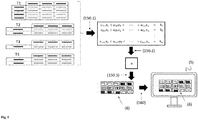
- Fig. 5 shows by way of example and schematically a specific embodiment of steps (150) and (160) of the in Fig. 3 illustrated method according to the invention, wherein step (150) from Fig. 3 in Fig. 5 is divided into three sub-steps (150.1), (150.2) and (150.3).
- the (in) equation system is preferably formed automatically. This can be done using Matlab or Python, for example.
- the (in) equation system is solved. This step, too, is preferably automated, for example by means of software for mathematical optimizations such as Gurobi Solver. During the optimization, a solution is sought that comes closest to achieving the optimization goal. This solution is, depending on the formulation of the Objective function, a maximum or minimum of the objective function.
- a flow chart (6) is generated from the solution. This step is also preferably automated, for example using Matlab or Python.
- the flow chart (6) or a part of the flow chart is displayed on an output unit (5) such as a monitor.
- Fig. 6 shows an example of a schedule.
- a schedule for a working week with the working days Monday to Friday (Mon, Tu, We, Th, Fri) is shown.
- the respective task is marked as hatching.
- the hatching can have different meanings, for example hatching can identify a process that the respective employee should carry out.
- hatching can identify a process object or a set of process objects that the respective employee should take care of (by adding them to one or more processes).
- hatching can identify a resource that is to be operated by the respective employee (the respective employee executing one or more processes on one or more process objects with the operating resource).
- the hatching can, however, also indicate a combination of several objects (process, process object, equipment).
- the size of the hatched area can indicate the time span in which the respective employee is busy with the respective task.
- the beginning and the end of the hatched area within the rectangle for the respective day and employee can, for example, indicate the beginning and end of the activities of the respective employee.
- the rectangle for employee Paul on Friday has a cross to indicate that he will not be available on Friday.
- a flow chart for process objects can indicate which process is to be carried out on the process objects in which time periods and / or which resources are to be used for processing the process objects in which time periods and / or which employees are to look after the process objects in which time periods.
- a flow chart for resources can show which resources are to be used at which time periods (e.g. by which employees, with which process objects and / or which processes are to be carried out).
- a particular strength of the invention is the ability to make changes to a schedule.
- Fig. 7 shows a possibility for a change.
- Fig. 7 (a) is the in Fig. 6 already shown flow chart shown. It turns out that the employee Agnes is not available on Monday.
- the computer system according to the invention and the computer program according to the invention are configured in such a way that a user can select the rectangle that represents the working day Monday for the employee Agnes , for example with a mouse, and enter the unavailability.
- Fig. 7 (b) As a result, the rectangle that represents the working day Monday for the employee Agnes is marked with a cross.
- the computer system according to the invention and the computer program according to the invention are configured in such a way that they recognize a change, in particular a change which leads to a task not being able to be carried out as planned.
- the computer system according to the invention and the computer program according to the invention are like this configured to display a message to the user on a monitor indicating that a task cannot be performed as scheduled.
- the computer system according to the invention and the computer program according to the invention are configured in such a way that they prompt the user to decide whether a new schedule should be created. If the user decides to create a new schedule, he can confirm this, for example, by making an entry in the computer system.
- the computer system according to the invention and the computer program according to the invention are configured in such a way that they set up a new (in) equation system based on the changed data (Agnes is no longer available on Monday), solve this and output the solution.
- Fig. 7 (c) shows a new schedule in which the task planned for the Monday working day for the employee Agnes is now to be completed on the working day Wednesday by the employee Charly .
- Fig. 8 shows another way of changing a schedule.
- Fig. 8 (a) is the in Fig. 6 already shown flow chart shown.
- an arrow is shown, which should represent a mouse pointer.
- the computer system according to the invention and the computer program according to the invention are configured in such a way that a user can select and move a task in the flow chart.
- Fig. 8 (a) and Fig. 8 (b) it is shown that the user selects the task planned for the workday Monday for the employee Agnes with the help of the mouse pointer.
- the computer system according to the invention and the computer program according to the invention are configured in such a way that they check the boundary conditions and highlight those working days of employees on which the selected task can be carried out without additional resources being required. In the present case, the respective working days are marked with a checkerboard pattern. The user can now decide for himself which working day he wants to postpone the task.
- Fig. 9 shows by way of example and schematically a preferred embodiment of the computer system according to the invention.
- the computer system (1) comprises a database (2), a receiving unit (3), a planning unit (4) and a plurality of output units (5.1, 5.2, 5.3 and 5.4).
- the receiving unit (3), the planning unit (4) and an output unit (5.1) are components of a first computer system.
- the first computer system can be used to create and update schedules. Inputs into the first computer system are made via a mouse or keyboard (not explicitly shown in the figure).
- the first computer system is configured to receive task information, process information, resource information and employee information via the receiving unit (3).
- the information comes from the database (2), which is set up as cloud storage, ie that one or more computer systems receive information from the cloud storage via a network (eg an intranet or the Internet) and transmit it to the cloud storage can.
- the planning unit (4) creates a sequence plan, which in turn can be stored in the cloud storage.
- the schedule can then be called up and displayed from various end devices.
- the flow chart can be output via the output unit (5.1) of the first computer system or via the output units (5.2, 5.3, 5.4) of other computer systems, which in the present case are designed as tablet computers. It is conceivable that every employee can have an individual schedule displayed on his tablet computer so that the employee is informed about which task he should complete and when.
Landscapes
- Business, Economics & Management (AREA)
- Human Resources & Organizations (AREA)
- Engineering & Computer Science (AREA)
- Strategic Management (AREA)
- Entrepreneurship & Innovation (AREA)
- Economics (AREA)
- Operations Research (AREA)
- Game Theory and Decision Science (AREA)
- Development Economics (AREA)
- Marketing (AREA)
- Educational Administration (AREA)
- Quality & Reliability (AREA)
- Tourism & Hospitality (AREA)
- Physics & Mathematics (AREA)
- General Business, Economics & Management (AREA)
- General Physics & Mathematics (AREA)
- Theoretical Computer Science (AREA)
- Management, Administration, Business Operations System, And Electronic Commerce (AREA)
Priority Applications (1)
| Application Number | Priority Date | Filing Date | Title |
|---|---|---|---|
| EP19212762.9A EP3832562A1 (fr) | 2019-12-02 | 2019-12-02 | Création et mise à jour d'ordinogrammes |
Applications Claiming Priority (1)
| Application Number | Priority Date | Filing Date | Title |
|---|---|---|---|
| EP19212762.9A EP3832562A1 (fr) | 2019-12-02 | 2019-12-02 | Création et mise à jour d'ordinogrammes |
Publications (1)
| Publication Number | Publication Date |
|---|---|
| EP3832562A1 true EP3832562A1 (fr) | 2021-06-09 |
Family
ID=68762520
Family Applications (1)
| Application Number | Title | Priority Date | Filing Date |
|---|---|---|---|
| EP19212762.9A Ceased EP3832562A1 (fr) | 2019-12-02 | 2019-12-02 | Création et mise à jour d'ordinogrammes |
Country Status (1)
| Country | Link |
|---|---|
| EP (1) | EP3832562A1 (fr) |
Cited By (1)
| Publication number | Priority date | Publication date | Assignee | Title |
|---|---|---|---|---|
| DE102022132942A1 (de) * | 2022-12-12 | 2024-06-13 | KyooBe Tech GmbH | Produktionsanlage zur Herstellung eines Produkts |
Citations (2)
| Publication number | Priority date | Publication date | Assignee | Title |
|---|---|---|---|---|
| US20160148137A1 (en) | 2014-11-24 | 2016-05-26 | International Business Machines Corporation | Optimized asset maintenance and replacement schedule |
| EP3188096A1 (fr) | 2015-12-28 | 2017-07-05 | Sap Se | Analyse de données pour l'optimisation de l'ordonnancement prédictif pour la production de produits |
-
2019
- 2019-12-02 EP EP19212762.9A patent/EP3832562A1/fr not_active Ceased
Patent Citations (2)
| Publication number | Priority date | Publication date | Assignee | Title |
|---|---|---|---|---|
| US20160148137A1 (en) | 2014-11-24 | 2016-05-26 | International Business Machines Corporation | Optimized asset maintenance and replacement schedule |
| EP3188096A1 (fr) | 2015-12-28 | 2017-07-05 | Sap Se | Analyse de données pour l'optimisation de l'ordonnancement prédictif pour la production de produits |
Non-Patent Citations (2)
| Title |
|---|
| R. MANSINI ET AL.: "Linear Mixed Integer Programing for Portfolio Optimization", 2015, SPRINGER |
| T. UNGERS. DEMPE: "Lineare Optimierung", 2010, VIEWEG + TEUBNER |
Cited By (1)
| Publication number | Priority date | Publication date | Assignee | Title |
|---|---|---|---|---|
| DE102022132942A1 (de) * | 2022-12-12 | 2024-06-13 | KyooBe Tech GmbH | Produktionsanlage zur Herstellung eines Produkts |
Similar Documents
| Publication | Publication Date | Title |
|---|---|---|
| DE102018111892B4 (de) | Betriebsüberwachungsvorrichtung und Steuerprogramm dafür | |
| Loske | Empirical evidence on human learning and work characteristics in the transition to automated order picking | |
| EP2452232B1 (fr) | Procédé pour optimiser des phases de travail orchestrées par un réseau de pétri pour des appareils d automatisation orientés service dans des systèmes automatisés orientés service | |
| DE112006000937T5 (de) | Verfahren und System zur Prüfung von Proben | |
| DE112019007257B4 (de) | Arbeits-assistenzeinrichtung | |
| DE10213830A1 (de) | Produktkostenvarianzanalysesystem und Steuerungsverfahren dafür | |
| DE102005010884A1 (de) | Prozesssteuerungssystem und Fertigungssteuerungssystem | |
| Isaza et al. | Automation and augmentation: A process study of how robotization shapes tasks of operational employees | |
| DE102008053274A1 (de) | Verfahren zur Steuerung einer Mehrzahl von Produktionsprozessen | |
| EP3832562A1 (fr) | Création et mise à jour d'ordinogrammes | |
| WO2011147560A2 (fr) | Procédé et système de production d'un modèle d'intégration | |
| EP3012603A1 (fr) | Procede et programme informatique destines a la detection et la quantification de grandeurs dans un processus de production | |
| EP4500424B1 (fr) | Optimisation d'un planning de production | |
| WO2022002518A1 (fr) | Fourniture de produits | |
| Elapanda et al. | An Analysis on Application of Lean Framework in Health and Safety Management for Manufacturing & Service Organizations | |
| DE112018007447T5 (de) | Informationstechnologieverwendungsevaluierungsvorrichtung,Informationstechnologieverwendungsevaluierungssystem undInformationstechnologieverwendungsevaluierungsverfahren | |
| WO2020016123A1 (fr) | Système de gestion de laboratoire | |
| EP3855375A1 (fr) | Identification de congestions dans des feuilles de route | |
| DE19539477A1 (de) | Verfahren zur automatisierten optimalen Redundanz-Auslegung von Messungen für die Leittechnik in Kraftwerken | |
| EP2901384A1 (fr) | Procédé de gestion de stock et/ou d'estimation du risque d'obsolescence | |
| RU2843492C1 (ru) | Способ и система генерации матрицы данных о производственных планах, структурированной по порядку, срокам и длительности выполнения операций всех производственных заказов | |
| DE102019105360A1 (de) | Betriebsverwaltungsvorrichtung | |
| AT501642A1 (de) | Verfahren zur steuerung einer fertigungsanlage | |
| DE102017005145A1 (de) | Verfahren und System zur Auftragsabwicklung | |
| DE102016119315A1 (de) | Apothekenbetriebseinrichtung |
Legal Events
| Date | Code | Title | Description |
|---|---|---|---|
| PUAI | Public reference made under article 153(3) epc to a published international application that has entered the european phase |
Free format text: ORIGINAL CODE: 0009012 |
|
| STAA | Information on the status of an ep patent application or granted ep patent |
Free format text: STATUS: THE APPLICATION HAS BEEN PUBLISHED |
|
| AK | Designated contracting states |
Kind code of ref document: A1 Designated state(s): AL AT BE BG CH CY CZ DE DK EE ES FI FR GB GR HR HU IE IS IT LI LT LU LV MC MK MT NL NO PL PT RO RS SE SI SK SM TR |
|
| STAA | Information on the status of an ep patent application or granted ep patent |
Free format text: STATUS: THE APPLICATION HAS BEEN REFUSED |
|
| 18R | Application refused |
Effective date: 20210628 |