EP3834582B1 - Procédé et appareil pour commander une qualité de service de liaison latérale - Google Patents
Procédé et appareil pour commander une qualité de service de liaison latérale Download PDFInfo
- Publication number
- EP3834582B1 EP3834582B1 EP19753321.9A EP19753321A EP3834582B1 EP 3834582 B1 EP3834582 B1 EP 3834582B1 EP 19753321 A EP19753321 A EP 19753321A EP 3834582 B1 EP3834582 B1 EP 3834582B1
- Authority
- EP
- European Patent Office
- Prior art keywords
- qos
- qos requirement
- network node
- bearer
- service
- Prior art date
- Legal status (The legal status is an assumption and is not a legal conclusion. Google has not performed a legal analysis and makes no representation as to the accuracy of the status listed.)
- Active
Links
Images



Classifications
-
- H—ELECTRICITY
- H04—ELECTRIC COMMUNICATION TECHNIQUE
- H04W—WIRELESS COMMUNICATION NETWORKS
- H04W76/00—Connection management
-
- H—ELECTRICITY
- H04—ELECTRIC COMMUNICATION TECHNIQUE
- H04W—WIRELESS COMMUNICATION NETWORKS
- H04W28/00—Network traffic management; Network resource management
- H04W28/16—Central resource management; Negotiation of resources or communication parameters, e.g. negotiating bandwidth or QoS [Quality of Service]
- H04W28/24—Negotiating SLA [Service Level Agreement]; Negotiating QoS [Quality of Service]
-
- H—ELECTRICITY
- H04—ELECTRIC COMMUNICATION TECHNIQUE
- H04L—TRANSMISSION OF DIGITAL INFORMATION, e.g. TELEGRAPHIC COMMUNICATION
- H04L47/00—Traffic control in data switching networks
- H04L47/10—Flow control; Congestion control
- H04L47/29—Flow control; Congestion control using a combination of thresholds
-
- H—ELECTRICITY
- H04—ELECTRIC COMMUNICATION TECHNIQUE
- H04L—TRANSMISSION OF DIGITAL INFORMATION, e.g. TELEGRAPHIC COMMUNICATION
- H04L47/00—Traffic control in data switching networks
- H04L47/70—Admission control; Resource allocation
- H04L47/80—Actions related to the user profile or the type of traffic
- H04L47/805—QOS or priority aware
-
- H—ELECTRICITY
- H04—ELECTRIC COMMUNICATION TECHNIQUE
- H04W—WIRELESS COMMUNICATION NETWORKS
- H04W28/00—Network traffic management; Network resource management
- H04W28/02—Traffic management, e.g. flow control or congestion control
- H04W28/0252—Traffic management, e.g. flow control or congestion control per individual bearer or channel
- H04W28/0263—Traffic management, e.g. flow control or congestion control per individual bearer or channel involving mapping traffic to individual bearers or channels, e.g. traffic flow template [TFT]
-
- H—ELECTRICITY
- H04—ELECTRIC COMMUNICATION TECHNIQUE
- H04W—WIRELESS COMMUNICATION NETWORKS
- H04W28/00—Network traffic management; Network resource management
- H04W28/02—Traffic management, e.g. flow control or congestion control
- H04W28/0268—Traffic management, e.g. flow control or congestion control using specific QoS parameters for wireless networks, e.g. QoS class identifier [QCI] or guaranteed bit rate [GBR]
-
- H—ELECTRICITY
- H04—ELECTRIC COMMUNICATION TECHNIQUE
- H04W—WIRELESS COMMUNICATION NETWORKS
- H04W72/00—Local resource management
- H04W72/50—Allocation or scheduling criteria for wireless resources
- H04W72/54—Allocation or scheduling criteria for wireless resources based on quality criteria
- H04W72/543—Allocation or scheduling criteria for wireless resources based on quality criteria based on requested quality, e.g. QoS
-
- H—ELECTRICITY
- H04—ELECTRIC COMMUNICATION TECHNIQUE
- H04W—WIRELESS COMMUNICATION NETWORKS
- H04W72/00—Local resource management
- H04W72/50—Allocation or scheduling criteria for wireless resources
- H04W72/56—Allocation or scheduling criteria for wireless resources based on priority criteria
-
- H—ELECTRICITY
- H04—ELECTRIC COMMUNICATION TECHNIQUE
- H04W—WIRELESS COMMUNICATION NETWORKS
- H04W76/00—Connection management
- H04W76/10—Connection setup
- H04W76/14—Direct-mode setup
-
- H—ELECTRICITY
- H04—ELECTRIC COMMUNICATION TECHNIQUE
- H04W—WIRELESS COMMUNICATION NETWORKS
- H04W76/00—Connection management
- H04W76/20—Manipulation of established connections
- H04W76/27—Transitions between radio resource control [RRC] states
-
- H—ELECTRICITY
- H04—ELECTRIC COMMUNICATION TECHNIQUE
- H04W—WIRELESS COMMUNICATION NETWORKS
- H04W4/00—Services specially adapted for wireless communication networks; Facilities therefor
- H04W4/30—Services specially adapted for particular environments, situations or purposes
- H04W4/40—Services specially adapted for particular environments, situations or purposes for vehicles, e.g. vehicle-to-pedestrians [V2P]
-
- H—ELECTRICITY
- H04—ELECTRIC COMMUNICATION TECHNIQUE
- H04W—WIRELESS COMMUNICATION NETWORKS
- H04W92/00—Interfaces specially adapted for wireless communication networks
- H04W92/16—Interfaces between hierarchically similar devices
- H04W92/18—Interfaces between hierarchically similar devices between terminal devices
Definitions
- the present application generally relates to wireless communication technology. More particularly, the present application relates to a method and apparatus for controlling sidelink (SL) QoS. The present application also relates to apparatus and computer program product adapted for the same purpose.
- SL sidelink
- QoS control is handled on bearer level in Long Term Evolution (LTE) and on QoS flow level in 5GS.
- LTE Long Term Evolution
- QoS control in Sidelink (SL) is based on the concept of ProSe Per-Packet Priority (PPPP) and ProSe Per-Packet Reliability (PPPR).
- PPPP ProSe Per-Packet Priority
- PPPR ProSe Per-Packet Reliability
- PDB packet delay budget
- upper layers may also indicate the PPPR value of a given packet.
- Priority queues (both intra-UE and inter-UE) are expected to be served in priority order i.e. UE (User Equipment) serves all packets associated with ProSe Per-Packet Priority N before serving packets associated with priority N+1 (lower number meaning higher priority).
- the PPPR is used to determine whether SL packet duplication to enhance transmission reliability shall be used or not.
- NW configures a mapping between Logical Channel Groups (LCGs) and PPPPs for the sake of Sidelink Buffer Status Report (SL-BSR) reporting, and UE indicates in SL-BSR the LCGs for which there are packets to transmit over the PC5 interface (interface between 2 UEs, also referred as Sidelink interface).
- SL-BSR Sidelink Buffer Status Report
- eNB receives the SL-BSR, it can determine which are the PPPPs of the packets UE needs to transmit over PC5, thereby also inferring the priority info and the packet delay budget.
- eNB can use the priority information reflecting PPPP for priority handling and UE-PC5-Aggregate Maximum Bit Rate (AMBR) for capping the UE PC5 transmission in the resources management.
- AMBR Maximum Bit Rate
- eNB/gNB may reserve one or more LCGs for PPPPR reporting.
- the eNB/gNB can, for example, decide whether to enable packet duplication or not.
- PPPP is contained in SCI to avoid other UEs transmitting on the high priority resources.
- UE derives the packet delay budget of the V2X message from PPPP based on the provisioned mapping information described.
- Management of QoS for V2X transmissions is for example described in WO 2018/016157 A1 , WO 2019/149182 A1 , and WO 2017/158515 A1 .
- EP 3 125 643 A1 , EP 3 148 285 A1 and WO 2015/163369 A1 describe utilization of bearers in SL communication.
- One of the objects is to provide methods and apparatus for controlling sidelink (SL) QoS in a cellular network, which could provide more solid sidelink QoS.
- the present invention provides a method according to claim 1, a UE according to claim 14 and a computer program product according to claim 16.
- the dependent claims define further embodiments.
- SL QoS control is based on basic relative priorities/reliabilities requirements differences, which can only secure the QoS of some particular UEs is better than that of other UEs but cannot secure an explicitly required QoS level, e.g. 20ms latency, of a particular V2X service of a UE. Moreover, for the UE using mode4 (UE autonomous resource selection), it is even worse, when all transmitting UEs are sharing resources.
- the QoS is mainly depending on the size of resource pool, and the number of UEs being using the pool. According to one or more embodiments, it provides mechanisms to improve SL QoS control enforcement.
- QoS requirement are determined at UE and then mapped into the corresponding data radio bearer for transmission according to the bearer configuration determined at network node.
- admission control could also be applied to help NW reject SL bearer requests when the channel is full or preempt low priority bearers for high priority ones.
- the invention can be implemented in numerous ways, including as a process; an apparatus; a system; a composition of matter; a computer program product embodied on a computer readable storage medium; and/or a processor, such as a processor configured to execute instructions stored on and/or provided by a memory coupled to the processor.
- these implementations, or any other form that the invention may take, may be referred to as techniques.
- the order of the steps of disclosed processes may be altered within the scope of the invention.
- a component such as a processor or a memory described as being configured to perform a task may be implemented as a general component that is temporarily configured to perform the task at a given time or a specific component that is manufactured to perform the task.
- the term "processor" refers to one or more devices, circuits, and/or processing cores configured to process data, such as computer program instructions.
- UE User Equipment
- UE User Equipment
- the non-exclusive examples of the UE include a hand-held telephone, a laptop computer equipped with a mobile broadband adapter, or any other device.
- Fig. 1 is a flow diagram illustrating a process for controlling sidelink (SL) Quality of Service (QoS) in a cellular network according to one or more exemplary embodiment.
- SL sidelink
- QoS Quality of Service
- a network node such as eNB/gNB, V2X control function or V2X server Node receives a SL bearer request from a user equipment (UE).
- the SL bearer request indicates QoS requirement, which, e.g., reflects QoS demand for SL transmission by the UE.
- the QoS requirement is represented as one of 5G QoS Indicator(5QI), QoS Class Identifier (QCI), ProSe Per-Packet Priority (PPPP) or ProSe Per-Packet Reliability (PPPR).
- the network node determines whether the bearer request is accepted on the basis of SL resources usage in the cellular network. If accepted, the process proceeds to step 103, which will be described in detail; otherwise, it proceeds to step 104 where the network node transmits to the UE a notification that the SL bearer request is rejected.
- the network node controls the number of UEs which are transmitting via sidelink at the same time.
- the determining is performed as follows:
- the SL resources are in form of one or more resource pools, each of which corresponds to a respective QoS requirement.
- the network node can configure the resource pools individually.
- the configuration for the resource pools can be adjusted at the network node by, e.g., adding new resource pool(s) or increasing the size of at least one of the resource pools.
- the network node may configure a plurality of resource pools corresponding to different QoS requirements. Several pools may be designated to one QoS requirement. For each pool, the network node evaluates whether the SL transmission by a new UE will degrade the QoS performance for the existing users in the pool. For example, the network node may specify some pools as ones where their QoS performance is not allowed to degrade. To this end, the network node may grant the pool with the least load to the new UE. If no pool satisfying the above criteria is available, the network node may carry out at least one of the following operations:
- a QoS threshold and a congestion level threshold can be assigned to one or more resource pools.
- the UE is allowed to use the resource pools for the SL transmission (only) if a congestion level of the resource pools is lower than the congestion level threshold for the QoS threshold.
- the network node may assign different QoS threshold and different associated congestion level to the same pool.
- the UE is allowed to start transmitting packets having a certain QoS on a given pool (only) if the congestion level (such as CBR) of such pool is lower than a certain congestion level threshold for the concerned QoS level.
- the UE shall stop using such pool if the congestion degrades above another congestion level for the concerned QoS level.
- step 103 where the network node determines bearer configuration for SL transmission by the UE on the basis of the QoS requirement.
- the determining may be performed as follows:
- the UE may either drop the corresponding QoS session/QoS flow/packet transmission or perform SL transmissions in best effort strategy.
- the UE may use the resources provided by the network for low priority transmissions where, for example, no latency requirements, bit rate, can be guaranteed.
- the network node may transmit to the UE information specifying which QoS requirement(s) can be supported in order to avoid non-supportable QoS demand from the UE.
- the information is transmitted during an attachment procedure or via a System Information Block (SIB).
- SIB System Information Block
- the bearer configuration comprises a mapping relationship between the QoS requirement and a SL Data Radio Bearer (DRB).
- the bearer configuration may further comprise one or more transmitting parameters. More preferably, the transmitting parameters comprises at least one of transmitting power for SL transmission, Modulation Coding Scheme (MCS), carrier aggregation, packet duplication configuration, and SL resources being used.
- MCS Modulation Coding Scheme
- a SOAP layer maps the QoS flows, e.g., the QCI/5QI of the incoming packets/QoS flows into PC5 data radio bearer associated with the corresponding LCID as indicated in the bearer configuration.
- the process proceeds to step 106 where the network node determines bearer reconfiguration for SL transmission on the basis of QoS performance.
- the network node may keep monitoring the QoS performance during the time based on feedbacks and reports sent from SL UEs.
- Link adaptation can be applied to achieve the required QoS. If the required QoS cannot be fulfilled during a certain amount of time, the current bearer will be modified or revoked.
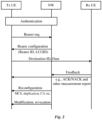
- Fig. 2 shows an example of NW SL QoS enforcement for In-Coverage connected mode according to one or more exemplary embodiment.
- TxUE and RxUE are in coverage and operate in RRC connected mode, an explicit permission from the NW is needed to establish and configure a SL bearer.
- TxUE sends a SL bearer request to NW for activating SL service.
- the information related to the SL bearer request can be sent via RRC, e.g. as part of SLUelnformation signal, including 5QI/QCI packets currently in an SL buffer, or related to SL QoS flows.
- the SL bearer request can be sent upon indication from upper layers that a certain V2X QoS session shall be initiated over a PC5 interface.
- the 5QI/QCI reported to NW in the SL bearer request are addressed by an index which is given to the UE via dedicated or SIB signaling by NW for each possible 5QI/QCI.
- a given 5QI/QCI is not associated with any index, it indicates that NW does not support NW controlled QoS for that specific 5QI/QCI in a concerned cell.
- TxUE shall either drop the corresponding QoS session/QoS flow/packet transmission, in which case AS layers at TxUE may indicate upper layers that such packet/QoS sessions/QoS flow shall be dropped, or perform transmissions of such QoS flow in best effort fashion, e.g.
- NW may indicate unallowable QCI/5QI in the concerned cell or indicate allowable QCI/5QI instead.
- NW upon reception of the SL bearer request, based on the current load in sidelink channel, NW determines whether the demanded QoS can be supported and returns acceptation or rejection accordingly. It shall be noted that if channel is unavailable, NW shall drop some low priority bearers in order to support the requested bearer with higher priority.
- NW will also configure, e.g. via RRC reconfiguration signaling, QoS to data radio bearer mapping in SL UE, e.g. SOAP layer.
- QoS to data radio bearer mapping in SL UE, e.g. SOAP layer.
- Such signal may indicate the mapping between the 5QI/QCI previously signaled in the SL bearer request and a PC5 DRB identity such as LCID, LCG, and a set of transmitting parameter configuration such as transmitting power, Modulation Coding Scheme (MCS), carrier aggregation, packet duplication configuration, and SL resources being used.
- MCS Modulation Coding Scheme
- the SOAP layer maps QoS flows, i.e. the QCI/5QI of the incoming packets/QoS flows into PC5 data radio bearer associated with the corresponding LCID as indicated in the bearer configuration by NW.
- NW keeps monitoring the QoS performance during the time based on feedbacks and reports sent from SL UEs, e.g., RxUE.
- Link adaptation can be applied to achieve the required QoS. If the required QoS cannot be fulfilled during a certain amount of time, the current bearer will be modified or revoked.
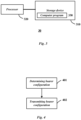
- Fig. 3 is a block diagram illustrating an apparatus for controlling sidelink (SL) Quality of Service (QoS) in a cellular network according to one or more exemplary embodiment.
- SL sidelink
- QoS Quality of Service
- the apparatus 30 comprises a storage device 310 and a processor 320 coupled to the storage device 310.
- the storage device 310 is configured to store a computer program 330 comprising computer instructions.
- the processor 320 is configured to execute the computer instructions to perform some or all of the method steps as shown in Figs. 1 and 2 .
- Fig. 4 is another flow diagram illustrating a process for controlling sidelink (SL) Quality of Service (QoS) in a cellular network.
- SL sidelink
- QoS Quality of Service
- a network node such as eNB/gNB, V2X control function or V2X server Node determines bearer configuration for SL transmission by the UE in response to attachment to the cellular network or location update of a User Equipment (UE).
- UE User Equipment
- the bearer configuration is determined based on an operational mode in which the UE operates, and the operational mode comprise a Radio Resource Control (RRC) connected mode and a RRC idle mode. That is, depending on the operational mode in which the UE operates, the network node may determine different bearer configurations for the UE. Moreover, when mode 3 UEs and mode 4 UEs are using the same resource pool, the same bearer configuration can be applied, and vice versa.
- RRC Radio Resource Control
- the bearer configuration provides QoS to data radio bearer mapping, which specifies, e.g. the usage of resource pools, LCID and LCG for each possible QoS flow.
- the network node may update the QoS to data radio bearer mapping.
- SL UEs do not need explicit permission from NW before SL transmitting via a bearer. Instead these SL UEs will perform SL transmission on the basis of the bearer configuration from the network node during attachment procedure.
- the bearer configuration comprises a mapping relationship between the QoS requirement and a SL Data Radio Bearer (DRB).
- the bearer configuration may further comprise one or more transmitting parameters. More preferably, the transmitting parameters comprises at least one of transmitting power for SL transmission, Modulation Coding Scheme (MCS), carrier aggregation, packet duplication configuration, and SL resources being used.
- MCS Modulation Coding Scheme
- the network node may transmit to the UE information specifying which QoS requirement(s) can be supported in order to avoid non-supportable QoS demand from the UE.
- the information is transmitted during an attachment procedure or via a System Information Block (SIB).
- SIB System Information Block
- step 402 the network node transmits the bearer configuration as determined at step 401 to the UE.
- Fig. 5 is another block diagram illustrating an apparatus for controlling sidelink (SL) Quality of Service (QoS) in a cellular network.
- SL sidelink
- QoS Quality of Service
- the apparatus 50 comprises a storage device 510 and a processor 520 coupled to the storage device 510.
- the storage device 510 is configured to store a computer program 530 comprising computer instructions.
- the processor 520 is configured to execute the computer instructions to perform some or all of the method steps as shown in Fig. 4 .
- Fig. 6 is another flow diagram illustrating a process for controlling sidelink (SL) Quality of Service (QoS).
- SL sidelink
- QoS Quality of Service
- a network node such as eNB/gNB, V2X control function or V2X server Node determines bearer configuration for SL transmission by the UE, which operates in a Radio Resource Control (RRC) idle mode.
- RRC Radio Resource Control
- the bearer configuration comprises a mapping relationship between the QoS requirement and a SL Data Radio Bearer (DRB)
- the bearer configuration may further comprise one or more transmitting parameters. More preferably, the transmitting parameters comprises at least one of transmitting power for SL transmission, Modulation Coding Scheme (MCS), carrier aggregation, packet duplication configuration, and SL resources being used.
- MCS Modulation Coding Scheme
- the process proceeds to step 602 where the network node broadcasts the bearer configuration as determined at step 601 in one or more cells of the cellular network where the UE resides.
- the bearer configuration is broadcasted via a System Information Block (SIB).
- SIB System Information Block
- the network node may transmit to the UE information specifying which QoS requirement(s) can be supported via a System Information Block (SIB).
- SL UEs do not need explicit permission from NW before SL transmitting via a bearer. Instead these SL UEs will perform SL transmission on the basis of the bearer configuration receiving from the network node while in the RRC idle mode.
- Fig. 7 is another block diagram illustrating an apparatus for controlling sidelink (SL) Quality of Service (QoS) in a cellular network.
- SL sidelink
- QoS Quality of Service
- the apparatus 70 comprises a storage device 710 and a processor 720 coupled to the storage device 710.
- the storage device 710 is configured to store a computer program 730 comprising computer instructions.
- the processor 720 is configured to execute the computer instructions to perform some or all of the method steps as shown in Fig. 6 .
- Fig. 8 is another flow diagram illustrating a process for controlling sidelink (SL) Quality of Service (QoS) in a cellular network according to one or more exemplary embodiment.
- SL sidelink
- QoS Quality of Service
- a UE generates QoS requirement from characteristics for one or more packets to be transmitted via a sidelink.
- the characteristics are defined in a packet header complying with a protocol layer above Access Stratum (AS).
- AS Access Stratum
- the protocol layer above AS may be transport layer or network layer where IP is used for transmission over PC5 or ITS facility layer where geo-networking is used for transmission over PC5.
- the characteristics may be represented as classical 5-tuple IP characteristics, e.g., source IP address, destination IP address, source port number, destination port number, protocol in use.
- the characteristic may be represented as geo-networking packet properties, e.g.
- Source port Destination port, Geo-Networking (GN) Destination address, GN Repetition interval indicating the periodicity of a given packet transmission, GN Maximum repetition time indicating the latency budget of a packet transmission, GN Traffic class, etc.
- GN Repetition interval indicating the periodicity of a given packet transmission
- GN Maximum repetition time indicating the latency budget of a packet transmission
- GN Traffic class etc.
- the specific V2X service is indicated, e.g., in the form of PSID or ITS-AIDs.
- the generating is performed by converting the characteristics into corresponding QoS requirement on the basis of a mapping relationship between the characteristics and the QoS requirement.
- the mapping relationship may be represented with a table including one or more entries, each defining a combination of the characteristic and the QoS requirement.
- each entry may be assigned an index, e.g., one as described with reference to Fig. 1 .
- the mapping relationship may be provided by the network node and can be updated by the network node.
- the mapping relationship may be provided with NAS/AS signaling (e.g. RRC/SIB) and/or represented as part of RRC preconfiguration.
- the mapping relationship can be provided while the UE entering radio NW coverage, and this can be performed by a network node such as the eNB/gNB, V2X control function or by a policy control function (PCF), or by a unified data repository (UDR), or by V2X server, or preconfigured in Universal Integrated Card (UICC) and/or Mobile Equipment (ME).
- a network node such as the eNB/gNB, V2X control function or by a policy control function (PCF), or by a unified data repository (UDR), or by V2X server, or preconfigured in Universal Integrated Card (UICC) and/or Mobile Equipment (ME).
- the mapping relationship can be provided via dedicated NAS or AS signaling in case the UE is in connected mode or via broadcast signaling (e.g., SIB) in case the UE is in idle mode.
- SIB broadcast signaling
- the mapping relationship depends on an operational mode, e.g., RRC connected mode, RRC idle mode or Out of Coverage (OoC) mode, in which the UE operates.
- an operational mode e.g., RRC connected mode, RRC idle mode or Out of Coverage (OoC) mode
- one or more candidate mapping relationships between the characteristics and the QoS requirement can be received from the network node and stored at the UE, each of which corresponds to one or more operational modes, and the operational mode comprises a Radio Resource Control (RRC) connected mode, a RRC idle mode and an Out of Coverage (OoC) mode.
- RRC Radio Resource Control
- OoC Out of Coverage
- the mapping relationship between the characteristics and the QoS requirement is selected from the one or more candidate mapping relationships depending on which operational mode the UE operates in.
- the UE transmits a bearer request comprising the QoS requirement as generated at step 801 to a network node.
- the network node may determine whether the bearer request is accepted on the basis of SL resources usage in the cellular network, and if accepted, it will transmit bearer configuration to the UE; otherwise, it will transmit to the UE a notification that the SL bearer request is rejected.
- step 803 the UE determines whether the SL bearer request is accepted or rejected. If accepted, it proceeds to step 804, and if rejected, it proceeds to step 805.
- the UE performs SL transmission on the basis of the bearer configuration received from the network node.
- a Service Data Adaption Protocol (SDAP) layer maps the QoS flows, e.g., the QCI/5QI of the incoming packets/QoS flows into PC5 data radio bearer associated with the corresponding LCID as indicated in the bearer configuration.
- SDAP Service Data Adaption Protocol
- the UE may either drop the corresponding QoS session/QoS flow/packet transmission or perform SL transmissions in best effort strategy.
- the UE may use the resources provided by the network for low priority transmissions where, for example, no latency requirements, bit rate, can be guaranteed.
- the bearer configuration comprises a mapping relationship between the QoS requirement and a SL Data Radio Bearer (DRB).
- the bearer configuration may further comprise one or more transmitting parameters. More preferably, the transmitting parameters comprises at least one of transmitting power for SL transmission, Modulation Coding Scheme (MCS), carrier aggregation, packet duplication configuration, and SL resources being used.
- MCS Modulation Coding Scheme
- Fig. 9 is another block diagram illustrating a User Equipment (UE) operating in a cellular network with sidelink (SL) Quality of Service (QoS) controlling function.
- UE User Equipment
- SL sidelink
- QoS Quality of Service
- UE 90 comprises a storage device 910 and a processor 920 coupled to the storage device 910.
- the storage device 910 is configured to store a computer program 930 comprising computer instructions.
- the processor 920 is configured to execute the computer instructions to perform some or all of the method steps as shown in Fig. 8 .
- Fig. 10 is another flow diagram illustrating a process for controlling sidelink (SL) Quality of Service (QoS) in a cellular network.
- SL sidelink
- QoS Quality of Service
- a UE generates QoS requirement from characteristics for one or more packets to be transmitted via a sidelink.
- the characteristics are defined in a packet header complying with a protocol layer above Access Stratum (AS).
- AS Access Stratum
- the protocol layer above AS may be transport layer or network layer where IP is used for transmission over PC5 or ITS facility layer where geo-networking is used for transmission over PC5.
- the characteristics may be represented as classical 5-tuple IP characteristics, e.g., source IP address, destination IP address, source port number, destination port number, protocol in use.
- the characteristic may be represented as geo-networking packet properties, e.g. Source port, Destination port, GN Destination address, GN Repetition interval indicating the periodicity of a given packet transmission, GN Maximum repetition time indicating the latency budget of a packet transmission, GN Traffic class, etc.
- the specific V2X service is indicated, e.g. in the form of PSID or ITS-AIDs.
- the generating is performed by converting the characteristics into corresponding QoS requirement on the basis of a mapping relationship between the characteristics and the QoS requirement.
- the mapping relationship may be represented with a table including one or more entries, each defining a combination of the characteristic and the QoS requirement.
- each entry may be assigned an index, e.g., one as described with reference to Fig. 1 .
- the mapping relationship may be provided by the network node and can be updated by the network node.
- the mapping relationship may be provided with Non-Access-Stratum/Access-Stratum (NAS/AS) signaling (e.g. RRC/SIB) and/or represented as part of RRC preconfiguration.
- NAS/AS Non-Access-Stratum/Access-Stratum
- the mapping relationship can be provided while the UE entering radio NW coverage, and this can be performed by a network node such as the eNB/gNB, V2X control function or by a policy control function (PCF), or by a unified data repository (UDR), or by V2X server, or preconfigured in UICC and/or ME.
- a network node such as the eNB/gNB, V2X control function or by a policy control function (PCF), or by a unified data repository (UDR), or by V2X server, or preconfigured in UICC and/or ME.
- the mapping relationship can be provided via dedicated NAS or AS signaling in case the UE is in connected mode or via broadcast signaling (e.g., SIB) in case the UE is in idle mode.
- SIB broadcast signaling
- the mapping relationship may depend on an operational mode, e.g., RRC connected mode, RRC idle mode or Out of Coverage (OoC) mode, in which the UE operates.
- an operational mode e.g., RRC connected mode, RRC idle mode or Out of Coverage (OoC) mode
- one or more candidate mapping relationships between the characteristics and the QoS requirement can be received from the network node and stored at the UE, each of which corresponds to one or more operational modes, and the operational mode comprises a Radio Resource Control (RRC) connected mode, an RRC idle mode and Out of Coverage (OoC) mode.
- RRC Radio Resource Control
- OoC Out of Coverage
- the mapping relationship between the characteristics and the QoS requirement is selected from the one or more candidate mapping relationships depending on which operational mode the UE operates in.
- the candidate mapping relationships between the characteristics and the QoS requirement can be received via broadcast from the network node while the UE is in-coverage of the cellular network.
- the UE determines bearer configuration corresponding to the QoS requirement as generated at step 1001.
- the determining may be on the basis of a mapping relationship between the QoS requirement and the bearer configuration.
- the mapping relationship can be received from the network node and stored at the UE. Alternatively, the mapping relationship can be preconfigured at the UE.
- mapping relationship between the QoS requirement and the bearer configuration can be received via broadcast from the network node while the UE is in-coverage of the cellular network.
- a SOAP layer can map the QoS flows, e.g., the QCI/5QI of the incoming packets/QoS flows into PC5 data radio bearer associated with the corresponding Logical Channel Identification (LCID) as indicated in the bearer configuration.
- LCID Logical Channel Identification
- the bearer configuration comprises a mapping relationship between the QoS requirement and a SL Data Radio Bearer (DRB).
- the bearer configuration may further comprise one or more transmitting parameters. More preferably, the transmitting parameters comprises at least one of transmitting power for SL transmission, Modulation Coding Scheme (MCS), carrier aggregation, packet duplication configuration, and SL resources being used.
- MCS Modulation Coding Scheme
- Fig. 11 is another block diagram illustrating a User Equipment (UE) operating in a cellular network with sidelink (SL) Quality of Service (QoS) controlling function.
- UE User Equipment
- SL sidelink
- QoS Quality of Service
- UE 110 comprises a storage device 1110 and a processor 1120 coupled to the storage device 1110.
- the storage device 1110 is configured to store a computer program 1130 comprising computer instructions.
- the processor 1120 is configured to execute the computer instructions to perform some or all of the method steps as shown in Fig. 10 .
- a method for controlling sidelink (SL) Quality of Service (QoS) in a cellular network comprises the following steps carried out at a network node:
- step a) comprises:
- the SL resources are in form of one or more resource pools, each of which corresponds to a respective QoS requirement.
- configuration for the resource pools can be adjusted by adding new resource pool(s) or increasing the size of at least one of the resource pools.
- a QoS threshold and a congestion level threshold are assigned to at least one of the resource pools and the UE is allowed to use the at least one of the resource pools for the SL transmission if a congestion level of the at least one of the resource pools is lower than the congestion level threshold for the QoS threshold.
- the QoS requirement is represented as one of 5G QoS Indicator(5QI), QoS Class Identifier (QCI), ProSe Per-Packet Priority(PPPP) or ProSe Per-Packet Reliability (PPPR).
- 5QI 5G QoS Indicator
- QCI QoS Class Identifier
- PPPP ProSe Per-Packet Priority
- PPPR ProSe Per-Packet Reliability
- the bearer configuration comprises a mapping relationship between the QoS requirement and a SL Data Radio Bearer (DRB).
- DRB SL Data Radio Bearer
- the bearer configuration further comprises a transmit parameter.
- the transmit parameter comprises at least one of transmitting power for SL transmission, Modulation Coding Scheme (MCS), carrier aggregation, packet duplication configuration, and SL resources being used.
- MCS Modulation Coding Scheme
- the method further comprises the step of determining bearer reconfiguration for SL transmission on the basis of QoS performance.
- step b) comprises:
- the method further comprises the step of signaling to the UE information specifying which QoS requirement(s) are supported.
- an apparatus (30) for controlling sidelink (SL) QoS in a cellular network comprises:
- step a) comprises:
- the SL resources are in form of one or more resource pools, each of which corresponds to a respective QoS requirement.
- configuration for the resource pools can be adjusted by adding new resource pool(s) or increasing the size of at least one of the resource pools.
- a QoS threshold and a congestion level threshold are assigned to at least one of the resource pools and the UE is allowed to use the at least one of the resource pools for the SL transmission if a congestion level of the at least one of the resource pools is lower than the congestion level threshold for the QoS threshold.
- the QoS requirement is represented as one of 5G QoS Indicator(5QI), QoS Class Identifier (QCI), ProSe Per-Packet Priority(PPPP) or ProSe Per-Packet Reliability (PPPR).
- 5QI 5G QoS Indicator
- QCI QoS Class Identifier
- PPPP ProSe Per-Packet Priority
- PPPR ProSe Per-Packet Reliability
- the bearer configuration comprises a mapping relationship between the QoS requirement and a SL Data Radio Bearer (DRB).
- DRB SL Data Radio Bearer
- the bearer configuration further comprises a transmit parameter.
- the transmit parameter comprises at least one of transmitting power for SL transmission, Modulation Coding Scheme (MCS), carrier aggregation, packet duplication configuration, and SL resources being used.
- MCS Modulation Coding Scheme
- the apparatus (30) is further configued for determining bearer reconfiguration for SL transmission on the basis of QoS performance.
- step b) comprises:
- the apparatus (30) is further configured for signaling to the UE information specifying which QoS requirement(s) are supported.
- a method for controlling sidelink (SL) Quality of Service (QoS) in a cellular network comprises the following steps carried out at a network node:
- the bearer configuration is determined based on an operational mode in which the UE operates, and the operational mode comprise a Radio Resource Control (RRC) connected mode and an RRC idle mode.
- RRC Radio Resource Control
- the bearer configuration comprises a mapping relationship between the QoS requirement and a SL Data Radio Bearer (DRB).
- DRB SL Data Radio Bearer
- the bearer configuration further comprises a transmit parameter.
- the transmit parameter comprises at least one of transmitting power for SL transmission, Modulation Coding Scheme (MCS), carrier aggregation, packet duplication configuration, and SL resources being used.
- MCS Modulation Coding Scheme
- the method further comprises the step of signaling to the UE information specifying which QoS requirement(s) are supported.
- an apparatus (50) for controlling sidelink (SL) Quality of Service (QoS) in a cellular network comprises:
- the bearer configuration is determined based on an operational mode in which the UE operates, and the operational mode comprise a Radio Resource Control (RRC) connected mode and an RRC idle mode.
- RRC Radio Resource Control
- the bearer configuration comprises a mapping relationship between the QoS requirement and a SL Data Radio Bearer (DRB).
- DRB SL Data Radio Bearer
- the bearer configuration further comprises a transmit parameter.
- the transmit parameter comprises at least one of transmitting power for SL transmission, Modulation Coding Scheme (MCS), carrier aggregation, packet duplication configuration, and SL resources being used.
- MCS Modulation Coding Scheme
- the apparatus (50) is further configured for signaling to the UE information specifying which QoS requirement(s) are supported.
- a method for controlling sidelink (SL) Quality of Service (QoS) in a cellular network comprises the following steps carried out at a network node:
- the bearer configuration comprises a mapping relationship between the QoS requirement and a SL Data Radio Bearer (DRB).
- DRB SL Data Radio Bearer
- the bearer configuration further comprises and a transmit parameter.
- the transmit parameter comprises at least one of transmitting power for SL transmission, Modulation Coding Scheme (MCS), carrier aggregation, packet duplication configuration, and SL resources being used.
- MCS Modulation Coding Scheme
- the bearer configuration is broadcasted via a System Information Block (SIB).
- SIB System Information Block
- the method further comprises the step of signaling to the UE information specifying which QoS requirement(s) are supported.
- an apparatus (70) for controlling sidelink (SL) Quality of Service (QoS) in a cellular network comprises:
- the bearer configuration comprises a mapping relationship between the QoS requirement and a SL Data Radio Bearer (DRB).
- DRB SL Data Radio Bearer
- the bearer configuration further comprises a transmit parameter.
- the transmit parameter comprises at least one of transmitting power for SL transmission, Modulation Coding Scheme (MCS), carrier aggregation, packet duplication configuration, and SL resources being used.
- MCS Modulation Coding Scheme
- the bearer configuration is broadcasted via a System Information Block (SIB).
- SIB System Information Block
- the apparatus (70) is further configured for signaling to the UE information specifying which QoS requirement(s) are supported.
- a method for controlling sidelink (SL) Quality of Service (QoS) in a cellular network comprises the following steps carried out at a User Equipment (UE):
- the characteristics are defined in a packet header complying with a protocol layer above Access Stratum (AS).
- AS Access Stratum
- the step a) comprises converting the characteristics into corresponding QoS requirement on the basis of a mapping relationship between the characteristics and the QoS requirement.
- mapping relationship is received from the network node and stored at the UE, or preconfigured at the UE.
- one or more candidate mapping relationships are received from the network node and stored at the UE, each of which corresponds to one or more operational modes, and the operational mode comprises a Radio Resource Control (RRC) connected mode, an RRC idle mode and Out of coverage (OoC) mode.
- RRC Radio Resource Control
- OoC Out of coverage
- the mapping relationship is selected from the one or more candidate mapping relationships depending on which operational mode the UE operates in.
- the method further comprises: d) if receiving a notification from the network node that the QoS requirement is not supported, performing (805) the SL transmission in best effort strategy or cancelling the SL transmission.
- the QoS requirement is represented as an index.
- the method further comprises the step of receiving from the network node information specifying which QoS requirement(s) are supported.
- the receiving is performed during an attachment procedure or via a System Information Block (SIB).
- SIB System Information Block
- a User Equipment (UE) (90) operating in a cellular network with sidelink (SL) Quality of Service (QoS) controlling function comprises:
- the characteristics are defined in a packet header complying with a protocol layer above Access Stratum (AS).
- AS Access Stratum
- the step a) comprises converting the characteristics into corresponding QoS requirement on the basis of a mapping relationship between the characteristics and the QoS requirement.
- mapping relationship is received from the network node and stored at the UE, or preconfigured at the UE.
- one or more candidate mapping relationships are received from the network node and stored at the UE, each of which corresponds to one or more operational modes, and the operational mode comprises a Radio Resource Control (RRC) connected mode, an RRC idle mode and Out of coverage (OoC) mode.
- RRC Radio Resource Control
- OoC Out of coverage
- the mapping relationship is selected from the one or more candidate mapping relationships depending on which operational mode the UE operates in.
- the UE (90) is further configured for: d) if receiving a notification from the network node that the QoS requirement is not supported, performing (805) the SL transmission in best effort strategy or cancelling the SL transmission.
- the QoS requirement is represented as an index.
- the UE is further configured for receiving from the network node information specifying which QoS requirement(s) are supported.
- the receiving is performed during an attachment procedure or via a System Information Block (SIB).
- SIB System Information Block
- a method for controlling sidelink (SL) Quality of Service comprises the following steps carried out at a User Equipment (UE):
- the UE is out of coverage of a cellular network.
- a mapping relationship between the QoS requirement and the bearer configuration is received from a network node and stored at the UE, or preconfigured at the UE.
- the characteristics are defined in a packet header complying with a protocol layer above Access Stratum (AS).
- AS Access Stratum
- the step a) comprising converting the characteristics into corresponding QoS requirement on the basis of a mapping relationship between the characteristics and the QoS requirement.
- mapping relationship between the characteristics and the QoS requirement is received from network node and stored at the UE, or preconfigured at the UE.
- one or more candidate mapping relationships between the characteristics and the QoS requirement are received from the network node and stored at the UE, each of which corresponds to one or more operational modes, and the operational mode comprises a Radio Resource Control (RRC) connected mode, an RRC idle mode and Out of coverage (OoC) mode.
- RRC Radio Resource Control
- OoC Out of coverage
- the mapping relationship between the characteristics and the QoS requirement is selected from the one or more candidate mapping relationships depending on which operational mode the UE operates in.
- a User Equipment (UE) (110) with sidelink (SL) Quality of Service (QoS) controlling function comprises:
- the UE is out of coverage of a cellular network.
- a mapping relationship between the QoS requirement and the bearer configuration is received from a network node and stored at the UE, or preconfigured at the UE.
- the characteristics are defined in a packet header complying with a protocol layer above Access Stratum (AS).
- AS Access Stratum
- the step a) comprising converting the characteristics into corresponding QoS requirement on the basis of a mapping relationship between the characteristics and the QoS requirement.
- mapping relationship between the characteristics and the QoS requirement is received from the network node and stored at the UE, or preconfigured at the UE.
- one or more candidate mapping relationships between the characteristics and the QoS requirement are received from the network node and stored at the UE, each of which corresponds to one or more operational modes, and the operational mode comprises a Radio Resource Control (RRC) connected mode, an RRC idle mode and Out of coverage (OoC) mode.
- RRC Radio Resource Control
- OoC Out of coverage
- the mapping relationship between the characteristics and the QoS requirement is selected from the one or more candidate mapping relationships depending on which operational mode the UE operates in.
- a computer program product for controlling sidelink (SL) Quality of Service (QoS) in a cellular network
- the computer program product being embodied in a computer readable storage medium and comprising computer instructions for carrying out the method according to one or more embodiments as described above.
- V2X service requirements five categories of requirements and five level of automations to better group various V2X service requirements may be defined, which are characterized by:
- 3GPP systems e.g., LTE and NR
- LTE and NR including both Uu and sidelink (SL) interfaces
- KPIs Key Performance Indicators
- QoS management for Uu interface may be specified based on QoS parameters, e.g., 5QI, ARP, RQA, GFBR, MFBR, notification control and maximum packet loss rate.
- QoS parameters e.g., 5QI, ARP, RQA, GFBR, MFBR, notification control and maximum packet loss rate.
- a 5QI value corresponds to multiple QoS characteristics, namely resource type (GBR, Delay critical GBR or Non-GBR), priority level, packet delay budget, packet error rate, averaging window, and maximum Data Burst Volume (for Delay-critical GBR resource type only).
- Table 1 gives a comparison between V2X KPIs and QoS parameter/characteristics. It indicates that most of the V2X KPls are already covered except transmission rate and minimum required communication range. Transmission rate can be determined by the network based on the data rate, latency, and payload requirements. Minimum required communication range is not a necessary QoS characteristic, which could be reflected by the destination address carried in the packet header, e.g. zone address in a geo-network. Relevant work regarding QoS framework for Uu is ongoing in SA2. Potential RAN enhancements for V2X may be developed based on inputs from SA2.
- Table 1 Comparison between V2X service KPI and QoS parameter/characteristic V2X service KPI QoS parameter/characteristic Payload Maximum data burst volume Transmission rate N/A Maximum end-to-end latency Packet delay budget Reliability Packet error rate Data rate GFBR/MFBR Minimum required communication range N/A
- QoS management for SL may be based on PPPP and/or PPPR.
- PPPP indicates the relative priority and reflects the latency requirement.
- PPPR describes the required reliability level with range from 1 to 8.
- Each generated V2X application packet will be configured with a PPPP value and optionally with a PPPR value.
- the packet will be treated in the lower layers according to PPPP/PPPR.
- packets with lower PPPP meaning a low latency requirement, will be transmitted first.
- packets with lower PPPP/PPPR can be transmitted using same resources occupied by other UEs for higher PPPP packet transmissions.
- the mapping between priority and LCID is left for UE implementation. It means there is no unified QoS handling rule among UEs and greedy UEs are allowed to assign lowest PPPP value to their generated packets.
- LTE SL UEs may handle logical channel prioritization differently depending on their implementations.
- a unified QoS handling rule e.g. map a packet to a corresponding QoS flow, may be used for NR SL UEs.
- SL there may be no explicit admission control mechanism in SL.
- UEs with low PPPP packets are allowed to transmit using those resources occupied by other UEs with high PPPP packets.
- severe collision will occur until collided transmitters drive far away from each other or a UE reselects its resource.
- a more concrete admission control may be needed in SL, such that a V2X service, which maps to one radio flow, only activates if there are enough free resources available.
- a more concrete admission control mechanism in SL may be needed.
- pre-emption mechanism may be needed to drop low priority packet transmissions when high priority packet transmission is requested and there are not enough free resources.
- gNB keep monitoring the resource usage of SL UEs. When channel is full, gNB can first stop some lowest priority packet transmissions and reserve those resources for newly arrived high priority packets.
- a pre-emption signalling can be designed.
- UEs with high priority packets can pre-empt some resources used for low priority packets before starting its own transmission.
- V2X service KPIs may be covered in 5GS QoS management for Uu.
- LTE SL UEs may handle logical channel prioritization differently depending on their implementations.
- a more concrete admission control mechanism in SL may be needed.
- 5GS QoS framework may be used for V2X services over Uu-interface.
- a unified QoS handling rule e.g. map a packet to a corresponding QoS flow, may be used for NR SL UEs.
- gNB keep monitoring the resource usage of SL UEs. When channel is full, gNB can first stop some lowest priority packet transmissions and reserve those resources for newly arrived high priority packets.
- a pre-emption signalling can be designed. UEs with high priority packets can pre-empt some resources used for low priority packets before starting its own transmission.
Landscapes
- Engineering & Computer Science (AREA)
- Computer Networks & Wireless Communication (AREA)
- Signal Processing (AREA)
- Quality & Reliability (AREA)
- Mobile Radio Communication Systems (AREA)
Claims (16)
- Procédé de commande d'une qualité de service, QoS, de liaison latérale, SL, dans un réseau cellulaire, étant caractérisé en ce qu'il comprend les étapes suivantes réalisées au niveau d'un équipement utilisateur, UE, qui est connecté au réseau cellulaire :- a) la génération (801) d'une exigence QoS à partir de caractéristiques indiquant un service de véhicule à tout, V2X, spécifique pour un ou plusieurs paquets à transmettre via une liaison latérale ;- b) la transmission (802) d'une demande de support comprenant l'exigence QoS à un noeud de réseau ; et- c) la réalisation (804) d'une transmission SL sur la base d'une configuration de support reçue depuis le noeud de réseau, dans lequel la configuration de support est déterminée sur la base de l'exigence QoS et comprend une relation de mappage entre l'exigence QoS et un support radio de données, DRB, SL.
- Procédé selon la revendication 1, dans lequel le service V2X spécifique est indiqué sous la forme d'un identifiant de service de fournisseur, PSID, ou d'identifiants d'application de système de transport intelligent, ITS-AID.
- Procédé selon la revendication 1 ou 2, dans lequel les caractéristiques sont définies dans un en-tête de paquet conforme à une couche de protocole au-dessus d'une strate d'accès, AS.
- Procédé selon l'une quelconque des revendications 1 à 3, dans lequel l'étape a) comprend la conversion des caractéristiques en une exigence QoS correspondante sur la base d'une relation de mappage entre les caractéristiques et l'exigence QoS.
- Procédé selon la revendication 4, dans lequel la relation de mappage entre les caractéristiques et l'exigence QoS est reçue depuis le noeud de réseau et stockée au niveau de l'UE ou préconfigurée au niveau de l'UE.
- Procédé selon la revendication 4 ou 5, dans lequel une ou plusieurs relations de mappage candidates sont reçues depuis le noeud de réseau et stockées au niveau de l'UE, chacune d'elles correspond à un ou plusieurs modes opérationnels, et le mode opérationnel comprend un mode connecté de commande de ressources radio, RRC, un mode de veille RRC et un mode hors couverture, OoC.
- Procédé selon la revendication 6, dans lequel la relation de mappage entre les caractéristiques et l'exigence QoS est sélectionnée parmi les une ou plusieurs relations de mappage candidates en fonction du mode opérationnel dans lequel l'UE fonctionne.
- Procédé selon l'une quelconque des revendications 1 à 7, comprenant en outre :
d) en cas de réception d'une notification depuis le noeud de réseau que l'exigence QoS n'est pas prise en charge, la réalisation (805) de la transmission SL selon une stratégie des meilleurs efforts ou l'annulation de la transmission SL. - Procédé selon l'une quelconque des revendications 1 à 8, dans lequel l'exigence QoS est représentée en tant qu'un indice.
- Procédé selon l'une quelconque des revendications 1 à 9, comprenant en outre l'étape de la réception, depuis le noeud de réseau, d'informations spécifiant la ou les exigences QoS qui sont prises en charge.
- Procédé selon la revendication 10, dans lequel la réception est réalisée au cours d'une procédure de rattachement ou via un bloc d'informations système, SIB.
- Procédé selon la revendication 6 ou 7, dans lequel la relation de mappage entre l'exigence QoS et la configuration de support et les relations de mappage candidates entre les caractéristiques et l'exigence QoS sont reçues par diffusion depuis le noeud de réseau.
- Procédé selon l'une quelconque des revendications 6 à 12, dans lequel au moins deux des relations de mappage candidates sont reçues depuis le noeud de réseau et stockées au niveau de l'UE.
- Equipement utilisateur, UE, (90) fonctionnant dans un réseau cellulaire avec une fonction de commande de qualité de service, QoS, de liaison latérale, SL, caractérisé en ce qu'il comprend :un dispositif de stockage (910) configuré pour stocker un programme informatique (930) comprenant des instructions informatiques ; etun processeur (930) couplé au dispositif de stockage et configuré pour exécuter les instructions informatiques pour, pendant que l'UE (90) est connecté au réseau cellulaire :- a) la génération (801) d'une exigence QoS à partir de caractéristiques indiquant un service de véhicule à tout, V2X, spécifique pour un ou plusieurs paquets à transmettre via une liaison latérale ;- b) la transmission (802) d'une demande de support comprenant l'exigence QoS à un noeud de réseau ; et- c) la réalisation (804) d'une transmission SL sur la base d'une configuration de support reçue depuis le noeud de réseau, dans lequel la configuration de support est déterminée sur la base de l'exigence QoS et comprend une relation de mappage entre l'exigence QoS et un support radio de données, DRB, SL.
- UE selon la revendication 14, configuré pour réaliser le procédé selon l'une quelconque des revendications 2 à 13.
- Produit programme informatique pour commander une qualité de service, QoS, de liaison latérale, SL, dans un réseau cellulaire, le produit programme informatique étant intégré dans un support de stockage lisible par ordinateur et comprenant des instructions informatiques pour réaliser le procédé selon l'une quelconque des revendications 1 à 13.
Priority Applications (1)
| Application Number | Priority Date | Filing Date | Title |
|---|---|---|---|
| EP24163810.5A EP4395449A3 (fr) | 2018-08-10 | 2019-08-09 | Procédé et appareil pour commander une qualité de service de liaison latérale |
Applications Claiming Priority (2)
| Application Number | Priority Date | Filing Date | Title |
|---|---|---|---|
| CN2018100024 | 2018-08-10 | ||
| PCT/EP2019/071457 WO2020030793A1 (fr) | 2018-08-10 | 2019-08-09 | Procédé et appareil pour commander une qualité de service de liaison latérale |
Related Child Applications (1)
| Application Number | Title | Priority Date | Filing Date |
|---|---|---|---|
| EP24163810.5A Division EP4395449A3 (fr) | 2018-08-10 | 2019-08-09 | Procédé et appareil pour commander une qualité de service de liaison latérale |
Publications (2)
| Publication Number | Publication Date |
|---|---|
| EP3834582A1 EP3834582A1 (fr) | 2021-06-16 |
| EP3834582B1 true EP3834582B1 (fr) | 2024-03-20 |
Family
ID=67659848
Family Applications (2)
| Application Number | Title | Priority Date | Filing Date |
|---|---|---|---|
| EP19753321.9A Active EP3834582B1 (fr) | 2018-08-10 | 2019-08-09 | Procédé et appareil pour commander une qualité de service de liaison latérale |
| EP24163810.5A Pending EP4395449A3 (fr) | 2018-08-10 | 2019-08-09 | Procédé et appareil pour commander une qualité de service de liaison latérale |
Family Applications After (1)
| Application Number | Title | Priority Date | Filing Date |
|---|---|---|---|
| EP24163810.5A Pending EP4395449A3 (fr) | 2018-08-10 | 2019-08-09 | Procédé et appareil pour commander une qualité de service de liaison latérale |
Country Status (4)
| Country | Link |
|---|---|
| US (3) | US11770741B2 (fr) |
| EP (2) | EP3834582B1 (fr) |
| CN (2) | CN113556786B (fr) |
| WO (1) | WO2020030793A1 (fr) |
Families Citing this family (11)
| Publication number | Priority date | Publication date | Assignee | Title |
|---|---|---|---|---|
| EP3834582B1 (fr) * | 2018-08-10 | 2024-03-20 | Telefonaktiebolaget LM Ericsson (publ) | Procédé et appareil pour commander une qualité de service de liaison latérale |
| CN113170487B (zh) | 2018-09-27 | 2024-06-04 | 瑞典爱立信有限公司 | 无线通信系统的自主模式下的副链路服务质量管理以及相关的方法和装置 |
| EP4657977A3 (fr) * | 2018-10-31 | 2026-02-18 | Koninklijke Philips N.V. | Attribution de groupe/bwp de ressources de liaison latérale sur la base de la qos |
| WO2020099128A1 (fr) | 2018-11-13 | 2020-05-22 | Telefonaktiebolaget Lm Ericsson (Publ) | Gestion de flux de qualité de service de liaison latérale dans des systèmes de communication sans fil et procédés et appareils associés |
| US12096273B2 (en) * | 2019-05-01 | 2024-09-17 | Lg Electronics Inc. | SDAP configuration for destination in sidelink communication |
| WO2021217376A1 (fr) * | 2020-04-27 | 2021-11-04 | 华为技术有限公司 | Procédé, appareil et système de communication |
| EP4009322A3 (fr) * | 2020-09-17 | 2022-06-15 | Orcam Technologies Ltd. | Systèmes et procédés d'atténuation sélective d'une voix |
| JP7709979B2 (ja) * | 2020-09-30 | 2025-07-17 | 株式会社Nttドコモ | 管理装置 |
| US12432616B2 (en) * | 2020-10-22 | 2025-09-30 | Telefonaktiebolaget Lm Ericsson (Publ) | Radio network node, network node, and methods performed in a wireless communication network |
| CN114666848A (zh) * | 2020-12-24 | 2022-06-24 | 夏普株式会社 | QoS分割和携带方法、对象侧QoS确定方法及UE |
| US20250142387A1 (en) * | 2021-11-11 | 2025-05-01 | Qualcomm Incorporated | Feedback report for sidelink communications using carrier aggregation |
Citations (1)
| Publication number | Priority date | Publication date | Assignee | Title |
|---|---|---|---|---|
| EP3858052A1 (fr) * | 2018-09-27 | 2021-08-04 | Telefonaktiebolaget LM Ericsson (publ) | Gestion de qualité de service de liaison latérale en mode autonome de systèmes de communication sans fil, et procédés et appareils associés |
Family Cites Families (10)
| Publication number | Priority date | Publication date | Assignee | Title |
|---|---|---|---|---|
| US20140204847A1 (en) | 2013-01-18 | 2014-07-24 | Telefonaktiebolaget L M Ericsson (Publ) | Network-assisted d2d communication using d2d capability information |
| WO2015163625A1 (fr) * | 2014-04-24 | 2015-10-29 | Lg Electronics Inc. | Procédé de création d'entités de couche 2 pour un système de communication d2d et dispositif associé |
| EP3125643B1 (fr) * | 2015-07-31 | 2019-04-03 | Panasonic Intellectual Property Corporation of America | Système d'allocation de resources amélioré pour des équipements utilisateurs agissant en relais de communication pour d'autres equipments distants |
| EP3148285B1 (fr) * | 2015-09-25 | 2019-04-17 | Panasonic Intellectual Property Corporation of America | Mappage de liens radio amélioré pour relais terminal cellulaire a réseau de 3gpp proximity services au moyen d'une signalisation de la priorité du traffic |
| EP3430834B1 (fr) * | 2016-03-15 | 2021-10-06 | Telefonaktiebolaget LM Ericsson (publ) | Systèmes et procédés de différenciation de qualité de service pour des supports non ip |
| EP3273634A1 (fr) | 2016-07-18 | 2018-01-24 | Panasonic Intellectual Property Corporation of America | Support amélioré de la qualité de service pour des transmissions de type v2x |
| WO2019108123A1 (fr) * | 2017-11-29 | 2019-06-06 | Telefonaktiebolaget Lm Ericsson (Publ) | Dispositif sans fil, nœud de réseau radio et procédés correspondants mis en oeuvre permettant de gérer une communication entre des dispositifs sans fil dans un réseau de communication sans fil |
| US10827380B2 (en) | 2018-01-30 | 2020-11-03 | Huawei Technologies Co., Ltd. | System and method for supporting URLLC in advanced V2X communications |
| JP7111820B2 (ja) * | 2018-02-15 | 2022-08-02 | テレフオンアクチーボラゲット エルエム エリクソン(パブル) | 無線デバイス、無線ネットワークノード、および、それらにおいて実行される方法 |
| EP3834582B1 (fr) * | 2018-08-10 | 2024-03-20 | Telefonaktiebolaget LM Ericsson (publ) | Procédé et appareil pour commander une qualité de service de liaison latérale |
-
2019
- 2019-08-09 EP EP19753321.9A patent/EP3834582B1/fr active Active
- 2019-08-09 WO PCT/EP2019/071457 patent/WO2020030793A1/fr not_active Ceased
- 2019-08-09 US US17/265,952 patent/US11770741B2/en active Active
- 2019-08-09 EP EP24163810.5A patent/EP4395449A3/fr active Pending
- 2019-08-09 CN CN202110832304.4A patent/CN113556786B/zh active Active
- 2019-08-09 CN CN201980051954.6A patent/CN112534954A/zh active Pending
-
2023
- 2023-08-25 US US18/456,034 patent/US12207140B2/en active Active
-
2024
- 2024-12-20 US US18/989,331 patent/US20250119796A1/en active Pending
Patent Citations (1)
| Publication number | Priority date | Publication date | Assignee | Title |
|---|---|---|---|---|
| EP3858052A1 (fr) * | 2018-09-27 | 2021-08-04 | Telefonaktiebolaget LM Ericsson (publ) | Gestion de qualité de service de liaison latérale en mode autonome de systèmes de communication sans fil, et procédés et appareils associés |
Also Published As
| Publication number | Publication date |
|---|---|
| US20250119796A1 (en) | 2025-04-10 |
| US12207140B2 (en) | 2025-01-21 |
| CN113556786A (zh) | 2021-10-26 |
| CN113556786B (zh) | 2024-07-26 |
| EP3834582A1 (fr) | 2021-06-16 |
| CN112534954A (zh) | 2021-03-19 |
| EP4395449A3 (fr) | 2024-09-18 |
| US11770741B2 (en) | 2023-09-26 |
| EP4395449A2 (fr) | 2024-07-03 |
| WO2020030793A1 (fr) | 2020-02-13 |
| US20210297905A1 (en) | 2021-09-23 |
| US20230422101A1 (en) | 2023-12-28 |
Similar Documents
| Publication | Publication Date | Title |
|---|---|---|
| US12207140B2 (en) | Method and apparatus for controlling sidelink QoS | |
| US20230127924A1 (en) | ProSe REMOTE AND RELAYING ENTITY QoS MANAGEMENT | |
| CN113228777B (zh) | 实现不同类型的同时传输的过程 | |
| US12058562B2 (en) | QoS-aware congestion control, resource allocation and in-device coexistence solutions for NR V2X sidelink communications | |
| JP7454551B2 (ja) | 優先度の高い通信およびQoSフィードバックのためのリソースの再割振りおよび予約 | |
| US11889579B2 (en) | QoS flows inactivity counters | |
| EP2514256B1 (fr) | Procédé d'établissement de porteuses dans un système d'accès radio | |
| EP2258134B1 (fr) | Priorisation de signalisation de commande de l3 actionnée par réseau | |
| RU2432698C2 (ru) | Способ и устройство для обеспечения предотвращения истощения восходящей линии связи в системе долговременного развития | |
| US20210219110A1 (en) | Device for transmitting and/or receiving a message in a combined assisted and ad-hoc mode | |
| US20250267023A1 (en) | Deterministic Networks | |
| US10686723B2 (en) | Providing quality of service based on bandwidth | |
| IL224489A (en) | Method and Device for Establishing User Equipment Policies Providing Mutual Help in a Long-Term Evolution System Operating Area | |
| US20100250688A1 (en) | Reservation and admission of access resources for access selection in multi-access networks | |
| US10887789B2 (en) | Feedback for RAN-assisted rate adaptation | |
| US11265762B2 (en) | Management of bitrate for UE bearers | |
| CN119364422A (zh) | 通信方法、装置及系统 | |
| CN111052848A (zh) | 用于操作蜂窝无线电通信网络网络实体的方法以及蜂窝无线电通信网络网络实体 | |
| CN120730379A (zh) | 无线通信方法、网元和装置 | |
| RU2782447C1 (ru) | Процедуры для обеспечения возможности одновременной передачи разных типов |
Legal Events
| Date | Code | Title | Description |
|---|---|---|---|
| STAA | Information on the status of an ep patent application or granted ep patent |
Free format text: STATUS: UNKNOWN |
|
| STAA | Information on the status of an ep patent application or granted ep patent |
Free format text: STATUS: THE INTERNATIONAL PUBLICATION HAS BEEN MADE |
|
| PUAI | Public reference made under article 153(3) epc to a published international application that has entered the european phase |
Free format text: ORIGINAL CODE: 0009012 |
|
| STAA | Information on the status of an ep patent application or granted ep patent |
Free format text: STATUS: REQUEST FOR EXAMINATION WAS MADE |
|
| 17P | Request for examination filed |
Effective date: 20210302 |
|
| AK | Designated contracting states |
Kind code of ref document: A1 Designated state(s): AL AT BE BG CH CY CZ DE DK EE ES FI FR GB GR HR HU IE IS IT LI LT LU LV MC MK MT NL NO PL PT RO RS SE SI SK SM TR |
|
| DAV | Request for validation of the european patent (deleted) | ||
| DAX | Request for extension of the european patent (deleted) | ||
| STAA | Information on the status of an ep patent application or granted ep patent |
Free format text: STATUS: EXAMINATION IS IN PROGRESS |
|
| 17Q | First examination report despatched |
Effective date: 20221212 |
|
| REG | Reference to a national code |
Ref country code: DE Free format text: PREVIOUS MAIN CLASS: H04W0076000000 Ref legal event code: R079 Ref document number: 602019048624 Country of ref document: DE Ipc: H04W0028240000 |
|
| GRAP | Despatch of communication of intention to grant a patent |
Free format text: ORIGINAL CODE: EPIDOSNIGR1 |
|
| STAA | Information on the status of an ep patent application or granted ep patent |
Free format text: STATUS: GRANT OF PATENT IS INTENDED |
|
| RIC1 | Information provided on ipc code assigned before grant |
Ipc: H04W 76/14 20180101ALI20231221BHEP Ipc: H04W 72/04 20090101ALI20231221BHEP Ipc: H04W 28/24 20090101AFI20231221BHEP |
|
| GRAS | Grant fee paid |
Free format text: ORIGINAL CODE: EPIDOSNIGR3 |
|
| GRAA | (expected) grant |
Free format text: ORIGINAL CODE: 0009210 |
|
| STAA | Information on the status of an ep patent application or granted ep patent |
Free format text: STATUS: THE PATENT HAS BEEN GRANTED |
|
| INTG | Intention to grant announced |
Effective date: 20240124 |
|
| AK | Designated contracting states |
Kind code of ref document: B1 Designated state(s): AL AT BE BG CH CY CZ DE DK EE ES FI FR GB GR HR HU IE IS IT LI LT LU LV MC MK MT NL NO PL PT RO RS SE SI SK SM TR |
|
| REG | Reference to a national code |
Ref country code: GB Ref legal event code: FG4D |
|
| P01 | Opt-out of the competence of the unified patent court (upc) registered |
Effective date: 20240219 |
|
| REG | Reference to a national code |
Ref country code: CH Ref legal event code: EP |
|
| REG | Reference to a national code |
Ref country code: DE Ref legal event code: R096 Ref document number: 602019048624 Country of ref document: DE |
|
| REG | Reference to a national code |
Ref country code: IE Ref legal event code: FG4D |
|
| PG25 | Lapsed in a contracting state [announced via postgrant information from national office to epo] |
Ref country code: LT Free format text: LAPSE BECAUSE OF FAILURE TO SUBMIT A TRANSLATION OF THE DESCRIPTION OR TO PAY THE FEE WITHIN THE PRESCRIBED TIME-LIMIT Effective date: 20240320 |
|
| REG | Reference to a national code |
Ref country code: LT Ref legal event code: MG9D |
|
| PG25 | Lapsed in a contracting state [announced via postgrant information from national office to epo] |
Ref country code: GR Free format text: LAPSE BECAUSE OF FAILURE TO SUBMIT A TRANSLATION OF THE DESCRIPTION OR TO PAY THE FEE WITHIN THE PRESCRIBED TIME-LIMIT Effective date: 20240621 |
|
| PG25 | Lapsed in a contracting state [announced via postgrant information from national office to epo] |
Ref country code: RS Free format text: LAPSE BECAUSE OF FAILURE TO SUBMIT A TRANSLATION OF THE DESCRIPTION OR TO PAY THE FEE WITHIN THE PRESCRIBED TIME-LIMIT Effective date: 20240620 Ref country code: HR Free format text: LAPSE BECAUSE OF FAILURE TO SUBMIT A TRANSLATION OF THE DESCRIPTION OR TO PAY THE FEE WITHIN THE PRESCRIBED TIME-LIMIT Effective date: 20240320 |
|
| REG | Reference to a national code |
Ref country code: NL Ref legal event code: MP Effective date: 20240320 |
|
| PG25 | Lapsed in a contracting state [announced via postgrant information from national office to epo] |
Ref country code: RS Free format text: LAPSE BECAUSE OF FAILURE TO SUBMIT A TRANSLATION OF THE DESCRIPTION OR TO PAY THE FEE WITHIN THE PRESCRIBED TIME-LIMIT Effective date: 20240620 Ref country code: NO Free format text: LAPSE BECAUSE OF FAILURE TO SUBMIT A TRANSLATION OF THE DESCRIPTION OR TO PAY THE FEE WITHIN THE PRESCRIBED TIME-LIMIT Effective date: 20240620 Ref country code: LT Free format text: LAPSE BECAUSE OF FAILURE TO SUBMIT A TRANSLATION OF THE DESCRIPTION OR TO PAY THE FEE WITHIN THE PRESCRIBED TIME-LIMIT Effective date: 20240320 Ref country code: HR Free format text: LAPSE BECAUSE OF FAILURE TO SUBMIT A TRANSLATION OF THE DESCRIPTION OR TO PAY THE FEE WITHIN THE PRESCRIBED TIME-LIMIT Effective date: 20240320 Ref country code: GR Free format text: LAPSE BECAUSE OF FAILURE TO SUBMIT A TRANSLATION OF THE DESCRIPTION OR TO PAY THE FEE WITHIN THE PRESCRIBED TIME-LIMIT Effective date: 20240621 Ref country code: FI Free format text: LAPSE BECAUSE OF FAILURE TO SUBMIT A TRANSLATION OF THE DESCRIPTION OR TO PAY THE FEE WITHIN THE PRESCRIBED TIME-LIMIT Effective date: 20240320 Ref country code: BG Free format text: LAPSE BECAUSE OF FAILURE TO SUBMIT A TRANSLATION OF THE DESCRIPTION OR TO PAY THE FEE WITHIN THE PRESCRIBED TIME-LIMIT Effective date: 20240320 |
|
| REG | Reference to a national code |
Ref country code: AT Ref legal event code: MK05 Ref document number: 1668902 Country of ref document: AT Kind code of ref document: T Effective date: 20240320 |
|
| PG25 | Lapsed in a contracting state [announced via postgrant information from national office to epo] |
Ref country code: SE Free format text: LAPSE BECAUSE OF FAILURE TO SUBMIT A TRANSLATION OF THE DESCRIPTION OR TO PAY THE FEE WITHIN THE PRESCRIBED TIME-LIMIT Effective date: 20240320 Ref country code: LV Free format text: LAPSE BECAUSE OF FAILURE TO SUBMIT A TRANSLATION OF THE DESCRIPTION OR TO PAY THE FEE WITHIN THE PRESCRIBED TIME-LIMIT Effective date: 20240320 |
|
| PG25 | Lapsed in a contracting state [announced via postgrant information from national office to epo] |
Ref country code: NL Free format text: LAPSE BECAUSE OF FAILURE TO SUBMIT A TRANSLATION OF THE DESCRIPTION OR TO PAY THE FEE WITHIN THE PRESCRIBED TIME-LIMIT Effective date: 20240320 |
|
| PG25 | Lapsed in a contracting state [announced via postgrant information from national office to epo] |
Ref country code: NL Free format text: LAPSE BECAUSE OF FAILURE TO SUBMIT A TRANSLATION OF THE DESCRIPTION OR TO PAY THE FEE WITHIN THE PRESCRIBED TIME-LIMIT Effective date: 20240320 |
|
| PG25 | Lapsed in a contracting state [announced via postgrant information from national office to epo] |
Ref country code: IS Free format text: LAPSE BECAUSE OF FAILURE TO SUBMIT A TRANSLATION OF THE DESCRIPTION OR TO PAY THE FEE WITHIN THE PRESCRIBED TIME-LIMIT Effective date: 20240720 |
|
| PG25 | Lapsed in a contracting state [announced via postgrant information from national office to epo] |
Ref country code: SM Free format text: LAPSE BECAUSE OF FAILURE TO SUBMIT A TRANSLATION OF THE DESCRIPTION OR TO PAY THE FEE WITHIN THE PRESCRIBED TIME-LIMIT Effective date: 20240320 Ref country code: PT Free format text: LAPSE BECAUSE OF FAILURE TO SUBMIT A TRANSLATION OF THE DESCRIPTION OR TO PAY THE FEE WITHIN THE PRESCRIBED TIME-LIMIT Effective date: 20240722 |
|
| PG25 | Lapsed in a contracting state [announced via postgrant information from national office to epo] |
Ref country code: ES Free format text: LAPSE BECAUSE OF FAILURE TO SUBMIT A TRANSLATION OF THE DESCRIPTION OR TO PAY THE FEE WITHIN THE PRESCRIBED TIME-LIMIT Effective date: 20240320 |
|
| PG25 | Lapsed in a contracting state [announced via postgrant information from national office to epo] |
Ref country code: CZ Free format text: LAPSE BECAUSE OF FAILURE TO SUBMIT A TRANSLATION OF THE DESCRIPTION OR TO PAY THE FEE WITHIN THE PRESCRIBED TIME-LIMIT Effective date: 20240320 Ref country code: EE Free format text: LAPSE BECAUSE OF FAILURE TO SUBMIT A TRANSLATION OF THE DESCRIPTION OR TO PAY THE FEE WITHIN THE PRESCRIBED TIME-LIMIT Effective date: 20240320 |
|
| PG25 | Lapsed in a contracting state [announced via postgrant information from national office to epo] |
Ref country code: AT Free format text: LAPSE BECAUSE OF FAILURE TO SUBMIT A TRANSLATION OF THE DESCRIPTION OR TO PAY THE FEE WITHIN THE PRESCRIBED TIME-LIMIT Effective date: 20240320 |
|
| PG25 | Lapsed in a contracting state [announced via postgrant information from national office to epo] |
Ref country code: PL Free format text: LAPSE BECAUSE OF FAILURE TO SUBMIT A TRANSLATION OF THE DESCRIPTION OR TO PAY THE FEE WITHIN THE PRESCRIBED TIME-LIMIT Effective date: 20240320 |
|
| PG25 | Lapsed in a contracting state [announced via postgrant information from national office to epo] |
Ref country code: SK Free format text: LAPSE BECAUSE OF FAILURE TO SUBMIT A TRANSLATION OF THE DESCRIPTION OR TO PAY THE FEE WITHIN THE PRESCRIBED TIME-LIMIT Effective date: 20240320 |
|
| PG25 | Lapsed in a contracting state [announced via postgrant information from national office to epo] |
Ref country code: SM Free format text: LAPSE BECAUSE OF FAILURE TO SUBMIT A TRANSLATION OF THE DESCRIPTION OR TO PAY THE FEE WITHIN THE PRESCRIBED TIME-LIMIT Effective date: 20240320 Ref country code: SK Free format text: LAPSE BECAUSE OF FAILURE TO SUBMIT A TRANSLATION OF THE DESCRIPTION OR TO PAY THE FEE WITHIN THE PRESCRIBED TIME-LIMIT Effective date: 20240320 Ref country code: RO Free format text: LAPSE BECAUSE OF FAILURE TO SUBMIT A TRANSLATION OF THE DESCRIPTION OR TO PAY THE FEE WITHIN THE PRESCRIBED TIME-LIMIT Effective date: 20240320 Ref country code: PT Free format text: LAPSE BECAUSE OF FAILURE TO SUBMIT A TRANSLATION OF THE DESCRIPTION OR TO PAY THE FEE WITHIN THE PRESCRIBED TIME-LIMIT Effective date: 20240722 Ref country code: PL Free format text: LAPSE BECAUSE OF FAILURE TO SUBMIT A TRANSLATION OF THE DESCRIPTION OR TO PAY THE FEE WITHIN THE PRESCRIBED TIME-LIMIT Effective date: 20240320 Ref country code: IS Free format text: LAPSE BECAUSE OF FAILURE TO SUBMIT A TRANSLATION OF THE DESCRIPTION OR TO PAY THE FEE WITHIN THE PRESCRIBED TIME-LIMIT Effective date: 20240720 Ref country code: ES Free format text: LAPSE BECAUSE OF FAILURE TO SUBMIT A TRANSLATION OF THE DESCRIPTION OR TO PAY THE FEE WITHIN THE PRESCRIBED TIME-LIMIT Effective date: 20240320 Ref country code: EE Free format text: LAPSE BECAUSE OF FAILURE TO SUBMIT A TRANSLATION OF THE DESCRIPTION OR TO PAY THE FEE WITHIN THE PRESCRIBED TIME-LIMIT Effective date: 20240320 Ref country code: CZ Free format text: LAPSE BECAUSE OF FAILURE TO SUBMIT A TRANSLATION OF THE DESCRIPTION OR TO PAY THE FEE WITHIN THE PRESCRIBED TIME-LIMIT Effective date: 20240320 Ref country code: AT Free format text: LAPSE BECAUSE OF FAILURE TO SUBMIT A TRANSLATION OF THE DESCRIPTION OR TO PAY THE FEE WITHIN THE PRESCRIBED TIME-LIMIT Effective date: 20240320 |
|
| PG25 | Lapsed in a contracting state [announced via postgrant information from national office to epo] |
Ref country code: IT Free format text: LAPSE BECAUSE OF FAILURE TO SUBMIT A TRANSLATION OF THE DESCRIPTION OR TO PAY THE FEE WITHIN THE PRESCRIBED TIME-LIMIT Effective date: 20240320 |
|
| REG | Reference to a national code |
Ref country code: DE Ref legal event code: R097 Ref document number: 602019048624 Country of ref document: DE |
|
| PG25 | Lapsed in a contracting state [announced via postgrant information from national office to epo] |
Ref country code: IT Free format text: LAPSE BECAUSE OF FAILURE TO SUBMIT A TRANSLATION OF THE DESCRIPTION OR TO PAY THE FEE WITHIN THE PRESCRIBED TIME-LIMIT Effective date: 20240320 |
|
| PG25 | Lapsed in a contracting state [announced via postgrant information from national office to epo] |
Ref country code: DK Free format text: LAPSE BECAUSE OF FAILURE TO SUBMIT A TRANSLATION OF THE DESCRIPTION OR TO PAY THE FEE WITHIN THE PRESCRIBED TIME-LIMIT Effective date: 20240320 |
|
| PLBE | No opposition filed within time limit |
Free format text: ORIGINAL CODE: 0009261 |
|
| STAA | Information on the status of an ep patent application or granted ep patent |
Free format text: STATUS: NO OPPOSITION FILED WITHIN TIME LIMIT |
|
| PG25 | Lapsed in a contracting state [announced via postgrant information from national office to epo] |
Ref country code: DK Free format text: LAPSE BECAUSE OF FAILURE TO SUBMIT A TRANSLATION OF THE DESCRIPTION OR TO PAY THE FEE WITHIN THE PRESCRIBED TIME-LIMIT Effective date: 20240320 |
|
| 26N | No opposition filed |
Effective date: 20241223 |
|
| REG | Reference to a national code |
Ref country code: CH Ref legal event code: PL |
|
| PG25 | Lapsed in a contracting state [announced via postgrant information from national office to epo] |
Ref country code: LU Free format text: LAPSE BECAUSE OF NON-PAYMENT OF DUE FEES Effective date: 20240809 |
|
| PG25 | Lapsed in a contracting state [announced via postgrant information from national office to epo] |
Ref country code: SI Free format text: LAPSE BECAUSE OF FAILURE TO SUBMIT A TRANSLATION OF THE DESCRIPTION OR TO PAY THE FEE WITHIN THE PRESCRIBED TIME-LIMIT Effective date: 20240320 Ref country code: CH Free format text: LAPSE BECAUSE OF NON-PAYMENT OF DUE FEES Effective date: 20240831 Ref country code: MC Free format text: LAPSE BECAUSE OF FAILURE TO SUBMIT A TRANSLATION OF THE DESCRIPTION OR TO PAY THE FEE WITHIN THE PRESCRIBED TIME-LIMIT Effective date: 20240320 |
|
| REG | Reference to a national code |
Ref country code: BE Ref legal event code: MM Effective date: 20240831 |
|
| PG25 | Lapsed in a contracting state [announced via postgrant information from national office to epo] |
Ref country code: BE Free format text: LAPSE BECAUSE OF NON-PAYMENT OF DUE FEES Effective date: 20240831 |
|
| PG25 | Lapsed in a contracting state [announced via postgrant information from national office to epo] |
Ref country code: FR Free format text: LAPSE BECAUSE OF NON-PAYMENT OF DUE FEES Effective date: 20240831 |
|
| PG25 | Lapsed in a contracting state [announced via postgrant information from national office to epo] |
Ref country code: IE Free format text: LAPSE BECAUSE OF NON-PAYMENT OF DUE FEES Effective date: 20240809 |
|
| PGFP | Annual fee paid to national office [announced via postgrant information from national office to epo] |
Ref country code: DE Payment date: 20250827 Year of fee payment: 7 |
|
| PGFP | Annual fee paid to national office [announced via postgrant information from national office to epo] |
Ref country code: TR Payment date: 20250721 Year of fee payment: 7 |
|
| PGFP | Annual fee paid to national office [announced via postgrant information from national office to epo] |
Ref country code: GB Payment date: 20250827 Year of fee payment: 7 |
|
| PG25 | Lapsed in a contracting state [announced via postgrant information from national office to epo] |
Ref country code: CY Free format text: LAPSE BECAUSE OF FAILURE TO SUBMIT A TRANSLATION OF THE DESCRIPTION OR TO PAY THE FEE WITHIN THE PRESCRIBED TIME-LIMIT; INVALID AB INITIO Effective date: 20190809 |
|
| PG25 | Lapsed in a contracting state [announced via postgrant information from national office to epo] |
Ref country code: HU Free format text: LAPSE BECAUSE OF FAILURE TO SUBMIT A TRANSLATION OF THE DESCRIPTION OR TO PAY THE FEE WITHIN THE PRESCRIBED TIME-LIMIT; INVALID AB INITIO Effective date: 20190809 |