EP3834860B1 - Vorrichtung für die extrakorporale blutzirkulation - Google Patents
Vorrichtung für die extrakorporale blutzirkulation Download PDFInfo
- Publication number
- EP3834860B1 EP3834860B1 EP19215310.4A EP19215310A EP3834860B1 EP 3834860 B1 EP3834860 B1 EP 3834860B1 EP 19215310 A EP19215310 A EP 19215310A EP 3834860 B1 EP3834860 B1 EP 3834860B1
- Authority
- EP
- European Patent Office
- Prior art keywords
- blood
- loop
- circulation circuit
- circulation
- liquefaction
- Prior art date
- Legal status (The legal status is an assumption and is not a legal conclusion. Google has not performed a legal analysis and makes no representation as to the accuracy of the status listed.)
- Active
Links
Images


Classifications
-
- A—HUMAN NECESSITIES
- A61—MEDICAL OR VETERINARY SCIENCE; HYGIENE
- A61M—DEVICES FOR INTRODUCING MEDIA INTO, OR ONTO, THE BODY; DEVICES FOR TRANSDUCING BODY MEDIA OR FOR TAKING MEDIA FROM THE BODY; DEVICES FOR PRODUCING OR ENDING SLEEP OR STUPOR
- A61M1/00—Suction or pumping devices for medical purposes; Devices for carrying-off, for treatment of, or for carrying-over, body-liquids; Drainage systems
- A61M1/36—Other treatment of blood in a by-pass of the natural circulatory system, e.g. temperature adaptation, irradiation ; Extra-corporeal blood circuits
- A61M1/3672—Means preventing coagulation
-
- A—HUMAN NECESSITIES
- A61—MEDICAL OR VETERINARY SCIENCE; HYGIENE
- A61L—METHODS OR APPARATUS FOR STERILISING MATERIALS OR OBJECTS IN GENERAL; DISINFECTION, STERILISATION OR DEODORISATION OF AIR; CHEMICAL ASPECTS OF BANDAGES, DRESSINGS, ABSORBENT PADS OR SURGICAL ARTICLES; MATERIALS FOR BANDAGES, DRESSINGS, ABSORBENT PADS OR SURGICAL ARTICLES
- A61L33/00—Antithrombogenic treatment of surgical articles, e.g. sutures, catheters, prostheses, or of articles for the manipulation or conditioning of blood; Materials for such treatment
- A61L33/04—Use of organic materials, e.g. acetylsalicylic acid
-
- A—HUMAN NECESSITIES
- A61—MEDICAL OR VETERINARY SCIENCE; HYGIENE
- A61L—METHODS OR APPARATUS FOR STERILISING MATERIALS OR OBJECTS IN GENERAL; DISINFECTION, STERILISATION OR DEODORISATION OF AIR; CHEMICAL ASPECTS OF BANDAGES, DRESSINGS, ABSORBENT PADS OR SURGICAL ARTICLES; MATERIALS FOR BANDAGES, DRESSINGS, ABSORBENT PADS OR SURGICAL ARTICLES
- A61L33/00—Antithrombogenic treatment of surgical articles, e.g. sutures, catheters, prostheses, or of articles for the manipulation or conditioning of blood; Materials for such treatment
- A61L33/06—Use of macromolecular materials
- A61L33/12—Polypeptides, proteins or derivatives thereof, e.g. degradation products thereof
- A61L33/128—Other specific proteins or polypeptides not covered by A61L33/122 - A61L33/126
-
- A—HUMAN NECESSITIES
- A61—MEDICAL OR VETERINARY SCIENCE; HYGIENE
- A61K—PREPARATIONS FOR MEDICAL, DENTAL OR TOILETRY PURPOSES
- A61K38/00—Medicinal preparations containing peptides
-
- A—HUMAN NECESSITIES
- A61—MEDICAL OR VETERINARY SCIENCE; HYGIENE
- A61M—DEVICES FOR INTRODUCING MEDIA INTO, OR ONTO, THE BODY; DEVICES FOR TRANSDUCING BODY MEDIA OR FOR TAKING MEDIA FROM THE BODY; DEVICES FOR PRODUCING OR ENDING SLEEP OR STUPOR
- A61M2202/00—Special media to be introduced, removed or treated
- A61M2202/04—Liquids
- A61M2202/0413—Blood
- A61M2202/0445—Proteins
- A61M2202/0447—Glycoproteins
- A61M2202/045—Fibrin
-
- A—HUMAN NECESSITIES
- A61—MEDICAL OR VETERINARY SCIENCE; HYGIENE
- A61M—DEVICES FOR INTRODUCING MEDIA INTO, OR ONTO, THE BODY; DEVICES FOR TRANSDUCING BODY MEDIA OR FOR TAKING MEDIA FROM THE BODY; DEVICES FOR PRODUCING OR ENDING SLEEP OR STUPOR
- A61M2205/00—General characteristics of the apparatus
- A61M2205/33—Controlling, regulating or measuring
- A61M2205/3331—Pressure; Flow
-
- A—HUMAN NECESSITIES
- A61—MEDICAL OR VETERINARY SCIENCE; HYGIENE
- A61M—DEVICES FOR INTRODUCING MEDIA INTO, OR ONTO, THE BODY; DEVICES FOR TRANSDUCING BODY MEDIA OR FOR TAKING MEDIA FROM THE BODY; DEVICES FOR PRODUCING OR ENDING SLEEP OR STUPOR
- A61M2205/00—General characteristics of the apparatus
- A61M2205/33—Controlling, regulating or measuring
- A61M2205/3331—Pressure; Flow
- A61M2205/3334—Measuring or controlling the flow rate
-
- A—HUMAN NECESSITIES
- A61—MEDICAL OR VETERINARY SCIENCE; HYGIENE
- A61M—DEVICES FOR INTRODUCING MEDIA INTO, OR ONTO, THE BODY; DEVICES FOR TRANSDUCING BODY MEDIA OR FOR TAKING MEDIA FROM THE BODY; DEVICES FOR PRODUCING OR ENDING SLEEP OR STUPOR
- A61M2205/00—General characteristics of the apparatus
- A61M2205/50—General characteristics of the apparatus with microprocessors or computers
- A61M2205/502—User interfaces, e.g. screens or keyboards
-
- A—HUMAN NECESSITIES
- A61—MEDICAL OR VETERINARY SCIENCE; HYGIENE
- A61M—DEVICES FOR INTRODUCING MEDIA INTO, OR ONTO, THE BODY; DEVICES FOR TRANSDUCING BODY MEDIA OR FOR TAKING MEDIA FROM THE BODY; DEVICES FOR PRODUCING OR ENDING SLEEP OR STUPOR
- A61M2205/00—General characteristics of the apparatus
- A61M2205/50—General characteristics of the apparatus with microprocessors or computers
- A61M2205/52—General characteristics of the apparatus with microprocessors or computers with memories providing a history of measured variating parameters of apparatus or patient
Definitions
- the present invention relates to an extracorporeal blood circulation device having an extracorporeal blood circulation loop.
- Devices performing extracorporeal blood circulation exist and are widely described in the literature; they perform numerous functions, for example to extract elements from the blood (white blood cells, plasma, platelets, etc., hereinafter referred to as “apheresis”), to treat patients with a pathology requiring blood purification such as renal failure (hemodialysis, hemofiltration, hemodiafiltration, hereinafter referred to as “dialysis”), to ensure blood circulation during cardiac surgery (hereinafter referred to as "CEC”) or to oxygenate the blood (hereinafter referred to as "ECMO").
- Dialysis, CPB and ECMO are always for therapeutic purposes, i.e.
- apheresis is intended either for patients, for example suffering from autoimmune disease or hypercholesterolemia, or for donors who are healthy people who donate elements of their blood such as plasma, platelets or red blood cells.
- blood circulation systems for this, all of which include tubes to circulate the blood and pumps that create the flow, such as peristaltic pumps, centrifugal pumps or membrane pumps.
- loop extracorporeal circulation loop
- Blood clotting is achieved by a cascade of events, many of which are still poorly understood, and which can be summarized simply as follows: the platelets present in the blood are first activated, that is, put in a state that makes them ready to bind, by an unusual situation such as contact with an unknown material or a strong and sudden change in pressure. They then clump together to form a "platelet plug” typically made to plug a wound such as in the case of a cut in the skin. This plug is then reinforced by various clotting factors, including fibrinogen, to become a "fibrin plug". While this phenomenon is desired when a wound is bleeding in order to stop the hemorrhage, it should be avoided in blood circulation loops since it reduces the loop's ability to circulate blood before completely preventing it, thus rendering the loop unusable.
- the coagulation cascade interacts with that of inflammation and that of immunity which are also often modified during the period of circulation in the loop either directly by the treatment carried out, for example when it removes mediators of inflammation or antibodies, or due to external factors such as the use of antibiotics; the parameters of the coagulation cascade are therefore likely to be modified not only by the passage of blood in the loop but also due to the situation of the patient over the duration of the circulation, which can be several days or even weeks. Many phenomena thus act to coagulate the blood, or on the contrary not to let it coagulate, and it is illusory to think that we know them all in order to prevent any coagulation in a loop.
- blood coagulation in extracorporeal circulation loops remains one of the main reasons for change of unwanted loops, which is done by stopping the device after having returned the blood to the patient/donor if possible, then putting in a new circuit and preparing the device with the so-called priming and rinsing phases.
- extracorporeal circulation is performed continuously, defined as 24 hours a day and without interruption until the patient's clinical situation no longer requires it, which is often several days or weeks.
- Stopping extracorporeal circulation due to blood clotting in the circulation loop can thus have different negative effects depending on the function performed. For example, in the case of dialysis, stopping the circulation of blood due to its clotting in the loop can result in a tolerable blood loss in itself as long as this is rare; in this case, the treatment will simply be continued after changing the loop. In cases of heart replacement (CPB) and/or lung replacement (ECMO), stopping the circulation can lead to the death of the patient in a few minutes if no emergency intervention is undertaken, which is heavy and presents risks of failure. In all cases, changing the loop requires at least 30 minutes, presents risks for the patient and is expensive in terms of equipment. It is therefore essential that the loop can operate without interruption, even in the event of blood clotting.
- CPB heart replacement
- ECMO lung replacement
- Heparin which acts by activating antithrombin III, is generally used in systemic anticoagulation, i.e. the patient/donor's blood that is anticoagulated in the loop remains so when it returns to the patient, which leads, among other things, to hemorrhagic risks for the latter. Heparin is therefore often not recommended for patients who have undergone surgery, including a simple biopsy, in the 24 hours preceding extracorporeal treatment.
- Citrate binds to ionized calcium (Ca ++ ), which is an essential element of the coagulation cascade without which it cannot occur. It was thus demonstrated in the publication of Calatzis and AI., “Citrate anticoagulation for extracorporeal circuits: Effects on whole blood coagulation activation and clot formation”; Nephron 2001;89:233-236 that a concentration of ionized calcium (Ca ++ ) in the blood lower than 0.4 mmol/L of blood increases the clotting time, the curve having an exponential shape and the blood no longer clotting from a concentration of ionized calcium (Ca ++ ) in the blood lower than 0.2 mmol/L.
- Another technique to reduce clotting in the loop is to dilute the blood, and therefore the concentration of platelets, which is achieved by injecting a crystalline physiological solution at the start of the loop, called predilution, a method which to be effective requires large quantities of solution that must be removed before the blood is returned to the patient so as not to overload it with fluid. This method therefore only applies to hemofiltration and is most often used in addition to those described above. It also has the disadvantage of reducing the effectiveness of the treatment since the treated blood is diluted and therefore contains fewer elements to be removed.
- the dosage of fluids injected for preventive anticoagulation is the result of a delicate and empirical balance which also fluctuates over the period of circulation of the blood in the loop. It is thus common for the preventive anticoagulation of the blood in the circuit to be insufficient and for the blood to coagulate despite everything, thus preventing circulation in the loop but also for the anticoagulation to be too high and become a source of risk for the patient. This is all the more true since the choice of flow rates of preventive anticoagulation solutions is the responsibility of the nursing staff who adapt it according to the evolution of the situation both that existing in the loop and the clinical state of the patient, both of which often evolve rapidly, i.e. in a few minutes.
- fibrinolysis which is described as an enzymatic liquefaction of fibrin cloves and "thrombolysis”, or fibrinolysis therapy, which consists of liquefying clots present in blood vessels.
- Clot liquefaction systems have been described and are used for laboratory analyses or following strokes to unclog vessels and thus restore blood flow in the patient by a chemical method or by means of a sound wave.
- Fibrinolysis is thus documented in the context of pathologies involving the formation of clots in the body such as coronary syndromes, pulmonary embolisms or myocardial infarction. Indeed, the unwanted coagulation observed in extracorporeal circulation loops can also occur in the human body and similarly block blood flow.
- a natural system of fibrinolysis exists that dissolves clots and usually prevents, among other things, the aforementioned pathologies. When this system no longer functions satisfactorily, drugs can be used to liquefy the clots; there are mainly three families that differ in their mode of action, namely tissue plasminogen activators, streptokinase and urokinase. Other medicinal substances exist but most are only effective in the first hours of symptoms, thus demonstrating that if the formation of clots is reversible, it evolves over time and in practice becomes increasingly irreversible.
- thrombolysis is mainly studied for the aforementioned pathologies, it is also studied for vascular accesses used in dialysis. Indeed, to have sufficient blood flow for extracorporeal circulation in a loop, it is necessary to prepare an appropriate access, the vascular access, to which the loop inlets and outlets will be connected.
- These accesses are mainly three in number, fistulas, catheters and implants; they are installed in the patient by means of a surgical procedure. Frequently (0.5-2 times per year for implants, 0.1-0.5 times per year for fistulas), they become blocked by clots.
- the substances that can be used to dissolve existing clots act in different ways and at different times in the coagulation cascade by directly targeting platelets, fibrin or interactions between the constituent elements of the cascade, for example by reducing the concentration of Ca ++ . They are therefore effective at different times in the coagulation process, which has many possible steps and paths.
- the cases usually studied and described above are for clots that have formed for several hours or even days. The methods used and the results obtained in these cases can therefore be very different from those encountered in a blood loop where we are in the first seconds or minutes of clot formation.
- Extracorporeal blood circulation loops always have pressure measurements used to determine whether the blood flow forced by a pump is as required. It is thus possible, and known, to detect incipient coagulation in a loop, for example by measuring the pressures upstream and downstream of an element such as a dialyzer or the pressure upstream of a clot filter placed to retain said clots before reinjecting the blood into the patient. Indeed, the coagulated blood does not circulate, or very little, and at least partially blocks the conduit in which it is located; it will therefore slow down the blood flow and if a pump is used to force the flow the pressure difference between the part upstream and the part downstream of its position will increase.
- an element such as a dialyzer or the pressure upstream of a clot filter placed to retain said clots before reinjecting the blood into the patient.
- the anticoagulation systems used for extracorporeal circulation loops and described in the literature all focus on preventing coagulation by injecting heparin or citrate in particular according to models that vary in complexity and whose adequacy must be reassessed either by the nursing staff or automatically at least once an hour.
- clots form in the loop, however, it would be interesting to liquefy the said clots in order to be able to continue blood circulation and related treatments rather than changing the loop as is usually done.
- the methods described above and used in the laboratory or in the patient's body are not applicable to a blood circulation loop because they are either too slow or too complicated.
- an extracorporeal blood loop is particular from the point of view of clot formation since the blood is on the one hand highly activated and, to counterbalance this, highly anticoagulated. Moreover, in this case it is possible to quickly detect the formation of clots and therefore to act at an early stage of the coagulation cascade.
- the patent application EP 1095666 describes a system applicable to the so-called haemofiltration treatment which measures parameters representing the flow of blood and ultrafiltrate, which is extracted from the blood through a filter, and accordingly adapts the predilution flow rate, which consists of a physiological solution supplied upstream of the filter, with the main aim of removing fouling in the filter while automatically adjusting the exchange volume.
- This document describes the possible means for determining the state of circulation in a loop. Its application is however limited to a haemofiltration loop which is necessary to remove the predilution.
- predilution requires the injection of large quantities of fluid, typically at a flow rate of at least 1 l/h, which cannot be accumulated in the patient and must therefore be eliminated.
- predilution essentially has filter cleaning properties by reducing blood viscosity and increasing blood flow; it reduces coagulation somewhat by diluting the blood, therefore the concentration of platelets whose probability of meeting thus decreases, but this effect is often insufficient to prevent the formation of clots.
- This invention has the advantage of measuring the circulation conditions in a loop used in hemofiltration, and their variations, to adapt the flow rate of a substance, the predilution improving this circulation.
- citrate as a liquefaction solution with a concentration at least double that used for prevention allows clots to be liquefied provided that intervention is made in the first minutes when the phenomenon is gaining momentum, whereas adding heparin when the blood begins to coagulate in a loop is completely useless, as is circulating physiological serum instead of blood.
- the aim of the present invention is to remedy, at least in part, the aforementioned drawbacks.
- the present invention relates to a circulation device extracorporeal blood circulation device having the technical characteristics of claim 1, this device comprising a blood circulation loop which comprises at least one blood extraction conduit and a blood return conduit, as well as means arranged to circulate the blood in the circulation loop, and a control unit comprising calculation means arranged to determine at least one threshold value of said parameter, record it in a memory, and then compare the current value of said parameter with said recorded threshold value.
- said device also comprises at least one source of blood clot liquefaction solution, injection means and one or more connecting conduits for conveying said liquefaction solution into the circulation loop.
- the control unit comprises means for controlling at least one of said means for injecting said liquefaction solution, and said control unit is arranged to actuate said control means when said threshold value is exceeded, signifying the formation of at least one clot, said control means being arranged so that the liquefaction solution is present in the circulation loop in a quantity and for a duration predetermined as being necessary and at least sufficient to allow the liquefaction of the clot formed.
- Said control means will act according to parameters such as a flow rate, a time or a volume, the essential being that the quantity of liquefaction liquid, determined for the volume of blood present in the loop, and the time, determined by the mode of action of the liquefaction solution, are sufficient to liquefy the clots present in the loop.
- said control means will act by actuating the means for circulating the liquefaction solution and/or the means for circulating the blood so as to ensure that the quantity and time are respected at all points of the loop.
- control means can also be arranged to control the means arranged to circulate the blood in the circulation loop according to different scenarios, for example by reducing the blood flow in the loop in order to allow more time for the liquefaction solution to act or by completely stopping the blood for a determined duration once the loop has been filled with a quantity, providing a concentration, estimated as sufficient of liquefaction solution.
- the different scenarios are in no way exclusive and can in practice be combined to determine the control of the means for circulating the liquefaction liquid.
- the device according to the invention further comprises in the circulation loop means for measuring at least one of the parameters influenced by the resistance to blood flow, since said resistance is modified by the presence of possible clots in the circulation loop.
- These means can be arranged to measure a pressure or a flow rate.
- the calculation means are arranged to compare a current value of said parameter with said threshold value recorded at a frequency sufficient to allow the liquefaction of the clot in formation, preferably once per second but at least once per minute.
- the liquefaction solution is composed of water and an element selected from a group consisting of citrate, urokinase, streptokinase, and mixtures thereof present in an amount sufficient to permit liquefaction of a clot. Any other known or to come can of course be used in the liquefaction solution as long as its effects on clots and adverse effects on the patient are determined.
- the device of the invention can also comprise means arranged to carry out preventive anticoagulation.
- the present invention provides a device or apparatus which has a blood circulation loop intended for any use (dialysis, CEC, apheresis, ECMO) as described above and which allows firstly to detect that blood is clotting and secondly to liquefy the clots by injecting a substance of which a small quantity, ideally less than 100 ml, is sufficient to achieve this goal. It therefore allows to liquefy the blood which has coagulated (i.e. the blood which, from the liquid state, had transformed into solid to form a clot in the loop) and thus to continue the circulation of the blood without having to change the loop.
- a blood circulation loop intended for any use (dialysis, CEC, apheresis, ECMO) as described above and which allows firstly to detect that blood is clotting and secondly to liquefy the clots by injecting a substance of which a small quantity, ideally less than 100 ml, is sufficient to achieve this goal. It therefore allows to
- An apparatus has, as shown in the figure 1 , an extracorporeal blood circulation loop comprising at least one blood extraction conduit comprising a conduit 1 for extracting blood from the patient or donor and a blood return conduit 3. Said loop may be completed by a conduit 2 and blood modification means 5.
- the apparatus also comprises means 9 arranged to circulate the blood in the circulation loop.
- injection means 4 for injecting a fluid containing a solution 4' capable of liquefying blood clots into the conduit 1 and/or the conduit 2; this solution 4' can be contained in any reservoir such as a bag, a syringe or a bottle.
- Said injection means comprise a connecting conduit 4" and means arranged to circulate the liquefaction solution 4' in said connecting conduit 4", such as a pump 4.
- the device may also comprise blood modification means 5, consisting for example of filters, dialyzers, adsorption cartridges or an oxygenator. These means 5, which are not present in the case of a pure CEC, may in practice be composed of several elements such as for example a dialyzer and an adsorption cartridge.
- the apparatus may also have measuring means 6, 7, 8 of at least one of the parameters influenced by the resistance to the flow of blood in the circulation loop. These measuring means may be pressure sensors or flow rate sensors 6 and/or 7 and/or 8 which are usually used to ensure that the circulation in the loop is in accordance with expectations and in particular that there is no disconnection or kinking of the conduit.
- the apparatus may be supplemented by means for extracting the fluid obtained from the blood modification means 5, said extraction means comprising a pump 10, a conduit 10", and discharge means 10'.
- the blood circulation loop is further supplemented in practice by the usual but not shown means for protecting the patient or donor 12, such as for example a blood leak detector or an air detector associated with a clamp and other means for injecting solutions such as for example a syringe pump used for preventive anticoagulation or means for substituting the extracted fluid.
- These means, not shown, are widely known to those skilled in the art and described in the literature, they can of course be part of the apparatus described in the present invention.
- the fluid circulation means 4, 9, 10, used for the present invention as represented by the circuit of the figure 1 can in practice be indifferently peristaltic pumps, membrane pumps, centrifugal pumps, syringe pumps or clamps, well-known elements used in applications requiring an extracorporeal blood circulation loop. These means are supplemented by reservoirs, conduits and connectors.
- the essential elements for the present invention are the blood circulation loop composed of conduits 1 and 3, blood circulation means 9, solution injection means 4, 4', 4" and a control unit as described below.
- the other elements are optional for an apparatus according to the invention and added or not depending on the intended use of the blood loop.
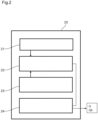
- the device according to the invention thus has a control unit 20, as shown in the figure 2 , composed of a user interface 21 which allows the display of the necessary messages and, if necessary, the entry of the determining values of the invention.
- the calculation means 22 act according to the pre-established rules for liquefying the clots and send the necessary messages to the user interface, taking, when required, information which is recorded in the memory 23.
- the pre-established rules use known equations but can also integrate new conditions, in particular high and low limits provided via the user interface 21.
- the control means 24 of the control unit will then control the pumps 4 and 9 according to the measurements and calculations carried out.
- the computing unit of a device may, for example, operate according to an algorithm as illustrated in the figure 3 .
- the control unit 20 In a stable flow rate regime, determined for example for a constant speed of the blood pump 9 for 30 seconds, the control unit 20 records the difference between the pressure 6 and the pressure 7 in the memory 23, a difference which is updated each time the stability conditions disappear, which initializes the stable duration counter.
- the control unit 20 controls the liquefaction solution pump 4 'at a predetermined flow rate and for a predetermined duration to dissolve the clots forming, then it checks that the difference returns below the desired 10% within the following 10 minutes.
- control unit 20 informs the user, via the interface 21, that there is a problem in the loop.
- Other algorithms are of course possible, the gist being that they proceed by first determining in some way that clots are forming in the loop, typically using pressures or flow rates measured by 6, 7 or 8 and applying rules such as those described in the patent application. EP 1095666 , then injecting for a determined duration and at a determined flow rate a solution suitable for liquefying the existing clots. Duration and flow rates can of course be replaced by other parameters such as for example a volume injected until the difference between pressures 6 and 7 is at most 5% above that recorded but at most 100 ml. Means 6, 7 or 8 can be replaced or supplemented by time intervals or predetermined situations such as prolonged interruption of blood circulation for more than 2 minutes, which are known to often cause the formation of clots.
- the pumps could be controlled not by doubling the speed of pump 4 but by reducing that of pump 9 by half.
- This solution would have the advantage of not increasing the dose of citrate injected into the patient while providing the same concentration of citrate in the blood and therefore the same liquefaction effect.
- the citrate circulation is done on 1-2 volume(s) of the loop either in an example of apheresis or dialysis on 200-400 ml which represents a pulse between 16 and 40 ml of solution, or a low volume compared to preventive anticoagulation.
- This pulse applied at the right time allows the treatment to continue as long as it is clinically indicated, and thus reduce the patient's blood loss and the associated transfusion risks.
- the means 4, 4' and 4" provided for injecting the liquefaction solution can also be used for preventive anticoagulation which has the advantage of reducing the necessary equipment as well as the time required for its installation.
- preventive anticoagulation that is to say that aimed at preventing the formation of clots in the loop, is carried out with a means other than a solute in citrate as in the example above, the situation would be the same and a citrate pulse would produce the same effect.
- the dialysis apparatus would further comprise injection means 4, 4', 4" of a solution containing 4% citrate which would be controlled as described in the previous case, or a solution containing urokinase or a mixture of the two which would be injected for 90 seconds so that all the blood contained in the loop is mixed with the liquefaction solution before stopping the pumps 4 and 9 for 3 minutes in order to allow time for the solution to act and liquefy the clots.
- control unit 20 could also measure the transmembrane pressure (TMP) defined by ((6+7)/2)-8) and control the pump 4 not only on the basis of the difference 6-7 but also on that of an increase in the TMP.
- TMP transmembrane pressure
- a third example would be a CEC that does not include preventive anticoagulation.
- Pump 4 could in this case be a syringe pump whose 60 ml syringe would be filled with a solution containing a mixture of 20% citrate and streptokinase.
- a 10 ml bolus is injected by the syringe pump which can thus liquefy 6 clots in succession before informing the operator of the need to refill the syringe.
- An essential advantage of the present invention lies in the fact that it allows, compared to existing techniques, to significantly reduce the risks linked to the use of anticoagulants since these can be dosed "at a minimum", any clots being detected and liquefied automatically using a small quantity of liquefaction solution since it is punctual and only addresses the volume of blood contained in the loop (which is typically 200 ml in apheresis and dialysis) and not the cumulative blood volume (typically 200 ml/min of blood flow or 12 l/h) or that of the patient (approximately 5 liters for an adult of 70 kg).
- the invention thus allows not only to use a minimum of anticoagulants but also to avoid the disadvantages of a loop containing coagulated blood by proposing means for liquefying the clots.
- the embodiment variants according to the invention apply to all the different configurations of extracorporeal circulation loops, they integrate the possibility of using the different possible solutions, comprising one or more substance(s) capable of liquefying the clots, and of injecting them into different places in the circuit but preferably before the blood pump 9.
Landscapes
- Health & Medical Sciences (AREA)
- Animal Behavior & Ethology (AREA)
- Public Health (AREA)
- Engineering & Computer Science (AREA)
- Hematology (AREA)
- Veterinary Medicine (AREA)
- General Health & Medical Sciences (AREA)
- Life Sciences & Earth Sciences (AREA)
- Heart & Thoracic Surgery (AREA)
- Vascular Medicine (AREA)
- Materials Engineering (AREA)
- Chemical & Material Sciences (AREA)
- Epidemiology (AREA)
- Surgery (AREA)
- Cardiology (AREA)
- Anesthesiology (AREA)
- Biomedical Technology (AREA)
- External Artificial Organs (AREA)
Claims (9)
- Vorrichtung für die extrakorporale Blutzirkulation, die eine Blutzirkulationsschleife umfasst, die mindestens eine Blutextraktionsleitung (1) und eine Blutrückleitung (3), Mittel (9), die dazu gestaltet sind, das Blut in der Zirkulationsschleife zum Zirkulieren zu bringen, Mittel zur Messung mindestens eines Parameters, der durch den Strömungswiderstand des Blutes in der Zirkulationsschleife beeinflusst wird, umfasst und wobei die Vorrichtung eine Quelle für Verflüssigungslösung (4') von Blutgerinnseln, Mittel (4, 4") zur Einspritzung der Verflüssigungslösung (4') in die Zirkulationsschleife (1, 3) und eine Steuereinheit (20) umfasst, die Berechnungsmittel (22) umfasst, die dazu gestaltet sind, mindestens einen Schwellenwert des Parameters zu bestimmen und ihn im Speicher aufzuzeichnen, und ferner dazu gestaltet sind, dann den aktuellen Wert des Parameters mit dem aufgezeichneten Schwellenwert zu vergleichen, wobei die Steuereinheit (20) Mittel (24) zur Lenkung der Mittel (4) zur Einspritzung der Verflüssigungslösung (4') in die Zirkulationsschleife (1, 3) umfasst, und die Steuereinheit dazu vorgesehen ist, die Lenkungsmittel (24) der Einspritzmittel (4) zu betätigen, wenn der Schwellenwert überschritten wird, dadurch gekennzeichnet, dass die Steuereinheit (20) zum Betätigen der Mittel (24) zur Lenkung der Einspritzmittel (4) vorgesehen ist, derart dass die Verflüssigungslösung (4') in der Zirkulationsschleife mit einer vorbestimmten Menge und während einer vorbestimmten Dauer, wie zum Ermöglichen der Verflüssigung des/der in der Schleife gebildeten Blutgerinnsel/s erforderlich und ausreichend bestimmt, vorhanden ist.
- Vorrichtung nach Anspruch 1, dadurch gekennzeichnet, dass die Steuereinheit (20) dazu gestaltet ist, mindestens ein Zeitintervall zu bestimmen oder von der Benutzeroberfläche (21) zu empfangen, es in einem Speicher (23) aufzuzeichnen und den aktuellen Wert der Zeit mit dem Intervall zu vergleichen, um die Mittel (24) zur Lenkung der Einspritzmittel (4) zu betätigen, die dazu gestaltet sind, die Verflüssigungslösung (4') in einer Verbindungsleitung (4") zum Zirkulieren zu bringen.
- Vorrichtung nach einem der vorhergehenden Ansprüche, dadurch gekennzeichnet, dass die Berechnungsmittel (22) dazu gestaltet sind, die Lenkungsmittel (24) durch Vermindern oder Anhalten des Durchsatzes einer Blutpumpe (9) derart zu steuern, dass die Verflüssigungslösung (4') während einer als ausreichend bestimmten Dauer in der Zirkulationsschleife vorhanden ist.
- Vorrichtung nach einem der vorhergehenden Ansprüche, dadurch gekennzeichnet, dass die Blutzirkulationsschleife durch Blutänderungsmittel (5) und eine Leitung (2) ergänzt ist.
- Vorrichtung nach einem der vorhergehenden Ansprüche, dadurch gekennzeichnet, dass die Mittel (6, 7, 8) zur Messung von mindestens einem der Parameter, die durch den Strömungswiderstand des Blutes in der Zirkulationsschleife beeinflusst werden, dazu gestaltet sind, einen Druck zu messen.
- Vorrichtung nach einem der Ansprüche 1 bis 4, dadurch gekennzeichnet, dass die Mittel (6, 7, 8) zur Messung mindestens eines der Parameter, die durch den Strömungswiderstand des Blutes in der Zirkulationsschleife beeinflusst werden, dazu gestaltet sind, einen Durchsatz zu messen.
- Vorrichtung nach einem der vorhergehenden Ansprüche, dadurch gekennzeichnet, dass sie ferner Mittel zum Durchführen einer präventiven Antikoagulation umfasst.
- Vorrichtung nach einem der vorhergehenden Ansprüche, dadurch gekennzeichnet, dass die Einspritzmittel (4), die Verflüssigungslösung (4') und die Verbindungsleitung (4") zum Durchführen einer präventiven Antikoagulation verwendet werden.
- Verfahren nach einem der vorhergehenden Ansprüche, dadurch gekennzeichnet, dass die Verflüssigungslösung (4') ein Element umfasst, das ausgewählt wird aus der Gruppe, die Citrat, Urokinase, Streptokinase und ihre Gemische umfasst.
Priority Applications (3)
| Application Number | Priority Date | Filing Date | Title |
|---|---|---|---|
| EP19215310.4A EP3834860B1 (de) | 2019-12-11 | 2019-12-11 | Vorrichtung für die extrakorporale blutzirkulation |
| JP2020204761A JP7689422B2 (ja) | 2019-12-11 | 2020-12-10 | 体外血液循環デバイス |
| US17/117,736 US11819599B2 (en) | 2019-12-11 | 2020-12-10 | Extracorporeal blood circulation device |
Applications Claiming Priority (1)
| Application Number | Priority Date | Filing Date | Title |
|---|---|---|---|
| EP19215310.4A EP3834860B1 (de) | 2019-12-11 | 2019-12-11 | Vorrichtung für die extrakorporale blutzirkulation |
Publications (3)
| Publication Number | Publication Date |
|---|---|
| EP3834860A1 EP3834860A1 (de) | 2021-06-16 |
| EP3834860B1 true EP3834860B1 (de) | 2024-08-14 |
| EP3834860C0 EP3834860C0 (de) | 2024-08-14 |
Family
ID=68886879
Family Applications (1)
| Application Number | Title | Priority Date | Filing Date |
|---|---|---|---|
| EP19215310.4A Active EP3834860B1 (de) | 2019-12-11 | 2019-12-11 | Vorrichtung für die extrakorporale blutzirkulation |
Country Status (3)
| Country | Link |
|---|---|
| US (1) | US11819599B2 (de) |
| EP (1) | EP3834860B1 (de) |
| JP (1) | JP7689422B2 (de) |
Families Citing this family (2)
| Publication number | Priority date | Publication date | Assignee | Title |
|---|---|---|---|---|
| CN114404707B (zh) * | 2021-12-27 | 2023-08-18 | 健帆生物科技集团股份有限公司 | 血液氧合装置 |
| CN116400014B (zh) * | 2023-03-13 | 2025-06-27 | 宁波天益医疗器械股份有限公司 | 体外循环透析管路抗凝测试系统及测试方法 |
Family Cites Families (7)
| Publication number | Priority date | Publication date | Assignee | Title |
|---|---|---|---|---|
| AU680897B2 (en) * | 1993-03-16 | 1997-08-14 | Aventis Pharmaceuticals Inc. | Removal of selected factors from whole blood or its components and prevention and treatment of septic shock symdrome |
| US8105258B2 (en) * | 1999-04-26 | 2012-01-31 | Baxter International Inc. | Citrate anticoagulation system for extracorporeal blood treatments |
| EP1095666A1 (de) | 1999-10-29 | 2001-05-02 | Infomed S.A. | Vorrichtung zur extrakorporalen Blutreinigung |
| FR2848857B1 (fr) * | 2002-12-20 | 2005-09-16 | Gambro Lundia Ab | Dispositif et ligne a usage unique pour le traitement extracorporel du sang par anticoagulation au citrate |
| JP5574147B2 (ja) * | 2009-08-25 | 2014-08-20 | 国立大学法人広島大学 | 血液粘度の推定方法、血液粘度比の推定方法、血液粘度モニタリング装置、及び、血液粘度比モニタリング装置 |
| US9061099B2 (en) * | 2011-04-29 | 2015-06-23 | Medtronic, Inc. | Cardiovascular monitoring for fluid removal processes |
| EP2959928A1 (de) * | 2014-06-26 | 2015-12-30 | Infomed SA | Vorrichtung zur Blutreinigung durch extrakorporale Zirkulation |
-
2019
- 2019-12-11 EP EP19215310.4A patent/EP3834860B1/de active Active
-
2020
- 2020-12-10 JP JP2020204761A patent/JP7689422B2/ja active Active
- 2020-12-10 US US17/117,736 patent/US11819599B2/en active Active
Also Published As
| Publication number | Publication date |
|---|---|
| JP2021090755A (ja) | 2021-06-17 |
| US11819599B2 (en) | 2023-11-21 |
| JP7689422B2 (ja) | 2025-06-06 |
| EP3834860A1 (de) | 2021-06-16 |
| EP3834860C0 (de) | 2024-08-14 |
| US20210178049A1 (en) | 2021-06-17 |
Similar Documents
| Publication | Publication Date | Title |
|---|---|---|
| EP1453559B1 (de) | Vorrichtung zur intra- und extrakorporalen reinigung | |
| US20090192137A1 (en) | Dialysis method | |
| JP2009268922A (ja) | アクセス流を測定するための方法及び装置 | |
| JP2003320023A (ja) | 体外血液処理を中断するかまたは修正された流速で体外血液処理を継続する方法および体外血液処理装置 | |
| JP2016129646A (ja) | 透析システム、透析方法、およびプログラム | |
| JP2017520365A (ja) | 血液処理セッションの完了後に流量増加によって血液フィルタから流体を除去するための方法及び該方法を実行するための処理機器 | |
| EP3834860A1 (de) | Vorrichtung für die extrakorporale blutzirkulation | |
| EP2959928A1 (de) | Vorrichtung zur Blutreinigung durch extrakorporale Zirkulation | |
| Van Dyk | The use of CRRT in ECMO patients | |
| Vanommeslaeghe et al. | Detection and scoring of extracorporeal circuit clotting during hemodialysis | |
| EP1430920B1 (de) | Vorrichtung zur extrakorporalen Blutbehandlung durch Zitratantikoagulation | |
| Zaccaria et al. | Principles of extracorporeal circulation and transport phenomena | |
| JP2004081833A (ja) | フィルタ目詰まり指数算出方法、フィルタ目詰まり監視方法及び装置、並びにベッドサイドシステム | |
| Katagiri et al. | Double Filtration Plasmapheresis | |
| Sebastian et al. | AngioJetTM rheolytic thrombectomy induced intravascular haemolysis leading to acute kidney injury requiring dialysis | |
| Elewa et al. | Hemodialysis in Clinical Practice | |
| JP2024085570A (ja) | 血液浄化装置 | |
| Katagiri et al. | Plasma Exchange | |
| Chen et al. | Plasma exchange parameter selection and safety observation of children with severe ricinism | |
| JP2024085569A (ja) | 血液浄化装置 | |
| ȘTEFĂNESCU et al. | Hemodialysis in veterinary medicine | |
| Leblanc et al. | Dialyzer fiber bundle volume during hemodialysis using large-surface dialyzers | |
| Katagiri et al. | Plasma Exchange | |
| Van Dyk | The Egyptian Journal of Critical Care Medicine | |
| Shroff | 19 Hemodialysis and Continuous Renal Replacement Therapy |
Legal Events
| Date | Code | Title | Description |
|---|---|---|---|
| PUAI | Public reference made under article 153(3) epc to a published international application that has entered the european phase |
Free format text: ORIGINAL CODE: 0009012 |
|
| STAA | Information on the status of an ep patent application or granted ep patent |
Free format text: STATUS: THE APPLICATION HAS BEEN PUBLISHED |
|
| AK | Designated contracting states |
Kind code of ref document: A1 Designated state(s): AL AT BE BG CH CY CZ DE DK EE ES FI FR GB GR HR HU IE IS IT LI LT LU LV MC MK MT NL NO PL PT RO RS SE SI SK SM TR |
|
| STAA | Information on the status of an ep patent application or granted ep patent |
Free format text: STATUS: REQUEST FOR EXAMINATION WAS MADE |
|
| 17P | Request for examination filed |
Effective date: 20211210 |
|
| RBV | Designated contracting states (corrected) |
Designated state(s): AL AT BE BG CH CY CZ DE DK EE ES FI FR GB GR HR HU IE IS IT LI LT LU LV MC MK MT NL NO PL PT RO RS SE SI SK SM TR |
|
| GRAP | Despatch of communication of intention to grant a patent |
Free format text: ORIGINAL CODE: EPIDOSNIGR1 |
|
| STAA | Information on the status of an ep patent application or granted ep patent |
Free format text: STATUS: GRANT OF PATENT IS INTENDED |
|
| INTG | Intention to grant announced |
Effective date: 20240311 |
|
| GRAS | Grant fee paid |
Free format text: ORIGINAL CODE: EPIDOSNIGR3 |
|
| GRAA | (expected) grant |
Free format text: ORIGINAL CODE: 0009210 |
|
| STAA | Information on the status of an ep patent application or granted ep patent |
Free format text: STATUS: THE PATENT HAS BEEN GRANTED |
|
| AK | Designated contracting states |
Kind code of ref document: B1 Designated state(s): AL AT BE BG CH CY CZ DE DK EE ES FI FR GB GR HR HU IE IS IT LI LT LU LV MC MK MT NL NO PL PT RO RS SE SI SK SM TR |
|
| REG | Reference to a national code |
Ref country code: GB Ref legal event code: FG4D Free format text: NOT ENGLISH |
|
| REG | Reference to a national code |
Ref country code: CH Ref legal event code: EP |
|
| REG | Reference to a national code |
Ref country code: DE Ref legal event code: R096 Ref document number: 602019056927 Country of ref document: DE |
|
| REG | Reference to a national code |
Ref country code: IE Ref legal event code: FG4D Free format text: LANGUAGE OF EP DOCUMENT: FRENCH |
|
| U01 | Request for unitary effect filed |
Effective date: 20240904 |
|
| U07 | Unitary effect registered |
Designated state(s): AT BE BG DE DK EE FI FR IT LT LU LV MT NL PT RO SE SI Effective date: 20240920 |
|
| PG25 | Lapsed in a contracting state [announced via postgrant information from national office to epo] |
Ref country code: NO Free format text: LAPSE BECAUSE OF FAILURE TO SUBMIT A TRANSLATION OF THE DESCRIPTION OR TO PAY THE FEE WITHIN THE PRESCRIBED TIME-LIMIT Effective date: 20241114 |
|
| U20 | Renewal fee for the european patent with unitary effect paid |
Year of fee payment: 6 Effective date: 20241211 |
|
| PG25 | Lapsed in a contracting state [announced via postgrant information from national office to epo] |
Ref country code: GR Free format text: LAPSE BECAUSE OF FAILURE TO SUBMIT A TRANSLATION OF THE DESCRIPTION OR TO PAY THE FEE WITHIN THE PRESCRIBED TIME-LIMIT Effective date: 20241115 Ref country code: PL Free format text: LAPSE BECAUSE OF FAILURE TO SUBMIT A TRANSLATION OF THE DESCRIPTION OR TO PAY THE FEE WITHIN THE PRESCRIBED TIME-LIMIT Effective date: 20240814 |
|
| PG25 | Lapsed in a contracting state [announced via postgrant information from national office to epo] |
Ref country code: IS Free format text: LAPSE BECAUSE OF FAILURE TO SUBMIT A TRANSLATION OF THE DESCRIPTION OR TO PAY THE FEE WITHIN THE PRESCRIBED TIME-LIMIT Effective date: 20241214 |
|
| PG25 | Lapsed in a contracting state [announced via postgrant information from national office to epo] |
Ref country code: HR Free format text: LAPSE BECAUSE OF FAILURE TO SUBMIT A TRANSLATION OF THE DESCRIPTION OR TO PAY THE FEE WITHIN THE PRESCRIBED TIME-LIMIT Effective date: 20240814 |
|
| PG25 | Lapsed in a contracting state [announced via postgrant information from national office to epo] |
Ref country code: RS Free format text: LAPSE BECAUSE OF FAILURE TO SUBMIT A TRANSLATION OF THE DESCRIPTION OR TO PAY THE FEE WITHIN THE PRESCRIBED TIME-LIMIT Effective date: 20241114 Ref country code: ES Free format text: LAPSE BECAUSE OF FAILURE TO SUBMIT A TRANSLATION OF THE DESCRIPTION OR TO PAY THE FEE WITHIN THE PRESCRIBED TIME-LIMIT Effective date: 20240814 |
|
| PG25 | Lapsed in a contracting state [announced via postgrant information from national office to epo] |
Ref country code: RS Free format text: LAPSE BECAUSE OF FAILURE TO SUBMIT A TRANSLATION OF THE DESCRIPTION OR TO PAY THE FEE WITHIN THE PRESCRIBED TIME-LIMIT Effective date: 20241114 Ref country code: PL Free format text: LAPSE BECAUSE OF FAILURE TO SUBMIT A TRANSLATION OF THE DESCRIPTION OR TO PAY THE FEE WITHIN THE PRESCRIBED TIME-LIMIT Effective date: 20240814 Ref country code: NO Free format text: LAPSE BECAUSE OF FAILURE TO SUBMIT A TRANSLATION OF THE DESCRIPTION OR TO PAY THE FEE WITHIN THE PRESCRIBED TIME-LIMIT Effective date: 20241114 Ref country code: IS Free format text: LAPSE BECAUSE OF FAILURE TO SUBMIT A TRANSLATION OF THE DESCRIPTION OR TO PAY THE FEE WITHIN THE PRESCRIBED TIME-LIMIT Effective date: 20241214 Ref country code: HR Free format text: LAPSE BECAUSE OF FAILURE TO SUBMIT A TRANSLATION OF THE DESCRIPTION OR TO PAY THE FEE WITHIN THE PRESCRIBED TIME-LIMIT Effective date: 20240814 Ref country code: GR Free format text: LAPSE BECAUSE OF FAILURE TO SUBMIT A TRANSLATION OF THE DESCRIPTION OR TO PAY THE FEE WITHIN THE PRESCRIBED TIME-LIMIT Effective date: 20241115 Ref country code: ES Free format text: LAPSE BECAUSE OF FAILURE TO SUBMIT A TRANSLATION OF THE DESCRIPTION OR TO PAY THE FEE WITHIN THE PRESCRIBED TIME-LIMIT Effective date: 20240814 |
|
| PG25 | Lapsed in a contracting state [announced via postgrant information from national office to epo] |
Ref country code: SM Free format text: LAPSE BECAUSE OF FAILURE TO SUBMIT A TRANSLATION OF THE DESCRIPTION OR TO PAY THE FEE WITHIN THE PRESCRIBED TIME-LIMIT Effective date: 20240814 |
|
| PG25 | Lapsed in a contracting state [announced via postgrant information from national office to epo] |
Ref country code: CZ Free format text: LAPSE BECAUSE OF FAILURE TO SUBMIT A TRANSLATION OF THE DESCRIPTION OR TO PAY THE FEE WITHIN THE PRESCRIBED TIME-LIMIT Effective date: 20240814 |
|
| PG25 | Lapsed in a contracting state [announced via postgrant information from national office to epo] |
Ref country code: SK Free format text: LAPSE BECAUSE OF FAILURE TO SUBMIT A TRANSLATION OF THE DESCRIPTION OR TO PAY THE FEE WITHIN THE PRESCRIBED TIME-LIMIT Effective date: 20240814 |
|
| PLBE | No opposition filed within time limit |
Free format text: ORIGINAL CODE: 0009261 |
|
| STAA | Information on the status of an ep patent application or granted ep patent |
Free format text: STATUS: NO OPPOSITION FILED WITHIN TIME LIMIT |
|
| PG25 | Lapsed in a contracting state [announced via postgrant information from national office to epo] |
Ref country code: MC Free format text: LAPSE BECAUSE OF FAILURE TO SUBMIT A TRANSLATION OF THE DESCRIPTION OR TO PAY THE FEE WITHIN THE PRESCRIBED TIME-LIMIT Effective date: 20240814 |
|
| 26N | No opposition filed |
Effective date: 20250515 |
|
| REG | Reference to a national code |
Ref country code: CH Ref legal event code: PL |
|
| GBPC | Gb: european patent ceased through non-payment of renewal fee |
Effective date: 20241211 |
|
| PG25 | Lapsed in a contracting state [announced via postgrant information from national office to epo] |
Ref country code: GB Free format text: LAPSE BECAUSE OF NON-PAYMENT OF DUE FEES Effective date: 20241211 |
|
| PG25 | Lapsed in a contracting state [announced via postgrant information from national office to epo] |
Ref country code: CH Free format text: LAPSE BECAUSE OF NON-PAYMENT OF DUE FEES Effective date: 20241231 |
|
| PG25 | Lapsed in a contracting state [announced via postgrant information from national office to epo] |
Ref country code: IE Free format text: LAPSE BECAUSE OF NON-PAYMENT OF DUE FEES Effective date: 20241211 |
|
| U20 | Renewal fee for the european patent with unitary effect paid |
Year of fee payment: 7 Effective date: 20251211 |
|
| PG25 | Lapsed in a contracting state [announced via postgrant information from national office to epo] |
Ref country code: CY Free format text: LAPSE BECAUSE OF FAILURE TO SUBMIT A TRANSLATION OF THE DESCRIPTION OR TO PAY THE FEE WITHIN THE PRESCRIBED TIME-LIMIT Effective date: 20240814 |