EP3835517A1 - Schutzkappe für ein einen schlosskasten aufweisendes schloss - Google Patents
Schutzkappe für ein einen schlosskasten aufweisendes schloss Download PDFInfo
- Publication number
- EP3835517A1 EP3835517A1 EP20211141.5A EP20211141A EP3835517A1 EP 3835517 A1 EP3835517 A1 EP 3835517A1 EP 20211141 A EP20211141 A EP 20211141A EP 3835517 A1 EP3835517 A1 EP 3835517A1
- Authority
- EP
- European Patent Office
- Prior art keywords
- protective cap
- lock
- side walls
- web
- cap according
- Prior art date
- Legal status (The legal status is an assumption and is not a legal conclusion. Google has not performed a legal analysis and makes no representation as to the accuracy of the status listed.)
- Granted
Links
Images

Classifications
-
- E—FIXED CONSTRUCTIONS
- E05—LOCKS; KEYS; WINDOW OR DOOR FITTINGS; SAFES
- E05B—LOCKS; ACCESSORIES THEREFOR; HANDCUFFS
- E05B9/00—Lock casings or latch-mechanism casings ; Fastening locks or fasteners or parts thereof to the wing
- E05B9/02—Casings of latch-bolt or deadbolt locks
-
- E—FIXED CONSTRUCTIONS
- E05—LOCKS; KEYS; WINDOW OR DOOR FITTINGS; SAFES
- E05B—LOCKS; ACCESSORIES THEREFOR; HANDCUFFS
- E05B17/00—Accessories in connection with locks
- E05B17/20—Means independent of the locking mechanism for preventing unauthorised opening, e.g. for securing the bolt in the fastening position
- E05B17/2084—Means to prevent forced opening by attack, tampering or jimmying
Definitions
- the invention relates to a protective cap for a lock of a door having a lock case, with two side walls laterally covering the lock case and with a web connecting the side walls.
- Such a protective cap is, for example, from DE 83 27 932 U1 known.
- the protective cap is designed as a rectangular protective hood covering a lock housing and has strips for attachment to a door.
- the protective cap is made of sheet steel and therefore has the same stability at every point. Due to the complete covering of the lock housing, however, the protective cap has a very complex construction.
- an anchoring element for a lock which is connected to a housing.
- the housing In the assembled state, the housing is pushed over the lock.
- the anchoring element supports the lock in the door.
- the anchoring element with the housing has a very complex structure.
- a lock case safety device has become known in which a base plate has several retaining pins and is arranged on the back of the lock case.
- This lock case security increases security against break-ins when the lock is used in a hollow profile frame.
- a recess for the lock must be accessible from two sides.
- the invention is based on the problem of developing a protective cap of the type mentioned at the outset in such a way that it can be manufactured inexpensively and offers a high level of protection for almost any lock.
- this problem is solved in that the web is designed as a reinforcement web in at least one partial area and that the reinforcement web has a higher strength than the side walls.
- the protective cap has a reinforcement at a particularly critical point with the reinforcement web to increase the stability in an area at risk of manipulation.
- the reinforcement web thereby covers a mostly open narrow side of the lock and prevents a tool from reaching into a gear between a lock cylinder and a bolt.
- the area of the lock case covered by the reinforcement web has a high level of protection against manipulation. Therefore, the side walls, which laterally cover the already stable lock case, can be made of very thin-walled material. This allows a lock of almost any design, together with the protective cap, to be pushed into a very narrow pocket in the door. Thanks to the invention, the protective cap can be manufactured particularly inexpensively.
- the web and the side walls could, for example, extend over the entire height of the lock case.
- this leads to high production costs for the protective cap. It is usually not necessary to completely enclose the lock case.
- adequate protection against manipulation of a gear adjacent to the lock cylinder can easily be avoided with particularly little material expenditure if the web and the reinforcing web cover a corner area of the lock case and if the side walls are approximately half the height of the lock case exhibit.
- the protective cap can be manufactured particularly cost-effectively by bending a punched sheet metal if the web extends over the entire height of the side walls and has a single recess for the passage of a cylinder lock screw.
- a recess in the web is particularly secure if the web has an outwardly directed formation for the passage of a fastening screw in a direction perpendicular to the side walls.
- the fastening screw that additionally secures the protective cap and protrudes outwardly via the web is secured inaccessible from the outside.
- An otherwise common open recess is avoided.
- the fastening screw is preferably used to fasten the inside and / or outside handle of the door.
- the protective effect of the protective cap is particularly great if the outwardly directed formation is semicircular is and forms an approximately circular passage with an opposing semicircular incision in the lock case.
- the fastening screw thus additionally secures the lock and the protective cap against deliberate movement.
- a corresponding semicircular recess is to be provided in the side walls. Since the distance between the fastening screw and the lock cylinder is often very small, the opposite semicircular incision in the lock case is already present in a large number of lock variants.
- the reinforcement web can be manufactured from almost any material with an intended strength if the reinforcement web has an insert element with an increased strength compared to the side walls.
- the reinforcing web has two overlaps formed by bending the side walls.
- bending up of the reinforcement web formed by overlaps can easily be avoided if the overlaps forming the reinforcement web are connected to one another by welding, riveting or clinching.
- the assembly of the protective cap is particularly simple if the side walls have a fixing device for holding it on the lock case.
- the fixing device is particularly simple in construction if the fixing device has latching means for latching on the lock case.
- the protective cap can simply be attached to the lock case and mounted with the lock in the door.
- the latching means can be manufactured particularly cost-effectively if the latching means have depressions arranged in the side walls.
- the protective cap has particularly small dimensions if the latching means are arranged next to recesses for a lock cylinder.
- the fixing device can be manufactured particularly inexpensively if the side walls are designed to converge on one another. This design enables a clamping connection between the protective cap and the lock case.
- the side walls can be designed to converge towards the web or from the web.
- Figure 1 shows a lock 1 designed as an espagnolette lock for arrangement in a door.
- the lock 1 has a lock case 2 with a bolt 3 and a latch 4.
- the bolt 3 and the latch 4 can be extended out of the lock case 2 by a lock cylinder 5 and a socket 6 or withdrawn into it.
- the lock 1 is used in the assembled state in a pocket of the door.
- the lock 1 has a protective cap 7 which covers a corner area of the lock case 2 that has the lock cylinder 5. In this corner area, a gear (not shown) for driving the bolt 3 above the lock cylinder 5 is usually arranged.
- the lock 1 and the protective cap 7 have aligned and approximately circular passages 19, 21 for fastening screws, not shown.
- the bushings 19, 21 are each arranged on an opposite side and at the same distance and on an axis next to the lock cylinder.
- Implementation 21 half penetrates the lock case 2 and the other half a recess 20 in a web 10.
- the protective cap 7 has two side walls 8, 9 for resting on lateral surfaces of the lock case 2 and the web 10 for connecting the side walls 8, 9.
- the formation 20 in the web 10 is semicircularly curved outward from the protective cap 7 from.
- the side walls 8, 9 have semicircular recesses in the region of the formation 20, which rounded off the openings for the fastening screws to form a circular shape.
- the web 10 covers the side of the lock case 2 facing away from the bolt 3.
- the web is designed as a reinforcing web 11. This reinforcement web 11 is formed by overlaps 12, 13 of bends in the side walls 9. The overlaps 12, 13 are welded to one another by means of a spot weld 14.
- latching means 16 for latching with the lock case 2 Figure 1 arranged.
- These latching means 16 are designed as depressions arranged in the side walls 8, 9. In this way, the protective cap 7 can be locked in place with the lock case 2 and mounted in the door.
- the latching means 16 are in addition to recesses 17 for the lock cylinder 5 Figure 1 arranged. With the exception of a recess 18, the web 10 is made for the implementation of a lock cylinder screw of the lock cylinder 5 Figure 1 completely closed and extends over the entire height of the side walls 8, 9.
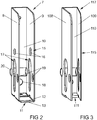
- Figure 3 shows a further embodiment of a protective cap 117, which extends from FIG Figure 2 differs in that a reinforcing web 111 is welded into the side walls 108, 109.
- the reinforcement web 111 has a higher strength than the side walls 108, 109.
- the side walls 108, 109 are designed to converge when viewed from a web 110.
- the side walls 108, 109 converging towards one another thus form a fixing device 115 for pre-assembly on the lock case 2 Figure 1 .
Landscapes
- Engineering & Computer Science (AREA)
- Mechanical Engineering (AREA)
- Lock And Its Accessories (AREA)
Abstract
Description
- Die Erfindung betrifft eine Schutzkappe für ein einen Schlosskasten aufweisendes Schloss einer Tür, mit zwei den Schlosskasten seitlich überdeckenden Seitenwandungen und mit einem die Seitenwandungen verbindenden Steg.
- Eine solche Schutzkappe ist beispielsweise aus der
DE 83 27 932 U1 bekannt. Die Schutzkappe ist als quaderförmige, ein Schlossgehäuse überdeckende Schutzhaube ausgebildet und hat Streifen zur Befestigung an einer Tür. Die Schutzkappe ist aus Stahlblech gefertigt und hat damit an jeder Stelle die gleiche Stabilität. Durch die vollständige Überdeckung des Schlossgehäuses ist die Schutzkappe jedoch sehr aufwändig aufgebaut. - Aus der
GB 2 369 856 A - Aus der
EP 2 339 095 A2 ist eine Schlosskastensicherung bekannt geworden, bei der eine Basisplatte mehrere Haltezapfen hat und auf der Rückseite des Schlosskastens angeordnet ist. Diese Schlosskastensicherung erhöht eine Einbruchssicherheit bei dem Einsatz des Schlosses in einem Hohlprofilrahmen. Für den Einsatz dieser Schlosskastensicherung muss eine Ausnehmung für das Schloss von zwei Seiten her zugänglich sein. - Der Erfindung liegt das Problem zugrunde, eine Schutzkappe der eingangs genannten Art so weiter zu bilden, dass sie kostengünstig herstellbar ist und einen hohen Schutz für nahezu beliebige Schlösser bietet.
- Dieses Problem wird erfindungsgemäß dadurch gelöst, dass der Steg in zumindest einem Teilbereich als Verstärkungssteg ausgebildet ist und dass der Verstärkungssteg eine höhere Festigkeit aufweist als die Seitenwandungen.
- Durch diese Gestaltung weist die Schutzkappe an einer besonders kritischen Stelle mit dem Verstärkungssteg eine Verstärkung zur Erhöhung der Stabilität in einem für Manipulationen gefährdeten Bereich auf. Der Verstärkungssteg überdeckt hierdurch eine meist offene Schmalseite des Schlosses und verhindert, dass mit einem Werkzeug in ein Getriebe zwischen einem Schließzylinder und einem Riegel eingegriffen wird. Hierdurch hat der von dem Verstärkungssteg abgedeckte Bereich des Schlosskastens einen hohen Schutz vor Manipulation. Daher können die Seitenwandungen, welche den ohnehin stabilen Schlosskasten seitlich überdecken, aus sehr dünnwandigem Material gefertigt sein. Damit lässt sich ein nahezu beliebig gestaltetes Schloss zusammen mit der Schutzkappe in eine sehr enge Tasche der Tür einschieben. Dank der Erfindung ist die Schutzkappe besonders kostengünstig herstellbar.
- Der Steg und die Seitenwandungen könnten sich beispielsweise über die gesamte Höhe des Schlosskastens erstrecken. Dies führt jedoch zu hohen Fertigungskosten der Schutzkappe. Ein vollständiges Umschließen des Schlosskastens ist meist nicht erforderlich. Ein ausreichender Schutz vor einer Manipulation eines an den Schließzylinder angrenzenden Getriebes lässt sich gemäß einer anderen vorteilhaften Weiterbildung der Erfindung bei besonders geringem Materialaufwand einfach vermeiden, wenn der Steg und der Verstärkungssteg einen Eckbereich des Schlosskastens überdecken und wenn die Seitenwandungen ungefähr die Hälfte der Höhe des Schlosskastens aufweisen.
- Die Schutzkappe lässt sich gemäß einer anderen vorteilhaften Weiterbildung der Erfindung besonders kostengünstig durch Abwinklungen eines ausgestanzten Blechs fertigen, wenn sich der Steg über die gesamte Höhe der Seitenwandungen erstreckt und eine einzelne Ausnehmung zur Durchführung einer Schließzylinderschraube aufweist.
- Eine Ausnehmung in dem Steg ist gemäß einer anderen vorteilhaften Weiterbildung der Erfindung besonders sicher, wenn der Steg eine nach außen gerichtete Ausformung zur Durchführung einer Befestigungsschraube in senkrechter Richtung zu den Seitenwandungen aufweist. Dadurch ist die die Schutzkappe zusätzlich sichernde und über den Steg nach außen überstehende Befestigungsschraube von außen unzugänglich gesichert. Eine sonst übliche offene Ausnehmung wird vermieden. Die Befestigungsschraube dient bevorzugt der Befestigung der Innen- und/oder der Außenhandhabe der Tür.
- Die Schutzwirkung der Schutzkappe ist gemäß einer anderen vorteilhaften Weiterbildung der Erfindung besonders groß, wenn die nach außen gerichtete Ausformung halbrund gestaltet ist und mit einem im Schlosskasten entgegenstehenden halbrunden Einschnitt eine in etwa kreisrunde Durchführung bildet. Die Befestigungsschraube sichert somit zusätzlich das Schloss und die Schutzkappe vor mutwilligem Verschieben. Bei dieser Weiterbildung der Erfindung ist eine entsprechende halbrunde Ausnehmung in den Seitenwandungen vorzusehen. Da der Abstand der Befestigungsschraube zum Schließzylinder häufig sehr gering ist, ist der im Schlosskasten entgegenstehende halbrunde Einschnitt bei einer Vielzahl von Schlossvarianten bereits vorhanden.
- Der Verstärkungssteg lässt sich gemäß einer anderen vorteilhaften Weiter-bildung der Erfindung aus einem nahezu beliebigen Material mit einer vorgesehenen Festigkeit fertigen, wenn der Verstärkungssteg ein Einlageelement mit einer im Vergleich zu den Seitenwandungen erhöhten Festigkeit hat.
- Zur weiteren Verringerung der Fertigungskosten der Schutzkappe trägt es gemäß einer anderen vorteilhaften Weiterbildung der Erfindung bei, wenn der Verstärkungssteg zwei durch Abwinklung der Seitenwandungen gebildete Überlappungen aufweist.
- Ein Aufbiegen des von Überlappungen gebildeten Verstärkungssteges lässt sich gemäß einer anderen vorteilhaften Weiterbildung der Erfindung einfach vermeiden, wenn die den Verstärkungssteg bildenden Überlappungen durch Verschweißen, oder Vernieten oder Durchsetzfügen miteinander verbunden sind.
- Die Montage der Schutzkappe gestaltet sich gemäß einer anderen vorteilhaften Weiterbildung der Erfindung besonders einfach, wenn die Seitenwandungen eine Fixiereinrichtung zur Halterung an dem Schlosskasten aufweisen.
- Die Fixiereinrichtung gestaltet sich gemäß einer anderen vorteilhaften Weiterbildung der Erfindung konstruktiv besonders einfach, wenn die Fixiereinrichtung Rastmittel zur Verrasterung an dem Schlosskasten hat. Durch diese Gestaltung lässt sich die Schutzkappe einfach auf den Schlosskasten aufstecken und mit dem Schloss in der Tür montieren.
- Die Rastmittel lassen sich gemäß einer anderen vorteilhaften Weiterbildung der Erfindung besonders kostengünstig fertigen, wenn die Rastmittel in den Seitenwandungen angeordnete Senkungen aufweisen.
- Die Schutzkappe weist gemäß einer anderen vorteilhaften Weiterbildung der Erfindung besonders kleine Abmessungen auf, wenn die Rastmittel neben Ausnehmungen für einen Schließzylinder angeordnet sind.
- Die Fixiereinrichtung lässt sich besonders kostengünstig fertigen, wenn die Seitenwandungen aufeinander zulaufend gestaltet sind. Diese Gestaltung ermöglicht eine Klemmverbindung der Schutzkappe mit dem Schlosskasten.
Dabei können die Seitenwandungen zu dem Steg oder von dem Steg aufeinander zulaufend gestaltet sein. - Die Erfindung lässt zahlreiche Ausführungsformen zu. Zur weiteren Verdeutlichung ihres Grundprinzips sind mehrere davon in der Zeichnung dargestellt und werden nachfolgend beschrieben. Diese zeigt in
- Fig.1
- ein Schloss mit einer Schutzkappe,
- Fig.2
- die Schutzkappe aus
Figur 1 in einer perspektivischen Darstellung, - Fig.3
- eine weitere Ausführungsform der Schutzkappe in einer perspektivischen Darstellung.
-
Figur 1 zeigt ein als Treibstangenschloss ausgebildetes Schloss 1 zur An-ordnung in einer Tür. Das Schloss 1 hat einen Schlosskasten 2 mit einem Riegel 3 und einer Falle 4. Der Riegel 3 und die Falle 4 lassen sich von einem Schließzylinder 5 und von einer Nuss 6 aus dem Schlosskasten 2 her-ausfahren oder in diesen zurückziehen. Das Schloss 1 ist im montierten Zustand in einer Tasche der Tür eingesetzt. - Weiterhin hat das Schloss 1 eine Schutzkappe 7, welche einen den Schließzylinder 5 aufweisenden Eckbereich des Schlosskastens 2 überdeckt. In diesem Eckbereich ist in der Regel ein nicht dargestelltes Getriebe zum Antrieb des Riegels 3 über dem Schließzylinder 5 angeordnet.
- Das Schloss 1 und die Schutzkappe 7 weisen fluchtende und in etwa kreisrunde Durchführungen 19, 21 für nicht dargestellte Befestigungsschrauben auf. Die Durchführungen 19, 21 sind jeweils auf einer entgegengesetzten Seite und im gleichen Abstand und auf einer Achse neben dem Schließzylinder angeordnet. Die Durchführung 21 durchdringt zur Hälfe den Schloss-kasten 2 und zur anderen Hälfte eine Ausformung 20 in einem Steg 10.
- Wie
Figur 2 in einer perspektivischen Darstellung zeigt, hat die Schutzkappe 7 zwei Seitenwandungen 8, 9 zur Auflage auf seitlichen Flächen des Schlosskastens 2 und den Steg 10 zur Verbindung der Seitenwandungen 8, 9. Die Ausformung 20 in dem Steg 10 steht halbrund gewölbt nach außen von der Schutzkappe 7 ab. Die Seitenwandungen 8, 9 weisen im Bereich der Ausformung 20 Halbrundausnehmungen auf, die die Öffnungen für die Befestigungsschrauben zur Kreisform vervollständigten. WieFigur 1 zeigt, überdeckt der Steg 10 im montierten Zustand die dem Riegel 3 abgewandte Seite des Schlosskastens 2. An der Unterseite ist der Steg als Verstärkungssteg 11 ausgebildet. Dieser Verstärkungssteg 11 wird von Überlappungen 12, 13 von Abwinklungen der Seitenwandungen 9 gebildet. Die Überlappungen 12, 13 sind mittels einer Punktschweißung 14 miteinander verschweißt. In den Seitenwandungen 8, 9 ist eine Fixiereinrichtung 15 mit Rastmitteln 16 zur Verrastung mit dem Schlosskasten 2 ausFigur 1 angeordnet. Diese Rastmittel 16 sind als in den Seitenwandungen 8, 9 angeordnete Senkungen ausgebildet. Damit lässt sich die Schutzkappe 7 mit dem Schlosskasten 2 verrasten und in der Tür montieren. Die Rastmittel 16 sind neben Ausnehmungen 17 für den Schließzylinder 5 ausFigur 1 angeordnet. Der Steg 10 ist mit Ausnahme einer Ausnehmung 18 zur Durchführung einer Schließzylinderschraube des Schließzylinders 5 ausFigur 1 vollständig geschlossen und erstreckt sich über die gesamte Höhe der Seitenwandungen 8, 9. -
Figur 3 zeigt eine weitere Ausführungsform einer Schutzkappe 117, welche sich von der ausFigur 2 dadurch unterscheidet, dass ein Verstärkungssteg 111 in die Seitenwandungen 108, 109 eingeschweißt ist. Der Verstärkungs-steg 111 hat eine höhere Festigkeit als die Seitenwandungen 108, 109. Weiterhin sind die Seitenwandungen 108, 109 von einem Steg 110 aus gesehen aufeinander zulaufend gestaltet. Damit bilden die aufeinander zulaufenden Seitenwandungen 108, 109 eine Fixiereinrichtung 115 zur Vormontage auf dem Schlosskasten 2 ausFigur 1 .
Claims (13)
- Schutzkappe (7) für ein einen Schlosskasten (2) aufweisendes Schloss (1) einer Tür, mit zwei den Schlosskasten (2) seitlich überdeckenden Seiten-wandungen (8, 9, 108, 109) und mit einem die Seitenwandungen (8, 9, 108, 109) verbindenden Steg (10, 110), dadurch gekennzeichnet, dass der Steg (10, 110) in zumindest einem Teilbereich als Verstärkungssteg (11, 111) ausgebildet ist und dass der Verstärkungssteg (11, 111) eine höhere Festigkeit aufweist als die Seitenwandungen (8, 9, 108, 109).
- Schutzkappe nach Anspruch 1, dadurch gekennzeichnet, dass der Steg (10, 110) und der Verstärkungssteg (11, 111) einen Eckbereich des Schloss-kastens (2) überdecken und dass die Seitenwandungen (8, 9, 108, 109) ungefähr die Hälfte der Höhe des Schlosskastens (2) aufweisen.
- Schutzkappe nach Anspruch 1 oder 2, dadurch gekennzeichnet, dass sich der Steg (10, 110) über die gesamte Höhe der Seitenwandungen (8, 9, 108, 109) erstreckt und eine einzelne Ausnehmung (18) zur Durchführung einer Schließzylinderschraube aufweist.
- Schutzkappe nach zumindest einem der Ansprüche 1 bis 3, dadurch gekennzeichnet, dass der Steg (10, 110) eine nach außen gerichtete Ausformung (20) zur Durchführung einer Befestigungsschraube in senkrechter Richtung zu den Seitenwandungen (8, 9, 108, 109) aufweist.
- Schutzkappe nach Anspruch 4, dadurch gekennzeichnet, dass die nach außen gerichtete Ausformung (20) halbrund gestaltet ist und mit einem im Schlosskasten (2) entgegenstehenden halbrunden Einschnitt eine in etwa kreisrunde Durchführung (21) bildet.
- Schutzkappe nach zumindest einem der Ansprüche 1 bis 5, dadurch gekennzeichnet, dass der Verstärkungssteg (111) ein Einlageelement mit einer im Vergleich zu den Seitenwandungen (108, 109) erhöhten Festigkeit hat.
- Schutzkappe nach zumindest einem der Ansprüche 1 bis 5, dadurch gekennzeichnet, dass der Verstärkungssteg (11) zwei durch Abwinklung der Seitenwandungen (8, 9) gebildete Überlappungen (12, 13) aufweist.
- Schutzkappe nach Anspruch 7, dadurch gekennzeichnet, dass die den Verstärkungssteg (11) bildenden Überlappungen (12, 13) durch Verschweißen, oder Vernieten oder Durchsetzfügen miteinander verbunden sind.
- Schutzkappe nach zumindest einem der Ansprüche 1 bis 8, dadurch gekennzeichnet, dass die Seitenwandungen (8, 9, 108, 109) eine Fixiereinrichtung (15, 115) zur Halterung an dem Schlosskasten (2) aufweisen.
- Schutzkappe nach Anspruch 9, dadurch gekennzeichnet, dass die Fixiereinrichtung (15) Rastmittel (16) zur Verrasterung an dem Schlosskasten (2) hat.
- Schutzkappe nach Anspruch 10, dadurch gekennzeichnet, dass die Rastmittel (16) in den Seitenwandungen (8, 9) angeordnete Senkungen aufweisen.
- Schutzkappe nach Anspruch 10 oder 11, dadurch gekennzeichnet, dass die Rastmittel (16) neben Ausnehmungen (17) für einen Schließzylinder (5) angeordnet sind.
- Schutzkappe nach zumindest einem der Ansprüche 1 bis 12, dadurch gekennzeichnet, dass die Seitenwandungen (108, 109) aufeinander zulaufend gestaltet sind.
Applications Claiming Priority (1)
| Application Number | Priority Date | Filing Date | Title |
|---|---|---|---|
| DE102019134236.8A DE102019134236A1 (de) | 2019-12-13 | 2019-12-13 | Schutzkappe für ein einen Schlosskasten aufweisendes Schloss |
Publications (2)
| Publication Number | Publication Date |
|---|---|
| EP3835517A1 true EP3835517A1 (de) | 2021-06-16 |
| EP3835517B1 EP3835517B1 (de) | 2023-11-29 |
Family
ID=73694784
Family Applications (1)
| Application Number | Title | Priority Date | Filing Date |
|---|---|---|---|
| EP20211141.5A Active EP3835517B1 (de) | 2019-12-13 | 2020-12-02 | Schutzkappe für ein einen schlosskasten aufweisendes schloss |
Country Status (2)
| Country | Link |
|---|---|
| EP (1) | EP3835517B1 (de) |
| DE (1) | DE102019134236A1 (de) |
Citations (6)
| Publication number | Priority date | Publication date | Assignee | Title |
|---|---|---|---|---|
| DE8327932U1 (de) | 1983-09-29 | 1984-03-22 | Werner Mauer Gmbh & Co Kg, 5628 Heiligenhaus | Kastenschloss |
| DE3313466A1 (de) * | 1983-04-14 | 1984-10-18 | Schwab Svedex-Türenwerk GmbH, 7417 Pfullingen | Tuerschloss, insbesondere fuer einbruchhemmende tueren |
| DE69606740T2 (de) * | 1995-06-28 | 2000-10-26 | Jpm Chauvat S.A., Avermes | Montageadapter für Einbauschloss |
| GB2369856A (en) | 2000-12-05 | 2002-06-12 | Florin Invest Ltd | Anchor member for a mortice lock and a mortice lining |
| EP1260657A1 (de) * | 2001-05-25 | 2002-11-27 | Steinbach & Vollmann GmbH & Co. | Schlossanordnung |
| EP2339095A2 (de) | 2009-12-22 | 2011-06-29 | Rehau AG & Co | Tür, insbesondere Kunstofftür, mit einer Schlosskastensicherung sowie Schlosskastensicherung dafür |
-
2019
- 2019-12-13 DE DE102019134236.8A patent/DE102019134236A1/de not_active Withdrawn
-
2020
- 2020-12-02 EP EP20211141.5A patent/EP3835517B1/de active Active
Patent Citations (6)
| Publication number | Priority date | Publication date | Assignee | Title |
|---|---|---|---|---|
| DE3313466A1 (de) * | 1983-04-14 | 1984-10-18 | Schwab Svedex-Türenwerk GmbH, 7417 Pfullingen | Tuerschloss, insbesondere fuer einbruchhemmende tueren |
| DE8327932U1 (de) | 1983-09-29 | 1984-03-22 | Werner Mauer Gmbh & Co Kg, 5628 Heiligenhaus | Kastenschloss |
| DE69606740T2 (de) * | 1995-06-28 | 2000-10-26 | Jpm Chauvat S.A., Avermes | Montageadapter für Einbauschloss |
| GB2369856A (en) | 2000-12-05 | 2002-06-12 | Florin Invest Ltd | Anchor member for a mortice lock and a mortice lining |
| EP1260657A1 (de) * | 2001-05-25 | 2002-11-27 | Steinbach & Vollmann GmbH & Co. | Schlossanordnung |
| EP2339095A2 (de) | 2009-12-22 | 2011-06-29 | Rehau AG & Co | Tür, insbesondere Kunstofftür, mit einer Schlosskastensicherung sowie Schlosskastensicherung dafür |
Also Published As
| Publication number | Publication date |
|---|---|
| EP3835517B1 (de) | 2023-11-29 |
| DE102019134236A1 (de) | 2021-06-17 |
Similar Documents
| Publication | Publication Date | Title |
|---|---|---|
| DE102016123230B3 (de) | Scharnieranordnung für ein Schaltschrankgehäuse und ein entsprechendes Schaltschrankgehäuse | |
| DE102010063868A1 (de) | Verstärktes Kraftfahrzeugschloss | |
| DE9110293U1 (de) | Gassack-Rückhaltesystem-Baugruppe | |
| DE102012023261A1 (de) | Kraftfahrzeugschloss | |
| DE19956012C1 (de) | Kraftfahrzeug-Türschloß | |
| DE102014115704A1 (de) | Kraftfahrzeugtürschloss | |
| DE102006027751A1 (de) | Befestigungselement zur Befestigung und/oder Vorfixierung eines Bauteils an einer mit einer Öffnung versehenen Halterung sowie Bauteil mit Befestigungselement | |
| EP4442942A1 (de) | Schloss | |
| DE102010016489A1 (de) | Gehäuseteil für einen Schaltschrank | |
| WO2008009491A1 (de) | Gehäuse zur aufnahme einer elektronischen baugruppe | |
| EP3835517B1 (de) | Schutzkappe für ein einen schlosskasten aufweisendes schloss | |
| DE202016101097U1 (de) | Verriegelungseinrichtung und dazugehörige Schiebetüranlage | |
| EP2754804B1 (de) | Verschluss für einen Treibstangenbeschlag | |
| DE202010004995U1 (de) | Befestiger zur Befestigung eines ersten Bauteils an einem zweiten Bauteil | |
| EP0668420B1 (de) | Schliessblechkasten | |
| EP2702301B1 (de) | Flachdichtung mit toleranzverträglicher fixierung | |
| WO2008068304A2 (de) | Treibstangengetriebe | |
| DE102006059583A1 (de) | Verriegelungsvorrichtung für eine Motorhaube | |
| EP0727552B1 (de) | Doppelbartschloss | |
| DE102005031729B4 (de) | Fahrzeugtür für ein Kraftfahrzeug | |
| DE202014101563U1 (de) | Verbinder zur Befestigung von Pfosten und Riegeln | |
| DE202012104990U1 (de) | Tür, insbesondere Kunststofftür, mit einem Verstärkungselement sowie Verstärkungselement hierfür | |
| DE102004035031B4 (de) | Klappdeckelanordnung an einem Ablagefach in einem Fahrzeug | |
| EP3931417B1 (de) | Schliessanordnung für einen schaltschrank | |
| DE102006020504B4 (de) | Gehäuse |
Legal Events
| Date | Code | Title | Description |
|---|---|---|---|
| PUAI | Public reference made under article 153(3) epc to a published international application that has entered the european phase |
Free format text: ORIGINAL CODE: 0009012 |
|
| STAA | Information on the status of an ep patent application or granted ep patent |
Free format text: STATUS: THE APPLICATION HAS BEEN PUBLISHED |
|
| AK | Designated contracting states |
Kind code of ref document: A1 Designated state(s): AL AT BE BG CH CY CZ DE DK EE ES FI FR GB GR HR HU IE IS IT LI LT LU LV MC MK MT NL NO PL PT RO RS SE SI SK SM TR |
|
| STAA | Information on the status of an ep patent application or granted ep patent |
Free format text: STATUS: REQUEST FOR EXAMINATION WAS MADE |
|
| 17P | Request for examination filed |
Effective date: 20211117 |
|
| RBV | Designated contracting states (corrected) |
Designated state(s): AL AT BE BG CH CY CZ DE DK EE ES FI FR GB GR HR HU IE IS IT LI LT LU LV MC MK MT NL NO PL PT RO RS SE SI SK SM TR |
|
| P01 | Opt-out of the competence of the unified patent court (upc) registered |
Effective date: 20230512 |
|
| GRAP | Despatch of communication of intention to grant a patent |
Free format text: ORIGINAL CODE: EPIDOSNIGR1 |
|
| STAA | Information on the status of an ep patent application or granted ep patent |
Free format text: STATUS: GRANT OF PATENT IS INTENDED |
|
| INTG | Intention to grant announced |
Effective date: 20230713 |
|
| GRAS | Grant fee paid |
Free format text: ORIGINAL CODE: EPIDOSNIGR3 |
|
| GRAA | (expected) grant |
Free format text: ORIGINAL CODE: 0009210 |
|
| STAA | Information on the status of an ep patent application or granted ep patent |
Free format text: STATUS: THE PATENT HAS BEEN GRANTED |
|
| AK | Designated contracting states |
Kind code of ref document: B1 Designated state(s): AL AT BE BG CH CY CZ DE DK EE ES FI FR GB GR HR HU IE IS IT LI LT LU LV MC MK MT NL NO PL PT RO RS SE SI SK SM TR |
|
| REG | Reference to a national code |
Ref country code: GB Ref legal event code: FG4D Free format text: NOT ENGLISH |
|
| REG | Reference to a national code |
Ref country code: CH Ref legal event code: EP |
|
| REG | Reference to a national code |
Ref country code: DE Ref legal event code: R096 Ref document number: 502020006188 Country of ref document: DE |
|
| REG | Reference to a national code |
Ref country code: IE Ref legal event code: FG4D Free format text: LANGUAGE OF EP DOCUMENT: GERMAN |
|
| REG | Reference to a national code |
Ref country code: NL Ref legal event code: FP |
|
| REG | Reference to a national code |
Ref country code: LT Ref legal event code: MG9D |
|
| PG25 | Lapsed in a contracting state [announced via postgrant information from national office to epo] |
Ref country code: GR Free format text: LAPSE BECAUSE OF FAILURE TO SUBMIT A TRANSLATION OF THE DESCRIPTION OR TO PAY THE FEE WITHIN THE PRESCRIBED TIME-LIMIT Effective date: 20240301 |
|
| PG25 | Lapsed in a contracting state [announced via postgrant information from national office to epo] |
Ref country code: IS Free format text: LAPSE BECAUSE OF FAILURE TO SUBMIT A TRANSLATION OF THE DESCRIPTION OR TO PAY THE FEE WITHIN THE PRESCRIBED TIME-LIMIT Effective date: 20240329 |
|
| PG25 | Lapsed in a contracting state [announced via postgrant information from national office to epo] |
Ref country code: LT Free format text: LAPSE BECAUSE OF FAILURE TO SUBMIT A TRANSLATION OF THE DESCRIPTION OR TO PAY THE FEE WITHIN THE PRESCRIBED TIME-LIMIT Effective date: 20231129 |
|
| PG25 | Lapsed in a contracting state [announced via postgrant information from national office to epo] |
Ref country code: ES Free format text: LAPSE BECAUSE OF FAILURE TO SUBMIT A TRANSLATION OF THE DESCRIPTION OR TO PAY THE FEE WITHIN THE PRESCRIBED TIME-LIMIT Effective date: 20231129 |
|
| PG25 | Lapsed in a contracting state [announced via postgrant information from national office to epo] |
Ref country code: LT Free format text: LAPSE BECAUSE OF FAILURE TO SUBMIT A TRANSLATION OF THE DESCRIPTION OR TO PAY THE FEE WITHIN THE PRESCRIBED TIME-LIMIT Effective date: 20231129 Ref country code: IS Free format text: LAPSE BECAUSE OF FAILURE TO SUBMIT A TRANSLATION OF THE DESCRIPTION OR TO PAY THE FEE WITHIN THE PRESCRIBED TIME-LIMIT Effective date: 20240329 Ref country code: GR Free format text: LAPSE BECAUSE OF FAILURE TO SUBMIT A TRANSLATION OF THE DESCRIPTION OR TO PAY THE FEE WITHIN THE PRESCRIBED TIME-LIMIT Effective date: 20240301 Ref country code: ES Free format text: LAPSE BECAUSE OF FAILURE TO SUBMIT A TRANSLATION OF THE DESCRIPTION OR TO PAY THE FEE WITHIN THE PRESCRIBED TIME-LIMIT Effective date: 20231129 Ref country code: BG Free format text: LAPSE BECAUSE OF FAILURE TO SUBMIT A TRANSLATION OF THE DESCRIPTION OR TO PAY THE FEE WITHIN THE PRESCRIBED TIME-LIMIT Effective date: 20240229 |
|
| PG25 | Lapsed in a contracting state [announced via postgrant information from national office to epo] |
Ref country code: SE Free format text: LAPSE BECAUSE OF FAILURE TO SUBMIT A TRANSLATION OF THE DESCRIPTION OR TO PAY THE FEE WITHIN THE PRESCRIBED TIME-LIMIT Effective date: 20231129 Ref country code: RS Free format text: LAPSE BECAUSE OF FAILURE TO SUBMIT A TRANSLATION OF THE DESCRIPTION OR TO PAY THE FEE WITHIN THE PRESCRIBED TIME-LIMIT Effective date: 20231129 Ref country code: PL Free format text: LAPSE BECAUSE OF FAILURE TO SUBMIT A TRANSLATION OF THE DESCRIPTION OR TO PAY THE FEE WITHIN THE PRESCRIBED TIME-LIMIT Effective date: 20231129 Ref country code: NO Free format text: LAPSE BECAUSE OF FAILURE TO SUBMIT A TRANSLATION OF THE DESCRIPTION OR TO PAY THE FEE WITHIN THE PRESCRIBED TIME-LIMIT Effective date: 20240229 Ref country code: LV Free format text: LAPSE BECAUSE OF FAILURE TO SUBMIT A TRANSLATION OF THE DESCRIPTION OR TO PAY THE FEE WITHIN THE PRESCRIBED TIME-LIMIT Effective date: 20231129 Ref country code: HR Free format text: LAPSE BECAUSE OF FAILURE TO SUBMIT A TRANSLATION OF THE DESCRIPTION OR TO PAY THE FEE WITHIN THE PRESCRIBED TIME-LIMIT Effective date: 20231129 |
|
| PG25 | Lapsed in a contracting state [announced via postgrant information from national office to epo] |
Ref country code: DK Free format text: LAPSE BECAUSE OF FAILURE TO SUBMIT A TRANSLATION OF THE DESCRIPTION OR TO PAY THE FEE WITHIN THE PRESCRIBED TIME-LIMIT Effective date: 20231129 |
|
| PG25 | Lapsed in a contracting state [announced via postgrant information from national office to epo] |
Ref country code: CZ Free format text: LAPSE BECAUSE OF FAILURE TO SUBMIT A TRANSLATION OF THE DESCRIPTION OR TO PAY THE FEE WITHIN THE PRESCRIBED TIME-LIMIT Effective date: 20231129 |
|
| PG25 | Lapsed in a contracting state [announced via postgrant information from national office to epo] |
Ref country code: SK Free format text: LAPSE BECAUSE OF FAILURE TO SUBMIT A TRANSLATION OF THE DESCRIPTION OR TO PAY THE FEE WITHIN THE PRESCRIBED TIME-LIMIT Effective date: 20231129 |
|
| PG25 | Lapsed in a contracting state [announced via postgrant information from national office to epo] |
Ref country code: SM Free format text: LAPSE BECAUSE OF FAILURE TO SUBMIT A TRANSLATION OF THE DESCRIPTION OR TO PAY THE FEE WITHIN THE PRESCRIBED TIME-LIMIT Effective date: 20231129 Ref country code: SK Free format text: LAPSE BECAUSE OF FAILURE TO SUBMIT A TRANSLATION OF THE DESCRIPTION OR TO PAY THE FEE WITHIN THE PRESCRIBED TIME-LIMIT Effective date: 20231129 Ref country code: RO Free format text: LAPSE BECAUSE OF FAILURE TO SUBMIT A TRANSLATION OF THE DESCRIPTION OR TO PAY THE FEE WITHIN THE PRESCRIBED TIME-LIMIT Effective date: 20231129 Ref country code: IT Free format text: LAPSE BECAUSE OF FAILURE TO SUBMIT A TRANSLATION OF THE DESCRIPTION OR TO PAY THE FEE WITHIN THE PRESCRIBED TIME-LIMIT Effective date: 20231129 Ref country code: EE Free format text: LAPSE BECAUSE OF FAILURE TO SUBMIT A TRANSLATION OF THE DESCRIPTION OR TO PAY THE FEE WITHIN THE PRESCRIBED TIME-LIMIT Effective date: 20231129 Ref country code: DK Free format text: LAPSE BECAUSE OF FAILURE TO SUBMIT A TRANSLATION OF THE DESCRIPTION OR TO PAY THE FEE WITHIN THE PRESCRIBED TIME-LIMIT Effective date: 20231129 Ref country code: CZ Free format text: LAPSE BECAUSE OF FAILURE TO SUBMIT A TRANSLATION OF THE DESCRIPTION OR TO PAY THE FEE WITHIN THE PRESCRIBED TIME-LIMIT Effective date: 20231129 |
|
| REG | Reference to a national code |
Ref country code: CH Ref legal event code: PL |
|
| PG25 | Lapsed in a contracting state [announced via postgrant information from national office to epo] |
Ref country code: PT Free format text: LAPSE BECAUSE OF FAILURE TO SUBMIT A TRANSLATION OF THE DESCRIPTION OR TO PAY THE FEE WITHIN THE PRESCRIBED TIME-LIMIT Effective date: 20240401 |
|
| PG25 | Lapsed in a contracting state [announced via postgrant information from national office to epo] |
Ref country code: LU Free format text: LAPSE BECAUSE OF NON-PAYMENT OF DUE FEES Effective date: 20231202 |
|
| PG25 | Lapsed in a contracting state [announced via postgrant information from national office to epo] |
Ref country code: MC Free format text: LAPSE BECAUSE OF FAILURE TO SUBMIT A TRANSLATION OF THE DESCRIPTION OR TO PAY THE FEE WITHIN THE PRESCRIBED TIME-LIMIT Effective date: 20231129 |
|
| REG | Reference to a national code |
Ref country code: BE Ref legal event code: MM Effective date: 20231231 |
|
| PG25 | Lapsed in a contracting state [announced via postgrant information from national office to epo] |
Ref country code: PT Free format text: LAPSE BECAUSE OF FAILURE TO SUBMIT A TRANSLATION OF THE DESCRIPTION OR TO PAY THE FEE WITHIN THE PRESCRIBED TIME-LIMIT Effective date: 20240401 Ref country code: MC Free format text: LAPSE BECAUSE OF FAILURE TO SUBMIT A TRANSLATION OF THE DESCRIPTION OR TO PAY THE FEE WITHIN THE PRESCRIBED TIME-LIMIT Effective date: 20231129 Ref country code: LU Free format text: LAPSE BECAUSE OF NON-PAYMENT OF DUE FEES Effective date: 20231202 |
|
| REG | Reference to a national code |
Ref country code: DE Ref legal event code: R097 Ref document number: 502020006188 Country of ref document: DE |
|
| PLBE | No opposition filed within time limit |
Free format text: ORIGINAL CODE: 0009261 |
|
| STAA | Information on the status of an ep patent application or granted ep patent |
Free format text: STATUS: NO OPPOSITION FILED WITHIN TIME LIMIT |
|
| REG | Reference to a national code |
Ref country code: IE Ref legal event code: MM4A |
|
| PG25 | Lapsed in a contracting state [announced via postgrant information from national office to epo] |
Ref country code: IE Free format text: LAPSE BECAUSE OF NON-PAYMENT OF DUE FEES Effective date: 20231202 |
|
| PG25 | Lapsed in a contracting state [announced via postgrant information from national office to epo] |
Ref country code: BE Free format text: LAPSE BECAUSE OF NON-PAYMENT OF DUE FEES Effective date: 20231231 |
|
| PG25 | Lapsed in a contracting state [announced via postgrant information from national office to epo] |
Ref country code: CH Free format text: LAPSE BECAUSE OF NON-PAYMENT OF DUE FEES Effective date: 20231231 |
|
| PG25 | Lapsed in a contracting state [announced via postgrant information from national office to epo] |
Ref country code: SI Free format text: LAPSE BECAUSE OF FAILURE TO SUBMIT A TRANSLATION OF THE DESCRIPTION OR TO PAY THE FEE WITHIN THE PRESCRIBED TIME-LIMIT Effective date: 20231129 |
|
| PG25 | Lapsed in a contracting state [announced via postgrant information from national office to epo] |
Ref country code: SI Free format text: LAPSE BECAUSE OF FAILURE TO SUBMIT A TRANSLATION OF THE DESCRIPTION OR TO PAY THE FEE WITHIN THE PRESCRIBED TIME-LIMIT Effective date: 20231129 Ref country code: IE Free format text: LAPSE BECAUSE OF NON-PAYMENT OF DUE FEES Effective date: 20231202 Ref country code: CH Free format text: LAPSE BECAUSE OF NON-PAYMENT OF DUE FEES Effective date: 20231231 Ref country code: BE Free format text: LAPSE BECAUSE OF NON-PAYMENT OF DUE FEES Effective date: 20231231 |
|
| 26N | No opposition filed |
Effective date: 20240830 |
|
| REG | Reference to a national code |
Ref country code: DE Ref legal event code: R081 Ref document number: 502020006188 Country of ref document: DE Owner name: AUG. WINKHAUS SE & CO. KG, DE Free format text: FORMER OWNER: AUG. WINKHAUS GMBH & CO. KG, 48291 TELGTE, DE Ref country code: DE Ref legal event code: R081 Ref document number: 502020006188 Country of ref document: DE Owner name: AUG. WINKHAUS SE, DE Free format text: FORMER OWNER: AUG. WINKHAUS GMBH & CO. KG, 48291 TELGTE, DE |
|
| PG25 | Lapsed in a contracting state [announced via postgrant information from national office to epo] |
Ref country code: FI Free format text: LAPSE BECAUSE OF FAILURE TO SUBMIT A TRANSLATION OF THE DESCRIPTION OR TO PAY THE FEE WITHIN THE PRESCRIBED TIME-LIMIT Effective date: 20231129 |
|
| PG25 | Lapsed in a contracting state [announced via postgrant information from national office to epo] |
Ref country code: CY Free format text: LAPSE BECAUSE OF FAILURE TO SUBMIT A TRANSLATION OF THE DESCRIPTION OR TO PAY THE FEE WITHIN THE PRESCRIBED TIME-LIMIT; INVALID AB INITIO Effective date: 20201202 |
|
| PG25 | Lapsed in a contracting state [announced via postgrant information from national office to epo] |
Ref country code: HU Free format text: LAPSE BECAUSE OF FAILURE TO SUBMIT A TRANSLATION OF THE DESCRIPTION OR TO PAY THE FEE WITHIN THE PRESCRIBED TIME-LIMIT; INVALID AB INITIO Effective date: 20201202 |
|
| REG | Reference to a national code |
Ref country code: DE Ref legal event code: R081 Ref document number: 502020006188 Country of ref document: DE Owner name: AUG. WINKHAUS SE, DE Free format text: FORMER OWNER: AUG. WINKHAUS SE & CO. KG, 48291 TELGTE, DE |
|
| PG25 | Lapsed in a contracting state [announced via postgrant information from national office to epo] |
Ref country code: TR Free format text: LAPSE BECAUSE OF FAILURE TO SUBMIT A TRANSLATION OF THE DESCRIPTION OR TO PAY THE FEE WITHIN THE PRESCRIBED TIME-LIMIT Effective date: 20231129 |
|
| PGFP | Annual fee paid to national office [announced via postgrant information from national office to epo] |
Ref country code: GB Payment date: 20251218 Year of fee payment: 6 |
|
| PGFP | Annual fee paid to national office [announced via postgrant information from national office to epo] |
Ref country code: AT Payment date: 20260113 Year of fee payment: 5 |
|
| PGFP | Annual fee paid to national office [announced via postgrant information from national office to epo] |
Ref country code: NL Payment date: 20251217 Year of fee payment: 6 Ref country code: FR Payment date: 20251218 Year of fee payment: 6 |
|
| PGFP | Annual fee paid to national office [announced via postgrant information from national office to epo] |
Ref country code: DE Payment date: 20251222 Year of fee payment: 6 |