EP3836596A1 - Procédé de traitement de défaillance de faisceau de cellule, terminal de communication mobile et dispositif côté réseau - Google Patents
Procédé de traitement de défaillance de faisceau de cellule, terminal de communication mobile et dispositif côté réseau Download PDFInfo
- Publication number
- EP3836596A1 EP3836596A1 EP19848044.4A EP19848044A EP3836596A1 EP 3836596 A1 EP3836596 A1 EP 3836596A1 EP 19848044 A EP19848044 A EP 19848044A EP 3836596 A1 EP3836596 A1 EP 3836596A1
- Authority
- EP
- European Patent Office
- Prior art keywords
- beam failure
- cell
- reference signal
- target cell
- information
- Prior art date
- Legal status (The legal status is an assumption and is not a legal conclusion. Google has not performed a legal analysis and makes no representation as to the accuracy of the status listed.)
- Pending
Links
Images


Classifications
-
- H—ELECTRICITY
- H04—ELECTRIC COMMUNICATION TECHNIQUE
- H04W—WIRELESS COMMUNICATION NETWORKS
- H04W24/00—Supervisory, monitoring or testing arrangements
- H04W24/04—Arrangements for maintaining operational condition
-
- H—ELECTRICITY
- H04—ELECTRIC COMMUNICATION TECHNIQUE
- H04W—WIRELESS COMMUNICATION NETWORKS
- H04W76/00—Connection management
- H04W76/10—Connection setup
- H04W76/19—Connection re-establishment
-
- H—ELECTRICITY
- H04—ELECTRIC COMMUNICATION TECHNIQUE
- H04B—TRANSMISSION
- H04B7/00—Radio transmission systems, i.e. using radiation field
- H04B7/02—Diversity systems; Multi-antenna system, i.e. transmission or reception using multiple antennas
- H04B7/04—Diversity systems; Multi-antenna system, i.e. transmission or reception using multiple antennas using two or more spaced independent antennas
- H04B7/06—Diversity systems; Multi-antenna system, i.e. transmission or reception using multiple antennas using two or more spaced independent antennas at the transmitting station
- H04B7/0602—Diversity systems; Multi-antenna system, i.e. transmission or reception using multiple antennas using two or more spaced independent antennas at the transmitting station using antenna switching
-
- H—ELECTRICITY
- H04—ELECTRIC COMMUNICATION TECHNIQUE
- H04W—WIRELESS COMMUNICATION NETWORKS
- H04W16/00—Network planning, e.g. coverage or traffic planning tools; Network deployment, e.g. resource partitioning or cells structures
- H04W16/24—Cell structures
- H04W16/28—Cell structures using beam steering
-
- H—ELECTRICITY
- H04—ELECTRIC COMMUNICATION TECHNIQUE
- H04W—WIRELESS COMMUNICATION NETWORKS
- H04W74/00—Wireless channel access
- H04W74/08—Non-scheduled access, e.g. ALOHA
- H04W74/0833—Random access procedures, e.g. with 4-step access
-
- H—ELECTRICITY
- H04—ELECTRIC COMMUNICATION TECHNIQUE
- H04W—WIRELESS COMMUNICATION NETWORKS
- H04W76/00—Connection management
- H04W76/10—Connection setup
- H04W76/18—Management of setup rejection or failure
Definitions
- the present disclosure relates to the field of communications technologies, and in particular, to a cell beam failure processing method, a mobile communication terminal, and a network side device.
- High-frequency communication can provide a wider system bandwidth, and an antenna size can be smaller, which better facilitates the deployment of large-scale antennas in base stations and UE (User Equipment, user equipment).
- UE User Equipment, user equipment
- a beam failure recovery procedure includes: detecting a beam failure, identifying a new candidate beam, transmitting a beam failure recovery request, and monitoring, by a terminal, a response of a base station to the beam failure recovery request. In other words, during current beam failure processing, beam failure recovery is performed, provided that a beam fails.
- current beam failure recovery takes a long time, causing a problem that the terminal cannot restore a connection to a cell in time.
- Embodiments of the present disclosure provide a cell beam failure processing method, a mobile communication terminal, and a network side device, to solve a problem that a terminal cannot restore a connection to a cell in time because beam failure recovery takes a long time in related technologies.
- an embodiment of the present disclosure provides a cell beam failure processing method, applied to a mobile communication terminal, and including:
- an embodiment of the present disclosure provides a cell beam failure processing method, applied to a network side, and including:
- an embodiment of the present disclosure provides a mobile communication terminal, including:
- an embodiment of the present disclosure provides a network side device, including:
- an embodiment of the present disclosure provides a mobile communication terminal, including: a memory, a processor, and a computer program stored in the memory and executable on the processor, where the computer program, when executed by the processor, implements steps of the cell beam failure processing method according to the first aspect.
- an embodiment of the present disclosure provides a network side device, including: a memory, a processor, a transceiver, and a computer program stored on the memory and executable on the processor, where the computer program, when executed by the processor, implementing steps of the cell beam failure processing method according to the second aspect.
- an embodiment of the present disclosure provides a computer readable storage medium, where the computer readable storage medium stores a computer program, and the computer program, when executed by a processor, implements steps of the cell beam failure processing method according to the first or second aspect.
- a physical layer indicates a beam failure instance to a Media Access Control (MAC) layer when a particular condition is satisfied, and the MAC layer determines whether the beam fails by counting beam failure instances periodically indicated by the physical layer. For example, at the MAC layer, a timer and counter are started to determine a beam failure. If an instance is received before the timer expires, the counter is increased by 1 and the timer is restarted; otherwise, if no instance is received before the timer expires, the counter is reset. When the counter reaches a preset quantity of times, it is determined that a beam failure event occurs.
- MAC Media Access Control
- the physical layer periodically reports detection events, and the MAC layer manages the periodically reported events by using the counter and the timer to determine whether a beam failure event occurs. In this manner, because a failure detection phase takes a long time, it also takes a long time for a beam to recover from a failure.
- the detection operation including at least beam failure detection is performed in the target cell.
- the first operation that can accelerate beam failure processing is performed in the target cell, for example, directly initiating beam failure recovery, directly triggering a radio link failure procedure, directly triggering failure instance reporting, and reporting to a network side.
- the terminal can directly perform the first operation when the target cell detects a beam failure, so that the terminal can recover from the beam failure as early as possible.
- FIG. 1 is a flowchart of a cell beam failure processing method according to an embodiment of the present disclosure. The method is applied to a mobile communication terminal, and as shown in FIG. 1 , includes the following steps.
- Step 101 Perform a detection operation in a target cell.
- the mobile communication terminal may be a terminal side device such as a mobile phone, a tablet personal computer (Tablet Personal Computer), a laptop computer (Laptop Computer), a personal digital assistant (personal digital assistant, PDA for short), and a mobile Internet device (Mobile Internet Device, MID) or a wearable device (Wearable Device).
- a specific type of the mobile communication terminal is not limited in this embodiment of the present disclosure.
- the mobile communication terminal is within coverage of at least one cell, and may establish a connection to at least one cell.
- the target cell may be one of the following cells.
- the target cell may be a secondary cell (Secondary Cell, SCell), or may be a primary cell, where the SCell may be an SCell in a carrier aggregation (Carrier Aggregation, CA) scenario, or may be an SCell in a master cell group (Master Cell Group, MCG) or a secondary cell group (Secondary Cell Group, SCG) in a dual connectivity (Dual Connectivity, DC) architecture.
- SCell Secondary Cell
- CA carrier Aggregation
- CA Carrier Aggregation
- MCG Master Cell Group
- SCG secondary Cell Group
- DC Dual Connectivity
- the primary cell may be a primary cell (Primary Cell, PCell) in the CA scenario, or may be a PCell in the MCG in the DC architecture, or may be a primary secondary cell (Primary Secondary Cell, PSCell) in the SCG, or may be a special cell (Special Cell, SpCell), where the PCell and the PSCell each can be referred to as a SpCell.
- the SCell and the primary cell may correspond to a same base station, or in some scenarios, the SCell and the primary cell may correspond to different base stations, which is not limited.
- the detection operation includes at least beam failure detection.
- Beam failure detection in a specific embodiment of the present disclosure can be performed by using any beam failure detection solution in related technologies. Meanwhile, a specific embodiment of the present disclosure proposes a new solution for beam failure detection based on a reference signal, and the solution is described as follows.
- the beam failure detection may be: determining, based on measurement performance information obtained by performing detection on a target reference signal on the target cell, whether a beam failure event is detected.
- the measurement performance information may be a block error ratio (BLER), and when a BLER obtained by performing detection on the target reference signal is higher than a preset threshold, it is determined that a beam failure event is detected.
- BLER block error ratio
- detection can be performed in the target cell on all reference signals that can be detected, and when measurement performance information obtained by performing detection on all target reference signals does not meet a requirement, it is determined that a beam failure event is detected; or detection can be performed in the target cell on all reference signals that can be detected, and when measurement performance information obtained by performing detection on a preset quantity of target reference signals does not meet a requirement, it is determined that a beam failure event is detected; or detection can be performed on a preset quantity of reference signals configured for the target cell, and when measurement performance information obtained by performing detection on the preset quantity of reference signals does not meet a requirement, it is determined that a beam failure event is detected.
- BLER block error ratio
- the measurement performance information may alternatively be RSRP, RSRQ or a SINR.
- this measurement performance is lower than a preset threshold, it is determined that a beam failure event is detected.
- the target reference signal includes at least one of the following reference signals:
- the target reference signal when the target reference signal is any one of the foregoing reference signals, it is determined that a beam failure event is detected, provided that the measurement performance information of the target reference signal is detected in the target cell that does not meet the requirement.
- the target reference signal configured on the target cell is a set of at least two of the foregoing reference signals, for example, the target reference signal includes the reference signal configured for the target cell and used for beam failure detection, the reference signal configured for the target cell and used for a beam failure event, and the reference signal configured for the target cell and used for beam management, it can be determined that a beam failure event is detected when none of detected measurement performance information of the foregoing three reference signals meets the requirement.
- the target reference signal may alternatively include another combination of reference signals, which is not be described herein in detail.
- Step 102 Perform, in the target cell based on a detection result, a first operation of accelerating beam failure processing.
- the detection operation includes at least beam failure detection, that is, the first operation of accelerating beam failure processing is performed in the target cell based on a detection result of the beam failure detection.
- the detection operation including at least beam failure detection is performed in the target cell, and based on the detection result of the physical layer, the first operation that can accelerate beam failure processing is performed in the target cell, such as directly initiating beam failure recovery, directly triggering a radio link failure procedure, directly triggering failure instance reporting, and reporting to a network side.
- the terminal can directly perform the first operation when a beam failure is detected in the target cell, so that the terminal can recover from the beam failure as early as possible.
- the detection operation includes beam failure detection is used as an example for description.
- related technologies provide an operation option for beam failure recovery, in a specific embodiment of the present disclosure, whether the beam failure recovery can be successful is further predicted, and whether to perform the first operation of accelerating beam failure processing in a next step is determined based on a success probability of the beam failure recovery.
- the detection operation further includes beam failure recovery condition detection, and step 102 is specifically: when a beam failure event is detected during the beam failure detection and a beam failure recovery condition is not satisfied, performing, in the target cell, the first operation of accelerating beam failure processing.
- the detection operation is performed in the target cell, where the detection operation includes at least beam failure detection and beam failure recovery condition detection.
- the beam failure recovery condition detection may be performed when a beam failure event is detected, and the first operation of accelerating beam failure processing is performed in the target cell when it is detected that the beam failure recovery condition is not satisfied, that is, when a condition for performing beam failure recovery is not satisfied.
- a beam failure recovery condition is set, and a subsequent operation is determined through detection of the beam failure recovery condition.
- the beam failure recovery condition is a condition for predicting whether the beam failure recovery can be successful.
- the beam failure recovery condition includes at least one of the following conditions:
- a condition for successful beam failure recovery is: the terminal can switch to a new beam that satisfies a requirement.
- the target cell is not configured with a candidate beam, or is configured with a candidate beam but measurement performance of a reference signal of the candidate beam does not meet a requirement, the beam failure recovery procedure cannot be successful even if it is performed. Therefore, when the target cell has no available candidate beam, it can be considered that the beam failure recovery condition is not satisfied.
- the beam failure recovery condition may be: whether the target cell has an available resource for performing a beam failure recovery procedure, and when there is no available resource for performing the beam failure recovery procedure, it is considered that the beam failure recovery condition is not satisfied. In this case, the first operation of accelerating beam failure processing needs to be performed.
- beam failure recovery can be attached to a particular procedure.
- currently beam failure recovery can be implemented by using a contention-free random access (Contention-Free Random Access, CFRA) procedure or a contention-based random access (Contention-Based Random Access, CBRA) procedure.
- CFRA contention-free Random Access
- CBRA contention-based random access
- whether the target cell has an available resource for performing a beam failure recovery procedure specifically includes at least one of the following conditions:
- the condition can be understood as: when the target cell is not configured with the first resource used for the contention-free random access (Contention-Free Random Access, CFRA) procedure; or the target cell is not configured with the second resource used for the CFRA procedure that supports beam failure recovery (in other words, a resource used for the CFRA procedure is configured but the CFRA procedure is not configured to support beam failure recovery), or a measurement value of a reference signal on the second resource used for the CFRA procedure that supports beam failure recovery does not meet a measurement performance requirement (in other words, the resource used for the CFRA procedure is configured, and the CFRA procedure is configured to support beam failure recovery, but transmission performance of the resource is insufficient to support a procedure success); or the target cell is not configured with the third resource used for the contention-based random access (Contention-Based Random Access, CBRA) procedure; or the target cell is not configured with the fourth resource used for the CBRA procedure that supports beam failure recovery (in other words, a resource used for the CBRA procedure is configured but the CBRA procedure is not configured to support beam failure recovery); or
- the reference signal on the second resource used for the CFRA procedure that supports beam failure recovery may include: a synchronization signal block (Synchronization Signal Block, SSB), a channel state information reference signal (Channel State Information-Reference Signal, CSI-RS), a demodulation reference signal (Demodulation Reference Signal, DMRS), a cell-specific reference signal (Cell Reference Signal, CRS), and the like.
- the measurement value of the foregoing reference signal can be: reference signal received power (Reference Signal Received Power, RSRP), reference signal received quality (Reference Signal Received Quality, RSRQ), a signal to interference plus noise ratio (Signal to Interference plus Noise Ratio, SINR), a BLER, or the like.
- definitions for not satisfying the measurement performance requirement are different. For example, for the BLER, when a measurement value is greater than a preset threshold, it is considered that the measurement performance requirement is not satisfied. For the RSRP or the like, when a measurement value is less than a preset threshold, it is considered that the measurement performance requirement is not satisfied.
- the reference signal on the fourth resource used for the CBRA procedure that supports beam failure recovery may also include: an SSB, a CSI-RS, a DMRS, a CRS, and the like.
- the measurement value of the foregoing reference signal may include: RSRQ, RSRP, a SINR, and the like.
- the beam failure recovery condition may be: whether a failure event of beam failure recovery performed corresponding to a detected beam failure event occurs in the target cell, and when the beam failure event is detected in the target cell, and a beam failure recovery failure event is caused due to a failure to perform beam failure recovery on the beam failure event, it already indicates that the beam failure recovery cannot be successful. Therefore, it can be determined that the beam failure recovery condition is not satisfied, and the first operation of accelerating beam failure processing is performed.
- the detection operation is performed in the target cell, and when a beam failure event is detected, the beam failure recovery condition is not satisfied, the first operation of accelerating beam failure processing is performed in the target cell, where the first operation may be any operation that can accelerate recovery from a beam failure for the terminal, and includes, for example, at least one of the following operations:
- the direct initiating the beam failure recovery procedure may be: directly performing the CBRA procedure on the SCell, PCell, PSCell, or SpCell, instead of reporting to the MAC layer.
- the MAC layer determines a beam failure event by using a timer and a counter. Therefore, recovery from a beam failure can be accelerated for the terminal.
- recovery from a beam failure for the terminal can alternatively be accelerated by directly triggering the radio link failure (Radio Link Failure, RLF), or by indicating the upper-layer beam failure instance.
- RLF Radio Link Failure
- recovery from a beam failure for the terminal can be accelerated by reporting the indication information to the network side so that the network side determines an action based on specific reported information.
- the indication information may be reported by adding the indication information into a Media Access Control control element (Media Access Control Control Element, MAC CE), a physical uplink control channel (Physical Uplink Control Channel, PUCCH), or a radio resource control (Radio Resource Control, RRC) message.
- the indication information may be reported to a network side device through an SCell, PCell, PSCell, or SpCell, where the SCell, PCell, PSCell, or SpCell that reports the indication information to the network side device can be a cell the same as the target cell in which a previously detected beam failure occurs, or may be a cell different from the target cell in which a beam failure occurs.
- the indication information is reported to the network side, and the network side is enabled to perform corresponding processing based on the reported indication information as early as possible, for example, changing the primary secondary cell PSCell or secondary cell SCell, or adding a primary secondary cell PSCell or secondary cell SCell, or perform a cell handover, so that the terminal can recover from a beam failure as early as possible while saving power of the terminal.
- the indication information may indicate specific failure information and/or a failure event.
- the indication information may include at least one of the following information:
- the detection operation including at least beam failure detection is performed in the target cell, and the first operation of accelerating beam failure processing is performed in the target cell based on the detection result.
- the first operation such as directly initiating the beam failure recovery procedure or reporting the indication information to the network side, to quickly complete the beam failure recovery, and improve a cell beam failure processing capability of the mobile communication terminal.
- an embodiment of the present disclosure further provides a cell beam failure processing method, applied to a network side.
- the cell beam failure processing method includes the following steps.
- Step 201 Receive indication information sent by a mobile communication terminal based on a detection result.
- the detection result includes at least a result of beam failure detection performed for a target cell. That is, the mobile communication terminal performs a detection operation of beam failure detection for the target cell, and sends the indication information to a network side device based on the detection result of the beam failure detection.
- Specific implementations of the detection operation of beam failure detection performed by the mobile communication terminal for the target cell can be implemented with reference to step 101 of the embodiment shown in FIG. 1 . To avoid repetition, details are not described herein.
- the detection result further includes a result of beam failure recovery condition detection performed for the target cell.
- the mobile communication terminal performs the detection operation in the target cell, where the detection operation includes at least beam failure detection and beam failure recovery condition detection.
- the mobile communication terminal can send, to the network side device, the indication information used to indicate a beam failure when a beam failure event is detected, and when it is detected that a beam failure recovery condition is not satisfied, that is, the condition for beam failure recovery is not met. Therefore, the network side device can receive the indication information reported by the mobile communication terminal after the beam failure is detected, to help the network side device take a measure against the beam failure.
- Step 202 Perform, based on the indication information, a second operation of accelerating beam failure processing.
- the network side device when receiving the indication information that indicates the beam failure and that is sent by the mobile communication terminal, performs, based on the indication information, the second operation of accelerating beam failure processing.
- the second operation includes at least one of the following operations:
- the initiating cell re-establishment may be: performing cell search, and perform cell re-establishment based on a cell search result; may be: performing cell re-establishment for the target cell, or for a neighboring cell of the target cell, or for any detected cell that satisfies a preset criterion (such as criterion S).
- a preset criterion such as criterion S
- the initiating a cell handover may be: performing a cell handover based on a preset criterion (such as criterion R), for example, may be: performing criterion R ranking on candidate cells by quality, and selecting an optimal cell for the handover, so that the mobile communication terminal is handed over from the target cell in which the beam failure is detected to the candidate cell, so as to ensure a wireless communication connection of the mobile communication terminal.
- a preset criterion such as criterion R
- the network side device may initiate, based on the received indication information sent by the mobile communication terminal, the related procedure subsequent to the PSCell failure and/or SCell failure, for example, initiate beam failure recovery for the PSCell, or initiate beam failure recovery for the SCell.
- the network side device may initiate the PSCell and/or SCell change procedure based on the indication information, for example, when a target cell SCell with a beam failure is detected, change the SCell to another candidate cell.
- the network side device may initiate the cell release procedure of the PSCell and/or SCell or initiate the cell addition procedure of the PSCell and/or SCell based on the indication information.
- the indication information sent by the mobile communication terminal may include measurement performance information used to indicate that the target cell has no available reference signal of the candidate beam, and the network side device may initiate, based on the received indication information, a procedure of activating an available reference signal of the target cell, to activate the available reference signal of the target cell so that the target cell performs beam failure recovery.
- the network side device may indicate an available reference signal on the PCell, PSCell, SpCell and/or SCell to the mobile communication terminal based on the received indication information, so that the mobile communication terminal implements a communication connection to the target cell; or indicate a new available reference signal to the mobile communication terminal by using the PCell, PSCell, SpCell, and/or SCell; or respond to the mobile communication terminal by using a new available reference signal on the PCell, PSCell, SpCell, and/or SCell, so that the mobile communication terminal activates a corresponding beam based on the new available reference signal, so as to implement the communication connection to the target cell.
- the network side device receives the indication information sent by the mobile communication terminal based on the detection result, where the detection result includes at least the result of beam failure detection performed for the target cell; and performs, based on the indication information, the second operation of accelerating beam failure processing.
- the network side device can perform, based on the received indication information, the operation of accelerating beam failure processing for the target cell with the beam failure, to quickly complete the beam failure recovery, improve a cell beam failure processing capability, and ensure stability of the communication connection to the mobile communication terminal.
- FIG. 3 is a structural diagram of a mobile communication terminal according to an embodiment of the present disclosure.
- the mobile communication terminal 300 includes:
- the detection operation further includes beam failure recovery condition detection
- the first execution module 302 is further configured to: when a beam failure event is detected during the beam failure detection and a beam failure recovery condition is not satisfied, perform, in the target cell, the first operation of accelerating the beam failure processing.
- the beam failure recovery condition includes at least one of the following conditions:
- whether the target cell has an available resource for performing a beam failure recovery procedure specifically includes at least one of the following conditions:
- the beam failure detection is specifically: determining, based on measurement performance information obtained by performing detection on a target reference signal in the target cell, whether a beam failure event is detected.
- the target reference signal includes at least one of the following reference signals:
- the first operation includes at least one of the following operations:
- the indication information is carried in a MAC CE, a PUCCH, or an RRC message; or, the indication information is reported by using an SCell, PCell, PSCell or SpCell.
- the indication information includes at least one of the following information:
- the mobile communication terminal 300 can implement processes of the embodiment of the cell beam failure processing method shown in FIG. 1 and achieve a same technical effect. To avoid repetition, details are not described herein again.
- the mobile communication terminal 300 performs the detection operation including at least beam failure detection in the target cell, and performs, in the target cell based on the detection result, the first operation of accelerating the beam failure processing.
- the first operation such as directly initiating the beam failure recovery procedure or reporting the indication information to the network side can be performed, to accelerate beam failure processing for the target cell with the beam failure, so as to quickly complete the beam failure recovery, and improve a cell beam failure processing capability of the mobile communication terminal 300.
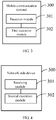
- FIG. 4 is a structural diagram of a network side device according to an embodiment of the present disclosure.
- the network side device 400 includes:
- the detection result further includes: a result of beam failure recovery condition detection performed for the target cell.
- the second operation includes at least one of the following operations:
- the network side device 400 can implement processes of the embodiment of the cell beam failure processing method shown in FIG. 2 and achieve a same technical effect. To avoid repetition, details are not described herein again.
- the network side device 400 receives the indication information sent by the mobile communication terminal based on the detection result, where the detection result includes at least the result of beam failure detection performed for the target cell; and performs, based on the indication information, the second operation of accelerating beam failure processing. In this way, the network side device 400 can perform, based on the received indication information, the operation of accelerating beam failure processing for a target cell with a beam failure, to quickly complete the beam failure recovery, improve a cell beam failure processing capability, and ensure stability of a communication connection to the mobile communication terminal.
- FIG. 5 is a structural diagram of another mobile communication terminal for implementing an embodiment of the present disclosure.
- the mobile communication terminal 500 can implement processes of the embodiment of the cell beam failure processing method shown in FIG. 1 and achieve a same technical effect.
- the mobile communication terminal 500 includes but is not limited to: components such as a radio frequency unit 501, a network module 502, an audio output unit 503, an input unit 504, a sensor 505, a display unit 506, a user input unit 507, an interface unit 508, a memory 509, a processor 510, and a power supply 511.
- components such as a radio frequency unit 501, a network module 502, an audio output unit 503, an input unit 504, a sensor 505, a display unit 506, a user input unit 507, an interface unit 508, a memory 509, a processor 510, and a power supply 511.
- a radio frequency unit 501 such as a radio frequency unit 501, a network module 502, an audio output unit 503, an input unit 504, a sensor 50
- the mobile communication terminal 5 does not constitute a limitation on the mobile communication terminal, and the mobile communication terminal may include more or fewer components than those shown in the figure, or combine some components, or have different component arrangements.
- the mobile communication terminal includes, but is not limited to, a mobile phone, a tablet computer, a laptop computer, a palmtop computer, a vehicle-mounted terminal, a wearable device, a pedometer, and the like.
- the processor 510 is configured to:
- the detection operation further includes beam failure recovery condition detection, and the processor 510 is further configured to: when a beam failure event is detected during the beam failure detection and a beam failure recovery condition is not satisfied, perform, in the target cell, the first operation of accelerating the beam failure processing.
- the beam failure recovery condition includes at least one of the following conditions:
- whether the target cell has an available resource for performing a beam failure recovery procedure specifically includes at least one of the following conditions:
- the beam failure detection is specifically: determining, based on measurement performance information obtained by performing detection on a target reference signal in the target cell, whether a beam failure event is detected.
- the target reference signal includes at least one of the following reference signals:
- the first operation includes at least one of the following operations:
- the indication information is carried in a MAC CE, a PUCCH, or an RRC message; or, the indication information is reported by using an SCell, PCell, PSCell or SpCell.
- the indication information includes at least one of the following information:
- the mobile communication terminal 500 performs the detection operation including at least beam failure detection in the target cell, and, performs, in the target cell based on the detection result, the first operation of accelerating the beam failure processing.
- the first operation such as directly initiating the beam failure recovery procedure or reporting the indication information to the network side can be performed, to accelerate beam failure processing for a target cell with a beam failure, so as to quickly complete the beam failure recovery, and improve a cell beam failure processing capability of the mobile communication terminal 500.
- the radio frequency unit 501 may be configured to receive and send signals in a process of receiving and sending information or calling. Specifically, after receiving downlink data from a base station, the radio frequency unit 501 sends the downlink data to the processor 510 for processing; and sends uplink data to the base station.
- the radio frequency unit 501 includes, but is not limited to, an antenna, at least one amplifier, a transceiver, a coupler, a low noise amplifier, a duplexer, and the like.
- the radio frequency unit 501 may further communicate with a network and another device by using a wireless communication system.
- the mobile communication terminal 500 provides wireless broadband internet access for a user by using a network module 502, for example, helping the user send and receive an email, browse a web page, and access streaming media.
- the audio output unit 503 may convert audio data received by the radio frequency unit 501 or the network module 502 or stored in the memory 509 into an audio signal and output the audio signal as sound. Moreover, the audio output unit 503 may further provide audio output (for example, call signal receiving sound and message receiving sound) related to a specific function executed by the mobile communication terminal 500.
- the audio output unit 503 includes a speaker, a buzzer, a telephone receiver, and the like.
- the input unit 504 is configured to receive an audio or video signal.
- the input unit 504 can include a graphics processing unit (Graphics Processing Unit, GPU) 5041 and a microphone 5042.
- the graphics processing unit 5041 processes image data of static pictures or videos obtained by an image capturing apparatus (for example, a camera) in a video capturing mode or an image capturing mode.
- a processed image frame can be displayed on the display unit 506.
- the image frame processed by the graphics processing unit 5041 may be stored in the memory 509 (or another computer-readable storage medium) or sent by using the radio frequency unit 501 or the network module 502.
- the microphone 5042 may receive sound and can process such sound into audio data. Processed audio data may be converted, in telephone call mode, into a format that can be sent to a mobile communication base station via the radio frequency unit 501 for output.
- the mobile communication terminal 500 further includes at least one sensor 505, such as an optical sensor, a motion sensor, and another sensor.
- the optical sensor includes an ambient light sensor and a proximity sensor.
- the ambient light sensor may adjust luminance of the display panel 5051 based on brightness of ambient light
- the proximity sensor may turn off the display panel 5051 and/or backlight when the mobile communication terminal 500 approaches an ear.
- an accelerometer sensor may detect magnitude of an acceleration in each direction (generally three axes), and may detect magnitude and a direction of gravity when the mobile communication terminal is static.
- the accelerometer sensor may be configured to recognize a mobile communication terminal gesture (for example, landscape/portrait screen switching, a related game, or magnetometer posture calibration), a vibration recognition related function (for example, a pedometer or a strike), or the like.
- the sensor 505 may further include a fingerprint sensor, a pressure sensor, an iris sensor, a molecular sensor, a gyroscope, a barometer, a hygrometer, a thermometer, an infrared sensor, and the like. Details are not described herein.
- the display unit 506 is configured to display information entered by the user or information provided for the user.
- the display unit 506 can include a display panel 5061.
- the display panel 5061 can be configured in a form of liquid crystal display (Liquid Crystal Display, LCD), organic light-emitting diode (Organic Light-Emitting Diode, OLED), and the like.
- the user input unit 507 may be configured to receive input digits or character information and generate key signal input related to user setting and function control of the mobile communication terminal 500.
- the user input unit 507 includes a touch panel 5071 and another input device 5072.
- the touch panel 5071 also referred to as a touchscreen, may collect a touch operation performed by the user on or near the touch panel 5071 (for example, an operation performed by the user on or near the touch panel 5071 by using any suitable object or accessory such as a finger or a stylus).
- the touch panel 5071 may include two parts: a touch detection apparatus and a touch controller.
- the touch detection apparatus detects a touch position of a user, detects a signal brought by a touch operation, and transmits the signal to the touch controller.
- the touch controller receives touch information from the touch detection apparatus, converts the touch information into contact coordinates, sends the contact coordinates to the processor 510, and receives and executes a command from the processor 510.
- the touch panel 5071 may be implemented by using a plurality of types such as a resistive type, a capacitive type, an infrared ray, and a surface acoustic wave.
- the user input unit 507 may include the another input device 5072 in addition to the touch panel 5071.
- the another input device 5072 may include but is not limited to one or more of a physical keyboard, a function key (such as a volume control key or an on/off key), a trackball, a mouse, a joystick, and the like. Details are not described herein again.
- the touch panel 5071 may cover the display panel 5061. After detecting the touch operation on or near the touch panel 5071, the touch panel 5071 transmits the touch operation to the processor 510 to determine a type of a touch event, and then the processor 510 provides corresponding visual output on the display panel 5061 based on the type of the touch event.
- the touch panel 5071 and the display panel 5061 are used as two independent components to implement input and output functions of the mobile communication terminal. However, in some embodiments, the touch panel 5071 and the display panel 5061 may be integrated to implement the input and output functions of the mobile communication terminal 500. This is not specifically limited herein.
- the interface unit 508 is an interface connecting an external apparatus and the mobile communication terminal 500.
- the external apparatus can include a wired or wireless headphone port, an external power supply (or a battery recharger) port, a wired or wireless data port, a memory card port, a port for connection to an apparatus having an identification module, an audio input/output (I/O) port, a video I/O port, an earphone port, and the like.
- the interface unit 508 may be configured to receive input (such as data information and power) from the external apparatus and transmit the received input to one or more elements in the mobile communication terminal 500, or may be configured to transmit data between the mobile communication terminal 500 and the external apparatus.
- the memory 509 may be configured to store a software program and various data.
- the memory 509 may mainly include a program storage area and a data storage area.
- the program storage area may store an operating system, an application program required by at least one function (such as a sound play function or an image play function), and the like.
- the data storage area may store data (such as audio data or an address book) or the like created based on use of the mobile phone.
- the memory 509 may include a high-speed random access memory, and may further include a nonvolatile memory, for example, at least one disk storage device, a flash memory, or another volatile solid-state storage device.
- the processor 510 is a control center of the mobile communication terminal 500, and is connected to various parts of the entire mobile communication terminal 500 by using various interfaces and lines, and performs various functions of the mobile communication terminal 500 and processes data by running or executing a software program and/or module stored in the memory 509 and invoking the data stored in the memory 509, to implement overall monitoring on the mobile communication terminal 500.
- the processor 510 may include one or more processing units.
- the processor 510 may integrate an application processor and a modem processor.
- the application processor mainly processes an operating system, a user interface, an application program, and the like.
- the modem processor mainly processes wireless communication. It may be understood that alternatively, the modem processor may not be integrated into the processor 510.
- the mobile communication terminal 500 may further include a power supply 511 (such as a battery) that supplies power to each component.
- a power supply 511 such as a battery
- the power supply 511 may be logically connected to the processor 510 by using a power supply management system, to implement functions such as charging, discharging, and power consumption management by using the power supply management system.
- the mobile communication terminal 500 includes some function modules not shown, and details are not described herein.
- an embodiment of the present disclosure further provides a mobile communication terminal, including: a processor, a memory, and a computer program stored in the memory and executable on the processor.
- the computer program when executed by the processor, implements processes of the embodiments of the foregoing cell beam failure processing method, and can achieve a same technical effect. To avoid repetition, details are not described herein again.
- FIG. 6 is a structural diagram of another network side device for implementing an embodiment of the present disclosure.
- the network side device 600 can implement processes of the embodiment of the cell beam failure processing method shown in FIG. 2 and achieve a same technical effect.
- the network side device 600 includes: a processor 601, a transceiver 602, a memory 603, a user interface 604, and a bus interface.
- the processor 601 is configured to read a program in the memory 603 and perform the following processes:
- a bus architecture may include any quantity of interconnected buses and bridges, which are specifically connected together by various circuits of one or more processors represented by the processor 601 and a memory represented by the memory 603.
- the bus architecture may further connect together various other circuits of a peripheral device, a voltage stabilizer, a power management circuit, and the like, which are known in this art and will not be further described herein.
- the bus interface provides an interface.
- the transceiver 602 may include a plurality of elements, that is, include a transmitter and a receiver, and provide units for communication with various other apparatuses on a transmission medium.
- the user interface 604 may alternatively be an interface for externally and internally connecting required equipment.
- the connected equipment includes but is not limited to a keypad, a display, a speaker, a microphone, a joystick, and the like.
- the processor 601 is responsible for managing the bus architecture and common processing, and the memory 603 may store data used when the processor 601 performs an operation.
- the detection result further includes: a result of beam failure recovery condition detection performed for the target cell.
- the second operation includes at least one of the following operations:
- the network side device 600 receives the indication information sent by the mobile communication terminal based on the detection result, where the detection result includes at least the result of beam failure detection performed for the target cell; and performs, based on the indication information, the second operation of accelerating beam failure processing. In this way, the network side device 600 can perform, based on the received indication information, the operation of accelerating beam failure processing for a target cell with a beam failure, to quickly complete the beam failure recovery, improve a cell beam failure processing capability, and ensure stability of a communication connection to the mobile communication terminal.
- An embodiment of the present disclosure further provides a computer readable storage medium, where the computer readable storage medium stores a computer program, and the computer program, when executed by a processor, implements processes of the foregoing embodiments of the cell beam failure processing method, and can achieve a same technical effect. To avoid repetition, details are not described herein again.
- the computer readable storage medium is, for example, a read-only memory (Read-Only Memory, ROM for short), a random access memory (Random Access Memory, RAM for short), a magnetic disk, or an optical disc.
- the foregoing methods in the embodiments may be implemented by using software and a required universal hardware platform, or certainly may be implemented by using hardware. However, in many cases, the former is a better implementation.
- the technical solutions of the present disclosure essentially or the part contributing to the prior art may be implemented in a form of a software product.
- the computer software product is stored in a storage medium (such as a ROM/RAM, a magnetic disk, or an optical disc), and includes several instructions for instructing a terminal (which may be a mobile phone, a computer, a server, an air conditioner, a network device, or the like) to perform the methods described in the embodiments of the present disclosure.
Landscapes
- Engineering & Computer Science (AREA)
- Computer Networks & Wireless Communication (AREA)
- Signal Processing (AREA)
- Mobile Radio Communication Systems (AREA)
Applications Claiming Priority (2)
| Application Number | Priority Date | Filing Date | Title |
|---|---|---|---|
| CN201810892074.9A CN110831041B (zh) | 2018-08-07 | 2018-08-07 | 小区波束失败处理方法、移动通信终端和网络侧设备 |
| PCT/CN2019/098113 WO2020029823A1 (fr) | 2018-08-07 | 2019-07-29 | Procédé de traitement de défaillance de faisceau de cellule, terminal de communication mobile et dispositif côté réseau |
Publications (2)
| Publication Number | Publication Date |
|---|---|
| EP3836596A1 true EP3836596A1 (fr) | 2021-06-16 |
| EP3836596A4 EP3836596A4 (fr) | 2021-09-15 |
Family
ID=69414518
Family Applications (1)
| Application Number | Title | Priority Date | Filing Date |
|---|---|---|---|
| EP19848044.4A Pending EP3836596A4 (fr) | 2018-08-07 | 2019-07-29 | Procédé de traitement de défaillance de faisceau de cellule, terminal de communication mobile et dispositif côté réseau |
Country Status (6)
| Country | Link |
|---|---|
| US (1) | US11671854B2 (fr) |
| EP (1) | EP3836596A4 (fr) |
| JP (1) | JP7305747B2 (fr) |
| KR (1) | KR102500046B1 (fr) |
| CN (1) | CN110831041B (fr) |
| WO (1) | WO2020029823A1 (fr) |
Families Citing this family (15)
| Publication number | Priority date | Publication date | Assignee | Title |
|---|---|---|---|---|
| CN110324119B (zh) * | 2018-03-28 | 2020-10-27 | 维沃移动通信有限公司 | 针对波束失败的配置方法和终端 |
| EP4135472A4 (fr) | 2020-04-09 | 2024-01-17 | Beijing Xiaomi Mobile Software Co., Ltd. | Procédé, appareil et dispositif de détection de défaillance de faisceau, et support de stockage lisible |
| WO2021253393A1 (fr) * | 2020-06-19 | 2021-12-23 | 深圳传音控股股份有限公司 | Procédé de traitement de défaillance de faisceau de cellule secondaire, dispositif et support de stockage |
| CN113949421B (zh) * | 2020-07-17 | 2023-02-24 | 维沃移动通信有限公司 | 确定波束信息的方法、装置及电子设备 |
| WO2022021445A1 (fr) * | 2020-07-31 | 2022-02-03 | Oppo广东移动通信有限公司 | Procédé de mesure, dispositif terminal et dispositif de réseau |
| US11678208B2 (en) * | 2021-04-08 | 2023-06-13 | Cisco Technology, Inc. | Failure prediction signaling and cognitive user migration |
| US12126490B2 (en) * | 2021-07-07 | 2024-10-22 | Qualcomm Incorporated | Periodic beam failure indicator reporting |
| US11728873B2 (en) * | 2021-07-09 | 2023-08-15 | Qualcomm Incorporated | Early beam failure detection |
| CN116156629A (zh) * | 2021-11-17 | 2023-05-23 | 华为技术有限公司 | 波束恢复方法、波束失败检测方法以及相关装置 |
| EP4457944A4 (fr) * | 2021-12-28 | 2025-11-19 | Lg Electronics Inc | Procédé et appareil pour effectuer une procédure de reprise sur défaillance de faisceau dans un système de communication sans fil |
| WO2023240601A1 (fr) * | 2022-06-17 | 2023-12-21 | Lenovo (Beijing) Limited | Mesure de faisceau et rapport de faisceau initiés par un ue |
| CN117793855A (zh) * | 2022-09-21 | 2024-03-29 | 展讯通信(上海)有限公司 | 通信方法及通信装置 |
| JP7649280B2 (ja) * | 2022-09-27 | 2025-03-19 | Kddi株式会社 | 接続先のセルを効率的に変更する端末装置及び制御方法 |
| EP4627836A4 (fr) * | 2022-12-01 | 2026-04-15 | Lg Electronics Inc | Commutation de cellule dans des communications sans fil |
| KR20260014226A (ko) * | 2024-07-23 | 2026-01-30 | 삼성전자주식회사 | 무선 통신 시스템에서 셀 간 빔 실패 복구를 위한 방법 및 장치 |
Family Cites Families (10)
| Publication number | Priority date | Publication date | Assignee | Title |
|---|---|---|---|---|
| CN107079459A (zh) * | 2015-08-11 | 2017-08-18 | 瑞典爱立信有限公司 | 从波束故障中恢复 |
| US10230447B2 (en) * | 2016-10-03 | 2019-03-12 | Qualcomm Incorporated | Fast beam recovery using beam information in the measurement report |
| CN108023630B (zh) * | 2016-11-04 | 2021-04-06 | 电信科学技术研究院 | 一种信息传输方法及相关设备 |
| US10601492B2 (en) | 2017-01-05 | 2020-03-24 | Futurewei Technologies, Inc. | Device/UE-oriented beam recovery and maintenance mechanisms |
| US11943677B2 (en) * | 2017-01-19 | 2024-03-26 | Qualcomm Incorporated | Beam selection and radio link failure during beam recovery |
| CA3057215C (fr) * | 2017-03-24 | 2024-04-09 | Telefonaktiebolaget Lm Ericsson (Publ) | Rlm et detection de defaillance de faisceau basee sur un melange de differents signaux de reference |
| CN106879010B (zh) * | 2017-04-13 | 2019-12-27 | 北京墨丘科技有限公司 | 一种优化网络的方法及装置 |
| CN111418226B (zh) * | 2017-11-28 | 2024-04-26 | 瑞典爱立信有限公司 | 用于无线通信的触发测量报告 |
| CN110300423B (zh) * | 2018-03-22 | 2022-12-20 | 华硕电脑股份有限公司 | 无线通信系统中用于波束故障处置的方法和设备 |
| WO2019191960A1 (fr) | 2018-04-04 | 2019-10-10 | Nec Corporation | Procédés et appareil de traitement de défaillance de faisceau d'une cellule secondaire |
-
2018
- 2018-08-07 CN CN201810892074.9A patent/CN110831041B/zh active Active
-
2019
- 2019-07-29 EP EP19848044.4A patent/EP3836596A4/fr active Pending
- 2019-07-29 JP JP2021506673A patent/JP7305747B2/ja active Active
- 2019-07-29 WO PCT/CN2019/098113 patent/WO2020029823A1/fr not_active Ceased
- 2019-07-29 KR KR1020217006869A patent/KR102500046B1/ko active Active
-
2021
- 2021-02-05 US US17/169,363 patent/US11671854B2/en active Active
Also Published As
| Publication number | Publication date |
|---|---|
| CN110831041A (zh) | 2020-02-21 |
| JP7305747B2 (ja) | 2023-07-10 |
| US11671854B2 (en) | 2023-06-06 |
| KR20210042348A (ko) | 2021-04-19 |
| WO2020029823A1 (fr) | 2020-02-13 |
| US20210168631A1 (en) | 2021-06-03 |
| EP3836596A4 (fr) | 2021-09-15 |
| JP2021533676A (ja) | 2021-12-02 |
| KR102500046B1 (ko) | 2023-02-14 |
| CN110831041B (zh) | 2023-10-27 |
Similar Documents
| Publication | Publication Date | Title |
|---|---|---|
| US11671854B2 (en) | Cell beam failure processing method, mobile communication terminal and network side device | |
| US12231969B2 (en) | Secondary cell group maintenance method, terminal device, and network node | |
| US20210168690A1 (en) | Information processing method for a radio link failure, terminal, and network device | |
| US11902818B2 (en) | Measurement method, user equipment, and network side device | |
| EP3739939A1 (fr) | Procédé de mesure pour signal de référence, et terminal utilisateur | |
| US12219412B2 (en) | Method for reporting state information, terminal, and network device | |
| US12495460B2 (en) | Information indication method, information obtaining method, terminal, and network node | |
| US11770871B2 (en) | Radio link recovery method and terminal | |
| KR20210036956A (ko) | 재구성 방법 및 단말 | |
| US12143838B2 (en) | Processing method and terminal | |
| CN112788676A (zh) | 小区管理方法、小区管理配置方法、终端和网络侧设备 | |
| US11909490B2 (en) | Scheduling request transmitting method, scheduling request receiving method, terminal, and network device | |
| US12284540B2 (en) | Method for cell management, terminal, and network-side device | |
| WO2019161740A1 (fr) | Procédé de suppression de groupe de cellules secondaires, dispositif terminal et nœud de réseau | |
| US20210377771A1 (en) | Information processing method, device, and system | |
| US12501295B2 (en) | Radio link monitoring method, terminal, and network side device | |
| US20210092766A1 (en) | Random Access Resource Selection Method And Terminal Device | |
| HK40067216A (en) | Status information reporting method, terminal and network device |
Legal Events
| Date | Code | Title | Description |
|---|---|---|---|
| STAA | Information on the status of an ep patent application or granted ep patent |
Free format text: STATUS: THE INTERNATIONAL PUBLICATION HAS BEEN MADE |
|
| PUAI | Public reference made under article 153(3) epc to a published international application that has entered the european phase |
Free format text: ORIGINAL CODE: 0009012 |
|
| STAA | Information on the status of an ep patent application or granted ep patent |
Free format text: STATUS: REQUEST FOR EXAMINATION WAS MADE |
|
| 17P | Request for examination filed |
Effective date: 20210305 |
|
| AK | Designated contracting states |
Kind code of ref document: A1 Designated state(s): AL AT BE BG CH CY CZ DE DK EE ES FI FR GB GR HR HU IE IS IT LI LT LU LV MC MK MT NL NO PL PT RO RS SE SI SK SM TR |
|
| A4 | Supplementary search report drawn up and despatched |
Effective date: 20210813 |
|
| RIC1 | Information provided on ipc code assigned before grant |
Ipc: H04W 76/19 20180101ALI20210809BHEP Ipc: H04W 24/04 20090101AFI20210809BHEP |
|
| DAV | Request for validation of the european patent (deleted) | ||
| DAX | Request for extension of the european patent (deleted) | ||
| STAA | Information on the status of an ep patent application or granted ep patent |
Free format text: STATUS: EXAMINATION IS IN PROGRESS |
|
| 17Q | First examination report despatched |
Effective date: 20230615 |