EP3838253B1 - Produit aérosol gélifié et kit de formation de gel - Google Patents
Produit aérosol gélifié et kit de formation de gel Download PDFInfo
- Publication number
- EP3838253B1 EP3838253B1 EP18935713.0A EP18935713A EP3838253B1 EP 3838253 B1 EP3838253 B1 EP 3838253B1 EP 18935713 A EP18935713 A EP 18935713A EP 3838253 B1 EP3838253 B1 EP 3838253B1
- Authority
- EP
- European Patent Office
- Prior art keywords
- liquid
- container
- mass
- gum
- aerosol product
- Prior art date
- Legal status (The legal status is an assumption and is not a legal conclusion. Google has not performed a legal analysis and makes no representation as to the accuracy of the status listed.)
- Active
Links
Images

Classifications
-
- A—HUMAN NECESSITIES
- A61—MEDICAL OR VETERINARY SCIENCE; HYGIENE
- A61K—PREPARATIONS FOR MEDICAL, DENTAL OR TOILETRY PURPOSES
- A61K8/00—Cosmetics or similar toiletry preparations
- A61K8/02—Cosmetics or similar toiletry preparations characterised by special physical form
- A61K8/0212—Face masks
-
- A—HUMAN NECESSITIES
- A61—MEDICAL OR VETERINARY SCIENCE; HYGIENE
- A61K—PREPARATIONS FOR MEDICAL, DENTAL OR TOILETRY PURPOSES
- A61K8/00—Cosmetics or similar toiletry preparations
- A61K8/02—Cosmetics or similar toiletry preparations characterised by special physical form
- A61K8/04—Dispersions; Emulsions
- A61K8/042—Gels
-
- A—HUMAN NECESSITIES
- A61—MEDICAL OR VETERINARY SCIENCE; HYGIENE
- A61K—PREPARATIONS FOR MEDICAL, DENTAL OR TOILETRY PURPOSES
- A61K8/00—Cosmetics or similar toiletry preparations
- A61K8/02—Cosmetics or similar toiletry preparations characterised by special physical form
- A61K8/04—Dispersions; Emulsions
- A61K8/046—Aerosols; Foams
-
- A—HUMAN NECESSITIES
- A61—MEDICAL OR VETERINARY SCIENCE; HYGIENE
- A61K—PREPARATIONS FOR MEDICAL, DENTAL OR TOILETRY PURPOSES
- A61K8/00—Cosmetics or similar toiletry preparations
- A61K8/18—Cosmetics or similar toiletry preparations characterised by the composition
- A61K8/30—Cosmetics or similar toiletry preparations characterised by the composition containing organic compounds
- A61K8/33—Cosmetics or similar toiletry preparations characterised by the composition containing organic compounds containing oxygen
- A61K8/34—Alcohols
- A61K8/345—Alcohols containing more than one hydroxy group
-
- A—HUMAN NECESSITIES
- A61—MEDICAL OR VETERINARY SCIENCE; HYGIENE
- A61K—PREPARATIONS FOR MEDICAL, DENTAL OR TOILETRY PURPOSES
- A61K8/00—Cosmetics or similar toiletry preparations
- A61K8/18—Cosmetics or similar toiletry preparations characterised by the composition
- A61K8/72—Cosmetics or similar toiletry preparations characterised by the composition containing organic macromolecular compounds
- A61K8/73—Polysaccharides
-
- A—HUMAN NECESSITIES
- A61—MEDICAL OR VETERINARY SCIENCE; HYGIENE
- A61K—PREPARATIONS FOR MEDICAL, DENTAL OR TOILETRY PURPOSES
- A61K8/00—Cosmetics or similar toiletry preparations
- A61K8/18—Cosmetics or similar toiletry preparations characterised by the composition
- A61K8/72—Cosmetics or similar toiletry preparations characterised by the composition containing organic macromolecular compounds
- A61K8/73—Polysaccharides
- A61K8/737—Galactomannans, e.g. guar; Derivatives thereof
-
- A—HUMAN NECESSITIES
- A61—MEDICAL OR VETERINARY SCIENCE; HYGIENE
- A61Q—SPECIFIC USE OF COSMETICS OR SIMILAR TOILETRY PREPARATIONS
- A61Q19/00—Preparations for care of the skin
-
- A—HUMAN NECESSITIES
- A61—MEDICAL OR VETERINARY SCIENCE; HYGIENE
- A61K—PREPARATIONS FOR MEDICAL, DENTAL OR TOILETRY PURPOSES
- A61K2800/00—Properties of cosmetic compositions or active ingredients thereof or formulation aids used therein and process related aspects
- A61K2800/40—Chemical, physico-chemical or functional or structural properties of particular ingredients
- A61K2800/48—Thickener, Thickening system
-
- A—HUMAN NECESSITIES
- A61—MEDICAL OR VETERINARY SCIENCE; HYGIENE
- A61K—PREPARATIONS FOR MEDICAL, DENTAL OR TOILETRY PURPOSES
- A61K2800/00—Properties of cosmetic compositions or active ingredients thereof or formulation aids used therein and process related aspects
- A61K2800/40—Chemical, physico-chemical or functional or structural properties of particular ingredients
- A61K2800/59—Mixtures
- A61K2800/592—Mixtures of compounds complementing their respective functions
- A61K2800/5922—At least two compounds being classified in the same subclass of A61K8/18
-
- A—HUMAN NECESSITIES
- A61—MEDICAL OR VETERINARY SCIENCE; HYGIENE
- A61K—PREPARATIONS FOR MEDICAL, DENTAL OR TOILETRY PURPOSES
- A61K2800/00—Properties of cosmetic compositions or active ingredients thereof or formulation aids used therein and process related aspects
- A61K2800/80—Process related aspects concerning the preparation of the cosmetic composition or the storage or application thereof
- A61K2800/87—Application Devices; Containers; Packaging
-
- A—HUMAN NECESSITIES
- A61—MEDICAL OR VETERINARY SCIENCE; HYGIENE
- A61K—PREPARATIONS FOR MEDICAL, DENTAL OR TOILETRY PURPOSES
- A61K2800/00—Properties of cosmetic compositions or active ingredients thereof or formulation aids used therein and process related aspects
- A61K2800/80—Process related aspects concerning the preparation of the cosmetic composition or the storage or application thereof
- A61K2800/88—Two- or multipart kits
- A61K2800/882—Mixing prior to application
-
- B—PERFORMING OPERATIONS; TRANSPORTING
- B65—CONVEYING; PACKING; STORING; HANDLING THIN OR FILAMENTARY MATERIAL
- B65D—CONTAINERS FOR STORAGE OR TRANSPORT OF ARTICLES OR MATERIALS, e.g. BAGS, BARRELS, BOTTLES, BOXES, CANS, CARTONS, CRATES, DRUMS, JARS, TANKS, HOPPERS, FORWARDING CONTAINERS; ACCESSORIES, CLOSURES, OR FITTINGS THEREFOR; PACKAGING ELEMENTS; PACKAGES
- B65D83/00—Containers or packages with special means for dispensing contents
- B65D83/14—Containers for dispensing liquid or semi-liquid contents by internal gaseous pressure, i.e. aerosol containers comprising propellant
- B65D83/60—Containers for dispensing liquid or semi-liquid contents by internal gaseous pressure, i.e. aerosol containers comprising propellant with contents and propellant separated
- B65D83/62—Containers for dispensing liquid or semi-liquid contents by internal gaseous pressure, i.e. aerosol containers comprising propellant with contents and propellant separated by membranes, bags or the like
-
- B—PERFORMING OPERATIONS; TRANSPORTING
- B65—CONVEYING; PACKING; STORING; HANDLING THIN OR FILAMENTARY MATERIAL
- B65D—CONTAINERS FOR STORAGE OR TRANSPORT OF ARTICLES OR MATERIALS, e.g. BAGS, BARRELS, BOTTLES, BOXES, CANS, CARTONS, CRATES, DRUMS, JARS, TANKS, HOPPERS, FORWARDING CONTAINERS; ACCESSORIES, CLOSURES, OR FITTINGS THEREFOR; PACKAGING ELEMENTS; PACKAGES
- B65D83/00—Containers or packages with special means for dispensing contents
- B65D83/14—Containers for dispensing liquid or semi-liquid contents by internal gaseous pressure, i.e. aerosol containers comprising propellant
- B65D83/68—Dispensing two or more contents
Definitions
- the present invention relates to a gelled aerosol product and a gel forming kit, which can be used for peel-off mask cosmetics and the like.
- peel-off mask cosmetics such as peel-off masks are mainly in the form of a sheet obtained by impregnating a nonwoven fabric with a skin toner component; however, a defined sheet shape makes it difficult to use such a sheet on an arbitrary spot.
- peel-off mask cosmetics that can be used on any spot; however, these cosmetics need to be washed off and thus cannot sufficiently leave their beauty components on the skin.
- Non-patent Document 1 discloses a two-component peel-off mask that utilizes gelation induced by mixing tamarind gum and glycerin.
- Non-patent Document 1 Tomoyuki Nishio and Sanae Hojo, "Physical Properties of Natural Polymers and its Application for Cosmetics, p. 71, 5-2. Two-Component Carbonic Acid Peel-off Mask, Table 3", FRAGRANCE JOURNAL, October 2014
- KR 101 731 926 B1 relates to a pouch assembly.
- WO 2012/165309 A1 discloses a composition for external use.
- JP 2008-050298 A relates to an external gel composition for attachment to skin.
- the peel-off mask disclosed in the above-described document has a problem in that the gelation takes a long time of 15 to 20 minutes. Therefore, the present inventors investigated the use of a diol having a small number of carbon atoms, such as butylene glycol, and glycerin as components that allow the gelation to proceed by reacting with tamarind gum, in place of glycerin and sorbitol that are used in the above-described document. As a result, it was found that, although such use accelerated the gelation, the resulting gel was soft and syneresis occurred over time, causing a problem that, for example, the gel is peeled off during its use as a peel-off mask.
- a diol having a small number of carbon atoms such as butylene glycol
- glycerin glycerin
- an object of the present invention is to provide: a gelled aerosol product which can be quickly gelled and form a good film in which syneresis is inhibited; and a gel forming kit.
- the present invention relates to a gelled aerosol product which includes: a first container filled with a first liquid; a second container filled with a second liquid; and a propellant, and having a discharge mechanism for discharging the first liquid and the second liquid, the gelled aerosol product being characterized in that
- a gelled aerosol product which can be quickly gelled and form a good film in which syneresis is inhibited, and a gel forming kit can be provided.
- the gelled aerosol product of the present invention contains, in addition to tamarind gum contained in the first liquid, and glycerin and the diol having 2 to 6 carbon atoms that are contained in the second liquid:
- the (A) and the (B) may be contained in either one of the first liquid and the second liquid.
- a mode in which the first liquid contains the (A) and the second liquid contains the (B), or a mode in which the first liquid contains the (B) and the second liquid contains the (A) may be adopted.
- the first liquid contains the (A) while the second liquid contains (B).
- the (A) and the (B) react with each other to form a gel.
- the gel formation by the (A) and the (B) complements the gel formation of tamarind gum, allowing the formation of a good film in which syneresis is inhibited.
- the components of (A) and (B) are normally heat-melted and gelled, the above-described effects are obtained since the components of (A) and (B) form a soft and elastic gel even when they are mixed at normal temperature (e.g., about 20 to 35°C).
- the (A) is preferably at least one selected from the group consisting of locust bean gum, tara gum, and guar gum, more preferably locust bean gum.
- the ratio of the (A) and the (B), [(A):(B)], is preferably 1:3 to 3:1, more preferably 1:2 to 2:1, still more preferably 2:3 to 3:2, in terms of mass.
- the content of the (A) in the first liquid or the second liquid is preferably 0.05% by mass to 5.0% by mass, more preferably 0.1% by mass to 2.0% by mass, still more preferably 0.15% by mass to 1.0% by mass.
- the content of the (B) in the first liquid or the second liquid is preferably 0.05% by mass to 5.0% by mass, more preferably 0.1% by mass to 2.0% by mass, still more preferably 0.15% by mass to 1.0% by mass.
- the first liquid contains tamarind gum.
- Tamarind gum reacts with glycerin and the diol having 2 to 6 carbon atoms to form a network based on hydrogen bonds and is thereby gelled.
- An elastic gel having good feeling of use is formed by using tamarind gum, and glycerin and the diol having 2 to 6 carbon atoms provide moisture to the skin as moisturizing components.
- tamarind gum is unlikely to undergo a change in viscosity even when it is used in an aerosol product; therefore, tamarind gum can be used in a stable manner. This is believed to be because tamarind gum exhibits substantially constant Newtonian viscosity even when a shear force is applied thereto.
- the tamarind gum used in the present invention is not particularly restricted as long as it is a polysaccharide (xyloglucan) obtained from tamarind seeds, and may be a commercially available product.
- examples thereof include GLYLOID 6C, GLYLOID 3S, and GLYLOID 2A (which are manufactured by DSP Gokyo Food & Chemical Co., Ltd.), among which GLYLOID 6C having excellent transparency is preferred.
- the content of tamarind gum in the first liquid is preferably 1.0% by mass to 10.0% by mass, more preferably 1.5% by mass to 8.0% by mass, still more preferably 2.0% by mass to 5.0% by mass, yet still more preferably 2.5% by mass to 4.5% by mass, particularly preferably 3.0% by mass to 4.0% by mass.
- the second liquid is required to contain glycerin and a diol having 2 to 6 carbon atoms. This relationship can increase the gelling rate.
- the mass ratio of the diol having 2 to 6 carbon atoms with respect to glycerin is preferably 0.15 to 7.0, more preferably 0.3 to 5.0, still more preferably 0.4 to 4.0, yet still more preferably 0.4 to 3.0, particularly preferably 1.0 to 2.0.
- the content of the diol having 2 to 6 carbon atoms is preferably 5.0% by mass to 70.0% by mass, more preferably 10.0% by mass to 65.0% by mass, still more preferably 15.0% by mass to 55.0% by mass, particularly preferably 25.0% by mass to 45.0% by mass.
- the content of the diol having 2 to 6 carbon atoms is in this range, gelation occurs quickly, and a gel having a good elasticity can be obtained.
- the content of glycerin is preferably 10.0% by mass to 70.0% by mass, more preferably 15.0% by mass to 60.0% by mass, still more preferably 25.0% by mass to 55.0% by mass, particularly preferably 25.0% by mass to 45.0% by mass.
- a preferable elastic gel is likely to be formed by glycerin and tamarind gum.
- the diol having 2 to 6 carbon atoms is preferably a diol having 3 to 5 carbon atoms.
- Specific examples thereof include propylene glycol, 1,3-propanediol, 1,2-butylene glycol, 1,3-butylene glycol, 1,4-butylene glycol, 2,3-butylene glycol, isopentyl diol, neopentyl glycol, pentylene glycol, and hexylene glycol.
- the diol having 2 to 6 carbon atoms is preferably at least one selected from the group consisting of 1,3-butylene glycol, propylene glycol, isopentyl diol, pentylene glycol and 1,3-propanediol, more preferably 1,3-butylene glycol.
- a thickening agent may be further used in addition to the above-described tamarind gum, (A) and (B).
- the thickening agent is not particularly restricted, and any known thickening agent can be used. Examples thereof include carboxyvinyl polymers, acrylic acid-alkyl acrylate copolymers, acrylates/alkyl acrylate crosspolymers, Na polyacrylates, cellulose gums, (PEG-240/decyltetradeceth-20/HDI) copolymers, and polyurethanes.
- the thickening agent is preferably a carboxyvinyl polymer.
- the thickening agent By using such a thickening agent, the viscosity and the fluidity can be appropriately controlled, so that, for example, the equal-amount dischargeability and the like are improved when the thickening agent is used in an aerosol product.
- the thickening agent is likely to favorably control the viscosity and the fluidity even in an aerosol product of a double-structure container in which the freedom in the design, such as the diameter of an actuator passage, is low and a fine adjustment of the discharge amount is difficult.
- the thickening agent may be used in either one or both of the first liquid and the second liquid.
- the content of the thickening agent other than the above-described tamarind gum, (A) and (B) in the first liquid or the second liquid is preferably 0.05% by mass to 2.0% by mass, more preferably 0.1% by mass to 1.0% by mass.
- the viscosity of the first liquid is preferably 1,000 mPa•s to 100,000 mPa•s, more preferably 5,000 mPa•s to 50,000 mPa•s, still more preferably 10,000 mPa•s to 40,000 mPa•s.
- the viscosity of the second liquid is preferably 1,000 mPa•s to 100,000 mPa•s, more preferably 2,000 mPa•s to 80,000 mPa•s, still more preferably 5,000 mPa•s to 70,000 mPa•s, yet still more preferably 7,000 mPa•s to 60,000 mPa•s.
- the viscosity is in the above-described respective ranges, dripping of each liquid can be inhibited at the time of mixing. In addition, favorable discharge properties are attained in the aerosol product.
- the viscosity is measured using a B-type viscometer under the conditions of 25°C and 6 rpm.
- the pH of the first liquid is not particularly restricted as long as it is in the range of an ordinary cosmetic, and can be widely set in an acidic to alkaline range; however, in a peel-off mask cosmetic, the pH of the first liquid is preferably weakly acidic to weakly alkaline, i.e. 4.0 to 9.0, more preferably 5.0 to 8.0.
- the pH of the second liquid is not particularly restricted as long as it is in the range of an ordinary cosmetic, and can be widely set in an acidic to alkaline range; however, in a peel-off mask cosmetic, the pH of the second liquid is preferably weakly acidic to weakly alkaline, i.e. 4.0 to 9.0, more preferably 5.0 to 8.0.
- a known pH modifier can be used.
- examples thereof include potassium hydroxide, citric acid, and sodium citrate.
- first liquid and the second liquid other additives may also be used to such an extent that does not impair the effects of the present invention.
- known surfactant, thickening agent, and fragrance can be added.
- optional active ingredients such as a beauty component in the case of using the liquids as a peel-off mask, can be added as well.
- additives may be added to either the first liquid or the second liquid.
- the form of the gel forming kit is not particularly restricted, and examples thereof include a kit which includes a first container containing the first liquid and a second container containing the second liquid.
- the first liquid and the second liquid can be gelled by mixing.
- the form of the gel forming kit is not particularly restricted as long as it is a container in which the first liquid and the second liquid can be separately filled and stored and from which these liquids can be taken out as appropriate, and examples of such a container include a bottle container, a pump container, a cup container, ajar container, a tube container, a pouch container, a pack container, and a bag.
- the mixing ratio of the first liquid and the second liquid is not particularly restricted since it varies depending on the concentrations of the raw materials used in the first liquid and the second liquid; however, the mixing ratio of the first liquid and the second liquid (mass of first liquid:mass of second liquid) is preferably 1.0:5.0 to 5.0:1.0, more preferably 1.0:2.0 to 2.0:1.0. When the mixing ratio is in this range, the first liquid and the second liquid can be easily mixed.
- the mixing ratio of the first liquid and the second liquid that are discharged from an actuator (mass of first liquid:mass of second liquid) is not particularly restricted because it varies depending on the concentrations of the respective raw materials used in the first liquid and the second liquid; however, it is preferably 0.8:1.2 to 1.2:0.8, more preferably 0.9:1.1 to 1.1:0.9.
- the first liquid and the second liquid that are discharged can be used by, for example, mixing them with a finger or the like on the palm of a hand or a tray at the above-described mixing ratio. After the mixing, the resulting mixture can be applied to an arbitrary spot and gelled.
- Preferred contents of the respective raw materials in the gel forming kit and the gelled aerosol product at the start of mixing the first liquid and the second liquid are described below. It is preferred to adjust the contents as described below by adjusting the above-described mixing ratio as appropriate.
- the content of the (A) at the time of mixing is preferably 0.02% by mass to 2.5% by mass, more preferably 0.05% by mass to 1.0% by mass, still more preferably 0.07% by mass to 0.5% by mass.
- the content of the (B) at the time of mixing is preferably 0.02% by mass to 2.5% by mass, more preferably 0.05% by mass to 1.0% by mass, still more preferably 0.07% by mass to 0.5% by mass.
- the content of tamarind gum at the time of mixing is preferably 0.5% by mass to 5.0% by mass, more preferably 0.7% by mass to 4.0% by mass, still more preferably 1.0% by mass to 2.5% by mass, yet still more preferably 1.25% by mass to 2.25% by mass, particularly preferably 1.5% by mass to 2.0% by mass.
- the content of the diol having 2 to 6 carbon atoms at the time of mixing is preferably 2.5% by mass to 35.0% by mass, more preferably 5.0% by mass to 32.5% by mass, still more preferably 7.5% by mass to 27.5% by mass, particularly preferably 12.5% by mass to 22.5% by mass.
- the content of glycerin at the time of mixing is preferably 5.0% by mass to 35.0% by mass, more preferably 7.5% by mass to 30.0% by mass, still more preferably 12.5% by mass to 27.5% by mass, particularly preferably 12.5% by mass to 22.5% by mass.
- the gelled aerosol product includes: a first container filled with the first liquid; and a second container filled with the second liquid.
- the gelled aerosol product may take any form of a container, such as a double-structure container or a double can type container, as long as it can be filled with the first liquid and the second liquid separately and discharge both of these liquids.
- the double-structure container includes, for example, an outer container including: a propellant filling space filled with a propellant; the first container; and the second container, and has a discharge mechanism for discharging the first liquid and the second liquid from the first container and the second container, respectively, and the propellant filling space is formed between the first and the second containers and the outer container.
- the double-structure container has an outer container including: the propellant filling space filled with a propellant; the first container filled with the first liquid; and the second container filled with the second liquid.
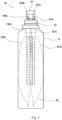
- FIG. 1 is a schematic drawing that illustrates one example of an aerosol product having a double-structure container.
- This aerosol product 10 includes an outer container 11 made of a metal, on which an aerosol valve 12 is provided. Inside of this outer container 11, a first inner bag 15A which partitions the first container to be filled with the first liquid, and a second inner bag 15B which partitions the second container to be filled with the second liquid are provided. In addition, a propellant filling space 16 to be filled with a propellant is formed by the gaps between the outer container 11, the first inner bag 15A, and the second inner bag 15B.
- a first stem 14A and a second stem 14B which are arranged in a vertically slidable manner in a first housing 13A and a second housing 13B, respectively, and each have a stem passage inside, are provided.
- a common actuator (discharge mechanism) 21 is provided on the upper ends of these first stem 14Aand second stem 14B.
- a first actuator passage 22A which is in communication with the stem passage of the first stem 14A, and a second actuator passage 22B which is in communication with the stem passage of the second stem 14B are provided.
- the actuator passages 22A and 22B are each in communication with a discharge port such that the first liquid and the second liquid can be discharged therefrom.
- the inner diameters of the actuator passages 22A and 22B and discharge ports may be changed as appropriate in accordance with the viscosity of the liquid to be discharged.
- the first liquid and the second liquid that are discharged from the respective discharge ports can be gelled by mixing with a finger or the like on, for example, the palm of a hand or a tray.
- FIG. 1 a mode of discharging two kinds of liquid contents, which are the first liquid and the second liquid, is illustrated; however, the double-structure container may be in a mode of discharging three or more kinds of liquid contents.
- the double-structure container may be in a mode of discharging three or more kinds of liquid contents.
- the third inner bag and a fourth inner bag may be provided so that the above-described other additives, active ingredients and the like can be filled thereinto and discharged therefrom.
- the inner bags are parallelly arranged in FIG. 1 ; however, various known modes can be adopted for the arrangement of the inner bags.
- the first inner bag and the second inner bag may be arranged one above the other.
- the first inner bag may be arranged above the second inner bag, and the first inner bag and the second inner bag may each be connected to the actuator via a tube or the like.
- the tube connecting the second inner bag and the actuator may be on the outside of the first inner bag, or may pass through the inside of the first inner bag in such a manner that the tube does not come into contact with the first liquid.
- FIG. 1 a mode of discharging two kinds of liquid contents, which are the first liquid and the second liquid, from the two respective stems is illustrated; however, a mode of discharging the two kinds of liquid contents from a single stem having two flow paths inside may be adopted as well.
- the propellant is not particularly restricted, and a liquefied gas or a compressed gas may be used.
- a liquefied gas include propane, butane, pentane, and a liquefied petroleum gas containing these gases, as well as dimethyl ether, hydrofluoroolefin, and hydrofluorocarbon.
- the compressed gas include nitrous oxide gas, nitrogen gas, carbon dioxide gas, and a mixed gas thereof.
- the propellant is preferably a compressed gas.
- the double can type container is a mode of simultaneously discharging the first liquid and the second liquid using a propellant from each of two aerosol products that are integrated.
- the double can type container includes: a first inner container filled with the first liquid; a second inner container filled with the second liquid; a first outer container in which the first inner container is housed; and a second outer container in which the second inner container is housed, and has a discharge mechanism for discharging the first liquid and the second liquid.
- the propellant is filled into each of a space formed between the first inner container and the first outer container and a space formed between the second inner container and the second outer container.
- FIG. 2 is a schematic drawing that illustrates a double can type aerosol product.
- An aerosol product 30 includes: a first outer container 31a, a second outer container 31b, and an actuator (discharge mechanism) 36 which includes actuator passages 35.
- the first outer container 31a houses a first inner container 32a, and this first inner container 32a is filled with the first liquid.
- the second outer container 3 1b houses a second inner container 32b, and this second inner container 32b is filled with the second liquid.
- the first outer container 31a and the second outer container 31b are fixed together by a fixation plate 37.
- a first propellant filling space 33a and a second propellant filling space 33b are formed between the first outer container 31a and the first inner container 32a and between the second outer container 31b and the second inner container 32b, respectively, and these propellant filling spaces are each filled with a propellant for discharging the first liquid and the second liquid from the discharge mechanism 35.
- the containers are parallelly arranged; however, various known modes can be adopted for the arrangement of the containers.
- the first outer container and the second outer container may be arranged one above the other.
- the first outer container may be arranged above the second outer container, and the first outer container and the second outer container may each be connected to the actuator via a tube or the like.
- FIG. 2 a double can type aerosol having inner containers is illustrated; however, at least one of the first outer container and the second outer container may be in a mode in which a liquid content and a propellant are filled into the same space without an inner container.
- the double can type aerosol may take a mode of having the first container filled with a propellant and the first liquid, the second container filled with a propellant and the second liquid, and a discharge mechanism for discharging the first liquid and the second liquid.
- the discharge mechanism 35 has a discharge port from which compositions filled into the first inner container 32a and the second inner container 32b are discharged.
- the double can type aerosol product may also be in a mode of discharging three or more kinds of liquid contents.
- the double can type aerosol product may also be in a mode of discharging three or more kinds of liquid contents.
- a third outer container, a third inner container, a third propellant filling space and the like three or more kinds of liquid contents can be discharged.
- the containers (inner containers) to be filled with the first liquid and the second liquid are not particularly restricted.
- Known resin containers, metal containers, or a combination thereof can be used.
- the outer containers are also not particularly restricted as long as they can withstand the pressure of a propellant, and known resin containers and metal containers can be used.
- a first liquid was formulated as shown in Table 1.
- a dispersion was prepared by adding tamarind gum, locust bean gum and methylparaben to 1,3-butylene glycol (BG). This dispersion was added to water with stirring the water, and the resultant was heated to 80°C in a hot bath and then further stirred for 30 minutes to obtain a homogeneous paste.
- the thus obtained paste was adjusted to have a prescribed pH by adding thereto a 10% aqueous citric acid solution and a 10% aqueous sodium citrate solution, and this paste was subsequently cooled, whereby the first liquid was obtained.
- a second liquid was formulated as shown in Table 1.
- a dispersion was prepared by adding xanthan gum and methylparaben to a portion of BG.
- This dispersion and a carboxyvinyl polymer (hereinafter, referred to as "carbomer”; 2% aqueous solution) were added to water with stirring the water, and the resultant was stirred for 30 minutes to obtain a homogeneous paste.
- This paste was stirred with addition of glycerin and the remaining BG and, once the paste was in a homogeneous state, a 10% aqueous potassium hydroxide solution was added thereto so as to adjust the paste to have a prescribed pH, whereby the second liquid was obtained.
- the first liquid and the second liquid were each placed in a beaker for viscosity measurement, and the beaker was left to stand in a 25°C thermostatic chamber for 2 hours, after which the viscosity was measured using a B-type viscometer at 6 rpm.
- the electrode of a pH meter was immersed in each of the first liquid and the second liquid for at least 2 minutes, and the pH was read thereafter.
- the first liquid (5 g) and the second liquid (5 g) were mixed on the palm of a hand for 1 minute. Subsequently, the resulting mixture was applied to a forearm, and the state of the applied mixture was observed. The following five items were evaluated.
- Gelling rate The time until a gel state was maintained when the mixture was lifted after being left to stand was evaluated based on the following criteria.
- Film strength When the mixture in a gel state was pressed with a finger, the hardness was evaluated based on the following criteria.
- Syneresis of gel The surface of the mixture in a gel state as well as the presence or absence of syneresis were visually observed and evaluated based on the following criteria.
- the evaluation items were each assessed as follows based on the average value of the above-described evaluation scores assigned by five panelists. The results thereof are shown in Table 1.
- Aerosol products were obtained in the same manner as in Example 1, except that the formulations of the first liquid and the second liquid were changed as shown in Table 1. The evaluation results are shown in Table 1.
- Aerosol products were obtained in the same manner as in Example 1, except that the formulations of the first liquid and the second liquid were changed as shown in Table 2. The evaluation results are shown in Table 2.
Landscapes
- Health & Medical Sciences (AREA)
- Life Sciences & Earth Sciences (AREA)
- General Health & Medical Sciences (AREA)
- Veterinary Medicine (AREA)
- Public Health (AREA)
- Animal Behavior & Ethology (AREA)
- Birds (AREA)
- Epidemiology (AREA)
- Chemical & Material Sciences (AREA)
- Dispersion Chemistry (AREA)
- Emergency Medicine (AREA)
- Dermatology (AREA)
- Engineering & Computer Science (AREA)
- Mechanical Engineering (AREA)
- Cosmetics (AREA)
Claims (15)
- Produit en aérosol gélifié adapté pour des cosmétiques, comprenant : un premier récipient rempli d'un premier liquide ; un deuxième récipient rempli d'un deuxième liquide ; et un propulseur, et ayant un mécanisme de décharge pour décharger le premier liquide et le deuxième liquide, dans lequelle premier liquide comprend l'un ou l'autre parmi les (A) et (B) qui suivent, et de la gomme de tamarin,le deuxième liquide comprend l'un ou l'autre parmi les (A) et (B) qui suivent, et de la glycérine et un diol ayant 2 à 6 atomes de carbone :(A) au moins l'un choisi dans le groupe constitué par la gomme de caroube, le glucomannane, la gomme tara, et la gomme de guar ; et(B) la gomme xanthane, etle premier et le deuxième liquide qui sont déchargés sont gélifiés par mélange.
- Produit en aérosol gélifié selon la revendication 1, dans lequel (A) est au moins l'une choisie dans le groupe constitué par la gomme de caroube, la gomme tara, et la gomme de guar.
- Produit en aérosol gélifié selon la revendication 1, dans lequel (A) est la gomme de caroube.
- Produit en aérosol gélifié selon l'une quelconque des revendications 1 à 3, dans lequel le rapport de (A) à (B), [(A)/(B)], est de 1/3 en 3/1 en masse.
- Produit en aérosol gélifié selon l'une quelconque des revendications 1 à 4, dans lequel le diol ayant 2 à 6 atomes de carbone est au moins l'un choisi dans le groupe constitué par le 1,3-butylèneglycol, le propylèneglycol, l'isopentyldiol, le pentylèneglycol, et le 1,3-propanediol.
- Produit en aérosol gélifié selon l'une quelconque des revendications 1 à 5, dans lequel le rapport en masse du diol ayant 2 à 6 atomes de carbone à la glycérine (diol ayant 2 à 6 atomes de carbone/glycérine) est de 0,15 à 7,0.
- Produit en aérosol gélifié selon l'une quelconque des revendications 1 à 6, dans lequel la teneur en gomme de tamarin dans le premier liquide est de 1,0 % en masse à 10,0 % en masse.
- Produit en aérosol gélifié selon l'une quelconque des revendications 1 à 7, comprenant un récipient extérieur qui comprend : un espace de remplissage par un propulseur rempli du propulseur ; le premier récipient ; et le deuxième récipient, et ayant un mécanisme de décharge pour décharger le premier liquide et le deuxième liquide respectivement hors du premier récipient et hors du deuxième récipient,
dans lequel l'espace de remplissage par un propulseur est formé entre le premier récipient, le deuxième récipient et le récipient extérieur. - Produit en aérosol gélifié selon l'une quelconque des revendications 1 à 7, comprenant : un premier récipient intérieur rempli du premier liquide ; un deuxième récipient intérieur rempli du deuxième liquide ; un premier récipient extérieur dans lequel est logé le premier récipient intérieur ; et un deuxième récipient extérieur dans lequel est logé le deuxième récipient intérieur, et ayant un mécanisme de décharge pour décharger le premier liquide et le deuxième liquide,
dans lequel le propulseur remplit chacun parmi un espace formé entre le premier récipient intérieur et le premier récipient extérieur, et un espace formé entre le deuxième récipient intérieur et le deuxième récipient extérieur. - Kit de formation de gel adapté pour des cosmétiques, comprenant au moins des récipients séparés remplis chacun par un premier liquide ou un deuxième liquide, dans lequelle premier liquide comprend l'un ou l'autre parmi les (A) et (B) qui suivent, et de la gomme de tamarin,le deuxième liquide comprend l'un ou l'autre parmi les (A) et (B) qui suivent, et de la glycérine et un diol ayant 2 à 6 atomes de carbone :(A) au moins l'un choisi dans le groupe constitué par la gomme de caroube, le glucomannane, la gomme tara, et la gomme de guar ; et(B) la gomme xanthane, etle premier et le deuxième liquide sont gélifiés par mélange.
- Kit de formation de gel selon la revendication 10, dans lequel (A) est au moins l'une choisie dans le groupe constitué par la gomme de caroube, la gomme tara, et la gomme de guar.
- Kit de formation de gel selon la revendication 10 ou 11, dans lequel le rapport de (A) à (B), [(A)/(B)], est de 1/3 en 3/1 en masse.
- Kit de formation de gel selon l'une quelconque des revendications 10 à 12, dans lequel le diol ayant 2 à 6 atomes de carbone est au moins l'un choisi dans le groupe constitué par le 1,3-butylèneglycol, le propylèneglycol, l'isopentyldiol, le pentylèneglycol, et le 1,3-propanediol.
- Kit de formation de gel selon l'une quelconque des revendications 10 à 13, dans lequel le rapport en masse du diol ayant 2 à 6 atomes de carbone à la glycérine (diol ayant 2 à 6 atomes de carbone/glycérine) est de 0,15 à 7,0.
- Kit de formation de gel selon l'une quelconque des revendications 10 à 14, dans lequel la teneur en gomme de tamarin dans le premier liquide est de 1,0 % en masse à 10,0 % en masse.
Applications Claiming Priority (1)
| Application Number | Priority Date | Filing Date | Title |
|---|---|---|---|
| PCT/JP2018/036027 WO2020065849A1 (fr) | 2018-09-27 | 2018-09-27 | Produit aérosol gélifié et kit de formation de gel |
Publications (3)
| Publication Number | Publication Date |
|---|---|
| EP3838253A1 EP3838253A1 (fr) | 2021-06-23 |
| EP3838253A4 EP3838253A4 (fr) | 2021-10-13 |
| EP3838253B1 true EP3838253B1 (fr) | 2024-03-13 |
Family
ID=65895178
Family Applications (1)
| Application Number | Title | Priority Date | Filing Date |
|---|---|---|---|
| EP18935713.0A Active EP3838253B1 (fr) | 2018-09-27 | 2018-09-27 | Produit aérosol gélifié et kit de formation de gel |
Country Status (6)
| Country | Link |
|---|---|
| US (1) | US20210205184A1 (fr) |
| EP (1) | EP3838253B1 (fr) |
| JP (1) | JP6490322B1 (fr) |
| KR (1) | KR102627109B1 (fr) |
| CN (1) | CN112770720B (fr) |
| WO (1) | WO2020065849A1 (fr) |
Families Citing this family (6)
| Publication number | Priority date | Publication date | Assignee | Title |
|---|---|---|---|---|
| JP7139558B2 (ja) * | 2018-01-29 | 2022-09-21 | 東洋エアゾール工業株式会社 | 二酸化塩素発生エアゾール |
| JP7349298B2 (ja) * | 2019-09-06 | 2023-09-22 | 東洋エアゾール工業株式会社 | 冷感ゲル組成物及び該冷感ゲル組成物を含むエアゾール製品 |
| FR3115990B1 (fr) * | 2020-11-10 | 2024-03-22 | Oreal | Composition comprenant au moins un polysaccharide de graines de tamarin indica |
| FR3115985B1 (fr) * | 2020-11-10 | 2023-05-12 | Oreal | Procédé de réalisation d’un masque visage sous forme de gel |
| JP7680289B2 (ja) * | 2021-07-05 | 2025-05-20 | 株式会社ファンケル | 2剤式固化組成物 |
| JP7851113B2 (ja) * | 2021-12-08 | 2026-04-24 | Mp五協フード&ケミカル株式会社 | 噴霧用組成物 |
Family Cites Families (17)
| Publication number | Priority date | Publication date | Assignee | Title |
|---|---|---|---|---|
| JP3909095B2 (ja) * | 1995-04-11 | 2007-04-25 | 大日本住友製薬株式会社 | 可逆的熱ゲル化剤 |
| JP4634030B2 (ja) * | 2003-12-12 | 2011-02-16 | 株式会社 サティス製薬 | 粘性水系組成物 |
| JP4395016B2 (ja) * | 2004-06-29 | 2010-01-06 | 日清オイリオグループ株式会社 | ゲル状吸水用組成物 |
| JP4642415B2 (ja) * | 2004-09-01 | 2011-03-02 | 株式会社日本色材工業研究所 | ゲル状化粧料 |
| JP5134778B2 (ja) * | 2006-03-10 | 2013-01-30 | 日清オイリオグループ株式会社 | ゲル組成物及び該ゲル組成物を使用したパック化粧料 |
| JP2008050298A (ja) * | 2006-08-24 | 2008-03-06 | Neige Corporation:Kk | 皮膚貼付用外用ゲル組成物 |
| KR101863984B1 (ko) * | 2011-03-28 | 2018-06-01 | 가부시키가이샤 시세이도 | 외용제 키트 |
| WO2012165309A1 (fr) * | 2011-05-27 | 2012-12-06 | ロート製薬株式会社 | Composition pour un usage externe |
| JP2013100305A (ja) * | 2011-12-28 | 2013-05-23 | Neige Corporation:Kk | ゲル状、半固形状の洗浄料 |
| JP2014047179A (ja) * | 2012-08-31 | 2014-03-17 | Dsp Gokyo Food & Chemical Co Ltd | キシログルカン含有ゲル状組成物 |
| JP5564130B1 (ja) * | 2013-03-18 | 2014-07-30 | 株式会社みやびコスメティックス | 発泡型皮膚外用剤 |
| KR101774342B1 (ko) * | 2014-11-10 | 2017-09-04 | 코스맥스아이큐어 주식회사 | 하이드로겔 마스크팩 조성물, 이를 통해 제조된 하이드로겔 마스크팩 및 이의 제조방법 |
| WO2016121087A1 (fr) * | 2015-01-30 | 2016-08-04 | 東洋エアゾール工業株式会社 | Produit d'aérosol permettant de former une composition de crème chauffante |
| JP2016169186A (ja) * | 2015-03-13 | 2016-09-23 | 東洋エアゾール工業株式会社 | ゲル状組成物形成用エアゾール製品 |
| JP2016204311A (ja) * | 2015-04-23 | 2016-12-08 | 伊那食品工業株式会社 | 乳化組成物 |
| KR101731926B1 (ko) * | 2016-11-29 | 2017-05-02 | (주)엔코스 | 이종 혼합 파우치 어셈블리 |
| CN111801285B (zh) * | 2018-03-09 | 2022-09-13 | 东洋喷雾工业株式会社 | 喷雾产品 |
-
2018
- 2018-09-27 EP EP18935713.0A patent/EP3838253B1/fr active Active
- 2018-09-27 JP JP2018556957A patent/JP6490322B1/ja active Active
- 2018-09-27 KR KR1020217010446A patent/KR102627109B1/ko active Active
- 2018-09-27 WO PCT/JP2018/036027 patent/WO2020065849A1/fr not_active Ceased
- 2018-09-27 CN CN201880098116.XA patent/CN112770720B/zh active Active
-
2021
- 2021-03-22 US US17/207,847 patent/US20210205184A1/en not_active Abandoned
Also Published As
| Publication number | Publication date |
|---|---|
| JPWO2020065849A1 (ja) | 2021-01-07 |
| US20210205184A1 (en) | 2021-07-08 |
| WO2020065849A1 (fr) | 2020-04-02 |
| CN112770720A (zh) | 2021-05-07 |
| CN112770720B (zh) | 2023-12-08 |
| KR20210057108A (ko) | 2021-05-20 |
| JP6490322B1 (ja) | 2019-03-27 |
| KR102627109B1 (ko) | 2024-01-23 |
| EP3838253A1 (fr) | 2021-06-23 |
| EP3838253A4 (fr) | 2021-10-13 |
Similar Documents
| Publication | Publication Date | Title |
|---|---|---|
| EP3838253B1 (fr) | Produit aérosol gélifié et kit de formation de gel | |
| KR20130136994A (ko) | 발포형 피부 외용제 | |
| EP3269348A1 (fr) | Produit aérosol formant une composition-gel | |
| JP5876296B2 (ja) | ジェル状組成物 | |
| JP7847416B2 (ja) | エアゾール組成物 | |
| KR20150008644A (ko) | 투명층을 포함하여 우수한 충진 안정성과 피부 도포성을 가지는 다층상 화장료 조성물 | |
| CN101467937B (zh) | 抑汗喷雾组合物 | |
| WO2009064061A1 (fr) | Composition pulvérulente botanique de coloration capillaire | |
| JP6903497B2 (ja) | 泡吐出容器入り液体口腔用組成物 | |
| JP6640280B2 (ja) | 化粧用ゲル及びこれを含む化粧料 | |
| JP6359302B2 (ja) | 化粧用ゲル及びこれを含む化粧料 | |
| JP7680289B2 (ja) | 2剤式固化組成物 | |
| JP7349298B2 (ja) | 冷感ゲル組成物及び該冷感ゲル組成物を含むエアゾール製品 | |
| JP5433142B2 (ja) | エアゾール剤 | |
| JP7018344B2 (ja) | 泡沫状化粧料 | |
| EP4159189A1 (fr) | Nettoyant capillaire de type aérosol | |
| JP5610661B2 (ja) | ゲル状組成物および該ゲル状組成物を含む化粧品 | |
| KR20150058935A (ko) | 수중유형 에멀전을 포함하는 화장료 조성물 | |
| JP6774705B2 (ja) | 泡吐出容器入り液体口腔用組成物 | |
| KR102663552B1 (ko) | 리브온 타입의 모발 컨디셔닝 조성물 | |
| JP7418920B2 (ja) | エアゾール型除毛剤 | |
| US20240423895A1 (en) | Aerosol type cream hair dye composition | |
| JP7396641B2 (ja) | 二剤同時吐出型泡沫形成エアゾール製品 | |
| JP2020143025A (ja) | 染毛用組成物 | |
| US20240423885A1 (en) | Hair dye composition |
Legal Events
| Date | Code | Title | Description |
|---|---|---|---|
| STAA | Information on the status of an ep patent application or granted ep patent |
Free format text: STATUS: THE INTERNATIONAL PUBLICATION HAS BEEN MADE |
|
| PUAI | Public reference made under article 153(3) epc to a published international application that has entered the european phase |
Free format text: ORIGINAL CODE: 0009012 |
|
| STAA | Information on the status of an ep patent application or granted ep patent |
Free format text: STATUS: REQUEST FOR EXAMINATION WAS MADE |
|
| 17P | Request for examination filed |
Effective date: 20210317 |
|
| AK | Designated contracting states |
Kind code of ref document: A1 Designated state(s): AL AT BE BG CH CY CZ DE DK EE ES FI FR GB GR HR HU IE IS IT LI LT LU LV MC MK MT NL NO PL PT RO RS SE SI SK SM TR |
|
| A4 | Supplementary search report drawn up and despatched |
Effective date: 20210913 |
|
| RIC1 | Information provided on ipc code assigned before grant |
Ipc: A61K 8/04 20060101ALI20210907BHEP Ipc: B65D 83/68 20060101ALI20210907BHEP Ipc: A61Q 19/00 20060101ALI20210907BHEP Ipc: A61K 8/34 20060101ALI20210907BHEP Ipc: A61K 8/02 20060101ALI20210907BHEP Ipc: A61K 8/73 20060101AFI20210907BHEP |
|
| DAV | Request for validation of the european patent (deleted) | ||
| DAX | Request for extension of the european patent (deleted) | ||
| GRAP | Despatch of communication of intention to grant a patent |
Free format text: ORIGINAL CODE: EPIDOSNIGR1 |
|
| STAA | Information on the status of an ep patent application or granted ep patent |
Free format text: STATUS: GRANT OF PATENT IS INTENDED |
|
| INTG | Intention to grant announced |
Effective date: 20231004 |
|
| P01 | Opt-out of the competence of the unified patent court (upc) registered |
Effective date: 20231109 |
|
| GRAS | Grant fee paid |
Free format text: ORIGINAL CODE: EPIDOSNIGR3 |
|
| GRAA | (expected) grant |
Free format text: ORIGINAL CODE: 0009210 |
|
| STAA | Information on the status of an ep patent application or granted ep patent |
Free format text: STATUS: THE PATENT HAS BEEN GRANTED |
|
| AK | Designated contracting states |
Kind code of ref document: B1 Designated state(s): AL AT BE BG CH CY CZ DE DK EE ES FI FR GB GR HR HU IE IS IT LI LT LU LV MC MK MT NL NO PL PT RO RS SE SI SK SM TR |
|
| REG | Reference to a national code |
Ref country code: GB Ref legal event code: FG4D |
|
| REG | Reference to a national code |
Ref country code: CH Ref legal event code: EP |
|
| REG | Reference to a national code |
Ref country code: DE Ref legal event code: R096 Ref document number: 602018066746 Country of ref document: DE |
|
| REG | Reference to a national code |
Ref country code: IE Ref legal event code: FG4D |
|
| PG25 | Lapsed in a contracting state [announced via postgrant information from national office to epo] |
Ref country code: LT Free format text: LAPSE BECAUSE OF FAILURE TO SUBMIT A TRANSLATION OF THE DESCRIPTION OR TO PAY THE FEE WITHIN THE PRESCRIBED TIME-LIMIT Effective date: 20240313 |
|
| REG | Reference to a national code |
Ref country code: LT Ref legal event code: MG9D |
|
| PG25 | Lapsed in a contracting state [announced via postgrant information from national office to epo] |
Ref country code: GR Free format text: LAPSE BECAUSE OF FAILURE TO SUBMIT A TRANSLATION OF THE DESCRIPTION OR TO PAY THE FEE WITHIN THE PRESCRIBED TIME-LIMIT Effective date: 20240614 |
|
| REG | Reference to a national code |
Ref country code: NL Ref legal event code: MP Effective date: 20240313 |
|
| PG25 | Lapsed in a contracting state [announced via postgrant information from national office to epo] |
Ref country code: HR Free format text: LAPSE BECAUSE OF FAILURE TO SUBMIT A TRANSLATION OF THE DESCRIPTION OR TO PAY THE FEE WITHIN THE PRESCRIBED TIME-LIMIT Effective date: 20240313 Ref country code: RS Free format text: LAPSE BECAUSE OF FAILURE TO SUBMIT A TRANSLATION OF THE DESCRIPTION OR TO PAY THE FEE WITHIN THE PRESCRIBED TIME-LIMIT Effective date: 20240613 |
|
| PG25 | Lapsed in a contracting state [announced via postgrant information from national office to epo] |
Ref country code: ES Free format text: LAPSE BECAUSE OF FAILURE TO SUBMIT A TRANSLATION OF THE DESCRIPTION OR TO PAY THE FEE WITHIN THE PRESCRIBED TIME-LIMIT Effective date: 20240313 |
|
| PG25 | Lapsed in a contracting state [announced via postgrant information from national office to epo] |
Ref country code: RS Free format text: LAPSE BECAUSE OF FAILURE TO SUBMIT A TRANSLATION OF THE DESCRIPTION OR TO PAY THE FEE WITHIN THE PRESCRIBED TIME-LIMIT Effective date: 20240613 Ref country code: NO Free format text: LAPSE BECAUSE OF FAILURE TO SUBMIT A TRANSLATION OF THE DESCRIPTION OR TO PAY THE FEE WITHIN THE PRESCRIBED TIME-LIMIT Effective date: 20240613 Ref country code: LT Free format text: LAPSE BECAUSE OF FAILURE TO SUBMIT A TRANSLATION OF THE DESCRIPTION OR TO PAY THE FEE WITHIN THE PRESCRIBED TIME-LIMIT Effective date: 20240313 Ref country code: HR Free format text: LAPSE BECAUSE OF FAILURE TO SUBMIT A TRANSLATION OF THE DESCRIPTION OR TO PAY THE FEE WITHIN THE PRESCRIBED TIME-LIMIT Effective date: 20240313 Ref country code: GR Free format text: LAPSE BECAUSE OF FAILURE TO SUBMIT A TRANSLATION OF THE DESCRIPTION OR TO PAY THE FEE WITHIN THE PRESCRIBED TIME-LIMIT Effective date: 20240614 Ref country code: FI Free format text: LAPSE BECAUSE OF FAILURE TO SUBMIT A TRANSLATION OF THE DESCRIPTION OR TO PAY THE FEE WITHIN THE PRESCRIBED TIME-LIMIT Effective date: 20240313 Ref country code: ES Free format text: LAPSE BECAUSE OF FAILURE TO SUBMIT A TRANSLATION OF THE DESCRIPTION OR TO PAY THE FEE WITHIN THE PRESCRIBED TIME-LIMIT Effective date: 20240313 Ref country code: BG Free format text: LAPSE BECAUSE OF FAILURE TO SUBMIT A TRANSLATION OF THE DESCRIPTION OR TO PAY THE FEE WITHIN THE PRESCRIBED TIME-LIMIT Effective date: 20240313 |
|
| REG | Reference to a national code |
Ref country code: AT Ref legal event code: MK05 Ref document number: 1665080 Country of ref document: AT Kind code of ref document: T Effective date: 20240313 |
|
| PG25 | Lapsed in a contracting state [announced via postgrant information from national office to epo] |
Ref country code: SE Free format text: LAPSE BECAUSE OF FAILURE TO SUBMIT A TRANSLATION OF THE DESCRIPTION OR TO PAY THE FEE WITHIN THE PRESCRIBED TIME-LIMIT Effective date: 20240313 Ref country code: LV Free format text: LAPSE BECAUSE OF FAILURE TO SUBMIT A TRANSLATION OF THE DESCRIPTION OR TO PAY THE FEE WITHIN THE PRESCRIBED TIME-LIMIT Effective date: 20240313 |
|
| PG25 | Lapsed in a contracting state [announced via postgrant information from national office to epo] |
Ref country code: NL Free format text: LAPSE BECAUSE OF FAILURE TO SUBMIT A TRANSLATION OF THE DESCRIPTION OR TO PAY THE FEE WITHIN THE PRESCRIBED TIME-LIMIT Effective date: 20240313 |
|
| PG25 | Lapsed in a contracting state [announced via postgrant information from national office to epo] |
Ref country code: NL Free format text: LAPSE BECAUSE OF FAILURE TO SUBMIT A TRANSLATION OF THE DESCRIPTION OR TO PAY THE FEE WITHIN THE PRESCRIBED TIME-LIMIT Effective date: 20240313 |
|
| PG25 | Lapsed in a contracting state [announced via postgrant information from national office to epo] |
Ref country code: IS Free format text: LAPSE BECAUSE OF FAILURE TO SUBMIT A TRANSLATION OF THE DESCRIPTION OR TO PAY THE FEE WITHIN THE PRESCRIBED TIME-LIMIT Effective date: 20240713 |
|
| PG25 | Lapsed in a contracting state [announced via postgrant information from national office to epo] |
Ref country code: PT Free format text: LAPSE BECAUSE OF FAILURE TO SUBMIT A TRANSLATION OF THE DESCRIPTION OR TO PAY THE FEE WITHIN THE PRESCRIBED TIME-LIMIT Effective date: 20240715 Ref country code: SM Free format text: LAPSE BECAUSE OF FAILURE TO SUBMIT A TRANSLATION OF THE DESCRIPTION OR TO PAY THE FEE WITHIN THE PRESCRIBED TIME-LIMIT Effective date: 20240313 |
|
| PG25 | Lapsed in a contracting state [announced via postgrant information from national office to epo] |
Ref country code: CZ Free format text: LAPSE BECAUSE OF FAILURE TO SUBMIT A TRANSLATION OF THE DESCRIPTION OR TO PAY THE FEE WITHIN THE PRESCRIBED TIME-LIMIT Effective date: 20240313 Ref country code: EE Free format text: LAPSE BECAUSE OF FAILURE TO SUBMIT A TRANSLATION OF THE DESCRIPTION OR TO PAY THE FEE WITHIN THE PRESCRIBED TIME-LIMIT Effective date: 20240313 |
|
| PG25 | Lapsed in a contracting state [announced via postgrant information from national office to epo] |
Ref country code: AT Free format text: LAPSE BECAUSE OF FAILURE TO SUBMIT A TRANSLATION OF THE DESCRIPTION OR TO PAY THE FEE WITHIN THE PRESCRIBED TIME-LIMIT Effective date: 20240313 |
|
| PG25 | Lapsed in a contracting state [announced via postgrant information from national office to epo] |
Ref country code: PL Free format text: LAPSE BECAUSE OF FAILURE TO SUBMIT A TRANSLATION OF THE DESCRIPTION OR TO PAY THE FEE WITHIN THE PRESCRIBED TIME-LIMIT Effective date: 20240313 |
|
| PG25 | Lapsed in a contracting state [announced via postgrant information from national office to epo] |
Ref country code: SK Free format text: LAPSE BECAUSE OF FAILURE TO SUBMIT A TRANSLATION OF THE DESCRIPTION OR TO PAY THE FEE WITHIN THE PRESCRIBED TIME-LIMIT Effective date: 20240313 |
|
| PG25 | Lapsed in a contracting state [announced via postgrant information from national office to epo] |
Ref country code: SM Free format text: LAPSE BECAUSE OF FAILURE TO SUBMIT A TRANSLATION OF THE DESCRIPTION OR TO PAY THE FEE WITHIN THE PRESCRIBED TIME-LIMIT Effective date: 20240313 Ref country code: SK Free format text: LAPSE BECAUSE OF FAILURE TO SUBMIT A TRANSLATION OF THE DESCRIPTION OR TO PAY THE FEE WITHIN THE PRESCRIBED TIME-LIMIT Effective date: 20240313 Ref country code: RO Free format text: LAPSE BECAUSE OF FAILURE TO SUBMIT A TRANSLATION OF THE DESCRIPTION OR TO PAY THE FEE WITHIN THE PRESCRIBED TIME-LIMIT Effective date: 20240313 Ref country code: PT Free format text: LAPSE BECAUSE OF FAILURE TO SUBMIT A TRANSLATION OF THE DESCRIPTION OR TO PAY THE FEE WITHIN THE PRESCRIBED TIME-LIMIT Effective date: 20240715 Ref country code: PL Free format text: LAPSE BECAUSE OF FAILURE TO SUBMIT A TRANSLATION OF THE DESCRIPTION OR TO PAY THE FEE WITHIN THE PRESCRIBED TIME-LIMIT Effective date: 20240313 Ref country code: IS Free format text: LAPSE BECAUSE OF FAILURE TO SUBMIT A TRANSLATION OF THE DESCRIPTION OR TO PAY THE FEE WITHIN THE PRESCRIBED TIME-LIMIT Effective date: 20240713 Ref country code: EE Free format text: LAPSE BECAUSE OF FAILURE TO SUBMIT A TRANSLATION OF THE DESCRIPTION OR TO PAY THE FEE WITHIN THE PRESCRIBED TIME-LIMIT Effective date: 20240313 Ref country code: CZ Free format text: LAPSE BECAUSE OF FAILURE TO SUBMIT A TRANSLATION OF THE DESCRIPTION OR TO PAY THE FEE WITHIN THE PRESCRIBED TIME-LIMIT Effective date: 20240313 Ref country code: AT Free format text: LAPSE BECAUSE OF FAILURE TO SUBMIT A TRANSLATION OF THE DESCRIPTION OR TO PAY THE FEE WITHIN THE PRESCRIBED TIME-LIMIT Effective date: 20240313 |
|
| REG | Reference to a national code |
Ref country code: DE Ref legal event code: R097 Ref document number: 602018066746 Country of ref document: DE |
|
| PG25 | Lapsed in a contracting state [announced via postgrant information from national office to epo] |
Ref country code: DK Free format text: LAPSE BECAUSE OF FAILURE TO SUBMIT A TRANSLATION OF THE DESCRIPTION OR TO PAY THE FEE WITHIN THE PRESCRIBED TIME-LIMIT Effective date: 20240313 |
|
| PLBE | No opposition filed within time limit |
Free format text: ORIGINAL CODE: 0009261 |
|
| STAA | Information on the status of an ep patent application or granted ep patent |
Free format text: STATUS: NO OPPOSITION FILED WITHIN TIME LIMIT |
|
| PG25 | Lapsed in a contracting state [announced via postgrant information from national office to epo] |
Ref country code: DK Free format text: LAPSE BECAUSE OF FAILURE TO SUBMIT A TRANSLATION OF THE DESCRIPTION OR TO PAY THE FEE WITHIN THE PRESCRIBED TIME-LIMIT Effective date: 20240313 |
|
| 26N | No opposition filed |
Effective date: 20241216 |
|
| PG25 | Lapsed in a contracting state [announced via postgrant information from national office to epo] |
Ref country code: MC Free format text: LAPSE BECAUSE OF FAILURE TO SUBMIT A TRANSLATION OF THE DESCRIPTION OR TO PAY THE FEE WITHIN THE PRESCRIBED TIME-LIMIT Effective date: 20240313 Ref country code: SI Free format text: LAPSE BECAUSE OF FAILURE TO SUBMIT A TRANSLATION OF THE DESCRIPTION OR TO PAY THE FEE WITHIN THE PRESCRIBED TIME-LIMIT Effective date: 20240313 |
|
| PG25 | Lapsed in a contracting state [announced via postgrant information from national office to epo] |
Ref country code: LU Free format text: LAPSE BECAUSE OF NON-PAYMENT OF DUE FEES Effective date: 20240927 |
|
| REG | Reference to a national code |
Ref country code: BE Ref legal event code: MM Effective date: 20240930 |
|
| PG25 | Lapsed in a contracting state [announced via postgrant information from national office to epo] |
Ref country code: BE Free format text: LAPSE BECAUSE OF NON-PAYMENT OF DUE FEES Effective date: 20240930 |
|
| PG25 | Lapsed in a contracting state [announced via postgrant information from national office to epo] |
Ref country code: IE Free format text: LAPSE BECAUSE OF NON-PAYMENT OF DUE FEES Effective date: 20240927 |
|
| REG | Reference to a national code |
Ref country code: CH Ref legal event code: U11 Free format text: ST27 STATUS EVENT CODE: U-0-0-U10-U11 (AS PROVIDED BY THE NATIONAL OFFICE) Effective date: 20251001 |
|
| PGFP | Annual fee paid to national office [announced via postgrant information from national office to epo] |
Ref country code: DE Payment date: 20250919 Year of fee payment: 8 |
|
| PGFP | Annual fee paid to national office [announced via postgrant information from national office to epo] |
Ref country code: IT Payment date: 20250923 Year of fee payment: 8 |
|
| PGFP | Annual fee paid to national office [announced via postgrant information from national office to epo] |
Ref country code: GB Payment date: 20250919 Year of fee payment: 8 |
|
| PGFP | Annual fee paid to national office [announced via postgrant information from national office to epo] |
Ref country code: FR Payment date: 20250922 Year of fee payment: 8 |
|
| PGFP | Annual fee paid to national office [announced via postgrant information from national office to epo] |
Ref country code: CH Payment date: 20251001 Year of fee payment: 8 |
|
| PG25 | Lapsed in a contracting state [announced via postgrant information from national office to epo] |
Ref country code: CY Free format text: LAPSE BECAUSE OF FAILURE TO SUBMIT A TRANSLATION OF THE DESCRIPTION OR TO PAY THE FEE WITHIN THE PRESCRIBED TIME-LIMIT; INVALID AB INITIO Effective date: 20180927 |
|
| PG25 | Lapsed in a contracting state [announced via postgrant information from national office to epo] |
Ref country code: HU Free format text: LAPSE BECAUSE OF FAILURE TO SUBMIT A TRANSLATION OF THE DESCRIPTION OR TO PAY THE FEE WITHIN THE PRESCRIBED TIME-LIMIT; INVALID AB INITIO Effective date: 20180927 |