EP3838325B1 - Arbre articulé pour un système de cathéter orientable et procédé de fabrication - Google Patents
Arbre articulé pour un système de cathéter orientable et procédé de fabrication Download PDFInfo
- Publication number
- EP3838325B1 EP3838325B1 EP19216804.5A EP19216804A EP3838325B1 EP 3838325 B1 EP3838325 B1 EP 3838325B1 EP 19216804 A EP19216804 A EP 19216804A EP 3838325 B1 EP3838325 B1 EP 3838325B1
- Authority
- EP
- European Patent Office
- Prior art keywords
- shaft
- wire support
- support elements
- wire
- feed
- Prior art date
- Legal status (The legal status is an assumption and is not a legal conclusion. Google has not performed a legal analysis and makes no representation as to the accuracy of the status listed.)
- Active
Links
Images

Classifications
-
- A—HUMAN NECESSITIES
- A61—MEDICAL OR VETERINARY SCIENCE; HYGIENE
- A61M—DEVICES FOR INTRODUCING MEDIA INTO, OR ONTO, THE BODY; DEVICES FOR TRANSDUCING BODY MEDIA OR FOR TAKING MEDIA FROM THE BODY; DEVICES FOR PRODUCING OR ENDING SLEEP OR STUPOR
- A61M25/00—Catheters; Hollow probes
- A61M25/01—Introducing, guiding, advancing, emplacing or holding catheters
- A61M25/0105—Steering means as part of the catheter or advancing means; Markers for positioning
- A61M25/0133—Tip steering devices
- A61M25/0147—Tip steering devices with movable mechanical means, e.g. pull wires
-
- A—HUMAN NECESSITIES
- A61—MEDICAL OR VETERINARY SCIENCE; HYGIENE
- A61B—DIAGNOSIS; SURGERY; IDENTIFICATION
- A61B17/00—Surgical instruments, devices or methods
- A61B17/00234—Surgical instruments, devices or methods for minimally invasive surgery
-
- A—HUMAN NECESSITIES
- A61—MEDICAL OR VETERINARY SCIENCE; HYGIENE
- A61F—FILTERS IMPLANTABLE INTO BLOOD VESSELS; PROSTHESES; DEVICES PROVIDING PATENCY TO, OR PREVENTING COLLAPSING OF, TUBULAR STRUCTURES OF THE BODY, e.g. STENTS; ORTHOPAEDIC, NURSING OR CONTRACEPTIVE DEVICES; FOMENTATION; TREATMENT OR PROTECTION OF EYES OR EARS; BANDAGES, DRESSINGS OR ABSORBENT PADS; FIRST-AID KITS
- A61F2/00—Filters implantable into blood vessels; Prostheses, i.e. artificial substitutes or replacements for parts of the body; Appliances for connecting them with the body; Devices providing patency to, or preventing collapsing of, tubular structures of the body, e.g. stents
- A61F2/02—Prostheses implantable into the body
- A61F2/24—Heart valves ; Vascular valves, e.g. venous valves; Heart implants, e.g. passive devices for improving the function of the native valve or the heart muscle; Transmyocardial revascularisation [TMR] devices; Valves implantable in the body
- A61F2/2427—Devices for manipulating or deploying heart valves during implantation
- A61F2/2436—Deployment by retracting a sheath
-
- A—HUMAN NECESSITIES
- A61—MEDICAL OR VETERINARY SCIENCE; HYGIENE
- A61F—FILTERS IMPLANTABLE INTO BLOOD VESSELS; PROSTHESES; DEVICES PROVIDING PATENCY TO, OR PREVENTING COLLAPSING OF, TUBULAR STRUCTURES OF THE BODY, e.g. STENTS; ORTHOPAEDIC, NURSING OR CONTRACEPTIVE DEVICES; FOMENTATION; TREATMENT OR PROTECTION OF EYES OR EARS; BANDAGES, DRESSINGS OR ABSORBENT PADS; FIRST-AID KITS
- A61F2/00—Filters implantable into blood vessels; Prostheses, i.e. artificial substitutes or replacements for parts of the body; Appliances for connecting them with the body; Devices providing patency to, or preventing collapsing of, tubular structures of the body, e.g. stents
- A61F2/02—Prostheses implantable into the body
- A61F2/24—Heart valves ; Vascular valves, e.g. venous valves; Heart implants, e.g. passive devices for improving the function of the native valve or the heart muscle; Transmyocardial revascularisation [TMR] devices; Valves implantable in the body
- A61F2/2442—Annuloplasty rings or inserts for correcting the valve shape; Implants for improving the function of a native heart valve
- A61F2/2466—Delivery devices therefor
-
- A—HUMAN NECESSITIES
- A61—MEDICAL OR VETERINARY SCIENCE; HYGIENE
- A61M—DEVICES FOR INTRODUCING MEDIA INTO, OR ONTO, THE BODY; DEVICES FOR TRANSDUCING BODY MEDIA OR FOR TAKING MEDIA FROM THE BODY; DEVICES FOR PRODUCING OR ENDING SLEEP OR STUPOR
- A61M25/00—Catheters; Hollow probes
- A61M25/0009—Making of catheters or other medical or surgical tubes
-
- A—HUMAN NECESSITIES
- A61—MEDICAL OR VETERINARY SCIENCE; HYGIENE
- A61M—DEVICES FOR INTRODUCING MEDIA INTO, OR ONTO, THE BODY; DEVICES FOR TRANSDUCING BODY MEDIA OR FOR TAKING MEDIA FROM THE BODY; DEVICES FOR PRODUCING OR ENDING SLEEP OR STUPOR
- A61M25/00—Catheters; Hollow probes
- A61M25/0009—Making of catheters or other medical or surgical tubes
- A61M25/0013—Weakening parts of a catheter tubing, e.g. by making cuts in the tube or reducing thickness of a layer at one point to adjust the flexibility
-
- A—HUMAN NECESSITIES
- A61—MEDICAL OR VETERINARY SCIENCE; HYGIENE
- A61M—DEVICES FOR INTRODUCING MEDIA INTO, OR ONTO, THE BODY; DEVICES FOR TRANSDUCING BODY MEDIA OR FOR TAKING MEDIA FROM THE BODY; DEVICES FOR PRODUCING OR ENDING SLEEP OR STUPOR
- A61M25/00—Catheters; Hollow probes
- A61M25/0021—Catheters; Hollow probes characterised by the form of the tubing
-
- A—HUMAN NECESSITIES
- A61—MEDICAL OR VETERINARY SCIENCE; HYGIENE
- A61M—DEVICES FOR INTRODUCING MEDIA INTO, OR ONTO, THE BODY; DEVICES FOR TRANSDUCING BODY MEDIA OR FOR TAKING MEDIA FROM THE BODY; DEVICES FOR PRODUCING OR ENDING SLEEP OR STUPOR
- A61M25/00—Catheters; Hollow probes
- A61M25/0043—Catheters; Hollow probes characterised by structural features
-
- A—HUMAN NECESSITIES
- A61—MEDICAL OR VETERINARY SCIENCE; HYGIENE
- A61M—DEVICES FOR INTRODUCING MEDIA INTO, OR ONTO, THE BODY; DEVICES FOR TRANSDUCING BODY MEDIA OR FOR TAKING MEDIA FROM THE BODY; DEVICES FOR PRODUCING OR ENDING SLEEP OR STUPOR
- A61M25/00—Catheters; Hollow probes
- A61M25/01—Introducing, guiding, advancing, emplacing or holding catheters
- A61M25/0105—Steering means as part of the catheter or advancing means; Markers for positioning
- A61M25/0133—Tip steering devices
- A61M25/0138—Tip steering devices having flexible regions as a result of weakened outer material, e.g. slots, slits, cuts, joints or coils
-
- B—PERFORMING OPERATIONS; TRANSPORTING
- B29—WORKING OF PLASTICS; WORKING OF SUBSTANCES IN A PLASTIC STATE IN GENERAL
- B29C—SHAPING OR JOINING OF PLASTICS; SHAPING OF MATERIAL IN A PLASTIC STATE, NOT OTHERWISE PROVIDED FOR; AFTER-TREATMENT OF THE SHAPED PRODUCTS, e.g. REPAIRING
- B29C64/00—Additive manufacturing, i.e. manufacturing of three-dimensional [3D] objects by additive deposition, additive agglomeration or additive layering, e.g. by 3D printing, stereolithography or selective laser sintering
- B29C64/10—Processes of additive manufacturing
-
- B—PERFORMING OPERATIONS; TRANSPORTING
- B33—ADDITIVE MANUFACTURING TECHNOLOGY
- B33Y—ADDITIVE MANUFACTURING, i.e. MANUFACTURING OF THREE-DIMENSIONAL [3D] OBJECTS BY ADDITIVE DEPOSITION, ADDITIVE AGGLOMERATION OR ADDITIVE LAYERING, e.g. BY 3D PRINTING, STEREOLITHOGRAPHY OR SELECTIVE LASER SINTERING
- B33Y10/00—Processes of additive manufacturing
-
- B—PERFORMING OPERATIONS; TRANSPORTING
- B33—ADDITIVE MANUFACTURING TECHNOLOGY
- B33Y—ADDITIVE MANUFACTURING, i.e. MANUFACTURING OF THREE-DIMENSIONAL [3D] OBJECTS BY ADDITIVE DEPOSITION, ADDITIVE AGGLOMERATION OR ADDITIVE LAYERING, e.g. BY 3D PRINTING, STEREOLITHOGRAPHY OR SELECTIVE LASER SINTERING
- B33Y70/00—Materials specially adapted for additive manufacturing
-
- B—PERFORMING OPERATIONS; TRANSPORTING
- B33—ADDITIVE MANUFACTURING TECHNOLOGY
- B33Y—ADDITIVE MANUFACTURING, i.e. MANUFACTURING OF THREE-DIMENSIONAL [3D] OBJECTS BY ADDITIVE DEPOSITION, ADDITIVE AGGLOMERATION OR ADDITIVE LAYERING, e.g. BY 3D PRINTING, STEREOLITHOGRAPHY OR SELECTIVE LASER SINTERING
- B33Y80/00—Products made by additive manufacturing
-
- A—HUMAN NECESSITIES
- A61—MEDICAL OR VETERINARY SCIENCE; HYGIENE
- A61B—DIAGNOSIS; SURGERY; IDENTIFICATION
- A61B17/00—Surgical instruments, devices or methods
- A61B17/00234—Surgical instruments, devices or methods for minimally invasive surgery
- A61B2017/00238—Type of minimally invasive operation
-
- A—HUMAN NECESSITIES
- A61—MEDICAL OR VETERINARY SCIENCE; HYGIENE
- A61B—DIAGNOSIS; SURGERY; IDENTIFICATION
- A61B17/00—Surgical instruments, devices or methods
- A61B17/00234—Surgical instruments, devices or methods for minimally invasive surgery
- A61B2017/00238—Type of minimally invasive operation
- A61B2017/00243—Type of minimally invasive operation cardiac
-
- A—HUMAN NECESSITIES
- A61—MEDICAL OR VETERINARY SCIENCE; HYGIENE
- A61M—DEVICES FOR INTRODUCING MEDIA INTO, OR ONTO, THE BODY; DEVICES FOR TRANSDUCING BODY MEDIA OR FOR TAKING MEDIA FROM THE BODY; DEVICES FOR PRODUCING OR ENDING SLEEP OR STUPOR
- A61M2207/00—Methods of manufacture, assembly or production
Definitions
- the present invention relates to an articulating shaft for a steerable catheter system which may be usable with a minimally invasive procedure e. g. with an intravascular medical treatment system.
- the present invention also relates to a method of fabricating such a shaft.
- Intravascular medical procedures allow the performance of therapeutic treatments in a variety of locations within a patient's body while requiring only relatively small access incisions.
- An intravascular procedure may, for example, eliminate the need for open-heart surgery, reducing risks, costs, and time associated with an open-heart procedure. The intravascular procedure also enables faster recovery times with lower associated costs and risks of complication.
- An example of an intravascular procedure that significantly reduces procedure and recovery time and cost over conventional open surgery is a heart valve replacement or repair procedure in which an artificial valve or valve repair device is guided to the heart through the patient's vasculature. For example, a catheter is inserted into the patient's vasculature and directed to the inferior vena cava.
- the catheter is then urged through the inferior vena cava toward the heart by applying force longitudinally to the catheter.
- the catheter Upon entering the heart from the inferior vena cava, the catheter enters the right atrium.
- the distal end of the catheter may be deflected by one or more deflecting mechanisms, which can be achieved by a tension cable, or other mechanisms positioned inside the catheter. Precise control of the distal end of the catheter allows for more reliable and faster positioning of a medical device and/or implant and other improvements in the procedures.
- the catheters are also used for minimally invasive procedures such as neurovascular, coronary, structural heart, peripheral vascular or endoscopic type procedures for gastrointestinal applications or other.
- An intravascular delivered device needs to be placed precisely to ensure a correct positioning of the medical device, which is essential for its functionality, as the device may be difficult to reposition after the device is fully deployed from the delivery system.
- catheters are required to have the ability to turn or rotate the distal end of the catheter with like-for-like movement of the proximal section or catheter handle. It is achieved through torque transfer along the length of the shaft. For example, single steer to traverse an anatomical challenge.
- catheters are required to achieve movement of parts of the catheter independent of the rest of the catheter.
- the design of the catheter shaft is a significant factor in determining the formation of curves, angles of deflection and levels of steerability.
- the choice of material determines the level of pushability, torque, and flexibility and it can be manipulated along the length of the catheter through a variety of means to achieve the desired results.
- a catheter shaft needs to be placed precisely to ensure a correct positioning of the medical device.
- Multiple lumens may be created within catheters for the passage of guidewires, catheters, fluids, and gases. The number of lumens depends on the material and cross-sectional area. Lumens can be shaped to meet user requirements. Reinforcement bars (or wires) and pull wires may be inserted in the lumens.
- a core lumen is usually provided for receiving the catheter with the medial device. Such a core lumen needs to be sealed hermetically in order to protect the medical device.
- EP2949262 describes articulating mechanisms, and flexible members and flexible segments that can form such articulating mechanisms.
- the mechanisms are useful, for example, for remote steering, guidance and/or manipulation of various instruments and tools at a targeted location.
- US6012494 describes a flexible structure, a number n of notches is formed in a preferably circular-cylindrical block of material.
- the parallel and equidistant notches begin at two diametrically opposed jacket lines and are at right angles or an acute angle to the longitudinal axis of the block and are made so deep that for joining together (n+1) segments, a continuous, approximately rectangular residual cross-sectional region remains, in the form of a residual web.
- continuous, closed conduits are formed in the rectangular residual cross-sectional region.
- aligned bores are located at diametrically opposed points, and in them pressure- and/or tension exerting components can be accommodated for bending the flexible structure.
- WO2004105849 describes a hollow bendable tube with a specified diameter, comprising one or a plurality of slits axially formed from one side of the tip part thereof at specified intervals.
- the slits are formed perpendicular to the longitudinal direction of the bendable tube and extended toward the opposite side of the bendable tube, and a bending operation mechanism is installed in the hollow part of the bendable tube.
- the bendable tube can be manufactured by injection molding, and even if the radius of curvature thereof is small, the tube can be bent with a smaller bending force by a simple structure.
- US4911148 describes an endoscope having a deflectable tip configured so as to have a small outer diameter of approximately 3,81 mm (0.15 inch) or less.
- the endoscope includes a flexible shaft subassembly comprised of a conduit having a deflectable end segment at its distal end which can be controlled by a manually operable mechanism on a handle subassembly.
- the present invention is based on the idea to fabricate an articulating shaft for a steerable catheter as one single piece, so that the central lumen for inserting the catheter is completely sealed along the entire length of the shaft.
- the central lumen may also be referred to as the "main lumen” or “core lumen”.
- at least one steering wire also called “pull wire” or “actuating wire” in the following
- a steering wire lumen that is formed by a plurality of aligned openings which are provided in wire support elements.
- These wire support elements are separated from each other by slots so that bending of the shaft is facilitated.
- These slots may also be referred to as "notches”.
- the outer wall of the shaft contains such notches to allow the shaft to contract and bend on this side.
- the present invention provides an articulating shaft for a steerable catheter system, the shaft comprising a tubular body with a longitudinal central axis, the tubular body having at least one sealed, i. e. radially closed lumen with a distal opening and a proximal opening, and a plurality of wire support elements for supporting at least one actuating wire.
- Each of the wire support elements comprise at least one feed-through opening for receiving the actuating wire, wherein two adjacent wire support elements are separated from each other in an axial direction by a slot, and wherein the body and the wire support elements are integrally formed from a single piece.
- the slots extend by at least 45° in a radial direction around the body.
- a sufficiently large segment of the shaft has enough pliability to facilitate the steering process.
- each slot may be provided to extend around approximately half the circumference of the shaft.
- Each slot may have a gradually diminishing depth in a radial direction towards the slot's peripheral regions around the circumference of the shaft. This design allows for an optimized force distribution when bending the shaft.
- each wire support member may be formed to comprise at least one bracket, which is separated from the body by a void, and wherein the feed-through opening is arranged at the bracket.
- the bracket is shaped symmetric with respect to a mirror plane orthogonally intersecting the cross-section and the central longitudinal axis of the shaft.
- the feed-through opening advantageously is arranged in the middle of the bracket.
- the shaft may comprise a first and a second row of wire support elements axially extending along the longitudinal axis and having first and second feed-through openings, respectively, the rows being arranged opposite to each other in a radial direction, wherein the first feed-through openings are aligned opposite to the second feed-through openings.
- the wire support members may be constructed is brackets having a void between the feed-through opening and the body.
- the shaft has a circular radial outline.
- Such a design is compatible with existing steering systems and allows optimal force distribution.
- an articulating shaft which has to be bent only in one direction
- a larger part of the shaft's cross-section can be used for the wire support elements.
- the shaft is fabricated from a 3D printed biocompatible material.
- 3D printing has become an increasingly cost effective and accurate technology for producing medical material.
- 3D printing is an additive manufacturing (AM) process defined as a process of joining materials to make objects from 3D model data, usually layer upon layer, as opposed to subtractive manufacturing methodologies, such as traditional machining.
- AM additive manufacturing
- 3D printing can deliver parts of very sophisticated and complex geometries with no need of post-processing, built from custom-made materials and composites with near-zero material waste, while being applicable to a diversity of materials, including smart materials such as shape memory polymers and other stimulus-responsive materials, or biocompatible materials. Therefore, 3D printing is a technology that allows designers and engineers to create unique products that can be manufactured at low volumes in a cost-effective way. In the field of medical engineering, 3D printing even allows to produce the shafts custom made and adapted to specific patients.
- the shaft further comprises at least one reinforcement lumen for receiving a reinforcing wire.
- the reinforcing wires which are assembled into these lumens, can be made from steel or Nitinol or other suitable materials with some elastic properties.
- the reinforcing wires can also be referred to as the "neutral axis support wires".
- the neutral axis support wires which are also attached at the distal end, bend to allow the assembly to bend.
- the neutral axis support wires also carry some articulation axial load. The wires keep the segments in alignment and position, and also keep tension on the assembly, preventing the segments from separating.
- the reinforcement lumen may be segmented by peripheral regions of the slots.
- lumens for instance for electric cables or the like may also be provided at the shaft according to the present invention. These lumens can be attached to the inner surface of the outer unsealed wall or they can be attached to the outer surface of the inner sealed wall.
- the present invention further relates to a method for fabricating a shaft for a steerable catheter system, using 3D printing to achieve the features required to allow articulation while also maintaining a sealed lumen, the method comprising:
- a hermetic sealing of the core lumen can be achieved easily without additional covers or sheaths. Moreover, the assembly process is facilitated due to the one-piece design of the shaft.
- the shaft is fabricated by means of a 3D printing process, as mentioned above.
- the shaft may also be fabricated by means of an extrusion process or an injection molding process. These processes are advantageous for high-volume production at low cost.
- the shaft is fabricated from a polymer material having a durometer in the range of 30 Shore A to 70 Shore A. It is particularly advantageous to manufacture the shaft from a polymer material having a durometer in the range of 35 Shore A to 40 Shore A.
- polyamide is a possible material.
- the shaft may also be fabricated from any other suitable material. A material with a relatively low hardness is desirable if low pulling forces and a soft surface are sought, a harder material is advantageous, if an enhanced stiffness is needed.
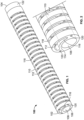
- Fig. 1 shows a schematic perspective representation of an articulating shaft 100 according to a first example of the present invention
- Fig. 2 is an enlarged view of the distal end 102 of the shaft 100.
- the shaft 100 has a distal end 102 with a distal opening and a proximal end 104 with a proximal opening.
- proximal and distal are to be taken as relative to a user using the disclosed delivery devices.
- Proximal is to be understood as relatively closer to the user and “distal” is to be understood as relatively farther away from the user.
- a main lumen 106 extends along the complete length of the shaft 100.
- the main lumen is delimited by an inner wall, which is closed along the length of the shaft 100.
- the main lumen can be sealed hermetically by connecting the distal and proximal ends 102, 104 to respective sealed fittings or connectors (not shown in the drawings).
- the articulating shaft 100 comprises wire support elements 110 with feed-through openings 112.
- the feed-through openings are linearly arranged in the longitudinal direction of the shaft 100, so that a segmented lumen for the steering wire is formed.
- the steering wires and other elements that are inserted into the various lumens are not shown.
- Each of the wire support elements 110 is formed as a bracket which is separated from a body 114 of the shaft 100 and by a void 116.
- Slots 118 separate each of the brackets 110 from the adjacent one. These slots 118 facilitate the bending of the articulating shaft 100 if a pull wire is inserted into the row of feed-through openings 112 and exerts bending forces on the shaft 100. The presence of the voids 116 further enhances the flexibility and pliability of the shaft 100.
- the shaft 100 further comprises reinforcement lumens 120 for receiving reinforcement bars or wires (not shown in the Figures).
- These reinforcement wires may for instance be made from steel, Nitinol, or other suitable materials having some elastic properties.
- the reinforcement wires may also be referred to as the neutral axis support wires because they stabilize the segments formed by the slots 118 in their alignment and position.
- the neutral axis support wires When a tensile load is applied, the actuating wire shortens and causes the notches 118 to close, thereby causing the assembly to bend in the direction of the notches 118.
- the neutral axis support wires arranged in the reinforcement lumens 120 also bend in order to allow the assembly to move.
- the reinforcement wires also carry some articulation axial load and keep tension on the assembly, thereby preventing the segments from separating.
- two reinforcement lumens 120 are provided. It is clear for a person skilled in the art, however, that any other number of lumens may also be provided. Further, also additional lumens for electrical cables or fluid channels can be provided.
- a fluidic connector 122 may be provided for a sealed connection to for instance a rigid part of a catheter or to a handle (not shown in the Figures).
- a similar fluidic connector may be provided at the distal end 102 . Thereby, a complete sealing of the main lumen 106 can be achieved.
- the connector 122 may also comprise means for forming an electrical connection.
- the shaft 100 has an essentially circular outer contour.
- any other cross-sectional outline may also be chosen, for instance an oval or polygonal contour.
- all openings forming a lumen have a circular cross-section. This is not necessarily the case; any other suitable cross-section, e. g. oval or polygonal, may also be used.
- the articulating shaft 100 is formed as a 3D printed part, additively building up the part along the longitudinal axis of the shaft 100.
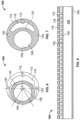
- the main lumen 106 has a center 128 which is off set with respect to a center 126 through which the longitudinal axis 130 of the shaft is passing.
- a center 128 which is off set with respect to a center 126 through which the longitudinal axis 130 of the shaft is passing.
- the first and second lumens 120 for the neutral axis support wires are arranged at the body 114 in a way that they are directly opposing each other along a diameter leading through the center 126 of the shaft 100.
- FIGS. 4 and 6 illustrate that the slots 118 which separate the plurality of segments formed by the wire support elements 110 from each other lead around the center 126 of the shaft 100 to cover a relatively large angle ⁇ , for instance 270°. Only the wall 132 forming the main lumen 106 remains closed continuously along the complete length of the shaft 100 for providing a sealed inner lumen 106.
- the notches 118 close, but also the brackets 110 formed by the voids 116 can be deformed if necessary, so that the distance between the feed-through openings 112 and the wall 132 is reduced.
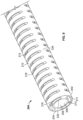
- Fig. 9 illustrates a second example of an articulating shaft 200 according to the present invention.
- the shaft 200 has a distal end 202 with a distal opening and a proximal end (not visible in this Figure) with a proximal opening.
- a main lumen 206 extends along the complete length of the shaft 200.
- the main lumen 206 is delimited by an inner wall 208, which is closed along the length of the shaft 200.
- the main lumen 206 can be sealed hermetically by connecting the distal and proximal ends to respective sealed fittings or connectors (not shown in the drawings).
- the articulating shaft 200 comprises first wire support elements 210 with first feed-through openings 212 and second wire support elements 211 with second feed-through openings 213.
- the feed-through openings 212, 213 are linearly arranged in the longitudinal direction of the shaft 200, so that two segmented lumens for two steering wires is formed.
- a two way steerable catheter can be provided using the shaft 200 shown in Fig. 9 .
- Each of the wire support elements 210 is formed as a bracket which is separated from a body 214 of the shaft 200 and by a void 216.
- Slots 218 separate each of the brackets 210 from the adjacent one. These slots 218 facilitate the bending of the articulating shaft 200 if a pull wire is inserted into the row of feed-through openings 212, 213 and exerts bending forces on the shaft 200. The presence of the voids 216 further enhances the flexibility and pliability of the shaft 200.
- the design of the shaft 200 further differs from the design of the shaft 100 in that the cross-section is symmetrical, in other words, that the center of the main lumen 106 is coaxial with the central axis of the shaft 200.
- each of the slots 218 extends along less than 180° of the outer circumference of the shaft 200, leaving two spines 234 for stabilizing the shaft 200.
- the spines 234 as such stabilize the neutral axis.
- one or more additional reinforcement lumens can be embedded in the spines 234 for receiving a neutral axis support wire of bar.
- These reinforcement wires may for instance be made from steel, Nitinol, or other suitable materials having some elastic properties.
- the reinforcement wires may also be referred to as the neutral axis support wires because they stabilize the segments formed by the slots 218 in their alignment and position.
- the actuating wire on the respective side shortens and causes the notches 218 on the side of the actuated wire to close, thereby causing the assembly to bend in the direction of those notches 218.
- the neutral axis support wires arranged in the reinforcement lumens would also bend in order to allow the assembly to move.
- the reinforcement wires also carry some articulation axial load and keep tension on the assembly, thereby preventing the segments from separating.
- a fluidic connector may be provided for a sealed connection to for instance a rigid part of a catheter or to a handle (not shown in the Figures).
- a similar fluidic connector may be provided at the distal end202 . Thereby, a complete sealing of the main lumen 206 can be achieved.
- the connector may also comprise means for forming an electrical connection.
- the shaft 200 has an essentially circular outer contour.
- any other cross-sectional outline may also be chosen, for instance an oval or polygonal contour.
- all openings forming a lumen have a circular cross-section. This is not necessarily the case; any other suitable cross-section, e. g. oval or polygonal, may also be used.
- the articulating shaft 200 is formed as a 3D printed part, additively building up the part along the longitudinal axis of the shaft 200.
- 3D printing is used to achieve the features required to allow articulation while also maintaining a sealed lumen.
- the present invention may provide an articulating shaft design based on 3D printed low durometer biocompatible material, containing a sealed main lumen.
- the 3D printed articulating design may contain one or more lumens for wires or cables and the sealed lumen may be placed concentric to the outer diameter or offset from the center axis.
- the outer wall contains notches to allow the shaft to contract and bend on this side.
- wire or cable lumens can be attached to the inner surface of the outer unsealed wall or they can be attached to the outer surface of the inner sealed wall. Additional wires may be assembled into these lumens. These can be steel or Nitinol or other suitable materials with some elastic properties. These will be referred to as the neutral axis support wires.
- wire (cable) When these wires are attached to the distal end of the assembly and a tensile load applied then the wire (cable) shortens. This causes the notches to close, causing the assembly to bend in the direction of the notches.
- the neutral axis support wires bend to allow the assembly to bend.
- These wires also carry some articulation axial load. The wires keep the segments in alignment and position. The wires also keep tension on the assembly, preventing the segments from separating.
- the notches can be configured in a multitude of ways, with single way and two way steering possible.
- Reference Numeral Description 100 200 Articulating shaft 102, 202 Distal end 104, 204 Proximal end 106, 206 Main lumen 108, 208 Inner wall of main lumen 110, 210 Wire support element 211 Second wire support element 112, 212 Feed-through opening 213 Second feed-through opening 114, 214 Body 116, 216 Void 118, 218 Slot 120 Reinforcement lumen 122 Connector 126 Center of shaft 128 Center of main lumen 130 Longitudinal axis 132, 232 Wall 234 Spine
Landscapes
- Health & Medical Sciences (AREA)
- Engineering & Computer Science (AREA)
- Life Sciences & Earth Sciences (AREA)
- Animal Behavior & Ethology (AREA)
- Biomedical Technology (AREA)
- Heart & Thoracic Surgery (AREA)
- General Health & Medical Sciences (AREA)
- Public Health (AREA)
- Veterinary Medicine (AREA)
- Pulmonology (AREA)
- Anesthesiology (AREA)
- Hematology (AREA)
- Biophysics (AREA)
- Materials Engineering (AREA)
- Chemical & Material Sciences (AREA)
- Manufacturing & Machinery (AREA)
- Cardiology (AREA)
- Mechanical Engineering (AREA)
- Oral & Maxillofacial Surgery (AREA)
- Transplantation (AREA)
- Vascular Medicine (AREA)
- Surgery (AREA)
- Physics & Mathematics (AREA)
- Optics & Photonics (AREA)
- Nuclear Medicine, Radiotherapy & Molecular Imaging (AREA)
- Medical Informatics (AREA)
- Molecular Biology (AREA)
- Media Introduction/Drainage Providing Device (AREA)
Claims (14)
- Tige d'articulation pour un système de cathéter orientable, la tige (100, 200) comprenant :un corps tubulaire (114, 214) ayant un axe longitudinal central (130), le corps tubulaire (114, 214) ayant au moins une lumière scellée (106, 206) avec une ouverture distale et une ouverture proximale, etune pluralité d'éléments de support de fil (110, 210) pour supporter au moins un fil d'actionnement,dans laquelle chacun des éléments de support de fil (110, 210) comprend au moins une ouverture à alimentation traversante (112, 212) pour recevoir le fil d'actionnement, dans laquelle deux éléments de support de fil (110, 210) adjacents sont séparés l'un de l'autre dans un sens axial par une fente (118, 218), et dans laquelle le corps (114, 214) et les éléments de support de fil (110, 210) sont intégralement formés d'une pièce unique,dans laquelle chaque élément de support de fil (110, 210) comprend au moins un étrier, qui est séparé du corps (114, 214) par un vide (116, 216), et dans laquelle l'ouverture à alimentation traversante (112, 212) est agencée au niveau de l'étrier.
- Tige selon la revendication 1, dans laquelle les fentes (118, 218) s'étendent d'au moins 45° dans un sens radial autour du corps (114, 214).
- Tige selon l'une des revendications précédentes, dans laquelle la tige (200) comprend une première et une seconde rangée d'éléments de support de fil (210, 211) s'étendant axialement le long de l'axe longitudinal et ayant de premières et secondes ouvertures à alimentation traversante (212, 213), respectivement, les rangées étant agencées opposées l'une à l'autre dans un sens radial, dans laquelle les premières ouvertures à alimentation traversante (212) sont alignées opposées aux secondes ouvertures à alimentation traversante (213).
- Tige selon l'une des revendications précédentes, dans laquelle la tige (100, 200) présente un contour radial circulaire.
- Tige selon la revendication 4, dans laquelle la lumière scellée (206) est agencée de manière concentrique à l'intérieur du contour de la tige (200).
- Tige selon la revendication 4, dans laquelle la lumière scellée (106) est agencée à l'intérieur du contour de la tige (100) avec son axe central (128) éloigné de l'axe longitudinal central (130) de la tige (100).
- Tige selon l'une des revendications précédentes, dans laquelle la tige (100, 200) est fabriquée à partir d'un matériau biocompatible imprimé en 3D.
- Tige selon l'une des revendications précédentes, dans laquelle la tige (100, 200) comprend en outre au moins une lumière de renfort (120) pour recevoir un fil de renfort.
- Tige selon la revendication 8, dans laquelle la lumière de renfort (120) est segmentée par des régions périphériques des fentes.
- Procédé de fabrication d'une tige (100, 200) pour un système de cathéter orientable, le procédé comprenant les étapes consistant à :fournir un corps tubulaire (114, 214) avec un axe longitudinal central (130), le corps tubulaire (114, 214) ayant au moins une lumière scellée (106, 206) avec une ouverture distale et une ouverture proximale,fabriquer une pluralité d'éléments de support de fil (110, 210) pour supporter au moins un fil d'actionnement, dans lequel chacun des éléments de support de fil (110, 210) comprend au moins une ouverture à alimentation traversante (112, 212) pour recevoir le fil d'actionnement, dans lequel deux éléments de support de fil (110, 210) adjacents sont séparés l'un de l'autre dans un sens axial par une fente (118, 218), et dans lequel le corps (114, 214) et les éléments de support de fil (110, 210) sont intégralement formés d'une pièce unique,dans lequel chaque élément de support de fil (110, 210) comprend au moins un étrier, qui est séparé du corps (114, 214) par un vide (116, 216), et dans lequel l'ouverture à alimentation traversante (112, 212) est agencée au niveau de l'étrier.
- Procédé selon la revendication 10, dans lequel la tige (100, 200) est fabriquée à l'aide d'un procédé d'impression en 3D.
- Procédé selon la revendication 10 ou 11, dans lequel la tige (100, 200) est fabriquée à l'aide d'un procédé d'extrusion.
- Procédé selon l'une des revendications 10 à 12, dans lequel la tige (100, 200) est imprimée en 3D à partir d'un matériau ayant une dureté au duromètre située dans la plage de 30 Shore A à 70 Shore A.
- Procédé selon la revendication 13, dans lequel la tige (100, 200) est imprimée en 3D à partir d'un matériau polymère ayant une dureté au duromètre située dans la plage de 35 Shore A à 40 Shore A.
Priority Applications (4)
| Application Number | Priority Date | Filing Date | Title |
|---|---|---|---|
| EP19216804.5A EP3838325B1 (fr) | 2019-12-17 | 2019-12-17 | Arbre articulé pour un système de cathéter orientable et procédé de fabrication |
| JP2020206417A JP7694874B2 (ja) | 2019-12-17 | 2020-12-14 | 操作可能なカテーテルシステムの関節シャフトおよび作製方法 |
| CN202011477374.4A CN113069151B (zh) | 2019-12-17 | 2020-12-15 | 用于可转向的导管系统的铰接轴及制造方法 |
| US17/122,565 US12005203B2 (en) | 2019-12-17 | 2020-12-15 | Articulating shaft for a steerable catheter system and fabrication method |
Applications Claiming Priority (1)
| Application Number | Priority Date | Filing Date | Title |
|---|---|---|---|
| EP19216804.5A EP3838325B1 (fr) | 2019-12-17 | 2019-12-17 | Arbre articulé pour un système de cathéter orientable et procédé de fabrication |
Publications (2)
| Publication Number | Publication Date |
|---|---|
| EP3838325A1 EP3838325A1 (fr) | 2021-06-23 |
| EP3838325B1 true EP3838325B1 (fr) | 2024-11-13 |
Family
ID=68917777
Family Applications (1)
| Application Number | Title | Priority Date | Filing Date |
|---|---|---|---|
| EP19216804.5A Active EP3838325B1 (fr) | 2019-12-17 | 2019-12-17 | Arbre articulé pour un système de cathéter orientable et procédé de fabrication |
Country Status (4)
| Country | Link |
|---|---|
| US (1) | US12005203B2 (fr) |
| EP (1) | EP3838325B1 (fr) |
| JP (1) | JP7694874B2 (fr) |
| CN (1) | CN113069151B (fr) |
Families Citing this family (1)
| Publication number | Priority date | Publication date | Assignee | Title |
|---|---|---|---|---|
| US20260069833A1 (en) * | 2024-09-12 | 2026-03-12 | Boston Scientific Scimed, Inc. | Deflectable catheter with asymmetric articulation joint |
Family Cites Families (8)
| Publication number | Priority date | Publication date | Assignee | Title |
|---|---|---|---|---|
| US4911148A (en) * | 1989-03-14 | 1990-03-27 | Intramed Laboratories, Inc. | Deflectable-end endoscope with detachable flexible shaft assembly |
| JP3233953B2 (ja) * | 1991-08-07 | 2001-12-04 | オリンパス光学工業株式会社 | カテーテル装置 |
| US5238005A (en) * | 1991-11-18 | 1993-08-24 | Intelliwire, Inc. | Steerable catheter guidewire |
| DE19509116C2 (de) * | 1995-03-16 | 2000-01-05 | Deutsch Zentr Luft & Raumfahrt | Flexible Struktur |
| JP2004351005A (ja) * | 2003-05-29 | 2004-12-16 | Japan Science & Technology Agency | 屈曲チューブとその製造方法 |
| US7678117B2 (en) * | 2004-06-07 | 2010-03-16 | Novare Surgical Systems, Inc. | Articulating mechanism with flex-hinged links |
| US9220433B2 (en) * | 2011-06-30 | 2015-12-29 | Biosense Webster (Israel), Ltd. | Catheter with variable arcuate distal section |
| LT3290079T (lt) * | 2016-08-31 | 2019-09-10 | Riocath Global, a.s | Kateterio vamzdelis |
-
2019
- 2019-12-17 EP EP19216804.5A patent/EP3838325B1/fr active Active
-
2020
- 2020-12-14 JP JP2020206417A patent/JP7694874B2/ja active Active
- 2020-12-15 US US17/122,565 patent/US12005203B2/en active Active
- 2020-12-15 CN CN202011477374.4A patent/CN113069151B/zh active Active
Also Published As
| Publication number | Publication date |
|---|---|
| US20210178123A1 (en) | 2021-06-17 |
| JP2021094394A (ja) | 2021-06-24 |
| CN113069151B (zh) | 2025-04-22 |
| US12005203B2 (en) | 2024-06-11 |
| JP7694874B2 (ja) | 2025-06-18 |
| CN113069151A (zh) | 2021-07-06 |
| EP3838325A1 (fr) | 2021-06-23 |
Similar Documents
| Publication | Publication Date | Title |
|---|---|---|
| EP2704786B1 (fr) | Gaines de pose orientables | |
| AU2015210338B2 (en) | Steerable medical delivery devices and methods of use | |
| US12515017B2 (en) | Support structure for medical apparatus and method of manufacturing same | |
| AU2010266027B2 (en) | Steerable medical delivery devices and methods of use | |
| EP3065806A1 (fr) | Corps de cathéter orientables avec des structures ondulées | |
| US11779733B2 (en) | Shaft for a catheter and fabrication method | |
| EP3838325B1 (fr) | Arbre articulé pour un système de cathéter orientable et procédé de fabrication | |
| WO2024251535A1 (fr) | Segment de cathéter et cathéter comprenant un tel segment |
Legal Events
| Date | Code | Title | Description |
|---|---|---|---|
| PUAI | Public reference made under article 153(3) epc to a published international application that has entered the european phase |
Free format text: ORIGINAL CODE: 0009012 |
|
| STAA | Information on the status of an ep patent application or granted ep patent |
Free format text: STATUS: THE APPLICATION HAS BEEN PUBLISHED |
|
| AK | Designated contracting states |
Kind code of ref document: A1 Designated state(s): AL AT BE BG CH CY CZ DE DK EE ES FI FR GB GR HR HU IE IS IT LI LT LU LV MC MK MT NL NO PL PT RO RS SE SI SK SM TR |
|
| STAA | Information on the status of an ep patent application or granted ep patent |
Free format text: STATUS: REQUEST FOR EXAMINATION WAS MADE |
|
| 17P | Request for examination filed |
Effective date: 20211217 |
|
| RBV | Designated contracting states (corrected) |
Designated state(s): AL AT BE BG CH CY CZ DE DK EE ES FI FR GB GR HR HU IE IS IT LI LT LU LV MC MK MT NL NO PL PT RO RS SE SI SK SM TR |
|
| GRAP | Despatch of communication of intention to grant a patent |
Free format text: ORIGINAL CODE: EPIDOSNIGR1 |
|
| STAA | Information on the status of an ep patent application or granted ep patent |
Free format text: STATUS: GRANT OF PATENT IS INTENDED |
|
| INTG | Intention to grant announced |
Effective date: 20240620 |
|
| GRAS | Grant fee paid |
Free format text: ORIGINAL CODE: EPIDOSNIGR3 |
|
| GRAA | (expected) grant |
Free format text: ORIGINAL CODE: 0009210 |
|
| STAA | Information on the status of an ep patent application or granted ep patent |
Free format text: STATUS: THE PATENT HAS BEEN GRANTED |
|
| AK | Designated contracting states |
Kind code of ref document: B1 Designated state(s): AL AT BE BG CH CY CZ DE DK EE ES FI FR GB GR HR HU IE IS IT LI LT LU LV MC MK MT NL NO PL PT RO RS SE SI SK SM TR |
|
| REG | Reference to a national code |
Ref country code: GB Ref legal event code: FG4D |
|
| REG | Reference to a national code |
Ref country code: CH Ref legal event code: EP |
|
| REG | Reference to a national code |
Ref country code: IE Ref legal event code: FG4D |
|
| REG | Reference to a national code |
Ref country code: DE Ref legal event code: R096 Ref document number: 602019061850 Country of ref document: DE |
|
| REG | Reference to a national code |
Ref country code: LT Ref legal event code: MG9D |
|
| REG | Reference to a national code |
Ref country code: NL Ref legal event code: MP Effective date: 20241113 |
|
| PG25 | Lapsed in a contracting state [announced via postgrant information from national office to epo] |
Ref country code: HR Free format text: LAPSE BECAUSE OF FAILURE TO SUBMIT A TRANSLATION OF THE DESCRIPTION OR TO PAY THE FEE WITHIN THE PRESCRIBED TIME-LIMIT Effective date: 20241113 Ref country code: PT Free format text: LAPSE BECAUSE OF FAILURE TO SUBMIT A TRANSLATION OF THE DESCRIPTION OR TO PAY THE FEE WITHIN THE PRESCRIBED TIME-LIMIT Effective date: 20250313 Ref country code: IS Free format text: LAPSE BECAUSE OF FAILURE TO SUBMIT A TRANSLATION OF THE DESCRIPTION OR TO PAY THE FEE WITHIN THE PRESCRIBED TIME-LIMIT Effective date: 20250313 |
|
| PG25 | Lapsed in a contracting state [announced via postgrant information from national office to epo] |
Ref country code: FI Free format text: LAPSE BECAUSE OF FAILURE TO SUBMIT A TRANSLATION OF THE DESCRIPTION OR TO PAY THE FEE WITHIN THE PRESCRIBED TIME-LIMIT Effective date: 20241113 Ref country code: NL Free format text: LAPSE BECAUSE OF FAILURE TO SUBMIT A TRANSLATION OF THE DESCRIPTION OR TO PAY THE FEE WITHIN THE PRESCRIBED TIME-LIMIT Effective date: 20241113 |
|
| REG | Reference to a national code |
Ref country code: AT Ref legal event code: MK05 Ref document number: 1741207 Country of ref document: AT Kind code of ref document: T Effective date: 20241113 |
|
| PG25 | Lapsed in a contracting state [announced via postgrant information from national office to epo] |
Ref country code: BG Free format text: LAPSE BECAUSE OF FAILURE TO SUBMIT A TRANSLATION OF THE DESCRIPTION OR TO PAY THE FEE WITHIN THE PRESCRIBED TIME-LIMIT Effective date: 20241113 |
|
| PG25 | Lapsed in a contracting state [announced via postgrant information from national office to epo] |
Ref country code: ES Free format text: LAPSE BECAUSE OF FAILURE TO SUBMIT A TRANSLATION OF THE DESCRIPTION OR TO PAY THE FEE WITHIN THE PRESCRIBED TIME-LIMIT Effective date: 20241113 |
|
| PG25 | Lapsed in a contracting state [announced via postgrant information from national office to epo] |
Ref country code: NO Free format text: LAPSE BECAUSE OF FAILURE TO SUBMIT A TRANSLATION OF THE DESCRIPTION OR TO PAY THE FEE WITHIN THE PRESCRIBED TIME-LIMIT Effective date: 20250213 |
|
| PG25 | Lapsed in a contracting state [announced via postgrant information from national office to epo] |
Ref country code: LV Free format text: LAPSE BECAUSE OF FAILURE TO SUBMIT A TRANSLATION OF THE DESCRIPTION OR TO PAY THE FEE WITHIN THE PRESCRIBED TIME-LIMIT Effective date: 20241113 Ref country code: GR Free format text: LAPSE BECAUSE OF FAILURE TO SUBMIT A TRANSLATION OF THE DESCRIPTION OR TO PAY THE FEE WITHIN THE PRESCRIBED TIME-LIMIT Effective date: 20250214 Ref country code: AT Free format text: LAPSE BECAUSE OF FAILURE TO SUBMIT A TRANSLATION OF THE DESCRIPTION OR TO PAY THE FEE WITHIN THE PRESCRIBED TIME-LIMIT Effective date: 20241113 |
|
| PG25 | Lapsed in a contracting state [announced via postgrant information from national office to epo] |
Ref country code: PL Free format text: LAPSE BECAUSE OF FAILURE TO SUBMIT A TRANSLATION OF THE DESCRIPTION OR TO PAY THE FEE WITHIN THE PRESCRIBED TIME-LIMIT Effective date: 20241113 |
|
| PG25 | Lapsed in a contracting state [announced via postgrant information from national office to epo] |
Ref country code: RS Free format text: LAPSE BECAUSE OF FAILURE TO SUBMIT A TRANSLATION OF THE DESCRIPTION OR TO PAY THE FEE WITHIN THE PRESCRIBED TIME-LIMIT Effective date: 20250213 |
|
| PG25 | Lapsed in a contracting state [announced via postgrant information from national office to epo] |
Ref country code: SM Free format text: LAPSE BECAUSE OF FAILURE TO SUBMIT A TRANSLATION OF THE DESCRIPTION OR TO PAY THE FEE WITHIN THE PRESCRIBED TIME-LIMIT Effective date: 20241113 |
|
| PG25 | Lapsed in a contracting state [announced via postgrant information from national office to epo] |
Ref country code: DK Free format text: LAPSE BECAUSE OF FAILURE TO SUBMIT A TRANSLATION OF THE DESCRIPTION OR TO PAY THE FEE WITHIN THE PRESCRIBED TIME-LIMIT Effective date: 20241113 |
|
| PG25 | Lapsed in a contracting state [announced via postgrant information from national office to epo] |
Ref country code: EE Free format text: LAPSE BECAUSE OF FAILURE TO SUBMIT A TRANSLATION OF THE DESCRIPTION OR TO PAY THE FEE WITHIN THE PRESCRIBED TIME-LIMIT Effective date: 20241113 |
|
| PG25 | Lapsed in a contracting state [announced via postgrant information from national office to epo] |
Ref country code: RO Free format text: LAPSE BECAUSE OF FAILURE TO SUBMIT A TRANSLATION OF THE DESCRIPTION OR TO PAY THE FEE WITHIN THE PRESCRIBED TIME-LIMIT Effective date: 20241113 |
|
| PG25 | Lapsed in a contracting state [announced via postgrant information from national office to epo] |
Ref country code: SK Free format text: LAPSE BECAUSE OF FAILURE TO SUBMIT A TRANSLATION OF THE DESCRIPTION OR TO PAY THE FEE WITHIN THE PRESCRIBED TIME-LIMIT Effective date: 20241113 |
|
| PG25 | Lapsed in a contracting state [announced via postgrant information from national office to epo] |
Ref country code: CZ Free format text: LAPSE BECAUSE OF FAILURE TO SUBMIT A TRANSLATION OF THE DESCRIPTION OR TO PAY THE FEE WITHIN THE PRESCRIBED TIME-LIMIT Effective date: 20241113 |
|
| PG25 | Lapsed in a contracting state [announced via postgrant information from national office to epo] |
Ref country code: IT Free format text: LAPSE BECAUSE OF FAILURE TO SUBMIT A TRANSLATION OF THE DESCRIPTION OR TO PAY THE FEE WITHIN THE PRESCRIBED TIME-LIMIT Effective date: 20241113 |
|
| REG | Reference to a national code |
Ref country code: CH Ref legal event code: PL |
|
| REG | Reference to a national code |
Ref country code: DE Ref legal event code: R097 Ref document number: 602019061850 Country of ref document: DE |
|
| PG25 | Lapsed in a contracting state [announced via postgrant information from national office to epo] |
Ref country code: LU Free format text: LAPSE BECAUSE OF NON-PAYMENT OF DUE FEES Effective date: 20241217 |
|
| PG25 | Lapsed in a contracting state [announced via postgrant information from national office to epo] |
Ref country code: SE Free format text: LAPSE BECAUSE OF FAILURE TO SUBMIT A TRANSLATION OF THE DESCRIPTION OR TO PAY THE FEE WITHIN THE PRESCRIBED TIME-LIMIT Effective date: 20241113 |
|
| PG25 | Lapsed in a contracting state [announced via postgrant information from national office to epo] |
Ref country code: MC Free format text: LAPSE BECAUSE OF FAILURE TO SUBMIT A TRANSLATION OF THE DESCRIPTION OR TO PAY THE FEE WITHIN THE PRESCRIBED TIME-LIMIT Effective date: 20241113 |
|
| PLBE | No opposition filed within time limit |
Free format text: ORIGINAL CODE: 0009261 |
|
| STAA | Information on the status of an ep patent application or granted ep patent |
Free format text: STATUS: NO OPPOSITION FILED WITHIN TIME LIMIT |
|
| REG | Reference to a national code |
Ref country code: BE Ref legal event code: MM Effective date: 20241231 |
|
| PG25 | Lapsed in a contracting state [announced via postgrant information from national office to epo] |
Ref country code: BE Free format text: LAPSE BECAUSE OF NON-PAYMENT OF DUE FEES Effective date: 20241231 |
|
| PG25 | Lapsed in a contracting state [announced via postgrant information from national office to epo] |
Ref country code: CH Free format text: LAPSE BECAUSE OF NON-PAYMENT OF DUE FEES Effective date: 20241231 |
|
| 26N | No opposition filed |
Effective date: 20250814 |
|
| PG25 | Lapsed in a contracting state [announced via postgrant information from national office to epo] |
Ref country code: IE Free format text: LAPSE BECAUSE OF NON-PAYMENT OF DUE FEES Effective date: 20241217 |
|
| PGFP | Annual fee paid to national office [announced via postgrant information from national office to epo] |
Ref country code: DE Payment date: 20250930 Year of fee payment: 7 |
|
| PGFP | Annual fee paid to national office [announced via postgrant information from national office to epo] |
Ref country code: GB Payment date: 20251001 Year of fee payment: 7 |
|
| PGFP | Annual fee paid to national office [announced via postgrant information from national office to epo] |
Ref country code: FR Payment date: 20251008 Year of fee payment: 7 |