EP3838894B1 - Procédé de production d'intermédiaire utile pour la synthèse d'un inhibiteur de sglt - Google Patents
Procédé de production d'intermédiaire utile pour la synthèse d'un inhibiteur de sglt Download PDFInfo
- Publication number
- EP3838894B1 EP3838894B1 EP19850413.6A EP19850413A EP3838894B1 EP 3838894 B1 EP3838894 B1 EP 3838894B1 EP 19850413 A EP19850413 A EP 19850413A EP 3838894 B1 EP3838894 B1 EP 3838894B1
- Authority
- EP
- European Patent Office
- Prior art keywords
- compound
- formula
- 7alkyl
- reacting
- halogen
- Prior art date
- Legal status (The legal status is an assumption and is not a legal conclusion. Google has not performed a legal analysis and makes no representation as to the accuracy of the status listed.)
- Active
Links
Classifications
-
- C—CHEMISTRY; METALLURGY
- C07—ORGANIC CHEMISTRY
- C07D—HETEROCYCLIC COMPOUNDS
- C07D307/00—Heterocyclic compounds containing five-membered rings having one oxygen atom as the only ring hetero atom
- C07D307/77—Heterocyclic compounds containing five-membered rings having one oxygen atom as the only ring hetero atom ortho- or peri-condensed with carbocyclic rings or ring systems
- C07D307/78—Benzo [b] furans; Hydrogenated benzo [b] furans
- C07D307/82—Benzo [b] furans; Hydrogenated benzo [b] furans with hetero atoms or with carbon atoms having three bonds to hetero atoms with at the most one bond to halogen, e.g. ester or nitrile radicals, directly attached to carbon atoms of the hetero ring
-
- C—CHEMISTRY; METALLURGY
- C07—ORGANIC CHEMISTRY
- C07D—HETEROCYCLIC COMPOUNDS
- C07D307/00—Heterocyclic compounds containing five-membered rings having one oxygen atom as the only ring hetero atom
- C07D307/77—Heterocyclic compounds containing five-membered rings having one oxygen atom as the only ring hetero atom ortho- or peri-condensed with carbocyclic rings or ring systems
- C07D307/78—Benzo [b] furans; Hydrogenated benzo [b] furans
- C07D307/79—Benzo [b] furans; Hydrogenated benzo [b] furans with only hydrogen atoms, hydrocarbon or substituted hydrocarbon radicals, directly attached to carbon atoms of the hetero ring
-
- C—CHEMISTRY; METALLURGY
- C07—ORGANIC CHEMISTRY
- C07D—HETEROCYCLIC COMPOUNDS
- C07D407/00—Heterocyclic compounds containing two or more hetero rings, at least one ring having oxygen atoms as the only ring hetero atoms, not provided for by group C07D405/00
- C07D407/02—Heterocyclic compounds containing two or more hetero rings, at least one ring having oxygen atoms as the only ring hetero atoms, not provided for by group C07D405/00 containing two hetero rings
- C07D407/04—Heterocyclic compounds containing two or more hetero rings, at least one ring having oxygen atoms as the only ring hetero atoms, not provided for by group C07D405/00 containing two hetero rings directly linked by a ring-member-to-ring-member bond
-
- C—CHEMISTRY; METALLURGY
- C07—ORGANIC CHEMISTRY
- C07D—HETEROCYCLIC COMPOUNDS
- C07D409/00—Heterocyclic compounds containing two or more hetero rings, at least one ring having sulfur atoms as the only ring hetero atoms
- C07D409/02—Heterocyclic compounds containing two or more hetero rings, at least one ring having sulfur atoms as the only ring hetero atoms containing two hetero rings
- C07D409/04—Heterocyclic compounds containing two or more hetero rings, at least one ring having sulfur atoms as the only ring hetero atoms containing two hetero rings directly linked by a ring-member-to-ring-member bond
-
- C—CHEMISTRY; METALLURGY
- C07—ORGANIC CHEMISTRY
- C07D—HETEROCYCLIC COMPOUNDS
- C07D493/00—Heterocyclic compounds containing oxygen atoms as the only ring hetero atoms in the condensed system
- C07D493/02—Heterocyclic compounds containing oxygen atoms as the only ring hetero atoms in the condensed system in which the condensed system contains two hetero rings
- C07D493/04—Ortho-condensed systems
-
- C—CHEMISTRY; METALLURGY
- C07—ORGANIC CHEMISTRY
- C07H—SUGARS; DERIVATIVES THEREOF; NUCLEOSIDES; NUCLEOTIDES; NUCLEIC ACIDS
- C07H1/00—Processes for the preparation of sugar derivatives
-
- C—CHEMISTRY; METALLURGY
- C07—ORGANIC CHEMISTRY
- C07H—SUGARS; DERIVATIVES THEREOF; NUCLEOSIDES; NUCLEOTIDES; NUCLEIC ACIDS
- C07H7/00—Compounds containing non-saccharide radicals linked to saccharide radicals by a carbon-to-carbon bond
- C07H7/06—Heterocyclic radicals
Definitions
- the present invention relates to preparation of an intermediate useful for synthesis of a diphenylmethane derivative that can be used as an SGLT inhibitor.
- SGLT Sodium-dependent glucose cotransporters
- SGLT1 and SGLT2 Two important SGLT isoforms, known as SGLT1 and SGLT2, have been cloned.
- SGLT1 is located in the intestine, kidney and heart, and regulates cardiac glucose transport.
- SGLT1 is a high-affinity, low-dose transporter and is responsible for only a fraction of renal glucose reuptake.
- SGLT2 is a low-affinity, high-dose transporter that is primarily located in the apical domain of epithelial cells in the early proximal curvature tubules.
- SGLT2 In healthy individuals, more than 99% of the plasma glucose filtered by the renal glomerulus is reabsorbed and less than 1% of the total filtered glucose is excreted in the urine. It is estimated that 90% of renal glucose reuptake is facilitated by SGLT2 and the remaining 10% is mediated by SGLT1 in the late proximal rectal tubule. Genetic mutations in SGLT2 do not have a particular adverse effect on carbohydrate metabolism, but cause increased renal glucose secretion of 140 g/day depending on mutations. Human mutation studies have presumed that SGLT2 is responsible for most renal glucose reuptake, which has been considered as the subject of therapeutic studies.
- Korean Patent Application Publication No. 2017-0142904 discloses a method of preparing a diphenylmethane derivative having inhibitory activity against SGLT2. This document discloses that a synthesis route is concise and a yield is improved, compared to a linear synthesis method disclosed in conventional documents, because a diphenylmethane derivative is prepared using a convergent synthesis method of individually synthesizing each major group and then coupling the same, and risk factors inherent in the linear synthesis method can be reduced.
- Patent Document 1 Korean Patent Application Publication No. 2017-0142904
- the above and other objects can be accomplished by the provision of an improved method of preparing an intermediate useful for synthesis of a diphenylmethane derivative that can be used as an SGLT inhibitor.
- the present inventors have improved a process of preparing an intermediate useful for synthesis of a diphenylmethane derivative that can be used as an SGLT inhibitor.
- a compound of Formula 1 that is a final target compound and an active ingredient used as an SGLT inhibitor is as follows:
- ring B-1 may be selected from the group consisting of: wherein R7 is hydrogen or C1-7alkyl; and R8a and R8b are, each independently, C1-7alkyl or are linked to each other to form 5-10 membered heterocycloalkyl (containing one or more heteroatoms selected from the group consisting of N, S and O).
- ring B-2 may be selected from the group consisting of
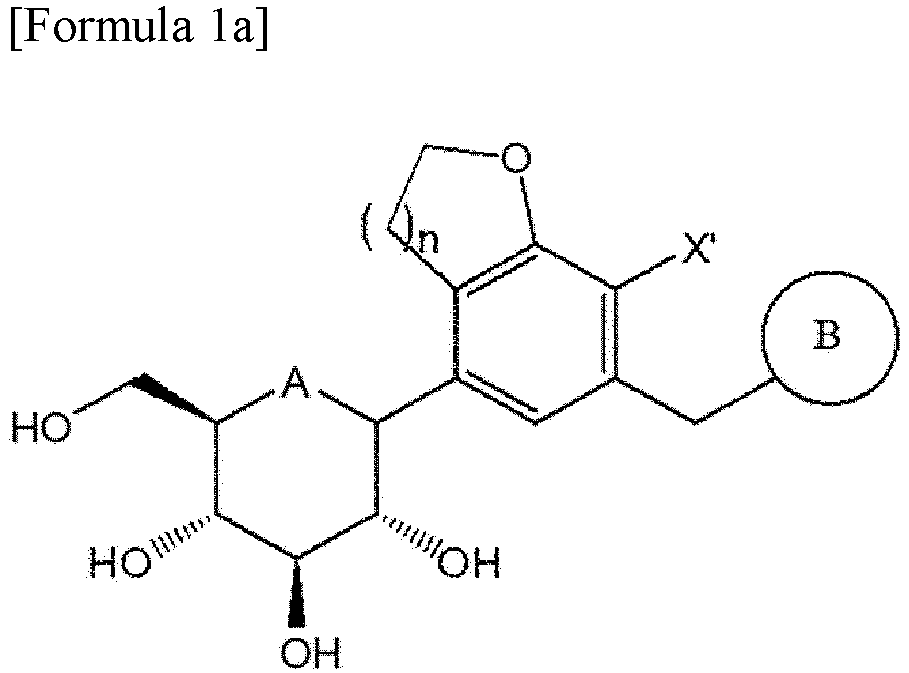
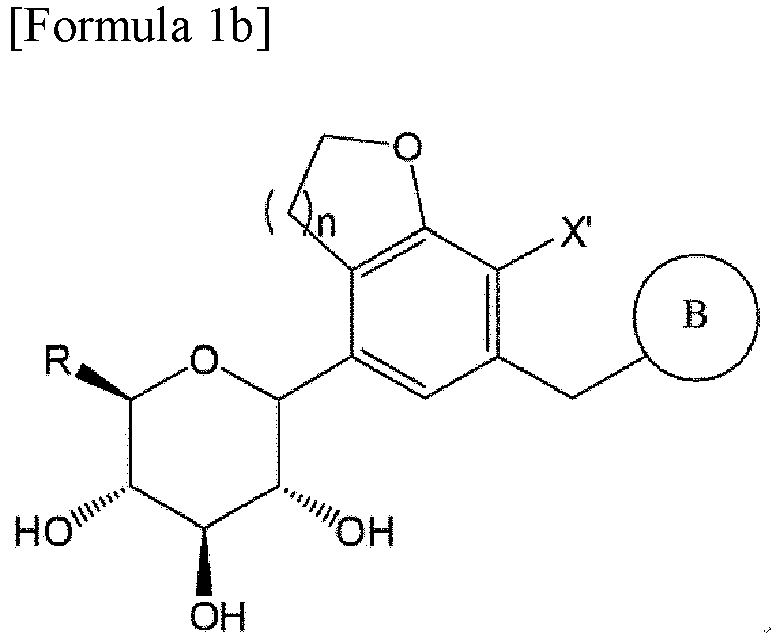
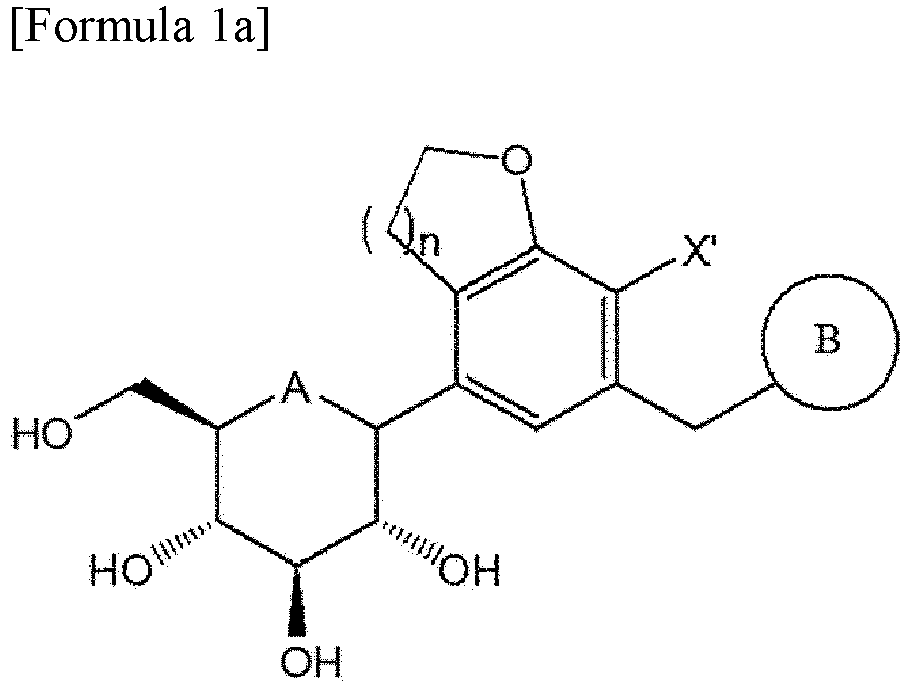
- the compound of Formula 1 may be a compound represented by Formula 1a below or a compound represented by Formula 1b below: wherein A, B, X' and n are the same as those defined in Formula 1 above, and, in Formula 1b, R is C1-7alkylthio.
- the compounds of Formulas 1a and 1b may be formed of a compound represented by Formula 8 below and a compound represented by Formula 7 below, wherein a bonding site between the compound of Formula 8 and the compound of Formula 7(Y position) has an ⁇ -form, a ⁇ -form, or a racemic form thereof.
- the compound of Formula 1a may be a compound represented by Formula 1ab below: wherein A, B, n and X' are the same as those defined above.
- the compound of Formula 1b may be a compound represented by Formula 1bb: wherein R, B, n and X' are the same as those defined above.
- the present invention provides a method of preparing a compound of Formula 7, which is an intermediate, used to prepare the diphenylmethane derivative of Formula 1.
- the present invention provides a method of preparing the compound of Formula 7, the method comprising:
- halogen refers to fluorine (F), chlorine (Cl), bromine (Br), or iodine (I).
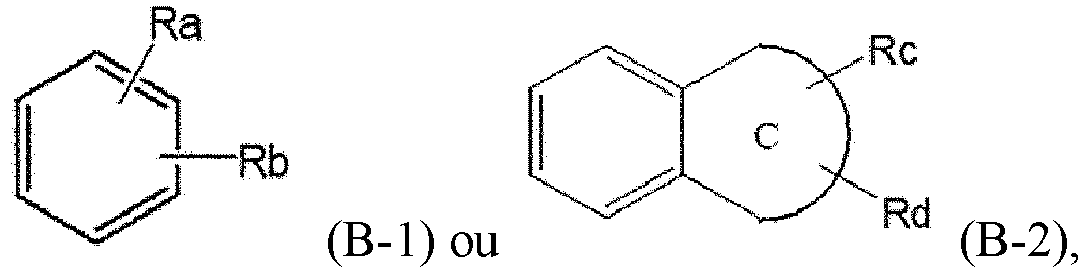
- Ra and Rb are each independently hydrogen, halogen, hydroxy, cyano, nitro, amino, mercapto, C1-7alkyl, C3-10cycloalkyl, or C1-7alkoxy, is provided.
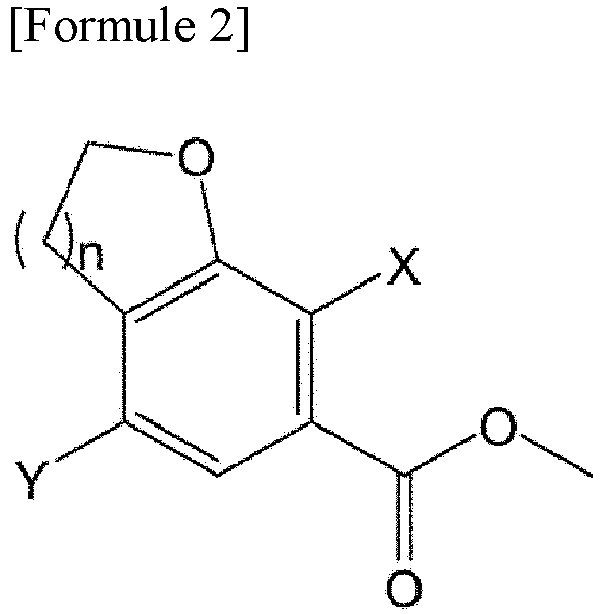
- a method of synthesizing the compound of Formula 2 used as a starting material for preparing the compound of Formula 7 is disclosed in detail in Korean Patent Application Publication No. 2017-0142904 .
- the compound of Formula 3 may be obtained from the compound of Formula 2.
- the base may be preferably an inorganic base and may be, for example, an inorganic base such as sodium hydroxide, potassium hydroxide, lithium hydroxide, sodium carbonate, or potassium carbonate.
- the base may be used, in an amount of 2 to 4 equivalents based on 1 equivalent of the compound of Formula 2.
- a solvent used in the reaction is preferably a polar solvent and is, for example, C1-12 alcohol, tetrahydrofuran (THF), dioxane, acetonitrile, acetone, dimethyl sulfoxide (DMSO), dimethylformamide (DMF).
- the solvent may be used at a concentration of 5 to 15 v/w%.
- a temperature condition of the reaction is not specifically limited, and the reaction may be performed, for example, at 15 to 30°C.
- the reaction may be performed for 1 to 3 hours, for example for 2 hours.
- the compound of Formula 4 is obtained by reacting the compound of Formula 3 with oxalyl halide.
- the generated compound represented by Formula 4 may be used in a subsequent reaction without an additional purification process.
- a catalyst may be used in the reaction. This catalyst may be used in an amount of 0.01 to 0.4 equivalents based on 1 equivalent of the compound of Formula 3.
- An example of an applicable catalyst includes, for instance N,N-dimethylformamide (DMF), N- methyl-N-phenyl-acetamide, N-methyl-N-phenyl-formamide, etc.
- the oxalyl halide may be used in an amount of 0.5 to 1.5 equivalents based on 1 equivalent of the compound of Formula 3.
- a reaction solvent may be, an aprotic solvent.
- An example of the aprotic solvent includes dichloromethane, dichloroethane, chloroform (CHCl 3 ), carbon tetrachloride (CCl 4 ), toluene, hexane, and ether.
- the reaction may be performed, preferably under a nitrogen atmosphere.
- the reaction may be performed, at 0 to 30°C
- the reaction may be performed for 30 minutes to 2 hours.
- the reaction may be performed while stirring at room temperature.
- cooling may be performed at -20°C to -10°C.
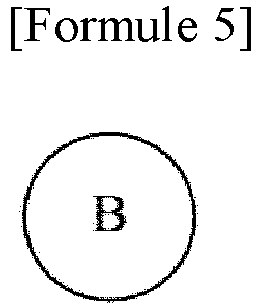
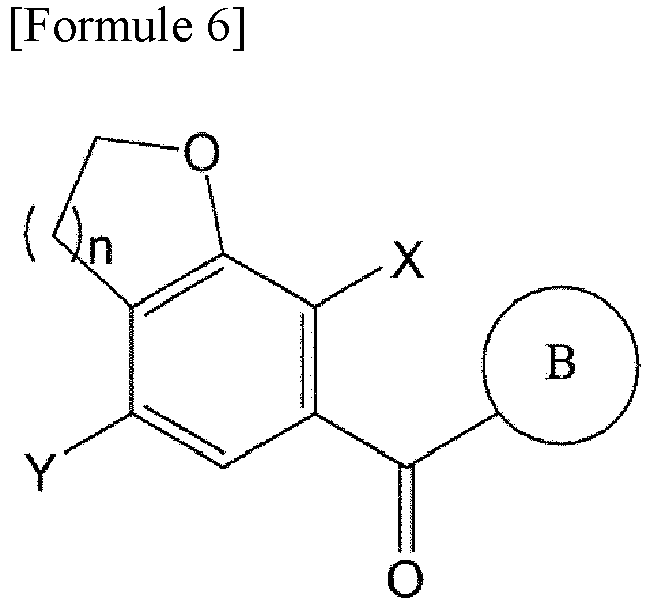
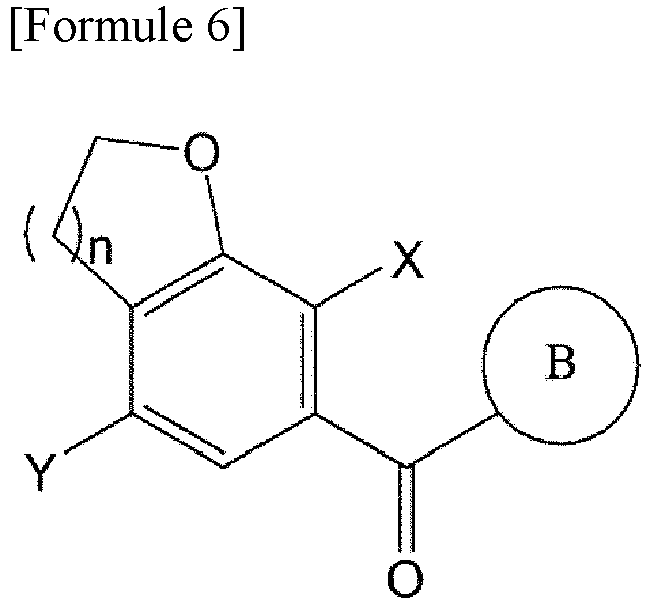
- the compound of Formula 6 is prepared by reacting the compound of Formula 4 with the compound of Formula 5.
- the compound of Formula 5 is added to the compound of Formula 4 and stirred, and a catalyst is added to the reaction mixture and stirred, thereby preparing the compound of Formula 6.
- the type of solvent applicable to the reaction is not specifically limited, and the solvent may be an aprotic solvent.
- an example of the aprotic solvent includes dichloromethane, dichloroethane, chloroform (CHCl 3 ), carbon tetrachloride (CCl 4 ), toluene, hexane, and ether.
- Lewis acids for example, such as AlCl 3 , FeCl 3 , ZnCl 2 , AlBr 3 , AlI 3 , and phenylphosphonic acid (PPA), may be used.
- the catalyst may be used in an amount of 0.5 to 1.5 equivalents, for example in an amount of 1.2 equivalents, based on 1 equivalent of the compound of Formula 4.
- the reaction between the compound of Formula 4 and the compound of Formula 5 is be performed at -20°C to -10°C. When the reaction is performed in the temperature range, there may be advantages in terms of yield and purity.
- the compound of Formula 5 may be synthesized or purchased.
- the compound of Formula 5 may be reacted in an amount of 1.5 to 2.5 equivalents, for example in an amount of 2 equivalents, based on 1 equivalent of the compound of Formula 4.
- the compound of Formula 6 may be synthesized without use of the Grignard reagent. Accordingly, compared to existing technologies, the time and cost required to prepare the Grignard reagent can be reduced, and the generation of benzene halide-based related substances in a synthesis process of the Grignard reagent can be fundamentally prevented.
- the compound of Formula 7 is obtained by deoxygenating the compound of Formula 6.
- triethylsilane, triisopropylsilane, t-butyldimethylsilane, sodium borohydride may be used as a reducing agent
- boron trifluoride diethylether, trimethylsilyltrifluoromethanesulfonate, aluminum chlorite, trifluoroacetic acid, trifluoromethanesulfonic acid may be used as an acid.
- the reducing agent may be used in an amount of 2 to 5 equivalents, more preferably in an amount of about 3 equivalents
- the acid may be used in an amount of 1.5 to 3 equivalents, more preferably in an amount of about 2 equivalents.
- a reaction may be performed for 2 to 5 hours at 0°C to 250°C.
- a reaction solvent a single solvent, such as dichloromethane, 1,2-dichloroethane, or acetonitrile, or a mixed solvent, such as dichloromethane/acetonitrile (1:1) or 1,2-dichloroethane/acetonitrile (1:1), may be used.
- the compound of Formula 7 may be obtained by reacting the compound of Formula 6 (1.0 eq) under conditions of acetonitrile, dichloromethane (1:1, 20v/w), boron trifluoride etherate (BF 3 ⁇ OEt 2 ) (2.5 eq), triethylsilane (Et 3 SiH) (3 eq), and 25°C.
- the process of deoxygenating the compound of Formula 6 does not require a conventional step of reprocessing reaction products including related substances because the related substances are hardly generated compared to an existing process of removing a hydroxyl group (the step of removing a hydroxyl group from a compound of Formula 6a to obtain a compound of Formula 6 in Korean Patent Application Publication No. 2017-0142904 ).
- the method of synthesizing the compound of Formula 7 according to the present invention can reduce synthesis processes, compared to existing methods, and can address problems of requiring an additional process due to synthesis of the Grignard reagent and requiring management of related substances.
- the deoxygenation process of Reaction Scheme 4 can minimize generation of related substances, reprocessing of reaction products is unnecessary, thereby simplifying the process.
- the compound of Formula 7 synthesized as described above may be used to prepare the compound of Formula 1.
- the present invention provides a method of preparing a compound of Formula 1a, the method including:
- the compound of Formula 1a may have a three-dimensional structure of Formula 1ab below: wherein A, B, n and X' are the same as those defined above.
- a method of preparing the compound of Formula 1 from the compound of Formula 7 is described in detail in Korean Patent Application Publication No. 2017-0142904 .
- a compound of Formula 1a may be prepared through deprotection and reduction processes.
- a reaction between the compound of Formula 7 and the compound of Formula 8 may be performed in the presence of n-butyllithium, sec-butyllithium, t-butyllithium, i-propyl magnesium chloride (i-PrMgCl).
- a compound of Formula 9a below may be obtained by reacting the compound of Formula 7 with the compound of Formula 8: wherein A is oxygen or sulfur; n is 1 or 2; X is halogen; PG is a protecting group; and B is the same as those defined in Formula 1.
- the protecting group may be, for example, a trimethylsilyl (TMS) group, a benzyl group, or an acetyl group.
- TMS trimethylsilyl
- the compound of Formula 1a may be obtained by deprotecting the compound of Formula 9a.
- the protecting group is a trimethylsilyl (TMS) group
- methanesulfonic acid (CH 3 SO 3 H) or trimethylsilyl trifluoromethanesulfonate (TMSOTf) is added to the compound of Formula 7a to perform deprotection, thereby obtaining the compound of Formula 1a.
- the compound of Formula 1a obtained through the above steps may be a compound wherein a bonding site between the compound of Formula 8 and the compound of Formula 7 (Y position) may be an ⁇ -form or a ⁇ -form.
- additional separation may be performed to obtain a desired ⁇ - or ⁇ -form. That is, after or during the deprotection and reduction, a process of separating only a compound wherein the bonding site between the compound of Formula 8 and the compound of Formula 7 (Y position) is a ⁇ -form may be additionally performed.
- a compound wherein the bonding site of the compound of Formula 8 and the compound of Formula 7 (Y position) is a ⁇ -form may be obtained by introducing a protecting group to the compound obtained as a result of the deprotection and reduction, and then isolating a precipitate generated by heating alcohol, ethyl acetate, or dichloromethane, and then deprotecting the precipitate.
- a compound of Formula 9e having a ⁇ -form may be only obtained by protecting the hydroxy group of the compound obtained as a result of the deprotection and reduction with an acetyl group, etc., and then heating and stirring the same in a C1-6 alcohol solvent (methanol, ethanol or isopropanol, etc.) to isolate a precipitate: wherein A is oxygen or sulfur; n is 1 or 2; X is halogen; PG is a protecting group; and B is the same as those defined in Formula 1.
- a C1-6 alcohol solvent methanol, ethanol or isopropanol, etc.
- a compound of Formula 9g may be obtained by performing selectively an alkylation reaction.
- A, B, n and X' are the same as those defined in Formula 1, and Xa is C1-7alkyl.
- the step of reacting the compound of Formula 7 with the compound of Formula 8 and deprotecting and reducing the same may include:
- the recrystallization step may be performed using a solvent selected from the group consisting of alcohol (for example, C1-6 alcohol), ethyl acetate, and dichloromethane.
- alcohol for example, C1-6 alcohol
- ethyl acetate for example, ethyl acetate
- dichloromethane for example, ethyl acetate
- An example of an acid applicable to the process of obtaining the compound of Formula 9b from the compound of Formula 9a includes hydrochloric acid, sulfuric acid, acetic acid, trifluoroacetic acid, methanesulfonic acid, trifluoromethanesulfonic acid, p-toluenesulfonic acid, hydrogen chloride gas.
- the step of reacting the compound of Formula 7 with the compound of Formula 8 and deprotecting and reducing the same may include:
- the recrystallization step may be performed using a solvent selected from the group consisting of alcohol (for example, C1-6 alcohol), ethyl acetate, and dichloromethane.
- alcohol for example, C1-6 alcohol
- ethyl acetate for example, ethyl acetate
- dichloromethane for example, ethyl acetate
- a bonding reaction is first performed.
- the compound of Formula 8 and the reaction reagent i.e., n-butyllithium, sec-butyllithium, t-butyllithium, or i-propyl magnesium chloride
- the reaction reagent i.e., n-butyllithium, sec-butyllithium, t-butyllithium, or i-propyl magnesium chloride
- This reaction may be performed at -80°C to -10°C, more preferably -70°C to -60°C, for 1 to 12 hours, or 1 to 3 hours.
- a single solvent such as tetrahydrofuran or ether, a mixed tetrahydrofuran/toluene (1: 1) solvent, or the like may be used as a reaction solvent.
- an example of an applicable acid includes hydrochloric acid, sulfuric acid, acetic acid, trifluoroacetic acid, methanesulfonic acid, trifluoromethanesulfonic acid, p-toluenesulfonic acid, hydrogen chloride gas, rfer and the acid may be used in an amount of 2 to 5 equivalents, more preferably 3 equivalents, based on 1 equivalent of the compound of Formula.
- This reaction may be performed at 0 to 40°C, more preferably 20 to 30°C, for 6 to 24 hours, or 6 to 12 hours.
- methanol may be used as a reaction solvent.
- a reduction reaction may be performed using a reducing agent and an acid.
- Triethylsilane, triisopropylsilane, t-butyldimethylsilane, sodium borohydride may be used as the reducing agent, and boron trifluoride diethylether, trimethylsilyltrifluoromethanesulfonate, aluminum chlorite, trifluoroacetic acid, trifluoromethanesulfonic acid, may be used as the acid.
- the reducing agent may be used in an amount of 2 to 5 equivalents, more preferably about 3 equivalents, and the acid may be used in an amount of 1.5 to 3 equivalents, more preferably about 2 equivalents.
- This reaction may be performed at -50°C to 0°C, more preferably -20°C to -10°C, for 2 to 12 hours, or 2 to 5 hours.
- a reaction solvent a single solvent, such as dichloromethane, 1,2-dichloroethane, acetonitrile, or a mixed solvent, such as dichloromethane/acetonitrile (1:1), 1,2-dichloroethane/acetonitrile (1:1), may be used.
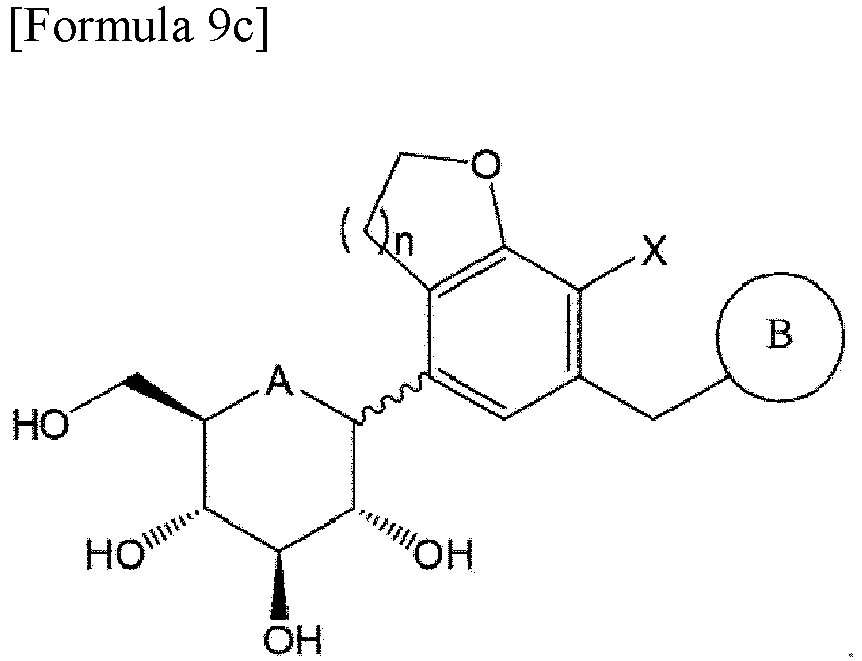
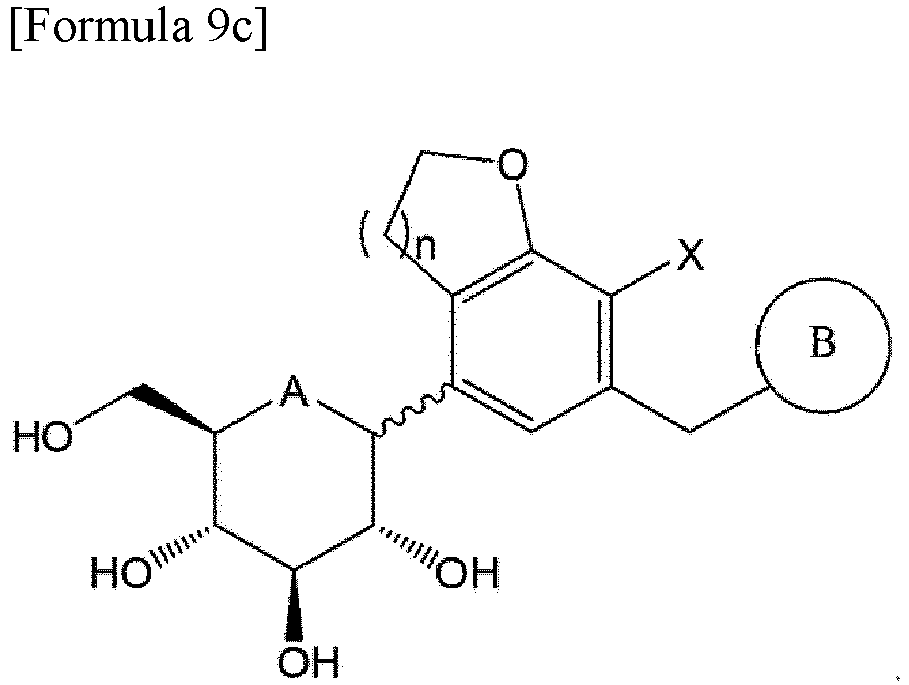
- a step of introducing a protecting group to the compound of Formula 9c to isolate only the compound ( ⁇ -form) of Formula 9e and deprotecting the same is performed.
- a reaction using an acetylating agent and a base may be performed.
- the acetylating agent includes acetyl chloride, acetyl bromide, acetic anhydride
- an example of the base includes sodium hydroxide, sodium carbonate, triethylamine, diisopropylethylamine, pyridine, lutidine, 4-dimethylaminopyridine.
- the acetylating agent may be used in an amount of 4 to 12 equivalents, more preferably about 8 equivalents, and the base may be used in an amount of 1 to 4 equivalents, more preferably about 1.5 equivalents.
- the reaction may be performed at 0 to 50°C, more preferably 20 to 30°C, for 1 to 12 hours, or 1 to 3 hours.
- acetone, ethyl acetate, tetrahydrofuran, dimethylformamide, dimethylacetamide, dichloromethane, 1,2-dichloroethane, chloroform may be used as a reaction solvent.
- a deprotection reaction is performed.
- a reagent such as lithium hydroxide, sodium hydroxide, potassium hydroxide, sodium methoxide, or sodium ethoxide may be used in an amount of 2 to 12 equivalents, more preferably about 5 equivalents.
- the reaction may be performed at 0 to 50°C, more preferably at 20 to 30°C, for 1 to 12 hours, or 1 to 3 hours.
- the step of reacting the compound of Formula 7 with the compound of Formula 8 and deprotecting and reducing the same may include:
- the recrystallization step may be performed using a solvent selected from the group consisting of alcohol (for example, C1-6 alcohol), ethyl acetate, and dichloromethane.
- alcohol for example, C1-6 alcohol
- ethyl acetate for example, ethyl acetate
- dichloromethane for example, ethyl acetate
- a bonding reaction, a deprotection reaction, and a methylation reaction are performed.
- conditions such as a preferred equivalent ratio, reaction temperature, solvent, are the same as those exemplified in the above embodiment.
- a protecting group is introduced to the compound of Formula 9b.
- a reaction using an acetylating agent and a base may be performed, and conditions such as a preferred acetylating agent type, base type, equivalent ratio, reaction temperature, solvent, are the same as those exemplified in the above embodiment.
- a reduction reaction is first performed.
- a reducing agent and an acid may be used, and conditions such as a preferred reducing agent type, acid type, equivalent ratio, reaction temperature, solvent, are the same as those exemplified in the above embodiment.
- the step of obtaining the compound of Formula 9b may be performed in two steps, or in one in-situ reaction step which is capable of further improving a final yield.
- a crude concentrated residue containing the compound of Formula 9b may be obtained, or the compound of Formula 9b may be obtained in a solid form through crystallization and may be used in a subsequent step. In the latter case, it may be easier to improve quality and control a moisture content through removal of reaction by-products.
- the synthesized compound may be used in a subsequent step after being subjected to a purification process.
- the synthesized compound may be mixed with an organic solvent such as toluene to form an azeotropic mixture, and then a concentration process may be repeated to remove residual moisture, thereby using an obtained residue in a subsequent step, or
- crystallization may be performed, and residual moisture may be removed through vacuum drying to obtain a solid that is to be used in a subsequent step.
- the present invention may also include an alkylation reaction step, after the step of reacting the compound of Formula 7 with the compound of Formula 8 and deprotecting and reducing the same.
- X' may be C1-7alkyl.
- the compound of Formula 7 may be reacted with the compound of Formula 8, and a product generated after the deprotection and reduction steps may be reacted with methylboronic acid, thereby obtaining the compound of Formula 1 (the compound of Formula 1a) wherein X' is methyl.
- the compound of Formula 1a according to the present invention may be prepared in a crystalline form, an amorphous form, or a combined form thereof, but the crystalline form is preferred in that it has physicochemical properties of allowing easy formulation due to excellent stability and non-hygroscopicity.
- the method of preparing the compound of Formula 1a according to the present invention may include, after the step of reacting the compound of Formula 7 with the compound of Formula 8 and deprotecting and reducing the same, a step of performing crystallization using various solvents to generate various crystalline forms.
- Korean Patent Application Publication No. 2017-0142904 discloses in detail various crystalline compounds and methods of generating the same.
- a solvent used in the crystallization may be selected from the group consisting of toluene; ethyl acetate; dichloromethane; acetone; acetonitrile; 2-propanol, tetrahydrofuran; n-hexane; and mixtures thereof (for example, a mixture of tetrahydrofuran and dichloromethane, and a mixture of tetrahydrofuran and n-hexane).
- a solvent used in the crystallization may be selected from a mixture of methanol and distilled water; a mixture of methanol and n-hexane; and a mixture of methanol, dichloromethane and n-hexane.
- a solvent used in the crystallization may be selected from a mixture of ethanol, distilled water and n-hexane; and a mixture of tetrahydrofuran and toluene.
- a solvent used in the crystallization may be a mixture of ethanol and n-hexane.
- a solvent used in the crystallization may be selected from the group consisting of a mixture of toluene, ethyl acetate, dichloromethane, tetrahydrofuran, and dichloromethane, and a mixture of tetrahydrofuran and n-hexane.
- the present invention also provides a method of preparing a compound of Formula 1b
- the step of preparing the compound of Formula 7 from the compound of Formula 2 may be performed in the same manner as in the method of preparing the compound of Formula 1a.
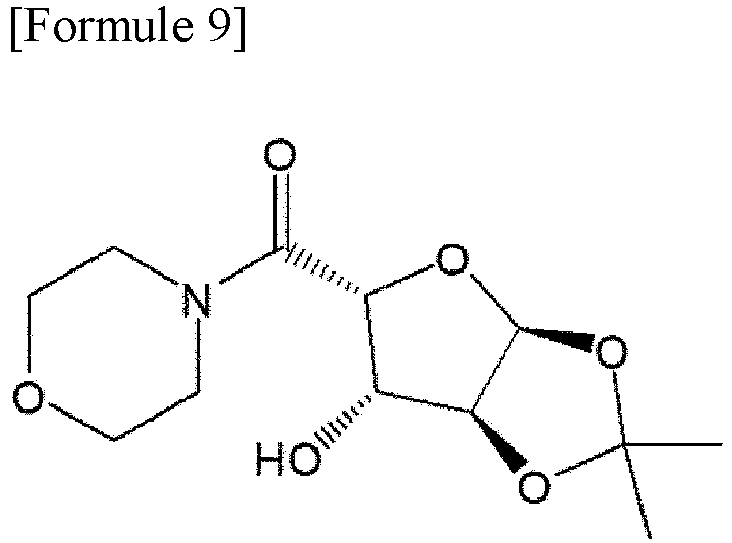
- the compound of Formula 10 is obtained by reacting the compound of Formula 7 with the compound of Formula 9 and reducing the same.
- the compound of Formula 9 may be prepared by a known method, e.g., a method disclosed in WO 2009/014970 .
- the compound of Formula 9 may be prepared according to the method disclosed in WO 2009/014970 starting from L-xylose.
- a compound of Formula 10a may be obtained by reacting the compound of Formula 7 with the compound of Formula 9: wherein B, n and X are the same as those defined in the Formula 1.
- the compound of Formula 10 may be obtained by reducing the compound of Formula 10a.
- the compound of Formula 11 is obtained by forming a furanose ring of the compound of Formula 10 into a pyranose ring under an acidic condition, and then introducing a protecting group thereto. Through this step, a pyranose ring constituting a glucose group may be completed.
- the protecting group may be, for example, an acetyl group.
- the compound of Formula 11 is treated with thiourea and reacted with C1-7alkyl halide, followed by being reduced.
- an alkylthio group may be introduced to the final product (the compound of Formula 1b).
- the C1-7alkyl halide may be, for example, C1-7alkyl iodide.
- a method of synthesizing a compound of Formula 7 according to the present invention can address problems of existing synthesis processes of requiring additional processes, due to synthesis of the Grignard reagent, and management of related substances.
- the method according to the present invention can minimize the generation of related substances, and thus does not require reprocessing of reaction products, thereby being capable of simplifying a process. Accordingly, the production yield of a diphenylmethane derivative can be maximized.
Landscapes
- Chemical & Material Sciences (AREA)
- Organic Chemistry (AREA)
- Health & Medical Sciences (AREA)
- Life Sciences & Earth Sciences (AREA)
- Engineering & Computer Science (AREA)
- Biochemistry (AREA)
- Biotechnology (AREA)
- General Health & Medical Sciences (AREA)
- Genetics & Genomics (AREA)
- Molecular Biology (AREA)
- Organic Low-Molecular-Weight Compounds And Preparation Thereof (AREA)
- Furan Compounds (AREA)
- Heterocyclic Carbon Compounds Containing A Hetero Ring Having Nitrogen And Oxygen As The Only Ring Hetero Atoms (AREA)
Claims (19)
- Procédé de préparation d'un composé de Formule 7, le procédé comprenant :la mise en réaction d'un composé de Formule 2 pour obtenir un composé de Formule 3,la mise en réaction du composé de Formule 3 avec un halogénure d'oxalyle pour obtenir un composé de Formule 4,la mise en réaction du composé de Formule 4 avec un composé de Formule 5 pour obtenir un composé de Formule 6, etla désoxygénation du composé de Formule 6 pour obtenir un composé de Formule 7,la réaction entre le composé de Formule 4 et le composé de Formule 5 étant effectuée à une température de -20 °C à -10 °C :

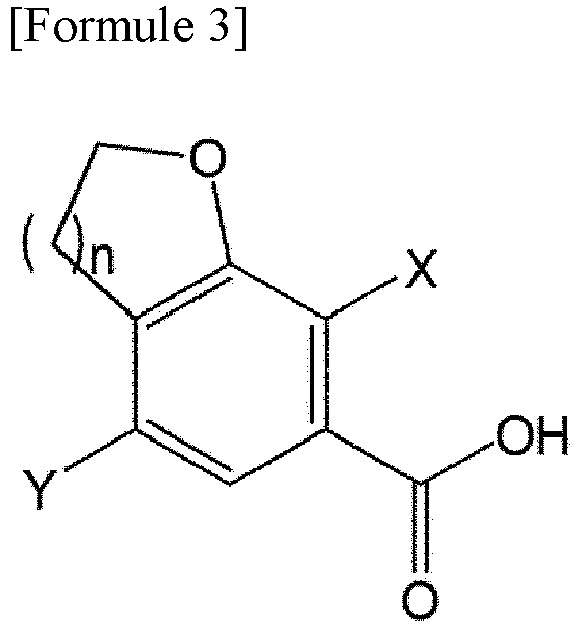

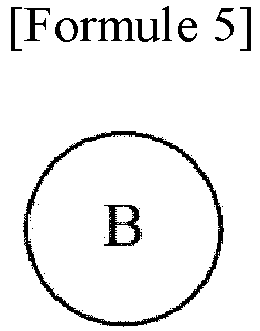
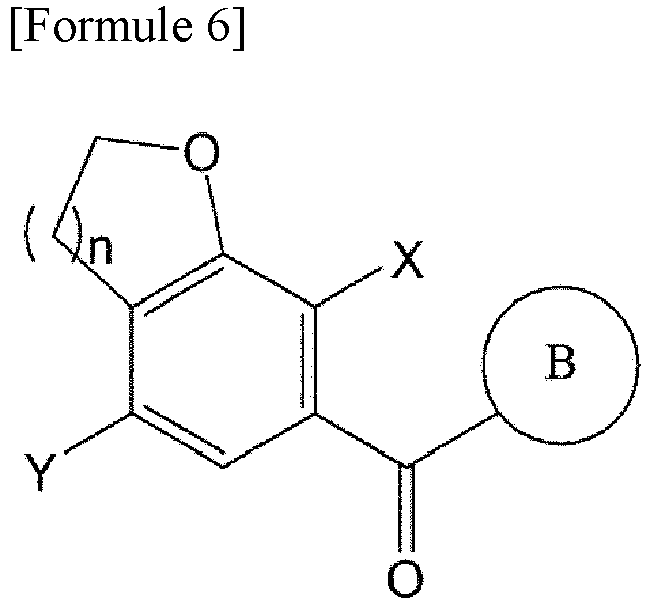
 où n est 1 ou 2,X, Y et Hal sont chacun indépendamment un halogène, et
 où Ra, Rb, Rc et Rd sont chacun indépendamment un hydrogène, un halogène, un hydroxy, un mercapto, un cyano, un nitro, un amino, un carboxy, un oxo, un alkyle en C1-7, un alkylthio en C1-7, un alcényle en C2-7, un alcynyle en C2-7, un alcoxy en C1-7, un alcoxy en C1-7-alkyle en C1-7, un alcényle en C2-7-alkyloxy en C1-7, un alcynyle en C2-7-alkyloxy en C1-7, un cycloalkyle en C3-10, un cycloalkylthio en C3-7, un cycloalcényle en C5-10, un cycloalkyloxy en C3-10, un cycloalkyloxy en C3-10-alcoxy en C1-7, un phényl-alkyle en C1-7, un alkylthio en C1-7-phényle, un phényl-alcoxy en C1-7, un mono- ou di-alkylamino en C1-7, un mono- ou di-alkylamino en C1-7-alkyle en C1-7, un alcanoyle en C1-7, un alcanoylamino en C1-7, un alkylcarbonyle en C1-7, un alcoxycarbonyle en C1-7, un carbamoyle, un mono- ou di-alkylcarbamoyle en C1-7, un alkylsulfonylamino en C1-7, un phénylsulfonylamino, un alkylsulfinyle en C1-7, un arylsulfanyle en C6-14, un arylsulfonyle en C6-14, un aryle en C6-14, un hétéroaryle à 5 à 13 chaînons, un hétérocycloalkyle à 5 à 10 chaînons, un hétérocycloalkyle à 5 à 10 chaînons-alkyle en C1-7 , ou un hétérocycloalkyle à 5 à 10 chaînons-alcoxy en C1-7 ;le cycle C est un cycloalkyle en C3-10, un cycloalcényle en C5-10, un aryle en C6-14, un hétéroaryle à 5 à 13 chaînons ou un hétérocycloalkyle à 5 à 10 chaînons ;l'alkyle, l'alcényle, l'alcynyle et l'alcoxy, chacun indépendamment, ne sont pas substitués ou ont un ou plusieurs substituants choisis dans le groupe constitué par halogène, hydroxy, cyano, nitro, amino, mercapto, alkyle en C1-7 et alcynyle en C2-7 ;le cycloalkyle, le cycloalkényle, l'aryle, l'hétéroaryle et l'hétérocycloalkyle, chacun indépendamment, ne sont pas substitués ou ont un ou plusieurs substituants choisis dans le groupe constitué par halogène, hydroxy, cyano, nitro, amino, mercapto, alkyle en C1-4 et alcoxy en C1-4 ; etl'hétéroaryle et l'hétérocycloalkyle contiennent, chacun indépendamment, un ou plusieurs hétéroatomes choisis dans le groupe constitué par N, S et O.
 - Procédé selon la revendication 1, dans lequel n est 1 ;X, Y et Hal sont chacun indépendamment un halogène ; etB est
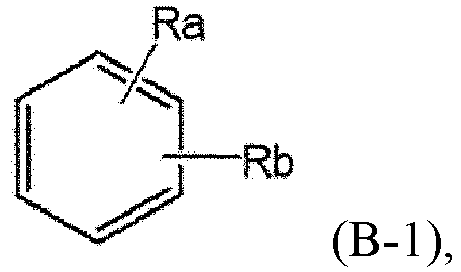 où Ra et Rb sont chacun indépendamment un hydrogène, un halogène, un hydroxy, un cyano, un nitro, un amino, un mercapto, un alkyle en C1-7, un cycloalkyle en C3-10 ou un alcoxy en C1-7.
 - Procédé selon la revendication 1, dans lequel n est 1,X est un chlorure,Y est le brome,Hal est un chlorure, etB est

- Procédé selon la revendication 1, dans lequel la désoxygénation du composé de Formule 6 pour obtenir un composé de Formule 7 est effectuée à une température de 0 °C à 25 °C.
- Procédé selon la revendication 1, dans lequel le composé de Formule 4 est obtenu par mise en réaction du composé de Formule 3 avec un halogénure d'oxalyle en présence d'un catalyseur.
- Procédé selon la revendication 5, dans lequel le catalyseur est utilisé en une quantité de 0,01 à 0,4 équivalent par rapport à 1 équivalent du composé de Formule 3.
- Procédé de préparation d'un composé de Formule 1a, le procédé comprenant :la mise en réaction d'un composé de Formule 2 pour obtenir un composé de Formule 3,la mise en réaction du composé de Formule 3 avec un halogénure d'oxalyle pour obtenir un composé de Formule 4,la mise en réaction du composé de Formule 4 avec un composé de Formule 5 pour obtenir un composé de Formule 6,la désoxygénisation du composé de Formule 6 pour obtenir un composé de Formule 7, etla mise en réaction du composé de Formule 7 avec un composé de Formule 8 et la déprotection et la réduction de celui-ci,la réaction entre le composé de Formule 4 et le composé de Formule 5 étant effectuée à une température de -20 °C à -10 °C :




 où A est l'oxygène (O) ou le soufre (S) ;PG est un groupe protecteur,X' est un halogène ou un alkyle en C1-7 ;n est 1 ou 2,X, Y et Hal sont chacun indépendamment un halogène ; etB est
 où Ra, Rb, Rc et Rd sont chacun indépendamment un hydrogène, un halogène, un hydroxy, un mercapto, un cyano, un nitro, un amino, un carboxy, un oxo, un alkyle en C1-7, un alkylthio en C1-7, un alcényle en C2-7, un alcynyle en C2-7, un alcoxy en C1-7, un alcoxy en C1-7-alkyle en C1-7, un alcényle en C2-7-alkyloxy en C1-7, un alcynyle en C2-7-alkyloxy en C1-7, un cycloalkyle en C3-10, un cycloalkylthio en C3-7, un cycloalcényle en C5-10, un cycloalkyloxy en C3-10, un cycloalkyloxy en C3-10-alcoxy en C1-7, un phényl-alkyle en C1-7, un alkylthio en C1-7-phényle, un phényl-alcoxy en C1-7, un mono- ou di-alkylamino en C1-7, un mono- ou di-alkylamino en C1-7-alkyle en C1-7, un alcanoyle en C1-7, un alcanoylamino en C1-7, un alkylcarbonyle en C1-7, un alcoxycarbonyle en C1-7, un carbamoyle, un mono- ou di-alkylcarbamoyle en C1-7, un alkylsulfonylamino en C1-7, un phénylsulfonylamino, un alkylsulfinyle en C1-7, un arylsulfanyle en C6-14, un arylsulfonyle en C6-14, un aryle en C6-14, un hétéroaryle à 5 à 13 chaînons, un hétérocycloalkyle à 5 à 10 chaînons, un hétérocycloalkyle à 5 à 10 chaînons-alkyle en C1-7 , ou un hétérocycloalkyle à 5 à 10 chaînons-alcoxy en C1-7 ;le cycle C est un cycloalkyle en C3-10, un cycloalcényle en C5-10, un aryle en C6-14, un hétéroaryle à 5 à 13 chaînons ou un hétérocycloalkyle à 5 à 10 chaînons ;l'alkyle, l'alcényle, l'alcynyle et l'alcoxy, chacun indépendamment, ne sont pas substitués ou ont un ou plusieurs substituants choisis dans le groupe constitué par halogène, hydroxy, cyano, nitro, amino, mercapto, alkyle en C1-7 et alcynyle en C2-7 ;le cycloalkyle, le cycloalkényle, l'aryle, l'hétéroaryle et l'hétérocycloalkyle, chacun indépendamment, ne sont pas substitués ou ont un ou plusieurs substituants choisis dans le groupe constitué par halogène, hydroxy, cyano, nitro, amino, mercapto, alkyle en C1-4 et alcoxy en C1-4 ; etl'hétéroaryle et l'hétérocycloalkyle contiennent, chacun indépendamment, un ou plusieurs hétéroatomes choisis dans le groupe constitué par N, S et O.
 - Procédé selon la revendication 7, dans lequel, après la déprotection et la réduction, une réaction d'alkylation est en outre comprise, et
X' est un alkyle en C1-7. - Procédé selon la revendication 7, dans lequel le composé de Formule 1a a une structure tridimensionnelle de Formule 1ab ci-dessous :

- Procédé selon la revendication 7, dans lequel la mise en réaction du composé de Formule 7 avec un composé de Formule 8 et la déprotection et la réduction de celui-ci comprennent :la mise en réaction du composé de Formule 7 avec le composé de Formule 8 en présence de n-butyllithium, de sec-butyllithium, de t-butyllithium ou de chlorure d'i-propylmagnésium pour obtenir un composé de Formule 9a ;la déprotection et la méthylation du composé de Formule 9a dans des conditions acides en présence de méthanol pour obtenir un composé de Formule 9b ;la réduction du composé de Formule 9b pour obtenir un composé de Formule 9c ; etl'introduction d'un groupe protecteur dans le composé de Formule 9c et la recristallisation de celui-ci, suivie d'une déprotection, ce qui permet d'obtenir un composé de Formule 9f :


 où PG est un groupe protecteur ; et A, B, n et X sont les mêmes que ceux définis dans la revendication 7.
 - Procédé selon la revendication 7, dans lequel la mise en réaction du composé de Formule 7 avec le composé de Formule 8 et la déprotection et la réduction de celui-ci comprennent :la mise en réaction du composé de Formule 7 avec le composé de Formule 8 en présence de n-butyllithium, de sec-butyllithium, de t-butyllithium ou de chlorure d'i-propylmagnésium et la déprotection et la méthylation de celui-ci dans des conditions acides en présence de méthanol sans purification séparée pour obtenir un composé de Formule 9b ;la réduction du composé de Formule 9b pour obtenir un composé de Formule 9c ;l'introduction d'un groupe protecteur dans le composé de Formule 9c et la recristallisation de celui-ci pour isoler le composé de Formule 9e ; etla déprotection du composé de Formule 9e pour obtenir un composé de Formule 9f :


 où PG est un groupe protecteur ; et A, B, n et X sont les mêmes que ceux définis dans la revendication 7.
 - Procédé selon la revendication 7, dans lequel la mise en réaction du composé de Formule 7 avec le composé de Formule 8 et la déprotection et la réduction de celui-ci comprennent :la mise en réaction du composé de Formule 7 avec le composé de Formule 8 en présence de n-butyllithium, de sec-butyllithium, de t-butyllithium ou de chlorure d'i-propylmagnésium et la déprotection et la méthylation de celui-ci dans des conditions acides en présence de méthanol sans purification séparée pour obtenir un composé de Formule 9b ;l'introduction d'un groupe protecteur dans le composé de Formule 9b pour obtenir un composé de Formule 9d ; etla réduction et la recristallisation du composé de Formule 9d pour isoler un composé de Formule 9e ; etla déprotection du composé de Formule 9e pour obtenir un composé de Formule 9f :


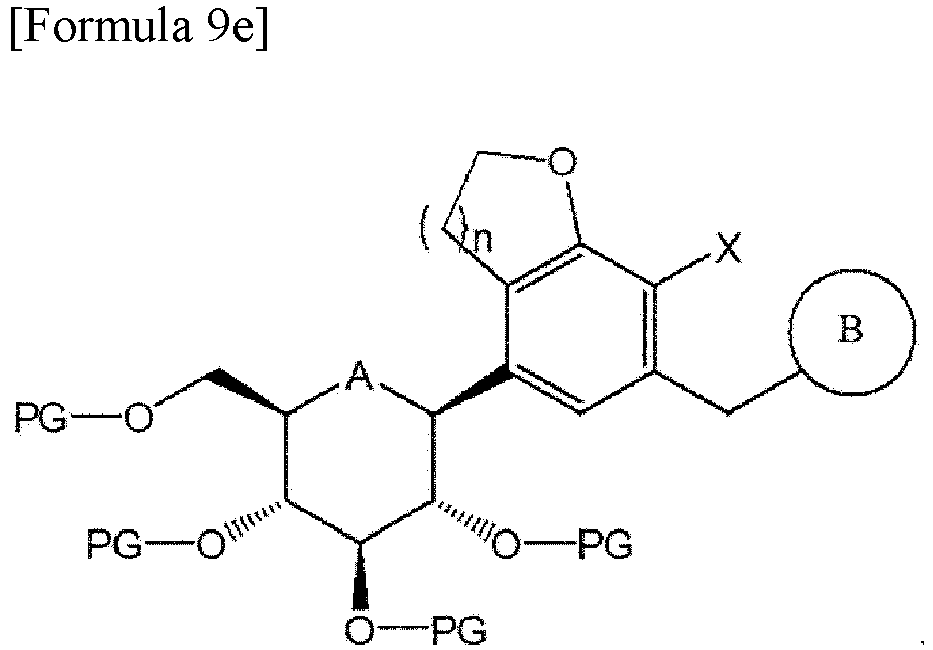
 où PG est un groupe protecteur ; et A, B, n et X sont les mêmes que ceux définis dans la revendication 7.
 - Procédé selon l'une quelconque des revendications 10 à 12, dans lequel le composé de Formule 8 et le n-butyllithium sont respectivement utilisés en une quantité de 1,5 à 2,5 équivalents par rapport à 1 équivalent du composé de Formule 7.
- Procédé selon l'une quelconque des revendications 10 à 12, dans lequel la recristallisation est effectuée à l'aide d'un solvant choisi dans le groupe constitué par l'alcool, l'acétate d'éthyle et le dichlorométhane.
- Procédé selon l'une quelconque des revendications 7 à 12, dans lequel n est 1.
- Procédé selon la revendication 7, dans lequel A est l'oxygène ;n est 1 ;X' est un halogène ; etB est un phényle non substitué ou substitué par un ou deux substituants choisis dans le groupe constitué par halogène, hydroxy, cyano, nitro, amino, mercapto, alkyle en C1-7, cycloalkyle en C3-10 et alcoxy en C1-7.
- Procédé de préparation d'un composé de Formule 1b, le procédé comprenant :la mise en réaction d'un composé de Formule 2 pour obtenir un composé de Formule 3,la mise en réaction du composé de Formule 3 avec un halogénure d'oxalyle pour obtenir un composé de Formule 4,la mise en réaction du composé de Formule 4 avec un composé de Formule 5 pour obtenir un composé de Formule 6,la désoxygénation du composé de Formule 6 pour obtenir un composé de Formule 7,la mise en réaction du composé de Formule 7 avec le composé de Formule 9, puis la réduction de celui-ci pour obtenir un composé de Formule 10,la transformation d'un cycle furanose du composé de Formule 10 en un cycle pyranose dans des conditions acides, puis l'introduction d'un groupe protecteur pour obtenir un composé de Formule 11, etle traitement du composé de Formule 11 avec de la thiourée et la mise en réaction de celui-ci avec un halogénure d'alkyle en C1-7, suivie par la réduction de celui-ci,la réaction entre le composé de Formule 4 et le composé de Formule 5 étant effectuée à une température de -20 °C à -10 °C :




 R est alkylthio en C1-7 ;PG est un groupe protecteur,X' est un halogène ou un alkyle en C1-7 ;n est 1 ou 2 ;X, Y et Hal sont chacun indépendamment un halogène ; etB est
 où Ra, Rb, Rc et Rd sont chacun indépendamment un hydrogène, un halogène, un hydroxy, un mercapto, un cyano, un nitro, un amino, un carboxy, un oxo, un alkyle en C1-7, un alkylthio en C1-7, un alcényle en C2-7, un alcynyle en C2-7, un alcoxy en C1-7, un alcoxy en C1-7-alkyle en C1-7, un alcényle en C2-7-alkyloxy en C1-7, un alcynyle en C2-7-alkyloxy en C1-7, un cycloalkyle en C3-10, un cycloalkylthio en C3-7, un cycloalcényle en C5-10, un cycloalkyloxy en C3-10, un cycloalkyloxy en C3-10-alcoxy en C1-7, un phényl-alkyle en C1-7, un alkylthio en C1-7-phényle, un phényl-alcoxy en C1-7, un mono- ou di-alkylamino en C1-7, un mono- ou di-alkylamino en C1-7-alkyle en C1-7, un alcanoyle en C1-7, un alcanoylamino en C1-7, un alkylcarbonyle en C1-7, un alcoxycarbonyle en C1-7, un carbamoyle, un mono- ou dialkylcarbamoyle en C1-7, un alkylsulfonylamino en C1-7, un phénylsulfonylamino, un alkylsulfinyle en C1-7, un arylsulfanyle en C6-14, un arylsulfonyle en C6-14, un aryle en C6-14, un hétéroaryle à 5 à 13 chaînons, un hétérocycloalkyle à 5 à 10 chaînons, un hétérocycloalkyle à 5 à 10 chaînons-alkyle en C1-7 , ou un hétérocycloalkyle à 5 à 10 chaînons-alcoxy en C1-7 ;le cycle C est un cycloalkyle en C3-10, un cycloalcényle en C5-10, un aryle en C6-14, un hétéroaryle à 5 à 13 chaînons ou un hétérocycloalkyle à 5 à 10 chaînons ;l'alkyle, l'alcényle, l'alcynyle et l'alcoxy, chacun indépendamment, ne sont pas substitués ou ont un ou plusieurs substituants choisis dans le groupe constitué par halogène, hydroxy, cyano, nitro, amino, mercapto, alkyle en C1-7 et alcynyle en C2-7 ;le cycloalkyle, le cycloalkényle, l'aryle, l'hétéroaryle et l'hétérocycloalkyle, chacun indépendamment, ne sont pas substitués ou ont un ou plusieurs substituants choisis dans le groupe constitué par halogène, hydroxy, cyano, nitro, amino, mercapto, alkyle en C1-4 et alcoxy en C1-4 ; etl'hétéroaryle et l'hétérocycloalkyle contiennent, chacun indépendamment, un ou plusieurs hétéroatomes choisis dans le groupe constitué par N, S et O.
 - Utilisation du composé de Formule 7 pour la préparation d'un composé de Formule 1a, l'utilisation comprenant :la mise en réaction d'un composé de Formule 2 pour obtenir un composé de Formule 3,la mise en réaction du composé de Formule 3 avec un halogénure d'oxalyle pour obtenir un composé de Formule 4,la mise en réaction du composé de Formule 4 avec un composé de Formule 5 pour obtenir un composé de Formule 6,la désoxygénisation du composé de Formule 6 pour obtenir un composé de Formule 7, etla mise en réaction du composé de Formule 7 avec un composé de Formule 8 et la déprotection et la réduction de celui-ci,la réaction entre le composé de Formule 4 et le composé de Formule 5 étant effectuée à une température de -20 °C à -10 °C :


 où A est l'oxygène (O) ou le soufre (S) ;PG est un groupe protecteur,X' est un halogène ou un alkyle en C1-7 ;n est 1 ou 2,X, Y et Hal sont chacun indépendamment un halogène ; etB est
 où Ra, Rb, Rc et Rd sont chacun indépendamment un hydrogène, un halogène, un hydroxy, un mercapto, un cyano, un nitro, un amino, un carboxy, un oxo, un alkyle en C1-7, un alkylthio en C1-7, un alcényle en C2-7, un alcynyle en C2-7, un alcoxy en C1-7, un alcoxy en C1-7-alkyle en C1-7, un alcényle en C2-7-alkyloxy en C1-7, un alcynyle en C2-7-alkyloxy en C1-7, un cycloalkyle en C3-10, un cycloalkylthio en C3-7, un cycloalcényle en C5-10, un cycloalkyloxy en C3-10, un cycloalkyloxy en C3-10-alcoxy en C1-7, un phényl-alkyle en C1-7, un alkylthio en C1-7-phényle, un phényl-alcoxy en C1-7, un mono- ou di-alkylamino en C1-7, un mono- ou di-alkylamino en C1-7-alkyle en C1-7, un alcanoyle en C1-7, un alcanoylamino en C1-7, un alkylcarbonyle en C1-7, un alcoxycarbonyle en C1-7, un carbamoyle, un mono- ou dialkylcarbamoyle en C1-7, un alkylsulfonylamino en C1-7, un phénylsulfonylamino, un alkylsulfinyle en C1-7, un arylsulfanyle en C6-14, un arylsulfonyle en C6-14, un aryle en C6-14, un hétéroaryle à 5 à 13 chaînons, un hétérocycloalkyle à 5 à 10 chaînons, un hétérocycloalkyle à 5 à 10 chaînons-alkyle en C1-7 , ou un hétérocycloalkyle à 5 à 10 chaînons-alcoxy en C1-7 ;le cycle C est un cycloalkyle en C3-10, un cycloalcényle en C5-10, un aryle en C6-14, un hétéroaryle à 5 à 13 chaînons ou un hétérocycloalkyle à 5 à 10 chaînons ;l'alkyle, l'alcényle, l'alcynyle et l'alcoxy, chacun indépendamment, ne sont pas substitués ou ont un ou plusieurs substituants choisis dans le groupe constitué par halogène, hydroxy, cyano, nitro, amino, mercapto, alkyle en C1-7 et alcynyle en C2-7 ;le cycloalkyle, le cycloalkényle, l'aryle, l'hétéroaryle et l'hétérocycloalkyle, chacun indépendamment, ne sont pas substitués ou ont un ou plusieurs substituants choisis dans le groupe constitué par halogène, hydroxy, cyano, nitro, amino, mercapto, alkyle en C1-4 et alcoxy en C1-4 ; etl'hétéroaryle et l'hétérocycloalkyle contiennent, chacun indépendamment, un ou plusieurs hétéroatomes choisis dans le groupe constitué par N, S et O.
 - Utilisation du composé de Formule 7 pour la préparation d'un composé de Formule 1b, l'utilisation comprenant :la mise en réaction d'un composé de Formule 2 pour obtenir un composé de Formule 3,la mise en réaction du composé de Formule 3 avec un halogénure d'oxalyle pour obtenir un composé de Formule 4,la mise en réaction du composé de Formule 4 avec un composé de Formule 5 pour obtenir un composé de Formule 6,la désoxygénation du composé de Formule 6 pour obtenir un composé de Formule 7,la mise en réaction du composé de Formule 7 avec le composé de Formule 9, puis la réduction de celui-ci pour obtenir un composé de Formule 10,la transformation d'un cycle furanose du composé de Formule 10 en un cycle pyranose dans des conditions acides, puis l'introduction d'un groupe protecteur pour obtenir un composé de Formule 11, etle traitement du composé de Formule 11 avec de la thiourée et la mise en réaction de celui-ci avec un halogénure d'alkyle en C1-7, suivie par la réduction de celui-ci,la réaction entre le composé de Formule 4 et le composé de Formule 5 étant effectuée à une température de -20 °C à -10 °C :




 R est alkylthio en C1-7 ;PG est un groupe protecteur,X' est un halogène ou un alkyle en C1-7 ;n est 1 ou 2 ;X, Y et Hal sont chacun indépendamment un halogène ; etB est
 où Ra, Rb, Rc et Rd sont chacun indépendamment un hydrogène, un halogène, un hydroxy, un mercapto, un cyano, un nitro, un amino, un carboxy, un oxo, un alkyle en C1-7, un alkylthio en C1-7, un alcényle en C2-7, un alcynyle en C2-7, un alcoxy en C1-7, un alcoxy en C1-7-alkyle en C1-7, un alcényle en C2-7-alkyloxy en C1-7, un alcynyle en C2-7-alkyloxy en C1-7, un cycloalkyle en C3-10, un cycloalkylthio en C3-7, un cycloalcényle en C5-10, un cycloalkyloxy en C3-10, un cycloalkyloxy en C3-10-alcoxy en C1-7, un phényl-alkyle en C1-7, un alkylthio en C1-7-phényle, un phényl-alcoxy en C1-7, un mono- ou di-alkylamino en C1-7, un mono- ou di-alkylamino en C1-7-alkyle en C1-7, un alcanoyle en C1-7, un alcanoylamino en C1-7, un alkylcarbonyle en C1-7, un alcoxycarbonyle en C1-7, un carbamoyle, un mono- ou dialkylcarbamoyle en C1-7, un alkylsulfonylamino en C1-7, un phénylsulfonylamino, un alkylsulfinyle en C1-7, un arylsulfanyle en C6-14, un arylsulfonyle en C6-14, un aryle en C6-14, un hétéroaryle à 5 à 13 chaînons, un hétérocycloalkyle à 5 à 10 chaînons, un hétérocycloalkyle à 5 à 10 chaînons-alkyle en C1-7 , ou un hétérocycloalkyle à 5 à 10 chaînons-alcoxy en C1-7 ;le cycle C est un cycloalkyle en C3-10, un cycloalcényle en C5-10, un aryle en C6-14, un hétéroaryle à 5 à 13 chaînons ou un hétérocycloalkyle à 5 à 10 chaînons ;l'alkyle, l'alcényle, l'alcynyle et l'alcoxy, chacun indépendamment, ne sont pas substitués ou ont un ou plusieurs substituants choisis dans le groupe constitué par halogène, hydroxy, cyano, nitro, amino, mercapto, alkyle en C1-7 et alcynyle en C2-7 ;le cycloalkyle, le cycloalkényle, l'aryle, l'hétéroaryle et l'hétérocycloalkyle, chacun indépendamment, ne sont pas substitués ou ont un ou plusieurs substituants choisis dans le groupe constitué par halogène, hydroxy, cyano, nitro, amino, mercapto, alkyle en C1-4 et alcoxy en C1-4 ; etl'hétéroaryle et l'hétérocycloalkyle contiennent, chacun indépendamment, un ou plusieurs hétéroatomes choisis dans le groupe constitué par N, S et O.
Applications Claiming Priority (2)
| Application Number | Priority Date | Filing Date | Title |
|---|---|---|---|
| KR20180094261 | 2018-08-13 | ||
| PCT/KR2019/010123 WO2020036382A1 (fr) | 2018-08-13 | 2019-08-09 | Procédé de production d'intermédiaire utile pour la synthèse d'un inhibiteur de sglt |
Publications (3)
| Publication Number | Publication Date |
|---|---|
| EP3838894A1 EP3838894A1 (fr) | 2021-06-23 |
| EP3838894A4 EP3838894A4 (fr) | 2022-04-20 |
| EP3838894B1 true EP3838894B1 (fr) | 2024-03-13 |
Family
ID=69525610
Family Applications (1)
| Application Number | Title | Priority Date | Filing Date |
|---|---|---|---|
| EP19850413.6A Active EP3838894B1 (fr) | 2018-08-13 | 2019-08-09 | Procédé de production d'intermédiaire utile pour la synthèse d'un inhibiteur de sglt |
Country Status (13)
| Country | Link |
|---|---|
| US (1) | US11661406B2 (fr) |
| EP (1) | EP3838894B1 (fr) |
| JP (1) | JP7146067B2 (fr) |
| KR (1) | KR102307475B1 (fr) |
| CN (1) | CN112585124B (fr) |
| BR (1) | BR112021002523A2 (fr) |
| CA (1) | CA3109107C (fr) |
| CO (1) | CO2021001857A2 (fr) |
| ES (1) | ES2980368T3 (fr) |
| MX (1) | MX2021001732A (fr) |
| PE (1) | PE20211206A1 (fr) |
| PH (1) | PH12021550297A1 (fr) |
| WO (1) | WO2020036382A1 (fr) |
Families Citing this family (3)
| Publication number | Priority date | Publication date | Assignee | Title |
|---|---|---|---|---|
| CN115087649B (zh) * | 2020-02-27 | 2024-07-05 | 株式会社大熊制药 | 用于合成sglt抑制剂的中间体和使用该中间体制备sglt抑制剂的方法 |
| WO2022051980A1 (fr) * | 2020-09-10 | 2022-03-17 | 广东莱佛士制药技术有限公司 | Procédé de synthèse destiné à la préparation d'un intermédiaire des inhibiteurs de sglt |
| KR20230110001A (ko) * | 2022-01-14 | 2023-07-21 | 주식회사 대웅제약 | Ssglt 저해제의 합성에 유용한 중간체의 제조 방법 |
Family Cites Families (7)
| Publication number | Priority date | Publication date | Assignee | Title |
|---|---|---|---|---|
| PT2183263E (pt) | 2007-07-26 | 2012-01-11 | Lexicon Pharmaceuticals Inc | Processos e compostos úteis na preparação de inibidores do co-transportador 2 de glucose e sódio |
| ES2719656T3 (es) | 2011-06-01 | 2019-07-11 | Green Cross Corp | Derivados de difenilmetano novedosos como inhibidores del SGLT2 |
| US9340521B2 (en) * | 2013-03-18 | 2016-05-17 | Green Cross Corporation | Method for dual inhibition of SGLT1 and SGLT2 using diphenylmethane derivatives |
| CN105518014B (zh) | 2013-09-09 | 2018-03-23 | 上海研健新药研发有限公司 | C‑芳基葡糖苷衍生物、其制备方法及其在医药上的应用 |
| CA3026756C (fr) | 2016-06-17 | 2021-03-02 | Daewoong Pharmaceutical Co., Ltd. | Procede de production d'un derive de diphenylmethane |
| KR101770302B1 (ko) * | 2016-06-28 | 2017-08-22 | 주식회사 녹십자 | 다이페닐메탄 유도체의 제조방법 |
| JP7160821B2 (ja) * | 2017-02-24 | 2022-10-25 | ドン-ア エスティ カンパニー リミテッド | Sglt-2阻害剤である新規グルコース誘導体 |
-
2019
- 2019-08-09 WO PCT/KR2019/010123 patent/WO2020036382A1/fr not_active Ceased
- 2019-08-09 CA CA3109107A patent/CA3109107C/fr active Active
- 2019-08-09 JP JP2021507818A patent/JP7146067B2/ja active Active
- 2019-08-09 KR KR1020190097311A patent/KR102307475B1/ko active Active
- 2019-08-09 CN CN201980054448.2A patent/CN112585124B/zh active Active
- 2019-08-09 EP EP19850413.6A patent/EP3838894B1/fr active Active
- 2019-08-09 BR BR112021002523-5A patent/BR112021002523A2/pt not_active Application Discontinuation
- 2019-08-09 ES ES19850413T patent/ES2980368T3/es active Active
- 2019-08-09 US US17/266,844 patent/US11661406B2/en active Active
- 2019-08-09 MX MX2021001732A patent/MX2021001732A/es unknown
- 2019-08-09 PE PE2021000202A patent/PE20211206A1/es unknown
-
2021
- 2021-02-10 PH PH12021550297A patent/PH12021550297A1/en unknown
- 2021-02-16 CO CONC2021/0001857A patent/CO2021001857A2/es unknown
Also Published As
| Publication number | Publication date |
|---|---|
| KR20200019092A (ko) | 2020-02-21 |
| CA3109107A1 (fr) | 2020-02-20 |
| CO2021001857A2 (es) | 2021-02-26 |
| WO2020036382A1 (fr) | 2020-02-20 |
| ES2980368T3 (es) | 2024-10-01 |
| EP3838894A4 (fr) | 2022-04-20 |
| US11661406B2 (en) | 2023-05-30 |
| CA3109107C (fr) | 2023-04-25 |
| JP7146067B2 (ja) | 2022-10-03 |
| PH12021550297A1 (en) | 2021-10-11 |
| BR112021002523A2 (pt) | 2021-05-04 |
| MX2021001732A (es) | 2021-06-23 |
| JP2021534174A (ja) | 2021-12-09 |
| EP3838894A1 (fr) | 2021-06-23 |
| US20210292291A1 (en) | 2021-09-23 |
| PE20211206A1 (es) | 2021-07-05 |
| CN112585124A (zh) | 2021-03-30 |
| KR102307475B1 (ko) | 2021-09-30 |
| CN112585124B (zh) | 2024-04-19 |
Similar Documents
| Publication | Publication Date | Title |
|---|---|---|
| WO2019208571A1 (fr) | Composé amidite et procédé de production de polynucléotide utilisant ledit composé | |
| EP3838894B1 (fr) | Procédé de production d'intermédiaire utile pour la synthèse d'un inhibiteur de sglt | |
| JP2021193102A (ja) | 1−シアノ−2−(4−シクロプロピル−ベンジル)−4−(β−D−グルコピラノス−1−イル)−ベンゼン、L−プロリンおよび水からなる1:1:1共結晶の合成 | |
| JP3848837B2 (ja) | 新規な中間体、それを用いたマイクロライド系抗生物質の製造方法 | |
| KR101308258B1 (ko) | 엔독시펜의 신규한 제조 방법 | |
| EP4112612B1 (fr) | Intermédiaire utile pour la synthèse d'un inhibiteur de sglt et procédé de préparation d'un inhibiteur de sglt l'utilisant | |
| JP3304098B2 (ja) | エリスロマイシン誘導体の10位のメチル基の新規な異性化方法 | |
| JP3453188B2 (ja) | オレアノール酸誘導体の製造方法 | |
| JP2011503093A (ja) | β−ヌクレオシドの新規な合成 | |
| JP6923520B2 (ja) | 新規な5−アジド−5−デオキシ−2:3−イソプロピリデン−D−アラビノース化合物、それらの製造方法、およびAra−N3、Kdo−N3および4eKdo−N3の合成のためのそれらの使用 | |
| JP3138834B2 (ja) | フコピラノース類縁体の製造方法およびその合成中間化合物 | |
| KR100699099B1 (ko) | 1-α-할로-2,2-다이플루오로-2-데옥시-D-라이보퓨라노스유도체 및 이의 제조방법 | |
| JP3228488B2 (ja) | 20−エピステロイド誘導体およびその製造方法 | |
| JP2007513134A (ja) | 2−置換アデノシンの改善された合成 | |
| RU2802443C1 (ru) | Промежуточное соединение, применяемое для синтеза ингибитора sglt, и способ получения ингибитора sglt с применением указанного промежуточного соединения | |
| US8168766B2 (en) | Process of making 2-deoxy-2,2-difluoro-D-ribofuranosyl nucleosides and intermediates therefor | |
| JP3682291B2 (ja) | オレアノール酸誘導体の製造方法 | |
| KR100550160B1 (ko) | 알부틴 및 알파형 알부틴 제조용 중간체의 제조방법 | |
| JP2750170B2 (ja) | ステロイド誘導体の製造法 | |
| JPS60166680A (ja) | スワインソニンの製造方法 | |
| JPH07145093A (ja) | ビタミンd誘導体の合成中間体の製造法 | |
| WO2003051904A1 (fr) | Procede de production d'un derive de pregnane |
Legal Events
| Date | Code | Title | Description |
|---|---|---|---|
| STAA | Information on the status of an ep patent application or granted ep patent |
Free format text: STATUS: THE INTERNATIONAL PUBLICATION HAS BEEN MADE |
|
| PUAI | Public reference made under article 153(3) epc to a published international application that has entered the european phase |
Free format text: ORIGINAL CODE: 0009012 |
|
| STAA | Information on the status of an ep patent application or granted ep patent |
Free format text: STATUS: REQUEST FOR EXAMINATION WAS MADE |
|
| 17P | Request for examination filed |
Effective date: 20210312 |
|
| AK | Designated contracting states |
Kind code of ref document: A1 Designated state(s): AL AT BE BG CH CY CZ DE DK EE ES FI FR GB GR HR HU IE IS IT LI LT LU LV MC MK MT NL NO PL PT RO RS SE SI SK SM TR |
|
| DAV | Request for validation of the european patent (deleted) | ||
| DAX | Request for extension of the european patent (deleted) | ||
| REG | Reference to a national code |
Ref country code: DE Ref legal event code: R079 Free format text: PREVIOUS MAIN CLASS: C07D0307820000 Ipc: C07D0307790000 Ref country code: DE Ref legal event code: R079 Ref document number: 602019048365 Country of ref document: DE Free format text: PREVIOUS MAIN CLASS: C07D0307820000 Ipc: C07D0307790000 |
|
| A4 | Supplementary search report drawn up and despatched |
Effective date: 20220321 |
|
| RIC1 | Information provided on ipc code assigned before grant |
Ipc: C07D 493/04 20060101ALI20220315BHEP Ipc: C07H 1/00 20060101ALI20220315BHEP Ipc: C07H 7/06 20060101ALI20220315BHEP Ipc: C07D 407/04 20060101ALI20220315BHEP Ipc: C07D 307/79 20060101AFI20220315BHEP |
|
| GRAP | Despatch of communication of intention to grant a patent |
Free format text: ORIGINAL CODE: EPIDOSNIGR1 |
|
| STAA | Information on the status of an ep patent application or granted ep patent |
Free format text: STATUS: GRANT OF PATENT IS INTENDED |
|
| GRAJ | Information related to disapproval of communication of intention to grant by the applicant or resumption of examination proceedings by the epo deleted |
Free format text: ORIGINAL CODE: EPIDOSDIGR1 |
|
| STAA | Information on the status of an ep patent application or granted ep patent |
Free format text: STATUS: REQUEST FOR EXAMINATION WAS MADE |
|
| INTG | Intention to grant announced |
Effective date: 20230904 |
|
| GRAP | Despatch of communication of intention to grant a patent |
Free format text: ORIGINAL CODE: EPIDOSNIGR1 |
|
| STAA | Information on the status of an ep patent application or granted ep patent |
Free format text: STATUS: GRANT OF PATENT IS INTENDED |
|
| INTC | Intention to grant announced (deleted) | ||
| P01 | Opt-out of the competence of the unified patent court (upc) registered |
Effective date: 20230927 |
|
| INTG | Intention to grant announced |
Effective date: 20231024 |
|
| GRAS | Grant fee paid |
Free format text: ORIGINAL CODE: EPIDOSNIGR3 |
|
| GRAA | (expected) grant |
Free format text: ORIGINAL CODE: 0009210 |
|
| STAA | Information on the status of an ep patent application or granted ep patent |
Free format text: STATUS: THE PATENT HAS BEEN GRANTED |
|
| AK | Designated contracting states |
Kind code of ref document: B1 Designated state(s): AL AT BE BG CH CY CZ DE DK EE ES FI FR GB GR HR HU IE IS IT LI LT LU LV MC MK MT NL NO PL PT RO RS SE SI SK SM TR |
|
| REG | Reference to a national code |
Ref country code: GB Ref legal event code: FG4D |
|
| REG | Reference to a national code |
Ref country code: CH Ref legal event code: EP |
|
| REG | Reference to a national code |
Ref country code: DE Ref legal event code: R096 Ref document number: 602019048365 Country of ref document: DE |
|
| REG | Reference to a national code |
Ref country code: IE Ref legal event code: FG4D |
|
| PG25 | Lapsed in a contracting state [announced via postgrant information from national office to epo] |
Ref country code: LT Free format text: LAPSE BECAUSE OF FAILURE TO SUBMIT A TRANSLATION OF THE DESCRIPTION OR TO PAY THE FEE WITHIN THE PRESCRIBED TIME-LIMIT Effective date: 20240313 |
|
| REG | Reference to a national code |
Ref country code: LT Ref legal event code: MG9D |
|
| PG25 | Lapsed in a contracting state [announced via postgrant information from national office to epo] |
Ref country code: GR Free format text: LAPSE BECAUSE OF FAILURE TO SUBMIT A TRANSLATION OF THE DESCRIPTION OR TO PAY THE FEE WITHIN THE PRESCRIBED TIME-LIMIT Effective date: 20240614 |
|
| REG | Reference to a national code |
Ref country code: NL Ref legal event code: MP Effective date: 20240313 |
|
| PG25 | Lapsed in a contracting state [announced via postgrant information from national office to epo] |
Ref country code: HR Free format text: LAPSE BECAUSE OF FAILURE TO SUBMIT A TRANSLATION OF THE DESCRIPTION OR TO PAY THE FEE WITHIN THE PRESCRIBED TIME-LIMIT Effective date: 20240313 Ref country code: RS Free format text: LAPSE BECAUSE OF FAILURE TO SUBMIT A TRANSLATION OF THE DESCRIPTION OR TO PAY THE FEE WITHIN THE PRESCRIBED TIME-LIMIT Effective date: 20240613 |
|
| PG25 | Lapsed in a contracting state [announced via postgrant information from national office to epo] |
Ref country code: RS Free format text: LAPSE BECAUSE OF FAILURE TO SUBMIT A TRANSLATION OF THE DESCRIPTION OR TO PAY THE FEE WITHIN THE PRESCRIBED TIME-LIMIT Effective date: 20240613 Ref country code: NO Free format text: LAPSE BECAUSE OF FAILURE TO SUBMIT A TRANSLATION OF THE DESCRIPTION OR TO PAY THE FEE WITHIN THE PRESCRIBED TIME-LIMIT Effective date: 20240613 Ref country code: LT Free format text: LAPSE BECAUSE OF FAILURE TO SUBMIT A TRANSLATION OF THE DESCRIPTION OR TO PAY THE FEE WITHIN THE PRESCRIBED TIME-LIMIT Effective date: 20240313 Ref country code: HR Free format text: LAPSE BECAUSE OF FAILURE TO SUBMIT A TRANSLATION OF THE DESCRIPTION OR TO PAY THE FEE WITHIN THE PRESCRIBED TIME-LIMIT Effective date: 20240313 Ref country code: GR Free format text: LAPSE BECAUSE OF FAILURE TO SUBMIT A TRANSLATION OF THE DESCRIPTION OR TO PAY THE FEE WITHIN THE PRESCRIBED TIME-LIMIT Effective date: 20240614 Ref country code: FI Free format text: LAPSE BECAUSE OF FAILURE TO SUBMIT A TRANSLATION OF THE DESCRIPTION OR TO PAY THE FEE WITHIN THE PRESCRIBED TIME-LIMIT Effective date: 20240313 Ref country code: BG Free format text: LAPSE BECAUSE OF FAILURE TO SUBMIT A TRANSLATION OF THE DESCRIPTION OR TO PAY THE FEE WITHIN THE PRESCRIBED TIME-LIMIT Effective date: 20240313 |
|
| REG | Reference to a national code |
Ref country code: AT Ref legal event code: MK05 Ref document number: 1665661 Country of ref document: AT Kind code of ref document: T Effective date: 20240313 |
|
| PG25 | Lapsed in a contracting state [announced via postgrant information from national office to epo] |
Ref country code: SE Free format text: LAPSE BECAUSE OF FAILURE TO SUBMIT A TRANSLATION OF THE DESCRIPTION OR TO PAY THE FEE WITHIN THE PRESCRIBED TIME-LIMIT Effective date: 20240313 Ref country code: LV Free format text: LAPSE BECAUSE OF FAILURE TO SUBMIT A TRANSLATION OF THE DESCRIPTION OR TO PAY THE FEE WITHIN THE PRESCRIBED TIME-LIMIT Effective date: 20240313 |
|
| PG25 | Lapsed in a contracting state [announced via postgrant information from national office to epo] |
Ref country code: NL Free format text: LAPSE BECAUSE OF FAILURE TO SUBMIT A TRANSLATION OF THE DESCRIPTION OR TO PAY THE FEE WITHIN THE PRESCRIBED TIME-LIMIT Effective date: 20240313 |
|
| PG25 | Lapsed in a contracting state [announced via postgrant information from national office to epo] |
Ref country code: NL Free format text: LAPSE BECAUSE OF FAILURE TO SUBMIT A TRANSLATION OF THE DESCRIPTION OR TO PAY THE FEE WITHIN THE PRESCRIBED TIME-LIMIT Effective date: 20240313 |
|
| REG | Reference to a national code |
Ref country code: ES Ref legal event code: FG2A Ref document number: 2980368 Country of ref document: ES Kind code of ref document: T3 Effective date: 20241001 |
|
| PG25 | Lapsed in a contracting state [announced via postgrant information from national office to epo] |
Ref country code: IS Free format text: LAPSE BECAUSE OF FAILURE TO SUBMIT A TRANSLATION OF THE DESCRIPTION OR TO PAY THE FEE WITHIN THE PRESCRIBED TIME-LIMIT Effective date: 20240713 |
|
| PG25 | Lapsed in a contracting state [announced via postgrant information from national office to epo] |
Ref country code: PT Free format text: LAPSE BECAUSE OF FAILURE TO SUBMIT A TRANSLATION OF THE DESCRIPTION OR TO PAY THE FEE WITHIN THE PRESCRIBED TIME-LIMIT Effective date: 20240715 Ref country code: SM Free format text: LAPSE BECAUSE OF FAILURE TO SUBMIT A TRANSLATION OF THE DESCRIPTION OR TO PAY THE FEE WITHIN THE PRESCRIBED TIME-LIMIT Effective date: 20240313 |
|
| PG25 | Lapsed in a contracting state [announced via postgrant information from national office to epo] |
Ref country code: CZ Free format text: LAPSE BECAUSE OF FAILURE TO SUBMIT A TRANSLATION OF THE DESCRIPTION OR TO PAY THE FEE WITHIN THE PRESCRIBED TIME-LIMIT Effective date: 20240313 Ref country code: EE Free format text: LAPSE BECAUSE OF FAILURE TO SUBMIT A TRANSLATION OF THE DESCRIPTION OR TO PAY THE FEE WITHIN THE PRESCRIBED TIME-LIMIT Effective date: 20240313 |
|
| PG25 | Lapsed in a contracting state [announced via postgrant information from national office to epo] |
Ref country code: AT Free format text: LAPSE BECAUSE OF FAILURE TO SUBMIT A TRANSLATION OF THE DESCRIPTION OR TO PAY THE FEE WITHIN THE PRESCRIBED TIME-LIMIT Effective date: 20240313 |
|
| PG25 | Lapsed in a contracting state [announced via postgrant information from national office to epo] |
Ref country code: PL Free format text: LAPSE BECAUSE OF FAILURE TO SUBMIT A TRANSLATION OF THE DESCRIPTION OR TO PAY THE FEE WITHIN THE PRESCRIBED TIME-LIMIT Effective date: 20240313 |
|
| PG25 | Lapsed in a contracting state [announced via postgrant information from national office to epo] |
Ref country code: SK Free format text: LAPSE BECAUSE OF FAILURE TO SUBMIT A TRANSLATION OF THE DESCRIPTION OR TO PAY THE FEE WITHIN THE PRESCRIBED TIME-LIMIT Effective date: 20240313 |
|
| PG25 | Lapsed in a contracting state [announced via postgrant information from national office to epo] |
Ref country code: SM Free format text: LAPSE BECAUSE OF FAILURE TO SUBMIT A TRANSLATION OF THE DESCRIPTION OR TO PAY THE FEE WITHIN THE PRESCRIBED TIME-LIMIT Effective date: 20240313 Ref country code: SK Free format text: LAPSE BECAUSE OF FAILURE TO SUBMIT A TRANSLATION OF THE DESCRIPTION OR TO PAY THE FEE WITHIN THE PRESCRIBED TIME-LIMIT Effective date: 20240313 Ref country code: RO Free format text: LAPSE BECAUSE OF FAILURE TO SUBMIT A TRANSLATION OF THE DESCRIPTION OR TO PAY THE FEE WITHIN THE PRESCRIBED TIME-LIMIT Effective date: 20240313 Ref country code: PT Free format text: LAPSE BECAUSE OF FAILURE TO SUBMIT A TRANSLATION OF THE DESCRIPTION OR TO PAY THE FEE WITHIN THE PRESCRIBED TIME-LIMIT Effective date: 20240715 Ref country code: PL Free format text: LAPSE BECAUSE OF FAILURE TO SUBMIT A TRANSLATION OF THE DESCRIPTION OR TO PAY THE FEE WITHIN THE PRESCRIBED TIME-LIMIT Effective date: 20240313 Ref country code: IS Free format text: LAPSE BECAUSE OF FAILURE TO SUBMIT A TRANSLATION OF THE DESCRIPTION OR TO PAY THE FEE WITHIN THE PRESCRIBED TIME-LIMIT Effective date: 20240713 Ref country code: EE Free format text: LAPSE BECAUSE OF FAILURE TO SUBMIT A TRANSLATION OF THE DESCRIPTION OR TO PAY THE FEE WITHIN THE PRESCRIBED TIME-LIMIT Effective date: 20240313 Ref country code: CZ Free format text: LAPSE BECAUSE OF FAILURE TO SUBMIT A TRANSLATION OF THE DESCRIPTION OR TO PAY THE FEE WITHIN THE PRESCRIBED TIME-LIMIT Effective date: 20240313 Ref country code: AT Free format text: LAPSE BECAUSE OF FAILURE TO SUBMIT A TRANSLATION OF THE DESCRIPTION OR TO PAY THE FEE WITHIN THE PRESCRIBED TIME-LIMIT Effective date: 20240313 |
|
| REG | Reference to a national code |
Ref country code: DE Ref legal event code: R097 Ref document number: 602019048365 Country of ref document: DE |
|
| PG25 | Lapsed in a contracting state [announced via postgrant information from national office to epo] |
Ref country code: DK Free format text: LAPSE BECAUSE OF FAILURE TO SUBMIT A TRANSLATION OF THE DESCRIPTION OR TO PAY THE FEE WITHIN THE PRESCRIBED TIME-LIMIT Effective date: 20240313 |
|
| PLBE | No opposition filed within time limit |
Free format text: ORIGINAL CODE: 0009261 |
|
| STAA | Information on the status of an ep patent application or granted ep patent |
Free format text: STATUS: NO OPPOSITION FILED WITHIN TIME LIMIT |
|
| PG25 | Lapsed in a contracting state [announced via postgrant information from national office to epo] |
Ref country code: DK Free format text: LAPSE BECAUSE OF FAILURE TO SUBMIT A TRANSLATION OF THE DESCRIPTION OR TO PAY THE FEE WITHIN THE PRESCRIBED TIME-LIMIT Effective date: 20240313 |
|
| 26N | No opposition filed |
Effective date: 20241216 |
|
| REG | Reference to a national code |
Ref country code: CH Ref legal event code: PL |
|
| PG25 | Lapsed in a contracting state [announced via postgrant information from national office to epo] |
Ref country code: LU Free format text: LAPSE BECAUSE OF NON-PAYMENT OF DUE FEES Effective date: 20240809 |
|
| PG25 | Lapsed in a contracting state [announced via postgrant information from national office to epo] |
Ref country code: CH Free format text: LAPSE BECAUSE OF NON-PAYMENT OF DUE FEES Effective date: 20240831 Ref country code: MC Free format text: LAPSE BECAUSE OF FAILURE TO SUBMIT A TRANSLATION OF THE DESCRIPTION OR TO PAY THE FEE WITHIN THE PRESCRIBED TIME-LIMIT Effective date: 20240313 Ref country code: SI Free format text: LAPSE BECAUSE OF FAILURE TO SUBMIT A TRANSLATION OF THE DESCRIPTION OR TO PAY THE FEE WITHIN THE PRESCRIBED TIME-LIMIT Effective date: 20240313 |
|
| REG | Reference to a national code |
Ref country code: BE Ref legal event code: MM Effective date: 20240831 |
|
| PGFP | Annual fee paid to national office [announced via postgrant information from national office to epo] |
Ref country code: GB Payment date: 20250624 Year of fee payment: 7 |
|
| PG25 | Lapsed in a contracting state [announced via postgrant information from national office to epo] |
Ref country code: BE Free format text: LAPSE BECAUSE OF NON-PAYMENT OF DUE FEES Effective date: 20240831 |
|
| PGFP | Annual fee paid to national office [announced via postgrant information from national office to epo] |
Ref country code: FR Payment date: 20250624 Year of fee payment: 7 |
|
| PG25 | Lapsed in a contracting state [announced via postgrant information from national office to epo] |
Ref country code: IE Free format text: LAPSE BECAUSE OF NON-PAYMENT OF DUE FEES Effective date: 20240809 |
|
| PGFP | Annual fee paid to national office [announced via postgrant information from national office to epo] |
Ref country code: ES Payment date: 20250911 Year of fee payment: 7 |
|
| PGFP | Annual fee paid to national office [announced via postgrant information from national office to epo] |
Ref country code: DE Payment date: 20250624 Year of fee payment: 7 |
|
| PGFP | Annual fee paid to national office [announced via postgrant information from national office to epo] |
Ref country code: IT Payment date: 20250624 Year of fee payment: 7 |
|
| PG25 | Lapsed in a contracting state [announced via postgrant information from national office to epo] |
Ref country code: CY Free format text: LAPSE BECAUSE OF FAILURE TO SUBMIT A TRANSLATION OF THE DESCRIPTION OR TO PAY THE FEE WITHIN THE PRESCRIBED TIME-LIMIT; INVALID AB INITIO Effective date: 20190809 |
|
| PG25 | Lapsed in a contracting state [announced via postgrant information from national office to epo] |
Ref country code: HU Free format text: LAPSE BECAUSE OF FAILURE TO SUBMIT A TRANSLATION OF THE DESCRIPTION OR TO PAY THE FEE WITHIN THE PRESCRIBED TIME-LIMIT; INVALID AB INITIO Effective date: 20190809 |