EP3838945A1 - Polymère de polyuréthane aliphatique thermoplastique à comportement de fusion amélioré - Google Patents
Polymère de polyuréthane aliphatique thermoplastique à comportement de fusion amélioré Download PDFInfo
- Publication number
- EP3838945A1 EP3838945A1 EP19216787.2A EP19216787A EP3838945A1 EP 3838945 A1 EP3838945 A1 EP 3838945A1 EP 19216787 A EP19216787 A EP 19216787A EP 3838945 A1 EP3838945 A1 EP 3838945A1
- Authority
- EP
- European Patent Office
- Prior art keywords
- thermoplastic
- mol
- polyurethane polymer
- range
- aliphatic polyurethane
- Prior art date
- Legal status (The legal status is an assumption and is not a legal conclusion. Google has not performed a legal analysis and makes no representation as to the accuracy of the status listed.)
- Pending
Links
Images


Classifications
-
- C—CHEMISTRY; METALLURGY
- C08—ORGANIC MACROMOLECULAR COMPOUNDS; THEIR PREPARATION OR CHEMICAL WORKING-UP; COMPOSITIONS BASED THEREON
- C08G—MACROMOLECULAR COMPOUNDS OBTAINED OTHERWISE THAN BY REACTIONS ONLY INVOLVING UNSATURATED CARBON-TO-CARBON BONDS
- C08G18/00—Polymeric products of isocyanates or isothiocyanates
- C08G18/06—Polymeric products of isocyanates or isothiocyanates with compounds having active hydrogen
- C08G18/08—Processes
- C08G18/10—Prepolymer processes involving reaction of isocyanates or isothiocyanates with compounds having active hydrogen in a first reaction step
-
- C—CHEMISTRY; METALLURGY
- C08—ORGANIC MACROMOLECULAR COMPOUNDS; THEIR PREPARATION OR CHEMICAL WORKING-UP; COMPOSITIONS BASED THEREON
- C08G—MACROMOLECULAR COMPOUNDS OBTAINED OTHERWISE THAN BY REACTIONS ONLY INVOLVING UNSATURATED CARBON-TO-CARBON BONDS
- C08G18/00—Polymeric products of isocyanates or isothiocyanates
- C08G18/06—Polymeric products of isocyanates or isothiocyanates with compounds having active hydrogen
- C08G18/08—Processes
- C08G18/0895—Manufacture of polymers by continuous processes
-
- C—CHEMISTRY; METALLURGY
- C08—ORGANIC MACROMOLECULAR COMPOUNDS; THEIR PREPARATION OR CHEMICAL WORKING-UP; COMPOSITIONS BASED THEREON
- C08G—MACROMOLECULAR COMPOUNDS OBTAINED OTHERWISE THAN BY REACTIONS ONLY INVOLVING UNSATURATED CARBON-TO-CARBON BONDS
- C08G18/00—Polymeric products of isocyanates or isothiocyanates
- C08G18/06—Polymeric products of isocyanates or isothiocyanates with compounds having active hydrogen
- C08G18/28—Polymeric products of isocyanates or isothiocyanates with compounds having active hydrogen characterised by the compounds used containing active hydrogen
- C08G18/30—Low-molecular-weight compounds
- C08G18/32—Polyhydroxy compounds; Polyamines; Hydroxyamines
- C08G18/3203—Polyhydroxy compounds
- C08G18/3206—Polyhydroxy compounds aliphatic
-
- C—CHEMISTRY; METALLURGY
- C08—ORGANIC MACROMOLECULAR COMPOUNDS; THEIR PREPARATION OR CHEMICAL WORKING-UP; COMPOSITIONS BASED THEREON
- C08G—MACROMOLECULAR COMPOUNDS OBTAINED OTHERWISE THAN BY REACTIONS ONLY INVOLVING UNSATURATED CARBON-TO-CARBON BONDS
- C08G18/00—Polymeric products of isocyanates or isothiocyanates
- C08G18/06—Polymeric products of isocyanates or isothiocyanates with compounds having active hydrogen
- C08G18/70—Polymeric products of isocyanates or isothiocyanates with compounds having active hydrogen characterised by the isocyanates or isothiocyanates used
- C08G18/72—Polyisocyanates or polyisothiocyanates
- C08G18/73—Polyisocyanates or polyisothiocyanates acyclic
Definitions
- the present invention relates to thermoplastic aliphatic polyurethane polymers having a M. w of ⁇ 170000 g / mol, where the enthalpy of fusion ⁇ H is independent of the polymer M. w of the thermoplastic aliphatic polyurethane polymer, compositions containing such polyurethane polymers, a process for the production thereof and the use of these polyurethane polymers.
- Polyurethanes and in particular thermoplastic polyurethanes have been used for a wide variety of purposes for years because of their excellent physical properties.
- polyurethanes there are areas of application in which other plastics, such as polyamide plastics, are used because polyurethanes with suitable physical properties are not available or these are difficult to provide.
- the melting behavior of TPU is influenced by the ratio of soft and hard segments in the polymer.
- Hard segments are understood to mean the urethane units of the polyurethane and soft segments are understood to mean the polyol chains.
- soft and hard segments are arranged in a polymeric two-phase system. The domains lying next to one another in the hard segments are associated via hydrogen bonds and form crystalline structures. The ends of the polymer chains represent defects that cannot be built into the crystalline structures.
- the melting enthalpy is lower for a TPU with a comparatively high molecular weight than for a TPU with a comparatively low molecular weight.
- the CN 10 714 1437 refers to TPU to be used in 3D printing processes.
- the document discloses a synthesis by reactive extrusion and teaches that the enthalpy of fusion of a TPU can be influenced by the addition of a chain extender, the chain extender being a cyclodextrin derivative.
- the CN 10 500 1626 also discloses a process for reactive extrusion of polyurethane.
- the publication discloses that the flow properties of the TPU can be influenced by adding a mixture of diphenylsilylglycol and ethylene glycol.
- the US 2017/145146 refers to TPU made from components that come from renewable, vegetable resources.
- the document discloses the synthesis in a batch process and teaches that the melting temperature of a TPU depends, among other things, on the isocyanate index and the polymerization time.
- thermoplastic aliphatic polyurethane polymer with good processing properties, such as, for example, good melting behavior, and a method for its production.
- thermoplastic aliphatic polyurethane polymer with a M. w of ⁇ 170,000 g / mol, characterized in that the enthalpy of fusion ⁇ H is independent of the polymer M. w of the thermoplastic aliphatic polyurethane polymer, ⁇ H polymer is the measured enthalpy of fusion in [J / g] of the thermoplastic aliphatic polyurethane polymer, determined using dynamic differential calorimetry (DSC) according to DIN EN ISO 11357-1: 2017-02 with a heating rate of 20 K / min in the range from -40 ° C to 220 ° C, and M.
- DSC dynamic differential calorimetry
- w is the weight average of the molar mass, determined by gel permeation chromatography, the sample being dissolved in a solution of potassium trifluoroacetate in hexafluoroisopropanol at a concentration of 2 mg / cm 3 and a polymethyl methacrylate standard being used.
- thermoplastic aliphatic polyurethane polymers according to the invention from one M. w of ⁇ 170,000 g / mol have an almost constant enthalpy of fusion, ie the enthalpy of fusion is independent of the mass-averaged molecular weight M. w is.
- This has the advantage that, for polyurethane polymers according to the invention with different molecular weights, less energy has to be expended for liquefying. In the case of melt-forming processes, this leads to a broader temperature processing window, lower quality fluctuations and less effort with regard to the settings on machines for thermoplastic processing, e.g. extruders.
- polyurethanes according to the invention with a very high molecular weight have almost the same thermal stability as polyurethane polymers according to the invention with a significantly lower molecular weight. This opens up the possibility of tailoring a material that meets the requirements in terms of processing and application.
- aliphatic or “aliphatic radical” is understood to mean acyclic saturated hydrocarbon radicals which are branched or linear and preferably unsubstituted. These aliphatic hydrocarbon radicals preferably contain 2, 3, 4, 5 or 6 carbon atoms.
- the terms “comprising” or “containing” preferably mean “essentially consisting of” and particularly preferably “consisting of”.
- the centrifuge means are molar mass M. z , the weight average of the molecular weight M. w and the number average molecular weight M. n determined by gel permeation chromatography (GPC) using polymethyl methacrylate as the standard.
- the sample to be measured is dissolved in a solution of 3 g of potassium trifluoroacetate in 400 cubic centimeters of hexafluoroisopropanol (sample concentration approx.
- RI detector refractive index detector
- the thermoplastic aliphatic polyurethane polymer according to the invention has a M. w in the range from 170,000 g / mol to 350,000 g / mol, preferably in the range from 175,000 g / mol to 300,000 g / mol, particularly preferably in the range from 200,000 g / mol to 300,000 g / mol, even more preferably in the range from 250,000 g / mol to 285000 g / mol.
- the enthalpy of fusion .DELTA.H is independent of the polymer M.
- thermoplastic aliphatic polyurethane polymer according to the invention and the melt enthalpy values of corresponding polyurethane polymers with different M. w which is 170,000 g / mol in each case, differ no more than 2%, preferably no more 1.5% and particularly preferably no more 1% from the arithmetic mean of the enthalpies of fusion of these polyurethane polymers.
- polymer / ⁇ H crystal 100 % ⁇ 100 % , where ⁇ H M, polymer is the measured enthalpy of fusion in [J / g] of the thermoplastic aliphatic polyurethane polymer, determined with dynamic differential calorimetry (DSC) according to DIN EN ISO 11357-1: 2017-02 with a heating rate of 20 K / min in the range of - 40 ° C to 220 ° C, and ⁇ H crystal, 100% is the enthalpy of fusion of the corresponding 100% crystalline thermoplastic aliphatic polyurethane polymer in [J / g], determined with dynamic differential calorimetry and X-ray scattering analysis.
- DSC dynamic differential calorimetry
- the enthalpy of fusion of the sample is determined by dynamics Differential calorimetry (DSC) measured, preferably with dynamic differential calorimetry, and the crystallinity of the sample determined by means of X-ray scattering.
- DSC dynamics Differential calorimetry
- the ratio of the two values then corresponds to ⁇ H crystal, 100% , according to the literature ( Kajiyama, T .; MacKnight, WJ; Polymer Journal, volume 1, 548-554 (1970 )).
- thermoplastic aliphatic polyurethane polymer according to the invention has a degree of crystallinity ⁇ in the range from 40% to 55%, preferably in the range from 45% to 54%, even more preferably in the range from 48% to 53% and most preferably in the range from 50 % to 53%.
- the melting enthalpy ⁇ H M, polymer of the thermoplastic aliphatic polyurethane polymer according to the invention is ⁇ 100 J / g, determined using dynamic differential calorimetry (DSC) according to DIN EN ISO 11357-1: 2017-02 with a heating rate of 20 K / min Range from -40 ° C to 220 ° C.
- DSC dynamic differential calorimetry
- the melting enthalpy ⁇ H M, polymer of the thermoplastic aliphatic polyurethane polymer according to the invention is preferably in a range from 90 J / g to 100 J / g, particularly preferably in a range from 95 J / g to 100 J / g, particularly preferably in a range from 98 J / g to 100 g / J, each determined with dynamic differential calorimetry (DSC) according to DIN EN ISO 11357-1: 2017-02 with a heating rate of 20 K / min in the range from -40 ° C to 220 ° C.
- DSC dynamic differential calorimetry
- the ratio is M. w / M. n of the thermoplastic aliphatic polyurethane polymer according to the invention in a range from 8.5 to 20, preferably in a range from 9 to 18, particularly preferably in a range from 10 to 15, where M. n is the number average of the molar mass and M. w is the weight average of the molar mass, determined in each case by gel permeation chromatography, the sample being dissolved in a solution of potassium trifluoroacetate in hexafluoroisopropanol at a concentration of 2 mg / cm 3 and a polymethyl methacrylate standard being used.
- the ratio is M. z / M. w of the thermoplastic aliphatic polyurethane polymer according to the invention in a range from 3 to 8, preferably in a range from 4.5 to 6.1, wherein M. z is the centrifuge agent of molar mass and M. w is the weight average of the molar mass, in each case determined by gel permeation chromatography, the sample being in a solution of potassium trifluoroacetate in Hexafluoroisopropanol was dissolved at a concentration of 2 mg / cm 3 and a polymethyl methacrylate standard was used.
- thermoplastic aliphatic polyurethane polymers according to the invention, one or more aliphatic polyisocyanates are reacted with one or more aliphatic polyols.
- aliphatic polyisocyanates known to the person skilled in the art, in particular monomeric aliphatic diisocyanates, are suitable as aliphatic polyisocyanates.
- Suitable compounds are preferably those of the molecular weight range from 140 g / mol to 400 g / mol, it being irrelevant whether these were obtained by means of phosgenation or by a phosgene-free process.
- the polyisocyanates and / or their precursor compounds can have been obtained from fossil or biological sources.
- 1,6-diisocyanatohexane is produced from 1,6-hexamethylenediamine and 1,5-diisocyanatopentane from 1,5-pentamethylenediamine, 1,6-hexamethylenediamine and 1,5-pentamethylenediamine from biological sources, preferably by bacterial fermentation , be won.
- Suitable aliphatic diisocyanates are 1,4-diisocyanatobutane (BDI), 1,5-diisocyanatopentane (PDI), 1,6-diisocyanatohexane (HDI), 2-methyl-1,5-diisocyanatopentane, 1,5-diisocyanato-2 , 2-dimethylpentane, 2,2,4- or 2,4,4-trimethyl-1,6-diisocyanatohexane, 1,8-diisocyanatooctane and 1,10-diisocyanatodecane.
- BDI 1,4-diisocyanatobutane
- PDI 1,5-diisocyanatopentane
- HDI 1,6-diisocyanatohexane
- 2-methyl-1,5-diisocyanatopentane 1,5-diisocyanato-2
- 2-dimethylpentane 2,2,4- or
- the term “monomeric diisocyanate” is understood to mean a diisocyanate which has no dimeric, trimeric etc. structures, is part of dimeric, trimeric etc. structures and / or is a reaction product of an NCO group with an NCO group.
- reactive group such as urethane, urea, carbodiimide, acylurea, amide, isocyanurate, allophanate, biuret, oxadiazinetrione, uretdione and / or iminooxadiazinedion structures.
- the one or more aliphatic polyisocyanates are selected from the group consisting of 1,4-diisocyanatobutane, 1,5-diisocyanatopentane, 1,6-diisocyanatohexane, 2-methyl-1,5-diisocyanatopentane and / or Mixtures of at least two of these.
- 1,5-diisocyanatopentane and / or 1,6-diisocyanatohexane are used as aliphatic polyisocyanates.
- only 1,6-diisocyanatohexane is used as the aliphatic polyisocyanate.
- Suitable aliphatic polyols are all organic diols known to those skilled in the art which have a molecular weight of 62 g / mol to 210 g / mol, preferably diols which have a molecular weight in the range from 62 g / mol to 120 g / mol.
- the diols and / or their precursor compounds can have been obtained from fossil or biological sources.
- the aliphatic diols for building up the thermoplastic polyurethane polymer according to the invention are preferably selected from the group consisting of 1,2-ethanediol, 1,2-propanediol, 1,3-propanediol, 1,2-butanediol, 1,3-butanediol, 1,4 -Butanediol, 1,2-pentanediol, 1,3-pentanediol, 1,4-pentanediol, 1,5-pentanediol, 1,2-hexanediol, 1,3-hexanediol, 1,4-hexanediol, 1,5-hexanediol and 1,6-hexanediol or a mixture of at least two thereof. It is preferred not to use branched aliphatic diols
- the one or more aliphatic diols are selected from the group consisting of 1,2-ethanediol, 1,2-propanediol, 1,3-propanediol, 1,2-butanediol, 1,3-butanediol, 1 , 4-butanediol, 1,5-pentanediol, 1,6-hexanediol and / or mixtures of at least two of these.
- 1,3-propanediol, 1,4-butanediol, 1,6-hexanediol and / or mixtures of at least two of these are used as aliphatic diols.
- 1,4-butanediol and / or 1,6-hexanediol are used as aliphatic diols. In another preferred embodiment, only 1,4-butanediol is used as the aliphatic diol.
- the thermoplastic aliphatic polyurethane polymer according to the invention is produced by reacting one or more aliphatic polyisocyanates with a molecular weight in the range from 140 g / mol to 400 g / mol, preferably one or more aliphatic diisocyanates with a molecular weight in the range of 140 g / mol to 170 g / mol, with one or more aliphatic polyols with a molecular weight in the range from 62 g / mol to 210 g mol, preferably one or more aliphatic diols with a molecular weight in the range from 62 g / mol to 210 g / mol, particularly preferably one or more unbranched aliphatic diols with a molecular weight in the range from 62 g / mol to 120 g / mol.
- thermoplastic aliphatic polyurethane polymer according to the invention consists of at least 80% by weight, preferably at least 90% by weight, particularly preferably at least 95% by weight, even more preferably at least 98% by weight, even more preferably at least 99% by weight, and most preferably at least 99.9% by weight from the reaction product of the reaction of 1 , 6-hexamethylene diisocyanate with 1,4-butanediol, based on the total mass of the thermoplastic aliphatic polyurethane polymer.
- the invention also relates to a process for producing a thermoplastic aliphatic polyurethane polymer according to the invention, wherein in a first step at least one or more aliphatic polyisocyanates are reacted with one or more aliphatic polyols, optionally in the presence of a catalyst and / or auxiliaries and additives, to form at least one prepolymer are, preferably to at least one hydroxy-terminated prepolymer, and the at least one prepolymer obtained in the first step is reacted in a second step with at least one chain extender, preferably at least one polyisocyanate, particularly preferably at least one diisocyanate, to form the thermoplastic polyurethane polymer, a total of a molar NCO / OH ratio of all polyisocyanates and polyols used in the process is in the range from 1.0: 0.95 to 0.95: 1.0.
- one or more aliphatic polyols with a molecular weight in the range from 62 g / mol to 210 g / mol are used as aliphatic polyols up to 210 g / mol, particularly preferably one or more unbranched aliphatic diols with a molecular weight in the range from 62 g / mol to 120 g / mol.
- an aliphatic diisocyanate is used independently of one another as the aliphatic polyisocyanate, preferably selected from the group consisting of 1,4-diisocyanatobutane (BDI), 1,5-diisocyanatopentane (PDI), 1,6-diisocyanatohexane ( HDI), 2-methyl-1,5-diisocyanatopentane, 1,5-diisocyanato-2,2-dimethylpentane, 2,2,4- or 2,4,4-trimethyl-1,6-diisocyanatohexane, 1.8 -Diisocyanatooctane, 1,10-diisocyanatodecane and / or mixtures of at least 2 thereof, particularly preferably selected from the group consisting of 1,4-diisocyanatobutane (BDI), 1,5-diisocyanatopentane (PDI), 1,6-d
- BDI 1,4-diisocyan
- 1,6-diisocyanatohexane (HDI) is used as the aliphatic polyisocyanate and 1,4-butanediol as the aliphatic polyol.
- thermoplastic aliphatic polyurethane polymer according to the invention can take place in the presence of one or more catalysts.
- Suitable catalysts according to the invention are the conventional tertiary amines known from the prior art, such as. B. triethylamine, dimethylcyclohexylamine, N-methylmorpholine, N, N'-dimethylpiperazine, 2- (dimethylaminoethoxy) ethanol, diazabicyclo (2,2,2) octane and similar, and in particular organic metal compounds such as titanic acid esters, iron compounds, Tin compounds, for example tin diacetate, tin dioctoate, tin dilaurate or the tin dialkyl salts of aliphatic carboxylic acids such as dibutyl tin diacetate, dibutyl tin dilaurate or the like.
- Preferred catalysts are organic metal compounds, in particular titanic acid esters, iron and / or tin compounds.
- the catalyst is used in amounts from 0.001% by weight to 2.0% by weight, preferably from 0.005% by weight to 1.0% by weight, particularly preferably from 0.01% by weight to 0.1% by weight .-% based on the diisocyanate component used.
- the catalyst can be used in bulk or dissolved in the diol component.
- One advantage here is that the thermoplastic polyurethanes then obtained do not contain any impurities from any solvents used for the catalyst.
- the catalyst can be added in one or more portions or continuously, e.g. B. with the help of a suitable metering pump over the entire duration of the implementation.
- catalyst (s) it is also possible to use mixtures of the catalyst (s) with a catalyst solvent, preferably with an organic catalyst solvent.
- a catalyst solvent preferably with an organic catalyst solvent.
- the degree of dilution of the catalyst solutions can be chosen freely within a very broad range. Solutions with a concentration of 0.001% or more are catalytically effective.
- Suitable solvents for the catalyst are, for example, solvents which are inert towards isocyanate groups, such as, for example, hexane, toluene, xylene, chlorobenzene, ethyl acetate, butyl acetate, diethylene glycol dimethyl ether, dipropylene glycol dimethyl ether, ethylene glycol monomethyl or methyl ether acetate, ether acetate, 1-propylene glycol acetate, 1-propylene glycol acetate, 2-propylene glycol acetate, 1-propyl-butyl-butyl-acetate acetate, 3-methoxy-n-butyl acetate, propylene glycol diacetate, acetone, methyl ethyl ketone, methyl isobutyl ketone, cyclohexanone, lactones such as ⁇ -propiolactone, ⁇ -butyrolactone, ⁇ -caprolactone and ⁇ -methylcaprol
- solvents for the catalyst which carry groups which are reactive toward isocyanates and which can be incorporated into the diisocyanate are mono- or polyhydric simple alcohols, such as. B. methanol, ethanol, n-propanol, isopropanol, n-butanol, n-hexanol, 2-ethyl-1-hexanol, ethylene glycol, propylene glycol, the isomeric butanediols, 2-ethyl-1,3-hexanediol or glycerol; Ether alcohols, such as. B.
- Ester alcohols such as. B. ethylene glycol monoacetate, propylene glycol monolaurate, glycerol mono- and diacetate, glycerol monobutyrate or 2,2,4-trimethyl-1,3-pentanediol monoisobutyrate; unsaturated alcohols such as. B. allyl alcohol, 1,1-dimethyl-allyl alcohol or oleic alcohol; araliphatic alcohols such as. B. benzyl alcohol; N-monosubstituted amides, e.g. B. N-methylformamide, N-methylacetamide, cyanoacetamide or 2-pyrrolidinone or any mixtures of such solvents.
- Ester alcohols such as. B. ethylene glycol monoacetate, propylene glycol monolaurate, glycerol mono- and diacetate, glycerol monobutyrate or 2,2,4-trimethyl-1,3-pentanediol monoisobutyrate
- auxiliaries and additives can be, for example, auxiliaries and additives common in the field of thermoplastic technology, such as dyes, fillers, processing aids, plasticizers, nucleating agents, stabilizers, flame retardants, mold release agents or reinforcing auxiliaries and additives. More detailed information on the auxiliaries and additives mentioned can be found in the specialist literature, for example the Monograph by JH Saunders and KC Frisch "High Polymers", Volume XVI, Polyurethane, Parts 1 and 2, Interscience Publishers 1962 and 1964, the Paperback book for plastic additives by R. Gumbleter and H. Müller (Hanser Verlag Kunststoff 1990 ) or the DE-A 29 01 774 refer to. Of course, it can also be advantageous to use several auxiliaries and additives of several types.
- a “hydroxy-terminated prepolymer” is understood to mean a prepolymer mixture in which at least 90% by number of the molecular ends have a hydroxyl group and the remaining 10% by number of molecular ends have further hydroxyl groups, NCO groups or non-reactive groups .
- a “non-reactive group” is understood to mean a group which, under the reaction conditions according to the invention, reacts neither with NCO groups nor with OH groups in a unit of time which corresponds to the reaction time according to the invention.
- a non-reactive group can, for example, be converted from a reactive NCO group or OH group into a non-reactive group by reacting with suitable reaction partners (chain terminators).
- Suitable chain terminators are all monofunctional compounds which react either with an isocyanate group or with a hydroxyl group under the reaction conditions according to the invention, for example monoalcohols such as methanol, monoamines such as diethylamine and monoisocyanates such as butyl isocyanate.
- the hydroxy-terminated prepolymer can, for example, have a hydroxyl group at one end of the molecule and, for example, an alkyl group at the other end of the molecule.
- a hydroxy-terminated prepolymer is spoken of in the context of the present invention, this also always includes a mixture of the at least one hydroxy-terminated prepolymer and a non-reactively terminated prepolymer.
- the at least one hydroxy-terminated prepolymer can also be a mixture of at least one hydroxy-terminated prepolymer and at least one non-reactively terminated prepolymer.
- a "non-reactively terminated prepolymer” is understood to mean a prepolymer in which the reactive groups (NCO groups or OH groups) were converted into chemical groups by reaction with suitable reaction partners (chain terminators) which, under the reaction conditions mentioned, react neither with NCO groups nor with OH groups.
- suitable reaction partners are, for example, monoalcohols such as methanol, monoamines such as diethylamine and monoisocyanates such as butyl isocyanate.
- the molar fraction of chain terminators can be, for example, from 0.001 mol% to 2 mol% and preferably from 0.002 mol% to 1 mol%, based in each case on the total amount of the corresponding monomer component.
- the at least one hydroxy-terminated prepolymer can be formed, for example, from the total amount of the aliphatic polyols and a first partial amount of the aliphatic polyisocyanates. In one or more subsequent steps, further partial amounts of the aliphatic polyisocyanates, i.e. a second, third etc. partial amount, can then be added in order to build up further inventive, on average higher molecular weight, hydroxy-terminated prepolymers. Alternatively, the at least one hydroxy-terminated prepolymer can be formed, for example, from a first subset of the aliphatic polyols and a first subset of the aliphatic polyisocyanates. In one or more subsequent process stages, further partial amounts of the aliphatic polyols and the aliphatic polyisocyanates can then be added in order to build up further, on average, higher molecular weight hydroxy-terminated prepolymers.
- the reaction can be carried out with or without a catalyst, but a catalyzed reaction is preferred.
- the catalysts listed above are suitable as catalysts.
- the reaction can be carried out without a solvent or in solution. In solution means that at least one of the reactants is dissolved in a solvent before it is added to the other reactant.
- the reaction is preferably carried out without a solvent.
- the process in the context of the present invention is still to be regarded as solvent-free if the content of the solvent is up to 1% by weight, preferably up to 0.1% by weight, more preferably up to 0.01% by weight, based on the total weight of the reaction mixture.
- the temperatures for forming the at least one prepolymer, preferably hydroxy-terminated prepolymer, by the process according to the invention can be selected as a function of the compounds used. However, it is preferred here if the reaction is carried out at temperatures from 40 ° C. to 260 ° C., preferably from 60 ° C. to 250 ° C., more preferably from 100 ° C. to 240 ° C., particularly preferably 120 ° C to ⁇ 220 ° C. It is tolerated that the product experiences short-term ( ⁇ 60 seconds) deviations in the reaction temperature from the above-mentioned ranges during implementation.
- the at least one prepolymer produced in this way can be reacted, for example, in at least one further process stage with at least one chain extender to form the thermoplastic polyurethane polymer.
- Either the total amounts of the two components, ie the at least one prepolymer produced, preferably hydroxy-terminated prepolymer, and the at least one chain extender, can be reacted with one another in one process stage, or a subset of one component is combined with the total amount or a subset of the other Component implemented in several process stages.
- One or more aliphatic diisocyanates with a molecular weight of 140 g / mol to 170 g / mol are preferably used as chain extenders.
- the prepolymer is a hydroxyl-terminated prepolymer, then this can be reacted with chain extenders which are reactive toward hydroxyl groups, such as, for example, polyisocyanates. All polyisocyanates known to the person skilled in the art are suitable as polyisocyanates. One or more aliphatic diisocyanates with a molecular weight of 140 g / mol to 170 g / mol are preferably used as chain extenders. If the prepolymer is an NCO-terminated prepolymer, then this can be reacted with NCO-reactive chain extenders such as, for example, organic diols, thiols, diamines and mixtures of at least two of these. Suitable organic diols, thiols and diamines are known to the person skilled in the art. The reaction of the prepolymer with the chain extender to form the polymer can take place, for example, in an extruder.
- the temperatures for forming the thermoplastic polyurethane polymer according to the invention by reacting the at least one prepolymer, preferably hydroxy-terminated prepolymer, with the at least one chain extender in the process according to the invention can be selected depending on the compounds used. However, it is preferred here if the reaction is carried out at temperatures from 60 ° C to ⁇ 260 ° C, preferably from 80 ° C to 250 ° C, particularly preferably from 100 ° C to 245 ° C and very particularly preferably from ⁇ 120 ° C to ⁇ 240 ° C is carried out. It is tolerated that the product experiences short-term ( ⁇ 60 seconds) deviations in the reaction temperature from the above-mentioned ranges during implementation.
- thermoplastic aliphatic polyurethane polymer of the present invention can be carried out in a single apparatus or in a plurality of apparatuses.
- the prepolymer preferably hydroxy-terminated prepolymer
- the reaction mixture in another Apparatus for example extruder or other high-viscosity reactors
- the at least one prepolymer preferably hydroxy-terminated prepolymer, is reacted with the at least one chain extender in an extruder.
- thermoplastic aliphatic polyurethane polymer according to the invention is produced in a combination of a loop reactor with an extruder.
- thermoplastic aliphatic polyurethane polymer according to the invention is produced in a combination of a static mixer, dynamic mixer, loop reactor or mixer-heat exchanger with a heated conveyor belt.
- thermoplastic aliphatic polyurethane polymer according to the invention is in the molten state, is comminuted in the molten state and solidified by cooling or first solidified by cooling and then comminuted.
- the cooling is preferably carried out with water; Cooling with air or other media is also possible.
- thermoplastic aliphatic polyurethane polymer according to the invention can also be cooled, crushed and ground.
- thermoplastic aliphatic polyurethane polymer according to the invention can according to the invention be mixed in a solids mixing process and melted in a further extruder and granulated again. This is particularly preferred when thermoplastic aliphatic polyurethane polymer according to the invention is cooled and ground after the belt reactor, because this process also homogenizes the product shape.
- the production process according to the invention can be carried out continuously or discontinuously, i.e. as a batch process or a semi-batch process.
- thermoplastic aliphatic polyurethane polymer obtainable or obtained by the process according to the invention.
- thermoplastic polymers that can be part of the composition according to the invention are, for example, polystyrenes, polyamides, polyethylene, polypropylene, polyacrylates, polymethacrylates, polyurethanes or acrylonitrile-butadiene-styrene copolymers (ABS).
- Thermoplastic molding compounds can be produced from the compositions according to the invention.
- the invention therefore also provides a thermoplastic molding composition which comprises at least one composition according to the invention.
- the thermoplastic molding compositions according to the invention can be prepared, for example, by mixing the respective constituents of the compositions in a known manner and at temperatures of preferably 180 ° C to 320 ° C, particularly preferably at 200 ° C to 300 ° C in conventional units such as internal kneaders, Melt compounded and melt extruded extruders and twin screw screws. This process is generally referred to as compounding in the context of this application.
- Molding compound is understood to mean the product that is obtained when the constituents of the composition are melt-compounded or melt-extruded.
- the individual constituents of the compositions can be mixed in a known manner, both successively and simultaneously, both at about 20 ° C. (room temperature) and at a higher temperature. This means that, for example, some of the constituents can be dosed via the main intake of an extruder and the remaining constituents can be fed in later in the compounding process via a side extruder.
- the invention also relates to a process for producing the molding compositions according to the invention.
- thermoplastic molding compositions according to the invention can be used to produce moldings, films and / or fibers of all types.
- the invention therefore also provides a molded article, a film and / or a fiber, the molded article, the film or the fiber comprising at least one thermoplastic polyurethane polymer according to the invention, at least one thermoplastic molding compound according to the invention or at least one composition according to the invention. This can be done, for example, by injection molding, extrusion, blow molding processes and / or melt spinning. Another form of processing is the production of moldings by deep drawing from previously produced sheets or foils.
- the invention further provides the use of a thermoplastic polyurethane polymer according to the invention, a thermoplastic molding composition according to the invention or a composition according to the invention for producing a molded article, a film and / or a fiber.
- the invention also provides the use of a thermoplastic polyurethane polymer according to the invention for producing a composition, a thermoplastic molding compound or a polyurethane dispersion.
- the invention further provides an article comprising or containing a thermoplastic molding composition according to the invention, a thermoplastic polyurethane according to the invention or a composition according to the invention.
- thermoplastic polyurethane polymers Five thermoplastic polyurethane polymers were compared with one another, which had been produced with the same synthesis process but had different degrees of polymerization. The enthalpy of fusion and the molecular weight of these polyurethane polymers were investigated.
- the enthalpy of fusion is determined by means of differential scanning calorimetry (DSC) based on DIN EN ISO 11357-1: 2017-02. The measurement was carried out on a Q2000 (TA Instruments). Two heating and cooling were carried out in the range -40 ° C to 220 ° C with a heating / cooling rate of 20 K / min. The sample mass was approximately 6 mg. The purge gas flow (nitrogen) was 50 ml / min.
- GPC method for determining M n and M w The number average and the weight average of the molar mass were determined with the aid of gel permeation chromatography (GPC), the sample to be examined being dissolved in a solution of potassium trifluoroacetate in hexafluoroisopropanol at a concentration of 2 mg / cm 3 and a polymethyl methacrylate standard being used.
- HPLC pump 515 Waters GmbH
- Detector Smartline RI detector 2300 (Knauermaschineliche Automatic GmbH)
- Columns 1 guard column, 1000 ⁇ PSS PFG 7 ⁇ m, 300 ⁇ PSS PFG 7 ⁇ m 100 ⁇ PSS PFG 7 ⁇ m in this order (PSS Polymer Standards Service GmbH)
- Degasing Degaser PSS (PSS Polymer Standards Service GmbH)
- Injection volume 100 microliters
- Temperature 23 ° C - 25 ° C Molar mass standard: Polymethyl methacrylate standard kit (PSS Polymer Standards Service GmbH)
- the centrifuge agent of molar mass M z was determined by means of gel permeation chromatography (GPC) using polymethyl methacrylate as the standard.
- the sample to be measured was dissolved in a solution of 3 g of potassium trifluoroacetate in 400 cubic centimeters of hexafluoroisopropanol (sample concentration approx.
- M i is the molar mass of the polymers of fraction i, so that M i ⁇ M i +1 for all i, in g / mol, n i is the amount of substance of the polymer of fraction i, in mol.
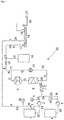
- a polyisocyanate stream A consisting of 1,6-hexamethylene diisocyanate was conveyed to a static mixer 7 from a 250 liter receiver 1 for 1,6-hexamethylene diisocyanate with the aid of a toothed ring pump 2 (from HNP, MZR 7255).
- the throughput of the polyisocyanate stream A was measured by means of a mass flow meter 3 (Bronkhorst, Mini Cori-Flow M1X, max. Flow 12 kg / h).
- the temperature of the 1,6-hexamethylene diisocyanate was room temperature.
- a polyol stream B consisting of 1,4-butanediol was conveyed to the static mixer 7 from a 250 liter receiver 4 for 1,4-butanediol with the aid of a gerotor pump 5 (from HNP, MZR 7205).
- the throughput of the polyol stream B was measured by means of a mass flow meter 6 (Bronkhorst Company, Mini Cori-Flow M1X, max. Flow rate 8 kg / h).
- the temperature of the 1,4-butanediol was 40 ° C.
- the polyisocyanate stream A and the polyol stream B were mixed with one another, so that a mixed stream C was obtained.
- the mass flows of the polyisocyanate stream A and of the polyol stream B were adjusted so that the isocyanate index in the mixture stream C was 78.
- the temperature-controllable static mixer 9 was constructed similarly to a Sulzer SMR reactor with internal, crossed tubes. It had an internal volume of 1.9 liters and a heat exchange area of 0.44 square meters. It was heated / cooled with thermal oil. The heating medium temperature at the inlet was 180 ° C.
- the circulating stream D emerged from the temperature-controllable static mixer 9 at a temperature of 183.degree. Downstream of the temperature-controllable static mixer 9, a prepolymer stream E was separated from the circulating stream D at a junction 11 and the circulating stream D was passed on to a gear pump 10. The prepolymer stream E was passed into an extruder 18.
- the pressure of the circulating flow D was increased at a gear pump 10.
- the pressure of the prepolymer stream E was measured in the prepolymer feed line (30) between the fourth confluence (11) and the pressure holding valve (12).
- the gear pump 10 (Witte Chem 25.6-3) had a volume per revolution of 25.6 cubic centimeters and a speed of 50 per minute.
- the circulating stream D was combined with the mixed stream C at the confluence 28 downstream of the pump, as already described.
- the circulation line 29 consisted of double-walled pipes that were heated with thermal oil.
- the heating medium temperature was 182 ° C.
- the static mixer 8, the temperature-controlled static mixer 9 and the gear pump 10 consisted of apparatuses which were heated with thermal oil.
- the heating medium temperature was 182 ° C.
- the reactive extrusion was carried out in an extruder 18 at a temperature of 200 ° C. and a speed of 66 revolutions per minute.
- the extruder 18 was a ZSK 26 MC from Coperion, with a screw diameter of 26 mm and a length to diameter ratio of 36 to 40.
- vent 17 On the extruder 18 there was a vent 17 which was operated at about 1 mbar underpressure compared to normal pressure and in the prepolymer stream E was freed of any inert gases and possible gaseous reaction products entrained with the polyisocyanate stream A and the polyol stream B.
- An isocyanate feed stream F consisting of 1,6-hexamethylene diisocyanate was taken from template 1 with the aid of a micro annular gear pump 15 (MZR 6355 from HNP).
- the throughput of the isocyanate feed stream F was measured by means of a mass flow meter 16 (Bronkhorst, Mini Cori-Flow, M1X, maximum flow rate 2 kg / h).
- the temperature of the 1,6-hexamethylene diisocyanate was room temperature.
- the isocyanate feed stream F was passed into the extruder 18 downstream of the prepolymer stream E. In the extruder 18, the prepolymer stream E was reacted with the isocyanate feed stream F at an isocyanate index of 99 to form a thermoplastic polyurethane G.
- thermoplastic polyurethane G was freed of volatile constituents at 200 mbar under normal pressure with the aid of a vacuum dome, which was arranged on a degassing shaft of the extruder.
- the thermoplastic polyurethane G was cooled through two nozzles in a water bath 20 filled with deionized water (deionized water) and cut into granules by a granulator 21.
- Table 1 Material flows in the production of the TPUs in Examples 1 to 5
- Example-# Current A (HDI) Stream B (BDO) Current J (HDI) Pressure in prepolymer feed line (30) 1 2.91 kg / h 2 kg / h 0.784 kg / h 4.4 bar 2 2.91 kg / h 2 kg / h 0.784 kg / h 4.6 bar 3 2.91 kg / h 2 kg / h 0.784 kg / h 4.9 bar 5 2.91 kg / h 2 kg / h 0.784 kg / h 5.4 bar 4th 2.91 kg / h 2 kg / h 0.784 kg / h 5.7 bar
- thermograms in the second heating of the examined materials are in Figure 2 shown, the characteristic values determined from it in Fig. 3 .
- the thermoplastic polyurethanes from the examples each have a weight average molecular weight in a similar range from approx. 86 kg / mol to approx. 283 g / mol and also similar peak melting temperatures in the range from 176.5 ° C to 181.4 ° C . In the case of the enthalpy of fusion, however, from around 170 kg / mol, there is a plateau depending on the molecular weight.
- TPU according to the invention Due to the lower enthalpy of fusion of the TPU according to the invention, further processing must be carried out by melting and subsequent Shaping requires less energy for melting than for TPU with Mw ⁇ 170 kg / mol. If the same amount of energy is used in each case for the melting of the thermoplastic polyurethanes from the two examples, the TPU according to the invention melts more quickly.
Landscapes
- Chemical & Material Sciences (AREA)
- Health & Medical Sciences (AREA)
- Chemical Kinetics & Catalysis (AREA)
- Medicinal Chemistry (AREA)
- Polymers & Plastics (AREA)
- Organic Chemistry (AREA)
- Engineering & Computer Science (AREA)
- Manufacturing & Machinery (AREA)
- Polyurethanes Or Polyureas (AREA)
Priority Applications (2)
| Application Number | Priority Date | Filing Date | Title |
|---|---|---|---|
| EP19216787.2A EP3838945A1 (fr) | 2019-12-17 | 2019-12-17 | Polymère de polyuréthane aliphatique thermoplastique à comportement de fusion amélioré |
| PCT/EP2020/085522 WO2021122305A1 (fr) | 2019-12-17 | 2020-12-10 | Polymère de polyuréthane aliphatique thermoplastique ayant un comportement de fusion amélioré |
Applications Claiming Priority (1)
| Application Number | Priority Date | Filing Date | Title |
|---|---|---|---|
| EP19216787.2A EP3838945A1 (fr) | 2019-12-17 | 2019-12-17 | Polymère de polyuréthane aliphatique thermoplastique à comportement de fusion amélioré |
Publications (1)
| Publication Number | Publication Date |
|---|---|
| EP3838945A1 true EP3838945A1 (fr) | 2021-06-23 |
Family
ID=68917763
Family Applications (1)
| Application Number | Title | Priority Date | Filing Date |
|---|---|---|---|
| EP19216787.2A Pending EP3838945A1 (fr) | 2019-12-17 | 2019-12-17 | Polymère de polyuréthane aliphatique thermoplastique à comportement de fusion amélioré |
Country Status (2)
| Country | Link |
|---|---|
| EP (1) | EP3838945A1 (fr) |
| WO (1) | WO2021122305A1 (fr) |
Citations (5)
| Publication number | Priority date | Publication date | Assignee | Title |
|---|---|---|---|---|
| DE2901774A1 (de) | 1979-01-18 | 1980-07-24 | Elastogran Gmbh | Rieselfaehiges, mikrobenbestaendiges farbstoff- und/oder hilfsmittelkonzentrat auf basis eines polyurethan-elastomeren und verfahren zu seiner herstellung |
| EP0598283A1 (fr) * | 1992-11-16 | 1994-05-25 | Bayer Ag | Procédé en continu pour le contrôle de la conversion de prépolymères de polyuréthane par mélange partiel des prépolymères avec des monomères |
| CN105001626A (zh) | 2015-07-22 | 2015-10-28 | 东莞市吉鑫高分子科技有限公司 | 一种挤出级热塑性聚氨酯弹性体及其制备方法 |
| US20170145146A1 (en) | 2015-11-25 | 2017-05-25 | Trent University | Renewably derived thermoplastic polyester-based urethanes and methods of making and using the same |
| CN107141437A (zh) | 2017-06-20 | 2017-09-08 | 万华化学集团股份有限公司 | 一种可控结晶的热塑性聚氨酯材料及其制备方法 |
-
2019
- 2019-12-17 EP EP19216787.2A patent/EP3838945A1/fr active Pending
-
2020
- 2020-12-10 WO PCT/EP2020/085522 patent/WO2021122305A1/fr not_active Ceased
Patent Citations (5)
| Publication number | Priority date | Publication date | Assignee | Title |
|---|---|---|---|---|
| DE2901774A1 (de) | 1979-01-18 | 1980-07-24 | Elastogran Gmbh | Rieselfaehiges, mikrobenbestaendiges farbstoff- und/oder hilfsmittelkonzentrat auf basis eines polyurethan-elastomeren und verfahren zu seiner herstellung |
| EP0598283A1 (fr) * | 1992-11-16 | 1994-05-25 | Bayer Ag | Procédé en continu pour le contrôle de la conversion de prépolymères de polyuréthane par mélange partiel des prépolymères avec des monomères |
| CN105001626A (zh) | 2015-07-22 | 2015-10-28 | 东莞市吉鑫高分子科技有限公司 | 一种挤出级热塑性聚氨酯弹性体及其制备方法 |
| US20170145146A1 (en) | 2015-11-25 | 2017-05-25 | Trent University | Renewably derived thermoplastic polyester-based urethanes and methods of making and using the same |
| CN107141437A (zh) | 2017-06-20 | 2017-09-08 | 万华化学集团股份有限公司 | 一种可控结晶的热塑性聚氨酯材料及其制备方法 |
Non-Patent Citations (5)
| Title |
|---|
| "HOUBEN-WEYL ''Methoden der organischen Chemie", vol. E20, 1987, GEORG THIEME VERLAG, article "Makromolekulare Stoffe", pages: 1587 - 1593 |
| J.H. SAUNDERSK.C. FRISCH: "Polyurethane", vol. XVI, 1962, VERLAG INTERSCIENCE PUBLISHERS, article "High Polymers" |
| JUSTUS LIEBIGS ANNALEN DER CHEMIE, vol. 562, 1949, pages 75 - 136 |
| KAJIYAMA, T.MACKNIGHT, W.J., POLYMER JOURNAL, vol. 1, 1970, pages 548 - 554 |
| R. GÄCHTERH. MÜLLER: "Taschenbuch für Kunststoff-Additive", 1990, HANSER VERLAG |
Also Published As
| Publication number | Publication date |
|---|---|
| WO2021122305A1 (fr) | 2021-06-24 |
Similar Documents
| Publication | Publication Date | Title |
|---|---|---|
| EP3838961A1 (fr) | Prépolymère de polyuréthane à terminaison hydroxy à faible teneur en allophanate | |
| WO2021122429A1 (fr) | Procédé d'impression 3d utilisant un matériau de construction ayant une teneur élevée en segments durs | |
| WO2021122280A1 (fr) | Polyuréthane thermoplastique présentant un module de flexion élevé | |
| EP3838944A1 (fr) | Polymère de polyuréthane aliphatique thermoplastique à faible enthalpie de cristallisation | |
| EP3887421B1 (fr) | Fabrication continue d'un tpu à base de ppg | |
| WO2021122307A1 (fr) | Procédé de production en continu d'un polyuréthane thermoplastique | |
| EP3838950A1 (fr) | Prépolymère de polyuréthane thermoplastique aliphatique à faible enthalpie de fusion | |
| EP3838945A1 (fr) | Polymère de polyuréthane aliphatique thermoplastique à comportement de fusion amélioré | |
| EP4015549A1 (fr) | Matière de moulage thermoplastique aux bonnes propriétés mécaniques | |
| EP4077441B1 (fr) | Polyuréthane thermoplastique ayant une contrainte à la flexion élevée | |
| EP4015550A1 (fr) | Matière de moulage thermoplastique aux bonnes propriétés mécaniques | |
| EP3838948A1 (fr) | Prépolymère de polyuréthane thermoplastique aliphatique à faible enthalpie de cristallisation | |
| EP3838943A1 (fr) | Procédé de fabrication de polyuréthanes semi-cristallins à enthalpie de réaction élevée | |
| EP4077440A1 (fr) | Composition de moulage thermoplastique présentant un bon comportement de démoulage | |
| EP4015551A1 (fr) | Matière de moulage thermoplastique aux bonnes propriétés mécaniques | |
| EP3838942A1 (fr) | Procédé de fabrication de polyuréthanes à enthalpie de réaction élevée | |
| EP4077444A1 (fr) | Procédé de production continue de polyuréthane thermoplastique | |
| EP3838952A1 (fr) | Polyuréthane thermoplastique à teneur en segment dur élevée | |
| EP4105256A1 (fr) | Matière de moulage thermoplastique à une bonne stabilité aux intempéries | |
| EP4105255A1 (fr) | Matière de moulage thermoplastique à un bon comportement à la cristallisation | |
| EP4077445A1 (fr) | Procédé de production d'un polyuréthane thermoplastique à faible indice de couleur | |
| WO2022037819A1 (fr) | Composition de moulage thermoplastique ayant de bonnes propriétés thermiques et mécaniques | |
| EP3838960A1 (fr) | Procédé de réglage de la répartition du poids moléculaire dans des polycondensations et/ou des polyadditions |
Legal Events
| Date | Code | Title | Description |
|---|---|---|---|
| PUAI | Public reference made under article 153(3) epc to a published international application that has entered the european phase |
Free format text: ORIGINAL CODE: 0009012 |
|
| STAA | Information on the status of an ep patent application or granted ep patent |
Free format text: STATUS: THE APPLICATION HAS BEEN PUBLISHED |
|
| AK | Designated contracting states |
Kind code of ref document: A1 Designated state(s): AL AT BE BG CH CY CZ DE DK EE ES FI FR GB GR HR HU IE IS IT LI LT LU LV MC MK MT NL NO PL PT RO RS SE SI SK SM TR |