EP3840411A1 - Ohrstück für ein hörgerät - Google Patents
Ohrstück für ein hörgerät Download PDFInfo
- Publication number
- EP3840411A1 EP3840411A1 EP19218042.0A EP19218042A EP3840411A1 EP 3840411 A1 EP3840411 A1 EP 3840411A1 EP 19218042 A EP19218042 A EP 19218042A EP 3840411 A1 EP3840411 A1 EP 3840411A1
- Authority
- EP
- European Patent Office
- Prior art keywords
- earpiece
- connector
- vent
- shape memory
- vent opening
- Prior art date
- Legal status (The legal status is an assumption and is not a legal conclusion. Google has not performed a legal analysis and makes no representation as to the accuracy of the status listed.)
- Withdrawn
Links
Images

Classifications
-
- H—ELECTRICITY
- H04—ELECTRIC COMMUNICATION TECHNIQUE
- H04R—LOUDSPEAKERS, MICROPHONES, GRAMOPHONE PICK-UPS OR LIKE ACOUSTIC ELECTROMECHANICAL TRANSDUCERS; ELECTRIC HEARING AIDS; PUBLIC ADDRESS SYSTEMS
- H04R25/00—Electric hearing aids
- H04R25/65—Housing parts, e.g. shells, tips or moulds, or their manufacture
- H04R25/652—Ear tips; Ear moulds
- H04R25/656—Non-customized, universal ear tips, i.e. ear tips which are not specifically adapted to the size or shape of the ear or ear canal
-
- H—ELECTRICITY
- H04—ELECTRIC COMMUNICATION TECHNIQUE
- H04R—LOUDSPEAKERS, MICROPHONES, GRAMOPHONE PICK-UPS OR LIKE ACOUSTIC ELECTROMECHANICAL TRANSDUCERS; ELECTRIC HEARING AIDS; PUBLIC ADDRESS SYSTEMS
- H04R25/00—Electric hearing aids
- H04R25/65—Housing parts, e.g. shells, tips or moulds, or their manufacture
- H04R25/652—Ear tips; Ear moulds
-
- C—CHEMISTRY; METALLURGY
- C08—ORGANIC MACROMOLECULAR COMPOUNDS; THEIR PREPARATION OR CHEMICAL WORKING-UP; COMPOSITIONS BASED THEREON
- C08G—MACROMOLECULAR COMPOUNDS OBTAINED OTHERWISE THAN BY REACTIONS ONLY INVOLVING UNSATURATED CARBON-TO-CARBON BONDS
- C08G2280/00—Compositions for creating shape memory
-
- C—CHEMISTRY; METALLURGY
- C08—ORGANIC MACROMOLECULAR COMPOUNDS; THEIR PREPARATION OR CHEMICAL WORKING-UP; COMPOSITIONS BASED THEREON
- C08L—COMPOSITIONS OF MACROMOLECULAR COMPOUNDS
- C08L75/00—Compositions of polyureas or polyurethanes; Compositions of derivatives of such polymers
- C08L75/04—Polyurethanes
-
- H—ELECTRICITY
- H04—ELECTRIC COMMUNICATION TECHNIQUE
- H04R—LOUDSPEAKERS, MICROPHONES, GRAMOPHONE PICK-UPS OR LIKE ACOUSTIC ELECTROMECHANICAL TRANSDUCERS; ELECTRIC HEARING AIDS; PUBLIC ADDRESS SYSTEMS
- H04R1/00—Details of transducers, loudspeakers or microphones
- H04R1/10—Earpieces; Attachments therefor ; Earphones; Monophonic headphones
- H04R1/1058—Manufacture or assembly
-
- H—ELECTRICITY
- H04—ELECTRIC COMMUNICATION TECHNIQUE
- H04R—LOUDSPEAKERS, MICROPHONES, GRAMOPHONE PICK-UPS OR LIKE ACOUSTIC ELECTROMECHANICAL TRANSDUCERS; ELECTRIC HEARING AIDS; PUBLIC ADDRESS SYSTEMS
- H04R2225/00—Details of deaf aids covered by H04R25/00, not provided for in any of its subgroups
- H04R2225/77—Design aspects, e.g. CAD, of hearing aid tips, moulds or housings
-
- H—ELECTRICITY
- H04—ELECTRIC COMMUNICATION TECHNIQUE
- H04R—LOUDSPEAKERS, MICROPHONES, GRAMOPHONE PICK-UPS OR LIKE ACOUSTIC ELECTROMECHANICAL TRANSDUCERS; ELECTRIC HEARING AIDS; PUBLIC ADDRESS SYSTEMS
- H04R2460/00—Details of hearing devices, i.e. of ear- or headphones covered by H04R1/10 or H04R5/033 but not provided for in any of their subgroups, or of hearing aids covered by H04R25/00 but not provided for in any of its subgroups
- H04R2460/11—Aspects relating to vents, e.g. shape, orientation, acoustic properties in ear tips of hearing devices to prevent occlusion
Definitions
- the invention relates to an earpiece for a hearing device.
- Earpieces for in-situ customization made of a shape memory material should have a design that allows the acousticians to drill vents, e.g. one straight surface, or should provide a pre-defined hole/ vent, which could be increased in size if needed. Acousticians need the opportunity to provide the client with a defined vent.
- the object is achieved by an earpiece for a hearing device according to claim 1.
- an earpiece for a hearing device comprises:
- the second material has a shore A hardness of at least 50.
- the first material is different from the second material, in particular it has a lower shore A hardness, so the second material is more rigid than the first material.
- the first material is a shape memory polymer.
- the earpiece further comprises at least one vent opening in the second part.
- the earpiece further comprises a connector opening in the second part for a connector adapted to connect to a component of a hearing aid.
- the first part is conical.
- the first part comprises tapering walls with a thickness increasing towards a lateral end.
- the lateral end is the end pointing outwards, i.e. away from the user of the earpiece when the earpiece is in place within the users ear canal.
- the second part has a circular or oval cross section.
- the oval cross section has a minor semi-axis smaller than 2.5 mm and a major semi-axis smaller than 3mm.
- the vent opening comprises a tubular extension so that the length of the vent opening exceeds a thickness of the second part.
- the vent opening has a length of 0.5mm to 12mm, in particular 0.5 mm to 2.5mm and a diameter of 0.3mm to 2 mm, in particular 0.3 mm to 1.5mm.
- the vent opening has a circular, oval or crescent shaped cross section.
- the second material is at least one of a metal, a ceramic and a polymer, in particular a polyurethane, a thermoplastic polyurethane, a thermoplastic elastomer or a polyamide.
- the second part further comprises a third material different than the first and second material.
- the earpiece further comprises a connector arranged in the connector hole, the connector made from the second material or from a third material.
- the third material may have a shore A hardness lower than the shore A hardness of the second material.
- the first material and the second material are both the same shape memory polymer, wherein the thickness of the second part is greater than the thickness of walls of the first part.
- the second part is overmolded with the shape memory polymer.
- a method of manufacturing an earpiece as described above wherein the second part and the first part are joined by at least one of a two-component molding process, gluing and laser welding.
- the new earpiece design comprises a first part, e.g. a shell, which can be customized to an individual ear canal geometry, and a second medial part, which does not or only marginally change its shape during the in-situ customization process.
- a connector e.g. to connect with a component of a hearing aid such as a receiver or a sound tube
- one or more vents if needed
- the first part of the earpiece may be made of a shape memory polymer (SMP), which allows for in-situ customization in the ear canal. It shall be provided in different sizes in order to fit a great range of ears. Due to the conicity of the first part the walls thereof can be tapered, i.e. they can be thinner at the medial end and become thicker towards a lateral end. In addition, the wall thickness can differ for different sizes of the earpiece, e.g. three different sizes.
- SMP shape memory polymer
- Figure 1 is a schematic side view of an exemplary first embodiment of an earpiece 1.
- Figure 2 is a schematic top view of the first embodiment of the earpiece 1.
- the earpiece 1 comprises a first part 2, e.g. a shell, which can be customized to an individual ear canal geometry, and a second part 3, e.g. a medial part, which does not or only marginally change its shape during an in-situ customization process.
- the first part 2 of the earpiece 1 may be made of a shape memory polymer (SMP), which allows for in-situ customization in the ear canal. It may be provided in different sizes in order to fit a great range of ears.
- the first part 2 may have a conical form, so the walls thereof can be tapered, i.e. they can be thinner at a medial end M and become thicker towards a lateral end L.
- the wall thickness can differ for different sizes of the earpiece 1, e.g. three different sizes.
- the second part 3 has an oval cross sectional form. In other exemplary embodiments, the second part 3 may have a different cross sectional form, e.g. circular.
- Figure 3 is a schematic top view of an exemplary second embodiment of an earpiece 1 which differs from the earpiece 1 of the first embodiment in that a connector opening 4, e.g. to connect with a component of a hearing aid such as a receiver or a sound tube, and one or more vent openings 5, e.g. respectively having a circular cross section, are integrated in the second part 3.
- the connector opening 4 may typically be significantly larger in diameter than the one or more vent openings 5.
- the connector opening 4 may have a circular cross section.
- Figure 4 is a schematic top view of an exemplary third embodiment of an earpiece 1 which differs from the earpiece 1 of the second embodiment in that the second part 3 has a circular cross sectional form.
- the connector opening 4 is off center to provide space for the vent opening 5.
- the second part 3 comprises the connector opening 4 for attaching a component of a hearing aid such as a receiver or a sound tube for connecting to a receiver.
- the second part 3 has space to drill one or more vent openings 5 or features pre-manufactured vent openings 5.
- the second part 3 shall be as large as needed to accommodate the connector opening 4 and the one or more vent openings 5 and as small as possible in order to allow for a high fit rate.
- the second part 3 shall have the same size for all earpiece 1 sizes, but can also be larger for the larger earpiece 1 sizes.
- the oval second part 3 of figure 3 features a minor semi-axis smaller than 2.5 mm and a major semi-axis smaller than 3mm. Due to the connector and receiver limiting space in the earpiece 1, the vent openings 5 shall ideally be integrated in the second part 3.
- a vent mass of a standard vent opening 5 e.g. with a length of approximately 12 mm and a diameter of 1.4 mm
- equation (1) can be used where the vent mass is proportional to the length of the vent opening 5 and inversely proportional to the cross section of the vent opening 5.
- vent mass for different sizes of vent openings 5 of standard earpieces 1 e.g. slim tips
- Phonak's fitting software "Target” was calculated (see Table 1).
- These (approximate) results for the vent mass and equation 2 were taken to calculate the respective vent diameters for the shape memory polymer earpieces 1 according to the invention for vent lengths of 1.5 and 1 mm, respectively, which corresponds to the thickness of the second part 3, as shown in Table 2.
- the range of vent diameters is between 0.2 and 1 mm, ideally between 0.31 mm and 0.8 mm.
- a drawback of these short and small vent openings 5 is that the manufacturing tolerances have a larger impact on the acoustic performance of the earpiece 1 than with larger vent openings 5. Consequently, in one design approach a slightly longer (e.g. 3 mm or 5 mm) and larger vent opening 5 may be integrated in the second part (see schematic in Figure 5 ).
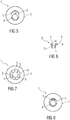
- Figure 5 is a schematic top view of an exemplary fourth embodiment of an earpiece 1, which differs from the second embodiment in that the vent opening 5 is slightly longer (e.g. 3 mm or 5 mm) and larger.
- Figure 6 is a schematic sectional view of the second part 3 of the fourth embodiment of the earpiece 1.
- the vent opening 5 comprises a tubular extension 6 so that the length of the vent opening 5 exceeds a thickness of the second part 3.
- the tubular extension 6 may consist of the same material as the second part 3 and may be integrally formed with the second part 3.
- Table 1 Vent masses calculated for different sizes of vent openings 5 of standard earpieces (e.g.
- Figure 7 is a schematic top view of an exemplary fifth embodiment of an earpiece 1 which differs from the third embodiment in that the connector opening 4 is in the centre of the second part 3 and a plurality of vent openings 5 having circular cross sections are arranged around the connector opening 4, e.g. uniformly distributed around the connector opening 4.
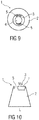
- Figure 8 is a schematic top view of an exemplary sixth embodiment of an earpiece 1 similar to the second and fourth embodiment because of the oval cross section of the second part 3; however, it differs from these embodiments in that the vent opening 5 does not have a circular cross section but a crescent shaped cross section.
- the curvature of the crescent shape may be at least approximately concentric with the connector opening 4. This may have an advantageous impact on the size of the second part 3 as the crescent shape allows for arranging the connector opening 4 less off centre.
- Figure 9 is a schematic top view of an exemplary seventh embodiment of an earpiece which is similar to the sixth embodiment but has two vent openings 5 respectively having a crescent shaped cross section.
- the curvature of the crescent shape may be at least approximately concentric with the connector opening 4 and the vent openings 5 may be arranged on opposite sides of the connector opening 4.
- the earpiece 1 is made of at least two different materials, i.e. one for the second part 3 and one for the first part 2. Further, an additional material can be used for the second part 3.
- the parts can be joined in different ways, e.g. via a two-component-molding process, by gluing or laser welding.
- FIG 10 is a schematic side view of an exemplary sixth embodiment of an earpiece 1.
- the earpiece 1 comprises a first part 2, e.g. a shell, which can be customized to an individual ear canal geometry, and a second part 3, e.g. a medial part, which does not or only marginally change its shape during an in-situ customization process.
- the first part 2 of the earpiece 1 may be made of a shape memory polymer (SMP), which allows for in-situ customization in the ear canal. It may be provided in different sizes in order to fit a great range of ears.
- the shapeable part 2 may have a conical form, so the walls thereof can be tapered, i.e. they can be thinner at a medial end M and become thicker towards a lateral end L.
- the wall thickness can differ for different sizes of the earpiece 1, e.g. three different sizes.
- the second part 3 has an oval cross sectional form. In other exemplary embodiments, the second part 3 may have a different cross sectional form, e.g. circular.
- the second part 3 consists of two components: one component features the connector 7 and a plate with the vent openings 5 and is made of a rather soft material (e.g. a TPU with a hardness of 68 Shore A). This component is overmolded with the shape memory polymer and at the same time the first part 2 is also molded.
- a rather soft material e.g. a TPU with a hardness of 68 Shore A
- vent openings 5 can either be incorporated during the injection molding/ manufacturing process, or afterwards, either in the manufacturing facility (pre-drilled holes) or at the acoustician (in the case of circular vent openings 5).
- vent openings 5 Another option to modify the size of vent openings 5 or to get rid of them is the use of plugs with defined sizes. Depending on the vent opening 5 size needed the respective plug can be mounted on the earpiece 1.
Landscapes
- Engineering & Computer Science (AREA)
- Manufacturing & Machinery (AREA)
- Health & Medical Sciences (AREA)
- General Health & Medical Sciences (AREA)
- Neurosurgery (AREA)
- Otolaryngology (AREA)
- Physics & Mathematics (AREA)
- Acoustics & Sound (AREA)
- Signal Processing (AREA)
- Headphones And Earphones (AREA)
Priority Applications (3)
| Application Number | Priority Date | Filing Date | Title |
|---|---|---|---|
| EP19218042.0A EP3840411A1 (de) | 2019-12-19 | 2019-12-19 | Ohrstück für ein hörgerät |
| CN202011458485.0A CN113015072A (zh) | 2019-12-19 | 2020-12-11 | 用于听力设备的耳塞 |
| US17/123,969 US20210195351A1 (en) | 2019-12-19 | 2020-12-16 | Earpiece for a Hearing Device |
Applications Claiming Priority (1)
| Application Number | Priority Date | Filing Date | Title |
|---|---|---|---|
| EP19218042.0A EP3840411A1 (de) | 2019-12-19 | 2019-12-19 | Ohrstück für ein hörgerät |
Publications (1)
| Publication Number | Publication Date |
|---|---|
| EP3840411A1 true EP3840411A1 (de) | 2021-06-23 |
Family
ID=68965906
Family Applications (1)
| Application Number | Title | Priority Date | Filing Date |
|---|---|---|---|
| EP19218042.0A Withdrawn EP3840411A1 (de) | 2019-12-19 | 2019-12-19 | Ohrstück für ein hörgerät |
Country Status (3)
| Country | Link |
|---|---|
| US (1) | US20210195351A1 (de) |
| EP (1) | EP3840411A1 (de) |
| CN (1) | CN113015072A (de) |
Families Citing this family (2)
| Publication number | Priority date | Publication date | Assignee | Title |
|---|---|---|---|---|
| US12063466B2 (en) | 2022-02-22 | 2024-08-13 | Apple Inc. | Charging case for portable wireless listening device |
| WO2025208248A1 (zh) * | 2024-03-30 | 2025-10-09 | 广州俊粤海绵耳塞有限公司 | 一种金属可探测耳塞及其制备方法 |
Citations (4)
| Publication number | Priority date | Publication date | Assignee | Title |
|---|---|---|---|---|
| US20070183613A1 (en) * | 2004-05-28 | 2007-08-09 | Juneau Roger P | Self forming in-the-ear hearing aid with conical stent |
| JP2012075850A (ja) * | 2010-10-04 | 2012-04-19 | Mitsuyo Sasaki | 装着補助具付き耳栓 |
| WO2018099562A1 (en) * | 2016-12-01 | 2018-06-07 | Sonova Ag | A method of customizing a hearing device component, a hearing device component and a hearing device |
| US20180359579A1 (en) * | 2009-07-25 | 2018-12-13 | Eargo, Inc. | Adjustable Securing Mechanism |
Family Cites Families (19)
| Publication number | Priority date | Publication date | Assignee | Title |
|---|---|---|---|---|
| US6695093B1 (en) * | 2000-01-13 | 2004-02-24 | Aearo Company | Earplug |
| ATE484925T1 (de) * | 2005-08-01 | 2010-10-15 | Gn Resound As | Hörgerät mit offenem ohrpassstück mit kurzer entlüftung |
| EP2055139B1 (de) * | 2006-08-07 | 2009-12-23 | Widex A/S | Hörgerät, verfahren für einen in-situ-okklusionseffekt und verfahren zur direktsendeschallmessung und öffnungsgrössenbestimmung |
| US8649540B2 (en) * | 2009-10-30 | 2014-02-11 | Etymotic Research, Inc. | Electronic earplug |
| US8616214B2 (en) * | 2011-04-06 | 2013-12-31 | Kimberly-Clark Worldwide, Inc. | Earplug having a resilient core structure |
| US8885866B2 (en) * | 2011-07-22 | 2014-11-11 | Panasonic Corporation | Earphone |
| CN202663526U (zh) * | 2011-12-01 | 2013-01-09 | 广州艾尔慢回弹耳塞有限公司 | 一种慢性回弹耳塞绵 |
| CN102413410A (zh) * | 2011-12-16 | 2012-04-11 | 江苏贝泰福医疗科技有限公司 | 数字式助听器 |
| WO2013091724A1 (en) * | 2011-12-23 | 2013-06-27 | Phonak Ag | Tip-plate assembly, hearing device with a tip-plate assembly and method of manufacturing a hearing device with a tip-plate assembly |
| US9451353B2 (en) * | 2012-02-08 | 2016-09-20 | Decibullz Llc | Moldable earpiece system |
| CN102547515B (zh) * | 2012-02-21 | 2014-09-03 | 江苏贝泰福医疗科技有限公司 | 一种音乐耳机 |
| CN103327435A (zh) * | 2013-07-15 | 2013-09-25 | 江苏贝泰福医疗科技有限公司 | 耳内受话耳背式助听器的非分离式可变形耳钩 |
| WO2016188642A1 (de) * | 2015-05-27 | 2016-12-01 | Sivantos Pte. Ltd. | Hörgerät und ohrstück |
| CN105050016A (zh) * | 2015-08-14 | 2015-11-11 | 张洪飞 | 入耳式助听器控制系统 |
| DK3142386T3 (da) * | 2015-09-08 | 2019-07-08 | Oticon As | Tætningsørestykke |
| US10158933B2 (en) * | 2016-04-21 | 2018-12-18 | Bose Corporation | Custom-molding in-ear headphone ear tips |
| US10531174B2 (en) * | 2016-10-13 | 2020-01-07 | Bose Corporation | Earpiece employing cooling and sensation inducing materials |
| EP3758795B1 (de) * | 2018-02-27 | 2022-08-24 | Advanced Bionics AG | Tonabgabegeräte für audiometrische messungen |
| US10623861B2 (en) * | 2018-08-31 | 2020-04-14 | Bose Corporation | Wearable devices using shape memory polymers |
-
2019
- 2019-12-19 EP EP19218042.0A patent/EP3840411A1/de not_active Withdrawn
-
2020
- 2020-12-11 CN CN202011458485.0A patent/CN113015072A/zh active Pending
- 2020-12-16 US US17/123,969 patent/US20210195351A1/en not_active Abandoned
Patent Citations (4)
| Publication number | Priority date | Publication date | Assignee | Title |
|---|---|---|---|---|
| US20070183613A1 (en) * | 2004-05-28 | 2007-08-09 | Juneau Roger P | Self forming in-the-ear hearing aid with conical stent |
| US20180359579A1 (en) * | 2009-07-25 | 2018-12-13 | Eargo, Inc. | Adjustable Securing Mechanism |
| JP2012075850A (ja) * | 2010-10-04 | 2012-04-19 | Mitsuyo Sasaki | 装着補助具付き耳栓 |
| WO2018099562A1 (en) * | 2016-12-01 | 2018-06-07 | Sonova Ag | A method of customizing a hearing device component, a hearing device component and a hearing device |
Non-Patent Citations (1)
| Title |
|---|
| ACS APPL. MATER. INTERFACES, vol. 10, 2018, pages 24829 - 24839 |
Also Published As
| Publication number | Publication date |
|---|---|
| CN113015072A (zh) | 2021-06-22 |
| US20210195351A1 (en) | 2021-06-24 |
Similar Documents
| Publication | Publication Date | Title |
|---|---|---|
| US5002151A (en) | Ear piece having disposable, compressible polymeric foam sleeve | |
| US7837005B2 (en) | Mushroom-shaped push-in foam eartip for use with high-fidelity insert earphones | |
| EP3840411A1 (de) | Ohrstück für ein hörgerät | |
| US10516951B2 (en) | Adjustable venting for hearing instruments | |
| US8897458B2 (en) | Concha-fitting custom earplug with flexible skin and filler material | |
| EP3198890B1 (de) | Abdrucknahmekissen, verfahren zur abdrucknahme, abdruck und verfahren zur herstellung einer individuell angepassten gehörgangschale | |
| EP3041259A1 (de) | Ohrinterner kopfhörer mit flexibler düse und zugehörige verfahren | |
| EP3449646B1 (de) | Massgefertigtes elastomeres ohrpassstück mit sekundärmaterialinfusion | |
| EP1880699A2 (de) | Verfahren zur Herstellung eines Ohrstöpsels | |
| JP2008193687A (ja) | イヤホンを製造するための方法およびイヤホン | |
| US8605928B2 (en) | Hook for a hearing aid | |
| JP2011524240A (ja) | 非ロール型フォームイヤーチップ | |
| US12427066B2 (en) | Earpiece and manufacturing method and customization method of the earpiece | |
| US20080298618A1 (en) | Earpiece for a hearing apparatus with a securing ring | |
| US20050238192A1 (en) | Shell in shell hearing aid system | |
| EP3939338B1 (de) | Verfahren zur anpassung einer otoplastik eines hörgeräts | |
| US7864972B2 (en) | Customized in-ear interface for acoustic equipment and method | |
| WO2009123563A1 (en) | Hearing aid housing | |
| US10743122B2 (en) | Dome for a hearing aid device insertable into an auditory canal, and hearing device | |
| US10231068B2 (en) | Hearing device for being worn at least partly within an ear canal and a method for manufacturing such a hearing device | |
| EP1998593A1 (de) | Ohrstück für eine Hörvorrichtung mit Sicherungsring | |
| CN101180918A (zh) | 用于助听器的钩状物 | |
| US8050438B2 (en) | Closure element for housing openings during a tumbling process |
Legal Events
| Date | Code | Title | Description |
|---|---|---|---|
| PUAI | Public reference made under article 153(3) epc to a published international application that has entered the european phase |
Free format text: ORIGINAL CODE: 0009012 |
|
| STAA | Information on the status of an ep patent application or granted ep patent |
Free format text: STATUS: REQUEST FOR EXAMINATION WAS MADE |
|
| 17P | Request for examination filed |
Effective date: 20210218 |
|
| AK | Designated contracting states |
Kind code of ref document: A1 Designated state(s): AL AT BE BG CH CY CZ DE DK EE ES FI FR GB GR HR HU IE IS IT LI LT LU LV MC MK MT NL NO PL PT RO RS SE SI SK SM TR |
|
| STAA | Information on the status of an ep patent application or granted ep patent |
Free format text: STATUS: EXAMINATION IS IN PROGRESS |
|
| 17Q | First examination report despatched |
Effective date: 20230511 |
|
| STAA | Information on the status of an ep patent application or granted ep patent |
Free format text: STATUS: THE APPLICATION IS DEEMED TO BE WITHDRAWN |
|
| 18D | Application deemed to be withdrawn |
Effective date: 20250404 |