EP3840839B1 - Composition comprising an iodide and a derivative of hyaluronic acid with an oxidative effect, method of preparation thereof and use thereof - Google Patents
Composition comprising an iodide and a derivative of hyaluronic acid with an oxidative effect, method of preparation thereof and use thereof Download PDFInfo
- Publication number
- EP3840839B1 EP3840839B1 EP19778421.8A EP19778421A EP3840839B1 EP 3840839 B1 EP3840839 B1 EP 3840839B1 EP 19778421 A EP19778421 A EP 19778421A EP 3840839 B1 EP3840839 B1 EP 3840839B1
- Authority
- EP
- European Patent Office
- Prior art keywords
- hyaluronic acid
- hyaluronan
- chloramide
- iodide
- group
- Prior art date
- Legal status (The legal status is an assumption and is not a legal conclusion. Google has not performed a legal analysis and makes no representation as to the accuracy of the status listed.)
- Active
Links
Images
Classifications
-
- A—HUMAN NECESSITIES
- A01—AGRICULTURE; FORESTRY; ANIMAL HUSBANDRY; HUNTING; TRAPPING; FISHING
- A01N—PRESERVATION OF BODIES OF HUMANS OR ANIMALS OR PLANTS OR PARTS THEREOF; BIOCIDES, e.g. AS DISINFECTANTS, AS PESTICIDES OR AS HERBICIDES; PEST REPELLANTS OR ATTRACTANTS; PLANT GROWTH REGULATORS
- A01N43/00—Biocides, pest repellants or attractants, or plant growth regulators containing heterocyclic compounds
- A01N43/02—Biocides, pest repellants or attractants, or plant growth regulators containing heterocyclic compounds having rings with one or more oxygen or sulfur atoms as the only ring hetero atoms
- A01N43/04—Biocides, pest repellants or attractants, or plant growth regulators containing heterocyclic compounds having rings with one or more oxygen or sulfur atoms as the only ring hetero atoms with one hetero atom
- A01N43/14—Biocides, pest repellants or attractants, or plant growth regulators containing heterocyclic compounds having rings with one or more oxygen or sulfur atoms as the only ring hetero atoms with one hetero atom six-membered rings
- A01N43/16—Biocides, pest repellants or attractants, or plant growth regulators containing heterocyclic compounds having rings with one or more oxygen or sulfur atoms as the only ring hetero atoms with one hetero atom six-membered rings with oxygen as the ring hetero atom
-
- A—HUMAN NECESSITIES
- A61—MEDICAL OR VETERINARY SCIENCE; HYGIENE
- A61P—SPECIFIC THERAPEUTIC ACTIVITY OF CHEMICAL COMPOUNDS OR MEDICINAL PREPARATIONS
- A61P31/00—Antiinfectives, i.e. antibiotics, antiseptics, chemotherapeutics
- A61P31/04—Antibacterial agents
-
- A—HUMAN NECESSITIES
- A01—AGRICULTURE; FORESTRY; ANIMAL HUSBANDRY; HUNTING; TRAPPING; FISHING
- A01N—PRESERVATION OF BODIES OF HUMANS OR ANIMALS OR PLANTS OR PARTS THEREOF; BIOCIDES, e.g. AS DISINFECTANTS, AS PESTICIDES OR AS HERBICIDES; PEST REPELLANTS OR ATTRACTANTS; PLANT GROWTH REGULATORS
- A01N25/00—Biocides, pest repellants or attractants, or plant growth regulators, characterised by their forms, or by their non-active ingredients or by their methods of application, e.g. seed treatment or sequential application; Substances for reducing the noxious effect of the active ingredients to organisms other than pests
- A01N25/02—Biocides, pest repellants or attractants, or plant growth regulators, characterised by their forms, or by their non-active ingredients or by their methods of application, e.g. seed treatment or sequential application; Substances for reducing the noxious effect of the active ingredients to organisms other than pests containing liquids as carriers, diluents or solvents
- A01N25/04—Dispersions, emulsions, suspoemulsions, suspension concentrates or gels
-
- A—HUMAN NECESSITIES
- A01—AGRICULTURE; FORESTRY; ANIMAL HUSBANDRY; HUNTING; TRAPPING; FISHING
- A01N—PRESERVATION OF BODIES OF HUMANS OR ANIMALS OR PLANTS OR PARTS THEREOF; BIOCIDES, e.g. AS DISINFECTANTS, AS PESTICIDES OR AS HERBICIDES; PEST REPELLANTS OR ATTRACTANTS; PLANT GROWTH REGULATORS
- A01N25/00—Biocides, pest repellants or attractants, or plant growth regulators, characterised by their forms, or by their non-active ingredients or by their methods of application, e.g. seed treatment or sequential application; Substances for reducing the noxious effect of the active ingredients to organisms other than pests
- A01N25/08—Biocides, pest repellants or attractants, or plant growth regulators, characterised by their forms, or by their non-active ingredients or by their methods of application, e.g. seed treatment or sequential application; Substances for reducing the noxious effect of the active ingredients to organisms other than pests containing solids as carriers or diluents
-
- A—HUMAN NECESSITIES
- A01—AGRICULTURE; FORESTRY; ANIMAL HUSBANDRY; HUNTING; TRAPPING; FISHING
- A01N—PRESERVATION OF BODIES OF HUMANS OR ANIMALS OR PLANTS OR PARTS THEREOF; BIOCIDES, e.g. AS DISINFECTANTS, AS PESTICIDES OR AS HERBICIDES; PEST REPELLANTS OR ATTRACTANTS; PLANT GROWTH REGULATORS
- A01N59/00—Biocides, pest repellants or attractants, or plant growth regulators containing elements or inorganic compounds
- A01N59/12—Iodine, e.g. iodophors; Compounds thereof
-
- A—HUMAN NECESSITIES
- A61—MEDICAL OR VETERINARY SCIENCE; HYGIENE
- A61K—PREPARATIONS FOR MEDICAL, DENTAL OR TOILETRY PURPOSES
- A61K31/00—Medicinal preparations containing organic active ingredients
- A61K31/70—Carbohydrates; Sugars; Derivatives thereof
- A61K31/715—Polysaccharides, i.e. having more than five saccharide radicals attached to each other by glycosidic linkages; Derivatives thereof, e.g. ethers, esters
- A61K31/726—Glycosaminoglycans, i.e. mucopolysaccharides
- A61K31/728—Hyaluronic acid
-
- A—HUMAN NECESSITIES
- A61—MEDICAL OR VETERINARY SCIENCE; HYGIENE
- A61K—PREPARATIONS FOR MEDICAL, DENTAL OR TOILETRY PURPOSES
- A61K33/00—Medicinal preparations containing inorganic active ingredients
- A61K33/18—Iodine; Compounds thereof
-
- A—HUMAN NECESSITIES
- A61—MEDICAL OR VETERINARY SCIENCE; HYGIENE
- A61K—PREPARATIONS FOR MEDICAL, DENTAL OR TOILETRY PURPOSES
- A61K47/00—Medicinal preparations characterised by the non-active ingredients used, e.g. carriers or inert additives; Targeting or modifying agents chemically bound to the active ingredient
- A61K47/30—Macromolecular organic or inorganic compounds, e.g. inorganic polyphosphates
- A61K47/36—Polysaccharides; Derivatives thereof, e.g. gums, starch, alginate, dextrin, hyaluronic acid, chitosan, inulin, agar or pectin
-
- A—HUMAN NECESSITIES
- A61—MEDICAL OR VETERINARY SCIENCE; HYGIENE
- A61K—PREPARATIONS FOR MEDICAL, DENTAL OR TOILETRY PURPOSES
- A61K9/00—Medicinal preparations characterised by special physical form
- A61K9/70—Web, sheet or filament bases ; Films; Fibres of the matrix type containing drug
- A61K9/7015—Drug-containing film-forming compositions, e.g. spray-on
-
- A—HUMAN NECESSITIES
- A61—MEDICAL OR VETERINARY SCIENCE; HYGIENE
- A61L—METHODS OR APPARATUS FOR STERILISING MATERIALS OR OBJECTS IN GENERAL; DISINFECTION, STERILISATION OR DEODORISATION OF AIR; CHEMICAL ASPECTS OF BANDAGES, DRESSINGS, ABSORBENT PADS OR SURGICAL ARTICLES; MATERIALS FOR BANDAGES, DRESSINGS, ABSORBENT PADS OR SURGICAL ARTICLES
- A61L15/00—Chemical aspects of, or use of materials for, bandages, dressings or absorbent pads
- A61L15/16—Bandages, dressings or absorbent pads for physiological fluids such as urine or blood, e.g. sanitary towels, tampons
- A61L15/22—Bandages, dressings or absorbent pads for physiological fluids such as urine or blood, e.g. sanitary towels, tampons containing macromolecular materials
- A61L15/28—Polysaccharides or their derivatives
-
- A—HUMAN NECESSITIES
- A61—MEDICAL OR VETERINARY SCIENCE; HYGIENE
- A61L—METHODS OR APPARATUS FOR STERILISING MATERIALS OR OBJECTS IN GENERAL; DISINFECTION, STERILISATION OR DEODORISATION OF AIR; CHEMICAL ASPECTS OF BANDAGES, DRESSINGS, ABSORBENT PADS OR SURGICAL ARTICLES; MATERIALS FOR BANDAGES, DRESSINGS, ABSORBENT PADS OR SURGICAL ARTICLES
- A61L15/00—Chemical aspects of, or use of materials for, bandages, dressings or absorbent pads
- A61L15/16—Bandages, dressings or absorbent pads for physiological fluids such as urine or blood, e.g. sanitary towels, tampons
- A61L15/42—Use of materials characterised by their function or physical properties
- A61L15/46—Deodorants or malodour counteractants, e.g. to inhibit the formation of ammonia or bacteria
-
- A—HUMAN NECESSITIES
- A61—MEDICAL OR VETERINARY SCIENCE; HYGIENE
- A61L—METHODS OR APPARATUS FOR STERILISING MATERIALS OR OBJECTS IN GENERAL; DISINFECTION, STERILISATION OR DEODORISATION OF AIR; CHEMICAL ASPECTS OF BANDAGES, DRESSINGS, ABSORBENT PADS OR SURGICAL ARTICLES; MATERIALS FOR BANDAGES, DRESSINGS, ABSORBENT PADS OR SURGICAL ARTICLES
- A61L27/00—Materials for grafts or prostheses or for coating grafts or prostheses
- A61L27/14—Macromolecular materials
- A61L27/20—Polysaccharides
-
- A—HUMAN NECESSITIES
- A61—MEDICAL OR VETERINARY SCIENCE; HYGIENE
- A61P—SPECIFIC THERAPEUTIC ACTIVITY OF CHEMICAL COMPOUNDS OR MEDICINAL PREPARATIONS
- A61P17/00—Drugs for dermatological disorders
- A61P17/10—Anti-acne agents
-
- A—HUMAN NECESSITIES
- A61—MEDICAL OR VETERINARY SCIENCE; HYGIENE
- A61P—SPECIFIC THERAPEUTIC ACTIVITY OF CHEMICAL COMPOUNDS OR MEDICINAL PREPARATIONS
- A61P31/00—Antiinfectives, i.e. antibiotics, antiseptics, chemotherapeutics
-
- A—HUMAN NECESSITIES
- A61—MEDICAL OR VETERINARY SCIENCE; HYGIENE
- A61P—SPECIFIC THERAPEUTIC ACTIVITY OF CHEMICAL COMPOUNDS OR MEDICINAL PREPARATIONS
- A61P31/00—Antiinfectives, i.e. antibiotics, antiseptics, chemotherapeutics
- A61P31/02—Local antiseptics
-
- C—CHEMISTRY; METALLURGY
- C08—ORGANIC MACROMOLECULAR COMPOUNDS; THEIR PREPARATION OR CHEMICAL WORKING-UP; COMPOSITIONS BASED THEREON
- C08B—POLYSACCHARIDES; DERIVATIVES THEREOF
- C08B37/00—Preparation of polysaccharides not provided for in groups C08B1/00 - C08B35/00; Derivatives thereof
- C08B37/006—Heteroglycans, i.e. polysaccharides having more than one sugar residue in the main chain in either alternating or less regular sequence; Gellans; Succinoglycans; Arabinogalactans; Tragacanth or gum tragacanth or traganth from Astragalus; Gum Karaya from Sterculia urens; Gum Ghatti from Anogeissus latifolia; Derivatives thereof
- C08B37/0063—Glycosaminoglycans or mucopolysaccharides, e.g. keratan sulfate; Derivatives thereof, e.g. fucoidan
- C08B37/0072—Hyaluronic acid, i.e. HA or hyaluronan; Derivatives thereof, e.g. crosslinked hyaluronic acid (hylan) or hyaluronates
-
- A—HUMAN NECESSITIES
- A61—MEDICAL OR VETERINARY SCIENCE; HYGIENE
- A61K—PREPARATIONS FOR MEDICAL, DENTAL OR TOILETRY PURPOSES
- A61K2300/00—Mixtures or combinations of active ingredients, wherein at least one active ingredient is fully defined in groups A61K31/00 - A61K41/00
-
- A—HUMAN NECESSITIES
- A61—MEDICAL OR VETERINARY SCIENCE; HYGIENE
- A61L—METHODS OR APPARATUS FOR STERILISING MATERIALS OR OBJECTS IN GENERAL; DISINFECTION, STERILISATION OR DEODORISATION OF AIR; CHEMICAL ASPECTS OF BANDAGES, DRESSINGS, ABSORBENT PADS OR SURGICAL ARTICLES; MATERIALS FOR BANDAGES, DRESSINGS, ABSORBENT PADS OR SURGICAL ARTICLES
- A61L2300/00—Biologically active materials used in bandages, wound dressings, absorbent pads or medical devices
- A61L2300/40—Biologically active materials used in bandages, wound dressings, absorbent pads or medical devices characterised by a specific therapeutic activity or mode of action
- A61L2300/404—Biocides, antimicrobial agents, antiseptic agents
Definitions
- the invention relates to compositions comprising an iodide and a derivative of hyaluronic acid, also referred to as hyaluronan chloramide, in which the majority of the hydrogen atoms contained in the amidic group -NH-CO- is substituted by chlorine atoms according to the structural formula -NCI-CO-.
- the aforesaid mixture In the presence of water, the aforesaid mixture generates iodine having an oxidation degree higher than -1 and providing a broad-spectrum antimicrobial effects.
- the final compositions include numerous forms, such as such a thin film, a lyophilisate, a layer of staple fibres, an endless fibre, woven fabric, knitted fabric, braided fabric or a nanofibrous layer, by means of which iodide and hyaluronan chloramide can be transferred both into medical devices or into medicaments.
- the invention relates to the use of the final compositions containing an iodide and hyaluronan chloramide in the fields where the following properties or any combinations of the following properties are required:
- Hyaluronic acid or the sodium salt thereof is a nonsulfated glycosaminoglycan constituted by two repeating units of D-glucuronic acid and N -acetyl-D-glucosamine. wherein R 1 stands for hydrogen or sodium.
- the molecular weight of the native hyaluronic acid ranges between 5.10 4 and 5.10 6 g.mol -1 .
- This hydrophilic polysaccharide plays a significant role in numerous biological processes, such as hydration, organization of proteoglycans or differentiation of cells, and is known to be an essential constituent of skin, synovial joint fluid and connective tissues.
- the aforesaid polymer is naturally occurring in biological systems and therefore it can be characterized as being biodegradable and biocompatible. Hence, it makes a suitable substrate in the field of carriers of biologically active substances for a wide range of biomedical applications.
- K.F. CUTTING "Wound healing through synergy of hyaluronan and an iodine complex",JOURNAL OF WOUND CARE, vol. 20, no. 9, 1 September 2011, pages 424-430 refers to wound healing through synergy of unsubstituted hyaluronan and a iodine complex.
- WO 2012/092908 A1 describes a preparation for healing of intracorporeal and/or surface wounds containing unsubstituted hyaluronic acid and at least one iodine.
- compositions for wound healing comprising unsubstituted hyaluronic acid, iodine and potassium iodine having antimicrobial properties.
- Non-woven fabrics are formed by combining staple microfibres, the latter being prepared by means of the wet spinning process in a non-stationary coagulation bath ( Zapotocky V. et al., International Journal of Biological Macromolecules, 95, 903-909, 2017 ).
- Trichloroisocyanuric acid is often used for performing the N-chlorination of structurally simpler amides to N-chloramides ( Hiegel G. A. et al., Synthetic Communications, 35, 2099-2105, 2005 ), mostly in non-aqueous solvents.
- TCC is often mentioned in combination with stable radicals, such as piperidinyloxy ones (TEMPO), for selectively oxidizing primary hydroxyl groups in the presence of water.
- TEMPO piperidinyloxy ones
- hypochlorous acid and the salts thereof are often used for the oxidation of hydroxyl groups of polysaccharides, mainly in combination with piperidinyloxy radicals (TEMPO) ( Bragd P. et al., WO2002/48197 , Buffa R. et al., WO2011/069475A3 ).
- TEMPO piperidinyloxy radicals
- the early sources do not mention any presence of hyaluronan chloramide at all ( Green S. P. et al., J. Rheumatology. 17, 1670-5. 1990 , Lindvall S.
- the main output should have been constituted by the information concerning both the inflammatory process itself and the expected in vivo presence of certain chemical structures. More recent sources already mention chloramides of hyaluronan. For example, the publication ( Hawkins C. L. et al., Free Radical Biology & Medicine, 24, 9, 1396-1410, 1998 ) deals with the study of the mechanism of degradation of hyaluronic acid, chondroitin sulfate and other substrates, including low-molecular ones, containing an amide group. The used oxidizing agent was HOCl/CIO". The authors do not assume the existence of other forms of hyaluronan chloramide than an unstable intermediate, which has, however, never been detected in a direct manner.
- chloramides of hyaluronan having a low modification degree cannot be expected to have a sufficient stability to make them suitable for preparing any compositions for biomedical applications.
- iodine having an oxidation degree higher than -1 are well-known biocompatible compounds providing antiseptic and disinfecting effects.
- One of the most widespread forms is triiodide (oxidation degree -1/3) which is subject to reversible decomposition into molecular iodine (I 2 ) and iodide (I - ).
- Molecular iodine is subject to transformation into the gaseous state which means that the solid materials containing triiodide gradually lose their oxidative properties due to the sublimation of I 2 . For this reason, triiodide is mostly used in the form of various solutions.
- Lugol's iodine solution aqueous solution of potassium triiodide
- Lugol's iodine solution aqueous solution of potassium triiodide
- a slight disadvantage of the aforesaid solution consist in that it may cause the formation of scars and temporary skin discolourations.
- the latter drawbacks have been overcome by the addition of hyaluronic acid that noticeably suppresses scarring and, in general, significantly contributes to the healing processes.
- the document CZ 12015 describes a composition for preventing bandage adhesions, said composition comprising a physiologically acceptable salt of hyaluronic acid having a molecular weight ranging between 200,000 and 2,500,000 g.mol -1 , iodine and potassium iodide.
- the composition which is available in the form of a sterile aqueous solution or a gel, is able to accelerate the wound healing process.
- the use of the aforesaid solution of hyaluronic acid and potassium triiodide (under the trade name Hyiodine ® ) in topical wound healing applications was also described in several publications ( Bezdekova B.
- the document CZ 22394 discloses an antimicrobial mixture for facilitating the healing process as well as an antimicrobial dressing for facilitating wound healing.
- the above mentioned mixture comprises a physiologically active salt of hyaluronic acid and, as the case may be, further polysaccharides and active antimicrobial substances. Besides that, it comprises an electrolyte, such as potassium iodide.
- the composition may assume the form of a chemical or physical mixture, the chemical one being advantageously an aqueous solution and the physical one being advantageously a layer of polysaccharidic fibres, the structure of the said layer containing an antimicrobial substance.
- the wound dressing is suitable for healing superficial wounds.
- a particular disadvantage of the aforesaid disclosure consists in the indispensable presence of an antimicrobial substance other than triiodide, which entails a risk of a local skin irritation, undesirable toxicity or allergic reaction.
- the document CZ 303548 discloses a smart possibility of avoiding the problem associated with the stability of antimicrobial compositions comprising active iodine with an oxidation degree higher than -1.
- the solution of the above problem consists in that the active iodine is generated not sooner than in situ when iodides react with iodates.
- Another problem consists in that the used oxidizing agent (an iodate of an alkali metal) exhibits very strong oxidative effects and causes a damage to the tissue if, in the course of the formation of the active iodine, it comes to contact with the tissue before becoming able to react with iodides.
- the portion of the composition which ensures the oxidation of iodides to iodine having an oxidation degree higher than -1 is not biocompatible.
- the constituents 1 and 2 may be formed as solid ones contained in a single final composition or as liquid ones contained in two separate compositions. In the latter case, iodine having an oxidation degree higher than -1 is generated and released when both constituents are mixed together in the presence of a solvent. The stability of the final composition during storage and transport is ensured in that the active (volatile) iodine having an oxidation degree higher than -1 is formed not sooner than in situ when an aqueous environment is present.
- the biocompatible oxidizing agent in the form of the chloramide of hyaluronic acid having a higher modification degree (more than 50%) serves as a generator of the active iodine, the generation of the latter taking place in a rapid reaction with iodides, and simultaneously as a source of active chlorine.
- chloramides of hyaluronic acid having a lower modification degree (up to 35%) has already been described, the respective disclosures do not propose any practical application thereof for the reasons associated with an unsatisfactory stability.
- the final composition comprising the constituents 1 and 2 is unique in that it meets all the following requirements at the same:
- the aforesaid combination is desirable in connection with both external and internal applications requiring antibacterial and, simultaneously, biocompatible wound dressings, fillings, anti-adhesive barriers, membranes, pockets or wraps.
- the present invention solves the preparation and use of stable, biocompatible and biodegradable compositions containing hyaluronan chloramide and an iodide, which, upon application, provide a broad spectrum of antimicrobial and antiviral effects accompanied by healing effects, owing to the presence of chlorine and iodine having oxidation degrees higher than -1. Furthermore, a wide variety of forms is described, which forms have largely variable surface areas and degradation time.
- compositions containing an iodide and a derivative of hyaluronic acid in which the majority of the hydrogen atoms contained in the amidic group -NH-CO- is substituted by chlorine atoms -NCI-CO-, the term "majority" referring to the range from 50 to 100%.
- the polymer namely hyaluronan chloramide, which is present in the form of a solution, rapidly reacts with iodides (the other part of the composition) which results in the formation of iodine compounds with oxidation degrees higher than -1, such as I 3 - or I 2 , and the native hyaluronic acid.
- the reaction can be described by the following schema.
- the final compositions may also comprise modified hyaluronic acid, the chemical modification involving the carboxyl and/or hydroxyl groups of the latter.
- the examples of the chloramides of modified hyaluronic acid include ethyl ester, benzyl ester, lauroyl, formyl, palmitoyl or hexanoyl hyaluronan.
- the iodide is preferably selected from the group comprising sodium iodide, potassium iodide, calcium iodide, magnesium iodide and a mixture thereof.
- the polysaccharide, i.e. chloramide has a molecular weight ranging from 5 to 500 kg.mol -1 .
- the molar ratio of the chloramide to the iodide in the composition is within the range from 1:1 to 1:5.
- the antimicrobial composition may also comprise an additive in the concentration of up to 90 % w/w, said additive being selected from the group comprising polyethylene oxide, water, glycerol, hyaluronic acid, chondroitin sulfate, ester forms of modified hyaluronic acid, aldehyde forms of modified hyaluronic acid, sodium alginate, oxy-cellulose, carboxymethyl cellulose, hydroxyethyl cellulose, esters of fatty acids, sodium chloride, potassium chloride, or calcium chloride.
- an additive in the concentration of up to 90 % w/w, said additive being selected from the group comprising polyethylene oxide, water, glycerol, hyaluronic acid, chondroitin sulfate, ester forms of modified hyaluronic acid, aldehyde forms of modified hyaluronic acid, sodium alginate, oxy-cellulose, carboxymethyl cellulose, hydroxyethyl cellulose, esters of fatty acids
- the preparation of hyaluronan chloramide takes place by means of agents containing chlorine bound to nitrogen, preferably by means of trichloroisocyanuric acid or by means of salts of dichloroisocyanuric acid.
- the preparation (modification) is carried out in water, the pH value of the solution being within the range from 2.5 to 7.5, preferably within the range from 4.0 to 6.0.
- the lower pH value is obtained by adding acetic acid in the amount between 0.2 and 7 eq., preferably between 2 and 4 eq.
- the initial substrate can be constituted by hyaluronic acid or by a chemically modified derivative thereof, the molecular weight of such substrate ranging from 40 to 2200 kg.mol -1 .
- the preparation of the final compositions comprises the formation of:
- the invention relates to the use of the final composition, particularly in the fields where the following properties or any combinations of the following properties are required:
- the final composition is usable in biomedical applications, particularly for the preparation of wound dressings, implantable medical devices, preparations against acne, antibacterial fillings, anti-adhesive barriers, membranes, pockets, wrappings, products for the prevention of adhesion following to anastomoses, products for prevention of wound dehiscences, or, in combination with other substances, products for supporting surgical corrections of abdominal wall defects.
- a controlled biodegradation rate of the final composition can be achieved either by combining the hyaluronan chloramide with additives exhibiting a slower degradability, such as sodium alginate or carboxymethyl cellulose, and/or by cross-linking the hyaluronan chloramide itself by means of, for example, polyvalent Ca 2+ cations,
- the present invention relates to the preparation and use of stable, biocompatible and biodegradable compositions containing iodides, such as potassium iodide, sodium iodide, calcium iodide or magnesium iodide, or a mixture thereof, which compositions exhibit antimicrobial and antiviral effects accompanied by healing effects. Furthermore, a wide range of forms is described, which forms have largely variable surface areas, mechanical or rheological properties and degradation periods.
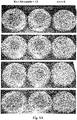
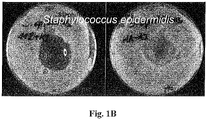
- Fig. 1A , Fig. 1B Antimicrobial activity of the composition having the form of a lyophilisate on the basis of hyaluronan chloramide and potassium iodide as prepared according to Example 20.
- the figures show the growth inhibition of the microorganisms Bacillus subtilis, Escherichia coli, Pseudomona aeruginosa, Candida albicans (all of them in Fig. 1A ) and Staphylolococus epidermidis ( Fig.
- Fig. 1B shows the comparison between one repeat (the left-hand scheme) and the control material (the right-hand scheme).
- Example 43 The procedure of determining the antimicrobial activity is described in Example 43.
- equivalent refers to a repeating unit of the respective polysaccharide, such as a dimer of hyaluronic acid.
- the molecular weight of polymers refers to a weight average value determined by means of the SEC-MALLS method.
- the DS value of the ester was 6 % (determined by means of NMR, lit. Kettou S. et al., PV 2009-399).
- the DS value of the ester was 3 % (determined by means of NMR, lit. Kettou et al., PV 2009-399).
- the resulting suspension was filtered into the solution of hyaluronan and the reaction mixture was stirred at 20 °C for 5 hours.
- the resulting solution was precipitated by adding 400 ml of 100% isopropanol and washed with 80% isopropanol and then with 100% isopropanol. Afterwards, the precipitate was dried at 40°C for 2 days. The substitution degree was determined as 37 % by means of NMR
- a one-percent aqueous solution of HA (1 g, 200 kg.mol -1 ) containing NaCl 1%, KBr 1%, N-acetylamino-TEMPO (0.01 eq.) and NaHCOl 3 (20 eq.) was gradually supplemented with an aqueous solution of NaClO (0.5 eq.) under nitrogen atmosphere.
- the mixture was stirred at 10 °C for 12 hours, whereupon 0.1 g of ethanol were added. Subsequently, the final mixture was stirred for another 1 hour.
- the resulting solution was diluted with distilled water to the concentration of 0.2% and dialysed against the mixture (0.1% NaCl, 0.1% NaHCO 3 ) 3 times 5 litres (1x a day) and then against distilled water 7 times 5 litres (2x a day). The final solution was evaporated and analysed.
- hyaluronan (Mw 2200 kg.mol -1 ) were dissolved in 250 ml of distilled water. Subsequently, 2 ml of acetic acid were added and the solution was stirred at the temperature of 20 °C for 15 minutes. Then, a sodium salt of dichloroisocyanuric acid in the amount of 3.2 g (1 eq.) was added, Then, the mixture was stirred at a temperature of 20 °C for 24 hours. Subsequently, the mixture was precipitated by 2.5 litres of isopropanol and filtered. The solid portion was washed with 2 litres of isopropanol, whereupon it was vacuum dried for 20 hours. DS 82% (determined by NMR).
- hyaluronan (Mw 40 kg.mor -1 ) were dissolved in 100 ml of distilled water. Subsequently, 2 ml of acetic acid were added and the solution was stirred at the temperature of 20 °C for 15 minutes. Then, a sodium salt of dichloroisocyanuric acid in the amount of 3.2 g (1 eq.) was added. Then, the mixture was stirred at a temperature of 20 °C for 24 hours. Subsequently, the mixture was precipitated by 2.5 litres of isopropanol and filtered. The solid portion was washed with 2 litres of isopropanol, whereupon it was vacuum dried for 20 hours. DS 83% (determined by NMR).
- hyaluronan (Mw 2200 kg.mol -1 ) were dissolved in 1000 ml of distilled water. Subsequently, 2 ml of acetic acid were added and the solution was stirred at the temperature of 20 °C for 15 minutes. Then, a sodium salt of dichloroisocyanuric acid in the amount of 3.2 g (1 eq.) was added. Then, the mixture was stirred at a temperature of 20 °C for 24 hours. Subsequently, the mixture was precipitated by 2.5 litres of isopropanol and filtered. The solid portion was washed with 2 litres of isopropanol, whereupon it was vacuum dried for 20 hours. DS 72% (determined by NMR).
- hyaluronan (Mw 2200 kg.mol -1 ) were dissolved in 250 ml of distilled water. Subsequently, 0.14 ml of acetic acid (0.2 eq.) were added and the solution was stirred at the temperature of 20 °C for 15 minutes. Then, a sodium salt of dichloroisocyanuric acid in the amount of 3.2 g (1 eq.) was added. Then, the mixture was stirred at a temperature of 20 °C for 24 hours. Subsequently, the mixture was precipitated by 2.5 litres of isopropanol and filtered. The solid portion was washed with 2 litres of isopropanol, whereupon it was vacuum dried for 20 hours. DS 53% (determined by NMR).
- hyaluronan (Mw 180 kg.mol -1 ) were dissolved in 250 ml of distilled water. Subsequently, 3 ml of acetic acid were added and the solution was stirred at the temperature of 20 °C for 15 minutes. Then, a sodium salt of dichloroisocyanuric acid in the amount of 3.2 g (1 eq.) was added. Then, the mixture was stirred at a temperature of 20 °C for 24 hours. Subsequently, the mixture was precipitated by 2.5 litres of isopropanol and filtered. The solid portion was washed with 2 litres of isopropanol, whereupon it was vacuum dried for 20 hours. DS 83% (determined by NMR).
- hyaluronan (Mw 2200 kg.mol -1 ) were dissolved in 250 ml of distilled water. Subsequently, 2 ml of acetic acid were added and the solution was stirred at the temperature of 20 °C for 15 minutes. Then, a sodium salt of dichloroisocyanuric acid in the amount of 1.07 g (0.33 eq.) was added. Then, the mixture was stirred at a temperature of 20 °C for 24 hours. Subsequently, the mixture was precipitated by 2.5 litres of isopropanol and filtered. The solid portion was washed with 2 litres of isopropanol, whereupon it was vacuum dried for 20 hours. DS 51% (determined by NMR).
- hyaluronan (Mw 2200 kg.mol -1 ) were dissolved in 250 ml of distilled water. Subsequently, 2 ml of acetic acid were added and the solution was stirred at the temperature of 20°C for 15 minutes. Then, a sodium salt of dichloroisocyanuric acid in the amount of 4.8 g (1.5 eq.) was added. Then, the mixture was stirred at a temperature of 20 °C for 24 hours. Subsequently, the mixture was precipitated by 2.5 litres of isopropanol and filtered. The solid portion was washed with 2 litres of isopropanol, whereupon it was vacuum dried for 20 hours. DS 96% (determined by NMR).
- hyaluronan (Mw 2200 kg.mol -1 ) were dissolved in 250 ml of distilled water. Subsequently, 2 ml of acetic acid were added and the solution was stirred at the temperature of 20°C for 15 minutes. Then, trichloroisocyanuric acid in the amount of 2.91 g (1 eq.) was added. Then, the mixture was stirred at a temperature of 20°C for 24 hours. Subsequently, the mixture was precipitated by 2.5 litres of isopropanol and filtered. The solid portion was washed with 2 litres of isopropanol, whereupon it was vacuum dried for 20 hours. DS 97% (determined by NMR).
- hyaluronan (Mw 2200 kg.mol -1 ) were dissolved in 250 ml of distilled water. Subsequently, 2 ml of acetic acid were added and the solution was stirred at the temperature of 20°C for 15 minutes. Then, trichloroisocyanuric acid in the amount of 0.87 g (0.3 eq.) was added. Then, the mixture was stirred at a temperature of 20°C for 24 hours. Subsequently, the mixture was precipitated by 2.5 litres of isopropanol and filtered. The solid portion was washed with 2 litres of isopropanol, whereupon it was vacuum dried for 20 hours. DS 71 % (determined by NMR).
- hyaluronan (Mw 2200 kg.mol -1 ) were dissolved in 250 ml of distilled water. Subsequently, 2 ml of acetic acid were added and the solution was stirred at the temperature of 20°C for 15 minutes. Then, a sodium salt of dichloroisocyanuric acid in the amount of 3.2 g (1 eq.) was added. Then, the mixture was stirred at a temperature of 20 °C for 5 hours. Subsequently, the mixture was precipitated by 2.5 litres of isopropanol and filtered. The solid portion was washed with 2 litres of isopropanol, whereupon it was vacuum dried for 20 hours. DS 52% (determined by NMR).
- hyaluronan (Mw 2200 kg.mot -1 ) were dissolved in 250 ml of distilled water. Subsequently, 2 ml of acetic acid were added and the solution was stirred at the temperature of 20°C for 15 minutes. Then, a sodium salt of dichloroisocyanuric acid in the amount of 3.2 g (1 eq.) was added. Then, the mixture was stirred at a temperature of 20 °C for 48 hours. Subsequently, the mixture was precipitated by 2.5 litres of isopropanol and filtered. The solid portion was washed with 2 litres of isopropanol, whereupon it was vacuum dried for 20 hours.
- the NMR solution (7 mg of the product in 0.7 ml of D 2 O) was measured after another 5 days of standing at 20 °C. The DS value was determined as 84%. The solid portion in the form of a powder was left to stand at 20 °C for 100 days and after that the sample was dissolved in D 2 O. The DS value was determined as 84%.
- hyaluronan (Mw 2200 kg.mol -1 ) were dissolved in 250 ml of distilled water. Subsequently, 2 ml of acetic acid were added and the solution was stirred at the temperature of 20 °C for 15 minutes. Then, a sodium salt of dichloroisocyanuric acid in the amount of 3.2 g (1 eq.) was added. Then, the mixture was stirred at a temperature of 5 °C for 72 hours. Subsequently, the mixture was precipitated by 2.5 litres of isopropanol and filtered. The solid portion was washed with 2 litres of isopropanol and vacuum dried for 20 hours. DS 64% (determined by NMR).
- hyaluronan (Mw 2200 kg.mol -1 ) were dissolved in 250 ml of distilled water. Subsequently, 2 ml of acetic acid were added and the solution was stirred at the temperature of 20 °C for 15 minutes. Then, a sodium salt of dichloroisocyanuric acid in the amount of 3.2 g (1 eq.) was added. Then, the mixture was stirred at a temperature of 40 °C for 5 hours. Subsequently, the mixture was precipitated by 2.5 litres of isopropanol and filtered. The solid portion was washed with 2 litres of isopropanol, whereupon it was vacuum dried for 20 hours. DS 75% (determined by NMR).
- the lyophilisate prepared according to Example 19 in the amount of 15 mg and the lyophilisate prepared according to Example 25 in the amount of 15 mg were placed on each other in a stacked manner (the bottom layer being the lyophilisate according to Example 19) and mechanically pressed together by means of a smooth glass roller at 20 °C, the corresponding pressure being applied for 1 minute.
- the resulting material was stored under dry conditions.
- the lyophilisate prepared according to Example 19 in the amount of 30 mg and the lyophilisate prepared according to Example 25 in the amount of 3 mg were placed on each other in a stacked manner (the bottom layer being the lyophilisate according to Example 19) and mechanically pressed together by means of a smooth glass roller at 20 °C, the required pressure being applied for 1 minute.
- the resulting material was stored under dry conditions.
- the lyophilisate prepared according to Example 19 in the amount of 3 mg and the lyophilisate prepared according to Example 25 in the amount of 30 mg were placed on each other in a stacked manner (the bottom layer being the lyophilisate according to Example 19) and mechanically pressed together by means of a smooth glass roller at 20 °C, the required pressure being applied for 1 minute.
- the resulting material was stored under dry conditions.
- the self-supporting films prepared according to Examples 31 and 32 were placed on each other in a stacked manner (the bottom layer being hyaluronan lauroyl + potassium iodide) and mechanically pressed together by means of a smooth glass roller at 20 °C, the required pressure being applied for 1 minute.
- the resulting material was stored under dry conditions.
- ethyl ester of hyaluronan prepared according to Example 1 were dissolved in 25 ml of distilled water. Subsequently, 0.2 ml of acetic acid were added and the solution was stirred at the temperature of 20 °C for 15 minutes. Then, a sodium salt of dichloroisocyanuric acid in the amount of 0.32 g (1 eq.) was added. Then, the mixture was stirred at a temperature of 20°C for 24 hours. Subsequently, the mixture was precipitated by 250 ml of isopropanol and filtered. The solid portion was washed with 0.2 litres of isopropanol, whereupon it was vacuum dried for 20 hours. DS 80% (determined by NMR).
- a solution of 1 g of the hyaluronan chloramide, prepared according to Example 16, in 50 ml of distilled water were, immediately following the homogenization, deep frozen at the temperature of -50 °C and lyophilized.
- the DS value was determined as 83 % by means of NMR.
- the preparation of a 2% solution was based on the use of hyaluronan chloramide (Example 14) having the substitution degree of 71 % according to NMR.
- the above constituent was weighed and supplemented with distilled water in order to obtain the required amount.
- the whole mixture was stirred in a stirring device at room temperature, the set speed of the latter being 500 rpm and the stirring time being 24 hours.
- the final solution was clear and slightly viscous.
- the method of preparation of staple fibres is based on the precipitation of a polymer solution in a stream of a mobile coagulation bath containing 100% isopropanol.
- the solution was dosed at room temperature through extrusion nozzles into a stream of a coagulation bath fed through spinning tubes (1 tube / 8 mm diameter), the controlled flow rate of the bath being 1.15 m/s.
- the formation of staple fibres was obtained by means of precipitation.
- the formed fibres were entrained in the bath stream, caught by separation combs and transferred into the maturation bath containing 100% isopropanol.
- the raw fibres were ground up by rotating blades of a mixer, the ratio between the amount of the fibres and that of the bath being 0.5 g / 350 ml,
- the final dispersion of fibres was filtered through a permeable substrate through a filter frame.
- a filter frame having the surface area of 64 cm 2 was used. After having been filtered, the fibres were carried over onto a drying device by means of a PAD knitted fabric, said device being equipped with means for the fixation of non-woven fabrics. Prior to being placed onto the drying device, the fibres were freed from the precipitant residues by means of a roller. The non-woven fabric was dried at the temperature of 40 °C for 30 minutes. The resulting layer was separated from the substrate as a self-supporting layer and weighed by means of an analytic balance. The areal weight of the fabric was 50.2 g/m 2 . The substitution degree of the formed non-woven fabric was determined as 64 % by means of NMR.
- an aqueous solution having the following composition was prepared.
- the concentration of the hyaluronan chloramide, which had been prepared according to Example 5, in the dry matter was 37,5 %
- the concentration of the native hyaluronan having the molecular weight of 80 kg.mol -1 was 37.5 %
- the amount of polyethylene oxide having the molecular weight of 600 kg.mol- 1 was 25 %.
- the overall concentration of the dry matter was 5 %.
- the solution was transferred into a syringe and spun electrostatically on a plate-type collector using a needleless linear nozzle, the voltage and spacing between the emitter and the collector being 50 kV and 16 cm, respectively.
- the dimension of the fibres was 110 ⁇ 27 nm.
- the DS value was determined as 30 % by means of NMR.
- an aqueous solution having the following composition was prepared.
- the concentration of the native hyaluronan having the molecular weight of 80 kg.mol -1 was 62.5 %
- the amount of polyethylene oxide having the molecular weight of 600 kg.mol -1 was 25 %
- the amount of KI was 12.5 %.
- the overall concentration of the dry matter was 5 %.
- the solution was transferred into a syringe and spun electrostatically on a plate-type collector using a needleless linear nozzle, the voltage and spacing between the emitter and the collector being 56 kV and 18 cm, respectively.
- the dimension of the fibres was 140 ⁇ 35 nm.
- the preparation of the film took place in a special drying device where the film was dried in a closed chamber.
- the apparatus is equipped with the bottom and top plates, the temperatures thereof being controllable.
- the detailed description of the apparatus is provided in the publication Foglarova et al., PV2015-166; Foglarova M. Et al., Carbohydrate Polymers 2016, 144, 68-75 .
- the weighed amount of 200 mg of the hyaluronan chloramide described in Example 5 was dissolved in 20 ml of demineralised water whereupon the resulting solution was stirred for 2 hours. Then the final solution was dosed to the drying device onto a pad (hydrophobized glass) and was dried in a closed chamber for 18 hours.
- the bottom and top plates of the dryer had the temperatures of 50 °C and 20 °C, respectively.
- the film was released from the pad and kept for future use.
- the DS value was determined as 60 % by means of NMR.
- the preparation of the film took place in the device described in Example 30.
- the weighed amount of 160 mg of sodium hyaluronate and 16 mg of potassium iodide was dissolved in 16 ml of demineralised water whereupon the resulting solution was stirred for 15 minutes.
- the final mixed solution was dosed to the drying device onto a pad (hydrophobized glass) and was dried in a closed chamber for 7 hours.
- the bottom and top plates of the dryer had the temperatures of 50 °C and 20 °C, respectively. After having been dried, the film was released from the pad and kept for future use.
- Example 30 The preparation of the film took place in the device described in Example 30.
- the weighed amount of 150 mg of the lauroyl derivative of sodium hyaluronate (as described in Example 3) was dissolved in 15 ml of an aqueous solution of 2-propanol (50 % w/w) whereupon the resulting solution was stirred for 18 hours.
- the weighed amount of 50 mg of the hyaluronan chloramide described in Example 5 was dissolved in 5 ml of demineralised water whereupon the resulting solution was stirred for 2 hours. Subsequently, both the solutions were blended for 30 minutes. Then the final mixed solution was dosed to the drying device onto a pad (hydrophobized glass) and was dried in a closed chamber for 7 hours.
- the bottom and top plates of the dryer had the temperatures of 50 °C and 20 °C, respectively. After having been dried, the film was released from the pad and kept for future use.
- the DS value of the hyaluronan chloramide in the final material was determined as 25 % by means of NMR.
- hyaluronan chloramide (0.1 g) prepared according to Example 5 in 100 ml of distilled water was supplemented with 0.01 g of CaCl 2 .2H 2 O and the mixture was stirred at 20°C for 1 hour. Following the homogenization, the final viscous solution was deep frozen at the temperature of -50 °C and lyophilized.
- the DS value of the hyaluronan chloramide was determined as 64 % by means of NMR.
- suspensions having the concentration of approximately 10 5 CFU/ml were prepared.
- the suspension in the amount of 100 ⁇ l was inoculated on the surface of tryptone soya agar in Petri dishes (an approximate count of microorganisms applied in each dish was 10 4 CFU).
- the suspension was uniformly spread over the entire surface of the dish by means of a sterile loop. After soaking the suspension in the agar, the surface of agar was covered by sterile square-shaped samples selected for testing.
- the dishes with the tested bacterium strains were cultivated at 37 °C for 24 hours.
- the diffusion plate method (2D layout) was selected.
- a non-selective substrate tryptone-soya agar
- the square-shaped samples were tested on the following microorganisms: Bacillus subtilis, Escherichia coli, Staphylococcus aureus, Candida Albicans, Pseudomona aeruginosa, Staphylolococus epidermidis.
- the figure 1 clearly shows that the compositions containing hyaluronan chloramide along with an iodide according to the invention provide a significantly higher efficacy in comparison to the control material having no content of hyaluronan chloramide.
Landscapes
- Health & Medical Sciences (AREA)
- Life Sciences & Earth Sciences (AREA)
- General Health & Medical Sciences (AREA)
- Chemical & Material Sciences (AREA)
- Veterinary Medicine (AREA)
- Public Health (AREA)
- Animal Behavior & Ethology (AREA)
- Medicinal Chemistry (AREA)
- Pharmacology & Pharmacy (AREA)
- Engineering & Computer Science (AREA)
- Epidemiology (AREA)
- Dentistry (AREA)
- Agronomy & Crop Science (AREA)
- Pest Control & Pesticides (AREA)
- Plant Pathology (AREA)
- Wood Science & Technology (AREA)
- Zoology (AREA)
- Environmental Sciences (AREA)
- Chemical Kinetics & Catalysis (AREA)
- Inorganic Chemistry (AREA)
- Organic Chemistry (AREA)
- Dermatology (AREA)
- General Chemical & Material Sciences (AREA)
- Nuclear Medicine, Radiotherapy & Molecular Imaging (AREA)
- Molecular Biology (AREA)
- Communicable Diseases (AREA)
- Oncology (AREA)
- Materials Engineering (AREA)
- Bioinformatics & Cheminformatics (AREA)
- Toxicology (AREA)
- Hematology (AREA)
- Dispersion Chemistry (AREA)
- Biochemistry (AREA)
- Transplantation (AREA)
- Oral & Maxillofacial Surgery (AREA)
- Polymers & Plastics (AREA)
- Pharmaceuticals Containing Other Organic And Inorganic Compounds (AREA)
- Medicinal Preparation (AREA)
- Materials For Medical Uses (AREA)
Applications Claiming Priority (2)
| Application Number | Priority Date | Filing Date | Title |
|---|---|---|---|
| CZ2018428A CZ2018428A3 (cs) | 2018-08-23 | 2018-08-23 | Kompozice obsahující jodid a derivát kyseliny hyaluronové s oxidačním účinkem, způsob její přípravy a použití |
| PCT/CZ2019/050035 WO2020038501A1 (en) | 2018-08-23 | 2019-08-17 | Composition comprising an iodide and a derivative of hyaluronic acid with an oxidative effect, method of preparation thereof and use thereof |
Publications (2)
| Publication Number | Publication Date |
|---|---|
| EP3840839A1 EP3840839A1 (en) | 2021-06-30 |
| EP3840839B1 true EP3840839B1 (en) | 2022-09-21 |
Family
ID=68069457
Family Applications (1)
| Application Number | Title | Priority Date | Filing Date |
|---|---|---|---|
| EP19778421.8A Active EP3840839B1 (en) | 2018-08-23 | 2019-08-17 | Composition comprising an iodide and a derivative of hyaluronic acid with an oxidative effect, method of preparation thereof and use thereof |
Country Status (10)
| Country | Link |
|---|---|
| US (1) | US11425907B2 (cs) |
| EP (1) | EP3840839B1 (cs) |
| JP (1) | JP7337406B2 (cs) |
| KR (1) | KR102707202B1 (cs) |
| AR (1) | AR116000A1 (cs) |
| BR (1) | BR112021001464A2 (cs) |
| CZ (1) | CZ2018428A3 (cs) |
| DK (1) | DK3840839T3 (cs) |
| HU (1) | HUE060850T2 (cs) |
| WO (1) | WO2020038501A1 (cs) |
Families Citing this family (1)
| Publication number | Priority date | Publication date | Assignee | Title |
|---|---|---|---|---|
| CZ308980B6 (cs) | 2020-01-24 | 2021-11-03 | Contipro A.S. | Dentální přípravek z vláken na bázi kyseliny hyaluronové s regulovatelnou biodegradabilitou |
Family Cites Families (15)
| Publication number | Priority date | Publication date | Assignee | Title |
|---|---|---|---|---|
| AU2002219718A1 (en) | 2000-12-13 | 2002-06-24 | Sca Hygiene Products Zeist B.V. | Process for oxidising primary alcohols |
| CZ12015U1 (cs) * | 2002-01-18 | 2002-02-25 | Cpn Spol. S R.O. | Přípravek pro prevenci adheze bandáľe na ránu |
| EP1815877B1 (en) * | 2006-02-02 | 2009-11-25 | Euro-Celtique S.A. | Hydrogel for the treatment of wounds |
| EP2111252A4 (en) * | 2007-01-31 | 2010-12-01 | Adam Heller | MANAGEMENT OF PAIN BY ELECTROCHEMICAL PATHWAY |
| CZ301899B6 (cs) | 2009-03-17 | 2010-07-21 | Contipro C, A.S. | Zpusob prípravy derivátu kyseliny hyaluronové pomocí O-acyl-O´-alkylkarbonátu v prítomnosti substituovaného pyridinu |
| CZ2009399A3 (cs) | 2009-06-24 | 2011-01-05 | Cpn Spol. S R.O. | Zpusob prípravy esteru hyaluronanu |
| CZ302503B6 (cs) | 2009-12-11 | 2011-06-22 | Contipro C A.S. | Zpusob prípravy derivátu kyseliny hyaluronové oxidovaného v poloze 6 glukosaminové cásti polysacharidu selektivne na aldehyd a zpusob jeho modifikace |
| CZ303548B6 (cs) * | 2011-01-05 | 2012-11-28 | Contipro Pharma A.S. | Zdravotní prípravek tvorící jód, zpusob jeho prípravy a bandáž, která jej obsahuje |
| CZ22394U1 (cs) | 2011-03-11 | 2011-06-20 | Contipro C, A.S. | Antimikrobiální smes a kryt pro podporu hojení ran s antimikrobiálním úcinkem |
| US20160032180A1 (en) * | 2012-11-26 | 2016-02-04 | Agienic, Inc. | Antimicrobial Resin Coated Proppants |
| CZ2012841A3 (cs) | 2012-11-27 | 2014-02-19 | Contipro Biotech S.R.O. | Vlákna založená na hydrofobizovaném hyaluronanu, způsob jejich přípravy a použití, textilie na jejich bázi a použití |
| CZ2013913A3 (cs) * | 2013-11-21 | 2015-06-03 | Contipro Biotech S.R.O. | Objemný nanovlákenný materiál na bázi kyseliny hyaluronové, jejích solí nebo jejich derivátů, způsob jeho přípravy, způsob jeho modifikace, modifikovaný nanovlákenný materiál, nanovlákenný útvar a jejich použití |
| CZ309295B6 (cs) | 2015-03-09 | 2022-08-10 | Contipro A.S. | Samonosný, biodegradabilní film na bázi hydrofobizované kyseliny hyaluronové, způsob jeho přípravy a použití |
| CZ2015710A3 (cs) | 2015-10-09 | 2016-12-14 | Contipro A.S. | Nekonečná vlákna typu jádro-obal zahrnující kombinaci nativního a C11-C18 acylovaného hyaluronanu nebo C11-C18 acylovaných hyaluronanů, způsob jejich přípravy a použití, střiž, příze a textilie z těchto vláken a jejich použití |
| CZ2018426A3 (cs) * | 2018-08-23 | 2019-10-16 | Contipro A.S. | Chlorovaný derivát kyseliny hyaluronové, způsob jeho přípravy, kompozice, která jej obsahuje, a použití |
-
2018
- 2018-08-23 CZ CZ2018428A patent/CZ2018428A3/cs unknown
-
2019
- 2019-08-17 WO PCT/CZ2019/050035 patent/WO2020038501A1/en not_active Ceased
- 2019-08-17 HU HUE19778421A patent/HUE060850T2/hu unknown
- 2019-08-17 JP JP2021509845A patent/JP7337406B2/ja active Active
- 2019-08-17 EP EP19778421.8A patent/EP3840839B1/en active Active
- 2019-08-17 BR BR112021001464-0A patent/BR112021001464A2/pt not_active IP Right Cessation
- 2019-08-17 US US17/270,617 patent/US11425907B2/en active Active
- 2019-08-17 DK DK19778421.8T patent/DK3840839T3/da active
- 2019-08-17 KR KR1020217006373A patent/KR102707202B1/ko active Active
- 2019-08-22 AR ARP190102394A patent/AR116000A1/es not_active Application Discontinuation
Also Published As
| Publication number | Publication date |
|---|---|
| EP3840839A1 (en) | 2021-06-30 |
| HUE060850T2 (hu) | 2023-04-28 |
| CZ308064B6 (cs) | 2019-12-04 |
| BR112021001464A2 (pt) | 2021-04-27 |
| DK3840839T3 (da) | 2022-10-24 |
| JP2021534869A (ja) | 2021-12-16 |
| KR102707202B1 (ko) | 2024-09-13 |
| US20210345610A1 (en) | 2021-11-11 |
| US11425907B2 (en) | 2022-08-30 |
| JP7337406B2 (ja) | 2023-09-04 |
| AR116000A1 (es) | 2021-03-25 |
| WO2020038501A1 (en) | 2020-02-27 |
| KR20210049823A (ko) | 2021-05-06 |
| CZ2018428A3 (cs) | 2019-12-04 |
Similar Documents
| Publication | Publication Date | Title |
|---|---|---|
| Laçin | Development of biodegradable antibacterial cellulose based hydrogel membranes for wound healing | |
| Weyell et al. | Tailor-made material characteristics of bacterial cellulose for drug delivery applications in dentistry | |
| Ghorbani et al. | Fabrication of honey-loaded ethylcellulose/gum tragacanth nanofibers as an effective antibacterial wound dressing | |
| Lu et al. | In situ reduction of silver nanoparticles by chitosan-l-glutamic acid/hyaluronic acid: Enhancing antimicrobial and wound-healing activity | |
| Liberman et al. | Antimicrobial hydrogels composed of chitosan and sulfated polysaccharides of red microalgae | |
| Żywicka et al. | Modification of bacterial cellulose with quaternary ammonium compounds based on fatty acids and amino acids and the effect on antimicrobial activity | |
| EP2695622B1 (en) | A chitosan wound dressing and its method of manufacturing | |
| JP4648632B2 (ja) | 新規バイオマテリアル、その製造および使用 | |
| Sivakumar et al. | Ferulic acid loaded microspheres reinforced in 3D hybrid scaffold for antimicrobial wound dressing | |
| EP3841128B1 (en) | Chlorinated derivative of hyaluronic acid, method of preparation thereof, a composition containing the derivative, and use thereof | |
| Ding et al. | Preparation of injectable self-healing hydrogels using carboxymethyl chitosan and oxidized dextran with incorporating quercetin-loaded PF127 micelles for wound healing | |
| Peng et al. | Synthesis of a disulfide cross-linked polygalacturonic acid hydrogel for biomedical applications | |
| Mao et al. | A novel chitosan-hyaluronic acid-pullulan composite film wound dressing for effectively inhibiting bacteria and accelerating wound healing | |
| JP2009505687A (ja) | 抗菌活性および抗真菌活性を有する医療機器として使用するための、ヒアルロン酸誘導体と組み合わせた、亜鉛で塩化したカルボキシメチルセルロースをベースとする生体材料、ならびにその製造方法 | |
| Ribeiro et al. | Sodium alginate-based multifunctional sandwich-like system for treating wound infections | |
| US20200179445A1 (en) | Antimicrobial composition comprising a polysaccharide, a stabilizing agent and triiodide, method of preparation thereof and use thereof | |
| Varguez-Catzim et al. | Tailoring membrane technology with galactomannan for enhanced biocompatibility and antibacterial action | |
| CN107261195A (zh) | 一种运动创伤康复敷料用抗菌生物质凝胶网的制备方法与用途 | |
| US11425907B2 (en) | Composition comprising an iodide and a derivative of hyaluronic acid with an oxidative effect, method of preparation thereof and use thereof | |
| ES2927979T3 (es) | Composición que comprende un yoduro y un derivado del ácido hialurónico con efecto oxidante, método de preparación y uso de la misma | |
| Gao et al. | Injectable and self-healing hydrogel with Schiff-base/Zn2+ dual-crosslinked architecture for antimicrobial and pro-angiogenic wound therapy |
Legal Events
| Date | Code | Title | Description |
|---|---|---|---|
| STAA | Information on the status of an ep patent application or granted ep patent |
Free format text: STATUS: UNKNOWN |
|
| STAA | Information on the status of an ep patent application or granted ep patent |
Free format text: STATUS: THE INTERNATIONAL PUBLICATION HAS BEEN MADE |
|
| PUAI | Public reference made under article 153(3) epc to a published international application that has entered the european phase |
Free format text: ORIGINAL CODE: 0009012 |
|
| STAA | Information on the status of an ep patent application or granted ep patent |
Free format text: STATUS: REQUEST FOR EXAMINATION WAS MADE |
|
| 17P | Request for examination filed |
Effective date: 20210209 |
|
| AK | Designated contracting states |
Kind code of ref document: A1 Designated state(s): AL AT BE BG CH CY CZ DE DK EE ES FI FR GB GR HR HU IE IS IT LI LT LU LV MC MK MT NL NO PL PT RO RS SE SI SK SM TR |
|
| DAV | Request for validation of the european patent (deleted) | ||
| DAX | Request for extension of the european patent (deleted) | ||
| GRAP | Despatch of communication of intention to grant a patent |
Free format text: ORIGINAL CODE: EPIDOSNIGR1 |
|
| STAA | Information on the status of an ep patent application or granted ep patent |
Free format text: STATUS: GRANT OF PATENT IS INTENDED |
|
| INTG | Intention to grant announced |
Effective date: 20220407 |
|
| GRAS | Grant fee paid |
Free format text: ORIGINAL CODE: EPIDOSNIGR3 |
|
| GRAA | (expected) grant |
Free format text: ORIGINAL CODE: 0009210 |
|
| STAA | Information on the status of an ep patent application or granted ep patent |
Free format text: STATUS: THE PATENT HAS BEEN GRANTED |
|
| AK | Designated contracting states |
Kind code of ref document: B1 Designated state(s): AL AT BE BG CH CY CZ DE DK EE ES FI FR GB GR HR HU IE IS IT LI LT LU LV MC MK MT NL NO PL PT RO RS SE SI SK SM TR |
|
| REG | Reference to a national code |
Ref country code: GB Ref legal event code: FG4D |
|
| REG | Reference to a national code |
Ref country code: CH Ref legal event code: EP |
|
| REG | Reference to a national code |
Ref country code: IE Ref legal event code: FG4D |
|
| REG | Reference to a national code |
Ref country code: DE Ref legal event code: R096 Ref document number: 602019019861 Country of ref document: DE |
|
| REG | Reference to a national code |
Ref country code: AT Ref legal event code: REF Ref document number: 1519669 Country of ref document: AT Kind code of ref document: T Effective date: 20221015 |
|
| REG | Reference to a national code |
Ref country code: DK Ref legal event code: T3 Effective date: 20221017 |
|
| REG | Reference to a national code |
Ref country code: ES Ref legal event code: FG2A Ref document number: 2927979 Country of ref document: ES Kind code of ref document: T3 Effective date: 20221114 |
|
| REG | Reference to a national code |
Ref country code: NL Ref legal event code: FP |
|
| REG | Reference to a national code |
Ref country code: SK Ref legal event code: T3 Ref document number: E 40749 Country of ref document: SK |
|
| REG | Reference to a national code |
Ref country code: SE Ref legal event code: TRGR Ref country code: LT Ref legal event code: MG9D |
|
| PG25 | Lapsed in a contracting state [announced via postgrant information from national office to epo] |
Ref country code: RS Free format text: LAPSE BECAUSE OF FAILURE TO SUBMIT A TRANSLATION OF THE DESCRIPTION OR TO PAY THE FEE WITHIN THE PRESCRIBED TIME-LIMIT Effective date: 20220921 Ref country code: NO Free format text: LAPSE BECAUSE OF FAILURE TO SUBMIT A TRANSLATION OF THE DESCRIPTION OR TO PAY THE FEE WITHIN THE PRESCRIBED TIME-LIMIT Effective date: 20221221 Ref country code: LV Free format text: LAPSE BECAUSE OF FAILURE TO SUBMIT A TRANSLATION OF THE DESCRIPTION OR TO PAY THE FEE WITHIN THE PRESCRIBED TIME-LIMIT Effective date: 20220921 Ref country code: LT Free format text: LAPSE BECAUSE OF FAILURE TO SUBMIT A TRANSLATION OF THE DESCRIPTION OR TO PAY THE FEE WITHIN THE PRESCRIBED TIME-LIMIT Effective date: 20220921 Ref country code: FI Free format text: LAPSE BECAUSE OF FAILURE TO SUBMIT A TRANSLATION OF THE DESCRIPTION OR TO PAY THE FEE WITHIN THE PRESCRIBED TIME-LIMIT Effective date: 20220921 |
|
| PG25 | Lapsed in a contracting state [announced via postgrant information from national office to epo] |
Ref country code: HR Free format text: LAPSE BECAUSE OF FAILURE TO SUBMIT A TRANSLATION OF THE DESCRIPTION OR TO PAY THE FEE WITHIN THE PRESCRIBED TIME-LIMIT Effective date: 20220921 Ref country code: GR Free format text: LAPSE BECAUSE OF FAILURE TO SUBMIT A TRANSLATION OF THE DESCRIPTION OR TO PAY THE FEE WITHIN THE PRESCRIBED TIME-LIMIT Effective date: 20221222 |
|
| PG25 | Lapsed in a contracting state [announced via postgrant information from national office to epo] |
Ref country code: SM Free format text: LAPSE BECAUSE OF FAILURE TO SUBMIT A TRANSLATION OF THE DESCRIPTION OR TO PAY THE FEE WITHIN THE PRESCRIBED TIME-LIMIT Effective date: 20220921 Ref country code: RO Free format text: LAPSE BECAUSE OF FAILURE TO SUBMIT A TRANSLATION OF THE DESCRIPTION OR TO PAY THE FEE WITHIN THE PRESCRIBED TIME-LIMIT Effective date: 20220921 Ref country code: PT Free format text: LAPSE BECAUSE OF FAILURE TO SUBMIT A TRANSLATION OF THE DESCRIPTION OR TO PAY THE FEE WITHIN THE PRESCRIBED TIME-LIMIT Effective date: 20230123 Ref country code: CZ Free format text: LAPSE BECAUSE OF FAILURE TO SUBMIT A TRANSLATION OF THE DESCRIPTION OR TO PAY THE FEE WITHIN THE PRESCRIBED TIME-LIMIT Effective date: 20220921 |
|
| REG | Reference to a national code |
Ref country code: HU Ref legal event code: AG4A Ref document number: E060850 Country of ref document: HU |
|
| PG25 | Lapsed in a contracting state [announced via postgrant information from national office to epo] |
Ref country code: IS Free format text: LAPSE BECAUSE OF FAILURE TO SUBMIT A TRANSLATION OF THE DESCRIPTION OR TO PAY THE FEE WITHIN THE PRESCRIBED TIME-LIMIT Effective date: 20230121 Ref country code: EE Free format text: LAPSE BECAUSE OF FAILURE TO SUBMIT A TRANSLATION OF THE DESCRIPTION OR TO PAY THE FEE WITHIN THE PRESCRIBED TIME-LIMIT Effective date: 20220921 |
|
| P01 | Opt-out of the competence of the unified patent court (upc) registered |
Effective date: 20230425 |
|
| REG | Reference to a national code |
Ref country code: DE Ref legal event code: R097 Ref document number: 602019019861 Country of ref document: DE |
|
| PG25 | Lapsed in a contracting state [announced via postgrant information from national office to epo] |
Ref country code: AL Free format text: LAPSE BECAUSE OF FAILURE TO SUBMIT A TRANSLATION OF THE DESCRIPTION OR TO PAY THE FEE WITHIN THE PRESCRIBED TIME-LIMIT Effective date: 20220921 |
|
| PLBE | No opposition filed within time limit |
Free format text: ORIGINAL CODE: 0009261 |
|
| STAA | Information on the status of an ep patent application or granted ep patent |
Free format text: STATUS: NO OPPOSITION FILED WITHIN TIME LIMIT |
|
| 26N | No opposition filed |
Effective date: 20230622 |
|
| PG25 | Lapsed in a contracting state [announced via postgrant information from national office to epo] |
Ref country code: SI Free format text: LAPSE BECAUSE OF FAILURE TO SUBMIT A TRANSLATION OF THE DESCRIPTION OR TO PAY THE FEE WITHIN THE PRESCRIBED TIME-LIMIT Effective date: 20220921 |
|
| PGFP | Annual fee paid to national office [announced via postgrant information from national office to epo] |
Ref country code: NL Payment date: 20230821 Year of fee payment: 5 |
|
| REG | Reference to a national code |
Ref country code: AT Ref legal event code: UEP Ref document number: 1519669 Country of ref document: AT Kind code of ref document: T Effective date: 20220921 |
|
| PGFP | Annual fee paid to national office [announced via postgrant information from national office to epo] |
Ref country code: SE Payment date: 20230821 Year of fee payment: 5 Ref country code: HU Payment date: 20230823 Year of fee payment: 5 Ref country code: DK Payment date: 20230823 Year of fee payment: 5 Ref country code: BE Payment date: 20230821 Year of fee payment: 5 |
|
| PG25 | Lapsed in a contracting state [announced via postgrant information from national office to epo] |
Ref country code: MC Free format text: LAPSE BECAUSE OF FAILURE TO SUBMIT A TRANSLATION OF THE DESCRIPTION OR TO PAY THE FEE WITHIN THE PRESCRIBED TIME-LIMIT Effective date: 20220921 |
|
| PG25 | Lapsed in a contracting state [announced via postgrant information from national office to epo] |
Ref country code: MC Free format text: LAPSE BECAUSE OF FAILURE TO SUBMIT A TRANSLATION OF THE DESCRIPTION OR TO PAY THE FEE WITHIN THE PRESCRIBED TIME-LIMIT Effective date: 20220921 |
|
| PG25 | Lapsed in a contracting state [announced via postgrant information from national office to epo] |
Ref country code: LU Free format text: LAPSE BECAUSE OF NON-PAYMENT OF DUE FEES Effective date: 20230817 |
|
| PG25 | Lapsed in a contracting state [announced via postgrant information from national office to epo] |
Ref country code: LU Free format text: LAPSE BECAUSE OF NON-PAYMENT OF DUE FEES Effective date: 20230817 |
|
| REG | Reference to a national code |
Ref country code: IE Ref legal event code: MM4A |
|
| PG25 | Lapsed in a contracting state [announced via postgrant information from national office to epo] |
Ref country code: IE Free format text: LAPSE BECAUSE OF NON-PAYMENT OF DUE FEES Effective date: 20230817 |
|
| PGFP | Annual fee paid to national office [announced via postgrant information from national office to epo] |
Ref country code: SK Payment date: 20240604 Year of fee payment: 6 |
|
| PG25 | Lapsed in a contracting state [announced via postgrant information from national office to epo] |
Ref country code: IE Free format text: LAPSE BECAUSE OF NON-PAYMENT OF DUE FEES Effective date: 20230817 |
|
| PGFP | Annual fee paid to national office [announced via postgrant information from national office to epo] |
Ref country code: PL Payment date: 20240723 Year of fee payment: 6 |
|
| PG25 | Lapsed in a contracting state [announced via postgrant information from national office to epo] |
Ref country code: BG Free format text: LAPSE BECAUSE OF FAILURE TO SUBMIT A TRANSLATION OF THE DESCRIPTION OR TO PAY THE FEE WITHIN THE PRESCRIBED TIME-LIMIT Effective date: 20220921 |
|
| PG25 | Lapsed in a contracting state [announced via postgrant information from national office to epo] |
Ref country code: BG Free format text: LAPSE BECAUSE OF FAILURE TO SUBMIT A TRANSLATION OF THE DESCRIPTION OR TO PAY THE FEE WITHIN THE PRESCRIBED TIME-LIMIT Effective date: 20220921 |
|
| REG | Reference to a national code |
Ref country code: DK Ref legal event code: EBP Effective date: 20240831 |
|
| REG | Reference to a national code |
Ref country code: SE Ref legal event code: EUG |
|
| REG | Reference to a national code |
Ref country code: NL Ref legal event code: MM Effective date: 20240901 |
|
| PG25 | Lapsed in a contracting state [announced via postgrant information from national office to epo] |
Ref country code: HU Free format text: LAPSE BECAUSE OF NON-PAYMENT OF DUE FEES Effective date: 20240818 |
|
| PG25 | Lapsed in a contracting state [announced via postgrant information from national office to epo] |
Ref country code: NL Free format text: LAPSE BECAUSE OF NON-PAYMENT OF DUE FEES Effective date: 20240901 |
|
| REG | Reference to a national code |
Ref country code: BE Ref legal event code: MM Effective date: 20240831 |
|
| PG25 | Lapsed in a contracting state [announced via postgrant information from national office to epo] |
Ref country code: DK Free format text: LAPSE BECAUSE OF NON-PAYMENT OF DUE FEES Effective date: 20240831 |
|
| PG25 | Lapsed in a contracting state [announced via postgrant information from national office to epo] |
Ref country code: BE Free format text: LAPSE BECAUSE OF NON-PAYMENT OF DUE FEES Effective date: 20240831 |
|
| PG25 | Lapsed in a contracting state [announced via postgrant information from national office to epo] |
Ref country code: CY Free format text: LAPSE BECAUSE OF FAILURE TO SUBMIT A TRANSLATION OF THE DESCRIPTION OR TO PAY THE FEE WITHIN THE PRESCRIBED TIME-LIMIT; INVALID AB INITIO Effective date: 20190817 |
|
| PGFP | Annual fee paid to national office [announced via postgrant information from national office to epo] |
Ref country code: ES Payment date: 20250926 Year of fee payment: 7 |
|
| PGFP | Annual fee paid to national office [announced via postgrant information from national office to epo] |
Ref country code: DE Payment date: 20250820 Year of fee payment: 7 |
|
| PG25 | Lapsed in a contracting state [announced via postgrant information from national office to epo] |
Ref country code: SE Free format text: LAPSE BECAUSE OF NON-PAYMENT OF DUE FEES Effective date: 20240818 |
|
| PGFP | Annual fee paid to national office [announced via postgrant information from national office to epo] |
Ref country code: IT Payment date: 20250825 Year of fee payment: 7 |
|
| REG | Reference to a national code |
Ref country code: AT Ref legal event code: MM01 Ref document number: 1519669 Country of ref document: AT Kind code of ref document: T Effective date: 20240817 |
|
| PGFP | Annual fee paid to national office [announced via postgrant information from national office to epo] |
Ref country code: GB Payment date: 20250820 Year of fee payment: 7 |
|
| PG25 | Lapsed in a contracting state [announced via postgrant information from national office to epo] |
Ref country code: AT Free format text: LAPSE BECAUSE OF NON-PAYMENT OF DUE FEES Effective date: 20240817 |
|
| PGFP | Annual fee paid to national office [announced via postgrant information from national office to epo] |
Ref country code: FR Payment date: 20250828 Year of fee payment: 7 |
|
| PGFP | Annual fee paid to national office [announced via postgrant information from national office to epo] |
Ref country code: CH Payment date: 20250901 Year of fee payment: 7 |
|
| PG25 | Lapsed in a contracting state [announced via postgrant information from national office to epo] |
Ref country code: TR Free format text: LAPSE BECAUSE OF FAILURE TO SUBMIT A TRANSLATION OF THE DESCRIPTION OR TO PAY THE FEE WITHIN THE PRESCRIBED TIME-LIMIT Effective date: 20220921 |
|
| PGFP | Annual fee paid to national office [announced via postgrant information from national office to epo] |
Ref country code: AT Payment date: 20260410 Year of fee payment: 5 |
|
| REG | Reference to a national code |
Ref country code: SK Ref legal event code: MM4A Ref document number: E 40749 Country of ref document: SK Effective date: 20250817 |
|
| PG25 | Lapsed in a contracting state [announced via postgrant information from national office to epo] |
Ref country code: SK Free format text: LAPSE BECAUSE OF NON-PAYMENT OF DUE FEES Effective date: 20250817 |