EP3841632B1 - Leitfähige zusätze enthaltende zusammensetzungen, zugehörige elektroden und zugehörige batterien - Google Patents
Leitfähige zusätze enthaltende zusammensetzungen, zugehörige elektroden und zugehörige batterien Download PDFInfo
- Publication number
- EP3841632B1 EP3841632B1 EP19851837.5A EP19851837A EP3841632B1 EP 3841632 B1 EP3841632 B1 EP 3841632B1 EP 19851837 A EP19851837 A EP 19851837A EP 3841632 B1 EP3841632 B1 EP 3841632B1
- Authority
- EP
- European Patent Office
- Prior art keywords
- electrode
- carbon black
- black particles
- equal
- ranging
- Prior art date
- Legal status (The legal status is an assumption and is not a legal conclusion. Google has not performed a legal analysis and makes no representation as to the accuracy of the status listed.)
- Active
Links
Images





Classifications
-
- H—ELECTRICITY
- H01—ELECTRIC ELEMENTS
- H01M—PROCESSES OR MEANS, e.g. BATTERIES, FOR THE DIRECT CONVERSION OF CHEMICAL ENERGY INTO ELECTRICAL ENERGY
- H01M4/00—Electrodes
- H01M4/02—Electrodes composed of, or comprising, active material
- H01M4/62—Selection of inactive substances as ingredients for active masses, e.g. binders, fillers
- H01M4/624—Electric conductive fillers
- H01M4/625—Carbon or graphite
-
- H—ELECTRICITY
- H01—ELECTRIC ELEMENTS
- H01M—PROCESSES OR MEANS, e.g. BATTERIES, FOR THE DIRECT CONVERSION OF CHEMICAL ENERGY INTO ELECTRICAL ENERGY
- H01M10/00—Secondary cells; Manufacture thereof
- H01M10/05—Accumulators with non-aqueous electrolyte
- H01M10/052—Li-accumulators
- H01M10/0525—Rocking-chair batteries, i.e. batteries with lithium insertion or intercalation in both electrodes; Lithium-ion batteries
-
- H—ELECTRICITY
- H01—ELECTRIC ELEMENTS
- H01M—PROCESSES OR MEANS, e.g. BATTERIES, FOR THE DIRECT CONVERSION OF CHEMICAL ENERGY INTO ELECTRICAL ENERGY
- H01M4/00—Electrodes
- H01M4/02—Electrodes composed of, or comprising, active material
- H01M4/13—Electrodes for accumulators with non-aqueous electrolyte, e.g. for lithium-accumulators; Processes of manufacture thereof
- H01M4/131—Electrodes based on mixed oxides or hydroxides, or on mixtures of oxides or hydroxides, e.g. LiCoOx
-
- H—ELECTRICITY
- H01—ELECTRIC ELEMENTS
- H01M—PROCESSES OR MEANS, e.g. BATTERIES, FOR THE DIRECT CONVERSION OF CHEMICAL ENERGY INTO ELECTRICAL ENERGY
- H01M4/00—Electrodes
- H01M4/02—Electrodes composed of, or comprising, active material
- H01M4/36—Selection of substances as active materials, active masses, active liquids
- H01M4/48—Selection of substances as active materials, active masses, active liquids of inorganic oxides or hydroxides
- H01M4/50—Selection of substances as active materials, active masses, active liquids of inorganic oxides or hydroxides of manganese
- H01M4/505—Selection of substances as active materials, active masses, active liquids of inorganic oxides or hydroxides of manganese of mixed oxides or hydroxides containing manganese for inserting or intercalating light metals, e.g. LiMn2O4 or LiMn2OxFy
-
- H—ELECTRICITY
- H01—ELECTRIC ELEMENTS
- H01M—PROCESSES OR MEANS, e.g. BATTERIES, FOR THE DIRECT CONVERSION OF CHEMICAL ENERGY INTO ELECTRICAL ENERGY
- H01M4/00—Electrodes
- H01M4/02—Electrodes composed of, or comprising, active material
- H01M4/36—Selection of substances as active materials, active masses, active liquids
- H01M4/48—Selection of substances as active materials, active masses, active liquids of inorganic oxides or hydroxides
- H01M4/52—Selection of substances as active materials, active masses, active liquids of inorganic oxides or hydroxides of nickel, cobalt or iron
- H01M4/525—Selection of substances as active materials, active masses, active liquids of inorganic oxides or hydroxides of nickel, cobalt or iron of mixed oxides or hydroxides containing iron, cobalt or nickel for inserting or intercalating light metals, e.g. LiNiO2, LiCoO2 or LiCoOxFy
-
- H—ELECTRICITY
- H01—ELECTRIC ELEMENTS
- H01M—PROCESSES OR MEANS, e.g. BATTERIES, FOR THE DIRECT CONVERSION OF CHEMICAL ENERGY INTO ELECTRICAL ENERGY
- H01M10/00—Secondary cells; Manufacture thereof
- H01M10/05—Accumulators with non-aqueous electrolyte
- H01M10/052—Li-accumulators
-
- H—ELECTRICITY
- H01—ELECTRIC ELEMENTS
- H01M—PROCESSES OR MEANS, e.g. BATTERIES, FOR THE DIRECT CONVERSION OF CHEMICAL ENERGY INTO ELECTRICAL ENERGY
- H01M4/00—Electrodes
- H01M4/02—Electrodes composed of, or comprising, active material
- H01M2004/021—Physical characteristics, e.g. porosity, surface area
-
- H—ELECTRICITY
- H01—ELECTRIC ELEMENTS
- H01M—PROCESSES OR MEANS, e.g. BATTERIES, FOR THE DIRECT CONVERSION OF CHEMICAL ENERGY INTO ELECTRICAL ENERGY
- H01M4/00—Electrodes
- H01M4/02—Electrodes composed of, or comprising, active material
- H01M2004/026—Electrodes composed of, or comprising, active material characterised by the polarity
- H01M2004/028—Positive electrodes
-
- Y—GENERAL TAGGING OF NEW TECHNOLOGICAL DEVELOPMENTS; GENERAL TAGGING OF CROSS-SECTIONAL TECHNOLOGIES SPANNING OVER SEVERAL SECTIONS OF THE IPC; TECHNICAL SUBJECTS COVERED BY FORMER USPC CROSS-REFERENCE ART COLLECTIONS [XRACs] AND DIGESTS
- Y02—TECHNOLOGIES OR APPLICATIONS FOR MITIGATION OR ADAPTATION AGAINST CLIMATE CHANGE
- Y02E—REDUCTION OF GREENHOUSE GAS [GHG] EMISSIONS, RELATED TO ENERGY GENERATION, TRANSMISSION OR DISTRIBUTION
- Y02E60/00—Enabling technologies; Technologies with a potential or indirect contribution to GHG emissions mitigation
- Y02E60/10—Energy storage using batteries
Definitions
- Lithium-ion batteries are commonly used sources of electrical energy for a variety of applications, such as electronic devices and electric vehicles.
- a lithium-ion battery typically includes a negative electrode (e.g., graphite) and a positive electrode (described below) that allow lithium ions and electrons to move to and from the electrodes during charging and discharging.
- An electrolyte solution in contact with the electrodes provides a conductive medium in which the ions can move.
- an ion-permeable separator is used to physically and electrically isolate the electrodes.
- electrical contact is made to the electrodes, allowing electrons to flow through the device to provide electrical power, and lithium ions to move through the electrolyte from one electrode to the other electrode.
- a combination of conductive additives namely, certain carbon black particles and carbon nanotubes, in certain ratios, can enhance the performance of batteries containing certain electroactive materials, namely, lithium nickel cobalt manganese oxide (“NCM”) and lithium nickel cobalt aluminum oxide (“NCA”).
- NCM lithium nickel cobalt manganese oxide
- NCA lithium nickel cobalt aluminum oxide
- the combination of carbon black particles and carbon nanotubes can still provide good electrode conductivity, rate capability and improved low-temperature capacity at reduced costs.
- the carbon black particles and the carbon nanotubes form a three-dimensional conductive network that covers and bridges particles of the electroactive material, thereby providing short-range conductivity among the particles of the electroactive material, and long-range conductivity between the particles of the electroactive material and the current collector.
- the invention features an electrode, including: an electrode composition having carbon nanotubes; carbon black particles having a Brunauer-Emmett-Teller (BET) surface area greater than 90 m 2 /g, and an oil adsorption number (OAN) greater than 150 mL/100g, and a surface energy less than 5 mJ/m2, wherein the ratio of the carbon nanotubes to the carbon black particles ranges from 3:1 to 0.25:1 by weight; and an electroactive material selected from the group consisting of lithium nickel cobalt manganese oxide and lithium nickel cobalt aluminum oxide, wherein the total concentration of the carbon nanotubes and the carbon black particles is equal to or less than 3 wt% of the electrode composition; and a current collector contacting the electrode composition.
- BET Brunauer-Emmett-Teller
- OFAN oil adsorption number
- the carbon black particle may include one or more of the following features.
- the carbon black particles have a BET surface area less than 400 m 2 /g.
- the carbon black particles have an OAN less than 250 mL/100g.
- the carbon black particles have an L a crystallite size, as determined by Raman spectroscopy, ranging from 50 ⁇ to 100 ⁇ .
- the carbon black particles have an L c crystallite size, as determined by X-ray diffraction, ranging from 50 ⁇ to 100 ⁇ .
- the carbon black particles have a % crystallinity ((I G /(I G +I D )) ⁇ 100%), as determined by Raman spectroscopy, ranging from 35% to 70%.
- the carbon black particles have an aggregate size distribution, as indicated by D 50 values of particle size distributions, ranging from 20 to 400 nm.
- the carbon black particles have one, two, three, four, five, six, or seven of the following properties, in any combination: a surface energy less than 5 mJ/m 2 ; an L a crystallite size, as determined by Raman spectroscopy, greater than 50 ⁇ ; an L c crystallite size, as determined by X-ray diffraction, greater than 50 ⁇ ; % crystallinity ((I G /(I G +I D )) ⁇ 100%), as determined by Raman spectroscopy, greater than 35%; an STSA greater than 50 m 2 /g; an aggregate size distribution, as indicated by D 50 values of particle size distributions, greater than 20 nm; and/or an oxygen content from 0 to 0.1 wt%.
- the carbon black particles have one, two, three, four, five, or six of the following properties, in any combination: an L a crystallite size, as determined by Raman spectroscopy, ranging from 50 ⁇ to 100 ⁇ ; an L c crystallite size, as determined by X-ray diffraction, ranging from 50 ⁇ to 100 ⁇ ; a % crystallinity ((I G /(I G +I D )) ⁇ 100%), as determined by Raman spectroscopy, ranging from 35% to 70%; an STSA ranging from 50 to 250 m 2 /g; an aggregate size distribution, as indicated by D 50 values of particle size distributions, ranging from 20 to 400 nm; and/or oxygen content from 0 to 0.1 wt%.
- an L a crystallite size as determined by Raman spectroscopy, ranging from 50 ⁇ to 100 ⁇
- an L c crystallite size as determined by X-ray diffraction, ranging from 50 ⁇ to 100 ⁇
- the BET surface area can have or include, for example, one of the following ranges: from 90 to 375 m 2 /g, or from 90 to 350 m 2 /g, or from 90 to 325 m 2 /g, or from 90 to 300 m 2 /g, or from 90 to 275 m 2 /g, or from 90 to 250 m 2 /g, or from 90 to 225 m 2 /g, or from 90 to 200 m 2 /g, or from 90 to 175 m 2 /g, or from 90 to 150 m 2 /g, or from 90 to 125 m 2 /g, or from 125 to 400 m 2 /g, or from 125 to 375 m 2 /g, or from 125 to 350 m 2 /g, or from 125 to 325 m 2 /g, or from 125 to 300 m 2 /g, or from 125 to 275 m 2 /g, or from 125 to 250 m 2 /g, or from
- R the gas constant
- T the temperature
- A the BET surface area of the sample as described herein
- ⁇ the amount of adsorbed water on the sample (converted to moles/gm)
- P the partial pressure of water in the atmosphere
- P o the saturation vapor pressure in the atmosphere.
- the equilibrium adsorption of water on the surface is measured at one or (preferably) several discrete partial pressures and the integral is estimated by the area under the curve.
- the sample was allowed to equilibrate at 0% RH. After equilibration, the initial mass of the sample was recorded. The relative humidity of the nitrogen atmosphere was then increased sequentially to levels of approximately 0, 5, 10, 20, 30, 40, 50, 60, 70, 80, 90, and 95% RH, with the system allowed to equilibrate for 20 minutes at each RH level. The mass of water adsorbed at each humidity level was recorded, from which water spreading pressure was calculated (see above). The measurement was done twice on two separate samples and the average value is reported.
- the carbon black particles have a crystallite size that indicates a relatively high degree of graphitization.
- a higher degree of graphitization correlates with certain crystalline domains as shown by higher L a crystallite size values, as determined by Raman spectroscopy, where L a is defined as 43.5 ⁇ (area of G band/area of D band).
- Raman measurements of L a were based on Gruber et al., "Raman studies of heat-treated carbon blacks," Carbon Vol. 32 (7), pp. 1377-1382, 1994 , which is incorporated herein by reference.
- the Raman spectrum of carbon includes two major “resonance” bands or peaks at about 1340 cm -1 and 1580 cm -1 , denoted as the “D” and “G” bands, respectively. It is generally considered that the D band is attributed to disordered sp 2 carbon, and the G band to graphitic or "ordered' sp 2 carbon.
- L a is calculated in Angstroms.
- the carbon black particles have an L a crystallite size of greater than or equal to 50 ⁇ , or less than or equal to 100 ⁇ , for example, from 50 ⁇ to 100 ⁇ .
- the L a crystallite size can have or include, for example, one of the following ranges: from 50 to 90 ⁇ , or from 50 to 80 ⁇ , or from 50 to 70 ⁇ , or from 50 to 60 ⁇ , or from 60 to 100 ⁇ , or from 60 to 90 ⁇ , or from 60 to 80 ⁇ , or from 60 to 70 ⁇ , or from 70 to 100 ⁇ , or from 70 to 90 ⁇ , or from 70 to 80 ⁇ , or from 80 to 100 ⁇ , or from 80 to 90 ⁇ , or from 90 to 100 ⁇ .
- the L a crystallite size is less than or equal to 90 ⁇ , or less than or equal to 80 ⁇ , or less than or equal to 70 ⁇ , or less than or equal to 60 ⁇ . In some embodiments, the L a crystallite size is greater than or equal to 60 ⁇ , or greater than or equal to 70 ⁇ , or greater than or equal to 80 ⁇ , or greater than or equal to 90 ⁇ .
- the crystalline domains can be further characterized by an L c crystallite size.
- the L c crystallite size was determined by X-ray diffraction using an X-ray diffractometer (PANalytical X'Pert Pro, PANalytical B.V.), with a copper tube, tube voltage of 45 kV, and a tube current of 40 mA.
- a sample of carbon black particles was packed into a sample holder (an accessory of the diffractometer), and measurement was performed over angle (2 ⁇ ) range of 10° to 80°, at a speed of 0.14°/min. Peak positions and full width at half maximum values were calculated by means of the software of the diffractometer.
- L c ( ⁇ ) K* ⁇ /( ⁇ *cos ⁇ ), where K is the shape factor constant (0.9); ⁇ is the wavelength of the characteristic X-ray line of Cu K ⁇ 1 (1.54056 ⁇ ); ⁇ is the peak width at half maximum in radians; and ⁇ is determined by taking half of the measuring angle peak position (2 ⁇ ).
- the carbon black particles have an L c crystallite size of less than or equal 100 ⁇ , or greater than or equal to 50 ⁇ , for example, from 50 ⁇ to 100 ⁇ .
- the L c crystallite size can have or include, for example, one of the following ranges: from 50 to 90 ⁇ , or from 50 to 80 ⁇ , or from 50 to 70 ⁇ , or from 50 to 60 ⁇ , or from 60 to 100 ⁇ , or from 60 to 90 ⁇ , or from 60 to 80 ⁇ , or from 60 to 70 ⁇ , or from 70 to 100 ⁇ , or from 70 to 90 ⁇ , or from 70 to 80 ⁇ , or from 80 to 100 ⁇ , or from 80 to 90 ⁇ , or from 90 to 100 ⁇ .
- the L c crystallite size is less than or equal to 90 ⁇ , or less than or equal to 80 ⁇ , or less than or equal to 70 ⁇ , or less than or equal to 60.
- the L c crystallite size is greater than or equal to 60 ⁇ , or greater than or equal to 70 ⁇ , or greater than or equal to 80 ⁇ , or greater than or equal to 90 ⁇ .
- the carbon black particles have a high degree of graphitization, as indicated by a high % crystallinity, which is obtained from Raman measurements as a ratio of the area of the G band and the areas of G and D bands (I G /(I G +I D )).
- a high % crystallinity can be achieved by using a high heat treatment temperature and, in some embodiments, a longer heat treatment time (described below).
- the carbon black particles have % crystallinities ((I G /(I G +I D )) ⁇ 100%) ranging from 35% to 70%, as determined by Raman spectroscopy.
- the % crystallinity ((I G /(I G +I D )) ⁇ 100%) can have or include, for example, one of the following ranges: from 35% to 65%, or from 35% to 60%, or from 35% to 55%, or from 35% to 50%, or from 35% to 45%, or from 35% to 40%, or from 45% to 70%, or from 45% to 65%, or from 45% to 60%, or from 45% to 55%, or from 45% to 50%, or from 55% to 70%, or from 55% to 65%, or from 55% to 60%, or from 60% to 70%, or from 60% to 65%, or from 65% to 70%.
- the % crystallinity ((I G /(I G +I D )) ⁇ 100%) can have or include, for example, one of the following ranges: greater than 35%, or greater than 40%, or greater than 45%, or greater than 50%, or greater than 55%, or greater than 60%, or greater than 65%, or less than 70%, or less than 65%, or less than 60%, or less than 55%, or less than 50%, or less than 45%, or less than 40%.
- Raman measurements were made using a Horiba LabRAM Aramis Raman microscope and the accompanying LabSpec6 software.
- the carbon black particles have an aggregate size distribution, as indicated by their D 50 values (also known as the "mass median diameter") of their particle size distributions, that is greater than or equal to 20 nm, or less than or equal to 400 nm, e.g., ranging from 20 nm to 400 nm.
- D 50 values also known as the "mass median diameter”
- mass e.g., ranging from 20 nm to 400 nm.
- carbon black particles having the aggregate size distribution disclosed herein are capable of improving conductivity.
- the D 50 values can have or include, for example, one of the following ranges: from 20 to 350 nm , or from 20 to 300 nm, or from 20 to 250 nm, or from 20 to 200 nm, or from 20 to 150 nm, or from 20 to 100 nm, or from 50 to 400 nm, or from 50 to 350 nm, or from 50 to 300 nm, or from 50 to 250 nm, or from 50 to 200 nm, or from 50 to 150 nm, or from 100 to 400 nm, or from 100 to 350 nm, or from 100 to 300 nm, or from 100 to 250 nm, or from 100 to 200 nm, or from 150 to 400 nm, or from 150 to 350 nm, or from 150 to 300 nm, or from 150 to 250 nm, or from 200 to 400 nm, or from 200 to 350 nm, or from 200 to 300 nm, or from 250 to 400 nm, or from 250 to 350 nm, or
- D-values disclosed herein were performed using a differential centrifugal sedimentation (DCS) method.
- the DCS method was performed using a disc centrifuge (CPS Instruments, Model DC24000) and an ultrasonic processor (Branson, Model 450D with a half-inch probe tip).
- Dispersion samples were prepared by sonicating compositions each containing 0.02g carbon black and 50mL dispersion fluid (75% v/v water, 25% v/v ethanol and 0.05%w/v Triton X100 surfactant) at an amplitude of 60% for ten minutes.
- Instrument settings included a particle density of 1.86; a refractive index of 1.84; an absorptivity of 0.85; and a non-sphericity of 1.0.
- Run conditions included a disc speed of 24K rpm; a gradient of 24 to 8% sucrose in deionized water (14.4ml); a gradient density of 1.045; a gradient refractive index of 1.345; a gradient viscosity of 1.25 cP; and a calibration standard of 237nm polystyrene (density 1.385).
- the carbon black particles can have a relatively low oxygen content, which can be indicative of the particles' purity and electrical conductivity properties.
- the carbon black has an oxygen content of less than or equal to 0.1 wt%, or less than or equal to 0.06 wt%%, or less than or equal to 0.03 wt%, for example, from 0 to 0.1 wt%.
- the oxygen content can have or include, for example, one of the following ranges: from 0.01 to 0.1 wt%, or from 0.01 to 0.06 wt%, or from 0.03 to 0.1 wt%, or from 0.03 to 0.06 wt%, or from 0.06 to 0.1 wt%.
- the oxygen content can be determined by inert gas fusion in which a sample of carbon black particles are exposed to very high temperatures (e.g., about 3000°C) under inert gas conditions.
- the oxygen in the sample reacts with carbon to form CO and CO 2 , which can be monitored by a non-dispersive infrared technique.
- the total oxygen content is reported in weight percent relative to the total weight of the sample.
- Various oxygen analyzers based on the inert gas fusion methods are known in the art and commercially available, for example a LECO ® TCH600 analyzer.
- the carbon black particles are heat-treated carbon black particles.
- Heat-treated carbon black particles are carbon black particles that have undergone a "heat treatment,” which as used herein, generally refers to a post-treatment of base carbon black particles that had been previously formed, e.g., by a furnace black process.
- the heat treatment can occur under inert conditions (i.e., in an atmosphere substantially devoid of oxygen), and typically occurs in a vessel other than that in which the base carbon black particles were formed.
- Inert conditions include, but are not limited to, a vacuum, and an atmosphere of inert gas, such as nitrogen, argon, and the like.
- the heat treatment of carbon black particles under inert conditions is capable of reducing the number of impurities (e.g., residual oil and salts), defects, dislocations, and/or discontinuities in carbon black crystallites and/or increasing the degree of graphitization.
- impurities e.g., residual oil and salts
- the heat treatment temperatures can vary.
- the heat treatment e.g., under inert conditions
- the heat treatment is performed at a temperature of at least 1000°C, or at least 1200°C, or at least 1400°C, or at least 1500°C, or at least 1700°C, or at least 2000°C.
- the heat treatment is performed at a temperature ranging from 1000°C to 2500°C, e.g., from 1400°C to 1600°C.
- Heat treatment performed at a temperature refers to one or more temperature ranges disclosed herein, and can involve heating at a steady temperature, or heating while ramping the temperature up or down, either stepwise and/or otherwise.
- the heat treatment is performed until one or more desired properties of the carbon black particles (e.g., surface energy) are produced.
- desired properties of the carbon black particles e.g., surface energy
- test samples of heat treated particles can be removed, and their surface energies can be measured. If the measured surface energies are not as desired, then various heat treatment process parameters (such as heat treatment temperature and/or residence time) can be adjusted until the desired surface energy is produced.
- the carbon black particles can also be commercially-available particles.
- Examples of carbon black particles include LITX ® 50, LITX@ 66, LITX ® 200, LITX ® 300 and LITX ® HP carbon black particles available from Cabot Corporation; C-NERGY TM C45, C-NERGY TM C65 and SUPER P ® products from hnerys; Li-400, Li-250, Li-100 and Li-435 products from Denka; and the EC300 product from Ketjen.
- Carbon nanotubes are known in the art as carbonaceous material that include at least one sheet of sp 2 -hybridized carbon atoms bonded to each other to form a honey-comb lattice that forms a cylindrical or tubular structure.
- the carbon nanotubes can be single-walled carbon nanotubes or multi-walled carbon nanotubes.
- the average diameters of the carbon nanotubes are typically greater than or equal to 4 nm, or less than or equal to 50 nm, for example, ranging from 4 to 50 nm.
- the diameter can have or include, for example, one of the following ranges: from 4 to 50 nm, or from 4 to 45 nm, or from 4 to 40 nm, or from 4 to 35 nm, or from 4 to 30 nm, or from 4 to 25 nm, or from 4 to 20 nm, or from 4 to 15 nm, or from 4 to 10 nm, or from 10 to 50 nm, or from 10 to 45 nm, or from 10 to 40 nm, or from 10 to 35 nm, or from 10 to 30 nm, or from 10 to 25 nm, or from 10 to 20 nm, or from 15 to 50 nm, or from 15 to 45 nm, or from 15 to 40 nm, or from 15 to 35 nm, or from 15 to 30 nm, or
- the diameter can have or include, for example, one of the following ranges: greater than or equal to 10 nm, or greater than or equal to 15 nm, or greater than or equal to 20 nm, or greater than or equal to 25 nm, or greater than or equal to 30 nm, or greater than or equal to 35 nm, or greater than or equal to 40 nm, or greater than or equal to 45 nm, or less than or equal to 45 nm, or less than or equal to 40 nm, or less than or equal to 35 nm, or less than or equal to 30 nm, or less than or equal to 25 nm, or less than or equal to 20 nm, or less than or equal to 15 nm, or less than or equal to 10 nm. Other ranges within these ranges are possible.
- the average lengths of the carbon nanotubes are typically greater than or equal to 5 micrometers, or less than or equal to 200 micrometers, for example, ranging from 5 to 200 micrometers.
- the length can have or include, for example, one of the following ranges: from 5 to 150 micrometers, or from 5 to 100 micrometers, or from 5 to 50 micrometers, or from 5 to 40 micrometers, or from 5 to 30 micrometers, or from 5 to 20 micrometers, or from 10 to 150 micrometers, or from 10 to 100 micrometers, or from 10 to 50 micrometers, or from 50 to 200 micrometers, or from 50 to 150 micrometers, or from 50 to 100 micrometers, or from 100 to 200 micrometers, or from 100 to 150 micrometers, or from 150 to 200 micrometers.
- the length can have or include, for example, one of the following ranges: greater than or equal to 5 micrometers, or greater than or equal to 10 micrometers, or greater than or equal to 50 micrometers, or greater than or equal to 75 micrometers, or greater than or equal to 100 micrometers, or greater than or equal to 125 micrometers, or greater than or equal to 150 micrometers, or greater than or equal to 175 micrometers, or less than or equal to 175 micrometers, or less than or equal to 150 micrometers, or less than or equal to 125 micrometers, or less than or equal to 100 micrometers, or less than or equal to 75 micrometers, or less than or equal to 50 micrometers, or less than or equal to 40 micrometers, or less than or equal to 30 micrometers, or less than or equal to 20 micrometers, or less than or equal to 10 micrometers. Other ranges within these ranges are possible.
- Examples of carbon nanotubes are LB101, LB107, and LB116 products from CNano Technology Ltd.; HX-N1, HX-N2 and HX-N6 products from Haoxin Technology; NTP 3003, NTP 3021, NTP 3103, and NTP 3121 products from Shenzhen Nanotech Port Co. Ltd.; and GCNTs5, HCNTs10, CNTs20 and CNTs40 products from SUSN.
- the carbon black particles and carbon nanotubes described herein can be combined with a liquid medium (e.g., a solvent) to form compositions (e.g., slurries, dispersions) that can be used to form electrodes.
- a liquid medium e.g., a solvent
- compositions e.g., slurries, dispersions
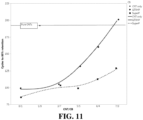
- the ratio of the carbon nanotubes to the carbon black particles in the compositions can range from 0.25:1 to 3:1 by weight. In some embodiments, having a higher concentration of carbon black particles relative to the concentration of carbon nanotubes provided improved low-temperature capacity.
- the ratio of the carbon nanotubes to the carbon black particles can have or include, for example, one of the following ranges, by weight: from 0.25:1 to 2.75:1, or from 0.25:1 to 2.5:1, or from 0.25:1 to 2.25:1, or from 0.25:1 to 2:1, or from 0.25:1 to 1.75:1, or from 0.25:1 to 1.5:1, or from 0.25:1 to 1.25:1, or from 0.25:1 to 1:1, or from 0.25:1 to 0.75:1, or from 0.25:1 to 0.5:1, or from 0.4:1 to 3:1, or from 0.4 to 2.75:1, or from 0.4:1 to 2.5:1, or from 0.4:1 to 2.3:1, or from 0.4:1 to 2.25:1, or from 0.4:1 to 2:1
- the liquid medium can be any liquid that is suitable for use with the constituents of the compositions described herein and capable of being used to manufacture the intended electrode.
- the solvent can be anhydrous, polar and/or aprotic.
- the solvent has a high volatility so that, during manufacturing, it can be easily removed (e.g., evaporated), thereby reducing drying time and production costs.
- Exemplary solvents include, e.g., N-methylpyrrolidone (NMP), acetone, alcohols, and water.
- compositions can be used in the production of a variety of energy storage devices, such as lithium-ion batteries.
- the compositions can be used to produce an electrode (e.g., cathode) composition for a lithium-ion battery.
- the electrode composition typically includes a mixture including the compositions described herein, NCM or NCA, and optionally, a binder.
- An electrode (e.g., cathode) composition can be made by homogeneously interspersing (e.g., by uniformly mixing) the compositions described herein with the NCM or NCA.
- the binder is also homogeneously interspersed with the compositions described herein and NCM or NCA.
- the electrode composition can take the form of a paste or a slurry, in which particulate NCM or NCA, conductive additives, dispersant(s) (if present), other additive(s) (if present), solvent, and binder (if present) are combined.
- the constituents of the electrode composition can be combined in any order so long as the resulting mixture is substantially homogeneous, which can be achieved by shaking, stirring, etc.
- the electrode composition is a solid resulting from solvent removal from the paste or slurry.
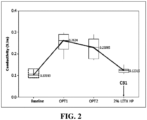
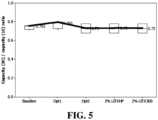
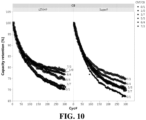
- Baseline 96 % NCM 111 + 1.5 % CNT CNT 2 + 0.5 % Super P + 2 %
- Binder Opt 1 96 % NCM 111 + 1.2 % CNT CNT 3 + 0.8 % LITX HP + 2 %
- Binder Opt 2 96.2 % NCM 111 + 1.0 % CNT LB 107 + 0.8 % LITX HP + 2 % Binder
Landscapes
- Chemical & Material Sciences (AREA)
- Chemical Kinetics & Catalysis (AREA)
- Electrochemistry (AREA)
- General Chemical & Material Sciences (AREA)
- Inorganic Chemistry (AREA)
- Engineering & Computer Science (AREA)
- Materials Engineering (AREA)
- Manufacturing & Machinery (AREA)
- Battery Electrode And Active Subsutance (AREA)
Claims (14)
- Elektrode, umfassend:
eine Elektroden-Zusammensetzung, umfassendKohlenstoff-Nanoröhrchen;Rußpartikel mit einer Brunauer-Emmett-Teller (BET)-Oberfläche von mehr als 90 m2/g, einer Öladsorptionszahl (OAN) von mehr als 150 mL/100g und einer Oberflächenenergie von weniger als 5 mJ/m2, wobei das Gewichtsverhältnis der Kohlenstoff- Nanoröhrchen zu den Rußpartikeln im Bereich von 3:1 bis 0,25:1 liegt; undein elektroaktives Material, ausgewählt aus der Gruppe bestehend aus Lithium-Nickel-Cobalt-Manganoxid und Lithium-Nickel-Cobalt-Aluminiumoxid,wobei die Gesamtkonzentration der Kohlenstoff-Nanoröhrchen und der Rußpartikel gleich oder weniger als 3 Gew.-% der Elektroden-Zusammensetzung beträgt; undeinen Stromkollektor, der die Elektroden-Zusammensetzung kontaktiert. - Elektrode nach Anspruch 1, wobei die Gesamtkonzentration der Kohlenstoff-Nanoröhrchen und der Rußpartikel im Bereich von 0,5 bis 2 Gew.-% der Elektroden-Zusammensetzung liegt.
- Elektrode nach Anspruch 1 oder 2, wobei das Gewichtsverhältnis der Kohlenstoff-Nanoröhrchen zu den Rußpartikeln im Bereich von 2,3:1 bis 0,4:1 liegt.
- Elektrode nach einem der vorhergehenden Ansprüche, die 90 bis 99 Gew.-% des elektroaktiven Materials enthält.
- Elektrode nach einem der vorhergehenden Ansprüche, wobei das elektroaktive Material Lithium-Nickel-Cobalt-Mangan-Oxid umfasst.
- Elektrode nach einem der vorhergehenden Ansprüche, wobei die Kohlenstoff-Nanoröhren eine oder beide der folgenden Eigenschaften aufweisen:(a) einen Durchmesser im Bereich von 4 bis 50 nm; und/oder(b) eine Länge im Bereich von 5 bis 20 Mikrometern.
- Elektrode nach einem der vorhergehenden Ansprüche, wobei die Rußpartikel eine BET-Oberfläche von weniger als 400 m2/g aufweisen.
- Elektrode nach einem der vorhergehenden Ansprüche, wobei die Rußpartikel einen OAN-Wert von weniger als 250 mL/100g aufweisen.
- Elektrode nach einem der vorhergehenden Ansprüche, wobei die Rußpartikel eine durch Raman-Spektroskopie bestimmte La-Kristallitgröße im Bereich von 50 Å bis 100 Å aufweisen.
- Elektrode nach einem der vorhergehenden Ansprüche, wobei die Rußpartikel eine durch Röntgenbeugung bestimmte Lc-Kristallitgröße im Bereich von 50 Å bis 100 Å aufweisen.
- Elektrode nach einem der vorhergehenden Ansprüche, wobei die Rußpartikel eine durch Raman-Spektroskopie bestimmte prozentuale Kristallinität ((IG/(IG+ID)) × 100%) im Bereich von 35% bis 70% aufweisen.
- Elektrode nach einem der vorhergehenden Ansprüche, wobei die Rußpartikel eine Aggregatgrößenverteilung, angegeben durch D50-Werte von Partikelgrößenverteilungen, im Bereich von 20 bis 400 nm aufweisen.
- Elektrode nach einem der Ansprüche 1 bis 8, wobei die Rußpartikel eine, zwei, drei, vier, fünf oder sechs der folgenden Eigenschaften in beliebiger Kombination aufweisen:(a) eine durch Raman-Spektroskopie bestimmte La-Kristallitgröße im Bereich von 50 Å bis 100 Å;(b) eine durch Röntgenbeugung bestimmte Lc-Kristallitgröße im Bereich von 50 Å bis 100 Å;(c) eine durch Raman-Spektroskopie bestimmte prozentuale Kristallinität ((IG/(IG+ID)) × 100%) im Bereich von 35% bis 70%;(d) eine STSA im Bereich von 50 bis 250 m2/g;(e) eine Aggregatgrößenverteilung, angegeben durch Dso-Werte von Partikelgrößenverteilungen, im Bereich von 20 bis 400 nm; und/oder(f) einen Sauerstoffgehalt von 0 bis 0,1 Gew.-%.
- Batterie, umfassend eine Elektrode nach einem der Ansprüche 1-13.
Applications Claiming Priority (2)
| Application Number | Priority Date | Filing Date | Title |
|---|---|---|---|
| US201862719750P | 2018-08-20 | 2018-08-20 | |
| PCT/CN2019/100906 WO2020038286A1 (en) | 2018-08-20 | 2019-08-16 | Compositions containing conductive additives, related electrodes and related batteries |
Publications (3)
| Publication Number | Publication Date |
|---|---|
| EP3841632A1 EP3841632A1 (de) | 2021-06-30 |
| EP3841632A4 EP3841632A4 (de) | 2022-07-20 |
| EP3841632B1 true EP3841632B1 (de) | 2024-07-10 |
Family
ID=69591152
Family Applications (1)
| Application Number | Title | Priority Date | Filing Date |
|---|---|---|---|
| EP19851837.5A Active EP3841632B1 (de) | 2018-08-20 | 2019-08-16 | Leitfähige zusätze enthaltende zusammensetzungen, zugehörige elektroden und zugehörige batterien |
Country Status (7)
| Country | Link |
|---|---|
| US (1) | US12394798B2 (de) |
| EP (1) | EP3841632B1 (de) |
| JP (1) | JP7159452B2 (de) |
| KR (1) | KR102729769B1 (de) |
| ES (1) | ES2992948T3 (de) |
| HU (1) | HUE068376T2 (de) |
| WO (1) | WO2020038286A1 (de) |
Families Citing this family (6)
| Publication number | Priority date | Publication date | Assignee | Title |
|---|---|---|---|---|
| KR20220074955A (ko) * | 2019-10-04 | 2022-06-03 | 야자키 소교 가부시키가이샤 | 리튬 이온 배터리의 성능 향상을 위한 고순도 swcnt 첨가제 |
| WO2022035606A1 (en) * | 2020-08-12 | 2022-02-17 | Cabot Corporation | Compositions containing carbon black, graphite and carbon nanotubes, related electrodes and related batteries |
| KR20230087705A (ko) * | 2021-12-10 | 2023-06-19 | 현대자동차주식회사 | 후막의 양극 활물질층을 포함하는 전고체 전지 및 이의 제조방법 |
| JP2023120171A (ja) * | 2022-02-17 | 2023-08-29 | 三洋化成工業株式会社 | リチウムイオン電池用正極組成物 |
| CN118946980A (zh) * | 2022-03-30 | 2024-11-12 | 电化株式会社 | 正极组合物、正极及其制造方法以及电池 |
| EP4517851A1 (de) * | 2023-08-30 | 2025-03-05 | ImerTech | Dispersionen von kohlenstoffnanoröhren und russen |
Family Cites Families (16)
| Publication number | Priority date | Publication date | Assignee | Title |
|---|---|---|---|---|
| JP2005174655A (ja) * | 2003-12-09 | 2005-06-30 | Toyota Motor Corp | リチウム電池 |
| JP4346565B2 (ja) * | 2004-03-30 | 2009-10-21 | 株式会社東芝 | 非水電解質二次電池 |
| CN100367561C (zh) * | 2004-03-30 | 2008-02-06 | 株式会社东芝 | 非水电解质二次电池 |
| CN101479866B (zh) * | 2006-06-27 | 2011-11-30 | 花王株式会社 | 锂电池正极用复合材料的制造方法 |
| HUE035012T2 (en) * | 2013-06-21 | 2018-05-02 | Cabot Corp | Conductive carbon for lithium ion batteries |
| JP6397007B2 (ja) * | 2013-06-21 | 2018-09-26 | キャボット コーポレイションCabot Corporation | リチウムイオン電池用の活性材料 |
| US10135071B2 (en) | 2013-06-21 | 2018-11-20 | Cabot Corporation | Conductive carbons for lithium ion batteries |
| KR101669711B1 (ko) * | 2013-09-06 | 2016-10-27 | 주식회사 엘지화학 | 전극 활물질 슬러리 및 이를 포함하는 리튬 이차 전지 |
| JP6278679B2 (ja) | 2013-12-09 | 2018-02-14 | 三星エスディアイ株式会社SAMSUNG SDI Co., LTD. | 導電組成物、正極、およびリチウムイオン二次電池。 |
| KR101652921B1 (ko) * | 2013-12-27 | 2016-08-31 | 주식회사 엘지화학 | 도전재 조성물, 이를 사용한 리튬 이차 전지의 전극 형성용 슬러리 조성물 및 리튬 이차 전지 |
| JP2016162538A (ja) | 2015-02-27 | 2016-09-05 | 三菱製紙株式会社 | リチウムイオン二次電池用セパレータ及びそれを用いてなるリチウムイオン二次電池 |
| HUE054152T2 (hu) * | 2016-05-05 | 2021-08-30 | Cabot Corp | Elektródák, kompozíciók és eszközök nagy szerkezetû kormokkal |
| CN106252712A (zh) * | 2016-08-20 | 2016-12-21 | 深圳市比克动力电池有限公司 | 一种锂离子二次电池 |
| JP2018062545A (ja) | 2016-10-11 | 2018-04-19 | デンカ株式会社 | カーボンブラック組成物及びそれを用いたリチウム二次電池用電極 |
| US10886535B2 (en) * | 2017-06-15 | 2021-01-05 | Cabot Corporation | Electrodes containing carbon black particles and related methods |
| CN108183236A (zh) * | 2018-01-16 | 2018-06-19 | 黑石(深圳)新材料技术有限公司 | 一种锂离子电池正极浆料的制备方法 |
-
2019
- 2019-08-16 JP JP2021509879A patent/JP7159452B2/ja active Active
- 2019-08-16 EP EP19851837.5A patent/EP3841632B1/de active Active
- 2019-08-16 US US17/268,737 patent/US12394798B2/en active Active
- 2019-08-16 KR KR1020217007913A patent/KR102729769B1/ko active Active
- 2019-08-16 ES ES19851837T patent/ES2992948T3/es active Active
- 2019-08-16 WO PCT/CN2019/100906 patent/WO2020038286A1/en not_active Ceased
- 2019-08-16 HU HUE19851837A patent/HUE068376T2/hu unknown
Also Published As
| Publication number | Publication date |
|---|---|
| EP3841632A4 (de) | 2022-07-20 |
| JP2021535553A (ja) | 2021-12-16 |
| HUE068376T2 (hu) | 2024-12-28 |
| JP7159452B2 (ja) | 2022-10-24 |
| KR20210043668A (ko) | 2021-04-21 |
| US20210305575A1 (en) | 2021-09-30 |
| EP3841632A1 (de) | 2021-06-30 |
| ES2992948T3 (en) | 2024-12-20 |
| WO2020038286A1 (en) | 2020-02-27 |
| KR102729769B1 (ko) | 2024-11-14 |
| US12394798B2 (en) | 2025-08-19 |
Similar Documents
| Publication | Publication Date | Title |
|---|---|---|
| EP3639311B1 (de) | Elektroden mit russteilchen und zugehörige verfahren | |
| US10971730B2 (en) | Electrodes, compositions, and devices having high structure carbon blacks | |
| EP3841632B1 (de) | Leitfähige zusätze enthaltende zusammensetzungen, zugehörige elektroden und zugehörige batterien | |
| US9337491B2 (en) | Electrode for a lithium battery and lithium battery | |
| US20200056050A1 (en) | Compositions containing conductive additives, related electrodes and related batteries | |
| CN115699360B (zh) | 复合粒子、其制造方法及其用途 | |
| US20190372121A1 (en) | Compositions useful for producing electrodes and related methods | |
| US20210066708A1 (en) | Compositions containing carbon black and graphenes additives, related electrodes and related batteries | |
| KR20160021279A (ko) | 리튬 이온 배터리를 위한 전도성 탄소 | |
| EP3639312B1 (de) | Elektroden und batterien mit verschiedenen russpartikeln | |
| WO2022035606A1 (en) | Compositions containing carbon black, graphite and carbon nanotubes, related electrodes and related batteries | |
| KR102959932B1 (ko) | 리튬 이차전지용 음극재 및 이의 제조방법 | |
| KR20260000941A (ko) | 리튬 이차전지용 음극재 | |
| JP2019071293A (ja) | リチウムイオン二次電池用導電材料、リチウムイオン二次電池負極形成用組成物、リチウムイオン二次電池正極形成用組成物、リチウムイオン二次電池用負極、リチウムイオン二次電池用正極及びリチウムイオン二次電池 |
Legal Events
| Date | Code | Title | Description |
|---|---|---|---|
| STAA | Information on the status of an ep patent application or granted ep patent |
Free format text: STATUS: THE INTERNATIONAL PUBLICATION HAS BEEN MADE |
|
| PUAI | Public reference made under article 153(3) epc to a published international application that has entered the european phase |
Free format text: ORIGINAL CODE: 0009012 |
|
| STAA | Information on the status of an ep patent application or granted ep patent |
Free format text: STATUS: REQUEST FOR EXAMINATION WAS MADE |
|
| 17P | Request for examination filed |
Effective date: 20210224 |
|
| AK | Designated contracting states |
Kind code of ref document: A1 Designated state(s): AL AT BE BG CH CY CZ DE DK EE ES FI FR GB GR HR HU IE IS IT LI LT LU LV MC MK MT NL NO PL PT RO RS SE SI SK SM TR |
|
| DAV | Request for validation of the european patent (deleted) | ||
| DAX | Request for extension of the european patent (deleted) | ||
| A4 | Supplementary search report drawn up and despatched |
Effective date: 20220615 |
|
| RIC1 | Information provided on ipc code assigned before grant |
Ipc: H01M 4/525 20100101ALI20220611BHEP Ipc: H01M 10/052 20100101ALI20220611BHEP Ipc: H01M 4/505 20100101ALI20220611BHEP Ipc: H01M 4/131 20100101ALI20220611BHEP Ipc: H01M 4/62 20060101AFI20220611BHEP |
|
| P01 | Opt-out of the competence of the unified patent court (upc) registered |
Effective date: 20230530 |
|
| GRAP | Despatch of communication of intention to grant a patent |
Free format text: ORIGINAL CODE: EPIDOSNIGR1 |
|
| STAA | Information on the status of an ep patent application or granted ep patent |
Free format text: STATUS: GRANT OF PATENT IS INTENDED |
|
| INTG | Intention to grant announced |
Effective date: 20240130 |
|
| GRAS | Grant fee paid |
Free format text: ORIGINAL CODE: EPIDOSNIGR3 |
|
| GRAA | (expected) grant |
Free format text: ORIGINAL CODE: 0009210 |
|
| STAA | Information on the status of an ep patent application or granted ep patent |
Free format text: STATUS: THE PATENT HAS BEEN GRANTED |
|
| AK | Designated contracting states |
Kind code of ref document: B1 Designated state(s): AL AT BE BG CH CY CZ DE DK EE ES FI FR GB GR HR HU IE IS IT LI LT LU LV MC MK MT NL NO PL PT RO RS SE SI SK SM TR |
|
| REG | Reference to a national code |
Ref country code: CH Ref legal event code: EP |
|
| REG | Reference to a national code |
Ref country code: DE Ref legal event code: R096 Ref document number: 602019055104 Country of ref document: DE |
|
| REG | Reference to a national code |
Ref country code: SE Ref legal event code: TRGR |
|
| REG | Reference to a national code |
Ref country code: LT Ref legal event code: MG9D |
|
| REG | Reference to a national code |
Ref country code: NL Ref legal event code: MP Effective date: 20240710 |
|
| PG25 | Lapsed in a contracting state [announced via postgrant information from national office to epo] |
Ref country code: PT Free format text: LAPSE BECAUSE OF FAILURE TO SUBMIT A TRANSLATION OF THE DESCRIPTION OR TO PAY THE FEE WITHIN THE PRESCRIBED TIME-LIMIT Effective date: 20241111 |
|
| REG | Reference to a national code |
Ref country code: AT Ref legal event code: MK05 Ref document number: 1702842 Country of ref document: AT Kind code of ref document: T Effective date: 20240710 |
|
| PG25 | Lapsed in a contracting state [announced via postgrant information from national office to epo] |
Ref country code: NL Free format text: LAPSE BECAUSE OF FAILURE TO SUBMIT A TRANSLATION OF THE DESCRIPTION OR TO PAY THE FEE WITHIN THE PRESCRIBED TIME-LIMIT Effective date: 20240710 |
|
| REG | Reference to a national code |
Ref country code: ES Ref legal event code: FG2A Ref document number: 2992948 Country of ref document: ES Kind code of ref document: T3 Effective date: 20241220 |
|
| REG | Reference to a national code |
Ref country code: HU Ref legal event code: AG4A Ref document number: E068376 Country of ref document: HU |
|
| PG25 | Lapsed in a contracting state [announced via postgrant information from national office to epo] |
Ref country code: PT Free format text: LAPSE BECAUSE OF FAILURE TO SUBMIT A TRANSLATION OF THE DESCRIPTION OR TO PAY THE FEE WITHIN THE PRESCRIBED TIME-LIMIT Effective date: 20241111 Ref country code: NL Free format text: LAPSE BECAUSE OF FAILURE TO SUBMIT A TRANSLATION OF THE DESCRIPTION OR TO PAY THE FEE WITHIN THE PRESCRIBED TIME-LIMIT Effective date: 20240710 |
|
| PG25 | Lapsed in a contracting state [announced via postgrant information from national office to epo] |
Ref country code: NO Free format text: LAPSE BECAUSE OF FAILURE TO SUBMIT A TRANSLATION OF THE DESCRIPTION OR TO PAY THE FEE WITHIN THE PRESCRIBED TIME-LIMIT Effective date: 20241010 |
|
| PG25 | Lapsed in a contracting state [announced via postgrant information from national office to epo] |
Ref country code: GR Free format text: LAPSE BECAUSE OF FAILURE TO SUBMIT A TRANSLATION OF THE DESCRIPTION OR TO PAY THE FEE WITHIN THE PRESCRIBED TIME-LIMIT Effective date: 20241011 Ref country code: FI Free format text: LAPSE BECAUSE OF FAILURE TO SUBMIT A TRANSLATION OF THE DESCRIPTION OR TO PAY THE FEE WITHIN THE PRESCRIBED TIME-LIMIT Effective date: 20240710 Ref country code: PL Free format text: LAPSE BECAUSE OF FAILURE TO SUBMIT A TRANSLATION OF THE DESCRIPTION OR TO PAY THE FEE WITHIN THE PRESCRIBED TIME-LIMIT Effective date: 20240710 |
|
| PG25 | Lapsed in a contracting state [announced via postgrant information from national office to epo] |
Ref country code: BG Free format text: LAPSE BECAUSE OF FAILURE TO SUBMIT A TRANSLATION OF THE DESCRIPTION OR TO PAY THE FEE WITHIN THE PRESCRIBED TIME-LIMIT Effective date: 20240710 |
|
| PG25 | Lapsed in a contracting state [announced via postgrant information from national office to epo] |
Ref country code: LV Free format text: LAPSE BECAUSE OF FAILURE TO SUBMIT A TRANSLATION OF THE DESCRIPTION OR TO PAY THE FEE WITHIN THE PRESCRIBED TIME-LIMIT Effective date: 20240710 |
|
| PG25 | Lapsed in a contracting state [announced via postgrant information from national office to epo] |
Ref country code: AT Free format text: LAPSE BECAUSE OF FAILURE TO SUBMIT A TRANSLATION OF THE DESCRIPTION OR TO PAY THE FEE WITHIN THE PRESCRIBED TIME-LIMIT Effective date: 20240710 Ref country code: IS Free format text: LAPSE BECAUSE OF FAILURE TO SUBMIT A TRANSLATION OF THE DESCRIPTION OR TO PAY THE FEE WITHIN THE PRESCRIBED TIME-LIMIT Effective date: 20241110 |
|
| PG25 | Lapsed in a contracting state [announced via postgrant information from national office to epo] |
Ref country code: HR Free format text: LAPSE BECAUSE OF FAILURE TO SUBMIT A TRANSLATION OF THE DESCRIPTION OR TO PAY THE FEE WITHIN THE PRESCRIBED TIME-LIMIT Effective date: 20240710 |
|
| PG25 | Lapsed in a contracting state [announced via postgrant information from national office to epo] |
Ref country code: RS Free format text: LAPSE BECAUSE OF FAILURE TO SUBMIT A TRANSLATION OF THE DESCRIPTION OR TO PAY THE FEE WITHIN THE PRESCRIBED TIME-LIMIT Effective date: 20241010 |
|
| PG25 | Lapsed in a contracting state [announced via postgrant information from national office to epo] |
Ref country code: RS Free format text: LAPSE BECAUSE OF FAILURE TO SUBMIT A TRANSLATION OF THE DESCRIPTION OR TO PAY THE FEE WITHIN THE PRESCRIBED TIME-LIMIT Effective date: 20241010 Ref country code: PL Free format text: LAPSE BECAUSE OF FAILURE TO SUBMIT A TRANSLATION OF THE DESCRIPTION OR TO PAY THE FEE WITHIN THE PRESCRIBED TIME-LIMIT Effective date: 20240710 Ref country code: NO Free format text: LAPSE BECAUSE OF FAILURE TO SUBMIT A TRANSLATION OF THE DESCRIPTION OR TO PAY THE FEE WITHIN THE PRESCRIBED TIME-LIMIT Effective date: 20241010 Ref country code: LV Free format text: LAPSE BECAUSE OF FAILURE TO SUBMIT A TRANSLATION OF THE DESCRIPTION OR TO PAY THE FEE WITHIN THE PRESCRIBED TIME-LIMIT Effective date: 20240710 Ref country code: IS Free format text: LAPSE BECAUSE OF FAILURE TO SUBMIT A TRANSLATION OF THE DESCRIPTION OR TO PAY THE FEE WITHIN THE PRESCRIBED TIME-LIMIT Effective date: 20241110 Ref country code: HR Free format text: LAPSE BECAUSE OF FAILURE TO SUBMIT A TRANSLATION OF THE DESCRIPTION OR TO PAY THE FEE WITHIN THE PRESCRIBED TIME-LIMIT Effective date: 20240710 Ref country code: GR Free format text: LAPSE BECAUSE OF FAILURE TO SUBMIT A TRANSLATION OF THE DESCRIPTION OR TO PAY THE FEE WITHIN THE PRESCRIBED TIME-LIMIT Effective date: 20241011 Ref country code: FI Free format text: LAPSE BECAUSE OF FAILURE TO SUBMIT A TRANSLATION OF THE DESCRIPTION OR TO PAY THE FEE WITHIN THE PRESCRIBED TIME-LIMIT Effective date: 20240710 Ref country code: BG Free format text: LAPSE BECAUSE OF FAILURE TO SUBMIT A TRANSLATION OF THE DESCRIPTION OR TO PAY THE FEE WITHIN THE PRESCRIBED TIME-LIMIT Effective date: 20240710 Ref country code: AT Free format text: LAPSE BECAUSE OF FAILURE TO SUBMIT A TRANSLATION OF THE DESCRIPTION OR TO PAY THE FEE WITHIN THE PRESCRIBED TIME-LIMIT Effective date: 20240710 |
|
| REG | Reference to a national code |
Ref country code: CH Ref legal event code: PL |
|
| REG | Reference to a national code |
Ref country code: DE Ref legal event code: R097 Ref document number: 602019055104 Country of ref document: DE |
|
| PG25 | Lapsed in a contracting state [announced via postgrant information from national office to epo] |
Ref country code: RO Free format text: LAPSE BECAUSE OF FAILURE TO SUBMIT A TRANSLATION OF THE DESCRIPTION OR TO PAY THE FEE WITHIN THE PRESCRIBED TIME-LIMIT Effective date: 20240710 Ref country code: DK Free format text: LAPSE BECAUSE OF FAILURE TO SUBMIT A TRANSLATION OF THE DESCRIPTION OR TO PAY THE FEE WITHIN THE PRESCRIBED TIME-LIMIT Effective date: 20240710 Ref country code: SM Free format text: LAPSE BECAUSE OF FAILURE TO SUBMIT A TRANSLATION OF THE DESCRIPTION OR TO PAY THE FEE WITHIN THE PRESCRIBED TIME-LIMIT Effective date: 20240710 |
|
| PG25 | Lapsed in a contracting state [announced via postgrant information from national office to epo] |
Ref country code: LU Free format text: LAPSE BECAUSE OF NON-PAYMENT OF DUE FEES Effective date: 20240816 |
|
| PG25 | Lapsed in a contracting state [announced via postgrant information from national office to epo] |
Ref country code: MC Free format text: LAPSE BECAUSE OF FAILURE TO SUBMIT A TRANSLATION OF THE DESCRIPTION OR TO PAY THE FEE WITHIN THE PRESCRIBED TIME-LIMIT Effective date: 20240710 Ref country code: CH Free format text: LAPSE BECAUSE OF NON-PAYMENT OF DUE FEES Effective date: 20240831 Ref country code: EE Free format text: LAPSE BECAUSE OF FAILURE TO SUBMIT A TRANSLATION OF THE DESCRIPTION OR TO PAY THE FEE WITHIN THE PRESCRIBED TIME-LIMIT Effective date: 20240710 |
|
| PG25 | Lapsed in a contracting state [announced via postgrant information from national office to epo] |
Ref country code: CZ Free format text: LAPSE BECAUSE OF FAILURE TO SUBMIT A TRANSLATION OF THE DESCRIPTION OR TO PAY THE FEE WITHIN THE PRESCRIBED TIME-LIMIT Effective date: 20240710 |
|
| PG25 | Lapsed in a contracting state [announced via postgrant information from national office to epo] |
Ref country code: SK Free format text: LAPSE BECAUSE OF FAILURE TO SUBMIT A TRANSLATION OF THE DESCRIPTION OR TO PAY THE FEE WITHIN THE PRESCRIBED TIME-LIMIT Effective date: 20240710 Ref country code: IT Free format text: LAPSE BECAUSE OF FAILURE TO SUBMIT A TRANSLATION OF THE DESCRIPTION OR TO PAY THE FEE WITHIN THE PRESCRIBED TIME-LIMIT Effective date: 20240710 |
|
| PLBE | No opposition filed within time limit |
Free format text: ORIGINAL CODE: 0009261 |
|
| STAA | Information on the status of an ep patent application or granted ep patent |
Free format text: STATUS: NO OPPOSITION FILED WITHIN TIME LIMIT |
|
| 26N | No opposition filed |
Effective date: 20250411 |
|
| GBPC | Gb: european patent ceased through non-payment of renewal fee |
Effective date: 20241010 |
|
| REG | Reference to a national code |
Ref country code: BE Ref legal event code: MM Effective date: 20240831 |
|
| PG25 | Lapsed in a contracting state [announced via postgrant information from national office to epo] |
Ref country code: GB Free format text: LAPSE BECAUSE OF NON-PAYMENT OF DUE FEES Effective date: 20241010 |
|
| PG25 | Lapsed in a contracting state [announced via postgrant information from national office to epo] |
Ref country code: BE Free format text: LAPSE BECAUSE OF NON-PAYMENT OF DUE FEES Effective date: 20240831 |
|
| PG25 | Lapsed in a contracting state [announced via postgrant information from national office to epo] |
Ref country code: IE Free format text: LAPSE BECAUSE OF NON-PAYMENT OF DUE FEES Effective date: 20240816 |
|
| PGFP | Annual fee paid to national office [announced via postgrant information from national office to epo] |
Ref country code: HU Payment date: 20250804 Year of fee payment: 7 |
|
| PGFP | Annual fee paid to national office [announced via postgrant information from national office to epo] |
Ref country code: ES Payment date: 20250908 Year of fee payment: 7 |
|
| PGFP | Annual fee paid to national office [announced via postgrant information from national office to epo] |
Ref country code: DE Payment date: 20250709 Year of fee payment: 7 |
|
| PGFP | Annual fee paid to national office [announced via postgrant information from national office to epo] |
Ref country code: FR Payment date: 20250709 Year of fee payment: 7 |
|
| PGFP | Annual fee paid to national office [announced via postgrant information from national office to epo] |
Ref country code: SE Payment date: 20250808 Year of fee payment: 7 |
|
| PG25 | Lapsed in a contracting state [announced via postgrant information from national office to epo] |
Ref country code: CY Free format text: LAPSE BECAUSE OF FAILURE TO SUBMIT A TRANSLATION OF THE DESCRIPTION OR TO PAY THE FEE WITHIN THE PRESCRIBED TIME-LIMIT; INVALID AB INITIO Effective date: 20190816 |