EP3841872A1 - In-vitro-direkterzeugung von polyploiden cannabispflanzen - Google Patents
In-vitro-direkterzeugung von polyploiden cannabispflanzen Download PDFInfo
- Publication number
- EP3841872A1 EP3841872A1 EP19383210.2A EP19383210A EP3841872A1 EP 3841872 A1 EP3841872 A1 EP 3841872A1 EP 19383210 A EP19383210 A EP 19383210A EP 3841872 A1 EP3841872 A1 EP 3841872A1
- Authority
- EP
- European Patent Office
- Prior art keywords
- cannabis
- vitro
- plant
- plants
- explants
- Prior art date
- Legal status (The legal status is an assumption and is not a legal conclusion. Google has not performed a legal analysis and makes no representation as to the accuracy of the status listed.)
- Withdrawn
Links
- 238000000338 in vitro Methods 0.000 title claims abstract description 138
- 238000011069 regeneration method Methods 0.000 title claims abstract description 66
- 230000008929 regeneration Effects 0.000 title claims abstract description 62
- 208000020584 Polyploidy Diseases 0.000 title claims abstract description 30
- 240000004308 marijuana Species 0.000 title description 67
- 241000196324 Embryophyta Species 0.000 claims abstract description 139
- 238000000034 method Methods 0.000 claims abstract description 92
- 244000025254 Cannabis sativa Species 0.000 claims abstract description 73
- 239000001963 growth medium Substances 0.000 claims abstract description 36
- 235000008697 Cannabis sativa Nutrition 0.000 claims abstract description 31
- 238000012258 culturing Methods 0.000 claims abstract description 21
- 230000009261 transgenic effect Effects 0.000 claims abstract description 6
- 241000218236 Cannabis Species 0.000 claims abstract 21
- 210000001519 tissue Anatomy 0.000 claims description 28
- 239000005648 plant growth regulator Substances 0.000 claims description 25
- 230000015572 biosynthetic process Effects 0.000 claims description 18
- 230000012010 growth Effects 0.000 claims description 17
- 206010020649 Hyperkeratosis Diseases 0.000 claims description 15
- 239000000126 substance Substances 0.000 claims description 14
- 210000002257 embryonic structure Anatomy 0.000 claims description 11
- 239000000758 substrate Substances 0.000 claims description 10
- 239000011782 vitamin Substances 0.000 claims description 9
- 229940088594 vitamin Drugs 0.000 claims description 9
- 235000013343 vitamin Nutrition 0.000 claims description 9
- 229930003231 vitamin Natural products 0.000 claims description 9
- 102000029749 Microtubule Human genes 0.000 claims description 8
- 108091022875 Microtubule Proteins 0.000 claims description 8
- 210000004688 microtubule Anatomy 0.000 claims description 8
- OKTJSMMVPCPJKN-UHFFFAOYSA-N Carbon Chemical compound [C] OKTJSMMVPCPJKN-UHFFFAOYSA-N 0.000 claims description 6
- 229910052799 carbon Inorganic materials 0.000 claims description 6
- 239000003349 gelling agent Substances 0.000 claims description 6
- 230000001965 increasing effect Effects 0.000 claims description 6
- 235000021073 macronutrients Nutrition 0.000 claims description 6
- 239000011785 micronutrient Substances 0.000 claims description 6
- 235000013369 micronutrients Nutrition 0.000 claims description 6
- 239000012492 regenerant Substances 0.000 claims description 5
- XLYOFNOQVPJJNP-UHFFFAOYSA-N water Substances O XLYOFNOQVPJJNP-UHFFFAOYSA-N 0.000 claims description 5
- 230000001737 promoting effect Effects 0.000 claims description 4
- 229910001868 water Inorganic materials 0.000 claims description 3
- 239000002962 chemical mutagen Substances 0.000 claims description 2
- 230000001939 inductive effect Effects 0.000 claims description 2
- 238000002703 mutagenesis Methods 0.000 claims description 2
- 231100000350 mutagenesis Toxicity 0.000 claims description 2
- 230000018109 developmental process Effects 0.000 abstract description 28
- 238000011161 development Methods 0.000 abstract description 26
- 230000002269 spontaneous effect Effects 0.000 abstract description 10
- 244000010815 Phlomis lychnitis Species 0.000 abstract description 5
- 238000004519 manufacturing process Methods 0.000 abstract description 4
- 229930000044 secondary metabolite Natural products 0.000 abstract description 4
- 239000002609 medium Substances 0.000 description 41
- 230000005305 organ development Effects 0.000 description 29
- 210000004027 cell Anatomy 0.000 description 20
- 230000000977 initiatory effect Effects 0.000 description 16
- 210000000056 organ Anatomy 0.000 description 16
- 210000004940 nucleus Anatomy 0.000 description 14
- 229930192334 Auxin Natural products 0.000 description 13
- 239000002363 auxin Substances 0.000 description 13
- SEOVTRFCIGRIMH-UHFFFAOYSA-N indole-3-acetic acid Chemical compound C1=CC=C2C(CC(=O)O)=CNC2=C1 SEOVTRFCIGRIMH-UHFFFAOYSA-N 0.000 description 13
- 239000004062 cytokinin Substances 0.000 description 12
- UQHKFADEQIVWID-UHFFFAOYSA-N cytokinin Natural products C1=NC=2C(NCC=C(CO)C)=NC=NC=2N1C1CC(O)C(CO)O1 UQHKFADEQIVWID-UHFFFAOYSA-N 0.000 description 12
- GOSWTRUMMSCNCW-HNNGNKQASA-N 9-ribosyl-trans-zeatin Chemical compound C1=NC=2C(NC\C=C(CO)/C)=NC=NC=2N1[C@@H]1O[C@H](CO)[C@@H](O)[C@H]1O GOSWTRUMMSCNCW-HNNGNKQASA-N 0.000 description 11
- HFCYZXMHUIHAQI-UHFFFAOYSA-N Thidiazuron Chemical compound C=1C=CC=CC=1NC(=O)NC1=CN=NS1 HFCYZXMHUIHAQI-UHFFFAOYSA-N 0.000 description 11
- 241000894007 species Species 0.000 description 11
- 238000002474 experimental method Methods 0.000 description 10
- 230000006698 induction Effects 0.000 description 10
- 230000008569 process Effects 0.000 description 10
- LFQSCWFLJHTTHZ-UHFFFAOYSA-N Ethanol Chemical compound CCO LFQSCWFLJHTTHZ-UHFFFAOYSA-N 0.000 description 9
- 230000002068 genetic effect Effects 0.000 description 9
- 208000035199 Tetraploidy Diseases 0.000 description 8
- JTEDVYBZBROSJT-UHFFFAOYSA-N indole-3-butyric acid Chemical compound C1=CC=C2C(CCCC(=O)O)=CNC2=C1 JTEDVYBZBROSJT-UHFFFAOYSA-N 0.000 description 8
- 235000012766 Cannabis sativa ssp. sativa var. sativa Nutrition 0.000 description 7
- 235000012765 Cannabis sativa ssp. sativa var. spontanea Nutrition 0.000 description 7
- 235000009120 camo Nutrition 0.000 description 7
- 229930003827 cannabinoid Natural products 0.000 description 7
- 239000003557 cannabinoid Substances 0.000 description 7
- 235000005607 chanvre indien Nutrition 0.000 description 7
- 239000011487 hemp Substances 0.000 description 7
- 230000001172 regenerating effect Effects 0.000 description 7
- NWBJYWHLCVSVIJ-UHFFFAOYSA-N N-benzyladenine Chemical compound N=1C=NC=2NC=NC=2C=1NCC1=CC=CC=C1 NWBJYWHLCVSVIJ-UHFFFAOYSA-N 0.000 description 6
- 229940065144 cannabinoids Drugs 0.000 description 6
- 230000000694 effects Effects 0.000 description 6
- 229940088597 hormone Drugs 0.000 description 6
- 239000000203 mixture Substances 0.000 description 6
- 238000011282 treatment Methods 0.000 description 6
- 229930006000 Sucrose Natural products 0.000 description 5
- CZMRCDWAGMRECN-UGDNZRGBSA-N Sucrose Chemical compound O[C@H]1[C@H](O)[C@@H](CO)O[C@@]1(CO)O[C@@H]1[C@H](O)[C@@H](O)[C@H](O)[C@@H](CO)O1 CZMRCDWAGMRECN-UGDNZRGBSA-N 0.000 description 5
- CYQFCXCEBYINGO-UHFFFAOYSA-N THC Natural products C1=C(C)CCC2C(C)(C)OC3=CC(CCCCC)=CC(O)=C3C21 CYQFCXCEBYINGO-UHFFFAOYSA-N 0.000 description 5
- 210000000349 chromosome Anatomy 0.000 description 5
- CYQFCXCEBYINGO-IAGOWNOFSA-N delta1-THC Chemical compound C1=C(C)CC[C@H]2C(C)(C)OC3=CC(CCCCC)=CC(O)=C3[C@@H]21 CYQFCXCEBYINGO-IAGOWNOFSA-N 0.000 description 5
- 238000000684 flow cytometry Methods 0.000 description 5
- 230000035784 germination Effects 0.000 description 5
- 238000011081 inoculation Methods 0.000 description 5
- 239000005720 sucrose Substances 0.000 description 5
- MRPKNNSABYPGBF-LSCFUAHRSA-N (2r,3r,4s,5r)-2-[6-(benzylamino)purin-9-yl]-5-(hydroxymethyl)oxolane-3,4-diol Chemical compound O[C@@H]1[C@H](O)[C@@H](CO)O[C@H]1N1C2=NC=NC(NCC=3C=CC=CC=3)=C2N=C1 MRPKNNSABYPGBF-LSCFUAHRSA-N 0.000 description 4
- 239000005631 2,4-Dichlorophenoxyacetic acid Substances 0.000 description 4
- 229920002148 Gellan gum Polymers 0.000 description 4
- MWUXSHHQAYIFBG-UHFFFAOYSA-N Nitric oxide Chemical compound O=[N] MWUXSHHQAYIFBG-UHFFFAOYSA-N 0.000 description 4
- 108091093105 Nuclear DNA Proteins 0.000 description 4
- PXIPVTKHYLBLMZ-UHFFFAOYSA-N Sodium azide Chemical compound [Na+].[N-]=[N+]=[N-] PXIPVTKHYLBLMZ-UHFFFAOYSA-N 0.000 description 4
- QHMBSVQNZZTUGM-UHFFFAOYSA-N Trans-Cannabidiol Natural products OC1=CC(CCCCC)=CC(O)=C1C1C(C(C)=C)CCC(C)=C1 QHMBSVQNZZTUGM-UHFFFAOYSA-N 0.000 description 4
- 238000009395 breeding Methods 0.000 description 4
- QHMBSVQNZZTUGM-ZWKOTPCHSA-N cannabidiol Chemical compound OC1=CC(CCCCC)=CC(O)=C1[C@H]1[C@H](C(C)=C)CCC(C)=C1 QHMBSVQNZZTUGM-ZWKOTPCHSA-N 0.000 description 4
- 229950011318 cannabidiol Drugs 0.000 description 4
- ZTGXAWYVTLUPDT-UHFFFAOYSA-N cannabidiol Natural products OC1=CC(CCCCC)=CC(O)=C1C1C(C(C)=C)CC=C(C)C1 ZTGXAWYVTLUPDT-UHFFFAOYSA-N 0.000 description 4
- PCXRACLQFPRCBB-ZWKOTPCHSA-N dihydrocannabidiol Natural products OC1=CC(CCCCC)=CC(O)=C1[C@H]1[C@H](C(C)C)CCC(C)=C1 PCXRACLQFPRCBB-ZWKOTPCHSA-N 0.000 description 4
- 229960004242 dronabinol Drugs 0.000 description 4
- 210000002615 epidermis Anatomy 0.000 description 4
- IXORZMNAPKEEDV-OBDJNFEBSA-N gibberellin A3 Chemical compound C([C@@]1(O)C(=C)C[C@@]2(C1)[C@H]1C(O)=O)C[C@H]2[C@]2(C=C[C@@H]3O)[C@H]1[C@]3(C)C(=O)O2 IXORZMNAPKEEDV-OBDJNFEBSA-N 0.000 description 4
- SEEGHKWOBVVBTQ-NFMPGMCNSA-N gibberellin A7 Chemical compound C([C@@H]1C[C@]2(CC1=C)[C@H]1C(O)=O)C[C@H]2[C@]2(C=C[C@@H]3O)[C@H]1[C@]3(C)C(=O)O2 SEEGHKWOBVVBTQ-NFMPGMCNSA-N 0.000 description 4
- 239000005556 hormone Substances 0.000 description 4
- 210000001161 mammalian embryo Anatomy 0.000 description 4
- 239000002207 metabolite Substances 0.000 description 4
- 230000000888 organogenic effect Effects 0.000 description 4
- 230000003647 oxidation Effects 0.000 description 4
- 238000007254 oxidation reaction Methods 0.000 description 4
- WLJVXDMOQOGPHL-UHFFFAOYSA-N phenylacetic acid Chemical compound OC(=O)CC1=CC=CC=C1 WLJVXDMOQOGPHL-UHFFFAOYSA-N 0.000 description 4
- 238000003976 plant breeding Methods 0.000 description 4
- 229920003023 plastic Polymers 0.000 description 4
- 241000218235 Cannabaceae Species 0.000 description 3
- 230000008901 benefit Effects 0.000 description 3
- 230000001488 breeding effect Effects 0.000 description 3
- 238000002224 dissection Methods 0.000 description 3
- 230000013020 embryo development Effects 0.000 description 3
- 230000007613 environmental effect Effects 0.000 description 3
- 239000012869 germination medium Substances 0.000 description 3
- 239000003102 growth factor Substances 0.000 description 3
- 210000004209 hair Anatomy 0.000 description 3
- 230000006872 improvement Effects 0.000 description 3
- 230000000442 meristematic effect Effects 0.000 description 3
- 239000004033 plastic Substances 0.000 description 3
- 230000004044 response Effects 0.000 description 3
- 150000003839 salts Chemical class 0.000 description 3
- 230000011869 shoot development Effects 0.000 description 3
- 238000009331 sowing Methods 0.000 description 3
- 230000007704 transition Effects 0.000 description 3
- YBJHBAHKTGYVGT-ZKWXMUAHSA-N (+)-Biotin Chemical compound N1C(=O)N[C@@H]2[C@H](CCCCC(=O)O)SC[C@@H]21 YBJHBAHKTGYVGT-ZKWXMUAHSA-N 0.000 description 2
- WQZGKKKJIJFFOK-SVZMEOIVSA-N (+)-Galactose Chemical compound OC[C@H]1OC(O)[C@H](O)[C@@H](O)[C@H]1O WQZGKKKJIJFFOK-SVZMEOIVSA-N 0.000 description 2
- MTCFGRXMJLQNBG-REOHCLBHSA-N (2S)-2-Amino-3-hydroxypropansäure Chemical compound OC[C@H](N)C(O)=O MTCFGRXMJLQNBG-REOHCLBHSA-N 0.000 description 2
- IAKHMKGGTNLKSZ-INIZCTEOSA-N (S)-colchicine Chemical compound C1([C@@H](NC(C)=O)CC2)=CC(=O)C(OC)=CC=C1C1=C2C=C(OC)C(OC)=C1OC IAKHMKGGTNLKSZ-INIZCTEOSA-N 0.000 description 2
- DYLIWHYUXAJDOJ-OWOJBTEDSA-N (e)-4-(6-aminopurin-9-yl)but-2-en-1-ol Chemical compound NC1=NC=NC2=C1N=CN2C\C=C\CO DYLIWHYUXAJDOJ-OWOJBTEDSA-N 0.000 description 2
- ZMZGFLUUZLELNE-UHFFFAOYSA-N 2,3,5-triiodobenzoic acid Chemical compound OC(=O)C1=CC(I)=CC(I)=C1I ZMZGFLUUZLELNE-UHFFFAOYSA-N 0.000 description 2
- HXKWSTRRCHTUEC-UHFFFAOYSA-N 2,4-Dichlorophenoxyaceticacid Chemical compound OC(=O)C(Cl)OC1=CC=C(Cl)C=C1 HXKWSTRRCHTUEC-UHFFFAOYSA-N 0.000 description 2
- BUDWTFCZGZYQHZ-UHFFFAOYSA-N 3-[(7h-purin-6-ylamino)methyl]phenol Chemical compound OC1=CC=CC(CNC=2C=3NC=NC=3N=CN=2)=C1 BUDWTFCZGZYQHZ-UHFFFAOYSA-N 0.000 description 2
- 229920001817 Agar Polymers 0.000 description 2
- 244000198134 Agave sisalana Species 0.000 description 2
- 235000011624 Agave sisalana Nutrition 0.000 description 2
- FBPFZTCFMRRESA-KVTDHHQDSA-N D-Mannitol Chemical compound OC[C@@H](O)[C@@H](O)[C@H](O)[C@H](O)CO FBPFZTCFMRRESA-KVTDHHQDSA-N 0.000 description 2
- UCONUSSAWGCZMV-HZPDHXFCSA-N Delta(9)-tetrahydrocannabinolic acid Chemical compound C([C@H]1C(C)(C)O2)CC(C)=C[C@H]1C1=C2C=C(CCCCC)C(C(O)=O)=C1O UCONUSSAWGCZMV-HZPDHXFCSA-N 0.000 description 2
- PLUBXMRUUVWRLT-UHFFFAOYSA-N Ethyl methanesulfonate Chemical compound CCOS(C)(=O)=O PLUBXMRUUVWRLT-UHFFFAOYSA-N 0.000 description 2
- 230000010337 G2 phase Effects 0.000 description 2
- RSQSQJNRHICNNH-UHFFFAOYSA-N Gibberellin A4 Natural products OC(=O)C1C2(CC3=C)CC3CCC2C2(OC3=O)C1C3(C)C(O)CC2 RSQSQJNRHICNNH-UHFFFAOYSA-N 0.000 description 2
- HHDWSDSMWJQURA-UHFFFAOYSA-N Gibberellin A51 Natural products C12CCC(C3)C(=C)CC23C(C(O)=O)C2C3(C)C(=O)OC21CC(O)C3 HHDWSDSMWJQURA-UHFFFAOYSA-N 0.000 description 2
- DHMQDGOQFOQNFH-UHFFFAOYSA-N Glycine Chemical compound NCC(O)=O DHMQDGOQFOQNFH-UHFFFAOYSA-N 0.000 description 2
- 244000025221 Humulus lupulus Species 0.000 description 2
- CSNNHWWHGAXBCP-UHFFFAOYSA-L Magnesium sulfate Chemical compound [Mg+2].[O-][S+2]([O-])([O-])[O-] CSNNHWWHGAXBCP-UHFFFAOYSA-L 0.000 description 2
- ZRKWMRDKSOPRRS-UHFFFAOYSA-N N-Methyl-N-nitrosourea Chemical compound O=NN(C)C(N)=O ZRKWMRDKSOPRRS-UHFFFAOYSA-N 0.000 description 2
- PVNIIMVLHYAWGP-UHFFFAOYSA-N Niacin Chemical compound OC(=O)C1=CC=CN=C1 PVNIIMVLHYAWGP-UHFFFAOYSA-N 0.000 description 2
- IOVCWXUNBOPUCH-UHFFFAOYSA-N Nitrous acid Chemical compound ON=O IOVCWXUNBOPUCH-UHFFFAOYSA-N 0.000 description 2
- 229920001213 Polysorbate 20 Polymers 0.000 description 2
- 239000008272 agar Substances 0.000 description 2
- 239000002168 alkylating agent Substances 0.000 description 2
- 229940100198 alkylating agent Drugs 0.000 description 2
- ZCCIPPOKBCJFDN-UHFFFAOYSA-N calcium nitrate Chemical compound [Ca+2].[O-][N+]([O-])=O.[O-][N+]([O-])=O ZCCIPPOKBCJFDN-UHFFFAOYSA-N 0.000 description 2
- TXCGAZHTZHNUAI-UHFFFAOYSA-N clofibric acid Chemical compound OC(=O)C(C)(C)OC1=CC=C(Cl)C=C1 TXCGAZHTZHNUAI-UHFFFAOYSA-N 0.000 description 2
- 239000008367 deionised water Substances 0.000 description 2
- 229910021641 deionized water Inorganic materials 0.000 description 2
- IWEDIXLBFLAXBO-UHFFFAOYSA-N dicamba Chemical compound COC1=C(Cl)C=CC(Cl)=C1C(O)=O IWEDIXLBFLAXBO-UHFFFAOYSA-N 0.000 description 2
- 239000003814 drug Substances 0.000 description 2
- -1 edible seeds Substances 0.000 description 2
- RAUQLNDTFONODT-UHFFFAOYSA-N ethyl n-ethyl-n-nitrosocarbamate Chemical compound CCOC(=O)N(CC)N=O RAUQLNDTFONODT-UHFFFAOYSA-N 0.000 description 2
- 239000000835 fiber Substances 0.000 description 2
- OVBPIULPVIDEAO-LBPRGKRZSA-N folic acid Chemical compound C=1N=C2NC(N)=NC(=O)C2=NC=1CNC1=CC=C(C(=O)N[C@@H](CCC(O)=O)C(O)=O)C=C1 OVBPIULPVIDEAO-LBPRGKRZSA-N 0.000 description 2
- 239000012634 fragment Substances 0.000 description 2
- IXORZMNAPKEEDV-UHFFFAOYSA-N gibberellic acid GA3 Natural products OC(=O)C1C2(C3)CC(=C)C3(O)CCC2C2(C=CC3O)C1C3(C)C(=O)O2 IXORZMNAPKEEDV-UHFFFAOYSA-N 0.000 description 2
- RSQSQJNRHICNNH-NFMPGMCNSA-N gibberellin A4 Chemical compound C([C@@H]1C[C@]2(CC1=C)[C@H]1C(O)=O)C[C@H]2[C@@]2(OC3=O)[C@H]1[C@@]3(C)[C@@H](O)CC2 RSQSQJNRHICNNH-NFMPGMCNSA-N 0.000 description 2
- SEEGHKWOBVVBTQ-UHFFFAOYSA-N gibberellin GA7 Natural products OC(=O)C1C2(CC3=C)CC3CCC2C2(C=CC3O)C1C3(C)C(=O)O2 SEEGHKWOBVVBTQ-UHFFFAOYSA-N 0.000 description 2
- 239000011521 glass Substances 0.000 description 2
- 239000007954 growth retardant Substances 0.000 description 2
- 231100000086 high toxicity Toxicity 0.000 description 2
- 230000003054 hormonal effect Effects 0.000 description 2
- 238000007654 immersion Methods 0.000 description 2
- 230000001976 improved effect Effects 0.000 description 2
- 239000003617 indole-3-acetic acid Substances 0.000 description 2
- QANMHLXAZMSUEX-UHFFFAOYSA-N kinetin Chemical compound N=1C=NC=2N=CNC=2C=1NCC1=CC=CO1 QANMHLXAZMSUEX-UHFFFAOYSA-N 0.000 description 2
- 239000000463 material Substances 0.000 description 2
- VHEWQRWLIDWRMR-UHFFFAOYSA-N n-[methoxy-(4-methyl-2-nitrophenoxy)phosphinothioyl]propan-2-amine Chemical group CC(C)NP(=S)(OC)OC1=CC=C(C)C=C1[N+]([O-])=O VHEWQRWLIDWRMR-UHFFFAOYSA-N 0.000 description 2
- 239000003279 phenylacetic acid Substances 0.000 description 2
- 229960003424 phenylacetic acid Drugs 0.000 description 2
- 230000029553 photosynthesis Effects 0.000 description 2
- 238000010672 photosynthesis Methods 0.000 description 2
- 239000003375 plant hormone Substances 0.000 description 2
- 238000007747 plating Methods 0.000 description 2
- 239000000256 polyoxyethylene sorbitan monolaurate Substances 0.000 description 2
- 235000010486 polyoxyethylene sorbitan monolaurate Nutrition 0.000 description 2
- FGIUAXJPYTZDNR-UHFFFAOYSA-N potassium nitrate Chemical compound [K+].[O-][N+]([O-])=O FGIUAXJPYTZDNR-UHFFFAOYSA-N 0.000 description 2
- 239000000047 product Substances 0.000 description 2
- LXNHXLLTXMVWPM-UHFFFAOYSA-N pyridoxine Chemical compound CC1=NC=C(CO)C(CO)=C1O LXNHXLLTXMVWPM-UHFFFAOYSA-N 0.000 description 2
- 230000013720 root morphogenesis Effects 0.000 description 2
- 239000012882 rooting medium Substances 0.000 description 2
- 230000001568 sexual effect Effects 0.000 description 2
- SUKJFIGYRHOWBL-UHFFFAOYSA-N sodium hypochlorite Chemical compound [Na+].Cl[O-] SUKJFIGYRHOWBL-UHFFFAOYSA-N 0.000 description 2
- 230000001954 sterilising effect Effects 0.000 description 2
- 238000004659 sterilization and disinfection Methods 0.000 description 2
- 238000012360 testing method Methods 0.000 description 2
- GOSWTRUMMSCNCW-UHFFFAOYSA-N trans-zeatin riboside Natural products C1=NC=2C(NCC=C(CO)C)=NC=NC=2N1C1OC(CO)C(O)C1O GOSWTRUMMSCNCW-UHFFFAOYSA-N 0.000 description 2
- 230000009466 transformation Effects 0.000 description 2
- HBDJFVFTHLOSDW-DNDLZOGFSA-N (2r,3r,4r,5r)-2,3,5,6-tetrahydroxy-4-[(2r,3r,4s,5s,6r)-3,4,5-trihydroxy-6-(hydroxymethyl)oxan-2-yl]oxyhexanal;hydrate Chemical compound O.O=C[C@H](O)[C@@H](O)[C@@H]([C@H](O)CO)O[C@H]1O[C@H](CO)[C@@H](O)[C@H](O)[C@H]1O HBDJFVFTHLOSDW-DNDLZOGFSA-N 0.000 description 1
- OSNSWKAZFASRNG-WNFIKIDCSA-N (2s,3r,4s,5s,6r)-6-(hydroxymethyl)oxane-2,3,4,5-tetrol;hydrate Chemical compound O.OC[C@H]1O[C@H](O)[C@H](O)[C@@H](O)[C@@H]1O OSNSWKAZFASRNG-WNFIKIDCSA-N 0.000 description 1
- MOKWKLMCALCWRH-UHFFFAOYSA-N 1-(2-chloropyridin-4-yl)-1-phenylurea Chemical compound C=1C=NC(Cl)=CC=1N(C(=O)N)C1=CC=CC=C1 MOKWKLMCALCWRH-UHFFFAOYSA-N 0.000 description 1
- LUBJCRLGQSPQNN-UHFFFAOYSA-N 1-Phenylurea Chemical class NC(=O)NC1=CC=CC=C1 LUBJCRLGQSPQNN-UHFFFAOYSA-N 0.000 description 1
- PRPINYUDVPFIRX-UHFFFAOYSA-N 1-naphthaleneacetic acid Chemical compound C1=CC=C2C(CC(=O)O)=CC=CC2=C1 PRPINYUDVPFIRX-UHFFFAOYSA-N 0.000 description 1
- LGGQQYXFFSOIJY-UHFFFAOYSA-N 2-(3-methylbut-2-enyl)-7h-purin-6-amine Chemical compound CC(C)=CCC1=NC(N)=C2NC=NC2=N1 LGGQQYXFFSOIJY-UHFFFAOYSA-N 0.000 description 1
- RHPUJHQBPORFGV-UHFFFAOYSA-N 4-chloro-2-methylphenol Chemical compound CC1=CC(Cl)=CC=C1O RHPUJHQBPORFGV-UHFFFAOYSA-N 0.000 description 1
- 229930024421 Adenine Natural products 0.000 description 1
- GFFGJBXGBJISGV-UHFFFAOYSA-N Adenine Chemical compound NC1=NC=NC2=C1N=CN2 GFFGJBXGBJISGV-UHFFFAOYSA-N 0.000 description 1
- 241000589156 Agrobacterium rhizogenes Species 0.000 description 1
- WSVLPVUVIUVCRA-KPKNDVKVSA-N Alpha-lactose monohydrate Chemical compound O.O[C@@H]1[C@@H](O)[C@@H](O)[C@@H](CO)O[C@H]1O[C@@H]1[C@@H](CO)O[C@H](O)[C@H](O)[C@H]1O WSVLPVUVIUVCRA-KPKNDVKVSA-N 0.000 description 1
- 208000019901 Anxiety disease Diseases 0.000 description 1
- 239000002028 Biomass Substances 0.000 description 1
- 108091033409 CRISPR Proteins 0.000 description 1
- 238000010453 CRISPR/Cas method Methods 0.000 description 1
- UXVMQQNJUSDDNG-UHFFFAOYSA-L Calcium chloride Chemical compound [Cl-].[Cl-].[Ca+2] UXVMQQNJUSDDNG-UHFFFAOYSA-L 0.000 description 1
- 229910021580 Cobalt(II) chloride Inorganic materials 0.000 description 1
- RFSUNEUAIZKAJO-VRPWFDPXSA-N D-Fructose Natural products OC[C@H]1OC(O)(CO)[C@@H](O)[C@@H]1O RFSUNEUAIZKAJO-VRPWFDPXSA-N 0.000 description 1
- FBPFZTCFMRRESA-FSIIMWSLSA-N D-Glucitol Natural products OC[C@H](O)[C@H](O)[C@@H](O)[C@H](O)CO FBPFZTCFMRRESA-FSIIMWSLSA-N 0.000 description 1
- 239000011665 D-biotin Substances 0.000 description 1
- FBPFZTCFMRRESA-JGWLITMVSA-N D-glucitol Chemical compound OC[C@H](O)[C@@H](O)[C@H](O)[C@H](O)CO FBPFZTCFMRRESA-JGWLITMVSA-N 0.000 description 1
- WQZGKKKJIJFFOK-QTVWNMPRSA-N D-mannopyranose Chemical compound OC[C@H]1OC(O)[C@@H](O)[C@@H](O)[C@@H]1O WQZGKKKJIJFFOK-QTVWNMPRSA-N 0.000 description 1
- XXGMIHXASFDFSM-UHFFFAOYSA-N Delta9-tetrahydrocannabinol Natural products CCCCCc1cc2OC(C)(C)C3CCC(=CC3c2c(O)c1O)C XXGMIHXASFDFSM-UHFFFAOYSA-N 0.000 description 1
- 239000005504 Dicamba Substances 0.000 description 1
- 239000005979 Forchlorfenuron Substances 0.000 description 1
- RFSUNEUAIZKAJO-ARQDHWQXSA-N Fructose Chemical compound OC[C@H]1O[C@](O)(CO)[C@@H](O)[C@@H]1O RFSUNEUAIZKAJO-ARQDHWQXSA-N 0.000 description 1
- 239000004471 Glycine Substances 0.000 description 1
- 239000007836 KH2PO4 Substances 0.000 description 1
- FAIXYKHYOGVFKA-UHFFFAOYSA-N Kinetin Natural products N=1C=NC=2N=CNC=2C=1N(C)C1=CC=CO1 FAIXYKHYOGVFKA-UHFFFAOYSA-N 0.000 description 1
- ZDXPYRJPNDTMRX-VKHMYHEASA-N L-glutamine Chemical compound OC(=O)[C@@H](N)CCC(N)=O ZDXPYRJPNDTMRX-VKHMYHEASA-N 0.000 description 1
- 229930182816 L-glutamine Natural products 0.000 description 1
- 241000218922 Magnoliophyta Species 0.000 description 1
- 229910017234 MnSO4 H2O Inorganic materials 0.000 description 1
- OVBPIULPVIDEAO-UHFFFAOYSA-N N-Pteroyl-L-glutaminsaeure Natural products C=1N=C2NC(N)=NC(=O)C2=NC=1CNC1=CC=C(C(=O)NC(CCC(O)=O)C(O)=O)C=C1 OVBPIULPVIDEAO-UHFFFAOYSA-N 0.000 description 1
- 229910003202 NH4 Inorganic materials 0.000 description 1
- 229910002651 NO3 Inorganic materials 0.000 description 1
- 229910004619 Na2MoO4 Inorganic materials 0.000 description 1
- 239000005587 Oryzalin Substances 0.000 description 1
- 239000005595 Picloram Substances 0.000 description 1
- 244000061458 Solanum melongena Species 0.000 description 1
- 235000002597 Solanum melongena Nutrition 0.000 description 1
- JZRWCGZRTZMZEH-UHFFFAOYSA-N Thiamine Natural products CC1=C(CCO)SC=[N+]1CC1=CN=C(C)N=C1N JZRWCGZRTZMZEH-UHFFFAOYSA-N 0.000 description 1
- 241000592342 Tracheophyta Species 0.000 description 1
- 208000026487 Triploidy Diseases 0.000 description 1
- 240000006677 Vicia faba Species 0.000 description 1
- 235000010749 Vicia faba Nutrition 0.000 description 1
- 238000001793 Wilcoxon signed-rank test Methods 0.000 description 1
- 230000036579 abiotic stress Effects 0.000 description 1
- 239000002253 acid Substances 0.000 description 1
- 230000009471 action Effects 0.000 description 1
- 229960000643 adenine Drugs 0.000 description 1
- BFNBIHQBYMNNAN-UHFFFAOYSA-N ammonium sulfate Chemical compound N.N.OS(O)(=O)=O BFNBIHQBYMNNAN-UHFFFAOYSA-N 0.000 description 1
- 229910052921 ammonium sulfate Inorganic materials 0.000 description 1
- 238000004458 analytical method Methods 0.000 description 1
- 210000003484 anatomy Anatomy 0.000 description 1
- 239000003080 antimitotic agent Substances 0.000 description 1
- 239000003963 antioxidant agent Substances 0.000 description 1
- 230000036506 anxiety Effects 0.000 description 1
- 238000003556 assay Methods 0.000 description 1
- 230000017047 asymmetric cell division Effects 0.000 description 1
- 230000033228 biological regulation Effects 0.000 description 1
- 230000004790 biotic stress Effects 0.000 description 1
- 239000011616 biotin Substances 0.000 description 1
- 229960002685 biotin Drugs 0.000 description 1
- 235000020958 biotin Nutrition 0.000 description 1
- 239000007844 bleaching agent Substances 0.000 description 1
- KGBXLFKZBHKPEV-UHFFFAOYSA-N boric acid Chemical compound OB(O)O KGBXLFKZBHKPEV-UHFFFAOYSA-N 0.000 description 1
- 230000003139 buffering effect Effects 0.000 description 1
- 239000001110 calcium chloride Substances 0.000 description 1
- 229910001628 calcium chloride Inorganic materials 0.000 description 1
- 239000004202 carbamide Substances 0.000 description 1
- 230000007348 cell dedifferentiation Effects 0.000 description 1
- 230000010261 cell growth Effects 0.000 description 1
- 210000003855 cell nucleus Anatomy 0.000 description 1
- 239000003610 charcoal Substances 0.000 description 1
- 238000006243 chemical reaction Methods 0.000 description 1
- 239000003795 chemical substances by application Substances 0.000 description 1
- 231100000481 chemical toxicant Toxicity 0.000 description 1
- 238000003776 cleavage reaction Methods 0.000 description 1
- 229960001338 colchicine Drugs 0.000 description 1
- 230000000295 complement effect Effects 0.000 description 1
- 229910000366 copper(II) sulfate Inorganic materials 0.000 description 1
- 239000002537 cosmetic Substances 0.000 description 1
- 230000002380 cytological effect Effects 0.000 description 1
- 230000002939 deleterious effect Effects 0.000 description 1
- 239000000645 desinfectant Substances 0.000 description 1
- 230000004069 differentiation Effects 0.000 description 1
- 201000010099 disease Diseases 0.000 description 1
- 208000037265 diseases, disorders, signs and symptoms Diseases 0.000 description 1
- 230000002222 downregulating effect Effects 0.000 description 1
- 235000013399 edible fruits Nutrition 0.000 description 1
- 230000034311 endomitotic cell cycle Effects 0.000 description 1
- 210000001844 endopolyploid cell Anatomy 0.000 description 1
- 230000001747 exhibiting effect Effects 0.000 description 1
- 239000000706 filtrate Substances 0.000 description 1
- 229960000304 folic acid Drugs 0.000 description 1
- 235000019152 folic acid Nutrition 0.000 description 1
- 239000011724 folic acid Substances 0.000 description 1
- GPXLRLUVLMHHIK-UHFFFAOYSA-N forchlorfenuron Chemical compound C1=NC(Cl)=CC(NC(=O)NC=2C=CC=CC=2)=C1 GPXLRLUVLMHHIK-UHFFFAOYSA-N 0.000 description 1
- 230000004927 fusion Effects 0.000 description 1
- 238000010362 genome editing Methods 0.000 description 1
- 230000000762 glandular Effects 0.000 description 1
- 229960002449 glycine Drugs 0.000 description 1
- XLYOFNOQVPJJNP-ZSJDYOACSA-N heavy water Substances [2H]O[2H] XLYOFNOQVPJJNP-ZSJDYOACSA-N 0.000 description 1
- 239000003688 hormone derivative Substances 0.000 description 1
- 239000003864 humus Substances 0.000 description 1
- 238000001727 in vivo Methods 0.000 description 1
- 229960000367 inositol Drugs 0.000 description 1
- CDAISMWEOUEBRE-GPIVLXJGSA-N inositol Chemical compound O[C@H]1[C@H](O)[C@@H](O)[C@H](O)[C@H](O)[C@@H]1O CDAISMWEOUEBRE-GPIVLXJGSA-N 0.000 description 1
- 230000003993 interaction Effects 0.000 description 1
- 231100000567 intoxicating Toxicity 0.000 description 1
- 230000002673 intoxicating effect Effects 0.000 description 1
- 229960001669 kinetin Drugs 0.000 description 1
- 229960001021 lactose monohydrate Drugs 0.000 description 1
- 239000007788 liquid Substances 0.000 description 1
- 239000012139 lysis buffer Substances 0.000 description 1
- 229910052943 magnesium sulfate Inorganic materials 0.000 description 1
- 229960003017 maltose monohydrate Drugs 0.000 description 1
- ISPYRSDWRDQNSW-UHFFFAOYSA-L manganese(II) sulfate monohydrate Chemical compound O.[Mn+2].[O-]S([O-])(=O)=O ISPYRSDWRDQNSW-UHFFFAOYSA-L 0.000 description 1
- 235000010355 mannitol Nutrition 0.000 description 1
- 238000013160 medical therapy Methods 0.000 description 1
- 239000013028 medium composition Substances 0.000 description 1
- 229960002523 mercuric chloride Drugs 0.000 description 1
- LWJROJCJINYWOX-UHFFFAOYSA-L mercury dichloride Chemical compound Cl[Hg]Cl LWJROJCJINYWOX-UHFFFAOYSA-L 0.000 description 1
- 230000002503 metabolic effect Effects 0.000 description 1
- 229910000402 monopotassium phosphate Inorganic materials 0.000 description 1
- 230000035772 mutation Effects 0.000 description 1
- 229960003512 nicotinic acid Drugs 0.000 description 1
- 235000001968 nicotinic acid Nutrition 0.000 description 1
- 239000011664 nicotinic acid Substances 0.000 description 1
- UNAHYJYOSSSJHH-UHFFFAOYSA-N oryzalin Chemical compound CCCN(CCC)C1=C([N+]([O-])=O)C=C(S(N)(=O)=O)C=C1[N+]([O-])=O UNAHYJYOSSSJHH-UHFFFAOYSA-N 0.000 description 1
- 230000037361 pathway Effects 0.000 description 1
- 230000002093 peripheral effect Effects 0.000 description 1
- 230000003285 pharmacodynamic effect Effects 0.000 description 1
- 235000017807 phytochemicals Nutrition 0.000 description 1
- 229930195732 phytohormone Natural products 0.000 description 1
- NQQVFXUMIDALNH-UHFFFAOYSA-N picloram Chemical compound NC1=C(Cl)C(Cl)=NC(C(O)=O)=C1Cl NQQVFXUMIDALNH-UHFFFAOYSA-N 0.000 description 1
- 229930000223 plant secondary metabolite Natural products 0.000 description 1
- 230000010152 pollination Effects 0.000 description 1
- 210000001850 polyploid cell Anatomy 0.000 description 1
- GNSKLFRGEWLPPA-UHFFFAOYSA-M potassium dihydrogen phosphate Chemical compound [K+].OP(O)([O-])=O GNSKLFRGEWLPPA-UHFFFAOYSA-M 0.000 description 1
- OTYBMLCTZGSZBG-UHFFFAOYSA-L potassium sulfate Chemical compound [K+].[K+].[O-]S([O-])(=O)=O OTYBMLCTZGSZBG-UHFFFAOYSA-L 0.000 description 1
- 229910052939 potassium sulfate Inorganic materials 0.000 description 1
- 230000000750 progressive effect Effects 0.000 description 1
- 230000035755 proliferation Effects 0.000 description 1
- 230000000644 propagated effect Effects 0.000 description 1
- 230000031877 prophase Effects 0.000 description 1
- 108090000623 proteins and genes Proteins 0.000 description 1
- 238000010298 pulverizing process Methods 0.000 description 1
- 235000008160 pyridoxine Nutrition 0.000 description 1
- 239000011677 pyridoxine Substances 0.000 description 1
- 238000011160 research Methods 0.000 description 1
- 230000021749 root development Effects 0.000 description 1
- 230000007017 scission Effects 0.000 description 1
- CDAISMWEOUEBRE-UHFFFAOYSA-N scyllo-inosotol Natural products OC1C(O)C(O)C(O)C(O)C1O CDAISMWEOUEBRE-UHFFFAOYSA-N 0.000 description 1
- 230000034655 secondary growth Effects 0.000 description 1
- 230000007226 seed germination Effects 0.000 description 1
- 230000021217 seedling development Effects 0.000 description 1
- 230000011218 segmentation Effects 0.000 description 1
- 229960001153 serine Drugs 0.000 description 1
- 208000019116 sleep disease Diseases 0.000 description 1
- AJPJDKMHJJGVTQ-UHFFFAOYSA-M sodium dihydrogen phosphate Chemical compound [Na+].OP(O)([O-])=O AJPJDKMHJJGVTQ-UHFFFAOYSA-M 0.000 description 1
- 239000011684 sodium molybdate Substances 0.000 description 1
- TVXXNOYZHKPKGW-UHFFFAOYSA-N sodium molybdate (anhydrous) Chemical compound [Na+].[Na+].[O-][Mo]([O-])(=O)=O TVXXNOYZHKPKGW-UHFFFAOYSA-N 0.000 description 1
- 229910000162 sodium phosphate Inorganic materials 0.000 description 1
- 239000007787 solid Substances 0.000 description 1
- 230000000392 somatic effect Effects 0.000 description 1
- 229960002920 sorbitol Drugs 0.000 description 1
- 238000003860 storage Methods 0.000 description 1
- 239000000725 suspension Substances 0.000 description 1
- 230000001360 synchronised effect Effects 0.000 description 1
- 150000003505 terpenes Chemical class 0.000 description 1
- 235000007586 terpenes Nutrition 0.000 description 1
- 230000001225 therapeutic effect Effects 0.000 description 1
- 235000019157 thiamine Nutrition 0.000 description 1
- KYMBYSLLVAOCFI-UHFFFAOYSA-N thiamine Chemical compound CC1=C(CCO)SCN1CC1=CN=C(C)N=C1N KYMBYSLLVAOCFI-UHFFFAOYSA-N 0.000 description 1
- 229960003495 thiamine Drugs 0.000 description 1
- 239000011721 thiamine Substances 0.000 description 1
- 239000003440 toxic substance Substances 0.000 description 1
- UZKQTCBAMSWPJD-UQCOIBPSSA-N trans-Zeatin Natural products OCC(/C)=C\CNC1=NC=NC2=C1N=CN2 UZKQTCBAMSWPJD-UQCOIBPSSA-N 0.000 description 1
- UZKQTCBAMSWPJD-FARCUNLSSA-N trans-zeatin Chemical compound OCC(/C)=C/CNC1=NC=NC2=C1N=CN2 UZKQTCBAMSWPJD-FARCUNLSSA-N 0.000 description 1
- 230000002792 vascular Effects 0.000 description 1
- 229940011671 vitamin b6 Drugs 0.000 description 1
- 238000005406 washing Methods 0.000 description 1
- UZKQTCBAMSWPJD-UHFFFAOYSA-N zeatin Chemical compound OCC(C)=CCNC1=NC=NC2=C1N=CN2 UZKQTCBAMSWPJD-UHFFFAOYSA-N 0.000 description 1
- 229940023877 zeatin Drugs 0.000 description 1
- NWONKYPBYAMBJT-UHFFFAOYSA-L zinc sulfate Chemical compound [Zn+2].[O-]S([O-])(=O)=O NWONKYPBYAMBJT-UHFFFAOYSA-L 0.000 description 1
- 229910000368 zinc sulfate Inorganic materials 0.000 description 1
- 239000011686 zinc sulphate Substances 0.000 description 1
Images




Classifications
-
- A—HUMAN NECESSITIES
- A01—AGRICULTURE; FORESTRY; ANIMAL HUSBANDRY; HUNTING; TRAPPING; FISHING
- A01H—NEW PLANTS OR NON-TRANSGENIC PROCESSES FOR OBTAINING THEM; PLANT REPRODUCTION BY TISSUE CULTURE TECHNIQUES
- A01H4/00—Plant reproduction by tissue culture techniques ; Tissue culture techniques therefor
- A01H4/005—Methods for micropropagation; Vegetative plant propagation using cell or tissue culture techniques
-
- A—HUMAN NECESSITIES
- A01—AGRICULTURE; FORESTRY; ANIMAL HUSBANDRY; HUNTING; TRAPPING; FISHING
- A01H—NEW PLANTS OR NON-TRANSGENIC PROCESSES FOR OBTAINING THEM; PLANT REPRODUCTION BY TISSUE CULTURE TECHNIQUES
- A01H5/00—Angiosperms, i.e. flowering plants, characterised by their plant parts; Angiosperms characterised otherwise than by their botanic taxonomy
- A01H5/10—Seeds
-
- A—HUMAN NECESSITIES
- A01—AGRICULTURE; FORESTRY; ANIMAL HUSBANDRY; HUNTING; TRAPPING; FISHING
- A01H—NEW PLANTS OR NON-TRANSGENIC PROCESSES FOR OBTAINING THEM; PLANT REPRODUCTION BY TISSUE CULTURE TECHNIQUES
- A01H6/00—Angiosperms, i.e. flowering plants, characterised by their botanic taxonomy
- A01H6/28—Cannabaceae, e.g. cannabis
Definitions
- the present invention is comprised in the agriculture, cosmetic and/or pharmaceutical industry and specifically relates to a new in vitro method for direct regeneration of a Cannabis sativa L. plant as well as the use of such method for micropropagation of selected elite clones belonging to Cannabis sativa L., development of polyploid Cannabis plants with enhanced levels of secondary metabolites, promote spontaneous rooting of in vitro regenerants in a shorter period of time than conventionally used methods, production of mutagenized plants and obtention of transgenic or gene-edited plants.
- Cannabaceae family used for multiple purposes (fiber, oil, edible seeds, medicinal drug) which comprises short and neutral-day varieties.
- cannabinoids ⁇ 9- tetrahydrocannabinol (THC) and cannabidiol (CBD) are generally the most abundant in the plant (Andre et al. , 2016).
- THC is responsible for the well-known psychoactive properties of Cannabis whereas non-intoxicating CBD is widely used for pain, anxiety, depression, and sleep disorders.
- Another group of important chemicals is the terpenes, which contribute to the smell and taste of Cannabis products, but also function as active metabolites with therapeutic properties. All of these metabolites are produced and stored within glandular trichomes that mainly develop on the inflorescence of the plant. Cannabis sativa L. is a diploid species.
- polyploidization consists in an increase in the number of complete sets of chromosomes and is common in the plant kingdom, being associated with increased genetic diversity in some plant lineages. Desirable consequences of polyploidy for plant breeding include the buffering of deleterious mutations, increased heterozygosity, and hybrid vigor. Consequently, polyploids often have phenotypic traits that are distinct from diploids, including larger flowers or leaves.
- Cannabis strains are recalcitrant to in vitro shoot regeneration protocols. Cannabis strains are not genetically stable when propagated through seeds, and while there has been little success in regenerating Cannabis shoots from callus, (non direct in vitro regeneration process), the propagation of high THC drug-type Cannabis through tissue culture using nodal explants has been described to be not economically feasible. In this respect, plant regeneration is an essential step for most in vitro culture techniques employed in plant breeding.
- US20190230882 refers to methods for producing a Cannabis plant by crossing a first parent Cannabis plant with a second parent Cannabis plant, wherein the first parent Cannabis plant or second parent Cannabis plant is the Cannabis plant from cultivar NWG331 or NWG452, wherein a representative sample of seed of said cultivar was deposited under Accession No. NCIMB 43290 or NCIMB 43280.
- WO2019006466 refers to a set of media for producing a hemp plant or plant part wherein the set of media comprises: (a) one or more initiation medium; (b) one or more multiplication medium; and (c) one or more rooting medium; wherein the initiation medium, the multiplication medium and/or the rooting medium comprises at least one cytokinin; wherein the media is selected from one of BOO 1 - B0091.
- US20190289804 discloses a method for inducing polyploidy in a Cannabis plant, the method comprising treating the Cannabis plant or a part thereof with an amount of a dinitroaniline compound effective to induce polyploidy.
- WO2019006470 discloses a medium for producing cannabis micropropagation wherein said medium comprises sucrose and (a) at least one cytokinin and at least one auxin; (b) at least one growth retardant; or (c) at least one cytokinin, at least one auxin, and at least one growth retardant.
- US20180258439 refers to a method for altering a content of one or more cannabinoids in a cannabis plant, the method comprising down-regulating activity of tetrahydrocannabinolic acid (THCA) synthase in the Cannabis plant.
- THCA tetrahydrocannabinolic acid
- the present invention provides a new method for in vitro direct regeneration of polyploid Cannabis plants which overcomes the drawbacks known from the prior art methods and present unexpected advantages in terms of quality, efficiency and time required for in vitro production of plants.
- the method of the present invention ensures the genetic fidelity of regenerants with respect to the donor plant, increased ploidy levels of regenerants and provides a method for obtaining spontaneous rooting of regenerants in a shorter period of time than conventionally used methods, and for producing mutagenized plants and transgenic or gene-edited plants.
- Cannabis sativa L. breeding In vitro shoot regeneration can efficiently contribute to the improvement of C. sativa through micropropagation, development of polyploids, obtention of mutagenized plants or production of transgenic or gene-edited plants.
- C. sativa is considered as recalcitrant to in vitro shoot regeneration.
- the author of the present invention has developed a highly efficient protocol or method for in vitro direct regeneration of polyploid Cannabis sativa L.
- plants from apical meristems, stem nodes, internodes, true leaves, cotyledons, hypocotyls and/or epicotyls used as explants obtained from donor Cannabis plant seedlings or mature Cannabis plants of short and neutral-day varieties such as Ferimon, Felina32, Fedora 17, USO31 and Finola.
- one embodiment of the present invention is directed to a method for in vitro direct regeneration of polyploid plants coming from Cannabis sativa L. by means of in vitro tissue culture of apical meristems, stem nodes, internodes or true leaves from a mature Cannabis plant or cotyledons, hypocotyls or epicotyls from a Cannabis seedling, said method characterized by:
- a further embodiment of the present invention is a method for in vitro direct regeneration of a Cannabis plant as in preceding paragraph, characterized in that the apical meristem, stem node, internode, true leaf, cotyledon, hypocotyl or epicotyl explants are dissected from a Cannabis donor plant with a phenological growth stage coded from 00 to 99 according to BBCH-scale of Mishchenko et a / . , (2017).In a preferred embodiment, the explants are dissected from seven-days-old seedlings of a Cannabis sativa L. donor plant.
- a further embodiment of the present invention is directed to a method as defined in any of the preceding paragraphs which is characterized in that the culture medium consists of macronutrients, micronutrients, vitamins and carbon sources, with or without gelling agents, plant growth regulators and chemical microtubule disruptors.
- a further embodiment of the present invention is directed to a method as defined in any of the preceding paragraphs which is characterized in that the culture medium for in vitro culturing of apical meristem, true leaf, stem node, internode, hypocotyl and/or epicotyl explants is hormone-free.
- a further embodiment of the present invention is directed to a method as defined in any of the preceding paragraphs which is characterized in that the culturing medium consists of macronutrients, micronutrients, vitamins, carbon sources and gelling agents.
- a further embodiment of the present invention is directed to a method as defined in any of the preceding paragraphs which is characterized in that the explants are grown at 22°C ⁇ 5°C and 60% ⁇ 10% relative humidity.
- a further embodiment of the present invention is directed to a method as defined in any of the preceding paragraphs which is characterized in that the photoperiod during culturing consists of between 16 and 18 hours of light and between 6 and 8 hours of dark.
- a further embodiment of the present invention is directed to a method as defined in any of the preceding paragraphs which is characterized in that the explants are in vitro cultured during at least 2 weeks.
- a further embodiment of the present invention is directed to a method as defined in any of the preceding paragraphs characterized in that it further comprises a step after culturing the explants where shoots and/or embryos regenerated from the original explant are subcultured individually to glass-tubes, vessels and/or containers of multiple volumes to produce rooted Cannabis plants.
- a further embodiment of the present invention is directed to a method as defined in any of the preceding paragraphs characterized by further comprising a step prior to in vitro culturing of cotyledon, hypocotyl and/or epicotyl explants, where seeds of the donor Cannabis plant are surface sterilized and washed in autoclaved water.
- a further embodiment of the present invention is directed to a method as defined in the preceding paragraph which is characterized in that once sterilized the seeds are germinated to produce a plant with a phenological growth stage coded from 00 to 99 according to BBCH-scale of Mishchenko et al. (2017). More preferably, the seeds are germinated to produce seven-days-old seedlings.
- a further embodiment of the present invention is directed to a method as defined in any of the preceding paragraphs which is characterized in that it optionally comprises a step after culturing the explants where shoots and or embryos regenerated from the original explant are sub-cultured individually to glass-tubes, vessels or containers of multiple volumes to produce rooted Cannabis plants or for promotion of embryo conversion into seedlings.
- Such glass-tubes, vessels or containers may be of different volumes.
- a further embodiment of the present invention is directed to a method as defined in any of the preceding paragraphs which is characterized by comprising a further step after sub-culturing the explants presenting shoots where rooted Cannabis plants or embryo-derived plantlets are transplanted in pots with fertilized substrate and are subjected to acclimatization.
- a further method of the present invention comprises directly transplanting rooted plants obtained after culturing the explants in pots with fertilized substrate and subsequent acclimatization.
- a further embodiment of the present invention is directed to a method as defined in any of the preceding paragraphs which is characterized in that the donor Cannabis plant belongs to Cannabis sativa L.
- a further embodiment of the present invention is directed to a Cannabis plant regenerant obtainable according to the method described in the present invention as defined in preceding paragraphs.
- a further embodiment of the present invention is directed to a method for micropropagation of selected elite clones belonging to Cannabis sativa L. which comprises the method for in vitro direct regeneration of Cannabis plants of the present invention as defined in preceding paragraphs.
- a further embodiment of the present invention is directed to a method for obtaining a polyploid Cannabis plant and/or modifying ploidy level of a Cannabis plant which comprises the method for in vitro direct regeneration of a Cannabis plant of the present invention as defined in preceding paragraphs.
- a further embodiment of the present invention is directed to a method for obtaining transgenic or gene-edited Cannabis plants which comprises the method for in vitro direct regeneration of a Cannabis plant of the present invention as defined in preceding paragraphs.
- a further embodiment of the present invention is directed to a method for obtaining mutagenized Cannabis plants which comprises the method for in vitro direct regeneration of a Cannabis plant of the present invention as defined in preceding paragraphs.
- the present invention is therefore directed to a method for in vitro direct regeneration of Cannabis plants, which comprises the following steps:
- the method according to the present invention comprises culturing the explants in a hormone-free culture medium.
- Cannabis plant is used with reference to a genus of flowering plants in the family Cannabaceae, which contains at least 3 subspecies: Cannabis sativa L. ssp. sativa, Cannabis sativa L. ssp. indica, and Cannabis sativa L. ssp. ruderalis.
- donor Cannabis plant refers to a selected young heathy plant exhibiting a desired phenotype, chemotype and/or genotype which is typically maintained in a vegetative stage throughout its entire life and has passed rigorous testing for diseases or a newly-germinated seedling from a specific C. sativa variety.
- mature plant refers to Cannabis sativa L. plants in a phenological growth stage coded from 12 to 99 according to BBCH-scale of Mishchenko et al. (2017).
- explant refers to plant tissue, means living plant tissue that is removed from the natural site of growth and placed in sterile medium (e.g., DKW or MS) for in vitro culture under aseptic conditions.
- sterile medium e.g., DKW or MS
- This can be of any tissue type such as leaves, roots, stems, or any portion taken from a plant and used to initiate tissue culture.
- the present invention contemplates the use of apical meristems, stem nodes, internodes, hypocotyls, epicotyls, cotyledons and true leaves.
- meristem as used herein, since it is located on the top of the stem and above cotyledons, is equivalent to the term “epicotyl” and refers to the cluster of meristematic cells capable of differentiate into distinct plant organs and/or multicellular structures such as embryos, shoots and/or leaves. It is located on the top of the main stem of the plant and on the top of secondary branches of the plant.
- stem node as used herein, since it is located above cotyledons, is equivalent to the term “epicotyl” and refers to the portion of stem from which branches comprising stems, petioles, leaves, flowers and/or apical meristems are originated.
- internode as used herein, since it is located above cotyledons, is equivalent to the term “epicotyl” and refers to the portion of the stem located between stem nodes and/or between stem nodes and apical meristems.
- hypocotyl refers to the portion of the stem located under cotyledons and above radicule.
- epicotyl refers to the portion of the stem located above cotyledons.
- cotyledon refers to a pair of rounded leaves present in the seedling even when it is enclosed inside the seed, whose function is to provide energy to the seedling while it is not able to develop photosynthesis by itself.
- true leaf refers to a vegetative organ of a vascular plant responsible for performing photosynthesis and its corresponding petiole by which the leaf is attached to the stem.
- culture medium refers to the medium in which explants are cultured. Its composition includes, but is not limited to macronutrients, micronutrients, vitamins, carbon sources, antioxidants (optional), gelling agents (optional) and plant growth regulators (optional).
- hormone-free culture medium refers to a culture medium free of any natural or synthetic hormone, plant growth regulator, growth factor and any other substance or composition which promotes formation or development of any multicellular structure or organ in a plant (e.g. embryo, shoot and/or root).
- direct in vitro regeneration method refers to an in vitro method of generating embryos, shoots and/or rooted plants or plantlets which does not involve the formation of a callus phase.
- plant regenerant or “regenerant” as used herein refers to plants or plantlets regenerated through in vitro embryogenesis and/or shoot organogenesis.
- Plant regeneration involves the in vitro culture and aseptically growth of cells, tissues, and organs under defined physical and chemical conditions. Regeneration has long been known to occur in plants. In plants, non-differentiated cells are able to regenerate into the full array of organs and/or tissues under appropriate culture conditions. Regeneration can involve direct or indirect organogenesis. In direct regeneration, in vitro organs are directly induced from explant tissues; in indirect regeneration, a de novo organ is typically formed from an intermediate tissue, the callus. Plant calli are undifferentiated structures that can give rise to new tissues. Plant leaves, shoots, roots, and embryos can variously be elicited from a growing callus by treating it with different ratios of hormones. However, in vitro regeneration of a plant from a callus is often associated with loss of genetic fidelity of the regenerants with respect to the donor plant.
- the method advantageously uses apical meristems, stem nodes, internodes, cotyledons, true leaves, and preferably, hypocotyls and/or epicotyls from a plant with a phenological growth stage coded from 00 to 99 according to BBCH-scale of Mishchenko et al. (2017), preferably seven-days-old seedlings are used as donor Cannabis plants.
- Cannabis plants are in vitro regenerated from said specific explants at a high rate of shoot organogenesis and/or embryogenesis.
- a high rate of shoot organogenesis and/or embryogenesis means that at least 22% of the explants give rise to Cannabis sativa L.
- regeneration occurs in at least 40% of cultured explants, even more preferably, regeneration occurs in at least 60% of cultured hypocotyl explants.
- apical meristem, stem node, internode, true leaf, hypocotyl and/or epicotyl explants are cultured according to the present invention's method, it is not even required addition of hormones, growth factors, plant growth regulators or any other substance or composition which induces or improves the formation or development of any multicellular structure or organ in the plant (e.g. embryo, shoot and/or root) to the culture medium.
- auxin cytokinin balance and not the amount of auxin or cytokinin added in the culture medium (Tanimoto and Harada, 1984). Cytokinins are produced predominantly in the root meristem and auxins are synthetized in the shoot meristem, and both types of phytohormones can migrate from roots and shoots to their action site through phloem and xylem (Beck, 1996).
- hypocotyl and epicotyl derived plants can root spontaneously in a hormone-free culture medium, which comprises no hormones, no growth factors and/or any plant growth regulator and/or any other substance or composition eliciting a plant growth regulator effect, thus being able to completely be acclimatized in only six weeks.
- auxins produced endogenously in the shoot meristem could promote the spontaneous rooting of in vitro regenerants, representing an added advantage of the method according to the present invention, since a separate auxin containing medium is not required for root induction.
- the author of the present invention has found that hypocotyls cultured in a medium free of plant growth regulators reached the third highest shoot induction rate of the evaluated media without presenting significant differences with the other two media with better percentages of shoot organogenesis (see table 5 below).
- hormone-free medium reached the highest shoot induction rate of the evaluated media (see table 3 below).
- hypocotyls and/or epicotyls were used as explants in a hormone-free medium according to the method described in the present invention, plants spontaneously rooted and thereafter were completely acclimatized in just six weeks.
- pericycle cells adjacent to xylem poles could be the origin of in vitro direct regenerated plants of Cannabis according to the present invention.
- hop hypocotyl cross-sections drawings detailed the connection between root and cotyledons of the seedling, describing not only the same regions than in the hypocotyl transversal section of the present invention's findings, but also two protoxylem poles situated in a peripheral position and distributed in opposite sides, whose location strongly resembles the regeneration area of hypocotyl and epicotyl derived meristems in the experiments of the present invention. Furthermore, this prior state of the art also describes how only one protoxylem pole is located in the median strand of the base of each cotyledon.
- the present invention is also based on the findings that polysomaty is present in cotyledons, epicotyls and hypocotyls of C. sativa seedlings.
- polysomaty refers to the condition of those cells in the somatic tissues of a plant which contain multiples of the typical chromosome number (Ervin, 1941). Its role as one of the most crucial pathways in introducing speciation and broadening biodiversity, especially in the plant kingdom, has been highlighted by the authors skilled in the art (Van Hieu, 2019). Endomitosis or endoreduplication are described as possible causes that may lead to polysomaty (D'Amato, 1964; Bubner et a / .
- the present invention is also based on the findings that mixoploid plants can be regenerated after in vitro culture of hypocotyls, epicotyls and cotyledons coming from seedlings of Cannabis.
- Polyploids are associated with enlarged organ sizes, increased biomass yield, phytochemical content and metabolic products, enhanced ability to adapt to biotic and abiotic stresses, and with changes on gene regulation (Van Hieu, 2019). Additionally, development of polyploid plants, in particular tetraploids, could be useful in plant breeding for development of triploid varieties with seedless fruits.
- polyploid nuclei may sometimes be the progenitors of a cell generation, giving rise to a patch of polyploid tissues (D'Amato, 1952) and after being aware of polysomaty in cotyledons, epicotyls and hypocotyls of C. sativa, the author of the present invention evaluated the ploidy level of in vitro regenerants. In this respect, no significant differences were detected between explants in terms of polyploidization of regenerated plants and it has been described how cotyledon, epicotyl and hypocotyl are the only explants capable to generate mixoploid plants.
- polyploidization uses to be associated with enhanced levels of secondary metabolites in a large number of species (lannicelli et a / . , 2019).
- Polyploidization in C. sativa has always been induced by treating apical meristems with chemical microtubule disruptors with a high toxicity grade (Mansouri and Bagheri, 2017; Parsons et a / . , 2019), for which polyploid plants often revert back to the diploid condition (Clarke, 1981), forcing to test the ploidy level of polyploid plants throughout generations.
- hypocotyls and epicotyls due the high regenerative capacity of hypocotyls and epicotyls and that only hypocotyl and epicotyl-derived in vitro regenerants have been able to spontaneously rooting, together with the absence of significant differences between media with the best shoot induction rates with respect to number of shoots per responding explant and between cotyledon, hypocotyl and epicotyl derived plants in terms of polyploidization, the present invention contemplates as a preferred embodiment of the invention the culture of hypocotyls and epicotyls in hormone-free medium without chemical microtubule disruptors as the most suitable of the treatments evaluated in this study in order to obtain polyploid Cannabis plants.
- the present invention's method for in vitro direct regeneration of Cannabis plants has important connotations in exploitation of contemporary plant breeding techniques like genome editing (e.g., by using CRISPR/Cas gene edition) or mutagenesis, being also useful for micropropagation and for the development of polyploid varieties with enhanced levels of cannabinoids without using toxic chemical inductors.
- contemporary plant breeding techniques like genome editing (e.g., by using CRISPR/Cas gene edition) or mutagenesis, being also useful for micropropagation and for the development of polyploid varieties with enhanced levels of cannabinoids without using toxic chemical inductors.
- the method for in vitro direct regeneration of a polyploid Cannabis plant comprises the following steps:
- the present invention describes semi-solid or liquid media including, but not limited to macronutrients like CaCl 2 , Ca(NO 3 ) 2 4H 2 O, MgSO 4 , NaH 2 PO 4 , (NH 4 ) 2 SO 4 , NH 4 NO 3 , KNO 3 , KH 2 PO 4 and K 2 SO 4 , in concentrations ranging, but not limited to between 50 and 5,000 mg/L, including, but not limited to micronutrients like CoCl 2 6H 2 O, CuSO 4 5H 2 O, FeNaEDTA, H 3 BO 3 , KI, MnSO 4 H 2 O, Na 2 MoO 4 2H 2 O and ZnSO 4 7H 2 O, in concentrations ranging, but not limited to between 0.001 and 40 mg/L, including, but not limited to vitamins like glycine, myo-inositol, nicotinic acid, pyridoxine HCI, thiamine HCI, biotin, D(+)-biotine, folic
- hypocotyls or epicotyls are preferably cultured in medium without plant growth regulators or hormones due spontaneous rooting of around 20% of in vitro regenerated plants.
- pH of the media is adjusted to a value between 4.0 and 8.0.
- any medium, or combinations thereof, of the present disclosure may be utilized for the in vitro culture of Cannabis sativa L. explants in plastic or glass tubes, vessels or containers of multiple volumes.
- the present invention includes a unique culture in which in vitro plants are regenerated and rooted in the same step or multiple and sequential subcultures of the original explant or in vitro regenerated plantlets in a different container with the same or a different medium (e.g. culturing the original explant or in vitro regenerated plants in a different container with the same or a different medium for promoting growth of regenerated shoots, continuous, exponential and unlimited regeneration of shoots or the induction of rooting of in vitro regenerated plantlets).
- Seeds from monoecious C. sativa short-day varieties Ferimon, Felina32, Fedora17 and USO31, together with seeds from dioecious neutral-day variety Finola were surface sterilized in 75% (v/v) ethanol during two minutes and 30 seconds, followed by immersion in 30 g/L of NaClO with 0.1% (v/v) of Tween 20 during 25 minutes, and finally washed three times in autoclaved deionized water.
- the culture medium is composed of 1 ⁇ 2 MS basal salts and vitamins (Murashige and Skoog, 1962) + 1.5% (w/v) sucrose + 3.5 g/L Gelrite®.
- the different culture media referred in Table 1 contain such medium composition without plant growth regulators (medium 0) and with different plant growth regulators (media 1 to 9).
- Seedlings and explants were grown under controlled conditions at 22°C ⁇ 1°C and 60% ⁇ 1% relative humidity. Photoperiod consisted of 16 hours of light and 8 hours of dark. Light was provided by LED tubes of 18W with a color temperature of 6,000K, which was translated in 6,010 lux and 90.1 ⁇ mol m -2 s -1 . Explants producing shoots and roots, and number of shoots developed on each of responding explants were counted periodically during two weeks of culture. After that time, in vitro regenerants were subcultured individually to glass-tubes of 2.5 cm of diameter and 15 cm long, containing the same medium in which shoots were generated.
- media number 4 (ZEA RIB 2 mg/L) and number 9 (ZEA RIB 1 mg/L + NAA 0.02 mg/L) resulted in the highest rate of shoot induction with 66.67% of responding explants, followed by medium 0 (without plant growth regulators) and medium 1 (TDZ 0.4 mg/L + NAA 0.2 mg/L) with, respectively, 61.54% and 54.17% of shoot organogenesis rate (see Table 5 below).
- medium 7 (TDZ 1 mg/L + NAA 0.02 mg/L) and medium 8 (4-CPPU 1 mg/L + NAA 0.02 mg/L) reached the highest percentages of responding explants, their data were employed to calculate the number of shoots per responding explant on each of them (see table 8 below). Although no significant differences were detected between the different media evaluated, medium 7 (TDZ 1 mg/L + NAA 0.02 mg/L) got the best results with 1.75 shoots per responding epicotyl (table 8).
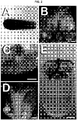
- Fig. 1D On the seventh day from seed plating, the first pair of true leaves were fully expanded ( Fig. 1D ). When seedlings arrived to this developmental stage, explants needed to continue the experiments were dissected. At this stage of seedling development, cotyledons were easily dissected ( Fig. 2A ). Some cotyledons did not respond to any of the studied treatments. After two weeks of exposure to the culture medium, non-responding cotyledons acquired a brown coloration and, some of them, developed non-organogenic green calli ( Fig. 2B ), which were unable to regenerate shoots even after being maintained for one month in culture. On the other hand, the first steps of direct shoot organogenesis were rapidly visible on the basal zone of responding cotyledons.
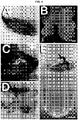
- hypocotyls were cut from seven-days-old seedlings. Hypocotyls employed in this experiment measured approximately one centimeter in height ( Fig. 3A ). Transversal section of freshly dissected hypocotyls revealed its internal structure, with different tissue layers such as epidermis, cortex and pith ( Fig. 3B ). Non-responding hypocotyls showed oxidation signs on its top after two weeks of in vitro culture (arrow in Fig. 3C ). On the other hand, responding explants exhibited different direct organogenesis patterns. Some of the hypocotyls generated only one primordium on the top of the explant which was originated from the central region of the section ( Fig.
- regenerants After spontaneous rooting of in vitro regenerants, these plantlets were submitted to the acclimatization process. The first step consisted of carefully washing the remaining gellified medium from roots. After 28 days of in vitro culture, regenerants showed different root morphogenesis patterns as illustrated in Fig. 7A , where long, medium and short size roots can be visualized, together with a robust main root with a prominent development of secondary roots. Vigorous development of the radicular system guaranteed successful acclimatization of in vitro regenerated plants. At this point, regenerants were ready for transplant in small pots (2 L) with fertilized commercial substrate ( Fig. 7B ), although placement of transparent plastic vessels was necessary to retain humidity and avoid desiccation of plants ( Fig. 7C ).
- in vitro regenerated plants displayed a vigorous growth, as can be observed in Fig. 7D , where a healthy regenerant stands out six weeks after culture of hypocotyls.
- acclimatized plants were grown during two additional weeks and were manually pollinated.
- in vitro regenerated plants showed sexual functionality eight weeks after in vitro explant inoculation, as can be deducted from the fact that female flowers developed viable seeds after manual pollination (insets in Fig. 7E ). Following this protocol, 100% of in vitro regenerated plants spontaneously rooted were successfully acclimatized.
- Example 4 Determination of ploidy level of explants and in vitro regenerants
- Ploidy level of cotyledons, hypocotyls, epicotyls and leaves from in vitro grown seven-days-old seedlings was evaluated to verify their polysomatic pattern.
- the four short-day varieties Ferimon, Felina32, Fedora17 and USO31, together with dioecious neutral-day variety Finola were analyzed in this experiment. Three seedlings coming from each variety were employed for this assay.
- young leaves from in vitro regenerated plants were also examined.
- Ploidy level of 38 in vitro regenerants (17 from cotyledons, 15 from hypocotyls, three from epicotyls and three from leaves) was determined. Cell nuclei of explants dissected were mechanically isolated.
- Sections of approximately 0.5 cm 2 were chopped with a razor blade in a 6 cm diameter glass Petri dish containing 0.5 ml lysis buffer LB01 (pH 7.5) (Dpoole ⁇ el et a / . , 1989), and incubated for 5 minutes. Subsequently, the suspension containing nuclei and cell fragments was filtered using a 30 ⁇ m CellTrics filter (Sysmex, Sant Just Desvern, Spain). The nuclei in the filtrate were stained with CyStain UV Ploidy (Sysmex) and incubated for 5 minutes.
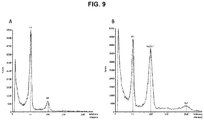
- the fluorescence intensity of the homogenate was measured using a CyFlow® Ploidy Analyser Sysmex Partec GmbH, analyzing at least 4,000 nuclei for each sample. Young leaves of diploid plants from all varieties studied were used as control. A diploid control peak was established at 50 points of the arbitrary intensity value of the fluorescence in the histogram. By comparison with this peak, the ploidy of the other tissues evaluated was checked.
- a total of 38 in vitro regenerated plants (17 from cotyledons, 15 from hypocotyls, three from epicotyls and three from leaves) were analyzed by means of flow cytometry at 28 days after tissue culture initiation. Only diploid and mixoploid plants (with diploid and tetraploid cells) were obtained. Differences in nuclear DNA histogram patterns between diploid ( Fig. 9A ) and mixoploid ( Fig. 9B ) plants are represented in a flow cytometry histogram ( Fig. 9 ). As illustrated in Table 9 (see below), no significant differences were identified between cotyledon, hypocotyl and epicotyl-derived plants in terms of polyploidization of in vitro regenerants.
Landscapes
- Life Sciences & Earth Sciences (AREA)
- Developmental Biology & Embryology (AREA)
- Environmental Sciences (AREA)
- Botany (AREA)
- Health & Medical Sciences (AREA)
- Engineering & Computer Science (AREA)
- Biotechnology (AREA)
- Cell Biology (AREA)
- Physiology (AREA)
- Natural Medicines & Medicinal Plants (AREA)
- Breeding Of Plants And Reproduction By Means Of Culturing (AREA)
- Micro-Organisms Or Cultivation Processes Thereof (AREA)
- Medicines Containing Plant Substances (AREA)
Priority Applications (8)
| Application Number | Priority Date | Filing Date | Title |
|---|---|---|---|
| EP19383210.2A EP3841872A1 (de) | 2019-12-28 | 2019-12-28 | In-vitro-direkterzeugung von polyploiden cannabispflanzen |
| EP20839330.6A EP4057801A1 (de) | 2019-12-28 | 2020-12-23 | In-vitro-direkterzeugung von polyploiden cannabispflanzen |
| US17/789,347 US20230044740A1 (en) | 2019-12-28 | 2020-12-23 | In vitro direct regeneration of polyploid cannabis plants |
| AU2020412316A AU2020412316A1 (en) | 2019-12-28 | 2020-12-23 | In vitro direct regeneration of polyploid Cannabis plants |
| IL294312A IL294312A (en) | 2019-12-28 | 2020-12-23 | In vitro direct regeneration of polyploid cannabis plants |
| PCT/EP2020/087829 WO2021130342A1 (en) | 2019-12-28 | 2020-12-23 | In vitro direct regeneration of polyploid cannabis plants |
| CA3162457A CA3162457A1 (en) | 2019-12-28 | 2020-12-23 | In vitro direct regeneration of polyploid cannabis plants |
| CONC2022/0008762A CO2022008762A2 (es) | 2019-12-28 | 2022-06-23 | Regeneración directa in vitro de plantas de cannabis poliploides |
Applications Claiming Priority (1)
| Application Number | Priority Date | Filing Date | Title |
|---|---|---|---|
| EP19383210.2A EP3841872A1 (de) | 2019-12-28 | 2019-12-28 | In-vitro-direkterzeugung von polyploiden cannabispflanzen |
Publications (1)
| Publication Number | Publication Date |
|---|---|
| EP3841872A1 true EP3841872A1 (de) | 2021-06-30 |
Family
ID=69167598
Family Applications (2)
| Application Number | Title | Priority Date | Filing Date |
|---|---|---|---|
| EP19383210.2A Withdrawn EP3841872A1 (de) | 2019-12-28 | 2019-12-28 | In-vitro-direkterzeugung von polyploiden cannabispflanzen |
| EP20839330.6A Withdrawn EP4057801A1 (de) | 2019-12-28 | 2020-12-23 | In-vitro-direkterzeugung von polyploiden cannabispflanzen |
Family Applications After (1)
| Application Number | Title | Priority Date | Filing Date |
|---|---|---|---|
| EP20839330.6A Withdrawn EP4057801A1 (de) | 2019-12-28 | 2020-12-23 | In-vitro-direkterzeugung von polyploiden cannabispflanzen |
Country Status (7)
| Country | Link |
|---|---|
| US (1) | US20230044740A1 (de) |
| EP (2) | EP3841872A1 (de) |
| AU (1) | AU2020412316A1 (de) |
| CA (1) | CA3162457A1 (de) |
| CO (1) | CO2022008762A2 (de) |
| IL (1) | IL294312A (de) |
| WO (1) | WO2021130342A1 (de) |
Families Citing this family (1)
| Publication number | Priority date | Publication date | Assignee | Title |
|---|---|---|---|---|
| CN116849128B (zh) * | 2023-08-23 | 2024-06-28 | 金陵科技学院 | 一种苏崎茄同源四倍体植株花药培养方法 |
Citations (6)
| Publication number | Priority date | Publication date | Assignee | Title |
|---|---|---|---|---|
| US20180258439A1 (en) | 2015-05-28 | 2018-09-13 | Tweed, Inc. | Cannabis plants having modified expression of thca synthase |
| WO2019006470A1 (en) | 2017-06-30 | 2019-01-03 | Booshoot Llc | MEDIA FOR RAPID AND RELIABLE TISSUE CULTURE OF PLANTS |
| WO2019006466A1 (en) | 2017-06-30 | 2019-01-03 | Booshoot Llc | COMPOSITIONS AND METHODS FOR BIOCULTURE OF LARGE SCALE IN VITRO PLANTS |
| US20190230882A1 (en) | 2016-05-27 | 2019-08-01 | New West Genetics | Industrial hemp cannabis cultivars and seeds with stable cannabinoid profiles |
| US20190289804A1 (en) | 2018-03-21 | 2019-09-26 | Canopy Growth Corporation | Methods for inducing polyploidy in cannabis |
| WO2019217843A1 (en) * | 2018-05-11 | 2019-11-14 | Front Range Biosciences, Inc. | Systems, methods and kits for micropropagation of cannabis |
-
2019
- 2019-12-28 EP EP19383210.2A patent/EP3841872A1/de not_active Withdrawn
-
2020
- 2020-12-23 IL IL294312A patent/IL294312A/en unknown
- 2020-12-23 WO PCT/EP2020/087829 patent/WO2021130342A1/en not_active Ceased
- 2020-12-23 EP EP20839330.6A patent/EP4057801A1/de not_active Withdrawn
- 2020-12-23 AU AU2020412316A patent/AU2020412316A1/en not_active Abandoned
- 2020-12-23 US US17/789,347 patent/US20230044740A1/en not_active Abandoned
- 2020-12-23 CA CA3162457A patent/CA3162457A1/en active Pending
-
2022
- 2022-06-23 CO CONC2022/0008762A patent/CO2022008762A2/es unknown
Patent Citations (7)
| Publication number | Priority date | Publication date | Assignee | Title |
|---|---|---|---|---|
| US20180258439A1 (en) | 2015-05-28 | 2018-09-13 | Tweed, Inc. | Cannabis plants having modified expression of thca synthase |
| US20190230882A1 (en) | 2016-05-27 | 2019-08-01 | New West Genetics | Industrial hemp cannabis cultivars and seeds with stable cannabinoid profiles |
| WO2019006470A1 (en) | 2017-06-30 | 2019-01-03 | Booshoot Llc | MEDIA FOR RAPID AND RELIABLE TISSUE CULTURE OF PLANTS |
| WO2019006466A1 (en) | 2017-06-30 | 2019-01-03 | Booshoot Llc | COMPOSITIONS AND METHODS FOR BIOCULTURE OF LARGE SCALE IN VITRO PLANTS |
| US20190289804A1 (en) | 2018-03-21 | 2019-09-26 | Canopy Growth Corporation | Methods for inducing polyploidy in cannabis |
| WO2019178680A1 (en) * | 2018-03-21 | 2019-09-26 | Canopy Growth Corporation | Methods for inducing polyploidy in cannabis |
| WO2019217843A1 (en) * | 2018-05-11 | 2019-11-14 | Front Range Biosciences, Inc. | Systems, methods and kits for micropropagation of cannabis |
Non-Patent Citations (51)
| Title |
|---|
| "Protocols for In Vitro Cultures and Secondary Metabolite Analysis of Aromatic and Medicinal Plants, Second Edition", 1 January 2016, NEW YORK, NY : HUMANA PRESS, US, ISBN: 978-1-4939-3332-7, article LATA HEMANT ET AL: "In Vitro Propagation of Cannabis sativa L. and Evaluation of Regenerated Plants for Genetic Fidelity and Cannabinoids Content for Quality Assurance | SpringerLink", pages: 275 - 288, XP055597325, DOI: 10.1007/978-1-4939-3332-7_19 * |
| ADELBERG, J. W.RHODES, BILL B.SKORUPSKA, H. T.: "Generating tetraploid melons in tissue culture", ACTA HORTIC., vol. 336, 1993, pages 373 - 380 |
| ANDRE, C. M.HAUSMAN, J. F.GUERRIERO, G.: "Cannabis sativa: The plant of the thousand and one molecules", FRONT. PLANT SCI., vol. 7, 2016, XP055581704, DOI: 10.3389/fpls.2016.00019 |
| BAGHERI MAHSA ET AL: "Effect of Induced Polyploidy on Some Biochemical Parameters inCannabis sativaL", APPLIED BIOCHEMISTRY AND BIOTECHNOLOGY, HUMANA PRESS INC, NEW YORK, vol. 175, no. 5, 10 December 2014 (2014-12-10), pages 2366 - 2375, XP035460813, ISSN: 0273-2289, [retrieved on 20141210], DOI: 10.1007/S12010-014-1435-8 * |
| BECK, E. H.: "Regulation of shoot/root ratio by cytokinins from roots in Urtica dioica: Opinion", PLANT SOIL, vol. 185, 1996, pages 3 - 12 |
| BEECKMAN, T.DE SMET, I.: "Pericycle", CURR. BIOL., vol. 24, 2014, pages R378 - R379, XP029025716, DOI: 10.1016/j.cub.2014.03.031 |
| BEHR, M.LEGAY, S.ZIZKOVA, E.MOTYKA, V.DOBREV, P. I.HAUSMAN, J. F. ET AL.: "Studying secondary growth and bast fiber development: The hemp hypocotyl peeks behind the wall", FRONT. PLANT SCI., vol. 7, 2016 |
| BRESLAVETZ, L.: "Polyploide Mitosen bei Cannabis sativa L", BER. DEUTSCH. BOT. GES., vol. 44, 1926, pages 498 - 502 |
| BRESLAVETZ, L.: "Polyploide Mitosen bei Cannabis sativa L. II", BER. DEUTSCH. BOT. GES., vol. 17, 1932, pages 644 - 649 |
| BUBNER, B.GASE, K.BERGER, B.LINK, D.BALDWIN, I. T.: "Occurrence of tetraploidy in Nicotiana attenuata plants after Agrobacterium-mediated transformation is genotype specific but independent of polysomaty of explant tissue", PLANT CELL REP., vol. 25, 2006, pages 668 - 675, XP019423723, DOI: 10.1007/s00299-005-0111-4 |
| CHAOHUA, C.GONGGU, Z.LINING, Z.CHUNSHENG, G.QING, T.JIANHUA, C. ET AL.: "A rapid shoot regeneration protocol from the cotyledons of hemp (Cannabis sativa L.", IND. CROPS 597 PROD., vol. 83, 2016, pages 61 - 65, XP055564196, DOI: 10.1016/j.indcrop.2015.12.035 |
| CHENG CHAOHUA ET AL: "A rapid shoot regeneration protocol from the cotyledons of hemp (Cannabis sativa L.)", INDUSTRIAL CROPS AND PRODUCTS., vol. 83, 1 May 2016 (2016-05-01), NL, pages 61 - 65, XP055564196, ISSN: 0926-6690, DOI: 10.1016/j.indcrop.2015.12.035 * |
| CLARKE, R. C.: "Marijuana Botany: An Advanced Study: The Propagation and Breeding of Distinctive Cannabis", 1981, RONIN PUBLISHING, article "The genetics and breeding of Cannabis", pages: 27 - 59 |
| D'AMATO, F.: "Endopolyploidy as a Factor in Plant Tissue Development", CARYOLOGIA, vol. 17, 1964, pages 41 - 52 |
| D'AMATO, F.: "Polyploidy in the differentiation and function of tissues and cells in plants", CARYOLOGIA, vol. 4, 1952, pages 311 - 358 |
| DPOOLEZEL, J.BINAROVA, P.LCRETTI, S.: "Analysis of Nuclear DNA content in plant cells by Flow cytometry", BIOL. PLANT., vol. 31, 1989, pages 113 - 120 |
| ERVIN, C. D.: "A study of polysomaty in Cucumis melo", AM. J. BOT., vol. 28, 1941, pages 113 - 124 |
| FEENEY, M.PUNJA, Z. K.: "Hemp (Cannabis sativa L.", METHODS MOL. BIOL., vol. 1224, 2015, pages 319 - 329 |
| FEENEY, M.PUNJA, Z. K.: "Tissue culture and Agrobacterium-mediated transformation of hemp (Cannabis sativa L.", VITR. CELL. DEV. BIOL. - PLANT, vol. 39, 2003, pages 578 - 585, XP055332883, DOI: 10.1079/IVP2003454 |
| GARCIA-FORTEA, E.LLUCH-RUIZ, A.PINEDA-CHAZA, B.GARCIA-PEREZ, A.BRACHO-GIL, J. P.PLAZAS, M. ET AL.: "Development of a new highly efficient organogenesis protocol in eggplant (Solanum melongena) and evaluation of the ploidy level", 17TH EUCARPIA GENET. BREED. CAPSICUM EGGPLANT, 2019 |
| HEMANT LATA ET AL: "Thidiazuron-induced high-frequency direct shoot organogenesis of Cannabis sativa L.", IN VITRO CELLULAR & DEVELOPMENT BIOLOGY. PLANT, vol. 45, no. 1, 27 November 2008 (2008-11-27), US, pages 12 - 19, XP055669862, ISSN: 1054-5476, DOI: 10.1007/s11627-008-9167-5 * |
| HEMPHILL, J. K.TURNER, J. C.MAHLBERG, P. G.: "Studies on growth and cannabinoid composition of callus derived from different strains of Cannabis sativa", LLOYDIA, vol. 41, 1978, pages 453 - 462 |
| LANGLET, O.: "Zur Kenntnis der polysomatischen Zellkerne im Wurzelmeristem", SVEN. BOT. TIDSKR., vol. 21, 1927, pages 397 - 422 |
| LANNICELLI, J.GUARINIELLO, J.TOSSI, V. E.REGALADO, J. J.DI CIACCIO, L.VAN BAREN, C. M. ET AL.: "The ''polyploid effect'' in the breeding of aromatic and medicinal species", SCI. HORTIC. (AMSTERDAM, vol. 260, 2019, pages 108854, XP085875083, DOI: 10.1016/j.scienta.2019.108854 |
| LATA H ET AL: "In vitro mass propagation of Cannabis sativa L.: A protocol refinement using novel aromatic cytokinin meta-topolin and the assessment of eco-physiological, biochemical and genetic fidelity of micropropagated plants", JOURNAL OF APPLIED RESEARCH ON MEDICINAL AND AROMATIC PLANTS 20160301 ELSEVIER GMBH DEU,, vol. 3, no. 1, 1 March 2016 (2016-03-01), pages 18 - 26, XP002792252, ISSN: 2214-7861, DOI: 10.1016/J.JARMAP.2015.12.001 * |
| LATA, H.CHANDRA, S.KHAN, I. A.ELSOHLY, M. A.: "Cannabis sativa L. - Botany and Biotechnology", 2017, SPRINGER INTERNATIONAL PUBLISHING, article "The role of Agrobacterium-mediated and other gene-transfer technologies in cannabis research and product development", pages: 299 - 317 |
| LATA, H.CHANDRA, S.KHAN, I. A.ELSOHLY, M. A.: "High frequency plant regeneration from leaf derived callus of high A9-tetrahydrocannabinol yielding Cannabis sativa L", PLANTA 29. MED., vol. 76, 2010, pages 1629 - 1633, XP055332886, DOI: 10.1055/s-0030-1249773 |
| LATA, H.CHANDRA, S.KHAN, I. A.ELSOHLY, M. A.: "Thidiazuron induced high-frequency direct shoot organogenesis of Cannabis sativa L", VITR. CELL. DEV. BIOL. - PLANT, vol. 45, no. 1, 2009, pages 12 - 19 |
| LITARDIERE, R. D.: "Sur I'existence de figures didiploides dans le meristeme radiculaire du Cannabis sativa L", CELLULE, vol. 35, 1925, pages 21 - 25 |
| LUSARKIEWICZ-JARZINA, A. S.PONITKA, A.KACZMAREK, Z., INFLUENCE OF CULTIVAR, EXPLANT SOURCE AND PLANT GROWTH REGULATOR ON CALLUS INDUCTION AND PLANT REGENERATION OF CANNABIS SATIVA L, 2005 |
| MANDOLINO, G.RANALLI, P.: "Advances in Hemp Research", 1999, CRC PRESS, article "Advances in Biotechnological Approaches for Hemp Breeding and Industry", pages: 185 - 212 |
| MANSOURI, H.BAGHERI, M.: "Induction of Polyploidy and Its Effect on Cannabis sativa L.", CANNABIS SATIVA L. - BOTANY AND BIOTECHNOLOGY, 2017 |
| MEHDI MOVAHEDI ET AL: "The effect of different concentrations of TDZ and BA on in vitro regeneration of Iranian cannabis (Cannabis sativa) using cotyledon and epicotyl explants", JOURNAL OF PLANT MOLECULAR BREEDING, vol. 3, no. 2, 1 December 2015 (2015-12-01), pages 20 - 27, XP055697967 * |
| MILLER, R. H.: "Morphology of Humulus lupulus. II. Secondary growth in the root and seedling vascularization", AM. J. BOT., vol. 46, 1959, pages 269 - 277 |
| MISHCHENKO, S.MOKHER, J.LAIKO, I.BURBULIS, N.KYRYCHENKO, H.DUDUKOVA, S.: "Phenological growth stages of hemp (Cannabis sativa L.): codification and description according to the BBCH scale", ZEMES UKIO MOKSL, vol. 24, 2017 |
| MOVAHEDI, M.GHASEMI-OMRAN, V. O.TORABI, S., IN VITRO CALLUS INDUCTION AND REGENERATION OF MEDICINAL PLANT CANNABIS SATIVA L, vol. 32, 2016, pages 758 - 769 |
| MOVAHEDI, M.GHASEMI-OMRAN, V. O.TORABI, S., THE EFFECT OF DIFFERENT CONCENTRATIONS OF TDZ AND BA ON IN VITRO REGENERATION OF IRANIAN CANNABIS (CANNABIS SATIVA L.) USING COTYLEDON AND EPICOTYL EXPLANTS, vol. 3, 2015, pages 20 - 27 |
| MOVAHEDI, M.GHASEMIOMRAN, V.TORABI, S.: "Effect of explants type and plant growth regulators on in vitro callus induction and shoot regeneration of Cannabis sativa L", IRAN. J. 31 MED. AROMAT. PLANTS, vol. 32, 2016, pages 83 - 96 |
| MURASHIGE, T.SKOOG, F.: "A revised medium for rapid growth and bio assays with tobacco tissue cultures", PHYSIOL PLANT, vol. 15, 1962, pages 473 - 479 |
| PARSONS, J. L.MARTIN, S. L.JAMES, T.GOLENIA, G.BOUDKO, E. A.HEPWORTH, S. R.: "Polyploidization for the genetic improvement of Cannabis sativa", FRONT. PLANT SCI., vol. 10, 2019 |
| PLAWUSZEWSKI, M.LASSOCINSKI, W.WIELGUS, K.: "Regeneration of Polish cultivars of monoecious hemp (Cannabis sativa L.) grown in in vitro cultures", RENEWABLE RESOURCES AND PLANT BIOTECHNOLOGY, 2006, pages 149 - 154 |
| RAMSAY, G.KUMAR, A.: "Transformation of Vicia faba cotyledon and stem tissues by Agrobacterium rhizogenes: Infectivity and cytological studies", J. EXP. BOT., vol. 41, 1990, pages 841 - 847 |
| RICHEZ-DUMANOIS, C.BRAUT-BOUCHER, F.COSSON, L.PARIS, M.: "Multiplication vegetative in vitro du chanvre (Cannabis sativa L.). Application a la conservation des clones selectionnes", AGRON. EDP SCI., vol. 6, no. 5, 1986, pages 487 - 495 |
| SKOOG, F.MILLER, C. O.: "Chemical regulation of growth and organ formation in plant tissues cultured in vitro", SYMP. SOC. EXP. BIOL., vol. 11, 1957, pages 118 - 30 |
| SMÝKALOVÁ IVA ET AL: "The effects of novel synthetic cytokinin derivatives and endogenous cytokinins on the in vitro growth responses of hemp (L.) explants", PLANT CELL, TISSUE AND ORGAN CULTURE, SPRINGER, NL, vol. 139, no. 2, 11 September 2019 (2019-09-11), pages 381 - 394, XP036901489, ISSN: 0167-6857, [retrieved on 20190911], DOI: 10.1007/S11240-019-01693-5 * |
| TANIMOTO, S.HARADA, H.: "Roles of Auxin and Cytokinin in Organogenesis in Torenia Stem Segments Cultured in vitro", J. PLANT PHYSIOL., vol. 115, 1984, pages 11 - 18 |
| URITS, I.BORCHART, M.HASEGAWA, M.KOCHANSKI, J.ORHURHU, V.VISWANATH, O.: "An Update of Current Cannabis-Based Pharmaceuticals in Pain Medicine", PAIN THER., vol. 8, 2019, pages 41 - 51 |
| VAN HIEU, P.: "Polyploid Gene Expression and Regulation in Polysomic Polyploids", AM. J. PLANT SCI., vol. 10, 2019, pages 1409 - 1443 |
| WANG REN ET AL: "A MICROPROPAGATION SYSTEM FOR CLONING OF HEMP (CANNABIS SATIVA L.) BY SHOOT TIP CULTURE", PAKISTAN JOURNAL OF BOTANY, PAKISTAN BOTANICAL SOCIETY, KARACHI, PK, vol. 41, no. 2, 31 March 2009 (2009-03-31), pages 603 - 608, XP009513973, ISSN: 0556-3321 * |
| WIELGUS, K.LUWANSKA, A.LASSOCINSKI, W.KACZMAREK, Z.: "Estimation of Cannabis sativa L. tissue culture conditions essential for callus induction and plant regeneration", J. NAT. 758 FIBERS, vol. 5, 2008, pages 199 - 207 |
| WRÓBEL TOMASZ ET AL: "The application of plant in vitro cultures in cannabinoid production", BIOTECHNOLOGY LETTERS, KLUWER ACADEMIC PUBLISHERS, DORDRECHT, vol. 40, no. 3, 16 December 2017 (2017-12-16), pages 445 - 454, XP036460111, ISSN: 0141-5492, [retrieved on 20171216], DOI: 10.1007/S10529-017-2492-1 * |
Also Published As
| Publication number | Publication date |
|---|---|
| AU2020412316A1 (en) | 2022-07-21 |
| CO2022008762A2 (es) | 2022-07-19 |
| US20230044740A1 (en) | 2023-02-09 |
| WO2021130342A1 (en) | 2021-07-01 |
| EP4057801A1 (de) | 2022-09-21 |
| CA3162457A1 (en) | 2021-07-01 |
| IL294312A (en) | 2022-08-01 |
Similar Documents
| Publication | Publication Date | Title |
|---|---|---|
| Galán-Ávila et al. | Development of a direct in vitro plant regeneration protocol from Cannabis sativa L. seedling explants: developmental morphology of shoot regeneration and ploidy level of regenerated plants | |
| Huy et al. | In vitro polyploid induction of Paphiopedilum villosum using colchicine | |
| Agrawal et al. | Plant regeneration in tissue cultures of pepper (Capsicum annuum L. cv. Mathania) | |
| Kuksova et al. | Somaclonal variation and in vitro induced mutagenesis in grapevine | |
| Thomas et al. | Production of triploid plants of mulberry (Morus alba L) by endosperm culture | |
| Wann | Somatic embryogenesis in woody species | |
| Naing et al. | Factors influencing in vitro shoot regeneration from leaf segments of Chrysanthemum | |
| Kulkarni et al. | In vitro mutagenesis in banana (Musa spp.) using gamma irradiation | |
| Hapsoro et al. | In vitro somatic embryogenesis of superior clones of robusta coffee from Lampung, Indonesia: Effect of genotypes and callus induction media | |
| Wang et al. | Establishment of a direct somatic embryogenesis regeneration system using immature cotyledon explants in Camellia sinensis cv. Shuchazao | |
| Lin et al. | In vitro flowering of green and albino Dendrocalamus latiflorus | |
| Kunitake et al. | Somaclonal and chromosomal effects of genotype, ploidy and culture duration in Asparagus officinalis L. | |
| US5312801A (en) | Somatic embryogenesis and plant regeneration of cacao | |
| Hazarika et al. | In vitro haploid production—a fast and reliable approach for crop improvement | |
| Singh et al. | In vitro regeneration and improvement in tropical fruit trees: an assessment | |
| EP3841872A1 (de) | In-vitro-direkterzeugung von polyploiden cannabispflanzen | |
| Radojević et al. | Induction of haploids | |
| Wan et al. | Optimization of microspore embryogenesis and plant regeneration protocols for Brassica napus. | |
| Neumann et al. | Plant propagation: meristem cultures, somatic embryogenesis micropropagation, and transformation of somatic embryos in bioreactors | |
| Attree et al. | White spruce [Picea glauca (Moench) Voss] and black spruce [Picea mariana (Mill) BSP] | |
| Srivastava et al. | In vitro organogenesis and plant regeneration from unpollinated ovary cultures of Azadirachta indica | |
| Leike | Cabbage (Brassica oleracea var. capitata L.) | |
| Jevremovic et al. | In vitro morphogenesis of dwarf irises | |
| Jha et al. | Tissue culture of cashewnut | |
| Vani et al. | Micropropagation and In Vitro Studies in Hedychium J. Koenig (Zingiberaceae) |
Legal Events
| Date | Code | Title | Description |
|---|---|---|---|
| PUAI | Public reference made under article 153(3) epc to a published international application that has entered the european phase |
Free format text: ORIGINAL CODE: 0009012 |
|
| STAA | Information on the status of an ep patent application or granted ep patent |
Free format text: STATUS: THE APPLICATION HAS BEEN PUBLISHED |
|
| AK | Designated contracting states |
Kind code of ref document: A1 Designated state(s): AL AT BE BG CH CY CZ DE DK EE ES FI FR GB GR HR HU IE IS IT LI LT LU LV MC MK MT NL NO PL PT RO RS SE SI SK SM TR |
|
| STAA | Information on the status of an ep patent application or granted ep patent |
Free format text: STATUS: REQUEST FOR EXAMINATION WAS MADE |
|
| 17P | Request for examination filed |
Effective date: 20211216 |
|
| RBV | Designated contracting states (corrected) |
Designated state(s): AL AT BE BG CH CY CZ DE DK EE ES FI FR GB GR HR HU IE IS IT LI LT LU LV MC MK MT NL NO PL PT RO RS SE SI SK SM TR |
|
| STAA | Information on the status of an ep patent application or granted ep patent |
Free format text: STATUS: EXAMINATION IS IN PROGRESS |
|
| 17Q | First examination report despatched |
Effective date: 20220921 |
|
| STAA | Information on the status of an ep patent application or granted ep patent |
Free format text: STATUS: THE APPLICATION IS DEEMED TO BE WITHDRAWN |
|
| 18D | Application deemed to be withdrawn |
Effective date: 20240612 |