EP3841991A1 - Laparoskopisches instrument - Google Patents
Laparoskopisches instrument Download PDFInfo
- Publication number
- EP3841991A1 EP3841991A1 EP20213158.7A EP20213158A EP3841991A1 EP 3841991 A1 EP3841991 A1 EP 3841991A1 EP 20213158 A EP20213158 A EP 20213158A EP 3841991 A1 EP3841991 A1 EP 3841991A1
- Authority
- EP
- European Patent Office
- Prior art keywords
- handgrip
- lever
- latching mechanism
- actuators
- instrument
- Prior art date
- Legal status (The legal status is an assumption and is not a legal conclusion. Google has not performed a legal analysis and makes no representation as to the accuracy of the status listed.)
- Granted
Links
Images


Classifications
-
- A—HUMAN NECESSITIES
- A61—MEDICAL OR VETERINARY SCIENCE; HYGIENE
- A61B—DIAGNOSIS; SURGERY; IDENTIFICATION
- A61B17/00—Surgical instruments, devices or methods
- A61B17/28—Surgical forceps
- A61B17/29—Forceps for use in minimally invasive surgery
- A61B17/2909—Handles
-
- A—HUMAN NECESSITIES
- A61—MEDICAL OR VETERINARY SCIENCE; HYGIENE
- A61B—DIAGNOSIS; SURGERY; IDENTIFICATION
- A61B17/00—Surgical instruments, devices or methods
- A61B17/00234—Surgical instruments, devices or methods for minimally invasive surgery
-
- A—HUMAN NECESSITIES
- A61—MEDICAL OR VETERINARY SCIENCE; HYGIENE
- A61B—DIAGNOSIS; SURGERY; IDENTIFICATION
- A61B17/00—Surgical instruments, devices or methods
- A61B17/12—Surgical instruments, devices or methods for ligaturing or otherwise compressing tubular parts of the body, e.g. blood vessels or umbilical cord
- A61B17/128—Surgical instruments, devices or methods for ligaturing or otherwise compressing tubular parts of the body, e.g. blood vessels or umbilical cord for applying or removing clamps or clips
- A61B17/1285—Surgical instruments, devices or methods for ligaturing or otherwise compressing tubular parts of the body, e.g. blood vessels or umbilical cord for applying or removing clamps or clips for minimally invasive surgery
-
- A—HUMAN NECESSITIES
- A61—MEDICAL OR VETERINARY SCIENCE; HYGIENE
- A61B—DIAGNOSIS; SURGERY; IDENTIFICATION
- A61B17/00—Surgical instruments, devices or methods
- A61B17/28—Surgical forceps
- A61B17/29—Forceps for use in minimally invasive surgery
-
- A—HUMAN NECESSITIES
- A61—MEDICAL OR VETERINARY SCIENCE; HYGIENE
- A61B—DIAGNOSIS; SURGERY; IDENTIFICATION
- A61B17/00—Surgical instruments, devices or methods
- A61B17/32—Surgical cutting instruments
- A61B17/3201—Scissors
-
- A—HUMAN NECESSITIES
- A61—MEDICAL OR VETERINARY SCIENCE; HYGIENE
- A61B—DIAGNOSIS; SURGERY; IDENTIFICATION
- A61B18/00—Surgical instruments, devices or methods for transferring non-mechanical forms of energy to or from the body
- A61B18/04—Surgical instruments, devices or methods for transferring non-mechanical forms of energy to or from the body by heating
- A61B18/12—Surgical instruments, devices or methods for transferring non-mechanical forms of energy to or from the body by heating by passing a current through the tissue to be heated, e.g. high-frequency current
- A61B18/14—Probes or electrodes therefor
- A61B18/1442—Probes having pivoting end effectors, e.g. forceps
- A61B18/1445—Probes having pivoting end effectors, e.g. forceps at the distal end of a shaft, e.g. forceps or scissors at the end of a rigid rod
-
- A—HUMAN NECESSITIES
- A61—MEDICAL OR VETERINARY SCIENCE; HYGIENE
- A61B—DIAGNOSIS; SURGERY; IDENTIFICATION
- A61B18/00—Surgical instruments, devices or methods for transferring non-mechanical forms of energy to or from the body
- A61B18/04—Surgical instruments, devices or methods for transferring non-mechanical forms of energy to or from the body by heating
- A61B18/12—Surgical instruments, devices or methods for transferring non-mechanical forms of energy to or from the body by heating by passing a current through the tissue to be heated, e.g. high-frequency current
- A61B18/14—Probes or electrodes therefor
- A61B18/1482—Probes or electrodes therefor having a long rigid shaft for accessing the inner body transcutaneously in minimal invasive surgery, e.g. laparoscopy
-
- A—HUMAN NECESSITIES
- A61—MEDICAL OR VETERINARY SCIENCE; HYGIENE
- A61B—DIAGNOSIS; SURGERY; IDENTIFICATION
- A61B18/00—Surgical instruments, devices or methods for transferring non-mechanical forms of energy to or from the body
- A61B18/04—Surgical instruments, devices or methods for transferring non-mechanical forms of energy to or from the body by heating
- A61B18/12—Surgical instruments, devices or methods for transferring non-mechanical forms of energy to or from the body by heating by passing a current through the tissue to be heated, e.g. high-frequency current
- A61B18/14—Probes or electrodes therefor
- A61B18/16—Indifferent or passive electrodes for grounding
-
- A—HUMAN NECESSITIES
- A61—MEDICAL OR VETERINARY SCIENCE; HYGIENE
- A61B—DIAGNOSIS; SURGERY; IDENTIFICATION
- A61B17/00—Surgical instruments, devices or methods
- A61B17/08—Wound clamps or clips, i.e. not or only partly penetrating the tissue ; Devices for bringing together the edges of a wound
-
- A—HUMAN NECESSITIES
- A61—MEDICAL OR VETERINARY SCIENCE; HYGIENE
- A61B—DIAGNOSIS; SURGERY; IDENTIFICATION
- A61B17/00—Surgical instruments, devices or methods
- A61B17/10—Surgical instruments, devices or methods for applying or removing wound clamps, e.g. containing only one clamp or staple; Wound clamp magazines
-
- A—HUMAN NECESSITIES
- A61—MEDICAL OR VETERINARY SCIENCE; HYGIENE
- A61B—DIAGNOSIS; SURGERY; IDENTIFICATION
- A61B17/00—Surgical instruments, devices or methods
- A61B17/00234—Surgical instruments, devices or methods for minimally invasive surgery
- A61B2017/00238—Type of minimally invasive operation
- A61B2017/00265—Hand assisted surgery, i.e. minimally invasive surgery with at least part of an assisting hand inside the body
-
- A—HUMAN NECESSITIES
- A61—MEDICAL OR VETERINARY SCIENCE; HYGIENE
- A61B—DIAGNOSIS; SURGERY; IDENTIFICATION
- A61B17/00—Surgical instruments, devices or methods
- A61B2017/0042—Surgical instruments, devices or methods with special provisions for gripping
- A61B2017/00424—Surgical instruments, devices or methods with special provisions for gripping ergonomic, e.g. fitting in fist
-
- A—HUMAN NECESSITIES
- A61—MEDICAL OR VETERINARY SCIENCE; HYGIENE
- A61B—DIAGNOSIS; SURGERY; IDENTIFICATION
- A61B17/00—Surgical instruments, devices or methods
- A61B17/28—Surgical forceps
- A61B17/2812—Surgical forceps with a single pivotal connection
- A61B17/2833—Locking means
- A61B2017/2837—Locking means with a locking ratchet
-
- A—HUMAN NECESSITIES
- A61—MEDICAL OR VETERINARY SCIENCE; HYGIENE
- A61B—DIAGNOSIS; SURGERY; IDENTIFICATION
- A61B17/00—Surgical instruments, devices or methods
- A61B17/28—Surgical forceps
- A61B17/29—Forceps for use in minimally invasive surgery
- A61B2017/2901—Details of shaft
- A61B2017/2902—Details of shaft characterized by features of the actuating rod
- A61B2017/2903—Details of shaft characterized by features of the actuating rod transferring rotary motion
-
- A—HUMAN NECESSITIES
- A61—MEDICAL OR VETERINARY SCIENCE; HYGIENE
- A61B—DIAGNOSIS; SURGERY; IDENTIFICATION
- A61B17/00—Surgical instruments, devices or methods
- A61B17/28—Surgical forceps
- A61B17/29—Forceps for use in minimally invasive surgery
- A61B17/2909—Handles
- A61B2017/2911—Handles rings
-
- A—HUMAN NECESSITIES
- A61—MEDICAL OR VETERINARY SCIENCE; HYGIENE
- A61B—DIAGNOSIS; SURGERY; IDENTIFICATION
- A61B17/00—Surgical instruments, devices or methods
- A61B17/28—Surgical forceps
- A61B17/29—Forceps for use in minimally invasive surgery
- A61B17/2909—Handles
- A61B2017/2912—Handles transmission of forces to actuating rod or piston
- A61B2017/2913—Handles transmission of forces to actuating rod or piston cams or guiding means
-
- A—HUMAN NECESSITIES
- A61—MEDICAL OR VETERINARY SCIENCE; HYGIENE
- A61B—DIAGNOSIS; SURGERY; IDENTIFICATION
- A61B17/00—Surgical instruments, devices or methods
- A61B17/28—Surgical forceps
- A61B17/29—Forceps for use in minimally invasive surgery
- A61B17/2909—Handles
- A61B2017/2912—Handles transmission of forces to actuating rod or piston
- A61B2017/2919—Handles transmission of forces to actuating rod or piston details of linkages or pivot points
- A61B2017/292—Handles transmission of forces to actuating rod or piston details of linkages or pivot points connection of actuating rod to handle, e.g. ball end in recess
-
- A—HUMAN NECESSITIES
- A61—MEDICAL OR VETERINARY SCIENCE; HYGIENE
- A61B—DIAGNOSIS; SURGERY; IDENTIFICATION
- A61B17/00—Surgical instruments, devices or methods
- A61B17/28—Surgical forceps
- A61B17/29—Forceps for use in minimally invasive surgery
- A61B17/2909—Handles
- A61B2017/2912—Handles transmission of forces to actuating rod or piston
- A61B2017/2923—Toothed members, e.g. rack and pinion
-
- A—HUMAN NECESSITIES
- A61—MEDICAL OR VETERINARY SCIENCE; HYGIENE
- A61B—DIAGNOSIS; SURGERY; IDENTIFICATION
- A61B17/00—Surgical instruments, devices or methods
- A61B17/28—Surgical forceps
- A61B17/29—Forceps for use in minimally invasive surgery
- A61B17/2909—Handles
- A61B2017/2925—Pistol grips
-
- A—HUMAN NECESSITIES
- A61—MEDICAL OR VETERINARY SCIENCE; HYGIENE
- A61B—DIAGNOSIS; SURGERY; IDENTIFICATION
- A61B17/00—Surgical instruments, devices or methods
- A61B17/28—Surgical forceps
- A61B17/29—Forceps for use in minimally invasive surgery
- A61B2017/2926—Details of heads or jaws
- A61B2017/2927—Details of heads or jaws the angular position of the head being adjustable with respect to the shaft
-
- A—HUMAN NECESSITIES
- A61—MEDICAL OR VETERINARY SCIENCE; HYGIENE
- A61B—DIAGNOSIS; SURGERY; IDENTIFICATION
- A61B17/00—Surgical instruments, devices or methods
- A61B17/28—Surgical forceps
- A61B17/29—Forceps for use in minimally invasive surgery
- A61B2017/2926—Details of heads or jaws
- A61B2017/2927—Details of heads or jaws the angular position of the head being adjustable with respect to the shaft
- A61B2017/2929—Details of heads or jaws the angular position of the head being adjustable with respect to the shaft with a head rotatable about the longitudinal axis of the shaft
-
- A—HUMAN NECESSITIES
- A61—MEDICAL OR VETERINARY SCIENCE; HYGIENE
- A61B—DIAGNOSIS; SURGERY; IDENTIFICATION
- A61B17/00—Surgical instruments, devices or methods
- A61B17/28—Surgical forceps
- A61B17/29—Forceps for use in minimally invasive surgery
- A61B2017/2926—Details of heads or jaws
- A61B2017/2931—Details of heads or jaws with releasable head
-
- A—HUMAN NECESSITIES
- A61—MEDICAL OR VETERINARY SCIENCE; HYGIENE
- A61B—DIAGNOSIS; SURGERY; IDENTIFICATION
- A61B17/00—Surgical instruments, devices or methods
- A61B17/28—Surgical forceps
- A61B17/29—Forceps for use in minimally invasive surgery
- A61B2017/2926—Details of heads or jaws
- A61B2017/2932—Transmission of forces to jaw members
- A61B2017/2939—Details of linkages or pivot points
-
- A—HUMAN NECESSITIES
- A61—MEDICAL OR VETERINARY SCIENCE; HYGIENE
- A61B—DIAGNOSIS; SURGERY; IDENTIFICATION
- A61B17/00—Surgical instruments, devices or methods
- A61B17/28—Surgical forceps
- A61B17/29—Forceps for use in minimally invasive surgery
- A61B2017/2926—Details of heads or jaws
- A61B2017/2932—Transmission of forces to jaw members
- A61B2017/2939—Details of linkages or pivot points
- A61B2017/294—Connection of actuating rod to jaw, e.g. releasable
-
- A—HUMAN NECESSITIES
- A61—MEDICAL OR VETERINARY SCIENCE; HYGIENE
- A61B—DIAGNOSIS; SURGERY; IDENTIFICATION
- A61B17/00—Surgical instruments, devices or methods
- A61B17/28—Surgical forceps
- A61B17/29—Forceps for use in minimally invasive surgery
- A61B2017/2926—Details of heads or jaws
- A61B2017/2945—Curved jaws
-
- A—HUMAN NECESSITIES
- A61—MEDICAL OR VETERINARY SCIENCE; HYGIENE
- A61B—DIAGNOSIS; SURGERY; IDENTIFICATION
- A61B17/00—Surgical instruments, devices or methods
- A61B17/28—Surgical forceps
- A61B17/29—Forceps for use in minimally invasive surgery
- A61B2017/2946—Locking means
-
- A—HUMAN NECESSITIES
- A61—MEDICAL OR VETERINARY SCIENCE; HYGIENE
- A61B—DIAGNOSIS; SURGERY; IDENTIFICATION
- A61B18/00—Surgical instruments, devices or methods for transferring non-mechanical forms of energy to or from the body
- A61B2018/00053—Mechanical features of the instrument of device
- A61B2018/00172—Connectors and adapters therefor
- A61B2018/00178—Electrical connectors
Definitions
- the subject of the invention is the laparoscopic instrument.
- tissue gripping pliers coupled with a mechanism to hold the jaws of the pliers in a fixed reciprocal operating position to ensure certain tissue compression, which must remain temporarily sustained due to the progress of the operation.
- the operating position is also understood to mean the holding of a tissue that allows temporary deflection of the tissue. Activities such as grasping and tissue incision can be performed many times during the operation, therefore the structure of the laparoscopic instrument should be ergonomic. There is an expectation that a laparoscopic instrument should be handled with one hand, for example with fingers of one hand.
- Laparoscopic instruments provided with a handgrip are known from the state of the art, wherein the handgrip can be two-part, such as in scissors, for which pulling parts of the handgrip towards each other causes handling of the instrument's actuators.
- Instruments with a handgrip on which a lever for handling the actuators is attached are known.
- the instrument handgrips are equipped with mechanisms to hold the lever position.
- the laparoscopic instrument is known from document EP0598607B1 which has a handgrip to which the handle is tightened to handling the pliers.
- the instrument is equipped with a latch mechanism comprising an arched toothed bar integrated in the handle and a latch arranged on the handgrip, wherein the latch covers a tooth on a longitudinal support.
- a deflection lever is installed on the handgrip, which is adapted to occupy two positions, wherein the lever holds continuous contact with the longitudinal support. In one position of the deflector lever, the toothed bar remains engaged with the tooth and in the other position deforms the longitudinal support so that the tooth is pushed back and out of the engagement so that the latching mechanism does not work.
- the disclosed latching mechanism is constructed from many elements, and in addition, the efficiency of this mechanism may be weakened with the loss of the elastic properties of the elements of which it is constructed.
- Document EP2471472A1 discloses a laparoscopic instrument which comprises two pull handles which can be used to close and open the pliers.
- the handles are provided with a latching mechanism.
- Rotatably mounted latch in the form of a double lever is arranged on a fixed handle, which cooperates with an arched toothed bar fixed on a movable handle.
- One end of the lever is provided with a tooth, the other end of the lever is pushed up or down depending on whether the jaw position needs to be locked or released.
- the disclosed latching mechanism is also made of many elements and is too complicated in relation to its function.
- Document EP2077774B1 discloses the tubular laparoscopic instrument for separating or cutting the tissue.
- Instrument is equipped with a latching mechanism, which comprises a toothed bar and a latch fixed on the handgrip and a lever tightened to it.
- the toothed bar acts as a flat spring and ensures that a latching mechanism remains in the locking position.
- the disclosed instrument does not have the lever to allow the latching mechanism to be disengaged permanently.
- the operator of the instrument In order to separate the latching mechanism elements, the operator of the instrument must tilt the toothed bar down with the other hand and hold it until the lever is completely tilted from the handle.
- the object of the invention is a laparoscopic instrument comprising a handgrip and an articulated lever, shank which is attached to the handgrip at its closer end, tissue acting actuators installed at the further end of the shank, string to move the actuators, the further end of which is connected to the said actuators and the closer end is connected to the lever, with the string being placed inside the shank and the movement of the lever being coupled with movement of the actuators,
- the instrument is equipped with an integrated latching mechanism, comprising a toothed bar and a latch, designed to hold the actuators in the operating position by holding the lever position in relation to the handgrip, and a locking and releasing mechanism equipped with a switching lever to hold the latching mechanism to engage and to disengage the latching mechanism, characterized in that, the switching lever, which is rotatably mounted on the handle, is provided with a pushback element which, in the release position of the switching lever, disengage the latching mechanism in such a way that the toothed bar is moved away from the latch, wherein the push
- the instrument is provided with a knob turn indicator mechanism, which comprises a latching mechanism.
- the latching mechanism is arranged in the handgrip, wherein the sphere element which determines the position of the knob makes a movement in the direction parallel to the axis of shank.
- the switching lever can be fastened with latching pins in the first opening of the handle.
- the shank of the instrument is preferably installed in a rotating position and the angular position of the shank in relation to the handgrip is set by means of a knob installed on the shank.
- actuators of the instrument are chosen from group comprising clamping jaws, window jaws, toothed jaws, hook jaws, scissors.
- the instrument's lever is preferably provided with pins, which are adapted to be installed in the second openings in the handgrip.
- the instrument's lever is preferably provided with the third opening, which is adapted to receive pivot element for string.
- a fourth opening next to the third opening to receive a cap of the third opening.
- the instrument is characterized in that the handgrip is provided with an electrical connector.
- the handgrip and toothed bar are preferably made of a single plastic element.
- the object of the invention is also the gripping and handling device for a laparoscopic instrument, which comprises handgrip and articulated lever, wherein the handgrip is adapted to attach the shank together with the actuators to act on tissue, wherein closer end of string adapted to move the actuators is articulated to the lever, wherein movement of actuators is coupled with movement of lever,
- the instrument is provided with an integrated latching mechanism, comprising a toothed bar and a latch, designed to hold the actuators in the operating position by holding the lever position in relation to the handgrip, and locking and releasing mechanism provided with switching lever to hold the latching mechanism to engage and to disengage the latching mechanism, characterized in that, the switching lever, which is rotatably mounted on the handgrip, is provided with a pushback element which, in release position of the switching lever, disengage the latching mechanism in such a way that toothed bar is moved away from the latch, wherein pushback element rests against toothed bar of the latching mechanism, while in locking position, the pushback element
- the pushback element of the devices is made as bolt.
- the device is characterized in that, the handgrip is provided with a longitudinal opening adapted to receive the shank of the laparoscopic instrument.
- the lever of the device is preferably provided with pins, which are adapted to be installed in the second openings in the handgrip.
- the lever of the device is preferably provided with the third opening, which is adapted to receive the pivot element for the string.
- the handgrip of the device is provided with an electrical connector.
- the handgrip and toothed bar are preferably made of a single plastic element.
- the gripping and handling device is made up of a minimum number of elements, namely three elements, whereby elements of the instrument are designed to be made of plastic by injection molding using low-cost horizontal injection.
- the "latch" installation method simplifies the construction of the tool as much as possible, there is no need for additional mandrels, which also reduces installation costs. Due to very low manufacturing costs, the laparoscopic instrument, according to the invention, can be used as a disposable instrument, which significantly reduces the cost of treatment.
- the handgrip is made in such a way that it comprises a number of elements which were previously made as separate elements joined together during the assembly process.
- patient safety is increased by ensuring that tools are sterile.
- the laparoscopic instrument is ergonomic in use and is also safe for the patient, because triggering the latch, i.e. bringing the latch into engagement and disabling the latch, i.e. the latch is disengaged with use of the little finger, which does not involve the remaining fingers that can perform surgery activities without a break to change the position of the latch, which significantly increases the precision and certainty of movement during the work of surgeon. In other words, changing position of the latch and handling the instrument can be done in parallel.
- the laparoscopic instrument enables aural control of the change in angular position of the actuators of the pliers, both intentional caused by a surgeon and unintentional, which is appreciated, as the specificity of endoscopic procedures limits the surgeon to observe the movements of hands and instruments.
- the execution of the function of rotation through the shank of the instrument is clearly perceptible or heard by means of a series of clicks, which allows audible control of rotation of the actuators.
- close and “further” are used to refer to the longitudinal or arched like supporting or stringing elements of the instrument, wherein “closer” refers to the end of the longitudinal element on the side of the handgrip and “further” refers to the end of such element on the opposite side of the handgrip.
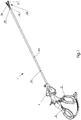
- the laparoscopic instrument 1 shown in Fig. 1 has handgrip 2 and lever 3 adapted to be operated by hand, wherein handgrip 2 and lever 3 are in the form of scissor-like handles, with finger openings.
- Lever 3 is operated with the thumb and the handgrip 2 is held with remaining fingers, wherein handgrip 2 is pointed downwards when using the laparoscopic instrument 1.
- Lever 3 and handgrip 2 are articulated to each other with their upper parts 3A and 2A ( Fig. 2 ).
- In the upper part 2A of handgrip 2 there is a longitudinal cylindrical opening 4 ( Fig.
- Electrical connector 12 presses spring latch 13 so that, by means of the spring tension, latch 13 holds frictional conductive connection to the shank 6, whereby, in the section from the knob 9 to the actuators of the laparoscopic instrument 1, shank 6 is surrounded by insulation foil 6A, for example, made of heat-shrinkable material.
- the laparoscopic instrument provided with an electrical connector can be used as monopolar instrument in laparoscopic surgery.
- Banana type electrical connector 12 is a standard connector used in electrosurgery to supply power to the actuators.
- Connector 12 is arranged at an angle of 55 degrees to the axis of shank 6, so that the power cord is positioned in a way that does not interfere with movement and precision of surgeon performing an operation.
- Lever 3 is installed to handgrip 2 and articulated on the k-axis.
- the lever 3 is provided in its upper part 3A with two coaxial pivots 15 arranged on two opposite sides of the articulation part 3B.
- the shaded articulation part 3B is arranged in the recess 2B of handgrip 2, wherein pivots 15 are being inserted in the second openings 16, whose k-axis passes through the walls of recess 2B, wherein in a position when the instrument is in use, the axis k is below the axis m of the shank 6.
- a slotted notch 20 is made, plane of which is perpendicular to both the k-axis and the n-axis, with the k and n axes intersecting the slotted notch 20.
- a cylindrical pivot element 21 is arranged, in which through opening 22 with p axis is made, wherein the cylindrical pivot element 21 is inserted in the third opening 19 symmetrically in relation to the upper part 3A so that the axis p is arranged in the plane of symmetry of slotted notch 20 and in the axis k.
- the closer end of string 23 is inserted into through opening 22 to move pliers 24 of the laparoscopic instrument 1, pivot element 21 and the third opening 19 represent the joint for string 23.
- the close end of string 23 is clamped into cylindrical pivot element 21 in opening 25 by means of a pressure screw 25A.
- the third opening 19 is closed with a cap 19A latched in the fourth opening 19B arranged next to the third opening 19.
- the laparoscopic instrument can be equipped with actuators selected from a group including: clamping jaws, window jaws, toothed jaws, hook jaws, scissors, in medical terminology known as graspers, dissectors and scissors of various types.
- the laparoscopic instrument shown in this example uses pliers 24, which comprises two window jaws 26, 27 which are rotatably mounted on the r-axis ( Fig. 7 ) with shank 28, which is placed in the support 29 at the further end of shank 6 ( Fig. 1 ).
- Each window jaw 26, 27 is made as a double lever, one arm respectively 26A, 27A has a clamping surface 30, 31, the other arm respectively 26B, 27B is equipped with an opening 32, 33, into which a susceptible string is inserted, respectively 34, 35.
- Strings 34, 35 for example braided steel cables, are connected to the further tube-shaped end of string 23 ( Fig. 8 ) by clamping with a press the ends in the tube after having previously passed them through openings 32, 33.
- Handgrip 2 is provided with the first center element 2D and the first gripping element 2E, while lever 3 is provided with the second center element 3D and the second gripping element 3E ( Fig. 2 ).
- the laparoscopic instrument 1 is provided with a latching mechanism 36 comprising a toothed bar 37 and a tooth 38 cooperating with toothed bar and acting as a latch ( Fig. 3 ).
- the arch-shaped toothed bar 37 is integrated with the second gripping element 3E, toothed bar 37 is provided with multiple teeth 39 adapted to cooperate with tooth 38 arranged on the first 2E gripping element.
- the toothed bar 37 is arranged in such a way that teeth 39 of the toothed bar 37 are in contact with tooth 38, i.e. engage the tooth 38. Both, teeth 39 and tooth 38 are triangular in shape. Between each of the teeth 39, there is a recess matching tooth 38.
- teeth 39 jump over the tooth 38, i.e. subsequent surfaces 39A of teeth 39 come into contact with the surface 38A of tooth 38 ( Fig. 4 ), while the toothed bar 37 tilts to allow teeth 39 to jump over.
- lever 3 in G direction affects the gripping of the pliers, i.e. the gripping of lever 3 into handgrip 2 and brings the jaws 26, 27 or any other actuators closer together.
- clamping i.e. the required position of the jaws 26, 27 relative to each other, and after stopping the tightening movement of lever 3 to handle 2, tooth 38 remains in the recess between teeth 39.
- Self-release movement of lever 3 and thus the of the clamp is not possible because the surface of 39B tooth 39 rests against the surface 38B of tooth 38.
- the Laparoscopic Instrument 1 is provided with a locking and releasing mechanism 40 which is designed to hold two positions - the locking position in which it is possible to clamp the pliers at any degree of clamping and to hold such clamping and the releasing position in which the person performing the operation can clamp the pliers and release the clamp freely, but it is not possible to hold the pliers being clamped.
- the locking and releasing mechanism 40 comprise a switching lever 41 articulated on the first gripping element 2E in the first opening 47 ( Fig. 2 ), where the t-axis of joint 42 is essentially parallel to the k-axis and n-axis.
- Switching lever 41 is provided with a pushback element 43, which can hold a position depending on the position of switching lever 41 in the first socket 45 for the locking position or the second socket 46 for the release position ( Fig. 4 and Fig. 6 ).
- Pushback element 43 is the movement limiter for switching lever 41, in the illustrated embodiment the pushback element 43 is a cylindrical bolt.
- Switching lever 41 is adapted to change its position from locking to releasing position and vice versa by pressing the tip 44.
- Joint 42 of switching lever 41 comprise two opposite pivots 41A arranged on the arms 41B of the switching lever 41.
- the arms 41B are flexible, allowing them to be tilted gently during the installation on a handgrip 2, so that the switching lever 41 is attached using a latch by inserting pins 41A into the first opening 47 in handgrip 2.
- the switching lever 41 In the locking position of the locking and releasing mechanism 40 as shown in Fig. 3 and Fig. 4 , the switching lever 41 is in the locking position and the latching mechanism 36 works as described above, i.e. it is possible to hold the appropriate operating position of the actuators, in the illustrated embodiment, clamping of the jaws 26, 27 of the pliers 24 of the of the laparoscopic instrument 1 by a person performing the operation.
- the locking and releasing mechanism 40 is in the releasing position, it is possible to withdraw lever 3 in the direction marked as R.
- Switching lever 41 is in the release position, where the pushback element 43 is resting against the second socket 46 of the gripping element 2E.
- Handgrip 2, lever 3, cap 19A and switching lever 41 are made of one type of plastic, e.g. ABS, using the most cost-effective horizontal injection method. Handgrip 2 and toothed bar 37 can form a single piece obtained by this method.
- the laparoscopic instrument is provided with a turn indicator mechanism 48 for knob 9 ( Fig. 9 ), which comprises sleeve 5 inserted on shank 6 and a latching mechanism 50, wherein sleeve 5 is provided with a flange 5A with multiple recesses 5B, which are designed to cooperate with sphere element 51 of latching mechanism 50.
- Sphere Element 51 is inserted into the sleeve 52 and pressed against the flange 5A by a spring 53, wherein the sleeve 52 is placed in the handgrip 2 opening 54.
- Sphere element 51 has the ability to move in the direction parallel to the m-axis of handgrip 2. While setting the required position of the actuators by turning knob 9, the person performing the operation can hear a series of clicks of the latching mechanism 50. Regardless of aural evaluation of repositioning of the actuators, the person performing the operation senses with his or her hand a successive latching of the latching mechanism 50. The person performing the operation obtains an information about an intentional or accidental rotation of the actuators, which during the treatment are inside the patient, without the need to look at the handgrip of the laparoscopic instrument.
Landscapes
- Health & Medical Sciences (AREA)
- Surgery (AREA)
- Life Sciences & Earth Sciences (AREA)
- Engineering & Computer Science (AREA)
- Veterinary Medicine (AREA)
- General Health & Medical Sciences (AREA)
- Nuclear Medicine, Radiotherapy & Molecular Imaging (AREA)
- Public Health (AREA)
- Biomedical Technology (AREA)
- Heart & Thoracic Surgery (AREA)
- Medical Informatics (AREA)
- Molecular Biology (AREA)
- Animal Behavior & Ethology (AREA)
- Otolaryngology (AREA)
- Plasma & Fusion (AREA)
- Physics & Mathematics (AREA)
- Ophthalmology & Optometry (AREA)
- Pathology (AREA)
- Reproductive Health (AREA)
- Vascular Medicine (AREA)
- Surgical Instruments (AREA)
Applications Claiming Priority (1)
| Application Number | Priority Date | Filing Date | Title |
|---|---|---|---|
| PL432431A PL239734B1 (pl) | 2019-12-27 | 2019-12-27 | Instrument laparoskopowy |
Publications (2)
| Publication Number | Publication Date |
|---|---|
| EP3841991A1 true EP3841991A1 (de) | 2021-06-30 |
| EP3841991B1 EP3841991B1 (de) | 2023-01-11 |
Family
ID=73793113
Family Applications (1)
| Application Number | Title | Priority Date | Filing Date |
|---|---|---|---|
| EP20213158.7A Active EP3841991B1 (de) | 2019-12-27 | 2020-12-10 | Laparoskopisches instrument |
Country Status (4)
| Country | Link |
|---|---|
| US (1) | US11925374B2 (de) |
| EP (1) | EP3841991B1 (de) |
| CN (1) | CN113040836B (de) |
| PL (1) | PL239734B1 (de) |
Cited By (1)
| Publication number | Priority date | Publication date | Assignee | Title |
|---|---|---|---|---|
| EP4209186A1 (de) * | 2022-01-07 | 2023-07-12 | "Konmex" Spólka Z Ograniczona Odpowiedzialnoscia | Laparoskopisches instrument |
Families Citing this family (3)
| Publication number | Priority date | Publication date | Assignee | Title |
|---|---|---|---|---|
| DE102022118636A1 (de) * | 2022-07-26 | 2024-02-01 | Karl Storz Se & Co. Kg | Hoch-Frequenz-Anschluss für ein chirurgisches Instrument |
| DE102022118628A1 (de) * | 2022-07-26 | 2024-02-01 | Karl Storz Se & Co. Kg | Anschlussanordnung, Verfahren zur Herstellung einer Anschlussanordnung und chirurgisches Instrument |
| WO2024079670A1 (en) * | 2022-10-12 | 2024-04-18 | Multi-Scale Medical Robotics Center Limited | End-effector for robotic systems |
Citations (12)
| Publication number | Priority date | Publication date | Assignee | Title |
|---|---|---|---|---|
| US5293878A (en) * | 1991-04-04 | 1994-03-15 | Symbiosis Corporation | Endoscopic surgical instruments having stepped rotatable end effectors |
| US5344428A (en) * | 1993-03-05 | 1994-09-06 | Auburn International, Inc. | Miniature surgical instrument |
| US5603723A (en) * | 1995-01-11 | 1997-02-18 | United States Surgical Corporation | Surgical instrument configured to be disassembled for cleaning |
| US5827323A (en) * | 1993-07-21 | 1998-10-27 | Charles H. Klieman | Surgical instrument for endoscopic and general surgery |
| EP0908150A1 (de) * | 1997-10-10 | 1999-04-14 | Ethicon Endo-Surgery, Inc. | Ultraschallwellen Koagulationsklemme mit zwei verschiedenen Umdrehungsmöglichkeiten |
| EP0598607B1 (de) | 1992-11-18 | 2000-02-16 | Ethicon, Inc. | Atraumatisches endoskopisches Gerät |
| US20030069565A1 (en) * | 2001-10-05 | 2003-04-10 | Miser John D. | Ratcheting mechanism for endoscopic instruments |
| EP1849420A1 (de) * | 2006-04-03 | 2007-10-31 | AESCULAP AG & Co. KG | Chirurgischer Instrumentengriff und chirurgisches Instrument |
| WO2011044560A2 (en) * | 2009-10-09 | 2011-04-14 | Applied Medical Resources Corporation | Single port instruments |
| EP2471472A1 (de) | 2010-03-11 | 2012-07-04 | Olympus Medical Systems Corp. | Für intraperitoneale eingriffe geeignete zange und techniken der verwendung der zange für intraperitioneale eingriffe |
| EP2077774B1 (de) | 2006-10-05 | 2014-09-10 | Erbe Elektromedizin GmbH | Rohrschaftinstrument |
| DE202016002850U1 (de) * | 2015-05-05 | 2016-06-02 | Olympus Winter & Ibe Gmbh | Chirurgisches Handinstrument |
Family Cites Families (3)
| Publication number | Priority date | Publication date | Assignee | Title |
|---|---|---|---|---|
| US5370659A (en) * | 1992-04-09 | 1994-12-06 | Olympus Optical Co., Ltd. | Grasping forceps for medical treatment |
| US20060287641A1 (en) * | 2005-06-16 | 2006-12-21 | Alfred Perlin | Laparoscopic surgical instrument for in situ tool exchange |
| US10918393B2 (en) * | 2017-11-05 | 2021-02-16 | Grena Usa Llc | Surgical appliance |
-
2019
- 2019-12-27 PL PL432431A patent/PL239734B1/pl unknown
-
2020
- 2020-12-10 EP EP20213158.7A patent/EP3841991B1/de active Active
- 2020-12-23 US US17/132,800 patent/US11925374B2/en active Active
- 2020-12-24 CN CN202011550596.4A patent/CN113040836B/zh active Active
Patent Citations (12)
| Publication number | Priority date | Publication date | Assignee | Title |
|---|---|---|---|---|
| US5293878A (en) * | 1991-04-04 | 1994-03-15 | Symbiosis Corporation | Endoscopic surgical instruments having stepped rotatable end effectors |
| EP0598607B1 (de) | 1992-11-18 | 2000-02-16 | Ethicon, Inc. | Atraumatisches endoskopisches Gerät |
| US5344428A (en) * | 1993-03-05 | 1994-09-06 | Auburn International, Inc. | Miniature surgical instrument |
| US5827323A (en) * | 1993-07-21 | 1998-10-27 | Charles H. Klieman | Surgical instrument for endoscopic and general surgery |
| US5603723A (en) * | 1995-01-11 | 1997-02-18 | United States Surgical Corporation | Surgical instrument configured to be disassembled for cleaning |
| EP0908150A1 (de) * | 1997-10-10 | 1999-04-14 | Ethicon Endo-Surgery, Inc. | Ultraschallwellen Koagulationsklemme mit zwei verschiedenen Umdrehungsmöglichkeiten |
| US20030069565A1 (en) * | 2001-10-05 | 2003-04-10 | Miser John D. | Ratcheting mechanism for endoscopic instruments |
| EP1849420A1 (de) * | 2006-04-03 | 2007-10-31 | AESCULAP AG & Co. KG | Chirurgischer Instrumentengriff und chirurgisches Instrument |
| EP2077774B1 (de) | 2006-10-05 | 2014-09-10 | Erbe Elektromedizin GmbH | Rohrschaftinstrument |
| WO2011044560A2 (en) * | 2009-10-09 | 2011-04-14 | Applied Medical Resources Corporation | Single port instruments |
| EP2471472A1 (de) | 2010-03-11 | 2012-07-04 | Olympus Medical Systems Corp. | Für intraperitoneale eingriffe geeignete zange und techniken der verwendung der zange für intraperitioneale eingriffe |
| DE202016002850U1 (de) * | 2015-05-05 | 2016-06-02 | Olympus Winter & Ibe Gmbh | Chirurgisches Handinstrument |
Cited By (1)
| Publication number | Priority date | Publication date | Assignee | Title |
|---|---|---|---|---|
| EP4209186A1 (de) * | 2022-01-07 | 2023-07-12 | "Konmex" Spólka Z Ograniczona Odpowiedzialnoscia | Laparoskopisches instrument |
Also Published As
| Publication number | Publication date |
|---|---|
| PL432431A1 (pl) | 2021-06-28 |
| US20210322044A1 (en) | 2021-10-21 |
| US11925374B2 (en) | 2024-03-12 |
| EP3841991B1 (de) | 2023-01-11 |
| CN113040836B (zh) | 2024-12-27 |
| PL239734B1 (pl) | 2022-01-03 |
| CN113040836A (zh) | 2021-06-29 |
Similar Documents
| Publication | Publication Date | Title |
|---|---|---|
| US11925374B2 (en) | Laparoscopic instrument | |
| US5467763A (en) | Surgical instruments | |
| EP0507621B1 (de) | Mit dem Daumen gesteuertes Betätigungsglied für endoskopisches chirurgisches Instrument | |
| EP0555103B1 (de) | Sperrklinken-Mechanismus für chirurgische Instrumente | |
| EP0623004B1 (de) | Chirurgische instrumente | |
| US8591523B2 (en) | Mid-point lock suture cutter | |
| US20150342585A1 (en) | Surgical instrument | |
| US20080243178A1 (en) | Surgical instrument particularly useful as tweezers for grasping and holding objects of different thicknesses | |
| US20140188159A1 (en) | Surgical tool | |
| US20110065992A1 (en) | Instrument for endoscopic surgery | |
| JPH10504984A (ja) | 医療用マニピュレーティングデバイス | |
| WO2010030832A2 (en) | Hand tool articulating apparatus with offset handle | |
| JP6126304B2 (ja) | 連続ラッチ付き鉗子 | |
| JP2012176241A (ja) | 操作性を改良した手術器具 | |
| JP5695835B2 (ja) | 外科用処置具 | |
| SE1851029A1 (en) | A tool gripping device for a laparoscopic instrument | |
| US7833243B2 (en) | Medical grasping and holding instrument | |
| EP4209186B1 (de) | Laparoskopisches instrument | |
| CN110402116B (zh) | 用于抓持、处理和/或切割组织的基于能量的外科器械 | |
| WO2018199852A1 (en) | Surgical instruments forming an angle by an articulation thereof | |
| PL239735B1 (pl) | Instrument laparoskopowy | |
| WO1995014435A1 (en) | Endocospic surgical instrument | |
| KR20260049662A (ko) | 수술용 핸드헬드 기구의 버터플라이 그립 | |
| CN1953713A (zh) | 用于手术器械的握持件 | |
| WO2019145540A1 (en) | A tool gripping device for a laparoscopic instrument |
Legal Events
| Date | Code | Title | Description |
|---|---|---|---|
| PUAI | Public reference made under article 153(3) epc to a published international application that has entered the european phase |
Free format text: ORIGINAL CODE: 0009012 |
|
| STAA | Information on the status of an ep patent application or granted ep patent |
Free format text: STATUS: THE APPLICATION HAS BEEN PUBLISHED |
|
| AK | Designated contracting states |
Kind code of ref document: A1 Designated state(s): AL AT BE BG CH CY CZ DE DK EE ES FI FR GB GR HR HU IE IS IT LI LT LU LV MC MK MT NL NO PL PT RO RS SE SI SK SM TR |
|
| STAA | Information on the status of an ep patent application or granted ep patent |
Free format text: STATUS: REQUEST FOR EXAMINATION WAS MADE |
|
| 17P | Request for examination filed |
Effective date: 20211220 |
|
| RBV | Designated contracting states (corrected) |
Designated state(s): AL AT BE BG CH CY CZ DE DK EE ES FI FR GB GR HR HU IE IS IT LI LT LU LV MC MK MT NL NO PL PT RO RS SE SI SK SM TR |
|
| STAA | Information on the status of an ep patent application or granted ep patent |
Free format text: STATUS: EXAMINATION IS IN PROGRESS |
|
| 17Q | First examination report despatched |
Effective date: 20220613 |
|
| GRAP | Despatch of communication of intention to grant a patent |
Free format text: ORIGINAL CODE: EPIDOSNIGR1 |
|
| STAA | Information on the status of an ep patent application or granted ep patent |
Free format text: STATUS: GRANT OF PATENT IS INTENDED |
|
| INTG | Intention to grant announced |
Effective date: 20220907 |
|
| RIN1 | Information on inventor provided before grant (corrected) |
Inventor name: WAWRYNIUK, GRZEGORZ Inventor name: PRZEKOPINSKI, TOMASZ Inventor name: DECEWICZ, ANDRZEJ Inventor name: BRODACZEWSKI, WIESLAW |
|
| GRAS | Grant fee paid |
Free format text: ORIGINAL CODE: EPIDOSNIGR3 |
|
| GRAA | (expected) grant |
Free format text: ORIGINAL CODE: 0009210 |
|
| STAA | Information on the status of an ep patent application or granted ep patent |
Free format text: STATUS: THE PATENT HAS BEEN GRANTED |
|
| AK | Designated contracting states |
Kind code of ref document: B1 Designated state(s): AL AT BE BG CH CY CZ DE DK EE ES FI FR GB GR HR HU IE IS IT LI LT LU LV MC MK MT NL NO PL PT RO RS SE SI SK SM TR |
|
| REG | Reference to a national code |
Ref country code: GB Ref legal event code: FG4D |
|
| REG | Reference to a national code |
Ref country code: CH Ref legal event code: EP |
|
| REG | Reference to a national code |
Ref country code: DE Ref legal event code: R096 Ref document number: 602020007521 Country of ref document: DE |
|
| REG | Reference to a national code |
Ref country code: IE Ref legal event code: FG4D |
|
| REG | Reference to a national code |
Ref country code: AT Ref legal event code: REF Ref document number: 1542937 Country of ref document: AT Kind code of ref document: T Effective date: 20230215 |
|
| REG | Reference to a national code |
Ref country code: LT Ref legal event code: MG9D |
|
| REG | Reference to a national code |
Ref country code: NL Ref legal event code: MP Effective date: 20230111 |
|
| REG | Reference to a national code |
Ref country code: AT Ref legal event code: MK05 Ref document number: 1542937 Country of ref document: AT Kind code of ref document: T Effective date: 20230111 |
|
| PG25 | Lapsed in a contracting state [announced via postgrant information from national office to epo] |
Ref country code: NL Free format text: LAPSE BECAUSE OF FAILURE TO SUBMIT A TRANSLATION OF THE DESCRIPTION OR TO PAY THE FEE WITHIN THE PRESCRIBED TIME-LIMIT Effective date: 20230111 |
|
| P01 | Opt-out of the competence of the unified patent court (upc) registered |
Effective date: 20230526 |
|
| PG25 | Lapsed in a contracting state [announced via postgrant information from national office to epo] |
Ref country code: RS Free format text: LAPSE BECAUSE OF FAILURE TO SUBMIT A TRANSLATION OF THE DESCRIPTION OR TO PAY THE FEE WITHIN THE PRESCRIBED TIME-LIMIT Effective date: 20230111 Ref country code: PT Free format text: LAPSE BECAUSE OF FAILURE TO SUBMIT A TRANSLATION OF THE DESCRIPTION OR TO PAY THE FEE WITHIN THE PRESCRIBED TIME-LIMIT Effective date: 20230511 Ref country code: NO Free format text: LAPSE BECAUSE OF FAILURE TO SUBMIT A TRANSLATION OF THE DESCRIPTION OR TO PAY THE FEE WITHIN THE PRESCRIBED TIME-LIMIT Effective date: 20230411 Ref country code: LV Free format text: LAPSE BECAUSE OF FAILURE TO SUBMIT A TRANSLATION OF THE DESCRIPTION OR TO PAY THE FEE WITHIN THE PRESCRIBED TIME-LIMIT Effective date: 20230111 Ref country code: LT Free format text: LAPSE BECAUSE OF FAILURE TO SUBMIT A TRANSLATION OF THE DESCRIPTION OR TO PAY THE FEE WITHIN THE PRESCRIBED TIME-LIMIT Effective date: 20230111 Ref country code: HR Free format text: LAPSE BECAUSE OF FAILURE TO SUBMIT A TRANSLATION OF THE DESCRIPTION OR TO PAY THE FEE WITHIN THE PRESCRIBED TIME-LIMIT Effective date: 20230111 Ref country code: ES Free format text: LAPSE BECAUSE OF FAILURE TO SUBMIT A TRANSLATION OF THE DESCRIPTION OR TO PAY THE FEE WITHIN THE PRESCRIBED TIME-LIMIT Effective date: 20230111 Ref country code: AT Free format text: LAPSE BECAUSE OF FAILURE TO SUBMIT A TRANSLATION OF THE DESCRIPTION OR TO PAY THE FEE WITHIN THE PRESCRIBED TIME-LIMIT Effective date: 20230111 |
|
| PG25 | Lapsed in a contracting state [announced via postgrant information from national office to epo] |
Ref country code: SE Free format text: LAPSE BECAUSE OF FAILURE TO SUBMIT A TRANSLATION OF THE DESCRIPTION OR TO PAY THE FEE WITHIN THE PRESCRIBED TIME-LIMIT Effective date: 20230111 Ref country code: PL Free format text: LAPSE BECAUSE OF FAILURE TO SUBMIT A TRANSLATION OF THE DESCRIPTION OR TO PAY THE FEE WITHIN THE PRESCRIBED TIME-LIMIT Effective date: 20230111 Ref country code: IS Free format text: LAPSE BECAUSE OF FAILURE TO SUBMIT A TRANSLATION OF THE DESCRIPTION OR TO PAY THE FEE WITHIN THE PRESCRIBED TIME-LIMIT Effective date: 20230511 Ref country code: GR Free format text: LAPSE BECAUSE OF FAILURE TO SUBMIT A TRANSLATION OF THE DESCRIPTION OR TO PAY THE FEE WITHIN THE PRESCRIBED TIME-LIMIT Effective date: 20230412 Ref country code: FI Free format text: LAPSE BECAUSE OF FAILURE TO SUBMIT A TRANSLATION OF THE DESCRIPTION OR TO PAY THE FEE WITHIN THE PRESCRIBED TIME-LIMIT Effective date: 20230111 |
|
| REG | Reference to a national code |
Ref country code: DE Ref legal event code: R097 Ref document number: 602020007521 Country of ref document: DE |
|
| PG25 | Lapsed in a contracting state [announced via postgrant information from national office to epo] |
Ref country code: SM Free format text: LAPSE BECAUSE OF FAILURE TO SUBMIT A TRANSLATION OF THE DESCRIPTION OR TO PAY THE FEE WITHIN THE PRESCRIBED TIME-LIMIT Effective date: 20230111 Ref country code: RO Free format text: LAPSE BECAUSE OF FAILURE TO SUBMIT A TRANSLATION OF THE DESCRIPTION OR TO PAY THE FEE WITHIN THE PRESCRIBED TIME-LIMIT Effective date: 20230111 Ref country code: EE Free format text: LAPSE BECAUSE OF FAILURE TO SUBMIT A TRANSLATION OF THE DESCRIPTION OR TO PAY THE FEE WITHIN THE PRESCRIBED TIME-LIMIT Effective date: 20230111 Ref country code: DK Free format text: LAPSE BECAUSE OF FAILURE TO SUBMIT A TRANSLATION OF THE DESCRIPTION OR TO PAY THE FEE WITHIN THE PRESCRIBED TIME-LIMIT Effective date: 20230111 Ref country code: CZ Free format text: LAPSE BECAUSE OF FAILURE TO SUBMIT A TRANSLATION OF THE DESCRIPTION OR TO PAY THE FEE WITHIN THE PRESCRIBED TIME-LIMIT Effective date: 20230111 |
|
| PLBE | No opposition filed within time limit |
Free format text: ORIGINAL CODE: 0009261 |
|
| STAA | Information on the status of an ep patent application or granted ep patent |
Free format text: STATUS: NO OPPOSITION FILED WITHIN TIME LIMIT |
|
| PG25 | Lapsed in a contracting state [announced via postgrant information from national office to epo] |
Ref country code: SK Free format text: LAPSE BECAUSE OF FAILURE TO SUBMIT A TRANSLATION OF THE DESCRIPTION OR TO PAY THE FEE WITHIN THE PRESCRIBED TIME-LIMIT Effective date: 20230111 |
|
| 26N | No opposition filed |
Effective date: 20231012 |
|
| PG25 | Lapsed in a contracting state [announced via postgrant information from national office to epo] |
Ref country code: SI Free format text: LAPSE BECAUSE OF FAILURE TO SUBMIT A TRANSLATION OF THE DESCRIPTION OR TO PAY THE FEE WITHIN THE PRESCRIBED TIME-LIMIT Effective date: 20230111 |
|
| PG25 | Lapsed in a contracting state [announced via postgrant information from national office to epo] |
Ref country code: IT Free format text: LAPSE BECAUSE OF FAILURE TO SUBMIT A TRANSLATION OF THE DESCRIPTION OR TO PAY THE FEE WITHIN THE PRESCRIBED TIME-LIMIT Effective date: 20230111 |
|
| REG | Reference to a national code |
Ref country code: CH Ref legal event code: PL |
|
| PG25 | Lapsed in a contracting state [announced via postgrant information from national office to epo] |
Ref country code: LU Free format text: LAPSE BECAUSE OF NON-PAYMENT OF DUE FEES Effective date: 20231210 |
|
| PG25 | Lapsed in a contracting state [announced via postgrant information from national office to epo] |
Ref country code: MC Free format text: LAPSE BECAUSE OF FAILURE TO SUBMIT A TRANSLATION OF THE DESCRIPTION OR TO PAY THE FEE WITHIN THE PRESCRIBED TIME-LIMIT Effective date: 20230111 |
|
| REG | Reference to a national code |
Ref country code: BE Ref legal event code: MM Effective date: 20231231 |
|
| PG25 | Lapsed in a contracting state [announced via postgrant information from national office to epo] |
Ref country code: MC Free format text: LAPSE BECAUSE OF FAILURE TO SUBMIT A TRANSLATION OF THE DESCRIPTION OR TO PAY THE FEE WITHIN THE PRESCRIBED TIME-LIMIT Effective date: 20230111 Ref country code: LU Free format text: LAPSE BECAUSE OF NON-PAYMENT OF DUE FEES Effective date: 20231210 |
|
| PG25 | Lapsed in a contracting state [announced via postgrant information from national office to epo] |
Ref country code: BE Free format text: LAPSE BECAUSE OF NON-PAYMENT OF DUE FEES Effective date: 20231231 |
|
| PG25 | Lapsed in a contracting state [announced via postgrant information from national office to epo] |
Ref country code: CH Free format text: LAPSE BECAUSE OF NON-PAYMENT OF DUE FEES Effective date: 20231231 |
|
| PG25 | Lapsed in a contracting state [announced via postgrant information from national office to epo] |
Ref country code: CH Free format text: LAPSE BECAUSE OF NON-PAYMENT OF DUE FEES Effective date: 20231231 Ref country code: BE Free format text: LAPSE BECAUSE OF NON-PAYMENT OF DUE FEES Effective date: 20231231 |
|
| PG25 | Lapsed in a contracting state [announced via postgrant information from national office to epo] |
Ref country code: BG Free format text: LAPSE BECAUSE OF FAILURE TO SUBMIT A TRANSLATION OF THE DESCRIPTION OR TO PAY THE FEE WITHIN THE PRESCRIBED TIME-LIMIT Effective date: 20230111 |
|
| PG25 | Lapsed in a contracting state [announced via postgrant information from national office to epo] |
Ref country code: BG Free format text: LAPSE BECAUSE OF FAILURE TO SUBMIT A TRANSLATION OF THE DESCRIPTION OR TO PAY THE FEE WITHIN THE PRESCRIBED TIME-LIMIT Effective date: 20230111 |
|
| PG25 | Lapsed in a contracting state [announced via postgrant information from national office to epo] |
Ref country code: CY Free format text: LAPSE BECAUSE OF FAILURE TO SUBMIT A TRANSLATION OF THE DESCRIPTION OR TO PAY THE FEE WITHIN THE PRESCRIBED TIME-LIMIT; INVALID AB INITIO Effective date: 20201210 |
|
| PG25 | Lapsed in a contracting state [announced via postgrant information from national office to epo] |
Ref country code: HU Free format text: LAPSE BECAUSE OF FAILURE TO SUBMIT A TRANSLATION OF THE DESCRIPTION OR TO PAY THE FEE WITHIN THE PRESCRIBED TIME-LIMIT; INVALID AB INITIO Effective date: 20201210 |
|
| PG25 | Lapsed in a contracting state [announced via postgrant information from national office to epo] |
Ref country code: TR Free format text: LAPSE BECAUSE OF FAILURE TO SUBMIT A TRANSLATION OF THE DESCRIPTION OR TO PAY THE FEE WITHIN THE PRESCRIBED TIME-LIMIT Effective date: 20230111 |
|
| PGFP | Annual fee paid to national office [announced via postgrant information from national office to epo] |
Ref country code: DE Payment date: 20251126 Year of fee payment: 6 |
|
| PGFP | Annual fee paid to national office [announced via postgrant information from national office to epo] |
Ref country code: GB Payment date: 20251218 Year of fee payment: 6 |
|
| PGFP | Annual fee paid to national office [announced via postgrant information from national office to epo] |
Ref country code: FR Payment date: 20251117 Year of fee payment: 6 |
|
| PGFP | Annual fee paid to national office [announced via postgrant information from national office to epo] |
Ref country code: IE Payment date: 20251218 Year of fee payment: 6 |