EP3842839A1 - Kompensation von polarisationseffekten in photonenzählenden detektoren - Google Patents
Kompensation von polarisationseffekten in photonenzählenden detektoren Download PDFInfo
- Publication number
- EP3842839A1 EP3842839A1 EP19219865.3A EP19219865A EP3842839A1 EP 3842839 A1 EP3842839 A1 EP 3842839A1 EP 19219865 A EP19219865 A EP 19219865A EP 3842839 A1 EP3842839 A1 EP 3842839A1
- Authority
- EP
- European Patent Office
- Prior art keywords
- photon counting
- counting detector
- correction value
- counts
- photons
- Prior art date
- Legal status (The legal status is an assumption and is not a legal conclusion. Google has not performed a legal analysis and makes no representation as to the accuracy of the status listed.)
- Withdrawn
Links
Images


Classifications
-
- G—PHYSICS
- G01—MEASURING; TESTING
- G01T—MEASUREMENT OF NUCLEAR OR X-RADIATION
- G01T1/00—Measuring X-radiation, gamma radiation, corpuscular radiation, or cosmic radiation
- G01T1/16—Measuring radiation intensity
- G01T1/17—Circuit arrangements not adapted to a particular type of detector
-
- G—PHYSICS
- G01—MEASURING; TESTING
- G01T—MEASUREMENT OF NUCLEAR OR X-RADIATION
- G01T1/00—Measuring X-radiation, gamma radiation, corpuscular radiation, or cosmic radiation
- G01T1/16—Measuring radiation intensity
- G01T1/17—Circuit arrangements not adapted to a particular type of detector
- G01T1/171—Compensation of dead-time counting losses
-
- G—PHYSICS
- G01—MEASURING; TESTING
- G01T—MEASUREMENT OF NUCLEAR OR X-RADIATION
- G01T1/00—Measuring X-radiation, gamma radiation, corpuscular radiation, or cosmic radiation
- G01T1/16—Measuring radiation intensity
- G01T1/24—Measuring radiation intensity with semiconductor detectors
-
- G—PHYSICS
- G01—MEASURING; TESTING
- G01T—MEASUREMENT OF NUCLEAR OR X-RADIATION
- G01T1/00—Measuring X-radiation, gamma radiation, corpuscular radiation, or cosmic radiation
- G01T1/16—Measuring radiation intensity
- G01T1/24—Measuring radiation intensity with semiconductor detectors
- G01T1/247—Detector read-out circuitry
-
- G—PHYSICS
- G01—MEASURING; TESTING
- G01T—MEASUREMENT OF NUCLEAR OR X-RADIATION
- G01T1/00—Measuring X-radiation, gamma radiation, corpuscular radiation, or cosmic radiation
- G01T1/29—Measurement performed on radiation beams, e.g. position or section of the beam; Measurement of spatial distribution of radiation
- G01T1/2914—Measurement of spatial distribution of radiation
- G01T1/2985—In depth localisation, e.g. using positron emitters; Tomographic imaging (longitudinal and transverse section imaging; apparatus for radiation diagnosis sequentially in different planes, steroscopic radiation diagnosis)
Definitions
- the present invention relates to a system for correcting a number of counts in an energy bin of X-ray photons detected by a photon counting detector for a spectral computed tomography system, and a method for correcting a number of counts in an energy bin of X-ray photons detected by a photon counting detector for a spectral computed tomography system.
- Photon counting detectors count photons impinging on the detector and determine their energy.
- the photon counting detector provides a signal with a pulse-height, which in first order can be proportional to the energy of the incoming photon.
- Such a trivial reconstruction of the photon energy can only be applied with relatively low count rates of incoming photons.
- the high X-ray intensities used, for example, in medical imaging systems like computed tomography result in very high rates of photons impinging onto the detector. These high rates of photons to be detected lead to a saturation of the detector.
- a polarization of the photon counting detector occurs, which results in a lower signal of the detector and therefore a reduced pulse-height of the signal.
- This effect can cause ring or band artifacts in computed tomography images depending on the dominance of this effect on a pixel level or module/crystal level.
- the described embodiments similarly pertain to the system for correcting a number of counts in an energy bin of X-ray photons detected by a photon counting detector for a spectral computed tomography system, and the method for correcting a number of counts in an energy bin of X-ray photons detected by a photon counting detector for a spectral computed tomography system. Synergistic effects may arise from different combinations of the embodiments although they might not be described in detail.
- a system for correcting a number of counts in an energy bin of X-ray photons detected by a photon counting detector for a spectral computed tomography system comprises a photon detection unit configured for detecting photons and providing a pulse-height of each of the detected photons, and a storage device configured for storing a number of counts in an energy bin according to the pulse-height of each of the detected photons.
- the system further comprises a determination unit configured for determining a correction value of a gain and/or a correction value of an offset of the photon counting detector based on an illumination history of the photon counting detector, and a correction unit configured for correcting the number of counts in the energy bin of the detected photons according to the correction value of the gain and/or the correction value of the offset of the photon counting detector.
- the photon detection unit comprises a photon counting detector.
- the photon detection unit can further comprise readout electronics of the photon counting detector like amplifier, shaper, comparators, counters or analog-to-digital converter.
- This detector can be a semiconductor detector made, for example, from silicon, cadmium zinc telluride, gallium arsenide, germanium or cadmium telluride.
- the photon can interact with the material of the detector via the photoelectric effect or the Compton Effect.
- the electron generated in this interaction can deposit its energy in an active region of the photon counting detector, thereby generating charge carriers like electrons and holes. These charge carriers can be accelerated towards the anode and the cathode of the detector, respectively by application of an electric field to the detector.
- the separation of the generated negative and positive charge carriers in the electric field can lead to the buildup of space charge and charge trapping can occur.
- This can depend on the presence of impurities in the detector material and changes the electric field and thus the response behavior of the photon counting detector with respect to gain and offset of the photon counting detector.
- the response of the photon counting detector can depend on the illumination history of the impinging irradiation. If the X-ray intensity increases, the buildup of space charge and charge trapping in the semiconductor material can lead to changes in the electric field. This causes different responses of the detector to a single detected photon depending on the history of impinging irradiation.
- the response of the photon counting detector as a result of an energy of an incoming photon can be characterized by a gain and an offset.
- the gain of the photon counting detector can be a measure for a number of charge carriers collected at the electrodes of the detector in relation to the number of charge carriers generated by the incident photon.
- the system according to the invention is based on a correction of the deviation in number of counts of detected photons in an energy bin, thereby obtaining a reproducible response of the detector.
- the correction is based on the insight of the inventors that the output of the detector at any given moment of its operation can be determined by the incident spectrum, flux and illumination history.
- the system of the present invention comprises the photon detection unit configured for detecting the photons and providing a pulse-height of the detected photons, and a storage device configured for storing a number of counts in an energy bin according to the pulse-height of each of the detected photons.
- the system can comprise several energy bins, preferably four or five energy bins, wherein the number of counts in all of the bins is corrected.
- An illumination history is provided, which can be a record of photons that have been previously detected in the photon counting detector.
- the illumination history can comprise a flux of photons and a time the photon counting detector is exposed to this flux of photons.
- the flux of the photons onto a photon counting detector can be dependent of the position of the specific detection element in the computing tomography system and it can be dependent on the projection being measured.
- the system further comprises a determination unit configured for determining a correction value of a gain and/or an offset of the photon counting detector based on the illumination history.
- the determination unit takes the preceding photons of the illumination history illuminating the photon detection unit into account and determines a correction value.
- This correction value can correspond to a decrease or an increase of the gain of the photon detection unit.
- the correction factor can further correspond to an offset of the pulse-height of the photon detection unit.
- the offset can be an extrapolation of the detector response with respect to a photon energy resulting in a pulse-height of zero.
- the system comprises further a correction unit configured for correcting the number of counts in the energy bin of the detected photons according to the correction value. Therefore, the number of counts in the energy bin is corrected to a number of counts that would
- the correction unit is configured for correcting the number of counts in the energy bin of the detected photons in a forward model of the spectral computed tomography system by adapting a response function of the photon detection unit according to the correction value.
- the photon counting detector can be a detector for a computed tomography system measuring photons with an energy in the energy range of X-rays.
- the number of counts in one or more energy bins preferably four or five bins, is used to derive attenuation coefficient and a material composition of an object to be examined.
- the number of counts can be directly corrected in the energy bins.
- the number of counts can also be corrected by providing a forward model for the expectation of the value of the number of X-ray photons detected in the energy bin accounting for the polarization state of the detector.
- the forward model can comprise a relation of the attenuation coefficient and the material composition with the number of counts in the energy bin and the response function of the photon detection unit.
- the measured number of counts of the photon counting detector can be used to determine the material composition of an object transmitted by X-rays.
- the measured number of counts is corrected for polarization effects, and then the corrected number of counts and a forward model for a detector not subject to polarization are used to estimate the object's material composition.
- the correction of the number of counts is performed by using a forward model for a detector subject to polarization to directly estimate the object's material composition.
- the illumination history comprises a flux of photons previously detected by the photon counting detector in a time interval.
- the illumination history can comprise in this embodiment of the invention the flux and an exposure time the detector has been exposed to radiation.
- the illumination history can further comprise the pulse-height and a timestamp of the detected photons.
- the pulse-height can be a measure of the number of charge carriers reaching the electrodes of the photon counting detector.
- the time of the detected photon can comprise a specific time stamp of the photon reaching the detector.
- the photon detection unit can be operated in list mode, thereby providing the energy and time of every individual photon.
- the time of the detected photon can comprise a time interval, in which the detector is measuring a specific projection of the computed tomography system. This may lead to a plurality of photons stored with the same detection time in the illumination history.
- the illumination history can comprise in this embodiment of the invention the signals of a plurality of photons that have been previously detected by the photon counting unit.
- the system is configured for correcting deviations of the number of counts in the energy bin, which are due to space charge effects, polarization effects of and/or charge trapping in the photon counting detector.
- the number of counts in the energy bin is corrected to a value that would have been measured in a detector previously not exposed to irradiation.
- the correction can take a changed gain of the photon detection unit into account.
- the reduced gain can be due to space charge effect, polarization effects or charge trapping in the photon detection unit, thereby leading to a pulse-height of the signal that is smaller than it would have been in a photon counting detector previously not exposed to illumination.
- the determination unit comprises an artificial intelligence module configured for determining the correction value of the gain and/or the correction value of the offset of the photon counting detector based on the illumination history.
- the number of counts can be corrected using an artificial intelligence module.
- the artificial intelligence module can comprise a recurrent neural network (RNN) that is trained to determine the correction value of the gain and/or the offset based on a plurality of training data comprising a known illumination history and a corresponding gain and/or offset of the photon counting detector.
- RNN recurrent neural network
- the artificial intelligence module is a recurrent neural network configured for being trained to determine the correction value with a dataset comprising a plurality of illumination histories and the corresponding gain and/or offset of the photon counting detector.
- the recurrent neural network can be trained in this embodiment of the invention with a sufficient number of training data sets comprising irradiation histories ⁇ i(E, t), t ⁇ 0 and corresponding offset and gain responses of the photon counting detector: Oi(t), Gi(t), t >0.
- the training data sets can be obtained by phantom scans, thereby leading to a known number of photons impinging onto the detector in a defined time interval.
- Determination of offsets and gains can be based on measurements or alternatively be deduced from the appearance of deviations from the nominal detector output, i.e. the output of the detector after a long period of non-illumination with a known spectrum.
- the entire illumination history of the detector can be taken into account, including detector illumination of calibration scans, clinical scans, tube conditioning, etc.
- the determination unit is configured for determining the correction value based on a physical model of the photon counting detector taking the illumination history of the photon counting detector into account.
- the correction value can be determined by a physical model accounting for the space charge or the charge trapped in the sensor as a function of the illumination history and thereby allows to predict the correction value of the gain and offset.
- the gain drifts can cause changes in the registered number of counts.
- the physical model assumes a constant trapping probability of charge carriers generated by the detected photon in the photon counting detector, and an exponential decay of trapped charge carriers over time.
- the correction value can be determined based on physical models estimating the decay of polarized offsets and gains using differential equations.
- an empirical model describing reasonable physical behavior of the offset and gain can be described by analytical means, e.g. the decay of polarized offsets and gains towards nominal values after illumination within certain time constants of a preferably exponential decay.
- the buildup of polarization and with it offsets and gains can depend on the illumination.
- Differential equations can be used in this model providing an approach to determine the correction factor. Determining the trapping probability and the de-trapping time constants allows describing a physical model accounting for the state of polarization of the sensor at any given time depending on the history of illumination.
- the trapping probability of charge carriers can in this embodiment of the invention be considered as constant, thereby leading to an increase of the number of trapped charge carries that is proportional to the photon flux or the amount of energy deposited in the photon counting detector in a defined time interval.
- the decay of the trapping states can be regarded as an exponential decay with a certain time constant. However, a plurality of different trapping states can be considered in the model, each state decaying with a different time constant.
- a computed tomography system comprising the system according to any of the preceding embodiments.
- the computed tomography system can comprise the system for correcting a number of counts in an energy bin of X-ray photons detected by a photon counting detector for a spectral computed tomography system, as described in the preceding embodiments, for providing medical images with reduced artifacts due to detector polarization.
- a method for correcting a number of counts in an energy bin of X-ray photons detected by a photon counting detector for a spectral computed tomography system comprises the steps of detecting photons and providing a pulse-height of each of the detected photons, and storing a number of counts in an energy bin according to the pulse-height of each of the detected photons.
- the method comprises further the steps of determining a correction value of a gain and/or a correction value of an offset of the photon counting detector based on an illumination history of the photon counting detector, and correcting the number of counts in the energy bin of the detected photons according to the correction value.
- the method according to the invention corrects a number of counts in an energy bin of photons detected by a photon counting detector.
- a first step the photons are detected and the pulse-height of the detected photons is provided.
- the number of counts in an energy bin of the detected photon is stored according to the pulse-height of the detected photons.
- a correction value of a gain and/or an offset of the photon counting detector based on an illumination history is determined.
- the number of counts in the energy bin of the detected photons is corrected according to the correction value of the gain and/or the correction value of the offset of the photon counting detector.
- the step of correcting the number of counts in the energy bin of the detected photons is performed in a forward model of the spectral computed tomography system by adapting a response function of the photon detection unit according to the correction value of the gain and/or the correction value of the offset of the photon counting detector.
- the method can be applied to an analysis of patient attenuation coefficients and a material composition of a patient being imaged by a computed tomography system measuring X-ray photons that are into different energy bins according to their measured pulse-height.
- the number of counts in one or more energy bins preferably four or five bins, is used to derive attenuation coefficient and a material composition of a patient to be imaged.
- the number of counts can be directly corrected in the energy bins. However, the number of counts can also be corrected by providing a forward model for the expectation of the value of the number of X-ray photons detected in the energy bin accounting for the polarization state of the detector.
- the forward model can comprise a relation of the attenuation coefficient and the material composition with the number of counts in the energy bin and the response function of the photon detection unit.
- the step of determining the correction value of the gain and/or the correction of the value of the offset of the photon counting detector based on an illumination history is performed by an artificial intelligence module.
- An artificial intelligence module can be used to determine the correction value of the gain and/or the correction value of the offset.
- the artificial intelligence module can comprise a recurrent neural network that is trained with multiple sets of training data, each comprising an illumination history and a corresponding gain and offset.
- the set of training data can comprise a correction factor of the gain and/or a correction factor of the offset, which corresponds to the illumination history.
- the artificial intelligence module can be trained to determine a correction value of the gain and/or a correction factor of the offset, in case an arbitrary illumination history is provided to the artificial intelligence module.
- the step of determining the correction value of the gain and/or the correction value of the offset of the photon counting detector based on an illumination history is performed on the basis of a physical model of the photon counting detector taking the illumination history of the photon counting detector into account.
- the correction value of the gain and/or the offset can be determined in this embodiment of the invention based on a physical model of the photon counting detector and the physical processes in the photon counting detector.
- the physical model can be based on the illumination history, taking the flux of photons previously detected by the photon counting detector into account.
- the physical model can be based on the assumption that the trapping probability of charge carriers is constant, thereby leading to an increase of trapped charge carriers that is proportional to the flux of photons or proportional to the number of free charge carriers generated in the photon counting detector.
- the number of trapped charge carriers can decrease in this embodiment of the invention in an exponential decay. One or more trapped states with different time constants of decay can be assumed in this model.
- a computer program element which, when executed on a processing unit, instructs the processing unit to perform the method according to any of the preceding embodiments.
- the computer program element can be performed on one or more processing units, which are instructed to perform the method for correcting a number of counts in an energy bin of X-ray photons detected by a photon counting detector for a spectral computed tomography system.
- a processing unit configured for executing the computer program element according to the preceding aspect of the invention.
- the processing unit can be distributed over one or more different devices executing the computer program element according to the invention.
- the invention relates to a system and a method for correcting a number of counts in an energy bin of X-ray photons detected by a photon counting detector for a spectral computed tomography system.
- An illumination history of the photon counting detector is taken into account to determine a gain and/or an offset of the photon counting detector.
- the number of counts in an energy bin of detected photons is corrected according to a correction value corresponding to the determined gain and/or offset.
- Fig. 1 shows a schematic set-up of a system 100 for correcting a number of counts 115 in an energy bin of X-ray photons 112 detected by a photon counting detector 111 for a spectral computed tomography system 300 according to an embodiment of the invention.
- a photon 112 incident on the photon counting detector 111 of the photon detection unit 110 is detected by the photon detection unit 110.
- the photon detection unit 110 provides a pulse-height of the detected photon 112.
- a storage device 120 is configured for storing a number of counts 115 in an energy bin according to the pulse-height 113 of each of the detected photons 112.
- An illumination history 125 is provided to the determination unit 130.
- the determination unit 130 can comprise in embodiments of the invention an artificial intelligence module 131.
- the determination unit 130 is configured for determining a correction value 135 of the gain or a correction value 135 of the offset of the photon counting detector 111 based on the illumination history 125.
- the correction factor(s) 135 and the number of counts 115 are provided to the correction unit 140, which is configured for correcting the number of counts 115 in the energy bin of the detected photons 112 according to the correction value(s) 135.
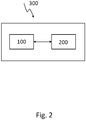
- Fig. 2 shows a schematic set-up of a computed tomography system 300 comprising the system 100 for correcting a number of counts 115 in an energy bin of X-ray photons 112 detected by a photon counting detector 111 for a spectral computed tomography system 300 according to an embodiment of the invention.
- the computed tomography system 300 further comprises a processing unit 200, which is communicationally connected to the system 100.
- the processing unit 200 can execute a computer program element that instructs the processing unit 200 to perform the method according to the invention. Therefore, the processing unit 200 can control the system 100 according to the invention.
- the system 100 can be a part of the computed tomography system 300.
- the photon counting detector 111 can be a detector of the computed tomography system 300, thereby detecting the X-ray photons of the computed tomography system 300.
- Fig. 3 shows a block diagram of a method for correcting a number of counts 115 in an energy bin of X-ray photons 112 detected by a photon counting detector 111 for a spectral computed tomography system 300 according to an embodiment of the invention.
- the method comprises a first step of detecting photons 112 and providing a pulse-height 113 of each of the detected photons. This step is followed by a second step of storing a number of counts 115 in an energy bin according to the pulse-height 113 of each of the detected photons 112.
- a correction value 135 of a gain and/or a correction value 135 of an offset of the photon counting detector 111 is determined based on an illumination history 125 of the photon counting detector 111.
- the number of counts 115 in the energy bin of the detected photons 112 is corrected according to the correction value(s) 135.
- the physical model for determining the correction value(s) is based on the following assumptions: First, the absence of permanent radiation damage effects. This entails that after a sufficiently long amount of time of non-illumination of the detector, it returns to its normal, non-polarized state resulting in the nominal gain provided before the illumination. Second, the polarization state S(t) determines the output, i.e. the gain and/or the offset of the photon counting detector, at time t. Third, the polarization state S(t) of the photon counting detector is uniquely determined by the illumination history. And fourth, the polarization state S(t) results in changes of offset and/or gain of the photon counting detector.
- the determination of the polarization state S(t) from an illumination history of the photon counting detector is described in 3). This may be described utilizing semiconductor physics, involving mobilities and lifetimes of electrons and holes, densities of impurities, physics of metal semiconductor transitions at the electrodes and many more.
- the timescales on which these effects take place can have a multitude of physical origins, leading to a physical model. During those timescales however, the nominal count rate or the response to individual photons will be changed with respect to a non-polarized sensor. These deviations in count rate can be corrected, thereby aiming at obtaining a reproducible response of the detector. It works with the insight that the output of the detector at any given moment of its operation is only determined by the incident spectrum, flux and illumination history.
- N b t N b ⁇ Et , O t , G t .
- the equation above states that provided the offset and/or gain are known, the output of the photon counting detector can be predicted for given spectrum rate incident on the detector, provided that pileup is understood. Reliable estimates for photon counts in the respective energy bin can be produced for an arbitrary state of detector polarization, provided that the offsets and gains can be determined uniquely from the illumination history. It can be assumed that only holes are affected by trapping and that one type of traps with de-trapping time ⁇ exists in the semiconductor material.
- Eq. (2) can be solved for arbitrary irradiation history j ( t ) .
- J ⁇ s ⁇ 0 ⁇ e ⁇ st j t dt .
- a model to estimate the charge collected in a detector described by a polarization state characterized by a total trapped charge Q is described by computing the reduction of the electric field or voltage in the semiconductor material in the presence of the charge Q compared to a charge Qo for the case of the un-polarized sensor.
- the number of counts in an energy bin can be described by equation (9).
- N b t ⁇ 0 ⁇ ⁇ U l b U h b R E U dU ⁇ E t dE
- R ( E, U ) is the response function. It is the function describing the probability of an X-ray photon interacting in the photon counting detector with incident energy E being detected with pulse-height U.
- patient attenuation A i can be inferred from the measured number of counts for the non-polarized case. So the A i are derived from the measured number of counts N b . Obviously, this fails if the response is changing due to polarization of the photon counting detector and the A i will become erroneous.
- Equations Eqs. (7) and (8) above can now be considered as a forward model for the case of a polarized sensor if R ( E, U ) is being replaced by R pol ( E, U, t ) .
Landscapes
- Physics & Mathematics (AREA)
- Health & Medical Sciences (AREA)
- Life Sciences & Earth Sciences (AREA)
- General Physics & Mathematics (AREA)
- High Energy & Nuclear Physics (AREA)
- Molecular Biology (AREA)
- Spectroscopy & Molecular Physics (AREA)
- Measurement Of Radiation (AREA)
- Apparatus For Radiation Diagnosis (AREA)
Priority Applications (6)
| Application Number | Priority Date | Filing Date | Title |
|---|---|---|---|
| EP19219865.3A EP3842839A1 (de) | 2019-12-27 | 2019-12-27 | Kompensation von polarisationseffekten in photonenzählenden detektoren |
| PCT/EP2020/086104 WO2021130053A1 (en) | 2019-12-27 | 2020-12-15 | Compensation of polarization effects in photon counting detectors |
| EP20821266.2A EP4081833B1 (de) | 2019-12-27 | 2020-12-15 | Kompensation von polarisationseffekten in photonenzählenden detektoren |
| JP2022538748A JP7685998B2 (ja) | 2019-12-27 | 2020-12-15 | フォトンカウント検出器における偏極効果の補償 |
| US17/788,343 US12313794B2 (en) | 2019-12-27 | 2020-12-15 | Compensation of polarization effects in photon counting detectors |
| CN202080090585.4A CN114902078B (zh) | 2019-12-27 | 2020-12-15 | 光子计数探测器中的偏振效应的补偿 |
Applications Claiming Priority (1)
| Application Number | Priority Date | Filing Date | Title |
|---|---|---|---|
| EP19219865.3A EP3842839A1 (de) | 2019-12-27 | 2019-12-27 | Kompensation von polarisationseffekten in photonenzählenden detektoren |
Publications (1)
| Publication Number | Publication Date |
|---|---|
| EP3842839A1 true EP3842839A1 (de) | 2021-06-30 |
Family
ID=69055767
Family Applications (2)
| Application Number | Title | Priority Date | Filing Date |
|---|---|---|---|
| EP19219865.3A Withdrawn EP3842839A1 (de) | 2019-12-27 | 2019-12-27 | Kompensation von polarisationseffekten in photonenzählenden detektoren |
| EP20821266.2A Active EP4081833B1 (de) | 2019-12-27 | 2020-12-15 | Kompensation von polarisationseffekten in photonenzählenden detektoren |
Family Applications After (1)
| Application Number | Title | Priority Date | Filing Date |
|---|---|---|---|
| EP20821266.2A Active EP4081833B1 (de) | 2019-12-27 | 2020-12-15 | Kompensation von polarisationseffekten in photonenzählenden detektoren |
Country Status (5)
| Country | Link |
|---|---|
| US (1) | US12313794B2 (de) |
| EP (2) | EP3842839A1 (de) |
| JP (1) | JP7685998B2 (de) |
| CN (1) | CN114902078B (de) |
| WO (1) | WO2021130053A1 (de) |
Cited By (1)
| Publication number | Priority date | Publication date | Assignee | Title |
|---|---|---|---|---|
| EP4160273A1 (de) * | 2021-09-30 | 2023-04-05 | Siemens Healthcare GmbH | Detektion von röntgenstrahlung |
Families Citing this family (1)
| Publication number | Priority date | Publication date | Assignee | Title |
|---|---|---|---|---|
| US12408888B2 (en) * | 2023-06-12 | 2025-09-09 | Canon Medical Systems Corporation | Detector response calibaration data weight optimization method for a photon counting x-ray imaging system |
Citations (3)
| Publication number | Priority date | Publication date | Assignee | Title |
|---|---|---|---|---|
| US20120243660A1 (en) * | 2011-03-25 | 2012-09-27 | Siemens Aktiengesellschaft | Method For Correcting Detector Data Of An X-Ray Detector And X-Ray Recording System |
| WO2017046002A1 (en) * | 2015-09-18 | 2017-03-23 | Koninklijke Philips N.V. | Correcting photon counts in a photon counting x-ray radiation detection system |
| EP3567405A1 (de) * | 2018-05-08 | 2019-11-13 | Koninklijke Philips N.V. | Spektrales ct basierend auf photonenzählung |
Family Cites Families (41)
| Publication number | Priority date | Publication date | Assignee | Title |
|---|---|---|---|---|
| RU2414724C2 (ru) * | 2005-10-28 | 2011-03-20 | Конинклейке Филипс Электроникс, Н.В. | Способ и устройство для спектральной компьютерной томографии |
| US7208739B1 (en) | 2005-11-30 | 2007-04-24 | General Electric Company | Method and apparatus for correction of pileup and charge sharing in x-ray images with energy resolution |
| EP2156218A2 (de) * | 2007-06-01 | 2010-02-24 | Koninklijke Philips Electronics N.V. | Spektraldetektor für photonenzählung |
| US7696483B2 (en) * | 2007-08-10 | 2010-04-13 | General Electric Company | High DQE photon counting detector using statistical recovery of pile-up events |
| JP5701743B2 (ja) * | 2008-03-19 | 2015-04-15 | コーニンクレッカ フィリップス エヌ ヴェ | 放射線検出器、画像システム、光子を検出するための方法及びその方法を実行するコンピュータプログラム |
| US8378310B2 (en) * | 2009-02-11 | 2013-02-19 | Prismatic Sensors Ab | Image quality in photon counting-mode detector systems |
| JP5576502B2 (ja) * | 2010-12-09 | 2014-08-20 | 株式会社リガク | 放射線検出器 |
| EP2748594B1 (de) * | 2011-10-26 | 2016-06-08 | Koninklijke Philips N.V. | Radiografische vorrichtung zur erfassung von photonen mit versatzkorrektur |
| US9678220B2 (en) * | 2011-12-19 | 2017-06-13 | Konninklijke Philips N.V. | X-ray detector with saturated sensor element estimated photon counting |
| EP2831629A2 (de) * | 2012-03-27 | 2015-02-04 | Koninklijke Philips N.V. | Elektronik eines photonenzählenden detektors mit hoher flussdichte |
| EP2866663B1 (de) | 2012-06-29 | 2016-03-16 | Koninklijke Philips N.V. | Dynamische modellierung von fehlstellen für photonenzählungsdetektoren |
| US9746566B2 (en) * | 2012-12-04 | 2017-08-29 | Koninklijke Philips N.V. | Method and apparatus for image correction of X-ray image information |
| US9155516B2 (en) * | 2013-02-19 | 2015-10-13 | Kabushiki Kaisha Toshiba | Apparatus and method for count loss calibration of photon-counting detectors in spectral computed tomography imaging |
| US9020092B2 (en) * | 2013-02-19 | 2015-04-28 | Kabushiki Kaisha Toshiba | Apparatus and method for angular response calibration of photon-counting detectors in sparse spectral computed tomography imaging |
| WO2015078753A1 (en) * | 2013-11-27 | 2015-06-04 | Koninklijke Philips N.V. | Detection device for detecting photons and method therefore |
| US9220469B2 (en) | 2013-12-31 | 2015-12-29 | General Electric Company | Systems and methods for correcting detector errors in computed tomography imaging |
| US9256938B2 (en) * | 2014-02-26 | 2016-02-09 | Kabushiki Kaisha Toshiba | Characteristic X-ray escape correction in photon-counting detectors |
| WO2015146691A1 (ja) * | 2014-03-26 | 2015-10-01 | 株式会社 日立メディコ | X線撮影装置 |
| EP3160351B1 (de) * | 2014-06-27 | 2020-12-09 | Koninklijke Philips N.V. | Spektrale materialzersetzung für photonenzählanwendungen |
| JP2016032635A (ja) * | 2014-07-30 | 2016-03-10 | 株式会社東芝 | フォトンカウンティング型x線ct装置 |
| US9801595B2 (en) | 2014-09-08 | 2017-10-31 | Toshiba Medical Systems Corporation | Count-weighted least squares parameter estimation for a photon-counting detector |
| US9897708B2 (en) | 2014-11-07 | 2018-02-20 | Toshiba Medical Systems Corporation | Polar effect model, system, and method for photon counting detector in medical imaging systems including computed tomography |
| US9476993B2 (en) | 2015-01-07 | 2016-10-25 | Toshiba Medical Systems Corporation | Apparatus and method for computing detector response of a photon-counting detector |
| US20160206255A1 (en) * | 2015-01-16 | 2016-07-21 | Kabushiki Kaisha Toshiba | Hybrid passive/active multi-layer energy discriminating photon-counting detector |
| US9757085B2 (en) * | 2015-02-25 | 2017-09-12 | Toshiba Medical Systems Corporation | Method for identifying and processing detector polarization in photon-counting spectral X-ray detectors |
| US9687207B2 (en) | 2015-04-01 | 2017-06-27 | Toshiba Medical Systems Corporation | Pre-reconstruction calibration, data correction, and material decomposition method and apparatus for photon-counting spectrally-resolving X-ray detectors and X-ray imaging |
| KR102405926B1 (ko) * | 2015-11-12 | 2022-06-07 | 프리스매틱 센서즈 에이비 | 시간 오프셋된 심도 구획부를 구비한 에지-온 검출기를 사용하는 고해상도 전산화 단층촬영(high-resolution computed tomography using edge-on detectors with temporally offset depth-segments) |
| US11002865B2 (en) | 2015-11-20 | 2021-05-11 | Koninklijke Philips N.V. | Detection values determination system |
| WO2018002226A1 (en) | 2016-06-29 | 2018-01-04 | Koninklijke Philips N.V. | Photon-counting computed tomography |
| US10433811B2 (en) * | 2016-12-23 | 2019-10-08 | General Electric Company | Self-calibrating CT detectors, systems and methods for self-calibration |
| US10398394B2 (en) | 2017-01-06 | 2019-09-03 | General Electric Company | Energy-discriminating photon-counting detector and the use thereof |
| US10067240B1 (en) * | 2017-03-06 | 2018-09-04 | Prismatic Sensors Ab | X-ray detector system based on photon counting |
| CN206683768U (zh) * | 2017-04-12 | 2017-11-28 | 东北大学 | 基于压缩感知的光子计数x射线能谱探测装置及成像系统 |
| WO2019102636A1 (ja) * | 2017-11-24 | 2019-05-31 | 浜松ホトニクス株式会社 | フォトンカウンティング装置およびフォトンカウンティング方法 |
| WO2019113440A1 (en) * | 2017-12-08 | 2019-06-13 | Rensselaer Polytechnic Institute | A neural network-based corrector for photon counting detectors |
| US12175734B2 (en) | 2018-02-12 | 2024-12-24 | Rensselaer Polytechnic Institute | CT big data from simulation, emulation and transfer learning |
| US10869646B2 (en) * | 2018-04-12 | 2020-12-22 | Canon Medical Systems Corporation | Method and apparatus for computed tomography (CT) and material decomposition with pile-up correction calibrated using real pulse pileup effect and detector response |
| US20200116874A1 (en) * | 2018-10-11 | 2020-04-16 | Redlen Technologies, Inc. | X-ray pulsing during sensor operation for high flux photon counting computed tomography (ct) imaging system applications |
| US11100684B2 (en) * | 2019-07-11 | 2021-08-24 | Canon Medical Systems Corporation | Apparatus and method for artifact detection and correction using deep learning |
| US11344266B2 (en) * | 2019-09-16 | 2022-05-31 | Redlen Technologies, Inc. | Calibration methods for improving uniformity in X-ray photon counting detectors |
| EP3805806A1 (de) * | 2019-10-07 | 2021-04-14 | Paul Scherrer Institut | Doppelmodusdetektor |
-
2019
- 2019-12-27 EP EP19219865.3A patent/EP3842839A1/de not_active Withdrawn
-
2020
- 2020-12-15 US US17/788,343 patent/US12313794B2/en active Active
- 2020-12-15 WO PCT/EP2020/086104 patent/WO2021130053A1/en not_active Ceased
- 2020-12-15 EP EP20821266.2A patent/EP4081833B1/de active Active
- 2020-12-15 JP JP2022538748A patent/JP7685998B2/ja active Active
- 2020-12-15 CN CN202080090585.4A patent/CN114902078B/zh active Active
Patent Citations (3)
| Publication number | Priority date | Publication date | Assignee | Title |
|---|---|---|---|---|
| US20120243660A1 (en) * | 2011-03-25 | 2012-09-27 | Siemens Aktiengesellschaft | Method For Correcting Detector Data Of An X-Ray Detector And X-Ray Recording System |
| WO2017046002A1 (en) * | 2015-09-18 | 2017-03-23 | Koninklijke Philips N.V. | Correcting photon counts in a photon counting x-ray radiation detection system |
| EP3567405A1 (de) * | 2018-05-08 | 2019-11-13 | Koninklijke Philips N.V. | Spektrales ct basierend auf photonenzählung |
Non-Patent Citations (1)
| Title |
|---|
| MENGHENG TOUCH ET AL: "A neural network-based method for spectral distortion correction in photon counting x-ray CT", PHYSICS IN MEDICINE AND BIOLOGY, INSTITUTE OF PHYSICS PUBLISHING, BRISTOL GB, vol. 61, no. 16, 29 July 2016 (2016-07-29), pages 6132 - 6153, XP020307577, ISSN: 0031-9155, [retrieved on 20160729], DOI: 10.1088/0031-9155/61/16/6132 * |
Cited By (2)
| Publication number | Priority date | Publication date | Assignee | Title |
|---|---|---|---|---|
| EP4160273A1 (de) * | 2021-09-30 | 2023-04-05 | Siemens Healthcare GmbH | Detektion von röntgenstrahlung |
| US12150798B2 (en) | 2021-09-30 | 2024-11-26 | Siemens Healthineers Ag | X-ray radiation detection |
Also Published As
| Publication number | Publication date |
|---|---|
| US20230024679A1 (en) | 2023-01-26 |
| US12313794B2 (en) | 2025-05-27 |
| EP4081833B1 (de) | 2024-09-25 |
| EP4081833A1 (de) | 2022-11-02 |
| WO2021130053A1 (en) | 2021-07-01 |
| JP2023510155A (ja) | 2023-03-13 |
| CN114902078A (zh) | 2022-08-12 |
| CN114902078B (zh) | 2024-10-29 |
| JP7685998B2 (ja) | 2025-05-30 |
Similar Documents
| Publication | Publication Date | Title |
|---|---|---|
| JP6277351B2 (ja) | デジタルx線センサ | |
| US6404853B1 (en) | Method for identifying and correcting pixels with excess pixel lag in a solid state x-ray detector | |
| EP2929372B1 (de) | Verfahren und vorrichtung zur bildkorrektur von röntgenbildinformationen | |
| US8680473B2 (en) | Multiply-sampled CMOS sensor for X-ray diffraction measurements with corrections for non-ideal sensor behavior | |
| US20180328785A1 (en) | Methods for collection, dark correction, and reporting of spectra from array detector spectrometers | |
| US20040252874A1 (en) | Radiation imaging method, radiation imaging apparatus, computer program and computer-readable recording medium | |
| US20040119855A1 (en) | Method and apparatus for excess signal correction in an imager | |
| JP2019181160A (ja) | 医用情報処理装置、x線ct装置及び医用情報処理方法 | |
| US11178346B2 (en) | Charge sharing calibration method and system | |
| EP3472647B1 (de) | Verbesserte photonenzählung in einem spektralstrahlungsdetektor | |
| JP6491545B2 (ja) | 画像処理装置、放射線撮影装置、画像処理方法、プログラム、および記憶媒体 | |
| US9689994B2 (en) | Method for correcting the stacking phenomenon applied to X-ray spectrums acquired using a spectrometric sensor | |
| EP4081833B1 (de) | Kompensation von polarisationseffekten in photonenzählenden detektoren | |
| EP3977936A1 (de) | Röntgenbildgebungsvorrichtung und röntgenbildgebungsverfahren | |
| US10648930B2 (en) | Apparatus for determining an effective energy spectrum of an X-ray tube | |
| US8395126B2 (en) | X-ray imaging apparatus, X-ray imaging method, and computer storage medium | |
| EP3234651B1 (de) | Grundlinienverschiebungsbestimmung für einen photonendetektor | |
| US20190146098A1 (en) | Dead-time calibration for a radiation detector | |
| EP2047478B1 (de) | Algorithmus und software zur korrektur von verstärkungs-/verzögerungsartefakten | |
| Kim et al. | Signal lag measurements based on temporal correlations | |
| Atharifard et al. | Per-pixel energy calibration of photon counting detectors | |
| Kim et al. | Measurement of the lag correction factor in low-dose fluoroscopic imaging | |
| CN102419450B (zh) | 用于确定和校正半导体阵列检测器的响应的稳定性的方法 | |
| Menser et al. | Linear system models for lag in flat dynamic x-ray detectors | |
| Busse et al. | Methodology to measure fundamental performance parameters of X-ray detectors |
Legal Events
| Date | Code | Title | Description |
|---|---|---|---|
| PUAI | Public reference made under article 153(3) epc to a published international application that has entered the european phase |
Free format text: ORIGINAL CODE: 0009012 |
|
| STAA | Information on the status of an ep patent application or granted ep patent |
Free format text: STATUS: THE APPLICATION HAS BEEN PUBLISHED |
|
| AK | Designated contracting states |
Kind code of ref document: A1 Designated state(s): AL AT BE BG CH CY CZ DE DK EE ES FI FR GB GR HR HU IE IS IT LI LT LU LV MC MK MT NL NO PL PT RO RS SE SI SK SM TR |
|
| STAA | Information on the status of an ep patent application or granted ep patent |
Free format text: STATUS: THE APPLICATION IS DEEMED TO BE WITHDRAWN |
|
| 18D | Application deemed to be withdrawn |
Effective date: 20220104 |