EP3843340A1 - Procédé et appareil d'exécution de service, et support de stockage et dispositif électronique - Google Patents
Procédé et appareil d'exécution de service, et support de stockage et dispositif électronique Download PDFInfo
- Publication number
- EP3843340A1 EP3843340A1 EP19851904.3A EP19851904A EP3843340A1 EP 3843340 A1 EP3843340 A1 EP 3843340A1 EP 19851904 A EP19851904 A EP 19851904A EP 3843340 A1 EP3843340 A1 EP 3843340A1
- Authority
- EP
- European Patent Office
- Prior art keywords
- node
- service
- path computation
- nodes
- services
- Prior art date
- Legal status (The legal status is an assumption and is not a legal conclusion. Google has not performed a legal analysis and makes no representation as to the accuracy of the status listed.)
- Pending
Links
- 238000000034 method Methods 0.000 title claims abstract description 65
- 238000004590 computer program Methods 0.000 claims description 13
- 230000004044 response Effects 0.000 claims description 8
- 238000012544 monitoring process Methods 0.000 claims description 6
- 238000011084 recovery Methods 0.000 abstract 2
- 238000004364 calculation method Methods 0.000 description 27
- 230000008569 process Effects 0.000 description 22
- 230000000717 retained effect Effects 0.000 description 10
- 238000010586 diagram Methods 0.000 description 8
- 235000008694 Humulus lupulus Nutrition 0.000 description 4
- 230000005540 biological transmission Effects 0.000 description 4
- 230000003287 optical effect Effects 0.000 description 4
- 239000013307 optical fiber Substances 0.000 description 3
- YTPUIQCGRWDPTM-UHFFFAOYSA-N 2-acetyloxybenzoic acid;5-(2-methylpropyl)-5-prop-2-enyl-1,3-diazinane-2,4,6-trione;1,3,7-trimethylpurine-2,6-dione Chemical compound CC(=O)OC1=CC=CC=C1C(O)=O.CN1C(=O)N(C)C(=O)C2=C1N=CN2C.CC(C)CC1(CC=C)C(=O)NC(=O)NC1=O YTPUIQCGRWDPTM-UHFFFAOYSA-N 0.000 description 2
- 238000004891 communication Methods 0.000 description 2
- 238000005516 engineering process Methods 0.000 description 2
- 230000006855 networking Effects 0.000 description 2
- 238000005457 optimization Methods 0.000 description 2
- 230000007547 defect Effects 0.000 description 1
- 239000000835 fiber Substances 0.000 description 1
- 230000006870 function Effects 0.000 description 1
- 230000007246 mechanism Effects 0.000 description 1
- 238000013468 resource allocation Methods 0.000 description 1
Images



Classifications
-
- H—ELECTRICITY
- H04—ELECTRIC COMMUNICATION TECHNIQUE
- H04L—TRANSMISSION OF DIGITAL INFORMATION, e.g. TELEGRAPHIC COMMUNICATION
- H04L45/00—Routing or path finding of packets in data switching networks
- H04L45/28—Routing or path finding of packets in data switching networks using route fault recovery
-
- H—ELECTRICITY
- H04—ELECTRIC COMMUNICATION TECHNIQUE
- H04L—TRANSMISSION OF DIGITAL INFORMATION, e.g. TELEGRAPHIC COMMUNICATION
- H04L45/00—Routing or path finding of packets in data switching networks
- H04L45/22—Alternate routing
-
- H—ELECTRICITY
- H04—ELECTRIC COMMUNICATION TECHNIQUE
- H04L—TRANSMISSION OF DIGITAL INFORMATION, e.g. TELEGRAPHIC COMMUNICATION
- H04L45/00—Routing or path finding of packets in data switching networks
- H04L45/42—Centralised routing
-
- H—ELECTRICITY
- H04—ELECTRIC COMMUNICATION TECHNIQUE
- H04L—TRANSMISSION OF DIGITAL INFORMATION, e.g. TELEGRAPHIC COMMUNICATION
- H04L45/00—Routing or path finding of packets in data switching networks
- H04L45/48—Routing tree calculation
Definitions
- the present disclosure relates to the field of communications and, for example, to a service operation method and a service operation method device, a storage medium and an electronic device.
- a connection controller CC
- PCE path computation element
- TE traffic engineering
- OSPF open shortest path first
- each node After the network state stabilizes, each node generates a topology.
- the PCE on a head node of the connection computes, according to the topology, an end-to-end path from the head node of the connection to an end node of the connection.
- Services are distributed on multiple head nodes.
- the PCE of each head node is responsible for a service path computation of only the node where each PCE is located.
- Such technology has two major defects. Firstly, it is easy to cause resource collision. While multiple head nodes establish service connections at the same time, paths computed by PCEs of the multiple head nodes may use an identical network resource (for example, link wavelength or slot). In this way, only the first connection using the resource can be established successfully, while establishments of other service connections fail. Secondly, global resource optimization cannot be performed. Since each PCE knows a service of only the node where each PCE is located, there is no way to optimize the resource allocation to all services in the network from a perspective of the whole network.
- Embodiments of the present disclosure provide a service operation method and a service operation device, a storage medium and an electronic device, so as to solve at least the problem of resource collision and inability to optimize global resources in related art.
- An embodiment of the present disclosure provides a service operation method.
- the method includes: determining service information about multiple nodes in a distributed network after determining a link failure in the distributed network, computing a restore path centralizedly for services indicated by the service information about the multiple nodes, and operating the services by using the restore path.
- An embodiment of the present disclosure provides a service operation device.
- the device includes a determination module, a computation module and an operation module.
- the determination module is configured to determine service information about multiple nodes in a distributed network after determining a link failure in the distributed network.
- the computation module is configured to compute a restore path centralizedly for services indicated by the service information about the multiple nodes.
- the operation module is configured to operate the services by using the restore path.
- Another embodiment of the present disclosure further provides a storage medium.
- the storage medium stores a computer program.
- the computer program is configured to, when executed, implement the above-mentioned method.
- the electronic device includes a memory and a processor.
- the memory stores a computer program.
- the processor is configured to execute the computer program to implement the above-mentioned method.
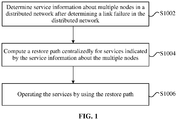
- FIG. 1 is a flowchart of the service operation method according to the embodiment of the present disclosure. As shown in FIG. 1 , the process includes the steps described below.
- step S1002 service information about multiple nodes in a distributed network is determined after a link failure in the distributed network is determined.
- step S1004 a restore path is computed centralizedly for services indicated by the service information about the multiple nodes.
- step S 1006 the services are operated by using the restore path.
- the above steps may be executed by functional modules in the distributed network. Additionally, the steps may be executed by the same functional module or different functional modules.
- the link failure in the distributed network may be determined by using a PCE in the network. For example, a link flooding message may be monitored by using the PCE in the network, and then, the link failure may be determined according to the monitored message. After the link failure is monitored, a link in failure may be recorded, and appropriate measures may be taken to avoid link state jitter. For example, the measures may include setting a timer.
- service information about all nodes in the distributed network may be determined since in the process of computing the restore path centralizedly, a service path not affected by the link failure may need to be adjusted to restore as many services as possible.
- an automatic, flexible and efficient centralized path computation mode is implemented in a distributed architecture, which can well solve the problem of resource collision in the distributed path computation.
- full use of resources can be made through global optimization from a perspective of overall network resources. Therefore, this can solve the problem of resource collision and inability to optimize global resources in related art.
- the step of determining the service information about the multiple nodes in the distributed network includes: determining a global path computation node and a connection tree of the distributed network; collecting, by using the global path computation node, service information about other nodes excluding the global path computation node in the connection tree; and determining service information about the global path computation node and the service information about the other nodes excluding the global path computation node.
- the global path computation node and the connection tree may be determined firstly, and then, services (corresponding to the preceding operated services) may be restored by using the determined global path computation node and the determined connection tree.
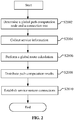
- FIG. 2 is a schematic diagram of a general framework for restoring services according to an embodiment of the present disclosure. As shown in FIG. 2 , the process includes the steps described below.
- step S2002 a global path computation node and a connection tree are determined.
- step S2004 service information is collected.
- step S2006 a global route calculation is performed to obtain a path computation result.
- Step S2008 the path computation result is distributed.
- Step S2008 is a specific operation of operating the services by using the restore path. That is, when the services are operated, the path computation result may be distributed to multiple nodes to instruct the multiple nodes to restore services.
- step S2010 service restore connections are established.
- link state jitter may be avoided by setting a timer as described below.
- the method further includes: setting a first timer corresponding to a first link after monitoring a failure of the first link in the distributed network, and keeping the first link still in a failure state after the first timer expires.
- the method further includes: updating the first timer to a second timer corresponding to a second link after monitoring a failure of the second link in the distributed network, and keeping the first link and/or the second link still in a failure state after the second timer expires.
- the link in failure is recorded, and the appropriate measures are taken to avoid the link state jitter.
- the measures include setting the timer. A timing length may be set according to requirements. If already set, the timer is reset. If a link restore is monitored, the link is deleted from records of links in failure. After the timer expires, if there is still a link failure, a topology is deeply traversed by using a current node as a root, so as to generate a connection tree where the current node is located.
- the step of determining the global path computation node and the connection tree of the distributed network includes: traversing the topology by using each node as a root, so as to generate a connection tree where each node is located; determining, according to a decision strategy, an initial global path computation node in the connection tree where each node is located; and selecting a target node from the multiple nodes by comparing whether each node is identical to the initial global path computation node in the connection tree where the each node is located; and using the selected target node as the global path computation node, and using the connection tree where the target node is located as the connection tree of the distributed network.
- the target node is the same as the initial global path computation node in the connection tree where the target node is located. There may exist one or more target nodes.
- the decision strategy includes at least one of: selecting a node having the smallest node identity (ID) as the global path computation node, selecting a node having the largest ID as the global path computation node, selecting a node having the largest number of link ports as the global path computation node, or selecting a node having the smallest number of link ports as the global path computation node.
- ID the smallest node identity
- a method for determining a global path computation node and a connection tree includes the steps described below.
- step S3002 a link flooding message is monitored.
- step S3004 it is determined, according to the monitored message, whether a link failure occurs; if it is determined that the link failure occurs, the process proceeds to step S3006; and otherwise, the process proceeds to step S3002.
- step S3006 measures, for example, setting a timer, are taken to avoid link state jitter.
- step S3008 it is determined whether the link is still in failure after the timer expires; if it is determined that the link is still in failure, the process proceeds to step S3010; and otherwise, the process proceeds to step S3002.
- step S3010 a topology is traversed to generate a connection tree where a current node is located.
- a global path computation node is determined by using a decision strategy. For example, a node having the smallest node ID is determined as the global path computation node.
- step S3014 it is determined whether the current node is a global path computation node of a connection tree where the current node is located; if a determination result is positive, the process proceeds to step S3016; and otherwise, the process proceeds to step S3002.
- a CC of the current node is notified of the link failure and corresponding connection tree information.
- the CC of the current node may be notified of the link failure and the corresponding connection tree information by using a PCE of the current node.
- the step of collecting, by using the global path computation node, the service information about the other nodes excluding the global path computation node in the connection tree includes: sending, by using the global path computation node, a collect service message for requesting service collection to the other nodes; and receiving, through the global path computation node, the service information about the other nodes returned by the other nodes.
- the collect service message may be sent to the other nodes by using a CC of the global path computation node.
- collect service (CollectService) messages are sent to all nodes in the connection tree by using appropriate communication channels (including a transmission control protocol (TCP)/Internet protocol (IP), a user datagram protocol (UDP)/IP and the like).
- TCP transmission control protocol
- IP Internet protocol
- UDP user datagram protocol
- ServiceInfo service information
- the global path computation node Based on all ServiceInfo received by the global path computation node from the other nodes and service information using the global path computation node as a head node, the global path computation node initiates a global route calculation request (GlobalRouteCalcRequest) message to a PCE of the global path computation node to instruct the PCE to compute a restore path centralizedly for services on multiple nodes.
- GlobalRouteCalcRequest global route calculation request
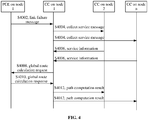
- node 1 is equivalent to the global path computation node in the embodiment, and nodes 2 to N are equivalent to the other nodes in the embodiment.
- the process includes the steps described below.
- step S4002 a PCE on node 1 sends a link failure message to a CC of node 1.
- step S4004 the CC on node 1 sends collect service messages to CCs of other nodes.
- step S4006 the CC on node 1 collects service information returned by the CCs of the other nodes.
- step S4008 the CC on node 1 initiates a global route calculation request to the PCE on node 1.
- step S4010 the PCE on node 1 returns a global route calculation response to the CC on node 1.
- step S4012 the CC on node 1 sends a path computation result (Restore Service) to the CCs of the other nodes.
- a path computation result Restore Service
- the service information includes at least one of: source node information and sink node information about a service, port information about an original node of a service, a signal type, a service priority, a current connection path of a service, or an original connection path of a service.
- the step of computing the restore path centralizedly for the services indicated by the service information about the multiple nodes includes: grouping all services according to a preset grouping strategy, and determining an order of all groups according to a preset ordering strategy; and computing a first restore path of each group of services according to the determined order and a preset path computation strategy, and using the first restore path as the restore path.
- the method before the step of grouping of all services and determining the order of all groups according to the preset ordering strategy, the method further includes setting the following information: the maximum number of iterative computations, an initial value 0 of the number of services successful in restore path computation, the path computation strategy and the grouping strategy.
- the method further includes: determining a first number of services successfully restored; updating the number of services successful in restore path computation from 0 to the first number; redetermining an order of all groups according to the ordering strategy in at least one of the following cases: the current number of iterative computations does not exceed the maximum number of iterative computations, or there is a service not successfully restored; computing a restore path of each group of services according to the path computation strategy and an order of all groups after regrouping, and determining a second number of services successfully restored; and in response to determining that the second number is greater than the first number, updating the restore path to the restore path of each group of services computed according to the order of all groups after regrouping.
- the process of the global route calculation that is, computing the restore path centralizedly
- the process includes the steps described below.
- a PCE receives a global route calculation request message from a CC.
- step S5004 the maximum number of iterations is set.
- step S5006 an initial value of the number of services successful in restore path computation is set to 0.
- step S5008 an appropriate path computation strategy is selected and set. For example, the minimum number of hops is preferred.
- step S5010 services are grouped by using an appropriate principle (corresponding to the grouping strategy).
- a topology resource is processed for a global route calculation. For example, if a route hop on a current connection of each service is not in an original connection, a resource occupied by the route hop is cleared.
- the original connection is a connection after the service is established.
- the current connection is a connection that the service currently uses.
- step S5014 a group order is adjusted by using an appropriate mechanism (corresponding to the ordering strategy).
- step S5016 a path of each group of services is computed according to the adjusted group order, and a resource used on the path is determined.
- step S5018 if the number of services successful in restore path computation becomes larger, a path computation result is retained.
- step S5020 it is determined whether the maximum number of iterative computations has been reached; if the maximum number of iterative computations has been reached, the process proceeds to step S5024; and otherwise, the process proceeds to step S5022.
- step S5022 it is determined whether all services are successful in restore path computation; if all services are successful in restore path computation, the process proceeds to step S5024; and otherwise, the process proceeds to step S5014.
- step S5024 the last retained path computation result is outputted as a global route calculation result, and a global route calculation response (GlobalRouteCalcResponse) message is returned to the CC.
- GlobalRouteCalcResponse GlobalRouteCalcResponse
- the grouping strategy includes: grouping services having the same source node and the same sink node into one group according to a source node identity (ID) and a sink node ID.
- the ordering strategy includes: ordering randomly or ordering according to priorities of groups.
- the resource occupied by the route hop is cleared.
- a wavelength of the original connection of each service can only be used by each service itself when each service is restored.
- the step of operating the services by using the restore path includes: sending information about the restore path to the global path computation node; and issuing the information about the restore path to the other nodes by using the global path computation node, so as to instruct the other nodes to operate services of the other nodes according to the information about the restore path.
- the global path computation node operates a service of the global path computation node according to the information about the restore path.
- the CC of the global path computation node may send a RestoreService message to CCs of the other nodes.
- the RestoreService message contains a restore path computation result for services.
- After the other nodes receive the RestoreService message service restore connections are established.
- the global path computation node also establishes a service restore connection.
- FIG. 6 may be used as a topological diagram for embodiment one.
- FIG. 7 may be used as a topological diagram for embodiments two to four.
- the topology consists of nodes A, B, C, D and E.
- a number next to a link is the number of available wavelengths on the link.
- Links AE and EC occupy 10 wavelengths.
- Links AE and ED occupy 10 wavelengths.
- Link BD occupies 10 wavelengths.
- Links BD and DC occupy 10 wavelengths.
- step 1 a global path computation node and a connection tree are determined.
- step S101 a PCE module on node A monitors a link flooding message.
- step S102 a failure of link A-E is monitored, link AE in failure is recorded, and a timer is set to 10 seconds.
- the timing length may be set according to requirements.
- step S103 a failure of link B-D is monitored, and link BD in failure is recorded.
- the timer is reset to 10 seconds.
- step S104 after the timer expires, the PCE on node A finds that links AE and BD are still in failure, and then, the topology is deeply traversed by using current node A as a root, so as to obtain a connection tree [A, B, E, D, C].
- step S105 since current node A is a node having the smallest node ID in the connection tree, the PCE notifies a CC of the link failure (LinkFailure) and the fact that the connection tree is [A, B, E, D, C] and node A having the smallest node ID in the connection tree is the global path computation node.
- LinkFailure a CC of the link failure
- step 2 service information is collected.
- step S201 after the CC on global path computation node A receives the link failure message from the PCE, collect service (CollectService) messages are sent to all other nodes [B, E, D, C] in the connection tree.
- CollectService Collection Service
- ServiceInfo service information
- Service information includes a source node and a sink node of a service, a port of a service, a signal type, a priority, a current connection path, an original connection path and the like.
- step 203 based on all ServiceInfo received by the global path computation node A from the other nodes and service information using the global path computation node A as a head node, the global path computation node A initiates a global route calculation request (GlobalRouteCalcRequest) message to the PCE.
- GlobalRouteCalcRequest global route calculation request
- step 3 a global route calculation is performed.
- step S301 the PCE on the global path computation node receives the global route calculation request message from the CC.
- step S302 the maximum number of iterative computations is set to 3.
- step S303 an initial value of the number of services successful in restore path computation is set to 0.
- step S304 a path computation strategy is set such that the minimum number of hops is preferred.
- step S305 services are grouped according to a source node ID and a sink node ID, and services having the same source node and the same sink node are set into one group.
- step S306 for a route hop on a current connection of each service, if the route hop is not in an original connection, a resource occupied by the route hop is cleared. For a current service, if a current connection is the same as an original connection, it is not necessary to clear a resource.
- step S307 a group order (AC, AD, BC, BD) is randomly generated, and the groups are reordered.
- step S308 according to the adjusted group order, a path of each group of services is computed, and a resource used on the path is determined.
- the wavelength of the original connection can be used by only this service when restored.
- Service group AC uses a restore path A-C.
- Service group AC uses a restore path A-B-E-D.
- Service group BC uses a restore path B-E-D-C. However, only 5 services can be restored.
- Service group BD has no available restore paths.
- step S309 since the number of services successful in restore path computation is 25, which is greater than 0 in the last time, the newest path computation result is retained.
- step S310 the number of iterative computations is 1, which does not reach the maximum number 3 of iterative computations, the number of restored services does not reach the number 40 of requested services, and then, the process proceeds to step S307 (the steps in the second iterative computation are denoted as S307' to S310', and the steps in the third iterative computation are denoted as S307" to S310").
- step S307' a group order (BC, AC, AD, BD) is randomly generated, and the groups are reordered.
- step S308' according to the adjusted group order, a path of each group of services is computed, and a resource used on the path is determined.
- the wavelength of the original connection can be used by only this service when restored.
- Service group BC uses a restore path B-A-C.
- Service group AC uses a restore path A-B-E-C.
- Service group AD uses a restore path A-B-E-D.
- Service group BD uses a restore path B-E-D. However, only 5 services can be restored.
- step S309' since the number of services successful in restore path computation is 35, which is greater than 25 in the last time, the newest path computation result is retained.
- step S310' the number of iterative computations is 2, which does not reach the maximum number 3 of iterative computations, the number of restored services does not reach the number 40 of requested services, and then, the process proceeds to step S307.
- step S307 a group order (AC, AD, BD, BC) is randomly generated, and the groups are reordered.
- step S308 according to the adjusted group order, a path of each group of services is computed, and a resource used on the path is determined.
- the wavelength of the original connection can be used by only this service when restored.
- Service group AC uses a restore path A-C.
- Service group AD uses a restore path A-B-E-D.
- Service group BD used a restore path B-E-D. However, only 5 services can be restored.
- Service group BD has no available restore paths.
- step S309 since the number of services successful in restore path computation is 25, which is less than 35 in the last time, the newest path computation result is not retained.
- step S310 the number of iterative computations is 3, which reaches the maximum number 3 of iterative computations, and then, the process proceeds to step S312.
- step S312 the last retained path computation result is outputted as a global route calculation result, and a global route calculation response (GlobalRouteCalcResponse) message is returned to the CC.
- GlobalRouteCalcResponse GlobalRouteCalcResponse
- step 4 the path computation result is distributed.
- step S401 the CC of the global path computation node sends RestoreService messages to CCs of other nodes.
- the RestoreService messages contain the restore path computation result of services.
- step S402 after the other nodes receive the RestoreService messages, service restore connections are established. Additionally, the global path computation node also establishes a service restore connection.
- the topology consists of nodes A, B, C, D and E.
- a number next to a link is the number of available wavelengths on the link.
- Links AE and EC occupy 10 wavelengths.
- Links AE and ED occupy 10 wavelengths.
- Link BD occupies 10 wavelengths.
- Links BD and DC occupy 10 wavelengths.
- step 1 a global path computation node and a connection tree are determined.
- step S101 a PCE module on node A monitors a link flooding message.
- step S102 a failure of link A-E is monitored, link AE in failure is recorded, and a timer is set to 10 seconds.
- the timing length may be set according to requirements.
- step S103 a failure of link B-D is monitored, and link BD in failure is recorded.
- the timer is reset to 10 seconds.
- step S104 after the timer expires, the PCE on node A finds that links AE and BD are still in failure, and then, the topology is deeply traversed by using current node A as a root, so as to obtain a connection tree [A, B, E, D, C].
- step S105 since current node A is a node having the smallest node ID in the connection tree, the PCE notifies a CC of the link failure (LinkFailure) and the fact that the connection tree is [A, B, E, D, C] and node A having the smallest node ID in the connection tree is the global path computation node.
- LinkFailure a CC of the link failure
- step 2 service information is collected.
- step S201 after the CC on global path computation node A receives the link failure message from the PCE, collect service (CollectService) messages are sent to all other nodes [B, E, D, C] in the connection tree.
- CollectService Collection Service
- ServiceInfo service information
- Service information includes a source node and a sink node of a service, a port of a service, a signal type, a priority, a current connection path, an original connection path and the like.
- step 203 based on all ServiceInfo received by the global path computation node A from other nodes and service information using the global path computation node A as a head node, the global path computation node A initiates a global route calculation request (GlobalRouteCalcRequest) message to the PCE.
- GlobalRouteCalcRequest global route calculation request
- step 3 a global route calculation is performed.
- step S301 the PCE on the global path computation node receives the global route calculation request message from the CC.
- step S302 the maximum number of iterative computations is set to 3.
- step S303 an initial value of the number of services successful in restore path computation is set to 0.
- step S304 a path computation strategy is set such that the minimum number of hops is preferred.
- step S305 services are grouped according to a source node ID and a sink node ID, and services having the same source node and the same sink node are set into one group.
- step S306 for a route hop on a current connection of each service, if the route hop is not in an original connection, a resource occupied by the route hop is cleared. For a current service, if a current connection is the same as an original connection, it is not necessary to clear a resource.
- step S307 a group order (BC, AC, AD, BD) is randomly generated, and the groups are reordered.
- step S308 according to the adjusted group order, a path of each group of services is computed, and a resource used on the path is determined.
- the wavelength of the original connection can be used by only this service when restored.
- Service group BC used a restore path B-A-C.
- Service group AD uses a restore path A-B-E-D.
- Service group BD used a restore path B-E-D.
- step S309 since the number of services successful in restore path computation is 40, which is greater than 0 in the last time, the newest path computation result is retained.
- step S310 the number of iterative computations is 1, which does not reach the maximum number 3 of iterative computations, but all requested services are successful in restore path computation, and then, the process proceeds to step S312.
- step S312 the last retained path computation result is outputted as a global route calculation result, and a global route calculation response (GlobalRouteCalcResponse) message is returned to the CC.
- GlobalRouteCalcResponse GlobalRouteCalcResponse
- step 4 the path computation result is distributed.
- step S401 the CC of the global path computation node sends RestoreService messages to CCs of other nodes, and the RestoreService messages contain the restore path computation result of services.
- step S402 after the other nodes receive the RestoreService messages, service restore connections are established. Additionally, the global path computation node also establishes a service restore connection.
- the topology consists of nodes A, B, C, D and E.
- a number next to a link is the number of available wavelengths on the link.
- Links AE and EC occupy 10 wavelengths.
- Links AE and ED occupy 10 wavelengths.
- Link BD occupies 10 wavelengths.
- Links BD and DC occupy 10 wavelengths.
- step 1 a global path computation node and a connection tree are determined.
- step S101 PCE modules on nodes A and B monitor a link flooding message.
- step S102 a failure of link A-B is monitored, link AB in failure is recorded, and a timer is set to 10 seconds.
- the timing length may be set according to requirements.
- step S103 a failure of link A-E is monitored, and link AE in failure is recorded.
- the timer is reset to 10 seconds.
- step S104 a failure of link C-E is monitored, and link CE in failure is recorded.
- the timer is reset to 10 seconds.
- step S105 a failure of link C-D is monitored, and link CD in failure is recorded.
- the timer is reset to 10 seconds.
- step S106 a failure of link B-D is monitored, and link BD in failure is recorded.
- the timer is reset to 10 seconds.
- step S 107 after the timer expires, the PCE on node A finds that links AB, AE, CE, CD and BD are still in failure, and then, the topology is deeply traversed by using current node A as a root, so as to obtain a connection tree [A, C].
- step S108 after the timer expires, the PCE on node B finds that links AB, AE, CE, CD and BD are still in failure, and then, the topology is deeply traversed by using current node B as a root, so as to obtain a connection tree [B, E, D].
- step S109 since node A is a node having the smallest node ID in the connection tree where node A is located, the PCE on node A notifies a CC of the link failure (LinkFailure) and the fact that the connection tree is [A, C] and node A having the smallest node ID in the connection tree is the global path computation node.
- LinkFailure link failure
- step S110 since node B is a node having the smallest node ID in the connection tree where node B is located, the PCE on node B notifies a CC of the link failure (LinkFailure) and the fact that the connection tree is [B, E, D] and node B having the smallest node ID in the connection tree is the global path computation node.
- LinkFailure link failure
- step 2 service information is collected.
- step S201 after the CC on global path computation node A receives the link failure message from the PCE, a collect service (CollectService) message is sent to the other node [C] in the connection tree; and after the CC on global path computation node B receives the link failure message from the PCE, collect service (CollectService) messages are sent to all other nodes [E, D] in the connection tree.
- CollectService collect service
- service information (ServiceInfo) messages using the other nodes as head nodes are returned to the message sending nodes.
- the service information includes a source node and a sink node of a service, a port of a service, a signal type, a priority, a current connection path, an original connection path and the like.
- step 203 based on ServiceInfo received by the global path computation node A from the other node and service information using global path computation node A as a head node, the global path computation node A initiates a global route calculation request (GlobalRouteCalcRequest) message to the PCE; and based on all ServiceInfo received by the global path computation node B from the other nodes and service information using global path computation node B as a head node, the global path computation node B initiates a global route calculation request (GlobalRouteCalcRequest) message to the PCE.
- GlobalRouteCalcRequest global route calculation request
- step 3 a global route calculation is performed.
- step S301 the PCE on global path computation node A receives the global route calculation request message from the CC; and the PCE on global path computation node B receives the global route calculation request message from the CC.
- step S302 the maximum number of iterative computations is set to 1.
- step S303 an initial value of the number of services successful in restore path computation is set to 0.
- step S304 a path computation strategy is set such that the minimum number of hops is preferred.
- step S305 services are grouped according to a source node ID and a sink node ID, and services having the same source node and the same sink node are set into one group.
- Service groups on global path computation node A are AC and AD.
- Service groups on global path computation node B are BD and BC.
- step S306 for a route hop on a current connection of each service, if the route hop is not in an original connection, a resource occupied by the route hop is cleared. For a current service, if a current connection is the same as an original connection, it is not necessary to clear a resource.
- step S307 a group order (AC, AD) is randomly generated on node A, and the groups are reordered; and a group order (BC, BD) is randomly generated on node B, and the groups are reordered.
- step S308 according to the adjusted group orders, a path of each group of services is computed, and a resource used on the path is determined.
- the wavelength of the original connection can be used by only this service when restored.
- step S309 it is determined on nodes A and B separately such that since the number of services successful in restore path computation is 10, which is greater than 0 in the last time, the last path computation result is retained.
- step S310 it is determined on nodes A and B separately such that the number of iterative computations is 1, which reaches the maximum number 1 of iterative computations, and then, the process proceeds to step S312.
- step S312 last retained path computation results are outputted as global route calculation results, and global route calculation response (GlobalRouteCalcResponse) messages are returned to the CCs.
- global route calculation response GlobalRouteCalcResponse
- step 4 the path computation results are distributed.
- step S401 the CC on global path computation node A sends a RestoreService message to a CC of the other node, and the RestoreService message contains the restore path computation result of services; and the CC on global path computation node B sends RestoreService messages to CCs of the other nodes, and the RestoreService messages contain the restore path computation result of services.
- step S402 after other nodes receive the RestoreService messages, service restore connections are established. Additionally, the global path computation nodes also establish service restore connections.
- the topology consists of nodes A, B, C, D and E.
- a number next to a link is the number of available wavelengths on the link.
- Links AE and EC occupy 10 wavelengths.
- Links AE and ED occupy 10 wavelengths.
- Link BD occupies 10 wavelengths.
- Links BD and DC occupy 10 wavelengths.
- step 1 a global path computation node and a connection tree are determined.
- step S101 a PCE module on node B monitors a link flooding message.
- step S102 a failure of link A-E is monitored, link AE in failure is recorded, and a timer is set to 10 seconds.
- the timing length may be set according to requirements.
- step S103 a failure of link B-D is monitored, and link BD in failure is recorded.
- the timer is reset to 10 seconds.
- step S104 after the timer expires, the PCE on node B finds that links AE and BD are still in failure, and then, the topology is deeply traversed by using current node B as a root, so as to obtain a connection tree [B, E, D, C, A].
- step S105 since current node B is not a node having the smallest node ID in the connection tree, the PCE does not notify a CC of the link failure (LinkFailure). That is, node B cannot be used as a global path computation node.
- LinkFailure a CC of the link failure
- the method of the embodiments above may be implemented by means of software plus a general-purpose hardware platform, or may of course be implemented by hardware.
- the solution of the present disclosure substantially, or the part contributing to the related art, may be embodied in the form of a software product.
- the computer software product is stored in a storage medium (such as a read-only memory (ROM)/random access memory (RAM), a magnetic disk or an optical disk) and includes several instructions for enabling a terminal device (which may be a mobile phone, a computer, a server, a network device or the like) to execute the method according to each embodiment of the present disclosure.
- An embodiment further provides a service operation device.
- the device is configured to implement the embodiments and implementations above. What has been described is not repeated.
- the term "module” may be software, hardware or a combination of software and hardware capable of implementing predetermined functions.
- the device described below in the embodiment may be implemented by software, but implementation by hardware or by a combination of software and hardware is also possible and conceived.
- FIG. 8 is a block diagram of a service operation device according to an embodiment of the present disclosure. As shown in FIG. 8 , the device includes a determination module 82, a computation module 84 and an operation module 86.
- the determination module 82 is configured to determine service information about multiple nodes in a distributed network after determining a link failure in the distributed network.
- the computation module 84 is configured to compute a restore path centralizedly for services indicated by service information about the multiple nodes.
- the operation module 86 is configured to operate the services by using the restore path.
- the determination module 82 includes a first determination unit, a collection unit and a second determination unit.
- the first determination unit is configured to determine a global path computation node and a connection tree of the distributed network.
- the collection module is configured to collect, by using the global path computation node, service information about other nodes excluding the global path computation node in the connection tree.
- the second determination unit is configured to determine service information about the global path computation node and the service information about the other nodes excluding the global path computation node.
- the device is further configured to, before determining the service information about the multiple nodes in the distributed network, set a first timer corresponding to a first link after monitoring a failure of the first link in the distributed network, and keep the first link still in a failure state after the first timer expires.
- the device is further configured to, after setting the first timer corresponding to the first link and before determining the service information about the multiple nodes in the distributed network, update the first timer to a second timer corresponding to a second link after monitoring a failure of the second link in the distributed network, and keep the first link and/or the second link still in a failure state after the second timer expires.
- the first determination unit may determine the global path computation node and the connection tree of the distributed network in the following manner: traversing a topology by using each node as a root, so as to generate a connection tree where each node is located; determining, according to a decision strategy, an initial global path computation node in the connection tree where each node is located; and selecting a target node from the multiple nodes by comparing whether each node is identical to the initial global path computation node in the connection tree where the each node is located; and using the selected target node as the global path computation node, and using the connection tree where the target node is located as the connection tree of the distributed network.
- the target node is the same as an initial global path computation node in the connection tree where the target node is located. There may exist one or more target nodes.
- the decision strategy includes at least one of: selecting a node having the smallest node identity (ID) as the global path computation node, selecting a node having the largest ID as the global path computation node, selecting a node having the largest number of link ports as the global path computation node, or selecting a node having the smallest number of link ports as the global path computation node.
- ID the smallest node identity
- the collection unit may collect the service information about the other nodes excluding the global path computation node in the connection tree in the following manner: sending, by using the global path computation node, a collect service message for requesting service collection to the other nodes; and receiving, through the global path computation node, the service information about the other nodes returned by the other nodes.
- the service information includes at least one of: source node information and sink node information about a service, port information about an original node of a service, a signal type, a service priority, a current connection path of a service, or an original connection path of a service.
- the computation module 84 may compute the restore path centralizedly for the services indicated by the service information about the multiple nodes in the following manner: grouping all services according to a preset grouping strategy, and determining an order of all groups according to a preset ordering strategy; and computing a first restore path of each group of services according to the determined order and the preset path computation strategy, and using the first restore path as the restore path.
- the device is further configured to, before grouping all services and determining the order of all groups, set the following information: the maximum number of iterative computations, an initial value 0 of the number of services successful in restore path computation, the path computation strategy and the grouping strategy.
- the device is further configured to, after determining a resource used on the restore path of each group of services, determine a first number of services successfully restored, update the number of services successful in restore path computation from 0 to the first number; redetermine an order of all groups according to the ordering strategy in at least one of the following cases: a current number of iterative computations does not exceed the maximum number of iterative computations, or there is a service not successfully restored; compute a restore path of each group of services according to the path computation strategy and the order of all groups after regrouping, and determine a second number of services successfully restored; and in response to determining that the second number is greater than the first number, update the restore path to the restore path of each group of services computed according to the order of all groups after regrouping.
- the grouping strategy includes: grouping services having the same source node and the same sink node into one group according to a source node identity (ID) and a sink node ID.
- ID source node identity
- the ordering strategy includes: ordering randomly or ordering according to priorities of groups.
- a resource occupied by the route hop is cleared.
- a wavelength of an original connection of each service can only be used by each service itself when each service is restored.
- the operation module 86 may operate the services in the following manner: sending information about the restore path to the global path computation node; and issuing the information about the restore path to the other nodes by using the global path computation node, so as to instruct the other nodes to operate services of the other nodes according to the information about the restore path.
- the global path computation node operates a service of the global path computation node according to the information about the restore path.
- Each module above may be implemented by software or hardware. Implementation by hardware may, but may not necessarily, be realized in the following manner: the various modules above are all located in the same processor or located in different processors in any combination form.
- An embodiment of the present disclosure further provides a storage medium.
- the storage medium stores a computer program.
- the computer program is configured to, when executed, implement the steps in any method embodiment above.
- the storage medium may include, but is not limited to, various media capable of storing the computer program, such as a universal serial bus flash disk (USB disk), an ROM, an RAM, a mobile hard disk, a magnetic disk, and an optical disk.
- USB disk universal serial bus flash disk
- ROM read-only memory
- RAM random access memory
- mobile hard disk a hard disk
- magnetic disk a magnetic disk
- optical disk an optical disk
- An embodiment of the present disclosure further provides an electronic device.
- the electronic device includes a memory and a processor.
- the memory stores a computer program.
- the processor is configured to execute the computer program to implement the steps in any method embodiment above.
- the electronic device may further include a transmission device and an input/output device. Both the transmission device and the input/output device are connected to the processor.
- modules or steps of the present disclosure above may be implemented by a general-purpose computing apparatus.
- the modules or steps may be concentrated on a single computing apparatus or distributed on a network composed of multiple computing apparatuses.
- the modules or steps may be implemented by program codes executable by the computing apparatus, so that the modules or steps may be stored in a storage apparatus and executed by the computing apparatus.
- the illustrated or described steps may be executed in sequences different from those described herein, or the module or steps may be separately made into one or more integrated circuit modules, or multiple modules or steps therein may be made into a single integrated circuit module for implementation. Therefore, the present disclosure is not limited to any particular combination of hardware and software.
Landscapes
- Engineering & Computer Science (AREA)
- Computer Networks & Wireless Communication (AREA)
- Signal Processing (AREA)
- Data Exchanges In Wide-Area Networks (AREA)
Applications Claiming Priority (2)
| Application Number | Priority Date | Filing Date | Title |
|---|---|---|---|
| CN201810961394.5A CN110858820A (zh) | 2018-08-22 | 2018-08-22 | 业务运行方法、装置、存储介质及电子装置 |
| PCT/CN2019/101881 WO2020038425A1 (fr) | 2018-08-22 | 2019-08-22 | Procédé et appareil d'exécution de service, et support de stockage et dispositif électronique |
Publications (2)
| Publication Number | Publication Date |
|---|---|
| EP3843340A1 true EP3843340A1 (fr) | 2021-06-30 |
| EP3843340A4 EP3843340A4 (fr) | 2022-05-18 |
Family
ID=69592854
Family Applications (1)
| Application Number | Title | Priority Date | Filing Date |
|---|---|---|---|
| EP19851904.3A Pending EP3843340A4 (fr) | 2018-08-22 | 2019-08-22 | Procédé et appareil d'exécution de service, et support de stockage et dispositif électronique |
Country Status (4)
| Country | Link |
|---|---|
| US (1) | US11757762B2 (fr) |
| EP (1) | EP3843340A4 (fr) |
| CN (1) | CN110858820A (fr) |
| WO (1) | WO2020038425A1 (fr) |
Families Citing this family (1)
| Publication number | Priority date | Publication date | Assignee | Title |
|---|---|---|---|---|
| CN113905291B (zh) * | 2020-06-22 | 2026-01-20 | 中兴通讯股份有限公司 | 连接建立方法、设备和存储介质 |
Family Cites Families (22)
| Publication number | Priority date | Publication date | Assignee | Title |
|---|---|---|---|---|
| US20020093954A1 (en) | 2000-07-05 | 2002-07-18 | Jon Weil | Failure protection in a communications network |
| US7280481B2 (en) * | 2002-10-10 | 2007-10-09 | Guangyi David Rong | Shortest path search method “Midway” |
| US7352703B2 (en) * | 2003-04-29 | 2008-04-01 | Alcatel Lucent | Protection scheme for a communications network under multiple failures |
| EP1768281B1 (fr) | 2004-06-22 | 2016-07-20 | ZTE Corporation | Procede permettant d'etablir une connexion de service et protection de reprise de service dans un reseau optique |
| CN100395991C (zh) | 2005-02-04 | 2008-06-18 | 华为技术有限公司 | 一种ason网络中端到端业务自动配置和恢复的方法 |
| CN1866806B (zh) | 2005-12-22 | 2011-11-02 | 华为技术有限公司 | 共享格状网恢复的实现方法 |
| CN101286892B (zh) * | 2007-04-12 | 2012-09-05 | 华为技术有限公司 | 进行业务恢复的装置和方法 |
| CN101459535A (zh) * | 2007-04-12 | 2009-06-17 | 华为技术有限公司 | 进行业务恢复的装置和方法 |
| CN101494801B (zh) * | 2008-01-21 | 2013-01-30 | 华为技术有限公司 | 故障恢复方法、系统及网络设备 |
| CN101232517B (zh) | 2008-01-31 | 2011-03-23 | 北京航空航天大学 | 地理位置无关的多汇聚节点部署方法 |
| CN101715149B (zh) * | 2009-07-21 | 2013-01-23 | 北京邮电大学 | 一种多层多域分布式光网络并行跨域故障恢复方法和装置 |
| CN101645847A (zh) * | 2009-08-25 | 2010-02-10 | 中兴通讯股份有限公司 | 一种在传送网络中提高业务恢复速度的方法及系统 |
| CN101651625B (zh) * | 2009-09-03 | 2011-09-21 | 中兴通讯股份有限公司 | 多业务恢复的选路装置及选路方法 |
| CN102487329B (zh) | 2010-12-02 | 2016-03-30 | 中兴通讯股份有限公司 | 业务恢复方法及装置 |
| WO2013152806A1 (fr) * | 2012-04-13 | 2013-10-17 | Telefonaktiebolaget L M Ericsson (Publ) | Reprise dans un réseau avec connexion |
| CN103795629B (zh) * | 2012-10-31 | 2018-10-26 | 中兴通讯股份有限公司 | 标签交换路径的全局并发优化方法、装置及系统 |
| WO2015051839A1 (fr) * | 2013-10-09 | 2015-04-16 | Telefonaktiebolaget L M Ericsson (Publ) | Routage de services point à multipoint dans un réseau multi-domaines |
| EP2961113B1 (fr) * | 2014-06-24 | 2017-05-24 | Alcatel Lucent | Commande de commutation de protection dans un réseau de communication |
| CN105066997B (zh) | 2015-07-28 | 2017-09-26 | 中国地质大学(武汉) | 一种面向室内导航的动态路径生成方法 |
| US10454830B2 (en) * | 2016-05-05 | 2019-10-22 | City University Of Hong Kong | System and method for load balancing in a data network |
| CN106878170B (zh) | 2016-12-29 | 2020-04-21 | 北京华为数字技术有限公司 | 一种转发路径确定方法和装置 |
| US10826823B2 (en) * | 2018-07-31 | 2020-11-03 | Facebook, Inc. | Centralized label-based software defined network |
-
2018
- 2018-08-22 CN CN201810961394.5A patent/CN110858820A/zh active Pending
-
2019
- 2019-08-22 WO PCT/CN2019/101881 patent/WO2020038425A1/fr not_active Ceased
- 2019-08-22 EP EP19851904.3A patent/EP3843340A4/fr active Pending
- 2019-08-22 US US17/270,083 patent/US11757762B2/en active Active
Also Published As
| Publication number | Publication date |
|---|---|
| EP3843340A4 (fr) | 2022-05-18 |
| US20210328912A1 (en) | 2021-10-21 |
| CN110858820A (zh) | 2020-03-03 |
| US11757762B2 (en) | 2023-09-12 |
| WO2020038425A1 (fr) | 2020-02-27 |
Similar Documents
| Publication | Publication Date | Title |
|---|---|---|
| US10256939B2 (en) | Scheduled light path switching in optical networks and automatic assessment of traffic impairments that would result from adding or deleting a channel in a wavelength-division multiplexed optical communication network | |
| US9647944B2 (en) | Segment routing based wide area network orchestration in a network environment | |
| US20160119255A1 (en) | Partial Software Defined Network Switch Replacement in IP Networks | |
| US20120163163A1 (en) | Apparatus and method for protection switching of multiple protection group | |
| US20170366265A1 (en) | Bandwidth optimization and hitless transport in dynamic free space optical communications networks | |
| Savas et al. | Backup reprovisioning with partial protection for disaster-survivable software-defined optical networks | |
| Liu et al. | Performance and testbed study of topology reconfiguration in IP over optical networks | |
| Castro et al. | Experimental assessment of bulk path restoration in multi-layer networks using PCE-based global concurrent optimization | |
| JP4547314B2 (ja) | 故障復旧方法および管理ノードならびに通信ノード | |
| EP3136649B1 (fr) | Procédé et système pour fournir des informations de charge d'un système de transmission optique de données | |
| US7443832B2 (en) | Device for determining switching paths in a label switched communication network in the presence of selection attributes | |
| CN101753417B (zh) | 计算和确定路由的方法、路径计算单元和确定路由的系统 | |
| US11757762B2 (en) | Service operation method and device, and storage medium and electronic device | |
| US7542413B1 (en) | Method and apparatus for delaying start of restoration of low priority services | |
| Castro et al. | Dynamic restoration in multi-layer IP/MPLS-over-flexgrid networks | |
| Aibin et al. | Adaptive survivability algorithm for path protection with various traffic classes in elastic optical networks | |
| US20040114513A1 (en) | Protection scheme for a communication network | |
| Bhumi Reddy et al. | Connection provisioning for PCE-based GMPLS optical networks | |
| Pavani et al. | Restoration in wavelength-routed optical networks by means of ant colony optimization | |
| CN113905291B (zh) | 连接建立方法、设备和存储介质 | |
| JP4820832B2 (ja) | 仮想プライベートネットワーク管理システム | |
| JP2007325032A (ja) | 要求解釈方法、および、要求解釈装置 | |
| Song et al. | Accumulated-downtime-oriented restoration strategy with service differentiation in survivable WDM mesh networks | |
| Giorgetti et al. | PCE-based dynamic restoration in wavelength switched optical networks | |
| Jamhour et al. | Evaluation of segment-based crankback re-routing for GMPLS-based WSON |
Legal Events
| Date | Code | Title | Description |
|---|---|---|---|
| STAA | Information on the status of an ep patent application or granted ep patent |
Free format text: STATUS: THE INTERNATIONAL PUBLICATION HAS BEEN MADE |
|
| PUAI | Public reference made under article 153(3) epc to a published international application that has entered the european phase |
Free format text: ORIGINAL CODE: 0009012 |
|
| STAA | Information on the status of an ep patent application or granted ep patent |
Free format text: STATUS: REQUEST FOR EXAMINATION WAS MADE |
|
| 17P | Request for examination filed |
Effective date: 20210322 |
|
| AK | Designated contracting states |
Kind code of ref document: A1 Designated state(s): AL AT BE BG CH CY CZ DE DK EE ES FI FR GB GR HR HU IE IS IT LI LT LU LV MC MK MT NL NO PL PT RO RS SE SI SK SM TR |
|
| DAV | Request for validation of the european patent (deleted) | ||
| DAX | Request for extension of the european patent (deleted) | ||
| REG | Reference to a national code |
Ref country code: DE Ref legal event code: R079 Free format text: PREVIOUS MAIN CLASS: H04L0012703000 Ipc: H04L0045280000 |
|
| A4 | Supplementary search report drawn up and despatched |
Effective date: 20220421 |
|
| RIC1 | Information provided on ipc code assigned before grant |
Ipc: H04L 45/48 20220101ALN20220413BHEP Ipc: H04L 45/00 20220101ALI20220413BHEP Ipc: H04L 45/42 20220101ALI20220413BHEP Ipc: H04L 45/28 20220101AFI20220413BHEP |
|
| STAA | Information on the status of an ep patent application or granted ep patent |
Free format text: STATUS: EXAMINATION IS IN PROGRESS |
|
| 17Q | First examination report despatched |
Effective date: 20250127 |