EP3843445A1 - Verfahren und vorrichtung zur erkennung von anomalien, endgerät und speichermedium - Google Patents
Verfahren und vorrichtung zur erkennung von anomalien, endgerät und speichermedium Download PDFInfo
- Publication number
- EP3843445A1 EP3843445A1 EP20864266.0A EP20864266A EP3843445A1 EP 3843445 A1 EP3843445 A1 EP 3843445A1 EP 20864266 A EP20864266 A EP 20864266A EP 3843445 A1 EP3843445 A1 EP 3843445A1
- Authority
- EP
- European Patent Office
- Prior art keywords
- objects
- data
- performance indicator
- clustering set
- clustering
- Prior art date
- Legal status (The legal status is an assumption and is not a legal conclusion. Google has not performed a legal analysis and makes no representation as to the accuracy of the status listed.)
- Granted
Links
Images




Classifications
-
- H—ELECTRICITY
- H04—ELECTRIC COMMUNICATION TECHNIQUE
- H04L—TRANSMISSION OF DIGITAL INFORMATION, e.g. TELEGRAPHIC COMMUNICATION
- H04L41/00—Arrangements for maintenance, administration or management of data switching networks, e.g. of packet switching networks
- H04L41/14—Network analysis or design
- H04L41/142—Network analysis or design using statistical or mathematical methods
-
- G—PHYSICS
- G06—COMPUTING OR CALCULATING; COUNTING
- G06F—ELECTRIC DIGITAL DATA PROCESSING
- G06F18/00—Pattern recognition
- G06F18/20—Analysing
- G06F18/21—Design or setup of recognition systems or techniques; Extraction of features in feature space; Blind source separation
- G06F18/214—Generating training patterns; Bootstrap methods, e.g. bagging or boosting
-
- G—PHYSICS
- G06—COMPUTING OR CALCULATING; COUNTING
- G06F—ELECTRIC DIGITAL DATA PROCESSING
- G06F18/00—Pattern recognition
- G06F18/20—Analysing
- G06F18/23—Clustering techniques
-
- H—ELECTRICITY
- H04—ELECTRIC COMMUNICATION TECHNIQUE
- H04L—TRANSMISSION OF DIGITAL INFORMATION, e.g. TELEGRAPHIC COMMUNICATION
- H04L41/00—Arrangements for maintenance, administration or management of data switching networks, e.g. of packet switching networks
- H04L41/08—Configuration management of networks or network elements
- H04L41/0803—Configuration setting
- H04L41/0806—Configuration setting for initial configuration or provisioning, e.g. plug-and-play
-
- H—ELECTRICITY
- H04—ELECTRIC COMMUNICATION TECHNIQUE
- H04L—TRANSMISSION OF DIGITAL INFORMATION, e.g. TELEGRAPHIC COMMUNICATION
- H04L41/00—Arrangements for maintenance, administration or management of data switching networks, e.g. of packet switching networks
- H04L41/08—Configuration management of networks or network elements
- H04L41/0803—Configuration setting
- H04L41/0813—Configuration setting characterised by the conditions triggering a change of settings
- H04L41/0816—Configuration setting characterised by the conditions triggering a change of settings the condition being an adaptation, e.g. in response to network events
-
- H—ELECTRICITY
- H04—ELECTRIC COMMUNICATION TECHNIQUE
- H04L—TRANSMISSION OF DIGITAL INFORMATION, e.g. TELEGRAPHIC COMMUNICATION
- H04L41/00—Arrangements for maintenance, administration or management of data switching networks, e.g. of packet switching networks
- H04L41/08—Configuration management of networks or network elements
- H04L41/0895—Configuration of virtualised networks or elements, e.g. virtualised network function or OpenFlow elements
-
- H—ELECTRICITY
- H04—ELECTRIC COMMUNICATION TECHNIQUE
- H04L—TRANSMISSION OF DIGITAL INFORMATION, e.g. TELEGRAPHIC COMMUNICATION
- H04L41/00—Arrangements for maintenance, administration or management of data switching networks, e.g. of packet switching networks
- H04L41/40—Arrangements for maintenance, administration or management of data switching networks, e.g. of packet switching networks using virtualisation of network functions or resources, e.g. SDN or NFV entities
-
- H—ELECTRICITY
- H04—ELECTRIC COMMUNICATION TECHNIQUE
- H04L—TRANSMISSION OF DIGITAL INFORMATION, e.g. TELEGRAPHIC COMMUNICATION
- H04L43/00—Arrangements for monitoring or testing data switching networks
- H04L43/02—Capturing of monitoring data
-
- H—ELECTRICITY
- H04—ELECTRIC COMMUNICATION TECHNIQUE
- H04L—TRANSMISSION OF DIGITAL INFORMATION, e.g. TELEGRAPHIC COMMUNICATION
- H04L43/00—Arrangements for monitoring or testing data switching networks
- H04L43/20—Arrangements for monitoring or testing data switching networks the monitoring system or the monitored elements being virtualised, abstracted or software-defined entities, e.g. SDN or NFV
-
- H—ELECTRICITY
- H04—ELECTRIC COMMUNICATION TECHNIQUE
- H04W—WIRELESS COMMUNICATION NETWORKS
- H04W24/00—Supervisory, monitoring or testing arrangements
- H04W24/02—Arrangements for optimising operational condition
-
- H—ELECTRICITY
- H04—ELECTRIC COMMUNICATION TECHNIQUE
- H04W—WIRELESS COMMUNICATION NETWORKS
- H04W24/00—Supervisory, monitoring or testing arrangements
- H04W24/04—Arrangements for maintaining operational condition
-
- H—ELECTRICITY
- H04—ELECTRIC COMMUNICATION TECHNIQUE
- H04L—TRANSMISSION OF DIGITAL INFORMATION, e.g. TELEGRAPHIC COMMUNICATION
- H04L41/00—Arrangements for maintenance, administration or management of data switching networks, e.g. of packet switching networks
- H04L41/14—Network analysis or design
- H04L41/147—Network analysis or design for predicting network behaviour
-
- H—ELECTRICITY
- H04—ELECTRIC COMMUNICATION TECHNIQUE
- H04L—TRANSMISSION OF DIGITAL INFORMATION, e.g. TELEGRAPHIC COMMUNICATION
- H04L41/00—Arrangements for maintenance, administration or management of data switching networks, e.g. of packet switching networks
- H04L41/14—Network analysis or design
- H04L41/149—Network analysis or design for prediction of maintenance
-
- H—ELECTRICITY
- H04—ELECTRIC COMMUNICATION TECHNIQUE
- H04L—TRANSMISSION OF DIGITAL INFORMATION, e.g. TELEGRAPHIC COMMUNICATION
- H04L43/00—Arrangements for monitoring or testing data switching networks
- H04L43/16—Threshold monitoring
Definitions
- Embodiments of the present application relates to a wireless communication network, in particular to an anomaly detection method and device, a terminal and a storage medium.
- PIs Performance Indicators
- KPIs Key Performance Indicators
- embodiments of the present application provide an anomaly detection method, including: generating at least one clustering set of objects based on configuration data and performance indicator data of the objects; determining an algorithm configuration parameter corresponding to each clustering set based on a preset anomaly detection algorithm and the performance indicator data corresponding to the objects in the clustering set; and determining, based on the algorithm configuration parameter, abnormal performance indicator data of the objects in the corresponding clustering set, so as to determine abnormal objects based on the abnormal performance indicator data.
- Embodiments of the present application provide an anomaly detection device, including: a clustering set generation module, configured to generate at least one clustering set of objects based on configuration data and performance indicator data of the objects; a parameter determination module, configured to determine an algorithm configuration parameter corresponding to each clustering set based on a preset anomaly detection algorithm and the performance indicator data corresponding to the objects in the clustering set; and an anomaly detection module, configured to determine, based on the algorithm configuration parameter, abnormal performance indicator data of the objects in the corresponding clustering set, so as to determine abnormal objects based on the abnormal performance indicator data.
- Embodiments of the present application provide a terminal, including: a memory, and one or more processors, where the memory is configured to store one or more programs; and the one or more programs, when executed by the one or more processors, cause the one or more processors to perform the anomaly detection method of any one of the embodiments of the present application.
- Embodiments of the present application provide a storage medium storing a computer program, where the computer program, when executed by a processor, causes the processor to perform the anomaly detection method of any one of the embodiments of the present application.
- Fig. 1 is a schematic diagram of a basic architecture of an existing wireless communication network system.
- the wireless communication network system mainly includes objects such as a core network 140, base stations 130, cells 120, terminals 110 and transmission links 150.
- the objects include function modules for constructing a wireless communication network system.
- the objects are not limited to those listed above, but may also be a baseband processing module, a radio frequency processing module, etc., which are not specifically defined in the embodiments of the present application.
- the terminal 110 is a general term for network access devices used by users.
- the terminal may be a mobile phone.
- the terminal and the base station conduct wireless data interaction through their respective antennas, and then access the network for uploading services (such as voice calls or Internet access).
- the base station 130 is a core device for constructing the wireless communication network system. It interacts upward with the terminal through a wireless communication protocol and downward with the core network through the transmission link, and is responsible for forming a data channel between the terminal and the core network. Most wireless communication protocols are implemented in the base station.
- the cell 120 is a virtual management object.
- planners In order to achieve an optimal balance between wireless signals in a service area of the system in terms of coverage, interference, access capacity and other factors, planners generally divide the entire service area into many cells and set different parameters for each cell. In most cases, the terminal will generally access the network through a geographically close cell.
- the core network 140 is responsible for end user authentication, billing, and processing of all service data.
- the service data (such as voice data and Internet data) initiated by the terminal needs to be processed or forwarded through the core network.
- the transmission link 150 generally refers to a wired transmission link connecting the base station and the core network. Since all terminal service data are eventually aggregated to the core network through the base station, there are generally high requirements on the bandwidth, reliability and delay of the transmission link.
- Fig. 1 is only a schematic diagram of the architecture of the wireless communication network system, and the actual network architecture of the wireless communication network system is more complicated.
- the network architecture shown in Fig. 1 is conceptually correct, and can help understand the basic structure of the wireless communication network system and the technical problems to be solved by the embodiments of the present application.
- the 3GPP standard organization has formulated a batch of basic performance indicators (PIs) and key performance indicators (KPIs) in several standard documents, and has given the meaning, collection contents, collection conditions and related operational formulas of the indicators. All communication device manufacturers are required to comply with the requirements of the standard, implement and report these PIs in a network device, summarize the PIs in a network management system (hereinafter referred to as NMS), and calculate the KPIs according to the formula.
- NMS network management system
- device manufacturers and operators generally also design and implement a batch of PIs or KPIs beyond the standard according to their own specific needs to monitor the key operation state of the system.
- the wireless communication network system will generate a surprisingly huge volume of KPI and PI data during its operation. With data on such a scale, it is very difficult to try to analyze the data manually and find anomalies therein.
- the NMS generally implements some auxiliary functions to help operation and maintenance personnel observe and analyze the data.
- the NMS provides a visual Kanban system, which allows users to observe and understand data in the form of charts.
- the NMS provides descending sorting and screening functions, so that users can focus on the indicators with the greatest amount of variation.
- the NMS provides an alarm system, so that the user can set an alarm threshold or rule for the specified indicators. When the indicator value exceeds the threshold or triggers the rule, the alarm system will report an alarm to let users know of system anomalies.
- the above functions provided by the NMS can relieve some of the burden of manual analysis of indicators, there are still some shortcomings.
- the analysis coverage is low.
- the number of indicators that can be manually observed and analyzed at the same time is still very limited (generally no more than 10), which is mainly due to the inherent limitations of human beings.
- a communication system is complicated and changeable, and different time, space, business scenarios and configurations will have different effects on the performance of the same indicators. It is difficult to accurately define what is abnormal or normal for relevant indicators in such changeable scenarios only by human experience and knowledge.
- the first is to manually maintain an empirical knowledge base for anomaly detection.
- the empirical knowledge base may be in the form of marked historical performance indicator data (i.e., abnormal performance indicator data has been marked), and may be a set of pattern recognition rules.
- the former is generally used to assist statistical training procedures to obtain detection thresholds, while the latter is used directly to detect abnormal performance indicator data.
- the second is to analyze historical performance indicator data by statistical analysis methods, so to obtain a threshold for distinguishing abnormal and normal performance indicator data by calculation, and apply the threshold to the detection of current performance indicator data.
- the first category of scheme continues the method of expert system to solve problems, and has similar effects as follows: the more complete the expert rules available in the system, the more accurate the results. If the problems to be solved do not change significantly, then the expert system will operate well. However, the actual situation is generally not so ideal, and usually has the following limitations: the cost of manually collecting and summarizing expert rules is very high; due to the limitations of human beings, it is difficult to guarantee the completeness and accuracy of expert rules. In reality, many problems to be solved are changing.
- anomaly detection algorithms have some assumptions about the characteristic pattern of anomalies (e.g., for the k-nearest neighbor algorithm, it is assumed that anomalies must be far away from all dense neighborhoods).
- the abnormal patterns of the same object may be different in different time ranges. In other words, the abnormal patterns of two similar objects may be different in the same time range. Under such a premise, it is difficult for algorithms with basically fixed parameter configurations to make accurate anomaly detection for objects under different conditions.
- the current mainstream algorithms for anomaly detection basically take historical performance indicator data as the only input, which means that the algorithms predict the future of performance indicator data based only on its history, which affects the accuracy of detection results.
- an embodiment of the present application provides an anomaly detection method to solve the above technical problems.
- Fig. 2 is a flow chart of an anomaly detection method provided in the embodiment of the present application, and the method may be performed by an anomaly detection device.
- the device may be implemented by software and/or hardware and may generally be integrated in a network management system or exist independently of the network management system.
- the method provided in the embodiment of the present application includes following steps of S210 to S230.
- At least one clustering set of objects is generated based on configuration data and performance indicator data of the objects.
- the objects include function modules for constructing a wireless communication network system.
- the objects may be core networks, base stations, cells, terminals and transmission links. It can be understood that the objects are associated with the composition of the wireless communication network system, and will vary with the composition of the wireless communication network system.
- the configuration data may be attribute information of the object in terms of configuration.
- the configuration data may include configuration data related to spatial information.
- the configuration data may also include configuration data related to performance indicators.
- the type of configuration data may be determined based on the type of performance indicator data for anomaly detection, and then a corresponding type of configuration data may be selected for further processing. It can be understood that when there are a variety of performance indicator data to be subjected to anomaly detection, or the performance indicator data to be subjected to anomaly detection includes multiple indicators, it is necessary to select multiple types of configuration data.
- the configuration data is usually unchanged by the time the wireless communication network system is constructed and starts operating. Therefore, when the configuration data changes, it is necessary to re-acquire the configuration data of the objects in the wireless communication network system from the NMS.
- the performance indicator data may be data related to the performance indicator.
- Performance indicators are evaluation standards for monitoring network quality and performance.
- the performance indicators include PIs or KPIs specified by 3GPP, and may also include PIs or KPIs beyond the standards set by device manufacturers and operators themselves.
- the performance indicator data is related to the operation of the wireless communication network system, so it is necessary to acquire the performance indicator data periodically from the wireless communication network system.
- the acquisition cycle of the performance indicator data typically coincides with the reporting and updating cycle of the performance indicator data reported by network device. For example, the acquisition cycle is the same as the reporting and update cycle. Alternatively, there is an integer multiple relationship between the acquisition cycle and the reporting and updating cycle.
- the clustering set is a set obtained by clustering the objects by comprehensively considering the characteristics of configuration data and performance indicator data corresponding to the objects. Since the performance indicator data is acquired periodically, at least one clustering set generated based on the performance indicator data of the current acquisition cycle contains objects that have similar performance indicator characteristics and fluctuation patterns in the current acquisition cycle. For example, the objects may be clustered based on the characteristics of the configuration data and performance indicator data, respectively, to obtain a sub-clustering set based on the configuration data and a sub-clustering set based on the performance indicator data. Considering the characteristics of the data in the two sub-clustering sets, logical operations are performed on the two sub-clustering sets to obtain at least one clustering set of the objects. The performance indicator data of the objects in the same clustering set have similar performance indicator characteristics and fluctuation patterns.
- the performance indicator data is acquired periodically, and accordingly, the clustering sets are also generated periodically, and the generation cycle of the clustering sets is related to the acquisition cycle of the performance indicator data.
- an algorithm configuration parameter corresponding to each clustering set are determined based on a preset anomaly detection algorithm and the performance indicator data corresponding to the objects in the clustering set.
- the preset anomaly detection algorithm is an algorithm for detecting abnormal objects based on the performance indicator data of the objects.
- the anomaly detection algorithms may include low-pass filter type algorithms, density-based detection algorithms, clustering detection algorithms and support vector machine algorithms.
- the low-pass filter algorithm includes moving average or Kalman filter algorithm and its variants.
- the density-based detection algorithm includes a k-nearest neighbor or local outlier factor algorithm and its variants.
- the clustering detection algorithm includes a k-means clustering algorithm and its variants.
- the support vector machine algorithm includes a one-class support vector machine algorithm and its variants.
- the algorithm configuration parameter is a parameter required to enable the anomaly detection algorithm for anomaly detection.
- the threshold for anomaly detection may be determined based on the algorithm configuration parameter. Since the algorithm configuration parameter correspond to each clustering set, the generation of different algorithm configuration parameters for the objects with different characteristics in different time intervals is implemented, which reduces the workload of manual analysis and parameter tuning in the field of performance indicator detection and improves the self-adaptability of the detection method.
- determining an algorithm configuration parameter corresponding to each clustering set based on a preset anomaly detection algorithm and the performance indicator data corresponding to the objects in the clustering set may include training the preset anomaly detection algorithm based on the performance indicator data of the objects in each clustering set, so as to obtain the algorithm configuration parameter corresponding to each clustering set. For example, based on a preset acquisition cycle, the performance indicator data is acquired. The currently acquired performance indicator data are cleaned and regularized to obtain sample data for training the preset anomaly detection algorithm. The sample data corresponds to the objects. A traversal is performed on the clustering sets, and the preset anomaly detection algorithm is trained by the sample data corresponding to the objects in each clustering set to obtain the algorithm configuration parameter applicable to each clustering set.
- the preset anomaly detection algorithm is trained based on the performance indicator parameters corresponding to the objects in the first clustering set to obtain the algorithm configuration parameter applicable to the first clustering set.
- the preset anomaly detection algorithm is trained based on the performance indicator parameters corresponding to the objects in the second clustering set to obtain the algorithm configuration parameter applicable to the second clustering set.
- the preset anomaly detection algorithm is trained based on the performance indicator parameters corresponding to the objects in the sixth clustering set to obtain the algorithm configuration parameter applicable to the sixth clustering set.
- the clustering sets are generated periodically, and accordingly, the algorithm configuration parameter corresponding to each clustering set is also determined periodically, and the cycle of determining the algorithm configuration parameter is related to the cycle of generating the clustering sets.
- abnormal performance indicator data of the objects in the corresponding clustering set is determined based on the algorithm configuration parameter, so as to determine abnormal objects based on the abnormal performance indicator data.
- the abnormal performance indicator data is performance indicator data with anomaly.
- the preset anomaly detection algorithm may be adopted to detect the presence of anomaly in the performance indicator data. Since the performance indicator data corresponds to the object, after the abnormal performance indicator data is detected, the object corresponding to the data, i.e., the abnormal object can be determined based on the abnormal performance indicator data.
- target performance indicator data corresponding to the objects in the clustering set to be detected is acquired.
- the target algorithm configuration parameter corresponding to the clustering set to be detected is determined.
- the anomaly detection is performed on the target performance indicator data based on the preset anomaly detection algorithm and the target algorithm configuration parameter, and the abnormal performance indicator data in the target performance indicator data is determined based on anomaly detection results to determine the object corresponding to the abnormal performance indicator data as an abnormal object.
- each clustering set may include at least one object.
- the wireless network communication system includes 10 cells. The cells are clustered based on the configuration data and performance indicator data to obtain six clustering sets, and each clustering set contains two cells.
- a clustering set of objects is randomly acquired as the clustering set to be detected.
- the object in the clustering set to be detected is determined, and the performance indicator data corresponding to the object is acquired as the target performance indicator data.
- the algorithm configuration parameter corresponding to the clustering set to be detected is acquired as the target algorithm configuration parameter.
- a preset anomaly detection algorithm is adopted to perform anomaly detection on the target performance indicator data, and the anomaly performance indicator data in the target performance indicator data is determined based on the anomaly detection results. The above operations are performed on the remaining clustering sets until all the objects in the clustering sets have been subjected to abnormal detection on the performance indicator data thereof. All objects corresponding to the abnormal performance indicator data in each clustering set are determined as abnormal objects.
- the performance indicator data is acquired periodically, and accordingly, the abnormal objects in the clustering set are also determined periodically, and the determination cycle of the abnormal objects is related to the acquisition cycle of the performance indicator data.
- An embodiment of the present application provides an anomaly detection method, including: clustering a plurality of objects based on configuration data and performance indicator data of the objects to obtain at least one clustering set; training a preset anomaly detection algorithm by the performance indicator data corresponding to each clustering set to obtain algorithm configuration parameter corresponding to each clustering set; and determining abnormal performance indicator data of the objects in the corresponding clustering set based on the preset abnormal detection algorithm and algorithm configuration parameter, so as to determine abnormal objects based on the abnormal performance indicator data.
- the above technical scheme makes full use of configuration data other than the performance indicator data, so that attributes of different components of the system can be grasped more accurately, the algorithm configuration parameter can be automatically adjusted, and the accuracy of detection and the self-adaptability of the detection method are improved.
- generating at least one clustering set of the objects based on the configuration data and performance indicator data of the objects can be optimized as generating at least one clustering set of the objects based on the configuration data, performance indicator data and operation state data of the objects.
- the operation state data includes service quality data, measurement report, call tracing data, signaling tracing data, user complaint data or other data associated with the operation state of the objects. It can be understood that the operation state data may be one or more of the data listed above, which is not specifically defined in the embodiments of the present application.
- the operation state data of the objects can reflect the operation state of the objects, and generation of the clustering sets based on the configuration data, performance indicator data and operation state data of the objects allows to grasp the operation state and attributes of different objects in the wireless communication network system more accurately, realizing automatic adjustment of the algorithm configuration parameter for different systems, different objects, different time intervals and other factors.
- generating at least one clustering set of the objects based on the configuration data, performance indicator data and operation state data of the objects further includes following steps:
- the configuration data is usually unchanged by the time the wireless communication network system is constructed and starts operating. Therefore, in the subsequent anomaly detection process, if the configuration data is still unchanged, the configuration data of the objects is acquired, and the objects are clustered based on the configuration data. The operation of generating the first clustering set of the objects is only performed once. If the configuration data changes, it is necessary to acquire the configuration data again, and cluster the objects based on the newly acquired configuration data to generate a new first clustering set.
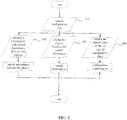
- Fig. 3 is a processing flow chart of the configuration data in the anomaly detection method provided in the embodiment of the present application. As shown in Fig. 3 , the processing flow of acquiring configuration data of the objects and clustering the objects based on the configuration data to generate a first clustering set of the objects includes following steps 310 to 340.
- the NMS acquires the configuration data of the wireless network management system, and cleans and regularizes the configuration data acquired.
- configuration data is cleaned to remove duplicate data and error data.
- configuration data is regularized to clean, transform, merge and reshape the data.
- a logical dependency between the objects in the wireless communication network system is determined based on the configuration data.
- the logical dependency refers to the logical connection between different objects.
- a base station may correspond to a plurality of cells.
- the base station is a parent object of the cells while the cells are a child object of the base station.
- the physical transmission link is the parent object of the logical transmission link, while the logical transmission link is the child object of the physical transmission link.
- the logical dependency of the objects in the wireless network communication system presents a tree structure.
- the objects are clustered based on the configuration data related to spatial information to obtain a spatial clustering set of the objects clustered based on the spatial information.
- the configuration data related to the spatial information refers to the data that carries one of the attributes of spatial information in the configuration data.
- the spatial information may be a geographical location and so on.
- the objects are clustered based on the set type of configuration data to obtain a configuration clustering set of the objects clustered based on the set type of configuration data.
- the type of configuration data selected for clustering depends on the KPI or PI indicators for which anomaly detection is performed. For example, if the indicators to be subjected to anomaly detection are those related to radio frequency, the configuration parameters related to radio frequency are selected for clustering. Alternatively, if the indicators to be subjected to anomaly detection are those related to calls, the configuration parameters related to calls are selected for clustering. In some implementations, there may be a plurality of configuration clustering sets obtained by clustering configuration data of different types at the same time.
- the first clustering set obtained by clustering the configuration data includes the spatial clustering set in the step 330 and the configuration clustering set in the step 340.
- step 320, step 330, and step 340 are not required to be performed in a specific order, and they may be performed in the order described in the above examples, or in a reverse order or may be performed simultaneously.
- Fig. 4 is a processing flow chart of determining a clustering set in the anomaly detection method provided in the embodiment of the present application.
- the processing flow of acquiring performance indicator data of the objects, and clustering the objects based on the performance indicator data to generate a second clustering set of the objects; clustering the objects based on the operation state data to generate a third clustering set of the objects; and performing logical operations on the first clustering set, the second clustering set and the third clustering set based on a preset rule to obtain at least one clustering set of the objects includes following steps of S410 to S440.
- the performance indicator data and operation state data of the objects are acquired periodically, and the performance indicator data and operation state data are cleaned and regularized, respectively.
- the acquisition cycle of the performance indicator data and operation state data is determined based on the reporting cycle of the above data. For example, assuming that the reporting cycle of the performance indicator data or operation state data in the wireless network communication system is x minutes, the acquisition cycle of the performance indicator data and operation state data of the acquired objects in the embodiments of the present application may also be x minutes. In some implementations, the acquisition cycle may also be an integer multiple of the reporting cycle according to the needs of the actual usage scenario, which is not specifically defined in the embodiments of the present application.
- the operation state data includes data such as call detail records, complaint records, measurement reports (MR) or Call Detail Trace (CDT) of users.
- the performance indicator data includes traffic-related indicator data.
- the traffic-related indicator data may be data corresponding to indicators such as traffic data volume or switching times.
- the objects in the wireless communication network system are clustered based on the traffic-related indicator data to obtain a traffic clustering set clustered based on the traffic-related indicator data.
- the traffic clustering set obtained by clustering the objects based on the traffic-related indicator data belongs to the second clustering set obtained by clustering the objects based on the performance indicator data.
- the objects in the wireless communication network system are clustered based on the operation state data to obtain an operation state clustering set clustered based on the operation state data.
- operation state clustering set belongs to the third clustering set.
- logical operations are performed on the spatial clustering set, the configuration clustering set, the traffic clustering set and the operation state clustering set based on the preset rule to obtain at least one clustering set of the objects.
- the preset rule is limiting information that limits the logical operator or operational order of the logical operation.
- Logical operations which are performed on the spatial clustering set, the configuration clustering set, the traffic clustering set, and the operation state clustering set based on different preset rules, may lead to different results.
- the preset rule to be selected may be determined based on the target of anomaly detection.
- the preset rule may be the configuration clustering set AND the traffic clustering set AND the operation state clustering set XOR the spatial clustering set, where AND is a logical operator that represents an AND operation, and XOR is a logical operator that represents an exclusive OR operation.
- the preset rule may be the configuration clustering set AND the spatial clustering set AND the operation state clustering set XOR the traffic clustering set.
- Logical operations, which are performed on the spatial clustering set, the configuration clustering set, the traffic clustering set, and the operation state clustering set based on the above preset rule result in that objects with similar configuration, operation state and spatial position but different traffic are included in one clustering set.
- the preset rule may be the configuration clustering set AND the traffic clustering set AND the operation state clustering set AND the spatial clustering set.
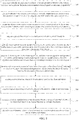
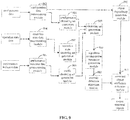
- Fig. 5 is a flow chart of another anomaly detection method provided in the embodiment of the present application. As shown in Fig. 5 , the anomaly detection method includes following steps of S501 to S511.
- the performance indicator data and operation state data of the objects are acquired periodically, and the performance indicator data and operation state data are cleaned and regularized, respectively.
- the objects in the wireless communication network system are clustered based on the operation state data to obtain an operation state clustering set clustered based on the operation state data.
- the objects in the wireless communication network system are clustered based on the traffic-related indicator data to obtain a traffic clustering set clustered based on the traffic-related indicator data.
- a spatial clustering set and a configuration clustering set of the objects are acquired.
- logical operations are performed on the spatial clustering set, the configuration clustering set, the traffic clustering set and the operation state clustering set based on the preset rule to obtain at least one clustering set of the objects.
- At least one clustering set of the objects may be stored in a list, and the list storing at least one clustering set is called a clustering set list.
- step of S506 all clustering sets in the clustering set list are acquired, and an algorithm configuration parameter corresponding to each clustering set are determined based on a preset anomaly detection algorithm and the performance indicator data corresponding to the objects in the clustering set.
- the algorithm configuration parameter include a configuration parameter or a threshold required by the anomaly detection algorithm. It should be noted that which algorithm is selected as the preset anomaly detection algorithm is determined based on the actual application scenario, which is not specifically defined in the embodiments of the present application. In some implementations, the objects in different states may be classified through the above logical operations, thus simplifying the application scenario, and a relatively simple anomaly detection algorithm such as Vector Auto Regression (VAR) may be selected.
- VAR Vector Auto Regression
- abnormal performance indicator data of the objects in the corresponding clustering set is determined based on the algorithm configuration parameter, and the abnormal objects are determined based on the abnormal performance indicator data.
- a preset anomaly detection algorithm is adopted to perform anomaly detection on the performance indicator data of the objects in each clustering set to obtain abnormal performance indicator data. Based on the corresponding relationship between the performance indicator data and the objects, abnormal objects corresponding to the abnormal performance indicator data are determined.
- a set of abnormal objects to be determined is generated based on the abnormal objects.
- a logical dependency between the objects in the wireless communication network system is acquired.
- a logical causality between the abnormal objects in the set of abnormal objects to be determined is determined based on the logical dependency between the objects.
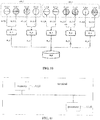
- Fig. 6 is a schematic diagram of a logical dependency between objects provided in the embodiment of the present application.
- object 0 has a logical dependency with three other types of objects (i.e., objects 0-0, 0-1 and 0-2), where the object 0-0 has a logical dependency with object 0-0-0 and object 0-0-1, respectively; the object 0-1 has a logical dependency with object 0-1-0 and object 0-1-1, respectively; and the object 0-2 has a logical dependency with object 0-2-0 and object 0-2-1, respectively.
- the set of abnormal objects to be determined is adjusted based on the logical causality to obtain the set of abnormal objects.
- an abnormal object and an object having a logical dependency with the abnormal object are acquired by performing a traversal downward from a topmost child node, to determine whether the abnormal object and the object at the parent node have similar anomalies in performance indicators. If so, the abnormal object as a child node is deleted from the set of abnormal objects to be determined. Otherwise, no operation is performed. In the case that there are still abnormal objects on which the traversal has not been performed in the clustering set, new abnormal objects are acquired and the above process is repeated. In the case that a traversal has been performed on the abnormal objects in all clustering sets in the clustering set list, the adjusted set of abnormal objects to be determined will be taken as a final set of abnormal objects.
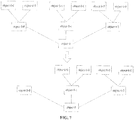
- Fig. 7 is a schematic diagram of attribution reduction of abnormal objects provided in the embodiment of the present application.
- objects 0-0, 0-0-0 and 0-0-1 have similar performance anomalies, and the object 0-0 is an object at the parent node, while the objects 0-0-0 and 0-0-1 are both objects at the child nodes.
- the anomaly of the object at the child node is probably caused by the object at the parent node, so the objects 0-0-0 and 0-0-1 may be deleted from the set of abnormal objects to be determined.
- the anomalies of the objects at the child node are attributed to those at the parent node, so that the attribution reduction of abnormal objects is achieved, redundant data contained in the set of abnormal objects is reduced, and the accuracy of abnormal object detection is improved.
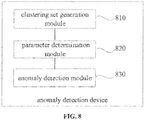
- Fig. 8 is a schematic structural block diagram of an anomaly detection device provided in the embodiment of the present application.
- the device may be configured in the NMS, and may also exist independently of the NMS.
- the anomaly detection method provided in the embodiment of the present application, the device can accurately detect abnormal objects in a wireless communication network system.
- the anomaly detection device in the embodiment of the present application includes a clustering set generation module 810, a parameter determination module 820, and an anomaly detection module 830.
- the clustering set generation module 810 is configured to generate at least one clustering set of objects based on configuration data and performance indicator data of the objects.
- the parameter determination module 820 is configured to determine an algorithm configuration parameter corresponding to each clustering set based on a preset anomaly detection algorithm and the performance indicator data corresponding to the objects in the clustering set.
- the anomaly detection module 830 is configured to determine abnormal performance indicator data of the objects in the corresponding clustering set based on the algorithm configuration parameter, so as to determine abnormal objects based on the abnormal performance indicator data.
- the anomaly detection device provided in the embodiment of the present application is configured to implement the anomaly detection method in the embodiment shown in Fig. 2 , and the implementation principle and technical effect of the anomaly detection device are similar to those of the anomaly detection method, which will not be described in detail here.
- the object includes function modules for constructing the wireless communication network system.
- the clustering set generation module 810 is configured to: generate at least one clustering set of the objects based on configuration data, performance indicator data and operation state data of the objects.
- the operation state data includes one or more of service quality data, measurement report, call tracing data, signaling tracing data and user complaint data.
- the clustering set generation module 810 is configured to:
- the parameter determination module 820 is configured to: train the preset anomaly detection algorithm based on the performance indicator data of the objects in each clustering set to obtain the algorithm configuration parameter corresponding to each clustering set.
- the anomaly detection module 830 is configured to:
- the anomaly detection device further includes a set adjustment module.
- the set adjustment module is configured to, after determining an abnormal object based on the abnormal performance indicator data, generate a set of abnormal objects to be determined based on the abnormal objects; acquire a dependency between the objects in the wireless communication network system, where the dependency is determined based on the configuration data; determine a logical causality between the abnormal objects in the set of abnormal objects to be determined based on the dependency between the objects; and adjust the set of abnormal objects to be determined based on the logical causality to obtain a set of abnormal objects.
- Fig. 9 is a processing flow diagram of another anomaly detection device provided in the embodiment of the present application.
- the anomaly detection device may include a performance indicator data preprocessing (loading, cleaning and regularization) module 901, an anomaly detection algorithm module 902, a configuration data preprocessing (loading, cleaning and regularization) module 903, an operation state data preprocessing (loading, cleaning and regularization) module 904, an object dependency generation module 905, a configuration clustering set generation module 906, an operation state clustering set generation module 907, a traffic clustering set generation module 908, a clustering set generation module 909, an algorithm configuration parameter generation module 910 and an abnormal object attribution reduction module 911.
- the performance indicator data preprocessing module 901 is configured to read performance indicator data, clean and regularize the data, and send the cleaned and regularized data to the anomaly detection algorithm module 902 and the traffic clustering set generation module 908, respectively.
- the configuration data preprocessing module 903 is configured to read configuration data of a wireless communication network system, clean and regularize the data, and send the cleaned and regularized data to the object dependency generation module 905 and the configuration cluster generation module 906, respectively.
- the operation state data preprocessing module 904 is configured to read operation state data of objects in the wireless communication network system, clean and regularize the data, and send the cleaned and regularized data to the operation state clustering set generation module 907.
- the object dependency generation module 905 is configured to generate a logical dependency between the objects based on the configuration data, and send the logical dependency to the abnormal object attribution reduction module 911.
- the configuration clustering set generation module 906 is configured to cluster the objects based on the configuration data to obtain a configuration clustering set and a spatial clustering set of the objects, and send the configuration clustering set and the spatial clustering set to the clustering set generation module 909.
- the operation state clustering set generation module 907 is configured to cluster the objects based on the operation state data to obtain an operation state clustering set of the objects, and send the operation state clustering set to the clustering set generation module 909.
- the traffic clustering set generation module 908 is configured to cluster the objects based on the traffic to obtain a traffic clustering set of the objects, and send the traffic clustering set to the clustering set generation module 909.
- the clustering set generation module 909 is configured to perform logical operations on the spatial clustering set, the configuration clustering set, the traffic clustering set and the operation state clustering set based on the preset rule to obtain at least one clustering set of the objects.
- at least one clustering set of the objects may be stored in a clustering set list.
- the clustering set generation module 909 sends the clustering set list to the algorithm configuration parameter generation module 910.
- the algorithm configuration parameter generation module 910 is configured to generate an algorithm configuration parameter for each clustering set based on a preset anomaly detection algorithm and the performance indicator data corresponding to the objects in the clustering set list, and send the parameter to the anomaly detection algorithm module 902.
- the anomaly detection algorithm module 902 is configured to perform anomaly detection on the performance indicator data in the corresponding clustering set based on the algorithm configuration parameter corresponding to each clustering set, generate a set of anomaly objects to be determined, and send the set to the anomaly object attribution reduction module 911.
- the abnormal object attribution reduction module 911 is configured to determine a logical causality between the abnormal objects in the set of abnormal objects to be determined based on the logical dependency of the objects, determine target abnormal objects that meets a setting rule in the set of abnormal objects to be determined based on the logical causality, delete the target abnormal objects to obtain a set of abnormal objects, and output the set of abnormal objects.
- Fig. 10 is a schematic diagram of a wireless communication network system provided in the embodiment of the present application. Assuming that there is a simplified wireless communication network system, as shown in Fig. 10 , the wireless communication network system includes a core network and five base stations.
- FIG. 11 is a structure diagram of the terminal provided in the embodiment of the present application.
- the terminal includes a memory 1110 and one or more processors 1120.
- the memory 1110 is configured to store one or more programs which, when executed by the one or more processors 1120, cause the one or more processors 1120 to implement the anomaly detection method described in the embodiments of the present application.
- the terminal provided above may be configured to execute the anomaly detection method provided in any of the above embodiments, and has corresponding functions and beneficial effects.
- An embodiment of the present application also provides a storage medium for storing executable instructions which, when executed by a computer processor, cause the computer processor to perform an anomaly detection method including:
- various embodiments of the present application may be implemented in hardware or dedicated circuitry, software, logic, or any combination thereof.
- some aspects may be implemented in hardware, while other aspects may be implemented in firmware or software that may be executed by a controller, microprocessor, or other computing device, although the present application is not limited thereto.
- a block diagram of any logic flow in the accompanying drawings of the present application may represent program steps, or may represent interconnected logic circuits, modules, and functions, or may represent a combination of program steps and logic circuits, modules, and functions.
- a computer program may be stored in a memory.
- the memory may be of any type suitable for a local technical environment and may be implemented using any suitable data storage technology, such as, but not limited to, read only memory (ROM), random access memory (RAM), optical memory device and system (digital versatile disc (DVD) or CD disc).
- the computer readable medium may include a non-transitory storage medium.
- the data processor may be of any type suitable for a local technical environment, such as, but not limited to, general purpose computer, special purpose computer, microprocessor, digital signal processor (DSP), application specific integrated circuit (ASIC), field programmable gate array (FGPA), and processor based on a multi-core processor architecture.
- DSP digital signal processor
- ASIC application specific integrated circuit
- FGPA field programmable gate array
Landscapes
- Engineering & Computer Science (AREA)
- Computer Networks & Wireless Communication (AREA)
- Signal Processing (AREA)
- Data Mining & Analysis (AREA)
- Physics & Mathematics (AREA)
- General Physics & Mathematics (AREA)
- Theoretical Computer Science (AREA)
- Pure & Applied Mathematics (AREA)
- Mathematical Physics (AREA)
- Probability & Statistics with Applications (AREA)
- Mathematical Optimization (AREA)
- Mathematical Analysis (AREA)
- Algebra (AREA)
- Bioinformatics & Cheminformatics (AREA)
- Artificial Intelligence (AREA)
- Bioinformatics & Computational Biology (AREA)
- Computer Vision & Pattern Recognition (AREA)
- Evolutionary Biology (AREA)
- Evolutionary Computation (AREA)
- General Engineering & Computer Science (AREA)
- Life Sciences & Earth Sciences (AREA)
- Mobile Radio Communication Systems (AREA)
- Testing And Monitoring For Control Systems (AREA)
Applications Claiming Priority (2)
| Application Number | Priority Date | Filing Date | Title |
|---|---|---|---|
| CN201910901446.4A CN112543465B (zh) | 2019-09-23 | 2019-09-23 | 一种异常检测方法、装置、终端及存储介质 |
| PCT/CN2020/112150 WO2021057382A1 (zh) | 2019-09-23 | 2020-08-28 | 一种异常检测方法、装置、终端及存储介质 |
Publications (3)
| Publication Number | Publication Date |
|---|---|
| EP3843445A1 true EP3843445A1 (de) | 2021-06-30 |
| EP3843445A4 EP3843445A4 (de) | 2021-12-22 |
| EP3843445B1 EP3843445B1 (de) | 2025-10-15 |
Family
ID=75013220
Family Applications (1)
| Application Number | Title | Priority Date | Filing Date |
|---|---|---|---|
| EP20864266.0A Active EP3843445B1 (de) | 2019-09-23 | 2020-08-28 | Verfahren und vorrichtung zur erkennung von anomalien, endgerät und speichermedium |
Country Status (4)
| Country | Link |
|---|---|
| US (1) | US12063528B2 (de) |
| EP (1) | EP3843445B1 (de) |
| CN (1) | CN112543465B (de) |
| WO (1) | WO2021057382A1 (de) |
Families Citing this family (13)
| Publication number | Priority date | Publication date | Assignee | Title |
|---|---|---|---|---|
| CN113568812B (zh) * | 2021-07-29 | 2024-06-07 | 北京奇艺世纪科技有限公司 | 一种智能机器人的状态检测方法和装置 |
| CN115884416A (zh) * | 2021-09-23 | 2023-03-31 | 中兴通讯股份有限公司 | 一种干扰信号的规避方法、装置、基站和存储介质 |
| CN113965497B (zh) * | 2021-10-20 | 2022-12-06 | 深圳平安医疗健康科技服务有限公司 | 服务器异常识别方法、装置、计算机设备及可读存储介质 |
| CN114630365B (zh) * | 2022-04-14 | 2024-02-06 | 北京邮电大学 | 小区健康状态检测的方法及装置 |
| CN117670015A (zh) * | 2022-08-19 | 2024-03-08 | 顺丰科技有限公司 | 物流对象的异常检测方法、装置、及相关设备 |
| WO2024085881A1 (en) * | 2022-10-21 | 2024-04-25 | Rakuten Mobile, Inc. | Method of analyzing voice over internet protocol communication and system for implementing the same |
| KR102541925B1 (ko) * | 2022-12-23 | 2023-06-13 | 성균관대학교산학협력단 | 파라미터 설정 없이 결함 데이터에서 노이즈 결함을 추출하는 방법 및 장치 |
| CN116419008B (zh) * | 2023-03-15 | 2024-05-10 | 苏州匠数科技有限公司 | 运营播放视频的实时检测方法、系统和电子设备 |
| FI20235781A1 (en) * | 2023-07-03 | 2025-01-04 | Elisa Oyj | Monitoring of target systems |
| CN116599778B (zh) * | 2023-07-18 | 2023-09-26 | 山东溯源安全科技有限公司 | 用于确定恶意设备的数据处理方法 |
| CN117093942B (zh) * | 2023-08-24 | 2024-11-19 | 唐人通信技术服务股份有限公司 | 家庭宽带中异常数据分析方法及装置 |
| CN117421684B (zh) * | 2023-12-14 | 2024-03-12 | 易知谷科技集团有限公司 | 基于数据挖掘和神经网络的异常数据监测与分析方法 |
| CN117633697B (zh) * | 2024-01-26 | 2024-05-03 | 西安艺琳农业发展有限公司 | 基于物联网的生猪智能监测方法及系统 |
Family Cites Families (14)
| Publication number | Priority date | Publication date | Assignee | Title |
|---|---|---|---|---|
| US10505825B1 (en) * | 2014-10-09 | 2019-12-10 | Splunk Inc. | Automatic creation of related event groups for IT service monitoring |
| US9805099B2 (en) * | 2014-10-30 | 2017-10-31 | The Johns Hopkins University | Apparatus and method for efficient identification of code similarity |
| US20170034720A1 (en) * | 2015-07-28 | 2017-02-02 | Futurewei Technologies, Inc. | Predicting Network Performance |
| US9961571B2 (en) * | 2015-09-24 | 2018-05-01 | Futurewei Technologies, Inc. | System and method for a multi view learning approach to anomaly detection and root cause analysis |
| US10546241B2 (en) | 2016-01-08 | 2020-01-28 | Futurewei Technologies, Inc. | System and method for analyzing a root cause of anomalous behavior using hypothesis testing |
| CN107231649B (zh) * | 2016-03-25 | 2019-11-19 | 中国移动通信有限公司研究院 | 一种室内弱覆盖的确定方法及装置 |
| CN105873105B (zh) * | 2016-04-22 | 2018-07-03 | 中国科学技术大学 | 一种基于网络体验质量的移动通信网异常检测和定位方法 |
| US20170364819A1 (en) | 2016-06-17 | 2017-12-21 | Futurewei Technologies, Inc. | Root cause analysis in a communication network via probabilistic network structure |
| US10178566B2 (en) * | 2017-01-27 | 2019-01-08 | Telefonaktiebolaget Lm Ericsson (Publ) | Radio access network (RAN) cell site diagnostic test tool system and method |
| JP7033499B2 (ja) | 2017-07-26 | 2022-03-10 | パナソニック インテレクチュアル プロパティ コーポレーション オブ アメリカ | 異常検知装置および異常検知方法 |
| CN110061854A (zh) * | 2018-01-18 | 2019-07-26 | 华东明 | 一种无边界网络智能运维管理方法与系统 |
| US10897389B2 (en) * | 2018-09-14 | 2021-01-19 | Cisco Technology, Inc. | Threshold selection for KPI candidacy in root cause analysis of network issues |
| CN110062410B (zh) * | 2019-03-28 | 2021-09-28 | 东南大学 | 一种基于自适应谐振理论的小区中断检测定位方法 |
| CN111199252A (zh) * | 2019-12-30 | 2020-05-26 | 广东电网有限责任公司 | 一种电力通信网络智能运维系统的故障诊断方法 |
-
2019
- 2019-09-23 CN CN201910901446.4A patent/CN112543465B/zh active Active
-
2020
- 2020-08-28 EP EP20864266.0A patent/EP3843445B1/de active Active
- 2020-08-28 WO PCT/CN2020/112150 patent/WO2021057382A1/zh not_active Ceased
- 2020-08-28 US US17/278,483 patent/US12063528B2/en active Active
Also Published As
| Publication number | Publication date |
|---|---|
| EP3843445B1 (de) | 2025-10-15 |
| CN112543465B (zh) | 2022-04-29 |
| US20220124517A1 (en) | 2022-04-21 |
| US12063528B2 (en) | 2024-08-13 |
| WO2021057382A1 (zh) | 2021-04-01 |
| US20230140836A9 (en) | 2023-05-04 |
| CN112543465A (zh) | 2021-03-23 |
| EP3843445A4 (de) | 2021-12-22 |
Similar Documents
| Publication | Publication Date | Title |
|---|---|---|
| EP3843445B1 (de) | Verfahren und vorrichtung zur erkennung von anomalien, endgerät und speichermedium | |
| US12380316B2 (en) | Assurance of policy based alerting | |
| US9503919B2 (en) | Wireless communication network using multiple key performance indicators and deviations therefrom | |
| WO2017215647A1 (en) | Root cause analysis in a communication network via probabilistic network structure | |
| CN104038371B (zh) | 一种电力通信传输网自适应性能采集方法 | |
| WO2022028120A1 (zh) | 指标检测模型获取及故障定位方法、装置、设备及存储介质 | |
| EP2934037B1 (de) | Technik zur Auswertung einer Parametereinstellung in einem mobilen Kommunikationsnetz | |
| KR20180120558A (ko) | 딥러닝 기반 통신망 장비의 장애 예측 시스템 및 방법 | |
| EP2997756A1 (de) | Verfahren und netzwerkvorrichtung für den nachweis von zellanomalien | |
| CN102572883B (zh) | 一种网络通信保障方法及装置 | |
| CN115022916B (zh) | 一种基于状态检测的5g通信异常预警方法及系统 | |
| WO2022149149A1 (en) | Artificial intelligence with dynamic causal model for failure analysis in mobile communication network | |
| JP2025532909A (ja) | フロントホールリンクの故障根本原因の特定方法及び装置 | |
| CN116643954A (zh) | 模型监控方法、监控端、装置及存储介质 | |
| CN114995342A (zh) | 一种基于大数据技术的c3无线通信超时分析方法及系统 | |
| CN114036711A (zh) | 一种网络质量劣化检测方法及系统 | |
| CN119276710A (zh) | 网络质量优化方法、装置、电子设备及存储介质 | |
| WO2025140705A1 (zh) | 中台能力的全生命周期质量监控方法、装置及设备 | |
| CN118138492A (zh) | 基于数字孪生的电力专网监测方法、系统、设备及介质 | |
| WO2021143483A1 (zh) | 系统维护方法、装置、设备和存储介质 | |
| EP3457634A1 (de) | Sammlung von leistungsdaten auf verwaltungsebene | |
| CN108156012B (zh) | 一种网络报障数据多维度分类统计分析方法及装置 | |
| CN108093431A (zh) | 一种以干数据处理网元tdpne为处理节点的数据上报方法和装置 | |
| CN113556773B (zh) | 基于ai模型检测睡眠小区的方法 | |
| WO2024061254A1 (zh) | 数据获取方法、装置、系统和设备 |
Legal Events
| Date | Code | Title | Description |
|---|---|---|---|
| STAA | Information on the status of an ep patent application or granted ep patent |
Free format text: STATUS: UNKNOWN |
|
| STAA | Information on the status of an ep patent application or granted ep patent |
Free format text: STATUS: THE INTERNATIONAL PUBLICATION HAS BEEN MADE |
|
| PUAI | Public reference made under article 153(3) epc to a published international application that has entered the european phase |
Free format text: ORIGINAL CODE: 0009012 |
|
| STAA | Information on the status of an ep patent application or granted ep patent |
Free format text: STATUS: REQUEST FOR EXAMINATION WAS MADE |
|
| 17P | Request for examination filed |
Effective date: 20210323 |
|
| AK | Designated contracting states |
Kind code of ref document: A1 Designated state(s): AL AT BE BG CH CY CZ DE DK EE ES FI FR GB GR HR HU IE IS IT LI LT LU LV MC MK MT NL NO PL PT RO RS SE SI SK SM TR |
|
| A4 | Supplementary search report drawn up and despatched |
Effective date: 20211118 |
|
| RIC1 | Information provided on ipc code assigned before grant |
Ipc: H04L 12/26 20060101ALI20211112BHEP Ipc: H04L 12/24 20060101ALI20211112BHEP Ipc: H04W 24/04 20090101AFI20211112BHEP |
|
| DAV | Request for validation of the european patent (deleted) | ||
| DAX | Request for extension of the european patent (deleted) | ||
| STAA | Information on the status of an ep patent application or granted ep patent |
Free format text: STATUS: EXAMINATION IS IN PROGRESS |
|
| 17Q | First examination report despatched |
Effective date: 20230616 |
|
| GRAP | Despatch of communication of intention to grant a patent |
Free format text: ORIGINAL CODE: EPIDOSNIGR1 |
|
| STAA | Information on the status of an ep patent application or granted ep patent |
Free format text: STATUS: GRANT OF PATENT IS INTENDED |
|
| RIC1 | Information provided on ipc code assigned before grant |
Ipc: H04W 24/04 20090101AFI20250606BHEP Ipc: H04L 41/0806 20220101ALI20250606BHEP Ipc: H04L 41/142 20220101ALI20250606BHEP Ipc: H04L 43/02 20220101ALI20250606BHEP Ipc: H04L 41/0895 20220101ALI20250606BHEP Ipc: H04L 43/20 20220101ALI20250606BHEP Ipc: H04L 41/40 20220101ALI20250606BHEP Ipc: H04L 41/147 20220101ALN20250606BHEP Ipc: H04L 43/16 20220101ALN20250606BHEP |
|
| INTG | Intention to grant announced |
Effective date: 20250620 |
|
| RIN1 | Information on inventor provided before grant (corrected) |
Inventor name: GUO, TIAN |
|
| GRAS | Grant fee paid |
Free format text: ORIGINAL CODE: EPIDOSNIGR3 |
|
| GRAA | (expected) grant |
Free format text: ORIGINAL CODE: 0009210 |
|
| STAA | Information on the status of an ep patent application or granted ep patent |
Free format text: STATUS: THE PATENT HAS BEEN GRANTED |
|
| AK | Designated contracting states |
Kind code of ref document: B1 Designated state(s): AL AT BE BG CH CY CZ DE DK EE ES FI FR GB GR HR HU IE IS IT LI LT LU LV MC MK MT NL NO PL PT RO RS SE SI SK SM TR |
|
| REG | Reference to a national code |
Ref country code: GB Ref legal event code: FG4D Ref country code: CH Ref legal event code: F10 Free format text: ST27 STATUS EVENT CODE: U-0-0-F10-F00 (AS PROVIDED BY THE NATIONAL OFFICE) Effective date: 20251015 |
|
| REG | Reference to a national code |
Ref country code: DE Ref legal event code: R096 Ref document number: 602020060654 Country of ref document: DE |
|
| REG | Reference to a national code |
Ref country code: IE Ref legal event code: FG4D |
|
| REG | Reference to a national code |
Ref country code: NL Ref legal event code: MP Effective date: 20251015 |
|
| REG | Reference to a national code |
Ref country code: AT Ref legal event code: MK05 Ref document number: 1848184 Country of ref document: AT Kind code of ref document: T Effective date: 20251015 |
|
| PG25 | Lapsed in a contracting state [announced via postgrant information from national office to epo] |
Ref country code: NL Free format text: LAPSE BECAUSE OF FAILURE TO SUBMIT A TRANSLATION OF THE DESCRIPTION OR TO PAY THE FEE WITHIN THE PRESCRIBED TIME-LIMIT Effective date: 20251015 |
|
| PG25 | Lapsed in a contracting state [announced via postgrant information from national office to epo] |
Ref country code: ES Free format text: LAPSE BECAUSE OF FAILURE TO SUBMIT A TRANSLATION OF THE DESCRIPTION OR TO PAY THE FEE WITHIN THE PRESCRIBED TIME-LIMIT Effective date: 20251015 |
|
| REG | Reference to a national code |
Ref country code: LT Ref legal event code: MG9D |
|
| PG25 | Lapsed in a contracting state [announced via postgrant information from national office to epo] |
Ref country code: NO Free format text: LAPSE BECAUSE OF FAILURE TO SUBMIT A TRANSLATION OF THE DESCRIPTION OR TO PAY THE FEE WITHIN THE PRESCRIBED TIME-LIMIT Effective date: 20260115 |
|
| PG25 | Lapsed in a contracting state [announced via postgrant information from national office to epo] |
Ref country code: AT Free format text: LAPSE BECAUSE OF FAILURE TO SUBMIT A TRANSLATION OF THE DESCRIPTION OR TO PAY THE FEE WITHIN THE PRESCRIBED TIME-LIMIT Effective date: 20251015 Ref country code: FI Free format text: LAPSE BECAUSE OF FAILURE TO SUBMIT A TRANSLATION OF THE DESCRIPTION OR TO PAY THE FEE WITHIN THE PRESCRIBED TIME-LIMIT Effective date: 20251015 Ref country code: HR Free format text: LAPSE BECAUSE OF FAILURE TO SUBMIT A TRANSLATION OF THE DESCRIPTION OR TO PAY THE FEE WITHIN THE PRESCRIBED TIME-LIMIT Effective date: 20251015 |
|
| PG25 | Lapsed in a contracting state [announced via postgrant information from national office to epo] |
Ref country code: RS Free format text: LAPSE BECAUSE OF FAILURE TO SUBMIT A TRANSLATION OF THE DESCRIPTION OR TO PAY THE FEE WITHIN THE PRESCRIBED TIME-LIMIT Effective date: 20260115 |
|
| PG25 | Lapsed in a contracting state [announced via postgrant information from national office to epo] |
Ref country code: IS Free format text: LAPSE BECAUSE OF FAILURE TO SUBMIT A TRANSLATION OF THE DESCRIPTION OR TO PAY THE FEE WITHIN THE PRESCRIBED TIME-LIMIT Effective date: 20260215 |
|
| PG25 | Lapsed in a contracting state [announced via postgrant information from national office to epo] |
Ref country code: PT Free format text: LAPSE BECAUSE OF FAILURE TO SUBMIT A TRANSLATION OF THE DESCRIPTION OR TO PAY THE FEE WITHIN THE PRESCRIBED TIME-LIMIT Effective date: 20260216 |
|
| PG25 | Lapsed in a contracting state [announced via postgrant information from national office to epo] |
Ref country code: PL Free format text: LAPSE BECAUSE OF FAILURE TO SUBMIT A TRANSLATION OF THE DESCRIPTION OR TO PAY THE FEE WITHIN THE PRESCRIBED TIME-LIMIT Effective date: 20251015 |
|
| PG25 | Lapsed in a contracting state [announced via postgrant information from national office to epo] |
Ref country code: LV Free format text: LAPSE BECAUSE OF FAILURE TO SUBMIT A TRANSLATION OF THE DESCRIPTION OR TO PAY THE FEE WITHIN THE PRESCRIBED TIME-LIMIT Effective date: 20251015 |
|
| PG25 | Lapsed in a contracting state [announced via postgrant information from national office to epo] |
Ref country code: BG Free format text: LAPSE BECAUSE OF FAILURE TO SUBMIT A TRANSLATION OF THE DESCRIPTION OR TO PAY THE FEE WITHIN THE PRESCRIBED TIME-LIMIT Effective date: 20251015 |