EP3844908B1 - Dispositif et procédé permettant de fournir une fonction de qualité de service - Google Patents
Dispositif et procédé permettant de fournir une fonction de qualité de service Download PDFInfo
- Publication number
- EP3844908B1 EP3844908B1 EP18773397.7A EP18773397A EP3844908B1 EP 3844908 B1 EP3844908 B1 EP 3844908B1 EP 18773397 A EP18773397 A EP 18773397A EP 3844908 B1 EP3844908 B1 EP 3844908B1
- Authority
- EP
- European Patent Office
- Prior art keywords
- qos
- application entity
- network
- function
- change
- Prior art date
- Legal status (The legal status is an assumption and is not a legal conclusion. Google has not performed a legal analysis and makes no representation as to the accuracy of the status listed.)
- Active
Links
Images





Classifications
-
- H—ELECTRICITY
- H04—ELECTRIC COMMUNICATION TECHNIQUE
- H04L—TRANSMISSION OF DIGITAL INFORMATION, e.g. TELEGRAPHIC COMMUNICATION
- H04L41/00—Arrangements for maintenance, administration or management of data switching networks, e.g. of packet switching networks
- H04L41/50—Network service management, e.g. ensuring proper service fulfilment according to agreements
- H04L41/5041—Network service management, e.g. ensuring proper service fulfilment according to agreements characterised by the time relationship between creation and deployment of a service
- H04L41/5045—Making service definitions prior to deployment
-
- H—ELECTRICITY
- H04—ELECTRIC COMMUNICATION TECHNIQUE
- H04L—TRANSMISSION OF DIGITAL INFORMATION, e.g. TELEGRAPHIC COMMUNICATION
- H04L41/00—Arrangements for maintenance, administration or management of data switching networks, e.g. of packet switching networks
- H04L41/14—Network analysis or design
- H04L41/147—Network analysis or design for predicting network behaviour
-
- H—ELECTRICITY
- H04—ELECTRIC COMMUNICATION TECHNIQUE
- H04L—TRANSMISSION OF DIGITAL INFORMATION, e.g. TELEGRAPHIC COMMUNICATION
- H04L43/00—Arrangements for monitoring or testing data switching networks
- H04L43/08—Monitoring or testing based on specific metrics, e.g. QoS, energy consumption or environmental parameters
- H04L43/091—Measuring contribution of individual network components to actual service level
-
- H—ELECTRICITY
- H04—ELECTRIC COMMUNICATION TECHNIQUE
- H04W—WIRELESS COMMUNICATION NETWORKS
- H04W28/00—Network traffic management; Network resource management
- H04W28/16—Central resource management; Negotiation of resources or communication parameters, e.g. negotiating bandwidth or QoS [Quality of Service]
- H04W28/24—Negotiating SLA [Service Level Agreement]; Negotiating QoS [Quality of Service]
-
- H—ELECTRICITY
- H04—ELECTRIC COMMUNICATION TECHNIQUE
- H04W—WIRELESS COMMUNICATION NETWORKS
- H04W4/00—Services specially adapted for wireless communication networks; Facilities therefor
- H04W4/30—Services specially adapted for particular environments, situations or purposes
- H04W4/40—Services specially adapted for particular environments, situations or purposes for vehicles, e.g. vehicle-to-pedestrians [V2P]
-
- H—ELECTRICITY
- H04—ELECTRIC COMMUNICATION TECHNIQUE
- H04L—TRANSMISSION OF DIGITAL INFORMATION, e.g. TELEGRAPHIC COMMUNICATION
- H04L43/00—Arrangements for monitoring or testing data switching networks
- H04L43/06—Generation of reports
-
- H—ELECTRICITY
- H04—ELECTRIC COMMUNICATION TECHNIQUE
- H04W—WIRELESS COMMUNICATION NETWORKS
- H04W24/00—Supervisory, monitoring or testing arrangements
- H04W24/10—Scheduling measurement reports ; Arrangements for measurement reports
-
- H—ELECTRICITY
- H04—ELECTRIC COMMUNICATION TECHNIQUE
- H04W—WIRELESS COMMUNICATION NETWORKS
- H04W28/00—Network traffic management; Network resource management
- H04W28/02—Traffic management, e.g. flow control or congestion control
- H04W28/0268—Traffic management, e.g. flow control or congestion control using specific QoS parameters for wireless networks, e.g. QoS class identifier [QCI] or guaranteed bit rate [GBR]
Definitions
- the present invention generally relates to the field of providing Quality of Service (QoS) in communication networks. More specifically, the present disclosure relates to a device and a method for determining a QoS of a communication service (e.g., a Vehicle-to-Everything (V2X) service) of an application entity (e.g., a vehicle, an application server) in a communication network including a plurality of network entities.
- a communication service e.g., a Vehicle-to-Everything (V2X) service
- V2X Vehicle-to-Everything
- This invention also relates to devices and methods that transmit the predicted QoS (e.g., an expected change in the QoS) to the application entity and/or the network entities.
- Enhanced Vehicular-to-Everything (eV2X) services are described as a special type of Fifth Generation (5G) services, which include both safety and non-safety services, according to the technical specification document with the reference number of "TS 22.186".
- 5G Fifth Generation
- a predictive QoS configuration or adaptation is essential, for example, to ensure meeting the mixture of safety or non-safety V2X services with the minimum control-plane latency, and real-time signalling.
- the Radio Access Network (RAN) for each User Equipment (UE) establishes one or more Data Radio Bearers (DRBs) per Protocol Data Unit (PDU) session.
- the RAN associates the uplink traffic (UL) and downlink traffic (DL) QoS flows with the DRBs.
- the DRB defines the packet treatment on the radio interface (Uu).
- a DRB serves packets with the same packet forwarding treatment. Separate DRBs may be established for the QoS flows requiring different packet forwarding treatment, as it is defined in "3GPP-38804".
- the appropriate DRBs are established based on the output of the admission control, in order to make sure that the expected QoS is achieved.
- the network via the "modify bearer context request" message provides the dynamic QoS modification in an established bearer
- a detailed description can be found in 3GPP specification documents with the references of 3GPP-36331, and 3GPP-24301.
- This is a hard decision that does not provide an "early" notification scheme from the network to the UE (or a group of them), for example, about the expected QoS and/or the coverage changes.
- This function does not allow the application or the UE to be notified early enough about an expected QoS change, and negotiate with the network or adapt the application layer configuration, e.g., before the actual QoS modification.
- the conventional schemes e.g., Long Term Evolution (LTE), Fifth Generation (5G)
- LTE Long Term Evolution
- 5G Fifth Generation
- the conventional devices and methods have the disadvantages that, they do not support the prediction of the changes in the QoS and/or the coverage (e.g., based on the mobility information of the UEs (e.g., the vehicles), the application behaviour, the map information, and the network information).
- the conventional devices and methods do not support, for example, the subscription to the service for the prediction of the QoS Changes, the corresponding monitoring requests to enable the prediction, the QoS negotiation between the application and the network (e.g., V2X application at the vehicle side), the early notification of the involved applications for the changes of the provided QoS and/or the coverage, etc.
- HUAWEI ET AL "Proposal for Solution to KI#2-Monitoring network situation and QoS by V2X application", vol. SA WG6, no. Sophia Antipolis, France; 20180305 - 20180309, (20180309), XP051411870, 3GPP DRAFT; S6-180416_WAS338-FS_V2XAPP-PROPOSAL FOR SOLUTION TO KI#2-MONITORING NETWORK SITUATION AND QOS BY V2X APPLICATION, 3RD GENERATION PARTNERSHIP PROJECT (3GPP), MOBILE COMPETENCE CENTRE; 650 , discloses procedures and requirements for network situation and Quality of Service (QoS) monitoring.
- QoS Quality of Service
- an objective of the present invention is to improve the conventional solutions for providing the QoS function for the communication services in the communication networks.
- the objective of the present invention is achieved by the solution provided in the enclosed independent claims.
- Advantageous implementations of the present invention are further defined in the dependent claims.
- an embodiment of the present invention proposes a device for providing a QoS function for a communication service of an application entity in a communication network. Specifically, the device determines the QoS and/or predicts a change in the QoS of the communication service of the application entity.
- the QoS function (also hereinafter referred to as the prediction QoS "P-QoS" function) is based on a prediction functionality in a communication system that allows to, for example, determine the QoS, predict the QoS, determine a change in the QoS, predict (and/or detect very fast) changes in the QoS, and/or the coverage for a specific communication service of an application entity (e.g., V2X application entity), identify potential changes of the QoS (e.g., based on historic information or statistics).
- an application entity e.g., V2X application entity
- a first aspect of the present invention provides a device for providing a quality of service (QoS) function, for at least one communication service of at least one application entity in a communication network comprising a plurality of network entities, the device configured to activate, in response to a subscription request of the at least one application entity, a subscription of the at least one application entity to the quality of service, QoS, function, transmit a monitoring request to one or more of: the at least one application entity, at least one network entity, and at least one user equipment, obtain a monitoring response from one or more of: the at least one application entity, the at least one network entity, and the at least one user equipment, predict a change in QoS of the at least one communication service of the at least one application entity, based on the obtained monitoring response, and transmit information based on the predicted change in the QoS to the at least one application entity and/or at least one of the plurality of network entities in the communication network, wherein the subscription of the at least one application entity to the QoS function is activated based on a
- the device is further configured to notify the predicted change in the QoS to the at least one application entity and/or the at least one of the plurality of network entities by providing an additional QoS indicating the predicted change in the QoS. This can be done by transmitting information based on the predicted change in the QoS, in particular the change in the QoS as such.
- the subscription parameter further includes one or more of: a protocol data unit (PDU) session identification number (ID), a vehicle-to-everything (V2X) communication service ID, a single or a group of affected vehicle-to-everything user equipment (V2X-UE) IDs, a timing window and/or a frequency of the subscription request to the QoS function, a time horizon for the prediction of the change in the QoS of the at least one communication service, a threshold value of the change in the QoS of the at least one communication service, a duration time of the communication service, a segment-based subscription or an end to end (E2E), subscription to the QoS function, a required capability and a monitoring exposure to the at least one application entity, a required QoS for the communication service, at least one or more alternative QoS levels that could be used, when it is determined that a primary QoS is not available, and a type of a link including a sidelink (PC5),
- PDU protocol data unit
- the transmitted monitoring request includes one or more of: a monitoring parameter, a monitoring level, a duration time and a granularity of the monitoring response, and a location information of the monitoring request.
- the change in the QoS of the at least one communication service is predicted based on one or more of: a mobility information of the at least one application entity, a behavior of the at least one application entity, a map information, a historic information representing a combination of the location of the UE and/or the communication network and/or a radio information, and characteristics of the communication network.
- notifying the predicted change in the QoS comprises providing a notification to the at least one application entity and/or the at least one of the plurality of network entities, based on a type of the communication service, including at least one of a Sidelink (PC5) communication, and a cellular communication (Uu).
- PC5 Sidelink
- Uu cellular communication
- notifying the predicted change in the QoS comprises providing a notification to the at least one application entity and/or the at least one of the plurality of network entities, including one or more of: a protocol data unit (PDU) session identification number (ID), a vehicle-to-everything (V2X) communication service ID, a type of a link including a Sidelink (PC5) and/or the cellular communication (Uu), a single or a group of affected vehicle-to-everything user equipment (V2X-UE) IDs, a QoS parameter, a proposal for a new level of the QoS, a timing information of the change in the QoS, a location information of the change in the QoS, a level of the QoS per user equipment (UE), a timing information of the UE, and a probabilistic information for the change in the QoS.
- PDU protocol data unit
- V2X vehicle-to-everything
- PC5 Sidelink
- Uu the cellular communication
- the at least one communication service includes a vehicle-to-everything (V2X) communication service.
- V2X vehicle-to-everything
- the application entity is based on a V2X application entity.
- the application entity is based on a V2X application entity including one or more of: an application server for the V2X communication service, a V2X application client representative of a UE, an application function (AF) representative of a public land mobile network, PLMN-owned application function, and a middleware application entity located between the application server and the communication network.
- a V2X application entity including one or more of: an application server for the V2X communication service, a V2X application client representative of a UE, an application function (AF) representative of a public land mobile network, PLMN-owned application function, and a middleware application entity located between the application server and the communication network.
- the application server for the V2X communication service includes one or more of: a V2X application server (V2X AS), a group-communications system application server (GCS-AS), and a content provider.
- V2X AS V2X application server
- GCS-AS group-communications system application server
- content provider a content provider
- the device is further configured to predict the change in the QoS of the at least one communication service, based on a slice-based architecture.
- the communication service is based on a direct vehicle-to-vehicle (V2V), communication service, and the application entity is based on a UE.
- V2V vehicle-to-vehicle
- the application entity may be a UE such as a vehicle, furthermore, the vehicle may further communicate with another vehicle.
- the device is further configured to provide a vehicle-to-everything control function (V2XCF) for providing a sidelink (PC5), parameter to the UE.
- V2XCF vehicle-to-everything control function
- PC5 sidelink
- the device is further configured to provide, via the vehicle-to-everything control function (V2XCF), a notification message to the UE, the notification message being representative of an enhanced provisioning policy for the QoS function.
- V2XCF vehicle-to-everything control function
- the notification message provided to the UE includes one or more of: the sidelink (PC5) parameter, a mapping of proximity services (ProSE) per packet priorities quality of service (PPPP/QoS) class to packet delay budget (PDB) and packet error rate (PER) for a current QoS, and the predicted change in the QoS, a radio parameter for the current QoS, and the predicted change in the QoS, a timer information (Txxxx) indicating the UE changing the radio parameters or mapping of the proximity services (ProSE) per packet priorities (PPPP) for the vehicle-to-everything (V2X) communication service over the sidelink (PC5).
- PC5 sidelink
- PDB packet delay budget
- PER packet error rate
- the device is further configured to trigger a network reconfiguration based on the predicted change in the QoS, for maintaining a specific QoS level.
- the device is further configured to provide an alert notification to the at least one application entity and/or the at least one of the plurality of network entities, the alert notification being indicative of an accuracy of the predicted change in the QoS.
- a second aspect of the invention provide a method for providing a quality of service (QoS) function, for at least one communication service of at least one application entity in a communication network comprising a plurality of network entities, the method comprising activating, in response to a subscription request of the at least one application entity, a subscription of the at least one application entity to a QoS function, transmitting a monitoring request to one or more of: the at least one application entity, at least one network entity, and at least one user equipment, obtaining a monitoring response from one or more of: the at least one application entity, the at least one network entity, and the at least one user equipment, predicting a change in quality of service (QoS) of the at least one communication service of the at least one application entity, based on the obtained monitoring response, and transmitting the predicted change in the QoS to the at least one application entity and/or at least one of the plurality of network entities in the communication network, wherein the subscription of the at least one application entity to the QoS function is activated based on
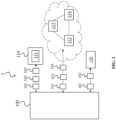
- FIG. 1 shows a device 100 for providing a quality of service (QoS) function, for a communication service 111 of an application entity 110 in a communication network 1, according to an embodiment of the invention.
- QoS quality of service
- the communication network may further include the user equipment 120, and a plurality of network entities 112, 113, and 114.
- the device and/or the application entity and/or the network entities and/or the user equipment 120 may be configured to communicate to each other, may be located in one or more communication networks, may be located in one or more PLMNs, etc., without limiting the present disclosure to a specific network configuration.
- the plurality of network entities 112, 113, and 114 may be based on Radio Access Network (RAN) nodes (e.g., Base Stations) or Core Network (CN) entities (e.g., NWDAF, SMF, PCF, UPF, Access and Mobility management Function (AMF), etc).
- RAN Radio Access Network
- CN Core Network
- the device 100 is configured to transmit a monitoring request 101 to one or more of: the application entity 110, at least one network entity (e.g., 112 in FIG. 1 ), and the user equipment 120.
- the monitoring request 101 may be transmitted to different network nodes, and may further be used for collection of information for determining the QoS of the communication service, the change in the QoS, etc.
- monitoring requests 101 may be transmitted to the application entity 110 and/or the UE 120, for example, directly or via another network entity.
- the device 100 is further configured to obtain a monitoring response 102 from one or more of: the application entity 110, the at least one network entity 112, and the user equipment 120.
- the device 100 may transmit the monitoring request 101 to the application entity 110 (e.g., which may be a vehicle). Moreover, the device 100 may further obtain the monitoring response 102 from the application entity 110 which may be, e.g., the path of the vehicle, the trajectory of the vehicle, etc.
- the application entity 110 e.g., which may be a vehicle.
- the device 100 may transmit the monitoring request 101 to the UE 120 (e.g., a vehicle). Moreover, the device 100 may further obtain the monitoring response 102 from the UE 120 which may be, e.g., the path of the vehicle, the trajectory of the vehicle, etc.
- the device 100 is further configured to determine a change in quality of service 103 of the at least one communication service 111 of the at least one application entity 110, based on the obtained monitoring response 102.
- the device may obtain the monitoring response from one or more of the network entities that the monitoring request is transmitted to them.
- the QoS of the communication service a change in the QoS of the communication service, a change in the coverage, etc., may be determined.
- the device 100 is further configured to transmit the determined change in the QoS 103 to the at least one application entity 110 and/or at least one of the network entities 112, 113, and 114 in the communication network 1.
- the device may determine the change in the QoS, and it may further transmit the change in the QoS (e.g., a QoS, a change in QoS, a coverage level, etc.) to the application entity and/or one more of the network entities, etc.
- the change in the QoS e.g., a QoS, a change in QoS, a coverage level, etc.
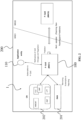
- FIG. 2 shows a schematic view of a system 200 including a device 100 for activating and providing a quality of service (QoS) function for a communication service of an application entity 110, according to an embodiment of the invention.
- QoS quality of service
- the device 100 in the system 200 performs several procedures that may be needed, in order to enable the QoS function (e.g., the P-QoS functionality).
- the QoS function e.g., the P-QoS functionality.
- the system 200 includes the application entity 110 which sends a subscription request to the QoS function of the device 100.
- the device 100 performs activation of prediction for all types of links and/or services, in response to the subscription request of the application entity 110.
- the QoS and/or the changes in the QoS of the communication service of the application entity may be determined.
- the device 100 further performs activation of monitoring reports to the appropriate nodes for all types of links and/or services, in order to enable and/or to provide the QoS function.
- the device 100 transmits the monitoring request to the RAN 201 and several network entities including NWDAF, SMF, PCF, Access and Mobility management Function (AMF) and UPF, in the CN 202 of the communication network 1.
- the device 100 obtains a monitoring response from the RAN 201, and from one or more of the network entities including NWDAF, SMF, PCF, AMF and UPF in the CN 202.
- the device 100 further determines a change in the QoS of the communication service of the application entity 110, based on the obtained monitoring response, and transmits the determined change in the QoS to the application entity 110.
- the device 100 notifies the application entity, by providing a notification of QoS change and/or coverage using timing location, probabilistic information, etc.
- the system 200 is based on a Multi-operators in which two different operators including a first mobile network operator MNO1 is interacting with a second mobile network operator MNO2. The interactions may be based on roaming and non-roaming cases.
- the device 100, the network entities in the CN 202, the application entity 110, and the RAN 201 are included in the first MNO1, without limiting the present disclosure to a specific location of the different entities.
- the device 100 (and/or the system 200) further performs the configuration of the P-QoS, for example, by the Management plane.
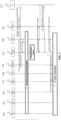
- FIG. 3 a flow diagram of an exemplary procedure, for activation of the QoS function, configuration of the communication network and providing a QoS function.
- Entities shown in FIG. 3 are the UE 300, the AN 301, the AMF 302, the SMF 303, the UPF 304, the NWDAF 305, the device 100 which is configured to provide the QoS function (e.g., the P-QoS functionality), the PCF 306, the Network Exposure function (the NEF) 307, and the application entity in the form of application function 110.
- the QoS function e.g., the P-QoS functionality
- the PCF 306 the Network Exposure function
- the application entity in the form of application function 110 e.g., the P-QoS functionality
- the UE 300 may be similar and/or may function similar to the UE 120 of the FIG. 1 , without limiting the present disclosure.
- the UE 120 of FIG. 1 and the UE 300 of FIG. 3 may be based on an identical vehicle or different types of vehicles, etc.
- the V2X application entity subscribes with the 5G communication network to support the predictive QoS (P-QoS) functionality.
- the QoS function e.g., P-QoS functionality
- P-QoS predictive QoS
- the application entity sends a P-QoS subscription parameter to the 5G system.
- the subscription parameter includes one or more of:
- the activation of the QoS function (e.g., the P-QoS functionality activation) is described as a feature which can be activated, e.g., in response to a subscription request of an application entity being based on an application function (AF), and for a V2X service considering the 5G system.
- the procedure can be applied more generally to all types of the application entities.
- the application entity may be based on an application server, an application function, a middleware application, etc.
- the communication system may also be any type of the (e.g., cellular) communication systems.
- AF 110 sends a service request message which includes:
- the AF 110 sends a service ID, and a time, area and periodicity information to the NEF 307 and the PCF 306, respectively.
- the PCF 306 (or any relevant network functionality which may be responsible for the policy control and charging), after receiving the AF's 110 request, sends a P-QoS activation request message to the device 100 (e.g., its P-QoS logical unit).
- the P-QoS activation request message includes:
- the device 100 (for example, its P-QoS unit) initiates the monitoring activation/subscription procedure (which will be described in detailed in the following in FIG. 4 ).
- the monitoring activation/subscription procedure may include on demand the analytics activation messages to the NWDAF 305, as well as, to the RAN via the AMF 302 and the UE 300 (for example, for a real-time UE monitoring).
- the device 100 e.g., its P-QoS admission control
- the PCF 306 activates the subscription of the AF 110 to the QoS function, in order to ensure that the communication network can support this features and monitoring response is acknowledged (ACK).
- ACK acknowledged
- the P-QoS functionality of the device 100 sends a P-QoS activation response message to the application entity 110, directly, or via the NEF 307.
- This message may include an ACK (in case of acceptance) or NACK (in case of rejection) or a negotiation of network parameters, for example, in the cases that, not all P-QoS parameters can be fulfilled by the system, etc.).
- the AF 110 responds by an ACK/NACK, for example, in the case of negotiating the P-QoS subscription parameters.
- the device 100 may undertake the role of overriding or extending the PCC rules by sending a message to the PCF 306 and/or to the SMF 303.
- a pre-configured extended PCC rule message may be transmitted from the P-QoS of the device 100 to the SMF 303
- a dynamic extended PCC rules message may be transmitted from the P-QoS of the device 100 to the PCF 306.
- both messages may include the P-QoS activation parameters.
- different interfaces may be impacted.
- the P-QoS function of the device 100 may be operated, for example, in a service or a session based manner.
- the communication network may notify the application entity 110 when the prediction service is not supported any more (e.g., change of the Radio Access Technology (RAT) or the cell), or in the cases when any change in the configuration of the prediction service (i.e. the QoS function) is needed. Therefore, the prediction service may be, e.g., released, modified, and updated either by the application entity and/or by the device and/or by the communication network, etc.
- the prediction service may be, e.g., released, modified, and updated either by the application entity and/or by the device and/or by the communication network, etc.
- the subscription request for the activating the prediction service may be sent by an application entity of a UE (or a group of UEs) to the network using control plane signaling (Radio Resource Control (RRC), Non-access stratum (NAS)), or to an application function (e.g., AF of 5GS) using user plane signaling.
- RRC Radio Resource Control
- NAS Non-access stratum
- AF AF of 5GS
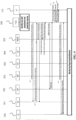
- FIG. 4 shows a flow diagram of an exemplary procedure, for activation of monitoring for the QoS function.
- the device 100 transmits a monitoring request to a network entity, for example, to AN 301 in the communication network, and/or the application entity 110, and/or the UE 300.
- a network entity for example, to AN 301 in the communication network, and/or the application entity 110, and/or the UE 300.
- the P-QoS subscription request e.g., the P-QoS subscription parameters, the type of the V2X service
- different monitoring subscription or configuration requests may be required, transmitted and collected, e.g., by different network nodes (e.g., gNB, UPF), depending on the type of the V2X service and the agreed P-QoS requirements.
- These requests may allow collection of different types of information that may be needed, in order to, e.g., activate the subscription request, determine the QoS, determine the change in the QoS and/or enable the prediction of the QoS change, etc.
- the different types of information may be one or more of:
- the procedure to identify the key QoS parameters and the prediction events may be affected by, for example, the type of service, the type of the communication link that is used (e.g., cellular (Uu), sidelink (PC5)) and the configuration of the P-QoS subscription request.
- the type of service e.g., cellular (Uu), sidelink (PC5)
- the configuration of the P-QoS subscription request e.g., the configuration of the P-QoS subscription request.
- the device may transmit (e.g., directly or via another CN function) the appropriate monitoring subscription request messages to the appropriate nodes (e.g., UE, RAN node, CN node, V2X application entity).
- the appropriate nodes e.g., UE, RAN node, CN node, V2X application entity.
- the transmitted monitoring request may include one or more of:
- the node that has received the monitoring request for the prediction service responds by an ACK or NACK.
- the node may indicate an alternative monitoring configuration, if it is available.
- a monitoring start message may be sent by the P-QoS function of the device 100 (e.g., directly or via another CN function).
- the monitoring may be stopped or paused (e.g., with a monitoring reject message), and the monitoring configuration may be modified during the lifetime of the V2X service.
- the device 100 and/or its P-QoS function may transmit an on-demand analytic activation request message.
- the P-QoS function 100 may transmit the on-demand analytic activation request message to the NWDAF 305.
- the NWDAF 305 may provide an analytic activation respond (e.g., ACK or NACk), to the P-QoS function of the device 100.
- an analytic activation respond e.g., ACK or NACk
- the device 100 may transmit the monitoring request to the application entity (i.e. the AF 110 in FIG. 4 ). Moreover, the device 100 may further obtain the monitoring response from the AF 110 which may be, e.g., the path of the vehicle, the trajectory of the vehicle, etc.
- the application entity i.e. the AF 110 in FIG. 4
- the device 100 may further obtain the monitoring response from the AF 110 which may be, e.g., the path of the vehicle, the trajectory of the vehicle, etc.
- the device 100 may transmit the monitoring request to the UE 300 which may be a vehicle. Moreover, the device 100 may further obtain the monitoring response from the UE 120 which may be, e.g., the path of the vehicle, the trajectory of the vehicle, etc.
- the device 100 and/or its P-QoS function may transmit a mobility stats subscription, for example, to the AMF 302, and the AMF 302 may further transmit a mobility stats response to the device 100.
- FIG. 5 shows a flow diagram of an exemplary procedure, for activation of monitoring for a local prediction of the QoS function.
- the P-QoS function (or any other CN function) may be based on a "local" predictions of, e.g., the changes in the QoS, the events that may be requested by and/or allocated to the individual network entities (e.g., Base Station (BS), UPF) or the UE.
- BS Base Station
- UPF User Plane Function
- the assignment of the prediction of the changes in the QoS for a PC5/sidelink communication may be faster to take place at the RAN side.
- the node that has received the prediction subscription request message may respond by ACK or NACK.
- the node may indicate an alternative prediction configuration, if possible.
- the device 100 and/or its P-QoS function transmits a local prediction message to the application entity AF 110 and/or to a network entity.
- the AN 301 transmit a prediction notification message (e.g., expected degradation of radio quality, increase of path loss of Uu and/or PC5 radio link) to the P-QoS function of the device 100.
- a prediction notification message e.g., expected degradation of radio quality, increase of path loss of Uu and/or PC5 radio link
- the prediction subscription request message may include the type of the parameter that should be predicted by the recipient node (or a local P-QoS functionality), the type of reporting (e.g., per flow, node, session, etc.), the time granularity of the prediction and the reporting, the location of the prediction and the reporting, etc.
- the actual "local” prediction results may be initiated, for example, a prediction start message is transmitted by the P-QoS function (directly or via another CN function).
- the "local” prediction may further be stopped or paused, while the "local” prediction configuration being modified during the lifetime of a V2X Service.
- the local" prediction results (i.e., the prediction notification message) may be sent to one or more of:
- the determined change in the QoS may be transmitted to the application entity and/or one of the network entities.
- the device 100 may provide a notification to the application entity 110 and/or one of the network entities, based on a type of the communication service, including at least one of a sidelink (PC5), communication, and a cellular communication (Uu).
- a type of the communication service including at least one of a sidelink (PC5), communication, and a cellular communication (Uu).
- the outcome of the QoS function e.g., the P-QoS functionality
- the V2X application entity e.g., the UE, the application server, etc.
- the type and the description of the notification may depend on the initial P-QoS subscription.
- the notification may be:
- the QoS function (e.g., the prediction functionality) may provide the notification of the changes in the QoS, based on the P-QoS outcome, and it may further include one or more of:
- FIGs. 6a, 6b , 7a and 7b illustrate different forms of implementations of providing the notification from the device 100 and/or its P-QoS function 100 to the V2X application entity using either a control plane and/or a user plane messages.
- the notification may be, for example, the service ID, the V2X-UE ID, the QoS parameter (e.g., an old value of the QoS, a new value for the QoS, an event, a timing information that the changes in the QoS being applied, the geographical area that the changes in QoS being applied, probability of the QoS change, etc.).
- the QoS parameter e.g., an old value of the QoS, a new value for the QoS, an event, a timing information that the changes in the QoS being applied, the geographical area that the changes in QoS being applied, probability of the QoS change, etc.
- the notification response may be, for example, ACK, NACK, negotiation of the parameters, etc.
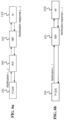
- FIG. 6a and FIG. 6b schematically illustrate two examples of signaling options via the NEF 601 in the 5G networks.
- the notified destination node is the V2X application entity located at the AF 110, which can be a PLMN-owned application or a third party application.
- FIG. 7a and FIG. 7b schematically illustrate two examples of signaling options where the notified destination node is the V2X application entity located at the UE 300.
- the notification may be sent either via the AF 110 or via the RAN interfaces (e.g., NAS, RRC).
- the SMF 303 is able to notify the PCF 306, if the QoS targets for a QoS flow cannot be fulfilled (in accordance to the "3GPP-23503"), and may further update it with an early notification information, etc.
- the P-QoS functionality may notify the SMF 303 entity, and the latter may forward the notification for any change of the QoS or the coverage levels to the PCF 306. Then, the PCF 306 undertakes to transmit the notification message to the NEF 601, the AMF 302, and/or any other function or network entity.
- the receiving V2X application entity may respond with a notification response message, for example, it may acknowledge the notification and/or accept or reject the new proposed QoS level (i.e. if the new proposed QoS level provided). In the case of the rejection, a negotiation of the QoS values between the network side and the V2X application entity may be initiated, and the later may propose a preferable alternative QoS level.
- the outcomes of the P-QoS notification about the expected QoS and/or the coverage change may be transmitted to the network entities (e.g., BS, UPF, AMF, SMF, PCF, V2X-CF of the 5G system, etc.).
- the appropriate re-configuration action may be triggered and decided by the network, for example, based on the type of the notification, and in order to maintain the initial agreed QoS level and/or optimize the network performance, etc.
- FIG. 8 schematically illustrates a procedure for the configuration of the P-QoS function by the management plane, and particularly for the scenario of a slice-based architecture (i.e., V2X slice).
- the P-QoS function may be a feature which is required, for example, on demand, or it may be activated by default for a particular service.
- the network slicing is a key 5G requirement for enabling the verticals to operate on an end-to-end logical sub-network, e.g., after an agreement with the network operator.
- the automotive sector is a key vertical for the 5G system, and the 5G-V2X is envisioned as a key slicing scenario.
- the operator may provide the required network features, in order to meet the customized service requirements of the third party or the customer (e.g. OEM).
- the network features may be required, for meeting the slice KPIs, and the associated functions and resources.
- the P-QoS function may be one particular feature, which may be provided by default or on demand for a V2X slice.
- the third party 801 transmits some service requirements to the CSMF 802 which is the entity that translates the service requirements to the network requirements, from the management perspective.
- the Network Slice Management Function (NSMF) 800 creates and/or modifies the network slice instances, and it further maps them to policies (e.g. radio resource management (RRM) policy, Network Function (NF) placement, scale in/out, slice coverage, etc.).
- RRM radio resource management
- NF Network Function placement
- scale in/out, slice coverage etc.
- the Communication Service Management Function (CSMF) 802, the NSMF 800, and the Network Slice Subnet Management Function (NSSMF) 803 are the slice management functionalities which comprise the slice management system as it is defined in technical specification document with the reference number of "3 GPP-28530".
- FIG. 9 schematically illustrates a procedure for a configuration of the PC5 parameters for the P-QoS function.
- a V2X Control Function (V2XCF) 900 is provided.
- the V2XCF 900 is a network function for provision of the Sidelink (PC5) parameters to the UE 300.
- the QoS function e.g., the QoS model
- the QoS function for the PC5 includes the proximity services (ProSE) per packet priorities (PPPP), and the reliability (PPPR) provisioning to the UE 300 for the sidelink operation.
- ProSE proximity services
- PPPP packet priorities
- PPPR reliability
- the P-QoS function provisions the P-QoS parameters which includes the predicted or expected changes (QoS characteristics/PPPPs/5QIs and the mapping to the QoS attributes) for the PC5 session.
- a message is transmitted from the device 100 (e.g., its P-QoS function) to the V2XCF 900, and/or the application server 901 and/or the UE 300 (via the V2XCF 900).
- the message is representative of an enhanced provisioning policies for the P-QoS message, and it includes the PC5 provisioning parameters as it is defined in technical specification documents with the reference numbers of "3GPP-24386" and "3GPP-23786".
- the transmitted message includes one or more of:
- FIG. 10 schematically illustrates a procedure for providing a P-QoS function in a Multi-MNO environment.
- a UE may enable the P-QoS functionality.
- its subscription to the QoS function (e.g., the P-QoS functionality) of a V2X service may be activated and/or it may be connected to an MNO with a QoS function.
- the UE may further move to a second MNO (e.g., a national MNO, a cross-border MNO).
- a second MNO e.g., a national MNO, a cross-border MNO.
- an extension of the subscription may be requested.
- the interaction between the MNOs may take place, for example:
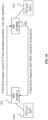
- FIG. 10 schematically illustrates a procedure for transmitting a P-QoS subscription request based on an inter NEF interaction, in a Multi-MNO environment, using a roaming service.
- a subscription request of the application entity in the first communication network may be transmitted to a network entity in the second communication network.
- the subscription request may include the QoS service request message for determining, upon a roaming of the application entity from the first communication network to the second communication network, whether the QoS function for the communication service of the application entity is supported in the second communication network.
- the PLMN/MNO1 asks via a P-QoS service request message whether the P-QoS subscription parameters for a V2X Service of one or more UEs could be supported, when the UE moves to the second PLMN/MNO2.
- the PLMN 1 includes the PCF Point coordinates function (1000) (or P-QoS 1), and the Network Exposure function (NEF) 1001 (NEF PLMN1).
- the PLMN 2 includes the PCF 1002 (or P-QoS 2), and the NEF 1003 (NEF PLMN2).
- the PLMN/MNO2 responds with the ACK or the NACK.
- NACK i.e., P-QoS service response message
- it may propose, an optional alternative supported configuration.
- the interaction between the MNOs may take place via the NEF or the AFs.
- FIG. 11a and FIG 11b schematically illustrate a procedure for transmitting a P-QoS subscription request based on an inter-PLMN control plane, in a Multi-MNO environment, using a roaming service.
- the interactions between the MNOs for the request of the P-QoS capabilities and/or the configuration that could be supported, i.e., by the second MNO are performed via the inter PLMN interfaces.
- the N24 and the N32 reference points of the 5G system architecture may be used for, e.g., the P-QoS service request, the response messages, and the subscription of the P-QoS capabilities to another MNO/PLMN.
- the N27 (between NRFs) may be used for inter-PLMN P-QoS service discovery function (e.g., the query, the response). For example, in the cases that the PLMN/MNO1 needs to check if the PLMN/MNO2 provides any P-QoS service.
- the QoS function (e.g., the prediction of the QoS) may be provided, for example, when two or more UEs are attached at different MNOs and they communicate via the cellular (Uu) and/or the Sidelink (PC5) interfaces (i.e. an identical or with different frequency bands).
- the cellular (Uu) and/or the Sidelink (PC5) interfaces i.e. an identical or with different frequency bands.
- the vehicle-to-network-to-vehicle (V2N2V) communication may be performed between two or more vehicles attached at different MNOs, e.g., sensor sharing, cooperative maneuver, etc.
- the prediction of the changes in the QoS may require an exchange of the prediction results (e.g., by a notifications) for a session of the V2X service that involves vehicles which are attached at different MNOs.
- the PLMN1 may detect an expected change of the QoS, based on its individual P-QoS calculations. Moreover, the PLMN1 may notify both of the vehicles that are attached at its own network, and it may also notify the other involved vehicles that are attached at the PLMN2.
- the messages representing notification of the changes in the QoS may include a proposed supported QoS level.
- a detailed description of the notification of the QoS changes is described above (e.g., in FIG. 6a, FIG. 6b , FIG. 7a, and FIG. 7b ).
- the other vehicles may accept or reject, and/or negotiate the new QoS that could be supported, e.g., by the triggering the corresponding MNO.
- FIG. 12a, FIG. 12b, and FIG. 12c schematically illustrate message sequence charts for providing QoS function in a Multi-MNO environment, where the application entities are attached at different MNOs.
- FIG. 12a, FIG. 12b, and FIG. 12c three alternative implementation forms of the MSC are illustrated for the interaction between different MNOs, and consequently, the transmission of the notification messages to the V2X application entities (e.g., in UEs) that are attached to different MNOs.
- V2X application entities e.g., in UEs
- FIG. 12a illustrates an interaction between different MNOs, based on the NEF interfaces or AFs.
- the PLMN 1 including the PCF 1200 (or P-QoS 1), and the NEF 1201 (NEF PLMN1) communities with the PLMN 2 includes the PCF 12002 (or P-QoS 2), and the NEF 1203 (NEF PLMN2).
- the communication between the MNOs is performed based on the the NEF interfaces.
- FIG. 12b illustrates an interaction between different MNOs, based on the control plane interfaces, which may be the N24 and the N32 (i.e. reference points of the 5G system architecture "3GPP-23501", as it is described in FIG. 11a ).
- the control plane interfaces may be used for the notification and the notification response messages to the other MNO/PLMN.
- the second MNO may undertake to forward the notifications to the appropriate V2X application entities (e.g., of the UEs) that are attached to the first MNO.
- the PLMN 1 including the P-QoS1 1204, and the PCF 1205 communities with the PLMN 2 which includes the P-QoS2 1206 and the PCF 1207.
- the communication between the MNOs is performed based on the the control plane interfaces.
- FIG. 12c illustrates an interaction between different MNOs, based on the sidelink interface (PC5).
- the vehicles exchange notification messages that have received from their MNOs (i.e. MNO that they are attached to it). Similarly, the corresponding notification responses is transmitted via the sidelink interface using either sidelink control plane (e.g., RRC) and/or the user plane messages.
- sidelink control plane e.g., RRC
- FIG. 12a, FIG. 12b, and FIG. 12c may be used either for the cellular Uu (V2N2V) or the sidelink/PC5 communication between two or more UEs.
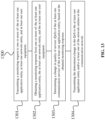
- FIG. 13 shows a method 1300 according to an embodiment of the invention for providing a quality of service (QoS) function, for a communication service 111 of an application entity 110 in a communication network 1 comprising a plurality of network entities 112, 113, 114.
- the method 1300 may be carried out by the device 100, as it described above.
- the method 1300 comprises a step 1301 of transmitting a monitoring request to one or more of: the at least one application entity, at least one network entity, and at least one user equipment.
- the method 1300 further comprises a step 1302 of obtaining a monitoring response from one or more of: the at least one application entity, the at least one network entity, and the at least one user equipment.
- the method 1300 further comprises a step 1303 of determining a change in quality of service (QoS) of the at least one communication service of the at least one application entity, based on the obtained monitoring response.
- QoS quality of service
- the method 1300 further comprises a step 1304 of transmitting the determined change in the QoS to the at least one application entity and/or at least one of the network entities in the communication network.
Landscapes
- Engineering & Computer Science (AREA)
- Computer Networks & Wireless Communication (AREA)
- Signal Processing (AREA)
- Quality & Reliability (AREA)
- Environmental & Geological Engineering (AREA)
- Mobile Radio Communication Systems (AREA)
- Data Exchanges In Wide-Area Networks (AREA)
Claims (17)
- Dispositif (100) pour fournir une fonction de qualité de service, QoS, pour au moins un service de communication (111) d'au moins une entité d'application (110) dans un réseau de communication (1) comprenant une pluralité d'entités de réseau (112, 113, 114), le dispositif (100) étant configuré pour :activer, en réponse à une demande d'abonnement de l'au moins une entité d'application (110), un abonnement de l'au moins une entité d'application (110) à la fonction QoS ;transmettre une demande de surveillance (101) à l'au moins une entité d'application (110) et/ou à au moins une entité de réseau (112) et/ou à au moins un équipement utilisateur (120) ;obtenir une réponse de surveillance (102) auprès de l'au moins une entité d'application (110) et/ou de l'au moins une entité de réseau (112) et/ou de l'au moins un équipement utilisateur (120) ;prédire un changement de QoS (103) de l'au moins un service de communication (111) de l'au moins une entité d'application (110) sur la base de la réponse de surveillance (102) obtenue ; ettransmettre des informations basées sur le changement de QoS (103) prédit à l'au moins une entité d'application (110) et/ou à au moins une de la pluralité d'entités de réseau (112, 113, 114) dans le réseau de communication (1),l'abonnement de l'au moins une entité d'application (110) à la fonction QoS étant activé sur la base d'un paramètre d'abonnement fourni par l'au moins une entité d'application (110) au réseau de communication (1), etle paramètre d'abonnement comportant une zone géographique prédéfinie pour la prédiction du changement de QoS de l'au moins un service de communication.
- Dispositif (100) selon la revendication 1, configuré en outre pour notifier le changement de QoS (103) prédit à l'au moins une entité d'application (110) et/ou à l'au moins une de la pluralité d'entités de réseau (112, 113, 114) en fournissant une QoS supplémentaire indiquant le changement de QoS prédit.
- Dispositif (100) selon la revendication 1 ou 2, le paramètre d'abonnement comportant en outre au moins un des éléments suivants :- un numéro d'identification, ID, de session d'unités de données de protocole, PDU,- un ID de service de communication véhicule-à-tout, V2X,- un seul ou un groupe d'ID d'équipement utilisateur véhicule-à-tout, V2X-UE, affectés,- une fenêtre temporelle et/ou une fréquence de la demande d'abonnement à la fonction QoS,- un horizon temporel pour la prédiction du changement de QoS de l'au moins un service de communication,- une valeur-seuil du changement de QoS de l'au moins un service de communication,- une durée du service de communication,- un abonnement par segments ou un abonnement de bout en bout, E2E, à la fonction QoS,- une capacité exigée et une exposition de surveillance à l'au moins une entité d'application,- une QoS exigée pour le service de communication,- au moins un ou plusieurs niveaux de QoS de substitution susceptibles d'être utilisés en cas de détermination qu'une QoS principale n'est pas disponible, et- un type d'une liaison comportant une liaison latérale, PC5, et/ou une communication cellulaire, Uu.
- Dispositif (100) selon l'une des revendications 1 à 3, la demande de surveillance transmise comportant au moins un des éléments suivants :- un paramètre de surveillance,- un niveau de surveillance,- une durée et une granularité de la réponse de surveillance, et- une information de localisation de la demande d'abonnement.
- Dispositif (100) selon l'une des revendications 1 à 4, le changement de QoS (103) de l'au moins un service de communication (111) étant prédit sur la base d'au moins un des éléments suivants :- une information de mobilité de l'au moins une entité d'application (110),- un comportement de l'au moins une entité d'application (110),- une information cartographique,- une information historique représentant une combinaison de la localisation de l'UE (120, 300) et/ou du réseau de communication (1) et/ou d'une information radio, et- des caractéristiques du réseau de communication.
- Dispositif (100) selon l'une des revendications 1 à 5, la notification du changement de QoS (103) prédit comprenant la fourniture d'une notification à l'au moins une entité d'application (110) et/ou à l'au moins une de la pluralité d'entités de réseau (112, 113, 114) sur la base d'un type du service de communication, comportant une communication en liaison latérale, PC5, et/ou une communication cellulaire, Uu.
- Dispositif (100) selon l'une des revendications 1 à 6, la notification du changement de QoS (103) prédit comprenant la fourniture d'une notification à l'au moins une entité d'application (110) et/ou à l'au moins une de la pluralité d'entités de réseau (112, 113, 114), comportant au moins un des éléments suivants :- un numéro d'identification, ID, de session d'unités de données de protocole, PDU,- un ID de service de communication véhicule-à-tout, V2X,- un type d'une liaison comportant une liaison latérale, PC5, et/ou une communication cellulaire, Uu,- un seul ou un groupe d'ID d'équipement utilisateur véhicule-à-tout, V2X-UE, affectés,- un paramètre de QoS,- une suggestion d'un nouveau niveau de QoS,- une information temporelle du changement de QoS,- une information de localisation du changement de QoS,- un niveau de QoS par équipement utilisateur, UE, (120, 300),- une information temporelle de l'UE (120, 300), et- une information probabiliste pour le changement de QoS.
- Dispositif (100) selon l'une des revendications 1 à 7, l'entité d'application (110) étant basée sur une entité d'application V2X comportant au moins un des éléments suivants :- un serveur d'applications (901) pour le service de communication V2X,- un client d'application V2X représentant un UE (120, 300),- une fonction d'application, AF, représentant une fonction d'application détenue par un réseau mobile terrestre public, PLMN, et- une entité d'application intergicielle située entre le serveur d'applications et le réseau de communication.
- Dispositif (100) selon la revendication 8, le serveur d'applications (901) pour le service de communication V2X comportant au moins un des éléments suivants :- un serveur d'applications V2X, V2X AS,- un serveur d'applications de système de communications de groupe, GCS-AS, et- un fournisseur de contenu.
- Dispositif (100) selon l'une des revendications 1 à 9, configuré en outre pour prédire le changement de QoS (103) de l'au moins un service de communication (111) sur la base d'une architecture à base de tranches.
- Dispositif (100) selon l'une des revendications 1 à 10, le service de communication (111) étant basé sur un service de communication directe de véhicule à véhicule, V2V, et l'entité d'application (110) étant basée sur un UE (120, 300).
- Dispositif (100) selon la revendication 11, configuré en outre pour fournir une fonction de commande véhicule-à-tout, V2XCF, (900), pour fournir un paramètre de liaison latérale, PC5, à l'UE (120, 300).
- Dispositif (100) selon la revendication 12, configuré en outre pour fournir, via la fonction de commande véhicule-à-tout, V2XCF, (900), un message de notification à l'UE (120, 300), le message de notification représentant une politique d'approvisionnement améliorée pour la fonction QoS.
- Dispositif (100) selon la revendication 13, le message de notification fourni à l'UE (120, 300) comportant au moins un des éléments suivants :- le paramètre de liaison latérale, PC5,- un mappage de classe de qualité de service de services de proximité, ProSE, par priorité de paquet, PPPP/QoS, sur un budget de retard des paquets, PDB, et un taux d'erreurs sur les paquets, PER, pour une QoS actuelle, et le changement de QoS prédit,- un paramètre radio pour la QoS actuelle, et le changement de QoS prédit, et- une information de temporisateur indiquant à l'UE un changement des paramètres radio ou un mappage des services de proximité, ProSE, par priorité de paquet, PPPP, pour le service de communication véhicule-à-tout, V2X, sur la liaison latérale, PC5.
- Dispositif (100) selon l'une des revendications 1 à 14, configuré en outre pour déclencher une reconfiguration de réseau sur la base du changement de QoS (103) prédit afin de maintenir un niveau de QoS spécifique.
- Dispositif (100) selon l'une des revendications 1 à 15, configuré en outre pour fournir une notification d'alerte à l'au moins une entité d'application (110) et/ou à l'au moins une de la pluralité d'entités de réseau (112, 113, 114), la notification d'alerte indiquant une précision du changement de QoS prédit.
- Procédé (1300) de fourniture d'une fonction de qualité de service, QoS, pour au moins un service de communication (111) d'au moins une entité d'application (110) dans un réseau de communication (1) comprenant une pluralité d'entités de réseau (112, 113, 114), le procédé comprenant :l'activation, en réponse à une demande d'abonnement de l'au moins une entité d'application (110), d'un abonnement de l'au moins une entité d'application (110) à une fonction QoS ;la transmission (1301) d'une demande de surveillance (101) à l'au moins une entité d'application (110) et/ou à au moins une entité de réseau (112) et/ou à au moins un équipement utilisateur (120) ;l'obtention (1302) d'une réponse de surveillance (102) auprès de l'au moins une entité d'application (110) et/ou de l'au moins une entité de réseau (112) et/ou de l'au moins un équipement utilisateur (120) ;la prédiction (1303) d'un changement de QoS (103) de l'au moins un service de communication (111) de l'au moins une entité d'application (110) sur la base de la réponse de surveillance (102) obtenue ; etla transmission d'informations basées sur le changement de QoS (103) prédit à l'au moins une entité d'application (110) et/ou à au moins une de la pluralité d'entités de réseau (112, 113, 114) dans le réseau de communication (1),l'abonnement de l'au moins une entité d'application (110) à la fonction QoS étant activé sur la base d'un paramètre d'abonnement fourni par l'au moins une entité d'application (110) au réseau de communication (1), etle paramètre d'abonnement comportant une zone géographique prédéfinie pour la prédiction du changement de QoS de l'au moins un service de communication.
Priority Applications (1)
| Application Number | Priority Date | Filing Date | Title |
|---|---|---|---|
| EP24168627.8A EP4380232A3 (fr) | 2018-09-17 | 2018-09-17 | Dispositif et procédé pour fournir une fonction de qualité de service |
Applications Claiming Priority (1)
| Application Number | Priority Date | Filing Date | Title |
|---|---|---|---|
| PCT/EP2018/075035 WO2020057717A1 (fr) | 2018-09-17 | 2018-09-17 | Dispositif et procédé permettant de fournir une fonction de qualité de service |
Related Child Applications (2)
| Application Number | Title | Priority Date | Filing Date |
|---|---|---|---|
| EP24168627.8A Division-Into EP4380232A3 (fr) | 2018-09-17 | 2018-09-17 | Dispositif et procédé pour fournir une fonction de qualité de service |
| EP24168627.8A Division EP4380232A3 (fr) | 2018-09-17 | 2018-09-17 | Dispositif et procédé pour fournir une fonction de qualité de service |
Publications (3)
| Publication Number | Publication Date |
|---|---|
| EP3844908A1 EP3844908A1 (fr) | 2021-07-07 |
| EP3844908B1 true EP3844908B1 (fr) | 2024-05-22 |
| EP3844908C0 EP3844908C0 (fr) | 2024-05-22 |
Family
ID=63667895
Family Applications (2)
| Application Number | Title | Priority Date | Filing Date |
|---|---|---|---|
| EP24168627.8A Pending EP4380232A3 (fr) | 2018-09-17 | 2018-09-17 | Dispositif et procédé pour fournir une fonction de qualité de service |
| EP18773397.7A Active EP3844908B1 (fr) | 2018-09-17 | 2018-09-17 | Dispositif et procédé permettant de fournir une fonction de qualité de service |
Family Applications Before (1)
| Application Number | Title | Priority Date | Filing Date |
|---|---|---|---|
| EP24168627.8A Pending EP4380232A3 (fr) | 2018-09-17 | 2018-09-17 | Dispositif et procédé pour fournir une fonction de qualité de service |
Country Status (7)
| Country | Link |
|---|---|
| US (2) | US11943663B2 (fr) |
| EP (2) | EP4380232A3 (fr) |
| JP (2) | JP7235858B2 (fr) |
| KR (1) | KR102545909B1 (fr) |
| CN (1) | CN112740623B (fr) |
| AU (1) | AU2018441631B2 (fr) |
| WO (1) | WO2020057717A1 (fr) |
Families Citing this family (44)
| Publication number | Priority date | Publication date | Assignee | Title |
|---|---|---|---|---|
| US10986516B2 (en) | 2017-03-10 | 2021-04-20 | Huawei Technologies Co., Ltd. | System and method of network policy optimization |
| WO2020060333A1 (fr) * | 2018-09-20 | 2020-03-26 | Lg Electronics Inc. | Procédé et appareil permettant d'effectuer une prédiction de qos sur la base d'une prédiction autonome d'ue dans nr v2x |
| US11678252B2 (en) | 2018-10-05 | 2023-06-13 | Huawei Technologies Co., Ltd. | Quality of service information notification to user equipment, users, and application server |
| WO2020074112A1 (fr) | 2018-10-08 | 2020-04-16 | Telefonaktiebolaget Lm Ericsson (Publ) | Procédé, appareil et support lisible par ordinateur pour la distribution de messages de systèmes de transport intelligents (its) |
| WO2020102621A1 (fr) * | 2018-11-16 | 2020-05-22 | Idac Holdings, Inc. | Adaptation de la qualité de service pour une communication par point de référence pc5 |
| CN113545008B (zh) * | 2019-03-28 | 2024-11-01 | 苹果公司 | 测量无线通信网络的性能 |
| US12082086B2 (en) * | 2019-03-29 | 2024-09-03 | Apple Inc. | Systems and methods for autonomous vehicle communication |
| CN111082960B9 (zh) * | 2019-04-15 | 2023-01-24 | 中兴通讯股份有限公司 | 数据的处理方法及装置 |
| CN111866935B (zh) * | 2019-04-24 | 2024-07-26 | 中兴通讯股份有限公司 | 指纹库创建、应用方法、装置及集中处理设备、基站 |
| CN110225555B (zh) * | 2019-05-06 | 2024-10-15 | 腾讯科技(深圳)有限公司 | 副链路通信的服务质量控制方法、装置、介质及电子设备 |
| US11350306B2 (en) * | 2019-10-15 | 2022-05-31 | Verizon Patent And Licensing Inc. | Dynamically prioritizing users during network congestion |
| EP4046336A1 (fr) * | 2019-11-07 | 2022-08-24 | Huawei Technologies Co., Ltd. | Entités de réseau pour une surveillance de qualité de service améliorée |
| WO2021219215A1 (fr) * | 2020-04-29 | 2021-11-04 | Lenovo (Singapore) Pte. Ltd. | Exigences d'application pour des applications de véhicule-à-tout |
| US11696184B2 (en) * | 2020-05-06 | 2023-07-04 | Accenture Global Solutions Limited | Quality of service manager for network slices of a network |
| CN116321535B (zh) | 2020-07-31 | 2025-07-15 | 瑞典爱立信有限公司 | 用于d2d通信的多个drx配置 |
| US11412415B2 (en) * | 2020-08-13 | 2022-08-09 | Dish Wireless L.L.C. | Systems and methods for zero-touch interworking of network orchestration with data platform and analytics in virtualized 5G deployment |
| GB202012634D0 (en) * | 2020-08-13 | 2020-09-30 | Samsung Electronics Co Ltd | NWDAF service experience analytics discrimination |
| US11350303B2 (en) * | 2020-08-25 | 2022-05-31 | Verizon Patent And Licensing Inc. | Mobile network conditional policy execution based on UE geographic location |
| CN116250189B (zh) * | 2020-08-26 | 2025-12-05 | 联想(新加坡)私人有限公司 | 用于管理端到端应用会话的qos的方法和设备 |
| WO2022042220A1 (fr) * | 2020-08-31 | 2022-03-03 | 华为技术有限公司 | Procédé et dispositif de communication, et support d'enregistrement |
| EP4128617B1 (fr) * | 2020-10-21 | 2024-02-14 | Ofinno, LLC | Transmission fiable de services de multidiffusion et de diffusion |
| TWI740713B (zh) * | 2020-11-11 | 2021-09-21 | 財團法人工業技術研究院 | 網路切片的資源管理方法、資源管理系統及工作負載調度裝置 |
| US12045738B2 (en) * | 2020-12-23 | 2024-07-23 | Intel Corporation | Transportation operator collaboration system |
| CN114765800B (zh) * | 2021-01-14 | 2026-04-10 | 维沃移动通信有限公司 | 传输方法、传输装置、通信设备及可读存储介质 |
| US20240365163A1 (en) * | 2021-07-15 | 2024-10-31 | Telefonaktiebolaget Lm Ericsson (Publ) | Metrics and measurements as network qos abstractions |
| CN113613201B (zh) * | 2021-08-02 | 2025-01-17 | 腾讯科技(深圳)有限公司 | 应用于车辆间的数据分享方法、装置、介质及电子设备 |
| TWI793697B (zh) * | 2021-08-03 | 2023-02-21 | 緯創資通股份有限公司 | 恆在協定資料單元會話之增強信令方法及使用者裝置 |
| JP2024528950A (ja) * | 2021-08-09 | 2024-08-01 | テレフオンアクチーボラゲット エルエム エリクソン(パブル) | セッション復元のための方法及び装置 |
| EP4142353A1 (fr) * | 2021-08-26 | 2023-03-01 | Robert Bosch GmbH | Procédé et appareil pour radiocommunication |
| CN113784397B (zh) | 2021-09-10 | 2024-11-19 | 腾讯科技(深圳)有限公司 | 一种数据处理方法、设备以及可读存储介质 |
| US12099519B1 (en) | 2021-12-10 | 2024-09-24 | Amazon Technologies, Inc. | Replicated events in a multi-region network |
| US12166624B1 (en) * | 2021-12-10 | 2024-12-10 | Amazon Technologies, Inc. | Network endpoint with failure recovery and traffic redistribution |
| CN116264703A (zh) * | 2021-12-14 | 2023-06-16 | 华为技术有限公司 | 检测方法、通信装置及通信系统 |
| CN116419200A (zh) * | 2021-12-30 | 2023-07-11 | 中国移动通信有限公司研究院 | 业务质量监控方法、装置、相关设备及存储介质 |
| KR102893797B1 (ko) | 2022-03-03 | 2025-12-01 | 한국전자통신연구원 | 자율적 서비스품질 제공 장치 및 그 방법 |
| EP4489518A4 (fr) * | 2022-03-08 | 2025-06-18 | Sony Group Corporation | Dispositif de traitement d'informations, système de traitement d'informations, et programme |
| CN117336742A (zh) * | 2022-06-27 | 2024-01-02 | 腾讯科技(深圳)有限公司 | 网络能力开放方法及相关设备 |
| WO2024020756A1 (fr) * | 2022-07-25 | 2024-02-01 | 北京小米移动软件有限公司 | Procédé et appareil de communication sans fil, dispositif de communication et support de stockage |
| WO2024046767A1 (fr) * | 2022-09-01 | 2024-03-07 | Telefonaktiebolaget Lm Ericsson (Publ) | Influence af sur une évaluation de politique |
| US20240179576A1 (en) * | 2022-11-28 | 2024-05-30 | Dish Wireless L.L.C. | Subscriber group quality of service adjustments |
| US12500887B1 (en) | 2022-12-12 | 2025-12-16 | Amazon Technologies, Inc. | Automated authorization verification of events received for an event bus |
| JP2026505585A (ja) * | 2023-02-10 | 2026-02-16 | 北京小米移動軟件有限公司 | QoS監視測定の購読方法、装置、通信デバイスおよび記憶媒体 |
| EP4451635A1 (fr) * | 2023-04-17 | 2024-10-23 | Mitsubishi Electric R&D Centre Europe BV | Rétroaction sur un format de qos alternatif permettant un calcul de satisfaction statistique d'application |
| CN117528651A (zh) * | 2023-10-10 | 2024-02-06 | 广州爱浦路网络技术有限公司 | 通信实体的QoS等级控制方法、计算机装置和存储介质 |
Family Cites Families (10)
| Publication number | Priority date | Publication date | Assignee | Title |
|---|---|---|---|---|
| US20140160990A1 (en) | 2012-09-20 | 2014-06-12 | Telecommunication Systems, Inc. | Mechanisms for Quality of Service to Over the Top Applications for Use in Commercial Wireless Networks |
| CN104754669A (zh) * | 2013-12-30 | 2015-07-01 | 南京理工大学常熟研究院有限公司 | 基于网络QoS预测的异构无线网络垂直切换判决方法 |
| WO2015172079A1 (fr) * | 2014-05-08 | 2015-11-12 | Interdigital Patent Holdings, Inc. | Services de surveillance de communications de type machine |
| CN106332187B (zh) * | 2015-06-30 | 2019-10-22 | 华为技术有限公司 | 一种WLAN中的QoS参数配置方法、装置及系统 |
| US20200178048A1 (en) * | 2016-10-06 | 2020-06-04 | Lg Electronics Inc. | V2x communication support method in wireless communication system |
| US11140047B2 (en) * | 2018-04-09 | 2021-10-05 | Intel Corporation | Network data analytics function (NWDAF) influencing fifth generation (5G) quality of service (QoS) configuration and adjustment |
| US12114184B2 (en) * | 2018-07-26 | 2024-10-08 | Lenovo (Singapore) Pte. Ltd. | Monitoring QoS parameters of a data connection |
| WO2020027639A1 (fr) * | 2018-08-03 | 2020-02-06 | 엘지전자 주식회사 | Terminal mobile pour afficher si une qos est satisfaite dans un système de communication sans fil |
| EP3834556B1 (fr) * | 2018-08-09 | 2024-12-04 | Koninklijke Philips N.V. | Réattribution et réservation de ressources pour communications à haute priorité et rétroaction de qos |
| CN109876735B (zh) | 2019-01-18 | 2020-07-28 | 威莱(广州)日用品有限公司 | 一种洗衣凝珠成型模具、洗衣凝珠及洗衣凝珠成型方法 |
-
2018
- 2018-09-17 EP EP24168627.8A patent/EP4380232A3/fr active Pending
- 2018-09-17 KR KR1020217010735A patent/KR102545909B1/ko active Active
- 2018-09-17 AU AU2018441631A patent/AU2018441631B2/en active Active
- 2018-09-17 CN CN201880097726.8A patent/CN112740623B/zh active Active
- 2018-09-17 WO PCT/EP2018/075035 patent/WO2020057717A1/fr not_active Ceased
- 2018-09-17 EP EP18773397.7A patent/EP3844908B1/fr active Active
- 2018-09-17 JP JP2021514332A patent/JP7235858B2/ja active Active
-
2021
- 2021-03-16 US US17/203,415 patent/US11943663B2/en active Active
-
2023
- 2023-02-24 JP JP2023026843A patent/JP7495069B2/ja active Active
-
2024
- 2024-01-24 US US18/421,670 patent/US12185166B2/en active Active
Also Published As
| Publication number | Publication date |
|---|---|
| EP4380232A2 (fr) | 2024-06-05 |
| AU2018441631A1 (en) | 2021-04-15 |
| EP3844908A1 (fr) | 2021-07-07 |
| JP2021536714A (ja) | 2021-12-27 |
| WO2020057717A1 (fr) | 2020-03-26 |
| US12185166B2 (en) | 2024-12-31 |
| CA3113115A1 (fr) | 2020-03-26 |
| US20210274387A1 (en) | 2021-09-02 |
| KR102545909B1 (ko) | 2023-06-20 |
| CN112740623B (zh) | 2022-08-19 |
| JP7495069B2 (ja) | 2024-06-04 |
| AU2018441631B2 (en) | 2022-10-20 |
| CN112740623A (zh) | 2021-04-30 |
| US11943663B2 (en) | 2024-03-26 |
| US20240163734A1 (en) | 2024-05-16 |
| JP7235858B2 (ja) | 2023-03-08 |
| JP2023075163A (ja) | 2023-05-30 |
| KR20210043729A (ko) | 2021-04-21 |
| EP3844908C0 (fr) | 2024-05-22 |
| EP4380232A3 (fr) | 2024-08-21 |
Similar Documents
| Publication | Publication Date | Title |
|---|---|---|
| US12185166B2 (en) | Device and method for providing a quality of service function | |
| US12089137B2 (en) | Quality of service information notification to user equipment, users, and application server | |
| KR102941072B1 (ko) | 근접 기반 서비스 원격 및 중계 엔티티 서비스 품질 관리 | |
| CN111279743B (zh) | 服务质量变化通知技术 | |
| WO2020052775A1 (fr) | Dispositif et procédé pour la fourniture d'une fonction de qualité de service | |
| CN105474710B (zh) | 性能报告及不同无线电接入技术之间的移动性控制 | |
| JP7475426B2 (ja) | 予想されるイベントの通知 | |
| EP3741141B1 (fr) | Entité, réseau et équipement utilisateur pour un service v2x ainsi que l'application v2x | |
| CN117042056A (zh) | 服务质量协商技术 | |
| WO2020011346A1 (fr) | Dispositif permettant de transmettre et/ou de recevoir un message dans un mode combiné assisté et ad-hoc | |
| KR101909557B1 (ko) | 모바일 네트워크에서의 sdn 기반 트래픽 데이터 제어 방법 및 장치 | |
| US20230328551A1 (en) | Connection Control | |
| Rangisetti et al. | QoS aware and fault tolerant handovers in software defined LTE networks | |
| CA3113115C (fr) | Dispositif et procede permettant de fournir une fonction de qualite de service | |
| EP4456630A1 (fr) | Prédiction de liaison latérale | |
| KR102130656B1 (ko) | 서비스 품질 정보 갱신 방법 | |
| KR20200081353A (ko) | 서비스 품질 정보 갱신 방법 | |
| SPAPIS et al. | 5G Functional Architecture and Signaling Enhancements to Support Path Management for eV2X |
Legal Events
| Date | Code | Title | Description |
|---|---|---|---|
| STAA | Information on the status of an ep patent application or granted ep patent |
Free format text: STATUS: UNKNOWN |
|
| STAA | Information on the status of an ep patent application or granted ep patent |
Free format text: STATUS: THE INTERNATIONAL PUBLICATION HAS BEEN MADE |
|
| STAA | Information on the status of an ep patent application or granted ep patent |
Free format text: STATUS: REQUEST FOR EXAMINATION WAS MADE |
|
| PUAI | Public reference made under article 153(3) epc to a published international application that has entered the european phase |
Free format text: ORIGINAL CODE: 0009012 |
|
| 17P | Request for examination filed |
Effective date: 20210329 |
|
| AK | Designated contracting states |
Kind code of ref document: A1 Designated state(s): AL AT BE BG CH CY CZ DE DK EE ES FI FR GB GR HR HU IE IS IT LI LT LU LV MC MK MT NL NO PL PT RO RS SE SI SK SM TR |
|
| DAV | Request for validation of the european patent (deleted) | ||
| DAX | Request for extension of the european patent (deleted) | ||
| STAA | Information on the status of an ep patent application or granted ep patent |
Free format text: STATUS: EXAMINATION IS IN PROGRESS |
|
| 17Q | First examination report despatched |
Effective date: 20230216 |
|
| REG | Reference to a national code |
Ref country code: DE Ref legal event code: R079 Free format text: PREVIOUS MAIN CLASS: H04L0012240000 Ipc: H04L0041504100 Ref country code: DE Ref legal event code: R079 Ref document number: 602018069796 Country of ref document: DE Free format text: PREVIOUS MAIN CLASS: H04L0012240000 Ipc: H04L0041504100 |
|
| GRAP | Despatch of communication of intention to grant a patent |
Free format text: ORIGINAL CODE: EPIDOSNIGR1 |
|
| STAA | Information on the status of an ep patent application or granted ep patent |
Free format text: STATUS: GRANT OF PATENT IS INTENDED |
|
| RIC1 | Information provided on ipc code assigned before grant |
Ipc: H04W 28/24 20090101ALI20231129BHEP Ipc: H04L 43/091 20220101ALI20231129BHEP Ipc: H04L 41/5041 20220101AFI20231129BHEP |
|
| INTG | Intention to grant announced |
Effective date: 20231218 |
|
| GRAS | Grant fee paid |
Free format text: ORIGINAL CODE: EPIDOSNIGR3 |
|
| GRAA | (expected) grant |
Free format text: ORIGINAL CODE: 0009210 |
|
| STAA | Information on the status of an ep patent application or granted ep patent |
Free format text: STATUS: THE PATENT HAS BEEN GRANTED |
|
| AK | Designated contracting states |
Kind code of ref document: B1 Designated state(s): AL AT BE BG CH CY CZ DE DK EE ES FI FR GB GR HR HU IE IS IT LI LT LU LV MC MK MT NL NO PL PT RO RS SE SI SK SM TR |
|
| REG | Reference to a national code |
Ref country code: GB Ref legal event code: FG4D |
|
| REG | Reference to a national code |
Ref country code: CH Ref legal event code: EP |
|
| REG | Reference to a national code |
Ref country code: DE Ref legal event code: R096 Ref document number: 602018069796 Country of ref document: DE |
|
| REG | Reference to a national code |
Ref country code: IE Ref legal event code: FG4D |
|
| U01 | Request for unitary effect filed |
Effective date: 20240522 |
|
| U07 | Unitary effect registered |
Designated state(s): AT BE BG DE DK EE FI FR IT LT LU LV MT NL PT SE SI Effective date: 20240527 |
|
| PG25 | Lapsed in a contracting state [announced via postgrant information from national office to epo] |
Ref country code: IS Free format text: LAPSE BECAUSE OF FAILURE TO SUBMIT A TRANSLATION OF THE DESCRIPTION OR TO PAY THE FEE WITHIN THE PRESCRIBED TIME-LIMIT Effective date: 20240922 |
|
| PG25 | Lapsed in a contracting state [announced via postgrant information from national office to epo] |
Ref country code: HR Free format text: LAPSE BECAUSE OF FAILURE TO SUBMIT A TRANSLATION OF THE DESCRIPTION OR TO PAY THE FEE WITHIN THE PRESCRIBED TIME-LIMIT Effective date: 20240522 |
|
| PG25 | Lapsed in a contracting state [announced via postgrant information from national office to epo] |
Ref country code: GR Free format text: LAPSE BECAUSE OF FAILURE TO SUBMIT A TRANSLATION OF THE DESCRIPTION OR TO PAY THE FEE WITHIN THE PRESCRIBED TIME-LIMIT Effective date: 20240823 |
|
| PG25 | Lapsed in a contracting state [announced via postgrant information from national office to epo] |
Ref country code: ES Free format text: LAPSE BECAUSE OF FAILURE TO SUBMIT A TRANSLATION OF THE DESCRIPTION OR TO PAY THE FEE WITHIN THE PRESCRIBED TIME-LIMIT Effective date: 20240522 |
|
| PG25 | Lapsed in a contracting state [announced via postgrant information from national office to epo] |
Ref country code: PL Free format text: LAPSE BECAUSE OF FAILURE TO SUBMIT A TRANSLATION OF THE DESCRIPTION OR TO PAY THE FEE WITHIN THE PRESCRIBED TIME-LIMIT Effective date: 20240522 |
|
| PG25 | Lapsed in a contracting state [announced via postgrant information from national office to epo] |
Ref country code: PL Free format text: LAPSE BECAUSE OF FAILURE TO SUBMIT A TRANSLATION OF THE DESCRIPTION OR TO PAY THE FEE WITHIN THE PRESCRIBED TIME-LIMIT Effective date: 20240522 Ref country code: NO Free format text: LAPSE BECAUSE OF FAILURE TO SUBMIT A TRANSLATION OF THE DESCRIPTION OR TO PAY THE FEE WITHIN THE PRESCRIBED TIME-LIMIT Effective date: 20240822 Ref country code: IS Free format text: LAPSE BECAUSE OF FAILURE TO SUBMIT A TRANSLATION OF THE DESCRIPTION OR TO PAY THE FEE WITHIN THE PRESCRIBED TIME-LIMIT Effective date: 20240922 Ref country code: HR Free format text: LAPSE BECAUSE OF FAILURE TO SUBMIT A TRANSLATION OF THE DESCRIPTION OR TO PAY THE FEE WITHIN THE PRESCRIBED TIME-LIMIT Effective date: 20240522 Ref country code: GR Free format text: LAPSE BECAUSE OF FAILURE TO SUBMIT A TRANSLATION OF THE DESCRIPTION OR TO PAY THE FEE WITHIN THE PRESCRIBED TIME-LIMIT Effective date: 20240823 Ref country code: ES Free format text: LAPSE BECAUSE OF FAILURE TO SUBMIT A TRANSLATION OF THE DESCRIPTION OR TO PAY THE FEE WITHIN THE PRESCRIBED TIME-LIMIT Effective date: 20240522 Ref country code: RS Free format text: LAPSE BECAUSE OF FAILURE TO SUBMIT A TRANSLATION OF THE DESCRIPTION OR TO PAY THE FEE WITHIN THE PRESCRIBED TIME-LIMIT Effective date: 20240822 |
|
| U20 | Renewal fee for the european patent with unitary effect paid |
Year of fee payment: 7 Effective date: 20240930 |
|
| PG25 | Lapsed in a contracting state [announced via postgrant information from national office to epo] |
Ref country code: CZ Free format text: LAPSE BECAUSE OF FAILURE TO SUBMIT A TRANSLATION OF THE DESCRIPTION OR TO PAY THE FEE WITHIN THE PRESCRIBED TIME-LIMIT Effective date: 20240522 |
|
| PG25 | Lapsed in a contracting state [announced via postgrant information from national office to epo] |
Ref country code: RO Free format text: LAPSE BECAUSE OF FAILURE TO SUBMIT A TRANSLATION OF THE DESCRIPTION OR TO PAY THE FEE WITHIN THE PRESCRIBED TIME-LIMIT Effective date: 20240522 Ref country code: SK Free format text: LAPSE BECAUSE OF FAILURE TO SUBMIT A TRANSLATION OF THE DESCRIPTION OR TO PAY THE FEE WITHIN THE PRESCRIBED TIME-LIMIT Effective date: 20240522 |
|
| PG25 | Lapsed in a contracting state [announced via postgrant information from national office to epo] |
Ref country code: SM Free format text: LAPSE BECAUSE OF FAILURE TO SUBMIT A TRANSLATION OF THE DESCRIPTION OR TO PAY THE FEE WITHIN THE PRESCRIBED TIME-LIMIT Effective date: 20240522 |
|
| PG25 | Lapsed in a contracting state [announced via postgrant information from national office to epo] |
Ref country code: SM Free format text: LAPSE BECAUSE OF FAILURE TO SUBMIT A TRANSLATION OF THE DESCRIPTION OR TO PAY THE FEE WITHIN THE PRESCRIBED TIME-LIMIT Effective date: 20240522 Ref country code: SK Free format text: LAPSE BECAUSE OF FAILURE TO SUBMIT A TRANSLATION OF THE DESCRIPTION OR TO PAY THE FEE WITHIN THE PRESCRIBED TIME-LIMIT Effective date: 20240522 Ref country code: RO Free format text: LAPSE BECAUSE OF FAILURE TO SUBMIT A TRANSLATION OF THE DESCRIPTION OR TO PAY THE FEE WITHIN THE PRESCRIBED TIME-LIMIT Effective date: 20240522 Ref country code: CZ Free format text: LAPSE BECAUSE OF FAILURE TO SUBMIT A TRANSLATION OF THE DESCRIPTION OR TO PAY THE FEE WITHIN THE PRESCRIBED TIME-LIMIT Effective date: 20240522 |
|
| REG | Reference to a national code |
Ref country code: DE Ref legal event code: R097 Ref document number: 602018069796 Country of ref document: DE |
|
| PLBE | No opposition filed within time limit |
Free format text: ORIGINAL CODE: 0009261 |
|
| STAA | Information on the status of an ep patent application or granted ep patent |
Free format text: STATUS: NO OPPOSITION FILED WITHIN TIME LIMIT |
|
| PG25 | Lapsed in a contracting state [announced via postgrant information from national office to epo] |
Ref country code: MC Free format text: LAPSE BECAUSE OF FAILURE TO SUBMIT A TRANSLATION OF THE DESCRIPTION OR TO PAY THE FEE WITHIN THE PRESCRIBED TIME-LIMIT Effective date: 20240522 |
|
| 26N | No opposition filed |
Effective date: 20250225 |
|
| REG | Reference to a national code |
Ref country code: CH Ref legal event code: PL |
|
| GBPC | Gb: european patent ceased through non-payment of renewal fee |
Effective date: 20240917 |
|
| PG25 | Lapsed in a contracting state [announced via postgrant information from national office to epo] |
Ref country code: GB Free format text: LAPSE BECAUSE OF NON-PAYMENT OF DUE FEES Effective date: 20240917 |
|
| PG25 | Lapsed in a contracting state [announced via postgrant information from national office to epo] |
Ref country code: CH Free format text: LAPSE BECAUSE OF NON-PAYMENT OF DUE FEES Effective date: 20240930 |
|
| PG25 | Lapsed in a contracting state [announced via postgrant information from national office to epo] |
Ref country code: IE Free format text: LAPSE BECAUSE OF NON-PAYMENT OF DUE FEES Effective date: 20240917 |
|
| U20 | Renewal fee for the european patent with unitary effect paid |
Year of fee payment: 8 Effective date: 20250930 |
|
| PG25 | Lapsed in a contracting state [announced via postgrant information from national office to epo] |
Ref country code: CY Free format text: LAPSE BECAUSE OF FAILURE TO SUBMIT A TRANSLATION OF THE DESCRIPTION OR TO PAY THE FEE WITHIN THE PRESCRIBED TIME-LIMIT; INVALID AB INITIO Effective date: 20180917 |
|
| PG25 | Lapsed in a contracting state [announced via postgrant information from national office to epo] |
Ref country code: HU Free format text: LAPSE BECAUSE OF FAILURE TO SUBMIT A TRANSLATION OF THE DESCRIPTION OR TO PAY THE FEE WITHIN THE PRESCRIBED TIME-LIMIT; INVALID AB INITIO Effective date: 20180917 |