EP3845231B1 - Therapeutisches mittel enthaltend pyrazolo[3,4-d]pyrimidin-verbindung als wirkstoff - Google Patents
Therapeutisches mittel enthaltend pyrazolo[3,4-d]pyrimidin-verbindung als wirkstoff Download PDFInfo
- Publication number
- EP3845231B1 EP3845231B1 EP19856279.5A EP19856279A EP3845231B1 EP 3845231 B1 EP3845231 B1 EP 3845231B1 EP 19856279 A EP19856279 A EP 19856279A EP 3845231 B1 EP3845231 B1 EP 3845231B1
- Authority
- EP
- European Patent Office
- Prior art keywords
- group
- pyrazolo
- optionally substituted
- amino
- pyrimidine
- Prior art date
- Legal status (The legal status is an assumption and is not a legal conclusion. Google has not performed a legal analysis and makes no representation as to the accuracy of the status listed.)
- Active
Links
Images

Classifications
-
- A—HUMAN NECESSITIES
- A61—MEDICAL OR VETERINARY SCIENCE; HYGIENE
- A61K—PREPARATIONS FOR MEDICAL, DENTAL OR TOILETRY PURPOSES
- A61K31/00—Medicinal preparations containing organic active ingredients
- A61K31/33—Heterocyclic compounds
- A61K31/395—Heterocyclic compounds having nitrogen as a ring hetero atom, e.g. guanethidine or rifamycins
- A61K31/495—Heterocyclic compounds having nitrogen as a ring hetero atom, e.g. guanethidine or rifamycins having six-membered rings with two or more nitrogen atoms as the only ring heteroatoms, e.g. piperazine or tetrazines
- A61K31/505—Pyrimidines; Hydrogenated pyrimidines, e.g. trimethoprim
- A61K31/519—Pyrimidines; Hydrogenated pyrimidines, e.g. trimethoprim ortho- or peri-condensed with heterocyclic rings
-
- A—HUMAN NECESSITIES
- A61—MEDICAL OR VETERINARY SCIENCE; HYGIENE
- A61K—PREPARATIONS FOR MEDICAL, DENTAL OR TOILETRY PURPOSES
- A61K9/00—Medicinal preparations characterised by special physical form
- A61K9/0012—Galenical forms characterised by the site of application
- A61K9/0053—Mouth and digestive tract, i.e. intraoral and peroral administration
-
- A—HUMAN NECESSITIES
- A61—MEDICAL OR VETERINARY SCIENCE; HYGIENE
- A61P—SPECIFIC THERAPEUTIC ACTIVITY OF CHEMICAL COMPOUNDS OR MEDICINAL PREPARATIONS
- A61P35/00—Antineoplastic agents
-
- C—CHEMISTRY; METALLURGY
- C07—ORGANIC CHEMISTRY
- C07K—PEPTIDES
- C07K16/00—Immunoglobulins [IG], e.g. monoclonal or polyclonal antibodies
- C07K16/18—Immunoglobulins [IG], e.g. monoclonal or polyclonal antibodies against material from animals or humans
- C07K16/32—Immunoglobulins [IG], e.g. monoclonal or polyclonal antibodies against material from animals or humans against translation products of oncogenes
Definitions
- the present invention relates to a therapeutic agent for a HER2-positive tumor that is resistant or intractable to an anti-HER2 antibody, which contains a pyrazolo[3,4-d]pyrimidine compound or a salt thereof as an active ingredient.
- HER2 (also called ErbB2) is a receptor tyrosine kinase that belongs to the ErbB family.
- HER2 is considered as a cancer-causing gene (Non-patent document 1), and amplification, mutation, overexpression and the like of HER2 gene have been reported in various cancers (Non-patent document 2).
- Non-patent document 1 In cancer cells associated with such abnormal expression/overexpression of HER2 gene, activation of HER2 signaling and signaling in the downstream pathways are reported to increase survival/growth signaling and the like in the cancer cells (Non-patent documents 3 and 4).
- An inhibitor that can suppress the kinase activity of HER2 would therefore presumably exert an anti-tumor effect by inhibiting signal transduction by HER2 and inhibiting signal transduction in the downstream pathways in the cancer cells, and thus considered to be effective as a cancer-treating drug.
- HER2 inhibitor While pyrazolo[3,4-d]pyrimidine represented by General formula (I) or a salt thereof is known as a HER2 inhibitor (Patent document 1), its anti-tumor effect on a HER2-positive tumor that is resistant or intractable to the existing drugs is yet unknown.
- Patent document 1 International Patent Application Publication WO2017/038838
- US2017/217970 discloses the pyrazolo pyrimidines of formula (I) of the present disclosure for use in the treatment of HER2 positive tumours.
- EP3590516 discloses a treatment for HER2 positive tumours which are resistant to some antitumour agents, including trastuzumab, pertuzumab and trastuzumab emtansine.
- an antitumor agent for treating a HER2-positive tumor that is resistant or intractable to an anti-HER2 antibody is strongly desired.
- Embodiments of the present invention comprise [1]-[9] below.
- the present invention can realize a cancer treatment with a superior anti-tumor effect on a HER2-positive tumor which is resistant or intractable to an anti-HER2 antibody.
- a compound that shows a superior anti-tumor effect on a HER2-positive tumor which is resistant or intractable an anti-HER2 antibody is a pyrazolo[3,4-d]pyrimidine compound represented by General formula (I) below or a salt thereof. (wherein, X, Y, Z 1 -Z 4 , W, n and R 1 -R 3 are as defined above).
- examples of the "substituent” include a halogen atom, a hydroxyl group, a cyano group, a nitro group, an alkyl group, a halogenoalkyl group, a cycloalkyl group, a cycloalkyl-alkyl group, an aralkyl group, an alkenyl group, an alkynyl group, an alkoxy group, a halogenoalkoxy group, a cycloalkoxy group, a cycloalkyl-alkoxy group, an aralkyloxy group, an alkylthio group, a cycloalkyl-alkylthio group, an amino group, a mono- or di-alkylamino group, a cycloalkyl-alkylamino group, an acyl group, an acyloxy group, an oxo group, a carboxyl group, an alkoxycarbonyl group, an aralkyl group
- halogen atom examples include a fluorine atom, a chlorine atom, a bromine atom and an iodine atom.
- alkyl group may be either linear or branched, and examples thereof include C1-C6 alkyl groups such as a methyl group, an ethyl group, a n-propyl group, an isopropyl group, a n-butyl group, an isobutyl group, a sec-butyl group, a tert-butyl group, a n-pentyl group, an isopentyl group and a hexyl group.
- C1-C6 alkyl groups such as a methyl group, an ethyl group, a n-propyl group, an isopropyl group, a n-butyl group, an isobutyl group, a sec-butyl group, a tert-butyl group, a n-pentyl group, an isopentyl group and a hexyl group.
- halogenoalkyl group is a linear or branched C1-C6 alkyl group which has 1 to 13 halogen atoms (C1-C6 halogenoalkyl group), and examples thereof include C1-C6 halogenoalkyl groups such as a fluoromethyl group, a difluoromethyl group, a trifluoromethyl group, a trichloromethyl group, a fluoroethyl group, a 1,1,1-trifluoroethyl group, a monofluoro-n-propyl group, a perfluoro-n-propyl group and a perfluoroisopropyl group, and preferably C1-C4 halogenoalkyl groups.
- examples of the "cycloalkyl group” specifically include C3-C7 cycloalkyl groups such as a cyclopropyl group, a cyclobutyl group, a cyclopentyl group, a cyclohexyl group and a cycloheptyl group.
- examples of the "cycloalkyl-alkyl group” include C3-C7 cycloalkyl-substituted C1-C4 alkyl groups such as a cyclopropylmethyl group, a cyclobutylmethyl group, a cyclopentylmethyl group, a cyclohexylmethyl group and a cycloheptylmethyl group.
- examples of the "aralkyl group” include C7-C13 aralkyl groups such as a benzyl group, a phenethyl group, a naphtylmethyl group and a fluorenylmethyl group.
- alkenyl group may be linear, branched or cyclic, and refers to an unsaturated hydrocarbon group which has at least one double bond, for example, a C2-C6 alkenyl group such as a vinyl group, an allyl group, a 1-propenyl group, a 2-methyl-2-propenyl group, an isopropenyl group, a 1-, 2- or 3-butenyl group, a 2-, 3- or 4-pentenyl group, a 2-methyl-2-butenyl group, a 3-methyl-2-butenyl group, a 5-hexenyl group, a 1-cyclopentenyl group, a 1-cyclohexenyl group and a 3-methyl-3-butenyl group.
- a C2-C6 alkenyl group such as a vinyl group, an allyl group, a 1-propenyl group, a 2-methyl-2-propenyl group, an isopropenyl group, a 1-, 2- or 3-butenyl
- alkynyl group may be linear, branched or cyclic, and refers to an unsaturated hydrocarbon group having at least one triple bond, for example, a C2-C6 alkynyl group such as an ethynyl group, a 1- or 2-propynyl group, a 1-, 2- or 3-butynyl group and a 1-methyl-2-propynyl group.
- a C2-C6 alkynyl group such as an ethynyl group, a 1- or 2-propynyl group, a 1-, 2- or 3-butynyl group and a 1-methyl-2-propynyl group.
- alkoxy group may be either linear or branched, and examples thereof include C1-C6 alkoxy groups such as a methoxy group, an ethoxy group, a n-propoxy group, an isopropoxy group, a n-butoxy group, an isobutoxy group, a sec-butoxy group, a tert-butoxy group, a pentyloxy group, an isopentyloxy group and a hexyloxy group.
- halogenoalkoxy group is a linear or branched C1-C6 alkoxy group which has 1 to 13 halogen atoms (C1-C6 halogenoalkoxy group), and examples thereof include C1-C6 halogenoalkoxy groups such as a fluoromethoxy group, a difluoromethoxy group, a trifluoromethoxy group, a trichloromethoxy group, a fluoroethoxy group, a 1,1,1-trifluoroethoxy group, a monofluoro-n-propoxy group, a perfluoro-n-propoxy group and a perfluoro-isopropoxy group, preferably a C1-C4 halogenoalkoxy group.
- examples of the "cycloalkoxy group” include C3-C7 cycloalkoxy groups such as a cyclopropoxy group, a cyclobutoxy group, a cyclopentyloxy group, a cyclohexyloxy group and a cycloheptyloxy group.
- examples of the "cycloalkyl-alkoxy group” include C3-C7 cycloalkyl-substituted C1-C4 alkoxy groups such as a cyclopropylmethoxy group, a cyclobutylmethoxy group, a cyclopentylmethoxy group, a cyclohexylmethoxy group and a cycloheptylmethoxy group.
- examples of the "aralkyloxy group” include C7-C13 aralkyloxy groups such as a benzyloxy group, a phenethyloxy group, a naphthylmethyloxy group and a fluorenylmethyloxy group.
- alkylthio may be either linear or branched, and examples thereof include C1-C6 alkylthio groups such as a methylthio group, an ethylthio group, a n-propylthio group, an isopropylthio group, a n-butylthio group, an isobutylthio group, a tert-butylthio group, a n-pentylthio group, an isopentylthio group and a hexylthio group.
- C1-C6 alkylthio groups such as a methylthio group, an ethylthio group, a n-propylthio group, an isopropylthio group, a n-butylthio group, an isobutylthio group, a tert-butylthio group, a n-pentylthio group, an isopentylthio group and
- examples of the "cycloalkyl-alkylthio group” include C3-C7 cycloalkyl-substituted C1-C4 alkylthio groups such as a cyclopropylmethylthio group, a cyclobutylmethylthio group, a cyclopentylmethylthio group, a cyclohexylmethylthio group and a cycloheptylmethylthio group.
- examples of the "monoalkylamino group” include amino groups which are mono-substituted with a linear or branched C1-C6 alkyl group such as a methylamino group, an ethylamino group, a n-propylamino group, an isopropylamino group, a n-butylamino group, an isobutylamino group, a tert-butylamino group, a n-pentylamino group, an isopentylamino group and a hexylamino group.
- a linear or branched C1-C6 alkyl group such as a methylamino group, an ethylamino group, a n-propylamino group, an isopropylamino group, a n-butylamino group, an isobutylamino group, a tert-butylamino group, a n
- dialkylamino group examples include amino groups which are disubstituted with a linear or branched C1-C6 alkyl group such as a dimethylamino group, a diethylamino group, a di(n-propyl)amino group, a diisopropylamino group, a di(n-butyl)amino group, a diisobutylamino group, a di(tert-butyl)amino group, a di(n-pentyl)amino group, a diisopentylamino group, a dihexylamino group, a methylethylamino group and a methylisopropylamino group.
- a linear or branched C1-C6 alkyl group such as a dimethylamino group, a diethylamino group, a di(n-propyl)amino group, a diisopropylamino
- examples of the "cycloalkyl-alkylamino group” include C3-C7 cycloalkyl-substituted C1-C4 alkylamino groups such as a cyclopropylmethylamino group, a cyclobutylmethylamino group, a cyclopentylmethylamino group, a cyclohexylmethylamino group and a cycloheptylmethylamino group.
- acyl group refers to an alkylcarbonyl group or an arylcarbonyl group.
- alkylcarbonyl group examples include linear or branched (C1-C6 alkyl)carbonyl groups such as a methylcarbonyl group, an ethylcarbonyl group, a n-propylcarbonyl group, an isopropylcarbonyl group, a n-butylcarbonyl group, an isobutylcarbonyl group, a tert-butylcarbonyl group, a n-pentylcarbonyl group, an isopentylcarbonyl group and a hexylcarbonyl group.
- C1-C6 alkyl linear or branched (C1-C6 alkyl)carbonyl groups such as a methylcarbonyl group, an ethylcarbonyl group, a n-propylcarbonyl group, an isopropylcarbonyl group, a n-butylcarbonyl group, an isobutylcarbonyl group, a tert-
- examples of the "arylcarbonyl group” include (C6-C13 aryl)carbonyl groups such as a phenylcarbonyl group, a naphthylcarbonyl group, a fluorenylcarbonyl group, an anthrylcarbonyl group, a biphenylcarbonyl group, a tetrahydronaphthylcarbonyl group, a chromanylcarbonyl group, a 2,3-dihydro-1,4-dioxanaphthalenylcarbonyl group, an indanylcarbonyl group and a phenanthrylcarbonyl group.
- C6-C13 arylcarbonyl groups such as a phenylcarbonyl group, a naphthylcarbonyl group, a fluorenylcarbonyl group, an anthrylcarbonyl group, a biphenylcarbonyl group, a tetrahydronaphthylcarbonyl group,
- acyloxy group refers to an alkylcarbonyloxy group or an arylcarbonyloxy group.
- alkylcarbonyloxy group examples include linear or branched (C1-C6 alkyl)carbonyloxy groups such as a methylcarbonyloxy group, an ethylcarbonyloxy group, a n-propylcarbonyloxy group, an isopropylcarbonyloxy group, a n-butylcarbonyloxy group, an isobutylcarbonyloxy group, a tert-butylcarbonyloxy group, a n-pentylcarbonyloxy group, an isopentylcarbonyloxy group and a hexylcarbonyloxy group.
- C1-C6 alkylcarbonyloxy groups such as a methylcarbonyloxy group, an ethylcarbonyloxy group, a n-propylcarbonyloxy group, an isopropylcarbonyloxy group, a n-butylcarbonyloxy group, an isobutylcarbonyloxy group, a
- examples of the "arylcarbonyloxy group” include (C6-C13 aryl)carbonyloxy groups such as a phenylcarbonyloxy group, a naphthylcarbonyloxy group, a fluorenylcarbonyloxy group, an anthrylcarbonyloxy group, a biphenylcarbonyloxy group, a tetrahydronaphthylcarbonyloxy group, a chromanylcarbonyloxy group, a 2,3-dihydro-1,4-dioxanaphthalenylcarbonyloxy group, an indanylcarbonyloxy group and a phenanthrylcarbonyloxy group.
- C6-C13 arylcarbonyloxy groups such as a phenylcarbonyloxy group, a naphthylcarbonyloxy group, a fluorenylcarbonyloxy group, an anthrylcarbonyloxy group, a biphenylcarbonyloxy group,
- alkoxycarbonyl group may be either linear or branched, and examples thereof include (C1-C6 alkoxy)carbonyl groups such as a methoxycarbonyl group, an ethoxycarbonyl group, a propoxycarbonyl group, an isopropoxycarbonyl group, a butoxycarbonyl group, an isobutoxycarbonyl group, a tert-butoxycarbonyl group, a pentyloxycarbonyl group, an isopentyloxycarbonyl group and a hexyloxycarbonyl group.
- C1-C6 alkoxycarbonyl groups such as a methoxycarbonyl group, an ethoxycarbonyl group, a propoxycarbonyl group, an isopropoxycarbonyl group, a butoxycarbonyl group, an isobutoxycarbonyl group, a tert-butoxycarbonyl group, a pentyloxycarbonyl group, an isopentyloxycarbonyl group
- examples of the "aralkyloxycarbonyl group” include (C7-C13 aralkyl)oxycarbonyl groups such as a benzyloxycarbonyl group, a phenethyloxycarbonyl group, a naphthylmethyloxycarbonyl group and a fluorenylmethyloxycarbonyl group.
- the "saturated heterocyclic group” refers to a saturated heterocyclic group that has a hetero atom selected from a nitrogen atom, an oxygen atom and a sulfur atom, and examples thereof specifically include a morpholino group, a pyrrolidinyl group, a piperidinyl group, a piperazinyl group, a 4-methyl-1-piperazinyl group, a tetrahydrofuranyl group, a tetrahydropyranyl group, a tetrahydrothiophenyl group, a thiazolidinyl group and an oxazolidinyl group.
- the "unsaturated heterocyclic group” refers to a completely unsaturated or partially unsaturated heteromonocyclic or heteropolycyclic group which has a hetero atom selected from a nitrogen atom, an oxygen atom and a sulfur atom, and examples thereof specifically include an imidazolyl group, a thienyl group, a furyl group, a pyrrolyl group, an oxazolyl group, an isoxazolyl group, a thiazolyl group, an isothiazolyl group, a thiadiazolyl group, a pyrazolyl group, a triazolyl group, a tetrazolyl group, a pyridyl group, a pyrazyl group, a pyrimidinyl group, a pyridazinyl group, an indolyl group, an isoindolyl group, an indazolyl group, a triazolopyridyl group,
- aromatic hydrocarbon group examples include C6-C14 aromatic hydrocarbon groups such as a phenyl group, a tolyl group, a xylyl group, a naphthyl group, an anthracenyl group, a phenanthryl group, a fluorenyl group and a tetrahydronaphthyl group.
- the "saturated heterocyclic oxy group” refers to a saturated heterocyclic oxy group having a hetero atom selected from a nitrogen atom, an oxygen atom and a sulfur atom, and examples thereof specifically include a morpholinyloxy group, a 1-pyrrolidinyloxy group, a piperidinoxy group, a piperazinyloxy group, a 4-methyl-1-piperazinyloxy group, a tetrahydrofuranyloxy group, a tetrahydropyranyloxy group, a tetrahydrothiophenyloxy group, a thiazolidinyloxy group and an oxazolidinyloxy group.
- CA-CB means that it is a group with a carbon number of A-B.
- a "C1-C6 alkyl group” refers to an alkyl group with a carbon number of 1-6
- C6-C14 aromatic hydrocarbonoxy group refers to an oxy group attached to an aromatic hydrocarbon group with a carbon number of 6-14.
- A-B-membered means that the number of atoms (number of members) forming a ring is A-B.
- a “saturated 4-10-membered heterocyclic group” refers to a saturated heterocyclic group with a number of members of 4-10.
- X represents a saturated, optionally substituted nitrogen-containing 4-10-membered heterocyclic group.
- saturated nitrogen-containing 4-10-membered heterocyclic group refers to a saturated 4-10-membered heterocyclic group which contains at least one nitrogen atom in the ring, and further contains zero to two identical or different kinds of hetero atoms selected from an oxygen atom and a sulfur atom in the ring.
- Examples of such groups include an azetidinyl group, a pyrrolidinyl group, a piperidinyl group, a piperazinyl group, a morpholinyl group, an octahydroquinolinylene group and an octahydroindolylene group.
- X is preferably a saturated 4-8-membered heterocyclic group containing one nitrogen atom in the ring, more preferably a pyrrolidinyl group or a piperidinyl group, still more preferably a 1,3-pyrrolidinyl group or a 1,3-piperidinyl group, and yet still more preferably a 1,3-piperidinyl group.
- a "substituent” that may be used for substitution in these saturated nitrogen-containing 4-10-membered heterocyclic groups may typically be a substituent mentioned above, it is preferably a halogen atom, a hydroxyl group, a cyano group, a C1-C6 alkyl group or an amino group, more preferably a halogen atom or a C1-C6 alkyl group, still more preferably a fluorine atom or a methyl group, and yet still more preferably a fluorine atom.
- the saturated nitrogen-containing 4-10-membered heterocyclic group that may be substituted with a halogen atom or a C1-C6 alkyl group is preferably a pyrrolidinyl group that may be substituted with a halogen atom or a C1-C6 alkyl group or a piperidinyl group that may be substituted with a halogen atom or a C1-C6 alkyl group, more preferably a pyrrolidinyl group that may be substituted with a C1-C6 alkyl group or a piperidinyl group that may be substituted with a fluorine atom, still more preferably a pyrrolidinyl group, a methylpyrrolidinyl group, a piperidinyl group or a fluoropiperidinyl group, and yet still more preferably a piperidinyl group or a fluoropiperidinyl group.
- X in a pyrazolo[3,4-d]pyrimidine compound represented by General formula (I) is preferably a saturated, optionally substituted nitrogen-containing 4-10-membered heterocyclic group, more preferably a saturated nitrogen-containing 4-10-membered heterocyclic group which may have a halogen atom, a hydroxyl group, a cyano group, a C1-C6 alkyl group or an amino group as a substituent, more preferably a saturated nitrogen-containing 4-8-membered heterocyclic group which may have a halogen atom or a C1-C6 alkyl group as a substituent, more preferably a pyrrolidinyl group which may have a halogen atom or a C1-C6 alkyl group as a substituent or a piperidinyl group which may have a halogen atom or a C1-C6 alkyl group as a substituent, more preferably a pyrrolidinyl group
- the nitrogen atom of the saturated nitrogen-containing 4-10-membered heterocyclic group represented by X is preferably attached to the carbonyl group of -COY in General formula (I).
- Z 1 , Z 2 , Z 3 and Z 4 identically or differently represent a hydrogen atom, a halogen atom, a cyano group, a C2-C6 alkenyl group, an optionally substituted C1-C6 alkoxy group, an optionally substituted C1-C6 alkyl group, an optionally substituted amino group, an optionally substituted C3-C7 cycloalkyl group, a C6-C14 aromatic hydrocarbon group or an unsaturated 4-14-membered heterocyclic group, or Z 1 and Z 2 or Z 3 and Z 4 may form, together with carbon atoms that bind thereto, a benzene ring or a saturated or unsaturated 5-7-membered heterocycle.
- the "C2-C6 alkenyl group" represented by Z 1 , Z 2 , Z 3 or Z 4 is preferably a vinyl group, a propenyl group, a butenyl group, a pentenyl group, a hexenyl group, a cyclopropenyl group, a cyclobutenyl group, a cyclopentenyl group or a cyclohexenyl group, more preferably a vinyl group, a propenyl group, a butenyl group, a cyclopropenyl group or a cyclobutenyl group, still more preferably a vinyl group, a 1-propenyl group, a 2-propenyl group or an isopropenyl group, and yet still more preferably a vinyl group.
- the "C1-C6 alkoxy group" in the "optionally substituted C1-C6 alkoxy group” represented by Z 1 , Z 2 , Z 3 or Z 4 is preferably a methoxy group, an ethoxy group, a propoxy group, a butoxy group, a pentyloxy group or a hexyloxy group, more preferably a methoxy group, an ethoxy group, a propoxy group or a butoxy group, still more preferably a methoxy group, an ethoxy group, a n-propoxy group, an isopropoxy group, a n-butoxy group, a sec-butoxy group or a tert-butoxy group, and yet still more preferably a methoxy group.
- substituted C1-C6 alkoxy group represented by Z 1 , Z 2 , Z 3 or Z 4 may typically be a substituent mentioned above, it is preferably a halogen atom and more preferably a fluorine atom.
- the "optionally substituted C1-C6 alkoxy group" represented by Z 1 , Z 2 , Z 3 or Z 4 is preferably a C1-C6 alkoxy group which may be substituted with a halogen atom, more preferably a C1-C6 alkoxy group which may be substituted with a fluorine atom, more preferably a methoxy group which may be substituted with a fluorine atom, an ethoxy group which may be substituted with a fluorine atom, a propoxy group which may be substituted with a fluorine atom, a butoxy group which may be substituted with a fluorine atom, a pentyloxy group which may be substituted with a fluorine atom or a hexyloxy group which may be substituted with a fluorine atom, more preferably a methoxy group which may be substituted with a fluorine atom, an ethoxy group which may be substituted with a fluorine
- the "C1-C6 alkyl group" of the "optionally substituted C1-C6 alkyl group” represented by Z 1 , Z 2 , Z 3 or Z 4 is preferably a methyl group, an ethyl group, a propyl group, a butyl group, a pentyl group or a hexyl group, more preferably a methyl group, an ethyl group, a n-propyl group, an isopropyl group, a n-butyl group, an isobutyl group, a sec-butyl group or a tert-butyl group, and still more preferably a methyl group or an ethyl group.
- substituted C1-C6 alkyl group represented by Z 1 , Z 2 , Z 3 or Z 4 may typically be a substituent mentioned above.
- the "optionally substituted C1-C6 alkyl group" represented by Z 1 , Z 2 , Z 3 or Z 4 is preferably an unsubstituted C1-C6 alkyl group, more preferably a methyl group, an ethyl group, a propyl group, a butyl group, a pentyl group or a hexyl group, still more preferably a methyl group, an ethyl group, a n-propyl group, an isopropyl group, a n-butyl group, an isobutyl group, a sec-butyl group or a tert-butyl group, and particularly preferably a methyl group or an ethyl group.
- the "substituent" of the "optionally substituted amino group" represented by Z 1 , Z 2 , Z 3 or Z 4 may typically be a substituent mentioned above, preferably an alkyl group, more preferably a C1-C6 alkyl group, more preferably a methyl group, an ethyl group, a propyl group, a butyl group, a pentyl group or a hexyl group, still more preferably a methyl group, an ethyl group, a n-propyl group, an isopropyl group, n-butyl group, an isobutyl group, a sec-butyl group or a tert-butyl group, and particularly preferably a methyl group.
- the optionally substituted amino group represented by Z 1 , Z 2 , Z 3 or Z 4 is preferably a mono- or di-alkylamino group, more preferably a mono- or di-(C1-C6 alkyl)amino group, more preferably a di(C1-C6 alkyl)amino group, more preferably a di(C1-C4 alkyl)amino group, and still more preferably a dimethylamino group.
- C3-C7 cycloalkyl group" in the "optionally substituted C3-C7 cycloalkyl group” represented by Z 1 , Z 2 , Z 3 or Z 4 is preferably a cyclopropyl group, a cyclobutyl group, a cyclopentyl group, a cyclohexyl group or a cycloheptyl group, more preferably a cyclopropyl group, a cyclobutyl group, a cyclopentyl group or a cyclohexyl group, and still more preferably a cyclopropyl group.
- substituted C3-C7 cycloalkyl group represented by Z 1 , Z 2 , Z 3 or Z 4 may typically be a substituent mentioned above.
- the "optionally substituted C3-C7 cycloalkyl group" represented by Z 1 , Z 2 , Z 3 or Z 4 is preferably an unsubstituted C3-C7 cycloalkyl group, more preferably a cyclopropyl group, a cyclobutyl group, a cyclopentyl group, a cyclohexyl group or a cycloheptyl group, still more preferably a cyclopropyl group, a cyclobutyl group, a cyclopentyl group or a cyclohexyl group, and particularly preferably a cyclopropyl group.
- the "C6-C14 aromatic hydrocarbon group" represented by Z 1 , Z 2 , Z 3 or Z 4 is preferably a phenyl group or a naphthyl group, and more preferably a phenyl group.
- the "unsaturated heterocyclic group" represented by Z 1 , Z 2 , Z 3 or Z 4 is a completely unsaturated or partially unsaturated heteromonocyclic or heteropolycyclic group which has a hetero atom selected from a nitrogen atom, an oxygen atom and a sulfur atom, and examples thereof include an imidazolyl group, a thienyl group, a furyl group, a pyrrolyl group, an oxazolyl group, an isoxazolyl group, a thiazolyl group, an isothiazolyl group, a thiadiazolyl group, a pyrazolyl group, a triazolyl group, a tetrazolyl group, a pyridyl group, a pyrazyl group, a pyrimidinyl group, a pyridazinyl group, an indolyl group, an isoindolyl group, an indazolyl group,
- the "saturated or unsaturated 5-7-membered heterocycle" formed by Z 1 and Z 2 or Z 3 and Z 4 together with carbon atoms that bind thereto is a saturated, completely unsaturated or partially unsaturated 5-7-membered heterocycle which has a hetero atom selected from a nitrogen atom, an oxygen atom or a sulfur atom.
- the number of hetero atoms in the ring is preferably 0-2, and more preferably 1-2.
- the hetero atom is preferably a nitrogen atom or an oxygen atom.
- the saturated or unsaturated 5-7-membered heterocycle is preferably a pyrrole ring, a pyrazole ring, an imidazole ring, a pyridine ring, a pyrazine ring, a pyrimidine ring or a dioxolane ring, and more preferably a pyridine ring or a dioxolane ring.
- a benzene ring is also preferable as the ring formed by Z 1 and Z 2 or Z 3 and Z 4 together with carbon atoms that bind thereto.
- W represents -CH 2 -, an oxygen atom or -NH-.
- W is preferably -CH 2 - or an oxygen atom, and more preferably -CH 2 -.
- n represents an integer of 0-2. n is preferably 0 or 1, and more preferably 0.
- R 1 represents an optionally substituted amino group.
- substituted amino group may typically be a substituent mentioned above.
- the optionally substituted amino group represented by R1 is preferably an unsubstituted amino group.
- R 2 and R 3 identically or differently represent a hydrogen atom, an optionally substituted C1-C6 alkoxy group, an optionally substituted C1-C6 alkyl group or an optionally substituted C6-C14 aromatic hydrocarbon group, or R 2 and R 3 may form a saturated, optionally substituted nitrogen-containing 4-8-membered heterocyclic group together with a nitrogen atom that binds thereto.
- the "C1-C6 alkoxy group" in the "optionally substituted C1-C6 alkoxy group” represented by R 2 or R 3 is preferably a methoxy group, an ethoxy group, a n-propoxy group, an isopropoxy group, a n-butoxy group, an isobutoxy group, a sec-butoxy group, a tert-butoxy group, a pentyloxy group or a hexyloxy group, more preferably a methoxy group, an ethoxy group, a n-propoxy group, an isopropoxy group, a n-butoxy group, an isobutoxy group, a sec-butoxy group or a tert-butoxy group, and still more preferably a methoxy group.
- substituted C1-C6 alkoxy group represented by R 2 or R 3 may typically be a substituent mentioned above.
- the "optionally substituted C1-C6 alkoxy group" represented by R 2 or R 3 is preferably an unsubstituted C1-C6 alkoxy group, more preferably a methoxy group, an ethoxy group, a n-propoxy group, an isopropoxy group, a n-butoxy group, an isobutoxy group, a sec-butoxy group, a tert-butoxy group, a pentyloxy group or a hexyloxy group, still more preferably a methoxy group, an ethoxy group, a n-propoxy group, an isopropoxy group, a n-butoxy group, an isobutoxy group, a sec-butoxy group or a tert-butoxy group, and particularly preferably a methoxy group.
- the "C1-C6 alkyl group" in the "optionally substituted C1-C6 alkyl group” represented by R 2 or R 3 is preferably a methyl group, an ethyl group, a n-propyl group, an isopropyl group, a n-butyl group, an isobutyl group, a sec-butyl group, a tert-butyl group, a pentyl group or a hexyl group, more preferably a methyl group, an ethyl group, a n-propyl group, an isopropyl group, a n-butyl group, an isobutyl group, a sec-butyl group or a tert-butyl group, and still more preferably a methyl group.
- the "substituent" in the "optionally substituted C1-C6 alkyl group” represented by R 2 or R 3 may typically be a substituent mentioned above, it is preferably a C1-C6 alkoxy group, preferably a methoxy group, an ethoxy group, a n-propoxy group, an isopropoxy group, a n-butoxy group, an isobutoxy group, a sec-butoxy group, a tert-butoxy group, a pentyloxy group or a hexyloxy group, more preferably a methoxy group, an ethoxy group, a n-propoxy group, an isopropoxy group, a n-butoxy group, an isobutoxy group, a sec-butoxy group or a tert-butoxy group, and still more preferably a methoxy group or an ethoxy group.
- the "optionally substituted C1-C6 alkyl group" represented by R 2 or R 3 is preferably an unsubstituted C1-C6 alkyl group or a C1-C6 alkoxy group-substituted C1-C6 alkyl group, more preferably an unsubstituted C1-C6 alkyl group, more preferably a methyl group, an ethyl group, a n-propyl group, an isopropyl group, a n-butyl group, an isobutyl group, a sec-butyl group, a tert-butyl group, a pentyl group or a hexyl group.
- substituents if any, is not particularly limited, it is preferably 1 when the substituent is a C1-C6 alkoxy group.
- C6-C14 aromatic hydrocarbon group in the "optionally substituted C6-C14 aromatic hydrocarbon group” represented by R 2 or R 3 is preferably a phenyl group or a naphthyl group, and more preferably a phenyl group.
- the "substituent" in the "optionally substituted C6-C14 aromatic hydrocarbon group” represented by R 2 or R 3 may typically be a substituent mentioned above, it is preferably a halogen atom.
- the C6-C14 aromatic hydrocarbon group which may be substituted with a halogen atom is preferably a phenyl group which may be substituted with a fluorine atom or a chlorine atom, more preferably a phenyl group, a fluorophenyl group, a difluorophenyl group, a trifluorophenyl group, a chlorophenyl group, a dichlorophenyl group or a trichlorophenyl group, and more preferably a phenyl group.
- the "saturated nitrogen-containing 4-8-membered heterocyclic group" in the “saturated, optionally substituted nitrogen-containing 4-8-membered heterocyclic group” formed by R 2 and R 3 together with a nitrogen atom that binds thereto is a saturated 4-8-membered heterocyclic group which contains at least one nitrogen atom in the ring, and further, zero to two identical or different kinds of hetero atoms selected from an oxygen atom and a sulfur atom in the ring.
- the saturated nitrogen-containing 4-8-membered heterocyclic group is preferably a saturated 4-8-membered heterocyclic group which contains one nitrogen atom, and more preferably an azetidinyl group, a pyrrolidinyl group or a piperidinyl group.
- substituted nitrogen-containing 4-8-membered heterocyclic group may typically be a substituent mentioned above, it is preferably a hydroxyl group.
- the saturated, optionally substituted nitrogen-containing 4-8-membered heterocyclic group is preferably a saturated nitrogen-containing 4-8-membered heterocyclic group which may be substituted with a hydroxyl group, more preferably an azetidinyl group, a pyrrolidinyl group, a piperidinyl group, a hydroxyazetidinyl group, a hydroxypyrrolidinyl group or a hydroxypiperidinyl group, and more preferably a pyrrolidinyl group, a piperidinyl group or a hydroxyazetidinyl group.
- R 4 , R 5 and R 6 identically or differently represent a hydrogen atom or an optionally substituted C1-C6 alkyl group.
- the "C1-C6 alkyl group" in the "optionally substituted C1-C6 alkyl group” represented by R 4 , R 5 or R 6 is preferably a methyl group, an ethyl group, a n-propyl group, an isopropyl group, a n-butyl group, an isobutyl group, a sec-butyl group, a tert-butyl group, a pentyl group or a hexyl group, more preferably a methyl group, an ethyl group, a n-propyl group, an isopropyl group, a n-butyl group, an isobutyl group, a sec-butyl group or a tert-butyl group, still more preferably a methyl group, an ethyl group, a n-propyl group or an isopropyl group, and particularly preferably a methyl group.
- the "substituent" in the "optionally substituted C1-C6 alkyl group” represented by R 4 , R 5 or R 6 may typically be a substituent mentioned above, it is preferably a dialkylamino group or a saturated heterocyclic group, more preferably a di(C1-C6 alkyl)amino group or a saturated 4-8-membered heterocyclic group having a nitrogen atom, more preferably a di(C1-C4 alkyl)amino group or a saturated 4-8-membered heterocyclic group having a nitrogen atom, still more preferably a dimethylamino group, a methylethylamino group, a diethylamino group, a methylisopropylamino group, a 1-piperidinyl group or a 1-pyrrolidinyl group, and particularly preferably a dimethylamino group.
- While the number of the substituent is not particularly limited, it is preferably 1.
- the "optionally substituted C1-C6 alkyl group" represented by R 4 , R 5 or R 6 is: preferably a C1-C6 alkyl group which may have, as a substituent, a di(C1-C6 alkyl)amino group or a saturated 4-8-membered heterocyclic group containing a nitrogen atom; more preferably a C1-C4 alkyl group which may have, as a substituent, a di(C1-C6 alkyl)amino group or a saturated 4-8-membered heterocyclic group containing a nitrogen atom; more preferably a methyl group, an ethyl group, a n-propyl group, an isopropyl group, a n-butyl group, an isobutyl group, a sec-butyl group, a tert-butyl group, a dimethylaminomethyl group, a methylethylaminomethyl group, a dieth
- R 4 , R 5 and R 6 in the pyrazolo[3,4-d]pyrimidine compound represented by General formula (I) is: preferably identically or differently a hydrogen atom or an optionally substituted C1-C6 alkyl group; more preferably a hydrogen atom or a C1-C6 alkyl group which may have, as a substituent, a di(C1-C6 alkyl)amino group or a saturated 4-8-membered heterocyclic group having a nitrogen atom; more preferably a hydrogen atom or a C1-C4 alkyl group which may have, as a substituent, a di(C1-C4 alkyl)amino group or a saturated 4-8-membered heterocyclic group having a nitrogen atom; more preferably a hydrogen atom, a methyl group, an ethyl group, a n-propyl group, an isopropyl group, a n-butyl group, an isobuty
- the pyrazolo[3,4-d]pyrimidine compound represented by General formula (I) is more preferably a compound wherein:
- the pyrazolo[3,4-d]pyrimidine compound represented by General formula (I) is more preferably a compound wherein:
- the pyrazolo[3,4-d]pyrimidine compound represented by General formula (I) is more preferably a compound wherein:
- the pyrazolo[3,4-d]pyrimidine compound represented by General formula (I) is more preferably a compound wherein:
- the pyrazolo[3,4-d]pyrimidine compound represented by General formula (I) is more preferably a compound wherein:
- the pyrazolo[3,4-d]pyrimidine compound represented by General formula (I) is more preferably a compound wherein:
- the pyrazolo[3,4-d]pyrimidine compound represented by General formula (I) is more preferably a compound wherein:
- the pyrazolo[3,4-d]pyrimidine compound represented by General formula (I) is more preferably a compound wherein:
- the pyrazolo[3,4-d]pyrimidine compound represented by General formula (I) is more preferably a compound wherein:
- the pyrazolo[3,4-d]pyrimidine compound represented by General formula (I) is more preferably a compound wherein:
- Example of specific pyrazolo[3,4-d]pyrimidine compounds that can be used in the present invention include, but not limited to, the exemplary compounds 1 to 79 described in International Patent Application Publication WO2017/038838 .
- Examples of more preferable pyrazolo[3,4-d]pyrimidine compounds include the followings:
- An example of a still more preferable pyrazolo[3,4-d]pyrimidine compound includes (R)-1-(1-acryloylpiperidine-3-yl)-4-amino-N-(4-(2-(dimethylamino)-2-oxoethyl)-2,3-dimethylphenyl)-1H-pyrazolo[3,4-d]pyrimidine-3-carboxamide (hereinafter, referred to as "Compound 1”) shown in Table 1.
- the salt of the pyrazolo[3,4-d]pyrimidine compound represented by General formula (I) is not particularly limited as long as it is a pharmaceutically acceptable salt and refers to one that is commonly used in the field of organic chemistry.
- Examples of such salt include salts such as a base-added salt of a carboxyl group when the compound has the carboxyl group, and an acid-added salt of an amino group or a basic heterocyclic group when the compound has the amino group or the basic heterocyclic group.
- Examples of said base-added salt include: alkali metal salts such as a sodium salt and a potassium salt; alkaline earth metal salts such as a calcium salt and a magnesium salt; ammonium salts; and organic amine salts such as a trimethylamine salt, a triethylamine salt, a dicyclohexylamine salt, an ethanolamine salt, a diethanolamine salt, a triethanolamine salt, a procaine salt and a N,N'-dibenzylethylenediamine salt.
- alkali metal salts such as a sodium salt and a potassium salt
- alkaline earth metal salts such as a calcium salt and a magnesium salt
- ammonium salts such as a trimethylamine salt, a triethylamine salt, a dicyclohexylamine salt, an ethanolamine salt, a diethanolamine salt, a triethanolamine salt, a procaine salt and a N,N'-dibenzylethylenedi
- said acid-added salt examples include: inorganic acid salts such as a hydrochloride, a sulfate, a nitrate, a phosphate and a perchlorate; organic acid salts such as an acetate, a formate, a maleate, a fumarate, a tartrate, a citrate, an ascorbate and a trifluoroacetate; and sulfonates such as a methanesulfonate, an isethionate, a benzenesulfonate and a p-toluenesulfonate.
- inorganic acid salts such as a hydrochloride, a sulfate, a nitrate, a phosphate and a perchlorate
- organic acid salts such as an acetate, a formate, a maleate, a fumarate, a tartrate, a citrate, an ascorbate and a trifluoro
- the pyrazolo[3,4-d]pyrimidine compound represented by General formula (I) or a salt thereof used in the present invention may be synthesized, for example, according to the process described in the pamphlet of International Patent Application Publication WO2017/038838 .
- the manufacturing process or the synthesis example of the pyrazolo[3,4-d]pyrimidine compound represented by General formula (I) or a salt thereof is not limited to the process described in said pamphlet.
- other antitumor agents refers to clinically employed antitumor agents other than the pyrazolo[3,4-d]pyrimidine compound represented by General formula (I) used in the present invention. While “other antitumor agents” are not particularly limited as long as they are antitumor agents as described above, they are preferably doxorubicin, paclitaxel, bevacizumab, carboplatin or an anti-HER2 antibody (trastuzumab, pertuzumab, trastuzumab emtansine, etc.), more preferably an anti-HER2 antibody such as trastuzumab, pertuzumab, trastuzumab emtansine, DS-8201 (trastuzumab deruxtecan), SYD985 (trastuzumab duocarmazine), XMT-1522 or MEDI4276, more preferably trastuzumab, pertuzumab, trastuzum
- the "resistance or intractability to an anti-HER2 antibody” may refer to resistance or intractability that is acquired via a treatment with other antitumor agent, or intrinsic resistance or intractability irrelevant to treatments with other antitumor agents.
- the "resistance or intractability that is acquired via a treatment with other antitumor agent” is: preferably resistance or intractability that is acquired via a treatment with a HER2 inhibitor; more preferably resistance or intractability that is acquired via a treatment with an anti-HER2 antibody; more preferably resistance or intractability that is acquired via a treatment with trastuzumab, pertuzumab, trastuzumab emtansine, DS-8201 (trastuzumab deruxtecan) or SYD985 (trastuzumab duocarmazine); still more preferably resistance or intractability that is acquired via a treatment with trastuzumab, trastuzumab emtansine or pertuzumab; and yet still more preferably resistance or intractability that is acquired via a treatment with trastuzumab or trastuzumab emtansine.
- the "intrinsic resistance or intractability irrelevant to treatments with other antitumor agents” is: preferably intrinsic resistance or intractability to a HER2 inhibitor irrelevant to a treatment with a HER2 inhibitor; more preferably intrinsic resistance or intractability to an anti-HER2 antibody irrelevant to a treatment with the anti-HER2 antibody; more preferably intrinsic resistance or intractability to trastuzumab, pertuzumab, trastuzumab emtansine, DS-8201 (trastuzumab deruxtecan) or SYD985 (trastuzumab duocarmazine) irrelevant to a treatment with trastuzumab, pertuzumab, trastuzumab emtansine, DS-8201 (trastuzumab deruxtecan) or SYD985 (trastuzumab duocarmazine); still more preferably intrinsic resistance or intractability to trastuzumab, trastuzumab emtansine or pert
- the "resistance or intractability to an anti-HER2 antibody” comprises resistance to an anti-HER2 antibody, intolerance to an anti-HER2 antibody, exacerbation following chemotherapy with an anti-HER2 antibody, and recurrence following chemotherapy with an anti-HER2 antibody
- a "HER2 inhibitor” refers to a drug that targets HER2 except the pyrazolo[3,4-d]pyrimidine compound represented by General formula (I) used in the present invention, and preferably is a HER2 inhibitor used in a standard treatment.
- the HER2 inhibitor may also have a function of targeting other target molecule as long as it has a function of targeting HER2.
- the HER2 inhibitor examples include trastuzumab, trastuzumab emtansine, pertuzumab and lapatinib.
- the HER2 inhibitor is an anti-HER2 antibody, more preferably trastuzumab, trastuzumab emtansine or pertuzumab, more preferably trastuzumab, pertuzumab, trastuzumab emtansine, DS-8201 (trastuzumab deruxtecan) or SYD985 (trastuzumab duocarmazine), still more preferably trastuzumab or trastuzumab emtansine, and yet still more preferably trastuzumab.
- Examples of preferable embodiments of the anti-HER2 antibody include trastuzumab and antibody-drug conjugates which have trastuzumab as the antibody (for example, trastuzumab emtansine, DS-8201 and SYD985).
- HER2 comprises human or non-human mammal HER2, preferably human HER2.
- HER2 comprises its isoforms.
- Cancer targeted by the present invention is preferably cancer on which the pyrazolo[3,4-d]pyrimidine compound represented by General formula (I) or a salt thereof can exert an anti-tumor effect, and more preferably HER2-associated malignant tumor.
- a "HER2-associated malignant tumor” comprises malignant tumors whose incidence can be decreased and whose symptoms can be ameliorated, alleviated and/or cured by deleting, suppressing and/or inhibiting the function of HER2.
- Such a malignant tumor is preferably a malignant tumor which is associated with overexpression of HER2, amplification of HER2 gene or mutation in HER2.
- malignant tumor to be targeted is not particularly limited, examples thereof include head and neck cancer, esophageal cancer, stomach cancer, colon cancer, rectal cancer, liver cancer, gallbladder and bile duct cancer, biliary tract cancer, pancreatic cancer, lung cancer, breast cancer, ovarian cancer, cervical cancer, endometrial cancer, renal cancer, bladder cancer, prostate cancer, testicular tumor, bone and soft tissue sarcomas, blood cancer, multiple myeloma, skin cancer, brain tumor and mesothelioma.
- malignant tumor is preferably breast cancer, stomach cancer, esophageal cancer, ovarian cancer, lung cancer, gallbladder and bile duct cancer, biliary tract cancer, bladder cancer or colon cancer, more preferably breast cancer, stomach cancer, esophageal cancer, biliary tract cancer, ovarian cancer or lung cancer, and more preferably breast cancer or stomach cancer.
- a "HER2-positive tumor which is resistant or intractable to an anti-HER2 antibody” is preferably the above-described malignant tumor that is resistant or intractable to an anti-HER2 antibody more preferably HER2-positive breast cancer resistant or intractable to other antitumor agents or HER2-positive stomach cancer resistant or intractable to an anti-HER2 antibody.
- a "HER2-positive tumor which is resistant or intractable an anti-HER2 antibody” may be HER2-positive breast cancer resistant or intractable an anti-HER2 antibody.
- a "HER2-positive tumor which is resistant or intractable to an anti-HER2 antibody” may be HER2-positive stomach cancer resistant or intractable to an anti-HER2 antibody.
- a "HER2-positive tumor which is resistant or intractable an anti-HER2 antibody” may be, for example, but not limited to, a trastuzumab-resistant tumor, a trastuzumab emtansine-resistant tumor or a pertuzumab-resistant tumor.
- pyrazolo[3,4-d]pyrimidine compound represented by General formula (I) or a salt thereof is used as a medicine
- various dosage forms can be employed according to the therapeutic purpose by adding a pharmacological carrier as necessary, where such form may be, for example, any of an oral agent, an injectable agent, a suppository, an ointment, a patch and the like.
- a pharmacological carrier as necessary, where such form may be, for example, any of an oral agent, an injectable agent, a suppository, an ointment, a patch and the like.
- These dosage forms can be manufactured according to a common formulation process commonly known to those skilled in the art.
- any organic or inorganic carrier substance common as a formulation material can be used as the pharmacological carrier, which can be added as an excipient, a binder, a disintegrant, a lubricant, a coating agent or the like in a solid formulation or as a solvent, a solubilizing adjuvant, a suspending agent, an isotonicity agent, a pH regulator/buffer, an analgesic or the like in a liquid formulation.
- formulation additives such as an antiseptic, an antioxidant, a colorant, a flavoring agent, a stabilizer and the like can also be used, as necessary.
- excipient examples include lactose, white sugar, D-mannitol, starch, microcrystalline cellulose and calcium silicate.
- binder examples include hydroxypropyl cellulose, methyl cellulose, polyvinylpyrrolidone, powdered starch syrup and hypromellose.
- disintegrant examples include sodium starch glycolate, carmellose calcium, croscarmellose sodium, crospovidone, low-substituted hydroxypropyl cellulose and partially pregelatinized starch.
- lubricant examples include talc, magnesium stearate, sucrose fatty acid esters, stearic acid and sodium stearyl fumarate.
- the coating agent examples include ethyl cellulose, an aminoalkyl methacrylate copolymer RS, hypromellose and white sugar.
- solvent examples include water, propylene glycol and physiological saline.
- solubilizing adjuvant examples include polyethylene glycol, ethanol, ⁇ -cyclodextrin, Macrogol 400 and polysorbate 80.
- suspending agent examples include carrageenan, microcrystalline cellulose/carmellose sodium, and polyoxyethylene hydrogenated castor oil.
- isotonicity agent examples include sodium chloride, glycerol and potassium chloride.
- pH regulator/buffer examples include sodium citrate, hydrochloric acid, lactic acid, phosphoric acid and sodium dihydrogen phosphate.
- analgesic examples include procaine hydrochloride and lidocain.
- antiseptic examples include ethyl para-hydroxybenzoate, cresol and benzalkonium chloride.
- antioxidant examples include sodium sulfite, ascorbic acid and naturally occurring vitamin E.
- colorant examples include titanium oxide, iron sesquioxide, Food Blue No. 1 and copper chlorophyll.
- flavoring agent examples include aspartame, saccharin, sucralose, 1-menthol and mint flavor.
- stabilizer examples include sodium pyrosulfite, sodium edetate, erythorbic acid, magnesium oxide and dibutyl hydroxytoluene.
- an excipient a binder, a disintegrant, a lubricant, a colorant, a flavoring agent or the like can be used to manufacture a tablet, a coated tablet, granules, powder, a capsule or the like according to a common method.
- an injectable agent is to be prepared, a pH regulator, a buffer, a stabilizer, an isotonicity agent, a local anesthetic or the like can be used to manufacture an injectable agent for subcutaneous, intramuscular or intravenous administration or the like according to a common method.
- the amount of the pyrazolo[3,4-d]pyrimidine compound or a salt thereof that should be added to each of the above-described unit dosage form varies depending on the symptoms of the patient who is given this dosage form or depending on the form of this dosage, in general, it is preferably 0.05-1,000 mg per unit dosage form in a case of an oral agent, 0.01-500 mg in a case of an injectable agent, and 1-1,000 mg in a case of a suppository.
- the daily dose of the pyrazolo[3,4-d]pyrimidine compound or a salt thereof in the above-described dosage form varies depending on the symptom, weight, age, sex and the like of the patient and thus cannot simply be determined but usually the daily dose in terms of the pyrazolo[3,4-d]pyrimidine compound may be 0.05-5,000 mg and preferably 0.1-1,000 mg for an adult (weight 50 kg), which is preferably administered once or a few times a day.
- a formulation kit which includes a pyrazolo[3,4-d]pyrimidine compound or a salt thereof used in the present invention, and instructions for use specifying that the pyrazolo[3,4-d]pyrimidine compound or a salt thereof used in the present invention is administered to a HER2-positive tumor which is resistant or intractable to an anti-HER2 antibody.
- instructions for use may be of any kind as long as it describes the above-mentioned dose with or without a legal restriction, it preferably recommends the above-mentioned dose.
- Specific examples of the instructions for use include an attached document, a pamphlet or the like.
- a formulation kit including instructions for use may mean that the instructions for use is printed on or attached to the package of the formulation kit, or instructions for use is enclosed together with the antitumor agent in the package of the formulation kit.
- Test example 1 Test for antitumor evaluation in model with tumor recurrence following administration of trastuzumab emtansine
- Human stomach cancer cell line NCI-N87, was obtained from American Type Culture Collection (ATCC). The cell line was cultured in a RPMI-1640 medium (containing 4.5 g/L glucose, 10 mM HEPES and 1 mM sodium pyruvate) (Wako Pure Chemical Corporation) containing 10% fetal bovine serum (FBS) at 37°C in a 5% CO 2 incubator.
- ATCC American Type Culture Collection
- RPMI-1640 medium containing 4.5 g/L glucose, 10 mM HEPES and 1 mM sodium pyruvate
- FBS fetal bovine serum
- the NCI-N87 cells were resuspended in PBS to a concentration of 10 8 cells/mL.
- a 1-mL tuberculin syringe with a 25G needle was used to subcutaneously transplant 8 x 10 6 cells/0.1 mL each of the cell suspension into the right chests of 6-week-old nude mice (BALB/cAJcl-nu/nu, CLEA Japan, Inc.).
- the tumor diameter was measured with a digital caliper by holding the long diameter and the short diameter of the tumor between the measuring surfaces of the digital caliper for each mouse. Measurements took place at a frequency of once in 2-5 days including the day of group sorting and the day of judgement.
- the tumor volume (TV) was calculated based on these long and short diameters.
- the relative tumor volume (RTV) and the rate of change in the relative tumor volume (T/C) were calculated from the calculated tumor volume.
- TV, RTV and T/C were calculated according to the following equations.
- Tumor volume TV (mm 3 ) (Long diameter, mm) x (Short diameter, mm) x (Short diameter, mm)/2
- Relative tumor volume RTV (TV on day of measurement)/(TV on day of dividing into groups)
- Rate of change in relative tumor volume T/C (%) (Mean RTV of treated group)/(Mean RTV of control group) x 100
- Rate of change in weight BWCn % BWn ⁇ BW0 / BW0 ⁇ 100
- Step 1 Preparation of model with tumor recurrence following administration of trastuzumab emtansine
- Nude mice with TV of 100-300 mm 3 were selected, and 6 animals were assigned to the control group while 36 animals were assigned to the trastuzumab emtansine-administered group by equal distribution (MiSTAT (ver.2.0)), such that the mean TV of each group was equal (Day 0).
- trastuzumab emtansine Kadcyla, Roche
- the tumor diameters and weights were measured with time to calculate TV and BWC.
- tumor shrinkage was confirmed for once by administration of trastuzumab emtansine but tumor recurrence was confirmed on Day 85.
- mice Eighteen nude mice confirmed with tumor recurrence in Step 1 were selected, and 9 animals were assigned to each group by equal distribution (MiSTAT (ver.2.0)) as follows such that the mean TV of each group was uniform (Day 1, i.e., Day 85 as counted from Step 1).
- Compound 1 was prepared to 6 mg/mL with a 0.1N HCl solution, and the resultant was orally administered once a day on Days 1-42 consecutively.
- Trastuzumab emtansine (Kadcyla, Roche) was prepared to 1 mg/mL with Otsuka normal saline, and the resultant was administered into the tail vein of each animal once a day on Days 1 and 22.
- the tumor diameters and weights were measured with time to calculate TV and BWC.
- Compound 1 was prepared to have a predetermined concentration with a 0.1N HCl solution, and the resultant was orally administered once a day on Days 0-27 consecutively. Tumor diameters were measured twice a week with a digital caliper. The rate of change in the weight of the mouse was calculated in the same manner as Test example 1 above. Mice observed with weight loss by 10% or more as compared to Day 0 were given DietGel (registered trademark).
- TGI of trastuzumab shown in Table 8 is weak, and thus cells derived from the corresponding patients are judged to have tolerance/resistance to trastuzumab.
- Table 9 Group Dose (mg/kg/day) Schedule (day) Route n Control - 0-27 p.o. 10 Compound 1 60 0-27 p.o. 10
- TGI tumor growth inhibition
- TGI (100% x [1 - (TV of treated group on Day 27 - TV of treated group on Day 0)/(TV of control group on Day 27 - TV of control group on Day 0)])
- toxicity was judged as follows: a dose observed with a weight loss of 20% or more or a mortality rate of 10% or more was judged to have exceeded the MTD (maximum tolerated dose) and thus toxicity was present.
- the dose was judged to be tolerable.
- the pyrazolo[3,4-d]pyrimidine compound represented by General formula (I) or a salt thereof that is used in the present invention was found to exert a superior anti-tumor effect to a HER2-positive tumor which is resistant or intractable to other antitumor agents.
Landscapes
- Health & Medical Sciences (AREA)
- Chemical & Material Sciences (AREA)
- Medicinal Chemistry (AREA)
- General Health & Medical Sciences (AREA)
- Life Sciences & Earth Sciences (AREA)
- Animal Behavior & Ethology (AREA)
- Veterinary Medicine (AREA)
- Public Health (AREA)
- Pharmacology & Pharmacy (AREA)
- Organic Chemistry (AREA)
- Epidemiology (AREA)
- Nuclear Medicine, Radiotherapy & Molecular Imaging (AREA)
- General Chemical & Material Sciences (AREA)
- Chemical Kinetics & Catalysis (AREA)
- Biophysics (AREA)
- Biochemistry (AREA)
- Immunology (AREA)
- Genetics & Genomics (AREA)
- Molecular Biology (AREA)
- Proteomics, Peptides & Aminoacids (AREA)
- Oncology (AREA)
- Nutrition Science (AREA)
- Physiology (AREA)
- Pharmaceuticals Containing Other Organic And Inorganic Compounds (AREA)
- Nitrogen Condensed Heterocyclic Rings (AREA)
Claims (15)
- Pyrazolo[3,4-d]pyrimidinverbindung der allgemeinen Formel (I), oder ein Salz davon zur Verwendung in einem Verfahren zur Behandlung eines HER2-positiven Tumors, der gegen einen Anti-HER2-Antikörper resistent oder widerstandsfähig ist:
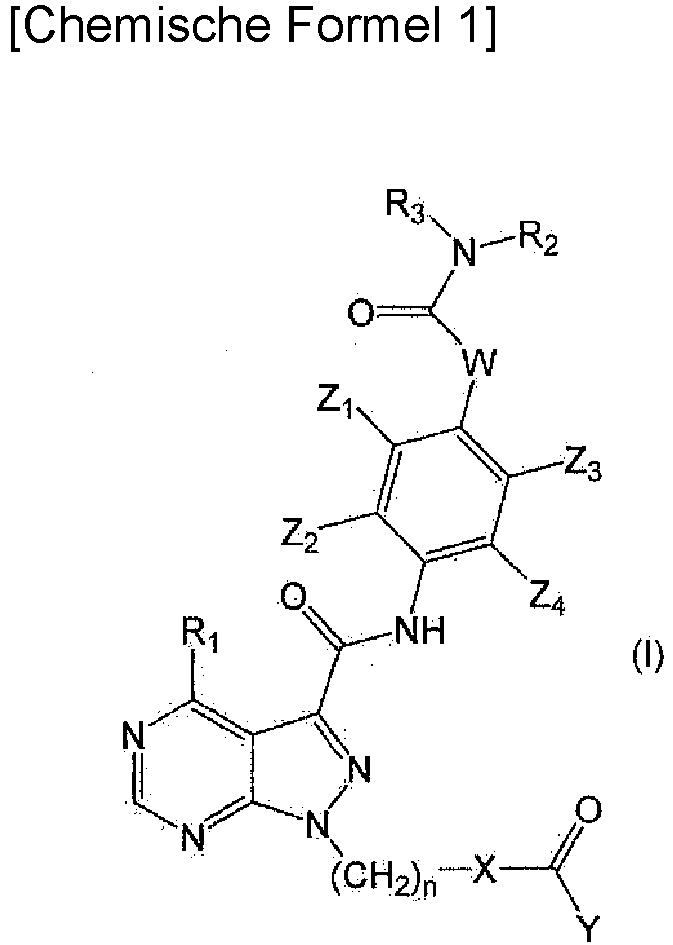 X für eine gesättigte, gegebenenfalls substituierte stickstoffhaltige 4-10-gliedrige heterozyklische Gruppe steht;Y für -C(R4)=C(R5)(R6) steht;Z1, Z2, Z3 und Z4,
die gleich oder verschieden sein können, für ein Wasserstoffatom, ein Halogenatom, eine Cyanogruppe, eine C2-C6-Alkenylgruppe, eine gegebenenfalls substituierte C1-C6-Alkoxygruppe, eine gegebenenfalls substituierte C1-C6-Alkylgruppe, eine gegebenenfalls substituierte Aminogruppe, eine gegebenenfalls substituierte C3-C7-Cycloalkylgruppe, eine C6-C14-aromatische Kohlenwasserstoffgruppe oder eine ungesättigte 4-14-gliedrige heterozyklische Gruppe stehen, oder Z1 und Z2 oder Z3 und Z4 können zusammen mit daran gebundenen Kohlenstoffatomen einen Benzolring oder einen gesättigten oder ungesättigten 5-7-gliedrigen Heterozyklus bilden;W für -CH2-, ein Sauerstoffatom oder -NH- steht;n eine ganze Zahl von 0 bis 2 darstellt;R1 für eine gegebenenfalls substituierte Aminogruppe steht;R2 und R3,
die gleich oder verschieden sein können, für ein Wasserstoffatom, eine gegebenenfalls substituierte C1-C6-Alkoxygruppe, eine gegebenenfalls substituierte C1-C6-Alkylgruppe oder eine gegebenenfalls substituierte C6-C14-aromatische Kohlenwasserstoffgruppe stehen, oder R2 und R3 können zusammen mit einem daran gebundenen Stickstoffatom eine gesättigte, gegebenenfalls substituierte stickstoffhaltige 4-8-gliedrige heterozyklische Gruppe bilden; undR4, R5 und R6,
die gleich oder verschieden sein können, stehen für ein Wasserstoffatom oder eine gegebenenfalls substituierte C1-C6-Alkylgruppe). - Die Pyrazolo[3,4-d]pyrimidin-Verbindung oder ein Salz davon zur Verwendung gemäß Anspruch 1, wobei in der allgemeinen Formel (I):X für eine gesättigte stickstoffhaltige 4-8-gliedrige heterozyklische Gruppe steht, die ein Halogenatom oder eine C1-C6-Alkylgruppe als Substituenten aufweisen kann;Y für -C(R4)=C(R5)(R6) steht;Z1, Z2, Z3 und Z4,
die gleich oder verschieden sein können, für ein Wasserstoffatom, ein Halogenatom, eine Cyanogruppe, eine C2-C6-Alkenylgruppe, eine C1-C6-Alkoxygruppe, die durch ein Halogenatom substituiert sein kann, eine C1-C6-Alkylgruppe, eine Aminogruppe, die durch eine C1-C6-Alkylgruppe substituiert sein kann, eine C3-C7-Cycloalkylgruppe oder eine ungesättigte 4-6-gliedrige heteromonocyclische Gruppe mit einem Sauerstoffatom stehen, oder Z1 und Z2 oder Z3 und Z4 können zusammen mit daran gebundenen Kohlenstoffatomen einen Benzolring oder einen gesättigten oder ungesättigten 5-7-gliedrigen Heterocyclus bilden;W für -CH2-, ein Sauerstoffatom oder -NH- steht;n 0 ist;R1 für eine Aminogruppe steht;R2 und R3,
die gleich oder verschieden sein können, für ein Wasserstoffatom, eine C1-C6-Alkoxygruppe, eine C1-C6-Alkylgruppe oder eine C6-C14-aromatische Kohlenwasserstoffgruppe, oder R2 und R3 können zusammen mit einem daran gebundenen Stickstoffatom eine gesättigte stickstoffhaltige 4-8-gliedrige heterozyklische Gruppe bilden, die mit einer Hydroxylgruppe substituiert sein kann; undR4, R5 und R6,
die gleich oder verschieden sein können, für ein Wasserstoffatom oder eine C1-C6-Alkylgruppe stehen, die mit einer Di(C1-C6-Alkyl)aminogruppe substituiert sein kann. - Die Pyrazolo[3,4-d]pyrimidinverbindung oder ein Salz davon zur Verwendung gemäß Anspruch 1 oder 2, wobei in der allgemeinen Formel (I):X für eine Pyrrolidinylgruppe, eine Methylpyrrolidinylgruppe, eine Piperidinylgruppe oder eine Fluorpiperidinylgruppe steht;Y für:
 Z1, Z2, Z3 und Z4,
die gleich oder verschieden sein können, für ein Wasserstoffatom, ein Fluoratom, ein Chloratom, ein Bromatom, eine Cyanogruppe, eine Vinylgruppe, eine Methoxygruppe, eine Fluormethoxygruppe, eine Difluormethoxygruppe, eine Methylgruppe, eine Ethylgruppe, eine Dimethylaminogruppe, eine Cyclopropylgruppe oder eine Furylgruppe stehen, oder Z1 und Z2 oder Z3 und Z4 können zusammen mit daran bindenden Kohlenstoffatomen einen Benzolring, einen Pyridinring oder einen Dioxolanring bilden;W für -CH2-, ein Sauerstoffatom oder -NH- steht;n 0 ist;R1 für eine Aminogruppe steht;R2 und R3,
die gleich oder verschieden sein können, für eine Methoxygruppe, eine Methylgruppe oder eine Phenylgruppe stehen, oder R2 und R3 können zusammen mit einem daran bindenden Stickstoffatom eine Hydroxyazetidinylgruppe, eine Pyrrolidinylgruppe oder eine Piperidinylgruppe bilden. - Die Pyrazolo[3,4-d]pyrimidinverbindung oder ein Salz davon zur Verwendung gemäß einem der Ansprüche 1 bis 3, wobei die Pyrazolo[3,4-d]pyrimidinverbindung eine Verbindung ist, die aus (1) bis (20) unten ausgewählt ist:(1) (R)-1-(1-Acryloylpiperidin-3-yl)-4-amino-N-(5-brom-4-(2-(dimethylamino)-2-oxoethyl)-2-methylphenyl)-1H-pyrazolo[3,4-d]pyrimidin-3-carboxamid;(2) (R)-1-(1-Acryloylpiperidin-3-yl)-4-amino-N-(2-chlor-4-(2-(dimethylamino)-2-oxoethyl)-5-methylphenyl)-1H-pyrazolo[3,4-d]pyrimidin-3-carboxamid;(3) (R)-1-(1-Acryloylpiperidin-3-yl)-4-amino-N-(2-chlor-4-(2-(dimethylamino)-2-oxoethyl)-3-methylphenyl)-1H-pyrazolo[3,4-d]pyrimidin-3-carboxamid;(4) (R)-1-(1-Acryloylpiperidin-3-yl)-4-amino-N-(4-(2-(dimethylamino)-2-oxoethyl)-2-methylphenyl)-1H-pyrazolo[3,4-d]pyrimidin-3-carboxamid;(5) (R)-1-(1-Acryloylpiperidin-3-yl)-4-amino-N-(4-(2-(dimethylamino)-2-oxoethyl)naphthalin-1-yl)-1H-pyrazolo[3,4-d]pyrimidin-3-carboxamid;(6) (R)-1-(1-Acryloylpiperidin-3-yl)-4-amino-N-(2-chlor-4-(2-(dimethylamino)-2-oxoethyl)phenyl)-1H-pyrazolo[3,4-d]pyrimidin-3-carboxamid;(7) (R)-1-(1-Acryloylpiperidin-3-yl)-4-amino-N-(4-(2-(dimethylamino)-2-oxoethyl)-2-methoxyphenyl)-1H-pyrazolo[3,4-d]pyrimidin-3-carboxamid;(8) (R)-1-(1-Acryloylpiperidin-3-yl)-4-amino-N-(3-chlor-4-(2-(dimethylamino)-2-oxoethyl)phenyl)-1H-pyrazolo[3,4-d]pyrimidin-3-carboxamid;(9) (R)-1-(1-Acryloylpiperidin-3-yl)-4-amino-N-(5-chlor-4-(2-(dimethylamino)-2-oxoethyl)-2-methoxyphenyl)-1H-pyrazolo[3,4-d]pyrimidin-3-carboxamid;(10) (R)-1-(1-Acryloylpiperidin-3-yl)-4-amino-N-(4-(2-(dimethylamino)-2-oxoethyl)-5-fluor-2-methylphenyl)-1H-pyrazolo[3,4-d]pyrimidin-3-carboxamid;(11) (R)-1-(1-Acryloylpiperidin-3-yl)-4-amino-N-(3-chlor-4-(2-(dimethylamino)-2-oxoethyl)-2-methoxyphenyl)-1H-pyrazolo[3,4-d]pyrimidin-3-carboxamid;(12) (R)-1-(1-Acryloylpiperidin-3-yl)-4-amino-N-(4-(2-(dimethylamino)-2-oxoethyl)-3-fluor-2-methylphenyl)-1H-pyrazolo[3,4-d]pyrimidin-3-carboxamid;(13) (R)-1-(1-Acryloylpiperidin-3-yl)-4-amino-N-(4-(2-(dimethylamino)-2-oxoethyl)-2,3-dimethylphenyl)-1H-pyrazolo[3,4-d]pyrimidin-3-carboxamid;(14) (R)-1-(1-Acryloylpiperidin-3-yl)-4-amino-N-(4-(2-(dimethylamino)-2-oxoethyl)-3-fluor-2-methoxyphenyl)-1H-pyrazolo[3,4-d]pyrimidin-3-carboxamid;(15) (R)-1-(1-Acryloylpiperidin-3-yl)-4-amino-N-(2-(difluormethoxy)-4-(2-(dimethylamino)-2-oxoethyl)phenyl)-1H-pyrazolo[3,4-d]pyrimidin-3-carboxamid;(16) (R)-1-(1-Acryloylpiperidin-3-yl)-4-amino-N-(4-(2-(dimethylamino)-2-oxoethyl)-2-(fluormethoxy)phenyl)-1H-pyrazolo[3,4-d]pyrimidin-3-carboxamid;(17) (R)-1-(1-Acryloylpiperidin-3-yl)-4-amino-N-(2-brom-4-(2-(dimethylamino)-2-oxoethyl)phenyl)-1H-pyrazolo[3,4-d]pyrimidin-3-carboxamid;(18) (R)-1-(1-Acryloylpiperidin-3-yl)-4-amino-N-(2-chlor-4-(2-(dimethylamino)-2-oxoethyl)-5-fluorphenyl)-1H-pyrazolo[3,4-d]pyrimidin-3-carboxamid;(19) (R)-1-(1-Acryloylpiperidin-3-yl)-4-amino-N-(5-chlor-4-(2-(dimethylamino)-2-oxoethyl)-2-methylphenyl)-1H-pyrazolo[3,4-d]pyrimidin-3-carboxamid; und(20) (R)-1-(1-Acryloylpiperidin-3-yl)-4-amino-N-(2,5-dichlor-4-(2-(dimethylamino)-2-oxoethyl)phenyl)-1H-pyrazolo[3,4-d]pyrimidin-3-carboxamid.
- Die Pyrazolo[3,4-d]pyrimidinverbindung oder ein Salz davon zur Verwendung gemäß einem der Ansprüche 1 bis 4, wobei die Pyrazolo[3,4-d]pyrimidinverbindung (R)-1-(1-Acryloylpiperidin-3-yl)-4-amino-N-(4-(2-(dimethylamino)-2-oxoethyl)-2,3-dimethylphenyl)-1H-pyrazolo[3,4-d]pyrimidin-3-carboxamid ist.
- Die Pyrazolo[3,4-d]pyrimidinverbindung oder ein Salz davon zur Verwendung gemäß einem der Ansprüche 1 bis 5, wobei die Resistenz oder Widerstandsfähigkeit gegenüber dem Anti-HER2-Antikörper eine Resistenz oder Widerstandsfähigkeit ist, die durch eine Behandlung mit dem Anti-HER2-Antikörper erworben wird.
- Die Pyrazolo[3,4-d]pyrimidin-Verbindung oder ein Salz davon zur Verwendung gemäß einem der Ansprüche 1 bis 5, wobei die Resistenz oder Widerstandsfähigkeit gegenüber dem Anti-HER2-Antikörper eine intrinsische Resistenz oder Widerstandsfähigkeit ist, die für eine Behandlung mit dem Anti-HER2-Antikörper irrelevant ist.
- Die Pyrazolo[3,4-d]pyrimidin-Verbindung oder ein Salz davon zur Verwendung gemäß Anspruch 6 oder 7, wobei der Anti-HER2-Antikörper mindestens einer ist, der aus der Gruppe ausgewählt ist, die aus Trastuzumab, Antikörper-Wirkstoff-Konjugaten, die Trastuzumab als Antikörper aufweisen, und Pertuzumab besteht.
- Die Pyrazolo[3,4-d]pyrimidin-Verbindung oder ein Salz davon zur Verwendung gemäß Anspruch 8, wobei der Anti-HER2-Antikörper mindestens einer ist, der aus der Gruppe ausgewählt ist, die aus Trastuzumab, Trastuzumab-Emtansin und Pertuzumab besteht.
- Pharmazeutische Zusammensetzung zur Verwendung in einem Verfahren zur Behandlung eines HER2-positiven Tumors, der gegen einen Anti-HER2-Antikörper resistent oder widerstandsfähig ist, wobei die pharmazeutische Zusammensetzung eine Pyrazolo[3,4-d]pyrimidin-Verbindung der folgenden allgemeinen Formel (I), oder ein Salz davon als Wirkstoff umfasst:
 X für eine gesättigte, gegebenenfalls substituierte stickstoffhaltige 4-10-gliedrige heterozyklische Gruppe steht;Y für -C(R4)=C(R5)(R6) steht;Z1, Z2, Z3 und Z4,
die gleich oder verschieden sein können, für ein Halogenatom, eine Cyanogruppe, eine C2-C6-Alkenylgruppe, eine gegebenenfalls substituierte C1-C6-Alkoxygruppe, eine gegebenenfalls substituierte C1-C6-Alkylgruppe, eine gegebenenfalls substituierte Aminogruppe, eine gegebenenfalls substituierte C3-C7-Cycloalkylgruppe, eine C6-C14-aromatische Kohlenwasserstoffgruppe oder eine ungesättigte 4-14-gliedrige heterozyklische Gruppe stehen, oder Z1 und Z2 oder Z3 und Z4 können zusammen mit daran gebundenen Kohlenstoffatomen einen Benzolring oder einen gesättigten oder ungesättigten 5-7-gliedrigen Heterozyklus bilden;W für -CH2-, ein Sauerstoffatom oder -NH- steht;n für eine ganze Zahl von 0 bis 2 steht;R1 für eine gegebenenfalls substituierte Aminogruppe steht;R2 und R3,
die gleich oder verschieden sein können, für ein Wasserstoffatom, eine gegebenenfalls substituierte C1-C6-Alkoxygruppe, eine gegebenenfalls substituierte C1-C6-Alkylgruppe oder eine gegebenenfalls substituierte C6-C14-aromatische Kohlenwasserstoffgruppe stehen, oder R2 und R3 können zusammen mit einem daran gebundenen Stickstoffatom eine gesättigte, gegebenenfalls substituierte stickstoffhaltige 4-8-gliedrige heterozyklische Gruppe bilden; undR4, R5 und R6,
die gleich oder verschieden sein können, stehen für ein Wasserstoffatom oder eine gegebenenfalls substituierte C1-C6-Alkylgruppe). - Die pharmazeutische Zusammensetzung zur Verwendung gemäß Anspruch 10, wobei die Pyrazolo[3,4-d]pyrimidinverbindung (R)-1-(1-Acryloylpiperidin-3-yl)-4-amino-N-(4-(2-(dimethylamino)-2-oxoethyl)-2,3-dimethylphenyl)-1H-pyrazolo[3,4-d]pyrimidin-3-carboxamid ist.
- Die pharmazeutische Zusammensetzung zur Verwendung gemäß Anspruch 10 oder 11, wobei die Resistenz oder Widerstandsfähigkeit gegenüber dem Anti-HER2-Antikörper eine Resistenz oder Widerstandsfähigkeit ist, die durch eine Behandlung mit dem Anti-HER2-Antikörper erworben wird; oder wobei die Resistenz oder Widerstandsfähigkeit gegenüber dem Anti-HER2-Antikörper eine intrinsische Resistenz oder Unlösbarkeit ist, die für eine Behandlung mit dem Anti-HER2-Antikörper irrelevant ist.
- Die pharmazeutische Zusammensetzung zur Verwendung gemäß Anspruch 12, wobei der Anti-HER2-Antikörper mindestens einer ist, der aus der Gruppe ausgewählt ist, die aus Trastuzumab, Antikörper-Wirkstoff-Konjugaten, die Trastuzumab als Antikörper aufweisen, und Pertuzumab besteht.
- Die pharmazeutische Zusammensetzung zur Verwendung gemäß Anspruch 13, wobei der Anti-HER2-Antikörper mindestens einer ist, der aus der Gruppe ausgewählt ist, die aus Trastuzumab, Trastuzumab-Emtansin und Pertuzumab besteht.
- Therapeutisches Mittel zur Verwendung in einem Verfahren zur Behandlung eines HER2-positiven Tumors, der gegen einen Anti-HER2-Antikörper resistent oder widerstandsfähig ist, wobei das therapeutische Mittel eine Pyrazolo[3,4-d]pyrimidin-Verbindung, die durch die nachstehende allgemeine Formel (I) dargestellt wird, oder ein Salz davon als Wirkstoff umfasst:
 X für eine gesättigte, optional substituierte stickstoffhaltige 4-10-gliedrige heterozyklische Gruppe steht;Y für -C(R4)=C(R5)(R6) steht;Z1, Z2, Z3 und Z4,
die gleich oder verschieden sein können, für ein Wasserstoffatom, ein Halogenatom, eine Cyanogruppe, eine C2-C6-Alkenylgruppe, eine gegebenenfalls substituierte C1-C6-Alkoxygruppe, eine gegebenenfalls substituierte C1-C6-Alkylgruppe, eine gegebenenfalls substituierte Aminogruppe, eine gegebenenfalls substituierte C3-C7-Cycloalkylgruppe, eine C6-C14-aromatische Kohlenwasserstoffgruppe oder eine ungesättigte 4-14-gliedrige heterozyklische Gruppe stehen, oder Z1 und Z2 oder Z3 und Z4 können zusammen mit daran gebundenen Kohlenstoffatomen einen Benzolring oder einen gesättigten oder ungesättigten 5-7-gliedrigen Heterozyklus bilden;W für -CH2-, ein Sauerstoffatom oder -NH- steht;n für eine ganze Zahl von 0 bis 2 steht;R1 für eine gegebenenfalls substituierte Aminogruppe steht;R2 und R3
die gleich oder verschieden sein können, für ein Wasserstoffatom, eine gegebenenfalls substituierte C1-C6-Alkoxygruppe, eine gegebenenfalls substituierte C1-C6-Alkylgruppe oder eine gegebenenfalls substituierte C6-C14-aromatische Kohlenwasserstoffgruppe stehen, oder R2 und R3können zusammen mit einem daran gebundenen Stickstoffatom eine gesättigte, gegebenenfalls substituierte stickstoffhaltige 4-8-gliedrige heterozyklische Gruppe bilden; undR4, R5 und R6,
die gleich oder verschieden sein können, für ein Wasserstoffatom oder eine gegebenenfalls substituierte C1-C6-Alkylgruppe stehen).
Applications Claiming Priority (2)
| Application Number | Priority Date | Filing Date | Title |
|---|---|---|---|
| JP2018160014 | 2018-08-29 | ||
| PCT/JP2019/033595 WO2020045461A1 (ja) | 2018-08-29 | 2019-08-28 | ピラゾロ[3,4-d]ピリミジン化合物を有効成分とする治療剤 |
Publications (3)
| Publication Number | Publication Date |
|---|---|
| EP3845231A1 EP3845231A1 (de) | 2021-07-07 |
| EP3845231A4 EP3845231A4 (de) | 2022-06-15 |
| EP3845231B1 true EP3845231B1 (de) | 2025-01-01 |
Family
ID=69644299
Family Applications (1)
| Application Number | Title | Priority Date | Filing Date |
|---|---|---|---|
| EP19856279.5A Active EP3845231B1 (de) | 2018-08-29 | 2019-08-28 | Therapeutisches mittel enthaltend pyrazolo[3,4-d]pyrimidin-verbindung als wirkstoff |
Country Status (7)
| Country | Link |
|---|---|
| US (1) | US12186320B2 (de) |
| EP (1) | EP3845231B1 (de) |
| JP (1) | JP7142707B2 (de) |
| ES (1) | ES3010436T3 (de) |
| MA (1) | MA53509A (de) |
| TW (1) | TWI769395B (de) |
| WO (1) | WO2020045461A1 (de) |
Families Citing this family (2)
| Publication number | Priority date | Publication date | Assignee | Title |
|---|---|---|---|---|
| US12492208B2 (en) | 2020-07-15 | 2025-12-09 | Taiho Pharmaceutical Co., Ltd. | Crystal of pyrimidine compound |
| CA3194724A1 (en) * | 2020-10-05 | 2022-04-14 | Dana-Farber Cancer Institute, Inc. | Potent and selective inhibitors of her2 |
Family Cites Families (3)
| Publication number | Priority date | Publication date | Assignee | Title |
|---|---|---|---|---|
| WO2016022723A1 (en) * | 2014-08-05 | 2016-02-11 | Merrimack Pharmaceuticals, Inc. | Combination therapies for treating her2-positive cancers that are resistant to her2-targeted therapies |
| JP6141568B1 (ja) * | 2015-09-01 | 2017-06-07 | 大鵬薬品工業株式会社 | 新規なピラゾロ[3,4−d]ピリミジン化合物又はその塩 |
| WO2018159613A1 (ja) * | 2017-02-28 | 2018-09-07 | 大鵬薬品工業株式会社 | ピラゾロ[3,4-d]ピリミジン化合物を用いた抗腫瘍効果増強剤 |
-
2019
- 2019-08-28 WO PCT/JP2019/033595 patent/WO2020045461A1/ja not_active Ceased
- 2019-08-28 EP EP19856279.5A patent/EP3845231B1/de active Active
- 2019-08-28 US US17/271,125 patent/US12186320B2/en active Active
- 2019-08-28 TW TW108130788A patent/TWI769395B/zh active
- 2019-08-28 ES ES19856279T patent/ES3010436T3/es active Active
- 2019-08-28 JP JP2020539520A patent/JP7142707B2/ja active Active
- 2019-08-28 MA MA053509A patent/MA53509A/fr unknown
Also Published As
| Publication number | Publication date |
|---|---|
| MA53509A (fr) | 2021-07-07 |
| ES3010436T3 (en) | 2025-04-03 |
| JP7142707B2 (ja) | 2022-09-27 |
| TW202023564A (zh) | 2020-07-01 |
| US20210252000A1 (en) | 2021-08-19 |
| TWI769395B (zh) | 2022-07-01 |
| EP3845231A1 (de) | 2021-07-07 |
| JPWO2020045461A1 (ja) | 2021-08-10 |
| EP3845231A4 (de) | 2022-06-15 |
| US12186320B2 (en) | 2025-01-07 |
| WO2020045461A1 (ja) | 2020-03-05 |
Similar Documents
| Publication | Publication Date | Title |
|---|---|---|
| KR102713072B1 (ko) | 두경부암 치료를 위한 egfr 저해제 | |
| US9943537B2 (en) | Antitumor agent and antitumor effect enhancer | |
| EP2799070B1 (de) | Wirkungsverstärker für antitumormittel | |
| CN103989681A (zh) | 用于乳腺癌的利用奈拉替尼的治疗方案 | |
| KR20210038906A (ko) | 비정상적 acvr1 발현과 연관된 질환을 치료하는 방법 및 그에 사용하기 위한 acvr1 억제제 | |
| CN118201616A (zh) | 用于癌症的wee1抑制剂 | |
| EP3845231B1 (de) | Therapeutisches mittel enthaltend pyrazolo[3,4-d]pyrimidin-verbindung als wirkstoff | |
| JP7223684B2 (ja) | ピラゾロ[3,4-d]ピリミジン化合物を用いた抗腫瘍効果増強剤 | |
| US20130101680A1 (en) | Radiotherapy enhancer | |
| EP3766502A1 (de) | Antitumormittel, antitumorwirkungsverstärker und antitumor-kit | |
| RU2491938C2 (ru) | Производное изоксазола для лечения рака | |
| JP2008501708A (ja) | がんの治療方法 | |
| TWI911331B (zh) | 以縮合嘧啶化合物作為有效成分之腦移行性腫瘤治療劑 | |
| AU2020256186B2 (en) | Polymorphs of a kinase inhibitor, pharmaceutical compositions containing such a compound, preparation methods, and applications | |
| US12036215B2 (en) | Antitumor agent and method for tumor therapy | |
| AU2019342447B2 (en) | Combination therapy of acylthiourea compound and abiraterone | |
| EP4670740A1 (de) | Verwendung eines arzneimittelkonjugats bei der behandlung von tumorerkrankungen und verfahren | |
| KR20260049608A (ko) | 아자 2 고리형 화합물과 항안드로겐제를 사용한 암 병용 요법 | |
| NZ750260A (en) | Antitumor agent and antitumor effect enhancer |
Legal Events
| Date | Code | Title | Description |
|---|---|---|---|
| STAA | Information on the status of an ep patent application or granted ep patent |
Free format text: STATUS: THE INTERNATIONAL PUBLICATION HAS BEEN MADE |
|
| STAA | Information on the status of an ep patent application or granted ep patent |
Free format text: STATUS: REQUEST FOR EXAMINATION WAS MADE |
|
| PUAI | Public reference made under article 153(3) epc to a published international application that has entered the european phase |
Free format text: ORIGINAL CODE: 0009012 |
|
| 17P | Request for examination filed |
Effective date: 20210324 |
|
| AK | Designated contracting states |
Kind code of ref document: A1 Designated state(s): AL AT BE BG CH CY CZ DE DK EE ES FI FR GB GR HR HU IE IS IT LI LT LU LV MC MK MT NL NO PL PT RO RS SE SI SK SM TR |
|
| A4 | Supplementary search report drawn up and despatched |
Effective date: 20220518 |
|
| RIC1 | Information provided on ipc code assigned before grant |
Ipc: A61P 35/00 20060101ALI20220512BHEP Ipc: A61K 31/519 20060101AFI20220512BHEP |
|
| GRAP | Despatch of communication of intention to grant a patent |
Free format text: ORIGINAL CODE: EPIDOSNIGR1 |
|
| STAA | Information on the status of an ep patent application or granted ep patent |
Free format text: STATUS: GRANT OF PATENT IS INTENDED |
|
| INTG | Intention to grant announced |
Effective date: 20240729 |
|
| RIN1 | Information on inventor provided before grant (corrected) |
Inventor name: FUJIOKA, YAYOI Inventor name: IRIE, HIROKI |
|
| GRAS | Grant fee paid |
Free format text: ORIGINAL CODE: EPIDOSNIGR3 |
|
| GRAA | (expected) grant |
Free format text: ORIGINAL CODE: 0009210 |
|
| STAA | Information on the status of an ep patent application or granted ep patent |
Free format text: STATUS: THE PATENT HAS BEEN GRANTED |
|
| AK | Designated contracting states |
Kind code of ref document: B1 Designated state(s): AL AT BE BG CH CY CZ DE DK EE ES FI FR GB GR HR HU IE IS IT LI LT LU LV MC MK MT NL NO PL PT RO RS SE SI SK SM TR |
|
| REG | Reference to a national code |
Ref country code: GB Ref legal event code: FG4D |
|
| REG | Reference to a national code |
Ref country code: CH Ref legal event code: EP |
|
| REG | Reference to a national code |
Ref country code: DE Ref legal event code: R096 Ref document number: 602019064379 Country of ref document: DE |
|
| P01 | Opt-out of the competence of the unified patent court (upc) registered |
Free format text: CASE NUMBER: APP_68017/2024 Effective date: 20241224 |
|
| REG | Reference to a national code |
Ref country code: IE Ref legal event code: FG4D |
|
| REG | Reference to a national code |
Ref country code: LT Ref legal event code: MG9D |
|
| REG | Reference to a national code |
Ref country code: NL Ref legal event code: MP Effective date: 20250101 |
|
| REG | Reference to a national code |
Ref country code: AT Ref legal event code: MK05 Ref document number: 1755557 Country of ref document: AT Kind code of ref document: T Effective date: 20250101 |
|
| PG25 | Lapsed in a contracting state [announced via postgrant information from national office to epo] |
Ref country code: NL Free format text: LAPSE BECAUSE OF FAILURE TO SUBMIT A TRANSLATION OF THE DESCRIPTION OR TO PAY THE FEE WITHIN THE PRESCRIBED TIME-LIMIT Effective date: 20250101 |
|
| PG25 | Lapsed in a contracting state [announced via postgrant information from national office to epo] |
Ref country code: FI Free format text: LAPSE BECAUSE OF FAILURE TO SUBMIT A TRANSLATION OF THE DESCRIPTION OR TO PAY THE FEE WITHIN THE PRESCRIBED TIME-LIMIT Effective date: 20250101 |
|
| PG25 | Lapsed in a contracting state [announced via postgrant information from national office to epo] |
Ref country code: PL Free format text: LAPSE BECAUSE OF FAILURE TO SUBMIT A TRANSLATION OF THE DESCRIPTION OR TO PAY THE FEE WITHIN THE PRESCRIBED TIME-LIMIT Effective date: 20250101 |
|
| PG25 | Lapsed in a contracting state [announced via postgrant information from national office to epo] |
Ref country code: NO Free format text: LAPSE BECAUSE OF FAILURE TO SUBMIT A TRANSLATION OF THE DESCRIPTION OR TO PAY THE FEE WITHIN THE PRESCRIBED TIME-LIMIT Effective date: 20250401 Ref country code: IS Free format text: LAPSE BECAUSE OF FAILURE TO SUBMIT A TRANSLATION OF THE DESCRIPTION OR TO PAY THE FEE WITHIN THE PRESCRIBED TIME-LIMIT Effective date: 20250501 |
|
| PG25 | Lapsed in a contracting state [announced via postgrant information from national office to epo] |
Ref country code: HR Free format text: LAPSE BECAUSE OF FAILURE TO SUBMIT A TRANSLATION OF THE DESCRIPTION OR TO PAY THE FEE WITHIN THE PRESCRIBED TIME-LIMIT Effective date: 20250101 |
|
| PG25 | Lapsed in a contracting state [announced via postgrant information from national office to epo] |
Ref country code: PT Free format text: LAPSE BECAUSE OF FAILURE TO SUBMIT A TRANSLATION OF THE DESCRIPTION OR TO PAY THE FEE WITHIN THE PRESCRIBED TIME-LIMIT Effective date: 20250502 Ref country code: LV Free format text: LAPSE BECAUSE OF FAILURE TO SUBMIT A TRANSLATION OF THE DESCRIPTION OR TO PAY THE FEE WITHIN THE PRESCRIBED TIME-LIMIT Effective date: 20250101 |
|
| PG25 | Lapsed in a contracting state [announced via postgrant information from national office to epo] |
Ref country code: BG Free format text: LAPSE BECAUSE OF FAILURE TO SUBMIT A TRANSLATION OF THE DESCRIPTION OR TO PAY THE FEE WITHIN THE PRESCRIBED TIME-LIMIT Effective date: 20250101 Ref country code: GR Free format text: LAPSE BECAUSE OF FAILURE TO SUBMIT A TRANSLATION OF THE DESCRIPTION OR TO PAY THE FEE WITHIN THE PRESCRIBED TIME-LIMIT Effective date: 20250402 |
|
| PG25 | Lapsed in a contracting state [announced via postgrant information from national office to epo] |
Ref country code: AT Free format text: LAPSE BECAUSE OF FAILURE TO SUBMIT A TRANSLATION OF THE DESCRIPTION OR TO PAY THE FEE WITHIN THE PRESCRIBED TIME-LIMIT Effective date: 20250101 |
|
| PG25 | Lapsed in a contracting state [announced via postgrant information from national office to epo] |
Ref country code: CZ Free format text: LAPSE BECAUSE OF FAILURE TO SUBMIT A TRANSLATION OF THE DESCRIPTION OR TO PAY THE FEE WITHIN THE PRESCRIBED TIME-LIMIT Effective date: 20250101 |
|
| PG25 | Lapsed in a contracting state [announced via postgrant information from national office to epo] |
Ref country code: SE Free format text: LAPSE BECAUSE OF FAILURE TO SUBMIT A TRANSLATION OF THE DESCRIPTION OR TO PAY THE FEE WITHIN THE PRESCRIBED TIME-LIMIT Effective date: 20250101 |
|
| REG | Reference to a national code |
Ref country code: DE Ref legal event code: R097 Ref document number: 602019064379 Country of ref document: DE |
|
| PG25 | Lapsed in a contracting state [announced via postgrant information from national office to epo] |
Ref country code: SM Free format text: LAPSE BECAUSE OF FAILURE TO SUBMIT A TRANSLATION OF THE DESCRIPTION OR TO PAY THE FEE WITHIN THE PRESCRIBED TIME-LIMIT Effective date: 20250101 |
|
| PGFP | Annual fee paid to national office [announced via postgrant information from national office to epo] |
Ref country code: ES Payment date: 20250901 Year of fee payment: 7 |
|
| PG25 | Lapsed in a contracting state [announced via postgrant information from national office to epo] |
Ref country code: DK Free format text: LAPSE BECAUSE OF FAILURE TO SUBMIT A TRANSLATION OF THE DESCRIPTION OR TO PAY THE FEE WITHIN THE PRESCRIBED TIME-LIMIT Effective date: 20250101 |
|
| PGFP | Annual fee paid to national office [announced via postgrant information from national office to epo] |
Ref country code: DE Payment date: 20250702 Year of fee payment: 7 |
|
| PGFP | Annual fee paid to national office [announced via postgrant information from national office to epo] |
Ref country code: IT Payment date: 20250722 Year of fee payment: 7 |
|
| VS25 | Lapsed in a validation state [announced via postgrant information from nat. office to epo] |
Ref country code: MD Free format text: LAPSE BECAUSE OF FAILURE TO SUBMIT A TRANSLATION OF THE DESCRIPTION OR TO PAY THE FEE WITHIN THE PRESCRIBED TIME-LIMIT Effective date: 20250101 |
|
| PGFP | Annual fee paid to national office [announced via postgrant information from national office to epo] |
Ref country code: GB Payment date: 20250703 Year of fee payment: 7 |
|
| PGFP | Annual fee paid to national office [announced via postgrant information from national office to epo] |
Ref country code: FR Payment date: 20250703 Year of fee payment: 7 |
|
| PG25 | Lapsed in a contracting state [announced via postgrant information from national office to epo] |
Ref country code: EE Free format text: LAPSE BECAUSE OF FAILURE TO SUBMIT A TRANSLATION OF THE DESCRIPTION OR TO PAY THE FEE WITHIN THE PRESCRIBED TIME-LIMIT Effective date: 20250101 |
|
| PG25 | Lapsed in a contracting state [announced via postgrant information from national office to epo] |
Ref country code: RO Free format text: LAPSE BECAUSE OF FAILURE TO SUBMIT A TRANSLATION OF THE DESCRIPTION OR TO PAY THE FEE WITHIN THE PRESCRIBED TIME-LIMIT Effective date: 20250101 |
|
| PG25 | Lapsed in a contracting state [announced via postgrant information from national office to epo] |
Ref country code: SK Free format text: LAPSE BECAUSE OF FAILURE TO SUBMIT A TRANSLATION OF THE DESCRIPTION OR TO PAY THE FEE WITHIN THE PRESCRIBED TIME-LIMIT Effective date: 20250101 |
|
| PLBE | No opposition filed within time limit |
Free format text: ORIGINAL CODE: 0009261 |
|
| STAA | Information on the status of an ep patent application or granted ep patent |
Free format text: STATUS: NO OPPOSITION FILED WITHIN TIME LIMIT |
|
| REG | Reference to a national code |
Ref country code: CH Ref legal event code: L10 Free format text: ST27 STATUS EVENT CODE: U-0-0-L10-L00 (AS PROVIDED BY THE NATIONAL OFFICE) Effective date: 20251112 |
|
| 26N | No opposition filed |
Effective date: 20251002 |
|
| REG | Reference to a national code |
Ref country code: CH Ref legal event code: H13 Free format text: ST27 STATUS EVENT CODE: U-0-0-H10-H13 (AS PROVIDED BY THE NATIONAL OFFICE) Effective date: 20260324 |
|
| PG25 | Lapsed in a contracting state [announced via postgrant information from national office to epo] |
Ref country code: MC Free format text: LAPSE BECAUSE OF FAILURE TO SUBMIT A TRANSLATION OF THE DESCRIPTION OR TO PAY THE FEE WITHIN THE PRESCRIBED TIME-LIMIT Effective date: 20250101 |
|
| PG25 | Lapsed in a contracting state [announced via postgrant information from national office to epo] |
Ref country code: LU Free format text: LAPSE BECAUSE OF NON-PAYMENT OF DUE FEES Effective date: 20250828 |
|
| VS25 | Lapsed in a validation state [announced via postgrant information from nat. office to epo] |
Ref country code: MA Free format text: LAPSE BECAUSE OF FAILURE TO SUBMIT A TRANSLATION OF THE DESCRIPTION OR TO PAY THE FEE WITHIN THE PRESCRIBED TIME-LIMIT; INVALID AB INITIO Effective date: 20190828 |
|
| PG25 | Lapsed in a contracting state [announced via postgrant information from national office to epo] |
Ref country code: CH Free format text: LAPSE BECAUSE OF NON-PAYMENT OF DUE FEES Effective date: 20250831 |