EP3846052A1 - Dispositif d'authentification biométrique, procédé d'authentification biométrique et support d'enregistrement - Google Patents
Dispositif d'authentification biométrique, procédé d'authentification biométrique et support d'enregistrement Download PDFInfo
- Publication number
- EP3846052A1 EP3846052A1 EP19855693.8A EP19855693A EP3846052A1 EP 3846052 A1 EP3846052 A1 EP 3846052A1 EP 19855693 A EP19855693 A EP 19855693A EP 3846052 A1 EP3846052 A1 EP 3846052A1
- Authority
- EP
- European Patent Office
- Prior art keywords
- authentication
- ear
- voice
- user
- unit
- Prior art date
- Legal status (The legal status is an assumption and is not a legal conclusion. Google has not performed a legal analysis and makes no representation as to the accuracy of the status listed.)
- Withdrawn
Links
Images




Classifications
-
- G—PHYSICS
- G10—MUSICAL INSTRUMENTS; ACOUSTICS
- G10L—SPEECH ANALYSIS TECHNIQUES OR SPEECH SYNTHESIS; SPEECH RECOGNITION; SPEECH OR VOICE PROCESSING TECHNIQUES; SPEECH OR AUDIO CODING OR DECODING
- G10L17/00—Speaker identification or verification techniques
- G10L17/06—Decision making techniques; Pattern matching strategies
-
- H—ELECTRICITY
- H04—ELECTRIC COMMUNICATION TECHNIQUE
- H04R—LOUDSPEAKERS, MICROPHONES, GRAMOPHONE PICK-UPS OR LIKE ACOUSTIC ELECTROMECHANICAL TRANSDUCERS; ELECTRIC HEARING AIDS; PUBLIC ADDRESS SYSTEMS
- H04R1/00—Details of transducers, loudspeakers or microphones
- H04R1/10—Earpieces; Attachments therefor ; Earphones; Monophonic headphones
- H04R1/1091—Details not provided for in groups H04R1/1008 - H04R1/1083
-
- A—HUMAN NECESSITIES
- A61—MEDICAL OR VETERINARY SCIENCE; HYGIENE
- A61B—DIAGNOSIS; SURGERY; IDENTIFICATION
- A61B5/00—Measuring for diagnostic purposes; Identification of persons
- A61B5/117—Identification of persons
-
- A—HUMAN NECESSITIES
- A61—MEDICAL OR VETERINARY SCIENCE; HYGIENE
- A61B—DIAGNOSIS; SURGERY; IDENTIFICATION
- A61B5/00—Measuring for diagnostic purposes; Identification of persons
- A61B5/117—Identification of persons
- A61B5/1171—Identification of persons based on the shapes or appearances of their bodies or parts thereof
-
- G—PHYSICS
- G06—COMPUTING OR CALCULATING; COUNTING
- G06F—ELECTRIC DIGITAL DATA PROCESSING
- G06F21/00—Security arrangements for protecting computers, components thereof, programs or data against unauthorised activity
- G06F21/30—Authentication, i.e. establishing the identity or authorisation of security principals
- G06F21/31—User authentication
- G06F21/32—User authentication using biometric data, e.g. fingerprints, iris scans or voiceprints
-
- G—PHYSICS
- G10—MUSICAL INSTRUMENTS; ACOUSTICS
- G10L—SPEECH ANALYSIS TECHNIQUES OR SPEECH SYNTHESIS; SPEECH RECOGNITION; SPEECH OR VOICE PROCESSING TECHNIQUES; SPEECH OR AUDIO CODING OR DECODING
- G10L17/00—Speaker identification or verification techniques
-
- A—HUMAN NECESSITIES
- A61—MEDICAL OR VETERINARY SCIENCE; HYGIENE
- A61B—DIAGNOSIS; SURGERY; IDENTIFICATION
- A61B5/00—Measuring for diagnostic purposes; Identification of persons
- A61B5/68—Arrangements of detecting, measuring or recording means, e.g. sensors, in relation to patient
- A61B5/6801—Arrangements of detecting, measuring or recording means, e.g. sensors, in relation to patient specially adapted to be attached to or worn on the body surface
- A61B5/6813—Specially adapted to be attached to a specific body part
- A61B5/6814—Head
- A61B5/6815—Ear
- A61B5/6817—Ear canal
-
- G—PHYSICS
- G10—MUSICAL INSTRUMENTS; ACOUSTICS
- G10L—SPEECH ANALYSIS TECHNIQUES OR SPEECH SYNTHESIS; SPEECH RECOGNITION; SPEECH OR VOICE PROCESSING TECHNIQUES; SPEECH OR AUDIO CODING OR DECODING
- G10L17/00—Speaker identification or verification techniques
- G10L17/06—Decision making techniques; Pattern matching strategies
- G10L17/08—Use of distortion metrics or a particular distance between probe pattern and reference templates
Definitions
- the example embodiments relate to a biometric authentication device and the like for authenticating a user.
- a personal authentication technology using biometric information on a user has the advantage of being less likely to be leaked or stolen and not to be forgotten or lost than a password or key. For this reason, various biometric authentication approaches for authenticating users have been developed in recent years, including voiceprint (voice) authentication (hereinafter referred to as voice authentication) and otoacoustic authentication (hereinafter referred to as ear authentication).
- voice authentication voiceprint
- ear authentication otoacoustic authentication
- voice authentication the user's voice is used for authentication.
- a user performs an operation through voice interaction with an artificial intelligence (AI) agent equipped in the instrument.
- AI artificial intelligence
- Voice authentication is used for purposes such as logging in to a service provided by the instrument or providing a more suitable response to an individual user from the instrument (personalizing) (see PTL 1).
- reverberation characteristics in an ear of a user are used for authentication.
- a hearable device such as headphones or earphones is equipped with a microphone, and extracts the reverberation characteristics of a sound in the ear to authenticate a user.
- the microphone of the hearable device can also be used to simultaneously perform the above voice authentication (see PTL 2).
- the authentication is not precise in some cases. For example, when the background noise is large, the accuracy of the voice authentication is lowered, and when the earphone is not sufficiently adhered to the ear, the accuracy of the ear authentication is lowered. If authentication fails, the user cannot immediately use an instrument (or function) accessible on the assumption that authentication succeeds. This could bring about fatal consequences for users who need to use the instrument immediately (for example, emergency medical personnel). Meanwhile, when voice authentication and ear authentication are simply combined, although the accuracy becomes higher, the time taken by authentication is given as the sum of times required for these approaches of authentication, and the user has to wait for a longer time.
- the disclosure has been made in view of the above disadvantages, and one object of the disclosure is to provide a biometric authentication device and the like capable of performing highly accurate, quick authentication in combination of voice authentication and ear authentication.
- a biometric authentication device includes:
- a biometric authentication method includes:
- a biometric authentication program includes:
- the program may be stored on a non-transitory computer-readable storage medium.
- a biometric authentication device and the like capable of performing highly accurate, quick authentication in combination of voice authentication and ear authentication can be provided.
- a biometric authentication device 100 will be described with reference to Fig. 1 .
- the biometric authentication device 100 is equipped with an electronic circuit incorporating a voice authentication process, an ear authentication process, and a process of integrating results of both of the processes.
- a program for executing these processes may be implemented by being installed in a communication instrument (such as a smartphone) owned by a user.
- the biometric authentication device 100 is connected to an earphone 1 built with a speaker 2 and a microphone 3 via a wired cable or wireless communication.
- the speaker 2 is connected to a replay unit 111 of the biometric authentication device 100.
- the microphone 3 is connected to a recording unit 112 of the biometric authentication device 100.
- the biometric authentication device 100 may be equipped on the earphone 1 built with the speaker 2 and the microphone 3.
- the speaker 2 outputs a sound to a user side.
- the microphone 3 inputs a reverberation sound from an ear side of the user while the user is wearing the earphone 1.
- voice authentication the microphone 3 inputs a speaking of the user while the user is wearing the earphone 1.
- the user may move the earphone 1 near the mouth or the like.
- the microphones 3 may be prepared separately for voice authentication and ear authentication. For example, using an earphone on a headset side, a microphone for ear authentication may be equipped inside the earphone 1, and a microphone alone such as an earphone microphone may be fixed near the mouth of the user as a microphone for voice authentication.
- the communication instrument (not illustrated) owned by the user may be equipped with an AI interaction program.
- the AI interaction program can be operated in cooperation with various applications, and is capable of acquiring various types of information and executing various application functions through interaction using voice.
- the voice on the AI side is delivered to the user via the speaker 2 built in the earphone 1, and the voice on the user side is delivered to the AI interaction program via the microphone 3 built in the earphone 1.
- the above-mentioned information acquisition and function execution includes information and functions that are only permitted to be accessed by an authorized user. Examples of the above include functions that require strong security to protect personal information, such as connecting to an email account and a bank account.
- the AI interaction program activates the biometric authentication device 100 to manage the access.
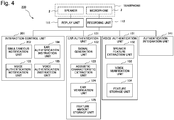
- the biometric authentication device 100 includes an interaction control unit 101, the replay unit 111, the recording unit 112, an ear authentication unit 121, a voice authentication unit 131, and an authentication integration unit 141.
- the interaction control unit 101 controls in such a way that, after the replay unit 111 outputs a sound into the user's ear, the recording unit 112 inputs (records) the user's voice.
- the interaction control unit 101 includes an ear authentication notification unit 102, a voice authentication notification unit 103, an ear authentication instruction unit 104, a voice authentication instruction unit 105, and an authentication result storage unit 106.
- the ear authentication notification unit 102 notifies the user that ear authentication (or both of ear authentication and voice authentication) will begin. Specifically, the ear authentication notification unit 102 causes the replay unit 111 to reproduce a voice (which can be a recorded voice) for letting the user know that the authentication is to start.
- a voice which can be a recorded voice
- the voice authentication notification unit 103 notifies the user that voice authentication will begin. Specifically, the voice authentication notification unit 103 causes the replay unit 111 to reproduce a voice (which can be a recorded voice) for letting the user know that authentication is to start.
- a voice which can be a recorded voice
- the ear authentication instruction unit 104 instructs the ear authentication unit 121 to start ear authentication.
- the voice authentication instruction unit 105 instructs the voice authentication unit 131 to start voice authentication.
- the voice authentication instruction unit 105 or the voice authentication unit 131 may generate a one-time password that can be used only for a predetermined time.
- the generated one-time password is delivered to the user by voice via the earphone 1, or is delivered to the user by being displayed on a display or the like of the user's communication instrument (not illustrated).
- the authentication result storage unit 106 stores verification scores notified from the ear authentication unit 121 and the voice authentication unit 131.
- the replay unit 111 reproduces (outputs) a recorded sound.
- the replay unit 111 may include a storage unit for storing a sound to be reproduced.
- the recording unit 112 records a sound that is input.
- the recording unit 112 may include a storage unit for storing a recorded sound.
- the ear authentication unit 121 includes a signal generation unit 122, an acoustic characteristic extraction unit 123, an ear verification unit 124, and a feature storage unit 125.
- the signal generation unit 122 generates a sound (such as a probe signal) to be output from the replay unit 111. This sound is output to acquire a reverberation sound in the ear of the user to be authenticated.
- a sound such as a probe signal
- the acoustic characteristic extraction unit 123 acquires the reverberation sound in the ear of the user to be authenticated, via the recording unit 112, and extracts acoustic characteristics relevant to the ear shape of the user from the acquired reverberation sound.
- the ear verification unit 124 verifies whether acoustic characteristics of the user to be authenticated, which are stored in advance in the feature storage unit 125, coincide with the extracted acoustic characteristics.
- the result of the verification is output as a verification score (ear authentication score).
- the feature storage unit 125 stores the acoustic characteristics of the user to be authenticated, which have been acquired in advance.
- the voice authentication unit 131 includes a talker feature extraction unit 132, a voice verification unit 133, and a feature storage unit 134.
- the talker feature extraction unit 132 extracts a talker feature from the voice of the user recorded via the recording unit 112.
- the voice verification unit 133 verifies whether a talker feature of the user to be authenticated, which is stored in advance in the feature storage unit 134, coincides with the extracted talker feature.
- the result of the verification is output as a verification score (voice authentication score).
- the feature storage unit 134 stores the talker feature of the user to be authenticated, which has been acquired in advance.
- the authentication integration unit 141 calculates and outputs an authentication integration result, based on the ear authentication score and the voice authentication score.
- the authentication integration result to be output is passed to a program that manages access to the secured instrument or function, such as the aforementioned AI interaction program. If the authentication integration result is equal to or more than a predetermined value, the AI interaction program permits access to a function desired by the user and terminates the biometric authentication device 100.
- step S1 when the interaction control unit 101 receives the fact that biometric authentication is required due to a request or the like from the user, the ear authentication notification unit 102 of the interaction control unit 101 instructs the replay unit 111 to reproduce a voice for notifying the user of the start of ear authentication and voice authentication.
- the replay unit 111 reproduces a voice (for example, "ear authentication is starting and then voice authentication will follow") for notifying the user of the start of ear authentication and voice authentication, in line with the instruction.
- the notification may be made not only by voice but also on a screen. For example, when the user owns a communication instrument (not illustrated) provided with a display unit, "authentication is starting" may be displayed on the provided display unit.
- step S2 the ear authentication instruction unit 104 instructs the ear authentication unit 121 to start ear authentication.
- the signal generation unit 122 of the ear authentication unit 121 generates a probe signal and sends the generated probe signal to the replay unit 111.
- the replay unit 111 transmits the probe signal to the speaker 2, and the speaker 2 reproduces the transmitted probe signal.
- the probe signal may be an audible sound such as a beep sound or a melody, or may be a white noise.
- the probe signal may be a non-audible sound such as ultrasound.
- step S4 the recording unit 112 records a reverberation sound of the reproduced probe signal in the user's ear via the microphone 3, and sends the recorded data to the ear authentication unit 121.
- the ear verification unit 124 of the ear authentication unit 121 performs an ear authentication process using the recorded data.
- the ear verification unit 124 estimates a transfer function in the ear using the probe signal and the reverberation sound.
- the ear verification unit 124 may further compress the transfer function into a low-dimensional feature by principal component analysis or the like, or may convert the transfer function into a feature such as a mel-frequency cepstral coefficient (MFCC). The output thus obtained is employed as an ear acoustic feature.
- MFCC mel-frequency cepstral coefficient
- the ear verification unit 124 compares the obtained ear acoustic feature with another ear acoustic feature exactly of the concerned user extracted in advance by the same procedure at the time of user registration, and calculates an ear acoustic score.
- a Euclidean distance or a cosine distance is conceivable as a distance scale used for score calculation.
- step S5 the ear verification unit 124 sends the verification score and the like as results of the ear authentication process to the interaction control unit 101.
- the interaction control unit 101 temporarily stores the received verification score of the ear authentication in the authentication result storage unit 106.
- step S6 the voice authentication notification unit 103 of the interaction control unit 101 instructs the replay unit 111 to reproduce a voice for notifying the user of the start of voice authentication and a prompt for the voice authentication.
- the replay unit 111 reproduces a voice for notifying the user of the start of voice authentication in line with the instruction.
- the password a matter that is normally known only to the user (for example, "please say your mother's maiden name”) may be used. Words used in voice authentication may be notified by voice (for example, "please say today's date”). Besides, the password may be displayed on the display unit (not illustrated) of the user's communication instrument in such a way that the user is notified of the password (for example, "please say the password: ABC” is displayed).
- the voice authentication instruction unit 105 may generate a one-time password every time a predetermined time elapses, and cause the replay unit 111 to broadcast the generated password and deliver the generated password to the user via the earphone 1 by sound, or cause the display unit (not illustrated) of the user's communication instrument to display the generated password. With this method, the degree of safety of the password can be enhanced.
- step S7 the voice authentication instruction unit 105 of the interaction control unit 101 instructs the voice authentication unit 131 to start voice authentication.
- the voice authentication unit 131 instructs the recording unit 112 to start recording the user's speaking (password).
- step S8 the recording unit 112 records the voice of the user who has heard the voice authentication start notification and started an utterance via the microphone 3, and sends the recorded data to the voice authentication unit 131.
- the voice authentication unit 131 performs the voice authentication process using the received recorded data.
- the voice authentication unit 131 extracts the talker feature such as an i-vector from the recorded voice uttered by the user.
- the talker feature may be extracted using a neural network capable of identifying the talker.
- the extracted talker feature is compared with another talker feature exactly of the concerned user extracted in advance by the same procedure at the time of user registration, and the verification score is calculated.
- a cosine distance, probabilistic linear discriminant analysis (PLDA), and the like are used for score calculation. Prior to the calculation of these scores, preprocesses such as average normalization, whitening, and norm normalization may be performed.
- the voice authentication unit 131 sends the voice authentication results such as the verification score to the interaction control unit 101.
- step S10 once the interaction control unit 101 receives two types of authentication results (verification scores) for ear authentication and voice authentication, the interaction control unit 101 sends these authentication results to the authentication integration unit 141.
- the authentication integration unit 141 integrates both of the authentication results, and finally examines whether the user being authenticated is exactly the concerned user or another person.
- any score integration approach such as a score average or a weighted average may be used.
- the authentication integration unit 141 determines whether the calculated authentication integration score exceeds a preset threshold value, and determines that the authentication is successful when the calculated authentication integration score exceeds the threshold value, while determining that the authentication is failed when the calculated authentication integration score does not exceed the threshold value.
- the interaction control unit 101 may instruct the authentication integration unit 141 to weight a verification score for which the authentication has been successfully completed.
- the determination result is transmitted to the interaction control unit 101 as the authentication integration result.
- the interaction control unit 101 notifies the AI interaction program or the like that manages access that the user is permitted to acquire the information or execute the function as requested.
- the authentication integration result indicates the authentication failure, the above AI interaction program or the like is notified to that effect.
- the interaction control unit 101 may notify the user of the authentication integration result via the earphone 1 or the like.
- the description has been given assuming a process (program) that operates in the communication instrument possessed by the user, but this is not limited to the process in the portable communication instrument.
- the program for the authentication process may be implemented in a server, and the communication instrument of the user may receive only the authentication integration result from the server via a network.
- the earphone 1 may be directly equipped with an instrument or component capable of executing the program.
- the biometric authentication device 100 can perform authentication with higher accuracy in combination of voice authentication and ear authentication. This is because the authentication integration unit 141 calculates and outputs the authentication integration result based on the ear authentication score output from the ear authentication unit 121 and the voice authentication score output from the voice authentication unit 131. When voice authentication and ear authentication are performed independently, the accuracy of authentication is lowered due to a variety of circumstances. However, the biometric authentication device 100 executes voice authentication and ear authentication using the biometric information on the user acquired via the earphone 1, and uses the authentication integration result of the voice authentication and the ear authentication, thereby being able to authenticate the user without lowering the accuracy. Moreover, the biometric authentication device 100 integrates the verification results of both of the voice authentication and the ear authentication, thereby being able to obtain a higher authentication accuracy as compared with the case of performing either authentication.
- the voice authentication process is executed after the ear authentication process, that is, at least, the voice of the user is input by the recording unit 112 after a sound is output into the ear by the replay unit 111.
- the authentication process can be completed earlier as a whole than in a normal device in which the ear authentication process and the voice authentication process are simply combined, which in turn can make the waiting time of the user shorter.
- the user is notified by voice twice, namely, at the start of ear authentication and at the start of voice authentication.
- voice twice namely, at the start of ear authentication and at the start of voice authentication.
- a biometric authentication device 200 includes an interaction control unit 201, a replay unit 111, a recording unit 112, an ear authentication unit 121, a voice authentication unit 131, and an authentication integration unit 141.
- the interaction control unit 201 includes a simultaneous notification unit 202, a voice authentication notification unit 103, an ear authentication instruction unit 104, and a voice authentication instruction unit 105.
- the simultaneous notification unit 202 instructs the replay unit 111 to reproduce a prompt for letting a user perform ear authentication and voice authentication consecutively, by voice.
- step T1 when the interaction control unit 201 receives the fact that biometric authentication is required due to a request or the like from the user, the simultaneous notification unit 202 of the interaction control unit 201 instructs the replay unit 111 to reproduce, by voice, a prompt for letting the user perform ear authentication and voice authentication consecutively, such as "please say your password after the beep sound". This is to start voice authentication consecutively, swiftly after the generation of a probe sound for ear authentication.
- the probe signal may be a non-audible ultrasound or the like in the first example embodiment, an audible sound is used in the example embodiment.
- the replay unit 111 reproduces a voice for notifying the user of the start of ear authentication and voice authentication via a speaker 2 in accordance with the instruction.
- step T2 the ear authentication instruction unit 104 of the interaction control unit 201 instructs the ear authentication unit 121 to start ear authentication.
- a signal generation unit 122 of the ear authentication unit 121 generates a probe signal and sends the generated probe signal to the replay unit 111.
- the replay unit 111 reproduces the sent probe signal and outputs the reproduced probe signal to the speaker 2 of an earphone 1.
- step T4 the recording unit 112 records a reverberation sound of the reproduced probe signal in the user's ear via the microphone 3, and sends the recorded data to an ear verification unit 124.
- step T5 the ear verification unit 124 performs ear authentication using the recorded data, and sends an ear authentication result such as the verification score to the interaction control unit 201.
- step T6 once the ear authentication is completed, the voice authentication instruction unit 105 of the interaction control unit 201 instructs the voice authentication unit 131 to start voice authentication.
- step T7 the voice authentication unit 131 instructs the recording unit 112 to start recording the user's voice.
- the recording unit 112 records the utterance of the user who has started the utterance, in accordance with the instruction, and sends the recorded data to the voice authentication unit 131.
- step T8 the voice authentication unit 131 performs voice authentication using the recorded data, and sends a voice authentication result such as the verification score to the interaction control unit 201.
- step T9 upon receiving the authentication result (verification score) for voice authentication, the interaction control unit 201 sends the authentication results for ear authentication and voice authentication to the authentication integration unit 141.
- step T10 the authentication integration unit 141 integrates the authentication results for ear authentication and voice authentication, and outputs an authentication integration result of finally examining whether the user being authenticated is exactly the concerned user or another person, to the interaction control unit 201.
- the overall time required for authentication can be shortened. This is because the simultaneous notification unit 202 of the interaction control unit 201 notifies the user in such a way that ear authentication and voice authentication can be performed consecutively, in other words, it is not necessary to make a notification of the start of voice authentication after the ear authentication is completed. Therefore, ear authentication and voice authentication can be performed consecutively with one prompt to the user, and the time taken to obtain the authentication integration result can be shortened.
- the verification score computation for ear authentication (step T5) is followed by the voice recording for voice authentication (steps T6 and T7), but the verification score computation for ear authentication and the voice recording for voice authentication may be executed in parallel.
- the ear verification unit 124 may send a reverberation sound recording completion notification to the interaction control unit 201 before ear authentication is performed, and the interaction control unit 201 may disclose step T6 with the reverberation sound recording completion notification as a trigger, instead of the verification score for ear authentication.
- ear authentication and voice authentication can be performed consecutively with one prompt to the user, and the time taken to obtain the authentication integration result can be further shortened as compared with the second example embodiment.
- step T1 By informing the user in advance that "the probe signal is a sign to start voice authentication", it is also possible to eliminate the process in step T1 illustrated in Fig. 5 (the simultaneous notification unit 202 reproduces a prompt for causing ear authentication and voice authentication to be performed consecutively, for the replay unit 111 by voice). That is, step T1 is omitted, and steps T2 to T10 are performed in the order of execution.
- the user may be informed by display on the display unit (not illustrated) of the communication instrument used by the user, or may be informed by hand or by a paper medium at the start of the biometric authentication device 200.
- the time taken to obtain the authentication integration result can be further shortened by an amount corresponding to omitting step T1.
- the voice authentication instruction unit 105 may instructs the voice authentication unit 131 to start voice authentication after waiting for the length of continuation of the probe signal, at the same time as step T2, or immediately before or after step T2. This is because, since the probe signal has a fixed length of continuation, the waiting time is also a fixed time, and the timing of starting voice authentication can be measured. At this time, the verification score computation for ear authentication and the voice recording for voice authentication may be executed in parallel without waiting for the verification score computation result for ear authentication.
- the time taken to obtain the authentication integration result can be further shortened by an amount corresponding to omitting step T6.
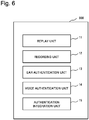
- a biometric authentication device 300 is provided with: a replay unit 11 that reproduces a sound; a recording unit 12 that records a sound; an ear authentication unit 13 that extracts an ear acoustic feature from a reverberation sound of the sound output from the replay unit in an ear of a user to be authenticated, after the reverberation sound is recorded by the recording unit, and calculates an ear authentication score by comparing the extracted ear acoustic feature with an ear acoustic feature stored in advance; a voice authentication unit 14 that extracts a talker feature from a voice of the user that has been recorded via the recording unit, and calculates a voice authentication score by comparing the extracted talker feature with a talker feature stored in advance; and an authentication integration unit 15 that outputs an authentication integration result calculated based on the ear authentication score and the voice authentication score, in which, after the sound is output into the ear by the replay
- authentication with higher accuracy can be performed quickly in combination of voice authentication and ear authentication.
- the authentication integration unit 15 calculates and outputs the authentication integration result, based on the ear authentication score and the voice authentication score.
- the voice authentication process is executed after the ear authentication process, that is, at least, the voice of the user is input by the recording unit 12 after a sound is output into the ear by the replay unit 11. With this procedure, the authentication process can be completed earlier as a whole than in a normal device in which the ear authentication process and the voice authentication process are simply combined.
- the constituent elements of the biometric authentication devices illustrated in Figs. 1 , 4 , 6 , and other drawings can be achieved using any combination of an information processing device 500 and a program as illustrated in Fig. 7 , for example.
- the information processing device 500 includes, as an example, the following constituents.
- Each constituent element of the biometric authentication device in each example embodiment of the application is achieved by the CPU 501 acquiring and executing the program 504 that enables the functions of these constituent elements.
- the program 504 that enables the function of each constituent element of the biometric authentication device is stored in advance, for example, in the storage device 505 or the RAM 503, and is read out by the CPU 501 as necessary.
- the program 504 may be supplied to the CPU 501 via the communication network 509, or may be stored in advance in the recording medium 506 in such a way as to be supplied to the CPU 501 by the drive device 507 that has read out the stored program.
- the biometric authentication device may be achieved by any combinations of information processing devices and programs that are separate from each other for each constituent element.
- a plurality of constituent elements included in the biometric authentication device may be achieved by any combination of one information processing device 500 and one program.
- biometric authentication device Some or all of multiple constituent elements of the biometric authentication device are achieved by other general-purpose or dedicated circuitry, a processor, or the like, or a combination thereof. These constituent elements may be constituted by a single chip or a plurality of chips connected via a bus.
- biometric authentication device Some or all of multiple constituent elements of the biometric authentication device may be achieved by a combination of the circuitry or the like described above and a program.
- the plurality of information processing devices, pieces of circuitry, or the like may be centrally arranged or dispersedly arranged.
- the information processing devices, pieces of circuitry, or the like may be achieved as a form in which the devices or pieces of circuitry or the like are connected with each other via a communication network, such as a client and server system or a cloud computing system.
Landscapes
- Engineering & Computer Science (AREA)
- Health & Medical Sciences (AREA)
- Life Sciences & Earth Sciences (AREA)
- Physics & Mathematics (AREA)
- Acoustics & Sound (AREA)
- Veterinary Medicine (AREA)
- Multimedia (AREA)
- Heart & Thoracic Surgery (AREA)
- Medical Informatics (AREA)
- Molecular Biology (AREA)
- Surgery (AREA)
- Animal Behavior & Ethology (AREA)
- General Health & Medical Sciences (AREA)
- Public Health (AREA)
- Pathology (AREA)
- Audiology, Speech & Language Pathology (AREA)
- Human Computer Interaction (AREA)
- Biophysics (AREA)
- Biomedical Technology (AREA)
- Computer Security & Cryptography (AREA)
- Theoretical Computer Science (AREA)
- Business, Economics & Management (AREA)
- Computer Vision & Pattern Recognition (AREA)
- Game Theory and Decision Science (AREA)
- Computer Hardware Design (AREA)
- Software Systems (AREA)
- General Engineering & Computer Science (AREA)
- General Physics & Mathematics (AREA)
- Signal Processing (AREA)
- Measurement Of The Respiration, Hearing Ability, Form, And Blood Characteristics Of Living Organisms (AREA)
- Collating Specific Patterns (AREA)
Applications Claiming Priority (2)
| Application Number | Priority Date | Filing Date | Title |
|---|---|---|---|
| JP2018162229 | 2018-08-31 | ||
| PCT/JP2019/032729 WO2020045204A1 (fr) | 2018-08-31 | 2019-08-22 | Dispositif d'authentification biométrique, procédé d'authentification biométrique et support d'enregistrement |
Publications (2)
| Publication Number | Publication Date |
|---|---|
| EP3846052A1 true EP3846052A1 (fr) | 2021-07-07 |
| EP3846052A4 EP3846052A4 (fr) | 2021-09-29 |
Family
ID=69644524
Family Applications (1)
| Application Number | Title | Priority Date | Filing Date |
|---|---|---|---|
| EP19855693.8A Withdrawn EP3846052A4 (fr) | 2018-08-31 | 2019-08-22 | Dispositif d'authentification biométrique, procédé d'authentification biométrique et support d'enregistrement |
Country Status (4)
| Country | Link |
|---|---|
| US (5) | US20210201918A1 (fr) |
| EP (1) | EP3846052A4 (fr) |
| JP (1) | JP7120313B2 (fr) |
| WO (1) | WO2020045204A1 (fr) |
Cited By (2)
| Publication number | Priority date | Publication date | Assignee | Title |
|---|---|---|---|---|
| EP4243439A4 (fr) * | 2020-11-09 | 2024-05-22 | NEC Corporation | Dispositif de traitement du signal, dispositif de microphone, procédé de traitement du signal, et support d'enregistrement |
| CN120612960A (zh) * | 2025-06-23 | 2025-09-09 | 平安创科科技(北京)有限公司 | 基于环境声音特征的真实性分析方法、装置、设备及介质 |
Families Citing this family (7)
| Publication number | Priority date | Publication date | Assignee | Title |
|---|---|---|---|---|
| US11388596B2 (en) * | 2019-09-03 | 2022-07-12 | International Business Machines Corporation | Secure transmittal of wireless local area network access codes |
| JP6700531B1 (ja) * | 2020-01-20 | 2020-05-27 | 株式会社白紙とロック | 認証方法、認証システム、スマートスピーカ及びプログラム |
| FR3123467A1 (fr) * | 2021-05-31 | 2022-12-02 | Orange | Procédé et dispositif de caractérisation d’un utilisateur, et dispositif de fourniture de services l’utilisant |
| JP7756346B2 (ja) * | 2021-12-03 | 2025-10-20 | パナソニックIpマネジメント株式会社 | 認証装置および認証方法 |
| KR20230142336A (ko) | 2022-04-01 | 2023-10-11 | 리벨리온 주식회사 | 뉴럴 프로세싱 장치의 퍼포먼스 측정 방법 및 퍼포먼스 측정 장치 |
| WO2025057270A1 (fr) * | 2023-09-11 | 2025-03-20 | 日本電気株式会社 | Système de traitement d'informations, terminal portable, procédé de traitement d'informations et support d'enregistrement |
| US20250342236A1 (en) * | 2024-05-02 | 2025-11-06 | Microsoft Technology Licensing, Llc | In-ear authentication |
Family Cites Families (27)
| Publication number | Priority date | Publication date | Assignee | Title |
|---|---|---|---|---|
| JP2000148985A (ja) | 1998-11-17 | 2000-05-30 | Hitachi Ltd | 個人認証システム |
| JP3818063B2 (ja) | 2001-01-25 | 2006-09-06 | 松下電器産業株式会社 | 個人認証装置 |
| US7088220B2 (en) * | 2003-06-20 | 2006-08-08 | Motorola, Inc. | Method and apparatus using biometric sensors for controlling access to a wireless communication device |
| US7529379B2 (en) * | 2005-01-04 | 2009-05-05 | Motorola, Inc. | System and method for determining an in-ear acoustic response for confirming the identity of a user |
| US20080005575A1 (en) * | 2006-06-30 | 2008-01-03 | Alcatel | Mobile phone locking system using multiple biometric factors for owner authentication |
| JP4937661B2 (ja) * | 2006-07-31 | 2012-05-23 | ナップエンタープライズ株式会社 | 携帯個人認証方法及び電子商取引方法 |
| US8189878B2 (en) * | 2007-11-07 | 2012-05-29 | Verizon Patent And Licensing Inc. | Multifactor multimedia biometric authentication |
| US8443202B2 (en) * | 2009-08-05 | 2013-05-14 | Daon Holdings Limited | Methods and systems for authenticating users |
| US10042993B2 (en) * | 2010-11-02 | 2018-08-07 | Homayoon Beigi | Access control through multifactor authentication with multimodal biometrics |
| KR101971697B1 (ko) * | 2012-02-24 | 2019-04-23 | 삼성전자주식회사 | 사용자 디바이스에서 복합 생체인식 정보를 이용한 사용자 인증 방법 및 장치 |
| US9323912B2 (en) * | 2012-02-28 | 2016-04-26 | Verizon Patent And Licensing Inc. | Method and system for multi-factor biometric authentication |
| US9100825B2 (en) * | 2012-02-28 | 2015-08-04 | Verizon Patent And Licensing Inc. | Method and system for multi-factor biometric authentication based on different device capture modalities |
| JP2015206857A (ja) | 2014-04-18 | 2015-11-19 | 善博 新井 | 磁石制動式試料板位置制御装置 |
| US10097914B2 (en) * | 2016-05-27 | 2018-10-09 | Bugatone Ltd. | Determining earpiece presence at a user ear |
| JP6855381B2 (ja) | 2015-10-21 | 2021-04-07 | 日本電気株式会社 | 個人認証装置、個人認証方法および個人認証プログラム |
| JP6675893B2 (ja) * | 2016-03-17 | 2020-04-08 | 株式会社エヌ・ティ・ティ・データ | 個人認証システム、個人認証装置、個人認証方法、およびプログラム |
| US10460095B2 (en) * | 2016-09-30 | 2019-10-29 | Bragi GmbH | Earpiece with biometric identifiers |
| JP2018162229A (ja) | 2017-03-27 | 2018-10-18 | 三井化学株式会社 | 遷移金属化合物、オレフィン多量化用触媒およびオレフィン多量体の製造方法 |
| US11494473B2 (en) * | 2017-05-19 | 2022-11-08 | Plantronics, Inc. | Headset for acoustic authentication of a user |
| GB201801528D0 (en) * | 2017-07-07 | 2018-03-14 | Cirrus Logic Int Semiconductor Ltd | Method, apparatus and systems for biometric processes |
| GB201801532D0 (en) * | 2017-07-07 | 2018-03-14 | Cirrus Logic Int Semiconductor Ltd | Methods, apparatus and systems for audio playback |
| GB201801527D0 (en) * | 2017-07-07 | 2018-03-14 | Cirrus Logic Int Semiconductor Ltd | Method, apparatus and systems for biometric processes |
| GB201801526D0 (en) * | 2017-07-07 | 2018-03-14 | Cirrus Logic Int Semiconductor Ltd | Methods, apparatus and systems for authentication |
| GB201801530D0 (en) * | 2017-07-07 | 2018-03-14 | Cirrus Logic Int Semiconductor Ltd | Methods, apparatus and systems for authentication |
| US10063542B1 (en) * | 2018-03-16 | 2018-08-28 | Fmr Llc | Systems and methods for simultaneous voice and sound multifactor authentication |
| US10720166B2 (en) * | 2018-04-09 | 2020-07-21 | Synaptics Incorporated | Voice biometrics systems and methods |
| US10915614B2 (en) * | 2018-08-31 | 2021-02-09 | Cirrus Logic, Inc. | Biometric authentication |
-
2019
- 2019-08-22 WO PCT/JP2019/032729 patent/WO2020045204A1/fr not_active Ceased
- 2019-08-22 US US17/270,303 patent/US20210201918A1/en not_active Abandoned
- 2019-08-22 EP EP19855693.8A patent/EP3846052A4/fr not_active Withdrawn
- 2019-08-22 JP JP2020539380A patent/JP7120313B2/ja active Active
-
2023
- 2023-10-10 US US18/483,843 patent/US20240038240A1/en active Pending
- 2023-10-10 US US18/483,896 patent/US12562170B2/en active Active
- 2023-10-10 US US18/483,881 patent/US20240038241A1/en active Pending
- 2023-10-10 US US18/483,905 patent/US20240038243A1/en active Pending
Cited By (3)
| Publication number | Priority date | Publication date | Assignee | Title |
|---|---|---|---|---|
| EP4243439A4 (fr) * | 2020-11-09 | 2024-05-22 | NEC Corporation | Dispositif de traitement du signal, dispositif de microphone, procédé de traitement du signal, et support d'enregistrement |
| US12456448B2 (en) | 2020-11-09 | 2025-10-28 | Nec Corporation | Signal processing device, microphone device, signal processing method, and recording medium |
| CN120612960A (zh) * | 2025-06-23 | 2025-09-09 | 平安创科科技(北京)有限公司 | 基于环境声音特征的真实性分析方法、装置、设备及介质 |
Also Published As
| Publication number | Publication date |
|---|---|
| JP7120313B2 (ja) | 2022-08-17 |
| US20210201918A1 (en) | 2021-07-01 |
| US20240038243A1 (en) | 2024-02-01 |
| US20240038240A1 (en) | 2024-02-01 |
| WO2020045204A1 (fr) | 2020-03-05 |
| US20240038241A1 (en) | 2024-02-01 |
| US12562170B2 (en) | 2026-02-24 |
| JPWO2020045204A1 (ja) | 2021-09-24 |
| EP3846052A4 (fr) | 2021-09-29 |
| US20240038242A1 (en) | 2024-02-01 |
Similar Documents
| Publication | Publication Date | Title |
|---|---|---|
| US12562170B2 (en) | Biometric authentication device, biometric authentication method, and recording medium | |
| US12216752B2 (en) | Personal authentication device based on echo sounds, personal authentication method, and recording medium | |
| US20230143028A1 (en) | Personal authentication device, personal authentication method, and recording medium | |
| US12198702B2 (en) | In-ear liveness detection for voice user interfaces | |
| US10867019B2 (en) | Personal authentication device, personal authentication method, and personal authentication program using acoustic signal propagation | |
| KR102180489B1 (ko) | 센서 신호들에 기초한 라이브니스 결정 | |
| JP6943248B2 (ja) | 個人認証システム、個人認証装置、個人認証方法および個人認証プログラム | |
| US20200411014A1 (en) | User authentication with audio reply | |
| TW200820218A (en) | Portable personal authentication method and electronic business transaction method | |
| KR20210006419A (ko) | 건강 관련 정보 생성 및 저장 | |
| WO2018051950A1 (fr) | Dispositif d'authentification personnelle, procédé d'authentification personnelle et support d'enregistrement | |
| US20220272131A1 (en) | Method, electronic device and system for generating record of telemedicine service | |
| WO2019006587A1 (fr) | Système de reconnaissance de locuteur, procédé de reconnaissance de locuteur et dispositif intra-auriculaire | |
| CN114582078A (zh) | 自助存取款方法及自助存取款系统 | |
| JP7019765B2 (ja) | 個人認証装置、個人認証方法および個人認証プログラム | |
| JP2022070872A (ja) | 個人認証装置、個人認証方法および個人認証プログラム |
Legal Events
| Date | Code | Title | Description |
|---|---|---|---|
| STAA | Information on the status of an ep patent application or granted ep patent |
Free format text: STATUS: THE INTERNATIONAL PUBLICATION HAS BEEN MADE |
|
| STAA | Information on the status of an ep patent application or granted ep patent |
Free format text: STATUS: REQUEST FOR EXAMINATION WAS MADE |
|
| PUAI | Public reference made under article 153(3) epc to a published international application that has entered the european phase |
Free format text: ORIGINAL CODE: 0009012 |
|
| 17P | Request for examination filed |
Effective date: 20210331 |
|
| AK | Designated contracting states |
Kind code of ref document: A1 Designated state(s): AL AT BE BG CH CY CZ DE DK EE ES FI FR GB GR HR HU IE IS IT LI LT LU LV MC MK MT NL NO PL PT RO RS SE SI SK SM TR |
|
| A4 | Supplementary search report drawn up and despatched |
Effective date: 20210831 |
|
| RIC1 | Information provided on ipc code assigned before grant |
Ipc: H04R 1/10 20060101ALI20210825BHEP Ipc: G10L 17/08 20130101ALI20210825BHEP Ipc: G10L 17/10 20130101ALI20210825BHEP Ipc: G10L 17/00 20130101ALI20210825BHEP Ipc: A61B 5/1171 20160101ALI20210825BHEP Ipc: G06F 21/32 20130101AFI20210825BHEP |
|
| DAV | Request for validation of the european patent (deleted) | ||
| DAX | Request for extension of the european patent (deleted) | ||
| STAA | Information on the status of an ep patent application or granted ep patent |
Free format text: STATUS: THE APPLICATION HAS BEEN WITHDRAWN |
|
| 18W | Application withdrawn |
Effective date: 20230124 |