EP3849088A1 - Procédé et appareil de codage et de décodage de canal dans un système de communication utilisant des codes ldpc (low-density parity-check) - Google Patents
Procédé et appareil de codage et de décodage de canal dans un système de communication utilisant des codes ldpc (low-density parity-check) Download PDFInfo
- Publication number
- EP3849088A1 EP3849088A1 EP21158617.7A EP21158617A EP3849088A1 EP 3849088 A1 EP3849088 A1 EP 3849088A1 EP 21158617 A EP21158617 A EP 21158617A EP 3849088 A1 EP3849088 A1 EP 3849088A1
- Authority
- EP
- European Patent Office
- Prior art keywords
- information
- column
- shortening
- bits
- parity
- Prior art date
- Legal status (The legal status is an assumption and is not a legal conclusion. Google has not performed a legal analysis and makes no representation as to the accuracy of the status listed.)
- Granted
Links
Images





Classifications
-
- H—ELECTRICITY
- H03—ELECTRONIC CIRCUITRY
- H03M—CODING; DECODING; CODE CONVERSION IN GENERAL
- H03M13/00—Coding, decoding or code conversion, for error detection or error correction; Coding theory basic assumptions; Coding bounds; Error probability evaluation methods; Channel models; Simulation or testing of codes
- H03M13/03—Error detection or forward error correction by redundancy in data representation, i.e. code words containing more digits than the source words
- H03M13/05—Error detection or forward error correction by redundancy in data representation, i.e. code words containing more digits than the source words using block codes, i.e. a predetermined number of check bits joined to a predetermined number of information bits
- H03M13/11—Error detection or forward error correction by redundancy in data representation, i.e. code words containing more digits than the source words using block codes, i.e. a predetermined number of check bits joined to a predetermined number of information bits using multiple parity bits
-
- H—ELECTRICITY
- H03—ELECTRONIC CIRCUITRY
- H03M—CODING; DECODING; CODE CONVERSION IN GENERAL
- H03M13/00—Coding, decoding or code conversion, for error detection or error correction; Coding theory basic assumptions; Coding bounds; Error probability evaluation methods; Channel models; Simulation or testing of codes
- H03M13/03—Error detection or forward error correction by redundancy in data representation, i.e. code words containing more digits than the source words
- H03M13/05—Error detection or forward error correction by redundancy in data representation, i.e. code words containing more digits than the source words using block codes, i.e. a predetermined number of check bits joined to a predetermined number of information bits
- H03M13/11—Error detection or forward error correction by redundancy in data representation, i.e. code words containing more digits than the source words using block codes, i.e. a predetermined number of check bits joined to a predetermined number of information bits using multiple parity bits
- H03M13/1102—Codes on graphs and decoding on graphs, e.g. low-density parity check [LDPC] codes
- H03M13/1148—Structural properties of the code parity-check or generator matrix
- H03M13/116—Quasi-cyclic LDPC [QC-LDPC] codes, i.e. the parity-check matrix being composed of permutation or circulant sub-matrices
- H03M13/1165—QC-LDPC codes as defined for the digital video broadcasting [DVB] specifications, e.g. DVB-Satellite [DVB-S2]
-
- H—ELECTRICITY
- H03—ELECTRONIC CIRCUITRY
- H03M—CODING; DECODING; CODE CONVERSION IN GENERAL
- H03M13/00—Coding, decoding or code conversion, for error detection or error correction; Coding theory basic assumptions; Coding bounds; Error probability evaluation methods; Channel models; Simulation or testing of codes
- H03M13/03—Error detection or forward error correction by redundancy in data representation, i.e. code words containing more digits than the source words
- H03M13/05—Error detection or forward error correction by redundancy in data representation, i.e. code words containing more digits than the source words using block codes, i.e. a predetermined number of check bits joined to a predetermined number of information bits
- H03M13/11—Error detection or forward error correction by redundancy in data representation, i.e. code words containing more digits than the source words using block codes, i.e. a predetermined number of check bits joined to a predetermined number of information bits using multiple parity bits
- H03M13/1102—Codes on graphs and decoding on graphs, e.g. low-density parity check [LDPC] codes
-
- H—ELECTRICITY
- H03—ELECTRONIC CIRCUITRY
- H03M—CODING; DECODING; CODE CONVERSION IN GENERAL
- H03M13/00—Coding, decoding or code conversion, for error detection or error correction; Coding theory basic assumptions; Coding bounds; Error probability evaluation methods; Channel models; Simulation or testing of codes
- H03M13/61—Aspects and characteristics of methods and arrangements for error correction or error detection, not provided for otherwise
- H03M13/615—Use of computational or mathematical techniques
- H03M13/616—Matrix operations, especially for generator matrices or check matrices, e.g. column or row permutations
-
- H—ELECTRICITY
- H03—ELECTRONIC CIRCUITRY
- H03M—CODING; DECODING; CODE CONVERSION IN GENERAL
- H03M13/00—Coding, decoding or code conversion, for error detection or error correction; Coding theory basic assumptions; Coding bounds; Error probability evaluation methods; Channel models; Simulation or testing of codes
- H03M13/61—Aspects and characteristics of methods and arrangements for error correction or error detection, not provided for otherwise
- H03M13/618—Shortening and extension of codes
-
- H—ELECTRICITY
- H03—ELECTRONIC CIRCUITRY
- H03M—CODING; DECODING; CODE CONVERSION IN GENERAL
- H03M13/00—Coding, decoding or code conversion, for error detection or error correction; Coding theory basic assumptions; Coding bounds; Error probability evaluation methods; Channel models; Simulation or testing of codes
- H03M13/63—Joint error correction and other techniques
-
- H—ELECTRICITY
- H03—ELECTRONIC CIRCUITRY
- H03M—CODING; DECODING; CODE CONVERSION IN GENERAL
- H03M13/00—Coding, decoding or code conversion, for error detection or error correction; Coding theory basic assumptions; Coding bounds; Error probability evaluation methods; Channel models; Simulation or testing of codes
- H03M13/63—Joint error correction and other techniques
- H03M13/6325—Error control coding in combination with demodulation
-
- H—ELECTRICITY
- H04—ELECTRIC COMMUNICATION TECHNIQUE
- H04L—TRANSMISSION OF DIGITAL INFORMATION, e.g. TELEGRAPHIC COMMUNICATION
- H04L1/00—Arrangements for detecting or preventing errors in the information received
- H04L1/004—Arrangements for detecting or preventing errors in the information received by using forward error control
- H04L1/0056—Systems characterized by the type of code used
- H04L1/0057—Block codes
-
- H—ELECTRICITY
- H04—ELECTRIC COMMUNICATION TECHNIQUE
- H04L—TRANSMISSION OF DIGITAL INFORMATION, e.g. TELEGRAPHIC COMMUNICATION
- H04L1/00—Arrangements for detecting or preventing errors in the information received
- H04L1/004—Arrangements for detecting or preventing errors in the information received by using forward error control
- H04L1/0056—Systems characterized by the type of code used
- H04L1/0067—Rate matching
- H04L1/0068—Rate matching by puncturing
- H04L1/0069—Puncturing patterns
-
- H—ELECTRICITY
- H04—ELECTRIC COMMUNICATION TECHNIQUE
- H04L—TRANSMISSION OF DIGITAL INFORMATION, e.g. TELEGRAPHIC COMMUNICATION
- H04L1/00—Arrangements for detecting or preventing errors in the information received
- H04L1/12—Arrangements for detecting or preventing errors in the information received by using return channel
- H04L1/16—Arrangements for detecting or preventing errors in the information received by using return channel in which the return channel carries supervisory signals, e.g. repetition request signals
- H04L1/18—Automatic repetition systems, e.g. Van Duuren systems
- H04L1/1812—Hybrid protocols; Hybrid automatic repeat request [HARQ]
- H04L1/1819—Hybrid protocols; Hybrid automatic repeat request [HARQ] with retransmission of additional or different redundancy
-
- H—ELECTRICITY
- H04—ELECTRIC COMMUNICATION TECHNIQUE
- H04L—TRANSMISSION OF DIGITAL INFORMATION, e.g. TELEGRAPHIC COMMUNICATION
- H04L27/00—Modulated-carrier systems
- H04L27/32—Carrier systems characterised by combinations of two or more of the types covered by groups H04L27/02, H04L27/10, H04L27/18 or H04L27/26
- H04L27/34—Amplitude- and phase-modulated carrier systems, e.g. quadrature-amplitude modulated carrier systems
- H04L27/3405—Modifications of the signal space to increase the efficiency of transmission, e.g. reduction of the bit error rate, bandwidth, or average power
- H04L27/3416—Modifications of the signal space to increase the efficiency of transmission, e.g. reduction of the bit error rate, bandwidth, or average power in which the information is carried by both the individual signal points and the subset to which the individual points belong, e.g. using coset coding, lattice coding, or related schemes
-
- H—ELECTRICITY
- H04—ELECTRIC COMMUNICATION TECHNIQUE
- H04L—TRANSMISSION OF DIGITAL INFORMATION, e.g. TELEGRAPHIC COMMUNICATION
- H04L27/00—Modulated-carrier systems
- H04L27/32—Carrier systems characterised by combinations of two or more of the types covered by groups H04L27/02, H04L27/10, H04L27/18 or H04L27/26
- H04L27/34—Amplitude- and phase-modulated carrier systems, e.g. quadrature-amplitude modulated carrier systems
- H04L27/3488—Multiresolution systems
Definitions
- the present invention relates generally to a communication system using Low-Density Parity-Check (LDPC) codes, and more particularly, to an encoding/decoding apparatus and method for generating LDPC codewords having various codeword lengths and code rates from an LDPC code given in a high-order modulation scheme.
- LDPC Low-Density Parity-Check
- the parity-check matrix H 1 is an LDPC code that generates a length-8 codeword, and the columns are mapped to 8 encoded bits.
- FIG. 2 illustrates a Tanner graph corresponding to the parity-check matrix H 1 of FIG. 1 .
- the Tanner graph of the LDPC code includes 8 variable nodes x 1 (202), x 2 (204), x 3 (206), x 4 (208), x 5 (210), x 6 (212), x 7 (214), and x 8 (216), and 4 check nodes 218, 220, 222, and 224.
- An i th column and a j th row in the parity-check matrix H 1 of the LDPC code are mapped to a variable node x i and a j th check node, respectively.
- a ratio of the number of degree-i variable nodes to the total number of variable nodes is defined as f i
- a ratio of the number of degree-j check nodes to the total number of check nodes is defined as g j .
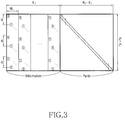
- FIG. 3 schematically illustrates an LDPC code adopted as the standard technology in Digital Video Broadcasting-Satellite transmission 2 nd generation (DVB-S2), which is one of the European digital broadcasting standards.
- DVD-S2 Digital Video Broadcasting-Satellite transmission 2 nd generation
- N 1 and K 1 denote a codeword length and an information length (or length of information word) of an LDPC code, respectively, and ( N 1 -K 1 ) provides a parity length.
- K 1 / M 1 is an integer.
- a structure of a parity part i.e., K 1 th column through ( N 1 -1) th column, in the parity-check matrix, has a dual diagonal shape. Therefore, as for degree distribution over columns corresponding to the parity part, all columns have a degree of 2, except for the last column having a degree of 1.
- information bits of a codeword having an information length K 1 are represented as ( i 0 , i 1 ,..., i K 1-1 ), and parity bits of a codeword having a parity length ( N 1 -K 1 ) are expressed as ( p 0 ,p 1 ,..., p N 1 -K 1 - 1 ).
- Step 2 The LDPC encoder reads information on rows of the DVB-S2 LDPC code where a 1 is located in a column group from a 0 th weight-1 position sequence out of the stored sequences indicating the parity-check matrix.
- the LDPC encoder updates particular parity bits p x in accordance with Equation (3), using the read information and the first information bit i 0 .
- Step 6 The LDPC encoder finally determines parity bits using Equation (6).
- the LDPC code In order to apply the LDPC code to the actual communication system, the LDPC code should be designed to be suitable for the data rate required in the communication system. Particularly, LDPC codes supporting various codeword lengths are needed to support various data rates according to the system requirements in an adaptive communication system employing Hybrid Automatic Retransmission reqQuest (HARQ) and Adaptive Modulation and Coding (AMC), and also in a communication system supporting various broadcast services.
- HARQ Hybrid Automatic Retransmission reqQuest
- AMC Adaptive Modulation and Coding
- the LDPC code used in the DVB-S2 system supports only two types of codeword lengths due to its limited use, and each type of the LDPC code uses an independent parity-check matrix. Accordingly, there is a long-felt need in the art for a method for supporting various codeword lengths to increase extendibility and flexibility of the system. Particularly, in the DVB-S2 system, transmission of data having several hundreds to thousands of bits is needed for transmitting signaling information. However, because only 16200 and 64800 are available for a length of the DVB-S2 LDPC code, there is still a need for support of various codeword lengths.
- FIG. 5B schematically illustrating a signal constellation for a conventional 16-QAM modulation.
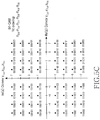
- FIG. 5C schematically illustrates a signal constellation for a conventional 64-QAM modulation.
- bits y 0 , y 1 , y 2 , y 3 , y 4 determine a magnitude and a sign of the real part
- y 1 , y 3 , and y 5 determine a magnitude and a sign of the imaginary part.
- y 0 and y 1 determine signs of the real part and the imaginary part, respectively
- a combination of y 2 and y 4 and a combination of y 3 and ys determine magnitudes of the real part and the imaginary part, respectively.
- reliabilities of y 0 and y 1 are higher than reliabilities of y 2 , y 3 , y 4 , and y 5 .
- Tian, et al Construction of Rate-Compatible LDPC Codes Utilizing Information Shortening and Parity Puncturing, Journal on Wireless Communications and Networking 2005:5 789-795 , discloses applying shortening (and puncturing) in association with LDPC codes. Both techniques are implemented, at the transmitter side, by omitting shortened and punctured code symbols when transmitting the codeword to a receiver. In Tian et al shortening corresponds to using zeros instead of payload data of a certain number of leftmost information bits in the encoding/decoding process.
- a method is provided in which a LDPC codeword is generated by LDPC encoding data using a parity check matrix and a shortening pattern as defined in independent claim 1.
- An apparatus configured to perform that method is defined in independent claim 3.
- a method for decoding and an apparatus configured to decode such a generated codeword are defined in independent claims 5 and 7, respectively.
- the present invention provides an encoding/decoding method and apparatus for providing optimal performance considering a DVB-S2 structure in a communication system using LDPC codes.
- FIG. 6 is a block diagram of a transceiver in a communication system using an LDPC code.
- a message u is input to an LDPC encoder 611 in a transmitter 610 before being transmitted to a receiver 630.
- the LDPC encoder 611 encodes the input message u, and outputs the encoded signal c to a modulator 613.
- the modulator 613 modulates the encoded signal c, and transmits the modulated signal s to the receiver 630 over a wireless channel 620.
- a demodulator 631 in the receiver 630 demodulates the received signal r, and outputs the demodulated signal x to an LDPC decoder 633.
- the LDPC decoder 633 decodes the demodulated signal x , resulting in an estimate u of the message based on the data received through the wireless channel 620.
- the LDPC encoder 611 generates a parity-check matrix according to a codeword length required by a communication system, using a preset scheme. Particularly, in accordance with an embodiment of the present invention, an LDPC encoder will support various codeword lengths using the LDPC code without the separate need for additional stored information.
- a method of acquiring various codeword lengths from a given LDPC code uses shortening or puncturing.
- Methods that optimize performance by applying shortening or puncturing to an LDPC codeword in accordance with a code rate or a codeword length are currently known.
- the known method of determining the shortening and puncturing patterns performs the optimization process considering only Binary Phase Shift Keying (BPSK) or Quadrature Phase Shift Keying (QPSK)
- BPSK Binary Phase Shift Keying
- QPSK Quadrature Phase Shift Keying
- the puncturing and shortening patterns optimized when a signal constellation/bit mapping scheme has been determined in high-order modulation can be different from those for BPSK or QPSK modulation.
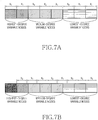
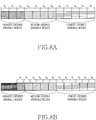
- FIGs. 7A and 7B and FIGs. 8A and 8B illustrate bit mapping examples in which bits are mapped to a symbol according to degrees of variable nodes in an LDPC codeword, for 16-QAM and 64-QAM, respectively. More specifically, FIG. 7A illustrates an example of signal constellation/bit mapping in 16-QAM modulation, and FIG. 7B illustrates an example of signal constellation/bit mapping modified by shortening in 16-QAM modulation. For convenience, an LDPC codeword is divided herein into an 8 or 12-bit partial block.
- y 1 and y 3 are mapped to an LDPC codeword bit part corresponding to the highest-degree variable nodes, 1/2 of the highest-degree variable nodes are mapped to a high-reliability part while the other 1/2 are connected to a low-reliability part.
- FIG. 8A illustrates an example of signal constellation/bit mapping in 64-QAM modulation
- FIG. 8B illustrates an example of signal constellation/bit mapping modified by shortening in 64-QAM modulation.
- 1/3 of variable nodes with the highest degree in the LDPC codeword are mapped to the lowestreliability bit y 5 .
- 2/3 of the highest-degree variable nodes undergo shortening as illustrated in FIG. 8B it can be understood that 5/6 of the remaining non-shortened highest-degree variable node is mapped to the lowestreliability bit y 5 , so that the bit ratio is different from that before the shortening.
- the shortening or puncturing pattern used in BPSK or QPSK modulation may not be suitable because a ratio of the LDPC codeword bit being mapped to each bit of a modulation symbol is very different according to the shortening technique.
- a shortening pattern should be determined considering an intended modulation scheme in order to find an optimized shortening or puncturing pattern in relation to an LDPC code.
- Shortening will be described below before a description of a method for determining a shortening or puncturing pattern in consideration of a modulation scheme is given.
- the term "shortening” as used herein refers to a method that does not substantially transmit a specified part of an LDPC codeword, after generating the LDPC codeword from a given particular parity-check matrix by performing LDPC encoding.
- a parity-check matrix of the DVB-S2 LDPC code illustrated in FIG. 3 will be described in more detail below.
- the total length is N 1 , where length- K 1 information bits ( i 0 , i 1 ,..., i K 1 -1 ) corresponds to a front part of the parity-check matrix, and length-( N 1 - K 1 ) parity bits ( p 0 , p 1 ,..., p N 1 - K 1 -1 ) corresponds to a rear part of the parity-check matrix.
- information bits freely have a value of 0 or 1, and the shortening technique restricts values of information bits in a particular part that is subject to shortening.
- the term "shortening" actually originates from the above-described limitation operation. Therefore, applying shortening herein also means considering values of the shortened information bits, as 0.
- a transmitter and a receiver can share or generate the same position information for the shortened information bits. Therefore, though the transmitter has not transmitted the shortened bits, the receiver can perform decoding, already knowing that information bits in the positions corresponding to the shortened bits have a value of 0.
- the code rate becomes ( K 1 - N s )/( N 1 - N s ), which is always less than the first given code rate K 1 / N 1 .
- a puncturing technique can be applied to both the information bits and the parity bits.
- the puncturing technique and the shortening technique commonly reduce codeword lengths
- the puncturing technique unlike the shortening technique described above, does not limit values of particular bits.
- the puncturing technique is simply a method for not transmitting particular information bits or a particular part of generated parity bits, such that a receiver can erase the corresponding bits. That is, by simply not transmitting bits in N p predefined positions in a generated length- N 1 LDPC codeword, the puncturing technique obtains the same effect as that obtained by transmitting a length-( N 1 - N p ) LDPC codeword. Because columns corresponding to the punctured bits in the parity-check matrix are all used intact in a decoding process, the puncturing technique is distinct from the shortening technique.
- the receiver may merely erase the corresponding punctured bits, before decoding.
- the code rate becomes K 1 /( N 1 -N p ), which is always greater than the first given code rate K 1 / N 1 .
- the DVB-S2 LDPC code has a length and an information length of N 1 and K 1 , respectively, and a codeword length and an information length of an LDPC codeword that are desired to be finally obtained from the DVB-S2 LDPC code using the shortening technique and the puncturing technique are N 2 and K 2 , respectively.
- N ⁇ K ⁇
- the LDPC code is generated by not performing shortening and puncturing or by performing only shortening.
- the following shortening process which will be described with reference to FIG. 9 , is proposed considering such characteristics.
- FIG. 9 illustrates a procedure for generating an LDPC codeword with a different codeword length from a parity-check matrix of a stored LDPC code according to an embodiment of the present invention.
- an LDPC encoder determines a transmission modulation scheme for a symbol in step 901, and reads column group information of a DVB-S2 LDPC code to be used in a shortening action in step 903. That is, the LDPC encoder reads stored parity-check matrix information. Thereafter, the LDPC encoder determines a codeword length N 2 and an information length K 2 based on the column group information of the DVB-S2 LDPC code in step 905.
- the LDPC encoder performs a shortening process of steps 907 to 913, in which the LDPC encoder performs shortening corresponding to a required information length of an LDPC codeword, based on the read information of the stored parity-check matrix.
- the LDPC encoder considers that there is no sequence for the remaining K 1 / M 1 -A -1 column groups except for the partial sequence S i , 0 k in the sequence R i , 0 k .
- Shortening Step 3 The LDPC encoder determines positions of column groups of the DVB-S2 LDPC code corresponding to an information word from the sequence S i , 0 k of ( A+1 ) column groups selected in Shortening Step 2, generating a shortened codeword relating to the DVB-S2 LDPC code in step 911. It should be noted that the shortened LDPC codeword has an information length ( A +1) M 1 , which is always greater than or equal to K 2 .
- Shortening Step 4 The LDPC encoder additionally shortens (A+1)M 1 -K 2 bits from the shortened LDPC codeword generated in Shortening Step 3 in step 913.
- Shortening Step 4 the additional shortening is more easily implemented if the process is sequentially performed from the rear or the front of the bit group where the additional shortening is achieved.
- an embodiment of the present invention applies an efficient shortening technique that does not use information on column groups of the DVB-S2 LDPC code depending on the structural features of the DVB-S2 LDPC code, compared with a conventional bit-by-bit shortening technique, which is commonly used for shortening in relation to the DVB-S2 LDPC code.
- Selection criteria of a sequence for column groups can be summarized as follows in Step 2 in the shortening process of the DVB-S2 LDPC code.
- Criterion 1 The LDPC encoder selects a shortening pattern sequence relating to column groups defined such that optimal degree distribution obtainable by considering a modulation scheme given for a normal LDPC code with a length N 2 and an information length K 2 is as similar as possible to degree distribution of a shortened LDPC code with a length N 2 and an information length K 2 , obtained by performing shortening on a DVB-S2 LDPC code with a length N 1 and an information length K 1 .
- Criterion 2 The LDPC encoder selects a shortening pattern sequence relating to column groups defined to provide a code having the good cycle characteristic on the Tanner graph among the shortened codes selected in Criterion 1. In accordance with an embodiment of the present invention, regarding a criterion for a cycle characteristic, the LDPC encoder selects a sequence where the minimum-length cycle in the Tanner graph is as large as possible and the number of the minimum-length cycles is as small possible.
- the optimal degree distribution of the normal LDPC code in which the modulation scheme is considered can be found out in Criterion 1 using a density evolution analysis method, various implementations of which are known in the art. However, because the process of determining the degree distribution using the density evolution method is not essential to the understanding of the present invention, a detailed description thereof will not be provided.
- the LDPC encoder may select (shortening pattern) sequence for the column group having the best performance by fully searching all the sequences regardless of Criterions 1 and 2.
- the selection criteria for column groups, applied in Shortening Step 2 for the DVB-S2 LDPC code enable to efficiently select a (shortening pattern) sequence by selecting an LDPC code satisfying the both conditions when the number of all possible (shortening pattern) sequences for the column group is too large.
- Criterion 1 and Criterion 2 are applied when N 2 and K 2 are fixed values. However, if values of N 2 and K 2 required in the system are varying, the shortening patterns optimized according to the value of K 2 may have no correlation. That is, when the values of N 2 and K 2 required in the system are varying, all of shortening patterns optimized according to the value of K 2 should be stored separately, for optimized performance.
- the above method cannot guarantee optimal selection for all cases, it has relatively stable performance from the shortening pattern having one regular rule, regardless of the change in the value of K 2 . Therefore, the above-described method has advantages of relatively stable performance and easy storage of shortening patterns.
- a DVB-S2 LDPC code having a total of G column groups corresponding to information bits will be described below by way of example. Assuming that orders of column groups, which are subjected to shortening in accordance with the method of determining shortening patterns are set as B 1 , B 2 , B 3 , ..., B x , when only the sequence meaning the orders of the column groups is stored, efficient shortening is possible for an arbitrary K 2 through Shortening Step 1 to Shortening Step 4.
- ⁇ indicates a permutation function that means a shortening pattern, and the relationships are shown at the bottom of the table.
- BCH Bose-Chaudhuri-Hocquenghem
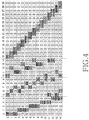
- the suboptimized shortening patterns shown in Table 1B, found for the shortening method in Table 1A, may not be unique according to conditions for finding the shortening patterns. For example, several column groups may exist that show similar performance in the interim process described above, i.e., Finding A Suboptimal Shortening Pattern Sequence. In this case, because selection of the next column groups may differ according to selection of column groups, the suboptimized shortening patterns may not be unique according to performance difference of the shortening process. Actually, shortening patterns shown in Table 1C also provide excellent performance, similar to the shortening method performance shown in Table 1A.
- bit mapping methods corresponding to the signal constellations used in 16-QAM and 64-QAM modulations of Table 1C are the results obtained by applying the same bit mapping methods as those illustrated in FIGs. 7A, 7B , 8A, and 8B .
- the LDPC encoder applies puncturing in the LDPC encoding process in step 915.
- the puncturing method will now be described below.
- FIG. 10 illustrates a block diagram of a transmission apparatus using a shortened LDPC code according to an embodiment of the present invention.
- a transmission apparatus includes a controller 1010, a shortening pattern applier 1020, an LDPC code parity-check matrix extractor 1040, and an LDPC encoder 1060.
- the LDPC code parity-check matrix extractor 1040 extracts an LDPC code parity-check matrix that has undergone shortening.
- the LDPC code parity-check matrix can be extracted using a memory, can be given in the transmission apparatus, or can be generated in the transmission apparatus.
- the LDPC code parity-check matrix extractor 1040 determines a transmission modulation scheme for a transmission symbol, groups columns corresponding to an information word in the parity-check matrix of the LDPC code into a plurality of column groups, and orders the column groups.
- the shortening pattern applier 1020 determines a range of an information word it desires to obtain through shortening, and based on the range of the information word, performs column group-by-column group shortening on the column groups in an order according to a shortening pattern determined in consideration of the determined modulation scheme.
- the controller 1010 controls the shortening pattern applier 1020 to determine a shortening pattern according to the transmission modulation scheme and the information length, and the shortening pattern applier 1020 inserts bits having a value of 0 in positions corresponding to the shortened bits, or does not use columns corresponding to the shortened bits from a parity-check matrix of a given LDPC code.
- the shortening pattern can be a shortening pattern stored in a memory, generated using a sequence generator (not shown), or acquired using a density evolution analysis algorithm for a parity-check matrix and a given information length.
- the LDPC encoder 1060 performs encoding on the LDPC codeword shortened by the controller 1010 and the shortening pattern applier 1020.
- FIG. 11 illustrates a block diagram of a transmission apparatus for a DVB-S2 LDPC code using both shortening and puncturing. More specifically, the transmission apparatus of FIG. 11 also includes a puncturing pattern applier 1180 when compared to the transmission apparatus of FIG. 10 .
- shortening is performed at an input stage of the LDPC encoder 1060, and puncturing is performed at an output stage of the LDPC encoder 1060.
- the puncturing pattern applier 1180 applies puncturing to an output of the LDPC encoder 1060. The method of applying puncturing has been described above in step 915 of FIG. 9 .
- FIG. 12 illustrates a block diagram of a reception apparatus using an LDPC code to which shortening is applied, according to an embodiment of the present invention. More specifically, FIG. 12 illustrates an example of a reception apparatus that receives a signal transmitted from a communication system using the shortened DVB-S2 LDPC code, and recovers user-desired data from the received signal when it detects a transmission modulation scheme and a length of the shortened DVB-S2 LDPC code from the received signal.
- the reception apparatus includes a controller 1210, a shortening pattern determination/estimation unit 1220, a demodulator 1230, and an LDPC decoder 1240.
- the demodulator 1230 receives and demodulates a shortened LDPC codeword, and provides the demodulated signal to the shortening pattern determination/estimation unit 1220 and the LDPC decoder 1240.
- the shortening pattern determination/estimation unit 1220 under the control of the controller 1210, estimates or determines information on a shortening pattern relating to the LDPC code from the demodulated signal, and provides position information of the shortened bits to the LDPC decoder 1240.
- Determining or estimating the shortening patterns in the shortening pattern determination/estimation unit 1220 can use shortening patterns stored in a memory, can generate shortening patterns using a sequence generator (not shown), or can obtain shortening patterns using a density evolution analysis algorithm for a parity-check matrix and a given information length.
- the controller 1210 controls the shortening pattern determination/estimation unit 1220 to deliver a shortening pattern to the LDPC decoder 1240 depending on the modulation scheme and the information length. Because the probability that values of the shortened bits will be zero is 1 (i.e., 100%), the LDPC decoder 1240 determines whether or not it will allow the shortened bits to take part in its decoding operation depending on the value 1 of the probability that the shortened bits would be zero.
- the LDPC decoder 1240 When the LDPC decoder 1240 receives information on a length of the DVB-S2 LDPC code shortened by the shortening pattern determination/estimation unit 1220, it restores the user-desired data from the received signals.
- FIG. 13 illustrates a block diagram of a reception apparatus using an LDPC code to which "shortening" and puncturing are applied, according to an embodiment of the present invention. More specifically, the reception apparatus illustrated in FIG. 13 includes a shortening/puncturing pattern determination/estimation unit 1320 that replaces the shortening pattern determination/estimation unit 1220 in the reception apparatus illustrated in FIG. 12 .
- the shortening/puncturing pattern determination/estimation unit 1320 in the reception apparatus may perform pattern determination or estimation on the shortening first, perform pattern determination or estimation on the puncturing first, or make pattern determination or estimation on both the shortening and puncturing.
- the LDPC decoder 1240 should have information about both shortening and puncturing to perform decoding.
- FIG. 14 illustrates a flowchart of a reception operation of a reception apparatus according to an embodiment of the present invention.
- a demodulator 1230 receives and demodulates a shortened LDPC codeword in step 1401.
- a shortening pattern determination/estimation unit 1220 determines or estimates shortening/puncturing patterns from the demodulated signal.
- the shortening pattern determination/estimation unit 1220 determines in step 1405 whether there are any shortened or punctured bits. If there are no shortened or punctured bits, an LDPC decoder 1240 performs decoding in step 1411. However, if there are shortened or punctured bits, the shortening pattern determination/estimation unit 1220 delivers position information of the shortened/punctured bits to the LDPC decoder 1240 in step 1407.
- step 1409 based on the position information of the shortened/punctured bits, the LDPC decoder 1240 determines that the probability that values of the shortened bits will be 0 is 1, and determines that the punctured bits are erased bits. Thereafter, the LDPC decoder 1240 performs LDPC decoding in step 1411.
- the embodiments of the present invention can generate a separate LDPC codeword with a different codeword length using information on the parity-check matrix given in the communication system that uses high-order modulation and an LDPC code.
Landscapes
- Engineering & Computer Science (AREA)
- Physics & Mathematics (AREA)
- Probability & Statistics with Applications (AREA)
- Theoretical Computer Science (AREA)
- Computer Networks & Wireless Communication (AREA)
- Signal Processing (AREA)
- Mathematical Physics (AREA)
- Mathematical Analysis (AREA)
- General Physics & Mathematics (AREA)
- Mathematical Optimization (AREA)
- Computational Mathematics (AREA)
- Pure & Applied Mathematics (AREA)
- Algebra (AREA)
- Computing Systems (AREA)
- Multimedia (AREA)
- Error Detection And Correction (AREA)
- Detection And Prevention Of Errors In Transmission (AREA)
- Digital Transmission Methods That Use Modulated Carrier Waves (AREA)
Priority Applications (2)
| Application Number | Priority Date | Filing Date | Title |
|---|---|---|---|
| HRP20221436TT HRP20221436T1 (hr) | 2008-02-26 | 2009-02-26 | Postupak i uređaj za kodiranje i dekodiranje kanala u komunikacijskom sustavu korištenjem koda za provjeru pariteta niske gustoće |
| SI200932172T SI3849088T1 (sl) | 2008-02-26 | 2009-02-26 | Postopek in naprava za kodiranje in dekodiranje kanala v komunikacijskem sistemu z uporabo kod low-density parity-check |
Applications Claiming Priority (5)
| Application Number | Priority Date | Filing Date | Title |
|---|---|---|---|
| KR20080017279 | 2008-02-26 | ||
| KR20080022484 | 2008-03-11 | ||
| KR1020080025144A KR101503059B1 (ko) | 2008-02-26 | 2008-03-18 | 저밀도 패리티 검사 부호를 사용하는 통신 시스템에서 채널 부호/복호 방법 및 장치 |
| EP09153740.7A EP2096760B1 (fr) | 2008-02-26 | 2009-02-26 | Procédé et appareil pour coder et décoder un canal dans un système de communication utilisant des codes de contrôle de parité de faible densité |
| EP11151068.1A EP2363962B1 (fr) | 2008-02-26 | 2009-02-26 | Procede et appareil pour coder et decoder un canal dans un systeme de communication utilisant des codes de controle de parite de faible densite |
Related Parent Applications (3)
| Application Number | Title | Priority Date | Filing Date |
|---|---|---|---|
| EP09153740.7A Division EP2096760B1 (fr) | 2008-02-26 | 2009-02-26 | Procédé et appareil pour coder et décoder un canal dans un système de communication utilisant des codes de contrôle de parité de faible densité |
| EP11151068.1A Division-Into EP2363962B1 (fr) | 2008-02-26 | 2009-02-26 | Procede et appareil pour coder et decoder un canal dans un systeme de communication utilisant des codes de controle de parite de faible densite |
| EP11151068.1A Division EP2363962B1 (fr) | 2008-02-26 | 2009-02-26 | Procede et appareil pour coder et decoder un canal dans un systeme de communication utilisant des codes de controle de parite de faible densite |
Publications (2)
| Publication Number | Publication Date |
|---|---|
| EP3849088A1 true EP3849088A1 (fr) | 2021-07-14 |
| EP3849088B1 EP3849088B1 (fr) | 2022-08-31 |
Family
ID=40677811
Family Applications (5)
| Application Number | Title | Priority Date | Filing Date |
|---|---|---|---|
| EP21158617.7A Active EP3849088B1 (fr) | 2008-02-26 | 2009-02-26 | Procédé et appareil de codage et de décodage de canal dans un système de communication utilisant des codes ldpc (low-density parity-check) |
| EP12166288.6A Active EP2490337B1 (fr) | 2008-02-26 | 2009-02-26 | Procede et appareil pour coder et decoder dans un systeme de communication utilisant des codes de controle de parite de faible densite |
| EP11151068.1A Active EP2363962B1 (fr) | 2008-02-26 | 2009-02-26 | Procede et appareil pour coder et decoder un canal dans un systeme de communication utilisant des codes de controle de parite de faible densite |
| EP09153740.7A Active EP2096760B1 (fr) | 2008-02-26 | 2009-02-26 | Procédé et appareil pour coder et décoder un canal dans un système de communication utilisant des codes de contrôle de parité de faible densité |
| EP09154641.6A Active EP2099136B1 (fr) | 2008-02-26 | 2009-02-26 | Procédé et appareil pour coder et décoder un canal dans un système de communication utilisant des codes de contrôle de parité de faible densité |
Family Applications After (4)
| Application Number | Title | Priority Date | Filing Date |
|---|---|---|---|
| EP12166288.6A Active EP2490337B1 (fr) | 2008-02-26 | 2009-02-26 | Procede et appareil pour coder et decoder dans un systeme de communication utilisant des codes de controle de parite de faible densite |
| EP11151068.1A Active EP2363962B1 (fr) | 2008-02-26 | 2009-02-26 | Procede et appareil pour coder et decoder un canal dans un systeme de communication utilisant des codes de controle de parite de faible densite |
| EP09153740.7A Active EP2096760B1 (fr) | 2008-02-26 | 2009-02-26 | Procédé et appareil pour coder et décoder un canal dans un système de communication utilisant des codes de contrôle de parité de faible densité |
| EP09154641.6A Active EP2099136B1 (fr) | 2008-02-26 | 2009-02-26 | Procédé et appareil pour coder et décoder un canal dans un système de communication utilisant des codes de contrôle de parité de faible densité |
Country Status (20)
| Country | Link |
|---|---|
| US (1) | US8176384B2 (fr) |
| EP (5) | EP3849088B1 (fr) |
| JP (3) | JP5440804B2 (fr) |
| KR (1) | KR101503059B1 (fr) |
| CN (3) | CN102017426B (fr) |
| AU (1) | AU2009217934B2 (fr) |
| CY (3) | CY1124200T1 (fr) |
| DK (3) | DK2490337T3 (fr) |
| ES (5) | ES2610133T3 (fr) |
| HR (3) | HRP20221436T1 (fr) |
| HU (4) | HUE055052T2 (fr) |
| LT (3) | LT2363962T (fr) |
| MY (2) | MY173292A (fr) |
| PL (3) | PL3849088T3 (fr) |
| PT (3) | PT2490337T (fr) |
| RU (4) | RU2012107861A (fr) |
| SG (2) | SG10201401192SA (fr) |
| SI (3) | SI3849088T1 (fr) |
| TW (3) | TWI506963B (fr) |
| WO (1) | WO2009107990A2 (fr) |
Families Citing this family (33)
| Publication number | Priority date | Publication date | Assignee | Title |
|---|---|---|---|---|
| PL2068449T3 (pl) * | 2007-12-06 | 2012-06-29 | Samsung Electronics Co Ltd | Skracanie i wycinanie kodów kontroli parzystości niskiej gęstości (LDPC) dla kodowania i dekodowania kanałowego |
| KR101503059B1 (ko) * | 2008-02-26 | 2015-03-19 | 삼성전자주식회사 | 저밀도 패리티 검사 부호를 사용하는 통신 시스템에서 채널 부호/복호 방법 및 장치 |
| KR101670511B1 (ko) * | 2010-05-07 | 2016-10-28 | 삼성전자주식회사 | 저밀도 패리티 검사 부호를 사용하는 통신 시스템에서 채널 부호/복호 방법 및 장치 |
| WO2012074334A2 (fr) | 2010-12-03 | 2012-06-07 | Samsung Electronics Co., Ltd. | Appareil et procédé d'émission et de réception de données dans un système de communication |
| JP2012151656A (ja) * | 2011-01-19 | 2012-08-09 | Sony Corp | データ処理装置、及び、データ処理方法 |
| JP5630282B2 (ja) * | 2011-01-19 | 2014-11-26 | ソニー株式会社 | データ処理装置、及び、データ処理方法 |
| JP2012151655A (ja) * | 2011-01-19 | 2012-08-09 | Sony Corp | データ処理装置、及び、データ処理方法 |
| JP5630283B2 (ja) | 2011-01-19 | 2014-11-26 | ソニー株式会社 | データ処理装置、及び、データ処理方法 |
| JP5672489B2 (ja) * | 2011-02-08 | 2015-02-18 | ソニー株式会社 | データ処理装置、及び、データ処理方法 |
| JP5637393B2 (ja) * | 2011-04-28 | 2014-12-10 | ソニー株式会社 | データ処理装置、及び、データ処理方法 |
| JP5648852B2 (ja) * | 2011-05-27 | 2015-01-07 | ソニー株式会社 | データ処理装置、及び、データ処理方法 |
| JP5664919B2 (ja) | 2011-06-15 | 2015-02-04 | ソニー株式会社 | データ処理装置、及び、データ処理方法 |
| EP2536030A1 (fr) * | 2011-06-16 | 2012-12-19 | Panasonic Corporation | Motifs de permutation de bits pour BICM avec codes LDPC et constellations QAM |
| KR101791477B1 (ko) * | 2011-10-10 | 2017-10-30 | 삼성전자주식회사 | 통신/방송 시스템에서 데이터 송수신 장치 및 방법 |
| KR102091889B1 (ko) | 2013-02-08 | 2020-04-14 | 소니 주식회사 | 데이터 처리 장치, 및 데이터 처리 방법 |
| US9124403B2 (en) | 2013-04-30 | 2015-09-01 | Qualcomm Incorporated | Puncturing scheme based decoder optimizations |
| KR101776275B1 (ko) | 2014-02-19 | 2017-09-07 | 삼성전자주식회사 | 송신 장치 및 그의 인터리빙 방법 |
| US10784901B2 (en) | 2015-11-12 | 2020-09-22 | Qualcomm Incorporated | Puncturing for structured low density parity check (LDPC) codes |
| CN105846827B (zh) * | 2016-03-17 | 2019-02-01 | 哈尔滨工程大学 | 基于算术码与低密度奇偶校验码的迭代联合信源信道译码方法 |
| US11043966B2 (en) | 2016-05-11 | 2021-06-22 | Qualcomm Incorporated | Methods and apparatus for efficiently generating multiple lifted low-density parity-check (LDPC) codes |
| US10454499B2 (en) | 2016-05-12 | 2019-10-22 | Qualcomm Incorporated | Enhanced puncturing and low-density parity-check (LDPC) code structure |
| US9917675B2 (en) | 2016-06-01 | 2018-03-13 | Qualcomm Incorporated | Enhanced polar code constructions by strategic placement of CRC bits |
| US10313057B2 (en) | 2016-06-01 | 2019-06-04 | Qualcomm Incorporated | Error detection in wireless communications using sectional redundancy check information |
| US10469104B2 (en) | 2016-06-14 | 2019-11-05 | Qualcomm Incorporated | Methods and apparatus for compactly describing lifted low-density parity-check (LDPC) codes |
| CN107645358B (zh) * | 2016-07-22 | 2020-07-28 | 北京大学 | 一种用于连续变量量子密钥分发中的码率自适应数据协调方法 |
| EP3491758B1 (fr) | 2016-07-27 | 2023-06-28 | QUALCOMM Incorporated | Conception de bits de rétroaction de demande automatique de répétition hybride (harq) pour codes polaires |
| WO2018084735A1 (fr) * | 2016-11-03 | 2018-05-11 | Huawei Technologies Co., Ltd. | Code qc-ldpc pouvant être décodé efficacement |
| EP3471276A4 (fr) * | 2017-02-06 | 2020-06-24 | LG Electronics Inc. -1- | Procédé de transmission de code ldpc faisant appel à une structure orthogonale en rangée, et dispositif associé |
| US10312939B2 (en) | 2017-06-10 | 2019-06-04 | Qualcomm Incorporated | Communication techniques involving pairwise orthogonality of adjacent rows in LPDC code |
| US12476733B2 (en) | 2017-06-19 | 2025-11-18 | Qualcomm Incorporated | Communication techniques with self-decodable redundancy versions (RVs) using systematic codes |
| RU2651222C1 (ru) * | 2017-07-05 | 2018-04-18 | Федеральное государственное бюджетное образовательное учреждение высшего образования "Рязанский государственный радиотехнический университет" | Способ декодирования ldpc-кодов и устройство для его осуществления |
| CN110832799B (zh) | 2017-07-07 | 2021-04-02 | 高通股份有限公司 | 应用低密度奇偶校验码基图选择的通信技术 |
| KR102914103B1 (ko) | 2020-08-19 | 2026-01-15 | 삼성전자주식회사 | 무선 통신 시스템에서 신호를 복호하는 방법 및 장치 |
Citations (3)
| Publication number | Priority date | Publication date | Assignee | Title |
|---|---|---|---|---|
| KR20080017279A (ko) | 2006-08-21 | 2008-02-26 | 와커 헤미 아게 | 유기실란의 연속 제조 방법 |
| KR20080022484A (ko) | 2006-09-06 | 2008-03-11 | 가부시끼 가이샤 구보다 | 콤바인 |
| KR20080025144A (ko) | 2005-06-13 | 2008-03-19 | 퀄컴 플래리온 테크놀러지스, 인크. | 원격 기지국과의 업링크를 지원하기 위한 방법 및 장치 |
Family Cites Families (28)
| Publication number | Priority date | Publication date | Assignee | Title |
|---|---|---|---|---|
| US7000174B2 (en) * | 1999-12-20 | 2006-02-14 | Research In Motion Limited | Hybrid automatic repeat request system and method |
| US6633856B2 (en) * | 2001-06-15 | 2003-10-14 | Flarion Technologies, Inc. | Methods and apparatus for decoding LDPC codes |
| US7222284B2 (en) * | 2003-06-26 | 2007-05-22 | Nokia Corporation | Low-density parity-check codes for multiple code rates |
| KR100922956B1 (ko) * | 2003-10-14 | 2009-10-22 | 삼성전자주식회사 | 저밀도 패리티 검사 코드의 부호화 방법 |
| US7383487B2 (en) | 2004-01-10 | 2008-06-03 | Broadcom Corporation | IPHD (iterative parallel hybrid decoding) of various MLC (multi-level code) signals |
| KR20050118056A (ko) * | 2004-05-12 | 2005-12-15 | 삼성전자주식회사 | 다양한 부호율을 갖는 Block LDPC 부호를 이용한이동 통신 시스템에서의 채널부호화 복호화 방법 및 장치 |
| US7165205B2 (en) * | 2004-05-14 | 2007-01-16 | Motorola, Inc. | Method and apparatus for encoding and decoding data |
| WO2006027818A1 (fr) * | 2004-09-03 | 2006-03-16 | Mitsubishi Denki Kabushiki Kaisha | Procede de generation de code ldpc et appareil de communication |
| WO2006039801A1 (fr) * | 2004-10-12 | 2006-04-20 | Nortel Networks Limited | Systeme et procede de codage de donnees a controle de parite faible densite |
| US7581159B2 (en) * | 2004-11-23 | 2009-08-25 | Texas Instruments Incorporated | Simplified decoding using structured and punctured LDPC codes |
| WO2006075382A1 (fr) | 2005-01-14 | 2006-07-20 | Fujitsu Limited | Méthode de codage, méthode de décodage et dispositif correspondant |
| US7953047B2 (en) * | 2005-01-24 | 2011-05-31 | Qualcomm Incorporated | Parser for multiple data streams in a communication system |
| KR100946884B1 (ko) | 2005-07-15 | 2010-03-09 | 삼성전자주식회사 | 저밀도 패리티 검사 부호를 사용하는 통신 시스템에서 채널인터리빙/디인터리빙 장치 및 그 제어 방법 |
| CN100584011C (zh) * | 2005-09-02 | 2010-01-20 | 清华大学 | 用于地面数字电视广播的纠错编码方法 |
| KR100856235B1 (ko) * | 2005-09-26 | 2008-09-03 | 삼성전자주식회사 | 가변 부호화율을 가지는 블록 저밀도 패리티 검사 부호부호화/복호 장치 및 방법 |
| KR100946905B1 (ko) * | 2005-09-27 | 2010-03-09 | 삼성전자주식회사 | 저밀도 패리티 검사 부호를 사용하는 통신 시스템에서 신호 송수신 장치 및 방법 |
| CN100502245C (zh) * | 2005-10-21 | 2009-06-17 | 中兴通讯股份有限公司 | 支持任何码率/码长的低密度奇偶校验码编码装置和方法 |
| KR101351140B1 (ko) | 2005-11-22 | 2014-01-15 | 조지아 테크 리서치 코오포레이션 | 통신 시스템에서 신호 송수신 장치 및 방법 |
| WO2007080727A1 (fr) | 2005-12-09 | 2007-07-19 | Mitsubishi Electric Corporation | Procede et appareil de communication |
| US7584406B2 (en) | 2005-12-20 | 2009-09-01 | Samsung Electronics Co., Ltd. | LDPC concatenation rules for IEEE 802.11n system with packets length specific in octets |
| US7631246B2 (en) * | 2006-01-09 | 2009-12-08 | Broadcom Corporation | LDPC (low density parity check) code size adjustment by shortening and puncturing |
| WO2007145491A1 (fr) * | 2006-06-15 | 2007-12-21 | Samsung Electronics Co., Ltd. | Appareil et procédé de codage/décodage de codes de vérification de parité à faible densité en bloc dans un système de communication |
| KR101502624B1 (ko) * | 2007-12-06 | 2015-03-17 | 삼성전자주식회사 | 저밀도 패리티 검사 부호를 사용하는 통신 시스템에서 채널 부호화/복호화 방법 및 장치 |
| PL2068449T3 (pl) * | 2007-12-06 | 2012-06-29 | Samsung Electronics Co Ltd | Skracanie i wycinanie kodów kontroli parzystości niskiej gęstości (LDPC) dla kodowania i dekodowania kanałowego |
| KR101503059B1 (ko) * | 2008-02-26 | 2015-03-19 | 삼성전자주식회사 | 저밀도 패리티 검사 부호를 사용하는 통신 시스템에서 채널 부호/복호 방법 및 장치 |
| US8255760B2 (en) * | 2008-11-05 | 2012-08-28 | Broadcom Corporation | Header encoding for single carrier (SC) and/or orthogonal frequency division multiplexing (OFDM) using shortening, puncturing, and/or repetition |
| US8707125B2 (en) * | 2009-11-18 | 2014-04-22 | Samsung Electronics Co., Ltd | Method and apparatus for transmitting and receiving data in a communication system |
| KR101670511B1 (ko) * | 2010-05-07 | 2016-10-28 | 삼성전자주식회사 | 저밀도 패리티 검사 부호를 사용하는 통신 시스템에서 채널 부호/복호 방법 및 장치 |
-
2008
- 2008-03-18 KR KR1020080025144A patent/KR101503059B1/ko active Active
-
2009
- 2009-02-26 PT PT121662886T patent/PT2490337T/pt unknown
- 2009-02-26 JP JP2010547571A patent/JP5440804B2/ja active Active
- 2009-02-26 TW TW102115481A patent/TWI506963B/zh active
- 2009-02-26 PL PL21158617.7T patent/PL3849088T3/pl unknown
- 2009-02-26 HU HUE12166288A patent/HUE055052T2/hu unknown
- 2009-02-26 US US12/393,670 patent/US8176384B2/en active Active
- 2009-02-26 DK DK12166288.6T patent/DK2490337T3/da active
- 2009-02-26 EP EP21158617.7A patent/EP3849088B1/fr active Active
- 2009-02-26 SI SI200932172T patent/SI3849088T1/sl unknown
- 2009-02-26 MY MYPI2014003229A patent/MY173292A/en unknown
- 2009-02-26 PT PT211586177T patent/PT3849088T/pt unknown
- 2009-02-26 ES ES09154641.6T patent/ES2610133T3/es active Active
- 2009-02-26 SG SG10201401192SA patent/SG10201401192SA/en unknown
- 2009-02-26 MY MYPI20103727 patent/MY152769A/en unknown
- 2009-02-26 TW TW098106144A patent/TWI399043B/zh active
- 2009-02-26 WO PCT/KR2009/000929 patent/WO2009107990A2/fr not_active Ceased
- 2009-02-26 EP EP12166288.6A patent/EP2490337B1/fr active Active
- 2009-02-26 RU RU2012107861/08A patent/RU2012107861A/ru not_active Application Discontinuation
- 2009-02-26 TW TW102115482A patent/TWI506964B/zh active
- 2009-02-26 HU HUE21158617A patent/HUE060734T2/hu unknown
- 2009-02-26 PL PL12166288T patent/PL2490337T3/pl unknown
- 2009-02-26 HU HUE11151068A patent/HUE055053T2/hu unknown
- 2009-02-26 DK DK11151068.1T patent/DK2363962T3/da active
- 2009-02-26 EP EP11151068.1A patent/EP2363962B1/fr active Active
- 2009-02-26 CN CN2009801145927A patent/CN102017426B/zh active Active
- 2009-02-26 ES ES09153740.7T patent/ES2611145T3/es active Active
- 2009-02-26 AU AU2009217934A patent/AU2009217934B2/en active Active
- 2009-02-26 SI SI200932126T patent/SI2490337T1/sl unknown
- 2009-02-26 SG SG2013014550A patent/SG188821A1/en unknown
- 2009-02-26 PL PL11151068T patent/PL2363962T3/pl unknown
- 2009-02-26 SI SI200932125T patent/SI2363962T1/sl unknown
- 2009-02-26 CN CN201310149429.2A patent/CN103281088B/zh active Active
- 2009-02-26 CN CN201310149574.0A patent/CN103281089B/zh active Active
- 2009-02-26 ES ES21158617T patent/ES2927436T3/es active Active
- 2009-02-26 EP EP09153740.7A patent/EP2096760B1/fr active Active
- 2009-02-26 LT LTEP11151068.1T patent/LT2363962T/lt unknown
- 2009-02-26 PT PT111510681T patent/PT2363962T/pt unknown
- 2009-02-26 ES ES12166288T patent/ES2875479T3/es active Active
- 2009-02-26 LT LTEP12166288.6T patent/LT2490337T/lt unknown
- 2009-02-26 LT LTEP21158617.7T patent/LT3849088T/lt unknown
- 2009-02-26 HR HRP20221436TT patent/HRP20221436T1/hr unknown
- 2009-02-26 RU RU2010135575/08A patent/RU2454794C2/ru active
- 2009-02-26 DK DK21158617.7T patent/DK3849088T3/da active
- 2009-02-26 HU HUE09153740A patent/HUE031516T2/en unknown
- 2009-02-26 ES ES11151068T patent/ES2873091T3/es active Active
- 2009-02-26 EP EP09154641.6A patent/EP2099136B1/fr active Active
-
2012
- 2012-03-01 RU RU2012107862/08A patent/RU2490791C1/ru active
-
2013
- 2013-04-09 RU RU2013115889/08A patent/RU2543553C2/ru active
- 2013-10-23 JP JP2013220347A patent/JP5648224B2/ja active Active
- 2013-10-23 JP JP2013220346A patent/JP5648223B2/ja active Active
-
2021
- 2021-06-04 CY CY20211100489T patent/CY1124200T1/el unknown
- 2021-06-07 CY CY20211100494T patent/CY1124205T1/el unknown
- 2021-06-10 HR HRP20210937TT patent/HRP20210937T1/hr unknown
- 2021-06-10 HR HRP20210936TT patent/HRP20210936T1/hr unknown
-
2022
- 2022-10-05 CY CY20221100664T patent/CY1125596T1/el unknown
Patent Citations (3)
| Publication number | Priority date | Publication date | Assignee | Title |
|---|---|---|---|---|
| KR20080025144A (ko) | 2005-06-13 | 2008-03-19 | 퀄컴 플래리온 테크놀러지스, 인크. | 원격 기지국과의 업링크를 지원하기 위한 방법 및 장치 |
| KR20080017279A (ko) | 2006-08-21 | 2008-02-26 | 와커 헤미 아게 | 유기실란의 연속 제조 방법 |
| KR20080022484A (ko) | 2006-09-06 | 2008-03-11 | 가부시끼 가이샤 구보다 | 콤바인 |
Non-Patent Citations (3)
| Title |
|---|
| A. MORELLO ET AL: "DVB-S2: The Second Generation Standard for Satellite Broad-Band Services", PROCEEDINGS OF THE IEEE, vol. 94, no. 1, 1 January 2006 (2006-01-01), pages 210 - 227, XP055117799, ISSN: 0018-9219, DOI: 10.1109/JPROC.2005.861013 * |
| TAO TIAN, CHRISTOPHER R. JONES: "Construction of Rate-Compatible LDPC Codes Utilizing Information Shortening and Parity Puncturing", EURASIP JOURNAL ONWIRELESS COMMUNICATIONS AND NETWORKING, 2005, XP002531349 * |
| TIAN ET AL.: "Construction of Rate-Compatible LDPC Codes Utilizing Information Shortening and Parity Puncturing", JOURNAL ON WIRELESS COMMUNICATIONS AND NETWORKING, vol. 5, 2005, pages 789 - 795, XP002531349, DOI: 10.1155/WCN.2005.789 |
Also Published As
Similar Documents
| Publication | Publication Date | Title |
|---|---|---|
| EP2363962B1 (fr) | Procede et appareil pour coder et decoder un canal dans un systeme de communication utilisant des codes de controle de parite de faible densite | |
| EP2584707B1 (fr) | Procédé et appareil de codage de canal dans un système de communication utilisant des codes LDPC poinçonnés | |
| US8286065B2 (en) | Method and apparatus for channel encoding and decoding in a communication system using low-density parity-check codes | |
| KR101503655B1 (ko) | 저밀도 패리티 검사 부호를 사용하는 통신 시스템에서 채널 부호/복호 방법 및 장치 | |
| AU2013201428B2 (en) | Method and apparatus for channel encoding and decoding in a communication system using low-density parity-check codes |
Legal Events
| Date | Code | Title | Description |
|---|---|---|---|
| REG | Reference to a national code |
Ref country code: HR Ref legal event code: TUEP Ref document number: P20221436T Country of ref document: HR |
|
| PUAI | Public reference made under article 153(3) epc to a published international application that has entered the european phase |
Free format text: ORIGINAL CODE: 0009012 |
|
| STAA | Information on the status of an ep patent application or granted ep patent |
Free format text: STATUS: THE APPLICATION HAS BEEN PUBLISHED |
|
| AC | Divisional application: reference to earlier application |
Ref document number: 2363962 Country of ref document: EP Kind code of ref document: P Ref document number: 2096760 Country of ref document: EP Kind code of ref document: P |
|
| AK | Designated contracting states |
Kind code of ref document: A1 Designated state(s): AT BE BG CH CY CZ DE DK EE ES FI FR GB GR HR HU IE IS IT LI LT LU LV MC MK MT NL NO PL PT RO SE SI SK TR |
|
| STAA | Information on the status of an ep patent application or granted ep patent |
Free format text: STATUS: REQUEST FOR EXAMINATION WAS MADE |
|
| 17P | Request for examination filed |
Effective date: 20211103 |
|
| RBV | Designated contracting states (corrected) |
Designated state(s): AT BE BG CH CY CZ DE DK EE ES FI FR GB GR HR HU IE IS IT LI LT LU LV MC MK MT NL NO PL PT RO SE SI SK TR |
|
| GRAP | Despatch of communication of intention to grant a patent |
Free format text: ORIGINAL CODE: EPIDOSNIGR1 |
|
| STAA | Information on the status of an ep patent application or granted ep patent |
Free format text: STATUS: GRANT OF PATENT IS INTENDED |
|
| INTG | Intention to grant announced |
Effective date: 20220510 |
|
| GRAS | Grant fee paid |
Free format text: ORIGINAL CODE: EPIDOSNIGR3 |
|
| GRAA | (expected) grant |
Free format text: ORIGINAL CODE: 0009210 |
|
| STAA | Information on the status of an ep patent application or granted ep patent |
Free format text: STATUS: THE PATENT HAS BEEN GRANTED |
|
| AC | Divisional application: reference to earlier application |
Ref document number: 2096760 Country of ref document: EP Kind code of ref document: P Ref document number: 2363962 Country of ref document: EP Kind code of ref document: P |
|
| AK | Designated contracting states |
Kind code of ref document: B1 Designated state(s): AT BE BG CH CY CZ DE DK EE ES FI FR GB GR HR HU IE IS IT LI LT LU LV MC MK MT NL NO PL PT RO SE SI SK TR |
|
| REG | Reference to a national code |
Ref country code: CH Ref legal event code: EP Ref country code: GB Ref legal event code: FG4D |
|
| REG | Reference to a national code |
Ref country code: AT Ref legal event code: REF Ref document number: 1516059 Country of ref document: AT Kind code of ref document: T Effective date: 20220915 |
|
| REG | Reference to a national code |
Ref country code: PT Ref legal event code: SC4A Ref document number: 3849088 Country of ref document: PT Date of ref document: 20220921 Kind code of ref document: T Free format text: AVAILABILITY OF NATIONAL TRANSLATION Effective date: 20220914 |
|
| REG | Reference to a national code |
Ref country code: DE Ref legal event code: R096 Ref document number: 602009064593 Country of ref document: DE |
|
| REG | Reference to a national code |
Ref country code: IE Ref legal event code: FG4D |
|
| REG | Reference to a national code |
Ref country code: RO Ref legal event code: EPE |
|
| REG | Reference to a national code |
Ref country code: ES Ref legal event code: FG2A Ref document number: 2927436 Country of ref document: ES Kind code of ref document: T3 Effective date: 20221104 |
|
| REG | Reference to a national code |
Ref country code: NO Ref legal event code: T2 Effective date: 20220831 |
|
| REG | Reference to a national code |
Ref country code: NL Ref legal event code: FP |
|
| REG | Reference to a national code |
Ref country code: GR Ref legal event code: EP Ref document number: 20220402090 Country of ref document: GR Effective date: 20221109 |
|
| REG | Reference to a national code |
Ref country code: DK Ref legal event code: T3 Effective date: 20221125 |
|
| REG | Reference to a national code |
Ref country code: SE Ref legal event code: TRGR |
|
| REG | Reference to a national code |
Ref country code: SK Ref legal event code: T3 Ref document number: E 40792 Country of ref document: SK |
|
| REG | Reference to a national code |
Ref country code: EE Ref legal event code: FG4A Ref document number: E022899 Country of ref document: EE Effective date: 20221111 |
|
| REG | Reference to a national code |
Ref country code: HR Ref legal event code: T1PR Ref document number: P20221436 Country of ref document: HR |
|
| REG | Reference to a national code |
Ref country code: HR Ref legal event code: ODRP Ref document number: P20221436 Country of ref document: HR Payment date: 20230123 Year of fee payment: 15 |
|
| REG | Reference to a national code |
Ref country code: HU Ref legal event code: AG4A Ref document number: E060734 Country of ref document: HU |
|
| REG | Reference to a national code |
Ref country code: DE Ref legal event code: R097 Ref document number: 602009064593 Country of ref document: DE |
|
| PLBE | No opposition filed within time limit |
Free format text: ORIGINAL CODE: 0009261 |
|
| STAA | Information on the status of an ep patent application or granted ep patent |
Free format text: STATUS: NO OPPOSITION FILED WITHIN TIME LIMIT |
|
| 26N | No opposition filed |
Effective date: 20230601 |
|
| REG | Reference to a national code |
Ref country code: HR Ref legal event code: ODRP Ref document number: P20221436 Country of ref document: HR Payment date: 20240126 Year of fee payment: 16 |
|
| REG | Reference to a national code |
Ref country code: HR Ref legal event code: ODRP Ref document number: P20221436 Country of ref document: HR Payment date: 20250113 Year of fee payment: 17 |
|
| PGFP | Annual fee paid to national office [announced via postgrant information from national office to epo] |
Ref country code: BG Payment date: 20250114 Year of fee payment: 17 |
|
| PGFP | Annual fee paid to national office [announced via postgrant information from national office to epo] |
Ref country code: SI Payment date: 20250115 Year of fee payment: 17 |
|
| PGFP | Annual fee paid to national office [announced via postgrant information from national office to epo] |
Ref country code: CY Payment date: 20250116 Year of fee payment: 17 |
|
| PGFP | Annual fee paid to national office [announced via postgrant information from national office to epo] |
Ref country code: MK Payment date: 20250122 Year of fee payment: 17 |
|
| PGFP | Annual fee paid to national office [announced via postgrant information from national office to epo] |
Ref country code: LU Payment date: 20260120 Year of fee payment: 18 Ref country code: NL Payment date: 20260121 Year of fee payment: 18 |
|
| REG | Reference to a national code |
Ref country code: HR Ref legal event code: ODRP Ref document number: P20221436 Country of ref document: HR Payment date: 20260119 Year of fee payment: 18 |
|
| REG | Reference to a national code |
Ref country code: CH Ref legal event code: U11 Free format text: ST27 STATUS EVENT CODE: U-0-0-U10-U11 (AS PROVIDED BY THE NATIONAL OFFICE) Effective date: 20260301 |
|
| PGFP | Annual fee paid to national office [announced via postgrant information from national office to epo] |
Ref country code: HU Payment date: 20260227 Year of fee payment: 18 |
|
| PGFP | Annual fee paid to national office [announced via postgrant information from national office to epo] |
Ref country code: SE Payment date: 20260121 Year of fee payment: 18 |
|
| PGFP | Annual fee paid to national office [announced via postgrant information from national office to epo] |
Ref country code: LT Payment date: 20260109 Year of fee payment: 18 Ref country code: GB Payment date: 20260122 Year of fee payment: 18 |
|
| PGFP | Annual fee paid to national office [announced via postgrant information from national office to epo] |
Ref country code: MC Payment date: 20260121 Year of fee payment: 18 Ref country code: ES Payment date: 20260324 Year of fee payment: 18 |
|
| PGFP | Annual fee paid to national office [announced via postgrant information from national office to epo] |
Ref country code: NO Payment date: 20260122 Year of fee payment: 18 Ref country code: IE Payment date: 20260120 Year of fee payment: 18 Ref country code: DK Payment date: 20260122 Year of fee payment: 18 Ref country code: DE Payment date: 20260120 Year of fee payment: 18 |
|
| PGFP | Annual fee paid to national office [announced via postgrant information from national office to epo] |
Ref country code: HR Payment date: 20260119 Year of fee payment: 18 Ref country code: AT Payment date: 20260120 Year of fee payment: 18 |
|
| PGFP | Annual fee paid to national office [announced via postgrant information from national office to epo] |
Ref country code: BE Payment date: 20260121 Year of fee payment: 18 Ref country code: RO Payment date: 20260127 Year of fee payment: 18 Ref country code: FI Payment date: 20260120 Year of fee payment: 18 Ref country code: IT Payment date: 20260121 Year of fee payment: 18 |
|
| PGFP | Annual fee paid to national office [announced via postgrant information from national office to epo] |
Ref country code: IS Payment date: 20260121 Year of fee payment: 18 Ref country code: FR Payment date: 20260121 Year of fee payment: 18 |
|
| PGFP | Annual fee paid to national office [announced via postgrant information from national office to epo] |
Ref country code: TR Payment date: 20260116 Year of fee payment: 18 |
|
| PGFP | Annual fee paid to national office [announced via postgrant information from national office to epo] |
Ref country code: CZ Payment date: 20260115 Year of fee payment: 18 Ref country code: CH Payment date: 20260301 Year of fee payment: 18 Ref country code: PT Payment date: 20260108 Year of fee payment: 18 |
|
| PGFP | Annual fee paid to national office [announced via postgrant information from national office to epo] |
Ref country code: GR Payment date: 20260120 Year of fee payment: 18 Ref country code: PL Payment date: 20260109 Year of fee payment: 18 Ref country code: MT Payment date: 20260108 Year of fee payment: 18 |
|
| PGFP | Annual fee paid to national office [announced via postgrant information from national office to epo] |
Ref country code: LV Payment date: 20260108 Year of fee payment: 18 Ref country code: EE Payment date: 20260108 Year of fee payment: 18 Ref country code: SK Payment date: 20260119 Year of fee payment: 18 |