EP3849664B1 - Phenoxy-pyridyl-pyrimidinverbindungen und anwendungsverfahren - Google Patents
Phenoxy-pyridyl-pyrimidinverbindungen und anwendungsverfahren Download PDFInfo
- Publication number
- EP3849664B1 EP3849664B1 EP19773712.5A EP19773712A EP3849664B1 EP 3849664 B1 EP3849664 B1 EP 3849664B1 EP 19773712 A EP19773712 A EP 19773712A EP 3849664 B1 EP3849664 B1 EP 3849664B1
- Authority
- EP
- European Patent Office
- Prior art keywords
- phenyl
- oxy
- pyrimidin
- pyridin
- amino
- Prior art date
- Legal status (The legal status is an assumption and is not a legal conclusion. Google has not performed a legal analysis and makes no representation as to the accuracy of the status listed.)
- Active
Links
Classifications
-
- C—CHEMISTRY; METALLURGY
- C07—ORGANIC CHEMISTRY
- C07D—HETEROCYCLIC COMPOUNDS
- C07D401/00—Heterocyclic compounds containing two or more hetero rings, having nitrogen atoms as the only ring hetero atoms, at least one ring being a six-membered ring with only one nitrogen atom
- C07D401/14—Heterocyclic compounds containing two or more hetero rings, having nitrogen atoms as the only ring hetero atoms, at least one ring being a six-membered ring with only one nitrogen atom containing three or more hetero rings
-
- C—CHEMISTRY; METALLURGY
- C07—ORGANIC CHEMISTRY
- C07D—HETEROCYCLIC COMPOUNDS
- C07D401/00—Heterocyclic compounds containing two or more hetero rings, having nitrogen atoms as the only ring hetero atoms, at least one ring being a six-membered ring with only one nitrogen atom
- C07D401/02—Heterocyclic compounds containing two or more hetero rings, having nitrogen atoms as the only ring hetero atoms, at least one ring being a six-membered ring with only one nitrogen atom containing two hetero rings
- C07D401/04—Heterocyclic compounds containing two or more hetero rings, having nitrogen atoms as the only ring hetero atoms, at least one ring being a six-membered ring with only one nitrogen atom containing two hetero rings directly linked by a ring-member-to-ring-member bond
-
- A—HUMAN NECESSITIES
- A61—MEDICAL OR VETERINARY SCIENCE; HYGIENE
- A61K—PREPARATIONS FOR MEDICAL, DENTAL OR TOILETRY PURPOSES
- A61K45/00—Medicinal preparations containing active ingredients not provided for in groups A61K31/00 - A61K41/00
- A61K45/06—Mixtures of active ingredients without chemical characterisation, e.g. antiphlogistics and cardiaca
-
- A—HUMAN NECESSITIES
- A61—MEDICAL OR VETERINARY SCIENCE; HYGIENE
- A61P—SPECIFIC THERAPEUTIC ACTIVITY OF CHEMICAL COMPOUNDS OR MEDICINAL PREPARATIONS
- A61P35/00—Antineoplastic agents
-
- C—CHEMISTRY; METALLURGY
- C07—ORGANIC CHEMISTRY
- C07D—HETEROCYCLIC COMPOUNDS
- C07D413/00—Heterocyclic compounds containing two or more hetero rings, at least one ring having nitrogen and oxygen atoms as the only ring hetero atoms
- C07D413/14—Heterocyclic compounds containing two or more hetero rings, at least one ring having nitrogen and oxygen atoms as the only ring hetero atoms containing three or more hetero rings
-
- C—CHEMISTRY; METALLURGY
- C07—ORGANIC CHEMISTRY
- C07D—HETEROCYCLIC COMPOUNDS
- C07D471/00—Heterocyclic compounds containing nitrogen atoms as the only ring hetero atoms in the condensed system, at least one ring being a six-membered ring with one nitrogen atom, not provided for by groups C07D451/00 - C07D463/00
- C07D471/02—Heterocyclic compounds containing nitrogen atoms as the only ring hetero atoms in the condensed system, at least one ring being a six-membered ring with one nitrogen atom, not provided for by groups C07D451/00 - C07D463/00 in which the condensed system contains two hetero rings
- C07D471/04—Ortho-condensed systems
-
- C—CHEMISTRY; METALLURGY
- C07—ORGANIC CHEMISTRY
- C07D—HETEROCYCLIC COMPOUNDS
- C07D471/00—Heterocyclic compounds containing nitrogen atoms as the only ring hetero atoms in the condensed system, at least one ring being a six-membered ring with one nitrogen atom, not provided for by groups C07D451/00 - C07D463/00
- C07D471/02—Heterocyclic compounds containing nitrogen atoms as the only ring hetero atoms in the condensed system, at least one ring being a six-membered ring with one nitrogen atom, not provided for by groups C07D451/00 - C07D463/00 in which the condensed system contains two hetero rings
- C07D471/08—Bridged systems
Definitions
- IRE1 ⁇ kinase/endoribonuclease inositol requiring enzyme 1
- UPR unfolded protein response
- IRE1 ⁇ is a transmembrane, bifunctional protein with a luminal domain that binds to misfolded proteins, a transmembrane segment, and a cytoplasmic portion consisting of a kinase moiety and a tandem endoribonuclease domain.
- Structure-activity relationship (SAR) studies led to compounds selective in recombinant IRE1 ⁇ kinase screens and potent against endoribonuclease activity of recombinant IRE1 ⁇ as well as cellular IRE1 ⁇ .
- IRE1 ⁇ activity mediates certain cytoprotective and pro-survival functions of the UPR, increases viability and growth in certain tumor cell lines, and can be an effective therapeutic target for specific small molecule inhibitors that block malignant tumor growth, contrary to an earlier report ( Harrington, P.E. et al (2015) ACS Med. Chem. Lett. 6:68-72 ).
- inhibitors of IRE1 ⁇ can be therapeutically useful for other types of diseases besides cancer including certain autoimmune, neurodegenerative, fibrotic and metabolic disorders ( Wang M. and Kaufman, R.J. (2016) Nature 529:326-335 ).
- ER endoplasmic reticulum
- UPR unfolded protein response
- IRE1 ⁇ is the most evolutionarily conserved of the three branches of the UPR. Importantly, the UPR makes life/ death decisions for the cell, depending on the severity and duration of ER stress, and the final outcome is either cell survival and recovery or programmed cell death (apoptosis) ( Sovolyova et al, (2014) Biol Chem 395: 1-13 ). All three pathways of the UPR form a coordinated reaction to the accumulation of unfolded proteins; and several studies have demonstrated that there is cross talk between the different pathways ( Yamamoto et al, J. Biochem. (2004) 136:343-350 ); Arai et al, FEBS Letts. (2006) 580:184-190 ; Adachi et al, Cell Struct. Func.
- ER stress and activation of the UPR can be caused by mechanical injury, inflammation, genetic mutations, infections, oxidative stress, metabolic stress, and other types of cellular stress associated with malignancy.
- ER stress has also been implicated in diseases that result in fibrotic remodeling of internal organs, such as chronic liver diseases ( Galligan et al, J. Toxicol. (2012) Vol. 2012, Article ID 207594, 12 pgs .; Shin et al, Cell Reports (2013) 5:654-665 ; Ji, Int. J. Hepatol. (2014) Vol. 2014, Article ID 513787, 11 pages ), pulmonary fibrosis ( Baek et al, Am. J. Resp. Cell Mol. Bio.
- IRE1 ⁇ is a transmembrane, bifunctional protein with cytoplasmic kinase and endoribonuclease activity.
- the N-terminal domain of IRE1 ⁇ is proposed to sense the presence of unfolded proteins in the ER lumen, triggering activation of the cytoplasmic kinase domain, which, in turn, activates the C-terminal endoribonuclease.
- IRE1 ⁇ transmits information across the ER lipid bilayer ( Tirasophon et al, Genes & Develop. (2000) 14:2725-2736 ).
- the IRE1 ⁇ endoribonuclease has the ability to cleave the mRNA that encodes unspliced X box protein 1 (XBP1u); this excises a 26-nucleotide intron and leads to formation of spliced XBP1 (XBP1s) mRNA, which encodes a potent transcription factor.
- XBP1s unspliced X box protein 1
- the XBP1s protein binds to UPR promoter elements to initiate transcription of genes that enhance the ability of the ER to cope with unfolded proteins, for example, through enhanced ER-associated degradation of misfolded proteins, and through elevated levels of chaperones and disulfide isomerases that support protein folding in the ER.
- IRE1 ⁇ activation is also associated with enlargement of the ER volume, which has been interpreted as an adaptive mechanism to increase protein folding capacity ( Sriburi et al, J. Cell. Bio. (2004) 167:35-41 ); ( Chen, Y. (2013) Trends Cell Biol., 23,547-555 ).
- the IRE1 ⁇ endoribonuclease cleaves various mRNAs in a process called regulated IRE1 ⁇ -dependent decay of mRNA (RIDD), which reduces both protein translation and import of proteins into the ER to help reestablish homeostasis (Hollien & Weissman, Science (2006) 313:104-107 ).
- RIDD regulated IRE1 ⁇ -dependent decay of mRNA
- IRE1 ⁇ suppresses ER-stress-induced apoptosis by reducing the mRNA levels of death receptor 5 (DR5) through RIDD ( Lu et al., Science (2014) 345:98-101 ).
- miRs are short noncoding RNA oligonucleotides consisting of 17-25 nucleotides that generally act to inhibit gene expression by binding to complementary sequences in the 30-untranslated region of target mRNAs, either to repress mRNA translation or to induce mRNA cleavage.
- a number of cellular functions such as proliferation, differentiation, and apoptosis are regulated by miRs, and aberrant miR expression is observed in a variety of human diseases including fibrosis ( Bowen et al, J. Pathol (2013) 229:274-285 ).
- Inhibitors that specifically target individual components of the UPR have recently been described.
- the inhibitor 4 ⁇ 8C that stably binds to lysine 907 in the IRE1a endoribonuclease domain has been shown to inhibit both RIDD activity and XBP-1 splicing ( Cross et al, Proc Natl. Acad. Sci. (2012) 109:E869-E878 ).
- Activation of the UPR has been shown to be an important survival pathway for tumors of secretory cell origin like multiple myeloma that have a very high protein synthesis burden. Therefore, efforts to disrupt the UPR by blocking the IRE1 ⁇ endoribonuclease cleavage and activation of XBP1 have been an active area of cancer research. As a specific IRE1 ⁇ RNase product, XBP1s is a direct indicator of functional IRE1 inhibition. A potent and selective IRE1 ⁇ inhibitor would serve as an important tool to test the hypothesis that, without full UPR activation, tumor cells would be driven to apoptosis. IRE1 ⁇ inhibitors and activating compounds have been reported ( Harrington, P.E. et al (2015) ACS Med. Chem.
- phenoxy-pyridyl-pyrimidine compounds that target IRE1 ⁇ , compositions containing these compounds, and methods for the treatment of IRE1-related diseases or disorders.
- a compound of Formula (I), or a pharmaceutically acceptable salt thereof as detailed herein.
- a pharmaceutical composition comprising a compound of Formula (I), or a pharmaceutically acceptable salt thereof, and one or more pharmaceutically acceptable excipients.
- a compound of Formula (I), or a pharmaceutically acceptable salt thereof or a pharmaceutical composition comprising a compound of Formula (I), or a pharmaceutically acceptable salt thereof, and one or more pharmaceutically acceptable excipients; for use as a medicament.
- Still further provided herein is a compound of Formula (I), or a pharmaceutically acceptable salt thereof for use in a method of treating cancer.
- kits for treating an IRE1-related disease or disorder comprising a pharmaceutical composition comprising a compound of Formula (I) or a pharmaceutically acceptable salt thereof; and instructions for use.
- Still another aspect of the disclosure herein is a method of inhibiting or killing a cancer cell expressing Ire1, where the method comprises contacting the cancer cell expressing Ire1 with a compound or pharmaceutically acceptable salt thereof described herein.
- Yet another aspect of the disclosure herein is a method of modulating Ire1 activity, where the method comprises contacting Ire1 with a compound or pharmaceutically acceptable salt thereof described herein.
- kits for treating cancer comprising a pharmaceutical composition comprising a the compound described herein, or a pharmaceutically acceptable salt thereof; and instructions for use.
- Another aspect of the disclosure herein is a method of making a compound of Formula (I). Also disclosed are compound intermediates useful in synthesis of a compound of Formula (I) or a pharmaceutically acceptable salt thereof described herein.
- the compounds and compositions are useful in treating diseases and disorders mediated by IRE1 ⁇ .
- Alkyl refers to a saturated linear (i.e. unbranched) or branched univalent hydrocarbon chain or combination thereof, having the number of carbon atoms designated ( i . e ., C 1-10 means one to ten carbon atoms).
- Particular alkyl groups are those having 1 to 20 carbon atoms (a "C 1-20 alkyl"), having a 1 to 8 carbon atoms (a “C 1-8 alkyl”), having 1 to 6 carbon atoms (a "C 1-6 alkyl”), having 2 to 6 carbon atoms (a "C 2-6 alkyl”), or having 1 to 4 carbon atoms (a "C 1-4 alkyl”).
- alkyl group examples include, but are not limited to, groups such as methyl, ethyl, n-propyl, isopropyl, n-butyl, t-butyl, isobutyl, sec-butyl, homologs and isomers of, for example, n-pentyl, n-hexyl, n-heptyl, n-octyl, and the like.
- the alkenyl group can be in “cis” or “trans” configurations, or alternatively in "E” or "Z” configurations.
- alkenyl groups are those having 2 to 20 carbon atoms (a "C 2-20 alkenyl"), having a 2 to 8 carbon atoms (a “C 2-8 alkenyl”), having 2 to 6 carbon atoms (a “C 2-6 alkenyl”), or having 2 to 4 carbon atoms (a "C 2-4 alkenyl”).
- alkenyl group examples include, but are not limited to, groups such as ethenyl (or vinyl), prop-1-enyl, prop-2-enyl (or allyl), 2-methylprop-1-enyl, but-1-enyl, but-2-enyl, but-3-enyl, buta-1,3-dienyl, 2-methylbuta-1,3-dienyl, homologs and isomers thereof, and the like.
- alkynyl groups are those having 2 to 20 carbon atoms (a "C 2-20 alkynyl"), having a 2 to 8 carbon atoms (a “C 2-8 alkynyl”), having 2 to 6 carbon atoms (a “C 2-6 alkynyl”), having 2 to 4 carbon atoms (a "C 2-4 alkynyl”).
- alkynyl group include, but are not limited to, groups such as ethynyl (or acetylenyl), prop-1-ynyl, prop-2-ynyl (or propargyl), but-1-ynyl, but-2-ynyl, but-3-ynyl, homologs and isomers thereof, and the like.
- Alkylene refers to the same residues as alkyl, but having bivalency. Particular alkylene groups are those having 1 to 6 carbon atoms (a “C 1-6 alkylene”), 1 to 5 carbon atoms (a “C 1-5 alkylene”), having 1 to 4 carbon atoms (a “C 1-4 alkylene”), or 1 to 3 carbon atoms (a "C 1-3 alkylene”).
- alkylene examples include, but are not limited to, groups such as methylene (-CH 2 -) , ethylene (-CH 2 -CH 2 -), propylene (-CH 2 -CH 2 -CH 2 -), butylene (-CH 2 -CH 2 -CH 2 -CH 2 -), and the like.
- Cycloalkyl refers to non-aromatic, saturated or unsaturated cyclic univalent hydrocarbon structures having the number of carbon atoms designated ( i . e ., (C 3 - 10 means three to ten carbon atoms). Cycloalkyl can consist of one ring, such as cyclohexyl, or multiple rings, such as adamantly, but excludes aryl groups. A cycloalkyl comprising more than one ring can be fused, spiro, or bridged, or combinations thereof. Particular cycloalkyl groups are those having from 3 to 12 annular carbon atoms.
- a preferred cycloalkyl is a cyclic hydrocarbon having from 3 to 8 annular carbon atoms (a "C 3-8 cycloalkyl"), or having 3 to 6 carbon atoms (a "C 3-6 cycloalkyl”).
- Examples of cycloalkyl include, but are not limited to, cyclopropyl, cyclobutyl, cyclopentyl, cyclohyxyl, 1-cyclohexenyl, 3-cyclohexenyl, cycloheptyl, norbornyl, and the like.
- Aryl refers to an unsaturated aromatic carbocyclic group having a single ring ( e . g ., phenyl) or multiple condensed rings (e.g., naphthyl or anthryl) which condensed rings can or can not be aromatic.
- Particular aryl groups are those having from 6 to 14 annular (i.e., ring) carbon atoms (a "C 6-14 aryl”).
- An aryl group having more than one ring where at least one ring is non-aromatic can be connected to the parent structure at either an aromatic ring position or at a non-aromatic ring position.
- an aryl group having more than one ring where at least one ring is non-aromatic is connected to the parent structure at an aromatic ring position.
- Heteroaryl refers to an unsaturated aromatic cyclic group having from 1 to 14 annular (i.e., ring) carbon atoms and at least one annular heteroatom, including but not limited to heteroatoms such as nitrogen, phosphorus, oxygen and sulfur.
- a heteroaryl group can have a single ring (e.g., pyridyl, furyl) or multiple condensed rings (e.g., indolizinyl, benzothienyl) which condensed rings can or can not be aromatic.
- heteroaryl groups are 5- to 14-membered rings having 1 to 12 annular (i.e., ring) carbon atoms and 1 to 6 annular (i.e., ring) heteroatoms independently selected from nitrogen, phosphorus, oxygen and sulfur; 5- to 10-membered rings having 1 to 8 annular carbon atoms and 1 to 4 annular heteroatoms independently selected from nitrogen, phosphorus, oxygen and sulfur; and 5-, 6- or 7-membered rings having 1 to 5 annular carbon atoms and 1 to 4 annular heteroatoms independently selected from nitrogen, oxygen and sulfur
- heteroaryl include monocyclic aromatic 5-, 6- or 7-membered rings having from 1 to 6 annular carbon atoms and 1 to 4 annular heteroatoms independently selected from nitrogen, oxygen and sulfur.
- heteroaryl includes polycyclic aromatic rings having from 1 to 12 annular carbon atoms and 1 to 6 annular heteroatoms independently selected from nitrogen, phosphorus, oxygen and sulfur.
- a heteroaryl group having more than one ring where at least one ring is non-aromatic can be connected to the parent structure at either an aromatic ring position or at a non-aromatic ring position.
- a heteroaryl group having more than one ring where at least one ring is non-aromatic is connected to the parent structure at an aromatic ring position.
- Heterocycle refers to a saturated or an unsaturated non-aromatic cyclic group having a single ring or multiple condensed rings, and having from 1 to 14 annular (i.e., ring) carbon atoms and from 1 to 6 annular (i.e., ring) heteroatoms, such as nitrogen, phosphorus, sulfur or oxygen, and the like.
- a heterocycle comprising more than one ring can be fused, spiro or bridged, or any combination thereof. In fused ring systems, one or more can be fused rings can be cycloalkyl.
- Particular heterocyclyl groups are 3- to 14-membered rings having 1 to 13 annular carbon atoms and 1 to 6 annular heteroatoms independently selected from nitrogen, phosphorus, oxygen and sulfur; 3- to 12-membered rings having 1 to 11 annular carbon atoms and 1 to 6 annular heteroatoms independently selected from nitrogen, phosphorus, oxygen and sulfur; 3- to 10-membered rings having 1 to 9 annular carbon atoms and 1 to 4 annular heteroatoms independently selected from nitrogen, phosphorus, oxygen and sulfur; 3- to 8-membered rings having 1 to 7 annular carbon atoms and 1 to 4 annular heteroatoms independently selected from nitrogen, phosphorus, oxygen and sulfur; and 3- to 6-membered rings having 1 to 5 annular carbon atoms and 1 to 4 annular heteroatoms independently selected from nitrogen, phosphorus, oxygen and sulfur.
- heterocyclyl include monocyclic 3-, 4-, 5-, 6- or 7-membered rings having from 1 to 2, 1 to 3, 1 to 4, 1 to 5 or 1 to 6 annular carbon atoms and 1 to 2, 1 to 3 or 1 to 4 annular heteroatoms independently selected from from nitrogen, phosphorus, oxygen and sulfur.
- heterocyclyl includes polycyclic non-aromatic rings having from 1 to 12 annular carbon atoms and 1 to 6 annular heteroatoms independently selected from nitrogen, phosphorus, oxygen and sulfur.
- Halo or Halogen refers to fluoro, chloro, bromo and/or iodo. Where a residue is substituted with more than one halogen, it can be referred to by using a prefix corresponding to the number of halogen moieties attached, e.g., dihaloaryl, dihaloalkyl, trihaloaryl etc. refer to aryl and alkyl substituted with two ("di") or three (“tri") halo groups, which can be but are not necessarily the same halo; thus 4-chloro-3-fluorophenyl is within the scope of dihaloaryl.
- haloalkyl An alkyl group in which one or more hydrogen is replaced with a halo group is referred to as a "haloalkyl", for example, "C 1-6 haloalkyl.”
- perhaloalkyl An alkyl group in which each hydrogen is replaced with a halo group is referred to as a "perhaloalkyl.”
- a preferred perhaloalkyl group is trifluoroalkyl (-CF 3 ).
- perhaloalkoxy refers to an alkoxy group in which a halogen takes the place of each H in the hydrocarbon making up the alkyl moiety of the alkoxy group.
- An example of a perhaloalkoxy group is trifluoromethoxy (-OCF 3 ).
- treat and “treatment” refer to therapeutic treatment, wherein the object is to slow down (lessen) an undesired physiological change or disorder, such as the development or spread of arthritis or cancer.
- beneficial or desired clinical results include, but are not limited to, alleviation of symptoms, diminishment of extent of disease, stabilized (i.e., not worsening) state of disease, delay or slowing of disease progression, amelioration or palliation of the disease state, and remission (whether partial or total), whether detectable or undetectable.
- Treatment can also mean prolonging survival as compared to expected survival if not receiving treatment. Those in need of treatment include those with the condition or disorder.
- phrases "effective amount” means an amount of a compound or pharmaceutically acceptable salt thereof that (i) treats the particular disease, condition, or disorder, (ii) attenuates, ameliorates, or eliminates one or more symptoms of the particular disease, condition, or disorder, or (iii) prevents or delays the onset of one or more symptoms of the particular disease, condition, or disorder described herein or (iv) favorably alters the clinical response of a patient to the treatment, where the inhibition and favorability is relative to a control (e.g. non-treatment or prior treatment with an anti-cancer agent such as that described herein).
- a control e.g. non-treatment or prior treatment with an anti-cancer agent such as that described herein.
- the effective amount of the drug can reduce the number of cancer cells; reduce the tumor size; inhibit (i.e., slow to some extent and preferably stop) cancer cell infiltration into peripheral organs; inhibit (i.e., slow to some extent and preferably stop) tumor metastasis; inhibit, to some extent, tumor growth; and/or relieve to some extent one or more of the symptoms associated with the cancer.
- the drug can prevent growth and/or kill existing cancer cells, it can be cytostatic and/or cytotoxic.
- efficacy can be measured, for example, by assessing the time to disease progression (TTP) and/or determining the response rate (RR).
- Clinical response refers to inhibition of disease progression, inhibition of tumor growth, reduction of primary tumor, relief of tumor-related symptoms, inhibition of tumor secreted factors (including tumor secreted hormones, such as those that contribute to carcinoid syndrome), delayed appearance of primary or secondary tumors, slowed development of primary or secondary tumors, decreased occurrence of primary or secondary tumors, slowed or decreased severity of secondary effects of disease, arrested tumor growth and regression of tumors, increased Time To Progression (TTP), increased Progression Free Survival (PFS), increased Overall Survival (OS), among others. OS as used herein means the time from treatment onset until death from any cause.
- clinical response refers to primary or secondary measures of efficacy known and understood in the art. Treatment and clinical response as described herein can be assessed using international standards for a given condition.
- Time To Progression refers to the time from treatment onset until tumor progression.
- PFS progression Free Survival
- CR Complete response
- CSF cerebrospinal fluid
- PR partial response
- treatment includes both a complete and a partial response.
- a subject is a human having or at risk for having cancer, in particular, a cancer described herein.
- a patient is a human having histologically or cytologically-confirmed cancer, including subjects who have progressed on (or not been able to tolerate) standard anticancer therapy or for whom no standard anticancer therapy exists.
- cancer refers to or describe the physiological condition in mammals that is typically characterized by unregulated cell growth.
- a “tumor” comprises one or more cancerous cells. Examples of cancer include, but are not limited to, carcinoma, lymphoma, blastoma, sarcoma, and leukemia or lymphoid malignancies. More particular examples of such cancers include squamous cell cancer ( e .
- lung cancer including small- cell lung cancer, non-small cell lung cancer ("NSCLC”), small-cell lung cancer, non-small cell lung cancer (NSCLC), lung adenocarcinoma, squamous cell lung cancer, peritoneum cancer, hepatocellular cancer, stomach cancer, gastrointestinal cancer, esophageal cancer, pancreatic cancer, glioblastoma, cervical cancer, ovarian cancer, liver cancer, bladder cancer, breast cancer, colon cancer, rectal cancer, colorectal cancer, endometrial cancer, uterine cancer, salivary gland carcinoma, renal cancer, prostate cancer, vulval cancer, thyroid cancer, hepatocellular carcinoma (HCC), anal carcinoma, penile carcinoma, or head and neck cancer.
- NSCLC non-small cell lung cancer
- NSCLC non-small cell lung cancer
- NSCLC non-small cell lung cancer
- lung adenocarcinoma squamous cell lung cancer
- peritoneum cancer hepatocellular cancer
- stomach cancer gastrointestinal cancer
- Hematological malignancies are the types of cancer that affect blood, bone marrow, and lymph nodes. As the three are intimately connected through the immune system, a disease affecting one of the three will often affect the others as well: although lymphoma is a disease of the lymph nodes, it often spreads to the bone marrow, affecting the blood. Hematological malignancies are malignant neoplasms (i.e. cancer), and they are generally treated by specialists in hematology and/or oncology. Hematological malignancies can derive from either of the two major blood cell lineages: myeloid and lymphoid cell lines.
- Lymphomas lymphocytic leukemias, and myeloma are from the lymphoid line, while acute and chronic myelogenous leukemia, myelodysplastic syndromes and myeloproliferative diseases are myeloid in origin.
- Exemplary leukemias include acute lymphoblastic leukemia (ALL), acute myelogenous leukemia (AML), chronic lymphocytic leukemia (CLL), chronic myelogenous leukemia (CML), acute monocytic leukemia (AMOL) and small lymphocytic lymphoma (SLL).
- Exemplary lymphomas include Hodgkin's lymphomas (all four subtypes) and Non-Hodgkin's lymphomas (NHL, all subtypes).
- anti-cancer agent is a chemical compound useful in the treatment of cancer, regardless of mechanism of action.
- Classes of anti-cancer agents include, but are not limited to: alkylating agents, antimetabolites, anti-hormone therapies, endocrine therapies, immunomodulatory agents, spindle poison plant alkaloids, cytotoxic/antitumor antibiotics, topoisomerase inhibitors, antibodies, photosensitizers, and kinase inhibitors.
- Anti-cancer agents include compounds used in targeted therapy and conventional chemotherapy.
- Examplary anti-cancer agents include proteasome inhibitors such as bortezomib (VELCADE), carfilzomib (KYPROLIS) and ixazomib (NINLARO).
- Other examples include immunomodulatory agents such as lenalidomide (REVLIMID) and pomalidomide (POMALYST).
- anti-cancer agents include inhibitors of B-cell receptor targets such as BTK, Bcl-2 and JAK inhibitors and include, for example, venetoclax (VENCLEXTA) and ibrutinib (IMBRUVICA).
- BTK B-cell receptor targets
- Bcl-2 Bcl-2
- JAK inhibitors include, for example, venetoclax (VENCLEXTA) and ibrutinib (IMBRUVICA).
- Additional anti-cancer agents include, for example, Abemaciclib (VERZENIO); abiraterone (ZYTIGA, YONSA); aclarubicin; acivicin; acodazole; acronine; actinomycin; acylfulvene; adecypenol; adozelesin; adriamycin; aldesleukin; altretamine; ambamustine; ambomycin; ametantrone; amidox; amifostine; aminoglutethimide; aminolevulinic acid; amrubicin; amsacrine; anagrelide; anastrozole; andrographolide; antarelix; anthramycin; aphidicolin glycinate; apurinic acid; ARRY-300; arabinoside; asperlin; asulacrine; atamestane; atrimustine; azasetron; azatoxin; azat
- an anti-cancer agent includes, for example, idelalisib (ZYDELIG), docetaxel, fluorouracil, gemcitabine (GEMZAR), cisplatin, cis-diamine, carboplatin, paclitaxel, nab-paclitaxel, trastuzumab (HERCEPTIN), temozolomide, tamoxifen, 4-hydroxytamoxifen, and doxorubicin.
- ZYDELIG idelalisib
- docetaxel fluorouracil
- GEMZAR gemcitabine
- cisplatin cis-diamine
- carboplatin paclitaxel
- nab-paclitaxel paclitaxel
- trastuzumab trastuzumab
- temozolomide tamoxifen
- 4-hydroxytamoxifen 4-hydroxytamoxifen
- doxorubicin doxorubicin
- anti-cancer agent also included in the definition of anti-cancer agent are: (i) anti-estrogens and selective estrogen receptor modulators (SERMs), including, for example, tamoxifen, raloxifene, droloxifene, 4-hydroxytamoxifen, trioxifene, ketoxifene, LY117018, onapristone, and toremifine citrate; (ii) selective estrogen receptor modulators (SERDs) such as brilanestrant, GDC-0927, GDC-9545, AZ9496, AZ9833, GNE-274, and fulvestrant (FASLODEX); (iii) aromatase inhibitors such as, for example, 4(5)-imidazoles, aminoglutethimide, megestrol acetate, exemestane, formestanie, fadrozole, vorozole, letrozole, and anastrozole; (iv) anti-androgens such as apa
- anti-cancer agents include: (iv) MEK inhibitors such as cobimetinib; (v) lipid kinase inhibitors, such as taselisib; (vi) antisense oligonucleotides such as oblimersen; (vii) ribozymes such as VEGF expression inhibitors such as angiozyme; (viii) vaccines such as gene therapy vaccines, for example, ALLOVECTIN, LEUVECTIN, and VAXID; (ix) topoisomerase 1 inhibitors such as LURTOTECAN ® ; ABARELIX ® rmRH; and (x) anti-angiogenic agents such as bevacizumab.
- MEK inhibitors such as cobimetinib
- lipid kinase inhibitors such as taselisib
- antisense oligonucleotides such as oblimersen
- ribozymes such as VEGF expression inhibitors such as
- the anti-cancer agents is a therapeutic antibody such as atezolizumab, nivolumab, daratumumab, pembrolizumab, alemtuzumab, bevacizumab; cetuximab; panitumumab, rituximab, pertuzumab, trastuzumab, trastuzumab emtansine, or tositumomab.
- a therapeutic antibody such as atezolizumab, nivolumab, daratumumab, pembrolizumab, alemtuzumab, bevacizumab; cetuximab; panitumumab, rituximab, pertuzumab, trastuzumab, trastuzumab emtansine, or tositumomab.
- a “metabolite” is a product produced through metabolism in the body of a specified compound or salt thereof. Metabolites of a compound can be identified using routine techniques and their activities determined using tests such as those described herein. Such products can result for example from the oxidation, reduction, hydrolysis, amidation, deamidation, esterification, deesterification, enzymatic cleavage, and the like, of the administered compound. Accordingly, provided herein are metabolites of compounds or pharmaceutically acceptable salts thereof described herein, including compounds produced by a process comprising contacting a Formula I compound or a pharmaceutically acceptable salt thereof with a mammal for a period of time sufficient to yield a metabolic product thereof.
- package insert is used to refer to instructions customarily included in commercial packages of therapeutic products, that contain information about the indications, usage, dosage, administration, contraindications and/or warnings concerning the use of such therapeutic products.
- chiral refers to molecules which have the property of non-superimposability of the mirror image partner, while the term “achiral” refers to molecules which are superimposable on their mirror image partner.
- stereoisomers refers to compounds which have identical chemical constitution, but differ with regard to the arrangement of the atoms or groups in space.
- Diastereomer refers to a stereoisomer with two or more centers of chirality and whose molecules are not mirror images of one another. Diastereomers have different physical properties, e.g. melting points, boiling points, spectral properties, and reactivities. Mixtures of diastereomers can separate under high resolution analytical procedures such as electrophoresis and chromatography.
- Enantiomers refer to two stereoisomers of a compound which are non-superimposable mirror images of one another.
- optically active compounds i.e., they have the ability to rotate the plane of plane-polarized light.
- the prefixes D and L, or R and S are used to denote the absolute configuration of the molecule about its chiral center(s).
- the prefixes d and l or (+) and (-) are employed to designate the sign of rotation of plane-polarized light by the compound, with (-) or 1 meaning that the compound is levorotatory.
- a compound prefixed with (+) or d is dextrorotatory. For a given chemical structure, these stereoisomers are identical except that they are mirror images of one another.
- a specific stereoisomer can also be referred to as an enantiomer, and a mixture of such isomers is often called an enantiomeric mixture.
- a 50:50 mixture of enantiomers is referred to as a racemic mixture or a racemate, which can occur where there has been no stereoselection or stereospecificity in a chemical reaction or process.
- the terms "racemic mixture” and “racemate” refer to an equimolar mixture of two enantiomeric species, devoid of optical activity.
- Enantiomers can be separated from a racemic mixture by a chiral separation method, such as supercritical fluid chromatography (SFC). Assignment of configuration at chiral centers in separated stereoisomers can be tentative, and depicted in Table 1 structures for illustrative purposes, before stereochemistry is definitively established, such as from x-ray crystallographic data.
- SFC supercritical fluid chromatography
- tautomer or “tautomeric form” refers to structural isomers of different energies which are interconvertible via a low energy barrier.
- proton tautomers also known as prototropic tautomers
- Valence tautomers include interconversions by reorganization of some of the bonding electrons.
- pharmaceutically acceptable salts denotes salts which are not biologically or otherwise undesirable.
- Pharmaceutically acceptable salts include both acid and base addition salts.
- pharmaceutically acceptable indicates that the substance or composition must be compatible chemically and/or toxicologically, with the other ingredients comprising a formulation, and/or the mammal being treated therewith.
- pharmaceutically acceptable acid addition salt denotes those pharmaceutically acceptable salts formed with inorganic acids such as hydrochloric acid, hydrobromic acid, sulfuric acid, nitric acid, carbonic acid, phosphoric acid, and organic acids selected from aliphatic, cycloaliphatic, aromatic, aryl-aliphatic, heterocyclic, carboxylic, and sulfonic classes of organic acids such as formic acid, acetic acid, propionic acid, glycolic acid, gluconic acid, lactic acid, pyruvic acid, oxalic acid, malic acid, maleic acid, malonic acid, succinic acid, fumaric acid, tartaric acid, citric acid, aspartic acid, ascorbic acid, glutamic acid, anthranilic acid, benzoic acid, cinnamic acid, mandelic acid, embonic acid, phenylacetic acid, methanesulfonic acid "mesylate", ethanesulfonic acid, p-
- pharmaceutically acceptable base addition salt denotes those pharmaceutically acceptable salts formed with an organic or inorganic base.
- acceptable inorganic bases include sodium, potassium, ammonium, calcium, magnesium, iron, zinc, copper, manganese, and aluminum salts.
- Salts derived from pharmaceutically acceptable organic nontoxic bases includes salts of primary, secondary, and tertiary amines, substituted amines including naturally occurring substituted amines, cyclic amines and basic ion exchange resins, such as isopropylamine, trimethylamine, diethylamine, triethylamine, tripropylamine, ethanolamine, 2-diethylaminoethanol, trimethamine, dicyclohexylamine, lysine, arginine, histidine, caffeine, procaine, hydrabamine, choline, betaine, ethylenediamine, glucosamine, methylglucamine, theobromine, purines, piperazine, piperidine, N-ethylpiperidine, and polyamine resins.
- substituted amines including naturally occurring substituted amines, cyclic amines and basic ion exchange resins, such as isopropylamine, trimethylamine, diethylamine, trieth
- a “solvate” refers to an association or complex of one or more solvent molecules and a compound described herein.
- solvents that form solvates include, but are not limited to, water (i.e., "hydrate”), isopropanol, ethanol, methanol, DMSO, ethylacetate (EtOAc), acetic acid (AcOH), and ethanolamine.
- EC 50 is the half maximal effective concentration" and denotes the plasma concentration of a particular compound required for obtaining 50% of the maximum of a particular effect in vivo.
- Ki is the inhibition constant and denotes the absolute binding affinity of a particular inhibitor to a receptor. It is measured using competition binding assays and is equal to the concentration where the particular inhibitor would occupy 50% of the receptors if no competing ligand (e.g. a radioligand) was present. Ki values can be converted logarithmically to pKi values (-log Ki), in which higher values indicate exponentially greater potency.
- IC 50 is the half maximal inhibitory concentration and denotes the concentration of a particular compound required for obtaining 50% inhibition of a biological process in vitro. IC 50 values can be converted logarithmically to pIC 50 values (-log IC 50 ), in which higher values indicate exponentially greater potency. The IC 50 value is not an absolute value but depends on experimental conditions e.g. concentrations employed, and can be converted to an absolute inhibition constant (Ki) using the Cheng-Prusoff equation ( Biochem. Pharmacol. (1973) 22:3099 ). Other percent inhibition parameters, such as IC 70 , IC 90 , etc., can be calculated.
- any formula or structure given herein, including Formula I compounds, is also intended to represent unlabeled forms as well as isotopically labeled forms of the compounds.
- Isotopically labeled compounds have structures depicted by the formulas given herein except that one or more atoms are replaced by an atom having a selected atomic mass or mass number.
- isotopes that can be incorporated into compounds or pharmaceutically acceptable salts thereof described herein described herein include isotopes of hydrogen, carbon, nitrogen, oxygen, phosphorous, fluorine, and chlorine, such as, but not limited to 2 H (deuterium, D), 3 H (tritium), 11 C, 13 C, 14 C, 15 N, 18 F, 31 P, 32 P, 35 S, 36 Cl, and 125 I.
- isotopically labeled compounds or pharmaceutically acceptable salts thereof described herein for example those into which radioactive isotopes such as 3 H and 14 C are incorporated.
- Such isotopically labeled compounds can be useful in metabolic studies, reaction kinetic studies, detection or imaging techniques, such as positron emission tomography (PET) or single-photon emission computed tomography (SPECT) including drug or substrate tissue distribution assays, or in radioactive treatment of patients.
- PET positron emission tomography
- SPECT single-photon emission computed tomography
- Deuterium labeled or substituted therapeutic compounds or pharmaceutically acceptable salts thereof described herein can have improved DMPK (drug metabolism and pharmacokinetics) properties, relating to distribution, metabolism, and excretion (ADME).
- DMPK drug metabolism and pharmacokinetics
- isotopically labeled compounds or pharmaceutically acceptable salts thereof described herein thereof can generally be prepared by carrying out the procedures disclosed in the schemes or in the examples and preparations described below by substituting a readily available isotopically labeled reagent for a non-isotopically labeled reagent.
- substitution with heavier isotopes can afford certain therapeutic advantages resulting from greater metabolic stability, for example increased in vivo half-life or reduced dosage requirements or an improvement in therapeutic index.
- deuterium in this context is regarded as a substituent in the compound of the formula (I).
- concentration of such a heavier isotope, specifically deuterium can be defined by an isotopic enrichment factor.
- any atom not specifically designated as a particular isotope is meant to represent any stable isotope of that atom.
- any atom specifically designated as a deuterium (D) is meant to represent deuterium.
- the compounds disclosed herein are compounds of Formula (I) or pharmaceutically acceptable salts, solvates (e.g., hydrates), prodrugs, metabolites, or derivatives thereof, and pharmaceutical compositions thereof, which are potentially useful in the treatment of diseases, conditions and/or disorders modulated by inositol requiring enzyme 1 (IRE1).
- compounds of Formula (I) or pharmaceutically acceptable salts thereof, and pharmaceutical compositions comprising such compounds are compounds of Formula (I) or pharmaceutically acceptable salts thereof, and pharmaceutical compositions comprising such compounds.
- the compound is of the Formula (I) or a pharmaceutically acceptable salt thereof, wherein wherein R 0 is hydrogen or fluoro. In some embodiments, R 0 is H.
- the compound is of the Formula (I), or a pharmaceutically acceptable salt thereof, wherein R 2A and R 2B are independently hydrogen, halogen, cyano, C 1-6 alkyl, C 1-6 haloalkyl, C 3-6 cycloalkyl, -O(C 1-6 alkyl), or -O(C 1-6 haloalkyl).
- R 2A and R 2B are independently hydrogen, halogen, cyano, C 1-6 alkyl, or -O(C 1-6 alkyl).
- R 2A and R 2B are independently H, F, Cl or C 1 -C 6 alkyl (e.g., methyl).
- one of R 2A and R 2B is hydrogen and the other one of R 2A and R 2B is hydrogen, fluoro or methyl. In some embodiments, R 2A and R 2B are each hydrogen. In some embodiments, R 2A and R 2B are each fluoro. In some embodiments, R 2A and R 2B are each methyl. In some embodiments, R 2A is H, F or methyl, and R 2B is H, F, Cl or -CH 3 .
- the compound is of the Formula (I) or a pharmaceutically acceptable salt thereof, wherein wherein R 3 is hydrogen, halogen, cyano, C 1-6 alkyl, C 1-6 haloalkyl, C 3-6 cycloalkyl, -O(C 1-6 alkyl), or -O(C 1-6 haloalkyl). In some embodiments, R 3 is hydrogen, halogen, cyano, C 1-6 alkyl, C 1-6 haloalkyl, or -O(C 1-6 alkyl).
- R 3 is H, F, Cl, -CN, C 1-6 alkyl (e.g., methyl), or C 1-6 haloalkyl (e.g., trifluoromethyl). In one variation, R 3 is H, F, Cl, -CN, -CH 3 , or -CF 3 .
- the compound is of the Formula (I) or a pharmaceutically acceptable salt thereof, wherein 0, 1, 2, or 3; and each R 6 is independently halogen, cyano, nitro, C 1-6 alkyl, C 1-6 haloalkyl, C 3-6 cycloalkyl, -O(C 1-6 alkyl), -O(C 1-6 haloalkyl), -SO 2 (C 1-6 alkyl) or -SO 2 (C 1-6 haloalkyl).
- n is 0. (i.e., R 6 is absent).
- n is 1 and R 6 is F, Cl, -CN, -NO 2 , -O-(C 1-6 alkyl) or C 1-6 alkyl. In some embodiments, n is 1 and R 6 is F, Cl, -CN, -O-(C 1-6 alkyl) (e.g., -OCH 3 ), or C 1-6 alkyl (e.g., methyl and ethyl).
- R 0 is H
- R 2A and R 2B are independently H, F, Cl or C 1 -C 6 alkyl (e.g., methyl)
- R 3 is H, F, Cl, -CN, C 1-6 alkyl (e.g., methyl), or C 1-6 haloalkyl (e.g., trifluoromethyl)
- n is 0 and R 6 is absent.
- R 0 is H;
- R 2A and R 2B are independently H, F, Cl or methyl;
- R 3 is H, F, Cl, - CN, methyl, or trifluoromethyl; and n is 0.
- R 5 is H, F, Cl, -CN, or C 1-6 alkyl optionally substituted with 1, 2, 3, 4 or 5 substituents independently selected from R 10 .
- R 5 is H, F, Cl, - CN, C 1-6 alkyl optionally substituted with 1, 2, 3, 4 or 5 substituents independently selected from R 10 , -NR 8 SO 2 R 9 , -NR 8A R 8B , or -C(O)N(R 8 )SO 2 R 9 .
- R 5 is H, F, Cl, -CN, C 1-6 alkyl (e.g., -CH 3 ) or C 1-6 haloalkyl (e.g., -CF 3 ).
- R 5 is H, F, Cl, -CN, -CH 3 , or -CF 3 .
- R 5 is NHC(O)NHR 9 , where R 9 is as described herein.
- R 5 is C 1-6 alkyl substituted with 1, 2, 3, 4 or 5 substituents independently selected from R 10 , -NR 8 SO 2 R 9 , -NR 8A R 8B , or -C(O)N(R 8 )SO 2 R 9 .
- R 4 is H, F, Cl, -CN, C 1-6 alkyl (e.g., -CH 3 ) or C 1-6 haloalkyl (e.g., -CF 3 ).
- R 4 is H, F, Cl, -CN, -CH 3 , or -CF 3 .
- R 4 is H
- R 5 is -(C 1-6 alkylene)-N(R f )C(O)R a ; C 1-6 alkyl substituted with 1, 2, 3, 4 or 5 substituents independently selected from R 10 , -NH-SO 2 R 9 , -NH-R 8B , or -C(O)NH-SO 2 R 9 .
- R 5 is -CH 2 NHC(O)-(cyclopropyl), -NHCH 2 CH(OH)CF 3 or -C(O)NHSO 2 -(2-chlorophenyl).
- R 5 is -NHSO 2 R 9
- R 9 is C 1-6 alkyl optionally substituted with 1, 2, 3, 4 or 5 substituents independently selected from R 10 , or C 6-10 aryl optionally substituted with 1, 2, 3, 4 or 5 substituents independently selected from R 10 .
- R 5 is -NHSO 2 -(2-chlorophenyl), -NHSO 2 -CH 2 CH 2 CH 3 or - NHSO 2 -CH 2 -(phenyl).
- R 4 is -NHC(O)R 7 , wherein R 7 is C 1-6 alkyl optionally substituted with 1, 2, 3, 4 or 5 substituents independently selected from R 10 , or C 3-8 cycloalkyl optionally substituted with 1, 2, 3, 4 or 5 substituents independently selected from R 10 .
- R 7 is cyclopropyl, spiro[2.2]pentyl, cyclohexylmethyl or 4-chlorobenzyl.
- R 7 is cyclopentyl, cyclohexyl, phenyl, 2-chlorophenyl, 3-cyanophenyl, 4-cyanophenyl, 2-methoxyphenyl, 3-methoxyphenyl, 4-methoxyphenyl, 3-(difluoromethoxy)phenyl, 3-(trifluoromethoxy)phenyl, 4-(trifluoromethoxy)phenyl, 3,5-difluorophenyl, 3-pyridyl, 1-methyl-1H-imidazol-4-yl, 1-methyl-1 H -pyrazol-4-yl, benzyl, 2-fluorobenzyl, 3-fluorobenzyl, 4-fluorobenzyl, 2-cyanobenzyl, 4-cyanobenzyl, 3-chlorobenzyl, 4-chlorobenzyl, (1-methyl-1 H -pyrazol-3-yl)methyl, (5-methylisoxazol-3-yl)methyl, (pyridin
- R 4 is -NH-SO 2 R 9 , wherein R 9 is C 1-6 alkyl, C 3-8 cycloalkyl, C 6-10 aryl, or 5- to 14-membered heteroaryl, wherein the C 1-6 alkyl, C 3-8 cycloalkyl, C 6-10 aryl and 5- to 14-membered heteroaryl of R 9 are independently optionally substituted with 1, 2, 3, 4 or 5 substituents independently selected from R 10 . In some of these embodiments, R 9 is C 1-6 alkyl optionally substituted with 1, 2, 3, 4 or 5 substituents independently selected from R 10 .
- R 9 is C 1-6 haloalkyl (e.g., C 1-6 fluoroalkyl). In some of these embodiments, R 9 is C 3-8 cycloalkyl optionally substituted with 1, 2, 3, 4 or 5 substituents independently selected from R 10 . In some of these embodiments, R 9 is C 6-10 aryl optionally substituted with 1, 2, 3, 4 or 5 substituents independently selected from R 10 . In some of these embodiments, R 9 is phenyl substituted with 1, 2, 3, 4 or 5 substituents independently selected from R 10 . In some of these embodiments, R 9 is 5- to 14-membered heteroaryl optionally substituted with 1, 2, 3, 4 or 5 substituents independently selected from R 10 .
- R 9 is C 1-6 haloalkyl (e.g., C 1-6 fluoroalkyl). In some embodiments, R 9 is benzyl optionally substituted with 1, 2, 3, 4 or 5 substituents independently selected from R 10 . In some embodiments, R 9 is benzyl where the phenyl ring is optionally substituted with 1, 2 or 3 substituents independently selected from R 10 . In some embodiments, R 9 is benzyl optionally substituted with 1, 2, 3, 4 or 5 substituents independently selected from the group consisting of fluoro, chloro, bromo, -CH 3 , -CH 2 CH 3 , -CH 2 OH, and -CN.
- R 9 is cyclopentyl, cyclohexyl, phenyl, 2-chlorophenyl, 3-cyanophenyl, 4-cyanophenyl, 2-methoxyphenyl, 3-methoxyphenyl, 4-methoxyphenyl, 3-(difluoromethoxy)phenyl, 3-(trifluoromethoxy)phenyl, 4-(trifluoromethoxy)phenyl, 3,5-difluorophenyl, 3-pyridyl, 1-methyl-1 H -imidazol-4-yl, 1-methyl-1 H -pyrazol-4-yl, benzyl, 2-fluorobenzyl, 3-fluorobenzyl, 4-fluorobenzyl, 2-cyanobenzyl, 4-cyanobenzyl, 3-chlorobenzyl, 4-chlorobenzyl, (1-methyl-1 H -pyrazol-3-yl)methyl, (5-methylisoxazol-3-yl)methyl, (pyridyl,
- R 9 is cyclopropyl, spiro[2.2]pentyl, cyclohexylmethyl or 4-chlorobenzyl.
- R 9 is selected from the group consisting of benzyl, cyclopropyl, cyclopropylmethyl, cyclobutyl, cyclobutylmethyl, cyclopentanyl, cyclopentanylmethyl, cyclohexyl, cyclohexylmethyl, pyrrolidin-1-yl, piperidin-1-yl, pyridyl, pyridylmethyl, tetrahydrofuranyl, tetrahydrofuranylmethyl, and tetrahydropyranyl, tetrahydropyranylmethyl, thiazolyl, and thiazolylmethyl; each of which is optionally and independently substituted with one or more substituents selected from fluoro, chloro, bromo, -CH 3 , -
- R 4 is -NHC(O)R 7 , wherein R 7 is cyclopropyl, spiro[2.2]pentyl, cyclohexylmethyl or 4-chlorobenzyl.
- R 4 is NHC(O)NHR 9 , where R 9 is as described herein.
- R 4 is -NH-SO 2 R 9 , wherein R 9 is cyclopentyl, cyclohexyl, phenyl, 2-chlorophenyl, 3-cyanophenyl, 4-cyanophenyl, 2-methoxyphenyl, 3-methoxyphenyl, 4-methoxyphenyl, 3-(difluoromethoxy)phenyl, 3-(trifluoromethoxy)phenyl, 4-(trifluoromethoxy)phenyl, 3,5-difluorophenyl, 3-pyridyl, 1-methyl-1 H -imidazol-4-yl, 1-methyl-1 H -pyrazol-4-yl, benzyl, 2-fluorobenzyl, 3-fluorobenzyl, 4-fluorobenzyl, 2-cyanobenzyl, 4-cyanobenzyl, 3-chlorobenzyl, 4-chlorobenzyl, (1-methyl-1 H -pyrazol-3-yl)methyl, (5-methyl
- R 5 is cyclopropanecarboxamidomethyl, (3,3,3-trifluoro-2-hydoxy-1-propyl)amino, or 2-chlorobenzenesulfonamidocarbonyl.
- R 5 is -NH-SO 2 R 9 , wherein R 9 is 2-chloropheyl, benzyl or n -propyl.
- R 4 is H.
- R 0 is H;
- R 2A and R 2B are independently H, F, Cl or C 1 -C 6 alkyl (e.g., methyl);
- R 3 is H, F, Cl, -CN, C 1-6 alkyl (e.g., methyl), or C 1-6 haloalkyl (e.g., trifluoromethyl);
- n is 0;
- R 4 is -NR 8 C(O)R 7 or -NR 8 SO 2 R 9 ;
- R 5 is H, F, Cl, -CN, C 1-6 alkyl (e.g., -CH 3 ) or C 1-6 haloalkyl (e.g., -CF 3 ).
- R 0 is H;
- R 2A and R 2B are independently H, F, Cl or methyl;
- R 3 is H, F, Cl, -CN, methyl, or trifluoromethyl;
- n is 0;
- R 4 is -NR 8 C(O)R 7 or - NR 8 SO 2 R 9 ;
- R 5 is H, F, Cl, -CN, -CH 3 , or -CF 3 ;
- R 7 is C 1-6 alkyl optionally substituted with 1, 2, 3, 4 or 5 substituents independently selected from R 10 , or C 3-8 cycloalkyl optionally substituted with 1, 2, 3, 4 or 5 substituents independently selected from R 10 ;
- R 9 is C 1-6 alkyl, C 3-8 cycloalkyl, C 6-10 aryl, or 5- to 14-membered heteroaryl, wherein the C 1-6 alkyl, C 3-8 cycloalkyl, C 6-10 aryl and 5- to 14-membered heteroary
- R 0 is H;
- R 2A and R 2B are independently H, F, Cl or C 1 -C 6 alkyl (e.g., methyl);
- R 3 is H, F, Cl, -CN, C 1-6 alkyl (e.g., methyl), or C 1-6 haloalkyl (e.g., trifluoromethyl);
- n is 0;
- R 4 is H, F, Cl, -CN, C 1-6 alkyl (e.g., -CH 3 ) or C 1-6 haloalkyl (e.g., -CF 3 );
- R 5 is C 1-6 alkyl substituted with 1, 2, 3, 4 or 5 substituents independently selected from R 10 , -NR 8 SO 2 R 9 , - NR 8A R 8B , or -C(O)N(R 8 )SO 2 R 9 .
- R 0 is H;
- R 2A and R 2B are independently H, F, Cl or methyl;
- R 3 is H, F, Cl, -CN, methyl, or trifluoromethyl;
- n is 0;
- R 4 is H, and
- R 5 is -(C 1-6 alkylene)-N(R f )C(O)R a ;
- the compound is of the Formula (I) or a pharmaceutically acceptable salt thereof, wherein R 1 is C 3-12 cycloalkyl, 3- to 14-membered heterocyclyl, 5- to 14-membered heteroaryl, -(C 1-6 alkylene)-(C 3 -C 12 cycloalkyl), or -(C 1-6 alkylene)-(3- to 14-membered heterocyclyl), -(C 1-6 alkylene)-OR 1c , or -(C 1-6 alkylene)-NR 1a R 1b ; wherein the C 3-12 cycloalkyl, 3- to 14-membered heterocyclyl, 5- to 14-membered heteroaryl, and C 1-6 alkylene of R 1 are independently optionally substituted with 1, 2, 3, 4 or 5 substituents independently selected from R 10 .
- R 1 is C 3-12 cycloalkyl, 3- to 14-membered heterocyclyl, 5- to 14-membered heteroaryl, and C 1-6
- R 1 is C 3-12 cycloalkyl, 3- to 14-membered heterocyclyl, 5- to 14-membered heteroaryl, -(C 1-6 alkylene)-(C 3 -C 12 cycloalkyl), or -(C 1-6 alkylene)-(3- to 14-membered heterocyclyl), or -(C 1-6 alkylene)-NR 1a R 1b ; wherein the C 3-12 cycloalkyl, 3- to 14-membered heterocyclyl, 5- to 14-membered heteroaryl, and C 1-6 alkylene of R 1 are independently optionally substituted with 1, 2, 3, 4 or 5 substituents independently selected from R 10 .
- R 1 is C 3-12 cycloalkyl; 3- to 14-membered heterocyclyl; -(C 1-6 alkylene)-(3- to 14-membered heterocyclyl), or -(C 1-6 alkylene)-NR 1a R 1b ; wherein the C 3-12 cycloalkyl, 3- to 14-membered heterocyclyl, and C 1-6 alkylene of R 1 are independently optionally substituted with 1, 2, 3, 4 or 5 substituents independently selected from R 10 . In some embodiments, R 1 is C 3-12 cycloalkyl optionally substituted with 1, 2, 3, 4 or 5 substituents independently selected from R 10 .
- R 1 is 3- to 14-membered heterocyclyl optionally substituted with 1, 2, 3, 4 or 5 substituents independently selected from R 10 .
- R 1 is cyclohexyl or piperidinyl, each is independently optionally substituted with 1, 2, 3, 4 or 5 substituents independently selected from the group consisting of F, -CH 3 , -OH, oxo, and -NH 2 .
- R 1 is selected from the group consisting of piperidin-3-yl, 5-fluoropiperidin-3-yl, 5-methylpiperidin-3-yl and 5-fluoro-5-methylpiperidin-3-yl.
- R 1 is -(C 1-6 alkylene)-(3- to 14-membered heterocyclyl) optionally substituted with 1, 2, 3, 4 or 5 substituents independently selected from R 10 .
- R 1 is -(C 1-6 alkylene)-NR 1a R 1b .
- R 1a and R 1b are independently hydrogen or C 1-6 alkyl.
- R 0 is H;
- R 1 is C 3-12 cycloalkyl; 3- to 14-membered heterocyclyl; -(C 1-6 alkylene)-(3- to 14-membered heterocyclyl), or -(C 1-6 alkylene)-NR 1a R 1b ; wherein the C 3-12 cycloalkyl, 3- to 14-membered heterocyclyl, and C 1-6 alkylene of R 1 are independently optionally substituted with 1, 2, 3, 4 or 5 substituents independently selected from R 10 ;
- R 2A and R 2B are independently H, F, Cl or C 1 -C 6 alkyl (e.g., methyl);
- R 3 is H, F, Cl, -CN, C 1-6 alkyl (e.g., methyl), or C 1-6 haloalkyl (e.g., trifluoromethyl);
- n is 0;
- R 4 is -NR 8 C(O)R 7 or -NR 8 SO 2 R
- R 0 is H;
- R 1 is piperidin-3-yl, 5-fluoropiperidin-3-yl, 5-methylpiperidin-3-yl or 5-fluoro-5-methylpiperidin-3-yl;
- R 2A and R 2B are independently H, F, Cl or methyl;
- R 3 is H, F, Cl, -CN, methyl, or trifluoromethyl;
- n is 0;
- R 4 is -NR 8 C(O)R 7 or -NR 8 SO 2 R 9 ;
- R 5 is H, F, Cl, -CN, -CH 3 , or -CF 3 ;
- R 7 is C 1-6 alkyl optionally substituted with 1, 2, 3, 4 or 5 substituents independently selected from R 10 , or C 3-8 cycloalkyl optionally substituted with 1, 2, 3, 4 or 5 substituents independently selected from R 10 ;
- R 9 is C 1-6 alkyl, C 3-8 cycloalkyl, C 6-10 aryl,
- R 0 is H;
- R 1 is C 3-12 cycloalkyl; 3- to 14-membered heterocyclyl; -(C 1-6 alkylene)-(3- to 14-membered heterocyclyl), or -(C 1-6 alkylene)-NR 1a R 1b ; wherein the C 3-12 cycloalkyl, 3- to 14-membered heterocyclyl, and C 1-6 alkylene of R 1 are independently optionally substituted with 1, 2, 3, 4 or 5 substituents independently selected from R 10 ;
- R 2A and R 2B are independently H, F, Cl or C 1 -C 6 alkyl (e.g., methyl);
- R 3 is H, F, Cl, -CN, C 1-6 alkyl (e.g., methyl), or C 1-6 haloalkyl (e.g., trifluoromethyl);
- n is 0;
- R 4 is H, F, Cl, -CN, C 1-6 alkyl (e
- R 0 is H;
- R 1 is piperidin-3-yl, 5-fluoropiperidin-3-yl, 5-methylpiperidin-3-yl or 5-fluoro-5-methylpiperidin-3-yl;
- R 2A and R 2B are independently H, F, Cl or methyl;
- R 3 is H, F, Cl, -CN, methyl, or trifluoromethyl;
- n is 0;
- R 4 is H, and R 5 is -(C 1-6 alkylene)-N(R f )C(O)R a ; C 1-6 alkyl substituted with 1, 2, 3, 4 or 5 substituents independently selected from R 10 , -NH-SO 2 R 9 , -NH-R 8B , or -C(O)NH-SO 2 R 9 .
- the compound is of the Formula (I) or a pharmaceutically acceptable salt thereof, wherein the compound is of the Formula (Ia): wherein R 6A is hydrogen or R 6 ; and R 1 , R 2A , R 2B , R 3 , R 5 , R 6 and R 9 are as detailed herein for Formula (I) or variations thereof.
- R 6A and R 2A is H
- each R 2B , R 3 and R 5 is F
- R 1 and R 9 are as detailed herein for Formula (I).
- the compound is of the Formula (I) or a pharmaceutically acceptable salt thereof, wherein the compound is of the Formula (Ib): wherein R 6A is hydrogen or R 6 ; and R 1 , R 2A , R 2B , R 3 , R 5 , R 6 and R 7 are as detailed herein for Formula (I) or variations thereof.
- each R 6A and R 2A is H, each R 2B , R 3 and R 5 is F, and R 1 and R 7 are as detailed herein for Formula (I).
- R 7 is NHR 9 , where R 9 is as described herein.
- the compound is of the Formula (I) or a pharmaceutically acceptable salt thereof, wherein the compound is of the Formula (Ic): wherein R 6A is hydrogen or R 6 ; and R 1 , R 2A , R 2B , R 3 , R 6 and R 9 are as detailed herein for Formula (I).
- the compound is of the Formula (I) or a pharmaceutically acceptable salt thereof, wherein the compound is of the Formula (Id): wherein R 6A is hydrogen or R 6 ; R 21 and R 22 are independently H, F, -CH 3 or -NH 2 ; and R 2A , R 2B , R 3 , R 4 , R 5 and R 6 are as detailed herein for Formula (I) or variations thereof.
- R 6A and R 2A is H
- each R 2B , R 3 and R 5 is F
- R 4 is as detailed herein for Formula (I).
- the compound is of the Formula (Id-1), (Id-2), (Id-3), (Id-4), (Id-5), (Id-6) or (Id-7): or a pharmaceutically acceptable salt thereof, wherein R 6A is hydrogen or R 6 ; and R 2A , R 2B , R 3 , R 4 , R 5 and R 6 are as detailed herein for Formula (I) or variations thereof.
- each R 6A and R 2A is H, each R 2B , R 3 and R 5 is F, and R 4 is as detailed herein for Formula (I).
- the compound is of the Formula (I) or a pharmaceutically acceptable salt thereof, wherein the compound is of the Formula (Ie): wherein R 6A is hydrogen or R 6 ; R 21 and R 22 are independently H, F, -CH 3 or -NH 2 ; and R 2A , R 2B , R 3 , R 5 , R 6 and R 9 are as detailed herein for Formula (I) or variations thereof.
- R 6A and R 2A is H
- each R 2B , R 3 and R 5 is F
- R 9 is as detailed herein for Formula (I).
- the compound is of the Formula (Ie-1), (Ie-2), (Ie-3), (Ie-4), (Ie-5), (Ie-6) or (Ie-7): or a pharmaceutically acceptable salt thereof, wherein R 6A is hydrogen or R 6 ; and R 2A , R 2B , R 3 , R 5 , R 6 and R 9 are as detailed herein for Formula (I). In some embodiments, each R 6A and R 2A is H, each R 2B , R 3 and R 5 is F, and R 9 is as detailed herein for Formula (I).
- R 6A is H.
- R 10 is independently oxo; C 1-6 alkyl optionally substituted with 1, 2, 3 or 4 substituents independently selected from R 11 ; 5- to 10-membered heteroaryl optionally substituted with 1, 2, 3 or 4 substituents independently selected from R 11 ; halogen, cyano, -OR b , -NR c R d , -N(R f )C(O)R a , or -N(R f )S(O) 2 R e .
- R 10 is independently oxo, halogen, cyano, C 1-6 alkyl optionally substituted with 1, 2, 3 or 4 substituents independently selected from R 11 , or -OR b .
- R 10 is independently -NR c R d , -N(R f )C(O)R a , -N(R f )C(O)OR b , - N(R f )C(O)NR c R d , -N(R f )S(O) 2 R e , or -N(R f )S(O) 2 NR c R d .
- R 10 is independently oxo, -OR b , -OC(O)R a , -OC(O)NR c R d , -SR b , - S(O)R e , -S(O) 2 R e , or -S(O) 2 NR c R d .
- each R 10 is independently C 1-6 alkyl, C 2-6 alkenyl, C 2-6 alkynyl, C 3-8 cycloalkyl, C 6-10 aryl, 5- to 10-membered heteroaryl, 3- to 12-membered heterocyclyl, halogen, cyano, -C(O)R a , -C(O)OR b , -C(O)NR c R d ; wherein the C 1-6 alkyl, C 2-6 alkenyl, C 2-6 alkynyl, C 3-8 cycloalkyl, C 6-14 aryl, 5- to 14-membered heteroaryl and 3- to 14-membered heterocyclyl of R 10 are each optionally substituted with 1, 2, 3 or 4 substituents independently selected from R 11 .
- each R 10 is independently C 1-6 alkyl, C 2-6 alkenyl, C 2-6 alkynyl, each optionally substituted with 1, 2, 3 or 4 substituents independently selected from R 11 .
- R 10 is C 1-6 alkyl optionally substituted with 1, 2, 3 or 4 substituents independently selected from R 11 .
- R 10 is 3- to 12-membered heterocyclyl optionally substituted with 1, 2, 3 or 4 substituents independently selected from R 11 .
- R 10 is halogen, cyano, -NR c R d , -C(O)NR c R d , -OR b , -S(O) 2 R e , C 1-6 haloalkyl, -(C 1-6 alkylene)-OH, or -(C 1-6 alkylene)-OH.
- R 10 is hydroxyl, cyano, halogen, -CHF 2 , -CF 3 , -NH 2 , -NH(C 1-6 alkyl), -N(C 1-6 alkyl) 2 , -O(C 1-6 alkyl), -SO 2 (C 1-6 alkyl), -S(O) 2 NR c R d , -C(O)NR c R d , or - N(R f )C(O)R a .
- each R a is independently hydrogen, C 1-6 alkyl, C 2-6 alkenyl, C 2-6 alkynyl, C 3-8 cycloalkyl, C 6-10 aryl, 5- to 10-membered heteroaryl or 3- to 12-membered heterocyclyl; wherein the C 1-6 alkyl, C 2-6 alkenyl, C 2-6 alkynyl, C 3-8 cycloalkyl, C 6-10 aryl, 5-to 10-membered heteroaryl and 3- to 12-membered heterocyclyl of R a are each optionally substituted with 1, 2, 3 or 4 substituents independently selected from R 11 .
- R a is independently hydrogen or C 1-6 alkyl.
- R a is independently C 1-6 alkyl (e.g., methyl).
- each R b is independently hydrogen, C 1-6 alkyl, C 3-8 cycloalkyl, C 6-10 aryl, 5- to 10-membered heteroaryl or 3- to 12-membered heterocyclyl; wherein the C 1-6 alkyl, C 3-8 cycloalkyl, C 6-10 aryl, 5- to 10-membered heteroaryl and 3- to 12-membered heterocyclyl of R b are each optionally substituted with 1, 2, 3 or 4 substituents independently selected from R 11 .
- R b is independently hydrogen or C 1-6 alkyl.
- R b is independently C 1-6 haloalkyl (e.g., -CF 3 ).
- each R c and R d is independently hydrogen, C 1-6 alkyl, C 3-8 cycloalkyl, C 6-10 aryl, 5- to 10-membered heteroaryl or 3- to 12-membered heterocyclyl; wherein the C 1-6 alkyl, C 3-8 cycloalkyl, C 6-10 aryl, 5- to 10-membered heteroaryl and 3- to 12-membered heterocyclyl of R c and R d are each optionally substituted with 1, 2, 3 or 4 substituents independently selected from R 11 ; or R c and R d are taken together with the nitrogen atom to which they are attached to form a 4- to 12-membered heterocyclyl optionally substituted with 1, 2, 3 or 4 substituents independently selected from R 11 .
- each R c and R d is independently hydrogen or C 1-6 alkyl.
- each R e is independently C 1-6 alkyl, C 3-8 cycloalkyl, C 6-10 aryl, 5- to 10-membered heteroaryl or 3- to 12-membered heterocyclyl; wherein the C 1-6 alkyl, C 3-8 cycloalkyl, C 6-10 aryl, 5- to 10-membered heteroaryl and 3- to 12-membered heterocyclyl of R e are each optionally substituted with 1, 2, 3 or 4 substituents independently selected from R 11 .
- R e is independently C 1-6 alkyl.
- R e is phenyl optionally substituted with 1, 2, 3 or 4 substituents independently selected from R 11 .
- each R f is independently hydrogen or C 1-6 alkyl. In one variation, R f is hydrogen.
- each R 11 is independently oxo, C 1-6 alkyl, C 2-6 alkenyl, C 2-6 alkynyl, C 3-6 cycloalkyl, C 6-10 aryl, 5- to 10-membered heteroaryl, 3- to 8-membered heterocyclyl, halogen, cyano, -C(O)R a1 , -C(O)OR b1 , -C(O)NR c1 R d1 , -OR b1 , -OC(O)R a1 , - OC(O)NR c1 R d1 , -SR b1 , -S(O)R e1 , -S(O) 2 R e1 , -S(O) 2 NR c1 R d1 , -NR c1 R d1 , -NR c1 R d1 , -N(R f1 )C(O)R a1 ,
- each R 11 is independently oxo, C 1-6 alkyl, C 3-6 cycloalkyl, 3- to 8-membered heterocyclyl, halogen, cyano, or -OR b1 ; wherein the C 1-6 alkyl, C 3-6 cycloalkyl, and 3- to 14-membered heterocyclyl of R 11 are each optionally substituted with 1, 2, 3 or 4 substituents independently selected from R 12 .
- R 11 is C 1-6 alkyl optionally substituted with 1, 2, 3 or 4 substituents independently selected from R 12 . In one variation, R 11 is 3- to 8-membered heterocyclyl optionally substituted with 1, 2, 3 or 4 substituents independently selected from R 12 .
- R 11 is halogen, cyano, -NR c1 R d1 , -C(O)NR c1 R d1 , -OR b1 , -S(O) 2 R e1 , C 1-6 haloalkyl, -(C 1-6 alkylene)-OH, or -(C 1-6 alkylene)-OH.
- R 11 is hydroxl, cyano, halogen, -CHF 2 , -CF 3 , -NH 2 , -NH(C 1-6 alkyl), -N(C 1-6 alkyl) 2 , -O(C 1-6 alkyl), -SO 2 (C 1-6 alkyl), -S(O) 2 NR c1 R d1 , -C(O)NR c1 R d1 , or - N(R f1 )C(O)R a1 .
- R 11 is halogen, cyano, -O(C 1-6 alkyl), -O(C 1-6 alkylene)-NH 2 , or - (C 1-6 alkylene)-OH.
- each R a1 is independently hydrogen, C 1-6 alkyl, C 2-6 alkenyl, C 2-6 alkynyl, C 3-6 cycloalkyl, C 6-10 aryl, 5- to 10-membered heteroaryl or 3- to 8-membered heterocyclyl; wherein the C 1-6 alkyl, C 2-6 alkenyl, C 2-6 alkynyl, C 3-6 cycloalkyl, C 6-10 aryl, 5-to 10-membered heteroaryl and 3- to 8-membered heterocyclyl of R a1 are each optionally substituted with 1, 2, 3 or 4 substituents independently selected from R 12 .
- each R b1 is independently hydrogen, C 1-6 alkyl, C 3-6 cycloalkyl, C 6-10 aryl, 5- to 10-membered heteroaryl or 3- to 8-membered heterocyclyl; wherein the C 1-6 alkyl, C 3-6 cycloalkyl, C 6-10 aryl, 5- to 10-membered heteroaryl and 3- to 8-membered heterocyclyl of R b1 are each optionally substituted with 1, 2, 3 or 4 substituents independently selected from R 12 .
- R b1 is independently hydrogen or C 1-6 alkyl.
- each R c1 and R d1 is independently hydrogen, C 1-6 alkyl, C 3-6 cycloalkyl, C 6-10 aryl, 5- to 10-membered heteroaryl or 3- to 8-membered heterocyclyl; wherein the C 1-6 alkyl, C 3-6 cycloalkyl, C 6-10 aryl, 5- to 10-membered heteroaryl and 3- to 8-membered heterocyclyl of R c1 and R d1 are each optionally substituted with 1, 2, 3 or 4 substituents independently selected from R 12 ; or R c1 and R d1 are taken together with the nitrogen atom to which they are attached to form a 4- to 8-membered heterocyclyl optionally substituted with 1, 2, 3 or 4 substituents independently selected from R 12 .
- each R c1 and R d1 is independently hydrogen or C 1-6 alkyl.
- each R e1 is independently C 1-6 alkyl, C 3-6 cycloalkyl, C 6-10 aryl, 5- to 10-membered heteroaryl or 3- to 8-membered heterocyclyl; wherein the C 1-6 alkyl, C 3-6 cycloalkyl, C 6-10 aryl, 5- to 10-membered heteroaryl and 3- to 8-membered heterocyclyl of R e1 are each optionally substituted with 1, 2, 3 or 4 substituents independently selected from R 12 .
- R e1 is independently C 1-6 alkyl.
- each R f1 is independently hydrogen or C 1-6 alkyl. In one variation, R f1 is hydrogen.
- each R 12 is independently oxo, C 1-6 alkyl, C 3-6 cycloalkyl, C 6 aryl, 5- to 6-membered heteroaryl, 3- to 6-membered heterocyclyl, halogen, cyano, -C(O)R a2 , -C(O)OR b2 , -C(O)NR c2 R d2 , -OR b2 , -OC(O)R a2 , -OC(O)NR c2 R d2 , -S(O) 2 R e2 , -S(O) 2 NR c2 R d2 , - NR c2 R d2 , -N(R f2 )C(O)R a2 , -N(R f2 )C(O)OR b2 , -N(R f2 )C(O)NR c2 R d2 , -N(R f2
- each R 12 is independently oxo, halogen, cyano, -OR b2 , or C 1-6 alkyl optionally substituted with 1, 2, 3 or 4 substituents independently selected from R 13 . In one variation, each R 12 is independently oxo, halogen, cyano, or hydroxyl.
- R 12 is C 1-6 alkyl optionally substituted with 1, 2, 3 or 4 substituents independently selected from R 13 .
- R 12 is oxo, hydroxyl, C 1-6 alkyl, or -O(C 1-6 alkyl).
- each R a2 is independently hydrogen, C 1-6 alkyl, C 3-6 cycloalkyl, C 6 aryl, 5- to 6-membered heteroaryl or 3- to 6-membered heterocyclyl; wherein the C 1-6 alkyl, C 3-6 cycloalkyl, C 6 aryl, 5- to 6-membered heteroaryl and 3- to 6-membered heterocyclyl of R a2 are each optionally substituted with 1, 2, 3 or 4 substituents independently selected from R 13 .
- R a2 is independently hydrogen or C 1-6 alkyl.
- each R b2 is independently hydrogen, C 1-6 alkyl, C 3-6 cycloalkyl or 3- to 6-membered heterocyclyl; wherein the C 1-6 alkyl, C 3-6 cycloalkyl and 3- to 6-membered heterocyclyl of R b2 are each optionally substituted with 1, 2, 3 or 4 substituents independently selected from R 13 .
- R b2 is hydrogen.
- each R c2 and R d2 is independently hydrogen, C 1-6 alkyl, C 3-6 cycloalkyl or 3- to 8-membered heterocyclyl; wherein the C 1-6 alkyl, C 3-6 cycloalkyl and 3- to 8-membered heterocyclyl of R c2 and R d2 are each optionally substituted with 1, 2, 3 or 4 substituents independently selected from R 13 ; or R c2 and R d2 are taken together with the nitrogen atom to which they are attached to form a 4- to 6-membered heterocyclyl optionally substituted with 1, 2, 3 or 4 substituents independently selected from R 13 .
- each R c2 and R d2 is independently hydrogen or C 1-6 alkyl.
- each R e2 is independently C 1-6 alkyl, C 3-6 cycloalkyl, C 6 aryl, 5- to 6-membered heteroaryl or 3- to 6-membered heterocyclyl; wherein the C 1-6 alkyl, C 3-6 cycloalkyl, C 6 aryl, 5- to 6-membered heteroaryl and 3- to 6-membered heterocyclyl of R e2 are each optionally substituted with 1, 2, 3 or 4 substituents independently selected from R 13 .
- R e2 is independently C 1-6 alkyl.
- each R f2 is independently hydrogen or C 1-6 alkyl. In one variation, R f2 is hydrogen.
- each R 13 is independently oxo, halogen, hydroxyl, -O(C 1-6 alkyl), cyano, C 1-6 alkyl or C 1-6 haloalkyl.
- each R 13 is independently halogen, hydroxyl, -O(C 1-6 alkyl), cyano, or C 1-6 alkyl.
- R 13 is oxo, hydroxyl, C 1-6 alkyl, or -O(C 1-6 alkyl).
- provided is a compound selected from Compound Nos.101-389 in Table 1, or a pharmaceutically acceptable salt thereof. In some embodiments, provided is a compound selected from Compound Nos.101-238 or 248-389 in Table 1, or a pharmaceutically acceptable salt thereof.
- Formula I compounds can be synthesized by synthetic routes that include processes analogous to those well-known in the chemical arts, particularly in light of the description contained herein, and those for other heterocycles described in: Comprehensive Heterocyclic Chemistry II, Editors Katritzky and Rees, Elsevier, 1997, e.g. Volume 3 ; Liebigs Annalen der Chemie, (9):1910-16, (1985 ); Helvetica Chimica Acta, 41:1052-60, (1958 ); Arzneistoff-Forschung, 40(12):1328-31, (1990 ).
- Synthetic chemistry transformations and protecting group methodologies useful in synthesizing Formula I compounds and necessary reagents and intermediates include, for example, those described in R. Larock, Comprehensive Organic Transformations, VCH Publishers (1989 ); T. W. Greene and P. G. M. Wuts, Protective Groups in Organic Synthesis, 3rd Ed., John Wiley and Sons (1999 ); and L. Paquette, ed., Encyclopedia of Reagents for Organic Synthesis, John Wiley and Sons (1995 ) and subsequent editions thereof.
- Compounds of Formula I can be prepared singly or as compound libraries comprising at least 2, for example 5 to 1,000 compounds, or 10 to 100 compounds.
- Libraries of compounds of Formula I can be prepared by a combinatorial split and mix approach or by multiple parallel syntheses using, for example, either solution phase or solid phase chemistry.
- a compound library comprising at least 2 compounds, or pharmaceutically acceptable salts thereof as described herein.
- the Examples provide exemplary methods for preparing Formula I compounds. Those skilled in the art will appreciate that other synthetic routes can be used to synthesize the Formula I compounds. Although specific starting materials and reagents are depicted and discussed in the Examples, other starting materials and reagents can be easily substituted to provide a variety of derivatives and/or reaction conditions. In addition, many of the exemplary compounds prepared by the described methods can be further modified in light of this disclosure using conventional chemistry.
- Suitable amino-protecting groups include acetyl, trifluoroacetyl, t-butoxycarbonyl (BOC), benzyloxycarbonyl (CBz) and 9-fluorenylmethyleneoxycarbonyl (Fmoc).
- BOC t-butoxycarbonyl
- CBz benzyloxycarbonyl
- Fmoc 9-fluorenylmethyleneoxycarbonyl
- reagents selected to bind to or render otherwise separable a desired product, unreacted starting material, reaction by product, or the like.
- reagents include adsorbents or absorbents such as activated carbon, molecular sieves, ion exchange media, or the like.
- the reagents can be acids in the case of a basic material, bases in the case of an acidic material, binding reagents such as antibodies, binding proteins, selective chelators such as crown ethers, liquid/liquid ion extraction reagents (LIX), or the like.
- Diastereomeric mixtures can be separated into their individual diastereomers on the basis of their physical chemical differences by methods such as by chromatography and/or fractional crystallization.
- Enantiomers can be separated by converting the enantiomeric mixture into a diastereomeric mixture by reaction with an appropriate optically active compound (e.g., chiral auxiliary such as a chiral alcohol or Mosher's acid chloride), separating the diastereomers and converting (e.g., hydrolyzing) the individual diastereoisomers to the corresponding pure enantiomers.
- an appropriate optically active compound e.g., chiral auxiliary such as a chiral alcohol or Mosher's acid chloride
- converting e.g., hydrolyzing
- some of the compounds or pharmaceutically acceptable salts thereof described herein can be atropisomers (e.g., substituted biaryls).
- Enantiomers can also be separated by use of a chiral HPLC column
- a single stereoisomer, e.g., an enantiomer, substantially free of its stereoisomer can be obtained by resolution of the racemic mixture using a method such as formation of diastereomers using optically active resolving agents ( Eliel, E. and Wilen, S. "Stereochemistry of Organic Compounds," John Wiley & Sons, Inc., New York, 1994 ; Lochmuller, C. H., (1975) J. Chromatogr., 113(3):283-302 ).
- Racemic mixtures of chiral compounds or pharmaceutically acceptable salts thereof described herein can be separated and isolated by any suitable method, including: (1) formation of ionic, diastereomeric salts with chiral compounds and separation by fractional crystallization or other methods, (2) formation of diastereomeric compounds with chiral derivatizing reagents, separation of the diastereomers, and conversion to the pure stereoisomers, and (3) separation of the substantially pure or enriched stereoisomers directly under chiral conditions. See: “ Drug Stereochemistry, Analytical Methods and Pharmacology," Irving W. Wainer, Ed., Marcel Dekker, Inc., New York (1993 ).
- diastereomeric salts can be formed by reaction of enantiomerically pure chiral bases such as brucine, quinine, ephedrine, strychnine, ⁇ -methyl- ⁇ -phenylethylamine (amphetamine), and the like with asymmetric compounds bearing acidic functionality, such as carboxylic acid and sulfonic acid.
- the diastereomeric salts can be induced to separate by fractional crystallization or ionic chromatography.
- addition of chiral carboxylic or sulfonic acids such as camphorsulfonic acid, tartaric acid, mandelic acid, or lactic acid can result in formation of the diastereomeric salts.
- the substrate to be resolved is reacted with one enantiomer of a chiral compound to form a diastereomeric pair
- a diastereomeric pair E. and Wilen, S. "Stereochemistry of Organic Compounds", John Wiley & Sons, Inc., 1994, p. 322 .
- Diastereomeric compounds can be formed by reacting asymmetric compounds with enantiomerically pure chiral derivatizing reagents, such as menthyl derivatives, followed by separation of the diastereomers and hydrolysis to yield the pure or enriched enantiomer.
- a method of determining optical purity involves making chiral esters, such as a menthyl ester, e.g., (-) menthyl chloroformate in the presence of base, or Mosher ester, ⁇ -methoxy- ⁇ -(trifluoromethyl)phenyl acetate ( Jacob III. J. Org. Chem. (1982) 47:4165 ), of the racemic mixture, and analyzing the 1 H NMR spectrum for the presence of the two atropisomeric enantiomers or diastereomers.
- chiral esters such as a menthyl ester, e.g., (-) menthyl chloroformate in the presence of base, or Mosher ester, ⁇ -methoxy- ⁇ -(trifluoromethyl)phenyl acetate ( Jacob III. J. Org. Chem. (1982) 47:4165 ), of the racemic mixture, and analyzing the 1 H NMR spectrum for the presence of the two atropisomeric en
- Stable diastereomers of atropisomeric compounds can be separated and isolated by normal- and reverse-phase chromatography following methods for separation of atropisomeric naphthyl-isoquinolines ( WO 96/15111 ).
- a racemic mixture of two enantiomers can be separated by chromatography using a chiral stationary phase (" Chiral Liquid Chromatography" (1989) W. J. Lough, Ed., Chapman and Hall, New York ; Okamoto, J. Chromatogr., (1990) 513:375-378 ).
- Enriched or purified enantiomers can be distinguished by methods used to distinguish other chiral molecules with asymmetric carbon atoms, such as optical rotation and circular dichroism.
- Scheme 2 shows coupling of a phenol compound D with a 4-(2-halopyridin-3-yl)-2-(alkylthio)pyrimidine compound C to form a 4-(2-(phenyloxy)pyridin-3-yl)pyrimidine-2-alkylthiol E compound.
- Oxidation of the sulfur atom forms 2-(alkylsulfinyl)-4-(2-(phenyloxy)pyridin-3-yl)pyrimidine compound F.
- the sulfoxide is displaced with a primary amine (R 1 -NH 2 ) to form a Formula I or I' compound, or an intermediate to be converted to a Formula I or I' compound.
- Scheme 3 shows an alternative route to Formula I compounds where a 4-(2-halopyridin-3-yl)-2-(alkylthio)pyrimidine compound C is oxidized to a 4-(2-halopyridin-3-yl)-2-(alkylsulfinyl)pyrimidine compound H.
- the sulfoxide is displaced with a primary amine (R 1 -NH 2 ) to form a 4-(2-halopyridin-3-yl)-I-alkylpyrimidin-2-amine compound I.
- Coupling of compound I with a phenol compound D forms a Formula I compound, or an intermediate to be converted to a Formula I compound.
- Scheme 4 shows the general preparation of exemplary compounds from aniline intermediate, tert-butyl ( S )-3-((4-(2-(4-amino-2,3-difluorophenoxy)pyridin-3-yl)pyrimidin-2-yl)amino)piperidine-1-carboxylate .
- the aniline intermediate is treated with a carboxlic acid (R a COOH) and a coupling reagent, such as 1-[Bis(dimethylamino)methylene]-1 H -1,2,3-triazolo[4,5- b ]pyridinium 3-oxid hexafluorophosphate (HATU) as in General Procedure C, or alternatively with an acid chloride (R a COCl) and an amine base such as diisopropylethylamine (DIPEA) or pyridine, to form Boc-protected, amide intermediates (top).
- a coupling reagent such as 1-[Bis(dimethylamino)methylene]-1 H -1,2,3-triazolo[4,5- b ]pyridinium 3-oxid hexafluorophosphate (HATU) as in General Procedure C, or alternatively with an acid chloride (R a COCl) and an amine base such as diisopropylethylamine (D
- the aniline intermediate is treated with a sulfonyl chloride (R b SO 2 Cl) and an amine base to form Boc-protected, sulfonamide intermediates (middle) as in General Procedure A.
- the Boc-protected intermediates are deprotected with acid, such as hydrochloric acid as in General Procedure B, to form exemplary compounds, such as those in Table 1 and the Examples.
- LCMS Liquid Chromatography Mass Spectrometry
- SHIMADZU LC-MS 2010EV coupled with SHIMADZU LC20AB using ESI as ionization source was using Column: MERCK, RP-18e 25-2 mm; Detector: PDA, ELSD; Wavelength: UV 220 nm; Column temperature: 50 °C; mobile Phase: 1.5 mL/4 LTFA in water (solvent A) and 0.75 mL/4 L TFA in acetonitrile (solvent B), using the elution gradient 5%-95% (solvent B) over 0.7 minutes and holding at 95% for 0.4 minutes at a flow rate of 1.5 mL/min;
- SHIMADZU LC-MS 2010EV coupled with SHIMADZU LC20AB using ESI as ionization source was using Column: MERCK, RP-18e 25-2 mm; Detector: PDA, ELSD; Wavelength: UV 220 nm; Column temperature: 50°C; mobile Phase: 1.5 mL/4 L TFA in water (solvent A) and 0.75 mL/4 L TFA in acetonitrile (solvent B),using the elution gradient 5%-95% (solvent B) over 0.7 minutes and holding at 95% for 0.4 minutes at a flow rate of 1.5 mL/min;
- SHIMADZU 2020 HPLC coupled with SHIMADZU MSD mass spectrometer using ESI as ionization source The LC separation was using an Shim-Pack XR-ODS-C18, 50 x 3.0 mm column with a 1 ml / minute flow rate. Solvent A is water with 0.05% TFA and solvent B is acetonitrile with 0.05% TFA. The gradient consisted with 5 - 100% solvent B over 2.2 minutes and hold 100% B for 1 minute. LC column temperature is 40 °C. UV absorbance was collected from 190 nm to 400 nm and mass spec full scan was applied to all experiments.
- SHIMADZU 2020 HPLC coupled with SHIMADZU MSD mass spectrometer using ESI as ionization source The LC separation was using an Gemini-NX 3 ⁇ C18 110A, 50 x 3.0 mm column with a 1.2 ml / minute flow rate. Solvent A is water with 0.4% NH 4 HCO3 and solvent B is acetonitrile. The gradient consisted with 10 - 50% solvent B over 4 minutes and hold 50% B for 1.2 minutes. LC column temperature is 40 °C. UV absorbance was collected from 190 nm to 400 nm and mass spec full scan was applied to all experiments.
- SHIMADZU UFLC-MS 2010EV coupled with SHIMADZU MSD mass spectrometer using ESI as ionization source The LC separation was using a Shim-pack XR-ODS-C18, 50 x 3.0 mm column with a 1 ml / minute flow rate. Solvent A is water with 0.05% TFA and solvent B is acetonitrile with 0.05% TFA. The gradient consisted with 5 - 100% solvent B over 2.2 minutes and hold 100% B for 1 minute. LC column temperature is 40 °C. UV absorbance was collected from 190 nm to 400 nm and mass spec full scan was applied to all experiments.
- the relative efficacies of Formula I compounds or pharmaceutically acceptable salts thereof as described herein as inhibitors of an enzyme activity can be established by determining the concentrations at which each compound inhibits the activity to a predefined extent and then comparing the results.
- the preferred determination is the concentration that inhibits 50% of the activity in a biochemical assay, i.e., the 50% inhibitory concentration or "IC 50 ".
- Determination of IC 50 values can be accomplished using conventional techniques known in the art. In general, an IC 50 can be determined by measuring the activity of a given enzyme in the presence of a range of concentrations of the inhibitor under study. The experimentally obtained values of enzyme activity then are plotted against the inhibitor concentrations used.
- the concentration of the inhibitor that shows 50% enzyme activity is taken as the IC 50 value.
- other inhibitory concentrations can be defined through appropriate determinations of activity. For example, in some settings it can be desirable to establish a 90% inhibitory concentration, i.e., IC 90 , etc.
- IRE1 ⁇ RNase activity was determined in an enzyme assay that measured cleavage of the XBP1 stem loop by autophosphorylated IRE1 ⁇ . This assay format was chosen to ensure that inhibitors of either the IRE1 ⁇ kinase or the RNase domains would be identified. Binding to the ATP pocket and inhibition of IRE1 ⁇ kinase activity are not necessarily required to inhibit the RNase activity.
- Cell proliferation, cytotoxicity, and cell viability of the Formula I compounds including pharmaceutically acceptable salts thereof can be measured by the CellTiter-Glo ® Luminescent Cell Viability Assay (Promega Corp.).
- the CellTiter-Glo ® Luminescent Cell Viability Assay is a homogeneous method of determining the number of viable cells in culture based on quantitation of the ATP present, an indicator of metabolically active cells.
- the CellTiter-Glo ® Assay is designed for use with multiwell formats, making it ideal for automated high-throughput screening (HTS), cell proliferation and cytotoxicity assays.
- the homogeneous assay procedure involves adding the single reagent (CellTiter-Glo ® Reagent) directly to cells cultured in serum-supplemented medium. Cell washing, removal of medium and multiple pipetting steps are not required. The system detects as few as 15 cells/well in a 384-well format in 10 minutes after adding reagent and mixing.
- Biological activity of Formula I compounds and pharmaceutically acceptable salts thereof was measured by an IRE1 biochemical binding assay (Example B1), a biochemical RNase assay (Example B2), a cellular PD assay, XBP1s-LUC reporter (Example B3), and an IRE1 ⁇ -based inhibition of multiple myeloma (MM) cell proliferation assay.
- Compounds described herein can be administered by any route appropriate to the condition to be treated. Suitable routes include oral, parenteral (including subcutaneous, intramuscular, intravenous, intraarterial, intradermal, intrathecal and epidural), transdermal, rectal, nasal, topical (including buccal and sublingual), vaginal, intraperitoneal, intrapulmonary and intranasal.
- the compounds can be administered by intralesional administration, including perfusing or otherwise contacting the graft with the inhibitor before transplantation.
- the preferred route can vary with for example the condition of the recipient.
- the compound is administered orally, it can be formulated as a pill, capsule, tablet, etc. with a pharmaceutically acceptable carrier or excipient.
- the compound is administered parenterally, it can be formulated with a pharmaceutically acceptable parenteral vehicle and in a unit dosage injectable form, as detailed below.
- a pharmaceutical composition comprising a compound or pharmaceutically acceptable salt thereof as described herein and one or more pharmaceutically acceptable excipients.
- compounds described herein are administered as pharmaceutical compositions capable of being administered to a subject orally or parenterally.
- the compounds described herein can be formulated for topical or parenteral use where the compound is dissolved or otherwise suspended in a solution suitable for injections, suspensions, syrups, creams, ointments, gels, sprays, solutions and emulsions.
- Oral administration can promote patient compliance in taking the compound (e.g. formulated as a pharmaceutical composition), thereby increasing compliance and efficacy.
- Oral pharmaceutical compositions comprising a compound described herein include, but are not limited to, tablets (e.g. coated, non-coated and chewable) and capsules (e.g. hard gelatin capsules, soft gelatin capsules, enteric coated capsules, and sustained release capsules). Tablets can be prepared by direct compression, by wet granulation, or by dry granulation.
- Oral pharmaceutical compositions comprising a compound described herein can be formulated for delayed or prolonged release.
- a dose to treat human patients can range from about 10 mg to about 1000 mg of Formula I compound.
- a typical dose can be about 100 mg to about 300 mg of the compound.
- a dose can be administered once a day (QID), twice per day (BID), or more frequently, depending on the pharmacokinetic and pharmacodynamic properties, including absorption, distribution, metabolism, and excretion of the particular compound.
- toxicity factors can influence the dosage and administration regimen.
- the pill, capsule, or tablet can be ingested daily or less frequently for a specified period of time. The regimen can be repeated for a number of cycles of therapy.
- Formula I compounds or pharmaceutically acceptable salts thereof are useful for treating a patient suffering from a disease or disorder arising from abnormal cell growth, function or behavior associated with the UPR pathway such as cancer, an immune disorder, cardiovascular disease, viral infection, inflammation, a metabolism/endocrine disorder or a neurological disorder, can thus be treated by a method comprising the administration thereto of a compound or pharmaceutically acceptable salts thereof described herein as defined above.
- a disease or disorder arising from abnormal cell growth, function or behavior associated with the UPR pathway
- an immune disorder such as cancer, an immune disorder, cardiovascular disease, viral infection, inflammation, a metabolism/endocrine disorder or a neurological disorder
- a method comprising the administration thereto of a compound or pharmaceutically acceptable salts thereof described herein as defined above.
- methods of treating cancer by administering to a patient having cancer an effective amount of a compound or pharmaceutically acceptable salt thereof described herein. The condition of the patient can thereby be improved or ameliorated.
- the methods provided herein include treatment of solid tumors/cancers.
- adminstration of a compound or pharmaceutically acceptable salt thereof described herein can be performed for patients having breast cancer, ovary cancer, cervix cancer, prostate cancer, testis cancer, genitourinary tract cancer, esophagus cancer, larynx cancer, glioblastoma, neuroblastoma, stomach cancer, skin cancer, keratoacanthoma, lung cancer, epidermoid carcinoma, large cell cancer, non-small cell lung cancer (NSCLC), small cell carcinoma, lung adenocarcinoma, bone cancer, colon cancer, adenoma, pancreatic cancer, adenocarcinoma, thyroid cancer, follicular carcinoma, undifferentiated carcinoma, papillary carcinoma, seminoma, melanoma, sarcoma, bladder carcinoma, liver carcinoma and biliary passages, kidney carcinoma, buccal cavity cancer, naso-pharyngeal cancer, pharynx
- the methods provided herein include treatment of cancer by administering to a patient having cancer an effective amount of a compound or pharmaceutically acceptable salt thereof where the cancer comprises squamous cell carcinoma, small-cell lung cancer, non-small cell lung cancer (NSCLC), lung adenocarcinoma, squamous cell lung cancer, peritoneum cancer, hepatocellular cancer, stomach cancer, gastrointestinal cancer, esophageal cancer, pancreatic cancer, glioblastoma, cervical cancer, ovarian cancer, liver cancer, bladder cancer, breast cancer, colon cancer, rectal cancer, colorectal cancer, endometrial cancer, uterine cancer, salivary gland carcinoma, renal cancer, prostate cancer, vulval cancer, thyroid cancer, hepatocellular carcinoma (HCC), anal carcinoma, penile carcinoma, or head and neck cancer.
- NSCLC non-small cell lung cancer
- HCC hepatocellular carcinoma
- the cancer is breast cancer.
- the breast cancer can be Stage I, II, III, or IV as understood in the art.
- the breast cancer is triple negative breast cancer (TNBC).
- the breast cancer is Her2 negative breast cancer.
- lymphoma lymphocytic leukemia (acute (ALL) and chronic (CLL), multiple myeloma (MM), acute myelogenous leukemia (AML), chronic myelogenous leukemia (CML), myelodysplastic syndrome (MDS), myeloproliferative disease (MPD), or non-Hodgkin lymphoma.
- ALL lymphocytic leukemia
- CLL chronic lymphoma
- MM multiple myeloma
- AML acute myelogenous leukemia
- CML chronic myelogenous leukemia
- MDS myelodysplastic syndrome
- MPD myeloproliferative disease
- non-Hodgkin lymphoma non-Hodgkin lymphoma
- the methods herein include treatment of lymphoma, lymphocytic leukemia, multiple myeloma (MM), acute myelogenous leukemia (AML), chronic myelogenous leukemia (CML), myelodysplastic syndrome (MDS), or myeloproliferative disease (MPD) by administering an effective amount of a compound described herein.
- MM multiple myeloma
- AML acute myelogenous leukemia
- CML chronic myelogenous leukemia
- MDS myelodysplastic syndrome
- MPD myeloproliferative disease
- a method of treating an IRE1-related disease or disorder in a patient comprising administering an effective amount of a compound of Formula (I) or pharmaceutically acceptable salt thereof, to a patient with an IRE1-related disease or condition.
- the method comprises administering to a patient with an IRE1-related disease or condition an effective amount of a pharmaceutical composition comprising a compound of Formula (I) or a pharmaceutically acceptable salt thereof and one or more pharmaceutically acceptable carrier excipients.
- the compound is of the Formula I excluding compounds of Table 1X.
- the compound is selected from Table 1, or a pharmaceutically acceptable salt thereof.
- the patient is a human patient.
- the cancer is an Ire1-mediated cancer (i.e. a cancer having abnormal expression or activity of Ire1 relative to a control).
- the Ire1-mediated cancer has increased expression of Ire1.
- the Ire1-mediated cancer has increased activity of Ire1.
- Such increases can be measured against a control (e.g. against a patient having predetermined Ire1 function, expression, activity; or for example measure in a single patient before, during, or after treatment with a compound or pharmaceutically acceptable salt thereof described herein).
- a compound of Formula I ora pharmaceutically acceptable salt thereof for use in a method for treating an IRE1-related disease or disorder.
- a use of a compound of Formula I or pharmaceutically acceptable salt thereof, in the manufacture of a medicament for the treatment of an IRE1-related disease or disorder is provided.
- an IRE1-related disease or disorder in a patient comprising administering an effective amount of a compound of Formula I or pharmaceutically acceptable salt thereof to a patient with an IRE1-related disease or condition, the method further comprising administering one or more additional therapeutic agent(s) selected from the group consisting of an anti-inflammatory agent, a corticosteroid, an immunomodulatory agent, anti-cancer agent as described herein, an apoptosis-enhancer, a neurotropic factor, an agent for treating cardiovascular disease, an agent for treating liver disease, an anti-viral agent, an agent for treating blood disorders, an agent for treating diabetes, an agent for treating metabolic disorders, an agent for treating autoimmune disorders, an agent for treating immunodeficiency disorders, and combinations thereof.
- additional therapeutic agent(s) selected from the group consisting of an anti-inflammatory agent, a corticosteroid, an immunomodulatory agent, anti-cancer agent as described herein, an apoptosis-enhancer, a neurotropic factor, an agent for treating cardiovascular disease, an
- the additional therapeutic agent is a corticosteroid, a proteasome inhibitor, an IMiD, an antibody, or a combination thereof.
- the additional therapeutic agent is a proteasome inhibitor (e.g. carfilzomib, bortezomib, or ixazomib).
- the additional therapeutic agent is an IMiD (e.g. lenalidomide or pomalidomide).
- the additional therapeutic agent is an antibody (e.g., an anti-CD38 antibody, an anti-VEGF-A antibody, an anti-PD-1 antibody, an anti-PD-L1 antibody or an anti-interleukin-6 antibody).
- the additional therapeutic agent is a corticosteroid (e.g., dexamethasone).
- the method further comprises radiotherapy.
- Also provided herein is a method of treating a disease caused by abnormal levels of Ire1 activity in a human or animal patient in need of such treatment with a Formula I compound or a pharmaceutically acceptable salt thereof described herein.
- the disease can be caused by an amount of Ire1 activity that is too low or too high.
- the disease can be caused by a deficiency in Ire1 activity or by abnormally high Ire1 activity (e.g., hyperactivity of Ire1).
- the method includes administering to the patient a effective amount of an Ire1 modulator Formula I compound or a pharmaceutically acceptable salt thereof described herein.
- Ire1 deficiency is a decreased amount of Ire1 activity compared to normal levels of Ire1 activity in a particular subject or a population of healthy subjects.
- the decreased amount of Ire1 activity results in excessive amounts of misfolded protein accumulation thereby causing the disease state.
- Ire1 hyperactivity is an increased amount of Ire1 activity compared to normal levels of Ire1 activity in a particular subject or a population of healthy subjects.
- the increased amount of Ire1 activity can result in, for example, excessive amounts of cell proliferation thereby causing the disease state.
- the disease is associated with Ire1 deficiency.
- diseases include, but are not limited to, cystic fibrosis, retinitis pigmentosa, diabetes, or a neurodegenerative disease.
- the neurodegenerative disease can include Alexander's disease, Alper's disease, Alzheimer's disease, Amyotrophic lateral sclerosis, Ataxia telangiectasia, Batten disease (also known as Spielmeyer-Vogt-Sjogren-Batten disease).
- Bovine spongiform encephalopathy (BSF), Canavan disease, Cockayne syndrome, Corticobasal degeneration, Creutzfeldt-Jakob disease, Huntington's disease, HIV-associated dementia, Kennedy's disease, Krabbe's disease, Lewy body dementia, Machado-Joseph disease (Spinocerebellar ataxia type 3), Multiple sclerosis, Multiple System Atrophy, Narcolepsy, Neuroborreliosis, Parkinson's disease, Pelizaeus-Merzbacher Disease, Pick's disease, Primary lateral sclerosis, Prion diseases, Refsum's disease, Sandhoffs disease, Schilder's disease, Subacute combined degeneration of spinal cord secondary to Pernicious Anaemia, Schizophrenia, Spinocerebellar ataxia (multiple types with varying characteristics), Spinal muscular atrophy, Steele-Richardson-Olszewski disease, or Tabes dorsalis.
- BSF Bovine s
- the disease is associated with abnormally high Ire1.
- diseases include, but are not limited, to cancers, inflammatory diseases, and autoimmune diseases.
- Exemplary cancers include, but am not limited to, breast cancer and multiple myeloma.
- the disease is multiple myeloma.
- the disease is a triple-negative breast cancer.
- Exemplary inflammatory diseases include, but are not limited to, asthma, chronic inflammation, chronic prostatitis, glomerulonephritis, hypersensitivities, inflammatory bowel diseases, pelvic inflammatory disease; reperfusion injury, rheumatoid arthritis, transplant rejection, and vasculitis.
- Exemplary autoimmune diseases include, but are not limited to, XBP1-linked Crohn's disease, Coeliac disease, diabetes mellitus type 1 (IDDM), systemic lupus erythematosus (SLE), Sjogren's syndrome, Churg-Strauss Syndrome, Hashimoto's thyroiditis, Graves' disease, idiopathic thrombocytopenic purpura, and rheumatoid arthritis.
- IDDM diabetes mellitus type 1
- SLE systemic lupus erythematosus
- Sjogren's syndrome Sjogren's syndrome
- Churg-Strauss Syndrome Hashimoto's thyroiditis
- Graves' disease idiopathic thrombocytopenic purpura
- rheumatoid arthritis rheumatoid arthritis.
- the disease is XBP1-linked. Crohn's disease.
- a method of treating atherosclerosis or the progression of atherosclerosis by administering an effective amount of a compound or pharmaceutically acceptable salt thereof described herein.
- administration of a compound or pharmaceutically acceptable salt thereof described herein reduces the number of macrophages in an atherosclerotic lesion. Such reduction can be imparted, in some embodiments, without altering apoptosis state.
- administration of a compound or pharmaceutically acceptable salt thereof as described herein inhibits or reduces the production of IL-1 ⁇ , CCL2, and chemokine receptor 2.
- compositions comprising a compound or pharmaceutically acceptable salt thereof and one or more pharmaceutically acceptable excipients.
- a typical formulation is prepared by mixing a compound or pharmaceutically acceptable salt thereof as described herein and an excipient.
- Suitable carriers, diluents and excipients include, but are not limited to, materials such as carbohydrates, waxes, water soluble and/or swellable polymers, hydrophilic or hydrophobic materials, gelatin, oils, solvents, water and the like. The particular excipient used will depend upon the means and purpose for which the compound or pharmaceutically acceptable salt thereof as described herein is being applied.
- Solvents are generally selected based on solvents recognized as safe (GRAS) to be administered to a mammal.
- safe solvents are non-toxic aqueous solvents such as water and other non-toxic solvents that are soluble or miscible in water.
- Suitable aqueous solvents include water, ethanol, propylene glycol, polyethylene glycols (e.g., PEG 400, PEG 300), etc. and mixtures thereof.
- the formulations can also include one or more buffers, stabilizing agents, surfactants, wetting agents, lubricating agents, emulsifiers, suspending agents, preservatives, antioxidants, opaquing agents, glidants, processing aids, colorants, sweeteners, perfuming agents, flavoring agents and other known additives to provide an elegant presentation of the drug (i.e., a compound described herein or pharmaceutical composition thereof) or aid in the manufacturing of the pharmaceutical product (i.e., medicament).
- the formulations can be prepared using conventional dissolution and mixing procedures.
- the bulk drug substance i.e., compound or pharmaceutically acceptable salt thereof as described herein or stabilized form thereof (e.g., complex with a cyclodextrin derivative or other known complexation agent) is dissolved in a suitable solvent in the presence of one or more of the excipients described above.
- the compound or pharmaceutically acceptable salt thereof as described herein is typically formulated into pharmaceutical dosage forms to provide an easily controllable dosage of the drug and to enable patient compliance with the prescribed regimen.
- the pharmaceutical composition (or formulation) for application can be packaged in a variety of ways depending upon the method used for administering the drug.
- an article for distribution includes a container having deposited therein the pharmaceutical formulation in an appropriate form.
- Suitable containers include materials such as bottles (plastic and glass), sachets, ampoules, plastic bags, metal cylinders, and the like.
- the container can also include a tamper-proof assemblage to prevent indiscreet access to the contents of the package.
- the container has deposited thereon a label that describes the contents of the container. The label can also include appropriate warnings.
- compositions of the compounds or pharmaceutically acceptable salts thereof as described herein can be prepared for various routes and types of administration.
- a compound or pharmaceutically acceptable salt thereof as described herein having the desired degree of purity can optionally be mixed with one or more pharmaceutically acceptable excipients (Remington's Pharmaceutical Sciences (1980) 16th edition, Osol, A. Ed.), in the form of a lyophilized formulation, milled powder, or an aqueous solution.
- Formulation can be conducted by mixing at ambient temperature at the appropriate pH, and at the desired degree of purity, with physiologically acceptable carriers, i.e., carriers that are non-toxic to recipients at the dosages and concentrations employed.
- the pH of the formulation depends mainly on the particular use and the concentration of compound, but can range from about 3 to about 8.
- formulation in an acetate buffer at pH 5 can be a suitable embodiment.
- the pharmaceutical composition ordinarily can be stored as a solid composition, a lyophilized formulation or as an aqueous solution.
- compositions described herein can be formulated, dosed and administered in a fashion, i.e., amounts, concentrations, schedules, course, vehicles and route of administration, consistent with good medical practice.
- Factors for consideration in this context include the particular disorder being treated, the particular mammal being treated, the clinical condition of the individual patient, the cause of the disorder, the site of delivery of the agent, the method of administration, the scheduling of administration, and other factors known to medical practitioners.
- the effective amount of the compound to be administered will be governed by such considerations, and is the minimum amount necessary to ameliorate, or treat the hyperproliferative disorder.
- the initial pharmaceutically effective amount of the inhibitor administered parenterally per dose will be in the range of about 0.01-100 mg/kg, namely about 0.1 to 20 mg/kg of patient body weight per day, with the typical initial range of compound used being 0.3 to 15 mg/kg/day.
- Acceptable pharmaceutically acceptable excipients are nontoxic to recipients at the dosages and concentrations employed, and include buffers such as phosphate, citrate and other organic acids; antioxidants including ascorbic acid and methionine; preservatives (such as octadecyldimethylbenzyl ammonium chloride; hexamethonium chloride; benzalkonium chloride, benzethonium chloride; phenol, butyl or benzyl alcohol; alkyl parabens such as methyl or propyl paraben; catechol; resorcinol; cyclohexanol; 3-pentanol; and m-cresol); low molecular weight (less than about 10 residues) polypeptides; proteins, such as serum albumin, gelatin, or immunoglobulins; hydrophilic polymers such as polyvinylpyrrolidone; amino acids such as glycine, glutamine, asparagine, histidine, arginine, or
- the active pharmaceutical ingredients can also be entrapped in microcapsules prepared, for example, by coacervation techniques or by interfacial polymerization, for example, hydroxymethylcellulose or gelatin-microcapsules and poly-(methylmethacylate) microcapsules, respectively, in colloidal drug delivery systems (for example, liposomes, albumin microspheres, microemulsions, nano-particles and nanocapsules) or in macroemulsions.
- colloidal drug delivery systems for example, liposomes, albumin microspheres, microemulsions, nano-particles and nanocapsules
- sustained-release preparations of compounds or pharmaceutically acceptable salts thereof as described herein may be prepared.
- suitable examples of sustained-release preparations include semipermeable matrices of solid hydrophobic polymers containing a compound or pharmaceutically acceptable salt thereof as described herein , which matrices are in the form of shaped articles, e.g., films, or microcapsules.
- sustained-release matrices examples include polyesters, hydrogels (for example, poly(2-hydroxyethylmethacrylate), or poly(vinyl alcohol)), polylactides ( US 3773919 ), copolymers of L-glutamic acid and gamma-ethyl-L-glutamate, non-degradable ethylene-vinyl acetate, degradable lactic acid-glycolic acid copolymers such as the LUPRON DEPOT TM (injectable microspheres composed of lactic acid-glycolic acid copolymer and leuprolide acetate) and poly-D-(-)-3-hydroxybutyric acid.
- polyesters for example, poly(2-hydroxyethylmethacrylate), or poly(vinyl alcohol)
- polylactides US 3773919
- copolymers of L-glutamic acid and gamma-ethyl-L-glutamate non-degradable ethylene-vinyl acetate
- the formulations include those suitable for the administration routes detailed herein.
- the formulations can conveniently be presented in unit dosage form and can be prepared by any methods. Techniques and formulations generally are found in Remington's Pharmaceutical Sciences (Mack Publishing Co., Easton, PA). Such methods include the step of bringing into association the active ingredient with the carrier which constitutes one or more accessory ingredients. In general the formulations are prepared by uniformly and intimately bringing into association the active ingredient with liquid carriers or finely divided solid carriers or both, and then, if necessary, shaping the product.
- Formulations of a compound or pharmaceutically acceptable salt thereof as described herein suitable for oral administration can be prepared as discrete units such as pills, capsules, cachets or tablets each containing a predetermined amount of such compound or pharmaceutically acceptable salt thereof.
- Compressed tablets can be prepared by compressing in a suitable machine the active ingredient in a free-flowing form such as a powder or granules, optionally mixed with a binder, lubricant, inert diluent, preservative, surface active or dispersing agent.
- Molded tablets can be made by molding in a suitable machine a mixture of the powdered active ingredient moistened with an inert liquid diluent.
- the tablets can optionally be coated or scored and optionally are formulated so as to provide slow or controlled release of the active ingredient therefrom.
- Tablets, troches, lozenges, aqueous or oil suspensions, dispersible powders or granules, emulsions, hard or soft capsules, e.g., gelatin capsules, syrups or elixirs can be prepared for oral use.
- Formulations of compounds or pharmaceutically acceptable salts thereof as described herein intended for oral use can be prepared according to any method for the manufacture of pharmaceutical compositions and such compositions can contain one or more agents including sweetening agents, flavoring agents, coloring agents and preserving agents, in order to provide a palatable preparation.
- Tablets containing the active ingredient in admixture with non-toxic pharmaceutically acceptable excipient which are suitable for manufacture of tablets are acceptable.
- excipients can be, for example, inert diluents, such as calcium or sodium carbonate, lactose, calcium or sodium phosphate; granulating and disintegrating agents, such as maize starch, or alginic acid; binding agents, such as starch, gelatin or acacia; and lubricating agents, such as magnesium stearate, stearic acid or talc. Tablets can be uncoated or can be coated by known techniques including microencapsulation to delay disintegration and adsorption in the gastrointestinal tract and thereby provide a sustained action over a longer period. For example, a time delay material such as glyceryl monostearate or glyceryl distearate alone or with a wax can be employed.
- the formulations are preferably applied as a topical ointment or cream containing the active ingredient(s) in an amount of, for example, 0.075 to 20% w/w.
- the active ingredients can be employed with either a paraffinic or a water-miscible ointment base.
- the active ingredients can be formulated in a cream with an oil-in-water cream base.
- the aqueous phase of the cream base can include a polyhydric alcohol, i.e., an alcohol having two or more hydroxyl groups such as propylene glycol, butane 1,3-diol, mannitol, sorbitol, glycerol and polyethylene glycol (including PEG 400) and mixtures thereof.
- the topical formulations can desirably include a compound which enhances absorption or penetration of the active ingredient through the skin or other affected areas. Examples of such dermal penetration enhancers include dimethyl sulfoxide and related analogs.
- the oily phase of the emulsions of compositions provided herein can be constituted from known ingredients in a known manner.
- the phase can comprise merely an emulsifier, it desirably comprises a mixture of at least one emulsifier with a fat or an oil or with both a fat and an oil.
- a hydrophilic emulsifier is included together with a lipophilic emulsifier which acts as a stabilizer. It is also preferred to include both an oil and a fat.
- the emulsifier(s) with or without stabilizer(s) make up the so-called emulsifying wax, and the wax together with the oil and fat make up the so-called emulsifying ointment base which forms the oily dispersed phase of the cream formulations.
- Emulsifiers and emulsion stabilizers suitable for use in the formulation of described herein include Tween ® 60, Span ® 80, cetostearyl alcohol, benzyl alcohol, myristyl alcohol, glyceryl monostearate and sodium lauryl sulfate.
- Aqueous suspensions comprising compounds or pharmaceutically acceptable salts thereof as described herein can contain the active materials in admixture with excipients suitable for the manufacture of aqueous suspensions.
- excipients include a suspending agent, such as sodium carboxymethylcellulose, croscarmellose, povidone, methylcellulose, hydroxypropyl methylcellulose, sodium alginate, polyvinylpyrrolidone, gum tragacanth and gum acacia, and dispersing or wetting agents such as a naturally occurring phosphatide (e.g., lecithin), a condensation product of an alkylene oxide with a fatty acid (e.g., polyoxyethylene stearate), a condensation product of ethylene oxide with a long chain aliphatic alcohol (e.g., heptadecaethyleneoxycetanol), a condensation product of ethylene oxide with a partial ester derived from a fatty acid and a hexitol anhydride (e.g.,
- the aqueous suspension can also contain one or more preservatives such as ethyl or n-propyl p-hydroxybenzoate, one or more coloring agents, one or more flavoring agents and one or more sweetening agents, such as sucrose or saccharin.
- preservatives such as ethyl or n-propyl p-hydroxybenzoate
- coloring agents such as a coloring agent
- flavoring agents such as sucrose or saccharin.
- sweetening agents such as sucrose or saccharin.
- compositions of compounds or pharmaceutically acceptable salts thereof as described herein can be in the form of a sterile injectable preparation, such as a sterile injectable aqueous or oleaginous suspension.
- a sterile injectable preparation such as a sterile injectable aqueous or oleaginous suspension.
- This suspension can be formulated using suitable dispersing or wetting agents and suspending agents which have been mentioned above.
- the sterile injectable preparation can also be a sterile injectable solution or suspension in a non-toxic parenterally acceptable diluent or solvent, such as a solution in 1,3-butanediol or prepared as a lyophilized powder.
- the acceptable vehicles and solvents that can be employed are water, Ringer's solution and isotonic sodium chloride solution.
- sterile fixed oils can conventionally be employed as a solvent or suspending medium.
- any bland fixed oil can be employed including synthetic mono- or diglycerides.
- fatty acids such as oleic acid can likewise be used in the preparation of inj ectables.
- a time-release formulation intended for oral administration to humans can contain approximately 1 to 1000 mg of active material compounded with an appropriate and convenient amount of carrier material which can vary from about 5 to about 95% of the total compositions (weight:weight).
- the pharmaceutical composition can be prepared to provide easily measurable amounts for administration.
- an aqueous solution intended for intravenous infusion can contain from about 3 to 500 ⁇ g of the active ingredient per milliliter of solution in order that infusion of a suitable volume at a rate of about 30 mL/hr can occur.
- Formulations suitable for parenteral administration include aqueous and non-aqueous sterile injection solutions which can contain anti-oxidants, buffers, bacteriostats and solutes which render the formulation isotonic with the blood of the intended recipient; and aqueous and non-aqueous sterile suspensions which can include suspending agents and thickening agents.
- Formulations suitable for topical administration to the eye also include eye drops wherein the active ingredient is dissolved or suspended in a suitable carrier, especially an aqueous solvent for the active ingredient.
- the active ingredient is preferably present in such formulations in a concentration of about 0.5 to 20% w/w, for example about 0.5 to 10% w/w, for example about 1.5% w/w.
- Formulations suitable for topical administration in the mouth include lozenges comprising the active ingredient in a flavored basis, usually sucrose and acacia or tragacanth; pastilles comprising the active ingredient in an inert basis such as gelatin and glycerin, or sucrose and acacia; and mouthwashes comprising the active ingredient in a suitable liquid carrier.
- Formulations for rectal administration can be presented as a suppository with a suitable base comprising for example cocoa butter or a salicylate.
- Formulations suitable for intrapulmonary or nasal administration have a particle size for example in the range of 0.1 to 500 microns (including particle sizes in a range between 0.1 and 500 microns in increments microns such as 0.5, 1, 30 microns, 35 microns, etc.), which is administered by rapid inhalation through the nasal passage or by inhalation through the mouth so as to reach the alveolar sacs.
- Suitable formulations include aqueous or oily solutions of the active ingredient.
- Formulations suitable for aerosol or dry powder administration can be prepared according to conventional methods and can be delivered with other therapeutic agents such as compounds heretofore used in the treatment or prophylaxis disorders as described below.
- Formulations suitable for vaginal administration can be presented as pessaries, tampons, creams, gels, pastes, foams or spray formulations containing in addition to the active ingredient such carriers considered to be appropriate.
- the formulations can be packaged in unit-dose or multi-dose containers, for example sealed ampoules and vials, and can be stored in a freeze-dried (lyophilized) condition requiring only the addition of the sterile liquid carrier, for example water, for injection immediately prior to use.
- sterile liquid carrier for example water
- Extemporaneous injection solutions and suspensions are prepared from sterile powders, granules and tablets of the kind previously described.
- Preferred unit dosage formulations are those containing a daily dose or unit daily sub-dose, as herein above recited, or an appropriate fraction thereof, of the active ingredient.
- veterinary compositions comprising at least one active ingredient as above defined together with a veterinary carrier.
- Veterinary carriers are materials useful for the purpose of administering the composition and can be solid, liquid or gaseous materials which are otherwise inert or acceptable in the veterinary field and are compatible with the active ingredient. These veterinary compositions can be administered parenterally, orally or by any other desired route.
- the compounds of Formula I can be employed alone or in combination with additional therapeutic agents for the treatment of a disease or disorder described herein, such as inflammation or a hyperproliferative disorder (e.g., cancer).
- a compound of Formula I or a pharmaceutically acceptable salt thereof as described herein is combined in a pharmaceutical combination formulation, or dosing regimen as combination therapy, with an additional, second therapeutic compound that has anti-inflammatory or anti-hyperproliferative properties or that is useful for treating an inflammation, immune-response disorder, or hyperproliferative disorder (e.g., cancer).
- the additional therapeutic can be a Bcl-2 inhibitor, a JAK inhibitor, a PI3K inhibitor, an mTOR inhibitor, an anti-inflammatory agent, an immunomodulatory agent, anti-cancer agent as described herein, an apoptosis-enhancer, a neurotropic factor, an agent for treating cardiovascular disease, an agent for treating liver disease, an anti-viral agent, an agent for treating blood disorders, an agent for treating diabetes, and an agent for treating immunodeficiency disorders.
- the second therapeutic agent can be an NSAID anti-inflammatory agent.
- the second therapeutic agent can be an anti-cancer agent as described herein.
- the second compound of the pharmaceutical combination formulation or dosing regimen preferably has complementary activities to the compound of Formula I such that they do not adversely affect each other.
- compositions provided herein comprises a compound of Formula I, or a stereoisomer, tautomer, solvate, metabolite, or pharmaceutically acceptable salt thereof, in combination with a therapeutic agent such as an NSAID.
- the combination therapy can be administered as a simultaneous or sequential regimen.
- the combination can be administered in two or more administrations.
- the combined administration includes coadministration, using separate formulations or a single pharmaceutical formulation, and consecutive administration in either order, wherein preferably there is a time period while both (or all) active agents simultaneously exert their biological activities.
- Suitable dosages for any of the above coadministered agents are those presently used and can be lowered due to the combined action (synergy) of the newly identified agent and other therapeutic agents or treatments.
- the combination therapy can provide "synergy” and prove “synergistic", i.e., the effect achieved when the active ingredients used together is greater than the sum of the effects that results from using the compounds separately.
- a synergistic effect can be attained when the active ingredients are: (1) co-formulated and administered or delivered simultaneously in a combined, unit dosage formulation; (2) delivered by alternation or in parallel as separate formulations; or (3) by some other regimen.
- a synergistic effect can be attained when the compounds are administered or delivered sequentially, e.g., by different injections in separate syringes, separate pills or capsules, or separate infusions.
- an effective dosage of each active ingredient is administered sequentially, i.e., serially
- effective dosages of two or more active ingredients are administered together.
- a compound of Formula I or a or pharmaceutically acceptable salt thereof can be combined with other therapeutic, hormonal or antibody agents such as those described herein, as well as combined with surgical therapy and radiotherapy.
- Combination therapies provided herein thus comprise the administration of at least one compound of Formula I or pharmaceutically acceptable salt thereof, and the use of at least one other cancer treatment method.
- the amounts of the compound(s) of Formula I or pharmaceutically acceptable salts thereof described herein, and the other pharmaceutically active therapeutic agent(s) and the relative timings of administration will be selected in order to achieve the desired combined therapeutic effect.
- a compound of Formula I is used in combination with an aromatase inhibitor, a phosphoinositide 3-kinase (PI3K)/mTOR pathway inhibitor, a CDK 4/6 inhibitor, a HER-2 inhibitor, a SERM, a SERD, an EGFR inhibitor, a PD-1 inhibitor, poly ADP-ribose polymerase (PARP) inhibitor, a histone deacetylase (HDAC) inhibitor, an HSP90 inhibitor, a VEGFR inhibitor, an AKT inhibitor, chemotherapy, or any combination thereof.
- an aromatase inhibitor a phosphoinositide 3-kinase (PI3K)/mTOR pathway inhibitor
- PI3K phosphoinositide 3-kinase
- CDK 4/6 a HER-2 inhibitor
- SERM SERM
- a SERD an EGFR inhibitor
- a PD-1 inhibitor poly ADP-ribose polymerase (PARP) inhibitor
- HDAC histone deacetylase
- a pharmaceutical composition comprising a compound of Formula I, or a pharmaceutically acceptable salt thereof, is administered in combination with a therapeutic agent selected from paclitaxel, anastrozole, exemestane, cyclophosphamide, epirubicin, fulvestrant, letrozole, palbociclib, gemcitabine, trastuzumab (HERCEPTIN ® , Genentech), trastuzumab emtansine (KADCYLA ® , Genentech), pegfilgrastim, filgrastim, tamoxifen, docetaxel, toremifene, vinorelbine, capecitabine, and ixabepilone.
- a therapeutic agent selected from paclitaxel, anastrozole, exemestane, cyclophosphamide, epirubicin, fulvestrant, letrozole, palbociclib, gemcitabine, trastuzumab (HERCEPTIN ® , Genentech), tras
- a compound of Formula I is used in combination with hormone blocking therapy, chemotherapy, radiation therapy, monoclonal antibodies, or combinations thereof.
- Metabolite products typically are identified by preparing a radiolabelled (e.g., 14C or 3H) isotope of a compound or pharmaceutically acceptable salt thereof as described herein , administering it parenterally in a detectable dose (e.g., greater than about 0.5 mg/kg) to an animal such as rat, mouse, guinea pig, monkey, or to man, allowing sufficient time for metabolism to occur (typically about 30 seconds to 30 hours) and isolating its conversion products from the urine, blood or other biological samples.
- a detectable dose e.g., greater than about 0.5 mg/kg
- an animal such as rat, mouse, guinea pig, monkey, or to man
- sufficient time for metabolism to occur typically about 30 seconds to 30 hours
- isolating its conversion products from the urine, blood or other biological samples typically isolating its conversion products from the urine, blood or other biological samples.
- the metabolite structures are determined in conventional fashion, e.g., by MS, LC/MS or NMR analysis. In general, analysis of metabolites is done in the same way as conventional drug metabolism studies.
- the metabolite products so long as they are not otherwise found in vivo, are useful in diagnostic assays for therapeutic dosing of the compounds or pharmaceutically acceptable salts thereof described herein.
- the kit comprises a container comprising a compound of Formula Ior pharmaceutically acceptable salt thereof.
- the kit can further comprise a label or package insert on or associated with the container.
- Suitable containers include, for example, bottles, vials, syringes, blister pack, etc.
- the container can be formed from a variety of materials such as glass or plastic.
- the container can hold a compound of Formula I or a formulation thereof which is effective for treating the condition and can have a sterile access port (for example, the container can be an intravenous solution bag or a vial having a stopper pierceable by a hypodermic injection needle).
- At least one active agent in the composition is a compound of Formula I or a pharmaceutically acceptable salt thereof.
- the label or package insert indicates that the composition is used for treating the condition of choice, such as cancer.
- the label or package insert can indicate that the patient to be treated is one having a disorder such as a hyperproliferative disorder, atherosclerosis, neurodegeneration, cardiac hypertrophy, pain, migraine or a neurotraumatic disease or event.
- the label or package inserts indicates that the composition comprising a compound of Formula I or a pharmaceutically acceptable salt thereof can be used to treat a disorder resulting from abnormal cell growth.
- the label or package inserts indicates that the composition comprising a compound of Formula I or a pharmaceutically acceptable salt thereof can be used to treat a disorder resulting from atherosclerosis.
- the label or package insert can also indicate that the composition can be used to treat other disorders.
- the article of manufacture can further comprise a second container comprising a pharmaceutically acceptable buffer, such as bacteriostatic water for injection (BWFI), phosphate-buffered saline, Ringer's solution and dextrose solution. It can further include other materials desirable from a commercial and user standpoint, including other buffers, diluents, filters, needles, and syringes.
- the kit can further comprise directions for the administration of the compound of Formula I or a pharmaceutically acceptable salt thereof and, if present, the second pharmaceutical formulation.
- the kit can further comprise directions for the simultaneous, sequential or separate administration of the first and second pharmaceutical compositions to a patient in need thereof.
- kits are suitable for the delivery of solid oral forms of a compound of Formula I or a pharmaceutically acceptable salt thereof, such as tablets or capsules.
- a kit preferably includes a number of unit dosages.
- Such kits can include a card having the dosages oriented in the order of their intended use.
- An example of such a kit is a blister pack.
- Blister packs are well known in the packaging industry and are widely used for packaging pharmaceutical unit dosage forms.
- a memory aid can be provided, for example in the form of numbers, letters, or other markings or with a calendar insert, designating the days in the treatment schedule in which the dosages can be administered.
- a kit can comprise (a) a first container with a compound of Formula I or a pharmaceutically acceptable salt thereof contained therein; and optionally (b) a second container with a second pharmaceutical formulation contained therein, wherein the second pharmaceutical formulation comprises a second compound with anti-hyperproliferative activity.
- the kit can further comprise a third container comprising a pharmaceutically-acceptable buffer, such as bacteriostatic water for injection (BWFI), phosphate-buffered saline, Ringer's solution and dextrose solution. It can further include other materials desirable from a commercial and user standpoint, including other buffers, diluents, filters, needles, and syringes.
- the kit can comprise a container for containing the separate compositions such as a divided bottle or a divided foil packet, however, the separate compositions can also be contained within a single, undivided container.
- the kit comprises directions for the administration of the separate components.
- the kit form is particularly advantageous when the separate components are preferably administered in different dosage forms (e.g., oral and parenteral), are administered at different dosage intervals, or when titration of the individual components of the combination is desired by the prescribing physician.
- Embodiment 2 The compound of embodiment 1, wherein R 2A and R 2B are independently H, F, Cl or C 1 -C 6 alkyl.
- Embodiment 3 The compound of embodiment 2, wherein R 2A is H, F or methyl, and R 2B is H, F, Cl or -CH 3 .
- Embodiment 4 The compound of any one of embodiments 1 to 3, wherein R 3 is H, F, Cl, -CN, C 1-6 alkyl, or C 1-6 haloalkyl.
- Embodiment 5 The compound of embodiment 4, wherein R 3 is H, F, Cl, -CN, - CH 3 , or -CF 3 .
- Embodiment 6 The compound of any one of embodiments 1 to 5, wherein n is 0.
- Embodiment 7 The compound of any one of embodiments 1 to 6, wherein R 5 is H, F, Cl, -CN, or C 1-6 alkyl optionally substituted with 1, 2, 3, 4 or 5 substituents independently selected from R 10 .
- Embodiment 8 The compound of embodiment 7, wherein R 5 is H, F, Cl, -CN, - CH 3 , or -CF 3 .
- Embodiment 10 The compound of embodiment 9, wherein R 5 is C 1-6 alkyl substituted with 1, 2, 3, 4 or 5 substituents independently selected from R 10 , -NR 8 SO 2 R 9 , - NR 8A R 8B , or -C(O)N(R 8 )SO 2 R 9 .
- Embodiment 11 The compound of embodiment 10, wherein R 4 is H, F, Cl, -CN, -CH 3 , or -CF 3 .
- Embodiment 12 The compound of embodiment 10 or 11, wherein R 4 is H, and R 5 is -(C 1-6 alkylene)-N(R f )C(O)R a ; C 1-6 alkyl substituted with 1, 2, 3, 4 or 5 substituents independently selected from R 10 , -NH-SO 2 R 9 , -NH-R 8B , or -C(O)NH-SO 2 R 9 .
- Embodiment 13 The compound of embodiment 12, wherein R 5 is - CH 2 NHC(O)-(cyclopropyl), -NHCH 2 CH(OH)CF 3 , or -C(O)NHSO 2 -(2-chlorophenyl).
- Embodiment 14 The compound of embodiment 12, wherein R 5 is -NHSO 2 R 9 , and R 9 is C 1-6 alkyl optionally substituted with 1, 2, 3, 4 or 5 substituents independently selected from R 10 , or C 6-10 aryl optionally substituted with 1, 2, 3, 4 or 5 substituents independently selected from R 10 .
- Embodiment 15 The compound of embodiment 14, wherein R 5 is -NHSO 2 -(2-chlorophenyl), -NHSO 2 -CH 2 CH 2 CH 3 , or -NHSO 2 -CH 2 -(phenyl).
- Embodiment 16 The compound of any one of embodiments 1 to 9, wherein R 4 is -NR 8 C(O)R 7 or -NR 8 SO 2 R 9 .
- Embodiment 17 The compound of embodiment 16, wherein R 4 is -NHC(O)R 7 , and R 7 is C 1-6 alkyl optionally substituted with 1, 2, 3, 4 or 5 substituents independently selected from R 10 , or C 3-8 cycloalkyl optionally substituted with 1, 2, 3, 4 or 5 substituents independently selected from R 10 .
- Embodiment 18 The compound of embodiment 16, wherein R 4 is -NH-SO 2 R 9 , and R 9 is C 1-6 alkyl, C 3-8 cycloalkyl, C 6-10 aryl, or 5- to 14-membered heteroaryl, wherein the C 1-6 alkyl, C 3-8 cycloalkyl, C 6-10 aryl and 5- to 14-membered heteroaryl of R 9 are independently optionally substituted with 1, 2, 3, 4 or 5 substituents independently selected from R 10 .
- Embodiment 19 The compound of embodiment 18, wherein R 9 is C 1-6 alkyl optionally substituted with 1, 2, 3, 4 or 5 substituents independently selected from R 10 .
- Embodiment 20 The compound of embodiment 18, wherein R 9 is C 3-8 cycloalkyl optionally substituted with 1, 2, 3, 4 or 5 substituents independently selected from R 10 .
- Embodiment 21 The compound of embodiment 18, wherein R 9 is C 6-10 aryl optionally substituted with 1, 2, 3, 4 or 5 substituents independently selected from R 10 .
- Embodiment 22 The compound of embodiment 18, wherein R 9 is 5- to 14-membered heteroaryl optionally substituted with 1, 2, 3, 4 or 5 substituents independently selected from R 10 .
- Embodiment 23 The compound of embodiment 18, wherein R 9 is selected from the group consisting of cyclopentyl, cyclohexyl, phenyl, 2-chlorophenyl, 3-cyanophenyl, 4-cyanophenyl, 2-methoxyphenyl, 3-methoxyphenyl, 4-methoxyphenyl, 3-(difluoromethoxy)phenyl, 3-(trifluoromethoxy)phenyl, 4-(trifluoromethoxy)phenyl, 3,5-difluorophenyl, 3-pyridyl, 1-methyl-1 H -imidazol-4-yl, 1-methyl-1 H -pyrazol-4-yl, benzyl, 2-fluorobenzyl, 3-fluorobenzyl, 4-fluorobenzyl, 2-cyanobenzyl, 4-cyanobenzyl, 3-chlorobenzyl, 4-chlorobenzyl, (1-methyl-1 H -pyrazol-3-yl)methyl, (5-methyl
- Embodiment 24 The compound of embodiment 16, wherein R 7 is selected from the group consisting of cyclopropyl, spiro[2.2]pentyl, cyclohexylmethyl and 4-chlorobenzyl.
- Embodiment 25 The compound of any one of embodiments 1 to 24, wherein R 1 is C 3-12 cycloalkyl; 3- to 14-membered heterocyclyl; -(C 1-6 alkylene)-(3- to 14-membered heterocyclyl), or -(C 1-6 alkylene)-NR 1a R 1b ; wherein the C 3-12 cycloalkyl, 3- to 14-membered heterocyclyl, and C 1-6 alkylene of R 1 are independently optionally substituted with 1, 2, 3, 4 or 5 substituents independently selected from R 10 .
- Embodiment 26 The compound of embodiment 25, wherein R 1 is C 3-12 cycloalkyl optionally substituted with 1, 2, 3, 4 or 5 substituents independently selected from R 10 .
- Embodiment 27 The compound of embodiment 25, wherein R 1 is 3- to 14-membered heterocyclyl optionally substituted with 1, 2, 3, 4 or 5 substituents independently selected from R 10 .
- Embodiment 28 The compound of embodiment 25, wherein R 1 is cyclohexyl or piperidinyl, each is independently optionally substituted with 1, 2, 3, 4 or 5 substituents independently selected from the group consisting of F, -CH 3 , -OH, oxo, and -NH 2 .
- Embodiment 29 The compound of embodiment 28, wherein R 1 is selected from the group consisting of piperidin-3-yl, 5-fluoropiperidin-3-yl, 5-methylpiperidin-3-yl and 5-fluoro-5 -methylpiperidin-3 -yl.
- Embodiment 30 The compound of embodiment 25, wherein R 1 is -(C 1-6 alkylene)-(3- to 14-membered heterocyclyl) optionally substituted with 1, 2, 3, 4 or 5 substituents independently selected from R 10 .
- Embodiment 31 The compound of embodiment 25, wherein R 1 is -(C 1-6 alkylene)-NR 1a R 1b .
- Embodiment 32 The compound of embodiment 31, wherein R 1a and R 1b are independently hydrogen or C 1-6 alkyl.
- Embodiment 33 The compound of any one of embodiments 1 to 32, wherein R 0 is H.
- Embodiment 34 The compound of embodiment 1, wherein the compound is of the Formula (Ia): wherein R 6A is hydrogen or R 6 ; and R 1 , R 2A , R 2B , R 3 , R 5 , R 6 and R 9 are as defined in embodiment 1.
- Embodiment 35 The compound of embodiment 1, wherein the compound is of the Formula (Ib): wherein R 6A is hydrogen or R 6 ; and R 1 , R 2A , R 2B , R 3 , R 5 , R 6 and R 7 are as defined in embodiment 1.
- Embodiment 36 The compound of embodiment 1, wherein the compound is of the Formula (Ic): wherein R 6A is hydrogen or R 6 ; and R 1 , R 2A , R 2B , R 3 , R 6 and R 9 are as defined in embodiment 1.
- Embodiment 37 The compound of embodiment 1, wherein the compound is of the Formula (Id): wherein R 6A is hydrogen or R 6 ; R 21 and R 22 are independently H, F, -CH 3 or -NH 2 . and R 2A , R 2B , R 3 , R 4 , R 5 and R 6 are as defined in embodiment 1.
- Embodiment 38 The compound of embodiment 37, wherein the compound is of the Formula (Id-1), (Id-2), (Id-3), (Id-4), (Id-5), (Id-6) or (Id-7): or
- Embodiment 39 The compound of embodiment 1, wherein the compound is of the Formula (Ie): wherein R 6A is hydrogen or R 6 ; R 21 and R 22 are independently H, F, -CH 3 or -NH 2 . and R 2A , R 2B , R 3 , R 5 , R 6 and R 9 are as defined in embodiment 1.
- Embodiment 40 The compound of embodiment 39, wherein the compound is of the Formula (Ie-1), (Ie-2), (Ie-3), (Ie-4), (Ie-5), (Ie-6) or (Ie-7):
- Embodiment 41 The compound of any one of embodiments 34 to 40, wherein R 6A is H.
- Embodiment 42 The compound of embodiment 1, wherein the compound is selected from Compound Nos. 101-247 in Table 1, or a pharmaceutically acceptable salt thereof; or the compound is selected from Compound Nos. 101-238 in Table 1, or a pharmaceutically acceptable salt thereof; or the compound is selected from Compound Nos. 101-389 in Table 1, or a pharmaceutically acceptable salt thereof; or the compound is selected from Compound Nos. 101-238 and 248-389 in Table 1, or a pharmaceutically acceptable salt thereof; or the compound is selected from Compound Nos. 248-389 in Table 1, or a pharmaceutically acceptable salt thereof; or the compound is selected from Compound Nos. 101-238, 248-380 and 382-389 in Table 1, or a pharmaceutically acceptable salt thereof; or the compound is selected from Compound Nos. 248-380 and 382-389 in Table 1, or a pharmaceutically acceptable salt thereof.
- Embodiment 43 A pharmaceutical composition comprising a compound of any of embodiments 1 to 42, or a pharmaceutically acceptable salt thereof, and one or more pharmaceutically acceptable excipients.
- Embodiment 44 A method of treating an IRE1-related disease or disorder, the method comprising administering to the subject having an IRE1-related disease or disorder an effective amount of the compound of any of embodiments 1 to 42 or a pharmaceutically acceptable salt thereof, or the pharmaceutical composition of embodiment 43.
- Embodiment 45 The method of embodiment 44, wherein the IRE1-related disease or disorder is cancer.
- Embodiment 46 The method of embodiment 45, wherein the cancer is is squamous cell carcinoma, small-cell lung cancer, non-small cell lung cancer (NSCLC), lung adenocarcinoma, squamous cell lung cancer, peritoneum cancer, hepatocellular cancer, stomach cancer, gastrointestinal cancer, esophageal cancer, pancreatic cancer, glioblastoma, cervical cancer, ovarian cancer, liver cancer, bladder cancer, breast cancer, colon cancer, rectal cancer, colorectal cancer, endometrial cancer, uterine cancer, salivary gland carcinoma, renal cancer, prostate cancer, vulval cancer, thyroid cancer, hepatocellular carcinoma (HCC), anal carcinoma, penile carcinoma, or head and neck cancer.
- NSCLC non-small cell lung cancer
- HCC hepatocellular carcinoma
- Embodiment 47 The method of embodiment 45, wherein the cancer is lymphoma, lymphocytic leukemia, multiple myeloma (MM), acute myelogenous leukemia (AML), chronic myelogenous leukemia (CML), myelodysplastic syndrome (MDS), or myeloproliferative disease (MPD).
- the cancer is lymphoma, lymphocytic leukemia, multiple myeloma (MM), acute myelogenous leukemia (AML), chronic myelogenous leukemia (CML), myelodysplastic syndrome (MDS), or myeloproliferative disease (MPD).
- Embodiment 48 The method of embodiment 44, wherein the IRE1-related disease or disorder is multiple myeloma.
- Embodiment 49 The method of embodiment 44, wherein the IRE1-related disease or disorder is a triple-negative breast cancer (TNBC).
- TNBC triple-negative breast cancer
- Embodiment 50 The method of any one of embodiments 44 to 49, further comprising administering one or more additional therapeutic agent(s) selected from the group consisting of an anti-inflammatory agent, a corticosteroid, an immunomodulatory agent, anti-cancer agent, an apoptosis-enhancer, a neurotropic factor, an agent for treating cardiovascular disease, an agent for treating liver disease, an anti-viral agent, an agent for treating blood disorders, an agent for treating diabetes, an agent for treating metabolic disorders, an agent for treating autoimmune disorders, and an agent for treating immunodeficiency disorders.
- additional therapeutic agent(s) selected from the group consisting of an anti-inflammatory agent, a corticosteroid, an immunomodulatory agent, anti-cancer agent, an apoptosis-enhancer, a neurotropic factor, an agent for treating cardiovascular disease, an agent for treating liver disease, an anti-viral agent, an agent for treating blood disorders, an agent for treating diabetes, an agent for treating metabolic disorders, an agent for treating autoimmune disorders, and an agent
- Embodiment 51 The method of embodiment 50, wherein the additional therapeutic agent is a corticosteroid, a proteasome inhibitor, an immunomodulatory agent, an anti-CD38 antibody, an anti-VEGF-A antibody, an anti-PD-1 antibody, an anti-PD-L1 antibody, or an anti-interleukin-6 antibody, or a combination thereof.
- the additional therapeutic agent is a corticosteroid, a proteasome inhibitor, an immunomodulatory agent, an anti-CD38 antibody, an anti-VEGF-A antibody, an anti-PD-1 antibody, an anti-PD-L1 antibody, or an anti-interleukin-6 antibody, or a combination thereof.
- Embodiment 52 The method of embodiment 51, wherein the corticosteroid comprises dexamethasone
- Embodiment 53 The method of embodiment 51, wherein proteasome inhibitor comprises carfilzomib, ixazomib or bortezomib.
- Embodiment 54 The method of embodiment 51, wherein immunomodulatory agent comprises lenalidomide or pomalidomide.
- Embodiment 55 The method of embodiment 51, wherein the anti-PD-L1 antibody comprises, avelumab, durvalumab, or atezolizumab.
- Embodiment 56 The method of embodiment 51, wherein the anti-PD-1 antibody comprises pembrolizumab or nivolumab.
- Embodiment 57 The method of any one of embodiments 44 to 56, further comprising administering radiotherapy.
- Embodiment 58 Use of a compound according to any of embodiments 1 to 42, or a pharmaceutically acceptable salt thereof, or a pharmaceutical composition according to embodiment 43, in the manufacture of a medicament for the treatment of an IRE1-related disease or disorder.
- Embodiment 59 The use of embodiment 58, wherein the IRE1-related disease or disorder is cancer.
- Embodiment 60 The method of embodiment 59, wherein the cancer is squamous cell carcinoma, small-cell lung cancer, non-small cell lung cancer (NSCLC), lung adenocarcinoma, squamous cell lung cancer, peritoneum cancer, hepatocellular cancer, stomach cancer, gastrointestinal cancer, esophageal cancer, pancreatic cancer, glioblastoma, cervical cancer, ovarian cancer, liver cancer, bladder cancer, breast cancer, colon cancer, rectal cancer, colorectal cancer, endometrial cancer, uterine cancer, salivary gland carcinoma, renal cancer, prostate cancer, vulval cancer, thyroid cancer, hepatocellular carcinoma (HCC), anal carcinoma, penile carcinoma, or head and neck cancer.
- NSCLC non-small cell lung cancer
- HCC hepatocellular carcinoma
- Embodiment 61 The method of embodiment 59, wherein the cancer is lymphoma, lymphocytic leukemia, multiple myeloma (MM), acute myelogenous leukemia (AML), chronic myelogenous leukemia (CML), myelodysplastic syndrome (MDS), or myeloproliferative disease (MPD).
- the cancer is lymphoma, lymphocytic leukemia, multiple myeloma (MM), acute myelogenous leukemia (AML), chronic myelogenous leukemia (CML), myelodysplastic syndrome (MDS), or myeloproliferative disease (MPD).
- Embodiment 62 The method of embodiment 58, wherein the IRE1-related disease or disorder is multiple myeloma.
- Embodiment 63 The method of embodiment 58, wherein the IRE1-related disease or disorder is a triple-negative breast cancer (TNBC).
- TNBC triple-negative breast cancer
- Embodiment 64 A compound according to any of embodiments 1 to 42, or a pharmaceutically acceptable salt thereof, or a pharmaceutical composition according to embodiment 43, for use in a method for treating an IRE1-related disease or disorder.
- Embodiment 65 A method of inhibiting or killing a cancer cell expressing Ire1, the method comprising contacting the cancer cell expressing Ire1 with a compound or pharmaceutically acceptable salt thereof, of any one of embodiments 1 to 42 or a pharmaceutical composition of embodiment 43.
- Embodiment 66 The method of embodiment 65, wherein the inhibiting or killing is performed in vivo
- Embodiment 67 The method of embodiment 65, wherein the cancer cell expressing Ire1 is in a human
- Embodiment 68 A method of modulating Ire1 activity, the method comprising contacting Ire1 with a compound or pharmaceutically acceptable salt thereof of any one of embodiments 1 to 42 or a pharmaceutical composition of embodiment 43.
- Embodiment 69 A kit for treating a condition mediated by IRE1, comprising:
- Exemplary Formula I compounds in Table 1 were made, characterized, and tested for binding to IRE1 ⁇ (alpha). Where more than one name is associated with a Formula I compound or intermediate, the chemical structure shall define the compound. Listed in Table A1 are the compound names (including the salt form where applicable), MS m / z for [M+H] + , 1 H NMR data, and the Example # where the synthetic protocols or analoguous synthetic protocols are described. Table A1 Cpd No. Name MS m/z 1 H NMR (ppm) Synth.
- Example 7 115 (S)-N-(3 -fluoro-5 -methyl-4-((3-(2-(piperidin-3 - ylamino)pyrimidin-4-yl)pyridin-2-yl)oxy)phenyl)butane-1-sulfonamide hydrochloride 515.
- Example 2 119 N -(4-((3-(2-(((1 r ,4 r )-4-aminocyclohexyl)amino)pyri midin-4-yl)pyridin-2-yl)oxy)-3-fluoro-5-methylphenyl)-1-phenylmethanesulfonamide hydrochloride 563.1 (400 MHz, DMSO- d 6 ) ⁇ 10.08 (s, 1H), 8.46 (m, 2H), 8.29 - 8.10 (m, 5H), 7.46 - 7.42 (m, 1H), 7.39 - 7.31 (m, 6H), 6.97 - 6.89 (m, 2H), 4.57 (s, 2H), 3.92 - 3.79 (m, 1H), 3.07 - 2.94 (m, 1H), 2.12 (s, 3H), 2.09 - 1.99 (m, 4H), 1.55 - 1.36 (m, 4H).
- Example 38 170 ( S )- N -(2,3-difluoro-4-((3-(2-((1-methylpiperidin-3-yl)amino)pyrimidin-4-yl)pyridin-2-yl)oxy)phenyl)-1-phenylmethane sulfonamide 567.2 (300 MHz, CD 3 OD) ⁇ 8.61 - 8.55 (m, 1H), 8.37 - 8.35 (m, 1H), 8.20 - 8.17 (m, 1H), 7.44 - 7.23 (m, 8H), 7.06 - 6.99 (m, 1H), 4.50 (s, 2H), 4.26 - 4.15 (m, 1H), 3.16 - 3.10 (m, 1H), 2.82 - 2.70 (m, 1H), 2.35 (s, 3H), 2.20 - 1.99 (m, 3H), 1.85 - 1.76 (m, 2H), 1.53 - 1.36 (m, 1H).
- Example 38 171 N -(4-((3-(2-((2-aminoethyl)amino)pyrimidin -4-yl)pyridin-2-yl)oxy)-2,3-difluorophenyl)-1-phenylmethanesulfonamide 513.2 (400 MHz, DMSO- d 6 ) ⁇ 8.56 - 8.43 (m, 2H), 8.32 - 8.31 (m, 1H), 7.64 - 7.55 (m, 1H), 7.45 - 7.37 (m, 6H), 7.25 - 7.17 (m, 2H), 4.56 (s, 2H), 3.82 - 3.61 (m, 2H), 3.15 - 3.08 (m, 2H).
- Example 38 183 ( S )- N -(4-((3-(2-((5,5-difluoropiperidin-3-yl)amino)pyrimidin-4-yl)pyridin-2-yl)oxy)-2,3-difluorophenyl)-1-phenylmethane sulfonamide 589.1 (400 MHz, DMSO- d 6 ) ⁇ 8.41 (s, 2H), 8.24 (s, 1H), 7.41 - 7.16 (m, 10H), 4.55 (s, 2H), 4.13 - 4.00 (m, 1H), 3.10 - 3.00 (m, 2H), 2.81 - 2.68 (m, 1H), 2.45 - 2.32 (m, 2H), 2.07 - 1.96 (m, 1H).
- Example 40 190 1-phenyl- N- (2,3,6-trifluoro-4-((3-(2-(((3 S ,5 S )-5-fluoro-5-methyl-3-piperidyl)amino)pyrimidin-4-yl)-2-pyridyl)oxy)phenyl)methane sulfonamide 603.1 (300 MHz, CD 3 OD) ⁇ 8.69 (s, 1H), 8.50-8.48 (m, 1H), 8.33 (s, 1H), 7.71 (s, 1H), 7.56 - 7.48 (m, 2H), 7.48 - 7.37 (m, 4H), 7.29 - 7.18 (m, 1H), 4.88 (s, 2H), 3.79 - 3.67 (m, 1H), 3.61 - 3.47 (m, 1H),3.41 - 3.37 (m, 1H), 3.29 - 3.15(m, 1H),3.03 - 2.89 (m, 1H),2.55 - 2.43 (m, 1H),
- Example 38 290 1-o-to
- Example 40 359 1-(4-pyridyl) N [2,3,6-trifluoro-4-[[3-[2-[[(3 S ,5 S )-5-fluoro-3-piperidyl]amino]pyrimidin-4-yl]-2-pyridyl]oxy]phenyl]methane sulfonamide 590.2 NO NMR
- Step 1 tert -Butyl N -[4-[[4-[2-(4-amino-2-methyl-phenoxy)-3-pyridyl]pyrimidin-2-yl]amino]cyclohexyl]carbamate
- Step 2 tert -Butyl N -[4-[[4-[2-[4-[(2-chlorophenyl)sulfonylamino]-2-methyl-phenoxy]-3-pyridyl]pyrimidin-2-yl]amino]cyclohexyl]carbamate
- Step 3 N -[4-[[3-[2-[(4-Aminocyclohexyl)amino]pyrimidin-4-yl]-2-pyridyl]oxy]-3-methyl-phenyl]-2-chloro-benzenesulfonamide hydrochloride
- Step 5 tert -butyl ((1 r ,4 r )-4-((4-(2-(4-amino-2-fluoro-6-methylphenoxy)pyridin-3-yl)pyrimidin-2-yl)amino)cyclohexyl)carbamate
- Step 6 tert -Butyl N -[4-[[4-[2-[4-[(2-chlorophenyl)sulfonylamino]-2-fluoro-6-methyl-phenoxy]-3 -pyridyl]pyrimidin-2-yl] amino] cyclohexyl] carbamate
- Step 7 N -[4-[[3-[2-[(4-Aminocyclohexyl)amino]pyrimidin-4-yl]-2-pyridyl]oxy]-3-fluoro-5-methyl-phenyl]-2-chloro-benzenesulfonamide hydrochloride
- Step 1 tert- Butyl (3 S )-3-[[4-[2-(5-methoxycarbonyl-2-methyl-phenoxy)-3-pyridyl]pyrimidin-2-yl]amino]piperidine-1-carboxylate
- Step 2 3-[[3-[2-[[(3S)-1- tert -Butoxycarbonyl-3-piperidyl]amino]pyrimidin-4-yl]-2-pyridyl]oxy]-4-methyl-benzoic acid
- Step 3 tert -Butyl (3S)-3-[[4-[2-[5-[(2-chlorophenyl)sulfonylcarbamoyl]-2-methyl-phenoxy]-3-pyridyl]pyrimidin-2-yl]amino]piperidine-1-carboxylate
- Step 4 N -(2-Chlorophenyl)sulfonyl-4-methyl-3-[[3-[2-[[(3S)-3-piperidyl]amino]pyrimidin-4-yl]-2-pyridyl]oxy]benzamide hydrochloride
- Step 1 2-Chloro- N -(3-chloro-5-fluoro-4-methoxy-phenyl)benzenesulfonamide
- Step 2 2-Chloro- N -(3-chloro-5-fluoro-4-hydroxy-phenyl)benzenesulfonamide
- Step 3 tert -Butyl N -[4-[[4-[2-[2-chloro-4-[(2-chlorophenyl)sulfonylamino]-6-fluoro-phenoxy]-3-pyridyl]pyrimidin-2-yl] amino] cyclohexyl] carbamate
- Step 4 N -[4-[[3-[2-[(4-Aminocyclohexyl)amino]pyrimidin-4-yl]-2-pyridyl]oxy]-3-chloro-5-fluoro-phenyl]-2-chloro-benzenesulfonamide hydrochloride
- Step 2 tert -Butyl ( S )-3-((4-(2-fluoropyridin-3-yl)pyrimidin-2-yl)amino)piperidine-1-carboxylate
- Step 3 tert -Butyl ( S )-3-((4-(2-(4-amino-3-fluorophenoxy)pyridin-3-yl)pyrimidin-2-yl)amino)piperidine-1-carboxylate
- Step 4 tert -Butyl ( S )-3-((4-(2-(3-fluoro-4-((3,3,3-trifluoropropyl)sulfonamido)phenoxy)pyridin-3-yl)pyrimidin-2-yl)amino)piperidine-1-carboxylate
- Step 5 ( S )-3,3,3-Trifluoro- N -(2-fluoro-4-((3-(2-(piperidin-3-ylamino)pyrimidin-4-yl)pyridin-2-yl)oxy)phenyl)propane-1-sulfonamide hydrochloride
- Step 1 Benzyl (3 S ,5 R )-3-((4-(2-fluoropyridin-3-yl)pyrimidin-2-yl)amino)-5-methylpiperidine-1-carboxylate
- Step 2 Benzyl (3 S ,5 R )-3-((4-(2-(4-amino-2,3-difluorophenoxy)pyridin-3-yl)pyrimidin-2-yl)amino)-5-methylpiperidine-1-carboxylate
- Step 3 Benzyl (3 S ,5 R )-3-((4-(2-(2,3-difluoro-4-((phenylmethyl)sulfonamido)phenoxy)pyridin-3-yl)pyrimidin-2-yl)amino)-5-methylpiperidine-1-carboxylate
- Step 4 N -(2,3-Difluoro-4-((3-(2-(((3 S ,5 R )-5-methylpiperidin-3-yl)amino)pyrimidin-4-yl)pyridin-2-yl)oxy)phenyl)-1-phenylmethanesulfonamide hydrochloride
- Step 1 ( S )- tert -Butyl 3-((4-(2-(4-amino-2-fluoro-6-methylphenoxy)pyridin-3-yl)pyrimidin-2-yl)amino)piperidine-1-carboxylate
- Step 2 ( S )- tert -Butyl 3-((4-(2-(4-(2-chlorophenylsulfonamido)-2-fluoro-6-methylphenoxy)pyridin-3-yl)pyrimidin-2-yl)amino)piperidine-1-carboxylate
- Step 3 ( S )-2-Chloro- N -(3-fluoro-5-methyl-4-((3-(2-(piperidin-3-ylamino)pyrimidin-4-yl)pyridin-2-yl)oxy)phenyl)benzenesulfonamide hydrochloride
- Step 1 tert -Butyl ((1 r ,4 r )-4-((4-(2-(4-amino-2,6-difluorophenoxy)pyridin-3-yl)pyrimidin-2-yl)amino)cyclohexyl)carbamate
- Step 2 tert -Butyl ((1 r ,4 r )-4-((4-(2-(2,6-difluoro-4-(propylsulfonamido)phenoxy)pyridin-3-yl)pyrimidin-2-yl)amino)cyclohexyl)carbamate
- Step 3 N -(4-((3-(2-(((1 r ,4 r )-4-Aminocyclohexyl)amino)pyrimidin-4-yl)pyridin-2-yl)oxy)-3,5-difluorophenyl)propane-1-sulfonamide hydrochloride
- Step 2 tert -Butyl ((1 r ,4 r )-4-((4-(2-(4-amino-2-chloro-6-fluorophenoxy)pyridin-3-yl)pyrimidin-2-yl)amino)cyclohexyl)carbamate
- Step 3 tert -Butyl ((1 r ,4 r )-4-((4-(2-(2-chloro-6-fluoro-4-(propylsulfonamido)phenoxy)pyridin-3-yl)pyrimidin-2-yl)amino)cyclohexyl)carbamate
- Step 4 N -(4-((3-(2-(((1 r ,4 r )-4-Aminocyclohexyl)amino)pyrimidin-4-yl)pyridin-2-yl)oxy)-3-chloro-5-fluorophenyl)propane-1-sulfonamide hydrochloride
- Step 1 tert -Butyl ( S )-3-((4-(2-(4-amino-2,3-dimethylphenoxy)pyridin-3-yl)pyrimidin-2-yl)amino)piperidine-1-carboxylate
- Step 2 tert -Butyl ( S )-3-((4-(2-(4-((2-chlorophenyl)sulfonamido)-2,3-dimethylphenoxy)pyridin-3-yl)pyrimidin-2-yl)amino)piperidine-1-carboxylate
- Step 3 ( S )-2-Chloro- N -(2,3-dimethyl-4-((3-(2-(piperidin-3-ylamino)pyrimidin-4-yl)pyridin-2-yl)oxy)phenyl)benzenesulfonamide
- Step 1 tert -Butyl ( S )-3-((4-(2-(4-(2-cyclohexylacetamido)-2,3-dimethylphenoxy)pyridin-3-yl)pyrimidin-2-yl)amino)piperidine-1-carboxylate
- Step 2 ( S )-2-Cyclohexyl- N -(2,3-dimethyl-4-((3-(2-(piperidin-3-ylamino)pyrimidin-4-yl)pyridin-2-yl)oxy)phenyl)acetamide
- Step 1 (S)-tert-Butyl 3-((4-(2-(2,6-dimethyl-4-nitrophenoxy)pyridin-3-yl)pyrimidin-2-yl)amino)piperidine-1-carboxylate
- Step 2 ( S )- tert -Butyl 3-((4-(2-(4-amino-2,6-dimethylphenoxy)pyridin-3-yl)pyrimidin-2-yl)amino)piperidine-1-carboxylate
- Step 3 ( S )- tert -Butyl 3-((4-(2-(4-(2-chlorophenylsulfonamido)-2,6-dimethylphenoxy)pyridin-3-yl)pyrimidin-2-yl)amino)piperidine-1-carboxylate
- Step 4 ( S )-2-Chloro- N -(3,5-dimethyl-4-((3-(2-(piperidin-3-ylamino)pyrimidin-4-yl)pyridin-2-yl)oxy)phenyl)benzenesulfonamide hydrochloride
- Step 1 ( S )- tert -Butyl 3-((4-(2-(3-aminophenoxy)pyridin-3-yl)pyrimidin-2-yl)amino)piperidine-1-carboxylate
- Step 2 (S)-tert-Butyl 3-((4-(2-(3-(2-chlorophenylsulfonamido)phenoxy)pyridin-3-yl)pyrimidin-2-yl)amino)piperidine-1-carboxylate
- Step 3 ( S )-2-Chloro- N -(3-((3-(2-(piperidin-3-ylamino)pyrimidin-4-yl)pyridin-2-yl)oxy)phenyl)benzenesulfonamide hydrochloride
- Step 1 ( S )- tert -Butyl 3-((4-(2-(3-(phenylmethylsulfonamido)phenoxy)pyridin-3-yl)pyrimidin-2-yl)amino)piperidine-1-carboxylate
- Step 2 ( S )-1-Phenyl- N -(3-((3-(2-(piperidin-3-ylamino)pyrim)pyrimidin-4-yl)pyridin-2-yl)oxy)phenyl)methanesulfonamide hydrochloride
- Step 1 ( S )- tert -Butyl 3-((4-(2-(4-aminophenoxy)pyridin-3-yl)pyrimidin-2-yl)amino)piperidine-1-carboxylate
- Step 2 ( S ) -tert-Butyl 3-((4-(2-(4-(2-chlorophenylsulfonamido)phenoxy)pyridin-3-yl)pyrimidin-2-yl)amino)piperidine-1-carboxylate
- Step 3 ( S )-2-Chloro- N -(4-((3-(2-(piperidin-3-ylamino)pyrimidin-4-yl)pyridin-2-yl)oxy)phenyl)benzenesulfonamide hydrochloride
- Step 1 ( S )- tert -Butyl 3-((4-(2-(5-amino-2-methylphenoxy)pyridin-3-yl)pyrimidin-2-yl)amino)piperidine-1-carboxylate
- Step 2 ( S )- tert -Butyl 3-((4-(2-(5-(2-chlorophenylsulfonamido)-2-methylphenoxy)pyridin-3-yl)pyrimidin-2-yl)amino)piperidine-1-carboxylate
- Step 3 ( S )-2-Chloro- N -(4-methyl-3-((3-(2-(piperidin-3-ylamino)pyrimidin-4-yl)pyridin-2-yl)oxy)phenyl)benzenesulfonamide hydrochloride
- Step 1 ( S )- tert -Butyl 3-((4-(2-(2-methyl-5-(phenylmethylsulfonamido)phenoxy)pyridin-3-yl)pyrimidin-2-yl)amino)piperidine-1-carboxylate
- Step 2 ( S )- N -(4-Methyl-3-((3-(2-(piperidin-3-ylamino)pyrimidin-4-yl)pyridin-2-yl)oxy)phenyl)-1-phenylmethanesulfonamide hydrochloride
- Step 1 tert -Butyl (3 S )-3-[[4-[2-[2,3-difluoro-4-(2-pyridylmethylsulfonylamino)phenoxy]-3-pyridyl]pyrimidin-2-yl]amino]piperidine-1-carboxylate
- Step 2 ( S )- N -(2,3-Difluoro-4-(3-(2-(piperidin-3-ylamino)pyrimidin-4-yl)pyridin-2-yloxy)phenyl)-1-(pyridin-2-yl)methanesulfonamide
- Step 2 (S)-tert-Butyl 3-((4-(2-(3-amino-6-chloro-2-fluorophenoxy)pyridin-3-yl)pyrimidin-2-yl)amino)piperidine-1-carboxylate
- Step 3 ( S )- tert -Butyl 3-((4-(2-(6-chloro-3-(2-chlorophenylsulfonamido)-2-fluorophenoxy)pyridin-3-yl)pyrimidin-2-yl)amino)piperidine-1-carboxylate
- Step 4 ( S )-2-Chloro- N -(4-chloro-2-fluoro-3-((3-(2-(piperidin-3-ylamino)pyrimidin-4-yl)pyridin-2-yl)oxy)phenyl)benzenesulfonamide hydrochloride
- Step 1 ( S )- tert -Butyl 3-((4-(2-(6-chloro-2-fluoro-3-(phenylmethylsulfonamido)phenoxy)pyridin-3-yl)pyrimidin-2-yl)amino)piperidine-1-carboxylate
- Step 2 ( S )- N -(4-Chloro-2-fluoro-3-((3-(2-(piperidin-3-ylamino)pyrimidin-4-yl)pyridin-2-yl)oxy)phenyl)-1-phenylmethanesulfonamide
- Step 1 ( S )- tert -Butyl 3-((4-(2-(3-amino-2-methylphenoxy)pyridin-3-yl)pyrimidin-2-yl)amino)piperidine-1-carboxylate
- Step 2 ( S )- tert -Butyl 3-((4-(2-(3-(2-chlorophenylsulfonamido)-2-methylphenoxy)pyridin-3-yl)pyrimidin-2-yl)amino)piperidine-1-carboxylate
- Step 3 ( S )-2-Chloro- N -(2-methyl-3-((3-(2-(piperidin-3-ylamino)pyrimidin-4-yl)pyridin-2-yl)oxy)phenyl)benzenesulfonamide hydrochloride
- Step 1 ( S )- tert -Butyl 3-((4-(2-(2-methyl-3-(phenylmethylsulfonamido)phenoxy)pyridin-3-yl)pyrimidin-2-yl)amino)piperidine-1-carboxylate
- Step 2 ( S )- N -(2-Methyl-3 -((3-(2-(piperidin-3-ylamino)pyrimidin-4-yl)pyridin-2-yl)oxy)phenyl)-1-phenylmethanesulfonamide hydrochloride
- Step 2 ( S )- tert -Butyl 3-((4-(2-(3-amino-2-fluorophenoxy)pyridin-3-yl)pyrimidin-2-yl)amino)piperidine-1-carboxylate
- Step 3 ( S )- tert -Butyl 3-((4-(2-(3-(2-chlorophenylsulfonamido)-2-fluorophenoxy)pyridin-3-yl)pyrimidin-2-yl)amino)piperidine-1-carboxylate
- Step 4 ( S )-2-Chloro- N -(2-fluoro-3-((3-(2-(piperidin-3-ylamino)pyrimidin-4-yl)pyridin-2-yl)oxy)phenyl)benzenesulfonamide hydrochloride
- Step 1 ( S )- tert -Butyl 3-((4-(2-(2-fluoro-3-(phenylmethylsulfonamido)phenoxy)pyridin-3-yl)pyrimidin-2-yl)amino)piperidine-1-carboxylate
- Step 2 ( S )- N -(2-Fluoro-3-((3-(2-(piperidin-3-ylamino)pyrimidin-4-yl)pyridin-2-yl)oxy)phenyl)-1-phenylmethanesulfonamide hydrochloride
- Step 1 ( S )- tert -Butyl 3-((4-(2-(6-chloro-2-fluoro-3-(propylsulfonamido)phenoxy)pyridin-3-yl)pyrimidin-2-yl)amino)piperidine-1-carboxylate
- Step 2 ( S )- N -(4-Chloro-2-fluoro-3-((3-(2-(piperidin-3-ylamino)pyrimidin-4-yl)pyridin-2-yl)oxy)phenyl)propane-1-sulfonamide hydrochloride
- Step 1 ( S ) -tert- Butyl 3-((4-(2-(2-fluoro-3-(propylsulfonamido)phenoxy)pyridin-3-yl)pyrimidin-2-yl)amino)piperidine-1-carboxylate
- Step 2 (5)-A-(2-Fluoro-3-((3-(2-(piperidin-3-ylamino)pyrimidin-4-yl)pyridin-2-yl)oxy)phenyl)propane-1-sulfonamide hydrochloride
- Step 1 tert -Butyl (3 S )-3-((4-(2-(4-amino-2,3-difluoro-phenoxy)-3-pyridyl)pyrimidin-2-yl)amino)piperidine-1-carboxylate
- Step 2 tert- Butyl (3 S )-3-((4-(2-(4-(cyclohexylmethylsulfonylamino)-2,3-difluoro-phenoxy)-3-pyridyl)pyrimidin-2-yl)amino)piperidine-1-carboxylate
- Step 3 ( S )-1-Cyclohexyl- N -(2,3-difluoro-4-((3-(2-(piperidin-3-ylamino)pyrimidin-4-yl)pyridin-2-yl)oxy)phenyl)methanesulfonamide hydrochloride
- Step 1 ( S )- tert -Butyl 3-(4-(2-(4-(cyclopropanecarboxamido)-2,3-difluorophenoxy)pyridin-3-yl)pyrimidin-2-ylamino)piperidine-1-carboxylate
- Step 2 (S)- N -(2,3-difluoro-4-(3-(2-(piperidin-3-ylamino)pyrimidin-4-yl)pyridin-2-yloxy)phenyl)cyclopropanecarboxamide hydrochloride
- Step 1 tert -Butyl (3 S )-3-((4-(2-(2,3-difluoro-4-(spiro[2.2]pentane-1-carboxamido)phenoxy)pyridin-3-yl)pyrimidin-2-yl)amino)piperidine-1-carboxylate and tert -butyl (3 S )-3-((4-(2-(2,3-difluoro-4-(spiro[2.2]pentane-1-carboxamido)phenoxy)pyridin-3-yl)pyrimidin-2-yl)amino)piperidine-1-carboxylate
- the crude product was further purified by prep-HPLC and chiral HPLC separation to provide two single stereoisomers stereogenic at the 2 position of the amide (conditions: Column: Chiralpak IA, 2 x 25 cm, 5 ⁇ m; Mobile Phase A:MTBE-HPLC, Mobile Phase B: IPA-HPLC; Flow rate: 20 mL/min; Gradient: 2 B to 2 B in 12 min; 254/220 nm).
- Step 2 N -(2,3-Difluoro-4-((3-(2-(((S)-piperidin-3-yl)amino)pyrimidin-4-yl)pyridin-2-yl)oxy)phenyl)spiro[2.2]pentane-1-carboxamide hydrochloride
- Step 3 ( S )- tert -Butyl 3-(4-(2-(4-amino-2,3,5-trifluorophenoxy)pyridin-3-yl)pyrimidin-2-ylamino)piperidine-1-carboxylate
- Step 4 ( S )- tert -Butyl 3-(4-(2-(2,3,5-trifluoro-4-(phenylmethylsulfonamido)phenoxy)pyridin-3-yl)pyrimidin-2-ylamino)piperidine-1-carboxylate
- Step 5 ( S )-1-Phenyl- N -(2,3,6-trifluoro-4-((3-(2-(piperidin-3-ylamino)pyrimidin-4-yl)pyridin-2-yl)oxy)phenyl)methanesulfonamide hydrochloride
- Step 5 ( S )- N -(2,6-Difluoro-3-methyl-4-(3-(2-(piperidin-3-ylamino)pyrimidin-4-yl)pyridin-2-yloxy)phenyl)(phenyl)methanesulfonamide hydrochloride
- the title compound was prepared according to Example 27. This provides the title compound (47.8 mg, 0.079 mmol, 73.4%) as a white solid.
Landscapes
- Chemical & Material Sciences (AREA)
- Organic Chemistry (AREA)
- Health & Medical Sciences (AREA)
- Veterinary Medicine (AREA)
- General Health & Medical Sciences (AREA)
- Medicinal Chemistry (AREA)
- Public Health (AREA)
- Pharmacology & Pharmacy (AREA)
- Life Sciences & Earth Sciences (AREA)
- Animal Behavior & Ethology (AREA)
- Epidemiology (AREA)
- General Chemical & Material Sciences (AREA)
- Nuclear Medicine, Radiotherapy & Molecular Imaging (AREA)
- Chemical Kinetics & Catalysis (AREA)
- Pharmaceuticals Containing Other Organic And Inorganic Compounds (AREA)
- Plural Heterocyclic Compounds (AREA)
- Medicines That Contain Protein Lipid Enzymes And Other Medicines (AREA)
- Medicines Containing Antibodies Or Antigens For Use As Internal Diagnostic Agents (AREA)
Claims (15)
- Verbindung der Formel (I):
 R0 Wasserstoff oder Fluor ist;R1 C3-12-Cycloalkyl, 3- bis 14-gliedriges Heterocyclyl, 5- bis 14-gliedriges Heteroaryl, -(C1-6-Alkylen)-(C3-C12-Cycloalkyl) oder -(C1-6-Alkylen)-(3- bis 14-gliedriges Heterocyclyl), -(C1-6-Alkylen)-OR1c oder -(C1-6-Alkylen)-NR1aR1b ist, wobei das C3-12-Cycloalkyl, 3- bis 14-gliedrige Heterocyclyl, 5- bis 14-gliedrige Heteroaryl und C1-6-Alkylen von R1 unabhängig voneinander optional mit 1, 2, 3, 4 oder 5 Substituenten substituiert sind, die unabhängig voneinander ausgewählt sind aus R10;jedes R1a, R1b und R1c unabhängig Wasserstoff, C1-6-Alkyl, C3-8-Cycloalkyl, C6-10-Aryl, 5- bis 14-gliedriges Heteroaryl oder 3- bis 12-gliedriges Heterocyclyl ist; wobei das C1-6-Alkyl, C3-8-Cycloalkyl, C6-10-Aryl, 5- bis 14-gliedrige Heteroaryl und 3- bis 12-gliedrige Heterocyclyl von R1aund R1b optional mit 1, 2, 3, 4 oder 5 Substituenten substituiert sind, die unabhängig voneinander ausgewählt sind aus R10;R2Aund R2B unabhängig voneinander Wasserstoff, Halogen, Cyano, C1-6-Alkyl, C1-6-Halogenalkyl, C3-6-Cycloalkyl, -O(C1-6-Alkyl) oder -O(C1-6-Halogenalkyl) sind;R3 Wasserstoff, Halogen, Cyano, C1-6-Alkyl, C1-6-Halogenalkyl, C3-6-Cycloalkyl, - O(C1-6-Alkyl) oder -O(C1-6-Halogenalkyl) ist;R4 und R5 unabhängig voneinander Wasserstoff, Halogen, Cyano, Nitro, C1-6-Alkyl, C2-6-Alkenyl, C2-6-Alkinyl, C3-12-Cycloalkyl, C6-20-Aryl, 3- bis 14-gliedriges Heterocyclyl, 5-bis 14-gliedriges Heteroaryl, -OR7A, -NR8AR8B, -NR8C(O)R7, -NR8C(O)OR7A, - NR8C(O)NR8AR8B, -NR8SO2R9, -NR8SO2NR8AR8B, -NR8S(O)(=NR8C)R9, -C(O)N(R8)SO2R9, -C(O)R7, -C(O)OR7A, -SO2R9, -NR8S(O)(=NR8C)R9 oder -SO2NR8AR8B sind; wobei das C1-6-Alkyl, C3-12-Cycloalkyl, C6-20-Aryl, 3- bis 14-gliedrige Heterocyclyl und 5- bis 14-gliedrige Heteroaryl von R4 und R5 optional mit 1, 2, 3, 4 oder 5 Substituenten substituiert sind, die unabhängig voneinander ausgewählt sind aus R10;n 0, 1, 2 oder 3 ist;jedes R6 unabhängig Halogen, Cyano, Nitro, C1-6-Alkyl, C1-6-Halogenalkyl, C3-6-Cycloalkyl, -O(C1-6-Alkyl), -O(C1-6-Halogenalkyl), -SO2(C1-6-Alkyl) oder -SO2(C1-6-Halogenalkyl) ist;jedes R7 unabhängig Wasserstoff, C1-6-Alkyl, C2-6-Alkenyl, C3-8-Cycloalkyl, 5- bis 14-gliedriges Heteroaryl oder 3- bis 12-gliedriges Heterocyclyl ist; wobei das C1-6-Alkyl, C2-6-Alkenyl, C3-8-Cycloalkyl, 5- bis 14-gliedrige Heteroaryl und 3- bis 12-gliedrige Heterocyclyl von R7 und R7A optional mit 1, 2, 3, 4 oder 5 Substituenten substituiert sind, die unabhängig voneinander ausgewählt sind aus R10;jedes R7A unabhängig Wasserstoff, C1-6-Alkyl, C2-6-Alkenyl, C3-8-Cycloalkyl, C6-10-Aryl, 5- bis 14-gliedriges Heteroaryl oder 3- bis 12-gliedriges Heterocyclyl ist; wobei das C1-6-Alkyl, C2-6-Alkenyl, C3-8-Cycloalkyl, C6-10-Aryl, 5- bis 14-gliedrige Heteroaryl und 3- bis 12-gliedrige Heterocyclyl von R7 und R7A optional mit 1, 2, 3, 4 oder 5 Substituenten substituiert sind, die unabhängig ausgewählt sind aus R10;jedes R8 unabhängig Wasserstoff oder C1-C6-Alkyl ist;jedes R8A unabhängig Wasserstoff oder C1-C6-Alkyl ist;jedes R8B unabhängig Wasserstoff, C1-6-Alkyl, C2-6-Alkenyl, C3-8-Cycloalkyl, C6-10-Aryl oder 3- bis 12-gliedriges Heterocyclyl ist; wobei das C1-6-Alkyl, C2-6-Alkenyl, C3-8-Cycloalkyl, C6-10-Aryl und 3- bis 12-gliedrige Heterocyclyl von R8B optional mit 1, 2, 3, 4 oder 5 Substituenten substituiert sind, die unabhängig voneinander ausgewählt sind aus R10;jedes R8C unabhängig Wasserstoff oder C1-C6-Alkyl ist;jedes R9 unabhängig C1-6-Alkyl, C2-6-Alkenyl, C3-8-Cycloalkyl, C6-10-Aryl, 5- bis 14-gliedriges Heteroaryl und 3- bis 12-gliedriges Heterocyclyl ist; wobei das C1-6-Alkyl, C2-6-Alkenyl, C3-8-Cycloalkyl, C6-10-Aryl, 5- bis 14-gliedrige Heteroaryl und 3- bis 12-gliedrige Heterocyclyl optional mit 1, 2, 3, 4 oder 5 Substituenten substituiert sind, die unabhängig voneinander ausgewählt sind aus R10;jedes R10 unabhängig Oxo, C1-6-Alkyl, C2-6-Alkenyl, C2-6-Alkinyl, C3-8-Cycloalkyl, C6-10-Aryl, 5- bis 10-gliedriges Heteroaryl, 3- bis 12-gliedriges Heterocyclyl, Halogen, Cyano, -C(O)Ra, -C(O)ORb, -C(O)NRcRd, -ORb, -OC(O)Ra, -OC(O)NRcRd, -SRb, -S(O)Re, -S(O)2Re, -S(O)(=NH)Re, -S(O)2NRcRd, -NRcRd, -N(Rf)C(O)Ra, -N(Rf)C(O)ORb, -N(Rf)C(O)NRcRd, - N(Rf)S(O)2Re, -N(Rf)S(O)2NRcRd, -P(O)RgRh oder -SiRiRjRk ist; wobei das C1-6-Alkyl, C2-6-Alkenyl, C2-6-Alkinyl, C3-8-Cycloalkyl, C6-14-Aryl, 5- bis 14-gliedrige Heteroaryl und 3- bis 14-gliedrige Heterocyclyl von R10 jeweils optional mit 1, 2, 3 oder 4 Substituenten substituiert sind, die unabhängig voneinander ausgewählt sind aus R11;jedes Ra unabhängig Wasserstoff, C1-6-Alkyl, C2-6-Alkenyl, C2-6-Alkinyl, C3-8-Cycloalkyl, C6-10-Aryl, 5- bis 10-gliedriges Heteroaryl oder 3- bis 12-gliedriges Heterocyclyl ist; wobei das C1-6-Alkyl, C2-6-Alkenyl, C2-6-Alkinyl, C3-8-Cycloalkyl, C6-10-Aryl, 5- bis 10-gliedrige Heteroaryl und 3- bis 12-gliedrige Heterocyclyl von Ra jeweils optional mit 1, 2, 3 oder 4 Substituenten substituiert sind, die unabhängig voneinander ausgewählt sind aus R11;jedes Rb unabhängig Wasserstoff, C1-6-Alkyl, C3-8-Cycloalkyl, C6-10-Aryl, 5- bis 10-gliedriges Heteroaryl oder 3- bis 12-gliedriges Heterocyclyl ist; wobei das C1-6-Alkyl, C3-8-Cycloalkyl, C6-10-Aryl, 5- bis 10-gliedrige Heteroaryl und 3- bis 12-gliedrige Heterocyclyl von Rb jeweils optional mit 1, 2, 3 oder 4 Substituenten substituiert sind, die unabhängig voneinander ausgewählt sind aus R11;jedes Rc und Rd unabhängig Wasserstoff, C1-6-Alkyl, C3-8-Cycloalkyl, C6-10-Aryl, 5- bis 10-gliedriges Heteroaryl oder 3- bis 12-gliedriges Heterocyclyl ist; wobei das C1-6-Alkyl, C3-8-Cycloalkyl, C6-10-Aryl, 5- bis 10-gliedrige Heteroaryl und 3- bis 12-gliedrige Heterocyclyl von
Rc und Rd jeweils optional mit 1, 2, 3 oder 4 Substituenten substituiert sind, die unabhängig voneinander ausgewählt sind aus R11.oder Rc und Rd zusammen mit dem Stickstoffatom, an das sie gebunden sind, genommen werden, um ein 4- bis 12-gliedriges Heterocyclyl zu bilden, das optional mit 1, 2, 3 oder 4 Substituenten substituiert ist, die unabhängig voneinander ausgewählt sind aus R11;jedes Re unabhängig C1-6-Alkyl, C3-8-Cycloalkyl, C6-10-Aryl, 5- bis 10-gliedriges Heteroaryl oder 3- bis 12-gliedriges Heterocyclyl ist; wobei das C1-6-Alkyl, C3-8-Cycloalkyl, C6-10-Aryl, 5- bis 10-gliedrige Heteroaryl und 3- bis 12-gliedrige Heterocyclyl von Re jeweils optional mit 1, 2, 3 oder 4 Substituenten substituiert sind, die unabhängig voneinander ausgewählt sind aus R11;jedes Rf unabhängig Wasserstoff oder C1-6-Alkyl ist;jedes Rg und Rh unabhängig C1-6-Alkyl, C3-8-Cycloalkyl, C6-10-Aryl, 5- bis 10-gliedriges Heteroaryl, 3- bis 12-gliedriges Heterocyclyl oder -O-C1-6-Alkyl ist; wobei das C1-6-Alkyl, C3-8-Cycloalkyl, C6-10-Aryl, 5- bis 10-gliedrige Heteroaryl und 3- bis 12-gliedrige Heterocyclyl von Rg und Rh jeweils optional mit 1, 2, 3 oder 4 Substituenten substituiert sind, die unabhängig ausgewählt sind aus R11;oder Rg und Rh zusammen mit dem Phosphoratom, an das sie gebunden sind, genommen werden, um ein 4- bis 12-gliedriges Heterocyclyl zu bilden, das optional mit 1, 2, 3 oder 4 Substituenten substituiert ist, die unabhängig voneinander ausgewählt sind aus R11;jedes Ri, Rj und Rk unabhängig C1-6-Alkyl ist;jedes R11 unabhängig Oxo, C1-6-Alkyl, C2-6-Alkenyl, C2-6-Alkinyl, C3-6-Cycloalkyl, C6-10-Aryl, 5- bis 10-gliedriges Heteroaryl, 3- bis 8-gliedriges Heterocyclyl, Halogen, Cyano, - C(O)Ra1, -C(O)ORb1, -C(O)NRc1Rd1, -ORb1, -OC(O)Ra1, -OC(O)NRc1Rd1, -SRb1, - S(O)Re1, -S(O)2Re1, -S(O)2NRc1Rd1, -NRc1Rd1, -N(Rf1)C(O)Ra1, -N(Rf1)C(O)ORb1, - N(Rf1)C(O)NRc1Rd1, -N(Rf1)S(O)2Re1, -N(Rf1)S(O)2NRc1Rd1, -P(O)Rg1Rh1 oder -SiRi1Rj1Rk1 ist; wobei das C1-6-Alkyl, C2-6-Alkenyl, C2-6-Alkinyl, C3-6-Cycloalkyl, C6-14-Aryl, 5- bis 14-gliedrige Heteroaryl und 3- bis 14-gliedrige Heterocyclyl von R11 jeweils optional mit 1, 2, 3 oder 4 Substituenten substituiert sind, die unabhängig voneinander ausgewählt sind aus R12,jedes Ra1 unabhängig Wasserstoff, C1-6-Alkyl, C2-6-Alkenyl, C2-6-Alkinyl, C3-6-Cycloalkyl, C6-10-Aryl, 5- bis 10-gliedriges Heteroaryl oder 3- bis 8-gliedriges Heterocyclyl ist; wobei das C1-6-Alkyl, C2-6-Alkenyl, C2-6-Alkinyl, C3-6-Cycloalkyl, C6-10-Aryl, 5- bis 10-gliedrige Heteroaryl und 3- bis 8-gliedrige Heterocyclyl von Ra1 jeweils optional mit 1, 2, 3 oder 4 Substituenten substituiert sind, die unabhängig voneinander ausgewählt sind aus R12,jedes Rb1 unabhängig Wasserstoff, C1-6-Alkyl, C3-6-Cycloalkyl, C6-10-Aryl, 5- bis 10-gliedriges Heteroaryl oder 3- bis 8-gliedriges Heterocyclyl ist; wobei das C1-6-Alkyl, C3-6-Cycloalkyl, C6-10-Aryl, 5- bis 10-gliedrige Heteroaryl und 3- bis 8-gliedrige Heterocyclyl von Rb1 jeweils optional mit 1, 2, 3 oder 4 Substituenten substituiert sind, die unabhängig voneinander ausgewählt sind aus R12.jedes Rc1 und Rd1 unabhängig Wasserstoff, C1-6-Alkyl, C3-6-Cycloalkyl, C6-10-Aryl, 5-bis 10-gliedriges Heteroaryl oder 3- bis 8-gliedriges Heterocyclyl ist; wobei das C1-6-Alkyl, C3-6-Cycloalkyl, C6-10-Aryl, 5- bis 10-gliedrige Heteroaryl und 3- bis 8-gliedrige Heterocyclyl von Rc1 und Rd1 jeweils optional mit 1, 2, 3 oder 4 Substituenten substituiert sind, die unabhängig voneinander ausgewählt sind aus R12;oder Rc1 und Rd1 zusammen mit dem Stickstoffatom, an das sie gebunden sind, genommen werden, um ein 4- bis 8-gliedriges Heterocyclyl zu bilden, das optional mit 1, 2, 3 oder 4 Substituenten substituiert ist, die unabhängig voneinander ausgewählt sind aus R12,jedes Re1 unabhängig C1-6-Alkyl, C3-6-Cycloalkyl, C6-10-Aryl, 5- bis 10-gliedriges Heteroaryl oder 3- bis 8-gliedriges Heterocyclyl ist; wobei das C1-6-Alkyl, C3-6-Cycloalkyl, C6-10-Aryl, 5- bis 10-gliedrige Heteroaryl und 3- bis 8-gliedrige Heterocyclyl von Re1 jeweils optional mit 1, 2, 3 oder 4 Substituenten substituiert sind, die unabhängig voneinander ausgewählt sind aus R12,jedes Rf1 unabhängig Wasserstoff oder C1-6-Alkyl ist;jedes Rg1 und Rh1 unabhängig C1-6-Alkyl, C3-6-Cycloalkyl, C6-10-Aryl, 5- bis 10-gliedriges Heteroaryl, 3- bis 8-gliedriges Heterocyclyl oder -O-C1-6-Alkyl ist; wobei das C1-6-Alkyl, C3-6-Cycloalkyl, C6-10-Aryl, 5- bis 10-gliedrige Heteroaryl und 3- bis 8-gliedrige Heterocyclyl von Rg1 und Rh1 jeweils optional mit 1, 2, 3 oder 4 Substituenten substituiert sind, die unabhängig ausgewählt sind aus R12,oder Rg1 und Rh1 zusammen mit dem Phosphoratom, an das sie gebunden sind, genommen werden, um ein 4- bis 8-gliedriges Heterocyclyl zu bilden, das optional mit 1, 2, 3 oder 4 Substituenten substituiert ist, die unabhängig voneinander ausgewählt sind aus R12,jedes Ri1, Rj1 und Rk1 unabhängig C1-6-Alkyl ist;jedes R12 unabhängig Oxo, C1-6-Alkyl, C3-6-Cycloalkyl, C6-Aryl, 5- bis 6-gliedriges Heteroaryl, 3- bis 6-gliedriges Heterocyclyl, Halogen, Cyano, -C(O)Ra2, -C(O)ORb2, - C(O)NRc2Rd2, -ORb2, -OC(O)Ra2, -OC(O)NRc2Rd2, -S(O)2Re2, -S(O)2NRc2Rd2, -NRc2Rd2, - N(Rf2)C(O)Ra2, -N(Rf2)C(O)ORb2, -N(Rf2)C(O)NRc2Rd2, -N(Rf2)S(O)2Re2, - N(Rf2)S(O)2NRc2Rd2 oder -P(O)Rg2Rh2 ist; wobei das C1-6-Alkyl, C3-6-Cycloalkyl, C6-Aryl, 5-bis 6-gliedrige Heteroaryl und 3- bis 6-gliedrige Heterocyclyl von R12 jeweils optional mit 1, 2, 3 oder 4 Substituenten substituiert sind, die unabhängig voneinander ausgewählt sind aus R13;jedes Ra2 unabhängig Wasserstoff, C1-6-Alkyl, C3-6-Cycloalkyl, C6-Aryl, 5- bis 6-gliedriges Heteroaryl oder 3- bis 6-gliedriges Heterocyclyl ist; wobei das C1-6-Alkyl, C3-6-Cycloalkyl, C6-Aryl, 5- bis 6-gliedrige Heteroaryl und 3- bis 6-gliedrige Heterocyclyl von Ra2 jeweils optional mit 1, 2, 3 oder 4 Substituenten substituiert sind, die unabhängig voneinander ausgewählt sind aus R13;jedes Rb2 unabhängig Wasserstoff, C1-6-Alkyl, C3-6-Cycloalkyl oder 3- bis 6-gliedriges Heterocyclyl ist, wobei das C1-6-Alkyl, C3-6-Cycloalkyl und das 3- bis 6-gliedrige Heterocyclyl von Rb2
jeweils optional mit 1, 2, 3 oder 4 Substituenten substituiert sind, die unabhängig voneinander ausgewählt sind aus R13,jedes Rc2 und Rd2 unabhängig Wasserstoff, C1-6-Alkyl, C3-6-Cycloalkyl oder 3- bis 8-gliedriges Heterocyclyl ist; wobei das C1-6-Alkyl, C3-6-Cycloalkyl und das 3- bis 8-gliedrige Heterocyclyl von Rc2 und Rd2 jeweils optional mit 1, 2, 3 oder 4 Substituenten substituiert sind, die unabhängig voneinander ausgewählt sind aus R13,oder Rc2 und Rd2 zusammen mit dem Stickstoffatom, an das sie gebunden sind, genommen werden, um ein 4- bis 6-gliedriges Heterocyclyl zu bilden, das optional mit 1, 2, 3 oder 4 Substituenten substituiert ist, die unabhängig voneinander ausgewählt sind aus R13;jedes Re2 unabhängig C1-6-Alkyl, C3-6-Cycloalkyl, C6-Aryl, 5- bis 6-gliedriges Heteroaryl oder 3- bis 6-gliedriges Heterocyclyl ist; wobei das C1-6-Alkyl, C3-6-Cycloalkyl, C6-Aryl, 5- bis 6-gliedrige Heteroaryl und 3- bis 6-gliedrige Heterocyclyl von Re2 jeweils optional mit 1, 2, 3 oder 4 Substituenten substituiert sind, die unabhängig voneinander ausgewählt sind aus R13;jedes Rf2 unabhängig Wasserstoff oder C1-6-Alkyl ist;jedes Rg2 und Rh2 unabhängig C1-6-Alkyl, C3-6-Cycloalkyl, 3- bis 8-gliedriges Heterocyclyl oder -O-C1-6-Alkyl ist; wobei das C1-6-Alkyl, C3-6-Cycloalkyl und 3- bis 8-gliedrige Heterocyclyl von Rg2 und Rh2 jeweils optional mit 1, 2, 3 oder 4 Substituenten substituiert sind, die unabhängig voneinander ausgewählt sind aus R13;oder Rg2 und Rh2 zusammen mit dem Phosphoratom, an das sie gebunden sind, genommen werden, um ein 4- bis 6-gliedriges Heterocyclyl zu bilden, das optional mit 1, 2, 3 oder 4 Substituenten substituiert ist, die unabhängig voneinander ausgewählt sind aus R13; undjedes R13 unabhängig Oxo, Halogen, Hydroxyl, -O(C1-6-Alkyl), Cyano, C1-6-Alkyl oder C1-6-Halogenalkyl ist;mit der Maßgabe, dass die Verbindung eine andere ist als die Verbindungen Nr. 2x-9x und deren Salze:Nr. Bezeichnung 2x 2-Pyrrolidinon, 1-[3-[[4-[2-(4-Amino-2-methylphenoxy)-3-pyridinyl]-2-pyrimidinyl]amino]propyl]- 3x 4-Morpholinpropanamin, N-[4-[2-(4-Amino-2-methylphenoxy)-3-pyridinyl]-2-pyrimidinyl]- 4x Harnstoff, N-(3-Fluor-4-methylphenyl)-N'-[4-[[3-[2-[[3-(4-morpholinyl)propyl]amino]-4-pyrimidinyl]-2-pyridinyl]oxy]phenyl]- 5x Harnstoff, N-(2,3-Dihydro-1H-inden-5-yl)-N'-[4-[[3-[2-[[3-(4-morpholinyl)propyl]amino]-4-pyrimidinyl]-2-pyridinyl]oxy]phenyl]- 6x Harnstoff, N-(4-Chlorphenyl)-N'-[4-[[3-[2-[[3-(4-morpholinyl)propyl]amino]-4-pyrimidinyl]-2-pyridinyl]oxy]phenyl]- 7x Harnstoff, N-[3-Methyl-4-[[3-[2-[[3-(2-oxo-1-pyrrolidinyl)propyl]amino]-4-pyrimidinyl]-2-pyridinyl]oxy]phenyl]-N'-[3-(trifluormethyl)phenyl]- 8x Harnstoff, N-(5-Chlor-2-methoxyphenyl)-N'-[3-methyl-4-[[3-[2-[[3-(2-oxo-1-pyrrolidinyl)propyl]amino]-4-pyrimidinyl]-2-pyridinyl]oxy]phenyl]- 9x Harnstoff, N-(5-Chlor-2-methoxyphenyl)-N'-[3-methyl-4-[[3-[2-[[3-(4-morpholinyl)propyl]amino]-4-pyrimidinyl]-2-pyridinyl]oxy]phenyl]- - Verbindung nach Anspruch 1, wobei:(i) R2A und R2B unabhängig voneinander H, F, Cl oder C1-C6-Alkyl sind; oder(ii) R2A H, F oder Methyl ist und R2B H, F, Cl oder -CH3 ist.
- Verbindung nach Anspruch 1 oder 2, wobei:(i) R3 H, F, Cl, -CN, C1-6-Alkyl oder C1-6-Halogenalkyl ist; oder(ii) R3 H, F, Cl, -CN, -CH3 oder -CF3 ist.
- Verbindung nach einem der Ansprüche 1 bis 3, wobei n 0 ist.
- Verbindung nach einem der Ansprüche 1 bis 4, wobei:(i) R5 H, F, Cl, -CN oder C1-6-Alkyl ist, das optional mit 1, 2, 3, 4 oder 5 Substituenten substituiert ist, die unabhängig voneinander ausgewählt sind aus R10; oder(ii) R5 H, F, Cl, -CN, -CH3 oder -CF3 ist; oder(iii) R5 H, F, Cl, -CN, C1-6-Alkyl ist, das optional mit 1, 2, 3, 4 oder 5 Substituenten substituiert ist, die unabhängig voneinander ausgewählt sind aus R10, -NR8SO2R9, -NR8AR8B oder -C(O)N(R8)SO2R9; oder(iv) R5 C1-6-Alkyl ist, das mit 1, 2, 3, 4 oder 5 Substituenten substituiert ist, die unabhängig voneinander ausgewählt sind aus R10, -NR8SO2R9, -NR8AR8B oder - C(O)N(R8)SO2R9; oder(v) R5 C1-6-Alkyl ist, das mit 1, 2, 3, 4 oder 5 Substituenten substituiert ist, die unabhängig voneinander ausgewählt sind aus R10, -NR8SO2R9, -NR8AR8B oder - C(O)N(R8)SO2R9 und R4 H, F, Cl, -CN, -CH3 oder -CF3 ist; oder(vi) R4 H ist und R5 -(C1-6-Alkylen)-N(Rf)C(O)Ra, C1-6-Alkyl ist, das mit 1, 2, 3, 4 oder 5 Substituenten substituiert ist, die unabhängig voneinander ausgewählt sind aus R10, - NH-SO2R9, -NH-R8B oder -C(O)NH-SO2R9; oder(vii) R4H ist und R5 -CH2NHC(O)-(Cyclopropyl), -NHCH2CH(OH)CF3 oder - C(O)NHSO2-(2-Chlorphenyl) ist; oder(viii) R4 H ist und R5 -NHSO2R9 ist und R9 C1-6-Alkyl ist, das optional mit 1, 2, 3, 4 oder 5 Substituenten substituiert ist, die unabhängig voneinander ausgewählt sind aus R10, oder C6-10-Aryl, das optional mit 1, 2, 3, 4 oder 5 Substituenten substituiert ist, die unabhängig voneinander ausgewählt sind aus R10; oder(ix) R4 H ist und R5 -NHSO2-(2-Chlorphenyl), -NHSO2-CH2CH2CH3 oder -NHSO2-CH2-(Phenyl) ist; oder(x) R4 -NR8C(O)R7 oder -NR8SO2R9 ist; oder(xi) R4 -NR8C(O)R7 oder -NR8SO2R9 ist und R7 ausgewählt ist aus der Gruppe bestehend aus Cyclopropyl, Spiro[2.2]pentyl, Cyclohexylmethyl und 4-Chlorbenzyl;(xii) R4 -NHC(O)R7 ist und R7 C1-6-Alkyl ist, das optional mit 1, 2, 3, 4 oder 5 Substituenten substituiert ist, die unabhängig voneinander ausgewählt sind aus R10, oder C3-8-Cycloalkyl, das optional mit 1, 2, 3, 4 oder 5 Substituenten substituiert ist, die unabhängig voneinander ausgewählt sind aus R10; oder(xiii) R4 -NH-SO2R9 ist und R9 C1-6-Alkyl, C3-8-Cycloalkyl, C6-10-Aryl oder 5- bis 14-gliedriges Heteroaryl ist, wobei das C1-6-Alkyl, C3-8-Cycloalkyl, C6-10-Aryl und 5- bis 14-gliedrige Heteroaryl von R9 unabhängig voneinander optional mit 1, 2, 3, 4 oder 5 Substituenten substituiert sind, die unabhängig voneinander ausgewählt sind aus R10.
- Verbindung nach einem der Ansprüche 1 bis 4, wobei R4 -NH-SO2R9 ist, und wobei:(i) R9 C1-6-Alkyl ist, das optional mit 1, 2, 3, 4 oder 5 Substituenten substituiert ist, die unabhängig ausgewählt sind aus R10; oder(ii) R9 C3-8-Cycloalkyl ist, das optional mit 1, 2, 3, 4 oder 5 Substituenten substituiert ist, die unabhängig voneinander ausgewählt sind aus R10; oder(iii) R9 C6-10-Aryl ist, das optional mit 1, 2, 3, 4 oder 5 Substituenten substituiert ist, die unabhängig voneinander ausgewählt sind aus R10; oder(iv) R9 5- bis 14-gliedriges Heteroaryl ist, das optional mit 1, 2, 3, 4 oder 5 Substituenten substituiert ist, die unabhängig voneinander ausgewählt sind aus R10; oder(v) R9 ausgewählt ist aus der Gruppe bestehend aus Cyclopentyl, Cyclohexyl, Phenyl, 2-Chlorphenyl, 3-Cyanophenyl, 4-Cyanophenyl, 2-Methoxyphenyl, 3-Methoxyphenyl, 4-Methoxyphenyl, 3-(Difluormethoxy)phenyl, 3-(Trifluormethoxy)phenyl, 4-(Trifluormethoxy)phenyl, 3,5-Difluorphenyl, 3-Pyridyl, 1-Methyl-1H-imidazol-4-yl, 1-Methyl-1H-pyrazol-4-yl, Benzyl, 2-Fluorbenzyl, 3-Fluorbenzyl, 4-Fluorbenzyl, 2-Cyanobenzyl, 4-Cyanobenzyl, 3-Chlorbenzyl, 4-Chlorbenzyl, (1-Methyl-1H-pyrazol-3-yl)methyl, (5-Methylisoxazol-3-yl)methyl, (Pyridin-2-yl)methyl, (Pyridin-3-yl)methyl, (Pyridin-4-yl)methyl, (6-(Trifluormethyl)pyridin-3-yl)methyl, (1-Fluorcyclopropyl)methyl, Cyclobutylmethyl, (2,2-Difluorcyclobutyl)methyl, (3,3-Difluorcyclobutyl)methyl, Cyclopentylmethyl, Cyclohexylmethyl, (Spiro[3.3]Heptan-2-yl)methyl, 2-(Cyclohexyl)ethyl, 2-(2,2-Difluorcyclopropyl)ethyl, n-Propyl, 3-Cyano-2,2-dimethylpropyl, 3,3,3-Trifluorpropyl, n-Butyl, 2,2-Difluorbutyl, 3,3-Difluorbutyl, 3,3-Dimethylbutyl, 3-Cyano-3-methylbutyl und 4,4-Dimethylpentyl.
- Verbindung nach einem der Ansprüche 1 bis 6, wobei:(i) R1 C3-12-Cycloalkyl; 3- bis 14-gliedriges Heterocyclyl; -(C1-6-Alkylen)-(3- bis 14-gliedriges Heterocyclyl) oder -(C1-6-Alkylen)-NR1aR1b ist, wobei das C3-12-Cycloalkyl, 3- bis 14-gliedrige Heterocyclyl und C1-6-Alkylen von R1 unabhängig voneinander optional mit 1, 2, 3, 4 oder 5 Substituenten substituiert sind, die unabhängig voneinander ausgewählt sind aus R10; oder(ii) R1 C3-12-Cycloalkyl ist, das optional mit 1, 2, 3, 4 oder 5 Substituenten substituiert ist, die unabhängig voneinander ausgewählt sind aus R10; oder(iii) R1 ein 3- bis 14-gliedriges Heterocyclyl ist, das optional mit 1, 2, 3, 4 oder 5 Substituenten substituiert ist, die unabhängig voneinander ausgewählt sind aus R10; oder(iv) R1 Cyclohexyl oder Piperidinyl ist, die jeweils unabhängig voneinander optional mit 1, 2, 3, 4 oder 5 Substituenten substituiert sind, die unabhängig voneinander ausgewählt sind aus der Gruppe bestehend aus F, -CH3, -OH, Oxo und -NH2; oder(v) R1 ausgewählt ist aus der Gruppe bestehend aus Piperidin-3-yl, 5-Fluorpiperidin-3-yl, 5-Methylpiperidin-3-yl und 5-Fluor-5-methylpiperidin-3-yl; oder(vi) R1 -(C1-6-Alkylen)-(3- bis 14-gliedriges Heterocyclyl) ist, das optional mit 1, 2, 3, 4 oder 5 Substituenten substituiert ist, die unabhängig voneinander ausgewählt sind aus R10; oder(vii) R1 -(C1-6-Alkylen)-NR1aR1b ist; oder(viii) R1 -(C1-6-Alkylen)-NR1aR1b ist, wobei R1a und R1b unabhängig voneinander Wasserstoff oder C1-6-Alkyl sind.
- Verbindung nach einem der Ansprüche 1 bis 7, wobei R0 H ist.
- Verbindung nach Anspruch 1, wobei:(i) die Verbindung die Formel (Ia) aufweist:
 (ii) die Verbindung die Formel (Ib) aufweist:
 (iii) die Verbindung die Formel (Ic) aufweist:
 (iv) die Verbindung die Formel (Id) aufweist:
 (v) die Verbindung die Formel (Id-1), (Id-2), (Id-3), (Id-4), (Id-5), (Id-6) oder (Id-7) aufweist:


 (vi) die Verbindung die Formel (Ie) aufweist:
 (vii) die Verbindung die Formel (Ie-1), (Ie-2), (Ie-3), (Ie-4), (Ie-5), (Ie-6) oder (Ie-7) aufweist:


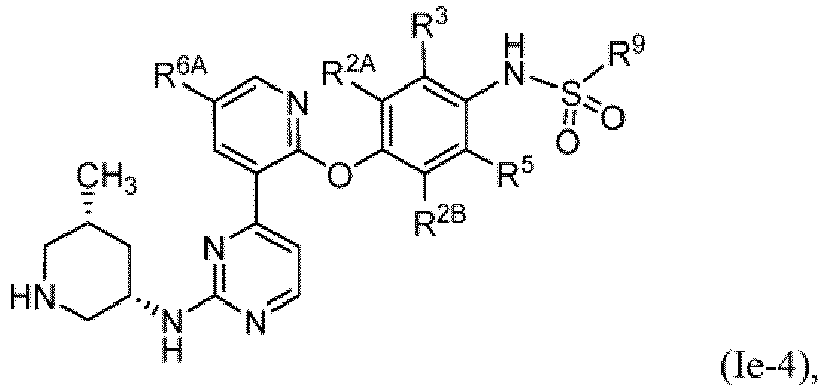


- Verbindung nach Anspruch 9, wobei R6A H ist.
- Verbindung nach Anspruch 1, wobei die Verbindung ausgewählt ist aus den Verbindungen
Nr. 101-247, oder den Verbindungen Nr. 101-238, 248-380 und 382-389, oder den Verbindungen Nr. 248-380 und 382-9, oder ein pharmazeutisch annehmbares Salz davon:Nr. Struktur Bezeichnung 101 
N-[4-[[3-[2-[(4-Aminocyclohexyl)amino]pyrimidin-4-yl]-2-pyridyl]oxy]-3-methyl-phenyl]-2-chlor-benzolsulfonamid 102 
N-[4-[[3-[2-[(4-Aminocyclohexyl)amino]pyrimidin-4-yl]-2-pyridyl]oxy]-3-fluor-5-methylphenyl]-2-chlor-benzsolsulfonamid 103 
(S)-N-((2-Chlorphenyl)sulfonyl)-4-methyl-3-((3-(2-(piperidin-3- ylamino)pyrimidin-4-yl)pyridin-2-yl)oxy)benzamid 104 
N-[4-[[3-[2-[(4-Aminocyclohexyl)amino]pyrimidin-4-yl]-2-pyridyl]oxy]-3-chlor-5-fluorphenyl]-2-chlor-benzolsulfonamid 105 
(S)-3,3,3-Trifluor-N-(2-fluor-4-((3-(2-(piperidin-3-ylamino)pyrimidin-4-yl)pyridin-2-yl)oxy)phenyl)propan-1-sulfonamid 106 
(S)-N-(2-Fluor-4-((3-(2-(piperidin-3-ylamino)pyrimidin-4-yl)pyridin-2-yl)oxy)phenyl)-1-phenylmethansulfonamid 107 
(S)-N-(2,5-Difluor-4-((3-(2-(piperidin-3-ylamino)pyrimidin-4-yl)pyridin-2-yl)oxy)phenyl)-1-phenylmethansulfonamid 108 
(S)-N-(2,3-Difluor-4-((3-(2-(piperidin-3- ylamino)pyrimidin-4-yl)pyridin-2-yl)oxy)phenyl)-1-phenylmethansulfonamid 109 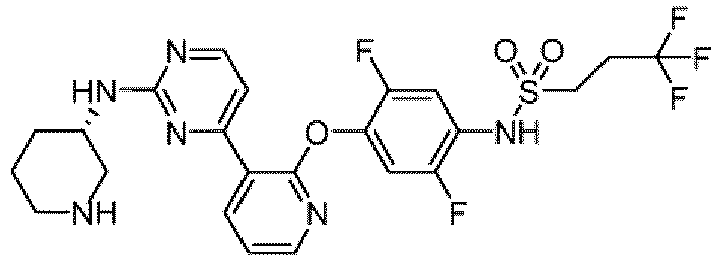
(S)-N-(2,5-Difluor-4-((3-(2-(piperidin-3- ylamino)pyrimidin-4-yl)pyridin-2-yl)oxy)phenyl)-3,3,3-trifluorpropan-1-sulfonamid 110 
(S)-N-(2,5-Difluor-4-((3-(2-(piperidin-3-ylamino)pyrimidin-4-yl)pyridin-2-yl)oxy)phenyl)-3,3,3-trifluorpropan-1-sulfonamid 111 
N-(2,3-Difluor-4-((3-(2-(((3S,5R)-5-methylpiperidin-3-yl)amino)pyrimidin-4-yl)pyridin-2-yl)oxy)phenyl)-1- phenylmethansulfonamid 112 
N-(2,3-Difluor-4-((3-(2-(((3S,5S)-5-fluorpiperidin-3-yl)amino)pyrimidin-4-yl)pyridin-2-yl)oxy)phenyl)-1-phenylmethansulfonamid 113 
(S)-1-Phenyl-N-(4-((3-(2-(piperidin-3-ylamino)pyrimidin-4-yl)pyridin-2-yl)oxy)-2-(trifluormethyl)phenyl)methansulfonami d 114 
(S)-2-Chlor-N-(3-fluor-5-methyl-4-((3-(2-(piperidin-3 -ylamino)pyrimidin-4-yl)pyridin-2-yl)oxy)phenyl)benzolsulfonamid 115 
(S)-N-(3-Fluor-5-methyl-4-((3-(2-(piperidin-3-ylamino)pyrimidin-4-yl)pyridin-2-yl)oxy)phenyl)butan-1-sulfonamid 116 
(S)-N-(3-Fluor-5-methyl-4-((3-(2-(piperidin-3-ylamino)pyrimidin-4-yl)pyridin-2-yl)oxy)phenyl)cyclopentansulfonamid 117 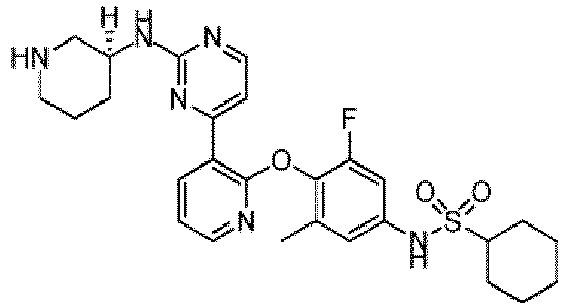
(S)-N-(3-Fluor-5-methyl-4-((3-(2-(piperidin-3-ylamino)pyrimidin-4-yl)pyridin-2-yl)oxy)phenyl)cyclohexansulfonamid 118 
N-(4-((3-(2-(((1r,4r)-4-Aminocyclohexyl)amino)pyrimidin-4-yl)pyridin-2-yl)oxy)-3-fluor-5-methylphenyl)propan-1-sulfonamid 119 
N-(4-((3-(2-(((1r,4r)-4-Aminocyclohexyl)amino)pyrimidin-4-yl)pyridin-2-yl)oxy)-3-fluor-5-methylphenyl)-1-phenylmethansulfonamid 120 
N-(4-((3-(2-(((1r,4r)-4-Aminocyclohexyl)amino)pyrimidin-4-yl)pyridin-2-yl)oxy)-3-fluor-5-methylphenyl)cyclopropancarboxamid 121 
N-(4-((3-(2-(((1r,4r)-4-Aminocyclohexyl)amino)pyrimidin-4-yl)pyridin-2-yl)oxy)-3-chlor-5-fluorphenyl)propan-1-sulfonamid 122 
N-(4-((3-(2-(((1r,4r)-4-Aminocyclohexyl)amino)pyrimidin-4-yl)pyridin-2-yl)oxy)-3,5-difluorphenyl)propan-1-sulfonamid 123 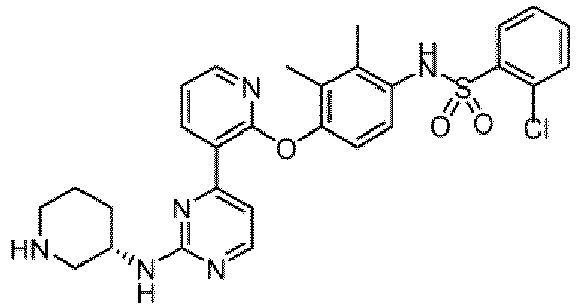
(S)-2-Chlor-N-(2,3-dimethyl-4-((3-(2-(piperidin-3-ylamino)pyrimidin-4-yl)pyridin-2-yl)oxy)phenyl)benzolsulfonamid 124 
(S)-N-(2,5-Dimethyl-4-((3-(2-(piperidin-3-ylamino)pyrimidin-4-yl)pyridin-2-yl)oxy)phenyl)propan-1-sulfonamid 125 
(S)-2-Chlor-N-(2,5-dimethyl-4-((3-(2-(piperidin-3-ylamino)pyrimidin-4-yl)pyridin-2-yl)oxy)phenyl)benzolsulfonamid 126 
(S)-N-(2,5-Dimethyl-4-((3-(2-(piperidin-3-ylamino)pyrimidin-4-yl)pyridin-2-yl)oxy)phenyl)propan-1-sulfonamid 127 
(S)-N-(4-Fluor-3-((3-(2-(piperidin-3-ylamino)pyrimidin-4-yl)pyridin-2-yl)oxy)phenyl)propan-1-sulfonamid 128 
(S)-2-Chlor-N-(4-fluor-3-((3-(2-(piperidin-3-ylamino)pyrimidin-4-yl)pyridin-2-yl)oxy)phenyl)benzolsulfonamid 129 
(S)-2-Cyclohexyl-N-(2,3-dimethyl-4-((3-(2-(piperidin-3 -ylamino)pyrimidin-4-yl)pyridin-2-yl)oxy)phenyl)acetamid 130 
(S)-2-(4-Chlorphenyl)-N-(2,3-dimethyl-4-((3-(2-(piperidin-3-ylamino)pyrimidin-4-yl)pyridin-2-yl)oxy)phenyl)acetamid 131 
(S)-2-Chlor-N-(3,5-dimethyl-4-((3-(2-(piperidin-3-ylamino)pyrimidin-4-yl)pyridin-2-yl)oxy)phenyl)benzolsulfonamid 132 
(S)-2-Chlor-N-(3-((3-(2-(piperidin-3-ylamino)pyrimidin-4-yl)pyridin-2-yl)oxy)phenyl)benzolsulfonamid 133 
(S)-1-Phenyl-N-(3-((3-(2-(piperidin-3-ylamino)pyrimidin-4-yl)pyridin-2-yl)oxy)phenyl)methansulfonamid 134 
(S)-2-Chlor-N-(4-((3-(2-(piperidin-3-ylamino)pyrimidin-4-yl)pyridin-2-yl)oxy)phenyl)benzolsulfonamid 135 
(S)-2-chloro-N-(4-methyl-3-((3-(2-(piperidin-3-ylamino)pyrimidin-4-yl)pyridin-2-yl)oxy)phenyl)benzolsulfonamid 136 
(S)-N-(4-Methyl-3-((3-(2-(piperidin-3-ylamino)pyrimidin-4-yl)pyridin-2-yl)oxy)phenyl)-1-phenylmethansulfonamid 137 
(S)-2-Chloro-N-(4-chlor-2-fluor-3-((3-(2-(piperidin-3 -ylamino)pyrimidin-4-yl)pyridin-2-yl)oxy)phenyl)benzolsulfonamid 138 
(S)-N-(4-Chlor-2-fluor-3-((3-(2-(piperidin-3-ylamino)pyrimidin-4-yl)pyridin-2-yl)oxy)phenyl)-1-phenylmethansulfonamid 139 
(S)-2-Chlor-N-(2-methyl-3-((3-(2-(piperidin-3-ylamino)pyrimidin-4-yl)pyridin-2-yl)oxy)phenyl)benzolsulfonamid 140 
(S)-N-(2-Methyl-3-((3-(2-(piperidin-3-ylamino)pyrimidin-4-yl)pyridin-2-yl)oxy)phenyl)-1-phenylmethansulfonamid 141 
(S)-2-Chlor-N-(2-fluor-3-((3-(2-(piperidin-3-ylamino)pyrimidin-4-yl)pyridin-2-yl)oxy)phenyl)benzolsulfonamid 142 
(S)-N-(2-Fluor-3-((3-(2-(piperidin-3-ylamino)pyrimidin-4-yl)pyridin-2-yl)oxy)phenyl)-1-phenylmethansulfonamid 143 
(S)-N-(4-Chlor-2-fluor-3-((3-(2-(piperidin-3-ylamino)pyrimidin-4-yl)pyridin-2-yl)oxy)phenyl)propan-1-sulfonamid 144 
(S)-N-(2-Fluor-3-((3-(2-(piperidin-3-ylamino)pyrimidin-4-yl)pyridin-2-yl)oxy)phenyl)propan-1-sulfonamid 145 
(S)-1-Cyclohexyl-N-(2,3-difluor-4-((3-(2-(piperidin-3 -ylamino)pyrimidin-4-yl)pyridin-2-yl)oxy)phenyl)methansulfonamid 146 
(S)-N-(2,3-Difluor-4-((3-(2-(piperidin-3-ylamino)pyrimidin-4-yl)pyridin-2-yl)oxy)phenyl)-1-(2-fluorphenyl)methansulfonamid 147 
(S)-N-(2,3-Difluor-4-(3-(2-(piperidin-3-ylamino)pyrimidin-4-yl)pyridin-2-yloxy)phenyl)cyclopropancarboxamid 148 
(S)-N-(2,3-Difluor-4-((3-(2-(piperidin-3-ylamino)pyrimidin-4-yl)pyridin-2-yl)oxy)phenyl)-2,2-difluorbutan-1-sulfonamid 149 
(S)-N-(2,3-Difluor-4-((3-(2-(piperidin-3- ylamino)pyrimidin-4-yl)pyridin-2-yl)oxy)phenyl)-3,3-difluorbutan-1- sulfonamid 150 
N-(2,3-Difluor-4-((3-(2-(((S)-piperidin-3-yl)amino)pyrimidin-4-yl)pyridin-2-yl)oxy)phenyl)spiro[2.2]pentan-1-carboxamid 151 
N-(2,3-Difluor-4-((3-(2-(((S)-piperidin-3-yl)amino)pyrimidin-4-yl)pyridin-2-yl)oxy)phenyl)spiro[2.2]pentan-1-carboxamid 152 
(S)-N-(2,6-Difluor-4-((3-(2-(piperidin-3-ylamino)pyrimidin-4-yl)pyridin-2-yl)oxy)phenyl)-1-phenylmethansulfonamid 153 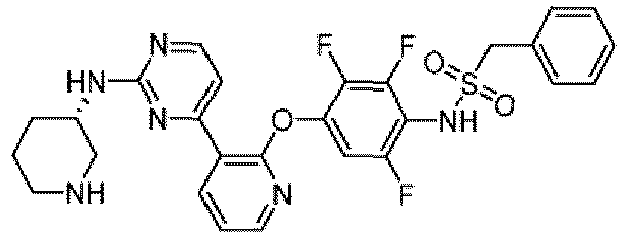
(S)-1-Phenyl-N-(2,3,6-trifluor-4-((3-(2-(piperidin-3-ylamino)pyrimidin-4-yl)pyridin-2-yl)oxy)phenyl)methansulfonamid 154 
(S)-N-(2,6-Difluor-3-methyl-4-(3-(2-(piperidin-3-ylamino)pyrimidin-4-yl)pyridin-2-yloxy)phenyl)(phenyl)methansulfonami d 155 
(S)-N-(2,3-Difluor-5-methyl-4-((3-(2-(piperidin-3-ylamino)pyrimidin-4-yl)pyridin-2-yl)oxy)phenyl)-1-phenylmethansulfonamid 156 
(S)-1-Phenyl-N-(2,3,5-trifluor-4-((3-(2-(piperidin-3-ylamino)pyrimidin-4-yl)pyridin-2-yl)oxy)phenyl)methansulfonamid 157 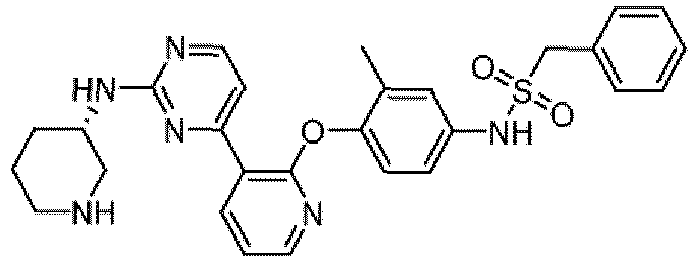
(S)-N-(3-Methyl-4-((3-(2-(piperidin-3-ylamino)pyrimidin-4-yl)pyridin-2-yl)oxy)phenyl)-1-phenylmethansulfonamid 158 
(S)-N-(2-Fluor-5-methyl-4-(3-(2-(piperidin-3-ylamino)pyrimidin-4-yl)pyridin-2-yloxy)phenyl)(phenyl)methansulfonami d 159 
(S)-N-(3-Fluor-4-((3-(2-(piperidin-3- ylamino)pyrimidin-4-yl)pyridin-2-yl)oxy)phenyl)-1-phenylmethansulfonamid 160 
(S)-N-(2,3-Difluor-6-methyl-4-((3-(2-(piperidin-3-ylamino)pyrimidin-4-yl)pyridin-2-yl)oxy)phenyl)-1-phenylmethansulfonamid 161 
(S)-N-(2-Chlor-3-fluor-4-((3-(2-(piperidin-3-ylamino)pyrimidin-4-yl)pyridin-2-yl)oxy)phenyl)-1-phenylmethansulfonamid 162 
N-(2,3-Difluor-4-((3-(2-(((3S,5R)-5-fluor-5-methylpiperidin-3-yl)amino)pyrimidin-4-yl)pyridin-2-yl)oxy)phenyl)-1-phenylmethansulfonamid 163 
(S)-N-(2-Cyano-3-fluor-4-((3 -(2-(piperidin-3-ylamino)pyrimidin-4-yl)pyridin-2-yl)oxy)phenyl)-1-phenylmethansulfonamid 164 
N-(2,6-Difluor-3-methyl-4-((3-(2-(((3S, 5R)-5-methyl-3-piperidyl)amino)pyrimidin-4-yl)-2-pyridyl)oxy)phenyl)-1-phenylmethansulfonamid 165 
1-Phenyl-N-(2,3,6-trifluor-4-((3-(2-(((3S,5R)-5-methyl-3-piperidyl)amino)pyrimidin-4-yl)-2-pyridyl)oxy)phenyl)methansulfonamid 166 
(S)-1-(4-Cyanophenyl)-N-(2,3-difluor-4-((3-(2-(piperidin-3-ylamino)pyrimidin-4-yl)pyridin-2-yl)oxy)phenyl)methansulfonamid 167 
(S)-N-(2,3-Difluor-4-((3-(2-(pyrrolidin-3-ylamino)pyrimidin-4-yl)pyridin-2-yl)oxy)phenyl)-1-phenylmethansulfonamid 168 
N-(2,3-Difluor-4-((3-(2-((1-methylpiperidin-4-yl)amino)pyrimidin-4-yl)pyridin-2-yl)oxy)phenyl)-1- phenylmethansulfonamid 169 
N-(4-((3-(2-(((1r,4r)-4-aminocyclohexyl)amino)pyrimidin-4-yl)pyridin-2-yl)oxy)-2,3-difluorphenyl)-1-phenylmethansulfonamid 170 
(S)-N-(2,3-Difluor-4-((3-(2-((1-methylpiperidin-3-yl)amino)pyrimidin-4-yl)pyridin-2-yl)oxy)phenyl)-1- phenylmethansulfonamid 171 
N-(4-((3-(2-((2-Aminoethyl)amino)pyrimidin-4-yl)pyridin-2-yl)oxy)-2,3-difluorphenyl)-1-phenylmethansulfonamid 172 
N-(2,3-Difluor-4-((3-(2-(2-(methylamino)ethylamino)pyrimidin-4-yl)-2-pyridyl)oxy)phenyl)-1-phenylmethansulfonamid 173 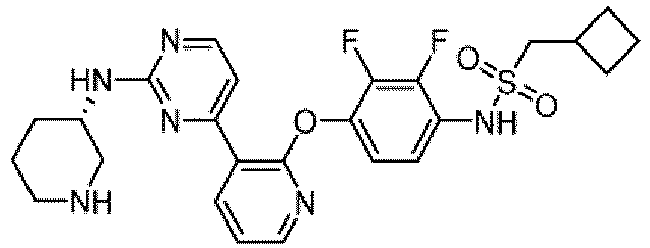
(S)-1-Cyclobutyl-N-(2,3-difluor-4-((3-(2-(piperidin-3-ylamino)pyrimidin-4-yl)pyridin-2-yl)oxy)phenyl)methansulfonamid 174 
N-(2,3-Difluor-4-((3-(2-(((3S,5S)-5-fluor-5-methylpiperidin-3-yl)amino)pyrimidin-4-yl)pyridin-2-yl)oxy)phenyl)-1-phenylmethansulfonamid 175 
(S)-N-(6-Fluor-2,3-dimethyl-4-((3-(2-(piperidin-3-ylamino)pyrimidin-4-yl)pyridin-2-yl)oxy)phenyl)-1-phenylmethansulfonamid 176 
1-Phenyl-N-(2,3,6-trifluor-4-((3-(2-(((3S,5 S)-5-fluorpiperidin-3-yl)amino)pyrimidin-4-yl)pyridin-2-yl)oxy)phenyl)methansulfonamid 177 
N-(2,3-Difluor-5-methyl-4-((3-(2-(((3S,5R)-5-methyl-3-piperidyl)amino)pyrimidin-4-yl)-2-pyridyl)oxy)phenyl)-1-phenylmethansulfonamid 178 
N-(2,3-Difluor-4-((3-(2-(((3S,5S)-5-luor-3-piperidyl)amino)pyrimidin-4-yl)-2-pyridyl)oxy)-5-methyl-phenyl)-1-phenyl-methansulfonamid 179 
N-(2,6-Difluor-4-((3-(2-(((3S,5S)-5-luor-3-piperidyl)amino)pyrimidin-4-yl)-2-pyridyl)oxy)-3-methyl-phenyl)-1-phenyl-methansulfonamid 180 
N-(2,3-Difluor-4-((3 -(2-(4-piperidylamino)pyrimidin-4-yl)-2-pyridyl)oxy)phenyl)-1-phenylmethansulfonamid 181 
(S)-N-(2,3-Difluor-4-((3-(2-((6-oxopiperidin-3-yl)amino)pyrimidin-4-yl)pyridin-2-yl)oxy)phenyl)-1-phenylmethansulfonamid 182 
N-(2,3-Difluor-4-((3-(2-(((1r,4r)-4-hydroxycyclohexyl)amino)pyrimidin-4-yl)pyridin-2-yl)oxy)phenyl)-1-phenylmethansulfonamid 183 
(S)-N-(4-((3-(2-((5,5-Difluorpiperidin-3-yl)amino)pyrimidin-4-yl)pyridin-2-yl)oxy)-2,3-difluorphenyl)-1-phenylmethansulfonamid 184 
N-(4-((3-(2-((2-(Dimethylamino)ethyl)amino)pyrimidin-4-yl)pyridin-2-yl)oxy)-2,3- difluorphenyl)-1-phenylmethansulfonamid 185^ 
N-(4-((3-(2-(3-Azabicyclo[3.1.0]hexan-5-ylamino)pyrimidin-4-yl)-2-pyridyl)oxy)-2,3-difluor-phenyl)-1-phenyl-methansulfonamid 186^ 187 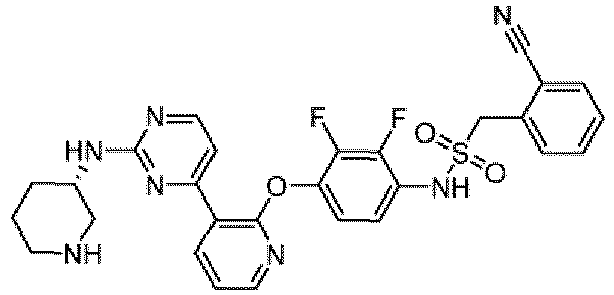
(S)-1-(2-Cyanophenyl)-N-(2,3-difluor-4-((3-(2-(piperidin-3 -ylamino)pyrimidin-4-yl)pyridin-2-yl)oxy)phenyl)methansulfonamid 188 
(S)-N-(2,3-Difluor-4-((3-(2-(piperidin-3- ylamino)pyrimidin-4-yl)pyridin-2-yl)oxy)phenyl)-1-(1-fluorcyclopropyl)methansulfonamid 189 
2,2-Difluor-N-(2,3,6-trifluor-4-((3-(2-(((3S,5S)-5-fluor-3-piperidyl)amino)pyrimidin-4-yl)-2-pyridyl)oxy)phenyl)butan-1-sulfonamid 190 
1-Phenyl-N-(2,3,6-trifluor-4-((3-(2-(((3S,5S)-5-fluor-5-methyl-3-piperidyl)amino)pyrimidin-4-yl)-2-pyridyl)oxy)phenyl)methansulfonamid 191 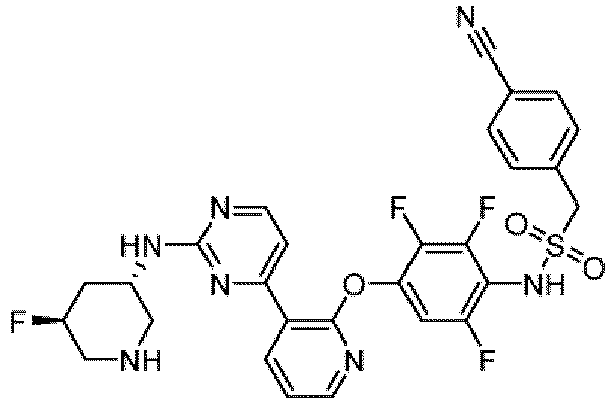
1-(4-Cyanophenyl)-N-(2,3,6-trifluor-4-((3-(2-(((3S,5S)-5-fluorpiperidin-3-yl)amino)pyrimidin-4-yl)pyridin-2-yl)oxy)phenyl)methansulfonami d 192 
N-(2,3-Difluor-4-((3-(2-(((S)-piperidin-3-yl)amino)pyrimidin-4-yl)pyridin-2-yl)oxy)phenyl)-1-(2,2-difluorcyclobutyl)methansulfonamid 193 
1-Phenyl-N-(2,3,6-trifluor-4-((3-(2-(((3R,5R)-5-fluor-3-piperidyl)amino)pyrimidin-4-yl)-2-pyridyl)oxy)phenyl)methansulfonamid 194 
(S)-2,2-Difluor-N-(2,3,6-trifluor-4-((3-(2-(piperidin-3-ylamino)pyrimidin-4-yl)pyridin-2-yl)oxy)phenyl)butan-1-sulfonamid 195 
(S)-1-(5-Methylisoxazol-3-yl)-N-(2,3,6-trifluor-4-((3-(2-(piperidin-3-ylamino)pyrimidin-4-yl)pyridin-2-yl)oxy)phenyl)methansulfonamid 196 
(S)-N-(2,3,6-Trifluor-4-((3-(2-(piperidin-3-ylamino)pyrimidin-4-yl)pyridin-2-yl)oxy)phenyl)-1-(6-(trifluormethyl)pyridin-3-yl)methansulfonamid 197 
(S)-N-(2-Fluor-3-((3-(2-(piperidin-3-ylamino)pyrimidin-4-yl)pyridin-2-yl)oxy)benzyl)cyclopropancarboxami d 198^ 
1-Phenyl-N-(2,3,6-trifluor-4-((3-(2-(piperidin-3-ylmethyl)pyrimidin-4-yl)pyridin-2-yl)oxy)phenyl)methansulfonamid 199^ 200^ 201^ 
1,1,1-Trifluor-3-((2-fluor-3-((3-(2-(((S)-piperidin-3-yl)amino)pyrimidin-4-yl)pyridin-2-yl)oxy)phenyl)amino)propan-2-ol 202 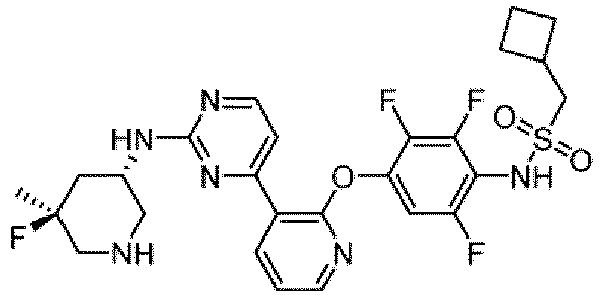
1-Cyclobutyl-N-(2,3,6-trifluor-4-((3-(2-(((3 S,5 S)-5-fluor-5-methylpiperidin-3-yl)amino)pyrimidin-4-yl)pyridin-2-yl)oxy)phenyl)methansulfonamid 203 
1-(5-Methylisoxazol-3-yl)-N-(2,3,6-trifluor-4-((3-(2-(((3S,5S)-5-fluor-5-methylpiperidin-3-yl)amino)pyrimidin-4-yl)pyridin-2-yl)oxy)phenyl)methansulfonamid 204 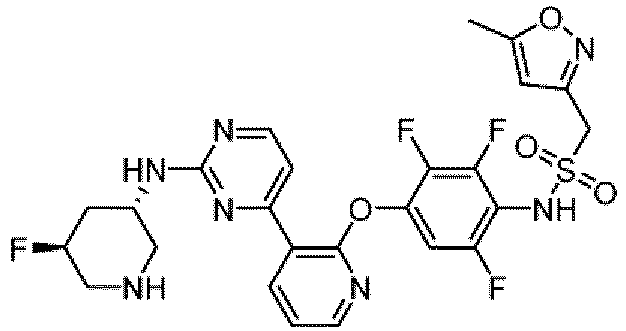
1-(5-Methylisoxazol-3-yl)-N-(2,3,6-trifluor-4-((3-(2-(((3 S,5 S)-5-fluorpiperidin-3-yl)amino)pyrimidin-4-yl)pyridin-2- 205 
3 3 3-Trifluor-N-(2,3,6-trifluor-4-((3-(2-(((3 S,5S)-5-fluor-3-piperidyl)amino)pyrimidin-4-yl)-2-pyridyl)oxy)phenyl)propan-1-sulfonamid 206 
(S)-N-(2,3-Difluor-4-((3-(2-(piperidin-3-ylamino)pyrimidin-4-yl)pyridin-2-yl)oxy)phenyl)-3,5-difluorbenzolsulfonamid 207 
(S)-N-(2,3-Difluor-4-((3-(2-(piperidin-3- ylamino)pyrimidin-4-yl)pyridin-2-yl)oxy)phenyl)-3-(trifluormethoxy)benzolsulfonamid 208 
(S)-N-(2,3 -Difluor-4-((3 -(2-(piperidin-3 - ylamino)pyrimidin-4-yl)pyridin-2-yl)oxy)phenyl)-3-(difluormethoxy)benzolsulfonamid 209 
(S)-N-(2,3-Difluor-4-((3-(2-(piperidin-3-ylamino)pyrimidin-4-yl)pyridin-2-yl)oxy)phenyl)-1-(spiro[3.3]heptan-2-yl)methansulfonamid 210 
(S)-3-Cyano-N-(2,3-difluor-4-((3-(2-(piperidin-3-ylamino)pyrimidin-4-yl)pyridin-2-yl)oxy)phenyl)-3- methylbutan-1-sulfonamid 211 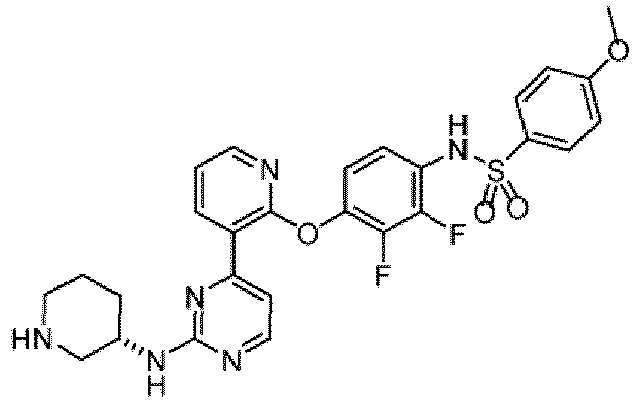
(S)-N-(2,3-Difluor-4-((3-(2-(piperidin-3- ylamino)pyrimidin-4-yl)pyridin-2-yl)oxy)phenyl)-4-methoxybenzolsulfonamid 212 
(S)-N-(2,3-Difluor-4-((3-(2-(piperidin-3-ylamino)pyrimidin-4-yl)pyridin-2-yl)oxy)phenyl)-3- methoxybenzolsulfonamid 213 
(S)-1-(4-Chlorphenyl)-N-(2,3-difluor-4-((3-(2-(piperidin-3-ylamino)pyrimidin-4-yl)pyridin-2-yl)oxy)phenyl)methansulfonamid 214 
(S)-N-(2,3-Difluor-4-((3-(2-(piperidin-3- ylamino)pyrimidin-4-yl)pyridin-2-yl)oxy)phenyl)pyridin-3-sulfonamid 215 
(S)-2-Cyclohexyl-N-(2,3 -difluor-4-((3-(2-(piperidin-3-ylamino)pyrimidin-4-yl)pyridin-2-yl)oxy)phenyl)ethan-1- sulfonamid 216 
(S)-3-Cyano-N-(2,3-difluor-4-((3-(2-(piperidin-3-ylamino)pyrimidin-4-yl)pyridin-2-yl)oxy)phenyl)-2,2-dimethylpropan-1-sulfonamid 217 
N-(2,3-Difluor-4-((3-(2-(((S)-piperidin-3-yl)amino)pyrimidin-4-yl)pyridin-2-yl)oxy)phenyl)-2-(2,2-difluorcyclopropyl)ethan-1-sulfonamid 218 
(S)-N-(2,3-Difluor-4-((3-(2-(piperidin-3-ylamino)pyrimidin-4-yl)pyridin-2-yl)oxy)phenyl)benzolsulfonamid 219 
(S)-4-Cyano-N-(2,3-difluor-4-((3-(2-(piperidin-3-ylamino)pyrimidin-4-yl)pyridin-2-yl)oxy)phenyl)benzolsulfonamid 220 
(S)-3-Cyano-N-(2,3-difluor-4-((3-(2-(piperidin-3-ylamino)pyrimidin-4-yl)pyridin-2-yl)oxy)phenyl)benzolsulfonamid 221 
(S)-N-(2,3-Difluor-4-((3-(2-(piperidin-3- ylamino)pyrimidin-4-yl)pyridin-2-yl)oxy)phenyl)-1-methyl-1H-imidazol-4-sulfonamid 222 
(S)-N-(2,3-Difluor-4-((3-(2-(piperidin-3-ylamino)pyrimidin-4-yl)pyridin-2-yl)oxy)phenyl)-1-methyl-1H-pyrazol-4-sulfonamid 223 
(S)-N-(2,3-Difluor-4-((3-(2-(piperidin-3-ylamino)pyrimidin-4-yl)pyridin-2-yl)oxy)phenyl)-4-(trifluormethoxy)benzolsulfonamid 224 
(S)-N-(2,3-Difluor-4-((3-(2-(piperidin-3-ylamino)pyrimidin-4-yl)pyridin-2-yl)oxy)phenyl)-2-methoxybenzolsulfonamid 225 
(S)-1-(3-Chlorphenyl)-N-(2,3-difluor-4((3-(2-(piperidin-3-ylamino)pyrimidin-4-yl)pyridin-2-yl)oxy)phenyl)methansulfonamid 226 
(S)-N-(2,3-Difluor-4-((3-(2-(piperidin-3-ylamino)pyrimidin-4-yl)pyridin-2-yl)oxy)phenyl)-3,3-dimethylbutan-1-sulfonamid 227 
(S)-2-Chlor-N-(2,3-difluor-4-((3-(2-(piperidin-3-ylamino)pyrimidin-4-yl)pyridin-2-yl)oxy)phenyl)benzolsulfonamid 228 
(S)-1-Cyclopentyl-N-(2,3-difluor-4-((3-(2-(piperidin-3-ylamino)pyrimidin-4-yl)pyridin-2-yl)oxy)phenyl)methansulfonamid 229 
(S)-1-(3-Cyanophenyl)-N-(2,3-difluor-4-((3-(2-(piperidin-3-ylamino)pyrimidin-4-yl)pyridin-2-yl)oxy)phenyl)methansulfonamid 230 
(S)-N-(2,3-Difluor-4-((3-(2-(piperidin-3-ylamino)pyrimidin-4-yl)pyridin-2-yl)oxy)phenyl)-4,4-dimethylpentan-1-sulfonamid 231 
(S)-N-(2,3-Difluor-4-((3-(2-(piperidin-3- ylamino)pyrimidin-4-yl)pyridin-2-yl)oxy)phenyl)-1-(3- fluorphenyl)methansulfonamid 232 
(S)-N-(2,3-Difluor-4-(3-(2-(piperidin-3-ylamino)pyrimidin-4-yl)pyridin-2-yloxy)phenyl)-1-(3,3-difluorcyclobutyl)methansulfonamid 233 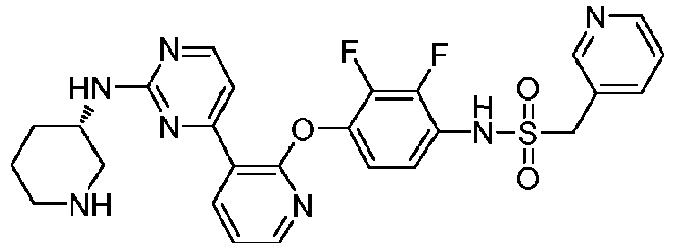
(S)-N-(2,3-Difluor-4-(3-(2-(piperidin-3-ylamino)pyrimidin-4-yl)pyridin-2-yloxy)phenyl)-1-(pyridin-3-yl)methansulfonamid 234 
(S)-N-(2,3-Difluor-4-(3-(2-(piperidin-3-ylamino)pyrimidin-4-yl)pyridin-2-yloxy)phenyl)-1-(pyridin-4-yl)methansulfonamid 235 
(S)-N-(2,3-Difluor-4-(3-(2-(piperidin-3-ylamino)pyrimidin-4-yl)pyridin-2-yloxy)phenyl)-1-(4-fluorphenyl)methansulfonamid 236 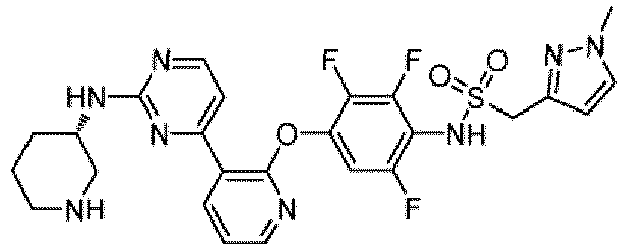
(S)-1-(1-Methyl-1H-pyrazol-3-yl)-N-(2,3,6-trifluor-4-(3-(2-(piperidin-3-ylamino)pyrimidin-4-yl)pyridin-2-yloxy)phenyl)methansulfonamid 237 
N-[2-Fluor-3-methyl-4-[[3-[2-[(3S)-3-piperidyl]amino]pyrimidin-4-yl]-2-pyridyl]oxy]phenyl]-1 phenylmethansulfonamid 238 
(S)-N-(2,3-Difluor-4-(3-(2-(piperidin-3-ylamino)pyrimidin-4-yl)pyridin-2-yloxy)phenyl)-1-(pyridin-2-yl)methansulfonamid 239 
1-(2-Chlorphenyl)-N-(2,3,6-trifluor-4-((3-(2-(((3S,5S)-5-fluorpiperidin-3-yl)amino)pyrimidin-4-yl)pyridin-2-yl)oxy)phenyl)methansulfonamid 240 
1-(2-Chlor-6-fluorphenyl)-N-(2,3,6-trifluor-4-((3-(2-(((3S,5S)-5-fluorpiperidin-3-yl)amino)pyrimidin-4-yl)pyridin-2-yl)oxy)phenyl)methansulfonamid 241 
1-(4-(Difluormethyl)phenyl)-N-(2,3,6-trifluor-4-((3-(2-(((3S,5S)-5-fluorpiperidin-3-yl)amino)pyrimidin-4-yl)pyridin-2-yl)oxy)phenyl)methansulfonamid 242 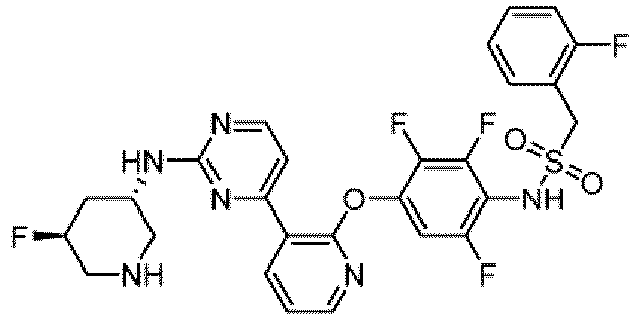
1-(2-Fluorphenyl)-N-(2,3,6-trifluor-4-((3-(2-(((3S,5S)-5-fluorpiperidin-3-yl)amino)pyrimidin-4-yl)pyridin-2-yl)oxy)phenyl)methansulfonamid 243 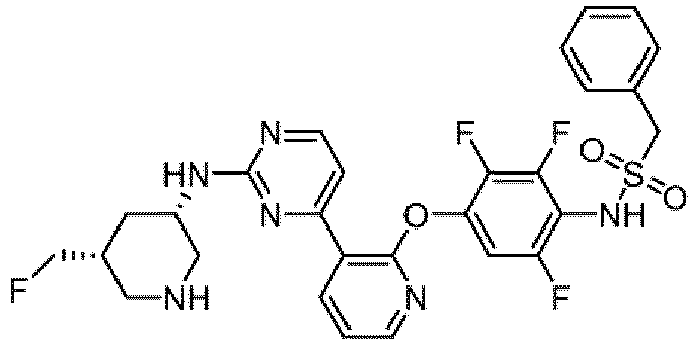
l-Phenyl-N-(2,3,6-trifluor-4-((3-(2-(((3S,5R)-5-(fluormethyl)piperidin-3-yl)amino)pyrimidin-4-yl)pyridin-2-yl)oxy)phenyl)methansulfonamid 244 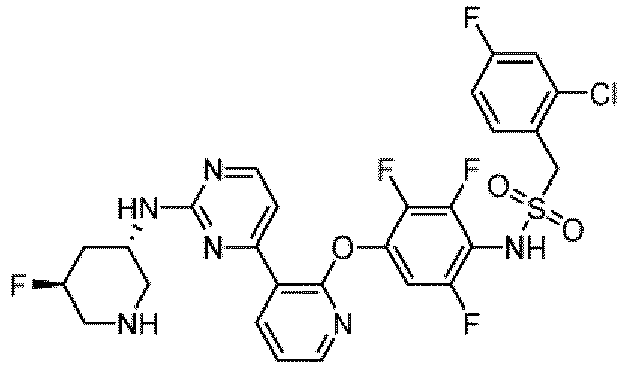
1-(2-Chlor-4-fluorphenyl)-N-(2,3,6-trifluor-4-((3-(2-(((3S,5S)-5-fluorpiperidin-3-yl)amino)pyrimidin-4-yl)pyridin-2-yl)oxy)phenyl)methansulfonamid 245 
1-(4-Chlorphenyl)-N-(2,3,6-trifluor-4-((3-(2-(((3S,5S)-5-fluorpiperidin-3-yl)amino)pyrimidin-4-yl)pyridin-2-yl)oxy)phenyl)methansulfonamid 246 
1-(2,6-Difluorphenyl)-N-(2,3,6-trifluor-4-((3-(2-(((3S,5S)-5-fluorpiperidin-3-yl)amino)pyrimidin-4-yl)pyridin-2-yl)oxy)phenyl)methansulfonamid 247 
N-(2,3,6-Trifluor-4-((3-(2-(((3S,5S)-5-fluorpiperidin-3-yl)amino)pyrimidin-4-yl)pyridin-2-yl)oxy)phenyl)-1-(6-(trifluormethyl)pyridin-3-yl)methansulfonamid 248^ 249^ 
1-(2,3-Difluor-4-((3-(2-(((S)-piperidin-3-yl)amino)pyrimidin-4-yl)pyridin-2-yl)oxy)phenyl)-3-ethylpyrrolidin-2-on 250 
(S)-1-(4-Cyanophenyl)-N-(2,3-difluor-4-((3-(2-(piperidin-3-ylamino)pyrimidin-4-yl)pyridin-2-yl)oxy)phenyl)methansulfonamid 251 
1-(3,3-Difluorcyclobutyl)-N-(2,3,6-trifluor-4-((3-(((3S,5S)-5-fluor-5-methylpiperidin-3-yl)amino)pyrimidin-4-yl)pyridin-2-yl)oxy)phenyl)methansulfonamid 252 
2-Methoxy-N-(2,3,6-trifluor-4-((3-(2-(((3S,5S)-5-fluorpiperidin-3-yl)amino)pyrimidin-4-yl)pyridin-2-yl)oxy)phenyl)ethan-1-sulfonamid 253 
3,3-Difluor-N-(2,3,6-trifluor-4-((3-(2-(((3S,5S)-5-fluorpiperidin-3-yl)amino)pyrimidin-4-yl)pyridin-2-yl)oxy)phenyl)butan-1-sulfonamid 254 
N-(2,3,6-Trifluor-4-((3-(2-(((3S,5S)-5-fluorpiperidin-3-yl)amino)pyrimidin-4-yl)pyridin-2-yl)oxy)phenyl)-1-(6-(trifluormethyl)pyridin-3-yl)methansulfonamid 255 
1-(4-Cyanophenyl)-N-(2,3,6-trifluor-4-((3-(2-(((3S,5S)-5-fluorpiperidin-3-yl)amino)pyrimidin-4-yl)pyridin-2-yl)oxy)-5-methylphenyl)methansulfonamid 256 
1-(Pyridin-3-yl)-N-(2,3,6-trifluor-4-((3-(2-(((3S,5S)-5-fluorpiperidin-3-yl)amino)pyrimidin-4-yl)pyridin-2-yl)oxy)phenyl)methansulfonamid 257 
1-Phenyl-N-(2,3,6-trifluor-4-((3-(2-(((3S,6S)-6-methylpiperidin-3-yl)amino)pyrimidin-4-yl)pyridin-2-yl)oxy)phenyl)methansulfonamid 258 
N-(2,3,6-Trifluor-4-((3-(2-(((3S,5S)-5-fluorpiperidin-3-yl)amino)pyrimidin-4-yl)pyridin-2-yl)oxy)phenyl)pyrrolidin-1-sulfonamid 259 
1-Phenyl-N-(2,3,6-trifluor-4-((3-(2-(((3S,5R)-5-fluorpiperidin-3-yl)amino)pyrimidin-4-yl)pyridin-2-yl)oxy)phenyl)methansulfonamid 260 
2,2,2-Trifluor-N-(2,3,6-trifluor-4-((3-(2-(((3S,5S)-5-fluorpiperidin-3-yl)amino)pyrimidin-4-yl)pyridin-2-yl)oxy)phenyl)ethan-1-sulfonamid 261 
1-(1-Fluorcyclopropyl)-N-(2,3,6-trifluor-4-((3-(2-(((3S,5S)-5-fluorpiperidin-3-yl)amino)pyrimidin-4-yl)pyridin-2-yl)oxy)phenyl)methansulfonamid 262 
1-Phenyl-N-(2,3,6-trifluor-4-((3-(2-(((3S,5R)-5-(fluormethyl)piperidin-3-yl)amino)pyrimidin-4-yl)pyridin-2-yl)oxy)phenyl)methansulfonamid 263 
N-(2,3,6-Trifluor-4-((3-(2-(((3S,5S)-5-fluorpiperidin-3-yl)amino)pyrimidin-4-yl)pyridin-2-yl)oxy)phenyl)piperidin-1-sulfonamid 264^ 
1-(2,2-Difluorcyclobutyl)-N-(2,3,6-trifluor-4-((3-(2-(((3S,5S)-5-fluorpiperidin-3-yl)amino)pyrimidin-4-yl)pyridin-2-yl)oxy)phenyl)methansulfonamid 265^ 266 
4-(2-(4-(Dimethylsulfamoylamino)-2,3,5-trifluor-phenoxy)-3-pyridyl)-2-(((3S,5S)-5-fluor-3-piperidyl)amino)pyrimidin 267 
2-Cyclopropyl-N-(2,3,6-trifluor-4-((3-(2-(((3S,5S)-5-fluorpiperidin-3-yl)amino)pyrimidin-4-yl)pyridin-2-yl)oxy)phenyl)ethan-1-sulfonamid 268 
2,2-Difluor-N-(2,3,6-trifluor-4-((5-fluor-3-(2-(((3S,5S)-5-fluorpiperidin-3-yl)amino)pyrimidin-4-yl)pyridin-2-yl)oxy)phenyl)butan-1-sulfonamid 269 
4-(2-(4-((Ethyl(methyl)sulfamoyl)amino)-2,3,5-trifluor-phenoxy)-3-pyridyl)-2-(((3S,5S)-5-fluor-3-piperidyl)amino)pyrimidin 270 
2,2-Difluor-N-(2,3,6-trifluor-4-((3-(2-(((3S,5S)-5-fluorpiperidin-3-yl)amino)pyrimidin-4-yl)-6-methylpyridin-2-yl)oxy)phenyl)butan-1-sulfonamid 271 
1-(2,2-Difluorcyclopropyl)-N-(2,3,6-trifluor-4-((3-(2-(((3S,5S)-5-fluorpiperidin-3-yl)amino)pyrimidin-4-yl)pyridin-2-yl)oxy)phenyl)methansulfonamid 272 
N-(4-((3-(2-(((1r,4r)-4-(Dimethylamino)cyclohexyl)amino)pyri m idin-4-yl)pyridin-2-yl)oxy)-2,3,6-trifluorphenyl)-1-phenylmethansulfonamid hydrochlorid 273^ 
N-(2,3-Difluor-4-((3-(2-(((S)-piperidin-3-yl)amino)pyrimidin-4-yl)pyridin-2-yl)oxy)phenyl)-N'-methyl-1- phenylmethansulfonimidamid 274^ 275 
1-(2-Fluorphenyl)-N-(2,3,6-trifluor-4-((3-(2-(((3S,5S)-5-fluor-5-methylpiperidin-3-yl)amino)pyrimidin-4-yl)pyridin-2-yl)oxy)phenyl)methansulfonamid 276 
1-(4-((3-(2-(((3S,5S)-5-Fluorpiperidin-3-yl)amino)pyrimidin-4-yl)pyridin-2-yl)oxy)phenyl)-3-(3-(trifluormethyl)phenyl)harnstoff 277^ 
1-Phenyl-N-(2,3,6-trifluor-4-((3-(2-((5-(fluormethyl)piperidin-3-yl)amino)pyrimidin-4-yl)pyridin-2-yl)oxy)phenyl)methansulfona mid 278^ 279 
N-(2,3-Difluor-4-((3-(2-(((3S,5S)-5-fluor-5-methylpiperidin-3-yl)amino)pyrimidin-4-yl)pyridin-2-yl)oxy)-6-methylphenyl)-1-phenylmethansulfonamid 280 
N-(2,3-Difluor-4-((3-(2-(((3S,5S)-5-fluorpiperidin-3-yl)amino)pyrimidin-4-yl)pyridin-2-yl)oxy)-6-methylphenyl)-1-phenylmethansulfonamid 281 
1-(2,4-Difluorphenyl)-N-(2,3,6-trifluor-4-((3-(2-(((3S,5S)-5-fluor-5-methylpiperidin-3-yl)amino)pyrimidin-4-yl)pyridin-2-yl)oxy)phenyl)methansulfonamid 282 
1-(2,6-Difluorphenyl)-N-(2,3,6-trifluor-4-((3-(2-(((3S,5S)-5-fluor-5-methylpiperidin-3-yl)amino)pyrimidin-4-yl)pyridin-2-yl)oxy)phenyl)methansulfonamid 283 
N-(2,3-Difluor-4-((3-(2-(((3S,5S)-5-fluorpiperidin-3-yl)amino)pyrimidin-4-yl)pyridin-2-yl)oxy)-5-methylphenyl)-1-(2,6-difluorphenyl)methansulfonamid 284 
1-p-Tolyl-N-(2,3,6-trifluor-4-((3-(2-(((3S,5S)-5-fluor-5-methylpiperidin-3-yl)amino)pyrimidin-4-yl)pyridin-2-yl)oxy)phenyl)methansulfonamid 285 
1-(4-((3-(2-(((3S,5S)-5-Fluorpiperidin-3-yl)amino)pyrimidin-4-yl)pyridin-2-yl)oxy)phenyl)-3-(4-((4-methylpiperazin-1-yl)methyl)-3-(trifluormethyl)phenyl)harnstoff hydrochlorid 286 
1-(3-((3-(2-(((3S,5S)-5-Fluorpiperidin-3-yl)amino)pyrimidin-4-yl)pyridin-2-yl)oxy)phenyl)-3-(4-((4-methylpiperazin-1-yl)methyl)-3-(trifluormethyl)phenyl)harnstoff hydrochlorid 287^ 
N-(4-((3-(2-((1-Azabicyclo[3.3.1]nonan-3-yl)amino)pyrimidin-4-yl)pyridin-2-yl)oxy)-2,3,6-trifluorphenyl)-1-phenylmethansulfonamid hydrochlorid 288^ 290 
1-o-Tolyl-N-(2,3,6-trifluor-4-((3-(2-(((3S,5S)-5-fluor-5-methylpiperidin-3-yl)amino)pyrimidin-4-yl)pyridin-2-yl)oxy)phenyl)methansulfonamid 291 
1-(3-Methoxyphenyl)-N-(2,3,6-trifluor-4-((3-(2-(((3S,5S)-5-fluor-5-methylpiperidin-3-yl)amino)pyrimidin-4-yl)pyridin-2-yl)oxy)phenyl)methansulfonamid 292 
N-(2,6-Difluor-4-((3-(2-(((3S,5S)-5-fluor-5-methylpiperidin-3-yl)amino)pyrimidin-4-yl)pyridin-2-yl)oxy)-3-methylphenyl)-1-phenylmethansulfonamid 293 
N-(2,6-Difluor-4-((3-(2-(((3 S,5 S)-5-fluorpiperidin-3-yl)amino)pyrimidin-4-yl)pyridin-2-yl)oxy)-3-methylphenyl)-1-(2,6-difluorphenyl)methansulfonamid 294^ 
1-Phenyl-N-(2,3,6-trifluor-4-((3-(2-((5-(fluormethyl)-5-methylpiperidin-3-yl)amino)pyrimidin-4-yl)pyridin-2-yl)oxy)phenyl)methansulfonamid 295^ 296 
N-(2-Fluor-4-((3-(2-(((3S,5S)-5-fluorpiperidin-3-yl)amino)pyrimidin-4-yl)pyridin-2-yl)oxy)-6-methoxyphenyl)-1-phenylmethansulfonamid 297 
N-(2,3-Difluor-4-((3-(2-(((3S,5S)-S-fluor-5-methylpiperidin-3-yl)amino)pyrimidin-4-yl)pyridin-2-yl)oxy)-5-methylphenyl)-1-(p-tolyl)methansulfonamid 298^ 
N-(4-((3-(2-((1,1-Difluor-5-azaspiro[2.5]octan-7-yl)amino)pyrimidin-4-yl)pyridin-2-yl)oxy)-2,3,6-trifluorphenyl)-1-phenylmethansulfonamid 299^ 300^ 301^ 302^ 
N-(4-((3-(2-((5-(Difluormethyl)piperidin-3-yl)amino)pyrimidin-4-yl)pyridin-2-yl)oxy)-2,3,6-trifluorphenyl)-1-phenylmethansulfonamid 303^ 304 
1-(4-Methoxyphenyl)-N-(2,3,6-trifluor-4-((3-(2-(((3S,5S)-5-fluor-5-methylpiperidin-3-yl)amino)pyrimidin-4-yl)pyridin-2-yl)oxy)phenyl)methansulfonamid 305 
N-(2,3-Difluor-4-((3-(2-(((3S,5S)-5-fluor-5-methylpiperidin-3- yl)amino)pyrimidin-4-yl)pyridin-2-yl)oxy)-6-methylphenyl)-1-(p-tolyl)methansulfonamid 306^ 
N-(4-((3-(2-((4-(Dimethylamino)-3-fluorcyclohexyl)amino)pyrimidin-4-yl)pyridin-2-yl)oxy)-2,3,6-trifluorphenyl)-1-phenylmethansulfonamid 307^ 308^ 309 
N-(4-((3-(2-(((1r,4r)-4-(Dimethylamino)cyclohexyl)amino)pyri midin-4-yl)pyridin-2-yl)oxy)-2,3,6-trifluorphenyl)propan-1-sulfonamid 310 
N-(4-((3-(2-(((1r,4r)-4-(Dimethylamino)cyclohexyl)amino)pyri midin-4-yl)pyridin-2-yl)oxy)-2,3,6-trifluorphenyl)-3,3-difluorbutan-1-sulfonamid 311 
N-(2,5-Difluor-4-((3-(2-(((3S,5S)-5-fluor-5-methylpiperidin-3-yl)amino)pyrimidin-4-yl)pyridin-2-yl)oxy)-3-methylphenyl)-1-(p-tolyl)methansulfonamid 312 
1-(4-(Methylsulfonyl)phenyl)-N-(2,3,6-trifluor-4-((3-(2-(((3S,5S)-5-fluorpiperidin-3-yl)amino)pyrimidin-4-yl)pyridin-2-yl)oxy)phenyl)methansulfonamid 313 
N-(2,3-Difluor-4-((3-(2-(((3S,5S)-5-fluorpiperidin-3-yl)amino)pyrimidin-4-yl)pyridin-2-yl)oxy)-5-methylphenyl)-1-phenylethan-1-sulfonamid hydrochlorid 314 
N-(2,3-Difluor-4-((3-(2-(((3S,5S)-S-fluorpiperidin-3-yl)amino)pyrimidin-4-yl)pyridin-2-yl)oxy)-5-methylphenyl)-1-phenylethan-1-sulfonamid 315 
1-(4-Cyclopropylphenyl)-N-(2,3,6-trifluor-4-((3-(2-(((3S,5S)-5-fluorpiperidin-3-yl)amino)pyrimidin-4-yl)pyridin-2-yl)oxy)phenyl)methansulfonamid 316 
1-(4-Fluorphenyl)-N-(2,3,6-trifluor-4-((3-(2-(((3S,5R)-5-(fluormethyl)piperidin-3-yl)amino)pyrimidin-4-yl)pyridin-2-yl)oxy)phenyl)methansulfonamid 317^ 
1-Phenyl-N-(2,3,6-trifluor-4-((3-(2-((5-methoxypiperidin-3-yl)amino)pyrimidin-4-yl)pyridin-2-yl)oxy)phenyl)methansulfonamid 318^ 319^ 320 
1-(2,4-Difluorphenyl)-N-(2,3,6-trifluor-4-((3-(2-(((3S,5R)-5-(fluormethyl)piperidin-3-yl)amino)pyrimidin-4-yl)pyridin-2-yl)oxy)phenyl)methansulfonamid 321 
1-(4-Cyanophenyl)-N-(2,3,6-trifluor-4-((3-(2-(((3S,5R)-5-(fluormethyl)piperidin-3-yl)amino)pyrimidin-4-yl)pyridin-2-yl)oxy)phenyl)methansulfonamid 322 
1-(4-Fluor-2-methylphenyl)-N-(2,3,6-trifluor-4-((3-(2-(((3S,5S)-5-fluorpiperidin-3-yl)amino)pyrimidin-4-yl)pyridin-2-yl)oxy)phenyl)methansulfonamid 323 
N-(6-Chlor-2,3-difluor-4-((3-(2-(((3S,5S)-5-fluorpiperidin-3-yl)amino)pyrimidin-4-yl)pyridin-2-yl)oxy)phenyl)-1-(2-fluorphenyl)methansulfonamid 324^ 
N-(4-((3-(2-((5-Cyclopropylpiperidin-3-yl)amino)pyrimidin-4-yl)pyridin-2-yl)oxy)-2,3,6-trifluorphenyl)-1-(2-fluorphenyl)methansulfonamid 325^ 326^ 327^ 328^ 
1-Phenyl-N-(2,3,6-trifluor-4-((3-(2-((5-(methoxymethyl)piperidin-3-yl)amino)pyrimidin-4-yl)pyridin-2-yl)oxy)phenyl)methansulfonamid 329^ 330^ 331^ 332 
N-(3-Chlor-2,6-difluor-4-((3-(2-(((3S,5S)-5-fluorpiperidin-3-yl)amino)pyrimidin-4-yl)pyridin-2-yl)oxy)phenyl)-1-(2-fluorphenyl)methansulfonamid 333 
1-Phenyl-N-(2,3,6-trifluor-4-((3-(2-((5-(2-fluorpropan-2-yl)piperidin-3-yl)amino)pyrimidin-4-yl)pyridin-2-yl)oxy)phenyl)methansulfonamid hydrochlorid 334^ 
1-Phenyl-N-(2,3,6-trifluor-4-((3-(2-((5-(2-fluorpropan-2-yl)piperidin-3-yl)amino)pyrimidin-4-yl)pyridin-2-yl)oxy)phenyl)methansulfonamid 335^ 336^ 337 
N-(4-((3-(2-((5-(1,1-Difluorethyl)piperidin-3-yl)amino)pyrimidin-4-yl)pyridin-2-yl)oxy)-2,3,6-trifluorphenyl)-1-phenylmethansulfonamid hydrochlorid 338^ 
N-(4-((3-(2-((5-(1,1-Difluorethyl)piperidin-3-yl)amino)pyrimidin-4-yl)pyridin-2-yl)oxy)-2,3,6-trifluorphenyl)-1-phenylmethansulfonamid 339^ 340 
N-(5-Chlor-2,3-difluor-4-((3-(2-(((3S,5S)-5-fluorpiperidin-3-yl)amino)pyrimidin-4-yl)pyridin-2-yl)oxy)phenyl)-1-(2-fluorphenyl)methansulfonamid 341 
1-(4-Fluorphenyl)-N-(2,3,6-trifluor-4-((3-(2-(((1r,4r)-4-((2-methoxyethyl)(methyl)amino)cyclohexyl ) amino)pyrimidin-4-yl)pyridin-2-yl)oxy)phenyl)methansulfonamid hydrochlorid 342^ 
1-Phenyl-N-(2,3,6-trifluor-4-((3-(2-((5-(1-fluorethyl)piperidin-3-yl)amino)pyrimidin-4-yl)pyridin-2-yl)oxy)phenyl)methansulfonamid hydrochlorid 343^ 344^ 345^ 346^ 
1-Phenyl-N-(2,3,6-trifluor-4-((3-(2-((5-(1-fluorethyl)piperidin-3-yl)amino)pyrimidin-4-yl)pyridin-2-yl)oxy)phenyl)methansulfonamid 347^ 348^ 349^ 350 
N-(2,3,6-Trifluor-4-((3-(2-((((1r,4r)-4-((2-methoxyethyl)(methyl)amino)cyclohexyl ) amino)pyrimidin-4-yl)pyridin-2-yl)oxy)phenyl)cyclohexansulfonamid 351 
1-(2,4-Difluorphenyl)-N-[2,3,6-trifluor-4-[[3-[2-[[(3S,5S)-5-fluor-3-piperidyl]amino]pyrimidin-4-yl]-2-pyridyl]oxy]phenyl]methansulfonamid 352 
1-(2-Chlorphenyl)-N-[2,3,6-trifluor-4-[[3-[2-[[(3S,5S)-5-fluor-3-piperidyl]amino]pyrimidin-4-yl]-2-pyridyl]oxy]phenyl]methansulfonamid 353 
1-(3-Chlorphenyl)-N-[2,3,6-trifluor-4-[[3-[2-[[(3S,5S)-5-fluor-3-piperidyl]amino]pyrimidin-4-yl]-2-pyridyl]oxy]phenyl]methansulfonamid 354 
1-(4-Chlorphenyl)-N-[2,3,6-trifluor-4-[[3-[2-[[(3S,5S)-5-fluor-3-piperidyl]amino]pyrimidin-4-yl]-2-pyridyl]oxy]phenyl]methansulfonamid 355 
1-(2-Fluorphenyl)-N-[2,3,6-trifluor-4-[[3-[2-[[(3S,5S)-5-fluor-3-piperidyl]amino]pyrimidin-4-yl]-2-pyridyl]oxy]phenyl]methansulfonamid 356 
1-(2-Pyridyl)-N-[2,3,6-trifluor-4-[[3-[2-[[(3S,5S)-5-fluor-3-piperidyl]amino]pyrimidin-4-yl]-2-pyridyl]oxy]phenyl]methansulfonamid 357 
1-(2-Cyano-4-fluor-phenyl)-N-[2,3,6-trifluor-4-[[3-[2-[[(3S,5S)-5-fluor-3-piperidyl]amino]pyrimidin-4-yl]-2-pyridyl]oxy]phenyl]methansulfonamid 358 
1-(2-Cyanophenyl)-N-[2,3,6-trifluor-4-[[3-[2-[[(3S,5S)-5-fluor-3-piperidyl]amino]pyrimidin-4-yl]-2-pyridyl]oxy]phenyl]methansulfonamid 359 
1-(4-Pyridyl)-N-[2,3,6-trifluor-4-[[3-[2-[[(3S,5S)-5-fluor-3-piperidyl]amino]pyrimidin-4-yl]-2-pyridyl]oxy]phenyl]methansulfonamid 360 
1-(4-Cyano-2-fluor-phenyl)-N-[2,3,6-trifluor-4-[[3-[2-[[(3S,5S)-5-fluor-3-piperidyl]amino]pyrimidin-4-yl]-2-pyridyl]oxy]phenyl]methansulfonamid 361 
3-Fluor-4-[[2,3,6-trifluor-4-[[3-[2-[[(3S,5S)-5-fluor-3-piperidyl]amino]pyrimidin-4-yl]-2-pyridyl]oxy]phenyl]sulfamoylmethyl] benzamid 362 
1-(4-Chlor-2-cyano-phenyl)-N-[2,3,6-trifluor-4-[[3-[2-[[(3S,5S)-5-fluor-3-piperidyl]amino]pyrimidin-4-yl]-2-pyridyl]oxy]phenyl]methansulfonamid 363 
1-(2,6-Difluorphenyl)-N-[2,3,6-trifluor-4-[[3-[2-[[(3S,5S)-5-fluor-3-piperidyl]amino]pyrimidin-4-yl]-2-pyridyl]oxy]phenyl]methansulfonamid 364 
1-(4-Chlor-2-fluor-phenyl)-N-[2,3,6-trifluor-4-[[3-[2-[[(3S,5S)-5-fluor-3-piperidyl]amino]pyrimidin-4-yl]-2-pyridyl]oxy]phenyl]methansulfonamid 365 
1-(2-Chlor-4-fluor-phenyl)-N-[2,3,6-trifluor-4-[[3-[2-[[(3S,5S)-5-fluor-3-piperidyl]amino]pyrimidin-4-yl]-2-pyridyl]oxy]phenyl]methansulfonamid 366 
1-(3-Chlor-4-fluor-phenyl)-N-[2,3,6-trifluor-4-[[3-[2-[[(3S,5S)-5-fluor-3-piperidyl]amino]pyrimidin-4-yl]-2-pyridyl]oxy]phenyl]methansulfonamid 367 
1-(2-Chlor-6-fluorphenyl)-N-(2,3,6-trifluor-4-((3-(2-(((3S,5S)-5-fluorpiperidin-3-yl)amino)pyrimidin-4-yl)pyridin-2-yl)oxy)phenyl)methansulfonamid 368 
N-(2,3,6-Trifluor-4-((3-(2-(((3S,5S)-5-fluorpiperidin-3-yl)amino)pyrimidin-4-yl)pyridin-2-yl)oxy)phenyl)cyclohexansulfonamid 369 
N-(2,3,6-Trifluor-4-((3-(2-(((3S,SS)-5-fluorpiperidin-3-yl)amino)pyrimidin-4-yl)pyridin-2-yl)oxy)phenyl)cyclopentansulfonamid 370 
N-(2,3,6-Trifluor-4-((3-(2-(((3S,5S)-5-fluorpiperidin-3-yl)amino)pyrimidin-4-yl)pyridin-2-yl)oxy)phenyl)-1-(4-(trifluormethyl)phenyl)methansulfonami d 371 
1-(4-(Difluormethyl)phenyl)-N-(2,3,6-trifluor-4-((3-(2-(((3S,5S)-5-fluorpiperidin-3-yl)amino)pyrimidin-4-yl)pyridin-2-yl)oxy)phenyl)methansulfonamid 372 
1-(4-Fluorphenyl)-N-(2,3,6-trifluor-4-((3-(2-(((3S,5S)-5-fluorpiperidin-3-yl)amino)pyrimidin-4-yl)pyridin-2-yl)oxy)phenyl)methansulfonamid 373 
N-(2,3,6-Trifluor-4-((3-(2-(((3S,5S)-5-fluorpiperidin-3-yl)amino)pyrimidin-4-yl)pyridin-2-yl)oxy)phenyl)-1-(2-(trifluormethyl )phenyl)methansulfonamid 374 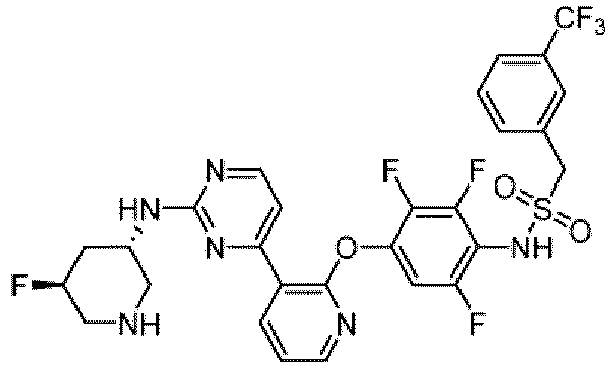
N-(2,3,6-Trifluor-4-((3-(2-(((3S,5S)-5-fluorpiperidin-3-yl)amino)pyrimidin-4-yl)pyridin-2-yl)oxy)phenyl)-1-(3-(trifluormethyl)phenyl)methansulfonami d 375 
1-p-Tolyl-N-(2,3,6-trifluor-4-((3-(2-(((3S,5S)-5-fluorpiperidin-3-yl)amino)pyrimidin-4-yl)pyridin-2-yl)oxy)phenyl)methansulfonamid 376 
1-(Bicyclo[2.2.1]heptan-1-yl)-N-(2,3,6-trifluor-4-((3-(2-(((3S,5S)-5-fluorpiperidin-3-yl)amino)pyrimidin-4-yl)pyridin-2-yl)oxy)phenyl)methansulfonamid 377 
1-(Bicyclo[2.2.2]octan-1-yl)-N-(2,3,6-trifluor-4-((3-(2-(((3S,5S)-5-fluorpiperidin-3-yl)amino)pyrimidin-4-yl)pyridin-2-yl)oxy)phenyl)methansulfonamid 378 
1-(2,5-Difluorphenyl)-N-(2,3,6-trifluor-4-((3-(2-(((3S,5S)-5-fluorpiperidin-3-yl)amino)pyrimidin-4-yl)pyridin-2-yl)oxy)phenyl)methansulfonamid 379 
1-(4-Cyanophenyl)-N-(2,3-difluor-4-((3-(2-(((S)-piperidin-3-yl)amino)pyrimidin-4-yl)pyridin-2-yl)oxy)phenyl)ethan-1-sulfonamid 380 
(S)-N-(2,3-Difluor-4-((3-(2-(piperidin-3- ylamino)pyrimidin-4-yl)pyridin-2-yl)oxy)phenyl)-1-(2-methoxyphenyl)methansulfonamid 382 
N-(4-((3-(2-(((1r,4r)-4-(Dimethylamino)cyclohexyl)amino)pyri midin-4-yl)pyridin-2-yl)oxy)-2,3,6-trifluorphenyl)-3,3,3-trifluorpropan-1- sulfonamid 383 
1-m-Tolyl-N-(2,3,6-trifluor-4-((3-(2-(((3S,5S)-5-fluorpiperidin-3-yl)amino)pyrimidin-4-yl)pyridin-2-yl)oxy)phenyl)methansulfonamid 384 
1-(2-Fluor-4-methylphenyl)-N-(2,3,6-trifluor-4-((3-(2-(((3S,5S)-5-fluorpiperidin-3-yl)amino)pyrimidin-4-yl)pyridin-2-yl)oxy)phenyl)methansulfonamid 385 
1-(3-Methoxyphenyl)-N-(2,3,6-trifluor-4-((3-(2-(((3S,5S)-5-fluorpiperidin-3-yl)amino)pyrimidin-4-yl)pyridin-2-yl)oxy)phenyl)methansulfonamid 386 
1-o-Tolyl-N-(2,3,6-trifluor-4-((3-(2-(((3S,5S)-5-fluorpiperidin-3-yl)amino)pyrimidin-4-yl)pyridin-2-yl)oxy)phenyl)methansulfonamid 387 
(*S)-1-Phenyl-N-(2,3,6-trifluor-4-((3-(2-(((3S,5S)-5-fluorpiperidin-3-yl)amino)pyrimidin-4-yl)pyridin-2-yl)oxy)phenyl)ethan-1-sulfonamid 388 
(*R)-1-Phenyl-N-(2,3,6-trifluor-4-((3-(2-(((3S,5S)-5-fluorpiperidin-3-yl)amino)pyrimidin-4-yl)pyridin-2-yl)oxy)phenyl)ethan-1-sulfonamid 389 
N-(2,3,6-Trifluor-4-((3-(2-(((3S,5S)-5-fluorpiperidin-3-yl)amino)pyrimidin-4-yl)pyridin-2-yl)oxy)phenyl)-1-(2-(trifluormethyl)pyridin-3-yl)methansulfonamid. *=willkürlich zugeordnet,
^Verbindungsnummern beziehen sich auf einzelne Enantiomere und Diastereomere, wobei die absoluten Stereokonfigurationen der chiralen Zentren willkürlich zugeordnet sind. - Pharmazeutische Zusammensetzung, umfassend eine Verbindung nach einem der Ansprüche 1 bis 11, oder ein pharmazeutisch annehmbares Salz davon und ein oder mehrere pharmazeutisch annehmbare Hilfsstoffe.
- Verbindung nach einem der Ansprüche 1 bis 11 oder ein pharmazeutisch annehmbares Salz davon oder die pharmazeutische Zusammensetzung nach Anspruch 12 zur Verwendung als Arzneimittel.
- Verbindung nach einem der Ansprüche 1 bis 11 oder ein pharmazeutisch annehmbares Salz davon oder die pharmazeutische Zusammensetzung nach Anspruch 12 zur Verwendung in einem Verfahren zur Behandlung einer mit IRE1 zusammenhängenden Krankheit oder Störung, die Folgendes ist:(i) Krebs; oder(ii) Krebs, der ein Plattenepithelkarzinom, kleinzelliger Lungenkrebs, nichtkleinzelliger Lungenkrebs (NSCLC), Lungenadenokarzinom, Plattenepithel-Lungenkrebs, Peritonealkrebs, Leberzellkrebs, Magenkrebs, Magen-Darm-Krebs, Speiseröhrenkrebs, Bauchspeicheldrüsenkrebs, Glioblastom, Gebärmutterhalskrebs, Eierstockkrebs, Leberkrebs, Blasenkrebs, Brustkrebs, Dickdarmkrebs, Enddarmkrebs, Kolorektalkrebs, Endometriumkrebs, Gebärmutterkrebs, Speicheldrüsenkarzinom, Nierenkrebs, Prostatakrebs, Vulvakrebs, Schilddrüsenkrebs, hepatozelluläres Karzinom (HCC), Analkarzinom, Peniskarzinom oder Kopf- und Halskrebs ist; oder(iii) Krebs, der ein Lymphom, eine lymphatische Leukämie, ein multiples Myelom (MM), eine akute myeloische Leukämie (AML), eine chronische myeloische Leukämie (CML), ein myelodysplastisches Syndrom (MDS) oder eine myeloproliferative Erkrankung (MPD) ist; oder(iv) Multiples Myelom; oder(v) ein dreifach negativer Brustkrebs (TNBC).
- Verbindung, Salz oder pharmazeutische Zusammensetzung zur Verwendung nach Anspruch 14, ferner umfassend die Verabreichung einer Strahlentherapie und/oder eines oder mehrerer zusätzlicher therapeutischer Mittel, ausgewählt aus der Gruppe bestehend aus einem entzündungshemmenden Mittel, einem Kortikosteroid, einem immunmodulatorischen Mittel, einem Antikrebsmittel, einem Apoptose-Verstärker, einem neurotropen Faktor, einem Mittel zur Behandlung kardiovaskulärer Erkrankungen, einem Mittel zur Behandlung von Lebererkrankungen, einem antiviralen Mittel, einem Mittel zur Behandlung von Blutkrankheiten, einem Mittel zur Behandlung von Diabetes, einem Mittel zur Behandlung von Stoffwechselkrankheiten, einem Mittel zur Behandlung von Autoimmunkrankheiten und einem Mittel zur Behandlung von Immunschwächekrankheiten;wobei es sich bei dem zusätzlichen therapeutischen Mittel optional um ein Kortikosteroid, einen Proteasominhibitor, ein immunmodulatorisches Mittel, einen Anti-CD38-Antikörper, einen Anti-VEGF-A-Antikörper, einen Anti-PD-1-Antikörper, ein Anti-PD-L1-Antikörper oder einen Anti-Interleukin-6-Antikörper oder eine Kombination davon handelt;und wobei ferner optional:- das Kortikosteroid Dexamethason umfasst; oder- der Proteasominhibitor Carfilzomib, Ixazomib oder Bortezomib umfasst; oder- das immunmodulatorische Mittel Lenalidomid oder Pomalidomid umfasst; oder- der Anti-PD-L1-Antikörper Avelumab, Durvalumab oder Atezolizumab umfasst; oder- der Anti-PD-1-Antikörper Pembrolizumab oder Nivolumab umfasst.
Applications Claiming Priority (2)
| Application Number | Priority Date | Filing Date | Title |
|---|---|---|---|
| CN2018105183 | 2018-09-12 | ||
| PCT/US2019/050749 WO2020056089A1 (en) | 2018-09-12 | 2019-09-12 | Phenoxy-pyridyl-pyrimidine compounds and methods of use |
Publications (3)
| Publication Number | Publication Date |
|---|---|
| EP3849664A1 EP3849664A1 (de) | 2021-07-21 |
| EP3849664B1 true EP3849664B1 (de) | 2024-06-12 |
| EP3849664C0 EP3849664C0 (de) | 2024-06-12 |
Family
ID=68052019
Family Applications (1)
| Application Number | Title | Priority Date | Filing Date |
|---|---|---|---|
| EP19773712.5A Active EP3849664B1 (de) | 2018-09-12 | 2019-09-12 | Phenoxy-pyridyl-pyrimidinverbindungen und anwendungsverfahren |
Country Status (7)
| Country | Link |
|---|---|
| US (1) | US12071425B2 (de) |
| EP (1) | EP3849664B1 (de) |
| JP (1) | JP7320600B2 (de) |
| CN (1) | CN112739420A (de) |
| AR (1) | AR116392A1 (de) |
| TW (1) | TWI831829B (de) |
| WO (1) | WO2020056089A1 (de) |
Families Citing this family (7)
| Publication number | Priority date | Publication date | Assignee | Title |
|---|---|---|---|---|
| WO2020056061A1 (en) * | 2018-09-12 | 2020-03-19 | Genentech, Inc. | Pyrimidinyl-heteroaryloxy-naphthyl compounds and methods of use |
| TWI831829B (zh) | 2018-09-12 | 2024-02-11 | 美商建南德克公司 | 苯氧基-吡啶基-嘧啶化合物及使用方法 |
| JP7539892B2 (ja) | 2019-01-03 | 2024-08-26 | ジェネンテック, インコーポレイテッド | 癌疾患の処置のためのエンドリボヌクレアーゼのイノシトール要求酵素i(ireiアルファ)の阻害剤としてのピリド-ピリミジノン化合物及びプテリジノン化合物 |
| MX2023002691A (es) * | 2020-09-03 | 2023-05-03 | Amgen Inc | Desimetrización de diol mediante sustitución aromática nucleófila. |
| EP4243815A4 (de) * | 2020-11-13 | 2024-10-02 | The Regents of the University of California | Ire1alpha-inhibitoren und verwendungen davon |
| CN116143695B (zh) * | 2023-02-17 | 2024-04-05 | 上海麦克林生化科技股份有限公司 | 一种1,1-二氟-5-氮杂螺[2.5]辛烷盐酸盐的合成方法 |
| WO2024196961A2 (en) * | 2023-03-21 | 2024-09-26 | Type6 Therapeutics, Inc. | Cdk2 modulators, compositions, and methods of use thereof |
Family Cites Families (33)
| Publication number | Priority date | Publication date | Assignee | Title |
|---|---|---|---|---|
| US3773919A (en) | 1969-10-23 | 1973-11-20 | Du Pont | Polylactide-drug mixtures |
| US5543523A (en) | 1994-11-15 | 1996-08-06 | Regents Of The University Of Minnesota | Method and intermediates for the synthesis of korupensamines |
| KR20020027649A (ko) | 1999-09-15 | 2002-04-13 | 로즈 암스트롱, 크리스틴 에이. 트러트웨인 | 카이나제 억제제로서의 프테리딘온 |
| BR0113628A (pt) | 2000-08-31 | 2003-07-01 | Hoffmann La Roche | 7-oxo-piridopirimidinas como inibidores de uma proliferação celular |
| WO2004063195A1 (en) | 2003-01-03 | 2004-07-29 | Sloan-Kettering Institute For Cancer Research | Pyridopyrimidine kinase inhibitors |
| JP4758349B2 (ja) | 2003-10-08 | 2011-08-24 | アイアールエム・リミテッド・ライアビリティ・カンパニー | タンパク質キナーゼ阻害剤としての化合物および組成物 |
| AU2005245386B2 (en) | 2004-05-07 | 2008-11-27 | Amgen Inc. | Nitrogenated heterocyclic derivatives as protein kinase modulators and use for the treatment of angiogenesis and cancer |
| CA2570494A1 (en) | 2004-06-23 | 2006-01-05 | Irm Llc | Pteridine derivatives as protein kinase inhibitors |
| US20070054916A1 (en) | 2004-10-01 | 2007-03-08 | Amgen Inc. | Aryl nitrogen-containing bicyclic compounds and methods of use |
| US20090131430A1 (en) | 2004-11-23 | 2009-05-21 | Palle Venkata P | Pyrido'2,3-dipyrimidines as anti-inflammatory agents |
| EP1846403A1 (de) | 2005-02-02 | 2007-10-24 | Ranbaxy Laboratories Limited | Azabicycloderivate als entzündungshemmende mittel |
| US7868177B2 (en) | 2006-02-24 | 2011-01-11 | Amgen Inc. | Multi-cyclic compounds and method of use |
| MX2008014618A (es) | 2006-05-15 | 2008-11-28 | Irm Llc | Composiciones y metodos para inhibidores de cinasas del receptor fgf. |
| US7897762B2 (en) | 2006-09-14 | 2011-03-01 | Deciphera Pharmaceuticals, Llc | Kinase inhibitors useful for the treatment of proliferative diseases |
| WO2008055842A1 (en) | 2006-11-09 | 2008-05-15 | F. Hoffmann-La Roche Ag | Substituted 6-phenyl-pyrido [2,3-d] pyrimidin-7-one derivatives as kinase inhibitors and methods for using the same |
| WO2008079933A2 (en) | 2006-12-22 | 2008-07-03 | Novartis Ag | Heteroaryl-heteroaryl compounds as cdk inhibitors for the treatment of cancer, inflammation and viral infections |
| EP2340248B1 (de) | 2008-09-15 | 2017-05-31 | The Regents of The University of California | Verfahren und zusammensetzungen zur modulation der ire1-, src- und abl-aktivität |
| US9181238B2 (en) | 2010-02-05 | 2015-11-10 | Novartis Ag | N-(pyridin-2-yl)sulfonamides and compositions thereof as protein kinase inhibitors |
| CA2854462A1 (en) | 2011-11-04 | 2013-05-10 | Afraxis Holdings, Inc. | Pak inhibitors for the treatment of fragile x syndrome |
| WO2013090840A1 (en) | 2011-12-15 | 2013-06-20 | Gilead Sciences, Inc. | 2 -amino- pyrido [3, 2 -d] pyrimidine derivatives as hcv inhibitors |
| MX2015003874A (es) | 2012-09-26 | 2015-12-16 | Univ California | Modulacion de ire1. |
| US20140323478A1 (en) | 2013-04-30 | 2014-10-30 | Afraxis Holdings, Inc. | Serine/threonine kinase inhibitors |
| US20140323477A1 (en) | 2013-04-30 | 2014-10-30 | Genentech, Inc. | Serine/threonine kinase inhibitors |
| CA2911706A1 (en) | 2013-05-09 | 2014-11-13 | Principia Biopharma Inc. | Quinolone derivatives as fibroblast growth factor inhibitors |
| WO2018102751A1 (en) | 2016-12-02 | 2018-06-07 | Quentis Therapeutics, Inc. | Ire1 small molecule inhibitors |
| TW201838981A (zh) | 2017-03-17 | 2018-11-01 | 美商建南德克公司 | 嘧啶基-吡啶氧基-萘基化合物以及治療ire1相關之疾病及病症的方法 |
| US10392367B2 (en) | 2017-06-01 | 2019-08-27 | Quentis Therapeutics, Inc. | IRE1 small molecule inhibitors |
| JP7126084B2 (ja) | 2017-06-01 | 2022-08-26 | コーネル ユニバーシティー | Ire1小分子阻害薬 |
| TWI831829B (zh) | 2018-09-12 | 2024-02-11 | 美商建南德克公司 | 苯氧基-吡啶基-嘧啶化合物及使用方法 |
| JP7546299B2 (ja) | 2018-12-03 | 2024-09-06 | コーネル・ユニバーシティー | Ire1小分子阻害物質 |
| JP7539892B2 (ja) | 2019-01-03 | 2024-08-26 | ジェネンテック, インコーポレイテッド | 癌疾患の処置のためのエンドリボヌクレアーゼのイノシトール要求酵素i(ireiアルファ)の阻害剤としてのピリド-ピリミジノン化合物及びプテリジノン化合物 |
| AR118826A1 (es) | 2019-05-03 | 2021-11-03 | Kinnate Biopharma Inc | Inhibidores de cinasas raf |
| KR102396930B1 (ko) | 2020-01-15 | 2022-05-12 | 한국과학기술연구원 | 피리도[3,4-d]피리미딘 유도체 및 이를 포함하는 치료용 약학 조성물 |
-
2019
- 2019-09-11 TW TW108132813A patent/TWI831829B/zh active
- 2019-09-12 AR ARP190102593A patent/AR116392A1/es unknown
- 2019-09-12 CN CN201980059447.7A patent/CN112739420A/zh active Pending
- 2019-09-12 WO PCT/US2019/050749 patent/WO2020056089A1/en not_active Ceased
- 2019-09-12 US US17/275,606 patent/US12071425B2/en active Active
- 2019-09-12 JP JP2021513785A patent/JP7320600B2/ja active Active
- 2019-09-12 EP EP19773712.5A patent/EP3849664B1/de active Active
Also Published As
| Publication number | Publication date |
|---|---|
| JP2021536496A (ja) | 2021-12-27 |
| TW202024051A (zh) | 2020-07-01 |
| WO2020056089A1 (en) | 2020-03-19 |
| JP7320600B2 (ja) | 2023-08-03 |
| EP3849664A1 (de) | 2021-07-21 |
| US20230057166A1 (en) | 2023-02-23 |
| EP3849664C0 (de) | 2024-06-12 |
| TWI831829B (zh) | 2024-02-11 |
| CN112739420A (zh) | 2021-04-30 |
| AR116392A1 (es) | 2021-05-05 |
| US12071425B2 (en) | 2024-08-27 |
Similar Documents
| Publication | Publication Date | Title |
|---|---|---|
| EP3941919B1 (de) | Pyrido-pyrimidinon- und pteridinonverbindungen als inhibitoren des endoribonuklease-inositol-i-erfordernden enzyms (ire i alpha) zur behandlung von krebserkrankungen | |
| AU2020234712B2 (en) | Protein tyrosine phosphatase inhibitors and methods of use thereof | |
| EP3710428B1 (de) | Modulatoren eines integrierten spannungswegs | |
| TWI888352B (zh) | 蛋白質酪胺酸磷酸酯酶抑制劑及其使用方法 | |
| US12071425B2 (en) | Phenoxy-pyridyl-pyrimidine compounds and methods of use | |
| JP6925435B2 (ja) | ピリミジニル−ピリジルオキシ−ナフチル化合物及びire1関連疾患及び障害を治療する方法 | |
| JP7611154B2 (ja) | ピリド-ピリミジニル化合物及び使用の方法 | |
| EP3983400B1 (de) | Chinazolinylinverbindungen und verfahren zur verwendung | |
| EP3892278B1 (de) | Cycloalkan-1,3-diamin-derivat | |
| EP3849663B1 (de) | Pyrimidinyl-heteroaryloxy-naphthyl-verbindungen und anwendungsverfahren | |
| HK40051987A (en) | Pyrimidinyl-heteroaryloxy-naphthyl compounds and methods of use | |
| HK40051446A (en) | Phenoxy-pyridyl-pyrimidine compounds and methods of use | |
| HK40053040A (en) | Cycloalkane-1,3-diamine derivative |
Legal Events
| Date | Code | Title | Description |
|---|---|---|---|
| STAA | Information on the status of an ep patent application or granted ep patent |
Free format text: STATUS: UNKNOWN |
|
| STAA | Information on the status of an ep patent application or granted ep patent |
Free format text: STATUS: THE INTERNATIONAL PUBLICATION HAS BEEN MADE |
|
| PUAI | Public reference made under article 153(3) epc to a published international application that has entered the european phase |
Free format text: ORIGINAL CODE: 0009012 |
|
| STAA | Information on the status of an ep patent application or granted ep patent |
Free format text: STATUS: REQUEST FOR EXAMINATION WAS MADE |
|
| 17P | Request for examination filed |
Effective date: 20210322 |
|
| AK | Designated contracting states |
Kind code of ref document: A1 Designated state(s): AL AT BE BG CH CY CZ DE DK EE ES FI FR GB GR HR HU IE IS IT LI LT LU LV MC MK MT NL NO PL PT RO RS SE SI SK SM TR |
|
| DAV | Request for validation of the european patent (deleted) | ||
| DAX | Request for extension of the european patent (deleted) | ||
| STAA | Information on the status of an ep patent application or granted ep patent |
Free format text: STATUS: EXAMINATION IS IN PROGRESS |
|
| 17Q | First examination report despatched |
Effective date: 20230217 |
|
| GRAP | Despatch of communication of intention to grant a patent |
Free format text: ORIGINAL CODE: EPIDOSNIGR1 |
|
| STAA | Information on the status of an ep patent application or granted ep patent |
Free format text: STATUS: GRANT OF PATENT IS INTENDED |
|
| INTG | Intention to grant announced |
Effective date: 20240314 |
|
| GRAS | Grant fee paid |
Free format text: ORIGINAL CODE: EPIDOSNIGR3 |
|
| GRAA | (expected) grant |
Free format text: ORIGINAL CODE: 0009210 |
|
| STAA | Information on the status of an ep patent application or granted ep patent |
Free format text: STATUS: THE PATENT HAS BEEN GRANTED |
|
| AK | Designated contracting states |
Kind code of ref document: B1 Designated state(s): AL AT BE BG CH CY CZ DE DK EE ES FI FR GB GR HR HU IE IS IT LI LT LU LV MC MK MT NL NO PL PT RO RS SE SI SK SM TR |
|
| REG | Reference to a national code |
Ref country code: GB Ref legal event code: FG4D |
|
| REG | Reference to a national code |
Ref country code: CH Ref legal event code: EP |
|
| REG | Reference to a national code |
Ref country code: DE Ref legal event code: R096 Ref document number: 602019053595 Country of ref document: DE |
|
| REG | Reference to a national code |
Ref country code: IE Ref legal event code: FG4D |
|
| U01 | Request for unitary effect filed |
Effective date: 20240709 |
|
| U07 | Unitary effect registered |
Designated state(s): AT BE BG DE DK EE FI FR IT LT LU LV MT NL PT SE SI Effective date: 20240716 |
|
| U20 | Renewal fee for the european patent with unitary effect paid |
Year of fee payment: 6 Effective date: 20240820 |
|
| PG25 | Lapsed in a contracting state [announced via postgrant information from national office to epo] |
Ref country code: HR Free format text: LAPSE BECAUSE OF FAILURE TO SUBMIT A TRANSLATION OF THE DESCRIPTION OR TO PAY THE FEE WITHIN THE PRESCRIBED TIME-LIMIT Effective date: 20240612 |
|
| PG25 | Lapsed in a contracting state [announced via postgrant information from national office to epo] |
Ref country code: GR Free format text: LAPSE BECAUSE OF FAILURE TO SUBMIT A TRANSLATION OF THE DESCRIPTION OR TO PAY THE FEE WITHIN THE PRESCRIBED TIME-LIMIT Effective date: 20240913 |
|
| PG25 | Lapsed in a contracting state [announced via postgrant information from national office to epo] |
Ref country code: ES Free format text: LAPSE BECAUSE OF FAILURE TO SUBMIT A TRANSLATION OF THE DESCRIPTION OR TO PAY THE FEE WITHIN THE PRESCRIBED TIME-LIMIT Effective date: 20240612 |
|
| PG25 | Lapsed in a contracting state [announced via postgrant information from national office to epo] |
Ref country code: NO Free format text: LAPSE BECAUSE OF FAILURE TO SUBMIT A TRANSLATION OF THE DESCRIPTION OR TO PAY THE FEE WITHIN THE PRESCRIBED TIME-LIMIT Effective date: 20240912 Ref country code: HR Free format text: LAPSE BECAUSE OF FAILURE TO SUBMIT A TRANSLATION OF THE DESCRIPTION OR TO PAY THE FEE WITHIN THE PRESCRIBED TIME-LIMIT Effective date: 20240612 Ref country code: GR Free format text: LAPSE BECAUSE OF FAILURE TO SUBMIT A TRANSLATION OF THE DESCRIPTION OR TO PAY THE FEE WITHIN THE PRESCRIBED TIME-LIMIT Effective date: 20240913 Ref country code: ES Free format text: LAPSE BECAUSE OF FAILURE TO SUBMIT A TRANSLATION OF THE DESCRIPTION OR TO PAY THE FEE WITHIN THE PRESCRIBED TIME-LIMIT Effective date: 20240612 Ref country code: RS Free format text: LAPSE BECAUSE OF FAILURE TO SUBMIT A TRANSLATION OF THE DESCRIPTION OR TO PAY THE FEE WITHIN THE PRESCRIBED TIME-LIMIT Effective date: 20240912 |
|
| PG25 | Lapsed in a contracting state [announced via postgrant information from national office to epo] |
Ref country code: PL Free format text: LAPSE BECAUSE OF FAILURE TO SUBMIT A TRANSLATION OF THE DESCRIPTION OR TO PAY THE FEE WITHIN THE PRESCRIBED TIME-LIMIT Effective date: 20240612 |
|
| PG25 | Lapsed in a contracting state [announced via postgrant information from national office to epo] |
Ref country code: IS Free format text: LAPSE BECAUSE OF FAILURE TO SUBMIT A TRANSLATION OF THE DESCRIPTION OR TO PAY THE FEE WITHIN THE PRESCRIBED TIME-LIMIT Effective date: 20241012 |
|
| PG25 | Lapsed in a contracting state [announced via postgrant information from national office to epo] |
Ref country code: CZ Free format text: LAPSE BECAUSE OF FAILURE TO SUBMIT A TRANSLATION OF THE DESCRIPTION OR TO PAY THE FEE WITHIN THE PRESCRIBED TIME-LIMIT Effective date: 20240612 |
|
| PG25 | Lapsed in a contracting state [announced via postgrant information from national office to epo] |
Ref country code: SK Free format text: LAPSE BECAUSE OF FAILURE TO SUBMIT A TRANSLATION OF THE DESCRIPTION OR TO PAY THE FEE WITHIN THE PRESCRIBED TIME-LIMIT Effective date: 20240612 Ref country code: RO Free format text: LAPSE BECAUSE OF FAILURE TO SUBMIT A TRANSLATION OF THE DESCRIPTION OR TO PAY THE FEE WITHIN THE PRESCRIBED TIME-LIMIT Effective date: 20240612 |
|
| PG25 | Lapsed in a contracting state [announced via postgrant information from national office to epo] |
Ref country code: SM Free format text: LAPSE BECAUSE OF FAILURE TO SUBMIT A TRANSLATION OF THE DESCRIPTION OR TO PAY THE FEE WITHIN THE PRESCRIBED TIME-LIMIT Effective date: 20240612 |
|
| PG25 | Lapsed in a contracting state [announced via postgrant information from national office to epo] |
Ref country code: SM Free format text: LAPSE BECAUSE OF FAILURE TO SUBMIT A TRANSLATION OF THE DESCRIPTION OR TO PAY THE FEE WITHIN THE PRESCRIBED TIME-LIMIT Effective date: 20240612 Ref country code: SK Free format text: LAPSE BECAUSE OF FAILURE TO SUBMIT A TRANSLATION OF THE DESCRIPTION OR TO PAY THE FEE WITHIN THE PRESCRIBED TIME-LIMIT Effective date: 20240612 Ref country code: RO Free format text: LAPSE BECAUSE OF FAILURE TO SUBMIT A TRANSLATION OF THE DESCRIPTION OR TO PAY THE FEE WITHIN THE PRESCRIBED TIME-LIMIT Effective date: 20240612 Ref country code: PL Free format text: LAPSE BECAUSE OF FAILURE TO SUBMIT A TRANSLATION OF THE DESCRIPTION OR TO PAY THE FEE WITHIN THE PRESCRIBED TIME-LIMIT Effective date: 20240612 Ref country code: IS Free format text: LAPSE BECAUSE OF FAILURE TO SUBMIT A TRANSLATION OF THE DESCRIPTION OR TO PAY THE FEE WITHIN THE PRESCRIBED TIME-LIMIT Effective date: 20241012 Ref country code: CZ Free format text: LAPSE BECAUSE OF FAILURE TO SUBMIT A TRANSLATION OF THE DESCRIPTION OR TO PAY THE FEE WITHIN THE PRESCRIBED TIME-LIMIT Effective date: 20240612 |
|
| PLBE | No opposition filed within time limit |
Free format text: ORIGINAL CODE: 0009261 |
|
| STAA | Information on the status of an ep patent application or granted ep patent |
Free format text: STATUS: NO OPPOSITION FILED WITHIN TIME LIMIT |
|
| PG25 | Lapsed in a contracting state [announced via postgrant information from national office to epo] |
Ref country code: MC Free format text: LAPSE BECAUSE OF FAILURE TO SUBMIT A TRANSLATION OF THE DESCRIPTION OR TO PAY THE FEE WITHIN THE PRESCRIBED TIME-LIMIT Effective date: 20240612 |
|
| 26N | No opposition filed |
Effective date: 20250313 |
|
| PG25 | Lapsed in a contracting state [announced via postgrant information from national office to epo] |
Ref country code: IE Free format text: LAPSE BECAUSE OF NON-PAYMENT OF DUE FEES Effective date: 20240912 |
|
| U20 | Renewal fee for the european patent with unitary effect paid |
Year of fee payment: 7 Effective date: 20250820 |
|
| REG | Reference to a national code |
Ref country code: CH Ref legal event code: U11 Free format text: ST27 STATUS EVENT CODE: U-0-0-U10-U11 (AS PROVIDED BY THE NATIONAL OFFICE) Effective date: 20251001 |
|
| PGFP | Annual fee paid to national office [announced via postgrant information from national office to epo] |
Ref country code: GB Payment date: 20250820 Year of fee payment: 7 |
|
| PGFP | Annual fee paid to national office [announced via postgrant information from national office to epo] |
Ref country code: CH Payment date: 20251001 Year of fee payment: 7 |
|
| PG25 | Lapsed in a contracting state [announced via postgrant information from national office to epo] |
Ref country code: CY Free format text: LAPSE BECAUSE OF FAILURE TO SUBMIT A TRANSLATION OF THE DESCRIPTION OR TO PAY THE FEE WITHIN THE PRESCRIBED TIME-LIMIT; INVALID AB INITIO Effective date: 20190912 |
|
| PG25 | Lapsed in a contracting state [announced via postgrant information from national office to epo] |
Ref country code: HU Free format text: LAPSE BECAUSE OF FAILURE TO SUBMIT A TRANSLATION OF THE DESCRIPTION OR TO PAY THE FEE WITHIN THE PRESCRIBED TIME-LIMIT; INVALID AB INITIO Effective date: 20190912 |