EP3851876A1 - Procédé et dispositif de traitement d'informations sur la base des ondes radar, terminal et support d'informations - Google Patents
Procédé et dispositif de traitement d'informations sur la base des ondes radar, terminal et support d'informations Download PDFInfo
- Publication number
- EP3851876A1 EP3851876A1 EP20181486.0A EP20181486A EP3851876A1 EP 3851876 A1 EP3851876 A1 EP 3851876A1 EP 20181486 A EP20181486 A EP 20181486A EP 3851876 A1 EP3851876 A1 EP 3851876A1
- Authority
- EP
- European Patent Office
- Prior art keywords
- terminal
- radar signal
- mode
- radar
- identification information
- Prior art date
- Legal status (The legal status is an assumption and is not a legal conclusion. Google has not performed a legal analysis and makes no representation as to the accuracy of the status listed.)
- Granted
Links
Images

Classifications
-
- G—PHYSICS
- G01—MEASURING; TESTING
- G01S—RADIO DIRECTION-FINDING; RADIO NAVIGATION; DETERMINING DISTANCE OR VELOCITY BY USE OF RADIO WAVES; LOCATING OR PRESENCE-DETECTING BY USE OF THE REFLECTION OR RERADIATION OF RADIO WAVES; ANALOGOUS ARRANGEMENTS USING OTHER WAVES
- G01S7/00—Details of systems according to groups G01S13/00, G01S15/00, G01S17/00
- G01S7/02—Details of systems according to groups G01S13/00, G01S15/00, G01S17/00 of systems according to group G01S13/00
- G01S7/021—Auxiliary means for detecting or identifying radar signals or the like, e.g. radar jamming signals
-
- G—PHYSICS
- G06—COMPUTING OR CALCULATING; COUNTING
- G06K—GRAPHICAL DATA READING; PRESENTATION OF DATA; RECORD CARRIERS; HANDLING RECORD CARRIERS
- G06K17/00—Methods or arrangements for effecting co-operative working between equipments covered by two or more of main groups G06K1/00 - G06K15/00, e.g. automatic card files incorporating conveying and reading operations
- G06K17/0022—Methods or arrangements for effecting co-operative working between equipments covered by two or more of main groups G06K1/00 - G06K15/00, e.g. automatic card files incorporating conveying and reading operations arrangements or provisions for transferring data to distant stations, e.g. from a sensing device
-
- G—PHYSICS
- G01—MEASURING; TESTING
- G01S—RADIO DIRECTION-FINDING; RADIO NAVIGATION; DETERMINING DISTANCE OR VELOCITY BY USE OF RADIO WAVES; LOCATING OR PRESENCE-DETECTING BY USE OF THE REFLECTION OR RERADIATION OF RADIO WAVES; ANALOGOUS ARRANGEMENTS USING OTHER WAVES
- G01S13/00—Systems using the reflection or reradiation of radio waves, e.g. radar systems; Analogous systems using reflection or reradiation of waves whose nature or wavelength is irrelevant or unspecified
- G01S13/02—Systems using reflection of radio waves, e.g. primary radar systems; Analogous systems
- G01S13/04—Systems determining presence of a target
-
- G—PHYSICS
- G01—MEASURING; TESTING
- G01S—RADIO DIRECTION-FINDING; RADIO NAVIGATION; DETERMINING DISTANCE OR VELOCITY BY USE OF RADIO WAVES; LOCATING OR PRESENCE-DETECTING BY USE OF THE REFLECTION OR RERADIATION OF RADIO WAVES; ANALOGOUS ARRANGEMENTS USING OTHER WAVES
- G01S13/00—Systems using the reflection or reradiation of radio waves, e.g. radar systems; Analogous systems using reflection or reradiation of waves whose nature or wavelength is irrelevant or unspecified
- G01S13/87—Combinations of radar systems, e.g. primary radar and secondary radar
-
- G—PHYSICS
- G01—MEASURING; TESTING
- G01S—RADIO DIRECTION-FINDING; RADIO NAVIGATION; DETERMINING DISTANCE OR VELOCITY BY USE OF RADIO WAVES; LOCATING OR PRESENCE-DETECTING BY USE OF THE REFLECTION OR RERADIATION OF RADIO WAVES; ANALOGOUS ARRANGEMENTS USING OTHER WAVES
- G01S13/00—Systems using the reflection or reradiation of radio waves, e.g. radar systems; Analogous systems using reflection or reradiation of waves whose nature or wavelength is irrelevant or unspecified
- G01S13/88—Radar or analogous systems specially adapted for specific applications
-
- G—PHYSICS
- G01—MEASURING; TESTING
- G01S—RADIO DIRECTION-FINDING; RADIO NAVIGATION; DETERMINING DISTANCE OR VELOCITY BY USE OF RADIO WAVES; LOCATING OR PRESENCE-DETECTING BY USE OF THE REFLECTION OR RERADIATION OF RADIO WAVES; ANALOGOUS ARRANGEMENTS USING OTHER WAVES
- G01S7/00—Details of systems according to groups G01S13/00, G01S15/00, G01S17/00
- G01S7/003—Transmission of data between radar, sonar or lidar systems and remote stations
-
- H—ELECTRICITY
- H04—ELECTRIC COMMUNICATION TECHNIQUE
- H04W—WIRELESS COMMUNICATION NETWORKS
- H04W76/00—Connection management
- H04W76/10—Connection setup
- H04W76/11—Allocation or use of connection identifiers
Definitions
- the disclosure relates to the technical field of radar waves, and more particularly, to a method and device for processing information based on radar waves, a terminal, and a storage medium.
- the radar waves are generally configured to test a distance, recognize and detect an object.
- the use of radar waves is still in the initial stage in the field of terminals such as mobile phones, computers, and the like. How to utilize radar waves to complete more tasks to facilitate the life, study or work of people has become an urgent technical problem to be solved.
- the disclosure provides a method and device for processing information based on radar waves, a terminal, and a storage medium.
- a method for processing information based on radar waves may include: receiving a first radar signal sent by a second terminal by a first terminal comprising a radar sensor during an event; and acquiring identification information of a user to which the second terminal belongs by the first terminal based on the first radar signal.
- the method may further include: recording an attendance signature of the user to the event based on the identification information.
- the method may further include: after receiving the first radar signal, sending a second radar signal.
- the second radar signal is configured to indicate the second terminal to start a predetermined mode for the event.
- the predetermined mode for the event may include a silent mode or a conference mode.
- the step of sending the second radar signal may include: when the identification information is acquired for a first time within a predetermined time range, sending a second radar signal including first indication information.
- the first indication information may be configured to indicate the second terminal to start the silent mode or the conference mode.
- the step of sending the second radar signal may include: when the identification information is not acquired for a first time within a predetermined time range, sending a second radar signal including second indication information.
- the second indication information may be configured to indicate the second terminal to terminate the predetermined mode for the event.
- a method for processing information based on radar waves may be applied to an attendee terminal and include: acquiring identification information of a user to which the attendee terminal belongs; and sending a first radar signal including the identification information during an event.
- the first radar signal may be used for a host terminal to acquire the identification information.
- the identification information may be used for recording an attendance signature of the user to the event in the host terminal.
- the method may further include: when a second radar signal returned by the host terminal based on the first radar signal is received, starting a predetermined mode for the event according to the second radar signal.
- the predetermined mode for the event may include a silent mode or a conference mode.
- the step of starting the predetermined mode for the event according to the second radar signal may include: in case of a second radar signal including first indication information, starting the silent mode or the conference mode.
- the method may further include: in case of a second radar signal including second indication information, terminating the predetermined mode for the event.
- the method before sending the first radar signal including the identification information, may further include: based on a wireless signal positioning mode, determining whether the attendee terminal enters a predetermined range of a target position; and when the attendee terminal enters the predetermined range of the target position, starting a radar sensor.
- the attendee terminal may send the first radar signal after the radar sensor is started.
- a device for processing information based on radar waves may be applied to an attendee terminal and include: a second acquisition module, which is configured to acquire identification information of a user to which the attendee terminal belongs; and a second sending module, which is configured to send a first radar signal including the identification information during an event; wherein the first radar signal is used for a host terminal to acquire the identification information.
- the identification information may be used for recording an attendance signature of the user to the event in the host terminal.
- the device may further include: a processing module configured, when a second radar signal returned by the host terminal based on the first radar signal is received, to start a predetermined mode for the event according to the second radar signal.
- a processing module configured, when a second radar signal returned by the host terminal based on the first radar signal is received, to start a predetermined mode for the event according to the second radar signal.
- the predetermined mode for the event may include a silent mode or a conference mode.
- the processing module may be configured to start the silent mode or the conference mode in the case of a second radar signal including first indication information.
- the processing module may be further configured to terminate the predetermined mode for the event in the case of a second radar signal including second indication information.
- the device may further include: a determining module configured to determine whether the attendee terminal enters a predetermined range of a target position based on a wireless signal positioning mode.
- the processing module may be further configured to start a radar sensor when the attendee terminal enters the predetermined range of the target position.
- the attendee terminal may send the first radar signal after the radar sensor is started.
- the first radar signal sent by the second terminal is received by the first terminal, and based on the first radar signal, the identification information of the user to which the second terminal belongs is acquired. Therefore, in the embodiments of the disclosure, on the one hand, the first radar signal may be utilized for receiving the identification information from the second terminal, there is no need to establish a connection in the related art, such as a wireless network or a wired network, and the information interaction between the first terminal and the second terminal may be realized only through the radar signal. On the other hand, it is convenient for the first terminal to perform further operations based on the acquired identification information, thereby improving user experience.
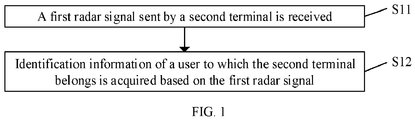
- FIG. 1 is a flow chart showing a method for processing information based on radar waves according to an example. As illustrated in FIG. 1 , the method is applied to a first terminal including a radar sensor and includes the following steps.
- a first radar signal sent by a second terminal is received during an event.
- the event may be a conference, a lecture, a class, a work or an athletic meeting, and the like.
- identification information of a user to which the second terminal belongs is acquired based on the first radar signal.
- the first terminal is a terminal provided with a radar sensor.
- the first terminal may be a mobile terminal or a fixed terminal.
- the first terminal may be a mobile phone, a computer, a tablet computer, a wearable device, and the like.
- any terminal provided with a radar sensor may be the first terminal in the embodiments of the disclosure.
- the second terminal is a mobile terminal provided with a radar sensor.
- the second terminal may be a mobile phone, a tablet computer, a wearable device, and the like.
- any mobile terminal provided with a radar sensor may be the second terminal in the embodiments of the disclosure.
- the first terminal or the second terminal may include at least one radar sensor.
- the first terminal may be referred as the host terminal.
- the second terminal may also be referred as the attendee terminal.
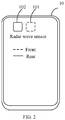
- the second terminal is a mobile phone.
- At least two radar sensors are mounted on the mobile phone 100.
- the two radar sensors may include a front radar sensor 101 mounted on a display screen of the mobile phone 100 and a rear radar sensor 102 mounted on a side of the mobile phone 100 opposite to the display screen.
- the first radar signal includes the identification information.
- the identification information is configured to uniquely identify the user to which the second terminal belongs.
- the identification information may include but is not limited to at least one of: a mobile phone number, an ID card number, a Wechat number, an email address, a QQ number, or any other identity associated with the second terminal.
- the identification information may be an encoded character string.
- the identification information may be a section of digital character string after binary encoding, such as 010, 10110, or the like.
- step S11 includes: at least one first radar signal sent by the second terminal is received during an event. Therefore, in the embodiment, the second terminal may acquire one or more pieces of identification information of the user to which the second terminal belongs.
- a mode for implementing step S12 includes: the first terminal decodes the first radar signal to obtain the identification information.
- the first radar signal sent by the second terminal may be received through the first terminal, the identification information may be acquired from the received first radar signal, and information interaction between the first terminal and the second terminal may be realized without establishing a connection such as a wireless network connection, a wired network connection, or the like in the related art.
- a connection such as a wireless network connection, a wired network connection, or the like in the related art.
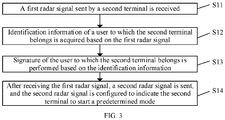
- the method may further include as follows.
- signing-in of the user to which the second terminal belongs is performed based on the identification information.
- the host terminal may record the attendance signature of the user to the event based on the identification information.
- the first terminal may perform signing-in of the user to which the terminal belongs based on the identification information after acquiring the identification information of the user to which the second terminal belongs.
- the signing-in of the user to which the terminal belongs may include signing-in in various scenarios or events, such as a conference, a lecture, a class, a work or an athletic meeting, and the like, which is not limited herein.
- a first terminal is disposed in a conference room or at an entrance of the conference room; when a user taking along a second terminal enters the conference room, the first terminal receives the identification information sent by the second terminal; and the first terminal records the identification information, thereby completing the signature of the user. Therefore, there is no need to manually record the users participating in the conference, and it is convenient to realize the job of signing-in of the users participating in the conference.
- a first terminal is disposed in a classroom or at an entrance of the classroom; when a student taking along a second terminal enters the classroom, the first terminal receives the identification information sent by the second terminal; and the first terminal records the identification information, thereby completing the signature of the student. Therefore, there is no need for a teacher to record all students who attend the class, it is convenient to realize the signing-in of students who attend the class, and the teacher and the students can attend the class as soon as possible to improve the teaching quality.
- the identification information included in the radar signal can be acquired, and based on the identification information, attendance signature in various scenarios, such as a class, a conference, a lecture, work, and the like, can be recorded conveniently without physical contact.
- attendance signature in various scenarios, such as a class, a conference, a lecture, work, and the like, can be recorded conveniently without physical contact.
- the signature of a user can be recorded based on the received radar signal, such that the signature work can be easily completed, and the user experience and the intelligence of the terminal can be greatly improved.
- the method may further include as follows.
- a second radar signal is sent; and the second radar signal is configured to indicate the second terminal to start a predetermined mode for the event.
- the predetermined mode for the event may include one of following modes: a silent mode or a conference mode. In the silent mode, the second terminal may mute all notifications. In the conference mode, the second terminal may start voice recording or start other preset conference functions in addition to muting all notifications.
- the second radar signal is a radar signal including first indication information. In another embodiment, the second radar signal is a radar signal including second indication information.
- the second radar signal is configured to indicate the second terminal to start the predetermined mode; and in the case of the second radar signal including the second indication information, the second radar signal is configured to indicate the second terminal to terminate the predetermined mode.
- the first indication information or the second indication information may also be a section of a mathematical character string.
- the first indication information is 0000
- the second indication information is 0001.
- the predetermined mode is a mode in which sound is turned off.
- the predetermined mode includes but is not limited to any one of: a silent mode, a conference mode or a do not disturb (DND) mode.
- DND do not disturb
- the predetermined mode may also be a flight mode.
- the step of sending the second radar signal includes: when the identification information is acquired for a first time within a predetermined time range, a second radar signal including first indication information is sent; and the first indication information is configured to indicate the second terminal to start the silent mode or the conference mode.
- the predetermined time range is different based on different signature scenarios or events.
- the predetermined time range when the signature is in a work scenario, the predetermined time range may be a first value, and the first value may be 8 hours, 9 hours, 10 hours, or the like.
- the predetermined time range when the signature is in a class scenario, the predetermined time range is a second value, and the second value may be 40 minutes, 45 minutes, 1 hour, 2 hours, or the like.
- the predetermined time range when the signature is in a conference or lecture scenario, the predetermined time range is a third value, and the third value may be 1 hour, 2 hours, 3 hours, 4 hours or the like.
- the identification information when the identification information is acquired for the first time within a predetermined time range, it may be determined that the second terminal enters the signature conference room where the first terminal is located for the first time, and then, it may be determined to send the second radar signal including the first indication information, such that the second terminal starts the silent mode or the conference mode. Therefore, it is possible to prevent the second terminal from disturbing others by ringing or vibrating during a meeting or a class.
- the unified setting of multiple second terminals may be completed, and then, all the second terminals are kept in the silent mode or the conference mode, thereby maintaining the quietness of the signature conference room, and avoiding interruption or influence of the normal progress of a class, a meeting, a lecture, a work, and the like in the conference room.
- the step of sending the second radar signal includes: when the identification information is not acquired for a first time within a predetermined time range, a second radar signal including second indication information is sent; and the second indication information is configured to indicate the second terminal to terminate the predetermined mode.
- the second terminal when the identification information is not acquired for the first time within a predetermined time range, it may be considered that the second terminal leaves the signature conference room, such as a conference, a class, and the like; therefore, the second terminal may terminate the predetermined mode, and the mode before the second terminal enters the signature conference room is restored. In this way, when a user leaves the signature conference room, there is no need to manually set the second terminal to terminate the silent mode or the conference mode, thereby further facilitating use for the user and improving the intelligence of the terminal.
- the step of sending the second radar signal may further include: when the identification information is acquired for an odd number of times within a predetermined time range, a second radar signal including first indication information is sent; and the first indication information is configured to indicate the second terminal to start a predetermined mode; or, when the identification information is acquired for an even number of times within a predetermined time range, a second radar signal including second indication information is sent; and the second indication information is configured to indicate the second terminal to terminate the predetermined mode.
- the second radar signal including the first indication information or the second radar signal including the second indication information may be determined whether to send the second radar signal including the first indication information or the second radar signal including the second indication information according to the acquired number of times of the identification information. Specifically, when the identification information is acquired for an odd number of times, it is determined that the user enters the signature conference room and that the second terminal needs to start the silent mode or the conference mode, and then the second radar signal including the first indication information may be sent; and when the identification information is acquired for an even number of times, it is determined that the user leaves the signature conference room and that the second terminal needs to terminate the silent mode or the conference mode, and then the second radar signal including the second indication information may be sent.
- the first terminal includes a first radar sensor and a second radar sensor.
- the step of sending the second radar signal after receiving the first radar signal includes:
- the positions of the first radar sensor and the second radar sensor in the first terminal are different.
- the first radar sensor is positioned at a side of the first terminal close to a signature conference room
- the second radar sensor is positioned at a side of the first terminal far from the signature conference room.
- the second radar waves including different indication information is sent to the second terminal, such that the second terminal starts a mode corresponding to different indication information.
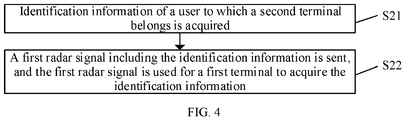
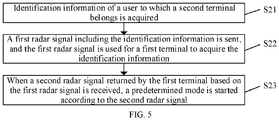
- FIG. 4 is a flow chart showing a method for processing information based on radar waves according to an example. As illustrated in FIG. 4 , the method is applied to a second terminal and includes the following steps.
- identification information of a user to which the second terminal (or called an attendee terminal) belongs is acquired.
- a first radar signal including the identification information is sent during an event, and the first radar signal is used for a first terminal (or called host terminal) to acquire the identification information.
- the identification information is used for signing-in of the user corresponding to the identification information in the first terminal.
- step S21 an implementation mode of step S21 is as follows: user information may be input into the second terminal, and based on the user information, the identification information of the user may be generated.
- the user information may include but is not limited to at least one of: a name, an identity (ID) card number or a position.
- ID identity
- an implementation mode of step S22 is as follows: the identification information is encoded in the first radar signal, and the first radar signal is sent.
- step S22 includes: the first radar signal including the identification information is sent to the first terminal, and the first terminal is within a first predetermined distance of the second terminal.
- the second terminal may be aligned with the first terminal, and then, the second terminal will send the first radar signal to the first terminal, such that the first terminal completes a collection of the identification information.
- the second terminal sends the identification information of the user, to which the second terminal belongs, to the first terminal through the first radar signal without establishing a wireless network connection, a wired network connection, or the like, therefore, radar waves may be applied to more scenarios, the user experience is improved, and it is convenient for subsequent processing performed by the first terminal based on the identification information.
- the signature may be easily completed without manual signature, thereby improving the user experience and the intelligence of the terminal.
- the method may further include the following step.
- the predetermined mode includes a silent mode or a conference mode.
- the step of starting the predetermined mode according to the second radar signal includes: in case of a second radar signal including first indication information, the silent mode or the conference mode is started.
- the method may further include: in case of a second radar signal including second indication information, the predetermined mode is terminated.
- the method before sending the first radar signal including the identification information, the method may further include:
- a radar sensor is started, and the second terminal sends the first radar signal after the radar sensor is started.
- the target position is a signature conference room in the above embodiments.
- the target position may be a conference room, a classroom, an office, a gymnasium, and the like.
- the first terminal is a terminal in the target position
- the second terminal is a terminal that moves as the user to which the second terminal belongs moves.
- whether the second terminal enters a predetermined range of the target position may be determined according to strength of a wireless signal between the first terminal and the second terminal.
- the distance between the second terminal and the target position may be determined through an image collected by the second terminal, so as to determine whether the second terminal enters the predetermined range of the target position.
- the radar sensor only when the second terminal enters the predetermined range of the target position, is the radar sensor started, such that the second terminal sends the first radar signal based on the radar sensor. Therefore, the number and time of use of the radar sensor in the second terminal may be greatly reduced, the risk of the radar sensor due to continuous use is reduced, and the electric consumption of the second terminal may be greatly reduced.
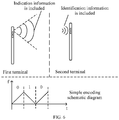
- FIG. 6 discloses a schematic diagram illustrating a system for processing information based on radar waves.
- the first terminal and the second terminal may transmit information through radar signals.
- the second terminal sends a first radar signal including identification information to the first terminal.
- the first terminal sends a second radar signal including indication information to the second terminal.
- Both the identification information and the indication information may be a section of a numerical character string after encoding, such as a character string of 010 in FIG. 6 .
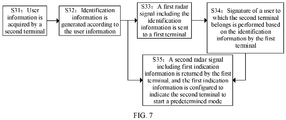
- FIG. 7 is a flow chart showing a method for processing information based on radar waves according to an example.
- the method for processing information based on radar waves is applied to a system for processing information based on radar waves according to the above embodiment.
- the system includes a first terminal and a second terminal. As illustrated in FIG. 7 , the method includes the following steps.
- the second terminal acquires user information.
- the second terminal acquires the user information.
- identification information is generated according to the user information.
- the second terminal generates the corresponding identification information based on the user information.
- a first radar signal including the identification information is sent to the first terminal.
- the second terminal sends the first radar signal including the identification information to the first terminal.
- the first terminal performs signature of a user to which the second terminal belongs based on the identification information.
- the first terminal receives the first radar signal and acquires the identification information from the first radar signal, and performs signature of the user to which the second terminal belongs based on the identification information.
- the first terminal returns a second radar signal including first indication information, and the first indication information is configured to indicate the second terminal to start a predetermined mode.
- the first terminal after receiving the first radar signal, the first terminal returns the second radar signal including the first indication information, and the first indication information is configured to indicate the second terminal to start the predetermined mode which includes a silent mode or a conference mode.
- the first terminal performs signature of the user to which the second terminal belongs based on the identification information, thereby completing the signature work, such as steps S31 to S34 in the above embodiment.
- the first terminal performs signature of the user to which the second terminal belongs based on the identification information, and sends the second radar signal to the second terminal, and the second terminal starts the silent mode or the conference mode based on the second radar signal, thereby completing the signature work, such as steps S31 to S35 in the above embodiment.
- the first terminal and the second terminal may transmit information through the radar signal, such that radar waves may be applied to more scenarios, and the user experience is improved. Furthermore, it is convenient for subsequent processing performed by the first terminal based on the identification information.
- the second radar signal including the first indication information may be returned to the second terminal, such that the second terminal may start the silent mode or the conference mode according to the first indication information after receiving the second radar signal. Therefore, it realizes the automatic setting of the second terminal starting the silent mode or the conference mode without manual setting, and it can further facilitate the user and improve the intelligence of the terminal.
- the unified setting of multiple second terminals may be completed, and then, all the second terminals are kept in the silent mode or the conference mode, thereby maintaining the quietness of a signature conference room, and avoiding interruption or influence of the normal progress of a class, a meeting, a lecture, work, and the like, in the conference room.
- FIG. 8 is a block diagram of a device for processing information based on radar waves according to an example.
- the device includes a first receiving module 41 and a first acquisition module 42.
- the first receiving module 41 is configured to receive a first radar signal sent by a second terminal.
- the first acquisition module 42 is configured to acquire identification information of a user to which the second terminal belongs based on the first radar signal.
- the device may further include: a signature module 43, which is configured to perform signing-in of the user to which the second terminal belongs based on the identification information.
- a signature module 43 which is configured to perform signing-in of the user to which the second terminal belongs based on the identification information.
- the device may further include: a first sending module 44, which is configured to send a second radar signal after receiving the first radar signal.
- the second radar signal is configured to indicate the second terminal to start a predetermined mode.
- the predetermined mode includes a silent mode or a conference mode.
- the first sending module 44 is configured to send a second radar signal including first indication information when the identification information is acquired for a first time within a predetermined time range.
- the first indication information is configured to indicate the second terminal to start the silent mode or the conference mode.
- the first sending module 44 is configured to send a second radar signal including second indication information when the identification information is not acquired for a first time within a predetermined time range.
- the second indication information is configured to indicate the second terminal to terminate the predetermined mode.
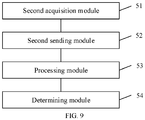
- FIG. 9 is a block diagram of a device for processing information based on radar waves according to an example.
- the device includes a second acquisition module 51 and a second sending module 52.
- the second acquisition module 51 is configured to acquire identification information of a user to which a second terminal (or called an attendee terminal) belongs.
- the second sending module 52 is configured to send a first radar signal including the identification information for the event.
- the first radar signal is used for a first terminal (or called host terminal) to acquire the identification information.
- the identification information is used for signature of the user corresponding to the identification information in the first terminal. That is, the identification information is used for recording an attendance signature of the user to the event in the host terminal.
- the device may further include: a processing module 53 configured, when a second radar signal returned by the first terminal based on the first radar signal is received, to start a predetermined mode for the event according to the second radar signal.
- a processing module 53 configured, when a second radar signal returned by the first terminal based on the first radar signal is received, to start a predetermined mode for the event according to the second radar signal.
- the predetermined mode for the event includes a silent mode or a conference mode.
- the processing module 53 is configured to start the silent mode or the conference mode in case of a second radar signal including first indication information.
- the processing module 53 is further configured to terminate the predetermined mode for the event in case of a second radar signal including second indication information.
- the device may further include: a determining module 54, which is configured to determine whether the second terminal enters a predetermined range of a target position based on a wireless signal positioning mode.
- the processing module 53 is further configured to start a radar sensor when the second terminal enters the predetermined range of the target position.
- the second terminal sends the first radar signal after the radar sensor is started.
- the embodiments of the disclosure further provide a first terminal, which includes:
- the first processor is configured to implement the method for processing information based on radar waves according to any embodiment applied to the first terminal in the disclosure when the executable instructions are executed.
- the first memory may include various types of storage media which are non-transitory computer storage media that can continue to memorize the information stored on a communication device after power off.
- the first processor may be coupled to the memory through a bus and the like to read executable programs stored on the memory, for example, to implement at least one of the method as illustrated in FIG. 1 or FIG. 3 .
- the embodiments of the disclosure further provide a second terminal, which includes:
- the second processor is configured to implement the method for processing information based on radar waves according to any embodiment applied to the second terminal in the disclosure when the executable instructions are executed.
- the second memory may include various types of storage media which are non-transitory computer storage media that can continue to memorize the information stored on a communication device after power off.
- the second processor may be coupled to the memory through a bus and the like to read executable programs stored on the memory, for example, to implement at least one of the method as illustrated in FIG. 4 or FIG. 5 .
- the embodiments of the disclosure further provide a computer-readable storage medium storing a computer program.
- the program is executed by a processor to implement the method for processing information based on radar waves according to any embodiment in the disclosure.
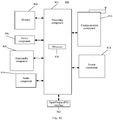
- FIG. 10 is a block diagram of a terminal 800 according to an example.
- the terminal 800 may be a mobile phone, a computer, a digital broadcast terminal, a messaging device, a gaming console, a tablet, a medical device, exercise equipment, a personal digital assistant, and the like.
- the terminal 800 may include one or more of the following components: a processing component 802, a memory 804, a power component 806, a multimedia component 808, an audio component 810, an input/output (I/O) interface 812, a sensor component 814, and a communication component 816.
- the processing component 802 typically controls overall operations of the terminal 800, such as operations associated with display, telephone calls, data communications, camera operations, and recording operations.
- the processing component 802 may include one or a plurality of processors 820 to execute instructions to complete all or part of the steps of the method described above.
- the processing component 802 may include one or a plurality of modules to facilitate interaction between the processing component 802 and other components.
- the processing component 802 may include a multimedia module to facilitate interaction between the multimedia component 808 and the processing component 802.
- the memory 804 is configured to store various types of data to support operations of the device 800. Examples of such data include instructions for any applications or methods operated on the terminal 800, contact data, phonebook data, messages, pictures, video, etc.
- the memory 804 may be implemented by any type of volatile or non-volatile memory devices, or a combination thereof, such as a static random access memory (SRAM), an electrically erasable programmable read-only memory (EEPROM), an erasable programmable read-only memory (EPROM), a programmable read-only memory (PROM), a read-only memory (ROM), a magnetic memory, a flash memory, a magnetic or optical disk.
- SRAM static random access memory
- EEPROM electrically erasable programmable read-only memory
- EPROM erasable programmable read-only memory
- PROM programmable read-only memory
- ROM read-only memory
- magnetic memory a magnetic memory
- flash memory a flash memory
- magnetic or optical disk a magnetic or optical disk
- the power component 806 provides power to various components of the terminal 800.
- the power component 806 may include a power management system, one or more power sources, and any other components associated with generation, management and distribution of power for the terminal 800.
- the multimedia component 808 includes a screen providing an output interface between the terminal 800 and a user.
- the screen may include a liquid crystal display (LCD) and a touch panel (TP). If the screen includes the TP, the screen may be implemented as a touch screen to receive an input signal from a user.
- the TP includes one or more touch sensors to sense touches, swipes, and gestures on the TP. The touch sensors may not only sense a boundary of a touch or swipe action, but also detect a period of time and a pressure associated with the touch or swipe operation.
- the multimedia component 808 includes a front camera and/or a rear camera.
- the front camera and/or the rear camera may receive external multimedia data when the device 800 is in an operation mode, such as a photographing mode or a video mode.
- an operation mode such as a photographing mode or a video mode.
- Each of the front camera and the rear camera may be a fixed optical lens system or may have focal lengths and optical zoom capabilities.
- the audio component 810 is configured to output and/or input audio signals.
- the audio component 810 includes a microphone (MIC) configured to receive an external audio signal when the terminal 800 is in an operation mode, such as a call mode, a recording mode, and a voice recognition mode.
- the received audio signals may further be stored in the memory 804 or sent via the communication component 816.
- the audio component 810 further includes a speaker configured to output the audio signals.
- the I/O interface 812 provides an interface between the processing component 802 and peripheral interface modules, such as a keyboard, a click wheel, buttons, and the like. These buttons may include, but are not limited to: a home button, a volume button, a starting button, and a locking button.
- the sensor component 814 includes one or more sensors configured to provide status assessments of various aspects of the terminal 800.
- the sensor component 814 may detect an on/off status of the device 800 and relative positioning of components, such as a display and small keyboard of the terminal 800, and the sensor component 814 may further detect a change in a position of the terminal 800 or a component of the terminal 800, the presence or absence of contact between a user and the terminal 800, the orientation or acceleration/deceleration of the terminal 800, and a change in temperature change of the terminal 800.
- the sensor component 814 may include a proximity sensor configured to detect presence of an object nearby without any physical contact.
- the sensor component 814 may also include a light sensor, such as a complementary metal oxide semiconductor (CMOS) or charge coupled device (CCD) image sensor, configured for use in an imaging application.
- CMOS complementary metal oxide semiconductor
- CCD charge coupled device
- the sensor component 814 may further include an acceleration sensor, a gyroscope sensor, a magnetic sensor, a pressure sensor, or a temperature sensor.
- the communication component 816 is configured to facilitate wired or wireless communication between the terminal 800 and other devices.
- the terminal 800 may access a communication-standard-based wireless network, such as a wireless fidelity (WiFi) network, a 2nd-generation (2G) or 3rd-generation (3G) network, or a combination thereof.
- the communication component 816 receives broadcast signals or broadcast associated information from an external broadcast management system via a broadcast channel.
- the communication component 816 further includes a near field communication (NFC) module to facilitate short-range communications.
- the NFC module may be implemented based on a radio frequency identification (RFID) technology, an infrared data association (IrDA) technology, an ultra-wide band (UWB) technology, a Bluetooth (BT) technology, and other technologies.
- RFID radio frequency identification
- IrDA infrared data association
- UWB ultra-wide band
- BT Bluetooth
- the terminal 800 may be implemented by one or more application specific integrated circuits (ASICs), digital signal processors (DSPs), digital signal processing devices (DSPDs), programmable logic devices (PLDs), field programmable gate arrays (FPGAs), controllers, micro-controllers, microprocessors, or other electronic components, and is configured to execute the above described methods.
- ASICs application specific integrated circuits
- DSPs digital signal processors
- DSPDs digital signal processing devices
- PLDs programmable logic devices
- FPGAs field programmable gate arrays
- controllers micro-controllers, microprocessors, or other electronic components, and is configured to execute the above described methods.
- non-transitory computer-readable storage medium including instructions, such as included in the memory 804, executable by the processor 820 of the terminal 800, for performing the above described methods.
- the non-transitory computer-readable storage medium may be an ROM, a random access memory (RAM), a compact disc read-only memory (CD-ROM), a magnetic tape, a floppy disk, an optical data storage device, and the like.
Landscapes
- Engineering & Computer Science (AREA)
- Radar, Positioning & Navigation (AREA)
- Remote Sensing (AREA)
- Physics & Mathematics (AREA)
- Computer Networks & Wireless Communication (AREA)
- General Physics & Mathematics (AREA)
- Electromagnetism (AREA)
- Signal Processing (AREA)
- General Engineering & Computer Science (AREA)
- Theoretical Computer Science (AREA)
- Telephone Function (AREA)
- Mobile Radio Communication Systems (AREA)
- Radar Systems Or Details Thereof (AREA)
Applications Claiming Priority (1)
| Application Number | Priority Date | Filing Date | Title |
|---|---|---|---|
| CN202010054603.5A CN113139631B (zh) | 2020-01-17 | 2020-01-17 | 一种基于雷达波的信息处理方法、装置、终端及存储介质 |
Publications (2)
| Publication Number | Publication Date |
|---|---|
| EP3851876A1 true EP3851876A1 (fr) | 2021-07-21 |
| EP3851876B1 EP3851876B1 (fr) | 2025-08-06 |
Family
ID=71130837
Family Applications (1)
| Application Number | Title | Priority Date | Filing Date |
|---|---|---|---|
| EP20181486.0A Active EP3851876B1 (fr) | 2020-01-17 | 2020-06-22 | Procédé et dispositif de traitement d'informations sur la base des ondes radar, terminal et support d'informations |
Country Status (3)
| Country | Link |
|---|---|
| US (1) | US11561278B2 (fr) |
| EP (1) | EP3851876B1 (fr) |
| CN (1) | CN113139631B (fr) |
Families Citing this family (2)
| Publication number | Priority date | Publication date | Assignee | Title |
|---|---|---|---|---|
| CN114051238A (zh) * | 2021-11-04 | 2022-02-15 | 珠海读书郎软件科技有限公司 | 一种智能设备建立绑定关系的方法 |
| CN114051239A (zh) * | 2021-11-04 | 2022-02-15 | 珠海读书郎软件科技有限公司 | 一种智能设备热点连接的方法 |
Citations (3)
| Publication number | Priority date | Publication date | Assignee | Title |
|---|---|---|---|---|
| US20070096885A1 (en) * | 2005-11-03 | 2007-05-03 | Yong-Hua Cheng | Inter-vehicle communication and warning apparatus |
| US20090148827A1 (en) * | 2007-12-05 | 2009-06-11 | At&T Delaware Intellectual Property, Inc. | Methods, systems, and computer program products for event attendance processing and attendee identification and related devices |
| WO2017207041A1 (fr) * | 2016-06-01 | 2017-12-07 | Sony Mobile Communications Inc. | Sondage radar utilisant des signaux pilotes |
Family Cites Families (15)
| Publication number | Priority date | Publication date | Assignee | Title |
|---|---|---|---|---|
| US7266383B2 (en) * | 2005-02-14 | 2007-09-04 | Scenera Technologies, Llc | Group interaction modes for mobile devices |
| US8275397B2 (en) * | 2005-07-14 | 2012-09-25 | Huston Charles D | GPS based friend location and identification system and method |
| US8793357B2 (en) * | 2011-04-02 | 2014-07-29 | Open Invention Network, Llc | System and method for persisting mobile agents within a mobile region of interest |
| JP2014045530A (ja) * | 2012-08-24 | 2014-03-13 | Sony Corp | 電子機器システム、及び、バッテリパック |
| US20140075348A1 (en) * | 2012-09-11 | 2014-03-13 | Nokia Corporation | Method and apparatus for associating event types with place types |
| US9516509B2 (en) * | 2013-05-22 | 2016-12-06 | Intel IP Corporation | Wireless communication in radar transmission channels |
| CN104268669B (zh) * | 2014-09-09 | 2021-01-08 | 惠州Tcl移动通信有限公司 | 一种利用ibeacons技术的会议管理方法及终端 |
| CN105005022A (zh) * | 2015-06-19 | 2015-10-28 | 上海美迪索科电子科技有限公司 | 一种基于射频及超声波的多模室内定位方法与装置 |
| EP3165944B1 (fr) * | 2015-11-04 | 2022-04-20 | Nxp B.V. | Authentification de communication intégrée |
| KR20180032041A (ko) * | 2016-09-21 | 2018-03-29 | 엘아이지넥스원 주식회사 | 전파 환경을 고려하여 레이더를 제어하기 위한 시스템 및 그 방법 |
| CN106780815A (zh) * | 2016-12-27 | 2017-05-31 | 珠海市魅族科技有限公司 | 一种基于地理位置的签到方法以及移动终端 |
| US20190126889A1 (en) * | 2017-11-02 | 2019-05-02 | Aptiv Technologies Limited | Hands-free access method |
| CN109151234A (zh) * | 2018-09-03 | 2019-01-04 | 中国联合网络通信集团有限公司 | 一种会议签到方法及其系统 |
| CN109842882B (zh) * | 2019-01-24 | 2020-12-11 | 珠海格力电器股份有限公司 | 基于雷达通讯的组网方法、装置、处理器及智能设备 |
| CN109992937B (zh) * | 2019-03-19 | 2021-04-13 | 北京小米移动软件有限公司 | 身份验证方法和身份验证装置 |
-
2020
- 2020-01-17 CN CN202010054603.5A patent/CN113139631B/zh active Active
- 2020-06-16 US US16/903,168 patent/US11561278B2/en active Active
- 2020-06-22 EP EP20181486.0A patent/EP3851876B1/fr active Active
Patent Citations (3)
| Publication number | Priority date | Publication date | Assignee | Title |
|---|---|---|---|---|
| US20070096885A1 (en) * | 2005-11-03 | 2007-05-03 | Yong-Hua Cheng | Inter-vehicle communication and warning apparatus |
| US20090148827A1 (en) * | 2007-12-05 | 2009-06-11 | At&T Delaware Intellectual Property, Inc. | Methods, systems, and computer program products for event attendance processing and attendee identification and related devices |
| WO2017207041A1 (fr) * | 2016-06-01 | 2017-12-07 | Sony Mobile Communications Inc. | Sondage radar utilisant des signaux pilotes |
Also Published As
| Publication number | Publication date |
|---|---|
| US11561278B2 (en) | 2023-01-24 |
| EP3851876B1 (fr) | 2025-08-06 |
| CN113139631B (zh) | 2024-06-11 |
| CN113139631A (zh) | 2021-07-20 |
| US20210223357A1 (en) | 2021-07-22 |
Similar Documents
| Publication | Publication Date | Title |
|---|---|---|
| EP3188066B1 (fr) | Procédé et appareil de gestion d'une application | |
| EP3125530A1 (fr) | Procédé et dispositif d'enregistrement vidéo | |
| EP3176709A1 (fr) | Procédé et appareil de catégorisation de vidéo, programme informatique et support d'enregistrement | |
| CN106919629B (zh) | 在群聊中实现信息筛选的方法及装置 | |
| US10230891B2 (en) | Method, device and medium of photography prompts | |
| US10334282B2 (en) | Methods and devices for live broadcasting based on live broadcasting application | |
| EP3024211A1 (fr) | Procédé et dispositif pour l'annonce d'appel vocal | |
| CN104980662A (zh) | 拍照过程中调整成像风格的方法、装置及摄像装置 | |
| EP3848762A1 (fr) | Procédé, appareil, dispositif et support d'informations pour commander un dispositif de compression de pâte | |
| CN112291631A (zh) | 信息获取方法、装置、终端及存储介质 | |
| CN113988814A (zh) | 会议室的管理方法及装置、电子设备和存储介质 | |
| CN114244640B (zh) | 会议预约界面的信息显示方法及装置、电子设备和介质 | |
| CN109325337A (zh) | 解锁方法及装置 | |
| EP3851876B1 (fr) | Procédé et dispositif de traitement d'informations sur la base des ondes radar, terminal et support d'informations | |
| CN109788367A (zh) | 一种信息提示方法、装置、电子设备及存储介质 | |
| CN105577523A (zh) | 消息发送方法及装置 | |
| EP3125514A1 (fr) | Procédé et dispositif de notification d'état | |
| CN105095213B (zh) | 信息关联方法及装置 | |
| CN109119075A (zh) | 语音识别场景唤醒方法及装置 | |
| US20170147593A1 (en) | Contact managing method and apparatus, and storage medium | |
| CN113704514B (zh) | 多媒体的播放显示方法及装置 | |
| CN106855818A (zh) | 设备模式切换方法和装置 | |
| CN104317480B (zh) | 字符按键显示方法、装置及终端 | |
| CN114138220A (zh) | 无线投屏方法及装置、电子设备和存储介质 | |
| CN107800849B (zh) | 联系对象身份设置方法及装置 |
Legal Events
| Date | Code | Title | Description |
|---|---|---|---|
| PUAI | Public reference made under article 153(3) epc to a published international application that has entered the european phase |
Free format text: ORIGINAL CODE: 0009012 |
|
| STAA | Information on the status of an ep patent application or granted ep patent |
Free format text: STATUS: THE APPLICATION HAS BEEN PUBLISHED |
|
| AK | Designated contracting states |
Kind code of ref document: A1 Designated state(s): AL AT BE BG CH CY CZ DE DK EE ES FI FR GB GR HR HU IE IS IT LI LT LU LV MC MK MT NL NO PL PT RO RS SE SI SK SM TR |
|
| STAA | Information on the status of an ep patent application or granted ep patent |
Free format text: STATUS: REQUEST FOR EXAMINATION WAS MADE |
|
| 17P | Request for examination filed |
Effective date: 20210804 |
|
| RBV | Designated contracting states (corrected) |
Designated state(s): AL AT BE BG CH CY CZ DE DK EE ES FI FR GB GR HR HU IE IS IT LI LT LU LV MC MK MT NL NO PL PT RO RS SE SI SK SM TR |
|
| STAA | Information on the status of an ep patent application or granted ep patent |
Free format text: STATUS: EXAMINATION IS IN PROGRESS |
|
| 17Q | First examination report despatched |
Effective date: 20220609 |
|
| GRAP | Despatch of communication of intention to grant a patent |
Free format text: ORIGINAL CODE: EPIDOSNIGR1 |
|
| STAA | Information on the status of an ep patent application or granted ep patent |
Free format text: STATUS: GRANT OF PATENT IS INTENDED |
|
| RIC1 | Information provided on ipc code assigned before grant |
Ipc: G01S 7/00 20060101ALI20250113BHEP Ipc: G01S 13/87 20060101ALI20250113BHEP Ipc: G01S 13/88 20060101AFI20250113BHEP |
|
| INTG | Intention to grant announced |
Effective date: 20250218 |
|
| GRAS | Grant fee paid |
Free format text: ORIGINAL CODE: EPIDOSNIGR3 |
|
| GRAA | (expected) grant |
Free format text: ORIGINAL CODE: 0009210 |
|
| STAA | Information on the status of an ep patent application or granted ep patent |
Free format text: STATUS: THE PATENT HAS BEEN GRANTED |
|
| AK | Designated contracting states |
Kind code of ref document: B1 Designated state(s): AL AT BE BG CH CY CZ DE DK EE ES FI FR GB GR HR HU IE IS IT LI LT LU LV MC MK MT NL NO PL PT RO RS SE SI SK SM TR |
|
| REG | Reference to a national code |
Ref country code: GB Ref legal event code: FG4D |
|
| REG | Reference to a national code |
Ref country code: CH Ref legal event code: EP |
|
| REG | Reference to a national code |
Ref country code: IE Ref legal event code: FG4D |
|
| REG | Reference to a national code |
Ref country code: DE Ref legal event code: R096 Ref document number: 602020055833 Country of ref document: DE |
|
| REG | Reference to a national code |
Ref country code: NL Ref legal event code: MP Effective date: 20250806 |
|
| PG25 | Lapsed in a contracting state [announced via postgrant information from national office to epo] |
Ref country code: IS Free format text: LAPSE BECAUSE OF FAILURE TO SUBMIT A TRANSLATION OF THE DESCRIPTION OR TO PAY THE FEE WITHIN THE PRESCRIBED TIME-LIMIT Effective date: 20251206 |
|
| PG25 | Lapsed in a contracting state [announced via postgrant information from national office to epo] |
Ref country code: NO Free format text: LAPSE BECAUSE OF FAILURE TO SUBMIT A TRANSLATION OF THE DESCRIPTION OR TO PAY THE FEE WITHIN THE PRESCRIBED TIME-LIMIT Effective date: 20251106 |
|
| REG | Reference to a national code |
Ref country code: LT Ref legal event code: MG9D |
|
| PG25 | Lapsed in a contracting state [announced via postgrant information from national office to epo] |
Ref country code: PT Free format text: LAPSE BECAUSE OF FAILURE TO SUBMIT A TRANSLATION OF THE DESCRIPTION OR TO PAY THE FEE WITHIN THE PRESCRIBED TIME-LIMIT Effective date: 20251209 |
|
| PG25 | Lapsed in a contracting state [announced via postgrant information from national office to epo] |
Ref country code: FI Free format text: LAPSE BECAUSE OF FAILURE TO SUBMIT A TRANSLATION OF THE DESCRIPTION OR TO PAY THE FEE WITHIN THE PRESCRIBED TIME-LIMIT Effective date: 20250806 |
|
| PG25 | Lapsed in a contracting state [announced via postgrant information from national office to epo] |
Ref country code: HR Free format text: LAPSE BECAUSE OF FAILURE TO SUBMIT A TRANSLATION OF THE DESCRIPTION OR TO PAY THE FEE WITHIN THE PRESCRIBED TIME-LIMIT Effective date: 20250806 Ref country code: NL Free format text: LAPSE BECAUSE OF FAILURE TO SUBMIT A TRANSLATION OF THE DESCRIPTION OR TO PAY THE FEE WITHIN THE PRESCRIBED TIME-LIMIT Effective date: 20250806 |
|
| PG25 | Lapsed in a contracting state [announced via postgrant information from national office to epo] |
Ref country code: GR Free format text: LAPSE BECAUSE OF FAILURE TO SUBMIT A TRANSLATION OF THE DESCRIPTION OR TO PAY THE FEE WITHIN THE PRESCRIBED TIME-LIMIT Effective date: 20251107 |
|
| PG25 | Lapsed in a contracting state [announced via postgrant information from national office to epo] |
Ref country code: SE Free format text: LAPSE BECAUSE OF FAILURE TO SUBMIT A TRANSLATION OF THE DESCRIPTION OR TO PAY THE FEE WITHIN THE PRESCRIBED TIME-LIMIT Effective date: 20250806 |
|
| PG25 | Lapsed in a contracting state [announced via postgrant information from national office to epo] |
Ref country code: LV Free format text: LAPSE BECAUSE OF FAILURE TO SUBMIT A TRANSLATION OF THE DESCRIPTION OR TO PAY THE FEE WITHIN THE PRESCRIBED TIME-LIMIT Effective date: 20250806 |
|
| PG25 | Lapsed in a contracting state [announced via postgrant information from national office to epo] |
Ref country code: PL Free format text: LAPSE BECAUSE OF FAILURE TO SUBMIT A TRANSLATION OF THE DESCRIPTION OR TO PAY THE FEE WITHIN THE PRESCRIBED TIME-LIMIT Effective date: 20250806 Ref country code: BG Free format text: LAPSE BECAUSE OF FAILURE TO SUBMIT A TRANSLATION OF THE DESCRIPTION OR TO PAY THE FEE WITHIN THE PRESCRIBED TIME-LIMIT Effective date: 20250806 |
|
| PG25 | Lapsed in a contracting state [announced via postgrant information from national office to epo] |
Ref country code: RS Free format text: LAPSE BECAUSE OF FAILURE TO SUBMIT A TRANSLATION OF THE DESCRIPTION OR TO PAY THE FEE WITHIN THE PRESCRIBED TIME-LIMIT Effective date: 20251106 |
|
| PG25 | Lapsed in a contracting state [announced via postgrant information from national office to epo] |
Ref country code: ES Free format text: LAPSE BECAUSE OF FAILURE TO SUBMIT A TRANSLATION OF THE DESCRIPTION OR TO PAY THE FEE WITHIN THE PRESCRIBED TIME-LIMIT Effective date: 20250806 |
|
| REG | Reference to a national code |
Ref country code: AT Ref legal event code: MK05 Ref document number: 1822470 Country of ref document: AT Kind code of ref document: T Effective date: 20250806 |
|
| PG25 | Lapsed in a contracting state [announced via postgrant information from national office to epo] |
Ref country code: SM Free format text: LAPSE BECAUSE OF FAILURE TO SUBMIT A TRANSLATION OF THE DESCRIPTION OR TO PAY THE FEE WITHIN THE PRESCRIBED TIME-LIMIT Effective date: 20250806 |
|
| PG25 | Lapsed in a contracting state [announced via postgrant information from national office to epo] |
Ref country code: DK Free format text: LAPSE BECAUSE OF FAILURE TO SUBMIT A TRANSLATION OF THE DESCRIPTION OR TO PAY THE FEE WITHIN THE PRESCRIBED TIME-LIMIT Effective date: 20250806 |
|
| PG25 | Lapsed in a contracting state [announced via postgrant information from national office to epo] |
Ref country code: AT Free format text: LAPSE BECAUSE OF FAILURE TO SUBMIT A TRANSLATION OF THE DESCRIPTION OR TO PAY THE FEE WITHIN THE PRESCRIBED TIME-LIMIT Effective date: 20250806 |
|
| PG25 | Lapsed in a contracting state [announced via postgrant information from national office to epo] |
Ref country code: IT Free format text: LAPSE BECAUSE OF FAILURE TO SUBMIT A TRANSLATION OF THE DESCRIPTION OR TO PAY THE FEE WITHIN THE PRESCRIBED TIME-LIMIT Effective date: 20250806 |
|
| PG25 | Lapsed in a contracting state [announced via postgrant information from national office to epo] |
Ref country code: CZ Free format text: LAPSE BECAUSE OF FAILURE TO SUBMIT A TRANSLATION OF THE DESCRIPTION OR TO PAY THE FEE WITHIN THE PRESCRIBED TIME-LIMIT Effective date: 20250806 |
|
| PG25 | Lapsed in a contracting state [announced via postgrant information from national office to epo] |
Ref country code: SK Free format text: LAPSE BECAUSE OF FAILURE TO SUBMIT A TRANSLATION OF THE DESCRIPTION OR TO PAY THE FEE WITHIN THE PRESCRIBED TIME-LIMIT Effective date: 20250806 Ref country code: EE Free format text: LAPSE BECAUSE OF FAILURE TO SUBMIT A TRANSLATION OF THE DESCRIPTION OR TO PAY THE FEE WITHIN THE PRESCRIBED TIME-LIMIT Effective date: 20250806 |