EP3851996A1 - Analyseverfahren und -vorrichtung zur optimierung des schwingungsverhaltens einer kraftfahrzeugkarosserie - Google Patents
Analyseverfahren und -vorrichtung zur optimierung des schwingungsverhaltens einer kraftfahrzeugkarosserie Download PDFInfo
- Publication number
- EP3851996A1 EP3851996A1 EP19860328.4A EP19860328A EP3851996A1 EP 3851996 A1 EP3851996 A1 EP 3851996A1 EP 19860328 A EP19860328 A EP 19860328A EP 3851996 A1 EP3851996 A1 EP 3851996A1
- Authority
- EP
- European Patent Office
- Prior art keywords
- optimization
- analysis
- automotive body
- block model
- load
- Prior art date
- Legal status (The legal status is an assumption and is not a legal conclusion. Google has not performed a legal analysis and makes no representation as to the accuracy of the status listed.)
- Pending
Links
Images






Classifications
-
- G—PHYSICS
- G01—MEASURING; TESTING
- G01M—TESTING STATIC OR DYNAMIC BALANCE OF MACHINES OR STRUCTURES; TESTING OF STRUCTURES OR APPARATUS, NOT OTHERWISE PROVIDED FOR
- G01M17/00—Testing of vehicles
- G01M17/007—Wheeled or endless-tracked vehicles
-
- G—PHYSICS
- G06—COMPUTING OR CALCULATING; COUNTING
- G06F—ELECTRIC DIGITAL DATA PROCESSING
- G06F30/00—Computer-aided design [CAD]
- G06F30/20—Design optimisation, verification or simulation
- G06F30/23—Design optimisation, verification or simulation using finite element methods [FEM] or finite difference methods [FDM]
-
- G—PHYSICS
- G06—COMPUTING OR CALCULATING; COUNTING
- G06F—ELECTRIC DIGITAL DATA PROCESSING
- G06F30/00—Computer-aided design [CAD]
- G06F30/20—Design optimisation, verification or simulation
-
- B—PERFORMING OPERATIONS; TRANSPORTING
- B62—LAND VEHICLES FOR TRAVELLING OTHERWISE THAN ON RAILS
- B62D—MOTOR VEHICLES; TRAILERS
- B62D65/00—Designing, manufacturing, e.g. assembling, facilitating disassembly, or structurally modifying motor vehicles or trailers, not otherwise provided for
- B62D65/005—Inspection and final control devices
-
- G—PHYSICS
- G01—MEASURING; TESTING
- G01M—TESTING STATIC OR DYNAMIC BALANCE OF MACHINES OR STRUCTURES; TESTING OF STRUCTURES OR APPARATUS, NOT OTHERWISE PROVIDED FOR
- G01M7/00—Vibration-testing of structures; Shock-testing of structures
- G01M7/02—Vibration-testing by means of a shake table
- G01M7/022—Vibration control arrangements, e.g. for generating random vibrations
-
- G—PHYSICS
- G01—MEASURING; TESTING
- G01M—TESTING STATIC OR DYNAMIC BALANCE OF MACHINES OR STRUCTURES; TESTING OF STRUCTURES OR APPARATUS, NOT OTHERWISE PROVIDED FOR
- G01M7/00—Vibration-testing of structures; Shock-testing of structures
- G01M7/02—Vibration-testing by means of a shake table
- G01M7/025—Measuring arrangements
-
- G—PHYSICS
- G06—COMPUTING OR CALCULATING; COUNTING
- G06F—ELECTRIC DIGITAL DATA PROCESSING
- G06F30/00—Computer-aided design [CAD]
- G06F30/10—Geometric CAD
-
- G—PHYSICS
- G06—COMPUTING OR CALCULATING; COUNTING
- G06F—ELECTRIC DIGITAL DATA PROCESSING
- G06F30/00—Computer-aided design [CAD]
- G06F30/10—Geometric CAD
- G06F30/15—Vehicle, aircraft or watercraft design
-
- G—PHYSICS
- G06—COMPUTING OR CALCULATING; COUNTING
- G06F—ELECTRIC DIGITAL DATA PROCESSING
- G06F30/00—Computer-aided design [CAD]
- G06F30/10—Geometric CAD
- G06F30/17—Mechanical parametric or variational design
-
- G—PHYSICS
- G06—COMPUTING OR CALCULATING; COUNTING
- G06F—ELECTRIC DIGITAL DATA PROCESSING
- G06F2111/00—Details relating to CAD techniques
- G06F2111/06—Multi-objective optimisation, e.g. Pareto optimisation using simulated annealing [SA], ant colony algorithms or genetic algorithms [GA]
-
- G—PHYSICS
- G06—COMPUTING OR CALCULATING; COUNTING
- G06F—ELECTRIC DIGITAL DATA PROCESSING
- G06F2111/00—Details relating to CAD techniques
- G06F2111/10—Numerical modelling
-
- G—PHYSICS
- G06—COMPUTING OR CALCULATING; COUNTING
- G06F—ELECTRIC DIGITAL DATA PROCESSING
- G06F2119/00—Details relating to the type or aim of the analysis or the optimisation
- G06F2119/14—Force analysis or force optimisation, e.g. static or dynamic forces
Definitions
- the present invention relates to an analysis method and apparatus for optimizing vibration performance of an automotive body of an automobile, which optimize vibration performance of a part of the automotive body to acquire an optimal shape that achieves weight reduction of the automotive body while at the same time improving dynamic stiffness of the part of the automotive body.
- Shape optimization in the present invention does not refer to assuming a predetermined shape such as a T shape and acquiring an optimal shape based on the predetermined shape, but refers to acquiring an optimal shape and arrangement that satisfy an analysis condition without assuming a predetermined shape.
- Indicators for stiffness of a structure include static stiffness and dynamic stiffness.
- the static stiffness of a structure is improved when a spring constant of the structure increases independently of a mass of the structure in accordance with Hooke's law.
- the dynamic stiffness of a structure is known to be influenced by its vibration performance when the shape of the structure changes periodically due to input of a load at an excitation point.
- the frequency ⁇ may not increase even when the stiffness K increases.
- the dynamic stiffness is not improved.
- it is effective to reduce the weight of the structure and improve the stiffness in order to improve the dynamic stiffness.
- the stiffness K also increases, which means that increase of the stiffness and weight reduction (reduction of mass M) contradict each other, resulting in extreme difficulty in achieving both thereof.
- many attempts have been made through trial and error to optimize the vibration performance of a structure and improve the dynamic stiffness.
- CAE analysis by computer aided engineering is an essential technology for design of an automotive body.
- the stiffness is known to be improved and the weight reduction is known to be achieved by using optimization technologies such as mathematical optimization, thickness optimization, shape optimization, and topology optimization, and for example, such optimization technologies are often used for structure optimization of a cast metal, for example, an engine block.
- Topology optimization is gradually attracting attention among the optimization technologies.
- Topology optimization is a method of providing a design space with a certain degree of size, incorporating a three-dimensional element into the design space, and securing a minimum necessary part of the three-dimensional element that satisfies a given condition, to thereby acquire an optimal shape that satisfies the given condition.
- a method of directly applying a constraint to three-dimensional elements forming the design space and directly applying a load is used as the topology optimization.
- Patent Literature 1 discloses a method for topology optimization of components of a complex structure as the technology relating to such topology optimization.
- Patent Literature 1 Japanese Patent Application Laid-open No. 2010-250818
- a driver or vehicle occupant feels a vibration phenomenon in a part (e.g., automotive-body parts) of an automotive body of an automobile until the frequency reaches about 30 Hz, which causes the driver or vehicle occupant to feel uncomfortable and also have trouble driving safely.
- a part e.g., automotive-body parts
- it is necessary to improve the dynamic stiffness of the part of the automotive body in order to achieve the frequency of 30 Hz or more.
- the frequency of an automotive body that is vibrating due to reception of an external force at an excitation point is represented by the static stiffness and mass of the automotive body, and for example, even when the thickness of the automotive body is increased to improve the static stiffness of the automotive body, the mass of the automotive-body parts increases, which prevents transition to a high-frequency region and results in a failure to improve the dynamic stiffness of the automotive-body parts.
- some automotive-body parts are desired to have such vibration performance as to prevent resonance with vibration of a part (e.g., engine) that exhibits vibration in an automobile.
- Patent Literature 1 relates to a physical system of a technique and analysis in terms of mathematical operation, and does not provide any solution to the above-mentioned problem. Thus, there is a demand for development of a technology for solving the above-mentioned problem.
- the present invention has been made in view of the above-mentioned problem, and has an object to provide an analysis method and apparatus for optimizing vibration performance of a part of an automotive body, and achieving both of improvement of dynamic stiffness of the part of the automotive body and weight reduction of the part of the automotive body.
- an analysis method is a method of optimizing vibration performance of an automotive body, the analysis method in which a computer performs each steps given below to optimize vibration performance of a part of the automotive body, the analysis method including: a vibration analysis step of acquiring a maximum displacement of vibration of the part of the automotive body by: applying a predetermined excitation condition to the part of the automotive body; and performing vibration analysis; a maximum displacement load acquisition step of acquiring a load required for applying a same displacement as the acquired maximum displacement, to the part of the automotive body; a design space setting step of setting a design space by setting a part or member that supports the part of the automotive body as an optimization target; an optimization block model generation step of generating an optimization block model formed of three-dimensional elements in the set design space; a combining processing step of generating an optimization analysis model by combining the generated optimization block model to the automotive body; and an optimization analysis step of acquiring an optimal shape of the optimization block model by: applying the load acquired in the maximum displacement load acquisition step as
- the optimization block model generation step sets a specific gravity of the optimization block model such that a mass of the optimization block model is equal to a mass of the part or member being the optimization target.
- the analysis method of optimizing vibration performance of an automotive body further includes a sensitivity analysis step of identifying the part or member being the optimization target by applying the load acquired in the maximum displacement load acquisition step as a load condition, and performing sensitivity analysis of the automotive body, wherein the design space setting step sets the design space for the part or member identified in the sensitivity analysis step.
- an analysis apparatus configured to optimize vibration performance of an automotive body, the analysis apparatus being configured to optimize vibration performance of a part of the automotive body, and includes: a vibration analysis unit configured to acquire a maximum displacement of the part of the automotive body by: applying a predetermined excitation condition to the part of the automotive body; and performing vibration analysis; a maximum displacement and load acquisition unit configured to acquire a load required for applying a same displacement as the acquired maximum displacement, to the part of the automotive body; a design space setting unit configured to set a design space by setting a part or member that supports the part of the automotive body as an optimization target; an optimization block model generation unit configured to generate an optimization block model formed of three-dimensional elements in the set design space; a combining processing unit configured generate an optimization analysis model by combining the generated optimization block model to the automotive body; and an optimization analysis unit configured to acquire an optimal shape of the optimization block model by: applying the load acquired by the maximum displacement load acquisition unit as a load condition; and performing optimization analysis for the optimization block model taking an inertial force that occurs in
- the optimization block model generation unit is configured to set a specific gravity of the optimization block model such that a mass of the optimization block model is equal to a mass of the part or member being the optimization target.
- the analysis apparatus configured to optimize vibration performance of an automotive body further includes a sensitivity analysis unit configured to identify the part or member being the optimization target by: applying the load acquired by the maximum displacement load acquisition unit as a load condition; and performing sensitivity analysis of the automotive body, wherein the design space setting unit is configured to set the design space for the part or member identified by the sensitivity analysis unit.
- a method which is executed by a computer through execution of each step given below to optimize vibration performance of a part of the automotive body, the method including: a vibration analysis step of performing vibration analysis by applying a predetermined excitation condition to the part of the automotive body, and acquiring a maximum displacement of vibration of the part of the automotive body; a maximum displacement load acquisition step of acquiring a load required for applying, to the part of the automotive body, the same displacement as the acquired maximum displacement; a design space setting step of setting a design space by setting a part or member that supports the part of the automotive body as an optimization target; an optimization block model generation step of generating an optimization block model formed of three-dimensional elements in the set design space; a combining processing step of combining the generated optimization block model to the automotive body, and generating an optimization analysis model; and an optimization analysis step of performing optimization analysis for the optimization block model in consideration of an inertial force that occurs in the part of the automotive body due to vibration by applying the load acquired in the maximum displacement load acquisition step as a load
- an automotive body 41 in the present embodiment includes an automotive body frame part such as A pillars 43, a dashboard 45, and a tunnel portion 47 of an automotive body floor, a steering wheel 49 being a part of the automotive body 41 for which vibration performance is to be optimized, a steering beam 51 being a part or member supporting the steering wheel 49, a bracket 53, connection sections 55, and a stay section 57.
- the steering wheel 49 is a part that is excited to vibrate, and in the present embodiment, as illustrated in FIG. 2 , the steering wheel 49 vibrates in a width direction (Y-axis direction in FIG. 2 ) and a vertical direction (Z-axis direction in FIG. 2 ) on a steering surface of the steering wheel 49 (surface orthogonal to rotation axis of steering wheel 49).
- the part or member supporting the steering wheel 49 supports the steering wheel 49 directly or indirectly, and is installed on a path that transmits vibration when the steering wheel 49 is excited.
- Both ends of the steering beam 51 are fixed to the A pillars 43 of the automotive body 41.
- One end of the bracket 53 is fixed to the dashboard 45 of the automotive body, and the other end of the bracket 53 is connected to the steering beam 51 (refer to FIG. 3 ).
- the connection sections 55 are used to connect fix both ends of the steering beam 51 to the A pillars 43.
- a lower end of the stay section 57 is connected and fixed to the tunnel portion 47 of the automotive body floor, and an upper end of the stay section 57 is connected to the steering beam 51.
- Each part or member described above is modeled by using two-dimensional elements and/or three-dimensional elements, the modeled element information and other information may be stored in an automotive body model file 31 (refer to FIG. 1 ) described later.
- vibration performance optimization analysis apparatus an analysis apparatus for optimizing vibration performance (hereinafter referred to as "vibration performance optimization analysis apparatus") of an automotive body according to the present embodiment.
- a vibration performance optimization analysis apparatus 1 is constructed by, for example, a personal computer, and includes a display device 3, an input device 5, a memory storage 7, a working data memory 9, and an arithmetic processing unit 11. Furthermore, the display device 3, the input device 5, the memory storage 7, and the working data memory 9 are connected to the arithmetic processing unit 11, and each function is executed in accordance with a command from the arithmetic processing unit 11.
- each configuration of the vibration performance optimization analysis apparatus 1 in a case where the shapes of the steering wheel 49 for which vibration performance is to be optimized and the bracket 53 being a part on the path that transmits vibration of the steering wheel 49, which are parts of the automotive body, are optimized for the automotive body 41 illustrated in FIG. 2 .
- the display device 3 is used for displaying an analysis result, for example, and is constructed by a liquid crystal monitor, for example.
- the input device 5 is used for giving an instruction to display the automotive body model file 31 or inputting a condition by an operator, for example, and is constructed by a keyboard or a mouse, for example.
- the memory storage 7 is used for storing various kinds of files such as the automotive body model file 31, for example, and is constructed by a hard disk, for example.
- the working data memory 9 is used for temporarily storing or calculating data to be used by the arithmetic processing unit 11, and is constructed by a random access memory (RAM), for example.
- RAM random access memory
- the arithmetic processing unit 11 includes a vibration analysis unit 13, a maximum displacement and load acquisition unit 15, a sensitivity analysis unit 17, a design space setting unit 19, an optimization block model generating unit 21, a combining processing unit 23, and an optimization analysis unit 25, and is constructed by a central processing unit (CPU), for example, a personal computer. Functions of those units are implemented through execution of a predetermined computer program by the CPU. In the following, description is given of the function of each unit of the arithmetic processing unit 11 described above.
- CPU central processing unit
- the vibration analysis unit 13 performs vibration analysis by applying a predetermined excitation condition to the steering wheel 49 in the automotive body 41, and acquires a maximum displacement of the steering wheel 49.
- the vibration analysis unit 13 uses frequency response analysis being one technique of vibration analysis.
- the frequency response analysis is to acquire response in a case where a sine-wave load constantly acts on a structure.
- a plurality of sine-wave frequencies and load amplitudes in respective sine-wave frequencies are given as an excitation condition to be applied to the steering wheel 49.
- an excitation condition Y excitation and Z excitation
- Y excitation and Z excitation as to cause the steering wheel 49 to vibrate in each of the Y direction and the Z direction is given.
- FIG. 4 represents an example of a result of the frequency response analysis.
- the horizontal axis represents the frequency of vibration
- the vertical axis represents the acceleration amplitude of each frequency.
- the maximum displacement and load acquisition unit 15 acquires a load required for applying, to the steering wheel 49, the same displacement as the maximum displacement of the steering wheel 49 acquired by the vibration analysis unit 13.
- frequency response analysis is performed for each of Y excitation and Z excitation, and the maximum displacement is acquired for each of the Y direction and the Z direction. Then, as illustrated in FIGS. 5 , loads (Y load and Z load) are acquired for Y excitation and Z excitation, respectively.
- the maximum displacement and load acquisition unit 15 may perform static analysis that considers a mass through use of an inertia relief method by changing a load to be applied to the steering wheel 49, for example, and acquire through trial and error a load that causes the same displacement as the maximum displacement acquired by the vibration analysis unit 13.
- the maximum displacement and load acquisition unit 15 may appropriately correct the rotational degree of freedom of the steering wheel 49 at a time when the load is applied in the excitation direction so as to cause the maximum displacement of the steering wheel 49 acquired by frequency response analysis to match the displacement of the steering wheel 49 at the time when the load is applied.
- the Y load and Z load to be applied to the steering wheel 49 as the load are both set to have one direction (Y load: rightward in automotive body width direction; Z load: downward in automotive body height direction). This is because there is no difference in absolute value of strain energy and stress acquired by optimization analysis described later even when the direction of applying the load is reversed, which also leads to no difference in result of optimization analysis.
- the sensitivity analysis unit 17 performs sensitivity analysis (e.g., refer to publicly known reference literature given below) of the automotive body 41 by applying the load acquired by the maximum displacement and load acquisition unit 15 as a load condition, and identifies a part or member being an optimization target.
- sensitivity analysis e.g., refer to publicly known reference literature given below
- the sensitivity analysis is to estimate an influence on the structural response of a structure (e.g., automotive body 41) to be analyzed by changing parameters such as a material property, geometric characteristics, and a boundary condition.
- a structure e.g., automotive body 41
- the sensitivity analysis unit 17 acquires the sensitivity of an objective function in optimization analysis as the influence on the structural response by setting, as parameters relating to the material property, design variables in optimization analysis by the optimization analysis unit 25 described later.
- topology optimization is executed by setting the element densities of elements (two-dimensional element and/or three-dimensional element) that model a part or member of the automotive body as design variables and setting minimization of the total sum of strain energies of the automotive body 41 being an objective function as an objective condition without setting the design space, to thereby acquire the element densities.
- the element densities acquired in this manner serve as an indicator representing the sensitivity to the stiffness of the automotive body 41.
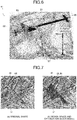
- FIG. 6 illustrates an example of a result of performing sensitivity analysis for the steering beam 51, the bracket 53, the connection sections 55, and the stay section 57, which are parts or members on the path that transmits vibration of the steering wheel 49.
- FIG. 6 represents a value of element densities showing sensitivity to stiffness in sensitivity analysis in a distribution map, and this means the fact that as the value of element densities becomes closer to 1.0, the sensitivity to performance becomes larger, whereas as the value of element densities becomes closer to 0, the sensitivity to performance becomes smaller. With this, it is possible to identify the bracket 53 as an optimization target because the sensitivity of the bracket 53 is higher than those of other parts or members.
- the design space setting unit 19 sets a design space with the part or member identified by the sensitivity analysis unit 17 serving as an optimization target.
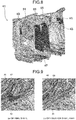
- FIGS. 7 illustrate examples of setting a design space 59 for the bracket 53 identified by the sensitivity analysis unit 17 as an optimization target.
- the design space 59 can be set in any manner based on the original shape of the bracket 53 and space between the bracket 53 and other parts around the bracket 53.
- the design space setting unit 19 is not limited to have such a configuration as to set the design space by setting the part or member identified by the sensitivity analysis unit 17 as an optimization target, and may identify any part or member as an optimization target to set the design space.
- design space setting unit 19 is not limited to have such a configuration as to set the design space for only one part or member.
- design spaces 63 may be set for the connection sections 55 and design spaces 65 may be set for the stay section 57 (refer to FIG. 2 ).
- the optimization block model generating unit 21 generates an optimization block model formed of three-dimensional elements in the design space set by the design space setting unit 19.
- FIG. 7(b) illustrates an example of generating an optimization block model 61 formed of three-dimensional elements in the design space 59 set for the bracket 53.
- the optimization block model generated by the optimization block model generating unit 21 is subjected to optimization analysis by the optimization analysis unit 25 described later, and in the process of optimization analysis, three-dimensional elements positioned at a portion that contributes less to improvement of stiffness are removed, and three-dimensional elements positioned at a portion that contributes more to improvement of stiffness remain.
- the optimization block model generated by the optimization block model generating unit 21 is preferred to be modeled by three-dimensional elements, which are a pentahedron, a hexahedron, a heptahedron, or an octahedron, and have at least one combination of two parallel surfaces. Furthermore, the optimization block model generating unit 21 is preferred to generate the optimization block model so that a surface parallel to surfaces around the design space 59 in the automotive body 41 has the maximum area.
- the optimization block model generating unit 21 may generate the optimization block model by arranging nodes at a portion connecting to two-dimensional elements and/or three-dimensional elements forming the automotive body, and stacking three-dimensional elements being a hexahedron along the surface parallel to surfaces around the design space 59.
- the combining processing unit 23 combines the optimization block model generated by the optimization block model generating unit 21 to the automotive body, and generates an optimization analysis model.
- the optimization block model and the automotive body may be combined by using rigid body elements or by sharing nodes.
- the optimization analysis unit 25 gives, as a load condition, the load acquired by the maximum displacement and load acquisition unit 15 to the optimization analysis model generated by the combining processing unit 23, performs optimization analysis by using the optimization block model as an optimization target in consideration of an inertial force that occurs at a part of the automotive body due to excitation, and acquires an optimal shape of the optimization block model.
- the optimization analysis unit 25 gives an objective condition, which is set in accordance with an object of optimization analysis, and limiting conditions to be imposed for optimization analysis, as optimization analysis conditions in optimization analysis.
- the objective condition is, for example, minimization of the total sum of strain energies, minimization of the displacement, minimization of the volume, or minimization of the mass in the optimization analysis model.
- the limiting conditions are, for example, a volume limiting fraction of the optimization block model being an optimization analysis target, or a displacement amount or stress of any node. A plurality of the limiting conditions can be set.
- the optimization analysis unit 25 uses the inertia relief method to consider an inertial force that occurs at a part of the automotive body due to excitation.
- the inertia relief method herein refers to an analysis technique of acquiring stress or strain based on a force acting on an object in uniformly accelerated motion under a free support state in which the object is supported at a supporting point serving as a criterion of coordinates of the inertial force. This method is used for static analysis of an airplane or ship in motion.
- Topology optimization can be applied as optimization analysis by the optimization analysis unit 25, for example.
- a penalty coefficient as the optimization parameter as shown in Expression (1) given below and perform discretization.
- penalty coefficients There are two or more penalty coefficients that are often used for discretization, and the values of penalty coefficients can be set appropriately.
- FIG. 9(a) illustrates an example of an optimal shape 67 of the optimization block model of the bracket 53 for which topology optimization is applied to the optimization analysis unit 25 in the present embodiment.
- the optimal shape 67 of the optimization block model is an optimization block model that remains in topology optimization, in which the load acquired by the maximum displacement and load acquisition unit 15 is given to the steering wheel 49 as the load condition, and minimization of the total sum of strain energies, which serves as an objective condition, and the volume limiting fraction being 20% or less, which serves as a limiting condition, are given as the optimization analysis condition.
- One end of the optimal shape 67 is connected to the dashboard 45, and the other end of the optimal shape 67 is in contact with and connected to half or more of the circumference surface on the front side of the automotive body of the steering beam 51.
- the optimal shape 67 of the optimization block model is acquired by securing and deleting three-dimensional elements so as to satisfy the above-mentioned analysis condition (load condition, objective condition, and limiting condition).
- FIG. 9(b) illustrates an optimization shape part 69, which imitates the optimal shape 67 of the optimization block model, and similarly to the optimal shape 67, the optimization shape part 69 is set to have such a shape that one end of the optimization shape part 69 is connected to the dashboard 45, and the other end of the optimization shape part 69 is in contact with and connected to half or more of the circumference surface on the front side of the automotive body of the steering beam 51.
- the optimization analysis unit 25 may perform topology optimization, or may perform optimization analysis by other calculation methods. Furthermore, for example, commercially available analysis software using a finite element method can be used as the optimization analysis unit 25.
- vibration performance optimization analysis method for optimizing vibration performance of an automotive body according to the present embodiment.
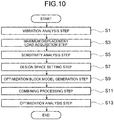
- the vibration performance optimization analysis method optimizes vibration performance of a part of the automotive body, and as illustrated in FIG. 10 , includes a vibration analysis step S1, a maximum displacement load acquisition step S3, a sensitivity analysis step S5, a design space setting step S7, an optimization block model generation step S9, a combining processing step S11, and an optimization analysis step S13.
- the vibration performance optimization analysis method according to the present embodiment is executed by using the vibration performance optimization analysis apparatus 1 (refer to FIG. 1 ) constructed by a computer to execute each step described above.
- the vibration analysis step S1 is a step of performing vibration analysis by applying a predetermined excitation condition to a part of the automotive body, and acquiring the maximum displacement of the part of the automotive body.
- the vibration analysis unit 13 of the vibration performance optimization analysis apparatus 1 performs vibration analysis by applying a predetermined excitation condition to the steering wheel 49 (refer to FIG. 2 ) being a part of the automotive body 41, and acquires the maximum displacement of the steering wheel 49.
- the maximum displacement load acquisition step S3 is a step of acquiring a load required for applying, to a part of the automotive body, the same displacement as the maximum displacement acquired in the vibration analysis step S1.
- the maximum displacement and load acquisition unit 15 of the vibration performance optimization analysis apparatus 1 acquires a load required for applying the same displacement as the maximum displacement of the steering wheel 49 acquired in the vibration analysis step S1.
- the sensitivity analysis step S5 is a step of performing sensitivity analysis of the automotive body by applying the load acquired in the maximum displacement load acquisition step S3 as a load condition, and identifying a part or member being an optimization target.
- the sensitivity analysis unit 17 of the vibration performance optimization analysis apparatus 1 performs sensitivity analysis of the automotive body 41 by applying the load acquired by the maximum displacement and load acquisition unit 15 as a load condition, and identifies the bracket 53 being a part having a high sensitivity as an optimization target as illustrated in FIG. 6 .
- the design space setting step S7 is a step of setting a design space for the part or member identified as an optimization target in the sensitivity analysis step S5.
- the design space setting unit 19 of the vibration performance optimization analysis apparatus 1 sets the design space 59 with the bracket 53 identified in the sensitivity analysis step S5 serving as an optimization target.
- the optimization block model generation step S9 is a step of generating an optimization block model formed of three-dimensional elements in the design space set in the design space setting step S7.
- the optimization block model generating unit 21 of the vibration performance optimization analysis apparatus 1 generates the optimization block model 61 in the design space 59 set for the bracket 53.
- the combining processing step S11 is a step of combining the optimization block model generated in the optimization block model generation step S9 to the automotive body, and generating an optimization analysis model.
- the combining processing unit 23 of the vibration performance optimization analysis apparatus 1 combines the optimization block model 61 generated in the optimization block model generation step S9 to the automotive body 41, and generates an optimization analysis model (not shown).
- the optimization analysis step S13 is a step of applying, as a load condition, the load acquired in the maximum displacement load acquisition step S3, performing optimization analysis for the optimization block model in consideration of an inertial force that occurs at a part of the automotive body due to excitation, and acquiring an optimal shape of the optimization block model.
- the optimization analysis unit 25 of the vibration performance optimization analysis apparatus 1 gives, as a load condition, the load acquired in the maximum displacement load acquisition step S3, performs optimization analysis for the optimization block model 61 of the bracket 53 in consideration of an inertial force that occurs at the steering wheel 49 due to excitation, and acquires the optimal shape 67 ( FIG. 9(a) ) of the optimization block model.
- an objective condition which is set in accordance with an object of optimization analysis, and limiting conditions to be imposed for optimization analysis, are given as optimization analysis conditions in optimization analysis.
- step S13 it is possible to consider an inertial force at the time of excitation of the steering wheel 49 by applying a load that causes the same displacement as the maximum displacement of vibration of the steering wheel 49 due to the excitation, and applying the inertia relief method in optimization analysis.
- Topology optimization can be applied as optimization analysis in the optimization analysis step S13, for example.
- the density method is applied in topology optimization, it is preferred to set two or more penalty coefficients given as the optimization parameter and perform discretization.
- Optimization analysis processing by other calculation methods can be applied as optimization analysis in the optimization analysis step S13, and for example, commercially available analysis software using a finite element method can also be used for the optimization analysis processing.
- the analysis method and apparatus for optimizing vibration performance of an automotive body performs sensitivity analysis of the automotive body, and identifies the bracket as a part being an optimization target.
- optimization analysis may be performed by setting an appropriately selected part as an optimization target without performing sensitivity analysis.
- the mass of the optimization block model generated by the optimization block model generating unit 21 or in the optimization block model generation step S9 is equal to the mass of the part or member being an optimization target.
- the steering wheel is set as a part that vibrates in response to vibration of the automotive body
- the bracket is set as a part that transmits vibration of the steering wheel.
- the present invention is not limited thereto, and the present invention can be applied without particular limitation as long as a part for which vibration performance is to be optimized and a part or member on a path that transmits vibration of the part are used.
- the automotive body 41 the steering wheel 49 being a part of the automotive body 41 to be excited
- the steering beam 51 supporting the steering wheel 49 the bracket 53, the connection sections 55, and the stay section 57 as illustrated in FIG. 2 are set as analysis targets to perform vibration analysis, sensitivity analysis, and optimization analysis of the shape.
- a predetermined excitation condition was given to the steering wheel 49 to perform vibration analysis.
- vibration (Y excitation) in the width direction and vibration (Z excitation) in the vertical direction on the steering surface of the steering wheel 49 were given as excitation conditions.
- FIG. 11 and FIG. 12 illustrate the maximum displacements of the steering wheel 49 for Y excitation and Z excitation, respectively.
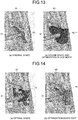
- FIG. 7(a) the design space 59 was set for the bracket 53, and further, as illustrated in FIGS. 13 , the design space 63 was set for the one connection section 55.
- FIG. 13(a) illustrates the original shape of the connection section 55
- FIG. 13(b) illustrates the design space 63 set for the connection section 55.
- the original shapes of the bracket 53 and the connection section 55 imitated shapes generally used for attachment to the automotive body 41 of the steering beam 51.
- the original shape of the bracket 53 is a shape that supports the steering beam 51 by suspending the steering beam 51 from the above
- the original shape of the connection section 55 is a shape that sandwiches the end portion of the steering beam 51 in two directions around the axis.
- bracket 53 and the connection section 55 were set as optimization analysis targets.
- the optimization block model 61 ( FIG. 7(b) ) and an optimization block model 71 ( FIG. 13(b) ) were generated for the set design space 59 and design space 63, respectively. Then, the generated optimization block model 61 and optimization block model 71 were each combined to the automotive body 41 to generate an optimization analysis model (not shown).
- a load condition and an optimization analysis condition were given to the generated optimization analysis model to perform optimization analysis.
- loads Y load and Z load
- minimization of the total sum of strain energies was given an objective condition, and the volume limiting fraction being 20% or less was given as a limiting condition.
- FIGS. 9 illustrate the optimal shape 67 of the optimization block model acquired for the bracket 53
- FIG. 14(a) illustrates an optimal shape 73 of the optimization block model acquired for the connection section 55.
- the optimization shape part 69 illustrated in FIG. 9(b) and an optimization shape part 75 illustrated in FIG. 14(b) were determined for the optimal shape 67 ( FIG. 9(a) ) and the optimal shape 73 ( FIG. 14(a) ) of the optimization block model, respectively, and vibration performance of the automotive body 41 to which the determined optimization shape part 69 and optimization shape part 75 were applied was evaluated.
- the optimization shape part 75 for the connection section 55 imitated the optimal shape 73 of the optimization block model, and similarly to the optimal shape 73, and the optimization shape part 75 was set so that the one end portion of the steering beam 51 was connected to the one A pillar 43 in a fixed manner so as to be supported in three directions around the axis.
- frequency response analysis at a time when a predetermined excitation condition was given to the steering wheel 49 of the automotive body 41 was performed to evaluate vibration performance by a frequency for which the acceleration has a peak in frequency response acquired by the frequency response analysis.
- the excitation condition in frequency response analysis was set as the same condition as that of frequency response analysis of acquiring the maximum displacement, and was given to the steering wheel 49 in each of the Y direction and the Z direction.
- the excitation condition was set as a condition generally applied in evaluation of vibration performance of the steering wheel 49, and a frequency to be given to the steering wheel 49 being an excitation point and a load amplitude in that frequency were set in frequency response analysis.
- an invention that uses the optimization shape part 69 ( FIG. 9(b) ) of the bracket 53 was set as a first example of the invention, and an invention that uses the optimization shape part 69 of the bracket 53 and the optimization shape part 75 ( FIG. 14(b) ) of the connection section 55 in the width direction was set as a second example of the invention. Furthermore, an invention that uses the bracket 53 and the connection section 55 having original shapes was set as a reference example.
- FIG. 15 represents frequency response (horizontal axis: frequency; vertical axis: acceleration) in a case where Y excitation was given as the excitation condition, and the acceleration exhibited a peak value at the frequency of 35.1 Hz.
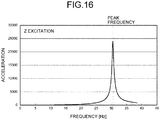
- FIG. 16 represents frequency response (horizontal axis: frequency; vertical axis: acceleration) in a case where Z excitation was given as the excitation condition, and the acceleration exhibited a peak value at the frequency of 30.5 Hz.
- FIG. 17 represents a result of the peak frequency in a case where Y excitation was given as the excitation condition
- FIG. 18 represents a result of the peak frequency in a case where Z excitation was given as the excitation condition.
- the peak frequency of the first example of the invention in which the shape of the bracket 53 was optimized has increased in both the cases of Y excitation and Z excitation.
- the peak frequency of the second example of the invention in which the shape of the connection section 55 was optimized together with the bracket 53 has increased more compared with the reference example, with the result that the peak frequency has increased by 7.4 Hz in Y excitation and the peak frequency has increased by 4.6 Hz in Z excitation.
- the weight was reduced by 121 g compared with the original shape in the second example of the invention.
- results of the first example of the invention and the second example of the invention shown in FIG. 17 and FIG. 18 represent the fact that the frequency of the steering was optimized to the frequency of about 30 Hz or more, which is felt by a person (driver), and the dynamic stiffness (firm feeling) has improved.
- the thickness of a part or all of the steering beam 51, the bracket 53, and the connection sections 55 on the path that transmits vibration of the steering wheel 49 was increased by a value illustrated in FIG. 19 compared with that of the original shape of each part or member.
- the analysis method and apparatus for optimizing vibration performance of an automotive body acquires the optimal shape of a part or member on the path that transmits vibration of a part of the automotive body, to thereby optimize the vibration performance of the part of the automotive body and achieve both of improvement of dynamic stiffness of the part of the automotive body and weight reduction of the part of the automotive body.
- the present invention it is possible to provide an analysis method and apparatus for optimizing vibration performance of a part of an automotive body, and achieving both of improvement of dynamic stiffness of the part of the automotive body and weight reduction of the part of the automotive body.
Landscapes
- Engineering & Computer Science (AREA)
- Physics & Mathematics (AREA)
- General Physics & Mathematics (AREA)
- Geometry (AREA)
- Theoretical Computer Science (AREA)
- General Engineering & Computer Science (AREA)
- Evolutionary Computation (AREA)
- Computer Hardware Design (AREA)
- Mathematical Analysis (AREA)
- Pure & Applied Mathematics (AREA)
- Computational Mathematics (AREA)
- Mathematical Optimization (AREA)
- Aviation & Aerospace Engineering (AREA)
- Automation & Control Theory (AREA)
- Transportation (AREA)
- Combustion & Propulsion (AREA)
- Chemical & Material Sciences (AREA)
- Manufacturing & Machinery (AREA)
- Mechanical Engineering (AREA)
- Measurement Of Mechanical Vibrations Or Ultrasonic Waves (AREA)
- Vehicle Body Suspensions (AREA)
- Testing Of Devices, Machine Parts, Or Other Structures Thereof (AREA)
- Automobile Manufacture Line, Endless Track Vehicle, Trailer (AREA)
Applications Claiming Priority (2)
| Application Number | Priority Date | Filing Date | Title |
|---|---|---|---|
| JP2018172104A JP6614301B1 (ja) | 2018-09-14 | 2018-09-14 | 車体の振動特性の適正化解析方法及び装置 |
| PCT/JP2019/022552 WO2020054153A1 (ja) | 2018-09-14 | 2019-06-06 | 車体の振動特性の適正化解析方法及び装置 |
Publications (2)
| Publication Number | Publication Date |
|---|---|
| EP3851996A1 true EP3851996A1 (de) | 2021-07-21 |
| EP3851996A4 EP3851996A4 (de) | 2021-10-06 |
Family
ID=68763390
Family Applications (1)
| Application Number | Title | Priority Date | Filing Date |
|---|---|---|---|
| EP19860328.4A Pending EP3851996A4 (de) | 2018-09-14 | 2019-06-06 | Analyseverfahren und -vorrichtung zur optimierung des schwingungsverhaltens einer kraftfahrzeugkarosserie |
Country Status (7)
| Country | Link |
|---|---|
| US (1) | US12093612B2 (de) |
| EP (1) | EP3851996A4 (de) |
| JP (1) | JP6614301B1 (de) |
| KR (1) | KR102543096B1 (de) |
| CN (1) | CN112673375B (de) |
| MX (1) | MX2021002966A (de) |
| WO (1) | WO2020054153A1 (de) |
Families Citing this family (13)
| Publication number | Priority date | Publication date | Assignee | Title |
|---|---|---|---|---|
| CN112182777B (zh) * | 2020-10-27 | 2022-08-09 | 中国运载火箭技术研究院 | 仪器支架的动特性分析方法、系统、终端及介质 |
| CN112257189B (zh) * | 2020-11-12 | 2023-12-15 | 湖北汽车工业学院 | 一种客车骨架轻量化的多学科优化方法 |
| JP7327424B2 (ja) * | 2021-02-09 | 2023-08-16 | Jfeスチール株式会社 | 自動車の車体部品の板厚感度解析方法、板厚感度解析装置及び板厚感度解析プログラム |
| CN113239558B (zh) * | 2021-05-21 | 2022-12-20 | 中国工程物理研究院总体工程研究所 | 一种机理与数据联合驱动的运输振动建模方法 |
| CN113468662B (zh) * | 2021-06-25 | 2022-06-03 | 重庆长安汽车股份有限公司 | 采用敲击指数曲面评价变速器齿轮敲击水平的方法 |
| CN114491815B (zh) * | 2022-01-25 | 2024-11-12 | 岚图汽车科技有限公司 | 汽车转向系统的刚度判定方法、装置、终端设备及介质 |
| JP7820639B2 (ja) * | 2022-02-22 | 2026-02-26 | 日本製鉄株式会社 | 構造体設計支援装置、構造体設計支援方法及び構造体設計支援プログラム |
| CN115062500B (zh) * | 2022-04-18 | 2025-09-19 | 南京航空航天大学 | 分布式随机激励下结构振动响应分析方法 |
| CN114912199B (zh) * | 2022-05-18 | 2024-09-20 | 南京航空航天大学 | 一种基于解耦分析策略的翼伞最大开伞动载快速预测方法 |
| JP7666427B2 (ja) * | 2022-07-08 | 2025-04-22 | Jfeスチール株式会社 | 自動車車体設計方法、装置及びプログラム、並びに自動車車体の製造方法 |
| JP7513134B1 (ja) | 2023-02-09 | 2024-07-09 | Jfeスチール株式会社 | 自動車車体設計方法、装置及びプログラム、並びに自動車車体の製造方法 |
| CN116861588B (zh) * | 2023-07-06 | 2024-06-25 | 小米汽车科技有限公司 | 仪表板横梁的设计方法、装置、电子设备及可读存储介质 |
| CN118468723B (zh) * | 2024-05-29 | 2025-09-26 | 中国船舶科学研究中心 | 一种基于粒子群算法的船舶管路支撑优化设计方法 |
Family Cites Families (14)
| Publication number | Priority date | Publication date | Assignee | Title |
|---|---|---|---|---|
| EP1524613A1 (de) | 2003-10-15 | 2005-04-20 | Rieter Technologies A.G. | Optimierungsverfahren zur Schwingungsdämpfung |
| GB0507618D0 (en) * | 2005-04-15 | 2005-05-25 | Lms Internat Nv | Method and system for dynamic analysis of complex systems |
| US8126684B2 (en) * | 2009-04-10 | 2012-02-28 | Livermore Software Technology Corporation | Topology optimization for designing engineering product |
| JP5810702B2 (ja) * | 2011-07-20 | 2015-11-11 | Jfeスチール株式会社 | 形状最適化解析方法及び装置 |
| CN102867075B (zh) * | 2012-06-11 | 2015-01-07 | 浙江吉利汽车研究院有限公司杭州分公司 | 基于加速度频率响应分析的车身地板优化设计方法 |
| JP5585672B2 (ja) * | 2013-02-01 | 2014-09-10 | Jfeスチール株式会社 | 形状最適化解析方法及び装置 |
| JP6606336B2 (ja) | 2015-03-11 | 2019-11-13 | 株式会社Subaru | 装備品懸架部材の設計方法 |
| JP6090400B1 (ja) | 2015-09-28 | 2017-03-08 | Jfeスチール株式会社 | 車体の剛性解析方法 |
| JP6477411B2 (ja) * | 2015-10-20 | 2019-03-06 | トヨタ自動車株式会社 | 解析プログラム |
| JP6222302B1 (ja) * | 2016-07-05 | 2017-11-01 | Jfeスチール株式会社 | 車体の接合位置の最適化解析方法及び装置 |
| CN106202693B (zh) | 2016-07-06 | 2019-03-22 | 厦门大学 | 一种基于参数化建模的加筋壁板结构抗振动疲劳优化方法 |
| JP6278087B1 (ja) * | 2016-10-04 | 2018-02-14 | Jfeスチール株式会社 | 車体の接合位置の最適化解析方法及び装置 |
| JP6583309B2 (ja) | 2017-02-24 | 2019-10-02 | Jfeスチール株式会社 | 車体の補強部材の形状最適化方法及び装置 |
| CN107403040B (zh) | 2017-07-14 | 2020-07-10 | 山东理工大学 | 一种基于振动能量传递的轮毂电机驱动车辆减振设计方法 |
-
2018
- 2018-09-14 JP JP2018172104A patent/JP6614301B1/ja active Active
-
2019
- 2019-06-06 US US17/260,701 patent/US12093612B2/en active Active
- 2019-06-06 CN CN201980058791.4A patent/CN112673375B/zh active Active
- 2019-06-06 WO PCT/JP2019/022552 patent/WO2020054153A1/ja not_active Ceased
- 2019-06-06 KR KR1020217009666A patent/KR102543096B1/ko active Active
- 2019-06-06 MX MX2021002966A patent/MX2021002966A/es unknown
- 2019-06-06 EP EP19860328.4A patent/EP3851996A4/de active Pending
Also Published As
| Publication number | Publication date |
|---|---|
| MX2021002966A (es) | 2021-05-12 |
| US12093612B2 (en) | 2024-09-17 |
| CN112673375B (zh) | 2024-03-29 |
| CN112673375A (zh) | 2021-04-16 |
| WO2020054153A1 (ja) | 2020-03-19 |
| JP6614301B1 (ja) | 2019-12-04 |
| EP3851996A4 (de) | 2021-10-06 |
| JP2020046185A (ja) | 2020-03-26 |
| US20210279383A1 (en) | 2021-09-09 |
| KR20210047946A (ko) | 2021-04-30 |
| KR102543096B1 (ko) | 2023-06-13 |
Similar Documents
| Publication | Publication Date | Title |
|---|---|---|
| US12093612B2 (en) | Analysis method and apparatus for optimizing vibration performance of automotive body | |
| KR102473091B1 (ko) | 차체 부품의 감도 해석 방법 및 장치, 차체 부품의 재료 특성 결정 방법 | |
| US12091095B2 (en) | Automotive body adhesive bonding position optimization analysis method and optimization analysis device | |
| US20100299107A1 (en) | Acoustic analysis apparatus for vehicle | |
| EP3699786A1 (de) | Formoptimierungsanalyseverfahren für geschichtetes verbundelement und formoptimierungsanalysevorrichtung | |
| EP4145329A1 (de) | Verfahren zur analyse der optimierung der fahrzeugkarosserieverbindungsposition und vorrichtung | |
| JP7099561B1 (ja) | 車体部品の分割位置及び一体化の決定方法及び装置 | |
| EP4148408A1 (de) | Analyseverfahren und -vorrichtung zur optimierung der fahrzeugkarosserieadhäsionsposition | |
| EP4140859B1 (de) | Verfahren und vorrichtung zur optimierung der analyse der verbindungsposition in einer kraftfahrzeugkarosserie | |
| US20240427950A1 (en) | Method and apparatus for weight reduction of automotive body | |
| JP2007298324A (ja) | 振動解析システム | |
| CN118070580A (zh) | 基于matlab的复杂结构动力学计算方法 | |
| JP2008059274A (ja) | 振動解析システム | |
| JP2020044857A (ja) | ステアリング支持構造 |
Legal Events
| Date | Code | Title | Description |
|---|---|---|---|
| STAA | Information on the status of an ep patent application or granted ep patent |
Free format text: STATUS: THE INTERNATIONAL PUBLICATION HAS BEEN MADE |
|
| PUAI | Public reference made under article 153(3) epc to a published international application that has entered the european phase |
Free format text: ORIGINAL CODE: 0009012 |
|
| STAA | Information on the status of an ep patent application or granted ep patent |
Free format text: STATUS: REQUEST FOR EXAMINATION WAS MADE |
|
| 17P | Request for examination filed |
Effective date: 20210330 |
|
| AK | Designated contracting states |
Kind code of ref document: A1 Designated state(s): AL AT BE BG CH CY CZ DE DK EE ES FI FR GB GR HR HU IE IS IT LI LT LU LV MC MK MT NL NO PL PT RO RS SE SI SK SM TR |
|
| A4 | Supplementary search report drawn up and despatched |
Effective date: 20210907 |
|
| RIC1 | Information provided on ipc code assigned before grant |
Ipc: G06F 119/14 20200101ALN20210901BHEP Ipc: G06F 111/10 20200101ALN20210901BHEP Ipc: G06F 30/15 20200101ALI20210901BHEP Ipc: G06F 30/23 20200101ALI20210901BHEP Ipc: G06F 30/10 20200101AFI20210901BHEP |
|
| DAV | Request for validation of the european patent (deleted) | ||
| DAX | Request for extension of the european patent (deleted) | ||
| STAA | Information on the status of an ep patent application or granted ep patent |
Free format text: STATUS: EXAMINATION IS IN PROGRESS |
|
| 17Q | First examination report despatched |
Effective date: 20240709 |