EP3852072A1 - Procédé de contrôle d'accès pour personnes et véhicules et système de mise en uvre du procédé - Google Patents
Procédé de contrôle d'accès pour personnes et véhicules et système de mise en uvre du procédé Download PDFInfo
- Publication number
- EP3852072A1 EP3852072A1 EP20152693.6A EP20152693A EP3852072A1 EP 3852072 A1 EP3852072 A1 EP 3852072A1 EP 20152693 A EP20152693 A EP 20152693A EP 3852072 A1 EP3852072 A1 EP 3852072A1
- Authority
- EP
- European Patent Office
- Prior art keywords
- access control
- data carrier
- access
- control device
- beacons
- Prior art date
- Legal status (The legal status is an assumption and is not a legal conclusion. Google has not performed a legal analysis and makes no representation as to the accuracy of the status listed.)
- Granted
Links
Images
Classifications
-
- G—PHYSICS
- G07—CHECKING-DEVICES
- G07C—TIME OR ATTENDANCE REGISTERS; REGISTERING OR INDICATING THE WORKING OF MACHINES; GENERATING RANDOM NUMBERS; VOTING OR LOTTERY APPARATUS; ARRANGEMENTS, SYSTEMS OR APPARATUS FOR CHECKING NOT PROVIDED FOR ELSEWHERE
- G07C9/00—Individual registration on entry or exit
- G07C9/20—Individual registration on entry or exit involving the use of a pass
- G07C9/22—Individual registration on entry or exit involving the use of a pass in combination with an identity check of the pass holder
-
- B—PERFORMING OPERATIONS; TRANSPORTING
- B60—VEHICLES IN GENERAL
- B60R—VEHICLES, VEHICLE FITTINGS, OR VEHICLE PARTS, NOT OTHERWISE PROVIDED FOR
- B60R25/00—Fittings or systems for preventing or indicating unauthorised use or theft of vehicles
- B60R25/20—Means to switch the anti-theft system on or off
- B60R25/24—Means to switch the anti-theft system on or off using electronic identifiers containing a code not memorised by the user
- B60R25/245—Means to switch the anti-theft system on or off using electronic identifiers containing a code not memorised by the user where the antenna reception area plays a role
-
- B—PERFORMING OPERATIONS; TRANSPORTING
- B60—VEHICLES IN GENERAL
- B60R—VEHICLES, VEHICLE FITTINGS, OR VEHICLE PARTS, NOT OTHERWISE PROVIDED FOR
- B60R25/00—Fittings or systems for preventing or indicating unauthorised use or theft of vehicles
- B60R25/30—Detection related to theft or to other events relevant to anti-theft systems
- B60R25/33—Detection related to theft or to other events relevant to anti-theft systems of global position, e.g. by providing GPS coordinates
-
- G—PHYSICS
- G07—CHECKING-DEVICES
- G07C—TIME OR ATTENDANCE REGISTERS; REGISTERING OR INDICATING THE WORKING OF MACHINES; GENERATING RANDOM NUMBERS; VOTING OR LOTTERY APPARATUS; ARRANGEMENTS, SYSTEMS OR APPARATUS FOR CHECKING NOT PROVIDED FOR ELSEWHERE
- G07C9/00—Individual registration on entry or exit
- G07C9/10—Movable barriers with registering means
- G07C9/15—Movable barriers with registering means with arrangements to prevent the passage of more than one individual at a time
-
- B—PERFORMING OPERATIONS; TRANSPORTING
- B60—VEHICLES IN GENERAL
- B60R—VEHICLES, VEHICLE FITTINGS, OR VEHICLE PARTS, NOT OTHERWISE PROVIDED FOR
- B60R2325/00—Indexing scheme relating to vehicle anti-theft devices
- B60R2325/10—Communication protocols, communication systems of vehicle anti-theft devices
- B60R2325/101—Bluetooth®
-
- G—PHYSICS
- G07—CHECKING-DEVICES
- G07C—TIME OR ATTENDANCE REGISTERS; REGISTERING OR INDICATING THE WORKING OF MACHINES; GENERATING RANDOM NUMBERS; VOTING OR LOTTERY APPARATUS; ARRANGEMENTS, SYSTEMS OR APPARATUS FOR CHECKING NOT PROVIDED FOR ELSEWHERE
- G07C2209/00—Indexing scheme relating to groups G07C9/00 - G07C9/38
- G07C2209/60—Indexing scheme relating to groups G07C9/00174 - G07C9/00944
- G07C2209/63—Comprising locating means for detecting the position of the data carrier, i.e. within the vehicle or within a certain distance from the vehicle
Definitions
- the present invention relates to a method for access control for people and vehicles according to the preamble of claim 1.
- the invention also relates to a system for carrying out the method according to the invention.
- the present invention is based on the object of specifying a method for access control in an access control system for people or vehicles comprising at least one access control device, in the context of which access authorization is checked based on the evaluation of an ID sent from a data carrier via a standard for wireless communication to an access control device , to which at least one access authorization is clearly assigned, takes place, through the implementation of which the access control is simplified.
- a "hands-free" access control is to be made possible, whereby separation and collision problems with data carriers of people or vehicles standing in line are avoided and a reliable lane or access separation is guaranteed in the case of multi-lane access.
- the data carrier located closest to an access control device in the access direction is to be determined in order to then evaluate the ID sent by this data carrier, to which at least one access authorization is clearly assigned, and to grant access if the access authorization is valid.
- a method for access control in an access control system for persons or vehicles comprising at least one access control device, each access control device each having at least one antenna, the checking of an access authorization based on the evaluation of at least one of a data carrier using a first standard for wireless communication in one Advertising mode takes place at regular intervals sent to an access control device beacons, which an ID that is uniquely assigned to at least one access authorization and contains a unique identifier of the data carrier.
- the beacons sent by the data carriers each additionally contain a beacon ID that is unique for the respective data carrier sending the beacon, whereby the combination of the unique identifier of the data carrier and the unique beacon ID for the data carrier provides a unique identification of each transmitted Beacons from any data carrier is enabled.
- the beacon ID is unique for the respective data carrier sending the beacon and for a predetermined time interval, for example for a predetermined number of minutes or hours from the start of the transmission process, so that the combination of the unique identifier of the data carrier and the Beacon ID enables a unique identification of each beacon transmitted from each data carrier within the specified time interval.
- the specified time interval can correspond to the average time required for access control in an access control system for vehicles or, in the case of a ski area, to the maximum length of stay in the ski area plus a preferably applicable offset.
- the identification and localization of the data carriers is carried out by evaluating the RSSIs (Received Signal Strength Indicator) sent by the data carriers Beacons carried out on the at least one antenna of an access control device, whereby the data carrier located closest to an access control device in the access direction is determined and the ID sent by this data carrier, to which at least one access authorization is clearly assigned, is evaluated in order to grant access if the access authorization is valid.
- RSSIs Receiveived Signal Strength Indicator
- the unique identification of each beacon transmitted from each data carrier through the combination of the unique identifier of the data carrier and the unique beacon ID for the data carrier ensures that the RSSI values of the same beacon on a data carrier are used in the RSSI evaluation .
- the data carriers send the beacons at regular intervals of, for example, 120 ms +/- 20%.
- the access control devices are preferably each connected to a server, it being possible for the RSSI evaluation and / or the evaluation of the validity of an access authorization to be carried out in the server. Alternatively, the RSSI evaluation and / or the evaluation of the validity of an access authorization can take place in the respective access control devices.
- the data carriers are preferably designed as mobile phones or smartwatches, in which case it is advantageous to use the IMEI number as a unique identifier for the data carrier; furthermore, the data carriers can be designed as separate transmitters.
- the sending process of the beacons can be activated by a user using an app installed on the data carrier, the user being able to select the correct or valid ID for the respective access control system to which an access authorization is assigned.
- correction values can be used in the RSSI evaluation, which can be different for each data carrier type, for example for each mobile phone model, in order to determine the different transmission powers of the transmission modules of the first standard for wireless communication to compensate for different data carrier types.
- a data carrier with a very high transmission power is determined as the data carrier located closest to an access control device in the access direction, although another data carrier with a lower transmission power is located closer to the access control device.
- the antennas are preferably arranged in the access direction immediately in front of the respective access and cover this area, so that due to the decrease in the radiated power per unit area, essentially with the square of the distance with usual transmission power differences, for example with usual Transmission power differences in mobile phones, the correct data carrier is recognized as the data carrier closest to an access control device in the access direction.
- the data carrier type-related correction value can be transmitted with the beacons of a data carrier to the access control device via the antennas of the access control device, whereby it is taken into account in the evaluation of the signal on the receiver side. This is preferably controlled by an app installed on the data carriers.
- a lookup table can be stored on the recipient side, namely in the access control device or in a server connected to the respective access control device, which contains the correction values for different data carrier types, with a corresponding correction value selected based on the unique identifier of the data carrier and used for RSSI evaluation is used.
- the first standard for wireless communication can be, for example, a BLE standard, a UWB (ultra-broadband technology) standard or a WLAN standard.
- the access control device if additional information flow is required from the access control device to the data carrier, for example if the user is to be informed of an access that has taken place, this, if the first standard is a BLE standard, is based on a further wireless standard Communication takes place, which eliminates the need to switch the data carrier from a send to a receive mode for the BLE standard.
- the further standard can be a WLAN or an LTE standard.
- the transmission function of the data carrier can be activated in an advertising mode when it is based on the evaluation of a GNSS (Global Navigation Satellite System) signal from a GNSS receiver, for example a GPS receiver, of the data carrier in a predetermined area near an access control device condition.
- GNSS Global Navigation Satellite System
- the transmission function of the data carrier can be activated in an advertising mode if they are within range of an activation signal emitted by an access control device according to a second standard for wireless communication and receive this, the transmission function being deactivated if the data carrier is outside the range of the Activation signal.
- the second standard for wireless communication can correspond to the first standard for wireless communication, wherein the first standard can be, for example, a BLE standard, a UWB standard or a WLAN standard.
- the first standard can be, for example, a BLE standard, a UWB standard or a WLAN standard.
- the activation of the transmission function of the data carrier in an advertising mode is preferably controlled by an app installed on the data carrier.
- the geofencing principle keeps the power consumption of the data carriers as low as possible, as the transmission function is activated when it is needed, namely when a data carrier is in the vicinity of an access control device, which means that it can be assumed that the person who carries the data carrier wants to enter the area covered by the access control system.
- the signal strength of the activation signal emitted by an access control device is selected in such a way that, taking into account the reception properties of possible data carriers, their transmission function is activated in a predetermined distance interval from the access control device.
- the emission angle of the signal emitted by an access control device can also be determined in such a way that the range is also limited with regard to the angle, which is particularly advantageous, for example, in the case of a multi-lane access.
- the activation signal contains information that uniquely identifies the access control device that emits the activation signal, such as an ID of the access control device and optionally an ID of the access control system, after receiving the activation signal, the data carrier in an advertising mode at regular intervals of, for example, 120 ms + / - 20% sends a beacon which contains the received data for identifying the access control device emitting the activation signal, an ID to which at least one access authorization is uniquely assigned, a unique identifier for the data carrier and a beacon ID that is unique for the data carrier.
- the information contained in the activation signal which the access control device that emits the activation signal clearly identifies or, in the case of activation of the transmission process of the beacons based on GNSS (Global Navigation Satellite System) signals, the determined geolocation, can be used for this purpose are to automatically select an ID from a possible list of IDs, which is assigned a correct or valid access authorization for the respective access control device or the respective access control system, and to send it by means of the beacons. If there is no ID to which a correct or valid access authorization is assigned for the respective access control device or the respective access control system, preferably no beacons are emitted.
- GNSS Global Navigation Satellite System
- the functionalities of the apps mentioned in the description are preferably contained in one app.
- the combination of the unique identifier of the data carrier and the unique beacon ID for the data carrier enables a unique identification of each beacon transmitted from each data carrier. Furthermore, according to a development, the chronological order of the values of the beacon IDs of the beacons sent from a data carrier can be determined according to a predetermined pattern or according to a predetermined function.
- the sending of unique beacons proposed according to the invention avoids cloning of the beacons and thus misuse. This also optimizes and simplifies the identification of the data carriers.
- the beacon IDs can be generated by means of an algorithm, the algorithm also being stored in the receiving access control device or in the access control system and being used to evaluate the beacon IDs, which makes cloning the beacons even more difficult; furthermore, the beacon ID can be a time stamp containing the current date.
- the at least one access control device to which an access is assigned has at least one antenna, the proximity of a data carrier to the at least one antenna, i.e. the identification and localization of the data carrier by evaluating the RSSIs (Received Signal Strength Indicator) of the beacons of the data carrier in a predetermined time interval based on the unique identifier of the data carrier and the beacon ID on the at least one antenna.
- RSSIs Receiveived Signal Strength Indicator
- beacons from different data carriers can be distinguished from one another, with the beacon ID being used for several antennas in order to be able to compare the signal strength of a beacon of a data carrier at the various antennas.
- a check is made as to whether, in an access control device with a single antenna, at least two different beacons of a data carrier have a higher signal strength than a predetermined one in a predetermined time interval, which can be one second, for example Have threshold value, wherein, if this is the case, the data carrier is recognized as the data carrier located closest to the access control device in the access direction.
- an access control device with a plurality of antennas
- the data carrier is recognized as the data carrier located closest to the access control device in the access direction.
- the access control devices can have an antenna if a defined position of the data carriers is provided immediately in front of the entrance, for example if the data carriers are arranged at a predetermined location on vehicles, in which case the antenna is as close as possible to the data carriers in the access direction immediately in front of the entrance should be arranged.
- the position of the data carrier is variable, as is the case with people who are of different sizes and can carry the mobile phone in their trouser or breast pocket or in a briefcase, for example, it is advantageous to use the area in the direction of access immediately in front of the access with as many as possible Cover antennas.
- the antennas are arranged in such a way that the RSSI evaluation determines which data carrier is closest to an access control device in the access direction.
- the antennas are preferably arranged laterally in the access direction immediately in front of the access.
- the received signal strengths of the data carriers 'beacons can be evaluated using the RSSI profile of the data carriers' beacons on the at least one antenna by means of a neural network in order to determine the data carrier closest to an access control device in the access direction.
- the neural network is taught in here by means of several signal courses based on test data. For this purpose, signal curves of many valid passes are recorded with a defined variability at the transmitter modules and carrying positions, whereby the recorded signal curves are used, for example, to train an RNN (Recurrent Neural Network) in combination with an LSTM (Long Short Term Memory). The trained model will then be used to evaluate future signal curves.
- RNN Recurrent Neural Network
- LSTM Long Short Term Memory
- the beacon ID is also used to identify whether the data carrier sending the beacons is an "active" and “valid” device. If this is the case, then successive beacons of a data carrier differ in terms of the beacon ID. If successive beacons on a data carrier do not differ with regard to the beacon ID, it is assumed that an unauthorized person taps a single signal of the transmission and reproduces it in a loop.
- the chronological order of the values of the beacon IDs of the beacons sent by a data carrier is in the receiving Access control device or is stored in the access control system, for example if the algorithm for generating the beacon IDs is known or is stored in the access control device or in the access control system, it can be checked whether the beacon IDs of two successive beacons of a data carrier of the known time sequence correspond to the values of the beacon IDs. If this is not the case, misuse of the system is recognized.
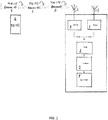
- Figure 1 1 denotes a data carrier which is designed as a transmitter which sends beacons containing the unique identifier TID of the data carrier 123 and in each case a beacon ID that is unique for this data carrier 1.
- beacons with the beacon IDs 1, 2 and 3 are shown by way of example.
- the beacons are received by the two antennas 2, 3 of an access control device, with beacons from different data carriers being able to be distinguished from one another based on the unique identifier of the data carrier, which is done, for example, in the beacon demuxers (demultiplexers) 4, 5. If several antennas are provided as in the example shown, the beacon ID is used to be able to compare the signal strength of the same beacon at the different antennas, for example by means of a beacon merger 6 in connection with a validation unit 7 and an RSSI evaluation unit 8 can be done.
- the components 4, 5, 6, 7, 8 required for evaluating the beacons, which can form a signal evaluation unit, can be provided in the access control devices or in a unit connected to a server.
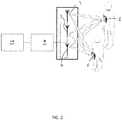
- an antenna arrangement for an access control device for people is shown schematically as an example.
- three antennas 2, 3, 4 are provided, which are arranged on one side of the access lane of the access in the access direction directly in front of the access and cover the entire area immediately in front of the access.
- This arrangement is particularly advantageous if the variable position of the data carriers 1 is expected, which in the example shown are designed as mobile telephones, as is the case with people.
- antennas can also be provided on the opposite side, wherein the total number of antennas and the height and width of the antenna arrays can vary.
- the received signals are transmitted to a signal evaluation unit 9, after the evaluation the data of the beacons of the determined data carrier closest to the access control device in the access direction, in particular the ID contained in the beacons of this data carrier, to which an access authorization is assigned, to an access authorization evaluation unit 10, which can be installed, for example, on a server, with access being granted to the access control device if the access authorization is valid, for example by controlling a blocking member. If no blocking devices are provided and there is no valid access authorization, an optical and / or acoustic signal can be output.
- An access control system in particular a system for carrying out the method according to the invention, accordingly preferably comprises at least one access control device, each of which is assigned an access, which is connected to a server on which an access authorization evaluation unit is installed and has at least one antenna, which is arranged on one side of the access lane in the access direction immediately in front of the entrance and covers the entire area immediately in front of the entrance as well as data carriers which are suitable for beacons that can be received by the at least one antenna according to the first standard for wireless communication, for example according to the Send BLE standard, containing an ID to which at least one access authorization is uniquely assigned, a unique identifier for the data carrier and in each case a unique beacon ID for the respective data carrier sending the beacon, which in combination with the unambiguous own identifier of the data carrier enables a clear identification of each transmitted beacon from each data carrier.
- the first standard for wireless communication for example according to the Send BLE standard, containing an ID to which at least one access authorization is uniquely assigned, a unique identifier for the data carrier and in each
- the beacons Upon receipt, the beacons are transmitted to a signal evaluation unit provided in the access control device or in the server, in which an RSSI evaluation is carried out in order to determine the data carrier closest to an access control device in the access direction determined data carrier closest to the access control device in the access direction are transmitted to the access authorization evaluation unit for validity evaluation, with access being granted if the access authorization is valid according to the validity evaluation.
Landscapes
- Engineering & Computer Science (AREA)
- Mechanical Engineering (AREA)
- Physics & Mathematics (AREA)
- General Physics & Mathematics (AREA)
- Radar, Positioning & Navigation (AREA)
- Remote Sensing (AREA)
- Mobile Radio Communication Systems (AREA)
- Quality & Reliability (AREA)
- Electromagnetism (AREA)
- Computer Networks & Wireless Communication (AREA)
- Signal Processing (AREA)
- Time Recorders, Dirve Recorders, Access Control (AREA)
Priority Applications (4)
| Application Number | Priority Date | Filing Date | Title |
|---|---|---|---|
| EP20152693.6A EP3852072B1 (fr) | 2020-01-20 | 2020-01-20 | Procédé de contrôle d'accès pour personnes et véhicules et système de mise en uvre du procédé |
| ES20152693T ES2963685T3 (es) | 2020-01-20 | 2020-01-20 | Procedimiento para el control de acceso de personas y vehículos y sistema para la ejecución del procedimiento |
| JP2021002035A JP2021119454A (ja) | 2020-01-20 | 2021-01-08 | 人及び車両のアクセス制御方法及びその方法を実行するシステム |
| US17/147,012 US11433854B2 (en) | 2020-01-20 | 2021-01-12 | Access control method for persons and vehicles and system for carrying out the method |
Applications Claiming Priority (1)
| Application Number | Priority Date | Filing Date | Title |
|---|---|---|---|
| EP20152693.6A EP3852072B1 (fr) | 2020-01-20 | 2020-01-20 | Procédé de contrôle d'accès pour personnes et véhicules et système de mise en uvre du procédé |
Publications (3)
| Publication Number | Publication Date |
|---|---|
| EP3852072A1 true EP3852072A1 (fr) | 2021-07-21 |
| EP3852072C0 EP3852072C0 (fr) | 2023-11-15 |
| EP3852072B1 EP3852072B1 (fr) | 2023-11-15 |
Family
ID=69185414
Family Applications (1)
| Application Number | Title | Priority Date | Filing Date |
|---|---|---|---|
| EP20152693.6A Active EP3852072B1 (fr) | 2020-01-20 | 2020-01-20 | Procédé de contrôle d'accès pour personnes et véhicules et système de mise en uvre du procédé |
Country Status (4)
| Country | Link |
|---|---|
| US (1) | US11433854B2 (fr) |
| EP (1) | EP3852072B1 (fr) |
| JP (1) | JP2021119454A (fr) |
| ES (1) | ES2963685T3 (fr) |
Cited By (1)
| Publication number | Priority date | Publication date | Assignee | Title |
|---|---|---|---|---|
| WO2025011807A1 (fr) * | 2023-07-11 | 2025-01-16 | Sonobeacon Gmbh | Procédé et système d'analyse de contrôle d'accès et d'utilisation |
Families Citing this family (6)
| Publication number | Priority date | Publication date | Assignee | Title |
|---|---|---|---|---|
| EP3985624A1 (fr) * | 2020-10-15 | 2022-04-20 | Skidata Ag | Procédé de contrôle d'accès pour personnes et système de mise en uvre du procédé |
| JP2023015582A (ja) * | 2021-07-20 | 2023-02-01 | 株式会社三共 | 遊技機 |
| JP2023015584A (ja) * | 2021-07-20 | 2023-02-01 | 株式会社三共 | 遊技機 |
| JP2023015581A (ja) * | 2021-07-20 | 2023-02-01 | 株式会社三共 | 遊技機 |
| EP4181094A1 (fr) * | 2021-11-11 | 2023-05-17 | dormakaba Schweiz AG | Procédé de contrôle d'accès, dispositif de lecture et système de contrôle d'accès |
| US12266232B2 (en) * | 2022-07-25 | 2025-04-01 | Bank Of America Corporation | User authentication using behavior patterns |
Citations (6)
| Publication number | Priority date | Publication date | Assignee | Title |
|---|---|---|---|---|
| EP2991041A2 (fr) * | 2014-08-25 | 2016-03-02 | Accenture Global Services Limited | Communication à base de distance courte sécurisée et système de contrôle d'accès |
| EP3131065A1 (fr) * | 2015-08-14 | 2017-02-15 | Skidata Ag | Procede et systeme de controle d'acces |
| KR20170020173A (ko) * | 2015-08-14 | 2017-02-22 | 주식회사 달콤 | 근거리 무선 통신을 이용한 출결 체크 방법 |
| US20180146336A1 (en) * | 2015-07-14 | 2018-05-24 | Assa Abloy Ab | Tracking for badge carrier |
| EP3343474A1 (fr) * | 2016-12-29 | 2018-07-04 | Skidata Ag | Procédé d'exploitation de la capacité de dispositifs dans un domaine skiable, d'une foire, d'un parc d'attraction ou dans un stade |
| WO2019069257A1 (fr) * | 2017-10-04 | 2019-04-11 | Acube Technology Sa | Procédé d'identification et/ou d'authentification de l'utilisateur d'un équipement mobile dans une zone particulière |
Family Cites Families (3)
| Publication number | Priority date | Publication date | Assignee | Title |
|---|---|---|---|---|
| JP6520800B2 (ja) * | 2015-12-23 | 2019-05-29 | 株式会社Soken | 乗員情報取得システム |
| JP6654512B2 (ja) * | 2016-06-07 | 2020-02-26 | 大日本印刷株式会社 | ビーコン信号送信機能付き照明装置 |
| IT201600127847A1 (it) * | 2016-12-19 | 2018-06-19 | Alfi Srl | Sistema per il controllo elettronico degli accessi. |
-
2020
- 2020-01-20 EP EP20152693.6A patent/EP3852072B1/fr active Active
- 2020-01-20 ES ES20152693T patent/ES2963685T3/es active Active
-
2021
- 2021-01-08 JP JP2021002035A patent/JP2021119454A/ja active Pending
- 2021-01-12 US US17/147,012 patent/US11433854B2/en active Active
Patent Citations (6)
| Publication number | Priority date | Publication date | Assignee | Title |
|---|---|---|---|---|
| EP2991041A2 (fr) * | 2014-08-25 | 2016-03-02 | Accenture Global Services Limited | Communication à base de distance courte sécurisée et système de contrôle d'accès |
| US20180146336A1 (en) * | 2015-07-14 | 2018-05-24 | Assa Abloy Ab | Tracking for badge carrier |
| EP3131065A1 (fr) * | 2015-08-14 | 2017-02-15 | Skidata Ag | Procede et systeme de controle d'acces |
| KR20170020173A (ko) * | 2015-08-14 | 2017-02-22 | 주식회사 달콤 | 근거리 무선 통신을 이용한 출결 체크 방법 |
| EP3343474A1 (fr) * | 2016-12-29 | 2018-07-04 | Skidata Ag | Procédé d'exploitation de la capacité de dispositifs dans un domaine skiable, d'une foire, d'un parc d'attraction ou dans un stade |
| WO2019069257A1 (fr) * | 2017-10-04 | 2019-04-11 | Acube Technology Sa | Procédé d'identification et/ou d'authentification de l'utilisateur d'un équipement mobile dans une zone particulière |
Cited By (1)
| Publication number | Priority date | Publication date | Assignee | Title |
|---|---|---|---|---|
| WO2025011807A1 (fr) * | 2023-07-11 | 2025-01-16 | Sonobeacon Gmbh | Procédé et système d'analyse de contrôle d'accès et d'utilisation |
Also Published As
| Publication number | Publication date |
|---|---|
| US20210221331A1 (en) | 2021-07-22 |
| JP2021119454A (ja) | 2021-08-12 |
| EP3852072C0 (fr) | 2023-11-15 |
| US11433854B2 (en) | 2022-09-06 |
| EP3852072B1 (fr) | 2023-11-15 |
| ES2963685T3 (es) | 2024-04-01 |
Similar Documents
| Publication | Publication Date | Title |
|---|---|---|
| EP3852072B1 (fr) | Procédé de contrôle d'accès pour personnes et véhicules et système de mise en uvre du procédé | |
| DE112019001523T5 (de) | Ultrabreitbandbasiertes fahrzeugzugangssystem und kommunikationsprotokoll zur lokalisierung einer zielvorrichtung | |
| EP3580731B1 (fr) | Procédé de fonctionnement d'un système d'authentification et système d'authentification | |
| EP1018692A2 (fr) | Système de sécurité, transpondeur et dispositif de réception | |
| DE112014002761B4 (de) | Kooperatives Spektrumdetektionsverfahren und fahrzeugeigene Drahtloskommunikationsvorrichtung | |
| WO2019149399A1 (fr) | Système de communication d'un véhicule | |
| DE102022208670A1 (de) | Verfahren zum Authentifizieren eines Nutzers, ein System und ein Kraftfahrzeug | |
| EP3131065A1 (fr) | Procede et systeme de controle d'acces | |
| DE102017214109B4 (de) | Mobiler Identifikationsgeber | |
| DE102017120524A1 (de) | Tragbarer ID-Geber für ein Authentifizierungssystem und Verfahren zum Betreiben eines Authentifizierungssystems | |
| EP3261060B1 (fr) | Procédés de contrôle d'accès dans un système de contrôle d'accès pour personnes ou véhicules automobiles et système de contrôle d'accès | |
| EP2635998A1 (fr) | Appareil mobile et système d'infrastructure | |
| EP3146355B1 (fr) | Système d'appareils médicaux et procédé pour localiser des appareils médicaux et des unités de commande mobiles de ce système d'appareils médicaux | |
| DE102020113244A1 (de) | Zugangssystem mit mindestens einem Gate | |
| DE102019211792A1 (de) | Zugangsanordnung für ein Fahrzeug | |
| EP2840554B1 (fr) | Procédé et capteur radio pour la localisation d'une unité embarquée | |
| WO2017129188A1 (fr) | Procédé et système de contrôle d'accès | |
| EP1016877A1 (fr) | Système pour l'affectation spatiale d'au moins un transpondeur à des cellules d'une zone de détection, station de base et transpondeur | |
| WO2020104086A1 (fr) | Dispositif d'accès pour un véhicule | |
| DE102017220509A1 (de) | Lokalisieren eines mobilen Endgeräts mittels eines Fahrzeugs | |
| DE102023100880A1 (de) | Steuersystem sowie Fahrzeugfunktionsfreigabesystem | |
| DE102010032369B4 (de) | Anmeldeverfahren für Funkkommunikationssysteme | |
| DE102007033891A1 (de) | Anordnung und Verfahren zum Identifizieren und Lokalisieren einer Person oder eines Objekts | |
| EP3188389B1 (fr) | Dispositif, systeme et procede d'enregistrement d'un signal parasite | |
| DE102010005581B4 (de) | Verbesserung des Rückkanals für Notrufe in einem satellitenbasierten SAR-System |
Legal Events
| Date | Code | Title | Description |
|---|---|---|---|
| PUAI | Public reference made under article 153(3) epc to a published international application that has entered the european phase |
Free format text: ORIGINAL CODE: 0009012 |
|
| STAA | Information on the status of an ep patent application or granted ep patent |
Free format text: STATUS: REQUEST FOR EXAMINATION WAS MADE |
|
| 17P | Request for examination filed |
Effective date: 20210412 |
|
| AK | Designated contracting states |
Kind code of ref document: A1 Designated state(s): AL AT BE BG CH CY CZ DE DK EE ES FI FR GB GR HR HU IE IS IT LI LT LU LV MC MK MT NL NO PL PT RO RS SE SI SK SM TR |
|
| GRAP | Despatch of communication of intention to grant a patent |
Free format text: ORIGINAL CODE: EPIDOSNIGR1 |
|
| STAA | Information on the status of an ep patent application or granted ep patent |
Free format text: STATUS: GRANT OF PATENT IS INTENDED |
|
| INTG | Intention to grant announced |
Effective date: 20230714 |
|
| GRAS | Grant fee paid |
Free format text: ORIGINAL CODE: EPIDOSNIGR3 |
|
| GRAA | (expected) grant |
Free format text: ORIGINAL CODE: 0009210 |
|
| STAA | Information on the status of an ep patent application or granted ep patent |
Free format text: STATUS: THE PATENT HAS BEEN GRANTED |
|
| AK | Designated contracting states |
Kind code of ref document: B1 Designated state(s): AL AT BE BG CH CY CZ DE DK EE ES FI FR GB GR HR HU IE IS IT LI LT LU LV MC MK MT NL NO PL PT RO RS SE SI SK SM TR |
|
| RAP3 | Party data changed (applicant data changed or rights of an application transferred) |
Owner name: SKIDATA GMBH |
|
| REG | Reference to a national code |
Ref country code: CH Ref legal event code: EP Ref country code: GB Ref legal event code: FG4D Free format text: NOT ENGLISH |
|
| REG | Reference to a national code |
Ref country code: DE Ref legal event code: R096 Ref document number: 502020005991 Country of ref document: DE |
|
| REG | Reference to a national code |
Ref country code: IE Ref legal event code: FG4D Free format text: LANGUAGE OF EP DOCUMENT: GERMAN |
|
| U01 | Request for unitary effect filed |
Effective date: 20231117 |
|
| U07 | Unitary effect registered |
Designated state(s): AT BE BG DE DK EE FI FR IT LT LU LV MT NL PT SE SI Effective date: 20231123 |
|
| U20 | Renewal fee for the european patent with unitary effect paid |
Year of fee payment: 5 Effective date: 20231219 |
|
| REG | Reference to a national code |
Ref country code: ES Ref legal event code: FG2A Ref document number: 2963685 Country of ref document: ES Kind code of ref document: T3 Effective date: 20240401 |
|
| PG25 | Lapsed in a contracting state [announced via postgrant information from national office to epo] |
Ref country code: GR Free format text: LAPSE BECAUSE OF FAILURE TO SUBMIT A TRANSLATION OF THE DESCRIPTION OR TO PAY THE FEE WITHIN THE PRESCRIBED TIME-LIMIT Effective date: 20240216 |
|
| PG25 | Lapsed in a contracting state [announced via postgrant information from national office to epo] |
Ref country code: IS Free format text: LAPSE BECAUSE OF FAILURE TO SUBMIT A TRANSLATION OF THE DESCRIPTION OR TO PAY THE FEE WITHIN THE PRESCRIBED TIME-LIMIT Effective date: 20240315 |
|
| PG25 | Lapsed in a contracting state [announced via postgrant information from national office to epo] |
Ref country code: IS Free format text: LAPSE BECAUSE OF FAILURE TO SUBMIT A TRANSLATION OF THE DESCRIPTION OR TO PAY THE FEE WITHIN THE PRESCRIBED TIME-LIMIT Effective date: 20240315 Ref country code: GR Free format text: LAPSE BECAUSE OF FAILURE TO SUBMIT A TRANSLATION OF THE DESCRIPTION OR TO PAY THE FEE WITHIN THE PRESCRIBED TIME-LIMIT Effective date: 20240216 |
|
| PG25 | Lapsed in a contracting state [announced via postgrant information from national office to epo] |
Ref country code: RS Free format text: LAPSE BECAUSE OF FAILURE TO SUBMIT A TRANSLATION OF THE DESCRIPTION OR TO PAY THE FEE WITHIN THE PRESCRIBED TIME-LIMIT Effective date: 20231115 Ref country code: PL Free format text: LAPSE BECAUSE OF FAILURE TO SUBMIT A TRANSLATION OF THE DESCRIPTION OR TO PAY THE FEE WITHIN THE PRESCRIBED TIME-LIMIT Effective date: 20231115 Ref country code: NO Free format text: LAPSE BECAUSE OF FAILURE TO SUBMIT A TRANSLATION OF THE DESCRIPTION OR TO PAY THE FEE WITHIN THE PRESCRIBED TIME-LIMIT Effective date: 20240215 Ref country code: HR Free format text: LAPSE BECAUSE OF FAILURE TO SUBMIT A TRANSLATION OF THE DESCRIPTION OR TO PAY THE FEE WITHIN THE PRESCRIBED TIME-LIMIT Effective date: 20231115 |
|
| PG25 | Lapsed in a contracting state [announced via postgrant information from national office to epo] |
Ref country code: CZ Free format text: LAPSE BECAUSE OF FAILURE TO SUBMIT A TRANSLATION OF THE DESCRIPTION OR TO PAY THE FEE WITHIN THE PRESCRIBED TIME-LIMIT Effective date: 20231115 |
|
| PG25 | Lapsed in a contracting state [announced via postgrant information from national office to epo] |
Ref country code: SK Free format text: LAPSE BECAUSE OF FAILURE TO SUBMIT A TRANSLATION OF THE DESCRIPTION OR TO PAY THE FEE WITHIN THE PRESCRIBED TIME-LIMIT Effective date: 20231115 |
|
| PG25 | Lapsed in a contracting state [announced via postgrant information from national office to epo] |
Ref country code: SM Free format text: LAPSE BECAUSE OF FAILURE TO SUBMIT A TRANSLATION OF THE DESCRIPTION OR TO PAY THE FEE WITHIN THE PRESCRIBED TIME-LIMIT Effective date: 20231115 Ref country code: SK Free format text: LAPSE BECAUSE OF FAILURE TO SUBMIT A TRANSLATION OF THE DESCRIPTION OR TO PAY THE FEE WITHIN THE PRESCRIBED TIME-LIMIT Effective date: 20231115 Ref country code: RO Free format text: LAPSE BECAUSE OF FAILURE TO SUBMIT A TRANSLATION OF THE DESCRIPTION OR TO PAY THE FEE WITHIN THE PRESCRIBED TIME-LIMIT Effective date: 20231115 Ref country code: CZ Free format text: LAPSE BECAUSE OF FAILURE TO SUBMIT A TRANSLATION OF THE DESCRIPTION OR TO PAY THE FEE WITHIN THE PRESCRIBED TIME-LIMIT Effective date: 20231115 |
|
| REG | Reference to a national code |
Ref country code: DE Ref legal event code: R097 Ref document number: 502020005991 Country of ref document: DE |
|
| PG25 | Lapsed in a contracting state [announced via postgrant information from national office to epo] |
Ref country code: MC Free format text: LAPSE BECAUSE OF FAILURE TO SUBMIT A TRANSLATION OF THE DESCRIPTION OR TO PAY THE FEE WITHIN THE PRESCRIBED TIME-LIMIT Effective date: 20231115 |
|
| PG25 | Lapsed in a contracting state [announced via postgrant information from national office to epo] |
Ref country code: MC Free format text: LAPSE BECAUSE OF FAILURE TO SUBMIT A TRANSLATION OF THE DESCRIPTION OR TO PAY THE FEE WITHIN THE PRESCRIBED TIME-LIMIT Effective date: 20231115 |
|
| REG | Reference to a national code |
Ref country code: CH Ref legal event code: PL |
|
| PLBE | No opposition filed within time limit |
Free format text: ORIGINAL CODE: 0009261 |
|
| STAA | Information on the status of an ep patent application or granted ep patent |
Free format text: STATUS: NO OPPOSITION FILED WITHIN TIME LIMIT |
|
| PG25 | Lapsed in a contracting state [announced via postgrant information from national office to epo] |
Ref country code: CH Free format text: LAPSE BECAUSE OF NON-PAYMENT OF DUE FEES Effective date: 20240131 |
|
| 26N | No opposition filed |
Effective date: 20240819 |
|
| PG25 | Lapsed in a contracting state [announced via postgrant information from national office to epo] |
Ref country code: CH Free format text: LAPSE BECAUSE OF NON-PAYMENT OF DUE FEES Effective date: 20240131 |
|
| U20 | Renewal fee for the european patent with unitary effect paid |
Year of fee payment: 6 Effective date: 20241218 |
|
| PG25 | Lapsed in a contracting state [announced via postgrant information from national office to epo] |
Ref country code: IE Free format text: LAPSE BECAUSE OF NON-PAYMENT OF DUE FEES Effective date: 20240120 |
|
| PG25 | Lapsed in a contracting state [announced via postgrant information from national office to epo] |
Ref country code: IE Free format text: LAPSE BECAUSE OF NON-PAYMENT OF DUE FEES Effective date: 20240120 |
|
| U1N | Appointed representative for the unitary patent procedure changed after the registration of the unitary effect |
Representative=s name: MEWBURN ELLIS LLP; GB |
|
| PG25 | Lapsed in a contracting state [announced via postgrant information from national office to epo] |
Ref country code: CY Free format text: LAPSE BECAUSE OF FAILURE TO SUBMIT A TRANSLATION OF THE DESCRIPTION OR TO PAY THE FEE WITHIN THE PRESCRIBED TIME-LIMIT; INVALID AB INITIO Effective date: 20200120 |
|
| PG25 | Lapsed in a contracting state [announced via postgrant information from national office to epo] |
Ref country code: HU Free format text: LAPSE BECAUSE OF FAILURE TO SUBMIT A TRANSLATION OF THE DESCRIPTION OR TO PAY THE FEE WITHIN THE PRESCRIBED TIME-LIMIT; INVALID AB INITIO Effective date: 20200120 |
|
| PG25 | Lapsed in a contracting state [announced via postgrant information from national office to epo] |
Ref country code: TR Free format text: LAPSE BECAUSE OF FAILURE TO SUBMIT A TRANSLATION OF THE DESCRIPTION OR TO PAY THE FEE WITHIN THE PRESCRIBED TIME-LIMIT Effective date: 20231115 |
|
| PGFP | Annual fee paid to national office [announced via postgrant information from national office to epo] |
Ref country code: GB Payment date: 20251211 Year of fee payment: 7 |
|
| U20 | Renewal fee for the european patent with unitary effect paid |
Year of fee payment: 7 Effective date: 20251218 |
|
| PGFP | Annual fee paid to national office [announced via postgrant information from national office to epo] |
Ref country code: ES Payment date: 20260213 Year of fee payment: 7 |