EP3852184A1 - Batterie au sodium à haute température à rendement énergétique élevé - Google Patents
Batterie au sodium à haute température à rendement énergétique élevé Download PDFInfo
- Publication number
- EP3852184A1 EP3852184A1 EP21150274.5A EP21150274A EP3852184A1 EP 3852184 A1 EP3852184 A1 EP 3852184A1 EP 21150274 A EP21150274 A EP 21150274A EP 3852184 A1 EP3852184 A1 EP 3852184A1
- Authority
- EP
- European Patent Office
- Prior art keywords
- sodium
- charge
- temperature
- cathode
- discharge
- Prior art date
- Legal status (The legal status is an assumption and is not a legal conclusion. Google has not performed a legal analysis and makes no representation as to the accuracy of the status listed.)
- Pending
Links
- 239000011734 sodium Substances 0.000 title claims abstract description 115
- 229910052708 sodium Inorganic materials 0.000 title claims abstract description 106
- DGAQECJNVWCQMB-PUAWFVPOSA-M Ilexoside XXIX Chemical compound C[C@@H]1CC[C@@]2(CC[C@@]3(C(=CC[C@H]4[C@]3(CC[C@@H]5[C@@]4(CC[C@@H](C5(C)C)OS(=O)(=O)[O-])C)C)[C@@H]2[C@]1(C)O)C)C(=O)O[C@H]6[C@@H]([C@H]([C@@H]([C@H](O6)CO)O)O)O.[Na+] DGAQECJNVWCQMB-PUAWFVPOSA-M 0.000 title claims abstract description 100
- 229910001415 sodium ion Inorganic materials 0.000 claims abstract description 40
- 239000000203 mixture Substances 0.000 claims abstract description 38
- 239000012528 membrane Substances 0.000 claims abstract description 29
- FKNQFGJONOIPTF-UHFFFAOYSA-N Sodium cation Chemical compound [Na+] FKNQFGJONOIPTF-UHFFFAOYSA-N 0.000 claims abstract description 27
- 239000007787 solid Substances 0.000 claims abstract description 23
- 230000032258 transport Effects 0.000 claims abstract description 9
- 238000000034 method Methods 0.000 claims description 29
- BNOODXBBXFZASF-UHFFFAOYSA-N [Na].[S] Chemical compound [Na].[S] BNOODXBBXFZASF-UHFFFAOYSA-N 0.000 claims description 22
- NINIDFKCEFEMDL-UHFFFAOYSA-N Sulfur Chemical compound [S] NINIDFKCEFEMDL-UHFFFAOYSA-N 0.000 claims description 21
- 229910052717 sulfur Inorganic materials 0.000 claims description 21
- 239000011593 sulfur Substances 0.000 claims description 20
- 229920001021 polysulfide Polymers 0.000 claims description 18
- 239000005077 polysulfide Substances 0.000 claims description 18
- 150000008117 polysulfides Polymers 0.000 claims description 18
- 238000006056 electrooxidation reaction Methods 0.000 claims description 16
- 230000009467 reduction Effects 0.000 claims description 16
- 229910021525 ceramic electrolyte Inorganic materials 0.000 claims description 12
- 229910020275 Na2Sx Inorganic materials 0.000 claims description 8
- 238000012983 electrochemical energy storage Methods 0.000 claims description 8
- 150000001875 compounds Chemical class 0.000 claims description 4
- 238000007599 discharging Methods 0.000 claims description 4
- GRVFOGOEDUUMBP-UHFFFAOYSA-N sodium sulfide (anhydrous) Chemical compound [Na+].[Na+].[S-2] GRVFOGOEDUUMBP-UHFFFAOYSA-N 0.000 claims description 4
- 238000010438 heat treatment Methods 0.000 claims description 3
- 230000003287 optical effect Effects 0.000 claims description 3
- 229910052979 sodium sulfide Inorganic materials 0.000 claims 1
- -1 sodium halide Chemical class 0.000 description 14
- ATHHXGZTWNVVOU-UHFFFAOYSA-N N-methylformamide Chemical compound CNC=O ATHHXGZTWNVVOU-UHFFFAOYSA-N 0.000 description 12
- ZMXDDKWLCZADIW-UHFFFAOYSA-N N,N-Dimethylformamide Chemical compound CN(C)C=O ZMXDDKWLCZADIW-UHFFFAOYSA-N 0.000 description 9
- 150000001768 cations Chemical class 0.000 description 9
- 229910052736 halogen Inorganic materials 0.000 description 9
- 239000002904 solvent Substances 0.000 description 8
- 230000015572 biosynthetic process Effects 0.000 description 7
- 238000003487 electrochemical reaction Methods 0.000 description 7
- 239000002608 ionic liquid Substances 0.000 description 7
- 239000003960 organic solvent Substances 0.000 description 7
- IAZDPXIOMUYVGZ-UHFFFAOYSA-N Dimethylsulphoxide Chemical compound CS(C)=O IAZDPXIOMUYVGZ-UHFFFAOYSA-N 0.000 description 6
- ZHNUHDYFZUAESO-UHFFFAOYSA-N Formamide Chemical compound NC=O ZHNUHDYFZUAESO-UHFFFAOYSA-N 0.000 description 6
- 239000007795 chemical reaction product Substances 0.000 description 6
- 230000008569 process Effects 0.000 description 6
- PNEYBMLMFCGWSK-UHFFFAOYSA-N aluminium oxide Inorganic materials [O-2].[O-2].[O-2].[Al+3].[Al+3] PNEYBMLMFCGWSK-UHFFFAOYSA-N 0.000 description 5
- 229910052794 bromium Inorganic materials 0.000 description 5
- 230000005611 electricity Effects 0.000 description 5
- 150000002367 halogens Chemical class 0.000 description 5
- 229910014103 Na-S Inorganic materials 0.000 description 4
- 229910014147 Na—S Inorganic materials 0.000 description 4
- GDTBXPJZTBHREO-UHFFFAOYSA-N bromine Substances BrBr GDTBXPJZTBHREO-UHFFFAOYSA-N 0.000 description 4
- 238000006243 chemical reaction Methods 0.000 description 4
- 229910052740 iodine Inorganic materials 0.000 description 4
- XCUQAIXRAUPKCX-UHFFFAOYSA-N COC.CNC=O Chemical compound COC.CNC=O XCUQAIXRAUPKCX-UHFFFAOYSA-N 0.000 description 3
- RAXXELZNTBOGNW-UHFFFAOYSA-O Imidazolium Chemical compound C1=C[NH+]=CN1 RAXXELZNTBOGNW-UHFFFAOYSA-O 0.000 description 3
- WHXSMMKQMYFTQS-UHFFFAOYSA-N Lithium Chemical compound [Li] WHXSMMKQMYFTQS-UHFFFAOYSA-N 0.000 description 3
- FXHOOIRPVKKKFG-UHFFFAOYSA-N N,N-Dimethylacetamide Chemical compound CN(C)C(C)=O FXHOOIRPVKKKFG-UHFFFAOYSA-N 0.000 description 3
- OHLUUHNLEMFGTQ-UHFFFAOYSA-N N-methylacetamide Chemical compound CNC(C)=O OHLUUHNLEMFGTQ-UHFFFAOYSA-N 0.000 description 3
- 229910019142 PO4 Inorganic materials 0.000 description 3
- KEAYESYHFKHZAL-UHFFFAOYSA-N Sodium Chemical compound [Na] KEAYESYHFKHZAL-UHFFFAOYSA-N 0.000 description 3
- 230000002378 acidificating effect Effects 0.000 description 3
- 229910052782 aluminium Inorganic materials 0.000 description 3
- 230000008901 benefit Effects 0.000 description 3
- 229910052801 chlorine Inorganic materials 0.000 description 3
- 229910052802 copper Inorganic materials 0.000 description 3
- SBZXBUIDTXKZTM-UHFFFAOYSA-N diglyme Chemical compound COCCOCCOC SBZXBUIDTXKZTM-UHFFFAOYSA-N 0.000 description 3
- 229910052733 gallium Inorganic materials 0.000 description 3
- 150000004820 halides Chemical class 0.000 description 3
- 229910052738 indium Inorganic materials 0.000 description 3
- 229910052744 lithium Inorganic materials 0.000 description 3
- 229910052751 metal Inorganic materials 0.000 description 3
- 239000002184 metal Substances 0.000 description 3
- QARBMVPHQWIHKH-UHFFFAOYSA-N methanesulfonyl chloride Chemical compound CS(Cl)(=O)=O QARBMVPHQWIHKH-UHFFFAOYSA-N 0.000 description 3
- 230000007935 neutral effect Effects 0.000 description 3
- XYFCBTPGUUZFHI-UHFFFAOYSA-O phosphonium Chemical compound [PH4+] XYFCBTPGUUZFHI-UHFFFAOYSA-O 0.000 description 3
- 239000000047 product Substances 0.000 description 3
- 125000001453 quaternary ammonium group Chemical group 0.000 description 3
- 238000006467 substitution reaction Methods 0.000 description 3
- ZUHZGEOKBKGPSW-UHFFFAOYSA-N tetraglyme Chemical compound COCCOCCOCCOCCOC ZUHZGEOKBKGPSW-UHFFFAOYSA-N 0.000 description 3
- WKBOTKDWSSQWDR-UHFFFAOYSA-N Bromine atom Chemical compound [Br] WKBOTKDWSSQWDR-UHFFFAOYSA-N 0.000 description 2
- 239000000919 ceramic Substances 0.000 description 2
- 238000004891 communication Methods 0.000 description 2
- 239000002241 glass-ceramic Substances 0.000 description 2
- 239000000463 material Substances 0.000 description 2
- HYHCSLBZRBJJCH-UHFFFAOYSA-N sodium polysulfide Chemical compound [Na+].S HYHCSLBZRBJJCH-UHFFFAOYSA-N 0.000 description 2
- 239000000126 substance Substances 0.000 description 2
- ZCYVEMRRCGMTRW-UHFFFAOYSA-N 7553-56-2 Chemical compound [I] ZCYVEMRRCGMTRW-UHFFFAOYSA-N 0.000 description 1
- 229910016905 AlxTi Inorganic materials 0.000 description 1
- 229910000873 Beta-alumina solid electrolyte Inorganic materials 0.000 description 1
- CPELXLSAUQHCOX-UHFFFAOYSA-M Bromide Chemical compound [Br-] CPELXLSAUQHCOX-UHFFFAOYSA-M 0.000 description 1
- 239000002227 LISICON Substances 0.000 description 1
- 229910006210 Li1+xAlxTi2-x(PO4)3 Inorganic materials 0.000 description 1
- 229910006212 Li1+xAlxTi2−x(PO4)3 Inorganic materials 0.000 description 1
- 229910009496 Li1.5Al0.5Ge1.5 Inorganic materials 0.000 description 1
- 229910005313 Li14ZnGe4O16 Inorganic materials 0.000 description 1
- 229910010516 Li2+2xZn1-xGeO4 Inorganic materials 0.000 description 1
- 229910010513 Li2+2xZn1−xGeO4 Inorganic materials 0.000 description 1
- 229910052783 alkali metal Inorganic materials 0.000 description 1
- 150000001340 alkali metals Chemical class 0.000 description 1
- CVJYOKLQNGVTIS-UHFFFAOYSA-K aluminum;lithium;titanium(4+);phosphate Chemical compound [Li+].[Al+3].[Ti+4].[O-]P([O-])([O-])=O CVJYOKLQNGVTIS-UHFFFAOYSA-K 0.000 description 1
- 239000010405 anode material Substances 0.000 description 1
- 239000010406 cathode material Substances 0.000 description 1
- 230000008859 change Effects 0.000 description 1
- 239000000470 constituent Substances 0.000 description 1
- 230000007423 decrease Effects 0.000 description 1
- 230000001419 dependent effect Effects 0.000 description 1
- 239000002019 doping agent Substances 0.000 description 1
- 239000003792 electrolyte Substances 0.000 description 1
- 238000004146 energy storage Methods 0.000 description 1
- 239000000446 fuel Substances 0.000 description 1
- XMBWDFGMSWQBCA-UHFFFAOYSA-N hydrogen iodide Chemical compound I XMBWDFGMSWQBCA-UHFFFAOYSA-N 0.000 description 1
- PNDPGZBMCMUPRI-UHFFFAOYSA-N iodine Chemical compound II PNDPGZBMCMUPRI-UHFFFAOYSA-N 0.000 description 1
- 239000011630 iodine Substances 0.000 description 1
- 150000002641 lithium Chemical class 0.000 description 1
- 239000005398 lithium aluminium silicate glass-ceramic Substances 0.000 description 1
- 229910000664 lithium aluminum titanium phosphates (LATP) Inorganic materials 0.000 description 1
- 230000007246 mechanism Effects 0.000 description 1
- 229910001463 metal phosphate Inorganic materials 0.000 description 1
- 230000004048 modification Effects 0.000 description 1
- 238000012986 modification Methods 0.000 description 1
- 231100000252 nontoxic Toxicity 0.000 description 1
- 230000003000 nontoxic effect Effects 0.000 description 1
- 230000003647 oxidation Effects 0.000 description 1
- 238000007254 oxidation reaction Methods 0.000 description 1
- 230000002441 reversible effect Effects 0.000 description 1
- 239000007784 solid electrolyte Substances 0.000 description 1
- 229910000957 xLi2O Inorganic materials 0.000 description 1
Images



Classifications
-
- H—ELECTRICITY
- H01—ELECTRIC ELEMENTS
- H01M—PROCESSES OR MEANS, e.g. BATTERIES, FOR THE DIRECT CONVERSION OF CHEMICAL ENERGY INTO ELECTRICAL ENERGY
- H01M10/00—Secondary cells; Manufacture thereof
- H01M10/36—Accumulators not provided for in groups H01M10/05-H01M10/34
- H01M10/39—Accumulators not provided for in groups H01M10/05-H01M10/34 working at high temperature
- H01M10/3909—Sodium-sulfur cells
-
- H—ELECTRICITY
- H01—ELECTRIC ELEMENTS
- H01M—PROCESSES OR MEANS, e.g. BATTERIES, FOR THE DIRECT CONVERSION OF CHEMICAL ENERGY INTO ELECTRICAL ENERGY
- H01M10/00—Secondary cells; Manufacture thereof
- H01M10/36—Accumulators not provided for in groups H01M10/05-H01M10/34
- H01M10/39—Accumulators not provided for in groups H01M10/05-H01M10/34 working at high temperature
- H01M10/3909—Sodium-sulfur cells
- H01M10/3918—Sodium-sulfur cells characterised by the electrolyte
-
- H—ELECTRICITY
- H01—ELECTRIC ELEMENTS
- H01M—PROCESSES OR MEANS, e.g. BATTERIES, FOR THE DIRECT CONVERSION OF CHEMICAL ENERGY INTO ELECTRICAL ENERGY
- H01M10/00—Secondary cells; Manufacture thereof
- H01M10/42—Methods or arrangements for servicing or maintenance of secondary cells or secondary half-cells
- H01M10/46—Accumulators structurally combined with charging apparatus
- H01M10/465—Accumulators structurally combined with charging apparatus with solar battery as charging system
-
- H—ELECTRICITY
- H01—ELECTRIC ELEMENTS
- H01M—PROCESSES OR MEANS, e.g. BATTERIES, FOR THE DIRECT CONVERSION OF CHEMICAL ENERGY INTO ELECTRICAL ENERGY
- H01M2300/00—Electrolytes
- H01M2300/0017—Non-aqueous electrolytes
- H01M2300/0025—Organic electrolyte
- H01M2300/0028—Organic electrolyte characterised by the solvent
-
- H—ELECTRICITY
- H01—ELECTRIC ELEMENTS
- H01M—PROCESSES OR MEANS, e.g. BATTERIES, FOR THE DIRECT CONVERSION OF CHEMICAL ENERGY INTO ELECTRICAL ENERGY
- H01M2300/00—Electrolytes
- H01M2300/0017—Non-aqueous electrolytes
- H01M2300/0025—Organic electrolyte
- H01M2300/0045—Room temperature molten salts comprising at least one organic ion
-
- H—ELECTRICITY
- H01—ELECTRIC ELEMENTS
- H01M—PROCESSES OR MEANS, e.g. BATTERIES, FOR THE DIRECT CONVERSION OF CHEMICAL ENERGY INTO ELECTRICAL ENERGY
- H01M2300/00—Electrolytes
- H01M2300/0017—Non-aqueous electrolytes
- H01M2300/0048—Molten electrolytes used at high temperature
- H01M2300/0054—Halogenides
-
- Y—GENERAL TAGGING OF NEW TECHNOLOGICAL DEVELOPMENTS; GENERAL TAGGING OF CROSS-SECTIONAL TECHNOLOGIES SPANNING OVER SEVERAL SECTIONS OF THE IPC; TECHNICAL SUBJECTS COVERED BY FORMER USPC CROSS-REFERENCE ART COLLECTIONS [XRACs] AND DIGESTS
- Y02—TECHNOLOGIES OR APPLICATIONS FOR MITIGATION OR ADAPTATION AGAINST CLIMATE CHANGE
- Y02E—REDUCTION OF GREENHOUSE GAS [GHG] EMISSIONS, RELATED TO ENERGY GENERATION, TRANSMISSION OR DISTRIBUTION
- Y02E60/00—Enabling technologies; Technologies with a potential or indirect contribution to GHG emissions mitigation
- Y02E60/10—Energy storage using batteries
-
- Y—GENERAL TAGGING OF NEW TECHNOLOGICAL DEVELOPMENTS; GENERAL TAGGING OF CROSS-SECTIONAL TECHNOLOGIES SPANNING OVER SEVERAL SECTIONS OF THE IPC; TECHNICAL SUBJECTS COVERED BY FORMER USPC CROSS-REFERENCE ART COLLECTIONS [XRACs] AND DIGESTS
- Y02—TECHNOLOGIES OR APPLICATIONS FOR MITIGATION OR ADAPTATION AGAINST CLIMATE CHANGE
- Y02P—CLIMATE CHANGE MITIGATION TECHNOLOGIES IN THE PRODUCTION OR PROCESSING OF GOODS
- Y02P70/00—Climate change mitigation technologies in the production process for final industrial or consumer products
- Y02P70/50—Manufacturing or production processes characterised by the final manufactured product
Definitions
- the disclosed invention relates to a molten sodium battery that is charged at a high temperature and discharged at a low temperature, relative to the charge temperature.
- the battery is particularly suited for storing solar energy. It utilizes solar energy in the form of both heat and photovoltaic electric potential. The heat facilitates high temperature charging, and the photovoltaic electric potential drives the electrochemical reactions necessary for charging the battery.
- the presently disclosed invention relates to a unique electrochemical energy storage (e.g. battery or fuel cell) system that utilizes the electricity and heat provided by a combined solar heat and photovoltaic electricity generator.
- a unique electrochemical energy storage e.g. battery or fuel cell
- the battery charges and discharges at different temperatures.
- the battery is heated by a source of thermal energy.
- the source of heat is a solar thermal concentrator.
- the source of heat is geothermal energy.
- electrons are given up at the anode in electronic communication via a circuit connected the cathode where the electrons are captured by the cations to form the discharged product.
- the cathode is in ionic communication with the catholyte bath.
- a cationically conductive membrane separates the electrolyte from the anode such that as cations pass through and are reduced at the cathode they are stored near that electrode until the device is ready to be charged. During charge, the process reverses itself, where the electrons are given up at the cathode and are captured by the cations transported back through the cation conductive membrane to form the charged product at the anode and are stored near that electrode until the device is ready to be discharged.
- the charge process happens advantageously at a higher temperature than the discharge process.
- the battery utilizes the electrons provided by the solar photovoltaic system for charging while being heated using solar heat concentrator.
- the disclosed system may be in the form of a molten sodium battery or secondary cell that charges at a high temperature and discharges at a relatively lower temperature.
- the disclosed molten sodium battery or secondary cell includes a sodium anode that undergoes electrochemical oxidation during discharge and electrochemical reduction during charge.
- the molten sodium battery further includes a cathode that undergoes electrochemical reduction during discharge and electrochemical oxidation during charge.
- the cathode comprises a catholyte composition that is thermally stable at cell operating conditions.
- the battery has a sodium ion conductive solid membrane separating the cathode and catholyte composition from the sodium anode that selectively transports sodium ions and is chemically and thermally stable at cell operating conditions.
- the battery includes a solar energy source.
- the solar energy source may include both a photovoltaic system to provide an electric charging potential to the sodium anode and the cathode and a solar thermal concentrator to provide heat to the battery and more specifically to the cathode and catholyte composition.
- the cell has a charge temperature and a charge voltage and a discharge temperature and a discharge voltage, wherein the charge temperature is substantially higher than the discharge temperature and the charge voltage is lower than the discharge voltage. This is possible because the electrochemical reaction products formed during cell charge have a free energy of formation that is lower at the charge temperature than the discharge temperature.
- the solar heat may be used to cause the molten sodium secondary cell to charge at a temperature in the range from about 300 to 800 °C. In some non-limiting embodiments, the cell has a discharge temperature in the range from about 110 to 350 °C.
- the cathode is sulfur and the catholyte composition comprises one or more sodium sulfide compounds.
- the cathode is a halogen and the catholyte composition comprises a sodium halide and a solvent.
- the solvent is selected from an organic solvent, an ionic liquid, and an inorganic molten-salt.
- Non-limiting examples of the organic solvent include methylacetamide, dimethylacetamide, N-methyl formamide (NMF), formamide, dimethylformamide, tetraglyme, diglyme, dimethylether N-methyl formamide, dimethyl sulfoxide, and methyl sulfonyl chloride.
- Non-limiting examples of the ionic liquid include quaternary- ammonium, phosphonium, imidazolium, or pyrrolidinium cations with halogenoaluminate, tetrafluroborate, halide, or bis(trifluoromethylsulfonyl)amide anions.
- Non-limiting examples of the inorganic molten-salt include NaM x (X1) y (X2) z , where X1 and X2 are halogens selected from Cl, Br or I; M can be Al, Cu, In, Ga or any trivalent metal cation; x is greater than or equal to 1 and less than or equal to 2; y is greater than or equal to zero and less than or equal to seven; and z is greater than or equal to zero and less than or equal to seven.
- the sodium metal halogen compounds of which sodium haloaluminate compounds are representative examples, can be neutral, acidic or basic.
- the sodium ion conductive solid membrane comprises a sodium ⁇ "-alumina ceramic electrolyte. Because the sodium ⁇ "-alumina ceramic electrolyte is chemically and thermally stable at very high temperature, it may operate at a cell charge temperature from about 500 to 800 °C. The cell may operate at a cell discharge temperature in the range from about 280 to 350 °C.
- the sodium ion conductive solid membrane comprises a NaSICON ceramic electrolyte.
- the NaSICON ceramic electrolyte provide high sodium conductivity at lower temperatures, compared to sodium ⁇ "-alumina, it may operate at a cell discharge temperature in the range from about 110 to 200 °C and a cell charge temperature in the range from about 300 to 400 °C.
- the disclosed invention includes a method of operating a molten sodium battery or secondary cell.
- the method utilizes a hybrid sodium anode battery disclosed herein.
- the battery includes a sodium anode that undergoes electrochemical oxidation during discharge and electrochemical reduction during charge.
- the battery further includes a cathode that undergoes electrochemical reduction during discharge and electrochemical oxidation during charge.
- the cathode includes catholyte composition that is thermally stable at cell operating conditions.
- the battery has a sodium ion conductive solid membrane separating the cathode and catholyte composition from the sodium anode that selectively transports sodium ions and is chemically and thermally stable at cell operating conditions.
- the battery includes a solar energy source.
- the solar energy source may include both a photovoltaic system to provide an electric charging potential to the sodium anode and the cathode and a solar thermal concentrator to provide heat to the battery and more specifically to the cathode and catholyte composition.
- the secondary cell has a charge temperature and a charge voltage and a discharge temperature and a discharge voltage.
- the secondary cell is charged at a charge temperature that is substantially higher than the discharge temperature, and the charge voltage is lower than the discharge voltage. This is possible because the electrochemical reaction products formed during cell charge have a free energy of formation that is lower at the charge temperature than the discharge temperature.
- the disclosed invention is drawn to a molten sodium battery or secondary cell.
- the battery includes a sodium anode that undergoes electrochemical oxidation during discharge and electrochemical reduction during charge.
- the molten sodium battery further includes a cathode that undergoes electrochemical reduction during discharge and electrochemical oxidation during charge.
- the cathode comprises a catholyte composition that is thermally stable at cell operating conditions.
- the battery has a sodium ion conductive solid membrane separating the cathode and catholyte composition from the sodium anode that selectively transports sodium ions and is chemically and thermally stable at cell operating conditions.
- the battery includes a solar energy source.
- the solar energy source may include both a photovoltaic system to provide an electric charging potential to the sodium anode and the cathode and a solar thermal concentrator to provide heat to the battery and more specifically to the cathode and catholyte composition.
- the cell has a charge temperature and a charge voltage and a discharge temperature and a discharge voltage, wherein the charge temperature is substantially higher than the discharge temperature and the charge voltage is lower than the discharge voltage. This is possible because the electrochemical reaction products formed during cell charge have a free energy of formation that is lower at the charge temperature than the discharge temperature.
- the sodium secondary cell is in the form of a sodium-sulfur battery (Na-S) combined with a photovoltaic/solar concentrator.
- Na-S sodium-sulfur battery
- This battery typically operates at temperatures greater than 300 °C where the sodium anode and sulfur/sodium polysulfides are in molten state.
- Sodium-sulfur batteries offer great potential to meet many of the above-stated needs.
- the theoretical specific energy of sodium-sulfur batteries is 792 Wh/kg, assuming the following overall discharge reaction: 2Na + xS ⁇ Na 2 S x
- high polysulfides Na 2 S y
- a combination of sulfur and high polysulfides are reduced to form lower polysulfides (Na 2 S x ), where y > x.
- the theoretical specific energy is one of the highest known specific energies for batteries that use non-gaseous constituents.
- the materials needed to produce these batteries are light, energetic, inexpensive, and readily available.
- sulfur is relatively non-toxic, making these batteries relatively safe for human contact.
- the sodium-sulfur battery has an open circuit voltage (OCV) of ⁇ 1.8 to 2 V with the charge happening at above 0.1 to 0.2 V above OCV and discharge happening at 0.1 to 0.2 V below OCV at practical current densities.
- OCV open circuit voltage
- sodium ion conductive solid membrane include sodium ⁇ "-alumina and NaSICON.
- the elemental sulfur (or higher sodium polysulfides, Na 2 S y ) present at the cathode are reduced by capturing the electrons to form the lower sodium polysulfides, Na 2 S x , where y > x.
- the process reverses (electrons and sodium ions are transported back to the anode).
- the sodium metal and sulfur (or high sodium polysulfides) are regenerated.
- the battery is discharged at lower temperature, between about 280 and 350 °C, but is charged at a much higher temperature than typical (e.g. 500 to 800 °C). It is known that if the sodium-sulfur battery charges at such a higher temperature it occurs at a lower voltage than typical. This lowering of charge voltage is due to lowering of free energy required to form the electrochemical charge reaction products (e.g., Na and S or high polysulfides) at higher temperature.
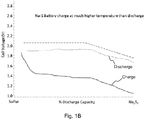
- Figs 1A and 1B illustrate the possible (theoretical) charge/discharge profile of a sodium-sulfur battery under normal operation ( Fig. 1A ) where the charge and discharge temperatures are substantially the same and when charged at a higher temperature ( Fig. 1B ) and discharged at a lower temperature according to the disclosed invention.
- This molten sodium battery as disclosed herein is envisioned to be charged during day time when the solar heat and electricity are available and discharged during the off-peak hours of solar energy (heat and electricity) generation.
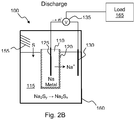
- FIGS 2A and 2B show a schematic of the charge-discharge process in relation to a sodium-sulfur battery.
- the disclosed molten sodium battery or secondary cell 100 includes a sodium anode 110 that undergoes electrochemical oxidation during discharge and electrochemical reduction during charge.
- the molten sodium battery further includes a cathode 115 that undergoes electrochemical reduction during discharge and electrochemical oxidation during charge.
- the cathode comprises a catholyte composition that is thermally stable at cell operating conditions.
- the battery has a sodium ion conductive solid membrane 120 separating the cathode and catholyte composition from the sodium anode that selectively transports sodium ions and is chemically and thermally stable at cell operating conditions.
- Suitable current collectors 125, 130 provide electrical connection between the anode 110 and cathode 115 and a voltage source 135.
- the battery includes a solar energy source 140.
- the solar energy source may include both a photovoltaic system 145 to provide an electric charging potential to voltage source 135 and a solar thermal concentrator 150 to provide heat to the battery and more specifically to the cathode and catholyte composition.
- the heat may be provided to the battery through any suitable mechanism, including but not limited to, a heat exchanger and direct heating via optical lenses and a heat transmitter window.
- the cathode and catholyte composition comprises one or more sodium polysulfides (Na 2 S x ).
- the electrons for charging are supplied by the photovoltaic array 145.
- a housing 160 seals to the cathode compartment to transmit heat from the solar thermal concentrator 150 and to prevent loss of the semi-volatile sodium polysulfide and volatile sulfur. While sulfur is generated, sodium ions will migrate through the sodium ion conductive solid membrane 120 and electrons will flow through the external circuit and sodium metal is produced. To recover the stored energy, the cell is discharged to power a load 165. Sodium is oxidized to form sodium ions and the sodium polysulfide (Na 2 S x ) is generated.
- the sodium anode and sulfur cathode are separated by a ⁇ "- alumina or NaSICON sodium-ion conducting solid electrolyte.
- the electrochemical reaction products formed during electrical charging (energetic chemicals) in the case of a traditional sodium-sulfur battery, in the present case are generated by a combination of thermal energy and electrical energy from a solar source.
- thermal input is used to heat the battery to high temperature between about 500 and 800 °C where the free energy of formation of sodium metal and higher sodium polysulfides is lower than at normal sodium-sulfur battery operation temperature (about 280 to 350 °C).
- Fig. 3 shows that the Open Circuit Voltage (OCV) decreases with increasing temperature.
- OCV is also dependent on the mole fraction of sulfur in the Na-S compound according to Fig. 3 . J. L. Sudworth and A. R. Tilley, The Sodium Sulfur Battery, p. 149, 1985 .
- Fig 1B The possible (theoretical) charge/discharge profile of a sodium-sulfur battery discharged at a normal operating temperature and charged at a higher temperature is illustrated in Fig 1B .
- the low free energy of formation translates to lower charge voltage at higher temperatures, as shown in Fig. 1B .
- the dotted line in Fig. 1B indicates the OCV at normal operating temperature.
- metallic sodium and sulfur (or higher polysulfides) are collected in their respective anode and cathode compartments separated by the sodium ion conductive solid membrane.
- the battery is discharged at lower temperature to produce lower sodium polysulfides in the cathode compartment. Because the charge voltage is lower than discharge voltage, the battery energy efficiency can potentially be greater than 100%.
- the invention includes other cathode systems compatible with a sodium anode and which may be charged at a higher temperature and lower voltage and discharged at lower temperature and higher voltage.
- Another non-limiting molten sodium secondary cell includes a sodium-halogen system that involves the oxidation of bromide or iodide to form bromine or iodine as the charge reaction.
- the cell may have the following electrochemical reactions as it operates: Anode Na ⁇ Na + + 1e - Cathode 2X - + 2e - ⁇ X 2 Overall 2Na + X 2 ⁇ 2Na + + 2X -
- the cell may have the following chemical reactions and the following theoretical voltage (V) and theoretical specific energy (Wh/kg): Negative electrode Na ⁇ Na + + 1e - (-2.71V) Positive electrode 2I - + 2e - ⁇ I 2 (0.52V) Overall 2Na + I 2 ⁇ 2Na + + 2I - (3.23V)(581 Wh/kg)
- the cell may have the following chemical reactions and the following theoretical voltage and theoretical specific energy: Negative electrode Na ⁇ Na + + 1e - (-2.71V) Positive electrode 2Br - + 2e - ⁇ Br 2 (1.08V) Overall 2Na + Br 2 ⁇ 2Na + + 2Br - (3.79V) (987 Wh/kg)
- the cathode is a halogen and the catholyte composition comprises a sodium halide and a solvent.
- the solvent is selected from an organic solvent, an ionic liquid, and an inorganic molten-salt that are chemically and thermally stable at cell operating temperatures.
- Non-limiting examples of the organic solvent include methylacetamide, dimethylacetamide, N-methyl formamide (NMF), formamide, dimethylformamide, tetraglyme, diglyme, dimethylether N-methyl formamide, dimethyl sulfoxide, and methyl sulfonyl chloride.
- Non-limiting examples of the ionic liquid include quaternary- ammonium, phosphonium, imidazolium, or pyrrolidinium cations with halogenoaluminate, tetrafluroborate, halide, or bis(trifluoromethylsulfonyl)amide anions.
- Non-limiting examples of the inorganic molten-salt include NaM x (X1) y (X2) z , where X1 and X2 are halogens selected from Cl, Br or I; M can be Al, Cu, In, Ga, or any trivalent metal cation; 1 ⁇ x ⁇ 2 is; 0 ⁇ y ⁇ 7; and 0 ⁇ z ⁇ 7.
- the sodium metal halogen compounds of which sodium haloaluminate compounds are representative examples, can be either neutral, acidic, or basic.
- An “acidic melt” of NaX and AlX 3 has an AlX 3 mole ratio greater than 50%.
- a "neutral melt” of NaX and AlX 3 has an AlX 3 mole ratio equal to 50%.
- a “basic melt” of NaX and AlX 3 has an AlX 3 mole ratio less than 50%.
- the inorganic molten-salt is the high sodium conductivity compared to organic solvents and ionic liquids. Furthermore, they may be safer to operate than organic-based catholyte solvents. In addition, the cells utilizing the inorganic moltensalts will be more energy dense due to higher molarity of the sodium halide.
- the sodium-halogen system may be operated (discharged) at lower temperatures. Because of NaSICON's high sodium conductivity at lower temperatures, compared to sodium ⁇ "-alumina, NaSICON is a preferred sodium ion conductive solid membrane for use in sodium-halogen battery systems.
- the sodium-halogen battery having a NaSICON membrane may operate at a cell discharge temperature in the range from about 110 to 200 °C and a cell charge temperature in the range from about 300 to 400 °C.
- the invention includes other alkali metal anode systems, including lithium.
- Non-limiting examples of the sodium ion conductive solid membrane include sodium beta alumina, sodium beta" alumina, and NaSICON.
- the NaSICON membrane commercially available from Ceramatec, Inc. is based on a sodium-metal-phosphate structure (Na 1+x Zr 2 X y (PO 4 ) 3 ) wherein x is between 0 and 3 and X is a dopant. Conductivity is near 5 milli-Siemens/centimeter (mS/cm) at 40 °C and rises to about 130 mS/cm at 200 °C. If the anode material is lithium, then lithium conductive membranes may be utilized such as LISICON or glass ceramic.
- LiSICON is a class of lithium conductive ceramics which include: Li 2+2x Zn 1-x GeO 4 (-0.36 ⁇ x ⁇ 0.87), Li 14 ZnGe 4 O 16 , and slight variations in stoichiometry and with amounts of cation substitution.
- LiSICON also includes the lithium aluminum titanium phosphate family of compositions including, but not limited to, ceramic membranes having the formula Li 1+x Al x Ti 2-x (PO 4 ) 3 , where x is between 0.0 and 0.5; and Li(1+x+4y)Al x Ti(1-x-y)(PO 4 ) 3 where x and y are between 0.0 and 0.5 and where slight substitutions of cations may be made to improve properties.
Landscapes
- Engineering & Computer Science (AREA)
- Manufacturing & Machinery (AREA)
- Chemical & Material Sciences (AREA)
- Chemical Kinetics & Catalysis (AREA)
- Electrochemistry (AREA)
- General Chemical & Material Sciences (AREA)
- Life Sciences & Earth Sciences (AREA)
- Sustainable Development (AREA)
- Sustainable Energy (AREA)
- Secondary Cells (AREA)
- Battery Electrode And Active Subsutance (AREA)
- Cell Separators (AREA)
- Power Engineering (AREA)
Applications Claiming Priority (3)
| Application Number | Priority Date | Filing Date | Title |
|---|---|---|---|
| US201361874114P | 2013-09-05 | 2013-09-05 | |
| PCT/US2014/054339 WO2015035200A1 (fr) | 2013-09-05 | 2014-09-05 | Batterie au sodium à haute température à rendement énergétique élevé |
| EP14842816.2A EP3044824B1 (fr) | 2013-09-05 | 2014-09-05 | Batterie au sodium à haute température à rendement énergétique élevé |
Related Parent Applications (1)
| Application Number | Title | Priority Date | Filing Date |
|---|---|---|---|
| EP14842816.2A Division EP3044824B1 (fr) | 2013-09-05 | 2014-09-05 | Batterie au sodium à haute température à rendement énergétique élevé |
Publications (1)
| Publication Number | Publication Date |
|---|---|
| EP3852184A1 true EP3852184A1 (fr) | 2021-07-21 |
Family
ID=52582274
Family Applications (2)
| Application Number | Title | Priority Date | Filing Date |
|---|---|---|---|
| EP21150274.5A Pending EP3852184A1 (fr) | 2013-09-05 | 2014-09-05 | Batterie au sodium à haute température à rendement énergétique élevé |
| EP14842816.2A Active EP3044824B1 (fr) | 2013-09-05 | 2014-09-05 | Batterie au sodium à haute température à rendement énergétique élevé |
Family Applications After (1)
| Application Number | Title | Priority Date | Filing Date |
|---|---|---|---|
| EP14842816.2A Active EP3044824B1 (fr) | 2013-09-05 | 2014-09-05 | Batterie au sodium à haute température à rendement énergétique élevé |
Country Status (5)
| Country | Link |
|---|---|
| US (1) | US9431681B2 (fr) |
| EP (2) | EP3852184A1 (fr) |
| JP (1) | JP6476189B2 (fr) |
| KR (1) | KR102219487B1 (fr) |
| WO (1) | WO2015035200A1 (fr) |
Families Citing this family (7)
| Publication number | Priority date | Publication date | Assignee | Title |
|---|---|---|---|---|
| US10224577B2 (en) * | 2011-11-07 | 2019-03-05 | Field Upgrading Usa, Inc. | Battery charge transfer mechanisms |
| US10854929B2 (en) * | 2012-09-06 | 2020-12-01 | Field Upgrading Usa, Inc. | Sodium-halogen secondary cell |
| US10742064B2 (en) * | 2015-09-15 | 2020-08-11 | Lithium Power, Inc. | Solar battery system for low temperature operation |
| DE102018213018A1 (de) | 2018-08-03 | 2020-02-06 | Karlsruher Institut für Technologie | Vorrichtung und Verfahren zur thermisch-elektrochemischen Energiespeicherung und Energiebereitstellung |
| KR102079084B1 (ko) * | 2018-10-15 | 2020-04-07 | 울산과학기술원 | 염소 살균 장치 |
| KR102334440B1 (ko) * | 2019-02-27 | 2021-12-01 | 울산과학기술원 | 수소 생산을 위한 이차 전지 |
| IT202000005623A1 (it) * | 2020-03-17 | 2021-09-17 | Cts H2 S R L | Impianto per lo stoccaggio di energia elettrica da fonti rinnovabili |
Citations (1)
| Publication number | Priority date | Publication date | Assignee | Title |
|---|---|---|---|---|
| WO2014033712A2 (fr) * | 2012-08-28 | 2014-03-06 | Yeda Research And Development Co. Ltd. | Stockage électrochimique d'énergie thermique |
Family Cites Families (37)
| Publication number | Priority date | Publication date | Assignee | Title |
|---|---|---|---|---|
| US3847667A (en) | 1972-09-26 | 1974-11-12 | Esb Inc | Alkali metal-porous conductive carbon battery having a molten alkali metal chloraluminate electrolyte |
| US4335191A (en) | 1980-07-28 | 1982-06-15 | Tadiran Israel Electronics Industries Ltd. | Lithium cells |
| US4894298A (en) | 1988-10-24 | 1990-01-16 | The United States Of America As Represented By The Secretary Of The Air Force | Alkali and halogen rechargeable cell with reactant recombination |
| GB8829949D0 (en) | 1988-12-22 | 1989-02-15 | Lilliwyte Sa | Electrochemical cell |
| US5053294A (en) | 1990-04-10 | 1991-10-01 | Hughes Aircraft Company | Planar sodium-sulfur electrical storage cell |
| JP3959749B2 (ja) | 1995-05-24 | 2007-08-15 | 株式会社ジーエス・ユアサコーポレーション | 固体高分子電解質を備えた金属水素化物二次電池 |
| GB9512971D0 (en) * | 1995-06-26 | 1995-08-30 | Programme 3 Patent Holdings | Electrochemical cell |
| JP3218177B2 (ja) * | 1996-02-08 | 2001-10-15 | 東京電力株式会社 | ナトリウム−硫黄電池を用いたバッテリーシステムの運転方法 |
| JPH10144343A (ja) * | 1996-11-07 | 1998-05-29 | Mitsubishi Heavy Ind Ltd | ナトリウム溶融塩電池 |
| JP2000508829A (ja) | 1997-02-06 | 2000-07-11 | アー・アー・ベー・アツシユ・パテント・ホールデイングス・ソシエテ・アノニム | 電気化学電池 |
| US6187479B1 (en) | 1998-03-06 | 2001-02-13 | Changle Liu | Ambient temperature, rechargeable cells with metal salt-based electrodes and a system of cell component materials for use therein |
| JP2004178991A (ja) | 2002-11-27 | 2004-06-24 | Ngk Insulators Ltd | ナトリウム−硫黄電池 |
| JP4843908B2 (ja) | 2004-05-18 | 2011-12-21 | 富士ゼロックス株式会社 | 二次電池及び発電方法 |
| US20060141346A1 (en) | 2004-11-23 | 2006-06-29 | Gordon John H | Solid electrolyte thermoelectrochemical system |
| WO2008133642A2 (fr) | 2006-10-13 | 2008-11-06 | Ceramatec, Inc. | Batterie air-métal de pointe comportant un électrolyte à membrane en céramique |
| JP5362261B2 (ja) | 2007-05-25 | 2013-12-11 | パナソニック株式会社 | 溶融塩及び熱電池 |
| US8012621B2 (en) | 2007-11-26 | 2011-09-06 | Ceramatec, Inc. | Nickel-metal hydride battery using alkali ion conducting separator |
| EP2076055B1 (fr) | 2007-12-27 | 2012-10-24 | Saab AB | Procédé pour l'affichage d'une image virtuelle |
| KR101442842B1 (ko) | 2008-09-02 | 2014-09-23 | 엔지케이 인슐레이터 엘티디 | 이차 전지의 전력 제어 방법 |
| US8338038B2 (en) | 2008-09-12 | 2012-12-25 | Ceramatec, Inc | Electrochemical cell comprising ionically conductive membrane and porous multiphase electrode |
| JP5599714B2 (ja) * | 2008-09-30 | 2014-10-01 | 日本碍子株式会社 | 二次電池の電力制御方法 |
| JP5359442B2 (ja) | 2009-03-25 | 2013-12-04 | 住友化学株式会社 | ナトリウムイオン電池 |
| US8551654B2 (en) | 2009-04-30 | 2013-10-08 | Edgar D. Young | Secondary batteries with treated bentonite cathodes |
| WO2010135283A2 (fr) | 2009-05-18 | 2010-11-25 | Trans Ionics Corporation | Accumulateurs sodium-soufre améliorés |
| EP2497133B1 (fr) | 2009-11-05 | 2018-12-26 | Field Upgrading USA, Inc. | Cellule secondaire à base de sodium à l'état solide ayant un séparateur en céramique conducteur d'ions sodium |
| US8586227B2 (en) | 2010-03-10 | 2013-11-19 | Lawrence Livermore National Security, Llc | Low temperature sodium-beta battery |
| US10056651B2 (en) | 2010-11-05 | 2018-08-21 | Field Upgrading Usa, Inc. | Low temperature secondary cell with sodium intercalation electrode |
| EP2636092A2 (fr) * | 2010-11-05 | 2013-09-11 | Ceramatec, Inc | Pile secondaire au sodium fondu basse température pourvue d'une membrane électrolytique conductrice d'ions sodium |
| US10020543B2 (en) | 2010-11-05 | 2018-07-10 | Field Upgrading Usa, Inc. | Low temperature battery with molten sodium-FSA electrolyte |
| US10084340B2 (en) * | 2010-11-30 | 2018-09-25 | Gary William Oakley, Jr. | Solar powered rechargeable device for use with an electronic device and method of use thereof |
| EP2647080B8 (fr) | 2010-12-01 | 2019-05-22 | Field Upgrading USA, Inc. | Batterie au sodium à température modérée |
| JP5721465B2 (ja) | 2011-02-16 | 2015-05-20 | 株式会社Nttドコモ | 二次電池充電装置及び二次電池充電システム |
| JP2012174442A (ja) | 2011-02-21 | 2012-09-10 | Sumitomo Electric Ind Ltd | 溶融塩電池及びその製造方法 |
| JP5775330B2 (ja) | 2011-03-02 | 2015-09-09 | 住友電気工業株式会社 | 溶融塩電池 |
| JP6086467B2 (ja) | 2011-03-28 | 2017-03-01 | 日産自動車株式会社 | ナトリウムイオン二次電池 |
| KR102022405B1 (ko) | 2012-02-27 | 2019-09-18 | 에스케이이노베이션 주식회사 | 나트륨 이차전지 |
| WO2014119578A1 (fr) * | 2013-01-29 | 2014-08-07 | 国立大学法人東京農工大学 | Dispositif de production d'énergie solaire du type à stockage d'électricité et système de production d'énergie solaire du type à stockage d'électricité |
-
2014
- 2014-09-05 EP EP21150274.5A patent/EP3852184A1/fr active Pending
- 2014-09-05 WO PCT/US2014/054339 patent/WO2015035200A1/fr not_active Ceased
- 2014-09-05 JP JP2016540429A patent/JP6476189B2/ja active Active
- 2014-09-05 KR KR1020167008554A patent/KR102219487B1/ko active Active
- 2014-09-05 EP EP14842816.2A patent/EP3044824B1/fr active Active
- 2014-09-05 US US14/478,676 patent/US9431681B2/en active Active
Patent Citations (1)
| Publication number | Priority date | Publication date | Assignee | Title |
|---|---|---|---|---|
| WO2014033712A2 (fr) * | 2012-08-28 | 2014-03-06 | Yeda Research And Development Co. Ltd. | Stockage électrochimique d'énergie thermique |
Non-Patent Citations (4)
| Title |
|---|
| D D NATION ET AL: "A CONCEPTUAL PHOTO-ELECTRO-CHEMICAL-THERMAL (PECT) RECEIVER FOR A NET ZERO CO 2 EMISSIONS SPTC PLANT", PROCEEDINGS ISES SOLAR WORLD CONGRESS 2011, AUGUST 28 - SEPTEMBER 2, 2011 KASSEL, 28 August 2011 (2011-08-28), pages 3189 - 3200, XP055358381, Retrieved from the Internet <URL:http://proceedings.ises.org/swc2011/proceedings/PDF/Papers.pdf> [retrieved on 20170323] * |
| J. L. SUDWORTHA. R. TILLEY, THE SODIUM SULFUR BATTERY, 1985, pages 149 |
| LANDIS GEOFFREY A. ET AL: "Batteries for Venus Surface Operation", JOURNAL OF PROPULSION AND POWER., vol. 26, no. 4, 31 August 2010 (2010-08-31), US, pages 649 - 654, XP055808686, ISSN: 0748-4658, Retrieved from the Internet <URL:https://arc.aiaa.org/doi/pdf/10.2514/1.41886> DOI: 10.2514/1.41886 * |
| NICHOLAS HUDAK: "Thermoelectrochemical Energy Storage", 29 November 2011 (2011-11-29), XP055624375, Retrieved from the Internet <URL:https://www.sandia.gov/ess-ssl/docs/pr_conferences/2011/Hudak_flow_battery.pdf> [retrieved on 20190920] * |
Also Published As
| Publication number | Publication date |
|---|---|
| EP3044824B1 (fr) | 2021-01-06 |
| US9431681B2 (en) | 2016-08-30 |
| US20150061570A1 (en) | 2015-03-05 |
| KR20160050064A (ko) | 2016-05-10 |
| WO2015035200A1 (fr) | 2015-03-12 |
| EP3044824A4 (fr) | 2017-05-03 |
| JP2016534524A (ja) | 2016-11-04 |
| KR102219487B1 (ko) | 2021-02-24 |
| JP6476189B2 (ja) | 2019-02-27 |
| EP3044824A1 (fr) | 2016-07-20 |
Similar Documents
| Publication | Publication Date | Title |
|---|---|---|
| US9431681B2 (en) | High temperature sodium battery with high energy efficiency | |
| Hueso et al. | High temperature sodium batteries: status, challenges and future trends | |
| JP5670339B2 (ja) | 電池およびエネルギーシステム | |
| KR101895087B1 (ko) | 이원금속 전극을 갖는 알칼리 금속 이온 배터리 | |
| US10734686B2 (en) | Sodium-aluminum battery with sodium ion conductive ceramic separator | |
| EP3010079B1 (fr) | Batterie au sodium à électrolyte céramique | |
| EP3005464B1 (fr) | Anode en sodium fondu/solide hybride pour une batterie de véhicule électrique à température ambiante/intermédiaire | |
| CN105190984A (zh) | 具有置换盐电极的高电流强度电池组 | |
| KR20150065974A (ko) | 나트륨 이차전지 | |
| JP2016122650A5 (fr) | ||
| CN104488131B (zh) | 具有钠的混合储能器件 | |
| US4749634A (en) | High temperature storage battery | |
| KR102302404B1 (ko) | 중온 나트륨-금속 할라이드 배터리 | |
| EP3180815A1 (fr) | Batterie de type zebra au na-fecl2 | |
| US10854929B2 (en) | Sodium-halogen secondary cell | |
| Wang et al. | High-Temperature Molten Sodium-Sulfur Batteries |
Legal Events
| Date | Code | Title | Description |
|---|---|---|---|
| PUAI | Public reference made under article 153(3) epc to a published international application that has entered the european phase |
Free format text: ORIGINAL CODE: 0009012 |
|
| STAA | Information on the status of an ep patent application or granted ep patent |
Free format text: STATUS: THE APPLICATION HAS BEEN PUBLISHED |
|
| AC | Divisional application: reference to earlier application |
Ref document number: 3044824 Country of ref document: EP Kind code of ref document: P |
|
| AK | Designated contracting states |
Kind code of ref document: A1 Designated state(s): AL AT BE BG CH CY CZ DE DK EE ES FI FR GB GR HR HU IE IS IT LI LT LU LV MC MK MT NL NO PL PT RO RS SE SI SK SM TR |
|
| STAA | Information on the status of an ep patent application or granted ep patent |
Free format text: STATUS: REQUEST FOR EXAMINATION WAS MADE |
|
| 17P | Request for examination filed |
Effective date: 20220113 |
|
| RBV | Designated contracting states (corrected) |
Designated state(s): AL AT BE BG CH CY CZ DE DK EE ES FI FR GB GR HR HU IE IS IT LI LT LU LV MC MK MT NL NO PL PT RO RS SE SI SK SM TR |
|
| STAA | Information on the status of an ep patent application or granted ep patent |
Free format text: STATUS: EXAMINATION IS IN PROGRESS |
|
| 17Q | First examination report despatched |
Effective date: 20231115 |