EP3852339B1 - Activation de la qualité de service pour les fonctions de réseau de tiers fiables dans des réseaux principaux - Google Patents
Activation de la qualité de service pour les fonctions de réseau de tiers fiables dans des réseaux principaux Download PDFInfo
- Publication number
- EP3852339B1 EP3852339B1 EP21152206.5A EP21152206A EP3852339B1 EP 3852339 B1 EP3852339 B1 EP 3852339B1 EP 21152206 A EP21152206 A EP 21152206A EP 3852339 B1 EP3852339 B1 EP 3852339B1
- Authority
- EP
- European Patent Office
- Prior art keywords
- function
- access token
- network
- service
- request
- Prior art date
- Legal status (The legal status is an assumption and is not a legal conclusion. Google has not performed a legal analysis and makes no representation as to the accuracy of the status listed.)
- Active
Links
Images




Classifications
-
- H—ELECTRICITY
- H04—ELECTRIC COMMUNICATION TECHNIQUE
- H04L—TRANSMISSION OF DIGITAL INFORMATION, e.g. TELEGRAPHIC COMMUNICATION
- H04L63/00—Network architectures or network communication protocols for network security
- H04L63/08—Network architectures or network communication protocols for network security for authentication of entities
- H04L63/0807—Network architectures or network communication protocols for network security for authentication of entities using tickets, e.g. Kerberos
-
- H—ELECTRICITY
- H04—ELECTRIC COMMUNICATION TECHNIQUE
- H04W—WIRELESS COMMUNICATION NETWORKS
- H04W12/00—Security arrangements; Authentication; Protecting privacy or anonymity
- H04W12/08—Access security
- H04W12/084—Access security using delegated authorisation, e.g. open authorisation [OAuth] protocol
Definitions
- Various example embodiments relate in general to core networks, such as core networks of cellular communication systems, and more specifically, to enabling Quality of Service, QoS, for trusted 3 rd party network functions in such networks.
- QoS Quality of Service
- QoS Quality of Service
- 5G core networks developed by the 3rd Generation Partnership Project, 3GPP.
- NFs Network Functions
- 3GPP still develops 5G core networks and there is a need to provide improved methods, apparatuses and computer programs for enabling QoS for trusted 3 rd party NFs in 5G core networks, and possibly in other core networks in the future as well.
- ERICSSON "New Solution for resource level authorization using access tokens", S3-193098, 3GPP TSG-SA WG3 Meeting #96, Wroclaw (Poland), 26-30 August 2019 , proposes to enhance OAuth 2.0 procedures to convey "additional scope" information in the JSON Web Token.
- a method for a first network function wherein the first network function is a network repository function, the method comprising, receiving, by the first network function, an access token request from a second function, wherein the second function is a network function consumer or an application function and responsive to receiving the access token request, transmitting by the first network function to the second function an access token usable in a service request to access a service of a third network function, wherein the third network function is a network exposure function or a network function producer and the access token comprises at least a throughput parameter, wherein the throughput parameter defines a limit on a total number of transactions for which the access token can be used within a lifetime of the access token.
- QoS Quality of Service
- the network may comprise a first NF, a second function and a third NF.
- the first NF may be a Network Repository Function, NRF.
- the second function may be a NF Consumer, NFC, or an Application Function, AF.
- the third NF may be a Network Exposure Function, NEF, or a NF Producer, NFP.
- the first NF may receive an access token request from the second function and transmit, responsive to receiving the access token request, an access token to the second function.
- the access token may comprise a throughput parameter.
- the second function may then use the received access token along with the throughput parameter in a service request, to request access to a service provided by the third NF.
- the third NF may determine whether a throughput has exceeded a limit. If the throughput has not exceeded the limit, the third NF may grant access to the service for the second function and transmit a response indicating that access to the service is granted. However, if the throughput has exceeded the limit, the third NF may decide not to grant access to the service and transmit a response indicating that access to the service is not granted.
- FIGURE 1 illustrates an exemplary system in accordance with at least some embodiments of the present invention.
- the exemplary system of FIGURE 1 comprises two Public Land Mobile Networks, PLMNs, 110 and 112, each equipped with at least one NF, 120 and 122, respectively.
- An NF may refer to an operational and/or a physical entity.
- An NF may be a specific network node or element, or a specific function or set of functions carried out by one or more entities, such as Virtual Network Elements, VNFs.
- At least some embodiments of the present invention may be applied in containerized deployments as well.
- One physical node may be configured to perform plural NFs. Examples of such network functions include a (radio) access or resource control or management function, session management or control function, interworking, data management or storage function, authentication function or a combination of one or more of these functions.
- NFs may comprise at least some of an Access and Mobility Function, AMF, a Session Management Function, SMF, a Network Slice Selection Function, NSSF, a NEF, an NRF, a Unified Data Management, UDM, an Authentication Server Function, AUSF, a Policy Control Function, PCF, an AF, Operations Administration and Maintenance, OAM, and Network Data Analysis Function, NWDAF.
- AMF Access and Mobility Function
- SMF Session Management Function
- NSSF Network Slice Selection Function
- NEF NEF
- NRF Unified Data Management
- UDM an Authentication Server Function
- AUSF a Policy Control Function
- PCF Policy Control Function
- OAM Operations Administration and Maintenance
- NWDAF Network Data Analysis Function
- NWDAF Network Data Analysis Function
- the AF may not be a NF though as defined by the 3GPP. Instead, the AF may be a complement to the NF.
- the AF may be a third party AF, e.g., for an enterprise
- the PLMNs 110 and 112 may further comprise a Security Edge Protection Proxy, SEPP, 130 and 132, respectively.
- SEPPs 130 and 132 may be configured to operate as a security edge node or gateway.
- the NFs may communicate with each other using representational state transfer Application Programming Interfaces, APIs. These may be known as Restful APIs.
- the NEF for example may comprise an Application Exposure Function, AEF, and a Common API Framework, CAPIF.
- the AEF may also be referred to as an API Exposing Function.
- the AEF may be a provider of Service APIs and/or a service communication entry point of a Service API to API invokers, such as AFs.
- the CAPIF may be a functionality that can be a part of the AEF of the NEF, or the NEF in general.
- the CAPIF may be defined in a 3GPP standard specification TS 29.222 for example.
- the CAPIF may provide services such as CAPIF Discover Service API, CAPIF Publish Service API, CAPIF Events API, CAPIF API Invoker Management API, CAPIF Security API, CAPIF Monitoring API, CAPIF Logging API Invocation API, CAPIF Auditing API, CAPIF Access Control Policy API. In some embodiments, security of APIs is considered.
- An AF may support impact of an application on traffic routing, access to the NEF and policy control, for example similarly as in the Evolved Packet Core, EPC.
- the SEPP 130, 132 is a network node at the boundary of an operator's network that receives a message, such as an HTTP request or HTTP response from the NF, applies protection for sending, and forwards the reformatted message through a chain of intermediate nodes, such as IP eXchanges, IPX, towards a receiving SEPP.
- the receiving SEPP receives a message sent by the sending SEPP and forwards the message towards an NF within its operator's network, e.g. the AUSF.
- An inter-PLMN interconnection allows secure communication between a service-consuming NF and a service-producing NF, referred to as a cNF 120 and a pNF 122 in FIGURE 1 .
- the cNF 120 may be referred to as an NF Consumer, NFC
- the pNF 122 may be referred to as an NF Producer, NFP.
- a Service Communication Proxy, SCP, 150 may be deployed for indirect communication between network functions.
- the SCP 150 is an intermediate function/element to assist in routing of messages, such as control plane messages such as Diameter Routing Agent, DRA, messages between NFs.
- Direct communication may be applied between the cNF 120 and the pNF 122 for an NF service, or NF service communication may be performed indirectly via SCP(s) 150.
- the cNF 120 may perform discovery of the target pNF 122 by local configuration or via a local NRF, the cNRF 140.
- the cNF 120 may delegate the discovery of the target pNF 122 to the pSCP 150 used for indirect communication.
- the pSCP 152 uses the parameters provided by the cNF 120 to perform discovery and/or selection of the target NFP.
- the pSCP 152 address may be locally configured in cNF 120.
- an SCP is an intermediate function covering delegated NF discovery to help resolving the target NF producer instances and delegated routing to help route control plane messages between two NFs.
- NF discovery and NF service discovery enable core network entities, such as the cNF 140 or the SCP 150, to discover a set of NF instance(s) and NF service instance(s) for a specific NF service or an NF type.
- the NRF is a function that is used to support the functionality of NFs and NF service discovery and status notification.
- the NRF may maintain an NF profile of available NF instances and their supported services.
- the NRF may notify about newly registered, updated, or deregistered NF instances along with its NF services to a subscribed cNF 120 or cSCP 150.
- the NF and NF service discovery may be implemented via the NRF.
- the NRF may be a logical function.
- the NRF may also support status notification.
- An NRF may be co-located together with an SCP.
- the cNF 120 or the cSCP 150 may initiate, based on local configuration, a discovery procedure with the cNRF 140.
- the discovery procedure may be initiated by providing the type of the NF and optionally a list of the specific service(s) it is attempting to discover.
- the cNF 120 or the cSCP 150 may also provide other service parameters, such as slicing related information.
- the cSCP 150 may request service discovery from an NRF in its PLMN 110, i.e., the cNRF 140.
- the cNRF 140 may send a discovery request to an NRF, referred herein as the pNRF 142, in another PLMN 112, e.g. the home PLMN.
- the pNRF 142 in the other PLMN 112 may respond with a discovery response which may be forwarded to the cSCP via the cNRF 140 in the PLMN 110 of the cNF 120.
- the cSCP may trigger service requests for the pNF via the cSEPP 130 and the pSEPP 132.
- a cNF 120 may provide the SCP an address or name of the NRF which may be used by the SCP.
- the entities or nodes 120, 122, 130, 132, 140, 142, 150, 152 may act in both service-consuming and service-providing roles and that their structure may also be similar or identical, even though their role in the example of FIGURE 1 in delivery of a particular message is identified by use of the prefix "c” or "p” indicating whether they are acting for the service-consuming or service-producing NF. It is to be noted that instead of “c” and “p”, “v” for visited and “h” for home can be used to refer to at least some respective entities in the visited and home PLMNs.
- OAuth based authorization and token exchange may be applied between the mobile networks.
- the second network entity such as the pNRF 142
- the cNF 120 may be an OAuth client and the pNF 122 may operate as OAuth resource server, and both may be configured to support OAuth authorization framework as defined in RFC 6749.
- An NF such as the pNF 122, may register its services with an NRF.
- a public key used by the NF in question is needed for verifying an NF service request, i.e., an access token, of the NF.
- the public key of the NF is the public key of the NRF to which the NF is registered. At least in some current standards, it is implicitly assumed that a public key of an NRF is made available to the NF's services through TLS connections as part of the handshake.
- FIGURE 2 illustrates signalling in accordance with at least some embodiments.
- the AF may register as a trusted application with the CAPIF.
- the AF may transmit at step 220 an access token request to the NEF, or the CAPIF of the NEF.
- the access token request may be referred to as a token retrieval request as well.
- Responsive to receiving the access token request, the NEF, or the CAPIF of the NEF may transmit at step 230 an access token, for example in an access token response "AccessTokenRsp(AccessTokenClaims(iss, aud, scope, throughput))", to the AF.
- the access token may comprise a throughput parameter.
- the throughput parameter may for example define a maximum number of transactions during an interval, i.e., a limit for the maximum number of transaction within a certain time period.
- the AF may transmit a service request, such as a NEF service request, comprising the access token to the NEF, or the AEF of the NEF.
- a service request such as a NEF service request
- the NEF, or the AEF of the NEF may validate/verify the access token.
- the NEF, or the AEF of the NEF may verify a digital signature in the access token for example.
- the NEF, or the AEF of the NEF may check the throughput parameter against a current throughput between an API Invoker and the AEF/NEF and transmit a response to the service request to the AF at step 260 if the throughput does not exceed a limit.
- the response may indicate that access to the service of the NEF is granted (NEF Service Response, 200 OK), i.e., a service may be provided when it is determined that the throughput does not exceed the limit. That is to say, the response may be that the service is provided.
- the response may indicate that access to the service of the NEF is not granted (NEF Service Response, 429 (Too Many Requests)).
- Interaction of an AF with a CAPIF of a NEF to secure communication between the AF and the NEF may be performed as defined in a 3GPP standard specification TS 29.222 for example.
- Interaction of the AF with an NRF for discovery of the NEF may be performed as defined in a 3GPP standard specification TS 23.502, section 5.7.2.1.
- the "Access Control Policy API" of the CAPIF may define access control policy and API invoker policy to restrict a throughput of the AF.
- the CAPIF may offload the work of a OAuth server to the NRF and the NRF may provide OAuth services.
- OAuth services may be defined for example in a 3GPP standard specification TS 29.510. Hence there may not be a need for the CAPIF to duplicate this functionality.
- a NRF may provide an OAuth service for the NF to NF communication.
- Some embodiments of the present invention thus provide an access control policy for the NRF, thereby enabling enforcement of an access control for any NF to NF communication.
- the CAPIF may be optional network functionality and thus, the AF may use Transport Layer Security, TLS, or Public Key Infrastructure, PKI, to access core network functions securely in the absence of the CAPIF.
- some embodiments of the present invention provide a way to enforce access control for the AF. For instance, services may be accessed until a TLS certificate or a public key distributed by PKI is valid.
- the AF may use a discovery service of the NRF to locate the NRF and an authorization interaction may be provided for the AF with the NRF, to enable retrieval of relevant access tokens to access services of the NEF.
- the interaction between the AF and the NEF, or the CAPIF of the NEF is considered.
- the interaction between the NEF, or the CAPIF of the NEF, and the NRF may be provided for retrieval of an access token.
- required parameters of OAuth in an access token request (AccessTokenClaim) between the NEF, or the CAPIF of the NEF, and the AF may be provided.
- Embodiments of the present invention therefore generally enable QoS for trusted 3 rd party NFs, for example in a core network of a cellular communication system, such as in a 5G core network.
- the access token may be extended to enforce a limit on a total number of transactions for which the access token may be used within a lifetime of the access token.
- hierarchy may be added between the NEF, or the CAPIF of the NEF, and the NRF for retrieval of the access token.
- the NEF, or the CAPIF of the NEF may be added as clients for retrieval of the access token service at the NRF.
- the NEF, or the CAPIF of the NEF may be added as clients for retrieval of the access token service for example to 3GPP standard specification TS 23.502, section 5.7.2.1.
- FIGURE 3 illustrates an example apparatus capable of supporting at least some embodiments.
- device 300 which may comprise, for example, an NRF, NFC, AF, NEF or NFP, or a device controlling functioning thereof.
- processor 310 which may comprise, for example, a single- or multi-core processor wherein a single-core processor comprises one processing core and a multi-core processor comprises more than one processing core.
- Processor 310 may comprise, in general, a control device.
- Processor 310 may comprise more than one processor.
- Processor 310 may be a control device.
- Processor 310 may comprise at least one Application-Specific Integrated Circuit, ASIC.
- Processor 310 may comprise at least one Field-Programmable Gate Array, FPGA.
- Processor 310 may comprise an Intel Xeon processor for example. Processor 310 may be means for performing method steps in device 300, such as determining, causing transmitting and causing receiving. Processor 310 may be configured, at least in part by computer instructions, to perform actions.
- a processor may comprise circuitry, or be constituted as circuitry or circuitries, the circuitry or circuitries being configured to perform phases of methods in accordance with embodiments described herein.
- circuitry may refer to one or more or all of the following: (a) hardware-only circuit implementations, such as implementations in only analog and/or digital circuitry, and (b) combinations of hardware circuits and software, such as, as applicable: (i) a combination of analog and/or digital hardware circuit(s) with software/firmware and (ii) any portions of hardware processor(s) with software (including digital signal processor(s)), software, and memory(ies) that work together to cause an apparatus, such as a network function, to perform various functions) and (c) hardware circuit(s) and or processor(s), such as a microprocessor(s) or a portion of a microprocessor(s), that requires software (e.g., firmware) for operation, but the software may not be present when it is not needed for operation.
- firmware firmware
- circuitry also covers an implementation of merely a hardware circuit or processor (or multiple processors) or portion of a hardware circuit or processor and its (or their) accompanying software and/or firmware.
- circuitry also covers, for example and if applicable to the particular claim element, a baseband integrated circuit or processor integrated circuit for a mobile device or a similar integrated circuit in server, a cellular network device, or other computing or network device.
- Device 300 may comprise memory 320.
- Memory 320 may comprise random-access memory and/or permanent memory.
- Memory 320 may comprise at least one RAM chip.
- Memory 320 may comprise solid-state, magnetic, optical and/or holographic memory, for example.
- Memory 320 may be at least in part accessible to processor 310.
- Memory 320 may be at least in part comprised in processor 310.
- Memory 320 may be means for storing information.
- Memory 320 may comprise computer instructions that processor 310 is configured to execute. When computer instructions configured to cause processor 310 to perform certain actions are stored in memory 320, and device 300 overall is configured to run under the direction of processor 310 using computer instructions from memory 320, processor 310 and/or its at least one processing core may be considered to be configured to perform said certain actions.
- Memory 320 may be at least in part comprised in processor 310.
- Memory 320 may be at least in part external to device 300 but accessible to device 300.
- Device 300 may comprise a transmitter 330.
- Device 300 may comprise a receiver 340.
- Transmitter 330 and receiver 340 may be configured to transmit and receive, respectively, information in accordance with at least one cellular standard, such as a standard defined by the 3GPP.
- Transmitter 330 may comprise more than one transmitter.
- Receiver 340 may comprise more than one receiver.
- Transmitter 330 and/or receiver 340 may be configured to operate in accordance with a suitable communication standard.
- Device 300 may comprise User Interface, UI, 350.
- UI 350 may comprise at least one of a display, a keyboard, a touchscreen, a vibrator arranged to signal to a user by causing device 300 to vibrate, a speaker and a microphone.
- a user may be able to operate device 300 via UI 350, for example to configure device 300 and/or functions it runs.
- Processor 310 may be furnished with a transmitter arranged to output information from processor 310, via electrical leads internal to device 300, to other devices comprised in device 300.
- a transmitter may comprise a serial bus transmitter arranged to, for example, output information via at least one electrical lead to memory 320 for storage therein.
- the transmitter may comprise a parallel bus transmitter.
- processor 310 may comprise a receiver arranged to receive information in processor 310, via electrical leads internal to device 300, from other devices comprised in device 300.
- Such a receiver may comprise a serial bus receiver arranged to, for example, receive information via at least one electrical lead from receiver 340 for processing in processor 310.
- the receiver may comprise a parallel bus receiver.
- Device 300 may comprise further devices not illustrated in FIGURE 3 .
- device 300 lacks at least one device described above.
- device 300 may not have UI 350.
- Processor 310, memory 320, transmitter 330, receiver 340 and/or UI 350 may be interconnected by electrical leads internal to device 300 in a multitude of different ways.
- each of the aforementioned devices may be separately connected to a master bus internal to device 300, to allow for the devices to exchange information.
- this is only one example and depending on the embodiment various ways of interconnecting at least two of the aforementioned devices may be selected without departing from the scope of the present invention.
- a first NF may refer to an NRF
- a second function may refer to an NFC or an AF
- a third NF may refer to an NEF or an NFP.
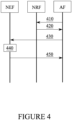
- FIGURE 4 illustrates a first signalling example in accordance with at least some embodiments.
- the first signalling example illustrates an example of interaction between the AF and the NEF through NRF.
- the first NF may receive an access token request (AccessTokenReq) from the second function, such as the AF.
- the AF may contact an authorization end point of the NRF.
- the first NF may determine a throughput parameter for the second function.
- the throughput parameter may be configured locally based on an instance ID of the second function or based on a type of the second function and/or a service of the second function for example.
- An access token may be generated by the first NF upon receiving the access token request.
- the access token may be generated by the first NF using a private key of the first NF.
- the first NF may transmit, responsive to receiving the access token request, the access token to the second function.
- the access token may be transmitted in an access token response (200 OK, AccessTokenRsp(AccessTokenClaims(iss, aud, scope,...throughput)). That is to say, the access token, i.e., the access token response, may comprise the throughput parameter.
- the access token and the throughput parameter may be used by the second function in a service request, such as a NF service request, to access a service of a third NF, such as the NEF.
- the access token may be usable in a service request to access a service of the third NF.
- the second function may, at step 430, transmit the service request to the third NF.
- the service request may comprise the access token and the access token may further comprise the throughput parameter.
- the third NF e.g., the AEF of the NEF, may verify, i.e., validate, the access token at step 440 by using a public key of the first NF. For instance, the third NF may validate the access token for integrity, expiry and scope (service to be accessed).
- the third NF may also look at the throughput parameter received from the second function, e.g.., the throughput parameter of the particular AF and check if the throughput has exceeded a limit.
- the throughput parameter may be the limit, such as a maximum number of transaction during a time interval.
- the third NF may accept or reject the service request to the second function depending on whether the throughput has been exceeded, or not.
- the throughput may be checked against token parameters and a response to the service request (NEF Service Response, 200 OK, 429 (Too many requests) may be transmitted accordingly at step 450.
- the throughput may be a current throughput of the second function and the current throughput may be checked against the throughput parameter.
- the third NF may check whether the current throughput has exceeded the limit by calculating a current throughput, e.g., based on local logic, for each of the peer AFs, i.e., second functions in general.
- the current throughput may be dynamically calculated using Key Performance Indicators, KPIs, which may be referred to counters as well.
- the third NF may determine whether the throughput has exceeded the limit and transmit the response to the service request based on said determination. For instance, the third NF may determine that the throughput has not exceeded the limit and transmit a response to the service request, the response indicating that access to the service of the third NF is granted, e.g., the service may be provided as the response upon determining that the throughput has not exceeded the limit, such as number of transactions during a time interval. The third NF may verify, based on determining that the throughput has not exceeded the limit, a digital signature in the access token using a public key of the first NF.
- the third NF may determine that the throughput has exceeded the limit and transmit a response to the service request, the response indicating that access to the service of the third NF is not granted.
- the third NF may decide, based on determining that the throughput has not exceeded the limit, not to verify the digital signature in the access token.
- the third NF may determine whether the throughput has exceeded the limit by comparing the current throughput of the second NF to the limit, i.e., to the throughput parameter.
- FIGURE 5 illustrates a second signalling example in accordance with at least some embodiments.
- the first signalling example illustrates and example, wherein the CAPIF uses an authorization service of the NRF for retrieving an access token for the AF.
- the AF may register as a trusted application with the NEF, or the CAPIF of the NEF, similarly as at step 210 of FIGURE 2 .
- the third NF may receive an access token request (AccessTokenReq) from the second function, such as the AF, similarly as at step 410 of FIGURE 4 .
- the AF may contact a token end point of the CAPIF of the NRF.
- the third NF may forward the access token request to the first NF, such as the NRF.
- the access token request may be forwarded to an authorization end point of the NRF for example.
- the first NF may, responsive to receiving the access token request, generate an access token along with a throughput parameter similarly as in the example of FIGURE 4 .
- the first NF may transmit the access token to the third NF similarly as at step 420 of FIGURE 4 .
- the access token may be transmitted in an access token response (200 OK, AccessTokenRsp(AccessTokenClaims(iss, aud, scope,...throughput)). That is to say, the access token, i.e., the access token response, may comprise a throughput parameter.
- the access token and the throughput parameter may be usable by the second function in a service request, such as a NF service request, to access a service of the third NF, such as the NEF or the AEF of the NEF.
- the third NF may forward the received access token comprising the throughput parameter to the second function.
- the second function may, at step 570, transmit the service request to the third NF, e.g., the AEF of the NEF, similarly as at step 430 of FIGURE 4 .
- the service request may comprise the access token and the access token may further comprise the throughput parameter.
- the third NF e.g., the AEF of the NEF, may verify, i.e., validate, the access token at step 580 by using a public key of the first NF similarly as at step 440 of FIGURE 4 .
- the third NF may validate the access token for integrity, expiry and scope (service to be accessed).
- the third NF may look at the throughput parameter received from the second function, e.g., the throughput parameter of the particular AF, and check if a throughput has exceeded a limit.
- the third NF may accept or reject the service request of the second function depending on whether the throughput has been exceeded, or not.
- the throughput may be checked against token parameters and a response to the service request (NEF Service Response, 200 OK, 429 (Too many requests) may be transmitted accordingly at step 590, similarly as at step 450 of FIGURE 4 .
- FIGURE 6 illustrates a third signalling example in accordance with at least some embodiments.
- the third signalling example illustrates an example, wherein an NFP may authorize a QoS of an NFC using an access token provided by an NRF.
- the first NF may receive an access token request (AccessTokenReq) from the second function, such as the NFC, similarly as at step 410 of FIGURE 4 .
- the NFC may contact an authorization end point of the NRF.
- the first NF may generate an access token along with a throughput parameter similarly as in the example of FIGURE 4 .
- the first NF may transmit, responsive to receiving the access token request, the access token to the second function similarly as at step 620 of FIGURE 6 .
- the access token may be transmitted in an access token response (200 OK, AccessTokenRsp(AccessTokenClaims(iss, aud, scope,...throughput)).
- the access token i.e., the access token response
- the access token and the throughput parameter may be usable by the second function in a service request, such as a NF service request, to access a service of a third NF, such as the NFP in FIGURE 6 .
- the second function may, at step 630, transmit the service request to the third NF similarly as at step 430 of FIGURE 4 .
- the service request may comprise the access token and the access token may further comprise the throughput parameter.
- the third NF e.g., the AEF of the NEF, may verify, i.e., validate, the access token at step 640 by using a public key of the first NF similarly as at step 440 of FIGURE 4 .
- the third NF may validate the access token for integrity, expiry and scope (service to be accessed).
- the third NF may also look at the throughput parameter received from the second function, e.g.., the throughput parameter of the particular AF and check if the throughput has exceeded a limit similarly as at step 440 of FIGURE 4 .
- the third NF may accept or reject the service request to the second function depending on whether the throughput has been exceeded, or not.
- the throughput may be checked against token parameters and a response to the service request (NEF Service Response, 200 OK, 429 (Too many requests) may be transmitted accordingly at step 650, similarly as at step 450.
- the throughput parameter may comprise an interval and a number of transactions.
- the interval may be a time interval and the number of transactions may be a maximum number of transaction during the time interval. That is to say, the throughput parameter may define a limit on a total number of transactions for which the access token can be used within a lifetime of the access token.
- the interval may be zero and the number of transactions may be for a lifetime of the access token.
- the access token and the throughput parameter therein may be generated by the first NF specifically for the second function. So the access token and the throughput parameter therein may be associated with the second function. For instance, the access token and the throughput parameter therein may refer to the access token and the throughput parameter of the second function, to be used to access a service of the third NF.
- Embodiments of the present invention thus enable QoS for trusted 3 rd party NFs in communication networks, such as in core networks of cellular communication networks.
- embodiments of the present invention QoS for trusted 3 rd party NFs in 5G core networks, and possibly in other core networks in the future as well.
- the first and the third NFs may operate according to at least one standard defined by a 3rd Generation Partnership Project, 3GPP.
- 3GPP 3rd Generation Partnership Project
- the first and the third NFs may be in a core network of a cellular communication network, such as a 5G core network.
- At least some embodiments of the present invention may be applied in a 3GPP standard specification TS 29.510, in section 5.2.7.1, table 5.2.7.1-1 (NFR Service and Service Operations as follows: Service Name Service Operations Operation Semantics Example Consumer(s) Nnrf_NFManag ement NFRegister Request/Response AMF, SMF, UDM, AUSF, NEF, PCF, SMSF, NSSF, UPF, BSF, CHF, NWDAF, P-CSCF, HSS, UDR, CAPIf NFUpdate Request/Response AMF, SMF, UDM, AUSF, NEF, PCF, SMSF, NSSF, UPF, BSF, CHF, NWDAF, P-CSCF, HSS, UDR, CAPIf NFDeregister Request/Response AMF, SMF, UDM, AUSF, NEF, PCF, SMSF, NSSF, UPF, BSF, CHF, NWDAF, P-CS
- At least some embodiments of the present invention may be applied in a 3GPP standard specification TS 29.510 as API additions, e.g., as additions to an existing yaml "TS29510_Nnrf_AccessToken.yaml", as follows (if interval is 0, the number of transaction is for a lifetime of an access token):
- FIGURE 7 is a flow graph of a first method in accordance with at least some embodiments.
- the phases of the illustrated first method may be performed by a first NF, such as the NRF, or by a control device configured to control the functioning thereof, possibly when installed therein.
- the first method may comprise, at step 710, receiving, by the first network function, an access token request from a second function, wherein the second function is a network function consumer or an application function.
- the first method may also comprise, at step 720, responsive to receiving the access token request, transmitting by the first network function to the second function an access token usable in a service request to access a service of a third network function, wherein the third network function is a network exposure function or a network function producer, and the access token comprises at least a throughput parameter.
- FIGURE 8 is a flow graph of a second method in accordance with at least some embodiments.
- the phases of the illustrated second method may be performed by a second function, such as a NFC or an AF, or by a control device configured to control the functioning thereof, possibly when installed therein.
- the second method may comprise, at step 810, transmitting, by the second function, an access token request to a first network function, wherein the first network function is a network repository function.
- the second method may also comprise, at step 820, responsive to transmitting the access token request, receiving from the first network function by the second function an access token usable in a service request to access a service of a third network function, wherein the third network function is a network exposure function or a network function producer and the access token comprises at least a throughput parameter.
- the second method may comprise, at step 830, transmitting, by the second function, the service request to the third network function, wherein the service request comprises the access token and the access token comprises at least the throughput parameter.
- the second method may comprise, at step 840, responsive to transmitting the service request, receiving by the second function a response to the service request from the third network function.
- FIGURE 9 is a flow graph of a third method in accordance with at least some embodiments.
- the phases of the illustrated third method may be performed by a third NF, such as an NEF or an NFP, or by a control device configured to control the functioning thereof, possibly when installed therein.
- a third NF such as an NEF or an NFP
- a control device configured to control the functioning thereof, possibly when installed therein.
- the third method may comprise, at step 910, receiving, by the third network function, a service request from a second function, wherein the service request comprises an access token and the second function is a network function consumer or an application function and the access token comprises at least a throughput parameter.
- the third method may also comprise, at step 920, responsive to receiving the service request, transmitting by the third network function a response to the service request to the second function, wherein the response is based on determining whether a throughput has exceeded a limit.
- an apparatus such as, for example, an NRF, NFC, AF, NEF or NFP, may comprise means for carrying out the embodiments described above and any combination thereof.
- a computer program may be configured to cause a method in accordance with the embodiments described above and any combination thereof.
- a computer program product embodied on a non-transitory computer readable medium, may be configured to control a processor to perform a process comprising the embodiments described above and any combination thereof.
- an apparatus such as, for example, an NRF, NFC, AF, NEF or NFP, may comprise at least one processor, and at least one memory including computer program code, wherein the at least one memory and the computer program code are configured to, with the at least one processor, cause the apparatus at least to perform the embodiments described above and any combination thereof.
- At least some embodiments find industrial application at least in 5G core networks, wherein it is desirable to enable QoS for trusted 3 rd party NFs, and possibly in other core networks in the future as well.
Landscapes
- Engineering & Computer Science (AREA)
- Computer Security & Cryptography (AREA)
- Computer Networks & Wireless Communication (AREA)
- Signal Processing (AREA)
- Computer Hardware Design (AREA)
- Computing Systems (AREA)
- General Engineering & Computer Science (AREA)
- Mobile Radio Communication Systems (AREA)
Claims (15)
- Procédé pour une première fonction de réseau, dans lequel la première fonction de réseau est une fonction de référentiel de réseau (140), le procédé comprenant :- la réception (710), par la première fonction de réseau (140), d'une demande de jeton d'accès provenant d'une deuxième fonction, dans lequel la deuxième fonction est un consommateur de fonction de réseau (120) ou une fonction d'application ; et- en réponse à la réception de la demande de jeton d'accès, la transmission (720) à la deuxième fonction, par la première fonction de réseau (140), d'un jeton d'accès utilisable dans une demande de service pour accéder à un service d'une troisième fonction de réseau, dans lequel la troisième fonction de réseau est une fonction d'exposition au réseau ou un producteur de fonction de réseau (122) et le jeton d'accès comprend au moins un paramètre de débit, dans lequel le paramètre de débit définit une limite sur le nombre total de transactions pour lesquelles le jeton d'accès peut être utilisé pendant une durée de vie du jeton d'accès.
- Procédé selon la revendication 1, dans lequel la demande de jeton d'accès est reçue de la deuxième fonction directement ou via un cadre d'interface de programmation d'application commune de la troisième fonction de réseau.
- Procédé selon la revendication 1 ou la revendication 2, dans lequel le jeton d'accès est transmis à la deuxième fonction directement, ou via un cadre d'interface de programmation d'application commune lorsque la deuxième fonction est la fonction d'application.
- Procédé selon l'une des revendications précédentes, dans lequel le jeton d'accès est généré par la première fonction de réseau (140) à la réception de la demande de jeton d'accès.
- Procédé selon la revendication 4, dans lequel le jeton d'accès généré est signé par la première fonction de réseau (140) à l'aide d'une clé privée de la première fonction de réseau (140).
- Procédé selon l'une des revendications précédentes, dans lequel le paramètre de débit est la limite.
- Procédé selon la revendication 6, dans lequel le paramètre de débit comprend un intervalle et un nombre de transactions.
- Procédé selon la revendication 7, dans lequel l'intervalle est égal à zéro et le nombre de transactions correspond à la durée de vie du jeton d'accès.
- Procédé selon l'une des revendications précédentes, dans lequel la première fonction de réseau (140), la deuxième fonction et la troisième fonction de réseau fonctionnent selon au moins une spécification standard définie par un projet de partenariat de troisième génération (3GPP).
- Procédé selon l'une des revendications précédentes, dans lequel les première (140) et troisième fonctions de réseau sont dans un réseau central d'un réseau de communication cellulaire.
- Procédé selon la revendication 10, dans lequel le réseau central est un réseau central 5G.
- Appareil comprenant :- des moyens pour recevoir une demande de jeton d'accès provenant d'une deuxième fonction, dans lequel la deuxième fonction est un consommateur de fonction de réseau (120) ou une fonction d'application ; et- des moyens pour transmettre à la deuxième fonction, en réponse à la réception de la demande de jeton d'accès, un jeton d'accès utilisable dans une demande de service pour accéder à un service d'une troisième fonction de réseau, dans lequel la troisième fonction de réseau est une fonction d'exposition au réseau ou un producteur de fonction de réseau (122) et le jeton d'accès comprend au moins un paramètre de débit, dans lequel le paramètre de débit définit une limite sur le nombre total de transactions pour lesquelles le jeton d'accès peut être utilisé pendant une durée de vie du jeton d'accès.
- Appareil selon la revendication 12, comprenant en outre des moyens pour réaliser un procédé selon l'une des revendications 2 à 11.
- Programme informatique comprenant des instructions qui, lorsqu'elles sont exécutées par un ordinateur, amènent l'ordinateur à réaliser au moins ce qui suit :- la réception, par la première fonction de réseau (140), d'une demande de jeton d'accès provenant d'une deuxième fonction, dans lequel la deuxième fonction est un consommateur de fonction de réseau (122) ou une fonction d'application ; et- en réponse à la réception de la demande de jeton d'accès, la transmission à la deuxième fonction, par la première fonction de réseau (140), d'un jeton d'accès utilisable dans une demande de service pour accéder à un service d'une troisième fonction de réseau, dans lequel la troisième fonction de réseau est une fonction d'exposition au réseau ou un producteur de fonction de réseau (122) et le jeton d'accès comprend au moins un paramètre de débit, dans lequel le paramètre de débit définit une limite sur le nombre total de transactions pour lesquelles le jeton d'accès peut être utilisé pendant une durée de vie du jeton d'accès.
- Programme informatique selon la revendication 14, comprenant en outre des instructions qui, lorsqu'elles sont exécutées par l'ordinateur, amènent l'ordinateur à réaliser un procédé selon l'une des revendications 2 à 11.
Applications Claiming Priority (1)
| Application Number | Priority Date | Filing Date | Title |
|---|---|---|---|
| IN202041002406 | 2020-01-20 |
Publications (2)
| Publication Number | Publication Date |
|---|---|
| EP3852339A1 EP3852339A1 (fr) | 2021-07-21 |
| EP3852339B1 true EP3852339B1 (fr) | 2023-08-09 |
Family
ID=74191540
Family Applications (1)
| Application Number | Title | Priority Date | Filing Date |
|---|---|---|---|
| EP21152206.5A Active EP3852339B1 (fr) | 2020-01-20 | 2021-01-19 | Activation de la qualité de service pour les fonctions de réseau de tiers fiables dans des réseaux principaux |
Country Status (1)
| Country | Link |
|---|---|
| EP (1) | EP3852339B1 (fr) |
Cited By (1)
| Publication number | Priority date | Publication date | Assignee | Title |
|---|---|---|---|---|
| US12413486B1 (en) | 2024-03-11 | 2025-09-09 | T-Mobile Usa, Inc. | Telecommunications system to timely send producer network function status notifications to consumer network functions |
Families Citing this family (6)
| Publication number | Priority date | Publication date | Assignee | Title |
|---|---|---|---|---|
| CN116321144A (zh) * | 2021-12-21 | 2023-06-23 | 中国电信股份有限公司 | 5g核心网sepp认证nf的方法、装置、设备及介质 |
| WO2023156706A1 (fr) * | 2022-02-21 | 2023-08-24 | Nokia Technologies Oy | Autorisation de fonctions d'application externes à des services de réseau mobile |
| WO2023216082A1 (fr) * | 2022-05-09 | 2023-11-16 | 北京小米移动软件有限公司 | Procédé et appareil de traitement d'abonnement, et support et puce |
| CN118614101A (zh) * | 2023-01-06 | 2024-09-06 | 北京小米移动软件有限公司 | 授权方法、装置、通信设备及存储介质 |
| GB2629811A (en) * | 2023-05-11 | 2024-11-13 | Nokia Technologies Oy | Method to prevent or reduce replay attacks on network functions using improved access token procedure |
| EP4687327A1 (fr) * | 2024-08-01 | 2026-02-04 | INTEL Corporation | Mécanismes avancés de protection de la vie privée et mécanismes d'autorisation pour l'apprentissage fédéré vertical (vfl) |
-
2021
- 2021-01-19 EP EP21152206.5A patent/EP3852339B1/fr active Active
Cited By (1)
| Publication number | Priority date | Publication date | Assignee | Title |
|---|---|---|---|---|
| US12413486B1 (en) | 2024-03-11 | 2025-09-09 | T-Mobile Usa, Inc. | Telecommunications system to timely send producer network function status notifications to consumer network functions |
Also Published As
| Publication number | Publication date |
|---|---|
| EP3852339A1 (fr) | 2021-07-21 |
Similar Documents
| Publication | Publication Date | Title |
|---|---|---|
| EP3852339B1 (fr) | Activation de la qualité de service pour les fonctions de réseau de tiers fiables dans des réseaux principaux | |
| US12063312B2 (en) | Security procedure for cryptographic signature verification based on a trust relationship between edge nodes connecting home and visited networks | |
| US11737011B2 (en) | Management of access tokens in communication networks | |
| EP4075847B1 (fr) | Contrôle d'abonnement de service de fonction réseau | |
| CN113748699B (zh) | 用于通信系统中的间接通信的服务授权 | |
| US12407561B2 (en) | Network function request error handling | |
| US12192359B2 (en) | Authorization of network request | |
| CN116325658A (zh) | 用于使用移动性模式的5g用户设备(ue)历史移动性跟踪和安全筛查的方法、系统和计算机可读介质 | |
| EP3886390A1 (fr) | Gestion de jeton | |
| WO2021140272A1 (fr) | Vérification de jetons d'accès avec des fonctions de référentiel de réseau dans des réseaux centraux | |
| US20220104162A1 (en) | Authorization of network node | |
| WO2021240055A1 (fr) | Autorisation améliorée dans des réseaux de communication | |
| US12452063B2 (en) | Network security | |
| US12328395B2 (en) | Network security | |
| WO2021165194A1 (fr) | Gestion de clé | |
| US20240121111A1 (en) | Enhanced security in communication networks | |
| WO2021176131A1 (fr) | Autorisation améliorée dans des réseaux de communication | |
| WO2021224545A1 (fr) | Enregistrement amélioré dans des réseaux de communication | |
| WO2021099675A1 (fr) | Gestion de sécurité de service de réseau mobile | |
| WO2021165925A1 (fr) | Gestion de clé | |
| WO2021198552A1 (fr) | Autorisation améliorée dans des réseaux de communication | |
| US20220217127A1 (en) | Authentication of network request | |
| WO2021224544A1 (fr) | Enregistrement dans des réseaux de communication | |
| EP4092982A1 (fr) | Authentification d'une demande de réseau | |
| WO2021079023A1 (fr) | Sécurité de communication de réseau inter-mobile |
Legal Events
| Date | Code | Title | Description |
|---|---|---|---|
| PUAI | Public reference made under article 153(3) epc to a published international application that has entered the european phase |
Free format text: ORIGINAL CODE: 0009012 |
|
| STAA | Information on the status of an ep patent application or granted ep patent |
Free format text: STATUS: THE APPLICATION HAS BEEN PUBLISHED |
|
| AK | Designated contracting states |
Kind code of ref document: A1 Designated state(s): AL AT BE BG CH CY CZ DE DK EE ES FI FR GB GR HR HU IE IS IT LI LT LU LV MC MK MT NL NO PL PT RO RS SE SI SK SM TR |
|
| STAA | Information on the status of an ep patent application or granted ep patent |
Free format text: STATUS: REQUEST FOR EXAMINATION WAS MADE |
|
| 17P | Request for examination filed |
Effective date: 20220119 |
|
| RBV | Designated contracting states (corrected) |
Designated state(s): AL AT BE BG CH CY CZ DE DK EE ES FI FR GB GR HR HU IE IS IT LI LT LU LV MC MK MT NL NO PL PT RO RS SE SI SK SM TR |
|
| REG | Reference to a national code |
Ref country code: DE Free format text: PREVIOUS MAIN CLASS: H04L0029060000 Ref country code: DE Ref legal event code: R079 Ref document number: 602021004036 Country of ref document: DE Free format text: PREVIOUS MAIN CLASS: H04L0029060000 Ipc: H04W0012084000 |
|
| GRAP | Despatch of communication of intention to grant a patent |
Free format text: ORIGINAL CODE: EPIDOSNIGR1 |
|
| STAA | Information on the status of an ep patent application or granted ep patent |
Free format text: STATUS: GRANT OF PATENT IS INTENDED |
|
| RIC1 | Information provided on ipc code assigned before grant |
Ipc: H04L 9/40 20220101ALI20230307BHEP Ipc: H04W 12/084 20210101AFI20230307BHEP |
|
| INTG | Intention to grant announced |
Effective date: 20230329 |
|
| GRAS | Grant fee paid |
Free format text: ORIGINAL CODE: EPIDOSNIGR3 |
|
| GRAA | (expected) grant |
Free format text: ORIGINAL CODE: 0009210 |
|
| STAA | Information on the status of an ep patent application or granted ep patent |
Free format text: STATUS: THE PATENT HAS BEEN GRANTED |
|
| AK | Designated contracting states |
Kind code of ref document: B1 Designated state(s): AL AT BE BG CH CY CZ DE DK EE ES FI FR GB GR HR HU IE IS IT LI LT LU LV MC MK MT NL NO PL PT RO RS SE SI SK SM TR |
|
| REG | Reference to a national code |
Ref country code: GB Ref legal event code: FG4D |
|
| REG | Reference to a national code |
Ref country code: CH Ref legal event code: EP |
|
| REG | Reference to a national code |
Ref country code: IE Ref legal event code: FG4D |
|
| REG | Reference to a national code |
Ref country code: DE Ref legal event code: R096 Ref document number: 602021004036 Country of ref document: DE |
|
| REG | Reference to a national code |
Ref country code: LT Ref legal event code: MG9D |
|
| REG | Reference to a national code |
Ref country code: NL Ref legal event code: MP Effective date: 20230809 |
|
| REG | Reference to a national code |
Ref country code: AT Ref legal event code: MK05 Ref document number: 1598901 Country of ref document: AT Kind code of ref document: T Effective date: 20230809 |
|
| PG25 | Lapsed in a contracting state [announced via postgrant information from national office to epo] |
Ref country code: GR Free format text: LAPSE BECAUSE OF FAILURE TO SUBMIT A TRANSLATION OF THE DESCRIPTION OR TO PAY THE FEE WITHIN THE PRESCRIBED TIME-LIMIT Effective date: 20231110 |
|
| PG25 | Lapsed in a contracting state [announced via postgrant information from national office to epo] |
Ref country code: IS Free format text: LAPSE BECAUSE OF FAILURE TO SUBMIT A TRANSLATION OF THE DESCRIPTION OR TO PAY THE FEE WITHIN THE PRESCRIBED TIME-LIMIT Effective date: 20231209 |
|
| PG25 | Lapsed in a contracting state [announced via postgrant information from national office to epo] |
Ref country code: SE Free format text: LAPSE BECAUSE OF FAILURE TO SUBMIT A TRANSLATION OF THE DESCRIPTION OR TO PAY THE FEE WITHIN THE PRESCRIBED TIME-LIMIT Effective date: 20230809 Ref country code: RS Free format text: LAPSE BECAUSE OF FAILURE TO SUBMIT A TRANSLATION OF THE DESCRIPTION OR TO PAY THE FEE WITHIN THE PRESCRIBED TIME-LIMIT Effective date: 20230809 Ref country code: PT Free format text: LAPSE BECAUSE OF FAILURE TO SUBMIT A TRANSLATION OF THE DESCRIPTION OR TO PAY THE FEE WITHIN THE PRESCRIBED TIME-LIMIT Effective date: 20231211 Ref country code: NO Free format text: LAPSE BECAUSE OF FAILURE TO SUBMIT A TRANSLATION OF THE DESCRIPTION OR TO PAY THE FEE WITHIN THE PRESCRIBED TIME-LIMIT Effective date: 20231109 Ref country code: NL Free format text: LAPSE BECAUSE OF FAILURE TO SUBMIT A TRANSLATION OF THE DESCRIPTION OR TO PAY THE FEE WITHIN THE PRESCRIBED TIME-LIMIT Effective date: 20230809 Ref country code: LV Free format text: LAPSE BECAUSE OF FAILURE TO SUBMIT A TRANSLATION OF THE DESCRIPTION OR TO PAY THE FEE WITHIN THE PRESCRIBED TIME-LIMIT Effective date: 20230809 Ref country code: LT Free format text: LAPSE BECAUSE OF FAILURE TO SUBMIT A TRANSLATION OF THE DESCRIPTION OR TO PAY THE FEE WITHIN THE PRESCRIBED TIME-LIMIT Effective date: 20230809 Ref country code: IS Free format text: LAPSE BECAUSE OF FAILURE TO SUBMIT A TRANSLATION OF THE DESCRIPTION OR TO PAY THE FEE WITHIN THE PRESCRIBED TIME-LIMIT Effective date: 20231209 Ref country code: HR Free format text: LAPSE BECAUSE OF FAILURE TO SUBMIT A TRANSLATION OF THE DESCRIPTION OR TO PAY THE FEE WITHIN THE PRESCRIBED TIME-LIMIT Effective date: 20230809 Ref country code: GR Free format text: LAPSE BECAUSE OF FAILURE TO SUBMIT A TRANSLATION OF THE DESCRIPTION OR TO PAY THE FEE WITHIN THE PRESCRIBED TIME-LIMIT Effective date: 20231110 Ref country code: FI Free format text: LAPSE BECAUSE OF FAILURE TO SUBMIT A TRANSLATION OF THE DESCRIPTION OR TO PAY THE FEE WITHIN THE PRESCRIBED TIME-LIMIT Effective date: 20230809 Ref country code: AT Free format text: LAPSE BECAUSE OF FAILURE TO SUBMIT A TRANSLATION OF THE DESCRIPTION OR TO PAY THE FEE WITHIN THE PRESCRIBED TIME-LIMIT Effective date: 20230809 |
|
| PG25 | Lapsed in a contracting state [announced via postgrant information from national office to epo] |
Ref country code: PL Free format text: LAPSE BECAUSE OF FAILURE TO SUBMIT A TRANSLATION OF THE DESCRIPTION OR TO PAY THE FEE WITHIN THE PRESCRIBED TIME-LIMIT Effective date: 20230809 |
|
| PG25 | Lapsed in a contracting state [announced via postgrant information from national office to epo] |
Ref country code: ES Free format text: LAPSE BECAUSE OF FAILURE TO SUBMIT A TRANSLATION OF THE DESCRIPTION OR TO PAY THE FEE WITHIN THE PRESCRIBED TIME-LIMIT Effective date: 20230809 |
|
| PG25 | Lapsed in a contracting state [announced via postgrant information from national office to epo] |
Ref country code: SM Free format text: LAPSE BECAUSE OF FAILURE TO SUBMIT A TRANSLATION OF THE DESCRIPTION OR TO PAY THE FEE WITHIN THE PRESCRIBED TIME-LIMIT Effective date: 20230809 Ref country code: RO Free format text: LAPSE BECAUSE OF FAILURE TO SUBMIT A TRANSLATION OF THE DESCRIPTION OR TO PAY THE FEE WITHIN THE PRESCRIBED TIME-LIMIT Effective date: 20230809 Ref country code: ES Free format text: LAPSE BECAUSE OF FAILURE TO SUBMIT A TRANSLATION OF THE DESCRIPTION OR TO PAY THE FEE WITHIN THE PRESCRIBED TIME-LIMIT Effective date: 20230809 Ref country code: EE Free format text: LAPSE BECAUSE OF FAILURE TO SUBMIT A TRANSLATION OF THE DESCRIPTION OR TO PAY THE FEE WITHIN THE PRESCRIBED TIME-LIMIT Effective date: 20230809 Ref country code: DK Free format text: LAPSE BECAUSE OF FAILURE TO SUBMIT A TRANSLATION OF THE DESCRIPTION OR TO PAY THE FEE WITHIN THE PRESCRIBED TIME-LIMIT Effective date: 20230809 Ref country code: CZ Free format text: LAPSE BECAUSE OF FAILURE TO SUBMIT A TRANSLATION OF THE DESCRIPTION OR TO PAY THE FEE WITHIN THE PRESCRIBED TIME-LIMIT Effective date: 20230809 Ref country code: SK Free format text: LAPSE BECAUSE OF FAILURE TO SUBMIT A TRANSLATION OF THE DESCRIPTION OR TO PAY THE FEE WITHIN THE PRESCRIBED TIME-LIMIT Effective date: 20230809 |
|
| REG | Reference to a national code |
Ref country code: DE Ref legal event code: R097 Ref document number: 602021004036 Country of ref document: DE |
|
| PG25 | Lapsed in a contracting state [announced via postgrant information from national office to epo] |
Ref country code: IT Free format text: LAPSE BECAUSE OF FAILURE TO SUBMIT A TRANSLATION OF THE DESCRIPTION OR TO PAY THE FEE WITHIN THE PRESCRIBED TIME-LIMIT Effective date: 20230809 |
|
| PLBE | No opposition filed within time limit |
Free format text: ORIGINAL CODE: 0009261 |
|
| STAA | Information on the status of an ep patent application or granted ep patent |
Free format text: STATUS: NO OPPOSITION FILED WITHIN TIME LIMIT |
|
| 26N | No opposition filed |
Effective date: 20240513 |
|
| PG25 | Lapsed in a contracting state [announced via postgrant information from national office to epo] |
Ref country code: SI Free format text: LAPSE BECAUSE OF FAILURE TO SUBMIT A TRANSLATION OF THE DESCRIPTION OR TO PAY THE FEE WITHIN THE PRESCRIBED TIME-LIMIT Effective date: 20230809 |
|
| PG25 | Lapsed in a contracting state [announced via postgrant information from national office to epo] |
Ref country code: MC Free format text: LAPSE BECAUSE OF FAILURE TO SUBMIT A TRANSLATION OF THE DESCRIPTION OR TO PAY THE FEE WITHIN THE PRESCRIBED TIME-LIMIT Effective date: 20230809 |
|
| PG25 | Lapsed in a contracting state [announced via postgrant information from national office to epo] |
Ref country code: MC Free format text: LAPSE BECAUSE OF FAILURE TO SUBMIT A TRANSLATION OF THE DESCRIPTION OR TO PAY THE FEE WITHIN THE PRESCRIBED TIME-LIMIT Effective date: 20230809 |
|
| REG | Reference to a national code |
Ref country code: CH Ref legal event code: PL |
|
| PG25 | Lapsed in a contracting state [announced via postgrant information from national office to epo] |
Ref country code: LU Free format text: LAPSE BECAUSE OF NON-PAYMENT OF DUE FEES Effective date: 20240119 |
|
| PG25 | Lapsed in a contracting state [announced via postgrant information from national office to epo] |
Ref country code: LU Free format text: LAPSE BECAUSE OF NON-PAYMENT OF DUE FEES Effective date: 20240119 |
|
| PG25 | Lapsed in a contracting state [announced via postgrant information from national office to epo] |
Ref country code: BE Free format text: LAPSE BECAUSE OF NON-PAYMENT OF DUE FEES Effective date: 20240131 |
|
| PG25 | Lapsed in a contracting state [announced via postgrant information from national office to epo] |
Ref country code: FR Free format text: LAPSE BECAUSE OF NON-PAYMENT OF DUE FEES Effective date: 20240131 |
|
| PG25 | Lapsed in a contracting state [announced via postgrant information from national office to epo] |
Ref country code: CH Free format text: LAPSE BECAUSE OF NON-PAYMENT OF DUE FEES Effective date: 20240131 |
|
| PG25 | Lapsed in a contracting state [announced via postgrant information from national office to epo] |
Ref country code: FR Free format text: LAPSE BECAUSE OF NON-PAYMENT OF DUE FEES Effective date: 20240131 Ref country code: CH Free format text: LAPSE BECAUSE OF NON-PAYMENT OF DUE FEES Effective date: 20240131 Ref country code: BE Free format text: LAPSE BECAUSE OF NON-PAYMENT OF DUE FEES Effective date: 20240131 |
|
| REG | Reference to a national code |
Ref country code: BE Ref legal event code: MM Effective date: 20240131 |
|
| PG25 | Lapsed in a contracting state [announced via postgrant information from national office to epo] |
Ref country code: BG Free format text: LAPSE BECAUSE OF FAILURE TO SUBMIT A TRANSLATION OF THE DESCRIPTION OR TO PAY THE FEE WITHIN THE PRESCRIBED TIME-LIMIT Effective date: 20230809 |
|
| PG25 | Lapsed in a contracting state [announced via postgrant information from national office to epo] |
Ref country code: BG Free format text: LAPSE BECAUSE OF FAILURE TO SUBMIT A TRANSLATION OF THE DESCRIPTION OR TO PAY THE FEE WITHIN THE PRESCRIBED TIME-LIMIT Effective date: 20230809 |
|
| PG25 | Lapsed in a contracting state [announced via postgrant information from national office to epo] |
Ref country code: IE Free format text: LAPSE BECAUSE OF NON-PAYMENT OF DUE FEES Effective date: 20240119 |
|
| PG25 | Lapsed in a contracting state [announced via postgrant information from national office to epo] |
Ref country code: IE Free format text: LAPSE BECAUSE OF NON-PAYMENT OF DUE FEES Effective date: 20240119 |
|
| PG25 | Lapsed in a contracting state [announced via postgrant information from national office to epo] |
Ref country code: CY Free format text: LAPSE BECAUSE OF FAILURE TO SUBMIT A TRANSLATION OF THE DESCRIPTION OR TO PAY THE FEE WITHIN THE PRESCRIBED TIME-LIMIT; INVALID AB INITIO Effective date: 20210119 |
|
| PG25 | Lapsed in a contracting state [announced via postgrant information from national office to epo] |
Ref country code: HU Free format text: LAPSE BECAUSE OF FAILURE TO SUBMIT A TRANSLATION OF THE DESCRIPTION OR TO PAY THE FEE WITHIN THE PRESCRIBED TIME-LIMIT; INVALID AB INITIO Effective date: 20210119 |
|
| GBPC | Gb: european patent ceased through non-payment of renewal fee |
Effective date: 20250119 |
|
| PG25 | Lapsed in a contracting state [announced via postgrant information from national office to epo] |
Ref country code: GB Free format text: LAPSE BECAUSE OF NON-PAYMENT OF DUE FEES Effective date: 20250119 |
|
| PG25 | Lapsed in a contracting state [announced via postgrant information from national office to epo] |
Ref country code: TR Free format text: LAPSE BECAUSE OF FAILURE TO SUBMIT A TRANSLATION OF THE DESCRIPTION OR TO PAY THE FEE WITHIN THE PRESCRIBED TIME-LIMIT Effective date: 20230809 |
|
| PGFP | Annual fee paid to national office [announced via postgrant information from national office to epo] |
Ref country code: DE Payment date: 20251203 Year of fee payment: 6 |