EP3853025B1 - Poudre plastique à déformation optimisée - Google Patents
Poudre plastique à déformation optimisée Download PDFInfo
- Publication number
- EP3853025B1 EP3853025B1 EP19801298.1A EP19801298A EP3853025B1 EP 3853025 B1 EP3853025 B1 EP 3853025B1 EP 19801298 A EP19801298 A EP 19801298A EP 3853025 B1 EP3853025 B1 EP 3853025B1
- Authority
- EP
- European Patent Office
- Prior art keywords
- polymer
- particulate
- particles
- plastic powder
- dimensional object
- Prior art date
- Legal status (The legal status is an assumption and is not a legal conclusion. Google has not performed a legal analysis and makes no representation as to the accuracy of the status listed.)
- Active
Links
Images


Classifications
-
- B—PERFORMING OPERATIONS; TRANSPORTING
- B29—WORKING OF PLASTICS; WORKING OF SUBSTANCES IN A PLASTIC STATE IN GENERAL
- B29C—SHAPING OR JOINING OF PLASTICS; SHAPING OF MATERIAL IN A PLASTIC STATE, NOT OTHERWISE PROVIDED FOR; AFTER-TREATMENT OF THE SHAPED PRODUCTS, e.g. REPAIRING
- B29C64/00—Additive manufacturing, i.e. manufacturing of three-dimensional [3D] objects by additive deposition, additive agglomeration or additive layering, e.g. by 3D printing, stereolithography or selective laser sintering
- B29C64/10—Processes of additive manufacturing
- B29C64/141—Processes of additive manufacturing using only solid materials
- B29C64/153—Processes of additive manufacturing using only solid materials using layers of powder being selectively joined, e.g. by selective laser sintering or melting
-
- B—PERFORMING OPERATIONS; TRANSPORTING
- B29—WORKING OF PLASTICS; WORKING OF SUBSTANCES IN A PLASTIC STATE IN GENERAL
- B29C—SHAPING OR JOINING OF PLASTICS; SHAPING OF MATERIAL IN A PLASTIC STATE, NOT OTHERWISE PROVIDED FOR; AFTER-TREATMENT OF THE SHAPED PRODUCTS, e.g. REPAIRING
- B29C64/00—Additive manufacturing, i.e. manufacturing of three-dimensional [3D] objects by additive deposition, additive agglomeration or additive layering, e.g. by 3D printing, stereolithography or selective laser sintering
- B29C64/20—Apparatus for additive manufacturing; Details thereof or accessories therefor
- B29C64/264—Arrangements for irradiation
-
- B—PERFORMING OPERATIONS; TRANSPORTING
- B33—ADDITIVE MANUFACTURING TECHNOLOGY
- B33Y—ADDITIVE MANUFACTURING, i.e. MANUFACTURING OF THREE-DIMENSIONAL [3D] OBJECTS BY ADDITIVE DEPOSITION, ADDITIVE AGGLOMERATION OR ADDITIVE LAYERING, e.g. BY 3D PRINTING, STEREOLITHOGRAPHY OR SELECTIVE LASER SINTERING
- B33Y10/00—Processes of additive manufacturing
-
- B—PERFORMING OPERATIONS; TRANSPORTING
- B33—ADDITIVE MANUFACTURING TECHNOLOGY
- B33Y—ADDITIVE MANUFACTURING, i.e. MANUFACTURING OF THREE-DIMENSIONAL [3D] OBJECTS BY ADDITIVE DEPOSITION, ADDITIVE AGGLOMERATION OR ADDITIVE LAYERING, e.g. BY 3D PRINTING, STEREOLITHOGRAPHY OR SELECTIVE LASER SINTERING
- B33Y70/00—Materials specially adapted for additive manufacturing
-
- B—PERFORMING OPERATIONS; TRANSPORTING
- B33—ADDITIVE MANUFACTURING TECHNOLOGY
- B33Y—ADDITIVE MANUFACTURING, i.e. MANUFACTURING OF THREE-DIMENSIONAL [3D] OBJECTS BY ADDITIVE DEPOSITION, ADDITIVE AGGLOMERATION OR ADDITIVE LAYERING, e.g. BY 3D PRINTING, STEREOLITHOGRAPHY OR SELECTIVE LASER SINTERING
- B33Y80/00—Products made by additive manufacturing
-
- C—CHEMISTRY; METALLURGY
- C08—ORGANIC MACROMOLECULAR COMPOUNDS; THEIR PREPARATION OR CHEMICAL WORKING-UP; COMPOSITIONS BASED THEREON
- C08J—WORKING-UP; GENERAL PROCESSES OF COMPOUNDING; AFTER-TREATMENT NOT COVERED BY SUBCLASSES C08B, C08C, C08F, C08G or C08H
- C08J3/00—Processes of treating or compounding macromolecular substances
- C08J3/20—Compounding polymers with additives, e.g. colouring
- C08J3/203—Solid polymers with solid and/or liquid additives
-
- C—CHEMISTRY; METALLURGY
- C08—ORGANIC MACROMOLECULAR COMPOUNDS; THEIR PREPARATION OR CHEMICAL WORKING-UP; COMPOSITIONS BASED THEREON
- C08K—Use of inorganic or non-macromolecular organic substances as compounding ingredients
- C08K3/00—Use of inorganic substances as compounding ingredients
- C08K3/01—Use of inorganic substances as compounding ingredients characterized by their specific function
- C08K3/013—Fillers, pigments or reinforcing additives
-
- C—CHEMISTRY; METALLURGY
- C08—ORGANIC MACROMOLECULAR COMPOUNDS; THEIR PREPARATION OR CHEMICAL WORKING-UP; COMPOSITIONS BASED THEREON
- C08K—Use of inorganic or non-macromolecular organic substances as compounding ingredients
- C08K3/00—Use of inorganic substances as compounding ingredients
- C08K3/02—Elements
- C08K3/04—Carbon
-
- C—CHEMISTRY; METALLURGY
- C08—ORGANIC MACROMOLECULAR COMPOUNDS; THEIR PREPARATION OR CHEMICAL WORKING-UP; COMPOSITIONS BASED THEREON
- C08L—COMPOSITIONS OF MACROMOLECULAR COMPOUNDS
- C08L77/00—Compositions of polyamides obtained by reactions forming a carboxylic amide link in the main chain; Compositions of derivatives of such polymers
- C08L77/02—Polyamides derived from omega-amino carboxylic acids or from lactams thereof
-
- C—CHEMISTRY; METALLURGY
- C08—ORGANIC MACROMOLECULAR COMPOUNDS; THEIR PREPARATION OR CHEMICAL WORKING-UP; COMPOSITIONS BASED THEREON
- C08L—COMPOSITIONS OF MACROMOLECULAR COMPOUNDS
- C08L77/00—Compositions of polyamides obtained by reactions forming a carboxylic amide link in the main chain; Compositions of derivatives of such polymers
- C08L77/06—Polyamides derived from polyamines and polycarboxylic acids
-
- B—PERFORMING OPERATIONS; TRANSPORTING
- B29—WORKING OF PLASTICS; WORKING OF SUBSTANCES IN A PLASTIC STATE IN GENERAL
- B29K—INDEXING SCHEME ASSOCIATED WITH SUBCLASSES B29B, B29C OR B29D, RELATING TO MOULDING MATERIALS OR TO MATERIALS FOR MOULDS, REINFORCEMENTS, FILLERS OR PREFORMED PARTS, e.g. INSERTS
- B29K2077/00—Use of PA, i.e. polyamides, e.g. polyesteramides or derivatives thereof, as moulding material
-
- B—PERFORMING OPERATIONS; TRANSPORTING
- B29—WORKING OF PLASTICS; WORKING OF SUBSTANCES IN A PLASTIC STATE IN GENERAL
- B29K—INDEXING SCHEME ASSOCIATED WITH SUBCLASSES B29B, B29C OR B29D, RELATING TO MOULDING MATERIALS OR TO MATERIALS FOR MOULDS, REINFORCEMENTS, FILLERS OR PREFORMED PARTS, e.g. INSERTS
- B29K2507/00—Use of elements other than metals as filler
- B29K2507/04—Carbon
-
- B—PERFORMING OPERATIONS; TRANSPORTING
- B33—ADDITIVE MANUFACTURING TECHNOLOGY
- B33Y—ADDITIVE MANUFACTURING, i.e. MANUFACTURING OF THREE-DIMENSIONAL [3D] OBJECTS BY ADDITIVE DEPOSITION, ADDITIVE AGGLOMERATION OR ADDITIVE LAYERING, e.g. BY 3D PRINTING, STEREOLITHOGRAPHY OR SELECTIVE LASER SINTERING
- B33Y30/00—Apparatus for additive manufacturing; Details thereof or accessories therefor
-
- C—CHEMISTRY; METALLURGY
- C08—ORGANIC MACROMOLECULAR COMPOUNDS; THEIR PREPARATION OR CHEMICAL WORKING-UP; COMPOSITIONS BASED THEREON
- C08J—WORKING-UP; GENERAL PROCESSES OF COMPOUNDING; AFTER-TREATMENT NOT COVERED BY SUBCLASSES C08B, C08C, C08F, C08G or C08H
- C08J2377/00—Characterised by the use of polyamides obtained by reactions forming a carboxylic amide link in the main chain; Derivatives of such polymers
- C08J2377/02—Polyamides derived from omega-amino carboxylic acids or from lactams thereof
-
- C—CHEMISTRY; METALLURGY
- C08—ORGANIC MACROMOLECULAR COMPOUNDS; THEIR PREPARATION OR CHEMICAL WORKING-UP; COMPOSITIONS BASED THEREON
- C08J—WORKING-UP; GENERAL PROCESSES OF COMPOUNDING; AFTER-TREATMENT NOT COVERED BY SUBCLASSES C08B, C08C, C08F, C08G or C08H
- C08J2377/00—Characterised by the use of polyamides obtained by reactions forming a carboxylic amide link in the main chain; Derivatives of such polymers
- C08J2377/06—Polyamides derived from polyamines and polycarboxylic acids
-
- C—CHEMISTRY; METALLURGY
- C08—ORGANIC MACROMOLECULAR COMPOUNDS; THEIR PREPARATION OR CHEMICAL WORKING-UP; COMPOSITIONS BASED THEREON
- C08K—Use of inorganic or non-macromolecular organic substances as compounding ingredients
- C08K2201/00—Specific properties of additives
- C08K2201/002—Physical properties
- C08K2201/003—Additives being defined by their diameter
Definitions
- the present invention relates to a plastic powder for use in a layer-by-layer process for producing molded bodies, in which areas of a respective powder layer are selectively melted and resolidified.
- the present invention also relates to a process for producing a molded body using the plastic powder according to the invention as a building material, a molded body produced from the powder according to the invention and a system for producing molded bodies according to the invention.
- a method for producing a three-dimensional object can be carried out layer by layer by selective sintering using electromagnetic radiation with the aid of an electromagnetic radiation source.
- a three-dimensional object is produced layer by layer - according to the principle of "additive manufacturing" - by applying layers of powder and bonding these layers to one another by selectively solidifying the powder at the locations corresponding to the cross sections of the object.
- WO2005085326A1 is a polymer powder for additive manufacturing by laser sintering that contains a particulate carbon material.
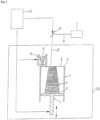
- Fig. 1 shows an example of a laser sintering device, by means of which a process for the layer-by-layer production of a three-dimensional object can be carried out.
- the device comprises a container 1. This is open at the top and is closed at the bottom by a carrier 4 for carrying an object 3 to be formed. limited.
- a working plane 6 is defined by the upper edge 2 of the container (or its side walls).
- the object is located on the upper side of the carrier 4 and is formed from a plurality of layers extending parallel to the upper side of the carrier 4 and made of a powdery construction material that can be solidified by means of electromagnetic radiation.
- the carrier can be moved in the vertical direction, ie parallel to the side wall of the container 1, via a height adjustment device. This allows the position of the carrier 4 to be adjusted relative to the working plane 6.
- an application device 10 is provided for applying the powder material 11 to be solidified onto the carrier surface 5 or a last solidified layer. Furthermore, an irradiation device in the form of a laser 7 is arranged above the working plane 6, which emits a directed light beam 8. This is directed as a deflected beam 8' in the direction of the working plane 6 via a deflection device 9, for example a rotating mirror.
- a control unit 40 enables the control of the carrier 4, the application device 10 and the deflection device 9.
- the elements 1 to 6, 10 and 11 are arranged within the machine frame 100.
- the powder material 11 is applied layer by layer to the carrier 4 or a previously solidified layer and solidified with the laser beam 8' at the points of each powder layer corresponding to the object. After each selective solidification of a layer, the carrier is lowered by the thickness of the next powder layer to be applied.
- a powder with powder particles comprising a thermoplastic polymer material is often considered as the construction material.
- the mechanical properties of the manufactured object can be influenced by a suitable choice of polymer in the raw material.
- polymers that lead to preferred mechanical material properties in the final object are used in the DE 10 2008 024 281 A1 and DE 10 2008 024 288 A1
- fillers For example, carbon fibers, glass fibers, Kevlar fibers, carbon nanotubes, or fillers that have a low aspect ratio (glass beads, aluminum grit, etc.) or mineral fillers such as titanium oxide could be incorporated into the polymer or copolymer-containing powder.
- auxiliary materials can be added to polymer-based materials before processing.
- crystallization nuclei For the crystallization of polymer-based materials from a melt, crystallization nuclei must be present; the crystallization rate is determined, among other things, by the nucleus density ( Gumbleter/Müller, Plastics Additives, 3rd edition, page 893 ff .).
- a major known disadvantage is that the addition of additives is usually accompanied by a reduction in the temperature window, poorer z-bonding of the layers and greater distortion of the components of processes that work according to the principle of "additive manufacturing”.
- Functional additives, fillers, reinforcing and/or auxiliary materials usually act as additional nucleating agents, which usually increase the crystallization rate and thus the analytically determined crystallization temperature.
- the crystallization temperature can be determined using the onset and extrapolated peak temperatures of a DSC measurement.
- IR absorbers can be added, for example in a process based on the principle of additive manufacturing, to melt and/or melt plastics with electromagnetic radiation in the near-infrared (NIR) range. Since most polymers do not absorb NIR radiation, the additive serves as an absorbent for the NIR radiation, which absorbs the energy introduced at that wavelength and converts it into heat.
- NIR near-infrared
- an object of the present invention is to provide a method and system for producing a three-dimensional object by selectively solidifying the building material at the locations corresponding to the cross-section of the three-dimensional object in the respective layer by the action of radiation, which at least partially overcomes the disadvantages described above.
- a main object of the invention is to provide a powder for use as a building material in such an improved method and a molded body produced by the advantageous method.
- the plastic powder comprises a mixture of polymer-based particles and a particulate additive, wherein the particulate additive is a particulate carbon material and is selected such that the crystallization point of the mixture of the polymer-based particles and the particulate additive is increased by no more than 2.5°C compared to the crystallization point of a mixture comprising the polymer-based particles without the particulate additive, wherein the respective crystallization point corresponds to T K Onset , which is determined by means of DSC.
- the particulate additive comprises graphite and/or soot and in particular gas black.
- Gas black refers to soot obtained as a residue from the combustion of natural gas. Compared to other industrial carbon blacks, gas black has a lower carbon content ( ⁇ 98 wt.%) and/or a narrower grain size distribution.
- the particulate carbon material is selected such that the crystallization point of the mixture of the polymer particles and the particulate additive is not more than 2.5°C, preferably not more than 2.0°C, and in certain embodiments not more than 1.5°C higher than the crystallization point of a mixture of the polymer-based particles without the particulate additive.
- the variation in the measurement method must be taken into account, which in the case of DSC is between 0.5 and 1.0°C.
- the powder according to the invention is intended to be used in particular as a building material for producing a three-dimensional object by selectively solidifying the building material at the points corresponding to the cross-section of the three-dimensional object in the respective layer by exposure to radiation, in particular NIR radiation.
- solidification is to be understood as at least partial melting or melting with subsequent solidification or resolidification of the building material.
- selective refers to locally limited irradiation at points of a continuous layer that are to be solidified, while points of the layer that are not to be solidified are not irradiated.
- polymer particles is used here as a synonym for the term “polymer-based particles” and refers to particles that contain the polymer described in more detail here, preferably at least 20% by weight, more preferably at least 40% by weight, and in particular at least 60% by weight. The remaining components can essentially contain fillers.
- the powder according to the invention has unexpected advantages in the additive manufacturing process and in the molded bodies produced thereby.
- the known negative influence of additives mixed into powder in the form of a dry mixture on the laser sintering process can be significantly limited.
- the negative influence on the component quality is also greatly reduced.
- the crystallization point can be determined by determining the temperature at which a melt of the mixture just begins to crystallize (T K Onset ) in a DSC measurement. The crystallization point therefore corresponds to T K Onset .
- the onset temperature can be determined using DSC (differential scanning calorimetry). The corresponding DSC measurements to determine the onset temperature are carried out in accordance with the ISO 11357 standard.
- a suitable device is, for example, the Mettler Toledo DSC 823.
- the particulate additive has an average primary particle diameter in the nm range.
- the term "nm range” refers to a size range from 1 nm to 999 nm.
- the particulate additive preferably has an average primary particle diameter of at most 500 nm, more preferably at most 250 nm, more preferably at most 100 nm and in particular at most 60 nm. This makes it possible to minimize or prevent the undesirable increase in the crystallization point of the mixture of the polymer-based particles and the particulate additive compared to the crystallization point of a mixture of the polymer-based particles without the particulate additive.
- primary particle diameter refers to the particle size of an original, non-agglomerated particle, as opposed to the diameter of an agglomerate or secondary particles. This means that an agglomerate consists of many primary particles, which represent the smallest, indivisible unit of the agglomerate. Starting from agglomerates, primary particles can be obtained by treating a sample in an ultrasonic bath. The primary particle diameter preferably refers to the average diameter. For the purposes of the present invention, the primary particle diameter can be determined according to ASTM D3849, in particular via morphological characterization using transmission electron microscopy (TEM) according to ASTM D3849.
- TEM transmission electron microscopy
- a LEO 912 Omega: 120 kV TEM device with a Proscan Slow Scan CCD 1024 x 1024 pixel camera and a 460 mesh copper grid with carbon film is suitable for determining the primary particle diameter.
- the image analysis can be carried out using Olympus Soft Imaging Solutions "analySIS". To prepare the sample, 8 mg of a sample can be dispersed in one milliliter of isopropanol for 5 minutes in an ultrasonic bath. A few drops can be taken from this and dispersed again in one milliliter of isopropanol for 5 minutes in an ultrasonic bath. A drop of the solution can then be dripped onto a copper grid. The microscopic examination can be carried out at various magnifications.
- the examination can preferably be carried out at a microscope magnification of 2,000 times (including the subsequent magnification of the camera, the magnification is 40,000 times).
- the calibration can be checked using a line grating grid with defined line spacing and/or a qualification test based on the TEM surface.
- the particulate additive comprises a particulate NIR absorber, or consists of it, which applies to solid particulate carbon material, in particular soot and/or graphite.
- NIR absorber here designates a substance or mixture of substances that at least partially absorbs near infrared (NIR) radiation.
- NIR absorber can comprise soot, it being preferred that the NIR absorber is soot and other NIR absorbers are not present or are present only to a small extent.
- the term "to a small extent” means that the ratio of the absorption of soot to the absorption of the other NIR absorbers in at least part of the NIR range is at least 2 or 3, preferably at least 4 or 5, more preferably at least 6 or 7 and in particular at least 8 or 9 or at least 10.
- the NIR absorber preferably has an absorption at at least one of the wavelengths 980 ⁇ 10 nm and/or 940 ⁇ 10 nm and/or 810 ⁇ 10 nm and/or 640 ⁇ 10 nm.
- the dry mixture has at least one or more additives which reflect (in the weight proportion used and the particle size used) at most 70, 60 or 50%, preferably at most 40, 30 or 20% and in particular at most 15, 10 or 5% of the NIR radiation. This ensures that the NIR radiation in the plastic powder is available to the NIR absorber for heat generation and is not reflected unused. Since laser diodes deliver significantly less energy than standard lasers (such as CO 2 lasers), this is the only way to process the powder and to use the energy savings to advantage.
- the plastic powder can certainly comprise reflection particles with a surface that at least partially reflects the NIR radiation. This measure makes it possible to exploit the advantages associated with certain materials that reflect in the IR range and, at the same time, the effects associated with the present invention.
- Titanium dioxide known as a white pigment, acts as such a reflection particle, for example.
- the use of titanium dioxide has unexpected advantages, particularly in the context of the present invention. This is described below.
- the present invention provides for the use of NIR absorbers to increase absorption in the NIR wavelength range (e.g. ⁇ 1 ⁇ m).
- NIR absorbers to increase absorption in the NIR wavelength range (e.g. ⁇ 1 ⁇ m).
- soot has a very high absorption capacity and the ability to efficiently convert the absorbed energy into heat.
- the amount of soot should be as small as possible so that the lightest possible component can be produced. This makes the component more suitable for subsequent coloring, especially with light colors.
- the reflection particles preferably comprise TiO 2 .
- the reflection particles are essentially made of TiO 2 .
- the weight proportion of the reflection particles in the total weight of the plastic powder is between 0.5% and 15.0%, preferably at least 0.5% and/or at most 5%, in particular at least 0.5% and/or at most 2%.
- the plastic powder is in the form of a preferably homogeneous dry mixture of the polymer-based particles with the particulate additive.
- the dry mixture is a mixture of the polymer-based particles and the particulate additive, i.e. the particles of the additive have not been incorporated into the polymer-based particles, for example via a polymer melt or by co-precipitation from a solution or in any other way.
- dry mixture is synonymous with the term Dry blend and, according to the invention, refers to a mixture of the polymer-based particles and particles of the particulate additive.
- the dry blend can additionally comprise one or more other substances that can optionally be mixed in the dry blend process and/or completely or at least partially incorporated into the plastic particles.
- a distribution is considered to be "homogeneous" in particular if, in a large number (e.g. 2, 3, 4, 5, 6, etc.) of samples, the smallest NIR absorber concentration deviates from the largest NIR absorber concentration by less than 30%, preferably less than 20%, more preferably less than 10%.
- the samples are preferably taken from a mixture of at least 1 g, in particular at least 5 g. This advantageously avoids location-dependent differences in the absorption of the NIR radiation.
- the process stability is increased and the result is a molded body with improved mechanical properties.
- a container mixer from Mixaco CM150-D with a standard blade structure is suitable for this purpose: 1 bottom scraper and 1 dispersion blade (blades with a diameter of 400 mm) with which a two-stage mixing with 2 minutes at 516 rpm and 4 minutes at 1000 rpm can be carried out.
- the single-stage process is therefore the preferred embodiment of the two options.
- the invention therefore moves away from providing the plastic powder using a masterbatch process and instead towards providing the entire amount of plastic powder in a single process step, i.e. in a single batch process.
- the advantages of the single batch process include a more homogeneous distribution of the NIR absorber in the powder and, in particular, a simpler and more cost-efficient process, since only one step has to be carried out.
- the particulate additive is gas black.
- the gas black preferably has an average primary particle diameter in the range from 1 to 50 nm, preferably an average primary particle diameter of at least 5 nm and/or at most 47 nm, more preferably of at least 10 nm and/or at most 30 nm, in particular of at least 15 nm and/or at most 25 nm.
- Such a selection of the average primary particle diameter advantageously improves the process stability and/or molded body quality.
- improvements in fluidizability and/or coating quality as well as consistent coating behavior and/or a sufficiently large process window can be achieved.
- the process window is defined as the temperature range between the crystallization temperature (TK) and the melting temperature (TM).
- Coating quality is defined as a uniformly dense coating of the surface without areas with a visibly lower bulk density, regardless of whether there is powder or a previously melted building material under the coated powder layer.
- Constant coating behavior is defined as stable coating behavior over the duration of an entire construction job, possibly several hours.
- a construction job refers to the construction of a job, whereby a job is the compilation of positioned and parameterized components in the software.
- the weight proportion of the particulate additive in the total weight of polymer-based particles and particulate additive is 0.01% to 5%, preferably at least 0.02% and/or at most 2%, more preferably at most 1%, even more preferably at most 0.45%.
- the polymer of the polymer-based particles is a thermoplastic and/or semi-crystalline polymer.
- Suitable polymer bases can be selected from the group consisting of homopolymers, copolymers and polyblends (also known as polymer blends).
- a polyblend (also referred to as a "polymer blend") is understood to be a mixture of two or more different polymers.
- a polyblend can be It can be a single-phase polyblend (homogeneous polyblend) or a multiphase polyblend (heterogeneous polyblend).
- homopolymers also known as polymer blends
- a polyblend also referred to as a "polymer blend”
- a polyblend can be It can be a single-phase polyblend (homogeneous polyblend) or a multiphase polyblend (heterogeneous polyblend).
- homopolymers also known as polymer blends
- a polyblend also referred to as a "polymer blend”
- a polyblend can be It can be a single-phase polyblend (homogeneous polyble
- the polymer can be selected from polyaryletherketone (PAEK), polyarylethersulfone (PAES), polyamides, polyesters, polyethers, polylactides (PLA), polyolefins, polystyrenes, polyphenylene sulfides, polyvinylidene fluorides, polyphenylene oxides, polyimides, polyetherimides, polycarbonates, and copolymers which include at least one of the preceding polymers or their monomer units, as well as polymer blends of one or more of the polymers mentioned or copolymers thereof, although the selection is not limited to the polymers mentioned above and copolymers and polymer blends thereof.
- PAEK polyaryletherketone
- PAES polyarylethersulfone
- PLA polylactides
- polyphenylene sulfides polyvinylidene fluorides
- polyphenylene oxides polyimides
- polymers can also include oligomers with a cyclic or ring-shaped molecular structure.
- An example of such an oligomer is CBT (cyclic butylene terephthalate) for the production of PBT (polybutylene terephthalate).
- suitable PAEK polymers and copolymers are selected from the group consisting of polyetheretherketone (PEEK), polyetherketoneketone (PEKK), polyetherketone (PEK), polyetheretherketoneketone (PEEKK), polyetherketoneetherketoneketone (PEKEKK), polyaryletheretherketone (PEEEK), and copolymers including at least one of the foregoing polymers.
- Suitable polyamide polymers or copolymers can be selected from the group consisting of polyamide 6/6T, polyamide elastomers such as polyether block amides such as PEBAX TM based materials, polyamide 6, polyamide 66, polyamide 11, polyamide 12, polyamide 612, polyamide 610, polyamide 1010, polyamide 1012, polyamide 1212, polyamide PA6T/66, PA4T/46 and copolymers including at least one of the aforementioned polymers.
- Suitable polyester polymers or copolymers can be selected from the group consisting of polyalkylene terephthalates (e.g. PET, PBT) and their copolymers.
- Suitable polyolefin polymers or copolymers may be selected from the group consisting of polyethylene and polypropylene.
- Suitable polystyrene polymers or copolymers may be selected from the group consisting of syndiotactic and isotactic polystyrenes.
- Suitable polyimide polymers or copolymers may be selected from the group consisting of polyarylamide, polybismaleimide and especially polyetherimide.
- the polymer particles comprise as polymer material at least one polymer selected from at least one polyaryletherketone (PAEK), polyarylethersulfone (PAES), polyamide, polyester, polyether, polylactide, polyolefin, polystyrene, polyphenylene sulfide, polyvinylidene fluoride, polyphenylene oxide, polyimide, polyetherimide, polycarbonate, preferably from polyamide, more preferably from polyamide 12, polyamide 11 and/or polyamide 1012 and/or at least one copolymer which includes at least one of the preceding polymers or their monomer units, and/or at least one polymer blend which comprises at least one of the polymers or copolymers mentioned.
- the polymer is preferably polyamide, more preferably polyamide 12, polyamide 11 and/or polyamide 1012.
- the polymer-based particles comprise polymers or copolymers or blends of PAEK, polyamide or polyetherimide as polymer material, wherein the PAEK is preferably PEEK, PEKK, PEK, PEEKK, PEKEKK and/or PEEEK and the preferred polyamide is polyamide 12 and/or polyamide 11. Furthermore, the molded bodies made from these polymer materials satisfy the high requirements placed on mechanical stress.
- the present invention is also suitable for the use of polyblends.
- the particulate additive preferably comprises a particulate IR absorber or consists of a particulate IR absorber. As mentioned at the beginning, this applies to most polymers. With The term "to a small extent" means that the absorption of the polymer-based particle present in excess is significantly smaller than the absorption of the NIR absorber. For example, the ratio of the absorption of the NIR absorber to the absorption of the polymer-based particles in at least part of the NIR range (e.g.
- the wavelengths (980 ⁇ 7) nm and/or (940 ⁇ 7) nm and/or (810 ⁇ 7) nm and/or (640 ⁇ 7) nm) is at least 2 or 3, preferably at least 4 or 5, more preferably at least 6 or 7 and in particular at least 8 or 9 or at least 10.
- Suitable average grain sizes d 50 are at least 10 ⁇ m, preferably at least 20 ⁇ m, particularly preferably at least 30 ⁇ m and/or at most 150 ⁇ m, preferably at most 100 ⁇ m or 90 ⁇ m, particularly preferably at most 80 ⁇ m, in particular at least 40 ⁇ m and/or at most 70 ⁇ m.
- additives such as TiO2 can be mixed together with the polymer-based particles and the particles of the particulate additive.
- the plastic powder can be packaged, preferably under exclusion of moisture.
- the polymer-based particles are mixed with the particles of the particulate additive and optionally other additives in a one-stage process in the desired mixing ratio so that the specified weight proportion is set.
- the mixing process can also be carried out as described above with several mixing steps (multi-stage process). As also stated above, the homogeneity is better in the one-stage process than in the multi-stage process.
- the mixture of polymer and particulate additive is homogeneous. Particularly good homogeneity is achieved by the single-stage mixing process disclosed here.
- a further aspect of the present invention is a molded body or a three-dimensional object which was produced by selectively solidifying a powdered construction material at the locations corresponding to the cross-section of the three-dimensional object in the respective layer by exposure to radiation, preferably by exposure to NIR radiation.
- NIR radiation is not absolutely necessary, but is preferred.
- the powder can in principle also be processed by other layer construction methods and unexpectedly offers the same advantages here.
- a cuboid (e.g. with the dimensions 250mm x 6 mm x 21 mm) can be built.
- ⁇ x ⁇ 2 f x / ⁇ x 2 / 1 + ⁇ f x / ⁇ x 2 ⁇ 3 / 2 ⁇
- x(0) 2a.
- the plastic powder according to the invention preferably served as the construction material.
- the plastic powder according to the invention is suitable for conventional laser sintering processes using CO 2 lasers as well as for processes based on shorter-wave radiation, e.g. NIR radiation, as well as for other additive manufacturing processes such as Multi Jet Fusion from HP.
- the addition of the particles of the particulate additive offers the same advantages in both processes.
- the determination of the tensile strength, modulus of elasticity and elongation at break was carried out according to EN ISO 527.
- Type 1BB test specimens were used.
- the conditioning state has relevant influences on the measurement results of the mechanical properties such as tensile strength, modulus of elasticity and elongation at break.
- the mechanical properties of the test specimens were determined in a dry state, with the test taking place a maximum of 3 hours after unpacking the components.
- the preferred test climate for determining the mechanical properties is a temperature of (23 ⁇ 2) °C and a relative humidity of (50 ⁇ 10) %. This test climate should be maintained when determining the mechanical properties.
- EN ISO 527-1 the test speeds should be agreed between the interested parties. A test speed of 50 mm/s was used.
- part of the unconsolidated building material left over from a previous production cycle (“old powder”) can be reused in a subsequent cycle.
- the old powder is mixed with a fresh powder mixture ("new powder") in a predetermined ratio.
- the building material therefore has a proportion of old powder that was previously left over as unconsolidated building material when producing a molded body and a proportion of new powder that has not previously been used in the production of an object.
- the proportion of new powder is preferably at most 70 percent by weight, in particular at most 60, 50 or even 40 percent by weight.
- a further aspect of the present invention is a system which is used to produce three-dimensional objects by selectively solidifying the powdery construction material according to the invention at the locations corresponding to the cross-section of the three-dimensional object in the respective layer by exposure to radiation, preferably NIR radiation.
- the system has at least one radiation source which is designed to emit electromagnetic radiation, in particular specifically in a wavelength or wavelength range in the NIR, a process chamber which is designed as an open container with a container wall, a carrier located in the process chamber, wherein the process chamber and carrier are movable relative to one another in the vertical direction, a storage container and a coater which is movable in the horizontal direction.
- the storage container is at least partially filled with the plastic powder according to the invention as building material.
- the electromagnetic radiation is emitted specifically in the NIR range within a window ( ⁇ 2 - ⁇ 1) of not more than 50 nm ( ⁇ 2 - ⁇ 1 ⁇ 50 nm), preferably not more than 40 nm, more preferably not more than 30 nm and in particular not more than 20 nm.
- a window ⁇ 2 - ⁇ 1 of not more than 50 nm ( ⁇ 2 - ⁇ 1 ⁇ 50 nm)
- the plastic powder according to the invention to comprise further substances which would interfere in a first sub-range of the NIR range due to their absorption or reflection capacity.
- the disruptive influence can be reduced or prevented.
- the radiation source is designed to emit electromagnetic radiation specifically in a wavelength or wavelength range in the NIR.
- the radiation source emits electromagnetic radiation specifically at one or more wavelengths in the range from 500 to 1500 nm, in particular at one or more of the following wavelengths: (980 ⁇ 10) nm and/or (940 ⁇ 10) nm and/or (810 ⁇ 10) nm and/or (640 ⁇ 10) nm.
- the radiation source preferably emits at (980 ⁇ 10) nm and/or (940 ⁇ 10) nm.
- the radiation source comprises at least one laser, preferably one or more laser diodes.
- the laser diodes can be arranged in rows or offset. It is also possible to arrange the laser diodes in a 2-dimensional array. It can be an edge emitter. It is preferably a surface emitter (VCSEL or Philips VCSEL). High construction speeds can be achieved through line exposure. In addition, the use of laser diodes enables high efficiency and reduces energy costs.
- Suitable process or system parameters are selected for layer-by-layer melting of the polymer powder according to the invention.
- the layer thickness, the laser power and the exposure speed as well as the wavelength of the laser are specifically selected.
- Suitable laser diodes usually operate with a power between 0.1 and 500 watts, preferably at least 1.0 watts and/or at most 100 watts.
- the focus of the laser beam can have a radius between 0.05 mm and 1 mm, preferably at least 0.1 mm and/or at most 0.4 mm.
- the exposure speed i.e. the speed of the laser focus relative to the build plane, is usually between 10 mm/s and 10,000 mm/s, preferably at least 300 mm/s and/or at most 5,000 mm/s.
- polymer-based particles Mixtures of polymer-based particles and various types of particulate additives were produced. Various types of particulate carbon material were tested as particulate additives, although similar tests can also be carried out with other particulate additives.
- the polymer-based particles were identical in all mixtures and were made of PA 2201 as a representative example. They had high sphericity and a d50 value of 50-62 ⁇ m. PA 2201 was used as an example for polymer-based particles based on PA12.
- Lamp black has a broad GD and gas black a narrow GD.
- Gas blacks usually have oxidized surfaces.
- the mixtures were mixed homogeneously using a Mixaco CM150-D container mixer with a standard blade design: 1 bottom scraper and 1 dispersion blade (blade with a diameter of 400 mm) with a two-stage mixing process of 2 minutes at 516 rpm and 4 minutes at 1000 rpm and then subjected to a DSC measurement.
- the DSC measurement was carried out according to ISO 11357 using a Mettler Toledo DSC 823.
- the construction material according to the invention can basically be used on a conventional laser sintering machine equipped with a CO 2 laser source, such as an EOS P 396 from EOS Electro Optical Systems, with the standard settings described by the manufacturer.
- a light source comprising NIR laser diodes was used instead of a CO 2 laser.
- EP14824420.5 published as EP 3 079 912 , referred to.
- the distortion of the resulting components was then determined.
- a cuboid measuring 250 mm x 6 mm x 21 mm was built in the rear part of the construction space.
- ⁇ x ⁇ 2 f x / ⁇ x 2 / 1 + ⁇ f x / ⁇ x 2 ⁇ 3 / 2 ⁇
- x(0) 2a.
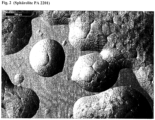
- Fig. 2 shows a cooled melt of PA 12 with large spherulites.
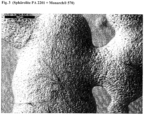
- Fig. 3 shows a cooled melt of a mixture of PA 12 and industrial carbon black using Monarch ® 570 as an example.
- This type of carbon black acts as a nucleating agent and leads to many small spherulites during crystallization.
- This type of carbon black does not act as a nucleating agent and does not significantly change the spherulite size during crystallization.
Landscapes
- Chemical & Material Sciences (AREA)
- Engineering & Computer Science (AREA)
- Materials Engineering (AREA)
- Manufacturing & Machinery (AREA)
- Health & Medical Sciences (AREA)
- Medicinal Chemistry (AREA)
- Organic Chemistry (AREA)
- Polymers & Plastics (AREA)
- Chemical Kinetics & Catalysis (AREA)
- Physics & Mathematics (AREA)
- Optics & Photonics (AREA)
- Mechanical Engineering (AREA)
- Toxicology (AREA)
Claims (15)
- Poudre plastique utilisée comme matériau de construction pour la fabrication additive d'un objet tridimensionnel par solidification sélective, en particulier par exposition au rayonnement, du matériau de construction aux positions correspondant à la section transversale de l'objet tridimensionnel dans la couche respective,dans laquelle la poudre plastique comprend un mélange de particules à base de polymère et de particules d'un additif particulaire, etdans laquelle l'additif particulaire comprend un matériau de carbone particulaire sélectionné de telle sorte que le point de cristallisation du mélange de particules à base de polymère et du matériau de carbone particulaire n'augmente pas de plus de 2,5°C par rapport au point de cristallisation d'un mélange de particules à base de polymère sans le matériau de carbone particulaire, le point de cristallisation respectif correspondant à TKOnset, qui est déterminé par DSC.
- Poudre plastique selon la revendication 1, dans laquelle l'additif particulaire comprend un suie ou un graphite, en particulier un suie de gaz.
- Poudre plastique selon l'une des revendications précédentes,
dans laquelle l'additif particulaire a un diamètre moyen de particule primaire compris entre 1 et 999 nm, de préférence un diamètre moyen de particule primaire d'au plus 500 nm, de préférence d'au plus 250 nm, de préférence encore d'au plus 100 nm. - Poudre plastique selon l'une des revendications précédentes,
dans laquelle l'additif particulaire comprend un noir de gaz dont le diamètre moyen des particules primaires est compris entre 15 et 70 nm, de préférence au moins 26 nm et/ou au plus 58 nm. - Poudre plastique selon l'une quelconque des revendications précédentes,
dans laquelle l'additif particulaire comprend un absorbeur NIR particulaire, l'absorbeur NIR particulaire ayant de préférence une absorption à au moins une des longueurs d'onde (980±10) nm et/ou (940±10) nm et/ou (810±10) nm et/ou (640±10) nm. - Poudre plastique selon l'une quelconque des revendications précédentes, qui se présente sous la forme d'un mélange sec, de préférence homogène, des particules de polymère avec l'additif particulaire.
- Poudre plastique selon l'une quelconque des revendications précédentes,
dans laquelle le pourcentage en poids de l'additif particulaire par rapport au poids total des particules de polymère et de l'additif particulaire est compris entre 0,01 % et 5 %, de préférence au moins 0,02 % et/ou au plus 2 %, de préférence au plus 1 %, de préférence encore au plus 0,45 %. - Poudre plastique selon l'une quelconque des revendications précédentes,
dans laquelle les particules à base de polymère comprennent comme matériau polymère au moins un polymère choisi parmi au moins un polyaryléthercétone (PAEK), polyaryléthersulfone (PAES), polyamide, polyester, polyéther, polylactide, polyoléfine, polystyrène, sulfure de polyphénylène, fluorure de polyvinylidène, oxyde de polyphénylène, polyimide, polyétherimide, polycarbonate, de préférence en polyamide, de préférence encore en polyamide 12, polyamide 11 et/ou polyamide 1012 et/ou au moins un copolymère comprenant au moins un des polymères précédents ou leurs unités monomères et/ou au moins un mélange de polymères comprenant au moins un des polymères ou copolymères mentionnés. - Préparation d'une poudre plastique selon l'une quelconque des revendications précédentes, qui est susceptibe notamment à une utilisation dans une méthode de fabrication additive d'un objet tridimensionnel par solidification sélective d'un matériau de construction pulvérulent aux endroits correspondant à la section transversale de l'objet tridimensionnel dans la couche respective, en particulier par exposition au rayonnement,
dans laquelle la préparation comprend au moins les étapes suivantes :(i) fournir les particules à base de polymère,(ii) fournir les particules d'additif particulaire, et(iii) mélange à sec au moins des particules à base de polymère et des particules d'additif particulaire. - Objet tridimensionnel fabriqué par solidification sélective d'un matériau de construction pulvérulent à base de particules à base de polymère et d'un additif particulaire aux positions correspondant à la section transversale de l'objet tridimensionnel dans la couche respective, en particulier par exposition au rayonnement,
dans lequel l'additif particulaire est un matériau de carbone particulaire et l'objet tridimensionnel présente au moins l'une des caractéristiques suivantes, en particulier les deux :(a) des régions cristallines observables au microscope sous forme de sphérulites d'une taille d'au moins 20 µm,(b) une distorsion Δ(hcentre - hà gauche) + Δ(hcentre - hà droite) d'au plus 0,50 mm. - Objet tridimensionnel selon la revendication 10, présentant une distorsion Δ(hcentre - hà gauche) + Δ(hcentre - hà droite) de ≤ 0,25 mm, de préférence de ≤ 0,20 mm.
- Objet tridimensionnel selon la revendication 10 ou 11, dans lequel on a utilisé comme matériau de construction une poudre plastique selon l'une quelconque des revendications précédentes 1 à 9.
- Système de fabrication d'objets tridimensionnels par solidification sélective d'un matériau de construction pulvérulent aux endroits correspondant à la section transversale de l'objet tridimensionnel dans la couche respective par exposition au rayonnement,
dans lequel le système comprend au moins une source de rayonnement, une chambre de traitement qui est formée comme un conteneur ouvert avec une paroi de conteneur, un support disposé dans la chambre de traitement, dans lequel la chambre de traitement et le support sont mobiles l'un par rapport à l'autre dans une direction verticale, un conteneur de stockage, et un recycleur qui est mobile dans une direction horizontale, dans lequel le conteneur de stockage est au moins partiellement rempli d'une poudre plastique selon l'une des revendications 1 à 9 en tant que matériau de construction. - Système selon la revendication 13,
dans lequel la source de rayonnement est adaptée pour émettre un rayonnement électromagnétique spécifiquement dans une longueur d'onde ou une gamme de longueurs d'onde située dans le proche infrarouge, de préférence la source de rayonnement comprend au moins un laser, de préférence au moins une diode laser. - Système selon la revendication 13 ou 14,
dans lequel la source de rayonnement émet un rayonnement électromagnétique dans la gamme de 500 nm à 1500 nm, en particulier à au moins une des longueurs d'onde (980±10) nm et/ou (940±10) nm et/ou (810±10) nm et/ou (640±10) nm.
Applications Claiming Priority (2)
| Application Number | Priority Date | Filing Date | Title |
|---|---|---|---|
| DE102018219303.7A DE102018219303A1 (de) | 2018-11-12 | 2018-11-12 | Verzugsoptimiertes Kunststoffpulver |
| PCT/EP2019/080553 WO2020099237A1 (fr) | 2018-11-12 | 2019-11-07 | Poudre plastique à déformation optimisée |
Publications (3)
| Publication Number | Publication Date |
|---|---|
| EP3853025A1 EP3853025A1 (fr) | 2021-07-28 |
| EP3853025C0 EP3853025C0 (fr) | 2025-01-01 |
| EP3853025B1 true EP3853025B1 (fr) | 2025-01-01 |
Family
ID=68503130
Family Applications (1)
| Application Number | Title | Priority Date | Filing Date |
|---|---|---|---|
| EP19801298.1A Active EP3853025B1 (fr) | 2018-11-12 | 2019-11-07 | Poudre plastique à déformation optimisée |
Country Status (5)
| Country | Link |
|---|---|
| US (1) | US20210403652A1 (fr) |
| EP (1) | EP3853025B1 (fr) |
| CN (1) | CN115943065A (fr) |
| DE (1) | DE102018219303A1 (fr) |
| WO (1) | WO2020099237A1 (fr) |
Families Citing this family (2)
| Publication number | Priority date | Publication date | Assignee | Title |
|---|---|---|---|---|
| DE102018219303A1 (de) | 2018-11-12 | 2020-05-14 | Eos Gmbh Electro Optical Systems | Verzugsoptimiertes Kunststoffpulver |
| FR3146477A1 (fr) | 2023-03-10 | 2024-09-13 | Arkema France | Mélange de poudres |
Citations (5)
| Publication number | Priority date | Publication date | Assignee | Title |
|---|---|---|---|---|
| DE102004009234A1 (de) | 2004-02-26 | 2005-09-15 | Degussa Ag | Polymerpulver mit Rußpartikeln, Verfahren zu dessen Herstellung und Formkörper, hergestellt aus diesem Polymerpulver |
| US20080122141A1 (en) | 2006-11-29 | 2008-05-29 | Bryan Bedal | Sinterable Powder |
| DE102007024469A1 (de) | 2007-05-25 | 2008-11-27 | Eos Gmbh Electro Optical Systems | Verfahren zum schichtweisen Herstellen eines dreidimensionalen Objekts |
| WO2018019728A1 (fr) | 2016-07-29 | 2018-02-01 | Basf Se | Mélange polyamide contenant un agent renforçant pour poudre pour frittage laser |
| WO2020099237A1 (fr) | 2018-11-12 | 2020-05-22 | Eos Gmbh Electro Optical Systems | Poudre plastique à déformation optimisée |
Family Cites Families (18)
| Publication number | Priority date | Publication date | Assignee | Title |
|---|---|---|---|---|
| CS221575B1 (en) * | 1981-07-03 | 1983-04-29 | Bozena Lanska | Method of increasing the resistance of polyamides in respect of the thermooxidation |
| EP0471463A3 (en) * | 1990-07-31 | 1992-06-03 | Shell Oil Company | Process for incorporating additives in thermoplastic polymers |
| DE4410046C2 (de) | 1994-03-23 | 2000-11-30 | Eos Electro Optical Syst | Verfahren und Material zum Herstellen eines dreidimensionalen Objekts durch Sintern |
| DE10334496A1 (de) * | 2003-07-29 | 2005-02-24 | Degussa Ag | Laser-Sinter-Pulver mit einem Metallsalz und einem Fettsäurederivat, Verfahren zu dessen Herstellung und Formkörper, hergestellt aus diesem Laser-Sinterpulver |
| DE102004012683A1 (de) | 2004-03-16 | 2005-10-06 | Degussa Ag | Lasersintern mit Lasern mit einer Wellenlänge von 100 bis 3000 nm |
| DE102004062761A1 (de) * | 2004-12-21 | 2006-06-22 | Degussa Ag | Verwendung von Polyarylenetherketonpulver in einem dreidimensionalen pulverbasierenden werkzeuglosen Herstellverfahren, sowie daraus hergestellte Formteile |
| DE102007016656B4 (de) * | 2007-04-05 | 2018-10-11 | Eos Gmbh Electro Optical Systems | PAEK-Pulver, insbesondere zur Verwendung in einem Verfahren zum schichtweisen Herstellen eines dreidimensionalen Objektes, sowie Verfahren zu dessen Herstellung |
| DE102008024288A1 (de) | 2008-05-20 | 2009-12-03 | Eos Gmbh Electro Optical Systems | Selektives Sintern von strukturell modifizierten Polymeren |
| DE102008024281A1 (de) | 2008-05-20 | 2009-12-03 | Eos Gmbh Electro Optical Systems | Selektives Sintern von strukturell modifizierten Polymeren |
| DE102008024465A1 (de) * | 2008-05-21 | 2009-11-26 | Eos Gmbh Electro Optical Systems | Verfahren und Vorrichtung zum schichtweisen Herstellen eines dreidimensionalen Objekts aus einem pulverförmigen Material |
| JP2015500375A (ja) * | 2011-12-12 | 2015-01-05 | アドヴァンスド レーザー マテリアルズ,リミティド ライアビリティー カンパニーAdvanced Laser Materials,LLC | 前処理された材料を用いたレーザー焼結のための方法およびシステム |
| US9718218B2 (en) * | 2012-03-13 | 2017-08-01 | Structured Polymers, Inc. | Materials for powder-based additive manufacturing processes |
| CN105283493B (zh) * | 2013-05-15 | 2018-07-03 | 东洋纺株式会社 | 用于发泡成型体的聚酰胺树脂组合物及包含其的聚酰胺树脂的发泡成型体 |
| ES2799123T3 (es) | 2013-12-17 | 2020-12-14 | Eos Gmbh Electro Optical Systems | Sistema de impresión láser |
| DE102014225488A1 (de) * | 2014-12-10 | 2016-06-16 | Fraunhofer-Gesellschaft zur Förderung der angewandten Forschung e.V. | Polymerzusammensetzung mit verzögertem Kristallisationsverhalten, das Kristallisationsverhalten beeinflussende Additivzusammensetzung, Verfahren zur Herabsetzung des Kristallisationspunktes sowie Verwendung einer Additivzusammensetzung |
| JP6552727B2 (ja) * | 2015-09-04 | 2019-07-31 | サビック グローバル テクノロジーズ ベスローテン フェンノートシャップ | 粉末組成物、粉末組成物からの物品およびコーティングの調製方法、およびそれから調製される物品 |
| JP2018015972A (ja) * | 2016-07-27 | 2018-02-01 | 株式会社リコー | 立体造形方法、造形物及び立体造形装置 |
| WO2018122142A1 (fr) * | 2016-12-28 | 2018-07-05 | Covestro Deutschland Ag | Procédé de fabrication additive à l'aide d'un matériau de construction contenant un absorbant des ir |
-
2018
- 2018-11-12 DE DE102018219303.7A patent/DE102018219303A1/de active Pending
-
2019
- 2019-11-07 CN CN201980074529.9A patent/CN115943065A/zh active Pending
- 2019-11-07 WO PCT/EP2019/080553 patent/WO2020099237A1/fr not_active Ceased
- 2019-11-07 US US17/291,881 patent/US20210403652A1/en not_active Abandoned
- 2019-11-07 EP EP19801298.1A patent/EP3853025B1/fr active Active
Patent Citations (5)
| Publication number | Priority date | Publication date | Assignee | Title |
|---|---|---|---|---|
| DE102004009234A1 (de) | 2004-02-26 | 2005-09-15 | Degussa Ag | Polymerpulver mit Rußpartikeln, Verfahren zu dessen Herstellung und Formkörper, hergestellt aus diesem Polymerpulver |
| US20080122141A1 (en) | 2006-11-29 | 2008-05-29 | Bryan Bedal | Sinterable Powder |
| DE102007024469A1 (de) | 2007-05-25 | 2008-11-27 | Eos Gmbh Electro Optical Systems | Verfahren zum schichtweisen Herstellen eines dreidimensionalen Objekts |
| WO2018019728A1 (fr) | 2016-07-29 | 2018-02-01 | Basf Se | Mélange polyamide contenant un agent renforçant pour poudre pour frittage laser |
| WO2020099237A1 (fr) | 2018-11-12 | 2020-05-22 | Eos Gmbh Electro Optical Systems | Poudre plastique à déformation optimisée |
Non-Patent Citations (4)
| Title |
|---|
| ANONYMOUS: "Kunststoffe - Dynamische Differenzkalorimetrie (DSC) - Teil 1: Allgemeine Grundlagen (ISO 11357-1:2023); Deutsche Fassung EN ISO 11357-1:2023", DIN EN ISO 11357-1, 1 June 2023 (2023-06-01), XP093324688 |
| D3 - EXPERIMENTELLE DATEN ZUR MESSUNG VON TK ONSET |
| ORION ENGINEERED CARBONS S.A: "Specialty Carbon Blacks", TECHNICAL DATA EUROPE, ORION ENGINEERED CARBONS S.A, pages 1 - 8, XP093194929 |
| PLUMMER C J, ZANETTO J.-E, BOURBAN P.-E, MÅNSON J.-A E: "The crystallization kinetics of polyamide-12", COLLOID. POLYM. SCI., vol. 279, 1 April 2001 (2001-04-01), pages 312 - 322, XP093324683 |
Also Published As
| Publication number | Publication date |
|---|---|
| US20210403652A1 (en) | 2021-12-30 |
| EP3853025C0 (fr) | 2025-01-01 |
| EP3853025A1 (fr) | 2021-07-28 |
| WO2020099237A1 (fr) | 2020-05-22 |
| DE102018219303A1 (de) | 2020-05-14 |
| CN115943065A (zh) | 2023-04-07 |
Similar Documents
| Publication | Publication Date | Title |
|---|---|---|
| EP3853024B1 (fr) | Matériau constitutif à base de polymère destiné au frittage sélectif | |
| EP1674497B1 (fr) | Utilisation d'une poudre de polyarylèneéthercétone dans un procédé de fabrication tridimensionnel à base de poudre n'impliquant pas d'outil et les pièces moulées ainsi produites | |
| DE102007024469B4 (de) | Verfahren zum schichtweisen Herstellen eines dreidimensionalen Objekts | |
| DE102007016656A1 (de) | PAEK-Pulver, insbesondere zur Verwendung in einem Verfahren zum schichtweisen Herstellen eines dreidimensionalen Objektes, sowie Verfahren zu dessen Herstellung | |
| WO2019206921A1 (fr) | Procédé de fabrication d'une poudre comprenant au moins un polymère ainsi que poudre de ce type | |
| EP2548718B1 (fr) | Utilisation d'un dispositif et procédé pour la fabrication en couches par le frittage laser des produits tridimensionelles | |
| DE102008024288A1 (de) | Selektives Sintern von strukturell modifizierten Polymeren | |
| EP2548719A1 (fr) | Dispositif et procédé pour la fabrication de composants par rayonnement au frittage laser en couches et composant ainsi obtenu | |
| EP3853025B1 (fr) | Poudre plastique à déformation optimisée | |
| WO2021032511A1 (fr) | Frittage sélectif de matériaux composites à base de polymère | |
| DE102018123702A1 (de) | Nanoskaliges LaB6- Pulver und Verfahren zu dessen Herstellung | |
| DE212022000027U1 (de) | Polymerpulverzusammensetzung für additives Herstellungsverfahren, die einen Erfassungszusatzstoff umfasst, und durch das Verfahren erhaltener Gegenstand | |
| DE102018212447A1 (de) | Pulverförmiges Material geeignet für die Herstellung eines dreidimensionalen Objekts in einem generativen Schichtbauverfahren, dessen Verwendung und Herstellungsverfahren dafür | |
| DE102014008186A1 (de) | Lasermarkierbare und laserschweißbare polymere Materialien | |
| DE102024108442A1 (de) | Polymerbasiertes Aufbaumaterial zum selektiven Sintern mit heller Farbe | |
| EP4624137A1 (fr) | Poudre de plastique avec absorbeur incorporé pour procédés d'impression 3d à base de poudre | |
| DE112022004906T5 (de) | Pulver zur herstellung von keramikstrukturen und verfahren zur herstellung einer keramikstruktur unter verwendung davon | |
| WO2026067988A1 (fr) | Procédé de façonnage de matériaux amorphes dans la fabrication additive à partir de poudre | |
| DE102017001361A1 (de) | Personalisierbarer Datenträger | |
| WO2026061616A1 (fr) | Poudres polymères à structure cœur-écorce destinées à être utilisées dans des procédés de fabrication additive | |
| DE102022129476A1 (de) | Grobes Flammschutzmittel | |
| DE102024128304A1 (de) | Polymerpulver für die additive Fertigung von dreidimensionalen Objekten mit geringer Staubungsneigung | |
| EP4344874A1 (fr) | Composition pour procédé de fabrication additive | |
| DE102021126217A1 (de) | Zusammensetzung für additive Fertigungsverfahren |
Legal Events
| Date | Code | Title | Description |
|---|---|---|---|
| STAA | Information on the status of an ep patent application or granted ep patent |
Free format text: STATUS: UNKNOWN |
|
| STAA | Information on the status of an ep patent application or granted ep patent |
Free format text: STATUS: THE INTERNATIONAL PUBLICATION HAS BEEN MADE |
|
| PUAI | Public reference made under article 153(3) epc to a published international application that has entered the european phase |
Free format text: ORIGINAL CODE: 0009012 |
|
| STAA | Information on the status of an ep patent application or granted ep patent |
Free format text: STATUS: REQUEST FOR EXAMINATION WAS MADE |
|
| 17P | Request for examination filed |
Effective date: 20210421 |
|
| AK | Designated contracting states |
Kind code of ref document: A1 Designated state(s): AL AT BE BG CH CY CZ DE DK EE ES FI FR GB GR HR HU IE IS IT LI LT LU LV MC MK MT NL NO PL PT RO RS SE SI SK SM TR |
|
| DAV | Request for validation of the european patent (deleted) | ||
| DAX | Request for extension of the european patent (deleted) | ||
| STAA | Information on the status of an ep patent application or granted ep patent |
Free format text: STATUS: EXAMINATION IS IN PROGRESS |
|
| 17Q | First examination report despatched |
Effective date: 20230615 |
|
| REG | Reference to a national code |
Ref country code: DE Ref legal event code: R079 Free format text: PREVIOUS MAIN CLASS: B33Y0070000000 Ipc: B29C0064153000 Ref document number: 502019012751 Country of ref document: DE |
|
| RIC1 | Information provided on ipc code assigned before grant |
Ipc: C08K 3/04 20060101ALI20240503BHEP Ipc: C08K 3/013 20180101ALI20240503BHEP Ipc: C08J 3/20 20060101ALI20240503BHEP Ipc: B33Y 80/00 20150101ALI20240503BHEP Ipc: B33Y 70/00 20200101ALI20240503BHEP Ipc: B33Y 10/00 20150101ALI20240503BHEP Ipc: B29C 64/153 20170101AFI20240503BHEP |
|
| GRAP | Despatch of communication of intention to grant a patent |
Free format text: ORIGINAL CODE: EPIDOSNIGR1 |
|
| STAA | Information on the status of an ep patent application or granted ep patent |
Free format text: STATUS: GRANT OF PATENT IS INTENDED |
|
| INTG | Intention to grant announced |
Effective date: 20240716 |
|
| GRAS | Grant fee paid |
Free format text: ORIGINAL CODE: EPIDOSNIGR3 |
|
| GRAA | (expected) grant |
Free format text: ORIGINAL CODE: 0009210 |
|
| STAA | Information on the status of an ep patent application or granted ep patent |
Free format text: STATUS: THE PATENT HAS BEEN GRANTED |
|
| AK | Designated contracting states |
Kind code of ref document: B1 Designated state(s): AL AT BE BG CH CY CZ DE DK EE ES FI FR GB GR HR HU IE IS IT LI LT LU LV MC MK MT NL NO PL PT RO RS SE SI SK SM TR |
|
| REG | Reference to a national code |
Ref country code: GB Ref legal event code: FG4D Free format text: NOT ENGLISH |
|
| REG | Reference to a national code |
Ref country code: CH Ref legal event code: EP |
|
| REG | Reference to a national code |
Ref country code: DE Ref legal event code: R096 Ref document number: 502019012751 Country of ref document: DE |
|
| REG | Reference to a national code |
Ref country code: IE Ref legal event code: FG4D Free format text: LANGUAGE OF EP DOCUMENT: GERMAN |
|
| U01 | Request for unitary effect filed |
Effective date: 20250101 |
|
| U07 | Unitary effect registered |
Designated state(s): AT BE BG DE DK EE FI FR IT LT LU LV MT NL PT RO SE SI Effective date: 20250109 |
|
| PG25 | Lapsed in a contracting state [announced via postgrant information from national office to epo] |
Ref country code: PL Free format text: LAPSE BECAUSE OF FAILURE TO SUBMIT A TRANSLATION OF THE DESCRIPTION OR TO PAY THE FEE WITHIN THE PRESCRIBED TIME-LIMIT Effective date: 20250101 |
|
| PG25 | Lapsed in a contracting state [announced via postgrant information from national office to epo] |
Ref country code: ES Free format text: LAPSE BECAUSE OF FAILURE TO SUBMIT A TRANSLATION OF THE DESCRIPTION OR TO PAY THE FEE WITHIN THE PRESCRIBED TIME-LIMIT Effective date: 20250101 |
|
| PG25 | Lapsed in a contracting state [announced via postgrant information from national office to epo] |
Ref country code: IS Free format text: LAPSE BECAUSE OF FAILURE TO SUBMIT A TRANSLATION OF THE DESCRIPTION OR TO PAY THE FEE WITHIN THE PRESCRIBED TIME-LIMIT Effective date: 20250501 Ref country code: NO Free format text: LAPSE BECAUSE OF FAILURE TO SUBMIT A TRANSLATION OF THE DESCRIPTION OR TO PAY THE FEE WITHIN THE PRESCRIBED TIME-LIMIT Effective date: 20250401 |
|
| PG25 | Lapsed in a contracting state [announced via postgrant information from national office to epo] |
Ref country code: HR Free format text: LAPSE BECAUSE OF FAILURE TO SUBMIT A TRANSLATION OF THE DESCRIPTION OR TO PAY THE FEE WITHIN THE PRESCRIBED TIME-LIMIT Effective date: 20250101 |
|
| PG25 | Lapsed in a contracting state [announced via postgrant information from national office to epo] |
Ref country code: GR Free format text: LAPSE BECAUSE OF FAILURE TO SUBMIT A TRANSLATION OF THE DESCRIPTION OR TO PAY THE FEE WITHIN THE PRESCRIBED TIME-LIMIT Effective date: 20250402 |
|
| PG25 | Lapsed in a contracting state [announced via postgrant information from national office to epo] |
Ref country code: CZ Free format text: LAPSE BECAUSE OF FAILURE TO SUBMIT A TRANSLATION OF THE DESCRIPTION OR TO PAY THE FEE WITHIN THE PRESCRIBED TIME-LIMIT Effective date: 20250101 |
|
| PLBI | Opposition filed |
Free format text: ORIGINAL CODE: 0009260 |
|
| PG25 | Lapsed in a contracting state [announced via postgrant information from national office to epo] |
Ref country code: SM Free format text: LAPSE BECAUSE OF FAILURE TO SUBMIT A TRANSLATION OF THE DESCRIPTION OR TO PAY THE FEE WITHIN THE PRESCRIBED TIME-LIMIT Effective date: 20250101 |
|
| REG | Reference to a national code |
Ref country code: CH Ref legal event code: L10 Free format text: ST27 STATUS EVENT CODE: U-0-0-L10-L00 (AS PROVIDED BY THE NATIONAL OFFICE) Effective date: 20251008 |
|
| PLAX | Notice of opposition and request to file observation + time limit sent |
Free format text: ORIGINAL CODE: EPIDOSNOBS2 |
|
| PG25 | Lapsed in a contracting state [announced via postgrant information from national office to epo] |
Ref country code: SK Free format text: LAPSE BECAUSE OF FAILURE TO SUBMIT A TRANSLATION OF THE DESCRIPTION OR TO PAY THE FEE WITHIN THE PRESCRIBED TIME-LIMIT Effective date: 20250101 |
|
| 26 | Opposition filed |
Opponent name: EVONIK OPERATIONS GMBH Effective date: 20251001 |
|
| U20 | Renewal fee for the european patent with unitary effect paid |
Year of fee payment: 7 Effective date: 20251127 |
|
| PGFP | Annual fee paid to national office [announced via postgrant information from national office to epo] |
Ref country code: GB Payment date: 20251121 Year of fee payment: 7 |
|
| PLBB | Reply of patent proprietor to notice(s) of opposition received |
Free format text: ORIGINAL CODE: EPIDOSNOBS3 |
|
| PLBP | Opposition withdrawn |
Free format text: ORIGINAL CODE: 0009264 |
|
| REG | Reference to a national code |
Ref country code: CH Ref legal event code: L10 Free format text: ST27 STATUS EVENT CODE: U-0-0-L10-L00 (AS PROVIDED BY THE NATIONAL OFFICE) Effective date: 20260416 |