EP3853048B1 - Système de commande pour un véhicule remorqué - Google Patents
Système de commande pour un véhicule remorqué Download PDFInfo
- Publication number
- EP3853048B1 EP3853048B1 EP19862702.8A EP19862702A EP3853048B1 EP 3853048 B1 EP3853048 B1 EP 3853048B1 EP 19862702 A EP19862702 A EP 19862702A EP 3853048 B1 EP3853048 B1 EP 3853048B1
- Authority
- EP
- European Patent Office
- Prior art keywords
- communication system
- electrical components
- electrical
- electrical component
- power
- Prior art date
- Legal status (The legal status is an assumption and is not a legal conclusion. Google has not performed a legal analysis and makes no representation as to the accuracy of the status listed.)
- Active
Links
Images

Classifications
-
- B—PERFORMING OPERATIONS; TRANSPORTING
- B60—VEHICLES IN GENERAL
- B60D—VEHICLE CONNECTIONS
- B60D1/00—Traction couplings; Hitches; Draw-gear; Towing devices
- B60D1/58—Auxiliary devices
- B60D1/62—Auxiliary devices involving supply lines, electric circuits or the like
- B60D1/64—Couplings or joints therefor
-
- B—PERFORMING OPERATIONS; TRANSPORTING
- B60—VEHICLES IN GENERAL
- B60R—VEHICLES, VEHICLE FITTINGS, OR VEHICLE PARTS, NOT OTHERWISE PROVIDED FOR
- B60R16/00—Electric or fluid circuits specially adapted for vehicles and not otherwise provided for; Arrangement of elements of electric or fluid circuits specially adapted for vehicles and not otherwise provided for
- B60R16/02—Electric or fluid circuits specially adapted for vehicles and not otherwise provided for; Arrangement of elements of electric or fluid circuits specially adapted for vehicles and not otherwise provided for electric constitutive elements
- B60R16/023—Electric or fluid circuits specially adapted for vehicles and not otherwise provided for; Arrangement of elements of electric or fluid circuits specially adapted for vehicles and not otherwise provided for electric constitutive elements for transmission of signals between vehicle parts or subsystems
-
- B—PERFORMING OPERATIONS; TRANSPORTING
- B60—VEHICLES IN GENERAL
- B60R—VEHICLES, VEHICLE FITTINGS, OR VEHICLE PARTS, NOT OTHERWISE PROVIDED FOR
- B60R16/00—Electric or fluid circuits specially adapted for vehicles and not otherwise provided for; Arrangement of elements of electric or fluid circuits specially adapted for vehicles and not otherwise provided for
- B60R16/02—Electric or fluid circuits specially adapted for vehicles and not otherwise provided for; Arrangement of elements of electric or fluid circuits specially adapted for vehicles and not otherwise provided for electric constitutive elements
- B60R16/03—Electric or fluid circuits specially adapted for vehicles and not otherwise provided for; Arrangement of elements of electric or fluid circuits specially adapted for vehicles and not otherwise provided for electric constitutive elements for supply of electrical power to vehicle subsystems or for
-
- H—ELECTRICITY
- H01—ELECTRIC ELEMENTS
- H01R—ELECTRICALLY-CONDUCTIVE CONNECTIONS; STRUCTURAL ASSOCIATIONS OF A PLURALITY OF MUTUALLY-INSULATED ELECTRICAL CONNECTING ELEMENTS; COUPLING DEVICES; CURRENT COLLECTORS
- H01R27/00—Coupling parts adapted for co-operation with two or more dissimilar counterparts
- H01R27/02—Coupling parts adapted for co-operation with two or more dissimilar counterparts for simultaneous co-operation with two or more dissimilar counterparts
-
- H—ELECTRICITY
- H01—ELECTRIC ELEMENTS
- H01R—ELECTRICALLY-CONDUCTIVE CONNECTIONS; STRUCTURAL ASSOCIATIONS OF A PLURALITY OF MUTUALLY-INSULATED ELECTRICAL CONNECTING ELEMENTS; COUPLING DEVICES; CURRENT COLLECTORS
- H01R31/00—Coupling parts supported only by co-operation with counterpart
- H01R31/06—Intermediate parts for linking two coupling parts, e.g. adapter
- H01R31/065—Intermediate parts for linking two coupling parts, e.g. adapter with built-in electric apparatus
-
- H—ELECTRICITY
- H04—ELECTRIC COMMUNICATION TECHNIQUE
- H04B—TRANSMISSION
- H04B3/00—Line transmission systems
- H04B3/54—Systems for transmission via power distribution lines
-
- B—PERFORMING OPERATIONS; TRANSPORTING
- B60—VEHICLES IN GENERAL
- B60Q—ARRANGEMENT OF SIGNALLING OR LIGHTING DEVICES, THE MOUNTING OR SUPPORTING THEREOF OR CIRCUITS THEREFOR, FOR VEHICLES IN GENERAL
- B60Q1/00—Arrangement of optical signalling or lighting devices, the mounting or supporting thereof or circuits therefor
- B60Q1/0088—Details of electrical connections
-
- B—PERFORMING OPERATIONS; TRANSPORTING
- B60—VEHICLES IN GENERAL
- B60Q—ARRANGEMENT OF SIGNALLING OR LIGHTING DEVICES, THE MOUNTING OR SUPPORTING THEREOF OR CIRCUITS THEREFOR, FOR VEHICLES IN GENERAL
- B60Q1/00—Arrangement of optical signalling or lighting devices, the mounting or supporting thereof or circuits therefor
- B60Q1/26—Arrangement of optical signalling or lighting devices, the mounting or supporting thereof or circuits therefor the devices being primarily intended to indicate the vehicle, or parts thereof, or to give signals, to other traffic
- B60Q1/30—Arrangement of optical signalling or lighting devices, the mounting or supporting thereof or circuits therefor the devices being primarily intended to indicate the vehicle, or parts thereof, or to give signals, to other traffic for indicating rear of vehicle, e.g. by means of reflecting surfaces
- B60Q1/305—Indicating devices for towed vehicles
-
- H—ELECTRICITY
- H01—ELECTRIC ELEMENTS
- H01R—ELECTRICALLY-CONDUCTIVE CONNECTIONS; STRUCTURAL ASSOCIATIONS OF A PLURALITY OF MUTUALLY-INSULATED ELECTRICAL CONNECTING ELEMENTS; COUPLING DEVICES; CURRENT COLLECTORS
- H01R2201/00—Connectors or connections adapted for particular applications
- H01R2201/26—Connectors or connections adapted for particular applications for vehicles
-
- H—ELECTRICITY
- H04—ELECTRIC COMMUNICATION TECHNIQUE
- H04W—WIRELESS COMMUNICATION NETWORKS
- H04W88/00—Devices specially adapted for wireless communication networks, e.g. terminals, base stations or access point devices
Definitions
- the present invention relates generally to vehicles and towed vehicles, including cars and trucks, trailers, boats and recreational vehicles such as caravans, camper trailers and the like.
- the present invention relates generally to a system and method for controlling the operation of electrical components associated with such vehicles to minimise the need for dedicated wiring systems to control features of the vehicle and/or towed vehicle and to simplify electrical and communication transmission between the towed vehicle and the towing vehicle.
- Towed vehicles such as caravans and camper trailers
- caravans and camper trailers are a popular form of portable accommodation used by many as an economic and enjoyable way in which to experience the outdoors in an independent and comfortable manner. They are typically hitched behind a passenger vehicle and towed to a destination where they may be unhitched from the towing vehicle and set up as an accommodation site in accordance with the user's personal preferences.
- the towed vehicle is in electrical communication with the towing vehicle such that the towing vehicle can operate indicating lamps and braking systems of the towed vehicle for safety reasons.
- most towed vehicles have a dedicated electrical socket that extends between the vehicles, and connects with an electric plug provided in the towing vehicle.
- a variety of mechanical connections have been proposed. Most such connection systems have a variety of pins ranging from between 7 pins to 12 pins, dedicated to supplying control signals from the towing vehicle to the towed vehicle to operate indicator lamps and brakes as desired.
- a problem with such conventional electrical connection systems is that the plug and socket arrangement is located external to the vehicles and is exposed to the environment, such as rain and wear, which can have a significant adverse effect on the integrity of electrical contact surfaces. This can result in the wires or contacts of the electrical connection becoming work hardened, crushed, corroded or hyper-extended during regular use, which can weaken their electrical and mechanical attributes. Therefore, over time, there is an increased probability that the connection will fail and require replacement due to faulty or intermittent electrical connections, which can cause accidents due to brake failures or inability to operate the turning indicators. The driver of the towing vehicle may have no indication that the connection has failed or is not working properly and may be oblivious to the potential dangers at hand. The probability of such failures occurring becomes even higher where multiple pins or connections are present.
- EP 2,199,118 discloses a tow bar structure comprising: a projecting hook; an electrical contact holder device associated to the hook; a slave control unit associated to the hook suitable to exchange electrical signals with a master control unit located inside the vehicle, managing the electrical commands to be transferred to the trailer and suitable to activate a plurality of electronic switches associated to the electrical contact holder in the tow bar structure; and an electrical connection allowing the exchange of signals between said master and slave control units and the supply of electrical power to be delivered through said contact holder device.
- DE 102 55 301 discloses generating control signals in a motor vehicle, transmitting the control signals to a trailer, receiving the control signals in the trailer and switching a voltage source in the trailer with the received control signals to provide the operating voltage for illumination devices.
- the control signals can be transmitted by data transmission cable or wireless data transmission channel.
- a communication system for delivering power and control signals to control the activation of electrical components in a vehicle according to claim 1.
- the present invention will be described below in relation to a caravan of the type that is to be towed by a vehicle. However, it will be appreciated that the present invention could be equally employed in any variety of towed vehicles, such as camper trailers, boats and the like that are to be towed by a vehicle and still fall within the scope of the present invention. It will also be appreciated that the present invention may also have application to vehicles, both land and water based, which generally have limited space therein to accommodate dedicated wiring systems for electronic appliances.
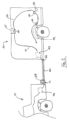
- a towing arrangement 5 is depicted between a towing vehicle 10 and a caravan 20.
- the towing vehicle 10 may be a conventional passenger vehicle having a tow ball 12 or the like for hitching the caravan 20 thereto in a conventional manner.
- the caravan 20 is also of a conventional type and comprises a chassis 22 that supports a body 24 over one or more pairs of wheels 26.
- the body 24 forms an enclosure over the top of the chassis 22 and is configured to function as a mobile accommodation space, as is well known in the art.
- a hitch 25 is provided at a front end of the chassis 22.
- the hitch 25 is configured to attach to the tow ball 12 or similar device on the towing vehicle 10 (not shown) and may be configured in a variety of different ways so as to provide secure attachment to the towing vehicle 10.
- Other securing devices, such as chains and the like may also be used to ensure secure attachment between the caravan 20 and the vehicle 10.
- an electrical connector 30 extends therebetween.
- the electrical connector 30 extends along the chassis 22 and in a preferred embodiment, is in the form of a pair of wires 31, preferably a pair of twisted wires 31, as depicted in Fig. 3 .
- the connector 30 has a pair of plug members 32 to facilitate connection at either end to the vehicle 10 and caravan 20. As the connector 30 comprises a single pair of wires 31, only two electrical connections need to be made at either end of the connector, greatly simplifying the connection process.
- Fig. 2 depicts a conventional electrical connection system 35 for delivering power and control signals from the vehicle 10 to the caravan 20.
- the system 35 comprises a plug member 36 that is configured to mate with a socket member 38 such that a total of around six to twelve electrical connections are made between opposing pins in the system.
- the resultant lead 37 comprises individual wires some of which are dedicated towards providing control signals to operate electrical components of the caravan 20, such as indicator lights and brakes, and some dedicated to providing power to operate such components.
- the connector 30 is able to comprise only two wires 31 rather than twelve wires as is the case with the prior art system 35.
- the control signals are transmitted to the components wirelessly and the power wires only provide power to the related devices.
- two-wire connector system is achieved through the provision of a slave unit 40, such as an encoder/decoder, located in the towing vehicle 10 that is in electrical communication with the towing vehicle's Electronic Control Unit (ECU) or ECUs, such that all control signals to be sent to the caravan 20 are directed to the slave unit 40.
- the slave unit 40 is connected to the DC power line connected to the positive and negative terminals of the vehicle battery which is then connected to the two-wire connector 30 for transmission of power and data to the caravan 20.
- all control signals to be transmitted to the caravan 20 are received by the slave unit 40 which then processes the signals such that they can be sent over the power lines of the connector 30 to the caravan 20 together with the power signal.
- the power lines are in electrical communication with a master unit 42.
- the master unit 42 receives the power signal together with any embedded control signals present therein and identifies the control signals to verify that they are legitimate.
- the master unit 42 is loaded with security certificates to check and verify the data signals before they are able to pass further to their desired destination along the power line.
- the dual wire power lines continue from the master unit 42 to connect to each of the required components so as to deliver power to the components as well as control signals.
- a central light 47 For simplicity, only three main operating components of the caravan 20 are depicted: a central light 47; rear indicator lights 48; and electric braking controller 49.
- Each of the components 47, 48, 49 has a receiver module 45 associated therewith which is directly connected to the two-wire power line 30 as shown.
- the receiver module 45 may be a simple addressable device for receiving and decoding the control signal and may have 1 - 8 switchable outputs for delivering power and controlling the state of the component 47, 48, 49.
- the associated receiver module 45 may receive the control signal requiring the module 45 to activate a left or right indicator light over the power line 30. The module 45 will then process the signal by delivering a signal to operate the required indicator light through a dedicated switchable output, together with a power signal. Only the module 45 that is configured to receive signals addressed to the associated electrical component will respond and operate accordingly.
- the two-wire power line can be arranged in a simple loop to connect to all the electrical components of the caravan to deliver both power and operating signals to the various electrical components.
- Such a wiring system will significantly reduce manufacture assembly time, have less overall weight due to the minimal use of wires, have less copper usage, be easy to isolate and interrogate faults, be easily scalable to add new components and provide for remote access and monitoring.
- the system of Figure 1 is adapted to incorporate Bluetooth ® and other wireless data exchange systems, through the provision of BLE devices along the two-wire power line that are capable of intercepting data and transmitting data wirelessly to other BLE devices within the system and outside the system, such as to a mobile phone and remote monitoring centre, and the like.
- This can then enable a wireless mesh system to operate within the two-wire system such that data is transmitted between the electric components wirelessly, with power delivered to the devices via the two-wire system.
- all information collected from the electrical components can be pushed to a remotely located data collector or collator to generate reports about the functioning of one or more electric components within the system.
- Such a system enables remote diagnostics of problems associated with the caravan components, such as braking system issues, lighting malfunctions and the like, and is also capable of remotely taking regular odometer readings to record the service status of the caravan and provide service updates.
- two-wire connector system merely provides power to the electrical components of the towed vehicle or caravan 20.
- the slave unit 40 such as an encoder/decoder with Bluetooth ® capabilities or other wireless data exchange system capabilities, is located in the towing vehicle 10 and is in electrical communication with the towing vehicle's Electronic Control Unit (ECU) or ECUs. All control signals to be sent to the caravan 20 from the towing vehicle's ECU are directed to the slave unit 40.
- the slave unit 40 is typically connected to the DC power line connected to the positive and negative terminals of the vehicle battery which is then connected to the two-wire connector 30 for transmission of power to the caravan 20. Data is separately transmitted by the wireless data exchange system to the caravan 20.
- all control signals to be transmitted to the caravan 20 are received by the slave unit 40 which then processes the signals such that they can be sent wirelessly to a master unit 42 located in the caravan 20.
- the power lines are in electrical communication with the master unit 42.
- the master unit 42 receives the power signal from the wired connection and the embedded control signals from the wireless data exchange system and identifies the control signals to verify that they are legitimate.
- the master unit 42 is loaded with security certificates to check and verify the wireless data signals before they are able to pass further to their desired destination via the wireless data exchange system.
- the dual wire power lines continue from the master unit 42 to connect to each of the required components so as to deliver power to the components.
- a central light 47 for simplicity, only three main operating components of the caravan 20 are depicted: a central light 47; rear indicator lights 48; and electric braking controller 49.
- Each of the components 47, 48, 49 has a receiver module 45 associated therewith which has a transmitter/receiver for communicating with the wireless data exchange system..
- the associated receiver module 45 may wirelessly receive a control signal requiring the module 45 to activate a left or right indicator light. The module 45 will then process the signal by delivering a signal to operate the required indicator light through a dedicated switchable output.
- Each module 45 will have a receiver that is individually addressable to receive signals addressed to the associated electrical component, which will respond and operate accordingly. In this regard, upon performing the task, the module will also transmit a confirmation signal back to the master unit which can be recorded to verify that the electric component is operating accordingly.
- a command centre in the form of a touch-screen monitor may be provided within the caravan to provide a simple point of information to determine the status of all components of the system.
- the command centre may comprise a microcontroller capable of controlling all of the devices within the system as well as the status of the caravan's battery to ensure that all components are operating within desired operating limits.
- management routine may be provided within the system to ensure that power is prioritised to be delivered to the refrigerator at all times to ensure that the refrigerator operates correctly.
- Each of the communication devices provided within the control system of the present invention are capable of encoding all analogue signals and convert to PWM signals to control each particular device, therein digitising the signal for control or transmission to other decoders or external networks.
- the system of the present invention provides a simple and effective means for configuring a caravan or similar vehicle such that the power line is used to provide either both power and control signals, or just power signals, to the components and no dedicated wiring is required for providing control signals.
- Such a system of wiring reduces the complexity and number of wires required to control the electrical components of such a vehicle and maximises space utilisation to accommodate the wiring.
- the control system is also fully scalable and capable of accommodating wireless transmitting units and other such systems to remotely monitor the operation of the components.
- the ability of the system of the present invention to incorporate network encoders that provide network interconnectivity enables the control system to be established to simply connect every feature and allow the system to be managed and configured by way of a simple software application on a smart phone, tablet or other electrical device. Pairs of lights can be linked and grouped together by a single switch via the software application, which enables all of the electrical logical functions to be established, without the need for complicated internal wiring systems.
- a vehicle or space can be simply wired by low-skilled labour as the components only require connection to the power circuit, leaving the skilled labour to make the logical software connections via the software application on electrical devices.
- skilled labour such as electricians and the like are also able to generate quality tests and reports via their personal electronic device and sign-off on installations and connections through this facility, greatly reducing their workload.
- control system of the present invention by configuring the control system of the present invention to include an external network interface capability, data is able to be collected about the vehicle and uploaded to the network where the data can be processed to determine the diagnostic status of the system as well as to update system software and find and record faults.
- a system has the potential to provide improved maintenance service to the vehicle, such as a caravan.
- the service centre upon the owner of the caravan bringing the caravan to a service centre for a regular service, the service centre is able to connect the vehicle to a computer having the necessary software to interrogate the electrical system to diagnose problems requiring attention and to run integrity tests on the system.
- the service centre is also able to update any software that may be out of date within the system and give an enhanced historical view of the health of the vehicle and the various components present therein. This can also be done remotely, via a mobile network or internet/cloud in communication with the system.
- software can interface to manage the complete network to perform diagnostics and status updates of the system in real time, which can have particular advantages for caravan manufacturers, especially caravan manufacturer warranty teams, who can investigate and diagnose on-road issues as they occur.
- they are able to identify issues and take action to address issues as they occur, particularly if the vehicle is still under warranty.
- the ability of the system to include network bridges and gateways to communicate with other physical networks or protocols for cross network communication allows for enhanced product control, such as the ability to use third party information to control the temperature of an air conditioner.
- the manner in which the system encoders/decoders are able to encrypt signals to ensure network products are embedded with security tokens and certificates to communicate with the network provides a simple means to ensure that unauthorised products such as lights/indicators, can be excluded from the system. Whilst such copycat and unauthorised products may be able to copy the physical attributes of authorised parts and products, they will not include the encrypted token to communicate with the network and will then be prevented from functioning. Such an improved security function is important to discourage theft of system information from competing system products.
- the method of delivering power and control signals to control the activation of electrical components in a vehicle comprises the following steps.
- a power supply line is formed that connects each electrical component in the vehicle to a power source for providing power to operate the electrical component.
- the power source may be a battery and the power supply line may comprise a two-cable supply line from the battery that connects each electrical component in series.
- a computer controller is connected to the power supply line to utilise the power supply line to deliver control signals to each electrical component to control the operation of the electrical component.
- the computer controller may be connected directly or indirectly to the power supply line.
- the computer controller may be connected to a slave unit that is connected to the power supply line.
- a master unit is located within the power supply line to receive and verify the control signals being transmitted to the electrical components prior to delivery to the electrical component.
- the master unit is also capable of receiving response signals generated by the electrical component in response to the control signals transmitted along the power supply line for further processing.
- the response signals received by the master unit may be processed to determine an operating status of each of the electrical components. It will be appreciated that this may be performed remotely through an appropriate network connection that enables the master unit to transmit data across a network, namely the internet or a telecommunication network where data can be logged and faults trigger an appropriate action.
- a method of delivering power and control signals to control the activation of electrical components in a vehicle comprises the following steps.
- a power supply line is formed that connects each electrical component in the vehicle to a power source for providing power to operate the electrical component.
- the power source may be a battery and the power supply line may comprise a two-cable supply line from the battery that connects each electrical component in series.
- the computer controller is able to wireless transmit control signals to each electrical component to control the operation of the electrical component. This may be achieved directly or by way of a slave or master unit dedicated to be in communication with the computer controller
- a master unit is located within the power supply line for wirelessly receiving and verifying the control signals prior to wireless delivery of the control signals to electrical component and for wirelessly receiving response signals generated by each electrical component in response to the control signals transmitted along the power supply line.
- the master unit is capable of processing the response signals to determine an operating status of each of the electrical components. This may include transmitting the status and other useful data to a remote host for storage and analysis to ensure that all components are operating in a desired manner and if a fault is detected, it is readily rectified.
Landscapes
- Engineering & Computer Science (AREA)
- Mechanical Engineering (AREA)
- Transportation (AREA)
- Power Engineering (AREA)
- Computer Networks & Wireless Communication (AREA)
- Signal Processing (AREA)
- Remote Monitoring And Control Of Power-Distribution Networks (AREA)
- Selective Calling Equipment (AREA)
Claims (12)
- Un système de communication pour délivrer des signaux d'alimentation et de commande afin de commander l'activation de composants électriques (47 à 49) dans un véhicule comprenant :une source d'alimentation pour générer un signal d'alimentation afin de fournir une alimentation aux composants électriques ;un organe de commande informatique pour générer des signaux de commande (1 à 7) afin de commander une opération des composants électriques ;un bloc esclave (40) raccordé de façon opérationnelle à la fois à la source d'alimentation et à l'organe de commande informatique afin de recevoir les signaux de commande et de convertir les signaux de commande en signaux de données pour qu'ils soient transmis aux composants électriques ;une ligne d'alimentation (30) pour transporter le signal d'alimentation, du bloc esclave jusqu'à chaque composant électrique ; etun bloc maître (42) placé à distance dudit bloc esclave et configuré afin de recevoir les signaux de données provenant du bloc esclave et de vérifier les signaux de données pour qu'ils soient délivrés plus avant jusqu'au composant électrique requisdans lequel la ligne d'alimentation s'étend à partir du bloc maitre afin de se raccorder à chacun des composants électriques dans le but de ne délivrer que le signal d'alimentation au composant électrique,dans lequel les signaux de données sont transmis à chaque composant électrique au moyen d'une transmission sans fil à partir du bloc maître, etdans lequel le bloc esclave est placé dans un véhicule de remorquage (10) et le bloc maître est placé dans le véhicule remorqué (20) et la ligne d'alimentation s'étend entre le véhicule de remorquage et le véhicule remorqué.
- Un système de communication selon la revendication 1, dans lequel chaque composant électrique a un module récepteur (45) qui lui est associé auquel la ligne d'alimentation se raccorde, le module récepteur comprenant un récepteur sans fil pour recevoir le signal de données provenant du bloc maître afin de commander l'opération du composant électrique.
- Un système de communication selon la revendication 2, dans lequel le module récepteur est configuré avec un transmetteur afin de délivrer sans fil un signal de sortie au bloc maître indicatif d'un état de service du composant électrique.
- Un système de communication selon la revendication 1, dans lequel chaque composant électrique a un module récepteur qui lui est associé auquel la ligne d'alimentation se raccorde, le module récepteur comprenant un bloc adressable pour décoder le signal de données transporté par la ligne d'alimentation afin d'activer le composant électrique selon le signal de données.
- Un système de communication selon la revendication 4, dans lequel le module récepteur est configuré avec des fonctionnalités entrée/sortie afin de délivrer une sortie au composant électrique associé conformément à un signal de données décodé dans le but d'amener le composant électrique associé à fonctionner en conséquence.
- Un système de communication selon la revendication 4, dans lequel un ou plusieurs des modules récepteurs est configuré avec des fonctionnalités entrée/sortie afin de recevoir des signaux logiques et analogiques provenant du composant électrique pour les transmettre en retour au bloc maître et/ou esclave.
- Un système de communication selon n'importe laquelle des revendications 1 à 6, dans lequel le bloc esclave est placé sur un châssis du véhicule remorqué.
- Un système de communication selon la revendication 2, dans lequel les un ou plusieurs composants électriques comprennent une interface informatique et dans lequel le module récepteur associé facilite un raccordement de l'interface informatique à un réseau de telle sorte que l'interface informatique comprend une application logicielle capable de configurer les composants électriques afin qu'ils fonctionnent au sein du système de communication.
- Un système de communication selon la revendication 8, dans lequel l'interface informatique comprend une interface de réseau externe capable de se raccorder à un réseau afin de lire/écrire des données associées à un ou plusieurs composants électriques destinées au/provenant du système dans le but de permettre des tests diagnostiques des un ou plusieurs composants électriques du système, la détection de défaut dans les un ou plusieurs composants électriques du système, et/ou des mises à jour logicielles d'un ou de plusieurs composants électriques du système.
- Un système de communication selon la revendication 8, dans lequel l'interface informatique est configurée afin de gérer les composants électriques du système et comprend des codeurs/décodeurs, ponts, passerelles et produits tiers raccordables au système.
- Un système de communication selon la revendication 8, dans lequel l'application logicielle est en communication avec un réseau à distance qui permet une surveillance à distance des composants électriques du système dans le but d'offrir une analyse de défaut et une amélioration de système.
- Un système de communication selon la revendication 2 ou la revendication 4, dans lequel chaque module récepteur comprend un chiffrement par codeur/décodeur afin de déterminer un statut du composant électrique associé de telle sorte que seuls des composants électriques autorisés sont capables de fonctionner au sein du système.
Applications Claiming Priority (2)
| Application Number | Priority Date | Filing Date | Title |
|---|---|---|---|
| AU2018903551A AU2018903551A0 (en) | 2018-09-21 | Wiring system for a vehicle | |
| PCT/AU2019/000112 WO2020056448A1 (fr) | 2018-09-21 | 2019-09-23 | Système de commande pour un véhicule remorqué |
Publications (3)
| Publication Number | Publication Date |
|---|---|
| EP3853048A1 EP3853048A1 (fr) | 2021-07-28 |
| EP3853048A4 EP3853048A4 (fr) | 2022-10-12 |
| EP3853048B1 true EP3853048B1 (fr) | 2024-12-25 |
Family
ID=69886709
Family Applications (1)
| Application Number | Title | Priority Date | Filing Date |
|---|---|---|---|
| EP19862702.8A Active EP3853048B1 (fr) | 2018-09-21 | 2019-09-23 | Système de commande pour un véhicule remorqué |
Country Status (4)
| Country | Link |
|---|---|
| US (1) | US11850901B2 (fr) |
| EP (1) | EP3853048B1 (fr) |
| AU (1) | AU2019341397B2 (fr) |
| WO (1) | WO2020056448A1 (fr) |
Families Citing this family (7)
| Publication number | Priority date | Publication date | Assignee | Title |
|---|---|---|---|---|
| AU2019341397B2 (en) * | 2018-09-21 | 2025-09-11 | OzX IP Pty Ltd | Control system for a towed vehicle |
| US11560188B2 (en) * | 2019-07-12 | 2023-01-24 | Isee, Inc. | Automatic tractor trailer coupling |
| GB2591824A (en) * | 2020-02-06 | 2021-08-11 | Aven Auto As | Electrical coupling system for vehicle-trailer coupling |
| WO2022234436A1 (fr) * | 2021-05-04 | 2022-11-10 | Accelerated Systems Inc. | Procédés et systèmes pour faire fonctionner un véhicule électrique |
| US12403852B2 (en) * | 2021-09-27 | 2025-09-02 | Grote Industries, Inc. | Light strip communication system |
| US11608127B1 (en) * | 2022-04-28 | 2023-03-21 | Mod.Al Group, Inc. | Trailer electrical connector assembly |
| WO2023250527A1 (fr) * | 2022-06-24 | 2023-12-28 | R.A. Phillips Industries, Inc. | Système et procédé pour la communication de données sur les véhicules |
Family Cites Families (19)
| Publication number | Priority date | Publication date | Assignee | Title |
|---|---|---|---|---|
| US5739592A (en) * | 1996-01-31 | 1998-04-14 | Grote Industries, Inc. | Power and communications link between a tractor and trailer |
| US6224443B1 (en) * | 2000-03-10 | 2001-05-01 | Earth & Ocean Sports, Inc. | Multilayer swim fin and method |
| US6222443B1 (en) * | 2000-04-24 | 2001-04-24 | Robert D. Beeson | Quick reliable power and/or data transfer system between tow vehicle and trailer via hitch and hitch receiver coupling |
| GB2381915B (en) * | 2001-11-07 | 2005-06-01 | Tmc Consultancy Ltd | An identification unit for a tractor unit |
| ITMI20021063A1 (it) * | 2002-05-17 | 2003-11-17 | O E M S R L | Sistema elettronico di gestione degli impianti luci e servizi ausiliari per rimorchi e semirimorchi |
| DE10255301A1 (de) * | 2002-11-27 | 2004-06-24 | Rüttgerodt, Werner | Verfahren und Vorrichtung zum selektiven Betreiben von Beleuchtungseinrichtungen eines Anhängers für ein Kraftfahrzeug |
| US7336159B2 (en) * | 2006-04-12 | 2008-02-26 | Swift Transportation Co., Inc. | System, method and device for retrofitting tractor-trailer communications systems |
| ITRM20080620A1 (it) * | 2008-11-20 | 2010-05-21 | Plini E Gigliotti S R L Ing | Struttura di gancio da traino |
| US20140368113A1 (en) * | 2013-06-17 | 2014-12-18 | B/E Aerospace, Inc. | Twin Aisle Light Architecture |
| DE102013014305A1 (de) * | 2013-08-29 | 2015-03-05 | Man Truck & Bus Ag | Fahrzeuganhänger |
| US20150203025A1 (en) * | 2013-11-19 | 2015-07-23 | Peter Harmon | Reverse Light Assembly for Tractor-Trailers |
| US9834133B2 (en) * | 2014-07-24 | 2017-12-05 | R. A. Phillips Industries, Inc. | Wireless link and a vehicle electrical system using the same |
| WO2016028818A1 (fr) * | 2014-08-18 | 2016-02-25 | Trimble Navigation Limited | Liaisons entre un tracteur et une remorque pour des données de capture d'image |
| WO2017062691A1 (fr) * | 2015-10-06 | 2017-04-13 | Pacific Insight Electronics Corp. | Système d'éclairage intelligent pour un véhicule |
| US20170240125A1 (en) * | 2016-02-19 | 2017-08-24 | GM Global Technology Operations LLC | System for communicating between vehicle and trailer and method of using the same |
| US10668859B2 (en) * | 2017-02-24 | 2020-06-02 | Velvac Incorporated | Method and apparatus for communicating video signals and data between a trailer and a towing vehicle |
| GB2565846B (en) * | 2017-08-25 | 2022-02-09 | Haldex Brake Prod Ab | Braking system |
| AU2019341397B2 (en) * | 2018-09-21 | 2025-09-11 | OzX IP Pty Ltd | Control system for a towed vehicle |
| CN113382891B (zh) * | 2018-11-29 | 2025-02-25 | 格罗特工业有限公司 | 用于选择卡车拖车上的灯功能的适配器 |
-
2019
- 2019-09-23 AU AU2019341397A patent/AU2019341397B2/en not_active Expired - Fee Related
- 2019-09-23 US US17/277,717 patent/US11850901B2/en active Active
- 2019-09-23 WO PCT/AU2019/000112 patent/WO2020056448A1/fr not_active Ceased
- 2019-09-23 EP EP19862702.8A patent/EP3853048B1/fr active Active
Also Published As
| Publication number | Publication date |
|---|---|
| WO2020056448A1 (fr) | 2020-03-26 |
| US11850901B2 (en) | 2023-12-26 |
| EP3853048A1 (fr) | 2021-07-28 |
| EP3853048A4 (fr) | 2022-10-12 |
| US20210347218A1 (en) | 2021-11-11 |
| AU2019341397A1 (en) | 2021-05-20 |
| AU2019341397B2 (en) | 2025-09-11 |
Similar Documents
| Publication | Publication Date | Title |
|---|---|---|
| US11850901B2 (en) | Control system for a towed vehicle | |
| US9501877B2 (en) | Intelligent towing plug | |
| CN106394141B (zh) | 拖车胎压管理系统和方法 | |
| CN102712229B (zh) | 挂车的连接装置和具有连接装置的挂车 | |
| US20160023587A1 (en) | Wireless link and a vehicle electrical system using the same | |
| US20160214551A1 (en) | Trailer communication system | |
| US12257868B2 (en) | Plug-in connector for transmitting data between coupled vehicles, and system and vehicle therewith | |
| US10352978B2 (en) | Device, system and method for wirelessly testing trailer brake control unit | |
| US10055900B2 (en) | Apparatus and system for communicating a fault in a combination vehicle | |
| CN104731082A (zh) | 一种接口转换装置及车载诊断系统 | |
| US20150362544A1 (en) | System for controlling and detecting the integrity of an electrical system in a vehicle | |
| EP3367678A1 (fr) | Procédé et appareil pour communicatiing des signaux vidéo et des données entre un véhicule tracteur et une remorque | |
| US20060235586A1 (en) | Diagnostic device | |
| DK202100049U1 (en) | Wireless Trailer Indication System | |
| JP2020158055A (ja) | ワイヤハーネス、及び、安全管理システム | |
| MXPA03008466A (es) | Dispositivo para diagnosticos lejanos (rdu). | |
| JP2023502947A (ja) | トレーラ検出システムを構成するための方法 | |
| CN110475679B (zh) | 用于挂车联结器的联结器控制模块 | |
| CN109557906A (zh) | 车辆故障码清除装置及系统 | |
| KR102298542B1 (ko) | 무선통신을 이용한 차량 신호등 제어신호 연결 장치 | |
| CN209274523U (zh) | 用于机动车辆的车辆管理电子单元 | |
| EP1369838A1 (fr) | Interface de radio entre un véhicule et une remorque | |
| EP0921965B1 (fr) | Systeme permettant de repondre a des signaux produits par un certain nombre de capteurs et de commander un certain nombre de dispositifs de fonctionnement dans un vehicule, et unite de commande | |
| CN206884945U (zh) | 一种车速信号控制装置 | |
| US9757994B2 (en) | System and method for monitoring a communicative connection with a trailer |
Legal Events
| Date | Code | Title | Description |
|---|---|---|---|
| STAA | Information on the status of an ep patent application or granted ep patent |
Free format text: STATUS: THE INTERNATIONAL PUBLICATION HAS BEEN MADE |
|
| PUAI | Public reference made under article 153(3) epc to a published international application that has entered the european phase |
Free format text: ORIGINAL CODE: 0009012 |
|
| STAA | Information on the status of an ep patent application or granted ep patent |
Free format text: STATUS: REQUEST FOR EXAMINATION WAS MADE |
|
| 17P | Request for examination filed |
Effective date: 20210420 |
|
| AK | Designated contracting states |
Kind code of ref document: A1 Designated state(s): AL AT BE BG CH CY CZ DE DK EE ES FI FR GB GR HR HU IE IS IT LI LT LU LV MC MK MT NL NO PL PT RO RS SE SI SK SM TR |
|
| DAV | Request for validation of the european patent (deleted) | ||
| DAX | Request for extension of the european patent (deleted) | ||
| A4 | Supplementary search report drawn up and despatched |
Effective date: 20220908 |
|
| RIC1 | Information provided on ipc code assigned before grant |
Ipc: B60Q 1/00 20060101ALI20220902BHEP Ipc: B60R 16/03 20060101ALI20220902BHEP Ipc: B60R 16/023 20060101ALI20220902BHEP Ipc: B60D 1/62 20060101AFI20220902BHEP |
|
| GRAP | Despatch of communication of intention to grant a patent |
Free format text: ORIGINAL CODE: EPIDOSNIGR1 |
|
| STAA | Information on the status of an ep patent application or granted ep patent |
Free format text: STATUS: GRANT OF PATENT IS INTENDED |
|
| INTG | Intention to grant announced |
Effective date: 20240719 |
|
| GRAS | Grant fee paid |
Free format text: ORIGINAL CODE: EPIDOSNIGR3 |
|
| GRAA | (expected) grant |
Free format text: ORIGINAL CODE: 0009210 |
|
| STAA | Information on the status of an ep patent application or granted ep patent |
Free format text: STATUS: THE PATENT HAS BEEN GRANTED |
|
| AK | Designated contracting states |
Kind code of ref document: B1 Designated state(s): AL AT BE BG CH CY CZ DE DK EE ES FI FR GB GR HR HU IE IS IT LI LT LU LV MC MK MT NL NO PL PT RO RS SE SI SK SM TR |
|
| REG | Reference to a national code |
Ref country code: GB Ref legal event code: FG4D |
|
| REG | Reference to a national code |
Ref country code: CH Ref legal event code: EP |
|
| REG | Reference to a national code |
Ref country code: DE Ref legal event code: R096 Ref document number: 602019064060 Country of ref document: DE |
|
| REG | Reference to a national code |
Ref country code: IE Ref legal event code: FG4D |
|
| REG | Reference to a national code |
Ref country code: NL Ref legal event code: FP |
|
| REG | Reference to a national code |
Ref country code: LT Ref legal event code: MG9D |
|
| PG25 | Lapsed in a contracting state [announced via postgrant information from national office to epo] |
Ref country code: HR Free format text: LAPSE BECAUSE OF FAILURE TO SUBMIT A TRANSLATION OF THE DESCRIPTION OR TO PAY THE FEE WITHIN THE PRESCRIBED TIME-LIMIT Effective date: 20241225 |
|
| PG25 | Lapsed in a contracting state [announced via postgrant information from national office to epo] |
Ref country code: FI Free format text: LAPSE BECAUSE OF FAILURE TO SUBMIT A TRANSLATION OF THE DESCRIPTION OR TO PAY THE FEE WITHIN THE PRESCRIBED TIME-LIMIT Effective date: 20241225 |
|
| PG25 | Lapsed in a contracting state [announced via postgrant information from national office to epo] |
Ref country code: BG Free format text: LAPSE BECAUSE OF FAILURE TO SUBMIT A TRANSLATION OF THE DESCRIPTION OR TO PAY THE FEE WITHIN THE PRESCRIBED TIME-LIMIT Effective date: 20241225 |
|
| PG25 | Lapsed in a contracting state [announced via postgrant information from national office to epo] |
Ref country code: NO Free format text: LAPSE BECAUSE OF FAILURE TO SUBMIT A TRANSLATION OF THE DESCRIPTION OR TO PAY THE FEE WITHIN THE PRESCRIBED TIME-LIMIT Effective date: 20250325 |
|
| PG25 | Lapsed in a contracting state [announced via postgrant information from national office to epo] |
Ref country code: LV Free format text: LAPSE BECAUSE OF FAILURE TO SUBMIT A TRANSLATION OF THE DESCRIPTION OR TO PAY THE FEE WITHIN THE PRESCRIBED TIME-LIMIT Effective date: 20241225 Ref country code: GR Free format text: LAPSE BECAUSE OF FAILURE TO SUBMIT A TRANSLATION OF THE DESCRIPTION OR TO PAY THE FEE WITHIN THE PRESCRIBED TIME-LIMIT Effective date: 20250326 |
|
| PG25 | Lapsed in a contracting state [announced via postgrant information from national office to epo] |
Ref country code: RS Free format text: LAPSE BECAUSE OF FAILURE TO SUBMIT A TRANSLATION OF THE DESCRIPTION OR TO PAY THE FEE WITHIN THE PRESCRIBED TIME-LIMIT Effective date: 20250325 |
|
| REG | Reference to a national code |
Ref country code: AT Ref legal event code: MK05 Ref document number: 1753887 Country of ref document: AT Kind code of ref document: T Effective date: 20241225 |
|
| PG25 | Lapsed in a contracting state [announced via postgrant information from national office to epo] |
Ref country code: SM Free format text: LAPSE BECAUSE OF FAILURE TO SUBMIT A TRANSLATION OF THE DESCRIPTION OR TO PAY THE FEE WITHIN THE PRESCRIBED TIME-LIMIT Effective date: 20241225 |
|
| PG25 | Lapsed in a contracting state [announced via postgrant information from national office to epo] |
Ref country code: PL Free format text: LAPSE BECAUSE OF FAILURE TO SUBMIT A TRANSLATION OF THE DESCRIPTION OR TO PAY THE FEE WITHIN THE PRESCRIBED TIME-LIMIT Effective date: 20241225 |
|
| PG25 | Lapsed in a contracting state [announced via postgrant information from national office to epo] |
Ref country code: ES Free format text: LAPSE BECAUSE OF FAILURE TO SUBMIT A TRANSLATION OF THE DESCRIPTION OR TO PAY THE FEE WITHIN THE PRESCRIBED TIME-LIMIT Effective date: 20241225 |
|
| PG25 | Lapsed in a contracting state [announced via postgrant information from national office to epo] |
Ref country code: IS Free format text: LAPSE BECAUSE OF FAILURE TO SUBMIT A TRANSLATION OF THE DESCRIPTION OR TO PAY THE FEE WITHIN THE PRESCRIBED TIME-LIMIT Effective date: 20250425 |
|
| PG25 | Lapsed in a contracting state [announced via postgrant information from national office to epo] |
Ref country code: PT Free format text: LAPSE BECAUSE OF FAILURE TO SUBMIT A TRANSLATION OF THE DESCRIPTION OR TO PAY THE FEE WITHIN THE PRESCRIBED TIME-LIMIT Effective date: 20250428 |
|
| PG25 | Lapsed in a contracting state [announced via postgrant information from national office to epo] |
Ref country code: EE Free format text: LAPSE BECAUSE OF FAILURE TO SUBMIT A TRANSLATION OF THE DESCRIPTION OR TO PAY THE FEE WITHIN THE PRESCRIBED TIME-LIMIT Effective date: 20241225 |
|
| PG25 | Lapsed in a contracting state [announced via postgrant information from national office to epo] |
Ref country code: AT Free format text: LAPSE BECAUSE OF FAILURE TO SUBMIT A TRANSLATION OF THE DESCRIPTION OR TO PAY THE FEE WITHIN THE PRESCRIBED TIME-LIMIT Effective date: 20241225 Ref country code: RO Free format text: LAPSE BECAUSE OF FAILURE TO SUBMIT A TRANSLATION OF THE DESCRIPTION OR TO PAY THE FEE WITHIN THE PRESCRIBED TIME-LIMIT Effective date: 20241225 |
|
| PG25 | Lapsed in a contracting state [announced via postgrant information from national office to epo] |
Ref country code: SK Free format text: LAPSE BECAUSE OF FAILURE TO SUBMIT A TRANSLATION OF THE DESCRIPTION OR TO PAY THE FEE WITHIN THE PRESCRIBED TIME-LIMIT Effective date: 20241225 |
|
| PG25 | Lapsed in a contracting state [announced via postgrant information from national office to epo] |
Ref country code: CZ Free format text: LAPSE BECAUSE OF FAILURE TO SUBMIT A TRANSLATION OF THE DESCRIPTION OR TO PAY THE FEE WITHIN THE PRESCRIBED TIME-LIMIT Effective date: 20241225 |
|
| PG25 | Lapsed in a contracting state [announced via postgrant information from national office to epo] |
Ref country code: IT Free format text: LAPSE BECAUSE OF FAILURE TO SUBMIT A TRANSLATION OF THE DESCRIPTION OR TO PAY THE FEE WITHIN THE PRESCRIBED TIME-LIMIT Effective date: 20241225 |
|
| PG25 | Lapsed in a contracting state [announced via postgrant information from national office to epo] |
Ref country code: SE Free format text: LAPSE BECAUSE OF FAILURE TO SUBMIT A TRANSLATION OF THE DESCRIPTION OR TO PAY THE FEE WITHIN THE PRESCRIBED TIME-LIMIT Effective date: 20241225 |
|
| REG | Reference to a national code |
Ref country code: DE Ref legal event code: R097 Ref document number: 602019064060 Country of ref document: DE |
|
| PG25 | Lapsed in a contracting state [announced via postgrant information from national office to epo] |
Ref country code: DK Free format text: LAPSE BECAUSE OF FAILURE TO SUBMIT A TRANSLATION OF THE DESCRIPTION OR TO PAY THE FEE WITHIN THE PRESCRIBED TIME-LIMIT Effective date: 20241225 |
|
| PLBE | No opposition filed within time limit |
Free format text: ORIGINAL CODE: 0009261 |
|
| STAA | Information on the status of an ep patent application or granted ep patent |
Free format text: STATUS: NO OPPOSITION FILED WITHIN TIME LIMIT |
|
| REG | Reference to a national code |
Ref country code: CH Ref legal event code: L10 Free format text: ST27 STATUS EVENT CODE: U-0-0-L10-L00 (AS PROVIDED BY THE NATIONAL OFFICE) Effective date: 20251105 |
|
| 26N | No opposition filed |
Effective date: 20250926 |
|
| PGFP | Annual fee paid to national office [announced via postgrant information from national office to epo] |
Ref country code: GB Payment date: 20260320 Year of fee payment: 7 |
|
| PGFP | Annual fee paid to national office [announced via postgrant information from national office to epo] |
Ref country code: DE Payment date: 20260323 Year of fee payment: 7 |
|
| PGFP | Annual fee paid to national office [announced via postgrant information from national office to epo] |
Ref country code: NL Payment date: 20260323 Year of fee payment: 7 |
|
| PGFP | Annual fee paid to national office [announced via postgrant information from national office to epo] |
Ref country code: FR Payment date: 20260320 Year of fee payment: 8 |
|
| REG | Reference to a national code |
Ref country code: CH Ref legal event code: H13 Free format text: ST27 STATUS EVENT CODE: U-0-0-H10-H13 (AS PROVIDED BY THE NATIONAL OFFICE) Effective date: 20260425 |