EP3853789B1 - Verbessertes trajectory matching auf der grundlage der verwendung von qualitätsindikatoren mit gewichteten vertrauenswerten - Google Patents
Verbessertes trajectory matching auf der grundlage der verwendung von qualitätsindikatoren mit gewichteten vertrauenswerten Download PDFInfo
- Publication number
- EP3853789B1 EP3853789B1 EP18789103.1A EP18789103A EP3853789B1 EP 3853789 B1 EP3853789 B1 EP 3853789B1 EP 18789103 A EP18789103 A EP 18789103A EP 3853789 B1 EP3853789 B1 EP 3853789B1
- Authority
- EP
- European Patent Office
- Prior art keywords
- trajectories
- low quality
- quality
- pairs
- spatiotemporal
- Prior art date
- Legal status (The legal status is an assumption and is not a legal conclusion. Google has not performed a legal analysis and makes no representation as to the accuracy of the status listed.)
- Active
Links
Images





Classifications
-
- G—PHYSICS
- G06—COMPUTING OR CALCULATING; COUNTING
- G06Q—INFORMATION AND COMMUNICATION TECHNOLOGY [ICT] SPECIALLY ADAPTED FOR ADMINISTRATIVE, COMMERCIAL, FINANCIAL, MANAGERIAL OR SUPERVISORY PURPOSES; SYSTEMS OR METHODS SPECIALLY ADAPTED FOR ADMINISTRATIVE, COMMERCIAL, FINANCIAL, MANAGERIAL OR SUPERVISORY PURPOSES, NOT OTHERWISE PROVIDED FOR
- G06Q10/00—Administration; Management
- G06Q10/08—Logistics, e.g. warehousing, loading or distribution; Inventory or stock management
- G06Q10/083—Shipping
- G06Q10/0833—Tracking
-
- H—ELECTRICITY
- H04—ELECTRIC COMMUNICATION TECHNIQUE
- H04W—WIRELESS COMMUNICATION NETWORKS
- H04W4/00—Services specially adapted for wireless communication networks; Facilities therefor
- H04W4/02—Services making use of location information
- H04W4/029—Location-based management or tracking services
-
- G—PHYSICS
- G01—MEASURING; TESTING
- G01S—RADIO DIRECTION-FINDING; RADIO NAVIGATION; DETERMINING DISTANCE OR VELOCITY BY USE OF RADIO WAVES; LOCATING OR PRESENCE-DETECTING BY USE OF THE REFLECTION OR RERADIATION OF RADIO WAVES; ANALOGOUS ARRANGEMENTS USING OTHER WAVES
- G01S19/00—Satellite radio beacon positioning systems; Determining position, velocity or attitude using signals transmitted by such systems
- G01S19/01—Satellite radio beacon positioning systems transmitting time-stamped messages, e.g. GPS [Global Positioning System], GLONASS [Global Orbiting Navigation Satellite System] or GALILEO
- G01S19/13—Receivers
- G01S19/14—Receivers specially adapted for specific applications
-
- G—PHYSICS
- G01—MEASURING; TESTING
- G01S—RADIO DIRECTION-FINDING; RADIO NAVIGATION; DETERMINING DISTANCE OR VELOCITY BY USE OF RADIO WAVES; LOCATING OR PRESENCE-DETECTING BY USE OF THE REFLECTION OR RERADIATION OF RADIO WAVES; ANALOGOUS ARRANGEMENTS USING OTHER WAVES
- G01S19/00—Satellite radio beacon positioning systems; Determining position, velocity or attitude using signals transmitted by such systems
- G01S19/38—Determining a navigation solution using signals transmitted by a satellite radio beacon positioning system
- G01S19/39—Determining a navigation solution using signals transmitted by a satellite radio beacon positioning system the satellite radio beacon positioning system transmitting time-stamped messages, e.g. GPS [Global Positioning System], GLONASS [Global Orbiting Navigation Satellite System] or GALILEO
- G01S19/393—Trajectory determination or predictive tracking, e.g. Kalman filtering
-
- G—PHYSICS
- G01—MEASURING; TESTING
- G01S—RADIO DIRECTION-FINDING; RADIO NAVIGATION; DETERMINING DISTANCE OR VELOCITY BY USE OF RADIO WAVES; LOCATING OR PRESENCE-DETECTING BY USE OF THE REFLECTION OR RERADIATION OF RADIO WAVES; ANALOGOUS ARRANGEMENTS USING OTHER WAVES
- G01S19/00—Satellite radio beacon positioning systems; Determining position, velocity or attitude using signals transmitted by such systems
- G01S19/38—Determining a navigation solution using signals transmitted by a satellite radio beacon positioning system
- G01S19/39—Determining a navigation solution using signals transmitted by a satellite radio beacon positioning system the satellite radio beacon positioning system transmitting time-stamped messages, e.g. GPS [Global Positioning System], GLONASS [Global Orbiting Navigation Satellite System] or GALILEO
- G01S19/396—Determining accuracy or reliability of position or pseudorange measurements
-
- G—PHYSICS
- G01—MEASURING; TESTING
- G01S—RADIO DIRECTION-FINDING; RADIO NAVIGATION; DETERMINING DISTANCE OR VELOCITY BY USE OF RADIO WAVES; LOCATING OR PRESENCE-DETECTING BY USE OF THE REFLECTION OR RERADIATION OF RADIO WAVES; ANALOGOUS ARRANGEMENTS USING OTHER WAVES
- G01S5/00—Position-fixing by co-ordinating two or more direction or position line determinations; Position-fixing by co-ordinating two or more distance determinations
- G01S5/0009—Transmission of position information to remote stations
- G01S5/0045—Transmission from base station to mobile station
- G01S5/0054—Transmission from base station to mobile station of actual mobile position, i.e. position calculation on base station
Definitions
- the present invention in some embodiments thereof, relates to an improvement of trajectory matching of user based locations and, more specifically, but not exclusively, to an improvement of trajectory matching of user based locations based on confidence of trajectory matching.
- MR based positioning systems have certain advantages when compared to global positioning system (GPS) based positioning, such as energy efficiency, availability, and improved network coverage. Therefore, MR based localization with Telco big data is a good complement to GPS for a better location based service experience without extra overhead.
- GPS global positioning system
- applications based on MR big data analytics include assistive technologies for memory and visually impaired people, tourist oriented services that enhance user experience in museums and galleries, indoor/outdoor gaming, in-shop advertisements and coupon distributions, as well as health and daily life monitoring applications.
- Document WO 2012/033807 A1 discloses a method for calibrating past position estimates from a positioning system that provides real-time position estimates of a mobile object, comprising storing the real-time position estimates as first past positions and aggregating the first past positions to form a first past trajectory, wherein the first past trajectory comprises at least three first past positions; generating a calibrated past trajectory based on the first past trajectory, wherein the calibrated past trajectory comprises second past positions and at least one of the second past positions is determined by using at least one of the first past positions that corresponds to an earlier time instance; whereby the second past positions approximate actual past positions of the mobile object better than the first past positions and the calibrated past trajectory depicts past movement of the mobile object more accurately than the first past trajectory.
- Document US 2007/010940 A1 discloses a position tracking system comprising: a positioning unit associated with a mobile object for providing first position data of the mobile object enabling providing a first real time trajectory indicating movement of the object; a data storage unit for storing the first position data; a navigation processing module for generating calibrated second trajectory data from the first position data; and an error correction computation module for comparing the second calibrated trajectory data from the navigation processing module with the first trajectory data and generating correction data indicating corrections in the first position data.
- Document US 2015/312722 A1 discloses a method, comprising: determining, using a processor, segments for a plurality of trajectories, wherein each trajectory comprises radio frequency (RF) data from a communication device; determining, using the processor, RF features for the segments; forming, using the processor, clusters of the segments according to the RF features; and generating, using the processor, routes for a map using the clusters.
- RF radio frequency
- Document CN 108 133 172 A discloses a moving object classification method and apparatus in video, and a traffic flow analyzing method and apparatus.
- the moving object classification method comprises: movement tracks of all target objects in a video are extracted; time-space relationship similarity modeling is carried out on the movement tracks of all target objects and time-space similarity between the movement tracks of all target objects is determined; and on the basis of the time-space similarity between the movement tracks of all target objects, the movement tracks of all target objects are clustered to obtain groups of the target objects being similar to each other in time and space.
- a system for iteratively matching a plurality of spatiotemporal trajectories of a plurality of users according to a threshold, the system comprising: at least one processor and a quality classifier, the at least one processor being configured to: receive a plurality of first spatiotemporal trajectories and a plurality of second spatiotemporal trajectories each generated based on location data gathered by a different tracking system; the quality classifier being configured to classify, , the plurality of first spatiotemporal trajectories into first low quality trajectories and first high quality trajectories and the plurality of second spatiotemporal trajectories into second low quality trajectories and second high quality trajectories; identify a plurality of high quality trajectories pairs by matching between the first high quality trajectories and the second high quality trajectories; identify a plurality of low quality trajectories pairs by matching between the first low quality trajectories; identify a
- a method for iteratively matching a plurality of spatiotemporal trajectories of a plurality of users according to a threshold comprising: receiving a plurality of first spatiotemporal trajectories and a plurality of second spatiotemporal trajectories each generated based on location data gathered by a different tracking system; classifying, using a quality classifier, the plurality of first spatiotemporal trajectories into first low quality trajectories and first high quality trajectories and the plurality of second spatiotemporal trajectories into second low quality trajectories and second high quality trajectories; identifying a plurality of high quality trajectories pairs by matching between the first high quality trajectories and the second high quality trajectories; identifying a plurality of low quality trajectories pairs by matching between the first low quality trajectories and the second low quality trajectories; associating to each of the plurality
- the processor is configured to output the plurality of high quality trajectories pairs, the plurality of low quality pairs, and respective confidence values.
- the machine learning process further comprises an iterative process of: using a classifier to classify the plurality of high and low quality trajectories pairs according to respective confidence values; adjusting the confidence values of the plurality of the high and low quality trajectories pairs according to the classifying; and checking a convergence condition on each adjusted confidence value, and when the convergence condition is met on all adjusted confidence values, outputting the adjusted confidence values.
- the quality classifier is further configured to perform an evaluation of the second low quality trajectories by a second filter having a sequence of temporal data scores, and discarding some of the second low quality trajectories based on the evaluation.
- identifying a plurality of low quality trajectories pairs further comprises: computing two distance matrices, each corresponding to a predetermined distance measure, where each entry in each matrix contains a distance between a respective pair of low quality trajectories; for each first low quality trajectory: creating two rankings, determined from a respective row or a respective column from each of the two distance matrices; and selecting, according to distributions of values within each of the two rankings, a second low quality trajectory to be paired with the first low quality trajectory.
- one predetermined distance measure is a Hausdorff distance measure
- a second predetermined distance measure is a longest common subsequence (LCSS) measure.
- one predetermined distance measure is a Hausdorff distance measure
- a second predetermined distance measure is an improved sequence weighted alignment (ISWALE) measure.
- the present invention in some embodiments thereof, relates to user location tracking and, more specifically, but not exclusively, to user location tracking by location based trajectory matching.
- a system which applies to location based trajectory matching, and includes a system of iteratively matching a plurality of spatiotemporal trajectories of a plurality of users according to a threshold.
- the plurality of spatiotemporal trajectories may comprise a plurality of first spatiotemporal trajectories and a plurality of second spatiotemporal trajectories each generated based on location data gathered by a different tracking system.
- the plurality of first spatiotemporal trajectories may comprise over the top (OTT) trajectories originating from sources such as global navigation satellite system (GNSS) receivers in the user equipment (e.g.
- OTT top
- GNSS global navigation satellite system
- GPS receiver or a location application programming interface (API) (e.g., Google location API that reports user locations based on GPS, wireless networks or network cells)
- API location application programming interface
- the plurality of second spatiotemporal trajectories may comprise measurement report (MR) trajectories originating from mobile network user locations and may be calculated, for example, by geometric or fingerprint matching algorithms.
- OTT and MR trajectories are difficult problems for several reasons, including not containing the same international mobile subscriber identity (IMSI), having thousands (or millions) of users moving more or less in the same area, thus generating OTT and MR trajectories that can be very similar, and having differing timestamps and sampling rates related to an identical user.
- IMSI international mobile subscriber identity
- Using MR user routes instead of, or in addition to OTT user routes may be a necessary feature of location based applications.
- OTT data may depend on infrastructure such as satellite availability, and/or internal and foreign institutional policies.
- a range of applications may benefit from the system: user localization products (for both indoor and outdoor scenarios), assistive technologies for memory and visually impaired people, tourist-oriented services that enhance user experience in museums and galleries, indoor/outdoor gaming, in-shop advertisements and coupon distributions, as well as health and daily life monitoring applications. For example, in caring for the elderly, allowing a mobile device to automatically determine whether they have deviated from their normal routine can trigger a notification to their carers.
- the system described herein may improve known solutions of matching OTT/MR trajectories by structuring and classifying location data into often-traversed routes based on machine learning clustering.
- the system comprises several components which are related in a machine learning based feedback loop for a purpose of improving matchings of OTT/MR trajectories.
- a component comprising a quality classifier is responsible for classifying the plurality of spatiotemporal trajectories received as input, into high quality trajectories and low quality trajectories.
- a threshold may be received as input, for example, from a service provider who uses the system described herein.
- the classifying is performed by evaluation of the trajectories using shape descriptors comprising of measurements of compactness and elongation.
- the quality classifier may also be responsible for filtering and discarding trajectories by two distinct filters: a first filter for OTT trajectories by using shape descriptors scores, and a second filter for MR trajectories by using temporal data scores.
- raw OTT/MR trajectories are preprocessed and stored according to a session identifier ( sessionID ), in order to be transformed into an efficiently computable form.
- sessionID session identifier
- the matching method matches each low quality OTT trajectory by creating two rankings for the OTT trajectory, and by examining distributions of MR trajectories within each ranking, the matching method selects an MR trajectory to be matched with the respective OTT trajectory.
- the confidence metric used to compute confidence values may be based on one of: maximum likelihood metric (MLM) and left-right consistency (LC), as described in " A Quantitative Evaluation of Confidence Measures for Stereo Vision" by X. Hu, and P. Mordohai, published at IEEE Transactions on Pattern Analysis and Machine Intelligence, pp 2121-2133, on November, 2012 .
- MLM maximum likelihood metric
- LC left-right consistency
- all matched OTT/MR pairs and associated confidence values are outputted to a system user.
- the system user may, for example, be a service provider which uses the matched trajectories to locate people in emergencies.
- a machine learning (ML) process is used to adjust confidence values of at least some of the matched OTT/MR trajectories.
- an ML approach based on random decision tree classifiers, also known as Random forest is used in order to classify matching correctness of at least some of the OTT/MR matched pairs, and an iterative adaptive boosting method known as Adaboost is used to adjust confidence values of matched OTT/MR pairs.
- Adaboost an iterative adaptive boosting method known as Adaboost is used to adjust confidence values of matched OTT/MR pairs.
- a convergence condition determines when to cease the confidence value adjustment process.
- Simulations of some embodiments of the present invention achieved an improvement in accuracy and efficiency in comparison to alternative existing approaches.
- An improvement of at least 10% in accuracy was achieved for all datasets tested, while an improvement by a factor of at least 1.3 was achieved in processing speed in comparison to previously used trajectory matching methods on datasets tested.
- the computer readable storage medium can be a tangible device that can retain and store instructions for use by an instruction execution device.
- the computer readable storage medium may be, for example, but is not limited to, an electronic storage device, a magnetic storage device, an optical storage device, an electromagnetic storage device, a semiconductor storage device, or any suitable combination of the foregoing.
- Computer readable program instructions described herein can be downloaded to respective computing/processing devices from a computer readable storage medium or to an external computer or external storage device via a network, for example, the Internet, a local area network, a wide area network and/or a wireless network.
- a network for example, the Internet, a local area network, a wide area network and/or a wireless network.
- the computer readable program instructions may execute entirely on the user's computer, partly on the user's computer, as a stand-alone software package, partly on the user's computer and partly on a remote computer or entirely on the remote computer or server.
- the remote computer may be connected to the user's computer through any type of network, including a local area network (LAN) or a wide area network (WAN), or the connection may be made to an external computer (for example, through the Internet using an Internet Service Provider).
- LAN local area network
- WAN wide area network
- Internet Service Provider for example, AT&T, MCI, Sprint, EarthLink, MSN, GTE, etc.
- electronic circuitry including, for example, programmable logic circuitry, field-programmable gate arrays (FPGA), or programmable logic arrays (PLA) may execute the computer readable program instructions by utilizing state information of the computer readable program instructions to personalize the electronic circuitry, in order to perform aspects of the present invention.
- FPGA field-programmable gate arrays
- PLA programmable logic arrays
- each block in the flowchart or block diagrams may represent a module, segment, or portion of instructions, which comprises one or more executable instructions for implementing the specified logical function(s).
- the functions noted in the block may occur out of the order noted in the figures.
- two blocks shown in succession may, in fact, be executed substantially concurrently, or the blocks may sometimes be executed in the reverse order, depending upon the functionality involved.
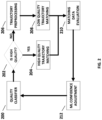
- FIG. 1 is a depiction of system components in a spatiotemporal trajectory matching system, according to some embodiments of the present invention.
- the system is used for matching OTT and MR trajectories of users locations that may be used in various applications.
- an embodiment of the system may be located within a server of a telecom company and/or partially implemented as a cloud service, and which may input data into an application for locating disabled or elderly people in emergencies.
- the system includes an I/O interface 100 which may receive OTT trajectories, MR trajectories, and the threshold, and may output matched OTT/MR pairs and associated confidence values.
- the system includes a computation module 102, which is responsible for the functionality of iteratively matching the plurality of OTT and MR trajectories according to the threshold.
- the system includes at least one processor 104 to execute instructions originating in the computation module.
- the system includes a storage 106 in order to store data such as OTT and MR trajectories, confidence values, and data computed during the matching of OTT and MR trajectories.
- the system includes a presentation display 108, for displaying results of OTT/MR trajectory matchings and/or outputs regarding user requests.
- outputs directed from the computation module to the I/O interface are outputted to the presentation display. It is assumed that the various system components may be implemented as software and/or firmware.
- the quality classifier 200 receives data comprising of OTT and MR trajectories and user preferences through the I/O interface 100, as seen in FIG. 1 .
- the quality classifier may classify OTT and MR trajectories into high quality and low quality trajectories.
- the quality classifier may use a designated filter for low quality OTT and MR trajectories in order to prune and discard trajectories which are of very low quality.
- high and low quality trajectories are separated.
- OTT and MR trajectories are inputted into a trajectory preprocessing submodule 206, which transforms raw OTT and MR trajectories data formats into easier computable forms.
- trajectories are grouped by sessionID and saved to files using the storage 106 in Javascript object notation (JSON) format.
- JSON Javascript object notation
- the trajectory preprocessing may be performed using off the shelf applications.
- the trajectory preprocessing submodule inputs the preprocessed low quality OTT and MR trajectories into a low quality trajectory matching submodule 208, according to respective sessionID values, which proceeds to match low quality OTT and MR trajectories.
- the low quality trajectory matching submodule inputs matched OTT/MR pairs into a matching data evaluation submodule 210, which computes a confidence value for each matched OTT/MR trajectory pair, whereas the confidence values may be computed from MLM or LC measures.
- the low quality trajectory matching submodule may use the storage 106 in order to store all matched OTT/MR pairs and respective confidence values.
- the matching data evaluation submodule may output upon request of a system user matched OTT/MR pairs and respective confidence values though the I/O interface 100.
- the trajectory data storage submodule may input matched OTT/MR pairs and respective confidence values into an ML confidence adjustment submodule 212, which uses an ML process in order to adjust confidence values.
- the ML process iteratively classifies OTT/MR matched pairs according to respective confidence values, adjusts confidence values according to the classifying, and checks the adjusted confidence values for a convergence condition.
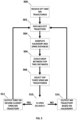
- FIG. 3 depicts dataflow between the quality classifier components, according to some embodiments of the present invention.
- the quality classifier computes shape descriptor scores for each OTT and MR trajectory.
- the shape descriptors used are compactness and elongation functions defined as follows.
- a trajectory t is given as a sequence of two dimensional coordinates, each with a time stamp, and therefore can be mapped geometrically as a line.
- the quality classifier classifies OTT and MR trajectories according to a heuristic, which according to some embodiments of the present invention, classifies a given OTT trajectory q and MR trajectory r as follows:
- Next referenced is 304, in which low quality trajectories are filtered according to the first and second filters, and are discarded if found to be of very low quality, and as shown in 306, classified OTT and MR trajectories which are not discarded may be outputted from the quality classifier to the pre-processing module 202.
- FIG. 4 is an exemplary dataflow of the first and second filters for OTT and MR trajectories respectively, as depicted in 304.
- OTT trajectories may be inputted into the OTT filter one by one, and as shown in 402, a predefined compactness threshold may be applied to C. If a current trajectories compactness is higher than the compactness threshold, then as shown in 404 a predefined elongation threshold may be applied to E.
- a predefined distinct grid number threshold may be applied, which comprises counting a number of trajectory coordinates within equally sized square grids, and if the current trajectory coordinates occupy a number of grids smaller than the distinct grid number the trajectory is not discarded and outputted as shown in 408.
- MR trajectories may be inputted into the MR filter one by one, and as shown in 412, temporal windows mean may be applied to a current MR trajectory.
- the temporal windows mean functions by sliding a temporal window of which size is predefined, and replacing all MR trajectory points within the temporal window by their mean value. This is performed in order to increase robustness and processing speed.
- OTT data windows filtering may be applied to the current MR trajectory, which comprises filtering out points of the current MR trajectory which are not within any time intervals of predefined size of any OTT data points of OTT trajectories with an identical sessionID as the current MR trajectory.
- a distinct point number threshold is applied, which according to some embodiments of the present invention, comprises discarding all MR trajectories who do not contain at least two points, and the last step, as shown in 418, comprises outputting all remaining MR trajectories.
- FIG. 5 depicts an embodiment of the low quality trajectory matching submodule, which includes a pre-fusion process, and a fusion process, using two distance measures which comprise a metric distance measure, and a sequence pattern matching similarity (SPMS) measure.
- SPMS sequence pattern matching similarity
- An OTT and MR pair of trajectories may display topological similarities from a Hausdorff distance perspective but not look similar from a sequence matching perspective and vice versa, hence a merging of the two distance measures may match correctly noisy OTT and MR trajectories.
- the low quality trajectory matching submodule may receive unmatched OTT and MR trajectories from the trajectory preprocessing submodule 202, and as shown in 502, for each OTT trajectory a matching process may be applied.
- a matching process may be applied.
- Hausdorff and SPMS distances may be computed between the current OTT trajectory and all MR trajectories with an identical sessionID.
- the two nearest MR trajectories to the current OTT trajectory denoted as OTT Curr according to Hausdorff and SPMS distances are checked as follows.
- K H K SPMS
- MR 1 H MR 2 H
- MR 1 SPMS MR 2 SPMS
- MR 2 SPMS the nearest and second nearest MR trajectories according to Hausdorff and SPMS respectively
- ⁇ serves as a similarity threshold, meaning distances between corresponding trajectories points which are smaller than ⁇ increase similarity by 1.
- the SPMS measure is implemented as an improved SWALE measure.
- SWALE rewards or penalizes computed distances between trajectories in accordance with a predefined threshold ⁇ , the logic being that if ⁇ is appropriately selected SWALE may strongly separate correctly matched pairs and incorrectly matched pairs by increasing the difference in similarity scores.
- the ISWALE measure takes into account temporal as well as spatial dimensions in calculating a similarity between two trajectories R, S.
- the ISWALE measure calculates rewards and penalties based on predefined spatial and temporal intervals for different Euclidean distances between OTT and MR trajectory points within spatial and temporal dimensions.
- T ( r i ) a temporal stamp of r i .
- the ML confidence adjustment submodule implements an Adaboost method (adaptive boosting) on a random forest dataset.
- the ML confidence adjustment submodule executes iterations in which OTT/MR pairs are classified according to respective confidence values, and the classifying is used to adjust confidence values.
- matched OTT/MR pairs and respective confidence values are received by the ML confidence adjustment submodule.
- OTT/MR pairs are classified according to their respective confidence values using a combination of Adaboost and Random forest.
- confidence values may be adjusted according to the results of the classifying. For example if an OTT/MR pair is classified similarly to other OTT/MR pairs which have relatively high confidence values then the confidence value of the OTT/MR pair may be adjusted upwards.
- a convergence condition is checked.
- the threshold may be applied, as shown in 608.
- the application of the threshold may consist of filtering all OTT and MR trajectories which are part of OTT/MR matched pairs for which respective adjusted confidence values are below the threshold.
- OTT and MR trajectories which remain after the filtering may be outputted by re-inputting them into the quality classifier for another iteration of trajectory matching.
- FIG.7 depicts results of simulations of some embodiments of the present invention.
- Three datasets were tested, named small Chengdu, big Chengdu, and big Chengdu 2.
- Small Chengdu consisted of 16,000 raw OTT trajectories and 310,000 raw MR trajectories.
- Big Chengdu consisted of 180,000 Raw OTT trajectories and 3,300,000 Raw MR trajectories, and big Chengdu 2 consisted of 40,300 Raw OTT trajectories and 1,740,000 Raw MR trajectories.
- an application may receive a user request, for example a guardian for an elderly and/or sick person may report the person missing via a mobile phone application, whereas the mobile phone application may contact a server, which may be a computer terminal and/or a cloud application.
- the server may select from the data storage 106, known OTT trajectories associated to an account of the missing person, and next the server may match the known OTT trajectories to MR trajectories tracked within a certain timeframe, using the computation module 102. Next, the server may process matched OTT trajectories in order to describe the matched OTT trajectories in terms of known landmarks.
- the server may output the known landmarks to the presentation display 108, for example, to a laptop screen and/or phone screen belonging to the guardian.
- the missing person may have been in locations with a blocked GPS signal, or may have a phone with no GPS feature, but may still be located due to MR signals being tracked.
- trajectory matching is intended to include all such new technologies a priori.
- composition or method may include additional ingredients and/or steps, but only if the additional ingredients and/or steps do not materially alter the basic and novel characteristics of the claimed composition or method.
- a compound or “at least one compound” may include a plurality of compounds, including mixtures thereof.
- range format is merely for convenience and brevity and should not be construed as an inflexible limitation on the scope of the invention. Accordingly, the description of a range should be considered to have specifically disclosed all the possible subranges as well as individual numerical values within that range. For example, description of a range such as from 1 to 6 should be considered to have specifically disclosed subranges such as from 1 to 3, from 1 to 4, from 1 to 5, from 2 to 4, from 2 to 6, from 3 to 6 etc., as well as individual numbers within that range, for example, 1, 2, 3, 4, 5, and 6. This applies regardless of the breadth of the range.
Landscapes
- Engineering & Computer Science (AREA)
- Radar, Positioning & Navigation (AREA)
- Remote Sensing (AREA)
- Physics & Mathematics (AREA)
- General Physics & Mathematics (AREA)
- Computer Networks & Wireless Communication (AREA)
- Business, Economics & Management (AREA)
- Economics (AREA)
- Signal Processing (AREA)
- Entrepreneurship & Innovation (AREA)
- Development Economics (AREA)
- Human Resources & Organizations (AREA)
- Marketing (AREA)
- Operations Research (AREA)
- Quality & Reliability (AREA)
- Strategic Management (AREA)
- Tourism & Hospitality (AREA)
- General Business, Economics & Management (AREA)
- Theoretical Computer Science (AREA)
- Information Retrieval, Db Structures And Fs Structures Therefor (AREA)
- Image Analysis (AREA)
Claims (15)
- System zur Nachverfolgung von Benutzerpositionen durch iteratives Matching einer Vielzahl von räumlich-zeitlichen Trajektorien einer Vielzahl von Benutzern gemäß einem Schwellenwert, umfassend:mindestens einen Prozessor (104) und einen Qualitätsklassifikator (200);wobei der mindestens eine Prozessor (104) dazu konfiguriert ist:eine Vielzahl von ersten räumlich-zeitlichen Trajektorien und eine Vielzahl von zweiten räumlich-zeitlichen Trajektorien zu empfangen, die jeweils basierend auf Positionsdaten generiert werden, die durch ein anderes Nachverfolgungssystem gesammelt wurden, wobei die Vielzahl von ersten räumlich-zeitlichen Trajektorien Over-the-Top-Trajektorien, OTT-Trajektorien, umfasst, die von Empfängern des globalen Navigationssatellitensystems in einem Benutzergerät stammen, und wobei die Vielzahl von zweiten räumlich-zeitlichen Trajektorien Messberichttrajektorien, MR-Trajektorien, umfasst, die von Positionen der Mobilnetzbenutzer stammen;wobei der Qualitätsklassifikator (200) dazu konfiguriert ist, die Vielzahl von ersten räumlich-zeitlichen Trajektorien in erste Trajektorien niedriger Qualität und erste Trajektorien hoher Qualität und die Vielzahl von zweiten räumlich-zeitlichen Trajektorien in zweite Trajektorien niedriger Qualität und zweite Trajektorien hoher Qualität zu klassifizieren, wobei der Qualitätsklassifikator (200) dazu konfiguriert ist, eine gegebene OTT-Trajektorie q und eine MR-Trajektorie r wie folgt zu klassifizieren:Wenn
 Wenn
Wenn wobei C(t) die Kompaktheit einer Trajektorie t bezeichnet und E(t) eine Verlängerung der Trajektorie t bezeichnet;wobei der Prozessor (104) ferner dazu konfiguriert ist:eine Vielzahl von Trajektorienpaaren hoher Qualität durch Matching zwischen den ersten Trajektorien hoher Qualität und den zweiten Trajektorien hoher Qualität unter Verwendung eines naiven Matching-Algorithmus zu identifizieren;eine Vielzahl von Trajektorienpaaren niedriger Qualität durch Matching zwischen den ersten Trajektorien niedriger Qualität und den zweiten Trajektorien niedriger Qualität basierend auf zwei Distanzmaßen zu identifizieren;jedem Trajektorienpaar niedriger Qualität der Vielzahl von Trajektorienpaaren niedriger Qualität und jedem Trajektorienpaar hoher Qualität der Vielzahl von Trajektorienpaaren hoher Qualität einen jeweiligen Vertrauenswert zuzuordnen, der eine Disparität des jeweiligen Trajektorienpaares hoher/niedriger Qualität angibt;die Vielzahl von Vertrauenswerten von mindestens einigen der Vielzahl von Trajektorienpaaren niedriger Qualität und der Vielzahl von Trajektorienpaaren hoher Qualität einzustellen, undalle räumlich-zeitlichen Trajektorien, welche Teil eines Trajektorienpaares niedriger Qualität der Vielzahl von Trajektorienpaaren niedriger Qualität oder eines Trajektorienpaares hoher Qualität der Vielzahl von Trajektorienpaaren hoher Qualität sind, deren eingestellter Vertrauenswert unter dem Schwellenwert liegt, erneut in den Qualitätsklassifikator einzugeben.
 - System nach Anspruch 1, wobei der Prozessor (104) ferner dazu konfiguriert ist, die Vielzahl von Trajektorienpaaren hoher Qualität, die Vielzahl von Trajektorienpaaren niedriger Qualität und jeweilige Vertrauenswerte auszugeben.
- System nach Anspruch 1, wobei der Qualitätsklassifikator (104) dazu konfiguriert ist, jede der Vielzahl von ersten und zweiten räumlich-zeitlichen Trajektorien durch Folgendes zu klassifizieren:Berechnen für jede der Vielzahl von ersten und zweiten räumlich-zeitlichen Trajektorien ihrer Vertrauenswerte und jeweiligen Formdeskriptorbewertungen; undVerwenden einer vorbestimmten Heuristik zum Kombinieren der Formdeskriptorbewertungen für jede der Vielzahl von ersten und zweiten räumlich-zeitlichen Trajektorien.
- System nach einem der vorhergehenden Ansprüche, wobei der Prozessor (104) ferner dazu konfiguriert ist, die Vielzahl von Vertrauenswerten durch weiteres Ausführen eines Maschinenlernprozesses an der Vielzahl von Trajektorienpaaren niedriger Qualität und der Vielzahl von Trajektorienpaaren hoher Qualität einzustellen.
- System nach Anspruch 4, wobei der Maschinenlernprozess ferner einen iterativen Prozess des Folgenden umfasst:Verwenden eines Klassifikators zum Klassifizieren der Vielzahl von Trajektorienpaaren hoher und niedriger Qualität gemäß jeweiligen Vertrauenswerten;Einstellen der Vertrauenswerte der Vielzahl der Trajektorienpaare hoher und niedriger Qualität gemäß dem Klassifizieren; undÜberprüfen einer Konvergenzbedingung an jedem angepassten Vertrauenswert, und, wenn die Konvergenzbedingung an allen angepassten Vertrauenswerte erfüllt ist, Ausgeben der eingestellten Vertrauenswerte.
- System nach einem der vorhergehenden Ansprüche, wobei der Qualitätsklassifikator (200) ferner dazu konfiguriert ist:eine Evaluierung der ersten Trajektorien niedriger Qualität durch ein erstes Filter, das eine Sequenz von Formdeskriptorbewertungen aufweist, durchzuführen; undTrajektorien aus den ersten Trajektorien niedriger Qualität basierend auf der Evaluierung zu verwerfen.
- System nach einem der vorhergehenden Ansprüche, wobei der Qualitätsklassifikator (200) ferner dazu konfiguriert ist:eine Evaluierung der zweiten Trajektorien niedriger Qualität durch ein zweites Filter, das eine Sequenz von temporären Datenbewertungen aufweist, durchzuführen, undTrajektorien aus den zweiten Trajektorien niedriger Qualität basierend auf der Evaluierung zu verwerfen.
- System nach einem der vorhergehenden Ansprüche, wobei der Prozessor (104) dazu konfiguriert ist, eine Vielzahl von Trajektorienpaaren niedriger Qualität durch Folgendes zu identifizieren:Berechnen von zwei Distanzmatrizen, die jeweils einem vorbestimmten Distanzmaß entsprechen, wobei jeder Eintrag in jeder Matrix eine Distanz zwischen einem jeweiligen Paar von Trajektorien niedriger Qualität enthält;für jede erste Trajektorie niedriger Qualität:Erstellen von zwei Rankings, die aus einer jeweiligen Zeile oder einer jeweiligen Spalte von jeder der zwei Distanzmatrizen bestimmt werden; undAuswählen einer zweiten Trajektorie niedriger Qualität, die mit der ersten Trajektorie niedriger Qualität gepaart werden soll, gemäß den Verteilungen von Werten innerhalb jedes der zwei Rankings.
- System nach Anspruch 8, wobei ein vorbestimmtes Distanzmaß ein metrisches Distanzmaß ist und ein zweites vorbestimmtes Distanzmaß ein Matching-Ähnlichkeitsmaß von Sequenzmustern ist.
- System nach Anspruch 9, wobei ein vorbestimmtes Distanzmaß ein Hausdorff-Distanzmaß ist und ein zweites vorbestimmtes Distanzmaß ein Maß der längsten gemeinsamen Teilsequenz, LCSS-Maß, ist.
- System nach Anspruch 9, wobei ein vorbestimmtes Distanzmaß ein Hausdorff-Distanzmaß ist und ein zweites vorbestimmtes Distanzmaß ein Maß der verbesserten sequenzgewichteten Ausrichtung, ISWALE-Maß, ist.
- System nach einem der vorhergehenden Ansprüche, ferner umfassend einen Speicher (106), der dazu konfiguriert ist, die Trajektorienpaare hoher und niedriger Qualität zusammen mit jeweiligen Vertrauenswerten und jeweiligen Distanzen zu speichern.
- Verfahren zur Nachverfolgung von Benutzerpositionen durch iteratives Matching einer Vielzahl von räumlich-zeitlichen Trajektorien einer Vielzahl von Benutzern gemäß einem Schwellenwert, umfassend:Empfangen einer Vielzahl von ersten räumlich-zeitlichen Trajektorien und einer Vielzahl von zweiten räumlich-zeitlichen Trajektorien, die jeweils basierend auf Positionsdaten generiert werden, die durch ein anderes Nachverfolgungssystem gesammelt wurden, wobei die Vielzahl von ersten räumlich-zeitlichen Trajektorien Over-the-Top-Trajektorien, OTT-Trajektorien, umfasst, die von Empfängern des globalen Navigationssatellitensystems in einem Benutzergerät stammen, und wobei die Vielzahl von zweiten räumlich-zeitlichen Trajektorien Messberichttrajektorien, MR-Trajektorien, umfasst, die von Positionen der Mobilnetzbenutzer stammen;Klassifizieren (202), unter Verwendung des Qualitätsklassifikators (200), der Vielzahl von ersten räumlich-zeitlichen Trajektorien in erste Trajektorien niedriger Qualität und erste Trajektorien hoher Qualität und die Vielzahl von zweiten räumlich-zeitlichen Trajektorien in zweite Trajektorien niedriger Qualität und zweite Trajektorien hoher Qualität zu klassifizieren, wobei der Qualitätsklassifikator (200) eine gegebene OTT-Trajektorie q und eine MR-Trajektorie r wie folgt klassifiziert:Wenn
 Wenn
Wenn wobei C(t) die Kompaktheit einer Trajektorie t bezeichnet und E(t) eine Verlängerung der Trajektorie t bezeichnet;Identifizieren (204) einer Vielzahl von Trajektorienpaaren hoher Qualität durch Matching zwischen den ersten Trajektorien hoher Qualität und den zweiten Trajektorien hoher Qualität unter Verwendung eines naiven Matching-Algorithmus;Identifizieren (208) einer Vielzahl von Trajektorienpaaren niedriger Qualität durch Matching zwischen den ersten Trajektorien niedriger Qualität und den zweiten Trajektorien niedriger Qualität basierend auf zwei Distanzmaßen;Zuordnen (210) eines jeweiligen Vertrauenswerts, der eine Disparität des jeweiligen Trajektorienpaares hoher/niedriger Qualität angibt, zu jedem Trajektorienpaar niedriger Qualität der Vielzahl von Trajektorienpaaren niedriger Qualität und jedem Trajektorienpaar hoher Qualität der Vielzahl von Trajektorienpaaren hoher Qualität;Einstellen (212) der Vertrauenswerte von mindestens einigen der Vielzahl von Trajektorienpaaren niedriger Qualität und der Vielzahl von Paaren hoher Qualität, underneutes Eingeben aller räumlich-zeitlichen Trajektorien, welche Teil eines Trajektorienpaares niedriger Qualität der Vielzahl von Trajektorienpaaren niedriger Qualität oder eines Trajektorienpaares hoher Qualität der Vielzahl von Trajektorienpaaren hoher Qualität sind, deren eingestellter Vertrauenswert unter dem Schwellenwert liegt, in den Qualitätsklassifikator.
 - Verfahren nach Anspruch 13, ferner umfassend:
Ausgeben der Vielzahl von Trajektorienpaaren hoher Qualität, der Vielzahl von Trajektorienpaaren niedriger Qualität und jeweiliger Vertrauenswerte. - Verfahren nach Anspruch 13, wobei das Klassifizieren (202) jeder der Vielzahl von ersten und zweiten räumlich-zeitlichen Trajektorien durch:Berechnen für jede der Vielzahl von ersten und zweiten räumlich-zeitlichen Trajektorien ihrer Vertrauenswerte und jeweiligen Formdeskriptorbewertungen; undVerwenden einer vorbestimmten Heuristik zum Kombinieren der Formdeskriptorbewertungen für jede der Vielzahl von ersten und zweiten räumlich-zeitlichen Trajektorien.
Applications Claiming Priority (1)
| Application Number | Priority Date | Filing Date | Title |
|---|---|---|---|
| PCT/EP2018/078247 WO2020078540A1 (en) | 2018-10-16 | 2018-10-16 | Improved trajectory matching based on use of quality indicators empowered by weighted confidence values |
Publications (2)
| Publication Number | Publication Date |
|---|---|
| EP3853789A1 EP3853789A1 (de) | 2021-07-28 |
| EP3853789B1 true EP3853789B1 (de) | 2025-03-26 |
Family
ID=63896170
Family Applications (1)
| Application Number | Title | Priority Date | Filing Date |
|---|---|---|---|
| EP18789103.1A Active EP3853789B1 (de) | 2018-10-16 | 2018-10-16 | Verbessertes trajectory matching auf der grundlage der verwendung von qualitätsindikatoren mit gewichteten vertrauenswerten |
Country Status (4)
| Country | Link |
|---|---|
| US (1) | US11889382B2 (de) |
| EP (1) | EP3853789B1 (de) |
| CN (1) | CN111328403B (de) |
| WO (1) | WO2020078540A1 (de) |
Families Citing this family (6)
| Publication number | Priority date | Publication date | Assignee | Title |
|---|---|---|---|---|
| CN112230253B (zh) * | 2020-10-13 | 2021-07-09 | 电子科技大学 | 基于公共切片子序列的轨迹特征异常检测方法 |
| CN113487865B (zh) * | 2021-07-02 | 2022-07-22 | 江西锦路科技开发有限公司 | 一种高速公路行驶车辆信息采集系统及方法 |
| US12228657B2 (en) * | 2021-08-20 | 2025-02-18 | Mediatek Inc. | Region-adapted neural network for location determination |
| CN115982592B (zh) * | 2022-10-27 | 2026-04-21 | 浙江大华技术股份有限公司 | 轨迹相似度计算方法、轨迹相似度计算装置以及存储介质 |
| EP4361819B1 (de) * | 2022-10-28 | 2025-06-18 | Zenseact AB | Verfahren und vorrichtungen zur beurteilung mit geschlossenem regelkreis für autonome fahrzeuge |
| CN116977374B (zh) * | 2023-08-02 | 2025-08-08 | 安徽工程大学 | 基于置信度优化的在线多目标跟踪方法 |
Family Cites Families (21)
| Publication number | Priority date | Publication date | Assignee | Title |
|---|---|---|---|---|
| AUPP375498A0 (en) | 1998-05-29 | 1998-06-18 | Small, David | A method for creating a network positioning system (NPS) |
| US6622090B2 (en) * | 2000-09-26 | 2003-09-16 | American Gnc Corporation | Enhanced inertial measurement unit/global positioning system mapping and navigation process |
| US7143083B2 (en) | 2001-06-12 | 2006-11-28 | Lucent Technologies Inc. | Method and apparatus for retrieving multimedia data through spatio-temporal activity maps |
| US8838374B2 (en) * | 2005-07-05 | 2014-09-16 | Mi-Jack Products, Inc. | Automatic correction of past position errors for location and inventory tracking |
| US7848881B2 (en) * | 2005-07-05 | 2010-12-07 | Containertrac, Inc. | Automatic past error corrections for location and inventory tracking |
| US8542636B2 (en) * | 2010-01-04 | 2013-09-24 | Lili Qiu | Vehicular content distribution |
| US9593957B2 (en) | 2010-06-04 | 2017-03-14 | Microsoft Technology Licensing, Llc | Searching similar trajectories by locations |
| JP5510112B2 (ja) * | 2010-06-23 | 2014-06-04 | アイシン・エィ・ダブリュ株式会社 | 軌跡情報生成装置、方法およびプログラム |
| WO2013148940A1 (en) * | 2012-03-28 | 2013-10-03 | Pioneer Advanced Solutions, Inc. | Method for increasing waypoint accuracies for crowd-sourced routes |
| US9881105B2 (en) * | 2014-04-23 | 2018-01-30 | International Business Machines Corporation | Minimizing uncertainty envelopes in trajectories of evolving ensemble members |
| US9510154B2 (en) * | 2014-04-28 | 2016-11-29 | Samsung Electronics Co., Ltd | Location determination, mapping, and data management through crowdsourcing |
| US11175142B2 (en) * | 2014-07-31 | 2021-11-16 | Honeywell International Inc. | Updating intensities in a PHD filter based on a sensor track ID |
| CN104501807B (zh) * | 2014-12-30 | 2017-04-12 | 杭州云象网络技术有限公司 | 基于地磁场和历史定位轨迹的室内定位方法 |
| CN104657746B (zh) | 2015-01-29 | 2017-09-12 | 电子科技大学 | 一种基于车辆轨迹相似性的异常检测方法 |
| US10423892B2 (en) * | 2016-04-05 | 2019-09-24 | Omni Ai, Inc. | Trajectory cluster model for learning trajectory patterns in video data |
| US10121374B2 (en) * | 2016-06-10 | 2018-11-06 | Apple Inc. | Parking event detection and location estimation |
| CN108346158B (zh) * | 2017-01-22 | 2020-04-07 | 山东大学 | 基于主块数据关联的多目标跟踪方法及系统 |
| WO2018150227A1 (en) * | 2017-02-17 | 2018-08-23 | Dataspark Pte, Ltd | Mobility gene for trajectory data |
| CN107679558B (zh) * | 2017-09-19 | 2019-09-24 | 电子科技大学 | 一种基于度量学习的用户轨迹相似性度量方法 |
| CN107807346A (zh) * | 2017-10-26 | 2018-03-16 | 南京华苏科技有限公司 | 基于ott与mr数据的自适应wknn室外定位方法 |
| CN108133172B (zh) * | 2017-11-16 | 2022-04-05 | 北京华道兴科技有限公司 | 视频中运动对象分类的方法、车流量的分析方法及装置 |
-
2018
- 2018-10-16 EP EP18789103.1A patent/EP3853789B1/de active Active
- 2018-10-16 CN CN201880006700.8A patent/CN111328403B/zh active Active
- 2018-10-16 WO PCT/EP2018/078247 patent/WO2020078540A1/en not_active Ceased
-
2021
- 2021-04-15 US US17/231,856 patent/US11889382B2/en active Active
Also Published As
| Publication number | Publication date |
|---|---|
| WO2020078540A1 (en) | 2020-04-23 |
| US20210235232A1 (en) | 2021-07-29 |
| EP3853789A1 (de) | 2021-07-28 |
| US11889382B2 (en) | 2024-01-30 |
| CN111328403B (zh) | 2023-09-29 |
| CN111328403A (zh) | 2020-06-23 |
Similar Documents
| Publication | Publication Date | Title |
|---|---|---|
| US11889382B2 (en) | Trajectory matching based on use of quality indicators empowered by weighted confidence values | |
| US11599825B2 (en) | Method and apparatus for training trajectory classification model, and electronic device | |
| Neill | Detection of spatial and spatio-temporal clusters | |
| CN109726658B (zh) | 人群计数及定位方法、系统、电子终端及存储介质 | |
| CN106462627B (zh) | 根据多个位置数据报告分析语义地点和相关数据 | |
| US9349189B2 (en) | Occlusion resistant image template matching using distance transform | |
| US20140253543A1 (en) | Performance prediction for generation of point clouds from passive imagery | |
| US11937146B2 (en) | High fidelity geolocation using machine learning | |
| US20130041753A1 (en) | System and Method for Identifying a Path of a Billboard Audience Group and Providing Advertising Content Based on the Path | |
| CN110377670B (zh) | 一种确定道路要素信息的方法、装置、介质及设备 | |
| US20230094192A1 (en) | Method for image processing, method for proposal evaluation, and related apparatuses | |
| JP2013034103A (ja) | 測位誤差を含む位置情報から対象エリアを特定するデータベースサーバ、システム、プログラム及び方法 | |
| CN119311707B (zh) | 基于gis支持下的时空数据要素动态更新方法及系统 | |
| CN114882696A (zh) | 道路容量的确定方法、装置及存储介质 | |
| Yang et al. | Unmanned aerial vehicle–assisted node localization for wireless sensor networks | |
| Liu et al. | A framework of road extraction from airborne lidar data and aerial imagery | |
| Lyu et al. | Movement-aware map construction | |
| CN115115825A (zh) | 图像中的对象检测方法、装置、计算机设备和存储介质 | |
| US20210012564A1 (en) | Scene model construction system and scene model constructing method | |
| AU2016433153B2 (en) | Estimated user location from cellular telephony data | |
| CN109697474A (zh) | 基于迭代贝叶斯的合成孔径雷达影像变化检测方法 | |
| US20230316701A1 (en) | Reference state deciding device, state determination system, reference state deciding method, and non-transitory computer readable medium | |
| CN121233687B (zh) | 一种国土空间规划地理信息大数据管理方法及系统 | |
| CN121456519B (zh) | 基于局部协方差与时空共享近邻的时空密度峰值聚类方法 | |
| CN117876980B (zh) | 一种轨迹构建方法 |
Legal Events
| Date | Code | Title | Description |
|---|---|---|---|
| STAA | Information on the status of an ep patent application or granted ep patent |
Free format text: STATUS: UNKNOWN |
|
| STAA | Information on the status of an ep patent application or granted ep patent |
Free format text: STATUS: THE INTERNATIONAL PUBLICATION HAS BEEN MADE |
|
| PUAI | Public reference made under article 153(3) epc to a published international application that has entered the european phase |
Free format text: ORIGINAL CODE: 0009012 |
|
| STAA | Information on the status of an ep patent application or granted ep patent |
Free format text: STATUS: REQUEST FOR EXAMINATION WAS MADE |
|
| 17P | Request for examination filed |
Effective date: 20210422 |
|
| AK | Designated contracting states |
Kind code of ref document: A1 Designated state(s): AL AT BE BG CH CY CZ DE DK EE ES FI FR GB GR HR HU IE IS IT LI LT LU LV MC MK MT NL NO PL PT RO RS SE SI SK SM TR |
|
| DAV | Request for validation of the european patent (deleted) | ||
| DAX | Request for extension of the european patent (deleted) | ||
| GRAP | Despatch of communication of intention to grant a patent |
Free format text: ORIGINAL CODE: EPIDOSNIGR1 |
|
| STAA | Information on the status of an ep patent application or granted ep patent |
Free format text: STATUS: GRANT OF PATENT IS INTENDED |
|
| RIC1 | Information provided on ipc code assigned before grant |
Ipc: G06Q 10/0833 20230101ALI20241105BHEP Ipc: G01S 5/00 20060101ALI20241105BHEP Ipc: G01S 19/48 20100101ALI20241105BHEP Ipc: G01S 19/14 20100101ALI20241105BHEP Ipc: G01S 19/39 20100101ALI20241105BHEP Ipc: G06Q 10/08 20120101AFI20241105BHEP |
|
| INTG | Intention to grant announced |
Effective date: 20241122 |
|
| GRAS | Grant fee paid |
Free format text: ORIGINAL CODE: EPIDOSNIGR3 |
|
| GRAA | (expected) grant |
Free format text: ORIGINAL CODE: 0009210 |
|
| STAA | Information on the status of an ep patent application or granted ep patent |
Free format text: STATUS: THE PATENT HAS BEEN GRANTED |
|
| AK | Designated contracting states |
Kind code of ref document: B1 Designated state(s): AL AT BE BG CH CY CZ DE DK EE ES FI FR GB GR HR HU IE IS IT LI LT LU LV MC MK MT NL NO PL PT RO RS SE SI SK SM TR |
|
| REG | Reference to a national code |
Ref country code: GB Ref legal event code: FG4D |
|
| REG | Reference to a national code |
Ref country code: CH Ref legal event code: EP |
|
| REG | Reference to a national code |
Ref country code: DE Ref legal event code: R096 Ref document number: 602018080487 Country of ref document: DE |
|
| REG | Reference to a national code |
Ref country code: IE Ref legal event code: FG4D |
|
| PG25 | Lapsed in a contracting state [announced via postgrant information from national office to epo] |
Ref country code: RS Free format text: LAPSE BECAUSE OF FAILURE TO SUBMIT A TRANSLATION OF THE DESCRIPTION OR TO PAY THE FEE WITHIN THE PRESCRIBED TIME-LIMIT Effective date: 20250626 |
|
| PG25 | Lapsed in a contracting state [announced via postgrant information from national office to epo] |
Ref country code: FI Free format text: LAPSE BECAUSE OF FAILURE TO SUBMIT A TRANSLATION OF THE DESCRIPTION OR TO PAY THE FEE WITHIN THE PRESCRIBED TIME-LIMIT Effective date: 20250326 |
|
| REG | Reference to a national code |
Ref country code: LT Ref legal event code: MG9D |
|
| PG25 | Lapsed in a contracting state [announced via postgrant information from national office to epo] |
Ref country code: NO Free format text: LAPSE BECAUSE OF FAILURE TO SUBMIT A TRANSLATION OF THE DESCRIPTION OR TO PAY THE FEE WITHIN THE PRESCRIBED TIME-LIMIT Effective date: 20250626 |
|
| PG25 | Lapsed in a contracting state [announced via postgrant information from national office to epo] |
Ref country code: HR Free format text: LAPSE BECAUSE OF FAILURE TO SUBMIT A TRANSLATION OF THE DESCRIPTION OR TO PAY THE FEE WITHIN THE PRESCRIBED TIME-LIMIT Effective date: 20250326 |
|
| PG25 | Lapsed in a contracting state [announced via postgrant information from national office to epo] |
Ref country code: LV Free format text: LAPSE BECAUSE OF FAILURE TO SUBMIT A TRANSLATION OF THE DESCRIPTION OR TO PAY THE FEE WITHIN THE PRESCRIBED TIME-LIMIT Effective date: 20250326 |
|
| PG25 | Lapsed in a contracting state [announced via postgrant information from national office to epo] |
Ref country code: BG Free format text: LAPSE BECAUSE OF FAILURE TO SUBMIT A TRANSLATION OF THE DESCRIPTION OR TO PAY THE FEE WITHIN THE PRESCRIBED TIME-LIMIT Effective date: 20250326 Ref country code: GR Free format text: LAPSE BECAUSE OF FAILURE TO SUBMIT A TRANSLATION OF THE DESCRIPTION OR TO PAY THE FEE WITHIN THE PRESCRIBED TIME-LIMIT Effective date: 20250627 |
|
| REG | Reference to a national code |
Ref country code: NL Ref legal event code: MP Effective date: 20250326 |
|
| PG25 | Lapsed in a contracting state [announced via postgrant information from national office to epo] |
Ref country code: NL Free format text: LAPSE BECAUSE OF FAILURE TO SUBMIT A TRANSLATION OF THE DESCRIPTION OR TO PAY THE FEE WITHIN THE PRESCRIBED TIME-LIMIT Effective date: 20250326 |
|
| PG25 | Lapsed in a contracting state [announced via postgrant information from national office to epo] |
Ref country code: SE Free format text: LAPSE BECAUSE OF FAILURE TO SUBMIT A TRANSLATION OF THE DESCRIPTION OR TO PAY THE FEE WITHIN THE PRESCRIBED TIME-LIMIT Effective date: 20250326 |
|
| REG | Reference to a national code |
Ref country code: AT Ref legal event code: MK05 Ref document number: 1779697 Country of ref document: AT Kind code of ref document: T Effective date: 20250326 |
|
| PG25 | Lapsed in a contracting state [announced via postgrant information from national office to epo] |
Ref country code: SM Free format text: LAPSE BECAUSE OF FAILURE TO SUBMIT A TRANSLATION OF THE DESCRIPTION OR TO PAY THE FEE WITHIN THE PRESCRIBED TIME-LIMIT Effective date: 20250326 |
|
| PG25 | Lapsed in a contracting state [announced via postgrant information from national office to epo] |
Ref country code: PT Free format text: LAPSE BECAUSE OF FAILURE TO SUBMIT A TRANSLATION OF THE DESCRIPTION OR TO PAY THE FEE WITHIN THE PRESCRIBED TIME-LIMIT Effective date: 20250728 Ref country code: ES Free format text: LAPSE BECAUSE OF FAILURE TO SUBMIT A TRANSLATION OF THE DESCRIPTION OR TO PAY THE FEE WITHIN THE PRESCRIBED TIME-LIMIT Effective date: 20250326 |
|
| PG25 | Lapsed in a contracting state [announced via postgrant information from national office to epo] |
Ref country code: PL Free format text: LAPSE BECAUSE OF FAILURE TO SUBMIT A TRANSLATION OF THE DESCRIPTION OR TO PAY THE FEE WITHIN THE PRESCRIBED TIME-LIMIT Effective date: 20250326 Ref country code: IT Free format text: LAPSE BECAUSE OF FAILURE TO SUBMIT A TRANSLATION OF THE DESCRIPTION OR TO PAY THE FEE WITHIN THE PRESCRIBED TIME-LIMIT Effective date: 20250326 |
|
| PG25 | Lapsed in a contracting state [announced via postgrant information from national office to epo] |
Ref country code: AT Free format text: LAPSE BECAUSE OF FAILURE TO SUBMIT A TRANSLATION OF THE DESCRIPTION OR TO PAY THE FEE WITHIN THE PRESCRIBED TIME-LIMIT Effective date: 20250326 |
|
| PG25 | Lapsed in a contracting state [announced via postgrant information from national office to epo] |
Ref country code: EE Free format text: LAPSE BECAUSE OF FAILURE TO SUBMIT A TRANSLATION OF THE DESCRIPTION OR TO PAY THE FEE WITHIN THE PRESCRIBED TIME-LIMIT Effective date: 20250326 |
|
| PG25 | Lapsed in a contracting state [announced via postgrant information from national office to epo] |
Ref country code: RO Free format text: LAPSE BECAUSE OF FAILURE TO SUBMIT A TRANSLATION OF THE DESCRIPTION OR TO PAY THE FEE WITHIN THE PRESCRIBED TIME-LIMIT Effective date: 20250326 |
|
| PG25 | Lapsed in a contracting state [announced via postgrant information from national office to epo] |
Ref country code: SK Free format text: LAPSE BECAUSE OF FAILURE TO SUBMIT A TRANSLATION OF THE DESCRIPTION OR TO PAY THE FEE WITHIN THE PRESCRIBED TIME-LIMIT Effective date: 20250326 |
|
| PG25 | Lapsed in a contracting state [announced via postgrant information from national office to epo] |
Ref country code: IS Free format text: LAPSE BECAUSE OF FAILURE TO SUBMIT A TRANSLATION OF THE DESCRIPTION OR TO PAY THE FEE WITHIN THE PRESCRIBED TIME-LIMIT Effective date: 20250726 |
|
| REG | Reference to a national code |
Ref country code: DE Ref legal event code: R097 Ref document number: 602018080487 Country of ref document: DE |
|
| PGFP | Annual fee paid to national office [announced via postgrant information from national office to epo] |
Ref country code: DE Payment date: 20250902 Year of fee payment: 8 |
|
| PG25 | Lapsed in a contracting state [announced via postgrant information from national office to epo] |
Ref country code: DK Free format text: LAPSE BECAUSE OF FAILURE TO SUBMIT A TRANSLATION OF THE DESCRIPTION OR TO PAY THE FEE WITHIN THE PRESCRIBED TIME-LIMIT Effective date: 20250326 |
|
| PG25 | Lapsed in a contracting state [announced via postgrant information from national office to epo] |
Ref country code: CZ Free format text: LAPSE BECAUSE OF FAILURE TO SUBMIT A TRANSLATION OF THE DESCRIPTION OR TO PAY THE FEE WITHIN THE PRESCRIBED TIME-LIMIT Effective date: 20250326 |
|
| PLBE | No opposition filed within time limit |
Free format text: ORIGINAL CODE: 0009261 |
|
| STAA | Information on the status of an ep patent application or granted ep patent |
Free format text: STATUS: NO OPPOSITION FILED WITHIN TIME LIMIT |
|
| REG | Reference to a national code |
Ref country code: CH Ref legal event code: L10 Free format text: ST27 STATUS EVENT CODE: U-0-0-L10-L00 (AS PROVIDED BY THE NATIONAL OFFICE) Effective date: 20260211 |
|
| 26N | No opposition filed |
Effective date: 20260105 |