EP3854277A1 - Appareil et procédé de traitement intelligent des aliments - Google Patents
Appareil et procédé de traitement intelligent des aliments Download PDFInfo
- Publication number
- EP3854277A1 EP3854277A1 EP20152912.0A EP20152912A EP3854277A1 EP 3854277 A1 EP3854277 A1 EP 3854277A1 EP 20152912 A EP20152912 A EP 20152912A EP 3854277 A1 EP3854277 A1 EP 3854277A1
- Authority
- EP
- European Patent Office
- Prior art keywords
- food processing
- processing apparatus
- threshold value
- controller
- food
- Prior art date
- Legal status (The legal status is an assumption and is not a legal conclusion. Google has not performed a legal analysis and makes no representation as to the accuracy of the status listed.)
- Withdrawn
Links
- 235000013305 food Nutrition 0.000 title claims abstract description 199
- 238000012545 processing Methods 0.000 title claims abstract description 131
- 238000000034 method Methods 0.000 title claims abstract description 16
- 239000002245 particle Substances 0.000 claims abstract description 114
- 239000012530 fluid Substances 0.000 claims abstract description 77
- 238000004891 communication Methods 0.000 claims description 10
- 235000008452 baby food Nutrition 0.000 claims description 5
- 230000003287 optical effect Effects 0.000 claims description 4
- 238000002604 ultrasonography Methods 0.000 claims description 4
- 235000013325 dietary fiber Nutrition 0.000 description 29
- XLYOFNOQVPJJNP-UHFFFAOYSA-N water Substances O XLYOFNOQVPJJNP-UHFFFAOYSA-N 0.000 description 22
- 239000000835 fiber Substances 0.000 description 12
- 239000004615 ingredient Substances 0.000 description 12
- 239000011159 matrix material Substances 0.000 description 6
- 238000001514 detection method Methods 0.000 description 5
- 230000006378 damage Effects 0.000 description 4
- 238000013461 design Methods 0.000 description 4
- 230000001953 sensory effect Effects 0.000 description 4
- 238000004140 cleaning Methods 0.000 description 3
- 230000036571 hydration Effects 0.000 description 3
- 238000006703 hydration reaction Methods 0.000 description 3
- 238000000149 argon plasma sintering Methods 0.000 description 2
- 230000009286 beneficial effect Effects 0.000 description 2
- 235000011389 fruit/vegetable juice Nutrition 0.000 description 2
- 210000001035 gastrointestinal tract Anatomy 0.000 description 2
- 239000000203 mixture Substances 0.000 description 2
- 235000013570 smoothie Nutrition 0.000 description 2
- 235000013311 vegetables Nutrition 0.000 description 2
- 235000021537 Beetroot Nutrition 0.000 description 1
- 240000008067 Cucumis sativus Species 0.000 description 1
- 235000010799 Cucumis sativus var sativus Nutrition 0.000 description 1
- 244000000626 Daucus carota Species 0.000 description 1
- 235000002767 Daucus carota Nutrition 0.000 description 1
- 235000020194 almond milk Nutrition 0.000 description 1
- 235000020197 coconut milk Nutrition 0.000 description 1
- 210000001072 colon Anatomy 0.000 description 1
- 230000000112 colonic effect Effects 0.000 description 1
- 230000001010 compromised effect Effects 0.000 description 1
- 238000010411 cooking Methods 0.000 description 1
- 230000008878 coupling Effects 0.000 description 1
- 238000010168 coupling process Methods 0.000 description 1
- 238000005859 coupling reaction Methods 0.000 description 1
- 230000007423 decrease Effects 0.000 description 1
- 230000003247 decreasing effect Effects 0.000 description 1
- 230000001419 dependent effect Effects 0.000 description 1
- 235000012762 dietary quality Nutrition 0.000 description 1
- 235000013399 edible fruits Nutrition 0.000 description 1
- 238000005516 engineering process Methods 0.000 description 1
- 239000002657 fibrous material Substances 0.000 description 1
- 239000010419 fine particle Substances 0.000 description 1
- 239000011521 glass Substances 0.000 description 1
- 230000005484 gravity Effects 0.000 description 1
- 210000002429 large intestine Anatomy 0.000 description 1
- 239000007788 liquid Substances 0.000 description 1
- 239000000463 material Substances 0.000 description 1
- 238000013178 mathematical model Methods 0.000 description 1
- 239000002184 metal Substances 0.000 description 1
- 229910001092 metal group alloy Inorganic materials 0.000 description 1
- 235000013336 milk Nutrition 0.000 description 1
- 239000008267 milk Substances 0.000 description 1
- 210000004080 milk Anatomy 0.000 description 1
- 238000010295 mobile communication Methods 0.000 description 1
- 238000012544 monitoring process Methods 0.000 description 1
- 235000015097 nutrients Nutrition 0.000 description 1
- 230000001766 physiological effect Effects 0.000 description 1
- 235000020245 plant milk Nutrition 0.000 description 1
- 229920000642 polymer Polymers 0.000 description 1
- 230000002265 prevention Effects 0.000 description 1
- 238000010298 pulverizing process Methods 0.000 description 1
- 239000011343 solid material Substances 0.000 description 1
- 235000014347 soups Nutrition 0.000 description 1
- 235000013322 soy milk Nutrition 0.000 description 1
- 239000000126 substance Substances 0.000 description 1
- 235000013618 yogurt Nutrition 0.000 description 1
Images

Classifications
-
- A—HUMAN NECESSITIES
- A47—FURNITURE; DOMESTIC ARTICLES OR APPLIANCES; COFFEE MILLS; SPICE MILLS; SUCTION CLEANERS IN GENERAL
- A47J—KITCHEN EQUIPMENT; COFFEE MILLS; SPICE MILLS; APPARATUS FOR MAKING BEVERAGES
- A47J43/00—Implements for preparing or holding food, not provided for in other groups of this subclass
- A47J43/04—Machines for domestic use not covered elsewhere, e.g. for grinding, mixing, stirring, kneading, emulsifying, whipping or beating foodstuffs, e.g. power-driven
- A47J43/046—Machines for domestic use not covered elsewhere, e.g. for grinding, mixing, stirring, kneading, emulsifying, whipping or beating foodstuffs, e.g. power-driven with tools driven from the bottom side
-
- A—HUMAN NECESSITIES
- A47—FURNITURE; DOMESTIC ARTICLES OR APPLIANCES; COFFEE MILLS; SPICE MILLS; SUCTION CLEANERS IN GENERAL
- A47J—KITCHEN EQUIPMENT; COFFEE MILLS; SPICE MILLS; APPARATUS FOR MAKING BEVERAGES
- A47J43/00—Implements for preparing or holding food, not provided for in other groups of this subclass
- A47J43/04—Machines for domestic use not covered elsewhere, e.g. for grinding, mixing, stirring, kneading, emulsifying, whipping or beating foodstuffs, e.g. power-driven
- A47J43/07—Parts or details, e.g. mixing tools, whipping tools
- A47J43/0716—Parts or details, e.g. mixing tools, whipping tools for machines with tools driven from the lower side
-
- A—HUMAN NECESSITIES
- A47—FURNITURE; DOMESTIC ARTICLES OR APPLIANCES; COFFEE MILLS; SPICE MILLS; SUCTION CLEANERS IN GENERAL
- A47J—KITCHEN EQUIPMENT; COFFEE MILLS; SPICE MILLS; APPARATUS FOR MAKING BEVERAGES
- A47J36/00—Parts, details or accessories of cooking-vessels
- A47J36/32—Time-controlled igniting mechanisms or alarm devices
- A47J36/321—Time-controlled igniting mechanisms or alarm devices the electronic control being performed over a network, e.g. by means of a handheld device
Definitions
- the present invention relates to a food processing apparatus for preparing a fluid food product comprising a food processing chamber including a blade arrangement driven by a motor and a controller arranged to control said motor.
- the present invention further relates to a method of operating such a food processing apparatus.
- Food processors such as blenders, juicers and baby food makers are widely used to pulverize foods in order to produce fluid food products such as soups, smoothies, juices, baby food, purees and so on.
- This typically involves pulverizing fibrous ingredients such as fruit and/or vegetables together with liquids such as water, milk, a plant-based milk such as soy milk, almond milk, coconut milk or the like, yoghurt, and so on, in order to produce the desired fluid food product.
- a plant-based milk such as soy milk, almond milk, coconut milk or the like, yoghurt, and so on
- mathematical models may be developed to explain the size distribution of particles in blenders to give insight into the behaviour of possible blender designs.
- Such models may be used to design a food processing apparatus such as a blender such that the produced fluid food product has the desired consistency in terms of particle size distribution.
- dietary fiber An important nutrient of the fibrous ingredients of such fluid food products is dietary fiber, which is considered beneficial for gut health.
- One of the important physico-chemical properties of such fibers is their hydration properties. Hydration properties of dietary fiber have been extensively studied in relation to the dietary fiber hypothesis. They partly influence the fate of dietary fibre in the gastrointestinal tract and account for some physiological effects such as faecal bulking. In the colon, fiber, especially insoluble fiber, can bind and absorb water like a sponge. This increases stool weight and shortens transit time through the large intestine, which is beneficial for colonic health. Water-holding capacity (WHC) is commonly used as an indicator for the hydration properties of such dietary fibers. The water holding capacity is defined as the quantity of water that is bound to the dietary fiber without the application of an external force (other than gravity and atmospheric pressure).
- the present invention seeks to provide a food processing apparatus for preparing a fluid food product comprising a food processing chamber including a blade arrangement driven by a motor and a controller arranged to control said motor in which the food processing apparatus may be operated to optimize the water holding capacity of dietary fiber in the fluid food product.
- the present invention further seeks to provide a method of operating a food processing apparatus such that the water holding capacity of the dietary fibers in the fluid food product is optimized.
- the present invention is based on the knowledge that the water holding capacity of dietary fiber is associated with particle size distribution of such fiber in the processed fluid food product. Without wishing to be bound by theory, it is believed that this is caused by destruction of the fiber matrix if dietary fibers are pulverized to fine particles, with this matrix structure being mainly responsible for the water holding capacity of dietary fiber. Therefore, by including a particle sensor in the design of the food processing apparatus and adapting the controller of the food processing apparatus such that the controller terminates the operation of the motor before the detected particle sizes drop below 400 ⁇ m, the water holding capacity of the (insoluble) dietary fibers is optimized by prevention of the destruction of their fiber matrix.
- the detection of the particle size of particles e.g. dietary fiber particles
- this may mean the detection of a minimum size of such particles or the detection of the average size of such particles.
- the actual particle size in example embodiments may mean the minimum size (lower end point) or average (mean) size of a size distribution or size range of such particles as detected with the particle sensor.
- the threshold value lies in a range of 400-850 ⁇ m. This is based on the knowledge that the water holding capacity of some types of dietary fibers slowly decreases with increasing particle size, such that it is believed that within this range a particularly good water holding capacity by the fiber matrix is achieved, regardless of fiber type. Moreover, this ensures that the consumer of the finalized fluid food product is still presented with a fluid food product that is perceived as having a desirable taste, e.g.
- the threshold value is in a range of 400-600 ⁇ m to optimize the taste or texture of the fluid food product whilst retaining the water holding capacity of the dietary fibers therein.
- the controller is further responsive to a threshold value selection signal and is adapted to select the threshold value based on said threshold value selection signal.
- the food processing apparatus may enable a user to generate a threshold value selection signal defining a relative processing time, e.g. short, medium or long, or a relative fluid food product texture, e.g. smooth, medium, coarse, or the like, with each of these selection options being associated with a particular threshold value preferably lying within the aforementioned threshold range such that the controller may disengage the motor and stop the processing of the fluid food product if the actual particle sizes therein have reached the user selected particular threshold value, thereby enabling a user to control the texture or taste of the fluid food product whilst maintaining its water holding capacity.
- the food processing apparatus may further comprise a user interface communicatively coupled to the controller, wherein the user interface is adapted to generate the threshold value selection signal in response to a user making a selection with the user interface.
- the food processing apparatus may further comprise a communication interface communicatively coupled to the controller, wherein the communication interface is adapted to receive the threshold value selection signal from a remote device.
- a user may be able to control the food processing apparatus through a software program such as an app running on the remote device, e.g. an electronic device such as a personal computer, smart phone, tablet computer, laptop computer or the like.
- the particle sensor preferably is integrated in the food processing chamber to ensure accurate detection of the particle sizes within the fluid food product in the food processing chamber.
- the particle sensor may be wirelessly connected to the controller, which has the advantage that in case of a food processing chamber that may be detached from a housing or base of the food processing apparatus, e.g. a jug or the like, no complex wired connectivity between the particle sensor and the controller facilitating such detachment of the food processing chamber is required.
- the particle sensor may be one of an image sensor, a camera, an ultrasound sensor and a Brix sensor.
- the particle sensor is an image sensor as this facilitates straightforward detection of particle sizes within the fluid food product in the food processing chamber.
- the particle sensor comprises a detector and at least one light source arranged to project light onto the detector, said at least one light source being separated from the detector by an optical path inside the food processing chamber, said at least one light source being protected inside the food processing chamber by a mesh enveloping the at least one light source.
- particle size within the fluid food product may be detected in a straightforward manner, e.g. by monitoring light scattering characteristics, whilst the mesh protects the at least one light source from accidental damage, e.g. when cleaning the food processing chamber.
- the food processing apparatus may take any suitable shape.
- the food processing apparatus may be a blender such as a jug blender, a cooking blender, stick blender, a juicer or a baby food maker.
- a method of operating a food processing apparatus for preparing a fluid food product comprising a food processing chamber including a blade arrangement driven by a motor, a particle sensor arranged to measure an actual particle size within said fluid food product in said food processing chamber and a controller communicatively coupled to the particle sensor and arranged to control said motor, the method comprising, with said controller, engaging the motor to start processing the fluid food product in the food processing chamber; receiving a signal from said particle sensor indicative of the actual particle size within the fluid food product in the food processing chamber during said processing; and disengaging said motor if the signal from the particle sensor is indicative of the actual particle size within said fluid food product reaching a threshold value of no less than 400 ⁇ m.
- the threshold value may be in a range of 400-850 ⁇ m, preferably in a range of 400-600 ⁇ m, to ensure optimal water holding capacity by such dietary fibers whilst at the same time allowing the processing of a fluid food product having a desirable texture or smoothness by avoiding overly large particles, e.g. dietary fibers, in the fluid food product.
- the method further comprises receiving a threshold value selection signal with said controller; and selecting the threshold value based on said received threshold value selection signal.
- the threshold value may be optimized as a function of how a user wants the fluid food product processed, e.g. to control its taste or texture.
- FIG. 1 schematically depicts a food processing apparatus 10 according to an embodiment of the present invention.
- the food processing apparatus 10 may take any suitable shape, e.g. a kitchen appliance for processing food, in particular liquidized or fluid food products such as smoothies, juices or the like.
- the food processing apparatus 10 is a blender, mixer, juicer or baby food maker although it should be understood that embodiments of the invention are not limited thereto.
- the food processing apparatus 10 comprises a food processing chamber 30, which typically comprises a blade arrangement 32 to grind, macerate or otherwise cut or blend food products.
- the blade arrangement 32 may be detachable from the food processing chamber 30, e.g. in order to facilitate cleaning of the blade arrangement 32.
- the food processing chamber 30 may take any suitable form, such as for example a glass or plastic jug or bowl that may be hermetically sealed by a lid 40.
- the food processing chamber 30 may be detachable from a base 20 of the food processing apparatus 10, e.g. for cleaning purposes.
- the blade arrangement 32 is driven by a motor 22 under control of a controller 60, which may be housed in the base 20 of the food processing apparatus 10.
- the motor 22 may be coupled to the blade arrangement in any suitable manner, e.g. through a drive axle or shaft 24, gear box and so on. Such types of couplings are well-known per se and are therefore not explained in further detail for the sake of brevity only.
- the controller 60 may be any suitable control arrangement comprising one or more physical entities implementing such a control arrangement.
- the food processing apparatus 10 further comprises a particle sensor 26 integrated in or coupled to the food processing chamber 30.
- the particle sensor 26 is communicatively coupled to the controller 60, e.g. wirelessly connected to the controller 60 via a wireless communication module 70 within the base 20 of the food processing apparatus 10. Any suitable wireless communication protocol such as Bluetooth or Wi-Fi may be used for such a wireless connection.
- the particle sensor 26 is arranged to detect the (average) particle size of the particles suspended in the fluid food product during its processing within the food processing chamber 30 of the food processing apparatus 10.
- the particle sensor 26 may be a sensor adapted to determine the light scattering characteristics of such particles in order to determine their (average) particle size or size distribution, as is well known per se.
- Such a particle sensor 26 may be an image sensor comprising at least one light source 27 spatially separated by an optical path from a detector 28 such as a photodiode array or an image sensor, wherein the at least one light source 27 is aimed at the detector 28.
- a mesh 29 may envelop the at least one light source 27 within the food processing chamber 30 such as to protect the at least one light source 27 from accidental damage.
- Such a mesh 29 may be made of any suitable material, e.g. a metal, metal alloy, polymer or combinations thereof.
- the particle sensor 26 is not necessarily limited to an image sensor as other types of sensors equally may be used to determine the (average) particle size or size distribution of the particles suspended in the fluid food product being processed within the food processing chamber 30.
- the particle sensor 26 may be a camera, in which case the controller 60 may be adapted to evaluate (high definition) images generated with the camera and determine the particle size or size distribution of the particles captured in such images using routine algorithms.
- the particle sensor 26 may be a Brix sensor, in which case the controller 60 may be adapted to derive such particle size (distribution) information from the refractive index of the fluid food product being processed within the food processing chamber 30.
- the sensor 26 instead may be an ultrasound sensor in which case the controller 60 may derive the (average) particle size or size distribution from the ultrasound echo characteristics acquired with such a sensor. Any suitable type of particle sensor 26 may be used for this purpose.
- the controller 60 may be responsive to a user interface 50 through which the food processing apparatus 10 may be controlled, e.g. by a user selecting the mode of operation in which the food product within the food processing chamber 30 is to be processed.
- a user interface 50 may form part of the food processing apparatus 10, in which case the user interface 50 may be implemented in any suitable manner, e.g. as a touchscreen display, one or more switches, buttons, knobs or dials, and so on, or any combination of such user interface elements.
- the user interface 50 for example may be located on the base 20 of the food processing apparatus 10 or in any other suitable location thereon.
- the food processing apparatus 10 may further comprise a sensory output device 52 responsive to the processor 60 through which the processor 60 may cause the generation of a sensory output, e.g.
- Such a sensory output device 52 may take any suitable shape, e.g. a speaker, one or more lights such as LEDs, a display, and so on.
- the sensory output device 52 may form part of the user interface 50 although this is not necessarily the case.
- a user interface for the food processing apparatus 10 may be implemented on a remote device 80, e.g. by way of a software program such as an app, through which the food processing apparatus 10 may be remotely controlled.
- a remote device 80 may be a computing device, a mobile communication device such as a smart phone, a tablet computer, a remote controller, and so on.
- the food processing apparatus 10 may communicate with the remote device 80 through its wireless communication module 70.
- Such a communication link may be a direct (P2P) link such as a Bluetooth link or the like, or may be an indirect link running through a communication management device such as a server, router or the like.
- P2P direct
- a communication management device such as a server, router or the like.
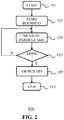
- FIG. 2 depicts a flowchart of a method 100 for controlling the processing of a fluid food product within the food processing chamber 30 of the food processing apparatus 10.
- the method 100 starts in operation 101, in which a user may load the ingredients (food types) of the fluid food product to be processed into the food processing chamber 30 of the food processing apparatus 10.
- the method 100 subsequently proceeds to operation 103, in which the motor 22 is engaged by the controller 60 in response to a start signal received from the user interface 50 or the remote device 80 indicating that the processing of the fluid food product within the food processing chamber 30 should commence.
- the engagement of the motor 22 causes the rotation of the blade arrangement 32 within the food processing chamber 30, thereby pulverising the solid materials, e.g. fibrous materials, loaded into the food processing chamber 30.
- the controller 60 in operation 105 monitors the (average) particle size of the particles in the fluid food product being processed with the particle sensor 26. To this end, the controller 60 typically receives a signal from the particle sensor 26 indicative of the actual particle size within the fluid food product in the food processing chamber 30 during its processing, which signal may be processed by the controller 60 in order to obtain the actual particle size of the particles within the fluid food product being processed.
- such particles include (insoluble) dietary fibers, for which as previously explained a minimum particle size should be guaranteed in order to ensure that the water holding capacity of such dietary fibers is optimized.
- the optimal particle size of the dietary fibers from such ingredients may be in the range of 250-850 ⁇ m to ensure optimal water-holding capacity by such dietary fibers, whereas for softer food types or ingredients, e.g.
- the optimal particle size of the dietary fibers from such ingredients may be in the range of 400-1250 ⁇ m to ensure optimal water-holding capacity by such dietary fibers, whilst achieving a good taste or texture for the fluid food product, as will be explained in further detail below.
- the controller 60 is adapted to control the particle size within the food product being processed in the food processing chamber 30 independent of food or ingredient type.
- the controller 60 in operation 107 compares the actual particle size as determined with the particle sensor 26 against a defined threshold for this particle size to ensure that the particle size within the fluid food product being processed in the food processing chamber 30 does not drop below 400 ⁇ m.
- the controller 60 proceeds to operation 109 in which the motor 22 is disengaged and the rotation of the blade arrangement 32 is stopped to ensure that the actual particle size of the processed fluid food product is at least 400 ⁇ m. This ensures that regardless of food or ingredient type, the insoluble dietary fibers obtained from such food or ingredient types retain good water holding capacity due to their fiber matrix remaining intact.
- the threshold value may be chosen in a range of 400-850 ⁇ m and preferably in a range of 400-600 ⁇ m to strike a good balance between the water holding capacity of the dietary fibers within the processed fluid food product and the taste and/or texture of the processed fluid food product. If the threshold value falls below 400 ⁇ m, the fiber matrix of the dietary fibers may be destroyed and the water holding capacity of such fibers may be decreased significantly. If the threshold value becomes larger than 850 ⁇ m, the texture or taste of the fluid food product may become unpleasant to some users.
- this range is defined by the overlap of these two specific food type ranges and as such is guaranteed to give desirable results both in terms of water holding capacity and fluid food product taste in embodiments in which the fluid food product contains one or a mixture of these food or ingredient types.
- the actual value of the particle size as detected with the particle sensor 26 may be a single value or an average value within the aforementioned range of threshold values, or may be a particle size distribution contained within this range.
- Such a particle size distribution may cover all particles within the fluid food product or instead may apply to a defined portion of a larger particle size distribution, e.g. a central portion of a bell-shaped or Gaussian size distribution covering at least a majority of the particle sizes in such a distribution, e.g. 60%, 70%, 80% or 90% of all particle sizes in such a particle size distribution.
- the user may control the setting of the threshold value within the aforementioned ranges, e.g. through the user interface 50 or the remote device 80 acting as a user interface, by the generation of a threshold value selection signal with the user interface 50 or the remote device 80 acting as a remote user interface.
- a user interface may offer the user a selection menu for selecting a processing mode of the fluid food product to control the particular taste and/or texture of the fluid food product to be processed (e.g.
- each of the selection options corresponding to a particular threshold value such that upon selection of a particular selection option by the user the controller 60 is programmed with the corresponding particular threshold value such that during processing of the fluid food product within the food processing chamber 30 the controller 60 may terminate the processing of the fluid food product by disengagement of the motor 22 once the particle size in the processed fluid food product has reached this particular threshold value.
- the threshold value selection of the fluid food product may take any suitable shape or form.
- the user may be able to select a short processing time, a medium processing time or a long processing time for the fluid food product, e.g. to facilitate a rapid food processing mode in case the user is in a hurry, with each of these processing times corresponding to different particular threshold values for the particle sizes within the fluid food product to be processed.
- a longer processing time typically corresponds to a lower particular threshold value, e.g. the particular threshold value for the short processing time may be 600 ⁇ m, the particular threshold value for the short processing time may be 500 ⁇ m and the particular threshold value for the long processing time may be 400 ⁇ m.
- Alternative particular threshold values of course may be chosen instead.
- the method 100 terminates in 111.
Landscapes
- Engineering & Computer Science (AREA)
- Mechanical Engineering (AREA)
- Food Science & Technology (AREA)
- Food-Manufacturing Devices (AREA)
Priority Applications (5)
| Application Number | Priority Date | Filing Date | Title |
|---|---|---|---|
| EP20152912.0A EP3854277A1 (fr) | 2020-01-21 | 2020-01-21 | Appareil et procédé de traitement intelligent des aliments |
| PCT/EP2020/084575 WO2021115942A1 (fr) | 2019-12-12 | 2020-12-04 | Appareil de transformation d'aliments intelligent et procédé |
| CN202080041891.9A CN114007473A (zh) | 2019-12-12 | 2020-12-04 | 智能食物加工装置及方法 |
| EP20816233.9A EP3993679B1 (fr) | 2019-12-12 | 2020-12-04 | Appareil et procédé de traitement intelligent des aliments |
| US17/619,585 US11696660B2 (en) | 2019-12-12 | 2020-12-04 | Smart food processing apparatus and method |
Applications Claiming Priority (1)
| Application Number | Priority Date | Filing Date | Title |
|---|---|---|---|
| EP20152912.0A EP3854277A1 (fr) | 2020-01-21 | 2020-01-21 | Appareil et procédé de traitement intelligent des aliments |
Publications (1)
| Publication Number | Publication Date |
|---|---|
| EP3854277A1 true EP3854277A1 (fr) | 2021-07-28 |
Family
ID=69185525
Family Applications (1)
| Application Number | Title | Priority Date | Filing Date |
|---|---|---|---|
| EP20152912.0A Withdrawn EP3854277A1 (fr) | 2019-12-12 | 2020-01-21 | Appareil et procédé de traitement intelligent des aliments |
Country Status (1)
| Country | Link |
|---|---|
| EP (1) | EP3854277A1 (fr) |
Cited By (2)
| Publication number | Priority date | Publication date | Assignee | Title |
|---|---|---|---|---|
| EP4316324A3 (fr) * | 2013-03-15 | 2024-03-13 | Vita-Mix Management Corporation | Récipient de mélange motorisé |
| WO2025149593A1 (fr) * | 2024-01-11 | 2025-07-17 | Seb S.A. | Appareil permettant le controle de la granulometrie d'une preparation culinaire et procede d'utilisation dudit appareil de preparation culinaire |
Citations (5)
| Publication number | Priority date | Publication date | Assignee | Title |
|---|---|---|---|---|
| WO2016145430A1 (fr) * | 2015-03-12 | 2016-09-15 | Vita-Mix Management Corporation | Système d'affichage pour systèmes de mélange |
| EP3378365A1 (fr) * | 2017-03-21 | 2018-09-26 | Koninklijke Philips N.V. | Appareil de surveillance et dispositif de traitement d'aliments l'utilisant |
| EP3586686A1 (fr) * | 2018-06-25 | 2020-01-01 | Koninklijke Philips N.V. | Centrifugeuse et procédé d'extraction de jus |
| EP3590393A1 (fr) * | 2018-07-02 | 2020-01-08 | Vorwerk & Co. Interholding GmbH | Procédé de numérisation d'un processus de cuisson, appareil de cuisine ainsi que système de numérisation d'un processus de cuisson |
| WO2021115942A1 (fr) * | 2019-12-12 | 2021-06-17 | Koninklijke Philips N.V. | Appareil de transformation d'aliments intelligent et procédé |
-
2020
- 2020-01-21 EP EP20152912.0A patent/EP3854277A1/fr not_active Withdrawn
Patent Citations (5)
| Publication number | Priority date | Publication date | Assignee | Title |
|---|---|---|---|---|
| WO2016145430A1 (fr) * | 2015-03-12 | 2016-09-15 | Vita-Mix Management Corporation | Système d'affichage pour systèmes de mélange |
| EP3378365A1 (fr) * | 2017-03-21 | 2018-09-26 | Koninklijke Philips N.V. | Appareil de surveillance et dispositif de traitement d'aliments l'utilisant |
| EP3586686A1 (fr) * | 2018-06-25 | 2020-01-01 | Koninklijke Philips N.V. | Centrifugeuse et procédé d'extraction de jus |
| EP3590393A1 (fr) * | 2018-07-02 | 2020-01-08 | Vorwerk & Co. Interholding GmbH | Procédé de numérisation d'un processus de cuisson, appareil de cuisine ainsi que système de numérisation d'un processus de cuisson |
| WO2021115942A1 (fr) * | 2019-12-12 | 2021-06-17 | Koninklijke Philips N.V. | Appareil de transformation d'aliments intelligent et procédé |
Non-Patent Citations (2)
| Title |
|---|
| C.M. ROONEY ET AL., JOURNAL OF ENGINEERING MATHEMATICS, vol. 112, no. 1, pages 119 - 135 |
| ROONEY C M ET AL: "Dynamics of particle chopping in blenders and food processors", JOURNAL OF ENGINEERING MATHEMATICS, KLUWER ACADEMIC PUBLISHERS, NL, vol. 112, no. 1, 6 August 2018 (2018-08-06), pages 119 - 135, XP036583302, ISSN: 0022-0833, [retrieved on 20180806], DOI: 10.1007/S10665-018-9968-4 * |
Cited By (3)
| Publication number | Priority date | Publication date | Assignee | Title |
|---|---|---|---|---|
| EP4316324A3 (fr) * | 2013-03-15 | 2024-03-13 | Vita-Mix Management Corporation | Récipient de mélange motorisé |
| WO2025149593A1 (fr) * | 2024-01-11 | 2025-07-17 | Seb S.A. | Appareil permettant le controle de la granulometrie d'une preparation culinaire et procede d'utilisation dudit appareil de preparation culinaire |
| FR3158218A1 (fr) * | 2024-01-11 | 2025-07-18 | Seb S.A. | Procédé de contrôle de la granulométrie d’une préparation culinaire |
Similar Documents
| Publication | Publication Date | Title |
|---|---|---|
| EP3993679B1 (fr) | Appareil et procédé de traitement intelligent des aliments | |
| US12357127B2 (en) | Intelligent blender | |
| US11612273B2 (en) | Monitoring apparatus and a food processing device using the same | |
| KR101618729B1 (ko) | 진공 믹서기 및 그 작동 방법 | |
| CN107613819B (zh) | 用于搅拌系统的显示系统 | |
| CN106455840B (zh) | 离心式榨汁机 | |
| EP3854277A1 (fr) | Appareil et procédé de traitement intelligent des aliments | |
| KR20200004374A (ko) | 식품 가공기 및 이의 인터페이스 디스플레이 제어 방법 | |
| WO2016009138A1 (fr) | Système d'assistance a l'utilisation d'un appareil électroménager | |
| EP3809929B1 (fr) | Centrifugeuse et procédé d'extraction de jus | |
| WO2020002167A1 (fr) | Extracteur de jus et procédé d'extraction de jus | |
| WO2005092158A2 (fr) | Dispositif de préparation d'une boisson selon un procédé à deux temps synchronisés | |
| CN107569130B (zh) | 一种食品加工机的食品加工方法及食品加工机 | |
| CN107660979A (zh) | 破壁料理机 | |
| EP3378365A1 (fr) | Appareil de surveillance et dispositif de traitement d'aliments l'utilisant | |
| WO2020002046A1 (fr) | Extracteur de jus et procédé d'extraction de jus | |
| KR102478994B1 (ko) | 당도 측정 기능을 구비한 주서기 | |
| JP2002085951A (ja) | 攪拌装置及び攪拌装置を使用した食品の製造方法 | |
| JPH11225891A (ja) | ミキサー | |
| EP3586685A1 (fr) | Centrifugeuse et procédé de pressage | |
| CN213757852U (zh) | 料理机 | |
| US20040194643A1 (en) | Texture synchronizer | |
| KR20120059001A (ko) | 죽 제조 장치 |
Legal Events
| Date | Code | Title | Description |
|---|---|---|---|
| PUAI | Public reference made under article 153(3) epc to a published international application that has entered the european phase |
Free format text: ORIGINAL CODE: 0009012 |
|
| STAA | Information on the status of an ep patent application or granted ep patent |
Free format text: STATUS: THE APPLICATION HAS BEEN PUBLISHED |
|
| AK | Designated contracting states |
Kind code of ref document: A1 Designated state(s): AL AT BE BG CH CY CZ DE DK EE ES FI FR GB GR HR HU IE IS IT LI LT LU LV MC MK MT NL NO PL PT RO RS SE SI SK SM TR |
|
| STAA | Information on the status of an ep patent application or granted ep patent |
Free format text: STATUS: REQUEST FOR EXAMINATION WAS MADE |
|
| 17P | Request for examination filed |
Effective date: 20220128 |
|
| RBV | Designated contracting states (corrected) |
Designated state(s): AL AT BE BG CH CY CZ DE DK EE ES FI FR GB GR HR HU IE IS IT LI LT LU LV MC MK MT NL NO PL PT RO RS SE SI SK SM TR |
|
| STAA | Information on the status of an ep patent application or granted ep patent |
Free format text: STATUS: EXAMINATION IS IN PROGRESS |
|
| 17Q | First examination report despatched |
Effective date: 20220613 |
|
| STAA | Information on the status of an ep patent application or granted ep patent |
Free format text: STATUS: THE APPLICATION IS DEEMED TO BE WITHDRAWN |
|
| 18D | Application deemed to be withdrawn |
Effective date: 20221025 |