EP3854423B1 - Artificial dermis repair material and preparation method therefor - Google Patents
Artificial dermis repair material and preparation method therefor Download PDFInfo
- Publication number
- EP3854423B1 EP3854423B1 EP18934139.9A EP18934139A EP3854423B1 EP 3854423 B1 EP3854423 B1 EP 3854423B1 EP 18934139 A EP18934139 A EP 18934139A EP 3854423 B1 EP3854423 B1 EP 3854423B1
- Authority
- EP
- European Patent Office
- Prior art keywords
- silicone rubber
- collagen
- layer
- rubber layer
- repair material
- Prior art date
- Legal status (The legal status is an assumption and is not a legal conclusion. Google has not performed a legal analysis and makes no representation as to the accuracy of the status listed.)
- Active
Links
Images




Classifications
-
- A—HUMAN NECESSITIES
- A61—MEDICAL OR VETERINARY SCIENCE; HYGIENE
- A61L—METHODS OR APPARATUS FOR STERILISING MATERIALS OR OBJECTS IN GENERAL; DISINFECTION, STERILISATION OR DEODORISATION OF AIR; CHEMICAL ASPECTS OF BANDAGES, DRESSINGS, ABSORBENT PADS OR SURGICAL ARTICLES; MATERIALS FOR BANDAGES, DRESSINGS, ABSORBENT PADS OR SURGICAL ARTICLES
- A61L27/00—Materials for grafts or prostheses or for coating grafts or prostheses
- A61L27/50—Materials characterised by their function or physical properties, e.g. injectable or lubricating compositions, shape-memory materials, surface modified materials
- A61L27/60—Materials for use in artificial skin
-
- A—HUMAN NECESSITIES
- A61—MEDICAL OR VETERINARY SCIENCE; HYGIENE
- A61F—FILTERS IMPLANTABLE INTO BLOOD VESSELS; PROSTHESES; DEVICES PROVIDING PATENCY TO, OR PREVENTING COLLAPSING OF, TUBULAR STRUCTURES OF THE BODY, e.g. STENTS; ORTHOPAEDIC, NURSING OR CONTRACEPTIVE DEVICES; FOMENTATION; TREATMENT OR PROTECTION OF EYES OR EARS; BANDAGES, DRESSINGS OR ABSORBENT PADS; FIRST-AID KITS
- A61F2/00—Filters implantable into blood vessels; Prostheses, i.e. artificial substitutes or replacements for parts of the body; Appliances for connecting them with the body; Devices providing patency to, or preventing collapsing of, tubular structures of the body, e.g. stents
- A61F2/02—Prostheses implantable into the body
- A61F2/10—Hair or skin implants
- A61F2/105—Skin implants, e.g. artificial skin
-
- A—HUMAN NECESSITIES
- A61—MEDICAL OR VETERINARY SCIENCE; HYGIENE
- A61L—METHODS OR APPARATUS FOR STERILISING MATERIALS OR OBJECTS IN GENERAL; DISINFECTION, STERILISATION OR DEODORISATION OF AIR; CHEMICAL ASPECTS OF BANDAGES, DRESSINGS, ABSORBENT PADS OR SURGICAL ARTICLES; MATERIALS FOR BANDAGES, DRESSINGS, ABSORBENT PADS OR SURGICAL ARTICLES
- A61L27/00—Materials for grafts or prostheses or for coating grafts or prostheses
- A61L27/14—Macromolecular materials
- A61L27/16—Macromolecular materials obtained by reactions only involving carbon-to-carbon unsaturated bonds
- A61L27/165—Rubbers
-
- A—HUMAN NECESSITIES
- A61—MEDICAL OR VETERINARY SCIENCE; HYGIENE
- A61L—METHODS OR APPARATUS FOR STERILISING MATERIALS OR OBJECTS IN GENERAL; DISINFECTION, STERILISATION OR DEODORISATION OF AIR; CHEMICAL ASPECTS OF BANDAGES, DRESSINGS, ABSORBENT PADS OR SURGICAL ARTICLES; MATERIALS FOR BANDAGES, DRESSINGS, ABSORBENT PADS OR SURGICAL ARTICLES
- A61L27/00—Materials for grafts or prostheses or for coating grafts or prostheses
- A61L27/14—Macromolecular materials
- A61L27/18—Macromolecular materials obtained otherwise than by reactions only involving carbon-to-carbon unsaturated bonds
-
- A—HUMAN NECESSITIES
- A61—MEDICAL OR VETERINARY SCIENCE; HYGIENE
- A61L—METHODS OR APPARATUS FOR STERILISING MATERIALS OR OBJECTS IN GENERAL; DISINFECTION, STERILISATION OR DEODORISATION OF AIR; CHEMICAL ASPECTS OF BANDAGES, DRESSINGS, ABSORBENT PADS OR SURGICAL ARTICLES; MATERIALS FOR BANDAGES, DRESSINGS, ABSORBENT PADS OR SURGICAL ARTICLES
- A61L27/00—Materials for grafts or prostheses or for coating grafts or prostheses
- A61L27/14—Macromolecular materials
- A61L27/20—Polysaccharides
-
- A—HUMAN NECESSITIES
- A61—MEDICAL OR VETERINARY SCIENCE; HYGIENE
- A61L—METHODS OR APPARATUS FOR STERILISING MATERIALS OR OBJECTS IN GENERAL; DISINFECTION, STERILISATION OR DEODORISATION OF AIR; CHEMICAL ASPECTS OF BANDAGES, DRESSINGS, ABSORBENT PADS OR SURGICAL ARTICLES; MATERIALS FOR BANDAGES, DRESSINGS, ABSORBENT PADS OR SURGICAL ARTICLES
- A61L27/00—Materials for grafts or prostheses or for coating grafts or prostheses
- A61L27/14—Macromolecular materials
- A61L27/22—Polypeptides or derivatives thereof, e.g. degradation products
- A61L27/24—Collagen
-
- A—HUMAN NECESSITIES
- A61—MEDICAL OR VETERINARY SCIENCE; HYGIENE
- A61L—METHODS OR APPARATUS FOR STERILISING MATERIALS OR OBJECTS IN GENERAL; DISINFECTION, STERILISATION OR DEODORISATION OF AIR; CHEMICAL ASPECTS OF BANDAGES, DRESSINGS, ABSORBENT PADS OR SURGICAL ARTICLES; MATERIALS FOR BANDAGES, DRESSINGS, ABSORBENT PADS OR SURGICAL ARTICLES
- A61L27/00—Materials for grafts or prostheses or for coating grafts or prostheses
- A61L27/14—Macromolecular materials
- A61L27/26—Mixtures of macromolecular compounds
-
- A—HUMAN NECESSITIES
- A61—MEDICAL OR VETERINARY SCIENCE; HYGIENE
- A61L—METHODS OR APPARATUS FOR STERILISING MATERIALS OR OBJECTS IN GENERAL; DISINFECTION, STERILISATION OR DEODORISATION OF AIR; CHEMICAL ASPECTS OF BANDAGES, DRESSINGS, ABSORBENT PADS OR SURGICAL ARTICLES; MATERIALS FOR BANDAGES, DRESSINGS, ABSORBENT PADS OR SURGICAL ARTICLES
- A61L27/00—Materials for grafts or prostheses or for coating grafts or prostheses
- A61L27/50—Materials characterised by their function or physical properties, e.g. injectable or lubricating compositions, shape-memory materials, surface modified materials
- A61L27/54—Biologically active materials, e.g. therapeutic substances
-
- A—HUMAN NECESSITIES
- A61—MEDICAL OR VETERINARY SCIENCE; HYGIENE
- A61L—METHODS OR APPARATUS FOR STERILISING MATERIALS OR OBJECTS IN GENERAL; DISINFECTION, STERILISATION OR DEODORISATION OF AIR; CHEMICAL ASPECTS OF BANDAGES, DRESSINGS, ABSORBENT PADS OR SURGICAL ARTICLES; MATERIALS FOR BANDAGES, DRESSINGS, ABSORBENT PADS OR SURGICAL ARTICLES
- A61L27/00—Materials for grafts or prostheses or for coating grafts or prostheses
- A61L27/50—Materials characterised by their function or physical properties, e.g. injectable or lubricating compositions, shape-memory materials, surface modified materials
- A61L27/56—Porous materials, e.g. foams or sponges
-
- A—HUMAN NECESSITIES
- A61—MEDICAL OR VETERINARY SCIENCE; HYGIENE
- A61L—METHODS OR APPARATUS FOR STERILISING MATERIALS OR OBJECTS IN GENERAL; DISINFECTION, STERILISATION OR DEODORISATION OF AIR; CHEMICAL ASPECTS OF BANDAGES, DRESSINGS, ABSORBENT PADS OR SURGICAL ARTICLES; MATERIALS FOR BANDAGES, DRESSINGS, ABSORBENT PADS OR SURGICAL ARTICLES
- A61L27/00—Materials for grafts or prostheses or for coating grafts or prostheses
- A61L27/50—Materials characterised by their function or physical properties, e.g. injectable or lubricating compositions, shape-memory materials, surface modified materials
- A61L27/58—Materials at least partially resorbable by the body
-
- A—HUMAN NECESSITIES
- A61—MEDICAL OR VETERINARY SCIENCE; HYGIENE
- A61F—FILTERS IMPLANTABLE INTO BLOOD VESSELS; PROSTHESES; DEVICES PROVIDING PATENCY TO, OR PREVENTING COLLAPSING OF, TUBULAR STRUCTURES OF THE BODY, e.g. STENTS; ORTHOPAEDIC, NURSING OR CONTRACEPTIVE DEVICES; FOMENTATION; TREATMENT OR PROTECTION OF EYES OR EARS; BANDAGES, DRESSINGS OR ABSORBENT PADS; FIRST-AID KITS
- A61F2210/00—Particular material properties of prostheses classified in groups A61F2/00 - A61F2/26 or A61F2/82 or A61F9/00 or A61F11/00 or subgroups thereof
- A61F2210/0004—Particular material properties of prostheses classified in groups A61F2/00 - A61F2/26 or A61F2/82 or A61F9/00 or A61F11/00 or subgroups thereof bioabsorbable
-
- A—HUMAN NECESSITIES
- A61—MEDICAL OR VETERINARY SCIENCE; HYGIENE
- A61L—METHODS OR APPARATUS FOR STERILISING MATERIALS OR OBJECTS IN GENERAL; DISINFECTION, STERILISATION OR DEODORISATION OF AIR; CHEMICAL ASPECTS OF BANDAGES, DRESSINGS, ABSORBENT PADS OR SURGICAL ARTICLES; MATERIALS FOR BANDAGES, DRESSINGS, ABSORBENT PADS OR SURGICAL ARTICLES
- A61L2300/00—Biologically active materials used in bandages, wound dressings, absorbent pads or medical devices
- A61L2300/20—Biologically active materials used in bandages, wound dressings, absorbent pads or medical devices containing or releasing organic materials
- A61L2300/204—Biologically active materials used in bandages, wound dressings, absorbent pads or medical devices containing or releasing organic materials with nitrogen-containing functional groups, e.g. aminoxides, nitriles, guanidines
- A61L2300/206—Biguanides, e.g. chlorohexidine
-
- A—HUMAN NECESSITIES
- A61—MEDICAL OR VETERINARY SCIENCE; HYGIENE
- A61L—METHODS OR APPARATUS FOR STERILISING MATERIALS OR OBJECTS IN GENERAL; DISINFECTION, STERILISATION OR DEODORISATION OF AIR; CHEMICAL ASPECTS OF BANDAGES, DRESSINGS, ABSORBENT PADS OR SURGICAL ARTICLES; MATERIALS FOR BANDAGES, DRESSINGS, ABSORBENT PADS OR SURGICAL ARTICLES
- A61L2300/00—Biologically active materials used in bandages, wound dressings, absorbent pads or medical devices
- A61L2300/20—Biologically active materials used in bandages, wound dressings, absorbent pads or medical devices containing or releasing organic materials
- A61L2300/252—Polypeptides, proteins, e.g. glycoproteins, lipoproteins, cytokines
- A61L2300/254—Enzymes, proenzymes
-
- A—HUMAN NECESSITIES
- A61—MEDICAL OR VETERINARY SCIENCE; HYGIENE
- A61L—METHODS OR APPARATUS FOR STERILISING MATERIALS OR OBJECTS IN GENERAL; DISINFECTION, STERILISATION OR DEODORISATION OF AIR; CHEMICAL ASPECTS OF BANDAGES, DRESSINGS, ABSORBENT PADS OR SURGICAL ARTICLES; MATERIALS FOR BANDAGES, DRESSINGS, ABSORBENT PADS OR SURGICAL ARTICLES
- A61L2300/00—Biologically active materials used in bandages, wound dressings, absorbent pads or medical devices
- A61L2300/40—Biologically active materials used in bandages, wound dressings, absorbent pads or medical devices characterised by a specific therapeutic activity or mode of action
- A61L2300/404—Biocides, antimicrobial agents, antiseptic agents
Definitions
- the present disclosure relates to the field of medical instruments and the field of tissue engineering regeneration, and in particular, to an artificial dermal repair material and a preparation method thereof.
- Skin is the largest organ of a human body, and can protect the body from harmful substances from outside, prevent the loss of water, electrolytes, and the like in the body, maintain the stability of an internal environment of the human body, and participate in immune and metabolic processes of the human body.
- Skin tissue defects caused by burns, diseases, physical trauma, wars, and the like affect the quality of life of people and even threaten lives.
- WHO World Health Organization
- dermal substitutes for treating a wound surface mainly include artificial dermis (made of biological and synthetic materials), allogeneic or xenogeneic natural dermis (treated by decellularization), tissue engineering active dermis (such as Apligraf ® , IERFU ® ), etc.
- Artificial dermal substitute products have no limitation on material sources and ethics, have low virus infection risk, are easy to store and transport, can be produced in batches, have increasingly mature production, safety, and quality control, and have low cost, thereby gradually occupying the mainstream of market development.
- Collagen as the most commonly used biological material, is widely used to prepare artificial skin.
- both Integra ® and Lando ® artificial dermis that have been approved for marketing use collagen-glycosaminoglycan (GAG) materials and are clinically used for deep burns and full-thickness skin defects.
- GAG collagen-glycosaminoglycan
- US Patent US 20160143726 A1 discloses a method of preparing a collagen-GAG-elastin scaffold, and the preparation process thereof includes preparing a collagen-GAG-elastin complex solution, freeze-drying the complex solution into a porous scaffold, and then performing cross-linking. These scaffolds can be used in the medical and surgical fields, such as the reconstruction of dermal tissue.
- a technical problem to be solved by the present disclosure is to provide an artificial dermal repair material and a preparation method thereof.
- the prepared artificial dermal repair material has good physical properties and antibacterial properties, and is applicable in the field of skin tissue engineering.
- the present disclosure provides an artificial dermal repair material, which includes a silicone rubber layer and a collagen complex layer bonded to each other.
- the collagen complex layer is prepared by raw materials including collagen, glycosaminoglycan, and an antibacterial agent by a cross-linking reaction.
- the silicone rubber layer includes a first silicone rubber layer, a second mesh-shaped silicone rubber intermediate layer, and a third silicone rubber layer which are provided in sequence.
- a tensile strength of the second mesh-shaped silicone rubber intermediate layer is greater than a tensile strength of the first silicone rubber layer and a tensile strength of the third silicone rubber layer.
- the tensile strength of the first silicone rubber layer and/or the third silicone rubber layer is less than 2 MPa.
- the tensile strength of the second mesh-shaped silicone rubber intermediate layer is greater than 10 MPa.
- the collagen complex layer is of a gradient porous structure. Further, sizes of holes in the gradient porous structure are distributed in a gradient manner, and a hole size increases from 50 ⁇ m to 250 ⁇ m.
- the raw materials include 73% to 97% of the collagen, 2% to 15% of the glycosaminoglycan, and 1% to 12% of the antibacterial agent.
- the raw materials include 78% to 93% of the collagen, 3% to 10% of the glycosaminoglycan, and 4% to 12% of the antibacterial agent.
- the glycosaminoglycan is chondroitin sulfate or hyaluronic acid.
- the antibacterial agent is at least one selected from the group consisting of polyhexamethylene biguanide (PHMB), lysozyme, and lysostaphin.
- PHMB polyhexamethylene biguanide
- lysozyme lysozyme
- lysostaphin lysostaphin
- At least one of the silicone rubber layer and the collagen complex layer is provided with a plurality of holes.
- diameters of the holes on the silicone rubber layer are in a range of 50 ⁇ m to 1000 ⁇ m. Spacing of the holes are in a range of 0.5 mm to 10 mm.
- diameters of the holes on the collagen complex layer are in a range of 50 ⁇ m to 500 ⁇ m. Spacing of the holes are in a range of 0.5 mm to 5 mm.
- the collagen complex layer has a thickness of 1 mm to 3 mm.
- the silicone rubber layer has a thickness of 0.2 mm to 0.3 mm.
- the present disclosure further provides a method of preparing the artificial dermal repair material as described above, which includes:
- the cross-linking reaction is further performed under a high-temperature vacuum condition of 100°C to 120°C.
- the preparing the silicone rubber layer includes: mixing and curing materials of a first silicone rubber to form the first silicone rubber layer; mixing materials of a second silicone rubber to form a mixed solution, preparing a mesh-shaped layer on the first silicone rubber layer with the mixed solution by using a dispenser, and performing curing to form a second mesh-shaped silicone rubber intermediate layer; and leveling materials of a third silicone rubber on a surface of the second mesh-shaped silicone rubber intermediate layer, and performing curing to form a third silicone rubber layer.
- a tensile strength of the materials of the second silicone rubber after film formation is greater than a tensile strength of the materials of the first silicone rubber and a tensile strength of the materials of the third silicone rubber after film formation.
- the acetic acid has a concentration of 0.03M to 0.1M.
- the performing freeze-drying includes: performing freezing under a low temperature environment, annealing for 5min to 10min, and then freezing under a low temperature environment, and then freeze-drying in a freeze dryer.
- the low temperature environment has a temperature in a range of -50°C to 70°C.
- the cross-linking agent is one selected from the group consisting of glutaraldehyde, genipin, and carbodiimide.
- the cross-linking agent accounts for the collagen-glycosaminoglycan complex solution in a mass range of 0.005% to 0.015%.
- the glycosaminoglycan solution is added to the collagen solution for mixing by high-speed airflow atomization.
- the holes may be prepared by any of laser drilling, physical puncturing, and freeze-drying into holes in a special mold with regularly arranged protrusions at a bottom thereof.
- the collagen complex layer and the silicone rubber layer are bonded together by silicone gel.
- the silicone rubber layer has high strength, high elasticity, and softness, is easy stitch, and has good fitting performance.
- the collagen complex layer is beneficial to the growth of fibroblasts, endothelial cells, and capillaries, and has good biocompatibility, degradability, and antibacterial property, which is applicable for the repair and reconstruction of dermal tissue.
- This example provides an artificial dermal repair material, and a preparation process thereof is as follows.
- Collagen was weighed and dissolved in water to prepare 200 g of a collagen solution with a mass concentration of 0.3%. Then, 0.056 g of chondroitin sulfate was weighed and dissolved in water to prepare a chondroitin sulfate solution with a mass concentration of 1.7 mg/mL. The chondroitin sulfate solution was atomized by high-speed airflow and then added to the collagen solution, and continuously stirred for 2 hours to obtain a collagen-chondroitin sulfate complex. The collagen-chondroitin sulfate complex was centrifuged at 8000 rpm for 15 minutes.
- the precipitate was collected, and 0.05M acetic acid was added to re-dissolve the precipitate to make the concentration of collagen 0.9% (w/w), and then stirred for 2.5h to be dispersed uniformly, thereby forming a dispersion of the collagen-chondroitin sulfate complex.
- the dispersion of the collagen-chondroitin sulfate complex was characterized. An AFM image was as shown in FIG. 1 and a SEM image was as shown in FIG. 2 .
- the obtained complex can be co-precipitated to form nano-scale collagen fibers, and the nano-scale collagen fibers can be self-assembled to form collagen fiber bundles, forming a uniformly dispersed collagen-chondroitin sulfate complex.
- a glutaraldehyde crosslinking agent solution acetic acid as solvent
- a mass fraction of the added glutaraldehyde was 0.01% (that is, a mass fraction of the glutaraldehyde accounting for the collagen complex solution)
- PHMB polyhexamethylene biguanide
- a polyhexamethylene biguanide (PHMB) antibacterial agent solution was added to make the concentration of the collagen 0.65% (w/w), where the amount of the added PHMB was 0.028g, and then was stirred for 2h to be uniformly distributed, and then was poured into an aluminum alloy mold, leveled, pre-frozen at -60°C for 2h, and then annealed for 5min to 10min, and then frozen at -60°C for half an hour, and then transferred to a freeze dryer for freeze-drying for 24h, and then placed under a high-temperature vacuum condition of 105°C for high-temperature cross-linking for 24 hours, to obtain the collagen complex layer.
- PHMB polyhexamethylene biguanide
- Components A and B of liquid silicone rubber with normal strength were mixed together in a ratio of 1:1, stirred at 300 rpm for 10 minutes, and then defoamed, and then poured into a polytetrafluoroethylene mold, leveled, and placed in a drying oven and cured at 150°C for 2 hours to obtain a first silicone rubber layer with a thickness of 0.12 mm.
- Components A and B of liquid silicone rubber with high strength were mixed together in a ratio of 1:1, stirred at 300 rpm for 10 minutes to form a mixed solution, and then the mixed solution was defoamed.
- a layer of silicone rubber layer in a parallelogram mesh shape was uniformly prepared on a surface of the first silicone rubber layer with the mixed solution by using a dispenser, in which a spacing between parallel lines was 1mm to 10mm, and then was placed in a drying oven for curing, and cured at 150°C for 2 hours, to obtain a second mesh-shaped silicone rubber layer with a thickness of 0.02 mm.
- a liquid silicone rubber with normal strength (with tensile strength ⁇ 2Mpa after film formation) was leveled on a surface of the second mesh-shaped silicone rubber layer, and then placed in a drying oven, and cured at 150°C for 2 hours, to obtain a third silicone rubber layer with a thickness of 0.12 mm.
- a silicone rubber layer with a thickness of 0.26 mm and having a mesh-shaped intermediate layer was formed.
- a layer of silicone gel was coated on a surface of the silicone rubber layer, and a drilled collagen complex layer was bonded to a surface of the silicone rubber film to obtain the artificial dermal repair material.
- the prepared artificial dermal repair material was packaged, and sterilized by high-energy electron beam with a sterilization dose of 15KGy to 20KGy.
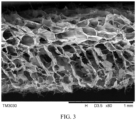
- the collagen complex layer prepared in this example is characterized, and a SEM image showing a cross section of the collagen complex layer is as shown in FIG. 3 .
- the prepared collagen complex layer has a three-dimensional gradient porous structure, and a pore size increases from 50 ⁇ m to 250 ⁇ m from a position in contact with the silicone rubber layer to a position away from the silicone rubber layer.
- the gradient porous structure is prepared generally by spraying and freeze-drying multiple layers of mixed solutions with different concentrations to achieve the effect of gradient pores, which has a more complicated preparation process, and the pore size increases suddenly.
- the gradient pores are prepared by pre-freezing, annealing, and freeze-drying, the operation is simple, the pore size increases transitionally and naturally, which is more beneficial to the growth of fibroblasts, endothelial cells, and capillaries.
- the silicone rubber layer prepared in this implementation is measured for tensile strength.
- the specific steps of the measurement are as follows. Referring to the standard of GB/T 1040.3-2006 "Measurement of Tensile Properties of Plastics Part 3: Test Conditions for Films and Sheets", type 5 dumbbell-shaped test pieces are prepared by a cutter, respectively, and 3 parallel test pieces are prepared for each group of samples. A specified marking is marked on the test piece. A thickness h and a width b of each test piece are measured within 5 mm from each end of the gauge length in the middle of each test piece. 3 points are measured to calculate the average value.
- the electronic universal testing machine is turned on, test parameters are set, and related test parameters such as thickness and gauge length are input. The test speed was set to 500 mm/min.
- the sensor is 1000 N.
- the test pieces are mounted on the fixture so that long axes of the test pieces are in line with an axis of the testing machine.
- the run button is clicked to test.
- Tensile strength calculation formula: aM F/S.
- ⁇ M tensile strength in MPa
- F force (maximum value) required for tearing the test piece, in N
- S original cross-sectional area of the test piece, mm 2 .
- Table 1 The tensile strength of the silicone rubber layer in Example 1 Sample number Tensile strength (MPa) 1 9.2 2 9.3 3 9.5
- the test results show that the silicone rubber layer with the mesh-shaped intermediate layer provided by the present disclosure has excellent mechanical strength.
- the mesh-shaped intermediate layer is similar to a layer of adjustable reinforcing mesh, which can balance the high strength and flexibility of the entire silicone rubber layer, improve the mechanical properties of the silicone rubber layer, so that the silicone rubber layer has the appropriate fitting performance and good tensile and tearing strength, and is convenient for stitching, and has a close attachment to a wound surface.
- This example provides an artificial dermal repair material, and a preparation process thereof is as follows.
- Collagen was weighed and dissolved in water to prepare 200 g of a collagen solution with a mass concentration of 0.3%. Then, 0.013 g of chondroitin sulfate was weighed and dissolved in water to prepare a chondroitin sulfate solution with a mass concentration of 0.37 mg/mL. The chondroitin sulfate solution was atomized by high-speed airflow and then added to the collagen solution, and continuously stirred for 2 hours to obtain a collagen-chondroitin sulfate complex. The collagen-chondroitin sulfate complex was centrifuged at 8000 rpm for 15 minutes.
- the precipitate was collected, and 0.03M acetic acid was added to re-dissolve the precipitate, to make the concentration of collagen 0.9% (w/w), and then stirred for 2.5h to be dispersed uniformly. Then, an acetic acid solution of glutaraldehyde was added to form a collagen complex solution to make the concentration of the collagen 0.7% (w/w), where a mass fraction of the added glutaraldehyde was 0.005% (that is, a mass fraction of the glutaraldehyde accounting for the collagen complex solution), and then stirred for 5h to be uniformly distributed.
- a PHMB antibacterial agent solution was added to make the concentration of the collagen 0.65% (w/w), where the amount of the added PHMB was 0.0062 g, and then was stirred for 2h to be uniformly distributed, and then was poured into an aluminum alloy mold, leveled, pre-frozen at -60°C for 2h, and then annealed for 5min to 10min, and then frozen at -60°C for half an hour, and then transferred to a freeze dryer for freeze-drying for 24h, and then placed under a high-temperature vacuum condition of 105 °C for high-temperature cross-linking for 24 hours, to obtain the collagen complex layer.
- Components A and B of liquid silicone rubber with normal strength were mixed together in a ratio of 1:1, stirred at 300 rpm for 10 minutes, and then defoamed, and then poured into a polytetrafluoroethylene mold, leveled, and placed in a drying oven and cured at 150°C for 2 hours to obtain a first silicone rubber layer with a thickness of 0.1 mm.
- Components A and B of liquid silicone rubber with high strength were mixed together in a ratio of 1:1, stirred at 300 rpm for 10 minutes to form a mixed solution, and then the mixed solution was defoamed.
- a layer of silicone rubber layer in a parallelogram mesh-shape was uniformly prepared on a surface of the first silicone rubber layer with the mixed solution by using a dispenser, in which a spacing between parallel lines was 1 mm to 10 mm, and then was placed in a drying oven for curing and cured at 150°C for 2 hours, to obtain a second mesh-shaped silicone rubber layer with a thickness of 0.01 mm.
- a liquid silicone rubber with normal-strength (with tensile strength ⁇ 2Mpa after film formation) was leveled on a surface of the second mesh-shaped silicone rubber layer, and then placed in a drying oven, and cured at 150°C for 2 hours, to obtain a third silicone rubber layer with a thickness of 0.1 mm. Finally, a silicone rubber layer with a thickness of 0.21 mm and having a mesh-shaped intermediate layer was formed.
- step S3 parameters such as hole spacing, number of rows, and hole size were set on an operation interface of the laser drilling machine.
- the collagen complex layer obtained in step S1 was placed and fixed in the machine, and the program was run to drill holes.
- the hole size was 250 ⁇ m.
- the hole spacing was 0.5 mm.
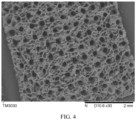
- the drilled collagen complex layer was characterized, and a SEM image thereof was as shown in FIG. 4 .
- a layer of silicone gel was coated on a surface of the silicone rubber layer, and the drilled collagen complex layer was bonded to a surface of the silicone rubber layer to obtain the artificial dermal repair material.
- the prepared artificial dermal repair material was packaged and sterilized by high-energy electron beam, with a sterilization dose of 15KGy to 20KGy.
- This example provides three types of artificial dermal repair materials, which are the same as that in Example 1. The difference was in that a content of the PHMB was 1.2%, 6%, and 12%, respectively. Bacteriostatic experiments were carried out on the three types of artificial dermal repair materials, and the operation was as follows: the artificial dermal repair materials were cut into discs with a diameter of 12 cm, and sterilized by ultraviolet irradiation for 30 minutes in a super clean bench for standby.
- a Mueller-Hinton (MH) agar medium was prepared, and then heated to be dissolved completely, and then sterilized at 121°C for 15 minutes, followed by being poured into a dish in a sterile environment when the temperature dropped to 40°C to 50°C, and then cooled and solidified for later use.
- the entire surface of the medium was coated by the cotton swab, the plate was rotated by 60 degrees each time, the smearing was carried out three times, and finally, was wiped around a periphery for two circles, to ensure that the bacterial solution was uniformly smeared.
- the sample was attached on a surface of the plate by sterile forceps, and cannot be taken away after being attached. Four samples were attached to each dish. The plate was turned over and cultured in a 37°C constant temperature incubator for 18 hours to 24 hours, and then taken out for measurement. A diameter of an inhibition zone was measured by a ruler on a back of the plate (measured crosswise, horizontally and vertically, calculating the average value, and making the average value an integer).
- FIG. 5 An edge of the inhibition zone was limited to the fact that no obvious growth of bacteria was visible to the naked eye.
- the results were as shown in FIG. 5 .
- the mark E indicates the Escherichia coli bacteriostatic experiment
- the mark S indicates the Staphylococcus aureus bacteriostatic experiment.
- Nos. 1 to 3 correspond to artificial dermal repair materials with a PHMB content of 1.2%, 6%, and 12%, respectively.
- No. 4 is a blank control group without PHMB.
- the experimental results show that the artificial dermal repair materials prepared by the present disclosure have bacteriostasis to both Gram-negative bacteria (such as Escherichia coli ) and Gram-positive bacteria (such as Staphylococcus aureus ), and have stronger bacteriostasis to Gram-positive bacteria.
- Gram-negative bacteria such as Escherichia coli
- Gram-positive bacteria such as Staphylococcus aureus
- This example provides an artificial dermal repair material, and a preparation process thereof is as follows.
- Collagen was weighed and dissolved in water to prepare 200 g of a collagen solution with a mass concentration of 0.3%. Then, 0.123 g of chondroitin sulfate was weighed and dissolved in water to prepare a chondroitin sulfate solution with a mass concentration of 3.54 mg/mL. The chondroitin sulfate solution was atomized by high-speed airflow and then added to the collagen solution, and continuously stirred for 2 hours to obtain a collagen-chondroitin sulfate complex. The collagen-chondroitin sulfate complex was centrifuged at 8000 rpm for 15 minutes.
- the precipitate was collected, and 0.1M acetic acid was added to re-dissolve the precipitate to make the concentration of collagen 0.9% (w/w), and then stirred for 2.5h to be dispersed uniformly. Then, an acetic acid solution of glutaraldehyde was added to form a collagen complex solution to make the concentration of the collagen 0.7% (w/w), where a mass fraction of the added glutaraldehyde was 0.015% (that is, a mass fraction of the glutaraldehyde accounting for the collagen complex solution), and then stirred for 5h to be uniformly distributed.
- a PHMB antibacterial agent solution was added to make the concentration of the collagen 0.65% (w/w), where the amount of the added PHMB was 0.099 g, and then was stirred for 2h to be uniformly distributed, and then was poured into an aluminum alloy mold, leveled, and pre-frozen at -60°C for 2h, and then annealed for 5min to 10min, and then frozen at - 60°C for half an hour, and then transferred to a freeze dryer for freeze-drying for 24h, and then placed under a high-temperature vacuum condition of 105°C for high-temperature cross-linking for 24 hours, to obtain the collagen complex layer.
- Components A and B of liquid silicone rubber with normal strength were mixed together in a ratio of 1:1, stirred at 300 rpm for 10 minutes, and then defoamed, and then poured into a polytetrafluoroethylene mold, leveled, and placed in a drying oven and cured at 150°C for 2 hours to obtain a first silicone rubber layer with a thickness of 0.15 mm.
- Components A and B of liquid silicone rubber with high strength were mixed together in a ratio of 1:1, stirred at 300 rpm for 10 minutes to form a mixed solution, and then the mixed solution was defoamed.
- a layer of silicone rubber layer in a parallelogram mesh-shape was uniformly prepared on a surface of the first silicone rubber layer with the mixed solution by using a dispenser, in which a spacing between parallel lines was 1 mm to 10 mm, and then was placed in a drying oven for curing and cured at 150°C for 2 hours, to obtain a second mesh-shaped silicone rubber layer with a thickness of 0.05 mm.
- a liquid silicone rubber with normal-strength (with tensile strength ⁇ 2Mpa after film formation) was leveled on a surface of the second mesh-shaped silicone rubber layer, and then placed in a drying oven, and cured at 150°C for 2 hours, to obtain a third silicone rubber layer with a thickness of 0.1 mm. Finally, a silicone rubber layer with a thickness of 0.3 mm and having a mesh-shaped intermediate layer was formed.
- step S3 parameters such as hole spacing, number of rows, and hole size were set on the operation interface of the laser drilling machine.
- the collagen complex layer obtained in step S1 was placed and fixed in the machine, and the program was run to drill holes.
- the hole size was 250 ⁇ m.
- the hole spacing was 5 mm.
- the silicone rubber layer obtained in step S2 was drilled, with a hole size of 500 ⁇ m and a hole spacing is 5 mm.
- the drilled silicone rubber layer was as shown in FIG. 6 .
- a layer of silicone gel was coated on a surface of the silicone rubber layer, and the drilled collagen complex layer was bonded to a surface of the drilled silicone rubber layer to obtain the artificial dermal repair material.
- the prepared artificial dermal repair material was packaged and sterilized by high-energy electron beam, with a sterilization dose of 15KGy to 20KGy.
Landscapes
- Health & Medical Sciences (AREA)
- Life Sciences & Earth Sciences (AREA)
- Transplantation (AREA)
- Chemical & Material Sciences (AREA)
- Public Health (AREA)
- Oral & Maxillofacial Surgery (AREA)
- Animal Behavior & Ethology (AREA)
- General Health & Medical Sciences (AREA)
- Dermatology (AREA)
- Veterinary Medicine (AREA)
- Medicinal Chemistry (AREA)
- Epidemiology (AREA)
- Engineering & Computer Science (AREA)
- Biomedical Technology (AREA)
- Cardiology (AREA)
- Heart & Thoracic Surgery (AREA)
- Vascular Medicine (AREA)
- Biophysics (AREA)
- Chemical Kinetics & Catalysis (AREA)
- Dispersion Chemistry (AREA)
- Molecular Biology (AREA)
- Materials For Medical Uses (AREA)
- Prostheses (AREA)
Applications Claiming Priority (2)
| Application Number | Priority Date | Filing Date | Title |
|---|---|---|---|
| CN201811096057.0A CN109248337B (zh) | 2018-09-19 | 2018-09-19 | 一种人工真皮修复材料及其制备方法 |
| PCT/CN2018/110016 WO2020056815A1 (zh) | 2018-09-19 | 2018-10-12 | 一种人工真皮修复材料及其制备方法 |
Publications (4)
| Publication Number | Publication Date |
|---|---|
| EP3854423A1 EP3854423A1 (en) | 2021-07-28 |
| EP3854423A4 EP3854423A4 (en) | 2022-05-25 |
| EP3854423C0 EP3854423C0 (en) | 2023-08-09 |
| EP3854423B1 true EP3854423B1 (en) | 2023-08-09 |
Family
ID=65048238
Family Applications (1)
| Application Number | Title | Priority Date | Filing Date |
|---|---|---|---|
| EP18934139.9A Active EP3854423B1 (en) | 2018-09-19 | 2018-10-12 | Artificial dermis repair material and preparation method therefor |
Country Status (6)
| Country | Link |
|---|---|
| US (1) | US20220031446A1 (pl) |
| EP (1) | EP3854423B1 (pl) |
| CN (1) | CN109248337B (pl) |
| ES (1) | ES2960795T3 (pl) |
| PL (1) | PL3854423T3 (pl) |
| WO (1) | WO2020056815A1 (pl) |
Families Citing this family (5)
| Publication number | Priority date | Publication date | Assignee | Title |
|---|---|---|---|---|
| CN110141681B (zh) * | 2019-05-24 | 2021-09-10 | 深圳齐康医疗器械有限公司 | 细胞悬液移植用创面修复材料及其制备方法 |
| CN111067665A (zh) * | 2019-12-24 | 2020-04-28 | 深圳齐康医疗器械有限公司 | 多孔人工真皮及其制备方法和模具 |
| CN111700713A (zh) * | 2020-06-24 | 2020-09-25 | 福建华民生物科技有限公司 | 一种人工皮肤 |
| CN114053480B (zh) * | 2022-01-17 | 2022-05-03 | 天新福(北京)医疗器材股份有限公司 | 一种软组织修复胶原膜及其制备方法 |
| JP2023157117A (ja) * | 2022-04-14 | 2023-10-26 | 株式会社ジーシー | 抗菌効果を有する人工皮膚 |
Family Cites Families (22)
| Publication number | Priority date | Publication date | Assignee | Title |
|---|---|---|---|---|
| US4060081A (en) * | 1975-07-15 | 1977-11-29 | Massachusetts Institute Of Technology | Multilayer membrane useful as synthetic skin |
| JP2987464B2 (ja) * | 1990-08-28 | 1999-12-06 | グンゼ株式会社 | 人工皮膚 |
| JPH04266764A (ja) * | 1991-02-22 | 1992-09-22 | Terumo Corp | 人工皮膚およびその製造法 |
| US6969523B1 (en) * | 2001-10-19 | 2005-11-29 | Integra Lifesciences Corporation | Collagen/glycosaminoglycan matrix stable to sterilizing by electron beam radiation |
| AU2003265103A1 (en) * | 2002-09-30 | 2004-04-19 | Bioland Ltd. | Dermal substitute consisting of amnion and biodegradable polymer, the preparation method and the use thereof |
| CN1319605C (zh) * | 2005-12-07 | 2007-06-06 | 浙江大学 | 胶原-壳聚糖和硅橡胶双层皮肤再生支架及其制备方法 |
| US20090024107A1 (en) * | 2007-05-14 | 2009-01-22 | Promethean Surgical Devices, Llc | Disc annulus closure |
| US9039783B2 (en) * | 2009-05-18 | 2015-05-26 | Baxter International, Inc. | Method for the improvement of mesh implant biocompatibility |
| DE102011106046A1 (de) * | 2011-06-30 | 2013-01-03 | Paul Hartmann Ag | Wundversorgungsprodukt |
| CN103239758B (zh) * | 2012-02-14 | 2015-01-21 | 深圳兰度生物材料有限公司 | 一种人工真皮支架及其制备方法 |
| US20160038645A1 (en) * | 2012-07-27 | 2016-02-11 | Association For The Advancement Of Tissue Engineering And Cell Based Technologies And Therap | Polymeric mesh with selective permeability, for the repair and regeneration of tissues |
| CN103830768A (zh) * | 2012-11-21 | 2014-06-04 | 深圳兰度生物材料有限公司 | 可降解创面修复材料及其制备方法 |
| JP6125278B2 (ja) * | 2013-02-28 | 2017-05-10 | 株式会社イノアック技術研究所 | シリコーンフォームシートの製造方法 |
| WO2014208525A1 (ja) * | 2013-06-28 | 2014-12-31 | 国立大学法人 佐賀大学 | 貼付型人工皮膚製剤 |
| US20170224874A1 (en) * | 2014-07-01 | 2017-08-10 | Vicus Therapeutics, Llc | Hydrogels for treating and ameliorating wounds and methods for making and using them |
| US9514658B1 (en) * | 2014-07-31 | 2016-12-06 | University Of South Florida | Synthetic skin and tissue model |
| US20160143726A1 (en) | 2014-11-26 | 2016-05-26 | Integra Lifesciences Corporation | Process for Preparing Tissue Regeneration Matrix |
| ES2934158T3 (es) * | 2015-04-28 | 2023-02-17 | Frank Dicosmo | Biomateriales de colágeno bioactivo y métodos para su fabricación |
| CN106693075A (zh) * | 2016-11-28 | 2017-05-24 | 深圳齐康医疗器械有限公司 | 一种抗菌人工真皮支架及其制备方法 |
| CN106853263A (zh) * | 2017-02-16 | 2017-06-16 | 深圳齐康医疗器械有限公司 | 一种人工皮肤及其制备方法 |
| CN107050521B (zh) * | 2017-04-27 | 2020-10-09 | 天新福(北京)医疗器材股份有限公司 | 一种双层胶原真皮支架及其制备方法 |
| CN107899080A (zh) * | 2017-11-30 | 2018-04-13 | 振德医疗用品股份有限公司 | 一种真皮修复支架制备方法 |
-
2018
- 2018-09-19 CN CN201811096057.0A patent/CN109248337B/zh active Active
- 2018-10-12 EP EP18934139.9A patent/EP3854423B1/en active Active
- 2018-10-12 PL PL18934139.9T patent/PL3854423T3/pl unknown
- 2018-10-12 WO PCT/CN2018/110016 patent/WO2020056815A1/zh not_active Ceased
- 2018-10-12 US US17/275,960 patent/US20220031446A1/en not_active Abandoned
- 2018-10-12 ES ES18934139T patent/ES2960795T3/es active Active
Also Published As
| Publication number | Publication date |
|---|---|
| ES2960795T3 (es) | 2024-03-06 |
| EP3854423A1 (en) | 2021-07-28 |
| US20220031446A1 (en) | 2022-02-03 |
| CN109248337B (zh) | 2021-03-30 |
| EP3854423C0 (en) | 2023-08-09 |
| EP3854423A4 (en) | 2022-05-25 |
| WO2020056815A1 (zh) | 2020-03-26 |
| PL3854423T3 (pl) | 2024-02-19 |
| CN109248337A (zh) | 2019-01-22 |
Similar Documents
| Publication | Publication Date | Title |
|---|---|---|
| EP3854423B1 (en) | Artificial dermis repair material and preparation method therefor | |
| Leal‐Marin et al. | Human Amniotic Membrane: A review on tissue engineering, application, and storage | |
| CN115154642B (zh) | 一种仿生非对称海绵敷料及其制备方法 | |
| CN110193098B (zh) | 一种多层梯度生物膜及其制备方法 | |
| Wang et al. | Engineered sandwich‐structured composite wound dressings with unidirectional drainage and anti‐adhesion supporting accelerated wound healing | |
| US20190216984A1 (en) | Vascularized full thickness tissue-engineered skin assembled by hydrogel, nanofibrous scaffolds and skin cell layers and preparation method thereof | |
| CN106860919B (zh) | 交联脱细胞羊膜及其制备方法和应用 | |
| CN102973984B (zh) | 一种复合材料多孔支架的制备方法与应用 | |
| Guo et al. | Microfluidic 3D printing polyhydroxyalkanoates-based bionic skin for wound healing | |
| CN103480042B (zh) | 一种人工硬脊膜及其制备方法和使用方法 | |
| CN101302486A (zh) | 木醋杆菌及用其制备纳米纤维素皮肤组织修复材料的方法 | |
| CN109481737B (zh) | 一种仿生双层敷料及其制备方法 | |
| CN109125808A (zh) | 一种可生物降解的胶原基角膜替代物及其制备方法 | |
| CN105194735A (zh) | 一种脱细胞生物羊膜及种以及京尼平交联脱细胞生物羊膜的制备方法 | |
| CN101264341A (zh) | 三维多孔组织工程支架材料、其制备及应用 | |
| CN110755173A (zh) | 一种抗菌防渗漏硬脑膜修补片及制备方法 | |
| CN106901866A (zh) | 防粘连的复合硬脑膜补片及其制备方法 | |
| CN101439200A (zh) | 一种生物可吸收的高分子人工敷料及制备方法 | |
| CN101695585B (zh) | 一种降解可控的组织工程角膜纤维支架及制备方法 | |
| CN107261216A (zh) | 一种明胶海绵支架的制备方法 | |
| Wen et al. | Multifunctional nanofiber membranes constructed by microfluidic blow-spinning to inhibit scar formation at early intervention stage | |
| CN109701089B (zh) | 一种可降解组织再生屏障膜及其制备方法 | |
| CN115887774A (zh) | 生物膜、制备方法及其应用 | |
| Luo et al. | Biomimetic tussah silk/chitosan composite scaffolds with radial pore architecture for enhanced wound repair | |
| CN109498841A (zh) | 一种生物型骨膜修复材料及其制备方法 |
Legal Events
| Date | Code | Title | Description |
|---|---|---|---|
| STAA | Information on the status of an ep patent application or granted ep patent |
Free format text: STATUS: THE INTERNATIONAL PUBLICATION HAS BEEN MADE |
|
| PUAI | Public reference made under article 153(3) epc to a published international application that has entered the european phase |
Free format text: ORIGINAL CODE: 0009012 |
|
| STAA | Information on the status of an ep patent application or granted ep patent |
Free format text: STATUS: REQUEST FOR EXAMINATION WAS MADE |
|
| 17P | Request for examination filed |
Effective date: 20210302 |
|
| AK | Designated contracting states |
Kind code of ref document: A1 Designated state(s): AL AT BE BG CH CY CZ DE DK EE ES FI FR GB GR HR HU IE IS IT LI LT LU LV MC MK MT NL NO PL PT RO RS SE SI SK SM TR |
|
| DAV | Request for validation of the european patent (deleted) | ||
| DAX | Request for extension of the european patent (deleted) | ||
| A4 | Supplementary search report drawn up and despatched |
Effective date: 20220425 |
|
| RIC1 | Information provided on ipc code assigned before grant |
Ipc: A61L 27/20 20060101AFI20220419BHEP |
|
| GRAP | Despatch of communication of intention to grant a patent |
Free format text: ORIGINAL CODE: EPIDOSNIGR1 |
|
| STAA | Information on the status of an ep patent application or granted ep patent |
Free format text: STATUS: GRANT OF PATENT IS INTENDED |
|
| INTG | Intention to grant announced |
Effective date: 20230503 |
|
| GRAS | Grant fee paid |
Free format text: ORIGINAL CODE: EPIDOSNIGR3 |
|
| GRAA | (expected) grant |
Free format text: ORIGINAL CODE: 0009210 |
|
| STAA | Information on the status of an ep patent application or granted ep patent |
Free format text: STATUS: THE PATENT HAS BEEN GRANTED |
|
| AK | Designated contracting states |
Kind code of ref document: B1 Designated state(s): AL AT BE BG CH CY CZ DE DK EE ES FI FR GB GR HR HU IE IS IT LI LT LU LV MC MK MT NL NO PL PT RO RS SE SI SK SM TR |
|
| REG | Reference to a national code |
Ref country code: GB Ref legal event code: FG4D |
|
| REG | Reference to a national code |
Ref country code: CH Ref legal event code: EP |
|
| REG | Reference to a national code |
Ref country code: DE Ref legal event code: R096 Ref document number: 602018055283 Country of ref document: DE |
|
| REG | Reference to a national code |
Ref country code: IE Ref legal event code: FG4D |
|
| U01 | Request for unitary effect filed |
Effective date: 20230811 |
|
| U07 | Unitary effect registered |
Designated state(s): AT BE BG DE DK EE FI FR IT LT LU LV MT NL PT SE SI Effective date: 20230818 |
|
| U20 | Renewal fee for the european patent with unitary effect paid |
Year of fee payment: 6 Effective date: 20231024 |
|
| PG25 | Lapsed in a contracting state [announced via postgrant information from national office to epo] |
Ref country code: GR Free format text: LAPSE BECAUSE OF FAILURE TO SUBMIT A TRANSLATION OF THE DESCRIPTION OR TO PAY THE FEE WITHIN THE PRESCRIBED TIME-LIMIT Effective date: 20231110 |
|
| PG25 | Lapsed in a contracting state [announced via postgrant information from national office to epo] |
Ref country code: IS Free format text: LAPSE BECAUSE OF FAILURE TO SUBMIT A TRANSLATION OF THE DESCRIPTION OR TO PAY THE FEE WITHIN THE PRESCRIBED TIME-LIMIT Effective date: 20231209 |
|
| PG25 | Lapsed in a contracting state [announced via postgrant information from national office to epo] |
Ref country code: RS Free format text: LAPSE BECAUSE OF FAILURE TO SUBMIT A TRANSLATION OF THE DESCRIPTION OR TO PAY THE FEE WITHIN THE PRESCRIBED TIME-LIMIT Effective date: 20230809 Ref country code: NO Free format text: LAPSE BECAUSE OF FAILURE TO SUBMIT A TRANSLATION OF THE DESCRIPTION OR TO PAY THE FEE WITHIN THE PRESCRIBED TIME-LIMIT Effective date: 20231109 Ref country code: IS Free format text: LAPSE BECAUSE OF FAILURE TO SUBMIT A TRANSLATION OF THE DESCRIPTION OR TO PAY THE FEE WITHIN THE PRESCRIBED TIME-LIMIT Effective date: 20231209 Ref country code: HR Free format text: LAPSE BECAUSE OF FAILURE TO SUBMIT A TRANSLATION OF THE DESCRIPTION OR TO PAY THE FEE WITHIN THE PRESCRIBED TIME-LIMIT Effective date: 20230809 Ref country code: GR Free format text: LAPSE BECAUSE OF FAILURE TO SUBMIT A TRANSLATION OF THE DESCRIPTION OR TO PAY THE FEE WITHIN THE PRESCRIBED TIME-LIMIT Effective date: 20231110 |
|
| REG | Reference to a national code |
Ref country code: ES Ref legal event code: FG2A Ref document number: 2960795 Country of ref document: ES Kind code of ref document: T3 Effective date: 20240306 |
|
| PG25 | Lapsed in a contracting state [announced via postgrant information from national office to epo] |
Ref country code: SM Free format text: LAPSE BECAUSE OF FAILURE TO SUBMIT A TRANSLATION OF THE DESCRIPTION OR TO PAY THE FEE WITHIN THE PRESCRIBED TIME-LIMIT Effective date: 20230809 Ref country code: RO Free format text: LAPSE BECAUSE OF FAILURE TO SUBMIT A TRANSLATION OF THE DESCRIPTION OR TO PAY THE FEE WITHIN THE PRESCRIBED TIME-LIMIT Effective date: 20230809 Ref country code: CZ Free format text: LAPSE BECAUSE OF FAILURE TO SUBMIT A TRANSLATION OF THE DESCRIPTION OR TO PAY THE FEE WITHIN THE PRESCRIBED TIME-LIMIT Effective date: 20230809 Ref country code: SK Free format text: LAPSE BECAUSE OF FAILURE TO SUBMIT A TRANSLATION OF THE DESCRIPTION OR TO PAY THE FEE WITHIN THE PRESCRIBED TIME-LIMIT Effective date: 20230809 |
|
| REG | Reference to a national code |
Ref country code: DE Ref legal event code: R097 Ref document number: 602018055283 Country of ref document: DE |
|
| PG25 | Lapsed in a contracting state [announced via postgrant information from national office to epo] |
Ref country code: MC Free format text: LAPSE BECAUSE OF FAILURE TO SUBMIT A TRANSLATION OF THE DESCRIPTION OR TO PAY THE FEE WITHIN THE PRESCRIBED TIME-LIMIT Effective date: 20230809 |
|
| PLBE | No opposition filed within time limit |
Free format text: ORIGINAL CODE: 0009261 |
|
| STAA | Information on the status of an ep patent application or granted ep patent |
Free format text: STATUS: NO OPPOSITION FILED WITHIN TIME LIMIT |
|
| 26N | No opposition filed |
Effective date: 20240513 |
|
| PG25 | Lapsed in a contracting state [announced via postgrant information from national office to epo] |
Ref country code: IE Free format text: LAPSE BECAUSE OF NON-PAYMENT OF DUE FEES Effective date: 20231012 |
|
| PG25 | Lapsed in a contracting state [announced via postgrant information from national office to epo] |
Ref country code: IE Free format text: LAPSE BECAUSE OF NON-PAYMENT OF DUE FEES Effective date: 20231012 |
|
| U20 | Renewal fee for the european patent with unitary effect paid |
Year of fee payment: 7 Effective date: 20241025 |
|
| PG25 | Lapsed in a contracting state [announced via postgrant information from national office to epo] |
Ref country code: CY Free format text: LAPSE BECAUSE OF FAILURE TO SUBMIT A TRANSLATION OF THE DESCRIPTION OR TO PAY THE FEE WITHIN THE PRESCRIBED TIME-LIMIT; INVALID AB INITIO Effective date: 20181012 |
|
| PG25 | Lapsed in a contracting state [announced via postgrant information from national office to epo] |
Ref country code: HU Free format text: LAPSE BECAUSE OF FAILURE TO SUBMIT A TRANSLATION OF THE DESCRIPTION OR TO PAY THE FEE WITHIN THE PRESCRIBED TIME-LIMIT; INVALID AB INITIO Effective date: 20181012 |
|
| PGFP | Annual fee paid to national office [announced via postgrant information from national office to epo] |
Ref country code: PL Payment date: 20250924 Year of fee payment: 8 |
|
| PGFP | Annual fee paid to national office [announced via postgrant information from national office to epo] |
Ref country code: GB Payment date: 20250912 Year of fee payment: 8 |
|
| U20 | Renewal fee for the european patent with unitary effect paid |
Year of fee payment: 8 Effective date: 20250919 |
|
| REG | Reference to a national code |
Ref country code: CH Ref legal event code: U11 Free format text: ST27 STATUS EVENT CODE: U-0-0-U10-U11 (AS PROVIDED BY THE NATIONAL OFFICE) Effective date: 20251101 |
|
| PG25 | Lapsed in a contracting state [announced via postgrant information from national office to epo] |
Ref country code: TR Free format text: LAPSE BECAUSE OF FAILURE TO SUBMIT A TRANSLATION OF THE DESCRIPTION OR TO PAY THE FEE WITHIN THE PRESCRIBED TIME-LIMIT Effective date: 20230809 |
|
| PGFP | Annual fee paid to national office [announced via postgrant information from national office to epo] |
Ref country code: CH Payment date: 20251101 Year of fee payment: 8 |
|
| PGFP | Annual fee paid to national office [announced via postgrant information from national office to epo] |
Ref country code: ES Payment date: 20251121 Year of fee payment: 8 |