EP3854471A1 - Verbesserungen im zusammenhang mit wasserreinigung - Google Patents
Verbesserungen im zusammenhang mit wasserreinigung Download PDFInfo
- Publication number
- EP3854471A1 EP3854471A1 EP20153353.6A EP20153353A EP3854471A1 EP 3854471 A1 EP3854471 A1 EP 3854471A1 EP 20153353 A EP20153353 A EP 20153353A EP 3854471 A1 EP3854471 A1 EP 3854471A1
- Authority
- EP
- European Patent Office
- Prior art keywords
- water
- sorbent material
- liquid composition
- suitably
- metal
- Prior art date
- Legal status (The legal status is an assumption and is not a legal conclusion. Google has not performed a legal analysis and makes no representation as to the accuracy of the status listed.)
- Withdrawn
Links
- JFDUTJYVYSRDMD-FSJBWODESA-N Brc1cc(/C=N/c(cc2)ccc2-[n]2cncc2)ccc1-[n]1cncc1 Chemical compound Brc1cc(/C=N/c(cc2)ccc2-[n]2cncc2)ccc1-[n]1cncc1 JFDUTJYVYSRDMD-FSJBWODESA-N 0.000 description 1
- FBONXLALJWELGC-IHXWQEJPSA-N Brc1cc(/C=N/c(cc2)ccc2/N=C/c(cc2)cc(Br)c2-[n]2cncc2)ccc1-[n]1cncc1 Chemical compound Brc1cc(/C=N/c(cc2)ccc2/N=C/c(cc2)cc(Br)c2-[n]2cncc2)ccc1-[n]1cncc1 FBONXLALJWELGC-IHXWQEJPSA-N 0.000 description 1
- KXTDWFYIMXPUFA-FSJBWODESA-N Brc1cc(/C=N/c2cccc3c2cccn3)ccc1-[n]1cncc1 Chemical compound Brc1cc(/C=N/c2cccc3c2cccn3)ccc1-[n]1cncc1 KXTDWFYIMXPUFA-FSJBWODESA-N 0.000 description 1
- NUSWJULDKPEKRJ-MFKUBSTISA-N Brc1ncc[n]1-c1ccc(/C=N/c(cc2)ccc2-c2ccncc2)cc1 Chemical compound Brc1ncc[n]1-c1ccc(/C=N/c(cc2)ccc2-c2ccncc2)cc1 NUSWJULDKPEKRJ-MFKUBSTISA-N 0.000 description 1
- KNDRMMJJIUUYIP-PAKBRULJSA-N C(/C=C\C/N=C/c(cc1)ccc1-[n]1c2ccccc2nc1)[n]1cncc1 Chemical compound C(/C=C\C/N=C/c(cc1)ccc1-[n]1c2ccccc2nc1)[n]1cncc1 KNDRMMJJIUUYIP-PAKBRULJSA-N 0.000 description 1
- ROYCGCBDHQVYCM-UHFFFAOYSA-N C(c(cc1)ccc1-[n]1c(cccc2)c2nc1)=N/c1cccc2c1cccn2 Chemical compound C(c(cc1)ccc1-[n]1c(cccc2)c2nc1)=N/c1cccc2c1cccn2 ROYCGCBDHQVYCM-UHFFFAOYSA-N 0.000 description 1
- MCUOAZKWSIBPMQ-UHFFFAOYSA-N C(c(cc1)ccc1-[n]1cncc1)=N/c(cc1)ccc1-[n]1cncc1 Chemical compound C(c(cc1)ccc1-[n]1cncc1)=N/c(cc1)ccc1-[n]1cncc1 MCUOAZKWSIBPMQ-UHFFFAOYSA-N 0.000 description 1
- UYIJETUAIBLIDY-UHFFFAOYSA-N C(c(cc1)ccc1-[n]1cncc1)=N/c(cc1)ccc1-c1ccncc1 Chemical compound C(c(cc1)ccc1-[n]1cncc1)=N/c(cc1)ccc1-c1ccncc1 UYIJETUAIBLIDY-UHFFFAOYSA-N 0.000 description 1
- HOQZQJVFHVABMP-BTMACWBJSA-N C(c1ccc(/C=N/c(cc2)ccc2-[n]2cncc2)cc1)=N/c(cc1)ccc1-[n]1cncc1 Chemical compound C(c1ccc(/C=N/c(cc2)ccc2-[n]2cncc2)cc1)=N/c(cc1)ccc1-[n]1cncc1 HOQZQJVFHVABMP-BTMACWBJSA-N 0.000 description 1
- VPGDUJKXGXFBQK-MYABXMPISA-N C(c1ccc(/C=N/c(cc2)ccc2-c2ccncc2)cc1)=N/c(cc1)ccc1-c1ccncc1 Chemical compound C(c1ccc(/C=N/c(cc2)ccc2-c2ccncc2)cc1)=N/c(cc1)ccc1-c1ccncc1 VPGDUJKXGXFBQK-MYABXMPISA-N 0.000 description 1
- WZOWVSSXNGVOHF-PEWBLEDYSA-N C(c1ccc(/C=N/c2ccncc2)cc1)=N/c1ccncc1 Chemical compound C(c1ccc(/C=N/c2ccncc2)cc1)=N/c1ccncc1 WZOWVSSXNGVOHF-PEWBLEDYSA-N 0.000 description 1
- UXIXTDZHZVQIGF-UHFFFAOYSA-N C(c1ccncc1)=N/c(cc1)ccc1-c1ccncc1 Chemical compound C(c1ccncc1)=N/c(cc1)ccc1-c1ccncc1 UXIXTDZHZVQIGF-UHFFFAOYSA-N 0.000 description 1
- OBQYWSKWAZJVFF-CVKSISIWSA-N CC(C1)C=C2C(/N=C/c3ccncc3)=CC=CC2=C1NCc1ccncc1 Chemical compound CC(C1)C=C2C(/N=C/c3ccncc3)=CC=CC2=C1NCc1ccncc1 OBQYWSKWAZJVFF-CVKSISIWSA-N 0.000 description 1
- IUZVNBUEDSCVCZ-YAGSLNJISA-N CC1Nc2cccc(/N=C/c3ccc(/C=N/c4cccc5ncccc45)cc3)c2C=C1 Chemical compound CC1Nc2cccc(/N=C/c3ccc(/C=N/c4cccc5ncccc45)cc3)c2C=C1 IUZVNBUEDSCVCZ-YAGSLNJISA-N 0.000 description 1
- MZGVDFLSBCCYLE-HYARGMPZSA-N CN(Cc1ccncc1)c(cc1)ccc1/N=C/c1ccncc1 Chemical compound CN(Cc1ccncc1)c(cc1)ccc1/N=C/c1ccncc1 MZGVDFLSBCCYLE-HYARGMPZSA-N 0.000 description 1
- VJAWYXITKIZYSQ-LTTYKRRRSA-N Cc1cc(/C=N/c(cc2)ccc2/N=C/c(cc2)cc(C)c2-[n]2cncc2)ccc1-[n]1cncc1 Chemical compound Cc1cc(/C=N/c(cc2)ccc2/N=C/c(cc2)cc(C)c2-[n]2cncc2)ccc1-[n]1cncc1 VJAWYXITKIZYSQ-LTTYKRRRSA-N 0.000 description 1
- CTBMSQFLFKXFLV-ZVHZXABRSA-N Cc1ncc[n]1-c1ccc(/C=N/c(cc2)cc(C)c2-[n]2cncc2)cc1 Chemical compound Cc1ncc[n]1-c1ccc(/C=N/c(cc2)cc(C)c2-[n]2cncc2)cc1 CTBMSQFLFKXFLV-ZVHZXABRSA-N 0.000 description 1
- AQKFOEQOJRMKBL-PCLIKHOPSA-N Cc1ncc[n]1-c1ccc(/C=N/c(cc2)ccc2-c2ccncc2)cc1 Chemical compound Cc1ncc[n]1-c1ccc(/C=N/c(cc2)ccc2-c2ccncc2)cc1 AQKFOEQOJRMKBL-PCLIKHOPSA-N 0.000 description 1
- DTYWZRIRJZJQSX-OEAKJJBVSA-N Cc1ncc[n]1-c1ccc(/C=N/c2cccc3c2cccn3)cc1 Chemical compound Cc1ncc[n]1-c1ccc(/C=N/c2cccc3c2cccn3)cc1 DTYWZRIRJZJQSX-OEAKJJBVSA-N 0.000 description 1
- WHUUTDBJXJRKMK-UHFFFAOYSA-N NC(CCC(O)=O)C(O)=O Chemical compound NC(CCC(O)=O)C(O)=O WHUUTDBJXJRKMK-UHFFFAOYSA-N 0.000 description 1
- VFVBSQVONILYDC-UHFFFAOYSA-N O=C(c1ccncc1)Nc(cc1)ccc1NC(c1ccncc1)=O Chemical compound O=C(c1ccncc1)Nc(cc1)ccc1NC(c1ccncc1)=O VFVBSQVONILYDC-UHFFFAOYSA-N 0.000 description 1
Images




Classifications
-
- B—PERFORMING OPERATIONS; TRANSPORTING
- B01—PHYSICAL OR CHEMICAL PROCESSES OR APPARATUS IN GENERAL
- B01J—CHEMICAL OR PHYSICAL PROCESSES, e.g. CATALYSIS OR COLLOID CHEMISTRY; THEIR RELEVANT APPARATUS
- B01J20/00—Solid sorbent compositions or filter aid compositions; Sorbents for chromatography; Processes for preparing, regenerating or reactivating thereof
- B01J20/22—Solid sorbent compositions or filter aid compositions; Sorbents for chromatography; Processes for preparing, regenerating or reactivating thereof comprising organic material
- B01J20/223—Solid sorbent compositions or filter aid compositions; Sorbents for chromatography; Processes for preparing, regenerating or reactivating thereof comprising organic material containing metals, e.g. organo-metallic compounds, coordination complexes
- B01J20/226—Coordination polymers, e.g. metal-organic frameworks [MOF], zeolitic imidazolate frameworks [ZIF]
-
- C—CHEMISTRY; METALLURGY
- C02—TREATMENT OF WATER, WASTE WATER, SEWAGE, OR SLUDGE
- C02F—TREATMENT OF WATER, WASTE WATER, SEWAGE, OR SLUDGE
- C02F1/00—Treatment of water, waste water, or sewage
- C02F1/02—Treatment of water, waste water, or sewage by heating
- C02F1/04—Treatment of water, waste water, or sewage by heating by distillation or evaporation
-
- C—CHEMISTRY; METALLURGY
- C02—TREATMENT OF WATER, WASTE WATER, SEWAGE, OR SLUDGE
- C02F—TREATMENT OF WATER, WASTE WATER, SEWAGE, OR SLUDGE
- C02F1/00—Treatment of water, waste water, or sewage
- C02F1/28—Treatment of water, waste water, or sewage by sorption
- C02F1/281—Treatment of water, waste water, or sewage by sorption using inorganic sorbents
-
- C—CHEMISTRY; METALLURGY
- C02—TREATMENT OF WATER, WASTE WATER, SEWAGE, OR SLUDGE
- C02F—TREATMENT OF WATER, WASTE WATER, SEWAGE, OR SLUDGE
- C02F1/00—Treatment of water, waste water, or sewage
- C02F1/28—Treatment of water, waste water, or sewage by sorption
- C02F1/285—Treatment of water, waste water, or sewage by sorption using synthetic organic sorbents
-
- C—CHEMISTRY; METALLURGY
- C02—TREATMENT OF WATER, WASTE WATER, SEWAGE, OR SLUDGE
- C02F—TREATMENT OF WATER, WASTE WATER, SEWAGE, OR SLUDGE
- C02F1/00—Treatment of water, waste water, or sewage
- C02F1/28—Treatment of water, waste water, or sewage by sorption
- C02F1/288—Treatment of water, waste water, or sewage by sorption using composite sorbents, e.g. coated, impregnated, multi-layered
-
- E—FIXED CONSTRUCTIONS
- E03—WATER SUPPLY; SEWERAGE
- E03B—INSTALLATIONS OR METHODS FOR OBTAINING, COLLECTING, OR DISTRIBUTING WATER
- E03B3/00—Methods or installations for obtaining or collecting drinking water or tap water
- E03B3/04—Methods or installations for obtaining or collecting drinking water or tap water from surface water
-
- C—CHEMISTRY; METALLURGY
- C02—TREATMENT OF WATER, WASTE WATER, SEWAGE, OR SLUDGE
- C02F—TREATMENT OF WATER, WASTE WATER, SEWAGE, OR SLUDGE
- C02F2103/00—Nature of the water, waste water, sewage or sludge to be treated
- C02F2103/08—Seawater, e.g. for desalination
-
- C—CHEMISTRY; METALLURGY
- C02—TREATMENT OF WATER, WASTE WATER, SEWAGE, OR SLUDGE
- C02F—TREATMENT OF WATER, WASTE WATER, SEWAGE, OR SLUDGE
- C02F2201/00—Apparatus for treatment of water, waste water or sewage
-
- Y—GENERAL TAGGING OF NEW TECHNOLOGICAL DEVELOPMENTS; GENERAL TAGGING OF CROSS-SECTIONAL TECHNOLOGIES SPANNING OVER SEVERAL SECTIONS OF THE IPC; TECHNICAL SUBJECTS COVERED BY FORMER USPC CROSS-REFERENCE ART COLLECTIONS [XRACs] AND DIGESTS
- Y02—TECHNOLOGIES OR APPLICATIONS FOR MITIGATION OR ADAPTATION AGAINST CLIMATE CHANGE
- Y02A—TECHNOLOGIES FOR ADAPTATION TO CLIMATE CHANGE
- Y02A20/00—Water conservation; Efficient water supply; Efficient water use
- Y02A20/124—Water desalination
- Y02A20/131—Reverse-osmosis
Definitions
- Freshwater is one of the Earth's most fundamental resources, with plants, animals and humans all needing freshwater for survival. Freshwater is also used heavily in agriculture and industrial processes. Water demand globally is projected to increase by 55% between 2000 and 2050. Much of this demand is driven by growing populations.
- RO Reverse osmosis
- seawater desalination systems include thermal-energy-based multi-stage flash (MSF) distillation, and multi-effect distillation (MED), both of which are energy- and capital-intensive processes.
- MSF thermal-energy-based multi-stage flash
- MED multi-effect distillation
- Humidification-dehumidification (HDH) desalination systems have also been developed. However this system also makes use of high amounts of thermal energy. Modifications to these systems have resulted in a reduction of the cost of the devices; however, energy costs are still high.
- a method of obtaining water from a liquid composition comprising water comprising:
- a device for obtaining water from a liquid composition comprising water comprising: a sorbent material movable between a first position and a second position; wherein in the first position the sorbent material is contactable with the liquid composition comprising water and in the second position the sorbent material is located within a conduit.
- the device of the second aspect comprises a sorbent material.
- Any suitable sorbent material may be used.
- Suitable sorbent materials are materials which selectively absorb or adsorb water molecules, for example from seawater, brackish water or other liquid compositions comprising water, for example contaminated freshwater sources. Suitable sorbent materials will be known to the person skilled in the art. Preferred sorbent materials for use herein have rapid sorption and desorption kinetics and low heats of adsorption.
- the sorbent material reaches at least 50% of its sorbent maximum capacity within 15 minutes under ambient conditions of temperature and humidity (27 °C, 1 atm).
- the sorbent material reaches at least 80%, suitably 90%, of its maximum sorbent capacity within 30 minutes under ambient conditions of temperature and humidity.
- the sorbent material reaches its sorbent capacity within 40 minutes under ambient conditions of temperature and humidity.
- the sorbent material reaches at least 50% of its sorbent maximum capacity within 5 minutes under ambient conditions of temperature and humidity (27 °C, 1 atm).
- the sorbent material reaches at least 80%, suitably 90%, of its maximum sorbent capacity within 10 minutes under ambient conditions of temperature and humidity.
- the sorbent material reaches its sorbent capacity within 10 minutes under ambient conditions of temperature and humidity.
- the sorbent material used in the second aspect of the present invention is a metal-organic material.
- the present invention relates to a method and a device for obtaining water from a liquid composition comprising water.
- obtaining water from a liquid composition comprising water involves removing water from the liquid composition comprising water.
- the invention may provide a method of capturing or removing water from a liquid composition comprising water.
- the liquid composition comprising water is suitably a complex liquid composition comprising water and one or more further components.
- water is not the major component of the composition and may, for example, be present as an impurity.
- the method of the first aspect may be used to remove water, for example to create an anhydrous composition.
- the liquid composition comprising water is an aqueous composition.
- the liquid composition comprising water may be an aqueous composition comprising dissolved salts, for example seawater or brackish water.
- the liquid composition comprising water comprises more than 1,000 ppm of dissolved salts, suitably more than 3,000 ppm dissolved salts or more than 5,000 ppm dissolved salts.
- Highly salted water may comprise from 10,000 ppm to 35,000 ppm dissolved salts.
- Sea and ocean water comprise approximately 35,000 ppm dissolved salts.
- liquid composition comprising water is highly salted water, for example seawater or ocean water.
- Dissolved salt species present in sea and ocean water are well known to the skilled person and include, for example, potassium chloride, magnesium chloride, sodium chloride, calcium sulphate and calcium carbonate.
- the dissolved salt species are suitably present as dissolved ions.
- Other species may also be present in the sea or ocean water, for example inorganic carbon, bromide, boron, strontium and fluoride and various dissolved atmospheric gases, for example nitrogen, oxygen, argon and carbon dioxide.
- the present invention may involve a desalination process.
- the liquid composition comprising water may comprise waste water or effluent water. This may include any water that has been affected by human use, including water used in industrial processes, in agriculture or in domestic use. Waste water or effluent water may comprise contaminants, for example heavy metals, hydrocarbons, organic matter or radioactive materials.
- the present invention may involve a purification process.
- liquid composition comprising water may be treated before use in the present invention. In preferred embodiments the liquid composition comprising water is not treated before use.
- steps (a) to (d) are carried out sequentially.
- Step (a) of the method of the first aspect of the present invention involves providing a sorbent material.
- the device of the second aspect comprises a sorbent material.
- the sorbent material selectively absorbs or adsorbs water molecules.
- other molecules do not enter or adhere or foul the pore or surface in a way that negatively impacts the water sorption functionality of the material.
- the sorbent material used in the method of the first aspect is a metal-organic material.
- the sorbent material used in the device of the second aspect is a metal-organic material.
- Metal-organic materials is a term used to describe materials comprising metal moieties and organic ligands including a diverse group of discrete (e.g. metal-organic polyhedra, spheres or nanoballs, metal-organic polygons) or polymeric structures (e.g. porous coordination polymers (PCPs), metal-organic frameworks (MOFs) or hybrid inorganic-organic materials).
- PCPs porous coordination polymers
- MOFs metal-organic frameworks
- hybrid inorganic-organic materials e.g. porous coordination polymers (PCPs), metal-organic frameworks (MOFs) or hybrid inorganic-organic materials.
- metal-organic materials encompass discrete as well as extended structures with periodicity in one, two, or three dimensions.
- the present invention relates to metal-organic materials which can exist in a first state and a second state.
- the second state is able to retain a higher amount of water than the first state. This change in state occurs upon exposure to water and/or water vapour.
- the first state may be regarded as an empty state in which no water or very low levels of water are retained in the material.
- the second state may be regarded as a loaded state in which water is retained within the material.
- the metal-organic materials of the present invention suitably comprise metal species and ligands. In some embodiments these may be linked in substantially two-dimensions with weaker forces between two-dimensional layers. In some embodiments the metal species and ligands are linked in three dimensions to provide a metal-organic framework material or MOF.
- metal species as used herein may refer to a metal cation or metal cluster that serves as a node in a metal-organic species.
- Some preferred metal species for use herein are d-block metals, for example transition metal species. These are suitably present as transition metal ions.
- Other metal species that may be useful herein are magnesium, calcium and aluminium.
- the metal species is selected from copper, cobalt, nickel, iron, zinc, cadmium, zirconium, magnesium, calcium and aluminium.
- the metal species is selected from Cu 2+ , Co 2+ , Ni 2+ , Fe 2+ , Fe 3+ , Zn 2+ , Cd 2+ , Zr 4+ , Mg 2+ , Ca 2+ and Al 3+ .
- the metal-organic material may comprise a mixture of two or more metal species. In preferred embodiments all of the metal species in the metal-organic material are the same.
- the metal-organic materials defined herein suitably comprise ligands. Unless otherwise specified we mean to refer to linker ligands which provide a link between two or more metal species.
- the ligand is a multidentate ligand.
- the metal-organic material may comprise a mixture of two or more different ligands. Preferably all of the ligands in the metal-organic material are the same.
- the ligand is a bidentate ligand.
- the ligand is an organic bidentate ligand.
- Suitable organic bidentate ligands may be aliphatic or aromatic in character.
- Bidentate ligands suitably include at least two donor atoms. These are atoms that are able to donate an electron pair to form a coordinate bond, suitably a coordinate covalent bond.
- the two donor atoms may be selected from halogens, sulphur, oxygen and nitrogen.
- the two donor atoms may each be the same or different.
- the donor atoms are selected from oxygen and nitrogen.
- Preferred ligands for use herein are compounds including one or more nitrogen atoms and/or one or more carboxylic acid (COOH) groups.
- carboxylic acid groups When incorporated into the metal-organic material carboxylic acid groups typically bind to a metal species as a carboxylate anion.
- Preferred ligands for use herein are compounds including one or more aromatic nitrogen atoms and/or one or more carboxylic acid groups.
- the metal-organic material comprises an organic bidentate ligand having two donor nitrogen atoms. These may be referred to herein as bidentate nitrogen ligands.
- Preferred bidentate nitrogen ligands comprise at least one nitrogen-containing heterocycle.
- the bidentate nitrogen ligand may be a nitrogen-containing heterocycle comprising two nitrogen atoms each having a lone pair of electrons, for example pyrazine.
- the bidentate ligand may comprise multiple aromatic rings including multiple nitrogen containing aromatic heterocycles, which may contain one or more nitrogen atoms and optionally one or more further heteroatoms.
- these may include aromatic moieties based on pyridine, pyrazine, imidazole, pyrimidine, pyrrole, pyrazole, isoxazole and oxazole.
- compounds based on bicyclic aromatic heterocycles for example indole, purine, isoindole, pteridine, quinoline, benzotriazole and isoquinoline.
- Nitrogen containing aromatic heterocyclic ligands may be incorporated into the metal-organic material in protonated or deprotonated form.
- the bidentate nitrogen ligand comprises two nitrogen-containing heterocycles, which may be linked by a bond.
- One such preferred bidentate ligand is 4,4'-bipyridine (L1):
- the two nitrogen-containing heterocycles may be linked together by a spacer group.
- the bidentate nitrogen ligand has the formula (L2N):
- hydrocarbyl is used in its ordinary sense, which is well-known to those skilled in the art. Specifically, it refers to a group having predominantly hydrocarbon character. Examples of hydrocarbyl groups include:
- Suitable bidentate nitrogen ligands for use herein include compounds L1 to L68:
- Preferred bidentate ligands for use herein include compounds (L1) to (L10) listed above.
- Preferred bidentate nitrogen ligands for use herein include 4,4'-bipyridine (L1), 1,4-bis(4-pyridyl)benzene (L2), 4,4'-(2,5-dimethyl-1,4-phenylene)dipyridine (L3), 1,4-bis(4-pyridyl)biphenyl (L4) and 1,2-di(pyridine-4-yl)-ethene (L5).
- Especially preferred bidentate nitrogen ligands for use herein include 4,4'-bipyridine (L1), 1,4-bis(4-pyridyl)benzene (L2), 4,4'-(2,5-dimethyl-1,4-phenylene)dipyridine (L3) and 1,4-bis(4-pyridyl)biphenyl (L4).
- the bidentate nitrogen ligand is 4,4'-bipyridine (L1) or 1,4-bis(4-pyridyl)biphenyl (L4).
- the metal-organic material comprises an organic multidentate ligand having at least one donor nitrogen atom and one or more carboxylic acid residues.
- Preferred compounds of this type include at least one nitrogen containing aromatic ring. Such compounds may be referred to herein as nitrogen-carboxylate ligands.
- suitable compounds of this type include those based on other nitrogen containing aromatic heterocycles, which may contain one or more nitrogen atoms and optionally one or more further heteroatoms, for example, imidazole, pyrimidine, pyrrole, pyrazole, isoxazole and oxazole. Also suitable are compounds based on bicyclic aromatic heterocycles, for example indole, purine, isoindole, pteridine, quinoline, benzotriazole and isoquinoline.
- Suitable nitrogen-carboxylate ligands include compounds of formula L69 to L128:
- Preferred ligands of this type include benzotriazole-5-carboxylic acid (L128) and 2,4-pyridinedicarboxylic acid (L80).
- the metal-organic material comprises an organic multidentate ligand having at least two carboxylic acid residues. These compounds may be referred to herein as polycarboxylate ligands.
- Suitable polycarboxylate ligands include compounds of formula L129 to L198:
- Preferred ligands of this type include glutaric acid (L141) and benzene-1,4-dicarboxylic acid (L156).
- the ligands of the metal-organic material are suitably selected from bidentate nitrogen ligands, nitrogen-carboxylate ligands and polycarboxylate ligands.
- Preferred bidentate nitrogen ligands are selected from compounds L1 to L68 and especially compounds L1 to L5.
- Preferred nitrogen-carboxylate ligands are selected from the compounds having the structures L69 to L128, and especially benzotriazole-5-carboxylic acid (L128) and 2,4-pyridinedicarboxylic acid (L80).
- Preferred polycarboxylate ligands are selected from the compounds having the structures L129 to L198 and especially glutaric acid (L141) and benzene-1,4-dicarboxylic acid (L156).
- the metal-organic material used in the present invention include one or more ligands selected from 4,4'-bipyridine (L1), 1,2-di(pyridine-4-yl)-ethene (L5), glutaric acid (L141), benzotriazole-5-carboxylic acid (L128), 2,4-pyridinedicarboxylic acid (L80) and benzene-1,4-dicarboxylic acid (L156).
- ligands selected from 4,4'-bipyridine (L1), 1,2-di(pyridine-4-yl)-ethene (L5), glutaric acid (L141), benzotriazole-5-carboxylic acid (L128), 2,4-pyridinedicarboxylic acid (L80) and benzene-1,4-dicarboxylic acid (L156).
- the metal-organic material suitably comprises metal species and ligands. It may further comprise one or more anions.
- the metal-organic material comprises metal species, ligands and anions.
- the anions may be coordinated to the metal species (as ligands) or may be incorporated elsewhere in the lattice.
- Suitable anions may be included. Suitable anions will be known to the person skilled in the art and include, for example, hydroxide, halide, carboxylate (including dicarboxylate), nitrate, nitrite, sulfate, sulfite, phosphate, phosphite, borate, oxide, fluro oxyanion, triflate, complex oxyanion, chlorate, bromate, iodate, nitride, tetrafluoroborate, hexafluorophosphate, cyanate and isocyanate.
- the anion is selected from tetrafluoroborate (BF 4 - ), nitrate (NO 3 - ), triflate (CF 3 SO 3 - ) and glutarate ( - OOC(CH 2 ) 3 COO - ).
- the metal-organic material may optionally comprise in one of its structural forms one or more solvent moieties.
- the solvent moiety may be water, an alcohol or other small organic molecule, for example a hydrocarbon compound, an oxygenated hydrocarbon or a halogenated carbon.
- Preferred solvent moieties include water, methanol, ethanol and ⁇ , ⁇ , ⁇ -trifluorotoluene.
- the solvent species may form a coordination bond such as a coordinate covalent bond with the metal species or may be incorporated elsewhere in the lattice.
- solvent molecules may be present in the crystal structure of the metal-organic material as a result of its preparation process.
- the active material used to capture water preferably does not contain any solvent molecules within its crystal structure.
- the metal-organic material may be a porous metal-organic framework material comprising pores which have a hydrophobic pore window and a hydrophilic internal pore surface, the hydrophilic internal pore surface being able to capture water, suitably from air.
- Hydrophobic atoms have absolute value of ⁇ charge close to 0, while hydrophilic atoms have large absolute value of ⁇ charge.
- hydrophobic atoms are H and C atoms in aliphatic or aromatic hydrocarbons.
- hydrophilic moieties are -OH, -NH 2 groups.
- Pore shapes of porous materials are generally complex and cannot be fitted to simple geometric shapes (e.g. cube, sphere).
- One of the possible approximations to describe the pore shapes is to use sizes of the spheres that could be inscribed into the pores.
- the porous metal-organic framework materials suitable for use herein are preferably microporous materials.
- Microporous materials have pore diameters of less than 2 nm.
- the porous metal-organic framework materials have a pore diameter of less than 10 ⁇ , more preferably less than 8 ⁇ , for example less than 7.5 ⁇ .
- porous metal-organic framework materials for use herein suitably comprise metal species and ligands as previously described.
- the metal-organic material comprises a metal species selected from copper, cobalt, nickel, iron, zinc, cadmium, zirconium, magnesium, calcium and aluminium, a ligand selected from compounds L1 to L5, L80, L128, L141 and L156 and an anion selected from BF 4 - , NO 3 - , CF 3 SO 3 - and glutarate.
- the metal-organic material comprises a metal species selected from copper, cobalt and nickel and a bidentate nitrogen ligand selected from compounds L1 to L4.
- metal-organic material comprises a metal species selected from copper and cobalt and one or more ligands selected from 4,4'-bipyridine (L1), 1,2-di(pyridine-4-yl)-ethene (L5), glutaric acid (L141), benzotriazole-5-carboxylic acid (L128) and 2,4-pyridinedicarboxylic acid (L80).
- the metal-organic material has the formula M x (A) y (L 1 ) z , wherein M is a metal species as described above and wherein L 1 is a ligand as defined above; A is an anion as defined above or an anionic form of ligands L69 to L128 or L129 to L198; and wherein x is an integer from 1 to 3, y is an integer from 1 to 3 and z is an integer from 1 to 3.
- L 1 is selected from L1 to L5, L80, L128, L141 and L156.
- A is selected from BF 4 - , NO 3 - , CF 3 SO 3 - and glutarate.
- M is selected from copper or cobalt.
- the metal-organic material has the formula Cu 2 (A) 2 (L 1 ).
- the metal-organic material comprises Cu 2+ , 4,4'-bipyridine (L1) and glutarate. Water may be present in some crystal forms. This compound may be referred to herein as [Cu 2 (glutarate) 2 (4,4'-bipyridine)] or ROS-037.
- Example 1 Methods of preparing this material are described in Examples 1 to 4. Its crystal structure is shown in Example 1 and its properties are described in Examples 1 and 6.
- the method and device of the present invention may involve the use of two or more sorbent materials.
- any reference to the sorbent material includes mixtures.
- Step (b) of the method of the first aspect involves contacting the sorbent material with the liquid composition comprising water.
- the sorbent material is directly contacted with the liquid composition comprising water.
- the liquid composition comprising water may be any body of water.
- the liquid composition comprising water may be still or standing water or may be movable, for example flowing water.
- the liquid composition comprising water may be retained in a container.
- the liquid composition comprising water may be a sample taken from a source and having a fixed volume.
- the liquid composition comprising water may be a naturally occurring body of water.
- the liquid composition comprising water may be ocean water, sea water, lake water, pond water, river water or stream water.
- the liquid composition comprising water may comprise canal water or reservoir water.
- step (b) the sorbent material is contacted with the liquid composition comprising water.
- the sorbent material may be stationary or moving and the liquid composition comprising water may be stationary or moving.
- step (b) may involve holding the sorbent material in still water.
- Step (b) may involve moving the sorbent material through still water.
- Step (b) may involve holding the sorbent material in moving water.
- Step (b) may involve moving the sorbent material through moving water.
- contact between the sorbent material and the liquid composition comprising water is sufficient to allow adsorption or absorption of water from the liquid composition comprising water.
- the sorbent material is suitably provided in a form that facilitates contact with the liquid composition comprising water.
- the sorbent material may be provided as a powder. Suitably when contacted with the liquid composition comprising water the sorbent powder may be wetted. Suitably the sorbent powder may be dispersed into the liquid composition comprising water.
- the sorbent material may be provided in the form of shaped bodies, for example in the form of pellets, granules or tablets.
- the sorbent pellets, granules or tablets may be placed in the liquid composition comprising water.
- the sorbent material may be provided as a sheet material.
- the sorbent material may be provided as part of a membrane.
- the liquid composition comprising water may flow across or through the sorbent membrane.
- the sorbent material is provided within or carried on a support.
- the support may help to maintain the form of the sorbent material under normal conditions of use.
- the sorbent material is contacted with flowing or running water.
- the sorbent material may be positioned so that the liquid composition comprising water falls onto the sorbent material.
- the sorbent material may be placed underneath a stream of flowing water.
- the sorbent material may be positioned so that the liquid composition comprising water flows through or over the sorbent material.
- the liquid composition comprising water may flow through a channel and the sorbent material may be fixed along or within the channel.
- the sorbent material is movable. In such embodiments the sorbent material may be moved through or within the liquid composition comprising water.
- the sorbent material may be positioned on a moving body, for example on the outside of a ship or other vessel.
- the sorbent material is moved through the liquid composition comprising water (for example sea water) as the ship travels through the water.
- the sorbent material is contacted with a liquid composition comprising water housed within a container.
- the container may comprise means for delivering liquid to the container.
- the sorbent material is at least partially immersed in the liquid composition comprising water.
- the sorbent material may be fully immersed in the liquid composition comprising water.
- the sorbent material has a water sorption capacity of at least 1 wt%, preferably at least 3 wt%, preferably at least 5 wt%, for example at least 6 wt% or at least 7 wt%.
- the sorbent material may have a water sorption capacity of greater than 8 wt%, for example at least 9 wt% or at least 10 wt%.
- water sorption capacity we mean to refer to the weight of water a sorbent material is able to adsorb and/or absorb as a fraction of its own weight.
- An intrinsic Dynamic Vapor Sorption (DVS) instrument is used by those skilled in the art to generate water sorption data (reported as %wt.) on porous and non-porous materials.
- Step (c) of the method of the first aspect of the present invention involves separating the sorbent material and the liquid composition comprising water.
- the liquid composition comprising water is not in contact with the sorbent material.
- step (c) may involve moving the sorbent material so that it is no longer immersed.
- the sorbent material may be lifted from or slid out of the liquid composition comprising water.
- the sorbent material may be rotated to remove it from the liquid composition comprising water.
- the container may be moved in step (c) such that the sorbent material is no longer in contact with the liquid composition comprising water.
- step (c) may involve stopping the flow of the liquid composition comprising water from contacting the sorbent material.
- step (c) may involve lifting the sorbent material out of the liquid composition comprising water.
- Step (d) of the method of the first aspect involves desorbing water from the sorbent material.
- Suitably desorption occurs when the sorbent material is subjected to a stimulus, for example a change in humidity or a change in temperature.
- a stimulus for example a change in humidity or a change in temperature.
- this stimulus is provided by separating the sorbent material from the liquid composition comprising water.
- Desorption may occur on application of external energy. In some preferred embodiments desorption occurs upon a reduction in humidity and/or an increase in temperature.
- Step (d) may involve contacting the sorbent material with a gas stream, for example an air stream.
- a gas stream for example an air stream.
- air is allowed to flow over or through the sorbent material or a stream of air is directed over or through the sorbent material.
- step (d) the sorbent material is contacted with warm air and/or dry air.
- step (d) involves contacting the sorbent material with warm air having a temperature of from 2°C to 140°C, preferably from 20°C to 100°C, for example from 25°C to 90°C or from 30°C to 80°C.
- the warm air has a temperature of from 35°C to 75°C, for example of from 40°C to 60°C.
- step (d) the sorbent material is contacted with dry air, suitably having a humidity of less than 50 grains, preferably less than 30 grains, more preferably less than 20 grains.
- the grain unit will be known to the skilled person and is an absolute measure of how much water is present in 1lb of air under any temperature condition.
- step (d) water molecules are desorbed as gaseous water molecules or water vapour.
- the water vapour is suitably condensed to provide liquid water.
- the sorbent material desorbs at least 120 cm 3 water vapour/cm 3 material when subjected to a stimulus, for example a change in temperature or change in humidity.
- the sorbent material desorbs at least 130 cm 3 water vapour/cm 3 material, for example at least 140 cm 3 water vapour/cm 3 material when subjected to a stimulus.
- the sorbent material desorbs at least 150 cm 3 water vapour/cm 3 material when subjected to a stimulus.
- the sorbent material of the present invention desorbs at least 20% of the sorbed water within 5 minutes under ambient conditions of temperature and humidity (27°C, 1 atm).
- the sorbent material desorbs at least 30%, for example at least 40%, of the sorbed water within 10 minutes under ambient conditions of temperature and humidity.
- the sorbent material desorbs at least 50% of the sorbed water within 1 hour under ambient conditions of temperature of humidity.
- the present invention suitably provides highly pure water vapour from the liquid composition comprising water without having to input the high energy necessary to achieve evaporation.
- the present invention offers significant advantages over the methods of the prior art that involve evaporation as such methods are energy intensive and costly.
- sorption and desorption of water is reversible.
- sorption and desorption are reversible over several cycles.
- the water delivered from the sorbent material is suitably ultra-high purity water.
- This water vapour is suitably condensed to provide ultra-high purity liquid water.
- ultra-high purity water we mean to refer to water without any contaminant species, such as organic and inorganic compounds and dissolved gases.
- contaminant species such as organic and inorganic compounds and dissolved gases.
- water comprising less than 10 ppm or less than 5ppm contaminant species may be provided.
- the desorbed water may be provided as a vapour.
- this water vapour is condensed to provide liquid water.
- the water vapour may condense without an external stimulus due to the temperature and/or humidity conditions of the environment present.
- the method of the first aspect comprises a further step (e) of condensing the desorbed water vapour to provide liquid water.
- step (e) is performed after step (d).
- the present invention may provide a method of obtaining water from a liquid composition comprising water, the method comprising:
- the water vapour may be cooled or pressurised. Cooling may be active or passive.
- the method of the first aspect of the present invention may be carried out using the device of the second aspect.
- the device of the second aspect of the present invention comprises a sorbent material movable between a first position and a second position.
- step (b) suitably involves arranging the sorbent material in the first position and step (c) suitably involves moving the sorbent material to the second position.
- the sorbent material is a metal-organic material as previously described herein.
- the sorbent material comprises [Cu 2 (glutarate) 2 (4,4'-bipyridine)] (ROS-037) as previously described herein.
- the sorbent material is mounted on or within a support.
- the material is suitably arranged on the support in a configuration to maximise adsorption and/or absorption.
- the metal-organic material may be arranged on the surface of the support or incorporated within the body of the support.
- the support may be selected from any suitable material. Such materials include polymeric, plastic, metal, resin, ceramic and/or composite materials. A person skilled in the art will be familiar with these types of material and will be able to select the most appropriate support for the device and/or sorbent material.
- the support comprises a polymer material.
- the support comprises an acrylic polymer. Suitable acrylic polymers include commercially available HYCAR® 26410 from the Lubrizol Corporation.
- the support comprises a cellulosic material, for example paper.
- the support may comprise a composite material of paper and another polymer.
- the sorbent material is arranged on a planar support structure, for example in a corrugated manner.
- the planar support structure carrying the sorbent material may be packed in layers to form a solid body.
- the planar support may be rolled around a central axis or core to form a disc or cylindrical body.
- the sorbent material may be retained within a shell.
- discrete portions of sorbent material may be retained in a hollow shell to provide a body of sorbent material.
- the portions may be shaped, for example in spherical form, and packed into multiple layers. Such spheres may be hollow or solid. At least one side or face of the outer shell is water permeable.
- a solid annular outer shell is provided sealed at each end by circular meshes to form a disc or cylindrical body.
- sorbent material Suitably within the shell portions of sorbent material are provided. These are suitably shaped and packed to present maximum surface area to liquid passing through the body of sorbent material.
- the sorbent material is movable between a first position and a second position.
- the sorbent material is adapted to move from the first position to the second position and from the second position to the first position.
- the sorbent material is adapted to rotate between the first position and the second position.
- the sorbent material is adapted to vacate the first position to enter the second position.
- the sorbent material is arranged such that a portion of the sorbent material is in the first position and a portion of the sorbent material is in the second position.
- the device comprises means for moving the sorbent material between the first position and the second position.
- the device may suitably comprise a power supply, for example a battery.
- the device comprises a motor configured to move the sorbent material between the first position and the second position.
- the device comprises a lever configured to move the sorbent material between the first position and the second position.
- the lever is configured to lift the sorbent material from the first position to the second position and lower the sorbent material from the second position to the first position.
- the device comprises a pulley system adapted to move the sorbent material between the first position and the second position.
- the device may comprise more than one pulley, for example the device may comprise two or more pulleys.
- the sorbent material may be provided on or within a belt which may loop between the first and second position.
- the sorbent material may be rotatable between the first position and the second position.
- the device may be configured to rotate around the central axis of this body.
- a portion of the sorbent material is in the first position and a portion of the sorbent material is in the second position at all times.
- the sorbent material In the first position the sorbent material is contactable with the liquid composition comprising water.
- the device comprises a reservoir for the liquid composition comprising water.
- the reservoir may be configured to hold a liquid composition comprising water.
- the device may comprise a channel which allows a liquid composition comprising water to flow through it.
- the sorbent material is located within a conduit.
- a part of the sorbent material will be located within the conduit and a part of the material will be located outside of the conduit.
- the device in embodiments wherein the device is configured such that the sorbent material vacates the first position to enter the second position, in the first position the sorbent material will be located outside of the conduit and in the second position the sorbent material will be located inside the conduit.
- the sorbent material is arranged within the conduit to allow a gas, for example air, to flow over or through the sorbent material.
- the device is configured to facilitate desorption of water at the second position.
- the shape of the conduit may be such that it allows a flow of air through or over the sorbent material.
- the device may be carried by a moving vehicle, for example, a ship. As the vehicle and thus the device moves, air flows through the conduit.
- the device further comprises a desorption means.
- the desorption means may comprise any means that promotes desorption of water from the device when the sorbent material is in the second position.
- the desorption means may comprise means for moving the conduit through the air.
- the desorption means comprises means for directing the flow of air through or over the sorbent material.
- the desorption means comprises means for directing air through the conduit such that it passes through or over the sorbent material when it is in the second position.
- the flow of air into the conduit may be carefully controlled.
- the conduit comprises an inlet and an outlet to direct the flow of air.
- the desorption means comprises means for directing warm air and/or dry air through the conduit.
- the device comprises means for directing warm air through the conduit such that it passes through or over the sorbent material.
- the desorption means may comprise a heater for heating air.
- the device comprises means for directing dry air through the conduit such that it passes through or over the sorbent material.
- air may be first passed through a desiccant before contacting the sorbent material.
- the device comprises means for directly heating the sorbent material. In preferred embodiments the sorbent material is not heated.
- the desorbed water may be released as water vapour.
- the device may further comprise means for condensing the desorbed water vapour to provide liquid water.
- the shape of the conduit may facilitate condensation.
- the conduit may include a surface to induce condensation.
- a surface of the conduit may be cooled.
- the device further comprises a receptacle for collecting desorbed water or means for directing desorbed water into a water delivery system.
- the present invention offers significant advantages over methods and devices of the prior art.
- the invention can be used on a small scale or a larger scale. This offers a significant advantage over desalination processes and devices of the prior art which must be carried out on a very large scale for efficiency.
- the present invention offers enormous energy savings compared with conventional methods relying on evaporation.
- the device of the present invention may be powered electrically. It may be powered using renewable resources, for example solar power.
- the device and method of the present invention can find utility in a wide variety of locations on a range of scales.
- the device and method of the present invention may be used on a ship, for example, to obtain water from seawater.
- the invention may be used in an industrial capacity, for example at waste-water treatment sites. It can be used on a small scale, for example in remote locations to provide drinking water to isolated communities.
- the invention can be used to remove water from sea water in general, to remove water from effluent waste from farms or homes, to remove water from milk prior to transportation, to remove water from commercial juice manufacturing, to remove water from industrial waste streams (paper industry etc), to remove water from radioactive waste, and in many other applications.
- it is highly versatile and can be used at different scales in many different environments.
- Figure 1 shows a cross sectional view of a device according to the present invention
- Figure 2 shows a detailed view of the circular rotor.
- the device comprises a reservoir (1) and a conduit (2).
- a liquid composition comprising water (3) is housed within the reservoir (1).
- a disc of sorbent material (4) is suspended from a motor (5) by a belt (6) which allows the sorbent material to rotate through 360°.
- the disc of sorbent material cycles between a first position (A) wherein the sorbent material is immersed in the liquid composition comprising water in the reservoir (1) and a second position (B) within the conduit (2). In the second position the sorbent material is exposed to a continuous flow of dry air which passes through the conduit via an inlet (7). Water vapour exits through an outlet (8) and is condensed.
- powder X-ray diffraction (PXRD) measurements were taken using microcrystalline samples using a PANalytical EmpyreanTM diffractometer equipped with a PIXcel3D detector.
- the variable temperature powder X-ray diffraction (VT-PXRD) measurements were collected using a Panalytical X'Pert diffractometer.
- SCXRD Single crystal X-ray diffraction
- Thermogravimetric analysis was carried out under nitrogen using the instrument TA Q50 V20.13 Build 39 and data was collected in the high resolution dynamic mode.
- FT-IR Fourier Transform Infrared
- Low-pressure N 2 adsorption measurements were performed on approximately 200 mg of sample using ultra-high purity grade N 2 .
- the measurements were collected using a Micrometrics TriStar II PLUS and a Micrometrics 3 Flex was used to analyse the surface area and pore size.
- Vacuum dynamic vapour sorption (DVS) studies made use of a Surface Measurement Systems DVS Vacuum, which gravimetrically measures the uptake and loss of vapour.
- the DVS methods were used for the determination of water vapour sorption isotherms using approximately 15 to 30 mg of sample. Pure water was used as the adsorbate for these measurements and temperature was maintained by enclosing the system in a temperature-controlled incubator.
- ROS-037 was synthesized in lab scale by a modified literature protocol as follows: 350 mL of water was taken in a 500 mL conical flask and glutaric acid (24.3 g, 0.184 mol) was added followed by the addition of NaOH (14.7 g, 0.368 mol) and stirred until a clear solution was obtained. Cu(NO 3 ) 2 ⁇ 2.5H 2 O (42.7 g, 0.184 mol) was added and allowed to stir for 10 minutes. 4,4'-bypyridyl (14.4 g, 0.092 mol) was added and the mixture was allowed to stir for 1 hour at 70°C. Once the reaction was completed, the solution was filtered to obtain the solid product, and further washed with water to remove any traces of unreacted reactants and air dried. Yield, 48 g, > 98%.
- ROS-037 can be scaled up to mini-plant scale by water slurry method as follows. 3.5 L of water was added to the 5 L reactor and the stirrer was set to 750 rpm. Glutaric acid (243 g, 1.84 mol) was added and allowed to dissolve for 10 minutes. NaOH (147 g, 3.68 mol) was added and the temperature of the reactor was set to 70 °C. (Note: Reaction can be carried out at room temperature also, however more reaction time is required). Once a clear solution was obtained, Cu(NO 3 ) 2 ⁇ 2.5H 2 O (427 g, 1.84 mol) was added and allowed to stir for 15 minutes.
- [Cu 2 (glutarate) 2 (4,4'-bipyridine)] powder was added in a standard cellulose paper making process that anyone skilled in the art could perform.
- Cellulose fiber was first dispersed in water at approximately 3-5% solids.
- [Cu 2 (glutarate) 2 (4,4'-bipyridine)] powder was added to the fiber mixture and agitated in order to disperse.
- the blend was then diluted to very low solids content (1% or less) to provide an attraction between the fibers and the desiccant powder.
- the evenly dispersed mixture was drained through a screen.
- the remaining water was removed from the wet sheet of fibers/powder through vacuum, pressing, and drying. Good adsorption and desorption properties were recorded for the resulting material.
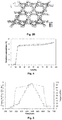
- Figure 7 shows the Powder X-ray diffraction spectrum of the paper composite (top line) in comparison with as synthesized powder (middle line) and calculated powder (bottom line).
- Figures 8 and 9 respectively show flat section and cross section SEM images of the paper composite.
- Figure 10 shows experimental isotherms for water vapour sorption at 27 °C on [Cu 2 (glutarate) 2 (4,4'-bipyridine)] powder and its paper composite, respectively from the top down.
- In-situ pre-treatment (intrinsic-DVS) before collecting isotherm at 40 °C for 120 min.
- Isotherm collected at 27 °C (Intrinsic-DVS).
- dm/dt ⁇ 0.01 %/min.
- NaCI concentration in all aqueous solution was analysed by using a conductivity meter (model: JENWAY 4510). Measurements were performed three times and the mean was calculated. The concentration of NaCI (g/L) was determined by correlating the conductivity (mS) and a [NaCI] calibration curve. The results indicate that [Cu 2 (glutarate) 2 (4,4'-bipyridine)] increased NaCI concentration by the expected amount in every experiment showing that the material can adsorb water from concentrated salt solutions.
Landscapes
- Chemical & Material Sciences (AREA)
- Engineering & Computer Science (AREA)
- Organic Chemistry (AREA)
- Water Supply & Treatment (AREA)
- Hydrology & Water Resources (AREA)
- Environmental & Geological Engineering (AREA)
- Life Sciences & Earth Sciences (AREA)
- Inorganic Chemistry (AREA)
- Analytical Chemistry (AREA)
- Chemical Kinetics & Catalysis (AREA)
- Health & Medical Sciences (AREA)
- Public Health (AREA)
- Solid-Sorbent Or Filter-Aiding Compositions (AREA)
- Water Treatment By Sorption (AREA)
Priority Applications (6)
| Application Number | Priority Date | Filing Date | Title |
|---|---|---|---|
| EP20153353.6A EP3854471A1 (de) | 2020-01-23 | 2020-01-23 | Verbesserungen im zusammenhang mit wasserreinigung |
| IL294995A IL294995A (en) | 2020-01-23 | 2021-01-22 | Improvements relating to water purification |
| AU2021211142A AU2021211142A1 (en) | 2020-01-23 | 2021-01-22 | Improvements relating to water purification |
| US17/759,326 US20230096195A1 (en) | 2020-01-23 | 2021-01-22 | Improvements relating to water purification |
| EP21702193.0A EP4090456A1 (de) | 2020-01-23 | 2021-01-22 | Verbesserungen im zusammenhang mit wasserreinigung |
| PCT/EP2021/051470 WO2021148613A1 (en) | 2020-01-23 | 2021-01-22 | Improvements relating to water purification |
Applications Claiming Priority (1)
| Application Number | Priority Date | Filing Date | Title |
|---|---|---|---|
| EP20153353.6A EP3854471A1 (de) | 2020-01-23 | 2020-01-23 | Verbesserungen im zusammenhang mit wasserreinigung |
Publications (1)
| Publication Number | Publication Date |
|---|---|
| EP3854471A1 true EP3854471A1 (de) | 2021-07-28 |
Family
ID=69190666
Family Applications (2)
| Application Number | Title | Priority Date | Filing Date |
|---|---|---|---|
| EP20153353.6A Withdrawn EP3854471A1 (de) | 2020-01-23 | 2020-01-23 | Verbesserungen im zusammenhang mit wasserreinigung |
| EP21702193.0A Pending EP4090456A1 (de) | 2020-01-23 | 2021-01-22 | Verbesserungen im zusammenhang mit wasserreinigung |
Family Applications After (1)
| Application Number | Title | Priority Date | Filing Date |
|---|---|---|---|
| EP21702193.0A Pending EP4090456A1 (de) | 2020-01-23 | 2021-01-22 | Verbesserungen im zusammenhang mit wasserreinigung |
Country Status (5)
| Country | Link |
|---|---|
| US (1) | US20230096195A1 (de) |
| EP (2) | EP3854471A1 (de) |
| AU (1) | AU2021211142A1 (de) |
| IL (1) | IL294995A (de) |
| WO (1) | WO2021148613A1 (de) |
Families Citing this family (2)
| Publication number | Priority date | Publication date | Assignee | Title |
|---|---|---|---|---|
| GB2551317A (en) * | 2016-06-07 | 2017-12-20 | Ide Technologies Ltd | Environmentally friendly water intake and pretreatment system |
| GB202402704D0 (en) * | 2024-02-26 | 2024-04-10 | Novnat Tech Ltd | Metal organic framework |
Citations (3)
| Publication number | Priority date | Publication date | Assignee | Title |
|---|---|---|---|---|
| US20190100902A1 (en) * | 2017-09-29 | 2019-04-04 | Rain Bird Corporation | Water Reclamation Systems And Methods |
| WO2020021112A1 (en) * | 2018-07-26 | 2020-01-30 | University Of Limerick | Improvements relating to water capture |
| WO2020099561A1 (en) * | 2018-11-15 | 2020-05-22 | Basf Se | Generation of drinking water from air by means of a box, comprising at least one sorption material |
Family Cites Families (12)
| Publication number | Priority date | Publication date | Assignee | Title |
|---|---|---|---|---|
| US2193569A (en) * | 1936-10-14 | 1940-03-12 | Westvaco Chlorine Products Cor | Method of and apparatus for drying |
| US3306591A (en) * | 1964-02-10 | 1967-02-28 | Bruno G Valazza | Evaporative cooler |
| US3756579A (en) * | 1971-07-15 | 1973-09-04 | Electrohome Ltd | Humidifier |
| US4124528A (en) * | 1974-10-04 | 1978-11-07 | Arthur D. Little, Inc. | Process for regenerating adsorbents with supercritical fluids |
| EP1354863B1 (de) * | 2002-04-18 | 2005-06-08 | Haldor Topsoe A/S | Kontinuierliches Verfahren zur Trennung von Wasser von einer Kohlenwasserstoffbeschickung |
| DE102005017478A1 (de) * | 2005-04-15 | 2006-10-19 | Reemtsma Cigarettenfabriken Gmbh | Tabakrauchfilter |
| MX349059B (es) * | 2009-08-25 | 2017-07-07 | Donaldson Company Inc * | Sistema de remocion y manejo de agua. |
| US9459184B2 (en) * | 2012-03-08 | 2016-10-04 | Dionex Corporation | Sorption of water from a sample using a polymeric drying agent |
| KR20180123134A (ko) * | 2016-03-24 | 2018-11-14 | 바스프 에스이 | 자기열량 장치 |
| US20190111768A1 (en) * | 2016-04-05 | 2019-04-18 | Denso Corporation | Air conditioning apparatus for vehicle |
| CN113195459B (zh) * | 2018-12-21 | 2024-11-01 | 英特维特国际股份有限公司 | 用于(5r)-4-[5-(3,5-二氯苯基)-5-(三氟甲基)-4h异噁唑-3-基]-2-甲基-苯甲酸的外消旋化的方法 |
| US12274974B2 (en) * | 2019-10-04 | 2025-04-15 | The Board Of Trustees Of The Leland Stanford Junior University | Continuously-cycled water harvesting for dry cooling tower operated power plants |
-
2020
- 2020-01-23 EP EP20153353.6A patent/EP3854471A1/de not_active Withdrawn
-
2021
- 2021-01-22 IL IL294995A patent/IL294995A/en unknown
- 2021-01-22 AU AU2021211142A patent/AU2021211142A1/en not_active Abandoned
- 2021-01-22 WO PCT/EP2021/051470 patent/WO2021148613A1/en not_active Ceased
- 2021-01-22 US US17/759,326 patent/US20230096195A1/en not_active Abandoned
- 2021-01-22 EP EP21702193.0A patent/EP4090456A1/de active Pending
Patent Citations (3)
| Publication number | Priority date | Publication date | Assignee | Title |
|---|---|---|---|---|
| US20190100902A1 (en) * | 2017-09-29 | 2019-04-04 | Rain Bird Corporation | Water Reclamation Systems And Methods |
| WO2020021112A1 (en) * | 2018-07-26 | 2020-01-30 | University Of Limerick | Improvements relating to water capture |
| WO2020099561A1 (en) * | 2018-11-15 | 2020-05-22 | Basf Se | Generation of drinking water from air by means of a box, comprising at least one sorption material |
Non-Patent Citations (2)
| Title |
|---|
| BETH RATHER ET AL: "A 3D metal-organic network, [Cu2(glutarate)2(4,4'-bipyridine)], that exhibits single-crystal to single-crystal dehydration and rehydrationElectronic supplementary information (ESI) available: experimental details, IR, TGA and XRPD of all compounds. See http://www.rsc.org/suppdata/cc/b3/b301219k/.", CHEMICAL COMMUNICATIONS, no. 7, 3 March 2003 (2003-03-03), pages 830 - 831, XP055630903, ISSN: 1359-7345, DOI: 10.1039/b301219k * |
| WEILONG WANG ET AL: "An Overview of Adsorbents in the Rotary Desiccant Dehumidifier for Air Dehumidification", DRYING TECHNOLOGY., vol. 31, no. 12, 10 September 2013 (2013-09-10), US, pages 1334 - 1345, XP055520049, ISSN: 0737-3937, DOI: 10.1080/07373937.2013.792094 * |
Also Published As
| Publication number | Publication date |
|---|---|
| AU2021211142A1 (en) | 2022-09-15 |
| US20230096195A1 (en) | 2023-03-30 |
| EP4090456A1 (de) | 2022-11-23 |
| WO2021148613A1 (en) | 2021-07-29 |
| IL294995A (en) | 2022-09-01 |
Similar Documents
| Publication | Publication Date | Title |
|---|---|---|
| Ji et al. | Temperature regulated adsorption and desorption of heavy metals to A-MIL-121: Mechanisms and the role of exchangeable protons | |
| Huo et al. | Magnetic responsive Fe3O4-ZIF-8 core-shell composites for efficient removal of As (III) from water | |
| Roushani et al. | Removal of cadmium ions from aqueous solutions using TMU-16-NH2 metal organic framework | |
| Feng et al. | Metal–organic frameworks HKUST-1 for liquid-phase adsorption of uranium | |
| Xiong et al. | Using MOF-74 for Hg2+ removal from ultra-low concentration aqueous solution | |
| Atallah et al. | A highly stable indium based metal organic framework for efficient arsenic removal from water | |
| Yang et al. | Covalent organic framework EB-COF: Br as adsorbent for phosphorus (V) or arsenic (V) removal from nearly neutral waters | |
| EP3826766A1 (de) | Verbesserungen im zusammenhang mit der wassererfassung | |
| Fan et al. | A multifunctional composite Fe 3 O 4/MOF/l-cysteine for removal, magnetic solid phase extraction and fluorescence sensing of Cd (ii) | |
| Esrafili et al. | The targeted design of dual-functional metal–organic frameworks (DF-MOFs) as highly efficient adsorbents for Hg 2+ ions: Synthesis for purpose | |
| Zheng et al. | Efficient, selective, and reusable metal–organic framework-based adsorbent for the removal of Pb (II) and Cr (VI) heavy-metal pollutants from wastewater | |
| Li et al. | Adsorption and intercalation of organic pollutants and heavy metal ions into MgAl-LDHs nanosheets with high capacity | |
| US11746191B2 (en) | Polymers for selective heavy metal removal | |
| KR101788527B1 (ko) | 활성탄-지르코늄 유기골격체 하이브리드 중금속 흡착제 및 그의 제조방법 | |
| Islam et al. | Polyacrylamide thorium (IV) phosphate as an important lead selective fibrous ion exchanger: synthesis, characterization and removal study | |
| Zhao et al. | Efficient and selective removal of Pb2+ from aqueous solutions by modified metal-organic frame materials | |
| Zhu et al. | Direct synthesis of ordered N-methylimidazolium functionalized mesoporous silica as highly efficient anion exchanger of Cr (VI) | |
| Zhang et al. | High removal of methyl blue over copper mixed-triazolate MOF by both adsorption and photodegradation from aqueous solution | |
| Islam et al. | Removal of lead (II) from aqueous environment by a fibrous ion exchanger: polycinnamamide thorium (IV) phosphate | |
| Chevinli et al. | Removal of La (III) ions from aqueous solution by Lanthanide MOF; characterization, synthesizing and process conditions study | |
| US20230096195A1 (en) | Improvements relating to water purification | |
| Pham et al. | Engineering of efficient functionalization in a zirconium-hydroxyl-based metal–organic framework for an ultra-high adsorption of Pb 2+ ions from an aqueous medium: an elucidated uptake mechanism | |
| Yang et al. | Solid solution approach to the design of copper mixed-triazolate multivariate-MOFs for the efficient adsorption of triclosan | |
| Obeso et al. | Al (iii)-based MOF for the selective adsorption of phosphate and arsenate from aqueous solutions | |
| Zhang et al. | Simultaneous high-performance detection and removal of tetracycline with a polyoxomolybdate-based coordination polymer |
Legal Events
| Date | Code | Title | Description |
|---|---|---|---|
| PUAI | Public reference made under article 153(3) epc to a published international application that has entered the european phase |
Free format text: ORIGINAL CODE: 0009012 |
|
| STAA | Information on the status of an ep patent application or granted ep patent |
Free format text: STATUS: THE APPLICATION HAS BEEN PUBLISHED |
|
| AK | Designated contracting states |
Kind code of ref document: A1 Designated state(s): AL AT BE BG CH CY CZ DE DK EE ES FI FR GB GR HR HU IE IS IT LI LT LU LV MC MK MT NL NO PL PT RO RS SE SI SK SM TR |
|
| STAA | Information on the status of an ep patent application or granted ep patent |
Free format text: STATUS: THE APPLICATION IS DEEMED TO BE WITHDRAWN |
|
| 18D | Application deemed to be withdrawn |
Effective date: 20220129 |