EP3855367A1 - Betriebsbeschleuniger, verarbeitungsverfahren und zugehörige vorrichtung - Google Patents
Betriebsbeschleuniger, verarbeitungsverfahren und zugehörige vorrichtung Download PDFInfo
- Publication number
- EP3855367A1 EP3855367A1 EP18936364.1A EP18936364A EP3855367A1 EP 3855367 A1 EP3855367 A1 EP 3855367A1 EP 18936364 A EP18936364 A EP 18936364A EP 3855367 A1 EP3855367 A1 EP 3855367A1
- Authority
- EP
- European Patent Office
- Prior art keywords
- row vectors
- matrix
- read
- memory
- row
- Prior art date
- Legal status (The legal status is an assumption and is not a legal conclusion. Google has not performed a legal analysis and makes no representation as to the accuracy of the status listed.)
- Pending
Links
Images






Classifications
-
- G—PHYSICS
- G06—COMPUTING OR CALCULATING; COUNTING
- G06F—ELECTRIC DIGITAL DATA PROCESSING
- G06F7/00—Methods or arrangements for processing data by operating upon the order or content of the data handled
- G06F7/38—Methods or arrangements for performing computations using exclusively denominational number representation, e.g. using binary, ternary, decimal representation
- G06F7/48—Methods or arrangements for performing computations using exclusively denominational number representation, e.g. using binary, ternary, decimal representation using non-contact-making devices, e.g. tube, solid state device; using unspecified devices
- G06F7/544—Methods or arrangements for performing computations using exclusively denominational number representation, e.g. using binary, ternary, decimal representation using non-contact-making devices, e.g. tube, solid state device; using unspecified devices for evaluating functions by calculation
- G06F7/5443—Sum of products
-
- G—PHYSICS
- G06—COMPUTING OR CALCULATING; COUNTING
- G06F—ELECTRIC DIGITAL DATA PROCESSING
- G06F17/00—Digital computing or data processing equipment or methods, specially adapted for specific functions
- G06F17/10—Complex mathematical operations
- G06F17/16—Matrix or vector computation, e.g. matrix-matrix or matrix-vector multiplication, matrix factorization
-
- G—PHYSICS
- G06—COMPUTING OR CALCULATING; COUNTING
- G06F—ELECTRIC DIGITAL DATA PROCESSING
- G06F17/00—Digital computing or data processing equipment or methods, specially adapted for specific functions
- G06F17/10—Complex mathematical operations
- G06F17/15—Correlation function computation including computation of convolution operations
- G06F17/153—Multidimensional correlation or convolution
-
- G—PHYSICS
- G06—COMPUTING OR CALCULATING; COUNTING
- G06N—COMPUTING ARRANGEMENTS BASED ON SPECIFIC COMPUTATIONAL MODELS
- G06N3/00—Computing arrangements based on biological models
- G06N3/02—Neural networks
- G06N3/04—Architecture, e.g. interconnection topology
- G06N3/045—Combinations of networks
-
- G—PHYSICS
- G06—COMPUTING OR CALCULATING; COUNTING
- G06N—COMPUTING ARRANGEMENTS BASED ON SPECIFIC COMPUTATIONAL MODELS
- G06N3/00—Computing arrangements based on biological models
- G06N3/02—Neural networks
- G06N3/04—Architecture, e.g. interconnection topology
- G06N3/0464—Convolutional networks [CNN, ConvNet]
-
- G—PHYSICS
- G06—COMPUTING OR CALCULATING; COUNTING
- G06N—COMPUTING ARRANGEMENTS BASED ON SPECIFIC COMPUTATIONAL MODELS
- G06N3/00—Computing arrangements based on biological models
- G06N3/02—Neural networks
- G06N3/06—Physical realisation, i.e. hardware implementation of neural networks, neurons or parts of neurons
- G06N3/063—Physical realisation, i.e. hardware implementation of neural networks, neurons or parts of neurons using electronic means
-
- Y—GENERAL TAGGING OF NEW TECHNOLOGICAL DEVELOPMENTS; GENERAL TAGGING OF CROSS-SECTIONAL TECHNOLOGIES SPANNING OVER SEVERAL SECTIONS OF THE IPC; TECHNICAL SUBJECTS COVERED BY FORMER USPC CROSS-REFERENCE ART COLLECTIONS [XRACs] AND DIGESTS
- Y02—TECHNOLOGIES OR APPLICATIONS FOR MITIGATION OR ADAPTATION AGAINST CLIMATE CHANGE
- Y02D—CLIMATE CHANGE MITIGATION TECHNOLOGIES IN INFORMATION AND COMMUNICATION TECHNOLOGIES [ICT], I.E. INFORMATION AND COMMUNICATION TECHNOLOGIES AIMING AT THE REDUCTION OF THEIR OWN ENERGY USE
- Y02D10/00—Energy efficient computing, e.g. low power processors, power management or thermal management
Definitions
- This application relates to data processing technologies in the artificial intelligence field, and in particular, to an operation accelerator, a processing method, and a related device.
- AI Artificial Intelligence
- cloud-based big data analysis and computing There are increasingly higher requirements on neural network computing, in particular, on a computing capability and computing efficiency of convolution.
- a main component of a convolutional neural network is the convolution operation, and the convolution operation accounts for more than 95% of calculation amount of the entire convolutional neural network.
- a mainstream calculation manner of the convolution operation is to convert a convolution operation of a 3D convolution input dataset and a 3D weight parameter dataset into multiplication between two matrices.
- the two matrices are relatively large, there may be problems of insufficient matrix buffer space, inflexible calculation, and low calculation efficiency. Therefore, how to improve convolution operation efficiency and significantly improve application of a neural network algorithm becomes an urgent problem to be resolved.
- Embodiments of the present invention provide an operation accelerator, a processing method, and a related device, to improve operation efficiency of a convolutional neural network.
- an operation accelerator which may include a matrix converter, and a first memory and a second memory coupled to the matrix converter.
- the first memory is configured to store an input dataset, and the input dataset includes S row vectors.
- Each of the S row vectors includes C0 pieces of data, and the C0 pieces of data are data that is corresponding to an element A ij in an input feature map and that is on C0 consecutive channels in a C direction.
- a size of the input feature map is W ⁇ H ⁇ C, W is a width, H is a height, and C is a quantity of channels.
- a ij is an element in an i th row and a j th column on a W ⁇ H plane of the input feature map, i is a positive integer less than or equal to W, and j is a positive integer less than or equal to H.
- the matrix converter is configured to perform the following actions: reading M row vectors from the input dataset, and generating a first instruction, where the M row vectors are M row vectors in a target matrix, a size of the target matrix is N ⁇ C0, N row vectors in the target matrix are row vectors corresponding to N elements A ij , when a convolution kernel continuously slides on the W ⁇ H plane of the input feature map for N times, that are corresponding to an element W mn in the convolution kernel and that are on the W ⁇ H plane, W mn is an element in an m th row and an n th column in the convolution kernel, the first instruction includes an instruction for performing preprocessing on the M row vectors, and the preprocessing includes one or more of sliding, concatenation, and padding, where M is an integer less than or equal to S, N is an integer greater than or equal to M, and C0 is an integer less than or equal to C; and sending the M row vectors and the first instruction to the second memory.
- the second memory performs, according to the first instruction, the preprocessing on the M row vectors to obtain n row vectors, and stores the n row vectors.
- the n row vectors include the M row vectors and (n-M) padding row vectors, the n row vectors are the N row vectors in the target matrix, and a storage sequence of the n row vectors in the second memory is consistent with a sequence of the N row vectors in the target matrix.
- a split small matrix namely, the target matrix
- the preprocessing including the one or more of sliding, concatenation, and padding
- Only a part of data is converted and stored in a buffer at a time.
- a large matrix operation is divided into small matrix operations to resolve an insufficient buffer problem.
- conversion and calculation can be performed at the same time, thereby resolving dependency between conversion and calculation processes.
- data reuse can be maximally implemented. For example, a weight matrix memory may be updated only after operations on all target matrices stored in the first memory are completed.
- a row vector in the target matrix on which an operation is performed is divided from the C direction of a channel by using a fixed length C0, when a small matrix of N ⁇ C0 is generated, element discreteness that is of the matrix and that is in a W direction and an H direction is reduced to discreteness in only the H direction. This reduces a probability of a conflict generated when the data in the feature map is read from the first memory, and improves original data reading performance.
- the N row vectors in the target matrix are specifically row vectors corresponding to N elements A ij , when the convolution kernel continuously slides on a padded W ⁇ H plane of the input feature map for N times, that are corresponding to the element W mn in the convolution kernel and that are on the padded W ⁇ H plane.
- That the second memory is configured to: perform, according to the first instruction, the preprocessing on the M row vectors to obtain n row vectors, and store the n row vectors specifically includes: padding the (n-M) padding row vectors with fixed values; and performing, according to the first instruction, a sliding or concatenation operation on the M row vectors and the (n-M) padding row vectors to obtain the n row vectors, and storing the n row vectors.
- a problem that bandwidth and storage space are occupied for transmitting padding by the input dataset of the feature map is resolved by using an online padding manner.
- the operation accelerator further includes a third memory coupled to the matrix converter, and an operation circuit coupled to the third memory.
- the matrix converter is further configured to: send, to the third memory for P times, the n row vectors stored in the second memory and a corresponding second instruction generated by the matrix converter, where P is an integer greater than or equal to 1, and the second instruction includes a write enable, a write address, and a write size instruction.
- the third memory is configured to: store P ⁇ n row vectors according to the corresponding second instruction, and send the P ⁇ n row vectors to the operation circuit, where a storage sequence of n row vectors that are received at each time in the n row vectors received for the P times and that are in the third memory is consistent with a sequence of the corresponding N row vectors in the target matrix, and storage sequences of the n row vectors that are received for the P times and that are in the third memory are consistent with receiving sequences.
- the operation circuit is configured to perform matrix operations on the P ⁇ n row vectors.
- a plurality of target matrices are generated through conversion in the second memory, and are sequentially sent to the third memory.
- the third memory may perform the related matrix operations on the P ⁇ n row vectors at a time.
- the operations and the conversion may be performed at the same time, thereby improving operation efficiency.
- the S row vectors are data corresponding to consecutive S pieces of A ij on the C0 consecutive channels in the C direction, and the S pieces of A ij are first in a W direction and then in an H direction in the input feature map.
- the matrix converter is configured to: read M row vectors from the input dataset, and generate a first instruction specifically includes: reading the M row vectors from the S row vectors according to a read instruction, where the read instruction includes a read enable, a read address, a read stride, and a read size, and the read stride is equal to a sliding stride of the convolution kernel.
- the matrix converter when reading the M row vectors, the matrix converter generates, based on the elements included in the target matrix, micro-ops including the read enable, the read address, the read stride, and the read size, to read, from the first memory, the related row vectors used to generate the target matrix.
- the matrix converter is further configured to: perform, based on the n row vectors stored in the second memory and the first instruction, a reverse operation on the n row vectors to obtain the M row vectors through restoration, where the reverse operation includes one or more of sliding, splitting, and de-padding; and restore locations of the M row vectors in the S row vectors according to the read instruction for reading the M row vectors from the input dataset, where the read instruction includes the read enable, the read address, the read stride, and the read size.
- the matrix converter may restore locations of the n row vectors in the original input dataset by using the first instruction and the n row vectors, to perform a convolution reverse operation.
- two convolution conversion operations forward conversion and reverse conversion are implemented in a hardware structure.
- this application provides a data processing method, including:
- the N row vectors in the target matrix are specifically row vectors corresponding to N elements A ij , when the convolution kernel continuously slides on a padded W ⁇ H plane of the input feature map for N times, that are corresponding to the element W mn in the convolution kernel and that are on the padded W ⁇ H plane.
- the performing preprocessing on the M row vectors to obtain n row vectors includes:
- the S row vectors are data corresponding to consecutive S pieces of A ij on the C0 consecutive channels in the C direction, and the S pieces of A ij are first in a W direction and then in an H direction in the input feature map.
- the reading the M row vectors from an input dataset includes: reading the M row vectors from the S row vectors according to a read instruction, where the read instruction includes a read enable, a read address, a read stride, and a read size, and the read stride is equal to a sliding stride of the convolution kernel.
- the method further includes:
- this application provides a neural network processor.
- the neural network processor may include the operation accelerator according to any one of the first aspect.
- this application provides a system on chip.
- the system on chip may include the operation accelerator provided in any implementation of the first aspect and another discrete device coupled to the operation accelerator.
- this application provides an operation acceleration system.
- the operation acceleration system includes a processor, an operation accelerator, and a memory.
- the operation accelerator invokes, under control of the processor, data in the memory, to implement a function of the operation accelerator in any one of the first aspect and implementations.
- a component may be, but is not limited to, a process that runs on a processor, a processor, an object, an executable file, a thread of execution, a program, and/or a computer.
- a computing device and an application that runs on a computing device may be components.
- One or more components may reside within a process and/or a thread of execution, and a component may be located on one computer and/or distributed between two or more computers.
- these components may be executed from various computer-readable media that store various data structures.
- the components may communicate by using a local and/or remote process and according to, for example, a signal having one or more data packets (for example, data from two components interacting with another component in a local system, a distributed system, and/or across a network such as the Internet interacting with other systems by using the signal).
- a signal having one or more data packets (for example, data from two components interacting with another component in a local system, a distributed system, and/or across a network such as the Internet interacting with other systems by using the signal).
- Artificial intelligence is a theory, a method, a technology, or an application system that simulates, extends, and expands human intelligence by using a digital computer or a machine controlled by a digital computer, to sense an environment, obtain knowledge, and achieve an optimal result by using the knowledge.
- the artificial intelligence is a branch of computer science, and is intended to understand essence of intelligence and produce a new intelligent machine that can react in a manner similar to the human intelligence.
- the artificial intelligence is to study design principles and implementation methods of various intelligent machines, to enable the machines to have perception, inference, and decision-making functions. Researches in the artificial intelligence field include a robot, natural language processing, computer vision, decision-making and inference, human-computer interaction, recommendation and search, an AI basic theory, and the like.
- a convolutional neural network (Convolutional Neural Network, CNN) is a multilayer neural network. Each layer includes a plurality of two-dimensional planes, and each plane includes a plurality of independent neurons. A plurality of neurons of each plane share a weight, and a quantity of parameters on the neural network may be reduced through weight sharing.
- performing a convolution operation by a processor is usually converting convolution of an input signal feature and a weight into a matrix multiplication operation between a feature map matrix and a weight matrix.
- Convolution is an operation between a convolution kernel and an input matrix of a convolutional layer.
- an input matrix is a matrix extracted from an image matrix based on a stride (stride) of the convolution kernel during convolution.
- the convolution kernel is a small window that records a weight.
- the convolution kernel slides on the image matrix based on the stride. Each time the convolution kernel slides, one sub-matrix of the image matrix is corresponding to the convolution kernel. Weight values in the convolution kernel are multiplied by values included in the sub-matrix and then are added. A result is assigned to an element corresponding to a feature map matrix (output matrix) in which the convolution kernel is currently located.
- a stride that a convolution kernel moves along a height direction of an image matrix for one time is a stride that the convolution kernel slides in the height direction.
- a stride that the convolution kernel moves along a width direction of the image matrix for one time is a stride that the convolution kernel slides in the width direction.
- a sliding stride of the convolution kernel is represented by a parameter stride.
- an input matrix is extracted from the image matrix (namely, input data) based on a stride (stride) of the convolution kernel during convolution.
- a stride is equal to [s1,s2], where s1 indicates the stride that the convolution kernel slides in the height direction, and s2 indicates the stride that the convolution kernel slides in the width direction.
- Padding (padding) a pixel Because a matrix obtained after convolution becomes smaller (for example, for a convolutional network including 100 layers, a final picture obtained after each layer is scaled down is a very small picture), an edge pixel of an image matrix may be calculated for only one time, and an intermediate pixel is calculated through convolution for a plurality of times. This means that corner information of an image is lost. To solve these two problems, padding is performed on an input image, that is, the pixel is padded, to maintain boundary information. The padding can also be used to supplement input images with different sizes, so that the sizes of the input images are the same. In addition, an input dimension and an output dimension of the convolutional layer can be consistent.
- the convolutional neural network mainly includes a convolution operation and a fully-connected (fully connected, FC) operation.
- An operation amount of the convolution operation usually accounts for more than 70% of an operation amount of the entire network.
- the convolution operation is not equivalent to a matrix multiplication operation in a strict sense. However, the convolution operation may be converted into the matrix multiplication operation through proper data adjustment.
- the convolution kernel is three-dimensional and includes three dimensions of data. Directions x and y represent a length and a width of the data, and a direction z may be considered as a depth of the data.
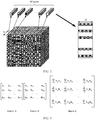
- the convolution kernel is actually a filter (filter), and is mainly configured to extract different features from an image. Referring to FIG. 1 , a convolution kernel is substantially a combination of a series of weights. It is assumed that there are K convolution kernels.
- the convolution kernel may be prestored in a memory of a matrix multiplier in a form of a weight matrix based on a specification (to be specific, a row quantity and a column quantity of the matrix that can be calculated by the matrix multiplier) of the matrix multiplier, so that the convolution kernel is invoked when the matrix multiplier performs a matrix multiplication operation.
- "*" represents "multiplication".
- the matrix multiplier may extract N pieces of data of M input points in the direction z, namely, a total of M ⁇ N pieces of data.
- An input matrix (input matrix) may be formed.
- the matrix multiplier needs to perform a multiplication operation on the input matrix and the weight matrix.
- the FC operation is substantially a multiplication operation of a vector and a matrix.
- An input of the FC operation is a 9216 vector, and the FC needs to output 4096 points.
- a point multiplication operation needs to be performed on a 9126 vector and 9216 weights, and to obtain all 4096 points, a point multiplication operation needs to be performed on a 9216 vector and 9216 x 4096 weights.
- M, N, and K each are a positive integer.
- a point multiplication operation needs to be performed on data in a row vector in the matrix A and corresponding data in a column vector in the matrix B, and then accumulation is performed.
- N multiplication operations need to be performed.
- M ⁇ N ⁇ K multiplication operations need to be performed.
- a systolic array computing manner for example, a dedicated chip (ASIC) Google TPUv1 customized by Google for machine learning
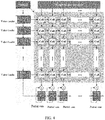
- a TPU uses a systolic array design to optimize a matrix multiplication operation and a convolution operation by using a 256x256 2-D MAC array (as shown in FIG. 4 ).
- a value loader of each row and a weight fetcher interface of each column in the figure transmit data to an intermediate cell (computation unit) matrix in a systolic mode.
- Each cell in the figure is a multiplier.
- a result (Partial Sum, that is, an intermediate result in matrix multiplication) obtained through calculation is transmitted down to an accumulation unit in the lower part of the figure, and is accumulated with a previous related accumulated value.
- the systolic array accumulates an intermediate value of a size of a matrix in each clock cycle.
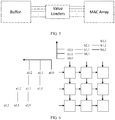
- FIG. 5 An overall structure is shown in FIG. 5 .
- a 3x3 systolic array is used as an example below.
- FIG. 6 is a schematic structural diagram of a 3x3 2D systolic array in the prior art.
- results that are obtained through calculation by inputting a matrix A[0,0] and a matrix B[0,0] to a first multiplier (where all expressions of [x,y] represent an x th row and a y th column) are input to an accumulation unit in the lower part.
- a matrix A[0,1] and a matrix B[1,0] are input to the first multiplier to calculate a second intermediate value that is obtained by multiplying a first row of the matrix A and a first column of the matrix B.
- the second intermediate value is input to the accumulation unit, and the second intermediate value and a first intermediate value calculated in the previous clock cycle are accumulated.
- the previous input A[0,0] enters a second multiplier on the right, and performs, with a newly input B[0,1], an intermediate value operation between a first row of the matrix A and a second column of the matrix B.
- B [0,0] enters a second multiplier in the lower part, and performs, with a newly input A[1,0], an intermediate value operation between a second row of the matrix A and a first column of the matrix B.
- matrix conversion of an input dataset is strongly coupled to a multiply and accumulate (Multiply and Accumulate, MAC) computation unit.
- Data obtained through matrix conversion is directly hardwired to the computation unit, and flexibility of a matrix operation is low.
- MAC multiply and accumulate
- a calculation dimension is relatively fixed and inflexible. Calculation efficiency of a 256x256 2D systolic array on a small matrix is not high.
- a reverse process of converting the matrix into a 3D dataset cannot be implemented.
- a technical problem to be resolved in this application is to design an operation accelerator to perform calculation on a large quantity of data operations in a convolutional neural network in an efficient, flexible, and low energy manner.
- the matrix conversion of the input dataset is decoupled from the MAC computation unit, to solve problems of low flexibility of a hardware structure design and a low data reuse rate.
- An NC1HWC0 data structure is designed to solve a problem of low efficiency in processing small matrices in a TPU architecture by splitting a matrix converted from the input dataset into small matrices.
- Padding data is designed to be generated online, to solve a problem that bandwidth and storage space are occupied for transmitting padding by an input dataset of a feature map.
- the operation accelerator provided in the embodiments of the present invention may be applied to fields such as machine learning, deep learning, and a convolutional neural network, or may be applied to fields such as digital image processing and digital signal processing, or may be applied to other fields related to a matrix multiplication operation.
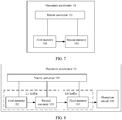
- FIG. 7 is a structural diagram of an operation accelerator according to an embodiment of the present invention.
- the operation accelerator 10 includes: a matrix converter 101, and a first memory 102 and a second memory 103 that are coupled to the matrix converter 101.
- FIG. 8 is a structural diagram of another operation accelerator according to an embodiment of the present invention.
- the operation accelerator 10 may further include a third memory 104 and an operation circuit 105.
- the matrix converter 101 may perform data communication with the first memory 102, the second memory 103, and the third memory 104 through a bus, or may form a small system for direct communication.
- the operation circuit 105 is configured to extract matrix data in the third memory 104 and a weight matrix in another related memory, to perform a vector multiplication operation, a vector addition operation, and the like.
- the first memory 102 is configured to store an input dataset.
- the input dataset includes S row vectors.
- Each of the S row vectors includes C0 pieces of data.
- the C0 pieces of data are data that is corresponding to an element A ij in an input feature map and that is on C0 consecutive channels in a C direction.
- a size of the input feature map is W ⁇ H ⁇ C.
- W is a width
- H is a height
- C is a quantity of channels.
- a ij is an element in an i th row and a j th column on a W ⁇ H plane of the input feature map.
- i is a positive integer less than or equal to W
- j is a positive integer less than or equal to H
- C0 is an integer less than or equal to C.
- the S row vectors are data corresponding to consecutive S pieces of A ij on the C0 consecutive channels in the C direction, and the S pieces of A ij are first in a W direction and then in an H direction in the input feature map.
- FIG. 9 is a storage manner of an input feature map according to an embodiment of the present invention.
- a data structure obtained after the input feature map (feature map) is converted is named NC1HWC0. It is assumed that the input feature map is a 3D matrix of the dimension of W ⁇ H ⁇ C shown in FIG. 9 .
- the input feature map is split into pieces of C0 (for example, 16 channels or 4 channels) with a fixed length in a channel channel direction.
- the pieces of C0 are named C0. 0, C0. 1, C0. 2, C0. 3,..., C0. (C1-1), totaling C1 pieces.
- C0.0 in each 3D matrix block after splitting, for example, C0.0, is a convolutional layer whose layer size C0 is W ⁇ H. If a quantity of entire channels channel is not an integer multiple of C0, padding may be performed at the tail, so that the quantity of entire channels channel is the integer multiple of C0.
- the input feature map may be stored in a sequence of C0. 0 ⁇ W ⁇ H ⁇ C0. 0 ⁇ W ⁇ H ⁇ ... ⁇ C0. (C1-1).
- N herein means that N input feature maps may be formed by a plurality of input feature maps.
- an input dataset in this embodiment of the present invention may be a row vector including C0 channels corresponding to some or all of A ij in one or more of the foregoing input feature maps. It is assumed that C0 is equal to 4, if S row vectors are data corresponding to consecutive S pieces of A ij (first in a W direction and then in an H direction) that are in a W ⁇ H plane of a matrix block C0.
- the S row vectors may be row vectors corresponding to A 12 , A 12 , A 13 , A 14 , ..., A 1w , A 21 , A 22 , A 23 , and the like in the W ⁇ H plane of the matrix block C0.
- a row vector corresponding to an element A 22 in a second row and a second column is data corresponding to A 22 on four consecutive channels in the C direction, which is ⁇ A 22-1 , A 22-2 , A 22-3 , A 22-4 ⁇ . It may be understood that column sequences that are of data of channels and that are in row vectors may be arranged in ascending order, in descending order, or based on a preset value. Elements that are located in a same column and that are in the S row vectors are on a W ⁇ H plane corresponding to a same channel.
- the matrix converter 101 is a hardware function module including control logic and an arithmetic unit, and is configured to generate related micro-ops of Img2Col or Co12Img. Specifically, the matrix converter 101 is configured to perform the following actions: reading M row vectors from the input dataset, and generating a first instruction, where the M row vectors are M row vectors in a target matrix, a size of the target matrix is N ⁇ C0, N row vectors in the target matrix are row vectors corresponding to N elements A ij , when a convolution kernel continuously slides on a W ⁇ H plane of the input feature map for N times, that are corresponding to an element W mn in the convolution kernel and that are on the W ⁇ H plane, W mn is an element in an m th row and an n th column in the convolution kernel, the first instruction includes an instruction for performing preprocessing on the M row vectors, and the preprocessing includes one or more instructions of sliding, concatenation, and padding, where M is an integer less
- a target matrix is an N ⁇ C0 matrix including C0 pieces of data corresponding to A ij on which an operation is performed with a weight element after the weight element in the convolution kernel continuously slides, in a convolution process, for N times based on a fixed sliding stride.
- C0 pieces of data corresponding to one piece of A ij are one row vector in the target matrix.
- an arrangement sequence of row vectors in the target matrix is consistent with a sliding sequence of convolution kernels.
- the matrix converter 101 is configured to: read M row vectors from the input dataset, and generate a first instruction specifically includes: reading the M row vectors from the S row vectors according to a read instruction.
- the read instruction includes a read enable, a read address, a read stride, and a read size.
- the read stride is equal to a sliding stride of the convolution kernel.
- the M row vectors are read from the S row vectors, and need to be read based on an element specifically included in the target matrix. In other words, corresponding micro-ops such as the read address, the read size, and the read stride need to be generated based on the element in the target matrix for reading the M row vectors.
- the read address may be obtained through calculation based on parameters given by a matrix conversion instruction delivered by a processor: a size of the feature map, a sliding starting location of a current convolution kernel, a location of an element processed by the current convolution kernel, and a starting address of the feature map stored in an L1 memory.
- the read size may be determined based on a size of each row vector.
- the read stride may be determined based on the sliding stride (stride) of the convolution kernel.
- N is greater than M, it indicates that there is a row vector with padding padding in the target matrix.
- N is equal to M, it indicates that there is no row vector with padding padding in the target matrix.
- the second memory 103 performs, according to the first instruction, the preprocessing on the M row vectors to obtain n row vectors, and stores the n row vectors.
- the n row vectors include the M row vectors and (n-M) padding row vectors.
- the n row vectors are the N row vectors in the target matrix.
- a storage sequence of the n row vectors in the second memory is consistent with a sequence of the N row vectors in the target matrix.
- the second memory is configured to: according to micro-ops (the first instruction) including one or more operations of sliding, concatenation, and padding, adjust, for the read M row vectors, a mapping relationship between a read address and a write address, and write the read address and the write address into corresponding locations.
- n row vectors stored in the second memory are the N row vectors in the target matrix, and details are not described subsequently.
- (N-M) is greater than 0, it indicates that the padding needs to be performed. In this case, a fixed value needs to be used for padding first, and then the sliding or concatenation is performed.
- (N-M) is equal to 0, it indicates that the padding does not need to be performed. In this case, only the sliding or concatenation needs to be performed.
- a sequence of a target matrix may be the same as a sequence of the M read row vectors. In this case, the foregoing operation does not need to be performed.
- the N row vectors in the target matrix are specifically row vectors corresponding to N elements A ij , when the convolution kernel continuously slides on a padded padding W ⁇ H plane of the input feature map for N times, that are corresponding to the element W mn in the convolution kernel and that are on the padded W ⁇ H plane.
- That the second memory 103 is configured to: perform, according to the first instruction, the preprocessing on the M row vectors to obtain n row vectors, and store the n row vectors specifically includes: padding the (n-M) padding row vectors with fixed values; and performing, according to the first instruction, a sliding or concatenation operation on the M row vectors and the (n-M) padding row vectors to obtain the n row vectors, and storing the n row vectors. That is, the fixed value, for example, 0, is used for padding first based on a padding table.
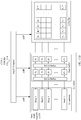
- FIG. 10 is a schematic diagram of a detailed structure of an operation accelerator according to an embodiment of the present invention.
- An L1 memory is a first memory in this embodiment of the present invention.
- An L1 align buffer is a second memory in this embodiment of the present invention.
- An L0 buffer is a third memory in this embodiment of the present invention.
- the L1 memory includes a plurality of storage units bank. Each bank may be configured to store a row vector in this embodiment of the present invention.
- the align buffer includes a plurality of storage units P. Each P may be configured to store a row vector in this embodiment of the present invention.
- FIG. 11 is a schematic diagram of generating a target matrix according to an embodiment of the present invention.
- an input feature map is W ⁇ H ⁇ C0, that is, C is equal to C0.
- a gray part is an original input feature map
- a white part is an input feature map obtained after a padding element (for example, 0) is padded.
- a size of the input feature map has changed to (W+2) ⁇ (H+2) ⁇ C0.
- a convolution kernel is a 3 ⁇ 3 weight matrix. The convolution kernel continuously slides on the W ⁇ H plane at a stride of 1.
- M row vectors read by a matrix converter (Img2Col Engine) from an input dataset are row vectors corresponding to 0, 1, 2, 3, 4, 5, 6, 7, 8, 9, 10, 11, 12, 13 and 14.
- Content actually stored in the L1 memory includes the row vectors corresponding to 0 to 14. After conversion is performed by the matrix converter, a corresponding instruction is generated.
- the row vectors corresponding to 0 to 14 are read from the L1 memory, and padding replacement is performed on the 15 th row vector.
- N row vectors finally stored in the second memory are row vectors that are corresponding to elements and that are stored in a sequence of 0, 1, 2, 3, 4, 5, 6, 7, 8, 9, 10, 11, 12, 13, 14 and 15.
- the operation accelerator in this embodiment of the present invention further includes the third memory 104 and the operation circuit 105.
- the matrix converter 102 is further configured to send, to the third memory for P times, the n row vectors stored in the second memory and a corresponding second instruction generated by the matrix converter.
- P is an integer greater than or equal to 1
- the second instruction includes a write enable, a write address, and a write size instruction.
- the third memory 104 is configured to: store P ⁇ n row vectors according to the corresponding second instruction, and send the P ⁇ n row vectors (may be all sent at a time) to the operation circuit 105.
- a storage sequence, in the third memory, of n row vectors that are received at each time in the n row vectors received for the P times is consistent with a sequence of the corresponding N row vectors in the target matrix, and storage sequences, in the third memory, of the n row vectors that are received for P times are consistent with receiving sequences.
- the operation circuit 105 may include X rows ⁇ Y columns ⁇ Z slices of operation units. Specifically, one operation unit may include a vector multiplication circuit and an addition circuit.
- the operation circuit 105 receives P ⁇ n pieces of row vector data sent by the third memory 104 and column vector data sent by a weight memory (not shown in the figure), and multiplies the two vectors.
- the addition circuit is configured to add a result of multiplying the two vectors, and accumulate a calculation result belonging to a same operation unit to obtain a calculation result of each operation unit.
- an operation size X ⁇ Y ⁇ Z of the operation circuit and a size N ⁇ C0 or (P ⁇ N) ⁇ C0 of the target matrix may be the same, or may be in an integer multiple relationship. In this way, a matrix operation may be exactly completed in one clock cycle or a plurality of clock cycles.
- the third memory may send, based on a size of the operation circuit and in one clock cycle or consecutive clock cycles, P ⁇ n row vectors that are sequentially stored to the operation circuit, to perform an operation with the P ⁇ n row vectors and corresponding W mn .
- P ⁇ n row vectors are of the same weight element W mn
- W mn in the weight memory may remain unchanged in an operation period, and is not changed until an operation corresponding to another weight element W mn is performed. This reduces read/write overheads and improves efficiency.
- the first memory 102, the second memory 103, the third memory 104, and another memory in this embodiment of the present invention may all be a register, a random access memory (random access memory, RAM for short), a static random access memory, a flash memory, or another readable and writable memory.
- the first memory 102 and the second memory 103 may be integrated into one memory as an L1 Buffer, and the third memory 104 is independently used as the L0 Buffer.
- the operation accelerator 10 includes multi-level buffers. From the L0 buffer to the L1 buffer, the L2 buffer, and the like, a capacity increases, access bandwidth decreases, a delay increases, and power consumption overheads increase.
- L0 is an innermost buffer, and may be directly connected to the operation circuit. This is not specifically limited in this embodiment of the present invention.
- both the input dataset and a data type of each row vector in this application may be of a type, for example, int 8, fp16, fp32, or the like.
- a problem of insufficient buffers is solved after a large matrix is divided into small blocks. Only a part of data is converted and stored in a buffer at a time. In addition, conversion and calculation can be performed at the same time, thereby resolving dependency between two processes: the conversion and the calculation. Because of a 3D matrix splitting manner and a matrix operation manner provided in this embodiment of the present invention, data reuse can be maximally implemented.
- a weight matrix memory may be updated only after operations on all target matrices stored in the first memory are completed.
- a row vector in the target matrix on which an operation is performed is divided from a C direction of a channel by using a fixed length C0, when a small matrix of N ⁇ C0 is generated, element discreteness that is of the matrix and that is in a W direction and an H direction is reduced to discreteness in only the H direction. This reduces a probability of a conflict generated when data in the feature map is read from the first memory, and improves original data reading performance.
- the matrix converter is further configured to perform, based on the n row vectors stored in the second memory and a first instruction, a reverse operation on the n row vectors to obtain the M row vectors through restoration.
- the reverse operation includes one or more of sliding, splitting, and de-padding.
- the matrix converter is further configured to restore locations of the M row vectors in S row vectors according to a read instruction for reading the M row vectors from the input dataset.
- the read instruction includes a read enable, a read address, a read stride, and a read size. That is, the matrix converter may restore locations of the n row vectors in the original input dataset by using the first instruction and the n row vectors, to perform a convolution reverse operation.
- the convolution reverse operation is an important step of neural network training.
- two conversion operations forward conversion and reverse conversion are implemented in a hardware structure.
- the operation accelerator in this embodiment of the present invention converts and stores the input feature map into the target matrix in the convolution process.
- the Llmemory in the L1 buffer in the operation accelerator is divided into a quantity of banks based on a quantity of rows (for example, a quantity of rows is N) of the target matrix (small matrix).
- a bit width of a bank is directly divided based on a size of C0.
- bank num matrix row num, that is, the quantity of banks is equal to the quantity of rows of the target matrix.
- bank width C0 ⁇ data width, that is, the bit width of the bank is equal to a width of C0.
- one row of data of the target matrix (namely, the small matrix) may be read from one bank in one clock cycle, thereby resolving a problem of a read conflict that may be caused when one row of data is read in one clock cycle.
- data of N (N is a quantity of banks) rows may be read from N banks in one clock cycle without any read conflict.
- N is equal to a quantity of rows of the small matrix, and the convolution kernel continuously slides in the input feature map, one small matrix may be generated in one clock cycle. This well resolves a memory bound (Memory bound) problem in a convolution operation.
- the Img2Col engine (namely, the matrix converter) controls L1/L0 through micro-ops (uOP) to complete a process of converting a dataset into a matrix.
- the Img2Col engine generates, for the L1 memory of the L1 buffer, micro-ops of the read address, the read enable, the read size, and the read stride (read stride). These micro-ops are used to control data to be read from the L1 memory. Further, the Img2Col engine generates, for the align buffer of the L1 buffer, micro-ops, namely, the first instructions, such as sliding, concatenation, or replacement (including a padding replacement table).
- These WeChat instructions control adjustment of the data read from the L1 memory, to change an arrangement sequence of the data into an arrangement sequence of the row vectors in the target matrix.
- the Img2Col engine generates, for L0, micro-ops, namely, the second instructions such as the write enable, the write address, and the write size. These micro-ops complete a process of writing data in the align buffer to L0.
- the read address is for a non-padding address.
- the following uses an example to describe how to read the data from the L1 memory and write the data into the align buffer.
- the data is read based on the read address, the read size, and the read stride, and then is transmitted to a level-1 buffer of the align buffer.
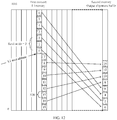
- the L1 memory stores row vectors corresponding to S consecutive elements A on an H ⁇ W plane of the input feature map, and a sliding stride of the convolution kernel is 2. Therefore, when a weight element in the convolution kernel slides for N times, an interval between N elements that are corresponding to the weight element and that are on the H ⁇ W plane of the input feature map is also the sliding stride of the convolution kernel.
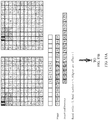
- a storage sequence of the S row vectors in the L1 memory is shown in FIG. 12 , and the S row vectors are corresponding to 0 to 15 row vectors.
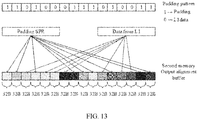
- a padding special-purpose register (special purpose register, SPR) is a register for storing a padding value, and may be configured by using a configuration instruction.
- currently read data may be a middle part or a tail part of the small matrix
- the sliding and the concatenation are performed.
- the data needs to be displaced to a correct location and concatenated with previously written data, to complete generation of the entire target matrix.
- a location corresponding to 0 is padded with the data read from the L1 memory
- a location corresponding to 1 is padded with a padding element.
- corresponding sliding and corresponding concatenation are performed.
- the engine completes writing data to L0 by using the micro-ops of the write enable, the write address, and the write size.
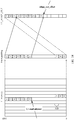
- FIG. 15 is a two-dimensional planar diagram of a process in which a 3D dataset is converted into a matrix.
- a channel direction is hidden in the figure, that is, data corresponding to C0 channels following each block is not shown in the figure.
- Dark color parts around, including the 1 st row, the 10 th row, the 11 th row, the 1 st column, the 10 th column, and the 11 th column are padding, are not stored in the L1 memory, and exist only in a coordinate calculation process.
- Light color parts in the middle including elements from the 2 nd row to the 9 th row, and elements from the 2 nd column to the 9 th column, are data of the feature map, and are continuously stored in a DDR/L1 in a W ⁇ H ⁇ C direction.
- a padding replacement table (pad bit-map) and an auxiliary mask table are generated, to record a location and a valid point at which the convolution kernel currently slides in the entire small matrix.
- the data of the feature map When the data of the feature map is filled in the level-1 buffer of the L1 align buffer after the data of the feature map is read from the L1 memory, the data of the feature map goes through points on which the padding is performed and that are recorded in the padding replacement table and the mask table.
- a fixed value (configured in the padding SRP) is used for padding, so that padding data can be generated online.
- two steps are included: (1) Displace the padding replacement table based on the mask table. (2) Based on the valid point in the mask table, extract a valid part and then perform a padding operation.
- both the Img2Col process and the Co12Img process may be implemented by the operation accelerators (the operation accelerators in FIG. 7, FIG. 8 , and FIG. 10 ) provided in the embodiments of the present invention, namely, a same hardware structure. That is, both a data writing process (Img2Col) and a data reading process (Co12Img) may exist between the matrix converter and the third memory.
- a read control line, a write control line, a read data transmission line, and a write data transmission line are required, for example, as shown in FIG. 10 , forward ctrl and forward data, and reverse ctrl and reverse data.
- virtual 3D dataset space with all 0 is first allocated.
- the space is also space of a target dataset, and a size of the space is a size of the input dataset.
- a small matrix is generated by using Img2Col (a process is the same as the foregoing Img2col process).
- the target matrix (Delta matrix) is also divided into small matrices in a same manner (generated offline or by another component of a processor through calculation). Two small matrices in corresponding locations are taken out, and element wise addition is performed on the two small matrices.
- a result matrix is written back into the 3D dataset space.
- Written-back parameters including an address, a size, sliding, and concatenation
- the process may be performed along a column direction, so that there is no dependency relationship between parameters of two matrices before and after, thereby implementing parallel reading and writing. All target matrices are traversed and written back in a column by column manner, to complete a reverse process of converting the target matrices into the 3D dataset.
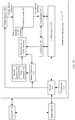
- FIG. 16 is a schematic diagram of a hardware structure of a neural network processor according to an embodiment of the present invention.
- the neural network processor NPU 20 is mounted to a CPU 30 (for example, a host CPU) as a coprocessor, and the host CPU 30 allocates a task.
- a core part of the NPU 20 is the operation circuit 105.
- a direct memory access controller DMAC 110 controls the operation circuit 105 to extract matrix data in memories (including the input memory 104, the weight memory 106, and the like) to perform a multiplication operation. Further, the DMAC 110 controls an operation result in the operation circuit 105 or matrix data in a unified memory 109 to enter an accumulator 107 and/or a vector unit 108 to perform a further operation.
- the operation circuit 105 may also be referred to as a matrix arithmetic unit (Cube Unit), and is configured to complete a matrix ⁇ matrix operation.
- the operation circuit 105 may include a plurality of processing units (Process Engine, PE).
- PE Processing Unit
- the operation circuit 105 is a two-dimensional systolic array.
- the operation circuit 105 may alternatively be a one-dimensional systolic array or another electronic circuit that can perform mathematical operations such as multiplication and addition.
- the operation circuit 1203 is a general-purpose matrix processor.
- the vector unit (Vector Unit) 108 is configured to perform further processing such as vector multiplication, vector addition, an exponent operation, a logarithm operation, or value comparison on an output of the operation circuit 105.
- the vector unit 108 is mainly used for neural network non-convolution/FC layer network calculation, such as pooling (Pooling), batch normalization (Batch Normalization), and local response normalization (Local Response Normalization).
- the vector unit 108 can store, in the unified memory 109, an output vector that has been processed.
- the vector unit 108 may apply a non-linear function to the output of the operation circuit 105, for example, to a vector of an accumulated value, to generate an activation value.
- the vector unit 108 generates a normalized value or a combined value, or the vector unit 108 generates a normalized value and a combined value.
- the processed output vector can be used as an activation input of the operation circuit 105, for example, can be used at a subsequent layer on the neural network.
- the unified memory 109 may also be referred to as an on-chip buffer (On-chip buffer), and is configured to store input data and output data.
- Weight data (weight matrix) is transferred to the weight memory 106 by using the DMAC 110.
- An input matrix (input matrix) is also transferred to the unified memory 109 or an input memory 2011 by using the DMAC.
- the third memory 104 is the input memory, may also be referred to as a feature map memory (Feature map buffer), and is configured to store a feature map matrix.
- the third memory 104 is configured to receive the target matrix (namely, the n row vectors) transmitted by the second memory in the embodiments of the present invention.
- the weight memory (Weight Buffer) 106 is configured to store the weight matrix.
- a format of the weight matrix includes four dimensions: a height of a convolution kernel, a width of the convolution kernel, a quantity of input channels (a depth of the convolution kernel), and a quantity of output channels (a quantity of convolution kernels).
- the weight matrix is the convolution kernel.
- the weight matrix may be a matrix including convolution kernels used by the convolutional layer to perform the convolution.
- the direct memory access controller (Direct Memory Access Controller, DMAC) 110 is configured to transfer the input data or an input matrix in an external memory 40 to various memories buffer, for example, transfer the weight data to the weight memory 106 or transfer the input data to the third memory (input memory) 104.
- the DMAC 110 transfers the output data from the unified memory 109 to a DDR/HBM.
- a complete DMA transmission process includes four steps: a DMA request, a DMA response, DMA transmission, and DMA ending.
- the external memory 40 may be a double data rate synchronous dynamic random access memory (Double Data Rate, DDR), a high bandwidth memory (High Bandwidth Memory, HBM), or the like.
- a control unit (Flow control) 111 is configured to control a processing process and control the data reading manner.
- the unified memory 109, the input memory 104, and the weight memory 106 are all on-chip memories.
- the external memory namely, the DDR/HBM, may be private to a hardware architecture of the CNN 20, or may further serve another processor in a case in which the CNN 20 is served.
- the host CPU 30 is further configured to: run general-purpose operating system software, and control, under action of the general-purpose operating system software, the neural network processor 20 to perform neural network training.
- the neural network processor 20 may also be integrated into the host CPU 30 as a part of the host CPU 30, or may be another function chip that is coupled to the host CPU 30 and that can implement a related function.
- functions executed by the host CPU 30 may also be distributed on a plurality of different function chips for execution. This is not specifically limited in this embodiment of the present invention.
- the operation circuit 105 fetches data corresponding to the matrix B from the weight memory 106 and buffers the data on each PE of the operation circuit.
- the operation circuit 105 fetches data of the matrix A from the input memory 104, performs a matrix operation with the data of the matrix A and the matrix B. Then the operation circuit 105 performs an addition operation in the accumulator 107, to obtain a partial result or a final result of a matrix, and stores the partial result or the final result in the unified memory 109.
- the foregoing hardware structure of the CNN is merely an example of the hardware structure provided in this embodiment of the present invention.
- the hardware structure of the CNN in this embodiment of the present invention includes but is not limited to the foregoing structure and connection relationship.
- FIG. 17 is a schematic flowchart of a data processing method according to an embodiment of the present invention.
- the method may be applied to the operation accelerator in FIG. 7, FIG. 8 , or FIG. 10 , or the neural network processor in FIG. 16 .
- the method may include the following steps S101 to S102.
- Step S101 Read M row vectors from an input dataset.
- the input dataset includes S row vectors.
- Each of the S row vectors includes C0 pieces of data.
- the C0 pieces of data are data that is corresponding to an element Aij in an input feature map and that is on C0 consecutive channels in a C direction.
- a size of the input feature map is W ⁇ H ⁇ C.
- W is a width
- H is a height
- C is a quantity of channels.
- Aij is an element in an i th row and a j th column on a W ⁇ H plane of the input feature map.
- i is a positive integer less than or equal to W
- j is a positive integer less than or equal to H.
- the M row vectors are M row vectors in a target matrix.
- a size of the target matrix is N ⁇ C0.
- N row vectors in the target matrix are row vectors corresponding to N elements A ij , when a convolution kernel continuously slides on the W ⁇ H plane of the input feature map for N times, that are corresponding to an element W mn in the convolution kernel and that are on the W ⁇ H plane.
- W mn is an element in an m th row and an n th column in the convolution kernel.
- M is an integer less than or equal to S
- N is an integer greater than or equal to M
- C0 is an integer less than or equal to C.
- Step S102 Perform preprocessing on the M row vectors to obtain n row vectors.
- the preprocessing includes one or more of sliding, concatenation, and padding.
- the n row vectors include the M row vectors and (n-M) padding row vectors.
- the n row vectors are the N row vectors in the target matrix.
- a storage sequence of the n row vectors in the second memory is consistent with a sequence of the N row vectors in the target matrix.
- the N row vectors in the target matrix are specifically row vectors corresponding to N elements A ij , when the convolution kernel continuously slides on a padded W ⁇ H plane of the input feature map for N times, that are corresponding to the element W mn in the convolution kernel and that are on the padded W ⁇ H plane.
- the performing preprocessing on the M row vectors to obtain n row vectors includes: padding the (n-M) padding row vectors with fixed values; and obtaining the n row vectors after the sliding or concatenation is performed on the M row vectors and the (n-M) padding row vectors.
- the S row vectors are data corresponding to consecutive S pieces of A ij on the C0 consecutive channels in the C direction, and the S pieces of A ij are first in a W direction and then in an H direction in the input feature map.
- the reading the M row vectors from an input dataset includes: reading the M row vectors from the S row vectors according to a read instruction.
- the read instruction includes a read enable, a read address, a read stride, and a read size.
- the read stride is equal to a sliding stride of the convolution kernel.
- the method further includes: performing a reverse operation on the n row vectors to obtain the M row vectors through restoration, where the reverse operation includes one or more of sliding, splitting, and de-padding; and restoring locations of the M row vectors in the S row vectors according to the read instruction for reading the M row vectors from the input dataset, where the read instruction includes the read enable, the read address, the read stride, and the read size.
- An embodiment of the present invention further provides a computer storage medium.
- the computer storage medium stores a program, and when being executed, the program includes some or all of the steps described in any one of the foregoing method embodiments.
- An embodiment of the present invention further provides a computer program, and the computer program includes an instruction.
- the computer may be enabled to perform some or all of the steps of any one of the data processing methods.
- the disclosed apparatus may be implemented in other manners.
- the described apparatus embodiment is merely an example.
- the unit division is merely logical function division and may be other division in an actual implementation.
- a plurality of units or components may be combined or integrated into another system, or some features may be ignored or not performed.
- the displayed or discussed mutual couplings or direct couplings or communication connections may be implemented through some interfaces.
- the indirect couplings or communication connections between the apparatuses or units may be implemented in electronic or other forms.
- the foregoing units described as separate parts may or may not be physically separate, and parts displayed as units may or may not be physical units, may be located in one position, or may be distributed on a plurality of network units. Some or all of the units may be selected based on actual requirements to achieve the objectives of the solutions of the embodiments.
- functional units in the embodiments of this application may be integrated into one processing unit, or each of the units may exist alone physically, or two or more units are integrated into one unit.
- the integrated unit may be implemented in a form of hardware, or may be implemented in a form of a software functional unit.
- the integrated unit When the foregoing integrated unit is implemented in the form of a software functional unit and sold or used as an independent product, the integrated unit may be stored in a computer-readable storage medium. Based on such an understanding, the technical solutions of this application essentially, or the part contributing to the prior art, or all or some of the technical solutions may be implemented in the form of a software product.
- the computer software product is stored in a storage medium and includes several instructions for instructing a computer device (which may be a personal computer, a server, or a network device) to perform all or some of the steps of the methods described in the embodiments of this application.
- the foregoing storage medium includes: any medium that can store program code, such as a USB flash drive, a removable hard disk, a magnetic disk, an optical disc, a read-only memory (Read-Only Memory, ROM for short), or a random access memory (Random Access Memory, RAM for short).
- program code such as a USB flash drive, a removable hard disk, a magnetic disk, an optical disc, a read-only memory (Read-Only Memory, ROM for short), or a random access memory (Random Access Memory, RAM for short).
Landscapes
- Engineering & Computer Science (AREA)
- Physics & Mathematics (AREA)
- Theoretical Computer Science (AREA)
- General Physics & Mathematics (AREA)
- Mathematical Physics (AREA)
- Data Mining & Analysis (AREA)
- General Engineering & Computer Science (AREA)
- Computing Systems (AREA)
- Computational Mathematics (AREA)
- Pure & Applied Mathematics (AREA)
- Mathematical Optimization (AREA)
- Mathematical Analysis (AREA)
- Software Systems (AREA)
- Biophysics (AREA)
- Biomedical Technology (AREA)
- Life Sciences & Earth Sciences (AREA)
- Health & Medical Sciences (AREA)
- Artificial Intelligence (AREA)
- Evolutionary Computation (AREA)
- Computational Linguistics (AREA)
- Molecular Biology (AREA)
- General Health & Medical Sciences (AREA)
- Algebra (AREA)
- Databases & Information Systems (AREA)
- Neurology (AREA)
- Complex Calculations (AREA)
Applications Claiming Priority (1)
| Application Number | Priority Date | Filing Date | Title |
|---|---|---|---|
| PCT/CN2018/109543 WO2020073211A1 (zh) | 2018-10-09 | 2018-10-09 | 运算加速器、处理方法及相关设备 |
Publications (2)
| Publication Number | Publication Date |
|---|---|
| EP3855367A1 true EP3855367A1 (de) | 2021-07-28 |
| EP3855367A4 EP3855367A4 (de) | 2022-06-29 |
Family
ID=70163758
Family Applications (1)
| Application Number | Title | Priority Date | Filing Date |
|---|---|---|---|
| EP18936364.1A Pending EP3855367A4 (de) | 2018-10-09 | 2018-10-09 | Betriebsbeschleuniger, verarbeitungsverfahren und zugehörige vorrichtung |
Country Status (4)
| Country | Link |
|---|---|
| US (1) | US12306901B2 (de) |
| EP (1) | EP3855367A4 (de) |
| CN (2) | CN112840356B (de) |
| WO (1) | WO2020073211A1 (de) |
Cited By (1)
| Publication number | Priority date | Publication date | Assignee | Title |
|---|---|---|---|---|
| US20220374347A1 (en) * | 2020-07-09 | 2022-11-24 | Horizon (Shanghai) Arificial Intelligence Technology Co., Ltd | Method and apparatus for calculating tensor data based on computer, medium, and device |
Families Citing this family (46)
| Publication number | Priority date | Publication date | Assignee | Title |
|---|---|---|---|---|
| US10409614B2 (en) | 2017-04-24 | 2019-09-10 | Intel Corporation | Instructions having support for floating point and integer data types in the same register |
| US10474458B2 (en) | 2017-04-28 | 2019-11-12 | Intel Corporation | Instructions and logic to perform floating-point and integer operations for machine learning |
| CN111859273B (zh) * | 2017-12-29 | 2025-01-21 | 华为技术有限公司 | 矩阵乘法器 |
| JP7012168B2 (ja) * | 2018-10-12 | 2022-01-27 | オリンパス株式会社 | 演算処理装置 |
| US12499353B1 (en) * | 2018-12-12 | 2025-12-16 | Amazon Technologies, Inc. | Configurable function approximation based on hardware selection of mapping table content |
| JP7353772B2 (ja) * | 2019-03-07 | 2023-10-02 | キヤノン株式会社 | データ処理装置及びその方法、プログラム |
| JP7408671B2 (ja) | 2019-03-15 | 2024-01-05 | インテル コーポレイション | シストリックアレイに対するブロックスパース演算のためのアーキテクチャ |
| CN113396401A (zh) | 2019-03-15 | 2021-09-14 | 英特尔公司 | 多贴片存储器管理 |
| US12182035B2 (en) | 2019-03-15 | 2024-12-31 | Intel Corporation | Systems and methods for cache optimization |
| US11663746B2 (en) | 2019-11-15 | 2023-05-30 | Intel Corporation | Systolic arithmetic on sparse data |
| US11861761B2 (en) | 2019-11-15 | 2024-01-02 | Intel Corporation | Graphics processing unit processing and caching improvements |
| US11520371B2 (en) * | 2020-02-10 | 2022-12-06 | Northwestern University | Compute-adaptive clock management for machine learning accelerators |
| US11347652B2 (en) * | 2020-08-31 | 2022-05-31 | Microsoft Technology Licensing, Llc | Banked memory architecture for multiple parallel datapath channels in an accelerator |
| US11972348B2 (en) | 2020-10-30 | 2024-04-30 | Apple Inc. | Texture unit circuit in neural network processor |
| CN112394645B (zh) * | 2021-01-20 | 2021-04-16 | 中国人民解放军国防科技大学 | 一种航天器姿态跟踪的神经网络反步滑模控制方法和系统 |
| JP7451453B2 (ja) * | 2021-03-15 | 2024-03-18 | 株式会社東芝 | 畳み込み演算処理装置および畳み込み演算処理システム |
| WO2023000136A1 (zh) * | 2021-07-19 | 2023-01-26 | 华为技术有限公司 | 数据格式转换装置及方法 |
| CN113487017A (zh) * | 2021-07-27 | 2021-10-08 | 湖南国科微电子股份有限公司 | 数据卷积处理方法、装置及计算机设备 |
| US12670227B2 (en) * | 2021-09-07 | 2026-06-30 | Beijing Transtreams Technology Co. Ltd. | Methods and devices for efficient general deconvolution implementation on hardware accelerator |
| CN113688069B (zh) * | 2021-09-10 | 2022-08-02 | 北京百度网讯科技有限公司 | 数据处理方法、装置、电子设备及介质 |
| CN113988256B (zh) * | 2021-10-14 | 2024-09-20 | 锐宸微(上海)科技有限公司 | 卷积运算方法 |
| US12136138B2 (en) * | 2021-11-11 | 2024-11-05 | Samsung Electronics Co., Ltd. | Neural network training with acceleration |
| CN116150556B (zh) * | 2021-11-19 | 2025-10-31 | 中科寒武纪科技股份有限公司 | 执行卷积运算的计算装置、方法及相关产品 |
| CN115660055B (zh) * | 2021-11-29 | 2025-07-04 | 锐宸微(上海)科技有限公司 | 降低存储器带宽的方法 |
| CN114283314B (zh) * | 2021-12-06 | 2025-09-09 | 广州小鹏自动驾驶科技有限公司 | 图像数据处理方法及装置 |
| CN114169512B (zh) * | 2021-12-16 | 2025-12-30 | Oppo广东移动通信有限公司 | 神经网络推理芯片、神经网络推理方法及终端 |
| CN116382782A (zh) * | 2021-12-20 | 2023-07-04 | 深圳市中兴微电子技术有限公司 | 向量运算方法、向量运算器、电子设备和存储介质 |
| CN114444656B (zh) * | 2021-12-30 | 2025-06-03 | 深圳云天励飞技术股份有限公司 | 特征图的处理方法、装置、电子设备及存储介质 |
| US12399743B2 (en) | 2022-02-23 | 2025-08-26 | International Business Machines Corporation | Padding input data for artificial intelligence accelerators |
| CN114461978B (zh) * | 2022-04-13 | 2022-07-08 | 苏州浪潮智能科技有限公司 | 数据处理方法、装置、电子设备及可读存储介质 |
| CN117252241B (zh) * | 2022-06-06 | 2026-07-21 | 中科寒武纪科技股份有限公司 | 执行卷积运算的计算装置、方法及相关产品 |
| CN114758209B (zh) * | 2022-06-14 | 2022-09-02 | 深圳思谋信息科技有限公司 | 卷积结果获取方法、装置、计算机设备及存储介质 |
| CN115034376B (zh) * | 2022-08-12 | 2022-11-18 | 上海燧原科技有限公司 | 神经网络处理器的批量标准化处理方法及存储介质 |
| US12547546B2 (en) | 2022-10-13 | 2026-02-10 | International Business Machines Corporation | Processing tensors |
| CN115982530A (zh) * | 2023-03-13 | 2023-04-18 | 苏州浪潮智能科技有限公司 | 加速器运算控制方法、系统、存储介质、装置及设备 |
| CN116432725B (zh) * | 2023-03-24 | 2025-11-28 | 华中科技大学 | 嵌入式设备可配置的神经网络运算器及嵌入式设备 |
| CN116152520B (zh) * | 2023-04-23 | 2023-07-07 | 深圳市九天睿芯科技有限公司 | 用于神经网络加速器的数据处理方法、芯片及电子设备 |
| CN116795432B (zh) * | 2023-08-18 | 2023-12-05 | 腾讯科技(深圳)有限公司 | 运算指令的执行方法、装置、电路、处理器及设备 |
| CN117252245A (zh) * | 2023-09-07 | 2023-12-19 | 上海壁仞智能科技有限公司 | 执行卷积运算的计算设备、方法和存储介质 |
| CN117194736A (zh) * | 2023-09-08 | 2023-12-08 | 北京字跳网络技术有限公司 | 多模态数据处理方法、装置、介质和电子设备 |
| CN117196932A (zh) * | 2023-09-11 | 2023-12-08 | 昆仑芯(北京)科技有限公司 | 图像处理方法及装置、设备和介质 |
| CN120031084A (zh) * | 2023-11-22 | 2025-05-23 | 腾讯科技(深圳)有限公司 | Ai处理器、数据处理方法以及计算机设备 |
| CN120277005B (zh) * | 2023-12-29 | 2026-03-06 | 摩尔线程智能科技(北京)股份有限公司 | 数据处理方法及装置、电子设备和存储介质 |
| CN118331904B (zh) * | 2024-04-23 | 2026-07-17 | 龙芯中科技术股份有限公司 | 数据处理方法、装置、电子设备及可读存储介质 |
| CN121188325A (zh) * | 2024-06-20 | 2025-12-23 | 云智能资产控股(新加坡)私人股份有限公司 | 一种计算加速方法、gpu、加速算子、计算机程序产品及存储介质 |
| CN119045776B (zh) * | 2024-10-31 | 2025-04-25 | 浪潮电子信息产业股份有限公司 | 一种数据的读写方法、产品、数据加速器以及介质 |
Family Cites Families (16)
| Publication number | Priority date | Publication date | Assignee | Title |
|---|---|---|---|---|
| BR112014005794A2 (pt) * | 2011-09-15 | 2017-03-28 | Exxonmobil Upstream Res Co | operações matriciais e vetoriais otimizadas em algoritmos de instrução limitada que executam cálculos de equação de estado |
| US10223333B2 (en) * | 2014-08-29 | 2019-03-05 | Nvidia Corporation | Performing multi-convolution operations in a parallel processing system |
| US9805303B2 (en) * | 2015-05-21 | 2017-10-31 | Google Inc. | Rotating data for neural network computations |
| CN105843591B (zh) * | 2016-04-08 | 2018-06-19 | 龙芯中科技术有限公司 | 多维数组滑动生成数据的方法、装置及处理器 |
| CN106445471B (zh) * | 2016-10-13 | 2018-06-01 | 北京百度网讯科技有限公司 | 处理器和用于在处理器上执行矩阵乘运算的方法 |
| JP6767660B2 (ja) * | 2017-01-27 | 2020-10-14 | 富士通株式会社 | プロセッサ、情報処理装置及びプロセッサの動作方法 |
| CN106940815B (zh) * | 2017-02-13 | 2020-07-28 | 西安交通大学 | 一种可编程卷积神经网络协处理器ip核 |
| US11086967B2 (en) * | 2017-03-01 | 2021-08-10 | Texas Instruments Incorporated | Implementing fundamental computational primitives using a matrix multiplication accelerator (MMA) |
| CN106970896B (zh) * | 2017-03-30 | 2020-05-12 | 中国人民解放军国防科学技术大学 | 面向向量处理器的二维矩阵卷积的向量化实现方法 |
| US10795836B2 (en) * | 2017-04-17 | 2020-10-06 | Microsoft Technology Licensing, Llc | Data processing performance enhancement for neural networks using a virtualized data iterator |
| US11386644B2 (en) * | 2017-10-17 | 2022-07-12 | Xilinx, Inc. | Image preprocessing for generalized image processing |
| CN107729994B (zh) * | 2017-11-28 | 2020-05-26 | 南京地平线机器人技术有限公司 | 执行卷积神经网络中的卷积层的运算的方法和装置 |
| US20190164037A1 (en) * | 2017-11-29 | 2019-05-30 | Electronics And Telecommunications Research Institute | Apparatus for processing convolutional neural network using systolic array and method thereof |
| CN108171327A (zh) * | 2017-12-25 | 2018-06-15 | 郑州云海信息技术有限公司 | 一种基于卷积运算的矩阵转化方法、装置及介质 |
| CN108205702B (zh) * | 2017-12-29 | 2020-12-01 | 中国人民解放军国防科技大学 | 一种多输入多输出矩阵卷积的并行处理方法 |
| US11687764B2 (en) * | 2020-04-17 | 2023-06-27 | Samsung Electronics Co., Ltd. | System and method for increasing utilization of dot-product based neural network accelerator |
-
2018
- 2018-10-09 CN CN201880098517.5A patent/CN112840356B/zh active Active
- 2018-10-09 WO PCT/CN2018/109543 patent/WO2020073211A1/zh not_active Ceased
- 2018-10-09 EP EP18936364.1A patent/EP3855367A4/de active Pending
- 2018-10-09 CN CN202310472072.5A patent/CN116541647A/zh active Pending
-
2021
- 2021-04-07 US US17/224,643 patent/US12306901B2/en active Active
Cited By (2)
| Publication number | Priority date | Publication date | Assignee | Title |
|---|---|---|---|---|
| US20220374347A1 (en) * | 2020-07-09 | 2022-11-24 | Horizon (Shanghai) Arificial Intelligence Technology Co., Ltd | Method and apparatus for calculating tensor data based on computer, medium, and device |
| US11907112B2 (en) * | 2020-07-09 | 2024-02-20 | Horizon (Shanghai) Artificial Intelligence Technology Co., Ltd | Method and apparatus for calculating tensor data with computer, medium, and device |
Also Published As
| Publication number | Publication date |
|---|---|
| US20210224125A1 (en) | 2021-07-22 |
| CN112840356B (zh) | 2023-04-11 |
| CN112840356A (zh) | 2021-05-25 |
| EP3855367A4 (de) | 2022-06-29 |
| US12306901B2 (en) | 2025-05-20 |
| CN116541647A (zh) | 2023-08-04 |
| WO2020073211A1 (zh) | 2020-04-16 |
Similar Documents
| Publication | Publication Date | Title |
|---|---|---|
| US12306901B2 (en) | Operation accelerator, processing method, and related device | |
| US20230026006A1 (en) | Convolution computation engine, artificial intelligence chip, and data processing method | |
| US11307865B2 (en) | Data processing apparatus and method | |
| CN111897579B (zh) | 图像数据处理方法、装置、计算机设备和存储介质 | |
| CN108765247B (zh) | 图像处理方法、装置、存储介质及设备 | |
| CN111758107B (zh) | 用于基于硬件的池化的系统和方法 | |
| CN111898733A (zh) | 一种深度可分离卷积神经网络加速器架构 | |
| US20240403646A1 (en) | Neural network training under memory restraint | |
| EP3637258A1 (de) | Datenverarbeitungsvorrichtung und -verfahren | |
| KR102744307B1 (ko) | 뉴럴 네트워크에서의 부하 균형을 위한 장치 및 방법 | |
| CN112163601B (zh) | 图像分类方法、系统、计算机设备及存储介质 | |
| CN107256424B (zh) | 三值权重卷积网络处理系统及方法 | |
| CN114730331B (zh) | 数据处理装置和数据处理方法 | |
| US12125124B1 (en) | Matrix transpose hardware acceleration | |
| WO2021081854A1 (zh) | 一种卷积运算电路和卷积运算方法 | |
| CN109993275B (zh) | 一种信号处理方法及装置 | |
| US11307866B2 (en) | Data processing apparatus and method | |
| EP3844610B1 (de) | Verfahren und system zur durchführung von parallelberechnung | |
| KR20260026478A (ko) | 2-레벨 토폴로지를 갖는 메모리를 갖춘 딥 신경망 가속기 | |
| CN114254563A (zh) | 数据处理方法及装置、电子设备、存储介质 | |
| WO2023122896A1 (zh) | 一种数据处理方法和装置 | |
| CN121279374A (zh) | 具有包括存储体特定的时钟域交叉缓冲器的存储器的神经网络加速器 | |
| WO2022179075A1 (zh) | 一种数据处理方法、装置、计算机设备及存储介质 | |
| CN118862985A (zh) | 一种多模态神经网络模型流式计算方法 | |
| CN116150556B (zh) | 执行卷积运算的计算装置、方法及相关产品 |
Legal Events
| Date | Code | Title | Description |
|---|---|---|---|
| STAA | Information on the status of an ep patent application or granted ep patent |
Free format text: STATUS: THE INTERNATIONAL PUBLICATION HAS BEEN MADE |
|
| PUAI | Public reference made under article 153(3) epc to a published international application that has entered the european phase |
Free format text: ORIGINAL CODE: 0009012 |
|
| STAA | Information on the status of an ep patent application or granted ep patent |
Free format text: STATUS: REQUEST FOR EXAMINATION WAS MADE |
|
| 17P | Request for examination filed |
Effective date: 20210423 |
|
| AK | Designated contracting states |
Kind code of ref document: A1 Designated state(s): AL AT BE BG CH CY CZ DE DK EE ES FI FR GB GR HR HU IE IS IT LI LT LU LV MC MK MT NL NO PL PT RO RS SE SI SK SM TR |
|
| DAV | Request for validation of the european patent (deleted) | ||
| DAX | Request for extension of the european patent (deleted) | ||
| A4 | Supplementary search report drawn up and despatched |
Effective date: 20220530 |
|
| RIC1 | Information provided on ipc code assigned before grant |
Ipc: G06F 17/16 20060101ALI20220523BHEP Ipc: G06N 3/06 20060101AFI20220523BHEP |
|
| STAA | Information on the status of an ep patent application or granted ep patent |
Free format text: STATUS: EXAMINATION IS IN PROGRESS |
|
| 17Q | First examination report despatched |
Effective date: 20240516 |