EP3858596A1 - Antimikrobielles material, schichtkörper, antimikrobieller schichtkörper, medizinisches element, verfahren zur herstellung eines antimikrobiellen materials, verfahren zur herstellung eines antimikrobiellen schichtkörpers und antimikrobielles verfahren - Google Patents
Antimikrobielles material, schichtkörper, antimikrobieller schichtkörper, medizinisches element, verfahren zur herstellung eines antimikrobiellen materials, verfahren zur herstellung eines antimikrobiellen schichtkörpers und antimikrobielles verfahren Download PDFInfo
- Publication number
- EP3858596A1 EP3858596A1 EP19865633.2A EP19865633A EP3858596A1 EP 3858596 A1 EP3858596 A1 EP 3858596A1 EP 19865633 A EP19865633 A EP 19865633A EP 3858596 A1 EP3858596 A1 EP 3858596A1
- Authority
- EP
- European Patent Office
- Prior art keywords
- antimicrobial
- layered body
- metal
- atom
- oxide layer
- Prior art date
- Legal status (The legal status is an assumption and is not a legal conclusion. Google has not performed a legal analysis and makes no representation as to the accuracy of the status listed.)
- Withdrawn
Links
Images




Classifications
-
- A—HUMAN NECESSITIES
- A61—MEDICAL OR VETERINARY SCIENCE; HYGIENE
- A61L—METHODS OR APPARATUS FOR STERILISING MATERIALS OR OBJECTS IN GENERAL; DISINFECTION, STERILISATION OR DEODORISATION OF AIR; CHEMICAL ASPECTS OF BANDAGES, DRESSINGS, ABSORBENT PADS OR SURGICAL ARTICLES; MATERIALS FOR BANDAGES, DRESSINGS, ABSORBENT PADS OR SURGICAL ARTICLES
- A61L31/00—Materials for other surgical articles, e.g. stents, stent-grafts, shunts, surgical drapes, guide wires, materials for adhesion prevention, occluding devices, surgical gloves, tissue fixation devices
- A61L31/08—Materials for coatings
- A61L31/082—Inorganic materials
-
- A—HUMAN NECESSITIES
- A61—MEDICAL OR VETERINARY SCIENCE; HYGIENE
- A61L—METHODS OR APPARATUS FOR STERILISING MATERIALS OR OBJECTS IN GENERAL; DISINFECTION, STERILISATION OR DEODORISATION OF AIR; CHEMICAL ASPECTS OF BANDAGES, DRESSINGS, ABSORBENT PADS OR SURGICAL ARTICLES; MATERIALS FOR BANDAGES, DRESSINGS, ABSORBENT PADS OR SURGICAL ARTICLES
- A61L27/00—Materials for grafts or prostheses or for coating grafts or prostheses
- A61L27/02—Inorganic materials
- A61L27/04—Metals or alloys
-
- A—HUMAN NECESSITIES
- A61—MEDICAL OR VETERINARY SCIENCE; HYGIENE
- A61L—METHODS OR APPARATUS FOR STERILISING MATERIALS OR OBJECTS IN GENERAL; DISINFECTION, STERILISATION OR DEODORISATION OF AIR; CHEMICAL ASPECTS OF BANDAGES, DRESSINGS, ABSORBENT PADS OR SURGICAL ARTICLES; MATERIALS FOR BANDAGES, DRESSINGS, ABSORBENT PADS OR SURGICAL ARTICLES
- A61L27/00—Materials for grafts or prostheses or for coating grafts or prostheses
- A61L27/28—Materials for coating prostheses
- A61L27/30—Inorganic materials
-
- A—HUMAN NECESSITIES
- A61—MEDICAL OR VETERINARY SCIENCE; HYGIENE
- A61L—METHODS OR APPARATUS FOR STERILISING MATERIALS OR OBJECTS IN GENERAL; DISINFECTION, STERILISATION OR DEODORISATION OF AIR; CHEMICAL ASPECTS OF BANDAGES, DRESSINGS, ABSORBENT PADS OR SURGICAL ARTICLES; MATERIALS FOR BANDAGES, DRESSINGS, ABSORBENT PADS OR SURGICAL ARTICLES
- A61L27/00—Materials for grafts or prostheses or for coating grafts or prostheses
- A61L27/50—Materials characterised by their function or physical properties, e.g. injectable or lubricating compositions, shape-memory materials, surface modified materials
- A61L27/54—Biologically active materials, e.g. therapeutic substances
-
- A—HUMAN NECESSITIES
- A61—MEDICAL OR VETERINARY SCIENCE; HYGIENE
- A61L—METHODS OR APPARATUS FOR STERILISING MATERIALS OR OBJECTS IN GENERAL; DISINFECTION, STERILISATION OR DEODORISATION OF AIR; CHEMICAL ASPECTS OF BANDAGES, DRESSINGS, ABSORBENT PADS OR SURGICAL ARTICLES; MATERIALS FOR BANDAGES, DRESSINGS, ABSORBENT PADS OR SURGICAL ARTICLES
- A61L31/00—Materials for other surgical articles, e.g. stents, stent-grafts, shunts, surgical drapes, guide wires, materials for adhesion prevention, occluding devices, surgical gloves, tissue fixation devices
- A61L31/02—Inorganic materials
-
- A—HUMAN NECESSITIES
- A61—MEDICAL OR VETERINARY SCIENCE; HYGIENE
- A61L—METHODS OR APPARATUS FOR STERILISING MATERIALS OR OBJECTS IN GENERAL; DISINFECTION, STERILISATION OR DEODORISATION OF AIR; CHEMICAL ASPECTS OF BANDAGES, DRESSINGS, ABSORBENT PADS OR SURGICAL ARTICLES; MATERIALS FOR BANDAGES, DRESSINGS, ABSORBENT PADS OR SURGICAL ARTICLES
- A61L31/00—Materials for other surgical articles, e.g. stents, stent-grafts, shunts, surgical drapes, guide wires, materials for adhesion prevention, occluding devices, surgical gloves, tissue fixation devices
- A61L31/14—Materials characterised by their function or physical properties, e.g. injectable or lubricating compositions, shape-memory materials, surface modified materials
- A61L31/16—Biologically active materials, e.g. therapeutic substances
-
- B—PERFORMING OPERATIONS; TRANSPORTING
- B32—LAYERED PRODUCTS
- B32B—LAYERED PRODUCTS, i.e. PRODUCTS BUILT-UP OF STRATA OF FLAT OR NON-FLAT, e.g. CELLULAR OR HONEYCOMB, FORM
- B32B15/00—Layered products comprising a layer of metal
- B32B15/04—Layered products comprising a layer of metal comprising metal as the main or only constituent of a layer, which is next to another layer of the same or of a different material
- B32B15/043—Layered products comprising a layer of metal comprising metal as the main or only constituent of a layer, which is next to another layer of the same or of a different material of metal
-
- B—PERFORMING OPERATIONS; TRANSPORTING
- B32—LAYERED PRODUCTS
- B32B—LAYERED PRODUCTS, i.e. PRODUCTS BUILT-UP OF STRATA OF FLAT OR NON-FLAT, e.g. CELLULAR OR HONEYCOMB, FORM
- B32B15/00—Layered products comprising a layer of metal
- B32B15/04—Layered products comprising a layer of metal comprising metal as the main or only constituent of a layer, which is next to another layer of the same or of a different material
- B32B15/08—Layered products comprising a layer of metal comprising metal as the main or only constituent of a layer, which is next to another layer of the same or of a different material of synthetic resin
- B32B15/082—Layered products comprising a layer of metal comprising metal as the main or only constituent of a layer, which is next to another layer of the same or of a different material of synthetic resin comprising vinyl resins; comprising acrylic resins
-
- B—PERFORMING OPERATIONS; TRANSPORTING
- B32—LAYERED PRODUCTS
- B32B—LAYERED PRODUCTS, i.e. PRODUCTS BUILT-UP OF STRATA OF FLAT OR NON-FLAT, e.g. CELLULAR OR HONEYCOMB, FORM
- B32B15/00—Layered products comprising a layer of metal
- B32B15/04—Layered products comprising a layer of metal comprising metal as the main or only constituent of a layer, which is next to another layer of the same or of a different material
- B32B15/08—Layered products comprising a layer of metal comprising metal as the main or only constituent of a layer, which is next to another layer of the same or of a different material of synthetic resin
- B32B15/085—Layered products comprising a layer of metal comprising metal as the main or only constituent of a layer, which is next to another layer of the same or of a different material of synthetic resin comprising polyolefins
-
- B—PERFORMING OPERATIONS; TRANSPORTING
- B32—LAYERED PRODUCTS
- B32B—LAYERED PRODUCTS, i.e. PRODUCTS BUILT-UP OF STRATA OF FLAT OR NON-FLAT, e.g. CELLULAR OR HONEYCOMB, FORM
- B32B15/00—Layered products comprising a layer of metal
- B32B15/04—Layered products comprising a layer of metal comprising metal as the main or only constituent of a layer, which is next to another layer of the same or of a different material
- B32B15/08—Layered products comprising a layer of metal comprising metal as the main or only constituent of a layer, which is next to another layer of the same or of a different material of synthetic resin
- B32B15/088—Layered products comprising a layer of metal comprising metal as the main or only constituent of a layer, which is next to another layer of the same or of a different material of synthetic resin comprising polyamides
-
- B—PERFORMING OPERATIONS; TRANSPORTING
- B32—LAYERED PRODUCTS
- B32B—LAYERED PRODUCTS, i.e. PRODUCTS BUILT-UP OF STRATA OF FLAT OR NON-FLAT, e.g. CELLULAR OR HONEYCOMB, FORM
- B32B15/00—Layered products comprising a layer of metal
- B32B15/04—Layered products comprising a layer of metal comprising metal as the main or only constituent of a layer, which is next to another layer of the same or of a different material
- B32B15/08—Layered products comprising a layer of metal comprising metal as the main or only constituent of a layer, which is next to another layer of the same or of a different material of synthetic resin
- B32B15/09—Layered products comprising a layer of metal comprising metal as the main or only constituent of a layer, which is next to another layer of the same or of a different material of synthetic resin comprising polyesters
-
- B—PERFORMING OPERATIONS; TRANSPORTING
- B32—LAYERED PRODUCTS
- B32B—LAYERED PRODUCTS, i.e. PRODUCTS BUILT-UP OF STRATA OF FLAT OR NON-FLAT, e.g. CELLULAR OR HONEYCOMB, FORM
- B32B15/00—Layered products comprising a layer of metal
- B32B15/20—Layered products comprising a layer of metal comprising aluminium or copper
-
- B—PERFORMING OPERATIONS; TRANSPORTING
- B32—LAYERED PRODUCTS
- B32B—LAYERED PRODUCTS, i.e. PRODUCTS BUILT-UP OF STRATA OF FLAT OR NON-FLAT, e.g. CELLULAR OR HONEYCOMB, FORM
- B32B17/00—Layered products essentially comprising sheet glass, or glass, slag, or like fibres
- B32B17/06—Layered products essentially comprising sheet glass, or glass, slag, or like fibres comprising glass as the main or only constituent of a layer, next to another layer of a specific material
- B32B17/061—Layered products essentially comprising sheet glass, or glass, slag, or like fibres comprising glass as the main or only constituent of a layer, next to another layer of a specific material of metal
-
- B—PERFORMING OPERATIONS; TRANSPORTING
- B32—LAYERED PRODUCTS
- B32B—LAYERED PRODUCTS, i.e. PRODUCTS BUILT-UP OF STRATA OF FLAT OR NON-FLAT, e.g. CELLULAR OR HONEYCOMB, FORM
- B32B27/00—Layered products comprising a layer of synthetic resin
- B32B27/30—Layered products comprising a layer of synthetic resin comprising vinyl (co)polymers; comprising acrylic (co)polymers
- B32B27/302—Layered products comprising a layer of synthetic resin comprising vinyl (co)polymers; comprising acrylic (co)polymers comprising aromatic vinyl (co)polymers, e.g. styrenic (co)polymers
-
- B—PERFORMING OPERATIONS; TRANSPORTING
- B32—LAYERED PRODUCTS
- B32B—LAYERED PRODUCTS, i.e. PRODUCTS BUILT-UP OF STRATA OF FLAT OR NON-FLAT, e.g. CELLULAR OR HONEYCOMB, FORM
- B32B27/00—Layered products comprising a layer of synthetic resin
- B32B27/32—Layered products comprising a layer of synthetic resin comprising polyolefins
-
- B—PERFORMING OPERATIONS; TRANSPORTING
- B32—LAYERED PRODUCTS
- B32B—LAYERED PRODUCTS, i.e. PRODUCTS BUILT-UP OF STRATA OF FLAT OR NON-FLAT, e.g. CELLULAR OR HONEYCOMB, FORM
- B32B27/00—Layered products comprising a layer of synthetic resin
- B32B27/34—Layered products comprising a layer of synthetic resin comprising polyamides
-
- B—PERFORMING OPERATIONS; TRANSPORTING
- B32—LAYERED PRODUCTS
- B32B—LAYERED PRODUCTS, i.e. PRODUCTS BUILT-UP OF STRATA OF FLAT OR NON-FLAT, e.g. CELLULAR OR HONEYCOMB, FORM
- B32B27/00—Layered products comprising a layer of synthetic resin
- B32B27/36—Layered products comprising a layer of synthetic resin comprising polyesters
-
- B—PERFORMING OPERATIONS; TRANSPORTING
- B32—LAYERED PRODUCTS
- B32B—LAYERED PRODUCTS, i.e. PRODUCTS BUILT-UP OF STRATA OF FLAT OR NON-FLAT, e.g. CELLULAR OR HONEYCOMB, FORM
- B32B3/00—Layered products comprising a layer with external or internal discontinuities or unevennesses, or a layer of non-planar shape; Layered products comprising a layer having particular features of form
- B32B3/26—Layered products comprising a layer with external or internal discontinuities or unevennesses, or a layer of non-planar shape; Layered products comprising a layer having particular features of form characterised by a particular shape of the outline of the cross-section of a continuous layer; characterised by a layer with cavities or internal voids ; characterised by an apertured layer
- B32B3/30—Layered products comprising a layer with external or internal discontinuities or unevennesses, or a layer of non-planar shape; Layered products comprising a layer having particular features of form characterised by a particular shape of the outline of the cross-section of a continuous layer; characterised by a layer with cavities or internal voids ; characterised by an apertured layer characterised by a layer formed with recesses or projections, e.g. hollows, grooves, protuberances, ribs
-
- C—CHEMISTRY; METALLURGY
- C25—ELECTROLYTIC OR ELECTROPHORETIC PROCESSES; APPARATUS THEREFOR
- C25D—PROCESSES FOR THE ELECTROLYTIC OR ELECTROPHORETIC PRODUCTION OF COATINGS; ELECTROFORMING; APPARATUS THEREFOR
- C25D11/00—Electrolytic coating by surface reaction, i.e. forming conversion layers
- C25D11/02—Anodisation
- C25D11/04—Anodisation of aluminium or alloys based thereon
-
- C—CHEMISTRY; METALLURGY
- C25—ELECTROLYTIC OR ELECTROPHORETIC PROCESSES; APPARATUS THEREFOR
- C25D—PROCESSES FOR THE ELECTROLYTIC OR ELECTROPHORETIC PRODUCTION OF COATINGS; ELECTROFORMING; APPARATUS THEREFOR
- C25D11/00—Electrolytic coating by surface reaction, i.e. forming conversion layers
- C25D11/02—Anodisation
- C25D11/04—Anodisation of aluminium or alloys based thereon
- C25D11/06—Anodisation of aluminium or alloys based thereon characterised by the electrolytes used
- C25D11/08—Anodisation of aluminium or alloys based thereon characterised by the electrolytes used containing inorganic acids
-
- C—CHEMISTRY; METALLURGY
- C25—ELECTROLYTIC OR ELECTROPHORETIC PROCESSES; APPARATUS THEREFOR
- C25D—PROCESSES FOR THE ELECTROLYTIC OR ELECTROPHORETIC PRODUCTION OF COATINGS; ELECTROFORMING; APPARATUS THEREFOR
- C25D11/00—Electrolytic coating by surface reaction, i.e. forming conversion layers
- C25D11/02—Anodisation
- C25D11/04—Anodisation of aluminium or alloys based thereon
- C25D11/06—Anodisation of aluminium or alloys based thereon characterised by the electrolytes used
- C25D11/10—Anodisation of aluminium or alloys based thereon characterised by the electrolytes used containing organic acids
-
- C—CHEMISTRY; METALLURGY
- C25—ELECTROLYTIC OR ELECTROPHORETIC PROCESSES; APPARATUS THEREFOR
- C25D—PROCESSES FOR THE ELECTROLYTIC OR ELECTROPHORETIC PRODUCTION OF COATINGS; ELECTROFORMING; APPARATUS THEREFOR
- C25D11/00—Electrolytic coating by surface reaction, i.e. forming conversion layers
- C25D11/02—Anodisation
- C25D11/04—Anodisation of aluminium or alloys based thereon
- C25D11/12—Anodising more than once, e.g. in different baths
-
- C—CHEMISTRY; METALLURGY
- C25—ELECTROLYTIC OR ELECTROPHORETIC PROCESSES; APPARATUS THEREFOR
- C25D—PROCESSES FOR THE ELECTROLYTIC OR ELECTROPHORETIC PRODUCTION OF COATINGS; ELECTROFORMING; APPARATUS THEREFOR
- C25D11/00—Electrolytic coating by surface reaction, i.e. forming conversion layers
- C25D11/02—Anodisation
- C25D11/04—Anodisation of aluminium or alloys based thereon
- C25D11/16—Pretreatment, e.g. desmutting
-
- C—CHEMISTRY; METALLURGY
- C25—ELECTROLYTIC OR ELECTROPHORETIC PROCESSES; APPARATUS THEREFOR
- C25D—PROCESSES FOR THE ELECTROLYTIC OR ELECTROPHORETIC PRODUCTION OF COATINGS; ELECTROFORMING; APPARATUS THEREFOR
- C25D11/00—Electrolytic coating by surface reaction, i.e. forming conversion layers
- C25D11/02—Anodisation
- C25D11/04—Anodisation of aluminium or alloys based thereon
- C25D11/18—After-treatment, e.g. pore-sealing
- C25D11/24—Chemical after-treatment
-
- C—CHEMISTRY; METALLURGY
- C25—ELECTROLYTIC OR ELECTROPHORETIC PROCESSES; APPARATUS THEREFOR
- C25F—PROCESSES FOR THE ELECTROLYTIC REMOVAL OF MATERIALS FROM OBJECTS; APPARATUS THEREFOR
- C25F3/00—Electrolytic etching or polishing
- C25F3/16—Polishing
- C25F3/18—Polishing of light metals
- C25F3/20—Polishing of light metals of aluminium
-
- B—PERFORMING OPERATIONS; TRANSPORTING
- B32—LAYERED PRODUCTS
- B32B—LAYERED PRODUCTS, i.e. PRODUCTS BUILT-UP OF STRATA OF FLAT OR NON-FLAT, e.g. CELLULAR OR HONEYCOMB, FORM
- B32B2255/00—Coating on the layer surface
- B32B2255/10—Coating on the layer surface on synthetic resin layer or on natural or synthetic rubber layer
-
- B—PERFORMING OPERATIONS; TRANSPORTING
- B32—LAYERED PRODUCTS
- B32B—LAYERED PRODUCTS, i.e. PRODUCTS BUILT-UP OF STRATA OF FLAT OR NON-FLAT, e.g. CELLULAR OR HONEYCOMB, FORM
- B32B2255/00—Coating on the layer surface
- B32B2255/20—Inorganic coating
-
- B—PERFORMING OPERATIONS; TRANSPORTING
- B32—LAYERED PRODUCTS
- B32B—LAYERED PRODUCTS, i.e. PRODUCTS BUILT-UP OF STRATA OF FLAT OR NON-FLAT, e.g. CELLULAR OR HONEYCOMB, FORM
- B32B2307/00—Properties of the layers or laminate
- B32B2307/40—Properties of the layers or laminate having particular optical properties
-
- B—PERFORMING OPERATIONS; TRANSPORTING
- B32—LAYERED PRODUCTS
- B32B—LAYERED PRODUCTS, i.e. PRODUCTS BUILT-UP OF STRATA OF FLAT OR NON-FLAT, e.g. CELLULAR OR HONEYCOMB, FORM
- B32B2307/00—Properties of the layers or laminate
- B32B2307/70—Other properties
- B32B2307/714—Inert, i.e. inert to chemical degradation, corrosion
- B32B2307/7145—Rot proof, resistant to bacteria, mildew, mould, fungi
-
- B—PERFORMING OPERATIONS; TRANSPORTING
- B32—LAYERED PRODUCTS
- B32B—LAYERED PRODUCTS, i.e. PRODUCTS BUILT-UP OF STRATA OF FLAT OR NON-FLAT, e.g. CELLULAR OR HONEYCOMB, FORM
- B32B2419/00—Buildings or parts thereof
-
- B—PERFORMING OPERATIONS; TRANSPORTING
- B32—LAYERED PRODUCTS
- B32B—LAYERED PRODUCTS, i.e. PRODUCTS BUILT-UP OF STRATA OF FLAT OR NON-FLAT, e.g. CELLULAR OR HONEYCOMB, FORM
- B32B2439/00—Containers; Receptacles
- B32B2439/70—Food packaging
-
- B—PERFORMING OPERATIONS; TRANSPORTING
- B32—LAYERED PRODUCTS
- B32B—LAYERED PRODUCTS, i.e. PRODUCTS BUILT-UP OF STRATA OF FLAT OR NON-FLAT, e.g. CELLULAR OR HONEYCOMB, FORM
- B32B2457/00—Electrical equipment
- B32B2457/20—Displays, e.g. liquid crystal displays, plasma displays
- B32B2457/208—Touch screens
-
- B—PERFORMING OPERATIONS; TRANSPORTING
- B32—LAYERED PRODUCTS
- B32B—LAYERED PRODUCTS, i.e. PRODUCTS BUILT-UP OF STRATA OF FLAT OR NON-FLAT, e.g. CELLULAR OR HONEYCOMB, FORM
- B32B2479/00—Furniture
-
- B—PERFORMING OPERATIONS; TRANSPORTING
- B32—LAYERED PRODUCTS
- B32B—LAYERED PRODUCTS, i.e. PRODUCTS BUILT-UP OF STRATA OF FLAT OR NON-FLAT, e.g. CELLULAR OR HONEYCOMB, FORM
- B32B2535/00—Medical equipment, e.g. bandage, prostheses or catheter
-
- B—PERFORMING OPERATIONS; TRANSPORTING
- B32—LAYERED PRODUCTS
- B32B—LAYERED PRODUCTS, i.e. PRODUCTS BUILT-UP OF STRATA OF FLAT OR NON-FLAT, e.g. CELLULAR OR HONEYCOMB, FORM
- B32B2605/00—Vehicles
- B32B2605/003—Interior finishings
Definitions
- the present invention relates to an antimicrobial material, a layered body, an antimicrobial layered body, a medical member, an antimicrobial material production method, an antimicrobial layered body production method, and an antimicrobial method.
- Antimicrobial substances such as antibiotics and synthetic antimicrobial agents are used for purpose of treating human and livestock diseases, improving a productivity of agricultural, livestock, and marine products, storing foods, and the like, and are used as medicines, veterinary medicines, pesticides, feed additives, food additives, and the like.
- Antibiotics are used for purpose of treating human and livestock diseases, improving a productivity of agricultural, livestock, and marine products, storing foods, and the like, and are used as medicines, veterinary medicines, pesticides, feed additives, food additives, and the like.
- the antimicrobial articles and the like of (1) to (5) are produced by an imprint method using a mold having micropores, and the microprotrusions in the antimicrobial articles are made of a cured product of a curable resin. According to the study of the present inventors, in an antimicrobial article in which microprotrusions are made of a resin, there is a case where an antimicrobial effect may not be exhibited depending on kinds of the resin of the microprotrusions, an average distance between adjacent microprotrusions, kinds of bacteria, and the like.
- An object of the present invention is to provide an antimicrobial material capable of exhibiting an excellent antimicrobial effect without using a drug, a layered body having a layer made of such an antimicrobial material, a medical member having an antimicrobial material, an antimicrobial material production method, and an antimicrobial method, and is also to provide an antimicrobial layered body that exhibits a wider antimicrobial effect without using an antibiotic, and a production method thereof.
- An antimicrobial material of the present invention can exhibit an excellent antimicrobial effect without using a drug.
- a layered body of the present invention can exhibit an excellent antimicrobial effect without using a drug.
- a medical member of the present invention can exhibit an excellent antimicrobial effect without using a drug.
- an antimicrobial material that can exhibit an excellent antimicrobial effect can be produced without using a drug.
- an excellent antimicrobial effect can be exhibited without using a drug.
- an antimicrobial layered body that exhibits a wider antimicrobial effect without using an antibiotic and a production method of the same.
- a "bacteria” means a germ, a fungus, and the like.
- Staphylococcus aureus, Escherichia coli, Bacillus subtilis, Lactic acid bacterium, Pseudomonas aeruginosa, Streptococcus, and the like are exemplary examples of the germ.
- Filamentous fungi (molds, mushrooms), yeast, and the like are exemplary examples of the fungus.
- Saccharomyces, Schizosaccharomyces, Cryptococcus, Candida, and the like are examples of a yeast.
- XPS is an abbreviation for X-ray Photoelectron Spectroscopy.
- FIG. 1 to 4 Dimensional ratios in Figs. 1 to 4 are different from actual ones for convenience of explanation. Further, in Figs. 2 to 4 , the same components as those in Fig. 1 are designated by the same reference numerals, and a description thereof will not be repeated.
- the antimicrobial material of the present invention includes an oxide film of a metal having a plurality of projection portions on a surface.
- Fig. 1 is a top view showing an example of an antimicrobial material of the present invention
- Fig. 2 is a sectional view taken along the line II-II of Fig. 1 .
- the antimicrobial material in a shown example is an example in which the metal is aluminum.
- An antimicrobial material 10 has an aluminum base material 12 and an oxide film 14 formed on a surface of the aluminum base material 12.
- a normal oxide film on aluminum is an assembly of a plurality of hexagonal columnar cells, and pores expanded in an axial direction of cells from the surface of the oxide film toward the aluminum base material are formed in the center of the cells.
- a pore of each cell 16 is expanded by a pore diameter expanding treatment to be described later to form an inverted conical recess portion 18.
- the oxide film 14 remains in a hexagonal lattice (broken line in the drawing) formed by boundaries of a plurality of cells 16 and in the vicinity thereof.
- the oxide film 14 is not eroded into a recess portion 18, and a projection portion 20 of the needle-like protrusion is formed.
- a ridge portion 22 having the oxide film 14 eroded by the recess portion 18 and having a height lower than that of the projection portion 20 is formed so as to connect adjacent projection portions 20.
- the metal may be any metal that can form an oxide film having pores by anodizing.
- Aluminum, niobium, tantalum, tungsten, titanium, zirconium, hafnium, an alloy made of two or more of these metals, an alloy of one or more of these metals with another metal, and the like are exemplary examples of the metal.
- the metal the aluminum or an alloy thereof is preferable in that it is easy to form an oxide film having a plurality of projection portions.
- a deposition film, a foil, a plate, and a formed product other than these are exemplary examples of a form of the metal base material.
- An average distance between adjacent projection portions is 20 to 400 nm, preferably 25 to 350 nm, and more preferably 30 to 300 nm.
- an oxide film having a plurality of projection portions is likely to be formed.
- an antimicrobial effect is exhibited.
- the "average distance between adjacent projection portions” is an average of values obtained by measuring a distance from the center of a top portion of the projection portion to the center of a top portion of the adjacent projection portion at 50 points, by an electron microscope observation.
- An average height of projection portion is preferably 50 to 2,500 nm, and more preferably 70 to 2,000 nm.
- An "average height of the projection portions” is an average of values obtained by measuring a height difference between a top portion of the projection portion and a bottom portion of the recess portion present between the projection portions at 50 points, by an electron microscope observation.
- the projection portion is preferably a needle-like protrusion in that an antimicrobial effect is further improved.
- the needle-like protrusion refers to a projection portion having an aspect ratio of 1.5 or more obtained by dividing the average height of the projection portion by the average distance between adjacent projection portions.
- the aspect ratio (average height/average distance) of the projection portions is preferably 1.5 to 10, more preferably 2 to 8, and even more preferably 3 to 7.
- the aspect ratio of the projection portion is equal to or higher than the lower limit value of the range, the antimicrobial effect is further improved.
- the aspect ratio of the projection portion is equal to or less than the upper limit value of the range, a durability of the projection portion is good.
- the oxide film preferably has a ridge portion having a height lower than that of the projection portion, which is formed so as to connect the adjacent projection portions. Since the oxide film has the ridge portion connecting the adjacent projection portions, the projection portion is reinforced by the ridge portion, and the durability of the projection portion is further improved.
- the antimicrobial material of the present invention described above has a plurality of projection portions having an average distance of 20 to 400 nm between adjacent projection portions on the surface, the antimicrobial effect can be exhibited. Further, since the projection portion is formed of an oxide film of a metal, an excellent antimicrobial effect can be reliably exhibited as compared with the projection portion formed of a cured product of a conventional curable resin. Although it is not clear why the projection portion formed of the oxide film of the metal can exhibit an excellent antimicrobial effect as compared with the projection portion formed of the cured product of the curable resin, it is considered that the metal oxide film is harder than the cured product of the curable resin, and the hardness affect the expression of the antimicrobial effect.
- An antimicrobial material production method of the present invention is a method for forming an oxide film having a plurality of projection portions on a surface by performing, once or more times, a combination of a step of anodizing a metal base material to form an oxide film having a pore and a step of expanding a diameter of the pore.
- the oxide film is an aluminum oxide film (Alumite).
- the antimicrobial material having an aluminum oxide film on the surface can be produced, for example, through the following steps (a) to (f). Although the regularity of the arrangement of the pores is slightly reduced, the steps (b) and (c) may not be performed, and the steps (d) and (e) may be repeated after the step (a), or the step (d) may be performed only once after the step (a).
- an oxide film 14 having a pore 24 is formed.
- a regularity of the pores formed by anodization is extremely low in an initial stage, but the regularity of the pores is improved by long-term anodizing.
- the anodizing time is preferably 5 minutes or longer, and more preferably 15 minutes or longer.
- the regularity of the pores is improved by performing anodization for a long time, the pores tend to be relatively deep, so that a treatment of the step (b) is performed and used as a generation point for forming regular pores. If only pores are formed without expecting regularity, the treatment time until the desired pore depth is reached may be appropriately set.
- a purity of aluminum is preferably 99% or higher, more preferably 99.5% or higher, and particularly preferably 99.8% or higher. When the purity of aluminum is low, the regularity of the pores obtained by anodizing may decrease.
- Sulfuric acid, an oxalic acid aqueous solution, and a phosphoric acid aqueous solution are exemplary examples of the electrolytic solution.
- a concentration of the sulfuric acid is preferably 0.7 mol/L or lower.
- a current value may become too high and a constant voltage may not be maintained.
- a temperature of the electrolytic solution is preferably 30°C or lower, and more preferably 20°C or lower.
- a concentration of the oxalic acid is preferably 0.7 mol/L or lower.
- concentration of the oxalic acid exceeds 0.7 mol/L, a current value may become too high and a surface of the oxide film may become rough.
- an oxide film having pores with high regularity with 100 to 200 nm of an interval between adjacent pores can be formed.
- a temperature of the electrolytic solution is preferably 60°C or lower, and more preferably 45°C or lower.
- a concentration of the phosphoric acid is preferably 2.5 mol/L or lower.
- concentration of the oxalic acid exceeds 2.5 mol/L, a current value may become too high and pores may be broken.
- an oxide film having pores with high regularity with 500 nm of an interval between adjacent pores can be formed.
- a temperature of the electrolytic solution is preferably 60°C or lower, and more preferably 45°C or lower.
- the regularity of the pores can be improved by temporarily removing the oxide film 14 and setting a depression on the surface of the aluminum base material 12 as an anodized pore generation point 26.
- a method in which aluminum is not dissolved but is dissolved in a solution that selectively dissolves the oxide film to remove the oxide film is an exemplary example of the method for removing the oxide film.
- a chromic acid/phosphoric acid mixed solution is an exemplary example of such a solution.
- the anodizing may be carried out under the same conditions as in the step (a). The longer the anodizing time, the deeper the pores can be obtained.
- a treatment of expanding the diameter of the pore 24 (hereinafter, referred to as a pore diameter expanding treatment) is performed.
- the pore diameter expanding treatment is a treatment for expanding the diameter of the pores obtained by anodizing by immersing in a solution that dissolves the oxide film.
- a phosphoric acid aqueous solution of about 5% by mass is an exemplary example of such a solution.
- the columnar pore 24 having a small diameter extending downward from the bottom portion of the columnar pore 24 is further formed.
- the anodizing may be carried out under the same conditions as in the step (a). The longer the anodizing time, the deeper the pores can be obtained.
- the antimicrobial material 10 having an oxide film 14 in which a recess portion 18 having a shape in which a diameter continuously decreases from the opening portion in the depth direction and the projection portion 20 surrounded by three recess portions 18 are formed can be obtained. It is preferable that the treatment ends with step (d) as a final step.
- the number of repetitions of the step (d) and the step (e) is increased, the time for the pore diameter expanding treatment in the step (d) is lengthened, and the like. Accordingly, the diameter of the pores may be expanded until the ridge portion is formed on the oxide film.
- the average distance between adjacent projection portions is determined by a distance between adjacent pores in the oxide film formed by anodizing.
- the distance between adjacent pores tends to decrease as the anodizing formation voltage decreases and to increase as the formation voltage increases.
- a layered body of the present invention has a layer made of the antimicrobial material of the present invention.
- Fig. 4 is a sectional view showing an example of a layered body of the present invention.
- the layered body in a shown example is an example in which the metal in the antimicrobial material is aluminum.
- the layered body 30 has a layer 32 made of the antimicrobial material and the other base material 34.
- the layer 32 made of the antimicrobial material has an aluminum base material 12 in contact with the other base material 34 and the oxide film 14 formed on the surface of the aluminum base material 12.
- the oxide film 14 has a plurality of recess portions 18, projection portions 20 surrounded by the recess portions 18, and the ridge portion 22 having a height lower than that of the projection portion 20, which is formed so as to connect the adjacent projection portions 20.
- a cured product of a curable resin, plastic, glass, ceramics, metal, and the like are exemplary examples of the material of the other base material.
- a film, a sheet, a plate, and a formed product other than these are exemplary examples of the other base material.
- the layered body of the present invention can be produced, for example, by producing a layered body having the metal base material and the other base material, and by performing, once or more times, a combination of a step of anodizing a metal base material of the layered body to form an oxide film having a pore and a step of expanding a diameter of the pore.
- the layered body of the present invention is an aluminum-deposited film
- a combination of a step of anodizing a deposition film of the aluminum-deposited film to form an oxide film having a pore and a step of expanding a diameter of the pore is performed once or more times.
- the layered body of the present invention may be any one having a metal oxide film having a plurality of projection portions on the outermost surface, and is not limited to the layered body 30 of the shown example.
- the metal base material may be completely anodized to form a layered body having the oxide film 14 and the other base material 34 in contact with the oxide film 14.
- the other base material is a transparent plastic film and the metal base material is a deposition film of aluminum
- an antimicrobial transparent barrier film in which an alumina layer having a plurality of projection portions is formed on the surface of the plastic film is obtained by completely anodizing the deposition film.
- the antimicrobial material of the present invention is provided, for example, at a place where the growth of bacteria is desired to be suppressed.
- the followings are exemplary examples of applications of the antimicrobial material and the layered body of the present invention.
- Medical member details of the medical member will be described later.
- Filter an air purifier filter, an air conditioner filter, an air filter, and the like.
- Water treatment member a water purifier, a shower nozzle, an inner surface of a pipe, and the like.
- Building material an interior material (such as wallpaper, a wall material, a floor material, a ceiling material, a door surface material, and counters), a water supply, a wind film, an exterior material, a handrail, and the like.
- Packaging material a food packaging film (such as an aluminum-deposited film and a barrier film), a container, a bottle, and the like.
- Home appliance part a touch panel, a display front material, a humidifier tank, a washing tubs of a washing machine, and the like.
- Furniture a table, a chair, a cooking utensil, and the like.
- Household product a mold prevention material for closet, an attic mold prevention material, and the like.
- Vehicle part an interior material, a strap, a handrail, and the like.
- Agricultural material a vinyl greenhouse, a hydroponic cultivation facility, a piping, and the like.
- the medical member of the present invention has the antimicrobial material of the present invention.
- the medical member of the present invention may be made of the antimicrobial material of the present invention, or may be a layered body having a layer made of the antimicrobial material of the present invention, and may be a combination of the antimicrobial material or layered body of the present invention and another member.
- the medical member of the present invention may be an artificial organ or a medical device itself, may be a part of an artificial organ, a medical device, medical equipment, or the like, may be a part of a medical facility, or may be a packaging material for an artificial organ, a medical device, medical equipment, and the like.
- a dental implant (artificial teeth), artificial heart, an artificial joint, and the like are exemplary examples of the artificial organ.
- a surgical instrument such as a scalpel, scissors, forceps, tweezers, a retractor, catheters, a stent, and a fixing bolt
- a syringe such as a scalpel, scissors, forceps, tweezers, a retractor, catheters, a stent, and a fixing bolt
- a syringe such as a stethoscope
- a consultant such as a microscope
- a cradle such as dental scaler and dental mirror
- An operating table an artificial dialyzer, an infusion pump, a heart-lung machine, a dialysate supply device, a component blood sampling device, a ventilator, an X-ray imaging device, an electrocardiograph, an ultrasonic diagnostic device, a particle beam therapy device, an analyzer, a pacemaker, a hearing aid, a massager, and the like are exemplary examples of the medical equipment.
- An interior material (such as wallpaper, a wall material, a floor material, a ceiling material, a door surface material, and a counter) for a hospital room, an operating room, a bathroom, a toilet, and the like, a handrail, a doorknob, and the like are exemplary examples of the medical facility.
- the antimicrobial layered body of the present invention includes a non-metal substrate; and a metal oxide layer, in which the metal oxide layer is present on an outermost surface, the metal oxide layer contains an anion, and a total abundance ratio of at least one atom of a sulfur atom, a phosphorus atom, and a carbon atom which are derived from the anion is 1.0 atm% or more when analyzed by XPS.
- the antimicrobial layered body of the present invention does not exhibit an antimicrobial property only by supporting Ag, Cu, Zn, or the like on anodized porous alumina.
- the metal is anodized with a high-concentration electrolytic solution and the anion is doped into the coating, and the metal itself exhibits an antimicrobial property.
- the non-metal substrate is not particularly limited as long as the substrate is made of non-metal, and the non-metal substrate is, for example, a resin or glass.
- the resin examples include polypropylene, polyethylene, polyethylene terephthalate, polystyrene, and nylon, but are not limited thereto.
- the metal oxide layer is present on the outermost surface of the antimicrobial layered body of the present invention.
- the metal oxide layer contains an anion.
- the metal contained in the metal oxide layer is not particularly limited, but a valve metal is preferable.
- the valve metal is a metal that forms a passivation oxide film on a surface by contact with an oxidizing acid or an oxidation treatment such as anodizing treatment.
- Specific examples of the valve metal include aluminum, chromium, titanium, and an alloy of two or more kinds thereof, but are not limited thereto.
- valve metal aluminum is preferable in that aluminum has good workability, high safety, and low cost.
- Non-valve metal Metals other than the valve metal are called "non-valve metal”.
- a total abundance ratio of the valve metal in the metal oxide layer is 10 atm% or more, preferably 15 atm% or more, and more preferably 20 atm% or more when analyzed by XPS.
- An upper limit is not particularly limited, and is usually 40 atm%.
- An analysis method and an analysis condition using XPS are as follows.
- the total abundance ratio of the non-valve metal and the halogen atom in the metal oxide layer is preferably 1.0 atm% or less when analyzed by XPS.
- a lower limit is not particularly limited, but is usually 0.0 atm%.
- the antimicrobial layered body according to the present invention does not exhibit an antimicrobial property only by supporting an antimicrobial material such as silver, copper, titanium oxide, or iodine on the outermost surface, but the oxide film itself exhibits an antimicrobial property.
- the non-valve metal is other than the metal contained in the metal oxide layer, and silver, copper, titanium, and germanium are specific examples thereof.
- the halogen atom is preferably at least one selected from the group consisting of a fluorine atom, a chlorine atom, a bromine atom, and an iodine atom, more preferably at least one selected from the group consisting of a chlorine atom, a bromine atom, and an iodine atom, and further preferably an iodine atom.
- the analysis method and the analysis condition using XPS are the same as the analysis method and analysis condition for the total abundance ratio of the valve metal.
- the total abundance ratio of at least one atom of a sulfur atom, a phosphorus atom, and a carbon atom derived from the anion contained in the metal oxide layer is 1.0 atm% or more, preferably 2.5 atm% or more, and more preferably 3.0 atm% or more when analyzed by XPS (X-ray photoelectron spectroscopy) from the viewpoint that a strong antimicrobial property can be exhibited.
- An upper limit is not particularly limited, but is usually 10 atm%.
- the metal oxide layer may be produced, for example, by [Antimicrobial layered body production method] to be described later.
- the total abundance ratio of a sulfur atom, a phosphorus atom, and a carbon atom derived from the anion can be adjusted.
- the abundance ratio (atm%) of each element on the surface can be determined from a peak intensity of the wide spectrum.
- the at least one atom of the sulfur atom, the phosphorus atom, and the carbon atom derived from the anion is preferably the sulfur atom.
- the abundance ratio of an oxygen atom in the metal oxide layer is preferably 45 atm% or more, and more preferably 55 atm% or more when analyzed by XPS.
- An upper limit is not particularly limited, but is usually 60 atm%.
- the analysis method and the analysis condition using XPS are the same as the analysis method and analysis condition for the total abundance ratio of the valve metal.
- Whether or not at least one atom of the sulfur atom, the phosphorus atom, and the carbon atom is derived from an anion can be determined by chemical shift in XPS.
- a peak when a peak appears at 169.8 ⁇ 1.4, it can be determined as the sulfur atom derived from an anion.
- a peak when a peak appears at 290 ⁇ 1.3, it can be determined as the carbon atom derived from an anion, and when a peak appears at 132.5 ⁇ 0.4, it can be determined as a phosphorus atom derived from an anion.
- the anion is preferably one or more selected from the group consisting of a sulfate ion (SO 4 2- ), a phosphate ion (PO 4 3- ), an oxalate ion (C 2 O 4 2- ), a malonate ion (C 3 H 2 O 4 2- ), a malate ion (C 4 H 4 O 5 2- ), and a citrate ion (C 6 H 5 O 7 3- ).
- the sulfate ion or the oxalate ion is more preferable, and sulfate ion is particularly preferable, from the viewpoint of exhibiting a strong antimicrobial property.
- the total light transmittance of the metal oxide layer is preferably 30% or more, more preferably 50% or more, and further preferably 60% or more.
- An upper limit is not particularly limited, but is usually 95%.
- the material of the present invention can be suitably used in applications for which transparency in which it is necessary to visually recognize what is inside is required.
- the total light transmittance of the metal oxide layer can be measured by a known method of the related art with reference to JIS K 7136: 2000 "Plastics - Determination of haze for transparent materials” and the like.
- a thickness of the metal oxide layer is preferably 50 nm or larger and 10 ⁇ m or smaller, more preferably 55 nm or larger and 1 ⁇ m or smaller, and further preferably 60 nm or larger and 500 nm or smaller.
- the thickness of the metal oxide layer is within the range, it is possible to prevent the anodizing treatment time to be described later, from becoming long.
- the thickness of the metal oxide layer can be confirmed by observing a section with an SEM or the like.
- the metal oxide layer may have a plurality of projection portions on the outermost surface thereof.
- the average distance between the adjacent projection portions may be in the range of 20 to 600 nm.
- a function such as hydrophilicity or water repellency can be further imparted by providing a structure in the range on the surface.
- the projection portion is preferably a needle-like protrusion.
- the antimicrobial layered body may further have a metal layer.
- the metal contained in the metal layer may be the same as the metal contained in the metal oxide layer.
- various metal thin films having a thickness of several nm may be provided in order to improve the adhesion between the metal layer and the resin film.
- a using method of the antimicrobial layered body of the present invention is not particularly limited, but it is preferable to provide the antimicrobial layered body of the present invention at a place where the growth of bacteria is desired to be suppressed.
- the followings are exemplary examples of applications of the antimicrobial layered body of the present invention.
- Medical member details of the medical member will be described later.
- Filter an air purifier filter, an air conditioner filter, an air filter, and the like.
- Water treatment member a water purifier, a shower nozzle, an inner surface of a pipe, and the like.
- Building material an interior material (such as wallpaper, a wall material, a floor material, a ceiling material, a door surface material, and counters), a water supply, a wind film, an exterior material, a handrail, and the like.
- Packaging material a food packaging film (such as an aluminum-deposited film and a barrier film), a container, a bottle, and the like.
- Home appliance part a touch panel, a display front material, a humidifier tank, a washing tubs of a washing machine, and the like.
- Furniture a table, a chair, a cooking utensil, and the like.
- Household product a mold prevention material for closet, an attic mold prevention material, and the like.
- Vehicle part an interior material, a strap, a handrail, and the like.
- Agricultural material a vinyl greenhouse, a hydroponic cultivation facility, a piping, and the like.
- the medical member may be made of the antimicrobial layered body of the present invention, or may be a combination of the antimicrobial layered body of the present invention and another member.
- the medical member may be an artificial organ or a medical device itself, may be a part of an artificial organ, a medical device, medical equipment, or the like, may be a part of a medical facility, or may be a packaging material for an artificial organ, a medical device, medical equipment, and the like.
- a dental implant (artificial teeth), artificial heart, an artificial joint, and the like are exemplary examples of the artificial organ.
- a surgical instrument such as a scalpel, scissors, forceps, tweezers, a retractor, catheters, a stent, and a fixing bolt
- a syringe such as a scalpel, scissors, forceps, tweezers, a retractor, catheters, a stent, and a fixing bolt
- a syringe such as a stethoscope
- a consultant such as a microscope
- a cradle such as dental scaler and dental mirror
- An operating table an artificial dialyzer, an infusion pump, a heart-lung machine, a dialysate supply device, a component blood sampling device, a ventilator, an X-ray imaging device, an electrocardiograph, an ultrasonic diagnostic device, a particle beam therapy device, an analyzer, a pacemaker, a hearing aid, a massager, and the like are exemplary examples of the medical equipment.
- An interior material (such as wallpaper, a wall material, a floor material, a ceiling material, a door surface material, and a counter) for a hospital room, an operating room, a bathroom, a toilet, and the like, a handrail, a doorknob, and the like are exemplary examples of the medical facility.
- An antimicrobial layered body production method of the present invention includes a step of anodizing a surface of a metal layer containing 95% by mass or more of a valve metal by using a polybasic acid having a concentration of 0.04 M or higher to form the metal oxide layer.
- valve metal is as described above.
- the metal layer contains 95% by mass or more of the valve metal, which means that the purity of the valve metal is 95% by mass or more.
- the purity of the valve metal is not particularly limited as long as the purity is 95% by mass or more, but is preferably 99% by mass or more, more preferably 99.9% by mass or more, and further preferably 99.99% by mass or more.
- the purity of the valve metal is 95% by mass, it is possible to prevent dissimilar metals from falling off during anodizing and a macroscopic defect from occurring on the surface.
- a polybasic acid is an acid having a basicity of 2 or more.
- the basicity is the number of hydrogen atoms substituted with metal atoms among the hydrogen atoms contained in one molecule of the acid.
- the polybasic acid is not particularly limited, and sulfuric acid (dibasic acid), phosphoric acid (tribasic acid), oxalic acid (dibasic acid), malonic acid (dibasic acid), and malic acid (dibasic acid), and citric acid (tribasic acid) are exemplary examples thereof.
- the polybasic acid is preferably at least one selected from the group consisting of sulfuric acid, phosphoric acid, oxalic acid, malonic acid, malic acid, and citric acid, more preferably at least one selected from the group consisting of sulfuric acid, phosphoric acid, and oxalic acid, and further preferably sulfuric acid.
- one kind of the polybasic acid may be used, or two or more kinds thereof may be used.
- a concentration of the polybasic acid is not particularly limited as long as the concentration is 0.04 M (0.04 mol/dm 3 ) or higher, and is preferably 0.3 M (0.3 mol/dm 3 ) or higher, and more preferably 3 M (3 mol/dm 3 ) or higher.
- An upper limit is not particularly limited, but in a case where the concentration exhibits an oxidizing power, a concentration not exhibiting oxidizing power is preferable.
- the concentration of the sulfuric acid is preferably 3 M (0.3 mol/dm 3 ) or higher, and more preferably 6 M (6 mol/dm 3 ) or higher.
- An upper limit of the concentration is usually 15 M (15 mol/dm 3 ) or lower, and preferably 12 M (12 mol/dm 3 ) or lower.
- the anodizing is not limited to once, but may be performed twice or more.
- a kind and a concentration of the polybasic acid may be changed.
- the antimicrobial layered body of the present invention can be produced, for example, through the following treatments of (a) and (b).
- an oxide film 114 having a pore 124 is formed to obtain an aluminum plate 110 with an anodic oxide coating.
- the regularity of the pores formed by anodizing improves as the anodizing takes longer.
- the antimicrobial property of the antimicrobial layered body of the present invention is not affected by the regularity of the pores, it is not necessary to perform anodizing for a long time.
- a purity of aluminum is preferably 95% or higher, more preferably 99% or higher, further preferably 99.5% or higher, and still further preferably 99.9% or higher.
- the electrolytic solution is preferably sulfuric acid, an oxalic acid aqueous solution, or a phosphoric acid aqueous solution.
- a concentration of the sulfuric acid is 0.3 M or higher, preferably 3 M or higher, and more preferably 3 to 4.5 M.
- Energizing time during anodizing is preferably 30 seconds to 15 minutes, more preferably 1 to 10 minutes, and further preferably 1 to 5 minutes.
- An applied voltage during anodizing is preferably 15 to 50 V, and more preferably 20 to 30 V.
- a temperature of the electrolytic solution during anodizing is preferably 0°C to 30°C, and more preferably 0°C to 20°C.
- a concentration of oxalic acid is preferably 0.01 M or higher, more preferably 0.01 to 0.7 M, and further preferably 0.01 to 0.1 M.
- Energizing time during anodizing is preferably 30 seconds to 15 minutes, more preferably 1 to 10 minutes, and further preferably 1 to 5 minutes.
- An applied voltage during anodizing is preferably 50 to 100 V, and more preferably 60 to 100 V.
- a temperature of the electrolytic solution during anodizing is preferably 0°C to 30°C, and more preferably 0°C to 20°C.
- a concentration of the phosphoric acid is preferably 0.01 M or more, more preferably 0.01 to 2.5 M, and further preferably 0.05 to 1 M.
- Energizing time during anodizing is preferably 1 to 15 minutes, more preferably 1 to 10 minutes, and further preferably 5 to 10 minutes.
- An applied voltage during anodizing is preferably 100 to 300 V, and more preferably 150 to 250 V.
- a temperature of the electrolytic solution during anodizing is preferably 0°C to 20°C, and more preferably 0°C to 10°C.
- An antimicrobial layered body can be obtained by the treatment of (b).
- the non-metal base material used in the present treatment it is preferable to use a resin substrate made of polyethylene, polypropylene, polyethylene terephthalate, nylon, polystyrene or the like, or a layered body thereof.
- the anodizing treatment of (a) may be performed after attaching the aluminum base material to the non-metal base material without performing the treatment of (b).
- an aluminum film formed on a non-metal base material by a method such as sputtering or vapor deposition may be used as an aluminum base material to be subjected to the anodizing treatment of (a).
- the non-metal base material it is preferable to use a resin substrate made of polyethylene, polypropylene, polyethylene terephthalate, nylon, polystyrene or the like, or a layered body thereof.
- the metal oxide layer can be made transparent by completely anodizing the aluminum base material by the anodizing treatment of (a).
- a translucent resin substrate as a resin substrate.
- the aluminum base material is preferably a thin film in order to reduce the time required for the step of completely anodizing the aluminum base material.
- a thickness of the aluminum base material is preferably 50 nm or larger and 1 ⁇ m or smaller, and more preferably 55 nm or larger and 500 nm or smaller.
- Embodiments of the present invention can be variously modified within the range not changing the gist of the present invention.
- An aluminum plate having a purity of 99.99% was polished by padding and electropolished in a perchloric acid/ethanol mixed solution (1/4 volume ratio) to be mirror-finished.
- the electropolished aluminum plate was anodized in a 0.3 mol/L oxalic acid aqueous solution for 60 minutes under the conditions of DC 40 V and a temperature of 17°C.
- the aluminum plate on which an oxide film was formed was immersed in a 6% by mass phosphoric acid/1.8% by mass chromic acid mixed aqueous solution for 6 hours to remove a part or an entirety of the oxide film.
- the aluminum plate from which the oxide film was removed was anodized in a 0.3 mol/L oxalic acid aqueous solution for 30 seconds under the conditions of DC 40 V and a temperature of 17°C.
- the aluminum plate on which the oxide film was formed was immersed in 5% by mass phosphoric acid at 30°C for 11 minutes to expand a pore diameter.
- the aluminum plate which was subjected to the pore diameter expanding treatment was anodized in a 0.3 mol/L oxalic acid aqueous solution for 30 seconds under the conditions of DC 40 V and a temperature of 17°C.
- step (d) and the step (e) are repeated a total of four times, and finally the step (d) is performed to obtain an antimicrobial material (test product) on which an oxide film (alumite) having a substantially conical recess portion with an average distance of 100 nm and a projection portion surrounded by the recess portion was formed.
- Table 1 shows an average distance, an average height, and an aspect ratio of the projection portions.
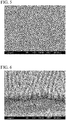
- Fig. 5 shows a scanning electron microscope image of a surface of the oxide film of the antimicrobial material
- Fig. 6 shows a scanning electron microscope image of a section of the antimicrobial material.
- An aluminum plate having a purity of 99.99% was polished by padding and electropolished in a perchloric acid/ethanol mixed solution (1/4 volume ratio) to be mirror-finished.
- the electropolished aluminum plate was anodized in a 0.3 mol/L sulfuric acid for 30 minutes under the conditions of DC 25 V and a temperature of 17°C.
- the aluminum plate on which an oxide film was formed was immersed in a 6% by mass phosphoric acid/1.8% by mass chromic acid mixed aqueous solution for 6 hours to remove a part or an entirety of the oxide film.
- the aluminum plate from which the oxide film was removed was anodized in a 0.3 mol/L sulfuric acid for 6 seconds under the conditions of DC 25 V and a temperature of 17°C.
- the aluminum plate on which the oxide film was formed was immersed in 10% by mass phosphoric acid at 30°C for 4 minutes to expand a pore diameter.
- the aluminum plate which was subjected to the pore diameter expanding treatment was anodized in a 0.3 mol/L sulfuric acid for 6 seconds under the conditions of DC 25 V and a temperature of 17°C.
- the step (d) and the step (e) are repeated a total of five times to obtain an antimicrobial material (test product) on which an oxide film (alumite) having a substantially conical recess portion with an average distance of 63 nm and a projection portion surrounded by the recess portion was formed.
- Table 1 shows an average distance, an average height, and an aspect ratio of the projection portions.
- An aluminum plate having a purity of 99.99% was polished by padding and electropolished in a perchloric acid/ethanol mixed solution (1/4 volume ratio) to be mirror-finished.
- the electropolished aluminum plate was anodized in a 0.05 mol/L oxalic acid aqueous solution for 30 minutes under the conditions of DC 80 V and a temperature of 17°C.
- the aluminum plate on which an oxide film was formed was immersed in a 6% by mass phosphoric acid/1.8% by mass chromic acid mixed aqueous solution for 6 hours to remove a part or an entirety of the oxide film.
- the aluminum plate from which the oxide film was removed was anodized in a 0.05 mol/L oxalic acid aqueous solution for 15 seconds under the conditions of DC 80 V and a temperature of 17°C.
- the aluminum plate on which the oxide film was formed was immersed in 5% by mass phosphoric acid at 30°C for 15 minutes to expand a pore diameter.
- the aluminum plate which was subjected to the pore diameter expanding treatment was anodized in a 0.05 mol/L oxalic acid aqueous solution for 15 seconds under the conditions of DC 80 V and a temperature of 17°C.
- the step (d) and the step (e) are repeated a total of five times to obtain an antimicrobial material (test product) on which an oxide film (alumite) having a substantially conical recess portion with an average distance of 200 nm and a projection portion surrounded by the recess portion was formed.
- Table 1 shows an average distance, an average height, and an aspect ratio of the projection portions.
- An aluminum plate having a purity of 99.99% was polished by padding and electropolished in a perchloric acid/ethanol mixed solution (1/4 volume ratio) to be mirror-finished.
- the electropolished aluminum plate was anodized in a 0.1 mol/L phosphoric acid aqueous solution for 60 minutes under the conditions of DC 195 V and a temperature of 0°C.
- the aluminum plate on which an oxide film was formed was immersed in a 6% by mass phosphoric acid/1.8% by mass chromic acid mixed aqueous solution for 6 hours to remove a part or an entirety of the oxide film.
- the aluminum plate from which the oxide film was removed was anodized in a 0.1 mol/L phosphoric acid aqueous solution for 90 seconds under the conditions of DC 195 V and a temperature of 0°C.
- the aluminum plate on which the oxide film was formed was immersed in 10% by mass phosphoric acid at 30°C for 35 minutes to expand a pore diameter.
- the aluminum plate which was subjected to the pore diameter expanding treatment was anodized in a 0.1 mol/L phosphoric acid aqueous solution for 90 seconds under the conditions of DC 195 V and a temperature of 0°C.
- the step (d) and the step (e) are repeated a total of four times to obtain an aluminum plate (test product) on which an oxide film (alumite) having a substantially conical recess portion with an average distance of 500 nm and a projection portion surrounded by the recess portion was formed.
- Table 1 shows an average distance, an average height, and an aspect ratio of the projection portions.
- An aluminum plate on which an oxide film having substantially conical recess portions having an average distance of 100 nm was formed was prepared as a mold.
- the acrylic curable resin composition was applied to a surface of the mold on a recess portion side, and a polyethylene terephthalate (hereinafter referred to as "PET") film having a thickness of 80 ⁇ m was put thereon.
- PET polyethylene terephthalate
- irradiation with ultraviolet rays was performed through a PET film with an integrated light amount of 1,000 mJ/cm 2 , and the acrylic curable resin composition was cured. Thereafter, the mold is separated to obtain a PET film (test product) in which a cured resin layer having a plurality of projection portions was formed on a surface.
- Table 1 shows an average distance, an average height, and an aspect ratio of the projection portions.
- test product 50 mm ⁇ 60 mm was immersed in 75% ethanol for 20 minutes and then sufficiently dried to obtain a test piece. Three test pieces were prepared for each example.
- Examples 1 to 4 and Comparative Example 1 An aluminum plate (50 mm ⁇ 50 mm) was immersed in 75% ethanol for 20 minutes and then sufficiently dried to obtain an unprocessed test piece as a control product. Six unprocessed test pieces were prepared for each example.
- Comparative Examples 1 to 3 A commercially available acrylic film was used as a target product. A control product (50 mm ⁇ 50 mm) was immersed in 75% ethanol for 20 minutes and then sufficiently dried to obtain an unprocessed test piece. Six unprocessed test pieces were prepared for each example.
- test bacteria were transplanted to an ordinary agar medium and cultured at 35°C for 24 hours, and then one platinum loop was transplanted to the ordinary agar medium again and cultured at 35°C for 20 hours.
- the bacterial cells were uniformly dispersed in a 1/500 concentration ordinary bouillon medium to obtain a test bacterial solution.
- test bacterial solution 0.4 mL of the test bacterial solution was dropped on a processed surface of the test piece, and a polyethylene terephthalate plate (40 mm ⁇ 40 mm) treated in the same manner as the test piece was put on the test piece and pressed so that the test bacterial solution was spread over the entire surface.
- a polyethylene terephthalate plate 40 mm ⁇ 40 mm treated in the same manner as the test piece was put on the test piece and pressed so that the test bacterial solution was spread over the entire surface.
- the same operation was performed on the unprocessed test pieces, and three test pieces and three unprocessed test pieces were allowed to stand at a temperature of 35°C and a relative humidity of 90% or higher for 24 hours. The remaining three unprocessed test pieces were used for measuring bacteria count immediately after inoculation with the test bacterial solution.
- test pieces and the unprocessed test pieces after standing for 24 hours were placed in a sterile stomacher bag, 10 mL of SCDLP bouillon medium was added thereto, and the bacterial solution was thoroughly washed out to prepare a specimen. 1 mL of the specimen was cultured using a standard agar medium at 35°C for 48 hours, and then viable bacteria count was measured. The same operation was performed on the unprocessed test piece immediately after inoculation.
- Uo is an average value of logarithmic values of viable bacteria counts of the unprocessed test piece immediately after inoculation
- Ut is an average value of logarithmic values of viable bacteria counts of the unprocessed test piece after 24 hours
- At is an average value of logarithmic values of viable bacteria counts of the test piece after 24 hours.
- the viable bacteria count was a value converted per 1 cm 2 of the test piece.
- An aluminum plate having a purity of 99.99% was polished by padding and electropolished in a perchloric acid/ethanol mixed solution (1/4 volume ratio) to be mirror-finished.
- the electropolished aluminum plate was anodized in a 0.3 M sulfuric acid for 1 minute under the conditions of DC 25 V and a temperature of 17°C to obtain an aluminum plate with an anodic oxide coating.
- Fig. 8 shows a scanning electron microscope image of the surface of the aluminum plate with an anodic oxide coating
- Fig. 9 shows a scanning electron microscope image of a section of the aluminum plate with an anodic oxide coating.
- the obtained aluminum plate with an anodic oxide coating was attached to a polyethylene plate to produce an antimicrobial layered body (test product).
- An aluminum plate having a purity of 99.99% was polished by padding and electropolished in a perchloric acid/ethanol mixed solution (1/4 volume ratio) to be mirror-finished.
- the electropolished aluminum plate was anodized in a 0.05 M oxalic acid aqueous solution for 100 seconds under the conditions of DC 80 V and a temperature of 17°C to obtain an aluminum plate with an anodic oxide coating.
- the obtained aluminum plate with an anodic oxide coating was attached to a polyethylene plate to produce an antimicrobial layered body (test product).
- An aluminum plate having a purity of 99.99% was polished by padding and electropolished in a perchloric acid/ethanol mixed solution (1/4 volume ratio) to be mirror-finished.
- the electropolished aluminum plate was anodized in a 0.1 M phosphoric acid aqueous solution for 8 minutes under the conditions of DC 195 V and a temperature of 0°C to obtain an aluminum plate with an anodic oxide coating.
- the obtained aluminum plate with an anodic oxide coating was attached to a polyethylene plate to produce an antimicrobial layered body (test product).
- test product 50 mm ⁇ 60 mm was immersed in 75% ethanol for 20 minutes and then sufficiently dried to obtain a test piece. Two test pieces were prepared for each example.
- test bacteria were transplanted to an ordinary agar medium and cultured at 35°C for 24 hours, and then one platinum loop was transplanted to the ordinary agar medium again and cultured at 35°C for 20 hours.
- the bacterial cells were uniformly dispersed in an ordinary bouillon medium having 1/500 concentration to obtain a test bacterial solution.
- test bacterial solution 0.4 mL was dropped on a processed surface of the test piece, and a polyethylene terephthalate plate (40 mm ⁇ 40 mm) treated in the same manner as the test piece was put on the test piece and pressed so that the test bacterial solution was spread over the entire surface.
- test pieces were allowed to stand at a temperature of 35°C and a relative humidity of 90% or higher for 24 hours.
- test pieces after standing for 24 hours were placed in a sterile stomacher bag, 10 mL of SCDLP bouillon medium was added thereto, and the bacterial solution was thoroughly washed out to prepare a specimen. 1 mL of the specimen was cultured using a standard agar medium at 35°C for 48 hours, and then viable bacteria count was measured.
- test bacterial solution 0.4 mL of the test bacterial solution was dropped on one surface of the unprocessed test piece, and a polyethylene terephthalate plate (40 mm ⁇ 40 mm) treated in the same manner as the test piece was put on the test piece and pressed so that the test bacterial solution was spread over the entire surface.
- a polyethylene terephthalate plate 40 mm ⁇ 40 mm
- SCDLP bouillon medium 10 mL
- viable bacteria count initial bacteria count
- Example 5 the growth of Staphylococcus aureus and Escherichia coli was strongly suppressed.
- Example 5 in which the sulfuric acid was used as the electrolytic solution showed a particularly excellent antimicrobial property.
- Example 7 in which the phosphoric acid was used as the electrolytic solution was able to suppress the growth of Staphylococcus aureus, but had a weak effect on Escherichia coli.
- An aluminum plate having a purity of 99.99% was polished by padding and electropolished in a perchloric acid/ethanol mixed solution (1/4 volume ratio) to be mirror-finished.
- the electropolished aluminum plate was anodized in a 0.3 M sulfuric acid for 1 minute under the conditions of DC 25 V and a temperature of 17°C to obtain an aluminum plate with an anodic oxide coating.
- the obtained aluminum plate with an anodic oxide coating was attached to a polyethylene plate to produce an antimicrobial layered body (test product).
- An aluminum plate having a purity of 99.99% was polished by padding and electropolished in a perchloric acid/ethanol mixed solution (1/4 volume ratio) to be mirror-finished.
- the electropolished aluminum plate was anodized in a 0.3 M sulfuric acid for 1 minute under the conditions of DC 25 V and a temperature of 17°C. Furthermore, a heat treatment (300°C, 10 minutes) was performed to obtain an aluminum plate with an anodic oxide coating.
- the obtained aluminum plate with an anodic oxide coating was attached to a polyethylene plate to produce an antimicrobial layered body (test product).
- An aluminum plate having a purity of 99.99% was polished by padding and electropolished in a perchloric acid/ethanol mixed solution (1/4 volume ratio) to be mirror-finished.
- the electropolished aluminum plate was anodized in a 6 M sulfuric acid for 1 minute under the conditions of DC 25 V and a temperature of 17°C.
- the obtained aluminum plate with an anodic oxide coating was attached to a polyethylene plate to produce an antimicrobial layered body (test product).
- An aluminum plate having a purity of 99.99% was polished by padding and electropolished in a perchloric acid/ethanol mixed solution (1/4 volume ratio) to be mirror-finished.
- the electropolished aluminum plate was anodized in a 8 M sulfuric acid for 1 minute under the conditions of DC 25 V and a temperature of 17°C to obtain an aluminum plate with an anodic oxide coating.
- the obtained aluminum plate with an anodic oxide coating was attached to a polyethylene plate to produce an antimicrobial layered body (test product).
- An aluminum plate having a purity of 99.99% was polished by padding and electropolished in a perchloric acid/ethanol mixed solution (1/4 volume ratio) to be mirror-finished.
- the electropolished aluminum plate was anodized in a 12 M sulfuric acid for 1 minute under the conditions of DC 25 V and a temperature of 17°C to obtain an aluminum plate with an anodic oxide coating.
- the obtained aluminum plate with an anodic oxide coating was attached to a polyethylene plate to produce an antimicrobial layered body (test product).
- An aluminum layer having a thickness of 50 nm and a purity of 99.999% was deposited on a surface of a polypropylene film base material having a thickness of 0.2 mm (PP craft film PF-11 manufactured by Acrysunday Co., Ltd.) by a sputtering method to obtain an aluminum layered polypropylene film.
- the obtained aluminum layered polypropylene film was anodized under the conditions of DC 25 V and a temperature 17°C while being slowly immersed in an electrolytic solution at a speed of 2 mm/min using a dip coater to produce an antimicrobial layered body (test product) in which the deposited aluminum layer was almost completely anodized. 12M sulfuric acid was used as the electrolytic solution. In the obtained layered body, the aluminum layer was completely anodized and was translucent.
- An antimicrobial test was performed for test products of Examples 8 to 13 and Comparative Example 6 by partially modifying contents of JIS Z 2801: 2010 (corresponding international standard ISO 22196: 2007). Specifically, at the time of adjusting the bacterial solution, a concentration of the ordinary bouillon medium in which bacterial cells were uniformly dispersed was set to 1/100 concentration, which was 5 times higher than that of the JIS standard. Other than the above, the same operation as in Examples 5 to 7 was performed, and the viable bacteria count was measured. Measurement results were shown in Table 2. Note that, the viable bacteria count is the average value of the results obtained from the three test pieces.
- Examples 8 and 9 were able to suppress the growth of Staphylococcus aureus, but had a weak effect on Escherichia coli.
- Examples 10 to 13 were able to strongly suppress the growth of both Staphylococcus aureus and Escherichia coli.
- the surface of the test piece used in Examples 8 to 12 was measured under the following conditions, and an abundance ratio of each atom on the surface of the metal oxide layer was determined.
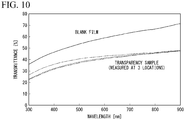
- a total light transmittance of the antimicrobial layered body obtained in Example 13 and the polypropylene film base material (blank film) used for producing the same was measured.
- a haze meter manufactured by Suga Test Instruments Co., Ltd.
- JIS K 7136: 2000 was used for the measurement. Results are shown in Fig. 10 .
- the antimicrobial layered body obtained in Example 13 transmitted light in all wavelength bands of visible light.
- An antimicrobial test was performed for an acrylic plate, an aluminum plate, and a test product of Examples 13 by partially modifying contents of JIS Z 2801: 2010 (corresponding international standard ISO 22196: 2007). Specifically, at the time of adjusting the bacterial solution, the antimicrobial test was performed at a medium concentration by setting the concentration of the ordinary bouillon medium in which bacterial cells were uniformly dispersed to 1/50 concentration, which was 10 times higher, 1/20 concentration, which was 25 times higher, or 1/10 concentration, which was 50 times higher than that of the JIS standard. Measurement results were shown in Table 5. Note that, the viable bacteria count is the average value of the results obtained from the three test pieces.
- Example 13 Even in a test conducted in an environment in which germs were much more likely to grow than in JIS Z 2801: 2010 (corresponding international standard ISO 22196: 2007), the antimicrobial layered body of Example 13 was able to strongly suppress the growth of both Staphylococcus aureus and Escherichia coli.
- the antimicrobial material and the antimicrobial layered body of the present invention can exhibit an excellent antimicrobial effect without using a drug, and thus are useful as a medical member, a food packaging material, and the like.
Landscapes
- Chemical & Material Sciences (AREA)
- Health & Medical Sciences (AREA)
- Engineering & Computer Science (AREA)
- Life Sciences & Earth Sciences (AREA)
- Chemical Kinetics & Catalysis (AREA)
- Electrochemistry (AREA)
- Materials Engineering (AREA)
- Metallurgy (AREA)
- Organic Chemistry (AREA)
- Public Health (AREA)
- Veterinary Medicine (AREA)
- Animal Behavior & Ethology (AREA)
- General Health & Medical Sciences (AREA)
- Epidemiology (AREA)
- Medicinal Chemistry (AREA)
- Inorganic Chemistry (AREA)
- Surgery (AREA)
- Transplantation (AREA)
- Oral & Maxillofacial Surgery (AREA)
- Dermatology (AREA)
- Heart & Thoracic Surgery (AREA)
- Vascular Medicine (AREA)
- Biomedical Technology (AREA)
- Molecular Biology (AREA)
- General Chemical & Material Sciences (AREA)
- Laminated Bodies (AREA)
- Agricultural Chemicals And Associated Chemicals (AREA)
- Materials For Medical Uses (AREA)
- Dental Preparations (AREA)
Applications Claiming Priority (3)
| Application Number | Priority Date | Filing Date | Title |
|---|---|---|---|
| JP2018183510 | 2018-09-28 | ||
| JP2019145611 | 2019-08-07 | ||
| PCT/JP2019/038349 WO2020067500A1 (ja) | 2018-09-28 | 2019-09-27 | 抗菌材、積層体、抗菌性積層体、医療用部材、抗菌材の製造方法、抗菌性積層体の製造方法及び抗菌方法 |
Publications (2)
| Publication Number | Publication Date |
|---|---|
| EP3858596A1 true EP3858596A1 (de) | 2021-08-04 |
| EP3858596A4 EP3858596A4 (de) | 2021-11-24 |
Family
ID=69953129
Family Applications (1)
| Application Number | Title | Priority Date | Filing Date |
|---|---|---|---|
| EP19865633.2A Withdrawn EP3858596A4 (de) | 2018-09-28 | 2019-09-27 | Antimikrobielles material, schichtkörper, antimikrobieller schichtkörper, medizinisches element, verfahren zur herstellung eines antimikrobiellen materials, verfahren zur herstellung eines antimikrobiellen schichtkörpers und antimikrobielles verfahren |
Country Status (5)
| Country | Link |
|---|---|
| US (1) | US20210206136A1 (de) |
| EP (1) | EP3858596A4 (de) |
| JP (1) | JP7204153B2 (de) |
| CN (1) | CN112770900A (de) |
| WO (1) | WO2020067500A1 (de) |
Families Citing this family (9)
| Publication number | Priority date | Publication date | Assignee | Title |
|---|---|---|---|---|
| WO2014143750A1 (en) * | 2013-03-15 | 2014-09-18 | Boston Scientific Scimed, Inc. | Anti-migration micropatterned stent coating |
| EP4117737A1 (de) * | 2020-03-13 | 2023-01-18 | Ricoh Company, Ltd. | Antipathogenstruktur, verfahren zur herstellung einer antipathogenstruktur, vorrichtung zur herstellung einer antipathogenstruktur und flüssige zusammensetzung |
| JPWO2021193742A1 (de) * | 2020-03-25 | 2021-09-30 | ||
| CN115315275A (zh) * | 2020-03-27 | 2022-11-08 | 本田技研工业株式会社 | 功能性材料和其制造方法 |
| JP7097486B1 (ja) | 2021-09-07 | 2022-07-07 | ジオマテック株式会社 | 抗ウイルス性微細構造を備える物品及び抗ウイルス性微細構造の転写方法 |
| CN114517319B (zh) * | 2022-03-01 | 2024-03-29 | 九牧厨卫股份有限公司 | 一种灰金色杀菌膜、灰金色杀菌产品及其制备方法 |
| CN115970057B (zh) * | 2022-09-09 | 2024-05-28 | 浙江科惠医疗器械股份有限公司 | 一种具有花瓣状TiO2纳米孔抗菌涂层的制备方法 |
| JP2025042250A (ja) * | 2023-09-14 | 2025-03-27 | 三菱マテリアル株式会社 | 接着構造体、および、接着構造体の製造方法 |
| WO2026023201A1 (ja) * | 2024-07-23 | 2026-01-29 | シャープ株式会社 | 水処理器具、水処理装置、洗濯機、空気調和機、冷蔵庫及び給湯設備 |
Family Cites Families (25)
| Publication number | Priority date | Publication date | Assignee | Title |
|---|---|---|---|---|
| US4995987A (en) * | 1989-09-21 | 1991-02-26 | Betz Laboratories, Inc. | Enhancement of the efficacy of antimicrobials by the addition of anions capable of interfering with microbial electrochemical reactions |
| JP2000064093A (ja) * | 1998-08-21 | 2000-02-29 | Kyoto Booze:Kk | 陽極酸化アルミニウム材の抗菌処理方法 |
| JP4651760B2 (ja) * | 1998-12-28 | 2011-03-16 | ピジョン株式会社 | 防菌防黴剤の繊維集合材料への吸着量の低減方法 |
| JP3712229B2 (ja) * | 2000-05-22 | 2005-11-02 | 株式会社Gha | アルミニウム又はその合金の表面処理方法 |
| AU2001289859A1 (en) * | 2000-09-05 | 2002-03-22 | Zeptosens Ag | Method for precipitating mono and multiple layers of organophosphoric and organophosphonic acids and the salts thereof in addition to use thereof |
| EP1593758A4 (de) * | 2003-01-30 | 2006-11-29 | Nihon Alumina Kakou Kabushiki | Verfahren zur ausbildung einer anodischen oxidbeschichtung auf der oberfläche von aluminium oder aluminiumlegierung |
| JP2006057161A (ja) | 2004-08-23 | 2006-03-02 | Gha:Kk | 抗菌部材、抗菌革材及びそれらの製造方法 |
| JP2008061897A (ja) | 2006-09-08 | 2008-03-21 | Saga Univ | 生体インプラント |
| JP4868466B2 (ja) * | 2008-06-18 | 2012-02-01 | 三谷 稔 | アルミニウム又はアルミニウム合金の表面処理方法及びその表面処理方法により処理されたアルミニウム又はその合金製品 |
| MX2011010391A (es) * | 2009-08-25 | 2012-01-20 | Prostec Co Ltd | Suministros medicos y metodo para producir los mismos. |
| JP6249592B2 (ja) * | 2011-03-17 | 2017-12-20 | 住友化学株式会社 | 銀−共役化合物複合体組成物 |
| JP5472752B2 (ja) * | 2011-06-01 | 2014-04-16 | 株式会社ハイジェニックス | 殺菌用水溶液の製造方法、アルコール殺菌液及びその製造方法 |
| CA2838017C (en) * | 2011-06-03 | 2019-08-27 | DePuy Synthes Products, LLC | Multilayered valve metal coating for a surgical implant |
| JP6396217B2 (ja) | 2012-03-02 | 2018-09-26 | シンセス・ゲーエムベーハーSynthes GmbH | 陽極酸化チタン装置及び関連方法 |
| WO2016021367A1 (ja) * | 2014-08-07 | 2016-02-11 | シャープ株式会社 | 表面が殺菌作用を備えたフィンを有する熱交換器、殺菌作用を備えた表面を有する金属部材、熱交換器のフィンの表面または金属部材の表面を用いたカビの発生を抑制する方法および殺菌方法、ならびに、金属部材を有する電気湯沸かし器、飲料供給器および弁当箱のふた |
| JP2016093939A (ja) * | 2014-11-13 | 2016-05-26 | 大日本印刷株式会社 | 抗菌性物品 |
| WO2016080245A1 (ja) * | 2014-11-20 | 2016-05-26 | シャープ株式会社 | 殺菌作用を備えた表面を有する合成高分子膜 |
| JP6500409B2 (ja) | 2014-12-01 | 2019-04-17 | 大日本印刷株式会社 | 抗菌性物品 |
| JP2016210164A (ja) | 2015-05-01 | 2016-12-15 | 大日本印刷株式会社 | カビ繁殖抑制部材、及び農業用カビ繁殖抑制物品 |
| JP2016215622A (ja) * | 2015-05-14 | 2016-12-22 | 大日本印刷株式会社 | 抗菌・抗カビ性物品、及び農業用抗菌・抗カビ性物品 |
| JP2017132916A (ja) | 2016-01-28 | 2017-08-03 | 大日本印刷株式会社 | 抗菌性物品 |
| WO2017130029A1 (en) * | 2016-01-29 | 2017-08-03 | Nanoti Limited | Scratch resistance and corrosion behavior of nanotubular and nano-pitted anodic films on medical grade bulk titanium substrates |
| JP6985809B2 (ja) | 2017-04-27 | 2021-12-22 | 東芝ライフスタイル株式会社 | 衣類乾燥機 |
| CN107774284B (zh) * | 2017-11-10 | 2020-01-10 | 纳琦环保科技有限公司 | 水性纳米抗菌光催化钛氧化物复合溶胶的制备方法 |
| JP7118660B2 (ja) | 2018-02-19 | 2022-08-16 | 三菱重工業株式会社 | 差動トランス式変位計の断線検知システム、差動トランス式変位計、及び断線検知方法 |
-
2019
- 2019-09-27 CN CN201980063922.8A patent/CN112770900A/zh active Pending
- 2019-09-27 JP JP2020549476A patent/JP7204153B2/ja active Active
- 2019-09-27 WO PCT/JP2019/038349 patent/WO2020067500A1/ja not_active Ceased
- 2019-09-27 EP EP19865633.2A patent/EP3858596A4/de not_active Withdrawn
-
2021
- 2021-03-25 US US17/212,078 patent/US20210206136A1/en not_active Abandoned
Also Published As
| Publication number | Publication date |
|---|---|
| US20210206136A1 (en) | 2021-07-08 |
| EP3858596A4 (de) | 2021-11-24 |
| JP7204153B2 (ja) | 2023-01-16 |
| JPWO2020067500A1 (ja) | 2021-09-02 |
| WO2020067500A1 (ja) | 2020-04-02 |
| CN112770900A (zh) | 2021-05-07 |
Similar Documents
| Publication | Publication Date | Title |
|---|---|---|
| US20210206136A1 (en) | Antimicrobial material, layered body, antimicrobial layered body, medical member, antimicrobial material production method, antimicrobial layered body production method, and antimicrobial method | |
| EP2371398B1 (de) | Medizinische komponente und verfahren zu ihrer herstellung | |
| JP5437809B2 (ja) | 抗菌効果を有する物質 | |
| CN102497892B (zh) | 采用纳米银进行的骨接合 | |
| EP1790224B1 (de) | Antimikrobielles Schichtmaterial | |
| DE102010054046B4 (de) | Antibakterielle Beschichtung für ein Implantat und Implantat. | |
| CN108904893B (zh) | 一种兼具抗菌和生物相容性的复合涂层及其制备方法和应用 | |
| EP2830673A1 (de) | Medizinische vorrichtung mit einer oberfläche mit galliumoxid | |
| WO2022262600A1 (zh) | 促细胞生长和抑细菌粘附的医用材料及加工方法 | |
| EP3294354B1 (de) | Metallobjekt mit aufgerauter oberfläche und verfahren zur herstellung | |
| Jain et al. | Photofunctionalization of anodized titanium surfaces using UVA or UVC light and its effects against Streptococcus sanguinis | |
| JP5692729B2 (ja) | 金属処理 | |
| Ionita et al. | Modifying the TiAlZr biomaterial surface with coating, for a better anticorrosive and antibacterial performance | |
| EP3666932A1 (de) | Herstellungsverfahren eines personalisierten, biokompatiblen und bioaktiven orthopädischen implantats | |
| Sheveyko et al. | Ag+, Cu2+ and Zn2+ ion-induced in vitro antibacterial activity of Ag-, Cu-, and Zn-doped coatings deposited by plasma electrolytic oxidation, anodization and cathodic electrodeposition on 3D-printed Ti6Al4V implants | |
| Aydin et al. | Antimicrobial properties and corrosion behavior of TiO2NTs electrodes modified with Ag and ZnO nanorod in simulated body fluid solution | |
| Ferreira et al. | Nanotexturization of Ti-based implants in simulated body fluid: Influence of synthesis parameters on coating properties and kinetics of drug release | |
| EP2229962A1 (de) | Medizinisch-chirurgische Vorrichtungen mit antibakterieller Beschichtung für ein Implantat für Menschen oder Tiere und Verfahren zu deren Herstellung | |
| JP2023140163A (ja) | 抗菌性を有する金属酸化物粒子及びその製造方法、抗菌材及びその製造方法、塗料、成形体、繊維、並びに抗菌方法 | |
| Zemtsova et al. | Creation of a bioactive coating on titanium with a two-level surface structure hierarchy at the nano-and micro-level promising for bone implantation | |
| Constantinescu et al. | Complex interplay of surface properties in modulating antibacterial activity of Ti50Zr alloys | |
| US20260102539A1 (en) | Antibiofilm and antimicrobial surfaces | |
| Stoian et al. | Complex Bioactive Chitosan–Bioglass Coatings on a New Advanced TiTaZrAg Medium–High-Entropy Alloy. Coatings 2023, 13, 971 | |
| Zhukovskii et al. | Preparation and study of polymer implants with a silver nanocoating | |
| JP2023072630A (ja) | 培養器具及び培養器具の製造方法 |
Legal Events
| Date | Code | Title | Description |
|---|---|---|---|
| STAA | Information on the status of an ep patent application or granted ep patent |
Free format text: STATUS: THE INTERNATIONAL PUBLICATION HAS BEEN MADE |
|
| PUAI | Public reference made under article 153(3) epc to a published international application that has entered the european phase |
Free format text: ORIGINAL CODE: 0009012 |
|
| STAA | Information on the status of an ep patent application or granted ep patent |
Free format text: STATUS: REQUEST FOR EXAMINATION WAS MADE |
|
| 17P | Request for examination filed |
Effective date: 20210423 |
|
| AK | Designated contracting states |
Kind code of ref document: A1 Designated state(s): AL AT BE BG CH CY CZ DE DK EE ES FI FR GB GR HR HU IE IS IT LI LT LU LV MC MK MT NL NO PL PT RO RS SE SI SK SM TR |
|
| A4 | Supplementary search report drawn up and despatched |
Effective date: 20211022 |
|
| RIC1 | Information provided on ipc code assigned before grant |
Ipc: C25D 11/08 20060101ALI20211018BHEP Ipc: B32B 9/00 20060101ALI20211018BHEP Ipc: A61L 31/16 20060101ALI20211018BHEP Ipc: A61L 31/08 20060101ALI20211018BHEP Ipc: A61L 31/02 20060101ALI20211018BHEP Ipc: A61L 27/54 20060101ALI20211018BHEP Ipc: A61L 27/30 20060101ALI20211018BHEP Ipc: A61L 27/04 20060101ALI20211018BHEP Ipc: B32B 3/30 20060101AFI20211018BHEP |
|
| DAV | Request for validation of the european patent (deleted) | ||
| DAX | Request for extension of the european patent (deleted) | ||
| STAA | Information on the status of an ep patent application or granted ep patent |
Free format text: STATUS: EXAMINATION IS IN PROGRESS |
|
| 17Q | First examination report despatched |
Effective date: 20230620 |
|
| STAA | Information on the status of an ep patent application or granted ep patent |
Free format text: STATUS: THE APPLICATION IS DEEMED TO BE WITHDRAWN |
|
| 18D | Application deemed to be withdrawn |
Effective date: 20250401 |