EP3859221A1 - Klimaanlagensystem und anwendungsprogramm - Google Patents
Klimaanlagensystem und anwendungsprogramm Download PDFInfo
- Publication number
- EP3859221A1 EP3859221A1 EP18935097.8A EP18935097A EP3859221A1 EP 3859221 A1 EP3859221 A1 EP 3859221A1 EP 18935097 A EP18935097 A EP 18935097A EP 3859221 A1 EP3859221 A1 EP 3859221A1
- Authority
- EP
- European Patent Office
- Prior art keywords
- air
- unit
- indoor unit
- conditioning apparatus
- radio wave
- Prior art date
- Legal status (The legal status is an assumption and is not a legal conclusion. Google has not performed a legal analysis and makes no representation as to the accuracy of the status listed.)
- Granted
Links
Images




Classifications
-
- F—MECHANICAL ENGINEERING; LIGHTING; HEATING; WEAPONS; BLASTING
- F24—HEATING; RANGES; VENTILATING
- F24F—AIR-CONDITIONING; AIR-HUMIDIFICATION; VENTILATION; USE OF AIR CURRENTS FOR SCREENING
- F24F11/00—Control or safety arrangements
- F24F11/50—Control or safety arrangements characterised by user interfaces or communication
- F24F11/56—Remote control
-
- F—MECHANICAL ENGINEERING; LIGHTING; HEATING; WEAPONS; BLASTING
- F24—HEATING; RANGES; VENTILATING
- F24F—AIR-CONDITIONING; AIR-HUMIDIFICATION; VENTILATION; USE OF AIR CURRENTS FOR SCREENING
- F24F11/00—Control or safety arrangements
- F24F11/50—Control or safety arrangements characterised by user interfaces or communication
- F24F11/54—Control or safety arrangements characterised by user interfaces or communication using one central controller connected to several sub-controllers
-
- F—MECHANICAL ENGINEERING; LIGHTING; HEATING; WEAPONS; BLASTING
- F24—HEATING; RANGES; VENTILATING
- F24F—AIR-CONDITIONING; AIR-HUMIDIFICATION; VENTILATION; USE OF AIR CURRENTS FOR SCREENING
- F24F11/00—Control or safety arrangements
- F24F11/50—Control or safety arrangements characterised by user interfaces or communication
- F24F11/52—Indication arrangements, e.g. displays
-
- F—MECHANICAL ENGINEERING; LIGHTING; HEATING; WEAPONS; BLASTING
- F24—HEATING; RANGES; VENTILATING
- F24F—AIR-CONDITIONING; AIR-HUMIDIFICATION; VENTILATION; USE OF AIR CURRENTS FOR SCREENING
- F24F11/00—Control or safety arrangements
- F24F11/62—Control or safety arrangements characterised by the type of control or by internal processing, e.g. using fuzzy logic, adaptive control or estimation of values
- F24F11/63—Electronic processing
- F24F11/64—Electronic processing using pre-stored data
Definitions
- the present disclosure relates to an air-conditioning system that conditions air by a plurality of indoor unit parts installed in a building such as an office and a shop, and an application program.
- a centralized controller is commonly used when the plurality of indoor unit parts are operated.
- an indoor floor plan is displayed on a screen on the centralized controller, and furthermore, to find out installation locations of the indoor unit parts, images of the indoor unit parts are arranged in the indoor floor plan and displayed on the screen.
- a method is commonly performed for a user to check the user's own location on the floor plan, and operate indoor unit parts located close to the user.
- a remote control device that can bidirectionally exchange data signals with a plurality of devices by using radio waves, and operations of the devices under management performed by the remote control device can be easily performed by associating data including ID codes assigned to the plurality of respective devices with results of averaging process for a predetermined period of time of radio wave intensities of the data signals and by registering the associated items, at the time of initial setting (for example, see Patent Literature 1).
- Patent Literature 1 a plurality of devices corresponding to operation targets such as air-conditioning apparatuses have unique IDs. At the time of the initial setting, these devices notify a remote control device of the IDs, and intensities of radio waves transmitted by the devices are associated with the IDs and the associated items are registered in the remote control device. As a result, it is possible to operate only the devices corresponding to the operation targets in the vicinity of the user.
- Patent Literature 1 Japanese Unexamined Patent Application Publication No. 2003-284169
- Patent Literature 1 As the IDs are registered in the remote control device at the time of the initial setting, under an environment where locations of the devices corresponding to the operation targets are frequently changed, a problem is caused in that much work is required for the initial setting, and the operation targets are not to be flexibly changed.
- the present disclosure has been made to solve the above-described problem and is aimed at providing an air-conditioning system and an application program each configured such that ones of indoor unit parts corresponding to targets of a collective setting operation can be flexibly changed.
- An air-conditioning system includes a plurality of indoor unit parts having wireless communication units configured to transmit wireless radio waves, and a mobile terminal unit configured to perform a wireless communication with each of the wireless communication units.
- the mobile terminal unit includes an air-conditioning apparatus operation input unit configured to accept input from a user, an air-conditioning apparatus information display unit configured to display information to the user, and an air-conditioning apparatus operation management unit configured to control the plurality of indoor unit parts.
- the air-conditioning apparatus operation management unit is configured to cause the air-conditioning apparatus information display unit to display a list of the plurality of indoor unit parts and is configured to cause the air-conditioning apparatus information display unit also to perform display for urging selection of ones of the plurality of indoor unit parts as targets of a collective setting operation.
- the air-conditioning apparatus operation management unit is configured to set the selected ones of the plurality of indoor unit parts as a group.
- an application program is configured to cause a computer to execute processing for causing a display unit configured to display information to a user to display a list of indoor unit parts and also to perform display for urging selection of ones of the indoor unit parts as targets of a collective setting operation.
- the application program is configured to cause the computer to execute processing for setting the selected ones of the indoor unit parts as a group.
- the air-conditioning apparatus operation management unit causes the air-conditioning apparatus information display unit to display the list of the indoor unit parts and also to perform the display for urging the selection of ones of the indoor unit parts as the targets of the collective setting operation. Then, when ones of the indoor unit parts are selected from the air-conditioning apparatus operation input unit, the air-conditioning apparatus operation management unit sets the selected ones of the indoor unit parts as a group. For this reason, group setting can be easily made, and ones of the indoor unit parts corresponding to the targets of the collective setting operation can be flexibly changed.
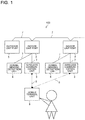
- Fig. 1 is a schematic diagram illustrating a configuration of an air-conditioning system 100 according to Embodiment 1 of the present disclosure.
- the air-conditioning system 100 includes a plurality of indoor unit parts 2 configured to condition air in air-conditioned spaces, an outdoor unit part 5 forming, together with the indoor unit parts 2, a refrigerant circuit, and a mobile terminal unit 6 configured to communicate with the indoor unit parts 2.
- each of the indoor unit parts 2 is provided with a wireless communication unit 3 configured to transmit a wireless radio wave, and a human-sensing detection unit 4 configured to detect a person.
- the indoor unit parts 2 and the outdoor unit part 5 form the refrigerant circuit in which refrigerant circulates, and are connected to each other by a wired communication line section 7 for each of refrigerant systems. It is noted that in one refrigerant system, the indoor unit part 2 may also include a plurality of indoor unit parts 2, and the outdoor unit part 5 may also include a plurality of outdoor unit parts 5. In addition, each of the indoor unit parts 2 and the outdoor unit part 5 can bidirectionally communicate with each other via the wired communication line section 7.
- the wireless communication unit 3 and the human-sensing detection unit 4 are connected to the corresponding indoor unit part 2 by the wired communication line section 7 through which communications can be performed bidirectionally.
- a configuration is adopted where one wireless communication unit 3 is connected to one indoor unit part 2 but is not limited to this case, and for example, a configuration may also be adopted where one wireless communication unit 3 is connected to two indoor unit parts 2.
- one wireless communication unit 3 may be a shared unit by the plurality of indoor unit parts 2.
- the wired communication line section 7 is configured by a widely used communication standard such as Ethernet (registered trademark) and a two-wire universal asynchronous receiver transmitter (UART), or a unique communication standard.
- a widely used communication standard such as Ethernet (registered trademark) and a two-wire universal asynchronous receiver transmitter (UART), or a unique communication standard.
- the wireless communication unit 3 and the human-sensing detection unit 4 may have a structure independent from the indoor unit part 2, or may also have a structure built inside the indoor unit part 2.
- the wired communication line section 7 can be configured by a widely used communication standard such as an inter-integrated circuit (I2C).
- I2C inter-integrated circuit
- the wireless communication unit 3 can bidirectionally communicate with the mobile terminal unit 6 via a wireless communication line section 8.
- the wireless communication line section 8 is configured by a widely used communication standard such as Wi-Fi (registered trademark), Bluetooth (registered trademark), and ZigBee (registered trademark).
- the human-sensing detection unit 4 is configured to detect a person in the vicinity of the indoor unit part 2, in other words, a person at a certain distance from the indoor unit part 2, and is a thermal viewer, a camera, a human-sensing sensor, or other device.
- the certain distance from the indoor unit part 2 is a distance within the air-conditioned space assigned to the indoor unit part 2. It is noted that the air-conditioning system 100 according to present Embodiment 1 may also have a configuration excluding the human-sensing detection unit 4.
- the wireless communication unit 3 and the human-sensing detection unit 4 are disposed close to an air outlet of the concealed package, close to an air inlet of the concealed package, or at a duct. It is noted that the wireless communication unit 3 and the human-sensing detection unit 4 may be built in the indoor unit part 2 or may also be separate units attached to the indoor unit part 2.
- the mobile terminal unit 6 is, for example, a commercially available smart phone or tablet PC, or other device, and may have any configuration as long as the mobile terminal unit 6 can wirelessly communicate with the wireless communication unit 3.
- An application program for operating the air-conditioning system 100 is installed in this mobile terminal unit 6.
- Fig. 2 is a block diagram illustrating an internal processing configuration of the air-conditioning system 100 according to Embodiment 1 of the present disclosure.
- the indoor unit part 2 includes an indoor unit control unit 11.
- the indoor unit control unit 11 is configured to execute control of the indoor unit part 2 for executing an air-conditioning operation in cooperation with the outdoor unit part 5 and other indoor unit part 2 that are connected by the wired communication line section 7 in the same refrigerant system.
- the wireless communication unit 3 includes a wireless ID unit 12 and a wireless transmission and reception unit 13.
- the wireless communication unit 3 includes a control circuit including an MCU, RAM, ROM, or other device configured to control the wireless ID unit 12 and the wireless transmission and reception unit 13.
- the wireless ID unit 12 is configured to record an ID uniquely assigned to the wireless communication unit 3, and is a ROM or other device included in the wireless communication unit 3.
- a BD address, a MAC address, and other address can be used as the ID.
- the wireless transmission and reception unit 13 is configured to execute transmission and reception of the wireless communication line section 8, and is a digital signal processing circuit, an analog signal processing circuit, an antenna circuit, or other circuit.
- the outdoor unit part 5 includes an outdoor unit control unit 14.
- the outdoor unit control unit 14 is configured to execute control of the outdoor unit part 5 for executing an air-conditioning operation in cooperation with the indoor unit part 2 and other outdoor unit part 5 that are connected by the wired communication line section 7 in the same refrigerant system.
- the mobile terminal unit 6 includes a mobile terminal side wireless communication unit 9, an air-conditioning apparatus operation management unit 15, an air-conditioning apparatus operation input unit 16, and an air-conditioning apparatus information display unit 17.
- an application program for executing processing for detecting a wireless radio wave transmitted by the wireless transmission and reception unit 13, processing for transmitting an air-conditioning operation command, which will be described below, to the wireless transmission and reception unit 13, and other processing is installed in the mobile terminal unit 6.
- the application program installed in the mobile terminal unit 6 is stored in the air-conditioning apparatus operation management unit 15, but may alternatively be stored in a storage unit other than the air-conditioning apparatus operation management unit 15.
- the mobile terminal side wireless communication unit 9 has a function similar to that of the wireless communication unit 3 provided to the indoor unit part 2, and the function can be implemented by using a function originally included in the mobile terminal unit 6.
- the air-conditioning apparatus operation management unit 15 is configured to control a setting operation such as starting of operation, stopping of the operation, and temperature setting for the indoor unit part 2, and control the wireless communication unit 3 provided to the indoor unit part 2 by the application program.
- the air-conditioning apparatus operation management unit 15 is configured to measure a radio wave intensity of a received wireless radio wave, for example, a received signal strength indication (RSSI) by the application program.
- the air-conditioning apparatus operation management unit 15 is configured to record a wireless ID of the wireless communication unit 3 provided to the indoor unit part 2 by the application program, and the function of recording the wireless ID can be implemented by an MCU, RAM, ROM, a flash memory, or other device.
- the air-conditioning apparatus operation management unit 15 determines that the mobile terminal unit 6 receives a wireless radio wave from the wireless communication unit 3 provided to the indoor unit part 2 and the indoor unit part 2 is located close to the mobile terminal unit 6, the wireless ID is recorded.
- the radio wave intensity of the wireless radio wave is associated with a distance, and it can be determined that the indoor unit part 2 provided with the wireless communication unit 3 that transmits a wireless radio wave having a higher radio wave intensity is located closer to the mobile terminal unit 6.
- the air-conditioning apparatus operation management unit 15 thus determines whether or not the indoor unit part 2 is located close to the mobile terminal unit 6 on the basis of the radio wave intensity of the wireless radio wave received from the wireless communication unit 3 provided to the indoor unit part 2.
- the air-conditioning apparatus operation management unit 15 determines that the indoor unit part 2 is no longer close to the mobile terminal unit 6 when the mobile terminal unit 6 does not receive the wireless radio wave for a certain period of time from the wireless communication unit 3 of the indoor unit part 2, and deletes the stored wireless ID.
- the air-conditioning apparatus operation input unit 16 is configured to accept input of the setting operation such as the starting of the operation, the stopping of the operation, and the temperature setting for the indoor unit part 2 by a user from the mobile terminal unit 6, and is formed by a button, a touch screen, and other parts included in the mobile terminal unit 6.
- the air-conditioning apparatus operation input unit 16 can obtain the setting operation such as the starting of the operation, the stopping of the operation, and the temperature setting by the application program executed on the mobile terminal unit 6.
- the mobile terminal side wireless communication unit 9 can communicate with the wireless communication unit 3 provided to the indoor unit part 2 by the application program executed on the mobile terminal unit 6.
- the air-conditioning apparatus information display unit 17 is configured to display necessary information when the user inputs the setting operation such as the starting of the operation, the stopping of the operation, and the temperature setting for the indoor unit part 2 from the mobile terminal unit 6, and is formed by a touch screen or other part included in the mobile terminal unit 6. It is noted that the air-conditioning apparatus operation input unit 16 and the air-conditioning apparatus information display unit 17 may have structures separate from each other, or may also have an integrated structure.
- wireless radio signals transmitted and received by the wireless communication unit 3 and the mobile terminal side wireless communication unit 9 include wireless ID information of transmission sources, address information of the transmission sources, operation command information for the indoor unit part 2, and other information.
- the air-conditioning system 100 performs grouping on the basis of radio wave intensities of the wireless communication units 3 provided to the respective indoor unit parts 2, in other words, causes the user to manually select ones of the indoor unit parts 2 to be set as a group, and sets the selected ones of the selected indoor unit parts 2 as a group. It is noted that this grouping also includes a case where a set of ones of the indoor unit parts 2 corresponding to targets of a collective setting operation is set only once, in other words, a case where the group that has been set once is subsequently subjected to cancellation of the group setting.
- Fig. 3 is a flowchart illustrating processing for making group setting of the indoor unit parts 2 by the mobile terminal unit 6 of the air-conditioning system 100 according to Embodiment 1 of the present disclosure.
- Fig. 4 is a diagram for describing groups of the air-conditioning system 100 according to Embodiment 1 of the present disclosure.
- the air-conditioning apparatus operation management unit 15 When the air-conditioning apparatus operation management unit 15 accepts input of a user ID from the air-conditioning apparatus operation input unit 16, the air-conditioning apparatus operation management unit 15 determines whether or not a user is an administrator with reference to information related to user IDs. It is noted that the information related to the user IDs is stored in the air-conditioning apparatus operation management unit 15. When the air-conditioning apparatus operation management unit 15 determines that the user is the administrator (YES), this process proceeds to the processing in step S502. On the other hand, when the air-conditioning apparatus operation management unit 15 determines that the user is not the administrator (NO), the process proceeds to the processing in step S507. It is noted that the information related to the user IDs may alternatively be stored in a storage unit other than the air-conditioning apparatus operation management unit 15.
- the air-conditioning apparatus operation management unit 15 determines whether or not a group is set in advance.
- the group refers to a set of ones of the indoor unit parts 2 corresponding to the targets of the collective setting operation.
- Fig. 4 for example, in a case where two indoor unit parts 2 belong to a group 1, when the group 1 is selected and operation for starting operation is performed on the group 1, an operation start command is transmitted to all of the two indoor unit parts 2 belonging to the group 1.
- the air-conditioning apparatus operation management unit 15 stores group information in which a number of the group and information of wireless IDs of the wireless communication units 3 of the indoor unit parts 2 belonging to the group are associated with each other.
- the process proceeds to the processing in step S503.
- the process proceeds to the processing in step S504. It is noted that the group information may alternatively be stored in a storage unit other than the air-conditioning apparatus operation management unit 15.
- the air-conditioning apparatus operation management unit 15 causes the air-conditioning apparatus information display unit 17 to perform display for urging the user to input on whether or not the group is reset. After the user inputs on whether or not the group is reset from the air-conditioning apparatus operation input unit 16, the air-conditioning apparatus operation management unit 15 determines whether or not the air-conditioning apparatus operation management unit 15 has accepted input for resetting the group from the air-conditioning apparatus operation input unit 16. When the air-conditioning apparatus operation management unit 15 determines that the air-conditioning apparatus operation management unit 15 has accepted the input for resetting the group from the air-conditioning apparatus operation input unit 16 (YES), the process proceeds to the processing in step S504.
- step S507 when the air-conditioning apparatus operation management unit 15 determines that the air-conditioning apparatus operation management unit 15 has accepted input for avoiding group resetting from the air-conditioning apparatus operation input unit 16 (NO), the process proceeds to the processing in step S507.
- the air-conditioning apparatus operation management unit 15 causes the air-conditioning apparatus information display unit 17 to display a list of the indoor unit parts 2 and also perform display for urging selection of ones of the indoor unit parts 2 as targets of a collective setting operation, in other words, selection of ones of the indoor unit parts 2 desired to be set as a group.
- the air-conditioning apparatus operation management unit 15 determines whether or not the selection of ones of the indoor unit parts 2 desired to be set as the group is performed from the air-conditioning apparatus operation input unit 16, in other words, whether or not the air-conditioning apparatus operation management unit 15 has accepted input of group setting.
- the process proceeds to the processing in step S506.
- the process waits until the air-conditioning apparatus operation management unit 15 accepts the input of the group setting.
- the air-conditioning apparatus operation management unit 15 associates the number of the group with the information of the wireless IDs of the wireless communication units 3 of the indoor unit parts 2 belonging to the group and registers the associated items in the air-conditioning apparatus operation management unit 15.
- the air-conditioning apparatus operation management unit 15 determines whether or not the air-conditioning apparatus operation management unit 15 has accepted input of the setting operation such as the starting of the operation, the stopping of the operation, and the temperature setting for the group or the indoor unit part 2 and selection of the group or ones of the indoor unit parts 2 as the targets of the setting operation from the air-conditioning apparatus operation input unit 16.
- the air-conditioning apparatus operation management unit 15 determines that the air-conditioning apparatus operation management unit 15 has accepted the input of the setting operation and other information from the air-conditioning apparatus operation input unit 16 (YES)
- the process proceeds to the processing in step S508.
- the process waits until the air-conditioning apparatus operation management unit 15 accepts the input of the setting operation.
- the air-conditioning apparatus operation management unit 15 transmits the air-conditioning operation command to the wireless communication units 3 of the selected ones of the indoor unit parts 2 or all of the wireless communication units 3 of ones of the indoor unit parts 2 that have the wireless IDs registered in the selected group.
- the air-conditioning operation command includes an operation start command for starting an air-conditioning operation, a setting change command for changing an operation mode, a set temperature, a wind direction, a wind strength, and other settings, an operation stop command for stopping the air-conditioning operation, and other commands.
- the indoor unit part 2 that has received the air-conditioning operation command executes the setting operation such as the starting of the operation, the stopping of the operation, and the setting of the temperature.
- the air-conditioning system 100 includes the plurality of indoor unit parts 2 having the wireless communication units 3 configured to transmit the wireless radio waves, and also includes the mobile terminal unit 6 configured to wirelessly communicate with each of the wireless communication units 3.
- the mobile terminal unit 6 includes the air-conditioning apparatus operation input unit 16 configured to accept the input from the user, the air-conditioning apparatus information display unit 17 configured to display the information to the user, and the air-conditioning apparatus operation management unit 15 configured to control the indoor unit parts 2.
- the air-conditioning apparatus operation management unit 15 causes the air-conditioning apparatus information display unit 17 to display the list of the indoor unit parts 2 and also to perform the display for urging the selection of ones of the indoor unit parts 2 as the targets of the collective setting operation. Then, when ones of the indoor unit parts 2 are selected from the air-conditioning apparatus operation input unit 16, the air-conditioning apparatus operation management unit 15 is configured to set the selected ones of the indoor unit parts 2 as the group.
- the application program according to present Embodiment 1 causes a computer to execute processing for causing a display unit configured to display information to the user to display the list of the indoor unit parts 2 and also to perform display for urging the selection of ones of the indoor unit parts 2 as the targets of the collective setting operation, and causes, when ones of the indoor unit parts 2 are selected from an input unit configured to accept the input from the user, the computer to execute processing for setting the selected ones of the indoor unit parts 2 as the group.
- the air-conditioning apparatus operation management unit 15 causes the air-conditioning apparatus information display unit 17 to display the list of the indoor unit parts 2 and also to perform the display for urging the selection of ones of the indoor unit parts 2 as the targets of the collective setting operation. Then, when ones of the indoor unit parts 2 are selected from the air-conditioning apparatus operation input unit 16, the selected ones of the indoor unit parts 2 are set as the group. For this reason, the group setting can be easily made, and ones of the indoor unit parts 2 corresponding to the targets of the collective setting operation can be flexibly changed.
- Embodiment 2 of the present disclosure will be described. Descriptions on components that correspond to those of Embodiment 1 will be omitted, and the same reference signs are assigned to the same components or equivalent components of Embodiment 1.
- An air-conditioning system 100 automatically decides ones of indoor unit parts 2 corresponding to operation targets on the basis of the radio wave intensities of wireless communication units 3 provided to the respective indoor unit parts 2.
- Fig. 5 is a flowchart illustrating processing in a mobile terminal unit 6 up to operation start of the indoor unit parts 2 of the air-conditioning system 100 according to Embodiment 2 of the present disclosure.
- the wireless communication units 3 of the indoor unit parts 2 transmit wireless radio waves at a certain radio wave intensity. It is noted that each of the wireless communication units 3 transmits the wireless radio wave at the same radio wave intensity. In addition, each of the wireless communication units 3 transmits the wireless radio wave irrespective of a status on whether a power supply of the corresponding one of the indoor unit parts 2 is on or off. Then, when an air-conditioning apparatus operation management unit 15 accepts input for starting the operation from an air-conditioning apparatus operation input unit 16, the air-conditioning apparatus operation management unit 15 starts to detect the wireless radio waves transmitted from the wireless communication units 3 of the indoor unit parts 2 by using a mobile terminal side wireless communication unit 9. Furthermore, the air-conditioning apparatus operation management unit 15 starts to measure a period of time from the start of the detection of the wireless radio waves.
- the air-conditioning apparatus operation management unit 15 determines whether or not the period of time from the start of the detection of the wireless radio waves reaches a period of time for ending the detection.
- the period of time for ending the detection is a period of time that is previously set, and is a period of time when the air-conditioning apparatus operation management unit 15 detects the wireless radio waves.
- the air-conditioning apparatus operation management unit 15 determines that the period of time from the start of the detection of the wireless radio waves reaches the period of time for ending the detection (YES)
- the processing for starting the operation of the indoor unit parts 2 ends.
- the air-conditioning apparatus operation management unit 15 determines that the period of time from the start of the detection of the wireless radio waves does not reach the period of time for ending the detection (NO), the detection of the wireless radio waves continues.
- the process proceeds to the processing in step S104.
- the air-conditioning apparatus operation management unit 15 does not detect the wireless radio wave (NO)
- the processing for starting the operation of the indoor unit parts 2 ends. It is noted that when the air-conditioning apparatus operation management unit 15 does not detect the wireless radio wave, the mobile terminal unit 6 may also be notified of a result that the operation is not to be performed by a pop-up screen or other method. Alternatively, the processing for detecting the wireless radio waves may also continue until the air-conditioning apparatus operation management unit 15 accepts input for ending the operation from the air-conditioning apparatus operation input unit 16.
- the air-conditioning apparatus operation management unit 15 checks a wireless ID of the wireless communication unit 3 that is a transmission source of the detected wireless radio wave, and also starts measurement of radio wave intensities. Furthermore, the air-conditioning apparatus operation management unit 15 resets the measured period of time from the start of the detection of the wireless radio waves.
- the air-conditioning apparatus operation management unit 15 uses an average or median value from results of multiple measurements, and decides the radio wave intensity of the detected wireless radio wave.
- the air-conditioning apparatus operation management unit 15 determines whether or not the radio wave intensity of the detected wireless radio wave that is decided in the processing in step S104 is higher than or equal to a reference intensity that is set in advance.
- the reference intensity is, for example, -70 dBm.
- the reference intensity is, for example, the level 3.
- the air-conditioning apparatus operation management unit 15 determines that the radio wave intensity of the detected wireless radio wave is higher than or equal to the reference intensity (YES)
- the process proceeds to the processing in step S107.
- the air-conditioning apparatus operation management unit 15 determines that the radio wave intensity of the detected wireless radio wave is not higher than or equal to the reference intensity (NO)
- the process proceeds to the processing in step S106.
- the air-conditioning apparatus operation management unit 15 discards or deletes information of the wireless ID of the wireless communication unit 3 of the indoor unit part 2 having the radio wave intensity below the reference intensity.
- the air-conditioning apparatus operation management unit 15 performs the processing in steps S104 to S106 the same number of times as the number of detected wireless radio waves.
- the air-conditioning apparatus operation management unit 15 associates the wireless IDs of the wireless communication units 3 of the indoor unit parts 2 that have radio wave intensities higher than or equal to the reference intensity with the information of the radio wave intensities and registers the associated items in the air-conditioning apparatus operation management unit 15.
- the air-conditioning apparatus operation management unit 15 transmits the operation start command to the wireless communication units 3, which is provided to the indoor unit parts 2, and that have the registered wireless IDs.
- Fig. 6 is a flowchart illustrating processing of the indoor unit part 2 up to the operation start of the indoor unit part 2 of the air-conditioning system 100 according to Embodiment 2 of the present disclosure.
- An indoor unit control unit 11 determines whether or not the operation start command is received from the mobile terminal unit 6 by using the wireless communication unit 3. When the indoor unit control unit 11 determines that the operation start command is received from the mobile terminal unit 6 (YES), the process proceeds to the processing in step S202. On the other hand, when the indoor unit control unit 11 determines that the operation start command is not received from the mobile terminal unit 6 (NO), the process waits until the operation start command is detected.
- the indoor unit control unit 11 determines whether or not a person in the air-conditioned space assigned to the indoor unit part 2 is detected by a human-sensing detection unit 4. When the indoor unit control unit 11 determines that a person in the air-conditioned space assigned to the indoor unit part 2 is detected (YES), the process proceeds to the processing in step S203. On the other hand, when the indoor unit control unit 11 determines that a person in the air-conditioned space assigned to the indoor unit part 2 is not detected (NO), the process proceeds to the processing in step S201.
- a reason why it is determined whether or not the person in the air-conditioned space assigned to the indoor unit part 2 is detected is to exclude the indoor unit part 2 to which the air-conditioned space in which no person is present is assigned from the operation targets for saving energy. It is noted that the detection of the person in the air-conditioned space assigned to the indoor unit part 2 by the human-sensing detection unit 4 may be performed before the measurement of the radio wave intensities is started.
- some indoor unit parts 2 may include no human-sensing detection unit 4.
- the determination processing in step S202 may be skipped.
- the indoor unit control unit 11 determines that the operation start command is received from the mobile terminal unit 6 (YES)
- the process proceeds to the processing in step S203.
- the indoor unit control unit 11 starts the operation of the indoor unit part 2 and also transmits the operation start command to an outdoor unit control unit 14 by using a wired communication line section 7 to start the operation of an outdoor unit part 5.
- the air-conditioning operation is thus executed.
- Fig. 7 is a flowchart illustrating processing in the mobile terminal unit 6 up to operation stop of the indoor unit parts 2 of the air-conditioning system 100 according to Embodiment 2 of the present disclosure.
- the air-conditioning apparatus operation management unit 15 When the air-conditioning apparatus operation management unit 15 accepts input of the operation stop from the air-conditioning apparatus operation input unit 16, the air-conditioning apparatus operation management unit 15 reads out the wireless ID registered in the air-conditioning apparatus operation management unit 15.
- the air-conditioning apparatus operation management unit 15 transmits the operation stop command to the wireless communication unit 3 of the indoor unit part 2 that has the read-out wireless ID from the mobile terminal side wireless communication unit 9.
- a command transmitted from the mobile terminal side wireless communication unit 9 is a setting change command or other command.
- Fig. 8 is a flowchart illustrating processing of the indoor unit part 2 up to the operation stop of the indoor unit part 2 of the air-conditioning system 100 according to Embodiment 2 of the present disclosure.
- the indoor unit control unit 11 determines whether or not the operation stop command is received from the mobile terminal unit 6 by using the wireless communication unit 3. When the indoor unit control unit 11 determines that the operation stop command is received from the mobile terminal unit 6 (YES), the process proceeds to the processing in step S402. On the other hand, when the indoor unit control unit 11 determines that the operation stop command is not received from the mobile terminal unit 6 (NO), the process waits until the operation stop command is received.
- the indoor unit control unit 11 stops the operation of the indoor unit part 2 and also transmits the operation stop command to the outdoor unit control unit 14 by using the wired communication line section 7 to stop the operation of the outdoor unit part 5. The air-conditioning operation is thus stopped.
- the air-conditioning system 100 includes the plurality of indoor unit parts 2 having the wireless communication units 3 configured to transmit the wireless radio waves, and the mobile terminal unit 6 configured to wirelessly communicate with each of the wireless communication units 3.
- the mobile terminal unit 6 detects the wireless radio waves transmitted from the wireless communication units 3, and transmits the operation start command to the wireless communication units 3 that transmit wireless radio waves having intensities higher than or equal to a previously set reference intensity.
- the mobile terminal unit 6 detects the wireless radio waves transmitted from the wireless communication units 3, and transmits the operation start command to the wireless communication units 3 that transmit wireless radio waves having intensities higher than or equal to the previously set reference intensity.
- the radio wave intensity of the wireless radio wave is associated with the distance, and it can be determined that the indoor unit part 2 provided with the wireless communication unit 3 that transmits a wireless radio wave having a higher radio wave intensity is located closer to the mobile terminal unit 6. For this reason, when the above-described configuration is adopted, even under an environment where locations of the indoor unit parts 2 are frequently changed, the indoor unit parts 2 located close to the user can be easily operated.
- the indoor unit part 2 or the mobile terminal unit 6 may also be provided with a feedback function.
- An exemplary method in the indoor unit part 2 includes that, in a case where a light emitting unit such as an LED is disposed in the indoor unit part 2, the user is notified that the input operation is accepted through feedback provided by turning on the light emitting unit.
- an exemplary method in the mobile terminal unit 6 includes that, in addition to light emission and vibration, the user is notified that which ones of the indoor unit parts 2 have accepted the input operation through feedback provided by displaying addresses of the indoor unit parts 2 that have accepted the input operation and the user is also notified of the number of the indoor unit parts 2 that have accepted the input operation as feedback.
- each of the indoor unit parts 2 is provided with the human-sensing detection unit 4 configured to detect a person
- the indoor unit parts 2 provided with the wireless communication units 3 that have received the operation start command are configured to start the operation of the indoor unit parts 2 when a person is detected by the corresponding human-sensing detection units 4.
- the indoor unit part 2 to which the air-conditioned space in which no person is present is assigned can be excluded from the operation targets, which can contribute to energy saving.
- Embodiment 3 of the present disclosure will be described. Descriptions on components that correspond to those of Embodiments 1 and 2 will be omitted, and the same reference signs are assigned to the same components or equivalent components of Embodiments 1 and 2.
- An air-conditioning system 100 starts operation of indoor unit parts 2 that have radio wave intensities higher than or equal to a previously set reference intensity and are also within a range from the highest radio wave intensity to the N-th highest radio wave intensity.
- N is, for example, "3".
- the administrator can freely set N, for example, from an air-conditioning apparatus operation input unit 16. It is noted that the user other than the administrator may also set N.
- Fig. 9 is a flowchart illustrating processing in a mobile terminal unit 6 up to operation start of the indoor unit parts 2 of the air-conditioning system 100 according to Embodiment 3 of the present disclosure.
- steps S101 to S106 is similar to that of Embodiment 2, the description will be omitted.
- the air-conditioning apparatus operation management unit 15 compares the registered wireless IDs with the information of the radio wave intensities, and determines whether or not wireless IDs having the same radio wave intensity exist, or whether a plurality of wireless IDs having radio wave intensities within a previously set range exist. It is noted that this determination is performed when the N-th highest radio wave intensity is not decided as a plurality of wireless IDs having the same radio wave intensity or mutually close radio wave intensities around the N-th highest radio wave intensity exist. In other words, this determination is not performed when wireless IDs having the same radio wave intensity or mutually close radio wave intensities in ranks that are not around the N-th highest radio wave intensity and are away from the N-th highest radio wave intensity exist.
- the process proceeds to the processing in step S113.
- the air-conditioning apparatus operation management unit 15 determines that wireless IDs having the same radio wave intensity do not exist, and also a plurality of wireless IDs having radio wave intensities within the previously set range do not exist (NO)
- the process proceeds to the processing in step S112.
- the radio wave intensities within the previously set range are ⁇ 5 dBm, for example.
- the air-conditioning apparatus operation management unit 15 ranks the detected wireless radio waves in a descending order of the radio wave intensity, associates the wireless IDs of the wireless communication units 3, which are provided to the indoor unit parts 2, and that transmit wireless radio waves having intensities higher than or equal to the N-th highest radio wave intensity with the information of the radio wave intensities, and registers the associated items in the air-conditioning apparatus operation management unit 15.
- the air-conditioning apparatus operation management unit 15 transmits a radio wave intensity changing command for decreasing the intensity of the radio wave to be output by a previously set value to the wireless communication units 3, which are provided to the indoor unit parts 2, and that have wireless IDs having the same radio wave intensity or wireless IDs having radio wave intensities within the previously set range, and the process proceeds to the processing in step S102.
- an attenuation amount of the wireless radio wave varies depending on a distance, and the difference based on the distance is more likely to be noticeable as the radio wave intensity is lower.
- the radio wave intensity of the wireless radio wave output from the wireless communication unit 3 is decreased, it is facilitated to determine a difference of the distance from the mobile terminal unit 6 to the indoor unit part 2.
- a radio wave intensity changing command for decreasing the intensity of the radio wave to be output by a previously set value may also be transmitted.
- information of the radio wave intensity change is registered in the air-conditioning apparatus operation management unit 15. Then, for example, after the transmission of the air-conditioning operation command, the air-conditioning apparatus operation management unit 15 transmits, to the wireless communication unit 3, which is provided to the indoor unit part 2, and in which the radio wave intensity has been changed, a radio wave intensity changing command for restoring the radio wave intensity to the original value.
- the air-conditioning apparatus operation management unit 15 transmits the operation start command to the wireless communication unit 3, which is provided to the indoor unit part 2, and that has the registered wireless ID.
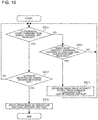
- Fig. 10 is a flowchart illustrating processing of the indoor unit part 2 up to the operation start of the indoor unit part 2 of the air-conditioning system 100 according to Embodiment 3 of the present disclosure.
- An indoor unit control unit 11 determines whether or not the operation start command is received from the mobile terminal unit 6 by using the wireless communication unit 3. When the indoor unit control unit 11 determines that the operation start command is received from the mobile terminal unit 6 (YES), the process proceeds to the processing in step S214. On the other hand, when the indoor unit control unit 11 determines that the operation start command is not received from the mobile terminal unit 6 (NO), the process proceeds to the processing in step S212.
- the indoor unit control unit 11 determines whether or not the wireless communication unit 3 receives the radio wave intensity changing command. When the indoor unit control unit 11 determines that the wireless communication unit 3 receives the radio wave intensity changing command (YES), the process proceeds to the processing in step S213. On the other hand, when the indoor unit control unit 11 determines that the wireless communication unit 3 does not receive the radio wave intensity changing command (NO), the process proceeds to the processing in step S211.
- the indoor unit control unit 11 decreases the intensity of the radio wave output from the wireless communication unit 3 by the previously set value, and the process proceeds to the processing in step S211.
- the indoor unit control unit 11 determines whether or not a person in the air-conditioned space assigned to the indoor unit part 2 is detected by the human-sensing detection unit 4. When the indoor unit control unit 11 determines that a person in the air-conditioned space assigned to the indoor unit part 2 is detected (YES), the process proceeds to the processing in step S215. On the other hand, when the indoor unit control unit 11 determines that a person in the air-conditioned space assigned to the indoor unit part 2 is not detected (NO), the process proceeds to the processing in step S211.
- some indoor unit parts 2 may include no human-sensing detection unit 4. In such a case, the determination processing step S214 may be skipped. In this case, in the determination in step S211, when the indoor unit control unit 11 determines that the operation start command is received from the mobile terminal unit 6 (YES), the process proceeds to the processing in step S215. It is noted that according to present Embodiment 3, the indoor unit parts 2 that have radio wave intensities in the range between the highest radio wave intensity and the N-th highest radio wave intensity are set as the operation targets, and among these indoor unit parts 2, the indoor unit part 2 to which the air-conditioned space in which a person is not detected is assigned is excluded from the operation targets.
- the processing (steps S101 to S114) for deciding the ones of indoor unit parts 2 corresponding to the operation targets may be repeatedly performed until the number of ones of the indoor unit parts 2 corresponding to the operation targets reaches N.
- the indoor unit control unit 11 starts the operation of the indoor unit part 2 and also transmits the operation start command to an outdoor unit control unit 14 by using a wired communication line section 7 to start the operation of the outdoor unit part 5.
- the air-conditioning operation is thus executed.
- the mobile terminal unit 6 is configured to rank the detected wireless radio waves in a descending order of the radio wave intensity, and transmit the operation start command to the wireless communication units 3 that transmit wireless radio waves in ranks higher than or equal to a previously set rank.
- the mobile terminal unit 6 ranks the detected wireless radio waves in a descending order of the radio wave intensity, and transmits the operation start command to the wireless communication units 3 that transmit wireless radio waves in the ranks higher than or equal to the previously set rank. For this reason, a condition for deciding the indoor unit parts 2 to be operated can be customized by the user.
- the mobile terminal unit 6 transmits the radio wave intensity changing command to the wireless communication units 3 that transmit wireless radio waves having the same radio wave intensity or radio wave intensities within the previously set range.
- the wireless communication units 3 that have received the radio wave intensity changing command are configured to decrease the radio wave intensity of the wireless radio wave to be transmitted.
- the mobile terminal unit 6 transmits the radio wave intensity changing command to the wireless communication units 3 that transmit wireless radio waves having the above-described radio wave intensities. For this reason, ranking of the distances from the respective indoor unit parts 2 to the mobile terminal unit 6 can be precisely decided.
- Embodiment 4 of the present disclosure will be described. Descriptions on components that correspond to those of Embodiments 1 to 3 will be omitted, and the same reference signs are assigned to the same components or equivalent components of Embodiments 1 to 3.
- An air-conditioning system 100 performs the processing for facilitating the selection of an indoor unit part 2 to which an air-conditioned space in which a person is present is assigned as an operation target.
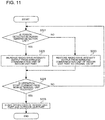
- Fig. 11 is a flowchart illustrating processing of the indoor unit part 2 up to operation start of the indoor unit part 2 of the air-conditioning system 100 according to Embodiment 4 of the present disclosure.
- An indoor unit control unit 11 determines whether or not a person in the air-conditioned space assigned to the indoor unit part 2 is detected by a human-sensing detection unit 4. When the indoor unit control unit 11 determines that a person in the air-conditioned space assigned to the indoor unit part 2 is detected (YES), the process proceeds to the processing in step S222. On the other hand, when the indoor unit control unit 11 determines that a person in the air-conditioned space assigned to the indoor unit part 2 is not detected (NO), the process proceeds to the processing in step S223.
- the indoor unit control unit 11 increases the intensity of the radio wave output from the wireless communication unit 3 by a previously set value. This is, by increasing the intensity of the radio wave output from the wireless communication unit 3, to facilitate the selection of the indoor unit part 2 to which the air-conditioned space in which a person is present is assigned as the operation target. It is noted that when the intensity of the radio wave output from the wireless communication unit 3 is already increased by the previously set value, this processing is skipped.
- the indoor unit control unit 11 restores the intensity of the radio wave output from the wireless communication unit 3 to the original value. This is to avoid the facilitation of the indoor unit part 2 to which the air-conditioned space in which no person is present is assigned to be selected as the operation target.
- the indoor unit control unit 11 determines whether or not the operation start command is received from the mobile terminal unit 6 by using the wireless communication unit 3. When the indoor unit control unit 11 determines that the operation start command is received from the mobile terminal unit 6 (YES), the process proceeds to the processing in step S225. On the other hand, when the indoor unit control unit 11 determines that the operation start command is not received from the mobile terminal unit 6 (NO), the process proceeds to the processing in step S221.
- the indoor unit control unit 11 starts the operation of the indoor unit part 2 and also transmits the operation start command to the outdoor unit control unit 14 by using the wired communication line section 7 to start the operation of the outdoor unit part 5.
- the air-conditioning operation is thus executed.
- the indoor unit part 2 of the air-conditioning system 100 is configured to increase the radio wave intensity of the wireless radio wave transmitted by the wireless communication unit 3.
- the indoor unit part 2 increases the radio wave intensity of the wireless radio wave transmitted by the wireless communication unit 3. For this reason, the selection of the indoor unit part 2 to which the air-conditioned space in which a person is present is assigned as the operation target can be facilitated. It is noted that the processing for increasing the radio wave intensity of the wireless radio wave transmitted by the wireless communication unit 3 when the human-sensing detection unit 4 provided to the indoor unit part 2 detects the person is also effective in a case where the indoor unit parts 2 up to the N-th indoor unit part 2 are not found according to Embodiment 2.
- Embodiment 5 of the present disclosure will be described. Descriptions on components that correspond to those of Embodiments 1 to 4 will be omitted, and the same reference signs are assigned to the same components or equivalent components of Embodiments 1 to 4.
- an air-conditioning system 100 performs processing for facilitating selection of an indoor unit part 2 to which an air-conditioned space in which a person is present is assigned as an operation target.
- Fig. 12 is a flowchart illustrating processing in a mobile terminal unit 6 up to operation start of the indoor unit parts 2 of the air-conditioning system 100 according to Embodiment 5 of the present disclosure.
- steps S101 to S108 are similar to that of Embodiment 2, the description will be omitted.
- the air-conditioning apparatus operation management unit 15 determines whether or not a mobile terminal side wireless communication unit 9 receives a radio wave intensity changing command.
- the radio wave intensity changing command is transmitted so that, as will be described below, the indoor unit parts 2 provided with the human-sensing detection units 4 that each detect a person in an air-conditioned space assigned to the indoor unit part 2 are facilitated to be selected as the operation targets.
- the air-conditioning apparatus operation management unit 15 determines that the mobile terminal side wireless communication unit 9 receives the radio wave intensity changing command (YES)
- the process proceeds to the processing in step S122.
- the air-conditioning apparatus operation management unit 15 determines that the mobile terminal side wireless communication unit 9 does not receive the radio wave intensity changing command (NO)
- the process proceeds to the processing in step S105.
- the air-conditioning apparatus operation management unit 15 checks a wireless ID of a wireless communication unit 3 that is a transmission source of the radio wave intensity changing command, and transmits the radio wave intensity changing command for decreasing the intensity of the radio wave to be output by a previously set value to the wireless communication units 3 of the indoor unit parts 2 other than the indoor unit part 2 having the wireless ID, and the process proceeds to the processing in step S102.
- Fig. 13 is a flowchart illustrating processing of the indoor unit part 2 up to the operation start of the indoor unit part 2 of the air-conditioning system 100 according to Embodiment 5 of the present disclosure.
- An indoor unit control unit 11 determines whether or not a person in the air-conditioned space assigned to the indoor unit part 2 is detected by the human-sensing detection unit 4. When the indoor unit control unit 11 determines that a person in the air-conditioned space assigned to the indoor unit part 2 is detected (YES), the process proceeds to the processing in step S232. On the other hand, when the indoor unit control unit 11 determines that a person in the air-conditioned space assigned to the indoor unit part 2 is not detected (NO), the process proceeds to the processing in step S233.
- the indoor unit control unit 11 transmits the radio wave intensity changing command for decreasing the intensity of the radio wave output from the wireless communication unit 3 of other indoor unit part 2 by a previously set value to the mobile terminal side wireless communication unit 9. This is, by decreasing the intensity of the radio wave output from the wireless communication unit 3 of other indoor unit part 2 to relatively increase the intensity of the radio wave output from the wireless communication unit 3 of the indoor unit part 2 having the wireless ID, to facilitate the selection of the indoor unit part 2 to which the air-conditioned space in which a person is present is assigned as the operation target. It is noted that this processing is skipped when the radio wave intensity changing command for decreasing the intensity of the radio wave output from the wireless communication unit 3 of other indoor unit part 2 is already transmitted.
- the indoor unit control unit 11 transmits, to the mobile terminal side wireless communication unit 9, the radio wave intensity changing command for restoring the intensity of the radio wave output from the wireless communication unit 3 of other indoor unit part 2 to the original radio wave intensity. This is to avoid facilitation of the indoor unit part 2 to which the air-conditioned space in which no person is present is assigned to be selected as the operation target.
- the indoor unit control unit 11 determines whether or not the operation start command is received from the mobile terminal unit 6 by using the wireless communication unit 3. When the indoor unit control unit 11 determines that the operation start command is received from the mobile terminal unit 6 (YES), the process proceeds to the processing in step S235. On the other hand, when the indoor unit control unit 11 determines that the operation start command is not received from the mobile terminal unit 6 (NO), the process proceeds to the processing in step S236.
- the indoor unit control unit 11 starts the operation of the indoor unit part 2 and also transmits the operation start command to the outdoor unit control unit 14 by using the wired communication line section 7 to start the operation of the outdoor unit part 5.
- the air-conditioning operation is thus executed.
- the indoor unit control unit 11 determines whether or not the wireless communication unit 3 receives the radio wave intensity changing command. When the indoor unit control unit 11 determines that the wireless communication unit 3 receives the radio wave intensity changing command (YES), the process proceeds to the processing in step S237. On the other hand, when the indoor unit control unit 11 determines that the wireless communication unit 3 does not receive the radio wave intensity changing command (NO), the process proceeds to the processing in step S231.
- the indoor unit control unit 11 determines whether or not a person in the air-conditioned space assigned to the indoor unit part 2 is detected by the human-sensing detection unit 4. When the indoor unit control unit 11 determines that a person in the air-conditioned space assigned to the indoor unit part 2 is detected (YES), the process proceeds to the processing in step S231. On the other hand, when the indoor unit control unit 11 determines that a person in the air-conditioned space assigned to the indoor unit part 2 is not detected (NO), the process proceeds to the processing in step S238.
- the indoor unit control unit 11 decreases the intensity of the radio wave output from the wireless communication unit 3 by the previously set value, and the process proceeds to the processing in step S231.
- the indoor unit part 2 of the air-conditioning system 100 is configured to transmit the radio wave intensity changing command to the mobile terminal unit 6.
- the mobile terminal unit 6 transmits the radio wave intensity changing command to the wireless communication units 3 other than the wireless communication unit 3 that is the transmission source of the radio wave intensity changing command.
- the mobile terminal unit 6 transmits the radio wave intensity changing command to the wireless communication units 3 other than the wireless communication unit 3 that is the transmission source of the radio wave intensity changing command.
- the intensity of the radio wave output from the wireless communication unit 3 provided to the indoor unit part 2 other than the indoor unit part 2 provided with the human-sensing detection unit 4 that detects a person is relatively increased.
- the selection of the indoor unit part 2 to which the air-conditioned space in which a person is present is assigned as the operation target can be thus facilitated.
- Embodiment 6 of the present disclosure will be described. Descriptions on components that correspond to those of Embodiments 1 to 5 will be omitted, and the same reference signs are assigned to the same components or equivalent components of Embodiments 1 to 5.
- Fig. 14 is a flowchart illustrating processing in a mobile terminal unit 6 up to operation start of indoor unit parts 2 of an air-conditioning system 100 according to Embodiment 6 of the present disclosure.
- Fig. 15 is a diagram for describing processing for excluding, from the operation targets, the indoor unit part 2 having a nonadjacent address of the air-conditioning system 100 according to Embodiment 6 of the present disclosure.
- the "nonadjacent address” refers to an address that is not adjacent to other addresses among a plurality of addresses.
- the address is valid when the address is set in accordance with a certain rule as in a case where columns are defined in alphabet letters and rows are defined in numbers as illustrated in Fig. 15 .
- steps S101 to S103, S107, and S108 is similar to that of Embodiment 2, the description will be omitted.
- the air-conditioning apparatus operation management unit 15 checks the wireless ID of a wireless communication unit 3 that is a transmission source and an address of the wireless communication unit 3 that is the transmission source, and also starts to measure the radio wave intensity (RSSI). Furthermore, the air-conditioning apparatus operation management unit 15 resets the measured period of time from the start of the detection of the wireless radio waves.
- the air-conditioning apparatus operation management unit 15 uses an average or median value from results of multiple measurements, and decides the radio wave intensity of the detected wireless radio wave.
- the air-conditioning apparatus operation management unit 15 determines whether or not the radio wave intensity of the detected wireless radio wave that is decided in the processing in step S131 is higher than or equal to a previously set reference intensity. When the air-conditioning apparatus operation management unit 15 determines that the radio wave intensity of the detected wireless radio wave is higher than or equal to the reference intensity (YES), the process proceeds to the processing in step S133. On the other hand, when the air-conditioning apparatus operation management unit 15 determines that the radio wave intensity of the detected wireless radio wave is not higher than or equal to the reference intensity (NO), the process proceeds to the processing in step S134.
- the air-conditioning apparatus operation management unit 15 determines whether or not the address of the wireless communication unit 3 of the indoor unit part 2 is a nonadjacent address. When the air-conditioning apparatus operation management unit 15 determines that the address of the wireless communication unit 3 of the indoor unit part 2 is a nonadjacent address (YES), the process proceeds to the processing in step S134. On the other hand, when the air-conditioning apparatus operation management unit 15 determines that the address of the wireless communication unit 3 of the indoor unit part 2 is not a nonadjacent address (NO), the process proceeds to the processing in step S107.
- the air-conditioning apparatus operation management unit 15 discards information of the wireless ID of the wireless communication unit 3 of the indoor unit part 2 having the radio wave intensity below the reference intensity or having a nonadjacent address.
- the addresses of the wireless communication units 3 of the indoor unit parts 2 that have radio wave intensities higher than or equal to the previously set reference intensity (-70 dBm or above) are "1-A", “2-A”, and "2-E".
- "1-A” and “2-A” are mutually adjacent addresses, but the address "2-E” is not adjacent to the addresses "1-A” and "2-A” and is thus a nonadjacent address.
- the wireless ID of the wireless communication unit 3 of the indoor unit part 2 having the address "2-E" is excluded from the operation targets.
- the air-conditioning apparatus operation management unit 15 avoids an erroneous detection of the radio wave intensity due to an influence of an obstacle. In other words, in some cases, the air-conditioning apparatus operation management unit 15 detects the wireless radio wave transmitted from the wireless communication unit 3 of the indoor unit part 2 in a farther location from the mobile terminal unit 6 at the higher radio wave intensity than the radio wave intensity of the wireless radio wave transmitted from the wireless communication unit 3 of the indoor unit part 2 in a closer location from the mobile terminal unit 6.
- the processing in steps S133 and S134 when the wireless ID of the wireless communication unit 3 of the indoor unit part 2 having a nonadjacent address is excluded from the operation targets as described above, the erroneous detection of the radio wave intensity can be avoided. It is noted that by associating the wireless ID with the location of the indoor unit part 2, the erroneous detection of the radio wave intensity may also be avoided as described above with reference to the wireless ID instead of the address.
- the air-conditioning apparatus operation management unit 15 performs the processing in steps S131 to S134 the same number of times as the number of detected wireless radio waves.
- the mobile terminal unit 6 obtains the address of the wireless communication unit 3 that transmits the wireless radio wave having an intensity higher than or equal to the previously set reference intensity. Then, the mobile terminal unit 6 excludes the wireless communication unit 3 having a nonadjacent address from the targets to which the operation start command is transmitted.
- the wireless communication unit 3 having a nonadjacent address is excluded from the targets to which the operation start command is transmitted, the erroneous detection of the radio wave intensity can be avoided.
- indoor unit part 3 wireless communication unit4 human-sensing detection unit 5 outdoor unit part 6 mobile terminal unit 7 wired communication line section 8 wireless communication line section 9 mobile terminal side wireless communication unit 11 indoor unit control unit 12 wireless ID unit 13 wireless transmission and reception unit 14 outdoor unit control unit 15 air-conditioning apparatus operation management unit 16 air-conditioning apparatus operation input unit 17 air-conditioning apparatus information display unit 100 air-conditioning system
Landscapes
- Engineering & Computer Science (AREA)
- Chemical & Material Sciences (AREA)
- Combustion & Propulsion (AREA)
- Mechanical Engineering (AREA)
- General Engineering & Computer Science (AREA)
- Human Computer Interaction (AREA)
- Signal Processing (AREA)
- Physics & Mathematics (AREA)
- Fuzzy Systems (AREA)
- Mathematical Physics (AREA)
- Air Conditioning Control Device (AREA)
Applications Claiming Priority (1)
| Application Number | Priority Date | Filing Date | Title |
|---|---|---|---|
| PCT/JP2018/036579 WO2020066017A1 (ja) | 2018-09-28 | 2018-09-28 | 空気調和システムおよびアプリケーションプログラム |
Publications (3)
| Publication Number | Publication Date |
|---|---|
| EP3859221A1 true EP3859221A1 (de) | 2021-08-04 |
| EP3859221A4 EP3859221A4 (de) | 2021-09-22 |
| EP3859221B1 EP3859221B1 (de) | 2024-01-10 |
Family
ID=69950405
Family Applications (1)
| Application Number | Title | Priority Date | Filing Date |
|---|---|---|---|
| EP18935097.8A Active EP3859221B1 (de) | 2018-09-28 | 2018-09-28 | Klimaanlagensystem und anwendungsprogramm |
Country Status (5)
| Country | Link |
|---|---|
| US (1) | US20210285677A1 (de) |
| EP (1) | EP3859221B1 (de) |
| JP (1) | JP7004837B2 (de) |
| CN (1) | CN112739959A (de) |
| WO (1) | WO2020066017A1 (de) |
Families Citing this family (3)
| Publication number | Priority date | Publication date | Assignee | Title |
|---|---|---|---|---|
| JP7534157B2 (ja) * | 2020-08-31 | 2024-08-14 | ビッグローブ株式会社 | 環境制御システムおよび環境制御方法 |
| CN119063191A (zh) * | 2023-06-01 | 2024-12-03 | 青岛海尔空调器有限总公司 | 基于共享外机的空调控制方法、装置及空调系统 |
| CN119063192B (zh) * | 2023-06-01 | 2025-12-19 | 青岛海尔空调器有限总公司 | 基于共享外机的空调控制方法、装置及空调系统 |
Family Cites Families (17)
| Publication number | Priority date | Publication date | Assignee | Title |
|---|---|---|---|---|
| JPH0875230A (ja) * | 1994-08-31 | 1996-03-19 | Sanyo Electric Co Ltd | 空調制御装置 |
| US6157943A (en) * | 1998-11-12 | 2000-12-05 | Johnson Controls Technology Company | Internet access to a facility management system |
| JP2003284169A (ja) | 2002-03-20 | 2003-10-03 | Mitsubishi Electric Corp | 家電機器のリモコン装置 |
| KR101203559B1 (ko) * | 2005-09-12 | 2012-11-21 | 엘지전자 주식회사 | 그룹제어가 가능한 공기조화 시스템 및 그 동작방법 |
| US8239922B2 (en) * | 2007-08-27 | 2012-08-07 | Honeywell International Inc. | Remote HVAC control with user privilege setup |
| US8167216B2 (en) * | 2007-11-30 | 2012-05-01 | Honeywell International Inc. | User setup for an HVAC remote control unit |
| US8078326B2 (en) * | 2008-09-19 | 2011-12-13 | Johnson Controls Technology Company | HVAC system controller configuration |
| JP5257012B2 (ja) * | 2008-11-18 | 2013-08-07 | ダイキン工業株式会社 | 空気調和制御システム |
| JP5177023B2 (ja) * | 2009-03-10 | 2013-04-03 | 株式会社富士通ゼネラル | 空気調和システム |
| KR101785655B1 (ko) * | 2010-08-17 | 2017-10-16 | 엘지전자 주식회사 | 공기조화시스템 |
| US20130246975A1 (en) * | 2012-03-15 | 2013-09-19 | Chandar Kumar Oddiraju | Gesture group selection |
| WO2014128781A1 (ja) * | 2013-02-20 | 2014-08-28 | パナソニック インテレクチュアル プロパティ コーポレーション オブ アメリカ | 携帯情報端末の制御方法及びプログラム |
| JP6051089B2 (ja) * | 2013-03-29 | 2016-12-27 | 日立アプライアンス株式会社 | 空調システム |
| JPWO2015111173A1 (ja) * | 2014-01-23 | 2017-03-23 | 三菱電機株式会社 | 空調機用コントローラ |
| US10291425B2 (en) * | 2014-05-29 | 2019-05-14 | Panasonic Intellectual Property Corporation Of America | Method for controlling terminal apparatus that remotely controls air conditioner, non-transitory recording medium storing program executed by terminal apparatus, recommend method executed by terminal apparatus, and terminal apparatus |
| CN107407490B (zh) * | 2015-04-07 | 2020-02-21 | 三菱电机株式会社 | 空调机的维护支持系统 |
| JP6613734B2 (ja) * | 2015-09-04 | 2019-12-04 | ダイキン工業株式会社 | 空調システム |
-
2018
- 2018-09-28 JP JP2020547881A patent/JP7004837B2/ja active Active
- 2018-09-28 US US17/262,480 patent/US20210285677A1/en not_active Abandoned
- 2018-09-28 CN CN201880097874.XA patent/CN112739959A/zh active Pending
- 2018-09-28 EP EP18935097.8A patent/EP3859221B1/de active Active
- 2018-09-28 WO PCT/JP2018/036579 patent/WO2020066017A1/ja not_active Ceased
Also Published As
| Publication number | Publication date |
|---|---|
| US20210285677A1 (en) | 2021-09-16 |
| EP3859221B1 (de) | 2024-01-10 |
| JPWO2020066017A1 (ja) | 2021-05-13 |
| WO2020066017A1 (ja) | 2020-04-02 |
| EP3859221A4 (de) | 2021-09-22 |
| CN112739959A (zh) | 2021-04-30 |
| JP7004837B2 (ja) | 2022-02-04 |
Similar Documents
| Publication | Publication Date | Title |
|---|---|---|
| JP4989702B2 (ja) | 設備制御端末、設備制御システム、設備制御方法並びにプログラム | |
| JP6440064B2 (ja) | 機器制御装置及びプログラム | |
| EP3859221B1 (de) | Klimaanlagensystem und anwendungsprogramm | |
| EP2669591B1 (de) | Klimaanlagensystem und klimatisierungsverfahren | |
| KR101898101B1 (ko) | Iot 상호작용 시스템 | |
| US10309674B2 (en) | Air-conditioning control system, air-conditioning control apparatus, and air-conditioning control method | |
| EP3860138B1 (de) | Klimatisierungssystem | |
| JPWO2018216088A1 (ja) | 人位置検知装置、人位置検知システム、人位置検知方法及びプログラム | |
| US11306934B2 (en) | Air-conditioning system control apparatus using degree of influence between air-conditioning indoor units | |
| US20140055040A1 (en) | Lighting control system | |
| US20210231339A1 (en) | Controller and air conditioning system | |
| KR102085799B1 (ko) | 사용자단말기에 연결되는 환경측정센서를 이용한 실내 공조제어시스템 | |
| US20260081479A1 (en) | System, transmitter, and method | |
| JP7054782B2 (ja) | 制御情報出力システム、機器制御システム、機器制御方法、及びプログラム | |
| WO2017208344A1 (ja) | 空調システム | |
| JP2017073633A (ja) | 情報処理装置、通信システム、通信制御方法およびプログラム | |
| US20200201368A1 (en) | Wireless climate control system | |
| WO2017081721A1 (ja) | 空調制御システム | |
| EP4704303A1 (de) | System, system und sender zur drahtlosen stromversorgung | |
| JP7228461B2 (ja) | 空調制御システム及び空調制御方法 | |
| US9842079B2 (en) | Communication apparatus, communication method, and computer readable medium | |
| JP7621550B2 (ja) | 空調制御システム、無線端末、空調制御方法及びプログラム | |
| CN113631869A (zh) | 遥控器以及空调系统 | |
| WO2020158837A1 (ja) | 所在人数測定システム、携帯機器及びプログラム | |
| US20240248451A1 (en) | Operation control device and method |
Legal Events
| Date | Code | Title | Description |
|---|---|---|---|
| STAA | Information on the status of an ep patent application or granted ep patent |
Free format text: STATUS: THE INTERNATIONAL PUBLICATION HAS BEEN MADE |
|
| PUAI | Public reference made under article 153(3) epc to a published international application that has entered the european phase |
Free format text: ORIGINAL CODE: 0009012 |
|
| STAA | Information on the status of an ep patent application or granted ep patent |
Free format text: STATUS: REQUEST FOR EXAMINATION WAS MADE |
|
| 17P | Request for examination filed |
Effective date: 20210127 |
|
| AK | Designated contracting states |
Kind code of ref document: A1 Designated state(s): AL AT BE BG CH CY CZ DE DK EE ES FI FR GB GR HR HU IE IS IT LI LT LU LV MC MK MT NL NO PL PT RO RS SE SI SK SM TR |
|
| A4 | Supplementary search report drawn up and despatched |
Effective date: 20210820 |
|
| RIC1 | Information provided on ipc code assigned before grant |
Ipc: F24F 11/64 20180101ALI20210816BHEP Ipc: F24F 11/56 20180101ALI20210816BHEP Ipc: F24F 11/52 20180101ALI20210816BHEP Ipc: F24F 11/54 20180101AFI20210816BHEP |
|
| DAV | Request for validation of the european patent (deleted) | ||
| DAX | Request for extension of the european patent (deleted) | ||
| GRAP | Despatch of communication of intention to grant a patent |
Free format text: ORIGINAL CODE: EPIDOSNIGR1 |
|
| STAA | Information on the status of an ep patent application or granted ep patent |
Free format text: STATUS: GRANT OF PATENT IS INTENDED |
|
| INTG | Intention to grant announced |
Effective date: 20230725 |
|
| P01 | Opt-out of the competence of the unified patent court (upc) registered |
Effective date: 20230906 |
|
| GRAS | Grant fee paid |
Free format text: ORIGINAL CODE: EPIDOSNIGR3 |
|
| GRAA | (expected) grant |
Free format text: ORIGINAL CODE: 0009210 |
|
| STAA | Information on the status of an ep patent application or granted ep patent |
Free format text: STATUS: THE PATENT HAS BEEN GRANTED |
|
| AK | Designated contracting states |
Kind code of ref document: B1 Designated state(s): AL AT BE BG CH CY CZ DE DK EE ES FI FR GB GR HR HU IE IS IT LI LT LU LV MC MK MT NL NO PL PT RO RS SE SI SK SM TR |
|
| REG | Reference to a national code |
Ref country code: GB Ref legal event code: FG4D |
|
| REG | Reference to a national code |
Ref country code: CH Ref legal event code: EP |
|
| REG | Reference to a national code |
Ref country code: DE Ref legal event code: R096 Ref document number: 602018064151 Country of ref document: DE |
|
| REG | Reference to a national code |
Ref country code: IE Ref legal event code: FG4D |
|
| REG | Reference to a national code |
Ref country code: LT Ref legal event code: MG9D |
|
| REG | Reference to a national code |
Ref country code: NL Ref legal event code: MP Effective date: 20240110 |
|
| REG | Reference to a national code |
Ref country code: AT Ref legal event code: MK05 Ref document number: 1649180 Country of ref document: AT Kind code of ref document: T Effective date: 20240110 |
|
| PG25 | Lapsed in a contracting state [announced via postgrant information from national office to epo] |
Ref country code: NL Free format text: LAPSE BECAUSE OF FAILURE TO SUBMIT A TRANSLATION OF THE DESCRIPTION OR TO PAY THE FEE WITHIN THE PRESCRIBED TIME-LIMIT Effective date: 20240110 |
|
| PG25 | Lapsed in a contracting state [announced via postgrant information from national office to epo] |
Ref country code: NL Free format text: LAPSE BECAUSE OF FAILURE TO SUBMIT A TRANSLATION OF THE DESCRIPTION OR TO PAY THE FEE WITHIN THE PRESCRIBED TIME-LIMIT Effective date: 20240110 |
|
| PG25 | Lapsed in a contracting state [announced via postgrant information from national office to epo] |
Ref country code: IS Free format text: LAPSE BECAUSE OF FAILURE TO SUBMIT A TRANSLATION OF THE DESCRIPTION OR TO PAY THE FEE WITHIN THE PRESCRIBED TIME-LIMIT Effective date: 20240510 |
|
| PG25 | Lapsed in a contracting state [announced via postgrant information from national office to epo] |
Ref country code: LT Free format text: LAPSE BECAUSE OF FAILURE TO SUBMIT A TRANSLATION OF THE DESCRIPTION OR TO PAY THE FEE WITHIN THE PRESCRIBED TIME-LIMIT Effective date: 20240110 |
|
| PG25 | Lapsed in a contracting state [announced via postgrant information from national office to epo] |
Ref country code: GR Free format text: LAPSE BECAUSE OF FAILURE TO SUBMIT A TRANSLATION OF THE DESCRIPTION OR TO PAY THE FEE WITHIN THE PRESCRIBED TIME-LIMIT Effective date: 20240411 |
|
| PG25 | Lapsed in a contracting state [announced via postgrant information from national office to epo] |
Ref country code: HR Free format text: LAPSE BECAUSE OF FAILURE TO SUBMIT A TRANSLATION OF THE DESCRIPTION OR TO PAY THE FEE WITHIN THE PRESCRIBED TIME-LIMIT Effective date: 20240110 Ref country code: RS Free format text: LAPSE BECAUSE OF FAILURE TO SUBMIT A TRANSLATION OF THE DESCRIPTION OR TO PAY THE FEE WITHIN THE PRESCRIBED TIME-LIMIT Effective date: 20240410 |
|
| PG25 | Lapsed in a contracting state [announced via postgrant information from national office to epo] |
Ref country code: ES Free format text: LAPSE BECAUSE OF FAILURE TO SUBMIT A TRANSLATION OF THE DESCRIPTION OR TO PAY THE FEE WITHIN THE PRESCRIBED TIME-LIMIT Effective date: 20240110 |
|
| PG25 | Lapsed in a contracting state [announced via postgrant information from national office to epo] |
Ref country code: AT Free format text: LAPSE BECAUSE OF FAILURE TO SUBMIT A TRANSLATION OF THE DESCRIPTION OR TO PAY THE FEE WITHIN THE PRESCRIBED TIME-LIMIT Effective date: 20240110 |
|
| PG25 | Lapsed in a contracting state [announced via postgrant information from national office to epo] |
Ref country code: RS Free format text: LAPSE BECAUSE OF FAILURE TO SUBMIT A TRANSLATION OF THE DESCRIPTION OR TO PAY THE FEE WITHIN THE PRESCRIBED TIME-LIMIT Effective date: 20240410 Ref country code: NO Free format text: LAPSE BECAUSE OF FAILURE TO SUBMIT A TRANSLATION OF THE DESCRIPTION OR TO PAY THE FEE WITHIN THE PRESCRIBED TIME-LIMIT Effective date: 20240410 Ref country code: LT Free format text: LAPSE BECAUSE OF FAILURE TO SUBMIT A TRANSLATION OF THE DESCRIPTION OR TO PAY THE FEE WITHIN THE PRESCRIBED TIME-LIMIT Effective date: 20240110 Ref country code: IS Free format text: LAPSE BECAUSE OF FAILURE TO SUBMIT A TRANSLATION OF THE DESCRIPTION OR TO PAY THE FEE WITHIN THE PRESCRIBED TIME-LIMIT Effective date: 20240510 Ref country code: HR Free format text: LAPSE BECAUSE OF FAILURE TO SUBMIT A TRANSLATION OF THE DESCRIPTION OR TO PAY THE FEE WITHIN THE PRESCRIBED TIME-LIMIT Effective date: 20240110 Ref country code: GR Free format text: LAPSE BECAUSE OF FAILURE TO SUBMIT A TRANSLATION OF THE DESCRIPTION OR TO PAY THE FEE WITHIN THE PRESCRIBED TIME-LIMIT Effective date: 20240411 Ref country code: ES Free format text: LAPSE BECAUSE OF FAILURE TO SUBMIT A TRANSLATION OF THE DESCRIPTION OR TO PAY THE FEE WITHIN THE PRESCRIBED TIME-LIMIT Effective date: 20240110 Ref country code: BG Free format text: LAPSE BECAUSE OF FAILURE TO SUBMIT A TRANSLATION OF THE DESCRIPTION OR TO PAY THE FEE WITHIN THE PRESCRIBED TIME-LIMIT Effective date: 20240110 Ref country code: AT Free format text: LAPSE BECAUSE OF FAILURE TO SUBMIT A TRANSLATION OF THE DESCRIPTION OR TO PAY THE FEE WITHIN THE PRESCRIBED TIME-LIMIT Effective date: 20240110 |
|
| PG25 | Lapsed in a contracting state [announced via postgrant information from national office to epo] |
Ref country code: PL Free format text: LAPSE BECAUSE OF FAILURE TO SUBMIT A TRANSLATION OF THE DESCRIPTION OR TO PAY THE FEE WITHIN THE PRESCRIBED TIME-LIMIT Effective date: 20240110 Ref country code: PT Free format text: LAPSE BECAUSE OF FAILURE TO SUBMIT A TRANSLATION OF THE DESCRIPTION OR TO PAY THE FEE WITHIN THE PRESCRIBED TIME-LIMIT Effective date: 20240510 |
|
| PG25 | Lapsed in a contracting state [announced via postgrant information from national office to epo] |
Ref country code: SE Free format text: LAPSE BECAUSE OF FAILURE TO SUBMIT A TRANSLATION OF THE DESCRIPTION OR TO PAY THE FEE WITHIN THE PRESCRIBED TIME-LIMIT Effective date: 20240110 Ref country code: PT Free format text: LAPSE BECAUSE OF FAILURE TO SUBMIT A TRANSLATION OF THE DESCRIPTION OR TO PAY THE FEE WITHIN THE PRESCRIBED TIME-LIMIT Effective date: 20240510 Ref country code: PL Free format text: LAPSE BECAUSE OF FAILURE TO SUBMIT A TRANSLATION OF THE DESCRIPTION OR TO PAY THE FEE WITHIN THE PRESCRIBED TIME-LIMIT Effective date: 20240110 Ref country code: LV Free format text: LAPSE BECAUSE OF FAILURE TO SUBMIT A TRANSLATION OF THE DESCRIPTION OR TO PAY THE FEE WITHIN THE PRESCRIBED TIME-LIMIT Effective date: 20240110 |
|
| PG25 | Lapsed in a contracting state [announced via postgrant information from national office to epo] |
Ref country code: DK Free format text: LAPSE BECAUSE OF FAILURE TO SUBMIT A TRANSLATION OF THE DESCRIPTION OR TO PAY THE FEE WITHIN THE PRESCRIBED TIME-LIMIT Effective date: 20240110 |
|
| REG | Reference to a national code |
Ref country code: DE Ref legal event code: R097 Ref document number: 602018064151 Country of ref document: DE |
|
| PG25 | Lapsed in a contracting state [announced via postgrant information from national office to epo] |
Ref country code: SM Free format text: LAPSE BECAUSE OF FAILURE TO SUBMIT A TRANSLATION OF THE DESCRIPTION OR TO PAY THE FEE WITHIN THE PRESCRIBED TIME-LIMIT Effective date: 20240110 |
|
| PG25 | Lapsed in a contracting state [announced via postgrant information from national office to epo] |
Ref country code: CZ Free format text: LAPSE BECAUSE OF FAILURE TO SUBMIT A TRANSLATION OF THE DESCRIPTION OR TO PAY THE FEE WITHIN THE PRESCRIBED TIME-LIMIT Effective date: 20240110 Ref country code: EE Free format text: LAPSE BECAUSE OF FAILURE TO SUBMIT A TRANSLATION OF THE DESCRIPTION OR TO PAY THE FEE WITHIN THE PRESCRIBED TIME-LIMIT Effective date: 20240110 |
|
| PG25 | Lapsed in a contracting state [announced via postgrant information from national office to epo] |
Ref country code: SK Free format text: LAPSE BECAUSE OF FAILURE TO SUBMIT A TRANSLATION OF THE DESCRIPTION OR TO PAY THE FEE WITHIN THE PRESCRIBED TIME-LIMIT Effective date: 20240110 |
|
| PG25 | Lapsed in a contracting state [announced via postgrant information from national office to epo] |
Ref country code: SM Free format text: LAPSE BECAUSE OF FAILURE TO SUBMIT A TRANSLATION OF THE DESCRIPTION OR TO PAY THE FEE WITHIN THE PRESCRIBED TIME-LIMIT Effective date: 20240110 Ref country code: SK Free format text: LAPSE BECAUSE OF FAILURE TO SUBMIT A TRANSLATION OF THE DESCRIPTION OR TO PAY THE FEE WITHIN THE PRESCRIBED TIME-LIMIT Effective date: 20240110 Ref country code: RO Free format text: LAPSE BECAUSE OF FAILURE TO SUBMIT A TRANSLATION OF THE DESCRIPTION OR TO PAY THE FEE WITHIN THE PRESCRIBED TIME-LIMIT Effective date: 20240110 Ref country code: EE Free format text: LAPSE BECAUSE OF FAILURE TO SUBMIT A TRANSLATION OF THE DESCRIPTION OR TO PAY THE FEE WITHIN THE PRESCRIBED TIME-LIMIT Effective date: 20240110 Ref country code: DK Free format text: LAPSE BECAUSE OF FAILURE TO SUBMIT A TRANSLATION OF THE DESCRIPTION OR TO PAY THE FEE WITHIN THE PRESCRIBED TIME-LIMIT Effective date: 20240110 Ref country code: CZ Free format text: LAPSE BECAUSE OF FAILURE TO SUBMIT A TRANSLATION OF THE DESCRIPTION OR TO PAY THE FEE WITHIN THE PRESCRIBED TIME-LIMIT Effective date: 20240110 |
|
| PLBE | No opposition filed within time limit |
Free format text: ORIGINAL CODE: 0009261 |
|
| STAA | Information on the status of an ep patent application or granted ep patent |
Free format text: STATUS: NO OPPOSITION FILED WITHIN TIME LIMIT |
|
| PG25 | Lapsed in a contracting state [announced via postgrant information from national office to epo] |
Ref country code: IT Free format text: LAPSE BECAUSE OF FAILURE TO SUBMIT A TRANSLATION OF THE DESCRIPTION OR TO PAY THE FEE WITHIN THE PRESCRIBED TIME-LIMIT Effective date: 20240110 |
|
| 26N | No opposition filed |
Effective date: 20241011 |
|
| PG25 | Lapsed in a contracting state [announced via postgrant information from national office to epo] |
Ref country code: IT Free format text: LAPSE BECAUSE OF FAILURE TO SUBMIT A TRANSLATION OF THE DESCRIPTION OR TO PAY THE FEE WITHIN THE PRESCRIBED TIME-LIMIT Effective date: 20240110 |
|
| PG25 | Lapsed in a contracting state [announced via postgrant information from national office to epo] |
Ref country code: SI Free format text: LAPSE BECAUSE OF FAILURE TO SUBMIT A TRANSLATION OF THE DESCRIPTION OR TO PAY THE FEE WITHIN THE PRESCRIBED TIME-LIMIT Effective date: 20240110 Ref country code: MC Free format text: LAPSE BECAUSE OF FAILURE TO SUBMIT A TRANSLATION OF THE DESCRIPTION OR TO PAY THE FEE WITHIN THE PRESCRIBED TIME-LIMIT Effective date: 20240110 |
|
| REG | Reference to a national code |
Ref country code: CH Ref legal event code: PL |
|
| PG25 | Lapsed in a contracting state [announced via postgrant information from national office to epo] |
Ref country code: LU Free format text: LAPSE BECAUSE OF NON-PAYMENT OF DUE FEES Effective date: 20240928 |
|
| REG | Reference to a national code |
Ref country code: BE Ref legal event code: MM Effective date: 20240930 |
|
| PG25 | Lapsed in a contracting state [announced via postgrant information from national office to epo] |
Ref country code: BE Free format text: LAPSE BECAUSE OF NON-PAYMENT OF DUE FEES Effective date: 20240930 |
|
| PG25 | Lapsed in a contracting state [announced via postgrant information from national office to epo] |
Ref country code: FR Free format text: LAPSE BECAUSE OF NON-PAYMENT OF DUE FEES Effective date: 20240930 |
|
| PG25 | Lapsed in a contracting state [announced via postgrant information from national office to epo] |
Ref country code: CH Free format text: LAPSE BECAUSE OF NON-PAYMENT OF DUE FEES Effective date: 20240930 |
|
| PG25 | Lapsed in a contracting state [announced via postgrant information from national office to epo] |
Ref country code: IE Free format text: LAPSE BECAUSE OF NON-PAYMENT OF DUE FEES Effective date: 20240928 |
|
| PG25 | Lapsed in a contracting state [announced via postgrant information from national office to epo] |
Ref country code: FI Free format text: LAPSE BECAUSE OF FAILURE TO SUBMIT A TRANSLATION OF THE DESCRIPTION OR TO PAY THE FEE WITHIN THE PRESCRIBED TIME-LIMIT Effective date: 20240110 |
|
| PGFP | Annual fee paid to national office [announced via postgrant information from national office to epo] |
Ref country code: DE Payment date: 20250805 Year of fee payment: 8 |
|
| PGFP | Annual fee paid to national office [announced via postgrant information from national office to epo] |
Ref country code: GB Payment date: 20250807 Year of fee payment: 8 |
|
| PG25 | Lapsed in a contracting state [announced via postgrant information from national office to epo] |
Ref country code: CY Free format text: LAPSE BECAUSE OF FAILURE TO SUBMIT A TRANSLATION OF THE DESCRIPTION OR TO PAY THE FEE WITHIN THE PRESCRIBED TIME-LIMIT; INVALID AB INITIO Effective date: 20180928 |
|
| PG25 | Lapsed in a contracting state [announced via postgrant information from national office to epo] |
Ref country code: HU Free format text: LAPSE BECAUSE OF FAILURE TO SUBMIT A TRANSLATION OF THE DESCRIPTION OR TO PAY THE FEE WITHIN THE PRESCRIBED TIME-LIMIT; INVALID AB INITIO Effective date: 20180928 |