EP3859672A1 - Procédé et appareil de traitement d'image et dispositif - Google Patents
Procédé et appareil de traitement d'image et dispositif Download PDFInfo
- Publication number
- EP3859672A1 EP3859672A1 EP19872293.6A EP19872293A EP3859672A1 EP 3859672 A1 EP3859672 A1 EP 3859672A1 EP 19872293 A EP19872293 A EP 19872293A EP 3859672 A1 EP3859672 A1 EP 3859672A1
- Authority
- EP
- European Patent Office
- Prior art keywords
- image
- area
- masks
- mask
- target
- Prior art date
- Legal status (The legal status is an assumption and is not a legal conclusion. Google has not performed a legal analysis and makes no representation as to the accuracy of the status listed.)
- Pending
Links
Images



Classifications
-
- G—PHYSICS
- G06—COMPUTING OR CALCULATING; COUNTING
- G06T—IMAGE DATA PROCESSING OR GENERATION, IN GENERAL
- G06T5/00—Image enhancement or restoration
- G06T5/90—Dynamic range modification of images or parts thereof
- G06T5/94—Dynamic range modification of images or parts thereof based on local image properties, e.g. for local contrast enhancement
-
- G—PHYSICS
- G06—COMPUTING OR CALCULATING; COUNTING
- G06F—ELECTRIC DIGITAL DATA PROCESSING
- G06F18/00—Pattern recognition
- G06F18/20—Analysing
- G06F18/24—Classification techniques
- G06F18/243—Classification techniques relating to the number of classes
- G06F18/2431—Multiple classes
-
- G—PHYSICS
- G06—COMPUTING OR CALCULATING; COUNTING
- G06T—IMAGE DATA PROCESSING OR GENERATION, IN GENERAL
- G06T5/00—Image enhancement or restoration
- G06T5/50—Image enhancement or restoration using two or more images, e.g. averaging or subtraction
-
- G—PHYSICS
- G06—COMPUTING OR CALCULATING; COUNTING
- G06T—IMAGE DATA PROCESSING OR GENERATION, IN GENERAL
- G06T5/00—Image enhancement or restoration
- G06T5/60—Image enhancement or restoration using machine learning, e.g. neural networks
-
- G—PHYSICS
- G06—COMPUTING OR CALCULATING; COUNTING
- G06T—IMAGE DATA PROCESSING OR GENERATION, IN GENERAL
- G06T5/00—Image enhancement or restoration
- G06T5/73—Deblurring; Sharpening
- G06T5/75—Unsharp masking
-
- G—PHYSICS
- G06—COMPUTING OR CALCULATING; COUNTING
- G06T—IMAGE DATA PROCESSING OR GENERATION, IN GENERAL
- G06T7/00—Image analysis
- G06T7/10—Segmentation; Edge detection
- G06T7/11—Region-based segmentation
-
- G—PHYSICS
- G06—COMPUTING OR CALCULATING; COUNTING
- G06T—IMAGE DATA PROCESSING OR GENERATION, IN GENERAL
- G06T7/00—Image analysis
- G06T7/10—Segmentation; Edge detection
- G06T7/194—Segmentation; Edge detection involving foreground-background segmentation
-
- G—PHYSICS
- G06—COMPUTING OR CALCULATING; COUNTING
- G06V—IMAGE OR VIDEO RECOGNITION OR UNDERSTANDING
- G06V10/00—Arrangements for image or video recognition or understanding
- G06V10/20—Image preprocessing
- G06V10/26—Segmentation of patterns in the image field; Cutting or merging of image elements to establish the pattern region, e.g. clustering-based techniques; Detection of occlusion
-
- G—PHYSICS
- G06—COMPUTING OR CALCULATING; COUNTING
- G06V—IMAGE OR VIDEO RECOGNITION OR UNDERSTANDING
- G06V10/00—Arrangements for image or video recognition or understanding
- G06V10/70—Arrangements for image or video recognition or understanding using pattern recognition or machine learning
- G06V10/764—Arrangements for image or video recognition or understanding using pattern recognition or machine learning using classification, e.g. of video objects
-
- G—PHYSICS
- G06—COMPUTING OR CALCULATING; COUNTING
- G06V—IMAGE OR VIDEO RECOGNITION OR UNDERSTANDING
- G06V10/00—Arrangements for image or video recognition or understanding
- G06V10/70—Arrangements for image or video recognition or understanding using pattern recognition or machine learning
- G06V10/82—Arrangements for image or video recognition or understanding using pattern recognition or machine learning using neural networks
-
- G—PHYSICS
- G06—COMPUTING OR CALCULATING; COUNTING
- G06V—IMAGE OR VIDEO RECOGNITION OR UNDERSTANDING
- G06V20/00—Scenes; Scene-specific elements
- G06V20/40—Scenes; Scene-specific elements in video content
-
- H—ELECTRICITY
- H04—ELECTRIC COMMUNICATION TECHNIQUE
- H04N—PICTORIAL COMMUNICATION, e.g. TELEVISION
- H04N23/00—Cameras or camera modules comprising electronic image sensors; Control thereof
- H04N23/80—Camera processing pipelines; Components thereof
-
- H—ELECTRICITY
- H04—ELECTRIC COMMUNICATION TECHNIQUE
- H04N—PICTORIAL COMMUNICATION, e.g. TELEVISION
- H04N5/00—Details of television systems
- H04N5/222—Studio circuitry; Studio devices; Studio equipment
- H04N5/262—Studio circuits, e.g. for mixing, switching-over, change of character of image, other special effects ; Cameras specially adapted for the electronic generation of special effects
-
- H—ELECTRICITY
- H04—ELECTRIC COMMUNICATION TECHNIQUE
- H04N—PICTORIAL COMMUNICATION, e.g. TELEVISION
- H04N5/00—Details of television systems
- H04N5/222—Studio circuitry; Studio devices; Studio equipment
- H04N5/262—Studio circuits, e.g. for mixing, switching-over, change of character of image, other special effects ; Cameras specially adapted for the electronic generation of special effects
- H04N5/2621—Cameras specially adapted for the electronic generation of special effects during image pickup, e.g. digital cameras, camcorders, video cameras having integrated special effects capability
-
- H—ELECTRICITY
- H04—ELECTRIC COMMUNICATION TECHNIQUE
- H04N—PICTORIAL COMMUNICATION, e.g. TELEVISION
- H04N5/00—Details of television systems
- H04N5/222—Studio circuitry; Studio devices; Studio equipment
- H04N5/262—Studio circuits, e.g. for mixing, switching-over, change of character of image, other special effects ; Cameras specially adapted for the electronic generation of special effects
- H04N5/272—Means for inserting a foreground image in a background image, i.e. inlay, outlay
-
- G—PHYSICS
- G06—COMPUTING OR CALCULATING; COUNTING
- G06T—IMAGE DATA PROCESSING OR GENERATION, IN GENERAL
- G06T2207/00—Indexing scheme for image analysis or image enhancement
- G06T2207/10—Image acquisition modality
- G06T2207/10016—Video; Image sequence
-
- G—PHYSICS
- G06—COMPUTING OR CALCULATING; COUNTING
- G06T—IMAGE DATA PROCESSING OR GENERATION, IN GENERAL
- G06T2207/00—Indexing scheme for image analysis or image enhancement
- G06T2207/10—Image acquisition modality
- G06T2207/10024—Color image
-
- G—PHYSICS
- G06—COMPUTING OR CALCULATING; COUNTING
- G06T—IMAGE DATA PROCESSING OR GENERATION, IN GENERAL
- G06T2207/00—Indexing scheme for image analysis or image enhancement
- G06T2207/20—Special algorithmic details
- G06T2207/20081—Training; Learning
-
- G—PHYSICS
- G06—COMPUTING OR CALCULATING; COUNTING
- G06T—IMAGE DATA PROCESSING OR GENERATION, IN GENERAL
- G06T2207/00—Indexing scheme for image analysis or image enhancement
- G06T2207/20—Special algorithmic details
- G06T2207/20084—Artificial neural networks [ANN]
Definitions
- the present invention relates to the field of terminal technologies, and in particular, to an image processing method and apparatus, and a device.
- Photographing is to use a camera or a video recorder to record an image of a person or an object.
- photographing skills for different scenes such as night scene photographing, rain scene photographing, building photographing, and portrait photographing.
- Dynamic photographing for movie art is also a type of photographing, but needs to comply with a specific principle. With advancement of the science and technology, photographing has become simpler and more popular.
- photographing has become a main way for people to show themselves and find beauty of things. People want to perform photographing in more interesting styles. For example, during photographing, special effect processing of images or videos are completed, to implement photographing experience of "what you see is what you get”. Therefore, for a non-professional, more novel image processing technologies need to be integrated into a terminal.
- the present invention provides an image processing method.
- a target area and a background area are determined in an image by performing mask (template) segmentation on the image.
- Different color processing modes are applied to the target area and the background area, so that luminance of the target area is greater than luminance of the background area, or chrominance of the target area is greater than chrominance of the background area, and a main object corresponding to the target area is more prominently highlighted. This enables a terminal user to have a movie special effect during photographing or video photographing, and improves photographing experience of the user.
- an embodiment of the present invention provides an image processing method.
- the method is applied to a video recording process, and the method includes: obtaining N images; and performing step 1 and step 2 on each of the N images to obtain a target video:
- an embodiment of the present invention provides an image processing apparatus.
- the apparatus is applied to a video photographing process, and the apparatus includes: a photographing module, configured to obtain N images; a determining module, configured to determine a target area and a background area in each of the N images based on a category of an object in the image, where the background area is an area of the image other than the target area; and a color processing module, configured to process the target area and the background area in different color processing modes to obtain a target image, where chrominance of the target area in the target image is greater than chrominance of the background area in the target image, or luminance of the target area in the target image is greater than luminance of the background area in the target image.
- an embodiment of the present invention provides an image processing method.
- the method is applied to a photographing process, and the method includes: obtaining an image; determining a target area and a background area in the image based on a category of an object in the image, where the background area is an area of the image other than the target area; and processing the target area and the background area in different color processing modes to obtain a target image, where chrominance of the target area in the target image is greater than chrominance of the background area in the target image, or luminance of the target area in the target image is greater than luminance of the background area in the target image.
- an embodiment of the present invention provides an image processing apparatus.
- the apparatus includes: a photographing module, configured to obtain an image; a determining module, configured to determine a target area and a background area in the image based on a category of an object in the image, where the background area is an area of the image other than the target area; and a color processing module, configured to process the target area and the background area in different color processing modes to obtain a target image, where chrominance of the target area in the target image is greater than chrominance of the background area in the target image, or luminance of the target area in the target image is greater than luminance of the background area in the target image.
- the processing the target area and the background area in different color processing modes includes but is not limited to:
- a manner for processing the background area may further include a dark-tone filter manner, for example, a retro filter manner or a film filter manner.
- the method is specifically performed by the color processing module.
- the category of the object includes at least one of a person, an animal, a plant, a preset object, or a background.
- a processor may invoke a program and an instruction in a memory to perform corresponding processing such as algorithm implementation and/or signal obtaining.
- an embodiment of the present invention provides an image processing method.
- the method is applied to a video recording process, and the method specifically includes: determining a category of an object included in each obtained image; if in the first NO images of a current image, a quantity of groups of adjacent images with a same object determined as different object categories is not greater than a preset threshold, determining a target area and a background area in the current image based on the category of the object in the image, where the background area is an area of the current image other than the target area; and processing the target area and the background area in a first color processing mode and a second color processing mode respectively, to obtain a target image, where chrominance of the target area in the target image is greater than chrominance of the background area in the target image, or luminance of the target area in the target image is greater than luminance of the background area in the target image; or if in the first NO images of a current image, a quantity of groups of adjacent images with a same object determined as different object categories is greater
- an embodiment of the present invention provides an image processing apparatus.
- the image processing apparatus is used in a video recording process, and the apparatus specifically includes: a photographing module, configured to obtain an image; a determining module, configured to determine a category of an object included in each obtained image; a judgment module, configured to: if in the first NO images of a current image, a quantity of groups of adjacent images with a same object determined as different object categories is not greater than a preset threshold, control the determining module to determine a target area and a background area in the current image based on the category of the object in the image, where the background area is an area of the current image other than the target area; and control a color processing module to process the target area and the background area in a first color processing mode and a second color processing mode respectively, to obtain a target image, where chrominance of the target area in the target image is greater than chrominance of the background area in the target image, or luminance of the target area in the target image is greater than luminance of the
- a current video image may be understood as an image that is being recorded at a moment.
- the moment herein may be understood as a general moment in some scenarios, or may be understood as a specific moment in some scenarios, for example, a latest moment or a moment in which a user is interested.
- the processing the target area and the background area in different color processing modes includes but is not limited to:
- a manner for processing the background area may further include a dark-tone filter manner, for example, a retro filter manner or a film filter manner.
- the method is specifically performed by the color processing module.
- the category of the object includes at least one of a person, an animal, a plant, a preset object, or a background.
- a processor may invoke a program and an instruction in a memory to perform corresponding processing, such as algorithm implementation and signal obtaining.
- an embodiment of the present invention provides a terminal device, including a camera, a memory, a processor, and a bus.
- the camera, the memory, and the processor are connected through the bus.
- the camera is configured to capture an image
- the memory is configured to store a computer program and an instruction.
- the processor is configured to invoke the computer program, the instruction, and the captured image that are stored in the memory, and is further specifically configured to enable the terminal device to perform any one of the foregoing possible design methods.
- the terminal device further includes an antenna system.
- the antenna system receives/sends a wireless communications signal under control of the processor, to implement wireless communication with a mobile communications network.
- the mobile communications network includes one or more of the following: a GSM network, a CDMA network, a 3G network, a 4G network, a 5G network, an FDMA network, a TDMA network, a PDC network, a TACS network, an AMPS network, a WCDMA network, a TDSCDMA network, a Wi-Fi network, and an LTE network.
- a special effect is not rich enough without distinguishing between individuals or colors in any image.
- different areas in an image can be distinguished between by using colors, so that a special effect of a photo or a video is enhanced, and a main object and a target in the image can be more highlighted. In this way, main roles are more prominent.
- a terminal may be a device that provides a user with video photographing and/or data connectivity, a handheld device having a wireless connection function, or another processing device connected to a wireless modem, for example, a digital camera, a single-lens reflex camera, a mobile phone (or referred to as a "cellular" phone), or a smartphone.
- the terminal may be a portable, pocket-sized, handheld, or wearable device (for example, a smartwatch), a tablet computer, a personal computer (PC), a PDA (Personal Digital Assistant), an in-vehicle computer, a drone, an aerial device, or the like
- FIG. 1 is a schematic diagram of an optional hardware structure of a terminal 100.
- the terminal 100 may include components such as a radio frequency unit 110, a memory 120, an input unit 130, a display unit 140, a camera 150, an audio circuit 160 (including a speaker 161 and a microphone 162), a processor 170, an external interface 180, and a power supply 190.
- a radio frequency unit 110 such as a radio frequency unit 110, a memory 120, an input unit 130, a display unit 140, a camera 150, an audio circuit 160 (including a speaker 161 and a microphone 162), a processor 170, an external interface 180, and a power supply 190.
- FIG. 1 is merely an example of an intelligent terminal or a multi-functional device, and does not constitute a limitation on the intelligent terminal or the multi-functional device.
- the intelligent terminal or the multi-functional device may include more or fewer components than those shown in the figure, or combine some components, or include different components.
- the intelligent terminal or the multi-functional device includes at least the memory 120, the processor 170, and the camera 150.
- the camera 150 is configured to capture an image or a video, and may be triggered and started according to an instruction from an application program, to implement a photographing function or a video photographing function.
- the camera may include components such as an imaging lens, a light filter, and an image sensor. Light rays emitted or reflected by an object enter the imaging lens, pass through the light filter, and finally converge on the image sensor.
- the imaging lens is mainly configured to converge, into an image, light emitted or reflected by all objects (which may also be referred to as a to-be-photographed scenario, to-be-photographed objects, a target scenario, or target objects, and may also be understood as a scenario image that a user expects to photograph) in a photographing angle of view.
- the light filter is mainly configured to filter out a redundant light wave (for example, a light wave other than visible light, for example, infrared light) in light rays.
- the image sensor is mainly configured to: perform optical-to-electrical conversion on a received optical signal, convert the optical signal into an electrical signal, and input the electrical signal to the processor 170 for subsequent processing.
- the camera may be located in front of the terminal device, or may be located on the back of the terminal device. A specific quantity and a specific arrangement manner of cameras may be flexibly determined based on a requirement of a designer or a vendor policy. This is not limited in this application.
- the input unit 130 may be configured to receive input digit or character information, and generate a key signal input related to user settings and function control of the multi-functional apparatus.
- the input unit 130 may include a touchscreen 131 and/or another input device 132.
- the touchscreen 131 may collect a touch operation (for example, an operation performed by the user on the touchscreen or near the touchscreen by using any proper object, for example, a finger, a joint, or a stylus) of the user on or near the touchscreen, and drive a corresponding connection apparatus based on a preset program.
- the touchscreen may detect a touch action of the user on the touchscreen, convert the touch action into a touch signal, send the touch signal to the processor 170, and can receive and execute a command sent by the processor 170.
- the touch signal includes at least contact coordinate information.
- the touchscreen 131 may provide an input interface and an output interface between the terminal 100 and the user.
- the touchscreen may be implemented in various types such as a resistive type, a capacitive type, an infrared type, and a surface acoustic wave type.
- the input unit 130 may further include the another input device.
- the another input device 132 may include but is not limited to one or more of a physical keyboard, a function key (for example, a volume control key or an on/off key 133), a trackball, a mouse, a joystick, and the like.
- the display unit 140 may be configured to display information input by the user or information provided for the user, various menus of the terminal 100, an interaction interface, a file, and/or play any multimedia file.
- the display unit is further configured to display the image/video obtained by the terminal by using the camera 150.
- the image/video may include a preview image/video in some photographing modes, a photographed initial image/video, and a target image/video on which a specific algorithm processing is performed after photographing is performed.
- the touchscreen 131 may cover a display panel 141. After detecting the touch operation on or near the touchscreen 131, the touchscreen 131 transfers the touch operation to the processor 170 to determine a type of the touch event. Then, the processor 170 provides a corresponding visual output on the display panel 141 based on the type of the touch event.
- the touchscreen and the display unit may be integrated into one component to implement input, output, and display functions of the terminal 100.
- a touch display screen represents a function set of the touchscreen and the display unit. In some embodiments, the touchscreen and the display unit may alternatively be used as two independent components.
- the memory 120 may be configured to store an instruction and data.
- the memory 120 may mainly include an instruction storage area and a data storage area.
- the data storage area may store data such as a multimedia file and a text.
- the instruction storage area may store software units such as an operating system, an application, and an instruction required by at least one function, a subset thereof, or an extension set thereof.
- the memory 120 may further include a non-volatile random access memory and provide the processor 170 with functions including managing hardware, software, and data resources in a computing processing device and supporting control on the software and an application.
- the memory 120 is further configured to store a multimedia file, and store an execution program and an application.
- the processor 170 is a control center of the terminal 100, and is connected to various parts of the entire terminal through various interfaces and lines.
- the processor 170 performs various functions of the terminal 100 and processes data, by running or executing the instruction stored in the memory 120 and invoking the data stored in the memory 120, to perform overall control on the terminal.
- the processor 170 may include one or more processing units.
- the processor 170 may be integrated with an application processor and a modem processor.
- the application processor mainly processes an operating system, a user interface, an application program, and the like.
- the modem processor mainly processes wireless communication. It may be understood that the modem processor may alternatively not be integrated into the processor 170.
- the processor and the memory may alternatively be implemented on a single chip.
- the processor and the memory may be respectively implemented on independent chips.
- the processor 170 may be further configured to: generate a corresponding operation control signal, send the operation control signal to a corresponding component in the computing processing device, and read and process data in software, especially read and process the data and the program in the memory 120, so that functional modules in the processor 170 perform corresponding functions, to control corresponding components to perform actions as required by instructions.
- the radio frequency unit 110 may be configured to receive and send information or receive and send a signal during a call process. For example, the radio frequency unit 110 receives downlink information from a base station, then delivers the downlink information to the processor 170 for processing, and sends related uplink data to the base station.
- the radio frequency unit includes but is not limited to an antenna, at least one amplifier, a transceiver, a coupler, a low noise amplifier (Low Noise Amplifier, LNA), a duplexer, and the like.
- the radio frequency unit 110 may further communicate with a network device and another device through wireless communication.
- the wireless communication may use any communications standard or protocol, including but not limited to a global system for mobile communications (Global System for Mobile Communications, GSM), a general packet radio service (General Packet Radio Service, GPRS), code division multiple access (Code Division Multiple Access, CDMA), wideband code division multiple access (Wideband Code Division Multiple Access, WCDMA), long term evolution (Long Term Evolution, LTE), an email, a short message service (Short Message Service, SMS), and the like.
- GSM Global System for Mobile Communications
- GPRS General Packet Radio Service
- CDMA Code Division Multiple Access
- WCDMA wideband code division multiple access
- LTE Long Term Evolution
- SMS short message service
- the audio circuit 160, the speaker 161, and the microphone 162 may provide an audio interface between the user and the terminal 100.
- the audio circuit 160 may transmit, to the speaker 161, an electrical signal converted from received audio data, and the speaker 161 converts the electrical signal into a sound signal for outputting.
- the microphone 162 is configured to collect a sound signal, and may further convert the collected sound signal into an electrical signal.
- the audio circuit 160 receives the electrical signal, converts the electrical signal into audio data, outputs the audio data to the processor 170 for processing, and then sends processed audio data to, for example, another terminal through the radio frequency unit 110, or outputs processed audio data to the memory 120 for further processing.
- the audio circuit may also include a headset jack 163, configured to provide a connection interface between the audio circuit and a headset. Specific quantities and specific arrangement manners of speakers and microphones may be flexibly determined based on a requirement of a designer or a vendor policy. This is not limited in this application.
- the terminal 100 further includes the power supply 190 (for example, a battery) that supplies power to each component.
- the power supply may be logically connected to the processor 170 by using a power management system, to implement functions such as charging, discharging, and power consumption management by using the power management system.
- the terminal 100 further includes the external interface 180.
- the external interface may be a standard micro-USB port, or may be a multi-pin connector.
- the external interface may be configured to connect the terminal 100 to another apparatus for communication, or may be configured to connect to a charger to charge the terminal 100.
- the terminal 100 may further include a flash light, a wireless fidelity (wireless fidelity, Wi-Fi) module, a Bluetooth module, sensors with different functions, and the like. Details are not described herein. Some or all of methods described below may be applied to the terminal shown in FIG. 1 .
- the present invention may be applied to a terminal device having a photographing function (including at least one of the photographing function or a video photographing function), and an implemented product may be in a form of an intelligent terminal, for example, a product on which a camera is installed, for example, a mobile phone, a tablet, a DV, a video camera, a camera, a portable computer, a notebook computer, an intelligent robot, a television, a security protection system, or a drone.
- functional modules of the present invention may be deployed on a DSP chip of a related device, and may be specifically an application program or software in the DSP chip. In the present invention, the functional modules are deployed on the terminal device, to provide an image processing function through software installation or upgrade and hardware invoking and cooperation.
- the present invention is mainly applied to a scenario in which an image or a video is photographed by using the terminal device. People have increasingly higher requirements for video photographing, and expect to complete special effect processing of videos while photographing, to implement video photographing experience of "what you see is what you get”. According to the present invention, main object segmentation may be performed on an image or a video, and colors of different areas may be adjusted, to implement a real-time special effect of the image.
- FIG. 2 is a flowchart of an image processing method according to an embodiment of the present invention. The method may be performed in a process of photographing an image or a video. The following describes the present invention by using examples.
- Example 1 image photographing (photographing mode)
- a terminal may configure a photographing mode.
- the method may include the following steps.
- Step 21 Obtain (which may also be understood as photograph or capture) an image.
- a preview image may generally refer to one image in the preview stream.
- the photographed image is obtained.
- a size of the photographed image is, for example, but is not limited to, 1920 x 1080.
- Step 22 Determine a target area and a background area in the image based on content (which may be understood as scene semantics) in the photographed image. More specifically, the target area and the background area may be determined in the image based on a category of an object in the image.
- the background area is an area of the image other than the target area.
- the target area corresponds to a target object or a target body in the image, namely, an object that the user expects to highlight in the image, and may be related to interactive selection of the user or a system setting.
- step 22 may include S221 to S224.
- the photographed image of an original size is downsampled and converted into the image of smaller resolution.
- a calculation amount can be reduced when calculation is performed based on the small image.
- the original size (for example, m0 x n0) may be downsampled to a size of m x n.
- Smaller values of m and n indicate a smaller subsequent calculation amount.
- pixel resolution subsequently decreases.
- appropriate value ranges of m and n are [128, 512], and more specifically, [256, 300].
- m and n may be equal or unequal. For example, an image of 1920 x 1080 may be downsampled to 256 x 256.
- the semantic segmentation refers to pixel-level segmentation performed on an object in an image, and a category of the object is marked for each pixel. An area without an object category marked is marked as a "background”.
- the semantic segmentation may use a deep learning algorithm based on a CNN (Convolutional Neural Network).
- a CNN-based network model is specifically described as follows:
- the terminal can identify k object categories (for example, at least one of a person, an animal, a plant, another preset object, or a background), k images may be obtained. Each pixel in the image obtains a score that belongs to an object category. A higher score indicates a higher probability that the pixel belongs to the object category.
- k object categories for example, at least one of a person, an animal, a plant, another preset object, or a background
- the pixel may be identified. For example, 1 is used to indicate a person, 2 is used to indicate a vehicle, 3 is used to indicate an animal, 4 is used to indicate a plant, and 0 is used to indicate a background.
- 1 is used to indicate a person
- 2 is used to indicate a vehicle
- 3 is used to indicate an animal
- 4 is used to indicate a plant
- 0 is used to indicate a background.
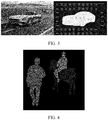
- the user may randomly design a quantity of categories, the categories, and an identification method based on a design requirement. A specific example may be shown in FIG. 3 . All pixel areas in which a vehicle is located are classified as a vehicle by the neural network, and are identified as 1. All pixel areas in a surrounding background part are classified as a background by the neural network, and are identified as 0.
- areas of objects of a same category have a same label.
- a label of a background is 0, a label of a cat is 1, and a label of a skateboard is 2.
- a same color may be further used to represent labels of a same object category. For example, a person, a horse, and a background are respectively identified by using different colors.
- the mask is a result of a semantic segmentation algorithm.
- all pixels belonging to a category of objects are labeled as a color or identifier, and a background is also labeled as a color or identifier.
- the image obtained after processing is referred to as a mask, so that a segmentation result is displayed intuitively.
- an image mask may include a main object mask and a background mask.
- the main object mask may correspond to a main object identified by using a segmentation method, including an individual that the user expects to highlight in an image or a photographed image, for example, a person, an animal, a plant, or a particular object (a cup, a table, clothes, decoration).
- the background mask corresponds to another area that is in the image and that is not identified as the main object mask.
- the image mask corresponds to the entire image.
- An identification capability of the main object mask is related to performance of the neural network. For example, some neural networks can identify only a person and a background.
- Some neural networks can identify a person, a vehicle, and a background. Some neural networks can identify only a vehicle and a background. Some neural networks can identify a person, an animal, and a background. Some neural networks can identify only an animal and a background. Some neural networks can identify an animal, a plant, a background...
- an image may alternatively include only a main object, or may include only a background.
- the main object may also be identified as the background.
- a large amount of segmentation training data needs to be used for training of a deep neural network
- a training data set includes a large quantity of images including segmentation object categories, input images, and mask graphs.
- the training data set may cover various typical application scenarios of a segmentation object, and has diverse data.
- the input images and the mask graphs in the training data set are used to train the network, to obtain an excellent network parameter, in other words, obtain segmentation performance satisfied by the user.
- the obtained network parameter is used as a finally used calculation parameter of the neural network.
- S223 Determine a target mask based on masks.
- the terminal may further determine a mask that is in the masks and that corresponds to an object that most needs to be highlighted and prominently displayed. That is, the target mask needs to be determined. Determining the target mask includes but is not limited to the following several manners.
- k 2 and the two masks include one main object mask and one background mask, an image area corresponding to the main object mask is determined as the target area, and an area corresponding to the background mask is determined as the background area.
- masks of an image output by the neural network include only a main object mask A1 and a background mask.
- A1 may be determined as the target mask.
- Manner 2 When the mask includes a plurality of main object masks and a background mask, if a quantity of pixels included in any main object mask is greater than a specific threshold, the main object mask is determined as the target main object; or if a quantity of pixels included in any main object mask is less than a specific threshold, the main object mask is re-marked, and is also marked as a background.
- a quantity of pixels included in the main object mask may be a quantity of pixels included in a region of the individual in the image.
- k masks correspond to different object categories. If k is greater than 2 and a quantity of pixels included in k0 main object masks in the k masks is greater than a preset threshold, an image area corresponding to the k0 main object masks is determined as the target area, and an image area corresponding to a remaining mask is determined as the background area, where k0 is a nonnegative integer less than k.
- masks of an image output by the neural network include a main object mask A1, a main object mask A2, and a background mask. If a quantity of pixels included in A1 is greater than the preset threshold and a quantity of pixels included in A2 is not greater than the preset threshold, A1 is determined as the target mask, and the main object mask A2 is re-marked as a background mask. A re-marked mask may be shown in FIG. 5 . If a quantity of pixels included in A1 is greater than the preset threshold and a quantity of pixels included in A2 is also greater than the preset threshold, both A1 and A2 are determined as the target mask. If neither a quantity of pixels included in A1 nor a quantity of pixels included in A2 is greater than the preset threshold, A1 and A2 are re-identified as background masks. In other words, the image includes no main object mask.
- A1 and A2 may be of a same object category or different object categories.
- Manner 3 When the mask includes a plurality of main object masks and a background mask, a main object mask including a largest quantity of pixels is selected as the target mask, and other main object masks are also re-marked as the background mask.
- k masks correspond to different object categories. If k is greater than 2, an image area corresponding to a main object mask that includes a largest quantity of pixels and that is in the k masks is determined as the target area, and an image area corresponding to remaining masks is determined as the background area.
- masks of an image output by the neural network include a main object mask A1, a main object mask A2, and a background mask.
- A1 that includes a largest quantity of pixels is determined as the target mask, and the main object mask A2 is re-marked as a background mask.
- the re-marked mask may be shown in FIG. 5 .
- A1 and A2 may be of a same object category or different object categories.
- the target mask is determined based on priorities of the object categories. For example, if a priority of a person mask is higher than a priority of a vehicle mask, the person mask is the target mask, and the vehicle mask may be re-marked as a background.
- the priority of the person mask is higher than a priority of an animal mask and is higher than a priority of a plant mask
- a priority set by a system is that all masks whose priorities are higher than the priority of the plant mask are main object masks, both the person mask and the animal mask are target masks, and the plant mask may be re-marked as a background. It should be understood that one or more individuals belong to a same object category mask.
- k masks correspond to different object categories. If k is greater than 2, the target mask is determined from the k masks based on preset priorities of the object categories. An image area corresponding to the target mask is determined as the target area, and an image area corresponding to the remaining masks is determined as the background area.
- masks of an image output by the neural network include a main object mask A1, a main object mask B1, and a background mask.
- A1 and B1 are of different object categories, and a priority of A1 is higher than a priority of B1. If a system sets that any main object mask whose priority is higher than or equal to that of B1 may be used as the target mask, both A1 and B1 are target masks. If a system sets that a main object mask whose priority is higher than B1 may be used as the target mask, A1 is determined as the target mask, and B1 is re-marked as a background mask.
- the target mask may be determined according to a selection operation input by the user.
- An input mode includes but is not limited to selection instructions such as screen touching and a voice.
- a main object mask corresponding to an individual selected by the user is the target mask.
- k masks correspond to different object categories. If k is greater than 2, the target mask is determined from the k masks according to a selection instruction of the user. An image area corresponding to the target mask is determined as the target area, and an image area corresponding to remaining masks is determined as the background area.
- the masks of the image output by the neural network include the main object mask A1, the main object mask B1, and the background mask. If the user taps, in a photographing process, an individual corresponding to A1 on a touchscreen, A1 is determined as the target mask, and B1 is re-marked as a background mask. If the user taps, in a photographing process, an individual corresponding to B1 on a touchscreen, B1 is determined as the target mask, and A1 is re-marked as a background mask.
- the target mask may be determined based on a selection operation input by the user.
- An input mode includes but is not limited to selection instructions such as screen touching and a voice. All main object masks of an object category corresponding to an individual selected by the user are target masks.
- k masks correspond to different object categories. If k is greater than 2, the target mask is determined from the k masks according to a selection instruction of the user. An image area corresponding to the target mask is determined as the target area, and an image area corresponding to the remaining masks is determined as the background area.
- masks of an image output by the neural network include main object masks A1, A2, B1, and B2 and a background mask.
- A1 and A2 are of a same object category
- B1 and B2 are of a same object category. If the user taps, in a photographing process, an individual corresponding to A1 on a touchscreen, A1 and A2 that are of the same object category are determined as target masks, and B1 and B2 are re-marked as background masks. If the user taps, in a photographing process, an individual corresponding to B2 on a touchscreen, B1 and B2 of the same object category are determined as target masks, and A1 and A2 are re-marked as background masks.
- target masks may be obtained. These target masks may be of one or more object categories, and each object category of target masks may further include one or more individuals.
- a displayed result is related to a rule that is set in a terminal system and that is for determining the target mask and an input of the user.
- an image may alternatively include only a background mask.
- s224 Determine the target area and the background area in the original image.
- the original size of the photographed image is sampled from the mask, and the target mask and the background mask in the mask are also upsampled.
- An area constituted by all pixels that are of the upsampled target mask and that correspond to the original image is the target area, and an area constituted by all pixels that are of the upsampled background mask and that correspond to the original image is the background area.
- Step 23 Process the target area and the background area in the image in different color processing modes to obtain a target image.
- the different color processing modes are used for processing, so that chrominance of the target area is greater than chrominance of the background area or luminance of the target area is greater than luminance of the background area.
- the chrominance of the target area in the target image is greater than the chrominance of the background area in the target image, or the luminance of the target area in the target image is greater than the luminance of the background area in the target image.
- a first color processing mode and a second color processing mode are respectively used for the target area and the background area in the image.
- the first color processing mode and the second color processing mode include but are not limited to the following manners.
- the first color processing mode is retaining a color
- the second color processing mode is using a filter, for example, converting a color of the background area into black and white.
- Typical filters further include any of a black and white filter, a darkening filter, a retro filter, a film filter, a blurring filter, a bokeh filter, and the like.
- the black and white filter is to map each pixel value to a grayscale value to implement an effect of the black and white filter.
- the darkening filter is to darken luminance of each pixel value to achieve a special darkening effect.
- the first color processing mode is a first filter manner
- the second color processing mode is a second filter manner
- the first filter manner is different from the second filter manner.
- chrominance of the image obtained in the first filter manner is greater than chrominance of the image obtained in the second filter manner.
- the first color processing mode is a third filter manner
- the second color processing mode is a fourth filter manner
- the third filter manner is different from the fourth filter manner.
- luminance of the image obtained in the third filter manner is greater than luminance of the image obtained in the fourth filter manner.
- color processing includes luminance processing and/or chrominance processing.
- the filter may include adjusting chrominance, luminance, and hue, and may further include superimposed texture and the like.
- a color system may be adjusted in a targeted manner by adjusting the chrominance and the hue, so that the color system becomes thicker or lighter, or a tone is changed, and another color system remains unchanged.
- the filter may also be understood as pixel-to-pixel mapping. A pixel value of an input image is mapped to a pixel value of a target pixel by using a preset mapping table, to achieve a special effect. It should be understood that the filter may be a preset parameter mask. These color-related parameters may be parameters in a filter mask well known in the industry, or may be parameters independently designed by the user.
- step 23 the method further includes step 24 of storing the image processed in step 23.
- the terminal may determine a target individual and a background based on image content, and perform different color processing on the target individual and the background, so that a main object in an image photographed by the user can be more prominent, and the photographed image is like a film.
- Example 2 video photographing (video recording mode)
- an image processing method for video recording is similar to an image processing method for photographing, and a difference lies in that an object processed in photographing is one image while an object processed in video recording is consecutive video frames, namely, a plurality of consecutive images.
- the object processed in video recording may be a complete video, or may be a segment in a complete video, or a user-defined video clip within a time period range.
- For a processing procedure of each image in the video or the video clip refer to the processing method in Example 1.
- an image processing method for video photographing may include the following steps.
- Step 31 Obtain N photographed images, where N is a positive integer; and perform operations of steps 32 and 33 on each image, where the N images may be adjacent video frames, and a sum of the N images may be understood as a video. Alternatively, the N images may be non-adjacent.
- step 32 may be the same as that of step 22.
- step 33 may be the same as that of step 23.
- any manner of determining a main object in S223 may have a delay.
- a person and a background are determined in the L1 th frame, and it may still be determined, from the (L1 + 1) th frame of image to the (L1 + L0) th frame of image through pixel marking and mask comparison, that the person in these images is the main object, and an area corresponding to the person in these images is a target area 0.
- the main object and the background do not need to be determined for each frame.
- a moment at which the main object is determined each time may be defined by a user, or the main object may be determined periodically, for example, but not limited to, every 2s or every 10s.
- a manner of determining the main object each time includes but is not limited to the six manners in S223.
- Step 34 Store the video constituted by the N images on which color processing is performed.
- the terminal may determine a target individual and a background based on video content, and perform different color processing on the target individual and the background, so that a main object of a video photographed by the user can be more prominent, the photographed video is as cool as a movie, and user experience is improved.
- Example 3 video photographing (video recording mode)
- an image processing method for video recording is similar to an image processing method for photographing, and a difference lies in that an object processed in photographing is one image while an object processed in video recording is consecutive video frames, namely, a plurality of consecutive images. Therefore, for a processing procedure of each image, refer to the processing method in Example 1.
- some areas in an image may be incorrectly detected. If a same area is separately marked as a target or a background in adjacent frames, the same area is processed into different colors according to the foregoing example color processing method, and changes of the colors of the same area in the adjacent frames cause a sensory flicker. Therefore, the flicker needs to be determined and eliminated during processing.
- the flicker may be understood as an object category determining error.
- a mask of a previous frame may be processed based on an optical flow to obtain an optical flow-based mask, and a difference between the optical flow-based mask and a mask of a current frame is compared.
- a coincidence degree or a similarity degree exceeds a specific proportion, it is determined that no flicker occurs.
- the coincidence degree or the similarity degree does not exceed the specific proportion, it is determined that a flicker occurs.
- flicker determining is a continuous process.
- a specific method for determining whether a flicker exists is as follows:
- a quantity of groups of adjacent images with a same object determined as different object categories is greater than a preset threshold, it may be determined that flicker exception processing needs to be performed on the current frame. If it is determined that a quantity of groups of adjacent images with a same object determined as different object categories is not greater than the preset threshold, it may be determined that flicker exception processing does not need to be performed on the current frame.
- a flicker occurs in more than half of the frames (for example, it is determined that a flicker occurs in three video frames in the first five adjacent frames of the current video frame), it may be determined that flicker exception processing needs to be performed on the current frame. If it is determined that a flicker occurs in less than half of the frames (for example, it is determined that a flicker occurs in one of the first five adjacent frames of the current video frame), it may be determined that flicker exception processing does not need to be performed on the current frame.
- a current video image may be understood as an image that is being recorded at a moment.
- the moment herein may be understood as a general moment in some scenarios, or may be understood as a specific moment in some scenarios, for example, a latest moment or a moment in which a user is interested.
- the image processing method for video photographing in this example may include the following steps.
- Step 41 Obtain N photographed images, where N is a positive integer; and perform operations of steps 32 and 33 on each image, where the N images may be adjacent video frames, and a sum of the N images may be understood as a video; or the N images may be non-adjacent.
- Step 42 Determine whether a quantity of groups of adjacent images in which a flicker occurs in the first NO frames of the current frame (the current image) is greater than the preset threshold.
- NO and the threshold may be set by the user.
- NO is a selected quantity of historical video frame samples
- the threshold may be 1/2, 2/3, or the like of N0. This is merely an example and is not limited.
- steps 42 and 43 are performed on the currently photographed or captured image.
- step 43 may be the same as that of step 32.
- step 44 may be the same as that of step 33.
- step 44 If the determining result is greater than the preset threshold, an operation of step 44 is performed on the currently photographed or captured image.
- Step 45 Process all image areas of the current frame by using a same color processing method to obtain a target image.
- the same color processing method may be the same as a color processing method of the background area in a previous frame, or may be the same as a color processing method of the target area in a previous frame, or may be the same as a color processing method of an entire image in a previous frame.
- a color processing method that is the same as that for the background area in step 33 (23) may be used for the entire image.
- a color processing method that is the same as that for the target area in step 33 (23) may be used for the entire image.
- the entire image remains colorful, or the entire image is black and white, or a first or second color processing mode (including but not limited to the color processing modes in Example 1) is used for the entire image.
- a mask segmentation procedure similar to that in step 22 may exist or may be omitted. This is not limited in this example.
- step 46 of storing the video constituted by the N images on which color processing is performed is performed.
- N is a positive integer.
- the terminal may determine a target individual and a background based on video content, and perform different color processing on the target individual and the background, so that a main object of a video photographed by the user can be more prominent, the photographed video is as cool as a movie, and user experience is improved.
- a main object of the image usually changes.
- the user also expects to freely select a color processing mode of the main object in different images, to independently control a video style.
- An image processing method in a video photographing process may include the following steps.
- Step 51 A terminal obtains a video frame.
- Step 52 The terminal determines a main object area and a background area in any video frame obtained from a video.
- Step 53 The terminal uses any color processing mode at any time for the main object area, and uses any color processing mode at any time for the background area. However, it needs to be ensured that for any image, luminance or chrominance of a main object area after color processing is greater than luminance or chrominance of a background area after color processing. Alternatively, for any image, chrominance or luminance of the image obtained in a color processing mode used for a main object area is greater than chrominance or luminance of the image obtained in a color processing mode used for a background area.
- Example 5 video photographing (video recording mode)
- a main object of the image usually changes.
- the user also expects to freely select a color processing mode of the main object in different images, to independently control a video style. Especially, a color is changed by time period.
- An image processing method in a video photographing process may include the following steps.
- Step 61 Capture N1 images in a first time period and capture N2 images in a second time period, where the first time period and the second time period are adjacent time periods, and both N1 and N2 are positive integers, the first time period and the second time period may be duration in which the user can identify an image change with naked eyes, and N1 and N2 are determined by frame rates and duration of the time periods during video recording. This is not limited in the present invention.
- Step 62 Determine a first target area and a first background area in each of the N1 images, where the first background area is an area of the image other than the first target area, and the first target area in each of the N1 images corresponds to a first object (which may include at least one object); and determine a second target area and a second background area in each of the N2 images, where the second background area is an area of the image other than the second target area, and the second target area in each of the N2 images corresponds to a second object (which may include at least one object).
- Step 63 Process the first target area in a first color processing mode, process the first background area in a second color processing mode, process the second target area in a third color processing mode, and process the second background area in a fourth color processing mode, to obtain a target video, where in the target video, chrominance of the first target area is greater than chrominance of the first background area, or luminance of the first target area is greater than luminance of the first background area; and chrominance of the second target area is greater than chrominance of the second background area, or luminance of the second target area is greater than luminance of the second background area.
- Example 6 video photographing (video recording mode)
- an image area corresponding to a first object is determined as a target area in a first time period
- an image area corresponding to a second object is determined as a target area in a second time period
- the first object and the second object are different objects, individuals, or object categories.
- an image processing method in a video photographing process may include the following steps.
- step 71 may be the same as that of step 61.
- Step 72 Determine a first target area and a first background area in any one of the N1 images based on image content, and determine a second target area and a second background area in any one of the N2 images based on image content, where an object or an object category corresponding to the second target area is different from an object or an object category corresponding to the first target area, so that a system and the user can independently select a target main object and the target area of the image.
- An image includes a main object and a background, and correspondingly, the image includes a target area and a background area.
- the first object is a person
- the second object is an animal.
- the first object is a person A
- the second object is a person B.
- the first object is two persons
- the second object is a dog and two cats.
- a remaining area that is not identified is marked as the background.
- an image mask may be determined by using the foregoing methods in S221 and S222.
- a subsequent method is not limited to determining a target object in the mask for each image.
- the user may freely input the first object and the second object, and the first object and the second object are determined according to a selection instruction input by the user. For example, if the user selects an individual, the system identifies a pixel corresponding to an instruction input by the user, further identifies a specific (/some) individual (/individuals) (/may be at least one individual) or a specific (/some) object category (/categories) (/may be at least one object category) of a mask selected by the user, further determines a specific (/some) individual (/individuals) or all individuals in which a specific (/some) object category (/object categories), as the first object, and determines the first object or the image area corresponding to the first object, as the first target area.
- a selection instruction input by the user For example, if the user selects an individual, the system identifies a pixel corresponding to an instruction input by the user, further identifies a specific (/some) individual (/individuals) (/may be at least one
- an area corresponding to a mask corresponding to the first object is the first target area until the user selects another individual at a next moment, and an area corresponding to the new individual is determined as the second target area according to a method similar to the foregoing method.
- an image area other than the first target area or the second target area is the background area.
- the area corresponding to the mask corresponding to the first object in the first time period is the first target area
- the area corresponding to the mask corresponding to the second object in the second time period is the second target area.
- the system may determine a target mask of an image in a time period in the image mask based on a preset time interval (for example, but not limited to 1s or 2s) or a preset quantity of frames (for example, but not limited to 50 frames or 100 frames).
- a first target mask is determined in the 101 th frame, and a mask that has a same object category or individual as the first target mask is used as the first target mask for each of the following 102 frames to 200 frames until a second target mask is determined in the 201 th frame.
- a mask that has a same object category or individual as the second target mask is used as the second target mask.
- numbers of the foregoing example may be predefined by the user or the system.
- the first target mask and the second target mask may be of a same object category or a same individual, or may be of different object categories or different individuals. This is related to an identification capability of a network, a scene image change, or a user input command.
- a target mask is determined at a moment, and the mask of this type or the mask of this individual is continuously used for a period of time.
- first target area, the first background area, the second target area, and the second background area are further determined according to a method in s224.
- step 73 may be the same as that of step 63.
- this example may vary by time period, there may be a plurality of combinations of color processing methods.
- the first color processing mode is the same as the third color processing mode
- the second color processing mode is the same as the fourth color processing mode.
- This color processing mode has good consistency.
- the first color processing mode is the same as the third color processing mode, and the second color processing mode is different from the fourth color processing mode.
- colors of the target main object are consistent, and background colors change, so that an overall visual effect is more dazzling.
- the first color processing mode is different from the third color processing mode, and the second color processing mode is the same as the fourth color processing mode.
- this color processing mode background colors are consistent, and colors of the target main object change, so that the target main object is more prominent.
- the first color processing mode is different from the third color processing mode
- the second color processing mode is different from the fourth color processing mode.
- this color processing mode more color transformation manners can be provided, and more color cooperation can be provided based on requirements of different scenarios.
- the first color processing mode or the third color processing mode includes a filter, for example, color retaining or color enhancement.
- the second color processing mode or the fourth color processing mode includes filters such as a black and white filter, a darkening filter, a retro filter, a film filter, a blurring filter, and a bokeh filter.
- the third color processing mode and the fourth color processing mode are respectively similar to the first color processing mode and the second color processing mode.
- the user may freely select a color processing mode of a background in different images, to highlight different backgrounds.
- the user may freely select a color processing mode of a main object in different images, to highlight the main object in different degrees or forms.
- the present invention provides an image processing method.
- a target area and a background area are determined in an image by performing mask segmentation on the image.
- Different color processing modes are applied to the target area and the background area, so that luminance of the target area is greater than luminance of the background area, or chrominance of the target is greater than chrominance of the background area, and a main object corresponding to the target area is more prominently highlighted. This implements a movie special effect.
- an embodiment of the present invention provides an image processing apparatus 900.
- the apparatus may be used in a plurality of terminal devices, and may be in any implementation form of the terminal 100, for example, a terminal having a video photographing function.
- the apparatus includes:
- the apparatus may further include a storage module 904, configured to store the image or the video on which color processing is performed.
- the present invention provides an image processing apparatus.
- Mask segmentation is performed on an image, so that a target area and a background area in the image are determined based on image content.
- Different color processing modes are applied to the target area and the background area, so that luminance of the target area is greater than luminance of the background area, or chrominance of the target area is greater than chrominance of the background area, and a main object corresponding to the target area is more prominently highlighted. This achieves a movie special effect.
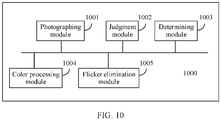
- an embodiment of the present invention further provides an image processing apparatus 1000.
- the apparatus may be used in a plurality of terminal devices, and may be in any implementation form of the terminal 100, for example, a terminal having a video photographing function.
- the apparatus includes:
- the apparatus 1000 may further include a storage module 1006, configured to store the image or the video on which color processing is performed.
- the present invention provides the image processing apparatus.
- Mask segmentation is performed on the image, so that the target area and the background area in the image are determined based on image content.
- the different color processing modes are applied to the target area and the background area, so that the luminance of the target area is greater than the luminance of the background area, or the chrominance of the target area is greater than the chrominance of the background area, and a main object corresponding to the target area is more prominently highlighted. This implements a movie special effect.
- each of the foregoing modules may be a separate processor element, or may be integrated on a chip of a terminal, or may be stored in a storage element of a controller in a form of program code.
- a processor element of the processor invokes and executes a function of each of the foregoing modules.
- the modules may be integrated or may be implemented independently.
- the processor element herein may be an integrated circuit chip and has a signal processing capability.
- steps in the foregoing methods or the foregoing modules may be implemented by using a hardware integrated logical circuit in the processor element, or by using instructions in a form of software.
- the processor element may be a general-purpose processor, for example, a central processing unit (English: central processing unit, CPU for short), or may be one or more integrated circuits configured to implement the foregoing methods, for example, one or more application-specific integrated circuits (English: application-specific integrated circuit, ASIC for short), or one or more microprocessors (English: digital signal processor, DSP for short), or one or more field-programmable gate arrays (English: field-programmable gate array, FPGAfor short).
- the embodiments of the present invention may be provided as a method, a system, or a computer program product. Therefore, the present invention may use a form of hardware only embodiments, software only embodiments, or embodiments with a combination of software and hardware. Moreover, the present invention may use a form of a computer program product that is implemented on one or more computer-usable storage media (including but not limited to a disk memory, a CD-ROM, an optical memory, and the like) that include computer-usable program code.
- computer-usable storage media including but not limited to a disk memory, a CD-ROM, an optical memory, and the like
- These computer program instructions may be provided for a general-purpose computer, a special-purpose computer, an embedded processor, or a processor of another programmable data processing device to generate a machine, so that the instructions executed by a computer or the processor of the another programmable data processing device generate an apparatus for implementing a specific function in one or more processes in the flowcharts and/or in one or more blocks in the block diagrams.
- These computer program instructions may be stored in a computer-readable memory that can instruct the computer or the another programmable data processing device to work in a specific manner, so that the instructions stored in the computer-readable memory generate an artifact that includes an instruction apparatus.
- the instruction apparatus implements the specific function in one or more processes in the flowcharts and/or in one or more blocks in the block diagrams.
- These computer program instructions may alternatively be loaded onto the computer or the another programmable data processing device, so that a series of operations and steps are performed on the computer or the another programmable device, thereby generating computer-implemented processing. Therefore, the instructions executed on the computer or the another programmable device provide steps for implementing the specific function in one or more processes in the flowcharts and/or in one or more blocks in the block diagrams.
Landscapes
- Engineering & Computer Science (AREA)
- Theoretical Computer Science (AREA)
- Physics & Mathematics (AREA)
- General Physics & Mathematics (AREA)
- Multimedia (AREA)
- Computer Vision & Pattern Recognition (AREA)
- Evolutionary Computation (AREA)
- Signal Processing (AREA)
- Artificial Intelligence (AREA)
- Medical Informatics (AREA)
- Databases & Information Systems (AREA)
- General Health & Medical Sciences (AREA)
- Computing Systems (AREA)
- Software Systems (AREA)
- Health & Medical Sciences (AREA)
- Data Mining & Analysis (AREA)
- Evolutionary Biology (AREA)
- Bioinformatics & Computational Biology (AREA)
- Bioinformatics & Cheminformatics (AREA)
- General Engineering & Computer Science (AREA)
- Life Sciences & Earth Sciences (AREA)
- Image Analysis (AREA)
- Studio Devices (AREA)
- Color Image Communication Systems (AREA)
- Image Processing (AREA)
- Processing Of Color Television Signals (AREA)
Applications Claiming Priority (2)
| Application Number | Priority Date | Filing Date | Title |
|---|---|---|---|
| CN201811199216.XA CN109961453B (zh) | 2018-10-15 | 2018-10-15 | 一种图像处理方法、装置与设备 |
| PCT/CN2019/091700 WO2020078026A1 (fr) | 2018-10-15 | 2019-06-18 | Procédé et appareil de traitement d'image et dispositif |
Publications (2)
| Publication Number | Publication Date |
|---|---|
| EP3859672A1 true EP3859672A1 (fr) | 2021-08-04 |
| EP3859672A4 EP3859672A4 (fr) | 2021-12-01 |
Family
ID=67023235
Family Applications (1)
| Application Number | Title | Priority Date | Filing Date |
|---|---|---|---|
| EP19872293.6A Pending EP3859672A4 (fr) | 2018-10-15 | 2019-06-18 | Procédé et appareil de traitement d'image et dispositif |
Country Status (10)
| Country | Link |
|---|---|
| US (1) | US12079974B2 (fr) |
| EP (1) | EP3859672A4 (fr) |
| JP (1) | JP7266672B2 (fr) |
| KR (1) | KR20210073570A (fr) |
| CN (4) | CN109961453B (fr) |
| AU (1) | AU2019363031B9 (fr) |
| BR (1) | BR112021007087A2 (fr) |
| MX (1) | MX2021004309A (fr) |
| MY (1) | MY209612A (fr) |
| WO (1) | WO2020078026A1 (fr) |
Families Citing this family (24)
| Publication number | Priority date | Publication date | Assignee | Title |
|---|---|---|---|---|
| CN110717865B (zh) * | 2019-09-02 | 2022-07-29 | 苏宁云计算有限公司 | 图片检测方法及装置 |
| CN113111684B (zh) * | 2020-01-10 | 2024-05-21 | 字节跳动有限公司 | 神经网络模型的训练方法、装置和图像处理系统 |
| SG10202001656VA (en) * | 2020-02-25 | 2021-09-29 | Emage Ai Pte Ltd | A computer implemented process to enhance edge defect detection and other defects in ophthalmic lenses |
| CN113313788B (zh) * | 2020-02-26 | 2025-01-28 | 北京小米移动软件有限公司 | 图像处理方法和装置、电子设备以及计算机可读存储介质 |
| CN113395441A (zh) * | 2020-03-13 | 2021-09-14 | 华为技术有限公司 | 图像留色方法及设备 |
| CN111598902B (zh) * | 2020-05-20 | 2023-05-30 | 抖音视界有限公司 | 图像分割方法、装置、电子设备及计算机可读介质 |
| KR102812744B1 (ko) | 2020-08-04 | 2025-05-26 | 삼성전자주식회사 | 피사체와 배경에 효과를 적용하여 이미지를 생성하는 전자 장치 및 그 방법 |
| CN112070656B (zh) * | 2020-08-10 | 2023-08-25 | 上海明略人工智能(集团)有限公司 | 帧数据的修改方法及装置 |
| WO2022092130A1 (fr) * | 2020-10-29 | 2022-05-05 | 株式会社湯山製作所 | Dispositif de discrimination de type, procédé de discrimination de type, programme de discrimination de type et dispositif de tri de médicament |
| CN113395599B (zh) * | 2020-12-03 | 2024-07-23 | 腾讯科技(深圳)有限公司 | 一种视频处理方法、装置、电子设备及介质 |
| CN112653920B (zh) * | 2020-12-18 | 2022-05-24 | 北京字跳网络技术有限公司 | 视频处理方法、装置、设备及存储介质 |
| CN112581463B (zh) * | 2020-12-25 | 2024-02-27 | 北京百度网讯科技有限公司 | 图像缺陷的检测方法、装置、电子设备、存储介质及产品 |
| CN112861661B (zh) * | 2021-01-22 | 2022-11-08 | 深圳市慧鲤科技有限公司 | 图像处理方法及装置、电子设备及计算机可读存储介质 |
| CN113067983B (zh) * | 2021-03-29 | 2022-11-15 | 维沃移动通信(杭州)有限公司 | 视频处理方法、装置、电子设备和存储介质 |
| CN113421275A (zh) * | 2021-05-13 | 2021-09-21 | 影石创新科技股份有限公司 | 图像处理方法、装置、计算机设备和存储介质 |
| CN113284080B (zh) * | 2021-06-17 | 2025-04-18 | Oppo广东移动通信有限公司 | 图像处理方法及装置、电子设备及存储介质 |
| CN115701129B (zh) * | 2021-07-31 | 2024-09-10 | 荣耀终端有限公司 | 一种图像处理方法及电子设备 |
| US11636683B2 (en) * | 2021-09-14 | 2023-04-25 | Black Sesame Technologies Inc. | Precise object segmentation with multi-modal input for realtime video application |
| CN114372222B (zh) * | 2022-01-10 | 2025-06-27 | 上海蒜芽信息科技有限公司 | 语义标签的页面色彩管理方法、系统、设备及存储介质 |
| CN118119919A (zh) | 2022-09-30 | 2024-05-31 | 京东方科技集团股份有限公司 | 显示装置以及显示方法 |
| CN115908448A (zh) * | 2022-10-17 | 2023-04-04 | 阿里巴巴(中国)有限公司 | 图像处理方法、装置及计算机可读存储介质 |
| EP4557271A4 (fr) | 2022-12-23 | 2025-10-01 | Samsung Electronics Co Ltd | Dispositif d'affichage et procédé de commande associé |
| CN116074640B (zh) * | 2023-02-17 | 2024-12-24 | 展讯通信(上海)有限公司 | 图像处理方法及相关装置 |
| US12608858B2 (en) * | 2023-04-10 | 2026-04-21 | Adobe Inc. | Image generation with multiple image editing modes |
Family Cites Families (43)
| Publication number | Priority date | Publication date | Assignee | Title |
|---|---|---|---|---|
| IL172480A (en) | 2005-12-08 | 2011-11-30 | Amir Zahavi | Method for automatic detection and classification of objects and patterns in low resolution environments |
| US8824567B2 (en) * | 2007-04-04 | 2014-09-02 | Ittiam Systems (P) Ltd. | Method and device for tracking error propagation and refreshing a video stream |
| CN101551853A (zh) * | 2008-11-14 | 2009-10-07 | 重庆大学 | 复杂静态彩色背景下的人耳检测方法 |
| RU2454043C2 (ru) | 2009-12-30 | 2012-06-20 | Юрий Алексеевич Громаков | Способ передачи данных в системе сотовой связи и система для его реализации |
| KR101192163B1 (ko) | 2010-11-19 | 2012-10-17 | (주)넥스리얼 | 물체 단위의 배경 영상 분석을 통한 움직이는 물체의 검출 방법 및 장치 |
| CN102298781B (zh) * | 2011-08-16 | 2014-06-25 | 长沙中意电子科技有限公司 | 基于颜色和梯度特征的运动阴影检测方法 |
| CN102622598B (zh) | 2012-01-13 | 2014-07-09 | 西安电子科技大学 | 基于区域标记与灰度统计的sar图像目标检测方法 |
| US9139133B2 (en) | 2012-05-31 | 2015-09-22 | GM Global Technology Operations LLC | Vehicle collision warning system and method |
| CN102779348B (zh) * | 2012-06-20 | 2015-01-07 | 中国农业大学 | 无标识运动目标跟踪测量方法 |
| CN109711304B (zh) * | 2013-05-21 | 2022-06-14 | 深圳市腾讯计算机系统有限公司 | 一种人脸特征点定位方法及装置 |
| AU2013206601A1 (en) * | 2013-06-28 | 2015-01-22 | Canon Kabushiki Kaisha | Variable blend width compositing |
| CN104301596B (zh) * | 2013-07-11 | 2018-09-25 | 炬芯(珠海)科技有限公司 | 一种视频处理方法及装置 |
| CN104036490B (zh) * | 2014-05-13 | 2017-03-29 | 重庆大学 | 适用于移动通信网络传输中的前景分割方法 |
| US10121256B2 (en) * | 2014-08-28 | 2018-11-06 | Qualcomm Incorporated | Temporal saliency map |
| CN104408743A (zh) | 2014-11-05 | 2015-03-11 | 百度在线网络技术(北京)有限公司 | 图像分割方法和装置 |
| CN104751407B (zh) * | 2015-03-11 | 2019-01-25 | 百度在线网络技术(北京)有限公司 | 一种用于对图像进行虚化的方法和装置 |
| WO2016197303A1 (fr) * | 2015-06-08 | 2016-12-15 | Microsoft Technology Licensing, Llc. | Segmentation sémantique d'image |
| JP2017054311A (ja) * | 2015-09-09 | 2017-03-16 | 株式会社デンソー | 物体検出装置 |
| US9754351B2 (en) * | 2015-11-05 | 2017-09-05 | Facebook, Inc. | Systems and methods for processing content using convolutional neural networks |
| US10580140B2 (en) * | 2016-05-23 | 2020-03-03 | Intel Corporation | Method and system of real-time image segmentation for image processing |
| CN106407369A (zh) | 2016-09-09 | 2017-02-15 | 华南理工大学 | 一种基于深度学习人脸识别的照片管理方法和系统 |
| CN106529565B (zh) * | 2016-09-23 | 2019-09-13 | 北京市商汤科技开发有限公司 | 目标识别模型训练和目标识别方法及装置、计算设备 |
| KR102359391B1 (ko) | 2016-11-08 | 2022-02-04 | 삼성전자주식회사 | 디바이스가 이미지를 보정하는 방법 및 그 디바이스 |
| WO2018096775A1 (fr) * | 2016-11-28 | 2018-05-31 | ソニー株式会社 | Dispositif de traitement d'image, procédé de traitement d'image et programme |
| CN106506962A (zh) * | 2016-11-29 | 2017-03-15 | 维沃移动通信有限公司 | 一种图像处理方法及移动终端 |
| CN106846321B (zh) * | 2016-12-08 | 2020-08-18 | 广东顺德中山大学卡内基梅隆大学国际联合研究院 | 一种基于贝叶斯概率与神经网络的图像分割方法 |
| CN108230252B (zh) * | 2017-01-24 | 2022-02-01 | 深圳市商汤科技有限公司 | 图像处理方法、装置以及电子设备 |
| CN106960195B (zh) * | 2017-03-27 | 2020-04-03 | 深圳市和巨信息技术有限公司 | 一种基于深度学习的人群计数方法及装置 |
| CN107133939A (zh) * | 2017-04-24 | 2017-09-05 | 努比亚技术有限公司 | 一种照片合成方法、设备及计算机可读存储介质 |
| US10262236B2 (en) * | 2017-05-02 | 2019-04-16 | General Electric Company | Neural network training image generation system |
| CN107507214B (zh) * | 2017-07-06 | 2020-09-11 | 北京华泰诺安探测技术有限公司 | 获取货物图像的方法和装置 |
| CN107547775A (zh) * | 2017-09-11 | 2018-01-05 | 郑州仁峰软件开发有限公司 | 多目标空间排列与虚拟背景、前景合成方法 |
| CN107665482B (zh) * | 2017-09-22 | 2021-07-23 | 北京奇虎科技有限公司 | 实现双重曝光的视频数据实时处理方法及装置、计算设备 |
| WO2019066794A1 (fr) * | 2017-09-27 | 2019-04-04 | Google Llc | Modèle de réseau de bout en bout pour segmentation d'image à haute résolution |
| KR102421855B1 (ko) * | 2017-09-28 | 2022-07-18 | 삼성전자주식회사 | 주행 차로를 식별하는 방법 및 장치 |
| CN107909081B (zh) * | 2017-10-27 | 2022-04-08 | 东南大学 | 一种深度学习中图像数据集的快速获取和快速标定方法 |
| CN108010037B (zh) * | 2017-11-29 | 2019-09-13 | 腾讯科技(深圳)有限公司 | 图像处理方法、装置及存储介质 |
| CN107958449A (zh) * | 2017-12-13 | 2018-04-24 | 北京奇虎科技有限公司 | 一种图像合成方法及装置 |
| CN108154465B (zh) * | 2017-12-19 | 2022-03-01 | 北京小米移动软件有限公司 | 图像处理方法及装置 |
| CN108206917B (zh) * | 2017-12-29 | 2020-09-15 | 南京中兴新软件有限责任公司 | 图像处理的方法及装置、存储介质、电子装置 |
| CN108305223B (zh) * | 2018-01-09 | 2020-11-03 | 珠海格力电器股份有限公司 | 图像背景虚化处理方法及装置 |
| CN108366203B (zh) * | 2018-03-01 | 2020-10-13 | 北京金山安全软件有限公司 | 一种构图方法、装置、电子设备及存储介质 |
| CN108632607B (zh) | 2018-05-09 | 2019-06-21 | 北京大学深圳研究生院 | 一种基于多角度自适应帧内预测的点云属性压缩方法 |
-
2018
- 2018-10-15 CN CN201811199216.XA patent/CN109961453B/zh active Active
- 2018-10-15 CN CN202110228022.3A patent/CN113163133A/zh active Pending
- 2018-10-15 CN CN202110393464.3A patent/CN113298845A/zh active Pending
-
2019
- 2019-06-18 EP EP19872293.6A patent/EP3859672A4/fr active Pending
- 2019-06-18 MY MYPI2021002048A patent/MY209612A/en unknown
- 2019-06-18 CN CN201980068151.1A patent/CN112868050A/zh active Pending
- 2019-06-18 BR BR112021007087-7A patent/BR112021007087A2/pt unknown
- 2019-06-18 MX MX2021004309A patent/MX2021004309A/es unknown
- 2019-06-18 KR KR1020217014609A patent/KR20210073570A/ko not_active Ceased
- 2019-06-18 JP JP2021520989A patent/JP7266672B2/ja active Active
- 2019-06-18 WO PCT/CN2019/091700 patent/WO2020078026A1/fr not_active Ceased
- 2019-06-18 AU AU2019363031A patent/AU2019363031B9/en active Active
-
2021
- 2021-04-15 US US17/231,375 patent/US12079974B2/en active Active
Also Published As
| Publication number | Publication date |
|---|---|
| MX2021004309A (es) | 2021-08-11 |
| CN113298845A (zh) | 2021-08-24 |
| US12079974B2 (en) | 2024-09-03 |
| EP3859672A4 (fr) | 2021-12-01 |
| KR20210073570A (ko) | 2021-06-18 |
| CN109961453B (zh) | 2021-03-12 |
| CN113163133A (zh) | 2021-07-23 |
| CN109961453A (zh) | 2019-07-02 |
| AU2019363031B2 (en) | 2025-03-20 |
| US20210233248A1 (en) | 2021-07-29 |
| AU2019363031B9 (en) | 2025-04-03 |
| JP2022505086A (ja) | 2022-01-14 |
| AU2019363031A1 (en) | 2021-05-27 |
| CN112868050A (zh) | 2021-05-28 |
| MY209612A (en) | 2025-07-24 |
| BR112021007087A2 (pt) | 2021-07-20 |
| WO2020078026A1 (fr) | 2020-04-23 |
| JP7266672B2 (ja) | 2023-04-28 |
Similar Documents
| Publication | Publication Date | Title |
|---|---|---|
| US12026863B2 (en) | Image processing method and apparatus, and device | |
| US12079974B2 (en) | Image processing method and apparatus, and device | |
| WO2022042168A1 (fr) | Procédé de traitement audio et dispositif électronique | |
| CN111881862B (zh) | 手势识别方法及相关装置 | |
| WO2020192692A1 (fr) | Procédé de traitement d'image et appareil associé | |
| WO2021185374A1 (fr) | Procédé de capture d'image et dispositif électronique | |
| CN108259771A (zh) | 图像处理方法、装置、存储介质和电子设备 | |
| WO2022252649A1 (fr) | Procédé de traitement vidéo et dispositif électronique | |
| CN115942122A (zh) | 图像的亮度调整方法、装置、终端及存储介质 | |
| CN119277194A (zh) | 图像处理方法、电子设备、计算机程序产品及存储介质 | |
| RU2791810C2 (ru) | Способ, аппаратура и устройство для обработки и изображения | |
| RU2794062C2 (ru) | Устройство и способ обработки изображения и оборудование | |
| WO2026082099A1 (fr) | Procédé de traitement d'image, caméra, et dispositif électronique | |
| WO2023010913A1 (fr) | Procédé de traitement d'images et dispositif électronique | |
| CN116721038A (zh) | 颜色修正方法、电子设备及存储介质 | |
| HK40026382B (zh) | 视频处理方法、装置、存储介质及电子设备 |
Legal Events
| Date | Code | Title | Description |
|---|---|---|---|
| STAA | Information on the status of an ep patent application or granted ep patent |
Free format text: STATUS: THE INTERNATIONAL PUBLICATION HAS BEEN MADE |
|
| PUAI | Public reference made under article 153(3) epc to a published international application that has entered the european phase |
Free format text: ORIGINAL CODE: 0009012 |
|
| STAA | Information on the status of an ep patent application or granted ep patent |
Free format text: STATUS: REQUEST FOR EXAMINATION WAS MADE |
|
| 17P | Request for examination filed |
Effective date: 20210429 |
|
| AK | Designated contracting states |
Kind code of ref document: A1 Designated state(s): AL AT BE BG CH CY CZ DE DK EE ES FI FR GB GR HR HU IE IS IT LI LT LU LV MC MK MT NL NO PL PT RO RS SE SI SK SM TR |
|
| A4 | Supplementary search report drawn up and despatched |
Effective date: 20211103 |
|
| RIC1 | Information provided on ipc code assigned before grant |
Ipc: G06T 5/00 20060101ALI20211027BHEP Ipc: G06T 7/194 20170101AFI20211027BHEP |
|
| DAV | Request for validation of the european patent (deleted) | ||
| DAX | Request for extension of the european patent (deleted) | ||
| STAA | Information on the status of an ep patent application or granted ep patent |
Free format text: STATUS: EXAMINATION IS IN PROGRESS |
|
| 17Q | First examination report despatched |
Effective date: 20240925 |
|
| GRAP | Despatch of communication of intention to grant a patent |
Free format text: ORIGINAL CODE: EPIDOSNIGR1 |
|
| STAA | Information on the status of an ep patent application or granted ep patent |
Free format text: STATUS: GRANT OF PATENT IS INTENDED |
|
| RIC1 | Information provided on ipc code assigned before grant |
Ipc: G06T 7/194 20170101AFI20260224BHEP Ipc: G06T 5/00 20060101ALI20260224BHEP Ipc: H04N 5/262 20060101ALI20260224BHEP Ipc: G06T 5/60 20240101ALI20260224BHEP Ipc: G06T 5/94 20240101ALI20260224BHEP Ipc: G06V 10/26 20220101ALI20260224BHEP Ipc: G06V 10/82 20220101ALI20260224BHEP Ipc: G06V 10/764 20220101ALI20260224BHEP Ipc: H04N 23/80 20230101ALI20260224BHEP Ipc: H04N 5/272 20060101ALI20260224BHEP |
|
| INTG | Intention to grant announced |
Effective date: 20260305 |