EP3861923B1 - Procédé pour déterminer au moins un paramètre d'un oeil d'une personne - Google Patents
Procédé pour déterminer au moins un paramètre d'un oeil d'une personne Download PDFInfo
- Publication number
- EP3861923B1 EP3861923B1 EP20305117.2A EP20305117A EP3861923B1 EP 3861923 B1 EP3861923 B1 EP 3861923B1 EP 20305117 A EP20305117 A EP 20305117A EP 3861923 B1 EP3861923 B1 EP 3861923B1
- Authority
- EP
- European Patent Office
- Prior art keywords
- eye
- image
- person
- target
- retina
- Prior art date
- Legal status (The legal status is an assumption and is not a legal conclusion. Google has not performed a legal analysis and makes no representation as to the accuracy of the status listed.)
- Active
Links
Images



Classifications
-
- A—HUMAN NECESSITIES
- A61—MEDICAL OR VETERINARY SCIENCE; HYGIENE
- A61B—DIAGNOSIS; SURGERY; IDENTIFICATION
- A61B3/00—Apparatus for testing the eyes; Instruments for examining the eyes
- A61B3/0016—Operational features thereof
- A61B3/0025—Operational features thereof characterised by electronic signal processing, e.g. eye models
-
- A—HUMAN NECESSITIES
- A61—MEDICAL OR VETERINARY SCIENCE; HYGIENE
- A61B—DIAGNOSIS; SURGERY; IDENTIFICATION
- A61B3/00—Apparatus for testing the eyes; Instruments for examining the eyes
- A61B3/0016—Operational features thereof
- A61B3/0033—Operational features thereof characterised by user input arrangements
-
- A—HUMAN NECESSITIES
- A61—MEDICAL OR VETERINARY SCIENCE; HYGIENE
- A61B—DIAGNOSIS; SURGERY; IDENTIFICATION
- A61B3/00—Apparatus for testing the eyes; Instruments for examining the eyes
- A61B3/02—Subjective types, i.e. testing apparatus requiring the active assistance of the patient
- A61B3/028—Subjective types, i.e. testing apparatus requiring the active assistance of the patient for testing visual acuity; for determination of refraction, e.g. phoropters
-
- A—HUMAN NECESSITIES
- A61—MEDICAL OR VETERINARY SCIENCE; HYGIENE
- A61B—DIAGNOSIS; SURGERY; IDENTIFICATION
- A61B3/00—Apparatus for testing the eyes; Instruments for examining the eyes
- A61B3/02—Subjective types, i.e. testing apparatus requiring the active assistance of the patient
- A61B3/028—Subjective types, i.e. testing apparatus requiring the active assistance of the patient for testing visual acuity; for determination of refraction, e.g. phoropters
- A61B3/032—Devices for presenting test symbols or characters, e.g. test chart projectors
-
- A—HUMAN NECESSITIES
- A61—MEDICAL OR VETERINARY SCIENCE; HYGIENE
- A61B—DIAGNOSIS; SURGERY; IDENTIFICATION
- A61B3/00—Apparatus for testing the eyes; Instruments for examining the eyes
- A61B3/18—Arrangement of plural eye-testing or -examining apparatus
-
- G—PHYSICS
- G02—OPTICS
- G02C—SPECTACLES; SUNGLASSES OR GOGGLES INSOFAR AS THEY HAVE THE SAME FEATURES AS SPECTACLES; CONTACT LENSES
- G02C7/00—Optical parts
- G02C7/02—Lenses; Lens systems ; Methods of designing lenses
- G02C7/024—Methods of designing ophthalmic lenses
- G02C7/025—Methods of designing ophthalmic lenses considering parameters of the viewed object
-
- G—PHYSICS
- G02—OPTICS
- G02C—SPECTACLES; SUNGLASSES OR GOGGLES INSOFAR AS THEY HAVE THE SAME FEATURES AS SPECTACLES; CONTACT LENSES
- G02C7/00—Optical parts
- G02C7/02—Lenses; Lens systems ; Methods of designing lenses
- G02C7/024—Methods of designing ophthalmic lenses
- G02C7/027—Methods of designing ophthalmic lenses considering wearer's parameters
Definitions
- the invention relates to a method for determining at least one parameter of an eye of a person.
- the invention further relates to a method for displaying a sharp image on the retina of an eye of a person.
- An optical lens is generally determined to be then manufactured in accordance with the wearer specifications.
- the ophthalmic lens is determined according to a wearer prescription corresponding to the visual requirements of that wearer.
- the ophthalmic prescription can include a positive or negative power prescription as well as an astigmatism prescription. These prescriptions correspond to corrections enabling the wearer of the lenses to correct defects of his vision.
- the patent document JP H03 1834 A describes an optical measuring unit.
- One object of the present invention is to provide a cheap, simple and very quick prescription measurement method.
- the invention proposes a method for determining at least one optical parameter of an eye of a person according to claim 1.
- digital refraction measurement is refraction measurement using digital means.
- the invention further relates to a device comprising a processor adapted to store one or more sequence of instructions and to carry out at least one of the steps of the method for determining at least one optical parameter of an eye of a person according to the invention.
- the invention further relates to a computer readable medium carrying one or more sequences of instructions of the computer program product according to the invention.
- a single head-mounted device could be used by different persons having different prescription, the image to be displayed on the retina of each person being corrected based on a prescription of the eye of the person determined by the same head-mounted device.
- the invention further relates to a device comprising a processor adapted to store one or more sequence of instructions and to carry out at least one of the steps of the method for displaying a sharp image on a retina of an eye of the person according to the invention.
- the invention relates to a computer program product comprising one or more stored sequences of instructions that are accessible to a processor and which, when executed by the processor, causes the processor to carry out at least the following steps of the method for displaying a sharp image on a retina of an eye of the person according to the invention.
- the invention further relates to a computer readable medium carrying one or more sequences of instructions of the computer program product according to the invention.
- Embodiments of the present invention may include apparatuses for performing the operations herein.
- This apparatus may be specially constructed for the desired purposes, or it may comprise a general purpose computer or Digital Signal Processor ("DSP") selectively activated or reconfigured by a computer program stored in the computer.
- DSP Digital Signal Processor
- Such a computer program may be stored in a computer readable storage medium, such as, but is not limited to, any type of disk including floppy disks, optical disks, CD-ROMs, magnetic-optical disks, read-only memories (ROMs), random access memories (RAMs) electrically programmable read-only memories (EPROMs), electrically erasable and programmable read only memories (EEPROMs), magnetic or optical cards, or any other type of media suitable for storing electronic instructions, and capable of being coupled to a computer system bus.
- a computer readable storage medium such as, but is not limited to, any type of disk including floppy disks, optical disks, CD-ROMs, magnetic-optical disks, read-only memories (ROMs), random access memories (RAMs) electrically programmable read-only memories (EPROMs), electrically erasable and programmable read only memories (EEPROMs), magnetic or optical cards, or any other type of media suitable for storing electronic instructions, and capable of being coupled to a computer system bus.
- the present invention relates to a method for determining one optical parameter of an eye of a person.
- the optical parameters to be determined are relative to a dioptric power, an astigmatism and an axis of the eye of the person.
- the center of rotation of the eye is called Q'.
- the axis Q'F' shown in the figure by the dot/dash line is the horizontal axis passing through the center of rotation of the eye Q' and extending in front of the wearer; in other words the axis Q'F' corresponds to the primary viewing direction.
- This axis intersects the front face of the lens at a point called the fitting cross CM.
- the fitting cross is marked on lenses in order to allow them to be positioned by an optician.
- the fitting cross is generally located 4 mm above the geometric center of the front face of the lens.
- a apex sphere also called vertex sphere, with center Q' and radius q', is defined, as the sphere that cuts the rear face of the lens at the point O corresponding to the intersection by the axis Q'F' of the rear face of the lens.
- a value of the radius q' of 25.5 mm corresponds to a standard value and provides satisfactory results when the lenses are worn.
- a given viewing direction-shown by the solid line in FIG. 1 corresponds to a position of the eye rotating about Q' and to a point J on the apex sphere.
- a viewing direction may also be identified, in spherical coordinates, by two angles ⁇ and ⁇ , in the so called Fick system.
- the angle ⁇ is the angle between the Q'F' axis and the projection of the straight line Q'J on the vertical plane containing the Q'F' axis, this angle appearing in the diagram of figure 1 .
- the angle ⁇ is the angle between the Q'F' axis and the projection of the straight line Q'J on the horizontal plane containing the Q'F' axis.
- a given viewing direction therefore corresponds to a point J on the apex sphere or to a coordinate pair ( ⁇ , ⁇ ).
- the image of a point in the object space at infinity is formed, on the Q'F' axis, at the point F'.
- the points S and T are coincident, which amounts to stating that the lens is locally spherical in the primary viewing direction.
- the distance D is the rear frontal plane of the lens.
- Figures 2 and 3 show perspective diagrams of a lens/eye system.
- the points J and O are then coincident.
- Figure 3 shows the position of the eye and the reference frame that is associated therewith in a direction ( ⁇ , ⁇ ).
- FIGS. 2 and 3 Shown in figures 2 and 3 are a fixed reference frame ⁇ x,y,z ⁇ and a reference frame ⁇ xm,ym,zm ⁇ associated with the eye in order to show clearly the rotation of the eye.
- the reference frame ⁇ x,y,z ⁇ has as origin the point Q' and the x-axis is the Q'F' axis-the point F' not being shown in FIGS. 2 and 3 and passes through the point O.
- This axis is directed from the lens to the eye in correspondence with the direction of measurement of the astigmatism axis.
- the ⁇ y,z ⁇ plane is the vertical plane.
- the y-axis is vertical and directed upwards.
- the z-axis is horizontal, the reference frame being a direct orthonormal coordinate system.
- the reference frame ⁇ xm,ym,zm ⁇ associated with the eye has the point Q' as center.
- the xm axis is defined by the viewing direction JQ', and coincides with the ⁇ x,y,z ⁇ reference frame in the case of the primary viewing direction.
- Listing's law gives the relationships between the ⁇ x,y,z ⁇ and ⁇ xm,ym,zm ⁇ coordinate systems for each viewing direction-see Le Grand, Optique Physiodefinite, Volume 1, published by Revue d'Optique, Paris 1965 .
- the section of the lens may be drawn in the (O,x,y) plane defined with reference to figure 2 .
- the tangent to this curve at the point O is inclined to the (O,y) axis at an angle called the pantoscopic angle.
- An object point M at an object distance given by the ergorama is considered for a gaze direction ( ⁇ , ⁇ ).
- the ergorama is a function associating to each gaze direction the usual distance of an object point.
- the object point is at infinity.
- the object distance is of the order of 30 to 50 cm.
- the object proximity can be considered as the inverse of the distance between the object point and the front surface of the lens, on the corresponding light ray.
- This definition corresponds to the astigmatism of a ray beam created by the lens.
- the prescription in ophthalmic field may comprise, in addition to the power prescription, an astigmatism prescription.
- a prescription is composed of an axis value (in degrees) and a module value (in diopters).
- the module value represents the difference between the maximal and minimal power in a given direction allowing to correct the visual default of a wearer.
- the axis represents the orientation of one of the two powers versus a reference axis and following a given rotation direction.
- TABO convention may be used. In this convention the reference axis is horizontal and the rotation direction is counterclockwise when looking at the wearer.
- a 45° axis corresponds to an axis orientated obliquely linking, when looking at the wearer, the upper right quadrant to the lower left quadrant.
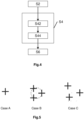
- the method comprises at least the following steps:
- each sharp image is displayed on a retina of the eye of the person carried by three light beams.
- each sharp image is carried by an associated light beam focused substantially in the plane of a pupil of the eye.
- the light beams are focused substantially in the plane means that the light beams are focused at a maximum distance of 10 mm from the plane of the pupil ensuring the sharp display of images on the retina.
- the crosses can be shifted pixel by pixel in the horizontal and/or in the vertical directions at each iteration.
- the third sharp image is also displayed on the retina carried by a third light beam and a parameter of the target in the third image is adapted based on feedback of the person relative to the change of the parameter of the target in the image during the step S4, preferably until the targets of the third image and one of the first images are seen by the person with the same position in the displayed images on the retina of the eye.
- the optical parameter of the person's eye is determined based on the adaption of the parameter of the target in each image.
- the optical parameters of the person's eye can be determined.
- the position of the focusing points can be beforehand determined during a calibration step.
- models other than the Prentice's law can be used to determine the optical parameters of the eye of the person.
- the method can be generalized to other display device configured to display a plurality of sharp images on the retina of an eye carried by a plurality of associated light beams focused in a plurality of different points in the plane of a pupil of the eye and wherein the focusing points are not equally distant from the center of the eye's pupil and/or not equally distant from each other.
- the position of the focusing points should be beforehand determined during a calibration step.
- the size of the target of an image carried by one of the light beams is adapted in a horizontal direction until the target of the image and the target of another image carried by another of the light beams are seen by the person touching each other in the horizontal direction in the displayed images on the retina of the eye.
- the size of the target of an image carried by one of the light beams is adapted in a vertical direction until the target of the image and the target of another image carried by another of the light beams are seen by the person touching each other in the vertical direction in the displayed images on the retina of the eye.
- the method is preferably implemented using a head-mounted device adapted to at least display a plurality of sharp images on the retina of the eye of the person, the plurality of images being carried by a plurality of light beams focused substantially in the plan of the pupil of the eye at different positions.
- a head-mounted device adapted to at least display a plurality of sharp images on the retina of the eye of the person, the plurality of images being carried by a plurality of light beams focused substantially in the plan of the pupil of the eye at different positions.
- the head mounted display devices disclosed in US 2016/033771 A1 or in WO 2018/091984 A1 may be used to implement the method according to the invention.
- Another object of the invention relates to a method for displaying a sharp image on a retina of an eye of a person, the person having a prescription for this eye.
- such displaying method is preferably implemented using a head-mounted device adapted to at least display a plurality of sharp images on the retina of the eye of the person, the plurality of images being carried by a plurality of light beams focused substantially in the plan of the pupil of the eye at different positions.
- a computer program product may be stored in a memory of the head mounted display device, the computer program product comprising one or more stored sequences of instructions that are accessible to a processor of the head mounted display device and which, when executed by the processor, causes the processor to carry out steps of the method according to the invention and as described hereinafter.
- a plurality of initial sub-images is provided during the sub-images providing step S52.
- Each initial sub-image corresponds to at least a part of the image to be displayed.
- a plurality of light beams is provided.
- the light beams are configured to be focused substantially in the plane of a pupil of the eye at a plurality of corresponding different positions.
- the light beams are focused substantially in the plane means that the light beams are focused at a maximum distance of 10 mm from the plane of the pupil ensuring the sharp display of images on the retina.
- each light beam is configured to carry an associated sub-image.
- the sub-image is adapted based on the at least one provided optical parameter and on the corresponding focused position of the light beam configured to carry the sub-image to form an adapted sub-image during the adapting step S56.
- each sub-image is calculated according to the wearer's needs, i.e. according to the eye's prescription.
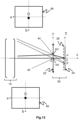
- a first light beam 42 carries an associated sub-image represented by a square frame 46 and a second light beam carries an associated sub-image represented by a square frame 48.
- Each sub-image is calculated and adapted according to the prescription of the eye of the person and on the corresponding focused position of the light beam.
- the content of the first second image and the second sub-image in their frame are vertically offset from each other allowing the properly superimposition on the retina of the first and second sub-images coming from the focusing points M1 and M2.
- the adapted sub-images may be displayed sequentially or simultaneously on the retina of the person.
- the focused positions of the plurality of light beams are regularly distant from each other in the plan of the pupil of the eye.
- a single head-mounted device could be used by different persons having different prescription, the image to be displayed on the retina of each person being corrected based on a prescription of the eye of the person determined by the same head-mounted device.
- a wavelength of at least one of the plurality of light beams differs from a wavelength of at least one other of the plurality of light beams.
- the wavelengths are very close to each other so that the person cannot perceive a difference in the image color.
- such method allows customizing a head-mounted display device to the user's viewing ability.
- such method allows a pre-compensation of the image to be displayed on the retina of the user based on the prescription of the eye of the user, so as to display a sharp image on the retina of the user.
- a single head-mounted device could be used by different persons having different prescription, the image to be displayed on the retina of each person being corrected based on a prescription of the eye of the person determined by the same head-mounted device.
Landscapes
- Health & Medical Sciences (AREA)
- Life Sciences & Earth Sciences (AREA)
- Physics & Mathematics (AREA)
- Ophthalmology & Optometry (AREA)
- General Health & Medical Sciences (AREA)
- Engineering & Computer Science (AREA)
- Surgery (AREA)
- Public Health (AREA)
- Medical Informatics (AREA)
- Molecular Biology (AREA)
- Biomedical Technology (AREA)
- Animal Behavior & Ethology (AREA)
- Biophysics (AREA)
- Heart & Thoracic Surgery (AREA)
- Veterinary Medicine (AREA)
- General Physics & Mathematics (AREA)
- Optics & Photonics (AREA)
- Signal Processing (AREA)
- Eye Examination Apparatus (AREA)
- Image Processing (AREA)
Claims (10)
- Procédé destiné à déterminer au moins un paramètre optique d'un œil d'une personne comprenant :- l'affichage d'au moins deux images nettes sur une rétine de l'œil de la personne, les au moins deux images comprenant une cible et étant transportées par deux faisceaux lumineux focalisés sensiblement dans le plan d'une pupille de l'œil à au moins deux positions différentes ;- l'adaptation d'un paramètre de la cible dans chaque image sur la base d'un retour de la personne relatif à la modification du paramètre de la cible dans l'image afin de superposer les cibles des au moins deux images nettes ; et- la détermination de l'au moins un paramètre optique de l'œil de la personne sur la base de l'adaptation du paramètre de la cible dans chaque image,dans lequel le paramètre adapté de la cible est la position relative ou la taille de la cible dans chaque image,dans lequel l'adaptation de la position relative de la cible dans chaque image comprend :- l'adaptation d'une position angulaire horizontale de la cible d'une image transportée par un des faisceaux lumineux jusqu'à ce que la cible de l'image et la cible d'une autre image transportée par un autre des faisceaux lumineux soient vues par la personne avec la même position horizontale dans les images affichées sur la rétine de l'œil ;- l'adaptation d'une position angulaire verticale de la cible d'une image transportée par un des faisceaux lumineux jusqu'à ce que la cible de l'image et la cible d'une autre image transportée par un autre des faisceaux lumineux soient vues par la personne avec la même position verticale dans les images affichées sur la rétine de l'œil, etdans lequel l'adaptation de la taille de la cible dans chaque image comprend :- l'adaptation d'une taille de la cible d'une image transportée par un des faisceaux lumineux dans une direction horizontale jusqu'à ce que la cible de l'image et la cible d'une autre image transportée par un autre des faisceaux lumineux soient vues par la personne se touchant dans la direction horizontale dans les images affichées sur la rétine de l'œil ;- l'adaptation d'une taille de la cible d'une image transportée par un des faisceaux lumineux dans une direction verticale jusqu'à ce que la cible de l'image et la cible d'une autre image transportée par un autre des faisceaux lumineux soient vues par la personne se touchant dans la direction verticale dans les images affichées sur la rétine de l'œil.
- Procédé selon la revendication 1, dans lequel au moins trois images nettes sont affichées sur la rétine de l'œil de la personne, les au moins trois images comprenant une cible et étant transportées par trois faisceaux lumineux focalisés sensiblement dans le plan de la pupille de l'œil à au moins trois positions différentes et trois paramètres optiques basés sur l'adaptation du paramètre de la cible dans chaque contenu focalisé sont déterminés.
- Procédé selon la revendication 1 ou 2, dans lequel les paramètres optiques déterminés de l'œil de la personne concernent une puissance dioptrique, un astigmatisme et un axe de l'œil de la personne.
- Procédé selon l'une quelconque des revendications 1 à 3 précédentes, dans lequel le retour de la personne est un retour haptique.
- Procédé selon l'une quelconque des revendications 1 à 3 précédentes, dans lequel le retour de la personne est un retour vocal.
- Procédé selon la revendication 5 précédente, dans lequel le retour de la personne est fourni par réponse à des questions.
- Procédé selon l'une quelconque des revendications 1 à 6 précédentes, qui est mis en œuvre au moyen d'un dispositif monté sur la tête adapté au moins pour afficher une pluralité d'images nettes sur la rétine de l'œil de la personne, la pluralité d'images étant transportées par une pluralité de faisceaux lumineux focalisés sensiblement dans le plan de la pupille de l'œil à différentes positions.
- Produit-programme informatique comprenant une ou plusieurs séquences d'instructions enregistrées qui sont accessibles à un processeur et qui, lors de leur exécution par le processeur, conduisent le processeur à effectuer au moins les étapes suivantes :- affichage d'au moins deux images nettes sur une rétine de l'œil de la personne, les au moins deux images comprenant une cible et étant transportées par deux faisceaux lumineux focalisés sensiblement dans le plan d'une pupille de l'œil à au moins deux positions différentes ;- adaptation d'un paramètre de la cible dans chaque image sur la base d'un retour de la personne relatif à la modification du paramètre de la cible dans l'image afin de superposer les cibles des au moins deux images nettes ; et- détermination de l'au moins un paramètre optique de l'œil de la personne sur la base de l'adaptation du paramètre de la cible dans chaque image selon les revendications 1 à 7.
- Support lisible par ordinateur portant une ou plusieurs séquences d'instructions du produit-programme informatique de la revendication 8.
- Procédé destiné à afficher une image nette sur une rétine d'un œil d'une personne, la personne ayant une prescription pour l'œil de la personne, le procédé comprenant :- la détermination d'au moins un paramètre optique relatif à la prescription pour l'œil de la personne selon l'une quelconque des revendications 1 à 7 ;- la fourniture d'une pluralité de sous-images initiales, chaque sous-image initiale correspondant à au moins une partie de l'image à afficher ;- la fourniture d'une pluralité de faisceaux lumineux conçus pour être focalisés sensiblement dans le plan d'une pupille de l'œil à une pluralité de positions différentes correspondantes, chaque faisceau lumineux étant conçu pour transporter une sous-image associée ;- pour chaque sous-image, l'adaptation de la sous-image sur la base de l'au moins un paramètre optique fourni et de la position focalisée correspondante du faisceau lumineux conçu pour transporter la sous-image pour former une sous-image adaptée ; et- l'affichage de chaque sous-image adaptée transportée par le faisceau lumineux associé sur la rétine de la personne.
Priority Applications (4)
| Application Number | Priority Date | Filing Date | Title |
|---|---|---|---|
| EP20305117.2A EP3861923B1 (fr) | 2020-02-07 | 2020-02-07 | Procédé pour déterminer au moins un paramètre d'un oeil d'une personne |
| CN202180012934.5A CN115052512B (zh) | 2020-02-07 | 2021-02-05 | 用于确定人的眼睛的至少一个参数的方法 |
| US17/760,113 US12502062B2 (en) | 2020-02-07 | 2021-02-05 | Method for determining at least one parameter of an eye of a person |
| PCT/EP2021/052851 WO2021156467A1 (fr) | 2020-02-07 | 2021-02-05 | Procédé de détermination d'au moins un paramètre d'un oeil d'une personne |
Applications Claiming Priority (1)
| Application Number | Priority Date | Filing Date | Title |
|---|---|---|---|
| EP20305117.2A EP3861923B1 (fr) | 2020-02-07 | 2020-02-07 | Procédé pour déterminer au moins un paramètre d'un oeil d'une personne |
Publications (2)
| Publication Number | Publication Date |
|---|---|
| EP3861923A1 EP3861923A1 (fr) | 2021-08-11 |
| EP3861923B1 true EP3861923B1 (fr) | 2025-07-09 |
Family
ID=69784357
Family Applications (1)
| Application Number | Title | Priority Date | Filing Date |
|---|---|---|---|
| EP20305117.2A Active EP3861923B1 (fr) | 2020-02-07 | 2020-02-07 | Procédé pour déterminer au moins un paramètre d'un oeil d'une personne |
Country Status (4)
| Country | Link |
|---|---|
| US (1) | US12502062B2 (fr) |
| EP (1) | EP3861923B1 (fr) |
| CN (1) | CN115052512B (fr) |
| WO (1) | WO2021156467A1 (fr) |
Families Citing this family (1)
| Publication number | Priority date | Publication date | Assignee | Title |
|---|---|---|---|---|
| CN114189623B (zh) * | 2021-09-01 | 2023-03-24 | 深圳盛达同泽科技有限公司 | 基于光场的屈光图形生成方法、装置、设备及存储介质 |
Citations (2)
| Publication number | Priority date | Publication date | Assignee | Title |
|---|---|---|---|---|
| WO2011133945A1 (fr) * | 2010-04-22 | 2011-10-27 | Massachusetts Institute Of Technology | Outil proche de l'œil pour l'estimation de la réfraction |
| WO2018022521A1 (fr) * | 2016-07-25 | 2018-02-01 | Magic Leap, Inc. | Système de processeur de champ lumineux |
Family Cites Families (9)
| Publication number | Priority date | Publication date | Assignee | Title |
|---|---|---|---|---|
| JPH031834A (ja) * | 1989-05-29 | 1991-01-08 | Riyuushiyou Sangyo Kk | 眼屈折度測定装置 |
| FR2753805B1 (fr) | 1996-09-20 | 1998-11-13 | Essilor Int | Jeu de lentilles ophtalmiques multifocales progressives |
| US6099125A (en) * | 1998-12-07 | 2000-08-08 | Schepens Eye Research Foundation | Coaxial spatially resolved refractometer |
| KR100467103B1 (ko) * | 2002-06-18 | 2005-01-24 | 주식회사 휴비츠 | 각막 토포그래퍼 및 각막 표면 형상 측정 방법 |
| US7703919B2 (en) | 2003-03-28 | 2010-04-27 | Digital Vision, Llc | Application of neuro-ocular wavefront data in vision correction |
| US8820929B2 (en) | 2006-01-20 | 2014-09-02 | Clarity Medical Systems, Inc. | Real-time measurement/display/record/playback of wavefront data for use in vision correction procedures |
| CN106170729A (zh) * | 2013-03-25 | 2016-11-30 | 英特尔公司 | 用于具有多个出射光瞳的头戴显示器的方法和设备 |
| US20150374233A1 (en) * | 2014-06-30 | 2015-12-31 | GuoTong Medical Development Co., Ltd | Visual Problem Diagnosis Using Refractive Parameters Measured With A Retinal Camera |
| AU2017360746B2 (en) | 2016-11-15 | 2022-07-28 | Creal Sa | Near-eye sequential light-field projector with correct monocular depth cues |
-
2020
- 2020-02-07 EP EP20305117.2A patent/EP3861923B1/fr active Active
-
2021
- 2021-02-05 CN CN202180012934.5A patent/CN115052512B/zh active Active
- 2021-02-05 WO PCT/EP2021/052851 patent/WO2021156467A1/fr not_active Ceased
- 2021-02-05 US US17/760,113 patent/US12502062B2/en active Active
Patent Citations (2)
| Publication number | Priority date | Publication date | Assignee | Title |
|---|---|---|---|---|
| WO2011133945A1 (fr) * | 2010-04-22 | 2011-10-27 | Massachusetts Institute Of Technology | Outil proche de l'œil pour l'estimation de la réfraction |
| WO2018022521A1 (fr) * | 2016-07-25 | 2018-02-01 | Magic Leap, Inc. | Système de processeur de champ lumineux |
Also Published As
| Publication number | Publication date |
|---|---|
| US20230016503A1 (en) | 2023-01-19 |
| EP3861923A1 (fr) | 2021-08-11 |
| US12502062B2 (en) | 2025-12-23 |
| CN115052512A (zh) | 2022-09-13 |
| CN115052512B (zh) | 2025-07-08 |
| WO2021156467A1 (fr) | 2021-08-12 |
Similar Documents
| Publication | Publication Date | Title |
|---|---|---|
| US10958898B2 (en) | Image creation device, method for image creation, image creation program, method for designing eyeglass lens and method for manufacturing eyeglass lens | |
| US9791718B2 (en) | Progressive multifocal ophthalmic lens designed to inhibit progressive myopia of the wearer | |
| JP5102289B2 (ja) | 眼鏡レンズを最適化および/または製造するための方法 | |
| CN109073897B (zh) | 用于为电子信息装置提供显示装置的方法 | |
| US9482884B2 (en) | Method of determining an ophthalmic lens | |
| CN103384846B (zh) | 用于确定目标光学功能的方法 | |
| WO2015150401A1 (fr) | Procédé de calcul d'un système optique selon une monture de lunettes donnée | |
| CA2873522C (fr) | Processus de determination de paire de lentilles ophtalmiques progressives | |
| EP4100780B1 (fr) | Procédé d'affichage d'une image nette sur la rétine d'un il de la personne | |
| EP3861923B1 (fr) | Procédé pour déterminer au moins un paramètre d'un oeil d'une personne | |
| JP3347514B2 (ja) | 眼光学系のシミュレーション装置 | |
| US10871658B2 (en) | Method for modifying a non-dioptric parameter of an optical system |
Legal Events
| Date | Code | Title | Description |
|---|---|---|---|
| PUAI | Public reference made under article 153(3) epc to a published international application that has entered the european phase |
Free format text: ORIGINAL CODE: 0009012 |
|
| STAA | Information on the status of an ep patent application or granted ep patent |
Free format text: STATUS: THE APPLICATION HAS BEEN PUBLISHED |
|
| AK | Designated contracting states |
Kind code of ref document: A1 Designated state(s): AL AT BE BG CH CY CZ DE DK EE ES FI FR GB GR HR HU IE IS IT LI LT LU LV MC MK MT NL NO PL PT RO RS SE SI SK SM TR |
|
| STAA | Information on the status of an ep patent application or granted ep patent |
Free format text: STATUS: REQUEST FOR EXAMINATION WAS MADE |
|
| 17P | Request for examination filed |
Effective date: 20220120 |
|
| RBV | Designated contracting states (corrected) |
Designated state(s): AL AT BE BG CH CY CZ DE DK EE ES FI FR GB GR HR HU IE IS IT LI LT LU LV MC MK MT NL NO PL PT RO RS SE SI SK SM TR |
|
| P01 | Opt-out of the competence of the unified patent court (upc) registered |
Effective date: 20230525 |
|
| STAA | Information on the status of an ep patent application or granted ep patent |
Free format text: STATUS: EXAMINATION IS IN PROGRESS |
|
| 17Q | First examination report despatched |
Effective date: 20240208 |
|
| GRAP | Despatch of communication of intention to grant a patent |
Free format text: ORIGINAL CODE: EPIDOSNIGR1 |
|
| STAA | Information on the status of an ep patent application or granted ep patent |
Free format text: STATUS: GRANT OF PATENT IS INTENDED |
|
| INTG | Intention to grant announced |
Effective date: 20250207 |
|
| GRAS | Grant fee paid |
Free format text: ORIGINAL CODE: EPIDOSNIGR3 |
|
| GRAA | (expected) grant |
Free format text: ORIGINAL CODE: 0009210 |
|
| STAA | Information on the status of an ep patent application or granted ep patent |
Free format text: STATUS: THE PATENT HAS BEEN GRANTED |
|
| AK | Designated contracting states |
Kind code of ref document: B1 Designated state(s): AL AT BE BG CH CY CZ DE DK EE ES FI FR GB GR HR HU IE IS IT LI LT LU LV MC MK MT NL NO PL PT RO RS SE SI SK SM TR |
|
| REG | Reference to a national code |
Ref country code: GB Ref legal event code: FG4D |
|
| REG | Reference to a national code |
Ref country code: CH Ref legal event code: EP |
|
| REG | Reference to a national code |
Ref country code: IE Ref legal event code: FG4D |
|
| REG | Reference to a national code |
Ref country code: DE Ref legal event code: R096 Ref document number: 602020054148 Country of ref document: DE |
|
| REG | Reference to a national code |
Ref country code: NL Ref legal event code: MP Effective date: 20250709 |
|
| PG25 | Lapsed in a contracting state [announced via postgrant information from national office to epo] |
Ref country code: PT Free format text: LAPSE BECAUSE OF FAILURE TO SUBMIT A TRANSLATION OF THE DESCRIPTION OR TO PAY THE FEE WITHIN THE PRESCRIBED TIME-LIMIT Effective date: 20251110 |
|
| PG25 | Lapsed in a contracting state [announced via postgrant information from national office to epo] |
Ref country code: NL Free format text: LAPSE BECAUSE OF FAILURE TO SUBMIT A TRANSLATION OF THE DESCRIPTION OR TO PAY THE FEE WITHIN THE PRESCRIBED TIME-LIMIT Effective date: 20250709 |
|
| REG | Reference to a national code |
Ref country code: AT Ref legal event code: MK05 Ref document number: 1811011 Country of ref document: AT Kind code of ref document: T Effective date: 20250709 |
|
| PG25 | Lapsed in a contracting state [announced via postgrant information from national office to epo] |
Ref country code: IS Free format text: LAPSE BECAUSE OF FAILURE TO SUBMIT A TRANSLATION OF THE DESCRIPTION OR TO PAY THE FEE WITHIN THE PRESCRIBED TIME-LIMIT Effective date: 20251109 |
|
| PG25 | Lapsed in a contracting state [announced via postgrant information from national office to epo] |
Ref country code: NO Free format text: LAPSE BECAUSE OF FAILURE TO SUBMIT A TRANSLATION OF THE DESCRIPTION OR TO PAY THE FEE WITHIN THE PRESCRIBED TIME-LIMIT Effective date: 20251009 |
|
| REG | Reference to a national code |
Ref country code: LT Ref legal event code: MG9D |
|
| PG25 | Lapsed in a contracting state [announced via postgrant information from national office to epo] |
Ref country code: AT Free format text: LAPSE BECAUSE OF FAILURE TO SUBMIT A TRANSLATION OF THE DESCRIPTION OR TO PAY THE FEE WITHIN THE PRESCRIBED TIME-LIMIT Effective date: 20250709 |
|
| PG25 | Lapsed in a contracting state [announced via postgrant information from national office to epo] |
Ref country code: FI Free format text: LAPSE BECAUSE OF FAILURE TO SUBMIT A TRANSLATION OF THE DESCRIPTION OR TO PAY THE FEE WITHIN THE PRESCRIBED TIME-LIMIT Effective date: 20250709 |
|
| PG25 | Lapsed in a contracting state [announced via postgrant information from national office to epo] |
Ref country code: HR Free format text: LAPSE BECAUSE OF FAILURE TO SUBMIT A TRANSLATION OF THE DESCRIPTION OR TO PAY THE FEE WITHIN THE PRESCRIBED TIME-LIMIT Effective date: 20250709 |
|
| PG25 | Lapsed in a contracting state [announced via postgrant information from national office to epo] |
Ref country code: GR Free format text: LAPSE BECAUSE OF FAILURE TO SUBMIT A TRANSLATION OF THE DESCRIPTION OR TO PAY THE FEE WITHIN THE PRESCRIBED TIME-LIMIT Effective date: 20251010 |
|
| PG25 | Lapsed in a contracting state [announced via postgrant information from national office to epo] |
Ref country code: SE Free format text: LAPSE BECAUSE OF FAILURE TO SUBMIT A TRANSLATION OF THE DESCRIPTION OR TO PAY THE FEE WITHIN THE PRESCRIBED TIME-LIMIT Effective date: 20250709 |
|
| PG25 | Lapsed in a contracting state [announced via postgrant information from national office to epo] |
Ref country code: LV Free format text: LAPSE BECAUSE OF FAILURE TO SUBMIT A TRANSLATION OF THE DESCRIPTION OR TO PAY THE FEE WITHIN THE PRESCRIBED TIME-LIMIT Effective date: 20250709 |
|
| PG25 | Lapsed in a contracting state [announced via postgrant information from national office to epo] |
Ref country code: BG Free format text: LAPSE BECAUSE OF FAILURE TO SUBMIT A TRANSLATION OF THE DESCRIPTION OR TO PAY THE FEE WITHIN THE PRESCRIBED TIME-LIMIT Effective date: 20250709 Ref country code: PL Free format text: LAPSE BECAUSE OF FAILURE TO SUBMIT A TRANSLATION OF THE DESCRIPTION OR TO PAY THE FEE WITHIN THE PRESCRIBED TIME-LIMIT Effective date: 20250709 |
|
| PG25 | Lapsed in a contracting state [announced via postgrant information from national office to epo] |
Ref country code: RS Free format text: LAPSE BECAUSE OF FAILURE TO SUBMIT A TRANSLATION OF THE DESCRIPTION OR TO PAY THE FEE WITHIN THE PRESCRIBED TIME-LIMIT Effective date: 20251009 |
|
| PG25 | Lapsed in a contracting state [announced via postgrant information from national office to epo] |
Ref country code: ES Free format text: LAPSE BECAUSE OF FAILURE TO SUBMIT A TRANSLATION OF THE DESCRIPTION OR TO PAY THE FEE WITHIN THE PRESCRIBED TIME-LIMIT Effective date: 20250709 |
|
| PG25 | Lapsed in a contracting state [announced via postgrant information from national office to epo] |
Ref country code: SM Free format text: LAPSE BECAUSE OF FAILURE TO SUBMIT A TRANSLATION OF THE DESCRIPTION OR TO PAY THE FEE WITHIN THE PRESCRIBED TIME-LIMIT Effective date: 20250709 |
|
| PGFP | Annual fee paid to national office [announced via postgrant information from national office to epo] |
Ref country code: GB Payment date: 20260227 Year of fee payment: 7 |
|
| PG25 | Lapsed in a contracting state [announced via postgrant information from national office to epo] |
Ref country code: DK Free format text: LAPSE BECAUSE OF FAILURE TO SUBMIT A TRANSLATION OF THE DESCRIPTION OR TO PAY THE FEE WITHIN THE PRESCRIBED TIME-LIMIT Effective date: 20250709 |
|
| PGFP | Annual fee paid to national office [announced via postgrant information from national office to epo] |
Ref country code: DE Payment date: 20260227 Year of fee payment: 7 |
|
| PGFP | Annual fee paid to national office [announced via postgrant information from national office to epo] |
Ref country code: IT Payment date: 20260219 Year of fee payment: 7 |
|
| PGFP | Annual fee paid to national office [announced via postgrant information from national office to epo] |
Ref country code: FR Payment date: 20260225 Year of fee payment: 7 |