EP3862360B1 - Composé organométallique, dispositif électroluminescent organique le comprenant et appareil électronique comprenant le dispositif électroluminescent organique - Google Patents
Composé organométallique, dispositif électroluminescent organique le comprenant et appareil électronique comprenant le dispositif électroluminescent organique Download PDFInfo
- Publication number
- EP3862360B1 EP3862360B1 EP21155700.4A EP21155700A EP3862360B1 EP 3862360 B1 EP3862360 B1 EP 3862360B1 EP 21155700 A EP21155700 A EP 21155700A EP 3862360 B1 EP3862360 B1 EP 3862360B1
- Authority
- EP
- European Patent Office
- Prior art keywords
- group
- substituted
- formula
- alkyl
- unsubstituted
- Prior art date
- Legal status (The legal status is an assumption and is not a legal conclusion. Google has not performed a legal analysis and makes no representation as to the accuracy of the status listed.)
- Active
Links
Images
Classifications
-
- C—CHEMISTRY; METALLURGY
- C07—ORGANIC CHEMISTRY
- C07F—ACYCLIC, CARBOCYCLIC OR HETEROCYCLIC COMPOUNDS CONTAINING ELEMENTS OTHER THAN CARBON, HYDROGEN, HALOGEN, OXYGEN, NITROGEN, SULFUR, SELENIUM OR TELLURIUM
- C07F15/00—Compounds containing elements of Groups 8, 9, 10 or 18 of the Periodic Table
- C07F15/0006—Compounds containing elements of Groups 8, 9, 10 or 18 of the Periodic Table compounds of the platinum group
- C07F15/0033—Iridium compounds
-
- C—CHEMISTRY; METALLURGY
- C09—DYES; PAINTS; POLISHES; NATURAL RESINS; ADHESIVES; COMPOSITIONS NOT OTHERWISE PROVIDED FOR; APPLICATIONS OF MATERIALS NOT OTHERWISE PROVIDED FOR
- C09K—MATERIALS FOR MISCELLANEOUS APPLICATIONS, NOT PROVIDED FOR ELSEWHERE
- C09K11/00—Luminescent materials, e.g. electroluminescent or chemiluminescent
- C09K11/06—Luminescent materials, e.g. electroluminescent or chemiluminescent containing organic luminescent materials
-
- H—ELECTRICITY
- H10—SEMICONDUCTOR DEVICES; ELECTRIC SOLID-STATE DEVICES NOT OTHERWISE PROVIDED FOR
- H10K—ORGANIC ELECTRIC SOLID-STATE DEVICES
- H10K50/00—Organic light-emitting devices
- H10K50/10—OLEDs or polymer light-emitting diodes [PLED]
- H10K50/11—OLEDs or polymer light-emitting diodes [PLED] characterised by the electroluminescent [EL] layers
- H10K50/12—OLEDs or polymer light-emitting diodes [PLED] characterised by the electroluminescent [EL] layers comprising dopants
-
- H—ELECTRICITY
- H10—SEMICONDUCTOR DEVICES; ELECTRIC SOLID-STATE DEVICES NOT OTHERWISE PROVIDED FOR
- H10K—ORGANIC ELECTRIC SOLID-STATE DEVICES
- H10K50/00—Organic light-emitting devices
- H10K50/10—OLEDs or polymer light-emitting diodes [PLED]
- H10K50/14—Carrier transporting layers
-
- H—ELECTRICITY
- H10—SEMICONDUCTOR DEVICES; ELECTRIC SOLID-STATE DEVICES NOT OTHERWISE PROVIDED FOR
- H10K—ORGANIC ELECTRIC SOLID-STATE DEVICES
- H10K85/00—Organic materials used in the body or electrodes of devices covered by this subclass
- H10K85/30—Coordination compounds
- H10K85/341—Transition metal complexes, e.g. Ru(II)polypyridine complexes
- H10K85/342—Transition metal complexes, e.g. Ru(II)polypyridine complexes comprising iridium
-
- H—ELECTRICITY
- H10—SEMICONDUCTOR DEVICES; ELECTRIC SOLID-STATE DEVICES NOT OTHERWISE PROVIDED FOR
- H10K—ORGANIC ELECTRIC SOLID-STATE DEVICES
- H10K85/00—Organic materials used in the body or electrodes of devices covered by this subclass
- H10K85/40—Organosilicon compounds, e.g. TIPS pentacene
-
- C—CHEMISTRY; METALLURGY
- C09—DYES; PAINTS; POLISHES; NATURAL RESINS; ADHESIVES; COMPOSITIONS NOT OTHERWISE PROVIDED FOR; APPLICATIONS OF MATERIALS NOT OTHERWISE PROVIDED FOR
- C09K—MATERIALS FOR MISCELLANEOUS APPLICATIONS, NOT PROVIDED FOR ELSEWHERE
- C09K2211/00—Chemical nature of organic luminescent or tenebrescent compounds
- C09K2211/18—Metal complexes
- C09K2211/185—Metal complexes of the platinum group, i.e. Os, Ir, Pt, Ru, Rh or Pd
-
- H—ELECTRICITY
- H10—SEMICONDUCTOR DEVICES; ELECTRIC SOLID-STATE DEVICES NOT OTHERWISE PROVIDED FOR
- H10K—ORGANIC ELECTRIC SOLID-STATE DEVICES
- H10K2101/00—Properties of the organic materials covered by group H10K85/00
- H10K2101/10—Triplet emission
-
- H—ELECTRICITY
- H10—SEMICONDUCTOR DEVICES; ELECTRIC SOLID-STATE DEVICES NOT OTHERWISE PROVIDED FOR
- H10K—ORGANIC ELECTRIC SOLID-STATE DEVICES
- H10K30/00—Organic devices sensitive to infrared radiation, light, electromagnetic radiation of shorter wavelength or corpuscular radiation
- H10K30/30—Organic devices sensitive to infrared radiation, light, electromagnetic radiation of shorter wavelength or corpuscular radiation comprising bulk heterojunctions, e.g. interpenetrating networks of donor and acceptor material domains
- H10K30/353—Organic devices sensitive to infrared radiation, light, electromagnetic radiation of shorter wavelength or corpuscular radiation comprising bulk heterojunctions, e.g. interpenetrating networks of donor and acceptor material domains comprising blocking layers, e.g. exciton blocking layers
-
- H—ELECTRICITY
- H10—SEMICONDUCTOR DEVICES; ELECTRIC SOLID-STATE DEVICES NOT OTHERWISE PROVIDED FOR
- H10K—ORGANIC ELECTRIC SOLID-STATE DEVICES
- H10K50/00—Organic light-emitting devices
- H10K50/10—OLEDs or polymer light-emitting diodes [PLED]
- H10K50/11—OLEDs or polymer light-emitting diodes [PLED] characterised by the electroluminescent [EL] layers
-
- H—ELECTRICITY
- H10—SEMICONDUCTOR DEVICES; ELECTRIC SOLID-STATE DEVICES NOT OTHERWISE PROVIDED FOR
- H10K—ORGANIC ELECTRIC SOLID-STATE DEVICES
- H10K50/00—Organic light-emitting devices
- H10K50/10—OLEDs or polymer light-emitting diodes [PLED]
- H10K50/14—Carrier transporting layers
- H10K50/15—Hole transporting layers
-
- H—ELECTRICITY
- H10—SEMICONDUCTOR DEVICES; ELECTRIC SOLID-STATE DEVICES NOT OTHERWISE PROVIDED FOR
- H10K—ORGANIC ELECTRIC SOLID-STATE DEVICES
- H10K50/00—Organic light-emitting devices
- H10K50/10—OLEDs or polymer light-emitting diodes [PLED]
- H10K50/14—Carrier transporting layers
- H10K50/16—Electron transporting layers
-
- H—ELECTRICITY
- H10—SEMICONDUCTOR DEVICES; ELECTRIC SOLID-STATE DEVICES NOT OTHERWISE PROVIDED FOR
- H10K—ORGANIC ELECTRIC SOLID-STATE DEVICES
- H10K50/00—Organic light-emitting devices
- H10K50/10—OLEDs or polymer light-emitting diodes [PLED]
- H10K50/17—Carrier injection layers
- H10K50/171—Electron injection layers
Definitions
- L 2 in Formula 1 is a monodentate ligand, a bidentate ligand, a tridentate ligand, or a tetradentate ligand. L 2 is further described in the present specification below.
- L 1 and L 2 in Formula 1 are different from each other.
- M may be Ir or Os, and the sum of n1 and n2 may be 3 or 4; or M may be Pt, and the sum of n1 and n2 may be 2.
- X 11 may be C bonded with X 1 in Formula 3 (via a single bond)
- X 12 may be C bonded with X 2 in Formula 3 (via a single bond)
- X 12 may be C bonded with X 1 in Formula 3 (via a single bond)
- X 13 may be C bonded with X 2 in Formula 3 (via a single bond)
- X 14 may be C bonded with X 2 in Formula 3 (via a single bond).
- X 1 is O, S, Se, B(R 31 ), N(R 31 ), C(R 31 )(R 32 ), or Si(R 31 )(R 32 )
- X 2 is O, S, Se, B(R 33 ), N(R 33 ), C(R 33 )(R 34 ), or Si(R 33 )(R 34 ).
- At least one of X 1 and X 2 in Formula 3 may be O, S, or Se.
- X 1 and X 2 in Formula 3 may be identical to each other.
- Y 1 is N
- Y 2 is C or N
- Y 2 in Formula 2 may be C.
- Ring CY 1 and ring CY 2 in Formulae 2 and 3 are each independently a C 5 -C 30 carbocyclic group or a C 1 -C 30 heterocyclic group.
- ring CY 1 and ring CY 2 in Formulae 2 and 3 may each independently be a first ring, a second ring, a condensed ring in which two or more first rings are condensed with each other, a condensed ring in which two or more second rings are condensed with each other, or a condensed ring in which one or more first rings and one or more second rings are condensed with each other,
- ring CY 1 and ring CY 2 may each independently be a cyclopentane group, a cyclohexane group, a cycloheptane group, a cyclopentene group, a cyclohexene group, a cycloheptene group, an adamantane group, a norbornane group, a norbornene group, a bicyclo[1.1.1]pentane group, a bicyclo[2.1.1]hexane group, a bicyclo[2.2.2]octane group, a benzene group, a naphthalene group, an anthracene group, a phenanthrene group, a triphenylene group, a pyrene group, a chrysene group, a 1,2,3,4-tetrahydronaphthalene group, a pyrrole group, a borole group, a cyclopentane group,
- ring CY 1 in Formula 3 may be a benzene group, a pyridine group, or a pyrimidine group.
- Y 2 in Formula 2 may be C, and ring CY 2 in Formula 2 may be a benzene group, a naphthalene group, a fluorene group, a dibenzofuran group, a dibenzothiophene group, a carbazole group, or a dibenzosilole group.
- R 1 , R 2 , R 11 to R 14 , and R 31 to R 34 are each independently hydrogen, deuterium, -F, -Cl, -Br, -I, -SF 5 , a hydroxyl group, a cyano group, a nitro group, an amino group, an amidino group, a hydrazine group, a hydrazone group, a carboxylic acid group or a salt thereof, a sulfonic acid group or a salt thereof, a phosphoric acid group or a salt thereof, a substituted or unsubstituted C 1 -C 60 alkyl group, a substituted or unsubstituted C 2 -C 60 alkenyl group, a substituted or unsubstituted C 2 -C 60 alkynyl group, a substituted or unsubstituted C 1 -C 60 alkoxy group, a substituted or unsubstituted C 3 -C
- R 1 , R 2 , R 11 to R 14 , and R 31 to R 34 may each independently be:
- the "group represented by one of Formulae 10-1 to 10-118 in which at least one hydrogen is substituted with deuterium” may be, for example, a group represented by one of Formulae 10-501 to 10-546.
- L 2 may be a ligand represented by one of Formulae 3-1 and 3-101 to 3-112:
- * and *' in Formula 3 each indicate a binding site to two of X 11 to X 14 in Formula 2.
- L 1 is the ligand represented by Formula 2
- n1 indicating the number of ligands L 1 is 1, 2, or 3. That is, the organometallic compound necessarily includes at least one ligand represented by Formula 2, as a ligand linked to metal M.
- An electronic device for example, an organic light-emitting device, including the organometallic compound represented by Formula 1, may have improved driving voltage and improved external quantum efficiency.
- Synthesis methods of the organometallic compound represented by Formula 1 may be understood by one of ordinary skill in the art by referring to Synthesis Examples provided below.
- the organometallic compound represented by Formula 1 is suitable for use as a material of an organic light-emitting device, for example, a dopant for an emission layer in an organic layer of an organic light-emitting device.
- an organic light-emitting device including: a first electrode; a second electrode; and an organic layer located between the first electrode and the second electrode and including an emission layer, and the organic layer includes at least one organometallic compound represented by Formula 1.
- the organometallic compound represented by Formula 1 may emit green light having a maximum emission wavelength in a range of about 500 nanometers (nm) to about 550 nm, for example, about 500 nm to about 540 nm.
- (an organic layer) includes at least one organometallic compound” used herein may include a case in which "(an organic layer) includes identical organometallic compounds represented by Formula 1" and a case in which "(an organic layer) includes two or more different organometallic compounds represented by Formula 1".
- the organic layer may include, as the organometallic compound, only Compound 1.
- Compound 1 may exist only in the emission layer of the organic light-emitting device.
- the organic layer may include, as the organometallic compound, Compound 1 and Compound 2.
- Compound 1 and Compound 2 may exist in an identical layer (for example, Compound 1 and Compound 2 both may exist in an emission layer).
- the first electrode may be an anode, which is a hole injection electrode
- the second electrode may be a cathode, which is an electron injection electrode
- the first electrode may be a cathode, which is an electron injection electrode
- the second electrode may be an anode, which is a hole injection electrode.
- the first electrode is an anode
- the second electrode is a cathode
- the organic layer may further include a hole transport region disposed between the first electrode and the emission layer and an electron transport region disposed between the emission layer and the second electrode
- the hole transport region may include a hole injection layer, a hole transport layer, an electron blocking layer, a buffer layer, or a combination thereof
- the electron transport region may include a hole blocking layer, an electron transport layer, an electron injection layer, or a combination thereof.
- organic layer refers to a single layer and/or a plurality of layers between the first electrode and the second electrode of the organic light-emitting device.
- the “organic layer” may include, in addition to an organic compound, an organometallic complex including metal.
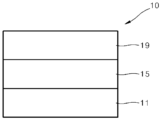
- the FIGURE is a schematic cross-sectional view of an organic light-emitting device 10 according to an embodiment.
- the organic light-emitting device 10 includes a first electrode 11, an organic layer 15, and a second electrode 19, which are sequentially stacked.
- a substrate may be additionally located under (i.e., beneath) the first electrode 11 or above the second electrode 19.
- the substrate any substrate that is used in organic light-emitting devices may be used, and the substrate may be a glass substrate or a transparent plastic substrate, each having excellent mechanical strength, thermal stability, transparency, surface smoothness, ease of handling, and water resistance.
- the first electrode 11 may be formed by depositing or sputtering a material for forming the first electrode 11 on the substrate.
- the first electrode 11 may be an anode.
- the material for forming the first electrode 11 may include materials with a high work function to facilitate hole injection.
- the first electrode 11 may be a reflective electrode, a semi-transmissive electrode, or a transmissive electrode.
- the material for forming the first electrode 11 may include indium tin oxide (ITO), indium zinc oxide (IZO), tin oxide (SnO 2 ), zinc oxide (ZnO), or a combination thereof.
- the first electrode 11 may have a single-layered structure or a multi-layered structure including two or more layers.
- the first electrode 11 may have a three-layered structure of ITO/Ag/ITO.
- the organic layer 15 may be disposed on the first electrode 11.
- the organic layer 15 may include a hole transport region, an emission layer, and an electron transport region.
- the hole transport region may be disposed between the first electrode 11 and the emission layer.
- the hole transport region may include a hole injection layer, a hole transport layer, an electron blocking layer, a buffer layer, or a combination thereof.
- the hole transport region may include a hole injection layer, a hole transport layer, or a combination thereof.
- the hole transport region may have a hole injection layer/hole transport layer structure or a hole injection layer/hole transport layer/electron blocking layer structure, wherein, for each structure, each layer is sequentially stacked in this stated order from the first electrode 11 towards the second electrode 19.
- the hole injection layer may be formed on the first electrode 11 by using one or more suitable methods, for example, vacuum deposition, spin coating, casting, and/or Langmuir-Blodgett (LB) deposition.
- suitable methods for example, vacuum deposition, spin coating, casting, and/or Langmuir-Blodgett (LB) deposition.
- the deposition conditions may vary according to a material that is used to form the hole injection layer, and the structure and thermal characteristics of the hole injection layer.
- the deposition conditions may include a deposition temperature of about 100 °C to about 500 °C, a vacuum pressure of about 1 ⁇ 10 -6 Pa (10 -8 torr) to about 0.133 Pa (10 -3 torr), and a deposition rate of about 0.01 Angstrom per second ( ⁇ /sec) to about 100 ⁇ /sec.
- coating conditions may vary according to the material used to form the hole injection layer, and the structure and thermal characteristics of the hole injection layer.
- a coating speed may be from about 2,000 revolutions per minute (rpm) to about 5,000 rpm
- a temperature at which a heat treatment is performed to remove a solvent after coating may be from about 80 °C to about 200 °C.
- Conditions for forming the hole transport layer and the electron blocking layer may be understood by referring to conditions for forming the hole injection layer.
- the hole transport region may include m-MTDATA, TDATA, 2-TNATA, NPB, ⁇ -NPB, TPD, Spiro-TPD, Spiro-NPB, methylated-NPB, TAPC, HMTPD, 4,4',4"-tris(N-carbazolyl)triphenylamine (TCTA), polyaniline/dodecylbenzenesulfonic acid (PANI/DBSA), poly(3,4-ethylenedioxythiophene)/poly(4-styrenesulfonate) (PEDOT/PSS), polyaniline/camphor sulfonicacid (PANI/CSA), polyaniline/poly(4-styrenesulfonate) (PANI/PSS), a compound represented by Formula 201 below, a compound represented by Formula 202 below, or a combination thereof:
- Ar 101 and Ar 102 in Formula 201 may each independently be a phenylene group, a pentalenylene group, an indenylene group, a naphthylene group, an azulenylene group, a heptalenylene group, an acenaphthylene group, a fluorenylene group, a phenalenylene group, a phenanthrenylene group, an anthracenylene group, a fluoranthenylene group, a triphenylenylene group, a pyrenylene group, a chrysenylenylene group, a naphthacenylene group, a picenylene group, a perylenylene group, or a pentacenylene group, each unsubstituted or substituted with at least one of deuterium, -F, -Cl, -Br, -I, a hydroxyl group, a cyano group, a
- R 101 to R 108 , R 111 to R 119 , and R 121 to R 124 may each independently be:
- R 109 may be a phenyl group, a naphthyl group, an anthracenyl group, or a pyridinyl group, each unsubstituted or substituted with at least one of deuterium, -F, - Cl, -Br, -I, a hydroxyl group, a cyano group, a nitro group, an amino group, an amidino group, a hydrazine group, a hydrazone group, a carboxylic acid group or a salt thereof, a sulfonic acid group or a salt thereof, a phosphoric acid group or a salt thereof, a C 1 -C 20 alkyl group, a C 1 -C 20 alkoxy group, a phenyl group, a naphthyl group, an anthracenyl group, or a pyridinyl group.
- the hole transport region may include at least one of Compounds HT1 to HT20:
- a thickness of the hole transport region may be in a range of about 100 ⁇ to about 10,000 ⁇ , for example, about 100 ⁇ to about 1,000 ⁇ .
- a thickness of the hole injection layer may be in a range of about 100 ⁇ to about 10,000 ⁇ , for example, about 100 ⁇ to about 1,000 ⁇
- a thickness of the hole transport layer may be in a range of about 50 ⁇ to about 2,000 ⁇ , for example, about 100 ⁇ to about 1,500 ⁇ .
- the hole transport region may further include a buffer layer.
- the buffer layer may compensate for an optical resonance distance according to a wavelength of light emitted from the emission layer, and thus, luminescence efficiency of the organic light-emitting device 10 may be improved.
- a material for forming the electron blocking layer may include a material that is used in the hole transport region as described above, a host material described below, or a combination thereof.
- a material for the electron blocking layer may be mCP described below.
- an emission layer may be formed on the hole transport region by vacuum deposition, spin coating, casting, LB deposition, or the like.
- the deposition or coating conditions may be similar to those applied in forming the hole injection layer although the deposition or coating conditions may vary according to a material that is used to form the emission layer.
- the emission layer may include a host and a dopant, and the dopant may include the organometallic compound represented by Formula 1.
- the host may include TPBi, TBADN, ADN (also referred to as "DNA”), CBP, CDBP, TCP, mCP, Compound H50, Compound H51, or a combination thereof:
- the emission layer may be patterned into a red emission layer, a green emission layer, and/or a blue emission layer.
- the emission layer may emit white light.
- the dopant may be the organometallic compound represented by Formula 1.
- the dopant may be a green phosphorescent dopant.
- a thickness of the emission layer may be in a range of about 100 ⁇ to about 1,000 ⁇ , for example, about 200 ⁇ to about 600 ⁇ . Without wishing to be bound by theory, when the thickness of the emission layer is within the range, excellent light-emission characteristics may be obtained without a substantial increase in driving voltage.
- the electron transport region may have a hole blocking layer/electron transport layer/electron injection layer structure or an electron transport layer/electron injection layer structure.
- the electron transport layer may have a single-layered structure or a multi-layered structure including two or more different materials.
- the hole blocking layer may include, for example, BCP, Bphen, BAIq, or a combination thereof.
- the electron transport layer may include BCP, BPhen, Alq 3 , BAIq, TAZ, NTAZ, or a combination thereof.
- a thickness of the electron transport layer may be in a range of about 100 ⁇ to about 1,000 ⁇ , for example, about 150 ⁇ to about 500 ⁇ . Without wishing to be bound by theory, when the thickness of the electron transport layer is within the range, the electron transport layer may obtain satisfactory electron transport characteristics without a substantial increase in driving voltage.
- the electron transport layer may further include, in addition to the materials described above, a metal-containing material.
- the electron injection layer may include LiF, NaCl, CsF, Li 2 O, BaO, or a combination thereof.
- a thickness of the electron injection layer may be in a range of about 1 ⁇ to about 100 ⁇ , and, for example, about 3 ⁇ to about 90 ⁇ . Without wishing to be bound by theory, when the thickness of the electron injection layer is within the range, the electron injection layer may obtain satisfactory electron injection characteristics without a substantial increase in driving voltage.
- the organic light-emitting device may be included in an electronic apparatus.
- an electronic apparatus including the organic light-emitting device is provided.
- the electronic apparatus may include, for example, a display, an illumination, a sensor, and the like.
- C 2 -C 60 alkenyl group as used herein has a structure including at least one carbon-carbon double bond in the middle or at the terminus of the C 2 -C 66 alkyl group, and examples thereof include an ethenyl group, a propenyl group, and a butenyl group.
- C 2 -C 60 alkenylene group as used herein refers to a divalent group having the same structure as the C 2 -C 60 alkenyl group.
- Examples of the C 1 -C 10 heterocycloalkyl group may include a silolanyl group, a silinanyl group, a tetrahydrofuranyl group, a tetrahydro-2H-pyranyl group, a tetrahydrothiophenyl group, and the like.
- C 3 -C 10 cycloalkenyl group refers to a monovalent monocyclic group that has 3 to 10 carbon atoms and at least one carbon-carbon double bond in the ring thereof and no aromaticity, and non-limiting examples thereof include a cyclopentenyl group, a cyclohexenyl group, and a cycloheptenyl group.
- C 3 -C 10 cycloalkenylene group refers to a divalent group having the same structure as the C 3 -C 10 cycloalkenyl group.
- C 6 -C 60 aryl group refers to a monovalent group having a carbocyclic aromatic system having 6 to 60 carbon atoms
- C 6 -C 60 arylene group refers to a divalent group having a carbocyclic aromatic system having 6 to 60 carbon atoms.
- Examples of the C 6 -C 60 aryl group include a phenyl group, a naphthyl group, an anthracenyl group, a phenanthrenyl group, a pyrenyl group, and a chrysenyl group.
- the C 6 -C 60 aryl group and the C 6 -C 60 arylene group each include two or more rings, the rings may be fused to each other.
- the term "monovalent non-aromatic condensed heteropolycyclic group” as used herein refers to a monovalent group (for example, having 1 to 60 carbon atoms) having two or more rings condensed to each other, a heteroatom selected from N, O, P, Si, S, Se, Ge, As, and B, other than carbon atoms, as a ring-forming atom, and non-aromaticity in its entire molecular structure.
- Examples of the monovalent non-aromatic condensed heteropolycyclic group include a carbazolyl group.
- divalent non-aromatic condensed heteropolycyclic group refers to a divalent group having the same structure as the monovalent non-aromatic condensed heteropolycyclic group.
- the "C 1 -C 30 heterocyclic group (unsubstituted or substituted with at least one R 10a )" may include, for example, a thiophene group, a furan group, a pyrrole group, a silole group, borole group, a phosphole group, a selenophene group, a germole group, a benzothiophene group, a benzofuran group, an indole group, a benzosilole group, a benzoborole group, a benzophosphole group, a benzoselenophene group, a benzogermole group, a dibenzothiophene group, a dibenzofuran group, a carbazole group, a dibenzosilole group, a dibenzoborole group, a dibenzophosphole group, a dibenzoselenophene group, a dibenzogermole group, a dibenzo
- deuterated C 1 -C 60 alkyl group (or a deuterated C 1 -C 20 alkyl group or the like)
- deuterated C 3 -C 10 cycloalkyl group "deuterated C 1 -C 10 heterocycloalkyl group”
- deuterated phenyl group respectively indicate a C 1 -C 60 alkyl group (or a C 1 -C 20 alkyl group or the like), a C 3 -C 10 cycloalkyl group, a C 1 -C 10 heterocycloalkyl group, and a phenyl group, each substituted with at least one deuterium.
- the "deuterated C 1 -C 60 alkyl group (or, a deuterated C 1 -C 20 alkyl group or the like)", the “deuterated C 3 -C 10 cycloalkyl group", or the “deuterated C 1 -C 10 heterocycloalkyl group” may be i) a fully deuterated C 1 -C 60 alkyl group (or, a fully deuterated C 1 -C 20 alkyl group or the like), a fully deuterated C 3 -C 10 cycloalkyl group, or a fully deuterated C 1 -C 10 heterocycloalkyl group, in which, in each group, all hydrogen atoms included therein is substituted with deuterium, or ii) a partially deuterated C 1 -C 60 alkyl group (or, a partially deuterated C 1 -C 20 alkyl group or the like), a partially deuterated C 3 -C 10 cycloalkyl group, or a partially de
- (C 1 -C 20 alkyl) 'X' group refers to a 'X' group that is substituted with at least one C 1 -C 20 alkyl group.
- the term "(C 1 -C 20 alkyl)C 3 -C 10 cycloalkyl group” as used herein refers to a C 3 -C 10 cycloalkyl group substituted with at least one C 1 -C 20 alkyl group
- the term “(C 1 -C 20 alkyl)phenyl group” as used herein refers to a phenyl group substituted with at least one C 1 -C 20 alkyl group.
- An example of a (C 1 alkyl) phenyl group is a toluyl group.
- an azaindole group, an azabenzoborole group, an azabenzophosphole group, an azaindene group, an azabenzosilole group, an azabenzogermole group, an azabenzothiophene group, an azabenzoselenophene group, an azabenzofuran group, an azacarbazole group, an azadibenzoborole group, an azadibenzophosphole group, an azafluorene group, an azadibenzosilole group, an azadibenzogermole group, an azadibenzothiophene group, an azadibenzoselenophene group, an azadibenzofuran group, an azadibenzothiophene 5-oxide group, an aza-9H-fluorene-9-one group, and an azadibenzothiophene group, and a 5,5-dioxide group respectively refer
- Compound 5-2 was obtained in the same manner as used to synthesize Compound 1-2 of Synthesis Example 1 and then used for next reaction without further purification, except that Compound 5-3 was used instead of Compound 1-3.
- a glass substrate with ITO deposited thereon to a thickness of 1,000 ⁇ was cut to a size of 50 mm ⁇ 50 mm ⁇ 0.5 mm, sonicated with isopropyl alcohol and pure water each for 5 minutes, and then cleaned by irradiation of ultraviolet rays and exposure to ozone for 30 minutes. Then the resultant glass substrate was loaded onto a vacuum deposition apparatus.
- 2-TNATA was vacuum-deposited on the anode to form a hole injection layer having a thickness of 600 ⁇
- NPB 4,4'-bis[N-(1-naphthyl)-N-phenylamino]biphenyl
- CBP host
- Compound 1 dopant
- BCP was vacuum-deposited on the emission layer to form a hole blocking layer having a thickness of 50 ⁇
- Alq 3 was vacuum-deposited on the hole blocking layer to form an electron transport layer having a thickness of 350 ⁇
- LiF was vacuum-deposited on the electron transport layer to form an electron injection layer having a thickness of 10 ⁇
- Al was deposited on the electron injection layer to form a cathode having a thickness of 1,200 ⁇ , thereby completing the manufacture of an organic light-emitting device.
- Organic light-emitting devices were manufactured in the same manner as in Example 1, except that in forming an emission layer, for use as a dopant, corresponding compounds shown in Table 10 were used instead of Compound 1.
- Example 1 1 6.5 20 80 505 Example 2 2 6.2 20 82 508 Example 3 3 6.4 20 78 510 Example 4 4 6.1 20 76 516 Example 5 5 6.2 19 77 514 Example 6 6 6.5 20 80 540 Example 7 7 6.4 19 79 521 Example 8 8 6.5 20 80 528 Example 9 9 6.1 20 70 516 Comparative Example A A 6.7 18 76 518 Comparative Example B B 6.6 18 76 565 Comparative Example C C 6.6 19 82 538
Landscapes
- Chemical & Material Sciences (AREA)
- Organic Chemistry (AREA)
- Engineering & Computer Science (AREA)
- Materials Engineering (AREA)
- Physics & Mathematics (AREA)
- Optics & Photonics (AREA)
- Crystallography & Structural Chemistry (AREA)
- Inorganic Chemistry (AREA)
- Electroluminescent Light Sources (AREA)
Claims (15)
- Composé organométallique représenté par la formule 1 :
formule 1 M(L1)n1(L2)n2
dans lequel, dans la formule 1,M est un métal de transition,L1 est un ligand représenté par la formule 2,n1 est 1, 2 ou 3, dans lequel, lorsque n1 est 2 ou plus, deux ligands L1 ou plus sont identiques ou différents les uns des autres,L2 est un ligand monodenté, un ligand bidenté, un ligand tridenté ou un ligand tétradenté,n2 est 0, 1, 2, 3 ou 4, dans lequel, lorsque n2 est 2 ou plus, deux ligands L2 ou plus sont identiques ou différents les uns des autres, etL1 et L2 sont différents l'un de l'autre,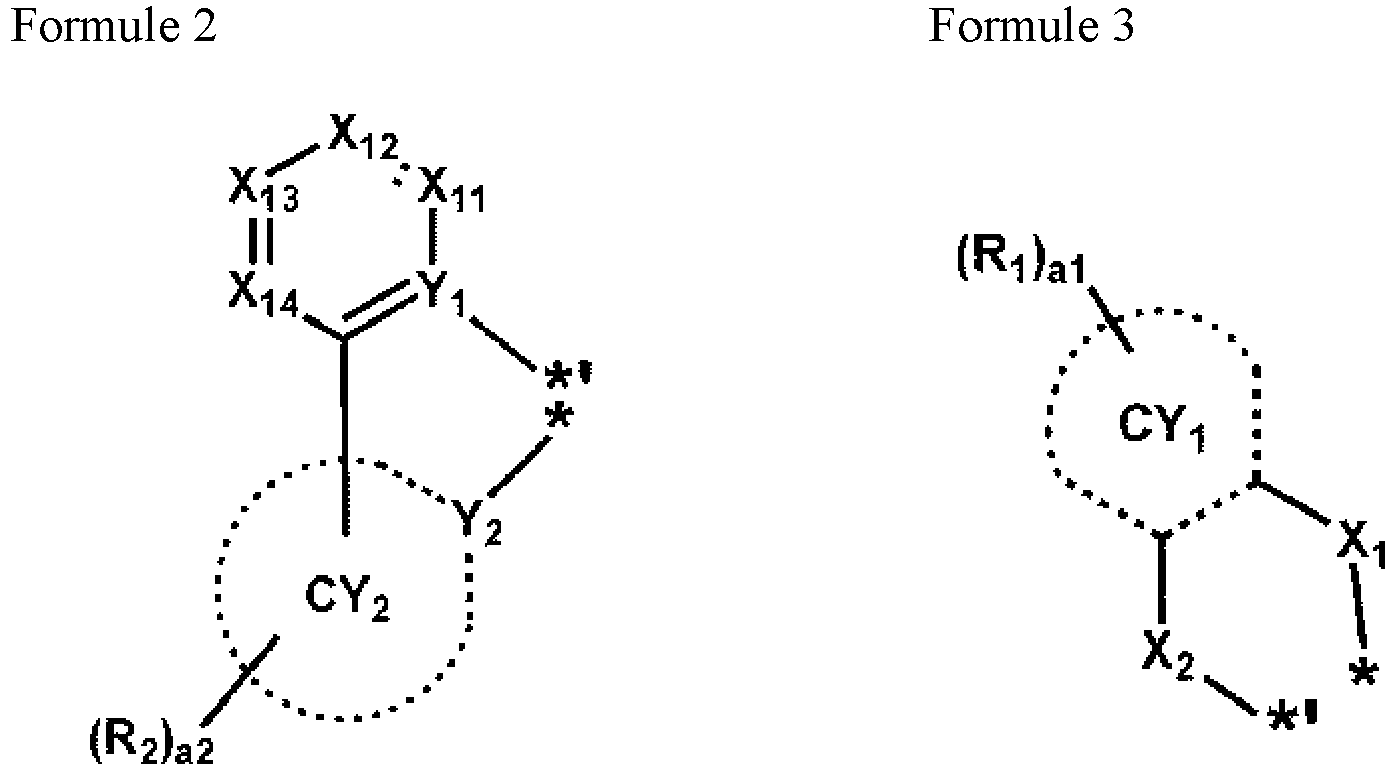 dans lequel, dans la formule 2,X11 est lié en C à X1 dans la formule 3, N ou C(R11),X12 est lié en C à X1 ou X2 dans la formule 3, N ou C(R12),X13 est lié en C à X1 ou X2 dans la formule 3, N ou C(R13), etX14 est lié en C à X2 dans la formule 3, N ou C(R14),à condition que X11 soit lié en C à X1 dans la formule 3, et que X12 soit lié en C à X2 dans la formule 3 ; X12 est lié en C à X1 dans la formule 3, et X13 est lié en C à X2 dans la formule 3 ; ou X13 est lié en C à X1 dans la formule 3, et X14 est lié en C à X2 dans la formule 3,dans la formule 3, X1 représente O, S, Se, B(R31), N(R31), C(R31)(R32), ou Si(R31)(R32),dans la formule 3, X2 représente O, S, Se, B(R33), N(R33), C(R33)(R34), ou Si(R33)(R34),Y1 est N, Y2 est C ou N,le cycle CY1 et le cycle CY2 sont chacun indépendamment un groupe carbocyclique en C5 à C30 ou un groupe hétérocyclique en C1 à C30,R1, R2, R11 à R14, et R31 à R34 sont chacun indépendamment hydrogène, deutérium, -F, -Cl, -Br, -I, -SF5, un groupe hydroxyle, un groupe cyano, un groupe nitro, un groupe amino, un groupe amidino, un groupe hydrazine, un groupe hydrazone, un groupe acide carboxylique ou un sel de celui-ci, un groupe acide sulfonique ou un sel de celui-ci, un groupe acide phosphorique ou un sel de celui-ci, un groupe alkyle en C1 à C60 substitué ou non substitué, un groupe alcényle en C2 à C60 substitué ou non substitué, un groupe alcynyle en C2 à C60 substitué ou non substitué, un groupe alcoxy en C1 à C60 substitué ou non substitué, un groupe cycloalkyle en C3 à C10 substitué ou non substitué, un groupe hétérocycloalkyle en C1 à C10 substitué ou non substitué, un groupe cycloalcényle en C3 à C10 substitué ou non substitué, un groupe hétérocycloalcényle en C1 à C10 substitué ou non substitué, un groupe aryle en C6 à C60 substitué ou non substitué, un groupe alkylaryle en C7 à C60 substitué ou non substitué, un groupe aryloxy en C6 à C60 substitué ou non substitué, un groupe arylthio en C6 à C60 substitué ou non substitué, un groupe arylalkyle en C7 à C60 substitué ou non substitué, un groupe hétéroaryle en C1 à C60 substitué ou non substitué, un groupe hétéroaryloxy en C1 à C60 substitué ou non substitué, un groupe hétéroarylthio en C1 à C60 substitué ou non substitué, un groupe hétéroarylalkyle en C2 à C60 substitué ou non substitué, un groupe alkylhétéroaryle en C2 à C60 substitué ou non substitué, un groupe polycyclique condensé non-aromatique monovalent substitué ou non substitué, un groupe hétéropolycyclique condensé non-aromatique monovalent substitué ou non substitué, -N(Q1)(Q2), -Si(Q3)(Q4)(Q5), - Ge(Q3)(Q4)(Q5), -B(Q6)(Q7), -P(=O)(Q8)(Q9), ou -P(Q8)(Q9), dans lequel R31 et R33 ne sont pas hydrogène,a1 est un nombre entier de 0 à 20, dans lequel, lorsque a1 est égal ou supérieur à 2, deux groupes R1 ou plus sont identiques ou différents les uns des autres,a2 est un nombre entier de 0 à 20, dans lequel, lorsque a2 est égal ou supérieur à 2, deux groupes R2 ou plus sont identiques ou différents les uns des autres,à condition que le composé organométallique ne comprenne pas de composé dans lequel n2 dans la formule 1 est 0, X1 dans la formule 3 est C(R31)(R32), et X2 dans la formule 3 est C(R33)(R34),deux ou plus d'une pluralité de groupes R1 sont éventuellement liés les uns aux autres pour former un groupe carbocyclique en C5 à C30 substitué ou non substitué par au moins un R10a ou un groupe hétérocyclique en C1 à C30 substitué ou non substitué par au moins un R10a,deux ou plus d'une pluralité de groupes R2 sont éventuellement liés les uns aux autres pour former un groupe carbocyclique en C5 à C30 substitué ou non substitué par au moins un R10a ou un groupe hétérocyclique en C1 à C30 substitué ou non substitué par au moins un R10a,R10a est le même que celui décrit en relation avec R2,* et *' dans la formule 2 indiquent chacun un site de liaison à M dans la formule 1,* et *' dans la formule 3 indiquent chacun un site de liaison à deux de X11 à X14 dans la formule 2,des substituants du groupe alkyle en C1 à C60 substitué, du groupe alcényle en C2 à C60 substitué, du groupe alcynyle en C2 à C60 substitué, du groupe alcoxy en C1 à C60 substitué, du groupe cycloalkyle en C3 à C10 substitué, du groupe hétérocycloalkyle en C1 à C10 substitué, du groupe cycloalcényle en C3 à C10 substitué, du groupe hétérocycloalcényle en C1 à C10 substitué, du groupe aryle en C6 à C60 substitué, du groupe alkylaryle en C7 à C60 substitué, du groupe aryloxy en C6 à C60 substitué, du groupe arylthio en C6 à C60 substitué, du groupe arylalkyle en C7 à C60 substitué, du groupe hétéroaryle en C1 à C60 substitué, du groupe hétéroaryloxy en C1 à C60 substitué, du groupe hétéroarylthio en C1 à C60 substitué, du groupe hétéroarylalkyle en C2 à C60 substitué, du groupe alkylhétéroaryle en C2 à C60 substitué, du groupe polycyclique condensé non aromatique monovalent substitué et du groupe hétéropolycyclique condensé non aromatique monovalent substitué sont chacun indépendamment :le deutérium, -F, -Cl, -Br, -I, -CD3, -CD2H, -CDH2, -CF3, -CF2H, -CFH2, un groupe hydroxyle, un groupe cyano, un groupe nitro, un groupe amidino, un groupe hydrazine, un groupe hydrazone, un groupe acide carboxylique ou un sel de celui-ci, un groupe acide sulfonique ou un sel de celui-ci, un groupe acide phosphorique ou un sel de celui-ci, un groupe alkyle en C1 à C60, un groupe alcényle en C2 à C60, un groupe alcynyle en C2 à C60, ou un groupe alcoxy en C1 à C60 ;un groupe alkyle en C1 à C60, un groupe alcényle en C2 à C60, un groupe alcynyle en C2 à C60, ou un groupe alcoxy en C1 à C60, chacun substitué par au moins l'un choisi parmi le deutérium -F, -Cl, -Br, -I, -CD3, -CD2H, -CDH2, -CF3, -CF2H, -CFH2, un groupe hydroxyle, un groupe cyano, un groupe nitro, un groupe amidino, un groupe hydrazine, un groupe hydrazone, un groupe acide carboxylique ou un sel de celui-ci, un groupe acide sulfonique ou un sel de celui-ci, un groupe acide phosphorique ou un sel de celui-ci, un groupe cycloalkyle en C3 à C10, un groupe hétérocycloalkyle en C1 à C10, un groupe cycloalcényle en C3 à C10, un groupe hétérocycloalcényle en C1 à C10, un groupe aryle en C6 à C60, un groupe alkylaryle en C7 à C60, un groupe aryloxy en C6 à C60, un groupe arylthio en C6 à C60, un groupe arylalkyle en C7 à C60, un groupe hétéroaryle en C1 à C60, un groupe hétéroaryloxy en C1 à C60, un groupe hétéroarylthio en C1 à C60, un groupe hétéroarylalkyle en C2 à C60, un groupe alkylhétéroaryle en C2 à C60,un groupe polycyclique condensé non aromatique monovalent, un groupe hétéropolycyclique condensé non aromatique monovalent, -N(Q11)(Q12), -Si(Q13)(Q14)(Q15), -Ge(Q13)(Q14)(Q15), -B(Q16)(Q17), - P(=O)(Q18)(Q19), ou -P(Q18)(Q19);un groupe cycloalkyle en C3 à C10, un groupe hétérocycloalkyle en C1 à C10, un groupe cycloalcényle en C3 à C10, un groupe hétérocycloalcényle en C1 à C10, un groupe aryle en C6 à C60, un groupe aryloxy en C6 à C60, un groupe arylthio en C6 à C60, un groupe hétéroaryle en C1 à C60, un groupe polycyclique condensé non aromatique monovalent, ou un groupe hétéropolycyclique condensé non aromatique monovalent, chacun substitué par au moins l'un choisi parmi le deutérium, F, -Cl, -Br, -I, -CD3, -CD2H, -CDH2, -CF3, -CF2H, -CFH2, un groupe hydroxyle, un groupe cyano, un groupe nitro, un groupe amidino, un groupe hydrazine, un groupe hydrazone, un groupe acide carboxylique ou un sel de celui-ci, un groupe acide sulfonique ou un sel de celui-ci, un groupe acide phosphorique ou un sel de celui-ci, un groupe alkyle en C1 à C60, un groupe alcényle en C2 à C60, un groupe alcynyle en C2 à C60, un groupe alcoxy en C1 à C60, un groupe cycloalkyle en C3 à C10, un groupe hétérocycloalkyle en C1 à C10, un groupe cycloalcényle en C3 à C10, un groupe hétérocycloalcényle en C1 à C10, un groupe aryle en C6 à C60, un groupe alkylaryle en C7 à C60, un groupe aryloxy en C6 à C60, un groupe arylthio en C6 à C60, un groupe arylalkyle en C7 à C60, un groupe hétéroaryle en C1 à C60, un groupe hétéroaryloxy en C1 à C60, un groupe hétéroarylthio en C1 à C60, un groupe hétéroarylalkyle en C2 à C60, un groupe alkylhétéroaryle en C2 à C60, un groupe polycyclique condensé non aromatique monovalent, un groupe hétéropolycyclique condensé non aromatique monovalent, -N(Q21)(Q22), -Si(Q23)(Q24)(Q25), - Ge(Q23)(Q24)(Q25), -B(Q26)(Q27), -P(=O)(Q28)(Q29), ou -P(Q28)(Q29) ;-N(Q31)(Q32), -Si(Q33)(Q34)(Q35), -Ge(Q33)(Q34)(Q35), -B(Q36)(Q37), -P(=O)(Q38)(Q39), ou -P(Q38)(Q39) ; ouune combinaison de ceux-ci, etQ1 à Q9, Q11 à Q19, Q21 à Q29 et Q31 à Q39 sont chacun indépendamment choisis parmi : l'hydrogène ; le deutérium ; -F ; -Cl ; -Br ; -I ; un groupe hydroxyle ; un groupe cyano ; un groupe nitro ; un groupe amidino ; un groupe hydrazine ; un groupe hydrazone ; un groupe acide carboxylique ou un sel de celui-ci ; un groupe acide sulfonique ou un sel de celui-ci ; un groupe acide phosphorique ou un sel de celui-ci ; un groupe alkyle en C1 à C60 qui est non substitué ou substitué par au moins l'un parmi le deutérium, un groupe alkyle en C1 à C60 ou un groupe aryle en C6 à C60, un groupe alcényle en C2 à C60 ; un groupe alcynyle en C2 à C60 ; un groupe alcoxy en C1 à C60 ; un groupe cycloalkyle en C3 à C10 ; un groupe hétérocycloalkyle en C1 à C10 ; un groupe cycloalcényle en C3 à C10 ; un groupe hétérocycloalcényle en C1 à C10 ; un groupe aryle en C6 à C60 qui est non substitué ou substitué par au moins l'un parmi le deutérium, un groupe alkyle en C1 à C60 ou un groupe aryle en C6 à C60 ; un groupe aryloxy en C6 à C60 ; un groupe arylthio en C6 à C60 ; un groupe arylalkyle en C7 à C60 ; un groupe hétéroaryle en C1 à C60 ; un groupe hétéroaryloxy en C1 à C60 ; un groupe hétéroarylthio en C1 à C60 ; un groupe hétéroarylalkyle en C2 à C60 ; un groupe alkylhétéroaryle en C2 à C60 ; un groupe polycyclique condensé non aromatique monovalent ; ou un groupe hétéropolycyclique condensé non aromatique monovalent.
 - Composé organométallique selon la revendication 1, dans lequel n2 est 1 ou 2 ; et/ou dans lequel au moins l'un parmi X1 et X2 dans la formule 3 est O, S ou Se.
- Composé organométallique selon la revendication 1 ou 2, dans lequelM est Ir ou Os, et la somme de n1 et n2 est 3 ou 4 ; ouM est Pt et la somme de n1 et n2 est 2.
- Composé organométallique selon l'une quelconque des revendications 1 à 3, dans lequel, dans la formule 3,X1 est C(R31)(R32), et X2 est O, S, Se, B(R33), N(R33), ou Si(R33)(R34) ; ouX1 est O, S, Se, B(R31), N(R31), ou Si(R31)(R32), et X2 est C(R33)(R34).
- Composé organométallique selon l'une quelconque des revendications 1 à 4, dans lequel le cycle CY1 dans la formule 3 est un groupe benzène, un groupe pyridine ou un groupe pyrimidine ; et/ou
dans lequel Y2 dans la formule 2 est C, et le cycle CY2 dans la formule 2 est un groupe benzène, un groupe naphtalène, un groupe fluorène, un groupe dibenzofurane, un groupe dibenzothiophène, un groupe carbazole ou un groupe dibenzosilole. - Composé organométallique selon l'une quelconque des revendications 1 à 5, dans lequel R1, R2, R11 à R14, et R31 à R34 sont chacun indépendamment :hydrogène, deutérium, -F, -Cl, -Br, -I, un groupe hydroxyle, un groupe cyano, un groupe nitro, un groupe amino, un groupe amidino, un groupe hydrazine, un groupe hydrazone, un groupe acide carboxylique ou un sel de celui-ci, un groupe acide sulfonique ou un sel de celui-ci, un groupe acide phosphorique ou un sel de celui-ci, -SF5, un groupe alkyle en C1 à C20, ou un groupe alcoxy en C1 à C20 ;un groupe alkyle en C1 à C20 ou un groupe alcoxy en C1 à C20, chacun substitué par au moins un parmi deutérium, -F, -Cl, -Br, -I, -CD3, -CD2H, -CDH2, -CF3, -CF2H, -CFH2, un groupe hydroxyle, un groupe cyano, un groupe nitro, un groupe amino, un groupe amidino, un groupe hydrazine, un groupe hydrazone, un groupe acide carboxylique ou un sel de celui-ci, un groupe acide sulfonique ou un sel de celui-ci, un groupe acide phosphorique ou un sel de celui-ci, un groupe alkyle en C1 à C20, un groupe alkyle deutéré en C1 à C20, un groupe cyclopentyle, un groupe cyclohexyle, un groupe cycloheptyle, un groupe cyclooctyle, un groupe adamantanyle, un groupe norbornanyle, un groupe norbornényle, un groupe cyclopentényle, un groupe cyclohexényle, un groupe cycloheptényle, un groupe bicyclo[1.1.1]pentyle, un groupe bicyclo[2.1.1]hexyle, un groupe bicyclo[2.2.2]octyle, un groupe (alkyle en C1 à C20)cyclopentyle, un groupe (alkyle en C1 à C20)cyclohexyle, un groupe (alkyle en C1 à C20)cycloheptyle, un groupe (alkyle en C1 à C20)cyclooctyle, un groupe (alkyle en C1 à C20)adamantanyle, un groupe (alkyle en C1 à C20)norbornanyle, un groupe (alkyle en C1 à C20)norbornenyle, un groupe (alkyle en C1 à C20)cyclopentenyle, un groupe (alkyle en C1 à C20)cyclohexenyle, un groupe (alkyle en C1 à C20)cycloheptenyle, un groupe (alkyle en C1 à C20)bicyclo[1.1.1]pentyle, un groupe (alkyle en C1 à C20)bicyclo[2.1.1]hexyle, un groupe (alkyle en C1 à C20)bicyclo[2.2.2]octyle, un groupe phényle, un groupe (alkyle en C1 à C20)phényle, un groupe biphényle, un groupe terphényle, un groupe naphthyle, un groupe 1,2,3,4-tetrahydronaphthyle, un groupe pyridinyle, ou un groupe pyrimidinyle ;un groupe cyclopentyle, un groupe cyclohexyle, un groupe cycloheptyle, un groupe cyclooctyle, un groupe adamantanyle, un groupe norbornanyle, un groupe norbornényle, un groupe cyclopentényle, un groupe cyclohexényle, un groupe cycloheptényle, un groupe bicyclo[1.1.1]pentyle, un groupe bicyclo[2.1.1]hexyle, un groupe bicyclo[2.2.2]octyle, un groupe phényle, un groupe (alkyle en C1 à C20)phényle, un groupe biphényle, un groupe terphényle, un groupe naphtyle, un groupe 1,2,3,4-tétrahydronaphtyle, un groupe fluorényle, un groupe phénanthrényle, un groupe anthracényle, un groupe fluoranthényle, un groupe triphénylényle, un groupe pyrényle, un groupe chrysényle, un groupe pyrrolyle, un groupe thiophényle, un groupe furanyle, un groupe imidazolyle, un groupe pyrazolyle, un groupe thiazolyle, un groupe isothiazolyle, un groupe oxazolyle, un groupe isoxazolyle, un groupe pyridinyle, un groupe pyrazinyle, un groupe pyrimidinyle, un groupe pyridazinyle, un groupe isoindolyle, un groupe indolyle, un groupe indazolyle, un groupe purinyle, un groupe quinolinyle, un groupe isoquinolinyle, un groupe benzoquinolinyle, un groupe quinoxalinyle, un groupe quinazolinyle, un groupe cinnolinyle, un groupe carbazolyle, un groupe phénanthrolinyle, un groupe benzimidazolyle, un groupe benzofuranyle, un groupe benzothiophényle, un groupe isobenzothiazolyle, un groupe benzoxazolyle, un groupe isobenzoxazolyle, un groupe triazolyle, un groupe tétrazolyle, un groupe oxadiazolyle, un groupe triazinyle, un groupe dibenzofuranyle, un groupe dibenzothiophényle, un groupe benzocarbazolyle, un groupe dibenzocarbazolyle, un groupe imidazopyridinyle, un groupe imidazopyrimidinyle, un groupe azacarbazolyle, un groupe azadibenzofuranyle ou un groupe azadibenzothiophényle, chacun non substitué ou substitué par au moins l'un parmi deutérium -F, -Cl, -Br, -I, -CD3, -CD2H, -CDH2, -CF3, -CF2H, -CFH2, un groupe hydroxyle, un groupe cyano, un groupe nitro, un groupe amino, un groupe amidino, un groupe hydrazine, un groupe hydrazone, un groupe acide carboxylique ou un sel de celui-ci, un groupe acide sulfonique ou un sel de celui-ci, un groupe acide phosphorique ou un sel de celui-ci, un groupe alkyle en C1 à C20, un groupe alkyle deutéré en C1 à C20, un groupe alcoxy en C1 à C20, un groupe cyclopentyle, un groupe cyclohexyle, un groupe cycloheptyle, un groupe cyclooctyle, un groupe adamantanyle, un groupe norbornanyle, un groupe norbornényle, un groupe cyclopentényle, un groupe cyclohexényle, un groupe cycloheptényle, un groupe bicyclo[1.1.1]pentyle, un groupe bicyclo[2.1.1]hexyle, un groupe bicyclo[2.2.2]octyle, un groupe (alkyle en C1 à C20)cyclopentyle, un groupe (alkyle en C1-C20)cyclohexyle, un groupe (alkyle en C1 à C20)cycloheptyle, un groupe (alkyle en C1 à C20)cyclooctyle, un groupe (alkyle en C1 à C20)adamantanyle, un groupe (alkyle en C1 à C20)norbomanyle, un groupe (alkyle en C1-C20)norbornényle, un groupe (alkyle en C1 à C20)cyclopentényle, un groupe (alkyle en C1 à C20)cyclohexényle, un groupe (alkyle en C1 à C20)cycloheptényle, un groupe (alkyle en C1 à C20)bicyclo[1.1.1]pentyle, un groupe (alkyle en C1 à C20)bicyclo[2.1.1]hexyle, un groupe (alkyle en C1 à C20)bicyclo[2.2.2]octyle, un groupe phényle, un groupe (alkyle en C1 à C20)phényle, un groupe biphényle, un groupe terphényle, un groupe naphtyle, un groupe 1,2,3,4-tétrahydronaphtyle, un groupe fluorényle, un groupe phénanthrényle, un groupe anthracényle, un groupe fluoranthényle, un groupe triphénylényle, un groupe pyrényle, un groupe chrysényle, un groupe pyrrolyle, un groupe thiophényle, un groupe furanyle, un groupe imidazolyle, un groupe pyrazolyle, un groupe thiazolyle, un groupe isothiazolyle, un groupe oxazolyle, un groupe isoxazolyle, un groupe pyridinyle, un groupe pyrazinyle, un groupe pyrimidinyle, un groupe pyridazinyle, un groupe isoindolyle, un groupe indolyle, un groupe indazolyle, un groupe purinyle, un groupe quinolinyle, un groupe isoquinolinyle, un groupe benzoquinolinyle, un groupe quinoxalinyle, un groupe quinazolinyle, un groupe cinnolinyle, un groupe carbazolyle, un groupe phénanthrolinyle, un groupe benzimidazolyle, un groupe benzofuranyle, un groupe benzothiophényle, un groupe isobenzothiazolyle, un groupe benzoxazolyle, un groupe isobenzoxazolyle, un groupe triazolyle, un groupe tétrazolyle, un groupe oxadiazolyle, un groupe triazinyle, un groupe dibenzofuranyle, un groupe dibenzothiophényle, un groupe benzocarbazolyle, un groupe dibenzocarbazolyle, un groupe imidazopyridinyle, un groupe imidazopyrimidinyle, un groupe azacarbazolyle, un groupe azadibenzofuranyle ou un groupe azadibenzothiophényle ; ou-N(Q1)(Q2), -Si(Q3)(Q4)(Q5), -Ge(Q3)(Q4)(Q5), -B(Q6)(Q7), -P(=O)(Q8)(Q9), ou-P(Q8)(Q9),dans lequel Q1 à Q9 sont chacun indépendamment :-CH3, -CD3, -CD2H, -CDH2, -CH2CH3, -CH2CD3, -CH2CD2H, -CH2CDH2, -CHDCH3,-CHDCD2H, -CHDCDH2, -CHDCD3, -CD2CD3, -CD2CD2H, ou -CD2CDH2 ; ouun groupe n-propyle, un groupe isopropyle, un groupe n-butyle, a groupe sec-butyle, un groupe isobutyle, un groupe tert-butyle, un groupe n-pentyle, un groupe tert-pentyle, un groupe néopentyle, un groupe isopentyle, un groupe sec-pentyle, un groupe 3-pentyle, un groupe sec-isopentyle, un groupe phényle, un groupe biphényle ou un groupe naphtyle, chacun non substitué ou substitué par au moins un parmi le deutérium, un groupe alkyle en C1 à C20, ou un groupe phényle.
- Composé organométallique selon l'une quelconque des revendications 1 à 6, dans lequel L1 est un ligand représenté par les formules 2-1, 2-2 ou 2-3 :
 dans lequel, dans les formules 2-1 à 2-3,X11 est N ou C(R11), X12 est N ou C(R12), X13 est N ou C(R13), X14 est N ou C(R14), etX1, X2, Y1, Y2, le cycle CY1, le cycle CY2, R1, R2, R11 à R14, a1, a2, *, et *' sont les mêmes que ceux décrits dans la revendication 1.
 - Composé organométallique selon la revendication 7, dans lequel L1 est le ligand représenté par la formule 2-3,X12 dans la formule 2-3 est C(R12), etR12 est -Si(Q3)(Q4)(Q5) ou -Ge(Q3)(Q4)(Q5), etdans lequel Q3 à Q5 sont identiques à ceux décrits dans la revendication 1 ; oudans lequel L1 dans la formule 1 est un ligand représenté par la formule 2-1(1), 2-2(1) ou 2-3(1) :
 dans les formules 2-1(1), 2-2(1), et 2-3(1), X1, X2, Y1, Y2, le cycle CY2, R1, R2, R11 à R14, a1, a2, * et *' sont les mêmes que ceux décrits dans la revendication 7.
 - Composé organométallique selon l'une quelconque des revendications 1 à 8, dans lequel un groupereprésenté par
 dans la formule 2, est un groupe représenté par l'une des formules CY2-1 à CY2-31 :


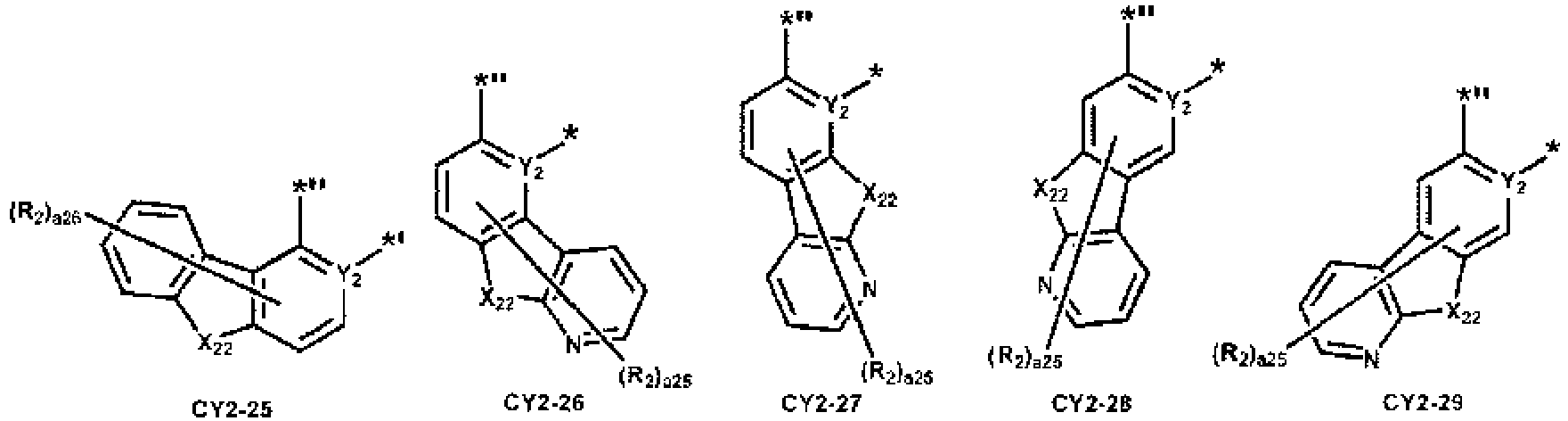
 dans lequel dans les formules CY2-1 à CY2-31,Y2 et R2 sont chacun identiques à ceux décrits dans la revendication 1,X22 est C(R22)(R23), N(R22), O, S, ou Si(R22)(R23),R22 à R29 sont les mêmes que ceux décrits en relation avec R2 dans la revendication 1,a26 est un nombre entier allant de 0 à 6,a25 est un nombre entier allant de 0 à 5,a24 est un nombre entier allant de 0 à 4,a23 est un nombre entier allant de 0 à 3,a22 est un nombre entier allant de 0 à 2,*" indique un site de liaison à un atome voisin dans la formule 2, et* indique un site de liaison à M dans la formule 1.
 - Composé organométallique selon l'une quelconque des revendications 1 à 9, dans lequel L2 dans la formule 1 est un ligand bidenté lié à M dans la formule 1 via deux atomes choisis parmi O, S, N, C, P, Si, et As inclus dans celui-ci.
- Composé organométallique selon l'une quelconque des revendications 1 à 9, dans lequel L2 dans la formule 1 est un groupe représenté par l'une des formules 3A à 3F :

 dans lequel, dans les formules 3A à 3F,Y13 est O, N, N(Z1), P(Z1)(Z2), ou As(Z1)(Z2),Y14 est O, N, N(Z3), P(Z3)(Z4), ou As(Z3)(Z4),T11 est une simple liaison, une double liaison, *-C(Z11)(Z12)-*', *-C(Z11)=C(Zlz)-*', *=C(Z11)-*', *-C(Z11)=*', *=C(Z11)-C(Z12)=C(Z13)-*', *-C(Z11)=C(Z12)-C(Z13)=*', *-N(Z11)-*', ou un groupe carbocyclique en C5 à C30 non substitué ou substitué par au moins un Z11,a11 est un nombre entier de 0 à 10, dans lequel, lorsque a11 est égal ou supérieur à 2, deux groupes T11 ou plus sont identiques ou différents les uns des autres,Y11 et Y12 sont chacun indépendamment C ou N,T21 est une simple liaison, une double liaison, O, S, C(Z11)(Z12), Si(Z11)(Z12), ou N(Z11),le cycle CY11 et le cycle CY12 sont chacun indépendamment un groupe carbocyclique en C5 à C30 ou un groupe hétérocyclique en C1 à C30,A1 est P ou As,Z1 à Z4 et Z11 à Z13 sont les mêmes que ceux décrits en relation avec R2 dans la revendication 1,d1 à d2 sont chacun indépendamment un entier de 0 à 10, et* et *' indiquent chacun un site de liaison à M dans la formule 1.
 - Composé organométallique selon la revendication 10, dans lequel L2 est un ligand représenté par l'une des formules 3-1 et 3-101 à 3-112 :

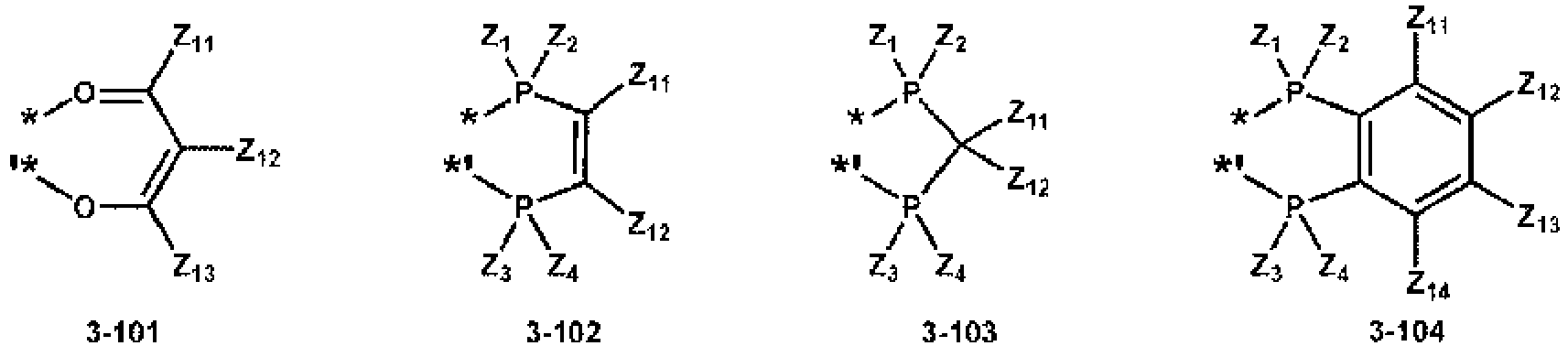
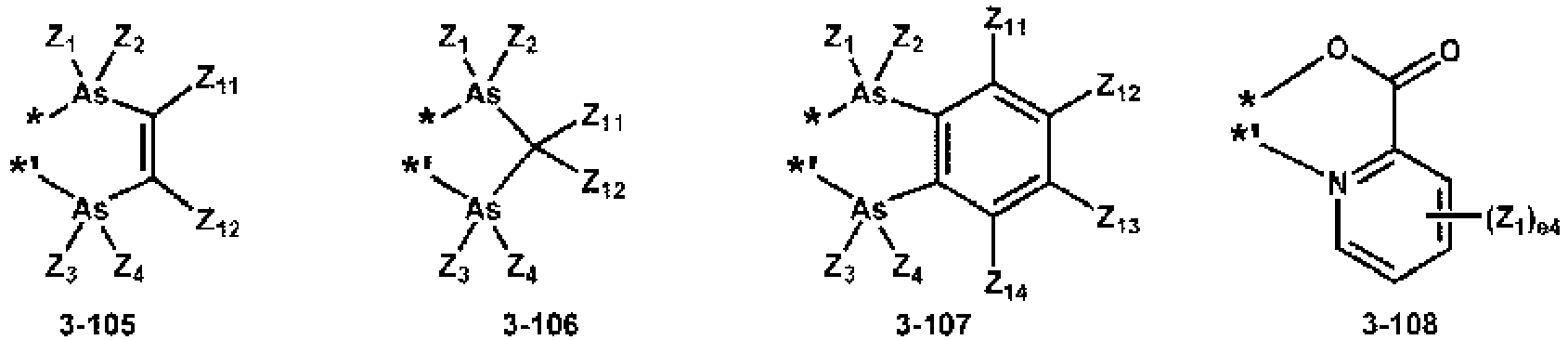
 dans lequel, dans les formules 3-1 et 3-101 à 3-112,Y11, Y12, le cycle CY12, Z1 à Z4, Z11 à Z13, et d2 sont les mêmes que ceux décrits dans la revendication 11,Z14 est le même que celui décrit en relation avec Z11 dans la revendication 11,e2 est un nombre entier allant de 0 à 2,e3 est un nombre entier allant de 0 à 3,e4 est un nombre entier allant de 0 à 4, et* et *' indiquent chacun un site de liaison à M dans la formule 1 ;de préférence dans lequel un groupe représenté par
 dans la formule 3-1 est un groupe représenté par l'une des formules 3-1-1 à 3-1-16, etun groupe représenté par
 dans la formule 3-1 est un groupe représenté par l'une des formules 3-1(1) à 3-1(16) :


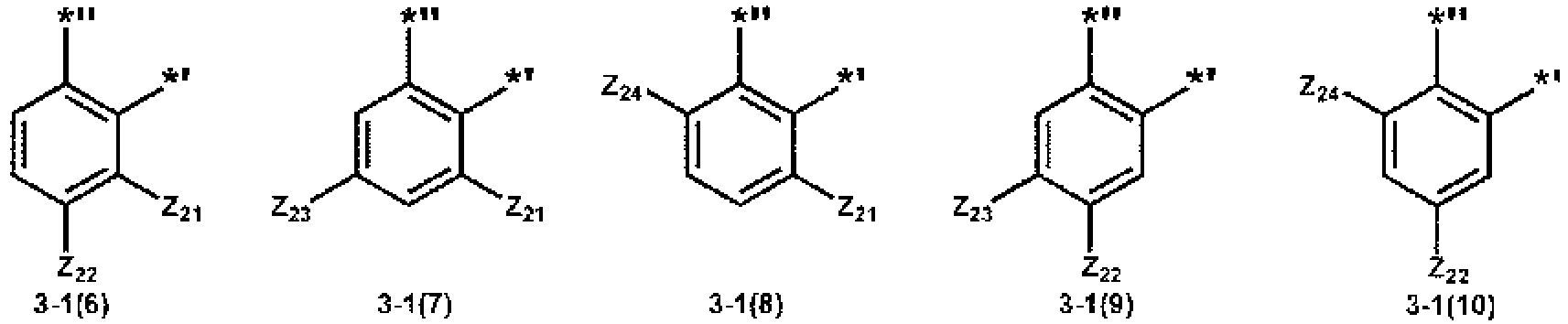

 dans lequel, dans les formules 3-1-1 à 3-1-16 et 3-1(1) à 3-1(16),Z11 à Z14 sont les mêmes que ceux décrits dans la revendication 11, Z21 à Z24 sontles mêmes que ceux décrits en relation avec Z11 dans la revendication 11, dans lequel Z11 à Z14 et Z21 à Z24 ne sont pas hydrogène,* et *' indiquent chacun un site de liaison à M dans la formule 1, et*" indique un site de liaison à un atome voisin.
 - Dispositif électroluminescent organique, comprenant :une première électrode ;une seconde électrode ; etune couche organique disposée entre la première électrode et la seconde électrode et comprenant une couche d'émission,dans lequel la couche organique comprend au moins un composé organométallique selon l'une quelconque des revendications 1 à 12 ;de préférence dans lequel la première électrode est une anode,la seconde électrode est une cathode,la couche organique comprend en outre une région de transport de trous disposée entre la première électrode et la couche d'émission et une région de transport d'électrons disposée entre la couche d'émission et la seconde électrode,la région de transport de trous comprend une couche d'injection de trous, une couche de transport de trous, une couche de blocage d'électrons, une couche tampon, ou une combinaison de celles-ci, etla région de transport d'électrons comprend une couche de blocage de trous, une couche de transport d'électrons, une couche d'injection d'électrons ou une combinaison de celles-ci.
- Dispositif électroluminescent organique selon la revendication 13, dans lequel la couche d'émission comprend l'au moins un composé organométallique.
- Appareil électronique, comprenant le dispositif électroluminescent organique selon la revendication 13 ou 14.
Applications Claiming Priority (1)
| Application Number | Priority Date | Filing Date | Title |
|---|---|---|---|
| KR1020200015840A KR20210101633A (ko) | 2020-02-10 | 2020-02-10 | 유기금속 화합물, 이를 포함한 유기 발광 소자 및 상기 유기 발광 소자를 포함한 전자 장치 |
Publications (2)
| Publication Number | Publication Date |
|---|---|
| EP3862360A1 EP3862360A1 (fr) | 2021-08-11 |
| EP3862360B1 true EP3862360B1 (fr) | 2024-07-03 |
Family
ID=74561729
Family Applications (1)
| Application Number | Title | Priority Date | Filing Date |
|---|---|---|---|
| EP21155700.4A Active EP3862360B1 (fr) | 2020-02-10 | 2021-02-08 | Composé organométallique, dispositif électroluminescent organique le comprenant et appareil électronique comprenant le dispositif électroluminescent organique |
Country Status (5)
| Country | Link |
|---|---|
| US (1) | US12240863B2 (fr) |
| EP (1) | EP3862360B1 (fr) |
| JP (1) | JP2021127335A (fr) |
| KR (1) | KR20210101633A (fr) |
| CN (1) | CN113248545B (fr) |
Families Citing this family (5)
| Publication number | Priority date | Publication date | Assignee | Title |
|---|---|---|---|---|
| EP3461831B1 (fr) * | 2017-09-29 | 2021-09-01 | Samsung Electronics Co., Ltd. | Composé organométallique, dispositif électroluminescent organique le comprenant et composition de diagnostic comprenant le composé organométallique |
| KR102811430B1 (ko) * | 2019-11-27 | 2025-05-23 | 삼성디스플레이 주식회사 | 유기금속 화합물 및 이를 포함한 유기 발광 소자 |
| JP7603392B2 (ja) * | 2020-07-31 | 2024-12-20 | 住友化学株式会社 | 金属錯体、組成物、膜及び発光素子 |
| KR20220090667A (ko) * | 2020-12-22 | 2022-06-30 | 삼성디스플레이 주식회사 | 발광 소자 및 이를 포함한 전자 장치 |
| KR102877126B1 (ko) * | 2022-09-28 | 2025-10-28 | 삼성디스플레이 주식회사 | 유기금속 화합물, 이를 포함한 유기 발광 소자 및 유기 발광 소자를 포함한 전자 장치 |
Family Cites Families (29)
| Publication number | Priority date | Publication date | Assignee | Title |
|---|---|---|---|---|
| US20040086743A1 (en) | 2002-11-06 | 2004-05-06 | Brown Cory S. | Organometallic compounds for use in electroluminescent devices |
| JP5273910B2 (ja) | 2006-03-31 | 2013-08-28 | キヤノン株式会社 | 発光素子用有機化合物、発光素子および画像表示装置 |
| TWI510598B (zh) | 2007-03-08 | 2015-12-01 | Universal Display Corp | 磷光材料 |
| TWI543983B (zh) | 2009-04-06 | 2016-08-01 | 環球展覽公司 | 包含新穎配位體結構之金屬錯合物 |
| WO2012162488A1 (fr) | 2011-05-26 | 2012-11-29 | Arizona Board Of Regents Acting For And On Behalf Of Arizona State University | Synthèse de complexes de platine et de palladium comme émetteurs phosphorescents à bande étroite pour dispositifs d'affichage pleine couleur |
| KR101897044B1 (ko) | 2011-10-20 | 2018-10-23 | 에스에프씨 주식회사 | 유기금속 화합물 및 이를 포함하는 유기전계발광소자 |
| EP2882763B1 (fr) * | 2012-08-07 | 2018-08-22 | Merck Patent GmbH | Complexes métalliques |
| US9312505B2 (en) | 2012-09-25 | 2016-04-12 | Universal Display Corporation | Organic electroluminescent materials and devices |
| KR20150105902A (ko) * | 2014-03-10 | 2015-09-18 | 삼성전자주식회사 | 유기금속 화합물 및 이를 포함한 유기 발광 소자 |
| KR102384222B1 (ko) | 2014-09-26 | 2022-04-07 | 삼성전자주식회사 | 유기금속 화합물 및 이를 포함한 유기 발광 소자 |
| KR102466672B1 (ko) | 2014-11-28 | 2022-11-15 | 삼성전자주식회사 | 유기금속 화합물 및 이를 포함한 유기 발광 소자 |
| EP3026056B1 (fr) | 2014-11-28 | 2017-11-08 | Samsung Electronics Co., Ltd. | Composé organométallique et dispositif électroluminescent organique l'incluant |
| KR102429871B1 (ko) | 2015-03-13 | 2022-08-05 | 삼성전자주식회사 | 유기금속 화합물 및 이를 포함한 유기 발광 소자 |
| US11672167B2 (en) | 2015-03-13 | 2023-06-06 | Samsung Electronics Co., Ltd. | Organometallic compound and organic light-emitting device including the same |
| KR102390371B1 (ko) | 2015-03-13 | 2022-04-25 | 삼성전자주식회사 | 유기금속 화합물 및 이를 포함한 유기 발광 소자 |
| EP3133078B1 (fr) | 2015-08-18 | 2019-01-30 | Samsung Electronics Co., Ltd. | Composé organométallique et dispositif électroluminescent organique l'incluant |
| GB2549246A (en) * | 2015-12-15 | 2017-10-18 | Cambridge Display Tech Ltd | Light-emitting Compound |
| KR102633852B1 (ko) | 2016-01-25 | 2024-02-07 | 삼성디스플레이 주식회사 | 카바졸계 화합물 및 이를 포함한 유기 발광 소자 |
| US10153443B2 (en) | 2016-07-19 | 2018-12-11 | Universal Display Corporation | Organic electroluminescent materials and devices |
| US10862046B2 (en) | 2017-03-30 | 2020-12-08 | Universal Display Corporation | Organic electroluminescent materials and devices |
| JP2018197225A (ja) | 2017-05-22 | 2018-12-13 | 田中 晃二 | 還元剤及びそれを用いたギ酸の製造方法 |
| US10692417B2 (en) * | 2017-06-23 | 2020-06-23 | Samsung Electronic Co., Ltd. | Display apparatus |
| EP3461831B1 (fr) * | 2017-09-29 | 2021-09-01 | Samsung Electronics Co., Ltd. | Composé organométallique, dispositif électroluminescent organique le comprenant et composition de diagnostic comprenant le composé organométallique |
| KR102595918B1 (ko) | 2018-01-18 | 2023-11-14 | 삼성디스플레이 주식회사 | 유기금속 화합물, 이를 포함한 유기 발광 소자 및 상기 유기 발광 소자를 포함한 유기 발광 장치 |
| US10886477B2 (en) * | 2018-03-23 | 2021-01-05 | Feng-wen Yen | Iridium complex and organic electroluminescence device using the same |
| CN108586545A (zh) * | 2018-07-16 | 2018-09-28 | 烟台显华光电材料研究院有限公司 | 一类用作磷光材料的过渡金属配合物、其制备方法及应用 |
| KR102824585B1 (ko) | 2019-11-28 | 2025-06-24 | 삼성전자주식회사 | 유기금속 화합물, 이를 포함한 유기 발광 소자 및 이를 포함한 진단용 조성물 |
| CN110862418B (zh) * | 2019-11-29 | 2022-05-10 | 吉林奥来德光电材料股份有限公司 | 一种铱金属配合物及其制备方法和应用 |
| KR102903025B1 (ko) | 2019-12-13 | 2025-12-22 | 삼성디스플레이 주식회사 | 유기금속 화합물, 이를 포함한 유기 발광 소자 및 이를 포함한 진단용 조성물 |
-
2020
- 2020-02-10 KR KR1020200015840A patent/KR20210101633A/ko not_active Ceased
- 2020-09-29 US US17/036,694 patent/US12240863B2/en active Active
-
2021
- 2021-02-03 JP JP2021016143A patent/JP2021127335A/ja active Pending
- 2021-02-05 CN CN202110162104.2A patent/CN113248545B/zh active Active
- 2021-02-08 EP EP21155700.4A patent/EP3862360B1/fr active Active
Also Published As
| Publication number | Publication date |
|---|---|
| JP2021127335A (ja) | 2021-09-02 |
| US20210253618A1 (en) | 2021-08-19 |
| US12240863B2 (en) | 2025-03-04 |
| EP3862360A1 (fr) | 2021-08-11 |
| CN113248545A (zh) | 2021-08-13 |
| CN113248545B (zh) | 2026-01-16 |
| KR20210101633A (ko) | 2021-08-19 |
Similar Documents
| Publication | Publication Date | Title |
|---|---|---|
| EP3663308B1 (fr) | Composé organométallique, dispositif électroluminescent organique le comprenant et composition de diagnostic comprenant le composé organométallique | |
| EP3067361B1 (fr) | Composé organométallique et dispositif électroluminescent organique l'incluant | |
| EP3560940B1 (fr) | Composé organométallique, dispositif électroluminescent organique le comprenant et composition de diagnostic comprenant le composé organométallique | |
| EP3392257B1 (fr) | Composé organométallique, dispositif électroluminescent organique le comprenant et composition de diagnostic comprenant le composé organométallique | |
| EP3862360B1 (fr) | Composé organométallique, dispositif électroluminescent organique le comprenant et appareil électronique comprenant le dispositif électroluminescent organique | |
| EP4016656B1 (fr) | Composé organométallique, dispositif électroluminescent organique le comprenant et composition de diagnostic comprenant le composé organométallique | |
| EP3483170A1 (fr) | Composé organométallique, dispositif électroluminescent organique le comprenant et composition de diagnostic comprenant le composé organométallique | |
| EP3943499A2 (fr) | Composé organométallique, dispositif électroluminescent organique le comprenant et appareil électronique comprenant le dispositif électroluminescent organique | |
| EP3974494A1 (fr) | Composé organométallique, dispositif électroluminescent organique le comprenant et appareil électronique comprenant le dispositif électroluminescent organique | |
| EP3988557B1 (fr) | Composé organométallique, dispositif électroluminescent organique le comprenant et composition de diagnostic comprenant le composé organométallique | |
| EP3549944B1 (fr) | Composé organométallique, dispositif électroluminescent organique le comprenant et composition de diagnostic comprenant le composé organométallique | |
| EP3865553A1 (fr) | Composé organométallique, dispositif électroluminescent organique le comprenant et appareil électronique comprenant le dispositif électroluminescent organique | |
| EP3971260A1 (fr) | Composé organométallique, dispositif électroluminescent organique le comprenant et appareil électronique comprenant le dispositif électroluminescent organique | |
| EP3626724A1 (fr) | Composé organométallique, dispositif électroluminescent organique le comprenant et composition de diagnostic comprenant le composé organométallique | |
| EP3725793B1 (fr) | Composé organométallique, dispositif électroluminescent organique le comprenant et composition de diagnostic comprenant le composé organométallique | |
| EP3722301B1 (fr) | Composé organométallique, dispositif électroluminescent organique le comprenant, composition de diagnostic comprenant le composé organométallique | |
| EP4086265B1 (fr) | Composé organométallique, dispositif électroluminescent organique le comprenant et appareil électronique comprenant le dispositif électroluminescent organique | |
| EP4059942A1 (fr) | Composé organométallique, dispositif électroluminescent organique le comprenant et appareil électronique comprenant le dispositif électroluminescent organique | |
| EP3715352B1 (fr) | Composé organométallique, dispositif électroluminescent organique le comprenant et appareil électronique comprenant le dispositif électroluminescent organique | |
| KR20190123228A (ko) | 유기금속 화합물, 이를 포함한 유기 발광 소자 및 이를 포함한 진단용 조성물 | |
| EP3617216B1 (fr) | Composé organométallique, dispositif électroluminescent organique le comprenant et composition de diagnostic comprenant le composé organométallique | |
| EP3992199A1 (fr) | Composé organométallique, dispositif électroluminescent organique le comprenant et appareil électronique comprenant le dispositif électroluminescent organique | |
| EP4495127A1 (fr) | Composé organométallique, dispositif électroluminescent organique le comprenant et appareil électronique comprenant le dispositif électroluminescent organique | |
| EP3851443B1 (fr) | Composé organométallique, dispositif électroluminescent organique le comprenant et appareil électronique comprenant le dispositif électroluminescent organique | |
| EP4311850B1 (fr) | Composé organométallique, dispositif électroluminescent organique le comprenant et appareil électronique comprenant le dispositif électroluminescent organique |
Legal Events
| Date | Code | Title | Description |
|---|---|---|---|
| PUAI | Public reference made under article 153(3) epc to a published international application that has entered the european phase |
Free format text: ORIGINAL CODE: 0009012 |
|
| STAA | Information on the status of an ep patent application or granted ep patent |
Free format text: STATUS: THE APPLICATION HAS BEEN PUBLISHED |
|
| AK | Designated contracting states |
Kind code of ref document: A1 Designated state(s): AL AT BE BG CH CY CZ DE DK EE ES FI FR GB GR HR HU IE IS IT LI LT LU LV MC MK MT NL NO PL PT RO RS SE SI SK SM TR |
|
| STAA | Information on the status of an ep patent application or granted ep patent |
Free format text: STATUS: REQUEST FOR EXAMINATION WAS MADE |
|
| 17P | Request for examination filed |
Effective date: 20211209 |
|
| RBV | Designated contracting states (corrected) |
Designated state(s): AL AT BE BG CH CY CZ DE DK EE ES FI FR GB GR HR HU IE IS IT LI LT LU LV MC MK MT NL NO PL PT RO RS SE SI SK SM TR |
|
| P01 | Opt-out of the competence of the unified patent court (upc) registered |
Effective date: 20230519 |
|
| STAA | Information on the status of an ep patent application or granted ep patent |
Free format text: STATUS: EXAMINATION IS IN PROGRESS |
|
| 17Q | First examination report despatched |
Effective date: 20231010 |
|
| REG | Reference to a national code |
Ref country code: DE Ref legal event code: R079 Free format text: PREVIOUS MAIN CLASS: C07F0015000000 Ipc: C09K0011060000 Ref country code: DE Ref legal event code: R079 Ref document number: 602021014986 Country of ref document: DE Free format text: PREVIOUS MAIN CLASS: C07F0015000000 Ipc: C09K0011060000 |
|
| GRAP | Despatch of communication of intention to grant a patent |
Free format text: ORIGINAL CODE: EPIDOSNIGR1 |
|
| STAA | Information on the status of an ep patent application or granted ep patent |
Free format text: STATUS: GRANT OF PATENT IS INTENDED |
|
| RIC1 | Information provided on ipc code assigned before grant |
Ipc: C07F 15/00 20060101ALI20240205BHEP Ipc: H10K 101/10 20230101ALI20240205BHEP Ipc: H10K 85/30 20230101ALI20240205BHEP Ipc: C09K 11/06 20060101AFI20240205BHEP |
|
| INTG | Intention to grant announced |
Effective date: 20240222 |
|
| GRAS | Grant fee paid |
Free format text: ORIGINAL CODE: EPIDOSNIGR3 |
|
| GRAA | (expected) grant |
Free format text: ORIGINAL CODE: 0009210 |
|
| STAA | Information on the status of an ep patent application or granted ep patent |
Free format text: STATUS: THE PATENT HAS BEEN GRANTED |
|
| AK | Designated contracting states |
Kind code of ref document: B1 Designated state(s): AL AT BE BG CH CY CZ DE DK EE ES FI FR GB GR HR HU IE IS IT LI LT LU LV MC MK MT NL NO PL PT RO RS SE SI SK SM TR |
|
| REG | Reference to a national code |
Ref country code: CH Ref legal event code: EP |
|
| REG | Reference to a national code |
Ref country code: DE Ref legal event code: R096 Ref document number: 602021014986 Country of ref document: DE |
|
| REG | Reference to a national code |
Ref country code: LT Ref legal event code: MG9D |
|
| REG | Reference to a national code |
Ref country code: NL Ref legal event code: MP Effective date: 20240703 |
|
| PG25 | Lapsed in a contracting state [announced via postgrant information from national office to epo] |
Ref country code: PT Free format text: LAPSE BECAUSE OF FAILURE TO SUBMIT A TRANSLATION OF THE DESCRIPTION OR TO PAY THE FEE WITHIN THE PRESCRIBED TIME-LIMIT Effective date: 20241104 |
|
| REG | Reference to a national code |
Ref country code: AT Ref legal event code: MK05 Ref document number: 1699814 Country of ref document: AT Kind code of ref document: T Effective date: 20240703 |
|
| PG25 | Lapsed in a contracting state [announced via postgrant information from national office to epo] |
Ref country code: NL Free format text: LAPSE BECAUSE OF FAILURE TO SUBMIT A TRANSLATION OF THE DESCRIPTION OR TO PAY THE FEE WITHIN THE PRESCRIBED TIME-LIMIT Effective date: 20240703 |
|
| PG25 | Lapsed in a contracting state [announced via postgrant information from national office to epo] |
Ref country code: PT Free format text: LAPSE BECAUSE OF FAILURE TO SUBMIT A TRANSLATION OF THE DESCRIPTION OR TO PAY THE FEE WITHIN THE PRESCRIBED TIME-LIMIT Effective date: 20241104 Ref country code: NL Free format text: LAPSE BECAUSE OF FAILURE TO SUBMIT A TRANSLATION OF THE DESCRIPTION OR TO PAY THE FEE WITHIN THE PRESCRIBED TIME-LIMIT Effective date: 20240703 |
|
| PG25 | Lapsed in a contracting state [announced via postgrant information from national office to epo] |
Ref country code: NO Free format text: LAPSE BECAUSE OF FAILURE TO SUBMIT A TRANSLATION OF THE DESCRIPTION OR TO PAY THE FEE WITHIN THE PRESCRIBED TIME-LIMIT Effective date: 20241003 |
|
| PG25 | Lapsed in a contracting state [announced via postgrant information from national office to epo] |
Ref country code: FI Free format text: LAPSE BECAUSE OF FAILURE TO SUBMIT A TRANSLATION OF THE DESCRIPTION OR TO PAY THE FEE WITHIN THE PRESCRIBED TIME-LIMIT Effective date: 20240703 Ref country code: GR Free format text: LAPSE BECAUSE OF FAILURE TO SUBMIT A TRANSLATION OF THE DESCRIPTION OR TO PAY THE FEE WITHIN THE PRESCRIBED TIME-LIMIT Effective date: 20241004 Ref country code: PL Free format text: LAPSE BECAUSE OF FAILURE TO SUBMIT A TRANSLATION OF THE DESCRIPTION OR TO PAY THE FEE WITHIN THE PRESCRIBED TIME-LIMIT Effective date: 20240703 |
|
| PG25 | Lapsed in a contracting state [announced via postgrant information from national office to epo] |
Ref country code: BG Free format text: LAPSE BECAUSE OF FAILURE TO SUBMIT A TRANSLATION OF THE DESCRIPTION OR TO PAY THE FEE WITHIN THE PRESCRIBED TIME-LIMIT Effective date: 20240703 |
|
| PG25 | Lapsed in a contracting state [announced via postgrant information from national office to epo] |
Ref country code: LV Free format text: LAPSE BECAUSE OF FAILURE TO SUBMIT A TRANSLATION OF THE DESCRIPTION OR TO PAY THE FEE WITHIN THE PRESCRIBED TIME-LIMIT Effective date: 20240703 |
|
| PG25 | Lapsed in a contracting state [announced via postgrant information from national office to epo] |
Ref country code: IS Free format text: LAPSE BECAUSE OF FAILURE TO SUBMIT A TRANSLATION OF THE DESCRIPTION OR TO PAY THE FEE WITHIN THE PRESCRIBED TIME-LIMIT Effective date: 20241103 Ref country code: AT Free format text: LAPSE BECAUSE OF FAILURE TO SUBMIT A TRANSLATION OF THE DESCRIPTION OR TO PAY THE FEE WITHIN THE PRESCRIBED TIME-LIMIT Effective date: 20240703 |
|
| PG25 | Lapsed in a contracting state [announced via postgrant information from national office to epo] |
Ref country code: CZ Free format text: LAPSE BECAUSE OF FAILURE TO SUBMIT A TRANSLATION OF THE DESCRIPTION OR TO PAY THE FEE WITHIN THE PRESCRIBED TIME-LIMIT Effective date: 20240703 Ref country code: HR Free format text: LAPSE BECAUSE OF FAILURE TO SUBMIT A TRANSLATION OF THE DESCRIPTION OR TO PAY THE FEE WITHIN THE PRESCRIBED TIME-LIMIT Effective date: 20240703 |
|
| PG25 | Lapsed in a contracting state [announced via postgrant information from national office to epo] |
Ref country code: RS Free format text: LAPSE BECAUSE OF FAILURE TO SUBMIT A TRANSLATION OF THE DESCRIPTION OR TO PAY THE FEE WITHIN THE PRESCRIBED TIME-LIMIT Effective date: 20241003 Ref country code: ES Free format text: LAPSE BECAUSE OF FAILURE TO SUBMIT A TRANSLATION OF THE DESCRIPTION OR TO PAY THE FEE WITHIN THE PRESCRIBED TIME-LIMIT Effective date: 20240703 |
|
| PG25 | Lapsed in a contracting state [announced via postgrant information from national office to epo] |
Ref country code: RS Free format text: LAPSE BECAUSE OF FAILURE TO SUBMIT A TRANSLATION OF THE DESCRIPTION OR TO PAY THE FEE WITHIN THE PRESCRIBED TIME-LIMIT Effective date: 20241003 Ref country code: PL Free format text: LAPSE BECAUSE OF FAILURE TO SUBMIT A TRANSLATION OF THE DESCRIPTION OR TO PAY THE FEE WITHIN THE PRESCRIBED TIME-LIMIT Effective date: 20240703 Ref country code: NO Free format text: LAPSE BECAUSE OF FAILURE TO SUBMIT A TRANSLATION OF THE DESCRIPTION OR TO PAY THE FEE WITHIN THE PRESCRIBED TIME-LIMIT Effective date: 20241003 Ref country code: LV Free format text: LAPSE BECAUSE OF FAILURE TO SUBMIT A TRANSLATION OF THE DESCRIPTION OR TO PAY THE FEE WITHIN THE PRESCRIBED TIME-LIMIT Effective date: 20240703 Ref country code: IS Free format text: LAPSE BECAUSE OF FAILURE TO SUBMIT A TRANSLATION OF THE DESCRIPTION OR TO PAY THE FEE WITHIN THE PRESCRIBED TIME-LIMIT Effective date: 20241103 Ref country code: HR Free format text: LAPSE BECAUSE OF FAILURE TO SUBMIT A TRANSLATION OF THE DESCRIPTION OR TO PAY THE FEE WITHIN THE PRESCRIBED TIME-LIMIT Effective date: 20240703 Ref country code: GR Free format text: LAPSE BECAUSE OF FAILURE TO SUBMIT A TRANSLATION OF THE DESCRIPTION OR TO PAY THE FEE WITHIN THE PRESCRIBED TIME-LIMIT Effective date: 20241004 Ref country code: FI Free format text: LAPSE BECAUSE OF FAILURE TO SUBMIT A TRANSLATION OF THE DESCRIPTION OR TO PAY THE FEE WITHIN THE PRESCRIBED TIME-LIMIT Effective date: 20240703 Ref country code: ES Free format text: LAPSE BECAUSE OF FAILURE TO SUBMIT A TRANSLATION OF THE DESCRIPTION OR TO PAY THE FEE WITHIN THE PRESCRIBED TIME-LIMIT Effective date: 20240703 Ref country code: CZ Free format text: LAPSE BECAUSE OF FAILURE TO SUBMIT A TRANSLATION OF THE DESCRIPTION OR TO PAY THE FEE WITHIN THE PRESCRIBED TIME-LIMIT Effective date: 20240703 Ref country code: BG Free format text: LAPSE BECAUSE OF FAILURE TO SUBMIT A TRANSLATION OF THE DESCRIPTION OR TO PAY THE FEE WITHIN THE PRESCRIBED TIME-LIMIT Effective date: 20240703 Ref country code: AT Free format text: LAPSE BECAUSE OF FAILURE TO SUBMIT A TRANSLATION OF THE DESCRIPTION OR TO PAY THE FEE WITHIN THE PRESCRIBED TIME-LIMIT Effective date: 20240703 |
|
| REG | Reference to a national code |
Ref country code: DE Ref legal event code: R097 Ref document number: 602021014986 Country of ref document: DE |
|
| PG25 | Lapsed in a contracting state [announced via postgrant information from national office to epo] |
Ref country code: DK Free format text: LAPSE BECAUSE OF FAILURE TO SUBMIT A TRANSLATION OF THE DESCRIPTION OR TO PAY THE FEE WITHIN THE PRESCRIBED TIME-LIMIT Effective date: 20240703 Ref country code: RO Free format text: LAPSE BECAUSE OF FAILURE TO SUBMIT A TRANSLATION OF THE DESCRIPTION OR TO PAY THE FEE WITHIN THE PRESCRIBED TIME-LIMIT Effective date: 20240703 Ref country code: SM Free format text: LAPSE BECAUSE OF FAILURE TO SUBMIT A TRANSLATION OF THE DESCRIPTION OR TO PAY THE FEE WITHIN THE PRESCRIBED TIME-LIMIT Effective date: 20240703 |
|
| PG25 | Lapsed in a contracting state [announced via postgrant information from national office to epo] |
Ref country code: EE Free format text: LAPSE BECAUSE OF FAILURE TO SUBMIT A TRANSLATION OF THE DESCRIPTION OR TO PAY THE FEE WITHIN THE PRESCRIBED TIME-LIMIT Effective date: 20240703 |
|
| PG25 | Lapsed in a contracting state [announced via postgrant information from national office to epo] |
Ref country code: SK Free format text: LAPSE BECAUSE OF FAILURE TO SUBMIT A TRANSLATION OF THE DESCRIPTION OR TO PAY THE FEE WITHIN THE PRESCRIBED TIME-LIMIT Effective date: 20240703 Ref country code: IT Free format text: LAPSE BECAUSE OF FAILURE TO SUBMIT A TRANSLATION OF THE DESCRIPTION OR TO PAY THE FEE WITHIN THE PRESCRIBED TIME-LIMIT Effective date: 20240703 |
|
| PLBE | No opposition filed within time limit |
Free format text: ORIGINAL CODE: 0009261 |
|
| STAA | Information on the status of an ep patent application or granted ep patent |
Free format text: STATUS: NO OPPOSITION FILED WITHIN TIME LIMIT |
|
| 26N | No opposition filed |
Effective date: 20250404 |
|
| PG25 | Lapsed in a contracting state [announced via postgrant information from national office to epo] |
Ref country code: SE Free format text: LAPSE BECAUSE OF FAILURE TO SUBMIT A TRANSLATION OF THE DESCRIPTION OR TO PAY THE FEE WITHIN THE PRESCRIBED TIME-LIMIT Effective date: 20240703 |
|
| PG25 | Lapsed in a contracting state [announced via postgrant information from national office to epo] |
Ref country code: MC Free format text: LAPSE BECAUSE OF FAILURE TO SUBMIT A TRANSLATION OF THE DESCRIPTION OR TO PAY THE FEE WITHIN THE PRESCRIBED TIME-LIMIT Effective date: 20240703 |
|
| REG | Reference to a national code |
Ref country code: CH Ref legal event code: PL |
|
| PG25 | Lapsed in a contracting state [announced via postgrant information from national office to epo] |
Ref country code: LU Free format text: LAPSE BECAUSE OF NON-PAYMENT OF DUE FEES Effective date: 20250208 |
|
| PG25 | Lapsed in a contracting state [announced via postgrant information from national office to epo] |
Ref country code: CH Free format text: LAPSE BECAUSE OF NON-PAYMENT OF DUE FEES Effective date: 20250228 |
|
| REG | Reference to a national code |
Ref country code: GB Ref legal event code: 732E Free format text: REGISTERED BETWEEN 20250925 AND 20251001 |
|
| REG | Reference to a national code |
Ref country code: DE Ref legal event code: R081 Ref document number: 602021014986 Country of ref document: DE Owner name: SAMSUNG DISPLAY CO., LTD., SUWON-SI, KR Free format text: FORMER OWNER: SAMSUNG ELECTRONICS CO., LTD., SUWON-SI, GYEONGGI-DO, KR |
|
| REG | Reference to a national code |
Ref country code: BE Ref legal event code: MM Effective date: 20250228 |
|
| PG25 | Lapsed in a contracting state [announced via postgrant information from national office to epo] |
Ref country code: BE Free format text: LAPSE BECAUSE OF NON-PAYMENT OF DUE FEES Effective date: 20250228 |
|
| PG25 | Lapsed in a contracting state [announced via postgrant information from national office to epo] |
Ref country code: IE Free format text: LAPSE BECAUSE OF NON-PAYMENT OF DUE FEES Effective date: 20250208 |
|
| PGFP | Annual fee paid to national office [announced via postgrant information from national office to epo] |
Ref country code: GB Payment date: 20260112 Year of fee payment: 6 |
|
| PGFP | Annual fee paid to national office [announced via postgrant information from national office to epo] |
Ref country code: DE Payment date: 20260114 Year of fee payment: 6 |
|
| PGFP | Annual fee paid to national office [announced via postgrant information from national office to epo] |
Ref country code: FR Payment date: 20260108 Year of fee payment: 6 |