EP3865272A1 - Procédé de fabrication d'un matériau fibreux préimprégné résistant au feu et à la chaleur - Google Patents
Procédé de fabrication d'un matériau fibreux préimprégné résistant au feu et à la chaleur Download PDFInfo
- Publication number
- EP3865272A1 EP3865272A1 EP21157089.0A EP21157089A EP3865272A1 EP 3865272 A1 EP3865272 A1 EP 3865272A1 EP 21157089 A EP21157089 A EP 21157089A EP 3865272 A1 EP3865272 A1 EP 3865272A1
- Authority
- EP
- European Patent Office
- Prior art keywords
- resistant
- fire
- heat
- substrate
- additives
- Prior art date
- Legal status (The legal status is an assumption and is not a legal conclusion. Google has not performed a legal analysis and makes no representation as to the accuracy of the status listed.)
- Withdrawn
Links
- 230000009970 fire resistant effect Effects 0.000 title claims abstract description 77
- 239000000835 fiber Substances 0.000 title claims abstract description 58
- 239000000463 material Substances 0.000 title claims abstract description 52
- 238000004519 manufacturing process Methods 0.000 title claims abstract description 26
- 238000000034 method Methods 0.000 claims abstract description 66
- 239000000654 additive Substances 0.000 claims abstract description 65
- 239000000758 substrate Substances 0.000 claims abstract description 43
- 229920001187 thermosetting polymer Polymers 0.000 claims abstract description 18
- 238000000576 coating method Methods 0.000 claims abstract description 15
- 239000011248 coating agent Substances 0.000 claims abstract description 14
- 239000004634 thermosetting polymer Substances 0.000 claims abstract description 12
- 239000000853 adhesive Substances 0.000 claims abstract description 6
- 230000001070 adhesive effect Effects 0.000 claims abstract description 6
- 239000011347 resin Substances 0.000 claims description 61
- 229920005989 resin Polymers 0.000 claims description 61
- 239000002131 composite material Substances 0.000 claims description 58
- 238000005470 impregnation Methods 0.000 claims description 32
- 239000004744 fabric Substances 0.000 claims description 13
- 239000011230 binding agent Substances 0.000 claims description 10
- 239000011162 core material Substances 0.000 claims description 10
- OKTJSMMVPCPJKN-UHFFFAOYSA-N Carbon Chemical compound [C] OKTJSMMVPCPJKN-UHFFFAOYSA-N 0.000 claims description 8
- OAICVXFJPJFONN-UHFFFAOYSA-N Phosphorus Chemical compound [P] OAICVXFJPJFONN-UHFFFAOYSA-N 0.000 claims description 7
- 229910052500 inorganic mineral Inorganic materials 0.000 claims description 7
- 239000011707 mineral Substances 0.000 claims description 7
- 229910052698 phosphorus Inorganic materials 0.000 claims description 7
- 239000011574 phosphorus Substances 0.000 claims description 7
- 239000007788 liquid Substances 0.000 claims description 6
- QJGQUHMNIGDVPM-UHFFFAOYSA-N nitrogen group Chemical group [N] QJGQUHMNIGDVPM-UHFFFAOYSA-N 0.000 claims description 6
- XLYOFNOQVPJJNP-UHFFFAOYSA-N water Substances O XLYOFNOQVPJJNP-UHFFFAOYSA-N 0.000 claims description 6
- 239000007787 solid Substances 0.000 claims description 5
- 229920001169 thermoplastic Polymers 0.000 claims description 5
- 239000004416 thermosoftening plastic Substances 0.000 claims description 5
- 229910052799 carbon Inorganic materials 0.000 claims description 4
- 239000010439 graphite Substances 0.000 claims description 4
- 229910002804 graphite Inorganic materials 0.000 claims description 4
- 238000000465 moulding Methods 0.000 claims description 4
- 229920002748 Basalt fiber Polymers 0.000 claims description 3
- 229920003235 aromatic polyamide Polymers 0.000 claims description 3
- 239000003365 glass fiber Substances 0.000 claims description 3
- 229910052736 halogen Inorganic materials 0.000 claims description 3
- 150000002367 halogens Chemical class 0.000 claims description 3
- 239000012943 hotmelt Substances 0.000 claims description 3
- 238000003475 lamination Methods 0.000 claims description 3
- 239000002184 metal Substances 0.000 claims description 3
- 239000000843 powder Substances 0.000 claims description 3
- 239000002904 solvent Substances 0.000 claims description 3
- 239000010410 layer Substances 0.000 description 66
- YLQBMQCUIZJEEH-UHFFFAOYSA-N Furan Chemical compound C=1C=COC=1 YLQBMQCUIZJEEH-UHFFFAOYSA-N 0.000 description 24
- 239000003063 flame retardant Substances 0.000 description 20
- 230000002787 reinforcement Effects 0.000 description 14
- 238000001802 infusion Methods 0.000 description 9
- 239000000243 solution Substances 0.000 description 7
- RNFJDJUURJAICM-UHFFFAOYSA-N 2,2,4,4,6,6-hexaphenoxy-1,3,5-triaza-2$l^{5},4$l^{5},6$l^{5}-triphosphacyclohexa-1,3,5-triene Chemical compound N=1P(OC=2C=CC=CC=2)(OC=2C=CC=CC=2)=NP(OC=2C=CC=CC=2)(OC=2C=CC=CC=2)=NP=1(OC=1C=CC=CC=1)OC1=CC=CC=C1 RNFJDJUURJAICM-UHFFFAOYSA-N 0.000 description 5
- 239000003795 chemical substances by application Substances 0.000 description 5
- 239000000203 mixture Substances 0.000 description 5
- 238000000748 compression moulding Methods 0.000 description 4
- 238000010276 construction Methods 0.000 description 4
- 239000007924 injection Substances 0.000 description 4
- 238000002347 injection Methods 0.000 description 4
- DMKSVUSAATWOCU-HROMYWEYSA-N loteprednol etabonate Chemical compound C1CC2=CC(=O)C=C[C@]2(C)[C@@H]2[C@@H]1[C@@H]1CC[C@@](C(=O)OCCl)(OC(=O)OCC)[C@@]1(C)C[C@@H]2O DMKSVUSAATWOCU-HROMYWEYSA-N 0.000 description 4
- 229920000728 polyester Polymers 0.000 description 4
- 229920002430 Fibre-reinforced plastic Polymers 0.000 description 3
- 239000011151 fibre-reinforced plastic Substances 0.000 description 3
- 238000009472 formulation Methods 0.000 description 3
- 238000009413 insulation Methods 0.000 description 3
- 238000002386 leaching Methods 0.000 description 3
- 239000002245 particle Substances 0.000 description 3
- IJGRMHOSHXDMSA-UHFFFAOYSA-N Atomic nitrogen Chemical compound N#N IJGRMHOSHXDMSA-UHFFFAOYSA-N 0.000 description 2
- 230000000996 additive effect Effects 0.000 description 2
- 238000009744 autoclave moulding Methods 0.000 description 2
- 230000008021 deposition Effects 0.000 description 2
- 238000009826 distribution Methods 0.000 description 2
- 230000000694 effects Effects 0.000 description 2
- 239000003822 epoxy resin Substances 0.000 description 2
- 239000006260 foam Substances 0.000 description 2
- 230000008092 positive effect Effects 0.000 description 2
- 239000002356 single layer Substances 0.000 description 2
- 238000003860 storage Methods 0.000 description 2
- NJVOHKFLBKQLIZ-UHFFFAOYSA-N (2-ethenylphenyl) prop-2-enoate Chemical compound C=CC(=O)OC1=CC=CC=C1C=C NJVOHKFLBKQLIZ-UHFFFAOYSA-N 0.000 description 1
- JOYRKODLDBILNP-UHFFFAOYSA-N Ethyl urethane Chemical compound CCOC(N)=O JOYRKODLDBILNP-UHFFFAOYSA-N 0.000 description 1
- ISWSIDIOOBJBQZ-UHFFFAOYSA-N Phenol Chemical compound OC1=CC=CC=C1 ISWSIDIOOBJBQZ-UHFFFAOYSA-N 0.000 description 1
- XTXRWKRVRITETP-UHFFFAOYSA-N Vinyl acetate Chemical group CC(=O)OC=C XTXRWKRVRITETP-UHFFFAOYSA-N 0.000 description 1
- 238000010521 absorption reaction Methods 0.000 description 1
- 239000012790 adhesive layer Substances 0.000 description 1
- 239000004760 aramid Substances 0.000 description 1
- 230000004888 barrier function Effects 0.000 description 1
- 239000003054 catalyst Substances 0.000 description 1
- 239000007795 chemical reaction product Substances 0.000 description 1
- 239000011247 coating layer Substances 0.000 description 1
- 230000000052 comparative effect Effects 0.000 description 1
- 150000001875 compounds Chemical class 0.000 description 1
- 230000001010 compromised effect Effects 0.000 description 1
- 239000006258 conductive agent Substances 0.000 description 1
- 239000000470 constituent Substances 0.000 description 1
- 238000010924 continuous production Methods 0.000 description 1
- 238000001035 drying Methods 0.000 description 1
- 239000000839 emulsion Substances 0.000 description 1
- 238000005516 engineering process Methods 0.000 description 1
- 239000000945 filler Substances 0.000 description 1
- 239000007849 furan resin Substances 0.000 description 1
- 239000011521 glass Substances 0.000 description 1
- 238000002156 mixing Methods 0.000 description 1
- 229910052757 nitrogen Inorganic materials 0.000 description 1
- 238000009828 non-uniform distribution Methods 0.000 description 1
- 239000005011 phenolic resin Substances 0.000 description 1
- 150000003017 phosphorus Chemical class 0.000 description 1
- 239000004033 plastic Substances 0.000 description 1
- 229920003023 plastic Polymers 0.000 description 1
- 229920000647 polyepoxide Polymers 0.000 description 1
- 239000004848 polyfunctional curative Substances 0.000 description 1
- 229920000642 polymer Polymers 0.000 description 1
- 239000000047 product Substances 0.000 description 1
- 230000009257 reactivity Effects 0.000 description 1
- 230000003014 reinforcing effect Effects 0.000 description 1
- 239000011265 semifinished product Substances 0.000 description 1
- 239000000126 substance Substances 0.000 description 1
- 229920002994 synthetic fiber Polymers 0.000 description 1
- 238000009736 wetting Methods 0.000 description 1
- 239000000080 wetting agent Substances 0.000 description 1
- 238000004804 winding Methods 0.000 description 1
Images
Classifications
-
- B—PERFORMING OPERATIONS; TRANSPORTING
- B29—WORKING OF PLASTICS; WORKING OF SUBSTANCES IN A PLASTIC STATE IN GENERAL
- B29B—PREPARATION OR PRETREATMENT OF THE MATERIAL TO BE SHAPED; MAKING GRANULES OR PREFORMS; RECOVERY OF PLASTICS OR OTHER CONSTITUENTS OF WASTE MATERIAL CONTAINING PLASTICS
- B29B15/00—Pretreatment of the material to be shaped, not covered by groups B29B7/00 - B29B13/00
- B29B15/08—Pretreatment of the material to be shaped, not covered by groups B29B7/00 - B29B13/00 of reinforcements or fillers
- B29B15/10—Coating or impregnating independently of the moulding or shaping step
- B29B15/12—Coating or impregnating independently of the moulding or shaping step of reinforcements of indefinite length
- B29B15/122—Coating or impregnating independently of the moulding or shaping step of reinforcements of indefinite length with a matrix in liquid form, e.g. as melt, solution or latex
- B29B15/125—Coating or impregnating independently of the moulding or shaping step of reinforcements of indefinite length with a matrix in liquid form, e.g. as melt, solution or latex by dipping
Definitions
- the present invention relates, on the one hand, to a method for producing a fire-resistant and heat-resistant preimpregnated fibre material.
- the present invention relates in particular to a method for producing a fire-resistant and heat-resistant preimpregnated fibre material, a so-called prepreg, which is suitable for use in fibre-reinforced plastics with strong fire-resistant and heat-resistant properties.
- the present invention relates to a composite made from a preimpregnated fibre material produced in this way.
- Preimpregnated fibre materials are semi-finished products which are composed of a substrate, such as for example a fabric made of e.g. carbon fibres or glass fibres, impregnated with one or several thermosetting polymers (resin material), such as for example epoxy resin.
- a substrate such as for example a fabric made of e.g. carbon fibres or glass fibres
- thermosetting polymers such as for example epoxy resin.
- the resultant preimpregnated fibre material may be cut to any desired shape and is used to produce layered composite materials (laminates, fibre-reinforced plastics). To this end, they are placed in a mould in several layers and are subsequently cured in, for example, an oven, with the resin material curing as a result of the heat.
- layered composite materials laminates, fibre-reinforced plastics
- Fibre-reinforced plastics are used in many technological fields, such as aircraft building, automotive construction, construction of railway vehicles and construction of vessels, due to their ability to withstand high mechanical loads in combination with their low weight. Also, these materials have had to meet high fire safety requirements for a considerable time.
- Resin infusion and resin injection are known methods of introducing flame retardants in the resin material.
- application of these methods bears the risk of the flame retardant being filtered out by the fibre reinforcement, resulting in a non-homogenous distribution of flame retardant across the composite.
- this process is also characterized by a relatively low fibre fraction in the composite and a high resin content which, in addition, may also be distributed in a non-homogenous manner.
- This non-homogenous distribution and high resin content result in non-uniform and unsatisfactory fire properties of the composite.
- the addition of flame retardants to the resin by means of resin infusion or injection will be limited and consequently it is not possible to produce a composite having a high fire resistance or heat-insulating properties.
- German patent publication DE 102008039866 describes a production process in which a high concentration of fire-resistant and heat-insulating additives is added to the fibre reinforcement beforehand via a coating process prior to the resin infusion.
- expandable graphite is also used as an additive. This method results in an increased degree of protection, but the limitations which are inherent to resin infusion remain.
- fire-resistant additives it is not inconceivable for fire-resistant additives to migrate with the flow of the resin during the infusion process, which also leads to a non-uniform distribution of resin and fire-resistant additives.
- US 2009/0148637 also describes a method in which nano-additives are added to a fibre reinforcement prior to the resin infusion in order to improve the fire-resistant properties of composites.
- fire-resistant phosphorus/nitrogen additives to a fibre reinforcement is also described in DE 602004002673 and US 2004197539 , in which, in addition to coating, impregnation of the fibre-reinforced material is also quoted as a way of achieving the required fire resistance.
- the fabric which has been treated in this way is then processed to form composites by means of resin infusion, as has also been described above.
- the absorption of additives via impregnation is limited and the additives are not only on the surface of the composite. As a result thereof, fire resistance is reduced and the efficiency of the added additives is also lower.
- the so-called prepreg technique With the method for producing a preimpregnated fibre material in which the fabric is impregnated with resin during a step prior to the production of the composite, the so-called prepreg technique, this inhomogeneity of flame retardants does not occur, irrespective of the technique used to perform this resin impregnation.
- the amount of resin in the prepreg during production is also readily controllable and possibly significantly lower than with resin infusion or injection which results in improved fire properties. Consequently, the prepreg technique is a highly suitable alternative to resin injection and resin infusion for producing composites with low flammability and high insulation.
- European patent publication EP 1 055 513 proposes a solution in the form of a preimpregnated fibre material consisting of two separate layers. These two layers both contain a thermosetting resin, but with different fire-resistant additives.
- the layer on the surface is rich in fire-resistant and heat-insulating additives, while the layer provided in the direction of the core of the composite contains a composition which promotes adhesion to the layers situated underneath. In this way, a great efficiency with regard to fire resistance is achieved on the surface and a good adhesion to the rest of the composite, respectively, and it offers a solution for producing composites consisting of several layers from preimpregnated fibre material in accordance with the current requirements.
- the production process which is described involves coating and impregnating a fibre material with a formulation consisting of 10 - 50 % flame retardants.
- a formulation consisting of 10 - 50 % flame retardants.
- different production steps consisting of coating or impregnation will be performed in succession.
- the fire-resistant additives and resins will always have to be fixed in order to prevent additives from leaching out in a subsequent step. Leaching out of additives results in reduced, uncontrollable and fluctuating fire properties of the end product.
- one layer acts as a fire barrier, an internal layer as a heat shield and, lastly, an inner layer as an adhesive layer.
- such a particle-coated substrate may be provided on a preimpregnated fibre material (prepreg) in order thus to manufacture composites having more robust mechanical properties and strength properties compared to conventional composites which are made using conventional prepregs.
- preg preimpregnated fibre material
- the objective of the invention is achieved by providing a method for producing a fire-resistant and heat-resistant preimpregnated fibre material, the method comprising the following successive steps:
- the fire-resistant and/or heat-resistant additives are situated, preferably in a relatively high concentration, on the outer side of the fibre material.
- the fire-resistant and/or heat-resistant layer is a single layer.
- the fibre material which is manufactured in accordance with the method of the invention preferably comprises 200 g/m 2 to 1500 g/m 2 of fire-resistant and/or heat-resistant additives.
- the other side, in particular the inner side, of the substrate is the adhesive side suitable for bonding to a structure situated underneath, preferably another preimpregnated fibre material or a core material.
- the fire-resistant and/or heat-resistant layer is preferably applied by coating via blade coating. Blade coating has the advantage that the fire-resistant and/or heat-resistant layer can be applied as a sufficiently thick layer, preferably having a thickness of 700 g/m 2 .
- preimpregnated fibre material produced according to the method of the present invention it is possible, partly because of the good bonding between the different layers of preimpregnated fibre material to each other, to manufacture composites having a high fire resistance and heat insulation, and it offers a solution for producing composites consisting of several layers of preimpregnated fibre material or sandwich panels made from one or several layers of preimpregnated fibre material and a core material in accordance with the requirements currently in force.
- Fire-resistant additives comprise constituents which have a positive effect on the fire resistance of plastics. These include, inter alia, minerals, metal-containing, phosphorus-containing, halogen-containing and nitrogen-containing compounds in both solid and liquid form.
- Heat-insulating additives are additives which expand as a result of heat and form an insulating layer on the surface of the composite. These are, inter alia, nitrogen-containing and phosphorus-containing compounds and expandable graphite.
- the fire-resistant and/or heat-resistant additives are preferably deposited in liquid form.
- the fire-resistant and/or heat-resistant layer comprises a thermoplastic binder.
- the thermoplastic binder is preferably vinyl acetate, styrene acrylate or urethane.
- a thermoplastic binder will result in a large expansion of the fire-resistant and/or heat-resistant layer in combination with good stability and adhesion of this layer to the substrate.
- the use of a thermoplastic binder also results in a high heat insulation.
- the fire-resistant and/or heat-resistant additives are applied immediately after impregnation has taken place.
- Such a method offers the advantage that it can be carried out as a continuous process which is attractive from an economic point of view.
- Such a method will be referred to as the one-step process in the remainder of this patent description.
- thermosetting polymers are partially cured after the fire-resistant and/or heat-resistant additives have been applied and the deposited fire-resistant and/or heat-resistant additives are simultaneously fixed onto the substrate.
- This method is preferred because of the following:
- the application of a fire-resistant and heat-resistant layer after impregnation of the fibre material may take place before, during or even after the partial curing of the thermosetting resin, as long as it takes place in one step.
- fixing takes place by means of a process which does not have any effect on the further curing of the thermosetting resin.
- thermosetting polymers are partially cured after impregnation has taken place and the impregnated substrate is temporarily stored and the deposited fire-resistant and/or heat-resistant additives are fixed onto the substrate in a subsequent step after they have been applied to said temporarily stored substrate.
- the temporary storage may be very short, a few hours or days, but may also be several years.
- the temporary storage preferably involves a freezer. Such a method is referred to as the two-step process in the remainder of this patent description.
- a fire-resistant and/or heat-resistant layer comprising 30% by weight to 80% by weight of fire-resistant and/or heat-resistant additives is deposited. More particularly, 60% by weight of fire-resistant and/or heat-resistant additives are deposited.
- the substrate is a fabric which is made of one or several fibres.
- Said fibres are preferably carbon fibres, aramid fibres, glass fibres, natural fibres, mineral fibres or basalt fibres.
- the substrate is impregnated by being submerged in an impregnation bath.
- the substrate is impregnated via water-based or solvent-based resin impregnation, powder impregnation or hot-melt impregnation.
- thermosetting polymer is preferably an epoxy, phenol or furan resin.
- said fire-resistant and/or heat-resistant layer has a weight per unit area of 5 to 3000 g/m 2 .
- said fire-resistant and/or heat-resistant layer has a weight per unit area of 50 to 2000 g/m 2 , more particularly a weight per unit area of 200 to 2000 g/m 2 , most particularly a weight per unit area of 200 to 1500 g/m 2 , preferably a weight per unit area of 200 to 1200 g/m 2 .
- the fire-resistant and/or heat-resistant layer has a weight per unit area of 500 to 1200 g/m 2 .
- said binder is a water-based binder.
- a water-based binder is preferably applied using a blade, because this can then be applied in a high yield.
- the fire-resistant additives comprise minerals, metal-containing, phosphorus-containing, halogen-containing or nitrogen-containing compounds in both solid and liquid form.
- the heat-resistant additives comprise phosphorus-containing and nitrogen-containing compounds, optionally in combination with expandable graphite.
- Another subject of the present invention relates to a composite comprising at least one layer of preimpregnated fibre material manufactured according to the method of the invention, wherein the fire-resistant and/or heat-resistant layer is situated on the outer surface of the composite.
- a composite has a sufficient degree of fire-resistant and heat-insulating properties to satisfy the standards currently in force.
- the composite is made in accordance with the invention by means of lamination, vacuum-moulding, autoclave or compression-moulding.
- the composite according to the invention comprises at least one top layer made of preimpregnated fibre material manufactured according to the method of the invention, and a layer situated underneath, wherein the layer situated underneath is made of a non-preimpregnated material, a preimpregnated fibre material and/or a core material.
- the present invention relates to a method for producing a fire-resistant and heat-resistant preimpregnated fibre material, wherein use is made of a preimpregnated fibre material (prepreg) wherein the fire-resistant and heat-insulating additives are applied after the fibre reinforcement has been impregnated with resin.
- preg preimpregnated fibre material
- the method according to the present invention comprises the following steps:
- the uniqueness of the method according to the invention lies in the fact that the fire-resistant and/or heat-resistant layer is applied after impregnation of the substrate with the one or several thermosetting polymers, preferably before the partial curing of the respective thermosetting polymers.
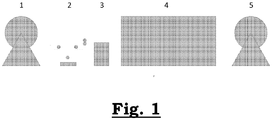
- Fig. 1 shows a diagrammatic representation of a possible embodiment of the method according to the invention, in particular the one-step process in which the fire-resistant and/or heat-resistant additives are applied immediately after the impregnation.
- the substrate made of fibre material is supplied via a supply system (1) and is submerged in an impregnation bath (2) in which the substrate is impregnated with one or several thermosetting polymers.
- the fire-resistant and/or heat-resistant additives are applied via coating (3), such as for example blade coating.
- the unit is passed through an oven (4).
- the deposited additives are partially cured and the deposited fire-resistant and/or heat-resistant additives are fixed onto the substrate.
- the residence time in the oven and the temperature of the oven are determined in such a way that, on the one hand, not too much partial curing takes place and the thermosetting resin is cured to a sufficient degree and, on the other hand, the fire-resistant and heat-resistant layer is fixed to a sufficient degree.
- the reactivity of the thermosetting resin and the formulation of the fire-resistant and heat-resistant layer will be tailored to each other.
- the preimpregnated fibre material After leaving the oven (4), the preimpregnated fibre material is rolled up by means of a winding unit (5).
- the resultant fibre material has a high concentration of fire-resistant and heat-resistant additives on one side and has a high concentration of resin ensuring good adhesion to the layers situated underneath on the other side.
- the use of one single layer of fibre reinforcement is inherent to this method and gives the opportunity of producing lightweight composites which satisfy the fire safety requirements in force.
- the resin/flame retardant can also be minimized in order to achieve the highest possible fire resistance and heat resistance.
- the preimpregnated fibre material has a resin/additives ratio of approximately 1 to 2.
- the additives are applied by coating after the fibre reinforcement has been impregnated with resin, before, during or after the resin is or has been partially cured by, for example, heat. If the additives are applied before or during this B stage, the process of partially curing the resin (B stage of the prepreg) will also fix the additives onto the carrier at the same time. With this method, the B stage of the prepreg and the fixation of the additives have to be balanced in order to achieve both an optimum B stage and fixation of the additives. If the additives are applied after the B stage, these will only be fixed by means of a process which does not involve any further curing of the prepreg.
- This production sequence is not limited to the technique which is used for resin impregnation and is usable for customary techniques such as water-based or solvent-based resin impregnation, powder impregnation or hot-melt impregnation.
- Typical resins which may be used are thermosetting resins.
- fibre reinforcement may be used for the fibre reinforcement.
- Typical fibres which are used for reinforcing composites are carbon, aramid, glass, natural, mineral or basalt fibres.
- the fibre reinforcement itself takes the form of an impregnable layer, inter alia in the form of a tape, fabric, multi-layered fabric or mat, consisting of one or several types of fibres.
- the prepreg obtained in this way is used further for producing composite materials by means of current methods, such as lamination, vacuum-moulding, autoclave or compression-moulding.
- the side of the prepreg with the fire-resistant and heat-resistant additives is turned towards the outside of the composite and the other side without additives is turned towards the inside of the composite.
- the latter side is able to adhere to other prepreg layers, optionally by the use of additives, or by means of a core material.
- This resin-rich side will bring about good adhesion to the layers situated underneath and good mechanical properties of the composite.
- composite A does not have a fire-resistant layer
- composite B comprises the fire-resistant and heat-resistant preimpregnated fibre material manufactured according to the invention.
- Composite A is a sandwich composite manufactured by compression-moulding a polyester foam core material (Airex T90.60 - 2 cm) comprising two layers of a furan resin-impregnated basalt fabric without heat-insulating layer of 810 g/m 2 on both sides.
- Composite B is a sandwich composite manufactured by compression-moulding a polyester foam core material (Airex T90.60 - 2 cm) comprising, on one side, two layers of a furan resin-impregnated basalt fabric without heat-insulating layer of 810 g/m 2 and, on the opposite side, one layer of a furan resin-impregnated basalt fabric without heat-insulating layer of 810 g/m 2 in contact with the polyester core, and one adjoining layer of a furan resin-impregnated basalt fabric of 810 g/m 2 with a heat-insulating layer of 667 g/m 2 , in which the heat-insulating layer was applied by means of blade coating immediately after impregnation of the basalt fabric.
Landscapes
- Engineering & Computer Science (AREA)
- Mechanical Engineering (AREA)
- Reinforced Plastic Materials (AREA)
- Laminated Bodies (AREA)
Applications Claiming Priority (1)
| Application Number | Priority Date | Filing Date | Title |
|---|---|---|---|
| BE20205087A BE1028055B1 (nl) | 2020-02-13 | 2020-02-13 | Werkwijze voor het produceren van een brand- en warmtewerend voorgeïmpregneerd vezelmateriaal |
Publications (1)
| Publication Number | Publication Date |
|---|---|
| EP3865272A1 true EP3865272A1 (fr) | 2021-08-18 |
Family
ID=69631400
Family Applications (1)
| Application Number | Title | Priority Date | Filing Date |
|---|---|---|---|
| EP21157089.0A Withdrawn EP3865272A1 (fr) | 2020-02-13 | 2021-02-15 | Procédé de fabrication d'un matériau fibreux préimprégné résistant au feu et à la chaleur |
Country Status (2)
| Country | Link |
|---|---|
| EP (1) | EP3865272A1 (fr) |
| BE (1) | BE1028055B1 (fr) |
Citations (13)
| Publication number | Priority date | Publication date | Assignee | Title |
|---|---|---|---|---|
| US5506039A (en) * | 1988-03-08 | 1996-04-09 | Dainippon Ink And Chemicals, Inc. | Sheet molding compounds, production processes therefor, and molded materials therefrom |
| EP1055513A1 (fr) | 1999-05-27 | 2000-11-29 | Hexcel Corporation | Préimprégné et panneau |
| GB2394917A (en) * | 2002-10-28 | 2004-05-12 | British Mica Co Holdings Ltd | Fire retardant panel |
| US20040197539A1 (en) | 2003-02-26 | 2004-10-07 | Christou Philippe D. | Fibrous reinforcement suitable as a fireproofing agent |
| WO2008058924A1 (fr) | 2006-11-15 | 2008-05-22 | Herbert Costard | Procédé de production de matériaux composites à fibres ignifugés ou pré-imprégnés |
| US20090148637A1 (en) | 2007-10-26 | 2009-06-11 | Florida State University Research Foundation | Fabrication of fire retardant materials with nanoadditives |
| DE102008039866A1 (de) | 2008-08-27 | 2010-03-04 | Saertex Gmbh & Co. Kg | Textile Verstärkung für die Herstellung eines faserverstärkten Kunststoffbauteils |
| US20120107560A1 (en) | 2010-11-01 | 2012-05-03 | Cytec Technology Corp. | Targeted deposition of particles used in the manufacture of composite articles |
| US20150336335A1 (en) * | 2013-01-09 | 2015-11-26 | Mitsubishi Electric Corporation | Fiber-reinforced composite material, method of producing same, and elevator component member and elevator car that use same |
| WO2017027569A1 (fr) * | 2015-08-10 | 2017-02-16 | Cytec Industries Inc. | Matériau pré-imprégné capable d'assurer une protection contre le foudroiement et de résister aux brûlures perforantes |
| WO2017120171A1 (fr) * | 2016-01-05 | 2017-07-13 | Hanwha Azdel, Inc. | Pré-imprégnés, noyaux et articles composites comprenant des matériaux ignifuges synergiques et composés |
| US20180194561A1 (en) * | 2015-07-20 | 2018-07-12 | Sgl Carbon Se | Material with at least two layer coverings |
| EP3603916A1 (fr) * | 2017-03-22 | 2020-02-05 | Toray Industries, Inc. | Procédé de fabrication de préimprégné, et procédé de fabrication de matériau composite renforcé par des fibres |
-
2020
- 2020-02-13 BE BE20205087A patent/BE1028055B1/nl active IP Right Grant
-
2021
- 2021-02-15 EP EP21157089.0A patent/EP3865272A1/fr not_active Withdrawn
Patent Citations (14)
| Publication number | Priority date | Publication date | Assignee | Title |
|---|---|---|---|---|
| US5506039A (en) * | 1988-03-08 | 1996-04-09 | Dainippon Ink And Chemicals, Inc. | Sheet molding compounds, production processes therefor, and molded materials therefrom |
| EP1055513A1 (fr) | 1999-05-27 | 2000-11-29 | Hexcel Corporation | Préimprégné et panneau |
| GB2394917A (en) * | 2002-10-28 | 2004-05-12 | British Mica Co Holdings Ltd | Fire retardant panel |
| US20040197539A1 (en) | 2003-02-26 | 2004-10-07 | Christou Philippe D. | Fibrous reinforcement suitable as a fireproofing agent |
| DE602004002673T2 (de) | 2003-02-26 | 2007-08-23 | Hexcel Reinforcements | Verstärktes fasermaterial als flammhemmendes mittel, seine herstellung und seine verwendung |
| WO2008058924A1 (fr) | 2006-11-15 | 2008-05-22 | Herbert Costard | Procédé de production de matériaux composites à fibres ignifugés ou pré-imprégnés |
| US20090148637A1 (en) | 2007-10-26 | 2009-06-11 | Florida State University Research Foundation | Fabrication of fire retardant materials with nanoadditives |
| DE102008039866A1 (de) | 2008-08-27 | 2010-03-04 | Saertex Gmbh & Co. Kg | Textile Verstärkung für die Herstellung eines faserverstärkten Kunststoffbauteils |
| US20120107560A1 (en) | 2010-11-01 | 2012-05-03 | Cytec Technology Corp. | Targeted deposition of particles used in the manufacture of composite articles |
| US20150336335A1 (en) * | 2013-01-09 | 2015-11-26 | Mitsubishi Electric Corporation | Fiber-reinforced composite material, method of producing same, and elevator component member and elevator car that use same |
| US20180194561A1 (en) * | 2015-07-20 | 2018-07-12 | Sgl Carbon Se | Material with at least two layer coverings |
| WO2017027569A1 (fr) * | 2015-08-10 | 2017-02-16 | Cytec Industries Inc. | Matériau pré-imprégné capable d'assurer une protection contre le foudroiement et de résister aux brûlures perforantes |
| WO2017120171A1 (fr) * | 2016-01-05 | 2017-07-13 | Hanwha Azdel, Inc. | Pré-imprégnés, noyaux et articles composites comprenant des matériaux ignifuges synergiques et composés |
| EP3603916A1 (fr) * | 2017-03-22 | 2020-02-05 | Toray Industries, Inc. | Procédé de fabrication de préimprégné, et procédé de fabrication de matériau composite renforcé par des fibres |
Also Published As
| Publication number | Publication date |
|---|---|
| BE1028055B1 (nl) | 2021-09-13 |
| BE1028055A1 (nl) | 2021-09-07 |
Similar Documents
| Publication | Publication Date | Title |
|---|---|---|
| EP1128958B2 (fr) | Materiaux de moulage | |
| EP1338406B1 (fr) | Matières à mouler et procédé pour leur fabrication | |
| CN104842619A (zh) | 高韧性多层结构预浸料制造工艺 | |
| US7267868B2 (en) | Composite products and molded articles obtained from said products | |
| GB2369597A (en) | Moulding material | |
| KR20180089413A (ko) | 현장 중합형 열가소성 프리프레그, 열가소성 컴포지트 및 그 제조 방법 | |
| EP0798102A2 (fr) | Produit pré-impregné auto-adhésif, procédé pour sa fabrication et son utilisation | |
| CN105946327B (zh) | 一种双面斜纹立体结构玻璃纤维织物及制备复合材料的方法 | |
| EP2496411B1 (fr) | Dispositif de protection contre les risques électromagnétiques pour matériaux composites | |
| EP0313171B1 (fr) | Matériau sandwich et son usage | |
| EP2496410B1 (fr) | Dispositif de protection contre des risques électromagnétiques pour matériaux composites | |
| EP3401085B1 (fr) | Matériaux composites durcis à l'aide d'un revêtement à couche mince thermoplastique | |
| US7112372B2 (en) | Pigmented panel assembly | |
| EP3865272A1 (fr) | Procédé de fabrication d'un matériau fibreux préimprégné résistant au feu et à la chaleur | |
| NL2015889B1 (en) | A stitch-reinforced sandwich panel. | |
| KR102470605B1 (ko) | 수지 함량율이 높은, 고광택 열가소성 프리프레그 라미네이트 및 그 제조방법 | |
| CN110951100A (zh) | 一种树脂性能差异分布的自粘性阻燃预浸料的制备方法 | |
| US5393591A (en) | Process for producing copper-clad base materials | |
| KR20170005999A (ko) | 섬유 복합재 자동차 판스프링 성형용 열경화성 수지, 프리프레그 및 프리프레그 시트 제조방법 | |
| CN116003965B (zh) | 一种预浸料增韧层 | |
| JPS6135941B2 (fr) | ||
| JPS6135942B2 (fr) |
Legal Events
| Date | Code | Title | Description |
|---|---|---|---|
| PUAI | Public reference made under article 153(3) epc to a published international application that has entered the european phase |
Free format text: ORIGINAL CODE: 0009012 |
|
| STAA | Information on the status of an ep patent application or granted ep patent |
Free format text: STATUS: THE APPLICATION HAS BEEN PUBLISHED |
|
| AK | Designated contracting states |
Kind code of ref document: A1 Designated state(s): AL AT BE BG CH CY CZ DE DK EE ES FI FR GB GR HR HU IE IS IT LI LT LU LV MC MK MT NL NO PL PT RO RS SE SI SK SM TR |
|
| STAA | Information on the status of an ep patent application or granted ep patent |
Free format text: STATUS: THE APPLICATION IS DEEMED TO BE WITHDRAWN |
|
| 18D | Application deemed to be withdrawn |
Effective date: 20220219 |