EP3865636A1 - Agencement de module ignifugé pour assembler des panneaux - Google Patents
Agencement de module ignifugé pour assembler des panneaux Download PDFInfo
- Publication number
- EP3865636A1 EP3865636A1 EP21157049.4A EP21157049A EP3865636A1 EP 3865636 A1 EP3865636 A1 EP 3865636A1 EP 21157049 A EP21157049 A EP 21157049A EP 3865636 A1 EP3865636 A1 EP 3865636A1
- Authority
- EP
- European Patent Office
- Prior art keywords
- module
- metal foil
- length
- protruding member
- arrangement
- Prior art date
- Legal status (The legal status is an assumption and is not a legal conclusion. Google has not performed a legal analysis and makes no representation as to the accuracy of the status listed.)
- Granted
Links
Images



Classifications
-
- E—FIXED CONSTRUCTIONS
- E04—BUILDING
- E04B—GENERAL BUILDING CONSTRUCTIONS; WALLS, e.g. PARTITIONS; ROOFS; FLOORS; CEILINGS; INSULATION OR OTHER PROTECTION OF BUILDINGS
- E04B1/00—Constructions in general; Structures which are not restricted either to walls, e.g. partitions, or floors or ceilings or roofs
- E04B1/38—Connections for building structures in general
- E04B1/61—Connections for building structures in general of slab-shaped building elements with each other
- E04B1/6108—Connections for building structures in general of slab-shaped building elements with each other the frontal surfaces of the slabs connected together
- E04B1/612—Connections for building structures in general of slab-shaped building elements with each other the frontal surfaces of the slabs connected together by means between frontal surfaces
- E04B1/6125—Connections for building structures in general of slab-shaped building elements with each other the frontal surfaces of the slabs connected together by means between frontal surfaces with protrusions on the one frontal surface co-operating with recesses in the other frontal surface
-
- F—MECHANICAL ENGINEERING; LIGHTING; HEATING; WEAPONS; BLASTING
- F25—REFRIGERATION OR COOLING; COMBINED HEATING AND REFRIGERATION SYSTEMS; HEAT PUMP SYSTEMS; MANUFACTURE OR STORAGE OF ICE; LIQUEFACTION SOLIDIFICATION OF GASES
- F25D—REFRIGERATORS; COLD ROOMS; ICE-BOXES; COOLING OR FREEZING APPARATUS NOT OTHERWISE PROVIDED FOR
- F25D23/00—General constructional features
- F25D23/06—Walls
-
- E—FIXED CONSTRUCTIONS
- E04—BUILDING
- E04B—GENERAL BUILDING CONSTRUCTIONS; WALLS, e.g. PARTITIONS; ROOFS; FLOORS; CEILINGS; INSULATION OR OTHER PROTECTION OF BUILDINGS
- E04B1/00—Constructions in general; Structures which are not restricted either to walls, e.g. partitions, or floors or ceilings or roofs
- E04B1/62—Insulation or other protection; Elements or use of specified material therefor
- E04B1/92—Protection against other undesired influences or dangers
- E04B1/94—Protection against other undesired influences or dangers against fire
- E04B1/941—Building elements specially adapted therefor
- E04B1/942—Building elements specially adapted therefor slab-shaped
-
- E—FIXED CONSTRUCTIONS
- E04—BUILDING
- E04B—GENERAL BUILDING CONSTRUCTIONS; WALLS, e.g. PARTITIONS; ROOFS; FLOORS; CEILINGS; INSULATION OR OTHER PROTECTION OF BUILDINGS
- E04B1/00—Constructions in general; Structures which are not restricted either to walls, e.g. partitions, or floors or ceilings or roofs
- E04B1/62—Insulation or other protection; Elements or use of specified material therefor
- E04B1/92—Protection against other undesired influences or dangers
- E04B1/94—Protection against other undesired influences or dangers against fire
- E04B1/941—Building elements specially adapted therefor
- E04B1/943—Building elements specially adapted therefor elongated
- E04B1/944—Building elements specially adapted therefor elongated covered with fire-proofing material
-
- E—FIXED CONSTRUCTIONS
- E04—BUILDING
- E04B—GENERAL BUILDING CONSTRUCTIONS; WALLS, e.g. PARTITIONS; ROOFS; FLOORS; CEILINGS; INSULATION OR OTHER PROTECTION OF BUILDINGS
- E04B2/00—Walls, e.g. partitions, for buildings; Wall construction with regard to insulation; Connections specially adapted to walls
- E04B2/74—Removable non-load-bearing partitions; Partitions with a free upper edge
- E04B2/7401—Removable non-load-bearing partitions; Partitions with a free upper edge assembled using panels without a frame or supporting posts, with or without upper or lower edge locating rails
-
- F—MECHANICAL ENGINEERING; LIGHTING; HEATING; WEAPONS; BLASTING
- F25—REFRIGERATION OR COOLING; COMBINED HEATING AND REFRIGERATION SYSTEMS; HEAT PUMP SYSTEMS; MANUFACTURE OR STORAGE OF ICE; LIQUEFACTION SOLIDIFICATION OF GASES
- F25D—REFRIGERATORS; COLD ROOMS; ICE-BOXES; COOLING OR FREEZING APPARATUS NOT OTHERWISE PROVIDED FOR
- F25D13/00—Stationary devices, e.g. cold-rooms
-
- E—FIXED CONSTRUCTIONS
- E04—BUILDING
- E04B—GENERAL BUILDING CONSTRUCTIONS; WALLS, e.g. PARTITIONS; ROOFS; FLOORS; CEILINGS; INSULATION OR OTHER PROTECTION OF BUILDINGS
- E04B1/00—Constructions in general; Structures which are not restricted either to walls, e.g. partitions, or floors or ceilings or roofs
- E04B1/38—Connections for building structures in general
- E04B1/61—Connections for building structures in general of slab-shaped building elements with each other
- E04B2001/6195—Connections for building structures in general of slab-shaped building elements with each other the slabs being connected at an angle, e.g. forming a corner
Definitions
- the embodiments of the invention disclose a fire proof construction, but in a more specifically speaking disclose a modular arrangement and a structure to make a cold room, in a fire proof manner from modular elements of an arrangement in accordance of independent claim directed to such an arrangement.
- Fire proof structures as such are needed in many applications, especially where there are high temperatures present in the operation of such structures continuously or expected to occur although may be not wanted.
- Fireproof materials are used in various place and environments.
- the material selections are aiming according to the standards to that, at an incident of fire, or a corresponding sudden temperature raise, there would be sufficiently long time preserved, for the persons working in the area for example, for a safe exit from a dangerous developing area.
- operations of cold rooms are based on transferring thermal energy from the temperature of the cold room to outside of the cold room.
- the insulation of the fireproof structures need to stand the ambient temperature but additionally also to stand against a temperature raise of stochastic nature at the raise.
- a temperature raise of stochastic nature at the raise When speaking about a room sized cold rooms, and the related freeze rooms, being considered as cold rooms with temperature even lower than in a cold room, there are also the fire safe issues more highlighted. This is as there might be human beings working in a cold room, or, the cold room may be used as a storage for materials that may be dangerous as released, because of various reasons, as depository, refrigerated to a suitable temperature. Therefore, the cold room structures have to tolerate the heat on one side, but keep cold on another side, to preserve the temperature difference.
- the joints may provide a passage to the flames or heat into the insulation and the fire can penetrate the join from a side of the insulation to the other side, and can also light up the insulating material itself.
- a standards SFS-EN 14509 certified B-s1 and Bs-2, d0 define for reaction to fire classification for discontinuous cam lock panel specifications are an examples about standards for materials and the structures have to meet for certification.
- One structure according to the traditional of making walls for a cold room uses a double skin metal faced insulating panels, which have being used for making cold rooms by a cut and saw methods, to meet for a self-supporting structure in accordance to SFS-EN 14509, for example.
- cut and saw structures are found weak in the fire tests and even to fail in Reaction to Fire test to meet B-s2, d0 or B-s1, d0 classification. Cut and saw corner and flashings do not cover panel insulation as much as it could and the result in non-desired outcome in test conditions.
- One aspect of the problems is that the saw-lines may be declined and/or wavy, to make voids to be filled afterwards.
- SFS-EN 14509 is under EU Construction Products Regulation 305/2011. According to the https://www.vm.fi/en-US/Land use and building/Legislation and instructions/Legislation on building products
- the aim of the Construction Products Regulation is to ensure the availability of accurate and reliable information on the performance levels and properties of construction products in a unified manner across Europe.
- the Regulation clarifies the use of the CE marking.
- a further goal of the regulation is to ensure the free mobility of construction products and remove trade barriers in the EU internal market. In countries outside it provides also means to compare the specifications to the local standards and so to help certification accordingly in such countries.
- Standards EN 14509 and EN 13823 define a fire test method of Single-Burning Item (SBI) and fire performance as one critical performance level which is declared in a panel CE marking.
- Normally one-time cast polyurethane panel has reaction according to fire classification D-s3, d0 or C-s3, d0.
- the building materials are classified as B, C and D for heat production, for smoke production s1, s2 and s3 and for dripping d0-d2.
- the measurable parameters for heat production are FIGRA (Fire Growing Rate) and THR (Total Heat Release).
- Measured parameters for smoke output are SMOGRA (Smoke Growing Rate) and TSP (Total Smoke Production).
- the objective is to at least alleviate the problems described hereinabove not satisfactorily solved by the known cut and saw or related structures in the cold room arrangements, and so to provide a new feasible fire proof modular structure that is easy to manufacture and assemble for making a cold room construction in a fire proof manner in accordance to meet at least one of the specifications in relevant standards.
- expression to comprise and its deflected forms are used as an open expression.
- the disclosure concerns a modular fireproof cold room wall arrangement to be formed between
- the arrangement has modules to provide a fireproof corner structure.
- the mating faces are selected to the first module end to the side of the module panel for a wall corner formation when the second module end is selected to the end side of the second module panel.
- the mating faces are selected to the respective end sides of the first module and the second module for wall modules to form a wall module joint for a cold room wall on another location than a wall corner.
- the arrangement has modules to provide a fireproof structure that comprises at least one of the following: a floor structure, a ceiling structure, a wall structure and a combination of just mentioned with a corner structure.
- the arrangement has in its geometry such a length n of said first metal foil part that is less than the distance from said protruding member to end of the said first module end, advantageously less than 3 ⁇ 4 of said distance, more advantageously less than 1 ⁇ 2 of said distance, and even more advantageously less than 1 ⁇ 4 of said distance.
- the metal foil forms on one hand a thermal bridge into the isolating structure, but on another hand equals temperature differences, if such would occur at the particular side of the module with the first metal foil.
- the arrangement can comprise a third metal foil part that has equal length n' as the length n of said first metal foil part.
- the metal foil to another metal foil contact has been achieved with the foil, but the extra foil on either side would make the thermal bridge longer by one of said metal foils.
- the arrangement can comprise such a second metal foil part of the metal foil that comprises such a metal foil part being as it were twisted at a certain deepness of the metal foil part into the isolating material by the length wherein the length of the part is equal or greater than the length of at least one of the following metal foil parts: length of said first metal foil part, length of said third metal foil part.
- the thermal bridging in the parallel direction of the metal foils in the isolating material can conduct heat and equalize the temperature to be conducted along the metal foil, especially in a corner such would also have a cooling effect in temperature rise locally, but would also conduct heat into the insulation materials, in suitable part.
- a length of a fourth metal foil part of the metal foil being as twisted into a deepness of a length of the metal foil part, into the isolating material by the length of the part being greater than the length of the second metal foil part.
- a part of the fourth metal foil part has been arranged into contact with an extension part to said second metal foil part.
- the thermal conduction can be improved at the extension part contacting parts of the structure.
- the protruding member has as a tapering form, the tapering form being defined by a first tapering side with an angle and a second tapering side with an angle in respect to the length dimension of the protruding member, when the cross section is concerned.
- the protruding member has an elongated shape such like a ridge.
- the protruding member can be one of such in an ensemble of similar ones in an aligned linear arrangement at an end of the module.
- the recessing part has as a tapering form, the tapering form being defined by a first tapering side with an angle and a second tapering side with an angle in respect to the length dimension of the recessing member, when the cross section is concerned.
- the recessing part has an elongated shape such like an elongated gorge or recess.
- the recessing member can be one of such in an ensemble of similar ones in an aligned linear arrangement at an end of the module.
- the recessing member is arranged to match to the protruding member geometry for making a mating joint at the mating face. The protruding member and the recessing part as such are arranged in the respective modules on a mating face to join respective modules.
- said first tapering angle is equal to said second tapering angle, for a protruding member and the corresponding recessing part, so to provide certain symmetry for mounting freedom of the sides, if the fire proof structure could be provided without a dedicated sides of the modules as such for a wall for certain sides out and in.
- first tapering angle when the first tapering angle is different from the second tapering angle, compatibly with the joining first and second modules, they could be mounted in a certain way guiding the mounting professional to provide a tight joint between the modules in question in a predetermined way more strictly than in a symmetrical tapering angles.
- the protruding member comprises a dimension as a height equal to the dimension of deepness of the recessing part for forming a mating joint between the modules with respective protruding member and recessing part.
- the protruding member comprises an ensemble of protrusions forming a sectional protrusion member to be fitted to a correspondingly to an ensemble of sectional recesses to form a sectional recessing part.
- a module comprises as thermal isolation material that has in the composition polymer that is an ester or alike.
- a module comprises as thermal isolation material that has in the composition PUR.
- a module comprises as thermal isolation material that has in the composition polymer that is an ether or alike.
- a module comprises as thermal isolation material that has in the composition of PIR (Polyisocyanurate).
- an embodied module of the arrangement comprises a layer of fire retardant material and/or extinguishing gas-forming material on a side of the module.
- the material comprises gypsum and/or a carbonate as a respective layer in a sandwiched structure.
- an element of the embodied arrangement is a module in accordance of said first module having at least a first module end formation, comprising between two metal foils a therebetween laminated thermal isolation material layer.
- an element of the embodied arrangement is a module in accordance of said second module having at least a second module end formation, comprising between two metal foils a therebetween laminated thermal isolation material layer.
- an element of the embodied arrangement is compatible to mount to an embodied element of the arrangement, wherein the element is a middle element having at least at one end side a protruding member and on another side a recessing part to match to said either first module or second module having a compatible mating face.
- an element of the embodied arrangement comprises for the mating face a metal foil formation according to the mating face assembly for at least at one end side a protruding member and on another side recessing part to match to said either first module or second module according to the mating face structure to match the modules to join together.
- an element of the embodied arrangement comprises a fire proof layer on inside side of the element, to form, when mount to another such element of said arrangement or a compatible element to mount, a contact to between such elements when mount.
- the inside side of the element is denoting to such a structure that is arranged to form a closure or a similar room with a door, such as an accessible cold room.
- the cold room comprises a freezer room.
- an element of the embodied arrangement comprises in the module in the fireproof layer further comprises a fire extinguishing gas releasing material.
- a cold room according to an embodiment comprises an element of the embodied arrangement.
- the structure is lightweight, and the joint between the modules of the structure members is technically strong with ability to conduct and equalize temperature differences by the thermal conduction enhancement at the mating face areas at the joint.
- the corner structure is technically stronger against fire, due to corner design and for example, gypsum boards as in embodiments and leads to improved results in SBI test achieving B-s1, d0 classification.
- Specimen structure is approved to fulfill panel standard SFS-EN 14509 requirements.
- Embodiments provide fire safety B-s1, d0 classification panels for Cold- and Freezer Rooms. Economical advantages to the end user of such elements with the module structure utilizing entity can also have lower insurance.
- SFS-EN 14509 defines regulation for sandwich panels with different production technologies.
- Embodiments according to the invention can replace for example in wall-corner joints the cut and saw corner type in standardized specimen according to SFS-EN 14509 self-supporting double skin metal faced insulating panels.
- the elements with the modular structure can be factory made products in beforehand. This is especially advantageous, when the module dimensions can be selectable stepwise to match together.
- Specifications can be embodied in sub-standard EN 13501 Fire classification of construction products and building elements in suitable part for embodiments. Classification using data from fire resistance tests, excluding ventilation services and test method SFS-EN 13823 Reaction to fire tests for building products can be met. Building products can be made, excluding floorings exposed to the thermal attack by a single burning item.
- panel press mold temperatures can be raised and wall-corner technical solution is used in embodied element system with embodied modules.
- Gypsum boards can be pre-cut in correct dimension and stored next to production line where it is easy and fast add during the production process to provide such modules as elements of the arrangement.
- fire performance is an important performance level for customers and end-users due to the stricter legislation on construction products.
- a number of' refers herein to any positive integer starting from one (1), e.g. to one, two, or three.
- a plurality of' refers herein to any positive integer starting from two (2), e.g. to two, three, or four.
- conditional language such as, among others, “can,” “could,” “might,” or “may,” unless specifically stated otherwise, or otherwise understood within the context as used, is generally intended to convey that certain implementations could include, while other implementations do not include, certain features, elements, and/or operations. Thus, such conditional language is not generally intended to imply that features, elements, and/or operations are in any way required for one or more implementations or that one or more implementations necessarily include logic for deciding, with or without user input or prompting, whether these features, elements, and/or operations are included or are to be performed in any particular implementation.
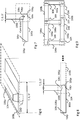
- the arrangement 100 in FIG 1 illustrates an ensemble of examples on modular arrangement modules 100a and 100b for joining them together at a mating face 104, comprising also the individual mating faces for the modules for a fireproof join, in accordance with one or more example embodiments of the present disclosure.
- the embodiments are used for providing a fireproof corner structure by the two wall modules a first module 100a and a second module 100b with their respective end formation examples.
- the modules can be embodied in the example by a sandwiched-structure, which has been achieved by a thermal isolation material 102 and 101 respectively for the thermal isolation between two pairs of metal foils, the metal foils being cited as foils 103 and 105.
- the foil 103 and the foil 105 were distinguished from each other mainly for clarity reasons for facilitating reference to first and second modules, although in theory, they can be embodied preferably with same foil material with even thickness, but according to an embodiment variant by a different material, even with different thickness of the foils.
- the metal foils at the sides of a single module should be separated for thermal insulation purposes by a thermal isolation material, in addition so that there would not be bridging of metal or similar thermal conductor weakening locally the thermal isolation.
- the wall structure can provide in addition to a cold room also electromagnetic protection, when the floor and the ceiling are made of similar sandwiched structure comprising metal foil.
- the protection can be manufactured to be double protected cold room, because of the sandwiched module structure. This can be important for such applications, which are sensitive for coupling signals from outside that could interfere fire alarm systems in the volume of disclosed closure made by the modules of the embodied arrangement.
- the embodied metal foil 105 is arranged as to turn around the module 100a end, the end having a dimension d, and to bend by a first metal foil part 105d towards the protruding member 106p in alignment of the metal foil 105 on the other side of the module 100a.
- the module 100a as a panel 100a has a thickness D illustrated in Fig 1 .
- the first metal foil part 105d is bent at distance d by a length n towards the protruding member, at the mating face 104.
- the thickness of the first module 100a D can have a thickness 80 mm, 100 mm, 150mm, 200 mm, 300 mm or 400 mm.
- the thickness D' of the second module 100b can be selected for match at the mating face 104 at the mating face 104, but also to equal the thickness D for a smooth outer wall structure, compatibly to provide galvanic contact between the first metal foil part 105d and the second metal foil part 103d of the respective modules. Such contact confirms also thermal conduction between the first module and second module so to distribute heat and thus lower the temperature at a location near the joint region. This arrangement also provides time for the warming and heating, up to critical temperatures, before the structure would be suffering damages in an incident of fire.
- the length n of said first metal foil part 105d is less than the distance from said protruding member 106p to end of the said first module end 100a, advantageously less than 3 ⁇ 4 of said distance, more advantageously less than 1 ⁇ 2 of said distance, and even more advantageously less than 1 ⁇ 4 of said distance
- the length n' for the part 103d can be chosen to equal the length n for the part 105d according to an embodiment. This can be decided so to correspond the thermal conditions at the joint for avoidance to make a thermal bridge for an unnecessary long into the isolating material.
- n (and n') values are representing different insulation requirements with the metal foil as thermal bridge at the mating face, so that the desired insulation depth can be gained despite of the thermal bridging by the metal foil parts with embodied lengths into the isolating material.
- the bended metal foil ends at the mating face 104 also protects the joint against mechanical wear out at the joining line, to prevent the exposure of the isolating material, also in an incident of fire.
- the length m along the part 105c equals the difference of D and d as a positive value, so providing an example depicted and embodied end structure at one side of the first module end.
- such modules can embody cold rooms that have a rectangular geometry, and/or such cold rooms that are provided as an aggregate of rooms with rectangular geometry cold room sections.
- the dashed line is used in Fig 1 for indicating the mating face 104 in an illustrative manner, indicating joining geometry examples in accordance of the disclosure for mating faces 104 to match the mutually compatible modules.
- it is not intended to limit embodiments only to the shown example geometries of the Fig 1 at the mating face 104, for the mating face for a joint between the modules, but rather show examples for an implementation with exemplified measures and/or geometrical ratios to be used in the modules.
- the foil 105 at the inner side of the first module has the second metal foil part 105c and 105b, that comprises the parts 105c and 105b, the last mentioned part 105b to be in the structure of the first module as twisted into the thermal insulation material 101
- the second metal foil part can comprise also an extension part 105a, to provide a galvanic connection as improved to the second module 100b at the fourth metal foil part 103a and 103c.
- the deepness m' of the turned back metal foil 103, part 103b of the module 100b, the part 103b has the deepness m'.
- the deepness m' equals to the measure of m, i.e. also equals the distance D-d in the mutually compatible module 100a, in the mating face area 104.
- the distance is determined for preventing the disruption of the foil 103 from the insulating material 102 at the inner corner intended location.
- the length k of said second metal foil part 105b is less than the distance from said protruding member 106p to end of the said first module end 100a, advantageously less than 3 ⁇ 4 of said distance, more advantageously less than 1 ⁇ 2 of said distance, and even more advantageously less than 1 ⁇ 4 of said distance.
- This can be preferably kept that short as the metal foil parts can conduct thermally cold from the metal foil 105 side in question into the insulation and thus the length to be kept limited for avoidance of thermal bridging more than embodied by the length exemplified.
- the first module 100a has been embodied with a protruding member 106p at the mating face 104 area.
- the protruding member 106p has been embodied as an elongated ridge as cross sectional illustration in Fig 1 , but in perspective example in FIG 2 .
- Further example embodiments with a protruding member 106p has been embodied in FIGs 4, FIG 5 and FIG 5A .
- embodied protruding members 106p and recessing part 106r are embodied.
- a single black line denotes to the embodiment as a continuous ridge ( FIG 4 ) along the module side length or an ensemble of shorter ridges by the dashed single line in line ( FIG 5 ) along the module side length.
- FIGS 4 and 5 also illustrate recessing parts 106r, to be mated to the respective protruding members at a mating face 104 ( FIGs 6 to 9 for example) by a module with a compatible mutual mating face for forming a wall structure of a cold room.
- the second module 100b has been embodied with a recessing part 106r, with a deepness r from the second module 100b end.
- the deepness r should not be shallower than the protruding member's 106p height p.
- the double-sided arrows there between the first module 100a and the second module 100b are indicative that protruding member 106p and the recessing part 106r are to be mated, for a corner structure of a cold room wall to be embodied for example.
- protruding member 106p and recessing part 106r should be pairwise equal for a match so that the parts 105d and 103 as well as the parts103c and 105c but also 103a and 105a can make a galvanic contact therebetween for thermal conduction at the respective contacting areas in the mating face 104.
- the foil part 103b can be as twisted into the thermal insulation material by the deepness m'; at a distance similar distance as the length n' (i.e. 103d part of the outer side foil), but from the intended inner side of the second module foil 103.
- the protruding members 106p, as well as recessing parts 106r are further embodied as examples in Fig 9 , being used at the mating faces 104 at the joints, for making a cold room with compatible modules 100a and 100b for wall structures.
- Fig 9 there are shown more examples, to embody the protruding member 106p and the recessing part 106r implementation examples in accordance of the disclosure, when the metal foils in the modules 100a and 100b are in suitable part according to the example Fig1 , for the cold room wall structure embodied.
- the protruding member (106p) has been illustrated as having a tapering form, the tapering form being defined by a first tapering side with an angle ( ⁇ ) and a second tapering side with an angle ( ⁇ ) in respect to the length dimension of the protruding member (106p).
- the recessing part (106r) has as a tapering form, the tapering form being defined by a first tapering side with an angle ( ⁇ ) and a second tapering side with an angle ( ⁇ ) in respect to the deepness dimension of the recessing part (106r).
- the corresponding first tapering angles ( ⁇ ) are equal to said second tapering angles ( ⁇ ).
- the feature "tapering” refers to the feature of the tapering sides to be sides of a cut triangular, for the recessing part 106r and the protruding member106p, as embodied.
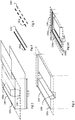
- Figs 2 and 3 illustrate further ensembles of examples of modular arrangement modules for joining embodied modules, by a perspective view illustration, in accordance with one or more example embodiments of the present disclosure.
- the module 100a can be embodied for a corner also with such mating face 104 that has the recessing part 106r for the joining to another module with a compatible protruding member 106p at its mating face.
- the panel measures T, D and D' are shown for the examples with the optional thicknesses of the modules in the embodiments exemplified in Fig 1 .
- Fig 3 illustrates a schematic example of a module 100b having a mating face 104 with a recessing part 106r on the mating face 104 at an end side of the module 100b.
- the module 100b can have at the opposite end side a mating face in accordance of Fig 6 options, for a wall of a cold room structure.
- Fig 4 illustrates schematically protruding member 106p and recessing part 106r respectively as a continuous filled thick line (106p) and as continuous double line (106r), for embodiment variants, especially as illustrated in Fig 5A .
- Fig 5 illustrates schematically protruding member 106p and recessing part 106r respectively as a dashed filled thick line (106p) and as dashed double line (106r), for embodiment variants, especially as illustrated in Fig 5A .
- Fig 5A illustrates schematically an example of a module 100ac as a module element to get joint to an embodied corner, formed from a first module 100a, and a second module 100b, as embodied in Fig 1 with the compatible mating faces 104 for joining.
- the module element 100ac can be an end element to form a floor and/or a ceiling to a wall corner of modules 100a and 100b.
- FIG. 6 illustrates optional mating face 104 geometries for a module as a second module 100b of an embodied arrangement in an embodied wall module, in accordance with one or more example embodiments of the present disclosure.
- the mating face 104 options are illustrated in accordance of the second module 100b in Fig 1 with options of a protruding member 106p and recessing part 106r.
- the panel measures T, D and D' are shown for the examples with the optional thicknesses of the modules in the embodiments, in suitable part as exemplified in Fig 1 .
- the measure T can be embodied as an indentation measure at the mating face, to match a module with thickness of D or D', in suitable part, in accordance of one or more embodiments of the disclosure.
- Fig 6 illustrates a schematic example of a module 100b having a mating face 104 with a recessing part 106r on the mating face 104 at an end side of the module 100b.
- the module 100b can have a mating face in accordance of Fig 3 options at the opposite end side, for a wall of a cold room structure.
- Figs 7 and 8 illustrate detailed examples as schematic cross sections of use of optional mating face 104 geometries for embodied modules 100a, 100b of the embodied arrangement, for joining the first and second modules 100a, 100b at the mating faces 104 for wall structures, in accordance with one or more example embodiments of the present disclosure.
- a corner joint example has been embodied.
- a cam lock connector which can be a pair to form the cam lock connection, has been embodied in the example, to be used in accordance with one or more example embodiments of the present disclosure, where applicable.
- Fig 8 a double corner joint for an inner middle wall of a cold room for dividing the cold room to sections, as illustrated in Fig 9 .
- the three black dots in Fig 8 are illustrative to continue the structure with optional structures of embodied panels in accordance of the cold room to be finally formed with the wall structure embodied.
- FIG 8 illustrates as schematic cross section optional mating face 104 geometries for embodied modules 100a, 100b of the embodied arrangement, at the mating face to join embodied modules for continuing the structure from a middle wall, in accordance with one or more example embodiments of the present dis-closure.
- FIG 9 illustrates as schematic cross section optional mating face 104 geometries for a cold room to be embodied by using embodied first and second modules 100a and 100b respectively, of the embodied arrangement with options of mating face 104 geometries in the mating face to join the embodied modules, in accordance with one or more example embodiments of the present disclosure.
- an embodied first module 100a having at least one first module 100a end formation ( Fig 1 ) at a first end can have also an end formation of a second module 100b end at a second end of said first module 100a, to join a first module 100a and a second module 100b at the mating face 104 to have compatible mating to join a first module and a second module.
- the view in Fig 9 can illustrate a ground plan layout view for the walls and their joining by the modules.
- the Fig 9 can also illustrate such an optional view from a wall direction, in accordance with one or more example embodiments of the present disclosure.
- Fig 9 there are two ends formed by the modules 100a, of which the right hand side has two mating faces at same side at the opposite ends on the side for the receiving a second modules 100b to each mating face 104.
- the upper second modules 100a and 100b are illustrated as forming a ceiling and the lower second modules 100b are illustrated as forming a floor, with the joints in accordance of suitable embodiments shown as examples in the Figs.
- the hexagonal like formations are illustrative of the options at the mating faces 104 in the Figs 7 to 9 , to illustrate uses of protruding members 106p and/or recessing parts 106r at the corresponding mating faces 104 of the embodied modules for making a joint.
- the SBI specimen was modified regarding to the corner structure as embodied by the module arrangement according to the disclosure.
- the module arrangement has been embodied with panels, but molded wall-corner joint designs as being used according to embodiments with the embodied mating faces 104 to join mutually compatible panels of the arrangement by using at the joining area embodied mating faces of the panels.
- first and second wall modules has been made with molded joint profiles to make 90-degree angle according to an embodiment.
- a wall panels goes one inside another, with the protruding member 106p and the recessing part 106r, in the example, about 20 mm (embodied in Fig 1 by p and r, to denote to the protruding member (106p) by the p, and to the recessing part (106r) by the r) in an embodied corner design by means of the protruding member 106p and the recessing part 106r (cf. FIGs 1 , Fig2, Fig 3, Fig 4, Fig 5 for alternative joints at the mating face 104).
- the modules have also a normal roll-formed and bended sheet metal facings to provide the metal foils as such in the manufacture, also with the embodied twistings providing the ends by the metal-to-metal contacts, in a thermally conductive way.
- gypsum boards are added to the intended inside of the modules, when being mounted, onto the steel facings next to the edge of sheet metal and joint.
- Gypsum board width is embodied as 180 mm and height depends on the room and panel height to be manufactured. Also other widths of the Gypsum can be embodied, according to embodiment variants up to the widths of the modules.
- on the inside intended side but according to an embodiment variant on inside and outside sides of the panel on the metal sheet.
- An embodied structure is approved by the standard and notified instance.
- This type of embodied panels with the modules of the arrangement for a Wall-Corner joint together with PIR insulation and optionally with gypsum boards makes possible to achieve B-s1, d0 classifications.
- the thermally isolating material is made in a known process as such of a polyoil to form PIR as the thermally isolating material in embodiments according to one or more of the disclosure.
- the isolating material is made in a known process as such of a polyoil to form PUR as the thermally isolating material in embodiments according to one or more of the disclosure.
- the first module 100a and/or the second module 100b has on a metal foil surface a layer of Gypsum 1001 for further isolation, also for use at the wall structure joint.
- a layer of Gypsum 1001 for further isolation, also for use at the wall structure joint.
- the Gypsum there is additionally a fire retardant gas-forming layer 1002 of material, such as carbonate for example.
- the layers 1001 ad 1002 are not intended to be used in the mating face's 104 ( Fig 1 ) metal surfaces (103a, 103b, 103c, 103d at the second module 100b, and surfaces of 105a, 105b, 105c, 105d at the first module 100a) to form a thermally conductive contact between the modules 100a and 100b.
- the cold room embodied in accordance of the disclosure can comprise a freeze room part.
- an embodied cold room is a morgue.
- an embodied cold room comprises a depository part, which can be embodied optionally as a freeze room.
- the cold room comprises a chemical and/or biological storage.
- the cold room comprises a foodstuff storage.
- the cold room comprises a storage for flammable and/or explosive materials.
- the modules according to disclosure are used as panels to form a corner structure 1100 as embodied for an example of such.
- the joining of the panels is strengthened by cam locks and their counter part joints at the mating face 104.
- the joining as such can be made according to the normal cam lock panel standards and recommendations as such.
- Suitable adhesive can be used at the mating faces 104, in addition the cam-lock and the counter part joining in suitable part to join the modules together.
- the corner has been also strengthened by an internal corner flashing at the mating face 104.
- Fig 11 illustrates also as an option an external corner flashing being used to strengthen the structure for improved fireproof properties.
- Panel W1 is a short width panel as a module being made according to the modular compatibility to form a match to the other dimensions, such as the thickness D to form a system in which the widths, including W2 as an extension module to form a structure with width W1+W2 +D, (also W3) are chosen to form a room as embodied in Fig 9 for example.
- the panel lengths as illustrated in Fig 12 are chosen to correspond the disclosure of the cold room wall height (H).
- the panels can be manufactured so, that the W1, W2 and W3 are chosen according to the dimension D by a multiplied by a non-zero positive integer, to form a modulo D panel system.
- W1, W2 and W3 are chosen according to the dimension D by a multiplied by a non-zero positive integer, to form a modulo D panel system.
Landscapes
- Engineering & Computer Science (AREA)
- Architecture (AREA)
- Physics & Mathematics (AREA)
- Electromagnetism (AREA)
- Civil Engineering (AREA)
- Structural Engineering (AREA)
- Chemical & Material Sciences (AREA)
- Combustion & Propulsion (AREA)
- Mechanical Engineering (AREA)
- Thermal Sciences (AREA)
- General Engineering & Computer Science (AREA)
- Building Environments (AREA)
Applications Claiming Priority (1)
| Application Number | Priority Date | Filing Date | Title |
|---|---|---|---|
| FI20205155A FI129924B (en) | 2020-02-14 | 2020-02-14 | FIREPROOF MODULAR ARRANGEMENT FOR PANELS |
Publications (3)
| Publication Number | Publication Date |
|---|---|
| EP3865636A1 true EP3865636A1 (fr) | 2021-08-18 |
| EP3865636C0 EP3865636C0 (fr) | 2025-03-12 |
| EP3865636B1 EP3865636B1 (fr) | 2025-03-12 |
Family
ID=74625846
Family Applications (1)
| Application Number | Title | Priority Date | Filing Date |
|---|---|---|---|
| EP21157049.4A Active EP3865636B1 (fr) | 2020-02-14 | 2021-02-15 | Agencement de module ignifugé pour assembler des panneaux |
Country Status (3)
| Country | Link |
|---|---|
| EP (1) | EP3865636B1 (fr) |
| FI (1) | FI129924B (fr) |
| PL (1) | PL3865636T3 (fr) |
Citations (3)
| Publication number | Priority date | Publication date | Assignee | Title |
|---|---|---|---|---|
| FI49652B (fr) * | 1972-06-16 | 1975-04-30 | Huurre Oy | |
| GB2344834A (en) * | 1998-12-18 | 2000-06-21 | Isowall | Composite panel |
| CN105971140A (zh) * | 2016-06-03 | 2016-09-28 | 山东冬瑞高新技术开发有限公司 | 一种建筑用聚氨酯泡沫保温板 |
-
2020
- 2020-02-14 FI FI20205155A patent/FI129924B/en active
-
2021
- 2021-02-15 EP EP21157049.4A patent/EP3865636B1/fr active Active
- 2021-02-15 PL PL21157049.4T patent/PL3865636T3/pl unknown
Patent Citations (3)
| Publication number | Priority date | Publication date | Assignee | Title |
|---|---|---|---|---|
| FI49652B (fr) * | 1972-06-16 | 1975-04-30 | Huurre Oy | |
| GB2344834A (en) * | 1998-12-18 | 2000-06-21 | Isowall | Composite panel |
| CN105971140A (zh) * | 2016-06-03 | 2016-09-28 | 山东冬瑞高新技术开发有限公司 | 一种建筑用聚氨酯泡沫保温板 |
Also Published As
| Publication number | Publication date |
|---|---|
| EP3865636C0 (fr) | 2025-03-12 |
| PL3865636T3 (pl) | 2025-06-30 |
| EP3865636B1 (fr) | 2025-03-12 |
| FI129924B (en) | 2022-11-15 |
| FI20205155A1 (en) | 2021-08-15 |
Similar Documents
| Publication | Publication Date | Title |
|---|---|---|
| USRE49073E1 (en) | Foam wall structure | |
| US11339567B2 (en) | Fire-retardant panel with frame | |
| EP2253776B1 (fr) | Panneau de plancher structurel et structure de plancher l'incorporant | |
| US20090126297A1 (en) | Thermal insulation and sealing means for a safing slot | |
| KR102027382B1 (ko) | 내화성 샌드위치 패널 | |
| KR102219234B1 (ko) | 보강재를 갖춘 방화문 | |
| US11713903B2 (en) | Ducting systems | |
| EP3865636B1 (fr) | Agencement de module ignifugé pour assembler des panneaux | |
| JP5721383B2 (ja) | 耐火パネルの連結部構造 | |
| EP2339105B1 (fr) | Porte de sécurité munie d'une fenêtre d'observation | |
| WO2016135432A1 (fr) | Systèmes de conduits résistant au feu | |
| EP0595777A2 (fr) | Panneau antifeu avec résistance thermique améliorée | |
| KR100672955B1 (ko) | 내화 성능이 우수한 샌드위치 패널용 연결부재 | |
| KR102175742B1 (ko) | 화재확산 방지기능을 구비하는 내벽용 단열패널 | |
| JP7075103B1 (ja) | 耐火パネルの嵌合構造 | |
| JP7816784B2 (ja) | 壁構造 | |
| KR102575594B1 (ko) | 3피스 구조의 방화문 | |
| EP3228769B1 (fr) | Appareil coupe-feu | |
| JP2026036000A (ja) | 建材パネル | |
| CN223386809U (zh) | 一种防火墙以及电气设备 | |
| RU81741U1 (ru) | Стеновая каркасная панель | |
| KR102538796B1 (ko) | 결로방지 및 화재확산방지 구조 방화문 | |
| EP4403715A1 (fr) | Ensemble paroi de séparation résistant au feu | |
| GB2223522A (en) | Insulated cladding panel | |
| WO2024241158A1 (fr) | Panneau radiant et plate-forme radiante fabriquée au moyen de celui-ci |
Legal Events
| Date | Code | Title | Description |
|---|---|---|---|
| PUAI | Public reference made under article 153(3) epc to a published international application that has entered the european phase |
Free format text: ORIGINAL CODE: 0009012 |
|
| STAA | Information on the status of an ep patent application or granted ep patent |
Free format text: STATUS: THE APPLICATION HAS BEEN PUBLISHED |
|
| AK | Designated contracting states |
Kind code of ref document: A1 Designated state(s): AL AT BE BG CH CY CZ DE DK EE ES FI FR GB GR HR HU IE IS IT LI LT LU LV MC MK MT NL NO PL PT RO RS SE SI SK SM TR |
|
| STAA | Information on the status of an ep patent application or granted ep patent |
Free format text: STATUS: REQUEST FOR EXAMINATION WAS MADE |
|
| 17P | Request for examination filed |
Effective date: 20220217 |
|
| RBV | Designated contracting states (corrected) |
Designated state(s): AL AT BE BG CH CY CZ DE DK EE ES FI FR GB GR HR HU IE IS IT LI LT LU LV MC MK MT NL NO PL PT RO RS SE SI SK SM TR |
|
| REG | Reference to a national code |
Ref country code: SE Ref legal event code: TRCL |
|
| STAA | Information on the status of an ep patent application or granted ep patent |
Free format text: STATUS: EXAMINATION IS IN PROGRESS |
|
| 17Q | First examination report despatched |
Effective date: 20240209 |
|
| GRAP | Despatch of communication of intention to grant a patent |
Free format text: ORIGINAL CODE: EPIDOSNIGR1 |
|
| STAA | Information on the status of an ep patent application or granted ep patent |
Free format text: STATUS: GRANT OF PATENT IS INTENDED |
|
| INTG | Intention to grant announced |
Effective date: 20240909 |
|
| GRAJ | Information related to disapproval of communication of intention to grant by the applicant or resumption of examination proceedings by the epo deleted |
Free format text: ORIGINAL CODE: EPIDOSDIGR1 |
|
| STAA | Information on the status of an ep patent application or granted ep patent |
Free format text: STATUS: EXAMINATION IS IN PROGRESS |
|
| GRAS | Grant fee paid |
Free format text: ORIGINAL CODE: EPIDOSNIGR3 |
|
| STAA | Information on the status of an ep patent application or granted ep patent |
Free format text: STATUS: GRANT OF PATENT IS INTENDED |
|
| GRAP | Despatch of communication of intention to grant a patent |
Free format text: ORIGINAL CODE: EPIDOSNIGR1 |
|
| GRAA | (expected) grant |
Free format text: ORIGINAL CODE: 0009210 |
|
| STAA | Information on the status of an ep patent application or granted ep patent |
Free format text: STATUS: THE PATENT HAS BEEN GRANTED |
|
| INTC | Intention to grant announced (deleted) | ||
| INTG | Intention to grant announced |
Effective date: 20250131 |
|
| AK | Designated contracting states |
Kind code of ref document: B1 Designated state(s): AL AT BE BG CH CY CZ DE DK EE ES FI FR GB GR HR HU IE IS IT LI LT LU LV MC MK MT NL NO PL PT RO RS SE SI SK SM TR |
|
| REG | Reference to a national code |
Ref country code: GB Ref legal event code: FG4D |
|
| REG | Reference to a national code |
Ref country code: CH Ref legal event code: EP |
|
| REG | Reference to a national code |
Ref country code: DE Ref legal event code: R096 Ref document number: 602021027368 Country of ref document: DE |
|
| REG | Reference to a national code |
Ref country code: IE Ref legal event code: FG4D |
|
| U01 | Request for unitary effect filed |
Effective date: 20250410 |
|
| U07 | Unitary effect registered |
Designated state(s): AT BE BG DE DK EE FI FR IT LT LU LV MT NL PT RO SE SI Effective date: 20250506 |
|
| PG25 | Lapsed in a contracting state [announced via postgrant information from national office to epo] |
Ref country code: RS Free format text: LAPSE BECAUSE OF FAILURE TO SUBMIT A TRANSLATION OF THE DESCRIPTION OR TO PAY THE FEE WITHIN THE PRESCRIBED TIME-LIMIT Effective date: 20250612 |
|
| PG25 | Lapsed in a contracting state [announced via postgrant information from national office to epo] |
Ref country code: ES Free format text: LAPSE BECAUSE OF FAILURE TO SUBMIT A TRANSLATION OF THE DESCRIPTION OR TO PAY THE FEE WITHIN THE PRESCRIBED TIME-LIMIT Effective date: 20250312 |
|
| PG25 | Lapsed in a contracting state [announced via postgrant information from national office to epo] |
Ref country code: HR Free format text: LAPSE BECAUSE OF FAILURE TO SUBMIT A TRANSLATION OF THE DESCRIPTION OR TO PAY THE FEE WITHIN THE PRESCRIBED TIME-LIMIT Effective date: 20250312 |
|
| PG25 | Lapsed in a contracting state [announced via postgrant information from national office to epo] |
Ref country code: GR Free format text: LAPSE BECAUSE OF FAILURE TO SUBMIT A TRANSLATION OF THE DESCRIPTION OR TO PAY THE FEE WITHIN THE PRESCRIBED TIME-LIMIT Effective date: 20250613 |
|
| PG25 | Lapsed in a contracting state [announced via postgrant information from national office to epo] |
Ref country code: SM Free format text: LAPSE BECAUSE OF FAILURE TO SUBMIT A TRANSLATION OF THE DESCRIPTION OR TO PAY THE FEE WITHIN THE PRESCRIBED TIME-LIMIT Effective date: 20250312 |
|
| PG25 | Lapsed in a contracting state [announced via postgrant information from national office to epo] |
Ref country code: CZ Free format text: LAPSE BECAUSE OF FAILURE TO SUBMIT A TRANSLATION OF THE DESCRIPTION OR TO PAY THE FEE WITHIN THE PRESCRIBED TIME-LIMIT Effective date: 20250312 |
|
| PG25 | Lapsed in a contracting state [announced via postgrant information from national office to epo] |
Ref country code: SK Free format text: LAPSE BECAUSE OF FAILURE TO SUBMIT A TRANSLATION OF THE DESCRIPTION OR TO PAY THE FEE WITHIN THE PRESCRIBED TIME-LIMIT Effective date: 20250312 |
|
| PG25 | Lapsed in a contracting state [announced via postgrant information from national office to epo] |
Ref country code: IS Free format text: LAPSE BECAUSE OF FAILURE TO SUBMIT A TRANSLATION OF THE DESCRIPTION OR TO PAY THE FEE WITHIN THE PRESCRIBED TIME-LIMIT Effective date: 20250712 |
|
| PLBE | No opposition filed within time limit |
Free format text: ORIGINAL CODE: 0009261 |
|
| STAA | Information on the status of an ep patent application or granted ep patent |
Free format text: STATUS: NO OPPOSITION FILED WITHIN TIME LIMIT |
|
| REG | Reference to a national code |
Ref country code: CH Ref legal event code: L10 Free format text: ST27 STATUS EVENT CODE: U-0-0-L10-L00 (AS PROVIDED BY THE NATIONAL OFFICE) Effective date: 20260121 |
|
| 26N | No opposition filed |
Effective date: 20251215 |
|
| U20 | Renewal fee for the european patent with unitary effect paid |
Year of fee payment: 6 Effective date: 20260203 |
|
| PGFP | Annual fee paid to national office [announced via postgrant information from national office to epo] |
Ref country code: GB Payment date: 20260203 Year of fee payment: 6 |
|
| PGFP | Annual fee paid to national office [announced via postgrant information from national office to epo] |
Ref country code: NO Payment date: 20260205 Year of fee payment: 6 |
|
| PGFP | Annual fee paid to national office [announced via postgrant information from national office to epo] |
Ref country code: PL Payment date: 20260206 Year of fee payment: 6 |