EP3866689B1 - Medizinische vorrichtung - Google Patents
Medizinische vorrichtung Download PDFInfo
- Publication number
- EP3866689B1 EP3866689B1 EP19790202.6A EP19790202A EP3866689B1 EP 3866689 B1 EP3866689 B1 EP 3866689B1 EP 19790202 A EP19790202 A EP 19790202A EP 3866689 B1 EP3866689 B1 EP 3866689B1
- Authority
- EP
- European Patent Office
- Prior art keywords
- medical device
- bladder
- needle
- resiliently deformable
- concertinaed
- Prior art date
- Legal status (The legal status is an assumption and is not a legal conclusion. Google has not performed a legal analysis and makes no representation as to the accuracy of the status listed.)
- Active
Links
Images



Classifications
-
- A—HUMAN NECESSITIES
- A61—MEDICAL OR VETERINARY SCIENCE; HYGIENE
- A61M—DEVICES FOR INTRODUCING MEDIA INTO, OR ONTO, THE BODY; DEVICES FOR TRANSDUCING BODY MEDIA OR FOR TAKING MEDIA FROM THE BODY; DEVICES FOR PRODUCING OR ENDING SLEEP OR STUPOR
- A61M5/00—Devices for bringing media into the body in a subcutaneous, intra-vascular or intramuscular way; Accessories therefor, e.g. filling or cleaning devices, arm-rests
- A61M5/42—Devices for bringing media into the body in a subcutaneous, intra-vascular or intramuscular way; Accessories therefor, e.g. filling or cleaning devices, arm-rests having means for desensitising skin, for protruding skin to facilitate piercing, or for locating point where body is to be pierced
- A61M5/427—Locating point where body is to be pierced, e.g. vein location means using ultrasonic waves, injection site templates
-
- A—HUMAN NECESSITIES
- A61—MEDICAL OR VETERINARY SCIENCE; HYGIENE
- A61B—DIAGNOSIS; SURGERY; IDENTIFICATION
- A61B5/00—Measuring for diagnostic purposes; Identification of persons
- A61B5/15—Devices for taking samples of blood
- A61B5/150007—Details
- A61B5/150015—Source of blood
- A61B5/15003—Source of blood for venous or arterial blood
-
- A—HUMAN NECESSITIES
- A61—MEDICAL OR VETERINARY SCIENCE; HYGIENE
- A61B—DIAGNOSIS; SURGERY; IDENTIFICATION
- A61B5/00—Measuring for diagnostic purposes; Identification of persons
- A61B5/15—Devices for taking samples of blood
- A61B5/150007—Details
- A61B5/150748—Having means for aiding positioning of the piercing device at a location where the body is to be pierced
-
- A—HUMAN NECESSITIES
- A61—MEDICAL OR VETERINARY SCIENCE; HYGIENE
- A61B—DIAGNOSIS; SURGERY; IDENTIFICATION
- A61B5/00—Measuring for diagnostic purposes; Identification of persons
- A61B5/15—Devices for taking samples of blood
- A61B5/150007—Details
- A61B5/150801—Means for facilitating use, e.g. by people with impaired vision; means for indicating when used correctly or incorrectly; means for alarming
- A61B5/150809—Means for facilitating use, e.g. by people with impaired vision; means for indicating when used correctly or incorrectly; means for alarming by audible feedback
-
- A—HUMAN NECESSITIES
- A61—MEDICAL OR VETERINARY SCIENCE; HYGIENE
- A61B—DIAGNOSIS; SURGERY; IDENTIFICATION
- A61B5/00—Measuring for diagnostic purposes; Identification of persons
- A61B5/15—Devices for taking samples of blood
- A61B5/150007—Details
- A61B5/150801—Means for facilitating use, e.g. by people with impaired vision; means for indicating when used correctly or incorrectly; means for alarming
- A61B5/150816—Means for facilitating use, e.g. by people with impaired vision; means for indicating when used correctly or incorrectly; means for alarming by tactile feedback, e.g. vibration
-
- A—HUMAN NECESSITIES
- A61—MEDICAL OR VETERINARY SCIENCE; HYGIENE
- A61B—DIAGNOSIS; SURGERY; IDENTIFICATION
- A61B5/00—Measuring for diagnostic purposes; Identification of persons
- A61B5/15—Devices for taking samples of blood
- A61B5/153—Devices specially adapted for taking samples of venous or arterial blood, e.g. with syringes
- A61B5/1535—Devices specially adapted for taking samples of venous or arterial blood, e.g. with syringes comprising means for indicating vein or arterial entry
-
- A—HUMAN NECESSITIES
- A61—MEDICAL OR VETERINARY SCIENCE; HYGIENE
- A61M—DEVICES FOR INTRODUCING MEDIA INTO, OR ONTO, THE BODY; DEVICES FOR TRANSDUCING BODY MEDIA OR FOR TAKING MEDIA FROM THE BODY; DEVICES FOR PRODUCING OR ENDING SLEEP OR STUPOR
- A61M2205/00—General characteristics of the apparatus
- A61M2205/58—Means for facilitating use, e.g. by people with impaired vision
- A61M2205/581—Means for facilitating use, e.g. by people with impaired vision by audible feedback
-
- A—HUMAN NECESSITIES
- A61—MEDICAL OR VETERINARY SCIENCE; HYGIENE
- A61M—DEVICES FOR INTRODUCING MEDIA INTO, OR ONTO, THE BODY; DEVICES FOR TRANSDUCING BODY MEDIA OR FOR TAKING MEDIA FROM THE BODY; DEVICES FOR PRODUCING OR ENDING SLEEP OR STUPOR
- A61M2205/00—General characteristics of the apparatus
- A61M2205/58—Means for facilitating use, e.g. by people with impaired vision
- A61M2205/582—Means for facilitating use, e.g. by people with impaired vision by tactile feedback
Definitions
- This invention relates to a medical device. More specifically, the present invention relates to an aspirator for use in facilitating the successful placement of a needle tip in a blood vessel.
- US5314410 in the name of Marks , discloses an entry indicator device for an arterial or intravenous needle. This device provides a visual indicator, specifically an inflatable balloon, to indicate successful insertion of the needle tip into a blood vessel.
- the device of US5314410 does not appear to provide active suction and requires passive filling. Additionally, the device requires visualization of balloon expansion. Importantly, it is understood that the expanding mushroom-like balloon will prevent a classic Seldinger technique from being performed as the needle would be obstructed.
- United States Patent No. US4108175 in the name of Orton , discloses a catheter insertion apparatus that may be held in one hand that may also be used to generate a negative pressure to facilitate identification of when the needle tip is in the lumen.
- the operator of the Orton device should be able to recognize the decrease in resistance and at the same time, a visual indicator of blood being drawn into the chamber will provide a visual indicator that the needle tip is in the lumen.
- the device described in US4108175 is a relatively complex valved configuration that requires a continuous pumping action and requires grasping of the apparatus in the hand with engagement of all fingers and thumb. The movement towards the target remains under the control of the elbow and shoulder muscles.
- United States Patent No. US4487605 in the name of McGaughey et al discloses a device for catheters that promotes faster flashback (i.e. backflow of blood up through the catheter upon insertion of the needle tip into a lumen acting as a visual indicator) to avoid cannula penetration through the back wall of the vascular structure and into the surrounding tissue.
- This device is also considered relatively complex in construction with a cam, an internal membrane and a vent.
- UK Patent Application Publication No. GB2488810 discloses a fluid vessel communication device with a retractable needle tip.
- the device is operable to withdraw the tip of a needle from a vessel upon sensing a change in pressure from ambient pressure at the tip of the needle.
- the device may comprise an additional or alternative alerting means such as an electronic system to sense retraction of the needle and alert the operator by way of a visual or audible indicator.
- an electronic system to sense retraction of the needle and alert the operator by way of a visual or audible indicator.
- the device described is relatively complex and expensive to manufacture, as well as requiring a power supply in certain embodiments.
- each of the proposed solutions relies heavily upon visual cues to confirm when the needle tip is correctly located in the lumen of the blood vessel. This requires the operator to look back and forth between the ultrasound screen and the needle and this can lead to the visual cue being missed and/or the misplacement of hardware.
- a medical device for use in aiding the successful placement of a needle tip in a blood vessel, the medical device comprising a resiliently deformable collapsible body defining a pressure chamber therein, a biasing means operable to urge the resiliently deformable collapsible body from a collapsed configuration to an expanded configuration, a port for engagement of a hub of a needle, the port defining a fluid passageway from the exterior of the resiliently deformable collapsible body to the interior of the pressure chamber, and in which the medical device further comprises means to generate an audible noise upon expansion of the collapsible body from a collapsed configuration to an expanded configuration.
- an aspirator which may be attached to the needle and that will apply suction without the need for continuous effort from the operator.
- the operator may rely on their hands rather than the muscles of the shoulder and elbow for the fine motor skills required for placement of the needle tip. This will facilitate easier, more rapid vascular access.
- the operator may also keep their focus on the ultrasound screen and will not have to continuously look back and forth between the screen and the device, waiting for a visual cue.
- the operator will be able to hear when the blood is beginning to flow into the device, thereby allowing them to focus on the ultrasound screen.
- This feature will facilitate not only central venous access but also ultrasound guided peripheral venous and arterial line placement.
- the device could be used to facilitate the ultrasound guided aspiration of fluid from other body cavities, for example from a pleural, pericardial or peritoneal collection.
- it will permit the operator to continue to use ultrasound whilst the sheath is advanced into the vessel (modified Seldinger technique) for safer, more assured hardware placement.
- a medical device in which the resiliently deformable collapsible body has a bellows-like configuration with a pair of sides and a bladder therebetween.
- a medical device in which the bladder is constructed from a resiliently deformable material, the natural resilience of the bladder providing the biasing means operable to urge the resiliently deformable collapsible body from a collapsed configuration to an expanded configuration when the bladder is in a collapsed configuration.
- the expansile properties of the bladder are used to generate negative pressure in the bladder, thereby aspirating as the needle is advanced towards the blood vessel.
- a medical device in which the concertinaed bladder is constructed from a resiliently deformable material, the concertinaed bladder providing the biasing means operable to urge the resiliently deformable collapsible body from a collapsed configuration to an expanded configuration when the concertinaed bladder is in a collapsed configuration.
- the expansile properties of the bladder are used to generate negative pressure in the bladder, thereby aspirating as the needle is advanced towards the blood vessel.
- a medical device in which the pair of sides are dimensioned to be grasped between the thumb and the forefinger of an operator.
- the sides will not be gripped during insertion. Instead, the sides may be brought together to "lock" the sides of the device in close proximity to each other and/or to flush the device following a failed attempt where blood has been drawn into the chamber.
- the operator will hold the sheathed needle at a point adjacent the connection between the hub of the needle and the port of the device. This will allow the operator to use the grip with which they are familiar while at the same time allowing the collapsible body to expand.
- a medical device in which the means to generate an audible noise and vibrations comprises a scraper arm, one end of which is connected to one of the pair of sides of the body and the other, free end of which is inwardly depending towards and for engagement of one or more of the folds of the concertinaed bladder.
- the friction between the inwardly depending part of the scraper arm and the folds of the concertinaed bladder will generate a "clicking" sound as the bladder expands and the inwardly part of the arm is dragged across the folds. This clicking sound will alert the operator, whose attention is fixed on the ultrasound screen, that entry of the tip into the lumen has occurred and that blood is being aspirated.
- a flange protruding outwardly from each fold of the bladder. This flange may be of a relatively thin piece of plastic material and may improve the auditory and haptic effect.
- a medical device in which the scraper arm is dimensioned so that when the bladder is in a fully collapsed configuration, the inwardly depending end of the scraper arm extends beyond and along portion of the other side of the body and is operable to releasably secure the two sides of the body together.
- the arm may be used to hold the two sides in a fixed relationship with respect to each other until the needle has been inserted into the patient. In this way, inadvertent release of the sides prior to insertion into the patient will not arise and the device will only start to expand and hence create suction once the arm has been released from holding the other side.
- a medical device in which one of the inwardly depending end of the scraper arm and the side of the body is provided with a protrusion and the other of the inwardly depending end of the scraper arm and the side of the body is provided with a complementary recess for reception of the protrusion.
- a more secure engagement of the scraper arm and the side of the body may be provided to keep the two sides of the body “locked” together until it is desired to release them apart.
- the scraper arm further comprises a tab extending outwardly therefrom beyond the inwardly depending end of the scraper arm.
- a small tab will allow the operator to "unlock" the two sides of the concertinaed bladder from engagement with each other by sliding their finger or their thumb rearwards and pushing rearwardly on the tab to release the scraper arm from one of the sides of the body.
- a medical device in which the port is angularly offset from a longitudinal axis of the resiliently deformable collapsible body.
- the port is angularly offset from the longitudinal axis of the resiliently deformable body.
- the expansion of the resiliently deformable collapsible body will not be impeded by the patient.
- this will enable the device and the needle attached thereto to be introduced at a shallow angle to the patient's skin. This may be particularly relevant and advantageous when attempting to introduce a needle into a jugular vein or other vein in the patient's neck.
- a medical device in which the port is provided with a side port branching off therefrom, the side port having a closure thereon. Again, this is seen as a particularly useful aspect of the invention.
- the side port may be used for the introduction of wire through the side port, through the port and along the needle allowing the fast execution of the Seldinger or modified Seldinger technique.
- a medical device in which the closure comprises a valve. It is important that it a valve is used, that the valve will not allow air intake into the vein or into the resiliently deformable collapsible body pressure chamber while the device is being inserted into a patient. Accordingly, the valve strength will be sufficiently strong that it will act against air intake until the tip of the needle is inside the vessel at which stage the valve strength may be overcome in order to allow insertion of a wire.
- a medical device in which the closure comprises an end cap.
- a cap may be provided instead of or in addition to a valve.
- a medical device in which the means to generate an audible noise comprises a surface coating on the folds of the concertinaed bladder that generate a noise when two abutting surfaces are separated apart from each other.
- the means to generate an audible noise comprises a surface coating on the folds of the concertinaed bladder that generate a noise when two abutting surfaces are separated apart from each other.
- This is seen as a useful alternative way to generate the noise. For example, if one of the surfaces of a fold has an adhesive coating thereon to form a loose bond with the surface of an adjacent fold, as the two folds and by extension surfaces are separated from each other, they will cause a tearing sound as they are separated. This sound may be interpreted by the operator as the expansion of the bladder and the location of the lumen by the needle tip as blood flows into the bladder.
- a medical device in which the means to generate an audible noise comprises a spring force holding the folds of the concertinaed bladder together that generate a noise when two sides of a fold are separated apart from each other. Effectively, the folds act akin to an over centre spring and will "pop" as they are separated apart from each other.
- a medical device in which the port is dimensioned to form a push fit in the hub of a needle.
- a medical device in which the port is provided with a luer lock attachment for engagement of the hub of a needle.
- a medical device in which there is provided a spring operable to return the body from a collapsed configuration to an expanded configuration. This may be provided instead of or in addition to a natural resilience of the body.
- a medical device in which there is provided means to generate a haptic feedback upon expansion of the collapsible body from a collapsed configuration to an expanded configuration.
- the means to generate the haptic feedback will preferably also be provided by way of the means to generate an audible noise.
- the scraper arm may also provide vibrations that may be sensed by the operator as well as the sound generated thereby.
- a medical device in which there is provided means to releasably secure the resiliently deformable collapsible body in a collapsed configuration.
- This may be achieved in a number of ways.
- the scraper arm may be dimensioned so that the inwardly depending free end of the arm extends beyond the rear surface of the other side of the device to hold the two sides of the device together and the resiliently deformable collapsible body, for example the bladder, in a collapsed configuration therebetween.
- a strap mounted on one side of the device with a button, a clasp, a magnet or other arrangement for engagement of a complementary member on the other side of the device to temporarily hold the body in a collapsed configuration.
- a pair of arms or flexible members, one on each side of the device, with complementary engagement members on the arms could be provided to hold the resiliently deformable collapsible body in a collapsed configuration.
- a medical device as claimed in any of the claims and a needle having a hub, a shaft having a lumen extending the length thereof, the proximal butt end of the shaft being in engagement with the hub and the distal, free end of the shaft terminating in a bevel.
- the needle may come pre-packaged with the aspirator ready for use by medical personnel.
- the combination may be used as part of a classic Seldinger technique.
- the medical device in combination, the medical device, a needle and a sheath for the needle.
- the combination may be used as part of a modified Seldinger technique.
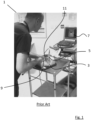
- FIG. 1 there is shown a photograph of a medical professional, indicated generally by the reference numeral 1, demonstrating a technique known in the art for performing a central line insertion on a test apparatus 3.
- the medical professional In their left hand, the medical professional is holding an ultrasound probe 5 whilst viewing the ultrasound of the test area on an ultrasound monitor 7.
- the medical professional In their right hand, the medical professional holds a syringe 9 with a needle 11 thereon.
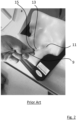
- FIG. 2 there is shown an enlarged photograph of the medical professional's grip on the syringe as they perform the known technique for inserting a central line.
- the syringe 9 is now shown in the left hand of the medical professional.
- the medical professional grasps the chamber 13 of the syringe 9 between their thumb, index and middle fingers and operates the plunger 15 of the syringe 9 using their remaining fingers.
- the plunger of the syringe is slowly extracted from the chamber.
- a partial vacuum is created inside the syringe chamber 13 between the internal end of the plunger 15 and the needle 11.
- the operator of the needle When the tip of the needle is inserted into the lumen of the blood vessel, the operator of the needle will experience a reduction in resistance and furthermore, the partial vacuum will act to draw blood inwardly from the vein into the syringe chamber. The appearance of blood in the syringe and the reduction of resistance will be sufficient to indicate that the tip of the needle is in the lumen of the blood vessel. Once in position, the remaining steps of the Seldinger technique may be performed.
- FIG. 3 there is shown a photograph of an alternative technique for inserting a central line known in the art.
- the medical professional holds the probe 5 of the ultrasound in their left hand and a needle 11 in their right hand. Effectively, the needle is provided without the syringe. Accordingly, the medical professional can grasp the hub 17 of the needle between their thumb and forefinger and use their hand muscles to more accurately position the tip of the needle. This grip will permit the operator to advance the sheath using the index or middle finger of the same hand. This also makes positioning the tip of the needle easier than the technique described with reference to Figures 1 and 2 as the muscles of the hand, rather than the muscles of the shoulder and elbow, are used for needle tip positioning.
- the medical device 20 comprises a resiliently deformable, collapsible body 21 defining a pressure chamber (not shown) therein.
- the body 21 is provided in the form of a bellows comprising a pair of sides 23, 25, and a concertinaed bladder 27 therebetween.
- the construction is such that the concertinaed bladder is in a state where it urges the sides 23, 25 apart.
- the body further comprises a port 29 defining a fluid passageway from the exterior of the body to the interior of the pressure chamber.
- the port 29 is dimensioned to engage the hub of a needle (as illustrated in Figure 9 in which the port is about to be introduced into the hub of the needle and will form a push fit in the hub).
- a scraper arm 31 there is shown a scraper arm 31.
- the scraper arm 31 is connected at one of its ends to one of the sides 23.
- the other, free, end 33 of the scraper arm is cranked inwardly towards the folds of the concertinaed bladder.
- the free end 33 of the scraper arm contacts against the folds of the concertinaed bladder.
- the free end 33 of the scraper arm will scrape over the folds causing vibrations and a "clicking" noise as the bladder expands.
- the port 29 is introduced into the hub 17 of the needle 11.
- the port may have a luer lock component for complementary engagement of a luer lock fitting on the hub 17 of the needle.
- the operator will then grasp the hub of the needle between the thumb and the forefinger of their hand and the tip of the needle is then inserted into the patient and the free end of the scraper arm is moved free of the side 25.
- the sides 23, 25 will move slightly apart from each other under the resilience of the concertinaed bladder, thereby forming a partial vacuum inside the body in the pressure chamber.
- the tip of the needle is then further guided into the patient, under ultrasound guidance, towards the blood vessel.
- the concertinaed bladder will not expand further as the tip of the needle passes through muscle and tissue. It will be appreciated that the device may be easily “flushed” by squeezing the two sides together. Furthermore, advantageously, the device is formed as a single unit.
- the partial vacuum will cause blood to be drawn into the pressure chamber of the medical device.
- the resiliently deformable bladder will be able to expand further, drawing more blood into the pressure chamber as the bladder expands.
- the free end 33 of the scraper arm will scrape against the folds of the concertinaed bladder causing vibrations and a clicking noise.
- This clicking noise will indicate to the medical professional that the bladder is expanding and by extension that the tip of the needle is in the lumen of the blood vessel.
- This auditory and haptic cue will enable the medical professional to keep their eyes on the ultrasound monitor throughout. Once the medical professional is confident that the tip of the needle is located inside the lumen of the blood vessel, they can obtain further assurance by examining the presence of blood in the needle hub and/or the medical device (if constructed at least in part from a transparent/translucent material).
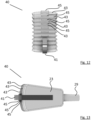
- the medical device 40 also comprises a resiliently deformable, collapsible body 21 defining a pressure chamber therein.
- the body 21 is provided in the form of a bellows comprising a pair of sides 23, 25, and a concertinaed bladder 27 therebetween. The construction is such that the concertinaed bladder urges the sides 23, 25 apart when the concertinaed bladder is in a collapsed configuration.
- the body 21 further comprises a port 29 dimensioned to engage the hub of a needle and defining a fluid passageway from the exterior of the body to the interior of the pressure chamber.
- a scraper arm 41 the scraper arm 41 being connected at one of its ends to one of the sides 23 and the other, free, end 33 of the scraper arm is cranked inwardly towards the folds of the concertinaed bladder.
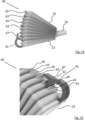
- the free end 33 of the scraper arm contacts against the folds 43 of the concertinaed bladder so that as the bladder expands from a contracted configuration with the folds of the bladder in close proximity to each other to an expanded configuration, the free end 33 of the scraper arm 41 will scrape over the folds causing a "clicking" noise and vibrations as the bladder expands. More specifically, the free end of the scraper arm contacts against a flange 45 of each fold 43.
- the scraper arm 41 differs from the scraper arm 31 of the first embodiment shown in Figure 3 to 9 inclusive in that the scraper arm 41 comprises a tab 47 extending upwardly from the free end 33 of the scraper arm 41.
- the operator slides their finger or a thumb rearwards to press against the tab 47 and release the inwardly depending end 33 from the side 25 of the resiliently deformable collapsible body.
- the resiliently deformable collapsible body will expand to a degree until the side 25 is free of the free end 33 of the scraper arm 41.
- the orientation is such that the tab 47 will, in use, be to the side of the device 40 remote from the patient for ease of access.
- the operator's index finger may be slid rearwards to disengage the scraper arm 41 from the side of the resiliently deformable collapsible body.
- the inwardly depending end 33 of the scraper arm 41 is provided with a protrusion 49 and the side 25 of the body is provided with a complementary recess 51 for reception of the protrusion 49. This will provide a more secure engagement between the scraper arm and the side when the two sides of the resiliently deformable collapsible body are being held together.
- the port 29 of the medical device 40 is angularly offset from a longitudinal axis of the resiliently deformable collapsible body. This is envisaged to be advantageous as it will allow the expansion of the resiliently deformable collapsible body without it being impeded by the patient. It will also enable the device and the needle attached thereto to be introduced at a shallower angle to the patient's skin than would otherwise be the case which has advantages for needle tip placement. Finally, this configuration may be particularly relevant and advantageous when attempting to introduce a needle into a jugular vein or other vein in the patient's neck where space is limited, and it is desirable to have a shallow angle of attack.
- the port could be angularly offset from the longitudinal axis of the resiliently deformable collapsible body by of the order of 5° to 75°, preferably between 10° to 70°, more preferably between 20° to 60°. It is envisaged that the ideal angular offset could be of the order of 45°.
- FIG 16 there is shown a third embodiment of medical device, indicated generally by the reference 60, where like parts have been given the same reference numeral as before.
- the medical device 60 is similar in construction to the medical device 40 illustrated in Figures 10 to 15 inclusive with the exception that the medical device 60 comprises a side port 61 branching off the port 29.
- the side port 61 may be used for the introduction of a wire through the side port 61 and into the patient's vessel when the tip of the needle (not shown) has been introduced into the patient.
- the side port 61 may have a valve and/or a removable end cap at its free end remote from the port 29 that will prevent ingress of air into the patient or into the pressure chamber before the tip of the needle is in place in the vessel.
- the resiliently deformable body may take a form other than bellows-shaped.
- the resiliently deformable body may be balloon-shaped or indeed pillow-shaped.
- the balloon-shaped or pillow-shaped resiliently deformable body may be sandwiched between two sides 23, 25 such as those shown in the embodiments hereinbefore described.
- a scraper arm instead of a scraper arm, other means could be provided for generating a sound on the expansion of the resiliently deformable body.
- the sides of the folds may be provided with an adhesive material so that as the sides separate, there is a tearing sound as the side come apart from each other.
- the sides of the folds could act in a manner similar to overcentre springs in that they would "pop" as they expand.
- a sensor and a sensor target could be provided, one on either side of the bellows-like body and effectively a capacitive sensor could be provided. This however would require a buzzer or like electrically powered device and a power supply and is not therefore preferred.
- the means to generate an audible noise of the device will do so mechanically.
- it will be configured to create a noise without any external electrical power supply.
- the noise will be created by two components moving against or apart from each other such as the scraper arm impacting and/or releasing from a fold of the concertinaed bladder.
- the means for providing the sound as the resiliently deformable body expands could comprise an arm mounted on one side of the device with a plurality of protrusions such as bosses or "sharks teeth” formed along a surface thereof.
- the arm could be led through a complementary groove or an aperture in the opposite side of the device with the protrusions abutting against the other side of the device.
- the arm will be withdrawn from the complementary groove or aperture and the protrusions on the arm will rub against the side wall of the aperture of groove, resulting in a noise that can be heard by the operator of the device and preferably also a vibration that may be sensed by the operator of the device.
- the medical device could be provided with a needle and, if desired, a sheath on the needle so that it may be used in the Seldinger or modified Seldinger techniques.
- the components could be provided already constructed and packaged if desired with wire and any other tubing or like components required to carry out the procedure. It will be understood that the present invention has been described in terms of inserting a central line however it is not limited to such a procedure as would be readily understood by the skilled addressee. It is envisaged that the port of the medical device may be permanently connected to the hub of a needle.
- the medical device having a body that is resiliently deformable and there being provided a biasing means operable to urge the resiliently deformable collapsible body from a collapsed configuration to an expanded configuration.
- the biasing means could be provided by way of a spring such as, but not limited to a helical spring or a leaf spring that could be located internal or external the body, for example pressing against the two sides 23, 25, urging them apart.
- the biasing means operable to urge the resiliently deformable collapsible body from a collapsed configuration to an expanded configuration will be provided by the natural elastic properties of the body itself, that when compressed into a collapsed configuration, will have a tendency to urge the sides 23, 25 of the body apart towards an expanded configuration.
- the body may be constructed from a suitable material with these elastic properties.
Landscapes
- Health & Medical Sciences (AREA)
- Life Sciences & Earth Sciences (AREA)
- Animal Behavior & Ethology (AREA)
- Hematology (AREA)
- Veterinary Medicine (AREA)
- Public Health (AREA)
- Engineering & Computer Science (AREA)
- Biomedical Technology (AREA)
- Heart & Thoracic Surgery (AREA)
- General Health & Medical Sciences (AREA)
- Vascular Medicine (AREA)
- Biophysics (AREA)
- Surgery (AREA)
- Molecular Biology (AREA)
- Medical Informatics (AREA)
- Pathology (AREA)
- Physics & Mathematics (AREA)
- Dermatology (AREA)
- Anesthesiology (AREA)
- Infusion, Injection, And Reservoir Apparatuses (AREA)
- Surgical Instruments (AREA)
- External Artificial Organs (AREA)
- Eye Examination Apparatus (AREA)
Claims (24)
- Medizinische Vorrichtung (20, 40, 60) zur Verwendung beim Unterstützen der erfolgreichen Platzierung einer Nadelspitze in einem Blutgefäß, wobei die medizinische Vorrichtung Folgendes umfasst: einen elastisch verformbaren, faltbaren Körper (21), der eine Druckkammer darin definiert, ein Spannmittel, das wirksam ist, um den elastisch verformbaren, faltbaren Körper aus einer zusammengefalteten Konfiguration in eine ausgedehnte Konfiguration zu drängen, einen Stutzen (29) zum Eingriff einer Nabe einer Nadel, wobei der Stutzen einen Fluiddurchgang von dem Äußeren des elastische verformbaren, faltbaren Körpers (21) zu dem Inneren der Druckkammer definiert und wobei die medizinische Vorrichtung ferner Mittel (31, 41) zum Erzeugen eines hörbaren Geräuschs, wenn sich der faltbare Körper aus einer zusammengefalteten Konfiguration in eine ausgedehnte Konfiguration ausdehnt, umfasst.
- Medizinische Vorrichtung (20, 40, 60) nach Anspruch 1, wobei der elastisch verformbare, faltbare Köper (21) eine balgartige Konfiguration mit einem Paar Seiten (23, 25) und einer Blase (27) dazwischen aufweist.
- Medizinische Vorrichtung (20, 40, 60) nach Anspruch 2, wobei die Blase (27) aus einem elastisch verformbaren Material hergestellt ist, wobei die natürliche Elastizität der Blase das Spannmittel bereitstellt, das wirksam ist, um den elastisch verformbaren, faltbaren Körper aus einer zusammengefalteten Konfiguration in eine ausgedehnte Konfiguration zu drängen, wenn sich die Blase in einer zusammengefalteten Konfiguration befindet.
- Medizinische Vorrichtung (20, 40, 60) nach Anspruch 2 oder 3, wobei das Paar Seiten (23, 25) dimensioniert ist, um zwischen dem Daumen und dem Zeigefinger einer Bedienperson gegriffen zu werden.
- Medizinische Vorrichtung (20, 40, 60) nach einem der Ansprüche 2 bis 4, wobei die Blase ziehharmonikaartig gefaltet ist.
- Medizinische Vorrichtung (20, 40, 60) nach Anspruch 5, wobei die ziehharmonikaartig gefaltete Blase (27) aus einem elastisch verformbaren, Material hergestellt ist, wobei die ziehharmonikaartige Blase das Spannmittel bereitstellt, das wirksam ist, um den elastisch verformbaren, faltbaren Körper aus einer zusammengefalteten Konfiguration in eine ausgedehnte Konfiguration zu drängen, wenn sich die ziehharmonikaartig gefaltete Blase in einer zusammengefalteten Konfiguration befindet.
- Medizinische Vorrichtung (20, 40, 60) nach Anspruch 5 oder 6, wobei das Mittel zum Erzeugen eines hörbaren Geräuschs einen Kratzarm (31, 41) umfasst, dessen eines Ende mit einer des Paars Seiten (23, 25) des Körpers verbunden ist und dessen anderes, freies Ende (33) in Richtung einer oder mehrerer der Falten (43) der ziehharmonikaartig gefalteten Blase und zum Eingriff damit nach innen ragt.
- Medizinische Vorrichtung (20, 40, 60) nach Anspruch 7, wobei das freie Ende (33) des Kratzarms (31, 41) in Richtung der Falten (43) der ziehharmonikaartig gefalteten Blase (27) elastisch gespannt ist.
- Medizinische Vorrichtung (20, 40, 60) nach Anspruch 7 oder 8, wobei der Kratzarm (31, 41) derart dimensioniert ist, dass, wenn sich die ziehharmonikaartig gefaltete Blase (27) in einer vollständig zusammengefalteten Konfiguration befindet, sich das nach innen ragende Ende (33) des Kratzarms (31, 41) über einen Abschnitt der anderen Seite (23, 25) des Körpers (21) hinaus und daran entlang erstreckt und wirksam ist, um die zwei Seiten (23, 25) des Körpers lösbar aneinander zu fixieren.
- Medizinische Vorrichtung (20, 40, 60) nach Anspruch 9, wobei eines von dem nach innen ragenden Ende (33) des Kratzarms und der Seite (23, 25) des Körpers mit einem Vorsprung (49) versehen ist und das andere des nach innen ragenden Endes (33) des Kratzarms (31, 41) und der Seite des Körpers (23, 25) mit einer komplementären Aussparung (51) zum Aufnehmen des Vorsprungs (49) versehen ist.
- Medizinische Vorrichtung (20, 40, 60) nach Anspruch 9 oder 10, wobei der Kratzarm (41) ferner eine Nase (47) umfasst, die sich davon nach außen über das nach innen ragende Ende (33) des Kratzarms (41) hinaus erstreckt.
- Medizinische Vorrichtung (20, 40, 60) nach einem der vorangehenden Ansprüche, wobei der Stutzen (29) von einer Längsachse des elastisch verformbaren, faltbaren Körpers (21) winkelversetzt ist.
- Medizinische Vorrichtung (20, 40, 60) nach einem der vorangehenden Ansprüche, wobei der Stutzen (29) mit einem davon abzweigenden Seitenstutzen (61) versehen ist, wobei der Seitenstutzen (61) einen Verschluss daran aufweist.
- Medizinische Vorrichtung (20, 40, 60) nach Anspruch 13, wobei der Verschluss ein Ventil umfasst.
- Medizinische Vorrichtung (20, 40, 60) nach Anspruch 13 oder 14, wobei der Verschluss eine Endkappe umfasst.
- Medizinische Vorrichtung (20, 40, 60) nach Anspruch 5 oder 6, wobei das Mittel zum Erzeugen eines hörbaren Geräuschs eine Oberflächenbeschichtung auf den Falten (43) der ziehharmonikaartig gefalteten Blase (27) umfasst, die ein Geräusch erzeugen, wenn zwei aneinander anliegende Oberflächen voneinander getrennt werden.
- Medizinische Vorrichtung (20, 40, 60) nach Anspruch 5 oder 6, wobei das Mittel zum Erzeugen eines hörbaren Geräuschs eine Federkraft umfasst, die die Falten (43) der ziehharmonikaartig gefalteten Blase (27), die ein Geräusch erzeugen, wenn zwei Seiten einer Falte voneinander getrennt werden, zusammenhält.
- Medizinische Vorrichtung (20, 40, 60) nach einem der vorangehenden Ansprüche, wobei der Stutzen (29) dazu bemessen ist, eine Schiebepassung in der Nabe (17) einer Nadel (11) zu bilden.
- Medizinische Vorrichtung (20, 40, 60) nach Ansprüchen 1 bis 17, wobei der Stutzen (29) mit einem Luer-Lock-Anbauteil versehen ist, um die Nabe (17) einer Nadel (11) in Eingriff zu nehmen.
- Medizinische Vorrichtung (20, 40, 60) nach einem der vorangehenden Ansprüche, wobei eine Feder bereitgestellt ist, die wirksam ist, um den Körper (21) aus der zusammengefalteten Konfiguration in eine ausgedehnte Konfiguration zurückzustellen.
- Medizinische Vorrichtung (20, 40, 60) nach einem der vorangehenden Ansprüche, wobei Mittel bereitgestellt sind, um eine haptische Rückmeldung bereitzustellen, wenn sich der faltbare Körper aus einer zusammengefalteten Konfiguration in eine ausgedehnte Konfiguration ausdehnt.
- Medizinische Vorrichtung (20, 40, 60) nach einem der vorangehenden Ansprüche, wobei Mittel bereitgestellt sind, um den elastisch verformbaren, faltbaren Körper in einer zusammengefalteten Konfiguration lösbar zu fixieren.
- In Kombination: eine medizinische Vorrichtung (20, 40, 60) nach einem der Ansprüche 1 bis 22 und eine Nadel (11) mit einer Nabe (17), einem Schaft mit einem sich über dessen Länge erstreckenden Lumen, wobei sich das proximale stumpfe Ende des Schafts mit der Nabe im Eingriff befindet und das distale freie Ende des Schafts in einer Schräge endet.
- In Kombination: die medizinische Vorrichtung (20, 40, 60) nach Anspruch 23 und eine Hülle für die Nadel (11).
Applications Claiming Priority (2)
| Application Number | Priority Date | Filing Date | Title |
|---|---|---|---|
| GBGB1817046.4A GB201817046D0 (en) | 2018-10-19 | 2018-10-19 | A medical device |
| PCT/EP2019/078429 WO2020079251A1 (en) | 2018-10-19 | 2019-10-18 | A medical device |
Publications (2)
| Publication Number | Publication Date |
|---|---|
| EP3866689A1 EP3866689A1 (de) | 2021-08-25 |
| EP3866689B1 true EP3866689B1 (de) | 2023-10-11 |
Family
ID=64453917
Family Applications (1)
| Application Number | Title | Priority Date | Filing Date |
|---|---|---|---|
| EP19790202.6A Active EP3866689B1 (de) | 2018-10-19 | 2019-10-18 | Medizinische vorrichtung |
Country Status (5)
| Country | Link |
|---|---|
| US (1) | US20210338944A1 (de) |
| EP (1) | EP3866689B1 (de) |
| ES (1) | ES2967516T3 (de) |
| GB (1) | GB201817046D0 (de) |
| WO (1) | WO2020079251A1 (de) |
Families Citing this family (3)
| Publication number | Priority date | Publication date | Assignee | Title |
|---|---|---|---|---|
| WO2020140121A2 (en) * | 2018-12-28 | 2020-07-02 | The Regents Of The University Of California | Tracheostomy support system |
| GB2607303A (en) * | 2021-06-01 | 2022-12-07 | Indomed Ltd | A medical device |
| AU2022286639A1 (en) | 2021-06-01 | 2024-01-25 | Indomed Limited | Medical device to aid placement of a needle tip |
Family Cites Families (15)
| Publication number | Priority date | Publication date | Assignee | Title |
|---|---|---|---|---|
| US2696695A (en) * | 1952-11-21 | 1954-12-14 | Norman A Decker | Snapback sounding toy |
| US4108175A (en) | 1977-01-28 | 1978-08-22 | Orton Dale W | Catheter insertion apparatus |
| US4487605A (en) | 1982-11-17 | 1984-12-11 | Critikon, Inc. | Flashback device for catheters |
| US5131394A (en) * | 1990-03-28 | 1992-07-21 | Gehlbach Steve M | Ultrasonic guided needle |
| US5314410A (en) | 1992-02-10 | 1994-05-24 | Marks Ronald L | Entry indicator device for arterial or intravenous needle |
| IL116685A (en) * | 1996-01-05 | 2000-07-16 | Vascular Technologies Ltd | Blood vessel entry indicator |
| US5749857A (en) * | 1996-04-25 | 1998-05-12 | Cuppy; Michael J. | Catheter system |
| US6526885B2 (en) * | 2001-06-28 | 2003-03-04 | Heidelberger Druckmaschinen Ag | Support device for a printing sleeve |
| US20070073160A1 (en) * | 2005-09-13 | 2007-03-29 | Children's Medical Center Corporation | Light-guided transluminal catheter |
| US20110054406A1 (en) * | 2009-09-02 | 2011-03-03 | Becton, Dickinson And Company | Vasculature entry confirmation mechanism |
| GB2488810A (en) * | 2011-03-09 | 2012-09-12 | Olberon Ltd | Fluid vessel communication device |
| DE102012002412A1 (de) * | 2012-02-09 | 2013-08-14 | Bernd Meier | Ultraschallnavigierte Punktion |
| WO2014018928A1 (en) * | 2012-07-27 | 2014-01-30 | Abbott Diabetes Care Inc. | Medical device applicators |
| US20140271292A1 (en) * | 2013-03-14 | 2014-09-18 | Teleflex Medical Incorporated | Rotary needle and expanding bellows pressure indicator |
| US10166343B1 (en) * | 2015-03-13 | 2019-01-01 | Timothy Brandon Hunt | Noise evident tamper cap |
-
2018
- 2018-10-19 GB GBGB1817046.4A patent/GB201817046D0/en not_active Ceased
-
2019
- 2019-10-18 WO PCT/EP2019/078429 patent/WO2020079251A1/en not_active Ceased
- 2019-10-18 EP EP19790202.6A patent/EP3866689B1/de active Active
- 2019-10-18 ES ES19790202T patent/ES2967516T3/es active Active
- 2019-10-18 US US17/286,701 patent/US20210338944A1/en active Pending
Also Published As
| Publication number | Publication date |
|---|---|
| US20210338944A1 (en) | 2021-11-04 |
| WO2020079251A1 (en) | 2020-04-23 |
| ES2967516T3 (es) | 2024-04-30 |
| EP3866689A1 (de) | 2021-08-25 |
| GB201817046D0 (en) | 2018-12-05 |
Similar Documents
| Publication | Publication Date | Title |
|---|---|---|
| JP6600377B2 (ja) | カテーテル挿入器具 | |
| EP4188219B1 (de) | Aspirationsspritzen | |
| US3714945A (en) | Digit manipulable quick release cannula insertion device | |
| JP4506834B2 (ja) | 医療用針装置 | |
| US5304144A (en) | Catheter introducer with enhanced needle gripping | |
| US3330278A (en) | Hypodermic needle for a cannula placement unit | |
| EP0615765B1 (de) | Kathetereinführvorrichtung mit vorgebogenen Flügeln | |
| US5267971A (en) | Catheter introducer with notched needle | |
| EP2019703B1 (de) | IV-Katheteranordnung mit ergonomischem Nadelgriff | |
| US5356390A (en) | Catheter introducer assembly | |
| US20210338944A1 (en) | A medical device | |
| SE426023B (sv) | Anordning bl a for inforande av katetrar i blodkerl | |
| WO2013107068A1 (zh) | 内窥镜下使用一次性远程注射针 | |
| JP5854271B2 (ja) | 留置針装置 | |
| US10842940B1 (en) | Adhesive thumb ring and syringe assembly, and an adhesive thumb ring for a syringe | |
| US6197006B1 (en) | Syringe handle | |
| US3685513A (en) | Indwelling catheter with breakaway needle and lanyard advancing means | |
| JP5178708B2 (ja) | 初期吸引を容易にするために弾性部を有する注射器 | |
| EP3646816B1 (de) | Werkzeug zur verabreichung von flüssigkeiten | |
| CN109481783B (zh) | 安全型静脉留置针 | |
| WO2004011063A1 (ja) | 留置針挿入用ホール形成ピンおよびその装着治具 | |
| CN107789702B (zh) | 一种具有回抽引导结构的安全型医用套管针 | |
| CN2247536Y (zh) | 不跑针的输液器 | |
| CN210020647U (zh) | 新型穿刺套管针 | |
| CN210186172U (zh) | 用于静脉输液针和采血针的安全护套 |
Legal Events
| Date | Code | Title | Description |
|---|---|---|---|
| STAA | Information on the status of an ep patent application or granted ep patent |
Free format text: STATUS: UNKNOWN |
|
| STAA | Information on the status of an ep patent application or granted ep patent |
Free format text: STATUS: THE INTERNATIONAL PUBLICATION HAS BEEN MADE |
|
| PUAI | Public reference made under article 153(3) epc to a published international application that has entered the european phase |
Free format text: ORIGINAL CODE: 0009012 |
|
| STAA | Information on the status of an ep patent application or granted ep patent |
Free format text: STATUS: REQUEST FOR EXAMINATION WAS MADE |
|
| 17P | Request for examination filed |
Effective date: 20210513 |
|
| AK | Designated contracting states |
Kind code of ref document: A1 Designated state(s): AL AT BE BG CH CY CZ DE DK EE ES FI FR GB GR HR HU IE IS IT LI LT LU LV MC MK MT NL NO PL PT RO RS SE SI SK SM TR |
|
| DAV | Request for validation of the european patent (deleted) | ||
| DAX | Request for extension of the european patent (deleted) | ||
| GRAP | Despatch of communication of intention to grant a patent |
Free format text: ORIGINAL CODE: EPIDOSNIGR1 |
|
| STAA | Information on the status of an ep patent application or granted ep patent |
Free format text: STATUS: GRANT OF PATENT IS INTENDED |
|
| INTG | Intention to grant announced |
Effective date: 20230426 |
|
| GRAS | Grant fee paid |
Free format text: ORIGINAL CODE: EPIDOSNIGR3 |
|
| GRAA | (expected) grant |
Free format text: ORIGINAL CODE: 0009210 |
|
| STAA | Information on the status of an ep patent application or granted ep patent |
Free format text: STATUS: THE PATENT HAS BEEN GRANTED |
|
| AK | Designated contracting states |
Kind code of ref document: B1 Designated state(s): AL AT BE BG CH CY CZ DE DK EE ES FI FR GB GR HR HU IE IS IT LI LT LU LV MC MK MT NL NO PL PT RO RS SE SI SK SM TR |
|
| REG | Reference to a national code |
Ref country code: GB Ref legal event code: FG4D |
|
| REG | Reference to a national code |
Ref country code: CH Ref legal event code: EP |
|
| REG | Reference to a national code |
Ref country code: DE Ref legal event code: R096 Ref document number: 602019039227 Country of ref document: DE |
|
| REG | Reference to a national code |
Ref country code: IE Ref legal event code: FG4D |
|
| REG | Reference to a national code |
Ref country code: NL Ref legal event code: FP |
|
| REG | Reference to a national code |
Ref country code: LT Ref legal event code: MG9D |
|
| REG | Reference to a national code |
Ref country code: AT Ref legal event code: MK05 Ref document number: 1619395 Country of ref document: AT Kind code of ref document: T Effective date: 20231011 |
|
| PG25 | Lapsed in a contracting state [announced via postgrant information from national office to epo] |
Ref country code: GR Free format text: LAPSE BECAUSE OF FAILURE TO SUBMIT A TRANSLATION OF THE DESCRIPTION OR TO PAY THE FEE WITHIN THE PRESCRIBED TIME-LIMIT Effective date: 20240112 |
|
| PG25 | Lapsed in a contracting state [announced via postgrant information from national office to epo] |
Ref country code: IS Free format text: LAPSE BECAUSE OF FAILURE TO SUBMIT A TRANSLATION OF THE DESCRIPTION OR TO PAY THE FEE WITHIN THE PRESCRIBED TIME-LIMIT Effective date: 20240211 |
|
| PG25 | Lapsed in a contracting state [announced via postgrant information from national office to epo] |
Ref country code: LT Free format text: LAPSE BECAUSE OF FAILURE TO SUBMIT A TRANSLATION OF THE DESCRIPTION OR TO PAY THE FEE WITHIN THE PRESCRIBED TIME-LIMIT Effective date: 20231011 |
|
| PG25 | Lapsed in a contracting state [announced via postgrant information from national office to epo] |
Ref country code: AT Free format text: LAPSE BECAUSE OF FAILURE TO SUBMIT A TRANSLATION OF THE DESCRIPTION OR TO PAY THE FEE WITHIN THE PRESCRIBED TIME-LIMIT Effective date: 20231011 |
|
| PG25 | Lapsed in a contracting state [announced via postgrant information from national office to epo] |
Ref country code: LT Free format text: LAPSE BECAUSE OF FAILURE TO SUBMIT A TRANSLATION OF THE DESCRIPTION OR TO PAY THE FEE WITHIN THE PRESCRIBED TIME-LIMIT Effective date: 20231011 Ref country code: IS Free format text: LAPSE BECAUSE OF FAILURE TO SUBMIT A TRANSLATION OF THE DESCRIPTION OR TO PAY THE FEE WITHIN THE PRESCRIBED TIME-LIMIT Effective date: 20240211 Ref country code: GR Free format text: LAPSE BECAUSE OF FAILURE TO SUBMIT A TRANSLATION OF THE DESCRIPTION OR TO PAY THE FEE WITHIN THE PRESCRIBED TIME-LIMIT Effective date: 20240112 Ref country code: BG Free format text: LAPSE BECAUSE OF FAILURE TO SUBMIT A TRANSLATION OF THE DESCRIPTION OR TO PAY THE FEE WITHIN THE PRESCRIBED TIME-LIMIT Effective date: 20240111 Ref country code: AT Free format text: LAPSE BECAUSE OF FAILURE TO SUBMIT A TRANSLATION OF THE DESCRIPTION OR TO PAY THE FEE WITHIN THE PRESCRIBED TIME-LIMIT Effective date: 20231011 Ref country code: PT Free format text: LAPSE BECAUSE OF FAILURE TO SUBMIT A TRANSLATION OF THE DESCRIPTION OR TO PAY THE FEE WITHIN THE PRESCRIBED TIME-LIMIT Effective date: 20240212 |
|
| REG | Reference to a national code |
Ref country code: ES Ref legal event code: FG2A Ref document number: 2967516 Country of ref document: ES Kind code of ref document: T3 Effective date: 20240430 |
|
| PG25 | Lapsed in a contracting state [announced via postgrant information from national office to epo] |
Ref country code: SE Free format text: LAPSE BECAUSE OF FAILURE TO SUBMIT A TRANSLATION OF THE DESCRIPTION OR TO PAY THE FEE WITHIN THE PRESCRIBED TIME-LIMIT Effective date: 20231011 Ref country code: RS Free format text: LAPSE BECAUSE OF FAILURE TO SUBMIT A TRANSLATION OF THE DESCRIPTION OR TO PAY THE FEE WITHIN THE PRESCRIBED TIME-LIMIT Effective date: 20231011 Ref country code: PL Free format text: LAPSE BECAUSE OF FAILURE TO SUBMIT A TRANSLATION OF THE DESCRIPTION OR TO PAY THE FEE WITHIN THE PRESCRIBED TIME-LIMIT Effective date: 20231011 Ref country code: NO Free format text: LAPSE BECAUSE OF FAILURE TO SUBMIT A TRANSLATION OF THE DESCRIPTION OR TO PAY THE FEE WITHIN THE PRESCRIBED TIME-LIMIT Effective date: 20240111 Ref country code: LV Free format text: LAPSE BECAUSE OF FAILURE TO SUBMIT A TRANSLATION OF THE DESCRIPTION OR TO PAY THE FEE WITHIN THE PRESCRIBED TIME-LIMIT Effective date: 20231011 Ref country code: HR Free format text: LAPSE BECAUSE OF FAILURE TO SUBMIT A TRANSLATION OF THE DESCRIPTION OR TO PAY THE FEE WITHIN THE PRESCRIBED TIME-LIMIT Effective date: 20231011 |
|
| REG | Reference to a national code |
Ref country code: CH Ref legal event code: PL |
|
| REG | Reference to a national code |
Ref country code: BE Ref legal event code: MM Effective date: 20231031 |
|
| PG25 | Lapsed in a contracting state [announced via postgrant information from national office to epo] |
Ref country code: LU Free format text: LAPSE BECAUSE OF NON-PAYMENT OF DUE FEES Effective date: 20231018 |
|
| PG25 | Lapsed in a contracting state [announced via postgrant information from national office to epo] |
Ref country code: LU Free format text: LAPSE BECAUSE OF NON-PAYMENT OF DUE FEES Effective date: 20231018 |
|
| PG25 | Lapsed in a contracting state [announced via postgrant information from national office to epo] |
Ref country code: DK Free format text: LAPSE BECAUSE OF FAILURE TO SUBMIT A TRANSLATION OF THE DESCRIPTION OR TO PAY THE FEE WITHIN THE PRESCRIBED TIME-LIMIT Effective date: 20231011 |
|
| REG | Reference to a national code |
Ref country code: DE Ref legal event code: R097 Ref document number: 602019039227 Country of ref document: DE |
|
| PG25 | Lapsed in a contracting state [announced via postgrant information from national office to epo] |
Ref country code: CH Free format text: LAPSE BECAUSE OF NON-PAYMENT OF DUE FEES Effective date: 20231031 |
|
| PG25 | Lapsed in a contracting state [announced via postgrant information from national office to epo] |
Ref country code: CZ Free format text: LAPSE BECAUSE OF FAILURE TO SUBMIT A TRANSLATION OF THE DESCRIPTION OR TO PAY THE FEE WITHIN THE PRESCRIBED TIME-LIMIT Effective date: 20231011 |
|
| PG25 | Lapsed in a contracting state [announced via postgrant information from national office to epo] |
Ref country code: SK Free format text: LAPSE BECAUSE OF FAILURE TO SUBMIT A TRANSLATION OF THE DESCRIPTION OR TO PAY THE FEE WITHIN THE PRESCRIBED TIME-LIMIT Effective date: 20231011 |
|
| PG25 | Lapsed in a contracting state [announced via postgrant information from national office to epo] |
Ref country code: SM Free format text: LAPSE BECAUSE OF FAILURE TO SUBMIT A TRANSLATION OF THE DESCRIPTION OR TO PAY THE FEE WITHIN THE PRESCRIBED TIME-LIMIT Effective date: 20231011 Ref country code: SK Free format text: LAPSE BECAUSE OF FAILURE TO SUBMIT A TRANSLATION OF THE DESCRIPTION OR TO PAY THE FEE WITHIN THE PRESCRIBED TIME-LIMIT Effective date: 20231011 Ref country code: RO Free format text: LAPSE BECAUSE OF FAILURE TO SUBMIT A TRANSLATION OF THE DESCRIPTION OR TO PAY THE FEE WITHIN THE PRESCRIBED TIME-LIMIT Effective date: 20231011 Ref country code: EE Free format text: LAPSE BECAUSE OF FAILURE TO SUBMIT A TRANSLATION OF THE DESCRIPTION OR TO PAY THE FEE WITHIN THE PRESCRIBED TIME-LIMIT Effective date: 20231011 Ref country code: DK Free format text: LAPSE BECAUSE OF FAILURE TO SUBMIT A TRANSLATION OF THE DESCRIPTION OR TO PAY THE FEE WITHIN THE PRESCRIBED TIME-LIMIT Effective date: 20231011 Ref country code: CZ Free format text: LAPSE BECAUSE OF FAILURE TO SUBMIT A TRANSLATION OF THE DESCRIPTION OR TO PAY THE FEE WITHIN THE PRESCRIBED TIME-LIMIT Effective date: 20231011 Ref country code: CH Free format text: LAPSE BECAUSE OF NON-PAYMENT OF DUE FEES Effective date: 20231031 |
|
| PLBE | No opposition filed within time limit |
Free format text: ORIGINAL CODE: 0009261 |
|
| STAA | Information on the status of an ep patent application or granted ep patent |
Free format text: STATUS: NO OPPOSITION FILED WITHIN TIME LIMIT |
|
| PG25 | Lapsed in a contracting state [announced via postgrant information from national office to epo] |
Ref country code: MC Free format text: LAPSE BECAUSE OF FAILURE TO SUBMIT A TRANSLATION OF THE DESCRIPTION OR TO PAY THE FEE WITHIN THE PRESCRIBED TIME-LIMIT Effective date: 20231011 |
|
| PG25 | Lapsed in a contracting state [announced via postgrant information from national office to epo] |
Ref country code: MC Free format text: LAPSE BECAUSE OF FAILURE TO SUBMIT A TRANSLATION OF THE DESCRIPTION OR TO PAY THE FEE WITHIN THE PRESCRIBED TIME-LIMIT Effective date: 20231011 Ref country code: BE Free format text: LAPSE BECAUSE OF NON-PAYMENT OF DUE FEES Effective date: 20231031 |
|
| 26N | No opposition filed |
Effective date: 20240712 |
|
| PG25 | Lapsed in a contracting state [announced via postgrant information from national office to epo] |
Ref country code: SI Free format text: LAPSE BECAUSE OF FAILURE TO SUBMIT A TRANSLATION OF THE DESCRIPTION OR TO PAY THE FEE WITHIN THE PRESCRIBED TIME-LIMIT Effective date: 20231011 |
|
| PG25 | Lapsed in a contracting state [announced via postgrant information from national office to epo] |
Ref country code: SI Free format text: LAPSE BECAUSE OF FAILURE TO SUBMIT A TRANSLATION OF THE DESCRIPTION OR TO PAY THE FEE WITHIN THE PRESCRIBED TIME-LIMIT Effective date: 20231011 |
|
| PG25 | Lapsed in a contracting state [announced via postgrant information from national office to epo] |
Ref country code: FI Free format text: LAPSE BECAUSE OF FAILURE TO SUBMIT A TRANSLATION OF THE DESCRIPTION OR TO PAY THE FEE WITHIN THE PRESCRIBED TIME-LIMIT Effective date: 20231011 |
|
| PG25 | Lapsed in a contracting state [announced via postgrant information from national office to epo] |
Ref country code: CY Free format text: LAPSE BECAUSE OF FAILURE TO SUBMIT A TRANSLATION OF THE DESCRIPTION OR TO PAY THE FEE WITHIN THE PRESCRIBED TIME-LIMIT; INVALID AB INITIO Effective date: 20191018 |
|
| PG25 | Lapsed in a contracting state [announced via postgrant information from national office to epo] |
Ref country code: HU Free format text: LAPSE BECAUSE OF FAILURE TO SUBMIT A TRANSLATION OF THE DESCRIPTION OR TO PAY THE FEE WITHIN THE PRESCRIBED TIME-LIMIT; INVALID AB INITIO Effective date: 20191018 |
|
| PGFP | Annual fee paid to national office [announced via postgrant information from national office to epo] |
Ref country code: NL Payment date: 20251030 Year of fee payment: 7 |
|
| PG25 | Lapsed in a contracting state [announced via postgrant information from national office to epo] |
Ref country code: TR Free format text: LAPSE BECAUSE OF FAILURE TO SUBMIT A TRANSLATION OF THE DESCRIPTION OR TO PAY THE FEE WITHIN THE PRESCRIBED TIME-LIMIT Effective date: 20231011 |
|
| PGFP | Annual fee paid to national office [announced via postgrant information from national office to epo] |
Ref country code: DE Payment date: 20251031 Year of fee payment: 7 |
|
| PGFP | Annual fee paid to national office [announced via postgrant information from national office to epo] |
Ref country code: GB Payment date: 20251028 Year of fee payment: 7 |
|
| PGFP | Annual fee paid to national office [announced via postgrant information from national office to epo] |
Ref country code: IT Payment date: 20251031 Year of fee payment: 7 |
|
| PGFP | Annual fee paid to national office [announced via postgrant information from national office to epo] |
Ref country code: FR Payment date: 20251030 Year of fee payment: 7 |
|
| PGFP | Annual fee paid to national office [announced via postgrant information from national office to epo] |
Ref country code: IE Payment date: 20251030 Year of fee payment: 7 |
|
| PGFP | Annual fee paid to national office [announced via postgrant information from national office to epo] |
Ref country code: ES Payment date: 20251118 Year of fee payment: 7 |