EP3867792B1 - Composant medical en matière elastomèrique marqué au moyen d'un laser - Google Patents
Composant medical en matière elastomèrique marqué au moyen d'un laser Download PDFInfo
- Publication number
- EP3867792B1 EP3867792B1 EP19797527.9A EP19797527A EP3867792B1 EP 3867792 B1 EP3867792 B1 EP 3867792B1 EP 19797527 A EP19797527 A EP 19797527A EP 3867792 B1 EP3867792 B1 EP 3867792B1
- Authority
- EP
- European Patent Office
- Prior art keywords
- film
- markable
- elastomeric material
- visible mark
- medical device
- Prior art date
- Legal status (The legal status is an assumption and is not a legal conclusion. Google has not performed a legal analysis and makes no representation as to the accuracy of the status listed.)
- Active
Links
Images






Classifications
-
- B—PERFORMING OPERATIONS; TRANSPORTING
- B23—MACHINE TOOLS; METAL-WORKING NOT OTHERWISE PROVIDED FOR
- B23K—SOLDERING OR UNSOLDERING; WELDING; CLADDING OR PLATING BY SOLDERING OR WELDING; CUTTING BY APPLYING HEAT LOCALLY, e.g. FLAME CUTTING; WORKING BY LASER BEAM
- B23K26/00—Working by laser beam, e.g. welding, cutting or boring
- B23K26/18—Working by laser beam, e.g. welding, cutting or boring using absorbing layers on the workpiece, e.g. for marking or protecting purposes
-
- A—HUMAN NECESSITIES
- A61—MEDICAL OR VETERINARY SCIENCE; HYGIENE
- A61B—DIAGNOSIS; SURGERY; IDENTIFICATION
- A61B90/00—Instruments, implements or accessories specially adapted for surgery or diagnosis and not covered by any of the groups A61B1/00 - A61B50/00, e.g. for luxation treatment or for protecting wound edges
- A61B90/90—Identification means for patients or instruments, e.g. tags
-
- A—HUMAN NECESSITIES
- A61—MEDICAL OR VETERINARY SCIENCE; HYGIENE
- A61B—DIAGNOSIS; SURGERY; IDENTIFICATION
- A61B90/00—Instruments, implements or accessories specially adapted for surgery or diagnosis and not covered by any of the groups A61B1/00 - A61B50/00, e.g. for luxation treatment or for protecting wound edges
- A61B90/90—Identification means for patients or instruments, e.g. tags
- A61B90/92—Identification means for patients or instruments, e.g. tags coded with colour
-
- A—HUMAN NECESSITIES
- A61—MEDICAL OR VETERINARY SCIENCE; HYGIENE
- A61B—DIAGNOSIS; SURGERY; IDENTIFICATION
- A61B90/00—Instruments, implements or accessories specially adapted for surgery or diagnosis and not covered by any of the groups A61B1/00 - A61B50/00, e.g. for luxation treatment or for protecting wound edges
- A61B90/90—Identification means for patients or instruments, e.g. tags
- A61B90/94—Identification means for patients or instruments, e.g. tags coded with symbols, e.g. text
-
- A—HUMAN NECESSITIES
- A61—MEDICAL OR VETERINARY SCIENCE; HYGIENE
- A61B—DIAGNOSIS; SURGERY; IDENTIFICATION
- A61B90/00—Instruments, implements or accessories specially adapted for surgery or diagnosis and not covered by any of the groups A61B1/00 - A61B50/00, e.g. for luxation treatment or for protecting wound edges
- A61B90/90—Identification means for patients or instruments, e.g. tags
- A61B90/94—Identification means for patients or instruments, e.g. tags coded with symbols, e.g. text
- A61B90/96—Identification means for patients or instruments, e.g. tags coded with symbols, e.g. text using barcodes
-
- A—HUMAN NECESSITIES
- A61—MEDICAL OR VETERINARY SCIENCE; HYGIENE
- A61L—METHODS OR APPARATUS FOR STERILISING MATERIALS OR OBJECTS IN GENERAL; DISINFECTION, STERILISATION OR DEODORISATION OF AIR; CHEMICAL ASPECTS OF BANDAGES, DRESSINGS, ABSORBENT PADS OR SURGICAL ARTICLES; MATERIALS FOR BANDAGES, DRESSINGS, ABSORBENT PADS OR SURGICAL ARTICLES
- A61L31/00—Materials for other surgical articles, e.g. stents, stent-grafts, shunts, surgical drapes, guide wires, materials for adhesion prevention, occluding devices, surgical gloves, tissue fixation devices
- A61L31/04—Macromolecular materials
- A61L31/048—Macromolecular materials obtained by reactions only involving carbon-to-carbon unsaturated bonds
- A61L31/049—Rubbers
-
- A—HUMAN NECESSITIES
- A61—MEDICAL OR VETERINARY SCIENCE; HYGIENE
- A61L—METHODS OR APPARATUS FOR STERILISING MATERIALS OR OBJECTS IN GENERAL; DISINFECTION, STERILISATION OR DEODORISATION OF AIR; CHEMICAL ASPECTS OF BANDAGES, DRESSINGS, ABSORBENT PADS OR SURGICAL ARTICLES; MATERIALS FOR BANDAGES, DRESSINGS, ABSORBENT PADS OR SURGICAL ARTICLES
- A61L31/00—Materials for other surgical articles, e.g. stents, stent-grafts, shunts, surgical drapes, guide wires, materials for adhesion prevention, occluding devices, surgical gloves, tissue fixation devices
- A61L31/08—Materials for coatings
- A61L31/10—Macromolecular materials
-
- A—HUMAN NECESSITIES
- A61—MEDICAL OR VETERINARY SCIENCE; HYGIENE
- A61M—DEVICES FOR INTRODUCING MEDIA INTO, OR ONTO, THE BODY; DEVICES FOR TRANSDUCING BODY MEDIA OR FOR TAKING MEDIA FROM THE BODY; DEVICES FOR PRODUCING OR ENDING SLEEP OR STUPOR
- A61M5/00—Devices for bringing media into the body in a subcutaneous, intra-vascular or intramuscular way; Accessories therefor, e.g. filling or cleaning devices, arm-rests
- A61M5/178—Syringes
- A61M5/31—Details
- A61M5/315—Pistons; Piston-rods; Guiding, blocking or restricting the movement of the rod or piston; Appliances on the rod for facilitating dosing ; Dosing mechanisms
-
- B—PERFORMING OPERATIONS; TRANSPORTING
- B23—MACHINE TOOLS; METAL-WORKING NOT OTHERWISE PROVIDED FOR
- B23K—SOLDERING OR UNSOLDERING; WELDING; CLADDING OR PLATING BY SOLDERING OR WELDING; CUTTING BY APPLYING HEAT LOCALLY, e.g. FLAME CUTTING; WORKING BY LASER BEAM
- B23K26/00—Working by laser beam, e.g. welding, cutting or boring
- B23K26/0006—Working by laser beam, e.g. welding, cutting or boring taking account of the properties of the material involved
-
- B—PERFORMING OPERATIONS; TRANSPORTING
- B23—MACHINE TOOLS; METAL-WORKING NOT OTHERWISE PROVIDED FOR
- B23K—SOLDERING OR UNSOLDERING; WELDING; CLADDING OR PLATING BY SOLDERING OR WELDING; CUTTING BY APPLYING HEAT LOCALLY, e.g. FLAME CUTTING; WORKING BY LASER BEAM
- B23K26/00—Working by laser beam, e.g. welding, cutting or boring
- B23K26/352—Working by laser beam, e.g. welding, cutting or boring for surface treatment
- B23K26/355—Texturing
-
- B—PERFORMING OPERATIONS; TRANSPORTING
- B29—WORKING OF PLASTICS; WORKING OF SUBSTANCES IN A PLASTIC STATE IN GENERAL
- B29C—SHAPING OR JOINING OF PLASTICS; SHAPING OF MATERIAL IN A PLASTIC STATE, NOT OTHERWISE PROVIDED FOR; AFTER-TREATMENT OF THE SHAPED PRODUCTS, e.g. REPAIRING
- B29C59/00—Surface shaping of articles, e.g. embossing; Apparatus therefor
- B29C59/02—Surface shaping of articles, e.g. embossing; Apparatus therefor by mechanical means, e.g. pressing
- B29C59/022—Surface shaping of articles, e.g. embossing; Apparatus therefor by mechanical means, e.g. pressing characterised by the disposition or the configuration, e.g. dimensions, of the embossments or the shaping tools therefor
-
- B—PERFORMING OPERATIONS; TRANSPORTING
- B29—WORKING OF PLASTICS; WORKING OF SUBSTANCES IN A PLASTIC STATE IN GENERAL
- B29C—SHAPING OR JOINING OF PLASTICS; SHAPING OF MATERIAL IN A PLASTIC STATE, NOT OTHERWISE PROVIDED FOR; AFTER-TREATMENT OF THE SHAPED PRODUCTS, e.g. REPAIRING
- B29C59/00—Surface shaping of articles, e.g. embossing; Apparatus therefor
- B29C59/02—Surface shaping of articles, e.g. embossing; Apparatus therefor by mechanical means, e.g. pressing
- B29C59/026—Surface shaping of articles, e.g. embossing; Apparatus therefor by mechanical means, e.g. pressing of layered or coated substantially flat surfaces
-
- B—PERFORMING OPERATIONS; TRANSPORTING
- B29—WORKING OF PLASTICS; WORKING OF SUBSTANCES IN A PLASTIC STATE IN GENERAL
- B29C—SHAPING OR JOINING OF PLASTICS; SHAPING OF MATERIAL IN A PLASTIC STATE, NOT OTHERWISE PROVIDED FOR; AFTER-TREATMENT OF THE SHAPED PRODUCTS, e.g. REPAIRING
- B29C59/00—Surface shaping of articles, e.g. embossing; Apparatus therefor
- B29C59/16—Surface shaping of articles, e.g. embossing; Apparatus therefor by wave energy or particle radiation, e.g. infrared heating
-
- G—PHYSICS
- G06—COMPUTING OR CALCULATING; COUNTING
- G06K—GRAPHICAL DATA READING; PRESENTATION OF DATA; RECORD CARRIERS; HANDLING RECORD CARRIERS
- G06K19/00—Record carriers for use with machines and with at least a part designed to carry digital markings
- G06K19/02—Record carriers for use with machines and with at least a part designed to carry digital markings characterised by the selection of materials, e.g. to avoid wear during transport through the machine
-
- G—PHYSICS
- G06—COMPUTING OR CALCULATING; COUNTING
- G06K—GRAPHICAL DATA READING; PRESENTATION OF DATA; RECORD CARRIERS; HANDLING RECORD CARRIERS
- G06K19/00—Record carriers for use with machines and with at least a part designed to carry digital markings
- G06K19/06—Record carriers for use with machines and with at least a part designed to carry digital markings characterised by the kind of the digital marking, e.g. shape, nature, code
- G06K19/06009—Record carriers for use with machines and with at least a part designed to carry digital markings characterised by the kind of the digital marking, e.g. shape, nature, code with optically detectable marking
- G06K19/06046—Constructional details
- G06K19/06159—Constructional details the marking being relief type, e.g. three-dimensional bar codes engraved in a support
-
- A—HUMAN NECESSITIES
- A61—MEDICAL OR VETERINARY SCIENCE; HYGIENE
- A61B—DIAGNOSIS; SURGERY; IDENTIFICATION
- A61B17/00—Surgical instruments, devices or methods
- A61B2017/00526—Methods of manufacturing
-
- A—HUMAN NECESSITIES
- A61—MEDICAL OR VETERINARY SCIENCE; HYGIENE
- A61B—DIAGNOSIS; SURGERY; IDENTIFICATION
- A61B17/00—Surgical instruments, devices or methods
- A61B2017/00831—Material properties
- A61B2017/00902—Material properties transparent or translucent
- A61B2017/00907—Material properties transparent or translucent for light
-
- A—HUMAN NECESSITIES
- A61—MEDICAL OR VETERINARY SCIENCE; HYGIENE
- A61B—DIAGNOSIS; SURGERY; IDENTIFICATION
- A61B17/00—Surgical instruments, devices or methods
- A61B2017/00982—General structural features
- A61B2017/00995—General structural features having a thin film
-
- A—HUMAN NECESSITIES
- A61—MEDICAL OR VETERINARY SCIENCE; HYGIENE
- A61B—DIAGNOSIS; SURGERY; IDENTIFICATION
- A61B50/00—Containers, covers, furniture or holders specially adapted for surgical or diagnostic appliances or instruments, e.g. sterile covers
- A61B2050/005—Containers, covers, furniture or holders specially adapted for surgical or diagnostic appliances or instruments, e.g. sterile covers with a lid or cover
- A61B2050/0058—Containers, covers, furniture or holders specially adapted for surgical or diagnostic appliances or instruments, e.g. sterile covers with a lid or cover closable by translation
- A61B2050/006—Containers, covers, furniture or holders specially adapted for surgical or diagnostic appliances or instruments, e.g. sterile covers with a lid or cover closable by translation perpendicular to the lid plane, e.g. by a downward movement
-
- A—HUMAN NECESSITIES
- A61—MEDICAL OR VETERINARY SCIENCE; HYGIENE
- A61B—DIAGNOSIS; SURGERY; IDENTIFICATION
- A61B50/00—Containers, covers, furniture or holders specially adapted for surgical or diagnostic appliances or instruments, e.g. sterile covers
- A61B2050/005—Containers, covers, furniture or holders specially adapted for surgical or diagnostic appliances or instruments, e.g. sterile covers with a lid or cover
- A61B2050/0067—Types of closures or fasteners
- A61B2050/0072—Plugs, e.g. rubber plugs
-
- A—HUMAN NECESSITIES
- A61—MEDICAL OR VETERINARY SCIENCE; HYGIENE
- A61B—DIAGNOSIS; SURGERY; IDENTIFICATION
- A61B90/00—Instruments, implements or accessories specially adapted for surgery or diagnosis and not covered by any of the groups A61B1/00 - A61B50/00, e.g. for luxation treatment or for protecting wound edges
- A61B90/08—Accessories or related features not otherwise provided for
- A61B2090/0807—Indication means
-
- A—HUMAN NECESSITIES
- A61—MEDICAL OR VETERINARY SCIENCE; HYGIENE
- A61L—METHODS OR APPARATUS FOR STERILISING MATERIALS OR OBJECTS IN GENERAL; DISINFECTION, STERILISATION OR DEODORISATION OF AIR; CHEMICAL ASPECTS OF BANDAGES, DRESSINGS, ABSORBENT PADS OR SURGICAL ARTICLES; MATERIALS FOR BANDAGES, DRESSINGS, ABSORBENT PADS OR SURGICAL ARTICLES
- A61L31/00—Materials for other surgical articles, e.g. stents, stent-grafts, shunts, surgical drapes, guide wires, materials for adhesion prevention, occluding devices, surgical gloves, tissue fixation devices
- A61L31/12—Composite materials, i.e. containing one material dispersed in a matrix of the same or different material
- A61L31/125—Composite materials, i.e. containing one material dispersed in a matrix of the same or different material having a macromolecular matrix
- A61L31/126—Composite materials, i.e. containing one material dispersed in a matrix of the same or different material having a macromolecular matrix containing carbon fillers
-
- A—HUMAN NECESSITIES
- A61—MEDICAL OR VETERINARY SCIENCE; HYGIENE
- A61M—DEVICES FOR INTRODUCING MEDIA INTO, OR ONTO, THE BODY; DEVICES FOR TRANSDUCING BODY MEDIA OR FOR TAKING MEDIA FROM THE BODY; DEVICES FOR PRODUCING OR ENDING SLEEP OR STUPOR
- A61M2205/00—General characteristics of the apparatus
- A61M2205/60—General characteristics of the apparatus with identification means
-
- B—PERFORMING OPERATIONS; TRANSPORTING
- B23—MACHINE TOOLS; METAL-WORKING NOT OTHERWISE PROVIDED FOR
- B23K—SOLDERING OR UNSOLDERING; WELDING; CLADDING OR PLATING BY SOLDERING OR WELDING; CUTTING BY APPLYING HEAT LOCALLY, e.g. FLAME CUTTING; WORKING BY LASER BEAM
- B23K2103/00—Materials to be soldered, welded or cut
- B23K2103/30—Organic materials
- B23K2103/42—Plastics other than composite materials
-
- B—PERFORMING OPERATIONS; TRANSPORTING
- B29—WORKING OF PLASTICS; WORKING OF SUBSTANCES IN A PLASTIC STATE IN GENERAL
- B29C—SHAPING OR JOINING OF PLASTICS; SHAPING OF MATERIAL IN A PLASTIC STATE, NOT OTHERWISE PROVIDED FOR; AFTER-TREATMENT OF THE SHAPED PRODUCTS, e.g. REPAIRING
- B29C2791/00—Shaping characteristics in general
- B29C2791/004—Shaping under special conditions
- B29C2791/009—Using laser
-
- B—PERFORMING OPERATIONS; TRANSPORTING
- B29—WORKING OF PLASTICS; WORKING OF SUBSTANCES IN A PLASTIC STATE IN GENERAL
- B29K—INDEXING SCHEME ASSOCIATED WITH SUBCLASSES B29B, B29C OR B29D, RELATING TO MOULDING MATERIALS OR TO MATERIALS FOR MOULDS, REINFORCEMENTS, FILLERS OR PREFORMED PARTS, e.g. INSERTS
- B29K2021/00—Use of unspecified rubbers as moulding material
-
- B—PERFORMING OPERATIONS; TRANSPORTING
- B29—WORKING OF PLASTICS; WORKING OF SUBSTANCES IN A PLASTIC STATE IN GENERAL
- B29L—INDEXING SCHEME ASSOCIATED WITH SUBCLASS B29C, RELATING TO PARTICULAR ARTICLES
- B29L2031/00—Other particular articles
- B29L2031/753—Medical equipment; Accessories therefor
-
- C—CHEMISTRY; METALLURGY
- C09—DYES; PAINTS; POLISHES; NATURAL RESINS; ADHESIVES; COMPOSITIONS NOT OTHERWISE PROVIDED FOR; APPLICATIONS OF MATERIALS NOT OTHERWISE PROVIDED FOR
- C09D—COATING COMPOSITIONS, e.g. PAINTS, VARNISHES OR LACQUERS; FILLING PASTES; CHEMICAL PAINT OR INK REMOVERS; INKS; CORRECTING FLUIDS; WOODSTAINS; PASTES OR SOLIDS FOR COLOURING OR PRINTING; USE OF MATERIALS THEREFOR
- C09D127/00—Coating compositions based on homopolymers or copolymers of compounds having one or more unsaturated aliphatic radicals, each having only one carbon-to-carbon double bond, and at least one being terminated by a halogen; Coating compositions based on derivatives of such polymers
- C09D127/02—Coating compositions based on homopolymers or copolymers of compounds having one or more unsaturated aliphatic radicals, each having only one carbon-to-carbon double bond, and at least one being terminated by a halogen; Coating compositions based on derivatives of such polymers not modified by chemical after-treatment
- C09D127/12—Coating compositions based on homopolymers or copolymers of compounds having one or more unsaturated aliphatic radicals, each having only one carbon-to-carbon double bond, and at least one being terminated by a halogen; Coating compositions based on derivatives of such polymers not modified by chemical after-treatment containing fluorine atoms
Definitions
- Embodiments described herein are directed to medical device components, and particularly elastomer components, such as stoppers or plungers, seals, and the like, that are laser marked with data or other identification information, and a method of marking such components, particularly during multiple manufacturing steps.
- elastomer components such as stoppers or plungers, seals, and the like
- RF tags can be expensive, rigid, and difficult to apply at scale. Labels require adhesion, which can risk leachable material into a drug, and can also be difficult to apply. Mold cavity identification is not unique, can wear down over time, and can only provide limited information. Surface printing can also create leachable material, and surface morphology differences can impact sealing or machinability. Relevant prior art is disclosed in US 2002/179 718 A1 .
- the present invention relates to a method for manufacturing a medical device component.
- the method may comprise forming a body of the medical device component, the body having a surface and being at least partially formed from a markable material having a first color; applying a film to at least a portion of the surface of the body over the elastomeric material, the film providing a barrier between the body and the medicament, preferably including at least a portion of the markable material; and after formation of the film, exposing one or more areas of the at least a portion of the elastomeric material and the film or markable material to laser irradiation of a predetermined wavelength to form a visible mark on the surface of the body by changing the one or more areas to a second color different from the first color, exposing the film to laser irradiation does not form the visible mark on the film, wherein the film has a transmittance at said wavelength of at least 5% and wherein the film comprises a material selected from
- the present invention relates to a medical device component comprising a body having a first surface being at least partially formed from an elastomeric material, preferably a markable material, having a first color, the elastomeric material having a characteristic that an area exposed to laser irradiation of preferably a predetermined wavelength of ultraviolet light changes to a second color different from the first color; a film covering at least a portion of the first surface of the body,; and a visible mark on the elastomericv material at the first surface of the body covered by the film.
- the visible mark comprising one or more areas of the elastomeric material at the first surface having the second color and the film being free of visible marks.
- the film has a transmittance at the predetermined wavelength of ultraviolet light of at least 5% and the film comprises a material selected from the group of materials according to claim 1.
- the present invention relates to method for manufacturing a medical device component.
- the method may comprise forming a body of the medical device component in a molding process, the body having a surface and being at least partially formed from a markable material having a first color.
- the method may also comprise forming a film over at least a portion of the surface of the body, including at least a portion of the markable material.
- the method may comprise forming a first visible mark on the surface of the body covered by the film by exposing one or more first areas of the at least a portion of the markable material to laser irradiation of a predetermined wavelength to change the one or more first areas to a second color different from the first color, the first visible mark containing or linking to first data related to the molding and/or film formation steps.
- the method may comprise washing the medical device component from the mold and forming a second visible mark on the surface of the body covered by the film by exposing one or more second areas of the at least a portion of the markable material to laser irradiation of the predetermined wavelength to change the one or more second areas to the second color, the second visible mark containing or linking to second data related to the washing step.
- UV ultraviolet
- drug-contact elastomer components can be marked/serialized to produce a safe, clean, and sterilization compatible product.
- a precise mark can be applied to a molded or finished product, even if an optional film has already been applied.
- This technology particularly where the mark is created under the film, poses very little risk to the drug product, as any potentially created extractables would not be present at the surface of the component.
- the technology may be preferable for components used in cryogenic applications because exposure to large temperature differentials are unlikely to substantially affect the mark, unlike labels that utilize adhesives.
- This technology is broadly applicable to elastomer components utilizing inorganic fillers, and can be extensible to other polymer components, especially those which can be covered in compatible films or other transparent layers.
- the stopper 10 includes a body 12 that is preferably formed at least partially of an elastomeric material having a first color, such as synthetic or natural rubber, e.g., butyl rubber, isoprene rubber, butadiene rubber, halogenated butyl rubber (e.g., bromobutyl rubber), ethylene propylene terpolymer, silicone rubber, ethylene propylene diene monomer (EPDM) rubber, combinations thereof, or the like, which preferably contains inorganic filler materials, such as titanium dioxide or the like.
- synthetic or natural rubber e.g., butyl rubber, isoprene rubber, butadiene rubber, halogenated butyl rubber (e.g., bromobutyl rubber), ethylene propylene terpolymer, silicone rubber, ethylene propylene diene monomer (EPDM) rubber, combinations thereof, or the like, which preferably contains inorganic filler materials, such as titanium dioxide or the like.
- the body 12 may at least partially be made from polymers having high amounts of carbon black, resulting in the first color of the body 12 material being darker. Such materials are markable, as will be explained further below.
- the body 12 preferably has a longitudinal axis L and a first surface 12a that is oriented transverse, and more preferably, substantially perpendicular to, to the longitudinal axis L. In some embodiments, the first surface 12a may come into contact with medicament.
- the body 12 includes additional surfaces that may be connected or adjacent to the first surface 12a, may extend parallel or be concentric with the longitudinal axis L, and the like.
- the body 12 may have a cylindrical shape, such as that shown in FIG. 1 , with one or more ribs concentrically formed around the longitudinal axis L for sealing the stopper 10 within a container or the like, such as a syringe (not shown).
- At least a portion of a surface of the body 12, and in certain embodiments preferably at least a portion of the first surface 12a, may be covered by a film 14 ( FIGS. 2 , 4A ) as a barrier material between the elastomeric material of the body 12 and any medicament (not shown) with which the body 12 may come into contact.
- a film 14 FIGS. 2 , 4A
- Common films 14 for such use may include, but are not limited to, materials containing tetrafluoroethylene, ethylene tetrafluoroethylene (ETFE), polytetrafluoroethylene (PTFE), perfluoroalkoxy alkanes (PFA), polyvinylidene difluoride (PVDF), fluorinated ethylene propylene (FEP), polyvinylidene fluoride (PVF), polychlorotrifluoroethylene (PCTFE), ethylene chlorotrifluoroethylene (ECTFE), perfluoroelastomer (FFPM), fluoroelastomer polymer (FPM), polyethylene (PE), cyclic olefin polymer (COP), cyclic olefin copolymer (COC), polypropylene (PP), combinations thereof, and the like.
- ETFE ethylene tetrafluoroethylene
- PTFE polytetrafluoroethylene
- PFA perfluoroalkoxy alkanes
- the stopper 10 preferably includes a visible mark 16 formed on a surface of the body 12.
- the visible mark 16 is formed on a surface of the body 12 that is highly visible at least during manufacture of the stopper, such as the first surface 12a, and may also be visible during use of the final medical device (not shown).
- the visible mark 16 may be at least one of machine-readable or human-readable.
- the visible mark 16 shown in FIGS. 3 , 4A, and 4B is a Data Matrix ECC 200 code, primarily due to the code's high data density and error correcting features.
- machine-readable codes such as other Data Matrix codes, other two-dimensional bar codes (e.g., QR codes or the like), one-dimensional or stacked bar codes, or the like may be used.
- human-readable visible marks 16 such as shown in FIG. 7 , alphanumeric characters, logos, instructional images or messages, or the like can be used.
- the visible mark 16 can encode or provide data related to, for example, unique product or component identifiers, manufacturing data, tracking information, expiration data, use instructions, and the like.
- the stopper 10 can be tracked by manufacturers and their customers, caregivers, and/or patients.
- the visible mark 16 is preferably made on a surface of the body 12 using UV laser irradiation such that one or more areas of the markable material in the body 12 exposed to the laser irradiation change to a second color different from the first color.
- the laser radiation is, for example, absorbed by the inorganic filler materials in the body 12, which subsequently degrade to produce a dark area. In other embodiments, such as those utilizing carbon black, the laser absorption may cause lighter areas exhibiting a "foamed" appearance.
- Such UV lasers are commercially available from, for example, DPSS Lasers, Inc. of Santa Clara, California.
- the visible mark 16 can be formed using a laser (not shown) having a 355 nm wavelength, which is in the ultraviolet range. Other wavelengths and/or types of lasers, such as CO 2 lasers or the like, can be used as well, depending on the material of the body 12 that is sought to be marked. The process is non-contact, and generates few, if any particles.
- the laser may use a mirror (not shown) to raster across the surface of the body 12 to form the visible mark 16.
- an XY carriage may be used to translate a laser over the portion of the surface of the body 12 to which the visible mark 16 will be applied.
- a mask having a plurality of openings may be applied to the surface of the body 12 prior to irradiating the surface with a laser. The openings may be arranged, such that upon removal of the mask, the desired visible mark 16 is left on the surface of the body 12.
- Laser parameters, such as power, speed, spot size, and the like may be optimized to achieve the desired effect in the visible mark 16.
- the stopper 10 can be stationary during the marking process, or may be in motion, such as on a production line, during marking.
- dimensions of the marks and the cells (squares representing a "bit" of the code) incorporated into the various embodiments of the present invention are not limited.
- the complexity and number of cells within a mark may also increase, and is, therefore, only limited by the ability of the device to successfully read and process the information provided by the marks, and by the marking resolution capabilities of the laser and material.
- the size of each cell may also proportionally increase in size, so that a device, such as a smartphone, is capable of successfully reading and processing the information provided by the mark 16.
- the visible mark 16 may also be optimized by reducing the size of the cells within the visible mark 16 to allow for a maximum amount of information to be encoded while still being able to be recognized and processed successfully by the reading device.
- Preferred minimum cell sizes within a mark having a specified size are provided in Table 1. Table 1 Total Mark Size (mm) Cell Size ( ⁇ m) 1.0 71. 1.4 100 2.1 150 2.8 200
- a marking method may be accomplished for a component having a pre-applied film by using a laser that emits light at a wavelength for which the film is transparent.
- a plurality of components in the form of stoppers may be manufactured in a first step by compression molding a sheet of elastomeric material to produce a panel, such as the molded panel of FIG. 12A .
- a polymeric film such as ETFE, may be applied to one or more surfaces of the stopper.
- a laser that emits light at a wavelength of 355 nm may be used to mark the surface of one or more stoppers that may be coated with an ETFE film because ETFE is transparent with respect to that particular wavelength of light.
- the laser can be used to form the visible mark 16 on the body 12 even after an ETFE film 14 is formed thereon, as the radiation can pass through the film 14 without causing damage thereto.
- the film 14 preferably has a transmittance at the laser wavelength (often a predetermined wavelength in the UV range) of at least 5%, more preferably of at least 10%, more preferably of at least 20%, more preferably of at least 30%, more preferably of at least 40%, more preferably of at least 50%, more preferably of at least 60%, more preferably of at least 70%, and most preferably of at least 80%.
- the marking 17 may be applied to the top surface of a stopper 10, preferably outside of a target area 11.
- the target area 11, bounded by a circle, identifies the area through which a syringe needle (not shown) should be inserted in order to extract the contents of a container (not shown) that is sealed with the stopper 10.
- the marking 17 is preferably outside of the target area to prevent potential contact between the contents of the container and the portions of the stopper 10 treated with the laser that formed the marking 17.
- each stopper 10 may be removed from the molded panel by cutting or trimming the excess elastomeric material around each stopper 10 using a blade or similar tool, as known by those of skill in the art.
- Optical microscopic observations such as those shown in FIGS. 4A and 4B , have demonstrated that no visible degradation to the film 14 is generated by the laser.
- other lasers may be paired with other polymer films or covers (e.g., polypropylene or fluorinated ethylene propylene (FEP) caps or the like) that are essentially transparent to the respective wavelength to accomplish the same result, i.e. the formation of a visible mark on the surface of the component and underneath a pre-applied film or cover.
- FEP fluorinated ethylene propylene
- creation of the visible mark 16 can occur any time after molding of the stopper 10, allowing inclusion of additional data throughout the manufacturing process while minimally impacting current manufacturing processes.
- Visible marks 16 have also been shown to withstand steam sterilization temperatures (e.g., up to 121 °C) for various materials.
- the marking may be applied to the component after the component has been incorporated into an assembly.
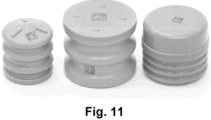
- an elastomeric stopper may be incorporated into a transparent cap, such as the DAIKYO PLASCAP ® RUV closures manufactured by Daikyo Seiko Ltd.
- a marking may be applied to the surface of the elastomeric stopper after being assembled in the transparent cap ( FIGS. 10A and 10B ).
- the surface of various types of elastomeric plungers FIG.
- a wavelength of light should be selected, such that the light is not substantially absorbed by the transparent material (e.g., glass, polymeric material, or the like) of the cartridge or syringe barrel.
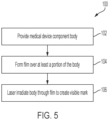
- FIG. 5 shows one exemplary method 100 for manufacturing a medical device components, such as a stopper 10.
- a body 12 may be provided having a surface and being at least partially formed from the markable material, such as the rubber with inorganic filler materials described above.
- the body 12 may be molded according to conventional techniques.
- a film 14, such as the ETFE described above may thereafter be formed to cover at least a portion of the surface of the body 12, and includes covering at least a portion of the markable material (e.g., where the body 12 may be formed partially of the markable material and partially of some other material designed for structural support and/or aesthetics).
- the visible mark 16 may be formed on the surface of the body 12 covered by the film 14 by exposing one or more areas of the markable material to laser irradiation of a predetermined wavelength (such as in the UV wavelength range), thereby changing the color of the exposed areas.
- This exposure can include, for example, rastering the laser irradiation across a plurality of areas on the body 12 to form spatially extending visible marks 16 (e.g., the machine readable code in FIGS. 1-4B ) and/or a plurality of visible marks 16 (e.g., visible marks 16a-16d in FIG. 7 ).
- FIG. 6 shows one example of a portion of a manufacturing process 200 for the stopper 10 in this manner.
- the stopper 10 is molded in a conventional manner, which preferably includes application of the film 14 in appropriate locations.
- the stopper 10 is laser marked in a first area of the body 12 with a molding process indicator before it is moved to the next process.
- the molding process indicator may be a coded mark (similar to the visible mark 16 in FIGS. 1-4B ) containing data (e.g., a time stamp, parameter information related to the molding process, or the like) or a unique ID or URL linking to an updatable database in which information related to completed process steps, like molding, can be identified and described.
- the molding process indicator can be a graphical symbol representing that the molding step has been completed (e.g., the visible mark 16a in FIG. 7 ), or other like marks.
- the stopper 10 is trimmed from its mold and at step 208, a trimming process indicator is formed on the stopper 10 in a second area of the body 12 through laser marking (see e.g., the visible mark 16b in FIG. 7 ).
- the stopper 10 is washed in a conventional process.
- the stopper 10 is laser marked in a third area of the body 12 with a washing process indicator (see e.g., the visible mark 16c in FIG. 7 ).
- the stopper 10 may be visually inspected for defects, either manually or by an inspection machine.
- a visual inspection process indicator is laser marked in a fourth area of the body 12 onto the stopper 10 (see e.g., the visible mark 16d in FIG. 7 ).
- the visible mark 16 is a machine-readable code that is added onto following each relevant process
- the various marking areas can be adjacent to one another, or each step may invoke its own separate and independent code. While various process steps are shown in FIG. 6 , and each is followed by a laser-created process indicator, the illustrated process is not limiting and variations in the steps, the number of laser-created process indicators, and the like can be made without departing from the spirit and scope of the present invention.
- a high speed filling line does not tolerate significant latency, and while the visible mark 16 can store limited data, there is no latency in retrieval, and can therefore be implemented on a high speed line.
- the visible mark 16 can be used for unique serialization.
- a database (not shown) may be updated with information related to the unique visible mark 16 of each stopper 10.
- a time stamp and metadata can be appended to entry for the specific visible mark 16 in a table as the component is scanned at each step.
- the visible mark 16 can include a short URL or unique ID, and each component can point to a manufacturer controlled website, API, or database with a log where individuals can retrieve data or metadata associated with the component (e.g., lot/batch information, process parameter information, drug safety details, interaction details, administration details, recall information, expiration dates, and the like).
- Components can then be tracked by geography, time, users, and the like. Drug manufacturers, pharmacies, healthcare providers and the like may also be allowed to add information associated with the particular component.
- information can be used to, for example, find defective mold cavities, identify where waste is being generated in a manufacturing system, provide traceability, assign unique patient IDs for emerging cell therapies, or to inform a patient about every person who enabled their treatment.
- the database can, in some instances, be pre-fetched prior to device manufacturing (for example, if a plurality of stoppers are all already uniquely marked) in order to reduce lag.
- a visible mark 16 may contain encrypted information that can only be read by the customer.
- the visible mark 16 may include a digital signature.
- the data encoded in visible mark 16 may be digitally signed.
- the end user can then confirm the authenticity of the message and therefore the component.
- Various other one-way hash, or cryptographic authentication methods e.g., Pretty Good Privacy (PGP) encryption or the like
- PGP Pretty Good Privacy
- cryptographic keys may be used differently.
- the manufacturer may choose to encrypt a message with their private key, so that all authorized users may decrypt and verify the message.
- messages for a specific customer could be encrypted with the customer's public key, so that only the specific customer could decrypt the message.
- the process can also serve to serialize components to be tracked together as part of one medical device.
- each component may have one or more visible marks 16 that can be related to one another in the database.
- manufacture, sale, shipping, and usage of an entire device can be tracked, and be correlated to individual components.
- the visible mark 16 on the stopper 10 does not correlate with the visible mark on one of the other device components, early detection of either improper manufacture or the use of counterfeit components may be detected.
- recalls of particular components can be easily traced to devices in which those components are incorporated.
- a single one of the components may include a laser-created visible mark 16, which then serves to link to a database for which all subsequent device information (e.g., manufacturing details, drug information, gene therapy information, patient information, expiration date, serial number) and the like can be stored and tracked.
- Patient information may include the patient's identity, intended treatment schedule, treatment administration information (e.g., frequency and type of medical therapy/device used), and any other patient metadata, so that the visible marking 16 may be used by a system that includes a personalized treatment application.
- the personalized treatment application may be available on a system, such as an electronic device, e.g., smartphone, tablet, laptop, or the like.
- a bag may contain a plurality of stoppers 10 each having an individual serial number in the form of a laser-created visible mark. Those serial numbers may be associated with one another in the database.
- the data for each stopper 10 in the bag can be updated either by scanning a tag on the bag affiliated with the stopper 10 serial numbers, or by scanning the visible mark 16 of one of the stoppers 10 and using previously established links to update the remaining stopper data.
- visible mark 16 may contain the relevant manufacturing data
- a second visible mark 16 may be a logo of the manufacturer.
- Other types of visible marks such as visual indicators to caregivers, such as a location for needle insertion, can be used as well.
- laser marking in accordance with the invention can be utilized in other medical device components as well.
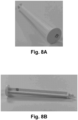
- the laser marking may be applied to one or more surfaces of a plunger rod ( FIGS. 8A and 8B ) either before or after the plunger rod is inserted into a transparent syringe barrel.
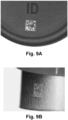
- aluminum seals having plastic flip-top caps may be marked, either by marking the top surface of the plastic cap or by marking a pigmented lacquer containing TiOz formed on the aluminum sidewall or by marking the aluminum itself through a clear lacquer ( FIGS. 9A and 9B ).
- Plastic seals and other pigmented plastics, as well as line seals produced from elastomer sheeting, are compatible with the laser marking process.
- Glass components can be laser marked, as can glass substitute components, such as those made using CRYSTAL ZENITH @ material manufactured by Daikyo Seiko, Ltd of Japan, using CO 2 lasers or the like to burn and/or ablate material.
Landscapes
- Health & Medical Sciences (AREA)
- Engineering & Computer Science (AREA)
- Life Sciences & Earth Sciences (AREA)
- Surgery (AREA)
- Veterinary Medicine (AREA)
- Public Health (AREA)
- General Health & Medical Sciences (AREA)
- Animal Behavior & Ethology (AREA)
- Heart & Thoracic Surgery (AREA)
- Biomedical Technology (AREA)
- Molecular Biology (AREA)
- Nuclear Medicine, Radiotherapy & Molecular Imaging (AREA)
- Oral & Maxillofacial Surgery (AREA)
- Medical Informatics (AREA)
- Mechanical Engineering (AREA)
- Pathology (AREA)
- Physics & Mathematics (AREA)
- Vascular Medicine (AREA)
- Plasma & Fusion (AREA)
- Optics & Photonics (AREA)
- Epidemiology (AREA)
- Theoretical Computer Science (AREA)
- General Physics & Mathematics (AREA)
- Chemical & Material Sciences (AREA)
- Chemical Kinetics & Catalysis (AREA)
- Toxicology (AREA)
- Anesthesiology (AREA)
- Hematology (AREA)
- Medical Preparation Storing Or Oral Administration Devices (AREA)
- Infusion, Injection, And Reservoir Apparatuses (AREA)
- Laser Beam Processing (AREA)
- Shaping Of Tube Ends By Bending Or Straightening (AREA)
- Thermal Transfer Or Thermal Recording In General (AREA)
- Medicinal Chemistry (AREA)
Claims (18)
- Dispositif médical comprenant un médicament et un composant en contact avec le médicament, le composant comprenant :un corps ayant une première surface formée au moins partiellement d'un matériau élastomère marquable ayant une première couleur, le matériau élastomère marquable ayant une caractéristique telle qu'une zone exposée à un rayonnement laser ayant la longueur d'onde de la lumière ultraviolette passe à une seconde couleur différente de la première couleur;un film couvrant au moins une partie de la première surface du corps, le film (14) fournissant une barrière entre le corps (12) et le médicament; etun marque visible sur le matériau élastomère marquable sur la première surface du corps recouverte par le film, le marque visible comprenant une ou plusieurs zones du matériau élastomère marquable sur la première surface ayant la deuxième couleur, le film n'étant pas visiblement dégradé;caractérisé en ce quele film a une transmission de lumière d'au moins 5% à la longueur d'onde; etle film comprend un matériau choisi dans le groupe constitué par le tétrafluoroéthylène, le polytétrafluoroéthylène (PTFE), l'éthylène-tétrafluoroéthylène (ETFE), l'éthylène-propylène fluoré (FEP), le polyfluorure de vinylidène (PVF), le polyfluorure de vinylidène (PVDF), le polychlorotrifluoroéthylène (PCTFE), les perfluoroalcoxyalcanes (PFA), l'éthylène-chlorotrifluoroéthylène (ECTFE), le perfluoroélastomère (FFPM), le polymère fluoroélastomère (FPM), le polyéthylène (PE), le polymère d'oléfine cyclique (COP), le copolymère d'oléfine cyclique (COC), le polypropylène (PP) et leurs combinaisons.
- Composant d'un dispositif médical selon la revendication 1, dans lequel la marque visible est un code Data Matrix lisible par une machine.
- Composant d'un dispositif médical selon la revendication 1, dans lequel le matériau élastomère pouvant être marqué comprend des charges inorganiques.
- Composant d'un dispositif médical selon la revendication 1, dans lequel la marque visible contient des informations qui se rapportent au moins à la fabrication du composant du dispositif médical et/ou à des informations sur le patient.
- Composant d'un dispositif médical selon la revendication 1, dans lequel la marque visible contient un localisateur de ressources uniformes (URL) qui renvoie à une page Web contenant des métadonnées en rapport avec le composant du dispositif médical.
- Composant d'un dispositif médical selon la revendication 1, dans lequel le marqueur visible contient un identifiant unique qui peut être trouvé dans une base de données contenant des métadonnées associées au composant du dispositif médical.
- Procédé de fabrication d'un composant d'un dispositif médical qui est en contact avec un médicament, le procédé comprenant :former un corps du composant du dispositif médical, le corps ayant une surface et étant formé au moins en partie d'un matériau élastomère marquable ayant une première couleur;appliquer un film sur au moins une partie de la surface du corps sur le matériau élastomère marquable, le film fournissant une barrière entre le corps et le médicament, etaprès la formation du film, l'exposition d'une ou plusieurs zones de ladite au moins une partie du matériau élastomère marquable et du film à un rayonnement laser ayant une longueur d'onde dans une plage de lumière ultraviolette pour former un marque visible sur la surface du corps en faisant passer la ou les zones à une deuxième couleur différente de la première couleur,caractérisé en ce quele film présente une transmission de lumière d'au moins 5% à cette longueur d'onde, etle film comprend un matériau choisi dans le groupe constitué par le tétrafluoroéthylène, le polytétrafluoroéthylène (PTFE), l'éthylène-tétrafluoroéthylène (ETFE), l'éthylène-propylène fluoré (FEP), le polyfluorure de vinylidène (PVF), le polyfluorure de vinylidène (PVDF), le polychlorotrifluoroéthylène (PCTFE), les perfluoroalcoxyalcanes (PFA), l'éthylène-chlorotrifluoroéthylène (ECTFE), le perfluoroélastomère (FFPM), le polymère fluoroélastomère (FPM), le polyéthylène (PE), le polymère d'oléfine cyclique (COP), le copolymère d'oléfine cyclique (COC), le polypropylène (PP) et leurs combinaisons.
- Procédé selon la revendication 7, dans lequel le matériau élastomère marquable comprend des charges inorganiques.
- Procédé selon la revendication 8, dans lequel les charges inorganiques dans une ou plusieurs zones d'au moins une partie du matériau élastomère marquable absorbent l'irradiation laser pour former la deuxième couleur.
- Procédé selon la revendication 7, dans lequel la formation de la marque visible comprend la formation d'au moins un symbole graphique et/ou d'un code Data Matrix lisible par une machine.
- Procédé selon la revendication 7, dans lequel l'exposition de ladite au moins une partie du matériau élastomère marquable à un rayonnement laser comprend le déplacement d'un laser à travers une pluralité de zones de ladite au moins une partie du matériau élastomère avec un chariot XY.
- Procédé selon la revendication 7, comprenant en outre l'application d'un masque sur une surface de ladite au moins une partie du matériau élastomère marquable avant de soumettre ladite au moins une partie du matériau élastomère marquable à une irradiation laser.
- Procédé selon la revendication 7, comprenant en outre:démoulage du corps (12); etlavage du composant du dispositif médical,dans lequel l'exposition d'une ou plusieurs zones d'au moins une partie du matériau élastomère marquable et du film (14) à une irradiation laser pour former la marque visible (16) sur la surface du corps est effectuée après le démoulage du corps (12).
- Procédé selon la revendication 12, comprenant en outre l'exposition d'une deuxième zone d'au moins une partie du matériau élastomère marquable et du film à l'irradiation laser après lavage, pour former un deuxième marque visible sur la surface du corps.
- Procédé selon la revendication 7, comprenant en outre:le démoulage du corps (12); etle taillage du composant du dispositif médical après le démoulage du corps (12),dans lequel l'exposition d'une ou plusieurs zones d'au moins une partie du matériau élastomère marquable et du film à l'irradiation laser pour former la marque visible (16) sur la surface du corps (12) est effectuée après le démoulage du corps (12).
- Procédé selon la revendication 7, comprenant en outre l'exposition d'une deuxième zone d'au moins une partie du matériau élastomère marquable et du film à une irradiation laser après le taillage, pour former une deuxième marque visible sur la surface du corps.
- Procédé selon la revendication 7, comprenant en outre:le démoulage du corps (12); etl'examen visuelle du composant du dispositif médical, dans lequel l'exposition d'une ou plusieurs zones d'au moins une partie du matériau élastomère marquable et du film (14) à l'irradiation laser pour former la marque visible (16) sur la surface du corps est effectuée après le démoulage du corps (12).
- Procédé selon la revendication 16, comprenant en outre l'exposition d'une deuxième zone de ladite au moins une partie du matériau élastomère marquable et du film à l'irradiation laser après l'examen visuel pour former une deuxième marque visible sur la surface du corps (12).
Applications Claiming Priority (2)
| Application Number | Priority Date | Filing Date | Title |
|---|---|---|---|
| US201862746216P | 2018-10-16 | 2018-10-16 | |
| PCT/US2019/056287 WO2020081541A1 (fr) | 2018-10-16 | 2019-10-15 | Composants médicaux marqués au laser à partir d'élastomères |
Publications (2)
| Publication Number | Publication Date |
|---|---|
| EP3867792A1 EP3867792A1 (fr) | 2021-08-25 |
| EP3867792B1 true EP3867792B1 (fr) | 2024-08-07 |
Family
ID=68425370
Family Applications (1)
| Application Number | Title | Priority Date | Filing Date |
|---|---|---|---|
| EP19797527.9A Active EP3867792B1 (fr) | 2018-10-16 | 2019-10-15 | Composant medical en matière elastomèrique marqué au moyen d'un laser |
Country Status (6)
| Country | Link |
|---|---|
| US (1) | US12336871B2 (fr) |
| EP (1) | EP3867792B1 (fr) |
| JP (1) | JP7189340B2 (fr) |
| CN (1) | CN112840346B (fr) |
| ES (1) | ES2985517T3 (fr) |
| WO (1) | WO2020081541A1 (fr) |
Families Citing this family (2)
| Publication number | Priority date | Publication date | Assignee | Title |
|---|---|---|---|---|
| US20230087154A1 (en) * | 2020-04-24 | 2023-03-23 | Fresenius Kabi Deutschland Gmbh | Medical syringe and piston stoppers for a medical syringe |
| CN116491881B (zh) * | 2023-06-28 | 2023-08-29 | 湖南省华芯医疗器械有限公司 | 一次性内窥镜及其使用方法和存储介质 |
Citations (3)
| Publication number | Priority date | Publication date | Assignee | Title |
|---|---|---|---|---|
| EP1905585B1 (fr) * | 2006-09-27 | 2009-06-24 | Mitsubishi Polyester Film GmbH | Feuille pouvant être marquée au laser |
| EP1550077B1 (fr) * | 2001-12-24 | 2009-07-08 | Digimarc ID Systems, LLC | Procedes relatifs a une gravure au laser et articles ainsi graves |
| EP2332012B1 (fr) * | 2008-09-10 | 2014-07-09 | DataLase Ltd | Compositions activées par une énergie |
Family Cites Families (25)
| Publication number | Priority date | Publication date | Assignee | Title |
|---|---|---|---|---|
| DE3346351A1 (de) * | 1983-12-22 | 1985-07-11 | Pharma-Gummi Wimmer West Gmbh, 5180 Eschweiler | Pharmazeutischer stopfen, kolben od. dgl. und verfahren zum herstellen von pharmazeutischen stopfen, kolben od. dgl. |
| US6776340B2 (en) * | 1999-07-23 | 2004-08-17 | Tri Star Technologies, A General Partnership | Duplicate laser marking discrete consumable articles |
| GB2352824A (en) * | 1999-07-30 | 2001-02-07 | Nokia Mobile Phones Ltd | Laser markable material comprising TiO2 pigmented thermoplstic elastomer |
| US20030194052A1 (en) * | 2002-04-12 | 2003-10-16 | Price L. Stephen | Methods for identification and verification |
| US7164360B2 (en) * | 2002-08-14 | 2007-01-16 | Mark Schiebler | Multi-use linkage device |
| US20060226234A1 (en) * | 2003-06-11 | 2006-10-12 | Kettinger Frederick R | Pharmaceutical dosage forms having overt and covert markings for identification and authentification |
| US20060243804A1 (en) * | 2003-10-03 | 2006-11-02 | Novo Nordisk A/S | Container comprising code information elements |
| US20050231585A1 (en) * | 2004-03-02 | 2005-10-20 | Mudigonda Dhurjati S | Method and system for laser imaging utilizing low power lasers |
| US20080161827A1 (en) * | 2006-12-29 | 2008-07-03 | Frost Ricky A | System and method for a selectively visible medical marker |
| JP3137881U (ja) * | 2007-09-28 | 2007-12-13 | 武田薬品工業株式会社 | バーコードの読取精度を保持した医療用薬品包装紙器 |
| US20090166311A1 (en) * | 2007-12-27 | 2009-07-02 | Helvoet Pharma Belgium N.V. | Pharmaceutical closure with a laser-applied marking |
| US7932826B2 (en) * | 2008-06-12 | 2011-04-26 | Abbott Laboratories Inc. | System for tracking the location of components, assemblies, and subassemblies in an automated diagnostic analyzer |
| US8552336B2 (en) * | 2008-12-23 | 2013-10-08 | Triune Ip Llc | Micro matrix data marking |
| RU2445700C1 (ru) * | 2010-07-05 | 2012-03-20 | Общество с ограниченной ответственностью "Флуоресцентные информационные технологии" | Верифицируемая символьная метка прямого нанесения и способ ее изготовления |
| JP5904719B2 (ja) | 2011-05-06 | 2016-04-20 | クオリカプス株式会社 | マーキングが施されたカプセル、カプセルの製造方法、およびカプセル剤 |
| US9662833B2 (en) * | 2012-06-04 | 2017-05-30 | Sabic Global Technologies B.V. | Marked thermoplastic compositions, methods of making and articles comprising the same, and uses thereof |
| US20140263674A1 (en) * | 2013-03-15 | 2014-09-18 | Conformis, Inc. | Systems, Methods, and Apparatus for Integrating Scannable Codes in Medical Devices |
| WO2014207415A1 (fr) * | 2013-06-24 | 2014-12-31 | Gluco Technology Limited | Système & marqueur de codage de sécurité, dispositif de balayage opto-électronique et procédé de codage d'articles |
| JP2015139897A (ja) | 2014-01-27 | 2015-08-03 | 大日本印刷株式会社 | スクラッチカード |
| FR3032123B1 (fr) * | 2015-01-29 | 2021-04-23 | Aptar Stelmi Sas | Bouchon-piston de seringue. |
| CN108025573B (zh) * | 2015-05-13 | 2023-03-10 | 皇冠包装技术公司 | 具有二维码的标记拉片 |
| CN109069725B (zh) * | 2016-02-22 | 2020-03-10 | 西医药服务有限公司 | 一种用于医疗设备的标记装置 |
| EP3306532A1 (fr) | 2016-10-05 | 2018-04-11 | Agfa-Gevaert | Étiquette rfid compatible avec un marquage au laser |
| CN109963702B (zh) | 2016-11-22 | 2022-02-18 | 默克专利股份有限公司 | 用于激光可标记及激光可焊接的聚合物材料的添加剂 |
| US20190161229A1 (en) * | 2017-11-30 | 2019-05-30 | Athenex, Inc. | Apparatus and method for improving safe identification, selection, distribution, and administration of medications and medicaments to patients |
-
2019
- 2019-10-15 ES ES19797527T patent/ES2985517T3/es active Active
- 2019-10-15 CN CN201980067480.4A patent/CN112840346B/zh active Active
- 2019-10-15 EP EP19797527.9A patent/EP3867792B1/fr active Active
- 2019-10-15 US US17/279,783 patent/US12336871B2/en active Active
- 2019-10-15 JP JP2021521009A patent/JP7189340B2/ja active Active
- 2019-10-15 WO PCT/US2019/056287 patent/WO2020081541A1/fr not_active Ceased
Patent Citations (3)
| Publication number | Priority date | Publication date | Assignee | Title |
|---|---|---|---|---|
| EP1550077B1 (fr) * | 2001-12-24 | 2009-07-08 | Digimarc ID Systems, LLC | Procedes relatifs a une gravure au laser et articles ainsi graves |
| EP1905585B1 (fr) * | 2006-09-27 | 2009-06-24 | Mitsubishi Polyester Film GmbH | Feuille pouvant être marquée au laser |
| EP2332012B1 (fr) * | 2008-09-10 | 2014-07-09 | DataLase Ltd | Compositions activées par une énergie |
Also Published As
| Publication number | Publication date |
|---|---|
| WO2020081541A9 (fr) | 2020-05-22 |
| US20210330422A1 (en) | 2021-10-28 |
| WO2020081541A1 (fr) | 2020-04-23 |
| EP3867792A1 (fr) | 2021-08-25 |
| CN112840346B (zh) | 2024-10-29 |
| US12336871B2 (en) | 2025-06-24 |
| JP7189340B2 (ja) | 2022-12-13 |
| ES2985517T3 (es) | 2024-11-06 |
| CN112840346A (zh) | 2021-05-25 |
| JP2022520510A (ja) | 2022-03-31 |
Similar Documents
| Publication | Publication Date | Title |
|---|---|---|
| US12336871B2 (en) | Laser-marked medical components from elastomers | |
| US8196807B2 (en) | Method of identifying a container and/or a finished article obtained from the said container, in particular for medical use | |
| EP3053619B1 (fr) | Seringue médicale, joint utilisé pour une seringue et son procédé de fabrication | |
| US6805170B2 (en) | Method for filling a vial | |
| US20230033805A1 (en) | System and process for manufacturing laser marked elastomer components | |
| EP3120886B1 (fr) | Seringue médicale, joint destiné à être utilisé dans la seringue et procédé de production de joint | |
| KR20030086336A (ko) | 코딩 심볼로지 및 그 인쇄 방법 | |
| CN101370539B (zh) | 识别多个容器和/或获自所述容器的最终物品的方法 | |
| US10173013B2 (en) | Medical syringe, gasket to be used for syringe, and gasket production method | |
| WO2021260574A1 (fr) | Pièce modulée gravée | |
| EP2415682A1 (fr) | Récipient pour le stockage d'aliments | |
| WO2024118644A1 (fr) | Emballage coque à passage direct avec gravure produite par laser uv et procédés de fabrication associés | |
| JP6732412B2 (ja) | Ptp包装体及び服薬記憶システム | |
| AU2001247981C1 (en) | Medicament vial having a heat-sealable cap, and apparatus and method for filling the vial | |
| AU2001247981A1 (en) | Medicament vial having a heat-sealable cap, and apparatus and method for filling the vial |
Legal Events
| Date | Code | Title | Description |
|---|---|---|---|
| STAA | Information on the status of an ep patent application or granted ep patent |
Free format text: STATUS: UNKNOWN |
|
| STAA | Information on the status of an ep patent application or granted ep patent |
Free format text: STATUS: THE INTERNATIONAL PUBLICATION HAS BEEN MADE |
|
| PUAI | Public reference made under article 153(3) epc to a published international application that has entered the european phase |
Free format text: ORIGINAL CODE: 0009012 |
|
| STAA | Information on the status of an ep patent application or granted ep patent |
Free format text: STATUS: REQUEST FOR EXAMINATION WAS MADE |
|
| 17P | Request for examination filed |
Effective date: 20210406 |
|
| AK | Designated contracting states |
Kind code of ref document: A1 Designated state(s): AL AT BE BG CH CY CZ DE DK EE ES FI FR GB GR HR HU IE IS IT LI LT LU LV MC MK MT NL NO PL PT RO RS SE SI SK SM TR |
|
| STAA | Information on the status of an ep patent application or granted ep patent |
Free format text: STATUS: EXAMINATION IS IN PROGRESS |
|
| DAV | Request for validation of the european patent (deleted) | ||
| DAX | Request for extension of the european patent (deleted) | ||
| 17Q | First examination report despatched |
Effective date: 20220111 |
|
| P01 | Opt-out of the competence of the unified patent court (upc) registered |
Effective date: 20230530 |
|
| GRAP | Despatch of communication of intention to grant a patent |
Free format text: ORIGINAL CODE: EPIDOSNIGR1 |
|
| STAA | Information on the status of an ep patent application or granted ep patent |
Free format text: STATUS: GRANT OF PATENT IS INTENDED |
|
| RIC1 | Information provided on ipc code assigned before grant |
Ipc: A61B 90/00 20160101ALN20240219BHEP Ipc: G06K 19/06 20060101ALN20240219BHEP Ipc: G06K 19/02 20060101ALN20240219BHEP Ipc: B23K 103/00 20060101ALN20240219BHEP Ipc: B23K 26/352 20140101ALN20240219BHEP Ipc: B23K 26/00 20140101ALN20240219BHEP Ipc: A61B 90/90 20160101ALN20240219BHEP Ipc: B29L 31/00 20060101ALN20240219BHEP Ipc: A61B 90/96 20160101ALI20240219BHEP Ipc: A61B 90/94 20160101ALI20240219BHEP Ipc: B23K 26/18 20060101ALI20240219BHEP Ipc: A61B 17/00 20060101ALI20240219BHEP Ipc: B29C 45/16 20060101ALI20240219BHEP Ipc: G06K 7/14 20060101AFI20240219BHEP |
|
| INTG | Intention to grant announced |
Effective date: 20240304 |
|
| GRAS | Grant fee paid |
Free format text: ORIGINAL CODE: EPIDOSNIGR3 |
|
| GRAA | (expected) grant |
Free format text: ORIGINAL CODE: 0009210 |
|
| STAA | Information on the status of an ep patent application or granted ep patent |
Free format text: STATUS: THE PATENT HAS BEEN GRANTED |
|
| AK | Designated contracting states |
Kind code of ref document: B1 Designated state(s): AL AT BE BG CH CY CZ DE DK EE ES FI FR GB GR HR HU IE IS IT LI LT LU LV MC MK MT NL NO PL PT RO RS SE SI SK SM TR |
|
| REG | Reference to a national code |
Ref country code: GB Ref legal event code: FG4D |
|
| REG | Reference to a national code |
Ref country code: CH Ref legal event code: EP |
|
| REG | Reference to a national code |
Ref country code: IE Ref legal event code: FG4D |
|
| REG | Reference to a national code |
Ref country code: DE Ref legal event code: R096 Ref document number: 602019056651 Country of ref document: DE |
|
| REG | Reference to a national code |
Ref country code: ES Ref legal event code: FG2A Ref document number: 2985517 Country of ref document: ES Kind code of ref document: T3 Effective date: 20241106 |
|
| REG | Reference to a national code |
Ref country code: LT Ref legal event code: MG9D |
|
| REG | Reference to a national code |
Ref country code: NL Ref legal event code: MP Effective date: 20240807 |
|
| PG25 | Lapsed in a contracting state [announced via postgrant information from national office to epo] |
Ref country code: NO Free format text: LAPSE BECAUSE OF FAILURE TO SUBMIT A TRANSLATION OF THE DESCRIPTION OR TO PAY THE FEE WITHIN THE PRESCRIBED TIME-LIMIT Effective date: 20241107 |
|
| REG | Reference to a national code |
Ref country code: AT Ref legal event code: MK05 Ref document number: 1711746 Country of ref document: AT Kind code of ref document: T Effective date: 20240807 |
|
| PG25 | Lapsed in a contracting state [announced via postgrant information from national office to epo] |
Ref country code: FI Free format text: LAPSE BECAUSE OF FAILURE TO SUBMIT A TRANSLATION OF THE DESCRIPTION OR TO PAY THE FEE WITHIN THE PRESCRIBED TIME-LIMIT Effective date: 20240807 Ref country code: GR Free format text: LAPSE BECAUSE OF FAILURE TO SUBMIT A TRANSLATION OF THE DESCRIPTION OR TO PAY THE FEE WITHIN THE PRESCRIBED TIME-LIMIT Effective date: 20241108 Ref country code: NL Free format text: LAPSE BECAUSE OF FAILURE TO SUBMIT A TRANSLATION OF THE DESCRIPTION OR TO PAY THE FEE WITHIN THE PRESCRIBED TIME-LIMIT Effective date: 20240807 Ref country code: PL Free format text: LAPSE BECAUSE OF FAILURE TO SUBMIT A TRANSLATION OF THE DESCRIPTION OR TO PAY THE FEE WITHIN THE PRESCRIBED TIME-LIMIT Effective date: 20240807 Ref country code: PT Free format text: LAPSE BECAUSE OF FAILURE TO SUBMIT A TRANSLATION OF THE DESCRIPTION OR TO PAY THE FEE WITHIN THE PRESCRIBED TIME-LIMIT Effective date: 20241209 |
|
| PG25 | Lapsed in a contracting state [announced via postgrant information from national office to epo] |
Ref country code: BG Free format text: LAPSE BECAUSE OF FAILURE TO SUBMIT A TRANSLATION OF THE DESCRIPTION OR TO PAY THE FEE WITHIN THE PRESCRIBED TIME-LIMIT Effective date: 20240807 |
|
| PG25 | Lapsed in a contracting state [announced via postgrant information from national office to epo] |
Ref country code: LV Free format text: LAPSE BECAUSE OF FAILURE TO SUBMIT A TRANSLATION OF THE DESCRIPTION OR TO PAY THE FEE WITHIN THE PRESCRIBED TIME-LIMIT Effective date: 20240807 |
|
| PG25 | Lapsed in a contracting state [announced via postgrant information from national office to epo] |
Ref country code: AT Free format text: LAPSE BECAUSE OF FAILURE TO SUBMIT A TRANSLATION OF THE DESCRIPTION OR TO PAY THE FEE WITHIN THE PRESCRIBED TIME-LIMIT Effective date: 20240807 Ref country code: IS Free format text: LAPSE BECAUSE OF FAILURE TO SUBMIT A TRANSLATION OF THE DESCRIPTION OR TO PAY THE FEE WITHIN THE PRESCRIBED TIME-LIMIT Effective date: 20241207 |
|
| PG25 | Lapsed in a contracting state [announced via postgrant information from national office to epo] |
Ref country code: HR Free format text: LAPSE BECAUSE OF FAILURE TO SUBMIT A TRANSLATION OF THE DESCRIPTION OR TO PAY THE FEE WITHIN THE PRESCRIBED TIME-LIMIT Effective date: 20240807 |
|
| PG25 | Lapsed in a contracting state [announced via postgrant information from national office to epo] |
Ref country code: RS Free format text: LAPSE BECAUSE OF FAILURE TO SUBMIT A TRANSLATION OF THE DESCRIPTION OR TO PAY THE FEE WITHIN THE PRESCRIBED TIME-LIMIT Effective date: 20241107 |
|
| PG25 | Lapsed in a contracting state [announced via postgrant information from national office to epo] |
Ref country code: RS Free format text: LAPSE BECAUSE OF FAILURE TO SUBMIT A TRANSLATION OF THE DESCRIPTION OR TO PAY THE FEE WITHIN THE PRESCRIBED TIME-LIMIT Effective date: 20241107 Ref country code: PT Free format text: LAPSE BECAUSE OF FAILURE TO SUBMIT A TRANSLATION OF THE DESCRIPTION OR TO PAY THE FEE WITHIN THE PRESCRIBED TIME-LIMIT Effective date: 20241209 Ref country code: PL Free format text: LAPSE BECAUSE OF FAILURE TO SUBMIT A TRANSLATION OF THE DESCRIPTION OR TO PAY THE FEE WITHIN THE PRESCRIBED TIME-LIMIT Effective date: 20240807 Ref country code: NO Free format text: LAPSE BECAUSE OF FAILURE TO SUBMIT A TRANSLATION OF THE DESCRIPTION OR TO PAY THE FEE WITHIN THE PRESCRIBED TIME-LIMIT Effective date: 20241107 Ref country code: NL Free format text: LAPSE BECAUSE OF FAILURE TO SUBMIT A TRANSLATION OF THE DESCRIPTION OR TO PAY THE FEE WITHIN THE PRESCRIBED TIME-LIMIT Effective date: 20240807 Ref country code: LV Free format text: LAPSE BECAUSE OF FAILURE TO SUBMIT A TRANSLATION OF THE DESCRIPTION OR TO PAY THE FEE WITHIN THE PRESCRIBED TIME-LIMIT Effective date: 20240807 Ref country code: IS Free format text: LAPSE BECAUSE OF FAILURE TO SUBMIT A TRANSLATION OF THE DESCRIPTION OR TO PAY THE FEE WITHIN THE PRESCRIBED TIME-LIMIT Effective date: 20241207 Ref country code: HR Free format text: LAPSE BECAUSE OF FAILURE TO SUBMIT A TRANSLATION OF THE DESCRIPTION OR TO PAY THE FEE WITHIN THE PRESCRIBED TIME-LIMIT Effective date: 20240807 Ref country code: GR Free format text: LAPSE BECAUSE OF FAILURE TO SUBMIT A TRANSLATION OF THE DESCRIPTION OR TO PAY THE FEE WITHIN THE PRESCRIBED TIME-LIMIT Effective date: 20241108 Ref country code: FI Free format text: LAPSE BECAUSE OF FAILURE TO SUBMIT A TRANSLATION OF THE DESCRIPTION OR TO PAY THE FEE WITHIN THE PRESCRIBED TIME-LIMIT Effective date: 20240807 Ref country code: BG Free format text: LAPSE BECAUSE OF FAILURE TO SUBMIT A TRANSLATION OF THE DESCRIPTION OR TO PAY THE FEE WITHIN THE PRESCRIBED TIME-LIMIT Effective date: 20240807 Ref country code: AT Free format text: LAPSE BECAUSE OF FAILURE TO SUBMIT A TRANSLATION OF THE DESCRIPTION OR TO PAY THE FEE WITHIN THE PRESCRIBED TIME-LIMIT Effective date: 20240807 |
|
| PG25 | Lapsed in a contracting state [announced via postgrant information from national office to epo] |
Ref country code: RO Free format text: LAPSE BECAUSE OF FAILURE TO SUBMIT A TRANSLATION OF THE DESCRIPTION OR TO PAY THE FEE WITHIN THE PRESCRIBED TIME-LIMIT Effective date: 20240807 Ref country code: SM Free format text: LAPSE BECAUSE OF FAILURE TO SUBMIT A TRANSLATION OF THE DESCRIPTION OR TO PAY THE FEE WITHIN THE PRESCRIBED TIME-LIMIT Effective date: 20240807 Ref country code: DK Free format text: LAPSE BECAUSE OF FAILURE TO SUBMIT A TRANSLATION OF THE DESCRIPTION OR TO PAY THE FEE WITHIN THE PRESCRIBED TIME-LIMIT Effective date: 20240807 |
|
| PG25 | Lapsed in a contracting state [announced via postgrant information from national office to epo] |
Ref country code: EE Free format text: LAPSE BECAUSE OF FAILURE TO SUBMIT A TRANSLATION OF THE DESCRIPTION OR TO PAY THE FEE WITHIN THE PRESCRIBED TIME-LIMIT Effective date: 20240807 |
|
| PG25 | Lapsed in a contracting state [announced via postgrant information from national office to epo] |
Ref country code: CZ Free format text: LAPSE BECAUSE OF FAILURE TO SUBMIT A TRANSLATION OF THE DESCRIPTION OR TO PAY THE FEE WITHIN THE PRESCRIBED TIME-LIMIT Effective date: 20240807 |
|
| PG25 | Lapsed in a contracting state [announced via postgrant information from national office to epo] |
Ref country code: SK Free format text: LAPSE BECAUSE OF FAILURE TO SUBMIT A TRANSLATION OF THE DESCRIPTION OR TO PAY THE FEE WITHIN THE PRESCRIBED TIME-LIMIT Effective date: 20240807 |
|
| REG | Reference to a national code |
Ref country code: DE Ref legal event code: R097 Ref document number: 602019056651 Country of ref document: DE |
|
| REG | Reference to a national code |
Ref country code: CH Ref legal event code: PL |
|
| PLBE | No opposition filed within time limit |
Free format text: ORIGINAL CODE: 0009261 |
|
| STAA | Information on the status of an ep patent application or granted ep patent |
Free format text: STATUS: NO OPPOSITION FILED WITHIN TIME LIMIT |
|
| PG25 | Lapsed in a contracting state [announced via postgrant information from national office to epo] |
Ref country code: MC Free format text: LAPSE BECAUSE OF FAILURE TO SUBMIT A TRANSLATION OF THE DESCRIPTION OR TO PAY THE FEE WITHIN THE PRESCRIBED TIME-LIMIT Effective date: 20240807 |
|
| PG25 | Lapsed in a contracting state [announced via postgrant information from national office to epo] |
Ref country code: LU Free format text: LAPSE BECAUSE OF NON-PAYMENT OF DUE FEES Effective date: 20241015 |
|
| 26N | No opposition filed |
Effective date: 20250508 |
|
| GBPC | Gb: european patent ceased through non-payment of renewal fee |
Effective date: 20241107 |
|
| PG25 | Lapsed in a contracting state [announced via postgrant information from national office to epo] |
Ref country code: CH Free format text: LAPSE BECAUSE OF NON-PAYMENT OF DUE FEES Effective date: 20241031 |
|
| PG25 | Lapsed in a contracting state [announced via postgrant information from national office to epo] |
Ref country code: SE Free format text: LAPSE BECAUSE OF FAILURE TO SUBMIT A TRANSLATION OF THE DESCRIPTION OR TO PAY THE FEE WITHIN THE PRESCRIBED TIME-LIMIT Effective date: 20240807 |
|
| PG25 | Lapsed in a contracting state [announced via postgrant information from national office to epo] |
Ref country code: GB Free format text: LAPSE BECAUSE OF NON-PAYMENT OF DUE FEES Effective date: 20241107 |
|
| PG25 | Lapsed in a contracting state [announced via postgrant information from national office to epo] |
Ref country code: IE Free format text: LAPSE BECAUSE OF NON-PAYMENT OF DUE FEES Effective date: 20241015 |
|
| PGFP | Annual fee paid to national office [announced via postgrant information from national office to epo] |
Ref country code: DE Payment date: 20251029 Year of fee payment: 7 |
|
| PG25 | Lapsed in a contracting state [announced via postgrant information from national office to epo] |
Ref country code: IT Free format text: LAPSE BECAUSE OF NON-PAYMENT OF DUE FEES Effective date: 20241015 |
|
| PGFP | Annual fee paid to national office [announced via postgrant information from national office to epo] |
Ref country code: FR Payment date: 20251027 Year of fee payment: 7 |
|
| PGFP | Annual fee paid to national office [announced via postgrant information from national office to epo] |
Ref country code: BE Payment date: 20251027 Year of fee payment: 7 |
|
| PG25 | Lapsed in a contracting state [announced via postgrant information from national office to epo] |
Ref country code: CY Free format text: LAPSE BECAUSE OF FAILURE TO SUBMIT A TRANSLATION OF THE DESCRIPTION OR TO PAY THE FEE WITHIN THE PRESCRIBED TIME-LIMIT; INVALID AB INITIO Effective date: 20191015 |
|
| PGFP | Annual fee paid to national office [announced via postgrant information from national office to epo] |
Ref country code: ES Payment date: 20251103 Year of fee payment: 7 |
|
| PG25 | Lapsed in a contracting state [announced via postgrant information from national office to epo] |
Ref country code: HU Free format text: LAPSE BECAUSE OF FAILURE TO SUBMIT A TRANSLATION OF THE DESCRIPTION OR TO PAY THE FEE WITHIN THE PRESCRIBED TIME-LIMIT; INVALID AB INITIO Effective date: 20191015 |
|
| PG25 | Lapsed in a contracting state [announced via postgrant information from national office to epo] |
Ref country code: IT Free format text: LAPSE BECAUSE OF NON-PAYMENT OF DUE FEES Effective date: 20241015 |
|
| PGFP | Annual fee paid to national office [announced via postgrant information from national office to epo] |
Ref country code: IT Payment date: 20251021 Year of fee payment: 7 |
|
| PGRI | Patent reinstated in contracting state [announced from national office to epo] |
Ref country code: IT Effective date: 20250228 |