EP3868314B1 - Instrument de coupe chirurgical avec capacité d'aspiration distale - Google Patents
Instrument de coupe chirurgical avec capacité d'aspiration distale Download PDFInfo
- Publication number
- EP3868314B1 EP3868314B1 EP21169129.0A EP21169129A EP3868314B1 EP 3868314 B1 EP3868314 B1 EP 3868314B1 EP 21169129 A EP21169129 A EP 21169129A EP 3868314 B1 EP3868314 B1 EP 3868314B1
- Authority
- EP
- European Patent Office
- Prior art keywords
- cutting blade
- cutting
- suction
- distal end
- surgical instrument
- Prior art date
- Legal status (The legal status is an assumption and is not a legal conclusion. Google has not performed a legal analysis and makes no representation as to the accuracy of the status listed.)
- Active
Links
Images


Classifications
-
- A—HUMAN NECESSITIES
- A61—MEDICAL OR VETERINARY SCIENCE; HYGIENE
- A61B—DIAGNOSIS; SURGERY; IDENTIFICATION
- A61B10/00—Instruments for taking body samples for diagnostic purposes; Other methods or instruments for diagnosis, e.g. for vaccination diagnosis, sex determination or ovulation-period determination; Throat striking implements
- A61B10/02—Instruments for taking cell samples or for biopsy
- A61B10/0233—Pointed or sharp biopsy instruments
- A61B10/0266—Pointed or sharp biopsy instruments means for severing sample
- A61B10/0275—Pointed or sharp biopsy instruments means for severing sample with sample notch, e.g. on the side of inner stylet
-
- A—HUMAN NECESSITIES
- A61—MEDICAL OR VETERINARY SCIENCE; HYGIENE
- A61B—DIAGNOSIS; SURGERY; IDENTIFICATION
- A61B10/00—Instruments for taking body samples for diagnostic purposes; Other methods or instruments for diagnosis, e.g. for vaccination diagnosis, sex determination or ovulation-period determination; Throat striking implements
- A61B10/02—Instruments for taking cell samples or for biopsy
- A61B10/0233—Pointed or sharp biopsy instruments
- A61B10/0283—Pointed or sharp biopsy instruments with vacuum aspiration, e.g. caused by retractable plunger or by connected syringe
-
- A—HUMAN NECESSITIES
- A61—MEDICAL OR VETERINARY SCIENCE; HYGIENE
- A61B—DIAGNOSIS; SURGERY; IDENTIFICATION
- A61B17/00—Surgical instruments, devices or methods
- A61B17/16—Instruments for performing osteoclasis; Drills or chisels for bones; Trepans
- A61B17/1604—Chisels; Rongeurs; Punches; Stamps
-
- A—HUMAN NECESSITIES
- A61—MEDICAL OR VETERINARY SCIENCE; HYGIENE
- A61B—DIAGNOSIS; SURGERY; IDENTIFICATION
- A61B17/00—Surgical instruments, devices or methods
- A61B17/32—Surgical cutting instruments
- A61B17/320016—Endoscopic cutting instruments, e.g. arthroscopes, resectoscopes
- A61B17/32002—Endoscopic cutting instruments, e.g. arthroscopes, resectoscopes with continuously rotating, oscillating or reciprocating cutting instruments
-
- A—HUMAN NECESSITIES
- A61—MEDICAL OR VETERINARY SCIENCE; HYGIENE
- A61B—DIAGNOSIS; SURGERY; IDENTIFICATION
- A61B17/00—Surgical instruments, devices or methods
- A61B17/32—Surgical cutting instruments
- A61B17/320016—Endoscopic cutting instruments, e.g. arthroscopes, resectoscopes
- A61B17/32002—Endoscopic cutting instruments, e.g. arthroscopes, resectoscopes with continuously rotating, oscillating or reciprocating cutting instruments
- A61B2017/320024—Morcellators, e.g. having a hollow cutting tube with an annular cutter for morcellating and removing tissue
-
- A—HUMAN NECESSITIES
- A61—MEDICAL OR VETERINARY SCIENCE; HYGIENE
- A61B—DIAGNOSIS; SURGERY; IDENTIFICATION
- A61B2217/00—General characteristics of surgical instruments
- A61B2217/002—Auxiliary appliance
- A61B2217/005—Auxiliary appliance with suction drainage system
Definitions
- This disclosure relates to surgical instruments, and in particular to surgical cutting instruments that use suction, for example, powered shavers, microdebriders and dissector blades.
- Surgical apparatus used to shave, cut, resect, abrade and/or remove tissue, bone and/or other bodily materials are known.
- Such surgical apparatus can include a cutting surface, such as a rotating blade disposed on an elongated inner tube that is rotated within an elongated outer tube having a cutting window.
- the inner and outer tubes together form a surgical cutting instrument or unit.
- the elongated outer tube includes a distal end defining an opening or cutting window disposed at a side of the distal end of the outer tube.
- the cutting window of the outer tube exposes the cutting surface of the inner tube (located at a side of the distal end of the inner tube) to tissue, bone and/or any other bodily materials to be removed.
- a powered handpiece is used to rotate the inner tube with respect to the outer tube while an outer tube hub (connected to the proximal end of the outer tube) is fixed to the handpiece and an inner tube hub (connected to the proximal end of the inner tube) is loosely held in place by the powered handpiece.
- the inner tube is hollow and has a cutting window on a side surface of its distal end such that tissue, bone, etc. will be cut or shaved as the cutting window of the inner tube aligns with and then becomes misaligned with the cutting window of the outer tube as the inner tube is rotated within the outer tube.
- the cutting device nibbles or takes away small pieces of the bone, tissue, etc. as the inner tube is rotated within the outer tube.
- a vacuum is applied through the inner tube such that the bodily material that is to be cut, shaved, etc. is drawn into the windows of the inner and outer tubes when those windows become aligned, thereby facilitating the cutting, shaving, etc. of the tissue, which then travels through the inner tube due to the suction.
- an irrigation fluid which can include a liquid, to the surgical site via a passage provided between the inner and outer tubes.
- US 2005/096649 A1 discloses a surgical micro-resecting instrument including an outer tubular member, an inner tubular member, a hub assembly and an electrical insulator.
- the outer tubular member is formed of an electrically conductive material and defines a proximal section, a distal section and a lumen.
- the inner tubular member is disposed within the lumen and defines a distal portion that forms a cutting tip.
- GB 2 042 902 A discloses a surgical instrument for remote cutting which comprises coaxial inner and outer tubes, the inner tube being rotatably driven whilst the outer tube is stationary.
- the inner and outer tubes have windows in their side walls at their distal ends providing diverging cutting edges.
- US 6 419 684 B1 discloses an end-cutting arthroscopic shaver blade having a tubular inner member rotatable within a tubular outer member.
- the distal ends of each of the tubular members are provided with at least two notches each of which has longitudinally extending sides provided with cutting edges.
- the surgeon can use the surgical cutting instrument as a suction device, for example, by stopping rotation of the inner cutting tube while continuing to apply suction through the inner tube.
- the pedal or other control device which controls the rotation of the inner tube
- the surgeon can cause the cutting windows of the inner and outer tubes to be aligned with each other such that suction can be applied to the surgical site through the aligned windows of the inner and outer tubes.
- the windows of the inner and outer tubes are cutting surfaces (and typically include serrations)
- most surgeons choose not to use the surgical cutting tool as a suctioning device because tissue adjacent to the outer tube window tends to be drawn into the window and partially cut and/or irritated by the cutting surfaces of the inner and outer tubes.
- a surgical instrument that performs cutting also can function as a suction wand. This is achieved by providing the surgical instrument with a suction aperture at the distal-most tip of the surgical instrument such that a longitudinal axis of the surgical instrument passes through the suction aperture.
- the surgical instrument includes a first cutting blade and a second cutting blade.
- the first cutting blade includes a tubular body having a proximal end and a distal end, with a cutting window disposed at a side of the first cutting blade near the distal end.
- the second cutting blade includes a tubular body having a proximal end and a distal end, with a cutting window disposed at a side of the second cutting blade near the distal end.
- the second cutting blade is rotatably disposed inside of the first cutting blade such that the surgical instrument cuts tissue by rotating the second cutting blade within the first cutting blade while a vacuum is applied through an internal bore of the second cutting blade to draw the tissue into the cutting windows of the first and second cutting blades and sever the tissue by rotation of the second cutting blade.
- the distal end of the first cutting blade includes a first suction aperture through which a longitudinal axis of the first cutting blade extends.
- the distal end of the second cutting blade includes a second suction aperture through which a longitudinal axis of the second cutting blade extends.
- the surgical instrument can be used as a suction tool by applying the vacuum through the internal bore of the second cutting blade while the second cutting blade is stopped from rotating with the cutting windows of the first and second cutting blades misaligned with each other so that the vacuum is applied through the first and second suction apertures.
- most of the suction is applied through the cutting windows because they are located closer to the vacuum source than are the suction apertures (that is, the cutting windows are proximal to the suction apertures).
- the cutting operation can be performed as usual.
- a diameter of the first suction aperture is equal to or smaller than a diameter of the second suction aperture.
- the second cutting blade can be positioned relative to the first cutting blade so that the cutting windows of the first and second cutting blades are misaligned with each other by the surgeon operating the controls of the surgical instrument (for example, by operating a foot pedal) while observing the distal tip of the cutting instrument (for example, with an endoscope as is typically used to observe the surgical procedure) until the cutting window of the inner, second cutting blade is misaligned with the cutting window of the outer, first cutting blade such that the back side of the second cutting blade opposite to the window substantially blocks the window of the first cutting blade.
- the method of suctioning can be performed after the surgical instrument has been used for cutting and/or before the surgical instrument has been used for cutting. In either case, it is unnecessary to withdraw the cutting instrument when switching between a cutting operation and a suctioning operation. Furthermore, a separate suction wand may not be needed.
- the suction source 28 may be an external suction source such as provided by attachment to a facility suction outlet provided on a wall.
- the handle 2 is connected, at its distal end, to a surgical instrument 8.
- the surgical instrument 8 in this embodiment includes a cutting tip at its distal end 8A that is used, for example, to cut, shave, remove, resect and/or abrade tissue, bone and/or other bodily materials.
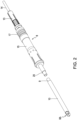
- Fig. 2 illustrates a perspective view of an exemplary embodiment of the surgical instrument 8 in accordance with aspects of the invention.
- the instrument 8 incorporates an inner tube 9 and an outer tube 10.
- an inner tube hub 13 is formed on the second end 14 of the inner tube 9 and an outer tube hub 15 is formed on the second end 17 of the outer tube 10.
- the inner tube 9 is inserted into a fluid passage 20 formed within the outer tube 10 so that the inner tube 9 is co-axially disposed within the outer tube 10 until the external distal tip of the inner tube 9 contacts the internal distal surface of the outer tube 10.
- the outer tube 10 has a larger diameter than the inner tube 9, thus allowing for insertion of the inner tube 9 within the outer tube 10.
- the inner and outer tubes will be pre-assembled prior to delivery to the customer. Thus, a customer will most likely not be inserting the inner tube into the outer tube.
- the inner and outer tube hubs 13, 15 couple the inner and outer tubes 9, 10, respectively, to the handle 2. Once coupled to the handle 2, the outer tube 10 will be fixed relative to the handle 2, but the inner tube 9 will be rotatable relative to the outer tube 10 and the handle 2.
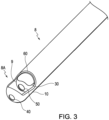
- Fig. 3 is a perspective view of the distal tip 8a of the surgical instrument 8.
- Fig. 3 shows the inner tube 9 retracted slightly from its usual position so that the structure of the distal tips of both the inner tube 9 and the outer tube 10 can be more readily seen.
- the outer tube 10 includes a cutting window 60 disposed at a side of its distal end.
- the outer tube 10 also can be referred to as a first cutting blade.
- the inner tube 9 also includes a cutting window 30 disposed at a side of its distal end.
- the inner tube 9 also can be referred to as a second cutting blade.
- the edges of the cutting windows 30 and 60 can be serrated, smooth or a combination of serrated and smooth to form cutting surfaces.
- Each of the inner and outer tubes 9, 10 also includes a suction aperture at its distal end as shown even more clearly in Figs. 4 and 5 .
- the inner cutting blade 9 rotates within the outer cutting blade 10, and thus as the inner cutting blade 9 rotates, the cutting windows 30 and 60 become aligned with each other as shown in Fig. 4 and then become misaligned with each other as shown in Fig. 5 .
- the side of the inner tube 9 distal tip opposite from the cutting window 30 blocks the cutting window 60 of the outer cutting blade 10, as will be described in more detail below.
- the first, or outer cutting blade 10 thus is a tubular body having a proximal end and a distal end, with a cutting window 60 disposed at a side of the first cutting blade 10 near the distal end.
- the outer cutting blade 10 also includes a suction aperture 40 at its distal-most end through which a longitudinal axis LA of the outer tube cutting blade 10 extends.
- the inner, second cutting blade 9 is a tubular body having a proximal end and a distal end, with cutting window 30 disposed at a side of its distal end.
- the second, inner cutting blade 9 is rotatably disposed inside of the first, outer cutting blade 10 such that the surgical instrument 8 cuts tissue by rotating the second, inner cutting blade 9 within the first, outer cutting blade 10 while a vacuum is applied through an internal bore 25 of the cutting blade 9 to draw the tissue into the cutting windows 30 and 60 of the cutting blades 9 and 10 and sever the tissue by rotation of the cutting blade 9.
- the inner cutting blade 9 also includes a suction aperture 50 at its distal-most end through which a longitudinal axis LA of the inner tube cutting blade 9 extends.
- the surgical instrument 8 can be used as a suction tool by applying the vacuum through the internal bore 25 of the cutting blade 9 while the cutting blade 9 is stopped from rotating and the cutting windows 30 and 60 of the cutting blades 9 and 10 are misaligned with each other as shown in Fig. 5 so that the vacuum is applied through a suction passage defined by the first and second suction apertures 40 and 50.
- the surgeon operating the instrument 8 can cause the windows 30 and 60 to become oriented in the misaligned state shown in Fig. 5 by, for example, tapping on the pedal 12 that controls the instrument to cause incremental rotation of the inner cutting blade 9 while observing the distal tip of the instrument, for example, by an endoscope, which usually also is disposed at the operating site, until the windows 30 and 60 obtain the state shown in Fig.
- irrigation fluid also could be supplied through bore 20 when in the state shown in Fig. 5 .
- the suction apertures 40 and 50 it is undesirable for the suction apertures 40 and 50 to function like a cutting element (like the cutting windows 30 and 60).
- the diameter of the suction aperture 40 provided on the outer cutting blade 10 be equal to or smaller than a diameter of the suction aperture 50 provided on the inner cutting blade 9.
- suction aperture 40 By making the diameter of the inner suction aperture (aperture 50) on the rotating cutting blade 9 equal to or larger than the diameter of the outer suction aperture (suction aperture 40), the suction apertures 40 and 50 will not function as a cutting device because tissue will not be pinched between the two apertures 40 and 50, or otherwise cut or damaged by those apertures when the instrument is being used as a suction wand and when the instrument is being used as a cutting tool with the inner blade 9 rotating.
- suction aperture 40 is smaller than suction aperture 50.
- the edges of the apertures 40 and 50 also can be rounded to further keep them from cutting tissue. However, the apertures do not cut tissue even if they are not rounded.
- the apertures 40 and 50 do not function to cut tissue is because the apertures 40 and 50 remain aligned with each other even while the inner cutting blade 9 rotates. Due to such alignment, the open suction passage (defined by apertures 40 and 50) exists between the internal bore 25 and an area external of the surgical instrument (that is, an area distal of the surgical instrument tip) through the suction apertures 40 and 50 both when the cutting blade 9 does not rotate and when the cutting blade 9 rotates within the cutting blade 10. In this regard, the suction aperture 50 at the distal end of the inner cutting blade 9 remains in fluid communication with the suction aperture 40 at the distal end of the outer cutting blade 10 as the inner cutting blade 9 rotates, and when it is stationary.
- the distal ends of the cutting blades 9 and 10 are substantially spherical.
- the distal ends of the blades 9 and 10 could be flat, with the first and second apertures 40 and 50 being disposed on flat portions of those blades.
- spherical tips are preferred to ease insertion into the patient.
- the cutting blades 9 and 10 are made from a sterilizable material.
- the sterilizable material is a metal such as stainless steel.
- the surgical instrument 8 When the instrument 8 is used for surgery, the surgical instrument 8 is inserted into a passage of a patient. Either before or after (or both before and after) a cutting operation is performed, the surgical instrument 8 can be used to perform a suctioning operation.
- the suctioning operation includes positioning the inner blade 9 relative to the outer blade 10 so that the cutting windows 30 and 60 are misaligned with each other so that the internal bore 25 of the cutting blade 9 does not communicate with the passage of the patient into which the surgical instrument is inserted through either of the cutting windows 30 and 60.
- a vacuum applied through the internal bore 25 of the inner cutting blade 9 draws material from the passage of the patient into the internal bore 25 through the suction passage defined by the first and second suction apertures 40 and 50.
- the inner cutting blade 9 is not rotated relative to outer cutting blade 10.
- the inner and outer cutting blades 9 and 10 are straight.
- the surgical instrument 8 can have one or more bends in it such that it is not straight.
- the inner cutting blade 9 would be flexible.
- Flexible hollow cutting blades are known and used with curved cutting instruments. See, for example, U.S. Patent No. 4,646,738 , and see, for example, U.S. Patent No. 5,707,350 .
- the outer cutting blade 10 included an open distal end defined by a suction aperture 40 formed through an otherwise closed portion at the distal tip of the outer cutting blade 10.
- the open distal end of the outer cutting blade 10 could be formed by providing an open-ended outer cutting blade 10 (rather than a closed portion having an aperture formed through it). That is, the opening provided at the distal end of the outer cutting blade 10 need not be an aperture that is completely surrounded by wall structure of the outer cutting blade, but instead could be only partially surrounded by wall structure of the outer cutting blade.
- the suction aperture 40 does need to be perfectly circular, but could have other shapes.
- FIG. 4 Another option would be to form the surgical instrument with no suction aperture at the distal end of the inner cutting blade 9, but to only provide a suction aperture through the distal end of the outer cutting blade 10 at a location that is offset from the longitudinal axis LA.
- Such a suction aperture would be disposed so as to be covered by and closed by the inner cutting blade 9 when the cutting windows are aligned with each other (the Fig. 4 orientation), but would be uncovered by the distal tip portion of the inner cutting blade 9 when the cutting windows of the inner and outer cutting blades 9 and 10 are misaligned with each other (the Fig. 5 orientation).
- a structure is disfavored because it is feared that the suction aperture in the outer cutting blade will function to cut tissue when the inner cutting blade is rotating within the outer cutting blade (i.e., during a cutting operation).
Landscapes
- Health & Medical Sciences (AREA)
- Life Sciences & Earth Sciences (AREA)
- Surgery (AREA)
- Biomedical Technology (AREA)
- General Health & Medical Sciences (AREA)
- Heart & Thoracic Surgery (AREA)
- Medical Informatics (AREA)
- Molecular Biology (AREA)
- Veterinary Medicine (AREA)
- Animal Behavior & Ethology (AREA)
- Engineering & Computer Science (AREA)
- Public Health (AREA)
- Pathology (AREA)
- Orthopedic Medicine & Surgery (AREA)
- Nuclear Medicine, Radiotherapy & Molecular Imaging (AREA)
- Dentistry (AREA)
- Oral & Maxillofacial Surgery (AREA)
- Surgical Instruments (AREA)
Claims (5)
- Instrument chirurgical (8) comprenant :- une lame coupante extérieure (10) à corps tubulaire avec une extrémité proximale et une extrémité distale ouverte (40), une fenêtre coupante (60) sur un côté de la lame coupante extérieure (10) près de l'extrémité distale,- une lame coupante intérieure (9) à corps tubulaire avec une extrémité proximale et une extrémité distale, une fenêtre coupante (30) sur un côté de la lame coupante intérieure (9) près de l'extrémité distale, la lame coupante intérieure (9) étant montée à rotation dans la lame coupante extérieure (10) pour que l'instrument chirurgical (8) coupe le tissu en faisant tourner la lame coupante intérieure (9) dans la lame coupante extérieure (10) une dépression étant appliquée par un perçage intérieur (25) de la lame coupante intérieure (9) pour aspirer le tissu dans les fenêtres coupantes (60, 30) des lames coupantes extérieure et intérieure et couper le tissu par la rotation de la lame coupante intérieure (9),- l'extrémité distale de la lame coupante intérieure (9) a une ouverture d'aspiration (50) en communication fluide avec l'extrémité distale ouverte (40) de la lame coupante extérieure (10) pendant la rotation de la lame coupante intérieure (9),- l'instrument chirurgical (8) pouvant être utilisé comme outil aspirant en appliquant le vide par le perçage intérieur (25) de la lame coupante intérieure (9) la lame coupante intérieure (9) restant fixe avec les fenêtres coupantes (60, 30) des lames coupantes extérieure et intérieure (30), les lames coupantes extérieure et intérieure étant désalignées l'une par rapport à l'autre, pour appliquer le vide à travers l'extrémité distale ouverte (40) de la lame coupante extérieure (10) et l'ouverture d'aspiration (50) de la lame coupante intérieure (9),- l'extrémité distale ouverte (40) de la lame coupante extérieure (10) étant une ouverture d'aspiration (40),instrument dans lequelun passage d'aspiration ouvert est formé par l'ouverture d'aspiration (40) et l'ouverture d'aspiration (50) entre l'alésage interne (25) et une zone externe de l'instrument chirurgical (8) à la fois lorsque la lame coupante interne (9) ne tourne pas et lorsque la lame coupante interne (9) tourne, instrument caractérisé en ce quela surface de l'ouverture d'aspiration (40) dans la lame coupante externe est plus petite que la surface de l'ouverture d'aspiration (50) dans la lame coupante interne (9) pour éviter de coincer le tissu entre l'ouverture d'aspiration (40) et l'ouverture d'aspiration (50).
- Instrument chirurgical selon la revendication 1,
dans lequel
l'ouverture d'aspiration (40) de la lame coupante extérieure (10) traverse l'extrémité distale de la lame coupante extérieure (10). - Instrument chirurgical selon la revendication 1 ou 2,
dans lequel
l'extrémité distale de la lame coupante intérieure (9) et celle de la lame coupante extérieure (10) de l'instrument chirurgical ont une forme sphérique. - Instrument chirurgical selon l'une des revendications 1 à 3,
dans lequel
l'axe longitudinal de la lame coupante intérieure (9) traverse l'ouverture d'aspiration (50) de la lame coupante intérieure (9). - Instrument chirurgical selon l'une des revendications 1 à 4,
dans lequel
un passage existe entre les lames coupantes extérieure (10) et intérieure (9) pour permettre l'alimentation avec un liquide.
Applications Claiming Priority (4)
| Application Number | Priority Date | Filing Date | Title |
|---|---|---|---|
| US13/013,240 US8585724B2 (en) | 2011-01-25 | 2011-01-25 | Surgical cutting instrument with distal suction capability |
| PCT/US2012/020171 WO2012102838A1 (fr) | 2011-01-25 | 2012-01-04 | Instrument de coupe chirurgical doté d'une fonction d'aspiration distale |
| EP18174405.3A EP3384857B1 (fr) | 2011-01-25 | 2012-01-04 | Instrument de coupe chirurgical avec capacité d'aspiration distale |
| EP12701276.3A EP2667794B1 (fr) | 2011-01-25 | 2012-01-04 | Instrument de coupe chirurgical doté d'une fonction d'aspiration distale |
Related Parent Applications (2)
| Application Number | Title | Priority Date | Filing Date |
|---|---|---|---|
| EP18174405.3A Division EP3384857B1 (fr) | 2011-01-25 | 2012-01-04 | Instrument de coupe chirurgical avec capacité d'aspiration distale |
| EP12701276.3A Division EP2667794B1 (fr) | 2011-01-25 | 2012-01-04 | Instrument de coupe chirurgical doté d'une fonction d'aspiration distale |
Publications (2)
| Publication Number | Publication Date |
|---|---|
| EP3868314A1 EP3868314A1 (fr) | 2021-08-25 |
| EP3868314B1 true EP3868314B1 (fr) | 2024-11-20 |
Family
ID=45532044
Family Applications (3)
| Application Number | Title | Priority Date | Filing Date |
|---|---|---|---|
| EP18174405.3A Active EP3384857B1 (fr) | 2011-01-25 | 2012-01-04 | Instrument de coupe chirurgical avec capacité d'aspiration distale |
| EP21169129.0A Active EP3868314B1 (fr) | 2011-01-25 | 2012-01-04 | Instrument de coupe chirurgical avec capacité d'aspiration distale |
| EP12701276.3A Active EP2667794B1 (fr) | 2011-01-25 | 2012-01-04 | Instrument de coupe chirurgical doté d'une fonction d'aspiration distale |
Family Applications Before (1)
| Application Number | Title | Priority Date | Filing Date |
|---|---|---|---|
| EP18174405.3A Active EP3384857B1 (fr) | 2011-01-25 | 2012-01-04 | Instrument de coupe chirurgical avec capacité d'aspiration distale |
Family Applications After (1)
| Application Number | Title | Priority Date | Filing Date |
|---|---|---|---|
| EP12701276.3A Active EP2667794B1 (fr) | 2011-01-25 | 2012-01-04 | Instrument de coupe chirurgical doté d'une fonction d'aspiration distale |
Country Status (5)
| Country | Link |
|---|---|
| US (1) | US8585724B2 (fr) |
| EP (3) | EP3384857B1 (fr) |
| JP (2) | JP5859025B2 (fr) |
| CN (1) | CN103327911B (fr) |
| WO (1) | WO2012102838A1 (fr) |
Families Citing this family (41)
| Publication number | Priority date | Publication date | Assignee | Title |
|---|---|---|---|---|
| US20160001064A1 (en) * | 2005-07-22 | 2016-01-07 | The Spectranetics Corporation | Endocardial lead cutting apparatus |
| IN2012DN01917A (fr) | 2009-09-08 | 2015-07-24 | Salient Surgical Tech Inc | |
| US8377086B2 (en) | 2011-01-25 | 2013-02-19 | Gyrus Ent L.L.C. | Surgical cutting instrument with distal suction passage forming member |
| US8425546B2 (en) * | 2011-01-27 | 2013-04-23 | Mi4Spine, Llc | Up cutting knife with suction |
| US8475482B2 (en) | 2011-02-17 | 2013-07-02 | Gyrus Ent L.L.C. | Surgical instrument with distal suction capability |
| US9226792B2 (en) * | 2012-06-12 | 2016-01-05 | Medtronic Advanced Energy Llc | Debridement device and method |
| US9173667B2 (en) * | 2012-10-16 | 2015-11-03 | Med-Sonics Corporation | Apparatus and methods for transferring ultrasonic energy to a bodily tissue |
| US9339284B2 (en) | 2012-11-06 | 2016-05-17 | Med-Sonics Corporation | Systems and methods for controlling delivery of ultrasonic energy to a bodily tissue |
| US8920419B2 (en) | 2012-11-30 | 2014-12-30 | Gyrus Acmi, Inc. | Apparatus and method for tubeset with drive axle |
| US9358036B2 (en) | 2013-03-12 | 2016-06-07 | Gyrus Acmi, Inc. | Blade positioning device |
| US10314647B2 (en) | 2013-12-23 | 2019-06-11 | Medtronic Advanced Energy Llc | Electrosurgical cutting instrument |
| US10813686B2 (en) | 2014-02-26 | 2020-10-27 | Medtronic Advanced Energy Llc | Electrosurgical cutting instrument |
| US20160066945A1 (en) * | 2014-09-08 | 2016-03-10 | Medtronic-Xomed, Inc. | Tumor margin device |
| US9636132B2 (en) * | 2014-09-08 | 2017-05-02 | Medtronic Xomed, Inc. | Tumor debulker |
| US9737322B2 (en) | 2014-09-08 | 2017-08-22 | Medtronic Xomed, Inc. | Method for resection of tumors and tissues |
| US20160183962A1 (en) * | 2014-12-17 | 2016-06-30 | Greg Spitz | Apparatus And Methods For Treating Undesired Viens |
| US10376302B2 (en) | 2015-02-18 | 2019-08-13 | Medtronic Xomed, Inc. | Rotating electrical connector for RF energy enabled tissue debridement device |
| JP6661652B2 (ja) | 2015-02-18 | 2020-03-11 | メドトロニック・ゾーメド・インコーポレーテッド | Rfエネルギー使用可能な組織デブリドマンデバイス |
| US10188456B2 (en) | 2015-02-18 | 2019-01-29 | Medtronic Xomed, Inc. | Electrode assembly for RF energy enabled tissue debridement device |
| US9763684B2 (en) | 2015-04-02 | 2017-09-19 | Med-Sonics Corporation | Devices and methods for removing occlusions from a bodily cavity |
| CN105169548A (zh) * | 2015-09-07 | 2015-12-23 | 王敏 | 一种吸引器及其导流头 |
| US10716612B2 (en) | 2015-12-18 | 2020-07-21 | Medtronic Advanced Energy Llc | Electrosurgical device with multiple monopolar electrode assembly |
| USD802769S1 (en) | 2016-05-16 | 2017-11-14 | Teleflex Medical Incorporated | Thrombectomy handle assembly |
| WO2017218703A1 (fr) * | 2016-06-15 | 2017-12-21 | Typenex Medical, Llc | Appareil et procédés de maintien de contrôleurs ou de dispositifs |
| EP4005512B1 (fr) * | 2016-07-14 | 2024-08-14 | Stryker European Operations Holdings LLC | Ensemble de coupe pour un instrument chirurgical doté d'un ensemble d'entraînement |
| CN106388878A (zh) * | 2016-08-30 | 2017-02-15 | 苏州品诺维新医疗科技有限公司 | 一种动力控制装置及其控制方法、手术操作系统 |
| CN106236197A (zh) * | 2016-08-30 | 2016-12-21 | 苏州品诺维新医疗科技有限公司 | 一种手术器械、操作方法及手术系统 |
| US11246649B2 (en) * | 2017-08-28 | 2022-02-15 | RELIGN Corporation | Arthroscopic devices and methods |
| US12023082B2 (en) | 2017-10-06 | 2024-07-02 | Medtronic Advanced Energy Llc | Hemostatic thermal sealer |
| CN107998472A (zh) * | 2017-12-28 | 2018-05-08 | 山西阳光中天医疗器械有限公司 | 一种双套式自动吸脂针管及其吸脂方法 |
| US11185345B2 (en) * | 2018-01-31 | 2021-11-30 | Gyrus Acmi, Inc. | Debrider with external irrigation supply channel |
| CN108186059B (zh) * | 2018-03-13 | 2020-07-28 | 湖州市妇幼保健院 | 一种胃肠镜活检摘取装置 |
| CN108378892B (zh) * | 2018-03-19 | 2023-12-15 | 广东工业大学 | 一种微创刨刀 |
| CN109770999B (zh) * | 2019-01-28 | 2024-04-16 | 逸思(苏州)医疗科技有限公司 | 一种手术切割器 |
| USD974558S1 (en) | 2020-12-18 | 2023-01-03 | Stryker European Operations Limited | Ultrasonic knife |
| NL2027205B1 (en) * | 2020-12-22 | 2022-07-20 | Univ Delft Tech | An endoluminal biopsy tool |
| JP7775564B2 (ja) | 2021-01-22 | 2025-11-26 | ウルトラテレッジ ユーエスエー カンパニー リミテッド | デュアル超音波カテーテル |
| CN113303876B (zh) * | 2021-06-01 | 2022-09-02 | 南阳市第二人民医院 | 一种旋转机构及医用鼻窦吸引切割器 |
| TWI788915B (zh) * | 2021-07-14 | 2023-01-01 | 國立成功大學 | 用於剃除皮下組織的刀具 |
| TWI841131B (zh) * | 2022-08-01 | 2024-05-01 | 美商克力邁生醫股份有限公司 | 內視鏡裝置 |
| CN118383812B (zh) * | 2024-05-31 | 2025-07-18 | 中国人民解放军总医院第一医学中心 | 一种宫颈活检钳 |
Family Cites Families (26)
| Publication number | Priority date | Publication date | Assignee | Title |
|---|---|---|---|---|
| US3882872A (en) | 1970-01-05 | 1975-05-13 | Nicholas G Douvas | Method and apparatus for cataract surgery |
| US3937222A (en) | 1973-11-09 | 1976-02-10 | Surgical Design Corporation | Surgical instrument employing cutter means |
| US4274414A (en) | 1979-02-21 | 1981-06-23 | Dyonics, Inc. | Surgical instrument |
| JPS60158851A (ja) * | 1984-01-31 | 1985-08-20 | 持田製薬株式会社 | ロ−タリ−スクレイパ− |
| US4646738A (en) | 1985-12-05 | 1987-03-03 | Concept, Inc. | Rotary surgical tool |
| US4844064A (en) | 1987-09-30 | 1989-07-04 | Baxter Travenol Laboratories, Inc. | Surgical cutting instrument with end and side openings |
| US5112299A (en) | 1989-10-25 | 1992-05-12 | Hall Surgical Division Of Zimmer, Inc. | Arthroscopic surgical apparatus and method |
| US5152744A (en) | 1990-02-07 | 1992-10-06 | Smith & Nephew Dyonics | Surgical instrument |
| US5674235A (en) | 1995-05-10 | 1997-10-07 | Ultralase Technologies International | Ultrasonic surgical cutting instrument |
| US5665101A (en) * | 1996-04-01 | 1997-09-09 | Linvatec Corporation | Endoscopic or open lipectomy instrument |
| US6342061B1 (en) | 1996-09-13 | 2002-01-29 | Barry J. Kauker | Surgical tool with integrated channel for irrigation |
| US5730752A (en) | 1996-10-29 | 1998-03-24 | Femrx, Inc. | Tubular surgical cutters having aspiration flow control ports |
| US5947983A (en) * | 1998-03-16 | 1999-09-07 | Boston Scientific Corporation | Tissue cutting and stitching device and method |
| US6478805B1 (en) * | 1999-04-16 | 2002-11-12 | Nuvasive, Inc. | System for removing cut tissue from the inner bore of a surgical instrument |
| US6419684B1 (en) | 2000-05-16 | 2002-07-16 | Linvatec Corporation | End-cutting shaver blade for axial resection |
| US6610059B1 (en) | 2002-02-25 | 2003-08-26 | Hs West Investments Llc | Endoscopic instruments and methods for improved bubble aspiration at a surgical site |
| US7247161B2 (en) | 2002-03-22 | 2007-07-24 | Gyrus Ent L.L.C. | Powered surgical apparatus, method of manufacturing powered surgical apparatus, and method of using powered surgical apparatus |
| US7318831B2 (en) | 2002-07-13 | 2008-01-15 | Stryker Corporation | System and method for performing irrigated nose and throat surgery |
| US20050070818A1 (en) | 2003-09-30 | 2005-03-31 | Mueller Richard L. | Biopsy device with viewing assembly |
| US6979332B2 (en) | 2003-11-04 | 2005-12-27 | Medtronic, Inc. | Surgical micro-resecting instrument with electrocautery and continuous aspiration features |
| CN100577116C (zh) * | 2004-03-04 | 2010-01-06 | 施特劳勃医疗器械股份公司 | 用于抽吸、粉碎和排出血管内可去除的材料的导管 |
| US7674263B2 (en) * | 2005-03-04 | 2010-03-09 | Gyrus Ent, L.L.C. | Surgical instrument and method |
| US7670299B2 (en) * | 2006-03-07 | 2010-03-02 | Ethincon Endo-Surgery, Inc. | Device for minimally invasive internal tissue removal |
| WO2008124650A1 (fr) * | 2007-04-06 | 2008-10-16 | Interlace Medical, Inc. | Procédé, système et dispositif d'exérèse de tissu |
| US8486097B2 (en) * | 2010-02-04 | 2013-07-16 | Nico Corporation | Tissue cutting device |
| JP2015133275A (ja) * | 2014-01-15 | 2015-07-23 | 株式会社オートネットワーク技術研究所 | 防水コネクタ |
-
2011
- 2011-01-25 US US13/013,240 patent/US8585724B2/en active Active
-
2012
- 2012-01-04 EP EP18174405.3A patent/EP3384857B1/fr active Active
- 2012-01-04 JP JP2013550487A patent/JP5859025B2/ja not_active Expired - Fee Related
- 2012-01-04 EP EP21169129.0A patent/EP3868314B1/fr active Active
- 2012-01-04 WO PCT/US2012/020171 patent/WO2012102838A1/fr not_active Ceased
- 2012-01-04 CN CN201280005896.1A patent/CN103327911B/zh not_active Expired - Fee Related
- 2012-01-04 EP EP12701276.3A patent/EP2667794B1/fr active Active
-
2015
- 2015-07-02 JP JP2015133275A patent/JP5980383B2/ja not_active Expired - Fee Related
Also Published As
| Publication number | Publication date |
|---|---|
| US8585724B2 (en) | 2013-11-19 |
| EP2667794B1 (fr) | 2018-07-11 |
| JP2015186639A (ja) | 2015-10-29 |
| EP3384857A1 (fr) | 2018-10-10 |
| EP2667794A1 (fr) | 2013-12-04 |
| CN103327911A (zh) | 2013-09-25 |
| JP2014508577A (ja) | 2014-04-10 |
| CN103327911B (zh) | 2015-09-23 |
| EP3868314A1 (fr) | 2021-08-25 |
| JP5859025B2 (ja) | 2016-02-10 |
| EP3384857B1 (fr) | 2021-04-21 |
| WO2012102838A1 (fr) | 2012-08-02 |
| JP5980383B2 (ja) | 2016-08-31 |
| US20120191117A1 (en) | 2012-07-26 |
Similar Documents
| Publication | Publication Date | Title |
|---|---|---|
| EP3868314B1 (fr) | Instrument de coupe chirurgical avec capacité d'aspiration distale | |
| EP2667803B1 (fr) | Instrument chirurgical tranchant avec capacité d'aspiration distale | |
| US8657840B2 (en) | Surgical instrument with distal suction capability | |
| EP3522799B1 (fr) | Resecteurs de tissu et systèmes de résection de tissu à commande manuelle | |
| US10376278B2 (en) | Tissue resectors with cutting wires, hand operated tissue resecting systems and associated methods | |
| EP0807413B1 (fr) | Instrument pour réaliser des lipectomies ouvertes ou endoscopiques | |
| EP0463798A1 (fr) | Instrument chirurgical coupant | |
| EP1972288A1 (fr) | Lame de rasoir avec marquages de profondeur | |
| EP4268737A2 (fr) | Dispositif médical |
Legal Events
| Date | Code | Title | Description |
|---|---|---|---|
| PUAI | Public reference made under article 153(3) epc to a published international application that has entered the european phase |
Free format text: ORIGINAL CODE: 0009012 |
|
| STAA | Information on the status of an ep patent application or granted ep patent |
Free format text: STATUS: THE APPLICATION HAS BEEN PUBLISHED |
|
| AC | Divisional application: reference to earlier application |
Ref document number: 3384857 Country of ref document: EP Kind code of ref document: P Ref document number: 2667794 Country of ref document: EP Kind code of ref document: P |
|
| AK | Designated contracting states |
Kind code of ref document: A1 Designated state(s): AL AT BE BG CH CY CZ DE DK EE ES FI FR GB GR HR HU IE IS IT LI LT LU LV MC MK MT NL NO PL PT RO RS SE SI SK SM TR |
|
| STAA | Information on the status of an ep patent application or granted ep patent |
Free format text: STATUS: REQUEST FOR EXAMINATION WAS MADE |
|
| 17P | Request for examination filed |
Effective date: 20220105 |
|
| RBV | Designated contracting states (corrected) |
Designated state(s): AL AT BE BG CH CY CZ DE DK EE ES FI FR GB GR HR HU IE IS IT LI LT LU LV MC MK MT NL NO PL PT RO RS SE SI SK SM TR |
|
| P01 | Opt-out of the competence of the unified patent court (upc) registered |
Effective date: 20230531 |
|
| GRAP | Despatch of communication of intention to grant a patent |
Free format text: ORIGINAL CODE: EPIDOSNIGR1 |
|
| STAA | Information on the status of an ep patent application or granted ep patent |
Free format text: STATUS: GRANT OF PATENT IS INTENDED |
|
| INTG | Intention to grant announced |
Effective date: 20240612 |
|
| GRAS | Grant fee paid |
Free format text: ORIGINAL CODE: EPIDOSNIGR3 |
|
| GRAA | (expected) grant |
Free format text: ORIGINAL CODE: 0009210 |
|
| STAA | Information on the status of an ep patent application or granted ep patent |
Free format text: STATUS: THE PATENT HAS BEEN GRANTED |
|
| AC | Divisional application: reference to earlier application |
Ref document number: 2667794 Country of ref document: EP Kind code of ref document: P Ref document number: 3384857 Country of ref document: EP Kind code of ref document: P |
|
| AK | Designated contracting states |
Kind code of ref document: B1 Designated state(s): AL AT BE BG CH CY CZ DE DK EE ES FI FR GB GR HR HU IE IS IT LI LT LU LV MC MK MT NL NO PL PT RO RS SE SI SK SM TR |
|
| REG | Reference to a national code |
Ref country code: GB Ref legal event code: FG4D |
|
| REG | Reference to a national code |
Ref country code: CH Ref legal event code: EP |
|
| REG | Reference to a national code |
Ref country code: DE Ref legal event code: R096 Ref document number: 602012081231 Country of ref document: DE |
|
| REG | Reference to a national code |
Ref country code: IE Ref legal event code: FG4D |
|
| REG | Reference to a national code |
Ref country code: LT Ref legal event code: MG9D |
|
| REG | Reference to a national code |
Ref country code: NL Ref legal event code: MP Effective date: 20241120 |
|
| PG25 | Lapsed in a contracting state [announced via postgrant information from national office to epo] |
Ref country code: PT Free format text: LAPSE BECAUSE OF FAILURE TO SUBMIT A TRANSLATION OF THE DESCRIPTION OR TO PAY THE FEE WITHIN THE PRESCRIBED TIME-LIMIT Effective date: 20250320 Ref country code: IS Free format text: LAPSE BECAUSE OF FAILURE TO SUBMIT A TRANSLATION OF THE DESCRIPTION OR TO PAY THE FEE WITHIN THE PRESCRIBED TIME-LIMIT Effective date: 20250320 Ref country code: HR Free format text: LAPSE BECAUSE OF FAILURE TO SUBMIT A TRANSLATION OF THE DESCRIPTION OR TO PAY THE FEE WITHIN THE PRESCRIBED TIME-LIMIT Effective date: 20241120 |
|
| PG25 | Lapsed in a contracting state [announced via postgrant information from national office to epo] |
Ref country code: FI Free format text: LAPSE BECAUSE OF FAILURE TO SUBMIT A TRANSLATION OF THE DESCRIPTION OR TO PAY THE FEE WITHIN THE PRESCRIBED TIME-LIMIT Effective date: 20241120 Ref country code: NL Free format text: LAPSE BECAUSE OF FAILURE TO SUBMIT A TRANSLATION OF THE DESCRIPTION OR TO PAY THE FEE WITHIN THE PRESCRIBED TIME-LIMIT Effective date: 20241120 |
|
| REG | Reference to a national code |
Ref country code: AT Ref legal event code: MK05 Ref document number: 1742841 Country of ref document: AT Kind code of ref document: T Effective date: 20241120 |
|
| PG25 | Lapsed in a contracting state [announced via postgrant information from national office to epo] |
Ref country code: BG Free format text: LAPSE BECAUSE OF FAILURE TO SUBMIT A TRANSLATION OF THE DESCRIPTION OR TO PAY THE FEE WITHIN THE PRESCRIBED TIME-LIMIT Effective date: 20241120 |
|
| PG25 | Lapsed in a contracting state [announced via postgrant information from national office to epo] |
Ref country code: ES Free format text: LAPSE BECAUSE OF FAILURE TO SUBMIT A TRANSLATION OF THE DESCRIPTION OR TO PAY THE FEE WITHIN THE PRESCRIBED TIME-LIMIT Effective date: 20241120 |
|
| PG25 | Lapsed in a contracting state [announced via postgrant information from national office to epo] |
Ref country code: NO Free format text: LAPSE BECAUSE OF FAILURE TO SUBMIT A TRANSLATION OF THE DESCRIPTION OR TO PAY THE FEE WITHIN THE PRESCRIBED TIME-LIMIT Effective date: 20250220 |
|
| PG25 | Lapsed in a contracting state [announced via postgrant information from national office to epo] |
Ref country code: GR Free format text: LAPSE BECAUSE OF FAILURE TO SUBMIT A TRANSLATION OF THE DESCRIPTION OR TO PAY THE FEE WITHIN THE PRESCRIBED TIME-LIMIT Effective date: 20250221 Ref country code: LV Free format text: LAPSE BECAUSE OF FAILURE TO SUBMIT A TRANSLATION OF THE DESCRIPTION OR TO PAY THE FEE WITHIN THE PRESCRIBED TIME-LIMIT Effective date: 20241120 Ref country code: AT Free format text: LAPSE BECAUSE OF FAILURE TO SUBMIT A TRANSLATION OF THE DESCRIPTION OR TO PAY THE FEE WITHIN THE PRESCRIBED TIME-LIMIT Effective date: 20241120 |
|
| PG25 | Lapsed in a contracting state [announced via postgrant information from national office to epo] |
Ref country code: PL Free format text: LAPSE BECAUSE OF FAILURE TO SUBMIT A TRANSLATION OF THE DESCRIPTION OR TO PAY THE FEE WITHIN THE PRESCRIBED TIME-LIMIT Effective date: 20241120 |
|
| PG25 | Lapsed in a contracting state [announced via postgrant information from national office to epo] |
Ref country code: RS Free format text: LAPSE BECAUSE OF FAILURE TO SUBMIT A TRANSLATION OF THE DESCRIPTION OR TO PAY THE FEE WITHIN THE PRESCRIBED TIME-LIMIT Effective date: 20250220 |
|
| PG25 | Lapsed in a contracting state [announced via postgrant information from national office to epo] |
Ref country code: SM Free format text: LAPSE BECAUSE OF FAILURE TO SUBMIT A TRANSLATION OF THE DESCRIPTION OR TO PAY THE FEE WITHIN THE PRESCRIBED TIME-LIMIT Effective date: 20241120 |
|
| PG25 | Lapsed in a contracting state [announced via postgrant information from national office to epo] |
Ref country code: DK Free format text: LAPSE BECAUSE OF FAILURE TO SUBMIT A TRANSLATION OF THE DESCRIPTION OR TO PAY THE FEE WITHIN THE PRESCRIBED TIME-LIMIT Effective date: 20241120 |
|
| PG25 | Lapsed in a contracting state [announced via postgrant information from national office to epo] |
Ref country code: EE Free format text: LAPSE BECAUSE OF FAILURE TO SUBMIT A TRANSLATION OF THE DESCRIPTION OR TO PAY THE FEE WITHIN THE PRESCRIBED TIME-LIMIT Effective date: 20241120 |
|
| PG25 | Lapsed in a contracting state [announced via postgrant information from national office to epo] |
Ref country code: RO Free format text: LAPSE BECAUSE OF FAILURE TO SUBMIT A TRANSLATION OF THE DESCRIPTION OR TO PAY THE FEE WITHIN THE PRESCRIBED TIME-LIMIT Effective date: 20241120 |
|
| PG25 | Lapsed in a contracting state [announced via postgrant information from national office to epo] |
Ref country code: SK Free format text: LAPSE BECAUSE OF FAILURE TO SUBMIT A TRANSLATION OF THE DESCRIPTION OR TO PAY THE FEE WITHIN THE PRESCRIBED TIME-LIMIT Effective date: 20241120 |
|
| PG25 | Lapsed in a contracting state [announced via postgrant information from national office to epo] |
Ref country code: CZ Free format text: LAPSE BECAUSE OF FAILURE TO SUBMIT A TRANSLATION OF THE DESCRIPTION OR TO PAY THE FEE WITHIN THE PRESCRIBED TIME-LIMIT Effective date: 20241120 |
|
| PG25 | Lapsed in a contracting state [announced via postgrant information from national office to epo] |
Ref country code: IT Free format text: LAPSE BECAUSE OF FAILURE TO SUBMIT A TRANSLATION OF THE DESCRIPTION OR TO PAY THE FEE WITHIN THE PRESCRIBED TIME-LIMIT Effective date: 20241120 |
|
| REG | Reference to a national code |
Ref country code: DE Ref legal event code: R097 Ref document number: 602012081231 Country of ref document: DE |
|
| REG | Reference to a national code |
Ref country code: CH Ref legal event code: PL |
|
| PG25 | Lapsed in a contracting state [announced via postgrant information from national office to epo] |
Ref country code: SE Free format text: LAPSE BECAUSE OF FAILURE TO SUBMIT A TRANSLATION OF THE DESCRIPTION OR TO PAY THE FEE WITHIN THE PRESCRIBED TIME-LIMIT Effective date: 20241120 |
|
| PG25 | Lapsed in a contracting state [announced via postgrant information from national office to epo] |
Ref country code: LU Free format text: LAPSE BECAUSE OF NON-PAYMENT OF DUE FEES Effective date: 20250104 Ref country code: MC Free format text: LAPSE BECAUSE OF FAILURE TO SUBMIT A TRANSLATION OF THE DESCRIPTION OR TO PAY THE FEE WITHIN THE PRESCRIBED TIME-LIMIT Effective date: 20241120 |
|
| PLBE | No opposition filed within time limit |
Free format text: ORIGINAL CODE: 0009261 |
|
| STAA | Information on the status of an ep patent application or granted ep patent |
Free format text: STATUS: NO OPPOSITION FILED WITHIN TIME LIMIT |
|
| PG25 | Lapsed in a contracting state [announced via postgrant information from national office to epo] |
Ref country code: BE Free format text: LAPSE BECAUSE OF NON-PAYMENT OF DUE FEES Effective date: 20250131 |
|
| PG25 | Lapsed in a contracting state [announced via postgrant information from national office to epo] |
Ref country code: FR Free format text: LAPSE BECAUSE OF NON-PAYMENT OF DUE FEES Effective date: 20250120 |
|
| PG25 | Lapsed in a contracting state [announced via postgrant information from national office to epo] |
Ref country code: CH Free format text: LAPSE BECAUSE OF NON-PAYMENT OF DUE FEES Effective date: 20250131 |
|
| 26N | No opposition filed |
Effective date: 20250821 |
|
| REG | Reference to a national code |
Ref country code: BE Ref legal event code: MM Effective date: 20250131 |
|
| GBPC | Gb: european patent ceased through non-payment of renewal fee |
Effective date: 20250220 |
|
| PG25 | Lapsed in a contracting state [announced via postgrant information from national office to epo] |
Ref country code: GB Free format text: LAPSE BECAUSE OF NON-PAYMENT OF DUE FEES Effective date: 20250220 |
|
| PG25 | Lapsed in a contracting state [announced via postgrant information from national office to epo] |
Ref country code: IE Free format text: LAPSE BECAUSE OF NON-PAYMENT OF DUE FEES Effective date: 20250104 |
|
| PGFP | Annual fee paid to national office [announced via postgrant information from national office to epo] |
Ref country code: DE Payment date: 20260128 Year of fee payment: 15 |