EP3868733A1 - Céramique stratifiée poreuse et son procédé de fabrication - Google Patents
Céramique stratifiée poreuse et son procédé de fabrication Download PDFInfo
- Publication number
- EP3868733A1 EP3868733A1 EP19874322.1A EP19874322A EP3868733A1 EP 3868733 A1 EP3868733 A1 EP 3868733A1 EP 19874322 A EP19874322 A EP 19874322A EP 3868733 A1 EP3868733 A1 EP 3868733A1
- Authority
- EP
- European Patent Office
- Prior art keywords
- porous layer
- porous
- metal oxide
- ceramic laminate
- less
- Prior art date
- Legal status (The legal status is an assumption and is not a legal conclusion. Google has not performed a legal analysis and makes no representation as to the accuracy of the status listed.)
- Withdrawn
Links
Images


Classifications
-
- C—CHEMISTRY; METALLURGY
- C04—CEMENTS; CONCRETE; ARTIFICIAL STONE; CERAMICS; REFRACTORIES
- C04B—LIME, MAGNESIA; SLAG; CEMENTS; COMPOSITIONS THEREOF, e.g. MORTARS, CONCRETE OR LIKE BUILDING MATERIALS; ARTIFICIAL STONE; CERAMICS; REFRACTORIES; TREATMENT OF NATURAL STONE
- C04B41/00—After-treatment of mortars, concrete, artificial stone or ceramics; Treatment of natural stone
- C04B41/80—After-treatment of mortars, concrete, artificial stone or ceramics; Treatment of natural stone of only ceramics
- C04B41/81—Coating or impregnation
- C04B41/85—Coating or impregnation with inorganic materials
- C04B41/87—Ceramics
-
- B—PERFORMING OPERATIONS; TRANSPORTING
- B01—PHYSICAL OR CHEMICAL PROCESSES OR APPARATUS IN GENERAL
- B01D—SEPARATION
- B01D39/00—Filtering material for liquid or gaseous fluids
- B01D39/14—Other self-supporting filtering material ; Other filtering material
- B01D39/20—Other self-supporting filtering material ; Other filtering material of inorganic material, e.g. asbestos paper, metallic filtering material of non-woven wires
- B01D39/2068—Other inorganic materials, e.g. ceramics
-
- B—PERFORMING OPERATIONS; TRANSPORTING
- B01—PHYSICAL OR CHEMICAL PROCESSES OR APPARATUS IN GENERAL
- B01D—SEPARATION
- B01D67/00—Processes specially adapted for manufacturing semi-permeable membranes for separation processes or apparatus
- B01D67/0081—After-treatment of organic or inorganic membranes
- B01D67/0083—Thermal after-treatment
-
- B—PERFORMING OPERATIONS; TRANSPORTING
- B01—PHYSICAL OR CHEMICAL PROCESSES OR APPARATUS IN GENERAL
- B01D—SEPARATION
- B01D69/00—Semi-permeable membranes for separation processes or apparatus characterised by their form, structure or properties; Manufacturing processes specially adapted therefor
- B01D69/02—Semi-permeable membranes for separation processes or apparatus characterised by their form, structure or properties; Manufacturing processes specially adapted therefor characterised by their properties
-
- B—PERFORMING OPERATIONS; TRANSPORTING
- B01—PHYSICAL OR CHEMICAL PROCESSES OR APPARATUS IN GENERAL
- B01D—SEPARATION
- B01D69/00—Semi-permeable membranes for separation processes or apparatus characterised by their form, structure or properties; Manufacturing processes specially adapted therefor
- B01D69/12—Composite membranes; Ultra-thin membranes
- B01D69/1213—Laminated layers
-
- B—PERFORMING OPERATIONS; TRANSPORTING
- B01—PHYSICAL OR CHEMICAL PROCESSES OR APPARATUS IN GENERAL
- B01D—SEPARATION
- B01D71/00—Semi-permeable membranes for separation processes or apparatus characterised by the material; Manufacturing processes specially adapted therefor
- B01D71/02—Inorganic material
- B01D71/024—Oxides
-
- B—PERFORMING OPERATIONS; TRANSPORTING
- B32—LAYERED PRODUCTS
- B32B—LAYERED PRODUCTS, i.e. PRODUCTS BUILT-UP OF STRATA OF FLAT OR NON-FLAT, e.g. CELLULAR OR HONEYCOMB, FORM
- B32B18/00—Layered products essentially comprising ceramics, e.g. refractory products
-
- C—CHEMISTRY; METALLURGY
- C04—CEMENTS; CONCRETE; ARTIFICIAL STONE; CERAMICS; REFRACTORIES
- C04B—LIME, MAGNESIA; SLAG; CEMENTS; COMPOSITIONS THEREOF, e.g. MORTARS, CONCRETE OR LIKE BUILDING MATERIALS; ARTIFICIAL STONE; CERAMICS; REFRACTORIES; TREATMENT OF NATURAL STONE
- C04B38/00—Porous mortars, concrete, artificial stone or ceramic ware; Preparation thereof
- C04B38/0051—Porous mortars, concrete, artificial stone or ceramic ware; Preparation thereof characterised by the pore size, pore shape or kind of porosity
-
- C—CHEMISTRY; METALLURGY
- C04—CEMENTS; CONCRETE; ARTIFICIAL STONE; CERAMICS; REFRACTORIES
- C04B—LIME, MAGNESIA; SLAG; CEMENTS; COMPOSITIONS THEREOF, e.g. MORTARS, CONCRETE OR LIKE BUILDING MATERIALS; ARTIFICIAL STONE; CERAMICS; REFRACTORIES; TREATMENT OF NATURAL STONE
- C04B38/00—Porous mortars, concrete, artificial stone or ceramic ware; Preparation thereof
- C04B38/0051—Porous mortars, concrete, artificial stone or ceramic ware; Preparation thereof characterised by the pore size, pore shape or kind of porosity
- C04B38/0054—Porous mortars, concrete, artificial stone or ceramic ware; Preparation thereof characterised by the pore size, pore shape or kind of porosity the pores being microsized or nanosized
-
- C—CHEMISTRY; METALLURGY
- C04—CEMENTS; CONCRETE; ARTIFICIAL STONE; CERAMICS; REFRACTORIES
- C04B—LIME, MAGNESIA; SLAG; CEMENTS; COMPOSITIONS THEREOF, e.g. MORTARS, CONCRETE OR LIKE BUILDING MATERIALS; ARTIFICIAL STONE; CERAMICS; REFRACTORIES; TREATMENT OF NATURAL STONE
- C04B41/00—After-treatment of mortars, concrete, artificial stone or ceramics; Treatment of natural stone
- C04B41/009—After-treatment of mortars, concrete, artificial stone or ceramics; Treatment of natural stone characterised by the material treated
-
- C—CHEMISTRY; METALLURGY
- C04—CEMENTS; CONCRETE; ARTIFICIAL STONE; CERAMICS; REFRACTORIES
- C04B—LIME, MAGNESIA; SLAG; CEMENTS; COMPOSITIONS THEREOF, e.g. MORTARS, CONCRETE OR LIKE BUILDING MATERIALS; ARTIFICIAL STONE; CERAMICS; REFRACTORIES; TREATMENT OF NATURAL STONE
- C04B41/00—After-treatment of mortars, concrete, artificial stone or ceramics; Treatment of natural stone
- C04B41/45—Coating or impregnating, e.g. injection in masonry, partial coating of green or fired ceramics, organic coating compositions for adhering together two concrete elements
- C04B41/4582—Porous coatings, e.g. coating containing porous fillers
-
- C—CHEMISTRY; METALLURGY
- C04—CEMENTS; CONCRETE; ARTIFICIAL STONE; CERAMICS; REFRACTORIES
- C04B—LIME, MAGNESIA; SLAG; CEMENTS; COMPOSITIONS THEREOF, e.g. MORTARS, CONCRETE OR LIKE BUILDING MATERIALS; ARTIFICIAL STONE; CERAMICS; REFRACTORIES; TREATMENT OF NATURAL STONE
- C04B41/00—After-treatment of mortars, concrete, artificial stone or ceramics; Treatment of natural stone
- C04B41/45—Coating or impregnating, e.g. injection in masonry, partial coating of green or fired ceramics, organic coating compositions for adhering together two concrete elements
- C04B41/50—Coating or impregnating, e.g. injection in masonry, partial coating of green or fired ceramics, organic coating compositions for adhering together two concrete elements with inorganic materials
- C04B41/5025—Coating or impregnating, e.g. injection in masonry, partial coating of green or fired ceramics, organic coating compositions for adhering together two concrete elements with inorganic materials with ceramic materials
- C04B41/5031—Alumina
-
- B—PERFORMING OPERATIONS; TRANSPORTING
- B01—PHYSICAL OR CHEMICAL PROCESSES OR APPARATUS IN GENERAL
- B01D—SEPARATION
- B01D2239/00—Aspects relating to filtering material for liquid or gaseous fluids
- B01D2239/04—Additives and treatments of the filtering material
- B01D2239/0414—Surface modifiers, e.g. comprising ion exchange groups
- B01D2239/0421—Rendering the filter material hydrophilic
-
- B—PERFORMING OPERATIONS; TRANSPORTING
- B01—PHYSICAL OR CHEMICAL PROCESSES OR APPARATUS IN GENERAL
- B01D—SEPARATION
- B01D2239/00—Aspects relating to filtering material for liquid or gaseous fluids
- B01D2239/04—Additives and treatments of the filtering material
- B01D2239/0414—Surface modifiers, e.g. comprising ion exchange groups
- B01D2239/0428—Rendering the filter material hydrophobic
-
- B—PERFORMING OPERATIONS; TRANSPORTING
- B01—PHYSICAL OR CHEMICAL PROCESSES OR APPARATUS IN GENERAL
- B01D—SEPARATION
- B01D2239/00—Aspects relating to filtering material for liquid or gaseous fluids
- B01D2239/04—Additives and treatments of the filtering material
- B01D2239/0457—Specific fire retardant or heat resistant properties
-
- B—PERFORMING OPERATIONS; TRANSPORTING
- B01—PHYSICAL OR CHEMICAL PROCESSES OR APPARATUS IN GENERAL
- B01D—SEPARATION
- B01D2239/00—Aspects relating to filtering material for liquid or gaseous fluids
- B01D2239/04—Additives and treatments of the filtering material
- B01D2239/0464—Impregnants
-
- B—PERFORMING OPERATIONS; TRANSPORTING
- B01—PHYSICAL OR CHEMICAL PROCESSES OR APPARATUS IN GENERAL
- B01D—SEPARATION
- B01D2239/00—Aspects relating to filtering material for liquid or gaseous fluids
- B01D2239/04—Additives and treatments of the filtering material
- B01D2239/0471—Surface coating material
- B01D2239/0478—Surface coating material on a layer of the filter
-
- B—PERFORMING OPERATIONS; TRANSPORTING
- B01—PHYSICAL OR CHEMICAL PROCESSES OR APPARATUS IN GENERAL
- B01D—SEPARATION
- B01D2239/00—Aspects relating to filtering material for liquid or gaseous fluids
- B01D2239/06—Filter cloth, e.g. knitted, woven non-woven; self-supported material
- B01D2239/065—More than one layer present in the filtering material
- B01D2239/0668—The layers being joined by heat or melt-bonding
-
- B—PERFORMING OPERATIONS; TRANSPORTING
- B01—PHYSICAL OR CHEMICAL PROCESSES OR APPARATUS IN GENERAL
- B01D—SEPARATION
- B01D2239/00—Aspects relating to filtering material for liquid or gaseous fluids
- B01D2239/12—Special parameters characterising the filtering material
- B01D2239/1216—Pore size
-
- B—PERFORMING OPERATIONS; TRANSPORTING
- B01—PHYSICAL OR CHEMICAL PROCESSES OR APPARATUS IN GENERAL
- B01D—SEPARATION
- B01D2239/00—Aspects relating to filtering material for liquid or gaseous fluids
- B01D2239/12—Special parameters characterising the filtering material
- B01D2239/1241—Particle diameter
-
- C—CHEMISTRY; METALLURGY
- C04—CEMENTS; CONCRETE; ARTIFICIAL STONE; CERAMICS; REFRACTORIES
- C04B—LIME, MAGNESIA; SLAG; CEMENTS; COMPOSITIONS THEREOF, e.g. MORTARS, CONCRETE OR LIKE BUILDING MATERIALS; ARTIFICIAL STONE; CERAMICS; REFRACTORIES; TREATMENT OF NATURAL STONE
- C04B2111/00—Mortars, concrete or artificial stone or mixtures to prepare them, characterised by specific function, property or use
- C04B2111/00241—Physical properties of the materials not provided for elsewhere in C04B2111/00
- C04B2111/00405—Materials with a gradually increasing or decreasing concentration of ingredients or property from one layer to another
-
- C—CHEMISTRY; METALLURGY
- C04—CEMENTS; CONCRETE; ARTIFICIAL STONE; CERAMICS; REFRACTORIES
- C04B—LIME, MAGNESIA; SLAG; CEMENTS; COMPOSITIONS THEREOF, e.g. MORTARS, CONCRETE OR LIKE BUILDING MATERIALS; ARTIFICIAL STONE; CERAMICS; REFRACTORIES; TREATMENT OF NATURAL STONE
- C04B2111/00—Mortars, concrete or artificial stone or mixtures to prepare them, characterised by specific function, property or use
- C04B2111/00474—Uses not provided for elsewhere in C04B2111/00
- C04B2111/00612—Uses not provided for elsewhere in C04B2111/00 as one or more layers of a layered structure
-
- C—CHEMISTRY; METALLURGY
- C04—CEMENTS; CONCRETE; ARTIFICIAL STONE; CERAMICS; REFRACTORIES
- C04B—LIME, MAGNESIA; SLAG; CEMENTS; COMPOSITIONS THEREOF, e.g. MORTARS, CONCRETE OR LIKE BUILDING MATERIALS; ARTIFICIAL STONE; CERAMICS; REFRACTORIES; TREATMENT OF NATURAL STONE
- C04B2111/00—Mortars, concrete or artificial stone or mixtures to prepare them, characterised by specific function, property or use
- C04B2111/00474—Uses not provided for elsewhere in C04B2111/00
- C04B2111/00793—Uses not provided for elsewhere in C04B2111/00 as filters or diaphragms
-
- C—CHEMISTRY; METALLURGY
- C04—CEMENTS; CONCRETE; ARTIFICIAL STONE; CERAMICS; REFRACTORIES
- C04B—LIME, MAGNESIA; SLAG; CEMENTS; COMPOSITIONS THEREOF, e.g. MORTARS, CONCRETE OR LIKE BUILDING MATERIALS; ARTIFICIAL STONE; CERAMICS; REFRACTORIES; TREATMENT OF NATURAL STONE
- C04B2237/00—Aspects relating to ceramic laminates or to joining of ceramic articles with other articles by heating
- C04B2237/30—Composition of layers of ceramic laminates or of ceramic or metallic articles to be joined by heating, e.g. Si substrates
- C04B2237/32—Ceramic
- C04B2237/34—Oxidic
-
- C—CHEMISTRY; METALLURGY
- C04—CEMENTS; CONCRETE; ARTIFICIAL STONE; CERAMICS; REFRACTORIES
- C04B—LIME, MAGNESIA; SLAG; CEMENTS; COMPOSITIONS THEREOF, e.g. MORTARS, CONCRETE OR LIKE BUILDING MATERIALS; ARTIFICIAL STONE; CERAMICS; REFRACTORIES; TREATMENT OF NATURAL STONE
- C04B2237/00—Aspects relating to ceramic laminates or to joining of ceramic articles with other articles by heating
- C04B2237/30—Composition of layers of ceramic laminates or of ceramic or metallic articles to be joined by heating, e.g. Si substrates
- C04B2237/32—Ceramic
- C04B2237/34—Oxidic
- C04B2237/341—Silica or silicates
-
- C—CHEMISTRY; METALLURGY
- C04—CEMENTS; CONCRETE; ARTIFICIAL STONE; CERAMICS; REFRACTORIES
- C04B—LIME, MAGNESIA; SLAG; CEMENTS; COMPOSITIONS THEREOF, e.g. MORTARS, CONCRETE OR LIKE BUILDING MATERIALS; ARTIFICIAL STONE; CERAMICS; REFRACTORIES; TREATMENT OF NATURAL STONE
- C04B2237/00—Aspects relating to ceramic laminates or to joining of ceramic articles with other articles by heating
- C04B2237/30—Composition of layers of ceramic laminates or of ceramic or metallic articles to be joined by heating, e.g. Si substrates
- C04B2237/32—Ceramic
- C04B2237/34—Oxidic
- C04B2237/343—Alumina or aluminates
-
- C—CHEMISTRY; METALLURGY
- C04—CEMENTS; CONCRETE; ARTIFICIAL STONE; CERAMICS; REFRACTORIES
- C04B—LIME, MAGNESIA; SLAG; CEMENTS; COMPOSITIONS THEREOF, e.g. MORTARS, CONCRETE OR LIKE BUILDING MATERIALS; ARTIFICIAL STONE; CERAMICS; REFRACTORIES; TREATMENT OF NATURAL STONE
- C04B2237/00—Aspects relating to ceramic laminates or to joining of ceramic articles with other articles by heating
- C04B2237/30—Composition of layers of ceramic laminates or of ceramic or metallic articles to be joined by heating, e.g. Si substrates
- C04B2237/32—Ceramic
- C04B2237/34—Oxidic
- C04B2237/345—Refractory metal oxides
-
- C—CHEMISTRY; METALLURGY
- C04—CEMENTS; CONCRETE; ARTIFICIAL STONE; CERAMICS; REFRACTORIES
- C04B—LIME, MAGNESIA; SLAG; CEMENTS; COMPOSITIONS THEREOF, e.g. MORTARS, CONCRETE OR LIKE BUILDING MATERIALS; ARTIFICIAL STONE; CERAMICS; REFRACTORIES; TREATMENT OF NATURAL STONE
- C04B2237/00—Aspects relating to ceramic laminates or to joining of ceramic articles with other articles by heating
- C04B2237/30—Composition of layers of ceramic laminates or of ceramic or metallic articles to be joined by heating, e.g. Si substrates
- C04B2237/32—Ceramic
- C04B2237/34—Oxidic
- C04B2237/345—Refractory metal oxides
- C04B2237/346—Titania or titanates
-
- C—CHEMISTRY; METALLURGY
- C04—CEMENTS; CONCRETE; ARTIFICIAL STONE; CERAMICS; REFRACTORIES
- C04B—LIME, MAGNESIA; SLAG; CEMENTS; COMPOSITIONS THEREOF, e.g. MORTARS, CONCRETE OR LIKE BUILDING MATERIALS; ARTIFICIAL STONE; CERAMICS; REFRACTORIES; TREATMENT OF NATURAL STONE
- C04B2237/00—Aspects relating to ceramic laminates or to joining of ceramic articles with other articles by heating
- C04B2237/30—Composition of layers of ceramic laminates or of ceramic or metallic articles to be joined by heating, e.g. Si substrates
- C04B2237/32—Ceramic
- C04B2237/34—Oxidic
- C04B2237/345—Refractory metal oxides
- C04B2237/348—Zirconia, hafnia, zirconates or hafnates
-
- C—CHEMISTRY; METALLURGY
- C04—CEMENTS; CONCRETE; ARTIFICIAL STONE; CERAMICS; REFRACTORIES
- C04B—LIME, MAGNESIA; SLAG; CEMENTS; COMPOSITIONS THEREOF, e.g. MORTARS, CONCRETE OR LIKE BUILDING MATERIALS; ARTIFICIAL STONE; CERAMICS; REFRACTORIES; TREATMENT OF NATURAL STONE
- C04B2237/00—Aspects relating to ceramic laminates or to joining of ceramic articles with other articles by heating
- C04B2237/50—Processing aspects relating to ceramic laminates or to the joining of ceramic articles with other articles by heating
- C04B2237/58—Forming a gradient in composition or in properties across the laminate or the joined articles
-
- C—CHEMISTRY; METALLURGY
- C04—CEMENTS; CONCRETE; ARTIFICIAL STONE; CERAMICS; REFRACTORIES
- C04B—LIME, MAGNESIA; SLAG; CEMENTS; COMPOSITIONS THEREOF, e.g. MORTARS, CONCRETE OR LIKE BUILDING MATERIALS; ARTIFICIAL STONE; CERAMICS; REFRACTORIES; TREATMENT OF NATURAL STONE
- C04B2237/00—Aspects relating to ceramic laminates or to joining of ceramic articles with other articles by heating
- C04B2237/50—Processing aspects relating to ceramic laminates or to the joining of ceramic articles with other articles by heating
- C04B2237/76—Forming laminates or joined articles comprising at least one member in the form other than a sheet or disc, e.g. two tubes or a tube and a sheet or disc
Definitions
- the present invention relates to a porous ceramic laminate and a method for producing the same.
- porous ceramics are used as membranes, such as a microfiltration membrane, an ultrafiltration membrane, a nanofiltration membrane, a reverse osmosis membrane, an ion-exchange membrane, and a gas separation membrane, that have functions of separation, concentration, filtration, etc., of a fluid such as a gas or a liquid.
- Patent Literature 1 discloses a ceramic porous body which is a ceramic porous asymmetric membrane including an inorganic support body and one or more inorganic coating layers that coat the support body, the ceramic porous body including a thin-layer-shaped inorganic porous body as at least one layer among the one or more inorganic coating layers that coat the support body.
- a slurry membrane containing alumina having an average particle diameter of 3 or 5 ⁇ m is formed on a porous support body having an average pore diameter of 11.0 or 14.2 ⁇ m, and the resultant matter is baked, and then a porous layer is formed on the porous support body.
- Patent Literature 2 discloses an asymmetric membrane including a support layer and a porous layer formed on the inner surface or the outer surface of the support layer.
- a support layer having a continuous pore diameter of 1 to 2 ⁇ m is created by using alumina particles or particles of another inorganic substance having an average particle diameter of 5 ⁇ m, and a porous layer is formed on a surface of the support layer by using a liquid in which an alumina fine powder having an average particle diameter of 0.5 ⁇ m is dispersed.
- an object of the present invention is to provide a porous ceramic laminate that can reduce pressure loss of a fluid.
- the porous ceramic laminate of the present invention can reduce pressure loss of a fluid such as a gas or a liquid.
- the porous ceramic laminate can reduce pressure loss of a fluid. That is, the porous ceramic laminate is a porous ceramic laminate including a first porous layer and a second porous layer, and the second porous layer is laminated on, in contact with or via air, the first porous layer. A part of the second porous layer is laminated on, in contact with, the first porous layer, and each of the first porous layer and the second porous layer contains a metal oxide.
- a ratio Da/Db of an average pore diameter Da of the first porous layer relative to an average pore diameter Db of the second porous layer is 10 or more and preferably 30 or more, and a proportion of a portion in which a distance between the first porous layer and the second porous layer is smaller than 1 ⁇ m is 70% or less and preferably 50% or less.
- the porous ceramic laminate of the present invention includes the first porous layer and the second porous layer laminated on, in contact with or via air, the first porous layer. A part of the second porous layer is laminated on, in contact with, the first porous layer. That is, a part of the second porous layer is laminated on, in contact with, the first porous layer, and the other part of the second porous layer is laminated on the first porous layer via air.
- the ratio Da/Db of the average pore diameter Da of the first porous layer relative to the average pore diameter Db of the second porous layer is 10 or more. Increasing the difference between Da and Db is important to reduce pressure loss of a fluid that permeates the porous ceramic laminate of the present invention.
- the ratio Da/Db is preferably 30 or more and 60 or less, more preferably 33 or more and 60 or less, further preferably 35 or more and 60 or less, and still further preferably 40 or more and 60 or less.
- the porous layer is formed on the porous support body by use of a slurry containing alumina having an average particle diameter of 3 or 5 ⁇ m.
- the average pore diameter of the porous layer is about 1 ⁇ m.
- the average pore diameter of the porous support body is 11.0 or 14.2 ⁇ m. Therefore, in Patent Literature 1, the ratio of the average pore diameter of the support body relative to the average pore diameter of the porous layer is considered to be about 14 at maximum.
- the continuous pore diameter of the support layer is 1 to 2 ⁇ m, and the pore diameter of the porous layer is 0.2 ⁇ m. Thus, the ratio of the continuous pore diameter of the support layer relative to the pore diameter of the porous layer is 10 at maximum.
- Da is, for example, 1.5 ⁇ m or more and 600 ⁇ m or less, preferably 5 ⁇ m or more and 300 ⁇ m or less, and more preferably 9 ⁇ m or more and 60 ⁇ m or less.
- Db is, for example, 0.01 ⁇ m or more and 10 ⁇ m or less, preferably 0.05 ⁇ m or more and 5 ⁇ m or less, more preferably 0.15 ⁇ m or more and 1 ⁇ m or less, and further preferably 0.25 ⁇ m or more and 1 ⁇ m or less.
- the proportion of a portion in which the distance between the first porous layer and the second porous layer is smaller than 1 ⁇ m is 70% or less and preferably 50% or less. Causing the proportion of the short-distance portion to be a predetermined proportion or more is also important to reduce pressure loss of a fluid.
- a method for calculating the proportion of the short-distance portion is as follows. First, the porous ceramic laminate of the present invention is observed in a cross section parallel to the lamination direction of the first porous layer and the second porous layer.
- the proportion of a portion in which the distance between the first porous layer and the second porous layer is smaller than 1 ⁇ m is measured.
- the distance is a distance from the surface of the first porous layer to the surface, of the second porous layer, that is closest to the surface of the first porous layer. That is, in the cross section, the total length of the surface, of the second porous layer, at which the distance to the first porous layer is smaller than 1 ⁇ m is defined as Lc, and the total length of the surface, of the second porous layer, at which the distance to the first porous layer is 1 ⁇ m or more is defined as Ld. Then, Lc and Ld are measured, and the proportion of Lc relative to the total of Lc and Ld is obtained.
- the reference character 1 represents the first porous layer
- the reference character 2 represents the second porous layer
- the reference character 3 represents air
- the reference character 4 represents the lamination direction of the second porous layer 2
- the reference character 5 represents the distance between the first porous layer 1 and the second porous layer 2
- the length of 5 is 1 ⁇ m
- the reference character 6 represents a range in which the distance between the first porous layer 1 and the second porous layer 2 is smaller than 1 ⁇ m
- the reference character 7 represents a range in which the distance between the first porous layer 1 and the second porous layer 2 is 1 ⁇ m or more
- the reference character 8 represents a region that is in contact with both of the first porous layer and the second porous layer and that contains a metal oxide A and a metal oxide C.
- the region that is in contact with both of the first porous layer and the second porous layer and that contains the metal oxide A and the metal oxide C will be referred to as a "third region".
- the total of the lengths of the surfaces of the second porous layer 2 each indicated by a thick solid line corresponds to Lc.
- the total of the lengths of the surfaces of the second porous layer 2 each indicated by a normal solid line corresponds to Ld.
- the distance between the first porous layer and the second porous layer that are in contact with the third region is regarded as 0.
- the proportion of the short-distance portion i.e., the proportion of Lc relative to the total of Lc and Ld is 70% or less, preferably 50% or less, more preferably 45% or less, further preferably 40% or less, still further preferably 30% or less, and particularly preferably 15% or less.
- the proportion of Lc relative to the total of Lc and Ld is preferably 5% or more, more preferably 8% or more, and further preferably 10% or more.
- the thickness of the first porous layer is, for example, 500 ⁇ m or more and 3000 ⁇ m or less, and preferably 1400 ⁇ m or more and 2800 ⁇ m or less.
- the thickness of the second porous layer is, for example, 3 ⁇ m or more and 30 ⁇ m or less, preferably 3 ⁇ m or more and 15 ⁇ m or less, and more preferably 3 ⁇ m or more and 10 ⁇ m or less.
- the second porous layer only needs to be laminated on at least one side surface of the first porous layer, and is preferably laminated on only one side surface of the first porous layer.
- the shape of the porous ceramic laminate of the present invention is not limited in particular, and may be a planar shape, a cylindrical shape, or a honeycomb shape, and a cylindrical shape is preferable.
- the second porous layer may be laminated on either of the outer peripheral surface or the inner peripheral surface of the first porous layer, and is preferably laminated on only the outer peripheral surface or only the inner peripheral surface of the first porous layer, and more preferably laminated on only the outer peripheral surface of the first porous layer.
- the first porous layer and the second porous layer contains a metal oxide.
- the term "metal” is used to include a semimetal such as Si and Ge.
- the first porous layer preferably contains, as the metal oxide, a metal oxide A and a metal oxide B having a melting point higher than the melting point of the metal oxide A.
- the second porous layer preferably contains, as the metal oxide, a metal oxide C having a melting point higher than the melting point of the metal oxide A.
- the metal oxide B and the metal oxide C may be the same or different from each other.
- the porous ceramic laminate preferably includes a third region.
- the third region improves adhesive strength between the first porous layer and the second porous layer.
- the number of third regions measured by methods according to Examples described later is 2 or more and 40 or less, preferably 2 or more and 20 or less, more preferably 5 or more and 20 or less, and further preferably 7 or more and 12 or less.
- the porosity of the third region is normally smaller than the porosity of the first porous layer, and the average pore diameter of the third region is normally smaller than the average pore diameter of the first porous layer.
- the porosity of the third region is normally smaller than the porosity of the second porous layer, and the average pore diameter of the third region is normally smaller than the average pore diameter of the second porous layer.
- the metal oxide A has a melting point of 95°C or higher and 1600°C or lower.
- Specific examples of the metal oxide A include B 2 O 3 , SiO 2 , GeO 2 , Al 2 O 3 , V 2 O 5 , As 2 O 5 , Sb 2 O 5 , ZrO 2 , TiO 2 , ZnO, PbO, ThO 2 , BeO, CdO, Ta 2 O 5 , Nb 2 O 5 , WO 3 , ScO 2 , La 2 O 3 , Y 2 O 3 , SnO 2 , Ga 2 O 3 , In 2 O 3 , PbO 2 , MgO, Li 2 O, BaO, CaO, SrO, Na 2 O, K 2 O, Rb 2 O, HgO, Cs 2 O, Ag 2 O, TeO 2 , and Tl 2 O, and a preferable example is SiO 2 .
- examples of the metal oxide A include those containing at least one type of the above oxides as a component.
- the metal oxide A is preferably a glass containing, as a component, at least one of the above oxides in particular, and is preferably a glass containing an oxide of silicon (SiO 2 in particular) such as quartz glass, borosilicate glass, or aluminosilicate glass in particular.
- the metal oxide B and the metal oxide C may be the same or different from each other, and preferably each have a melting point of 2000°C or higher and 2800°C or lower. Specific examples of the metal oxide B and the metal oxide C include Al 2 O 3 , ZrO 2 , MgO, Cr 2 O 3 , and Y 2 O 3 , and a preferable example is Al 2 O 3 .
- a surface roughness Ra of the surface of the second porous layer in the porous ceramic laminate of the present invention varies depending on the surface roughness of the first porous layer, the particle diameter of the metal oxide forming the second porous layer, and the like, and, for example, 0.5 ⁇ m or more and 7 ⁇ m or less, and preferably 1 ⁇ m or more and 5 ⁇ m or less.
- the surface roughness Ra of the first porous layer before being laminated by the second porous layer is, for example, 5 ⁇ m or more and 15 ⁇ m or less, and preferably 7 ⁇ m or more and 10 ⁇ m or less.
- the surface roughness of the surface of the second porous layer in the porous ceramic laminate of the present invention can be smaller than the surface roughness of the first porous layer before being laminated by the second porous layer.
- the porous ceramic laminate of the present invention can reduce pressure loss of a fluid.
- the permeance of the porous ceramic laminate of the present invention can be practically sufficient, i.e., the permeance evaluated in Examples described later can be 3.0 ⁇ 10 -6 m 3 /(m 2 ⁇ sec ⁇ Pa), and preferably 7.0 ⁇ 10 -6 m 3 /(m 2 ⁇ sec ⁇ Pa) or more.
- the permeance is preferably 0.8 ⁇ 10 -5 m 3 /(m 2 ⁇ sec ⁇ Pa) or more and more preferably 1.0 ⁇ 10 -5 m 3 /(m 2 ⁇ sec ⁇ Pa) or more, and is 5.0 ⁇ 10 -5 m 3 /(m 2 ⁇ sec ⁇ Pa) or less, for example.
- the ratio Da/Db of the average pore diameter Da of the first porous layer relative to the average pore diameter Db of the second porous layer is 10 or more and preferably 30 or more.
- components of the second porous layer are taken into pores of the first porous layer having a large average pore diameter.
- a method for producing the porous ceramic laminate of the present invention includes: a step of applying a water repellent agent or an oil repellent agent to at least one surface of the first porous layer; a step of applying a slurry containing a thickener, a solvent, and the metal oxide contained in the second porous layer to the surface of the first porous layer to which the water repellent agent or the oil repellent agent has been applied; and a step of heat-treating the first porous layer to which the slurry has been applied.
- the second porous layer having a small average pore diameter can be laminated on the first porous layer having a large average pore diameter.
- the water repellent agent or the oil repellent agent only needs to have at least one of a water repelling function and an oil repelling function, and may be a water and oil repellent agent having both of a water repelling function and an oil repelling function.
- Examples of the water repellent agent or the oil repellent agent include a paraffin-based water and oil repellent agent, a fluorine-based water and oil repellent agent, and a polysiloxane-based water and oil repellent agent.
- the method for applying the water repellent agent or the oil repellent agent to at least one surface of the first porous layer is not limited in particular, and examples thereof include spray coating, dip coating, bar coating, suction coating, ultrasonic spraying, brush coating, squeegee application, and wipe application.
- the metal oxide contained in the second porous layer preferably includes the metal oxide C.
- the concentration of the metal oxide in the slurry is, for example, 2 mass% or more and 15 mass% or less, and preferably 4 mass% or more and 13 mass% or less. In a case where the second porous layer contains a plurality of types of metal oxides, the concentration means the total concentration of the plurality of types of metal oxides.
- the average particle diameter of the metal oxide contained in the second porous layer is, for example, 0.1 ⁇ m or more and 50 ⁇ m or less.
- the thickener examples include methyl cellulose, hydroxyethyl methyl cellulose, hydroxyethyl cellulose, hydroxypropyl methyl cellulose, polyalkylene oxide, polyvinyl alcohol, sodium polyacrylate, polyvinylpyrrolidone, polyacrylamide, and polydimethyl aminoethyl methacrylate.
- concentration of the thickener in the slurry is, for example, 0.5 mass% or more and 5 mass% or less, and preferably 1 mass% or more and 3 mass% or less.
- the method for applying the slurry to the surface of the first porous layer to which the water repellent agent or the oil repellent agent has been applied is not limited in particular, and examples thereof include a dip coating method, a spray coating method, a roll coating method, a bar coating method, a spin coating method, a slit coating method, and brush coating.
- the temperature of the heat treatment is, for example, 95°C or higher, preferably 265°C or higher, more preferably 500°C or higher, and further preferably 1000°C or higher.
- the temperature of the heat treatment is, for example, 1600°C or lower, and preferably 1400°C or lower.
- the temperature of the heat treatment is preferably not lower than the softening temperature of the metal oxide A. Specifically, the temperature of the heat treatment is preferably 1000°C or higher and 1500°C or lower, and more preferably 1100°C or higher and 1400°C or lower.
- the retention time at the temperature of the heat treatment is, for example, 30 minutes or longer and 10 hours or shorter, preferably 1 hour or longer and 8 hours or shorter, and more preferably 3 hours or longer and 7 hours or shorter.
- the porous ceramic laminate of the present invention can be used as a microfiltration membrane.
- the porous ceramic laminate of the present invention on which the function membrane has been laminated can also be used as a substrate of a membrane such as an ultrafiltration membrane, a nanofiltration membrane, a reverse osmosis membrane, an ion-exchange membrane, or a gas separation membrane.
- Air was flowed at a constant flow rate of 1.0 m 3 /h from the outer side of a cylindrical porous ceramic laminate sample, and air was caused to permeate the sample through the inside thereof.
- the pressure difference before and after the permeation through the sample was measured.
- the permeance was calculated by the following formula by use of the measured result.
- Permeance m 3 m 2 ⁇ sec ⁇ Pa flow rate m 3 h / 3600 pressure difference Pa at measurement of sample ⁇ pressure difference Pa measured without sample ⁇ membrane area m 2
- a cylindrical porous ceramic laminate was cut at a cross section perpendicular to the axial direction, and was embedded in a resin such that the cross section could be observed. Then, the cross section was polished and observed with a scanning electron microscope (SEM). An image was obtained such that the total length of the surface of the second porous layer on the side of the first porous layer is 2 mm or more in the circumferential direction. Further, a total length Lc of the surface of the second porous layer, where the distance to the first porous layer is smaller than 1 ⁇ m, and a total length Ld of the surface of the second porous layer, where the distance to the first porous layer is 1 ⁇ m or more were measured, respectively. Then, the proportion of Lc relative to the total of Lc and Ld was calculated. In addition, the number of third regions present in the above-mentioned range of 2 mm of the SEM observation image was counted.
- the porous ceramic laminate sample was dried for 4 hours at 120°C, and then, measurement was performed according to a mercury intrusion method by use of AutoPore IV9520 (manufactured by Micromeritics).
- AutoPore IV9520 manufactured by Micromeritics.
- one peak was observed in the first porous layer before being laminated by the second porous layer, and two peaks were observed in the porous ceramic laminate of each Example below.
- the peak position observed in the first porous layer before being laminated by the second porous layer was defined as Da.
- the peak position on the smaller pore diameter side was defined as Db.
- the porous ceramic laminate sample was evaluated as ⁇ , and when significant peering of the outer peripheral surface was observed, the porous ceramic laminate sample was evaluated as x.
- a cylindrical porous ceramic laminate was cut at a cross section perpendicular to the axial direction, and was embedded in a resin such that the cross section could be observed. Then, the cross section was polished and observed with a scanning electron microscope (SEM). An image was obtained such that a line of the second porous layer corresponding to the surface on the side of the first porous layer was 250 ⁇ m or more in the circumferential direction. Then, the area of the second porous layer was obtained and divided by the length of the circumferential direction, whereby the thickness was calculated.
- SEM scanning electron microscope
- An alumina substrate A-12 manufactured by Hagi Glass, containing alumina and SiO 2 was used as the first porous layer.
- the substrate A-12 was in a cylindrical shape having an inner diameter of 8.6 mm, an outer diameter of 11.5 mm, and a length of 5 cm.
- a water and oil repellent spray "AMEDAS” manufactured by COLUMBUS Inc. was sprayed to be applied to the outer peripheral surface of the substrate A-12, and the resultant matter was dried.
- the water and oil repellent spray contains a fluororesin and a petroleum-based hydrocarbon.
- an alumina powder AKP-3000 manufactured by Sumitomo Chemical Co., Ltd.
- a hydroxypropyl methyl cellulose 65SH-30000 as a thickener, manufactured by Shin-Etsu Chemical Co., Ltd. were mixed in water at a concentration shown in Table 1, to prepare a slurry.
- the upper end and the lower end of the substrate A-12 were sealed so as to prevent the slurry from advancing to the inner peripheral surface of the substrate A-12, and then, the substrate A-12 was dip-coated with the slurry. Then, the substrate A-12 with the slurry applied on the outer peripheral surface thereof was heat-treated for 3 hours at 1200°C.
- Comparative Example 1 was prepared similarly to Example 1 except that the substrate A-12, without a water and oil repellent spray applied thereto, was dip-coated with the same slurry as that in Example 1 and that the temperature of the heat treatment was 1100°C.
- Example 5 was prepared similarly to Example 1 except that a porous layer having a pore diameter of 4.8 ⁇ m was used as the first porous layer, and that the concentration of the thickener for the slurry was 1.5 wt%.
- Comparative Example 2 was prepared similarly to Example 5 except that the water and oil repellent spray was not applied.
- Comparative Example 3 was prepared similarly to Example 5 except that a porous layer having a pore diameter of 1.8 ⁇ m was used as the first porous layer.
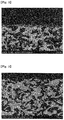
- FIG. 2 shows an SEM observation image of the cross section of Example 1.
- FIG. 3 shows an SEM observation image of the cross section of Comparative Example 1.
- FIG. 4 shows a manner of analysis of Lc and Ld in Example 2.
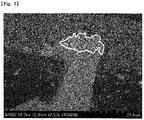
- FIG. 5 shows an SEM observation image of the cross section, capturing a third region in Example 2.
- Example 1 YES 5.0 1.0 1200 14.7 0.31 7.4 47 14 3.8 YES 2 1.4 ⁇ 10 -5 ⁇ Example 2 YES 5.0 2.0 1200 14.7 0.42 13.3 35 22 3.7 YES 12 1.4 ⁇ 10 -5 ⁇ Example 3 YES 5.0 2.5 1200 14.7 0.42 14.0 35 19 3.6 YES 8 1.3 ⁇ 10 -5 ⁇ Example 4 YES 10.0 1.0 1200 14.7 0.31 15.2 47 44 2.0 YES 13 9.3 ⁇ 10 -6 ⁇ Comparative Example 1 No 5.0 1.0 1100 14.7 Layer was not formed - - - No - Second porous layer was not formed - Example 5 YES 5.0 1.5 1200 4.8 0.25 11.5 19 69 3.4 YES 39 3.7 ⁇ 10 -6 ⁇ Comparative Example 1 No 5.0 1.0 1100 14.7 Layer was not formed - - - No - Second porous layer was not formed - Example 5 YES 5.0 1.5 1200 4.8 0.25 11.5 19 69 3.4
- Example 2 As shown in FIG. 2 , in Example 1, where the water and oil repellent spray was applied to the substrate A-12 serving as the first porous layer and then dip-coated with the slurry, a second porous layer including alumina was formed on the first porous layer. Meanwhile, as shown in FIG. 3 , in Comparative Example 1, where the water and oil repellent spray was not used, alumina was taken into pores in the first porous layer deeply, and no second porous layer was able to be formed on the first porous layer.
- FIG. 4 shows a cross section parallel to the lamination direction of the first porous layer and the second porous layer in Example 2.
- a range in which the distance to the first porous layer is smaller than 1 ⁇ m is indicated by a black solid line
- a range in which the distance to the first porous layer is 1 ⁇ m or more is indicated by a white solid line.
- the range indicated by the black solid line corresponds to the range indicated as 6 in FIG. 1 .
- the range indicated by the white solid line corresponds to the range indicated as 7 in FIG. 1 .
- Example 2 the permeance when air was flowed into the porous ceramic laminate was 3.0 ⁇ 10 -6 m 3 /(m 2 ⁇ sec ⁇ Pa) or more and preferably 7.0 ⁇ 10 -6 m 3 /(m 2 ⁇ sec ⁇ Pa) or more.
- FIG. 5 in Example 2, the situation where the glass component in the first porous layer melted and oozed out into the second porous layer and solidified to form the third area is observed at the area surrounded by the white solid line.
- the first porous layer and the second porous layer are favorably adhered to each other. This also matches the result of the membrane strength shown in Table 1.
- Comparative Example 2 had a proportion of Lc/(Lc+Ld) exceeding 70%, and Comparative Example 3 had a value of Da/Db smaller than 10 and a proportion of Lc/(Lc+Ld) exceeding 70%, Comparative Example 2 and Comparative Example 3 had reduced permeance values.
Landscapes
- Chemical & Material Sciences (AREA)
- Engineering & Computer Science (AREA)
- Ceramic Engineering (AREA)
- Inorganic Chemistry (AREA)
- Chemical Kinetics & Catalysis (AREA)
- Materials Engineering (AREA)
- Structural Engineering (AREA)
- Organic Chemistry (AREA)
- Physics & Mathematics (AREA)
- Thermal Sciences (AREA)
- Manufacturing & Machinery (AREA)
- Life Sciences & Earth Sciences (AREA)
- Geology (AREA)
- Nanotechnology (AREA)
- Laminated Bodies (AREA)
- Separation Using Semi-Permeable Membranes (AREA)
- Porous Artificial Stone Or Porous Ceramic Products (AREA)
Applications Claiming Priority (2)
| Application Number | Priority Date | Filing Date | Title |
|---|---|---|---|
| JP2018194512 | 2018-10-15 | ||
| PCT/JP2019/039844 WO2020080225A1 (fr) | 2018-10-15 | 2019-10-09 | Céramique stratifiée poreuse et son procédé de fabrication |
Publications (2)
| Publication Number | Publication Date |
|---|---|
| EP3868733A1 true EP3868733A1 (fr) | 2021-08-25 |
| EP3868733A4 EP3868733A4 (fr) | 2022-07-06 |
Family
ID=70284566
Family Applications (1)
| Application Number | Title | Priority Date | Filing Date |
|---|---|---|---|
| EP19874322.1A Withdrawn EP3868733A4 (fr) | 2018-10-15 | 2019-10-09 | Céramique stratifiée poreuse et son procédé de fabrication |
Country Status (5)
| Country | Link |
|---|---|
| US (1) | US12168635B2 (fr) |
| EP (1) | EP3868733A4 (fr) |
| JP (1) | JP7514183B2 (fr) |
| CN (1) | CN112805264A (fr) |
| WO (1) | WO2020080225A1 (fr) |
Cited By (1)
| Publication number | Priority date | Publication date | Assignee | Title |
|---|---|---|---|---|
| EP4140561A4 (fr) * | 2020-04-22 | 2024-05-29 | Sumitomo Chemical Company, Limited | Stratifié céramique poreux et son procédé de fabrication |
Families Citing this family (5)
| Publication number | Priority date | Publication date | Assignee | Title |
|---|---|---|---|---|
| JP2024001373A (ja) * | 2020-11-26 | 2024-01-10 | Agc株式会社 | 液体分離膜及びその製造方法 |
| JP2024098825A (ja) * | 2023-01-11 | 2024-07-24 | 住友化学株式会社 | 多孔質セラミックス積層体及び分離膜 |
| JP2024127599A (ja) * | 2023-03-09 | 2024-09-20 | 住友化学株式会社 | 多孔質セラミックス層、多孔質セラミックス積層体及び分離膜 |
| JP2025037437A (ja) * | 2023-09-06 | 2025-03-18 | 住友化学株式会社 | 多孔質セラミックス積層体及び分離膜 |
| JP2025037436A (ja) * | 2023-09-06 | 2025-03-18 | 住友化学株式会社 | 多孔質セラミックス積層体及び分離膜 |
Family Cites Families (12)
| Publication number | Priority date | Publication date | Assignee | Title |
|---|---|---|---|---|
| JPS5651245A (en) | 1979-10-03 | 1981-05-08 | Nissan Motor Co Ltd | Coating of solid catalyst carrier |
| JPS62186908A (ja) | 1986-02-10 | 1987-08-15 | Toto Ltd | 非対称膜の製造方法 |
| JPH03143535A (ja) * | 1989-10-26 | 1991-06-19 | Toto Ltd | セラミックス製非対称膜及びその製造方法 |
| JPH11292653A (ja) | 1998-04-02 | 1999-10-26 | Noritake Co Ltd | セラミック多孔体及びその製造方法 |
| JP4094830B2 (ja) * | 2000-11-24 | 2008-06-04 | 日本碍子株式会社 | 多孔質ハニカムフィルター及びその製造方法 |
| JP4673497B2 (ja) * | 2001-04-12 | 2011-04-20 | 株式会社ソフト99コーポレーション | 皮革用撥水艶出しクロス |
| JP2007045691A (ja) * | 2005-08-12 | 2007-02-22 | Research Institute Of Innovative Technology For The Earth | メソポーラス複合体およびその製造方法 |
| JP2009235487A (ja) | 2008-03-27 | 2009-10-15 | Toshiba Corp | 多孔質材料、及び多孔質材料の製造方法 |
| WO2012111792A1 (fr) * | 2011-02-17 | 2012-08-23 | 京セラ株式会社 | Composition revêtue d'un film de carbone et procédé de production correspondant |
| WO2015151699A1 (fr) * | 2014-03-31 | 2015-10-08 | 日本碍子株式会社 | Structure de membrane de séparation monolithique |
| JP6757072B2 (ja) * | 2015-07-23 | 2020-09-16 | 国立大学法人信州大学 | 多孔質膜、水処理膜及び多孔質膜の製造方法 |
| JP2018194512A (ja) | 2017-05-22 | 2018-12-06 | 日立オートモティブシステムズ株式会社 | 電子制御装置の検査方法 |
-
2019
- 2019-10-09 EP EP19874322.1A patent/EP3868733A4/fr not_active Withdrawn
- 2019-10-09 CN CN201980066601.3A patent/CN112805264A/zh active Pending
- 2019-10-09 WO PCT/JP2019/039844 patent/WO2020080225A1/fr not_active Ceased
- 2019-10-09 US US17/283,485 patent/US12168635B2/en active Active
- 2019-10-09 JP JP2020553116A patent/JP7514183B2/ja active Active
Cited By (1)
| Publication number | Priority date | Publication date | Assignee | Title |
|---|---|---|---|---|
| EP4140561A4 (fr) * | 2020-04-22 | 2024-05-29 | Sumitomo Chemical Company, Limited | Stratifié céramique poreux et son procédé de fabrication |
Also Published As
| Publication number | Publication date |
|---|---|
| US12168635B2 (en) | 2024-12-17 |
| JP7514183B2 (ja) | 2024-07-10 |
| WO2020080225A1 (fr) | 2020-04-23 |
| EP3868733A4 (fr) | 2022-07-06 |
| US20210395157A1 (en) | 2021-12-23 |
| CN112805264A (zh) | 2021-05-14 |
| JPWO2020080225A1 (ja) | 2021-09-16 |
Similar Documents
| Publication | Publication Date | Title |
|---|---|---|
| EP3868733A1 (fr) | Céramique stratifiée poreuse et son procédé de fabrication | |
| DE69416133T2 (de) | Kompositmaterial mit hohem brechungsindex, verfahren zur herstellung dieses materials und optisch aktive gegenstände auf basis dieses materials | |
| EP2832429B1 (fr) | Corps en céramique poreux en forme de nid d'abeilles, son procédé de fabrication, et structure à membrane de séparation en céramique en forme de nid d'abeilles | |
| US7585347B2 (en) | Ceramic filter | |
| EP3075719B1 (fr) | Matériau poreux et film thermo-isolant | |
| JPH0534043B2 (fr) | ||
| EP4140561A1 (fr) | Stratifié céramique poreux et son procédé de fabrication | |
| JP2018099678A (ja) | 酸化処理されたSiCを用いた水処理用セラミック分離膜及びその製造方法 | |
| US7053016B2 (en) | Ceramic porous body and method of manufacturing glass usable as binder therefor | |
| WO2017169363A1 (fr) | Matériau de base monolithique et son procédé de production | |
| JP4398105B2 (ja) | セラミック膜フィルター | |
| JP2003112019A (ja) | 多孔質セラミックス中空糸膜の製造方法 | |
| US10870607B2 (en) | Inorganic membrane filtration articles and methods thereof | |
| JP5274321B2 (ja) | セラミック多孔質膜およびセラミック多孔質膜の製造方法 | |
| JP2017177055A (ja) | モノリス型基材及びその製造方法 | |
| CN120548303A (zh) | 多孔质陶瓷层、多孔质陶瓷层叠体及分离膜 | |
| JP2016093794A (ja) | セラミックフィルタ | |
| WO2024150547A1 (fr) | Corps poreux en céramique, et membrane de séparation | |
| US12558655B2 (en) | Transparent reusable ultrahigh molecular weight polyethylene air filter | |
| CN120584096A (zh) | 多孔质陶瓷层、多孔质陶瓷层叠体及分离膜 | |
| KR102416209B1 (ko) | 산화 처리된 SiC를 이용한 수처리용 세라믹 분리막의 제조 방법 | |
| JP2025022447A (ja) | 多孔質セラミックス積層体及び分離膜 | |
| JP2005177693A (ja) | フィルタ及びその製造方法 | |
| JP2025022448A (ja) | セラミックス多孔質積層体の製造方法 | |
| JP2012045490A (ja) | セラミックス分離膜 |
Legal Events
| Date | Code | Title | Description |
|---|---|---|---|
| STAA | Information on the status of an ep patent application or granted ep patent |
Free format text: STATUS: THE INTERNATIONAL PUBLICATION HAS BEEN MADE |
|
| PUAI | Public reference made under article 153(3) epc to a published international application that has entered the european phase |
Free format text: ORIGINAL CODE: 0009012 |
|
| STAA | Information on the status of an ep patent application or granted ep patent |
Free format text: STATUS: REQUEST FOR EXAMINATION WAS MADE |
|
| 17P | Request for examination filed |
Effective date: 20210515 |
|
| AK | Designated contracting states |
Kind code of ref document: A1 Designated state(s): AL AT BE BG CH CY CZ DE DK EE ES FI FR GB GR HR HU IE IS IT LI LT LU LV MC MK MT NL NO PL PT RO RS SE SI SK SM TR |
|
| DAV | Request for validation of the european patent (deleted) | ||
| DAX | Request for extension of the european patent (deleted) | ||
| A4 | Supplementary search report drawn up and despatched |
Effective date: 20220602 |
|
| RIC1 | Information provided on ipc code assigned before grant |
Ipc: B01D 71/02 20060101ALI20220527BHEP Ipc: B01D 69/12 20060101ALI20220527BHEP Ipc: B01D 69/10 20060101ALI20220527BHEP Ipc: B01D 39/20 20060101ALI20220527BHEP Ipc: C04B 41/85 20060101AFI20220527BHEP |
|
| STAA | Information on the status of an ep patent application or granted ep patent |
Free format text: STATUS: EXAMINATION IS IN PROGRESS |
|
| STAA | Information on the status of an ep patent application or granted ep patent |
Free format text: STATUS: THE APPLICATION HAS BEEN WITHDRAWN |
|
| 17Q | First examination report despatched |
Effective date: 20250625 |
|
| 18W | Application withdrawn |
Effective date: 20250709 |