EP3869448A1 - Irisauthentifizierungsvorrichtung, irisauthentifizierungsverfahren und aufzeichnungsmedium - Google Patents
Irisauthentifizierungsvorrichtung, irisauthentifizierungsverfahren und aufzeichnungsmedium Download PDFInfo
- Publication number
- EP3869448A1 EP3869448A1 EP18937158.6A EP18937158A EP3869448A1 EP 3869448 A1 EP3869448 A1 EP 3869448A1 EP 18937158 A EP18937158 A EP 18937158A EP 3869448 A1 EP3869448 A1 EP 3869448A1
- Authority
- EP
- European Patent Office
- Prior art keywords
- image
- target
- score
- authentication
- eye
- Prior art date
- Legal status (The legal status is an assumption and is not a legal conclusion. Google has not performed a legal analysis and makes no representation as to the accuracy of the status listed.)
- Withdrawn
Links
Images




Classifications
-
- G—PHYSICS
- G06—COMPUTING OR CALCULATING; COUNTING
- G06V—IMAGE OR VIDEO RECOGNITION OR UNDERSTANDING
- G06V40/00—Recognition of biometric, human-related or animal-related patterns in image or video data
- G06V40/10—Human or animal bodies, e.g. vehicle occupants or pedestrians; Body parts, e.g. hands
- G06V40/18—Eye characteristics, e.g. of the iris
- G06V40/197—Matching; Classification
-
- G—PHYSICS
- G06—COMPUTING OR CALCULATING; COUNTING
- G06V—IMAGE OR VIDEO RECOGNITION OR UNDERSTANDING
- G06V10/00—Arrangements for image or video recognition or understanding
- G06V10/20—Image preprocessing
- G06V10/22—Image preprocessing by selection of a specific region containing or referencing a pattern; Locating or processing of specific regions to guide the detection or recognition
-
- G—PHYSICS
- G06—COMPUTING OR CALCULATING; COUNTING
- G06V—IMAGE OR VIDEO RECOGNITION OR UNDERSTANDING
- G06V10/00—Arrangements for image or video recognition or understanding
- G06V10/40—Extraction of image or video features
- G06V10/60—Extraction of image or video features relating to illumination properties, e.g. using a reflectance or lighting model
-
- G—PHYSICS
- G06—COMPUTING OR CALCULATING; COUNTING
- G06V—IMAGE OR VIDEO RECOGNITION OR UNDERSTANDING
- G06V10/00—Arrangements for image or video recognition or understanding
- G06V10/70—Arrangements for image or video recognition or understanding using pattern recognition or machine learning
- G06V10/764—Arrangements for image or video recognition or understanding using pattern recognition or machine learning using classification, e.g. of video objects
-
- G—PHYSICS
- G06—COMPUTING OR CALCULATING; COUNTING
- G06V—IMAGE OR VIDEO RECOGNITION OR UNDERSTANDING
- G06V40/00—Recognition of biometric, human-related or animal-related patterns in image or video data
- G06V40/10—Human or animal bodies, e.g. vehicle occupants or pedestrians; Body parts, e.g. hands
- G06V40/103—Static body considered as a whole, e.g. static pedestrian or occupant recognition
-
- G—PHYSICS
- G06—COMPUTING OR CALCULATING; COUNTING
- G06V—IMAGE OR VIDEO RECOGNITION OR UNDERSTANDING
- G06V40/00—Recognition of biometric, human-related or animal-related patterns in image or video data
- G06V40/10—Human or animal bodies, e.g. vehicle occupants or pedestrians; Body parts, e.g. hands
- G06V40/16—Human faces, e.g. facial parts, sketches or expressions
- G06V40/172—Classification, e.g. identification
-
- G—PHYSICS
- G06—COMPUTING OR CALCULATING; COUNTING
- G06V—IMAGE OR VIDEO RECOGNITION OR UNDERSTANDING
- G06V40/00—Recognition of biometric, human-related or animal-related patterns in image or video data
- G06V40/10—Human or animal bodies, e.g. vehicle occupants or pedestrians; Body parts, e.g. hands
- G06V40/18—Eye characteristics, e.g. of the iris
- G06V40/19—Sensors therefor
-
- G—PHYSICS
- G06—COMPUTING OR CALCULATING; COUNTING
- G06V—IMAGE OR VIDEO RECOGNITION OR UNDERSTANDING
- G06V40/00—Recognition of biometric, human-related or animal-related patterns in image or video data
- G06V40/20—Movements or behaviour, e.g. gesture recognition
- G06V40/23—Recognition of whole body movements, e.g. for sport training
- G06V40/25—Recognition of walking or running movements, e.g. gait recognition
-
- G—PHYSICS
- G06—COMPUTING OR CALCULATING; COUNTING
- G06V—IMAGE OR VIDEO RECOGNITION OR UNDERSTANDING
- G06V40/00—Recognition of biometric, human-related or animal-related patterns in image or video data
- G06V40/70—Multimodal biometrics, e.g. combining information from different biometric modalities
Definitions
- the example embodiments relates to an iris authentication device and the like for authenticating a target.
- biometrics-based authentication has a lower risk of leakage and theft than a password or the like created by a user. Therefore, for the purpose of identifying individuals and confirming rights, and for the purpose of protecting security, a case of introducing individual authentication based on an individual difference of a living body increases.
- a personal authentication technology based on an individual difference of a living body there is known a technology using a fingerprint, a vein, a face, an iris, voice, or the like as biometric information.
- iris authentication has high authentication accuracy.
- the reason for this is because an iris pattern is more complicated than a fingerprint, and is certainly different for every person. Furthermore, once an iris pattern is completed, there is no change or deterioration thereafter. Unlike a fingerprint, an iris pattern can be recognized without contact, and forgery is difficult. In addition, even the same person has a different iris pattern between the right eye and the left eye.
- PTL 1 discloses a technique related to an iris authentication device.
- the disclosure has been made in view of the above problems, and one object is to provide an iris authentication device and the like for performing iris authentication with high accuracy by reliably identifying left and right eyes.
- an iris authentication device includes:
- An iris authentication method includes:
- An iris authentication program causes a computer to enable:
- the iris authentication program may be stored in a recording medium.
- an iris authentication device and the like for performing iris authentication with high accuracy by reliably identifying left and right eyes.
- Examples of information for biometric authentication include a plurality of pieces of information such as an ultrasound graph, an image of a living body, or audio data.
- an image specifically, an iris image
- an image are mainly used as an example, but this is not intended to limit the example embodiments.
- an authentication target is mainly a living body, and includes a person (a user), an animal, and the like.
- a thing other than the living body such as a mannequin, for example, may be included.
- iris authentication is performed, left and right eyes (including artificial eyes for the purpose of impersonation) of the target are authenticated.
- the authentication target is also referred to as a "target user”.
- an iris authentication device 100 includes a first image input unit 11, a second image input unit 12, a determination unit 13, a detection unit 14, a storage unit 15, a score calculation unit 16, and an authentication unit 17.
- the first image input unit 11 and the second image input unit 12 are connected to a camera 10.
- the camera 10 is a camera to capture an image of a user to be authenticated. There may be one or a plurality of cameras 10.
- the camera 10 captures an image of a user moving in a specific direction. Moving in a specific direction means, for example, that the user walks from an entrance gate to an exit gate of an authentication execution area, in a case of walk-through authentication (referring to performing biometric authentication while an authentication target user is moving without stopping).
- the user moving in a specific direction is captured by the camera 10 as an image shown in Fig. 2 , for example. Although an image of a whole body is captured in Fig. 2 , this may be an image of a face or the like.
- the camera 10 is fixed at a position where the image as shown in Fig. 2 can be captured (a wall, a gate, or the like).
- image data of a region including the whole body of the user is inputted as a first image to the first image input unit 11, while image data of a region including a periphery of left and right eyes of the user is inputted as a second image to the second image input unit 12.
- Processing for selecting the image region may be performed by the first image input unit 11 and the second image input unit 12 that have received the image from the camera 10. After the camera 10 performs the processing, the first image input unit 11 and the second image input unit 12 may input the image of the selected image region.
- the first image input unit 11 inputs, from the camera 10, the first image (see Fig. 3 ) obtained by capturing, at a particular location, an image of the region including the whole body of the user moving in the specific direction.
- the first image may be a face image of the user.
- the second image input unit 12 inputs, from the camera 10, the second image (see Fig. 3 ) obtained by capturing an image of at least one of a right eye and a left eye of the user moving in the specific direction.
- the second image input unit 12 preferably inputs an image for both eyes.
- the camera 10 is unable to obtain an image of one eye (for example, such as being unable to capture an image due to blocking with bangs or being unable to capture an image due to reflection of glasses), an image is captured for the other eye that can be captured.
- an image is captured for the other eye that can be captured.
- the camera 10 uses a region of the right and left eyes in the whole body image (the first image) of the user to be captured as the second image, but the region of the left and right eyes may be magnified by a telephoto lens and captured.
- the determination unit 13 determines whether the second image is of the left eye or the right eye of the user on the basis of information including the first image, and outputs left/right information indicating a determination result in association with the second image (see Fig. 4 ). As will be described later, the determination unit 13 outputs an image of an iris part as shown in Fig. 4 . In the example embodiment, one of the following two methods is used as an example of the determination of the left and right eyes.
- the determination unit 13 determines whether the second image is of the left eye or the right eye of the user by applying, in a region of the user's face in the first image, a predetermined template for detecting a contour of the face and a positional relationship of both eyes and the like to perform matching processing, and specifying a region including the left eye and the right eye of the target user.
- the user's face needs to face a front side with respect to the camera 10.
- the camera 10 by setting the camera 10 in advance at a position where the image of the user moving toward a predetermined traveling direction can be captured, the user facing the front side with respect to the camera 10 can be inevitably made a target of the determination.
- the determination unit 13 determines whether the second image is relevant to the left eye or the right eye of the user, by comparing a pixel in a region of right and left eyes of the user in the first image with a pixel in a region of right or left eye of the user in the second image.
- the determination unit 13 extracts a pixel of each region of right eye and the left eye of the user in the first image, which is an image of a whole body, and compares the extracted pixels with a pixel in a region of eye captured in the second image, and determines which of the right and left eyes is captured in the second image in accordance with the similarity of the compared pixels.
- a contour tracking algorithm using a chain code, a principal component analysis method, a three-dimensional phase only correlation, or the like may be used.
- a method of determining the left and right eyes is not limited to the above methods.
- the first image and the second image may be captured at the same timing by using two cameras 10.
- the camera to capture an image of the second image may be a telephoto camera capable of capturing an image with a high magnification.
- the first image and the second image may be captured at different timings by using the same camera 10.
- the camera 10 can quickly switch the magnification of the telephoto function for capturing the first image and the second image of the subject.
- the detection unit 14 detects an overlap between a region including the second image and a predetermined region in the first image.
- the camera 10 fixed at a certain place captures an image of the user.
- the determination unit 13 applies, to the first image, a face template for determining positions of the left and right eyes from the contour of the user's face and the like, and specifies a region (the region including the second image) including the left eye and the right eye of the target user included in the first image.
- the specified region including the right eye of the target user is a
- the specified region including the left eye of the target user is b. It is assumed that the first image is divided in advance into rectangular regions as shown in Fig.
- the camera 10 at the predetermined position captures an image of the moving target user
- the right eye is included in a rectangular region B2 and the left eye is included in a rectangular region B3, and the regions are set in advance (these rectangular regions are set as predetermined regions in the first image).
- This can be achieved, for example, by causing a machine learning engine to learn a plurality of images of the target user at a certain position as teacher data in advance.
- the region of the right eye of the target user shown in the first image is included in the rectangular region B2, and the region of the left eye is included in the rectangular region B3.
- the detection unit 14 superimposes the face template and the divided first image, and detects whether the region a of the right eye in the face template overlaps with the rectangular region B2 where the right eye should be present in the first image, and similarly detects whether the region b of the left eye in the face template overlaps with the rectangular region B3 where the left eye should be present in the first image.
- the detection unit 14 outputs, as a detection result, to the score calculation unit 16 that the left and right eyes overlap at an appropriate position.
- no overlap for example, when the left and right eyes of the face template overlap with only a part of the rectangular region (B2, B3) where the left and right eyes should be present in the first image (see Fig.
- the detection unit 14 outputs, as a detection result, to the score calculation unit 16 that the left and right eyes do not overlap at an appropriate position.
- the storage unit 15 stores iris characteristic information of a right eye and iris characteristic information of a left eye, of a plurality of users.
- the iris characteristic information is, for example, an iris code (see characteristic information of Fig. 12 ) generated on the basis of the Daugman's algorithm.
- the score calculation unit 16 calculates the iris characteristic information from the second image (see Fig. 4 ) associated with the left/right information, and calculates a first weighted verification score obtained by weighting the calculated verification score with a detection result.
- a case of using an iris code as the iris characteristic information will be described.
- the score calculation unit 16 specifies a boundary line of an iris from an image of the iris received from the determination unit 13, to extract an iris part. Further, the score calculation unit 16 applies a two-dimensional Gabor filter to information of the extracted iris part to encode an iris pattern, and generates an iris code.
- the iris code is, for example, a 2048 bit digital encoding code.
- the second image associated with the left/right information refers to an iris image determined to be the right eye by the determination unit 13 and tagged as "right eye", or an iris image determined to be the left eye by the determination unit 13 and tagged as "left eye” (see Fig. 4 ).
- the iris code may be tagged with any one of the left and right eyes.
- the score calculation unit 16 compares the calculated characteristic information with characteristic information of a plurality of users related to the left/right information stored in the storage unit 15. Specifically, the score calculation unit 16 compares with characteristic information of only a right eye stored in the storage unit 15 for an iris image tagged as right eye, and compares with characteristic information of only a left eye stored in the storage unit 15 for an iris image tagged as left eye. The score calculation unit 16 obtains a verification score as a result of the comparison. The verification score is a value obtained as a result of calculating the number of bits different between the iris code of the target user and the iris code registered in the storage unit 15 (calculating a hamming distance).
- the score calculation unit 16 weights the detection result by the detection unit 14 to the verification score, to calculate the first weighted verification score. For example, when the detection unit 14 detects that a region including the left eye and a region including the right eye specified with the template is overlapped with the region of the left and right eyes in the divided first image (both eyes overlap at an appropriate position), for example, a calculation result is obtained by multiplying and adding a predetermined value to the verification score, or substituting into a predetermined formula, in order to increase the value of the verification score. In addition, the score calculation unit 16 may weight so as to reduce the verification score, when the score calculation unit 16 receives a detection result that the left and right eyes do not overlap at an appropriate position.
- the authentication unit 17 receives the first weighted verification score from the score calculation unit 16, and authenticates the user captured in the first image and the second image as a registered user (a legitimate user), for example, when the first weighted verification score is equal to or greater than a predetermined threshold value, and authenticates the user captured in the first image and the second image as not a registered user when the first weighted verification score is equal to or less than a predetermined threshold value.
- the authentication unit 17 outputs an authentication result to an external display unit 20.
- the display unit 20 is a liquid crystal display or the like, and can display such that the target user or an administrator of the authentication execution area can browse the authentication result.
- the authentication result may be made known by voice notification with a speaker or a buzzer, lamp lighting, or the like.
- the storage unit 15 stores, in advance, iris characteristic information of a right eye and a left eye relating to a plurality of users that may be the authentication target.
- step S101 the first image input unit 11 inputs a first image obtained by capturing an image of the authentication target user moving in a specific direction.
- the second image input unit 12 inputs, for at least one eye, the second image obtained by capturing an image of the right eye or the left eye of the target user.
- step S102 the determination unit 13 determines whether a second image is of a left eye or a right eye of the target user on the basis of information including the first image, and outputs left/right information indicating a determination result in association with the second image.
- step S103 the detection unit 14 detects an overlap between a region including the second image and a predetermined region in the first image.
- step S104 the score calculation unit 16 calculates a verification score obtained by comparing iris characteristic information calculated from the second image associated with the left/right information, with one or more pieces of characteristic information related to the left/right information and stored in the storage unit 15.
- the score calculation unit 16 weights the verification score with a detection result, to calculate the first weighted verification score.
- step S105 the authentication unit 17 authenticates the user captured in the first image and the second image on the basis of the calculated first weighted verification score, and outputs an authentication result.
- the operation of the iris authentication device 100 is ended.
- iris authentication can be performed by reliably identifying left and right eyes.
- the determination unit 13 determines whether the second image is of a left eye or a right eye of the user on the basis of information including the first image, and outputs a determination result as the left/right information in association with the second image.
- the detection unit 14 detects an overlap between a region including left and right eyes in a region of the face template and a region of left and right eyes in the first image, and weights the verification score on the basis of the detection result.
- the weights for authentication of the left and right eyes are the same, but one eye is easy to identify and one eye is difficult to identify since features of the right and left irises are different even for the same person. Since the eye that is easy to identify requires less time for authentication processing and is more accurate in identification, it is possible to perform authentication with higher accuracy in a shorter time by performing the authentication processing using the eye that is easy to identify among right and left eyes.
- a description is given to an iris authentication device and the like for performing the authentication processing by weighting an eye that is easy to identify.
- an iris authentication device 200 includes a first image input unit 11, a second image input unit 12, a determination unit 13, a detection unit 14, a storage unit 15a, a score calculation unit 16a, and an authentication unit 17.
- the first image input unit 11 and the second image input unit 12 are connected to an external camera 10.
- the authentication unit 17 is connected to an external display unit 20.
- the storage unit 15a stores characteristic information and a reliability score of a right eye and characteristic information and a reliability score of a left eye of each user, for each identifier (ID) that is associated with a user to be authenticated and can be identified.
- the reliability is a value indicating the ease of identification between the target user and other users, and the reliability score represents this value by 0 to 100%. An example of a calculation method of the reliability score will be described.
- similar processing is performed for a left eye, and the calculated value is set as reliability S left .
- the reliability score (%) 100 ⁇ (S -1)/(M -1) is calculated (where 1 ⁇ S ⁇ M; S represents either S right or S left , and M represents a maximum value of the reliability. The maximum value is set in advance by a designer or the like, and the reliability in a case of M ⁇ S is 100).
- the method for calculating the reliability score is not limited to the above. As the reliability score is higher, characteristic information of the target user is easy to be identified (is a rare iris code) as compared with characteristic information of other users.
- the reliability score of the right eye is 80%, and the reliability score of the left eye is 20%, which indicates that an iris of a right eye of the user is distinctive, and there are relatively no users having similar characteristic information. Conversely, it is indicated that an iris of the left eye of the user is not very distinctive, and there are many users having similar characteristic information. In such a case, since it is more efficient to use the right eye for the authentication processing, it is desirable to perform the authentication processing using the second image of the right eye even when the second image of both eyes can be captured.
- the iris authentication device 200 can also request the user to capture the iris image again. Specifically, the iris authentication device 200 requests the user to move again from an entrance gate to an exit gate for authentication again via the display unit 20 or the like. If an eye with a higher reliability score is hidden by hair and the like, the authentication unit 17 may present, to the display unit 20, text or the like requesting cooperation from the user so that the eye having the higher reliability score can be clearly captured by the camera 10.
- the score calculation unit 16a performs authentication using a second weighted verification score obtained by adding the reliability score to the verification score.
- the score calculation unit 16a calculates the verification score obtained by comparing iris characteristic information calculated from the second image associated with the left/right information, with one or more pieces of characteristic information related to the left/right information and stored in the storage unit 15a.
- the score calculation unit 16a specifies the target user on the basis of the verification score, acquires the reliability score related to the target user from the storage unit 15a, and calculates the second weight reference score in which the reliability score is reflected on the calculated verification score. For example, for a user with ID "1" in Fig.
- a reliability score of the right eye is 80%, and a reliability score of the left eye is 20%. Therefore, when the verification score of the second image of both eyes has been calculated, the score calculation unit 16a weights the verification score of the right eye with the reliability score of the right eye, and weights the verification score of the left eye with the reliability score of the left eye. At this time, the score calculation unit 16a may increase the priority of the eye having higher reliability, and weight only the verification score of the right eye with the reliability score of the right eye. This enables a score of higher reliability to be obtained.
- the weighting refers to obtaining a calculation result by multiplying, adding, or substituting both scores into a predetermined formula, for example.
- the score calculation unit 16a transfers the weighted calculation result to the authentication unit 17 as the second weighted verification score.
- the storage unit 15a stores, in advance, iris characteristic information and reliability scores (see Fig. 12 ) of a right eye and a left eye relating to a plurality of users that may be the authentication target.
- Steps S201 to S204 are similar to steps S101 to S104 in Fig. 10 .
- step S205 the score calculation unit 16a specifies the target user from the storage unit 15a on the basis of the verification score calculated in step S204, acquires the reliability score related to the target user from the storage unit 15a, and weights the calculated verification score with the reliability score.
- the score calculation unit 16a may give priority to an eye having higher reliability, and weight the verification score of the eye having higher priority with the reliability score of the eye.
- the score calculation unit 16a transfers a second verification score weighted by the reliability score, to the authentication unit 17.
- Step S206 is similar to step S105 in Fig. 10 .
- the operation of the iris authentication device 200 is ended.
- authentication processing with higher accuracy can be performed, in addition to the effects of the first example embodiment.
- the reason for this is because the score calculation unit 16a specifies the target user from the storage unit 15a on the basis of the calculated verification score, acquires the reliability score related to the target user from the storage unit 15a, and weights the calculated verification score with the reliability score. Further, the reason is because the score calculation unit 16a gives priority to an eye having higher reliability, and weights the verification score of the eye having higher priority with the reliability score of the eye.
- iris authentication using the second image is performed.
- another biometric authentication human form authentication, gait authentication, face authentication, or the like
- multimodal authentication may be performed by combining results of the two authentications. This can further improve the accuracy of authentication.
- an iris authentication device and the like for combining another biometric authentication will be described.
- the human form authentication refers to authentication performed on the basis of physical characteristics (for example, a height, a body width, a length of limbs, a facial contour, or a combination thereof) of a person to be authenticated.
- An iris authentication device 300 includes, as shown in Fig. 14 , a first image input unit 11, a second image input unit 12, a determination unit 13, a detection unit 14, a storage unit 15a, a score calculation unit 16a, an authentication unit 17a, a second score calculation unit 21, a second storage unit 22, and a score integration unit 23.
- the first image input unit 11 and the second image input unit 12 are connected to an external camera 10.
- the authentication unit 17a is connected to an external display unit 20.
- the second storage unit 22 stores information (characteristic information of a human form, a gait, a face, or the like) to be used for authentication of another biometric authentication (human form authentication, gait authentication, face authentication, or the like) using a first image.
- the second score calculation unit 21 calculates characteristic information of a user to be authenticated from the first image as the second verification score, for the other biometric authentication.
- the biometric authentication to be used by the second score calculation unit 21 may be initially set or may be set by the user. For example, when the first image is a static image or a moving image obtained by capturing an image of a whole body of the user, the second score calculation unit 21 calculates the second verification score by performing human form authentication using the static image or gait authentication using the moving image. When the first image is an image obtained by capturing an image of a face of the user, the second score calculation unit 21 calculates the second verification score by performing face authentication using the first image.
- the score integration unit 23 integrates the second weighted verification score outputted from the score calculation unit 16a with the second verification score outputted from the second score calculation unit 21, and outputs as an integrated score to the authentication unit 17a.
- the integrated score is calculated by multiplying, adding, or substituting the weighted verification score and the second verification score into a predetermined formula.
- the second verification score may be integrated to the first weighted verification score outputted by the score calculation unit 16 shown in Fig. 1 .
- the authentication unit 17a uses the integrated score to perform authentication processing.
- the storage unit 15a stores, in advance, iris characteristic information of a right eye and a left eye relating to a plurality of users that may be the authentication target. Further, a reliability score (see Fig. 12 ) may be stored.
- the second storage unit 22 stores, in advance, body characteristic information relating to a plurality of users that may be the authentication target.
- Steps S301 to S305 are similar to steps S201 to S205 in Fig. 13 .
- the second score calculation unit 21 performs biometric authentication (human form authentication, gait authentication, face authentication, or the like) other than iris authentication by using a first image in which a user's body image is captured, calculates characteristic information of the user's body included in the first image, compares the calculated characteristic information with the characteristic information stored in the second storage unit 22, and outputs a comparison result to the score integration unit 23 as the second verification score.
- biometric authentication human form authentication, gait authentication, face authentication, or the like
- step S307 the score integration unit 23 calculates an integrated score obtained by adding the second verification score outputted by the second score calculation unit 21 to the second weighted verification score outputted by the score calculation unit 16a.
- the score integration unit 23 outputs the calculated integrated score to the authentication unit 17a.
- step S308 the authentication unit 17a authenticates the user captured in the first image and the second image on the basis of the calculated integrated score, and outputs an authentication result. Specifically, the authentication unit 17a authenticates the user captured in the first image and the second image as a registered user (a legitimate user), for example, when the integrated score is equal to or greater than a predetermined threshold, and authenticates the user captured in the first image and the second image as not a registered user when the integrated score is equal to or less than a predetermined threshold value. Then, the authentication unit 17a outputs the authentication result to an external display unit 20.
- the operation of the iris authentication device 300 is ended.
- the iris authentication device 300 having even higher authentication accuracy than the iris authentication devices described in the first to second example embodiments.
- the reason for this is because the second score calculation unit 21 calculates characteristic information from a body image of the authentication target user included in the first image and outputs the second verification score, the score integration unit 23 calculates an integrated score in which the second verification score is reflected on the second weighted verification score, and the authentication unit 17a performs the authentication processing on the basis of this integrated score.
- the score integration unit 23 may be designed to reflect the second verification score on the first weighted verification score to calculate the integrated score.
- a machine learning engine is made to learn which rectangular region in the first image includes left and right eyes on the basis of teacher data before operation of the iris authentication device, and a designer or the like sets a position of the camera 10 on the basis of a learning result.
- the machine learning engine can learn where, what, and how images appear on a screen captured by the fixed camera 10, and a position, an angle, and the like of the camera 10 can be adjusted on the basis of the learning result. This can be learned and adjusted by the machine learning engine on the basis mainly of a history of authentication result data when the authentication is successful.
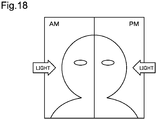
- an image captured by the fixed camera 10 may have different authentication accuracy depending on a season and time. For example, authentication accuracy may be high in the morning but authentication accuracy may be low in the afternoon, or authentication accuracy may be high in the daytime but authentication accuracy may be low at night. This is often caused by a change in light applied to the target user while the camera 10 is capturing an image.
- another possible cause is that types of teacher data used for the learning of the machine learning engine have been biased (for example, only images captured in the morning have been learned). This can be learned and adjusted by the machine learning engine on the basis mainly of a history of authentication result data when the authentication fails.
- the light may be outdoor light (sunlight), indoor light (illumination light), or a mixture thereof.
- Sunlight reaching a ground surface changes in accordance with a season of image capturing and progress of time of image capturing.
- the indoor light changes with illuminance, orientation, and a type of illumination, as well as addition or reduction of illumination.
- An iris authentication device 400 includes, as shown in Fig. 16 , a first image input unit 11, a second image input unit 12, a determination unit 13, a detection unit 14, a storage unit 15a, a score calculation unit 16a, an authentication unit 17, an authentication result storage unit 31, a learning unit 32, and a feedback unit 33.
- the first image input unit 11 and the second image input unit 12 are connected to an external camera 10.
- the authentication unit 17 is connected to an external display unit 20.
- the authentication result storage unit 31 stores authentication result data obtained by the authentication unit 17 (see Fig. 17 ).
- the authentication result data includes, as items, for example, an authentication ID, an authentication time, an authentication result, and authentication image data.
- the authentication ID is an ID for identifying each authentication result.
- the authentication time is the time when the authentication result is calculated.
- the authentication result is a code, a value, or the like representing a result of authentication. As shown in Fig. 17 , the authentication result indicates " ⁇ " for a legitimate user, and " ⁇ " for not a legitimate user. These are all authentication success data. When authentication fails but the user is a legitimate user, an ID of the legitimate user is stored (for example, in Fig.
- the ID of the legitimate user is read from a touch panel, a scanner, or the like (not shown) by a user or a manager.
- the data is to be authentication failure data.
- a method for specifying the authentication failure data is not limited to the above. For example, when an observer is shown in an image captured by the camera 10, it may be regarded that some trouble has occurred in the authentication processing, and the data may be made authentication failure data.
- Whether the observer is shown is determined by face authentication of the observer or by authentication of a mark indicating the observer on the observer's clothing (back, an arm, or the like).
- authentication failure data can also be extracted by comparing the two authentication result data.
- the learning unit 32 learns which rectangular region in a first image includes a pixel indicating a left eye and a right eye, on the basis of the authentication result data extracted from the authentication result storage unit 31. This is for feedback to the detection unit 14 which rectangular region in the first image includes a left eye and a right eye more often.
- the learning unit 32 learns characteristics of light included in the first image and a second image, and determines, in a specific period, which of the left eye or the right eye of the target user should be associated with the second image as left/right information.
- the characteristics of light include a change in a luminance value of a pixel indicating the target user in the first image and the second image.
- the change in the luminance value includes a change in sunlight along seasonal and time transitions at a particular location, as well as a change in a type of a light source and arrangement of the light source in a room.
- the learning unit 32 learns how the characteristics of light affect the luminance value of the pixel indicating the target user, and determines the camera 10 to be used for authentication and left and right eyes to be used for authentication for each date and time, on the basis of a learning result.
- the learning unit 32 includes a machine learning engine or the like that learns on the basis of authentication result data stored in the authentication result storage unit 31.
- the learning unit 32 may be designed to be connected to an external machine learning engine and receive results of learning.
- the learning unit 32 learns on the basis mainly of a history of the authentication success data, and outputs information about a camera position and an angle for accommodating a region of the face of the target user in the first or second image.
- the learning unit 32 learns on the basis mainly of a history of the authentication failure data, and outputs information for determining a video image captured by which camera 10 is suitable, based on a light condition of a current authentication area.
- the learning unit 32 outputs information that authentication should be performed on the basis of the right eye of the target user in the morning, and authentication should be performed on the basis of the left eye of the target user in the afternoon (it is assumed that target user is moving northward). Further, when the learning unit 32 learns that the authentication accuracy tends to decrease at night due to bias of teacher data of the machine learning engine to be used, the learning unit 32 outputs information on types of teacher data to be additionally learned and the like. The learning unit 32 transfers the learning result to the feedback unit 33, and also displays the learning result on the display unit 20.
- the feedback unit 33 adjusts operations of the camera 10, the first image input unit 11, the second image input unit 12, the determination unit 13, the detection unit 14, the score calculation unit 16a, and the authentication unit 17.
- An administrator or the like may manually adjust each unit on the basis of the learning result displayed on the display unit 20.
- the storage unit 15a stores, in advance, iris characteristic information and reliability scores (see Fig. 12 ) of a right eye and a left eye relating to a plurality of users that may be the authentication target.
- Steps S401 to S406 are similar to steps S201 to S206 in Fig. 13 .
- step S407 the learning unit 32 learns which rectangular region in the first image includes a pixel indicating a left eye and a right eye, on the basis of the authentication result data extracted from the authentication result storage unit 31. Further, the learning unit 32 learns characteristics of light included in the first image, and determines, in a specific period, which of the left eye or the right eye of the target user should be associated with the second image as left/right information. This learning may be performed after the authentication result data is accumulated up to a predetermined amount.
- step S408 the learning unit 32 determines whether the learning result should be presented to the display unit 20, or fed back to each unit of the iris authentication device 400.
- the designer may determine in advance, or the learning unit 32 may determine with what kind of trigger or timing the feedback should be made.
- the process proceeds to step S409, and when it is determined that feedback should not be made yet, the process returns to step S401.
- step S408 when receiving the learning result from the learning unit 32, the feedback unit 33 feeds back the learning result to each unit of the iris authentication device 400 to urge adjustment as appropriate.
- the operation of the iris authentication device 400 is ended.
- authentication processing with higher accuracy can be performed, in addition to the effects of the first and second example embodiments.
- the reason for this is because the learning unit 32 learns, on the basis of the history of the authentication result data, which rectangular region in the first image includes a pixel indicating a left eye and a right eye, and learns characteristics of light included in the first and second images. Further, the learning result is fed back to each unit of the iris authentication device 400. This enables authentication with higher accuracy to be performed in accordance with operation of the iris authentication device.
- the individual components of the iris authentication device shown in Figs. 1 , 11 , 14 , 16 , and the like may be implemented by using any combination of, for example, an information processing apparatus 500 as shown in Fig. 20 and a program.
- the information processing apparatus 500 includes, as an example, the following configuration.
- the program 504 for achieving the functions of the individual components of the iris authentication device is stored in advance, for example, in the storage device 505 or the RAM 503, and is read out by the CPU 501, as necessary.
- the program 504 may be supplied via the communication network 509 to the CPU 501, or may be stored in advance in the recording medium 506 and supplied to the CPU 501 by the drive device 507 reading out the program.
- the iris authentication device may be implemented by any combination of an information processing apparatus and a program that are separate for each component.
- a plurality of components included in the iris authentication device may be implemented by any combination of one information processing apparatus 500 and a program.
- iris authentication device may be implemented by other general-purpose or dedicated circuit, processor, and the like, or a combination thereof. These may be configured by a single chip or a plurality of chips connected via a bus.
- Some or all of the individual components of the iris authentication device may be implemented by a combination of the above-described circuit and the like and a program.
- the plurality of information processing apparatuses, circuits, and the like may be centrally arranged or dispersedly arranged.
- the information processing apparatus, the circuit, and the like may be implemented as a form in which each is connected via a communication network, such as a client and server system, a cloud computing system, and the like.
- An iris authentication device comprising:
- the score calculation means specifies the target on the basis of the verification score, acquires the reliability score related to the target from the storage means, and calculates a second weighted verification score obtained by weighting the verification score with the reliability score.
- the iris authentication device according to any one of Supplementary Notes 1 to 3, further comprising:
- the iris authentication device described in Supplementary Note 4 in which the first image is a static image or a moving image obtained by capturing an image of a whole body of the target, and the second score calculation means calculates characteristic information of the body image by executing human form authentication using the static image or gait authentication using the moving image.
- the iris authentication device described in Supplementary Note 4 in which the first image is an image obtained by capturing an image of a face of the target, and the second score calculation means calculates characteristic information of the body image by executing face authentication using the first image.
- the iris authentication device described in Supplementary Note 1, in which the predetermined region is one region in the first image divided into a plurality of regions, the iris authentication device further comprising:
- the iris authentication device described in Supplementary Note 9 in which the learning means learns characteristics of light included in the first image and the second image on the basis of data of the authentication result extracted from the authentication result storage means, and determines which of a left eye or a right eye of the target should be associated with the second image as the left/right information in a specific period.
- the iris authentication device described in Supplementary Note 10 in which the characteristics of light include a change in a luminance value of a pixel indicating a user as the target in the first image and the second image.
- a change in the luminance value includes a change in sunlight along seasonal and time transitions at the particular location, as well as a change in a type of a light source and arrangement of the light source in a room.
- An iris authentication method comprising:
- the storage means stores a reliability score of a right eye and a left eye relating to the targets to be authenticated, and in calculating the first weighted verification score, the target is specified on the basis of the verification score, the reliability score related to the target is acquired from the storage means, and a second weighted verification score obtained by weighting the verification score with the reliability score is calculated.
- the second weighted verification score is calculated with priority given to an eye having a higher value indicating the reliability score.
- the iris authentication method described in Supplementary Note 16, in which the first image is a static image or a moving image obtained by capturing an image of a whole body of the target, and outputting the comparison result as a second verification score includes calculating characteristic information of the body image by executing human form authentication using the static image or gait authentication using the moving image.
- the iris authentication method described in Supplementary Note 16, in which the first image is an image obtained by capturing an image of a face of the target, and outputting the comparison result as a second verification score includes calculating characteristic information of the body image by executing face authentication using the first image.
- a predetermined template is applied to a region of a face of the target in the first image, and it is determined whether the two images are relevant to a left eye or a right eye of the target.
- a pixel in a region of a right eye and a left eye of the target in the first image is compared with a pixel in a region of a right eye or a left eye of the target in the second image, and it is determined whether the two images are relevant to a left eye or a right eye of the target.
- the iris authentication method described in Supplementary Note 13 in which the predetermined region is one region in the first image divided into a plurality of regions, the iris authentication method further comprising: learning which of the regions in the first image includes a pixel indicating a left eye and a right eye on the basis of data of the authentication result extracted from an authentication result storage means for storing data of the authentication result, and setting, as the predetermined region, each of a region of a left eye and a region of a right eye that have been learned.
- a change in the luminance value includes a change in sunlight along seasonal and time transitions at the particular location, as well as a change in a type of a light source and arrangement of the light source in a room.
- a recording medium storing an iris authentication program for causing a computer to enable:
- the recording medium as described in Supplementary Note 25 or 26, in which in calculating the first weighted verification score, the second weighted verification score is calculated with priority given to an eye having a higher value indicating the reliability score.
- the iris authentication program further comprising:
- the recording medium as described in Supplementary Note 28, in which the first image is a static image or a moving image obtained by capturing an image of a whole body of the target, and outputting the comparison result as a second verification score includes calculating characteristic information of the body image by executing human form authentication using the static image or gait authentication using the moving image.
- the recording medium as described in Supplementary Note 28, in which the first image is an image obtained by capturing an image of a face of the target, and outputting the comparison result as a second verification score includes calculating characteristic information of the body image by executing face authentication using the first image.
- the iris authentication program further comprising: learning which of the regions in the first image includes a pixel indicating a left eye and a right eye on the basis of data of the authentication result extracted from an authentication result storage means for storing data of the authentication result, and setting, as the predetermined region, each of a region of a left eye and a region of a right eye that have been learned.
- the recording medium as described in Supplementary Note 33 in which the learning includes learning characteristics of light included in the first image and the second image on the basis of data of the authentication result extracted from the authentication result storage means, and determining which of a left eye or a right eye of the target should be associated with the second image as the left/right information in a specific period.
- the recording medium as described in Supplementary Note 34 in which the characteristics of light include a change in a luminance value of a pixel indicating a user as the target in the first image and the second image.
- a change in the luminance value includes a change in sunlight along seasonal and time transitions at the particular location, as well as a change in a type of a light source and arrangement of the light source in a room.
Landscapes
- Engineering & Computer Science (AREA)
- Theoretical Computer Science (AREA)
- Multimedia (AREA)
- General Physics & Mathematics (AREA)
- Physics & Mathematics (AREA)
- Human Computer Interaction (AREA)
- General Health & Medical Sciences (AREA)
- Health & Medical Sciences (AREA)
- Ophthalmology & Optometry (AREA)
- Computer Vision & Pattern Recognition (AREA)
- Software Systems (AREA)
- Databases & Information Systems (AREA)
- Computing Systems (AREA)
- Artificial Intelligence (AREA)
- Evolutionary Computation (AREA)
- Medical Informatics (AREA)
- Oral & Maxillofacial Surgery (AREA)
- Psychiatry (AREA)
- Social Psychology (AREA)
- Collating Specific Patterns (AREA)
- Image Analysis (AREA)
- Measurement Of The Respiration, Hearing Ability, Form, And Blood Characteristics Of Living Organisms (AREA)
Applications Claiming Priority (1)
| Application Number | Priority Date | Filing Date | Title |
|---|---|---|---|
| PCT/JP2018/038396 WO2020079741A1 (ja) | 2018-10-16 | 2018-10-16 | 虹彩認証装置、虹彩認証方法および記録媒体 |
Publications (2)
| Publication Number | Publication Date |
|---|---|
| EP3869448A1 true EP3869448A1 (de) | 2021-08-25 |
| EP3869448A4 EP3869448A4 (de) | 2021-10-27 |
Family
ID=70283755
Family Applications (1)
| Application Number | Title | Priority Date | Filing Date |
|---|---|---|---|
| EP18937158.6A Withdrawn EP3869448A4 (de) | 2018-10-16 | 2018-10-16 | Irisauthentifizierungsvorrichtung, irisauthentifizierungsverfahren und aufzeichnungsmedium |
Country Status (4)
| Country | Link |
|---|---|
| US (5) | US11348370B2 (de) |
| EP (1) | EP3869448A4 (de) |
| JP (1) | JP7192872B2 (de) |
| WO (1) | WO2020079741A1 (de) |
Families Citing this family (8)
| Publication number | Priority date | Publication date | Assignee | Title |
|---|---|---|---|---|
| US11341459B2 (en) * | 2017-05-16 | 2022-05-24 | Artentika (Pty) Ltd | Digital data minutiae processing for the analysis of cultural artefacts |
| JP7188446B2 (ja) * | 2018-09-28 | 2022-12-13 | 日本電気株式会社 | 認証装置、認証方法、認証プログラムおよび記録媒体 |
| WO2020079741A1 (ja) | 2018-10-16 | 2020-04-23 | 日本電気株式会社 | 虹彩認証装置、虹彩認証方法および記録媒体 |
| US11531887B1 (en) * | 2020-01-23 | 2022-12-20 | Amazon Technologies, Inc. | Disruptive prediction with ordered treatment candidate bins |
| JP7568114B2 (ja) * | 2021-07-30 | 2024-10-16 | 日本電気株式会社 | 情報処理システム、情報処理装置、情報処理方法、及び記録媒体 |
| KR20230121399A (ko) * | 2022-02-11 | 2023-08-18 | 현대자동차주식회사 | 차량 및 차량의 제어방법 |
| US20260080278A1 (en) * | 2022-10-06 | 2026-03-19 | Nec Corporation | Information processing system, information processing method, and non-transitory recording medium |
| JP2026010780A (ja) * | 2024-07-10 | 2026-01-23 | 株式会社日立製作所 | 認証システム及び認証方法 |
Family Cites Families (14)
| Publication number | Priority date | Publication date | Assignee | Title |
|---|---|---|---|---|
| US20070019882A1 (en) * | 2004-01-30 | 2007-01-25 | Shoji Tanaka | Makeup simulation program, makeup simulation device, and makeup simulation method |
| JP2005227933A (ja) | 2004-02-12 | 2005-08-25 | Oki Electric Ind Co Ltd | バイオメトリクス照合高速化方法 |
| JP2006212185A (ja) * | 2005-02-03 | 2006-08-17 | Matsushita Electric Ind Co Ltd | 生体判別装置および認証装置ならびに生体判別方法 |
| JP2007319174A (ja) | 2006-05-30 | 2007-12-13 | Matsushita Electric Ind Co Ltd | 撮影装置およびそれを用いた認証装置 |
| JP2008117333A (ja) * | 2006-11-08 | 2008-05-22 | Sony Corp | 情報処理装置、情報処理方法、個人識別装置、個人識別装置における辞書データ生成・更新方法および辞書データ生成・更新プログラム |
| JPWO2009016846A1 (ja) | 2007-08-02 | 2010-10-14 | パナソニック株式会社 | 虹彩認証装置および虹彩認証システム |
| JP2009277027A (ja) * | 2008-05-15 | 2009-11-26 | Seiko Epson Corp | 画像における顔の器官の画像に対応する器官領域の検出 |
| US8538044B2 (en) * | 2008-09-26 | 2013-09-17 | Panasonic Corporation | Line-of-sight direction determination device and line-of-sight direction determination method |
| US8948467B2 (en) * | 2010-08-06 | 2015-02-03 | Honeywell International Inc. | Ocular and iris processing system and method |
| US10089525B1 (en) * | 2014-12-31 | 2018-10-02 | Morphotrust Usa, Llc | Differentiating left and right eye images |
| US9449217B1 (en) * | 2015-06-25 | 2016-09-20 | West Virginia University | Image authentication |
| JP6921694B2 (ja) | 2017-09-21 | 2021-08-18 | 株式会社東芝 | 監視システム |
| KR102532746B1 (ko) | 2018-02-21 | 2023-05-16 | 삼성전자주식회사 | 전자 장치 및 그 제어 방법 |
| WO2020079741A1 (ja) * | 2018-10-16 | 2020-04-23 | 日本電気株式会社 | 虹彩認証装置、虹彩認証方法および記録媒体 |
-
2018
- 2018-10-16 WO PCT/JP2018/038396 patent/WO2020079741A1/ja not_active Ceased
- 2018-10-16 EP EP18937158.6A patent/EP3869448A4/de not_active Withdrawn
- 2018-10-16 JP JP2020551622A patent/JP7192872B2/ja active Active
- 2018-10-16 US US17/283,050 patent/US11348370B2/en active Active
-
2022
- 2022-03-02 US US17/684,808 patent/US11651624B2/en active Active
- 2022-03-02 US US17/684,793 patent/US11663853B2/en active Active
- 2022-03-02 US US17/684,802 patent/US11756336B2/en active Active
-
2023
- 2023-07-03 US US18/217,851 patent/US11989975B2/en active Active
Also Published As
| Publication number | Publication date |
|---|---|
| US11663853B2 (en) | 2023-05-30 |
| US11348370B2 (en) | 2022-05-31 |
| JPWO2020079741A1 (ja) | 2021-09-24 |
| EP3869448A4 (de) | 2021-10-27 |
| JP7192872B2 (ja) | 2022-12-20 |
| US11989975B2 (en) | 2024-05-21 |
| US20220189205A1 (en) | 2022-06-16 |
| WO2020079741A1 (ja) | 2020-04-23 |
| US11756336B2 (en) | 2023-09-12 |
| US20220189207A1 (en) | 2022-06-16 |
| US20210350126A1 (en) | 2021-11-11 |
| US20230351809A1 (en) | 2023-11-02 |
| US11651624B2 (en) | 2023-05-16 |
| US20220189206A1 (en) | 2022-06-16 |
Similar Documents
| Publication | Publication Date | Title |
|---|---|---|
| US11989975B2 (en) | Iris authentication device, iris authentication method, and recording medium | |
| Chan et al. | Face liveness detection using a flash against 2D spoofing attack | |
| US12217548B2 (en) | Authentication device, authentication method, and recording medium | |
| EP3617993B1 (de) | Kollationsvorrichtung, kollationsverfahren und kollationsprogramm | |
| US11682236B2 (en) | Iris authentication device, iris authentication method and recording medium | |
| KR20110067716A (ko) | 얼굴 인식을 위한 복수의 얼굴 이미지를 등록하기 위한 장치 및 방법 | |
| Zhang et al. | A virtual proctor with biometric authentication for facilitating distance education | |
| Srivastava et al. | A machine learning and IoT-based anti-spoofing technique for liveness detection and face recognition | |
| KR100847142B1 (ko) | 얼굴 인식을 위한 전처리 방법, 이를 이용한 얼굴 인식방법 및 장치 | |
| JP2022040244A (ja) | 情報処理装置、方法およびプログラム | |
| Shah et al. | Strengthening Facial Biometrics: An Innovative Approach to Liveness Detection for Anti-Spoofing | |
| Dixit et al. | SIFRS: Spoof Invariant Facial Recognition System (A Helping Hand for Visual Impaired People) |
Legal Events
| Date | Code | Title | Description |
|---|---|---|---|
| STAA | Information on the status of an ep patent application or granted ep patent |
Free format text: STATUS: THE INTERNATIONAL PUBLICATION HAS BEEN MADE |
|
| PUAI | Public reference made under article 153(3) epc to a published international application that has entered the european phase |
Free format text: ORIGINAL CODE: 0009012 |
|
| STAA | Information on the status of an ep patent application or granted ep patent |
Free format text: STATUS: REQUEST FOR EXAMINATION WAS MADE |
|
| 17P | Request for examination filed |
Effective date: 20210517 |
|
| AK | Designated contracting states |
Kind code of ref document: A1 Designated state(s): AL AT BE BG CH CY CZ DE DK EE ES FI FR GB GR HR HU IE IS IT LI LT LU LV MC MK MT NL NO PL PT RO RS SE SI SK SM TR |
|
| A4 | Supplementary search report drawn up and despatched |
Effective date: 20210928 |
|
| RIC1 | Information provided on ipc code assigned before grant |
Ipc: G06K 9/00 20060101ALI20210922BHEP Ipc: G06T 7/00 20170101AFI20210922BHEP |
|
| DAV | Request for validation of the european patent (deleted) | ||
| DAX | Request for extension of the european patent (deleted) | ||
| REG | Reference to a national code |
Ref country code: DE Ref legal event code: R079 Free format text: PREVIOUS MAIN CLASS: G06T0007000000 Ipc: G06V0040180000 |
|
| STAA | Information on the status of an ep patent application or granted ep patent |
Free format text: STATUS: EXAMINATION IS IN PROGRESS |
|
| RIC1 | Information provided on ipc code assigned before grant |
Ipc: G06V 40/16 20220101ALI20220511BHEP Ipc: G06V 40/18 20220101AFI20220511BHEP |
|
| 17Q | First examination report despatched |
Effective date: 20220613 |
|
| GRAP | Despatch of communication of intention to grant a patent |
Free format text: ORIGINAL CODE: EPIDOSNIGR1 |
|
| STAA | Information on the status of an ep patent application or granted ep patent |
Free format text: STATUS: GRANT OF PATENT IS INTENDED |
|
| INTG | Intention to grant announced |
Effective date: 20230216 |
|
| STAA | Information on the status of an ep patent application or granted ep patent |
Free format text: STATUS: THE APPLICATION IS DEEMED TO BE WITHDRAWN |
|
| 18D | Application deemed to be withdrawn |
Effective date: 20230627 |