EP3869778A1 - Album photo sur papier augmenté - Google Patents
Album photo sur papier augmenté Download PDFInfo
- Publication number
- EP3869778A1 EP3869778A1 EP21158202.8A EP21158202A EP3869778A1 EP 3869778 A1 EP3869778 A1 EP 3869778A1 EP 21158202 A EP21158202 A EP 21158202A EP 3869778 A1 EP3869778 A1 EP 3869778A1
- Authority
- EP
- European Patent Office
- Prior art keywords
- frame
- video
- image
- framed
- Prior art date
- Legal status (The legal status is an assumption and is not a legal conclusion. Google has not performed a legal analysis and makes no representation as to the accuracy of the status listed.)
- Granted
Links
Images


Classifications
-
- H—ELECTRICITY
- H04—ELECTRIC COMMUNICATION TECHNIQUE
- H04N—PICTORIAL COMMUNICATION, e.g. TELEVISION
- H04N5/00—Details of television systems
- H04N5/76—Television signal recording
- H04N5/765—Interface circuits between an apparatus for recording and another apparatus
- H04N5/77—Interface circuits between an apparatus for recording and another apparatus between a recording apparatus and a television camera
- H04N5/772—Interface circuits between an apparatus for recording and another apparatus between a recording apparatus and a television camera the recording apparatus and the television camera being placed in the same enclosure
-
- H—ELECTRICITY
- H04—ELECTRIC COMMUNICATION TECHNIQUE
- H04N—PICTORIAL COMMUNICATION, e.g. TELEVISION
- H04N23/00—Cameras or camera modules comprising electronic image sensors; Control thereof
- H04N23/80—Camera processing pipelines; Components thereof
-
- G—PHYSICS
- G06—COMPUTING OR CALCULATING; COUNTING
- G06T—IMAGE DATA PROCESSING OR GENERATION, IN GENERAL
- G06T11/00—Two-dimensional [2D] image generation
-
- G—PHYSICS
- G06—COMPUTING OR CALCULATING; COUNTING
- G06V—IMAGE OR VIDEO RECOGNITION OR UNDERSTANDING
- G06V20/00—Scenes; Scene-specific elements
- G06V20/20—Scenes; Scene-specific elements in augmented reality scenes
-
- H—ELECTRICITY
- H04—ELECTRIC COMMUNICATION TECHNIQUE
- H04N—PICTORIAL COMMUNICATION, e.g. TELEVISION
- H04N23/00—Cameras or camera modules comprising electronic image sensors; Control thereof
- H04N23/60—Control of cameras or camera modules
- H04N23/63—Control of cameras or camera modules by using electronic viewfinders
Definitions
- the present invention relates to the technical sector of the capture of images and their processing.
- the invention refers to an innovative method which allows display, through the camera of a mobile device, of a static real image, for example a paper photograph, and with the mobile device programmed to animate said image in real time in order to create an Augmented Photo Album.
- all these mobile devices are equipped with one or more cameras in order to be able to acquire images in the form of photos and/or videos which are then stored in a memory module on the device itself.
- apps software applications that are pre-installed in the memory of the mobile device or which can be downloaded from the internet and which allow these images to be further processed for the most diverse reasons and in the most divers of ways.
- the images that are animated are however only and exclusively virtual images which have been previously captured by the camera and are therefore stored in the memory of the device in question (as they could also be in memory in a "cloud").
- a succession of these images obtained with a sequence of shots made by the software itself, following the single shot taken by the user, can all later be compacted in a single file that creates the moving image effect.
- the only feasible action, as mentioned, is to start the video recording and/or capture of one or more photos or a sequence of photos in a certain time and then process them subsequently. Subsequent processing allows an in-motion display of the original virtual image.
- the user makes a video and can, for example, print some frames of the video in paper form, in order, for example, to create and keep a paper album.
- This method includes the following steps:
- the mobile device can for example be a smart mobile phone or a tablet, as they are equipped with a camera, a video screen and a processor capable of processing information.
- a user wishing to animate a photo in a paper album can place the photo on any support, on a table for example, and frame it through the camera of his mobile device (for example a tablet, or smartphone).
- his mobile device for example a tablet, or smartphone.
- the user will display the image he is framing live on the screen and, by launching the appropriate software application, the mobile device's processor will be able to process a "live" animation of the image framed in real time.
- the proposed solution therefore provides for the advance production of a video, while the image that is animated is the print of a frame of this video, the initial frame (at instant 0) of the video.
- the user can now animate printed images that come from a video shot previously.
- a frame is printed which, when framed, can be animated.
- the user can thus animate prints deriving from videos he has produced with his mobile device.
- the said step of creating the transparent virtual layer comprises a step of recognizing the print framed inside the full image; said recognition occurs through a comparison made between a virtual image saved in the memory of the mobile device and said framed real image (IMM_1).
- a tracing step which allows the dimensions of the print framed inside the full image to be determined together with its spatial coordinates (X; Y; Z) in such a way as to create the said transparent virtual layer having the same dimensions as the print, recognized in the previous step: this virtual layer is then fastened above the said image.
- the application now creates and clips a transparent virtual layer (lay_virt) to the print framed in real time, although the image as a whole may contain other objects in the frame in addition to the above-mentioned print.
- lay_virt a transparent virtual layer
- the transparent layer therefore becomes a fixed reference to which may now be clipped the video layer, which instead is not transparent but overlays the print that corresponds to the initial instant 0 frame.
- the application then clips the video layer (lay_vid) that is generated by the video associated with the image and starts playing the video above the real photo, obtaining the final effect of the print coming to life, making the frames scroll in succession at the various moments taken from the video.
- lay_vid video layer
- the transparent layer and the video layer are generated with known art layer generation technologies.
- the first frame of the video coincides with the printed and framed frame while the following frames are different images that determine the movement.
- the user therefore, must first prepare the video via his mobile device, the application will create and save the initial frame of any video in a directory and it will be possible to print this first instant 0 frame. This print will be animated as described above in summary.
- the user can be directed to choose an album pointing to a directory present in the memory of the device being used, where the images taken previously from the relative video recordings made by the user are stored. If the user deletes the app and loses the data, these images can be recovered from the network inside the remote folder in the Cloud.
- the user selects a photo album in the app and then activates the camera provided in the device.
- the user is able to view the real world he is framing with the camera on the video screen of his mobile device.
- No image capture is required at this stage since the animation process, however detailed, is carried out precisely on a specific image framed in real time by the camera, i.e. the printed image preferably of the first instant 0 frame, which can preferably be printed on paper but also on other media.
- Live Photo Compared to the prior art which consisted of the above-mentioned "Live Photo” (Apple), further advantages are shown in the table below: Live Photo Present invention Animated object Virtual photograph Real paper photograph Duration of animation Limited (a few seconds) Variable Real-time filters No Yes Audio No Yes
- the said virtual layer generated has the same length and width dimensions as the framed print.
- the said video layer (Lay_vid) is generated from the video produced which is identified through the association that exists between the said video and the frame from which it is taken, following positive recognition.
- the first frame of the video coincides with the printed and framed frame, so as to perfectly overlay it.
- the scrolling of the subsequent frames results in animation.
- a further filter layer (Lay_fil) can be further provided which is generated and superimposed on the video layer (Lay_vid) in such a way as to generate a predetermined effect in playback of the animation, for example a certain coloring or the application of a cartoon bubble.
- a mobile device preferably a smart mobile telephone or a tablet, having a processor programmed to be able to process and carry out the steps of the method in accordance with what has been described above.
- Also described here is a software program comprising instructions which, when the program is run by a mobile device, determine execution of the steps of the method in accordance with what has been described above.
- Figure 1 shows a flow chart describing the operational/software method, according to the invention.
- a mobile device which can be a new generation mobile telephone, a smartphone, or a tablet for instance.
- They can normally be connected to the internet to download information and software applications that can run on said mobile device.
- Such mobile devices are also provided with one or more cameras (there are many types of varying resolution) in order to frame images and then take photos and/or videos that can be stored in the memory of the mobile device or in the cloud.
- Management of this operating method is therefore carried out by a specific software program which may be originally present in the memory of the mobile device or can be downloaded from the internet in the form of a software application (app).
- the processor of the mobile device can run the software, correctly performing the necessary processing operations.
- Figure 1A is a schematic diagram of a mobile device, for example a mobile telephone, which acquires a video comprising a succession of frames from instant 0 onwards and from which the initial frame is extrapolated at instant 0.
- Both are saved in the device memory or in a directory in the cloud.
- the complete shot generally does not frame only the print but also surrounding objects according to the framing that the user makes.
- the user can produce a video in advance which is only subsequently processed by the software application, i.e. when the application is launched.
- the user can access the software application and produce the video through the same mobile application.
- the frame thus created is now automatically saved in a directory in the device memory (and possibly in a cloud folder), so as to be recoverable when needed by the software system.
- the video is present in memory and so also is the single instant 0 frame taken from this video and therefore associated with this video.
- the application automatically allows this first frame of the video at instant 0 (frame t_0) to be printed on a paper medium, for example through an online print service or in other equivalent ways.
- the user can in any case, however, print this first frame extrapolated from the video and print it on paper medium or on any medium, provided that it can obviously be framed through the lens of the mobile device.
- the printed image can be framed live by the lens and animated live while it is being framed.
- the animation basically provides for a superimposition of the video taken from the printed image but, to do this, it is necessary to fasten the video to the image of the real framed print, which is inside a main image shot live and which can contain other objects (the frame is generally larger than the object that it is desired to frame).
- a step of recognition and tracing is provided precisely in order to identify the print framed inside the full image (which occupies the full mobile device's screen), all by using the stored frame from which the print that is to be framed has been taken.
- the user is required by the software to select a photographic album present in the memory where the saved images are present, i.e. the frame_0 of each of the various videos.
- This selection of the album, or selection of a directory facilitates the calculation operation but could also not be carried out and the software could search and analyze the entire memory.
- the camera is activated and the user can frame the real world and therefore the real image, and in particular the printed image.
- the frame will capture not only the printed image but also what in the real world is around the said printed image.
- the shot could frame any other objects present.
- the recognition therefore serves, as clarified below, to identify the print in the frame and build a transparent virtual layer of the correct size which can thus be fastened on the real print in a certain position inside the framed real image, thus excluding any other elements present in the image.
- the video is therefore also processed in the form of a video layer with known techniques, and fastened to the transparent layer.
- the recognition also serves to identify, among possibly various videos, the correct video to be superimposed as the positively recognized frame in memory is also associated with the related video.
- the app retrieves from the memory of the mobile device itself the video associated with this frame which has the same name as the photo but with the extension mp4 (photo_1.mp4 based on the example of the name provided for the image), in order to generate the animation.
- the frame at instant 0 e.g. foto_1.png
- the app retrieves from the memory of the mobile device itself the video associated with this frame which has the same name as the photo but with the extension mp4 (photo_1.mp4 based on the example of the name provided for the image), in order to generate the animation.
- What is framed by the camera in real time is processed by the processor in real time, through the said software application, in such a way as to check if at least part of what is framed in real time (in particular, the print) corresponds to a certain frame present in the directory, taken from a video and associated therewith.
- An image recognition algorithm can be used for this purpose.
- the image recognition algorithm is in itself known art and there are many applications (algorithms, generally) serving this purpose. They can, for example, work through a pixel brightness analysis, once an image is transformed into a matrix of pixels with each pixel having a certain coloring.
- the image is positively recognized, i.e. the print framed by the camera inside the complete framed image corresponds to one of the images in the directory, then it is possible to carry out a tracing step, i.e. a step in which the positioning coordinates and the dimensions of the print framed inside the real image can be determined and, consequently, it is possible to generate a layer of the correct size, or a virtual layer, which can, at this point, be correctly superimposed on the framed print, located and geometrically defined inside the full image framed by the camera of the mobile device.
- a tracing step i.e. a step in which the positioning coordinates and the dimensions of the print framed inside the real image can be determined and, consequently, it is possible to generate a layer of the correct size, or a virtual layer, which can, at this point, be correctly superimposed on the framed print, located and geometrically defined inside the full image framed by the camera of the mobile device.
- the recognition is useful in order to be able to correctly generate and also position the transparent virtual layer in the right position, so that it correctly overlaps the print framed inside the real image, moreover creating a layer of the correct size that traces that of the image printed and shot in real time.
- the user will move his/her mobile device framing the real world while the processor processes what is framed in real time in order to carry out the above-mentioned recognition step by comparing the framed image with the images present in the memory directory associated with the album chosen by the user in the app. If recognition does not occur, the animation is simply not processed.
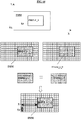
- the image recognition step is better detailed with reference to figures 2 and 2A , in which a mobile telephone 10 has been schematized (similarly for any mobile device in general), having a screen 20.
- the user By means of the camera, or rather the lens, provided in the mobile telephone (not visible in figure 2 for simplicity's sake) the user displays on the screen 20 the real image (IMM) which contains, in addition to any other objects not shown for simplicity's sake, the print (PRINT_1) of what is intended to be animated.
- IMM real image
- PRINT_1 the print of what is intended to be animated.
- PRINT_1 the print of what is intended to be animated.
- PRINT_1 has been schematized as (PRINT_1) and corresponds to the printed image of the first instant 0 frame of a certain video placed within the complete frame (IMM) in real time.
- the image displayed live on the screen i.e. IMM as indicated in figure 2A
- the software can, for example, transform the complete framed image (IMM) into a matrix of pixels (for this, see figure 14 of the IMM image in the form of a grid representing the matrix of pixels inside which is the framed print highlighted by a different coloring of pixels).
- the software performs a comparison with the matrix of pixels of the frames stored (see the grid of frame_c_0).
- frame_c_0 matches at least a part of the matrix of the image (IMM), this means that there is a brightness correspondence, i.e. the matrix of the frame's pixels are the same as a portion of the matrix of pixels within the image.
- the recognition step is therefore important as it allows, as already said, a "transparent layer" to be created which is superimposed, in augmented reality and fastened to the real image shot live augmenting the reality framed by the device's camera.
- the pixel analysis technique could be considered one possible image recognition technique, even if other recognition techniques are implementable.
- the processor is able to extrapolate dimensions and coordinates such that the transparent virtual layer is created and correctly fastened to the real print in augmented reality.
- Figure 4 further shows precisely the said step of tracing the framed print within the image in which, precisely because of the correct recognition, the software can determine the correct spatial coordinates (X; Y) of the framed object in real time and an elevation Z which must be greater than the z of the real image, so that the transparent layer is on top of the real image.
- Figure 4 thus shows the Cartesian axes (X; Y; Z) with the detected coordinates (X1; Y1; Z1) of the framed image (obviously after it has been positively recognized) and with the relative length (l) and height (h) dimensions.
- Figure 7 shows the superimposition of the transparent virtual layer on the framed image.
- these measurements and this step of calculating the measurements and the position are used to create and then perfectly superimpose the transparent layer (lay_virt) on the framed print inside the real image (IMM) so that an augmented image is created, by way of this superimposition. Therefore, the coordinates (X, Y, Z) and the dimensional measurements introduced above are used to create a transparent image of the same size as the real image and which can be perfectly superimposed on the real image (the print).
- the transparent layer is important in that it serves as a fasten, i.e., as a placeholder for subsequent animation layers. This layer is therefore used to trace the real image in augmented reality.
- FIG. 3 is an excellent illustration and summary of what has been described up to now.
- Figure 3 is, in fact, a block diagram showing the interaction of the user with his mobile device on which this software application is present and therefore illustrates the interaction between user and application.
- the user opening the application is asked to select an album of preloaded virtual images, i.e. created previously and stored in the device.
- Photos can be downloaded remotely but only when the app is opened. So, when the user selects an album, the photos are already in memory (either because they were there already before the app was opened, or because they were downloaded when the app was started).
- the image must be the one relating to the object that is intended to be animated, so if the user wants to animate a paper photo, he must first acquire the video of the object in motion and stored in such a way that, when the app is started, it is sent back to the directory, allowing selection of this image taken from the video.
- the system then proceeds with a mapping step that provides for the above-mentioned image recognition, tracing of the image and creation of the transparent layer that is applied to the image framed.
- the image is traced through the transparent layer that is applied to the image framed by the camera.
- the next step is the animation step using the video associated with frame_0.
- the overlaying, frame by frame, of the video generates the animation and this is highlighted in figures 8 , 9 , 11 and 12 where overlaying of the generated video layer on Lay_virt can be seen.
- Lay_virt is a tracing frame that is created once for each print, recognized by the image recognition algorithm, during the augmented reality session and is deleted at the end of the augmented reality session.
- the video layer (lay_vid) is created (i.e. generated) from the video and superimposed whenever the real image is recognized.
- the video layer is removed every time as it takes up space in RAM and, having several of them may lead to the application crashing due to running out of memory.
- the video i.e. the content of Lay_vid which is superimposed on the virtual layer
- the video is of itself formed by a succession of frames, the scrolling of which in the lay_vid generates the animation.
- the video frames generate animation of the image.
- Each of these frames at various instants (t0, t1, t2, etc.) is superimposed on the transparent layer in temporal sequence, i.e. the frame at instant t0 is superimposed on the transparent layer and then removed and replaced by the frame at instant t1, and so on.
- the superimposition therefore further augments what is already augmented reality as the virtual layer is now superimposed on the framed image (IMM) in correspondence with the framed print and the various frames of the video are alternated above it, in succession.
- Figure 11 shows, in fact, the framed image (IMM), on which the transparent Layer is superimposed and, above it, the sequence of frames which, as shown in figure 12 , alternate in succession on the image (IMM) at different instants, thus creating the animation.
- the virtual layer maintains this reference even though it is not very heavy, and therefore does not overload the RAM of the device.
- some filters may be selected, each of which always in the form of a further layer (lay_flt) that is superimposed on that of the video frames to add additional effects and colors (where desired).
- lay_flt a further layer
- a filter can be selected.
- the number of filter layers is at most 1. You can therefore apply the "cartoon bubble” filter that applies the cartoon effect to each frame of the video displayed on the mobile device's screen.
- the app If, subsequently, the user wants to modify the filter, wishing to apply the "hot” filter, for example, the app then first deletes the "cartoon bubble” filter, subsequently applied, and then adds the "hot” filter.
- Only one filter can therefore be selected and applied from time to time.
- the processing goes from a minimum of three overlaid layers (real image, transparent layer and frame layers taken from the video) to four layers when a fourth layer related to filters is added.
- a mobile device equipped with a camera is able to animate any thing/object framed by the camera in real time and with the animation which, in real time, is processed and therefore visible to the user who is framing that thing/object.
- the frame that is printed is generally the first frame of the video, since the first frame of the video and the image must coincide in order to obtain the effect of animation.
- the video should be cut so that the frame at the i-th instant becomes the first frame of the video. This is more complex from a software viewpoint, but still achievable.
Landscapes
- Engineering & Computer Science (AREA)
- Multimedia (AREA)
- Signal Processing (AREA)
- Physics & Mathematics (AREA)
- General Physics & Mathematics (AREA)
- Theoretical Computer Science (AREA)
- Processing Or Creating Images (AREA)
- Holo Graphy (AREA)
- Electrochromic Elements, Electrophoresis, Or Variable Reflection Or Absorption Elements (AREA)
Applications Claiming Priority (1)
| Application Number | Priority Date | Filing Date | Title |
|---|---|---|---|
| IT102020000003707A IT202000003707A1 (it) | 2020-02-21 | 2020-02-21 | Album fotografico cartaceo aumentato |
Publications (2)
| Publication Number | Publication Date |
|---|---|
| EP3869778A1 true EP3869778A1 (fr) | 2021-08-25 |
| EP3869778B1 EP3869778B1 (fr) | 2026-03-18 |
Family
ID=70738885
Family Applications (1)
| Application Number | Title | Priority Date | Filing Date |
|---|---|---|---|
| EP21158202.8A Active EP3869778B1 (fr) | 2020-02-21 | 2021-02-19 | Album photo sur papier augmenté |
Country Status (2)
| Country | Link |
|---|---|
| EP (1) | EP3869778B1 (fr) |
| IT (1) | IT202000003707A1 (fr) |
Citations (9)
| Publication number | Priority date | Publication date | Assignee | Title |
|---|---|---|---|---|
| GB2246933A (en) * | 1990-06-13 | 1992-02-12 | Rank Cintel Ltd | Production of multi-layered video composite |
| EP0902589A2 (fr) * | 1997-09-03 | 1999-03-17 | Matsushita Electric Industrial Co., Ltd | Système numérique de prise de vues |
| US20060038833A1 (en) * | 2004-08-19 | 2006-02-23 | Mallinson Dominic S | Portable augmented reality device and method |
| US20100262911A1 (en) | 2009-04-13 | 2010-10-14 | Pure Digital Technologies | Graphical user interface for still image capture from video footage |
| US20130281208A1 (en) * | 2010-11-15 | 2013-10-24 | Bally Gaming, Inc. | System and method for augmented reality with complex augmented reality video image tags |
| US20140253743A1 (en) * | 2012-05-10 | 2014-09-11 | Hewlett-Packard Development Company, L.P. | User-generated content in a virtual reality environment |
| US20160203645A1 (en) | 2015-01-09 | 2016-07-14 | Marjorie Knepp | System and method for delivering augmented reality to printed books |
| US20160371890A1 (en) * | 2005-10-26 | 2016-12-22 | Cortica, Ltd. | System and method for generating a customized augmented reality environment to a user |
| US20180025752A1 (en) * | 2016-07-22 | 2018-01-25 | Zeality Inc. | Methods and Systems for Customizing Immersive Media Content |
Family Cites Families (1)
| Publication number | Priority date | Publication date | Assignee | Title |
|---|---|---|---|---|
| US20170206711A1 (en) * | 2015-12-30 | 2017-07-20 | Mage Inc. | Video-enhanced greeting cards |
-
2020
- 2020-02-21 IT IT102020000003707A patent/IT202000003707A1/it unknown
-
2021
- 2021-02-19 EP EP21158202.8A patent/EP3869778B1/fr active Active
Patent Citations (9)
| Publication number | Priority date | Publication date | Assignee | Title |
|---|---|---|---|---|
| GB2246933A (en) * | 1990-06-13 | 1992-02-12 | Rank Cintel Ltd | Production of multi-layered video composite |
| EP0902589A2 (fr) * | 1997-09-03 | 1999-03-17 | Matsushita Electric Industrial Co., Ltd | Système numérique de prise de vues |
| US20060038833A1 (en) * | 2004-08-19 | 2006-02-23 | Mallinson Dominic S | Portable augmented reality device and method |
| US20160371890A1 (en) * | 2005-10-26 | 2016-12-22 | Cortica, Ltd. | System and method for generating a customized augmented reality environment to a user |
| US20100262911A1 (en) | 2009-04-13 | 2010-10-14 | Pure Digital Technologies | Graphical user interface for still image capture from video footage |
| US20130281208A1 (en) * | 2010-11-15 | 2013-10-24 | Bally Gaming, Inc. | System and method for augmented reality with complex augmented reality video image tags |
| US20140253743A1 (en) * | 2012-05-10 | 2014-09-11 | Hewlett-Packard Development Company, L.P. | User-generated content in a virtual reality environment |
| US20160203645A1 (en) | 2015-01-09 | 2016-07-14 | Marjorie Knepp | System and method for delivering augmented reality to printed books |
| US20180025752A1 (en) * | 2016-07-22 | 2018-01-25 | Zeality Inc. | Methods and Systems for Customizing Immersive Media Content |
Also Published As
| Publication number | Publication date |
|---|---|
| EP3869778B1 (fr) | 2026-03-18 |
| IT202000003707A1 (it) | 2021-08-21 |
Similar Documents
| Publication | Publication Date | Title |
|---|---|---|
| US10832460B2 (en) | Method and apparatus for generating image by using multi-sticker | |
| KR102118000B1 (ko) | 타겟 대상 표시 방법 및 디바이스 | |
| US12598373B2 (en) | Video recording method and apparatus, and electronic device | |
| CN111479059B (zh) | 拍照处理方法、装置、电子设备及存储介质 | |
| CN112492214B (zh) | 图像拍摄方法、装置、电子设备和可读存储介质 | |
| US9137461B2 (en) | Real-time camera view through drawn region for image capture | |
| CN113709545A (zh) | 视频的处理方法、装置、计算机设备和存储介质 | |
| TWI578782B (zh) | 基於場景辨識的影像處理 | |
| CN115623313B (zh) | 图像处理方法、图像处理装置、电子设备、存储介质 | |
| CN114125179B (zh) | 拍摄方法和装置 | |
| CN112202958A (zh) | 截图方法、装置及电子设备 | |
| CN113822899B (zh) | 图像处理方法、装置、计算机设备和存储介质 | |
| CN113178017A (zh) | Ar数据展示方法、装置、电子设备及存储介质 | |
| CN114222069B (zh) | 拍摄方法、拍摄装置及电子设备 | |
| CN114089826A (zh) | 车端场景的生成方法、装置、车端和存储介质 | |
| EP3869778B1 (fr) | Album photo sur papier augmenté | |
| CN114125297B (zh) | 视频拍摄方法、装置、电子设备及存储介质 | |
| CN114025237B (zh) | 视频生成方法、装置和电子设备 | |
| JP2016506688A (ja) | シングルクリックに基づく映像クリップの始点および終点の判定方法 | |
| CN115174812A (zh) | 视频生成方法、视频生成装置及电子设备 | |
| CN116939354A (zh) | 相机功能页面切换方法、装置、电子设备及存储介质 | |
| CN109675312B (zh) | 游戏物品列表显示方法及装置 | |
| CN113873135A (zh) | 一种图像获得方法、装置、电子设备及存储介质 | |
| CN109089150B (zh) | 图像处理方法及电子设备 | |
| CN119729196B (zh) | 图像处理方法、装置和电子设备 |
Legal Events
| Date | Code | Title | Description |
|---|---|---|---|
| PUAI | Public reference made under article 153(3) epc to a published international application that has entered the european phase |
Free format text: ORIGINAL CODE: 0009012 |
|
| STAA | Information on the status of an ep patent application or granted ep patent |
Free format text: STATUS: THE APPLICATION HAS BEEN PUBLISHED |
|
| AK | Designated contracting states |
Kind code of ref document: A1 Designated state(s): AL AT BE BG CH CY CZ DE DK EE ES FI FR GB GR HR HU IE IS IT LI LT LU LV MC MK MT NL NO PL PT RO RS SE SI SK SM TR |
|
| STAA | Information on the status of an ep patent application or granted ep patent |
Free format text: STATUS: REQUEST FOR EXAMINATION WAS MADE |
|
| 17P | Request for examination filed |
Effective date: 20220111 |
|
| RBV | Designated contracting states (corrected) |
Designated state(s): AL AT BE BG CH CY CZ DE DK EE ES FI FR GB GR HR HU IE IS IT LI LT LU LV MC MK MT NL NO PL PT RO RS SE SI SK SM TR |
|
| RAP3 | Party data changed (applicant data changed or rights of an application transferred) |
Owner name: CORDARO, EMANUELE Owner name: TOMA, FRANCESCA |
|
| STAA | Information on the status of an ep patent application or granted ep patent |
Free format text: STATUS: EXAMINATION IS IN PROGRESS |
|
| 17Q | First examination report despatched |
Effective date: 20230309 |
|
| REG | Reference to a national code |
Ref country code: DE Ipc: G06T0011000000 Ref country code: DE Ref legal event code: R079 Ref document number: 602021050024 Country of ref document: DE Free format text: PREVIOUS MAIN CLASS: H04N0001000000 Ipc: G06T0011000000 |
|
| GRAP | Despatch of communication of intention to grant a patent |
Free format text: ORIGINAL CODE: EPIDOSNIGR1 |
|
| STAA | Information on the status of an ep patent application or granted ep patent |
Free format text: STATUS: GRANT OF PATENT IS INTENDED |
|
| RIC1 | Information provided on ipc code assigned before grant |
Ipc: G06T 11/00 20060101AFI20250924BHEP Ipc: G06V 20/20 20220101ALI20250924BHEP Ipc: H04N 23/63 20230101ALI20250924BHEP Ipc: H04N 23/80 20230101ALI20250924BHEP Ipc: H04N 5/77 20060101ALI20250924BHEP |
|
| INTG | Intention to grant announced |
Effective date: 20251022 |
|
| GRAS | Grant fee paid |
Free format text: ORIGINAL CODE: EPIDOSNIGR3 |
|
| GRAA | (expected) grant |
Free format text: ORIGINAL CODE: 0009210 |
|
| STAA | Information on the status of an ep patent application or granted ep patent |
Free format text: STATUS: THE PATENT HAS BEEN GRANTED |
|
| RAP3 | Party data changed (applicant data changed or rights of an application transferred) |
Owner name: TOMA, FRANCESCA Owner name: CORDARO, EMANUELE |
|
| AK | Designated contracting states |
Kind code of ref document: B1 Designated state(s): AL AT BE BG CH CY CZ DE DK EE ES FI FR GB GR HR HU IE IS IT LI LT LU LV MC MK MT NL NO PL PT RO RS SE SI SK SM TR |
|
| REG | Reference to a national code |
Ref country code: CH Ref legal event code: F10 Free format text: ST27 STATUS EVENT CODE: U-0-0-F10-F00 (AS PROVIDED BY THE NATIONAL OFFICE) Effective date: 20260318 Ref country code: GB Ref legal event code: FG4D |
|
| REG | Reference to a national code |
Ref country code: DE Ref legal event code: R096 Ref document number: 602021050024 Country of ref document: DE |
|
| REG | Reference to a national code |
Ref country code: IE Ref legal event code: FG4D |