EP3870035B1 - System, computersystem und computerprogramm zur bestimmung eines kardiovaskulären parameters - Google Patents
System, computersystem und computerprogramm zur bestimmung eines kardiovaskulären parameters Download PDFInfo
- Publication number
- EP3870035B1 EP3870035B1 EP19804629.4A EP19804629A EP3870035B1 EP 3870035 B1 EP3870035 B1 EP 3870035B1 EP 19804629 A EP19804629 A EP 19804629A EP 3870035 B1 EP3870035 B1 EP 3870035B1
- Authority
- EP
- European Patent Office
- Prior art keywords
- patient
- temperature
- blood treatment
- extracorporeal blood
- treatment apparatus
- Prior art date
- Legal status (The legal status is an assumption and is not a legal conclusion. Google has not performed a legal analysis and makes no representation as to the accuracy of the status listed.)
- Active
Links
Images
Classifications
-
- A—HUMAN NECESSITIES
- A61—MEDICAL OR VETERINARY SCIENCE; HYGIENE
- A61B—DIAGNOSIS; SURGERY; IDENTIFICATION
- A61B5/00—Measuring for diagnostic purposes; Identification of persons
- A61B5/02—Detecting, measuring or recording for evaluating the cardiovascular system, e.g. pulse, heart rate, blood pressure or blood flow
- A61B5/0205—Simultaneously evaluating both cardiovascular conditions and different types of body conditions, e.g. heart and respiratory condition
-
- A—HUMAN NECESSITIES
- A61—MEDICAL OR VETERINARY SCIENCE; HYGIENE
- A61B—DIAGNOSIS; SURGERY; IDENTIFICATION
- A61B5/00—Measuring for diagnostic purposes; Identification of persons
- A61B5/02—Detecting, measuring or recording for evaluating the cardiovascular system, e.g. pulse, heart rate, blood pressure or blood flow
- A61B5/026—Measuring blood flow
- A61B5/0275—Measuring blood flow using tracers, e.g. dye dilution
- A61B5/028—Measuring blood flow using tracers, e.g. dye dilution by thermo-dilution
-
- A—HUMAN NECESSITIES
- A61—MEDICAL OR VETERINARY SCIENCE; HYGIENE
- A61B—DIAGNOSIS; SURGERY; IDENTIFICATION
- A61B5/00—Measuring for diagnostic purposes; Identification of persons
- A61B5/02—Detecting, measuring or recording for evaluating the cardiovascular system, e.g. pulse, heart rate, blood pressure or blood flow
- A61B5/026—Measuring blood flow
- A61B5/029—Measuring blood output from the heart, e.g. minute volume
-
- A—HUMAN NECESSITIES
- A61—MEDICAL OR VETERINARY SCIENCE; HYGIENE
- A61B—DIAGNOSIS; SURGERY; IDENTIFICATION
- A61B5/00—Measuring for diagnostic purposes; Identification of persons
- A61B5/02—Detecting, measuring or recording for evaluating the cardiovascular system, e.g. pulse, heart rate, blood pressure or blood flow
- A61B5/026—Measuring blood flow
- A61B5/0295—Measuring blood flow using plethysmography, i.e. measuring the variations in the volume of a body part as modified by the circulation of blood therethrough, e.g. impedance plethysmography
-
- A—HUMAN NECESSITIES
- A61—MEDICAL OR VETERINARY SCIENCE; HYGIENE
- A61M—DEVICES FOR INTRODUCING MEDIA INTO, OR ONTO, THE BODY; DEVICES FOR TRANSDUCING BODY MEDIA OR FOR TAKING MEDIA FROM THE BODY; DEVICES FOR PRODUCING OR ENDING SLEEP OR STUPOR
- A61M1/00—Suction or pumping devices for medical purposes; Devices for carrying-off, for treatment of, or for carrying-over, body-liquids; Drainage systems
- A61M1/36—Other treatment of blood in a by-pass of the natural circulatory system, e.g. temperature adaptation, irradiation ; Extra-corporeal blood circuits
- A61M1/3607—Regulation parameters
- A61M1/3609—Physical characteristics of the blood, e.g. haematocrit, urea
-
- A—HUMAN NECESSITIES
- A61—MEDICAL OR VETERINARY SCIENCE; HYGIENE
- A61M—DEVICES FOR INTRODUCING MEDIA INTO, OR ONTO, THE BODY; DEVICES FOR TRANSDUCING BODY MEDIA OR FOR TAKING MEDIA FROM THE BODY; DEVICES FOR PRODUCING OR ENDING SLEEP OR STUPOR
- A61M1/00—Suction or pumping devices for medical purposes; Devices for carrying-off, for treatment of, or for carrying-over, body-liquids; Drainage systems
- A61M1/36—Other treatment of blood in a by-pass of the natural circulatory system, e.g. temperature adaptation, irradiation ; Extra-corporeal blood circuits
- A61M1/3607—Regulation parameters
- A61M1/3609—Physical characteristics of the blood, e.g. haematocrit, urea
- A61M1/361—Physical characteristics of the blood, e.g. haematocrit, urea before treatment
-
- A—HUMAN NECESSITIES
- A61—MEDICAL OR VETERINARY SCIENCE; HYGIENE
- A61M—DEVICES FOR INTRODUCING MEDIA INTO, OR ONTO, THE BODY; DEVICES FOR TRANSDUCING BODY MEDIA OR FOR TAKING MEDIA FROM THE BODY; DEVICES FOR PRODUCING OR ENDING SLEEP OR STUPOR
- A61M1/00—Suction or pumping devices for medical purposes; Devices for carrying-off, for treatment of, or for carrying-over, body-liquids; Drainage systems
- A61M1/36—Other treatment of blood in a by-pass of the natural circulatory system, e.g. temperature adaptation, irradiation ; Extra-corporeal blood circuits
- A61M1/3607—Regulation parameters
- A61M1/3609—Physical characteristics of the blood, e.g. haematocrit, urea
- A61M1/3612—Physical characteristics of the blood, e.g. haematocrit, urea after treatment
-
- A—HUMAN NECESSITIES
- A61—MEDICAL OR VETERINARY SCIENCE; HYGIENE
- A61M—DEVICES FOR INTRODUCING MEDIA INTO, OR ONTO, THE BODY; DEVICES FOR TRANSDUCING BODY MEDIA OR FOR TAKING MEDIA FROM THE BODY; DEVICES FOR PRODUCING OR ENDING SLEEP OR STUPOR
- A61M2205/00—General characteristics of the apparatus
- A61M2205/33—Controlling, regulating or measuring
- A61M2205/3368—Temperature
Definitions
- the present invention relates to a system for determining one or more cardiovascular parameters of a patient, which is designed to interact with a device for extracorporeal blood treatment.
- Extracorporeal blood treatment is indicated for a number of clinical pictures in patients, for example hemodialysis in kidney and liver diseases as well as extracorporeal decarboxylation / membrane oxygenation (ECMO) in the treatment of severe lung diseases (acute respiratory distress syndrome, ARDS) and heart diseases (myocardial infarction, severe arrhythmias). .
- Extracorporeal membrane oxygenation is part of the standard therapy for stabilizing blood circulation and/or respiratory function in patients with ARDS and life-threatening hypoxemia.
- large-volume veins are cannulated using the Seldinger technique, allowing blood to flow between the patient and the ECMO.
- the blood is perfused through a membrane oxygenator using a pump. This houses a semi-permeable membrane through which gas exchange takes place, with the patient's blood flowing on one side and oxygen being introduced on the other side.
- the pump produces a blood flow of 2 to 6 l/min, enabling efficient oxygenation and carbon dioxide elimination.
- veno-venous, arterio-venous and veno-arterial cannulation are possible to establish ECMO.
- Arteriovenous cannulation is used in patients with exclusively disturbed gas exchange, i.e. with stable circulation and good cardiac function (avECMO; operation without a pump is sometimes possible if the cardiac function is intact).
- avECMO stable circulation and good cardiac function
- the blood flow from the femoral artery is directed back into the right atrium via the oxygenator. This is contrasted with veno-arterial ECMO (vaECMO), which enables complete cardiac support.
- Venous drainage takes place via the inferior vena cava, from there the blood reaches the oxygenator and back to the patient via the femoral artery or the ascending aorta. By draining the right atrium, vaECMO can provide biventricular relief achieved and concomitant lung failure can also be treated.
- Veno-venous cannulation is most commonly used; wECMO serves as lung support for gas exchange in the lungs.
- the patient's blood flows via a cannula located in the inferior vena cava to the oxygenator and from there via the superior vena cava back into the patient's circulation.
- Optimizing the patient's hemodynamic situation requires accurate measurement of cardiovascular parameters before and during ECMO, for example using indicator dilution techniques such as thermodilution.
- indicator dilution techniques such as thermodilution.
- pulmonary arterial and transpulmonary thermodilution measurements during ECMO treatment can lead to incorrect assessment of cardiovascular parameters, as the extracorporeal circulation can cause a loss of indicator in the patient's vascular system.
- the cardiac output calculated from such measurements may be above the actual cardiac output. It is therefore the object of the present invention to eliminate the error in determining cardiovascular parameters, such as CO, during treatment with an extracorporeal blood treatment device, e.g. B. during ECMO treatment, to be recorded, minimized and corrected as much as possible.
- the system according to the invention increases the accuracy and reliability of the determination of cardiovascular parameters, such as CO, during treatment with an extracorporeal blood treatment device; The patients are therefore better integrated into the corresponding extracorporeal blood treatment device and its configuration can be optimally adjusted.
- US 2011/004143 A1 discloses a method and an arrangement for determining the recirculation in a fistula and / or the cardio-pulmonary portion of the recirculation during the extracorporeal treatment of blood in a patient, such as. B. in hemodialysis.
- a temperature sensor in the venous blood line directly detects a temperature change induced on the blood side of the dialyzer.
- the invention therefore relates to a system for determining a cardiovascular parameter of a patient.
- the system can also be advantageously designed to determine several cardiovascular parameters of a patient.
- the system is designed to interact with a device for extracorporeal blood treatment, which is connected to the patient's venous vascular system via an afferent and an efferent leg.
- the extracorporeal blood treatment device can be, for example, a device for hemodialysis, a device for liver support, or an extracorporeal device for decarboxylation or for membrane oxygenation.
- the supplying leg supplies blood from the patient's vascular system to the blood treatment device.
- a “drainage” catheter located in the inferior vena cava directs venous blood to the membrane oxygenator.
- the treated blood is reintroduced into the patient's vascular system via the draining leg;
- a catheter placed in the jugular vein or superior vena cava delivers oxygen-rich blood to the right atrium.
- the extracorporeal blood treatment device has at least one pump arranged between the supplying and the draining leg for moving the patient's blood within the extracorporeal blood treatment device, the pump transporting the blood over the corresponding treatment unit, for example the dialysis membrane or the decarboxylator/oxygenator.
- the system has temperature influencing means for causing an initial, local temperature deviation T I in the vicinity of a first location of the patient's vascular system.
- the temperature influencing means introduces a traveling temperature change in the patient's blood flow.
- the temperature influencing means can change the temperature in a central vein of the patient's vascular system, such as the jugular vein or the Femoral vein.
- the system further comprises a first temperature sensor for measuring the local temperature of the patient's blood at a second location of the patient's vascular system downstream of the first location, and a second temperature sensor for measuring the local temperature of the patient's blood in the supplying leg of the extracorporeal blood treatment device.
- the first temperature sensor preferably detects the temperature of the patient's blood in the arterial vascular system downstream of the venous vascular system (transpulmonary thermodilution).
- the sensors provided can advantageously be designed like known sensors used in dilution measurement methods.
- a platinum resistance sensor is particularly suitable for temperature measurement, but other thermal resistors or thermocouples are also useful.
- a computer system connected to the first and second temperature sensors is designed to record the local blood temperature measured at the second location of the patient's vascular system and in the supplying leg of the extracorporeal blood treatment device, each as a function of time and, accordingly, a first and a second To determine and evaluate thermodilution curve (TDK 1 , TDK 2 ).
- the program-technical device for carrying out evaluation steps of a thermodilution is per se known from the prior art (e.g. from the German laid-open specification DE 4 214 402 A1 ).
- the computer system is further designed to determine from the second thermodilution curve a temperature deviation T EKBV , which is to be assigned to the extracorporeal blood treatment device, and to relate T I and T EKBV to determine the cardiovascular parameter.
- the cardiovascular parameter for example the cardiac output
- the flow rate of the extracorporeal blood treatment device can be increased or decreased accordingly in order to adapt the pump performance to the patient's cardiovascular situation.
- the flow rate of the extracorporeal blood treatment device can only be greatly reduced or set to zero for a short time in order to be able to carry out a measurement into the extracorporeal circuit without loss of indicator.
- the system according to the invention advantageously makes it possible to effectively detect and subsequently correct an indicator loss possibly caused by the extracorporeal circulation, so that errors in the determination of cardiovascular parameters, such as CO, during an extracorporeal blood treatment, e.g. B. during ECMO treatment, can be minimized and thus the accuracy and reliability of the determination is increased.
- the system according to the invention can be used independently of the arrangement/flow direction of the respective extracorporeal blood treatment device and can therefore be used in a variety of ways.
- the patient is better integrated into the extracorporeal blood treatment device and its configuration is optimally adapted to the patient's cardiovascular condition.
- the first point of the patient's vascular system, near which the temperature influencing means cause the initial, local temperature deviation T I can be located upstream of the supplying leg of the extracorporeal blood treatment device.
- upstream refers to the direction of flow in the supplying leg of the blood treatment device.
- the supplying leg of the blood treatment device can lie in the inferior vena cava, preferably below the confluence of the hepatic vein, while the temperature deviation is caused in the jugular vein.
- the extracorporeal blood treatment device can be a blood treatment device with a pump that provides a flow rate of >100 ml/min, particularly preferably the pump can have a flow rate of >200 ml/min and particularly preferably a flow rate of >300 Provide ml/min.
- the extracorporeal blood treatment device can preferably be a device for decarboxylation or membrane oxygenation (ECMO).
- ECMO membrane oxygenation
- the computer system can be designed to determine from the relationship between T EKBV and T I the proportion A reEKBV of the migrating temperature change, which recirculates through the extracorporeal blood treatment device.
- an indicator e.g. a moving temperature change or a dye indicator
- T I the proportion A reEKBV of the moving temperature change recirculating in the blood treatment device can be determined in percent.
- the value A reEKBV can be used advantageously Correction of the cardiovascular parameter to be determined can be used; alternatively, the value can be used to adjust system parameters, for example the flow rate of the extracorporeal blood treatment device, for a new measurement or continuous operation.
- the temperature influencing means can be manual or automated injection means for injecting a liquid, wherein a temperature of the liquid differs from the temperature of the patient's blood.
- the temperature influencing means can be particularly suitable for injecting a correspondingly tempered liquid bolus.
- the temperature, time and particularly preferably also duration of the bolus injection are measured by a further, third temperature sensor, which is arranged, for example, within or in the immediate vicinity of the temperature influencing means, and fed to the computer system via appropriate connecting means.
- the first thermodilution curve can be determined using transpulmonary thermodilution.
- a thermal indicator bolus is injected into the superior vena cava (vena cava sup.) of a patient and the temperature response is measured at a point in the patient's systemic circulation, for example in the Femoral artery of a patient.
- thermodilution curve obtained, for example the cardiac output CO, the global end-diastolic volume (GEDV), the intrathoracic blood volume (ITBV), etc., as well as a number of other parameters and indices can be derived, e.g. B. the extravascular lung water EVLW, a parameter for impending pulmonary edema, is also calculated.
- the contractility of the heart muscle can be assessed (dP max , GEF, CPI).
- the one cardiovascular parameter can be the cardiac output (CO), the extravascular lung water (EVLW) or the global end-diastolic volume (GEDV).
- CO cardiac output
- EDLW extravascular lung water
- GEDV global end-diastolic volume
- the computer system can be set up to relate T I and T EKBV and the area under the first thermodilution curve (TDK 1 ) to calculate the cardiac output.
- the flow rate of the blood treatment device is known, while the cardiac output and the temperature change branched off into the blood treatment device are unknown.
- the cardiac output can be calculated using the relationship between the flow rate and the quotient of the temperature deviation in the patient's vascular system (T I -T EKBV ) and the area under the first thermodilution curve. From this value and from the values that can be derived from the TDK (MTT, DST), for example, the GEDV and other cardiovascular parameters can be calculated.
- the computer system can also be designed to interact with the pump of the extracorporeal blood treatment device such that when determining the one or more cardiovascular parameters A reEKBV ⁇ 30%. This can be achieved, for example, by the computer system controlling the pump and reducing the pump performance accordingly or suspending it for a limited time.
- a reEKBV ⁇ 20% particularly preferred is A reEKBV ⁇ 10%.
- the first point of the vascular system of a patient, in the vicinity of which the temperature influencing means cause an initial local temperature deviation, and the supplying leg of the extracorporeal blood treatment device can be located cranially with respect to a plane in which the patient's heart valves lie.
- the arrangement is advantageous because there are already constants to be taken into account empirically for the specific measuring arrangement with regard to the calculation of a large number of cardiovascular parameters.
- Constants K 1 and K 2 are known for the correspondingly carried out transpulmonary thermodilution, ie for an arrangement in which the temperature bolus is injected via the jugular vein into the superior vena cava and recorded in the femoral artery of a patient.
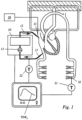
- Fig. 1 shows a schematic overview of the measuring arrangement according to the invention in a preferred embodiment and the vascular system of a patient.
- Fig. 1 shows a schematic overview of the measuring arrangement according to the invention and the vascular system of a patient, the device for extracorporeal blood treatment (10) being connected to the venous vascular system of the patient via a supplying leg (11; "drainage") and a draining leg (12).
- the extracorporeal blood treatment device can be, for example, a device for extracorporeal membrane oxygenation (vvECMO, as in Fig. 1 shown) or a device for liver dialysis.
- the supplying leg (11) is over The femoral vein is inserted and comes to rest in the inferior vena cava (inferior vena cava) below the confluence of the hepatic vein.
- the draining leg (12) is inserted via the jugular vein and comes to rest in the superior vena cava (superior vena cava) directly in front of the right atrium.
- oxygen-poor venous blood is supplied to the blood treatment device via the supplying leg (11), while the oxygenated blood reaches the right atrium via the draining leg (12).
- the system according to the invention can also be used in situations in which vaECMO is used, in which the deoxygenated blood is sent to ECMO via the femoral vein and the oxygenated blood is returned to the patient's vascular system via the femoral artery. In this arrangement, the ECMO takes over all of the pumping power.
- the cardiovascular parameter is determined using thermodilution; Using thermodilution, several cardiovascular parameters can also be determined and/or calculated.
- the temperature influencing means (20) according to the invention is preferably an injection device by means of which a cooled liquid is injected as a bolus into the patient's vascular system.
- the temperature change can be generated at any point in the patient's central venous vascular system.
- the draining leg of the ECMO via which oxygenated blood is supplied to the patient's vascular system
- the first point (31) are located cranially with respect to the heart valve level. It is particularly preferred, as in Fig. 1 shown at a first location (31), e.g. B.
- thermodilution measurement A migratory temperature change generated in the jugular vein travels via the right heart and pulmonary circulation to the left heart and from there via the aorta to the systemic circulation.
- the initial temperature deviation T I generated by the bolus injection is calculated or measured, for example, using a corresponding algorithm.
- the temperature influencing means can detect the temperature, time and possibly also duration of the bolus injection, for example by means of a temperature sensor which is arranged within or in the immediate vicinity of the temperature influencing means.
- the temperature influencing means can preferably supply the measurement results to a computer system (40) which is connected to the system according to the invention via connecting means.
- the first temperature sensor (21) is for measuring the local temperature of the blood Patients arranged, here e.g. B. in the femoral artery.
- a further temperature sensor (22) is arranged in the supplying leg (11) of the extracorporeal blood treatment device.
- a portion of the injected temperature bolus is diverted into the extracorporeal circuit. This part of the injected temperature bolus is detected by the second temperature sensor (22).
- the computer system (40) which is connected to the first (21) and the second temperature sensor (22) via connecting means, records the recorded temperature as a function of time and accordingly determines a first and a second thermodilution curve (TDK 1 , TDK 2 ).
- the program-technical device for carrying out the evaluation steps of a thermodilution is per se known from the prior art (e.g. from the German laid-open specification DE 4 214 402 A1 ).
- the computer system is further designed to determine from the second thermodilution curve TDK 2 a temperature deviation T EKBV , which is to be assigned to the extracorporeal blood treatment device, and to relate T I and T EKBV to determine the cardiovascular parameter.
- the system according to the invention advantageously makes it possible to effectively detect and subsequently correct an indicator loss possibly caused by the extracorporeal circulation, so that errors in the determination of cardiovascular parameters, such as CO, during an extracorporeal blood treatment, e.g. B. during ECMO treatment, can be minimized and thus the accuracy and reliability of the determination is increased.
- the system according to the invention can be used independently of the arrangement/flow direction of the respective extracorporeal blood treatment device and can therefore be used in a variety of ways.
- the patient is better integrated into the extracorporeal blood treatment device and its configuration is optimally adapted to the patient's cardiovascular condition.
- the first location of the patient's vascular system in the vicinity of which the temperature influencing means cause the initial, local temperature deviation T I , can be in the vicinity of a first location of the patient's vascular system upstream of the supplying leg (11) of the extracorporeal blood treatment device lay.
- upstream refers to the direction of flow in the supplying leg of the blood treatment device.
- the supplying leg of the blood treatment device can lie in the inferior vena cava, while the temperature deviation is caused in the jugular vein.
Landscapes
- Health & Medical Sciences (AREA)
- Life Sciences & Earth Sciences (AREA)
- Cardiology (AREA)
- Heart & Thoracic Surgery (AREA)
- Hematology (AREA)
- Public Health (AREA)
- Animal Behavior & Ethology (AREA)
- Veterinary Medicine (AREA)
- Engineering & Computer Science (AREA)
- Biomedical Technology (AREA)
- General Health & Medical Sciences (AREA)
- Physiology (AREA)
- Vascular Medicine (AREA)
- Molecular Biology (AREA)
- Biophysics (AREA)
- Medical Informatics (AREA)
- Surgery (AREA)
- Physics & Mathematics (AREA)
- Pathology (AREA)
- Anesthesiology (AREA)
- Pulmonology (AREA)
- External Artificial Organs (AREA)
Description
- Die vorliegende Erfindung betrifft ein System zur Bestimmung eines oder mehrerer kardiovaskulärer Parameter eines Patienten, welches dazu eingerichtet ist, mit einer Vorrichtung zur extrakorporalen Blutbehandlung zusammenzuwirken.
- Eine extrakorporale Blutbehandlung ist für eine Reihe von Krankheitsbildern in Patienten indiziert, beispielsweise die Hämodialyse bei Nieren- und Lebererkrankungen sowie die extrakorporale Decarboxylierung / Membranoxygenierung (ECMO) bei der Therapie schwerer Lungenerkrankungen (akutes Atemnotsyndrom, ARDS) und von Herzerkrankungen (Myokardinfarkt, schwere Rhythmusstörungen). Die extrakorporale Membranoxygenierung gehört dabei zur Standardtherapie für die Stabilisierung des Blutkreislaufs und/oder der Atemfunktion von Patienten mit ARDS und lebensbedrohlicher Hypoxämie. Bei der ECMO werden großvolumige Venen mittels Seldinger-Technik kanüliert, sodass ein Blutfluss zwischen Patient und der ECMO ermöglicht wird. In der ECMO- Vorrichtung wird das Blut mittels einer Pumpe über einen Membranoxygenator perfundiert. Dieser beherbergt eine semipermeable Membran, über welche der Gasaustausch stattfindet, indem auf einer Seite das Patientenblut fließt und auf der anderen Seite Sauerstoff eingeleitet wird. Die Pumpe produziert dabei einen Blutfluss von 2 bis 6 l/min, sodass eine effiziente Oxygenierung und Kohlendioxidelimination möglich ist.
- Am häufigsten erfolgt der Zugang zum Gefäßsystem des Patienten über die Femoralgefäße. In Abhängigkeit von der zugrunde liegenden Erkrankung des Patienten sind zur Etablierung der ECMO eine veno-venöse, eine arterio-venöse und eine veno-arterielle Kanülierung möglich. Die arterio-venöse Kanülierung wird bei Patienten mit ausschließlich gestörtem Gasaustausch, also bei stabilem Kreislauf und guter Herzfunktion, eingesetzt (avECMO; bei intakter Herzfunktion z.T. Betrieb ohne Pumpe möglich). Dabei wird der Blutfluss von der A. femoralis über den Oxygenator zurück in den rechten Vorhof geleitet. Dem gegenüber steht die veno-arterielle ECMO (vaECMO), die eine komplette Herzunterstützung ermöglicht. Die venöse Drainage erfolgt über die V. cava inferior, von dort gelangt das Blut in den Oxygenator und über die A. femoralis oder die Aorta ascendens wieder zum Patienten. Über die Drainage des rechten Vorhofes kann mit der vaECMO eine biventrikuläre Entlastung erreicht und zusätzlich ein begleitendes Lungenversagen therapiert werden. Am häufigsten wird die veno-venöse Kanülierung eingesetzt; die wECMO dient als Lungenunterstützung dem Gasaustausch der Lunge. Das Blut des Patienten fließt über eine in der V. cava inferior liegende Kanüle zum Oxygenator und von dort über die V. cava superior zurück in den Patientenkreislauf.
- Obwohl das Verfahren seit vielen Jahrzehnten verwendet wird, konnten prospektivrandomisierte Studien bei ARDS Patienten, bei denen der Einsatz von ECMO im Vergleich zur konventionellen Behandlung überprüft wurde, bislang nur eine marginale Verbesserung des Outcomes mit strittigem Überlebensvorteil durch die ECMO aufzeigen. Strategien zur Verbesserung der Wirksamkeit der ECMO umfassen optimierte Patientenauswahl, weniger invasive Techniken und Kombination von ECMO mit ultra-protektiver Beatmung. Außerdem wird postuliert, dass die Optimierung der hämodynamischen Situation des Patienten vor der eigentlichen ECMO dazu beitragen kann, Patienten besser in die ECMO zu integrieren und die ECMO-Konfiguration optimal anzupassen. Dabei ist der extrakorporale Blutfluss in der ECMO, der an kardiovaskuläre Parameter wie z. B. das Herzzeitvolumen (HZV) des Patienten angepasst wird, von großer Bedeutung für eine effektive Sauerstoffversorgung des Blutes. Die Optimierung der hämodynamischen Situation des Patienten erfordert eine genaue Messung kardiovaskulärer Parameter vor und während ECMO, beispielsweise mittels Indikatorverdünnungstechnik wie Thermodilution. Pulmonal-arterielle und transpulmonale Thermodilutionsmessungen während der ECMO-Behandlung können allerdings zu einer Fehleinschätzung kardiovaskulärer Parameter führen, da der extrakorporale Kreislauf einen Indikatorverlust im Gefäßsystem des Patienten bedingen kann. Beispielsweise kann das aus derartigen Messungen berechnete Herzzeitvolumen über dem tatsächlichen Herzzeitvolumen liegen. Es ist daher die Aufgabe der vorliegenden Erfindung, den Fehler bei der Bestimmung kardiovaskulärer Parameter, wie z.B. des HZV, während einer Behandlung mit einer extrakorporalen Blutbehandlungsvorrichtung, z. B. während einer ECMO Behandlung, zu erfassen, zu minimieren und möglichst weitgehend zu korrigieren. Durch das erfindungsgemäße System werden Genauigkeit und Zuverlässigkeit der Bestimmung kardiovaskulärer Parameter, wie z.B. des HZV, während einer Behandlung mit einer extrakorporalen Blutbehandlungsvorrichtung erhöht; somit werden die Patienten besser in die entsprechende extrakorporale Blutbehandlungsvorrichtung integriert und deren Konfiguration kann optimal angepasst werden.
-
US 2011/004143 A1 offenbart ein Verfahren und eine Anordnung zur Bestimmung der Rezirkulation in einer Fistel und/oder des kardio-pulmonalen Anteils der Rezirkulation während der extrakorporalen Behandlung von Blut bei einem Patienten, wie z. B. in der Hämodialyse. Ein Temperatursensor in der venösen Blutleitung erfasst dabei unmittelbar eine auf der Blutseite des Dialysators induzierte Temperaturänderung. - Die der Erfindung zugrunde liegende Aufgabe wird durch ein System gemäß Anspruch 1 gelöst. Besondere Ausführungsformen können gemäß einem der Ansprüche 2 bis 10 gestaltet sein.
- In einem ersten Aspekt betrifft die Erfindung daher ein System zum Bestimmen eines kardiovaskulären Parameters eines Patienten. Das System kann dabei auch vorteilhaft dazu ausgelegt sein, mehrere kardiovaskuläre Parameter eines Patienten zu bestimmen. Das System ist dazu eingerichtet, mit einer Vorrichtung zur extrakorporalen Blutbehandlung zusammenzuwirken, welche mit dem venösen Gefäßsystem des Patienten über einen zuführenden und einen abführenden Schenkel verbunden ist. Bei der extrakorporalen Blutbehandlungsvorrichtung kann es sich beispielsweise um eine Vorrichtung zur Hämodialyse, eine Vorrichtung zur Leberunterstützung, oder um eine extrakorporale Vorrichtung zur Decarboxylierung oder zur Membranoxygenierung handeln. Der zuführende Schenkel führt der Blutbehandlungsvorrichtung Blut aus dem Gefäßsystem des Patienten zu. Beispielsweise leitet bei der vvECMO ein in der unteren Hohlvene liegender "Drainage"-Katheter venöses Blut zum Membranoxygenator. Das behandelte Blut wird über den abführenden Schenkel wieder in das Gefäßsystem des Patienten eingeleitet; beispielsweise führt bei der vvECMO ein in der Jugularvene oder der oberen Hohlvene liegender Katheter sauerstoffreiches Blut zum rechten Vorhof. Die extrakorporale Blutbehandlungsvorrichtung weist mindestens eine zwischen dem zuführenden und dem abführenden Schenkel angeordnete Pumpe zur Bewegung des Bluts des Patienten innerhalb der extrakorporalen Blutbehandlungsvorrichtung auf, wobei die Pumpe das Blut über die entsprechende Behandlungseinheit befördert, z.B. die Dialysemembran oder den Decarboxylator/Oxygenator. Das System weist Temperaturbeeinflussungsmittel zum Hervorrufen einer initialen, lokalen Temperaturabweichung TI in der Nähe einer ersten Stelle des Gefäßsystems des Patienten auf. Durch die Temperaturbeeinflussungsmittel wird eine wandernde Temperaturänderung im Blutfluss des Patienten eingeführt. Beispielsweise können die Temperaturbeeinflussungsmittel die Temperatur in einer zentralen Vene des Gefäßsystems des Patienten verändern, wie z.B. in der Jugularvene oder in der Femoralvene. Das System weist ferner einen ersten Temperatursensor zum Messen der lokalen Temperatur des Bluts des Patienten an einer zweiten Stelle des Gefäßsystems des Patienten stromabwärts zur ersten Stelle auf, sowie einen zweiten Temperatursensor zum Messen der lokalen Temperatur des Bluts des Patienten im zuführenden Schenkel der extrakorporalen Blutbehandlungsvorrichtung. Bevorzugt erfasst der erste Temperatursensor die Temperatur des Bluts des Patienten im stromabwärts des venösen Gefäßsystems gelegenen, arteriellen Gefäßsystem (transpulmonale Thermodilution). Die vorgesehenen Sensoren können vorteilhaft wie bekannte, in Dilutionsmessverfahren eingesetzte Sensoren ausgeführt sein. Für die Temperaturmessung ist insbesondere ein Platinwiderstandssensor geeignet, daneben sind jedoch auch andere Thermowiderstände oder Thermoelemente zweckgemäß. Ein mit dem ersten und dem zweiten Temperatursensor verbundenes Computersystem ist dazu ausgelegt, die lokale Bluttemperatur, die an der zweiten Stelle des Gefäßsystems des Patienten und im zuführenden Schenkel der extrakorporalen Blutbehandlungsvorrichtung gemessen wird, jeweils als Funktion der Zeit aufzuzeichnen und entsprechend eine erste und eine zweite Thermodilutionskurve (TDK1, TDK2) zu ermitteln und auszuwerten. Die programmtechnische Einrichtung zur Durchführung von Auswerteschritten eines Thermodilution ist dabei per se aus dem Stand der Technik bekannt (z.B. aus der deutschen Offenlegungsschrift
DE 4 214 402 A1 ). Das Computersystem ist weiterhin dazu ausgelegt, aus der zweiten Thermodilutionskurve eine Temperaturabweichung TEKBV zu bestimmen, welche der extrakorporalen Blutbehandlungsvorrichtung zuzuordnen ist, und TI und TEKBV zur Bestimmung des kardiovaskulären Parameters in Beziehung zu setzen. Nach der Bestimmung des kardiovaskulären Parameters, beispielsweise des Herzzeitvolumens, kann die Flussrate der extrakorporalen Blutbehandlungsvorrichtung entsprechend gesteigert oder verringert werden, um die Pumpleistung der Herz-Kreislauf Situation des Patienten anzupassen. Beispielsweise kann die Flussrate der extrakorporalen Blutbehandlungsvorrichtung aber auch nur kurzfristig stark verringert bzw. auf null gesetzt werden, um eine Messung ohne Indikatorverlust in den extrakorporalen Kreislauf durchführen zu können. - Das erfindungsgemäße System ermöglicht es vorteilhaft, einen durch den extrakorporalen Kreislauf möglicherweise hervorgerufenen Indikatorverlust effektiv zu erfassen und nachfolgend zu korrigieren, so dass Fehler bei der Bestimmung kardiovaskulärer Parameter, wie z.B. des HZV, während einer extrakorporalen Blutbehandlung, z. B. während einer ECMO Behandlung, minimiert werden und damit die Genauigkeit und Zuverlässigkeit der Bestimmung erhöht wird. Das erfindungsgemäße System kann dabei unabhängig von der Anordnung/Flussrichtung der jeweiligen extrakorporalen Blutbehandlungsvorrichtung verwendet werden und ist somit vielseitig einsetzbar. Der Patient wird besser in die extrakorporale Blutbehandlungsvorrichtung integriert und deren Konfiguration optimal an den kardiovaskulären Zustand des Patienten angepasst.
- In einer weiteren Ausführungsform des erfindungsgemäßen Systems kann die erste Stelle des Gefäßsystems des Patienten, in deren Nähe die Temperaturbeeinflussungsmittel die initiale, lokale Temperaturabweichung TI hervorrufen, stromaufwärts des zuführenden Schenkels der extrakorporalen Blutbehandlungsvorrichtung liegen. Der Begriff "stromaufwärts" bezieht sich dabei auf die Flussrichtung im zuführenden Schenkel der Blutbehandlungsvorrichtung. Beispielsweise kann der zuführende Schenkel der Blutbehandlungsvorrichtung in der unteren Hohlvene liegen, vorzugsweise unterhalb der Einmündung der Lebervene, während die Temperaturabweichung in der Jugularvene hervorgerufen wird. Die Anordnung führt zu einer geringstmöglichen Interferenz des erfindungsgemäßen Systems mit der extrakorporalen Blutbehandlungsvorrichtung, wodurch z.B. die Anzahl der erforderlichen Messzyklen vorteilhaft gering gehalten wird.
- In einer bevorzugten Weiterbildung des erfindungsgemäßen Systems kann die extrakorporale Blutbehandlungsvorrichtung eine Blutbehandlungsvorrichtung mit einer Pumpe sein, die eine Flussrate von > 100 ml/min bereitstellt, besonders bevorzugt kann die Pumpe eine Flussrate von >200 ml/min und insbesondere bevorzugt eine Flussrate von > 300 ml/min bereitstellen. Bevorzugt kann es sich bei der extrakorporalen Blutbehandlungsvorrichtung eine Vorrichtung zur Decarboxylierung oder zur Membranoxygenierung (ECMO) handeln. Insbesondere bei extrakorporalen Blutbehandlungsvorrichtungen mit hoher Flussrate kann mittels des erfindungsgemäßen Systems die Genauigkeit der Bestimmung von kardiovaskulären Parametern erhöht werden, da der durch diese Vorrichtungen bedingte, mögliche Verlust des Indikators (z.B. der wandernden Temperaturänderung oder des Farbstoffs) in die entsprechende Vorrichtung akkurat und effektiv erfasst und nachfolgend korrigiert werden kann.
- In einer weiteren Ausführungsform des erfindungsgemäßen Systems kann das Computersystem dazu ausgelegt sein, aus der Beziehung von TEKBV und TI den Anteil AreEKBV der wandernden Temperaturänderung zu bestimmen, welcher durch die extrakorporale Blutbehandlungsvorrichtung rezirkuliert. Beispielsweise kann ein Indikator (z. B. eine wandernde Temperaturänderung oder ein Farbstoff-Indikator) bei erhöhter Flussrate der Blutbehandlungsvorrichtung von der ersten Stelle des Gefäßsystems des Patienten größtenteils direkt in den zuführenden Schenkel ("Drainage-Katheder") der Vorrichtung abgezweigt werden. Durch ins-Verhältnis-setzen der der extrakorporalen Blutbehandlungsvorrichtung zuzuordnenden Temperaturabweichung TEKBV mit TI kann der Anteil AreEKBV der in der Blutbehandlungsvorrichtung re-zirkulierenden, wandernden Temperaturänderung in Prozent bestimmt werden. Der Wert AreEKBV kann vorteilhaft zur Korrektur des zu bestimmenden kardiovaskulären Parameters herangezogen werden; alternativ kann der Wert dazu dienen, Systemparameter, beispielsweise die Flussrate der extrakorporalen Blutbehandlungsvorrichtung, für eine erneute Messung oder den kontinuierlichen Betrieb anzupassen.
- In einer bevorzugten Implementierung des erfindungsgemäßen Systems können die Temperaturbeeinflussungsmittel manuelle oder automatisierte Injektionsmittel zum Injizieren einer Flüssigkeit sein, wobei sich eine Temperatur der Flüssigkeit von der Temperatur des Bluts des Patienten unterscheidet. Die Temperaturbeeinflussungsmittel können insbesondere geeignet sein, einen entsprechend temperierten Flüssigkeits-Bolus zu injizieren. Vorzugsweise werden Temperatur, Zeitpunkt und besonders bevorzugt auch Dauer der Bolus-Injektion durch einen weiteren, dritten Temperatursensor, der beispielweise innerhalb oder in unmittelbarer Nähe der Temperaturbeeinflussungsmittel angeordnet ist, gemessen und dem Computersystem über entsprechende Verbindungsmittel zugeführt.
- In einer bevorzugten Weiterbildung des erfindungsgemäßen Systems kann die erste Thermodilutionskurve mittels einer transpulmonalen Thermodilution ermittelt werden. Bei der aus dem Stand der Technik bekannten transpulmonalen Thermodilutionsmessung erfolgt zur Bestimmung der Thermodilutionskurve eine Injektion eines Thermoindikator-Bolus in die obere Hohlvene (V. cava sup.) eines Patienten und eine Messung der Temperaturantwort an einer Stelle im Körperkreislauf des Patienten, z.B. in der Femoralarterie eines Patienten. Vorteilhaft können aus der erhaltenen Thermodilutionskurve eine Vielzahl vaskulärer Parameter bestimmt werden, beispielsweise das Herzzeitvolumen HZV, das globale enddiastolische Volumen (GEDV), das intrathorakale Blutvolumen (ITBV) usw., sowie eine Reihe anderer Parameter und Indices abgeleitet werden, z. B. wird zusätzlich das extravasale Lungenwasser EVLW, ein Parameter für drohendes Lungenödem, errechnet. Zudem kann die Kontraktilität des Herzmuskels beurteilt werden (dPmax, GEF, CPI). Insbesondere kann es sich bei dem einen kardiovaskulären Parameter um das Herzzeitvolumen (HZV), das extravaskuläre Lungenwasser (EVLW) oder das globale enddiastolische Volumen (GEDV) handeln. Diese können in bekannter Art und Weise aus der arteriellen Thermodilutionskurve TDK berechnet werden; insbesondere können das Herzzeitvolumen HZVTDart, die Erscheinungszeit AT, die mittlere Durchgangszeit MTDTDart und die exponentielle Abfallzeit DSTTDart berechnet werden.
- In einer weiteren Ausführungsform des erfindungsgemäßen Systems kann das Computersystem dazu eingerichtet sein, TI und TEKBV und die Fläche unter der ersten Thermodilutionskurve (TDK1) zur Berechnung des Herzzeitvolumens in Beziehung zu setzen. Insbesondere ist beim erfindungsgemäßen System die Flussrate der Blutbehandlungsvorrichtung bekannt, während das Herzzeitvolumen und die in nicht die Blutbehandlungsvorrichtung abgezweigte Temperaturänderung unbekannt sind. Unter Zuhilfenahme der der Beziehung der Flussrate zum Quotienten der Temperaturabweichung im Gefäßsystem des Patienten (TI-TEKBV) und der Fläche unter der ersten Thermodilutionskurve kann das Herzzeitvolumen berechnet werden. Aus dieser Größe und aus den aus der TDK, ableitbaren Größen (MTT, DST) können z.B. die GEDV und andere kardiovaskuläre Parameter berechnet werden.
- In einer bevorzugten Implementierung des erfindungsgemäßen Systems kann das Computersystem außerdem dazu ausgelegt sein, mit der Pumpe der extrakorporalen Blutbehandlungsvorrichtung zusammenzuwirken, derart, dass bei der Bestimmung des einen oder der mehreren kardiovaskulären Parameter/s AreEKBV < 30%. Dies kann beispielsweise erreicht werden, indem das Computersystem die Pumpe ansteuert und die Pumpenleistung entsprechend verringert oder zeitlich begrenzt ausgesetzt wird. Bevorzugt ist es, dass bei der Bestimmung des einen oder der mehreren kardiovaskulären Parameter/s AreEKBV < 20%, insbesondere bevorzugt ist AreEKBV < 10%.
- In einer besonderen Weiterbildung des erfindungsgemäßen Systems können sich die erste Stelle des Gefäßsystems eines Patienten, in deren Nähe die Temperaturbeeinflussungsmittel eine initiale lokale Temperaturabweichung hervorrufen, und der zuführende Schenkel der extrakorporalen Blutbehandlungsvorrichtung kranial befinden bezüglich einer Ebene, in der die Herzklappen des Patienten liegen. Die Anordnung ist vorteilhaft, da für die spezifische Messanordnung im Hinblick auf die Berechnung einer Vielzahl kardiovaskulärer Parameter bereits empirisch zu berücksichtigende Konstanten vorliegen. Beispielsweise sind die in die Steward-Hamilton Gleichung einzufügenden

- Konstanten K1 und K2 für die entsprechend durchgeführte transpulmonale Thermodilution bekannt, d.h. für eine Anordnung, in der der Temperatur-Bolus über die Jugularvene in die obere Hohlvene injiziert und in der Femoralarterie eines Patienten erfasst wird.
- Nachfolgend werden anhand der zugehörigen Zeichnung Beispiele bevorzugte Ausführungsformen der vorliegenden Erfindung näher erläutert.
- Die Zeichnung ist dabei rein schematische und, aus Gründen der Anschaulichkeit, nicht maßstabsgetreue Darstellung. Insbesondere können Verhältnisse zwischen den Abmessungen, vor allem Durchmesser, Schlauchlängen und Außenabmessungen von tatsächlichen Ausführungen abweichen. In der Praxis können die Abmessungen anhand der Anforderungen im Einzelfall sowie anhand gängiger Standardteile dimensioniert werden.
-
Fig. 1 zeigt eine schematische Übersicht der erfindungsgemäßen Messanordnung in einer bevorzugten Ausführungsform und des Gefäßsystems eines Patienten. -
Fig. 1 zeigt eine schematische Übersicht der erfindungsgemäßen Messanordnung und des Gefäßsystems eines Patienten, wobei die Vorrichtung zur extrakorporalen Blutbehandlung (10) mit dem venösen Gefäßsystem des Patienten über einen zuführenden Schenkel (11; "Drainage") und einen abführenden Schenkel (12) verbunden ist. Bei der extrakorporalen Blutbehandlungsvorrichtung kann es sich beispielsweise um eine Vorrichtung zur extrakorporalen Membranoxygenierung (vvECMO, wie inFig. 1 dargestellt) oder um eine Vorrichtung zur Leberdialyse handeln. Der zuführende Schenkel (11) ist beispielsweise über die Femoralvene eingeführt und kommt in der unteren Hohlvene (V. cava inferior) unterhalb der Einmündung der Lebervene zu liegen. Der abführende Schenkel (12) ist beispielsweise über die Jugularvene eingeführt und kommt in der oberen Hohlvene (V. cava superior) unmittelbar vor dem rechten Vorhof zu liegen. Über den zuführenden Schenkel (11) wird der Blutbehandlungsvorrichtung im Falle der ECMO sauerstoffarmes, venöses Blut zugeführt, während das oxygenierte Blut über den abführenden Schenkel (12) zum rechten Vorhof gelangt. Das erfindungsgemäße System kann ebenfalls in Situationen angewendet werden, in denen eine vaECMO verwendet wird, bei welcher das deoxygenierte Blut über die Femoralvene zur ECMO geleitet und das oxygenierte Blut über die Femoralarterie in das Gefäßsystem des Patienten zurückgeleitet wird. In dieser Anordnung übernimmt die ECMO die gesamte Pumpleistung. - Der kardiovaskuläre Parameter wird mittels Thermodilution bestimmt; mittels der Thermodilution lassen sich auch mehrere kardiovaskulärer Parameter bestimmen und/oder errechnen. Bei den erfindungsgemäßen Temperaturbeeinflussungsmitteln (20) handelt sich vorzugsweise um eine Injektionsvorrichtung, mittels derer eine gekühlte Flüssigkeit als Bolus in das Gefäßsystem des Patienten injiziert wird. Prinzipiell kann die Temperaturänderung an einer beliebigen Stelle des zentralen, venösen Gefäßsystems des Patienten erzeugt werden. Vorzugsweise liegen der abführende Schenkel der ECMO (über welchen dem Gefäßsystem des Patienten oxygeniertes Blut zugeführt wird) und die erste Stelle (31) bezüglich der Herzklappenebene kranial. Besonders bevorzugt wird, wie in
Fig. 1 gezeigt, an einer ersten Stelle (31), z. B. der Jugularvene, stromaufwärts des zuführenden Schenkels (11) der ECMO eine Bolus-Injektion zur Thermodilutionsmessung vorgenommen. Eine in der Jugularvene erzeugte wandernde Temperaturänderung gelangt über das rechte Herz und die pulmonale Zirkulation in das linke Herz und von dort über die Aorta in die systemische Zirkulation. Die durch die Bolus-Injektion erzeugte initiale Temperaturabweichung TI wird dabei z.B. über einen entsprechenden Algorithmus berechnet oder gemessen. Vorzugsweise können die Temperaturbeeinflussungsmittel Temperatur, Zeitpunkt und gegebenenfalls auch Dauer der Bolus-Injektion erfassen, beispielsweise mittels eines Temperatursensors, welcher innerhalb oder in unmittelbarer Nähe der Temperaturbeeinflussungsmittel angeordnet ist. Die Temperaturbeeinflussungsmittel können bevorzugt die Messergebnisse einem Computersystem (40) zuführen, welches mit dem erfindungsgemäßen System über Verbindungsmittel verbunden ist. - An einer zweiten Stelle (32) des Gefäßsystems des Patienten stromabwärts zur ersten Stelle (31), ist der erste Temperatursensor (21) zum Messen der lokalen Temperatur des Bluts des Patienten angeordnet, hier z. B. in der Femoralarterie. Ein weiterer Temperatursensor (22) ist im zuführenden Schenkel (11) der extrakorporalen Blutbehandlungsvorrichtung angeordnet. In Abhängigkeit von der Flussrate der extrakorporalen Blutbehandlungsvorrichtung, z.B. bei hoher Flussrate >500ml/min, oder in Abhängigkeit von der Lagebeziehung Injektionsort/zuführen der Schenkel wird ein Teil des injizierten Temperatur-Bolus in den extrakorporalen Kreislauf abgezweigt. Dieser Teil des injizierten TemperaturBolus wird durch den zweiten Temperatursensor (22) erfasst. Das mit dem ersten (21) und dem zweiten Temperatursensor (22) über Verbindungsmittel verbundene Computersystem (40) zeichnet jeweils die erfasste Temperatur als Funktion der Zeit auf und ermittelt entsprechend eine erste und eine zweite Thermodilutionskurve (TDK1, TDK2). Die programmtechnische Einrichtung zur Durchführung von Auswerteschritten eines Thermodilution ist dabei perse aus dem Stand der Technik bekannt (z.B. aus der deutschen Offenlegungsschrift
DE 4 214 402 A1 ). Das Computersystem ist weiterhin dazu ausgelegt, aus der zweiten Thermodilutionskurve TDK2 eine Temperaturabweichung TEKBV zu bestimmen, welche der extrakorporalen Blutbehandlungsvorrichtung zuzuordnen ist, und TI und TEKBV zur Bestimmung des kardiovaskulären Parameters in Beziehung zu setzen. Das erfindungsgemäße System ermöglicht es vorteilhaft, einen durch den extrakorporalen Kreislauf möglicherweise hervorgerufenen Indikatorverlust effektiv zu erfassen und nachfolgend zu korrigieren, so dass Fehler bei der Bestimmung kardiovaskulärer Parameter, wie z.B. des HZV, während einer extrakorporalen Blutbehandlung, z. B. während einer ECMO Behandlung, minimiert werden und damit die Genauigkeit und Zuverlässigkeit der Bestimmung erhöht wird. Das erfindungsgemäße System kann dabei unabhängig von der Anordnung/Flussrichtung der jeweiligen extrakorporalen Blutbehandlungsvorrichtung verwendet werden und ist somit vielseitig einsetzbar. Der Patient wird besser in die extrakorporale Blutbehandlungsvorrichtung integriert und deren Konfiguration optimal an den kardiovaskulären Zustand des Patienten angepasst. - In einer weiteren Ausführungsform des erfindungsgemäßen Systems kann die erste Stelle des Gefäßsystems des Patienten, in deren Nähe die Temperaturbeeinflussungsmittel die initiale, lokale Temperaturabweichung TI hervorrufen, in der Nähe einer ersten Stelle des Gefäßsystems des Patienten stromaufwärts des zuführenden Schenkels (11) der extrakorporalen Blutbehandlungsvorrichtung liegen. Der Begriff "stromaufwärts" bezieht sich dabei auf die Flussrichtung im zuführenden Schenkel der Blutbehandlungsvorrichtung. Beispielsweise kann der zuführende Schenkel der Blutbehandlungsvorrichtung in der unteren Hohlvene liegen, während die Temperaturabweichung in der Jugularvene hervorgerufen wird. Die Anordnung führt zu einer geringstmöglichen Interferenz des erfindungsgemäßen Systems mit der extrakorporalen Blutbehandlungsvorrichtung, wodurch z.B. die Anzahl der erforderlichen Messzyklen vorteilhaft gering gehalten wird.
Claims (10)
- System zum Bestimmen eines kardiovaskulären Parameters eines Patienten (30), welches dazu eingerichtet ist, mit einer Vorrichtung zur extrakorporalen Blutbehandlung (10) zusammenzuwirken, welche mit dem venösen Gefäßsystem des Patienten über einen zuführenden (11) und einen abführenden Schenkel (12) verbunden ist, wobei die extrakorporale Blutbehandlungsvorrichtung (10) mindestens eine zwischen dem zuführenden (11) und dem abführenden Schenkel (12) angeordnete Pumpe (13) zur Bewegung des Bluts des Patienten innerhalb der extrakorporalen Blutbehandlungsvorrichtung aufweist,
wobei das System folgendes aufweist:a. Temperaturbeeinflussungsmittel (20) zum Hervorrufen einer initialen lokalen Temperaturabweichung TI in der Nähe einer ersten Stelle (31) des Gefäßsystems des Patienten, wodurch eine wandernde Temperaturänderung im Blutfluss des Patienten eingeführt wird,b. einen ersten Temperatursensor (21) zum Messen der lokalen Temperatur des Bluts des Patienten an einer zweiten Stelle (32) des Gefäßsystems des Patienten stromabwärts zur ersten Stelle (31),c. einen zweiten Temperatursensor (22) zum Messen der lokalen Temperatur des Bluts des Patienten im zuführenden Schenkel (11) der extrakorporalen Blutbehandlungsvorrichtung,d. ein Computersystem (40), welches mit dem ersten (21) und dem zweiten Temperatursensor (22) verbunden ist, und dazu ausgelegt ist, die lokale Bluttemperatur, die an der zweiten Stelle (32) des Gefäßsystems des Patienten und im zuführenden Schenkel (11) der extrakorporalen Blutbehandlungsvorrichtung gemessen wird, jeweils als Funktion der Zeit aufzuzeichnen und entsprechend eine erste und eine zweite Thermodilutionskurve (TDK1, TDK2) zu ermitteln und auszuwerten, und weiterhin dazu ausgelegt ist, aus der zweiten Thermodilutionskurve eine Temperaturabweichung TEKBV zu bestimmen, welche der extrakorporalen Blutbehandlungsvorrichtung zuzuordnen ist, und TI und TEKBV zur Bestimmung des kardiovaskulären Parameters in Beziehung zu setzen. - System gemäß Anspruch 1, wobei die erste Stelle des Gefäßsystems des Patienten stromaufwärts des zuführenden Schenkels (11) der extrakorporalen Blutbehandlungsvorrichtung liegt.
- System gemäß einem der Ansprüche 1 oder 2, wobei die extrakorporale Blutbehandlungsvorrichtung eine Blutbehandlungsvorrichtung mit einer Pumpe ist, die eine Flussrate von > 100 ml/min bereitstellt.
- System gemäß einem der vorhergehenden Ansprüche, wobei das Computersystem dazu ausgelegt ist, aus der Beziehung von TEKBV und TI einen Anteil AreEKBV der wandernden Temperaturänderung zu bestimmen, welcher durch die extrakorporale Blutbehandlungsvorrichtung rezirkuliert.
- System gemäß einem der vorhergehenden Ansprüche, wobei die Temperaturbeeinflussungsmittel Injektionsmittel zum Injizieren einer Flüssigkeit aufweisen, wobei sich eine Temperatur der Flüssigkeit von der Temperatur des Bluts des Patienten unterscheidet.
- System gemäß einem der vorhergehenden Ansprüche, welches dazu ausgelegt ist, die erste Thermodilutionskurve mittels einer transpulmonalen Thermodilution zu ermitteln.
- System gemäß einem der vorhergehenden Ansprüche, wobei der kardiovaskuläre Parameter das Herzzeitvolumen (HZV), das extravaskuläre Lungenwasser (EVLW) oder das globale enddiastolische Volumen (GEDV) ist.
- System gemäß einem der vorhergehenden Ansprüche 6 oder 7, wobei das Computersystem dazu eingerichtet ist, TI und TEKBV und die Fläche unter der ersten Thermodilutionskurve zur Berechnung des Herzzeitvolumens in Beziehung zu setzen.
- System gemäß einem der Ansprüche 4 bis 8, wobei das Computersystem außerdem dazu ausgelegt ist, mit der Pumpe der extrakorporalen Blutbehandlungsvorrichtung zusammenzuwirken, derart, dass bei der Bestimmung des einen oder der mehreren kardiovaskulären Parameters AEKBV < 30%.
- System gemäß einem der vorhergehenden Ansprüche, wobei die erste Stelle des Gefäßsystems eines Patienten, in deren Nähe eine initiale lokale Temperaturabweichung hervorzurufen die Temperaturbeeinflussungsmittel ausgelegt sind, und der abführende Schenkel der extrakorporalen Blutbehandlungsvorrichtung sich kranial befinden bezüglich einer Ebene, in der die Herzklappen des Patienten liegen.
Applications Claiming Priority (2)
| Application Number | Priority Date | Filing Date | Title |
|---|---|---|---|
| DE102018008356.0A DE102018008356A1 (de) | 2018-10-22 | 2018-10-22 | System, Computersystem und Computerprogramm zur Bestimmung eines kardiovaskulären Parameters |
| PCT/EP2019/078571 WO2020083836A1 (de) | 2018-10-22 | 2019-10-21 | System, computersystem und computerprogramm zur bestimmung eines kardiovaskulären parameters |
Publications (2)
| Publication Number | Publication Date |
|---|---|
| EP3870035A1 EP3870035A1 (de) | 2021-09-01 |
| EP3870035B1 true EP3870035B1 (de) | 2024-03-27 |
Family
ID=68581742
Family Applications (1)
| Application Number | Title | Priority Date | Filing Date |
|---|---|---|---|
| EP19804629.4A Active EP3870035B1 (de) | 2018-10-22 | 2019-10-21 | System, computersystem und computerprogramm zur bestimmung eines kardiovaskulären parameters |
Country Status (5)
| Country | Link |
|---|---|
| US (1) | US12257033B2 (de) |
| EP (1) | EP3870035B1 (de) |
| CN (1) | CN113226167A (de) |
| DE (1) | DE102018008356A1 (de) |
| WO (1) | WO2020083836A1 (de) |
Families Citing this family (1)
| Publication number | Priority date | Publication date | Assignee | Title |
|---|---|---|---|---|
| NL2028193B1 (en) * | 2021-05-11 | 2022-12-02 | Amazec Photonics Ip B V | Obtaining cardiovascular and/or respiratory information from the mammal body |
Family Cites Families (5)
| Publication number | Priority date | Publication date | Assignee | Title |
|---|---|---|---|---|
| DE4214402C2 (de) | 1992-04-30 | 1997-04-24 | Pulsion Verwaltungs Gmbh & Co | Vorrichtung zum Bestimmen des Füllungszustandes eines Blutkreislaufs |
| DE102007049409C5 (de) * | 2007-10-15 | 2020-04-09 | Edwards Lifesciences Iprm Ag | Verfahren und Vorrichtung für Indikator-Verdünnungsmessungen |
| DE102007056475A1 (de) * | 2007-11-22 | 2009-06-04 | Fresenius Medical Care Deutschland Gmbh | Verfahren und Vorrichtung zum Bestimmen der Rezirkulation in einer Fistel oder der kardiopulmonalen Rezirkulation sowie Blutbehandlungsvorrichtung mit einer Vorrichtung zur Bestimmung der Fistelrezirkulation oder des kardiopulmonalen Rezirkulationsanteils |
| US20150316404A1 (en) * | 2014-05-02 | 2015-11-05 | Transonic Systems, Inc. | Measurement of fluid volume of a blood oxygenator in an extracorporeal circuit |
| US9814824B2 (en) * | 2015-06-01 | 2017-11-14 | Asia Pacific Medical Technology Development Company, Ltd | Systems and methods for extracorporeal support |
-
2018
- 2018-10-22 DE DE102018008356.0A patent/DE102018008356A1/de not_active Withdrawn
-
2019
- 2019-10-21 WO PCT/EP2019/078571 patent/WO2020083836A1/de not_active Ceased
- 2019-10-21 EP EP19804629.4A patent/EP3870035B1/de active Active
- 2019-10-21 US US17/287,046 patent/US12257033B2/en active Active
- 2019-10-21 CN CN201980085338.2A patent/CN113226167A/zh active Pending
Non-Patent Citations (2)
| Title |
|---|
| DATABASE MEDLINE [online] US NATIONAL LIBRARY OF MEDICINE (NLM), BETHESDA, MD, US; April 2013 (2013-04-01), ZERAATI ABBASALI ET AL: "A review article: access recirculation among end stage renal disease patients undergoing maintenance hemodialysis.", Database accession no. NLM23841034 * |
| ZERAATI ABBASALI ET AL: "A review article: access recirculation among end stage renal disease patients undergoing maintenance hemodialysis.", NEPHRO-UROLOGY MONTHLY SPRING 2013, vol. 5, no. 2, April 2013 (2013-04-01), pages 728 - 732, ISSN: 2251-7006 * |
Also Published As
| Publication number | Publication date |
|---|---|
| US20220079453A1 (en) | 2022-03-17 |
| EP3870035A1 (de) | 2021-09-01 |
| WO2020083836A1 (de) | 2020-04-30 |
| US12257033B2 (en) | 2025-03-25 |
| DE102018008356A1 (de) | 2020-04-23 |
| CN113226167A (zh) | 2021-08-06 |
Similar Documents
| Publication | Publication Date | Title |
|---|---|---|
| DE69926418T2 (de) | Vorrichtung zur Bestimmung von Hämodialyseparametern | |
| EP2750730B1 (de) | Dialysatfluss-regelung | |
| EP1813188B1 (de) | System zum Einrichten einer Dilutionsmessstelle | |
| EP0900094B1 (de) | Vorrichtung zur bestimmung der rezirkulation während einer extrakorporalen blutbehandlung | |
| DE69731943T2 (de) | VORRICHTUNG ZUR BESTIMMUNG DER BLUTREZIRKULATION IN EINEm VASKULäREN ZUGANG | |
| EP2217303B1 (de) | Vorrichtung zum bestimmen der rezirkulation in einer fistel oder der kardiopulmonalen rezirkulation sowie blutbehandlungsvorrichtung mit einer vorrichtung zur bestimmung der fistelrezirkulation oder des kardiopulmonalen rezirkulationsanteils | |
| DE102005001051B4 (de) | Vorrichtung und Verfahren zur Erkennung von Komplikationen während einer extrakorporalen Blutbehandlung | |
| EP2714128B1 (de) | Vorrichtung und verfahren zur erkennung eines betriebszustandes einer extrakorporalen blutbehandlung | |
| EP2897669B1 (de) | Vorrichtung zur erkennung der rezirkulation während einer extrakorporalen blutbehandlung | |
| DE19541783C1 (de) | Verfahren zum Betreiben einer Blutbehandlungsvorrichtung zur Ermittlung hämodynamischer Parameter während einer extrakorporalen Blutbehandlung und Vorrichtung zur Ermittlung hämodynamischer Parameter während einer extrakorporalen Blutbehandlung | |
| DE102014011699B4 (de) | Vorrichtung zur Ermittlung eines optimalen Dialysatflusses für eine extrakorporale Blutbehandlung mit einer extrakorporalen Blutbehandlungsvorrichtung | |
| DE10393156T5 (de) | Kontrolleinrichtung und Kontrollverfahren für ein Blutbehandlungsgerät | |
| DE60029754T2 (de) | Vorrichtung zur bestimmung des blutwiederumlaufes in einer vaskulären zugangseinrichtung | |
| EP2783713A1 (de) | Rezirkulationsdetektion durch Bolusgabe | |
| DE602004007238T2 (de) | Vorrichtung, computersystem und computerprogramm zur Bestimmung des intrathorakalen Blutvolumens und anderer kardio-vaskulären Parametern | |
| EP3870035A1 (de) | System, computersystem und computerprogramm zur bestimmung eines kardiovaskulären parameters | |
| DE102007049409B4 (de) | Verfahren und Vorrichtung für Indikator-Verdünnungsmessungen | |
| DE102010015664A1 (de) | Verfahren und Vorrichtung zur Bestimmung des Fistelflusses einer Fistel für die Dialysebehandlung | |
| DE102018108492A1 (de) | Blutschlauchsatz, Steuer- oder Regelvorrichtung, Blutbehandlungsvorrichtung und Verfahren für die Single Needle-Behandlung | |
| EP4142822B1 (de) | Dialysevorrichtung mit einer vorrichtung zur bestimmung von mindestens zwei hämodialyseparametern | |
| DE112020000613T5 (de) | System, Computersystem und Computerprogramm zum Bestimmen eines kardiovaskulären Parameters | |
| DE10254988A1 (de) | Verfahren und Vorrichtung zur Überwachung des Blutflusses in einem Gefäßzugang während einer extrakorporalen Blutbehandlung |
Legal Events
| Date | Code | Title | Description |
|---|---|---|---|
| STAA | Information on the status of an ep patent application or granted ep patent |
Free format text: STATUS: UNKNOWN |
|
| STAA | Information on the status of an ep patent application or granted ep patent |
Free format text: STATUS: THE INTERNATIONAL PUBLICATION HAS BEEN MADE |
|
| PUAI | Public reference made under article 153(3) epc to a published international application that has entered the european phase |
Free format text: ORIGINAL CODE: 0009012 |
|
| STAA | Information on the status of an ep patent application or granted ep patent |
Free format text: STATUS: REQUEST FOR EXAMINATION WAS MADE |
|
| 17P | Request for examination filed |
Effective date: 20210507 |
|
| AK | Designated contracting states |
Kind code of ref document: A1 Designated state(s): AL AT BE BG CH CY CZ DE DK EE ES FI FR GB GR HR HU IE IS IT LI LT LU LV MC MK MT NL NO PL PT RO RS SE SI SK SM TR |
|
| DAV | Request for validation of the european patent (deleted) | ||
| DAX | Request for extension of the european patent (deleted) | ||
| STAA | Information on the status of an ep patent application or granted ep patent |
Free format text: STATUS: EXAMINATION IS IN PROGRESS |
|
| 17Q | First examination report despatched |
Effective date: 20220621 |
|
| GRAP | Despatch of communication of intention to grant a patent |
Free format text: ORIGINAL CODE: EPIDOSNIGR1 |
|
| STAA | Information on the status of an ep patent application or granted ep patent |
Free format text: STATUS: GRANT OF PATENT IS INTENDED |
|
| INTG | Intention to grant announced |
Effective date: 20231020 |
|
| GRAS | Grant fee paid |
Free format text: ORIGINAL CODE: EPIDOSNIGR3 |
|
| GRAA | (expected) grant |
Free format text: ORIGINAL CODE: 0009210 |
|
| STAA | Information on the status of an ep patent application or granted ep patent |
Free format text: STATUS: THE PATENT HAS BEEN GRANTED |
|
| AK | Designated contracting states |
Kind code of ref document: B1 Designated state(s): AL AT BE BG CH CY CZ DE DK EE ES FI FR GB GR HR HU IE IS IT LI LT LU LV MC MK MT NL NO PL PT RO RS SE SI SK SM TR |
|
| P01 | Opt-out of the competence of the unified patent court (upc) registered |
Effective date: 20240215 |
|
| REG | Reference to a national code |
Ref country code: GB Ref legal event code: FG4D Free format text: NOT ENGLISH |
|
| REG | Reference to a national code |
Ref country code: CH Ref legal event code: EP |
|
| REG | Reference to a national code |
Ref country code: DE Ref legal event code: R096 Ref document number: 502019010920 Country of ref document: DE |
|
| REG | Reference to a national code |
Ref country code: IE Ref legal event code: FG4D Free format text: LANGUAGE OF EP DOCUMENT: GERMAN |
|
| PG25 | Lapsed in a contracting state [announced via postgrant information from national office to epo] |
Ref country code: LT Free format text: LAPSE BECAUSE OF FAILURE TO SUBMIT A TRANSLATION OF THE DESCRIPTION OR TO PAY THE FEE WITHIN THE PRESCRIBED TIME-LIMIT Effective date: 20240327 |
|
| REG | Reference to a national code |
Ref country code: LT Ref legal event code: MG9D |
|
| PG25 | Lapsed in a contracting state [announced via postgrant information from national office to epo] |
Ref country code: GR Free format text: LAPSE BECAUSE OF FAILURE TO SUBMIT A TRANSLATION OF THE DESCRIPTION OR TO PAY THE FEE WITHIN THE PRESCRIBED TIME-LIMIT Effective date: 20240628 |
|
| PG25 | Lapsed in a contracting state [announced via postgrant information from national office to epo] |
Ref country code: HR Free format text: LAPSE BECAUSE OF FAILURE TO SUBMIT A TRANSLATION OF THE DESCRIPTION OR TO PAY THE FEE WITHIN THE PRESCRIBED TIME-LIMIT Effective date: 20240327 Ref country code: RS Free format text: LAPSE BECAUSE OF FAILURE TO SUBMIT A TRANSLATION OF THE DESCRIPTION OR TO PAY THE FEE WITHIN THE PRESCRIBED TIME-LIMIT Effective date: 20240627 |
|
| PG25 | Lapsed in a contracting state [announced via postgrant information from national office to epo] |
Ref country code: RS Free format text: LAPSE BECAUSE OF FAILURE TO SUBMIT A TRANSLATION OF THE DESCRIPTION OR TO PAY THE FEE WITHIN THE PRESCRIBED TIME-LIMIT Effective date: 20240627 Ref country code: NO Free format text: LAPSE BECAUSE OF FAILURE TO SUBMIT A TRANSLATION OF THE DESCRIPTION OR TO PAY THE FEE WITHIN THE PRESCRIBED TIME-LIMIT Effective date: 20240627 Ref country code: LT Free format text: LAPSE BECAUSE OF FAILURE TO SUBMIT A TRANSLATION OF THE DESCRIPTION OR TO PAY THE FEE WITHIN THE PRESCRIBED TIME-LIMIT Effective date: 20240327 Ref country code: HR Free format text: LAPSE BECAUSE OF FAILURE TO SUBMIT A TRANSLATION OF THE DESCRIPTION OR TO PAY THE FEE WITHIN THE PRESCRIBED TIME-LIMIT Effective date: 20240327 Ref country code: GR Free format text: LAPSE BECAUSE OF FAILURE TO SUBMIT A TRANSLATION OF THE DESCRIPTION OR TO PAY THE FEE WITHIN THE PRESCRIBED TIME-LIMIT Effective date: 20240628 Ref country code: FI Free format text: LAPSE BECAUSE OF FAILURE TO SUBMIT A TRANSLATION OF THE DESCRIPTION OR TO PAY THE FEE WITHIN THE PRESCRIBED TIME-LIMIT Effective date: 20240327 Ref country code: BG Free format text: LAPSE BECAUSE OF FAILURE TO SUBMIT A TRANSLATION OF THE DESCRIPTION OR TO PAY THE FEE WITHIN THE PRESCRIBED TIME-LIMIT Effective date: 20240327 |
|
| REG | Reference to a national code |
Ref country code: NL Ref legal event code: MP Effective date: 20240327 |
|
| PG25 | Lapsed in a contracting state [announced via postgrant information from national office to epo] |
Ref country code: SE Free format text: LAPSE BECAUSE OF FAILURE TO SUBMIT A TRANSLATION OF THE DESCRIPTION OR TO PAY THE FEE WITHIN THE PRESCRIBED TIME-LIMIT Effective date: 20240327 Ref country code: LV Free format text: LAPSE BECAUSE OF FAILURE TO SUBMIT A TRANSLATION OF THE DESCRIPTION OR TO PAY THE FEE WITHIN THE PRESCRIBED TIME-LIMIT Effective date: 20240327 |
|
| PG25 | Lapsed in a contracting state [announced via postgrant information from national office to epo] |
Ref country code: NL Free format text: LAPSE BECAUSE OF FAILURE TO SUBMIT A TRANSLATION OF THE DESCRIPTION OR TO PAY THE FEE WITHIN THE PRESCRIBED TIME-LIMIT Effective date: 20240327 |
|
| PG25 | Lapsed in a contracting state [announced via postgrant information from national office to epo] |
Ref country code: NL Free format text: LAPSE BECAUSE OF FAILURE TO SUBMIT A TRANSLATION OF THE DESCRIPTION OR TO PAY THE FEE WITHIN THE PRESCRIBED TIME-LIMIT Effective date: 20240327 |
|
| PG25 | Lapsed in a contracting state [announced via postgrant information from national office to epo] |
Ref country code: IS Free format text: LAPSE BECAUSE OF FAILURE TO SUBMIT A TRANSLATION OF THE DESCRIPTION OR TO PAY THE FEE WITHIN THE PRESCRIBED TIME-LIMIT Effective date: 20240727 |
|
| PG25 | Lapsed in a contracting state [announced via postgrant information from national office to epo] |
Ref country code: SM Free format text: LAPSE BECAUSE OF FAILURE TO SUBMIT A TRANSLATION OF THE DESCRIPTION OR TO PAY THE FEE WITHIN THE PRESCRIBED TIME-LIMIT Effective date: 20240327 Ref country code: PT Free format text: LAPSE BECAUSE OF FAILURE TO SUBMIT A TRANSLATION OF THE DESCRIPTION OR TO PAY THE FEE WITHIN THE PRESCRIBED TIME-LIMIT Effective date: 20240729 |
|
| PG25 | Lapsed in a contracting state [announced via postgrant information from national office to epo] |
Ref country code: ES Free format text: LAPSE BECAUSE OF FAILURE TO SUBMIT A TRANSLATION OF THE DESCRIPTION OR TO PAY THE FEE WITHIN THE PRESCRIBED TIME-LIMIT Effective date: 20240327 |
|
| PG25 | Lapsed in a contracting state [announced via postgrant information from national office to epo] |
Ref country code: EE Free format text: LAPSE BECAUSE OF FAILURE TO SUBMIT A TRANSLATION OF THE DESCRIPTION OR TO PAY THE FEE WITHIN THE PRESCRIBED TIME-LIMIT Effective date: 20240327 Ref country code: CZ Free format text: LAPSE BECAUSE OF FAILURE TO SUBMIT A TRANSLATION OF THE DESCRIPTION OR TO PAY THE FEE WITHIN THE PRESCRIBED TIME-LIMIT Effective date: 20240327 |
|
| PG25 | Lapsed in a contracting state [announced via postgrant information from national office to epo] |
Ref country code: PL Free format text: LAPSE BECAUSE OF FAILURE TO SUBMIT A TRANSLATION OF THE DESCRIPTION OR TO PAY THE FEE WITHIN THE PRESCRIBED TIME-LIMIT Effective date: 20240327 |
|
| PG25 | Lapsed in a contracting state [announced via postgrant information from national office to epo] |
Ref country code: SK Free format text: LAPSE BECAUSE OF FAILURE TO SUBMIT A TRANSLATION OF THE DESCRIPTION OR TO PAY THE FEE WITHIN THE PRESCRIBED TIME-LIMIT Effective date: 20240327 |
|
| PG25 | Lapsed in a contracting state [announced via postgrant information from national office to epo] |
Ref country code: SM Free format text: LAPSE BECAUSE OF FAILURE TO SUBMIT A TRANSLATION OF THE DESCRIPTION OR TO PAY THE FEE WITHIN THE PRESCRIBED TIME-LIMIT Effective date: 20240327 Ref country code: SK Free format text: LAPSE BECAUSE OF FAILURE TO SUBMIT A TRANSLATION OF THE DESCRIPTION OR TO PAY THE FEE WITHIN THE PRESCRIBED TIME-LIMIT Effective date: 20240327 Ref country code: RO Free format text: LAPSE BECAUSE OF FAILURE TO SUBMIT A TRANSLATION OF THE DESCRIPTION OR TO PAY THE FEE WITHIN THE PRESCRIBED TIME-LIMIT Effective date: 20240327 Ref country code: PT Free format text: LAPSE BECAUSE OF FAILURE TO SUBMIT A TRANSLATION OF THE DESCRIPTION OR TO PAY THE FEE WITHIN THE PRESCRIBED TIME-LIMIT Effective date: 20240729 Ref country code: PL Free format text: LAPSE BECAUSE OF FAILURE TO SUBMIT A TRANSLATION OF THE DESCRIPTION OR TO PAY THE FEE WITHIN THE PRESCRIBED TIME-LIMIT Effective date: 20240327 Ref country code: IS Free format text: LAPSE BECAUSE OF FAILURE TO SUBMIT A TRANSLATION OF THE DESCRIPTION OR TO PAY THE FEE WITHIN THE PRESCRIBED TIME-LIMIT Effective date: 20240727 Ref country code: ES Free format text: LAPSE BECAUSE OF FAILURE TO SUBMIT A TRANSLATION OF THE DESCRIPTION OR TO PAY THE FEE WITHIN THE PRESCRIBED TIME-LIMIT Effective date: 20240327 Ref country code: EE Free format text: LAPSE BECAUSE OF FAILURE TO SUBMIT A TRANSLATION OF THE DESCRIPTION OR TO PAY THE FEE WITHIN THE PRESCRIBED TIME-LIMIT Effective date: 20240327 Ref country code: CZ Free format text: LAPSE BECAUSE OF FAILURE TO SUBMIT A TRANSLATION OF THE DESCRIPTION OR TO PAY THE FEE WITHIN THE PRESCRIBED TIME-LIMIT Effective date: 20240327 |
|
| REG | Reference to a national code |
Ref country code: DE Ref legal event code: R097 Ref document number: 502019010920 Country of ref document: DE |
|
| PG25 | Lapsed in a contracting state [announced via postgrant information from national office to epo] |
Ref country code: DK Free format text: LAPSE BECAUSE OF FAILURE TO SUBMIT A TRANSLATION OF THE DESCRIPTION OR TO PAY THE FEE WITHIN THE PRESCRIBED TIME-LIMIT Effective date: 20240327 |
|
| PG25 | Lapsed in a contracting state [announced via postgrant information from national office to epo] |
Ref country code: DK Free format text: LAPSE BECAUSE OF FAILURE TO SUBMIT A TRANSLATION OF THE DESCRIPTION OR TO PAY THE FEE WITHIN THE PRESCRIBED TIME-LIMIT Effective date: 20240327 |
|
| PLBE | No opposition filed within time limit |
Free format text: ORIGINAL CODE: 0009261 |
|
| STAA | Information on the status of an ep patent application or granted ep patent |
Free format text: STATUS: NO OPPOSITION FILED WITHIN TIME LIMIT |
|
| 26N | No opposition filed |
Effective date: 20250103 |
|
| PG25 | Lapsed in a contracting state [announced via postgrant information from national office to epo] |
Ref country code: SI Free format text: LAPSE BECAUSE OF FAILURE TO SUBMIT A TRANSLATION OF THE DESCRIPTION OR TO PAY THE FEE WITHIN THE PRESCRIBED TIME-LIMIT Effective date: 20240327 |
|
| REG | Reference to a national code |
Ref country code: CH Ref legal event code: PL |
|
| PG25 | Lapsed in a contracting state [announced via postgrant information from national office to epo] |
Ref country code: MC Free format text: LAPSE BECAUSE OF FAILURE TO SUBMIT A TRANSLATION OF THE DESCRIPTION OR TO PAY THE FEE WITHIN THE PRESCRIBED TIME-LIMIT Effective date: 20240327 |
|
| PG25 | Lapsed in a contracting state [announced via postgrant information from national office to epo] |
Ref country code: BE Free format text: LAPSE BECAUSE OF NON-PAYMENT OF DUE FEES Effective date: 20241031 Ref country code: LU Free format text: LAPSE BECAUSE OF NON-PAYMENT OF DUE FEES Effective date: 20241021 |
|
| PG25 | Lapsed in a contracting state [announced via postgrant information from national office to epo] |
Ref country code: CH Free format text: LAPSE BECAUSE OF NON-PAYMENT OF DUE FEES Effective date: 20241031 |
|
| REG | Reference to a national code |
Ref country code: BE Ref legal event code: MM Effective date: 20241031 |
|
| PGFP | Annual fee paid to national office [announced via postgrant information from national office to epo] |
Ref country code: IT Payment date: 20250923 Year of fee payment: 7 |
|
| PGFP | Annual fee paid to national office [announced via postgrant information from national office to epo] |
Ref country code: GB Payment date: 20250923 Year of fee payment: 7 |
|
| PGFP | Annual fee paid to national office [announced via postgrant information from national office to epo] |
Ref country code: FR Payment date: 20250924 Year of fee payment: 7 |
|
| PG25 | Lapsed in a contracting state [announced via postgrant information from national office to epo] |
Ref country code: IE Free format text: LAPSE BECAUSE OF NON-PAYMENT OF DUE FEES Effective date: 20241021 |
|
| REG | Reference to a national code |
Ref country code: AT Ref legal event code: MM01 Ref document number: 1669127 Country of ref document: AT Kind code of ref document: T Effective date: 20241021 |
|
| PGFP | Annual fee paid to national office [announced via postgrant information from national office to epo] |
Ref country code: DE Payment date: 20250923 Year of fee payment: 7 |
|
| PG25 | Lapsed in a contracting state [announced via postgrant information from national office to epo] |
Ref country code: AT Free format text: LAPSE BECAUSE OF NON-PAYMENT OF DUE FEES Effective date: 20241021 |
|
| PG25 | Lapsed in a contracting state [announced via postgrant information from national office to epo] |
Ref country code: CY Free format text: LAPSE BECAUSE OF FAILURE TO SUBMIT A TRANSLATION OF THE DESCRIPTION OR TO PAY THE FEE WITHIN THE PRESCRIBED TIME-LIMIT; INVALID AB INITIO Effective date: 20191021 |
|
| PG25 | Lapsed in a contracting state [announced via postgrant information from national office to epo] |
Ref country code: HU Free format text: LAPSE BECAUSE OF FAILURE TO SUBMIT A TRANSLATION OF THE DESCRIPTION OR TO PAY THE FEE WITHIN THE PRESCRIBED TIME-LIMIT; INVALID AB INITIO Effective date: 20191021 |