EP3870664B1 - Dérivés de pfpe polyacrylique - Google Patents
Dérivés de pfpe polyacrylique Download PDFInfo
- Publication number
- EP3870664B1 EP3870664B1 EP19789718.4A EP19789718A EP3870664B1 EP 3870664 B1 EP3870664 B1 EP 3870664B1 EP 19789718 A EP19789718 A EP 19789718A EP 3870664 B1 EP3870664 B1 EP 3870664B1
- Authority
- EP
- European Patent Office
- Prior art keywords
- chain
- polymer
- pfpe
- group
- atom
- Prior art date
- Legal status (The legal status is an assumption and is not a legal conclusion. Google has not performed a legal analysis and makes no representation as to the accuracy of the status listed.)
- Active
Links
Classifications
-
- C—CHEMISTRY; METALLURGY
- C08—ORGANIC MACROMOLECULAR COMPOUNDS; THEIR PREPARATION OR CHEMICAL WORKING-UP; COMPOSITIONS BASED THEREON
- C08G—MACROMOLECULAR COMPOUNDS OBTAINED OTHERWISE THAN BY REACTIONS ONLY INVOLVING UNSATURATED CARBON-TO-CARBON BONDS
- C08G65/00—Macromolecular compounds obtained by reactions forming an ether link in the main chain of the macromolecule
- C08G65/02—Macromolecular compounds obtained by reactions forming an ether link in the main chain of the macromolecule from cyclic ethers by opening of the heterocyclic ring
- C08G65/32—Polymers modified by chemical after-treatment
- C08G65/329—Polymers modified by chemical after-treatment with organic compounds
- C08G65/331—Polymers modified by chemical after-treatment with organic compounds containing oxygen
- C08G65/332—Polymers modified by chemical after-treatment with organic compounds containing oxygen containing carboxyl groups, or halides, or esters thereof
-
- C—CHEMISTRY; METALLURGY
- C08—ORGANIC MACROMOLECULAR COMPOUNDS; THEIR PREPARATION OR CHEMICAL WORKING-UP; COMPOSITIONS BASED THEREON
- C08G—MACROMOLECULAR COMPOUNDS OBTAINED OTHERWISE THAN BY REACTIONS ONLY INVOLVING UNSATURATED CARBON-TO-CARBON BONDS
- C08G81/00—Macromolecular compounds obtained by interreacting polymers in the absence of monomers, e.g. block polymers
- C08G81/02—Macromolecular compounds obtained by interreacting polymers in the absence of monomers, e.g. block polymers at least one of the polymers being obtained by reactions involving only carbon-to-carbon unsaturated bonds
- C08G81/024—Block or graft polymers containing sequences of polymers of C08C or C08F and of polymers of C08G
- C08G81/025—Block or graft polymers containing sequences of polymers of C08C or C08F and of polymers of C08G containing polyether sequences
-
- C—CHEMISTRY; METALLURGY
- C08—ORGANIC MACROMOLECULAR COMPOUNDS; THEIR PREPARATION OR CHEMICAL WORKING-UP; COMPOSITIONS BASED THEREON
- C08G—MACROMOLECULAR COMPOUNDS OBTAINED OTHERWISE THAN BY REACTIONS ONLY INVOLVING UNSATURATED CARBON-TO-CARBON BONDS
- C08G65/00—Macromolecular compounds obtained by reactions forming an ether link in the main chain of the macromolecule
- C08G65/02—Macromolecular compounds obtained by reactions forming an ether link in the main chain of the macromolecule from cyclic ethers by opening of the heterocyclic ring
- C08G65/32—Polymers modified by chemical after-treatment
- C08G65/329—Polymers modified by chemical after-treatment with organic compounds
- C08G65/337—Polymers modified by chemical after-treatment with organic compounds containing other elements
-
- C—CHEMISTRY; METALLURGY
- C09—DYES; PAINTS; POLISHES; NATURAL RESINS; ADHESIVES; COMPOSITIONS NOT OTHERWISE PROVIDED FOR; APPLICATIONS OF MATERIALS NOT OTHERWISE PROVIDED FOR
- C09D—COATING COMPOSITIONS, e.g. PAINTS, VARNISHES OR LACQUERS; FILLING PASTES; CHEMICAL PAINT OR INK REMOVERS; INKS; CORRECTING FLUIDS; WOODSTAINS; PASTES OR SOLIDS FOR COLOURING OR PRINTING; USE OF MATERIALS THEREFOR
- C09D171/00—Coating compositions based on polyethers obtained by reactions forming an ether link in the main chain; Coating compositions based on derivatives of such polymers
-
- C—CHEMISTRY; METALLURGY
- C09—DYES; PAINTS; POLISHES; NATURAL RESINS; ADHESIVES; COMPOSITIONS NOT OTHERWISE PROVIDED FOR; APPLICATIONS OF MATERIALS NOT OTHERWISE PROVIDED FOR
- C09D—COATING COMPOSITIONS, e.g. PAINTS, VARNISHES OR LACQUERS; FILLING PASTES; CHEMICAL PAINT OR INK REMOVERS; INKS; CORRECTING FLUIDS; WOODSTAINS; PASTES OR SOLIDS FOR COLOURING OR PRINTING; USE OF MATERIALS THEREFOR
- C09D171/00—Coating compositions based on polyethers obtained by reactions forming an ether link in the main chain; Coating compositions based on derivatives of such polymers
- C09D171/02—Polyalkylene oxides
-
- C—CHEMISTRY; METALLURGY
- C09—DYES; PAINTS; POLISHES; NATURAL RESINS; ADHESIVES; COMPOSITIONS NOT OTHERWISE PROVIDED FOR; APPLICATIONS OF MATERIALS NOT OTHERWISE PROVIDED FOR
- C09D—COATING COMPOSITIONS, e.g. PAINTS, VARNISHES OR LACQUERS; FILLING PASTES; CHEMICAL PAINT OR INK REMOVERS; INKS; CORRECTING FLUIDS; WOODSTAINS; PASTES OR SOLIDS FOR COLOURING OR PRINTING; USE OF MATERIALS THEREFOR
- C09D187/00—Coating compositions based on unspecified macromolecular compounds, obtained otherwise than by polymerisation reactions only involving unsaturated carbon-to-carbon bonds
- C09D187/005—Block or graft polymers not provided for in groups C09D101/00 - C09D185/04
Definitions
- the present invention relates to polyacrylic (per)fluoropolyether polymers derivatives obtained using controlled radical polymerization technologies and to their use as additives in coating compositions.
- the provision of a coating on a substrate may generally be desirable for a variety of reasons including protection of the substrate and provision of desirable surface characteristics which the substrate material does not exhibit to the required degree.
- Fluoropolymers provide advantages over conventional hydrocarbon based materials in terms of high chemical inertness (solvent, acid, and base resistance), dirt and stain resistance (due to low surface energy), low moisture absorption, and resistance to weather and solar conditions.
- Fluoropolymer compositions are used as additives in the preparation of a wide variety of surface treatment materials to provide surface effects to substrates. Many such compositions are fluorinated acrylate polymers or copolymers.
- US 2011/0293943 discloses a composition comprising a fluoropolymer and its use as an additive to coating compositions such as alkyd paints or polymeric resins, to provide durable surface effects.
- the compositions disclosed in this patent application comprise solvent-based fluoroalkyl (meth)acrylate copolymers with short (per)fluoroalkyl groups of 6 or less carbon atoms, notably from 2 to 6 carbon atoms.
- the fluoropolymer composition of the invention When used as an additive to a coating base, which is a solvent-based paint, the fluoropolymer composition of the invention is generally added at about 0.001 wt.% to about 1 wt.% on a dry weight basis of the fluoropolymer of the weight of the wet paint, more preferably from about 0.01 wt.% to about 0.5 wt.%.
- Block co-polymers comprising a fluorinated block derived from Krytox ® , a monofunctional perfluoropolyethers (PFPE) polymer commercially available from DuPont of formula CF 3 (CF 2 ) 2 O-[CF(CF 3 )CF 2 O]-CF(CF 3 )CH 2 OH, have been disclosed by ZHANG, Zhou, et al. Honeycomb Films from Perfluoropolyether-based Star and Micelle Architecture. Australian Journal of Chemistry. 2012, vol.65, p.1186-1190 and WOODS, Helen, et al. Dispersion Polymerization of Methyl Methacrylate in Supercritical Carbon Dioxide: an Investigation into Stabilizer Anchor Group. Macromolecules. 2005, vol.38, p.3271-3282 .
- PFPE monofunctional perfluoropolyethers
- fluoroalkyl (meth)acrylate copolymers is the low compatibility with hydrogenated materials, which sometimes hampers their use as reactive additives/building blocks in formulations for surface treatment.
- the present invention addresses the issues described above by introducing novel polyacrylic (per)fluoropolyether polymers.
- coating additives are utilized as coating additives and impart unexpectedly desirable surface effects such as: uniform spreading, increased water and oil contact angles, enhanced cleanability to the coated film and air-cured coated surface, enhanced solubility in hydrogenated solvents and resistance to hydrolysis.
- WO 2017/108852 Solvay Specialty Polymers Italy S.p.A .
- EP 0622353 discloses coatings based on perfluoropolyether terminated with acrylic groups and containing ethoxylix groups as a connecting bridge between the fluorinated part and the (meth)acrylic group.
- novel (per)fluoropolyether polymers comprising acrylate monomers and oxyalkylene units are characterized by improved solubility in hydrogenated solvents, improved resistance to hydrolysis and improved compatibility with several materials.
- the present invention relates to a (per)fluoropolyether polymer [polymer (PFPE A )] comprising:
- the novel polymers according to the present invention comprise both a hydrophobic segment, i.e. chain (R f ), a hydrophilic hydrogenated spacer, i.e. chain (R a ), and a (meth)acrylic segment, i.e units (MA), that can bear different functional groups, so that the novel polymers (PFPE A ) as defined above can be used in several applications wherein the functional group can be used to tune the properties of the polymer or can be used as intermediates in the synthesis of further polymers.
- PFPE A novel polymers
- the present invention is thus directed to a process for manufacturing polymer (PFPE A ) as above defined, said process comprising:
- polymer (PFPE I ) as provided in step (a) of the process according to the present invention is novel.
- the present invention relates to a PFPE macroinitiator [polymer (PFPE I )] comprising:
- polymers (PFPE I ) are more resistant to hydrolysis than the compounds known in the art not comprising the oxyalkylene units as above defined.
- polymers (PFPE A ) obtained by reaction of polymers (PFPE I ) according to the present invention are more resistant to hydrolysis than the compounds known in the art not comprising the oxyalkylene units as above defined.
- composition S comprising from 1 to 90 wt% based on the total weight of said composition, of at least one polymer (PFPE A ) as defined above, and at least one solvent.
- the present invention relates to the use of said composition (S) for coating at least one surface of a substrate, said substrate being preferably selected from glass, plastic and metal.
- the present invention relates to a method for coating at least one surface of a substrate, preferably selected from plastic, metallic or glass, said method comprising:
- said chain (R f ) is a (per)fluoropolyoxyalkylene chain having an average number molecular weight M n ranging from 100 to 8,000, preferably from 300 to 6,000, more preferably from 800 to 3,000, and comprising, preferably consisting of, repeating units, which may be equal to or different from one another, selected from:
- said chain (R f ) complies with the following formula: (R f -I)
- said chain (R f ) is selected from chains of formula: (R f -IIA) -[(CF 2 CF 2 O) a1 (CF 2 O) a2 ]- wherein:
- said chain (R f ) complies with formula (R f -III) here below: (R f -III) -[(CF 2 CF 2 O) a1 (CF 2 O) a2 ]- wherein:
- said chain (R a ) is a polyoxyalkylene chain free from fluorine atoms, said chain comprising from 1 to 50 fluorine-free oxyalkylene units, said units being the same or different from one another and having the general formula: wherein R n is at each occurrence independently a hydrogen, a lower alkyl or a lower alkoxy group, and m is an integer from 1 to 10.
- lower alkyl refers to alkyl groups having 1 to about 6 carbon atoms and includes primary, secondary and tertiary alkyl groups.
- Typical lower alkyl groups include, for example, methyl, ethyl, n-propyl, isopropyl, n-butyl, sec-butyl, t-butyl, n-pentyl, n-hexyl and the like.
- lower alkoxy refers to a group -O-lower alkyl. Typical lower alkoxy groups include methoxy, ethoxy, and the like.
- said free oxyalkylene units are selected from -CH 2 CH 2 O-and -CH 2 CH(J)O-, wherein J is a straight or branched alkyl or aryl, preferably methyl, ethyl or phenyl.
- chain R a complies with formula (R a -I) below: (R a -I) -(CH 2 CH 2 O) r (CH 2 CH(CH 3 )O) s (CH 2 CH(CH 2 CH 3 )O) t (CH 2 CH(Ph)O) u - wherein r, s, t and u are independently selected from 0 and a positive number, with r+s+t+u ranging from 1 to 50, preferably from 1 to 15, more preferably from 1 to 10.
- r is a positive number ranging from 1 to 15, preferably from 1 to 10, s, t and u are 0.
- r, t and u are 0, s is a positive number ranging from 1 to 15, preferably from 1 to 10.
- r and s are positive numbers and t and u are 0, r+s ranges from 1 to 15, preferably from 1 to 10.
- (meth)acrylic refers to moieties including acrylates, methacrylates, acrylamides, methacrylamides, thioacrylates and thiomethacrylates.
- Units (MA) in polymer (PFPE A ) derive from (meth)acrylic monomers (MM) of formula (II) as above defined through the process of the invention.
- units (MA) of formula (I) may be ionisable or non-ionizable.
- an ionizable group is a group capable of forming an ionic group, such as carboxy acid, phosphates, sulphides, amines, and the like.
- the group -X-R 4 of unit (MA) can form an ionic group -X- in suitable conditions to give improved solubility of the polymer (PFPE A ) in certain solvents.
- R 4 is a C 2 -C 20 hydrocarbon chain moiety comprising at least one functional group (FG)
- the functional group (FG) may be an ionisable or a non-ionizable functional group.
- said functional group (FG) may be form an ionic group in suitable conditions to give improved solubility of the polymer (PFPE A ) in certain solvents.
- a “functional unit (f-MA)” is defined in the present invention as a (meth)acrylic monomer recurring unit of formula (I) wherein R 4 is a C 2 -C 20 hydrocarbon chain moiety comprising at least one functional group (FG);
- a "non-functional unit (nf-MA)” is defined in the present invention as a (meth)acrylic monomer recurring unit of formula (I) wherein R 4 is a hydrogen atom or a C 2 -C 20 hydrocarbon chain moiety not comprising any functional group (FG).
- Non-limiting examples of suitable functional groups include hydroxyl groups, ether groups, oxyalkylene groups, polyoxyalkylene groups, carboxylic acid groups, amine groups, amide groups, halogen containing groups, including fluoro and perfluoro groups, halogen atoms, phosphate groups, ester groups, siloxane groups and polysiloxane groups, as long as those FG are compatible with the overall formation of the polymer (PFPE A ).
- Non-limitative examples of non-functional units include those notably deriving from (meth)acrylic monomers (MM):
- the non-functional units (nf-MA) include those deriving from acrylic acid (AA), methylmethacrylate (MMA), ethylmetacrylate (EMA) and the like.
- Suitable functional units include those notably deriving from (meth)acrylic monomers (MM):
- PFPE A polymer
- PFPE A polymer
- MA units
- PFPE A polymer
- the polymers (PFPE A ) are "monofunctional polymers (PFPE A )" complying with formula (III) above wherein A is a straight or branched C 1 -C 4 (per)fluoroalkyl group wherein one fluorine atom can be substituted by one chlorine atom or one hydrogen atom.
- R f complies with formulae (R f -I), (R f -IIA) to (R f -IIE) or (R f -III) as defined above, more preferably with formula (R f -III).
- R a in polymer (PFPE A ) of formula (III), R a complies with formula (R a -I) as above defined wherein r, s, t and u are independently selected from 0 and a positive number, with r+s+t+u ranging from 1 to 50, preferably from 1 to 15, more preferably from 1 to 10.
- R a in polymer (PFPE A ) of formula (III), R a complies with formula (R a -I) as above defined wherein r is a positive number ranging from 1 to 15, preferably from 1 to 10, s, t and u are 0.
- R a in polymer (PFPE A ) of formula (III), R a complies with formula (R a -I) as above defined wherein r, t and u are 0, s is a positive number ranging from 1 to 15, preferably from 1 to 10.
- R a in polymer (PFPE A ) of formula (III), R a complies with formula (R a -I) as above defined wherein r and s are positive numbers and t and u are 0, r+s ranges from 1 to 15, preferably from 1 to 10.
- polymers (PFPE A ) of the present invention are compounds of formula (III) as above defined wherein: A, R f , Z, R a , R 6 , R 7 , x, w and Q are as above defined;
- Y is a unit (MA), preferably Y is a (MMA) unit and w is an integer from 1 to 100.
- wa is an integer from 1 and 100 and wb is an integer from 1 and 10.
- wa is an integer from 1 and 100 and wb is an integer from 1 and 100.
- wa and wb are independently selected from integers from 1 and 100 and wc is an integer from 1 and 10.
- wa and wb are independently selected from integers from 1 and 100 and wc is an integer from 1 and 10.
- this process comprises the following steps:
- a polymer (PFPE I ) is provided wherein the at least one (per)fluoropolyoxyalkylene chain [chain (R f )] and the at least one (poly)oxyalkylene chain [chain (R a )] are as above defined.
- the polymers (PFPE I ) are "monofunctional polymers (PFPEi)" complying with formula (IV) above wherein A is a straight or branched C 1 -C 4 (per)fluoroalkyl group wherein one fluorine atom can be substituted by one chlorine atom or one hydrogen atom.
- R f complies with formulae (R f -I), (R f -IIA) to (R f -IIE) or (R f -III) as defined above, more preferably with formula (R f -III).
- R a in polymer (PFPE I ) of formula (IV), R a complies with formula (R a -I) as above defined wherein r, s, t and u are independently selected from 0 and a positive number, with r+s+t+u ranging from 1 to 50, preferably from 1 to 15, more preferably from 1 to 10.
- R a in polymer (PFPE I ) of formula (IV), R a complies with formula (R a -I) as above defined wherein r is a positive number ranging from 1 to 15, preferably from 1 to 10, s, t and u are 0.
- R a in polymer (PFPE I ) of formula (IV), R a complies with formula (R a -I) as above defined wherein r, t and u are 0, s is a positive number ranging from 1 to 15, preferably from 4 to 10.
- R a in polymer (PFPE I ) of formula (IV), R a complies with formula (R a -I) as above defined wherein r and s are positive numbers and t and u are 0, r+s ranges from 1 to 15, preferably from 1 to 10.
- Polymers (PFPEi) of the present invention can be manufactured by esterification reaction of (poly)alkoxylated (per)fluoropolyether polymers [polymer P*] with any appropriate esterification reactant (ER), wherein polymer P* denotes (per)fluoropolyether polymers comprising:
- Polymers P* are commercially available from Solvay Specialty Polymers (Italy) and can be obtained according to the method disclosed in WO 2014/090649 (SOLVAY SPECIALTY POLYMERS ITALY S.P.A .) or in WO 2016/020232 (SOLVAY SPECIALTY POLYMERS ITALY S.P.A. ).
- Suitable esterification reactant (ER) for the preparation of polymers (PFPE I ) of the present invention are acid halides, acid anhydrides, carboxylic acids or acid alkyl esters which bear at one end a secondary or tertiary carbon atom with a halide atom directly attached to said carbon atom.
- both said chain ends (R fe ) comprise a hydroxyl-, alkoxy- or acyloxy - terminated (poly)oxyalkylene chain (R a ), the polymer is also referred to as "bifunctional polymer P*".
- Suitable acid halides are, notably, 2-bromoisobutyrate bromide, 2-bromo-2-methyl-butyric acid bromide, 2-chloro-2-methyl-butyric acid bromide, 2-bromoisobutyrate chloride, 2-bromo-2-methylbutyric acid chloride, 2-chloro-2-methylbutyric acid chloride, and the like.
- Suitable acid anhydrides are, notably, 2-bromoisobutyrate anhydride, 2-bromo-2-methyl-butyric anhydride, 2-chloro-2-methyl-butyric anhydride, etc. and the like.
- suitable acid alkyl ester are, notably, ethyl 2-bromoisobutyrate, 2-bromo-2-methyl-ethyl butyrate, 2-chloro-2-methylethyl butyrate, 2-bromoisobutyric methyl butyrate, 2-bromo-2-methyl-butyric acid methyl, 2-chloro-2-methyl-butyric acid methyl, and the like.
- carboxylic acids are, notably, 2-bromoisobutyrate, 2-bromo-2-methylbutyric acid, 2-chloro-2-methyl butyrate and the like.
- the reaction between the polymer P* and the esterification reactant (ER) may be carried out in a suitably organic solvent.
- suitable organic solvents are ketones, esters, amides, sulfoxides, ethers, hydrocarbons or fluorinated solvents.
- fluorinated solvents include, for example, Galden ® PFPEs, hydrofluoroethers (HFEs) including Novec ® HFEs, hydrofluorocarbons (HFCs), like Vertel ® or Fluorinert ® , and fluoroaromatic solvents like hexafluorobenzene and 1,3-hexafluoroxylene.
- the ratio between the polymer P* and the esterification reactant (ER) typically ranges from 1:2 to 1:10 mole/mole.
- Reaction temperature of polymer P* and the esterification reactant (ER) is usually in the range from -40 to 60 °C.
- the reaction time is usually from 1 to 20 hours.
- step b) of the process the polymer (PFPE I ) provided in step a) is reacted with at least one (meth)acrylic monomer in the presence of at least one transition metal catalyst via atom transfer radical polymerization (ARTP) according to methods known in the art.
- This method allows the controlled synthesis of polymers (PFPE A ) including at least one chain (R f ) linked to at least one chain (R a ) which is in turn bonded to at least one unit derived from at least one (meth)acrylic monomer with a well-defined architecture.
- the recurring units (MA) derived from said at least two (meth)acrylic monomers can be arranged in blocks or they can be randomly disposed in polymer (PFPE A ).
- Polymers (PFPE A ) including units (MA) randomly disposed and bonded to the at least one chain (R a ) via a linking group (LG) can be obtained by adding batch-wise to the reaction mixture a mixture of the at least two different monomers (MM).
- Transition metal catalysts reported to be useful in ATRP are those which can participate in a redox cycle with the initiator and the polymer chain.
- Suitable transition metal catalysts for use in step b) of the process of the present invention include at least one transition metal of a group consisting of iron, copper, nickel, manganese and chromium and a ligand.
- Suitable transition metal catalysts can be in the form of a complex formed in a separate preliminary step by reaction of a salt of the transition metal and the ligand, or is preferably formed in-situ from the transition metal salt which is then converted to the complex compound by addition of the ligand present in the complex catalyst.
- Suitable ligands for use in step b) of the process of the present invention are those able to form a complex with the transition metal.
- copper can be supplied to the system, for example, starting from one of the salts of a group consisting of Cu 2 O, CuBr, CuCl, Cul, CuN 3 , CuSCN, CuCN, CuNO 2 , CuNOs, CuBF 4 , Cu(CH 3 COO) or Cu(CF 3 COO), and the transition metal catalysts can be formed in situ by addition of a suitable ligand for copper, which can be selected from 2'-bipyridyl and derivatives thereof, 1,10-phenanthroline and derivatives thereof, tetramethylethylenediamine, pentamethyl diethylenetriamine, hexamethylene methyltris (2-aminoethyl) complexes.
- a suitable ligand for copper which can be selected from 2'-bipyridyl and derivatives thereof, 1,10-phenanthroline and derivatives
- Suitable ligands for iron can be suitably selected from bis triphenylphosphine complex, triazacyclononane complex, and the like.
- the transition metal is converted from its lower oxidation state in the above-mentioned redox systems to its higher oxidation state during the ATRP reaction.
- Reaction temperature in step b) of the process is usually in the range of from 0 to 100°C.
- the reaction time is usually from 1 to 20 hours.
- step c) purification the polymer (PFPE A ) obtained in step b) is carried out to remove the at least one transition metal compound from the reaction medium.
- Purification may suitably be carried out by any technique known in the art. As an example, removal of transition metal may be carried out by addition of an ion exchange resin or by precipitation by means of the addition of a suitable precipitant and are then removed by means of filtration.
- Polymers (PFPE A ) obtained after the purification step c) of the process of the present invention are preferably polymers of formula (III) as above defined wherein Q is a halogen coming from the polymer (PFPE I ).
- Polymers (PFPE A ) of formula (III) as above defined wherein Q is a halogen obtained at the end of step b) or at the end of step c) may optionally be submitted to an additional reduction step in order to reduce the halogen atom to a hydrogen atom, thus providing polymers (PFPE A ) of formula (III) as above defined wherein Q is a hydrogen atom.
- Polymers (PFPE A ) of formula (III) as above defined wherein Q is a halogen may also be used as starting material for obtaining derivatives of polymers (PFPE A ) having any suitable chain-end functionality that can be obtained by reacting the terminal halogen atom with any suitable functionalizing reactant by transformations known in the art.
- Polymers (PFPE A ) wherein the recurring units (MA) are recurring units deriving from (meth)acrylic monomers that comprise at least one functional group (FG) may also be used as starting material for obtaining other derivatives of polymers (PFPE A ) [polymers (PFPE FA )] having any suitable functionality grafted to the polymers (PFPE A ) backbone through said functional group (FG) of the unit (MA).
- the process according to the present invention allows to modulate the structure of the perfluoropolyether polymers thanks to the possibility of introducing recurring units (MA) deriving from different (meth)acrylic monomers, functionalities FA grafted to the polymer backbone and/or functionalities F un at the chain ends, and hence it is possible to tune the physical and chemical properties thereof, notably the solubility in hydrogenated solvents, the resistance to hydrolysis the compatibility with several materials.
- MA recurring units
- the present invention thus relates to the use of at least one polymer (PFPE A ) as defined above, as an intermediate compound in the synthesis of at least one polymer (PFPE F ) or of at least one polymer (PFPE FA ) as defined above.
- Polymer (PFPE A ), polymer (PFPE F ) or polymer (PFPE FA ) according to the present invention can be used as such or as a composition [composition (S)], containing said polymers and at least one solvent.
- said composition (S) is in the form of a solution.
- Suitable solvents for use in compositions (S) are selected from the group consisting of ketones, for instance methylethylketone (MEK), methylisobutylketone (MIBK ); esters, for instance ethyl acetate, butyl acetate, isobutyl acetate; organic solvents containing in the molecule an ester-ether group, such as polyoxyethylene monoethyl-ether acetate, polyoxyethylene monobutylether acetate, polyoxy butylene mono-ethylether acetate, polyoxy-butylene monobutylether acetate, polyoxyethylene diacetate, polyoxybutylene-diacetate, 2-ethoxy ethylacetate, ethyleneglycol diacetate, butyleneglycol diacetate; aromatic solvents, such as, toluene, xylene, ethylbenzene; halogenated hydrocarbons such as chloroform; sulphur-containing compounds such as
- said composition (S) contains polymer (PFPE A ) or a derivative thereof in an amount of from 1 to 90 wt%, preferably from 10 to 75wt %, based on the total weight of said composition (S).
- the main targeted uses of the polymers (PFPE A ) of the invention, of derivatives polymer (PFPE F ) or polymer (PFPE FA ), and of compositions (S), are for coating, surface treatment and as additive in polymer composites and coating compositions.
- polymers (PFPE A ) of the invention, of derivatives polymer (PFPE F ) or polymer (PFPE FA ), and of compositions (S) can be suitably used as additives in coating compositions comprising polyacrylic resins.
- polymers (PFPE A ), derivatives polymer (PFPE F ) or polymer (PFPE FA ) and compositions (S) of the present invention may be suitably used in the preparation of curable coating compositions further comprising a curing agent.
- curable coating compositions comprising polymers (PFPE A ), derivatives polymer (PFPE F ) or polymer (PFPE FA ) or compositions (S) of the present invention comprising (meth)acrylic monomers bearing at least one hydroxyl functional group (FG) and at least one polyisocyanate can be prepared and cured to obtain improved coating compositions.
- Fluorolink ® E10 and Fluorolink ® D were obtained from Solvay Specialty Polymers Italy S.p.A..
- Trimethylamine, 2-bromoisobutyryl bromide, methyl-methacrylate, hydroxyethyl-methacrylate, CuBr and tributyltinhydride where purchased from Sigma-Aldrich ® and used as such.
- Static contact angles were measured using Drop Shape Analyzer "Krüss DSA10" from Krüss GmbH, Germany, by casting at least five drops of liquid mixture (10% w/w solutions of polymer in butyl acetate) on aluminum panels and drying at room temperature for 48h. Contact angles were measured if a clear homogeneous film is obtained. Water and n- hexadecane solvent were used as reference solvents for measuring hydrophobicity and oleophobicity.
- the quantitative determination of Br in the sample is obtained by comparison with the calibration solutions.
- the method is applicable to the samples with Br content higher than 50 ⁇ g/g.
- 0.1 g of polymer sample was mineralized using a microwave acid digestion system with HNO 3 and HCl 3:1; after specific dilution, the clear digested solution was analyzed with the ICP-OES PerkinElmer Optima 4300 DV instrument previously calibrated using different solutions of Cu aqueous certificate standard.
- the quantitative determination of Cu in the sample comes from the comparison with the calibration solutions.
- the method has an analytical limit of 25 ⁇ g Cu/g sample.
- the mixtures were applied by casting on aluminium panels and dried at room temperature for 48h.
- Curable compositions were prepared mixing 10% solutions in butyl acetate of each polymer P-2c, P-2d, P-2e and P-2f and each solution was mixed with 3 commercial polyacrylics resins (1 part of commercial polyacrylic resin and 1 part of the 10% solution of polymer) and with polyisocianate, in ratio 1/1 between OH equivalents (deriving from the hydroxyl groups of HEMA units) and NCO equivalents of polyisocyanate.
- Comparative blank compositions each comprising one of the 3 commercial polyacrylics resins and polyisocianate were prepared.
- the mixtures were applied by casting on aluminium panels, dried at room temperature for 24 and cured at 80°C for 4h.
Landscapes
- Chemical & Material Sciences (AREA)
- Chemical Kinetics & Catalysis (AREA)
- Organic Chemistry (AREA)
- Polymers & Plastics (AREA)
- Medicinal Chemistry (AREA)
- Health & Medical Sciences (AREA)
- General Chemical & Material Sciences (AREA)
- Materials Engineering (AREA)
- Wood Science & Technology (AREA)
- Engineering & Computer Science (AREA)
- Life Sciences & Earth Sciences (AREA)
- Addition Polymer Or Copolymer, Post-Treatments, Or Chemical Modifications (AREA)
- Graft Or Block Polymers (AREA)
- Paints Or Removers (AREA)
- Compositions Of Macromolecular Compounds (AREA)
- Application Of Or Painting With Fluid Materials (AREA)
Claims (15)
- Polymère (per)fluoropolyéther [polymère (PFPEA)] comprenant :- au moins une chaîne (per)fluoropolyoxyalkylène [chaîne (Rf)] ayant deux extrémités de chaîne ;- au moins une chaîne (poly)oxyalkylène [chaîne (Ra)] liée à au moins une extrémité de chaîne de ladite chaîne (Rf), ladite chaîne (Ra) comprenant au moins un motif oxyalkylène exempt de fluor ; et- au moins un motif répétitif de monomère (méth)acrylique [motif (MA)] de formule (I):
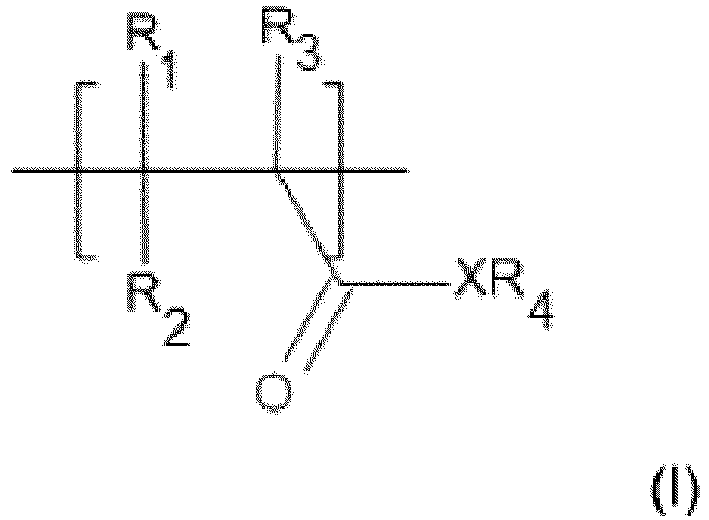 - R1, R2 et R3, égaux ou différents les uns des autres, étant indépendamment choisis parmi un atome d'hydrogène et un groupe C1-C3 hydrocarboné ;- X étant un atome d'oxygène, un atome de soufre ou un groupe NR8, R8 étant choisi parmi un atome d'hydrogène et un groupe C1-C3 hydrocarboné ;- R4 étant un atome d'hydrogène ou un groupement de chaîne C2-C20 hydrocarbonée, ledit groupement de chaîne C2-C20 hydrocarbonée comprenant éventuellement au moins un groupe fonctionnel (FG) ;ledit au moins un motif (MA) étant lié à ladite au moins une chaîne (Ra) via un groupe de liaison (LG) de formule
*-(C=O)-R5-**
R5 étant un groupe C1-C8 alkylène ou cycloalkylène ayant au moins un atome de carbone secondaire ou tertiaire,le symbole (*) indiquant la liaison à ladite chaîne (Ra), etle symbole (**) indiquant la liaison auxdits motifs (MA) par le biais dudit atome de carbone secondaire ou tertiaire. - Polymère (PFPEA) selon la revendication 1, la chaîne (Rf) étant une chaîne (per)fluoropolyoxyalkylène ayant un poids moléculaire moyen en nombre Mn dans la plage de 100 à 8 000, préférablement de 300 à 6 000, plus préférablement de 800 à 3 000, et comprenant, préférablement constituée par, des motifs répétitifs, qui peuvent être égaux ou différents les uns des autres, choisis parmi :(i) -CFY'O-, Y' étant F ou CF3,(ii) -CFY'CFY'O-, Y', égaux ou différents en chaque occurrence, étant comme définis ci-dessus, à la condition qu'au moins l'un parmi Y' soit -F,(iii) -CF2CF2CW2O-, chacun parmi W, égaux ou différents les uns des autres, étant F ou H,(iv) -CF2CF2CF2CF2O-,(v) -(CF2)j-CFZ'-O-, j étant un entier de 0 à 3 et Z' étant un groupe de formule générale -ORf'T, Rf' étant une chaîne fluoropolyoxyalcène comprenant un nombre de motifs répétitifs de 0 à 10, lesdits motifs répétitifs étant choisis parmi les suivants : -CFY"O- , -CF2CFY"O-, - CF2CF2CF2O-, -CF2CF2CF2CF2O-, chacun parmi chacun parmi Y" étant indépendamment F ou CF3 et T étant un groupe C1-C3 perfluoroalkyle.
- Polymère (PFPEA) selon la revendication 2, la chaîne (Rf) étant choisie parmi les formules (Rf-I), (Rf-IIA), (Rf-IIB), (Rf-IIC), (Rf-IID), (Rf-IIE) ou (Rf-III) ci-dessous :
(Rf-I) -[(CFX1O)g1(CFX2CFX3O)g2(CF2CF2CF2O)g3(CF2CF2CF2CF2O)g4]-
- X1 étant indépendamment choisi parmi -F et -CF3,- X2, X3, égaux ou différents l'un de l'autre et en chaque occurrence, étant indépendamment -F, -CF3, à la condition qu'au moins l'un parmi X1 à X3 soit -F ;- g1, g2, g3, et g4, égaux ou différents les uns des autres, étant indépendamment des entiers ≥ 0, de sorte que g1 + g2 + g3 + g4 soit dans la plage de 2 à 300, préférablement de 2 à 100 ; si au moins deux parmi g1, g2, g3 et g4 sont différents de zéro, les différents motifs répétitifs étant généralement distribués de manière statistique le long de la chaîne ;
(Rf-IIA) -[(CF2CF2O)a1(CF2O)a2]-
- a1 et a2 étant indépendamment des entiers ≥ 0 de sorte que le poids moléculaire moyen en nombre soit compris entre 400 et 10 000, préférablement entre 400 et 5 000 ; à la fois a1 et a2 étant préférablement différents de zéro, le rapport a1/a2 étant préférablement compris entre 0,1 et 10 ;
(Rf-IIB) -[(CF2CF2O)b1(CF2O)b2(CF(CF3)O)b3(CF2CF(CF3)O)b4]-
b1, b2, b3, b4, étant indépendamment des entiers ≥ 0 de sorte que le poids moléculaire moyen en nombre soit compris entre 400 et 10 000, préférablement entre 400 et 5 000 ; préférablement b1 étant 0, b2, b3, b4 étant > 0, le rapport b4/(b2 + b3) étant ≥ 1 ;
(Rf-IIC) -((CF2CF2O)c1(CF2O)c2(CF2(CF2)cwCF2O)c3]-
cw = 1 ou 2 ;c1, c2, et c3 étant indépendamment des entiers ≥ 0 choisis de sorte que le poids moléculaire moyen en nombre soit compris entre 400 et 10 000, préférablement entre 400 et 5 000 ; préférablement c1, c2, et C3 étant tous > 0, le rapport c3/(c1 +c2) étant plus faible que 0,2 ;
(Rf-IID) -[(CF2CF(CF3)O)d]-
d étant un entier > 0 de sorte que le poids moléculaire moyen en nombre soit compris entre 400 et 10 000, préférablement entre 400 et 5 000 ;
(Rf-IIE) -[(CF2CF2C(Hal*)2O)e1-(CF2CF2CH2O)e2-(CF2CF2CH(Hal*)O)e3]-
- Hal*, égaux ou différents en chaque occurrence, étant un halogène choisi parmi des atomes de fluor et de chlore, préférablement un atome de fluor ;- e1, e2, et e3, égaux ou différents les uns des autres, étant indépendamment des entiers ≥ 0 de sorte que la somme (e1+e2+e3) soit comprise entre 2 et 300 ;
(Rf-III) -[(CF2CF2O)a1(CF2O)a2]-
- a1, et a2 étant des entiers > 0 de sorte que le poids moléculaire moyen en nombre soit compris entre 400 et 10 000, préférablement entre 400 et 5 000, le rapport a1/a2 étant compris entre 0,1 et 10, plus préférablement entre 0,2 et 5. - Polymère (PFPEA) selon la revendication 1, la chaîne (Ra) étant une chaîne polyoxyalkylène exempte d'atomes de fluor, ladite chaîne comprenant de 1 à 50 motifs oxyalkylène exempts de fluor, lesdits motifs étant les mêmes ou différents les uns des autres et ayant la formule générale :

- Polymère (PFPEA) selon la revendication 4, les motifs oxyalkylène exempts de fluor étant choisis parmi -CH2CH2O- et -CH2CH(J)O-, J étant un alkyle linéaire ou ramifié ou aryle, préférablement méthyle, éthyle ou phényle.
- Polymère (PFPEA) selon l'une quelconque des revendications 4 ou 5, la chaîne Ra répondant à la formule (Ra-I) ci-dessous :
(Ra-I) -(CH2CH2O)r(CH2GH(CH3)O)s(CH2CH(CH2CH3)O)t(CH2CH(Ph)O)u-
r, s, t et u étant indépendamment choisis parmi 0 et un nombre positif, r + s + t + u étant dans la plage de 1 à 50, préférablement de 1 à 15, plus préférablement de 1 à 10. - Polymère (PFPEA) selon la revendication 1, l'au moins un groupe fonctionnel (FG) étant choisi dans le groupe constitué par des groupes hydroxyle, des groupes éther, des groupes oxyalkylène, des groupes polyoxyalkylène, des groupes acides carboxylique, des groupes amine, des groupes amide, des groupes contenant halogène, y compris des groupes fluoro et perfluoro, des atomes d'halogène, des groupes phosphate, des groupes ester, des groupes siloxane et des groupes polysiloxane.
- Polymère (PFPEA) selon la revendication 1, le groupe de liaison (LG) étant choisi parmi les formules (LG-I) ou (LG-II) :
(LG-I) *-(C=O)-C(R6R7)-**
R6 et R7 étant indépendamment un hydrogène, un groupe méthyle ou un groupe benzyle, à la condition que R6 et R7 ne puissent pas être tous deux hydrogène,
(LG-II) *-(C=O)-C(CH3)2-**.
- Procédé pour la fabrication de polymères (PFPEA) selon l'une quelconque des revendications 1 à 8, le procédé comprenant les étapes suivantes :a) fourniture d'un macroinitiateur de PFPE [polymère (PFPEi)] comprenant :- au moins une chaîne (per) fluoropolyoxyalkylène [chaîne (Rf)];- au moins une chaîne (poly)oxyalkylène [chaîne (Ra)] liée à au moins un côté de ladite chaîne (Rf), ladite chaîne (Ra) comprenant au moins un motif oxyalkylène exempt de fluor ; et- au moins un groupe de formule *-(C=O)-R5-X', R5 étant un groupe C1-C8 alkylène ou cycloalkylène comprenant au moins un atome de carbone secondaire ou tertiaire, X' étant un halogène, l'halogène étant lié à R5 via ledit atome de carbone secondaire ou tertiaire, le symbole (*) indiquant la liaison à ladite chaîne (Ra) ;b) mise en réaction de l'initiateur fourni dans l'étape a) par polymérisation radicalaire par transfert d'atome (ATRP) avec au moins un monomère (méth)acrylique [monomère (MM)] de formule (II) :
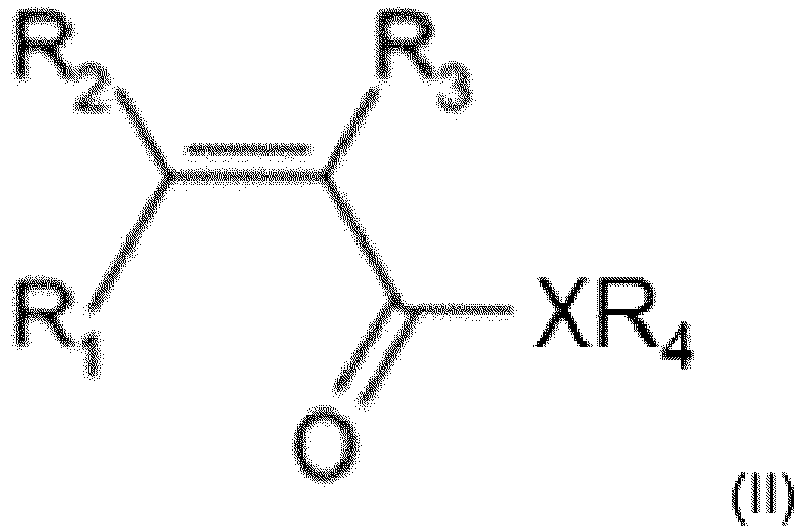 - R1, R2 et R3, égaux ou différents les uns des autres, étant indépendamment choisis parmi un atome d'hydrogène et un groupe C1-C3 hydrocarboné ;- X étant un atome d'oxygène, un atome de soufre ou un groupe NR8, R8 étant choisi parmi un atome d'hydrogène et un groupe C1-C3 hydrocarboné ;- R4 étant un atome d'hydrogène ou un groupement de chaîne C2-C20 hydrocarbonée, ledit groupement de chaîne C2-C20 hydrocarbonée comprenant éventuellement au moins un groupe fonctionnel (FG) ;en la présence d'au moins un catalyseur de métal de transition et d'un ligand pour obtenir un polymère (PFPEA) ; etc) purification du polymère (PFPEA) obtenu dans l'étape b) pour éliminer l'au moins un catalyseur de métal de transition.
 - Procédé selon la revendication 9, l'au moins un groupe de formule *-(C=O)-R5-X' répondant à la formule
*-(C=O)-C(R6R7)-X'
R6 et R7 étant indépendamment un hydrogène, un groupe méthyle ou un groupe benzyle, à la condition que R6 et R7 ne puissent pas être tous deux hydrogène, et X' étant un atome de chlore, un atome de brome ou un atome d'iode. - Polymère (PFPEi) comprenant :- au moins une chaîne (per)fluoropolyoxyalkylène [chaîne (Rf)] ;- au moins une chaîne (poly)oxyalkylène [chaîne (Ra)] liée à au moins un côté de ladite chaîne (Rf), ladite chaîne (Ra) comprenant au moins un motif oxyalkylène exempt de fluor ; et- au moins un groupe de formule *-(C=O)-R5-X', R5 étant un groupe C1-C8 alkylène ou cycloalkylène comprenant au moins un atome de carbone secondaire ou tertiaire, X' étant un halogène, l'halogène étant lié à R5 via ledit atome de carbone secondaire ou tertiaire, le symbole (*) indiquant la liaison à ladite chaîne (Ra).
- Polymère (PFPEi) selon la revendication 11 de formule (IV) :
A-O-Rf-(CF2)x-CFZ-CH2-O-Ra-C(=O)-C(R6R7)-X' (IV)
- Rf étant une chaîne (per)fluoropolyoxyalkylène ayant un poids moléculaire moyen en nombre Mn dans la plage de 100 à 8 000, préférablement de 300 à 6 000, plus préférablement de 800 à 3 000, et comprenant, préférablement constituée par, des motifs répétitifs, qui peuvent être égaux ou différents les uns des autres, choisis parmi :(i) -CFY'O-, Y' étant F ou CF3,(ii) -CFY'CFY'O-, Y', égaux ou différents en chaque occurrence, étant comme définis ci-dessus, à la condition qu'au moins l'un parmi Y' soit -F,(iii) -CF2CF2CW2O-, chacun parmi W, égaux ou différents les uns des autres, étant F ou H,(iv) -CF2CF2CF2CF2O-,(v) -(CF2)j-CFZ'-O-, j étant un entier de 0 à 3 et Z' étant un groupe de formule générale -ORf'T, Rf' étant une chaîne fluoropolyoxyalcène comprenant un nombre de motifs répétitifs de 0 à 10, lesdits motifs répétitifs étant choisis parmi les suivants : -CFY"O- , -CF2CFY"O-, - CF2CF2CF2O-, -CF2CF2CF2CF2O-, chacun parmi chacun parmi Y" étant indépendamment F ou CF3 et T étant un groupe C1-C3 perfluoroalkyle ;- Z étant fluor ou CF3 ;- x étant 0 ou 1, à la condition que, si, x est 1, Z soit F ;- Ra étant une chaîne polyoxyalkylène exempte d'atomes de fluor, ladite chaîne comprenant de 4 à 50 motifs oxyalkylène exempts de fluor, lesdits motifs étant les mêmes ou différents les uns des autres et étant choisis parmi -CH2CH2O- et -CH2CH(J)O-, J étant un alkyle linéaire ou ramifié ou aryle, préférablement méthyle, éthyle ou phényle- R6 et R7 étant indépendamment un hydrogène, un groupe méthyle ou un groupe benzyle, à la condition que R6 et R7 ne puissent pas être tous deux hydrogène ;- X' étant un atome de chlore, un atome de brome ou un atome d'iode, préférablement un atome de brome ;- A étant -Ra-C(=O)-C(R6R7)-X' , Ra, R6, R7, et X' étant tels que définis ci-dessus, ou étant un groupe C1-C4 (per) fluoroalkyle linéaire ou ramifié, un atome de fluor pouvant être substitué par un atome de chlore ou un atome d'hydrogène. - Polymère (PFPEi) selon la revendication 12 ayant la formule
Rf[CF2CH2O-(CH2CH2O)n-C(=O)-C(CH3)2-Br]2.
- Composition (S) comprenant un polymère tel que défini dans l'une quelconque des revendications 1 à 8, et au moins un solvant.
- Procédé pour le revêtement d'au moins une surface d'un substrat, préférablement choisie parmi plastique, métallique ou verre, ledit procédé comprenant :(i) la mise en contact d'un substrat avec ladite composition (S) et(ii) le séchage de ladite composition (S) sur ledit substrat.
Applications Claiming Priority (2)
| Application Number | Priority Date | Filing Date | Title |
|---|---|---|---|
| EP18202808 | 2018-10-26 | ||
| PCT/EP2019/079033 WO2020084054A1 (fr) | 2018-10-26 | 2019-10-24 | Dérivés de pfpe polyacrylique |
Publications (2)
| Publication Number | Publication Date |
|---|---|
| EP3870664A1 EP3870664A1 (fr) | 2021-09-01 |
| EP3870664B1 true EP3870664B1 (fr) | 2024-08-07 |
Family
ID=64051387
Family Applications (1)
| Application Number | Title | Priority Date | Filing Date |
|---|---|---|---|
| EP19789718.4A Active EP3870664B1 (fr) | 2018-10-26 | 2019-10-24 | Dérivés de pfpe polyacrylique |
Country Status (6)
| Country | Link |
|---|---|
| US (1) | US20220002499A1 (fr) |
| EP (1) | EP3870664B1 (fr) |
| JP (2) | JP7794633B2 (fr) |
| KR (1) | KR102810273B1 (fr) |
| CN (1) | CN112912453A (fr) |
| WO (1) | WO2020084054A1 (fr) |
Families Citing this family (3)
| Publication number | Priority date | Publication date | Assignee | Title |
|---|---|---|---|---|
| AU2022216794A1 (en) | 2021-02-03 | 2023-09-21 | Basf Se | Compositions, comprising silver nanoplatelets |
| CN113667051B (zh) * | 2021-09-13 | 2022-07-15 | 卫星化学股份有限公司 | 一种含有全氟聚醚结构的高疏水疏油乳液的制备方法 |
| WO2023072740A1 (fr) | 2021-10-26 | 2023-05-04 | Basf Se | Procédé pour la production d'éléments d'interférence |
Family Cites Families (8)
| Publication number | Priority date | Publication date | Assignee | Title |
|---|---|---|---|---|
| IT1270818B (it) * | 1993-04-28 | 1997-05-13 | Ausimont Spa | Coatings a base di perfluoropolieteri contenenti gruppi acrilici |
| KR101632762B1 (ko) | 2008-08-11 | 2016-06-22 | 솔베이 스페셜티 폴리머스 이태리 에스.피.에이. | 열적 안정성 및 화학적 안정성이 개선된 하이드로플루오로알코올 |
| US9029452B2 (en) | 2010-05-27 | 2015-05-12 | E I Du Pont De Nemours And Company | Fluoropolymer additive for coatings |
| KR102121906B1 (ko) | 2012-12-11 | 2020-06-12 | 솔베이 스페셜티 폴리머스 이태리 에스.피.에이. | (퍼)플루오로폴리에테르 알코올의 알콕실화 공정 |
| US20170240839A1 (en) * | 2014-08-05 | 2017-08-24 | Solvay Specialty Polymers Italy S.P.A. | Lubrication method with alkoxylated perfluoropolyether |
| WO2016096684A1 (fr) * | 2014-12-15 | 2016-06-23 | Solvay Specialty Polymers Italy S.P.A. | Composition à base d'eau comprenant un polymère fluoré |
| JP6176426B2 (ja) | 2015-07-23 | 2017-08-09 | Dic株式会社 | 含フッ素化合物、リビング重合開始剤、含フッ素重合体、含フッ素重合体の製造方法及びレジスト組成物 |
| US20190002633A1 (en) * | 2015-12-22 | 2019-01-03 | Solvay Specialty Polymers Italy S.P.A. | Functionalized (poly)alkoxylated (per)fluoropolyether polymers |
-
2019
- 2019-10-24 US US17/283,324 patent/US20220002499A1/en not_active Abandoned
- 2019-10-24 KR KR1020217011791A patent/KR102810273B1/ko active Active
- 2019-10-24 WO PCT/EP2019/079033 patent/WO2020084054A1/fr not_active Ceased
- 2019-10-24 CN CN201980070595.9A patent/CN112912453A/zh active Pending
- 2019-10-24 EP EP19789718.4A patent/EP3870664B1/fr active Active
- 2019-10-24 JP JP2021521519A patent/JP7794633B2/ja active Active
-
2024
- 2024-09-24 JP JP2024164771A patent/JP2025011116A/ja not_active Withdrawn
Also Published As
| Publication number | Publication date |
|---|---|
| EP3870664A1 (fr) | 2021-09-01 |
| WO2020084054A1 (fr) | 2020-04-30 |
| KR20210082451A (ko) | 2021-07-05 |
| CN112912453A (zh) | 2021-06-04 |
| KR102810273B1 (ko) | 2025-05-20 |
| JP2025011116A (ja) | 2025-01-23 |
| JP2022505474A (ja) | 2022-01-14 |
| JP7794633B2 (ja) | 2026-01-06 |
| US20220002499A1 (en) | 2022-01-06 |
Similar Documents
| Publication | Publication Date | Title |
|---|---|---|
| JP2025011116A (ja) | ポリアクリルpfpe誘導体 | |
| EP0870778B1 (fr) | Polymères hydrogénés modifiés, procédé et utilisation | |
| EP2170968B1 (fr) | Polymères aromatiques hydrogénés contenant du fluor | |
| EP4229112B1 (fr) | Nouveaux polymères (per)fluoropolyéther et leur utilisation | |
| CN101589088A (zh) | 氟化的润滑剂 | |
| CN101679569A (zh) | 氟化醚组合物以及使用该组合物的方法 | |
| EP1568730B1 (fr) | Perfluorpolyéthers peroxydés | |
| JP2015196723A (ja) | フルオロポリエーテル基含有ポリマー | |
| EP3221381B1 (fr) | Dérivés aminés de perfluoropolyéthers | |
| WO2018078001A1 (fr) | Procédé de prévention de la corrosion d'articles métalliques | |
| He et al. | Low-fluorinated homopolymer from heterogeneous ATRP of 2, 2, 2-trifluoroethyl methacrylate mediated by copper complex with nitrogen-based ligand | |
| EP1568725B1 (fr) | Perfluoropolyethers peroxidiques | |
| EP3221382B1 (fr) | Dérivés zwitterioniques de (per)fluoropolyéthers | |
| JP2020041043A (ja) | 硬化性組成物、及び硬化物 | |
| EP4058488A1 (fr) | Procédé de fonctionnalisation de polymères fluorés, polymère fluoré fonctionnalisé et compositions de revêtement à base de ceux-ci | |
| EP4229113B1 (fr) | Nouveaux polymères (per)fluoropolyéther et leur utilisation | |
| EP4453044B1 (fr) | Polymères de perfluoropolyéther avec des groupes fonctionnels pendants | |
| CN108431082A (zh) | 官能化(聚)烷氧基化的(全)氟聚醚聚合物 | |
| WO2024053357A1 (fr) | Composé contenant un groupe fluoropolyéther, composition de fluoropolyéther photoréticulable, produit photoréticulé et procédé de photoréticulation d'une composition | |
| WO2025070541A1 (fr) | Composition de revêtement | |
| WO2019229187A1 (fr) | Composition réversiblement réticulable de polymères ioniques |
Legal Events
| Date | Code | Title | Description |
|---|---|---|---|
| STAA | Information on the status of an ep patent application or granted ep patent |
Free format text: STATUS: UNKNOWN |
|
| STAA | Information on the status of an ep patent application or granted ep patent |
Free format text: STATUS: THE INTERNATIONAL PUBLICATION HAS BEEN MADE |
|
| PUAI | Public reference made under article 153(3) epc to a published international application that has entered the european phase |
Free format text: ORIGINAL CODE: 0009012 |
|
| STAA | Information on the status of an ep patent application or granted ep patent |
Free format text: STATUS: REQUEST FOR EXAMINATION WAS MADE |
|
| 17P | Request for examination filed |
Effective date: 20210526 |
|
| AK | Designated contracting states |
Kind code of ref document: A1 Designated state(s): AL AT BE BG CH CY CZ DE DK EE ES FI FR GB GR HR HU IE IS IT LI LT LU LV MC MK MT NL NO PL PT RO RS SE SI SK SM TR |
|
| DAV | Request for validation of the european patent (deleted) | ||
| DAX | Request for extension of the european patent (deleted) | ||
| STAA | Information on the status of an ep patent application or granted ep patent |
Free format text: STATUS: EXAMINATION IS IN PROGRESS |
|
| 17Q | First examination report despatched |
Effective date: 20230612 |
|
| GRAP | Despatch of communication of intention to grant a patent |
Free format text: ORIGINAL CODE: EPIDOSNIGR1 |
|
| STAA | Information on the status of an ep patent application or granted ep patent |
Free format text: STATUS: GRANT OF PATENT IS INTENDED |
|
| INTG | Intention to grant announced |
Effective date: 20240523 |
|
| GRAS | Grant fee paid |
Free format text: ORIGINAL CODE: EPIDOSNIGR3 |
|
| GRAA | (expected) grant |
Free format text: ORIGINAL CODE: 0009210 |
|
| STAA | Information on the status of an ep patent application or granted ep patent |
Free format text: STATUS: THE PATENT HAS BEEN GRANTED |
|
| P01 | Opt-out of the competence of the unified patent court (upc) registered |
Free format text: CASE NUMBER: APP_33923/2024 Effective date: 20240606 |
|
| AK | Designated contracting states |
Kind code of ref document: B1 Designated state(s): AL AT BE BG CH CY CZ DE DK EE ES FI FR GB GR HR HU IE IS IT LI LT LU LV MC MK MT NL NO PL PT RO RS SE SI SK SM TR |
|
| REG | Reference to a national code |
Ref country code: GB Ref legal event code: FG4D |
|
| REG | Reference to a national code |
Ref country code: CH Ref legal event code: EP |
|
| REG | Reference to a national code |
Ref country code: IE Ref legal event code: FG4D |
|
| REG | Reference to a national code |
Ref country code: DE Ref legal event code: R096 Ref document number: 602019056637 Country of ref document: DE |
|
| REG | Reference to a national code |
Ref country code: LT Ref legal event code: MG9D |
|
| REG | Reference to a national code |
Ref country code: NL Ref legal event code: MP Effective date: 20240807 |
|
| PG25 | Lapsed in a contracting state [announced via postgrant information from national office to epo] |
Ref country code: NO Free format text: LAPSE BECAUSE OF FAILURE TO SUBMIT A TRANSLATION OF THE DESCRIPTION OR TO PAY THE FEE WITHIN THE PRESCRIBED TIME-LIMIT Effective date: 20241107 |
|
| REG | Reference to a national code |
Ref country code: AT Ref legal event code: MK05 Ref document number: 1710926 Country of ref document: AT Kind code of ref document: T Effective date: 20240807 |
|
| PG25 | Lapsed in a contracting state [announced via postgrant information from national office to epo] |
Ref country code: FI Free format text: LAPSE BECAUSE OF FAILURE TO SUBMIT A TRANSLATION OF THE DESCRIPTION OR TO PAY THE FEE WITHIN THE PRESCRIBED TIME-LIMIT Effective date: 20240807 Ref country code: GR Free format text: LAPSE BECAUSE OF FAILURE TO SUBMIT A TRANSLATION OF THE DESCRIPTION OR TO PAY THE FEE WITHIN THE PRESCRIBED TIME-LIMIT Effective date: 20241108 Ref country code: NL Free format text: LAPSE BECAUSE OF FAILURE TO SUBMIT A TRANSLATION OF THE DESCRIPTION OR TO PAY THE FEE WITHIN THE PRESCRIBED TIME-LIMIT Effective date: 20240807 Ref country code: PL Free format text: LAPSE BECAUSE OF FAILURE TO SUBMIT A TRANSLATION OF THE DESCRIPTION OR TO PAY THE FEE WITHIN THE PRESCRIBED TIME-LIMIT Effective date: 20240807 Ref country code: PT Free format text: LAPSE BECAUSE OF FAILURE TO SUBMIT A TRANSLATION OF THE DESCRIPTION OR TO PAY THE FEE WITHIN THE PRESCRIBED TIME-LIMIT Effective date: 20241209 |
|
| PG25 | Lapsed in a contracting state [announced via postgrant information from national office to epo] |
Ref country code: BG Free format text: LAPSE BECAUSE OF FAILURE TO SUBMIT A TRANSLATION OF THE DESCRIPTION OR TO PAY THE FEE WITHIN THE PRESCRIBED TIME-LIMIT Effective date: 20240807 |
|
| PG25 | Lapsed in a contracting state [announced via postgrant information from national office to epo] |
Ref country code: LV Free format text: LAPSE BECAUSE OF FAILURE TO SUBMIT A TRANSLATION OF THE DESCRIPTION OR TO PAY THE FEE WITHIN THE PRESCRIBED TIME-LIMIT Effective date: 20240807 |
|
| PG25 | Lapsed in a contracting state [announced via postgrant information from national office to epo] |
Ref country code: AT Free format text: LAPSE BECAUSE OF FAILURE TO SUBMIT A TRANSLATION OF THE DESCRIPTION OR TO PAY THE FEE WITHIN THE PRESCRIBED TIME-LIMIT Effective date: 20240807 Ref country code: IS Free format text: LAPSE BECAUSE OF FAILURE TO SUBMIT A TRANSLATION OF THE DESCRIPTION OR TO PAY THE FEE WITHIN THE PRESCRIBED TIME-LIMIT Effective date: 20241207 |
|
| PG25 | Lapsed in a contracting state [announced via postgrant information from national office to epo] |
Ref country code: HR Free format text: LAPSE BECAUSE OF FAILURE TO SUBMIT A TRANSLATION OF THE DESCRIPTION OR TO PAY THE FEE WITHIN THE PRESCRIBED TIME-LIMIT Effective date: 20240807 |
|
| PG25 | Lapsed in a contracting state [announced via postgrant information from national office to epo] |
Ref country code: ES Free format text: LAPSE BECAUSE OF FAILURE TO SUBMIT A TRANSLATION OF THE DESCRIPTION OR TO PAY THE FEE WITHIN THE PRESCRIBED TIME-LIMIT Effective date: 20240807 Ref country code: RS Free format text: LAPSE BECAUSE OF FAILURE TO SUBMIT A TRANSLATION OF THE DESCRIPTION OR TO PAY THE FEE WITHIN THE PRESCRIBED TIME-LIMIT Effective date: 20241107 |
|
| PG25 | Lapsed in a contracting state [announced via postgrant information from national office to epo] |
Ref country code: RS Free format text: LAPSE BECAUSE OF FAILURE TO SUBMIT A TRANSLATION OF THE DESCRIPTION OR TO PAY THE FEE WITHIN THE PRESCRIBED TIME-LIMIT Effective date: 20241107 Ref country code: PT Free format text: LAPSE BECAUSE OF FAILURE TO SUBMIT A TRANSLATION OF THE DESCRIPTION OR TO PAY THE FEE WITHIN THE PRESCRIBED TIME-LIMIT Effective date: 20241209 Ref country code: PL Free format text: LAPSE BECAUSE OF FAILURE TO SUBMIT A TRANSLATION OF THE DESCRIPTION OR TO PAY THE FEE WITHIN THE PRESCRIBED TIME-LIMIT Effective date: 20240807 Ref country code: NO Free format text: LAPSE BECAUSE OF FAILURE TO SUBMIT A TRANSLATION OF THE DESCRIPTION OR TO PAY THE FEE WITHIN THE PRESCRIBED TIME-LIMIT Effective date: 20241107 Ref country code: NL Free format text: LAPSE BECAUSE OF FAILURE TO SUBMIT A TRANSLATION OF THE DESCRIPTION OR TO PAY THE FEE WITHIN THE PRESCRIBED TIME-LIMIT Effective date: 20240807 Ref country code: LV Free format text: LAPSE BECAUSE OF FAILURE TO SUBMIT A TRANSLATION OF THE DESCRIPTION OR TO PAY THE FEE WITHIN THE PRESCRIBED TIME-LIMIT Effective date: 20240807 Ref country code: IS Free format text: LAPSE BECAUSE OF FAILURE TO SUBMIT A TRANSLATION OF THE DESCRIPTION OR TO PAY THE FEE WITHIN THE PRESCRIBED TIME-LIMIT Effective date: 20241207 Ref country code: HR Free format text: LAPSE BECAUSE OF FAILURE TO SUBMIT A TRANSLATION OF THE DESCRIPTION OR TO PAY THE FEE WITHIN THE PRESCRIBED TIME-LIMIT Effective date: 20240807 Ref country code: GR Free format text: LAPSE BECAUSE OF FAILURE TO SUBMIT A TRANSLATION OF THE DESCRIPTION OR TO PAY THE FEE WITHIN THE PRESCRIBED TIME-LIMIT Effective date: 20241108 Ref country code: FI Free format text: LAPSE BECAUSE OF FAILURE TO SUBMIT A TRANSLATION OF THE DESCRIPTION OR TO PAY THE FEE WITHIN THE PRESCRIBED TIME-LIMIT Effective date: 20240807 Ref country code: ES Free format text: LAPSE BECAUSE OF FAILURE TO SUBMIT A TRANSLATION OF THE DESCRIPTION OR TO PAY THE FEE WITHIN THE PRESCRIBED TIME-LIMIT Effective date: 20240807 Ref country code: BG Free format text: LAPSE BECAUSE OF FAILURE TO SUBMIT A TRANSLATION OF THE DESCRIPTION OR TO PAY THE FEE WITHIN THE PRESCRIBED TIME-LIMIT Effective date: 20240807 Ref country code: AT Free format text: LAPSE BECAUSE OF FAILURE TO SUBMIT A TRANSLATION OF THE DESCRIPTION OR TO PAY THE FEE WITHIN THE PRESCRIBED TIME-LIMIT Effective date: 20240807 |
|
| PG25 | Lapsed in a contracting state [announced via postgrant information from national office to epo] |
Ref country code: RO Free format text: LAPSE BECAUSE OF FAILURE TO SUBMIT A TRANSLATION OF THE DESCRIPTION OR TO PAY THE FEE WITHIN THE PRESCRIBED TIME-LIMIT Effective date: 20240807 Ref country code: DK Free format text: LAPSE BECAUSE OF FAILURE TO SUBMIT A TRANSLATION OF THE DESCRIPTION OR TO PAY THE FEE WITHIN THE PRESCRIBED TIME-LIMIT Effective date: 20240807 Ref country code: SM Free format text: LAPSE BECAUSE OF FAILURE TO SUBMIT A TRANSLATION OF THE DESCRIPTION OR TO PAY THE FEE WITHIN THE PRESCRIBED TIME-LIMIT Effective date: 20240807 |
|
| PG25 | Lapsed in a contracting state [announced via postgrant information from national office to epo] |
Ref country code: EE Free format text: LAPSE BECAUSE OF FAILURE TO SUBMIT A TRANSLATION OF THE DESCRIPTION OR TO PAY THE FEE WITHIN THE PRESCRIBED TIME-LIMIT Effective date: 20240807 |
|
| PG25 | Lapsed in a contracting state [announced via postgrant information from national office to epo] |
Ref country code: CZ Free format text: LAPSE BECAUSE OF FAILURE TO SUBMIT A TRANSLATION OF THE DESCRIPTION OR TO PAY THE FEE WITHIN THE PRESCRIBED TIME-LIMIT Effective date: 20240807 |
|
| PG25 | Lapsed in a contracting state [announced via postgrant information from national office to epo] |
Ref country code: SK Free format text: LAPSE BECAUSE OF FAILURE TO SUBMIT A TRANSLATION OF THE DESCRIPTION OR TO PAY THE FEE WITHIN THE PRESCRIBED TIME-LIMIT Effective date: 20240807 |
|
| REG | Reference to a national code |
Ref country code: DE Ref legal event code: R097 Ref document number: 602019056637 Country of ref document: DE |
|
| REG | Reference to a national code |
Ref country code: CH Ref legal event code: PL |
|
| PLBE | No opposition filed within time limit |
Free format text: ORIGINAL CODE: 0009261 |
|
| STAA | Information on the status of an ep patent application or granted ep patent |
Free format text: STATUS: NO OPPOSITION FILED WITHIN TIME LIMIT |
|
| PG25 | Lapsed in a contracting state [announced via postgrant information from national office to epo] |
Ref country code: MC Free format text: LAPSE BECAUSE OF FAILURE TO SUBMIT A TRANSLATION OF THE DESCRIPTION OR TO PAY THE FEE WITHIN THE PRESCRIBED TIME-LIMIT Effective date: 20240807 |
|
| PG25 | Lapsed in a contracting state [announced via postgrant information from national office to epo] |
Ref country code: BE Free format text: LAPSE BECAUSE OF NON-PAYMENT OF DUE FEES Effective date: 20241031 Ref country code: LU Free format text: LAPSE BECAUSE OF NON-PAYMENT OF DUE FEES Effective date: 20241024 |
|
| 26N | No opposition filed |
Effective date: 20250508 |
|
| PG25 | Lapsed in a contracting state [announced via postgrant information from national office to epo] |
Ref country code: CH Free format text: LAPSE BECAUSE OF NON-PAYMENT OF DUE FEES Effective date: 20241031 |
|
| REG | Reference to a national code |
Ref country code: BE Ref legal event code: MM Effective date: 20241031 |
|
| PG25 | Lapsed in a contracting state [announced via postgrant information from national office to epo] |
Ref country code: SE Free format text: LAPSE BECAUSE OF FAILURE TO SUBMIT A TRANSLATION OF THE DESCRIPTION OR TO PAY THE FEE WITHIN THE PRESCRIBED TIME-LIMIT Effective date: 20240807 |
|
| PGFP | Annual fee paid to national office [announced via postgrant information from national office to epo] |
Ref country code: GB Payment date: 20250904 Year of fee payment: 7 |
|
| PGFP | Annual fee paid to national office [announced via postgrant information from national office to epo] |
Ref country code: FR Payment date: 20250908 Year of fee payment: 7 |
|
| PG25 | Lapsed in a contracting state [announced via postgrant information from national office to epo] |
Ref country code: IE Free format text: LAPSE BECAUSE OF NON-PAYMENT OF DUE FEES Effective date: 20241024 |
|
| PGFP | Annual fee paid to national office [announced via postgrant information from national office to epo] |
Ref country code: DE Payment date: 20250902 Year of fee payment: 7 |
|
| PG25 | Lapsed in a contracting state [announced via postgrant information from national office to epo] |
Ref country code: IT Free format text: LAPSE BECAUSE OF FAILURE TO SUBMIT A TRANSLATION OF THE DESCRIPTION OR TO PAY THE FEE WITHIN THE PRESCRIBED TIME-LIMIT Effective date: 20240807 Ref country code: CY Free format text: LAPSE BECAUSE OF FAILURE TO SUBMIT A TRANSLATION OF THE DESCRIPTION OR TO PAY THE FEE WITHIN THE PRESCRIBED TIME-LIMIT; INVALID AB INITIO Effective date: 20191024 |
|
| PG25 | Lapsed in a contracting state [announced via postgrant information from national office to epo] |
Ref country code: HU Free format text: LAPSE BECAUSE OF FAILURE TO SUBMIT A TRANSLATION OF THE DESCRIPTION OR TO PAY THE FEE WITHIN THE PRESCRIBED TIME-LIMIT; INVALID AB INITIO Effective date: 20191024 |