EP3872154A1 - Ionische flüssigkeiten enthaltende schmierstoffzusammensetzung - Google Patents
Ionische flüssigkeiten enthaltende schmierstoffzusammensetzung Download PDFInfo
- Publication number
- EP3872154A1 EP3872154A1 EP21154009.1A EP21154009A EP3872154A1 EP 3872154 A1 EP3872154 A1 EP 3872154A1 EP 21154009 A EP21154009 A EP 21154009A EP 3872154 A1 EP3872154 A1 EP 3872154A1
- Authority
- EP
- European Patent Office
- Prior art keywords
- base oil
- ionic liquid
- bis
- lubricant composition
- mixtures
- Prior art date
- Legal status (The legal status is an assumption and is not a legal conclusion. Google has not performed a legal analysis and makes no representation as to the accuracy of the status listed.)
- Granted
Links
Classifications
-
- C—CHEMISTRY; METALLURGY
- C10—PETROLEUM, GAS OR COKE INDUSTRIES; TECHNICAL GASES CONTAINING CARBON MONOXIDE; FUELS; LUBRICANTS; PEAT
- C10M—LUBRICATING COMPOSITIONS; USE OF CHEMICAL SUBSTANCES EITHER ALONE OR AS LUBRICATING INGREDIENTS IN A LUBRICATING COMPOSITION
- C10M171/00—Lubricating compositions characterised by purely physical criteria, e.g. containing as base-material, thickener or additive, ingredients which are characterised exclusively by their numerically specified physical properties, i.e. containing ingredients which are physically well-defined but for which the chemical nature is either unspecified or only very vaguely indicated
-
- C—CHEMISTRY; METALLURGY
- C10—PETROLEUM, GAS OR COKE INDUSTRIES; TECHNICAL GASES CONTAINING CARBON MONOXIDE; FUELS; LUBRICANTS; PEAT
- C10M—LUBRICATING COMPOSITIONS; USE OF CHEMICAL SUBSTANCES EITHER ALONE OR AS LUBRICATING INGREDIENTS IN A LUBRICATING COMPOSITION
- C10M169/00—Lubricating compositions characterised by containing as components a mixture of at least two types of ingredient selected from base-materials, thickeners or additives, covered by the preceding groups, each of these compounds being essential
- C10M169/04—Mixtures of base-materials and additives
- C10M169/045—Mixtures of base-materials and additives the additives being a mixture of compounds of unknown or incompletely defined constitution and non-macromolecular compounds
-
- C—CHEMISTRY; METALLURGY
- C10—PETROLEUM, GAS OR COKE INDUSTRIES; TECHNICAL GASES CONTAINING CARBON MONOXIDE; FUELS; LUBRICANTS; PEAT
- C10M—LUBRICATING COMPOSITIONS; USE OF CHEMICAL SUBSTANCES EITHER ALONE OR AS LUBRICATING INGREDIENTS IN A LUBRICATING COMPOSITION
- C10M137/00—Lubricating compositions characterised by the additive being an organic non-macromolecular compound containing phosphorus
- C10M137/12—Lubricating compositions characterised by the additive being an organic non-macromolecular compound containing phosphorus having a phosphorus-to-carbon bond
-
- C—CHEMISTRY; METALLURGY
- C10—PETROLEUM, GAS OR COKE INDUSTRIES; TECHNICAL GASES CONTAINING CARBON MONOXIDE; FUELS; LUBRICANTS; PEAT
- C10M—LUBRICATING COMPOSITIONS; USE OF CHEMICAL SUBSTANCES EITHER ALONE OR AS LUBRICATING INGREDIENTS IN A LUBRICATING COMPOSITION
- C10M101/00—Lubricating compositions characterised by the base-material being a mineral or fatty oil
- C10M101/02—Petroleum fractions
-
- C—CHEMISTRY; METALLURGY
- C10—PETROLEUM, GAS OR COKE INDUSTRIES; TECHNICAL GASES CONTAINING CARBON MONOXIDE; FUELS; LUBRICANTS; PEAT
- C10M—LUBRICATING COMPOSITIONS; USE OF CHEMICAL SUBSTANCES EITHER ALONE OR AS LUBRICATING INGREDIENTS IN A LUBRICATING COMPOSITION
- C10M105/00—Lubricating compositions characterised by the base-material being a non-macromolecular organic compound
- C10M105/08—Lubricating compositions characterised by the base-material being a non-macromolecular organic compound containing oxygen
- C10M105/32—Esters
- C10M105/34—Esters of monocarboxylic acids
-
- C—CHEMISTRY; METALLURGY
- C10—PETROLEUM, GAS OR COKE INDUSTRIES; TECHNICAL GASES CONTAINING CARBON MONOXIDE; FUELS; LUBRICANTS; PEAT
- C10M—LUBRICATING COMPOSITIONS; USE OF CHEMICAL SUBSTANCES EITHER ALONE OR AS LUBRICATING INGREDIENTS IN A LUBRICATING COMPOSITION
- C10M107/00—Lubricating compositions characterised by the base-material being a macromolecular compound
- C10M107/02—Hydrocarbon polymers; Hydrocarbon polymers modified by oxidation
- C10M107/10—Hydrocarbon polymers; Hydrocarbon polymers modified by oxidation containing aliphatic monomer having more than 4 carbon atoms
-
- C—CHEMISTRY; METALLURGY
- C10—PETROLEUM, GAS OR COKE INDUSTRIES; TECHNICAL GASES CONTAINING CARBON MONOXIDE; FUELS; LUBRICANTS; PEAT
- C10M—LUBRICATING COMPOSITIONS; USE OF CHEMICAL SUBSTANCES EITHER ALONE OR AS LUBRICATING INGREDIENTS IN A LUBRICATING COMPOSITION
- C10M133/00—Lubricating compositions characterised by the additive being an organic non-macromolecular compound containing nitrogen
- C10M133/02—Lubricating compositions characterised by the additive being an organic non-macromolecular compound containing nitrogen having a carbon chain of less than 30 atoms
- C10M133/16—Amides; Imides
-
- C—CHEMISTRY; METALLURGY
- C10—PETROLEUM, GAS OR COKE INDUSTRIES; TECHNICAL GASES CONTAINING CARBON MONOXIDE; FUELS; LUBRICANTS; PEAT
- C10M—LUBRICATING COMPOSITIONS; USE OF CHEMICAL SUBSTANCES EITHER ALONE OR AS LUBRICATING INGREDIENTS IN A LUBRICATING COMPOSITION
- C10M137/00—Lubricating compositions characterised by the additive being an organic non-macromolecular compound containing phosphorus
- C10M137/02—Lubricating compositions characterised by the additive being an organic non-macromolecular compound containing phosphorus having no phosphorus-to-carbon bond
- C10M137/04—Phosphate esters
- C10M137/10—Thio derivatives
- C10M137/105—Thio derivatives not containing metal
-
- C—CHEMISTRY; METALLURGY
- C10—PETROLEUM, GAS OR COKE INDUSTRIES; TECHNICAL GASES CONTAINING CARBON MONOXIDE; FUELS; LUBRICANTS; PEAT
- C10M—LUBRICATING COMPOSITIONS; USE OF CHEMICAL SUBSTANCES EITHER ALONE OR AS LUBRICATING INGREDIENTS IN A LUBRICATING COMPOSITION
- C10M169/00—Lubricating compositions characterised by containing as components a mixture of at least two types of ingredient selected from base-materials, thickeners or additives, covered by the preceding groups, each of these compounds being essential
- C10M169/04—Mixtures of base-materials and additives
-
- C—CHEMISTRY; METALLURGY
- C10—PETROLEUM, GAS OR COKE INDUSTRIES; TECHNICAL GASES CONTAINING CARBON MONOXIDE; FUELS; LUBRICANTS; PEAT
- C10M—LUBRICATING COMPOSITIONS; USE OF CHEMICAL SUBSTANCES EITHER ALONE OR AS LUBRICATING INGREDIENTS IN A LUBRICATING COMPOSITION
- C10M2203/00—Organic non-macromolecular hydrocarbon compounds and hydrocarbon fractions as ingredients in lubricant compositions
- C10M2203/06—Well-defined aromatic compounds
- C10M2203/065—Well-defined aromatic compounds used as base material
-
- C—CHEMISTRY; METALLURGY
- C10—PETROLEUM, GAS OR COKE INDUSTRIES; TECHNICAL GASES CONTAINING CARBON MONOXIDE; FUELS; LUBRICANTS; PEAT
- C10M—LUBRICATING COMPOSITIONS; USE OF CHEMICAL SUBSTANCES EITHER ALONE OR AS LUBRICATING INGREDIENTS IN A LUBRICATING COMPOSITION
- C10M2203/00—Organic non-macromolecular hydrocarbon compounds and hydrocarbon fractions as ingredients in lubricant compositions
- C10M2203/10—Petroleum or coal fractions, e.g. tars, solvents, bitumen
- C10M2203/1006—Petroleum or coal fractions, e.g. tars, solvents, bitumen used as base material
-
- C—CHEMISTRY; METALLURGY
- C10—PETROLEUM, GAS OR COKE INDUSTRIES; TECHNICAL GASES CONTAINING CARBON MONOXIDE; FUELS; LUBRICANTS; PEAT
- C10M—LUBRICATING COMPOSITIONS; USE OF CHEMICAL SUBSTANCES EITHER ALONE OR AS LUBRICATING INGREDIENTS IN A LUBRICATING COMPOSITION
- C10M2203/00—Organic non-macromolecular hydrocarbon compounds and hydrocarbon fractions as ingredients in lubricant compositions
- C10M2203/10—Petroleum or coal fractions, e.g. tars, solvents, bitumen
- C10M2203/102—Aliphatic fractions
- C10M2203/1025—Aliphatic fractions used as base material
-
- C—CHEMISTRY; METALLURGY
- C10—PETROLEUM, GAS OR COKE INDUSTRIES; TECHNICAL GASES CONTAINING CARBON MONOXIDE; FUELS; LUBRICANTS; PEAT
- C10M—LUBRICATING COMPOSITIONS; USE OF CHEMICAL SUBSTANCES EITHER ALONE OR AS LUBRICATING INGREDIENTS IN A LUBRICATING COMPOSITION
- C10M2205/00—Organic macromolecular hydrocarbon compounds or fractions, whether or not modified by oxidation as ingredients in lubricant compositions
- C10M2205/02—Organic macromolecular hydrocarbon compounds or fractions, whether or not modified by oxidation as ingredients in lubricant compositions containing acyclic monomers
- C10M2205/028—Organic macromolecular hydrocarbon compounds or fractions, whether or not modified by oxidation as ingredients in lubricant compositions containing acyclic monomers containing aliphatic monomers having more than four carbon atoms
- C10M2205/0285—Organic macromolecular hydrocarbon compounds or fractions, whether or not modified by oxidation as ingredients in lubricant compositions containing acyclic monomers containing aliphatic monomers having more than four carbon atoms used as base material
-
- C—CHEMISTRY; METALLURGY
- C10—PETROLEUM, GAS OR COKE INDUSTRIES; TECHNICAL GASES CONTAINING CARBON MONOXIDE; FUELS; LUBRICANTS; PEAT
- C10M—LUBRICATING COMPOSITIONS; USE OF CHEMICAL SUBSTANCES EITHER ALONE OR AS LUBRICATING INGREDIENTS IN A LUBRICATING COMPOSITION
- C10M2207/00—Organic non-macromolecular hydrocarbon compounds containing hydrogen, carbon and oxygen as ingredients in lubricant compositions
- C10M2207/04—Ethers; Acetals; Ortho-esters; Ortho-carbonates
- C10M2207/0406—Ethers; Acetals; Ortho-esters; Ortho-carbonates used as base material
-
- C—CHEMISTRY; METALLURGY
- C10—PETROLEUM, GAS OR COKE INDUSTRIES; TECHNICAL GASES CONTAINING CARBON MONOXIDE; FUELS; LUBRICANTS; PEAT
- C10M—LUBRICATING COMPOSITIONS; USE OF CHEMICAL SUBSTANCES EITHER ALONE OR AS LUBRICATING INGREDIENTS IN A LUBRICATING COMPOSITION
- C10M2207/00—Organic non-macromolecular hydrocarbon compounds containing hydrogen, carbon and oxygen as ingredients in lubricant compositions
- C10M2207/10—Carboxylix acids; Neutral salts thereof
- C10M2207/12—Carboxylix acids; Neutral salts thereof having carboxyl groups bound to acyclic or cycloaliphatic carbon atoms
- C10M2207/121—Carboxylix acids; Neutral salts thereof having carboxyl groups bound to acyclic or cycloaliphatic carbon atoms having hydrocarbon chains of seven or less carbon atoms
- C10M2207/123—Carboxylix acids; Neutral salts thereof having carboxyl groups bound to acyclic or cycloaliphatic carbon atoms having hydrocarbon chains of seven or less carbon atoms polycarboxylic
- C10M2207/1233—Carboxylix acids; Neutral salts thereof having carboxyl groups bound to acyclic or cycloaliphatic carbon atoms having hydrocarbon chains of seven or less carbon atoms polycarboxylic used as base material
-
- C—CHEMISTRY; METALLURGY
- C10—PETROLEUM, GAS OR COKE INDUSTRIES; TECHNICAL GASES CONTAINING CARBON MONOXIDE; FUELS; LUBRICANTS; PEAT
- C10M—LUBRICATING COMPOSITIONS; USE OF CHEMICAL SUBSTANCES EITHER ALONE OR AS LUBRICATING INGREDIENTS IN A LUBRICATING COMPOSITION
- C10M2207/00—Organic non-macromolecular hydrocarbon compounds containing hydrogen, carbon and oxygen as ingredients in lubricant compositions
- C10M2207/10—Carboxylix acids; Neutral salts thereof
- C10M2207/12—Carboxylix acids; Neutral salts thereof having carboxyl groups bound to acyclic or cycloaliphatic carbon atoms
- C10M2207/125—Carboxylix acids; Neutral salts thereof having carboxyl groups bound to acyclic or cycloaliphatic carbon atoms having hydrocarbon chains of eight up to twenty-nine carbon atoms, i.e. fatty acids
- C10M2207/126—Carboxylix acids; Neutral salts thereof having carboxyl groups bound to acyclic or cycloaliphatic carbon atoms having hydrocarbon chains of eight up to twenty-nine carbon atoms, i.e. fatty acids monocarboxylic
-
- C—CHEMISTRY; METALLURGY
- C10—PETROLEUM, GAS OR COKE INDUSTRIES; TECHNICAL GASES CONTAINING CARBON MONOXIDE; FUELS; LUBRICANTS; PEAT
- C10M—LUBRICATING COMPOSITIONS; USE OF CHEMICAL SUBSTANCES EITHER ALONE OR AS LUBRICATING INGREDIENTS IN A LUBRICATING COMPOSITION
- C10M2207/00—Organic non-macromolecular hydrocarbon compounds containing hydrogen, carbon and oxygen as ingredients in lubricant compositions
- C10M2207/28—Esters
- C10M2207/2805—Esters used as base material
-
- C—CHEMISTRY; METALLURGY
- C10—PETROLEUM, GAS OR COKE INDUSTRIES; TECHNICAL GASES CONTAINING CARBON MONOXIDE; FUELS; LUBRICANTS; PEAT
- C10M—LUBRICATING COMPOSITIONS; USE OF CHEMICAL SUBSTANCES EITHER ALONE OR AS LUBRICATING INGREDIENTS IN A LUBRICATING COMPOSITION
- C10M2207/00—Organic non-macromolecular hydrocarbon compounds containing hydrogen, carbon and oxygen as ingredients in lubricant compositions
- C10M2207/28—Esters
- C10M2207/285—Esters of aromatic polycarboxylic acids
- C10M2207/2855—Esters of aromatic polycarboxylic acids used as base material
-
- C—CHEMISTRY; METALLURGY
- C10—PETROLEUM, GAS OR COKE INDUSTRIES; TECHNICAL GASES CONTAINING CARBON MONOXIDE; FUELS; LUBRICANTS; PEAT
- C10M—LUBRICATING COMPOSITIONS; USE OF CHEMICAL SUBSTANCES EITHER ALONE OR AS LUBRICATING INGREDIENTS IN A LUBRICATING COMPOSITION
- C10M2209/00—Organic macromolecular compounds containing oxygen as ingredients in lubricant compositions
- C10M2209/02—Macromolecular compounds obtained by reactions only involving carbon-to-carbon unsaturated bonds
- C10M2209/04—Macromolecular compounds obtained by reactions only involving carbon-to-carbon unsaturated bonds containing monomers having an unsaturated radical bound to an alcohol or ester thereof; bound to an aldehyde, ketonic, ether, ketal or acetal radical
- C10M2209/043—Macromolecular compounds obtained by reactions only involving carbon-to-carbon unsaturated bonds containing monomers having an unsaturated radical bound to an alcohol or ester thereof; bound to an aldehyde, ketonic, ether, ketal or acetal radical used as base material
-
- C—CHEMISTRY; METALLURGY
- C10—PETROLEUM, GAS OR COKE INDUSTRIES; TECHNICAL GASES CONTAINING CARBON MONOXIDE; FUELS; LUBRICANTS; PEAT
- C10M—LUBRICATING COMPOSITIONS; USE OF CHEMICAL SUBSTANCES EITHER ALONE OR AS LUBRICATING INGREDIENTS IN A LUBRICATING COMPOSITION
- C10M2209/00—Organic macromolecular compounds containing oxygen as ingredients in lubricant compositions
- C10M2209/10—Macromolecular compoundss obtained otherwise than by reactions only involving carbon-to-carbon unsaturated bonds
- C10M2209/103—Polyethers, i.e. containing di- or higher polyoxyalkylene groups
- C10M2209/1033—Polyethers, i.e. containing di- or higher polyoxyalkylene groups used as base material
-
- C—CHEMISTRY; METALLURGY
- C10—PETROLEUM, GAS OR COKE INDUSTRIES; TECHNICAL GASES CONTAINING CARBON MONOXIDE; FUELS; LUBRICANTS; PEAT
- C10M—LUBRICATING COMPOSITIONS; USE OF CHEMICAL SUBSTANCES EITHER ALONE OR AS LUBRICATING INGREDIENTS IN A LUBRICATING COMPOSITION
- C10M2215/00—Organic non-macromolecular compounds containing nitrogen as ingredients in lubricant Compositions
- C10M2215/086—Imides [having hydrocarbon substituents containing less than thirty carbon atoms]
-
- C—CHEMISTRY; METALLURGY
- C10—PETROLEUM, GAS OR COKE INDUSTRIES; TECHNICAL GASES CONTAINING CARBON MONOXIDE; FUELS; LUBRICANTS; PEAT
- C10M—LUBRICATING COMPOSITIONS; USE OF CHEMICAL SUBSTANCES EITHER ALONE OR AS LUBRICATING INGREDIENTS IN A LUBRICATING COMPOSITION
- C10M2219/00—Organic non-macromolecular compounds containing sulfur, selenium or tellurium as ingredients in lubricant compositions
- C10M2219/04—Organic non-macromolecular compounds containing sulfur, selenium or tellurium as ingredients in lubricant compositions containing sulfur-to-oxygen bonds, i.e. sulfones, sulfoxides
- C10M2219/044—Sulfonic acids, Derivatives thereof, e.g. neutral salts
-
- C—CHEMISTRY; METALLURGY
- C10—PETROLEUM, GAS OR COKE INDUSTRIES; TECHNICAL GASES CONTAINING CARBON MONOXIDE; FUELS; LUBRICANTS; PEAT
- C10M—LUBRICATING COMPOSITIONS; USE OF CHEMICAL SUBSTANCES EITHER ALONE OR AS LUBRICATING INGREDIENTS IN A LUBRICATING COMPOSITION
- C10M2223/00—Organic non-macromolecular compounds containing phosphorus as ingredients in lubricant compositions
- C10M2223/02—Organic non-macromolecular compounds containing phosphorus as ingredients in lubricant compositions having no phosphorus-to-carbon bonds
- C10M2223/04—Phosphate esters
-
- C—CHEMISTRY; METALLURGY
- C10—PETROLEUM, GAS OR COKE INDUSTRIES; TECHNICAL GASES CONTAINING CARBON MONOXIDE; FUELS; LUBRICANTS; PEAT
- C10M—LUBRICATING COMPOSITIONS; USE OF CHEMICAL SUBSTANCES EITHER ALONE OR AS LUBRICATING INGREDIENTS IN A LUBRICATING COMPOSITION
- C10M2223/00—Organic non-macromolecular compounds containing phosphorus as ingredients in lubricant compositions
- C10M2223/02—Organic non-macromolecular compounds containing phosphorus as ingredients in lubricant compositions having no phosphorus-to-carbon bonds
- C10M2223/04—Phosphate esters
- C10M2223/043—Ammonium or amine salts thereof
-
- C—CHEMISTRY; METALLURGY
- C10—PETROLEUM, GAS OR COKE INDUSTRIES; TECHNICAL GASES CONTAINING CARBON MONOXIDE; FUELS; LUBRICANTS; PEAT
- C10M—LUBRICATING COMPOSITIONS; USE OF CHEMICAL SUBSTANCES EITHER ALONE OR AS LUBRICATING INGREDIENTS IN A LUBRICATING COMPOSITION
- C10M2223/00—Organic non-macromolecular compounds containing phosphorus as ingredients in lubricant compositions
- C10M2223/02—Organic non-macromolecular compounds containing phosphorus as ingredients in lubricant compositions having no phosphorus-to-carbon bonds
- C10M2223/04—Phosphate esters
- C10M2223/047—Thioderivatives not containing metallic elements
-
- C—CHEMISTRY; METALLURGY
- C10—PETROLEUM, GAS OR COKE INDUSTRIES; TECHNICAL GASES CONTAINING CARBON MONOXIDE; FUELS; LUBRICANTS; PEAT
- C10M—LUBRICATING COMPOSITIONS; USE OF CHEMICAL SUBSTANCES EITHER ALONE OR AS LUBRICATING INGREDIENTS IN A LUBRICATING COMPOSITION
- C10M2223/00—Organic non-macromolecular compounds containing phosphorus as ingredients in lubricant compositions
- C10M2223/02—Organic non-macromolecular compounds containing phosphorus as ingredients in lubricant compositions having no phosphorus-to-carbon bonds
- C10M2223/049—Phosphite
-
- C—CHEMISTRY; METALLURGY
- C10—PETROLEUM, GAS OR COKE INDUSTRIES; TECHNICAL GASES CONTAINING CARBON MONOXIDE; FUELS; LUBRICANTS; PEAT
- C10M—LUBRICATING COMPOSITIONS; USE OF CHEMICAL SUBSTANCES EITHER ALONE OR AS LUBRICATING INGREDIENTS IN A LUBRICATING COMPOSITION
- C10M2223/00—Organic non-macromolecular compounds containing phosphorus as ingredients in lubricant compositions
- C10M2223/06—Organic non-macromolecular compounds containing phosphorus as ingredients in lubricant compositions having phosphorus-to-carbon bonds
-
- C—CHEMISTRY; METALLURGY
- C10—PETROLEUM, GAS OR COKE INDUSTRIES; TECHNICAL GASES CONTAINING CARBON MONOXIDE; FUELS; LUBRICANTS; PEAT
- C10M—LUBRICATING COMPOSITIONS; USE OF CHEMICAL SUBSTANCES EITHER ALONE OR AS LUBRICATING INGREDIENTS IN A LUBRICATING COMPOSITION
- C10M2223/00—Organic non-macromolecular compounds containing phosphorus as ingredients in lubricant compositions
- C10M2223/06—Organic non-macromolecular compounds containing phosphorus as ingredients in lubricant compositions having phosphorus-to-carbon bonds
- C10M2223/063—Ammonium or amine salts
-
- C—CHEMISTRY; METALLURGY
- C10—PETROLEUM, GAS OR COKE INDUSTRIES; TECHNICAL GASES CONTAINING CARBON MONOXIDE; FUELS; LUBRICANTS; PEAT
- C10N—INDEXING SCHEME ASSOCIATED WITH SUBCLASS C10M RELATING TO LUBRICATING COMPOSITIONS
- C10N2020/00—Specified physical or chemical properties or characteristics, i.e. function, of component of lubricating compositions
- C10N2020/01—Physico-chemical properties
- C10N2020/077—Ionic Liquids
-
- C—CHEMISTRY; METALLURGY
- C10—PETROLEUM, GAS OR COKE INDUSTRIES; TECHNICAL GASES CONTAINING CARBON MONOXIDE; FUELS; LUBRICANTS; PEAT
- C10N—INDEXING SCHEME ASSOCIATED WITH SUBCLASS C10M RELATING TO LUBRICATING COMPOSITIONS
- C10N2030/00—Specified physical or chemical properties which is improved by the additive characterising the lubricating composition, e.g. multifunctional additives
- C10N2030/02—Pour-point; Viscosity index
-
- C—CHEMISTRY; METALLURGY
- C10—PETROLEUM, GAS OR COKE INDUSTRIES; TECHNICAL GASES CONTAINING CARBON MONOXIDE; FUELS; LUBRICANTS; PEAT
- C10N—INDEXING SCHEME ASSOCIATED WITH SUBCLASS C10M RELATING TO LUBRICATING COMPOSITIONS
- C10N2030/00—Specified physical or chemical properties which is improved by the additive characterising the lubricating composition, e.g. multifunctional additives
- C10N2030/06—Oiliness; Film-strength; Anti-wear; Resistance to extreme pressure
-
- C—CHEMISTRY; METALLURGY
- C10—PETROLEUM, GAS OR COKE INDUSTRIES; TECHNICAL GASES CONTAINING CARBON MONOXIDE; FUELS; LUBRICANTS; PEAT
- C10N—INDEXING SCHEME ASSOCIATED WITH SUBCLASS C10M RELATING TO LUBRICATING COMPOSITIONS
- C10N2030/00—Specified physical or chemical properties which is improved by the additive characterising the lubricating composition, e.g. multifunctional additives
- C10N2030/28—Anti-static
-
- C—CHEMISTRY; METALLURGY
- C10—PETROLEUM, GAS OR COKE INDUSTRIES; TECHNICAL GASES CONTAINING CARBON MONOXIDE; FUELS; LUBRICANTS; PEAT
- C10N—INDEXING SCHEME ASSOCIATED WITH SUBCLASS C10M RELATING TO LUBRICATING COMPOSITIONS
- C10N2030/00—Specified physical or chemical properties which is improved by the additive characterising the lubricating composition, e.g. multifunctional additives
- C10N2030/70—Soluble oils
-
- C—CHEMISTRY; METALLURGY
- C10—PETROLEUM, GAS OR COKE INDUSTRIES; TECHNICAL GASES CONTAINING CARBON MONOXIDE; FUELS; LUBRICANTS; PEAT
- C10N—INDEXING SCHEME ASSOCIATED WITH SUBCLASS C10M RELATING TO LUBRICATING COMPOSITIONS
- C10N2040/00—Specified use or application for which the lubricating composition is intended
- C10N2040/02—Bearings
-
- C—CHEMISTRY; METALLURGY
- C10—PETROLEUM, GAS OR COKE INDUSTRIES; TECHNICAL GASES CONTAINING CARBON MONOXIDE; FUELS; LUBRICANTS; PEAT
- C10N—INDEXING SCHEME ASSOCIATED WITH SUBCLASS C10M RELATING TO LUBRICATING COMPOSITIONS
- C10N2040/00—Specified use or application for which the lubricating composition is intended
- C10N2040/04—Oil-bath; Gear-boxes; Automatic transmissions; Traction drives
-
- C—CHEMISTRY; METALLURGY
- C10—PETROLEUM, GAS OR COKE INDUSTRIES; TECHNICAL GASES CONTAINING CARBON MONOXIDE; FUELS; LUBRICANTS; PEAT
- C10N—INDEXING SCHEME ASSOCIATED WITH SUBCLASS C10M RELATING TO LUBRICATING COMPOSITIONS
- C10N2040/00—Specified use or application for which the lubricating composition is intended
- C10N2040/38—Conveyors or chain belts
-
- C—CHEMISTRY; METALLURGY
- C10—PETROLEUM, GAS OR COKE INDUSTRIES; TECHNICAL GASES CONTAINING CARBON MONOXIDE; FUELS; LUBRICANTS; PEAT
- C10N—INDEXING SCHEME ASSOCIATED WITH SUBCLASS C10M RELATING TO LUBRICATING COMPOSITIONS
- C10N2050/00—Form in which the lubricant is applied to the material being lubricated
- C10N2050/10—Form in which the lubricant is applied to the material being lubricated semi-solid; greasy
Definitions
- the present invention relates to a lubricant composition containing ionic liquids and its use.
- ionic liquids can be used as additives in lubricants such as lubricating greases and lubricating oils. In this way, tribologically relevant properties such as friction, wear and electrical conductivity can be favorably influenced.
- lubricants such as lubricating greases and lubricating oils.
- tribologically relevant properties such as friction, wear and electrical conductivity can be favorably influenced.
- the ionic liquids are insoluble or only soluble to a very limited extent.
- EP2164934B1 describes the use of selected ionic liquids (IL) with fluorine-containing anions in lubricant compositions to reduce the effects of aging in the lubricant and to reduce the electrical resistance of the lubricant.
- the ionic liquids described therein are particularly suitable for polar base oils such as esters and polyglycols. On the basis of this publication, it would be desirable to extend this effect to lubricants based on base oils or base oil mixtures with low polarity.
- EP1970432A1 describes IL with ammonium or phosphonium cations, combined with a large number of anions as additives in lubricants, especially for internal combustion engines.
- US20150232777A1 describes IL with symmetrical phosphonium cations, combined with phosphate anions as substances and as additives for lubricants to reduce friction and wear.
- the ionic liquids with phosphate and carboxylate anions specified in the four aforementioned publications show improved solubility in lubricants that predominantly contain base oils with low polarity, but there is only a slight reduction in electrical resistance.
- the object of the present invention is to provide lubricant compositions which show a reduced electrical resistance even when they comprise base oils with low polarity.
- the term lubricant denotes a composition which comprises a base oil and optionally at least one additive. Suitable additives are defined in more detail below.
- the additive is preferably selected from corrosion inhibitors, antioxidants, agents for protection against metal influences, radical scavengers, UV stabilizers, reaction layer formers, friction inhibitors, rheology modifiers, solid lubricants and mixtures thereof.
- Suitable base oils are selected from synthetic oils, mineral oils, native oils and mixtures thereof.
- the base oil can consist of one base oil (the terms are then synonymous) or contain two or more base oils.
- the lubricant preferably contains a non-polar base oil.
- a non-polar base oil is understood to mean a base oil with a dipole moment of at most 3.00 D.
- the dipole moments of the base oils can be calculated using the method described in A. Naveira Suárez, M. Grahn, R. Pasaribu and R. Larsson, The influence of base oil polarity on the tribological performance of zinc dialkyl dithiophosphate additives, Tribology International, 2010, 43 (12), pages 2268-2278 is described.
- Polyalphaolefins are commercially available and can be produced catalytically from ethylene by known processes, the first intermediate product being alpha olefins with a greater chain length.
- the polyalphaolefins are essentially synthesized from this by oligomerization, with isoparaffins with a different number of side chains of the same length generally being formed.
- the synthesis can be carried out by acid-catalyzed (conventional) or metallocene-catalyzed olefin polymerization.
- Conventional PAO and metallocene-catalyzed PAO differ in their structure and the resulting product properties.
- PAO products have a high degree of isomerization, which results from ionic oligomerization with the formation of charged intermediates which easily undergo a carbocation rearrangement.
- metallocene oligomerization the olefin is inserted into a metal-carbon bond without the formation of charged intermediates, and the resulting products are free from isomerization.
- Suitable polyalphaolefins are, for example, the oligomers, preferably the dimers, trimers, tetramers, pentamers and higher oligomers with more than 5 repeating units of alpha olefins, and mixtures of these oligomers.
- the alpha olefins used to produce the polyalphaolefins are preferably selected from C 8 -C 14 -alphaolefins, in particular 1-octene, 1-decene, 1-dodecene and mixtures thereof.
- 1-decene and 1-decene-containing alpha olefin mixtures are used to produce the polyalphaolefins.
- Technically available polyalphaolefins are usually in the form of a mixture.
- a typical decene dimer can contain 80 to 99.8% by weight of decene dimer, 0.1 to 19.8% by weight of decene monomer and 0.1 to 19.8% by weight of decene trimer contain.
- polyalphaolefin copolymers and polyalphaolefin mixtures of alpha olefins with different numbers of carbon atoms for example decene / dodecene copolymers or mixtures of decene homopolymer and dodecene homopolymer.
- decene / dodecene copolymers or mixtures of decene homopolymer and dodecene homopolymer By selecting suitable compositions of these copolymers and mixtures, the properties of the polyalphaolefins can be adjusted over a wide range depending on the respective requirements.
- PAO 400/40 used according to the invention as the base oil and to determine the solubility of the ionic liquids is commercially available, for example under the name Synton® PAO 40 from Lanxess.
- An ionic liquid is soluble in polyalphaolefin, in particular in PAO 400/40, made from 1-decene as a monomer component, if a mixture of 1% by weight of the ionic liquid and 99% in a turbidity measurement according to DIN EN ISO 7027 at 25 ° C %
- polyalphaolefin, in particular PAO 400/40, made from 1-decene as the monomer component the haze value is no more than 1 FNU higher than with pure polyalphaolefin, in particular PAO 400/40, made from 1-decene as the monomer component.
- Polyalphaolefin was used as a reference because it is a non-polar base oil with very little haze.
- An ionic liquid is insoluble in polyalphaolefin, in particular in PAO 400/40, made from 1-decene as a monomer component if, in a turbidity measurement according to DIN EN ISO 7027 at 25 ° C, a mixture of 1% by weight of the ionic liquid and 99% by weight .-% polyalphaolefin, especially PAO 400/40 made from 1-decene as the monomer component, the haze value is more than 1 FNU higher than with pure polyalphaolefin, especially PAO 400/40, made from 1-decene as the monomer component.
- the first ionic liquid is soluble in the preferably non-polar base oil contained in the lubricant composition and the second ionic liquid is insoluble in this base oil.
- the solubility of the ionic liquid in the base oil is determined in the same way as the procedure described in the test methods chapter, using the base oil contained in the lubricant composition as a reference.
- this changed solubility behavior also has a positive effect on other lubricant properties, such as the friction and wear behavior of the lubricant composition.
- the lubricant composition comprises a base oil, preferably a non-polar base oil.
- the base oil can consist of a base oil selected from synthetic oils, mineral oils and native oils or a combination of synthetic oils, mineral oils and / or native oils as base oils. These oils can be used singly or in any combination depending on the use.
- Synthetic base oils include ester of an aliphatic or aromatic di-, tri- or tetracarboxylic acid with one or more present in mixture C 7 to C 22 alcohols, further esters of trimethylolpropane, pentaerythritol or dipentaerythritol with aliphatic C 7 to C 22 carboxylic acids, C 18 dimer acid esters with C 7 to C 22 alcohols, as well as complex esters and estolides.
- Polyalphaolefins, also called PAO here are also suitable base oils. These can be produced via acid catalysis or metallocene catalysis.
- base oils are alkylated naphthalenes, alkylated benzenes, polyglycols, silicone oils, perfluoropolyethers, and polyphenyl ethers or alkylated di- or triphenyl ethers.
- Other synthetic base oils are copolymers of LAO (linear alpha olefins) with unsaturated esters.
- the mineral oils can be selected from paraffinic, naphthenic and aromatic hydrocracked oils as well as gas to liquid (GTL) liquids.
- GTL describes a process for the production of liquid hydrocarbons from natural gas.
- Triglycerides from animal / vegetable sources which have been refined using known processes such as hydrogenation, can be used as native oils.
- the particularly preferred triglyceride oils are high oleic triglyceride oils.
- Typical high oleic vegetable oils used herein are safflower oil, corn oil, canola oil, sunflower oil, soybean oil, flaxseed oil, peanut oil, lesquerella oil, meadowfoam oil and palm oil.
- the base oil preferably has a first base oil selected from the group consisting of mineral oils, PAO, diphenyl ethers and mixtures thereof in combination with a second base oil selected from the group consisting of native and synthetic esters, polyglycols and mixtures thereof.
- the weight ratio is preferably of the first base oil to the second base oil 90:10 to 50:50, particularly preferably 85:15 to 60:40, in particular 80:20 to 70:30.
- the base oil also preferably has a base oil selected from the group consisting of mineral oils, polyalphalolefins, alkylated naphthalenes, alkylated diphenyl ethers, alkylated benzenes, copolymers of alkenes, particularly linear alpha olefins (LAO) with unsaturated esters and mixtures thereof, in particular selected from the group consisting of from polyalphaolefins and alkylated diphenyl ethers and their mixtures.
- LAO linear alpha olefins
- the base oil likewise preferably has a base oil selected from the group consisting of copolymers of alkenes, preferably LAO with unsaturated esters and mixtures thereof.
- the base oil particularly preferably has as base oil a copolymer of decene and / or dodecene and dec-9-ene carboxylic acid methyl ester, in particular Elevance Aria WTP 40 ⁇ , and / or mixtures thereof.
- Non-polar base oils preferred according to the invention contain a non-polar base oil, selected from the group consisting of mineral oils, polyalphalolefins, alkylated naphthalenes, alkylated diphenyl ethers, alkylated benzenes, copolymers of alkenes, in particular LAO (linear alpha olefins) with unsaturated esters, in particular a copolymer of decene and decene 9-ene carboxylic acid methyl ester, and mixtures thereof.
- a non-polar base oil selected from the group consisting of mineral oils, polyalphalolefins, alkylated naphthalenes, alkylated diphenyl ethers, alkylated benzenes, copolymers of alkenes, in particular LAO (linear alpha olefins) with unsaturated esters, in particular a copolymer of decene and decene
- Non-polar base oils also preferred according to the invention contain a non-polar base oil, in particular one or more of the aforementioned non-polar base oils, mixed with other base oils, in particular with polar base oils, preferably esters and polyglycols, ie base oils with a calculated dipole moment of over 3.00 D.
- the non-polar base oil in a proportion of more than 50% by weight, preferably in a proportion of more than 60% by weight, in particular in a proportion of more than 70% by weight, based on the total weight of the base oil.
- the non-polar base oil is present in a proportion of 50 to 90% by weight, more preferably 60 to 85% by weight, in particular 70 to 85% by weight, based on the total weight of the base oil.
- the first ionic liquid preferably has anions which are selected from dialkyl phosphate, dialkyl phosphinate, carboxylate and mixtures thereof.
- the first ionic liquid particularly preferably has anions selected from the group consisting of bis (2-ethylhexyl) phosphate, bis (2,4,4-trimethylpentyl) phosphinate, decanoate, docusate and mixtures thereof.
- Docusate refers to the anion bis (2-ethylhexyl) sulfosuccinate.
- the second ionic liquid preferably has anions selected from bis (perfluoroalkylsulfonyl) imides, tris (perfluoroalkylsulfonyl) methides, tris (perfluoroalkyl) trifluorophosphates, bis (fluorosulfonyl) imide and mixtures thereof.
- the second ionic liquid has anions selected from bis (perfluoroalkylsulfonyl) imides, tris (perfluoroalkylsulfonyl) methides, tris (perfluoroalkyl) trifluorophosphates and mixtures thereof.
- the second ionic liquid preferably has anions selected from the group consisting of bis (trifluoromethylsulfonyl) imide, tris (trifluoromethylsulfonyl) methide, tris (pentafluoroethyl) trifluorophosphate, bis (fluorosulfonyl) imide and mixtures thereof.
- the second ionic liquid has anions selected from the group consisting of bis (trifluoromethylsulfonyl) imide, tris (trifluoromethylsulfonyl) methide, tris (pentafluoroethyl) trifluorophosphate and mixtures thereof.
- the anion of the second ionic liquid bis (trifluoromethylsulfonyl) imide (bta) is particularly preferred.
- the second ionic liquid has bis (fluorosulfonyl) imide or a mixture containing bis (fluorosulfonyl) imide as the anion.
- the second ionic liquid has bis (fluorosulfonyl) imide as the sole anion.
- the second ionic liquid has a mixture of bis (fluorosulfonyl) imide and at least one further anion selected from bis (perfluoroalkylsulfonyl) imides, tris (perfluoroalkylsulfonyl) methides, tris (perfluoroalkyl) trifluorophosphates and mixtures thereof as the anion .
- the first and second ionic liquids preferably contain, independently of one another, cations selected from the group of the symmetrical and asymmetrical ammonium ions NR 1 R 2 R 3 R 4 + and phosphonium ions PR 1 R 2 R 3 R 4 + .
- the radicals R 1 to R 4 are preferably selected independently of one another from branched or unbranched, substituted or unsubstituted C 1 - to C 24 -alkyl groups and C 6 - to C 30 -aryl groups.
- the radicals R 1 to R 4 are particularly preferably selected, independently of one another, from branched or unbranched, substituted or unsubstituted C 1 - to C 18 -alkyl groups and C 6 - to C 30 -aryl groups.
- the radicals R 1 to R 4 are independently selected from branched or unbranched, substituted or unsubstituted C 6 to C 18 alkyl groups and C 6 to C 30 aryl groups.
- Preferred substituents are alkoxy, carboxy, amido, amino, thiocarboxy, carbamoyl, oxo, thioxo and / or hydroxy.
- the radicals R 1 to R 4 are selected such that they have at least 10 carbon atoms in total, preferably have at least 20 carbon atoms, more preferably have at least 25 carbon atoms.
- the second ionic liquid is selected from (trihexyltetradecylphosphonium) bis (trifluoromethylsulfonyl) imide, (tetraoctylphosphonium) bis (trifluoromethylsulfonyl) imide, (methyltrioctylammonium) bis (trifluoromethylsulfonyl) imide and mixtures thereof.
- the proportion of the first ionic liquid, based on the total weight of the lubricant composition is 0.5 to 10% by weight, more preferably 1 to 5% by weight, in particular 2 to 5% by weight.
- the proportion of the second ionic liquid, based on the total weight of the lubricant composition is 0.25 to 5% by weight, more preferably 0.5 to 2.5% by weight, in particular 1 to 2.5 Wt%.
- the weight ratio of the first ionic liquid to the second ionic liquid is preferably 1: 1 to 4: 1, more preferably 1.5: 1 to 3: 1, even more preferably 1.5: 1 to 2.5: 1, in particular 1.9 : 1 to 2.1: 1.
- the proportion of the lubricant, based on the total weight of the lubricant composition, is preferably 99.25% by weight to 80% by weight, more preferably 99.25% by weight to 85% by weight.
- the lubricant can contain customary additives against corrosion, oxidation and for protection against metal influences, for example chelate compounds, radical scavengers, UV stabilizers, reaction layer formers. Preference is given to using additives in the form of phosphorus and sulfur-containing compounds, e.g. zinc dialkyldithiophosphate, as antiwear / extreme pressure. Aromatic amines or substituted phenols can be used as antioxidants.
- Metal salts, carboxylic acids, esters, nitrogen-containing compounds and heterocyclic compounds can be used as agents to prevent corrosion
- glycerol mono- or di-esters can be used as anti-friction agents
- polyisobutylene, polymethacrylate and olefin copolymers can be used as viscosity improvers.
- the lubricant can also contain a thickener.
- the lubricant is designed as a lubricating grease.
- the thickener is preferably selected from urea, aluminum complex soaps, metal single soaps of the elements of the 1st and 2nd main group of the periodic table, metal complex soaps of the elements of the 1st and 2nd main group of the periodic table, bentonite, sulfonate, silicate, polyimide or PTFE as well a mixture of the aforementioned thickeners.
- a diisocyanate preferably 2,4-diisocyan
- the lubricant can also contain inorganic or organic solid lubricants.
- Preferred solid lubricants are selected from the group consisting of polytetrafluoroethylene (PTFE), molybdenum disulfide, graphite, graphene, boron nitride (hexagonal), tin (IV) sulfide, zinc (II) sulfide, tungsten disulfide, metal sulfide, phosphate such as calcium phosphate, carbonate such as calcium carbonate , Metal oxide such as amorphous silicon dioxide, silicate and layered silicate, talc, mica and mixtures thereof.
- the lubricant a) contains, as the base oil, a copolymer of alkenes which is selected from LAO with unsaturated esters and mixtures thereof.
- the lubricant contains a) a base oil which is selected from polyalphaolefins, alkylated diphenyl ethers and mixtures thereof.
- the first ionic liquid b) has anions selected from the group consisting of bis (2-ethylhexyl) phosphate, bis (2,4,4-trimethylpentyl) phosphinate, decanoate, docusate and mixtures thereof.
- the second ionic liquid c) has anions selected from the group consisting of bis (perfluoroalkylsulfonyl) imide, tris (perfluoroalkylsulfonyl) methide, tris (perfluoroalkyl) trifluorophosphate and mixtures thereof.
- Bis (trifluoromethylsulfonyl) imide, tris (trifluoromethylsulfonyl) methide, tris (pentafluoroethyl) trifluorophosphate and mixtures thereof are preferred.
- Another object of the present invention is the use of the lubricant composition according to the invention for the treatment of surfaces of drive elements, preferably of roller bearings, gears, slide bearings and / or chains, the drive elements preferably in plants and machines for the production and conveyance of food, in wind turbines, in Automobiles, in pulley stores, in rail vehicles, in ships, in electric motors, generators, auxiliary units and / or joints.
- drive elements preferably of roller bearings, gears, slide bearings and / or chains
- the drive elements preferably in plants and machines for the production and conveyance of food, in wind turbines, in Automobiles, in pulley stores, in rail vehicles, in ships, in electric motors, generators, auxiliary units and / or joints.
- Another object of the present invention is the use of drive elements, the surfaces of which have been treated with the lubricant composition according to the invention, of preferably roller bearings, gears, slide bearings and / or chains, the drive elements preferably in plants and machines for the production and conveyance of food, in wind turbines , in automobiles, in pulley stores, in rail vehicles, in ships, in electric motors, generators, auxiliary units and / or joints.
- drive elements the surfaces of which have been treated with the lubricant composition according to the invention, of preferably roller bearings, gears, slide bearings and / or chains, the drive elements preferably in plants and machines for the production and conveyance of food, in wind turbines , in automobiles, in pulley stores, in rail vehicles, in ships, in electric motors, generators, auxiliary units and / or joints.
- the base oil mentioned in Table 1 below (copolymer of decene and dec-9-ene carboxylic acid methyl ester) was presented as the non-polar base oil, and the two ionic liquids mentioned in the table, the second of which has a symmetrical phosphonium cation, were added and the mixture was stirred at 60 ° C. for 10 min using a magnetic stirrer. After cooling to room temperature, the mixtures were visually examined and the electrical resistance was determined.
- Example 2 according to the invention has a lower resistance than comparative example 4, although the content of ionic liquids in example 2 according to the invention is lower than in Comparative example 4.
- comparative examples 4 and 5 are clear, since they do not contain any insoluble IL, they do not solve the problem as they have high specific resistances.
- the base oil mentioned in Table 2 below (copolymer of decene and dec-9-ene carboxylic acid methyl ester) was presented as the non-polar base oil, the two ionic liquids mentioned in the table, the second of which has an asymmetrical ammonium cation, were added and the mixture was stirred at 60 ° C. for 10 min using a magnetic stirrer. After cooling to room temperature, the mixtures were visually examined and the electrical resistance was determined.
- Example 7 according to the invention has a lower resistance than comparative example 4, although the content of ionic liquids in example 7 according to the invention is lower than in comparative example 4.
- the mixtures were mixed with a spatula and homogenized twice over a three-roll mill.
- Comparative example 13 without ionic liquids was also homogenized twice over a three-roll mill.
- Examples 9 and 10 according to the invention show a reduced resistance compared with Comparative Examples 11 to 13.
- inventive example 10 has a lower resistance than comparative example 11, although the content of ionic liquids in inventive example 10 is lower than in comparative example 11.
- the base oil listed in the table below a pure hydrocarbon oil with a very low dipole moment, was initially charged as the non-polar base oil, the two ionic liquids listed in Table 4, both of which have an asymmetrical phosphonium cation, were added and the mixture was added at 60 ° C for 10 min. Stirred using a magnetic stirrer. To prepare the comparative examples, only one ionic liquid was added, but the procedure was otherwise the same. The base oil without IL was measured without further treatment.
- Example 14 according to the invention shows a reduced resistance compared with Comparative Examples 15 to 17.
- the base oil PAO 6 was mixed with a polar base oil 1,6-hexanedicarboxylic acid diisotridecyl ester at room temperature with stirring in a weight ratio of 80% by weight PAO 6 and 20% by weight 1,6-hexanedicarboxylic acid diisotridecyl ester (CAS number 26401-35-4) mixed.
- the two ionic liquids mentioned in Table 5, both of which have an asymmetrical phosphonium cation, were added to the base oil thus formed, and the mixture was stirred at 60 ° C. for 10 minutes by means of a magnetic stirrer.
- inventive example 21 has a lower resistance than comparative example 24, although the content of ionic liquids in inventive example 21 is lower than in comparative example 24.
- the base oil PAO 6 was mixed with a polar base oil, hexanedicarboxylic acid 1,6-diisotridecyl ester at room temperature with stirring in a weight ratio of 70% by weight PAO 6 and 30% by weight hexanedicarboxylic acid 1,6-diisotridecyl ester (CAS. No. 26401-35-4) mixed.
- the two ionic liquids mentioned in Table 6, both of which have an asymmetrical phosphonium cation, were added to the base oil thus formed, and the mixture was stirred at 60 ° C. for 10 minutes by means of a magnetic stirrer.
- inventive example 29 has a lower resistance than comparative example 31, although the content of ionic liquids in inventive example 29 is lower than in comparative example 31.
- the base oil mentioned in Table 7 below (copolymer of decene and dec-9-ene carboxylic acid methyl ester) was presented as the non-polar base oil, the two ionic liquids mentioned in the table, both of which have an asymmetrical phosphonium cation, were added and the mixture Stirred by means of a magnetic stirrer at 60 ° C. for 10 min. After cooling to room temperature, the mixtures were visually examined and the electrical resistance was determined.
- the base oil PAO 6 was mixed with a polar base oil 1,6-hexanedicarboxylic acid diisotridecyl ester at room temperature with stirring in a weight ratio of 50% by weight PAO 6 and 50% by weight 1,6-hexanedicarboxylic acid diisotridecyl ester (CAS. No. 26401-35-4), the two ionic liquids mentioned in the table, both of which have an asymmetrical phosphonium cation, are added and the mixture is stirred at 60 ° C. for 10 minutes using a magnetic stirrer. After cooling to room temperature, the mixtures were visually examined and the electrical resistance was determined.
- Examples 39 to 41 according to the invention show a reduced resistance compared with all Comparative Examples 42 to 45.
- inventive example 41 surprisingly has a lower resistance than comparative example 43, although the content of ionic liquids in inventive example 41 is lower than in comparative example 43.
- Examples 39 and 40 according to the invention have the highest kinematic viscosity at 40.degree and the lowest resistivity of all examples 39 to 45. Therefore, the observed differences in resistivities are not due to changes in kinematic viscosity.
- the base oil mentioned in Table 9 below (copolymer of decene and dec-9-ene carboxylic acid methyl ester) was presented as the non-polar base oil, the two ionic liquids mentioned in the table, both of which have an asymmetrical phosphonium cation, were added and the mixture Stirred by means of a magnetic stirrer at 60 ° C. for 10 min. After cooling to room temperature, the mixtures were visually examined and the electrical resistance was determined.
- Examples 46 and 47 according to the invention show a reduced resistance compared with all Comparative Examples 5, 48 and 49.
- inventive example 47 has a lower resistance than comparative example 48, although the content of ionic liquids in inventive example 47 is lower than in comparative example 48.
- the standards described refer to the version valid at the time of registration.
- An ionic liquid is soluble in polyalphaolefin, in particular in PAO 400/40 made from 1-decene as the monomer component, if a mixture of 1% by weight of the ionic liquid and 99% by weight is used in the turbidity measurement according to DIN EN ISO 7027 at 25 ° C .-% polyalphaolefin, especially PAO 400/40 made from 1-decene as a monomer component, the haze value is no more than 1 FNU higher than with pure polyalphaolefin, especially PAO 400/40, made from 1-decene as a monomer component.
- An ionic liquid is insoluble in polyalphaolefin, in particular in PAO 400/40, made from 1-decene as a monomer component if, in the turbidity measurement according to DIN EN ISO 7027 at 25 ° C, a mixture of 1% by weight of the ionic liquid and 99% by weight is used .-% polyalphaolefin, especially PAO 400/40, made from 1-decene as the monomer component, the haze value is more than 1 FNU higher than with pure polyalphaolefin, especially PAO 400/40, made from 1-decene as the monomer component.
- PAO 400/40 is a polyalphaolefin with a kinematic viscosity (on average) of 400 mm2 / sec at 40 ° C.
- the FNU value is below 0.2.
- the ionic liquids are added to PAO 400/40, heated to 100 ° C on the magnetic stirrer while stirring, then the resulting mixture is poured into the measuring cuvettes and measured after cooling to 25 ° C.
- Synton PAO 40 produced from 1-decene, was used as PAO 400/40, the kinematic viscosity at 40 ° C. measured according to ASTM D-445 being between 38 and 42 mm2 / sec.
- the lubricant compositions in the form of lubricating oils are carefully poured into transparent, cylindrical glass screw-capped vessels with a height of 12 cm and a radius of 1.25 cm and left to stand for two hours without movement.
- the glasses that are filled with IL-containing lubricant compositions are compared with the glass that contains the associated non-polar base oil without IL. If there is a difference when looking at the two samples parallel to the bottom of the container, the sample is classified as slightly cloudy or cloudy.
- a high-resistance liquid electrode FSE 3 (from Fischer Elektronik, 15749 Mittenwalde Germany) is used for the determination and a Milli-TO 3 (from Fischer Elektronik, 15749 Mittenwalde Germany).
- a mean value is formed over three individual measurements.
- the measuring voltage is 10 V direct current.
- a measured value is read off one minute after the measuring voltage has been applied. If no measured values can be obtained at 10 V measurement voltage, the measurement voltage is increased to 100 V and then proceeded in the same way. This is typically required for samples with high resistivity (> 1E4 Mohm * cm)
- a circular plate electrode according to 5.3, Figure 2 of the named DIN standard is modified with a 1 mm thick PTFE ring between electrode 2 and guide piece 4, a cylindrical cavity between electrode 1 (measuring electrode) and electrode 2 (counter electrode) of 1 mm is created Height and 20 mm 2 area.
- the cell constant is thus 200.
- the measured value [Ohm] must be multiplied by this in order to obtain the specific resistance.
- the grease is smeared into the cavity as described above with a spatula and placed on the electrode 1.
- the measuring cell assembled in this way is placed in a shielded chamber (TOM 300-2, Fischer Elektronik, 15749 Mittenwalde Germany).
- a Milli-TO 3 (Fischer Elektronik, 15749 Mittenwalde Germany) is used as the voltage source. A DC voltage of 10 V is applied and the measured value [in ohms] is read off after 1 minute. The measurement is repeated three times, with new fat being applied into the cavity each time. The mean value over the three individual measurements is multiplied by the cell constant to obtain the specific resistance. If necessary, the measuring voltage can be increased as described above.
- the polarity of a base oil was determined via the dipole moment.
- the dipole moments were after Trib. Int. 43, 2010, 2268-2278 .
- the Hyperchem program was used for this.
- the coarse structure of the molecule was calculated by means of force field calculation ("Molecular Mechanics Force Field” with "BIO + (CHARMM)”), then the semi-empirical model ("Semi-empirical Method”) with the selection "RM1" was applied.
- a non-polar base oil is understood to mean a base oil with a dipole moment, as calculated above, of at most 3.00 D.
Landscapes
- Chemical & Material Sciences (AREA)
- Oil, Petroleum & Natural Gas (AREA)
- Chemical Kinetics & Catalysis (AREA)
- General Chemical & Material Sciences (AREA)
- Organic Chemistry (AREA)
- Health & Medical Sciences (AREA)
- Emergency Medicine (AREA)
- Engineering & Computer Science (AREA)
- Lubricants (AREA)
Abstract
Description
- Die vorliegende Erfindung betrifft eine Ionische Flüssigkeiten enthaltende Schmierstoffzusammensetzung und ihre Verwendung.
- Es ist bekannt, dass Ionische Flüssigkeiten als Additive in Schmierstoffen, wie Schmierfetten und Schmierölen, eingesetzt werden können. Dadurch können tribologisch relevante Eigenschaften wie Reibung, Verschleiß und elektrische Leitfähigkeit günstig beeinflusst werden. Nachteilig ist allerdings, dass besonders bei Schmierstoffen, die überwiegend Grundöle bzw. Grundölgemische mit geringer Polarität enthalten, die Ionischen Flüssigkeiten nicht oder nur sehr begrenzt löslich sind.
-
EP2164934B1 beschreibt die Verwendung von ausgewählten Ionischen Flüssigkeiten (IL) mit Fluor-enthaltenden Anionen in Schmierstoffzusammensetzungen zur Reduktion von Alterungserscheinungen des Schmierstoffes und zur Reduktion des elektrischen Widerstandes des Schmierstoffes. Besonders geeignet sind die darin beschriebenen Ionischen Flüssigkeiten für polare Grundöle wie Ester und Polyglykole. Ausgehend von dieser Druckschrift wäre es wünschenswert, diesen Effekt auch auf Schmierstoffe basierend auf Grundölen oder Grundölgemischen mit niedriger Polarität auszudehnen. - A. E. Somers et al., Appl. Mater. Interfaces 2013, 5, 11544 - 11553 (dx.doi.org/10.1021/am4037614) beschreibt den Einsatz von Ionischen Flüssigkeiten als verschleißminderndes Additiv in Basisölen. Dabei wird der Einfluss der Struktur auf die Mischbarkeit und die Verschleißschutz-Wirkung beim Einsatz als Schmierstoff für Stahl auf Aluminium untersucht. Zusammengefasst konnten die Mischungen aus unpolaren Basisölen und IL höheren Verschleißtest-Belastungen widerstehen als Mischungen aus polaren Basisölen und IL, wobei die besten Ergebnisse mit Gemischen von Mineralöl mit IL mit (iC8)phosphinat-Kation erzielt wurden.
- William C. Barnhill, Huimin Luo, Harry M. Meyer III, Cheng Ma, Miaffang Chi, Brian L. Papke, Jun Qu, Tertiary and quarternary Ammonium-Phosphate lonic Liquids as lubricant additives, Tribology letters (2016) 63:22, DOI 10.1007/s11249-016-0707-6 beschreibt Löslichkeit und Reibungs- und Verschleißeigenschaften von z.B. Trioctylmethylammonium bis(2-ethylhexyl)-phosphat (Abkürzung: N1888 dehp) und Trioctylammonium bis(2-ethylhexyl)phosphat (N888H dehp) in einem Modelmotorenöl.
-
EP1970432A1 beschreibt IL mit Ammonium- oder Phosphoniumkationen, kombiniert mit einer großen Anzahl an Anionen als Additive in Schmierstoffen, besonders für Verbrennungsmotoren. -
US20160024421A1 beschreibt IL mit quaternären Phosphoniumkationen, kombiniert mit verzweigten Carboxylatanionen, die verbesserte Löslichkeit in unpolaren Ölen zeigen sollen. -
US20150232777A1 beschreibt IL mit symmetrischen Phosphoniumkationen, kombiniert mit Phosphat-Anionen als Substanzen und als Additive für Schmierstoffe zur Reduktion von Reibung und Verschleiß. - Die in den vier voran genannten Schriften angegebenen Ionischen Flüssigkeiten mit Phosphat- und Carboxylatanionen zeigen zwar eine verbesserte Löslichkeit in Schmierstoffen, die überwiegend Grundöle mit geringer Polarität enthalten, allerdings zeigt sich nur eine geringe Reduktion des elektrischen Widerstandes.
- Die Aufgabe der vorliegenden Erfindung besteht darin, Schmierstoffzusammensetzungen bereitzustellen, die einen reduzierten elektrischen Widerstand zeigen, auch wenn sie Basisöle mit geringer Polarität umfassen.
- Die Aufgabe wird gelöst durch eine Schmierstoffzusammensetzung umfassend
- a) ein Schmiermittel, insbesondere enthaltend ein unpolares Basisöl,
- b) eine erste Ionische Flüssigkeit, die in Polyalphaolefin, insbesondere in PAO 400/40, hergestellt aus 1-Decen als Monomerkomponente, löslich ist,
- c) eine zweite Ionische Flüssigkeit, die in Polyalphaolefin, insbesondere in PAO 400/40, hergestellt aus 1-Decen als Monomerkomponente, unlöslich ist.
- Eine bevorzugte Ausführungsform ist eine Schmierstoffzusammensetzung umfassend
- a) ein Schmiermittel, enthaltend ein unpolares Basisöl,
- b) eine erste Ionische Flüssigkeit, die in Polyalphaolefin (PAO) 400/40, hergestellt aus 1-Decen als Monomerkomponente, löslich ist,
- c) eine zweite Ionische Flüssigkeit, die in Polyalphaolefin (PAO) 400/40, hergestellt aus 1-Decen als Monomerkomponente, unlöslich ist.
- Im Rahmen der Erfindung bezeichnet der Begriff Schmiermittel eine Zusammensetzung, die ein Basisöl und gegebenenfalls wenigstens ein Additiv umfasst. Geeignete Additive werden im Folgenden näher definiert. Bevorzugt ist das Additiv ausgewählt unter Korrosionschutzmitteln, Antioxidantien, Mitteln zum Schutz gegen Metalleinflüsse, Radikalfängern, UV-Stabilisatoren, Reaktionsschichtbildner, Reibungsschutzmitteln, Rheologiemodifizierern, Festschmierstoffen und Mischungen davon.
- Geeignete Basisöle sind ausgewählt unter synthetischen Ölen, mineralischen Ölen, nativen Ölen und Mischungen davon. Das Basisöl kann dabei aus einem Grundöl bestehen (wobei die Begriffe dann synonym sind) oder zwei oder mehr Grundöle enthalten.
- Erfindungsgemäß bevorzugt enthält das Schmiermittel ein unpolares Basisöl.
- Unter einem unpolaren Basisöl wird im Rahmen der Erfindung ein Basisöl mit einem Dipolmoment von höchstens 3,00 D verstanden. Die Dipolmomente der Basisöle können nach der Methode berechnet werden, die in A. Naveira Suárez, M. Grahn, R. Pasaribu and R. Larsson, The influence of base oil polarity on the tribological performance of zinc dialkyl dithiophosphate additives, Tribology International, 2010, 43 (12), Seiten 2268-2278 beschrieben ist.
- Polyalphaolefine sind kommerziell erhältlich und können nach bekannten Verfahren katalytisch aus Ethylen hergestellt werden, wobei als Zwischenprodukt zunächst Alphaolefine mit größerer Kettenlänge resultieren. Hieraus werden die Polyalphaolefine im Wesentlichen durch Oligomerisierung synthetisiert, wobei in der Regel Isoparaffine mit einer unterschiedlichen Anzahl von gleichlangen Seitenketten entstehen. Die Synthese kann durch säurekatalysierte (konventionelle) oder Metallocen-katalysierte Olefinpolymerisation erfolgen. Konventionelle PAO und Metallocen-katalysierte PAO unterscheiden sich in ihrer Struktur und den daraus resultierenden Produkteigenschaften. Konventionelle PAO-Produkte weisen einen hohen Isomerisierungsgrad auf, der aus der ionischen Oligomerisierung unter Bildung von geladenen Zwischenprodukten resultiert, die leicht eine Carbokation-Umlagerung durchlaufen. Bei der Metallocen-Oligomerisierung wird das Olefin ohne die Bildung geladener Zwischenprodukte in eine Metall-Kohlenstoff-Bindung insertiert, und die resultierenden Produkte sind frei von Isomerisierung. Geeignete Polyalphaolefine sind z.B. die Oligomere, vorzugsweise die Dimere, Trimere, Tetramere, Pentamere und höheren Oligomere mit mehr als 5 Wiederholungseinheiten von Alphaolefinen, und Gemische dieser Oligomere. Die zur Herstellung der Polyalphaolefine eingesetzten Alphaolefine sind vorzugsweise ausgewählt unter C8-C14-Alphaolefinen, insbesondere 1-Octen, 1-Decen, 1-Dodecen und Mischungen davon. In einer bevorzugten Ausführungsform werden zur Herstellung der Polyalphaolefine 1-Decen und 1-Decen-haltige Alphaolefingemische eingesetzt. Technisch zur Verfügung stehende Polyalphaolefine liegen in der Regel in Form eines Gemischs vor. So kann ein typisches Decen-Dimer z.B. 80 bis 99,8 Gew.-% Decen-Dimer, 0,1 bis 19,8 Gew.-% Decen-Monomer und 0,1 bis 19,8 Gew.-% Decen-Trimer enthalten. Möglich ist auch der Einsatz von Polyalphaolefin-Copolymeren und Polyalphaolefin-Gemischen aus Alphaolefinen unterschiedlicher Kohlenstoffatomanzahl, z.B. Decen/Dodecen-Copolymere oder Gemische von Decen-Homopolymer und Dodecen-Homopolymer. Durch die Auswahl geeigneter Zusammensetzungen dieser Copolymere und Mischungen lassen sich die Eigenschaften der Polyalphaolefine in Abhängigkeit von den jeweiligen Anforderungen in weiten Bereichen einstellen.
- Das erfindungsgemäß als Basisöl und zur Bestimmung der Löslichkeit der Ionischen Flüssigkeiten eingesetzte PAO 400/40 ist kommerziell erhältlich, z.B. unter der Bezeichnung Synton® PAO 40 der Fa. Lanxess. PAO 400/40 bezeichnet dabei ein Polyalphaolefin mit einer kinematischen Viskosität von 40 mm2/s (= 40 cSt) bei 100°C. Die Messgenauigkeit liegt dabei bei +/- 5%, für Mineralöle bei +/- 10%.
- Eine Ionische Flüssigkeit ist in Polyalphaolefin, insbesondere in PAO 400/40, hergestellt aus 1-Decen als Monomerkomponente, löslich, wenn bei einer Trübungsmessung nach DIN EN ISO 7027 bei 25°C einer Mischung aus 1 Gew.-% der ionischen Flüssigkeit und 99 Gew.-% Polyalphaolefin, insbesondere PAO 400/40, hergestellt aus 1-Decen als Monomerkomponente, der Trübungswert um nicht mehr als 1 FNU höher liegt als bei reinem Polyalphaolefin, insbesondere PAO 400/40, hergestellt aus 1-Decen als Monomerkomponente. Polyalphaolefin wurde als Referenz verwendet, da es ein unpolares Basisöl mit sehr geringer Trübung ist.
- Eine Ionische Flüssigkeit ist in Polyalphaolefin, insbesondere in PAO 400/40, hergestellt aus 1-Decen als Monomerkomponente unlöslich, wenn bei einer Trübungsmessung nach DIN EN ISO 7027 bei 25°C einer Mischung aus 1 Gew.-% der ionischen Flüssigkeit und 99 Gew.-% Polyalphaolefin, insbesondere PAO 400/40 hergestellt aus 1-Decen als Monomerkomponente, der Trübungswert um mehr als 1 FNU höher liegt als bei reinem Polyalphaolefin, insbesondere PAO 400/40, hergestellt aus 1-Decen als Monomerkomponente.
- Überraschend wurde gefunden, dass bei Kombination eines Schmiermittels mit einer ersten in Polyalphaolefin löslichen Ionischen Flüssigkeit und einer zweiten in Polyalphaolefin unlöslichen Ionischen Flüssigkeit es zu einer höheren Löslichkeit der zweiten Ionischen Flüssigkeit kommt und sich eine überproportionale Reduktion des elektrischen Widerstandes der Schmierstoffzusammensetzung zeigt. Dies gilt insbesondere für Schmierstoffzusammensetzungen, die ein unpolares Basisöl enthalten.
- Ohne sich auf einen Mechanismus festzulegen, wird vermutet, dass es in Schmierstoffzusammensetzungen, die ein unpolares Basisöl enthalten, dadurch zu einer Verbesserung der Beweglichkeit der Ladungsträger kommt, so dass in der zweiten Ionischen Flüssigkeit, aufgrund ihrer chemischen Natur, die Ladungsträger weniger stark aneinander gebunden sind. Hierdurch ergibt sich bei der durch die Kombination mit der ersten Ionischen Flüssigkeit verursachten Erhöhung der Löslichkeit eine stärkere Reduktion des elektrischen Widerstandes im unpolaren Basisöl. Zusätzlich wird vermutet, dass die verbesserte Löslichkeit der zweiten Ionischen Flüssigkeit auf Wechselwirkung mit der ersten Ionischen Flüssigkeit im unpolaren Basisöl zurückzuführen ist.
- In einer bevorzugten Ausführungsform der Erfindung ist die erste Ionische Flüssigkeit in dem in der Schmierstoffzusammensetzung enthaltenem, vorzugsweise unpolaren, Basisöl löslich und die zweite Ionische Flüssigkeit in diesem Basisöl unlöslich. Dabei wird die Löslichkeit der Ionischen Flüssigkeit in dem Basisöl analog zu dem in dem Kapitel Prüfmethoden beschriebenen Verfahren bestimmt, wobei das jeweils in der Schmierstoffzusammensetzung enthaltene Basisöl als Referenz genommen wird.
- Die Erhöhung der Löslichkeit der zweiten Ionischen Flüssigkeit war unerwartet, da in der Regel unpolare Basisöle nur eine begrenzte Aufnahmefähigkeit für ionische Substanzen haben und bei Erhöhung der Konzentration von ionischen Substanzen Aussalzeffekte beobachtet werden.
- Darüber hinaus wirkt sich dieses veränderte Löslichkeitsverhalten auch auf andere Schmierstoffeigenschaften, wie Reibungs- und Verschleißverhalten der Schmierstoffzusammensetzung, positiv aus.
- Erfindungsgemäß umfasst die Schmierstoffzusammensetzung ein Basisöl, bevorzugt ein unpolares Basisöl.
- Das Basisöl kann aus einem Grundöl bestehen, das ausgewählt ist unter synthetischen Ölen, mineralischen Ölen und nativen Öle oder eine Kombination von synthetischen Ölen, mineralischen Ölen und/oder nativen Ölen als Grundöle enthalten. Diese Öle können einzeln oder in beliebigen Kombinationen in Abhängigkeit von der Verwendung angewendet werden.
- Synthetische Grundöle umfassen Ester einer aliphatischen oder aromatischen Di-, Tri- oder Tetracarbonsäure mit einem oder mehreren in Mischung vorliegenden C7-bis C22-Alkoholen, weiterhin Ester von Trimethylolpropan, Pentaerythrit oder Dipentaerythrit mit aliphatischen C7-bis C22-Carbonsäuren, C18-Dimersäureester mit C7- bis C22-Alkoholen, sowie Komplexester und Estolide. Ebenfalls geeignete Grundöle sind Polyalphaolefine, hier auch PAO genannt. Diese können über Säure-Katalyse oder Metallocen-Katalyse hergestellt werden. Ebenfalls geeignete Grundöle sind alkylierte Naphthaline, alkylierte Benzole, Polyglykole, Silikonöle, Perfluorpolyether, sowie Polyphenylether oder alkylierte Di- oder Triphenylether. Weitere synthetische Grundöle sind Copolymere von LAO (lineare Alphaolefine) mit ungesättigten Estern.
- Die mineralischen Öle können ausgewählt werden aus paraffinbasischen, naphthenbasischen und aromatischen Hydrocrackölen sowie Gas to Liquid (GTL)-Flüssigkeiten. GTL beschreibt ein Verfahren zur Herstellung von flüssigen Kohlenwasserstoffen aus Erdgas. Als native Öle können Triglyceride aus tierischer/pflanzlicher Quelle verwendet werden, die nach bekannten Verfahren wie beispielsweise Hydrogenierung veredelt wurden. Die besonders bevorzugten Triglyceridöle sind Triglyceridöle mit hohem Ölsäureanteil. Typische hierin verwendete Pflanzenöle mit hohem Ölsäuregehalt sind Safloröl, Maisöl, Rapsöl, Sonnenblumenöl, Sojabohnenöl, Leinsamenöl, Erdnußöl, Lesquerella-Öl, Meadowfoam-Öl und Palmöl.
- Bevorzugt weist das Basisöl eine erstes Grundöl, ausgewählt aus der Gruppe bestehend aus Mineralölen, PAO, Diphenylethern und deren Mischungen in Kombination mit einem zweiten Grundöl, ausgewählt aus der Gruppe bestehend aus nativen und synthetischen Estern, Polyglykolen und deren Mischungen auf. Bevorzugt beträgt dabei das Gewichtsverhältnis des ersten Grundöls zum zweiten Grundöl 90:10 bis 50:50 besonders bevorzugt 85: 15 bis 60:40, insbesondere 80:20 bis 70:30.
- Ebenfalls bevorzugt weist das Basisöl ein Grundöl, ausgewählt aus der Gruppe bestehend aus Mineralölen, Polyalphalolefinen, alkylierten Naphthalinen, alkylierten Diphenylethern, alkylierten Benzolen, Copolymeren aus Alkenen, besonders linearen Alphaolefinen (LAO) mit ungesättigten Estern und deren Gemischen, insbesondere ausgewählt aus der Gruppe bestehend aus Polyalphaolefinen und alkylierten Diphenylethern und deren Gemischen auf.
- Ebenfalls bevorzugt weist das Basisöl ein Grundöl, ausgewählt aus der Gruppe bestehend aus Copolymeren aus Alkenen, bevorzugt LAO mit ungesättigten Estern und deren Mischungen auf. Besonders bevorzugt weist das Basisöl als Grundöl ein Copolymer aus Decen und/oder Dodecen und Dec-9-encarbonsäuremethylester auf, insbesondere Elevance Aria WTP 40 ©, und/oder deren Mischungen.
- Erfindungsgemäß bevorzugte unpolare Basisöle enthalten ein unpolares Grundöl, ausgewählt aus der Gruppe bestehend aus Mineralölen, Polyalphalolefinen, alkylierten Naphthalinen, alkylierten Diphenylethern, alkylierten Benzolen, Copolymeren aus Alkenen, insbesondere LAO (linearen Alphaolefinen) mit ungesättigten Estern, insbesondere einem Copolymer aus Decen und Dec-9-encarbonsäuremethylester, und Gemischen hiervon. Erfindungsgemäß ebenfalls bevorzugte unpolare Basisöle enthalten ein unpolares Grundöl, insbesondere ein oder mehrere der vorgenannten unpolaren Grundöle, im Gemisch mit anderen Grundölen, insbesondere mit polaren Grundölen, vorzugsweise Estern und Polyglycolen, d.h. Grundölen mit einem berechneten Dipolmoment von über 3,00 D. Dabei liegt das unpolare Grundöl in einem Anteil von mehr als 50 Gew.-%, bevorzugt in einem Anteil von mehr als 60 Gew.-%, insbesondere in einem Anteil von mehr als 70 Gew.-%, bezogen auf das Gesamtgewicht des Basisöls vor. In einer speziellen Ausführungsform liegt das unpolare Grundöl in einem Anteil von 50 bis 90 Gew.-%, bevorzugter 60 bis 85 Gew.-%, insbesondere 70 bis 85 Gew.-%, bezogen auf das Gesamtgewicht des Basisöls, vor.
- Erfindungsgemäß bevorzugt weist die erste Ionische Flüssigkeit Anionen auf, die ausgewählt sind unter Dialkylphosphat, Dialkylphosphinat, Carboxylat und deren Gemischen. Besonders bevorzugt weist die erste Ionische Flüssigkeit Anionen, ausgewählt aus der Gruppe bestehend aus Bis(2-ethylhexyl)phosphat, Bis(2,4,4-trimethylpentyl)phosphinat, Decanoat, Docusat und deren Gemischen, auf. Docusat bezeichnet das Anion Bis(2-ethylhexyl)sulfosuccinat.
- Bevorzugt weist die zweite Ionische Flüssigkeit Anionen auf, die ausgewählt sind unter Bis(perfluoralkylsulfonyl)imiden, Tris(perfluoralkylsulfonyl)methiden, Tris-(perfluoralkyl)trifluorphosphaten, Bis(fluorsulfonyl)imid und deren Gemischen. In einer speziellen Ausführungsform weist die zweite Ionische Flüssigkeit Anionen auf, die ausgewählt sind unter Bis(perfluoralkylsulfonyl)imiden, Tris(perfluoralkylsulfonyl)methiden, Tris(perfluoralkyl)trifluorphosphaten und deren Gemischen.
- Die zweite Ionische Flüssigkeit weist bevorzugt Anionen auf, ausgewählt aus der Gruppe bestehend aus Bis(trifluormethylsulfonyl)imid, Tris(trifluormethylsulfonyl)methid, Tris(pentafluorethyl)trifluorphosphat, Bis(fluorsulfonyl)imid und deren Gemischen. In einer speziellen Ausführungsform weist die zweite Ionische Flüssigkeit Anionen auf, ausgewählt aus der Gruppe bestehend aus Bis(trifluormethylsulfonyl)imid, Tris(trifluormethylsulfonyl)methid, Tris(pentafluorethyl)trifluorphosphat und deren Gemischen. Besonders bevorzugt ist das Anion der zweiten Ionischen Flüssigkeit Bis(trifluormethylsulfonyl)imid (bta).
- In einer bevorzugten Ausführungsform weist die zweite Ionische Flüssigkeit als Anion Bis(fluorsulfonyl)imid auf oder ein Gemisch, das Bis(fluorsulfonyl)imid enthält. In einer speziellen Ausführung weist die zweite Ionische Flüssigkeit Bis(fluorsulfonyl)imid als alleiniges Anion auf. In einer weiteren speziellen Ausführung weist die zweite Ionische Flüssigkeit als Anion ein Gemisch aus Bis(fluorsulfonyl)imid und wenigstens einem weiteren Anion, ausgewählt unter Bis(perfluoralkylsulfonyl)imiden, Tris(perfluoralkylsulfonyl)methiden, Tris(perfluoralkyl)trifluorphosphaten und deren Gemischen, auf.
- Bevorzugt enthält die erste und zweite Ionische Flüssigkeit unabhängig voneinander Kationen, ausgewählt aus der Gruppe der jeweils symmetrischen und unsymmetrischen Ammoniumionen NR1R2R3R4 + und Phosphoniumionen PR1R2R3R4 +. Die Reste R1 bis R4 sind vorzugsweise unabhängig voneinander ausgewählt unter verzweigten oder unverzweigten, substituierten oder unsubstituierten C1- bis C24-Alkylgruppen und C6- bis C30-Arylgruppen. Besonders bevorzugt sind die Reste R1 bis R4 unabhängig voneinander ausgewählt unter verzweigten oder unverzweigten, substituierten oder unsubstituierten C1- bis C18-Alkylgruppen und C6- bis C30-Arylgruppen. Insbesondere sind die Reste R1 bis R4 unabhängig voneinander ausgewählt unter verzweigten oder unverzweigten, substituierten oder unsubstituierten C6- bis C18-Alkylgruppen und C6- bis C30-Arylgruppen. Bevorzugte Substituenten sind dabei Alkoxy, Carboxy, Amido, Amino, Thiocarboxy, Carbamoyl, Oxo, Thioxo und/oder Hydroxy.
- In einer bevorzugten Ausführungsform der Erfindung sind die Reste R1 bis R4 so ausgewählt, dass sie in der Summe mindestens 10 Kohlenstoffatome aufweisen, vorzugsweise mindestens 20 Kohlenstoffatome aufweisen, noch bevorzugter mindestens 25 Kohlenstoffatome aufweisen.
- Besonders bevorzugt ist die erste Ionische Flüssigkeit ausgewählt aus der Gruppe bestehend aus
- (Trihexyltetradecylphosphonium) bis(2-ethylhexyl)phosphat (P66614 dehp), erhältlich bei der Fa. IoLiTec unter der Produktnummer IN-0036-HP
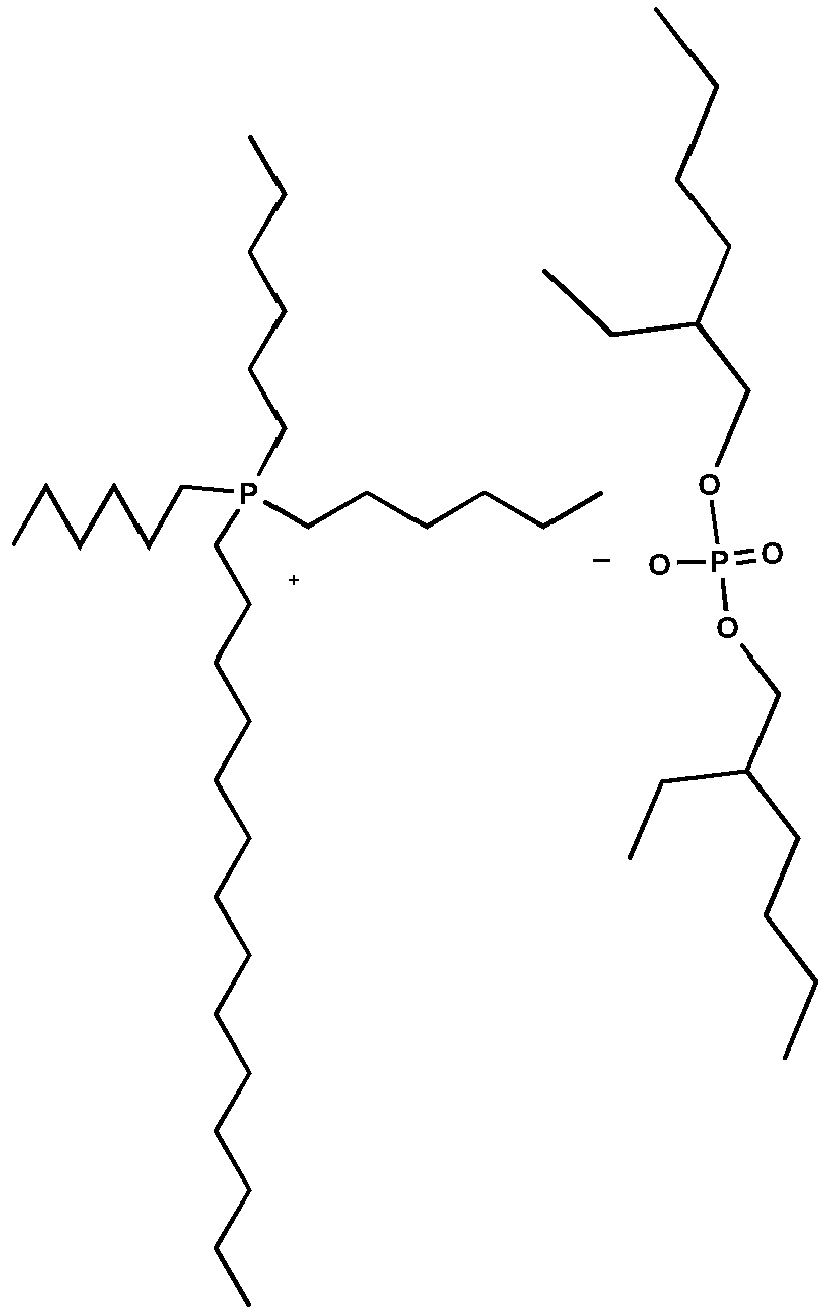
- (Trihexyltetradecylphosphonium) docusat, (P66614 docusat), erhältlich bei der Fa. IoLiTec unter der Produktnummer IN-0042-HP

- (Trihexyltetradecylphosphonium) bis(2,4,4-trimethylpentyl)phosphinat (P66614 phosphinat) erhältlich bei der Fa. IoLiTec unter der Produktnummer IN-0009-TG

- (Trihexyltetradecylphosphonium) decanoat (P66614 decanoat), erhältlich bei der Fa. IoLiTec unter der Produktnummer IN-0008-TG

- Besonders bevorzugt ist die zweite Ionische Flüssigkeit ausgewählt aus der Gruppe bestehend aus
- (Trihexyltetradecylphosphonium) bis(trifluormethylsulfonyl)imid (P66614 bta), erhältlich bei der Fa. IoLiTec unter der Produktnummer IN-0021-HP

- (Tetraoctylphosphonium) bis(trifluormethylsulfonyl)imid (P8888 bta), erhältlich bei der Fa. IoLiTec unter der Produktnummer IN-0043-HP

- (Methyltrioctylammonium) bis(trifluormethylsulfonyl)imid (N1888 bta), erhältlich bei der Fa. IoLiTec unter der Produktnummer IL-0017-HP IL-0017-HP,

- (Trihexyltetradecylphosphonium) bis(fluorsulfonyl)imid (P66614 fsi), erhältlich bei der Fa. IoLiTec

- In einer speziellen Ausführungsform ist die zweite Ionische Flüssigkeit ausgewählt unter (Trihexyltetradecylphosphonium) bis(trifluormethylsulfonyl)imid, (Tetraoctylphosphonium) bis(trifluormethylsulfonyl)imid, (Methyltrioctylammonium) bis(trifluormethylsulfonyl)imid und deren Gemischen.
- Besonders bevorzugt ist die Kombination von (Trihexyltetradecylphosphonium) bis(2-ethylhexyl)phosphat (P66614 dehp) als erste Ionische Flüssigkeit mit (Tetraoctylphosphonium) bis(trifluormethylsulfonyl)imid (P8888 bta) als zweite Ionische Flüssigkeit.
- Ebenfalls besonders bevorzugt ist die Kombination von (Trihexyltetradecylphosphonium) bis(2-ethylhexyl)phosphat (P66614 dehp) als erste Ionische Flüssigkeit mit (Trihexyltetradecylphosphonium) bis(trifluormethylsulfonyl)imid (P66614 bta) als zweite Ionische Flüssigkeit.
- Ebenfalls besonders bevorzugt ist die Kombination von (Trihexyltetradecylphosphonium) bis(2-ethylhexyl)phosphat (P66614 dehp) als erste Ionische Flüssigkeit mit (Trihexyltetradecylphosphonium) bis(fluorsulfonyl)imid (P66614 fsi) als zweite Ionische Flüssigkeit.
- In einer bevorzugten Ausführungsform beträgt der Anteil der ersten Ionischen Flüssigkeit, bezogen auf das Gesamtgewicht der Schmierstoffzusammensetzung, 0,5 bis 10 Gew.-%, noch bevorzugter 1 bis 5 Gew.-%, insbesondere 2 bis 5 Gew.-%.
- In einer weiteren bevorzugten Ausführungsform beträgt der Anteil der zweiten Ionischen Flüssigkeit, bezogen auf das Gesamtgewicht der Schmierstoffzusammensetzung, 0,25 bis 5 Gew.-%, noch bevorzugter 0,5 bis 2,5 Gew.-%, insbesondere 1 bis 2,5 Gew.-%.
- Das Gewichtsverhältnis der ersten Ionischen Flüssigkeit zur zweiten Ionischen Flüssigkeit beträgt vorzugsweise 1:1 bis 4:1, noch bevorzugter 1,5:1 bis 3:1, noch bevorzugter 1,5:1 bis 2,5:1, insbesondere 1,9:1 bis 2,1:1.
- Vorzugsweise beträgt der Anteil des Schmiermittels bezogen auf das Gesamtgewicht der Schmierstoffzusammensetzung 99,25 Gew.-% bis 80 Gew.-%, bevorzugt 99,25 Gew.-% bis 85 Gew.-%.
- Darüber hinaus kann das Schmiermittel übliche Additive gegen Korrosion, Oxidation und zum Schutz gegen Metalleinflüsse, beispielsweise Chelatverbindungen, Radikalfänger, UV-Stabilisatoren, Reaktionsschichtbildner enthalten. Bevorzugt werden Additive in Form von phosphor- und schwefelhaltigen Verbindungen, z.B. Zinkdialkyldithiophosphat, als Antiwear/Extrempressure eingesetzt. Aromatische Amine oder substituierte Phenole können als Antioxidantien Verwendung finden. Metallsalze, Carbonsäuren, Ester, stickstoffhaltige Verbindungen und heterocyclische Verbindungen können als Mittel zur Korrosionsverhinderung eingesetzt werden, Glycerin-mono- oder di-ester als Reibungsschutzmittel, sowie Polyisobutylen, Polymethacrylat und Olefincopolymere als Viskositätsverbesserer verwendet werden.
- Das Schmiermittel kann auch ein Verdickungsmittel enthalten. Hierdurch wird das Schmiermittel als Schmierfett ausgebildet. Vorzugsweise ist das Verdickungsmittel ausgewählt aus Harnstoff, Aluminiumkomplexseifen, Metall-Einfachseifen der Elemente der 1. und 2. Hauptgruppe des Periodensystems, Metall-Komplexseifen der Elemente der 1. und 2. Hauptgruppe des Periodensystems, Bentonit, Sulfonat, Silikat, Polyimid oder PTFE sowie einer Mischung der vorgenannten Verdickungsmittel. Im Falle von Harnstoff ist gemeint ein Reaktionsprodukt aus einem Diisocyanat, vorzugsweise 2,4-Diisocyanatotoluol, 2,6-Diisocyanatotoluol, 4,4'-Diisocyanatodiphenylmethan 2,4'-Diisocyantodiphenylmethan, 4,4'-Diisocyanatodiphenyl, 4,4'-Diisocyanato-3,3'-dimethyldiphenyl, 4,4'-Diisocyanato-3,3'-dimethylphenylmethan, die einzeln oder in Kombination verwendet werden können, mit einem Amin/Diamin der allgemeinen Formel (H2N)xR, wobei x = 1 oder 2 ist, und R ein Aryl-, Alkyl- oder Alkylenrest mit 2 bis 22 Kohlenstoffatomen, die einzeln oder in Kombination vorhanden sind.
- Das Schmiermittel kann auch anorganische oder organische Festschmierstoffe enthalten. Bevorzugte Festschmierstoffe sind ausgewählt aus der Gruppe bestehend aus Polytetrafluorethylen (PTFE), Molybdändisulfid, Graphit, Graphen, Bornitrid (hexagonal), Zinn(IV)-Sulfid, Zink(II)-Sulfid, Wolframdisulfid, Metallsulfid, Phosphat wie Calciumphosphat, Carbonat wie Calciumcarbonat, Metalloxid wie amorphem Siliziumdioxid, Silikat und Schichtsilikat, Talk, Glimmer und Gemischen hiervon.
- Ein weiterer Gegenstand der vorliegenden Erfindung umfasst eine Schmierstoffzusammensetzung umfassend
- a) ein Schmiermittel enthaltend ein Basisöl, ausgewählt aus der Gruppe bestehend aus Mineralölen, Polyalphalolefinen, alkylierten Naphthalinen, alkylierten Diphenylethern, alkylierten Benzolen, Copolymeren aus Alkenen und deren Gemischen,
- b) eine erste Ionische Flüssigkeit, deren Anion ausgewählt ist aus der Gruppe bestehend aus Dialkylphosphat, Dialkylphosphinat, Carboxylat und deren Gemischen,
- c) eine zweite Ionische Flüssigkeit, deren Anion ausgewählt ist aus der Gruppe bestehend aus Bis(perfluoralkylsulfonyl)imid Tris(perfluoralkylsulfonyl)methid, Tris(perfluoralkyl)trifluorphosphat, Bisfluorsulfonylimid und deren Gemischen
- In einer speziellen Ausführungsform enthält das Schmiermittel a) als Basisöl ein Copolymer aus Alkenen, das ausgewählt ist unter LAO mit ungesättigten Estern und deren Gemischen. In einer weiteren speziellen Ausführungsform enthält das Schmiermittel a) ein Basisöl, das ausgewählt ist unter Polyalphaolefinen, alkylierten Diphenylethern und deren Gemischen.
- In einer speziellen Ausführungsform weist die erste Ionische Flüssigkeit b) Anionen auf, ausgewählt aus der Gruppe bestehend aus Bis(2-ethylhexyl)phosphat, Bis(2,4,4-trimethylpentyl)phosphinat, Decanoat, Docusat und deren Gemischen.
- In einer speziellen Ausführungsform weist die zweite Ionische Flüssigkeit c) Anionen auf, ausgewählt aus der Gruppe bestehend aus Bis(perfluoralkylsulfonyl)imid, Tris(perfluoralkylsulfonyl)methid, Tris(perfluoralkyl)trifluorphosphat und deren Gemischen. Bevorzugt sind Bis(trifluormethylsulfonyl)imid, Tris(trifluormethylsulfonyl)methid, Tris(pentafluorethyl)trifluorphosphat und deren Gemische.
- In Bezug auf das Schmiermittel, das unpolare Basisöl, die erste und die zweite Ionische Flüssigkeit und insbesondere in Bezug auf deren bevorzugte Ausführungsformen gilt das vorangehend und nachfolgend Gesagte mutatis mutandis.
- Ein weiterer Gegenstand der vorliegenden Erfindung ist die Verwendung der erfindungsgemäßen Schmierstoffzusammensetzung zur Behandlung von Oberflächen von Antriebselementen, vorzugweise von Wälzlagern, Getrieben, Gleitlagern und/oder Ketten, wobei die Antriebselemente vorzugsweise in Anlagen und Maschinen zur Herstellung und Förderung von Lebensmitteln, in Windkraftanlagen, in Automobilen, in Pulleylagern, in Schienenfahrzeugen, in Schiffen, in Elektromotoren, Generatoren, Nebenaggregaten und/oder Gelenken vorliegen.
- Ein weiterer Gegenstand der vorliegenden Erfindung ist die Verwendung von Antriebselementen, deren Oberflächen mit der erfindungsgemäßen Schmierstoffzusammensetzung behandelt wurden, von vorzugsweise Wälzlagern, Getrieben, Gleitlagern und/oder Ketten, wobei die Antriebselemente vorzugsweise in Anlagen und Maschinen zur Herstellung und Förderung von Lebensmitteln, in Windkraftanlagen, in Automobilen, in Pulleylagern, in Schienenfahrzeugen, in Schiffen, in Elektromotoren, Generatoren, Nebenaggregaten und/oder Gelenken vorliegen.
- Im Folgenden wird die Erfindung anhand mehrerer Beispiele näher erläutert.
- Zur Herstellung der erfindungsgemäßen Zusammensetzungen wurde als unpolares Basisöl das in der nachfolgenden Tabelle 1 genannte Grundöl (Copolymer aus Decen und Dec-9-encarbonsäuremethylester) vorgelegt, die beiden in der Tabelle genannten Ionischen Flüssigkeiten, von denen das zweite ein symmetrisches Phosphonium Kation aufweist, zugegeben und das Gemisch bei 60°C für 10 min mittels eines Magnetrührers gerührt. Nach Abkühlen auf Raumtemperatur wurden die Mischungen optisch begutachtet und der elektrische Widerstand bestimmt.
- Zur Herstellung der Vergleichsbeispiele wurde nur eine Ionische Flüssigkeit zugegeben, aber ansonsten gleich verfahren. Das Grundöl ohne IL wurde ohne weitere Behandlung vermessen.
Tabelle 1 Beispiel P8888bta [%] (unlöslich in PAO zweite IL) P66614dehp [%] (löslich in PAO, erste IL) ARIA WTP 40 © [%] unpolares Grundöl spezifischer Widerstand [Mohm*cm]# Aussehen Beispiel 1 erfindungsgemäß 2 4 94 5,40E+01 leicht trüb Beispiel 2 erfindungsgemäß 1 2 97 5,89E+02 klar Beispiel 3 Vergleich 2 0 98 4,20E+03 trüb Beispiel 4 Vergleich 0 4 98 3,80E+03 klar Beispiel 5 Vergleich 0,00 0,00 100,00 1,70E+06 klar # Die Angabe des spezifischen Widerstandes erfolgt in exponentieller Art, d.h. beispielsweise steht der Wert 5,40E+01 MOhm*cm für 5,40*101 MOhm*cm. - Wie aus der Tabelle 1 hervorgeht, konnte durch Kombination der beiden IL die Löslichkeit der an sich unlöslichen IL P8888bta erhöht werden, da die erfindungsgemäßen Beispiele 1 und 2 gegenüber Vergleichsbeispiel 3 eine geringere Trübung zeigen. Darüber hinaus zeigen die erfindungsgemäßen Beispiele 1 und 2 gegenüber Vergleichsbeispiel 3 einen verringerten Widerstand. Dazu kommt, dass überraschenderweise das erfindungsgemäße Beispiel 2 einen niedrigeren Widerstand als das Vergleichsbeispiel 4 aufweist, obwohl der Gehalt an Ionischen Flüssigkeiten beim erfindungsgemäßem Beispiel 2 niedriger ist als bei Vergleichsbeispiel 4. Die Vergleichsbeispiele 4 und 5 sind zwar klar, da sie keine unlösliche IL enthalten, lösen aber die gestellte Aufgabe nicht, da sie hohe spezifische Widerstände aufweisen.
- Zur Herstellung der erfindungsgemäßen Zusammensetzungen wurde als unpolares Basisöl das in der nachfolgenden Tabelle 2 genannte Grundöl (Copolymer aus Decen und Dec-9-encarbonsäuremethylester) vorgelegt, die beiden in der Tabelle genannten Ionischen Flüssigkeiten, von denen das zweite ein unsymmetrisches Ammoniumkation aufweist, zugegeben und das Gemisch bei 60°C für 10 Min. mittels eines Magnetrührers gerührt. Nach Abkühlen auf Raumtemperatur wurden die Mischungen optisch begutachtet und der elektrische Widerstand bestimmt.
- Zur Herstellung der Vergleichsbeispiele wurde nur eine Ionische Flüssigkeit zugegeben, aber ansonsten gleich verfahren. Das Grundöl ohne IL wurde ohne weitere Behandlung vermessen.
Tabelle 2 Beispiel N1888 bta [%] zweite IL P66614dehp [%] erste IL Aria WTP 40 © [%] spezifischer Widerstand [Mohm*cm] Aussehen Beispiel 6 erfindungsgemäß 2 4 94 8,02E+02 leicht trüb Beispiel 7 erfindungsgemäß 1 2 97 1,68E+03 leicht trüb Beispiel 4 Vergleich 0 4 98 3,80E+03 klar Beispiel 8 Vergleich 2 0 98 3,48E+04 trüb Beispiel 5 Vergleich 0 0 100 1,70E+06 klar - Wie aus der Tabelle 2 hervorgeht, konnte durch Kombination der beiden IL die Löslichkeit der an sich unlöslichen IL N1888 bta erhöht werden, da die erfindungsgemäßen Beispiele 6 und 7 gegenüber Vergleichsbeispiel 8 eine geringere Trübung zeigen. Darüber hinaus zeigen die erfindungsgemäßen Beispiele 6 und 7 gegenüber Vergleichsbeispiel 8 einen verringerten Widerstand. Dazu kommt, dass überraschenderweise das erfindungsgemäße Beispiel 7 einen niedrigeren Widerstand als das Vergleichsbeispiel 4 aufweist, obwohl der Gehalt an Ionischen Flüssigkeiten beim erfindungsgemäßem Beispiel 7 niedriger ist als bei Vergleichsbeispiel 4.
- Zur Herstellung der Beispiele 9 bis 13 wurde zuerst ein Fettsud erstellt.
- Die Zusammensetzung war
- 93,5 % Aria WTP 40 ©
- 0,5 % Dioctyldiphenylamin (Antioxidant)
- 6% Lithium-12-hydroxystearat.
- Dazu wurden als unpolares Basisöl 30 Gew.-% des in der nachfolgenden Tabelle genannten Grundöls (Copolymer aus Decen und Dec-9-encarbonsäuremethylester; Aria WTP 40 ©) in einem Kessel mit Planetenrührwerk vorgelegt. 6% Lithium-12-hydroxystearat wurden zugegeben und das Gemisch unter Rühren auf 215°C erhitzt. Es entstand eine klare Schmelze. Die Wärmezufuhr wurde beendet und zur Kühlung 63,5 Gew.-% von Aria WTP 40 © zugegeben. Bei 110°C wurde 0,5 Gew.-% Dioctyldiphenylamin zugegeben. Danach ließ man das Gemisch auf Raumtemperatur abkühlen. Der so erhaltene Sud wurde nicht homogenisiert.
- In den Sud wurden zur Herstellung der erfindungsgemäßen Zusammensetzungen die beiden in der Tabelle 3 genannten Ionischen Flüssigkeiten, von denen beide ein unsymmetrisches Phosphoniumkation aufweisen, zugegeben. Die Mischungen wurden mit einem Spatel gemischt und zweimal über ein Dreiwalzwerk homogenisiert. Zur Herstellung der Vergleichsbeispiele wurde nur eine Ionische Flüssigkeit zugegeben, aber ansonsten gleich verfahren. Das Vergleichsbeispiel 13 ohne Ionische Flüssigkeiten wurde ebenfalls zweimal über ein Dreiwalzwerk homogenisiert.
Tabelle 3 Beispiel P66614bta [%] P66614dehp [%] Fettsud mit Aria WTP 40 © als unpolares Basisöl [%] spezifischer Widerstand [Mohm*cm] Beispiel 9 erfindungsgemäß 2 4 96 7,10E+01 Beispiel 10 erfindungsgemäß 1 2 97 6,78E+02 Beispiel 11 Vergleich 0 4 96 1,60E+03 Beispiel 12 Vergleich 2 0 98 1,81 E+04 Beispiel 13 Vergleich 0 0 100 1,20E+06 - Wie aus der Tabelle 3 hervorgeht, zeigen die erfindungsgemäßen Beispiele 9 und 10 gegenüber den Vergleichsbeispielen 11 bis 13 einen verringerten Widerstand. Dazu kommt, dass überraschenderweise das erfindungsgemäße Beispiel 10 einen niedrigeren Widerstand als das Vergleichsbeispiel 11 aufweist, obwohl der Gehalt an ionischen Flüssigkeiten bei dem erfindungsgemäßem Beispiel 10 niedriger ist als bei Vergleichsbeispiel 11.
- Hieraus lässt sich schließen, dass die Ergebnisse der Öluntersuchungen sich auch auf ein Fett übertragen lassen und mit den Messwerten aus reiner Ölformulierung mit den gleichen Rohstoffen vergleichbar sind.
- Zur Herstellung der erfindungsgemäßen Zusammensetzungen wurde als unpolares Basisöl das in der nachfolgenden Tabelle genannten Grundöl, ein reines Kohlenwasserstofföl mit sehr niedrigem Dipolmoment, vorgelegt, die beiden in der Tabelle 4 genannten Ionischen Flüssigkeiten, die beide ein unsymmetrisches Phosphoniumkation aufweisen, zugegeben und das Gemisch bei 60°C für 10 Min. mittels eines Magnetrührers gerührt. Zur Herstellung der Vergleichsbeispiele wurde nur eine Ionische Flüssigkeit zugegeben, aber ansonsten gleich verfahren. Das Grundöl ohne IL wurde ohne weitere Behandlung vermessen.
- Nach Abkühlen auf Raumtemperatur wurden die Mischungen optisch begutachtet und der elektrische Widerstand bestimmt.
Tabelle 4 Beispiele P66614bta [%] zweite IL P66614dehp [%] erste IL Basisöl: PAO 6 [%] spezifischer Widerstand [Mohm*cm] Aussehen Beispiel 14 erfindungsgemäß 0,67 5 94,33 4,65E+02 leicht trüb Beispiel 15 Vergleich 0 5 95 9,99E+02 klar Beispiel 16 Vergleich 0,67 0 99,33 2,73E+05 klar Beispiel 17 Vergleich 0 0 100 2,20E+06 klar - Wie aus der Tabelle 4 hervorgeht, zeigt das erfindungsgemäße Beispiele 14 gegenüber Vergleichsbeispielen 15 bis 17 einen verringerten Widerstand.
- Zur Herstellung des unpolaren Basisöls wurde das Grundöl PAO 6 mit einem polaren Grundöl Hexandicarbonsäure-1,6-diisotridecylester bei Raumtemperatur unter Rühren im Gewichtsverhältnis 80 Gew.-% PAO 6 und 20 Gew.-% Hexandicarbonsäure-1,6-diisotridecylester (CAS Nummer 26401-35-4) gemischt. In das so entstehende Basisöl wurden die beiden in der Tabelle 5 genannten Ionischen Flüssigkeiten, die beide ein unsymmetrisches Phosphoniumkation aufweisen, zugegeben und das Gemisch bei 60°C für 10 Min. mittels eines Magnetrührers gerührt. Zur Herstellung der Vergleichsbeispiele wurde nur eine Ionische Flüssigkeit zugegeben, aber ansonsten gleich verfahren. Nach Abkühlen auf Raumtemperatur wurden die Mischungen optisch begutachtet und der elektrische Widerstand bestimmt. Das Basisöl ohne IL wurde ohne weitere Behandlung vermessen.
Tabelle 5 Beispiel Basisöl: PAO 6/ Hexanedicarbonsäure -1,6-diisotridecylester im Gewichtsverhältnis von 80:20 [%] P66614dehp [%] erste IL P66614bta [%] zweite IL spez. Widerstand [Mohm*cm] Aussehen Beispiel 18 erfindungsgemäß 94 4,00 2,00 1,57E+01 klar Beispiel 19 erfindungsgemäß 95 4,00 1,00 3,87E+01 klar Beispiel 20 erfindungsgemäß 94 2,00 2,00 1,60E+02 leicht trüb Beispiel 21 erfindungsgemäß 97 2,00 1,00 1,14E+02 klar Beispiel 22 Vergleich 98 0,00 2,00 7,52E+03 trüb Beispiel 23 Vergleich 99 0,00 1,00 5,62E+03 trüb Beispiel 24 Vergleich 96 4,00 0,00 1,65E+03 klar Beispiel 25 Vergleich 98 2,00 0,00 1,18E+04 klar Beispiel 26 Vergleich 100 0,00 0,00 5,92E+06 klar - Wie aus der Tabelle 5 hervorgeht, konnte durch Kombination der beiden IL die Löslichkeit der an sich unlöslichen IL P66614bta erhöht werden, da die erfindungsgemäßen Beispiele 18 bzw. 21 gegenüber Vergleichsbeispiel 22 bzw. 23 eine geringere Trübung zeigen. Darüber hinaus zeigen die erfindungsgemäßen Beispiele 18 bis 21 gegenüber Vergleichsbeispielen 23 bis 26 einen verringerten Widerstand. Dazu kommt, dass überraschenderweise das erfindungsgemäße Beispiel 21 einen niedrigeren Widerstand als das Vergleichsbeispiel 24 aufweist, obwohl der Gehalt an ionischen Flüssigkeiten bei dem erfindungsgemäßem Beispiel 21 niedriger ist als bei Vergleichsbeispiel 24.
- Zur Herstellung des unpolaren Basisöls wurde das Grundöl PAO 6 mit einem polaren Grundöl Hexandicarbonsäure-1,6-diisotridecylester bei Raumtemperatur unter Rühren im Gewichtsverhältnis 70 Gew.-% PAO 6 und 30 Gew.-% Hexandicarbonsäure-1,6-diisotridecylester (CAS.Nr. 26401-35-4) gemischt. In das so entstandene Basisöl wurden die beiden in der Tabelle 6 genannten Ionischen Flüssigkeiten, die beide ein unsymmetrisches Phosphoniumkation aufweisen, zugegeben und das Gemisch bei 60°C für 10 Min. mittels eines Magnetrührers gerührt. Zur Herstellung der Vergleichsbeispiele wurde nur eine Ionische Flüssigkeit zugegeben, aber ansonsten gleich verfahren. Nach Abkühlen auf Raumtemperatur wurden die Mischungen optisch begutachtet und der elektrische Widerstand bestimmt. Das Basisöl ohne IL wurde ohne weitere Behandlung vermessen.
Tabelle 6 Beispiel Basisöl: PAO 6 / Hexandicarbonsäure-1,6-diisotridecylester im Gewichtsverhältnis von 70:30 P66614dehp [%] erste IL P66614bta [%] zweite IL spez. Widerstand [Mohm*cm] Aussehen Beispiel 26 erfindungsgemäß 94,00 4 2 1,05E+01 klar Beispiel 27 erfindungsgemäß 96,00 2 2 2,24E+01 klar Beispiel 28 erfindungsgemäß 95,00 4 1 3,29E+01 klar Beispiel 29 erfindungsgemäß 97,00 2 1 6,62E+01 klar Beispiel 30 Vergleich 98,00 0 2 9,30E+02 trüb Beispiel 31 Vergleich 96,00 4 0 1,28E+03 klar Beispiel 32 Vergleich 98,00 2 0 7,60E+03 klar Beispiel 33 Vergleich 100 0 0 4,50E+06 klar - Wie aus der Tabelle 6 hervorgeht, konnte durch Kombination der beiden IL die Löslichkeit der an sich unlöslichen IL P66614bta erhöht werden, da die erfindungsgemäßen Beispiele 27 und 26 gegenüber Vergleichsbeispiel 30 eine geringere Trübung zeigen. Darüber hinaus zeigen die erfindungsgemäßen Beispiele 26 bis 29 gegenüber den Vergleichsbeispielen 30 bis 33 einen verringerten Widerstand. Dazu kommt, dass überraschenderweise das erfindungsgemäße Beispiel 29 einen niedrigeren Widerstand als das Vergleichsbeispiel 31 aufweist, obwohl der Gehalt an ionischen Flüssigkeiten bei dem erfindungsgemäßem Beispiel 29 niedriger ist als bei Vergleichsbeispiel 31.
- Zur Herstellung der erfindungsgemäßen Zusammensetzungen wurde als unpolares Basisöl das in der nachfolgenden Tabelle 7 genannte Grundöl (Copolymer aus Decen und Dec-9-encarbonsäuremethylester) vorgelegt, die beiden in der Tabelle genannten Ionischen Flüssigkeiten, die beide ein unsymmetrisches Phosphoniumkation aufweisen, zugegeben und das Gemisch bei 60°C für 10 Min. mittels eines Magnetrührers gerührt. Nach Abkühlen auf Raumtemperatur wurden die Mischungen optisch begutachtet und der elektrische Widerstand bestimmt.
- Zur Herstellung der Vergleichsbeispiele wurde nur eine Ionische Flüssigkeit zugegeben, aber ansonsten gleich verfahren. Das Grundöl ohne IL wurde ohne weitere Behandlung vermessen.
Tabelle 7 Beispiel P66614 dehp Erste IL [%] P66614bta Zweite IL [%] Aria WTP 40 © [%] spez. Widerstand [Mohm*cm] Aussehen Kinematische Viskosität bei 40°C Kinematische Viskosität bei 100°C VI Beispiel 34 erfindungsgemäß 1,00 1,00 98,00 1,11 E+03 klar 346,1 39,12 164 Beispiel 35 erfindungsgemäß 1,50 0,50 98,00 2,50E+03 klar 348,7 35,91 165 Beispiel 37 Vergleich 0,00 2,00 98,00 1,09E+04 trüb - - - Beispiel 38 Vergleich 2,00 0,00 98,00 3,00E+04 klar 348,1 39,36 164 VI = Viskositätsindex - Wie aus der Tabelle 7 hervorgeht, haben alle betrachteten Zusammensetzungen einen Gesamtgehalt an Ionischer Flüssigkeit von 2 Gew.-%. Durch Kombination der beiden IL sowohl im Gewichtsverhältnis von 1:1 bei dem erfindungsgemäßen Beispiel 34 als auch 1,5:1 bei dem erfindungsgemäßen Beispiel 35 konnte ein niedrigerer Widerstand erhalten werden als bei den beiden Vergleichsbeispielen 37 und 38, die nur eine Ionische Flüssigkeit enthalten. Die kinematische Viskosität verändert sich aber nur gering, ein Einfluss der Viskosität auf die beobachteten Unterschiede im elektrischen Widerstand ist nicht gegeben.
- Zur Herstellung des unpolaren Basisöls wurde das Grundöl PAO 6 mit einem polaren Grundöl Hexandicarbonsäure-1,6-diisotridecylester bei Raumtemperatur unter Rühren im Gewichtsverhältnis 50 Gew.-% PAO 6 und 50 Gew.-% Hexandicarbonsäure-1,6-diisotridecylester (CAS.Nr. 26401-35-4) gemischt, die beiden in der Tabelle genannten Ionischen Flüssigkeiten, die beide ein unsymmetrisches Phosphonium Kation aufweisen, zugegeben und das Gemisch bei 60°C für 10 Min. mittels eines Magnetrührers gerührt. Nach Abkühlen auf Raumtemperatur wurden die Mischungen optisch begutachtet und der elektrische Widerstand bestimmt. Zur Herstellung der Vergleichsbeispiele wurde nur eine Ionische Flüssigkeit zugegeben, aber ansonsten gleich verfahren. Das Grundöl ohne IL wurde ohne weitere Behandlung vermessen.
Tabelle 8 Beispiel Basisöl: PAO 6/ Hexanedicarbonsäure-1,6-diisotridecylester im Gewichtsverhältnis von 50:50 [%] P66614 dehp [%] erste IL P66614 bta [%] zweite IL spez. Widerstand [Mohm*cm] Aussehen Kinematische Viskosität bei 40°C Kinematische Viskosität bei 100°C VI Beispiel 39 erfindungsgemäß 96,00 2,00 2,00 1,09E+01 klar 29,36 5,73 140 Beispiel 40 erfindungsgemäß 95,00 4,00 1,00 1,85E+01 klar 29,38 5,74 141 Beispiel 41 erfindungsgemäß 97,00 2,00 1,00 3,43E+01 klar 28,54 5,62 140 Beispiel 42 Vergleich 99,00 0,00 1,00 1,31E+02 klar 27,74 5,51 140 Beispiel 43 Vergleich 96,00 4,00 0,00 8,54+02 klar 29,05 5,67 140 Beispiel 44 Vergleich 98,00 2,00 0,00 2,93E+03 klar 27,93 5,54 140 Beispiel 45 Vergleich 100,00 0,00 0,00 7,92+05 klar 27,23 5,48 140 VI = Viskositätsindex - Wie aus der Tabelle 8 hervorgeht, zeigen die erfindungsgemäßen Beispiele 39 bis 41 gegenüber allen Vergleichsbeispielen 42 bis 45 einen verringerten Widerstand. Dazu kommt, dass überraschenderweise das erfindungsgemäße Beispiel 41 einen niedrigeren Widerstand als das Vergleichsbeispiel 43 aufweist, obwohl der Gehalt an Ionischen Flüssigkeiten beim erfindungsgemäßem Beispiel 41 niedriger ist als bei Vergleichsbeispiel 43. Die erfindungsgemäßen Beispiele 39 und 40 weisen bei 40°C die höchste kinematische Viskosität und den niedrigsten spezifischen Widerstand
aller Beispiele 39 bis 45 auf. Daher sind die beobachteten Unterschiede bei den spezifischen Widerständen nicht auf Änderungen der kinematischen Viskosität zurückzuführen. - Zur Herstellung der erfindungsgemäßen Zusammensetzungen wurde als unpolares Basisöl das in der nachfolgenden Tabelle 9 genannte Grundöl (Copolymer aus Decen und Dec-9-encarbonsäuremethylester) vorgelegt, die beiden in der Tabelle genannten Ionischen Flüssigkeiten, die beide ein unsymmetrisches Phosphoniumkation aufweisen, zugegeben und das Gemisch bei 60°C für 10 Min. mittels eines Magnetrührers gerührt. Nach Abkühlen auf Raumtemperatur wurden die Mischungen optisch begutachtet und der elektrische Widerstand bestimmt.
- Zur Herstellung der Vergleichsbeispiele wurde nur eine Ionische Flüssigkeit zugegeben, aber ansonsten gleich verfahren. Das Grundöl ohne IL wurde ohne weitere Behandlung vermessen.
Tabelle 9 Beispiel P66614fsi [%] zweite IL P66614dehp [%] erste IL Aria WTP 40 © [%] spezifischer Widerstand [Mohm*cm] Aussehen Beispiel 46 erfindungsgemäß 2 4 94 1,76E+02 trüb Beispiel 47 erfindungsgemäß 1 2 97 5,04E+02 klar Beispiel 48 Vergleich 0 4 96 3,80E+03 klar Beispiel 49 Vergleich 2 0 98 3,39E+04 trüb Beispiel 5 Vergleich 0 0 100 1,70E+06 klar - Wie aus der Tabelle 9 hervorgeht, zeigen die erfindungsgemäßen Beispiele 46 und 47 gegenüber allen Vergleichsbeispielen 5, 48 und 49 einen verringerten Widerstand. Dazu kommt, dass überraschenderweise das erfindungsgemäße Beispiel 47 einen niedrigeren Widerstand als das Vergleichsbeispiel 48 aufweist, obwohl der Gehalt an Ionischen Flüssigkeiten beim erfindungsgemäßem Beispiel 47 niedriger ist als beim Vergleichsbeispiel 48.
- Die beschriebenen Normen beziehen sich, sofern nicht anders angegeben, auf die zum Anmeldezeitpunkt gültige Fassung.
- Eine Ionische Flüssigkeit ist in Polyalphaolefin, insbesondere in PAO 400/40 hergestellt aus 1-Decen als Monomerkomponente, löslich, wenn bei der Trübungmessung nach DIN EN ISO 7027 bei 25°C einer Mischung aus 1 Gew.-% der ionischen Flüssigkeit und 99 Gew.-% Polyalphaolefin, insbesondere PAO 400/40 hergestellt aus 1-Decen als Monomerkomponente, der Trübungswert um nicht mehr als 1 FNU höher liegt als bei reinem Polyalphaolefin, insbesondere PAO 400/40, hergestellt aus 1-Decen als Monomerkomponente.
- Eine Ionische Flüssigkeit ist in Polyalphaolefin, insbesondere in PAO 400/40, hergestellt aus 1-Decen als Monomerkomponente unlöslich, wenn bei der Trübungmessung nach DIN EN ISO 7027 bei 25°C einer Mischung aus 1 Gew.-% der ionischen Flüssigkeit und 99 Gew.-% Polyalphaolefin, insbesondere PAO 400/40, hergestellt aus 1-Decen als Monomerkomponente, der Trübungswert um mehr als 1 FNU höher liegt als bei reinem Polyalphaolefin, insbesondere PAO 400/40, hergestellt aus 1-Decen als Monomerkomponente.
- Als Messgerät wird ein 2100 AN IS von Hach verwendet. PAO 400/40 ist ein Polyalphaolefin mit einer kinematischen Viskosität (im Mittel) von 400 mm2/sec bei 40°C. Der FNU Wert liegt unter 0,2.
- Die Ionischen Flüssigkeiten werden zu PAO 400/40 zugegeben, auf dem Magnetrührer unter Rühren auf 100°C erhitzt, dann die entstehende Mischung in die Messküvetten eingefüllt und nach Abkühlen auf 25°C gemessen. Als PAO 400/40 wurde Synton PAO 40, hergestellt aus 1-Decen verwendet, wobei die kinematische Viskosität bei 40°C gemessen nach ASTM D-445 zwischen 38 und 42 mm2/sec lag.
- Zur Bewertung des Aussehens werden die Schmierstoffzusammensetzungen in Form von Schmierölen in durchsichtige, zylindrische Glas-Schraubdeckelgefäße mit 12 cm Höhe und 1,25 cm Radius vorsichtig eingefüllt und für zwei Stunden ohne Bewegung stehen gelassen. Die Gläser, die mit IL enthaltenden Schmierstoffzusammensetzungen gefüllt sind, werden mit dem Glas verglichen, das das zugehörige unpolare Basisöl ohne IL enthält. Ergibt sich bei optischer Betrachtung der beiden Proben parallel zum Behälterboden ein Unterschied, so wird die Probe als leicht trüb bzw. trüb eingestuft.
- Zur Bestimmung wird eine Hochohm-Flüssigkeitselektrode FSE 3 (Fa. Fischer Elektronik, 15749 Mittenwalde Deutschland) verwendet und als Spannungsquelle ein Milli-TO 3 (Fa. Fischer Elektronik, 15749 Mittenwalde Deutschland). Es wird ein Mittelwert über drei Einzelmessungen gebildet. Die Messspannung beträgt 10 V Gleichstrom. Die Ablesung eines Messwertes erfolgt eine Minute nach Anlegen der Messspannung. Kann bei 10 V Messspannung keine Messwerte erhalten werden, wird die Messspannung auf 100 V erhöht und dann analog verfahren. Dies ist typischerweise bei Proben mit hohem spezifischen Widerstand (> 1E4 Mohm*cm erforderlich)
- Dazu wird eine kreisförmige Plattenelektrode gemäß 5.3, Abbildung 2 der genannten DIN Norm mit einem 1 mm dicken PTFE Ring zwischen Elektrode 2 und dem Führungsstück 4 modifiziert, es entsteht ein zylindrischer Hohlraum zwischen Elektrode 1 (Messelektrode) und Elektrode 2 (Gegenelektrode) von 1 mm Höhe und 20 mm2 Fläche. Die Zellkonstante beträgt damit 200. Mit dieser ist der Messwert [Ohm] zu multiplizieren, um den spezifischen Widerstand zu erhalten. Das Schmierfett wird mit einem Spatel in den wie oben beschriebenen Hohlraum eingestrichen und auf die Elektrode 1 aufgesetzt. Die so zusammengesetzte Messzelle wird in eine Schirmkammer (TOM 300-2, Fa. Fischer Elektronik, 15749 Mittenwalde Deutschland) eingebracht. Als Spannungsquelle wird ein Milli-TO 3 (Fa. Fischer Elektronik, 15749 Mittenwalde Deutschland) verwendet. Es wird eine Gleichspannung von 10 V angelegt und der Messwert [in Ohm] nach 1 Min. abgelesen. Die Messung wird dreimal wiederholt, wobei jedes Mal neues Fett in den Hohlraum appliziert wird. Der Mittelwert über die drei Einzelmessungen wird mit der Zellkonstante multipliziert und so der spezifische Widerstand erhalten. Bei Bedarf kann die Messspannung, wie oben beschrieben, erhöht werden.
- Die Bestimmung wird, soweit nicht anders angegeben, nach ASTM D7042, Ausgabe Juli 2016 mit einem Stabinger Viskosimeter durchgeführt.
- Die Polarität eines Basisöles wurde erfindungsgemäß über das Dipolmoment bestimmt. Hierzu wurden die Dipolmomente nach Trib. Int. 43, 2010, 2268 - 2278, The influence of base oil polarity on the tribological performance of zinc dialkyl dithiophosphate, A.N. Suarez et. Al., berechnet. Dafür wurde das Programm Hyperchem verwendet. Im ersten Schritt wurde die Grobstruktur des Moleküls mittels Kraftfeld-Berechnung ("Molecular Mechanics Force Field" mit "BIO+(CHARMM)" berechnet, anschließend das semi-empirische Modell ("Semi-empirical Method") mit der Auswahl "RM1" angewendet. Es wurden solange Optimierungen durchlaufen, bis Konvergenz auftrat (RMS Gradient kleiner als 0.01 kcal/Å mol). Bei Basisölen, die oligomere Gemische darstellen, wie Polyalphaolefine, wurden publizierte Leitstrukturen für die Berechnung verwendet, (Exxon Mobil Chemical, in Researchgate, Harrington, B.A. & Reid-Peters, S. & Han, W.W. (2014). The influence of molecular structure on the properties of polyalphaolefins (PAO). 61. 14-18). Wenn das Basisöl aus verschiedenen Grundölen zusammengesetzt ist, so wurde das Dipolmoment aufsummiert aus den Massenanteilen der einzelnen Grundöle multipliziert mit dem für das einzelne Grundöl berechnete Dipolmoment.
- Nachstehende Tabelle gibt exemplarisch einige Ergebnisse wieder.
Grundöl bzw. Basisöl berechnetes Dipolmoment [D] PAO 400 0,13 Pyromelithsäuretetra(2-ethylhexanoat) 3,35 Trimelithsäuredidecyloctylester 3,42 PAO 6 0,09 alkylierter Diphenylether (Viskosität 100 cst bei 40°C) 1,21 Pyromelithsäuretetra(2-ethylhexanoat) / alkylierter Diphenylether (Gewichtsverhältnis 1 : 1) 2,28 Aria WTP 40 © 1,82 Hexandicarbonsäure-1,6-diisotridecylester 4,79 PAO 6 / Hexandicarbonsäure-1,6-diisotridecylester (Gewichtsverhältnis 8 : 2) 1,03 PAO 6 / Hexandicarbonsäure-1,6-diisotridecylester (Gewichtsverhältnis 7 : 3) 1,50 PAO 6 / Hexandicarbonsäure-1,6-diisotridecylester (Gewichtsverhältnis 1 : 1) 2,44 - Unter einem unpolaren Basisöl wird erfindungsgemäß ein Basisöl mit einem Dipolmoment wie oben berechnet von höchstens 3,00 D verstanden.
Claims (17)
- Schmierstoffzusammensetzung umfassenda) ein Schmiermittel, insbesondere enthaltend ein unpolares Basisöl,b) eine erste Ionische Flüssigkeit, die in Polyalphaolefin (PAO), insbesondere in PAO 400/40, hergestellt aus 1-Decen als Monomerkomponente, löslich ist,c) eine zweite Ionische Flüssigkeit, die in Polyalphaolefin (PAO), insbesondere in PAO 400/40, hergestellt aus 1-Decen als Monomerkomponente, unlöslich ist.
- Schmierstoffzusammensetzung nach Anspruch 1, dadurch gekennzeichnet, dass die erste Ionische Flüssigkeit in dem Basisöl löslich ist und die zweite Ionische Flüssigkeit in dem Basisöl unlöslich ist.
- Schmierstoffzusammensetzung nach Anspruch 1 oder 2, dadurch gekennzeichnet, dass das Basisöl ein erstes Grundöl, ausgewählt aus der Gruppe bestehend aus Mineralölen, PAO, Diphenylethern und deren Mischungen in Kombination mit einem zweiten Grundöl, ausgewählt aus der Gruppe bestehend aus nativen und synthetischen Estern, Polyglykolen und deren Mischungen, aufweist.
- Schmierstoffzusammensetzung nach Anspruch 3, dadurch gekennzeichnet, dass das Gewichtsverhältnis des ersten Grundöls zum zweiten Grundöl 90:10 bis 50:50, besonders bevorzugt 85: 15 bis 60:40, insbesondere 80:20 bis 70:30, beträgt.
- Schmierstoffzusammensetzung nach einem oder mehreren der vorangehenden Ansprüche, dadurch gekennzeichnet, dass das Basisöl ein unpolares Grundöl, ausgewählt aus der Gruppe bestehend aus Mineralölen, Polyalphalolefinen, alkylierten Naphthalinen, alkylierten Diphenylethern, alkylierten Benzolen, Copolymeren aus Alkenen, vorzugsweise LAO (linearen Alphaolefinen) mit ungesättigten Estern, insbesondere einem Copolymer aus Decen und Dec-9-encarbonsäuremethylestern, und Gemischen hiervon enthält.
- Schmierstoffzusammensetzung nach einem oder mehreren der vorangehenden Ansprüche, dadurch gekennzeichnet, dass das Basisöl ein unpolares Grundöl enthält, ausgewählt aus der Gruppe bestehend aus Mineralölen, Polyalphalolefinen, alkylierten Naphthalinen, alkylierten Diphenylethern, alkylierten Benzolen, Copolymeren aus Alkenen, vorzugsweise LAO (linearen Alphaolefinen) mit ungesättigten Estern, insbesondere einem Copolymer aus Decen und Dec-9-encarbonsäuremethylestern, und Gemischen hiervon im Gemisch mit anderen Grundölen, insbesondere mit polaren Grundölen, vorzugsweise Estern und Polyglycolen, wobei das unpolare Grundöl in einem Anteil von mehr als 50 Gew.-%, bevorzugt in einem Anteil von mehr als 60 Gew.-%, insbesondere in einem Anteil von mehr als 70 Gew.-%, bezogen auf das Gesamtgewicht des Basisöls, vorliegt.
- Schmierstoffzusammensetzung nach einem oder mehreren der vorangehenden Ansprüche, dadurch gekennzeichnet, dass das Basisöl ein Grundöl, ausgewählt aus der Gruppe bestehend aus Copolymeren aus Alkenen, vorzugsweise ausgewählt unter LAO (linearen Alphaolefinen) mit ungesättigten Estern, insbesondere einem Copolymer aus Decen und Dec-9-encarbonsäuremethylester, enthält.
- Schmierstoffzusammensetzung nach einem oder mehreren der vorangehenden Ansprüche, dadurch gekennzeichnet, dass die erste Ionische Flüssigkeit Anionen, ausgewählt aus der Gruppe bestehend aus Dialkylphosphat, bevorzugt Bis(2-ethylhexyl)phosphat, Dialkylphosphinat, bevorzugt Bis(2,4,4-trimethylpentyl)phosphinat, Carboxylat, bevorzugt Decanoat, und Docusat und deren Gemischen, aufweist.
- Schmierstoffzusammensetzung nach einem oder mehreren der vorangehenden Ansprüche, dadurch gekennzeichnet, dass die zweite Ionische Flüssigkeit Anionen, ausgewählt aus der Gruppe bestehend aus Bis(perfluoralkylsulfonyl)imiden, Tris(perfluoralkylsulfonyl)methiden, Tris(perfluoralkyl)trifluorphosphaten, Bis(fluorsulfonyl)imid und deren Gemischen, aufweist.
- Schmierstoffzusammensetzung nach einem oder mehreren der vorangehenden Ansprüche, dadurch gekennzeichnet, dass die erste und zweite Ionische Flüssigkeit unabhängig voneinander Kationen enthält, ausgewählt aus der Gruppe der symmetrischen und unsymmetrischen Ammoniumionen NR1R2R3R4 + und Phosphoniumionen PR1R2R3R4 +, wobei die Reste R1 bis R4 unabhängig voneinander verzeigte oder unverzweigte, substituierte oder unsubstituierte C1- bis C24-Alkylgruppen, bevorzugt C1- bis C18-Alkylgruppen, besonders bevorzugt C6- bis C18-Alkylgruppen, oder substituierte oder unsubstituierte C6- bis C30-Arylgruppen sein können.
- Schmierstoffzusammensetzung nach einem oder mehreren der vorangehenden Ansprüche, dadurch gekennzeichnet, dass die erste Ionische Flüssigkeit ausgewählt ist aus der Gruppe bestehend aus- (Trihexyltetradecylphosphonium)bis(2-ethylhexyl)phosphat
 - (Trihexyltetradecylphosphonium) docusat
 - (Trihexyltetradecylphosphonium) bis(2,4,4-trimethylpentyl)phosphinat
 - (Trihexyltetradecylphosphonium)decanoat
- Schmierstoffzusammensetzung nach einem oder mehreren der vorangehenden Ansprüche, dadurch gekennzeichnet, dass die zweite Ionische Flüssigkeit ausgewählt ist aus der Gruppe bestehend aus- (Trihexyltetradecylphosphonium) bis(trifluormethylsulfonyl)imid
 - (Tetraoctylphosphonium) bis(trifluormethylsulfonyl)imid
 - (Methyltrioctylammonium) bis(trifluormethylsulfonyl)imid
 - (Trihexyltetradecylphosphonium) bis(fluorsulfonyl)imid
- Schmierstoffzusammensetzung nach einem oder mehreren der vorangehenden Ansprüche, dadurch gekennzeichnet, dass die Schmierstoffzusammensetzung (Trihexyltetradecylphosphonium) bis(2-ethylhexyl)phosphat als erste Ionische Flüssigkeit und (Tetraoctylphosphonium) bis(trifluormethylsulfonyl)imid als zweite Ionische Flüssigkeit oder (Trihexyltetradecylphosphonium) bis(2-ethylhexyl)phosphat als erste Ionische Flüssigkeit und (Trihexyltetradecylphosphonium) bis(trifluormethylsulfonyl)imid als zweite Ionische Flüssigkeit oder (Trihexyltetradecylphosphonium) bis(2-ethylhexyl)phosphat als erste Ionische Flüssigkeit und (Trihexyltetradecylphosphonium) bis(fluorsulfonyl)imid als zweite Ionische Flüssigkeit enthält.
- Schmierstoffzusammensetzung nach einem oder mehreren der vorangehenden Ansprüche, dadurch gekennzeichnet, dass der Anteil der ersten Ionischen Flüssigkeit, bezogen auf das Gesamtgewicht der Schmierstoffzusammensetzung, 0,5 bis 10 Gew.-%, noch bevorzugter 1 bis 5 Gew.-%, insbesondere 2 bis 5 Gew.-% und/oder der Anteil der zweiten Ionischen Flüssigkeit, bezogen auf das Gesamtgewicht der Schmierstoffzusammensetzung, 0,25 bis 5 Gew.-%, noch bevorzugter 0,5 bis 2,5 Gew.-%, insbesondere 1 bis 2,5 Gew.-%, beträgt.
- Schmierstoffzusammensetzung nach einem oder mehreren der vorangehenden Ansprüche, dadurch gekennzeichnet, dass das Gewichtsverhältnis der ersten Ionischen Flüssigkeit zur zweiten Ionischen Flüssigkeit 1:1 bis 4:1, bevorzugt 1,5:1 bis 3:1, noch bevorzugter 1,5:1 bis 2,5:1 insbesondere 1,9:1 bis 2,1:1 beträgt.
- Schmierstoffzusammensetzung umfassenda) ein Schmiermittel enthaltend ein Basisöl, ausgewählt aus der Gruppe bestehend aus Mineralölen, Polyalphalolefinen, alkylierten Naphthalinen, alkylierten Diphenylethern, alkylierten Benzolen, Copolymeren aus Alkenen, bevorzugt LAO mit ungesättigten Estern, und deren Gemischen, insbesondere ausgewählt aus der Gruppe bestehend aus Polyalphaolefinen und alkylierten Diphenylethern und deren Gemischen,b) eine erste Ionische Flüssigkeit, deren Anion ausgewählt ist aus der Gruppe bestehend aus Dialkylphosphat, bevorzugt Bis(2-ethylhexyl)phosphat, Dialkylphosphinat, bevorzugt Bis(2,4,4-trimethylpentyl)phosphinat, Carboxylat, bevorzugt Decanoat, und Docusat und deren Gemischen,c) eine zweite Ionische Flüssigkeit, deren Anion ausgewählt ist aus der Gruppe bestehend aus Bis(perfluoralkylsulfonyl)imid, Tris(perfluoralkylsulfonyl)methid, Tris(perfluoralkyl)trifluorphosphat, Bisfluorsulfonylimid und deren Gemischen.
- Verwendung einer Schmierstoffzusammensetzung wie in einem der Ansprüche 1 bis 16 definiert, zur Behandlung von Oberflächen von Antriebselementen, vorzugweise von Wälzlagern, Getrieben, Gleitlagern und/oder Ketten, wobei die Antriebselemente vorzugsweise in Anlagen und Maschinen zur Herstellung und Förderung von Lebensmitteln, in Windkraftanlagen, in Automobilen, in Pulleylagern, in Schienenfahrzeugen, in Schiffen, in Elektromotoren, Generatoren, Nebenaggregaten und/oder Gelenken vorliegen.
Applications Claiming Priority (1)
| Application Number | Priority Date | Filing Date | Title |
|---|---|---|---|
| DE102020102462.2A DE102020102462A1 (de) | 2020-01-31 | 2020-01-31 | Ionische Flüssigkeiten enthaltende Schmierstoffzusammensetzung |
Publications (2)
| Publication Number | Publication Date |
|---|---|
| EP3872154A1 true EP3872154A1 (de) | 2021-09-01 |
| EP3872154B1 EP3872154B1 (de) | 2026-04-08 |
Family
ID=74346968
Family Applications (1)
| Application Number | Title | Priority Date | Filing Date |
|---|---|---|---|
| EP21154009.1A Active EP3872154B1 (de) | 2020-01-31 | 2021-01-28 | Ionische flüssigkeiten enthaltende schmierstoffzusammensetzung |
Country Status (4)
| Country | Link |
|---|---|
| US (1) | US11312916B2 (de) |
| EP (1) | EP3872154B1 (de) |
| CN (1) | CN113201384B (de) |
| DE (1) | DE102020102462A1 (de) |
Cited By (2)
| Publication number | Priority date | Publication date | Assignee | Title |
|---|---|---|---|---|
| EP4239039A1 (de) | 2022-07-21 | 2023-09-06 | Klüber Lubrication München SE & Co. KG | Schmierstoffzusammensetzung enthaltend eine ionische flüssigkeit |
| EP4310163A1 (de) | 2022-07-21 | 2024-01-24 | Klüber Lubrication München SE & Co. KG | Schmierfettzusammensetzung enthaltend eine ionische flüssigkeit |
Families Citing this family (5)
| Publication number | Priority date | Publication date | Assignee | Title |
|---|---|---|---|---|
| CN114606043B (zh) * | 2022-03-18 | 2022-08-30 | 中国科学院兰州化学物理研究所 | 一种合成型开式齿轮润滑油及其制备方法和应用 |
| KR102688946B1 (ko) * | 2022-11-18 | 2024-07-25 | 소마아루 가부시끼가이샤 | 자기 점성 유체 및 기계 장치 |
| CN116042291B (zh) * | 2023-01-06 | 2024-11-12 | 广州特种设备检测研究院(广州市特种设备事故调查技术中心、广州市电梯安全运行监控中心) | 含有离子液体的石墨烯二硫化钼的润滑油复合添加剂及其制备与应用 |
| EP4739758A1 (de) | 2023-07-05 | 2026-05-13 | Schaeffler Technologies AG & Co. KG | Schmierfettzusammensetzung für lager von schienenfahrzeugen |
| CN120464445B (zh) * | 2025-05-12 | 2026-03-31 | 抚顺辽兴碳素材料有限公司 | 一种纳米石墨烯润滑油及其制备方法 |
Citations (6)
| Publication number | Priority date | Publication date | Assignee | Title |
|---|---|---|---|---|
| EP1970432A1 (de) | 2006-12-19 | 2008-09-17 | Castrol Limited | Schmiermittelzusammensetzungen und ihre Verwendung |
| US20100105586A1 (en) * | 2007-06-20 | 2010-04-29 | Bodesheim Guenther | Lubricating grease composition |
| US20120202724A1 (en) * | 2007-06-20 | 2012-08-09 | Klueber Lubrication Muenchen Kg | Method of using ionic liquids to improve the lubrication of chains, steel belts, wheel bearings, roller bearings, and electric motors |
| US20130331305A1 (en) * | 2012-05-07 | 2013-12-12 | Board Of Regents, The University Of Texas System | Synergistic mixtures of ionic liquids with other ionic liquids and/or with ashless thiophosphates for antiwear and/or friction reduction applications |
| US20150232777A1 (en) | 2014-02-20 | 2015-08-20 | Ut-Battelle, Llc | Ionic liquids containing symmetric quaternary phosphonium cations and phosphorus-containing anions, and their use as lubricant additives |
| US20160024421A1 (en) | 2014-07-28 | 2016-01-28 | Ut-Battelle, Llc | Ionic liquids containing quaternary phosphonium cations and carboxylate anions, and their use as lubricant additives |
Family Cites Families (10)
| Publication number | Priority date | Publication date | Assignee | Title |
|---|---|---|---|---|
| DE10214873A1 (de) * | 2002-04-04 | 2003-10-16 | Creavis Tech & Innovation Gmbh | Neue kationische Polymere mit Amidinium-Gruppen und deren Verwendung |
| DE102008017144A1 (de) * | 2008-04-04 | 2009-10-15 | KLüBER LUBRICATION MüNCHEN KG | Schmierfettzusammensetzung auf Basis von ionischen Flüssigkeiten |
| DE102008001674A1 (de) * | 2008-05-09 | 2009-11-12 | Evonik Goldschmidt Gmbh | Flüssige Leitfähigkeitsadditive für nichtwässrige Hydrauliköle |
| US8268760B2 (en) * | 2009-02-20 | 2012-09-18 | Exxonmobil Research And Engineering Company | Method for reducing friction/wear of formulated lubricating oils by use of ionic liquids as anti-friction/anti-wear additives |
| JP5739121B2 (ja) * | 2010-07-30 | 2015-06-24 | 出光興産株式会社 | 潤滑油基油および潤滑油組成物 |
| US20140171348A1 (en) * | 2012-12-14 | 2014-06-19 | Exxonmobil Research And Engineering Company | Ionic liquids as lubricating oil base stocks, cobase stocks and multifunctional functional fluids |
| US20150045266A1 (en) * | 2012-12-14 | 2015-02-12 | Exxonmobil Research And Engineering Company | Ionic liquid as lubricating oil base stocks, cobase stocks and multifunctional functional fluids |
| JP6518157B2 (ja) * | 2015-01-28 | 2019-05-22 | デクセリアルズ株式会社 | イオン液体、潤滑剤及び磁気記録媒体 |
| KR102602374B1 (ko) * | 2015-05-04 | 2023-11-16 | 바스프 코포레이션 | 전기화학 수소 저장 전극 및 전지 |
| KR102122544B1 (ko) * | 2019-09-20 | 2020-06-16 | 에스케이이노베이션 주식회사 | 2가 양이온 및 1가 음이온을 포함하는 이온성 액체 및 이를 포함하는 윤활제 조성물 |
-
2020
- 2020-01-31 DE DE102020102462.2A patent/DE102020102462A1/de active Pending
-
2021
- 2021-01-28 EP EP21154009.1A patent/EP3872154B1/de active Active
- 2021-01-29 CN CN202110124135.9A patent/CN113201384B/zh active Active
- 2021-01-29 US US17/161,932 patent/US11312916B2/en active Active
Patent Citations (7)
| Publication number | Priority date | Publication date | Assignee | Title |
|---|---|---|---|---|
| EP1970432A1 (de) | 2006-12-19 | 2008-09-17 | Castrol Limited | Schmiermittelzusammensetzungen und ihre Verwendung |
| US20100105586A1 (en) * | 2007-06-20 | 2010-04-29 | Bodesheim Guenther | Lubricating grease composition |
| US20120202724A1 (en) * | 2007-06-20 | 2012-08-09 | Klueber Lubrication Muenchen Kg | Method of using ionic liquids to improve the lubrication of chains, steel belts, wheel bearings, roller bearings, and electric motors |
| EP2164934B1 (de) | 2007-06-20 | 2018-07-04 | Klüber Lubrication München SE & Co. KG | Verwendung von ionischen flüssigkeiten zur verbesserung der eigenschaften von schmierstoffzusammensetzungen |
| US20130331305A1 (en) * | 2012-05-07 | 2013-12-12 | Board Of Regents, The University Of Texas System | Synergistic mixtures of ionic liquids with other ionic liquids and/or with ashless thiophosphates for antiwear and/or friction reduction applications |
| US20150232777A1 (en) | 2014-02-20 | 2015-08-20 | Ut-Battelle, Llc | Ionic liquids containing symmetric quaternary phosphonium cations and phosphorus-containing anions, and their use as lubricant additives |
| US20160024421A1 (en) | 2014-07-28 | 2016-01-28 | Ut-Battelle, Llc | Ionic liquids containing quaternary phosphonium cations and carboxylate anions, and their use as lubricant additives |
Non-Patent Citations (4)
| Title |
|---|
| A. E. SOMERS ET AL., APPL. MATER. INTERFACES, vol. 5, 2013, pages 11544 - 11553 |
| A. NAVEIRA SUÄREZM. GRAHNR. PASARIBUR. LARSSON: "The influence of base oil polarity on the tribological performance of zinc dialkyl dithiophosphate additives", TRIBOLOGY INTERNATIONAL, vol. 43, no. 12, 2010, pages 2268 - 2278, XP027423506, DOI: 10.1016/j.triboint.2010.07.016 |
| A.N. SUAREZ: "The influence of base oil polarity on the tribological performance of zinc dialkyl dithiophosphate", TRIB. INT., vol. 43, 2010, pages 2268 - 22278 |
| WILLIAM C. BARNHILLHUIMIN LUOHARRY M. MEYER IIICHENG MAMIAFFANG CHIBRIAN L. PAPKEJUN QU: "Tertiary and quarternary Ammonium-Phosphate lonic Liquids as lubricant additives", TRIBOLOGY LETTERS, vol. 63, 2016, pages 22 |
Cited By (5)
| Publication number | Priority date | Publication date | Assignee | Title |
|---|---|---|---|---|
| EP4239039A1 (de) | 2022-07-21 | 2023-09-06 | Klüber Lubrication München SE & Co. KG | Schmierstoffzusammensetzung enthaltend eine ionische flüssigkeit |
| EP4310163A1 (de) | 2022-07-21 | 2024-01-24 | Klüber Lubrication München SE & Co. KG | Schmierfettzusammensetzung enthaltend eine ionische flüssigkeit |
| WO2024017518A1 (de) | 2022-07-21 | 2024-01-25 | Klueber Lubrication Muenchen Se & Co. Kg | Schmierfettzusammensetzung enthaltend eine ionische flüssigkeit |
| WO2024017517A1 (de) | 2022-07-21 | 2024-01-25 | Klueber Lubrication Muenchen Se & Co. Kg | Schmierstoffzusammensetzung enthaltend eine ionische flüssigkeit |
| US12612575B2 (en) | 2022-07-21 | 2026-04-28 | Klueber Lubrication Muenchen Gmbh & Co. Kg | Lubricating grease composition containing an ionic fluid |
Also Published As
| Publication number | Publication date |
|---|---|
| CN113201384B (zh) | 2023-10-24 |
| EP3872154B1 (de) | 2026-04-08 |
| US20210253972A1 (en) | 2021-08-19 |
| US11312916B2 (en) | 2022-04-26 |
| CN113201384A (zh) | 2021-08-03 |
| DE102020102462A1 (de) | 2021-08-05 |
Similar Documents
| Publication | Publication Date | Title |
|---|---|---|
| EP3872154B1 (de) | Ionische flüssigkeiten enthaltende schmierstoffzusammensetzung | |
| EP2164935B1 (de) | Schmierfettzusammensetzung | |
| EP2714872B1 (de) | Hochtemperaturöl | |
| DE112006003061B4 (de) | Rostschutzmittel für hochparaffinische Grundschmieröle, fertiges Schmiermittel und Herstellungsverfahren dafür sowie dessen Verwendung | |
| EP3372660B1 (de) | Hochtemperaturschmierstoffe | |
| EP3375850B1 (de) | Hochtemperaturschmierstoff für die lebensmittelindustrie | |
| EP3601209B1 (de) | Neue esterverbindungen, verfahren zu ihrer herstellung sowie ihre verwendung | |
| EP0205995B1 (de) | Schmiermittel und Anwendung desselben | |
| EP4073213A1 (de) | Verwendung einer schmierfettzusammensetzung mit hoher oberer gebrauchstemperatur | |
| DE102021130746A1 (de) | Schmierfett | |
| DE69008335T2 (de) | Ölzusammensetzung. | |
| EP4090723B1 (de) | Lithiumkomplexhybridfett | |
| DE102008001674A1 (de) | Flüssige Leitfähigkeitsadditive für nichtwässrige Hydrauliköle | |
| DE874940C (de) | Schmierfette | |
| EP4239039B1 (de) | Schmierstoffzusammensetzung enthaltend eine ionische flüssigkeit | |
| EP4310163B1 (de) | Schmierfettzusammensetzung enthaltend eine ionische flüssigkeit | |
| DE102018133586B4 (de) | Mineralölfreies Schmierfett und Verfahren zur Herstellung eines mineralölfreien Schmierfetts | |
| DE102024116319B3 (de) | Schmierfett-Zusammensetzungen enthaltend pentacyclische Triterpene als Co-Verdicker, deren Verwendung und Verfahren zu deren Herstellung | |
| DE2340454A1 (de) | Mineraloel und azelainsaeurediester enthaltendes schmiermittel | |
| EP4491699A1 (de) | Phthalimidverbindungen als basisöl für schmierstoffzusammensetzungen | |
| WO2024175811A1 (de) | Schmierfett | |
| DE102023113449A1 (de) | Schmierfett | |
| EP4467632A1 (de) | Schmierfett | |
| EP4499789A1 (de) | Verwendung einer schmierstoffzusammensetzung zum schmieren von arbeitsgeräten |
Legal Events
| Date | Code | Title | Description |
|---|---|---|---|
| PUAI | Public reference made under article 153(3) epc to a published international application that has entered the european phase |
Free format text: ORIGINAL CODE: 0009012 |
|
| STAA | Information on the status of an ep patent application or granted ep patent |
Free format text: STATUS: THE APPLICATION HAS BEEN PUBLISHED |
|
| AK | Designated contracting states |
Kind code of ref document: A1 Designated state(s): AL AT BE BG CH CY CZ DE DK EE ES FI FR GB GR HR HU IE IS IT LI LT LU LV MC MK MT NL NO PL PT RO RS SE SI SK SM TR |
|
| STAA | Information on the status of an ep patent application or granted ep patent |
Free format text: STATUS: REQUEST FOR EXAMINATION WAS MADE |
|
| 17P | Request for examination filed |
Effective date: 20220301 |
|
| RBV | Designated contracting states (corrected) |
Designated state(s): AL AT BE BG CH CY CZ DE DK EE ES FI FR GB GR HR HU IE IS IT LI LT LU LV MC MK MT NL NO PL PT RO RS SE SI SK SM TR |
|
| STAA | Information on the status of an ep patent application or granted ep patent |
Free format text: STATUS: EXAMINATION IS IN PROGRESS |
|
| 17Q | First examination report despatched |
Effective date: 20231121 |
|
| GRAP | Despatch of communication of intention to grant a patent |
Free format text: ORIGINAL CODE: EPIDOSNIGR1 |
|
| STAA | Information on the status of an ep patent application or granted ep patent |
Free format text: STATUS: GRANT OF PATENT IS INTENDED |
|
| RIC1 | Information provided on ipc code assigned before grant |
Ipc: C10M 169/04 20060101AFI20251208BHEP Ipc: C10M 171/00 20060101ALI20251208BHEP Ipc: C10N 40/04 20060101ALN20251208BHEP Ipc: C10N 40/02 20060101ALN20251208BHEP Ipc: C10N 30/00 20060101ALN20251208BHEP Ipc: C10N 30/02 20060101ALN20251208BHEP Ipc: C10N 20/00 20060101ALN20251208BHEP |
|
| INTG | Intention to grant announced |
Effective date: 20251222 |
|
| GRAS | Grant fee paid |
Free format text: ORIGINAL CODE: EPIDOSNIGR3 |
|
| GRAA | (expected) grant |
Free format text: ORIGINAL CODE: 0009210 |
|
| STAA | Information on the status of an ep patent application or granted ep patent |
Free format text: STATUS: THE PATENT HAS BEEN GRANTED |
|
| AK | Designated contracting states |
Kind code of ref document: B1 Designated state(s): AL AT BE BG CH CY CZ DE DK EE ES FI FR GB GR HR HU IE IS IT LI LT LU LV MC MK MT NL NO PL PT RO RS SE SI SK SM TR |
|
| REG | Reference to a national code |
Ref country code: CH Ref legal event code: F10 Free format text: ST27 STATUS EVENT CODE: U-0-0-F10-F00 (AS PROVIDED BY THE NATIONAL OFFICE) Effective date: 20260408 Ref country code: GB Ref legal event code: FG4D Free format text: NOT ENGLISH |
|
| REG | Reference to a national code |
Ref country code: DE Ref legal event code: R096 Ref document number: 502021010214 Country of ref document: DE |
|
| P01 | Opt-out of the competence of the unified patent court (upc) registered |
Free format text: CASE NUMBER: UPC_APP_0011731_3872154/2026 Effective date: 20260401 |